Language Development in
Early Childhood
Angel Mendez
Ale Monroy
Dmitry Olshansky
Vocabulary
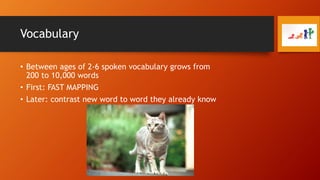
• Between ages of 2-6 spoken vocabulary grows from
200 to 10,000 words
• First: FAST MAPPING

• Later: contrast new word to word they already know
Children will make guesses
• When do kids make guesses?
• When do kids have biases?
• Why do we care about these biases?

Role of adults:
• Recast/model for kids
• Expand
• Listen attentively
• Stimulate child to talk further
Mutual Exclusivity Bias
• 1990 study by Au and Glusman
• Mido / Theri
• Shape Bias - first several hundred nouns are refer to objects wellorganized by shape
• Whole-object Assumption
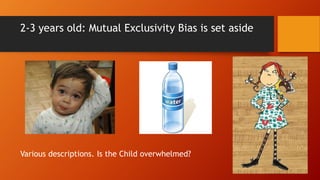
2-3 years old: Mutual Exclusivity Bias is set aside

Various descriptions. Is the Child overwhelmed?
Age 3 and further: new properties start to
make sense
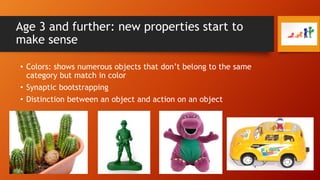
• Colors: shows numerous objects that don’t belong to the same
category but match in color
• Synaptic bootstrapping

• Distinction between an object and action on an object
Also by 3 years and further
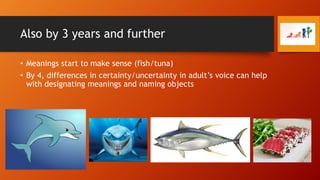
• Meanings start to make sense (fish/tuna)
• By 4, differences in certainty/uncertainty in adult’s voice can help
with designating meanings and naming objects
3 years: combing words they know to
describe once they don’t
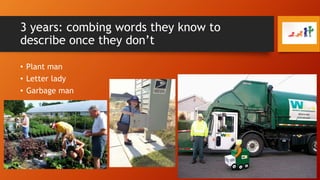
• Plant man
• Letter lady
• Garbage man
Child begins to use metaphors
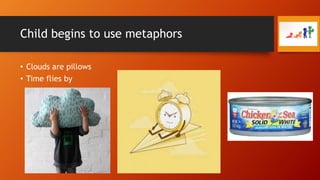
• Clouds are pillows
• Time flies by
Grammar
• Between ages 2-3 English speaking kids use simple sentences that follow subjectverb-object word order
• Basic Rules:
1. Children look to adults as speech models
2. Up until ages 3-4 children apply subject-verb-object with the verbs they've
learned
3. At this age they also master plural form, and some tenses and prepositions
4. Some children have problems with overregularization, which is the extension
of grammatical rules to words that are exceptions.
Complex Structures
• Questions still remain a variable after ages 2-3
• Children at this age also have trouble with subject-verb agreement
and subject-case
• By the end of the child's preschool years most the use of grammatical
constructions are made but it's not until middle childhood that passive
expressions are mastered and applied
Explaining Grammatical Development
• Chomsky's language acquisition device (lad )
assumes that kids have instinct on using
grammatical rules.
• Experts believe that language is part of cognitive
development

• Children use word meanings to figure
grammatical rules this is called semantic
boosting
Conversation
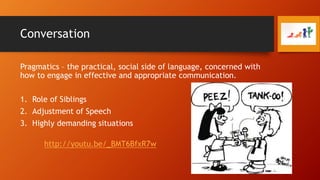
Pragmatics – the practical, social side of language, concerned with
how to engage in effective and appropriate communication.

1. Role of Siblings
2. Adjustment of Speech
3. Highly demanding situations
http://youtu.be/_BMT6BfxR7w
Supporting Language learning
•
•
•
•

Conversations
Variety of grammar
Read books
Outings i.e. Museums etc.

Say Peanut Butter
http://youtu.be/w4GjPlR6BAE

Language development in early childhood

  • 1.
    Language Development in EarlyChildhood Angel Mendez Ale Monroy Dmitry Olshansky
  • 2.
    Vocabulary • Between agesof 2-6 spoken vocabulary grows from 200 to 10,000 words • First: FAST MAPPING • Later: contrast new word to word they already know
  • 3.
    Children will makeguesses • When do kids make guesses? • When do kids have biases? • Why do we care about these biases? Role of adults: • Recast/model for kids • Expand • Listen attentively • Stimulate child to talk further
  • 4.
    Mutual Exclusivity Bias •1990 study by Au and Glusman • Mido / Theri • Shape Bias - first several hundred nouns are refer to objects wellorganized by shape • Whole-object Assumption
  • 5.
    2-3 years old:Mutual Exclusivity Bias is set aside Various descriptions. Is the Child overwhelmed?
  • 6.
    Age 3 andfurther: new properties start to make sense • Colors: shows numerous objects that don’t belong to the same category but match in color • Synaptic bootstrapping • Distinction between an object and action on an object
  • 7.
    Also by 3years and further • Meanings start to make sense (fish/tuna) • By 4, differences in certainty/uncertainty in adult’s voice can help with designating meanings and naming objects
  • 8.
    3 years: combingwords they know to describe once they don’t • Plant man • Letter lady • Garbage man
  • 9.
    Child begins touse metaphors • Clouds are pillows • Time flies by
  • 10.
    Grammar • Between ages2-3 English speaking kids use simple sentences that follow subjectverb-object word order • Basic Rules: 1. Children look to adults as speech models 2. Up until ages 3-4 children apply subject-verb-object with the verbs they've learned 3. At this age they also master plural form, and some tenses and prepositions 4. Some children have problems with overregularization, which is the extension of grammatical rules to words that are exceptions.
  • 11.
    Complex Structures • Questionsstill remain a variable after ages 2-3 • Children at this age also have trouble with subject-verb agreement and subject-case • By the end of the child's preschool years most the use of grammatical constructions are made but it's not until middle childhood that passive expressions are mastered and applied
  • 12.
    Explaining Grammatical Development •Chomsky's language acquisition device (lad ) assumes that kids have instinct on using grammatical rules. • Experts believe that language is part of cognitive development • Children use word meanings to figure grammatical rules this is called semantic boosting
  • 13.
    Conversation Pragmatics – thepractical, social side of language, concerned with how to engage in effective and appropriate communication. 1. Role of Siblings 2. Adjustment of Speech 3. Highly demanding situations http://youtu.be/_BMT6BfxR7w
  • 14.
    Supporting Language learning • • • • Conversations Varietyof grammar Read books Outings i.e. Museums etc. Say Peanut Butter http://youtu.be/w4GjPlR6BAE