1. Piaget’s Theory
“’Theprinciple goal of education is to create men who are capable of doing
new things, not simply of repeating what other generations have done men
who are creative, inventive and discoverers."
-Jean Piaget
4.
1. Piaget’s Theory
Forsixty years, Jean Piaget conducted research on cognitive development. His
research method involved observing a small number of individuals as they responded
to cognitive tasks that he designed. These tasks were later known as Piagetian
tasks.
Piaget called his general theoretical framework "genetic epistemology" because he
was interested in how knowledge developed in human organisms.
Piaget examined the implications of his theory not only to aspects of cognition but
also se intelligence and moral development. His theory has been applied widely to
teaching and curriculum design specially the preschool and elementary curricula.
5.
Basic Cognitive Concepts
1.Schema.Piaget used the term "schema" to refer to the
cognitive structures by which individuals intellectually adapt to
and organize they environment. It is an individual's way to
understand or create meaning about a thing or experience. It
is like the mind has a fitting cabinet, and coach drawer has
folders that contain files of things he has had a experience
with.
6.
Basic Cognitive Concepts
2.Assimilation.This is the process of fitting a new
experience into an existing or previously created
cognitive structure or schema. If the child sees another
dog, this time a little smaller one, he would make sense
of what he is seeing by adding this new information (a
different looking dog) into his schema of a dog.
7.
Basic Cognitive Concepts
3.Accommodation.This is the process of creating a new schema If the
same child now sees another animal that looks a little bit like dog, but
somehow different. He might try to fit it into his schema of a dog, and
say, "Look mommy, what a funny looking dog. Its bark is funny too!"
Then the mommy explains. "That's not a funny looking dog That's a
goat!" With mommy's further descriptions, the child will now create a
new schema, that of a goat. He now adds a new file in his filing cabinet.
8.
Basic Cognitive Concepts
4.Equilibration.Piaget believed that that people have the natural need
to understand how the world works and to find order, structure and
predictability in their life. Equilibration is achieving proper balance
between assimilation and accommodation. When our experiences do
not match our schemata (plural of schema) or cognitive structures, we
experience cognitive disequilibrium. This means there is a discrepancy
between what is perceived and what is understood. We then exert
effort through assimilation and accommodation to establish
equilibrium once more.
9.
Paget's Stages ofCognitive Development
Stage 1. Sensori-motor Stage. (birth-infancy) Grasping, sucking and
reaching becomes more organized in his movement and activity. The
term sensori-motor focuses on the prominence of the senses and
muscle movement through which the infant comes to learn about
himself and the world. In working with children in the sensori-motor
stage, teachers should aim to provide a rich and stimulating
environment with appropriate objects to play with.
Object permanence. This is the ability of the child to know that an object still
exists even when out of sight. This ability is attained in the sensory motor stage.
10.
Piaget's Stages ofCognitive Development
Stage 2. Pre-Operational Stage. (2-7) roughly corresponding to the preschool
years. Intelligence at this stage is intuitive in nature. Child can now make mental
representations and is able to pretend, the child is now ever closer to the use of
symbols. This stage is highlighted by the following:
1. Symbolic Function. This is the ability to represent objects and events. A symbol
is a thing that represents something else. A drawing, a written word, or a spoken
word comes to be understood as representing a real object Symbolic function
gradually develops in the period between 2 to 7 years.
11.
Piaget's Stages ofCognitive Development
By the age of 6 of 7 the child can pretend play with objects that exist
only in his mind
Example:
1.Nico, may, after pretending to drink from an empty glass, turns the
glass into a rocket ship or a telephone
2.Enzo, who is six, can do a whole ninja turtle routine without any
costume nor "props".
12.
Piaget's Stages ofCognitive Development
3.Egocentrism. This is the tendency of the child to only see his point of view and to assume
that everyone also has his same point of view.
EXAMPLE: Three year old girl who cannot understand why her cousins call her daddy "uncle"
and not daddy.
4. Centration. This refers to the tendency of the child to only focus on one aspect of a thing or
event and exclude other aspects.
EXAMPLE: When a child is presented with two identical glasses with the same amount of water,
the child will say they have the same amount of water. However, once water from one of the
glasses is transferred to an obviously taller but narrower glass, the child might say that there is
more water in the taller glass.
13.
Piaget's Stages ofCognitive Development
5. Irreversibility. Pre-operational children still have the inability to reverse their thinking.
They can understand that 23 is 5, but cannot understand that 5-3 is 2. Animism.
EXAMPLE: When at night, the child is asked, where the sun is, she will reply. "Mr. Sun is
asleep".
6. Transductive reasoning. This refers to the pre-operational child's type of reasoning that
is neither inductive nor deductive. Reasoning appears to be from particular to particular
EXAMPLE: If A causes B, then B causes A. For example, since her mommy comes home
everyday around six o' clock in the evening, when asked why it is already night, the child
will say. "because my mom is already home."
14.
Piaget's Stages ofCognitive Development
7.Irreversibility. Pre-operational children still have the inability to reverse their thinking.
They can understand that 23 is 5, but cannot understand that 5-3 is 2. Animism.
EXAMPLE: When at night, the child is asked, where the sun is, she will reply. "Mr. Sun is
asleep".
8.Transductive reasoning. This refers to the pre-operational child's type of reasoning that is
neither inductive nor deductive. Reasoning appears to be from particular to particular
EXAMPLE: If A causes B, then B causes A. For example, since her mommy comes home
everyday around six o' clock in the evening, when asked why it is already night, the child
will say. "because my mom is already home."
15.
Piaget's Stages ofCognitive Development
Stage 3. Concrete-Operational Stage. This stage is characterized by the
ability of the child to think logically but only in terms of concrete
objects. This covers approximately the ages between 8-11 years or the
elementary school years. The concrete operational stage is marked by
the following:
1.Decentering. This refers to the ability of the child to perceive the
different features of objects and situations. No longer is the child
focused or limited to one aspect or dimension.
16.
Piaget's Stages ofCognitive Development
2.Reversibility. During the stage of concrete operations, the child can
now follow that certain operations can be done in reverse.
EXAMPLE: They can already comprehend the com mutative property of
addition, and that subtraction is the reverse of addition.
3.Conservation. This is the ability to know that certain properties of objects like
number, mass, volume, or area do not change even if there is a change in
appearance.
Child can now judge rightly that the amount of water in a taller but narrower
container is still the same as when the water was in the shorter but wider glass.
17.
Piaget's Stages ofCognitive Development
4.Seriation. This refers to the ability to order or arrange things
in a series based on one dimension such as weight, volume or
size.
18.
Piaget's Stages ofCognitive Development
Stage 4. Formal Operational Stage, In the final stage of formal operations
covering ages between 12 and 15 years, thinking becomes more logical. They can
now solve abstract problems and can hypothesize. This stage is characterized by
the follow- ing:
1. Hypothetical Reasoning. This is the ability to come up with different hypothesis
about a problem and to gather and weigh data in order to make a final decision or
judgment. This can be done in the absence of concrete objects.
EXAMPLE: "What if" questions.
19.
Piaget's Stages ofCognitive Development
2.Analogical reasoning. This is the ability to perceive the relationship in one
instance and then use that relationship to narrow down possible answers in
another similar situation or problem.
EXAMPLE: UK : EUROPE , PHILIPPINES : __________
3. Deductive Reasoning. This is the ability to think logically by applying a general
rule to a particular instance or situation.
EXAMPLE: All countries near the north pole have cold temperatures. Greenland is
near the North pole. Therefore, Greenland has cold temperature.
20.
2. Vygotsky’s Socio-culturalTheory
What a child can do in cooperation today, tomorrow she/he will be
able to do alone
-Lev Vygotsky
21.
Vygotsky’s Socio-cultural Theory
WhenVygotsky was a young boy he was educated under a teacher who
used the Socratic method. This method was a systematic question and
answer approach that allowed Vygotsky to examine current thinking
and practice higher levels of understanding. This experience. together
with his interest in literature and his work as a teacher, led him to
recognize social interaction and language as two central factors in
cognitive development. His theory became known as the Socio-Cultural
Theory of Development.
22.
Vygotsky’s Socio-cultural Theory
1.Social Interaction. Piaget's theory was more individual, while Vygotsky was
more social Plaget's work on Piagetian's tasks focused heavily on how an
individual's cognitive development became evident through the individual's own
processing of the tasks.
Vygotsky, on the other hand gave more weight on the social interactions that
contributed to the cognitive development of individuals. For him, the social
environment or the community takes on a major role in one's development.
They explain, model, assist, give directions and provide feedback to the leamer.
Peers, on the other hand, cooperate and collaborate and enrich the learning
experience.
23.
Vygotsky’s Socio-cultural Theory
2.Culturalfactors. Vygotsky believed in the crucial role that culture played on the
cognitive development of children.
Vygotsky, on the other hand, looked into the wide range of experiences that a
culture would give to a child. For instance, one culture's view about education,
how children are trained early in life all can contribute to the cognitive
development of the child.
3. Language. Language opens the door for learners to acquire knowledge that
others already have. Learners can use language to know and understand the
world and solve problems. Language serves a social function but it also has an
important individual function. It helps the learner regulate and reflect on his own
thinking.
24.
Vygotsky’s Socio-cultural Theory
EXAMPLE:preschoolers play and you may hear, "Gagawin ko itong airplane
(holding a rectangular block), tapos ito ang airport (holding two long blocks)."
For Vygotsky, this "talking-to-oneself is an indication of the thinking that goes on
in the mind of the child. This will eventually lead to private speech. Private
speech is a form of self-talk that guides the child's thinking and action. Vygotsky
believed in the essential role of activities in learning Children learn best through
hands-on activities than when listening passively. Leaming by doing is even made
more fruitful when children interact with knowledgeable adults and peers.
25.
Vygotsky’s Socio-cultural Theory
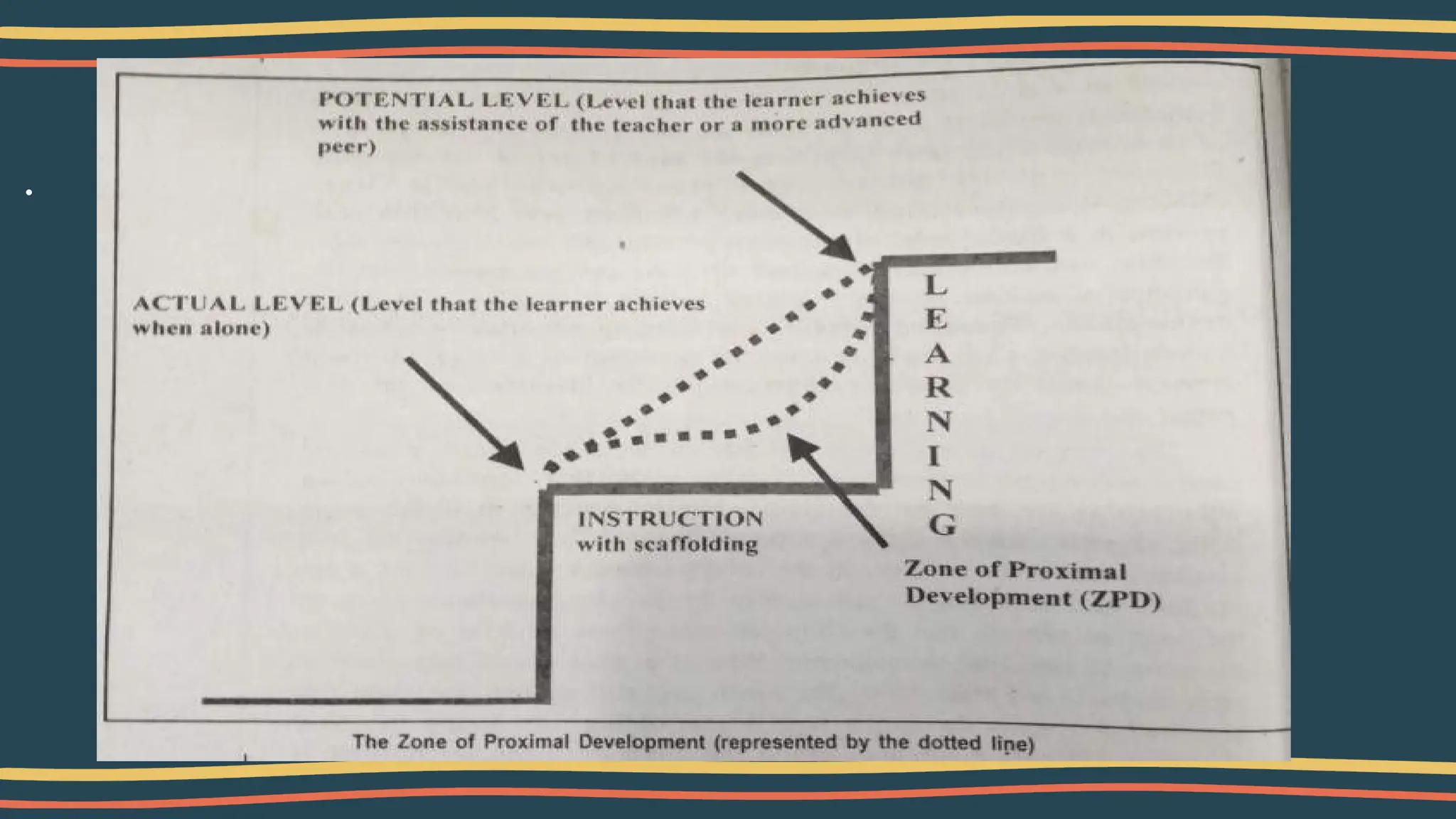
4.Zone Proximal Development
When a child attempts to perform a skill alone, she may not be immediately
proficient at it. So, alone she may perform at a certain level of competency. We
refer to this as the zone of actual development. However, with the guidance of a
More Knowledgeable Other (MKO), competent adult or a more advanced peer,
the child can perform at a higher level of competency.
The difference between what the child can accomplish alone and what she can
accomplish with the guidance of another is what Vygotsky referred to as zone of
proximal development. The zone represents a learning opportunity where a
knowledgeable adult such as a teacher or parent or a more advanced peer can
assist the child's development.
26.
Vygotsky’s Socio-cultural Theory
Thesupport or assistance that lets the child accomplish a task he cannot
accomplish independently is called scaffolding.
Scaffolding is not about doing the task for the child while he watches. It is not
about doing shortcuts for the child.
Unzipping the lunch bag, opening the food container and putting straw in the
child's tetrapack juice for him is not scaffolding
When the adult unzips the zipper an inch or two, and then holds the lunch bag
still so that the child can continue to unzip the lunch bag is scaffolding. Loosening
the food container lid just a bit and letting the child open the lid himself is
scaffolding.
27.
Vygotsky’s Socio-cultural Theory
Theinstructor should scaffold in such a way that the gap is bridged
between the learner's current skill levels and the desired skill level. As
learners become more proficient, able to complete tasks on their own
that they could not initially do without assistance, the guidance can be
withdrawn. This is called scaffold and fade-away technique.
Scaffolding, when done appropriately can make a learner confident and
eventually he can accomplish the task without any need for assistance.
Vygotsky’s Socio-cultural Theory
Piagetand Vygotsky
Vygotsky worked on his theory around the same time as Piaget
in between the 1920' and 30's but they had clear differences in
their views about cognitive development. Since Piaget was
taken up already in the preceding module, it would be easier
now to see how his views compare with Vygotsky's.
.
30.
Vygotsky’s Socio-cultural Theory
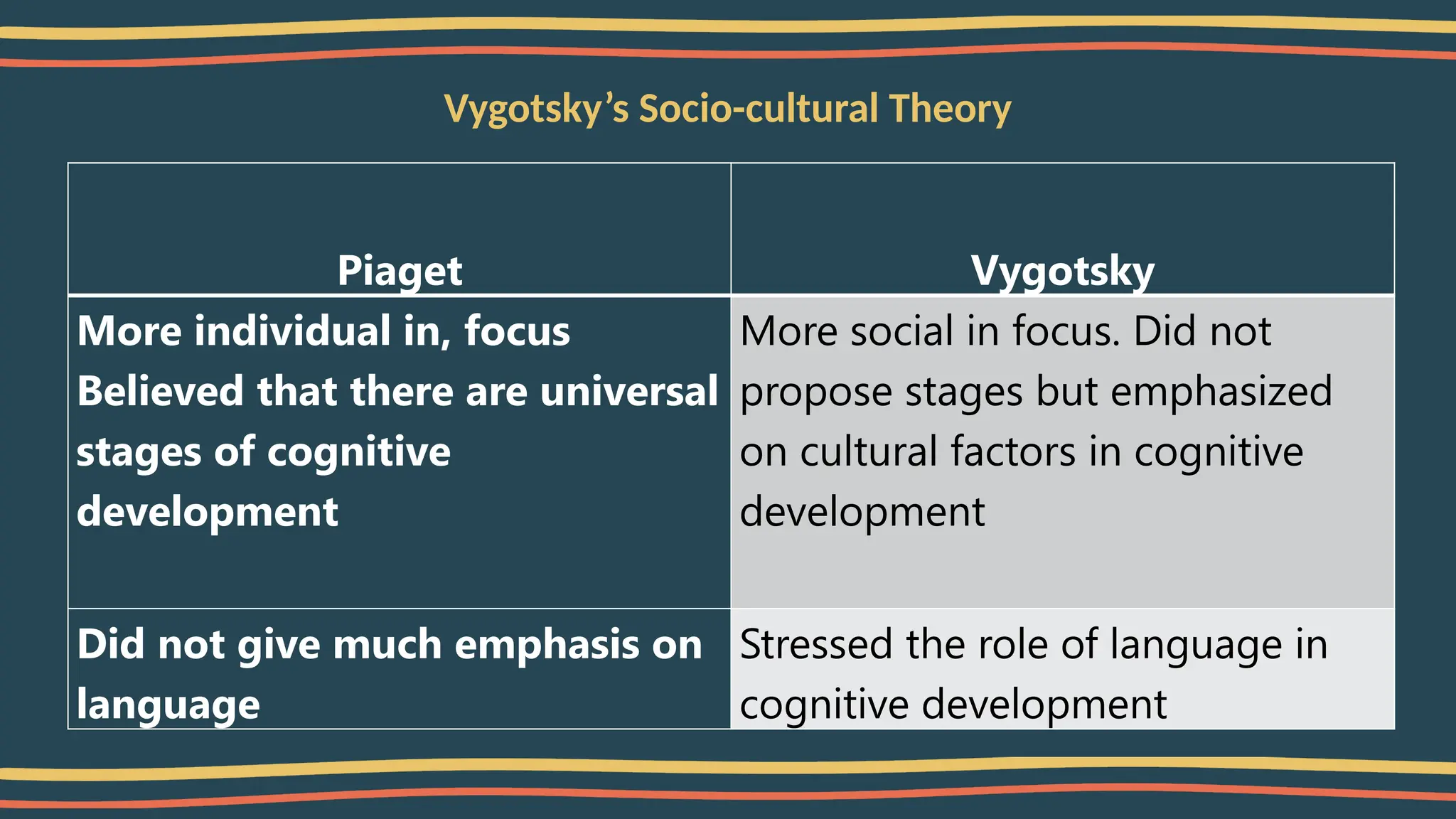
PiagetVygotsky
More individual in, focus
Believed that there are universal
stages of cognitive
development
More social in focus. Did not
propose stages but emphasized
on cultural factors in cognitive
development
Did not give much emphasis on
language
Stressed the role of language in
cognitive development
1. Concept ofIntelligence
(Alfred Binet)
Alfred Binet
A French psychologist, defined intelligence as a combination of reasoning,
judgment, memory, and the ability to abstract. Binet’s theory of intelligence
was based on the idea that intelligence could be measured by comparing a
child’s performance to that of other children of the same age.
It is primarily associated with his development of the first practical intelligence
test, which aimed to measure a person’s intellectual ability in a way that could
guide educational interventions.
33.
1. Concept ofIntelligence
(Alfred Binet)
His views on intelligence:
Intelligence as a Set of Abilities
Focus on Mental Age
The Role of Age in Intellectual Development
Critique of Innate Intelligence
Practical Purpose of Intelligence Testing
The Concept of “Intelligence” as a Fluid Trait
The Role of Judgment and Problem Solving
34.
1. Concept ofIntelligence
(Alfred Binet)
1.Intelligence as a Set of Abilities Binet viewed intelligence not as a
single, fixed trait, but as a set of cognitive abilities that could be
measured and developed.
2. Focus on Mental Age Binet's most famous contribution was the
concept of "mental age" (MA). He proposed that a child's intellectual
development could be assessed in terms of how well they
performed on tasks typical of various age groups.
35.
1. Concept ofIntelligence
(Alfred Binet)
3. The Role of Age in Intellectual Development Binet emphasized
that intelligence develops with age and that children of different
ages would show different intellectual abilities.
4. Critique of Innate Intelligence Binet rejected the notion that
intelligence was fixed or purely genetic. Instead, he believed that
intelligence could be nurtured and developed through education.
36.
1. Concept ofIntelligence
(Alfred Binet)
5. Practical Purpose of Intelligence Testing Binet developed his intelligence test
with a clear educational purpose in mind. The goal was not to rank individuals
but to identify children who were struggling and might benefit from additional
educational resources.
6. The Concept of "Intelligence" as a Fluid Trait Binet believed that intelligence
was not a rigid, unchangeable quality but rather something that could evolve
over time.
7. The Role of Judgment and Problem Solving Binet believed that intelligence
was closely tied to the ability to make judgments, reason logically, and solve
problems.
2. General intelligence
(CHARLE’SSPEARMAN)
Charles Spearman
-was born on September 10th 1863 in London, England and died
September 17th, 1945. Spearman believed we have one general
intelligence which was known as g. This g was used in factor analysis,
a theory that he helped developed. Factor analysis is a statistical
procedure that breaks down test scores in identifying areas of
intelligence. All in all he helped pioneer theories of general
intelligence and factor analysis.
39.
2. General intelligence
(CHARLE’SSPEARMAN)
G-factor (general intelligence)
- reflects the capability of a person in doing the general mental
ability tasks.
S-factor (specific intelligence)
- responsible for recognizing the specific abilities of a person.
40.
2. General intelligence
(CHARLE’SSPEARMAN)
COMPONENTS OF GENERAL INTELLIGENCE:
Fluid reasoning: This involves the ability to think flexibly and solve problems.
Knowledge: This is a person's general understanding of a wide range of topics and can be
equated with crystallized intelligence.
Quantitative reasoning: This is an individual's capacity to solve problems that involve
numbers.
Visual-spatial processing: This relates to a person's abilities to interpret and manipulate visual
information, such as putting together puzzles and copying complex shapes.
Working memory: This involves the use of short-term memory such as being able to repeat a
list of items.
41.
2. General intelligence
(CHARLE’SSPEARMAN)
Impact of General Intelligence
While the concept of intelligence is still the subject of debate within psychology,
researchers believe that general intelligence is correlated with overall success in
life. Some of the effects that it may have on an individual's life include areas such
as:
Academic Achievement
Job Success
Health and Longevity
Income
42.
2. General intelligence
(CHARLE’SSPEARMAN)
Challenges of General Intelligence
The notion that intelligence could be measured and summarized
by a single number on an IQ test was controversial, even during
Spearman's time. IQ and intelligence testing have remained
topics of debate ever since. While influential, the g factor is just
one way of thinking about intelligence.
3. Primary MentalAbilities
( Thurstone )
Primary Mental Abilities = Refer to the fundamental cognitive abilities
that underlie human intelligence.
Louise Leon Thurstone = Proposed theory in 1930's that intelligence is
composed of several different factors.
3. Primary MentalAbilities
( Thurstone )
1. Verbal comprehension The ability to understand and interpret written
and spoken Language, involving vocabulary, syntax, semantics and
inference.
2. Verbal fluency Quickly generate words fitting specific criteria, such as
category, letter or sound.
3. Number facility The ability to perform mathematical calculations,
reasons numerically, and interpret quantitive data with speed and accuracy.
4. Spatial Visualization Mentally manipulate and understand objects ,
spaces and relationships in three dimension.
47.
3. Primary MentalAbilities
( Thurstone )
5. Perceptual speed = Quickly and accurately process and
identify visual information .
6. Memory = The mental capacity to encode, store and
retrieve information, encompassing shot - term, long - term,
sensory and working memory.
7. Inductive Reasoning = Drawing logical conclusions fron
specific observations to make generalization
4. Multiple Intelligences
(HowardGardner)
What is Multiple Intelligences Theory?
Proposes that people are not born with all of the intelligence they
will ever have.
Challenged the traditional notion that there is one single type of
intelligence, sometimes known as "g" for general intelligence, that
only focuses on cognitive abilities
Gardner notes that the linguistic and logical- mathematical
modalities are most typed valued in school and society.
50.
4. Multiple Intelligences
(HowardGardner)
• Gardner also suggests that there may other "candidate"
intelligences such as spiritual intelligence, existential
intelligence, and moral intelligence-but does not believe
these meet his original inclusion criteria. (Gardner, 2011)
Gardner developed a series of eight inclusion criteria while
evaluating each "candidate" intelligence that was based on a
variety of scientific disciplines.
51.
4. Multiple Intelligences
(HowardGardner)
1. Linguistic Intelligence ("word smart")
Odeals with sensitivity to the spoken and written language, ability to
learn languages, and capacity to use language to accomplish certain
goals.
OPeople with linguistic intelligence, such as William Shakespeare
and Oprah Winfrey, have an ability to analyse information and
create products involving oral and written language such as
speeches, books, and memos.
52.
4. Multiple Intelligences
(HowardGardner)
2. Logical-Mathematical Intelligence ("number/reasoning smart")
ORefers to the capacity to analyse problems logically, carry out
mathematical operations, and investigate issues scientifically.
OPeople with logical-mathematical intelligence, such as Albert
Einstein and Bill Gates, have an ability to develop equations and
proofs, make calculations, and solve abstract problems.
53.
4. Multiple Intelligences
(HowardGardner)
3. Spatial Intelligence ("picture smart")
Spatial intelligence features the potential to recognize and manipulate the
patterns of wide space (those used, for instance, by navigators and pilots) as
well as the patterns of more confined areas, such as those of importance to
sculptors, surgeons, chess players, graphic artists, or architects.
People with spatial intelligence, such as Frank Lloyd Wright and Amelia
Earhart, have an ability to recognize and manipulate large- scale and fine-
grained spatial images
54.
4. Multiple Intelligences
(HowardGardner)
4. Bodily-Kinesthetic Intelligence ("body smart")
Bodily kinesthetic intelligence is the potential of using one's whole
body or parts of the body (like the hand or the mouth) to solve
problems or to fashion products.
People with bodily-kinesthetic intelligence, such as Michael Jordan
and Simone Biles, have an ability to use one's own body to create
products, perform skills, or solve problems through mind- body
union.
55.
4. Multiple Intelligences
(HowardGardner)
5. Musical Intelligence ("music smart")
Musical intelligence refers to the skill in the performance,
composition, and appreciation of musical patterns.
People with musical intelligence, such as Beethoven and Ed Sheeran,
have an ability to recognize and create musical pitch, rhythm,
timbre, and tone
56.
4. Multiple Intelligences
(HowardGardner)
6. Interpersonal Intelligence ("people smart")
lnterpersonal intelligence is the capacity to understand the
intentions, motivations, and desires of other people and
consequently to work effectively with others
People with interpersonal intelligence, such as Mahatma Gandhi and
Mother Teresa, have an ability to recognize and understand other
people's moods, desires, motivations, and intentions.
57.
4. Multiple Intelligences
(HowardGardner)
7. Intrapersonal Intelligence ("self smart")
lntrapersonal intelligerte is the capacity to understand oneself, to have an
effective working model of oneself- including owns desires, fears, and
capacities and to use such information effectively in regulating one's own life.
People with intrapersonal intelligence, such as Aristotle and Maya Angelou,
have an ability to recognize and understand his or her own moods, desires,
motivations, and intentions.
This type of intelligence can help a person to understand which life goals are
important and how to achieve them
58.
4. Multiple Intelligences
(HowardGardner)
Implications for learning
A common misconception about the theory of multiple intelligences is that it
is synonymous with learning styles. Gardner states that learning styles refer to
the way an individual is most comfortable approaching a range of tasks and
materials.
Multiple intelligences theory states that everyone has all eight intelligences at
varying degrees of proficiency and an individual's learning style is unrelated to
the areas in which they are the most intelligent.
59.
4. Multiple Intelligences
(HowardGardner)
Research shows that students are more engaged and learn best when they are
given various ways to demonstrate their knowledge and skills, which also
helps teachers more accurately assess student learning (Darling-Hammond,
2010).
The biggest mistake of past centuries in teaching has been to treat all students as if
they were variants of the same individual and thus to feel justified in teaching them
all the same subjects the same way.
- Howard Gardner
4. Multiple Intelligences
(HowardGardner)
-is a theory that describes intelligence as a combination of three distinct types of
intelligence:
Practical intelligence
The ability to adapt to and change one's environment to suit their needs. This is
also known as street smarts.
Creative intelligence
The ability to come up with new ideas and solve new problems using past
experiences. This is also known as experiential intelligence.
62.
4. Multiple Intelligences
(HowardGardner)
Analytical intelligence
The ability to process and analyze information. This is also known as
componential intelligence.
The triarchic theory of intelligence was developed by psychologist Robert J.
Sternberg as an alternative to the concept of general intelligence.
The theory is based on the idea that intelligence is the ability to succeed in life
based on one's standards and sociocultural setting. The triarchic theory is made
up of three subtheories: contextual, experiential, and componential. Each
subtheory corresponds to one of the three types of intelligence.
4. Multiple Intelligences
(HowardGardner)
Richard Atkinson and Richard Shiffrin proposed the Cognitive
Information Processing (CIP) theory, also known as the
Atkinson-Shiffrin model, in 1968.
This theory explains how people process and store
information, comparing the human mind to a computer with
three main components:
65.
4. Multiple Intelligences
(HowardGardner)
1. Sensory Memory:
• This is where information from the environment (what you see, hear, feel, etc.)
first enters.
• It lasts for only a few seconds.
Example: Seeing a flash of light or hearing someone call your name
. 2. Short-Term Memory (STM):
• Also known as working memory.
• Can hold approximately seven items of information for 15 to 30 seconds.
Example: Remembering a phone number before dialing it.
66.
4. Multiple Intelligences
(HowardGardner)
3. Long-Term Memory (LTM):
• This stores information permanently for later use
. • Information here is organized and retrieved when needed.
Examples:
1. Remembering lessons from past classes or personal experiences.
2. Your happy childhood moments, or even just your birthdays.
67.
4. Multiple Intelligences
(HowardGardner)
How It Works:
1. Information enters through sensory memory
2. If you pay attention, it moves to short-term memory. 3. Through rehearsal (repeating or
connecting ideas), it transfers to long-term memory. Retrieval brings information from long-
term memory back when needed.
Key Takeaways:
• Focus and repetition help improve memory.
• Distractions can stop information from reaching long-term memory.
• Learning happens when you process information deeply (e.g., understanding instead of just
memorizing).
68.
C. Factors affectingCognitive
Development
D.Language development
-is the process by which children
learn to understand and
communicate language. It begins
before birth and continues
throughout a child's life:
69.
Factors affecting CognitiveDevelopment
Language development
Infancy
Babies start to recognize speech patterns in their mother's voice in utero. By
10 months, they can distinguish speech sounds and start babbling.
Toddlerhood
Children typically have a vocabulary of around 200 words by the time they
become toddlers. They start to put words together in short phrases, which is
called the naming explosion.
70.
Factors affecting CognitiveDevelopment
Language development
Elementary school
Children continue to expand their spoken language and start learning to
read and write.
Middle school Children
continue to improve their vocabulary and grammar, and their writing
becomes more complex.
71.
Factors affecting CognitiveDevelopment
Language development
Language development is influenced by many factors, including:
• Environment: Children develop best in environments with lots of
sounds and sights, and consistent exposure to speech and language.
• Motivation: A child's motivation can influence their language learning.
Gender: A child's gender can influence their language learning.
• Physical development: A child's physical development can influence
their language learning.
E. Factors thataffecting cognitive and
language development
I. Genetic Factors
1. Genetic predispositions- Inherited traits
influencing intelligence and language ability.
2. Chromosomal abnormalities- Conditions like
Down syndrome affecting cognitive development.
74.
E. Factors thataffecting cognitive and
language development
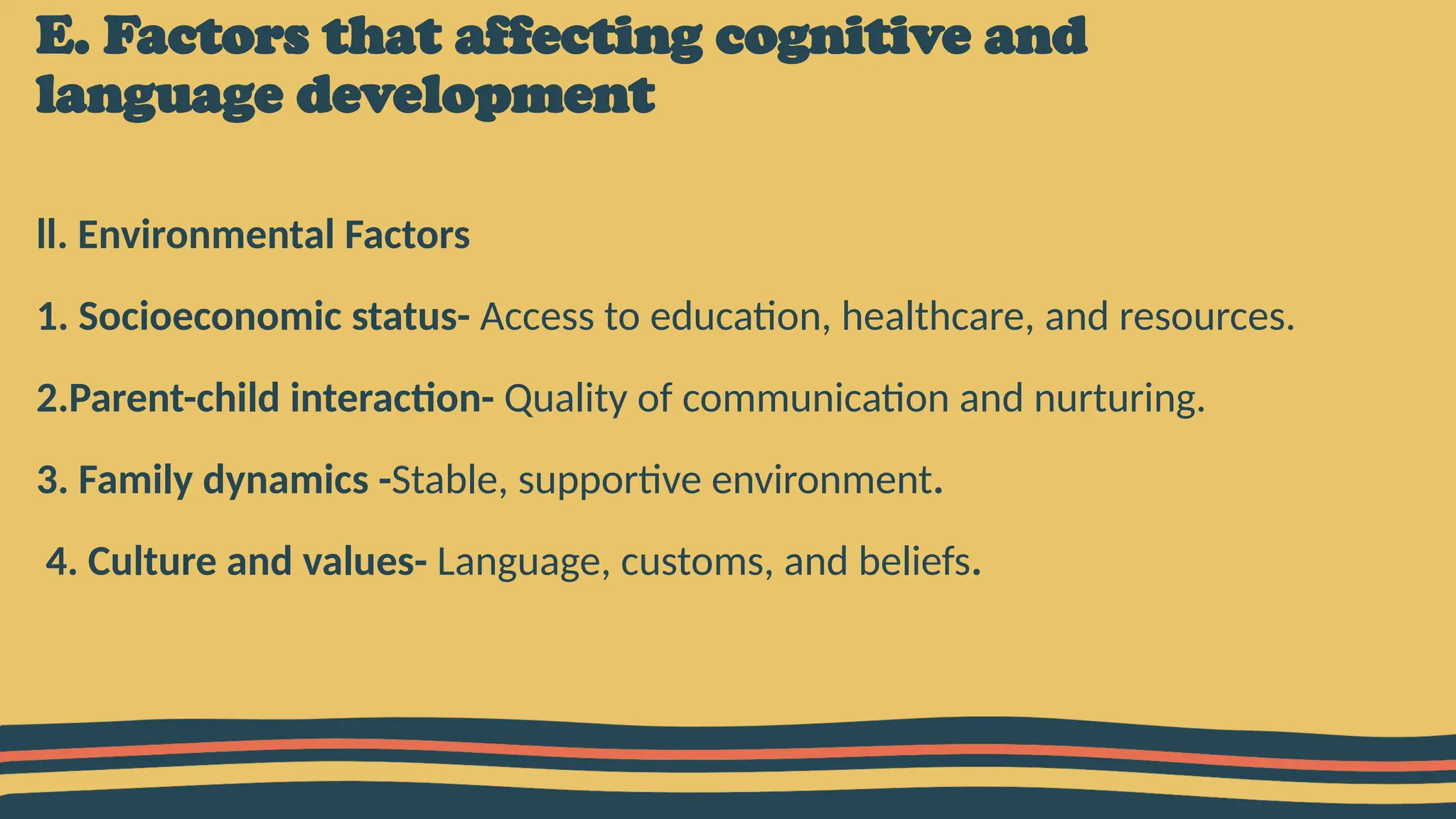
ll. Environmental Factors
1. Socioeconomic status- Access to education, healthcare, and resources.
2.Parent-child interaction- Quality of communication and nurturing.
3. Family dynamics -Stable, supportive environment.
4. Culture and values- Language, customs, and beliefs.
75.
E. Factors thataffecting cognitive and
language development
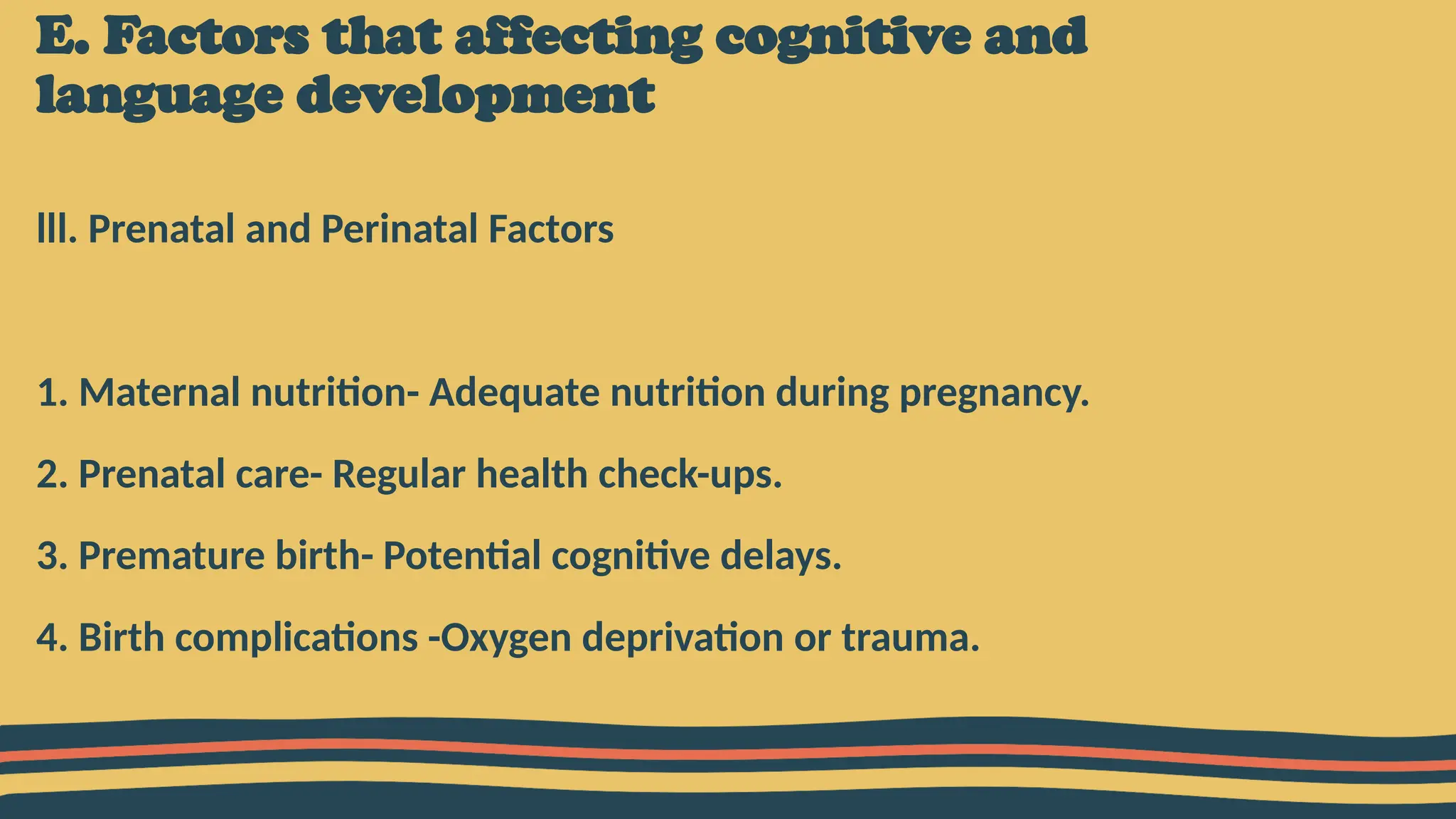
lll. Prenatal and Perinatal Factors
1. Maternal nutrition- Adequate nutrition during pregnancy.
2. Prenatal care- Regular health check-ups.
3. Premature birth- Potential cognitive delays.
4. Birth complications -Oxygen deprivation or trauma.
76.
E. Factors thataffecting cognitive and
language development
lll. Prenatal and Perinatal Factors
1. Maternal nutrition- Adequate nutrition during pregnancy.
2. Prenatal care- Regular health check-ups.
3. Premature birth- Potential cognitive delays.
4. Birth complications -Oxygen deprivation or trauma.
77.
E. Factors thataffecting cognitive and
language development
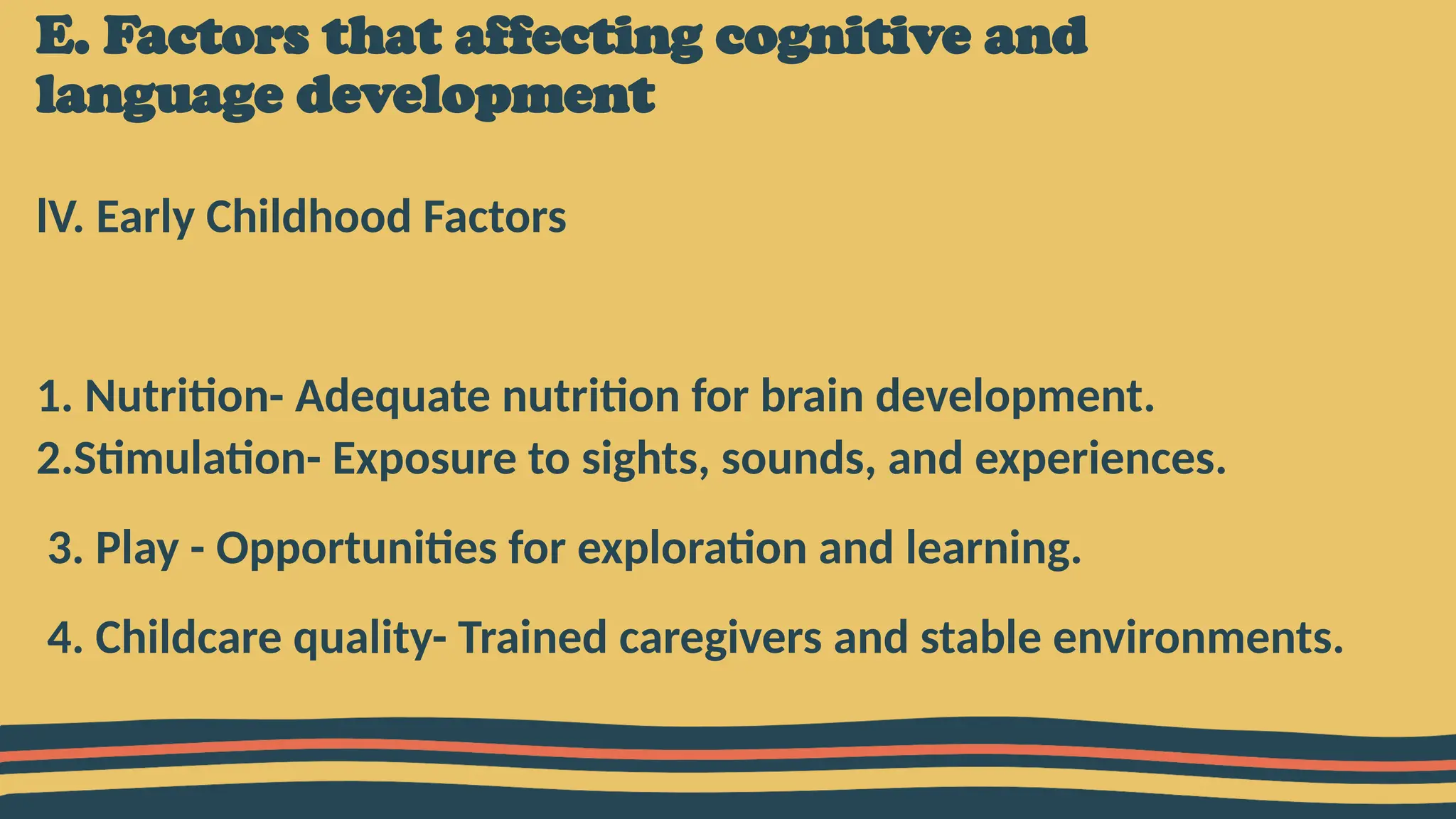
lV. Early Childhood Factors
1. Nutrition- Adequate nutrition for brain development.
2.Stimulation- Exposure to sights, sounds, and experiences.
3. Play - Opportunities for exploration and learning.
4. Childcare quality- Trained caregivers and stable environments.
78.
E. Factors thataffecting cognitive and
language development
Keep in mind that these factors interact and influence
one another. A comprehensive understanding of these
factors can help support healthy cognitive and
language development.
79.
F. Current Researchand Pedagogical
Applications
EDAGOGY MOST COMMONLY UNDERSTOOD AS THE APPROACH TO TEACHING, IS
THE THEORY AND PRACTICE OF LEARNING, AND HOW THIS PROCESS
INFLUENCES, AND IS INFLUENCED BY, THE SOCIAL, POLITICAL AND
PSYCHOLOGICAL DEVELOPMENT OF LEARNERS.
PEDAGOGY, TAKEN AS AN ACADEMIC DISCIPLINE, IS THE STUDY OF HOW
KNOWLEDGE AND SKILLS ARE IMPARTED IN AN EDUCATIONAL CONTEXT, AND IT
CONSIDERS THE INTERACTIONS THAT TAKE PLACE DURING LEARNING.
80.
F. Current Researchand Pedagogical Applications
Cognitive Development
Cognitive development is how humans acquire, organize, and learn to use
knowledge (Gauvain & Richert, 2016). In psychology, the focus of cognitive
development has often been only on childhood. However, cognitive
development continues through adolescence and adulthood. It involves
acquiring language and knowledge, thinking, memory, decision making.
problem solving, and exploration (Von Eckardt, 1996). Much of the
research within cognitive development in children focuses on thinking,
developing knowledge, exploring, and solving problems (Carpendale &
Lewis, 2015).
81.
F. Current Researchand Pedagogical Applications
Pedagogical Applications Cognitive Development
Connects with assets that is needed. to present
Create cognitive psychology based on the learning process.
82.
F. Current Researchand Pedagogical Applications
Pedagogical Content Knowledge(PCK)
Pedagogical content knowledge is the combining of pedagogy and subject content
knowledge which Shulman re-emphasized in the 1980s.
Lee Shulman was a teacher education researcher who worked towards expanding and
improving knowledge about teaching and teacher preparation. He posited that simply
developing general pedagogical skills were insufficient; he believed that the key to
distinguishing the knowledge base of teaching rested at the intersection of content and
pedagogy. he established pedagogical content knowledge as teachers' interpretations and
transformations of subject-matter knowledge in the context of facilitating student learning.
83.
F. Current Researchand Pedagogical Applications
Key Elements
Pedagogical Content Knowledge
Understanding Of students Conceptions Of The Subject And The Learning
Knowledge of Educational Contexts
Knowledge Representations Of Subject Matter
Curriculum Knowledge Knowledge of The Purpose of Education
Key Elements Of Pedagogical Content Knowledge
Knowledge Of Representations Of Subject Matter
84.
F. Current Researchand Pedagogical Applications
Subject Matter Knowledge
-extends beyond knowing a Jot about something. It suggests that
both educators and students think in a disciplined manner that they
can apply to a multitude of places and situations.
• A teacher's understanding and expertise in the content area they
are teaching.
85.
F. Current Researchand Pedagogical Applications
Understanding Of Students' Conceptions Of The Subject And The
Learning
PCK illustrates how the subject matter of a particular discipline is
transformed for communication with learners. It includes recognition
of what makes specific topics difficult to learn. the conceptions
students bring to the learning of these concepts, and teaching
strategies tailored to this specific teaching situation.
86.
F. Current Researchand Pedagogical Applications
Curriculum Knowledge
The purpose of the curriculum is to facilitate effective student learning; it is much more than
guiding them to learn specific chapters in maths, science or literature.
• Reflects the national culture in which a school operates different countries have different
expectations of their students, even if teaching practices are similar.
Knowledge Of Educational Contexts Teachers indeed need to understand subject matter deeply
and flexibly so they can help students map their own ideas, relate one idea to another, and re-
direct their thinking to create powerful learning.
Provide students with plenty of opportunities nities to achieve learning outcomes and develop
the knowledge. skills and understandings that are essential to all areas of the curriculum.
87.
F. Current Researchand Pedagogical Applications
Knowledge Of The Purpose Of Education
Cochran et al. (1993) highlighted that Shulman's concept of PCK is stagnant and
divided into various components, they remarked that a teacher's knowledge of
teaching should he dynamic, developing and continuously growing. Therefore, the
revised version that came to be known as pedagogical content knowing PCKg
outlined a few vital aspects of teacher education. It emphasized:
Subject matter knowledge
Knowledge of pedagogy
Knowledge of students
Knowledge of environmental contexts
88.
F. Current Researchand Pedagogical Applications
Early Childhood
Social and Emotional Development
Promoting Young Children's Social and Emotional Health
Middle Childhood
Development of Self and Social Understandings
Piaget (1952), focusing on children's cognitive development, characterized middle
childhood as a time when children become less egocentric and much more
responsive to the views of others.
89.
F. Current Researchand Pedagogical Applications
Adolescent
The adolescent must develop expanded verbal skills As adolescents mature
intellectually, as they face increased school demands, and as they prepare for
adult roles, they must develop new verbal skills to accommodate more complex
concepts and tasks. Their limited language of childhood is no longer adequate.
Higher education
Higher education takes a much different approach. The traditional lecture is still an
accepted teaching approach, especially in large classes and the sciences. Many
students still spend their class hours passively taking notes as the professor talks.
90.
Key people
Choose threeleaders for Black History Month using Bing.com and discuss their lives and
accomplishments. Here are some examples:
Bayard Rustin was a close advisor to
Martin Luther King and an American
leader of the civil rights movement. Rustin
organized and led several protests,
including the 1963 March on Washington.
Jesse Owens was an American track and
field athlete and four-time gold medalist
in the 1936 Olympic Games in Germany.
Owens specialized in the sprints and the
long jump.
Zora Neale Hurston was an American
author, anthropologist, and filmmaker. In
1937, she published her famous novel,
Their Eyes Were Watching God.