Piaget’s Theory of Cognitive Development
Introduction According to Piaget, there are some fundamental aspects to human development.  Specifically, we learn to  adapt   to our world cognitively through two processes:- i) Assimilation - individuals incorporate and experience in the environment into an existing scheme ii) Accomodation - individuals modify an existing scheme and create a new one in response to experience
Factors Influencing Development Experience with the physical world Social Experiences (e.g.: school experiences)
Stages of Development Some key points regarding the stages of development: Movement from one stage to another represents a qualitative difference in thinking Each stage forms the foundation for movement for the next stage Stages cannot be skipped Rates of progressing from stage to stage varies between individual  (e.g.: same chronological age    different stage of development)
4 Stages of Development Sensorimotor Stage  (0 to 2 Years) Preoperational Stage  (2 to 7 Years) Concrete Operational Stage  (7 to 11 Years) Formal Operational Stage  (11 Years to Adult)
Sensorimotor Stage  (0 to 2 Years) Children use senses and motor capacities to understand the world Acquire  object permanence  later in the stage Object permanence:  The ability to understand that even if an object is no longer visible, it continues to exist.
Preoperational Stage  (2 to 7 Years) Stage is characterized by perception Children make large progress in language development but have limited notions of abstract concepts (e.g.: fairness, democracy, etc.) Children lack  conservation; they t end to  center  and they lack  transformation  and  reversibility Conservation:  The recognition that certain properties of objects  (e.g.: weight/volume) are not altered by superficial changes in appearance, such as in length or shape.   Centration:  Focusing on one aspect of a situation to the exclusion of others Transformation:  Ability to mentally record the process of moving from one state to another Reversibility:  Ability to mentally trace the process of moving from an existing state back to a previous state
Preoperational Stage  (2 to 7 Years) Children in this stage are  egocentric . This means that they have difficulty seeing from others’ perspectives.  Egocentrism: The difficulty or inability of young children to distinguish between their own perspective and that of others
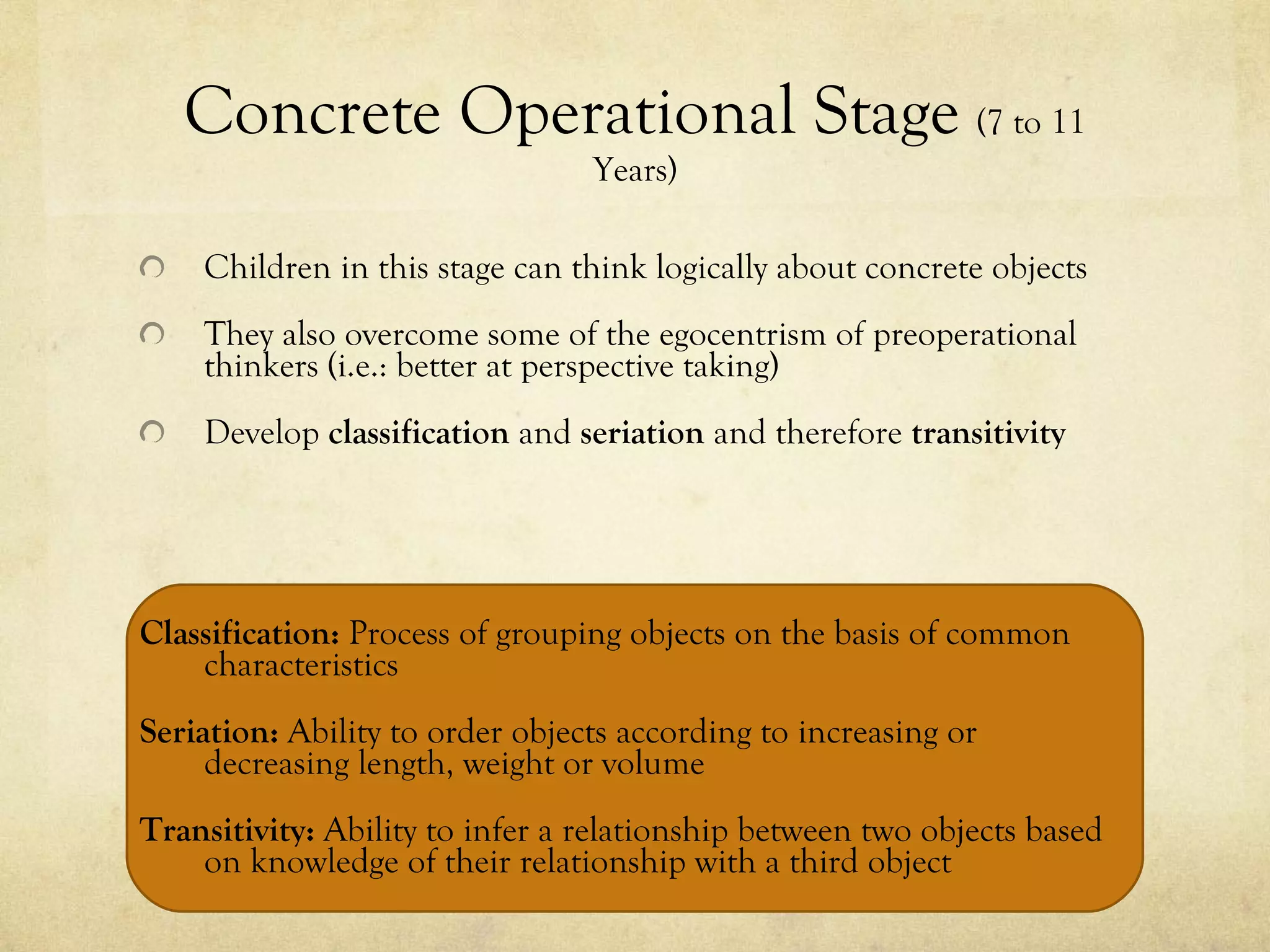
Concrete Operational Stage  (7 to 11 Years) Children in this stage can think logically about concrete objects They also overcome some of the egocentrism of preoperational thinkers (i.e.: better at perspective taking) Develop  classification  and  seriation  and therefore  transitivity Classification:  Process of grouping objects on the basis of common characteristics Seriation:  Ability to order objects according to increasing or decreasing length, weight or volume Transitivity:  Ability to infer a relationship between two objects based on knowledge of their relationship with a third object
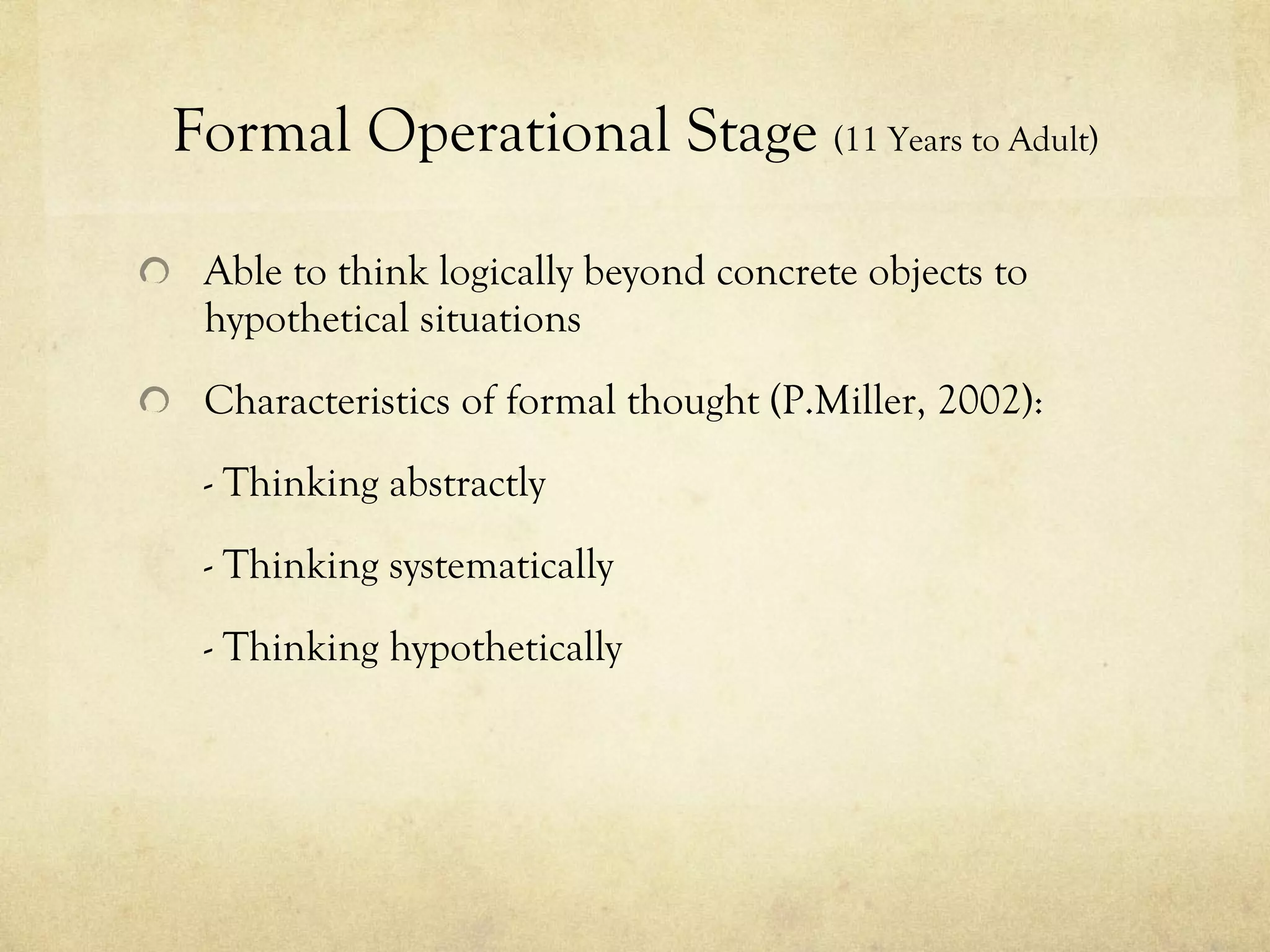
Formal Operational Stage  (11 Years to Adult) Able to think logically beyond concrete objects to hypothetical situations Characteristics of formal thought (P.Miller, 2002): - Thinking abstractly - Thinking systematically  - Thinking hypothetically
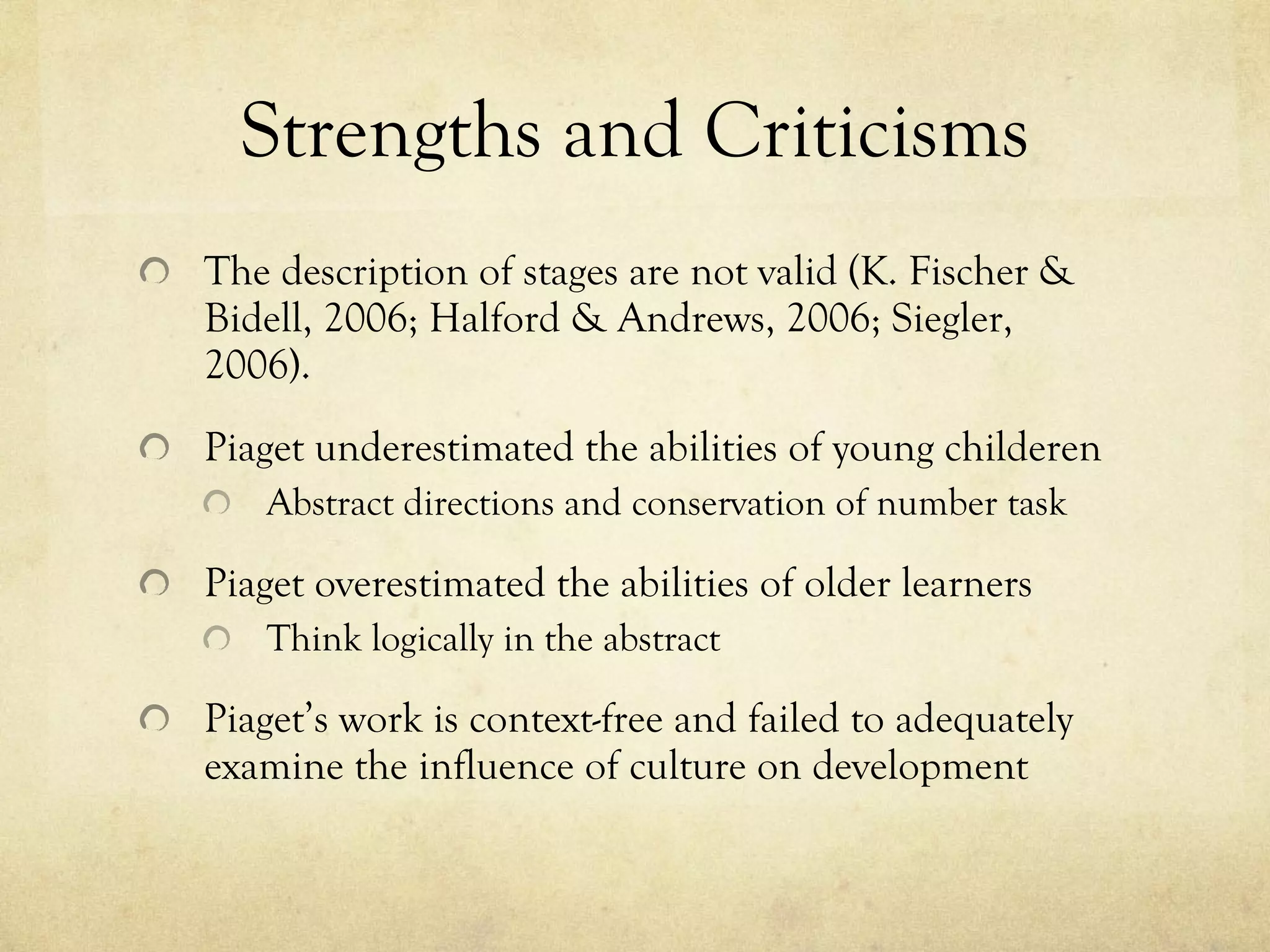
Strengths and Criticisms The description of stages are not valid (K. Fischer & Bidell, 2006; Halford & Andrews, 2006; Siegler, 2006). Piaget underestimated the abilities of young childeren  Abstract directions and conservation of number task Piaget overestimated the abilities of older learners Think logically in the abstract Piaget’s work is context-free and failed to adequately examine the influence of culture on development

Piaget's Theory of Cognitive Development

  • 1.
    Piaget’s Theory ofCognitive Development
  • 2.
    Introduction According toPiaget, there are some fundamental aspects to human development. Specifically, we learn to adapt to our world cognitively through two processes:- i) Assimilation - individuals incorporate and experience in the environment into an existing scheme ii) Accomodation - individuals modify an existing scheme and create a new one in response to experience
  • 3.
    Factors Influencing DevelopmentExperience with the physical world Social Experiences (e.g.: school experiences)
  • 4.
    Stages of DevelopmentSome key points regarding the stages of development: Movement from one stage to another represents a qualitative difference in thinking Each stage forms the foundation for movement for the next stage Stages cannot be skipped Rates of progressing from stage to stage varies between individual (e.g.: same chronological age  different stage of development)
  • 5.
    4 Stages ofDevelopment Sensorimotor Stage (0 to 2 Years) Preoperational Stage (2 to 7 Years) Concrete Operational Stage (7 to 11 Years) Formal Operational Stage (11 Years to Adult)
  • 6.
    Sensorimotor Stage (0 to 2 Years) Children use senses and motor capacities to understand the world Acquire object permanence later in the stage Object permanence: The ability to understand that even if an object is no longer visible, it continues to exist.
  • 7.
    Preoperational Stage (2 to 7 Years) Stage is characterized by perception Children make large progress in language development but have limited notions of abstract concepts (e.g.: fairness, democracy, etc.) Children lack conservation; they t end to center and they lack transformation and reversibility Conservation: The recognition that certain properties of objects (e.g.: weight/volume) are not altered by superficial changes in appearance, such as in length or shape. Centration: Focusing on one aspect of a situation to the exclusion of others Transformation: Ability to mentally record the process of moving from one state to another Reversibility: Ability to mentally trace the process of moving from an existing state back to a previous state
  • 8.
    Preoperational Stage (2 to 7 Years) Children in this stage are egocentric . This means that they have difficulty seeing from others’ perspectives. Egocentrism: The difficulty or inability of young children to distinguish between their own perspective and that of others
  • 9.
    Concrete Operational Stage (7 to 11 Years) Children in this stage can think logically about concrete objects They also overcome some of the egocentrism of preoperational thinkers (i.e.: better at perspective taking) Develop classification and seriation and therefore transitivity Classification: Process of grouping objects on the basis of common characteristics Seriation: Ability to order objects according to increasing or decreasing length, weight or volume Transitivity: Ability to infer a relationship between two objects based on knowledge of their relationship with a third object
  • 10.
    Formal Operational Stage (11 Years to Adult) Able to think logically beyond concrete objects to hypothetical situations Characteristics of formal thought (P.Miller, 2002): - Thinking abstractly - Thinking systematically - Thinking hypothetically
  • 11.
    Strengths and CriticismsThe description of stages are not valid (K. Fischer & Bidell, 2006; Halford & Andrews, 2006; Siegler, 2006). Piaget underestimated the abilities of young childeren Abstract directions and conservation of number task Piaget overestimated the abilities of older learners Think logically in the abstract Piaget’s work is context-free and failed to adequately examine the influence of culture on development

Editor's Notes

  • #4 Social Experiences – process of interacting with other people