Piaget Cognitive
Development
Jean Piaget's theory of cognitive development
suggests that children move through four
different stages of mental development. His
theory focuses not only on understanding
how children acquire knowledge, but also on
understanding the nature of intelligence.
He proposed that intelligence is
something that grows and develops
through a series of stages. Older children
do not just think more quickly than
younger children, he suggested.
Based on his observations, he concluded
that children were not less intelligent
than adults, they simply think differently.
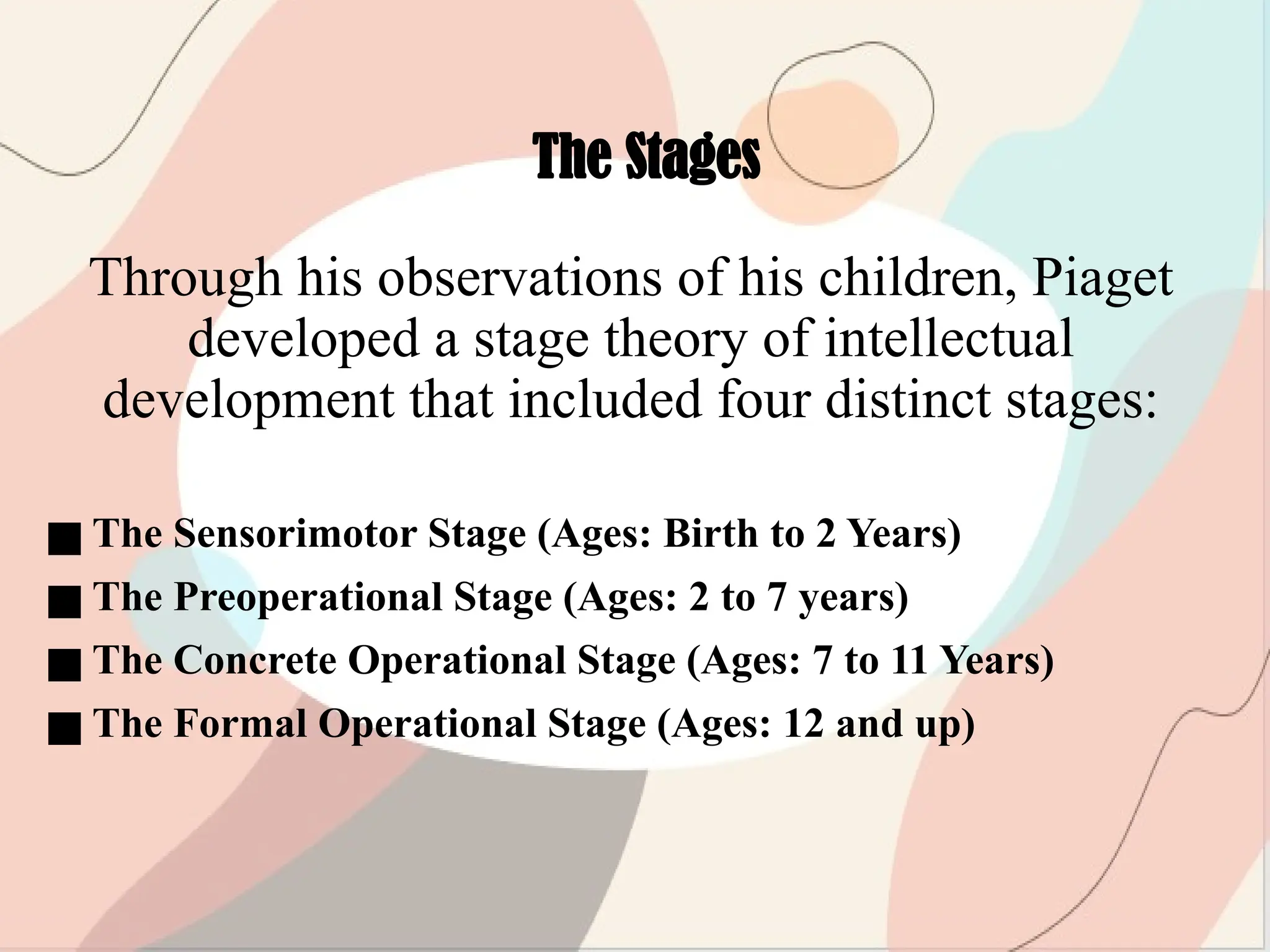
The Stages
Through his observations of his children, Piaget
developed a stage theory of intellectual
development that included four distinct stages:
■ The Sensorimotor Stage (Ages: Birth to 2 Years)
■ The Preoperational Stage (Ages: 2 to 7 years)
■ The Concrete Operational Stage (Ages: 7 to 11 Years)
■ The Formal Operational Stage (Ages: 12 and up)
Sensorimotor Stage
(Ages: Birth to 2 Years)
During this earliest stage of cognitive
development, infants and toddlers acquire
knowledge through sensory experiences and
manipulating objects.
The cognitive development that occurs
during this period takes place over a
relatively short period of time and
involves a great deal of growth. Children
not only learn how to perform physical
actions such as crawling and walking;
they also learn a great deal about
language from the people with whom
they interact. Piaget also broke this stage
down into a number of different
substages.
Substages:
■ Reflexes ( 0-1 month ) child understands the
environment purely through inborn reflexes.
■ Primary Circular Reactions ( 1-4 months)
involves coordinating sensation and new schemas.
■ Secondary Circular Reactions ( 4-8 months) child
becomes more focused on the world and begins to
intentionally repeat an action in order to trigger a
response in the environment.
 Coordination of reactions (8-12 months)
child starts to show clearly intentional
actions.
 Tertiary Circular Reactions (12-18
months) children begin a period of trial
and error experimentation.
 Early Representational Thought (18-24)
children begin to develop symbols to
represent events or objects
1) Use of mental symbols, words, or pictures, which the
child uses to represent something which is not
physically present.
2) children still have the inability to reverse their
thinking. They can understand that 2+3 is 5, but cannot
understand that 5-3 is 2.
3) tendency of a child to only think from his/her own
point of view; also, the inability of a child to take the
point of view of others.
4) the child believes that inanimate objects have
“lifelike” qualities.
Preoperational Stage
(Ages: 2 to 7 Years)
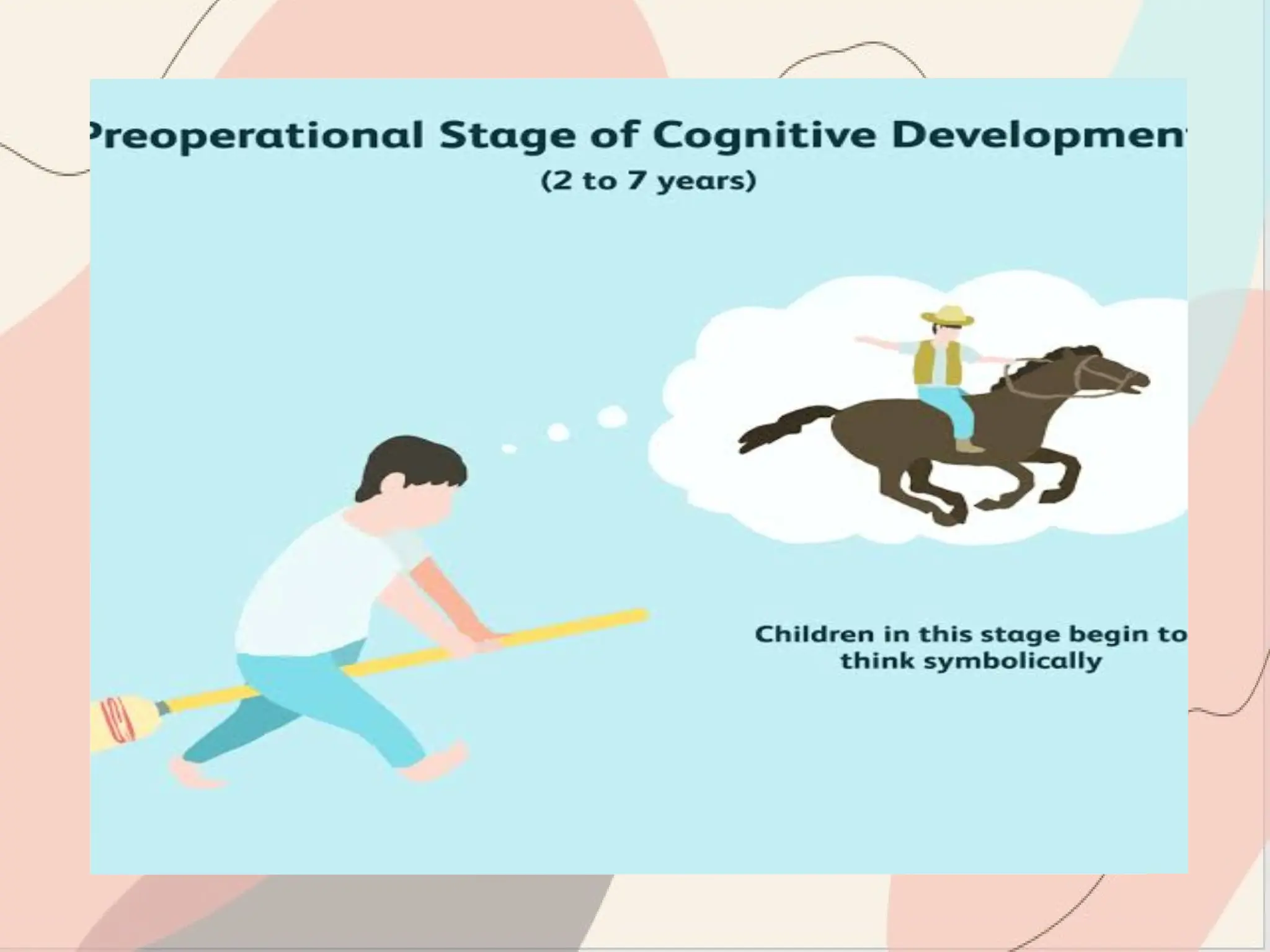
The preoperational stage is the second stage in
Piaget's theory of cognitive development. This
stage begins around age 2, as children start to talk,
and lasts until approximately age 7. During this
stage, children begin to engage in symbolic play
and learn to manipulate symbols.
The emergence of language that is one of
the major hallmarks of the preoperational
stage of development.
Major Characteristics and Developmental Changes:
■ Children begin to think symbolically and learn to use
words and pictures to represent objects.
■ Children at this stage tend to be egocentric and
struggle to see things from the perspective of others.
■ While they are getting better with language and
thinking, they still tend to think about things in very
concrete terms.
Transductive reasoning - This refers to the pre-
operational child’s type of reasoning that is neither
inductive nor deductive. Reasoning appears to from
particular to particular. i.e, if A cause B. then B
causes A.
The Concrete Operational Stage
(Ages: 7 to 11 Years)
The concrete operational stage is the third stage in
Piaget's theory of cognitive development. This
period spans the time of middle childhood—it
begins around age 7 and continues until
approximately age 11—and is characterized by
the development of logical thought. Children
become much more logical and sophisticated in
their thinking during this stage of development.
Major Characteristics and Developmental Changes:
■ During this stage, children begin to thinking
logically about concrete events.
■ They begin to understand the concept of
conservation; that the amount of liquid in a short,
wide cup is equal to that in a tall, skinny glass,
for example.
■ Their thinking becomes more logical and
organized.
■ Children begin using inductive logic, or
reasoning from specific information to a general
principle.
1) The ability to arrange objects in an order
according to size, shape, or any other.
2) The ability to name and identify sets of
objects according to appearance, size or other
characteristic.
3)Where the child takes into account multiple
aspects of a problem to solve.
4) Where the child understands that numbers
or objects can be changed
The Formal Operational Stage
(Ages: 12 and up)
The formal operational stage is the fourth and final stage
of Jean Piaget's theory of cognitive development. It begins
at approximately age 12 and lasts into adulthood.
At this point in development, thinking becomes much
more sophisticated and advanced. Kids can think about
abstract and theoretical concepts and use logic to come up
with creative solutions to problems. Skills such as logical
thought, deductive reasoning, and systematic planning
also emerge during this stage.
Major Characteristics and Developmental Changes:
■ At this stage, the adolescent or young adult
begins to think abstractly and reason about
hypothetical problems
■ Teens begin to think more about moral,
philosophical, ethical, social, and political
issues that require theoretical and abstract
reasoning
■ Begin to use deductive logic, or reasoning
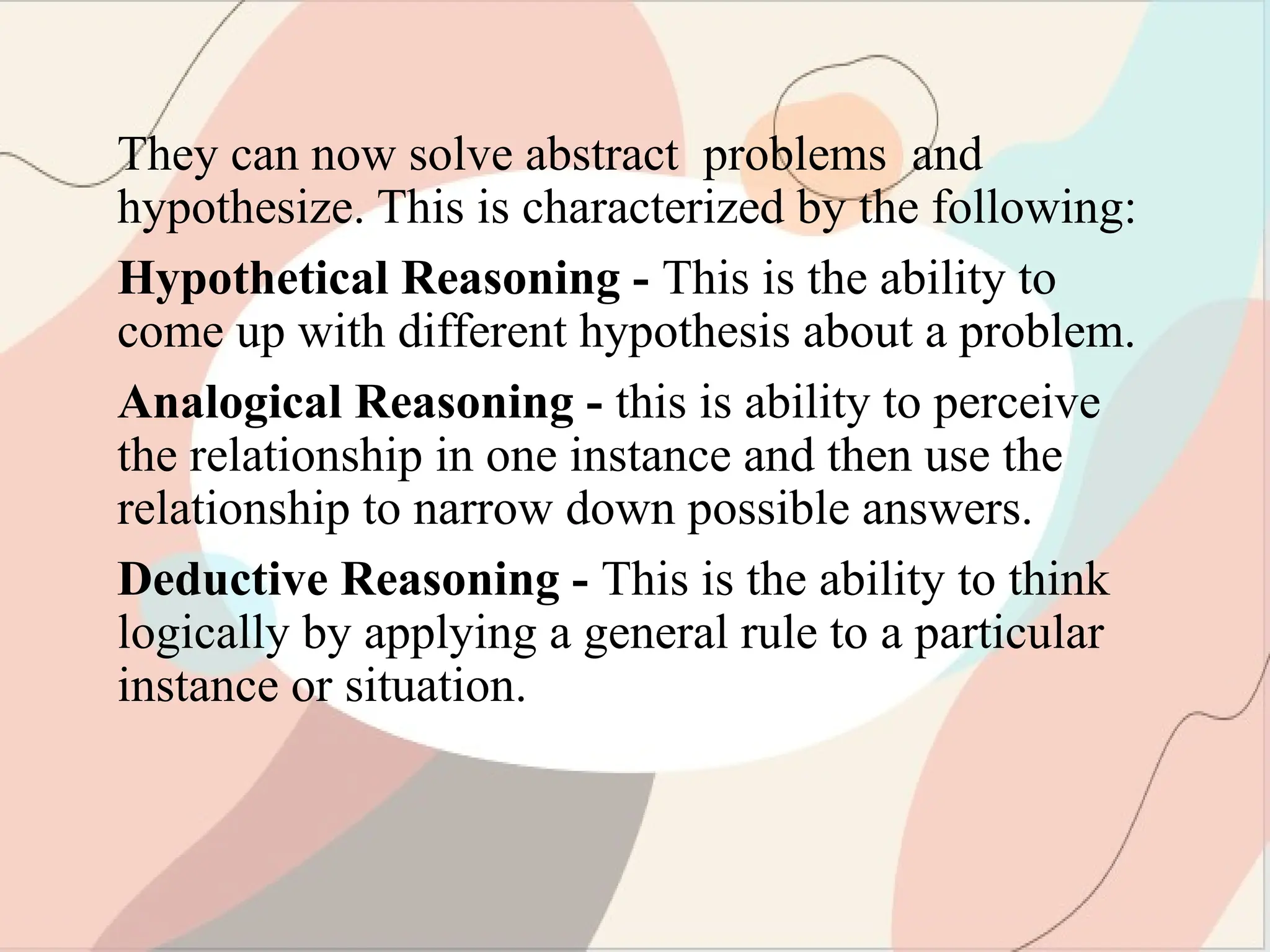
They can now solve abstract problems and
hypothesize. This is characterized by the following:
Hypothetical Reasoning - This is the ability to
come up with different hypothesis about a problem.
Analogical Reasoning - this is ability to perceive
the relationship in one instance and then use the
relationship to narrow down possible answers.
Deductive Reasoning - This is the ability to think
logically by applying a general rule to a particular
instance or situation.
Important Concepts
To better understand some of the things that happen
during cognitive development, it is important first to
examine a few of the important ideas and concepts
introduced by Piaget.
The following are some of the factors that influence
how children learn and grow:
■ Schemas
■ Assimilation
■ Accommodation
Schemas - A schema describes both the mental and
physical actions involved in understanding and
knowing. Schemas are categories of knowledge
that help us to interpret and understand the world.
Assimilation - The process of taking in new
information into our already existing schemas is
known as assimilation.
Accommodation - Another part of adaptation
involves changing or altering our existing schemas
in light of new information, a process known as
accommodation.
Equilibration - Piaget believed that the people have
the natural need to understand how the world works
and to find order, structure, and predictability in their
life. Equilibration is achieving proper balance
between assimilation and accommodation.
Note: When our experiences do not match our schema
or cognitive structure. We experience COGNITIVE
DISEQUILIBRIUM. This means there is a
discrepancy between what is perceived and what we
understood. We then exert effort through assimilation
and accommodation to establish equilibrium once
more.

Piaget COGNITIVE DEVELOPMENT theory powerpoint.pptx

  • 1.
  • 2.
    Jean Piaget's theoryof cognitive development suggests that children move through four different stages of mental development. His theory focuses not only on understanding how children acquire knowledge, but also on understanding the nature of intelligence.
  • 3.
    He proposed thatintelligence is something that grows and develops through a series of stages. Older children do not just think more quickly than younger children, he suggested. Based on his observations, he concluded that children were not less intelligent than adults, they simply think differently.
  • 4.
    The Stages Through hisobservations of his children, Piaget developed a stage theory of intellectual development that included four distinct stages: ■ The Sensorimotor Stage (Ages: Birth to 2 Years) ■ The Preoperational Stage (Ages: 2 to 7 years) ■ The Concrete Operational Stage (Ages: 7 to 11 Years) ■ The Formal Operational Stage (Ages: 12 and up)
  • 5.
    Sensorimotor Stage (Ages: Birthto 2 Years) During this earliest stage of cognitive development, infants and toddlers acquire knowledge through sensory experiences and manipulating objects.
  • 7.
    The cognitive developmentthat occurs during this period takes place over a relatively short period of time and involves a great deal of growth. Children not only learn how to perform physical actions such as crawling and walking; they also learn a great deal about language from the people with whom they interact. Piaget also broke this stage down into a number of different substages.
  • 8.
    Substages: ■ Reflexes (0-1 month ) child understands the environment purely through inborn reflexes. ■ Primary Circular Reactions ( 1-4 months) involves coordinating sensation and new schemas. ■ Secondary Circular Reactions ( 4-8 months) child becomes more focused on the world and begins to intentionally repeat an action in order to trigger a response in the environment.
  • 9.
     Coordination ofreactions (8-12 months) child starts to show clearly intentional actions.  Tertiary Circular Reactions (12-18 months) children begin a period of trial and error experimentation.  Early Representational Thought (18-24) children begin to develop symbols to represent events or objects
  • 10.
    1) Use ofmental symbols, words, or pictures, which the child uses to represent something which is not physically present. 2) children still have the inability to reverse their thinking. They can understand that 2+3 is 5, but cannot understand that 5-3 is 2. 3) tendency of a child to only think from his/her own point of view; also, the inability of a child to take the point of view of others. 4) the child believes that inanimate objects have “lifelike” qualities.
  • 11.
    Preoperational Stage (Ages: 2to 7 Years) The preoperational stage is the second stage in Piaget's theory of cognitive development. This stage begins around age 2, as children start to talk, and lasts until approximately age 7. During this stage, children begin to engage in symbolic play and learn to manipulate symbols.
  • 13.
    The emergence oflanguage that is one of the major hallmarks of the preoperational stage of development.
  • 14.
    Major Characteristics andDevelopmental Changes: ■ Children begin to think symbolically and learn to use words and pictures to represent objects. ■ Children at this stage tend to be egocentric and struggle to see things from the perspective of others. ■ While they are getting better with language and thinking, they still tend to think about things in very concrete terms.
  • 15.
    Transductive reasoning -This refers to the pre- operational child’s type of reasoning that is neither inductive nor deductive. Reasoning appears to from particular to particular. i.e, if A cause B. then B causes A.
  • 16.
    The Concrete OperationalStage (Ages: 7 to 11 Years) The concrete operational stage is the third stage in Piaget's theory of cognitive development. This period spans the time of middle childhood—it begins around age 7 and continues until approximately age 11—and is characterized by the development of logical thought. Children become much more logical and sophisticated in their thinking during this stage of development.
  • 18.
    Major Characteristics andDevelopmental Changes: ■ During this stage, children begin to thinking logically about concrete events. ■ They begin to understand the concept of conservation; that the amount of liquid in a short, wide cup is equal to that in a tall, skinny glass, for example. ■ Their thinking becomes more logical and organized. ■ Children begin using inductive logic, or reasoning from specific information to a general principle.
  • 19.
    1) The abilityto arrange objects in an order according to size, shape, or any other. 2) The ability to name and identify sets of objects according to appearance, size or other characteristic. 3)Where the child takes into account multiple aspects of a problem to solve. 4) Where the child understands that numbers or objects can be changed
  • 20.
    The Formal OperationalStage (Ages: 12 and up) The formal operational stage is the fourth and final stage of Jean Piaget's theory of cognitive development. It begins at approximately age 12 and lasts into adulthood. At this point in development, thinking becomes much more sophisticated and advanced. Kids can think about abstract and theoretical concepts and use logic to come up with creative solutions to problems. Skills such as logical thought, deductive reasoning, and systematic planning also emerge during this stage.
  • 22.
    Major Characteristics andDevelopmental Changes: ■ At this stage, the adolescent or young adult begins to think abstractly and reason about hypothetical problems ■ Teens begin to think more about moral, philosophical, ethical, social, and political issues that require theoretical and abstract reasoning ■ Begin to use deductive logic, or reasoning
  • 23.
    They can nowsolve abstract problems and hypothesize. This is characterized by the following: Hypothetical Reasoning - This is the ability to come up with different hypothesis about a problem. Analogical Reasoning - this is ability to perceive the relationship in one instance and then use the relationship to narrow down possible answers. Deductive Reasoning - This is the ability to think logically by applying a general rule to a particular instance or situation.
  • 24.
    Important Concepts To betterunderstand some of the things that happen during cognitive development, it is important first to examine a few of the important ideas and concepts introduced by Piaget. The following are some of the factors that influence how children learn and grow: ■ Schemas ■ Assimilation ■ Accommodation
  • 25.
    Schemas - Aschema describes both the mental and physical actions involved in understanding and knowing. Schemas are categories of knowledge that help us to interpret and understand the world. Assimilation - The process of taking in new information into our already existing schemas is known as assimilation. Accommodation - Another part of adaptation involves changing or altering our existing schemas in light of new information, a process known as accommodation.
  • 26.
    Equilibration - Piagetbelieved that the people have the natural need to understand how the world works and to find order, structure, and predictability in their life. Equilibration is achieving proper balance between assimilation and accommodation. Note: When our experiences do not match our schema or cognitive structure. We experience COGNITIVE DISEQUILIBRIUM. This means there is a discrepancy between what is perceived and what we understood. We then exert effort through assimilation and accommodation to establish equilibrium once more.