Salmonella typhi
CONTENT:
Taxonomy
Introduction
Pathogenesis
Morphology
Cultural
Characteristics
Clinical
symptoms
Diagnosis
Treatment
Reference
By
NIVETHA.R
II.M.SC MICROBIOLOGY
Medical Microbiology
UNDER THE GUIDANCE OF
Mrs.S.Selvajeyanthi
Asst.Professor,
Dept.of Microbiology,
Tiruppur Kumaran College
For Women,Tirupur
Typhoid fever
SALMONELLA- CLASSIFICATION
Domain: Bacteria
Phylum: Proteobacteria
Class: Gammaproteobacteria
Order: Enterobacterales
Family: Enterobacteriaceae
Genus: Salmonella
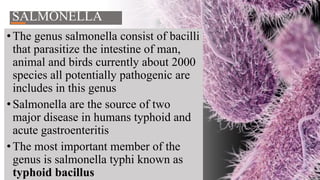
SALMONELLA
• The genus salmonella consist of bacilli
that parasitize the intestine of man,
animal and birds currently about 2000
species all potentially pathogenic are
includes in this genus
• Salmonella are the source of two
major disease in humans typhoid and
acute gastroenteritis
• The most important member of the
genus is salmonella typhi known as
typhoid bacillus
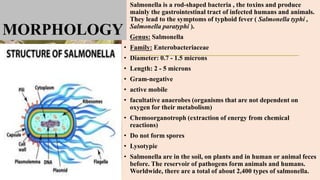
• Salmonella is a rod-shaped bacteria , the toxins and produce
mainly the gastrointestinal tract of infected humans and animals.
They lead to the symptoms of typhoid fever ( Salmonella typhi ,
Salmonella paratyphi ).
• Genus: Salmonella
• Family: Enterobacteriaceae
• Diameter: 0.7 - 1.5 microns
• Length: 2 - 5 microns
• Gram-negative
• active mobile
• facultative anaerobes (organisms that are not dependent on
oxygen for their metabolism)
• Chemoorganotroph (extraction of energy from chemical
reactions)
• Do not form spores
• Lysotypie
• Salmonella are in the soil, on plants and in human or animal feces
before. The reservoir of pathogens form animals and humans.
Worldwide, there are a total of about 2,400 types of salmonella.
MORPHOLOGY
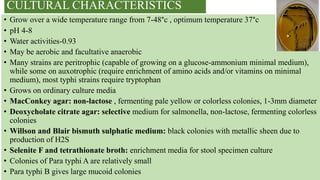
CULTURAL CHARACTERISTICS
• Grow over a wide temperature range from 7-48°c , optimum temperature 37°c
• pH 4-8
• Water activities-0.93
• May be aerobic and facultative anaerobic
• Many strains are peritrophic (capable of growing on a glucose-ammonium minimal medium),
while some on auxotrophic (require enrichment of amino acids and/or vitamins on minimal
medium), most typhi strains require tryptophan
• Grows on ordinary culture media
• MacConkey agar: non-lactose , fermenting pale yellow or colorless colonies, 1-3mm diameter
• Deoxycholate citrate agar: selective medium for salmonella, non-lactose, fermenting colorless
colonies
• Willson and Blair bismuth sulphatic medium: black colonies with metallic sheen due to
production of H2S
• Selenite F and tetrathionate broth: enrichment media for stool specimen culture
• Colonies of Para typhi A are relatively small
• Para typhi B gives large mucoid colonies
BIOCHEMICAL
ACTIVITIES
• Ferment - glucose, maltose, manitol
• Non-ferment - lactose, sucrose, salicin
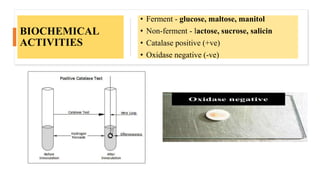
• Catalase positive (+ve)
• Oxidase negative (-ve)
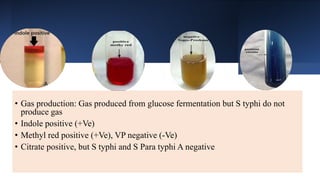
• Gas production: Gas produced from glucose fermentation but S typhi do not
produce gas
• Indole positive (+Ve)
• Methyl red positive (+Ve), VP negative (-Ve)
• Citrate positive, but S typhi and S Para typhi A negative
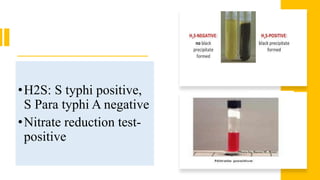
•H2S: S typhi positive,
S Para typhi A negative
•Nitrate reduction test-
positive
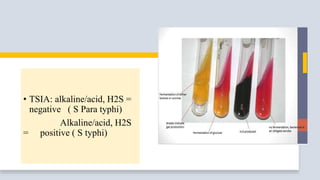
• TSIA: alkaline/acid, H2S =
negative ( S Para typhi)
Alkaline/acid, H2S
= positive ( S typhi)
EPIDEMIOLOGY
Salmonella are primarily intestinal
parasite of humans and many animals
including wild birds, domestic pets and
rodents; they may be isolated from their
blood and internal organs
Found frequently in sewage, rivers and
other waters and soil in which they do
not multiply significantly
Under suitable conditions they may
survive in waters and for years in soil
Have been isolated from many foods,
vegetables and fruit and are important
contaminants of animal protein-feed
supplements
VIRULENCE FACTORS
•Endotoxin
•Invasion
•Factors involved in resistance to phagocytosis ie
catalase, superoxide dismutase, defensins
•Acid tolerance response (ATR) gene protect
organisms from stomach acid
•Vi-antigen or virulence antigen
ANTIGENIC
STRUCTURE
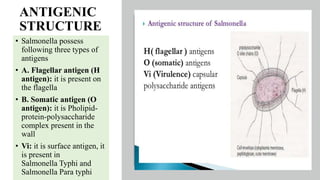
• Salmonella possess
following three types of
antigens
• A. Flagellar antigen (H
antigen): it is present on
the flagella
• B. Somatic antigen (O
antigen): it is Pholipid-
protein-polysaccharide
complex present in the
wall
• Vi: it is surface antigen, it
is present in
Salmonella Typhi and
Salmonella Para typhi
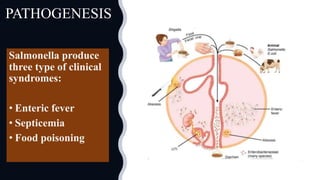
PATHOGENESIS
Salmonella produce
three type of clinical
syndromes:
• Enteric fever
• Septicemia
• Food poisoning
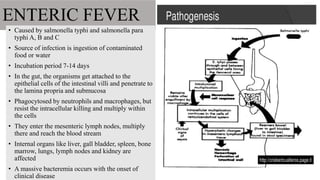
ENTERIC FEVER
• Caused by salmonella typhi and salmonella para
typhi A, B and C
• Source of infection is ingestion of contaminated
food or water
• Incubation period 7-14 days
• In the gut, the organisms get attached to the
epithelial cells of the intestinal villi and penetrate to
the lamina propria and submucosa
• Phagocytosed by neutrophils and macrophages, but
resist the intracellular killing and multiply within
the cells
• They enter the mesenteric lymph nodes, multiply
there and reach the blood stream
• Internal organs like liver, gall bladder, spleen, bone
marrow, lungs, lymph nodes and kidney are
affected
• A massive bacteremia occurs with the onset of
clinical disease
SEPTICAEMIA
• Caused by salmonella choleraesuis and salmonella para typhi C
• Local lesion occurs in various part of the body giving rise to
osteomyelitis, pneumonia, pulmonary abscission, meningitis etc.
FOOD POISONING:
• Caused by ingestion of contaminated food like meat, milk, egg
• Incubation period is 12-24 hours
• Clinical features includes fever, vomiting, abdominal pain, and
diarrhea
SIGNS AND SYMPTOMS
•Salmonella causes a mild to severe gastrointestinal
illness called gastroenteritis, which is also known
commonly as stomach flu. Symptoms typically
begin sometime between six hours to six days
after exposure to the bacteria (though it can take
several weeks for some people to develop
symptoms).
•Common symptoms include: Diarrhea, Abdominal
cramps, Fever, Headache, Nausea and vomiting
LABORATORY DIAGNOSIS
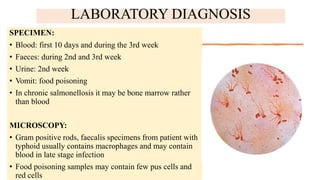
SPECIMEN:
• Blood: first 10 days and during the 3rd week
• Faeces: during 2nd and 3rd week
• Urine: 2nd week
• Vomit: food poisoning
• In chronic salmonellosis it may be bone marrow rather
than blood
MICROSCOPY:
• Gram positive rods, faecalis specimens from patient with
typhoid usually contains macrophages and may contain
blood in late stage infection
• Food poisoning samples may contain few pus cells and
red cells
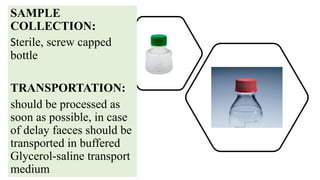
SAMPLE
COLLECTION:
Sterile, screw capped
bottle
TRANSPORTATION:
should be processed as
soon as possible, in case
of delay faeces should be
transported in buffered
Glycerol-saline transport
medium
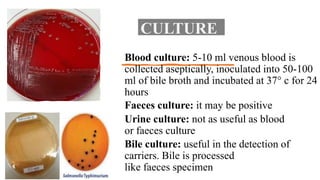
Blood culture: 5-10 ml venous blood is
collected aseptically, inoculated into 50-100
ml of bile broth and incubated at 37° c for 24
hours​
Faeces culture: it may be positive
Urine culture: not as useful as blood
or faeces culture
Bile culture: useful in the detection of
carriers. Bile is processed
like faeces specimen​
CULTURE
SEROLOGICAL TEST
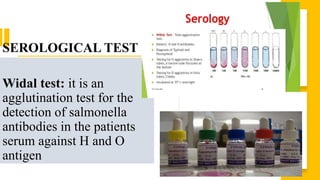
Widal test: it is an
agglutination test for the
detection of salmonella
antibodies in the patients
serum against H and O
antigen
PREVENTION
Most salmonella infections are
caused by contaminated food.A
Clean Wash your hands and
surfaces such as cutting boards
and countertops often and rinse
fruits and vegetables under
running water.
Separate Avoid cross-
contamination by using a
separate cutting board for raw
meat, poultry, and seafood, and
by keeping these items
separated from other food
Cook Make sure food is cooked
to the recommended internal
temperature to kill germs.
Chill Keep your refrigerator
temperature at 40 degrees F or
below and never leave
perishable food out of the fridge
for more than two hours. Thaw
frozen food in the refrigerator
or in the microwave, because
leaving food out on the counter
to defrost can allow bacteria to
multiply rapidly.
Remember, too, to always wash
your hands thoroughly after
using the toilet or changing
diapers and to wash your hands
after contact with animals.
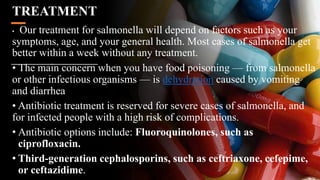
TREATMENT
• Our treatment for salmonella will depend on factors such as your
symptoms, age, and your general health. Most cases of salmonella get
better within a week without any treatment.
• The main concern when you have food poisoning — from salmonella
or other infectious organisms — is dehydration caused by vomiting
and diarrhea
• Antibiotic treatment is reserved for severe cases of salmonella, and
for infected people with a high risk of complications.
• Antibiotic options include: Fluoroquinolones, such as
ciprofloxacin.
• Third-generation cephalosporins, such as ceftriaxone, cefepime,
or ceftazidime.
REFERENCE
• https://www.everydayhealth.com/salmonella/gui
de/
• Essential of medical microbiology, by Apurba
Sankar shasty, sathya bhata K pg no-238-239
• https://www.classcentral.com/tag/microbiology
Salmonella typhi-Typhoid fever

Salmonella typhi-Typhoid fever

  • 1.
    Salmonella typhi CONTENT: Taxonomy Introduction Pathogenesis Morphology Cultural Characteristics Clinical symptoms Diagnosis Treatment Reference By NIVETHA.R II.M.SC MICROBIOLOGY MedicalMicrobiology UNDER THE GUIDANCE OF Mrs.S.Selvajeyanthi Asst.Professor, Dept.of Microbiology, Tiruppur Kumaran College For Women,Tirupur Typhoid fever
  • 2.
    SALMONELLA- CLASSIFICATION Domain: Bacteria Phylum:Proteobacteria Class: Gammaproteobacteria Order: Enterobacterales Family: Enterobacteriaceae Genus: Salmonella
  • 3.
    SALMONELLA • The genussalmonella consist of bacilli that parasitize the intestine of man, animal and birds currently about 2000 species all potentially pathogenic are includes in this genus • Salmonella are the source of two major disease in humans typhoid and acute gastroenteritis • The most important member of the genus is salmonella typhi known as typhoid bacillus
  • 4.
    • Salmonella isa rod-shaped bacteria , the toxins and produce mainly the gastrointestinal tract of infected humans and animals. They lead to the symptoms of typhoid fever ( Salmonella typhi , Salmonella paratyphi ). • Genus: Salmonella • Family: Enterobacteriaceae • Diameter: 0.7 - 1.5 microns • Length: 2 - 5 microns • Gram-negative • active mobile • facultative anaerobes (organisms that are not dependent on oxygen for their metabolism) • Chemoorganotroph (extraction of energy from chemical reactions) • Do not form spores • Lysotypie • Salmonella are in the soil, on plants and in human or animal feces before. The reservoir of pathogens form animals and humans. Worldwide, there are a total of about 2,400 types of salmonella. MORPHOLOGY
  • 5.
    CULTURAL CHARACTERISTICS • Growover a wide temperature range from 7-48°c , optimum temperature 37°c • pH 4-8 • Water activities-0.93 • May be aerobic and facultative anaerobic • Many strains are peritrophic (capable of growing on a glucose-ammonium minimal medium), while some on auxotrophic (require enrichment of amino acids and/or vitamins on minimal medium), most typhi strains require tryptophan • Grows on ordinary culture media • MacConkey agar: non-lactose , fermenting pale yellow or colorless colonies, 1-3mm diameter • Deoxycholate citrate agar: selective medium for salmonella, non-lactose, fermenting colorless colonies • Willson and Blair bismuth sulphatic medium: black colonies with metallic sheen due to production of H2S • Selenite F and tetrathionate broth: enrichment media for stool specimen culture • Colonies of Para typhi A are relatively small • Para typhi B gives large mucoid colonies
  • 6.
    BIOCHEMICAL ACTIVITIES • Ferment -glucose, maltose, manitol • Non-ferment - lactose, sucrose, salicin • Catalase positive (+ve) • Oxidase negative (-ve)
  • 7.
    • Gas production:Gas produced from glucose fermentation but S typhi do not produce gas • Indole positive (+Ve) • Methyl red positive (+Ve), VP negative (-Ve) • Citrate positive, but S typhi and S Para typhi A negative
  • 8.
    •H2S: S typhipositive, S Para typhi A negative •Nitrate reduction test- positive
  • 9.
    • TSIA: alkaline/acid,H2S = negative ( S Para typhi) Alkaline/acid, H2S = positive ( S typhi)
  • 10.
    EPIDEMIOLOGY Salmonella are primarilyintestinal parasite of humans and many animals including wild birds, domestic pets and rodents; they may be isolated from their blood and internal organs Found frequently in sewage, rivers and other waters and soil in which they do not multiply significantly Under suitable conditions they may survive in waters and for years in soil Have been isolated from many foods, vegetables and fruit and are important contaminants of animal protein-feed supplements
  • 11.
    VIRULENCE FACTORS •Endotoxin •Invasion •Factors involvedin resistance to phagocytosis ie catalase, superoxide dismutase, defensins •Acid tolerance response (ATR) gene protect organisms from stomach acid •Vi-antigen or virulence antigen
  • 12.
    ANTIGENIC STRUCTURE • Salmonella possess followingthree types of antigens • A. Flagellar antigen (H antigen): it is present on the flagella • B. Somatic antigen (O antigen): it is Pholipid- protein-polysaccharide complex present in the wall • Vi: it is surface antigen, it is present in Salmonella Typhi and Salmonella Para typhi
  • 13.
    PATHOGENESIS Salmonella produce three typeof clinical syndromes: • Enteric fever • Septicemia • Food poisoning
  • 14.
    ENTERIC FEVER • Causedby salmonella typhi and salmonella para typhi A, B and C • Source of infection is ingestion of contaminated food or water • Incubation period 7-14 days • In the gut, the organisms get attached to the epithelial cells of the intestinal villi and penetrate to the lamina propria and submucosa • Phagocytosed by neutrophils and macrophages, but resist the intracellular killing and multiply within the cells • They enter the mesenteric lymph nodes, multiply there and reach the blood stream • Internal organs like liver, gall bladder, spleen, bone marrow, lungs, lymph nodes and kidney are affected • A massive bacteremia occurs with the onset of clinical disease
  • 15.
    SEPTICAEMIA • Caused bysalmonella choleraesuis and salmonella para typhi C • Local lesion occurs in various part of the body giving rise to osteomyelitis, pneumonia, pulmonary abscission, meningitis etc. FOOD POISONING: • Caused by ingestion of contaminated food like meat, milk, egg • Incubation period is 12-24 hours • Clinical features includes fever, vomiting, abdominal pain, and diarrhea
  • 16.
    SIGNS AND SYMPTOMS •Salmonellacauses a mild to severe gastrointestinal illness called gastroenteritis, which is also known commonly as stomach flu. Symptoms typically begin sometime between six hours to six days after exposure to the bacteria (though it can take several weeks for some people to develop symptoms). •Common symptoms include: Diarrhea, Abdominal cramps, Fever, Headache, Nausea and vomiting
  • 17.
    LABORATORY DIAGNOSIS SPECIMEN: • Blood:first 10 days and during the 3rd week • Faeces: during 2nd and 3rd week • Urine: 2nd week • Vomit: food poisoning • In chronic salmonellosis it may be bone marrow rather than blood MICROSCOPY: • Gram positive rods, faecalis specimens from patient with typhoid usually contains macrophages and may contain blood in late stage infection • Food poisoning samples may contain few pus cells and red cells
  • 18.
    SAMPLE COLLECTION: Sterile, screw capped bottle TRANSPORTATION: shouldbe processed as soon as possible, in case of delay faeces should be transported in buffered Glycerol-saline transport medium
  • 19.
    Blood culture: 5-10ml venous blood is collected aseptically, inoculated into 50-100 ml of bile broth and incubated at 37° c for 24 hours​ Faeces culture: it may be positive Urine culture: not as useful as blood or faeces culture Bile culture: useful in the detection of carriers. Bile is processed like faeces specimen​ CULTURE
  • 20.
    SEROLOGICAL TEST Widal test:it is an agglutination test for the detection of salmonella antibodies in the patients serum against H and O antigen
  • 21.
    PREVENTION Most salmonella infectionsare caused by contaminated food.A Clean Wash your hands and surfaces such as cutting boards and countertops often and rinse fruits and vegetables under running water. Separate Avoid cross- contamination by using a separate cutting board for raw meat, poultry, and seafood, and by keeping these items separated from other food Cook Make sure food is cooked to the recommended internal temperature to kill germs. Chill Keep your refrigerator temperature at 40 degrees F or below and never leave perishable food out of the fridge for more than two hours. Thaw frozen food in the refrigerator or in the microwave, because leaving food out on the counter to defrost can allow bacteria to multiply rapidly. Remember, too, to always wash your hands thoroughly after using the toilet or changing diapers and to wash your hands after contact with animals.
  • 22.
    TREATMENT • Our treatmentfor salmonella will depend on factors such as your symptoms, age, and your general health. Most cases of salmonella get better within a week without any treatment. • The main concern when you have food poisoning — from salmonella or other infectious organisms — is dehydration caused by vomiting and diarrhea • Antibiotic treatment is reserved for severe cases of salmonella, and for infected people with a high risk of complications. • Antibiotic options include: Fluoroquinolones, such as ciprofloxacin. • Third-generation cephalosporins, such as ceftriaxone, cefepime, or ceftazidime.
  • 23.
    REFERENCE • https://www.everydayhealth.com/salmonella/gui de/ • Essentialof medical microbiology, by Apurba Sankar shasty, sathya bhata K pg no-238-239 • https://www.classcentral.com/tag/microbiology