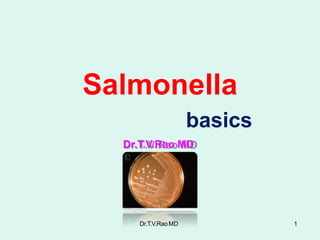
Salmonella
basics
Dr.T.V.Rao MD
Dr.T.V.RaoMD 1
Salmonella
Dr.T.V.RaoMD 2
• Causes Infections in Humans and
vertebrates,
• Enteric Fever ( Typhoid fever )
• Gastroenteritis
• Septicemias,
• Carrier state.
Salmonella
Dr.T.V.RaoMD 3
• A Very complex group
• Contains more > 2,000 spp
• Typed on the basis of Serotyping, and
species typing
• Divided into two groups
1 Enteric fever group
2 Food poisoning group – Septicemias.
Enteric Fever
Typhoid Fever
Dr.T.V.RaoMD 4
• Caused by Salmonella typhi, and other
Groups called as Paratyphi A, B, C
• Salmonella typhi - Causes Typhoid
• Salmonella Paratyphi A,B,C Causes
Paratyphoid fevers.
• Food Poison group
• Spread from Animals – Humans
• Causes Gastroenteritis – Septicemias,
Localized Infection
Typhoid Mary Most Dangerous
Woman in America
Dr.T.V.RaoMD 5
Morphology of Salmonella
• Gram negative
bacilli
• 1-3 / 0.5
microns,
• Motile by
peritrichous
flagella
Dr.T.V.RaoMD 6
Bacteriology –Typhoid fever
• The Genus
Salmonella belong to
Enterobacteriaceae
• Facultative anaerobe
• Gram negative bacilli
• Distinguished from
other bacteria by
Biochemical and
antigen structure
Dr.T.V.RaoMD 7
Cultural Characters
Dr.T.V.RaoMD 8
• Aerobic / Facultatively anaerobic
• Grows on simple media – Nutrient agar,
• Temp 15 – 41ºc / 37º c
• Colonies appear as large 2 -3 mm, circular, low
convex,
• On MacConkey medium appear
Colorless ( NLF )
Selective Medium - Wilson Blair Bismuth sulphide
medium. Produce Jet black colonies
H2 S produced by Salmonella typhi
Enrichment Medium
Dr.T.V.RaoMD 9
Liquid Medium
• Selenite F medium
• Tetrathionate broth
• Above medium are used for
isolation of Salmonella from
contaminated specimens
• Particularly stool specimens..
Identifying Enteric Organisms
Dr.T.V.RaoMD 10
• Isolates which are Non lactose fermenting
• Motile, Indole positive
• Urease negative
• Ferment Glucose,Mannitol,Maltose
• Do not ferment Lactose, Sucrose
• Typhoid bacilli are anaerogenic
• Some of the Paratyphoid form acid and gas
• Further identification done by slide agglutination
tests
Biochemical Characters
• Glucose ,Mannitol ,Maltose produce A/G
• Salmonella typhi do not produce gas
• Lactose/Salicin/sucrose not fermented.
• Indole –
• Methyl Red +
• V P -
• Citrate +
• Urea –
• H2S – produced by Salmonella typhi
• Paratyphi A do not produce H2S
Dr.T.V.Rao MD 11
Resistance of Salmonella
• 55º c – 1 hour
• 60º c – 15 MT
• Boiling ,Chlorination,
Pasteurization Destroy the
Bacilli.
Dr.T.V.RaoMD 12
Antigenic structure of
Salmonella
Dr.T.V.RaoMD 13
• Two sets of antigens
• Detection by serotyping
• 1 Somatic or 0 Antigens contain long
chain polysaccharides ( LPS ) comprises
of heat stable polysaccharide commonly.
• 2 Flagellar or H Antigens are strongly
immunogenic and induces antibody formation
rapidly and in high titers following infection or
immunization. The flagellar antigen is of a dual
nature, occurring in one of the two phases.
Salmonella
Antigenic Structure
Dr.T.V.RaoMD 14
• H – Flegellar antigens
• O – Somatic antigen,
• Vi – Surface antigen in some species only
• H antigens also called flegellar antigens,
heat labile protein,
• Boiling destroys antigenicity
• When mixed with Antiserum produces
agglutination and fluffy clumps are produced
• H antigens are strongly immunogenic Induces
antibodies rapidly,
Antigens – Salmonella ( cont )
Dr.T.V.RaoMD 15
• O Antigens
• Forms integral part of Cell wall,
• Like Endotoxin
• 0 Antigens unaffected by boiling.
• When mixed with antiserum produce chalky
clumps are formed, take more time reaction, at
high temp 50º – 55º c
• O antigens are less immunogenic. than H
antigens
Antigen (Vi) – Salmonella ( contd )
• Vi antigens
• Many strains in S.typhi covers the O antigens-
prevents agglutination.
• Resembles like K antigens
• Destroyed after boiling at 60º c / 1 hour.
• Vi a polysaccharide
• Acts as virulence factor, protects the bacilli
against Phagocytosis and activity of
Complement
• Poorly immunogenic
• Low titer of antibodies are produced, Not
diagnostic Dr.T.V.RaoMD 16
Classification of Salmonella
• Classified on the basis of
Kauffmann-White Scheme
• Structure of 0 and H antigens
are taken into consideration,
• More than 2000 species
characterized.
Dr.T.V.RaoMD 17
Kauffmann – White scheme
Dr.T.V.RaoMD 18
• Serotype 0 antigens H antigens
Phase 1 2
1.Typhi 9,12,(Vi) d 1,2
2 Paratyphi A 1,2.12 a -
3 Paratyphi B 1,4,5,12 b 1,2
4 Typhimuruim 1,4,5,12 I 1,7
5 Enteritidis 1,9,12 g m 1,2
Antigenic Variation in
Salmonella
• May be phenotypic / Genotypic
• H to O = loss of Flagella
May be phase variation from I
to II
V to W variation
S to R variation
Dr.T.V.RaoMD 19
Pathogenicity
Dr.T.V.RaoMD 20
• Salmonella are definite parasites to
humans.
• Eg S.typhi.
• S.paratyphi A, B ,C
• Other groups Salmonella
• The important clinical syndromes
1.Enteric fever, Septicemias,
gastroenteritis.
Enteric Fever
Typhoid
• Typhoid – caused by S.typhi
• Paratyphoid Caused by
Paratyphi A,B,C
• Typhoid --- Like Typhus
• Infective dose ID50 / 107,
Dr.T.V.RaoMD 21
Dr.T.V.RaoMD 22
Events in a Typical typhoid Fever
Dr.T.V.RaoMD 23
Pathology and Pathogenesis
Dr.T.V.RaoMD 24
• Bacilli enter through ingestion,
• Bacilli attach to Microvilli,ileal mucosa,
penetrate to Lamina propria and sub
mucosa
• Phagocytosis by Polymorphs and
Macrophages
• Enters the mesenteric lymph nodes
• Enter the thoracic duct – Blood stream
Pathology and Pathogenesis
Dr.T.V.RaoMD 25
• Bacteremia Spread to Liver, Gall
bladder, Spleen, Bone marrow,
Lymph nodes, Lungs, Multiply in
kidneys
Once again spill into Blood
stream
Causes clinical illness.
Pathology and Pathogenesis
• Multiply abundantly in Gall bladder,
• Bile rich source of Bacteria
• Spill into Intestine, infects payers patches,
Lymph follicles
• Inflammation – Undergo necrosis, Slough
off
• Typhoid ulcers
• Typhoid ulcers can cause perforation and
hemorrhage
• Duration of Illness 3 – 4 weeks
• Incubation 7 -14, D
(r.T
3
.V.-
R5
ao6
MD days ) 26
Immunity in Typhoid
• Typhoid
bacilli are
Intracellular
pathogens
• Cell mediated
immunity is
crucial Dr.T.V.RaoMD 27
Clinical manifestation
• Head ache, malise,anorexia ,coated
tongue
• Abdominal discomfort,
• Constipation / Diarrhea
• Step ladder type fever,
• Relative bradycardia,
• A soft palpable spleen
• Hepatomegaly
• Rose spots appea
Dr
r
.T
.V.Rao MD 28
Events in a Typical typhoid Fever
Dr.T.V.RaoMD 29
Rashes in Typhoid
• May present with
rash, rose spots 2 -4
mm in diameter
raised discrete
irregular blanching
pink maculae's found
in front of chest
• Appear in crops of up
to a dozen at a time
• Fade after 3 – 4 days
Dr.T.V.RaoMD 30
Complications of Enteric
fever
Dr.T.V.RaoMD 31
• Intestinal perforation,
• Hemorrhage,
• Circulatory collapse.
• Bronchitis Bronchopneumonia,
• Meningitis,
• Cholecystitis,
• Arthritis,Periostitis / Nephritis,
• Osteomyletis,
Other complications
• Causes relapses
in particular to
patients treated
with
chloramphenicol.
• S.paratyphi
produce
septicemias.
Dr.T.V.RaoMD 32
Epidemiology
Dr.T.V.RaoMD 33
• Developed countries - Controlled.
• Water supply/ Sanitation /Economically
poor.
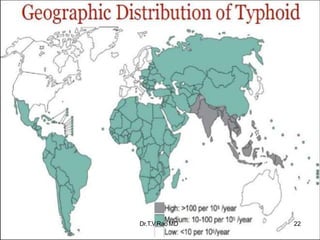
• S.typhi and S.paratyphi are prevalent in
India
• Previously Typhi are more common
Paratyphoid A on raise.
• Age 5 – 20 years, Sanitation
Epidemiology
Dr.T.V.RaoMD 34
• Sanitation has great role
• Source an active patient or a Carrier shed
the Bacilli.
• Who are carriers.
Convalescent carrier 3 weeks to 3
months
Temporary carrier
Chronic carrier
3 months to 1 year
> 1 year,
Women attain more carrier stage
Epidemiology (Contd)
Dr.T.V.RaoMD 35
• Bacilli persist in the Gall bladder and kidney
• Food handlers spread the infection
• Cooks great role
• S.typhi and S.paratyphi in humans
• S.para B in Animals,
• Typhoid spread through
Water, Milk, Food
HIV patients potentially susceptible for Typhoid
disease.
Typhoid Mary
• A famous example is
“Typhoid” Mary
Mallon, who was a
food handler
responsible for
infecting at least 78
people, killing 5.
These highly
infectious carriers
pose a great risk to
public health.
Dr.T.V.RaoMD 36
• Diagnosis is made by any blood, bone
marrow or stool cultures and with the
Widal test (demonstration of salmonella
antibodies against antigens O-somatic and
H-flagellar ). In epidemics and less
wealthy countries, after excluding malaria,
dysentery or pneumonia, a therapeutic trial
time with chloramphenicol is generally
undertaken while awaiting the results of
Widal test and cultures of the blood and
Dr.T.V.RaoMD 37
stool.
How we Diagnose Typhoid
Fever
Laboratory Diagnosis of
Typhoid Fever
• 1 Isolation of Bacilli. A Gold standard
• 2 Diagnosis for presence of
Antibodies,
• Positive Blood culture – A gold
standard
• Isolation from Feces and Urine ?
• Detection of Antibodies Inconclusive.
• Newer methods
Detection of antD
ir
g.
T
.
eV
.
R
na
o
i
M
n
D Blood and Urine 38
Blood Culture
Dr.T.V.RaoMD 39
1 st week Positive in 90 %
2 nd week Positive in 75 %
3 rd week Positive in 60 %
> 3 weeks positive in 25 %
Draw 5 – 10 cc of Blood by venipuncture.
ADD to 50 -100 ml of Bile broth.
Incubate at 37 c /Subculture in MacConkey
At regular intervals
Blood Cultures in Typhoid
Fevers
• Bacteremia occurs
early in the disease
• Blood Cultures are
positive in
1st week in 90%
2nd week in 75%
3rd week in 60%
4th week and later in
25%
Dr.T.V.RaoMD 40
Castaneda’s method of
Blood Culture
Dr.T.V.RaoMD 41
• Double medium used Solid/Liquid medium
in the same Bottle.
• Bottle contains Bile broth/agar slant,
• For subculture the bottle is merely tilted.
• A subculture into MacConkey at regular
intervals,
• Reduces the chances of contamination
• Increases the chances of isolation.
Salmonella on Mac Conkey's
agar
Dr.T.V.RaoMD
Salmonella on XLD agar
Dr.T.V.RaoMD
Clot culture
• Clot cultures are
more productive in
yielding better
results in isolation.
• A blood after
clotting, the clot is
lysed with
Streptokinase ,but
expensive to
perform in
developing
countries.
Dr.T.V.RaoMD 44
Bactek and Radiometric based
methods are in recent use
• Bactek methods in
isolation of
Salmonella is a rapid
and sensitive method
in early diagnosis of
Enteric fever.
• Many Microbiology
Diagnostic
Laboratories are
upgrading to Bactek
methods
Dr.T.V.RaoMD 45
Biochemical Characters
Dr.T.V.RaoMD 46
• Non Lactose fermenter,
• Motile
• Indole – MR + VP - Citrate +
• Ferment Glu/Mal/Man
• Do not ferment Lactose/Sucrose
Slide agglutination tests
• In slide agglutination
tests a known serum
and unknown culture
isolate is mixed,
clumping occurs
within few minutes
• Commercial sera are
available for detection
of A, B,C1,C2,D, and
E.
Dr.T.V.RaoMD 47
Culturing other Specimens
Dr.T.V.RaoMD 48
• Feces Enrichment in Tetrathionate
broth and Selenite broth
• Culturing in MacConkey/DCA/Wilson
Blair medium – Large black colonies.
• Urine Culture – positive in 25 %
• Other samples
Bone Marrow,Bile,CSF/Sputum
Serology
Dr.T.V.RaoMD 49
• WIDAL Test – Tube agglutination test.
• Detects O and H antibodies
• Diagnosis of Typhoid and Paratyphoid
• Testing for H agglutinins in Dryers tubes, a
narrow tube floccules at the bottom
• Testing for O agglutinins in Felix tubes,
Chalky
• Incubated at 37º c overnight
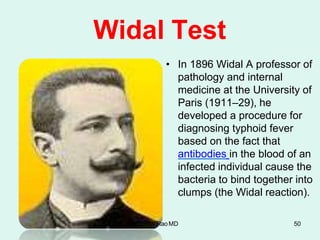
Widal Test
• In 1896 Widal A professor of
pathology and internal
medicine at the University of
Paris (1911–29), he
developed a procedure for
diagnosing typhoid fever
based on the fact that
antibodies in the blood of an
infected individual cause the
bacteria to bind together into
clumps (the Widal reaction).
Dr.T.V.RaoMD 50
WIDAL Test
land Mark In Diagnosis
• The Widal test is an old
serologic assay for detecting
IgM and IgG antibodies to
the O and H antigens of
Salmonella. The test is
unreliable, but is widely used
in developing countries
because of its low cost.
Newer serologic assays are
somewhat more sensitive
and specific than the Widal
test, but are infrequently
available.
Dr.T.V.RaoMD 51
Widal test
Dr.T.V.RaoMD 52
• S.typhi O and H tubes
• Paratyphi A/B H agglutinins only
• Common antigens O in all Factor sharing
12
• Significance
• I st week negative.
• Titers raise in 2nd week Raise of titers
diagnostic
Widal Test
Dr.T.V.RaoMD 53
• Single test not diagnostic.
• Paired samples tests
• Diagnostic.
O > 1 in 80
H > 1in 160
H agglutinins appear first
False positives in Unapparent infection,
Immunization
Previously infected
Widal test
Dr.T.V.RaoMD 54
• Anamnestic response previous
infection and responding to
unrelated infection
• Other Diagnostic tests
CIE and ELISA
Detection of Circulating antigens
Co agglutination test.
Limitation of Widal Test
• The Widal test is
time consuming and
often times when
diagnosis is reached
it is too late to start
an antibiotic
regimen.
• In spite of several
limitation many
Physicians depend
on Widal Test Dr.T.V.RaoMD 55
• The Widal test should be interpreted
in the light of baseline titers in a
healthy local population. This is
especially important when there is a
high local prevalence of non-typhoid
salmonellosis.
The Widal test may be falsely positive
in patients who have had previous
vaccination or infection with S typhi.
False Positive and Negative
Reactions with WIDAL Test
Dr.T.V.RaoMD 56
False Positive and Negative
Reactions with WIDAL Test
• Widal titers have also been reported in
association with the
dysgammaglobulinaemia of chronic active
hepatitis and other autoimmune
diseases.64 '8 '9 False negative results
may be associated with early treatment,
with "hidden organisms" in bone and
joints, and with relapses of typhoid fever.
Occasionally the infecting strains are
poorly immunogeD
n
r.T
i.
c
V.R
.ao MD 57
Diagnosis of Carriers and
Environments
• Fecal carriers by
isolation from
specimens. or
Bile aspirated.
• Sewer swabs
• Bacteriophage
typing
Dr.T.V.RaoMD 58
Prophylaxis
Dr.T.V.RaoMD 59
• TAB vaccine
S.typhi 1,000 millions
S Paratyphi A,B 750 millions.
Injected subcutaneously 0.5 ml
at 4 – 6 weeks.
Live Oral Vaccine Typhoral
Mutant S.typhi strain Ty 2 1a Lacking enzyme
UDP galctose 4 epimerase 10 to9
Viable bacilli
Given orally 1 – 3 – 5 days
Vaccines
Dr.T.V.RaoMD 60
• An Inject able vaccine Typhium Vi
• Contains purified Vi polysaccharide
antigen from S.typhi strain Ty2
• A single dose, subcutaneous route
• Given to children > 5 years
• Immunity lasts for 2- 3 years.
• Follow a booster
Treatment
Dr.T.V.RaoMD 61
• Chloramphenicol 1948 /1970 resistance.
• Other Important drugs
Ampicillin Amoxicillin,
Furazolidine
Cotromoxazole
Chloramphenical resistance /Mexico
Kerala
Other Drugs
• Fluroquinolones
Ciprofloxacillin,
Pefloxacillin
Ofloxacillin
Ceftazidime
Ceftriaxone /
Cefotoxaime
Dr.T.V.RaoMD 62
Coalition against Typhoid
• Since May 2011, the
Coalition against Typhoid
(CaT) has featured
monthly articles in the
WHO’s Global
Immunization Newsletters
(GIN). The articles,
written by CaT members
from around the world,
highlight important work
being done to accelerate
adoption of typhoid
vaccines. Dr.T.V.RaoMD 63
Salmonella Gastroenteritis
Dr.T.V.RaoMD 64
• Zoonotic disease
• S.enteritidis
• S.typhimurium
• S.halder
• S. agana
• S.indiana
• Contaminated poultry, Meat Milk, Milk products.
• Enters the shells of the Intact eggs – Chicken
feed, and Fecal droppings.
Nontyphoidal Salmonella
• General Incubation: 6 hrs-10 days; Duration: 2-7 days
• Infective Dose = usually millions to billions of cells
• Transmission occurs via contaminated food and water
• Reservoir:
a) multiple animal reservoirs
b) mainly from poultry and eggs (80% cases from eggs)
c)fresh produce and exotic pets are also a source of contamination
(> 90% of reptile stool contain salmonella bacterium); small turtles
ban.
• General Symptoms: diarrhea with fever, abdominal cramps, nausea
and sometimes vomiting Dr.T
.V.Rao MD 65
Nontyphoidal Salmonella:
Gastroenteritis
• Incubation: 8-48 hrs ; Duration: 3-7 days for
diarrhea & 72 hrs. for fever
• Inoculum: large
• Limited to GI tract
• Symptoms include: diarrhea, nausea, abdominal
cramps and fevers of 100.5-102.2ºF. Also
accompanied by loose, bloody stool; Pseudo
appendicitis (rare)
• Stool culture will remain positive for 4-5 weeks
• < 1% will become carD
rr
i
.T
e
.V
r
.R
s
ao MD 66
Nontyphoidal Salmonella:
Bacteremia and Endovascular Infections
Dr.T.V.RaoMD 67
• 5% develop septicemia; 5-10% of septicemia patients
develop localized infections
• Endocarditis: Salmonella often infect vascular sites;
preexisting heart valve disease risk factor
• Arteritis: Elderly patients with a history of back/chest +
prolonged fever or abdominal pain proceeding
gastroenteritis are particularly at risk.
- Both are rare, but can cause complications that may lead
to death
Salmonella Gastroenteritis
Dr.T.V.RaoMD 68
• Can occur as cross infection
• 24 hours
• Manifest with Diarrhea, omitting
• Abdominal pain mucous and blood in
stools
• Last for 2 – 4 days
• Some times may lead to septicemias
Diagnosis and Treatment
• Isolation by
culturing
• Rarely need
antibiotics.
• More frequent in
Developed
nations.
Dr.T.V.RaoMD 69
Salmonella septicemias
• S.cholera suis
• Deep abscess,
Endocarditis
• Isolation from
Blood and Pus.
• Chloramphenicol
highly effective
Dr.T.V.RaoMD 70
Programme created by Dr.T.V.Rao MD for
Medical and Paramedical Students in the
Developing World
Dr.T.V.RaoMD 71
Email
doctortvrao@gmail.com

salmonella-120422061415-phpapp02.pptx

  • 1.
  • 2.
    Salmonella Dr.T.V.RaoMD 2 • CausesInfections in Humans and vertebrates, • Enteric Fever ( Typhoid fever ) • Gastroenteritis • Septicemias, • Carrier state.
  • 3.
    Salmonella Dr.T.V.RaoMD 3 • AVery complex group • Contains more > 2,000 spp • Typed on the basis of Serotyping, and species typing • Divided into two groups 1 Enteric fever group 2 Food poisoning group – Septicemias.
  • 4.
    Enteric Fever Typhoid Fever Dr.T.V.RaoMD4 • Caused by Salmonella typhi, and other Groups called as Paratyphi A, B, C • Salmonella typhi - Causes Typhoid • Salmonella Paratyphi A,B,C Causes Paratyphoid fevers. • Food Poison group • Spread from Animals – Humans • Causes Gastroenteritis – Septicemias, Localized Infection
  • 5.
    Typhoid Mary MostDangerous Woman in America Dr.T.V.RaoMD 5
  • 6.
    Morphology of Salmonella •Gram negative bacilli • 1-3 / 0.5 microns, • Motile by peritrichous flagella Dr.T.V.RaoMD 6
  • 7.
    Bacteriology –Typhoid fever •The Genus Salmonella belong to Enterobacteriaceae • Facultative anaerobe • Gram negative bacilli • Distinguished from other bacteria by Biochemical and antigen structure Dr.T.V.RaoMD 7
  • 8.
    Cultural Characters Dr.T.V.RaoMD 8 •Aerobic / Facultatively anaerobic • Grows on simple media – Nutrient agar, • Temp 15 – 41ºc / 37º c • Colonies appear as large 2 -3 mm, circular, low convex, • On MacConkey medium appear Colorless ( NLF ) Selective Medium - Wilson Blair Bismuth sulphide medium. Produce Jet black colonies H2 S produced by Salmonella typhi
  • 9.
    Enrichment Medium Dr.T.V.RaoMD 9 LiquidMedium • Selenite F medium • Tetrathionate broth • Above medium are used for isolation of Salmonella from contaminated specimens • Particularly stool specimens..
  • 10.
    Identifying Enteric Organisms Dr.T.V.RaoMD10 • Isolates which are Non lactose fermenting • Motile, Indole positive • Urease negative • Ferment Glucose,Mannitol,Maltose • Do not ferment Lactose, Sucrose • Typhoid bacilli are anaerogenic • Some of the Paratyphoid form acid and gas • Further identification done by slide agglutination tests
  • 11.
    Biochemical Characters • Glucose,Mannitol ,Maltose produce A/G • Salmonella typhi do not produce gas • Lactose/Salicin/sucrose not fermented. • Indole – • Methyl Red + • V P - • Citrate + • Urea – • H2S – produced by Salmonella typhi • Paratyphi A do not produce H2S Dr.T.V.Rao MD 11
  • 12.
    Resistance of Salmonella •55º c – 1 hour • 60º c – 15 MT • Boiling ,Chlorination, Pasteurization Destroy the Bacilli. Dr.T.V.RaoMD 12
  • 13.
    Antigenic structure of Salmonella Dr.T.V.RaoMD13 • Two sets of antigens • Detection by serotyping • 1 Somatic or 0 Antigens contain long chain polysaccharides ( LPS ) comprises of heat stable polysaccharide commonly. • 2 Flagellar or H Antigens are strongly immunogenic and induces antibody formation rapidly and in high titers following infection or immunization. The flagellar antigen is of a dual nature, occurring in one of the two phases.
  • 14.
    Salmonella Antigenic Structure Dr.T.V.RaoMD 14 •H – Flegellar antigens • O – Somatic antigen, • Vi – Surface antigen in some species only • H antigens also called flegellar antigens, heat labile protein, • Boiling destroys antigenicity • When mixed with Antiserum produces agglutination and fluffy clumps are produced • H antigens are strongly immunogenic Induces antibodies rapidly,
  • 15.
    Antigens – Salmonella( cont ) Dr.T.V.RaoMD 15 • O Antigens • Forms integral part of Cell wall, • Like Endotoxin • 0 Antigens unaffected by boiling. • When mixed with antiserum produce chalky clumps are formed, take more time reaction, at high temp 50º – 55º c • O antigens are less immunogenic. than H antigens
  • 16.
    Antigen (Vi) –Salmonella ( contd ) • Vi antigens • Many strains in S.typhi covers the O antigens- prevents agglutination. • Resembles like K antigens • Destroyed after boiling at 60º c / 1 hour. • Vi a polysaccharide • Acts as virulence factor, protects the bacilli against Phagocytosis and activity of Complement • Poorly immunogenic • Low titer of antibodies are produced, Not diagnostic Dr.T.V.RaoMD 16
  • 17.
    Classification of Salmonella •Classified on the basis of Kauffmann-White Scheme • Structure of 0 and H antigens are taken into consideration, • More than 2000 species characterized. Dr.T.V.RaoMD 17
  • 18.
    Kauffmann – Whitescheme Dr.T.V.RaoMD 18 • Serotype 0 antigens H antigens Phase 1 2 1.Typhi 9,12,(Vi) d 1,2 2 Paratyphi A 1,2.12 a - 3 Paratyphi B 1,4,5,12 b 1,2 4 Typhimuruim 1,4,5,12 I 1,7 5 Enteritidis 1,9,12 g m 1,2
  • 19.
    Antigenic Variation in Salmonella •May be phenotypic / Genotypic • H to O = loss of Flagella May be phase variation from I to II V to W variation S to R variation Dr.T.V.RaoMD 19
  • 20.
    Pathogenicity Dr.T.V.RaoMD 20 • Salmonellaare definite parasites to humans. • Eg S.typhi. • S.paratyphi A, B ,C • Other groups Salmonella • The important clinical syndromes 1.Enteric fever, Septicemias, gastroenteritis.
  • 21.
    Enteric Fever Typhoid • Typhoid– caused by S.typhi • Paratyphoid Caused by Paratyphi A,B,C • Typhoid --- Like Typhus • Infective dose ID50 / 107, Dr.T.V.RaoMD 21
  • 22.
  • 23.
    Events in aTypical typhoid Fever Dr.T.V.RaoMD 23
  • 24.
    Pathology and Pathogenesis Dr.T.V.RaoMD24 • Bacilli enter through ingestion, • Bacilli attach to Microvilli,ileal mucosa, penetrate to Lamina propria and sub mucosa • Phagocytosis by Polymorphs and Macrophages • Enters the mesenteric lymph nodes • Enter the thoracic duct – Blood stream
  • 25.
    Pathology and Pathogenesis Dr.T.V.RaoMD25 • Bacteremia Spread to Liver, Gall bladder, Spleen, Bone marrow, Lymph nodes, Lungs, Multiply in kidneys Once again spill into Blood stream Causes clinical illness.
  • 26.
    Pathology and Pathogenesis •Multiply abundantly in Gall bladder, • Bile rich source of Bacteria • Spill into Intestine, infects payers patches, Lymph follicles • Inflammation – Undergo necrosis, Slough off • Typhoid ulcers • Typhoid ulcers can cause perforation and hemorrhage • Duration of Illness 3 – 4 weeks • Incubation 7 -14, D (r.T 3 .V.- R5 ao6 MD days ) 26
  • 27.
    Immunity in Typhoid •Typhoid bacilli are Intracellular pathogens • Cell mediated immunity is crucial Dr.T.V.RaoMD 27
  • 28.
    Clinical manifestation • Headache, malise,anorexia ,coated tongue • Abdominal discomfort, • Constipation / Diarrhea • Step ladder type fever, • Relative bradycardia, • A soft palpable spleen • Hepatomegaly • Rose spots appea Dr r .T .V.Rao MD 28
  • 29.
    Events in aTypical typhoid Fever Dr.T.V.RaoMD 29
  • 30.
    Rashes in Typhoid •May present with rash, rose spots 2 -4 mm in diameter raised discrete irregular blanching pink maculae's found in front of chest • Appear in crops of up to a dozen at a time • Fade after 3 – 4 days Dr.T.V.RaoMD 30
  • 31.
    Complications of Enteric fever Dr.T.V.RaoMD31 • Intestinal perforation, • Hemorrhage, • Circulatory collapse. • Bronchitis Bronchopneumonia, • Meningitis, • Cholecystitis, • Arthritis,Periostitis / Nephritis, • Osteomyletis,
  • 32.
    Other complications • Causesrelapses in particular to patients treated with chloramphenicol. • S.paratyphi produce septicemias. Dr.T.V.RaoMD 32
  • 33.
    Epidemiology Dr.T.V.RaoMD 33 • Developedcountries - Controlled. • Water supply/ Sanitation /Economically poor. • S.typhi and S.paratyphi are prevalent in India • Previously Typhi are more common Paratyphoid A on raise. • Age 5 – 20 years, Sanitation
  • 34.
    Epidemiology Dr.T.V.RaoMD 34 • Sanitationhas great role • Source an active patient or a Carrier shed the Bacilli. • Who are carriers. Convalescent carrier 3 weeks to 3 months Temporary carrier Chronic carrier 3 months to 1 year > 1 year, Women attain more carrier stage
  • 35.
    Epidemiology (Contd) Dr.T.V.RaoMD 35 •Bacilli persist in the Gall bladder and kidney • Food handlers spread the infection • Cooks great role • S.typhi and S.paratyphi in humans • S.para B in Animals, • Typhoid spread through Water, Milk, Food HIV patients potentially susceptible for Typhoid disease.
  • 36.
    Typhoid Mary • Afamous example is “Typhoid” Mary Mallon, who was a food handler responsible for infecting at least 78 people, killing 5. These highly infectious carriers pose a great risk to public health. Dr.T.V.RaoMD 36
  • 37.
    • Diagnosis ismade by any blood, bone marrow or stool cultures and with the Widal test (demonstration of salmonella antibodies against antigens O-somatic and H-flagellar ). In epidemics and less wealthy countries, after excluding malaria, dysentery or pneumonia, a therapeutic trial time with chloramphenicol is generally undertaken while awaiting the results of Widal test and cultures of the blood and Dr.T.V.RaoMD 37 stool. How we Diagnose Typhoid Fever
  • 38.
    Laboratory Diagnosis of TyphoidFever • 1 Isolation of Bacilli. A Gold standard • 2 Diagnosis for presence of Antibodies, • Positive Blood culture – A gold standard • Isolation from Feces and Urine ? • Detection of Antibodies Inconclusive. • Newer methods Detection of antD ir g. T . eV . R na o i M n D Blood and Urine 38
  • 39.
    Blood Culture Dr.T.V.RaoMD 39 1st week Positive in 90 % 2 nd week Positive in 75 % 3 rd week Positive in 60 % > 3 weeks positive in 25 % Draw 5 – 10 cc of Blood by venipuncture. ADD to 50 -100 ml of Bile broth. Incubate at 37 c /Subculture in MacConkey At regular intervals
  • 40.
    Blood Cultures inTyphoid Fevers • Bacteremia occurs early in the disease • Blood Cultures are positive in 1st week in 90% 2nd week in 75% 3rd week in 60% 4th week and later in 25% Dr.T.V.RaoMD 40
  • 41.
    Castaneda’s method of BloodCulture Dr.T.V.RaoMD 41 • Double medium used Solid/Liquid medium in the same Bottle. • Bottle contains Bile broth/agar slant, • For subculture the bottle is merely tilted. • A subculture into MacConkey at regular intervals, • Reduces the chances of contamination • Increases the chances of isolation.
  • 42.
    Salmonella on MacConkey's agar Dr.T.V.RaoMD
  • 43.
    Salmonella on XLDagar Dr.T.V.RaoMD
  • 44.
    Clot culture • Clotcultures are more productive in yielding better results in isolation. • A blood after clotting, the clot is lysed with Streptokinase ,but expensive to perform in developing countries. Dr.T.V.RaoMD 44
  • 45.
    Bactek and Radiometricbased methods are in recent use • Bactek methods in isolation of Salmonella is a rapid and sensitive method in early diagnosis of Enteric fever. • Many Microbiology Diagnostic Laboratories are upgrading to Bactek methods Dr.T.V.RaoMD 45
  • 46.
    Biochemical Characters Dr.T.V.RaoMD 46 •Non Lactose fermenter, • Motile • Indole – MR + VP - Citrate + • Ferment Glu/Mal/Man • Do not ferment Lactose/Sucrose
  • 47.
    Slide agglutination tests •In slide agglutination tests a known serum and unknown culture isolate is mixed, clumping occurs within few minutes • Commercial sera are available for detection of A, B,C1,C2,D, and E. Dr.T.V.RaoMD 47
  • 48.
    Culturing other Specimens Dr.T.V.RaoMD48 • Feces Enrichment in Tetrathionate broth and Selenite broth • Culturing in MacConkey/DCA/Wilson Blair medium – Large black colonies. • Urine Culture – positive in 25 % • Other samples Bone Marrow,Bile,CSF/Sputum
  • 49.
    Serology Dr.T.V.RaoMD 49 • WIDALTest – Tube agglutination test. • Detects O and H antibodies • Diagnosis of Typhoid and Paratyphoid • Testing for H agglutinins in Dryers tubes, a narrow tube floccules at the bottom • Testing for O agglutinins in Felix tubes, Chalky • Incubated at 37º c overnight
  • 50.
    Widal Test • In1896 Widal A professor of pathology and internal medicine at the University of Paris (1911–29), he developed a procedure for diagnosing typhoid fever based on the fact that antibodies in the blood of an infected individual cause the bacteria to bind together into clumps (the Widal reaction). Dr.T.V.RaoMD 50
  • 51.
    WIDAL Test land MarkIn Diagnosis • The Widal test is an old serologic assay for detecting IgM and IgG antibodies to the O and H antigens of Salmonella. The test is unreliable, but is widely used in developing countries because of its low cost. Newer serologic assays are somewhat more sensitive and specific than the Widal test, but are infrequently available. Dr.T.V.RaoMD 51
  • 52.
    Widal test Dr.T.V.RaoMD 52 •S.typhi O and H tubes • Paratyphi A/B H agglutinins only • Common antigens O in all Factor sharing 12 • Significance • I st week negative. • Titers raise in 2nd week Raise of titers diagnostic
  • 53.
    Widal Test Dr.T.V.RaoMD 53 •Single test not diagnostic. • Paired samples tests • Diagnostic. O > 1 in 80 H > 1in 160 H agglutinins appear first False positives in Unapparent infection, Immunization Previously infected
  • 54.
    Widal test Dr.T.V.RaoMD 54 •Anamnestic response previous infection and responding to unrelated infection • Other Diagnostic tests CIE and ELISA Detection of Circulating antigens Co agglutination test.
  • 55.
    Limitation of WidalTest • The Widal test is time consuming and often times when diagnosis is reached it is too late to start an antibiotic regimen. • In spite of several limitation many Physicians depend on Widal Test Dr.T.V.RaoMD 55
  • 56.
    • The Widaltest should be interpreted in the light of baseline titers in a healthy local population. This is especially important when there is a high local prevalence of non-typhoid salmonellosis. The Widal test may be falsely positive in patients who have had previous vaccination or infection with S typhi. False Positive and Negative Reactions with WIDAL Test Dr.T.V.RaoMD 56
  • 57.
    False Positive andNegative Reactions with WIDAL Test • Widal titers have also been reported in association with the dysgammaglobulinaemia of chronic active hepatitis and other autoimmune diseases.64 '8 '9 False negative results may be associated with early treatment, with "hidden organisms" in bone and joints, and with relapses of typhoid fever. Occasionally the infecting strains are poorly immunogeD n r.T i. c V.R .ao MD 57
  • 58.
    Diagnosis of Carriersand Environments • Fecal carriers by isolation from specimens. or Bile aspirated. • Sewer swabs • Bacteriophage typing Dr.T.V.RaoMD 58
  • 59.
    Prophylaxis Dr.T.V.RaoMD 59 • TABvaccine S.typhi 1,000 millions S Paratyphi A,B 750 millions. Injected subcutaneously 0.5 ml at 4 – 6 weeks. Live Oral Vaccine Typhoral Mutant S.typhi strain Ty 2 1a Lacking enzyme UDP galctose 4 epimerase 10 to9 Viable bacilli Given orally 1 – 3 – 5 days
  • 60.
    Vaccines Dr.T.V.RaoMD 60 • AnInject able vaccine Typhium Vi • Contains purified Vi polysaccharide antigen from S.typhi strain Ty2 • A single dose, subcutaneous route • Given to children > 5 years • Immunity lasts for 2- 3 years. • Follow a booster
  • 61.
    Treatment Dr.T.V.RaoMD 61 • Chloramphenicol1948 /1970 resistance. • Other Important drugs Ampicillin Amoxicillin, Furazolidine Cotromoxazole Chloramphenical resistance /Mexico Kerala
  • 62.
  • 63.
    Coalition against Typhoid •Since May 2011, the Coalition against Typhoid (CaT) has featured monthly articles in the WHO’s Global Immunization Newsletters (GIN). The articles, written by CaT members from around the world, highlight important work being done to accelerate adoption of typhoid vaccines. Dr.T.V.RaoMD 63
  • 64.
    Salmonella Gastroenteritis Dr.T.V.RaoMD 64 •Zoonotic disease • S.enteritidis • S.typhimurium • S.halder • S. agana • S.indiana • Contaminated poultry, Meat Milk, Milk products. • Enters the shells of the Intact eggs – Chicken feed, and Fecal droppings.
  • 65.
    Nontyphoidal Salmonella • GeneralIncubation: 6 hrs-10 days; Duration: 2-7 days • Infective Dose = usually millions to billions of cells • Transmission occurs via contaminated food and water • Reservoir: a) multiple animal reservoirs b) mainly from poultry and eggs (80% cases from eggs) c)fresh produce and exotic pets are also a source of contamination (> 90% of reptile stool contain salmonella bacterium); small turtles ban. • General Symptoms: diarrhea with fever, abdominal cramps, nausea and sometimes vomiting Dr.T .V.Rao MD 65
  • 66.
    Nontyphoidal Salmonella: Gastroenteritis • Incubation:8-48 hrs ; Duration: 3-7 days for diarrhea & 72 hrs. for fever • Inoculum: large • Limited to GI tract • Symptoms include: diarrhea, nausea, abdominal cramps and fevers of 100.5-102.2ºF. Also accompanied by loose, bloody stool; Pseudo appendicitis (rare) • Stool culture will remain positive for 4-5 weeks • < 1% will become carD rr i .T e .V r .R s ao MD 66
  • 67.
    Nontyphoidal Salmonella: Bacteremia andEndovascular Infections Dr.T.V.RaoMD 67 • 5% develop septicemia; 5-10% of septicemia patients develop localized infections • Endocarditis: Salmonella often infect vascular sites; preexisting heart valve disease risk factor • Arteritis: Elderly patients with a history of back/chest + prolonged fever or abdominal pain proceeding gastroenteritis are particularly at risk. - Both are rare, but can cause complications that may lead to death
  • 68.
    Salmonella Gastroenteritis Dr.T.V.RaoMD 68 •Can occur as cross infection • 24 hours • Manifest with Diarrhea, omitting • Abdominal pain mucous and blood in stools • Last for 2 – 4 days • Some times may lead to septicemias
  • 69.
    Diagnosis and Treatment •Isolation by culturing • Rarely need antibiotics. • More frequent in Developed nations. Dr.T.V.RaoMD 69
  • 70.
    Salmonella septicemias • S.cholerasuis • Deep abscess, Endocarditis • Isolation from Blood and Pus. • Chloramphenicol highly effective Dr.T.V.RaoMD 70
  • 71.
    Programme created byDr.T.V.Rao MD for Medical and Paramedical Students in the Developing World Dr.T.V.RaoMD 71 Email doctortvrao@gmail.com