ARTIFICIAL NEURAL NETWORKS
End of Semester Presentation
Presented by:
Saif Al Kalbani 39579/12
20-05-2014
ECCE6206
Switching Theory: Design and
Practice
Spring 2014
1
Sultan Qaboos University
College of Engineering
Department of Electrical and
Computer Engineering
Outline
2
 Introduction
 General Architecture
 Learning
 Examples
 Applications
 Neuro-Fuzzy
 Conclusion
Applications
3
 Input is high-dimensional discrete or real-
valued (e.g. raw sensor input)
 Output is discrete or real valued
 Output is a vector of values
 Form of target function is unknown
 Control System
 Transfer function with huge number of inputs
 Unknown transfer function
General Architecture
4
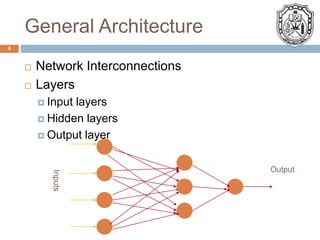
 Network Interconnections
 Layers
 Input layers
 Hidden layers
 Output layer
Inputs
Output
General Architecture
5
General Architecture
6
 Threshold switching units
 Weighted interconnections among units
 Highly parallel, distributed processing
 Learning by tuning the connection weights
General Architecture
7
General Architecture
8
• Layers
• Activation function
• Learning
Layers
9
• The input layer.
– Introduces input values into the network.
– No activation function or other processing.
• The hidden layer(s).
– Perform classification of features
– Two hidden layers are sufficient to solve any problem
– Features imply more layers may be better
• The output layer.
– Functionally just like the hidden layers
– Outputs are passed on to the world outside the
neural network.
Examples
10
Activation Function
11
Learning
12
• Adjust neural network weights to map inputs to
outputs.
• Use a set of sample patterns where the desired
output (given the inputs presented) is known.
• The purpose is to learn to generalize
– Recognize features which are common to
good and bad exemplars
– Types
– Supervises
– Unsupervised
Supervised Learning
13
 Training and test data sets
 Training set; input & target
Learning
14
 wi = wi + wi
 wi =  (t - o) xi
 t=c(x) is the target value
 o is the perceptron output
  Is a small constant (e.g. 0.1) called learning rate
• If the output is correct (t=o) the weights wi are not
changed
• If the output is incorrect (to) the weights wi are
changed such that the output of the perceptron
for the new weights is closer to t.
 The algorithm converges to the correct
classification
• if the training data is linearly separable and  is
sufficiently small
Learning
15
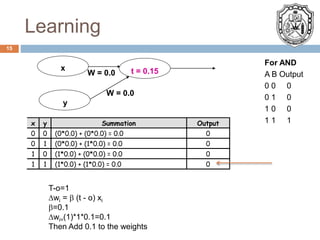
For AND
A B Output
0 0 0
0 1 0
1 0 0
1 1 1
t = 0.15
y
x
W = 0.0
W = 0.0
x y Summation Output
0 0 (0*0.0) + (0*0.0) = 0.0 0
0 1 (0*0.0) + (1*0.0) = 0.0 0
1 0 (1*0.0) + (0*0.0) = 0.0 0
1 1 (1*0.0) + (1*0.0) = 0.0 0
T-o=1
wi =  (t - o) xi
=0.1
wi=(1)*1*0.1=0.1
Then Add 0.1 to the weights
Learning
16
For AND
A B Output
0 0 0
0 1 0
1 0 0
1 1 1
t = 0.15
y
x
W = 0.1
W = 0.1
x y Summation Output
0 0 (0*0.1) + (0*0.1) = 0.0 0
0 1 (0*0.1) + (1*0.1) = 0.1 0
1 0 (1*0.1) + (0*0.1) = 0.1 0
1 1 (1*0.1) + (1*0.1) = 0.2 1
Decision Boundary
17
X1
X2
A
B
A
A
A
A
A
A
B
B
B
B
B
B
B Decision
Boundary
Strength
18
 Solving complex problems
 Inputs are complex, large, unknown
 Transfer function is unknown
 Adaptation
 Adaptive controllers
 Learning process
Shortfalls
19
 Learning
 Weights
 Processing time
 Delays in processing
 Sensing
 Set up
 Layers
Application Example
20
• Engine Control Unit (ECU) in new cars
• Fuel injector
• The behaviour of a car engine is influenced by a
large number of parameters
– temperature at various points
– fuel/air mixture
– lubricant viscosity.
• Major companies have used neural networks to
dynamically tune an engine depending on
current settings.
Neuro-Fuzzy
21
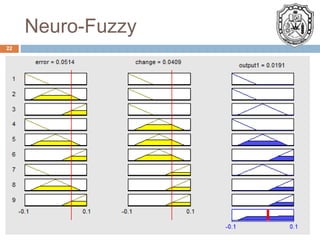
 Hybrid controllers
 ANN controllers
 Fuzzy logic Controllers
 Adaptation
 Rules
 Membership functions
Neuro-Fuzzy
22
Conclusion
23
 Ability of ANN to
 Adapt through learning
 Solve complex systems
 ANN is claimed to be able to solve any
problem with a maximum of two hidden layers
Thank You
Q&A24
Back-up25
Fuzzy System
26

Artificial Neural Networks

  • 1.
    ARTIFICIAL NEURAL NETWORKS Endof Semester Presentation Presented by: Saif Al Kalbani 39579/12 20-05-2014 ECCE6206 Switching Theory: Design and Practice Spring 2014 1 Sultan Qaboos University College of Engineering Department of Electrical and Computer Engineering
  • 2.
    Outline 2  Introduction  GeneralArchitecture  Learning  Examples  Applications  Neuro-Fuzzy  Conclusion
  • 3.
    Applications 3  Input ishigh-dimensional discrete or real- valued (e.g. raw sensor input)  Output is discrete or real valued  Output is a vector of values  Form of target function is unknown  Control System  Transfer function with huge number of inputs  Unknown transfer function
  • 4.
    General Architecture 4  NetworkInterconnections  Layers  Input layers  Hidden layers  Output layer Inputs Output
  • 5.
  • 6.
    General Architecture 6  Thresholdswitching units  Weighted interconnections among units  Highly parallel, distributed processing  Learning by tuning the connection weights
  • 7.
  • 8.
    General Architecture 8 • Layers •Activation function • Learning
  • 9.
    Layers 9 • The inputlayer. – Introduces input values into the network. – No activation function or other processing. • The hidden layer(s). – Perform classification of features – Two hidden layers are sufficient to solve any problem – Features imply more layers may be better • The output layer. – Functionally just like the hidden layers – Outputs are passed on to the world outside the neural network.
  • 10.
  • 11.
  • 12.
    Learning 12 • Adjust neuralnetwork weights to map inputs to outputs. • Use a set of sample patterns where the desired output (given the inputs presented) is known. • The purpose is to learn to generalize – Recognize features which are common to good and bad exemplars – Types – Supervises – Unsupervised
  • 13.
    Supervised Learning 13  Trainingand test data sets  Training set; input & target
  • 14.
    Learning 14  wi =wi + wi  wi =  (t - o) xi  t=c(x) is the target value  o is the perceptron output   Is a small constant (e.g. 0.1) called learning rate • If the output is correct (t=o) the weights wi are not changed • If the output is incorrect (to) the weights wi are changed such that the output of the perceptron for the new weights is closer to t.  The algorithm converges to the correct classification • if the training data is linearly separable and  is sufficiently small
  • 15.
    Learning 15 For AND A BOutput 0 0 0 0 1 0 1 0 0 1 1 1 t = 0.15 y x W = 0.0 W = 0.0 x y Summation Output 0 0 (0*0.0) + (0*0.0) = 0.0 0 0 1 (0*0.0) + (1*0.0) = 0.0 0 1 0 (1*0.0) + (0*0.0) = 0.0 0 1 1 (1*0.0) + (1*0.0) = 0.0 0 T-o=1 wi =  (t - o) xi =0.1 wi=(1)*1*0.1=0.1 Then Add 0.1 to the weights
  • 16.
    Learning 16 For AND A BOutput 0 0 0 0 1 0 1 0 0 1 1 1 t = 0.15 y x W = 0.1 W = 0.1 x y Summation Output 0 0 (0*0.1) + (0*0.1) = 0.0 0 0 1 (0*0.1) + (1*0.1) = 0.1 0 1 0 (1*0.1) + (0*0.1) = 0.1 0 1 1 (1*0.1) + (1*0.1) = 0.2 1
  • 17.
  • 18.
    Strength 18  Solving complexproblems  Inputs are complex, large, unknown  Transfer function is unknown  Adaptation  Adaptive controllers  Learning process
  • 19.
    Shortfalls 19  Learning  Weights Processing time  Delays in processing  Sensing  Set up  Layers
  • 20.
    Application Example 20 • EngineControl Unit (ECU) in new cars • Fuel injector • The behaviour of a car engine is influenced by a large number of parameters – temperature at various points – fuel/air mixture – lubricant viscosity. • Major companies have used neural networks to dynamically tune an engine depending on current settings.
  • 21.
    Neuro-Fuzzy 21  Hybrid controllers ANN controllers  Fuzzy logic Controllers  Adaptation  Rules  Membership functions
  • 22.
  • 23.
    Conclusion 23  Ability ofANN to  Adapt through learning  Solve complex systems  ANN is claimed to be able to solve any problem with a maximum of two hidden layers
  • 24.
  • 25.
  • 26.