INTRODUCTION TO
ARTIFICIAL INTELLIGENCE
USING FUZZY LOGIC AND
NEURAL NETWORK
By: Mr. Snehal Dewaji Gongle
Electronics & Communication
Engg.
MIET Gondia, Maharashtra
Email:
gonglesnehal4@gmail.com
Contents
 Introduction to Artificial Intelligence
 Artificial Intelligence using Fuzzy and NN
 Fuzzy Logic
 Traditional Logic v/s Fuzzy Logic
 Neural Network
 Biological aspect for Architecture of Artificial
Neural Network
 Fuzzy-Neural Hybrid Network
 Conclusion and Reference
Intro to Artificial Intelligence:
The branch of computer science concerned with
making computers behave like humans. The term
was coined in 1956 by John McCarthy at the
Massachusetts Institute of Technology.
Machines that perceive, understand and
react to their environment in other words
Machines that think is due to Artificial
Intelligence.
Definition:
Example:
The Automatic Car Parking:
The Auto-pilot mode in
planes:
Artificial Intelligence using Fuzzy
and Neural Network:
AI applications built on logic
Induction, semantic queries, system of logic
These sequence, systems or queries are solved
on the basics of Fuzzy Sets.
Computers as same as humans
As humans connect their thoughts by the flow of
neuronal data transfer
Same as the neural data transfer the Artificial
Neural Network transfer the data in computers.
Computers much better than humans
The accuracy rate in the calculation part is high as
compared.
Fuzzy logic:
Definition of fuzzy logic
o A form of knowledge representation suitable for
notions that cannot be defined precisely, but
which depend upon their contexts.
 History:
In the year 1965 Lotfi Zadeh, published his famous
paper (Fuzzy sets). Zadeh extended the work on
possibility theory into a formal system of mathematical
logic, and introduced a new concept for applying natural
language terms.
This new and multi-valued logic for representing and manipulating
fuzzy terms was called fuzzy logic.
Traditional Logic v/s Fuzzy
Logic:
Slow Fast
Speed = 0 Speed = 1
Fastest
Slow
Fast
[ 0.0 – 0.25 ]
[ 0.25 – 0.50 ]
[ 0.50 – 0.75 ]
[ 0.75 – 1.00 ]
Slowest
(a) Boolean Logic. (b) Multi-valued Logic.
0 1 10 0.2 0.4 0.6 0.8 100 1 10
Traditional logic Fuzzy logic
Fuzzy logic is based on the idea that all
things admit of degrees or can be drew
into sets . Temperature, height, speed,
distance, beauty – all come on a sliding
scale.
We can have different characteristics of players
on basis of:
Strength: strong, medium, weak
Aggressiveness: meek, medium, nasty
If meek and attacked, run away fast
If medium and attacked, run away slowly
If nasty and strong and attacked, attack back
Fuzzy set theory:
An object is in a set by matter of
degree
1.0 => in the set
0.0 => not in the set
0.0 < object < 1.0 => partially in the
setExample:
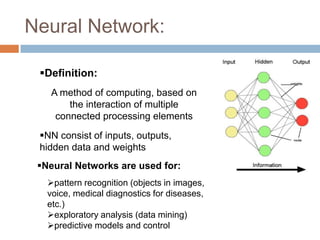
Neural Network:
Neural Networks are used for:
pattern recognition (objects in images,
voice, medical diagnostics for diseases,
etc.)
exploratory analysis (data mining)
predictive models and control
A method of computing, based on
the interaction of multiple
connected processing elements
Definition:
NN consist of inputs, outputs,
hidden data and weights
Biological aspect for architecture of
Artificial Neural Network:
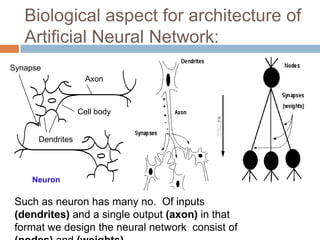
Such as neuron has many no. Of inputs
(dendrites) and a single output (axon) in that
format we design the neural network consist of
Synapse
Axon
Cell body
Dendrites
Neuron
Fuzzy-Neural Hybrid Network:
 For example, while neural networks are good at
recognizing patterns, they are not good at explaining how
they reach their decisions.
Fuzzy logic systems, which can reason with imprecise
information, are good at explaining their decisions but they
cannot automatically acquire the rules they use to make
those decisions.
These limitations have been a central driving force behind
the creation of intelligent hybrid systems where two or more
techniques are combined in a manner that overcomes
individual techniques even after they are hard at training
period but lately they are excellent in accuracy.
In Hybrid network both the Fuzzy Logic and
Neural Network are taken and combined
together to form Fuzzy-Neural Network.
• Transfer function g is linear
• If wk=0 then wk AND xk=0 while if wk=1 then wk
AND xk= xk independent of xk
y=OR(x1 AND w1, x2 AND w2 … xn AND wn)
OR:[0,1]x[0,1]n->[0,1]
OR Fuzzy-Neural:
y=AND(x1 OR w1, x2 OR w2 … xn OR wn)
AND:[0,1]x[0,1]n->[0,1]
And Fuzzy-Neural:
y = g(w.x)
Conclusion and Reference:
 Fuzzy logic provides a
way to represent linguistic and
subjective attributes of the real world in
computing.
Yes Neural Networks are hard at the
training part, and also they are time
consuming but once it is trained its
accuracy is great
With the help of Fuzzy and Neural
Network the Artificial Intelligence can be
developed.
Reference:
 L. Smith, "An Introduction to Neural Networks", URL:
http://www.cs.stir.ac.uk/~lss/NNIntro/InvSlides.html

Ppt on artifishail intelligence

  • 1.
    INTRODUCTION TO ARTIFICIAL INTELLIGENCE USINGFUZZY LOGIC AND NEURAL NETWORK By: Mr. Snehal Dewaji Gongle Electronics & Communication Engg. MIET Gondia, Maharashtra Email: gonglesnehal4@gmail.com
  • 2.
    Contents  Introduction toArtificial Intelligence  Artificial Intelligence using Fuzzy and NN  Fuzzy Logic  Traditional Logic v/s Fuzzy Logic  Neural Network  Biological aspect for Architecture of Artificial Neural Network  Fuzzy-Neural Hybrid Network  Conclusion and Reference
  • 3.
    Intro to ArtificialIntelligence: The branch of computer science concerned with making computers behave like humans. The term was coined in 1956 by John McCarthy at the Massachusetts Institute of Technology. Machines that perceive, understand and react to their environment in other words Machines that think is due to Artificial Intelligence. Definition: Example: The Automatic Car Parking: The Auto-pilot mode in planes:
  • 4.
    Artificial Intelligence usingFuzzy and Neural Network: AI applications built on logic Induction, semantic queries, system of logic These sequence, systems or queries are solved on the basics of Fuzzy Sets. Computers as same as humans As humans connect their thoughts by the flow of neuronal data transfer Same as the neural data transfer the Artificial Neural Network transfer the data in computers. Computers much better than humans The accuracy rate in the calculation part is high as compared.
  • 5.
    Fuzzy logic: Definition offuzzy logic o A form of knowledge representation suitable for notions that cannot be defined precisely, but which depend upon their contexts.  History: In the year 1965 Lotfi Zadeh, published his famous paper (Fuzzy sets). Zadeh extended the work on possibility theory into a formal system of mathematical logic, and introduced a new concept for applying natural language terms. This new and multi-valued logic for representing and manipulating fuzzy terms was called fuzzy logic.
  • 6.
    Traditional Logic v/sFuzzy Logic: Slow Fast Speed = 0 Speed = 1 Fastest Slow Fast [ 0.0 – 0.25 ] [ 0.25 – 0.50 ] [ 0.50 – 0.75 ] [ 0.75 – 1.00 ] Slowest (a) Boolean Logic. (b) Multi-valued Logic. 0 1 10 0.2 0.4 0.6 0.8 100 1 10 Traditional logic Fuzzy logic
  • 7.
    Fuzzy logic isbased on the idea that all things admit of degrees or can be drew into sets . Temperature, height, speed, distance, beauty – all come on a sliding scale. We can have different characteristics of players on basis of: Strength: strong, medium, weak Aggressiveness: meek, medium, nasty If meek and attacked, run away fast If medium and attacked, run away slowly If nasty and strong and attacked, attack back Fuzzy set theory: An object is in a set by matter of degree 1.0 => in the set 0.0 => not in the set 0.0 < object < 1.0 => partially in the setExample:
  • 8.
    Neural Network: Neural Networksare used for: pattern recognition (objects in images, voice, medical diagnostics for diseases, etc.) exploratory analysis (data mining) predictive models and control A method of computing, based on the interaction of multiple connected processing elements Definition: NN consist of inputs, outputs, hidden data and weights
  • 9.
    Biological aspect forarchitecture of Artificial Neural Network: Such as neuron has many no. Of inputs (dendrites) and a single output (axon) in that format we design the neural network consist of Synapse Axon Cell body Dendrites Neuron
  • 10.
    Fuzzy-Neural Hybrid Network: For example, while neural networks are good at recognizing patterns, they are not good at explaining how they reach their decisions. Fuzzy logic systems, which can reason with imprecise information, are good at explaining their decisions but they cannot automatically acquire the rules they use to make those decisions. These limitations have been a central driving force behind the creation of intelligent hybrid systems where two or more techniques are combined in a manner that overcomes individual techniques even after they are hard at training period but lately they are excellent in accuracy. In Hybrid network both the Fuzzy Logic and Neural Network are taken and combined together to form Fuzzy-Neural Network.
  • 11.
    • Transfer functiong is linear • If wk=0 then wk AND xk=0 while if wk=1 then wk AND xk= xk independent of xk y=OR(x1 AND w1, x2 AND w2 … xn AND wn) OR:[0,1]x[0,1]n->[0,1] OR Fuzzy-Neural: y=AND(x1 OR w1, x2 OR w2 … xn OR wn) AND:[0,1]x[0,1]n->[0,1] And Fuzzy-Neural: y = g(w.x)
  • 12.
    Conclusion and Reference: Fuzzy logic provides a way to represent linguistic and subjective attributes of the real world in computing. Yes Neural Networks are hard at the training part, and also they are time consuming but once it is trained its accuracy is great With the help of Fuzzy and Neural Network the Artificial Intelligence can be developed. Reference:  L. Smith, "An Introduction to Neural Networks", URL: http://www.cs.stir.ac.uk/~lss/NNIntro/InvSlides.html

Editor's Notes