Presented to:
Dr. Shafqat Ali
Associate Professor
UE Lower Mall Campus, Lahore
Presented By:
Sabir Ali
Roll No. MSF 1700148
M.Phil Education
What is CAA?
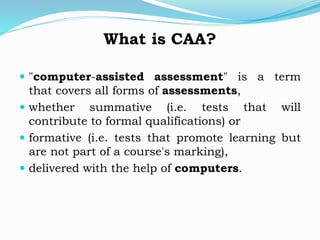
 "computer-assisted assessment" is a term
that covers all forms of assessments,
 whether summative (i.e. tests that will
contribute to formal qualifications) or
 formative (i.e. tests that promote learning but
are not part of a course's marking),
 delivered with the help of computers.
What is CAA?
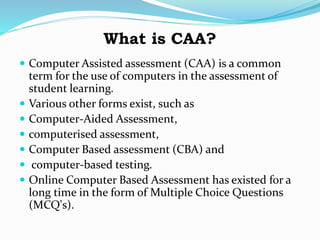
 Computer Assisted assessment (CAA) is a common
term for the use of computers in the assessment of
student learning.
 Various other forms exist, such as
 Computer-Aided Assessment,
 computerised assessment,
 Computer Based assessment (CBA) and
 computer-based testing.
 Online Computer Based Assessment has existed for a
long time in the form of Multiple Choice Questions
(MCQ's).
IMPLEMENTATION
 Computer Based Assessment is commonly directly
made via a computer, whereas
 Computer Assisted Assessment is used to manage or
support the assessment process.
 Examples are the optical mark reader used to score
MCQs , and
 database programs used to record student marks.
FORMATIVE VERSUS SUMMATIVE
 Computer Assisted Assessment is typically formative,
in that,
 it helps students to discover whether they have
learned what the educator intended and provide
timely feedback on how best to teach a subject.
 Increasingly,
 it can be summative, with limited feedback typically
being given at the end of a course and serving to grade
and categorize the student's work.
 It can also be diagnostic, e.g. by testing for pre-
knowledge.
NORM REFERENCED VERSUS CRITERIA
TESTING
 Assessment techniques are usually either norm
referenced or criterion referenced.
 Norm referenced assesses an individual's
performance in relation to the norms established by a
peer group.
 Criterion referenced occurs when a student is
assessed on his or her ability to meet a required level
of skill or competence.
 Computer Assisted Assessment is usually
criterion referenced.
ADVANTAGES
 Well-written computer assisted testing is more likely
to be objective testing:
 testing that can be marked objectively and thus offer
high reliability.
 The benefit is that the tests can be marked quickly and
easily,
 and adapted to meet a wide range of learning
outcomes.
ADVANTAGES
 Tests have the following potential:
 To incorporate a wide range of media;
 To link online assessments to feedback;
 To incorporate hints into test questions;
 To assign other learning activities based on the test
result;
 To make randomized selection can be made from large
question banks;
 To be administrated easily,
 allowing better test management.

DISADVANTAGES
 CAA can have the following limitations:
 It is usually associated with testing knowledge skills
rather than conceptual understanding,
 because of the frequent use of MCQ formatting, which
is believed to test at a lower level of understanding
when related to Bloom's Taxonomy;
 Construction of good objective tests requires skill and
practice and so is initially time consuming;
 Implementation of a CAA system can be costly;
 Hardware and software must be carefully monitored to
avoid failure during examinations;
DISADVANTAGES
 Security issues can be a problem in Web based CAA;
 Students require adequate IT skills and experience of
the assessment type;
 Assessors and invigilators need training in assessment
design,
 IT skills and examination management;
 A high level of organization is required of all parties
involved in assessment (academics, support staff,
computer services, administrators).
RECENT DEVELOPMENTS
 Computer assisted assessment of higher order skills
 such as
 comprehension, application and reasoning is difficult.
 Recent research has produced an improvement in
CAA's ability to test these skills, and allowed for its
implementation of the tools on the Web.
 Areas for development include graphical hotspot
questions, which involve selecting an area of the
screen by moving a marker to the required position.
 Text assessment is also being developed.
RECENT DEVELOPMENTS
 A number of institutional Computer Based
Assessment development projects (many funded by
higher education initiatives) offer free or relatively
inexpensive assessment tools, which do not require the
purchase of costly licenses.
 One example is
 the CASTLE toolkit,
 part of the Book of Talent, which has been developed
so that Tutors and Course managers can create on-line
interactive assessment tools quickly and easily without
any prior knowledge of HTML, CGI , or scripting
languages.
RECENT DEVELOPMENTS
 Its aim is to provide a High Level Authoring Shell for
online Interactive Tutorials and Assessment, by
developing a comprehensive courseware authoring
tool, which will enable tutors to produce and maintain
on-line Web pages.
 This should enhance the learning resources available
to the student, whilst requiring a fairly minimal time
investment on behalf of the tutor or course developer.
 Effective question design means that assessment
questionnaires can test different cognitive processes
(e.g. comprehension, application and evaluation) as
well as the ability to recall facts.
THANKS
Don’t work hard,
Work intelligent

Computer assisted assesment presentation

  • 1.
    Presented to: Dr. ShafqatAli Associate Professor UE Lower Mall Campus, Lahore Presented By: Sabir Ali Roll No. MSF 1700148 M.Phil Education
  • 2.
    What is CAA? "computer-assisted assessment" is a term that covers all forms of assessments,  whether summative (i.e. tests that will contribute to formal qualifications) or  formative (i.e. tests that promote learning but are not part of a course's marking),  delivered with the help of computers.
  • 3.
    What is CAA? Computer Assisted assessment (CAA) is a common term for the use of computers in the assessment of student learning.  Various other forms exist, such as  Computer-Aided Assessment,  computerised assessment,  Computer Based assessment (CBA) and  computer-based testing.  Online Computer Based Assessment has existed for a long time in the form of Multiple Choice Questions (MCQ's).
  • 4.
    IMPLEMENTATION  Computer BasedAssessment is commonly directly made via a computer, whereas  Computer Assisted Assessment is used to manage or support the assessment process.  Examples are the optical mark reader used to score MCQs , and  database programs used to record student marks.
  • 5.
    FORMATIVE VERSUS SUMMATIVE Computer Assisted Assessment is typically formative, in that,  it helps students to discover whether they have learned what the educator intended and provide timely feedback on how best to teach a subject.  Increasingly,  it can be summative, with limited feedback typically being given at the end of a course and serving to grade and categorize the student's work.  It can also be diagnostic, e.g. by testing for pre- knowledge.
  • 6.
    NORM REFERENCED VERSUSCRITERIA TESTING  Assessment techniques are usually either norm referenced or criterion referenced.  Norm referenced assesses an individual's performance in relation to the norms established by a peer group.  Criterion referenced occurs when a student is assessed on his or her ability to meet a required level of skill or competence.  Computer Assisted Assessment is usually criterion referenced.
  • 7.
    ADVANTAGES  Well-written computerassisted testing is more likely to be objective testing:  testing that can be marked objectively and thus offer high reliability.  The benefit is that the tests can be marked quickly and easily,  and adapted to meet a wide range of learning outcomes.
  • 8.
    ADVANTAGES  Tests havethe following potential:  To incorporate a wide range of media;  To link online assessments to feedback;  To incorporate hints into test questions;  To assign other learning activities based on the test result;  To make randomized selection can be made from large question banks;  To be administrated easily,  allowing better test management. 
  • 9.
    DISADVANTAGES  CAA canhave the following limitations:  It is usually associated with testing knowledge skills rather than conceptual understanding,  because of the frequent use of MCQ formatting, which is believed to test at a lower level of understanding when related to Bloom's Taxonomy;  Construction of good objective tests requires skill and practice and so is initially time consuming;  Implementation of a CAA system can be costly;  Hardware and software must be carefully monitored to avoid failure during examinations;
  • 10.
    DISADVANTAGES  Security issuescan be a problem in Web based CAA;  Students require adequate IT skills and experience of the assessment type;  Assessors and invigilators need training in assessment design,  IT skills and examination management;  A high level of organization is required of all parties involved in assessment (academics, support staff, computer services, administrators).
  • 11.
    RECENT DEVELOPMENTS  Computerassisted assessment of higher order skills  such as  comprehension, application and reasoning is difficult.  Recent research has produced an improvement in CAA's ability to test these skills, and allowed for its implementation of the tools on the Web.  Areas for development include graphical hotspot questions, which involve selecting an area of the screen by moving a marker to the required position.  Text assessment is also being developed.
  • 12.
    RECENT DEVELOPMENTS  Anumber of institutional Computer Based Assessment development projects (many funded by higher education initiatives) offer free or relatively inexpensive assessment tools, which do not require the purchase of costly licenses.  One example is  the CASTLE toolkit,  part of the Book of Talent, which has been developed so that Tutors and Course managers can create on-line interactive assessment tools quickly and easily without any prior knowledge of HTML, CGI , or scripting languages.
  • 13.
    RECENT DEVELOPMENTS  Itsaim is to provide a High Level Authoring Shell for online Interactive Tutorials and Assessment, by developing a comprehensive courseware authoring tool, which will enable tutors to produce and maintain on-line Web pages.  This should enhance the learning resources available to the student, whilst requiring a fairly minimal time investment on behalf of the tutor or course developer.  Effective question design means that assessment questionnaires can test different cognitive processes (e.g. comprehension, application and evaluation) as well as the ability to recall facts.
  • 14.