Advanced Educational Psychology
Name: Amina Tariq
Program: M.phil Education
Semester: 1
Roll No: MSF1700145
Assignment of Lesson Plan
______________________________________________________________________________
Lesson plan of Critical thinking
Topic: Life cycle of plant
Grade: 3
Subject: General Science Time: 60 mints
Critical thinking lesson plan have 6 levels
General Objective:  Students will be able to read and draw the life
cycle of a plant. Students will be able to name
the three things plants need to grow.
Specific objective:  Understand that plant have a life cycle that
includes sprouting, developing roots, stems,
leaves, and flowers; reproducing; and eventually
dying
 Observe the changes that occur during plant
growth and development
 Understand that life cycle of plant different from
the life cycle of animals
 Sequence the stages of plant life.
Material Book ,pictures of life cycle of plant, worksheet
Procedure
Level 1
Knowledge
(Identification and recall of information)
To introduced the topic or recall of pervious knowledge
I use question answer method?
1- Do you like plants or flower?
2- Tell me what is the name of our national
flower?
3- Do you think is plants alive or not?
Now I introduced the topic to students “Life cycle of
plants”.
Level 2
Comprehension
( Organization and Selection of facts and ideas )
After introducing the topic I define the life cycle of
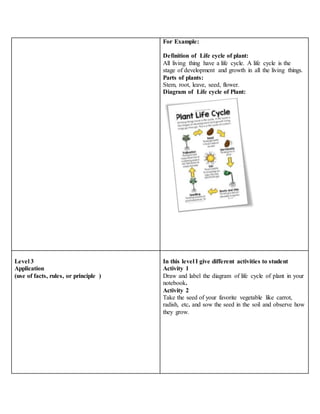
plant, parts of plants and show the diagram of life cycle
of plants.
For Example:
Definition of Life cycle of plant:
All living thing have a life cycle. A life cycle is the
stage of development and growth in all the living things.
Parts of plants:
Stem, root, leave, seed, flower.
Diagram of Life cycle of Plant:
Level 3
Application
(use of facts, rules, or principle )
In this level I give different activities to student
Activity 1
Draw and label the diagram of life cycle of plant in your
notebook.
Activity 2
Take the seed of your favorite vegetable like carrot,
radish, etc. and sow the seed in the soil and observe how
they grow.
Level 4
Analysis
(separating the whole into components or parts)
In this level I ask different short question to check
how much understanding they get from lecture
1- Like plants other living things like human or
animals also have life cycle or not?
2- Can you image how butterfly grow? If yes than
draw a butterfly life cycle using same steps of
plants life cycle?
Level 5
Synthesis
( Combining ideas to form a new whole)
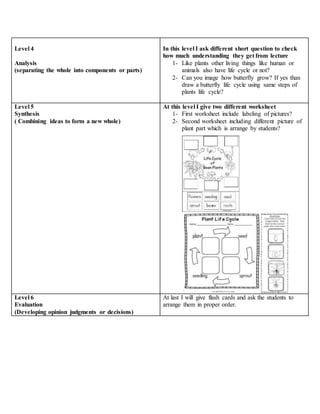
At this level I give two different worksheet
1- First worksheet include labeling of pictures?
2- Second worksheet including different picture of
plant part which is arrange by students?
Level 6
Evaluation
(Developing opinion judgments or decisions)
At last I will give flash cards and ask the students to
arrange them in proper order.
Lesson Plan of collaborative thinking
Subject: General science
Grade: 3
Topic: Food Chain Duration:
60mins
Material: Visual Aids, picture, chips, markers.
General Objectives
Specific Objectives  Define the word “food chain” and
identify the producer, consumer and
decomposer.
 Assemble the pictures of organisms in a
food chain.
 Appreciate the importance of food
chains in an ecosystem.
Procedure
Introduction Previous knowledge: The students are aware
that all living things have certain
characteristics.
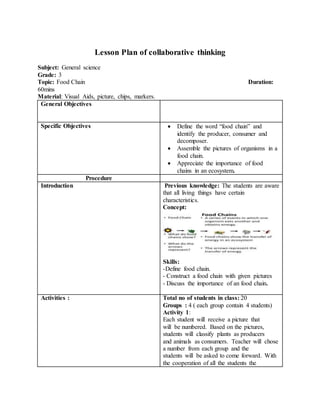
Concept:
Skills:
-Define food chain.
- Construct a food chain with given pictures
- Discuss the importance of an food chain.
Activities : Total no of students in class: 20
Groups : 4 ( each group contain 4 students)
Activity 1:
Each student will receive a picture that
will be numbered. Based on the pictures,
students will classify plants as producers
and animals as consumers. Teacher will chose
a number from each group and the
students will be asked to come forward. With
the cooperation of all the students the
pictures will be connected to form a food
chain. It will demonstrate to students
how each one of them depends on each other
to survive. Students whose pictures
have been used to construct the food chain
will be assigned a new picture.
Activity 2:
Each student in the group will be asked to
place their pictures on the table and to
brainstorm ways how to organize the pictures
in order to construct a food chain with the
pictures available on each table. Each student
from each group will be given a
chip. In order for students to share their
taught, they must place their chip in the center
of the table.
This technique assures that all students share
their idea on how to construct their own food
chain.
Conclusion:  Provide a worksheet for students to
identify the parts of a food chain.
Evaluation:
 Students will be asked to construct their
own food chain and to label each one of
them as producer, consumer and
decomposer.
Lesson plan of scaffolding learning
Subject: Math
Topic: Math Shapes
Time:60mints Grade: 3
Scaffolding lesson plan strategies into 5 levels
General Objective: Students will describe, identify, and create
geometric shapes.
Specific Objective: Students will:
• Will look at shapes while reading the names
of each shape.
• Get into pairs and orally explain the
characteristics of each shape.
• Will actively listen and identify shapes as
teacher describes the characteristics
(e.g. this shape has for equal sides).
• Draw each shape and label shape with the
correct name.
Material: Pencil, paper, scale,
Procedure
Introduction: Step 1 : Ask student to look around in
classroom and guess what kind of shapes are
there.
Step 2 : write or draw the shapes in your
notebook you observe .
Level 1
Show and tell
Names of shapes will be given to students.
• Recognize the shape by name
• Draw picture of shape.
• Student can match the word to its shape.
• Student will say the name of each shape
Level 2
Tap into prior knowledge
 What do you look at when you try to
identify the shape.
 Can you create new shape by combining
these shape.
 What are some basic shapes.
Level 3
Give time to talk
 Student divided into different groups each
group contain 2 student.
 They discus there ideas with each other
for 10 mints and there point in their
notebook.
Level 4
Use visual Aid

 Read this hand out and answer these
questions?
1. Draw shapes and label them.
2. Read and understand names of
each shape.
3. Actively identify shapes from a
teacher’s description.
4. Students will orally describe
shapes.
Level 5
Evaluation
 The learner will be evaluated informally
through their participation in the group
activity and formally through quiz number
one.

Lesson plan assignment

  • 1.
    Advanced Educational Psychology Name:Amina Tariq Program: M.phil Education Semester: 1 Roll No: MSF1700145 Assignment of Lesson Plan ______________________________________________________________________________ Lesson plan of Critical thinking Topic: Life cycle of plant Grade: 3 Subject: General Science Time: 60 mints Critical thinking lesson plan have 6 levels General Objective:  Students will be able to read and draw the life cycle of a plant. Students will be able to name the three things plants need to grow. Specific objective:  Understand that plant have a life cycle that includes sprouting, developing roots, stems, leaves, and flowers; reproducing; and eventually dying  Observe the changes that occur during plant growth and development  Understand that life cycle of plant different from the life cycle of animals  Sequence the stages of plant life. Material Book ,pictures of life cycle of plant, worksheet Procedure Level 1 Knowledge (Identification and recall of information) To introduced the topic or recall of pervious knowledge I use question answer method? 1- Do you like plants or flower? 2- Tell me what is the name of our national flower? 3- Do you think is plants alive or not? Now I introduced the topic to students “Life cycle of plants”. Level 2 Comprehension ( Organization and Selection of facts and ideas ) After introducing the topic I define the life cycle of plant, parts of plants and show the diagram of life cycle of plants.
  • 2.
    For Example: Definition ofLife cycle of plant: All living thing have a life cycle. A life cycle is the stage of development and growth in all the living things. Parts of plants: Stem, root, leave, seed, flower. Diagram of Life cycle of Plant: Level 3 Application (use of facts, rules, or principle ) In this level I give different activities to student Activity 1 Draw and label the diagram of life cycle of plant in your notebook. Activity 2 Take the seed of your favorite vegetable like carrot, radish, etc. and sow the seed in the soil and observe how they grow.
  • 3.
    Level 4 Analysis (separating thewhole into components or parts) In this level I ask different short question to check how much understanding they get from lecture 1- Like plants other living things like human or animals also have life cycle or not? 2- Can you image how butterfly grow? If yes than draw a butterfly life cycle using same steps of plants life cycle? Level 5 Synthesis ( Combining ideas to form a new whole) At this level I give two different worksheet 1- First worksheet include labeling of pictures? 2- Second worksheet including different picture of plant part which is arrange by students? Level 6 Evaluation (Developing opinion judgments or decisions) At last I will give flash cards and ask the students to arrange them in proper order.
  • 4.
    Lesson Plan ofcollaborative thinking Subject: General science Grade: 3 Topic: Food Chain Duration: 60mins Material: Visual Aids, picture, chips, markers. General Objectives Specific Objectives  Define the word “food chain” and identify the producer, consumer and decomposer.  Assemble the pictures of organisms in a food chain.  Appreciate the importance of food chains in an ecosystem. Procedure Introduction Previous knowledge: The students are aware that all living things have certain characteristics. Concept: Skills: -Define food chain. - Construct a food chain with given pictures - Discuss the importance of an food chain. Activities : Total no of students in class: 20 Groups : 4 ( each group contain 4 students) Activity 1: Each student will receive a picture that will be numbered. Based on the pictures, students will classify plants as producers and animals as consumers. Teacher will chose a number from each group and the students will be asked to come forward. With the cooperation of all the students the
  • 5.
    pictures will beconnected to form a food chain. It will demonstrate to students how each one of them depends on each other to survive. Students whose pictures have been used to construct the food chain will be assigned a new picture. Activity 2: Each student in the group will be asked to place their pictures on the table and to brainstorm ways how to organize the pictures in order to construct a food chain with the pictures available on each table. Each student from each group will be given a chip. In order for students to share their taught, they must place their chip in the center of the table. This technique assures that all students share their idea on how to construct their own food chain. Conclusion:  Provide a worksheet for students to identify the parts of a food chain. Evaluation:  Students will be asked to construct their own food chain and to label each one of them as producer, consumer and decomposer.
  • 6.
    Lesson plan ofscaffolding learning Subject: Math Topic: Math Shapes Time:60mints Grade: 3 Scaffolding lesson plan strategies into 5 levels General Objective: Students will describe, identify, and create geometric shapes. Specific Objective: Students will: • Will look at shapes while reading the names of each shape. • Get into pairs and orally explain the characteristics of each shape. • Will actively listen and identify shapes as teacher describes the characteristics (e.g. this shape has for equal sides). • Draw each shape and label shape with the correct name. Material: Pencil, paper, scale, Procedure Introduction: Step 1 : Ask student to look around in classroom and guess what kind of shapes are there. Step 2 : write or draw the shapes in your notebook you observe . Level 1 Show and tell Names of shapes will be given to students. • Recognize the shape by name • Draw picture of shape. • Student can match the word to its shape. • Student will say the name of each shape Level 2 Tap into prior knowledge  What do you look at when you try to identify the shape.  Can you create new shape by combining these shape.  What are some basic shapes. Level 3 Give time to talk  Student divided into different groups each group contain 2 student.
  • 7.
     They discusthere ideas with each other for 10 mints and there point in their notebook. Level 4 Use visual Aid   Read this hand out and answer these questions? 1. Draw shapes and label them. 2. Read and understand names of each shape. 3. Actively identify shapes from a teacher’s description. 4. Students will orally describe shapes. Level 5 Evaluation  The learner will be evaluated informally through their participation in the group activity and formally through quiz number one.