Dr. Namrata Bavalekar
M.P.Th
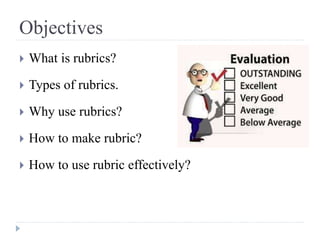
Objectives
 What is rubrics?
 Types of rubrics.
 Why use rubrics?
 How to make rubric?
 How to use rubric effectively?
What is Rubrics?
 A rubric is an assessment tool that clearly
indicates achievement criteria across all the
components of any kind of student work, from
written to oral to visual.
 It can be used for marking assignments, class
participation, or overall grades. There are two
types of rubrics.
Types of Rubrics
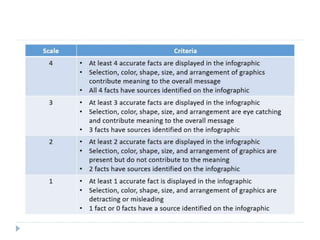
1. Holistic rubrics: A holistic rubric consists of a
single scale with all criteria to be included in the
evaluation being considered together. With a
holistic rubric the rater assigns a single score
(usually on a 1 to 4 or 1 to 6 point scale) based
on an overall judgment of the student work. The
rater matches an entire piece of student work to a
single description on the scale.
Advantages:
1. Emphasis on what the learner is able to
demonstrate, rather than what s/he cannot do.
2. Saves time by minimizing the number of
decisions raters make.
3. Can be applied consistently by trained raters
increasing reliability.
Disadvantages:
1. Does not provide specific feedback for
improvement.
2. When student work is at varying levels spanning
the criteria points it can be difficult to select the
single best description.
3. Criteria cannot be weighted
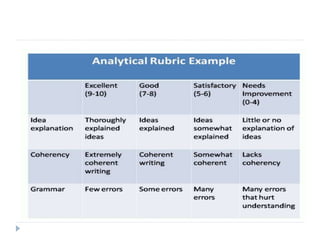
 Analytic rubrics: An analytic rubric resembles a
grid with the criteria for a student product listed in
the leftmost column and with levels of
performance listed across the top row often using
numbers or descriptive tags. The cells within the
center of the rubric may be left blank or may
contain descriptions of what the specified criteria
look like for each level of performance.
Advantages:
1. Provide useful feedback on areas of strength and
weakness.
2. Criterion can be weighted to reflect the relative
importance of each dimension.
Disadvantages:
1. Takes more time to create and use than a holistic
rubric.
2. Unless each point for each criterion is well-
defined raters may not arrive at the same score.
Why Use Rubrics?
Rubrics help instructors:
 Assess assignments consistently from student-to-
student.
 Save time in grading, both short-term and long-
term.
 Give timely, effective feedback and promote
student learning in a sustainable way.
 Clarify expectations and components of an
assignment for both students and course teaching
assistants.
 Refine teaching methods by evaluating rubric
results.
Rubrics help students:
 Understand expectations and components of an
assignment.
 Become more aware of their learning process and
progress.
 Improve work through timely and detailed
feedback.
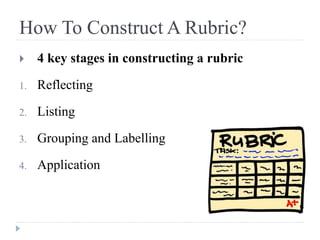
How To Construct A Rubric?
 4 key stages in constructing a rubric
1. Reflecting
2. Listing
3. Grouping and Labelling
4. Application
1. Reflecting: In this stage, we take the time to
reflect on what we want from the students, why
we created this assignment, what happened the
last time we gave it, and what our expectations
are.
2. Listing: In this stage, we focus on the particular
details of the assignment and what specific
learning objectives we hope to see in the
completed assignments.
3. Grouping and Labelling: In this stage, we
organize the results of our reflections in Stage 1
and Stage 2, grouping similar expectations
together in what will probably become the rubric
dimensions.
4. Application: In this stage, we apply the
dimensions and description from Stage 3 to the
final form of the rubric, using the grid formats.
How To Use Rubric Effectively?
Develop a different rubric for each assignment
 Although this takes time in the beginning, you’ll
find that rubrics can be changed slightly or re-used
later. Whether you develop your own or use an
existing rubric, practice with any other graders in
your course to achieve inter-tester reliability.
Be transparent
 Give students a copy of the rubric when you
assign the performance task. These are not meant
to be surprise criteria.
Integrate rubrics into assignments
 Require students to attach the rubric to the
assignment when they hand it in. Some instructors
ask students to self-assess or give peer feedback
using the rubric prior to handing in the work.
Leverage rubrics to manage your time
 When you mark the assignment, circle or highlight
the achieved level of performance for each
criterion on the rubric. This is where you will save
a great deal of time, as no comments are required.
 Include any additional specific or
overall comments that do not fit within the
rubric’s criteria.
Be prepared to revise your rubrics
 Decide upon a final grade for the assignment
based on the rubric. If you find, as some do, that
presented work meets criteria on the rubric but
nevertheless seems to have exceeded or not met
the overall qualities you’re seeking, revise the
rubric accordingly for the next time you teach the
course.
Consider developing online rubrics
 If an assignment is being submitted to an
electronic drop box you may be able to develop
and use an online rubric. The scores from these
rubrics are automatically entered in the online
grade book in the course management system.
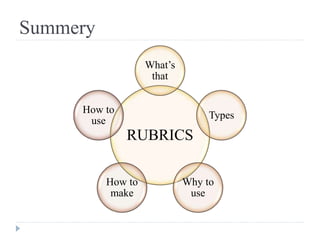
Summery
RUBRICS
What’s
that
Types
Why to
use
How to
make
How to
use
Sources
1) University of Waterloo.
2) Cornell University.
3) DePaul education.
4) Introduction to Rubrics: An Assessment Tool to
Save Grading Time, Convey Effective Feedback,
and Promote Student Learning
RUBRICS.pptx

RUBRICS.pptx

  • 1.
  • 2.
    Objectives  What isrubrics?  Types of rubrics.  Why use rubrics?  How to make rubric?  How to use rubric effectively?
  • 3.
    What is Rubrics? A rubric is an assessment tool that clearly indicates achievement criteria across all the components of any kind of student work, from written to oral to visual.  It can be used for marking assignments, class participation, or overall grades. There are two types of rubrics.
  • 4.
    Types of Rubrics 1.Holistic rubrics: A holistic rubric consists of a single scale with all criteria to be included in the evaluation being considered together. With a holistic rubric the rater assigns a single score (usually on a 1 to 4 or 1 to 6 point scale) based on an overall judgment of the student work. The rater matches an entire piece of student work to a single description on the scale.
  • 6.
    Advantages: 1. Emphasis onwhat the learner is able to demonstrate, rather than what s/he cannot do. 2. Saves time by minimizing the number of decisions raters make. 3. Can be applied consistently by trained raters increasing reliability.
  • 7.
    Disadvantages: 1. Does notprovide specific feedback for improvement. 2. When student work is at varying levels spanning the criteria points it can be difficult to select the single best description. 3. Criteria cannot be weighted
  • 8.
     Analytic rubrics:An analytic rubric resembles a grid with the criteria for a student product listed in the leftmost column and with levels of performance listed across the top row often using numbers or descriptive tags. The cells within the center of the rubric may be left blank or may contain descriptions of what the specified criteria look like for each level of performance.
  • 10.
    Advantages: 1. Provide usefulfeedback on areas of strength and weakness. 2. Criterion can be weighted to reflect the relative importance of each dimension.
  • 11.
    Disadvantages: 1. Takes moretime to create and use than a holistic rubric. 2. Unless each point for each criterion is well- defined raters may not arrive at the same score.
  • 12.
    Why Use Rubrics? Rubricshelp instructors:  Assess assignments consistently from student-to- student.  Save time in grading, both short-term and long- term.  Give timely, effective feedback and promote student learning in a sustainable way.
  • 13.
     Clarify expectationsand components of an assignment for both students and course teaching assistants.  Refine teaching methods by evaluating rubric results.
  • 14.
    Rubrics help students: Understand expectations and components of an assignment.  Become more aware of their learning process and progress.  Improve work through timely and detailed feedback.
  • 15.
    How To ConstructA Rubric?  4 key stages in constructing a rubric 1. Reflecting 2. Listing 3. Grouping and Labelling 4. Application
  • 16.
    1. Reflecting: Inthis stage, we take the time to reflect on what we want from the students, why we created this assignment, what happened the last time we gave it, and what our expectations are.
  • 17.
    2. Listing: Inthis stage, we focus on the particular details of the assignment and what specific learning objectives we hope to see in the completed assignments.
  • 18.
    3. Grouping andLabelling: In this stage, we organize the results of our reflections in Stage 1 and Stage 2, grouping similar expectations together in what will probably become the rubric dimensions.
  • 19.
    4. Application: Inthis stage, we apply the dimensions and description from Stage 3 to the final form of the rubric, using the grid formats.
  • 20.
    How To UseRubric Effectively? Develop a different rubric for each assignment  Although this takes time in the beginning, you’ll find that rubrics can be changed slightly or re-used later. Whether you develop your own or use an existing rubric, practice with any other graders in your course to achieve inter-tester reliability.
  • 21.
    Be transparent  Givestudents a copy of the rubric when you assign the performance task. These are not meant to be surprise criteria.
  • 22.
    Integrate rubrics intoassignments  Require students to attach the rubric to the assignment when they hand it in. Some instructors ask students to self-assess or give peer feedback using the rubric prior to handing in the work.
  • 23.
    Leverage rubrics tomanage your time  When you mark the assignment, circle or highlight the achieved level of performance for each criterion on the rubric. This is where you will save a great deal of time, as no comments are required.  Include any additional specific or overall comments that do not fit within the rubric’s criteria.
  • 24.
    Be prepared torevise your rubrics  Decide upon a final grade for the assignment based on the rubric. If you find, as some do, that presented work meets criteria on the rubric but nevertheless seems to have exceeded or not met the overall qualities you’re seeking, revise the rubric accordingly for the next time you teach the course.
  • 25.
    Consider developing onlinerubrics  If an assignment is being submitted to an electronic drop box you may be able to develop and use an online rubric. The scores from these rubrics are automatically entered in the online grade book in the course management system.
  • 26.
  • 27.
    Sources 1) University ofWaterloo. 2) Cornell University. 3) DePaul education. 4) Introduction to Rubrics: An Assessment Tool to Save Grading Time, Convey Effective Feedback, and Promote Student Learning