ubrics
Ken Ronkowitz
2015
What are we going to cover in this session?
Origins
Defining
Why Use Them
Types
Creating Rubrics
Moodle’s Rubric Tool
1. What types of assessments do you use in your courses?
2. Do you use rubrics for assessment?
3. Do you use rubrics for grading?
4. Do you use rubrics for non-graded assessment?
5. Do you have students use them for self-assessment?
6. Do students ever contribute to rubric creation?
But first
ubric
A rubric was a word or section of text which was traditionally written or
printed in red ink to highlight it. (from Latin: rubrica, meaning “red
ochre”)
In Medieval illuminated manuscripts, red letters were used to highlight
initial capitals, section headings, & names of significance (rubrication).
Texts used by clergy, included instructional text in red while the text for
the congregation was printed in black ink.
As universities were created and books became more commonly used,
scholars grading student papers would use red ink to leave instructions,
suggestions and corrections on student papers. The practice has survived,
although in some educational settings using red ink is now frowned on.
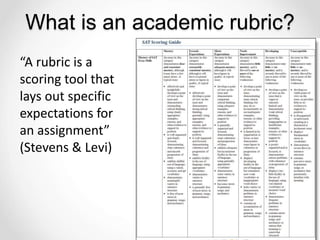
What is an academic rubric?
“A rubric is a
scoring tool that
lays out specific
expectations for
an assignment”
(Stevens & Levi)
Uses of Rubrics
• A description of explicit learning goals
• A checklist of assignment criteria
• A vehicle for feedback
• A guide for planning future learning
• A scoring chart
Why Use Rubrics?
Why use rubrics?
A good rubric tells the performer (student) and
evaluator (teacher)
• by what criteria the work will be judged
• the difference between good work and weaker work
• that our judgments (or scores) are valid
• a standard (continuity) for judging
• When used correctly, it can help both performers
and judges focus on improvement and achieving
excellence.
Rubrics can
1) Save grading time
2) Provide effective feedback
3) Give transparency and consistency in
marking
4) Result in better understood assignment
requirements
5) May reduce grading complaints
6) Provide more perceived objectivity
7) Reveal standards in a discipline
8) Share benchmark qualities
Pedagogically, rubrics can
• Guide feedback - descriptively
• Characterize the desired results - objectively
• Operationalize performance standards -
purposefully
• Develop self-assessment competence -
constantly
• Involve students – thoughtfully
• Focus instruction – intentionally 
Rubrics put intentional focus on elements
• They help guide the evaluator in giving
feedback that is descriptive as well as
evaluative.
• Rubric creation by students is an excellent
way to use active learning.
oActive learning focuses the responsibility of
learning on learners. It can be eye-opening
to see what students believe is important or
what they believe they will be judged on in
the performance.
Typically, teachers use rubrics to assess an
assignment, but they can also assess
1) The course MATERIALS
2) The DELIVERY of the course
3) Student UNDERSTANDING of broad concepts and
knowledge elements
4) Student & instructor PERFORMANCE (problem
solving, research, communication skills)
5) Student & instructor COMPETENCE (expertise) with
the subject-matter.
6) Student & instructor HABITS OF MIND (perseverance,
flexibility, tolerance for ambiguity, applying prior knowledge
to new situations... habits-of-mind.net Costa & Kallick
What’s In It For Students?
Students can use rubrics:
• when they plan their work
• Before submission or performance as a checklist
• at the completion of the task
In designing rubrics, students will:
• have a voice in their own assessment
• be partners in learning
• understand the expected qualities and indicators
• understand feedback
Types of Rubrics
• A holistic rubric has one global, holistic
rating for a behavior divided into levels
of that rating.
• More commonly, an analytic rubric has
separate, ratings of specified
characteristics of a behavior.
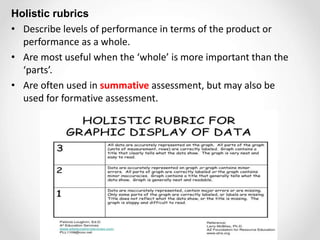
Holistic rubrics
• Describe levels of performance in terms of the product or
performance as a whole.
• Are most useful when the ‘whole’ is more important than the
‘parts’.
• Are often used in summative assessment, but may also be
used for formative assessment.
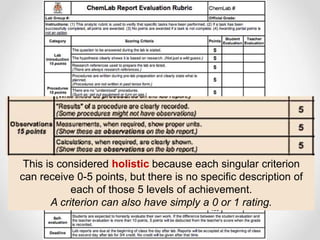
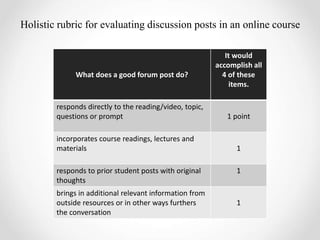
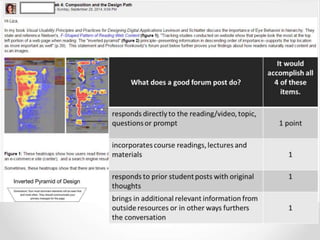
This is considered holistic because each singular criterion
can receive 0-5 points, but there is no specific description of
each of those 5 levels of achievement.
A criterion can also have simply a 0 or 1 rating.
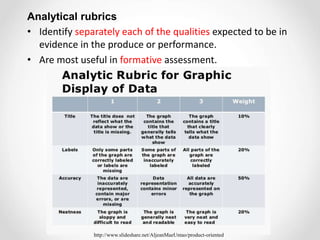
Analytical rubrics
• Identify separately each of the qualities expected to be in
evidence in the produce or performance.
• Are most useful in formative assessment.
http://www.slideshare.net/AljeanMaeUntao/product-oriented
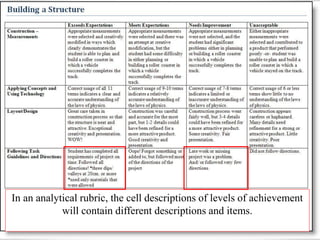
In an analytical rubric, the cell descriptions of levels of achievement
will contain different descriptions and items.
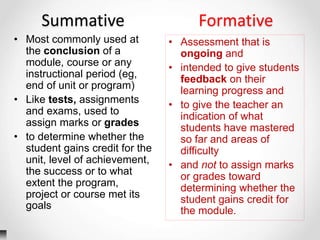
Summative Formative
• Most commonly used at
the conclusion of a
module, course or any
instructional period (eg,
end of unit or program)
• Like tests, assignments
and exams, used to
assign marks or grades
• to determine whether the
student gains credit for the
unit, level of achievement,
the success or to what
extent the program,
project or course met its
goals
• Assessment that is
ongoing and
• intended to give students
feedback on their
learning progress and
• to give the teacher an
indication of what
students have mastered
so far and areas of
difficulty
• and not to assign marks
or grades toward
determining whether the
student gains credit for
the module.
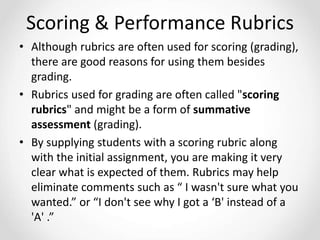
Scoring & Performance Rubrics
• Although rubrics are often used for scoring (grading),
there are good reasons for using them besides
grading.
• Rubrics used for grading are often called "scoring
rubrics" and might be a form of summative
assessment (grading).
• By supplying students with a scoring rubric along
with the initial assignment, you are making it very
clear what is expected of them. Rubrics may help
eliminate comments such as “ I wasn't sure what you
wanted.” or “I don't see why I got a ‘B' instead of a
'A' .”
The aim of authentic assessment is to
IMPROVE performance
not merely to audit it.
That includes the performance of
the instructor,
the course materials,
the program...
Rubrics can be formative when used for
self-assessment, critiques & peer-editing
where consistency of judgment is critical.
Assessment cannot be fair unless students
as well as teachers know the “rules of the
game” when they are beginning on a task.
Creating Rubrics
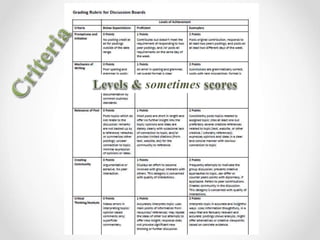
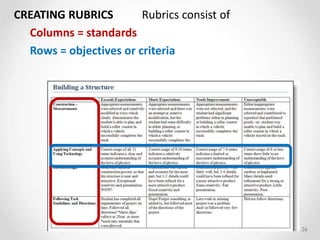
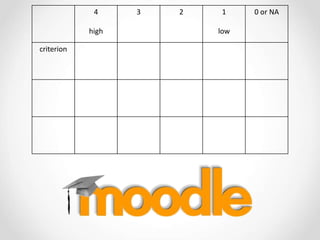
CREATING RUBRICS Rubrics consist of
Columns = standards
Rows = objectives or criteria
26
Creating an Analytic Rubric
• A frequent starting place is to create the ideal
(highest scoring) criterion description and
• then revise it is descending levels of
competence.
o Avoid?
• an odd number of competence levels (split decisions)
• levels that might be seen as corresponding to a grade (4=A)
• Scoring rubrics are often built to align with
a grading scale (100 points)
Columns (Standards)
• First, determine the number of proficiency levels
o Excellent/ Exceeds expectation/ Expert
o Good/ Meets expectation/ Proficient
o Satisfactory/ Needs some improvement/
Developing
o Weak/ Needs much improvement/ Novice
• Total of “meets expectation” column grades will
often be the average mark or a “B”
What would be
your criteria for
judging a student’s
post in an online
discussion forum?
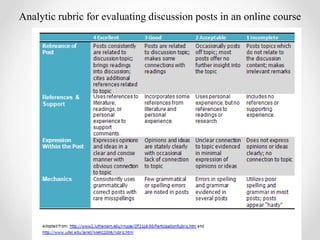
Analytic rubric for evaluating discussion posts in an online course
Holistic rubric for evaluating discussion posts in an online course
What does a good forum post do?
It would
accomplish all
4 of these
items.
responds directly to the reading/video, topic,
questions or prompt 1 point
incorporates course readings, lectures and
materials 1
responds to prior student posts with original
thoughts
1
brings in additional relevant information from
outside resources or in other ways furthers
the conversation
1
Breaking the Rules
Holistic / Analytic
4
high
3 2 1
low
0 or NA
criterion
Using Moodle Rubrics
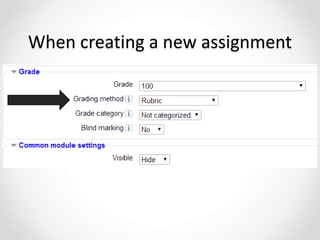
Rubrics can be added
to an assignment
or created with a
new assignment.

When creating a new assignment
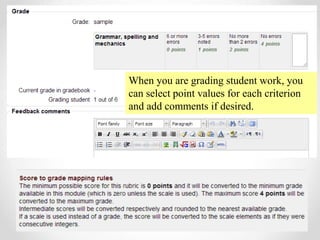
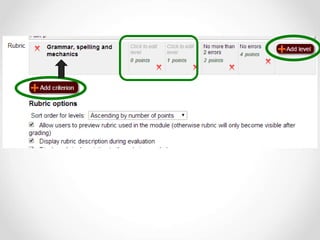
When you are grading student work, you
can select point values for each criterion
and add comments if desired.
MoodleRooms VIDEO TUTORIALS
Creating a Moodle Rubric from Scratch
http://youtu.be/tdWqHBAH6XA
Using a template
http://youtu.be/wRRy0huMdqE
Grading within a rubric
http://youtu.be/ZC_SNqNgFw0
Moodle Rubrics help page http://bit.ly/1NCTFEa
Rubric Resources
• Rubric Samples for Higher Education in Undergraduate
Research, student learning and development outcomes,
presentations, research manuscripts, organization
effectiveness, reflection, content analysis forms for a course
and workshop http://rubrics.kon.org
• ABET with rubrics for each outcome (such as Outcome 1: An
ability to apply math & science in engineering)
http://www.ce.udel.edu/ABET/Current%20Documentation/AB
ET_scoring_rubrics_index.html
• Sample rubrics collected by the AALHE Association for the
Assessment of Learning in Higher Education
http://course1.winona.edu/shatfield/air/rubrics.htm
Rubric Resources
• RubiStar http://rubistar.4teachers.org
o Helps the teacher who wants to use rubrics, but
does not have time to develop them from scratch
o Provides template rubrics that can “… be printed
and used for many typical projects and research
assignments.”
• iRubric http://www.rcampus.com/indexrubric.cfm
o Site for free development and sharing of rubrics
o Public gallery, how-to videos and building tools
43
ubrics
Ken Ronkowitz
ronkowitz@njit.edu
serendipity35.net
presentation at slideshare.net/ronko4/

Rubrics: Transparent Assessment in Support of Learning

  • 1.
  • 2.
    What are wegoing to cover in this session? Origins Defining Why Use Them Types Creating Rubrics Moodle’s Rubric Tool
  • 3.
    1. What typesof assessments do you use in your courses? 2. Do you use rubrics for assessment? 3. Do you use rubrics for grading? 4. Do you use rubrics for non-graded assessment? 5. Do you have students use them for self-assessment? 6. Do students ever contribute to rubric creation? But first
  • 4.
    ubric A rubric wasa word or section of text which was traditionally written or printed in red ink to highlight it. (from Latin: rubrica, meaning “red ochre”) In Medieval illuminated manuscripts, red letters were used to highlight initial capitals, section headings, & names of significance (rubrication). Texts used by clergy, included instructional text in red while the text for the congregation was printed in black ink. As universities were created and books became more commonly used, scholars grading student papers would use red ink to leave instructions, suggestions and corrections on student papers. The practice has survived, although in some educational settings using red ink is now frowned on.
  • 5.
    What is anacademic rubric? “A rubric is a scoring tool that lays out specific expectations for an assignment” (Stevens & Levi)
  • 6.
    Uses of Rubrics •A description of explicit learning goals • A checklist of assignment criteria • A vehicle for feedback • A guide for planning future learning • A scoring chart
  • 8.
  • 9.
    Why use rubrics? Agood rubric tells the performer (student) and evaluator (teacher) • by what criteria the work will be judged • the difference between good work and weaker work • that our judgments (or scores) are valid • a standard (continuity) for judging • When used correctly, it can help both performers and judges focus on improvement and achieving excellence.
  • 10.
    Rubrics can 1) Savegrading time 2) Provide effective feedback 3) Give transparency and consistency in marking 4) Result in better understood assignment requirements 5) May reduce grading complaints 6) Provide more perceived objectivity 7) Reveal standards in a discipline 8) Share benchmark qualities
  • 11.
    Pedagogically, rubrics can •Guide feedback - descriptively • Characterize the desired results - objectively • Operationalize performance standards - purposefully • Develop self-assessment competence - constantly • Involve students – thoughtfully • Focus instruction – intentionally 
  • 12.
    Rubrics put intentionalfocus on elements • They help guide the evaluator in giving feedback that is descriptive as well as evaluative. • Rubric creation by students is an excellent way to use active learning. oActive learning focuses the responsibility of learning on learners. It can be eye-opening to see what students believe is important or what they believe they will be judged on in the performance.
  • 13.
    Typically, teachers userubrics to assess an assignment, but they can also assess 1) The course MATERIALS 2) The DELIVERY of the course 3) Student UNDERSTANDING of broad concepts and knowledge elements 4) Student & instructor PERFORMANCE (problem solving, research, communication skills) 5) Student & instructor COMPETENCE (expertise) with the subject-matter. 6) Student & instructor HABITS OF MIND (perseverance, flexibility, tolerance for ambiguity, applying prior knowledge to new situations... habits-of-mind.net Costa & Kallick
  • 14.
    What’s In ItFor Students? Students can use rubrics: • when they plan their work • Before submission or performance as a checklist • at the completion of the task In designing rubrics, students will: • have a voice in their own assessment • be partners in learning • understand the expected qualities and indicators • understand feedback
  • 15.
  • 16.
    • A holisticrubric has one global, holistic rating for a behavior divided into levels of that rating. • More commonly, an analytic rubric has separate, ratings of specified characteristics of a behavior.
  • 17.
    Holistic rubrics • Describelevels of performance in terms of the product or performance as a whole. • Are most useful when the ‘whole’ is more important than the ‘parts’. • Are often used in summative assessment, but may also be used for formative assessment.
  • 18.
    This is consideredholistic because each singular criterion can receive 0-5 points, but there is no specific description of each of those 5 levels of achievement. A criterion can also have simply a 0 or 1 rating.
  • 19.
    Analytical rubrics • Identifyseparately each of the qualities expected to be in evidence in the produce or performance. • Are most useful in formative assessment. http://www.slideshare.net/AljeanMaeUntao/product-oriented
  • 20.
    In an analyticalrubric, the cell descriptions of levels of achievement will contain different descriptions and items.
  • 21.
    Summative Formative • Mostcommonly used at the conclusion of a module, course or any instructional period (eg, end of unit or program) • Like tests, assignments and exams, used to assign marks or grades • to determine whether the student gains credit for the unit, level of achievement, the success or to what extent the program, project or course met its goals • Assessment that is ongoing and • intended to give students feedback on their learning progress and • to give the teacher an indication of what students have mastered so far and areas of difficulty • and not to assign marks or grades toward determining whether the student gains credit for the module.
  • 22.
    Scoring & PerformanceRubrics • Although rubrics are often used for scoring (grading), there are good reasons for using them besides grading. • Rubrics used for grading are often called "scoring rubrics" and might be a form of summative assessment (grading). • By supplying students with a scoring rubric along with the initial assignment, you are making it very clear what is expected of them. Rubrics may help eliminate comments such as “ I wasn't sure what you wanted.” or “I don't see why I got a ‘B' instead of a 'A' .”
  • 23.
    The aim ofauthentic assessment is to IMPROVE performance not merely to audit it. That includes the performance of the instructor, the course materials, the program...
  • 24.
    Rubrics can beformative when used for self-assessment, critiques & peer-editing where consistency of judgment is critical. Assessment cannot be fair unless students as well as teachers know the “rules of the game” when they are beginning on a task.
  • 25.
  • 26.
    CREATING RUBRICS Rubricsconsist of Columns = standards Rows = objectives or criteria 26
  • 27.
    Creating an AnalyticRubric • A frequent starting place is to create the ideal (highest scoring) criterion description and • then revise it is descending levels of competence. o Avoid? • an odd number of competence levels (split decisions) • levels that might be seen as corresponding to a grade (4=A) • Scoring rubrics are often built to align with a grading scale (100 points)
  • 28.
    Columns (Standards) • First,determine the number of proficiency levels o Excellent/ Exceeds expectation/ Expert o Good/ Meets expectation/ Proficient o Satisfactory/ Needs some improvement/ Developing o Weak/ Needs much improvement/ Novice • Total of “meets expectation” column grades will often be the average mark or a “B”
  • 29.
    What would be yourcriteria for judging a student’s post in an online discussion forum?
  • 30.
    Analytic rubric forevaluating discussion posts in an online course
  • 31.
    Holistic rubric forevaluating discussion posts in an online course What does a good forum post do? It would accomplish all 4 of these items. responds directly to the reading/video, topic, questions or prompt 1 point incorporates course readings, lectures and materials 1 responds to prior student posts with original thoughts 1 brings in additional relevant information from outside resources or in other ways furthers the conversation 1
  • 33.
  • 35.
    4 high 3 2 1 low 0or NA criterion
  • 36.
    Using Moodle Rubrics Rubricscan be added to an assignment or created with a new assignment. 
  • 37.
    When creating anew assignment
  • 40.
    When you aregrading student work, you can select point values for each criterion and add comments if desired.
  • 41.
    MoodleRooms VIDEO TUTORIALS Creatinga Moodle Rubric from Scratch http://youtu.be/tdWqHBAH6XA Using a template http://youtu.be/wRRy0huMdqE Grading within a rubric http://youtu.be/ZC_SNqNgFw0 Moodle Rubrics help page http://bit.ly/1NCTFEa
  • 42.
    Rubric Resources • RubricSamples for Higher Education in Undergraduate Research, student learning and development outcomes, presentations, research manuscripts, organization effectiveness, reflection, content analysis forms for a course and workshop http://rubrics.kon.org • ABET with rubrics for each outcome (such as Outcome 1: An ability to apply math & science in engineering) http://www.ce.udel.edu/ABET/Current%20Documentation/AB ET_scoring_rubrics_index.html • Sample rubrics collected by the AALHE Association for the Assessment of Learning in Higher Education http://course1.winona.edu/shatfield/air/rubrics.htm
  • 43.
    Rubric Resources • RubiStarhttp://rubistar.4teachers.org o Helps the teacher who wants to use rubrics, but does not have time to develop them from scratch o Provides template rubrics that can “… be printed and used for many typical projects and research assignments.” • iRubric http://www.rcampus.com/indexrubric.cfm o Site for free development and sharing of rubrics o Public gallery, how-to videos and building tools 43
  • 44.

Editor's Notes

  • #27 Let’s have a look at a sample rubric. This is an example of a simple rubric that could be used to make comparisons between two items. It is in essence a chart which describes levels of learning (exemplary, proficient and beginning) in designated aspects of a learning experience – in this case the processes of identifying characteristics and using these to make comparisons. (Click mouse to animate.) The expected qualities to be demonstrated in the task are described in the column on the left side of the rubric. In this case they are the skills of selecting the characteristics, identifying the similarities and differences and drawing conclusions from those comparisons. For a different task the expected qualities might also include reference to the knowledge or understanding that is expected to be demonstrated. (Click mouse to animate.) The performance levels are described in the headings of the other columns in the rubric. There are commonly three or four performance levels which reflect progressive levels of achievement or performance. In this example the rankings beginning, proficient and exemplary are used. (The order from left and to right can vary, that is, ‘Beginning’ might be the first column and ‘Exemplary’ the last.) The workshop materials include other suggestions for names of these performance levels. (Click mouse to animate.) The indicators of student performance are articulations of levels of performance in the development of skills or knowledge with reference to each of the expected qualities. These are the descriptions in the grid to the right of each expected quality.
  • #29 Let’s have a look at a sample rubric. This is an example of a simple rubric that could be used to make comparisons between two items. It is in essence a chart which describes levels of learning (exemplary, proficient and beginning) in designated aspects of a learning experience – in this case the processes of identifying characteristics and using these to make comparisons. (Click mouse to animate.) The expected qualities to be demonstrated in the task are described in the column on the left side of the rubric. In this case they are the skills of selecting the characteristics, identifying the similarities and differences and drawing conclusions from those comparisons. For a different task the expected qualities might also include reference to the knowledge or understanding that is expected to be demonstrated. (Click mouse to animate.) The performance levels are described in the headings of the other columns in the rubric. There are commonly three or four performance levels which reflect progressive levels of achievement or performance. In this example the rankings beginning, proficient and exemplary are used. (The order from left and to right can vary, that is, ‘Beginning’ might be the first column and ‘Exemplary’ the last.) The workshop materials include other suggestions for names of these performance levels. (Click mouse to animate.) The indicators of student performance are articulations of levels of performance in the development of skills or knowledge with reference to each of the expected qualities. These are the descriptions in the grid to the right of each expected quality.
  • #31 Let’s have a look at a sample rubric. This is an example of a simple rubric that could be used to make comparisons between two items. It is in essence a chart which describes levels of learning (exemplary, proficient and beginning) in designated aspects of a learning experience – in this case the processes of identifying characteristics and using these to make comparisons. (Click mouse to animate.) The expected qualities to be demonstrated in the task are described in the column on the left side of the rubric. In this case they are the skills of selecting the characteristics, identifying the similarities and differences and drawing conclusions from those comparisons. For a different task the expected qualities might also include reference to the knowledge or understanding that is expected to be demonstrated. (Click mouse to animate.) The performance levels are described in the headings of the other columns in the rubric. There are commonly three or four performance levels which reflect progressive levels of achievement or performance. In this example the rankings beginning, proficient and exemplary are used. (The order from left and to right can vary, that is, ‘Beginning’ might be the first column and ‘Exemplary’ the last.) The workshop materials include other suggestions for names of these performance levels. (Click mouse to animate.) The indicators of student performance are articulations of levels of performance in the development of skills or knowledge with reference to each of the expected qualities. These are the descriptions in the grid to the right of each expected quality.