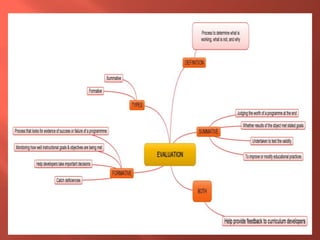
This document discusses curriculum evaluation, which refers to collecting information to make judgments about the effectiveness of an educational program in order to determine whether it should continue unchanged, be modified, or discontinued. The document outlines that curriculum evaluation has three main purposes: describing and judging a program, comparing student performance to objectives, and obtaining information for decision-making. It also distinguishes between formative evaluation, which collects information during instruction to improve it, and summative evaluation, which assesses the worth of a program at its end. Finally, the document notes that evaluation serves a range of stakeholders and helps ensure curriculum quality and updating over time.

ď¨ HAVE YOUEVER BEEN EVALUATED?
ď¨ HAVE YOU EVER EVALUATED SOMEONE?
2.
It refers tothe collection of information on
which judgment might be made about the
worth and the effectiveness of a particular
programme. It includes making those
judgments so that decision might be made
about the future of programme, whether to
retain the programme as it stand, modify it
or throw it out altogether.
3.
According to Gatawa(1990: 50), the term
curriculum evaluation has three major meanings:
The process of:
ď¨ describing and judging an educational
programme or subject.
ď¨ comparing a studentâs performance with
behaviourally stated objectives.
ď¨ defining, obtaining and using relevant
information for decision-making purposes.
ď¨ According to the ICT curriculum,â it is expected
that students are not only proficient enough in
using some computer applications but also be
able to understand what they are doing with
computer.â (National Curriculum
Framework, 2005).
ď¨ The termâformative evaluationâ was
originally coined by Scriven (1967)
to classify evaluation that gathered
information for the purpose of
improving instruction as the
instruction was being given.
6.
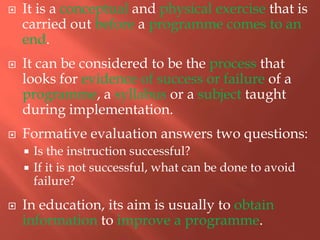
ď¨ It isa conceptual and physical exercise that is
carried out before a programme comes to an
end.
ď¨ It can be considered to be the process that
looks for evidence of success or failure of a
programme, a syllabus or a subject taught
during implementation.
ď¨ Formative evaluation answers two questions:
ďĄ Is the instruction successful?
ďĄ If it is not successful, what can be done to avoid
failure?
ď¨ In education, its aim is usually to obtain
information to improve a programme.
7.
ď¨ A methodto judge the worth of a
curriculum at the end of the syllabus
where the focus is on the outcome.
(Scriven,1967)
8.
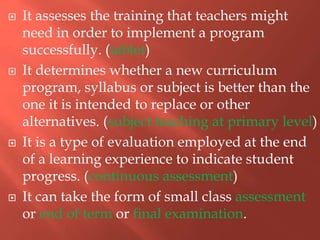
ď¨ It assessesthe training that teachers might
need in order to implement a program
successfully. (tablet)
ď¨ It determines whether a new curriculum
program, syllabus or subject is better than the
one it is intended to replace or other
alternatives. (subject teaching at primary level)
ď¨ It is a type of evaluation employed at the end
of a learning experience to indicate student
progress. (continuous assessment)
ď¨ It can take the form of small class assessment
or end of term or final examination.
9.
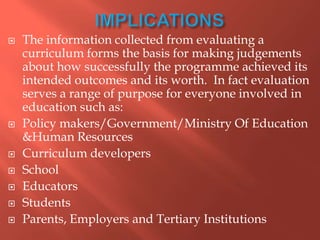
ď¨ The informationcollected from evaluating a
curriculum forms the basis for making judgements
about how successfully the programme achieved its
intended outcomes and its worth. In fact evaluation
serves a range of purpose for everyone involved in
education such as:
ď¨ Policy makers/Government/Ministry Of Education
&Human Resources
ď¨ Curriculum developers
ď¨ School
ď¨ Educators
ď¨ Students
ď¨ Parents, Employers and Tertiary Institutions
10.
ď¨ A curriculumthat operates satisfactorily over a
certain period of time may gradually become
obsolete or deteriorate over time.
ď¨ To prevent this from occurring permanent follow-up
and quality control of the program should be
maintained.
ď¨ Quality control may reveal when some or all portions
of the program should be altered or replaced. In this
way quality control may lead toward the updating of
an old programme and production of âsecond
generation programmeâ.