Prepared by: Ponciano B. Abria III
RUBRIC is a guide listing
specific criteria for grading or
scoring academic papers,
projects, or tests
A scoring rubric is an attempt to
communicate expectations of
quality arounda task
FOCUSON MEASURING AST
A
TEDOBJECTIVE
(PERFORMANCE,BEHAVIOR,ORQUALITY)
USEARANGETORA
TEPERFORMANCE
CONTAIN SPECIFIC PERFORMANCE
CHARACTERISTICS ARRANGED IN
LEVELS INDICATING THE DEGREE TO
WHICHST
ANDARDHASBEENMET
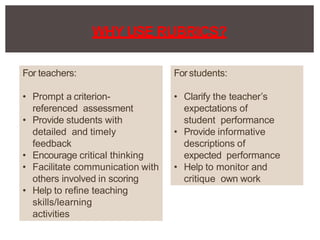
WHY USE RUBRICS?
For teachers:
• Prompt a criterion-
referenced assessment
• Provide students with
detailed and timely
feedback
• Encourage critical thinking
• Facilitate communication with
others involved in scoring
• Help to refine teaching
skills/learning
activities
For students:
• Clarify the teacher’s
expectations of
student performance
• Provide informative
descriptions of
expected performance
• Help to monitor and
critique own work
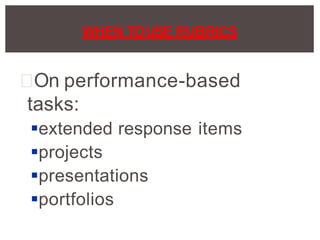
On performance-based
tasks:
extended response items
projects
presentations
portfolios
WHEN TOUSE RUBRICS
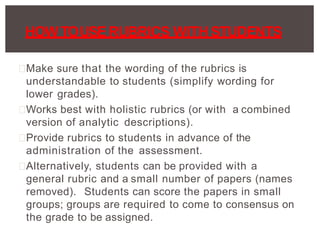
Make sure that the wording of the rubrics is
understandable to students (simplify wording for
lower grades).
Works best with holistic rubrics (or with a combined
version of analytic descriptions).
Provide rubrics to students in advance of the
administration of the assessment.
Alternatively, students can be provided with a
general rubric and a small number of papers (names
removed). Students can score the papers in small
groups; groups are required to come to consensus on
the grade to be assigned.
HOW TOUSERUBRICS WITH STUDENTS
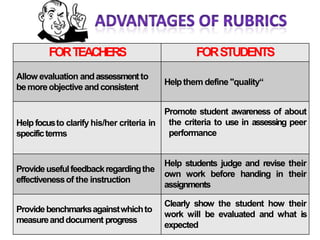
FORTEACHERS FORSTUDENTS
Allow evaluation andassessmentto
bemoreobjective and consistent
Helpthem define "quality“
Helpfocusto clarify his/her criteria in
specificterms
Promote student awareness of about
the criteria to use in assessing peer
performance
Provideusefulfeedbackregardingthe
effectivenessof the instruction
Help students judge and revise their
own work before handing in their
assignments
Providebenchmarksagainstwhichto
measureanddocument progress
Clearly show the student how their
work will be evaluated and what is
expected
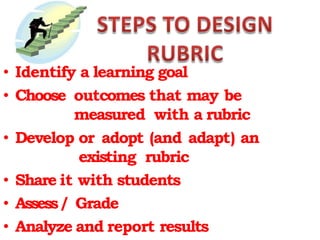
• Identify a learning goal
• Choose outcomes that may be
measured with a rubric
• Develop or adopt (and adapt) an
existing rubric
• Share it with students
• Assess/ Grade
• Analyze and report results
DESCRIBES LEVELSOFPERFORMANCEFOREACH
CRITERION TO ASSESS STUDENT PERFORMANCE ON
EACHOFTHEM.
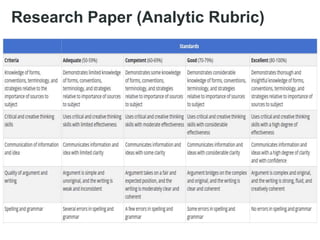
When scoring with an analytic rubric each of
the criteria isscored individually
Analytic rubrics are more common because teachers
typically want to assess each criterion separately,
particularly for assignments that involve a larger
numberof criteria
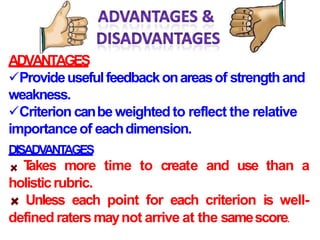
ADVANTAGES
Provideusefulfeedbackonareasof strengthand
weakness.
Criterion canbeweightedto reflect the relative
importanceof eachdimension.
DISADV
ANT
AGES
T
akes more time to create and use than a
holisticrubric.
Unless each point for each criterion is well-
defined ratersmaynot arrive at the samescore.
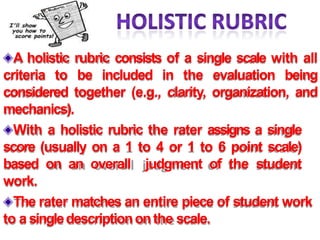
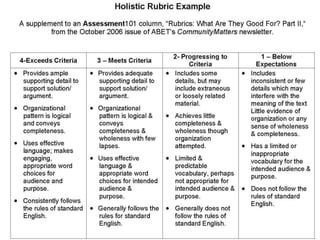
A holistic rubric consists of a single scale with all
criteria to be included in the evaluation being
considered together (e.g., clarity, organization, and
mechanics).
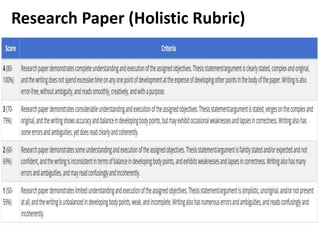
With a holistic rubric the rater assigns a single
score (usually on a 1 to 4 or 1 to 6 point scale)
based on an overall judgment of the student
work.
The rater matches an entire piece of student work
to a singledescriptiononthe scale.
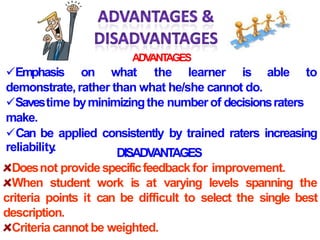
ADV
ANT
AGES
Emphasis on what the learner is able to
demonstrate, rather than what he/she cannot do.
Savestime byminimizingthe numberof decisionsraters
make.
Can be applied consistently by trained raters increasing
reliability
. DISADV
ANT
AGES
Doesnot providespecificfeedbackfor improvement.
When student work is at varying levels spanning the
criteria points it can be difficult to select the single best
description.
Criteria cannot be weighted.
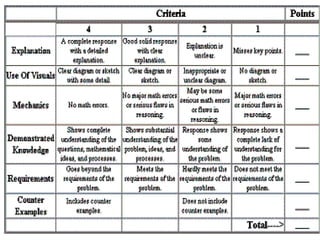
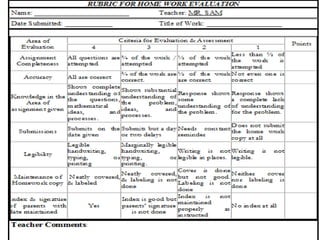
Research Paper (Analytic Rubric)
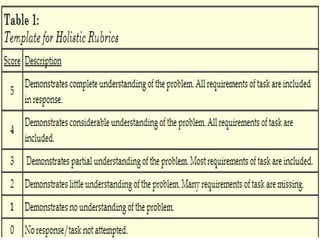
Research Paper (Holistic Rubric)
Analytic and holistic rubrics are two common types of rubrics used in
education to evaluate student work. While both types of rubrics are
useful in different contexts, they differ in their approach to evaluating
student performance.
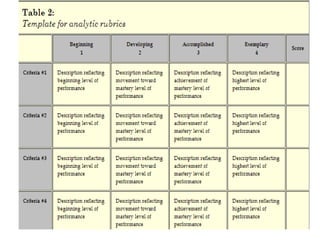
An analytic rubric is a detailed and specific
tool for evaluating student work that breaks
down the assignment into individual criteria
or components. Each criterion is evaluated
separately and assigned a score, and the
scores are then combined to determine an
overall grade. Analytic rubrics are useful
when a teacher wants to evaluate specific
aspects of student performance or provide
detailed feedback on strengths and
weaknesses. However, they can be time-
consuming to create and use.
Overall, both analytic and holistic rubrics
can be effective tools for evaluating
student work. The choice of which type of
rubric to use depends on the teacher's
goals and the nature of the assignment
being evaluated.
In contrast, a holistic rubric assesses
overall performance on an assignment as a
single entity, often assigning a single score
or rating for the entire work. Holistic rubrics
are simpler and less time-consuming to
create and use than analytic rubrics. They
are useful when a teacher wants to
evaluate the overall quality of student work
quickly or when the assignment is less
complex.
Rubrics in teaching offer a transparent and impartial way to
evaluate student work, resulting in fairer assessments and more
valuable feedback. Additionally, rubrics assist students in
comprehending assignment expectations and what is required for
success. Rubrics save teachers time and provide uniformity
across different assignments and classes. Rubrics align with
principles of effective teaching by emphasizing the significance of
explicit expectations, feedback, and engagement. By incorporating
rubrics into teaching, teachers can cultivate a more structured and
meaningful learning environment, which leads to increased
motivation and understanding for students. Ultimately, using
rubrics is an effective method of improving instruction and
promoting student learning.

rubricsppt-130322061126-phpapp01.pptx

  • 1.
  • 3.
    RUBRIC is aguide listing specific criteria for grading or scoring academic papers, projects, or tests A scoring rubric is an attempt to communicate expectations of quality arounda task
  • 4.
    FOCUSON MEASURING AST A TEDOBJECTIVE (PERFORMANCE,BEHAVIOR,ORQUALITY) USEARANGETORA TEPERFORMANCE CONTAINSPECIFIC PERFORMANCE CHARACTERISTICS ARRANGED IN LEVELS INDICATING THE DEGREE TO WHICHST ANDARDHASBEENMET
  • 5.
    WHY USE RUBRICS? Forteachers: • Prompt a criterion- referenced assessment • Provide students with detailed and timely feedback • Encourage critical thinking • Facilitate communication with others involved in scoring • Help to refine teaching skills/learning activities For students: • Clarify the teacher’s expectations of student performance • Provide informative descriptions of expected performance • Help to monitor and critique own work
  • 6.
    On performance-based tasks: extended responseitems projects presentations portfolios WHEN TOUSE RUBRICS
  • 7.
    Make sure thatthe wording of the rubrics is understandable to students (simplify wording for lower grades). Works best with holistic rubrics (or with a combined version of analytic descriptions). Provide rubrics to students in advance of the administration of the assessment. Alternatively, students can be provided with a general rubric and a small number of papers (names removed). Students can score the papers in small groups; groups are required to come to consensus on the grade to be assigned. HOW TOUSERUBRICS WITH STUDENTS
  • 8.
    FORTEACHERS FORSTUDENTS Allow evaluationandassessmentto bemoreobjective and consistent Helpthem define "quality“ Helpfocusto clarify his/her criteria in specificterms Promote student awareness of about the criteria to use in assessing peer performance Provideusefulfeedbackregardingthe effectivenessof the instruction Help students judge and revise their own work before handing in their assignments Providebenchmarksagainstwhichto measureanddocument progress Clearly show the student how their work will be evaluated and what is expected
  • 9.
    • Identify alearning goal • Choose outcomes that may be measured with a rubric • Develop or adopt (and adapt) an existing rubric • Share it with students • Assess/ Grade • Analyze and report results
  • 11.
    DESCRIBES LEVELSOFPERFORMANCEFOREACH CRITERION TOASSESS STUDENT PERFORMANCE ON EACHOFTHEM. When scoring with an analytic rubric each of the criteria isscored individually Analytic rubrics are more common because teachers typically want to assess each criterion separately, particularly for assignments that involve a larger numberof criteria
  • 15.
    ADVANTAGES Provideusefulfeedbackonareasof strengthand weakness. Criterion canbeweightedtoreflect the relative importanceof eachdimension. DISADV ANT AGES T akes more time to create and use than a holisticrubric. Unless each point for each criterion is well- defined ratersmaynot arrive at the samescore.
  • 16.
    A holistic rubricconsists of a single scale with all criteria to be included in the evaluation being considered together (e.g., clarity, organization, and mechanics). With a holistic rubric the rater assigns a single score (usually on a 1 to 4 or 1 to 6 point scale) based on an overall judgment of the student work. The rater matches an entire piece of student work to a singledescriptiononthe scale.
  • 19.
    ADV ANT AGES Emphasis on whatthe learner is able to demonstrate, rather than what he/she cannot do. Savestime byminimizingthe numberof decisionsraters make. Can be applied consistently by trained raters increasing reliability . DISADV ANT AGES Doesnot providespecificfeedbackfor improvement. When student work is at varying levels spanning the criteria points it can be difficult to select the single best description. Criteria cannot be weighted.
  • 20.
  • 21.
  • 22.
    Analytic and holisticrubrics are two common types of rubrics used in education to evaluate student work. While both types of rubrics are useful in different contexts, they differ in their approach to evaluating student performance.
  • 23.
    An analytic rubricis a detailed and specific tool for evaluating student work that breaks down the assignment into individual criteria or components. Each criterion is evaluated separately and assigned a score, and the scores are then combined to determine an overall grade. Analytic rubrics are useful when a teacher wants to evaluate specific aspects of student performance or provide detailed feedback on strengths and weaknesses. However, they can be time- consuming to create and use.
  • 24.
    Overall, both analyticand holistic rubrics can be effective tools for evaluating student work. The choice of which type of rubric to use depends on the teacher's goals and the nature of the assignment being evaluated.
  • 25.
    In contrast, aholistic rubric assesses overall performance on an assignment as a single entity, often assigning a single score or rating for the entire work. Holistic rubrics are simpler and less time-consuming to create and use than analytic rubrics. They are useful when a teacher wants to evaluate the overall quality of student work quickly or when the assignment is less complex.
  • 26.
    Rubrics in teachingoffer a transparent and impartial way to evaluate student work, resulting in fairer assessments and more valuable feedback. Additionally, rubrics assist students in comprehending assignment expectations and what is required for success. Rubrics save teachers time and provide uniformity across different assignments and classes. Rubrics align with principles of effective teaching by emphasizing the significance of explicit expectations, feedback, and engagement. By incorporating rubrics into teaching, teachers can cultivate a more structured and meaningful learning environment, which leads to increased motivation and understanding for students. Ultimately, using rubrics is an effective method of improving instruction and promoting student learning.