BSED - ENGLISH III
What is RUBRIC?
A rubric is typically an evaluation tool or
set of guidelines used to promote the
consistent application of learning
expectations, learning objectives, or
learning standards in the classroom, or to
measure their attainment against a
consistent set of criteria. Rubrics are also
used as scoring instruments to determine
grades or the degree to which learning
standards have been demonstrated or
attained by students.
Importanc
Rubrics can help instructors communicate their expectations
to students and assess student work fairly and efficiently.
Rubrics can also provide students with informative feedback
on their strengths and weaknesses, and prompt students to
reflect on their own work. This page describes how to create
and use a grading rubric.
Focus on measuring a stated objective
(performance, behavior, or quality)
Use a range to rate a performance
Contain specific performance characteristics
arranged in levels dicating the degree to
which standard has been met
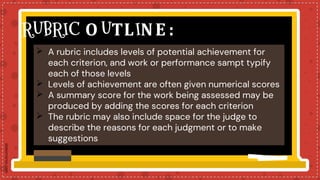
RUBRIC O UTLINE :
 A rubric includes levels of potential achievement for
each criterion, and work or performance sampt typify
each of those levels
 Levels of achievement are often given numerical scores
 A summary score for the work being assessed may be
produced by adding the scores for each criterion
 The rubric may also include space for the judge to
describe the reasons for each judgment or to make
suggestions
TE RMS TO BE
US E D:
 Needs Improvement...Satisfactory...Good...Exemplary
 Beginning...Developing...Accomplished...Exemplary
 Needs work...Good...Excellent
 Novice...Apprentice...Proficient...Distinguished
 Numeric scale ranging from 1 to 5, for example
CRE ATE A
G RADING
RUBRIC?
1 . Define the purpose of the assignment/
assessment for which you are creating a
rubric.
What exactly is the assigned task?
What might an exemplary student
product/performance look like?
What kind of feedback do you want
to give students on their
work/performance?
2. Decide what kind of rubric you will
use: a holistic rubric or an analytic
rubric?
There are two kinds of rubric; holistic
rubric and analytic rubric. Holistic and
analytic rubrics use a combination of
descriptive rating scales (e.g., weak,
satisfactory, strong) and assessment
criteria to guide the assessment
process.
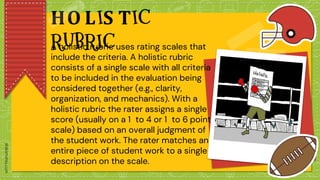
HO LIS TIC
RUBRIC
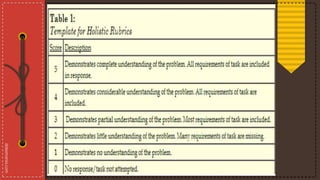
A holistic rubric uses rating scales that
include the criteria. A holistic rubric
consists of a single scale with all criteria
to be included in the evaluation being
considered together (e.g., clarity,
organization, and mechanics). With a
holistic rubric the rater assigns a single
score (usually on a 1 to 4 or 1 to 6 point
scale) based on an overall judgment of
the student work. The rater matches an
entire piece of student work to a single
description on the scale.
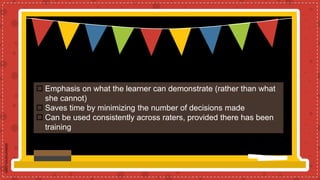
 Emphasis on what the learner can demonstrate (rather than what
she cannot)
 Saves time by minimizing the number of decisions made
 Can be used consistently across raters, provided there has been
training
 Does not provide specific feedback for improvement
 Can be difficult to choose a score when student work is at varying
levels across the criteria
 Criteria cannot be weighted
ANALYTIC
RUBRIC
An analytic rubric uses a rating
scale to evaluate each criterion
separately, forming a grid or table
in which the rating scale is
presented in the top row and each
criterium is listed down the
leftmost column.
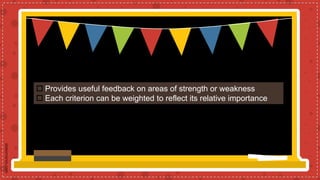
 Provides useful feedback on areas of strength or weakness
 Each criterion can be weighted to reflect its relative importance
 More time consuming to create and use than a holistic rubric
 May not be used consistently across raters, unless extremely well
defined
3. Define the criteria.
Ask yourself: what knowledge and skills are required for
the assignment/assessment? Make a list of these, group
and label them, and eliminate any that are not critical.
The list should contain no more than 6-7 criteria, but
need not include that many.
Consider the effectiveness of the criteria:
• Can they be observed and measured?
• Are they important and essential?
• Are they distinct from other criteria?
Revise the criteria as needed. Consider how you will
weight them relative to each other.
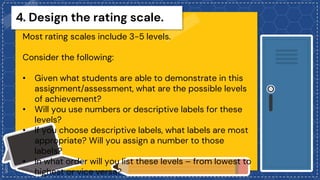
4. Design the rating scale.
Most rating scales include 3-5 levels.
Consider the following:
• Given what students are able to demonstrate in this
assignment/assessment, what are the possible levels
of achievement?
• Will you use numbers or descriptive labels for these
levels?
• If you choose descriptive labels, what labels are most
appropriate? Will you assign a number to those
labels?
• In what order will you list these levels – from lowest to
highest or vice versa?
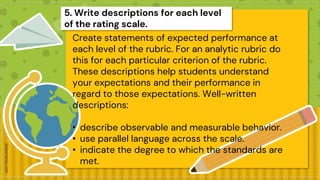
5. Write descriptions for each level
of the rating scale.
Create statements of expected performance at
each level of the rubric. For an analytic rubric do
this for each particular criterion of the rubric.
These descriptions help students understand
your expectations and their performance in
regard to those expectations. Well-written
descriptions:
• describe observable and measurable behavior.
• use parallel language across the scale.
• indicate the degree to which the standards are
met.
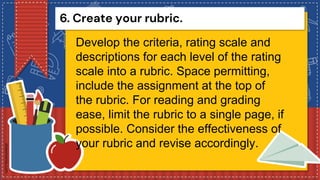
6. Create your rubric.
Develop the criteria, rating scale and
descriptions for each level of the rating
scale into a rubric. Space permitting,
include the assignment at the top of
the rubric. For reading and grading
ease, limit the rubric to a single page, if
possible. Consider the effectiveness of
your rubric and revise accordingly.
Credits:
Presentation Template: SlidesMania
Sample Images: Unsplash
Designing Grading Rubrics
https://www.brown.edu/sheridan/teaching-learning-resources/teaching-
resources/course-design/classroom-assessment/grading-criteria/designing-
rubrics?fbclid=IwAR1 82Wbd2Gkdziky6-
zudCLXtjl8Hylclh2obCiN2eXAjYnvoGPJTjxXl9Y
Rubrics pptx
https://www.slideshare.net/gayvasan/rubrics-
ppt?fbclid=IwAR1 rHHrlYpUCPnjS9ZGtkB-Gx5BEccDuhA6txyly3y3-
WzoVfUL5EpGHRMs

RUBRIC-BSED-III.pptx

  • 1.
  • 2.
    What is RUBRIC? Arubric is typically an evaluation tool or set of guidelines used to promote the consistent application of learning expectations, learning objectives, or learning standards in the classroom, or to measure their attainment against a consistent set of criteria. Rubrics are also used as scoring instruments to determine grades or the degree to which learning standards have been demonstrated or attained by students.
  • 3.
    Importanc Rubrics can helpinstructors communicate their expectations to students and assess student work fairly and efficiently. Rubrics can also provide students with informative feedback on their strengths and weaknesses, and prompt students to reflect on their own work. This page describes how to create and use a grading rubric.
  • 4.
    Focus on measuringa stated objective (performance, behavior, or quality) Use a range to rate a performance Contain specific performance characteristics arranged in levels dicating the degree to which standard has been met
  • 5.
    RUBRIC O UTLINE:  A rubric includes levels of potential achievement for each criterion, and work or performance sampt typify each of those levels  Levels of achievement are often given numerical scores  A summary score for the work being assessed may be produced by adding the scores for each criterion  The rubric may also include space for the judge to describe the reasons for each judgment or to make suggestions
  • 6.
    TE RMS TOBE US E D:  Needs Improvement...Satisfactory...Good...Exemplary  Beginning...Developing...Accomplished...Exemplary  Needs work...Good...Excellent  Novice...Apprentice...Proficient...Distinguished  Numeric scale ranging from 1 to 5, for example
  • 7.
    CRE ATE A GRADING RUBRIC?
  • 8.
    1 . Definethe purpose of the assignment/ assessment for which you are creating a rubric. What exactly is the assigned task? What might an exemplary student product/performance look like? What kind of feedback do you want to give students on their work/performance?
  • 9.
    2. Decide whatkind of rubric you will use: a holistic rubric or an analytic rubric? There are two kinds of rubric; holistic rubric and analytic rubric. Holistic and analytic rubrics use a combination of descriptive rating scales (e.g., weak, satisfactory, strong) and assessment criteria to guide the assessment process.
  • 10.
    HO LIS TIC RUBRIC Aholistic rubric uses rating scales that include the criteria. A holistic rubric consists of a single scale with all criteria to be included in the evaluation being considered together (e.g., clarity, organization, and mechanics). With a holistic rubric the rater assigns a single score (usually on a 1 to 4 or 1 to 6 point scale) based on an overall judgment of the student work. The rater matches an entire piece of student work to a single description on the scale.
  • 14.
     Emphasis onwhat the learner can demonstrate (rather than what she cannot)  Saves time by minimizing the number of decisions made  Can be used consistently across raters, provided there has been training
  • 15.
     Does notprovide specific feedback for improvement  Can be difficult to choose a score when student work is at varying levels across the criteria  Criteria cannot be weighted
  • 16.
    ANALYTIC RUBRIC An analytic rubricuses a rating scale to evaluate each criterion separately, forming a grid or table in which the rating scale is presented in the top row and each criterium is listed down the leftmost column.
  • 20.
     Provides usefulfeedback on areas of strength or weakness  Each criterion can be weighted to reflect its relative importance
  • 21.
     More timeconsuming to create and use than a holistic rubric  May not be used consistently across raters, unless extremely well defined
  • 22.
    3. Define thecriteria. Ask yourself: what knowledge and skills are required for the assignment/assessment? Make a list of these, group and label them, and eliminate any that are not critical. The list should contain no more than 6-7 criteria, but need not include that many. Consider the effectiveness of the criteria: • Can they be observed and measured? • Are they important and essential? • Are they distinct from other criteria? • Are they distinct from other criteria? Revise the criteria as needed. Consider how you will weight them relative to each other.
  • 23.
    4. Design therating scale. Most rating scales include 3-5 levels. Consider the following: • Given what students are able to demonstrate in this assignment/assessment, what are the possible levels of achievement? • Will you use numbers or descriptive labels for these levels? • If you choose descriptive labels, what labels are most appropriate? Will you assign a number to those labels? • In what order will you list these levels – from lowest to highest or vice versa?
  • 24.
    5. Write descriptionsfor each level of the rating scale. Create statements of expected performance at each level of the rubric. For an analytic rubric do this for each particular criterion of the rubric. These descriptions help students understand your expectations and their performance in regard to those expectations. Well-written descriptions: • describe observable and measurable behavior. • use parallel language across the scale. • indicate the degree to which the standards are met.
  • 25.
    6. Create yourrubric. Develop the criteria, rating scale and descriptions for each level of the rating scale into a rubric. Space permitting, include the assignment at the top of the rubric. For reading and grading ease, limit the rubric to a single page, if possible. Consider the effectiveness of your rubric and revise accordingly.
  • 26.
    Credits: Presentation Template: SlidesMania SampleImages: Unsplash Designing Grading Rubrics https://www.brown.edu/sheridan/teaching-learning-resources/teaching- resources/course-design/classroom-assessment/grading-criteria/designing- rubrics?fbclid=IwAR1 82Wbd2Gkdziky6- zudCLXtjl8Hylclh2obCiN2eXAjYnvoGPJTjxXl9Y Rubrics pptx https://www.slideshare.net/gayvasan/rubrics- ppt?fbclid=IwAR1 rHHrlYpUCPnjS9ZGtkB-Gx5BEccDuhA6txyly3y3- WzoVfUL5EpGHRMs