IN THE NAME OF ALLAH, THE MOST
MERCIFUL THE MOST GRACIOUS
Saturday,
February
8,
2025
Types of Root Systems
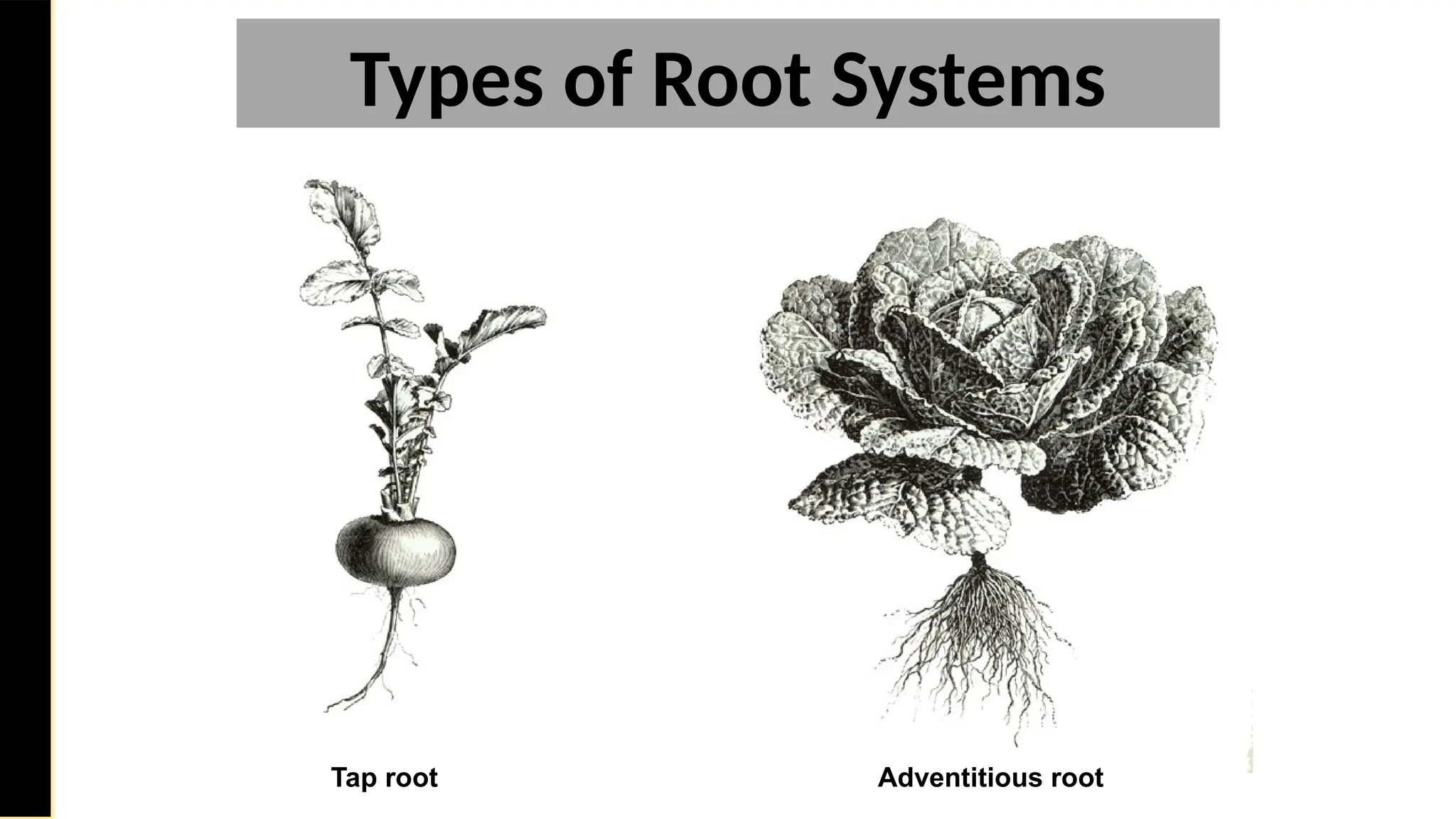
Tap root Adventitious root
• On the basis of their origin, roots are of two types – tap root and adventitious
root.
(a) Tap root:
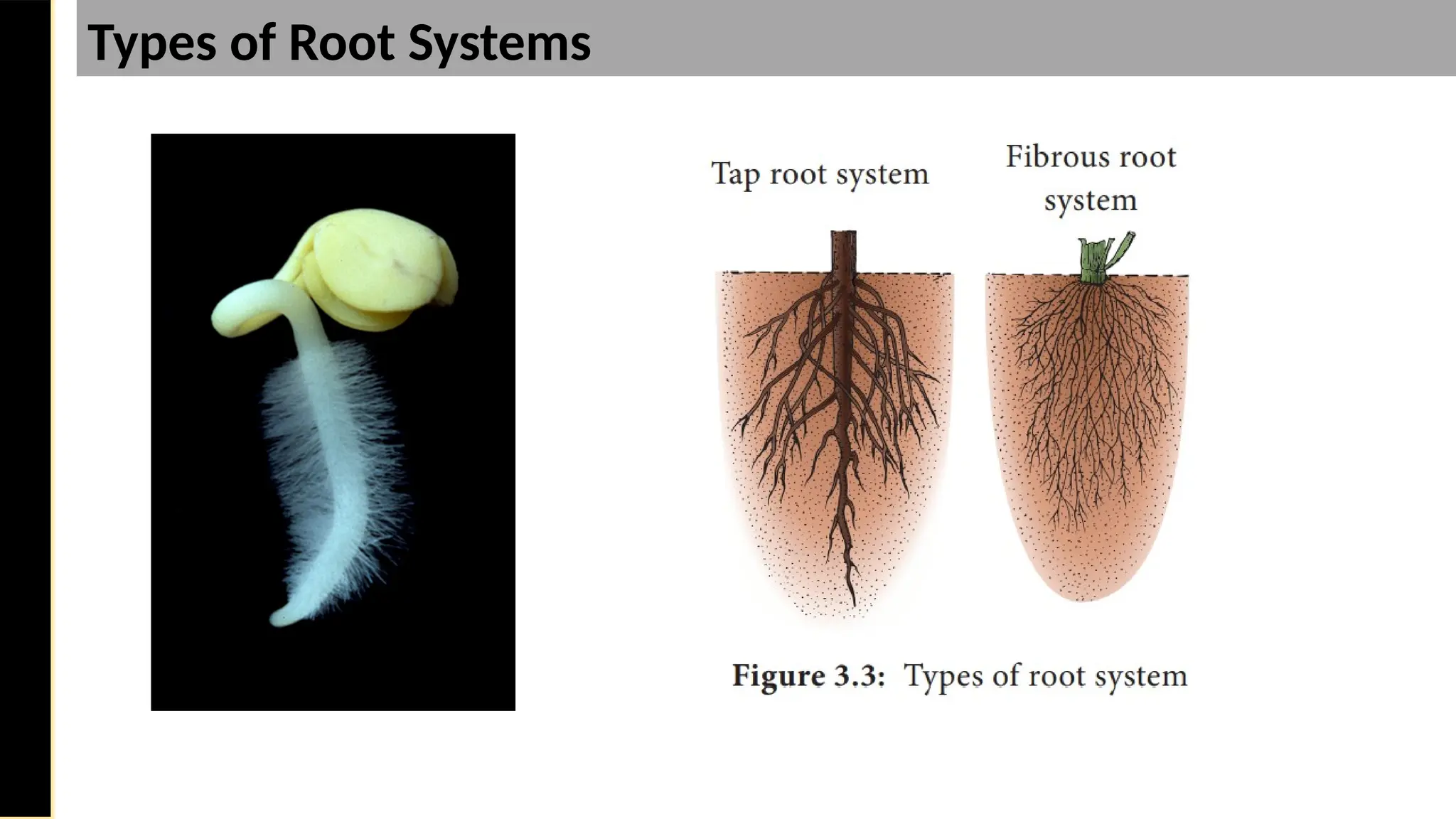
• On germination of a seed, the radicle elongates into primary root or true root
or tap root. In dicot plants, the tap root is persistent and produces lateral roots
such as secondary’ roots, tertiary roots etc. All lateral roots arise in acropetal
succession i.e. younger roots towards apex and older roots towards base. The
tap root and its branches constitute the tap root system.
(b) Adventitious root:
• These are the roots that grow from any part of the plant other than radicle. In
monocot plants, the tap root is short lived and soon replaced by adventitious
roots. A group of adventitious roots and their branches constitute adventitious
root system.
Saturday,
February
8,
2025
Types of Root Systems
Saturday,
February
8,
2025
Types of Root Systems
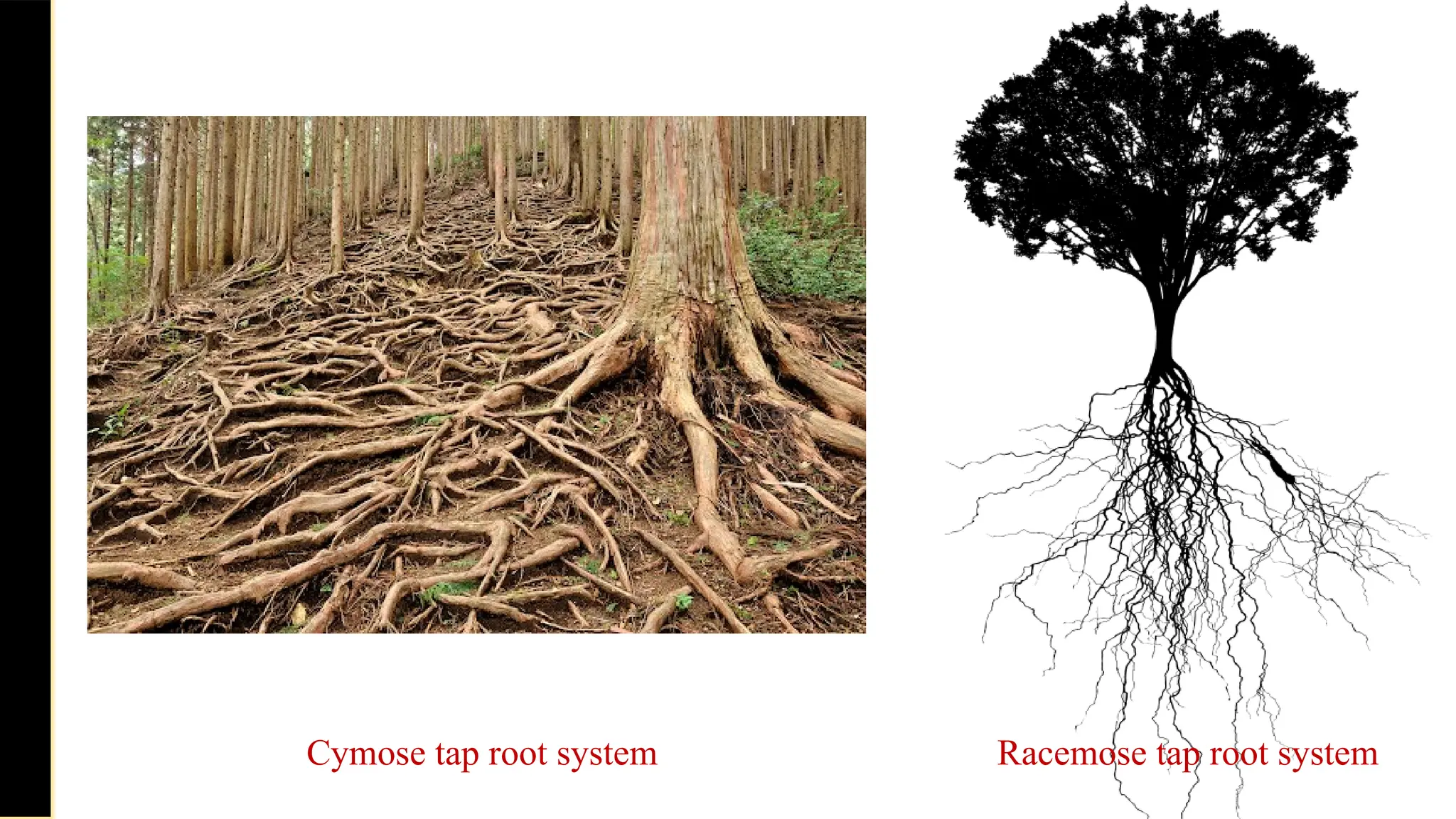
• Tap root system is of two types:
• Deep feeders:
• Deep feeder tap root system has an elongated tap root which penetrates the
deeper layers of the soil. It is mostly met in trees. Deep feeder tap root
system is also called racemose tap root system.
• Surface feeders:
• In surface feeders the tap root does not elongate very much. The secondary
roots spread to a greater extent, mostly horizontal near the soil surface.
Such a system is also named as cymose tap root system.
Saturday,
February
8,
2025
Types of Tap Root System
Saturday,
February
8,
2025
Racemose tap root system
Cymose tap root system
• The tap root becomes swollen and fleshy with the stored food. The secondary roots remain thin. Hypocotyl
(embryonic region between cotyledons and radicle) may also join the tap root in storing food. Stem is reduced
and discoid in the beginning and bears radical leaves.
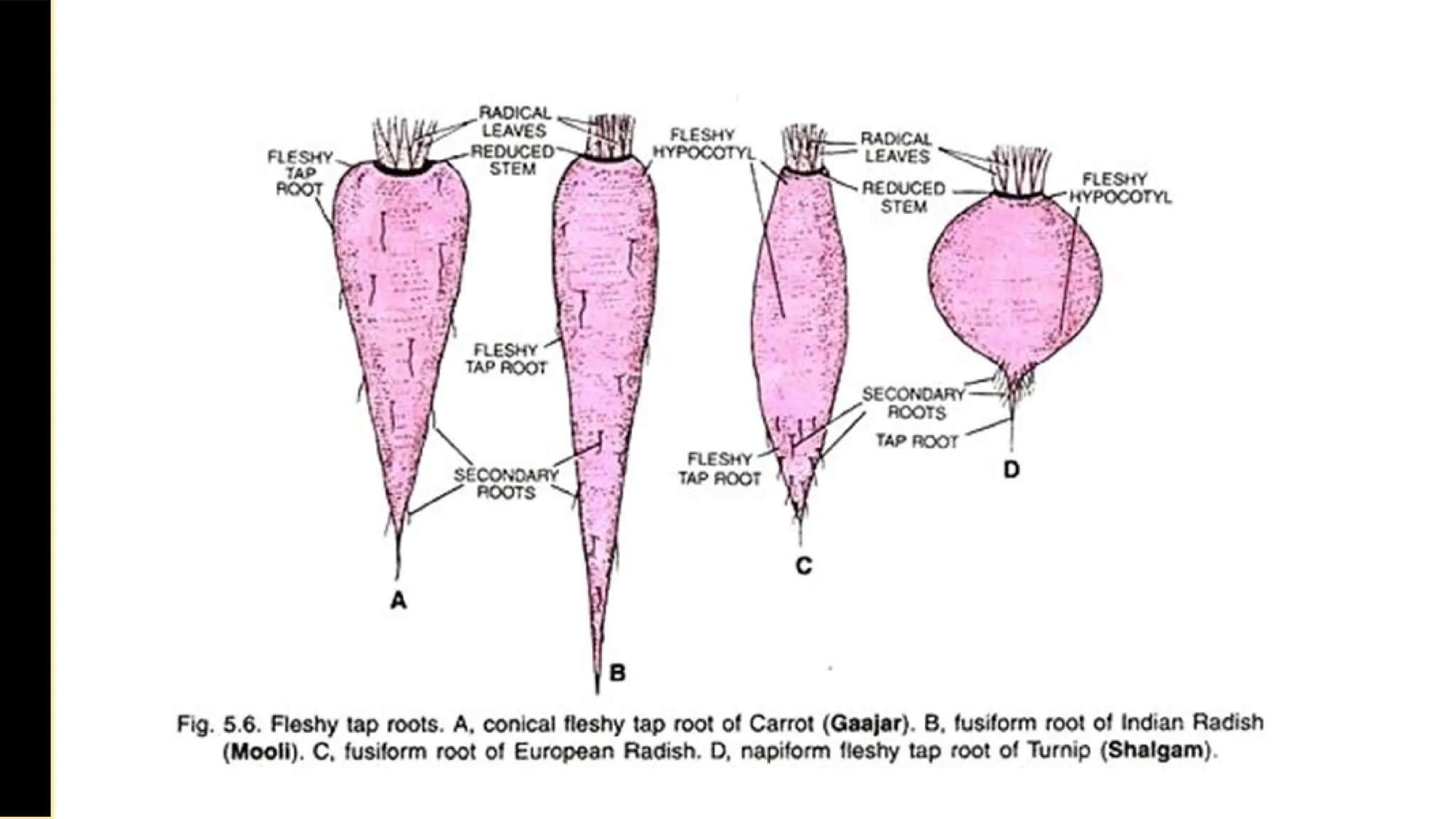
• Depending upon the shape, the fleshy tap roots are of the following types:
• (i) Conical:
• Here the fleshy tap root resembles a cone, that is, the thickest towards base and gradually tapering towards the
apex. Many thread-like secondary roots are found throughout the length of conical fleshy root, e.g., Carrot
(Daucus carota).
• (ii) Fusiform:
• The fusiform fleshy root is like a spindle, that is, thickest roughly in the middle and narrow towards both its
base and apex, e.g., Radish (Raphanus sativus). The fusiform root of Indian Radish consists of swollen
hypocotyl near the base only and swollen tap root in the remaining region.
• The latter possesses thin and thread-like secondary roots. In European Radish the tap root forms only the
terminal tapering fleshy part of the root. The middle and the basal fleshy parts are formed by the hypocotyl.
• (iii) Napiform:
• The fleshy root is very thick at the base and is almost spherical. It suddenly thins out towards the apex (top-
like), e.g., Turnip (Brassica rapa) and Beet (Beta vulgaris, vern. Chakander). In Turnip most of the swollen part
is hypocotyl. The tap root occurs only towards the narrow pointed apical region which also bears thread­
like
secondary roots. In Beet both the tap root and hypocotyl are swollen.
Saturday,
February
8,
2025
(A) Modification of Tap Root System:
Saturday,
February
8,
2025
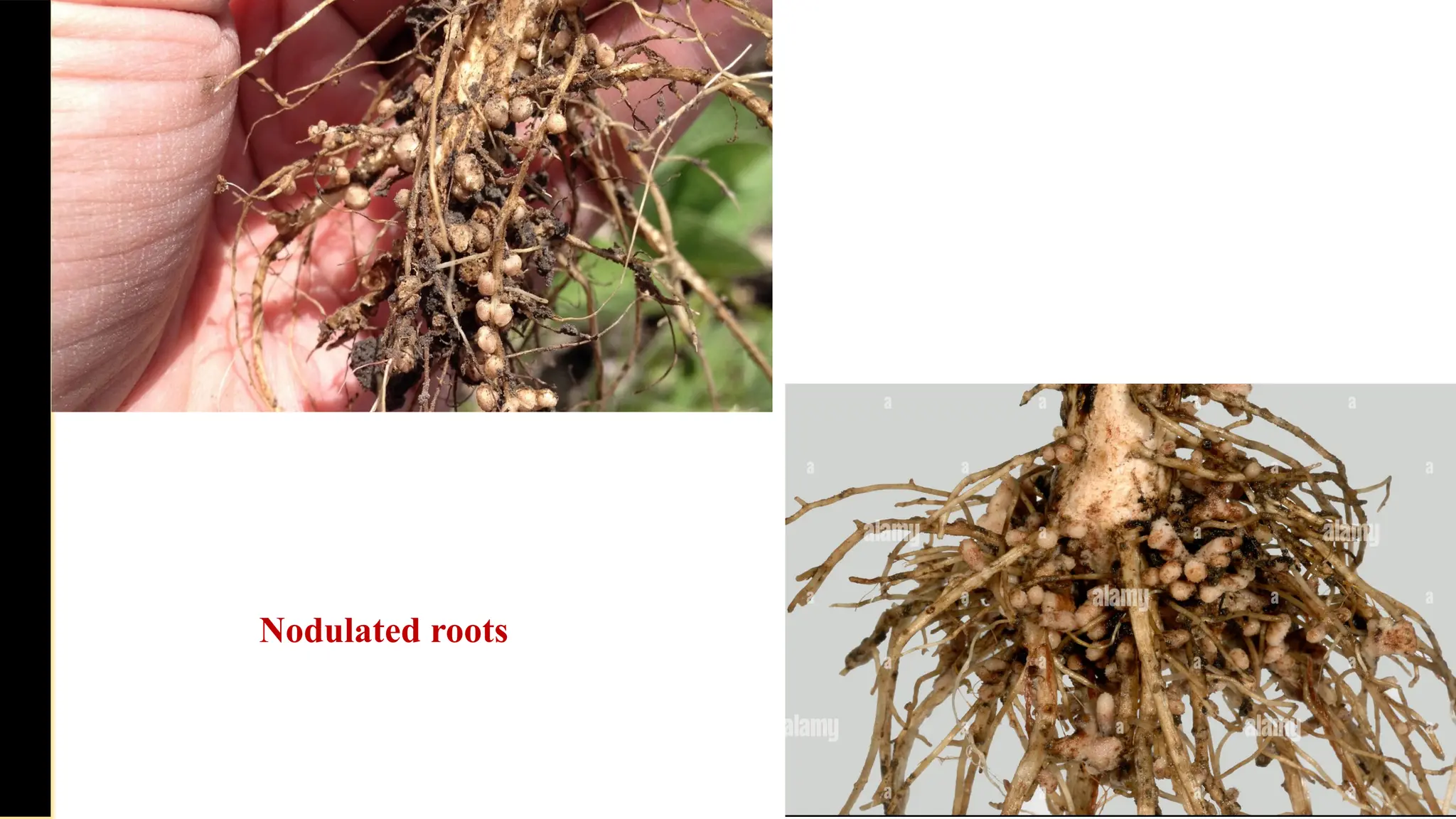
i. Nodulated (Tuberculate) Roots:
• They occur in papiliona­
ceous (leguminous) plants like Pea (Pisum sativum), Gram
(Cicer arietinum), Groundnut (= Peanut, Arachis hypogea), Methi (Medicago
falcata), Soy Bean (Glycine max), Alfalfa, etc.
• The secondary, tertiary roots and sometimes the primary root develop numerous
small or large irregular swellings called root nodules or tubercles. The root nodules
enclose millions of minute nitrogen fixing bacteria of the genus Rhizobium (e.g.,
R. leguminosarum).
• These bacteria pick up the free nitrogen present in the soil atmosphere and convert
it into organic compounds of nitrogen. The property of converting free nitrogen
into nitrogenous compounds is called nitrogen fixa­
tion.
• Some of the nitrogenous compounds are taken up by the legume in return for food
and shelter. Therefore, both the bacteria and the leguminous plant are benefitted by
their asso­
ciation. Such a mutually beneficial relationship is called reciprocal
symbiosis or mutualism.
Saturday,
February
8,
2025
Modification of Tap Root Branches
Saturday,
February
8,
2025
Nodulated roots
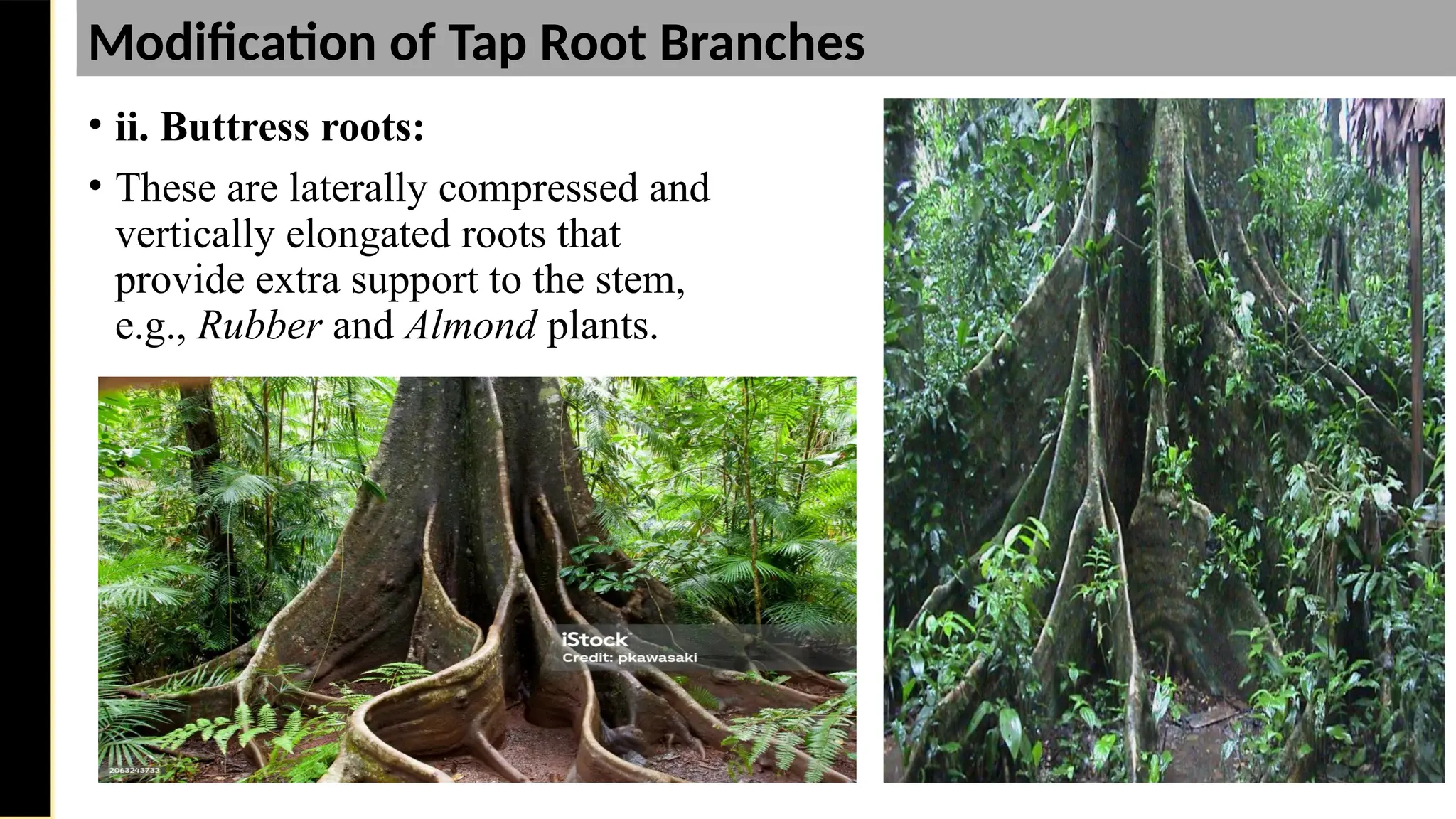
• ii. Buttress roots:
• These are laterally compressed and
vertically elongated roots that
provide extra support to the stem,
e.g., Rubber and Almond plants.
Saturday,
February
8,
2025
Modification of Tap Root Branches
Saturday,
February
8,
2025
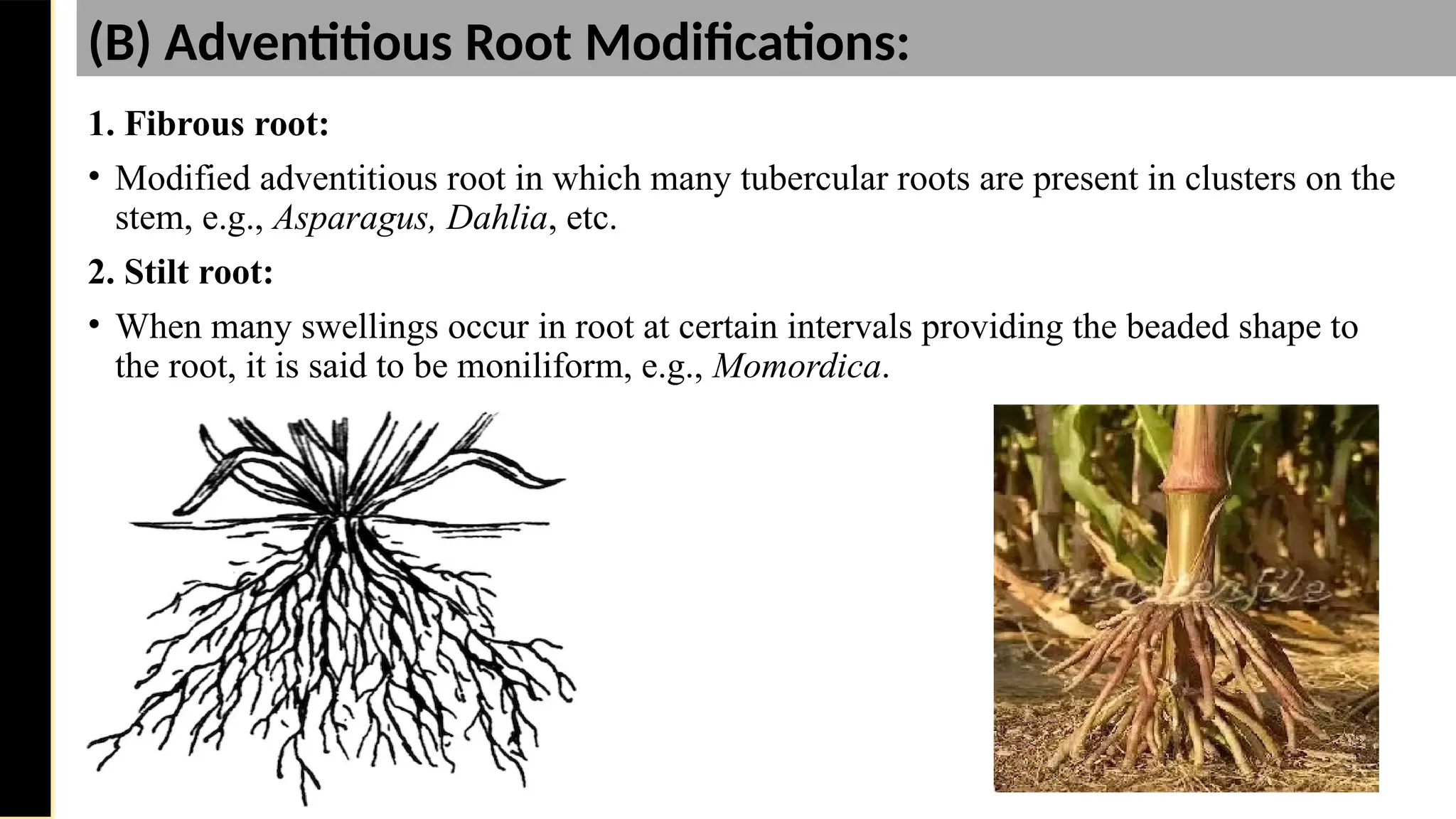
1. Fibrous root:
• Modified adventitious root in which many tubercular roots are present in clusters on the
stem, e.g., Asparagus, Dahlia, etc.
2. Stilt root:
• When many swellings occur in root at certain intervals providing the beaded shape to
the root, it is said to be moniliform, e.g., Momordica.
Saturday,
February
8,
2025
(B) Adventitious Root Modifications:
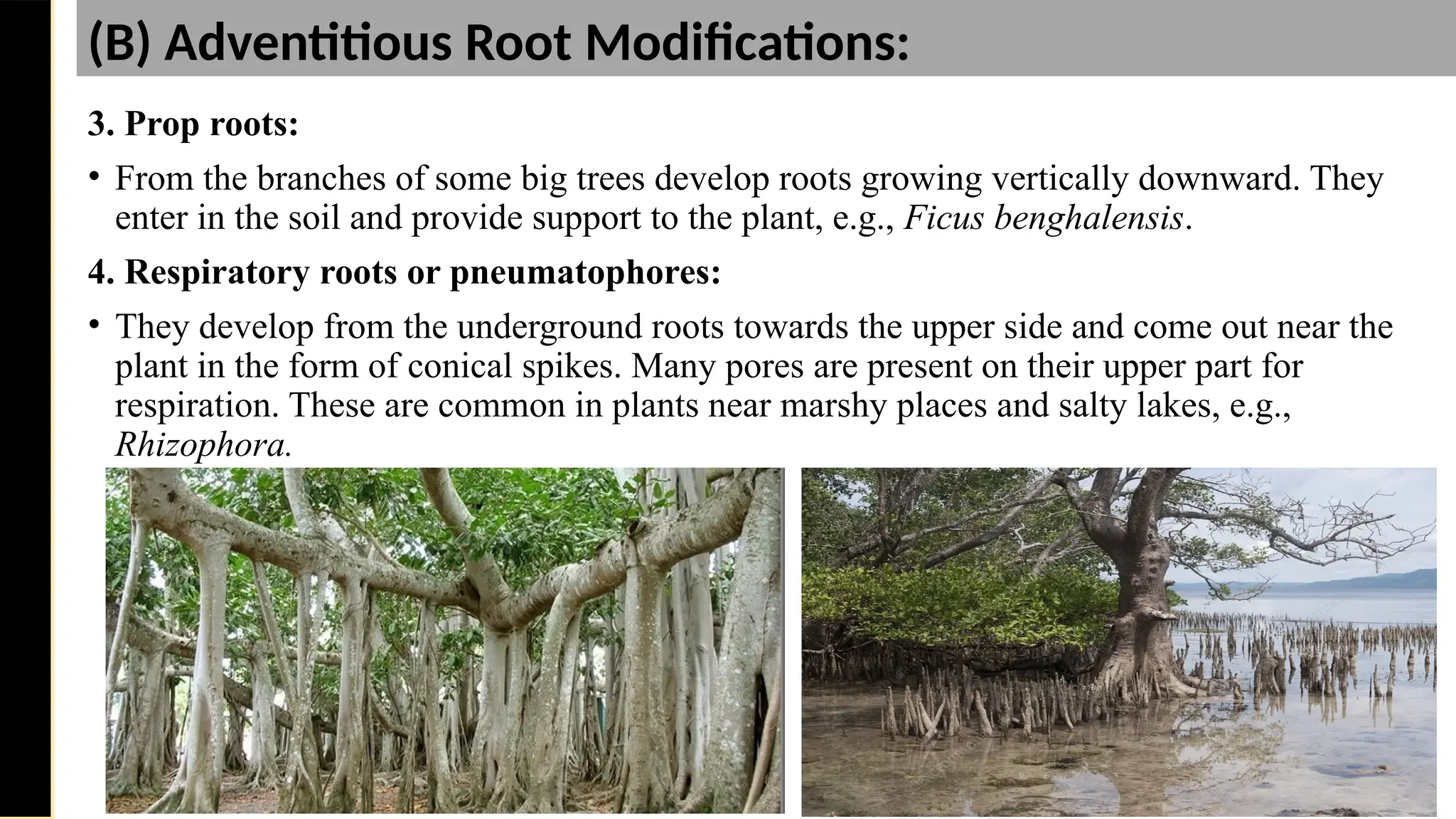
3. Prop roots:
• From the branches of some big trees develop roots growing vertically downward. They
enter in the soil and provide support to the plant, e.g., Ficus benghalensis.
4. Respiratory roots or pneumatophores:
• They develop from the underground roots towards the upper side and come out near the
plant in the form of conical spikes. Many pores are present on their upper part for
respiration. These are common in plants near marshy places and salty lakes, e.g.,
Rhizophora.
Saturday,
February
8,
2025
(B) Adventitious Root Modifications:
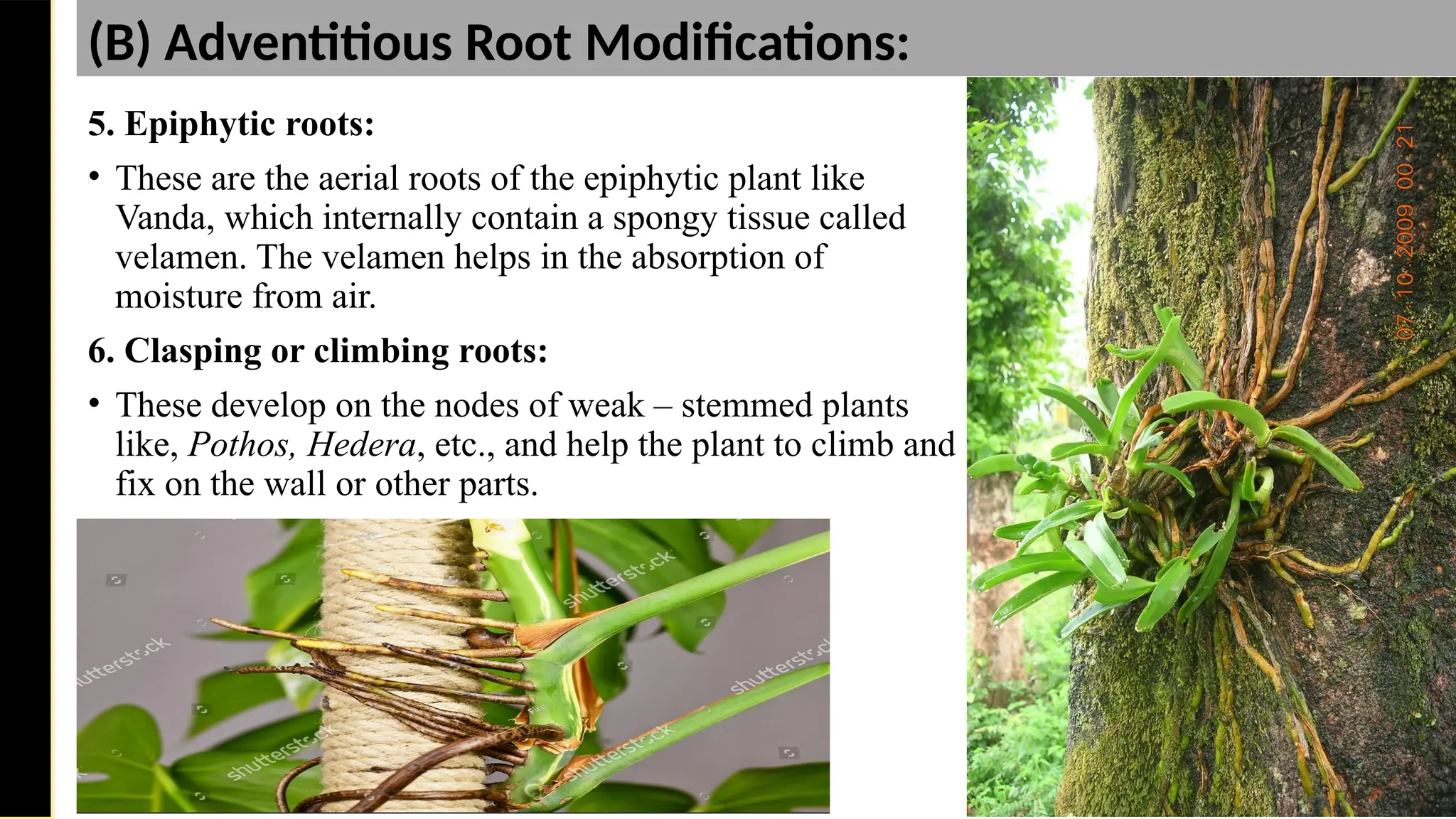
5. Epiphytic roots:
• These are the aerial roots of the epiphytic plant like
Vanda, which internally contain a spongy tissue called
velamen. The velamen helps in the absorption of
moisture from air.
6. Clasping or climbing roots:
• These develop on the nodes of weak – stemmed plants
like, Pothos, Hedera, etc., and help the plant to climb and
fix on the wall or other parts.
Saturday,
February
8,
2025
(B) Adventitious Root Modifications:
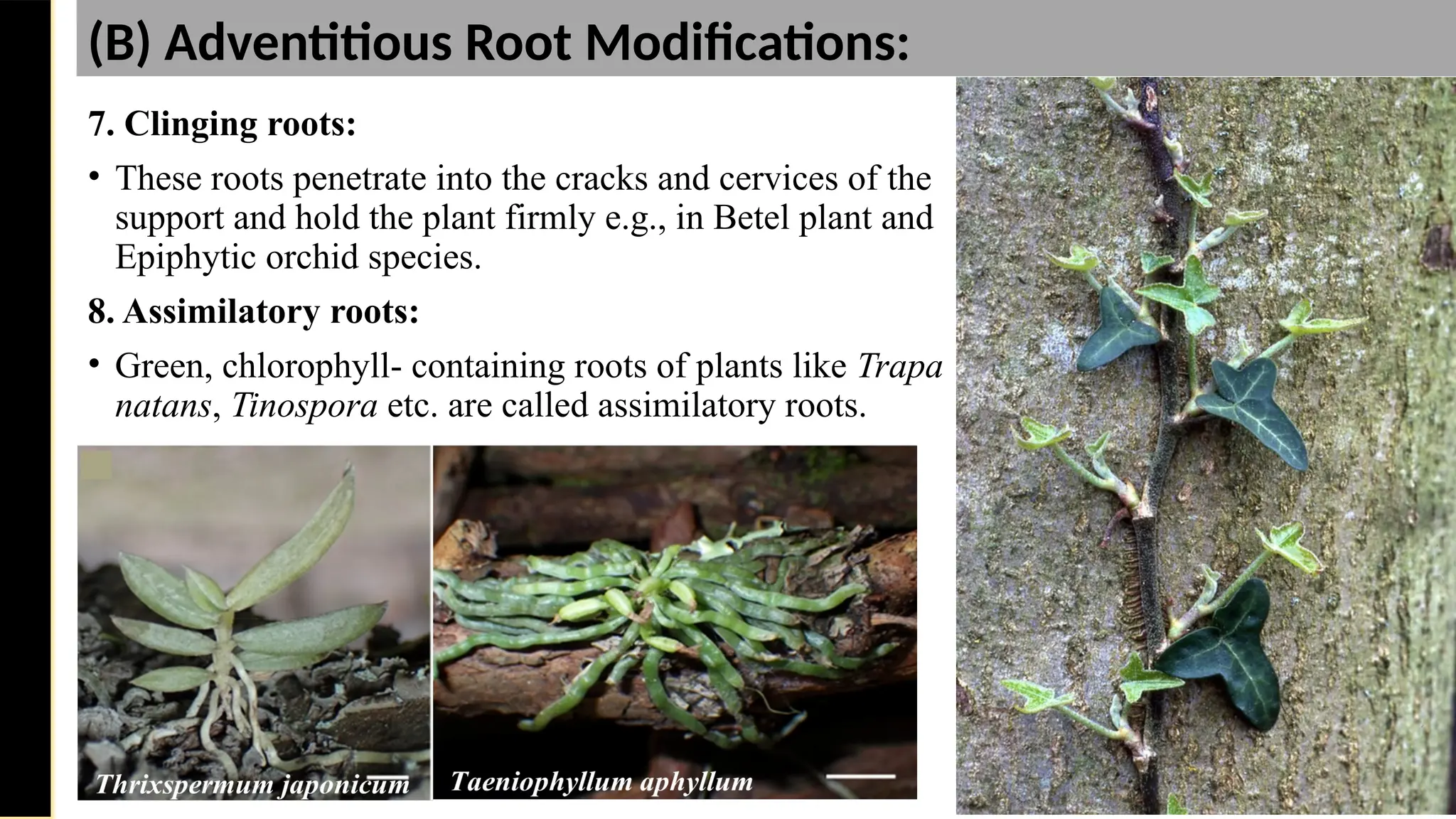
7. Clinging roots:
• These roots penetrate into the cracks and cervices of the
support and hold the plant firmly e.g., in Betel plant and
Epiphytic orchid species.
8. Assimilatory roots:
• Green, chlorophyll- containing roots of plants like Trapa
natans, Tinospora etc. are called assimilatory roots.
Saturday,
February
8,
2025
(B) Adventitious Root Modifications:
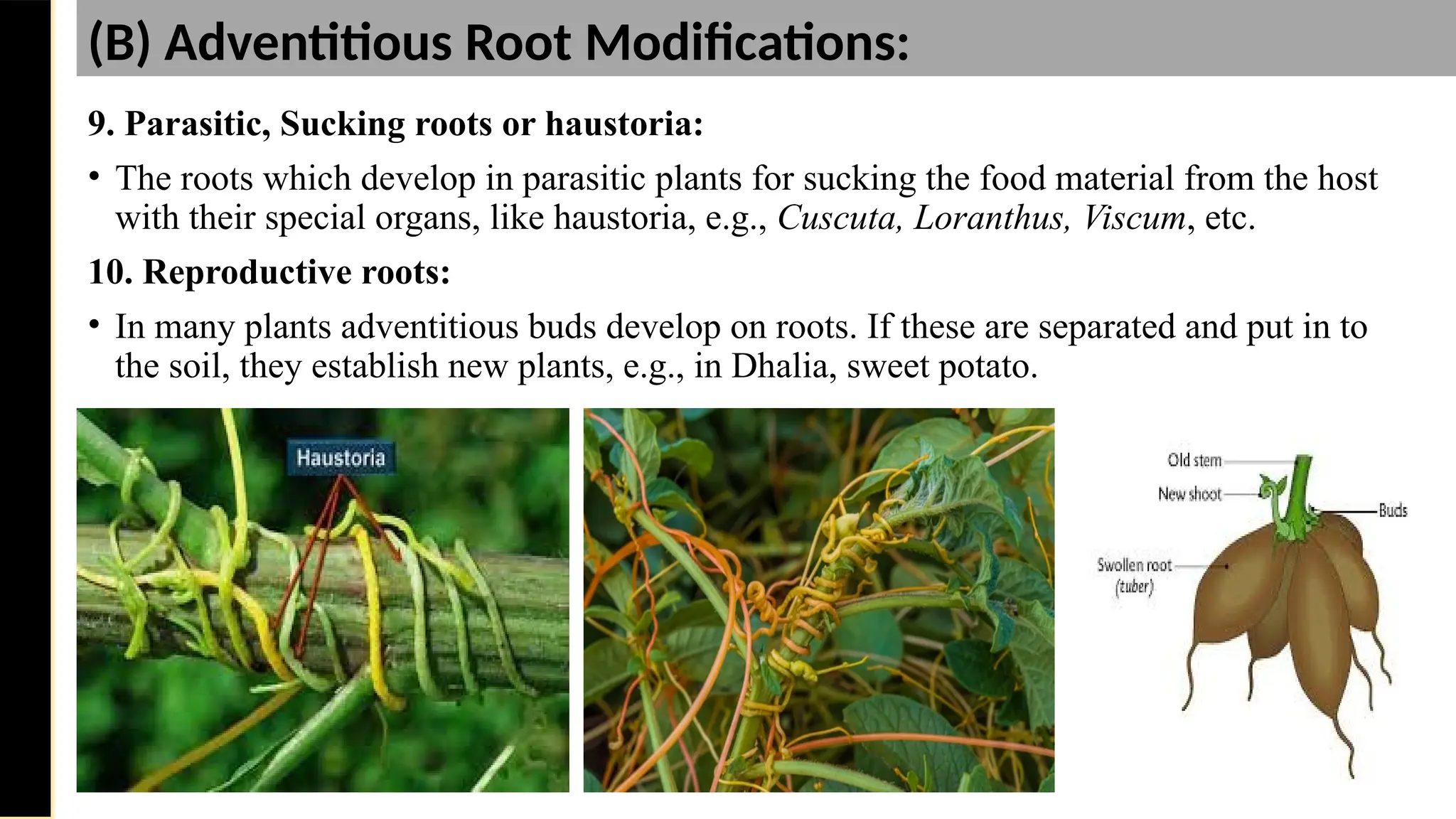
9. Parasitic, Sucking roots or haustoria:
• The roots which develop in parasitic plants for sucking the food material from the host
with their special organs, like haustoria, e.g., Cuscuta, Loranthus, Viscum, etc.
10. Reproductive roots:
• In many plants adventitious buds develop on roots. If these are separated and put in to
the soil, they establish new plants, e.g., in Dhalia, sweet potato.
Saturday,
February
8,
2025
(B) Adventitious Root Modifications:
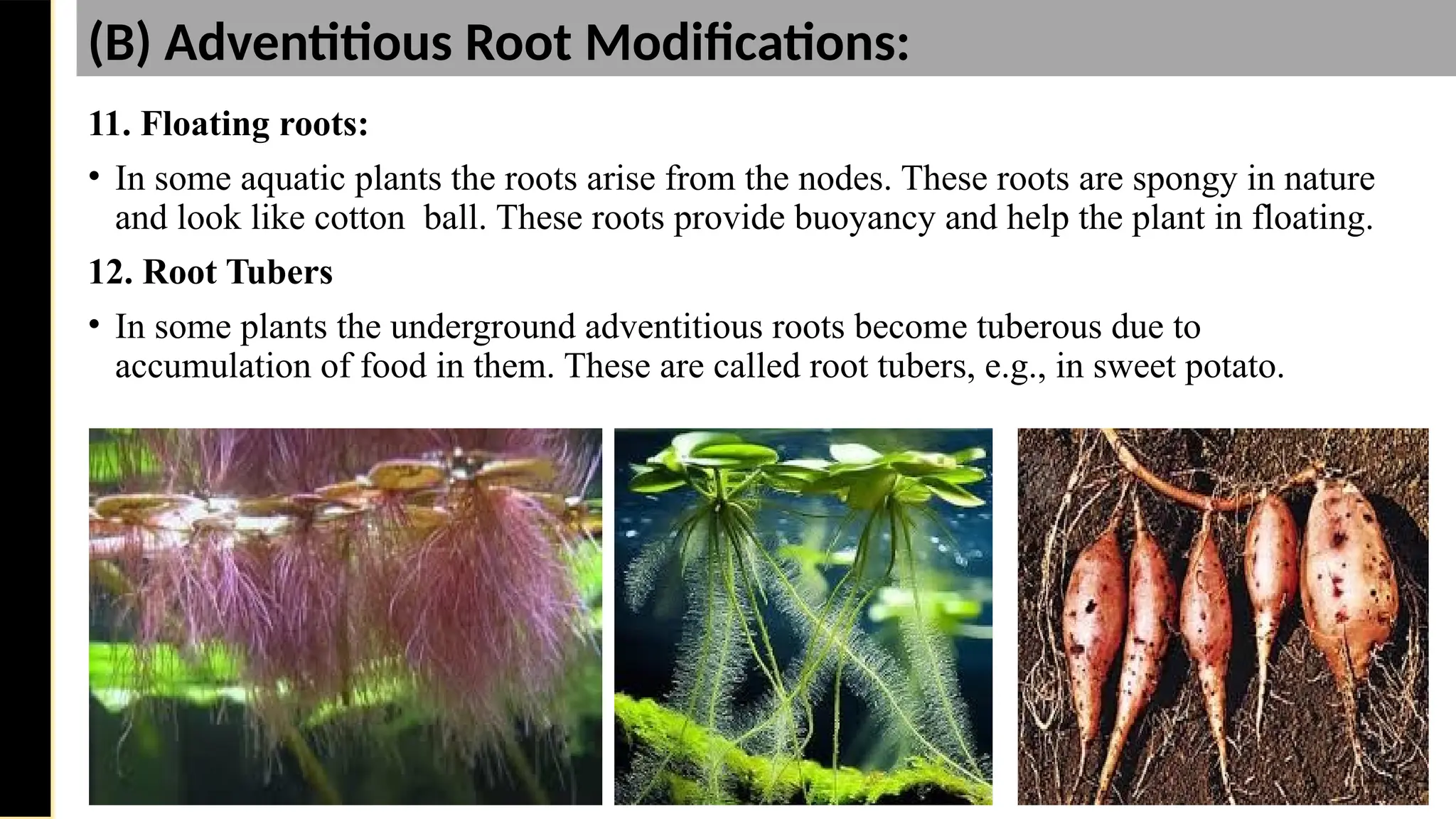
11. Floating roots:
• In some aquatic plants the roots arise from the nodes. These roots are spongy in nature
and look like cotton ball. These roots provide buoyancy and help the plant in floating.
12. Root Tubers
• In some plants the underground adventitious roots become tuberous due to
accumulation of food in them. These are called root tubers, e.g., in sweet potato.
Saturday,
February
8,
2025
(B) Adventitious Root Modifications:
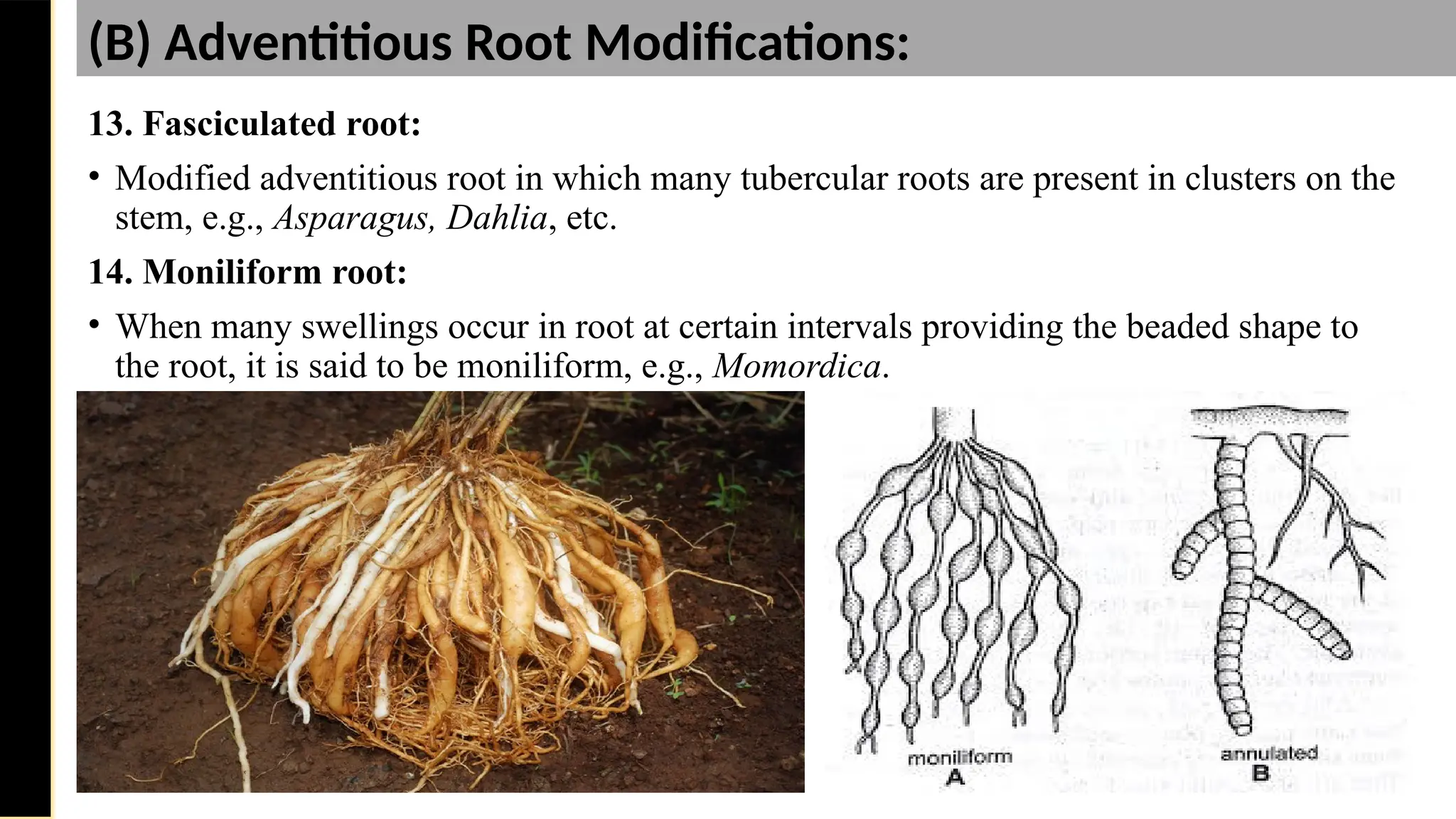
13. Fasciculated root:
• Modified adventitious root in which many tubercular roots are present in clusters on the
stem, e.g., Asparagus, Dahlia, etc.
14. Moniliform root:
• When many swellings occur in root at certain intervals providing the beaded shape to
the root, it is said to be moniliform, e.g., Momordica.
Saturday,
February
8,
2025
(B) Adventitious Root Modifications:
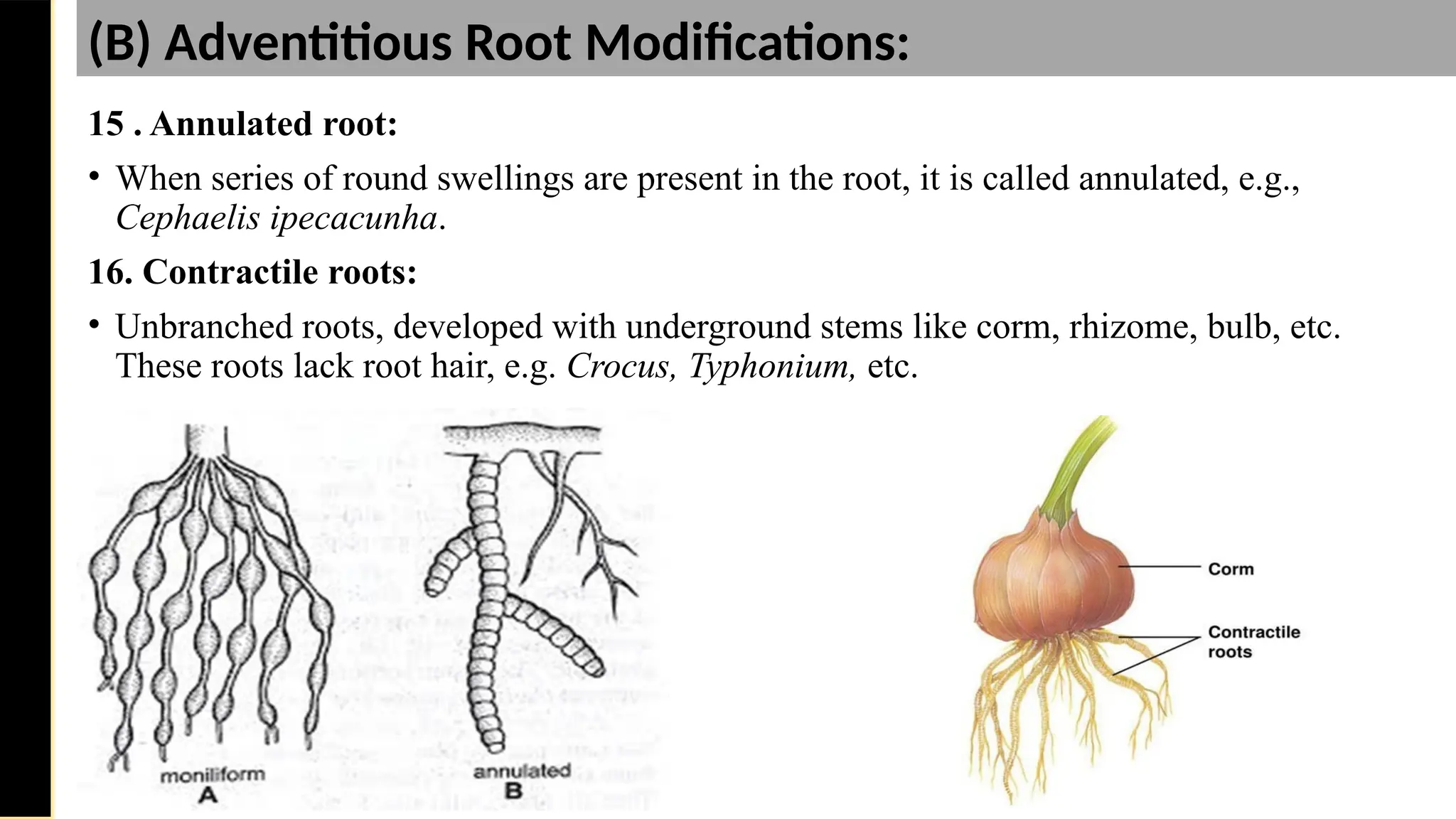
15 . Annulated root:
• When series of round swellings are present in the root, it is called annulated, e.g.,
Cephaelis ipecacunha.
16. Contractile roots:
• Unbranched roots, developed with underground stems like corm, rhizome, bulb, etc.
These roots lack root hair, e.g. Crocus, Typhonium, etc.
Saturday,
February
8,
2025
(B) Adventitious Root Modifications:
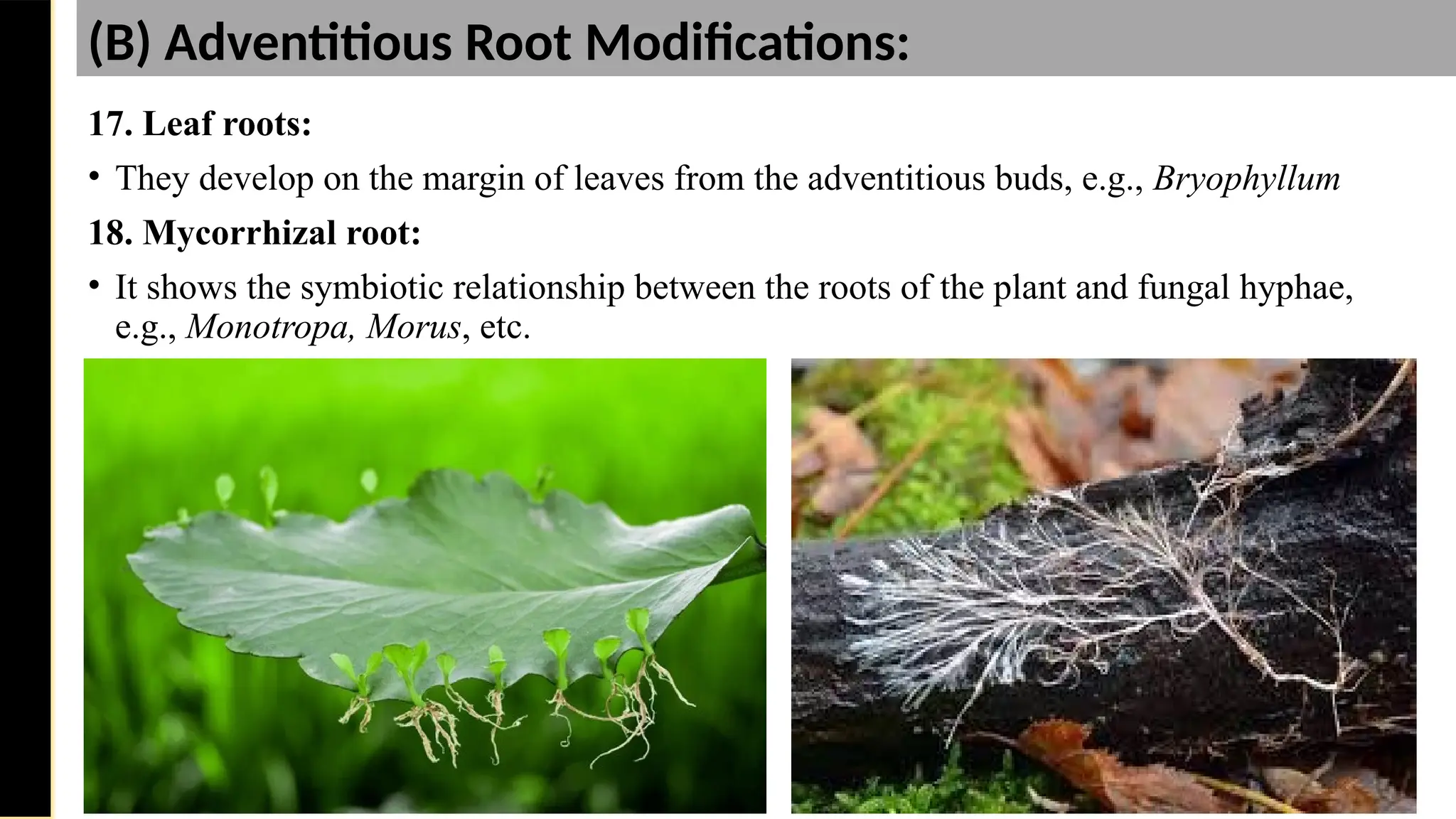
17. Leaf roots:
• They develop on the margin of leaves from the adventitious buds, e.g., Bryophyllum
18. Mycorrhizal root:
• It shows the symbiotic relationship between the roots of the plant and fungal hyphae,
e.g., Monotropa, Morus, etc.
Saturday,
February
8,
2025
(B) Adventitious Root Modifications:
Saturday,
February
8,
2025
Saturday,
February
8,
2025
MESSAGE OF
THE DAY
Saturday,
February
8,
2025
Saturday,
February
8,
2025

types,modification,parts and function of root.pptx

  • 1.
    IN THE NAMEOF ALLAH, THE MOST MERCIFUL THE MOST GRACIOUS
  • 2.
    Saturday, February 8, 2025 Types of RootSystems Tap root Adventitious root
  • 3.
    • On thebasis of their origin, roots are of two types – tap root and adventitious root. (a) Tap root: • On germination of a seed, the radicle elongates into primary root or true root or tap root. In dicot plants, the tap root is persistent and produces lateral roots such as secondary’ roots, tertiary roots etc. All lateral roots arise in acropetal succession i.e. younger roots towards apex and older roots towards base. The tap root and its branches constitute the tap root system. (b) Adventitious root: • These are the roots that grow from any part of the plant other than radicle. In monocot plants, the tap root is short lived and soon replaced by adventitious roots. A group of adventitious roots and their branches constitute adventitious root system. Saturday, February 8, 2025 Types of Root Systems
  • 4.
  • 5.
    • Tap rootsystem is of two types: • Deep feeders: • Deep feeder tap root system has an elongated tap root which penetrates the deeper layers of the soil. It is mostly met in trees. Deep feeder tap root system is also called racemose tap root system. • Surface feeders: • In surface feeders the tap root does not elongate very much. The secondary roots spread to a greater extent, mostly horizontal near the soil surface. Such a system is also named as cymose tap root system. Saturday, February 8, 2025 Types of Tap Root System
  • 6.
    Saturday, February 8, 2025 Racemose tap rootsystem Cymose tap root system
  • 7.
    • The taproot becomes swollen and fleshy with the stored food. The secondary roots remain thin. Hypocotyl (embryonic region between cotyledons and radicle) may also join the tap root in storing food. Stem is reduced and discoid in the beginning and bears radical leaves. • Depending upon the shape, the fleshy tap roots are of the following types: • (i) Conical: • Here the fleshy tap root resembles a cone, that is, the thickest towards base and gradually tapering towards the apex. Many thread-like secondary roots are found throughout the length of conical fleshy root, e.g., Carrot (Daucus carota). • (ii) Fusiform: • The fusiform fleshy root is like a spindle, that is, thickest roughly in the middle and narrow towards both its base and apex, e.g., Radish (Raphanus sativus). The fusiform root of Indian Radish consists of swollen hypocotyl near the base only and swollen tap root in the remaining region. • The latter possesses thin and thread-like secondary roots. In European Radish the tap root forms only the terminal tapering fleshy part of the root. The middle and the basal fleshy parts are formed by the hypocotyl. • (iii) Napiform: • The fleshy root is very thick at the base and is almost spherical. It suddenly thins out towards the apex (top- like), e.g., Turnip (Brassica rapa) and Beet (Beta vulgaris, vern. Chakander). In Turnip most of the swollen part is hypocotyl. The tap root occurs only towards the narrow pointed apical region which also bears thread­ like secondary roots. In Beet both the tap root and hypocotyl are swollen. Saturday, February 8, 2025 (A) Modification of Tap Root System:
  • 8.
  • 9.
    i. Nodulated (Tuberculate)Roots: • They occur in papiliona­ ceous (leguminous) plants like Pea (Pisum sativum), Gram (Cicer arietinum), Groundnut (= Peanut, Arachis hypogea), Methi (Medicago falcata), Soy Bean (Glycine max), Alfalfa, etc. • The secondary, tertiary roots and sometimes the primary root develop numerous small or large irregular swellings called root nodules or tubercles. The root nodules enclose millions of minute nitrogen fixing bacteria of the genus Rhizobium (e.g., R. leguminosarum). • These bacteria pick up the free nitrogen present in the soil atmosphere and convert it into organic compounds of nitrogen. The property of converting free nitrogen into nitrogenous compounds is called nitrogen fixa­ tion. • Some of the nitrogenous compounds are taken up by the legume in return for food and shelter. Therefore, both the bacteria and the leguminous plant are benefitted by their asso­ ciation. Such a mutually beneficial relationship is called reciprocal symbiosis or mutualism. Saturday, February 8, 2025 Modification of Tap Root Branches
  • 10.
  • 11.
    • ii. Buttressroots: • These are laterally compressed and vertically elongated roots that provide extra support to the stem, e.g., Rubber and Almond plants. Saturday, February 8, 2025 Modification of Tap Root Branches
  • 12.
  • 13.
    1. Fibrous root: •Modified adventitious root in which many tubercular roots are present in clusters on the stem, e.g., Asparagus, Dahlia, etc. 2. Stilt root: • When many swellings occur in root at certain intervals providing the beaded shape to the root, it is said to be moniliform, e.g., Momordica. Saturday, February 8, 2025 (B) Adventitious Root Modifications:
  • 14.
    3. Prop roots: •From the branches of some big trees develop roots growing vertically downward. They enter in the soil and provide support to the plant, e.g., Ficus benghalensis. 4. Respiratory roots or pneumatophores: • They develop from the underground roots towards the upper side and come out near the plant in the form of conical spikes. Many pores are present on their upper part for respiration. These are common in plants near marshy places and salty lakes, e.g., Rhizophora. Saturday, February 8, 2025 (B) Adventitious Root Modifications:
  • 15.
    5. Epiphytic roots: •These are the aerial roots of the epiphytic plant like Vanda, which internally contain a spongy tissue called velamen. The velamen helps in the absorption of moisture from air. 6. Clasping or climbing roots: • These develop on the nodes of weak – stemmed plants like, Pothos, Hedera, etc., and help the plant to climb and fix on the wall or other parts. Saturday, February 8, 2025 (B) Adventitious Root Modifications:
  • 16.
    7. Clinging roots: •These roots penetrate into the cracks and cervices of the support and hold the plant firmly e.g., in Betel plant and Epiphytic orchid species. 8. Assimilatory roots: • Green, chlorophyll- containing roots of plants like Trapa natans, Tinospora etc. are called assimilatory roots. Saturday, February 8, 2025 (B) Adventitious Root Modifications:
  • 17.
    9. Parasitic, Suckingroots or haustoria: • The roots which develop in parasitic plants for sucking the food material from the host with their special organs, like haustoria, e.g., Cuscuta, Loranthus, Viscum, etc. 10. Reproductive roots: • In many plants adventitious buds develop on roots. If these are separated and put in to the soil, they establish new plants, e.g., in Dhalia, sweet potato. Saturday, February 8, 2025 (B) Adventitious Root Modifications:
  • 18.
    11. Floating roots: •In some aquatic plants the roots arise from the nodes. These roots are spongy in nature and look like cotton ball. These roots provide buoyancy and help the plant in floating. 12. Root Tubers • In some plants the underground adventitious roots become tuberous due to accumulation of food in them. These are called root tubers, e.g., in sweet potato. Saturday, February 8, 2025 (B) Adventitious Root Modifications:
  • 19.
    13. Fasciculated root: •Modified adventitious root in which many tubercular roots are present in clusters on the stem, e.g., Asparagus, Dahlia, etc. 14. Moniliform root: • When many swellings occur in root at certain intervals providing the beaded shape to the root, it is said to be moniliform, e.g., Momordica. Saturday, February 8, 2025 (B) Adventitious Root Modifications:
  • 20.
    15 . Annulatedroot: • When series of round swellings are present in the root, it is called annulated, e.g., Cephaelis ipecacunha. 16. Contractile roots: • Unbranched roots, developed with underground stems like corm, rhizome, bulb, etc. These roots lack root hair, e.g. Crocus, Typhonium, etc. Saturday, February 8, 2025 (B) Adventitious Root Modifications:
  • 21.
    17. Leaf roots: •They develop on the margin of leaves from the adventitious buds, e.g., Bryophyllum 18. Mycorrhizal root: • It shows the symbiotic relationship between the roots of the plant and fungal hyphae, e.g., Monotropa, Morus, etc. Saturday, February 8, 2025 (B) Adventitious Root Modifications:
  • 22.
  • 23.
  • 24.
  • 25.