Morphology of Root
Kalariya Manisha V.
M. Pharm(Herbal Drug Technology)
B.K.M.G.P.C., Rajkot
 Morphology deals with the study of forms
and features of different plant organs such
as roots, stems, leaves, flowers, seeds and
fruits.
 It includes shape, size, colour, odour, taste
etc. of various plant organs their
modification.
2
Introduction
Introduction
 The root is descending organ of the plant,
and is originally the direct prolongation of
radicle of the embryo.
 It grows downwards, fixes the seedling and
later the plant as a whole to the ground,
and absorb raw food materials from the
soil particles.
 It is non green in color, without nodes and
internodes, with no leaves or buds.
3
Region of root
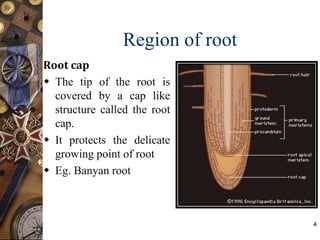
Root cap
 The tip of the root is
covered by a cap like
structure called the root
cap.
 It protects the delicate
growing point of root
 Eg. Banyan root
4
Different kinds of root
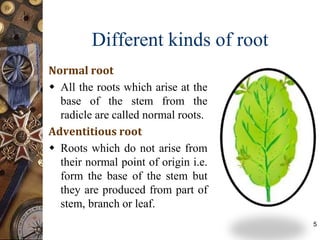
Normal root
 All the roots which arise at the
base of the stem from the
radicle are called normal roots.
Adventitious root
 Roots which do not arise from
their normal point of origin i.e.
form the base of the stem but
they are produced from part of
stem, branch or leaf.
5
Kinds of root system
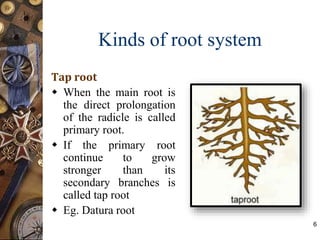
Tap root
 When the main root is
the direct prolongation
of the radicle is called
primary root.
 If the primary root
continue to grow
stronger than its
secondary branches is
called tap root
 Eg. Datura root
6
Kinds of root system
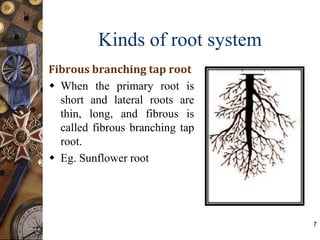
Fibrous branching tap root
 When the primary root is
short and lateral roots are
thin, long, and fibrous is
called fibrous branching tap
root.
 Eg. Sunflower root
7
Kinds of root system
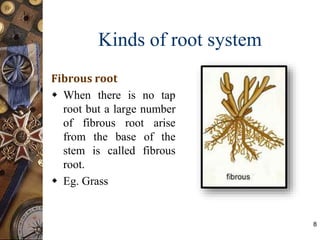
Fibrous root
 When there is no tap
root but a large number
of fibrous root arise
from the base of the
stem is called fibrous
root.
 Eg. Grass
8
Functions of root
Mechanical
 Fixation of plant into the soil.
Physiological
 Absorption of water, minerals and raw material from
the soil.
Special functions
 Storage of food, water and other materials. Eg. carrot,
beet
 Some root provide support. Eg. Banyan
 Respiratory function
 The root of gulvel do photosynthesis 9
Modification of tap root for
storage
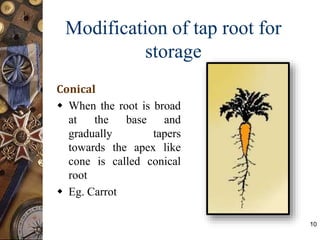
Conical
 When the root is broad
at the base and
gradually tapers
towards the apex like
cone is called conical
root
 Eg. Carrot
10
Modification of tap root for
storage
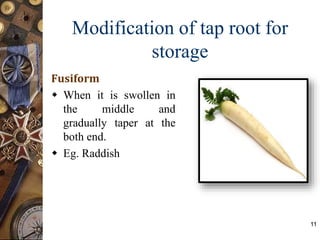
Fusiform
 When it is swollen in
the middle and
gradually taper at the
both end.
 Eg. Raddish
11
Modification of tap root for
storage
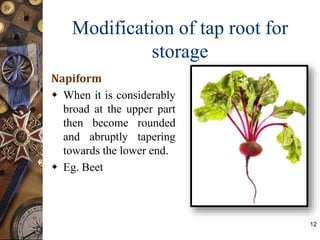
Napiform
 When it is considerably
broad at the upper part
then become rounded
and abruptly tapering
towards the lower end.
 Eg. Beet
12
Branched root modified for respiration
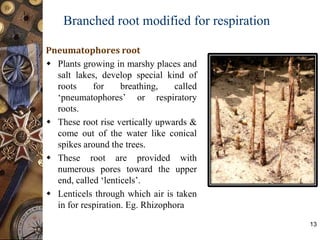
Pneumatophores root
 Plants growing in marshy places and
salt lakes, develop special kind of
roots for breathing, called
‘pneumatophores’ or respiratory
roots.
 These root rise vertically upwards &
come out of the water like conical
spikes around the trees.
 These root are provided with
numerous pores toward the upper
end, called ‘lenticels’.
 Lenticels through which air is taken
in for respiration. Eg. Rhizophora
13
Modification of adventitious
root for storage
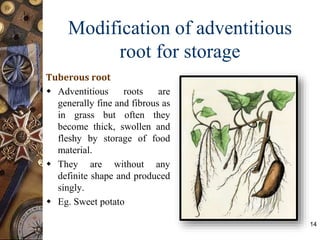
Tuberous root
 Adventitious roots are
generally fine and fibrous as
in grass but often they
become thick, swollen and
fleshy by storage of food
material.
 They are without any
definite shape and produced
singly.
 Eg. Sweet potato
14
Modification of adventitious
root for storage
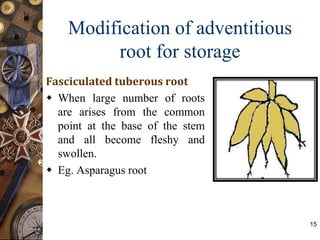
Fasciculated tuberous root
 When large number of roots
are arises from the common
point at the base of the stem
and all become fleshy and
swollen.
 Eg. Asparagus root
15
Modification of adventitious
root for storage
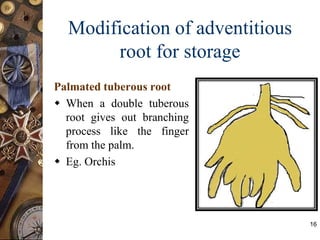
Palmated tuberous root
 When a double tuberous
root gives out branching
process like the finger
from the palm.
 Eg. Orchis
16
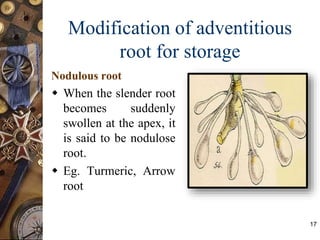
Nodulous root
 When the slender root
becomes suddenly
swollen at the apex, it
is said to be nodulose
root.
 Eg. Turmeric, Arrow
root
17
Modification of adventitious
root for storage
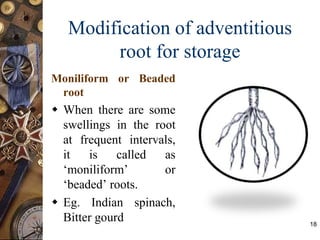
Moniliform or Beaded
root
 When there are some
swellings in the root
at frequent intervals,
it is called as
‘moniliform’ or
‘beaded’ roots.
 Eg. Indian spinach,
Bitter gourd 18
Modification of adventitious
root for storage
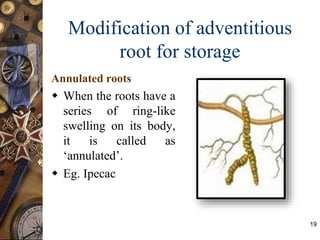
Annulated roots
 When the roots have a
series of ring-like
swelling on its body,
it is called as
‘annulated’.
 Eg. Ipecac
19
Modification of adventitious
root for storage
Modification of adventitious
root for mechanical support
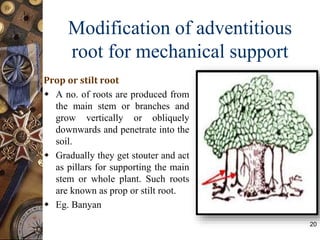
Prop or stilt root
 A no. of roots are produced from
the main stem or branches and
grow vertically or obliquely
downwards and penetrate into the
soil.
 Gradually they get stouter and act
as pillars for supporting the main
stem or whole plant. Such roots
are known as prop or stilt root.
 Eg. Banyan
20
Modification of adventitious
root for mechanical support
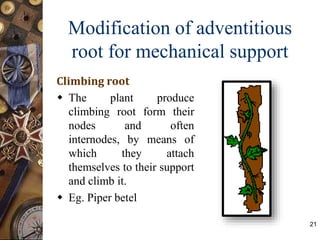
Climbing root
 The plant produce
climbing root form their
nodes and often
internodes, by means of
which they attach
themselves to their support
and climb it.
 Eg. Piper betel
21
Modification of adventitious
root for vital functions
Sucking roots or haustoria
 There are some plants which
grow on the branches of the
other plant and obtain their food
by sending special roots called
the sucking roots or haustroia
into the substance of the host
plants and absorb the
nourishment form them. Such
plants are called parasitic
plants.
 Eg. Cuscuta
22
Modification of adventitious
root for vital functions
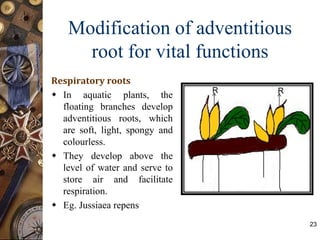
Respiratory roots
 In aquatic plants, the
floating branches develop
adventitious roots, which
are soft, light, spongy and
colourless.
 They develop above the
level of water and serve to
store air and facilitate
respiration.
 Eg. Jussiaea repens
23
R
R
Modification of adventitious
root for vital functions
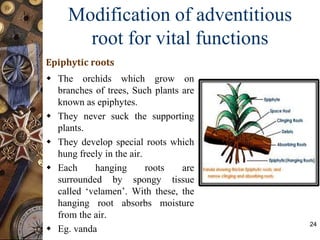
Epiphytic roots
 The orchids which grow on
branches of trees, Such plants are
known as epiphytes.
 They never suck the supporting
plants.
 They develop special roots which
hung freely in the air.
 Each hanging roots are
surrounded by spongy tissue
called ‘velamen’. With these, the
hanging root absorbs moisture
from the air.
 Eg. vanda
24
Modification of adventitious
root for vital functions
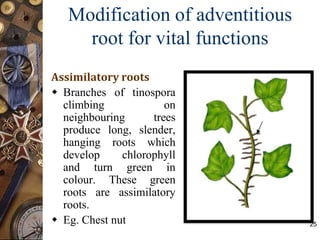
Assimilatory roots
 Branches of tinospora
climbing on
neighbouring trees
produce long, slender,
hanging roots which
develop chlorophyll
and turn green in
colour. These green
roots are assimilatory
roots.
 Eg. Chest nut 25
Questions asked in GTU Exam
 What is morphology? Define root and add
note on modification of roots for storage.
(GTU’10)
 Define terms with suitable examples for: 1)
Breathing roots, 2) Stilt root, 3) Parasitic
root, 4) Tap root. (GTU’10)
26
27

morphology of root.ppt

  • 1.
    Morphology of Root KalariyaManisha V. M. Pharm(Herbal Drug Technology) B.K.M.G.P.C., Rajkot
  • 2.
     Morphology dealswith the study of forms and features of different plant organs such as roots, stems, leaves, flowers, seeds and fruits.  It includes shape, size, colour, odour, taste etc. of various plant organs their modification. 2 Introduction
  • 3.
    Introduction  The rootis descending organ of the plant, and is originally the direct prolongation of radicle of the embryo.  It grows downwards, fixes the seedling and later the plant as a whole to the ground, and absorb raw food materials from the soil particles.  It is non green in color, without nodes and internodes, with no leaves or buds. 3
  • 4.
    Region of root Rootcap  The tip of the root is covered by a cap like structure called the root cap.  It protects the delicate growing point of root  Eg. Banyan root 4
  • 5.
    Different kinds ofroot Normal root  All the roots which arise at the base of the stem from the radicle are called normal roots. Adventitious root  Roots which do not arise from their normal point of origin i.e. form the base of the stem but they are produced from part of stem, branch or leaf. 5
  • 6.
    Kinds of rootsystem Tap root  When the main root is the direct prolongation of the radicle is called primary root.  If the primary root continue to grow stronger than its secondary branches is called tap root  Eg. Datura root 6
  • 7.
    Kinds of rootsystem Fibrous branching tap root  When the primary root is short and lateral roots are thin, long, and fibrous is called fibrous branching tap root.  Eg. Sunflower root 7
  • 8.
    Kinds of rootsystem Fibrous root  When there is no tap root but a large number of fibrous root arise from the base of the stem is called fibrous root.  Eg. Grass 8
  • 9.
    Functions of root Mechanical Fixation of plant into the soil. Physiological  Absorption of water, minerals and raw material from the soil. Special functions  Storage of food, water and other materials. Eg. carrot, beet  Some root provide support. Eg. Banyan  Respiratory function  The root of gulvel do photosynthesis 9
  • 10.
    Modification of taproot for storage Conical  When the root is broad at the base and gradually tapers towards the apex like cone is called conical root  Eg. Carrot 10
  • 11.
    Modification of taproot for storage Fusiform  When it is swollen in the middle and gradually taper at the both end.  Eg. Raddish 11
  • 12.
    Modification of taproot for storage Napiform  When it is considerably broad at the upper part then become rounded and abruptly tapering towards the lower end.  Eg. Beet 12
  • 13.
    Branched root modifiedfor respiration Pneumatophores root  Plants growing in marshy places and salt lakes, develop special kind of roots for breathing, called ‘pneumatophores’ or respiratory roots.  These root rise vertically upwards & come out of the water like conical spikes around the trees.  These root are provided with numerous pores toward the upper end, called ‘lenticels’.  Lenticels through which air is taken in for respiration. Eg. Rhizophora 13
  • 14.
    Modification of adventitious rootfor storage Tuberous root  Adventitious roots are generally fine and fibrous as in grass but often they become thick, swollen and fleshy by storage of food material.  They are without any definite shape and produced singly.  Eg. Sweet potato 14
  • 15.
    Modification of adventitious rootfor storage Fasciculated tuberous root  When large number of roots are arises from the common point at the base of the stem and all become fleshy and swollen.  Eg. Asparagus root 15
  • 16.
    Modification of adventitious rootfor storage Palmated tuberous root  When a double tuberous root gives out branching process like the finger from the palm.  Eg. Orchis 16
  • 17.
    Nodulous root  Whenthe slender root becomes suddenly swollen at the apex, it is said to be nodulose root.  Eg. Turmeric, Arrow root 17 Modification of adventitious root for storage
  • 18.
    Moniliform or Beaded root When there are some swellings in the root at frequent intervals, it is called as ‘moniliform’ or ‘beaded’ roots.  Eg. Indian spinach, Bitter gourd 18 Modification of adventitious root for storage
  • 19.
    Annulated roots  Whenthe roots have a series of ring-like swelling on its body, it is called as ‘annulated’.  Eg. Ipecac 19 Modification of adventitious root for storage
  • 20.
    Modification of adventitious rootfor mechanical support Prop or stilt root  A no. of roots are produced from the main stem or branches and grow vertically or obliquely downwards and penetrate into the soil.  Gradually they get stouter and act as pillars for supporting the main stem or whole plant. Such roots are known as prop or stilt root.  Eg. Banyan 20
  • 21.
    Modification of adventitious rootfor mechanical support Climbing root  The plant produce climbing root form their nodes and often internodes, by means of which they attach themselves to their support and climb it.  Eg. Piper betel 21
  • 22.
    Modification of adventitious rootfor vital functions Sucking roots or haustoria  There are some plants which grow on the branches of the other plant and obtain their food by sending special roots called the sucking roots or haustroia into the substance of the host plants and absorb the nourishment form them. Such plants are called parasitic plants.  Eg. Cuscuta 22
  • 23.
    Modification of adventitious rootfor vital functions Respiratory roots  In aquatic plants, the floating branches develop adventitious roots, which are soft, light, spongy and colourless.  They develop above the level of water and serve to store air and facilitate respiration.  Eg. Jussiaea repens 23 R R
  • 24.
    Modification of adventitious rootfor vital functions Epiphytic roots  The orchids which grow on branches of trees, Such plants are known as epiphytes.  They never suck the supporting plants.  They develop special roots which hung freely in the air.  Each hanging roots are surrounded by spongy tissue called ‘velamen’. With these, the hanging root absorbs moisture from the air.  Eg. vanda 24
  • 25.
    Modification of adventitious rootfor vital functions Assimilatory roots  Branches of tinospora climbing on neighbouring trees produce long, slender, hanging roots which develop chlorophyll and turn green in colour. These green roots are assimilatory roots.  Eg. Chest nut 25
  • 26.
    Questions asked inGTU Exam  What is morphology? Define root and add note on modification of roots for storage. (GTU’10)  Define terms with suitable examples for: 1) Breathing roots, 2) Stilt root, 3) Parasitic root, 4) Tap root. (GTU’10) 26
  • 27.