

Unit – II : Inflorescence – Cymose and Racemose
Presented by Debanjan pandit, faculty of Raidighi college
Why This Portion is Important ??
 Comparatively easy to score area.
 This portion contains 2-3 Questions per year.
 Straight forward questions.
 Tricks to remember all things.
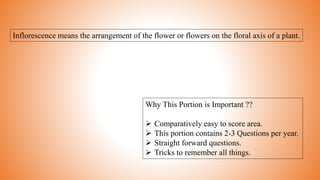
Inflorescence means the arrangement of the flower or flowers on the floral axis of a plant.
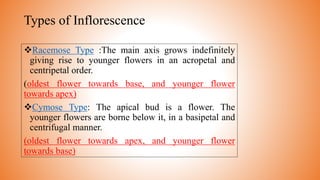
Racemose Type :The main axis grows indefinitely
giving rise to younger flowers in an acropetal and
centripetal order.
(oldest flower towards base, and younger flower
towards apex)
Cymose Type: The apical bud is a flower. The
younger flowers are borne below it, in a basipetal and
centrifugal manner.
(oldest flower towards apex, and younger flower
towards base)
Types of Inflorescence
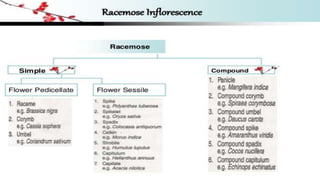
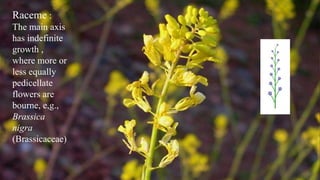
Raceme :
The main axis
has indefinite
growth ,
where more or
less equally
pedicellate
flowers are
bourne, e,g.,
Brassica
nigra
(Brassicaceae)
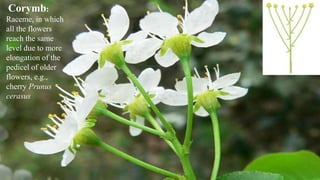
Corymb:
Raceme, in which
all the flowers
reach the same
level due to more
elongation of the
pedicel of older
flowers, e.g.,
cherry Prunus
cerasus
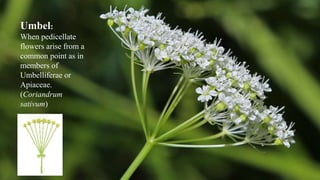
Umbel:
When pedicellate
flowers arise from a
common point as in
members of
Umbelliferae or
Apiaceae.
(Coriandrum
sativum)
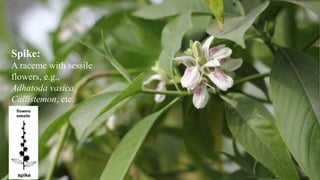
Spike:
A raceme with sessile
flowers, e.g.,
Adhatoda vasica,
Callistemon, etc.
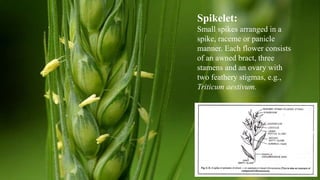
Spikelet:
Small spikes arranged in a
spike, raceme or panicle
manner. Each flower consists
of an awned bract, three
stamens and an ovary with
two feathery stigmas, e.g.,
Triticum aestivum.
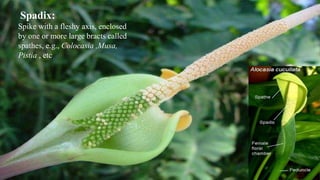
Spadix:
Spike with a fleshy axis, enclosed
by one or more large bracts called
spathes, e.g., Colocasia ,Musa,
Pistia , etc
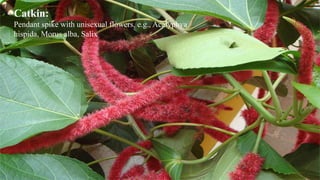
Catkin:
Pendant spike with unisexual flowers, e.g., Acalyphya
hispida, Morus alba, Salix
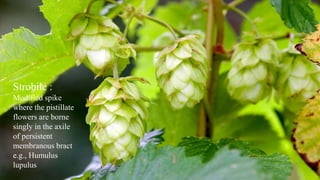
Strobile :
Modified spike
where the pistillate
flowers are borne
singly in the axile
of persistent
membranous bract
e.g., Humulus
lupulus
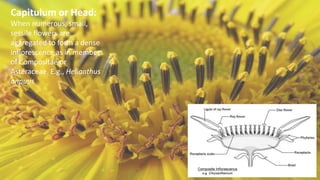
Capitulum or Head:
When numerous, small,
sessile flowers are
aggregated to form a dense
inflorescence as in members
of Compositae or
Asteraceae. E.g., Helianthus
annuus
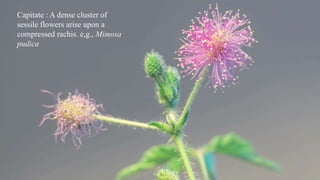
Capitate : A dense cluster of
sessile flowers arise upon a
compressed rachis. e,g., Mimosa
pudica
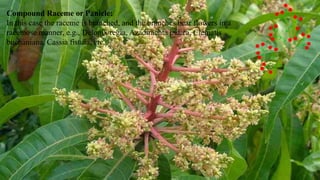
Compound Raceme or Panicle:
In this case the raceme is branched, and the branches bear flowers in a
racemose manner, e.g., Delonix regia, Azadirachta indica, Clematis
buchaniana, Cassia fistula, etc.
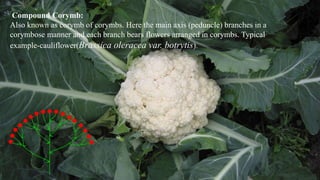
Compound Corymb:
Also known as corymb of corymbs. Here the main axis (peduncle) branches in a
corymbose manner and each branch bears flowers arranged in corymbs. Typical
example-cauliflower(Brassica oleracea var. botrytis).
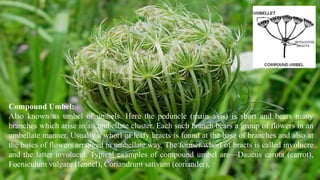
Compound Umbel:
Also known as umbel of umbels. Here the peduncle (main axis) is short and bears many
branches which arise in an umbellate cluster. Each such branch bears a group of flowers in an
umbellate manner. Usually a whorl of leafy bracts is found at the base of branches and also at
the bases of flowers arranged in umbellate way. The former whorl of bracts is called involucre
and the latter involucel. Typical examples of compound umbel are—Daucus carota (carrot),
Foeniculum vulgare (fennel), Coriandrum sativum (coriander),
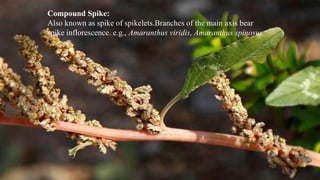
Compound Spike:
Also known as spike of spikelets.Branches of the main axis bear
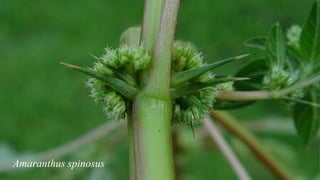
spike inflorescence. e.g., Amaranthus viridis, Amaranthus spinosus
Amaranthus spinosus
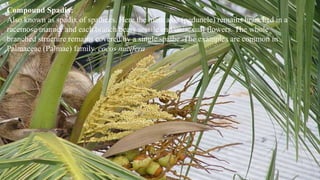
Compound Spadix:
Also known as spadix of spadices. Here the main axis (peduncle) remains branched in a
racemose manner and each branch bears sessile and unisexual flowers. The whole
branched structure remains covered by a single spathe. The examples are common in
Palmaceae (Palmae) family. cocos nucifera
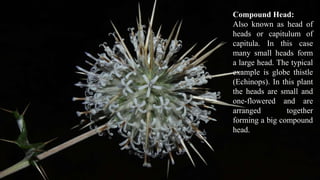
Compound Head:
Also known as head of
heads or capitulum of
capitula. In this case
many small heads form
a large head. The typical
example is globe thistle
(Echinops). In this plant
the heads are small and
one-flowered and are
arranged together
forming a big compound
head.
Inflorescence Types,cymose and racemose types,examples with Diagrams

Inflorescence Types,cymose and racemose types,examples with Diagrams

  • 1.
    Unit – II: Inflorescence – Cymose and Racemose Presented by Debanjan pandit, faculty of Raidighi college
  • 2.
    Why This Portionis Important ??  Comparatively easy to score area.  This portion contains 2-3 Questions per year.  Straight forward questions.  Tricks to remember all things. Inflorescence means the arrangement of the flower or flowers on the floral axis of a plant.
  • 4.
    Racemose Type :Themain axis grows indefinitely giving rise to younger flowers in an acropetal and centripetal order. (oldest flower towards base, and younger flower towards apex) Cymose Type: The apical bud is a flower. The younger flowers are borne below it, in a basipetal and centrifugal manner. (oldest flower towards apex, and younger flower towards base) Types of Inflorescence
  • 6.
    Raceme : The mainaxis has indefinite growth , where more or less equally pedicellate flowers are bourne, e,g., Brassica nigra (Brassicaceae)
  • 7.
    Corymb: Raceme, in which allthe flowers reach the same level due to more elongation of the pedicel of older flowers, e.g., cherry Prunus cerasus
  • 8.
    Umbel: When pedicellate flowers arisefrom a common point as in members of Umbelliferae or Apiaceae. (Coriandrum sativum)
  • 9.
    Spike: A raceme withsessile flowers, e.g., Adhatoda vasica, Callistemon, etc.
  • 10.
    Spikelet: Small spikes arrangedin a spike, raceme or panicle manner. Each flower consists of an awned bract, three stamens and an ovary with two feathery stigmas, e.g., Triticum aestivum.
  • 11.
    Spadix: Spike with afleshy axis, enclosed by one or more large bracts called spathes, e.g., Colocasia ,Musa, Pistia , etc
  • 12.
    Catkin: Pendant spike withunisexual flowers, e.g., Acalyphya hispida, Morus alba, Salix
  • 13.
    Strobile : Modified spike wherethe pistillate flowers are borne singly in the axile of persistent membranous bract e.g., Humulus lupulus
  • 14.
    Capitulum or Head: Whennumerous, small, sessile flowers are aggregated to form a dense inflorescence as in members of Compositae or Asteraceae. E.g., Helianthus annuus
  • 15.
    Capitate : Adense cluster of sessile flowers arise upon a compressed rachis. e,g., Mimosa pudica
  • 16.
    Compound Raceme orPanicle: In this case the raceme is branched, and the branches bear flowers in a racemose manner, e.g., Delonix regia, Azadirachta indica, Clematis buchaniana, Cassia fistula, etc.
  • 17.
    Compound Corymb: Also knownas corymb of corymbs. Here the main axis (peduncle) branches in a corymbose manner and each branch bears flowers arranged in corymbs. Typical example-cauliflower(Brassica oleracea var. botrytis).
  • 18.
    Compound Umbel: Also knownas umbel of umbels. Here the peduncle (main axis) is short and bears many branches which arise in an umbellate cluster. Each such branch bears a group of flowers in an umbellate manner. Usually a whorl of leafy bracts is found at the base of branches and also at the bases of flowers arranged in umbellate way. The former whorl of bracts is called involucre and the latter involucel. Typical examples of compound umbel are—Daucus carota (carrot), Foeniculum vulgare (fennel), Coriandrum sativum (coriander),
  • 19.
    Compound Spike: Also knownas spike of spikelets.Branches of the main axis bear spike inflorescence. e.g., Amaranthus viridis, Amaranthus spinosus
  • 20.
  • 21.
    Compound Spadix: Also knownas spadix of spadices. Here the main axis (peduncle) remains branched in a racemose manner and each branch bears sessile and unisexual flowers. The whole branched structure remains covered by a single spathe. The examples are common in Palmaceae (Palmae) family. cocos nucifera
  • 22.
    Compound Head: Also knownas head of heads or capitulum of capitula. In this case many small heads form a large head. The typical example is globe thistle (Echinops). In this plant the heads are small and one-flowered and are arranged together forming a big compound head.