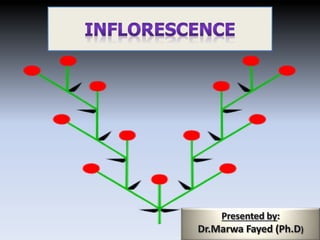

Inflorescence
• Definition:
It is the aggregation of the flowers on the plant.
• Kinds of inflorescence:
(According to the mode of branching)
I- Racemose inflorescence.
II- Cymose inflorescence.
III- Mixed inflorescence.
Inflorescence
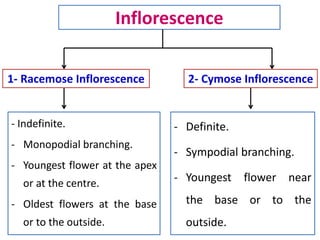
- Indefinite.
- Monopodial branching.
- Youngest flower at the apex
or at the centre.
- Oldest flowers at the base
or to the outside.
1- Racemose Inflorescence 2- Cymose Inflorescence
- Definite.
- Sympodial branching.
- Youngest flower near
the base or to the
outside.
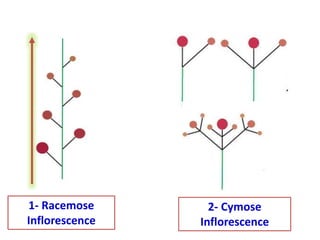
1- Racemose
Inflorescence
2- Cymose
Inflorescence
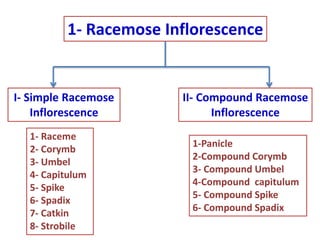
1- Racemose Inflorescence
I- Simple Racemose
Inflorescence
II- Compound Racemose
Inflorescence
1- Raceme
2- Corymb
3- Umbel
4- Capitulum
5- Spike
6- Spadix
7- Catkin
8- Strobile
1-Panicle
2-Compound Corymb
3- Compound Umbel
4-Compound capitulum
5- Compound Spike
6- Compound Spadix
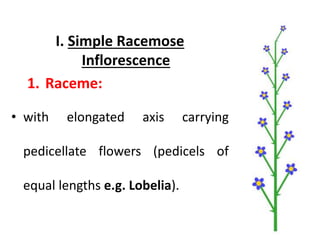
I. Simple Racemose
Inflorescence
1. Raceme:
• with elongated axis carrying
pedicellate flowers (pedicels of
equal lengths e.g. Lobelia).
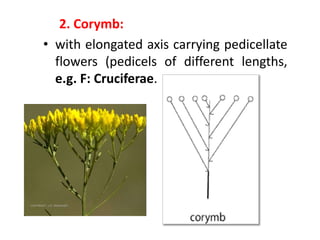
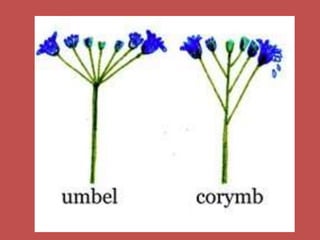
2. Corymb:
• with elongated axis carrying pedicellate
flowers (pedicels of different lengths,
e.g. F: Cruciferae.
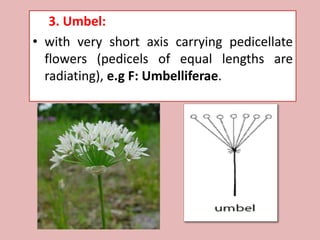
3. Umbel:
• with very short axis carrying pedicellate
flowers (pedicels of equal lengths are
radiating), e.g F: Umbelliferae.
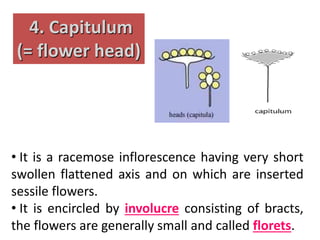
4. Capitulum
(= flower head)
• It is a racemose inflorescence having very short
swollen flattened axis and on which are inserted
sessile flowers.
• It is encircled by involucre consisting of bracts,
the flowers are generally small and called florets.
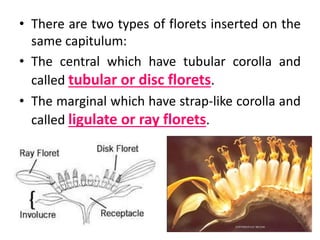
• There are two types of florets inserted on the
same capitulum:
• The central which have tubular corolla and
called tubular or disc florets.
• The marginal which have strap-like corolla and
called ligulate or ray florets.
5. Spike:
• with elongated axis
carrying nearly sessile
florets, e.g Plantago.
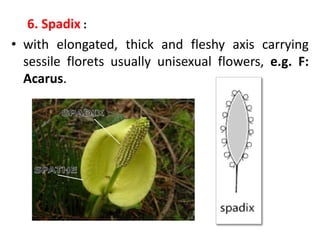
6. Spadix :
• with elongated, thick and fleshy axis carrying
sessile florets usually unisexual flowers, e.g. F:
Acarus.
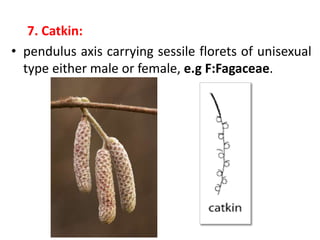
7. Catkin:
• pendulus axis carrying sessile florets of unisexual
type either male or female, e.g F:Fagaceae.
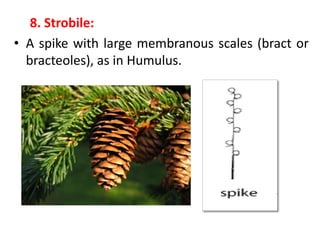
8. Strobile:
• A spike with large membranous scales (bract or
bracteoles), as in Humulus.
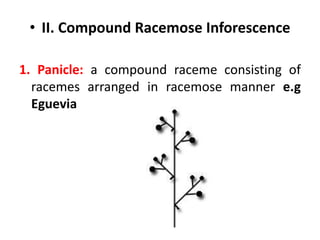
• II. Compound Racemose Inforescence
1. Panicle: a compound raceme consisting of
racemes arranged in racemose manner e.g
Eguevia
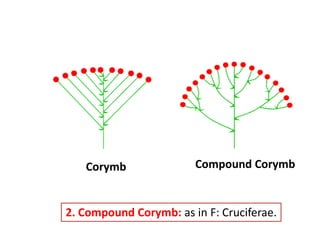
2. Compound Corymb: as in F: Cruciferae.
Corymb Compound Corymb
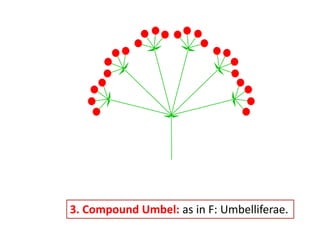
3. Compound Umbel: as in F: Umbelliferae.
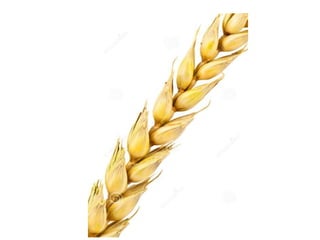
4- Compound Spike: as in Wheat.
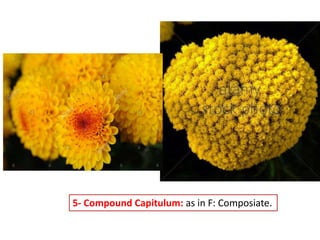
5- Compound Capitulum: as in F: Composiate.
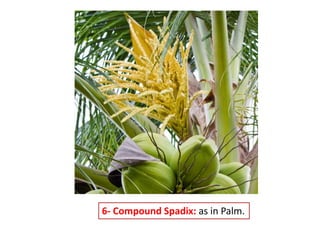
6- Compound Spadix: as in Palm.
II- Cymose inflorescence
• Cymose inflorescence is characterized by the
sympodial branching with the oldest flowers
present on the top of the elongated pedicel or
occupied in the central position of the flat
receptacle. The primary axis and the daughter
branches end in a flower i.e. growth of the axis is
limited by the formation of a flower.
• Cymose inflorescence may be either simple or
compound.
1- Simple Cyme:
The main axis terminate in a flower and one, two
or more stalked flower arises on its pedicel, thus
resemble the simple umbel but differ from the
umbel in that the oldest flower is present in the
centre.
2- Compound Cymose
• In which the lateral branches continue to give further
branches. It may be:
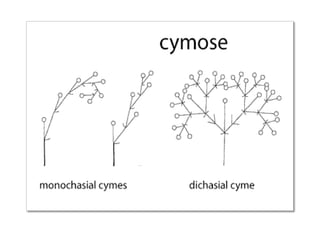
1- Monochasium (or one sided cyme): where the main
axis terminate in a flower, the pedicel of which
posses two bracteoles, one of which develop one
branch from the bud in its axil and so on. There are
two kinds:
a- Helicoid cyme: produced as a development of the
bud of only one side (either right or left e.g. Juncus).
b- Scorpoid cyme: produced as a development of the
bud of two sides (right and left) alternatively, e.g Iris.
III- Mixed Inflorescence
When both racemose
and cymose types of
branching occur on the
same inflorescence.
Inflorescence

Inflorescence

  • 2.
    Inflorescence • Definition: It isthe aggregation of the flowers on the plant. • Kinds of inflorescence: (According to the mode of branching) I- Racemose inflorescence. II- Cymose inflorescence. III- Mixed inflorescence.
  • 3.
    Inflorescence - Indefinite. - Monopodialbranching. - Youngest flower at the apex or at the centre. - Oldest flowers at the base or to the outside. 1- Racemose Inflorescence 2- Cymose Inflorescence - Definite. - Sympodial branching. - Youngest flower near the base or to the outside.
  • 4.
  • 5.
    1- Racemose Inflorescence I-Simple Racemose Inflorescence II- Compound Racemose Inflorescence 1- Raceme 2- Corymb 3- Umbel 4- Capitulum 5- Spike 6- Spadix 7- Catkin 8- Strobile 1-Panicle 2-Compound Corymb 3- Compound Umbel 4-Compound capitulum 5- Compound Spike 6- Compound Spadix
  • 6.
    I. Simple Racemose Inflorescence 1.Raceme: • with elongated axis carrying pedicellate flowers (pedicels of equal lengths e.g. Lobelia).
  • 7.
    2. Corymb: • withelongated axis carrying pedicellate flowers (pedicels of different lengths, e.g. F: Cruciferae.
  • 8.
    3. Umbel: • withvery short axis carrying pedicellate flowers (pedicels of equal lengths are radiating), e.g F: Umbelliferae.
  • 10.
    4. Capitulum (= flowerhead) • It is a racemose inflorescence having very short swollen flattened axis and on which are inserted sessile flowers. • It is encircled by involucre consisting of bracts, the flowers are generally small and called florets.
  • 11.
    • There aretwo types of florets inserted on the same capitulum: • The central which have tubular corolla and called tubular or disc florets. • The marginal which have strap-like corolla and called ligulate or ray florets.
  • 12.
    5. Spike: • withelongated axis carrying nearly sessile florets, e.g Plantago.
  • 13.
    6. Spadix : •with elongated, thick and fleshy axis carrying sessile florets usually unisexual flowers, e.g. F: Acarus.
  • 14.
    7. Catkin: • pendulusaxis carrying sessile florets of unisexual type either male or female, e.g F:Fagaceae.
  • 15.
    8. Strobile: • Aspike with large membranous scales (bract or bracteoles), as in Humulus.
  • 16.
    • II. CompoundRacemose Inforescence 1. Panicle: a compound raceme consisting of racemes arranged in racemose manner e.g Eguevia
  • 17.
    2. Compound Corymb:as in F: Cruciferae. Corymb Compound Corymb
  • 18.
    3. Compound Umbel:as in F: Umbelliferae.
  • 19.
    4- Compound Spike:as in Wheat.
  • 20.
    5- Compound Capitulum:as in F: Composiate.
  • 21.
  • 22.
    II- Cymose inflorescence •Cymose inflorescence is characterized by the sympodial branching with the oldest flowers present on the top of the elongated pedicel or occupied in the central position of the flat receptacle. The primary axis and the daughter branches end in a flower i.e. growth of the axis is limited by the formation of a flower. • Cymose inflorescence may be either simple or compound.
  • 23.
    1- Simple Cyme: Themain axis terminate in a flower and one, two or more stalked flower arises on its pedicel, thus resemble the simple umbel but differ from the umbel in that the oldest flower is present in the centre.
  • 24.
    2- Compound Cymose •In which the lateral branches continue to give further branches. It may be: 1- Monochasium (or one sided cyme): where the main axis terminate in a flower, the pedicel of which posses two bracteoles, one of which develop one branch from the bud in its axil and so on. There are two kinds: a- Helicoid cyme: produced as a development of the bud of only one side (either right or left e.g. Juncus). b- Scorpoid cyme: produced as a development of the bud of two sides (right and left) alternatively, e.g Iris.
  • 26.
    III- Mixed Inflorescence Whenboth racemose and cymose types of branching occur on the same inflorescence.