Root
The part of a plant that attaches it to
the ground or to a support, conveying
water and nourishment to the rest of
the plant.
Modifications of Roots
Roots sometimes have special
functions to perform and in such
cases their form and structure differ
from those of normal roots.
The modified roots may be
underground or aerial.
Underground Root Modifications
Taproot and adventitious roots may
undergo certain modifications to
perform the function of storage and
vegetative propagation.
Tap Root Modifications
(for storage of food)
In some plants the tap roots store reserve food
for which they become swollen and assume
different shapes. There are three types :
(i) Fusiform:
(ii) Napiform:
(iii) Conical:
(iv) Tuberous or tubercular:
(v) Pneumatophores:
(i) Fusiform:
It is a modified tap root. The primary root is swollen in the
middle while both the ends gradually taper forming a spindle
shaped structure, e.g., Radish (Raphanus sativus).
(ii) Napiform:
The hypocotyls region is considerably swollen, becoming
almost spherical and then abruptly tapering towards the lower
end, e.g., Turnip (Brassica campestris var. rapa) and beet (Beta
vulgaris).
(iii) Conical:
The roots swell, becoming broad at the base and gradually
taper towards apex forming a cone like structure, e.g., Carrot
(Daucus carota).
(iv) Tuberous or tubercular:
In this case, the root is thick and fleshy but does not form
any definite shape, e.g., Mirabilis jalapa.
(v) Pneumatophores:
These roots grow vertically up and come out of the water
or marshy soil like conical spikes. They occur in large
numbers around the tree trunk. Such roots are provided
with numerous pores (breathing pores) through which air
is taken for respiration, e.g., Rhizophora.
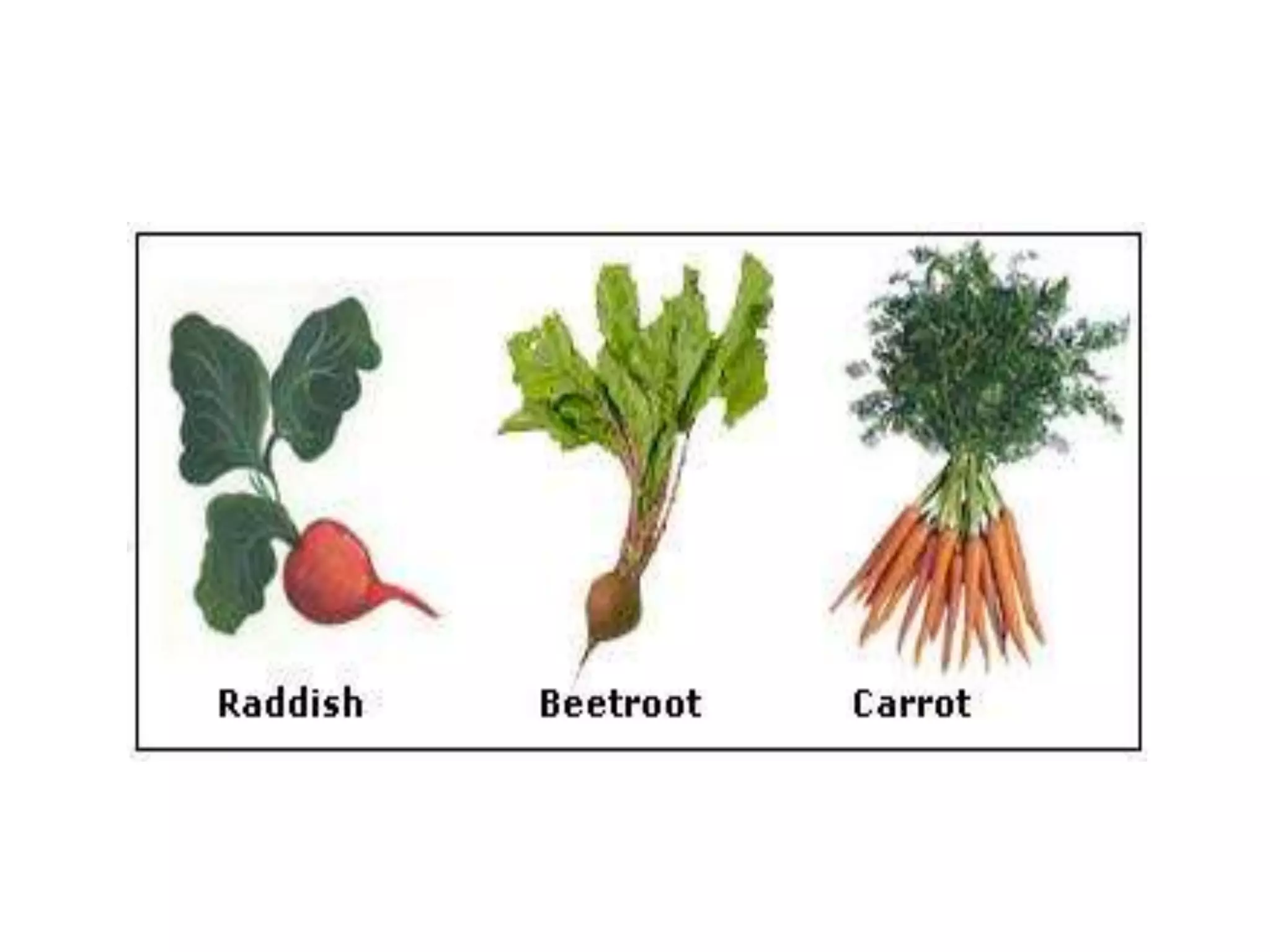
Fusiform root - In radish the modified tap root is thickened in
the middle and tapers towards both ends.
e.g., Raphanus sativus (Radish)
Napiform root - In beetroot the modified tap root is greatly
swollen at the base, but abruptly narrows into a tail-like
portion.
e.g., Beta vulgaris (Beetroot)
Conical root - In carrot the modified tap root is conical. It is
broad at the base and gradually tapers towards its apex.
e.g., Daucas carota (carrot)
Adventitious Root Modifications
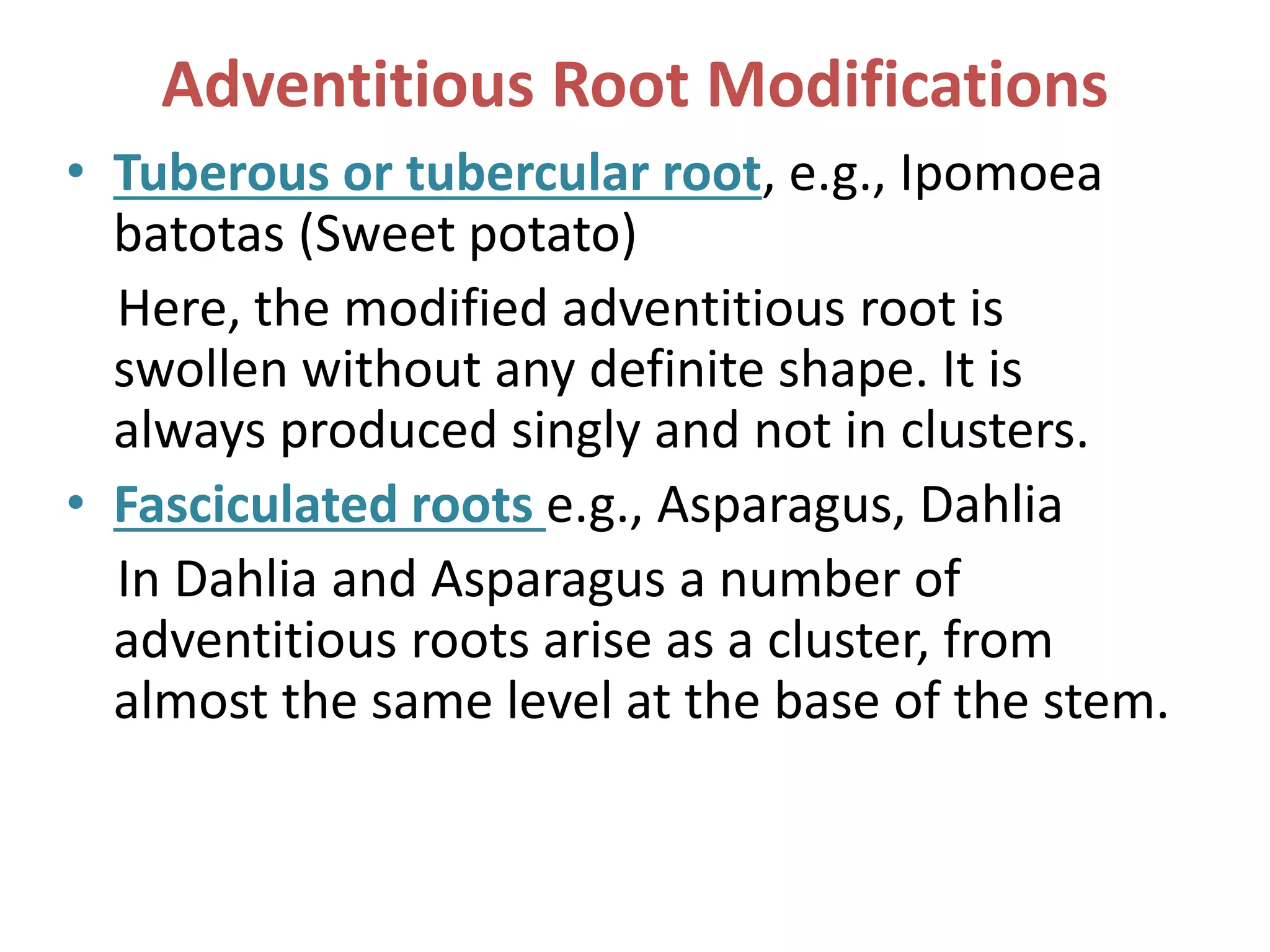
• Tuberous or tubercular root, e.g., Ipomoea
batotas (Sweet potato)
Here, the modified adventitious root is
swollen without any definite shape. It is
always produced singly and not in clusters.
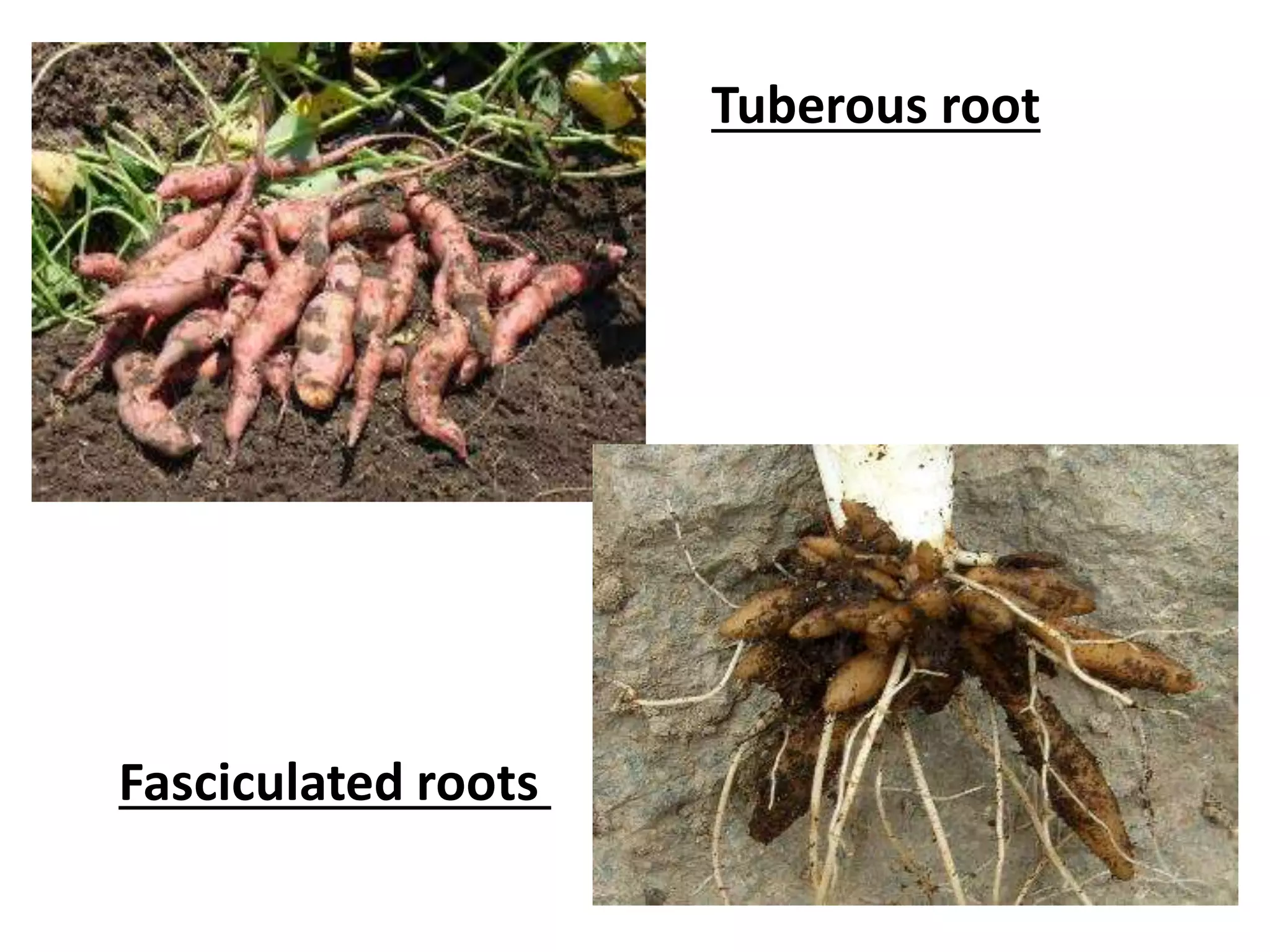
• Fasciculated roots e.g., Asparagus, Dahlia
In Dahlia and Asparagus a number of
adventitious roots arise as a cluster, from
almost the same level at the base of the stem.
Tuberous root
Fasciculated roots
Adventitious Root Modifications
• Nodulose roots e.g., Curcuma amada,
(mango ginger)Here, the root becomes
swollen at its tip.
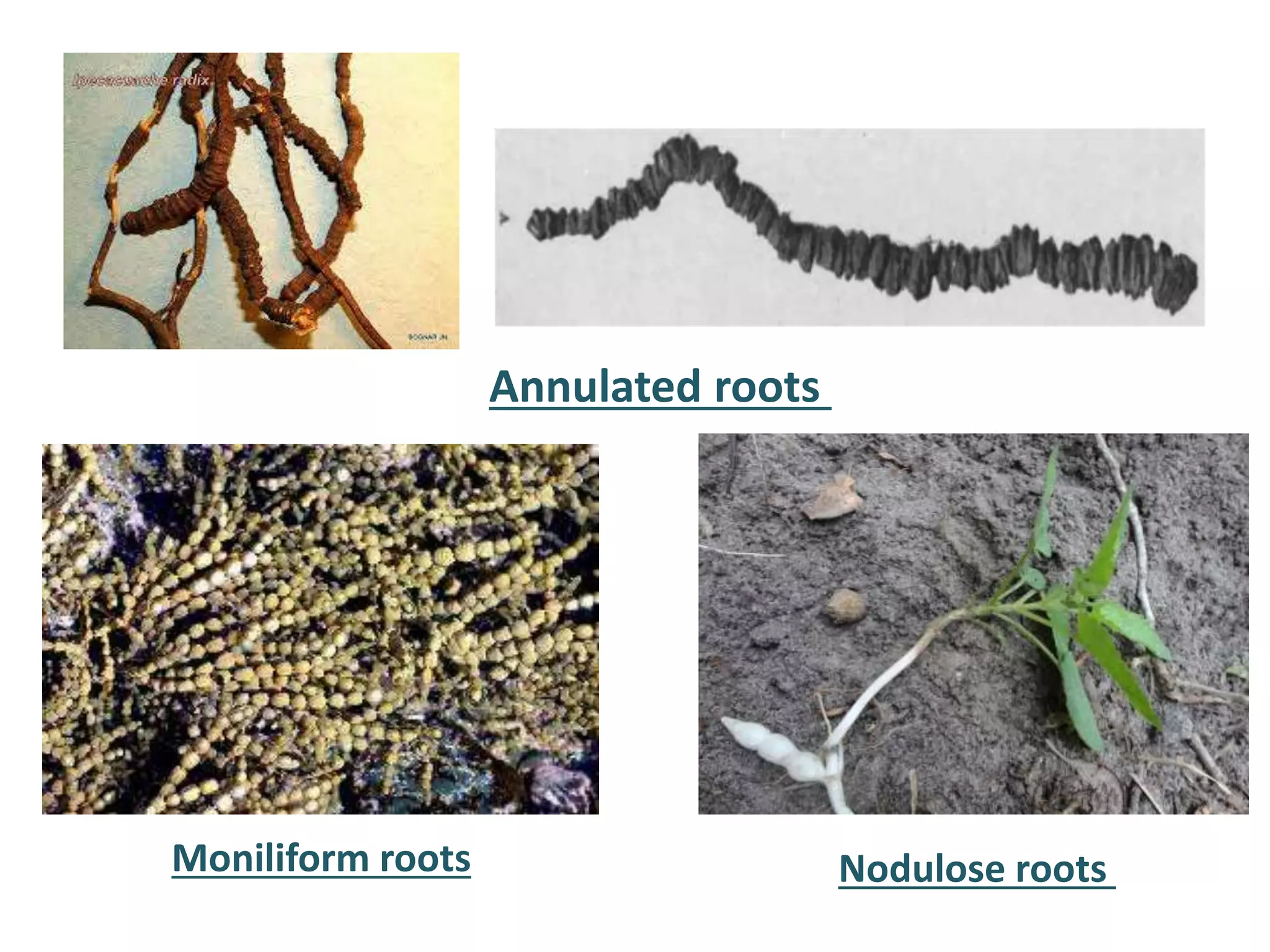
• Moniliform roots e.g., Momordica. Here,
the roots show beadlike swellings at
frequent intervals.
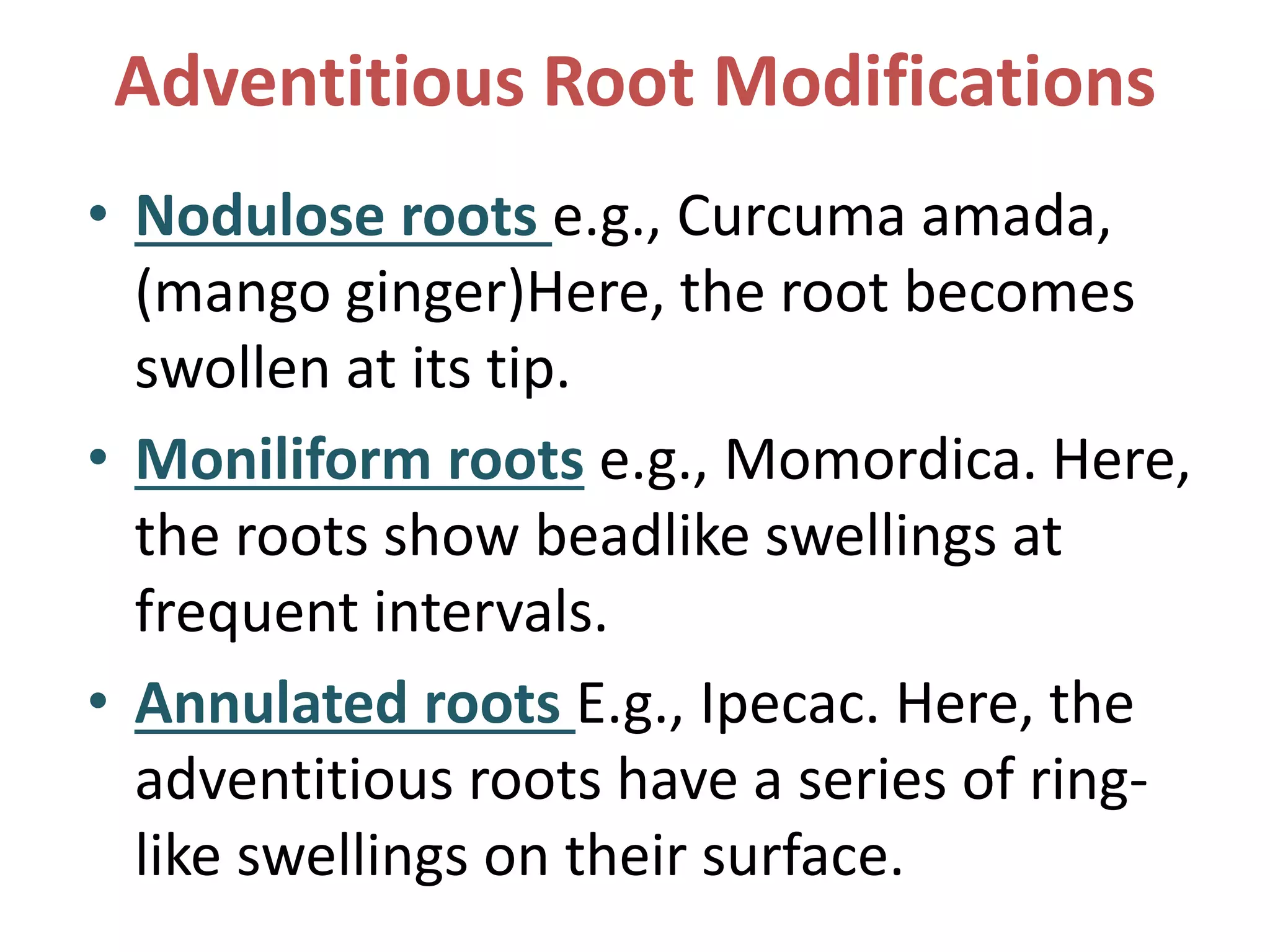
• Annulated roots E.g., Ipecac. Here, the
adventitious roots have a series of ring-
like swellings on their surface.
Nodulose rootsMoniliform roots
Annulated roots
Aerial Root Modifications
Aerial roots are adventitious roots
which develop from the aerial parts
of the plant to perform various
functions.
A. For Mechanical Support
B. For Vital Functions
For Mechanical Support
• Prop roots
• Stilt roots
• Climbing roots
For Vital Functions
•Haustoria or sucking roots
•Respiratory roots or breathing roots or pneumtophores.
•Floating roots
•Epiphytic roots
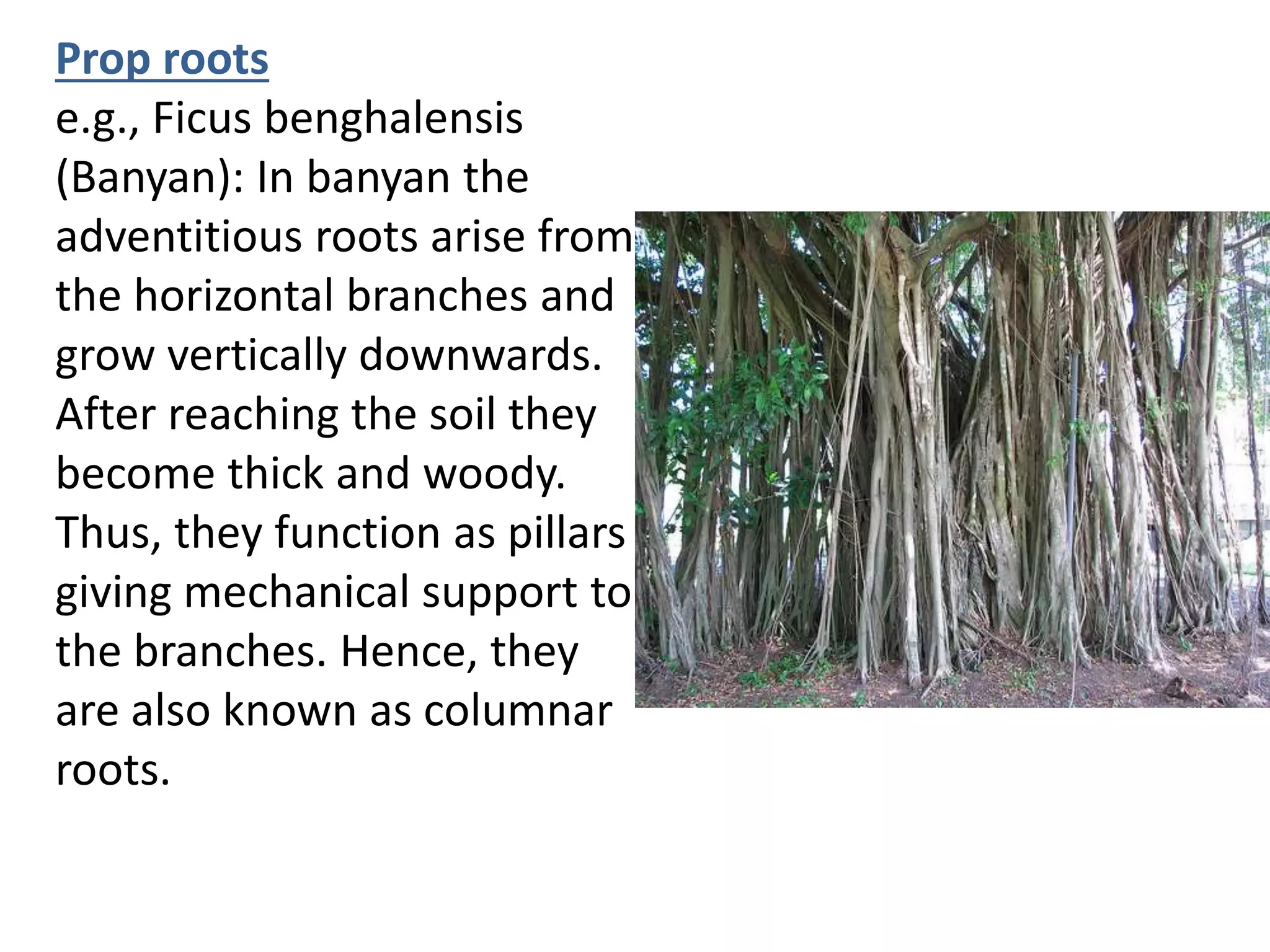
Prop roots
e.g., Ficus benghalensis
(Banyan): In banyan the
adventitious roots arise from
the horizontal branches and
grow vertically downwards.
After reaching the soil they
become thick and woody.
Thus, they function as pillars
giving mechanical support to
the branches. Hence, they
are also known as columnar
roots.
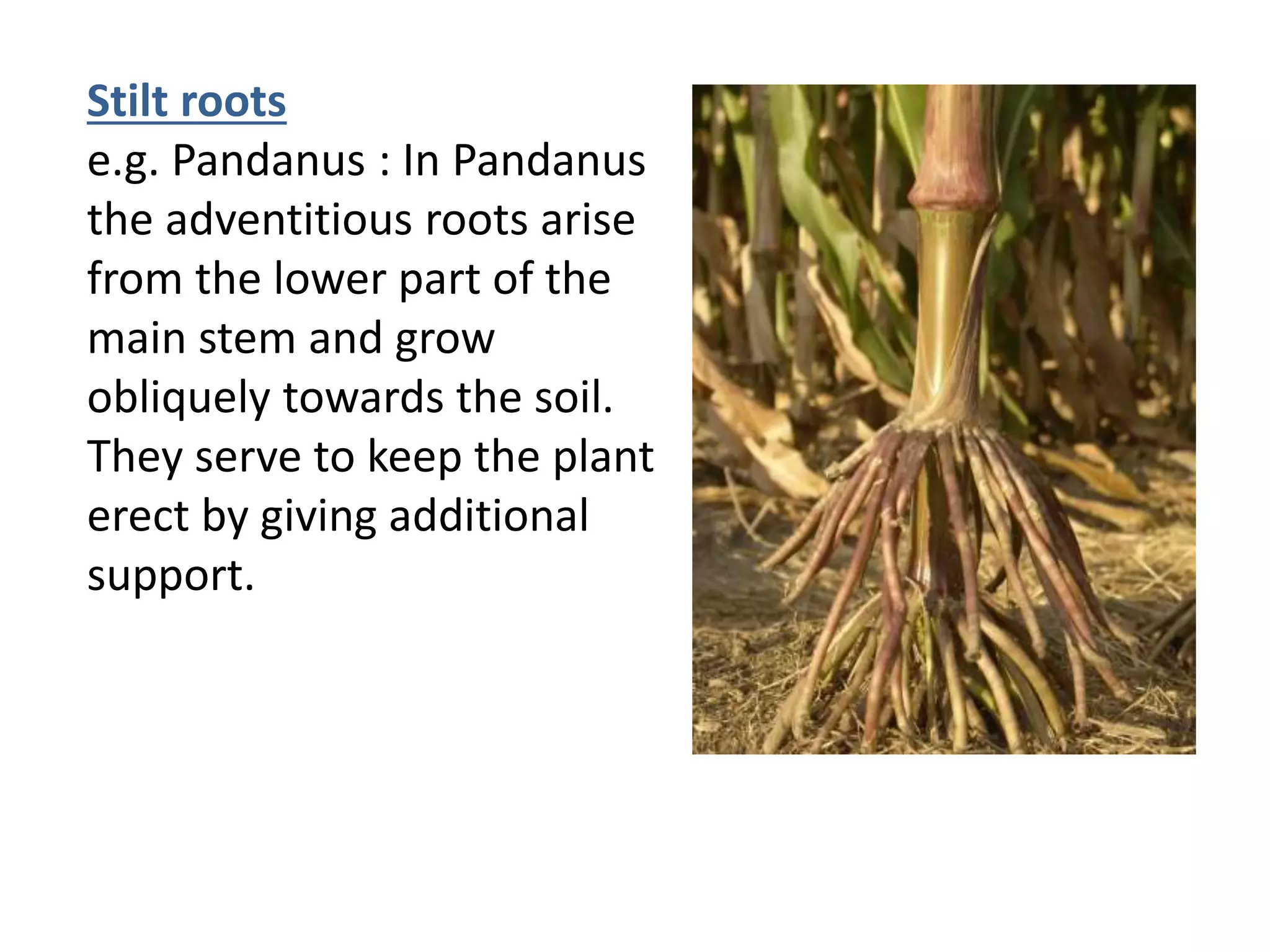
Stilt roots
e.g. Pandanus : In Pandanus
the adventitious roots arise
from the lower part of the
main stem and grow
obliquely towards the soil.
They serve to keep the plant
erect by giving additional
support.
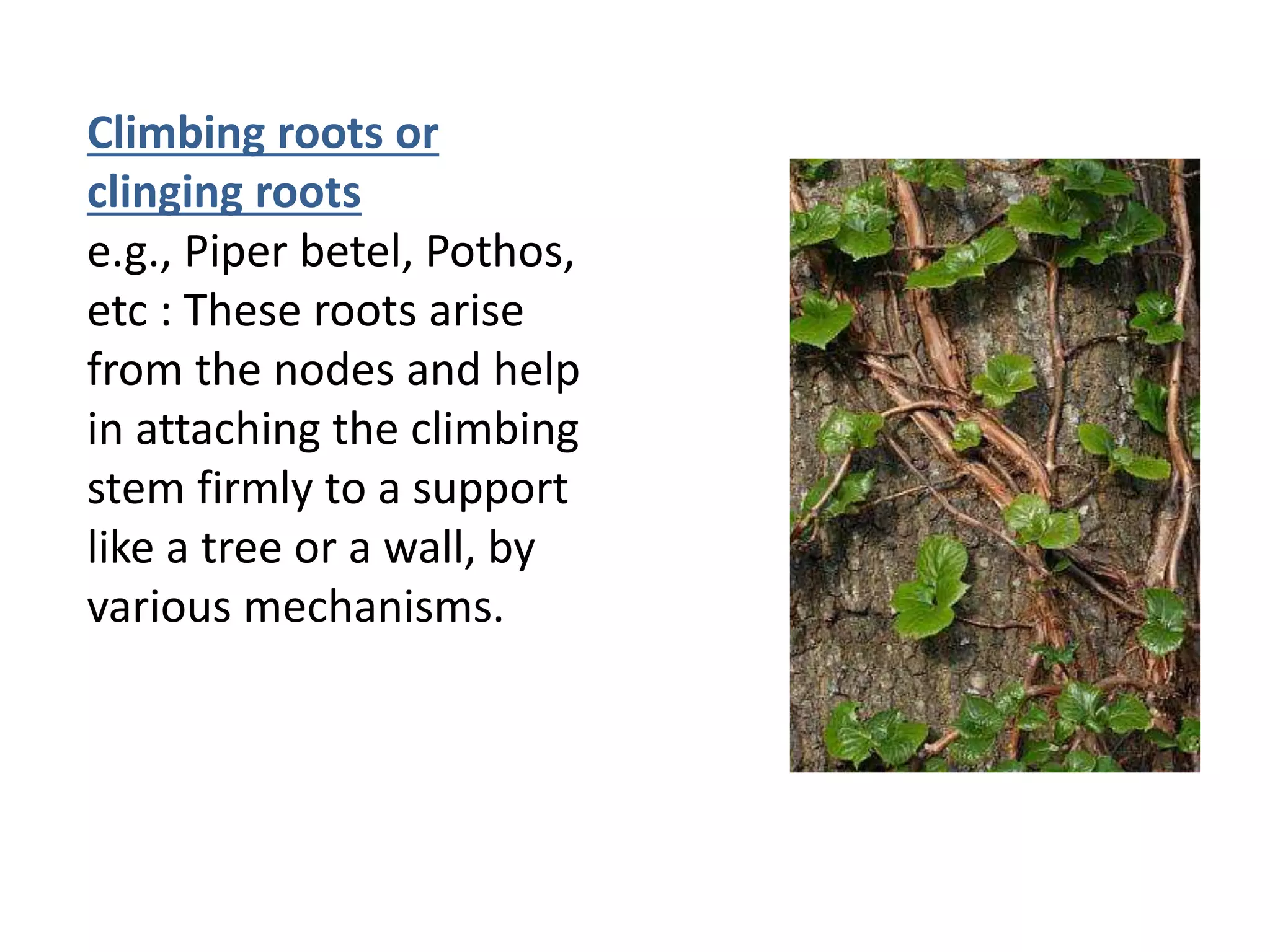
Climbing roots or
clinging roots
e.g., Piper betel, Pothos,
etc : These roots arise
from the nodes and help
in attaching the climbing
stem firmly to a support
like a tree or a wall, by
various mechanisms.
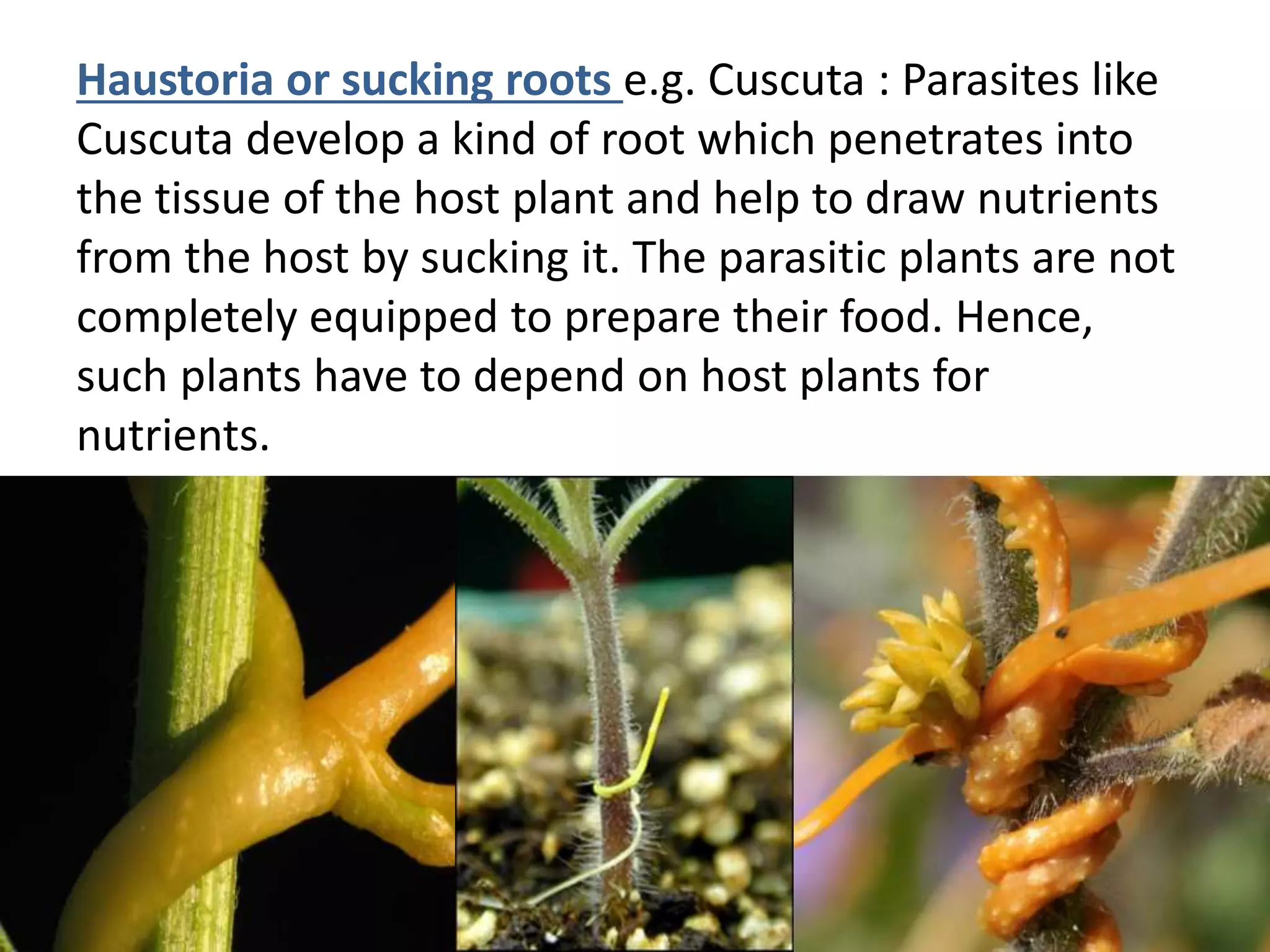
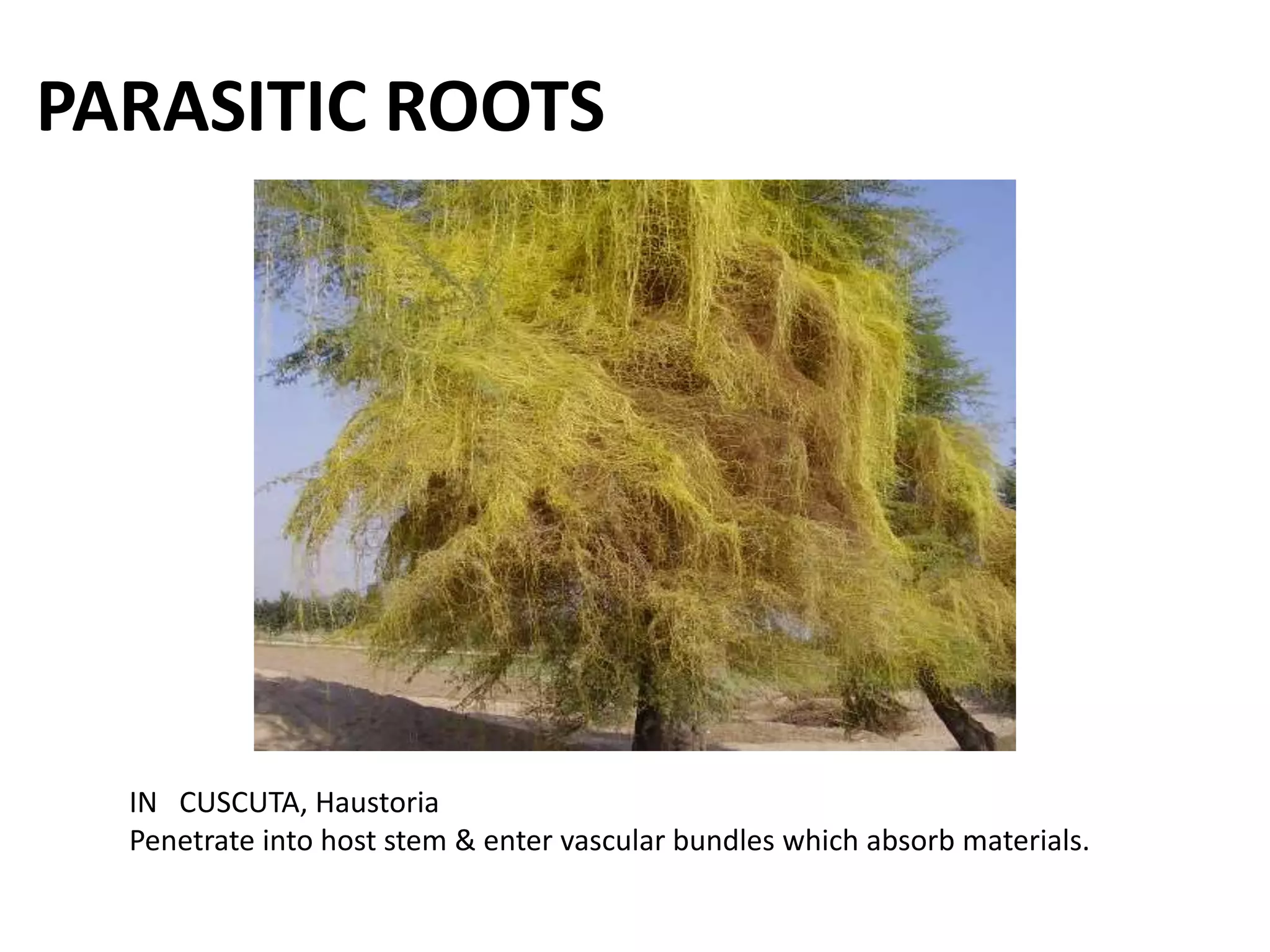
Haustoria or sucking roots e.g. Cuscuta : Parasites like
Cuscuta develop a kind of root which penetrates into
the tissue of the host plant and help to draw nutrients
from the host by sucking it. The parasitic plants are not
completely equipped to prepare their food. Hence,
such plants have to depend on host plants for
nutrients.
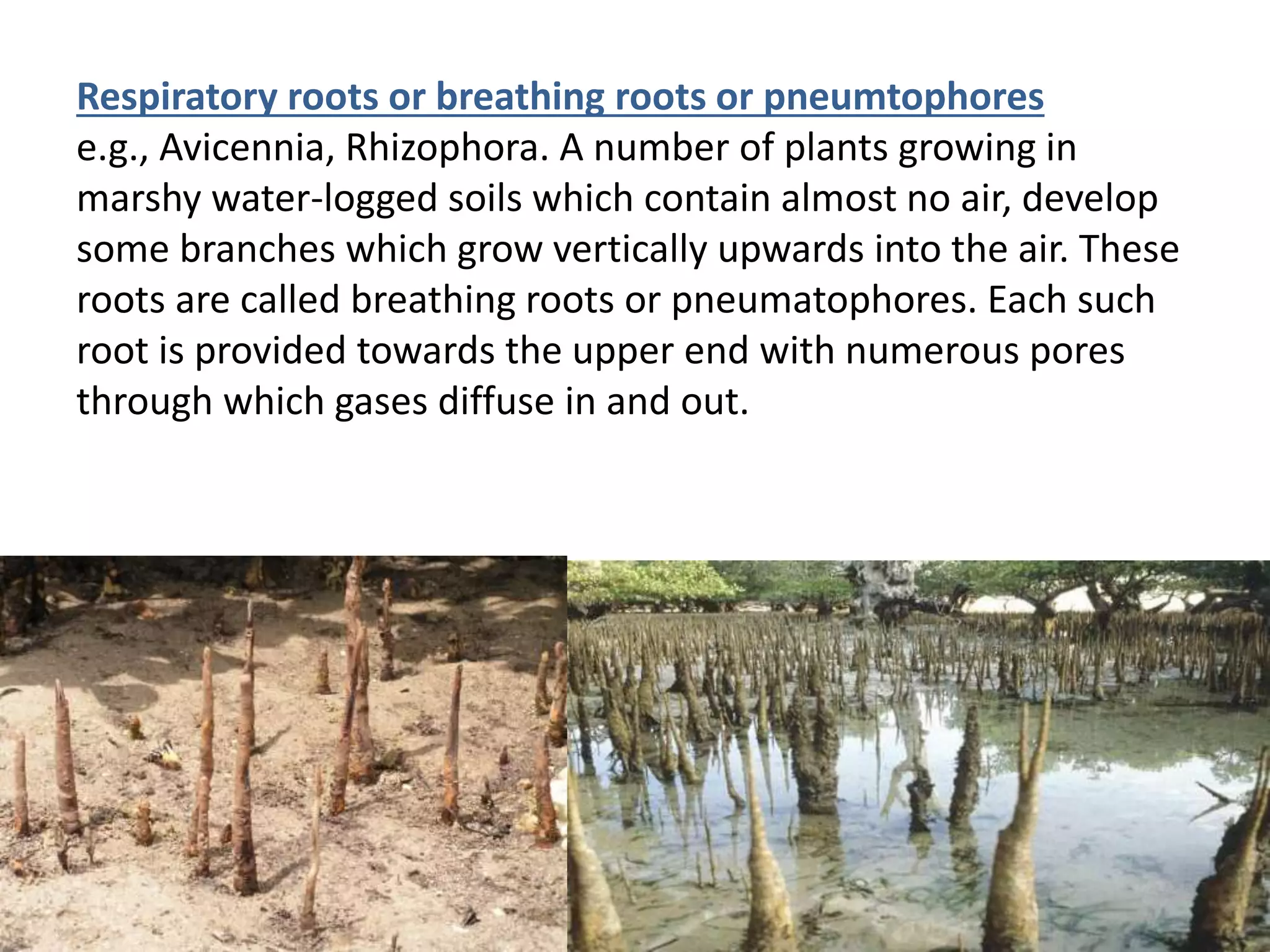
Respiratory roots or breathing roots or pneumtophores
e.g., Avicennia, Rhizophora. A number of plants growing in
marshy water-logged soils which contain almost no air, develop
some branches which grow vertically upwards into the air. These
roots are called breathing roots or pneumatophores. Each such
root is provided towards the upper end with numerous pores
through which gases diffuse in and out.
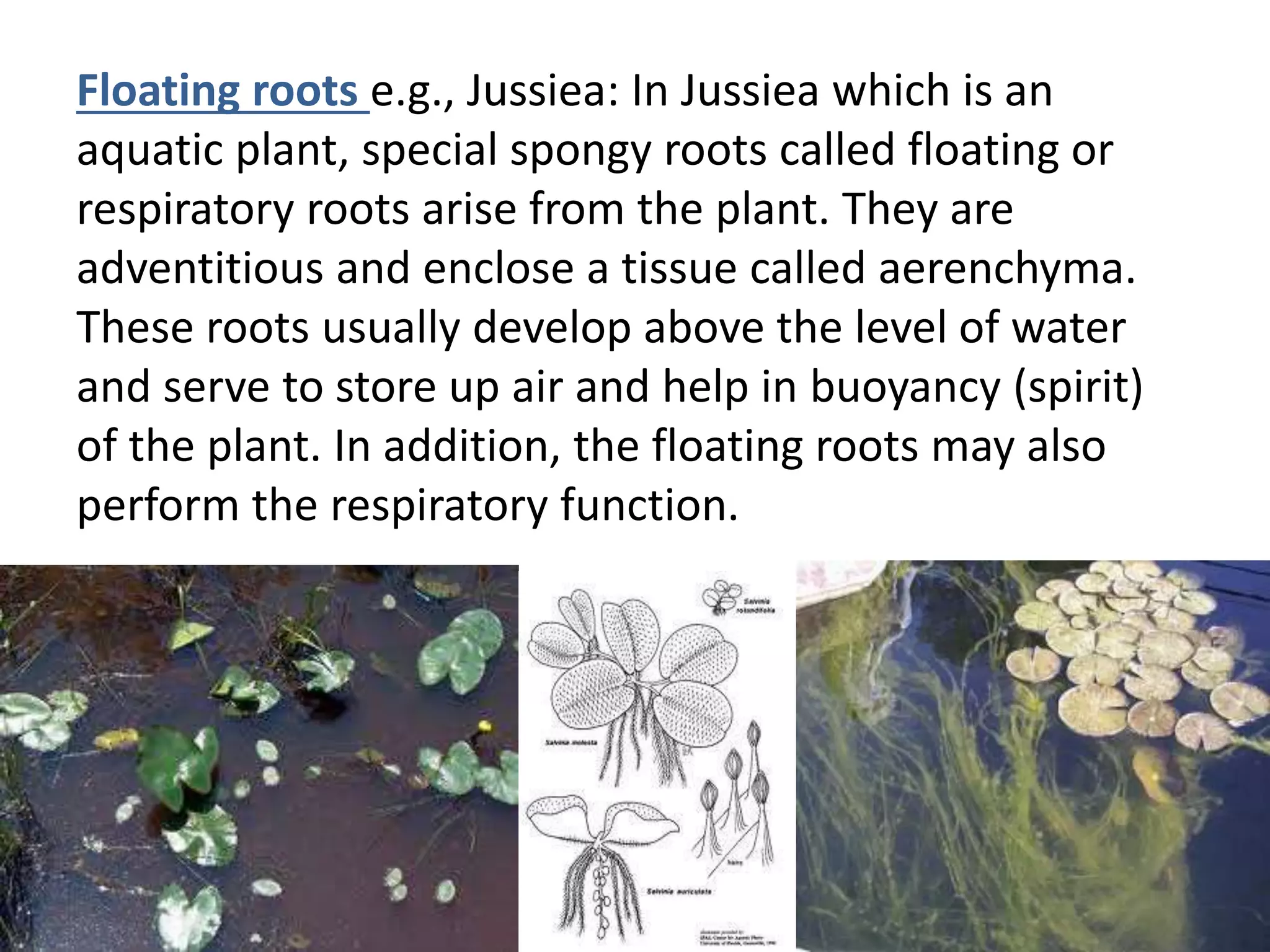
Floating roots e.g., Jussiea: In Jussiea which is an
aquatic plant, special spongy roots called floating or
respiratory roots arise from the plant. They are
adventitious and enclose a tissue called aerenchyma.
These roots usually develop above the level of water
and serve to store up air and help in buoyancy (spirit)
of the plant. In addition, the floating roots may also
perform the respiratory function.
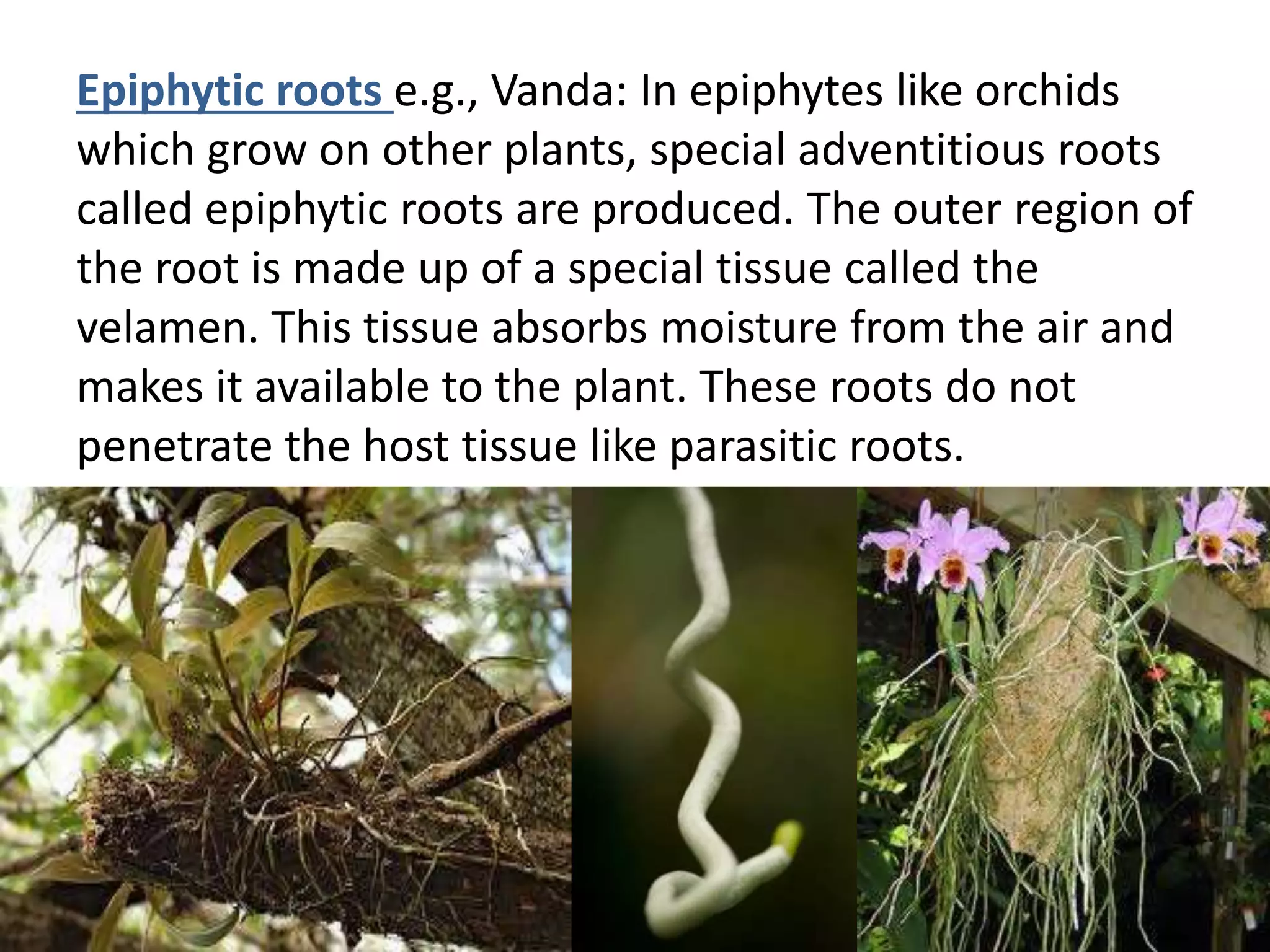
Epiphytic roots e.g., Vanda: In epiphytes like orchids
which grow on other plants, special adventitious roots
called epiphytic roots are produced. The outer region of
the root is made up of a special tissue called the
velamen. This tissue absorbs moisture from the air and
makes it available to the plant. These roots do not
penetrate the host tissue like parasitic roots.
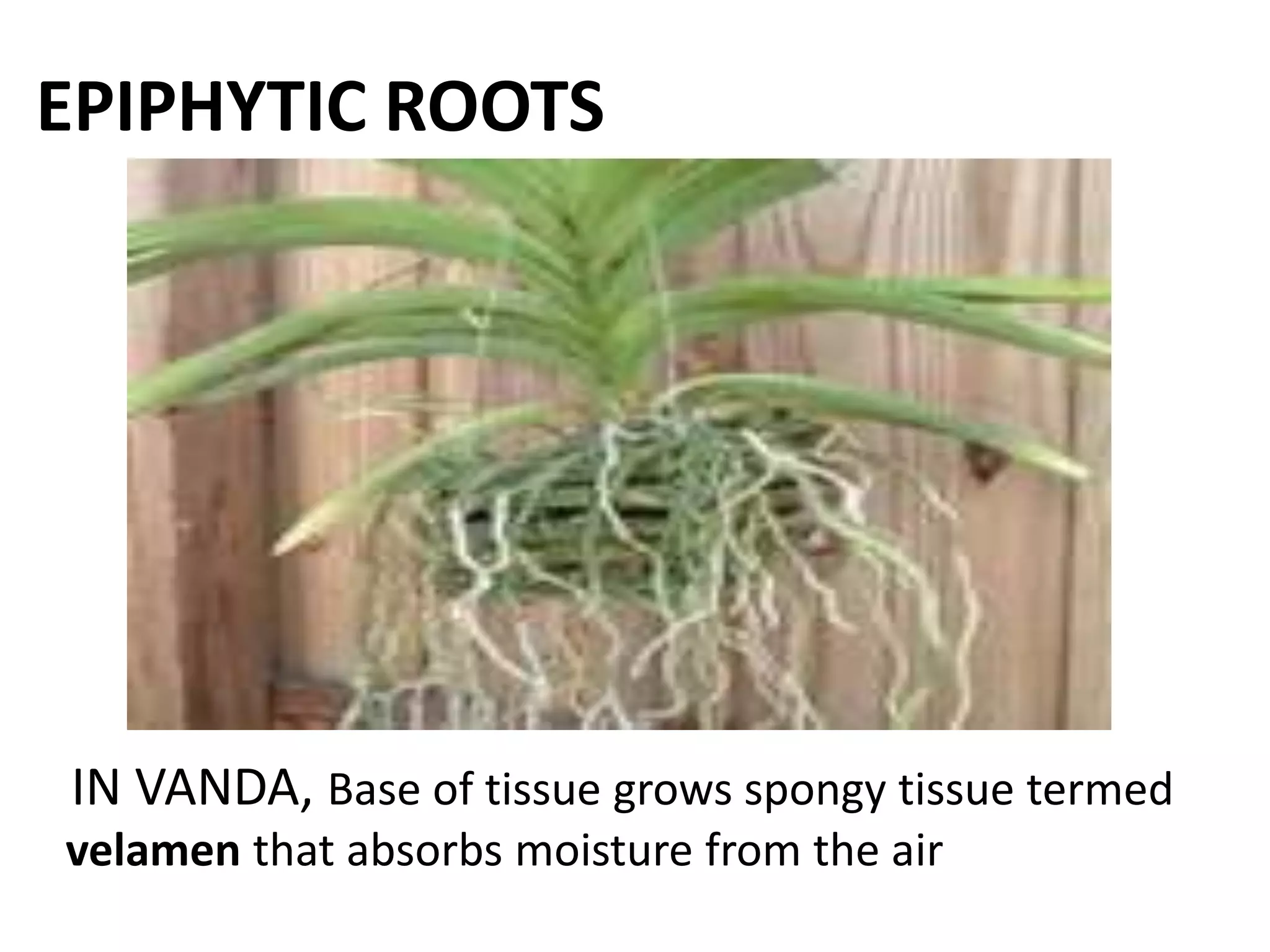
EPIPHYTIC ROOTS
IN VANDA, Base of tissue grows spongy tissue termed
velamen that absorbs moisture from the air
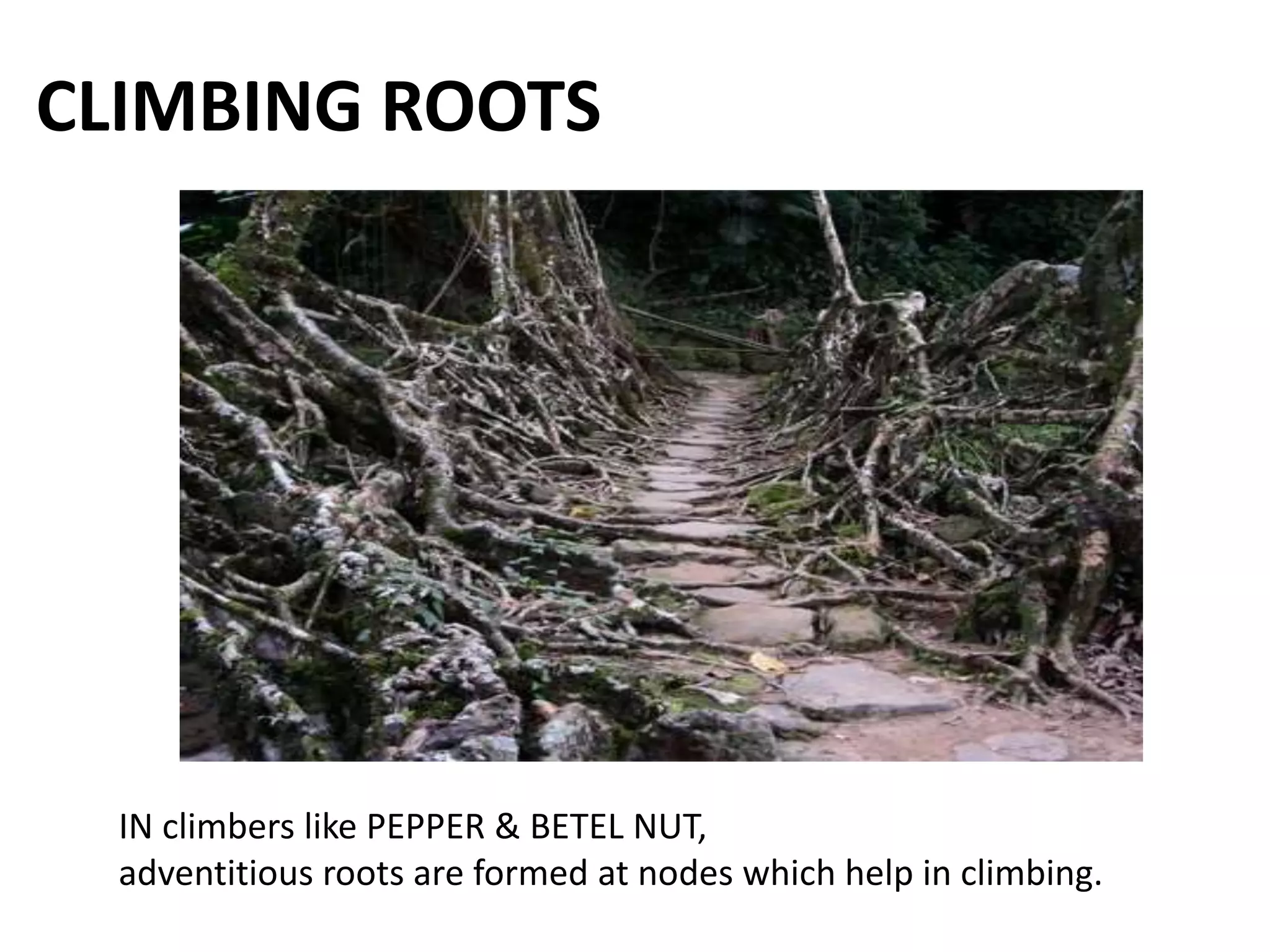
CLIMBING ROOTS
IN climbers like PEPPER & BETEL NUT,
adventitious roots are formed at nodes which help in climbing.
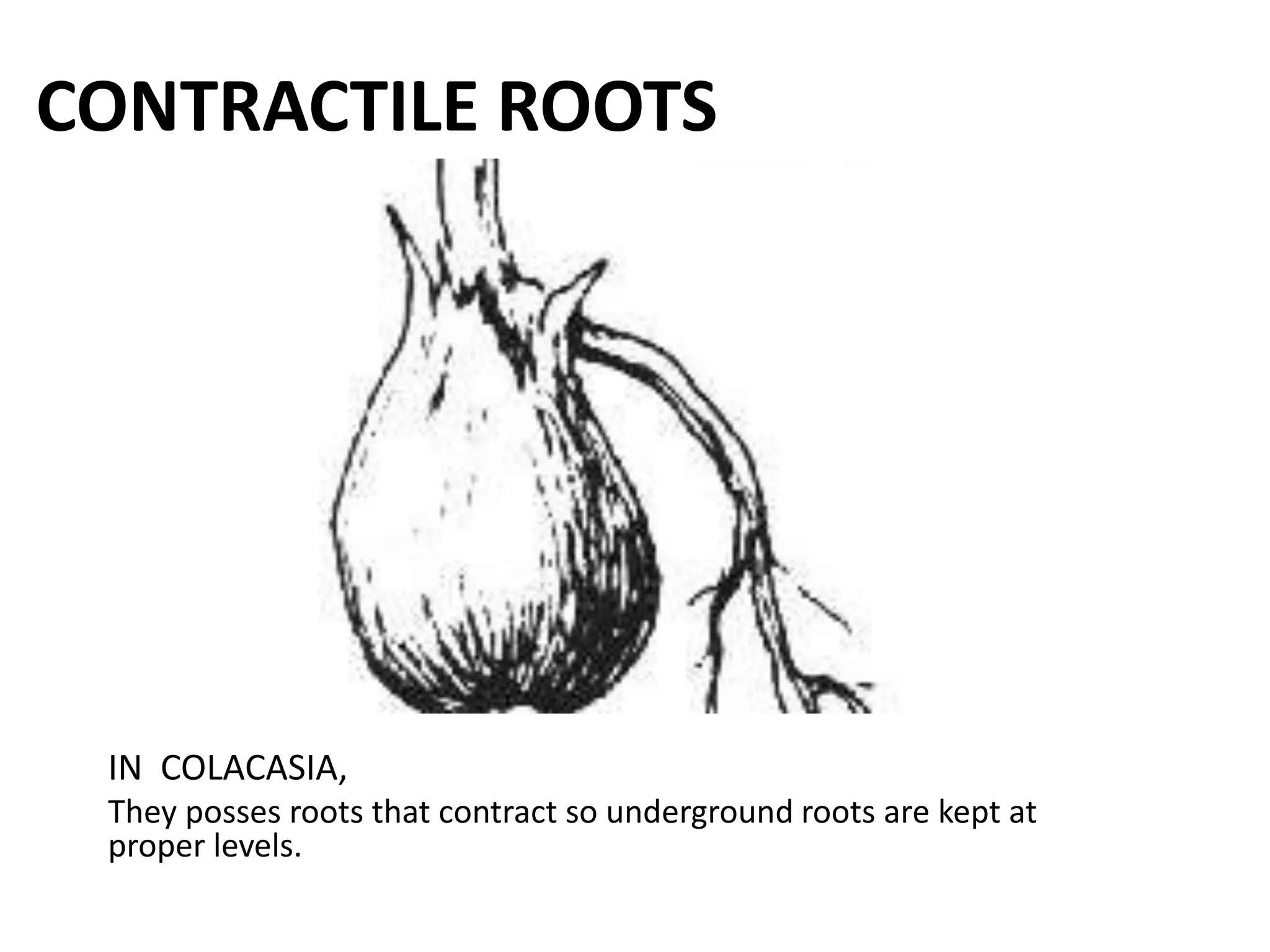
CONTRACTILE ROOTS
IN COLACASIA,
They posses roots that contract so underground roots are kept at
proper levels.
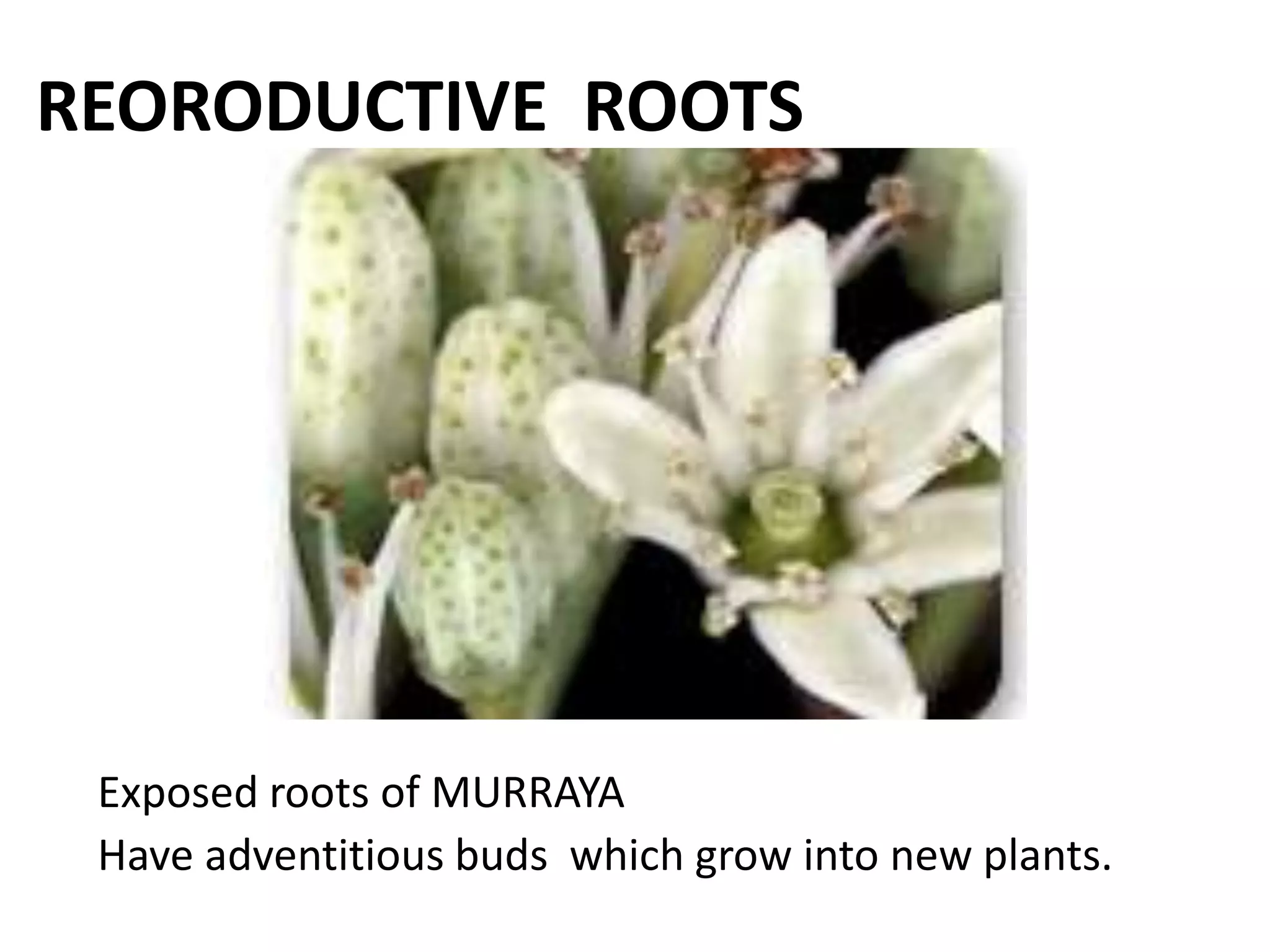
REORODUCTIVE ROOTS
Exposed roots of MURRAYA
Have adventitious buds which grow into new plants.
PARASITIC ROOTS
IN CUSCUTA, Haustoria
Penetrate into host stem & enter vascular bundles which absorb materials.
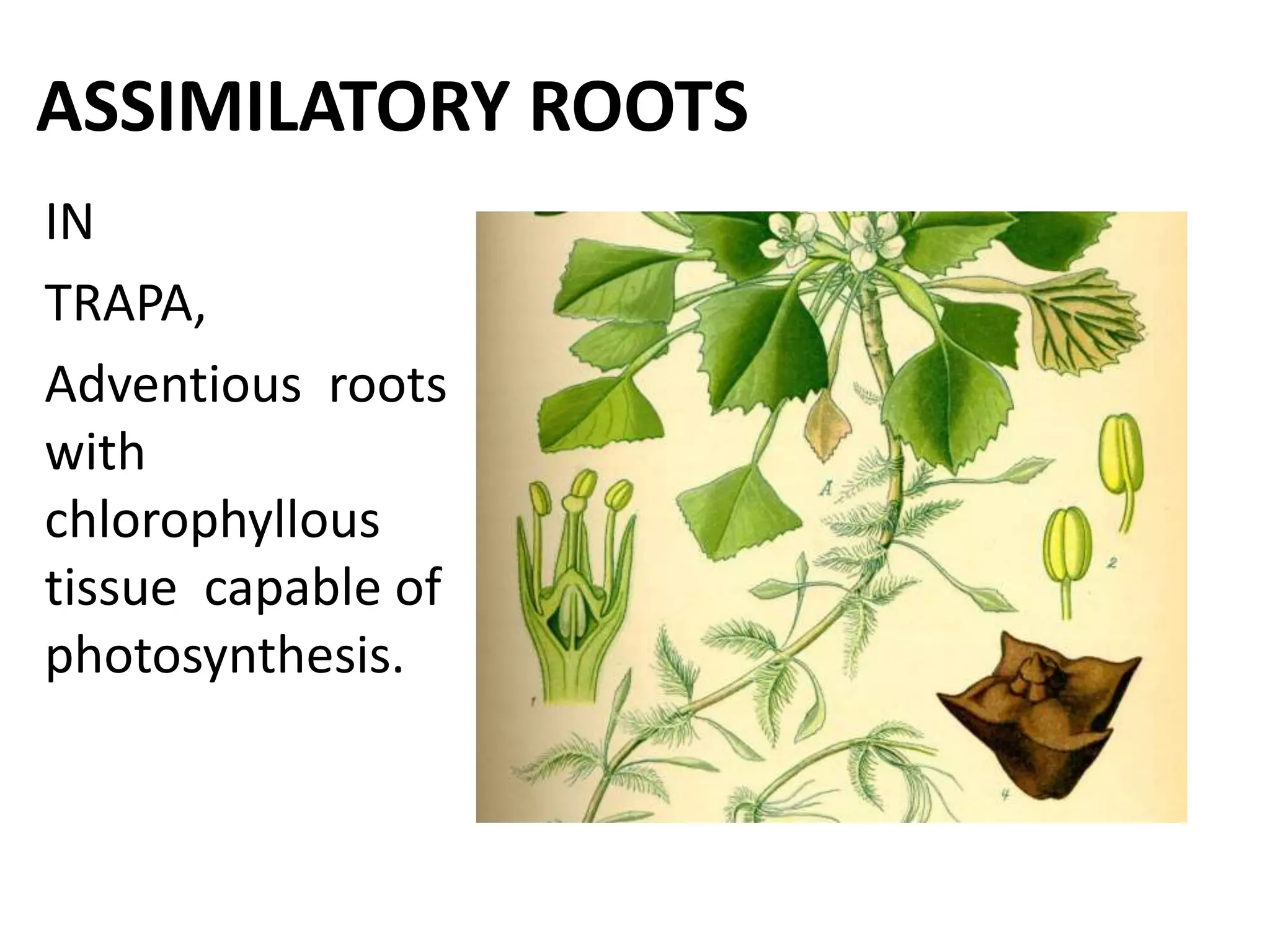
ASSIMILATORY ROOTS
IN
TRAPA,
Adventious roots
with
chlorophyllous
tissue capable of
photosynthesis.
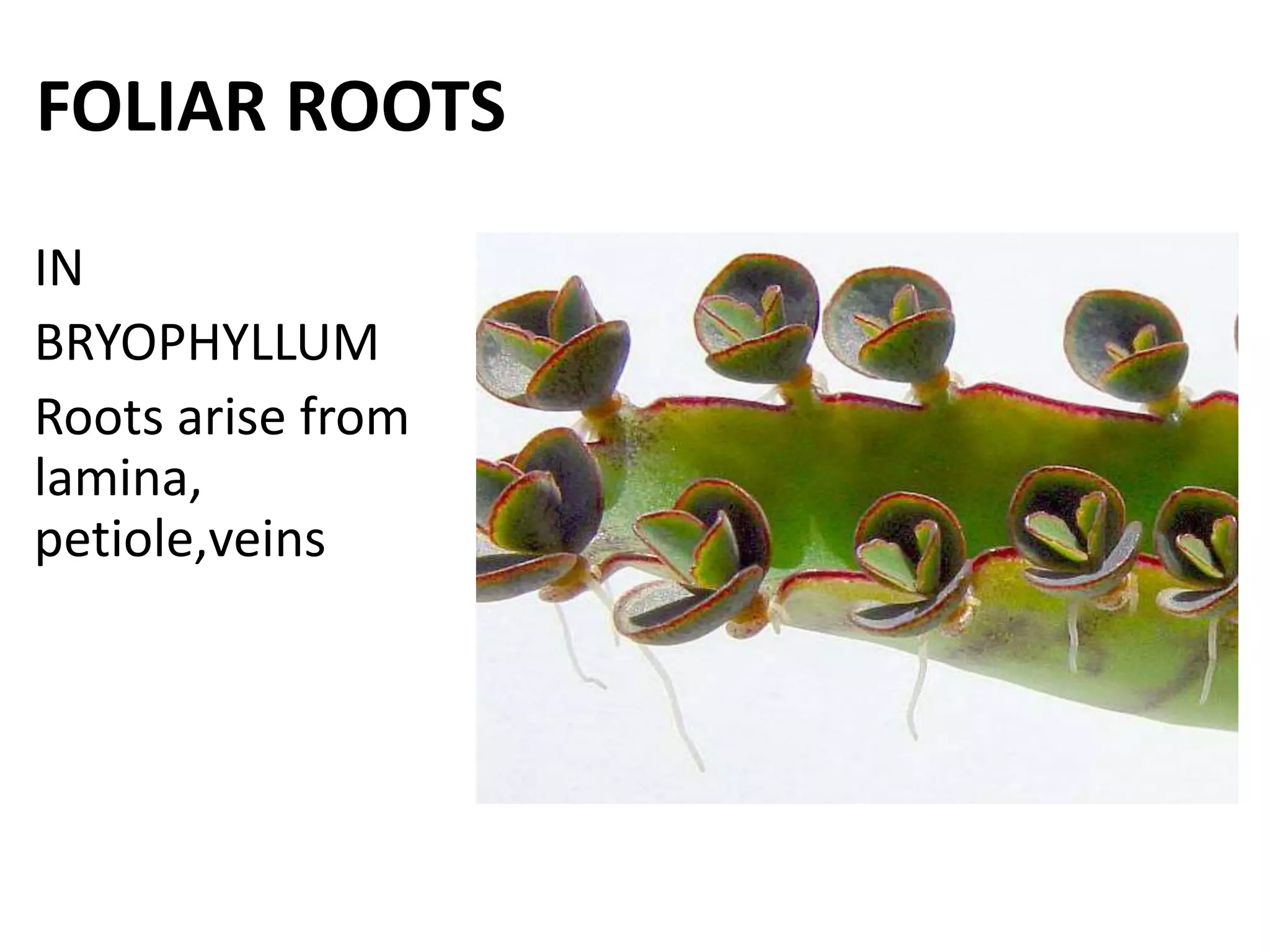
FOLIAR ROOTS
IN
BRYOPHYLLUM
Roots arise from
lamina,
petiole,veins
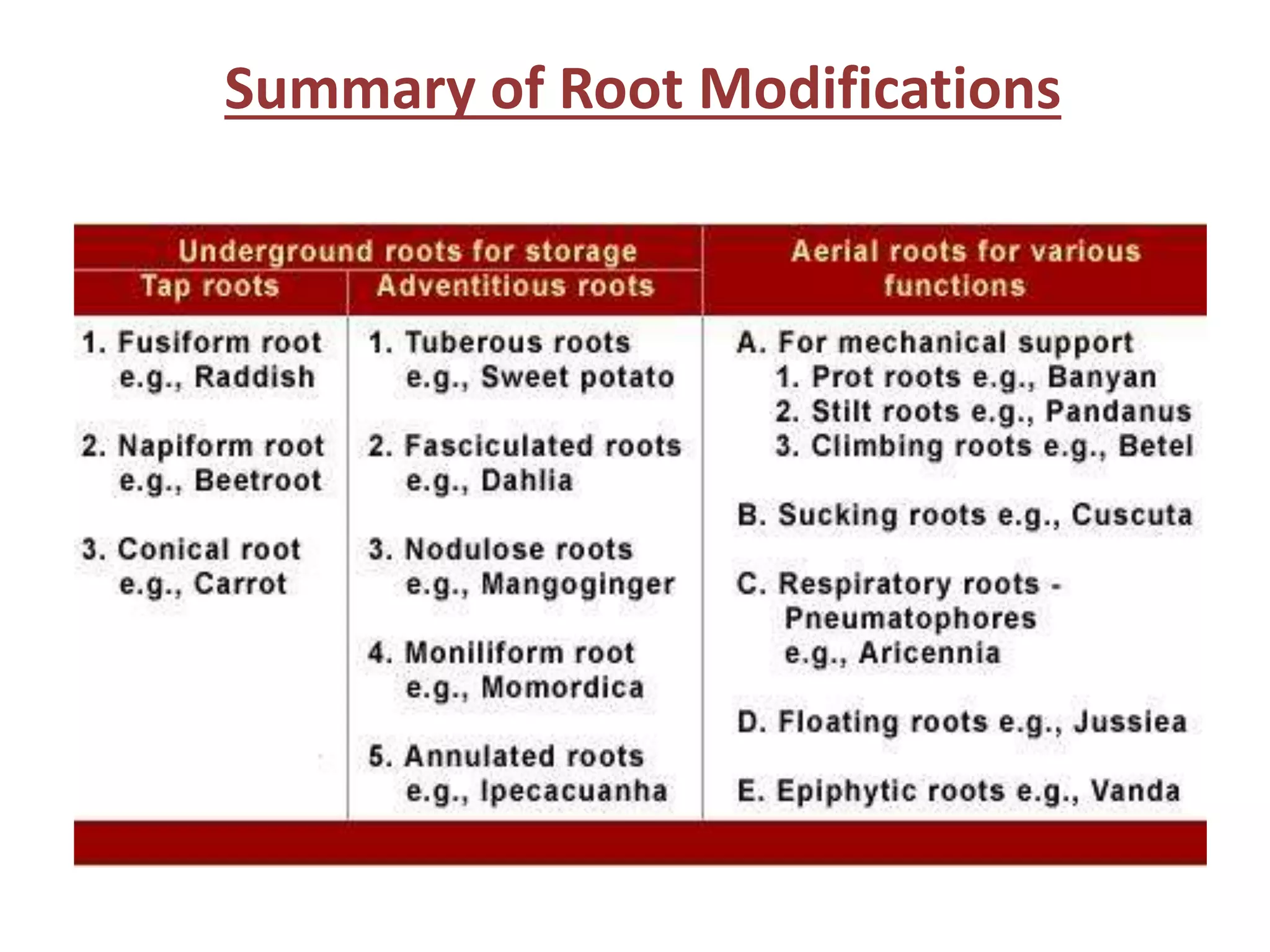
Summary of Root Modifications

Modificationsofroots by pooja

  • 1.
    Root The part ofa plant that attaches it to the ground or to a support, conveying water and nourishment to the rest of the plant.
  • 2.
    Modifications of Roots Rootssometimes have special functions to perform and in such cases their form and structure differ from those of normal roots. The modified roots may be underground or aerial.
  • 3.
    Underground Root Modifications Taprootand adventitious roots may undergo certain modifications to perform the function of storage and vegetative propagation.
  • 4.
    Tap Root Modifications (forstorage of food) In some plants the tap roots store reserve food for which they become swollen and assume different shapes. There are three types : (i) Fusiform: (ii) Napiform: (iii) Conical: (iv) Tuberous or tubercular: (v) Pneumatophores:
  • 5.
    (i) Fusiform: It isa modified tap root. The primary root is swollen in the middle while both the ends gradually taper forming a spindle shaped structure, e.g., Radish (Raphanus sativus). (ii) Napiform: The hypocotyls region is considerably swollen, becoming almost spherical and then abruptly tapering towards the lower end, e.g., Turnip (Brassica campestris var. rapa) and beet (Beta vulgaris). (iii) Conical: The roots swell, becoming broad at the base and gradually taper towards apex forming a cone like structure, e.g., Carrot (Daucus carota).
  • 6.
    (iv) Tuberous ortubercular: In this case, the root is thick and fleshy but does not form any definite shape, e.g., Mirabilis jalapa. (v) Pneumatophores: These roots grow vertically up and come out of the water or marshy soil like conical spikes. They occur in large numbers around the tree trunk. Such roots are provided with numerous pores (breathing pores) through which air is taken for respiration, e.g., Rhizophora.
  • 7.
    Fusiform root -In radish the modified tap root is thickened in the middle and tapers towards both ends. e.g., Raphanus sativus (Radish) Napiform root - In beetroot the modified tap root is greatly swollen at the base, but abruptly narrows into a tail-like portion. e.g., Beta vulgaris (Beetroot) Conical root - In carrot the modified tap root is conical. It is broad at the base and gradually tapers towards its apex. e.g., Daucas carota (carrot)
  • 9.
    Adventitious Root Modifications •Tuberous or tubercular root, e.g., Ipomoea batotas (Sweet potato) Here, the modified adventitious root is swollen without any definite shape. It is always produced singly and not in clusters. • Fasciculated roots e.g., Asparagus, Dahlia In Dahlia and Asparagus a number of adventitious roots arise as a cluster, from almost the same level at the base of the stem.
  • 10.
  • 11.
    Adventitious Root Modifications •Nodulose roots e.g., Curcuma amada, (mango ginger)Here, the root becomes swollen at its tip. • Moniliform roots e.g., Momordica. Here, the roots show beadlike swellings at frequent intervals. • Annulated roots E.g., Ipecac. Here, the adventitious roots have a series of ring- like swellings on their surface.
  • 12.
  • 13.
    Aerial Root Modifications Aerialroots are adventitious roots which develop from the aerial parts of the plant to perform various functions. A. For Mechanical Support B. For Vital Functions
  • 14.
    For Mechanical Support •Prop roots • Stilt roots • Climbing roots For Vital Functions •Haustoria or sucking roots •Respiratory roots or breathing roots or pneumtophores. •Floating roots •Epiphytic roots
  • 15.
    Prop roots e.g., Ficusbenghalensis (Banyan): In banyan the adventitious roots arise from the horizontal branches and grow vertically downwards. After reaching the soil they become thick and woody. Thus, they function as pillars giving mechanical support to the branches. Hence, they are also known as columnar roots.
  • 16.
    Stilt roots e.g. Pandanus: In Pandanus the adventitious roots arise from the lower part of the main stem and grow obliquely towards the soil. They serve to keep the plant erect by giving additional support.
  • 17.
    Climbing roots or clingingroots e.g., Piper betel, Pothos, etc : These roots arise from the nodes and help in attaching the climbing stem firmly to a support like a tree or a wall, by various mechanisms.
  • 18.
    Haustoria or suckingroots e.g. Cuscuta : Parasites like Cuscuta develop a kind of root which penetrates into the tissue of the host plant and help to draw nutrients from the host by sucking it. The parasitic plants are not completely equipped to prepare their food. Hence, such plants have to depend on host plants for nutrients.
  • 19.
    Respiratory roots orbreathing roots or pneumtophores e.g., Avicennia, Rhizophora. A number of plants growing in marshy water-logged soils which contain almost no air, develop some branches which grow vertically upwards into the air. These roots are called breathing roots or pneumatophores. Each such root is provided towards the upper end with numerous pores through which gases diffuse in and out.
  • 20.
    Floating roots e.g.,Jussiea: In Jussiea which is an aquatic plant, special spongy roots called floating or respiratory roots arise from the plant. They are adventitious and enclose a tissue called aerenchyma. These roots usually develop above the level of water and serve to store up air and help in buoyancy (spirit) of the plant. In addition, the floating roots may also perform the respiratory function.
  • 21.
    Epiphytic roots e.g.,Vanda: In epiphytes like orchids which grow on other plants, special adventitious roots called epiphytic roots are produced. The outer region of the root is made up of a special tissue called the velamen. This tissue absorbs moisture from the air and makes it available to the plant. These roots do not penetrate the host tissue like parasitic roots.
  • 22.
    EPIPHYTIC ROOTS IN VANDA,Base of tissue grows spongy tissue termed velamen that absorbs moisture from the air
  • 23.
    CLIMBING ROOTS IN climberslike PEPPER & BETEL NUT, adventitious roots are formed at nodes which help in climbing.
  • 24.
    CONTRACTILE ROOTS IN COLACASIA, Theyposses roots that contract so underground roots are kept at proper levels.
  • 25.
    REORODUCTIVE ROOTS Exposed rootsof MURRAYA Have adventitious buds which grow into new plants.
  • 26.
    PARASITIC ROOTS IN CUSCUTA,Haustoria Penetrate into host stem & enter vascular bundles which absorb materials.
  • 27.
  • 28.
    FOLIAR ROOTS IN BRYOPHYLLUM Roots arisefrom lamina, petiole,veins
  • 29.
    Summary of RootModifications