Plant Part
Modifications
 Some of the most important types of
modifications of stem are as follows:
 I. Underground modifications of Stem
 II. Subaerial modifications of Stem
 III. Aerial modifications of Stem.w
STEM MODIFICAIONS
Underground modifications of
Stem
 Many plants produce underground stems for
perennation and food storage. They produce
aerial shoots annually.
 Although they resemble roots superficially but
can be; distinguishable from roots by the
presence of following features:
 Presence of nodes and internodes
 Presence of scale leaves, buds and adventitious
roots at the nodes.
 Internal structure resembles that of aerial stem
and not of root.
Rhizome
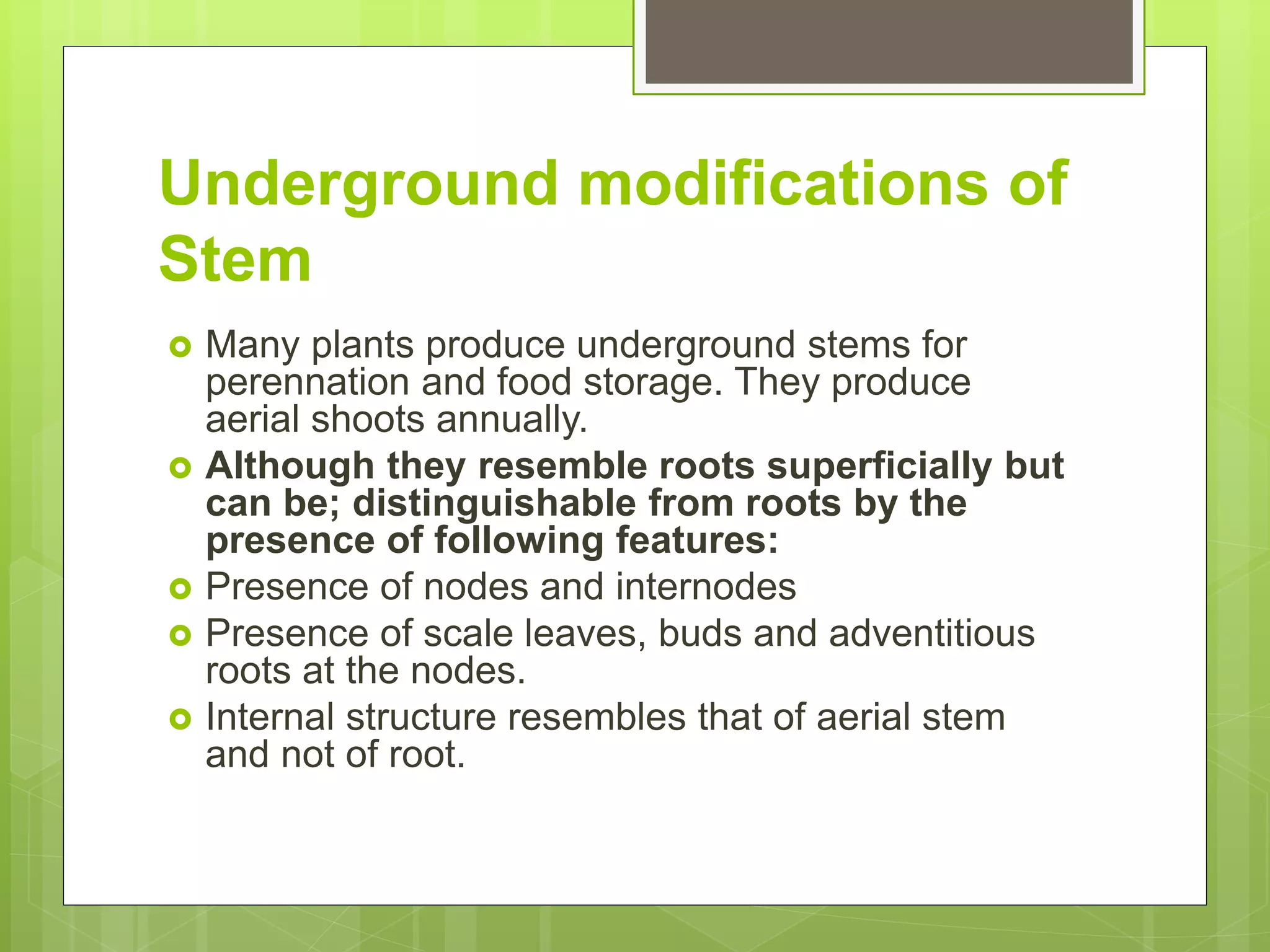
 Fleshy, non-green
underground stem.
 Distinct nodes and
internodes.
 Nodes bear dry scale
leaves with axillary buds.
 Terminal buds also
present.
 Adventitious roots arise
from the lower side.
 e.g. Ginger, turmeric,
Canna etc
Bulb
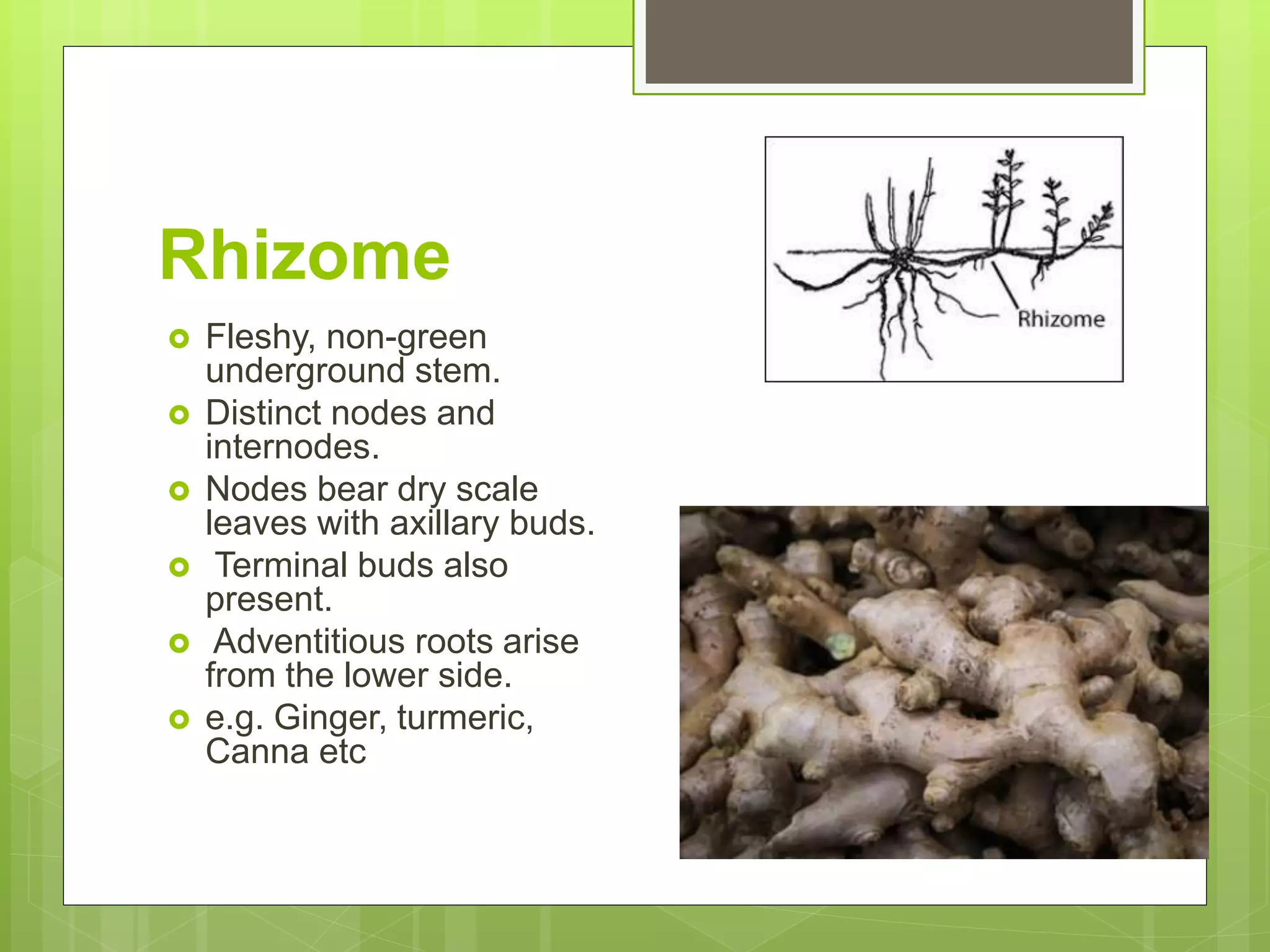
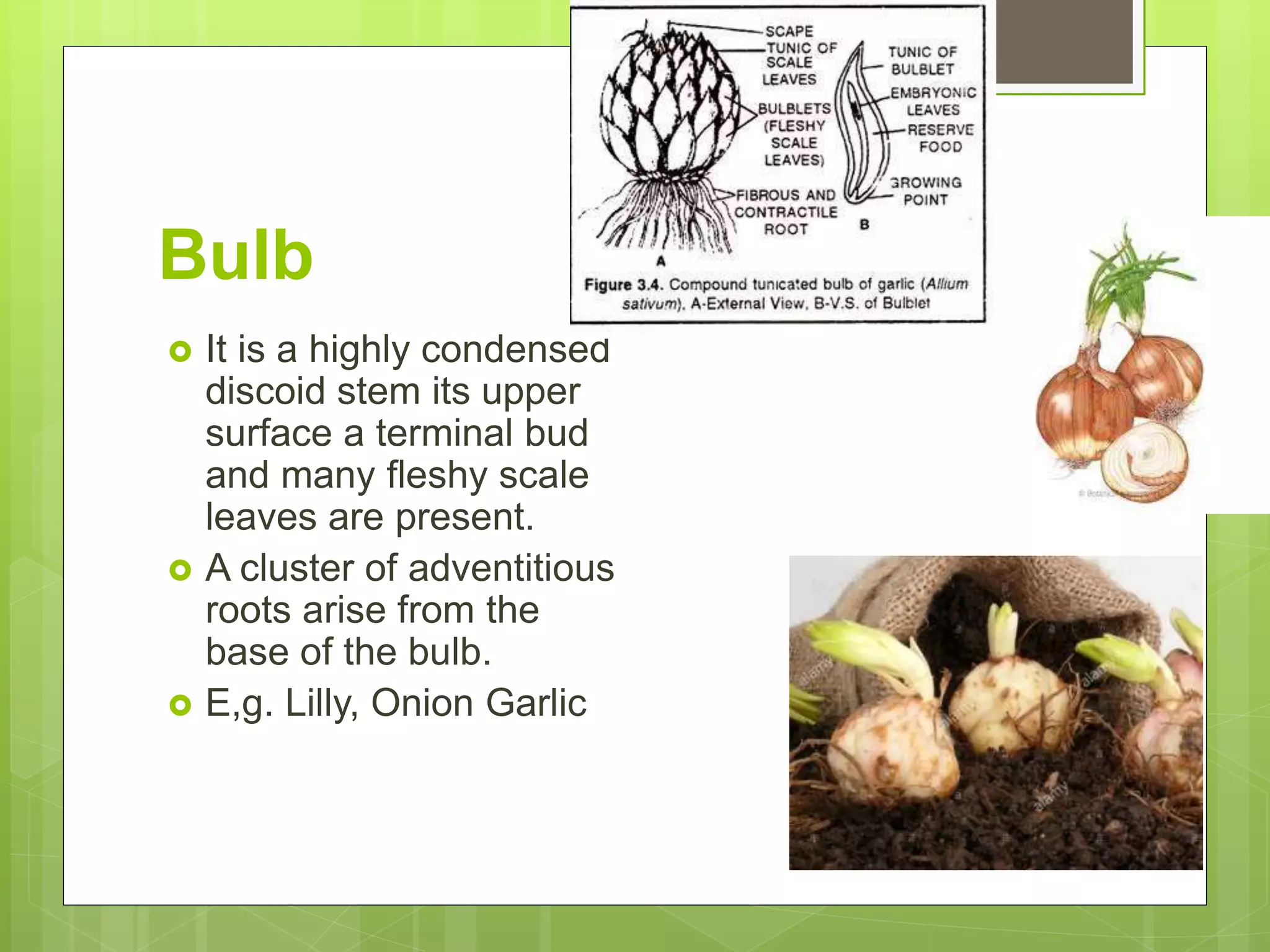
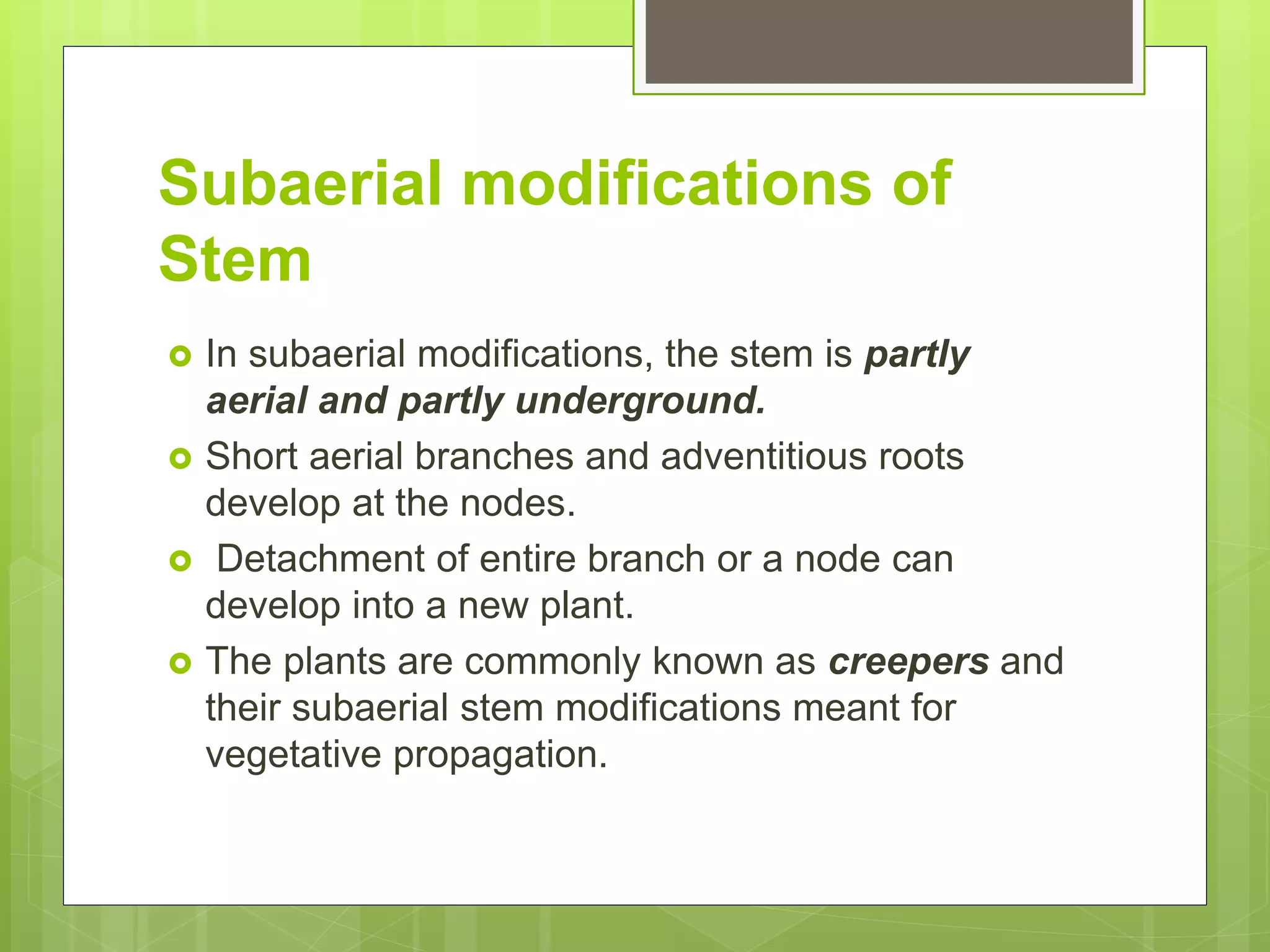
 It is a highly condensed
discoid stem its upper
surface a terminal bud
and many fleshy scale
leaves are present.
 A cluster of adventitious
roots arise from the
base of the bulb.
 E,g. Lilly, Onion Garlic
Corm
 It is a condensed form of
rhizome growing in vertical
direction.
 It is more or less spherical with
a flattered base.
 The corm has distinct circular
nodes and internodes.
 Examples- colocasia,
Amorphophallus.
Tuber
 Stem tuber is a swollen tip
of an underground lateral
Stem (Stolon).
 It is covered by a number
small depressions called
eyes’.
 Each eye represents a
node, bearing one or more
buds subtended by a leaf
scar
 Adventitious roots are
usually absent e.g., Potato.
Subaerial modifications of
Stem
 In subaerial modifications, the stem is partly
aerial and partly underground.
 Short aerial branches and adventitious roots
develop at the nodes.
 Detachment of entire branch or a node can
develop into a new plant.
 The plants are commonly known as creepers and
their subaerial stem modifications meant for
vegetative propagation.
Runner
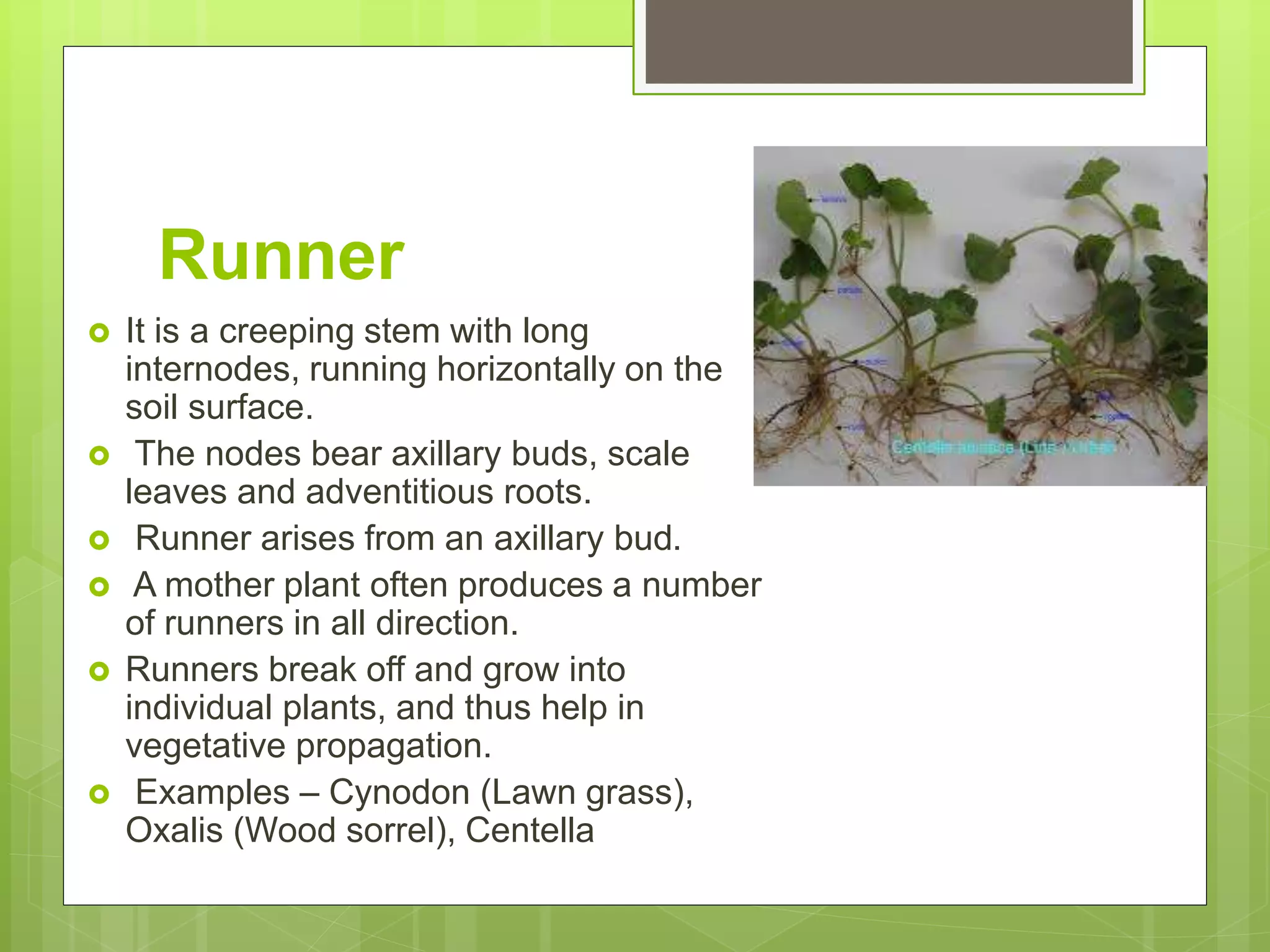
 It is a creeping stem with long
internodes, running horizontally on the
soil surface.
 The nodes bear axillary buds, scale
leaves and adventitious roots.
 Runner arises from an axillary bud.
 A mother plant often produces a number
of runners in all direction.
 Runners break off and grow into
individual plants, and thus help in
vegetative propagation.
 Examples – Cynodon (Lawn grass),
Oxalis (Wood sorrel), Centella
Sucker
 It arises from the basal,
underground part of the
main stem.
 It grows horizontally for a
distance under the soil and
then emerges obliquely
upwards.
 It develops a leafy shoot
and adventitious roots
before separating from the
mother plant.
 The common sucker-
bearing plants are
Chrysanthemum , Musa
(banana), Mentha
Stolon
 It is a weak lateral branch
that arises from the base
of main stem.
 After growing aerially for
some time it bends
downwards to touch the
ground, where its terminal
bud gives rise to a new
shoot and adventitious
roots.
 The common stolon
bearing plants are
Jasmine, Colocasia, and
Vallisneria
Offset
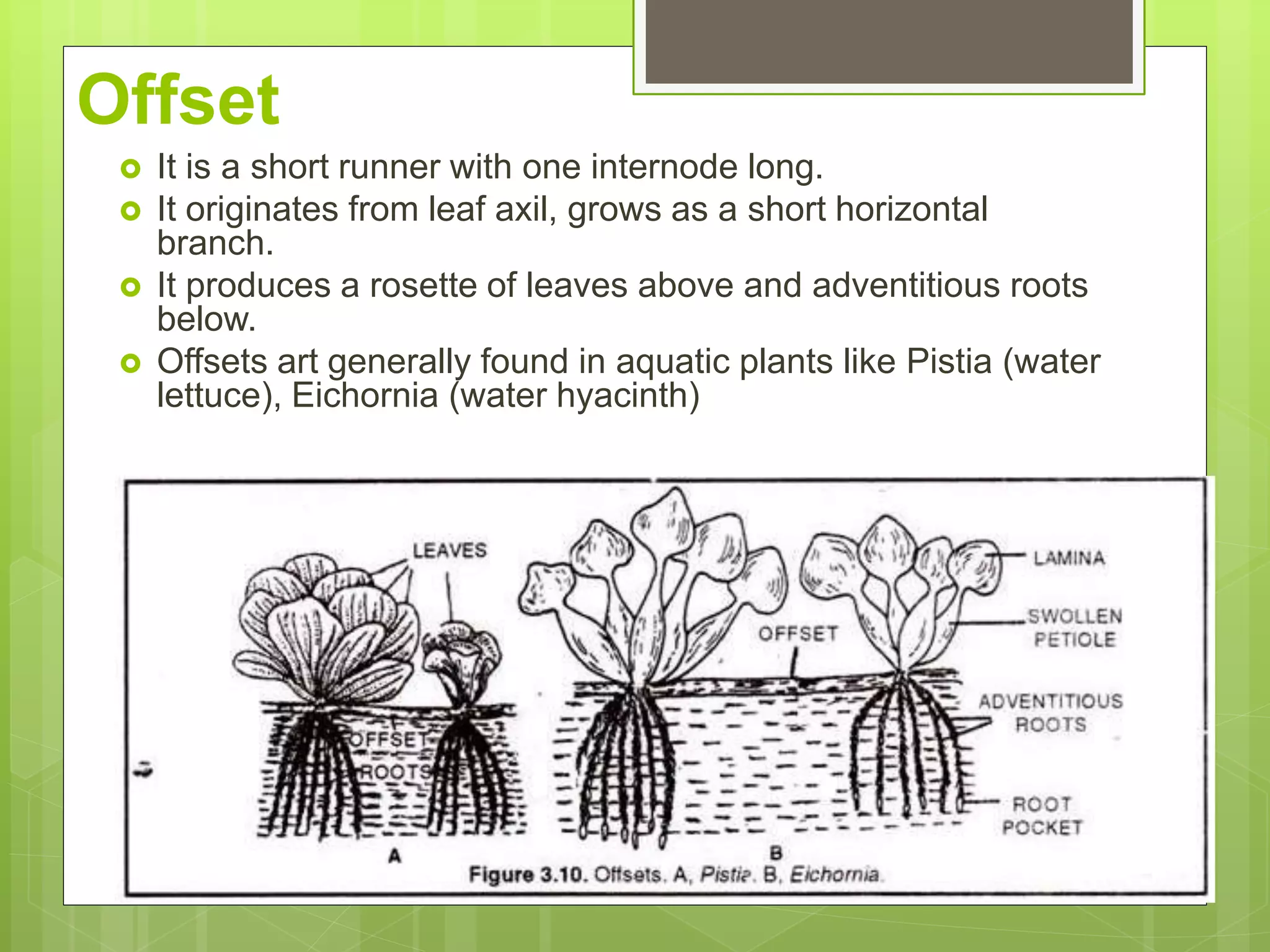
 It is a short runner with one internode long.
 It originates from leaf axil, grows as a short horizontal
branch.
 It produces a rosette of leaves above and adventitious roots
below.
 Offsets art generally found in aquatic plants like Pistia (water
lettuce), Eichornia (water hyacinth)
Aerial modifications of Stem
 In certain plants, the aerial stem or buds get
modified to perform special functions like
climbing, protection, food storage, vegetative
propagation etc.
Stem tendrils
 Stem or its branches get modified into green thread like leafless
structures called tendrils which are meant for climbing.
 These may be branched or un-branched
 Stem tendrils are of four types:
 Axillary tendrils-e.g., Passiflora
 Extra-axillary tendrils-e.g., Cucurbita, Luffa
 Leaf-opposed or Apical bud tendrils, e.g., Grapevine (Vitis)
 Floral bud or Inflorescence tendrils – e.g., Antigonon, Cardiospermum
Thorns
 These are straight, pointed, hard or woody
structures sometimes they bear leaves, flowers or
even may be branched. E.g.Citrus
 Thorns are used as organs of defence or climbing
(e.g. Bougainvillea) and check transpiration
Phylloclades
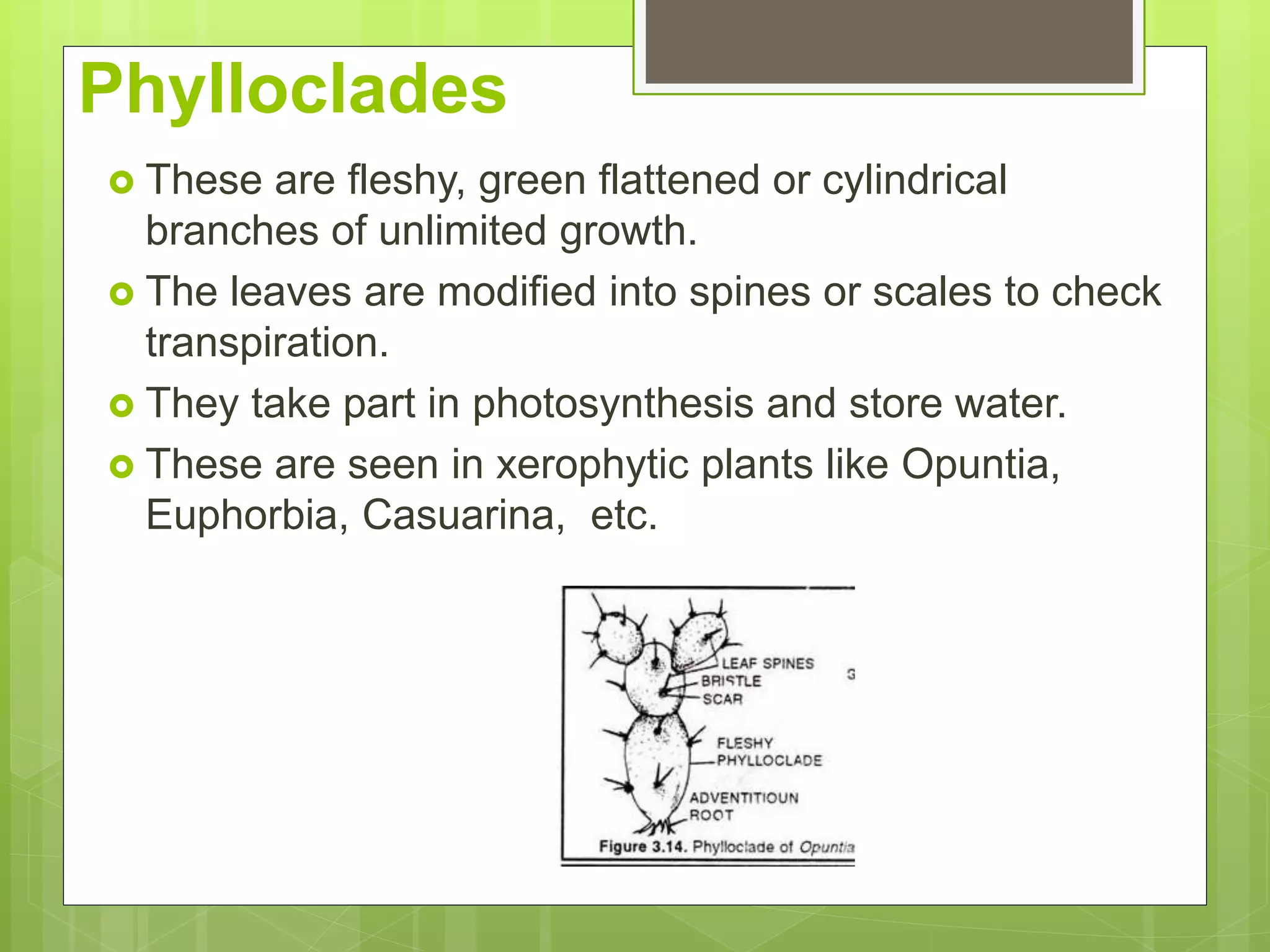
 These are fleshy, green flattened or cylindrical
branches of unlimited growth.
 The leaves are modified into spines or scales to check
transpiration.
 They take part in photosynthesis and store water.
 These are seen in xerophytic plants like Opuntia,
Euphorbia, Casuarina, etc.
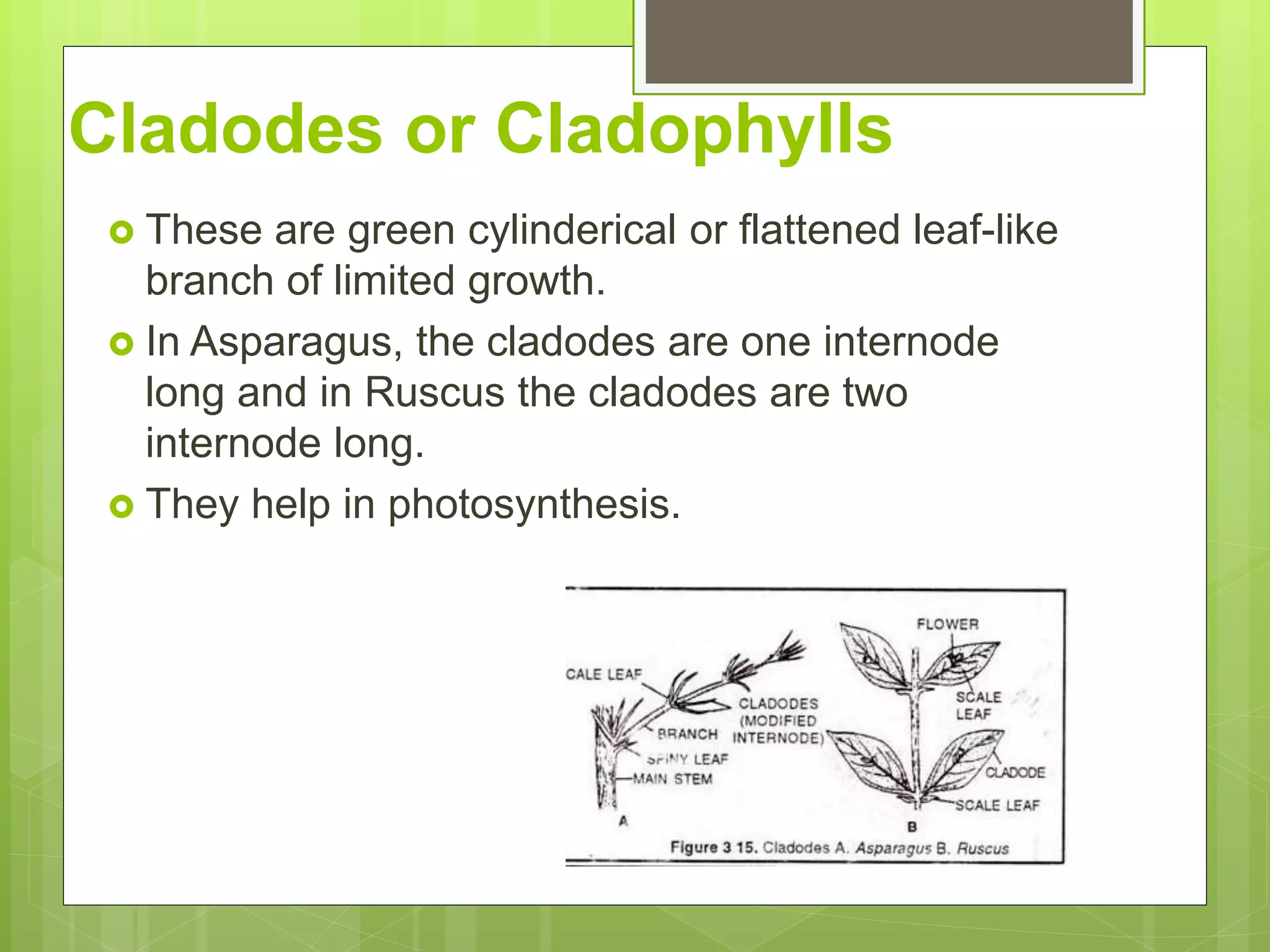
Cladodes or Cladophylls
 These are green cylinderical or flattened leaf-like
branch of limited growth.
 In Asparagus, the cladodes are one internode
long and in Ruscus the cladodes are two
internode long.
 They help in photosynthesis.
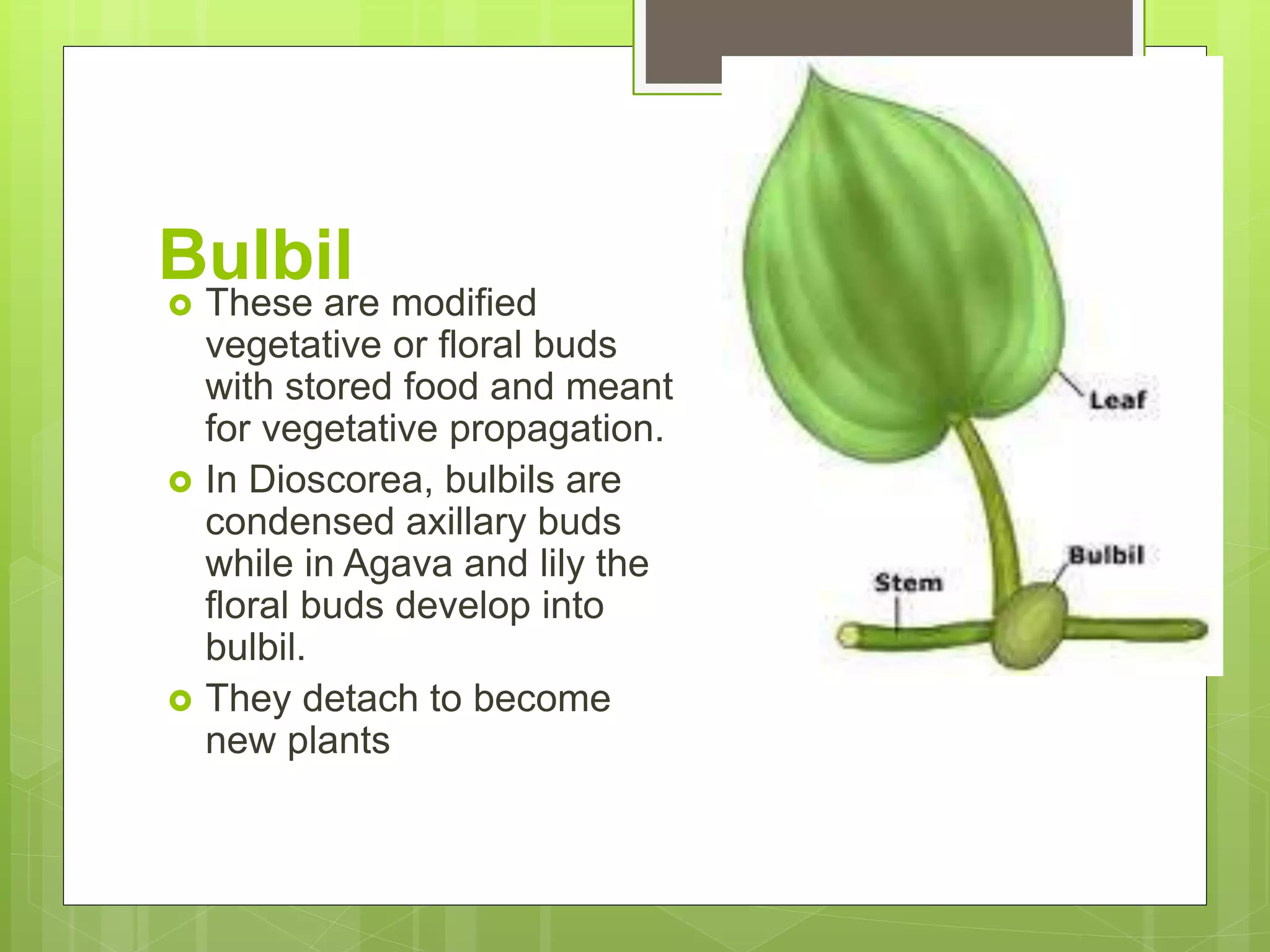
Bulbil
 These are modified
vegetative or floral buds
with stored food and meant
for vegetative propagation.
 In Dioscorea, bulbils are
condensed axillary buds
while in Agava and lily the
floral buds develop into
bulbil.
 They detach to become
new plants
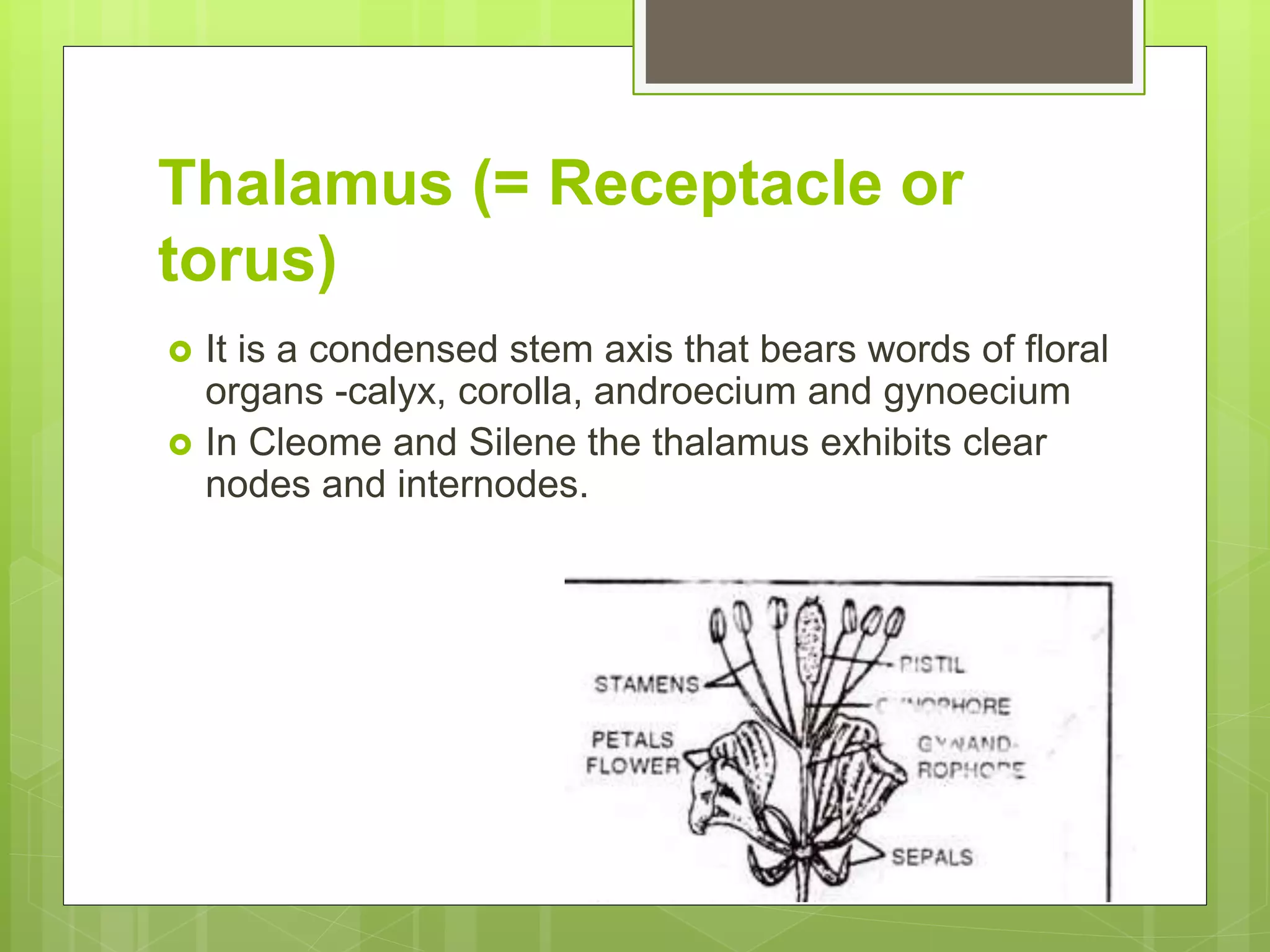
Thalamus (= Receptacle or
torus)
 It is a condensed stem axis that bears words of floral
organs -calyx, corolla, androecium and gynoecium
 In Cleome and Silene the thalamus exhibits clear
nodes and internodes.
ROOT MODIFICATIONS
 Root is said to be the part of a plant which
remains inside the soil.
 But there are subaerial as well as aerial roots
also.
 Root is a positively geotropic part of the plant
having a root cap and many unicellular root
hairs.
 Roots sometimes have
special functions to
perform and in such
cases their form and
structure differ from
those of normal roots.
 The modified roots may
be underground or
aerial.
Tap Root Modifications
 In some plants the tap roots store reserve
food for which they become swollen and
assume different shapes.
 Fusiform
 Napiform
 Conical
 Tuberous or tubercular
 Pneumatophores:
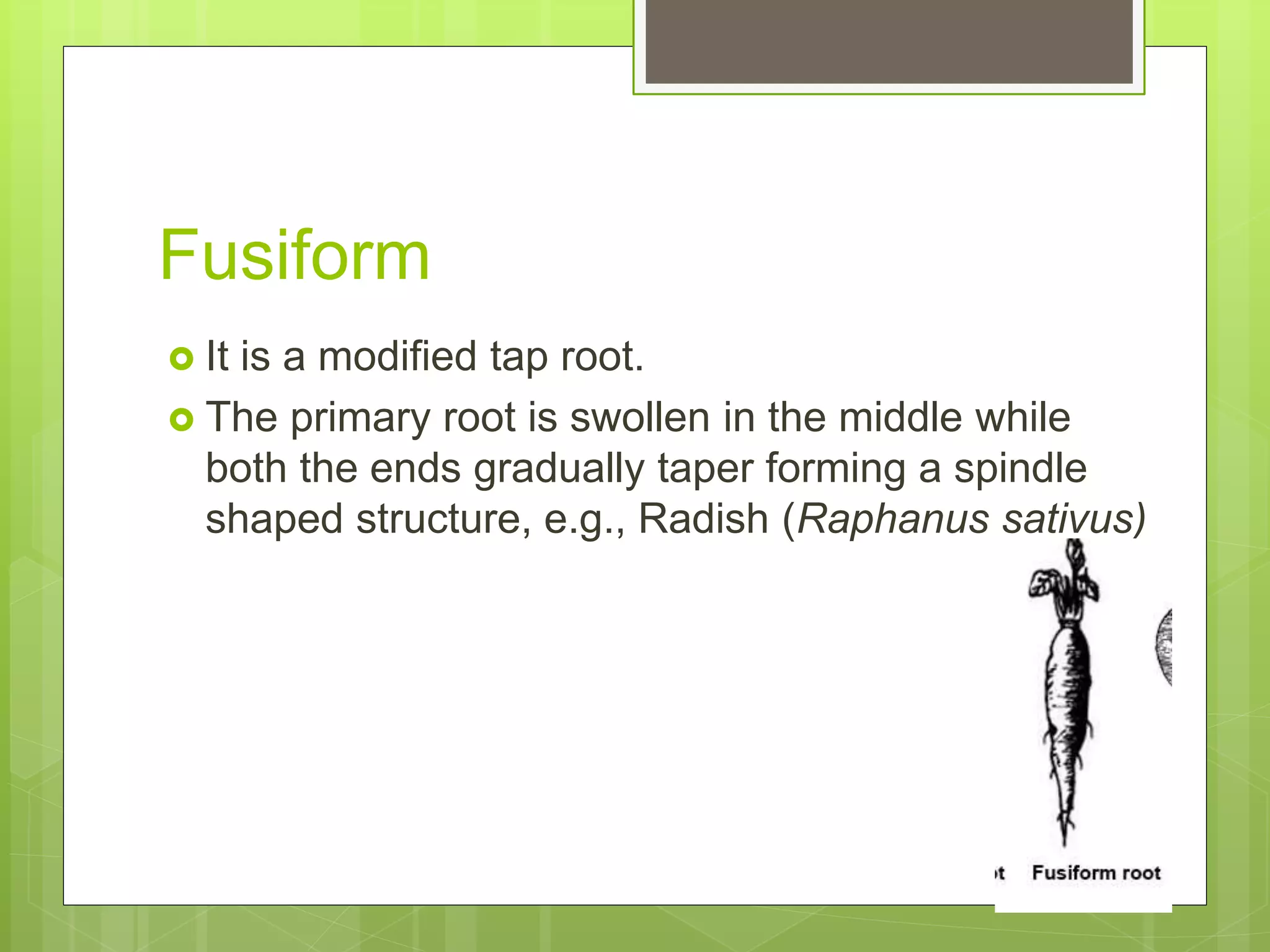
Fusiform
 It is a modified tap root.
 The primary root is swollen in the middle while
both the ends gradually taper forming a spindle
shaped structure, e.g., Radish (Raphanus sativus)
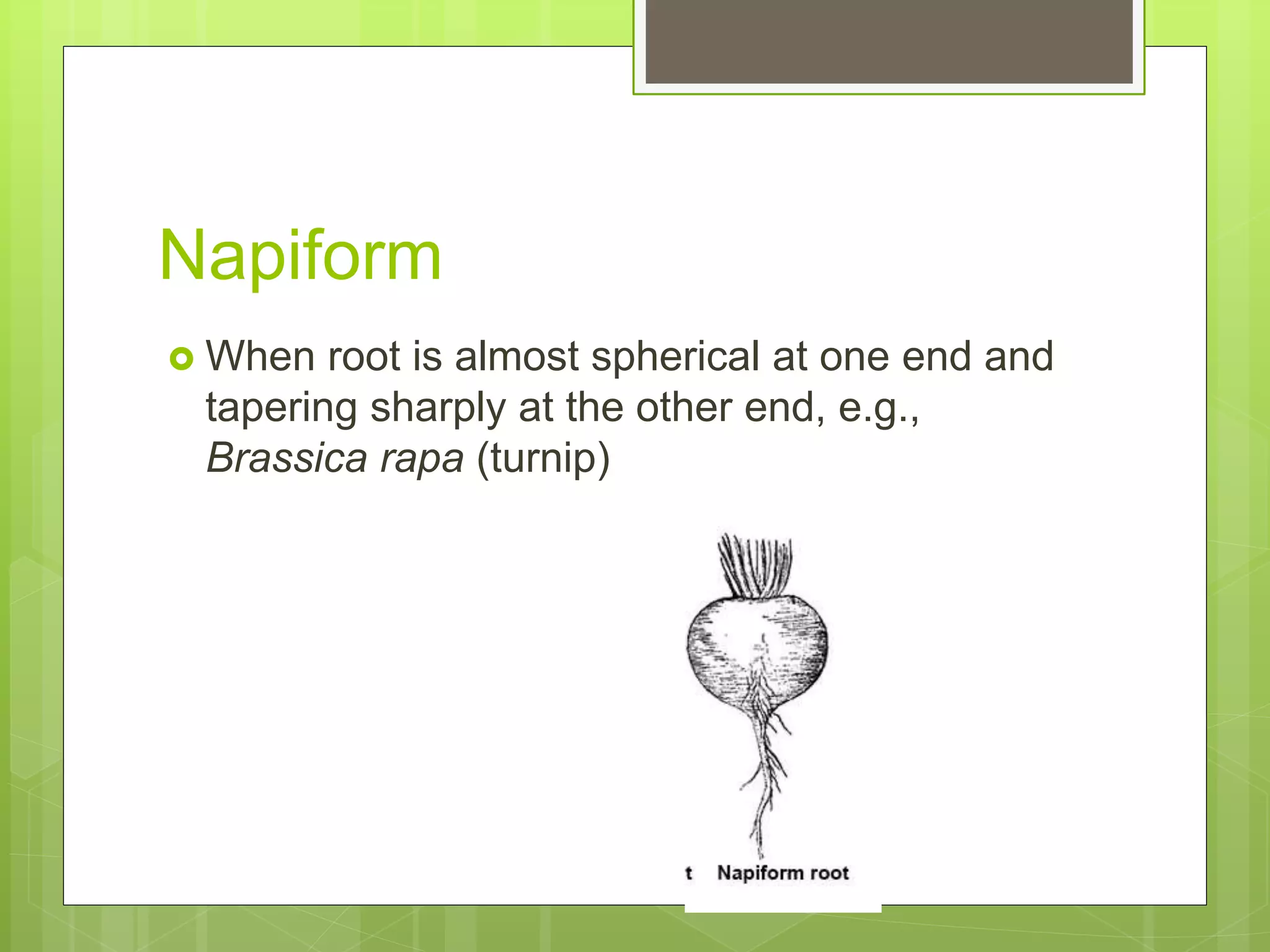
Napiform
 When root is almost spherical at one end and
tapering sharply at the other end, e.g.,
Brassica rapa (turnip)
Conical root
 Root which appears like a cone, i.e., broad at
the base and tapering gradually into a pointed
end, e.g., Daucas carota (carrot)
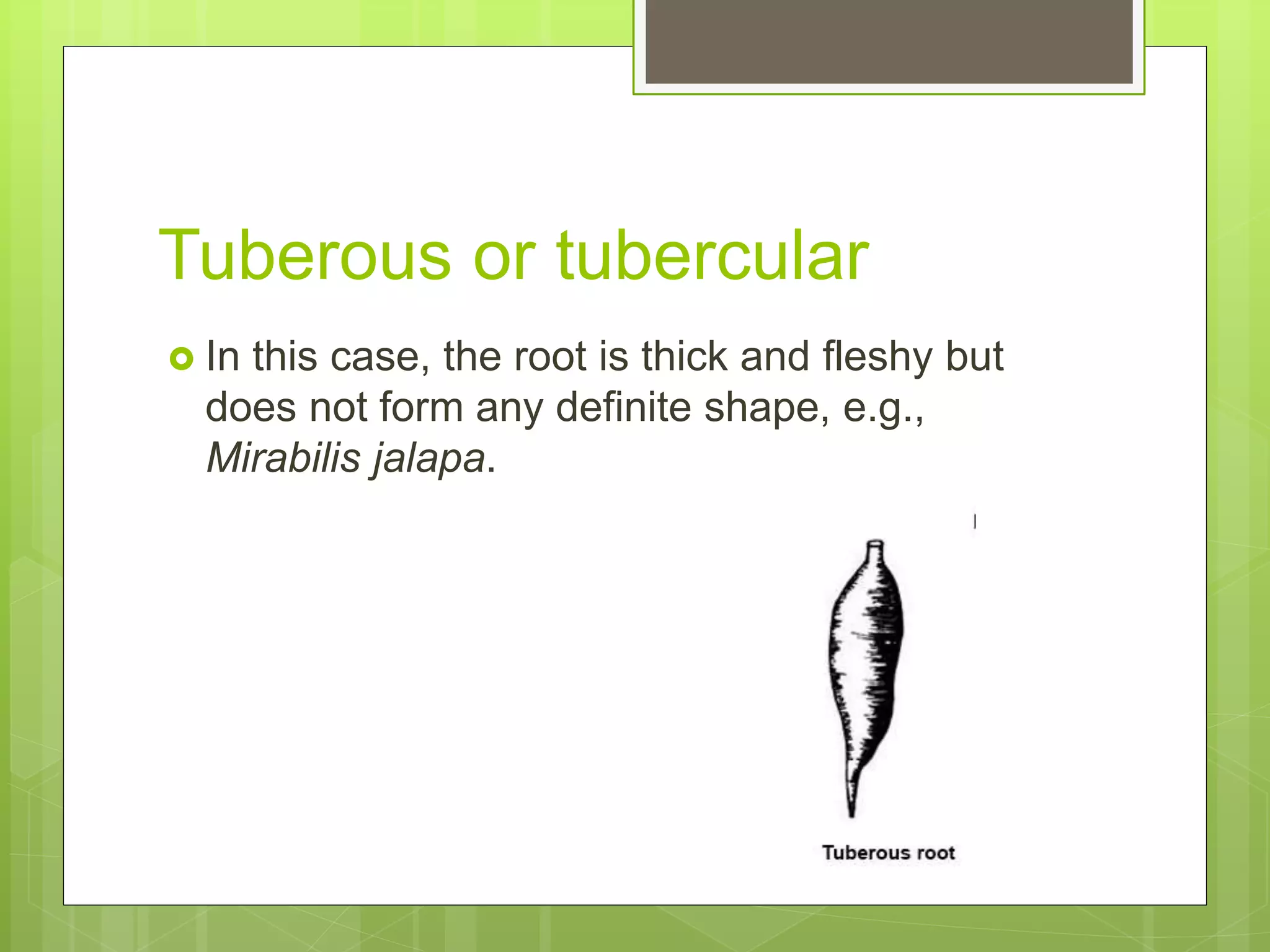
Tuberous or tubercular
 In this case, the root is thick and fleshy but
does not form any definite shape, e.g.,
Mirabilis jalapa.
Pneumatophores
 These roots grow vertically up
and come out of the water or
marshy soil like conical spikes.
 They occur in large numbers
around the tree trunk.
 Such roots are provided with
numerous pores (breathing
pores) through which air is
taken for respiration, e.g.,
Rhizophora.
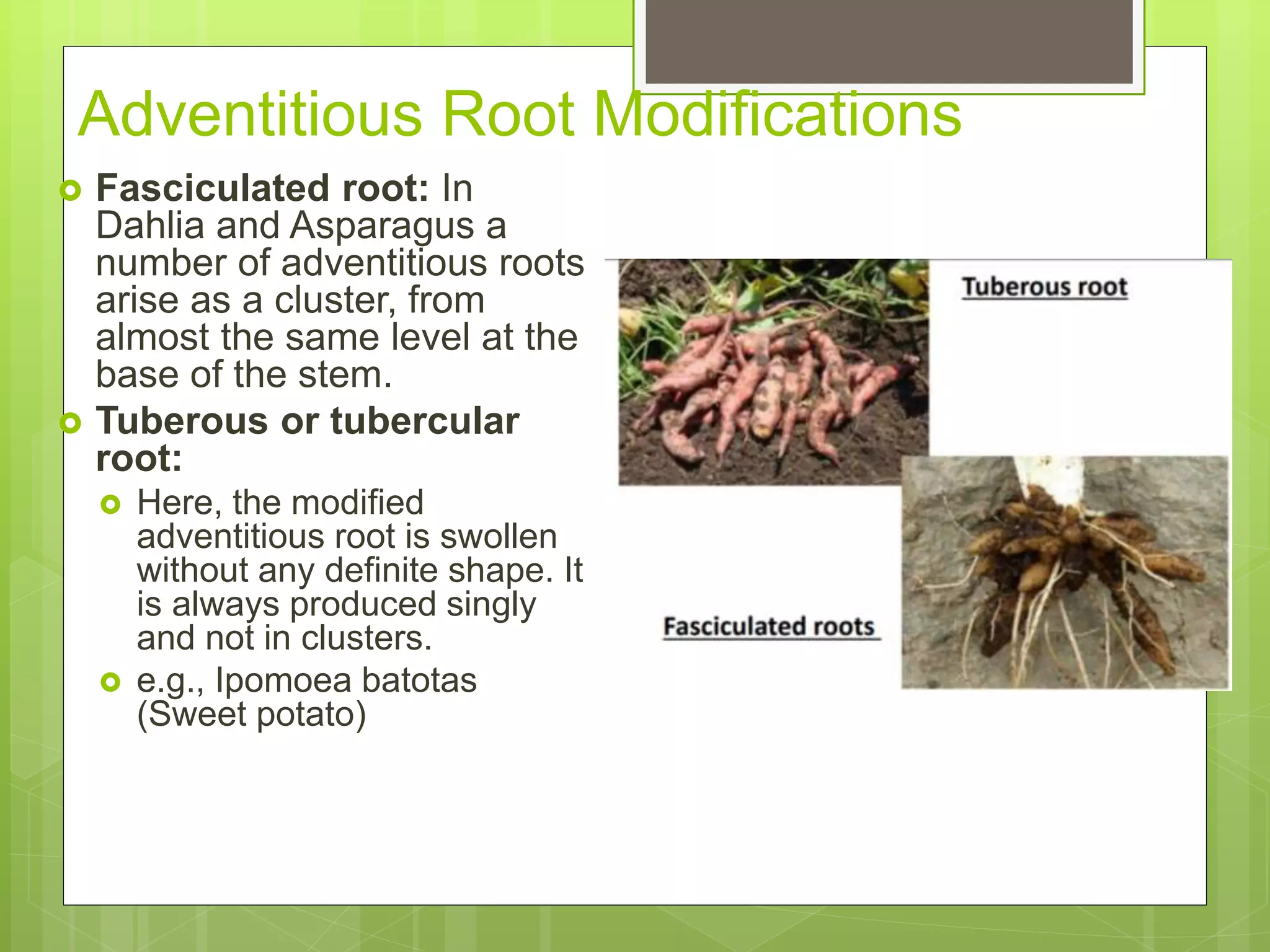
Adventitious Root Modifications
 Fasciculated root: In
Dahlia and Asparagus a
number of adventitious roots
arise as a cluster, from
almost the same level at the
base of the stem.
 Tuberous or tubercular
root:
 Here, the modified
adventitious root is swollen
without any definite shape. It
is always produced singly
and not in clusters.
 e.g., Ipomoea batotas
(Sweet potato)
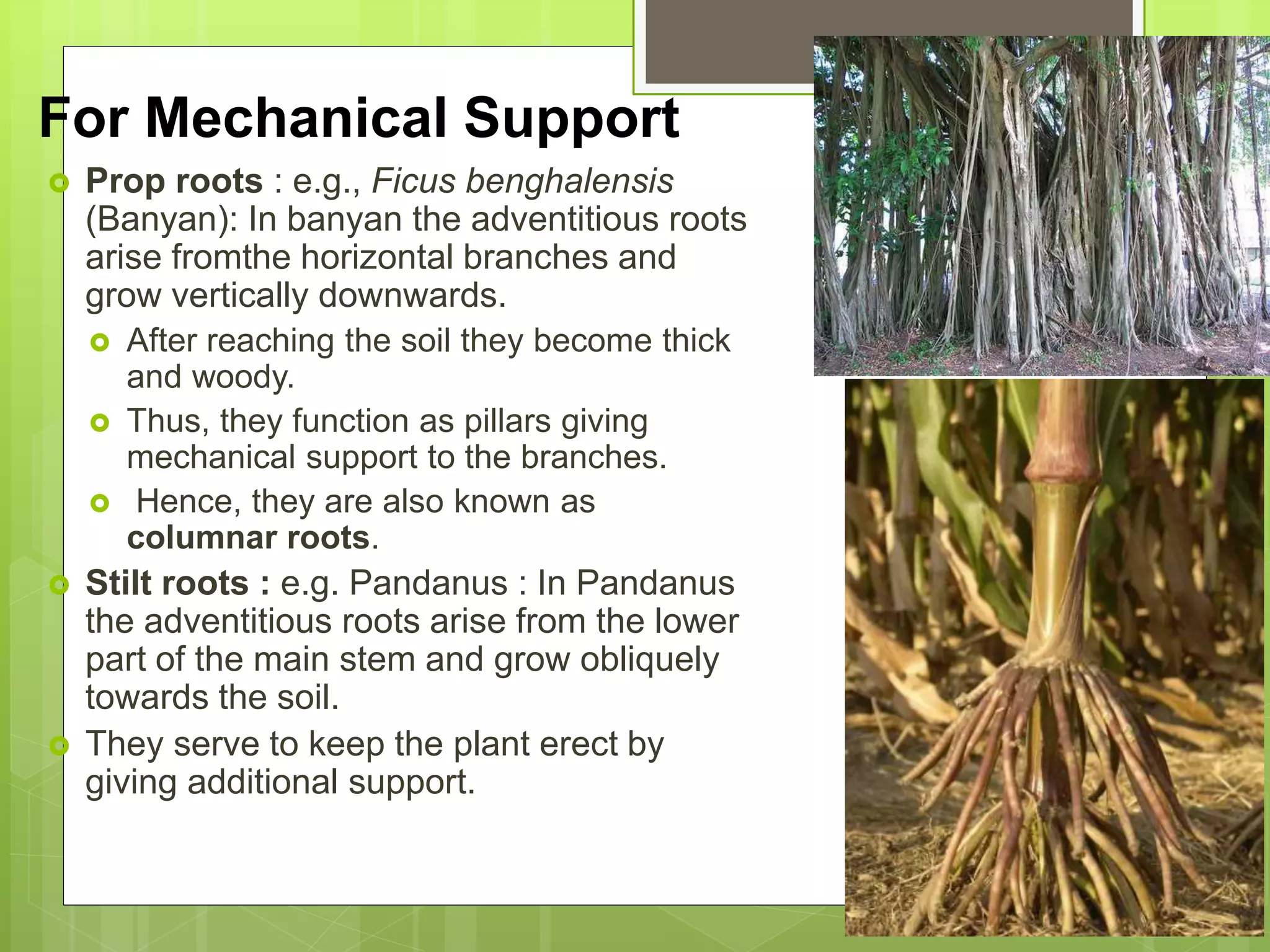
 Nodulose roots e.g., Curcuma amada, (mango ginger)Here, the root
becomes swollen at its tip.
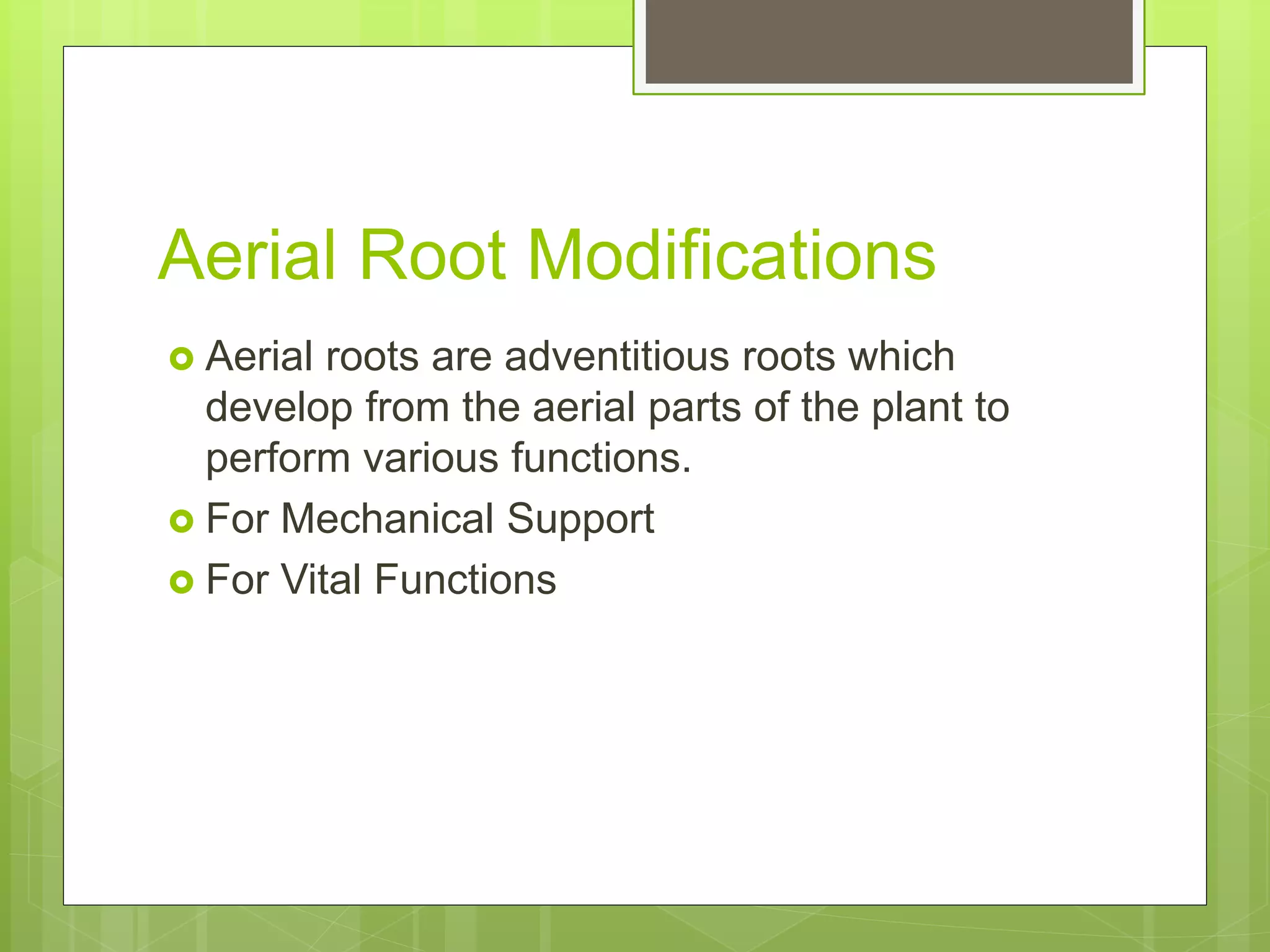
 Moniliform roots e.g., Momordica. Here, the roots show beadlike
swellings at frequent intervals.
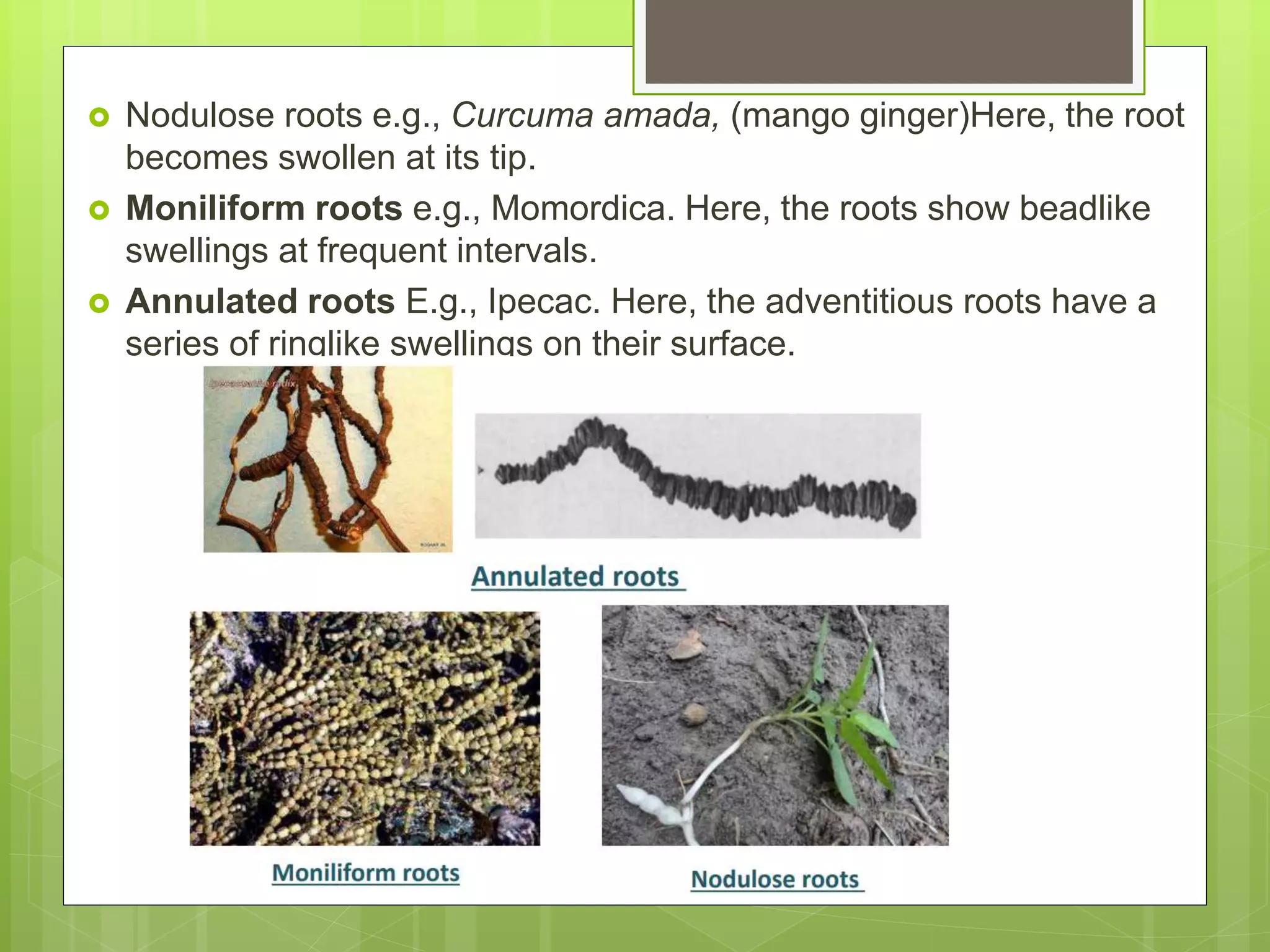
 Annulated roots E.g., Ipecac. Here, the adventitious roots have a
series of ringlike swellings on their surface.
Aerial Root Modifications
 Aerial roots are adventitious roots which
develop from the aerial parts of the plant to
perform various functions.
 For Mechanical Support
 For Vital Functions
For Mechanical Support
 Prop roots : e.g., Ficus benghalensis
(Banyan): In banyan the adventitious roots
arise fromthe horizontal branches and
grow vertically downwards.
 After reaching the soil they become thick
and woody.
 Thus, they function as pillars giving
mechanical support to the branches.
 Hence, they are also known as
columnar roots.
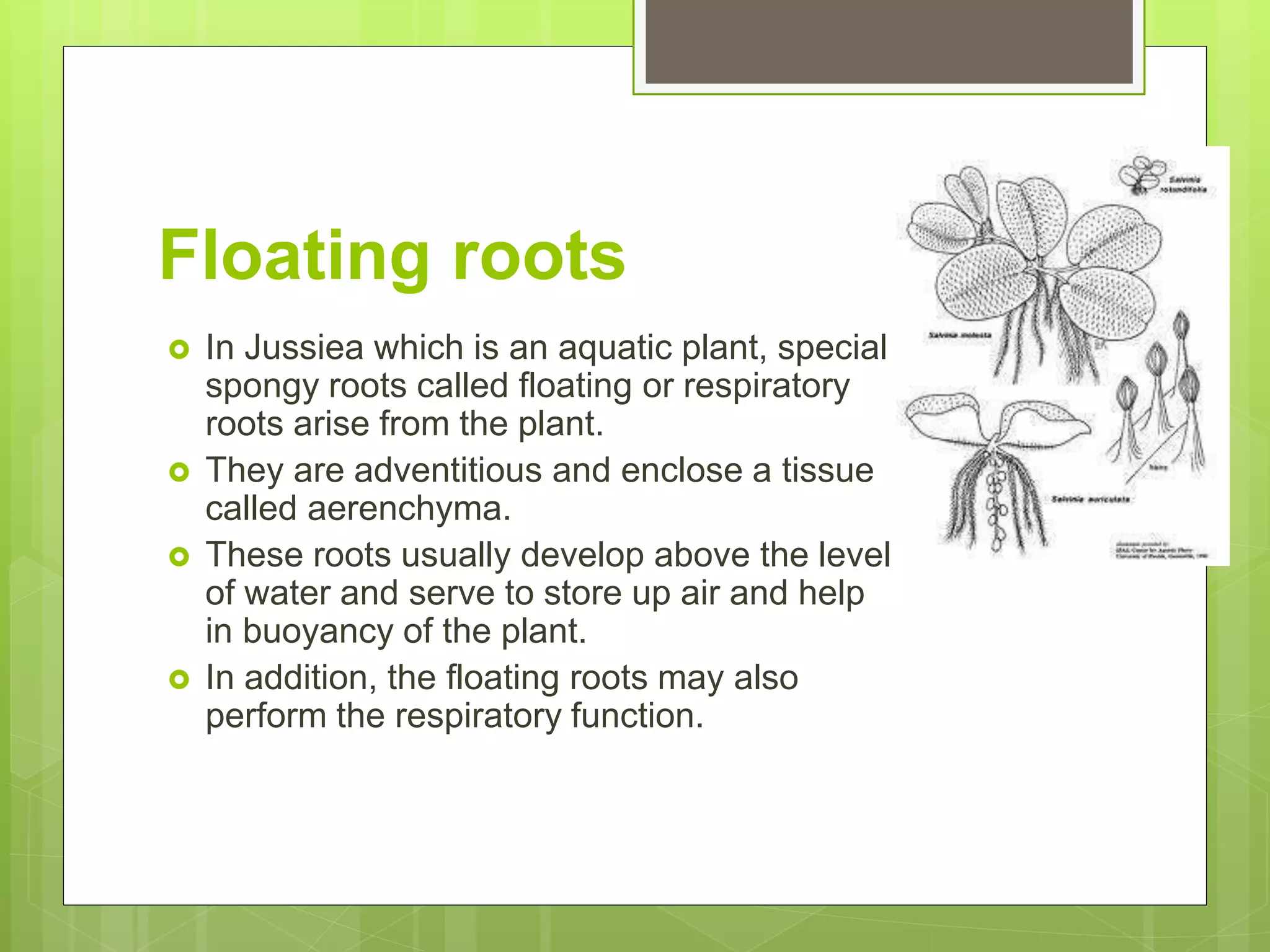
 Stilt roots : e.g. Pandanus : In Pandanus
the adventitious roots arise from the lower
part of the main stem and grow obliquely
towards the soil.
 They serve to keep the plant erect by
giving additional support.
 Climbing roots: e.g., Piper betel, : These roots
arise from the nodes and help in attaching the
climbing stem firmly to a support like a tree or a
wall, by various mechanisms.
Haustoria or sucking roots
 e.g. Cuscuta : Parasites like
Cuscuta develop a kind of root
which penetrates into the tissue
of the host plant and help to
draw nutrients from the host by
sucking it.
 The parasitic plants are not
completely equipped to prepare
their food.
 Hence, such plants have to
depend on host plants for
nutrients.
Floating roots
 In Jussiea which is an aquatic plant, special
spongy roots called floating or respiratory
roots arise from the plant.
 They are adventitious and enclose a tissue
called aerenchyma.
 These roots usually develop above the level
of water and serve to store up air and help
in buoyancy of the plant.
 In addition, the floating roots may also
perform the respiratory function.
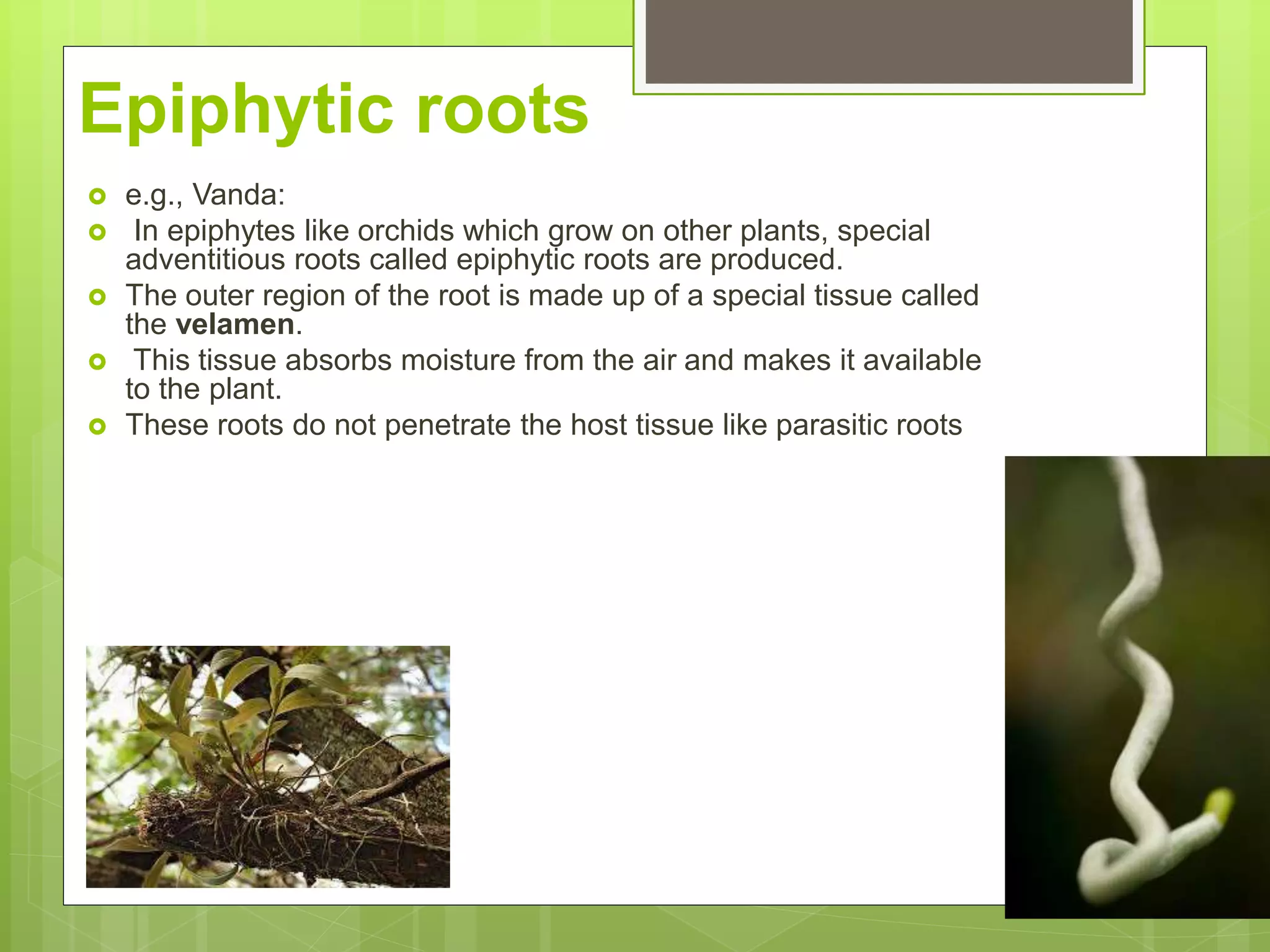
Epiphytic roots
 e.g., Vanda:
 In epiphytes like orchids which grow on other plants, special
adventitious roots called epiphytic roots are produced.
 The outer region of the root is made up of a special tissue called
the velamen.
 This tissue absorbs moisture from the air and makes it available
to the plant.
 These roots do not penetrate the host tissue like parasitic roots

plant part modifications.pptx

  • 1.
  • 2.
     Some ofthe most important types of modifications of stem are as follows:  I. Underground modifications of Stem  II. Subaerial modifications of Stem  III. Aerial modifications of Stem.w STEM MODIFICAIONS
  • 3.
    Underground modifications of Stem Many plants produce underground stems for perennation and food storage. They produce aerial shoots annually.  Although they resemble roots superficially but can be; distinguishable from roots by the presence of following features:  Presence of nodes and internodes  Presence of scale leaves, buds and adventitious roots at the nodes.  Internal structure resembles that of aerial stem and not of root.
  • 4.
    Rhizome  Fleshy, non-green undergroundstem.  Distinct nodes and internodes.  Nodes bear dry scale leaves with axillary buds.  Terminal buds also present.  Adventitious roots arise from the lower side.  e.g. Ginger, turmeric, Canna etc
  • 5.
    Bulb  It isa highly condensed discoid stem its upper surface a terminal bud and many fleshy scale leaves are present.  A cluster of adventitious roots arise from the base of the bulb.  E,g. Lilly, Onion Garlic
  • 6.
    Corm  It isa condensed form of rhizome growing in vertical direction.  It is more or less spherical with a flattered base.  The corm has distinct circular nodes and internodes.  Examples- colocasia, Amorphophallus.
  • 7.
    Tuber  Stem tuberis a swollen tip of an underground lateral Stem (Stolon).  It is covered by a number small depressions called eyes’.  Each eye represents a node, bearing one or more buds subtended by a leaf scar  Adventitious roots are usually absent e.g., Potato.
  • 8.
    Subaerial modifications of Stem In subaerial modifications, the stem is partly aerial and partly underground.  Short aerial branches and adventitious roots develop at the nodes.  Detachment of entire branch or a node can develop into a new plant.  The plants are commonly known as creepers and their subaerial stem modifications meant for vegetative propagation.
  • 9.
    Runner  It isa creeping stem with long internodes, running horizontally on the soil surface.  The nodes bear axillary buds, scale leaves and adventitious roots.  Runner arises from an axillary bud.  A mother plant often produces a number of runners in all direction.  Runners break off and grow into individual plants, and thus help in vegetative propagation.  Examples – Cynodon (Lawn grass), Oxalis (Wood sorrel), Centella
  • 10.
    Sucker  It arisesfrom the basal, underground part of the main stem.  It grows horizontally for a distance under the soil and then emerges obliquely upwards.  It develops a leafy shoot and adventitious roots before separating from the mother plant.  The common sucker- bearing plants are Chrysanthemum , Musa (banana), Mentha
  • 11.
    Stolon  It isa weak lateral branch that arises from the base of main stem.  After growing aerially for some time it bends downwards to touch the ground, where its terminal bud gives rise to a new shoot and adventitious roots.  The common stolon bearing plants are Jasmine, Colocasia, and Vallisneria
  • 12.
    Offset  It isa short runner with one internode long.  It originates from leaf axil, grows as a short horizontal branch.  It produces a rosette of leaves above and adventitious roots below.  Offsets art generally found in aquatic plants like Pistia (water lettuce), Eichornia (water hyacinth)
  • 13.
    Aerial modifications ofStem  In certain plants, the aerial stem or buds get modified to perform special functions like climbing, protection, food storage, vegetative propagation etc.
  • 14.
    Stem tendrils  Stemor its branches get modified into green thread like leafless structures called tendrils which are meant for climbing.  These may be branched or un-branched  Stem tendrils are of four types:  Axillary tendrils-e.g., Passiflora  Extra-axillary tendrils-e.g., Cucurbita, Luffa  Leaf-opposed or Apical bud tendrils, e.g., Grapevine (Vitis)  Floral bud or Inflorescence tendrils – e.g., Antigonon, Cardiospermum
  • 15.
    Thorns  These arestraight, pointed, hard or woody structures sometimes they bear leaves, flowers or even may be branched. E.g.Citrus  Thorns are used as organs of defence or climbing (e.g. Bougainvillea) and check transpiration
  • 16.
    Phylloclades  These arefleshy, green flattened or cylindrical branches of unlimited growth.  The leaves are modified into spines or scales to check transpiration.  They take part in photosynthesis and store water.  These are seen in xerophytic plants like Opuntia, Euphorbia, Casuarina, etc.
  • 17.
    Cladodes or Cladophylls These are green cylinderical or flattened leaf-like branch of limited growth.  In Asparagus, the cladodes are one internode long and in Ruscus the cladodes are two internode long.  They help in photosynthesis.
  • 18.
    Bulbil  These aremodified vegetative or floral buds with stored food and meant for vegetative propagation.  In Dioscorea, bulbils are condensed axillary buds while in Agava and lily the floral buds develop into bulbil.  They detach to become new plants
  • 19.
    Thalamus (= Receptacleor torus)  It is a condensed stem axis that bears words of floral organs -calyx, corolla, androecium and gynoecium  In Cleome and Silene the thalamus exhibits clear nodes and internodes.
  • 20.
    ROOT MODIFICATIONS  Rootis said to be the part of a plant which remains inside the soil.  But there are subaerial as well as aerial roots also.  Root is a positively geotropic part of the plant having a root cap and many unicellular root hairs.
  • 21.
     Roots sometimeshave special functions to perform and in such cases their form and structure differ from those of normal roots.  The modified roots may be underground or aerial.
  • 22.
    Tap Root Modifications In some plants the tap roots store reserve food for which they become swollen and assume different shapes.  Fusiform  Napiform  Conical  Tuberous or tubercular  Pneumatophores:
  • 23.
    Fusiform  It isa modified tap root.  The primary root is swollen in the middle while both the ends gradually taper forming a spindle shaped structure, e.g., Radish (Raphanus sativus)
  • 24.
    Napiform  When rootis almost spherical at one end and tapering sharply at the other end, e.g., Brassica rapa (turnip)
  • 25.
    Conical root  Rootwhich appears like a cone, i.e., broad at the base and tapering gradually into a pointed end, e.g., Daucas carota (carrot)
  • 26.
    Tuberous or tubercular In this case, the root is thick and fleshy but does not form any definite shape, e.g., Mirabilis jalapa.
  • 27.
    Pneumatophores  These rootsgrow vertically up and come out of the water or marshy soil like conical spikes.  They occur in large numbers around the tree trunk.  Such roots are provided with numerous pores (breathing pores) through which air is taken for respiration, e.g., Rhizophora.
  • 28.
    Adventitious Root Modifications Fasciculated root: In Dahlia and Asparagus a number of adventitious roots arise as a cluster, from almost the same level at the base of the stem.  Tuberous or tubercular root:  Here, the modified adventitious root is swollen without any definite shape. It is always produced singly and not in clusters.  e.g., Ipomoea batotas (Sweet potato)
  • 29.
     Nodulose rootse.g., Curcuma amada, (mango ginger)Here, the root becomes swollen at its tip.  Moniliform roots e.g., Momordica. Here, the roots show beadlike swellings at frequent intervals.  Annulated roots E.g., Ipecac. Here, the adventitious roots have a series of ringlike swellings on their surface.
  • 30.
    Aerial Root Modifications Aerial roots are adventitious roots which develop from the aerial parts of the plant to perform various functions.  For Mechanical Support  For Vital Functions
  • 31.
    For Mechanical Support Prop roots : e.g., Ficus benghalensis (Banyan): In banyan the adventitious roots arise fromthe horizontal branches and grow vertically downwards.  After reaching the soil they become thick and woody.  Thus, they function as pillars giving mechanical support to the branches.  Hence, they are also known as columnar roots.  Stilt roots : e.g. Pandanus : In Pandanus the adventitious roots arise from the lower part of the main stem and grow obliquely towards the soil.  They serve to keep the plant erect by giving additional support.
  • 32.
     Climbing roots:e.g., Piper betel, : These roots arise from the nodes and help in attaching the climbing stem firmly to a support like a tree or a wall, by various mechanisms.
  • 33.
    Haustoria or suckingroots  e.g. Cuscuta : Parasites like Cuscuta develop a kind of root which penetrates into the tissue of the host plant and help to draw nutrients from the host by sucking it.  The parasitic plants are not completely equipped to prepare their food.  Hence, such plants have to depend on host plants for nutrients.
  • 34.
    Floating roots  InJussiea which is an aquatic plant, special spongy roots called floating or respiratory roots arise from the plant.  They are adventitious and enclose a tissue called aerenchyma.  These roots usually develop above the level of water and serve to store up air and help in buoyancy of the plant.  In addition, the floating roots may also perform the respiratory function.
  • 35.
    Epiphytic roots  e.g.,Vanda:  In epiphytes like orchids which grow on other plants, special adventitious roots called epiphytic roots are produced.  The outer region of the root is made up of a special tissue called the velamen.  This tissue absorbs moisture from the air and makes it available to the plant.  These roots do not penetrate the host tissue like parasitic roots