The Five Good
Emperors
Nerva, Trajan,
Hadrian, Antonius
Pius, and Marcus
Aurelius
Nerva (96-98 CE)
 Appointed emperor by
Domitian’s assassins
 Swore to never execute a
Roman senator and to deal with
senate as a legitmate political
body
 Spent lavish amounts of money
to secure public goodwill, such
as tax breaks for the poorest
Roman families
 Completed many public projects
begun by Domitian while actively
seeking to destroy his
predecessor’s good name
 Survived a rebellious abduction
by the Praetorian Guard by
handing over Domitian’s
assassins and adopting Trajan
as his heir.
Trajan (98-117 CE)
 Took the name Optimus Maximus for
his contributions to the Empire
through his victories on the frontier
and his respectful treatment of the
senate
 Increase the amount free food stuffs
distributed to the poor
 Completed many magnificent and
beneficial public works, such a new
forum, baths, and a large market
 Undertook an overly ambitious war
against Parthia with an eye to
conquering the entire Mesopotamian
region
 During his war with the Parthians, his
health failed and he died of natural
causes while trying to return to
Rome.
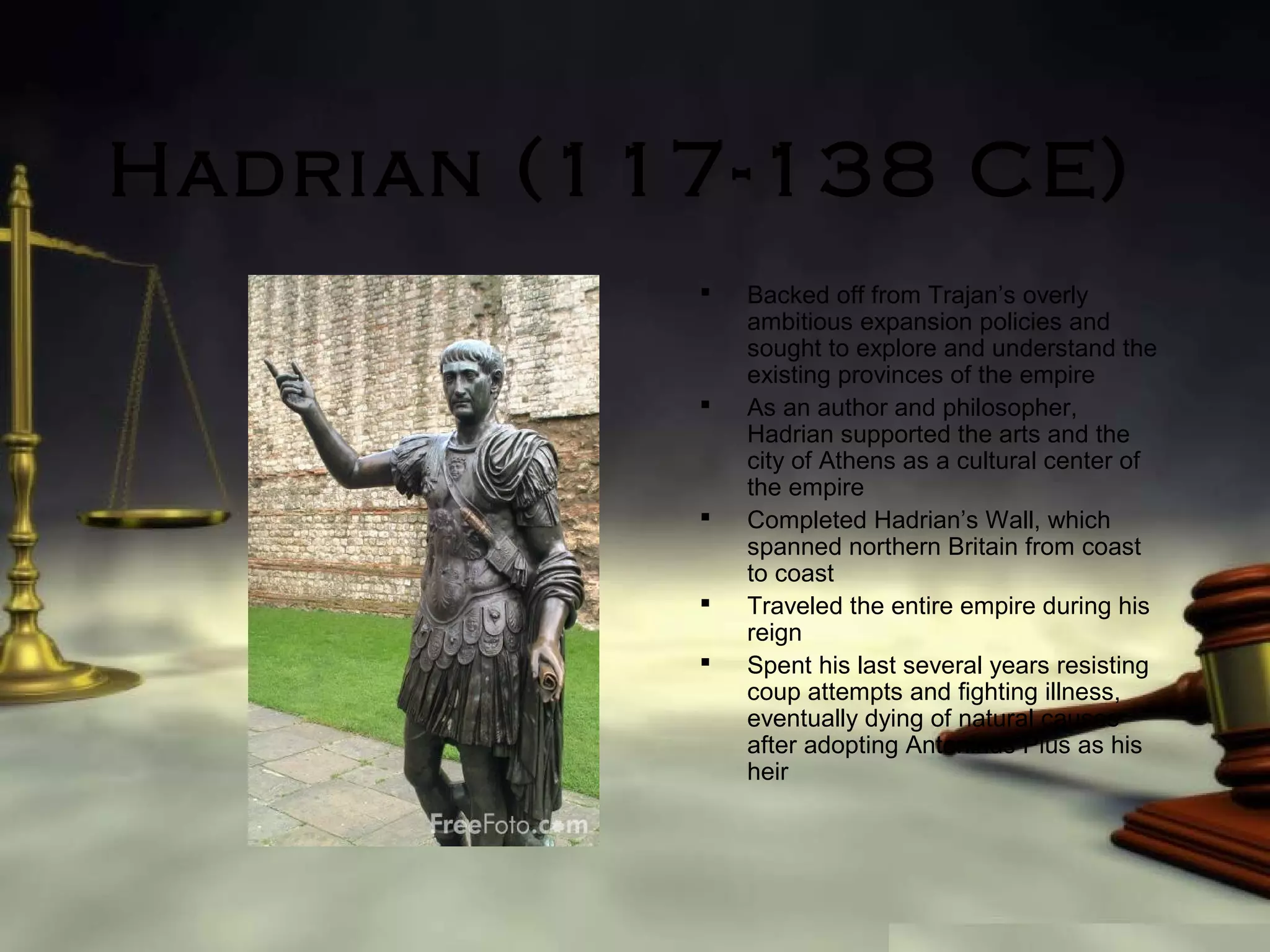
Hadrian (117-138 CE)
 Backed off from Trajan’s overly
ambitious expansion policies and
sought to explore and understand the
existing provinces of the empire
 As an author and philosopher,
Hadrian supported the arts and the
city of Athens as a cultural center of
the empire
 Completed Hadrian’s Wall, which
spanned northern Britain from coast
to coast
 Traveled the entire empire during his
reign
 Spent his last several years resisting
coup attempts and fighting illness,
eventually dying of natural causes
after adopting Antoninus Pius as his
heir
Antoninus Pius (138-
161 CE)
 Earned his nickname “Pius” with his
refusal to put to death those awaiting
execution under Hadrian’s rule
 Improved the bureaucratic functions
of the empire bringing about a
prosperous period for the empire
 Did not make major changes to
Hadrian’s government programs
 Ruled from Rome and dealt with
rebellions and international crises by
delegating responsibility to local
governors
 Threw a celebration of Rome’s 900th
anniversary that were so lavish and
expensive he had to debase the
currency to pay the costs of the
games
 Died of natural causes never having
left Italy during his reign
Marcus Aurelius
(161-180 CE)
 Ruled over very troubled
times for the empire
 Incessant wars in the
provinces
 Plague in the east
 Eminent philosopher and
writer, a true intellectual, he
wrote the famous Meditations
 Very skilled and interested in
law, he earned a reputation
as devoted to justice
 Devoted to defending the
empire, he died from illness
contracted on the German
frontiers
Marcus Aurelius
(161-180 CE)
 Ruled over very troubled
times for the empire
 Incessant wars in the
provinces
 Plague in the east
 Eminent philosopher and
writer, a true intellectual, he
wrote the famous Meditations
 Very skilled and interested in
law, he earned a reputation
as devoted to justice
 Devoted to defending the
empire, he died from illness
contracted on the German
frontiers

Unit Fourteen - 5 Good Emperors

  • 1.
    The Five Good Emperors Nerva,Trajan, Hadrian, Antonius Pius, and Marcus Aurelius
  • 2.
    Nerva (96-98 CE) Appointed emperor by Domitian’s assassins  Swore to never execute a Roman senator and to deal with senate as a legitmate political body  Spent lavish amounts of money to secure public goodwill, such as tax breaks for the poorest Roman families  Completed many public projects begun by Domitian while actively seeking to destroy his predecessor’s good name  Survived a rebellious abduction by the Praetorian Guard by handing over Domitian’s assassins and adopting Trajan as his heir.
  • 3.
    Trajan (98-117 CE) Took the name Optimus Maximus for his contributions to the Empire through his victories on the frontier and his respectful treatment of the senate  Increase the amount free food stuffs distributed to the poor  Completed many magnificent and beneficial public works, such a new forum, baths, and a large market  Undertook an overly ambitious war against Parthia with an eye to conquering the entire Mesopotamian region  During his war with the Parthians, his health failed and he died of natural causes while trying to return to Rome.
  • 4.
    Hadrian (117-138 CE) Backed off from Trajan’s overly ambitious expansion policies and sought to explore and understand the existing provinces of the empire  As an author and philosopher, Hadrian supported the arts and the city of Athens as a cultural center of the empire  Completed Hadrian’s Wall, which spanned northern Britain from coast to coast  Traveled the entire empire during his reign  Spent his last several years resisting coup attempts and fighting illness, eventually dying of natural causes after adopting Antoninus Pius as his heir
  • 5.
    Antoninus Pius (138- 161CE)  Earned his nickname “Pius” with his refusal to put to death those awaiting execution under Hadrian’s rule  Improved the bureaucratic functions of the empire bringing about a prosperous period for the empire  Did not make major changes to Hadrian’s government programs  Ruled from Rome and dealt with rebellions and international crises by delegating responsibility to local governors  Threw a celebration of Rome’s 900th anniversary that were so lavish and expensive he had to debase the currency to pay the costs of the games  Died of natural causes never having left Italy during his reign
  • 6.
    Marcus Aurelius (161-180 CE) Ruled over very troubled times for the empire  Incessant wars in the provinces  Plague in the east  Eminent philosopher and writer, a true intellectual, he wrote the famous Meditations  Very skilled and interested in law, he earned a reputation as devoted to justice  Devoted to defending the empire, he died from illness contracted on the German frontiers
  • 7.
    Marcus Aurelius (161-180 CE) Ruled over very troubled times for the empire  Incessant wars in the provinces  Plague in the east  Eminent philosopher and writer, a true intellectual, he wrote the famous Meditations  Very skilled and interested in law, he earned a reputation as devoted to justice  Devoted to defending the empire, he died from illness contracted on the German frontiers