An Empire Across Three
Continents
A Presentation By:
Arshdeep Kaur
XI- A
 There are innumerable quotes about Rome, which talk
of its greatness, undermining its success or simply
criticizing it. However, one thing is for sure, no one can
ignore it.
In this presentation, we shall see how Rome was established
and what were the circumstances that led to Rome
becoming the greatest empire known to Man, and its
drawbacks, which led to its downfall.
According to the founding myth which was widely
popularized by being taught in schools in Ancient
Rome, Rome was Established on 21st April, 753
BC, by Romulus and Remus. They were born out
of wedlock and hence drowned but saved and
care for by a she-wolf. Romulus killed Remus in a
fight for determining the location of the city they
would found and gave his name to the city.
Another legend says that Prince Aeneas of Troy
lead a group of Trojans by sea to establish a new
Troy but the women refused to travel any further
and Roma set fire to the ships. Later, the city was
named after her.
 The city of Rome grew out of settlements
around a ford on the river Tiber. The city was
founded by the Latin tribe of Italy, over the
Palatine Hill.
 The Etruscans established political control over
the city around the 7th Century BC.
 Except Romulus, all the other kings were elected
by the people of Rome and served for life. The
Senate had most power over the election of the
King.
The Roman King was the Chief
Executive, Chief Legislator, Chief
Priest and the Chief Judge. Rome
was ruled by seven kings, the last
of them being Lucius Tarquinius
Superbus, who was overthrown
by Lucius Junius Brutus
and Lucius Tarquinius
Collatinus, who became the first
Consuls of Rome and the Roman
Republic began in 509 BC.
The above picture shows the
insignia of Roman Kings: The
12 lictors holding fasces with
an axe, the Toga Picta, the
diadem and the Curule chair.
The Roman Republic started with the overthrow of
monarchy in 509 BC, which was replaced by a
government headed my two annually-elected
Consuls, which soon developed into a complex
system of governance based on Checks and
Balances and Separation of Power. During its first
two centuries, it expanded rapidly through conquest
and alliances. At the end of its third, it included the
Italian peninsula, Iberian peninsula, North Africa,
Modern France and much of the Eastern
Mediterranean. Despite constrains, political power
was wielded by Leaders and the era was punctuated
by civil wars. The victor in such a Civil War, Octavian
declared Rome a Principate, with him as the
Princeps.
The Roman Republic was never restored, but neither
was it abolished, so the exact date of the transition
to the Roman Empire is a matter of interpretation.
Historians have variously proposed the appointment
of Julius Caesar as perpetual dictator in 44 BC, the
defeat of Mark Antony at the Battle of Actium in 31
BC, and the Roman Senate’s grant of extraordinary
powers to Octavian under the First Settlement and
his adopting the title Augustus in 27 BC, as the
defining event ending the Republic.
This was followed by the Dominate phase, where the rulers
openly displayed imperial power instead of creating an
illusion of a Republic. This was followed by the Official
Roman Empire ruled by the Julio-Claudian Dynasty.
Though the Roman Republic never really ended, the
transition to an autocratic state was completed gradually.
Augustus, the first “emperor”, took the position that he had
saved the republic. Though Rome was essentially still a
Republic, it was him who took all the final decisions,
backed by military force.
Augustus’ reign lasted for 40 years and was known as the
Golden Age in Augustan literature and art. He laid the
enduring ideological foundation for the next three
centuries of the Roman Empire, known as the Principate
((27 BC–284 AD), the first 200 of which were known as
Pax Romana or Roman Peace ( also Roman Accord or
Treaty)
The success of Augustus in
establishing principles of
dynastic succession was
limited by his outliving a
number of talented potential
heirs. The Julio-Claudian
Dynasty lasted for 4 more
emperors, namely; Tiberius,
Caligula, Claudius and Nero –
before it yielded in 69 AD to
the strife-torn Year of the
Four Emperors, which was
the only disturbance during
the Pax Romana, from which
Vespasian emerged the victor.
The Flavian dynasty consisted of three kings,
namely; Vespasian (69-79 AD), Titus (79-81
AD) and Domitian (81-96 AD). The dynasty,
though short, is known for its
achievements. They include:
 Introduction of Economic Reforms and
currency revaluation.
 Enactment of a massive Building Program.
 Popularization of Gladiatorial Games.
It ended in 96 AD, when Domitian was
assasinated. He was succeeded by his
advisor Marcus Cocceius Nerva, who
founded the long-lived Nervan-Antonian
Dynasty.
The Nerva-Antonine dynasty consisted of seven
emperors who ruled Rome from 96 AD to 192 AD.
It was divided into the Nerva-Trajan and Antonine
Dynasty on the basis of their shared last names.
It gave Rome the Five Good Emperors, namely;
Nerva, Trajan, Hadrian, Antoninus Pius and Marcus
Aurelius.
Their reign was characterized by benevolence and
peace, in contrast to the tyrannical reign of the
emperors before them. The dynasty came to an end
with the assassination of Commodus by his
wrestling partner, which was followed by the Year
of the Five Emperors in193 AD, from which
Septimius Severus emerged victor, starting the
Severus Dynasty
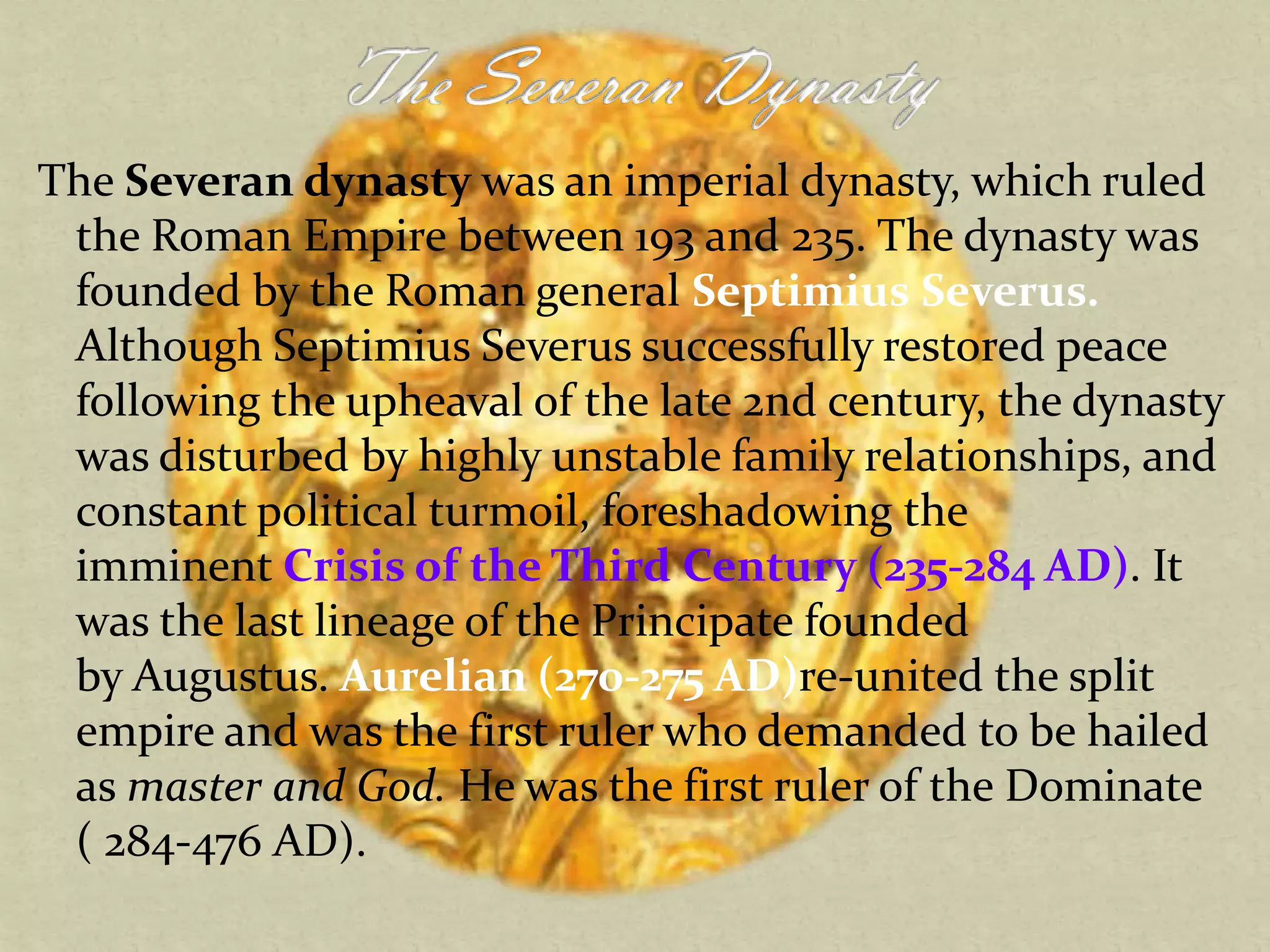
The Severan dynasty was an imperial dynasty, which ruled
the Roman Empire between 193 and 235. The dynasty was
founded by the Roman general Septimius Severus.
Although Septimius Severus successfully restored peace
following the upheaval of the late 2nd century, the dynasty
was disturbed by highly unstable family relationships, and
constant political turmoil, foreshadowing the
imminent Crisis of the Third Century (235-284 AD). It
was the last lineage of the Principate founded
by Augustus. Aurelian (270-275 AD)re-united the split
empire and was the first ruler who demanded to be hailed
as master and God. He was the first ruler of the Dominate
( 284-476 AD).
The Crisis ended with the acession of Diocletian ( 284–305) to
the throne. But the unity of the Empire was just an illusion. He
devised the system of Tetrarchy i.e. The rule of four emperors.
It started in 285 AD, when Diocletian installed his general
Maximilian as his co-emperor, first as Caesar (Junior Emperor)
and then Augustus in 286 AD. In 293, feeling that more focus
was needed on military and civic problems, Diocletian, with
Maximian's consent, expanded the imperial college by
appointing two Caesars (one responsible to each Augustus)-
Galerius and Constantius Chlorus. The system broke down
after 306 and in the end only two Augusti remained.
Constantine defeted Lucius and was the only Augustus in
313AD.
 The Roman Empire began to disintegrate in the
late 4th century as invasions overwhelmed the
capacity of the Empire to govern. The Western
empire ended in 476, when Romulus
Augustulus was forced to abdicate to
the Germanic warlord Odoacer.The empire in
the East—known today as the Byzantine
Empire, ended in 1453 with the death
of Constantine XI and the fall of
Constantinople to the Ottoman Turks.
The language of the Romans was Latin, but was not imposed
officially on peoples brought under Roman rule. Romans who
received an elite education studied Greek as a literary
language, and most men of the governing classes could speak
Greek. The Julio-Claudian emperors encouraged high
standards of correct Latin.
References to interpreters indicate the continuing use of local
languages other than Greek and Latin, particularly in Egypt,
where Coptic predominated, and in military settings along the
Rhine and Danube. Roman jurists also show a concern for local
languages such as Punic, Gaulish, and Aramaic.
Latin developed locally into branches that became the Romance
languages while international use of Greek, was one factor
enabling the spread of Christianity
The dominance of the emperor was based on the consolidation of
certain powers from several republican offices, including the
inviolability of the tribunes of the people and the authority of
the censors to manipulate the hierarchy of Roman society. The
emperor also made himself the central religious authority
as Pontifex Maximus.
The soldiers of the Imperial Roman army were professionals who
volunteered for a 25-year tour of duty. The three major divisions
of the military were:
 the garrison at Rome, which includes both the Praetorians and
the vigiles who functioned as police and firefighters;
 the provincial army, comprising the Roman legions and the
auxiliaries provided by the provinces (auxilia);
 the navy.
 A peace keeping force for Italy called Praetorian Guard.
An annexed territory became a province in a three-step
process: making a register of cities, taking a census of the
population, and surveying the land. Further government
recordkeeping included births and deaths, real estate
transactions, taxes, and juridical proceedings.
Among these officials were the "Roman governors", as they
are called in English: either magistrates elected at Rome or
governors. His staff was minimal. He had to make himself
accessible to the people he governed. Other officials were
appointed as supervisors of government finances
Papyri preserve complex accounting methods that suggest
elements of economic rationalism and the Empire was highly
monetized. Economic growth, though not comparable to
modern economies, was greater than that of most other
societies prior to industrialization. The standardization of
money throughout the Empire promoted trade and market
integration. Rome had no central bank, and regulation of the
banking system was minimal. Roman provinces traded among
themselves, but trade extended outside the frontiers to
regions as far away as China and India. The
main commodity was grain. Also traded were olive oil, various
foodstuffs, garum (fish sauce), slaves, ore and manufactured
metal objects, fibers and textiles, timber, pottery, glassware,
marble, papyrus, spices and materia medica, ivory, pearls, and
gemstones and wine. Inscriptions record 268 different
occupations in the city of Rome.
The chief Roman contributions to architecture were
the arch and the dome. Even after more than 2,000 years
some Roman structures still stand, due in part to
sophisticated methods of making cements and concrete.
Roman bridges were among the first large and lasting
bridges, built from stone with the arch as the basic
structure. Most utilized concrete as well.
The Romans built many dams for water collection.
Insulated glazing (or "double glazing") was used in
the construction of public baths. Elite housing in
cooler climates might have hypocausts, a form of
central heating. The Romans were the first culture
to assemble all essential components of the much
later steam engine.
In the ancient world, a city was viewed as a place that
fostered civilization by being "properly designed, ordered,
and adorned”. Augustus undertook a vast building
program in Rome, supported public displays of art that
expressed the new imperial ideology, and reorganized the
city into neighbourhoods administered at the local level.
City planning and urban lifestyles had been influenced by
the Greeks from an early period. In the city of Rome, most
people lived in multi-storey apartment buildings that were
often squalid firetraps.
Rich families from Rome usually had two or more houses,a
townhouse (domus, plural domūs) and at least one luxury
home (villa) outside the city. Maintaining an affordable
food supply to the city of Rome had become a major
political issue in the late Republic, when the state began
to provide a grain dole (annona) to citizens who registered
for it.
Most apartments in Rome lacked kitchens, though a
charcoal brazier could be used for rudimentary cookery. fine
dining could be sought only at private dinner parties in well-to-
do houses with a chef and trained kitchen staff, or at banquets
hosted by social clubs (collegia) Prepared food was sold at
pubs and bars, inns, and food stalls. Most people would have
consumed at least 70 percent of daily calories in the form
of cereals and legumesRoman literature focuses on the dining
habits of the upper classes.
In a status-conscious society like that of the Romans,
clothing and personal adornment gave immediate visual
clues about the etiquette of interacting with the
wearer. The Toga was the distinctive national garment of
the Roman male citizen, but was worn only on formal
occasions. The Tunic was the most commonly worn
garment. The use of silk increased, and courtiers of the
later Empire wore elaborate silk robes
Roman government believed that public recreation was
important to keep the subjects happy. The State funded various
events. Circus games were preceded by an elaborate
parade that ended at the venue. Competitive events were held
also in smaller venues such as the amphitheatre. The Romans
thought gladiator contests had originated with funeral
games and sacrifices in which select captive warriors were
forced to fight to expiate the deaths of noble Romans. However,
Gladiators were highly skilled and trained fighters, who might
be slaves, convicts, or free volunteers. Chariot racing continued
into the Byzantine period under imperial sponsorship, but the
decline of cities in the 6th and 7th centuries led to its eventual
demise. Playing with dice as a form of gambling was
disapproved of, but was a popular pastime during the
December festival of the Saturnalia with its carnival, norms-
overturned atmosphere
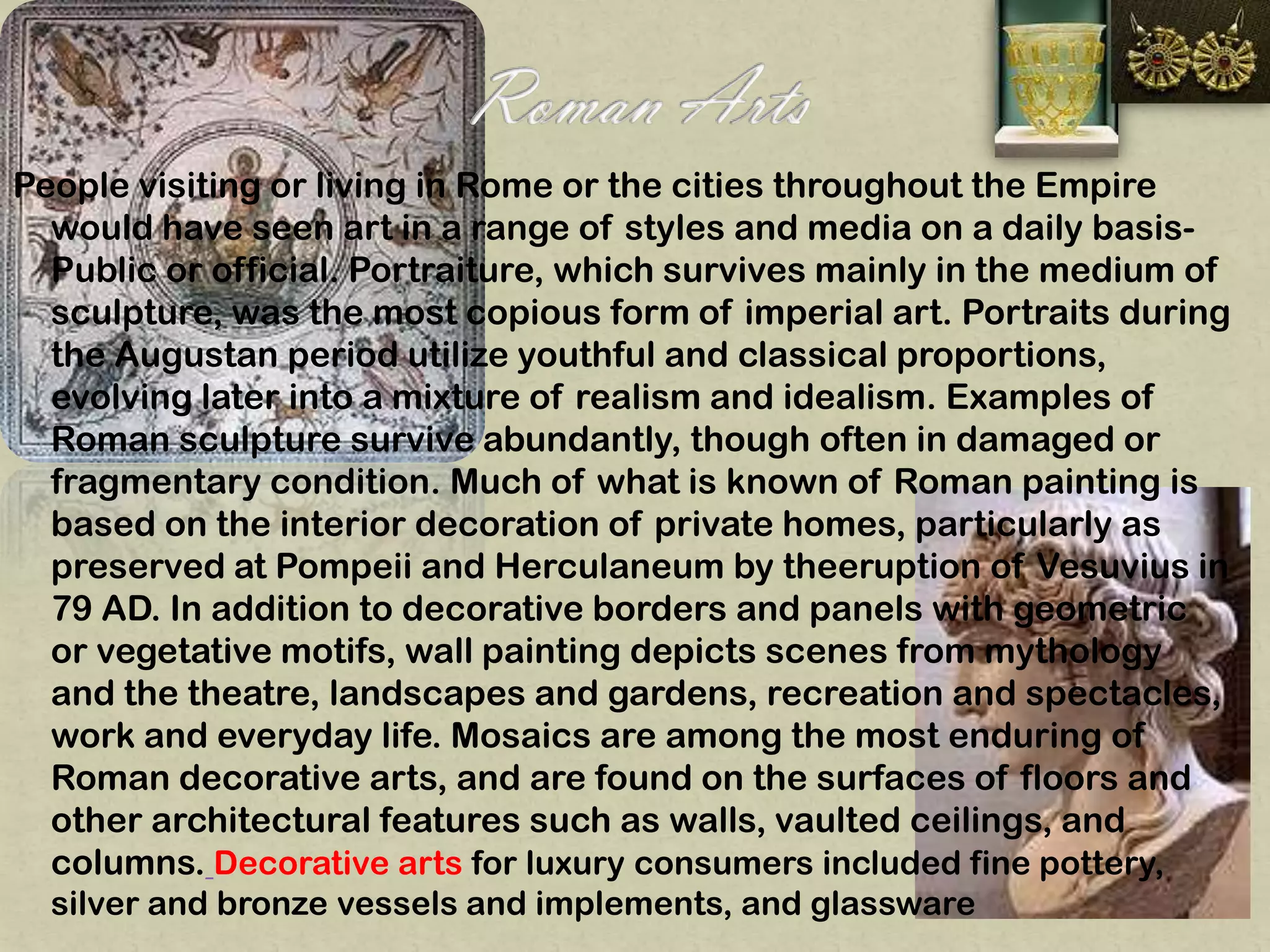
People visiting or living in Rome or the cities throughout the Empire
would have seen art in a range of styles and media on a daily basis-
Public or official. Portraiture, which survives mainly in the medium of
sculpture, was the most copious form of imperial art. Portraits during
the Augustan period utilize youthful and classical proportions,
evolving later into a mixture of realism and idealism. Examples of
Roman sculpture survive abundantly, though often in damaged or
fragmentary condition. Much of what is known of Roman painting is
based on the interior decoration of private homes, particularly as
preserved at Pompeii and Herculaneum by theeruption of Vesuvius in
79 AD. In addition to decorative borders and panels with geometric
or vegetative motifs, wall painting depicts scenes from mythology
and the theatre, landscapes and gardens, recreation and spectacles,
work and everyday life. Mosaics are among the most enduring of
Roman decorative arts, and are found on the surfaces of floors and
other architectural features such as walls, vaulted ceilings, and
columns. Decorative arts for luxury consumers included fine pottery,
silver and bronze vessels and implements, and glassware
Estimates of the average literacy rate in the Empire range
from 5 to 30 percent or higher, depending in part on the
definition of "literacy". The Roman obsession with
documents and public inscriptions indicates the high
value placed on the written word Illiterate Roman subjects
would have someone such as a government scribe read or
write their official documents for them. Public art and
religious ceremonies were ways to communicate imperial
ideology regardless of ability to read. Books were
expensive, since each copy had to written out individually
on a roll of papyrus (volumen) by scribes . Traditional
Roman education was moral and practical. Stories about
great men and women, or cautionary tales about
individual failures, were meant to instill Roman values
The Romans are known for the great number of deities they
honored, a capacity that earned the mockery of early
Christian polemicists. As the Romans extended their
dominance throughout the Mediterranean world, their policy
in general was to absorb the deities and cults of other
peoples rather than try to eradicate them.[550] One way that
Rome promoted stability among diverse peoples was by
supporting their religious heritage, building temples to local
deities that framed their theology within the hierarchy of
Roman religion. Inscriptions throughout the Empire record
the side-by-side worship of local and Roman deities,
including dedications made by Romans to local gods.
Christianity emerged in Roman Judea as a Jewish religious
sect in the 1st century AD. In the early 4th
century,Constantine I became the first emperor
to convert to Christianity, launching the era of
Christian hegemony. It became the state religion in 391
AD.
Freeborn women in ancient Rome were citizens (cives), but could
not vote or hold political office. But while Roman women held no
direct political power, those from wealthy or powerful families
could and did exert influence through private
negotiations Exceptional women who left an undeniable mark
on history range from the semi-legendary Lucretia and Claudia
Quinta, whose stories took on mythic significance;
fierce Republican-era women such asCornelia, mother of
the Gracchi, and Fulvia, who commanded an army and issued
coins bearing her image; women of the Julio-Claudian dynasty,
most prominently Livia, who contributed to the formation
of Imperial mores; and the empress Helena, a driving force in
promoting Christianity. The one major public role reserved
solely for women was in the sphere of religion: the priestly
office of the Vestals.
 http://en.wikipedia.org/wiki/Women_in_Ancient_Ro
me
 http://en.wikipedia.org/wiki/Roman_Empire
 http://en.wikipedia.org/wiki/Dominate
 http://en.wikipedia.org/wiki/Tetrarchy
 http://en.wikipedia.org/wiki/Ancient_rome
 http://en.wikipedia.org/wiki/Roman_Republic

All roads lead to rome

  • 1.
    An Empire AcrossThree Continents A Presentation By: Arshdeep Kaur XI- A
  • 2.
     There areinnumerable quotes about Rome, which talk of its greatness, undermining its success or simply criticizing it. However, one thing is for sure, no one can ignore it. In this presentation, we shall see how Rome was established and what were the circumstances that led to Rome becoming the greatest empire known to Man, and its drawbacks, which led to its downfall.
  • 3.
    According to thefounding myth which was widely popularized by being taught in schools in Ancient Rome, Rome was Established on 21st April, 753 BC, by Romulus and Remus. They were born out of wedlock and hence drowned but saved and care for by a she-wolf. Romulus killed Remus in a fight for determining the location of the city they would found and gave his name to the city. Another legend says that Prince Aeneas of Troy lead a group of Trojans by sea to establish a new Troy but the women refused to travel any further and Roma set fire to the ships. Later, the city was named after her.
  • 4.
     The cityof Rome grew out of settlements around a ford on the river Tiber. The city was founded by the Latin tribe of Italy, over the Palatine Hill.  The Etruscans established political control over the city around the 7th Century BC.  Except Romulus, all the other kings were elected by the people of Rome and served for life. The Senate had most power over the election of the King.
  • 5.
    The Roman Kingwas the Chief Executive, Chief Legislator, Chief Priest and the Chief Judge. Rome was ruled by seven kings, the last of them being Lucius Tarquinius Superbus, who was overthrown by Lucius Junius Brutus and Lucius Tarquinius Collatinus, who became the first Consuls of Rome and the Roman Republic began in 509 BC. The above picture shows the insignia of Roman Kings: The 12 lictors holding fasces with an axe, the Toga Picta, the diadem and the Curule chair.
  • 6.
    The Roman Republicstarted with the overthrow of monarchy in 509 BC, which was replaced by a government headed my two annually-elected Consuls, which soon developed into a complex system of governance based on Checks and Balances and Separation of Power. During its first two centuries, it expanded rapidly through conquest and alliances. At the end of its third, it included the Italian peninsula, Iberian peninsula, North Africa, Modern France and much of the Eastern Mediterranean. Despite constrains, political power was wielded by Leaders and the era was punctuated by civil wars. The victor in such a Civil War, Octavian declared Rome a Principate, with him as the Princeps.
  • 8.
    The Roman Republicwas never restored, but neither was it abolished, so the exact date of the transition to the Roman Empire is a matter of interpretation. Historians have variously proposed the appointment of Julius Caesar as perpetual dictator in 44 BC, the defeat of Mark Antony at the Battle of Actium in 31 BC, and the Roman Senate’s grant of extraordinary powers to Octavian under the First Settlement and his adopting the title Augustus in 27 BC, as the defining event ending the Republic. This was followed by the Dominate phase, where the rulers openly displayed imperial power instead of creating an illusion of a Republic. This was followed by the Official Roman Empire ruled by the Julio-Claudian Dynasty.
  • 9.
    Though the RomanRepublic never really ended, the transition to an autocratic state was completed gradually. Augustus, the first “emperor”, took the position that he had saved the republic. Though Rome was essentially still a Republic, it was him who took all the final decisions, backed by military force. Augustus’ reign lasted for 40 years and was known as the Golden Age in Augustan literature and art. He laid the enduring ideological foundation for the next three centuries of the Roman Empire, known as the Principate ((27 BC–284 AD), the first 200 of which were known as Pax Romana or Roman Peace ( also Roman Accord or Treaty)
  • 10.
    The success ofAugustus in establishing principles of dynastic succession was limited by his outliving a number of talented potential heirs. The Julio-Claudian Dynasty lasted for 4 more emperors, namely; Tiberius, Caligula, Claudius and Nero – before it yielded in 69 AD to the strife-torn Year of the Four Emperors, which was the only disturbance during the Pax Romana, from which Vespasian emerged the victor.
  • 11.
    The Flavian dynastyconsisted of three kings, namely; Vespasian (69-79 AD), Titus (79-81 AD) and Domitian (81-96 AD). The dynasty, though short, is known for its achievements. They include:  Introduction of Economic Reforms and currency revaluation.  Enactment of a massive Building Program.  Popularization of Gladiatorial Games. It ended in 96 AD, when Domitian was assasinated. He was succeeded by his advisor Marcus Cocceius Nerva, who founded the long-lived Nervan-Antonian Dynasty.
  • 12.
    The Nerva-Antonine dynastyconsisted of seven emperors who ruled Rome from 96 AD to 192 AD. It was divided into the Nerva-Trajan and Antonine Dynasty on the basis of their shared last names. It gave Rome the Five Good Emperors, namely; Nerva, Trajan, Hadrian, Antoninus Pius and Marcus Aurelius. Their reign was characterized by benevolence and peace, in contrast to the tyrannical reign of the emperors before them. The dynasty came to an end with the assassination of Commodus by his wrestling partner, which was followed by the Year of the Five Emperors in193 AD, from which Septimius Severus emerged victor, starting the Severus Dynasty
  • 13.
    The Severan dynastywas an imperial dynasty, which ruled the Roman Empire between 193 and 235. The dynasty was founded by the Roman general Septimius Severus. Although Septimius Severus successfully restored peace following the upheaval of the late 2nd century, the dynasty was disturbed by highly unstable family relationships, and constant political turmoil, foreshadowing the imminent Crisis of the Third Century (235-284 AD). It was the last lineage of the Principate founded by Augustus. Aurelian (270-275 AD)re-united the split empire and was the first ruler who demanded to be hailed as master and God. He was the first ruler of the Dominate ( 284-476 AD).
  • 14.
    The Crisis endedwith the acession of Diocletian ( 284–305) to the throne. But the unity of the Empire was just an illusion. He devised the system of Tetrarchy i.e. The rule of four emperors. It started in 285 AD, when Diocletian installed his general Maximilian as his co-emperor, first as Caesar (Junior Emperor) and then Augustus in 286 AD. In 293, feeling that more focus was needed on military and civic problems, Diocletian, with Maximian's consent, expanded the imperial college by appointing two Caesars (one responsible to each Augustus)- Galerius and Constantius Chlorus. The system broke down after 306 and in the end only two Augusti remained. Constantine defeted Lucius and was the only Augustus in 313AD.
  • 16.
     The RomanEmpire began to disintegrate in the late 4th century as invasions overwhelmed the capacity of the Empire to govern. The Western empire ended in 476, when Romulus Augustulus was forced to abdicate to the Germanic warlord Odoacer.The empire in the East—known today as the Byzantine Empire, ended in 1453 with the death of Constantine XI and the fall of Constantinople to the Ottoman Turks.
  • 17.
    The language ofthe Romans was Latin, but was not imposed officially on peoples brought under Roman rule. Romans who received an elite education studied Greek as a literary language, and most men of the governing classes could speak Greek. The Julio-Claudian emperors encouraged high standards of correct Latin. References to interpreters indicate the continuing use of local languages other than Greek and Latin, particularly in Egypt, where Coptic predominated, and in military settings along the Rhine and Danube. Roman jurists also show a concern for local languages such as Punic, Gaulish, and Aramaic. Latin developed locally into branches that became the Romance languages while international use of Greek, was one factor enabling the spread of Christianity
  • 18.
    The dominance ofthe emperor was based on the consolidation of certain powers from several republican offices, including the inviolability of the tribunes of the people and the authority of the censors to manipulate the hierarchy of Roman society. The emperor also made himself the central religious authority as Pontifex Maximus. The soldiers of the Imperial Roman army were professionals who volunteered for a 25-year tour of duty. The three major divisions of the military were:  the garrison at Rome, which includes both the Praetorians and the vigiles who functioned as police and firefighters;  the provincial army, comprising the Roman legions and the auxiliaries provided by the provinces (auxilia);  the navy.  A peace keeping force for Italy called Praetorian Guard.
  • 19.
    An annexed territorybecame a province in a three-step process: making a register of cities, taking a census of the population, and surveying the land. Further government recordkeeping included births and deaths, real estate transactions, taxes, and juridical proceedings. Among these officials were the "Roman governors", as they are called in English: either magistrates elected at Rome or governors. His staff was minimal. He had to make himself accessible to the people he governed. Other officials were appointed as supervisors of government finances
  • 20.
    Papyri preserve complexaccounting methods that suggest elements of economic rationalism and the Empire was highly monetized. Economic growth, though not comparable to modern economies, was greater than that of most other societies prior to industrialization. The standardization of money throughout the Empire promoted trade and market integration. Rome had no central bank, and regulation of the banking system was minimal. Roman provinces traded among themselves, but trade extended outside the frontiers to regions as far away as China and India. The main commodity was grain. Also traded were olive oil, various foodstuffs, garum (fish sauce), slaves, ore and manufactured metal objects, fibers and textiles, timber, pottery, glassware, marble, papyrus, spices and materia medica, ivory, pearls, and gemstones and wine. Inscriptions record 268 different occupations in the city of Rome.
  • 21.
    The chief Romancontributions to architecture were the arch and the dome. Even after more than 2,000 years some Roman structures still stand, due in part to sophisticated methods of making cements and concrete. Roman bridges were among the first large and lasting bridges, built from stone with the arch as the basic structure. Most utilized concrete as well. The Romans built many dams for water collection. Insulated glazing (or "double glazing") was used in the construction of public baths. Elite housing in cooler climates might have hypocausts, a form of central heating. The Romans were the first culture to assemble all essential components of the much later steam engine.
  • 22.
    In the ancientworld, a city was viewed as a place that fostered civilization by being "properly designed, ordered, and adorned”. Augustus undertook a vast building program in Rome, supported public displays of art that expressed the new imperial ideology, and reorganized the city into neighbourhoods administered at the local level. City planning and urban lifestyles had been influenced by the Greeks from an early period. In the city of Rome, most people lived in multi-storey apartment buildings that were often squalid firetraps. Rich families from Rome usually had two or more houses,a townhouse (domus, plural domūs) and at least one luxury home (villa) outside the city. Maintaining an affordable food supply to the city of Rome had become a major political issue in the late Republic, when the state began to provide a grain dole (annona) to citizens who registered for it.
  • 23.
    Most apartments inRome lacked kitchens, though a charcoal brazier could be used for rudimentary cookery. fine dining could be sought only at private dinner parties in well-to- do houses with a chef and trained kitchen staff, or at banquets hosted by social clubs (collegia) Prepared food was sold at pubs and bars, inns, and food stalls. Most people would have consumed at least 70 percent of daily calories in the form of cereals and legumesRoman literature focuses on the dining habits of the upper classes. In a status-conscious society like that of the Romans, clothing and personal adornment gave immediate visual clues about the etiquette of interacting with the wearer. The Toga was the distinctive national garment of the Roman male citizen, but was worn only on formal occasions. The Tunic was the most commonly worn garment. The use of silk increased, and courtiers of the later Empire wore elaborate silk robes
  • 24.
    Roman government believedthat public recreation was important to keep the subjects happy. The State funded various events. Circus games were preceded by an elaborate parade that ended at the venue. Competitive events were held also in smaller venues such as the amphitheatre. The Romans thought gladiator contests had originated with funeral games and sacrifices in which select captive warriors were forced to fight to expiate the deaths of noble Romans. However, Gladiators were highly skilled and trained fighters, who might be slaves, convicts, or free volunteers. Chariot racing continued into the Byzantine period under imperial sponsorship, but the decline of cities in the 6th and 7th centuries led to its eventual demise. Playing with dice as a form of gambling was disapproved of, but was a popular pastime during the December festival of the Saturnalia with its carnival, norms- overturned atmosphere
  • 25.
    People visiting orliving in Rome or the cities throughout the Empire would have seen art in a range of styles and media on a daily basis- Public or official. Portraiture, which survives mainly in the medium of sculpture, was the most copious form of imperial art. Portraits during the Augustan period utilize youthful and classical proportions, evolving later into a mixture of realism and idealism. Examples of Roman sculpture survive abundantly, though often in damaged or fragmentary condition. Much of what is known of Roman painting is based on the interior decoration of private homes, particularly as preserved at Pompeii and Herculaneum by theeruption of Vesuvius in 79 AD. In addition to decorative borders and panels with geometric or vegetative motifs, wall painting depicts scenes from mythology and the theatre, landscapes and gardens, recreation and spectacles, work and everyday life. Mosaics are among the most enduring of Roman decorative arts, and are found on the surfaces of floors and other architectural features such as walls, vaulted ceilings, and columns. Decorative arts for luxury consumers included fine pottery, silver and bronze vessels and implements, and glassware
  • 26.
    Estimates of theaverage literacy rate in the Empire range from 5 to 30 percent or higher, depending in part on the definition of "literacy". The Roman obsession with documents and public inscriptions indicates the high value placed on the written word Illiterate Roman subjects would have someone such as a government scribe read or write their official documents for them. Public art and religious ceremonies were ways to communicate imperial ideology regardless of ability to read. Books were expensive, since each copy had to written out individually on a roll of papyrus (volumen) by scribes . Traditional Roman education was moral and practical. Stories about great men and women, or cautionary tales about individual failures, were meant to instill Roman values
  • 27.
    The Romans areknown for the great number of deities they honored, a capacity that earned the mockery of early Christian polemicists. As the Romans extended their dominance throughout the Mediterranean world, their policy in general was to absorb the deities and cults of other peoples rather than try to eradicate them.[550] One way that Rome promoted stability among diverse peoples was by supporting their religious heritage, building temples to local deities that framed their theology within the hierarchy of Roman religion. Inscriptions throughout the Empire record the side-by-side worship of local and Roman deities, including dedications made by Romans to local gods. Christianity emerged in Roman Judea as a Jewish religious sect in the 1st century AD. In the early 4th century,Constantine I became the first emperor to convert to Christianity, launching the era of Christian hegemony. It became the state religion in 391 AD.
  • 28.
    Freeborn women inancient Rome were citizens (cives), but could not vote or hold political office. But while Roman women held no direct political power, those from wealthy or powerful families could and did exert influence through private negotiations Exceptional women who left an undeniable mark on history range from the semi-legendary Lucretia and Claudia Quinta, whose stories took on mythic significance; fierce Republican-era women such asCornelia, mother of the Gracchi, and Fulvia, who commanded an army and issued coins bearing her image; women of the Julio-Claudian dynasty, most prominently Livia, who contributed to the formation of Imperial mores; and the empress Helena, a driving force in promoting Christianity. The one major public role reserved solely for women was in the sphere of religion: the priestly office of the Vestals.
  • 29.
     http://en.wikipedia.org/wiki/Women_in_Ancient_Ro me  http://en.wikipedia.org/wiki/Roman_Empire http://en.wikipedia.org/wiki/Dominate  http://en.wikipedia.org/wiki/Tetrarchy  http://en.wikipedia.org/wiki/Ancient_rome  http://en.wikipedia.org/wiki/Roman_Republic