Each Egyptian ruler contributed something unique to the empire.
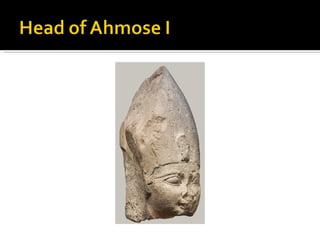
Ahmose rid Egypt of the Hyksos and established the New Kingdom. He set up Egypt to experience a golden age. Ahmose re-established the economy and trade. He created a central government. Ahmose conquered Nubia and greatly expanded Egypt’s borders.
 
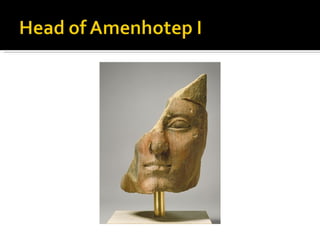
Amenhotep established a deliberate expansion policy, setting an example for his successors. He expanded farther in Nubia. Amenhotep built a new capital city, advancing art and architecture. He promoted the god Amun by dedicating buildings to him.

 
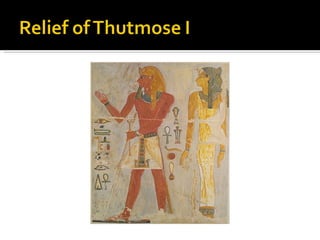
Thutmose kept Egypt under control through military campaigns and building projects. He fully established the concept of the “warrior pharaoh”. During Thutmose’s reign, the Nile’s third cataract was penetrated. He took control of Nubian resources, treating Nubia as a colonial land.
 
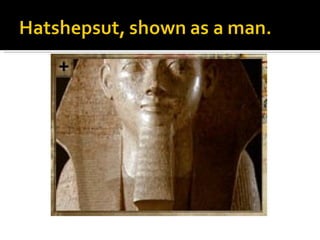
Hatshepsut took power from her stepson, Thutmose III. She was the third female pharaoh. Hatshepsut used heavy propaganda, including having herself depicted as a man. Hatshepsut encouraged trade instead of engaging in warfare. She sent the army on a trading expedition, from which they brought back goods such as ivory, leopard skin, and incense.
 
Tuthmosis III successfully organized 20000 soldiers to defeat the foreign princes who had been in Megiddo. His exploits in war made Thebes one of the most wealthy cities in the Ancient World Tuthmosis III installed a viceroy in Nubia. He created the biggest empire ever conquered and ruled by one king.
 
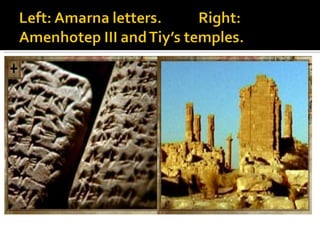
Amenhotep III was a diplomat. He wrote the Amarna letters, carved on small stones, to foreign princes. Amenhotep III gave monetary gifts to foreign rulers, always leaving them begging for more. He married a commoner named Tiy, and saw her as a near-equal. They were both worshipped as gods. He switched his religious interest to the minor god Aten.
 
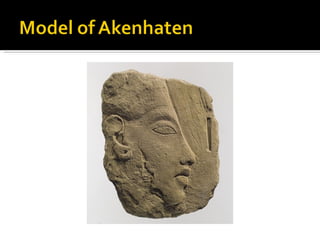
Akenhaten encouraged worship of the sun god Aten. He shut down all worship of Amen-Re, and became the first pharaoh to practice monotheism. Akenhaten relocated 20000 people, including himself, to a new capital city called Amarna. He became obsessed with destroyed all mentions of Amen, and got so caught up that the empire almost collapsed. Akenhaten died before disaster could strike.
 
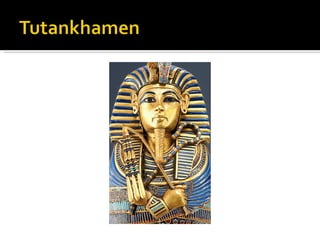
Tutankhamen had no power, since he became pharaoh at 9 years old. During his reign, the old religion was restored. At 19, Tutankhamen died mysteriously. His tomb was discovered, untouched, by Howard Carter in 1922. It took 10 years to empty the tomb. His death marked the beginning of a period of uncertainty.
 
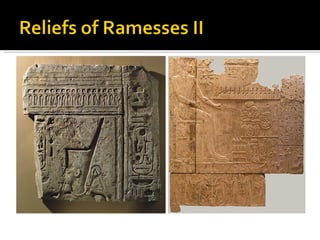
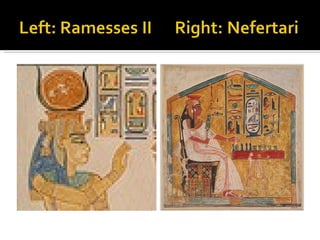
Ramesses II was born a commoner, but his family fought their way into royalty and he became pharaoh at 15. He fought a lot with the Hittites. Ramesses II knew he could not defeat the Hittites, so he negotiated a peace treaty. He created the Ramesseum, a temple to tell of his greatness. It had a library with 10000 papyrus scrolls. He began a building program greater than any before. He died at an astonishing 93 years old. The New Kingdom fell less than 150 years after his death.
 
 
Though the religion and culture of Egypt had its own distinct characteristics , the religion had a large effect on the practices and life style of Ancient Egypt.
In Ancient Egypt, the religion and ideas of the culture greatly effected the Egyptians life style. The everyday lives and religion of this ancient civilization differed from that of other river valley civilizations. Egyptians excelled in technology, controlling their resources, government, and a polytheistic religion. The religion had a large effect on how the Egyptians lived.  The religion controlled education, the structure of society, technological advances, and the system of government.
Egyptians had a polytheistic religion, meaning they believed in many gods Some gods such as Ra, the sun god, hathor, the god of music, Nut the god of the sky, Geb the god of the earth, Seth, the god of the Desert Believed in a significant after life occurring after death, where people’s spirits lived on.  Refferred to as “A beautiful other world” Preserved bodies through mummification in order for spirit to have a proper body to live in through after life Built large temples where citizens worshipped gods Temple cities and towns arose because of the amount of temples that began to spring up Kings were considered “living gods”, worshipped kings as they would worship any other gods
The society of Egypt was structured like a pyramid. The smallest social class of rulers and pharaohs was placed at the top of the social class. Then the upper class of priests, land owners, and army commanders fell beneath the rulers. Then the middle class of merchants and artisans, and last the largest class consisting of the poor and unskilled workers fell at the base of societies social structure. Trusted their natural water supply to fertilize their land Most Egyptians worked as farmers or craftsmen Homes of a family important to life in Egypt, made from dried mud and straw. Three areas in each home, living area, sleeping area, and back yard. Larger homes had more than one story Women were equal in power with men, and had equal rights Daughters followed mothers, and sons stood by fathers Married through a system of a “common house”, no formal religious marriage Education was taught by priests Fashion consisted of heavy eye makeup to protect eyes and fragranced oils to protect skin, and rulers wore gold and fancy jewlrey
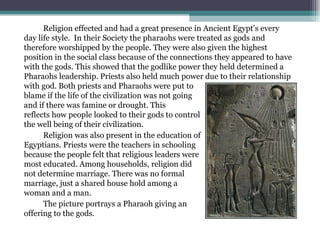
Religion effected and had a great presence in Ancient Egypt’s every day life style.  In their Society the pharaohs were treated as gods and therefore worshipped by the people. They were also given the highest position in the social class because of the connections they appeared to have with the gods. This showed that the godlike power they held determined a Pharaohs leadership. Priests also held much power due to their relationship with god. Both priests and Pharaohs were put to  blame if the life of the civilization was not going  very well, and if there was famine or drought. This  reflects how people looked to their gods to control  the well being of their civilization.  Religion was also present in the education of  Egyptians. Priests were the teachers in schooling  because the people felt that religious leaders were  most educated. Among households, religion did  not determine marriage. There was no formal  marriage, just a shared house hold among a  woman and a man.  The picture portrays a Pharaoh giving an  offering to the gods.
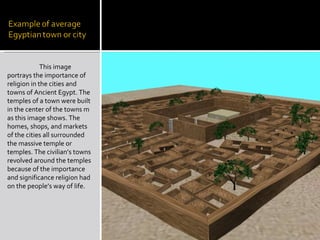
This image portrays the importance of religion in the cities and towns of Ancient Egypt. The temples of a town were built in the center of the towns m as this image shows. The homes, shops, and markets of the cities all surrounded the massive temple or temples. The civilian’s towns revolved around the temples because of the importance and significance religion had on the people’s way of life.
The technology and geography of the Egyptian empire was connected and helped the empire grow to its full potential.   
 
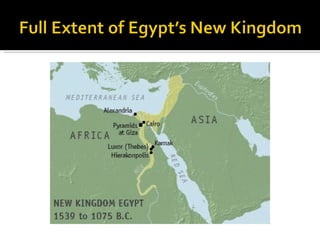
Egypt would never have been founded without the Nile River. The Nile River stretches 4,100 miles and flows from the South to the North. It is a stretch of water in a dry desert land, and that is what attracted ancient peoples to the land of Egypt. Egypt is often referred to as “the gift of the Nile”.  Originally, Egypt only occupied the land around the northernmost 750 miles of the Nile. Egypt went North until the Nile Delta, where the river empties into the Mediterranean Sea.  Egypt went South until the First Cataract on the Nile, which is where the rocky rapids start in the Nile.  In the New Kingdom, Egypt had extended past Upper Egypt and Lower Egypt, and now spread out to conquer Nubia and Egypt conquered a small region around the Mediterranean Sea.
Egypt’s New Kingdom’s people now had bronze weapons and metal daggers. They also developed two wheeled chariots pulled by horses and armor made of leather. They also made bows and arrows made of animal horns and javelins. The senior commanders in the army actually had bronze armor, compared to the leather armor of lower ranked soldiers.  The New Kingdom was also known for its use of gold because they had found gold mines under their land.  This gold, and the money that came to Egypt from trade was given to the gods, or helped funded the new palaces that the Egyptians were making.
 
Egyptians had learned to build embankments and dykes, which controlled the water of the Nile river. This helped farmers use the flooding river to their advantage.  Egyptians invented a new way to lift flood water called a shaduf. It was a cross pole attached to the ground with a counterweight at one end and a bucket at the other. So, water could be slung where the farmer wanted it to go. This enabled all of the land to get water, and not just the parts that flooded.
 
Fernandez-Armesto, Felipe.  The World, A History . Combined Volume. Upper Saddle River, New Jersey: Pearson, Prentice Hall, 2007. Beck, Black Krieger, Naylor, Shabaka, Roger, Linda, Phillip, Dahia.  World History, Patterns of Interaction . Evanston, Illinois: McDougal Littell, 1999. PBS, &quot;Egypt's Golden Empire.&quot;  http://www.pbs.org/empires/egypt/newkingdom/index.html . 15 March 2006. 20 Nov 2008 <http://www.pbs.org/empires/egypt/newkingdom/index.html>.
By Kleyvin Vaquero  A26 After the reign of the Hyksos, did Egypt ever become powerful or did they declined again? During the last years of the Middle Kingdom in Egypt, Egypt grew into war and violence due to the  weak pharaohs that had power struggles, and had to succeed from the country.  Now the weakened country fell into invaders from the Hyksos, which were nomadic peoples, and had ruled Egypt from 1640 to 1570B.C. Now that is a really long time. Then some great leaders rose again in order to restore Egypt’s power and overthrow the Hyksos. Leaders like Queen Ahhotep and Kamose. .   www.love-egypt.com/images/hyksos1.jpg 448 x 251 - 41k Image may be scaled down and subject to copyright.
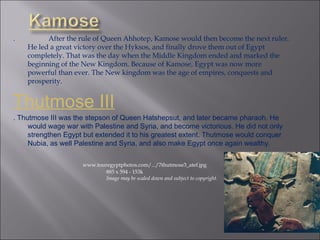
.  After the rule of Queen Ahhotep, Kamose would then become the next ruler. He led a great victory over the Hyksos, and finally drove them out of Egypt completely. That was the day when the Middle Kingdom ended and marked the beginning of the New Kingdom. Because of Kamose, Egypt was now more powerful than ever. The New kingdom was the age of empires, conquests and prosperity. Thutmose III . Thutmose III was the stepson of Queen Hatshepsut, and later became pharaoh. He would wage war with Palestine and Syria, and become victorious. He did not only strengthen Egypt but extended it to his greatest extent. Thutmose would conquer Nubia, as well Palestine and Syria, and also make Egypt once again wealthy. www.touregyptphotos.com/.../7thutmose3_atef.jpg   885 x 594 - 153k   Image may be scaled down and subject to copyright.
The Egyptian Empire Declines . Around 1200 B.C., the Egyptian Empire started to fall once again, but by the people of the sea.  The people of the sea first invaded lower east Egypt and destroyed many kingdoms there. And from the west of Egypt, the Libyans also caused so much destruction. Egypt’s natural barriers could no longer stop invaders from coming in. Libyans took control of the Egyptian empire. The empire later then faded into an oblivion.  ...  “the  Kushites  populated the  ... 640 x 425 - 101k - jpg www.americanchronicle.com
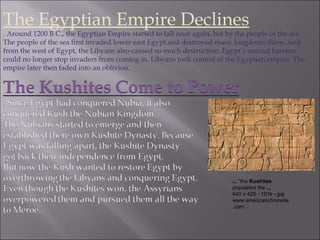
. After the Golden Age of the Kushites, Meroe started to decline due to the power of the Aksum. Aksum had now dominated the Kush trade seaports. After this invasion, the Kush was no more.

Ancient Egypt, The New Kingdom

  • 1.
  • 2.
    Each Egyptian rulercontributed something unique to the empire.
  • 3.
    Ahmose rid Egyptof the Hyksos and established the New Kingdom. He set up Egypt to experience a golden age. Ahmose re-established the economy and trade. He created a central government. Ahmose conquered Nubia and greatly expanded Egypt’s borders.
  • 4.
  • 5.
    Amenhotep established adeliberate expansion policy, setting an example for his successors. He expanded farther in Nubia. Amenhotep built a new capital city, advancing art and architecture. He promoted the god Amun by dedicating buildings to him.
  • 6.
  • 7.
    Thutmose kept Egyptunder control through military campaigns and building projects. He fully established the concept of the “warrior pharaoh”. During Thutmose’s reign, the Nile’s third cataract was penetrated. He took control of Nubian resources, treating Nubia as a colonial land.
  • 8.
  • 9.
    Hatshepsut took powerfrom her stepson, Thutmose III. She was the third female pharaoh. Hatshepsut used heavy propaganda, including having herself depicted as a man. Hatshepsut encouraged trade instead of engaging in warfare. She sent the army on a trading expedition, from which they brought back goods such as ivory, leopard skin, and incense.
  • 10.
  • 11.
    Tuthmosis III successfullyorganized 20000 soldiers to defeat the foreign princes who had been in Megiddo. His exploits in war made Thebes one of the most wealthy cities in the Ancient World Tuthmosis III installed a viceroy in Nubia. He created the biggest empire ever conquered and ruled by one king.
  • 12.
  • 13.
    Amenhotep III wasa diplomat. He wrote the Amarna letters, carved on small stones, to foreign princes. Amenhotep III gave monetary gifts to foreign rulers, always leaving them begging for more. He married a commoner named Tiy, and saw her as a near-equal. They were both worshipped as gods. He switched his religious interest to the minor god Aten.
  • 14.
  • 15.
    Akenhaten encouraged worshipof the sun god Aten. He shut down all worship of Amen-Re, and became the first pharaoh to practice monotheism. Akenhaten relocated 20000 people, including himself, to a new capital city called Amarna. He became obsessed with destroyed all mentions of Amen, and got so caught up that the empire almost collapsed. Akenhaten died before disaster could strike.
  • 16.
  • 17.
    Tutankhamen had nopower, since he became pharaoh at 9 years old. During his reign, the old religion was restored. At 19, Tutankhamen died mysteriously. His tomb was discovered, untouched, by Howard Carter in 1922. It took 10 years to empty the tomb. His death marked the beginning of a period of uncertainty.
  • 18.
  • 19.
    Ramesses II wasborn a commoner, but his family fought their way into royalty and he became pharaoh at 15. He fought a lot with the Hittites. Ramesses II knew he could not defeat the Hittites, so he negotiated a peace treaty. He created the Ramesseum, a temple to tell of his greatness. It had a library with 10000 papyrus scrolls. He began a building program greater than any before. He died at an astonishing 93 years old. The New Kingdom fell less than 150 years after his death.
  • 20.
  • 21.
  • 22.
    Though the religionand culture of Egypt had its own distinct characteristics , the religion had a large effect on the practices and life style of Ancient Egypt.
  • 23.
    In Ancient Egypt,the religion and ideas of the culture greatly effected the Egyptians life style. The everyday lives and religion of this ancient civilization differed from that of other river valley civilizations. Egyptians excelled in technology, controlling their resources, government, and a polytheistic religion. The religion had a large effect on how the Egyptians lived. The religion controlled education, the structure of society, technological advances, and the system of government.
  • 24.
    Egyptians had apolytheistic religion, meaning they believed in many gods Some gods such as Ra, the sun god, hathor, the god of music, Nut the god of the sky, Geb the god of the earth, Seth, the god of the Desert Believed in a significant after life occurring after death, where people’s spirits lived on. Refferred to as “A beautiful other world” Preserved bodies through mummification in order for spirit to have a proper body to live in through after life Built large temples where citizens worshipped gods Temple cities and towns arose because of the amount of temples that began to spring up Kings were considered “living gods”, worshipped kings as they would worship any other gods
  • 25.
    The society ofEgypt was structured like a pyramid. The smallest social class of rulers and pharaohs was placed at the top of the social class. Then the upper class of priests, land owners, and army commanders fell beneath the rulers. Then the middle class of merchants and artisans, and last the largest class consisting of the poor and unskilled workers fell at the base of societies social structure. Trusted their natural water supply to fertilize their land Most Egyptians worked as farmers or craftsmen Homes of a family important to life in Egypt, made from dried mud and straw. Three areas in each home, living area, sleeping area, and back yard. Larger homes had more than one story Women were equal in power with men, and had equal rights Daughters followed mothers, and sons stood by fathers Married through a system of a “common house”, no formal religious marriage Education was taught by priests Fashion consisted of heavy eye makeup to protect eyes and fragranced oils to protect skin, and rulers wore gold and fancy jewlrey
  • 26.
    Religion effected andhad a great presence in Ancient Egypt’s every day life style. In their Society the pharaohs were treated as gods and therefore worshipped by the people. They were also given the highest position in the social class because of the connections they appeared to have with the gods. This showed that the godlike power they held determined a Pharaohs leadership. Priests also held much power due to their relationship with god. Both priests and Pharaohs were put to blame if the life of the civilization was not going very well, and if there was famine or drought. This reflects how people looked to their gods to control the well being of their civilization. Religion was also present in the education of Egyptians. Priests were the teachers in schooling because the people felt that religious leaders were most educated. Among households, religion did not determine marriage. There was no formal marriage, just a shared house hold among a woman and a man. The picture portrays a Pharaoh giving an offering to the gods.
  • 27.
    This image portraysthe importance of religion in the cities and towns of Ancient Egypt. The temples of a town were built in the center of the towns m as this image shows. The homes, shops, and markets of the cities all surrounded the massive temple or temples. The civilian’s towns revolved around the temples because of the importance and significance religion had on the people’s way of life.
  • 28.
    The technology andgeography of the Egyptian empire was connected and helped the empire grow to its full potential.   
  • 29.
  • 30.
    Egypt would neverhave been founded without the Nile River. The Nile River stretches 4,100 miles and flows from the South to the North. It is a stretch of water in a dry desert land, and that is what attracted ancient peoples to the land of Egypt. Egypt is often referred to as “the gift of the Nile”. Originally, Egypt only occupied the land around the northernmost 750 miles of the Nile. Egypt went North until the Nile Delta, where the river empties into the Mediterranean Sea. Egypt went South until the First Cataract on the Nile, which is where the rocky rapids start in the Nile. In the New Kingdom, Egypt had extended past Upper Egypt and Lower Egypt, and now spread out to conquer Nubia and Egypt conquered a small region around the Mediterranean Sea.
  • 31.
    Egypt’s New Kingdom’speople now had bronze weapons and metal daggers. They also developed two wheeled chariots pulled by horses and armor made of leather. They also made bows and arrows made of animal horns and javelins. The senior commanders in the army actually had bronze armor, compared to the leather armor of lower ranked soldiers. The New Kingdom was also known for its use of gold because they had found gold mines under their land. This gold, and the money that came to Egypt from trade was given to the gods, or helped funded the new palaces that the Egyptians were making.
  • 32.
  • 33.
    Egyptians had learnedto build embankments and dykes, which controlled the water of the Nile river. This helped farmers use the flooding river to their advantage. Egyptians invented a new way to lift flood water called a shaduf. It was a cross pole attached to the ground with a counterweight at one end and a bucket at the other. So, water could be slung where the farmer wanted it to go. This enabled all of the land to get water, and not just the parts that flooded.
  • 34.
  • 35.
    Fernandez-Armesto, Felipe. The World, A History . Combined Volume. Upper Saddle River, New Jersey: Pearson, Prentice Hall, 2007. Beck, Black Krieger, Naylor, Shabaka, Roger, Linda, Phillip, Dahia. World History, Patterns of Interaction . Evanston, Illinois: McDougal Littell, 1999. PBS, &quot;Egypt's Golden Empire.&quot; http://www.pbs.org/empires/egypt/newkingdom/index.html . 15 March 2006. 20 Nov 2008 <http://www.pbs.org/empires/egypt/newkingdom/index.html>.
  • 36.
    By Kleyvin Vaquero A26 After the reign of the Hyksos, did Egypt ever become powerful or did they declined again? During the last years of the Middle Kingdom in Egypt, Egypt grew into war and violence due to the weak pharaohs that had power struggles, and had to succeed from the country. Now the weakened country fell into invaders from the Hyksos, which were nomadic peoples, and had ruled Egypt from 1640 to 1570B.C. Now that is a really long time. Then some great leaders rose again in order to restore Egypt’s power and overthrow the Hyksos. Leaders like Queen Ahhotep and Kamose. . www.love-egypt.com/images/hyksos1.jpg 448 x 251 - 41k Image may be scaled down and subject to copyright.
  • 37.
    . Afterthe rule of Queen Ahhotep, Kamose would then become the next ruler. He led a great victory over the Hyksos, and finally drove them out of Egypt completely. That was the day when the Middle Kingdom ended and marked the beginning of the New Kingdom. Because of Kamose, Egypt was now more powerful than ever. The New kingdom was the age of empires, conquests and prosperity. Thutmose III . Thutmose III was the stepson of Queen Hatshepsut, and later became pharaoh. He would wage war with Palestine and Syria, and become victorious. He did not only strengthen Egypt but extended it to his greatest extent. Thutmose would conquer Nubia, as well Palestine and Syria, and also make Egypt once again wealthy. www.touregyptphotos.com/.../7thutmose3_atef.jpg 885 x 594 - 153k Image may be scaled down and subject to copyright.
  • 38.
    The Egyptian EmpireDeclines . Around 1200 B.C., the Egyptian Empire started to fall once again, but by the people of the sea. The people of the sea first invaded lower east Egypt and destroyed many kingdoms there. And from the west of Egypt, the Libyans also caused so much destruction. Egypt’s natural barriers could no longer stop invaders from coming in. Libyans took control of the Egyptian empire. The empire later then faded into an oblivion. ... “the Kushites populated the ... 640 x 425 - 101k - jpg www.americanchronicle.com
  • 39.
    . After theGolden Age of the Kushites, Meroe started to decline due to the power of the Aksum. Aksum had now dominated the Kush trade seaports. After this invasion, the Kush was no more.

Editor's Notes