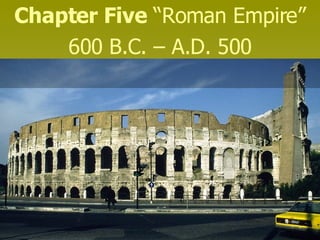
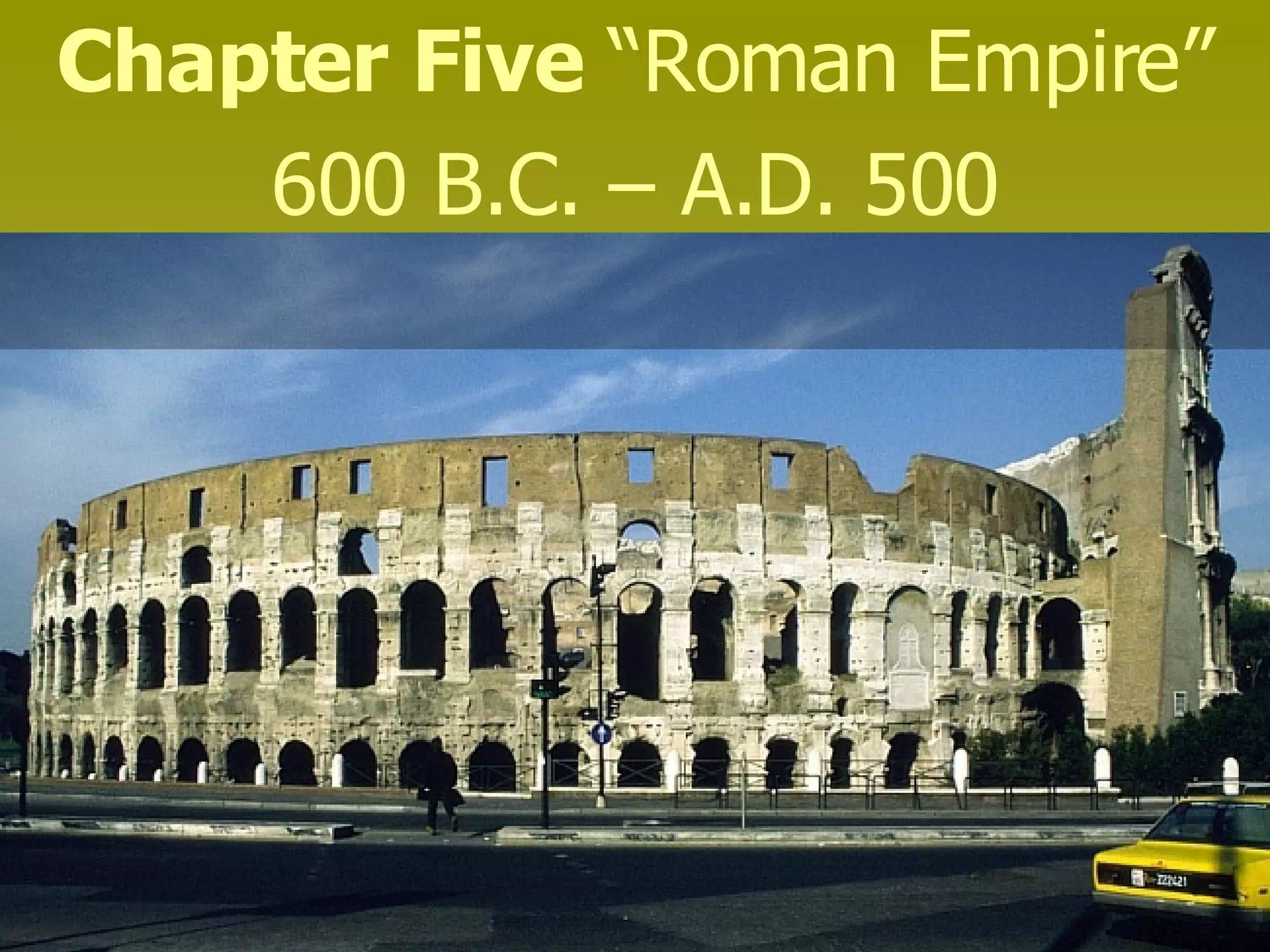
Chapter Five  “Roman Empire” 600 B.C. – A.D. 500
Welcome to Ancient Rome
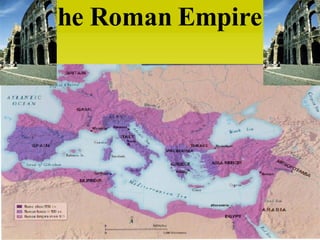
The Roman Empire
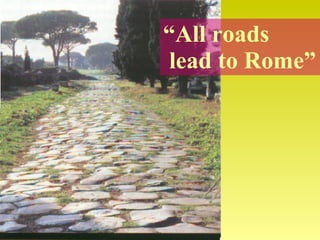
“ All roads lead to Rome”
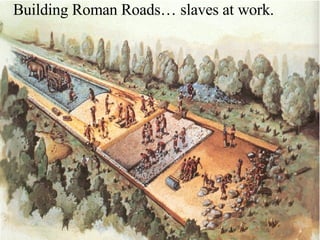
Building Roman Roads… slaves at work.
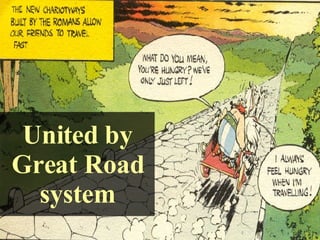
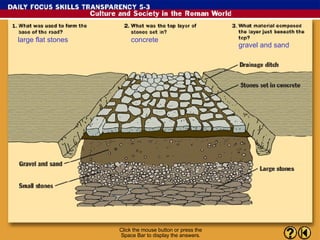
United by Great Road system
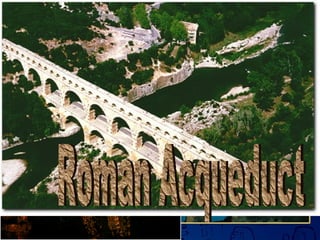
Roman Acqueduct
Click the mouse button or press the Space Bar to display the answers. large flat stones  concrete gravel and sand
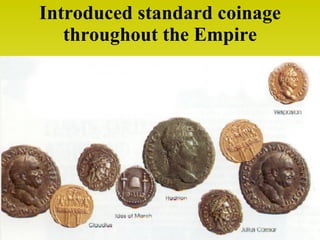
Introduced standard coinage throughout the Empire
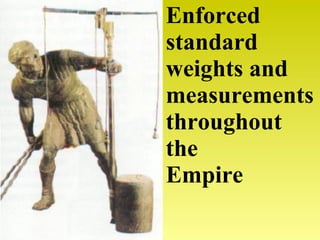
Enforced standard weights and measurements throughout the  Empire
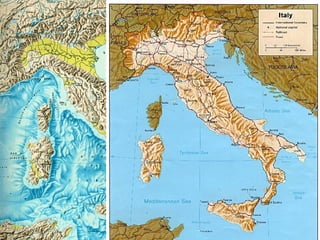
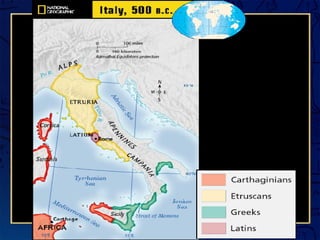
Italy is a peninsula about 750 miles long Apennine  (A PUN NAY)   Mountains run down the center Not rugged like in Greece, provides Good Farming
The Land and Peoples of Italy   3 important fertile plains ideal for farming are  along the Po River ;  the plain of Latium , where  Rome  is located; and the  plain of Campania , south of Latium.   farmland allowed it to support a large population.
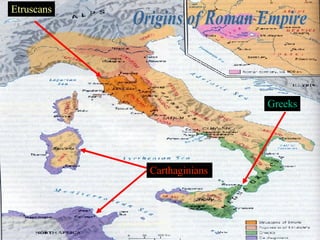
Etruscans Greeks Carthaginians Origins of Roman Empire
 
Daily Life in Ancient Rome
The Impact of Geography Rome located 18 miles inland on the Tiber River Easy access to the sea but safe from pirates Built on 7 hills
The Impact of Geography Italian peninsula was a natural stopping point for trade & travel Center of Mediterranean Travel Turn to page 149, “Voices from the Past”
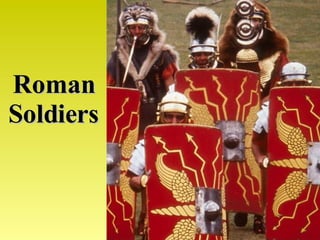
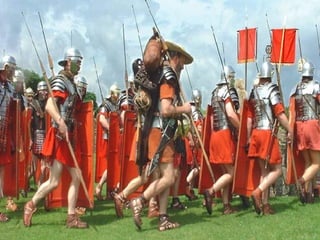
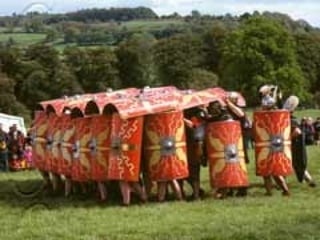
Roman Soldiers
Roman Soldiers!
 
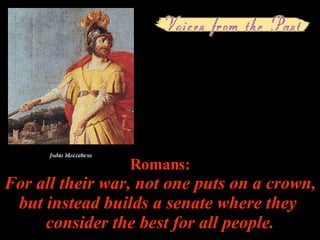
Romans: For all their war, not one puts on a crown,  but instead builds a senate where they  consider the best for all people.
The Roman Republic Early Rome ruled by kings, some Etruscan 509 B.C. overthrew the last Etruscan king Republic   – a form of government in which the leader is not a monarch & certain citizens have the right to vote
 
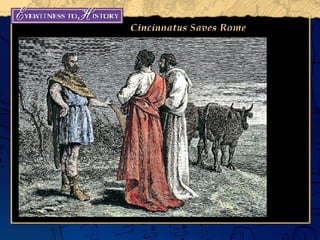
Roman Values & Virtues 3 virtues:  duty, courage & discipline Livy   Roman historian wrote of  Cincinnatus
Why Rome Was Successful? 1. Good diplomats 2. Extending Roman citizenship & allowing states to run internal affairs 3. Skilled persistent soldiers & brilliant strategists
Why Rome Was Successful? 4.  Built towns connected by roads 5.  Soldiers were deployed quickly 6.  Law & politics: Roman were practical & created institutions that responded to problems
The Birth of Rome
VIDEO: “ Building an Empire” Size, Culture, Customs, Pompeii, Technology, Religion, Laws, War
The Government of Rome Two groups: 1.   Patricians  – great landowners, who became Rome’s ruling class 2.  Plebeians  – landholders, craftspeople, merchants & small farmers *Only patricians elected to public office
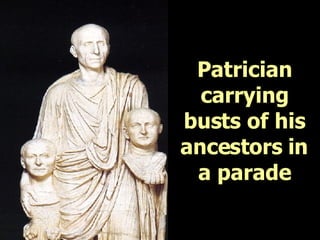
Patrician carrying busts of his ancestors in a parade
The Government of Rome Chief executive officers Consuls  (2) – ran the government & led the Roman army into battle Praetors  – in charge of civil law
The Government of Rome Senate , about 300 patricians served for life Centuriate assembly , elected consuls & praetors & passed laws Organized by classes based on wealth
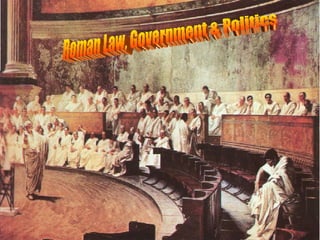
Roman Law, Government & Politics
Roman Law First code of law: Twelve Tables Law of Nations  : Issues of Roman and Non-Roman citizenship Standards of justice applied to all people equally & used principles recognized today
Law of Nations Innocent until proven otherwise The accused has a right to a defense before a judge Judges should decide cases based on evidence
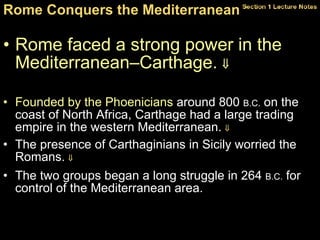
Rome Conquers the Mediterranean  Rome faced a strong power in the Mediterranean–Carthage.   Founded by the Phoenicians  around 800  B.C.  on the coast of North Africa, Carthage had a large trading empire in the western Mediterranean.   The presence of Carthaginians in Sicily worried the Romans.     The two groups began a long struggle in 264  B.C.  for control of the Mediterranean area.
 
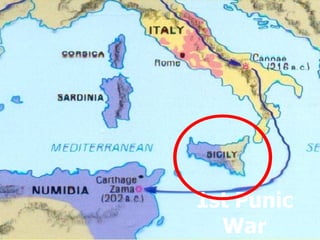
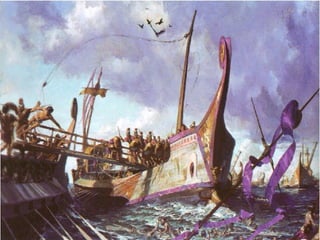
Rome Conquers the Mediterranean  (cont.)   The First Punic War     Romans realized that to win the war they needed a large navy, which they built.     Rome defeated Carthage’s navy, and in 241  B.C.  Carthage gave up its rights to Sicily and paid money to Rome.   Sicily became Rome’s first province.
Video:  1 st  Punic War
1st Punic War
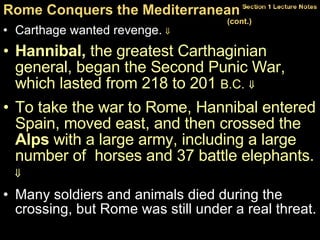
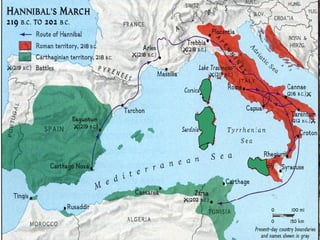
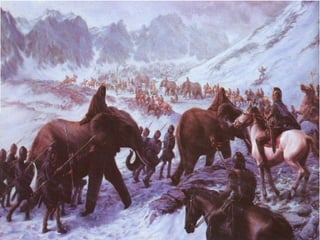
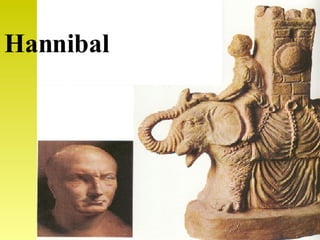
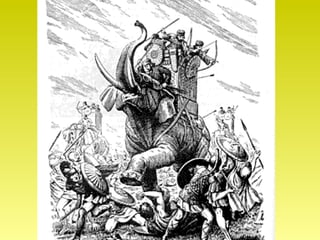
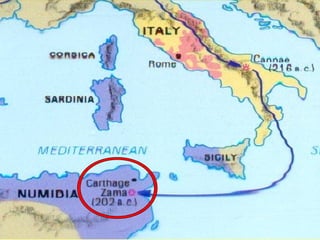
Carthage wanted revenge.   Hannibal,  the greatest Carthaginian general, began the Second Punic War, which lasted from 218 to 201  B.C.      To take the war to Rome, Hannibal entered Spain, moved east, and then crossed the  Alps  with a large army, including a large number of  horses and 37 battle elephants.     Many soldiers and animals died during the crossing, but Rome was still under a real threat. Rome Conquers the Mediterranean  (cont.)
Video:  Hannibal’s Revenge
 
 
Video:  2 nd  Punic War
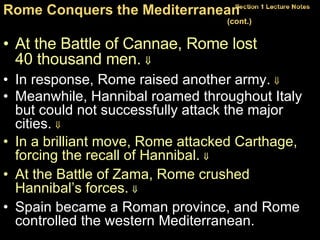
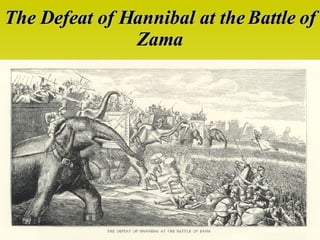
At the Battle of Cannae, Rome lost  40 thousand men.   In response, Rome raised another army.   Meanwhile, Hannibal roamed throughout Italy but could not successfully attack the major cities.   In a brilliant move, Rome attacked Carthage, forcing the recall of Hannibal.     At the Battle of Zama, Rome crushed Hannibal’s forces.     Spain became a Roman province, and Rome controlled the western Mediterranean. Rome Conquers the Mediterranean  (cont.)
Hannibal
The Defeat of Hannibal at the Battle of Zama
Video:  Battle of Zama
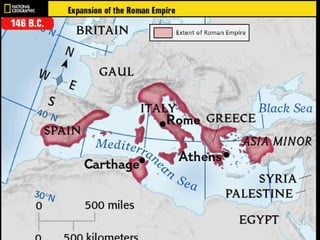
50 years later, the Romans fought  the Third Punic War.    In 146  B.C.,  Roman soldiers sacked Carthage.      50 thousand men, women, and children were sold into slavery.   The territory of Carthage became a Roman province called Africa. Rome Conquers the Mediterranean  (cont.)
 
Hannibal famously crossed the Alps with elephants to be used in battle. Few of them survived the trip, but some did. What do you think the reaction was of the Roman soldiers to elephants in battle? Rome Conquers the Mediterranean  (cont.)   The few elephants that survived terrified the Romans, as one could imagine on being faced with a charging elephant. Who knows how history would have been different if all of Hannibal’s elephants had survived?
 
 
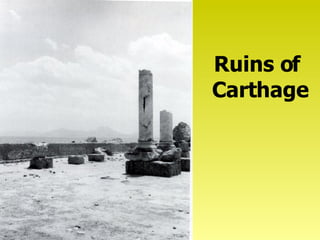
Ruins of  Carthage
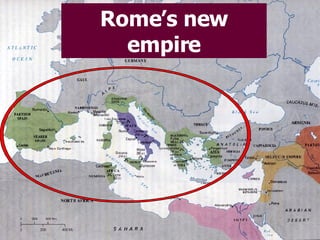
Rome’s new empire

Rome Sec1

  • 1.
    Chapter Five “Roman Empire” 600 B.C. – A.D. 500
  • 2.
  • 3.
  • 4.
    “ All roadslead to Rome”
  • 5.
  • 6.
    United by GreatRoad system
  • 7.
  • 8.
    Click the mousebutton or press the Space Bar to display the answers. large flat stones concrete gravel and sand
  • 9.
    Introduced standard coinagethroughout the Empire
  • 10.
    Enforced standard weightsand measurements throughout the Empire
  • 11.
    Italy is apeninsula about 750 miles long Apennine (A PUN NAY) Mountains run down the center Not rugged like in Greece, provides Good Farming
  • 12.
    The Land andPeoples of Italy 3 important fertile plains ideal for farming are along the Po River ; the plain of Latium , where Rome is located; and the plain of Campania , south of Latium.  farmland allowed it to support a large population.
  • 13.
    Etruscans Greeks CarthaginiansOrigins of Roman Empire
  • 14.
  • 15.
    Daily Life inAncient Rome
  • 16.
    The Impact ofGeography Rome located 18 miles inland on the Tiber River Easy access to the sea but safe from pirates Built on 7 hills
  • 17.
    The Impact ofGeography Italian peninsula was a natural stopping point for trade & travel Center of Mediterranean Travel Turn to page 149, “Voices from the Past”
  • 18.
  • 19.
  • 20.
  • 21.
    Romans: For alltheir war, not one puts on a crown, but instead builds a senate where they consider the best for all people.
  • 22.
    The Roman RepublicEarly Rome ruled by kings, some Etruscan 509 B.C. overthrew the last Etruscan king Republic – a form of government in which the leader is not a monarch & certain citizens have the right to vote
  • 23.
  • 24.
    Roman Values &Virtues 3 virtues: duty, courage & discipline Livy Roman historian wrote of Cincinnatus
  • 25.
    Why Rome WasSuccessful? 1. Good diplomats 2. Extending Roman citizenship & allowing states to run internal affairs 3. Skilled persistent soldiers & brilliant strategists
  • 26.
    Why Rome WasSuccessful? 4. Built towns connected by roads 5. Soldiers were deployed quickly 6. Law & politics: Roman were practical & created institutions that responded to problems
  • 27.
  • 28.
    VIDEO: “ Buildingan Empire” Size, Culture, Customs, Pompeii, Technology, Religion, Laws, War
  • 29.
    The Government ofRome Two groups: 1. Patricians – great landowners, who became Rome’s ruling class 2. Plebeians – landholders, craftspeople, merchants & small farmers *Only patricians elected to public office
  • 30.
    Patrician carrying bustsof his ancestors in a parade
  • 31.
    The Government ofRome Chief executive officers Consuls (2) – ran the government & led the Roman army into battle Praetors – in charge of civil law
  • 32.
    The Government ofRome Senate , about 300 patricians served for life Centuriate assembly , elected consuls & praetors & passed laws Organized by classes based on wealth
  • 33.
  • 34.
    Roman Law Firstcode of law: Twelve Tables Law of Nations : Issues of Roman and Non-Roman citizenship Standards of justice applied to all people equally & used principles recognized today
  • 35.
    Law of NationsInnocent until proven otherwise The accused has a right to a defense before a judge Judges should decide cases based on evidence
  • 36.
    Rome Conquers theMediterranean Rome faced a strong power in the Mediterranean–Carthage.  Founded by the Phoenicians around 800 B.C. on the coast of North Africa, Carthage had a large trading empire in the western Mediterranean.  The presence of Carthaginians in Sicily worried the Romans.  The two groups began a long struggle in 264 B.C. for control of the Mediterranean area.
  • 37.
  • 38.
    Rome Conquers theMediterranean (cont.) The First Punic War  Romans realized that to win the war they needed a large navy, which they built.  Rome defeated Carthage’s navy, and in 241 B.C. Carthage gave up its rights to Sicily and paid money to Rome.  Sicily became Rome’s first province.
  • 39.
    Video: 1st Punic War
  • 40.
  • 41.
    Carthage wanted revenge.  Hannibal, the greatest Carthaginian general, began the Second Punic War, which lasted from 218 to 201 B.C.  To take the war to Rome, Hannibal entered Spain, moved east, and then crossed the Alps with a large army, including a large number of horses and 37 battle elephants.  Many soldiers and animals died during the crossing, but Rome was still under a real threat. Rome Conquers the Mediterranean (cont.)
  • 42.
  • 43.
  • 44.
  • 45.
    Video: 2nd Punic War
  • 46.
    At the Battleof Cannae, Rome lost 40 thousand men.  In response, Rome raised another army.  Meanwhile, Hannibal roamed throughout Italy but could not successfully attack the major cities.  In a brilliant move, Rome attacked Carthage, forcing the recall of Hannibal.  At the Battle of Zama, Rome crushed Hannibal’s forces.  Spain became a Roman province, and Rome controlled the western Mediterranean. Rome Conquers the Mediterranean (cont.)
  • 47.
  • 48.
    The Defeat ofHannibal at the Battle of Zama
  • 49.
  • 50.
    50 years later,the Romans fought the Third Punic War.  In 146 B.C., Roman soldiers sacked Carthage.  50 thousand men, women, and children were sold into slavery.  The territory of Carthage became a Roman province called Africa. Rome Conquers the Mediterranean (cont.)
  • 51.
  • 52.
    Hannibal famously crossedthe Alps with elephants to be used in battle. Few of them survived the trip, but some did. What do you think the reaction was of the Roman soldiers to elephants in battle? Rome Conquers the Mediterranean (cont.) The few elephants that survived terrified the Romans, as one could imagine on being faced with a charging elephant. Who knows how history would have been different if all of Hannibal’s elephants had survived?
  • 53.
  • 54.
  • 55.
    Ruins of Carthage
  • 56.