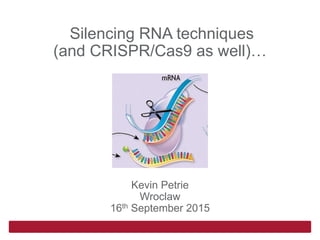
Silencing RNA techniques
(and CRISPR/Cas9 as well)…
Kevin Petrie
Wroclaw
16th September 2015
2
Outline
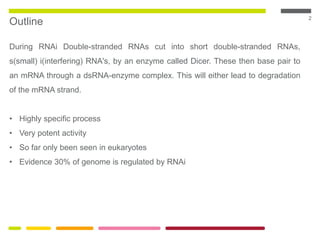
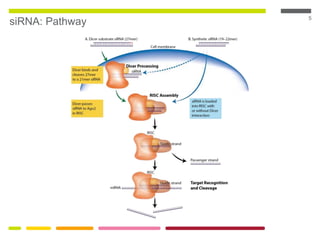
During RNAi Double-stranded RNAs cut into short double-stranded RNAs,
s(small) i(interfering) RNA's, by an enzyme called Dicer. These then base pair to
an mRNA through a dsRNA-enzyme complex. This will either lead to degradation
of the mRNA strand.
• Highly specific process
• Very potent activity
• So far only been seen in eukaryotes
• Evidence 30% of genome is regulated by RNAi
3
Outline
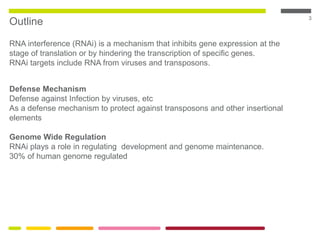
RNA interference (RNAi) is a mechanism that inhibits gene expression at the
stage of translation or by hindering the transcription of specific genes.
RNAi targets include RNA from viruses and transposons.
Defense Mechanism
Defense against Infection by viruses, etc
As a defense mechanism to protect against transposons and other insertional
elements
Genome Wide Regulation
RNAi plays a role in regulating development and genome maintenance.
30% of human genome regulated
4
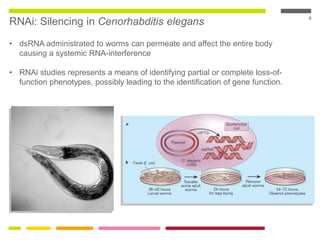
RNAi: Silencing in Cenorhabditis elegans
• dsRNA administrated to worms can permeate and affect the entire body
causing a systemic RNA-interference
• RNAi studies represents a means of identifying partial or complete loss-of-
function phenotypes, possibly leading to the identification of gene function.
5
siRNA: Pathway
6
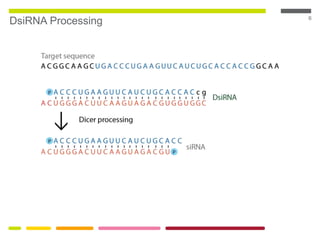
DsiRNA Processing
7
RNAi experiments
Functional analysis by mRNA knockdown using siRNAs or shRNAs is now
routine in many molecular biology labs. However, many RNAi-related
experiments fail due to diversion from simple, good practices.
Steps leading to successful siRNA experiments include:
• Understanding the target transcript
• siRNA selection
• Choosing the cell type
• Validating the assay
• Including appropriate biological controls
8
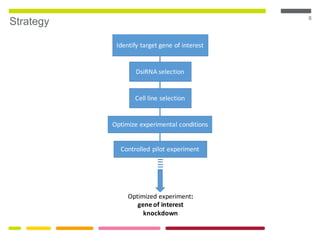
Strategy
Optimized experiment:
gene of interest
knockdown
Identify target gene of interest
DsiRNA selection
Cell line selection
Optimize experimental conditions
Controlled pilot experiment
9
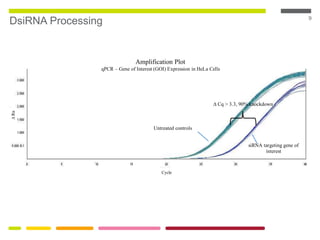
DsiRNA Processing
Untreated controls
siRNA targeting gene of
interest
Cycle
∆Rn
∆ Cq > 3.3, 90% knockdown
Amplification Plot
qPCR – Gene of Interest (GOI) Expression in HeLa Cells
10
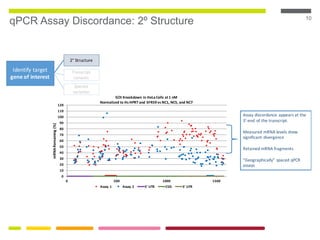
qPCR Assay Discordance: 2º Structure
Identify target
gene of interest
2° Structure
Transcript
variants
Species
variation
Assay discordance appears at the
3’-end of the transcript.
Measured mRNA levels show
significant divergence
Retained mRNA fragments
“Geographically” spaced qPCR
assays
0
10
20
30
40
50
60
70
80
90
100
110
120
0 500 1000 1500
mRNARemaining(%)
GOI Knockdown in HeLa Cells at 1 nM
Normalized to Hs HPRT and SFRS9 vs NC1, NC5, and NC7
Assay 1 Assay 2 5' UTR CDS 3' UTR
11
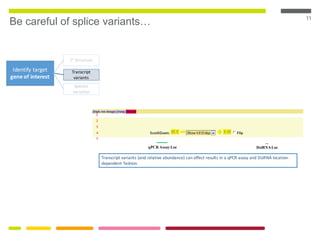
Be careful of splice variants…
qPCR Assay Loc DsiRNALoc
Identify target
gene of interest
2° Structure
Transcript
variants
Species
variation
Transcript variants (and relative abundance) can affect results in a qPCR assay and DsiRNA location-
dependent fashion.
1
2
3
4
5
12
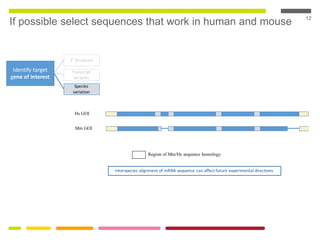
If possible select sequences that work in human and mouse
Identify target
gene of interest
2° Structure
Transcript
variants
Species
variation
Hs GOI
Mm GOI
Region of Mm/Hs sequence homology
Interspecies alignment of mRNA sequence can affect future experimental directions.
DsiRNA selec on
Design rules
Design tools
13
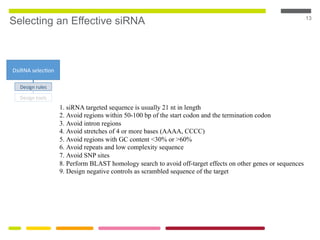
Selecting an Effective siRNA
14
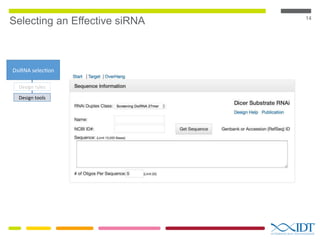
Selecting an Effective siRNA
DsiRNA selec on
Design rules
Design tools
15
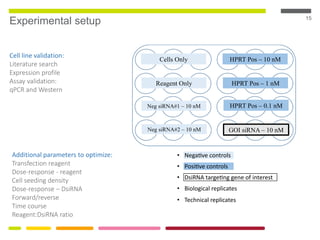
Experimental setup
Additional parameters to optimize:
Transfection reagent
Dose-response - reagent
Cell seeding density
Dose-response – DsiRNA
Forward/reverse
Time course
Reagent:DsiRNA ratio
Cell line validation:
Literature search
Expression profile
Assay validation:
qPCR and Western
16
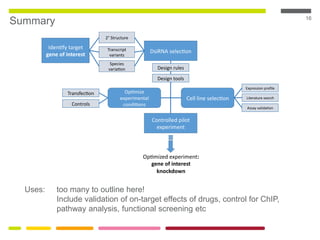
Summary
Uses: too many to outline here!
Include validation of on-target effects of drugs, control for ChIP,
pathway analysis, functional screening etc
17
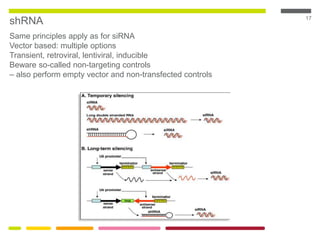
shRNA
Same principles apply as for siRNA
Vector based: multiple options
Transient, retroviral, lentiviral, inducible
Beware so-called non-targeting controls
– also perform empty vector and non-transfected controls
18
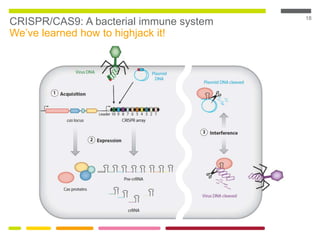
CRISPR/CAS9: A bacterial immune system
We’ve learned how to highjack it!
19
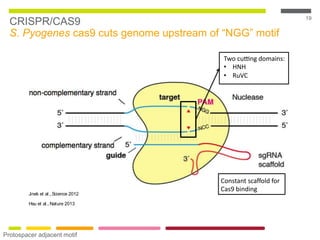
CRISPR/CAS9
S. Pyogenes cas9 cuts genome upstream of “NGG” motif
September 15 9
Two cu ng domains:
• HNH
• RuVC
Constant scaffold for
Cas9 binding
Jinek et al.,Science 2012
Hsu et al.,Nature 2013
Protospacer adjacent motif
20
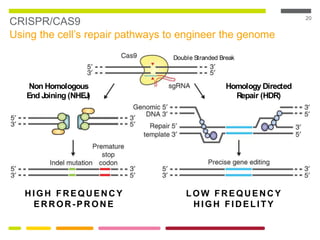
CRISPR/CAS9
Using the cell’s repair pathways to engineer the genome
HI GH FREQUENCY
ERROR-PRONE
LOW FREQUENCY
HI GH FI DELI TY
Non Homologous
End Joining (NHEJ)
Homology Directed
Repair (HDR)
Double Stranded Break
21
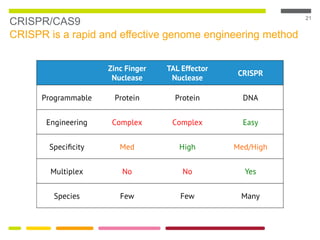
CRISPR/CAS9
CRISPR is a rapid and effective genome engineering method
22
Generating CRISPR vectors made easy…
23
Generating CRISPR vectors made easy…
24
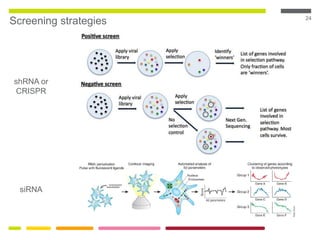
Screening strategies
shRNA or
CRISPR
siRNA
25
Screening strategies
shRNA:
Mutiple options
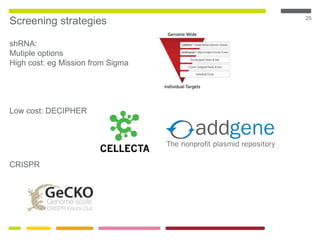
High cost: eg Mission from Sigma
Low cost: DECIPHER
CRISPR
26
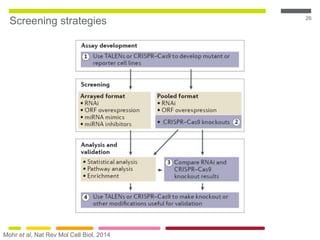
Screening strategies
Mohr et al, Nat Rev Mol Cell Biol, 2014
27
Screening strategies
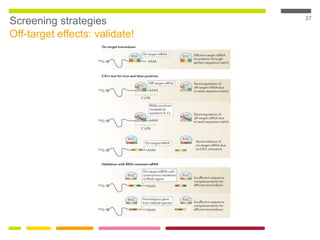
Off-target effects: validate!

Silencing RNA techniques

  • 1.
    Silencing RNA techniques (andCRISPR/Cas9 as well)… Kevin Petrie Wroclaw 16th September 2015
  • 2.
    2 Outline During RNAi Double-strandedRNAs cut into short double-stranded RNAs, s(small) i(interfering) RNA's, by an enzyme called Dicer. These then base pair to an mRNA through a dsRNA-enzyme complex. This will either lead to degradation of the mRNA strand. • Highly specific process • Very potent activity • So far only been seen in eukaryotes • Evidence 30% of genome is regulated by RNAi
  • 3.
    3 Outline RNA interference (RNAi)is a mechanism that inhibits gene expression at the stage of translation or by hindering the transcription of specific genes. RNAi targets include RNA from viruses and transposons. Defense Mechanism Defense against Infection by viruses, etc As a defense mechanism to protect against transposons and other insertional elements Genome Wide Regulation RNAi plays a role in regulating development and genome maintenance. 30% of human genome regulated
  • 4.
    4 RNAi: Silencing inCenorhabditis elegans • dsRNA administrated to worms can permeate and affect the entire body causing a systemic RNA-interference • RNAi studies represents a means of identifying partial or complete loss-of- function phenotypes, possibly leading to the identification of gene function.
  • 5.
  • 6.
  • 7.
    7 RNAi experiments Functional analysisby mRNA knockdown using siRNAs or shRNAs is now routine in many molecular biology labs. However, many RNAi-related experiments fail due to diversion from simple, good practices. Steps leading to successful siRNA experiments include: • Understanding the target transcript • siRNA selection • Choosing the cell type • Validating the assay • Including appropriate biological controls
  • 8.
    8 Strategy Optimized experiment: gene ofinterest knockdown Identify target gene of interest DsiRNA selection Cell line selection Optimize experimental conditions Controlled pilot experiment
  • 9.
    9 DsiRNA Processing Untreated controls siRNAtargeting gene of interest Cycle ∆Rn ∆ Cq > 3.3, 90% knockdown Amplification Plot qPCR – Gene of Interest (GOI) Expression in HeLa Cells
  • 10.
    10 qPCR Assay Discordance:2º Structure Identify target gene of interest 2° Structure Transcript variants Species variation Assay discordance appears at the 3’-end of the transcript. Measured mRNA levels show significant divergence Retained mRNA fragments “Geographically” spaced qPCR assays 0 10 20 30 40 50 60 70 80 90 100 110 120 0 500 1000 1500 mRNARemaining(%) GOI Knockdown in HeLa Cells at 1 nM Normalized to Hs HPRT and SFRS9 vs NC1, NC5, and NC7 Assay 1 Assay 2 5' UTR CDS 3' UTR
  • 11.
    11 Be careful ofsplice variants… qPCR Assay Loc DsiRNALoc Identify target gene of interest 2° Structure Transcript variants Species variation Transcript variants (and relative abundance) can affect results in a qPCR assay and DsiRNA location- dependent fashion. 1 2 3 4 5
  • 12.
    12 If possible selectsequences that work in human and mouse Identify target gene of interest 2° Structure Transcript variants Species variation Hs GOI Mm GOI Region of Mm/Hs sequence homology Interspecies alignment of mRNA sequence can affect future experimental directions.
  • 13.
    DsiRNA selec on Designrules Design tools 13 Selecting an Effective siRNA
  • 14.
    14 Selecting an EffectivesiRNA DsiRNA selec on Design rules Design tools
  • 15.
    15 Experimental setup Additional parametersto optimize: Transfection reagent Dose-response - reagent Cell seeding density Dose-response – DsiRNA Forward/reverse Time course Reagent:DsiRNA ratio Cell line validation: Literature search Expression profile Assay validation: qPCR and Western
  • 16.
    16 Summary Uses: too manyto outline here! Include validation of on-target effects of drugs, control for ChIP, pathway analysis, functional screening etc
  • 17.
    17 shRNA Same principles applyas for siRNA Vector based: multiple options Transient, retroviral, lentiviral, inducible Beware so-called non-targeting controls – also perform empty vector and non-transfected controls
  • 18.
    18 CRISPR/CAS9: A bacterialimmune system We’ve learned how to highjack it!
  • 19.
    19 CRISPR/CAS9 S. Pyogenes cas9cuts genome upstream of “NGG” motif September 15 9 Two cu ng domains: • HNH • RuVC Constant scaffold for Cas9 binding Jinek et al.,Science 2012 Hsu et al.,Nature 2013 Protospacer adjacent motif
  • 20.
    20 CRISPR/CAS9 Using the cell’srepair pathways to engineer the genome HI GH FREQUENCY ERROR-PRONE LOW FREQUENCY HI GH FI DELI TY Non Homologous End Joining (NHEJ) Homology Directed Repair (HDR) Double Stranded Break
  • 21.
    21 CRISPR/CAS9 CRISPR is arapid and effective genome engineering method
  • 22.
  • 23.
  • 24.
  • 25.
    25 Screening strategies shRNA: Mutiple options Highcost: eg Mission from Sigma Low cost: DECIPHER CRISPR
  • 26.
    26 Screening strategies Mohr etal, Nat Rev Mol Cell Biol, 2014
  • 27.

Editor's Notes

  • #5 RNAi can be induced in C. elegans in three simple ways: Injection of dsRNA into the worm gonads Soaking the worms in dsRNA solution Feeding the worms engineered bacteria producing dsRNA
  • #7 Small interfering RNAs that have an integral role in the phenomenon of RNA interference (RNAi), a form of post-transcriptional gene silencing RNAi: 21-25 nt fragments, which bind to the complementary portion of the target mRNA and tag it for degradation A single base pair difference between the siRNA template and the target mRNA is enough to block the process. Each strand of siRNA has: a. 5’-phosphate termini b. 3’-hydroxyl termini c. 2/3-nucleotide 3’ overhangs
  • #16 Hypoxanthine-guanine phosphoribosyltransferase
  • #20 HNH – target strand