RNA Processing
Drs. Sutarno, MSc., PhD.
RNA Processing
 RNA Processing: pre-mRNA ----> mRNA
 Semua transkrip primer yang dihasilkan di
dalam nukleus, harus mengalami taham
pemrosesan untuk menghasilkan molekul RNA
yang fungsional untuk dikeluarkan ke
sitoplasma.
 RNA processing merupakan proses untuk
menghasilkan RNA yang dewasa (mature
mRNA) bagi gen protein, atau tRNA / rRNA
fungsional dari primary transcript.
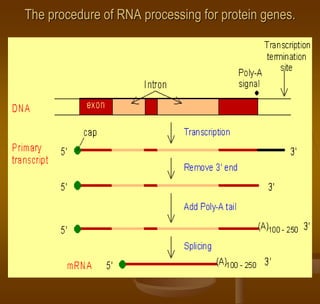
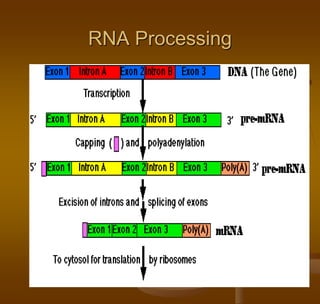
 Pemrosesan pre-mRNA meliputi tahap-tahap:
 Capping – penambahan 7-methylguanylate
(m7G) ke ujung 5’
 Polyadenylation - penambahan poly-A ke
ujung 3‘.
 Splicing – pembuangan intron dan
menggabungkan/ menyambungkan exon.
Fungsi Caping
• Melindungi mRNA dari degradasi
• Meningkatkan efisiensi dari translasi mRNA
• Meningkatkan pengangkutan mRNA dari
nukleus ke sitoplasma
• Meningkatkan proses splicing mRNA
The procedure of RNA processing for protein genes.
5'-Capping
 The Cap site is the position in the gene at
which transcription starts, and really should be
called the "transcription initiation site". The
first nucleotide is transcribed from this site to
start the nascent RNA chain. That nucleotide
becomes the 5' end of the chain, and thus the
nucleotide to which the cap structure is
attached
5'-Capping
 Capping occurs shortly after transcription
begins.
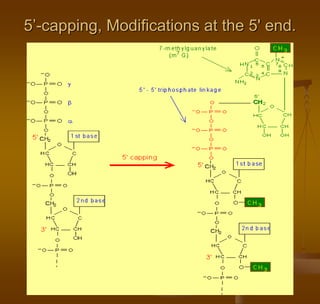
 The chemical structure of the "cap“:
 m7G is linked to the first nucleotide by a special 5'-
5' triphosphate linkage.
 In most organisms, the first nucleotide is methylated
at the 2'-hydroxyl of the ribose. In vertebrates, the
second nucleotide is also methylated.
5’-capping, Modifications at the 5' end.
Polyadenin
Penambahan Adenin pada 3’ arah downstream
dari terminasi sinyal pengakhir AAUAA
Fungsi :
• Membantu melindungi RNA dari degradasi,
• Mempermudah perpindahan mRNA dari nukleus ke
sitoplasma
• Bersama dengan protein sitoplasma membantu mRNA dalam
mengenali ribosom
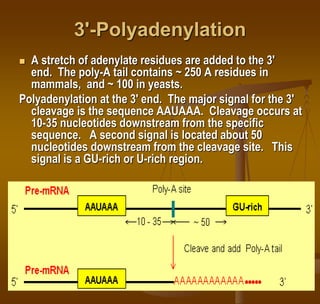
3'-Polyadenylation
 A stretch of adenylate residues are added to the 3'
end. The poly-A tail contains ~ 250 A residues in
mammals, and ~ 100 in yeasts.
Polyadenylation at the 3' end. The major signal for the 3'
cleavage is the sequence AAUAAA. Cleavage occurs at
10-35 nucleotides downstream from the specific
sequence. A second signal is located about 50
nucleotides downstream from the cleavage site. This
signal is a GU-rich or U-rich region.
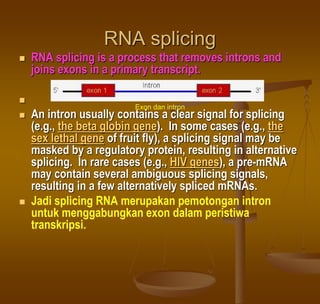
RNA splicing
 RNA splicing is a process that removes introns and
joins exons in a primary transcript.

 An intron usually contains a clear signal for splicing
(e.g., the beta globin gene). In some cases (e.g., the
sex lethal gene of fruit fly), a splicing signal may be
masked by a regulatory protein, resulting in alternative
splicing. In rare cases (e.g., HIV genes), a pre-mRNA
may contain several ambiguous splicing signals,
resulting in a few alternatively spliced mRNAs.
 Jadi splicing RNA merupakan pemotongan intron
untuk menggabungkan exon dalam peristiwa
transkripsi.
Exon dan intron
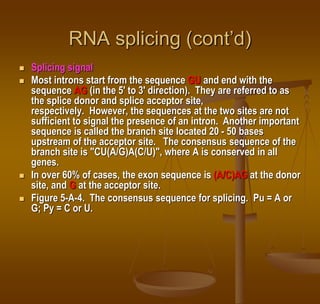
RNA splicing (cont’d)
 Splicing signal
 Most introns start from the sequence GU and end with the
sequence AG (in the 5' to 3' direction). They are referred to as
the splice donor and splice acceptor site,
respectively. However, the sequences at the two sites are not
sufficient to signal the presence of an intron. Another important
sequence is called the branch site located 20 - 50 bases
upstream of the acceptor site. The consensus sequence of the
branch site is "CU(A/G)A(C/U)", where A is conserved in all
genes.
 In over 60% of cases, the exon sequence is (A/C)AG at the donor
site, and G at the acceptor site.
 Figure 5-A-4. The consensus sequence for splicing. Pu = A or
G; Py = C or U.
Splicing mechanism
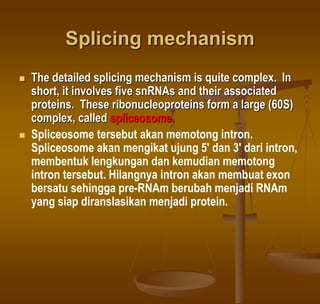
 The detailed splicing mechanism is quite complex. In
short, it involves five snRNAs and their associated
proteins. These ribonucleoproteins form a large (60S)
complex, called spliceosome.
 Spliceosome tersebut akan memotong intron.
Spliceosome akan mengikat ujung 5' dan 3' dari intron,
membentuk lengkungan dan kemudian memotong
intron tersebut. Hilangnya intron akan membuat exon
bersatu sehingga pre-RNAm berubah menjadi RNAm
yang siap diranslasikan menjadi protein.
Splicing mechanism
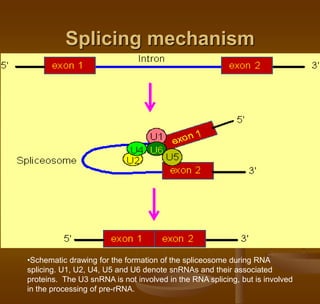
•Schematic drawing for the formation of the spliceosome during RNA
splicing. U1, U2, U4, U5 and U6 denote snRNAs and their associated
proteins. The U3 snRNA is not involved in the RNA splicing, but is involved
in the processing of pre-rRNA.
RNA Processing
Summary of the steps
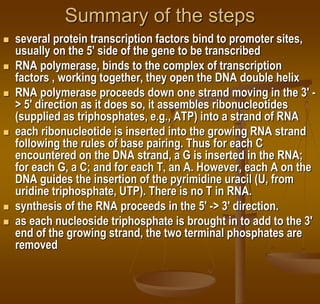
 several protein transcription factors bind to promoter sites,
usually on the 5' side of the gene to be transcribed
 RNA polymerase, binds to the complex of transcription
factors , working together, they open the DNA double helix
 RNA polymerase proceeds down one strand moving in the 3' -
> 5' direction as it does so, it assembles ribonucleotides
(supplied as triphosphates, e.g., ATP) into a strand of RNA
 each ribonucleotide is inserted into the growing RNA strand
following the rules of base pairing. Thus for each C
encountered on the DNA strand, a G is inserted in the RNA;
for each G, a C; and for each T, an A. However, each A on the
DNA guides the insertion of the pyrimidine uracil (U, from
uridine triphosphate, UTP). There is no T in RNA.
 synthesis of the RNA proceeds in the 5' -> 3' direction.
 as each nucleoside triphosphate is brought in to add to the 3'
end of the growing strand, the two terminal phosphates are
removed
Types of RNA
 Several types of RNA are synthesized:
 messenger RNA (mRNA). This will later be translated
into a polypeptide.
 ribosomal RNA (rRNA). This will be used in the building
of ribosomes: machinery for synthesizing proteins by
translating mRNA.
 transfer RNA (tRNA). RNA molecules that carry amino
acids to the growing polypeptide.
 small nuclear RNA (snRNA). DNA transcription of the
genes for mRNA, rRNA, and tRNA produces large
precursor molecules ("primary transcripts") that must
be processed within the nucleus to produce the
functional molecules for export to the cytosol. Some of
these processing steps are mediated by snRNAs.
Types of RNA
 Ribosomal RNA (rRNA)
 There are 4 kinds. In eukaryotes, these are
 18S rRNA. One of these molecules, along with some 30
different protein molecules, is used to make the small
subunit of the ribosome.
 28S, 5.8S, and 5S rRNA. One each of these molecules,
along with some 45 different proteins, are used to make the
large subunit of the ribosome.
 The name given each type of rRNA reflects the rate at
which the molecules sediment in the ultracentrifuge. The
larger the number, the larger the molecule (but not
proportionally).
Types of RNA
 Transfer RNA (tRNA)
 There are some 32 different kinds of tRNA in a typical
eukaryotic cell.
 each is the product of a separate gene
 they are small (~4S), containing 73-93 nucleotides
 many of the bases in the chain pair with each other forming
sections of double helix
 the unpaired regions form 3 loops
 each kind of tRNA carries (at its 3' end) one of the 20
amino acids (thus most amino acids have more than one
tRNA responsible for them)
 at one loop, 3 unpaired bases form an anticodon
 base pairing between the anticodon and the
complementary codon on a mRNA molecule brings the
correct amino acid into the growing polypeptide chain.
Types of RNA
 Messenger RNA (mRNA)
 Messenger RNA comes in a wide range of sizes reflecting
the size of the polypeptide it encodes. Most cells produce
small amounts of thousands of different mRNA molecules,
each to be translated into a peptide needed by the cell.
 Many mRNAs are common to most cells, encoding
"housekeeping" proteins needed by all cells (e.g. the
enzymes of glycolysis). Other mRNAs are specific for only
certain types of cells. These encode proteins needed for
the function of that particular cell (e.g., the mRNA for
hemoglobin in the precursors of red blood cells).
Types of RNA
 Small Nuclear RNA (snRNA)
 Approximately a dozen different genes for snRNAs, each
present in multiple copies, have been identified.
 The snRNAs have various roles in the processing of the
other classes of RNA. For example, several snRNAs are
part of the spliceosome that participates in converting pre-
mRNA into mRNA by excising the introns and splicing the
exons.
 The RNA polymerases
 The RNA polymerases are huge multi-subunit protein
complexes. Three kinds are found in eukaryotes.
 RNA polymerase I (Pol I). It transcribes the rRNA genes for
the precursor of the 28S, 18S, and 5.8S molecules. (and is
the busiest of the RNA polymerases)
 RNA polymerase II (Pol II). It transcribes the mRNA and
snRNA genes.
 RNA polymerase III (Pol III). It transcribes the 5S rRNA
genes and all the tRNA genes.

Mol genet-8. transkripsi2

  • 1.
  • 2.
    RNA Processing  RNAProcessing: pre-mRNA ----> mRNA  Semua transkrip primer yang dihasilkan di dalam nukleus, harus mengalami taham pemrosesan untuk menghasilkan molekul RNA yang fungsional untuk dikeluarkan ke sitoplasma.
  • 3.
     RNA processingmerupakan proses untuk menghasilkan RNA yang dewasa (mature mRNA) bagi gen protein, atau tRNA / rRNA fungsional dari primary transcript.  Pemrosesan pre-mRNA meliputi tahap-tahap:  Capping – penambahan 7-methylguanylate (m7G) ke ujung 5’  Polyadenylation - penambahan poly-A ke ujung 3‘.  Splicing – pembuangan intron dan menggabungkan/ menyambungkan exon.
  • 4.
    Fungsi Caping • MelindungimRNA dari degradasi • Meningkatkan efisiensi dari translasi mRNA • Meningkatkan pengangkutan mRNA dari nukleus ke sitoplasma • Meningkatkan proses splicing mRNA
  • 5.
    The procedure ofRNA processing for protein genes.
  • 6.
    5'-Capping  The Capsite is the position in the gene at which transcription starts, and really should be called the "transcription initiation site". The first nucleotide is transcribed from this site to start the nascent RNA chain. That nucleotide becomes the 5' end of the chain, and thus the nucleotide to which the cap structure is attached
  • 7.
    5'-Capping  Capping occursshortly after transcription begins.  The chemical structure of the "cap“:  m7G is linked to the first nucleotide by a special 5'- 5' triphosphate linkage.  In most organisms, the first nucleotide is methylated at the 2'-hydroxyl of the ribose. In vertebrates, the second nucleotide is also methylated.
  • 8.
  • 9.
    Polyadenin Penambahan Adenin pada3’ arah downstream dari terminasi sinyal pengakhir AAUAA Fungsi : • Membantu melindungi RNA dari degradasi, • Mempermudah perpindahan mRNA dari nukleus ke sitoplasma • Bersama dengan protein sitoplasma membantu mRNA dalam mengenali ribosom
  • 10.
    3'-Polyadenylation  A stretchof adenylate residues are added to the 3' end. The poly-A tail contains ~ 250 A residues in mammals, and ~ 100 in yeasts. Polyadenylation at the 3' end. The major signal for the 3' cleavage is the sequence AAUAAA. Cleavage occurs at 10-35 nucleotides downstream from the specific sequence. A second signal is located about 50 nucleotides downstream from the cleavage site. This signal is a GU-rich or U-rich region.
  • 11.
    RNA splicing  RNAsplicing is a process that removes introns and joins exons in a primary transcript.   An intron usually contains a clear signal for splicing (e.g., the beta globin gene). In some cases (e.g., the sex lethal gene of fruit fly), a splicing signal may be masked by a regulatory protein, resulting in alternative splicing. In rare cases (e.g., HIV genes), a pre-mRNA may contain several ambiguous splicing signals, resulting in a few alternatively spliced mRNAs.  Jadi splicing RNA merupakan pemotongan intron untuk menggabungkan exon dalam peristiwa transkripsi. Exon dan intron
  • 12.
    RNA splicing (cont’d) Splicing signal  Most introns start from the sequence GU and end with the sequence AG (in the 5' to 3' direction). They are referred to as the splice donor and splice acceptor site, respectively. However, the sequences at the two sites are not sufficient to signal the presence of an intron. Another important sequence is called the branch site located 20 - 50 bases upstream of the acceptor site. The consensus sequence of the branch site is "CU(A/G)A(C/U)", where A is conserved in all genes.  In over 60% of cases, the exon sequence is (A/C)AG at the donor site, and G at the acceptor site.  Figure 5-A-4. The consensus sequence for splicing. Pu = A or G; Py = C or U.
  • 13.
    Splicing mechanism  Thedetailed splicing mechanism is quite complex. In short, it involves five snRNAs and their associated proteins. These ribonucleoproteins form a large (60S) complex, called spliceosome.  Spliceosome tersebut akan memotong intron. Spliceosome akan mengikat ujung 5' dan 3' dari intron, membentuk lengkungan dan kemudian memotong intron tersebut. Hilangnya intron akan membuat exon bersatu sehingga pre-RNAm berubah menjadi RNAm yang siap diranslasikan menjadi protein.
  • 14.
    Splicing mechanism •Schematic drawingfor the formation of the spliceosome during RNA splicing. U1, U2, U4, U5 and U6 denote snRNAs and their associated proteins. The U3 snRNA is not involved in the RNA splicing, but is involved in the processing of pre-rRNA.
  • 15.
  • 16.
    Summary of thesteps  several protein transcription factors bind to promoter sites, usually on the 5' side of the gene to be transcribed  RNA polymerase, binds to the complex of transcription factors , working together, they open the DNA double helix  RNA polymerase proceeds down one strand moving in the 3' - > 5' direction as it does so, it assembles ribonucleotides (supplied as triphosphates, e.g., ATP) into a strand of RNA  each ribonucleotide is inserted into the growing RNA strand following the rules of base pairing. Thus for each C encountered on the DNA strand, a G is inserted in the RNA; for each G, a C; and for each T, an A. However, each A on the DNA guides the insertion of the pyrimidine uracil (U, from uridine triphosphate, UTP). There is no T in RNA.  synthesis of the RNA proceeds in the 5' -> 3' direction.  as each nucleoside triphosphate is brought in to add to the 3' end of the growing strand, the two terminal phosphates are removed
  • 17.
    Types of RNA Several types of RNA are synthesized:  messenger RNA (mRNA). This will later be translated into a polypeptide.  ribosomal RNA (rRNA). This will be used in the building of ribosomes: machinery for synthesizing proteins by translating mRNA.  transfer RNA (tRNA). RNA molecules that carry amino acids to the growing polypeptide.  small nuclear RNA (snRNA). DNA transcription of the genes for mRNA, rRNA, and tRNA produces large precursor molecules ("primary transcripts") that must be processed within the nucleus to produce the functional molecules for export to the cytosol. Some of these processing steps are mediated by snRNAs.
  • 18.
    Types of RNA Ribosomal RNA (rRNA)  There are 4 kinds. In eukaryotes, these are  18S rRNA. One of these molecules, along with some 30 different protein molecules, is used to make the small subunit of the ribosome.  28S, 5.8S, and 5S rRNA. One each of these molecules, along with some 45 different proteins, are used to make the large subunit of the ribosome.  The name given each type of rRNA reflects the rate at which the molecules sediment in the ultracentrifuge. The larger the number, the larger the molecule (but not proportionally).
  • 19.
    Types of RNA Transfer RNA (tRNA)  There are some 32 different kinds of tRNA in a typical eukaryotic cell.  each is the product of a separate gene  they are small (~4S), containing 73-93 nucleotides  many of the bases in the chain pair with each other forming sections of double helix  the unpaired regions form 3 loops  each kind of tRNA carries (at its 3' end) one of the 20 amino acids (thus most amino acids have more than one tRNA responsible for them)  at one loop, 3 unpaired bases form an anticodon  base pairing between the anticodon and the complementary codon on a mRNA molecule brings the correct amino acid into the growing polypeptide chain.
  • 20.
    Types of RNA Messenger RNA (mRNA)  Messenger RNA comes in a wide range of sizes reflecting the size of the polypeptide it encodes. Most cells produce small amounts of thousands of different mRNA molecules, each to be translated into a peptide needed by the cell.  Many mRNAs are common to most cells, encoding "housekeeping" proteins needed by all cells (e.g. the enzymes of glycolysis). Other mRNAs are specific for only certain types of cells. These encode proteins needed for the function of that particular cell (e.g., the mRNA for hemoglobin in the precursors of red blood cells).
  • 21.
    Types of RNA Small Nuclear RNA (snRNA)  Approximately a dozen different genes for snRNAs, each present in multiple copies, have been identified.  The snRNAs have various roles in the processing of the other classes of RNA. For example, several snRNAs are part of the spliceosome that participates in converting pre- mRNA into mRNA by excising the introns and splicing the exons.
  • 22.
     The RNApolymerases  The RNA polymerases are huge multi-subunit protein complexes. Three kinds are found in eukaryotes.  RNA polymerase I (Pol I). It transcribes the rRNA genes for the precursor of the 28S, 18S, and 5.8S molecules. (and is the busiest of the RNA polymerases)  RNA polymerase II (Pol II). It transcribes the mRNA and snRNA genes.  RNA polymerase III (Pol III). It transcribes the 5S rRNA genes and all the tRNA genes.