This document provides an overview of key concepts in hypothesis testing including:
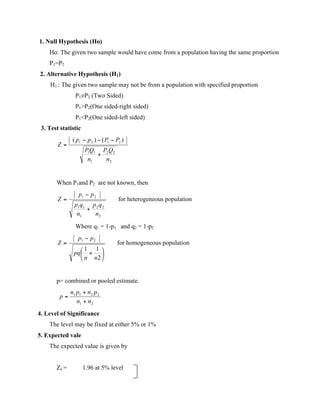
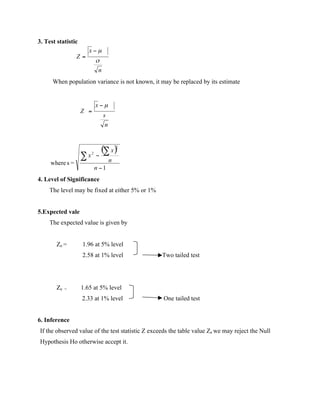
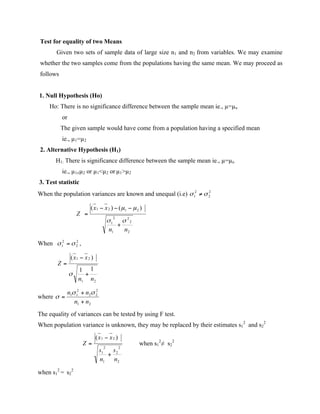
- The null and alternative hypotheses, where the null hypothesis is what we aim to reject or fail to reject.
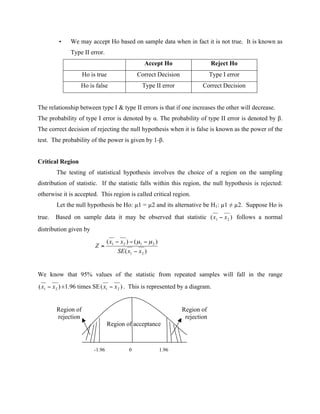
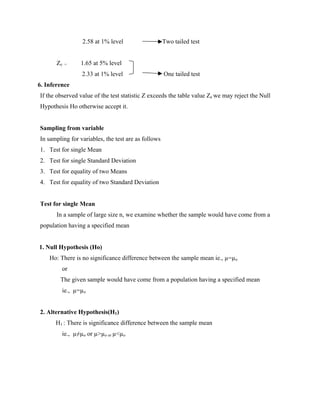
- The level of significance and critical region, which define the threshold for rejecting the null hypothesis.
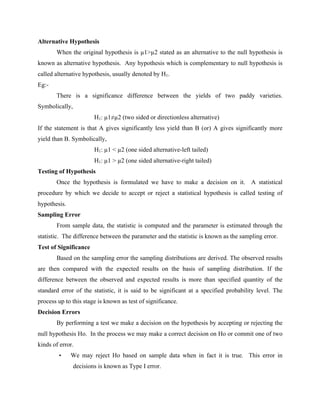
- Type I and type II errors, where we aim to minimize both by choosing an appropriate significance level and critical region.
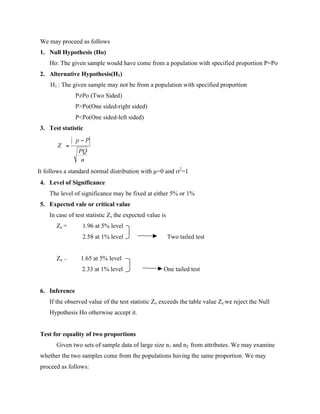
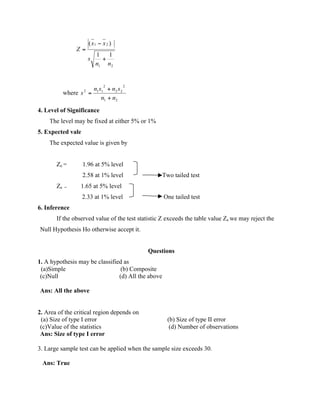
- Common test statistics like z, t, and chi-squared that are used to evaluate hypotheses based on samples.
- The process of hypothesis testing, which involves defining hypotheses, choosing a test statistic and significance level, and making a decision to reject or fail to reject the null based on the critical region.