Testing of
Hypothesis
Dr. AKHIL CHILWAL
Teaching Assistant & Data Analyst
G.B.P.U.A. & T., Pantnagar
Mo. 9411883705
Introduction
The primary objective of statistical analysis is to use
data from a sample to make inferences about the
population from which the sample was drawn.
µ,σ
, S
Sample
Mean and variance
of GATE scores of
all students of IIT-
KGP
The mean and
variance of
students in the
entire country?
x
What is Hypothesis?
• “A hypothesis is an educated prediction that can be tested”
(study.com).
• “A hypothesis is a proposed explanation for a phenomenon”
(Wikipedia).
• “A hypothesis is used to define the relationship between two
variables” (Oxford dictionary).
• “A supposition or proposed explanation made on the basis of
limited evidence as a starting point for further investigation”
(Walpole).
Hypothesis Testing
Testing of Hypothesis
Testing of Hypothesis:
In hypothesis testing, we decide whether to accept or
reject a particular value of a set, of particular values of a
parameter or those of several parameters. It is seen that,
although the exact value of a parameter may be unknown,
there is often same idea about the true value. The data
collected from samples helps us in rejecting or accepting our
hypothesis. In other words, in dealing with problems of
hypothesis testing, we try to arrive at a right decision about a
pre-stated hypothesis.
Definition:
A test of a statistical hypothesis is a two action
decision problem after the experimental sample values have
been obtained, the two–actions being the acceptance or
rejection of the hypothesis.
Statistical Hypothesis:
If the hypothesis is stated in terms of population parameters (such as
mean and variance), the hypothesis is called statistical hypothesis.
Example: To determine whether the wages of men and women are
equal.
A product in the market is of standard quality.
Whether a particular medicine is effective to cure a
disease.
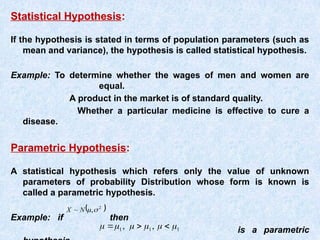
Parametric Hypothesis:
A statistical hypothesis which refers only the value of unknown
parameters of probability Distribution whose form is known is
called a parametric hypothesis.
Example: if then
is a parametric
 
2
,
~ 

N
X
1
1
1 ,
, 




 


Null Hypothesis: H0
 The null hypothesis (denoted by H0) is a
statement that the value of a population
parameter (such as proportion, mean, or standard
deviation) is equal to some claimed value.
 We test the null hypothesis directly.
 Either reject H0 or fail to reject H0.
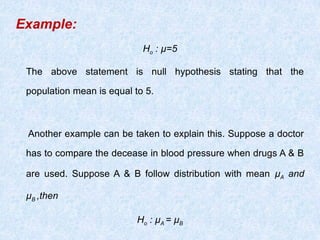
Example:
Ho : µ=5
The above statement is null hypothesis stating that the
population mean is equal to 5.
Another example can be taken to explain this. Suppose a doctor
has to compare the decease in blood pressure when drugs A & B
are used. Suppose A & B follow distribution with mean µA and
µB ,then
Ho : µA = µB
Alternative Hypothesis: H1
 The alternative hypothesis (denoted by H1 or
Ha or HA) is the statement that the parameter
has a value that somehow differs from the
Null Hypothesis.
 The symbolic form of the alternative
hypothesis must use one of these symbols: ,
<, >.
Types of Alternative Hypothesis
We have two kinds of alternative hypothesis:-
(a) One sided alternative hypothesis
(b) Two sided alternative hypothesis
The test related to (a) is called as ‘one – tailed’
test and those related to (b) are called as ‘two
tailed’ tests.
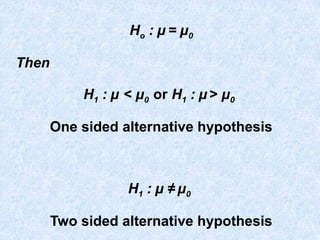
Ho : µ = µ0
Then
H1 : µ < µ0 or H1 : µ > µ0
One sided alternative hypothesis
H1 : µ ≠ µ0
Two sided alternative hypothesis
Note about Forming Your
Own Claims (Hypotheses)
If you are conducting a study and want
to use a hypothesis test to support
your claim, the claim must be worded
so that it becomes the alternative
hypothesis.
Test Statistic
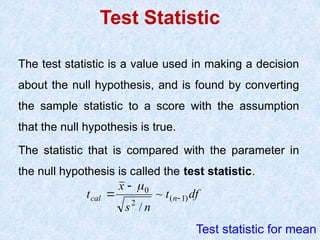
The test statistic is a value used in making a decision
about the null hypothesis, and is found by converting
the sample statistic to a score with the assumption
that the null hypothesis is true.
The statistic that is compared with the parameter in
the null hypothesis is called the test statistic.
df
t
n
s
x
t n
cal )
1
(
2
0
~
/




Test statistic for mean
Critical Region
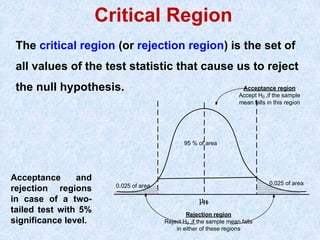
The critical region (or rejection region) is the set of
all values of the test statistic that cause us to reject
the null hypothesis.
Acceptance and
rejection regions
in case of a two-
tailed test with 5%
significance level.
µH0
Rejection region
Reject H0 ,if the sample mean falls
in either of these regions
95 % of area
Acceptance region
Accept H0 ,if the sample
mean falls in this region
0.025 of area
0.025 of area
Significance Level
The significance level (denoted by ) is the
probability that the test statistic will fall in the
critical region when the null hypothesis is
actually true. Common choices for  are
0.05, 0.01, and 0.10.
Critical Value
A critical value is any value that separates the
critical region (where we reject the null
hypothesis) from the values of the test
statistic that do not lead to rejection of the null
hypothesis. The critical values depend on the
nature of the null hypothesis, the sampling
distribution that applies, and the significance
level .
Two-tailed, Right-tailed,
Left-tailed Tests
The tails in a distribution are the extreme
regions bounded by critical values.
Two-tailed Test
H0: =
H1: 
is divided equally between the
two tails of the critical region
Means less than or greater than
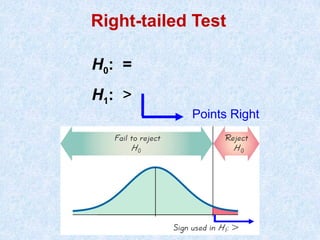
Right-tailed Test
H0: =
H1: >
Points Right
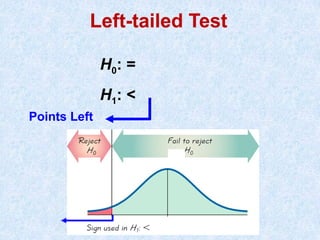
Left-tailed Test
H0: =
H1: <
Points Left
P-Value
The P-value (or p-value or probability value)
is the probability of getting a value of the test
statistic that is at least as extreme as the one
representing the sample data, assuming that
the null hypothesis is true. The null
hypothesis is rejected if the P-value is very
small, such as 0.05 or less.
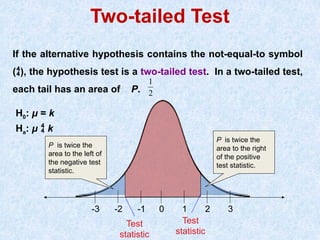
Two-tailed Test
If the alternative hypothesis contains the not-equal-to symbol
(), the hypothesis test is a two-tailed test. In a two-tailed test,
each tail has an area of P.
0 1 2 3
-3 -2 -1
Test
statistic
Test
statistic
H0: μ = k
Ha: μ  k
P is twice the
area to the left of
the negative test
statistic.
P is twice the
area to the right
of the positive
test statistic.
2
1
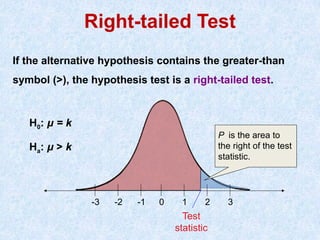
Right-tailed Test
If the alternative hypothesis contains the greater-than
symbol (>), the hypothesis test is a right-tailed test.
0 1 2 3
-3 -2 -1
Test
statistic
H0: μ = k
Ha: μ > k
P is the area to
the right of the test
statistic.
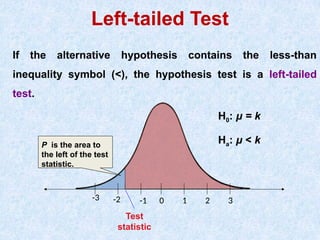
Left-tailed Test
If the alternative hypothesis contains the less-than
inequality symbol (<), the hypothesis test is a left-tailed
test.
0 1 2 3
-3 -2 -1
Test
statistic
H0: μ = k
Ha: μ < k
P is the area to
the left of the test
statistic.
We always test the null hypothesis.
The initial conclusion will always be
one of the following:
1. Reject the null hypothesis.
2. Fail to reject the null hypothesis.
Making a Decision
Traditional method
Reject H0 if the test statistic falls
within the critical region.
Fail to reject H0 if the test statistic
does not fall within the critical
region.
Decision Criterion
P-value method
Reject H0 if the P-value   (where
 is the significance level, such as
0.05).
Accept H0 if the P-value > .
Decision Criterion
Decision Criterion
Confidence Intervals
Because a confidence interval estimate of a
population parameter contains the likely
values of that parameter, reject a claim that the
population parameter has a value that is not
included in the confidence interval.
Type I Error
 A Type I error is the mistake of
rejecting the null hypothesis when it
is true.
 The symbol  (alpha) is used to
represent the probability of a type I
error.
Type II Error
 A Type II error is the mistake of failing to
reject the null hypothesis when it is false.
 The symbol  (beta) is used to represent
the probability of a type II error.
Actual Truth of H0
H0 is true H0 is false
Accept H0
Reject H0
Correct Decision
Correct Decision
Type II Error
Type I Error
Decision
There may be four possible situations that arise
in any test procedure which have been
summaries are given below:
Controlling Type I &
Type II Errors
 For any fixed , an increase in the sample
size n will cause a decrease in 
 For any fixed sample size n, a decrease in 
will cause an increase in . Conversely, an
increase in  will cause a decrease in .
 To decrease both  and , increase the
sample size.
•
Hypothesis Testing Procedures
Interpreting a Decision
Example:
H0: (Claim) A cigarette manufacturer claims that less
than one-eighth of the US adult population smokes
cigarettes.
If H0 is rejected, you should conclude “there is
sufficient evidence to indicate that the manufacturer’s
claim is false.”
If you fail to reject H0, you should conclude “there is not
sufficient evidence to indicate that the manufacturer’s
Thank You

Testing of Hypothesis.pptx. Hypothesis types

  • 1.
    Testing of Hypothesis Dr. AKHILCHILWAL Teaching Assistant & Data Analyst G.B.P.U.A. & T., Pantnagar Mo. 9411883705
  • 2.
    Introduction The primary objectiveof statistical analysis is to use data from a sample to make inferences about the population from which the sample was drawn. µ,σ , S Sample Mean and variance of GATE scores of all students of IIT- KGP The mean and variance of students in the entire country? x
  • 3.
    What is Hypothesis? •“A hypothesis is an educated prediction that can be tested” (study.com). • “A hypothesis is a proposed explanation for a phenomenon” (Wikipedia). • “A hypothesis is used to define the relationship between two variables” (Oxford dictionary). • “A supposition or proposed explanation made on the basis of limited evidence as a starting point for further investigation” (Walpole). Hypothesis Testing
  • 4.
    Testing of Hypothesis Testingof Hypothesis: In hypothesis testing, we decide whether to accept or reject a particular value of a set, of particular values of a parameter or those of several parameters. It is seen that, although the exact value of a parameter may be unknown, there is often same idea about the true value. The data collected from samples helps us in rejecting or accepting our hypothesis. In other words, in dealing with problems of hypothesis testing, we try to arrive at a right decision about a pre-stated hypothesis. Definition: A test of a statistical hypothesis is a two action decision problem after the experimental sample values have been obtained, the two–actions being the acceptance or rejection of the hypothesis.
  • 5.
    Statistical Hypothesis: If thehypothesis is stated in terms of population parameters (such as mean and variance), the hypothesis is called statistical hypothesis. Example: To determine whether the wages of men and women are equal. A product in the market is of standard quality. Whether a particular medicine is effective to cure a disease. Parametric Hypothesis: A statistical hypothesis which refers only the value of unknown parameters of probability Distribution whose form is known is called a parametric hypothesis. Example: if then is a parametric   2 , ~   N X 1 1 1 , ,         
  • 6.
    Null Hypothesis: H0 The null hypothesis (denoted by H0) is a statement that the value of a population parameter (such as proportion, mean, or standard deviation) is equal to some claimed value.  We test the null hypothesis directly.  Either reject H0 or fail to reject H0.
  • 7.
    Example: Ho : µ=5 Theabove statement is null hypothesis stating that the population mean is equal to 5. Another example can be taken to explain this. Suppose a doctor has to compare the decease in blood pressure when drugs A & B are used. Suppose A & B follow distribution with mean µA and µB ,then Ho : µA = µB
  • 8.
    Alternative Hypothesis: H1 The alternative hypothesis (denoted by H1 or Ha or HA) is the statement that the parameter has a value that somehow differs from the Null Hypothesis.  The symbolic form of the alternative hypothesis must use one of these symbols: , <, >.
  • 9.
    Types of AlternativeHypothesis We have two kinds of alternative hypothesis:- (a) One sided alternative hypothesis (b) Two sided alternative hypothesis The test related to (a) is called as ‘one – tailed’ test and those related to (b) are called as ‘two tailed’ tests.
  • 10.
    Ho : µ= µ0 Then H1 : µ < µ0 or H1 : µ > µ0 One sided alternative hypothesis H1 : µ ≠ µ0 Two sided alternative hypothesis
  • 11.
    Note about FormingYour Own Claims (Hypotheses) If you are conducting a study and want to use a hypothesis test to support your claim, the claim must be worded so that it becomes the alternative hypothesis.
  • 12.
    Test Statistic The teststatistic is a value used in making a decision about the null hypothesis, and is found by converting the sample statistic to a score with the assumption that the null hypothesis is true. The statistic that is compared with the parameter in the null hypothesis is called the test statistic. df t n s x t n cal ) 1 ( 2 0 ~ /     Test statistic for mean
  • 13.
    Critical Region The criticalregion (or rejection region) is the set of all values of the test statistic that cause us to reject the null hypothesis. Acceptance and rejection regions in case of a two- tailed test with 5% significance level. µH0 Rejection region Reject H0 ,if the sample mean falls in either of these regions 95 % of area Acceptance region Accept H0 ,if the sample mean falls in this region 0.025 of area 0.025 of area
  • 14.
    Significance Level The significancelevel (denoted by ) is the probability that the test statistic will fall in the critical region when the null hypothesis is actually true. Common choices for  are 0.05, 0.01, and 0.10.
  • 15.
    Critical Value A criticalvalue is any value that separates the critical region (where we reject the null hypothesis) from the values of the test statistic that do not lead to rejection of the null hypothesis. The critical values depend on the nature of the null hypothesis, the sampling distribution that applies, and the significance level .
  • 16.
    Two-tailed, Right-tailed, Left-tailed Tests Thetails in a distribution are the extreme regions bounded by critical values.
  • 17.
    Two-tailed Test H0: = H1: is divided equally between the two tails of the critical region Means less than or greater than
  • 18.
  • 19.
  • 20.
    P-Value The P-value (orp-value or probability value) is the probability of getting a value of the test statistic that is at least as extreme as the one representing the sample data, assuming that the null hypothesis is true. The null hypothesis is rejected if the P-value is very small, such as 0.05 or less.
  • 21.
    Two-tailed Test If thealternative hypothesis contains the not-equal-to symbol (), the hypothesis test is a two-tailed test. In a two-tailed test, each tail has an area of P. 0 1 2 3 -3 -2 -1 Test statistic Test statistic H0: μ = k Ha: μ  k P is twice the area to the left of the negative test statistic. P is twice the area to the right of the positive test statistic. 2 1
  • 22.
    Right-tailed Test If thealternative hypothesis contains the greater-than symbol (>), the hypothesis test is a right-tailed test. 0 1 2 3 -3 -2 -1 Test statistic H0: μ = k Ha: μ > k P is the area to the right of the test statistic.
  • 23.
    Left-tailed Test If thealternative hypothesis contains the less-than inequality symbol (<), the hypothesis test is a left-tailed test. 0 1 2 3 -3 -2 -1 Test statistic H0: μ = k Ha: μ < k P is the area to the left of the test statistic.
  • 24.
    We always testthe null hypothesis. The initial conclusion will always be one of the following: 1. Reject the null hypothesis. 2. Fail to reject the null hypothesis. Making a Decision
  • 25.
    Traditional method Reject H0if the test statistic falls within the critical region. Fail to reject H0 if the test statistic does not fall within the critical region. Decision Criterion
  • 26.
    P-value method Reject H0if the P-value   (where  is the significance level, such as 0.05). Accept H0 if the P-value > . Decision Criterion
  • 27.
    Decision Criterion Confidence Intervals Becausea confidence interval estimate of a population parameter contains the likely values of that parameter, reject a claim that the population parameter has a value that is not included in the confidence interval.
  • 28.
    Type I Error A Type I error is the mistake of rejecting the null hypothesis when it is true.  The symbol  (alpha) is used to represent the probability of a type I error.
  • 29.
    Type II Error A Type II error is the mistake of failing to reject the null hypothesis when it is false.  The symbol  (beta) is used to represent the probability of a type II error.
  • 30.
    Actual Truth ofH0 H0 is true H0 is false Accept H0 Reject H0 Correct Decision Correct Decision Type II Error Type I Error Decision There may be four possible situations that arise in any test procedure which have been summaries are given below:
  • 31.
    Controlling Type I& Type II Errors  For any fixed , an increase in the sample size n will cause a decrease in   For any fixed sample size n, a decrease in  will cause an increase in . Conversely, an increase in  will cause a decrease in .  To decrease both  and , increase the sample size.
  • 32.
  • 33.
    Interpreting a Decision Example: H0:(Claim) A cigarette manufacturer claims that less than one-eighth of the US adult population smokes cigarettes. If H0 is rejected, you should conclude “there is sufficient evidence to indicate that the manufacturer’s claim is false.” If you fail to reject H0, you should conclude “there is not sufficient evidence to indicate that the manufacturer’s
  • 34.