Pediatric Growth
Hormone
Deficiency
Abdulmoein Al-Agha,
FRCP(UK)
Professor & Pediatric
Endocrinologist.
aagha@kau.edu.sa
Objectives
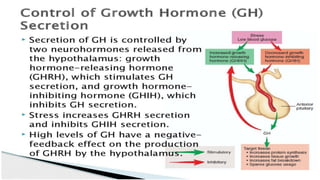
• GH secretion & control.
• GH physiology.
• Metabolic effects of GH.
• Approach to a child with short stature.
• Differential diagnoses of short stature.
• Investigations of a child with short stature.
• Causes of GH deficiency.
• GH therapy (indications, monitoring, side effects &
contraindications).
• Future of GH therapy.
Growth hormone: Physiology
• GH is a 191 amino acid polypeptide hormone synthesized, stored &
secreted by the somatotroph cells of anterior pituitary gland.
• GH synthesis and release is controlled by many hormonal agents
including GHRH, Somatostatin, Ghrelin, IGF-1, thyroid hormones and
glucocorticoids.
• Growth hormone is secreted in pulses (after infancy).
• GH secretion is increased in puberty then decreases subsequently.
• Growth hormone binding proteins binds GH and dampen the
fluctuation of GH level associated with its pulsatile secretion.
• Growth promoting mediated actions are either directly via GH binding
on its receptor of target cells or indirectly via IGF-1, includes most of its
growth promoting action.
Ayyar VS. History of growth hormone therapy. Indian J Endocrinol Metab. 2011;15 Suppl 3(Suppl3):S162–S165.
doi:10.4103/2230-8210.84852
GH physiology
• GH released metabolized by different organs (mostly liver).
• GH binds to its receptor in different tissues.
• The liver synthesized Somatomedin-C (IGF1).
• IGF1 & IGFBP3 gets united by an Acid-Labile Subunit (ALS).
• This complex of IGF1-IGBP3-ALS circulate to the epiphyses.
• Once target tissues gets the complex, negative feedback message is sent
to the hypothalamus to increase somatostatin secretion in order to stop
the GH pulses from the pituitary.
• IGF1 & IGBP3 together are used to screen for GH deficiency as well as
for monitoring GH therapy.
Physiologic & Metabolic effects of GH
• In general, growth hormone stimulates protein anabolism in many tissues:
• Increases amino acid uptake, increases protein synthesis & decreases oxidation of
proteins.
• Promotes linear growth.
• Increase bone formation & bone mass.
• Increase active muscle mass.
• Anabolic effects.
• Increase lipolysis & redistribution of fat:
• Growth hormone enhances the utilization of fat by stimulating triglyceride
breakdown and oxidation in adipocytes
• Growth hormone has anti-insulin activity, because it supresses the abilities of insulin to
stimulate uptake of glucose in peripheral tissues and enhance glucose synthesis in the
liver.
• Positive self esteem.
Short stature
• Short stature, occurring in 2.5% of children
• Standard Deviation Score (SDS) report the number of standard
deviations from the mean for age , sex & race.
• Normal range is -2 to +2 SDS.
• Short stature is defined when height is below (3rd. Percentile ) or 2
standard deviations for age , gender &race.
• Not all cases of short stature are related to GHD.
• The prevalence of GHD is estimated at 1:4,000 - 10,000.
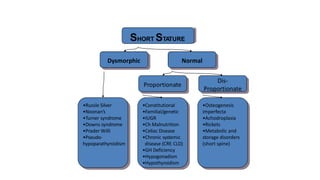
SHORT STATURE
Dysmorphic Normal
•Russle Silver
•Noonan’s
•Turner syndrome
•Downs syndrome
•Prader Willi
•Pseudo-
hypoparathyroidism
Proportionate
Dis-
Proportionate
•Constitutional
•Familial/genetic
•IUGR
•Ch Malnutrition
•Celiac Disease
•Chronic systemic
disease (CRF, CLD)
•GH Deficiency
•Hypogonadism
•Hypothyroidism
•Osteogenesis
imperfecta
•Achodroplasia
•Rickets
•Metabolic and
storage disorders
(short spine)
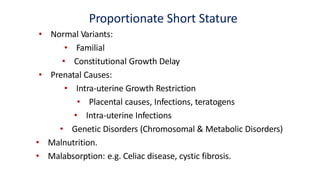
Proportionate Short Stature
• Normal Variants:
• Familial
• Constitutional Growth Delay
• Prenatal Causes:
• Intra-uterine Growth Restriction
• Placental causes, Infections, teratogens
• Intra-uterine Infections
• Genetic Disorders (Chromosomal & Metabolic Disorders)
• Malnutrition.
• Malabsorption: e.g. Celiac disease, cystic fibrosis.
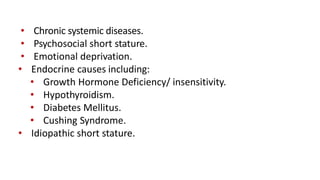
• Chronic systemic diseases.
• Psychosocial short stature.
• Emotional deprivation.
• Endocrine causes including:
• Growth Hormone Deficiency/ insensitivity.
• Hypothyroidism.
• Diabetes Mellitus.
• Cushing Syndrome.
• Idiopathic short stature.
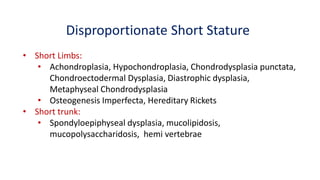
Disproportionate Short Stature
• Short Limbs:
• Achondroplasia, Hypochondroplasia, Chondrodysplasia punctata,
Chondroectodermal Dysplasia, Diastrophic dysplasia,
Metaphyseal Chondrodysplasia
• Osteogenesis Imperfecta, Hereditary Rickets
• Short trunk:
• Spondyloepiphyseal dysplasia, mucolipidosis,
mucopolysaccharidosis, hemi vertebrae
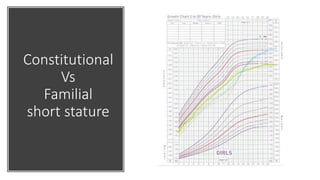
Constitutional
Vs
Familial
short stature
Constitutional short stature
• History of delayed puberty in father or late menarche in mother.
• Normal growth velocity
• Drift down in early childhood, continue to growth slowly, delayed
onset of puberty then catch-up growth
• Bone age is delayed but equivalent to height age
• No need for GH therapy
Familial short stature
• Short parents.
• Normal growth velocity.
• Normal bone age.
• Normal onset of puberty.
• No need for therapy.
Approach to child with short stature
•Onset of short stature.
•Antenatal, natal & post natal histories including birth measurements.
• Family history of short stature including parents' height & timing of
their puberty.
• Past medical history of the child.
• Calculate mid-parental height.
• Is the poor growth reflected in poor weight gain ,short stature or both?
• Failure to thrive Vs. short stature.
• Detailed physical examination including Tanner puberty staging.
Approach to child with short stature
• Detailed measurements of weigh, height, head circumference over
time to calculate growth velocity.
•Systemic review.
•Developmental history.
•Family history.
•Nutritional history.
•Medication & Allergic histories.
Investigations
Universal for all cases include:
• Bone age (mandatory to differentiate between physiological and
pathological short stature).
• Thyroid function test (even if no other symptoms).
• Karyotype in girls (even if no dysmorphism).
• CBC.
• Electrolytes , Renal & Liver function tests.
• Urinalysis & stool analysis.
• IgA anti-tissue transglutaminase as screening for celiac (even if no other
symptoms).
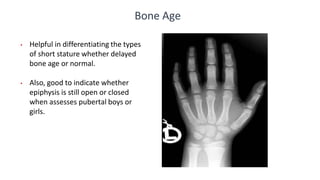
Bone Age
• Helpful in differentiating the types
of short stature whether delayed
bone age or normal.
• Also, good to indicate whether
epiphysis is still open or closed
when assesses pubertal boys or
girls.
Investigations
Further investigations depend on suspected possibilities:
• Skeletal survey : Skeletal dysplasia.
• Serum calcium, phosphate, alkaline phosphatase, venous gas,
fasting glucose, albumin, transaminases for various types of
rickets.
• Sweet chloride test: Cystic fibrosis.
• Jejunal biopsy : Celiac disease (if screening is positive)
• Growth factors: (IGF-1, IGFBP3 (Neither are completely sensitive
or specific).
• GH stimulation test if GH deficiency is suspected.
• Pharmacological stimulation tests: two pharmacological tests.
• MRI Brain: if GH hormone deficiency is confirmed.
GH stimulation test
• By using GHRH, Arginine, Clonidine, L- Dopa, Glucagon or inducing
hypoglycemia with insulin tolerance test
• Use two testing agents.
• Send blood sample with tubes marked with time t a reliable
laboratory.
• If the patient is already experiencing hypoglycemia, obtaining GH
levels during the hypoglycemic episode can be diagnostic
• GH level of less than 10 ng/mL suggests that diagnosis of GHD in
pediatrics.
• Most of the insurance companies require provocative testing.
Radiological study
• Bone Age: X- ray of the left hand which determines bone maturations
when compared to a standard atlas, children with GHD have delayed
bone age
• MRI of the pituitary and brain to evaluate the anatomy and
potentially diagnose any etiology of GHD: structural deformities of
the pituitary gland, craniopharyngioma and even brain tumor
• MRI should be a standard approach since finding a CNS tumor is
contraindication for GH therapy.
Classification of GH deficiency
• Defects in GH secretion
• Defects in GH activity
• Defects in IGF1, IGFBP3 or ALS
• Defects at GH receptor (GH resistance)
Classification of GH deficiency
• Congenital ( CNS and pituitary anomalies) vs Acquired
• Isolated vs combined
• Isolated : Only GHD
• Combined: Hypopituitarism: 2 pituitary hormonal deficiencies
• Panhypopituitarism: More than 2 pituitary hormonal deficiencies
• Other hormonal deficiencies may include TSH (secondary
hypothyroidism), ACTH (secondary hypocortisolism), FSH and LH
(delayed puberty)
• May start as isolated but can progress, need to monitor other
hormones during treatment of GHD
• Certain pituitary mutations may include several hormonal deficiencies
Causes of GH deficiency
• Most common cause is idiopathic
• CNS congenital abnormalities
• Septo-optic dysplasia (SOD), optic nerve atrophy
• Midline face defects ( Cleft lip /palate)
• Holoprosencephaly
• Pituitary aplasia or hypoplasia
• Most of the CNS abnormalities are associated with multiple
pituitary hormonal deficiencies.
Causes of GH deficiency
• CNS insults:
• Trauma.
• Infection.
• Surgery.
• Radiation therapy.
• GH granules are affected first, but other hormonal
deficiencies may develop later.
• May be associated with posterior pituitary dysfunction.
Causes of GH deficiency
• CNS neoplasm:
• Craniopharyngioma.
• Hypothalamic tumors.
• Brain tumors close to pituitary stalk.
• Local effect to increased pressure.
• Post surgery or radiation therapy (Caution about GH
therapy and relapse).
Causes of GH deficiency
• Genetic mutations and Defects in GH-1 gene
• IGHD Type I : A: short length at birth and hypoglycemia in
infancy, develop severe growth retardation by the age of
six months. Initial good response to exogenous GH is
hampered by the development of anti–GH–antibodies
leading to dramatic slowing of growth while on therapy
• IGHD Type IB: Autosomal recessive, less severe
• IGHD Type II: Autosomal dominant, severe
• IGHD Type III: X–linked, recessive, associated with
agammaglobulinemia and repeated infections.
Genetic mutations causing GHD
Combined with multiple hormonal deficiencies
• Homeobox Gene: HESX1: SOD, multiple pituitary hormones.
• SOX3 SRY (Sex Determining Region Y) : Multiple pituitary hormones.
• POU1F1 (PIT1): The pituitary transcription factor: GH, TSH , PRL.
• PROP1: Prophet of PIT1: Multiple pituitary hormones.
Defects in GH pathway ( GH, receptor, IGF1, boinactive GH)
• GH insensitivity is characterized by low IGF-I levels, normal or elevated GH levels,
and lack of IGF-I response to GH treatment
• IGF-I resistance is characterized by elevated IGF-I levels with normal/high GH levels.
• Several genetic defects are responsible for impairment of GH and IGF-I actions
resulting in short stature that could affect intrauterine growth or be present in the
postnatal period.
• The genetic defects affecting GH and/or IGF-I action can be divided into five
different groups:
• GH insensitivity by defects affecting the GH receptor (GHR).
• Intracellular GH signalling pathway (STAT5B, STAT3, IKBKB, IL2RG, PIK3R1).
• synthesis of insulin-like growth factors (IGF1, IGF2).
• transport/bioavailability of IGFs (IGFALS, PAPPA2).
• defects affecting IGF-I sensitivity (IGF1R).
Diagnosis of GH deficiency
• Pathological short stature.
• Poor growth velocity for age.
• Below target height.
• Low IGF1, IGFBP3.
• GH deficiency after stim test.
• Delayed bone age.
GH therapy
• The treatment for children with growth hormone deficiency has significantly
developed since its first uses from human cadavers (1958), until the arrival of
recombinant human growth hormone (1985).
• The biotechnological advance has allowed an expansion in its uses due to a
greater availability, as well as a greater biological safety.
• Recombinant GH, is used for treatment of several conditions including:
• GHD, Turner’s syndrome, idiopathic short stature, SGA, PWS, CRF & Noonan’s
syndrome .. etc*.
Ayyar VS. History of growth hormone therapy. Indian J Endocrinol Metab. 2011;15 Suppl 3(Suppl3):S162–S165. doi:10.4103/2230-8210.84852
*Novo Nordisk doesn’t encourage the use of its products outside the approved labelled indications
GH therapy
• Lessons learned since recombinant human GH was introduced to the
market in 1985
• High level of GH safety has lasted more than 35 years because of:
–Jacob Creutzfeldt disease relationship to pituitary-derived GH
–Potential association between GH & leukemia.
• Initially, growth hormone was injected intramuscularly.
• In mid 1980s, it was shown as effective when administered as a
subcutaneous injection.
• Early in its use, growth hormone was administered twice weekly; this
was increased to 3 times weekly when the higher frequency was shown
to result in an increased growth response
• Daily administration is now the recommended use
Growth hormone replacement therapy
• Improves linear growth.
• Body composition changes producing a reduction in total and visceral
fat and increase in lean body mass.
• Improvement in CV function and lipids.
• Improves Quality of life.
• Increases bone mineral density.
• Improves memory, alertness & concentration.
FOR INTERNAL USE ONLY - NOT FOR DISTRIBUTION OR DETAILING
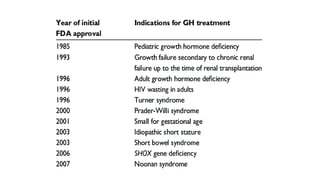
Hormone Therapy FDA indications of Growth
• Growth hormone deficiency.
• Chronic renal failure.
• Turner Syndrome.
• Prader-Willi Syndrome.
• SGA.
• Idiopathic short stature.
• AIDS wasting.
• Noonan Syndrome.
• Chronic diseases.
• Skeletal dysplasia (Achondroplasia).
• Others.
Growth Hormone Deficiency (GHD)
• Recommend a dose in the range of 0.025–0.05 mg/kg/day.
• Under special circumstances, higher doses may be required,
including adolescents with late diagnosis & diminished
period for catch-up growth.
• Recently it has been proposed that IGF-1-based GH dosing
may improve growth responses.
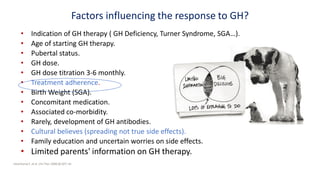
Factors influencing the response to GH?
• Indication of GH therapy ( GH Deficiency, Turner Syndrome, SGA…).
• Age of starting GH therapy.
• Pubertal status.
• GH dose.
• GH dose titration 3-6 monthly.
• Treatment adherence.
• Birth Weight (SGA).
• Concomitant medication.
• Associated co-morbidity.
• Rarely, development of GH antibodies.
• Cultural believes (spreading not true side effects).
• Family education and uncertain worries on side effects.
• Limited parents' information on GH therapy.
Haverkamp F, et al. Clin Ther 2008;30:307–16
GH side effects
• Peripheral edema.
• Carpal tunnel syndrome.
• Arthralgia & Myalgia.
• Growing pains.
• Orthopedic complications:
• slipped capital femoral epiphysis SCFE.
• worsening of scoliosis in children with established scoliosis.
• Gynecomastia.
• Increased nevi size.
• Pseudotumor cerebri (Benign intra-cranial hypertension).
• Increased insulin resistance ( slight increase in T2DM), however, diabetes
mellitus is not contraindication to GH treatment in children.
GH side effects
• Benign Intracranial Hypertension:
• occurs in first 8 weeks of starting GH therapy.
• has been reported in 1 in 1000 children receiving GH
treatment.
• due to the increase in salt and water retention.
• resolves rapidly when growth hormone treatment is
stopped
• GH can usually then be restarted at a lower dose, and the
dose slowly increased without further problems.
Is GH mitogenic ??
• GH does NOT cause cancer.
• In 1988, reports from Japan describing leukemia in GH-treated
children raised concern about malignancy.
• Most recurrences occur within the first 2 years of treatment, and
most endocrinologists defer institution of treatment until a year of
stable remission has passed.
• Not to use GH in any condition which may predisposes to cancer:
• e.g. those with Neurofibromatosis type 1, Fanconi anaemia,
Downs & Bloom syndromes.
• Patients with previous malignancies or history of radiation
therapy carry significant risk for recurrence and second
malignancy.
GH contraindication
• Advanced bone age.
• Active malignancy.
• Risks diseases /syndromes lead to malignancy.
• Severe allergic reactions to therapy.
Follow up
• History:
• Availability of GH supply.
• compliance with therapy.
• missed doses.
• general well being.
• any concerns and side effects.
• Improvement of GV.
• Physical Examination:
• Accurate measurement of weigh & height.
• general examination.
• visual fields.
• Tanner puberty staging.
• Laboratory work: Monitor therapy with IGF1 & IGFBP3 levels every 3- 6 months.
• Radiology: Bone age
• Follow up 1-month post therapy then Q3-4 months.
Monitor for other pituitary hormones
• GH can increase the metabolism of total T4.
• Other hormonal deficiencies may develop as a progression of
panhypopituitarism without the influence of GH.
• Low TSH & free T4 may indicate secondary hypothyroidism.
• Sudden hypoglycemia may indicate ACTH deficiency causing
secondary hypoadrenalism.
• Diabetes insipidus.
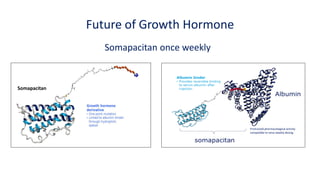
Future of Growth Hormone
Protracted pharmacological activity
compatible to once weekly dosing
Somapacitan
Somapacitan once weekly
Conclusions
Growth hormone therapy has the following advantages :
• Improves linear growth.
• Body composition changes producing a reduction in total &
visceral fat and increase in lean body mass.
• Improvement in CV function & lipids.
• Improves Quality of life.
• Increases bone mineral density.
• Improves memory, alertness & concentration.
Conclusions
• GH has been approved for the following conditions including:
• Growth hormone deficiency.
• Chronic renal failure.
• Turner syndrome.
• Prader Willi syndrome.
• SGA.
• Idiopathic short stature.
• AIDS wasting.
• Noonan Syndrome.
• Nocturnal administration mimics physiological GH secretion may add to
efficacy .
Conclusions
• The effect of GH wanes with time.
• First year of treatment usually produces the greatest growth increment .
• Certain patient groups who receive GH treatment carry an intrinsic risk of
developing malignancies, including those with Neurofibromatosis type 1,
Fanconi anemia, Downs & Bloom syndromes.
• Although no evidence that GH replacement poses increased cancer risk,
such children be carefully monitored regarding tumor formation.
Thanks

Pediatric growth hormone deficiency

  • 1.
  • 2.
    Objectives • GH secretion& control. • GH physiology. • Metabolic effects of GH. • Approach to a child with short stature. • Differential diagnoses of short stature. • Investigations of a child with short stature. • Causes of GH deficiency. • GH therapy (indications, monitoring, side effects & contraindications). • Future of GH therapy.
  • 3.
    Growth hormone: Physiology •GH is a 191 amino acid polypeptide hormone synthesized, stored & secreted by the somatotroph cells of anterior pituitary gland. • GH synthesis and release is controlled by many hormonal agents including GHRH, Somatostatin, Ghrelin, IGF-1, thyroid hormones and glucocorticoids. • Growth hormone is secreted in pulses (after infancy). • GH secretion is increased in puberty then decreases subsequently. • Growth hormone binding proteins binds GH and dampen the fluctuation of GH level associated with its pulsatile secretion. • Growth promoting mediated actions are either directly via GH binding on its receptor of target cells or indirectly via IGF-1, includes most of its growth promoting action. Ayyar VS. History of growth hormone therapy. Indian J Endocrinol Metab. 2011;15 Suppl 3(Suppl3):S162–S165. doi:10.4103/2230-8210.84852
  • 5.
    GH physiology • GHreleased metabolized by different organs (mostly liver). • GH binds to its receptor in different tissues. • The liver synthesized Somatomedin-C (IGF1). • IGF1 & IGFBP3 gets united by an Acid-Labile Subunit (ALS). • This complex of IGF1-IGBP3-ALS circulate to the epiphyses. • Once target tissues gets the complex, negative feedback message is sent to the hypothalamus to increase somatostatin secretion in order to stop the GH pulses from the pituitary. • IGF1 & IGBP3 together are used to screen for GH deficiency as well as for monitoring GH therapy.
  • 6.
    Physiologic & Metaboliceffects of GH • In general, growth hormone stimulates protein anabolism in many tissues: • Increases amino acid uptake, increases protein synthesis & decreases oxidation of proteins. • Promotes linear growth. • Increase bone formation & bone mass. • Increase active muscle mass. • Anabolic effects. • Increase lipolysis & redistribution of fat: • Growth hormone enhances the utilization of fat by stimulating triglyceride breakdown and oxidation in adipocytes • Growth hormone has anti-insulin activity, because it supresses the abilities of insulin to stimulate uptake of glucose in peripheral tissues and enhance glucose synthesis in the liver. • Positive self esteem.
  • 7.
    Short stature • Shortstature, occurring in 2.5% of children • Standard Deviation Score (SDS) report the number of standard deviations from the mean for age , sex & race. • Normal range is -2 to +2 SDS. • Short stature is defined when height is below (3rd. Percentile ) or 2 standard deviations for age , gender &race. • Not all cases of short stature are related to GHD. • The prevalence of GHD is estimated at 1:4,000 - 10,000.
  • 8.
    SHORT STATURE Dysmorphic Normal •RussleSilver •Noonan’s •Turner syndrome •Downs syndrome •Prader Willi •Pseudo- hypoparathyroidism Proportionate Dis- Proportionate •Constitutional •Familial/genetic •IUGR •Ch Malnutrition •Celiac Disease •Chronic systemic disease (CRF, CLD) •GH Deficiency •Hypogonadism •Hypothyroidism •Osteogenesis imperfecta •Achodroplasia •Rickets •Metabolic and storage disorders (short spine)
  • 9.
    Proportionate Short Stature •Normal Variants: • Familial • Constitutional Growth Delay • Prenatal Causes: • Intra-uterine Growth Restriction • Placental causes, Infections, teratogens • Intra-uterine Infections • Genetic Disorders (Chromosomal & Metabolic Disorders) • Malnutrition. • Malabsorption: e.g. Celiac disease, cystic fibrosis.
  • 10.
    • Chronic systemicdiseases. • Psychosocial short stature. • Emotional deprivation. • Endocrine causes including: • Growth Hormone Deficiency/ insensitivity. • Hypothyroidism. • Diabetes Mellitus. • Cushing Syndrome. • Idiopathic short stature.
  • 11.
    Disproportionate Short Stature •Short Limbs: • Achondroplasia, Hypochondroplasia, Chondrodysplasia punctata, Chondroectodermal Dysplasia, Diastrophic dysplasia, Metaphyseal Chondrodysplasia • Osteogenesis Imperfecta, Hereditary Rickets • Short trunk: • Spondyloepiphyseal dysplasia, mucolipidosis, mucopolysaccharidosis, hemi vertebrae
  • 12.
  • 13.
    Constitutional short stature •History of delayed puberty in father or late menarche in mother. • Normal growth velocity • Drift down in early childhood, continue to growth slowly, delayed onset of puberty then catch-up growth • Bone age is delayed but equivalent to height age • No need for GH therapy
  • 14.
    Familial short stature •Short parents. • Normal growth velocity. • Normal bone age. • Normal onset of puberty. • No need for therapy.
  • 15.
    Approach to childwith short stature •Onset of short stature. •Antenatal, natal & post natal histories including birth measurements. • Family history of short stature including parents' height & timing of their puberty. • Past medical history of the child. • Calculate mid-parental height. • Is the poor growth reflected in poor weight gain ,short stature or both? • Failure to thrive Vs. short stature. • Detailed physical examination including Tanner puberty staging.
  • 16.
    Approach to childwith short stature • Detailed measurements of weigh, height, head circumference over time to calculate growth velocity. •Systemic review. •Developmental history. •Family history. •Nutritional history. •Medication & Allergic histories.
  • 17.
    Investigations Universal for allcases include: • Bone age (mandatory to differentiate between physiological and pathological short stature). • Thyroid function test (even if no other symptoms). • Karyotype in girls (even if no dysmorphism). • CBC. • Electrolytes , Renal & Liver function tests. • Urinalysis & stool analysis. • IgA anti-tissue transglutaminase as screening for celiac (even if no other symptoms).
  • 18.
    Bone Age • Helpfulin differentiating the types of short stature whether delayed bone age or normal. • Also, good to indicate whether epiphysis is still open or closed when assesses pubertal boys or girls.
  • 19.
    Investigations Further investigations dependon suspected possibilities: • Skeletal survey : Skeletal dysplasia. • Serum calcium, phosphate, alkaline phosphatase, venous gas, fasting glucose, albumin, transaminases for various types of rickets. • Sweet chloride test: Cystic fibrosis. • Jejunal biopsy : Celiac disease (if screening is positive) • Growth factors: (IGF-1, IGFBP3 (Neither are completely sensitive or specific). • GH stimulation test if GH deficiency is suspected. • Pharmacological stimulation tests: two pharmacological tests. • MRI Brain: if GH hormone deficiency is confirmed.
  • 20.
    GH stimulation test •By using GHRH, Arginine, Clonidine, L- Dopa, Glucagon or inducing hypoglycemia with insulin tolerance test • Use two testing agents. • Send blood sample with tubes marked with time t a reliable laboratory. • If the patient is already experiencing hypoglycemia, obtaining GH levels during the hypoglycemic episode can be diagnostic • GH level of less than 10 ng/mL suggests that diagnosis of GHD in pediatrics. • Most of the insurance companies require provocative testing.
  • 21.
    Radiological study • BoneAge: X- ray of the left hand which determines bone maturations when compared to a standard atlas, children with GHD have delayed bone age • MRI of the pituitary and brain to evaluate the anatomy and potentially diagnose any etiology of GHD: structural deformities of the pituitary gland, craniopharyngioma and even brain tumor • MRI should be a standard approach since finding a CNS tumor is contraindication for GH therapy.
  • 22.
    Classification of GHdeficiency • Defects in GH secretion • Defects in GH activity • Defects in IGF1, IGFBP3 or ALS • Defects at GH receptor (GH resistance)
  • 23.
    Classification of GHdeficiency • Congenital ( CNS and pituitary anomalies) vs Acquired • Isolated vs combined • Isolated : Only GHD • Combined: Hypopituitarism: 2 pituitary hormonal deficiencies • Panhypopituitarism: More than 2 pituitary hormonal deficiencies • Other hormonal deficiencies may include TSH (secondary hypothyroidism), ACTH (secondary hypocortisolism), FSH and LH (delayed puberty) • May start as isolated but can progress, need to monitor other hormones during treatment of GHD • Certain pituitary mutations may include several hormonal deficiencies
  • 24.
    Causes of GHdeficiency • Most common cause is idiopathic • CNS congenital abnormalities • Septo-optic dysplasia (SOD), optic nerve atrophy • Midline face defects ( Cleft lip /palate) • Holoprosencephaly • Pituitary aplasia or hypoplasia • Most of the CNS abnormalities are associated with multiple pituitary hormonal deficiencies.
  • 25.
    Causes of GHdeficiency • CNS insults: • Trauma. • Infection. • Surgery. • Radiation therapy. • GH granules are affected first, but other hormonal deficiencies may develop later. • May be associated with posterior pituitary dysfunction.
  • 26.
    Causes of GHdeficiency • CNS neoplasm: • Craniopharyngioma. • Hypothalamic tumors. • Brain tumors close to pituitary stalk. • Local effect to increased pressure. • Post surgery or radiation therapy (Caution about GH therapy and relapse).
  • 27.
    Causes of GHdeficiency • Genetic mutations and Defects in GH-1 gene • IGHD Type I : A: short length at birth and hypoglycemia in infancy, develop severe growth retardation by the age of six months. Initial good response to exogenous GH is hampered by the development of anti–GH–antibodies leading to dramatic slowing of growth while on therapy • IGHD Type IB: Autosomal recessive, less severe • IGHD Type II: Autosomal dominant, severe • IGHD Type III: X–linked, recessive, associated with agammaglobulinemia and repeated infections.
  • 28.
    Genetic mutations causingGHD Combined with multiple hormonal deficiencies • Homeobox Gene: HESX1: SOD, multiple pituitary hormones. • SOX3 SRY (Sex Determining Region Y) : Multiple pituitary hormones. • POU1F1 (PIT1): The pituitary transcription factor: GH, TSH , PRL. • PROP1: Prophet of PIT1: Multiple pituitary hormones.
  • 29.
    Defects in GHpathway ( GH, receptor, IGF1, boinactive GH) • GH insensitivity is characterized by low IGF-I levels, normal or elevated GH levels, and lack of IGF-I response to GH treatment • IGF-I resistance is characterized by elevated IGF-I levels with normal/high GH levels. • Several genetic defects are responsible for impairment of GH and IGF-I actions resulting in short stature that could affect intrauterine growth or be present in the postnatal period. • The genetic defects affecting GH and/or IGF-I action can be divided into five different groups: • GH insensitivity by defects affecting the GH receptor (GHR). • Intracellular GH signalling pathway (STAT5B, STAT3, IKBKB, IL2RG, PIK3R1). • synthesis of insulin-like growth factors (IGF1, IGF2). • transport/bioavailability of IGFs (IGFALS, PAPPA2). • defects affecting IGF-I sensitivity (IGF1R).
  • 30.
    Diagnosis of GHdeficiency • Pathological short stature. • Poor growth velocity for age. • Below target height. • Low IGF1, IGFBP3. • GH deficiency after stim test. • Delayed bone age.
  • 31.
    GH therapy • Thetreatment for children with growth hormone deficiency has significantly developed since its first uses from human cadavers (1958), until the arrival of recombinant human growth hormone (1985). • The biotechnological advance has allowed an expansion in its uses due to a greater availability, as well as a greater biological safety. • Recombinant GH, is used for treatment of several conditions including: • GHD, Turner’s syndrome, idiopathic short stature, SGA, PWS, CRF & Noonan’s syndrome .. etc*. Ayyar VS. History of growth hormone therapy. Indian J Endocrinol Metab. 2011;15 Suppl 3(Suppl3):S162–S165. doi:10.4103/2230-8210.84852 *Novo Nordisk doesn’t encourage the use of its products outside the approved labelled indications
  • 32.
    GH therapy • Lessonslearned since recombinant human GH was introduced to the market in 1985 • High level of GH safety has lasted more than 35 years because of: –Jacob Creutzfeldt disease relationship to pituitary-derived GH –Potential association between GH & leukemia. • Initially, growth hormone was injected intramuscularly. • In mid 1980s, it was shown as effective when administered as a subcutaneous injection. • Early in its use, growth hormone was administered twice weekly; this was increased to 3 times weekly when the higher frequency was shown to result in an increased growth response • Daily administration is now the recommended use
  • 33.
    Growth hormone replacementtherapy • Improves linear growth. • Body composition changes producing a reduction in total and visceral fat and increase in lean body mass. • Improvement in CV function and lipids. • Improves Quality of life. • Increases bone mineral density. • Improves memory, alertness & concentration.
  • 34.
    FOR INTERNAL USEONLY - NOT FOR DISTRIBUTION OR DETAILING
  • 35.
    Hormone Therapy FDAindications of Growth • Growth hormone deficiency. • Chronic renal failure. • Turner Syndrome. • Prader-Willi Syndrome. • SGA. • Idiopathic short stature. • AIDS wasting. • Noonan Syndrome. • Chronic diseases. • Skeletal dysplasia (Achondroplasia). • Others.
  • 36.
    Growth Hormone Deficiency(GHD) • Recommend a dose in the range of 0.025–0.05 mg/kg/day. • Under special circumstances, higher doses may be required, including adolescents with late diagnosis & diminished period for catch-up growth. • Recently it has been proposed that IGF-1-based GH dosing may improve growth responses.
  • 37.
    Factors influencing theresponse to GH? • Indication of GH therapy ( GH Deficiency, Turner Syndrome, SGA…). • Age of starting GH therapy. • Pubertal status. • GH dose. • GH dose titration 3-6 monthly. • Treatment adherence. • Birth Weight (SGA). • Concomitant medication. • Associated co-morbidity. • Rarely, development of GH antibodies. • Cultural believes (spreading not true side effects). • Family education and uncertain worries on side effects. • Limited parents' information on GH therapy. Haverkamp F, et al. Clin Ther 2008;30:307–16
  • 38.
    GH side effects •Peripheral edema. • Carpal tunnel syndrome. • Arthralgia & Myalgia. • Growing pains. • Orthopedic complications: • slipped capital femoral epiphysis SCFE. • worsening of scoliosis in children with established scoliosis. • Gynecomastia. • Increased nevi size. • Pseudotumor cerebri (Benign intra-cranial hypertension). • Increased insulin resistance ( slight increase in T2DM), however, diabetes mellitus is not contraindication to GH treatment in children.
  • 39.
    GH side effects •Benign Intracranial Hypertension: • occurs in first 8 weeks of starting GH therapy. • has been reported in 1 in 1000 children receiving GH treatment. • due to the increase in salt and water retention. • resolves rapidly when growth hormone treatment is stopped • GH can usually then be restarted at a lower dose, and the dose slowly increased without further problems.
  • 40.
    Is GH mitogenic?? • GH does NOT cause cancer. • In 1988, reports from Japan describing leukemia in GH-treated children raised concern about malignancy. • Most recurrences occur within the first 2 years of treatment, and most endocrinologists defer institution of treatment until a year of stable remission has passed. • Not to use GH in any condition which may predisposes to cancer: • e.g. those with Neurofibromatosis type 1, Fanconi anaemia, Downs & Bloom syndromes. • Patients with previous malignancies or history of radiation therapy carry significant risk for recurrence and second malignancy.
  • 41.
    GH contraindication • Advancedbone age. • Active malignancy. • Risks diseases /syndromes lead to malignancy. • Severe allergic reactions to therapy.
  • 42.
    Follow up • History: •Availability of GH supply. • compliance with therapy. • missed doses. • general well being. • any concerns and side effects. • Improvement of GV. • Physical Examination: • Accurate measurement of weigh & height. • general examination. • visual fields. • Tanner puberty staging. • Laboratory work: Monitor therapy with IGF1 & IGFBP3 levels every 3- 6 months. • Radiology: Bone age • Follow up 1-month post therapy then Q3-4 months.
  • 43.
    Monitor for otherpituitary hormones • GH can increase the metabolism of total T4. • Other hormonal deficiencies may develop as a progression of panhypopituitarism without the influence of GH. • Low TSH & free T4 may indicate secondary hypothyroidism. • Sudden hypoglycemia may indicate ACTH deficiency causing secondary hypoadrenalism. • Diabetes insipidus.
  • 44.
    Future of GrowthHormone Protracted pharmacological activity compatible to once weekly dosing Somapacitan Somapacitan once weekly
  • 45.
    Conclusions Growth hormone therapyhas the following advantages : • Improves linear growth. • Body composition changes producing a reduction in total & visceral fat and increase in lean body mass. • Improvement in CV function & lipids. • Improves Quality of life. • Increases bone mineral density. • Improves memory, alertness & concentration.
  • 46.
    Conclusions • GH hasbeen approved for the following conditions including: • Growth hormone deficiency. • Chronic renal failure. • Turner syndrome. • Prader Willi syndrome. • SGA. • Idiopathic short stature. • AIDS wasting. • Noonan Syndrome. • Nocturnal administration mimics physiological GH secretion may add to efficacy .
  • 47.
    Conclusions • The effectof GH wanes with time. • First year of treatment usually produces the greatest growth increment . • Certain patient groups who receive GH treatment carry an intrinsic risk of developing malignancies, including those with Neurofibromatosis type 1, Fanconi anemia, Downs & Bloom syndromes. • Although no evidence that GH replacement poses increased cancer risk, such children be carefully monitored regarding tumor formation.
  • 48.