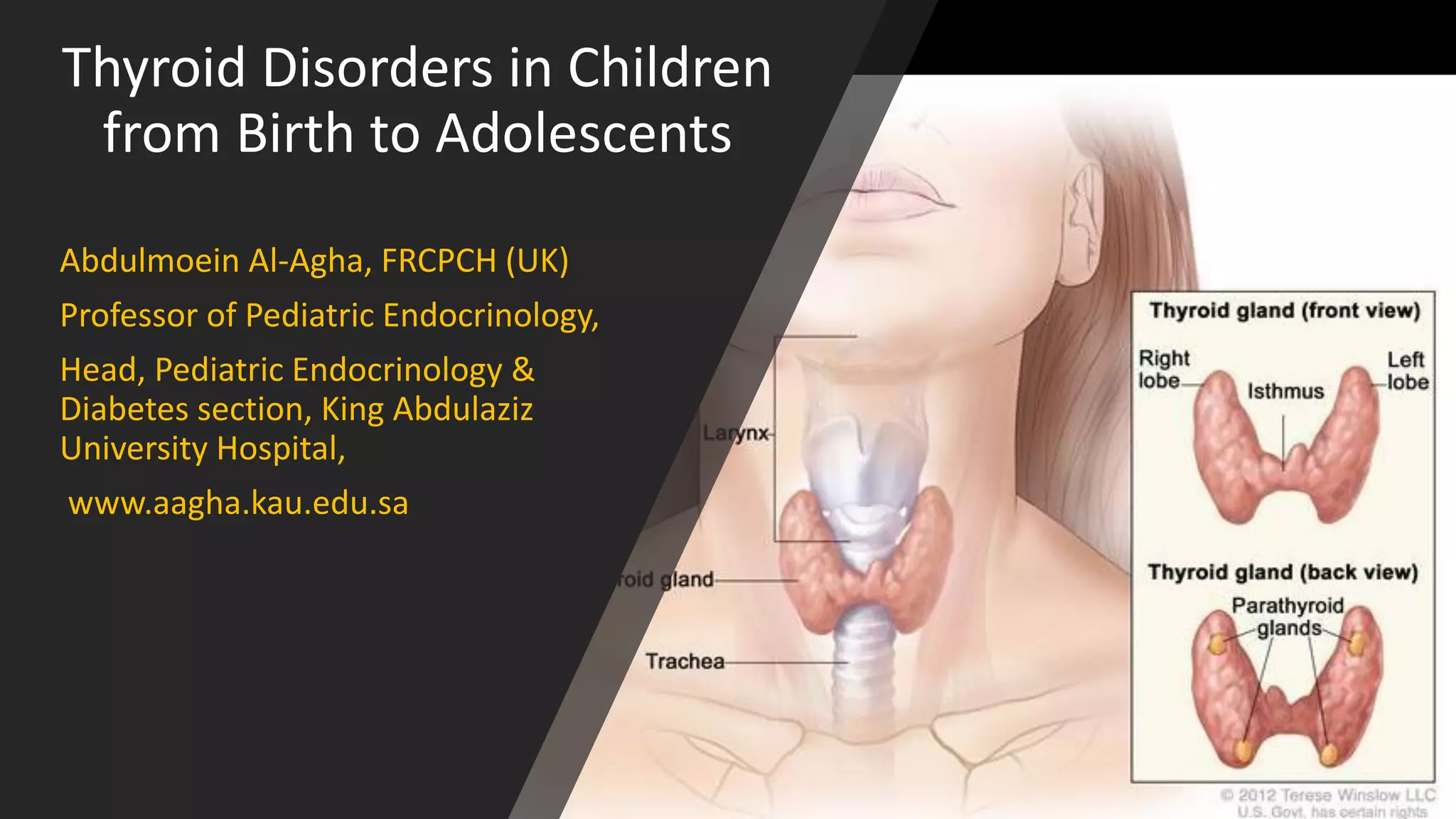
Thyroid Disorders in Children
from Birth to Adolescents
Abdulmoein Al-Agha, FRCPCH (UK)
Professor of Pediatric Endocrinology,
Head, Pediatric Endocrinology &
Diabetes section, King Abdulaziz
University Hospital,
www.aagha.kau.edu.sa
Objectives
โ€ข Introduction on thyroid gland regards, anatomy, physiology
and thyroid hormone biosynthesis.
โ€ข Control and regulation of thyroid hormone synthesis.
โ€ข Physiological effects of thyroid hormones.
โ€ข Congenital hypothyroidism
โ€ข Screening, causes & clinical presentations.
โ€ข Investigations & treatment of hypothyroidism.
โ€ข Thyrotoxicosis in children.
โ€ข Investigation & treatment of Thyrotoxicosis.
Introduction
โ€ข Thyroid hormone is essential for somatic growth & neurological
development in infancy & early childhood.
โ€ข Thyroid gland begins to develop at 7 weeks of gestation, while thyroid
hormones are produced starting of 12 weeksโ€™ gestation.
โ€ข Thyroxine is critical for the myelinization of the central nervous system
during the first 3 years after birth.
โ€ข Congenital hypothyroidism is the most preventable cause of potential
intellectual disability.
โ€ข Thyroid hormones influence almost all aspects of normal child
development and play a crucial role in growth, puberty, skeletal
development & various tissues metabolism.
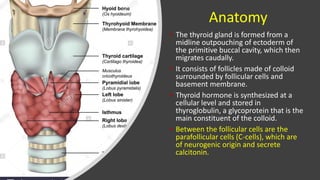
Anatomy
โ€ข The thyroid gland is formed from a
midline outpouching of ectoderm of
the primitive buccal cavity, which then
migrates caudally.
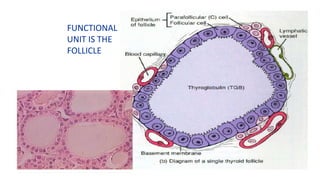
โ€ข It consists of follicles made of colloid
surrounded by follicular cells and
basement membrane.
โ€ข Thyroid hormone is synthesized at a
cellular level and stored in
thyroglobulin, a glycoprotein that is the
main constituent of the colloid.
โ€ข Between the follicular cells are the
parafollicular cells (C-cells), which are
of neurogenic origin and secrete
calcitonin.
FUNCTIONAL
UNIT IS THE
FOLLICLE
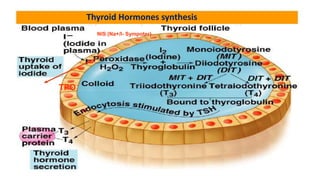
Thyroid Hormones synthesis
NIS (Na+/I- Sympoter)
TPO
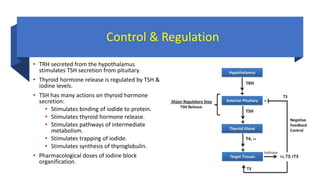
Control & Regulation
โ€ข TRH secreted from the hypothalamus
stimulates TSH secretion from pituitary.
โ€ข Thyroid hormone release is regulated by TSH &
iodine levels.
โ€ข TSH has many actions on thyroid hormone
secretion:
โ€ข Stimulates binding of iodide to protein.
โ€ข Stimulates thyroid hormone release.
โ€ข Stimulates pathways of intermediate
metabolism.
โ€ข Stimulates trapping of iodide.
โ€ข Stimulates synthesis of thyroglobulin.
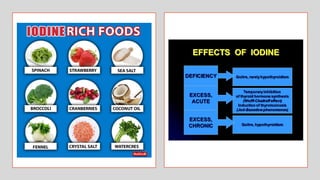
โ€ข Pharmacological doses of iodine block
organification.
Physiological effects of thyroid hormones
โ€ข Fetal brain development which continues up age of three years.
โ€ข Skeletal maturation from birth until adolescence.
โ€ข Increase in basal metabolic rate.
โ€ข Inotropic & chronotropic effects on the heart.
โ€ข Increases sensitivity to catecholamines.
โ€ข Stimulates gut motility.
โ€ข Increase bone turnover.
โ€ข Stimulates gut motility.
โ€ข Increase in serum glucose & decrease in serum cholesterol.
โ€ข Conversion carotene to vitamin A.
โ€ข Play role in thermal regulation.
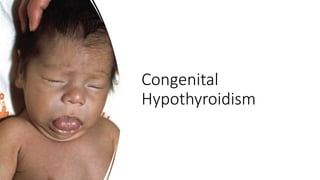
Congenital
Hypothyroidism
Congenital hypothyroidism
โ€ข Is one of the most preventable causes of mental retardation in children.
โ€ข Incidence of 1/4000 live births.
โ€ข Most cases of thyroid dysgenesis are sporadic.
โ€ข Primary persistent congenital hypothyroidism:
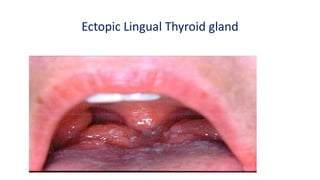
โ€ข Thyroid dysgenesis ( agenesis, hypoplasia, ectopic gland).
โ€ข Thyroid biosynthetic defects.
โ€ข Primary transient congenital hypothyroidism:
โ€ข Maternal Iodine deficiency.
โ€ข Maternal Iodine overload.
โ€ข Maternal blocking thyroid antibodies.
โ€ข Maternal anti thyroid medication during pregnancy.
โ€ข Secondary congenital hypothyroidism:
โ€ข Congenital pituitary / hypothalamic abnormalities (idiopathic, Anencephaly,
holoprosencephaly, S.O.D).
Screening for congenital hypothyroidism
โ€ข TSH is measured in Saudi Arabia from cord blood at birth, while in other
countries heel prick sample between 3-5 days of life.
โ€ข Screening program detects > 90% of cases of congenital hypothyroidism.
โ€ข Those due to secondary (pituitary/hypothalamic) are missed as TSH levels are
low or normal.
โ€ข Screening results must be interpreted with care when:
โ€ข Screening done during the first 2 days of life.
โ€ข Preterm born before 32 weeks of gestation.
โ€ข Critically ill neonates.
โ€ข Patients receiving blood transfusions.
โ€ข Neonates exposed during the perinatal phase to iodine containing topical
anti-septic agents.
โ€ข Neonates treated in intensive care with drugs which are known to impair
thyroid function (e.g., amiodarone, dopamine, glucocorticoids).
Congenital Hypothyroidism
โ€ข Hypothyroidism in children can be classified as primary or secondary
(central), and can be either congenital or acquired, transient or
permanent.
โ€ข In primary hypothyroidism, thyroid dysgenesis accounts for 80%โ€“90% of
all cases of congenital hypothyroidism which include:
โ€ข thyroid agenesis (40%), hypogenesis (25%) and ectopia (35%).
โ€ข Dyshormonogenesis โ€œdefects in one of the steps of thyroid hormone
biosynthesisโ€ are found in 10%โ€“20% of cases.
โ€ข Insufficient secretion & action of hypothalamic (TRH) and /or pituitary
TSH causes secondary or central hypothyroidism seen in (hypothalamic-
pituitary anomalies, multiple pituitary hormone deficiencies, isolated
TSH deficiency).
Congenital hypothyroidism
โ€ข Most cases of congenital hypothyroidism appear to be sporadic, the
exceptions being inborn errors of thyroid hormone biosynthesis or
dyshormonogenesis which are autosomal recessive in inheritance.
โ€ข The prevalence of congenital hypothyroidism seems to be higher in
girls than in boys.
โ€ข Recently, several cases of thyroid dysgenesis have been shown to be
associated with genetic mutations of transcription factors (TTF1, TTF2,
PAX8 & TSH receptor), which are involved in the development of
thyroid follicular cells.
โ€ข Should be diagnosed and treated within 2 weeks of delivery to avoid
unpleasant effects on the brain development.
Transient Congenital Hypothyroidism
โ€ข Occurs in 5%โ€“ 10% of infants with congenital hypothyroidism.
โ€ข The most common causes are maternal TSH receptor blocking auto-
antibodies, endemic iodine deficiency, iodine contamination &
antithyroid drug or goitrogen ingestion.
โ€ข The non-thyroidal illness syndrome denotes transient thyroid dysfunction
in critical illness or after surgery which biochemically resembles
secondary hypothyroidism, and which may contribute to the morbidity of
critical illness.
โ€ข Transient hypothyroxinemia of prematurity with low TSH concentrations
which is observed in preterm infants has been investigated intensively,
but no conclusive evidence has been if morbidity of preterm infants can
be attributed to thyroid dysfunction which usually resolves within the
first 2 months of life.
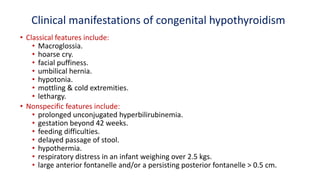
Clinical manifestations of congenital hypothyroidism
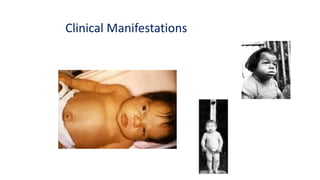
โ€ข Classical features include:
โ€ข Macroglossia.
โ€ข hoarse cry.
โ€ข facial puffiness.
โ€ข umbilical hernia.
โ€ข hypotonia.
โ€ข mottling & cold extremities.
โ€ข lethargy.
โ€ข Nonspecific features include:
โ€ข prolonged unconjugated hyperbilirubinemia.
โ€ข gestation beyond 42 weeks.
โ€ข feeding difficulties.
โ€ข delayed passage of stool.
โ€ข hypothermia.
โ€ข respiratory distress in an infant weighing over 2.5 kgs.
โ€ข large anterior fontanelle and/or a persisting posterior fontanelle > 0.5 cm.
Clinical Manifestations
Ectopic Lingual Thyroid gland
Acquired Hypothyroidism
โ€ข The most common cause of acquired hypothyroidism is autoimmune thyroiditis.
โ€ข The broad category of thyroiditis entails all inflammatory diseases of the thyroid gland,
which would include infectious aetiology such as:
โ€ข Acute suppurative thyroiditis, usually secondary to a bacterial infection
โ€ข Subacute thyroiditis for example de Quervainโ€™s disease, caused by a viral infection.
โ€ข Chronic thyroiditis, on the other hand, most often is autoimmune in nature known as
Hashimotoโ€™s thyroiditis, but Riedelโ€™s thyroiditis is another recognised aetiology of
chronic thyroiditis and is usually invasive and fibrous.
โ€ข Acquired hypothyroidism can be a consequence of either iodine deficiency or overload, or
certain medications i.e. antiepileptics, lithium, interferon alpha,
โ€ข Iatrogenic causes, as seen in cases with history of external radiation therapy, radioactive
iodine treatment, or post thyroidectomy.
โ€ข It has a striking predilection towards the female gender and those with a family history of
autoimmune thyroid disease.
โ€ข Underlying pathophysiology has been attributed to the circulation of antibodies against
thyroglobulin and thyroid peroxidase (TPO) that were detectable in over 95% of patients with
Hashimotoโ€™s thyroiditis.
โ€ข TSH receptor blocking antibodies have been detected as well, but they tend to occur only in
patients with severe hypothyroidism.
โ€ข An increased prevalence has been noted in patients with other autoimmune diseases such as
insulin-dependent diabetes, of whom 20% were found to have at the very least positive thyroid
antibodies, and 5% an elevated serum TSH level; suggesting that Hashimotoโ€™s thyroiditis may be
part of an autoimmune polyglandular syndrome.
โ€ข Associated with some chromosomal abnormalities, such as Down syndrome, Turner syndrome,
Klinefelter syndrome and Noonan syndrome.
โ€ข Another association has been demonstrated with chronic urticaria and, rarely, immune-complex
glomerulonephritis.
Autoimmune Hypothyroidism
Clinical presentations of acquired hypothyroidism
โ€ข Goitre is present in approximately two-thirds of affected children and is thought to occur
primarily from lymphocytic infiltration but can occur as consequence of the compensatory
increases in TSH as demonstrated by some patients.
โ€ข Presentation is usually during adolescence, but onset should be expected at any age.
โ€ข They may remain euthyroid, suffer a subclinical course, or express overt hypothyroidism.
โ€ข Occasionally, children may present with an initial thyrotoxic phase due to damage experienced by
the thyroid gland and consequent release of preformed T4 and T3.
โ€ข Thyrotoxicosis, in a small percentage of children with autoimmune thyroiditis, the initial
presentation is characterized by hyperthyroidism of short duration < 3 months, often termed
โ€œHashitoxicosis.โ€
โ€ข However, most children who are initially hypothyroid remain hypothyroid.
โ€ข Spontaneous recovery of thyroid function may occur in some patients.
Clinical Presentations of Acquired
Hypothyroidism
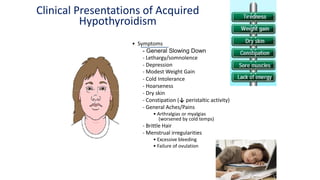
โ€ข Symptoms
- General Slowing Down
- Lethargy/somnolence
- Depression
- Modest Weight Gain
- Cold Intolerance
- Hoarseness
- Dry skin
- Constipation (โ†“ peristaltic activity)
- General Aches/Pains
โ€ข Arthralgias or myalgias
(worsened by cold temps)
- Brittle Hair
- Menstrual irregularities
โ€ข Excessive bleeding
โ€ข Failure of ovulation
Clinical Presentations of Acquired Hypothyroidism
โ€ข Dry, pale, course skin with yellowish tinge.
โ€ข Periorbital edema.
โ€ข Puffy face & extremities.
โ€ข Sinus Bradycardia.
โ€ข Diastolic hypotension.
โ€ข โ†“ Body temperature.
โ€ข Delayed relaxation of reflexes.
โ€ข Megacolon (โ†“ peristaltic activity).
โ€ข Pericardial/ pleural effusions.
โ€ข Congestive heart failure.
โ€ข Non-pitting edema.
โ€ข Hoarse voice
โ€ข Myopathy.
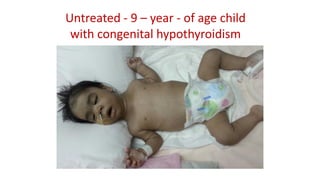
Untreated - 9 โ€“ year - of age child
with congenital hypothyroidism
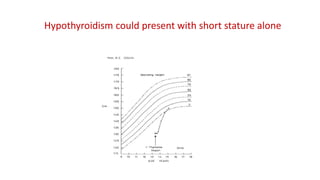
Hypothyroidism could present with short stature alone
Investigations
โ€ขThe primary laboratory investigations for the assessment of hypothyroidism is a
thyroid profile including : serum TSH, free T4 and occasionally free T3.
โ€ขMeasurement of TSH is the best initial screening test for the presence of primary
hypothyroidism and free T4 will distinguish whether the child has subclinical
hypothyroidism through the presence of normal free T4 or overt hypothyroidism
evident through low levels of circulating free T4.
โ€ขMeasurement of TSH, on the other hand, is not helpful in central hypothyroidism.
โ€ขThyroid hormone resistance is characterised by elevated levels of T4 and T3 and an
inappropriately normal level or elevated TSH concentration.
โ€ขAdditional investigations are sometimes necessary as some cases of thyroiditis,
e.g., acute thyroiditis, may present with a thyroid profile within the reference
range.
Investigations
โ€ข A complete blood count and inflammatory markers such as C-reactive protein and
erythrocyte sedimentation rate are all necessary to look for leucocytosis amongst other
indications of an underlying inflammatory/infectious process.
โ€ข A thyroid antibody profile must be considered in all children with primary hypothyroidism in
order to investigate for the presence of autoimmune thyroiditis.
โ€ข Hypothalamic and pituitary function should be checked in cases of central hypothyroidism
including, FSH, LH, prolactin, adrenocorticotropic hormone, and insulin growth factor 1 in
addition to brain magnetic resonance imaging (MRI) or if unavailable, head CT with coronal
views of the pituitary gland.
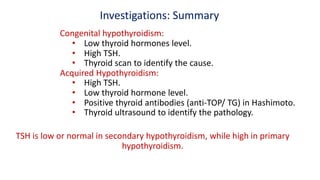
Investigations: Summary
Congenital hypothyroidism:
โ€ข Low thyroid hormones level.
โ€ข High TSH.
โ€ข Thyroid scan to identify the cause.
Acquired Hypothyroidism:
โ€ข High TSH.
โ€ข Low thyroid hormone level.
โ€ข Positive thyroid antibodies (anti-TOP/ TG) in Hashimoto.
โ€ข Thyroid ultrasound to identify the pathology.
TSH is low or normal in secondary hypothyroidism, while high in primary
hypothyroidism.
Radiological investigations
โ€ข Ultrasonography represents a sensitive diagnostic tool to examine &
locate the thyroid gland even in infancy.
โ€ข A radioactive iodine uptake scan may be useful to distinguish agenesis,
hypogenesis & ectopia of the thyroid gland in cases with thyroid
dysgenesis.
โ€ข Routine performance of thyroid scan in neonates with congenital
hypothyroidism is no longer recommended.
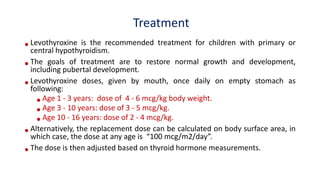
Treatment
โ€ขLevothyroxine is the recommended treatment for children with primary or
central hypothyroidism.
โ€ขThe goals of treatment are to restore normal growth and development,
including pubertal development.
โ€ขLevothyroxine doses, given by mouth, once daily on empty stomach as
following:
โ€ขAge 1 - 3 years: dose of 4 - 6 mcg/kg body weight.
โ€ขAge 3 - 10 years: dose of 3 - 5 mcg/kg.
โ€ขAge 10 - 16 years: dose of 2 - 4 mcg/kg.
โ€ขAlternatively, the replacement dose can be calculated on body surface area, in
which case, the dose at any age is โ€œ100 mcg/m2/dayโ€.
โ€ขThe dose is then adjusted based on thyroid hormone measurements.
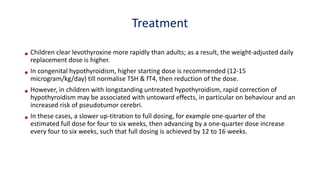
Treatment
โ€ข Children clear levothyroxine more rapidly than adults; as a result, the weight-adjusted daily
replacement dose is higher.
โ€ข In congenital hypothyroidism, higher starting dose is recommended (12-15
microgram/kg/day) till normalise TSH & fT4, then reduction of the dose.
โ€ข However, in children with longstanding untreated hypothyroidism, rapid correction of
hypothyroidism may be associated with untoward effects, in particular on behaviour and an
increased risk of pseudotumor cerebri.
โ€ข In these cases, a slower up-titration to full dosing, for example one-quarter of the
estimated full dose for four to six weeks, then advancing by a one-quarter dose increase
every four to six weeks, such that full dosing is achieved by 12 to 16 weeks.
Treatment
โ€ขChildren with acquired primary hypothyroidism, serum TSH and free T4 should be
checked 6-8 weeks after initiation of treatment and then every 3 to 6 months.
โ€ขThyroid function tests should be obtained 6-8 weeks after any dose change or if
the patient develops any clinical manifestations suspicious for hypothyroidism or
hyperthyroidism.
โ€ขLevothyroxine dose is adjusted to maintain TSH & free T4 in the normal reference
range for age targeting TSH in the lower one-half & free T4 in the upper one-half
of the reference range.
โ€ข Acquired hypothyroidism is the most common abnormality of thyroid function in
children and is most often caused by autoimmune thyroiditis.
โ€ข Clinical features include declining height velocity, short stature, and/or the presence of a
goitre, while adolescents might have signs of pubertal delay.
โ€ข Patients with symptoms or findings on physical examination compatible with
hypothyroidism should be evaluated with measurements of serum TSH and free
thyroxine concentrations, and the results should be compared with age-specific normal
values.
โ€ข In children with mild elevations of serum TSH (5 to 10 mU/L), the test should be
repeated before making treatment decisions, because TSH levels are normal in up to 70
% of such patients when the test is repeated.
Acquired Hypothyroidism: Summary
โ€ขMild elevation of TSH in obese children is common, is a consequence of the
obesity, and, by itself, does not warrant thyroid hormone replacement.
โ€ขPatients with clinical and laboratory evidence of hypothyroidism require
replacement therapy with levothyroxine.
โ€ขThe goals of treatment are to restore normal growth and development and
correct associated clinical manifestations of hypothyroidism.
โ€ขOnce growth and pubertal development are complete, levothyroxine treatment
can be discontinued and thyroid function re-evaluated.
Acquired Hypothyroidism: Summary
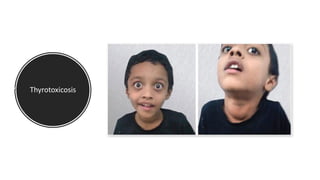
Thyrotoxicosis
Thyrotoxicosis
Transient
1. Neonatal thyrotoxicosis
2. Infectious : Acute & subacute thyroiditis
3. Drug - induced: Amiodarone, interferon &interleukin
4. Iatrogenic
Thyrotoxicosis in children
Causes of persistent thyrotoxicosis:
โ€ข Autoimmune thyroiditis (Graves disease).
โ€ข 95% of young people with thyrotoxicosis have Graves
disease.
โ€ข Diffuse toxic goiter.
โ€ข Nodular toxic goiter.
โ€ข TSH producing pituitary adenoma (TSHoma).
โ€ข Pituitary resistance to thyroid hormones
โ€ข Iatrogenic (ingestion of exogenous thyroid hormone or iodine).
โ€ข Activating mutations in the TSH receptor gene or GNAS1.
Thyrotoxicosis in children
โ€ข Occurs 1 in every 5000 children and adolescents.
โ€ข More than 95% the cause is autoimmune Gravesโ€™ disease, which like CLT, is a complex
genetic trait that occurs in a genetically predisposed population.
โ€ข The underlying pathophysiology is brought into effect by circulating TSH receptor antibodies
that mimic the action of TSH by binding to the TSH receptor and stimulating the thyroid
gland to produce and release supraphysiological levels of T3 and T4.
โ€ข The ophthalmological manifestations of Graveโ€™s disease are not related to a thyrotoxic
complication rather are a result of antibodies against a TSHR-like protein in retroorbital
connective tissue.
โ€ข Gravesโ€™ disease is much less common in childhood than adulthood, and the incidence rises
sharply during puberty, so that about 80 percent of Pediatric cases occur after 11 years of
age.
โ€ข Although it can occur at any age, it is most common during adolescence, when a strong
female predominance develops, at a ratio of about 5:1.
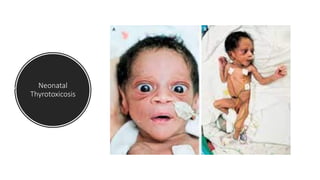
Neonatal
Thyrotoxicosis
Neonatal thyrotoxicosis
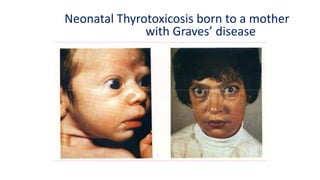
โ€ข Transplacental passage of TSI from mothers with Gravesโ€™ disease causes neonatal
autoimmune-mediated hyperthyroidism in their offspring.
โ€ข 1% of neonates are affected.
โ€ข Autoantibodies may persist in the maternal circulation for a long time after thyroidectomy
or radiation therapy and may still cause hyperthyroidism in the neonate.
โ€ข The presence of a combination of TSH receptor stimulating and blocking antibodies may
lead to the development of late-onset neonatal Gravesโ€™ disease presenting later than 9 days
post partum.
โ€ข Neonatal Gravesโ€™ disease resolves within 3โ€“12 weeks, since maternal TSH receptor
stimulating antibodies (of the IgG class) are degraded with a half-life of approximately 12
days.
โ€ข Antithyroid drugs such as carbimazole or methimazole also cross the placenta and
temporarily mask the stimulating effects of TSI in the neonate.
โ€ข Clinical manifestations may be rather unspecific and minimal in the initial phase of Gravesโ€™
disease because the disease usually develops over several months.
Neonatal thyrotoxicosis
โ€ข Persisting congenital hyperthyroidism & familial hyperthyroidism of
non-autoimmune origin due to gain of-function mutations in the TSH
receptor gene have been identified.
โ€ข The mode of inheritance is autosomal dominant.
โ€ข The onset of hyperthyroidism in these familial cases occurs at various
times from infancy to adulthood.
โ€ข In contrast, severe non-familial congenital hyperthyroidism due to
gain-of-function mutations has been described in neonates.
Neonatal Thyrotoxicosis born to a mother
with Gravesโ€™ disease
A Color Atlas of Endocrinology p51
Gravesโ€™ disease
โ€ข Autoimmune disease caused by stimulatory TSH receptor antibodies.
โ€ข Accounts for 95% of cases of hyperthyroidism in children.
โ€ข A family history of autoimmune thyroid disease is present in 60% of patients.
โ€ข Patients with Gravesโ€™ disease have an increased incidence of HLA haplotypes
A1, B8 and DR3.
โ€ข Antibodies to the thyroid peroxidase (TPO) and thyroglobulin antibodies can
also be detected in Gravesโ€™ disease.
โ€ข Associated with other autoimmune diseases, both endocrine and non-
endocrine, including:
โ€ข Insulin dependent diabetes, Addisonโ€™s disease, vitiligo, systemic lupus
erythematosus, rheumatoid arthritis, myasthenia gravis, periodic
paralysis, idiopathic thrombocytopenic purpura and pernicious anemia.
โ€ข There is an increased risk of Gravesโ€™ disease in children with Down syndrome.
Gravesโ€™ disease
โ€ข The incidence increases during childhood and peaks during adolescence.
โ€ข It occurs more frequently in females than in males, in a ratio of 3:1 to 5:1.
โ€ข Hyperthyroidism is defined as excess synthesis and secretion of thyroid
hormones by the thyroid gland, i.e., exceeding the need of the organism.
โ€ข Recent studies have reported an incidence of 1:10,000,000.
โ€ข Gravesโ€™ disease is characterized clinically by thyromegaly, hyperthyroidism and
infiltrative ophthalmopathy.
โ€ข However, severe ophthalmopathy is rare in childhood and occurs in less than
50% of children with Gravesโ€™ disease.
โ€ข Is the most common of the thyroid diseases in areas of iodine abundance.
โ€ข Rarely, hyperthyroidism may be caused by a functioning thyroid adenoma, toxic
multinodular goitre, as part of the McCune Albright syndrome, or by a TSH-
secreting pituitary adenoma.
Clinical Manifestations
โ€ข All but a few children with Gravesโ€™ disease present with some degree of thyroid
enlargement.
โ€ข Most have symptoms and signs of excessive thyroid activity; around a hyperdynamic
circulation and increased cardiac output.
โ€ข Tremors, weight loss despite an increased appetite, tachycardia, insomnia, heat
intolerance and proximal muscle weakness may constitute the presenting clinical picture.
โ€ข Shortened attention span and emotional lability may lead to behavioural difficulties and
poor school performance.
โ€ข Some patients complain of polyuria and of nocturia, the result of an increased
glomerular filtration rate.
โ€ข Acceleration in linear growth may also occur, often accompanied by advancement in
skeletal maturation and bone age, however, adult height is not affected.
โ€ข In the adolescent child, puberty may be delayed, and if menarche has already occurred in
the female, secondary amenorrhea is a common concomitant.
Graveโ€™s ophthalmopathy
โ€ข Eye involvement is by inflammation of the extraocular muscles,
orbital fat and connective tissue, which results in exophthalmos,
impairment of eye muscle function, and periorbital edema.
โ€ข Patients may complain from a gritty sensation or pain in their eyes,
and/or blurred vision due to diplopia caused by extraocular muscle
dysfunction.
โ€ข Corneal ulceration is a complication of proptosis and lid retraction.
โ€ข Over half of children affected with Graveโ€™s disease may express
features of Graves ophthalmopathy, but symptoms are milder than in
adults.
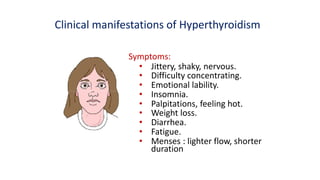
Clinical manifestations of Hyperthyroidism
Symptoms:
โ€ข Jittery, shaky, nervous.
โ€ข Difficulty concentrating.
โ€ข Emotional lability.
โ€ข Insomnia.
โ€ข Palpitations, feeling hot.
โ€ข Weight loss.
โ€ข Diarrhea.
โ€ข Fatigue.
โ€ข Menses : lighter flow, shorter
duration
Clinical manifestations of Hyperthyroidism
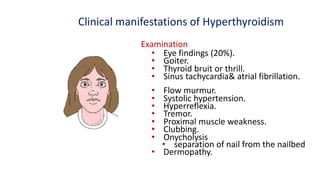
Examination
โ€ข Eye findings (20%).
โ€ข Goiter.
โ€ข Thyroid bruit or thrill.
โ€ข Sinus tachycardia& atrial fibrillation.
โ€ข Flow murmur.
โ€ข Systolic hypertension.
โ€ข Hyperreflexia.
โ€ข Tremor.
โ€ข Proximal muscle weakness.
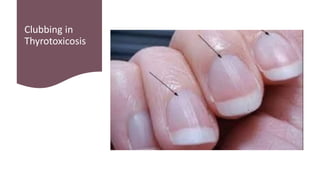
โ€ข Clubbing.
โ€ข Onycholysis
โ€ข separation of nail from the nailbed
โ€ข Dermopathy.
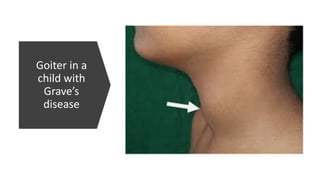
Goiter in a
child with
Graveโ€™s
disease
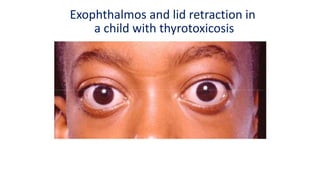
Exophthalmos and lid retraction in
a child with thyrotoxicosis
Clubbing in
Thyrotoxicosis
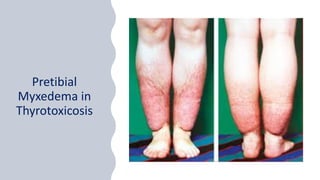
Pretibial
Myxedema in
Thyrotoxicosis
Diagnosis of hyperthyroidism
โ€ข The clinical diagnosis of hyperthyroidism is confirmed by the
biochemical finding of high concentrations of circulating free T4 in the
setting of a suppressed TSH level.
โ€ข The diagnosis of Gravesโ€™ disease as cause for the hyperthyroidism is
confirmed by the demonstration of TSH receptor antibodies (TSHR-
Ab) in serum.
โ€ข Thyrotropin-binding inhibitor immunoglobulin (TBII), antibody that
competes with TSH binding to its receptor.
โ€ข Thyroglobulin and TPO antibodies are positive in 70% of children and
adolescents with Gravesโ€™ disease but their measurement is not as
sensitive or specific as measurement of TSH receptor antibodies.
Investigations
โ€ข TSH level usually low < 0.05 ยตu / ml
โ€ข High FT4 & FT3
โ€ข In 5% high FT3 with normal T4 (T3
Thyrotoxicosis)
โ€ข Thyroid receptor (TRAB) are usually
elevated at diagnosis.
โ€ข Antibodies against thyroglobulin, peroxidase or
both are present in the majority of patients.
Thyrotoxicosis Investigations
โ€ข Antibodies (TSI, TBII, TPO) are detectable in up to 80% of affected
patients but do not represent a follow-up parameter for remission or
relapse of the disease.
โ€ข Ultrasonography reveals the enlargement of the thyroid gland, with
reduced, largely non-homogeneous echogenicity and increased
perfusion.
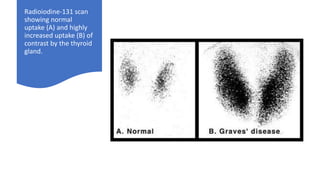
โ€ข Thyroid scintigraphy is performed only in patients with nodules
detected by ultrasonography in order to rule out autonomous
functioning nodules.
Radioiodine-131 scan
showing normal
uptake (A) and highly
increased uptake (B) of
contrast by the thyroid
gland.
Treatment of Neonatal Thyrotoxicosis
โ€ข The goal of the treatment is to normalize thyroid functions as quickly as possible, to avoid iatrogenic
hypothyroidism while providing management and supportive therapy for the infantโ€™s specific signs
and symptoms.
โ€ข The treatment of neonatal thyrotoxicosis is on the same principles as that of a thyrotoxic crisis in the
adult.
โ€ข The synthesis of thyroid hormone is blocked by carbimazole and PTU.
โ€ข In addition PTU blocks the peripheral deiodination of T4 to T3.
โ€ข The dose of carbimazole is 0.5-1.5 mg/kg/day as a single dose and that of PTU is 5-10 mg/kg/day.
โ€ข Lugolโ€™s iodine acts by blocking the synthesis of thyroid hormones as well as blocking the release of
the hormone stored in the colloid.
โ€ข Lugolโ€™s iodine, which contains 5% potassium iodide is used in a dose of one drop 8 hourly.
โ€ข Beta blockers, which control the adrenergic symptoms effectively as well as inhibit the peripheral
deiodination of T4 to T3are used in a dose of propranolol 0.27-0.75 mg/kg 8 hourly.
Treatment of Neonatal Thyrotoxicosis
โ€ข Steroids act by inhibiting the peripheral deiodination of T4 to T3 and by compensating for
hypermetabolism of endogenous steroids induced by T4 and T3.
โ€ข Prednisolone is used in a dose of 2 mg/kg/day.
โ€ข Supportive treatment is very important to manage respiratory distress, fluid and electrolyte
imbalance, temperature and high output heart failure.
โ€ข Specific treatment of congestive heart failure by diuretics and digoxin may be necessary.
โ€ข Oxygen therapy, non-invasive and invasive ventilation may be required.
โ€ข Diarrhoea and hyperthermia can occur and so intravenous fluids and nursing in a
temperature-controlled environment may be necessary.
โ€ข Sepsis may complicate neonatal thyrotoxicosis and appropriate antibiotics may be required.
โ€ข Neonatal thyrotoxicosis usually resolves by age 3-6 months, during this time, treatment
should be monitored regularly, and doses should be adjusted according to the thyroid
function test.
Treatment of Thyrotoxicosis in Children
โ€ข Therapeutic management options for Gravesโ€™ disease in childhood include:
โ€ข Antithyroid drug therapy, surgery and radioiodine treatment.
โ€ข All of which are associated with potential complications.
โ€ข Antithyroid drug therapy with thioamides (carbimazole or methimazole
and propylthiouracil) is associated with side-effects:
โ€ข rash, granulocytopenia, arthritis and hepatitis, and a disappointing
long-term remission rate as low as 30%โ€“40% even after prolonged
therapy.
โ€ข The equivalent dosages for methimazole and carbimazole (0.5โ€“1 mg/kg
body weight; may be given in one dose) are one-tenth of the
propylthiouracil dosage (5โ€“10 mg/kg in three divided doses).
โ€ข After achievement of euthyroidism, maintenance therapy may proceed
either by reducing the dosage by one-third to one-half to maintain
thyroid hormones levels in the normal range.
Treatment of Thyrotoxicosis in Children
โ€ข Propranolol (1 mg/kg body weight) or dexamethasone may be helpful
in relieving symptoms from autonomic dysfunction and blocking the
conversion of T4 to the biologically more active T3.
โ€ข Thyroid hormone synthesis may be acutely blocked by iodide (Lugolโ€™s
solution).
โ€ข In contrast to drug therapy, surgery has favorable cure rates (90%)
and reverses the hyperthyroid state rapidly but entails a complex
surgical procedure that can result in permanent hypothyroidism,
hypoparathyroidism or dysphonia due to damage of the recurrent
laryngeal nerves.
Treatment of Thyrotoxicosis in Children
โ€ข Thyroidectomy may be useful for the patient who develops drug-related
complications or does not achieve lasting remission, and for neonates with severe
non-familial congenital hyperthyroidism due to gain-of-function mutations.
โ€ข Radioiodine therapy is associated with cure rates as high as 90% and represents
the least expensive treatment option for Gravesโ€™ disease.
โ€ข However, the long-term safety of iodine-131 in children and adolescents has not
been evaluated extensively.
โ€ข The oncogenic potential of radioiodine and the potential risks of genetic damage
to any offspring after 131I treatment has raised concern.
โ€ข Radioiodine therapy should be avoided in children less than 5 years of age
because the risk of thyroid cancer after external radiation is highest in children
less than 5 years of age and progressively declines with advancing age.
โ€ข In older children and adolescents, radioiodine treatment may be considered as an
alternative treatment option for Gravesโ€™ disease, e.g., in patients with large
goiters.
Thanks

Thyroid disorders in children

  • 1.
    Thyroid Disorders inChildren from Birth to Adolescents Abdulmoein Al-Agha, FRCPCH (UK) Professor of Pediatric Endocrinology, Head, Pediatric Endocrinology & Diabetes section, King Abdulaziz University Hospital, www.aagha.kau.edu.sa
  • 2.
    Objectives โ€ข Introduction onthyroid gland regards, anatomy, physiology and thyroid hormone biosynthesis. โ€ข Control and regulation of thyroid hormone synthesis. โ€ข Physiological effects of thyroid hormones. โ€ข Congenital hypothyroidism โ€ข Screening, causes & clinical presentations. โ€ข Investigations & treatment of hypothyroidism. โ€ข Thyrotoxicosis in children. โ€ข Investigation & treatment of Thyrotoxicosis.
  • 3.
    Introduction โ€ข Thyroid hormoneis essential for somatic growth & neurological development in infancy & early childhood. โ€ข Thyroid gland begins to develop at 7 weeks of gestation, while thyroid hormones are produced starting of 12 weeksโ€™ gestation. โ€ข Thyroxine is critical for the myelinization of the central nervous system during the first 3 years after birth. โ€ข Congenital hypothyroidism is the most preventable cause of potential intellectual disability. โ€ข Thyroid hormones influence almost all aspects of normal child development and play a crucial role in growth, puberty, skeletal development & various tissues metabolism.
  • 4.
    Anatomy โ€ข The thyroidgland is formed from a midline outpouching of ectoderm of the primitive buccal cavity, which then migrates caudally. โ€ข It consists of follicles made of colloid surrounded by follicular cells and basement membrane. โ€ข Thyroid hormone is synthesized at a cellular level and stored in thyroglobulin, a glycoprotein that is the main constituent of the colloid. โ€ข Between the follicular cells are the parafollicular cells (C-cells), which are of neurogenic origin and secrete calcitonin.
  • 5.
  • 6.
    Thyroid Hormones synthesis NIS(Na+/I- Sympoter) TPO
  • 8.
    Control & Regulation โ€ขTRH secreted from the hypothalamus stimulates TSH secretion from pituitary. โ€ข Thyroid hormone release is regulated by TSH & iodine levels. โ€ข TSH has many actions on thyroid hormone secretion: โ€ข Stimulates binding of iodide to protein. โ€ข Stimulates thyroid hormone release. โ€ข Stimulates pathways of intermediate metabolism. โ€ข Stimulates trapping of iodide. โ€ข Stimulates synthesis of thyroglobulin. โ€ข Pharmacological doses of iodine block organification.
  • 9.
    Physiological effects ofthyroid hormones โ€ข Fetal brain development which continues up age of three years. โ€ข Skeletal maturation from birth until adolescence. โ€ข Increase in basal metabolic rate. โ€ข Inotropic & chronotropic effects on the heart. โ€ข Increases sensitivity to catecholamines. โ€ข Stimulates gut motility. โ€ข Increase bone turnover. โ€ข Stimulates gut motility. โ€ข Increase in serum glucose & decrease in serum cholesterol. โ€ข Conversion carotene to vitamin A. โ€ข Play role in thermal regulation.
  • 10.
  • 11.
    Congenital hypothyroidism โ€ข Isone of the most preventable causes of mental retardation in children. โ€ข Incidence of 1/4000 live births. โ€ข Most cases of thyroid dysgenesis are sporadic. โ€ข Primary persistent congenital hypothyroidism: โ€ข Thyroid dysgenesis ( agenesis, hypoplasia, ectopic gland). โ€ข Thyroid biosynthetic defects. โ€ข Primary transient congenital hypothyroidism: โ€ข Maternal Iodine deficiency. โ€ข Maternal Iodine overload. โ€ข Maternal blocking thyroid antibodies. โ€ข Maternal anti thyroid medication during pregnancy. โ€ข Secondary congenital hypothyroidism: โ€ข Congenital pituitary / hypothalamic abnormalities (idiopathic, Anencephaly, holoprosencephaly, S.O.D).
  • 12.
    Screening for congenitalhypothyroidism โ€ข TSH is measured in Saudi Arabia from cord blood at birth, while in other countries heel prick sample between 3-5 days of life. โ€ข Screening program detects > 90% of cases of congenital hypothyroidism. โ€ข Those due to secondary (pituitary/hypothalamic) are missed as TSH levels are low or normal. โ€ข Screening results must be interpreted with care when: โ€ข Screening done during the first 2 days of life. โ€ข Preterm born before 32 weeks of gestation. โ€ข Critically ill neonates. โ€ข Patients receiving blood transfusions. โ€ข Neonates exposed during the perinatal phase to iodine containing topical anti-septic agents. โ€ข Neonates treated in intensive care with drugs which are known to impair thyroid function (e.g., amiodarone, dopamine, glucocorticoids).
  • 13.
    Congenital Hypothyroidism โ€ข Hypothyroidismin children can be classified as primary or secondary (central), and can be either congenital or acquired, transient or permanent. โ€ข In primary hypothyroidism, thyroid dysgenesis accounts for 80%โ€“90% of all cases of congenital hypothyroidism which include: โ€ข thyroid agenesis (40%), hypogenesis (25%) and ectopia (35%). โ€ข Dyshormonogenesis โ€œdefects in one of the steps of thyroid hormone biosynthesisโ€ are found in 10%โ€“20% of cases. โ€ข Insufficient secretion & action of hypothalamic (TRH) and /or pituitary TSH causes secondary or central hypothyroidism seen in (hypothalamic- pituitary anomalies, multiple pituitary hormone deficiencies, isolated TSH deficiency).
  • 14.
    Congenital hypothyroidism โ€ข Mostcases of congenital hypothyroidism appear to be sporadic, the exceptions being inborn errors of thyroid hormone biosynthesis or dyshormonogenesis which are autosomal recessive in inheritance. โ€ข The prevalence of congenital hypothyroidism seems to be higher in girls than in boys. โ€ข Recently, several cases of thyroid dysgenesis have been shown to be associated with genetic mutations of transcription factors (TTF1, TTF2, PAX8 & TSH receptor), which are involved in the development of thyroid follicular cells. โ€ข Should be diagnosed and treated within 2 weeks of delivery to avoid unpleasant effects on the brain development.
  • 15.
    Transient Congenital Hypothyroidism โ€ขOccurs in 5%โ€“ 10% of infants with congenital hypothyroidism. โ€ข The most common causes are maternal TSH receptor blocking auto- antibodies, endemic iodine deficiency, iodine contamination & antithyroid drug or goitrogen ingestion. โ€ข The non-thyroidal illness syndrome denotes transient thyroid dysfunction in critical illness or after surgery which biochemically resembles secondary hypothyroidism, and which may contribute to the morbidity of critical illness. โ€ข Transient hypothyroxinemia of prematurity with low TSH concentrations which is observed in preterm infants has been investigated intensively, but no conclusive evidence has been if morbidity of preterm infants can be attributed to thyroid dysfunction which usually resolves within the first 2 months of life.
  • 16.
    Clinical manifestations ofcongenital hypothyroidism โ€ข Classical features include: โ€ข Macroglossia. โ€ข hoarse cry. โ€ข facial puffiness. โ€ข umbilical hernia. โ€ข hypotonia. โ€ข mottling & cold extremities. โ€ข lethargy. โ€ข Nonspecific features include: โ€ข prolonged unconjugated hyperbilirubinemia. โ€ข gestation beyond 42 weeks. โ€ข feeding difficulties. โ€ข delayed passage of stool. โ€ข hypothermia. โ€ข respiratory distress in an infant weighing over 2.5 kgs. โ€ข large anterior fontanelle and/or a persisting posterior fontanelle > 0.5 cm.
  • 17.
  • 18.
  • 19.
    Acquired Hypothyroidism โ€ข Themost common cause of acquired hypothyroidism is autoimmune thyroiditis. โ€ข The broad category of thyroiditis entails all inflammatory diseases of the thyroid gland, which would include infectious aetiology such as: โ€ข Acute suppurative thyroiditis, usually secondary to a bacterial infection โ€ข Subacute thyroiditis for example de Quervainโ€™s disease, caused by a viral infection. โ€ข Chronic thyroiditis, on the other hand, most often is autoimmune in nature known as Hashimotoโ€™s thyroiditis, but Riedelโ€™s thyroiditis is another recognised aetiology of chronic thyroiditis and is usually invasive and fibrous. โ€ข Acquired hypothyroidism can be a consequence of either iodine deficiency or overload, or certain medications i.e. antiepileptics, lithium, interferon alpha, โ€ข Iatrogenic causes, as seen in cases with history of external radiation therapy, radioactive iodine treatment, or post thyroidectomy.
  • 20.
    โ€ข It hasa striking predilection towards the female gender and those with a family history of autoimmune thyroid disease. โ€ข Underlying pathophysiology has been attributed to the circulation of antibodies against thyroglobulin and thyroid peroxidase (TPO) that were detectable in over 95% of patients with Hashimotoโ€™s thyroiditis. โ€ข TSH receptor blocking antibodies have been detected as well, but they tend to occur only in patients with severe hypothyroidism. โ€ข An increased prevalence has been noted in patients with other autoimmune diseases such as insulin-dependent diabetes, of whom 20% were found to have at the very least positive thyroid antibodies, and 5% an elevated serum TSH level; suggesting that Hashimotoโ€™s thyroiditis may be part of an autoimmune polyglandular syndrome. โ€ข Associated with some chromosomal abnormalities, such as Down syndrome, Turner syndrome, Klinefelter syndrome and Noonan syndrome. โ€ข Another association has been demonstrated with chronic urticaria and, rarely, immune-complex glomerulonephritis. Autoimmune Hypothyroidism
  • 21.
    Clinical presentations ofacquired hypothyroidism โ€ข Goitre is present in approximately two-thirds of affected children and is thought to occur primarily from lymphocytic infiltration but can occur as consequence of the compensatory increases in TSH as demonstrated by some patients. โ€ข Presentation is usually during adolescence, but onset should be expected at any age. โ€ข They may remain euthyroid, suffer a subclinical course, or express overt hypothyroidism. โ€ข Occasionally, children may present with an initial thyrotoxic phase due to damage experienced by the thyroid gland and consequent release of preformed T4 and T3. โ€ข Thyrotoxicosis, in a small percentage of children with autoimmune thyroiditis, the initial presentation is characterized by hyperthyroidism of short duration < 3 months, often termed โ€œHashitoxicosis.โ€ โ€ข However, most children who are initially hypothyroid remain hypothyroid. โ€ข Spontaneous recovery of thyroid function may occur in some patients.
  • 22.
    Clinical Presentations ofAcquired Hypothyroidism โ€ข Symptoms - General Slowing Down - Lethargy/somnolence - Depression - Modest Weight Gain - Cold Intolerance - Hoarseness - Dry skin - Constipation (โ†“ peristaltic activity) - General Aches/Pains โ€ข Arthralgias or myalgias (worsened by cold temps) - Brittle Hair - Menstrual irregularities โ€ข Excessive bleeding โ€ข Failure of ovulation
  • 23.
    Clinical Presentations ofAcquired Hypothyroidism โ€ข Dry, pale, course skin with yellowish tinge. โ€ข Periorbital edema. โ€ข Puffy face & extremities. โ€ข Sinus Bradycardia. โ€ข Diastolic hypotension. โ€ข โ†“ Body temperature. โ€ข Delayed relaxation of reflexes. โ€ข Megacolon (โ†“ peristaltic activity). โ€ข Pericardial/ pleural effusions. โ€ข Congestive heart failure. โ€ข Non-pitting edema. โ€ข Hoarse voice โ€ข Myopathy.
  • 24.
    Untreated - 9โ€“ year - of age child with congenital hypothyroidism
  • 25.
    Hypothyroidism could presentwith short stature alone
  • 26.
    Investigations โ€ขThe primary laboratoryinvestigations for the assessment of hypothyroidism is a thyroid profile including : serum TSH, free T4 and occasionally free T3. โ€ขMeasurement of TSH is the best initial screening test for the presence of primary hypothyroidism and free T4 will distinguish whether the child has subclinical hypothyroidism through the presence of normal free T4 or overt hypothyroidism evident through low levels of circulating free T4. โ€ขMeasurement of TSH, on the other hand, is not helpful in central hypothyroidism. โ€ขThyroid hormone resistance is characterised by elevated levels of T4 and T3 and an inappropriately normal level or elevated TSH concentration. โ€ขAdditional investigations are sometimes necessary as some cases of thyroiditis, e.g., acute thyroiditis, may present with a thyroid profile within the reference range.
  • 27.
    Investigations โ€ข A completeblood count and inflammatory markers such as C-reactive protein and erythrocyte sedimentation rate are all necessary to look for leucocytosis amongst other indications of an underlying inflammatory/infectious process. โ€ข A thyroid antibody profile must be considered in all children with primary hypothyroidism in order to investigate for the presence of autoimmune thyroiditis. โ€ข Hypothalamic and pituitary function should be checked in cases of central hypothyroidism including, FSH, LH, prolactin, adrenocorticotropic hormone, and insulin growth factor 1 in addition to brain magnetic resonance imaging (MRI) or if unavailable, head CT with coronal views of the pituitary gland.
  • 28.
    Investigations: Summary Congenital hypothyroidism: โ€ขLow thyroid hormones level. โ€ข High TSH. โ€ข Thyroid scan to identify the cause. Acquired Hypothyroidism: โ€ข High TSH. โ€ข Low thyroid hormone level. โ€ข Positive thyroid antibodies (anti-TOP/ TG) in Hashimoto. โ€ข Thyroid ultrasound to identify the pathology. TSH is low or normal in secondary hypothyroidism, while high in primary hypothyroidism.
  • 29.
    Radiological investigations โ€ข Ultrasonographyrepresents a sensitive diagnostic tool to examine & locate the thyroid gland even in infancy. โ€ข A radioactive iodine uptake scan may be useful to distinguish agenesis, hypogenesis & ectopia of the thyroid gland in cases with thyroid dysgenesis. โ€ข Routine performance of thyroid scan in neonates with congenital hypothyroidism is no longer recommended.
  • 30.
    Treatment โ€ขLevothyroxine is therecommended treatment for children with primary or central hypothyroidism. โ€ขThe goals of treatment are to restore normal growth and development, including pubertal development. โ€ขLevothyroxine doses, given by mouth, once daily on empty stomach as following: โ€ขAge 1 - 3 years: dose of 4 - 6 mcg/kg body weight. โ€ขAge 3 - 10 years: dose of 3 - 5 mcg/kg. โ€ขAge 10 - 16 years: dose of 2 - 4 mcg/kg. โ€ขAlternatively, the replacement dose can be calculated on body surface area, in which case, the dose at any age is โ€œ100 mcg/m2/dayโ€. โ€ขThe dose is then adjusted based on thyroid hormone measurements.
  • 31.
    Treatment โ€ข Children clearlevothyroxine more rapidly than adults; as a result, the weight-adjusted daily replacement dose is higher. โ€ข In congenital hypothyroidism, higher starting dose is recommended (12-15 microgram/kg/day) till normalise TSH & fT4, then reduction of the dose. โ€ข However, in children with longstanding untreated hypothyroidism, rapid correction of hypothyroidism may be associated with untoward effects, in particular on behaviour and an increased risk of pseudotumor cerebri. โ€ข In these cases, a slower up-titration to full dosing, for example one-quarter of the estimated full dose for four to six weeks, then advancing by a one-quarter dose increase every four to six weeks, such that full dosing is achieved by 12 to 16 weeks.
  • 32.
    Treatment โ€ขChildren with acquiredprimary hypothyroidism, serum TSH and free T4 should be checked 6-8 weeks after initiation of treatment and then every 3 to 6 months. โ€ขThyroid function tests should be obtained 6-8 weeks after any dose change or if the patient develops any clinical manifestations suspicious for hypothyroidism or hyperthyroidism. โ€ขLevothyroxine dose is adjusted to maintain TSH & free T4 in the normal reference range for age targeting TSH in the lower one-half & free T4 in the upper one-half of the reference range.
  • 33.
    โ€ข Acquired hypothyroidismis the most common abnormality of thyroid function in children and is most often caused by autoimmune thyroiditis. โ€ข Clinical features include declining height velocity, short stature, and/or the presence of a goitre, while adolescents might have signs of pubertal delay. โ€ข Patients with symptoms or findings on physical examination compatible with hypothyroidism should be evaluated with measurements of serum TSH and free thyroxine concentrations, and the results should be compared with age-specific normal values. โ€ข In children with mild elevations of serum TSH (5 to 10 mU/L), the test should be repeated before making treatment decisions, because TSH levels are normal in up to 70 % of such patients when the test is repeated. Acquired Hypothyroidism: Summary
  • 34.
    โ€ขMild elevation ofTSH in obese children is common, is a consequence of the obesity, and, by itself, does not warrant thyroid hormone replacement. โ€ขPatients with clinical and laboratory evidence of hypothyroidism require replacement therapy with levothyroxine. โ€ขThe goals of treatment are to restore normal growth and development and correct associated clinical manifestations of hypothyroidism. โ€ขOnce growth and pubertal development are complete, levothyroxine treatment can be discontinued and thyroid function re-evaluated. Acquired Hypothyroidism: Summary
  • 35.
  • 36.
    Thyrotoxicosis Transient 1. Neonatal thyrotoxicosis 2.Infectious : Acute & subacute thyroiditis 3. Drug - induced: Amiodarone, interferon &interleukin 4. Iatrogenic
  • 37.
    Thyrotoxicosis in children Causesof persistent thyrotoxicosis: โ€ข Autoimmune thyroiditis (Graves disease). โ€ข 95% of young people with thyrotoxicosis have Graves disease. โ€ข Diffuse toxic goiter. โ€ข Nodular toxic goiter. โ€ข TSH producing pituitary adenoma (TSHoma). โ€ข Pituitary resistance to thyroid hormones โ€ข Iatrogenic (ingestion of exogenous thyroid hormone or iodine). โ€ข Activating mutations in the TSH receptor gene or GNAS1.
  • 38.
    Thyrotoxicosis in children โ€ขOccurs 1 in every 5000 children and adolescents. โ€ข More than 95% the cause is autoimmune Gravesโ€™ disease, which like CLT, is a complex genetic trait that occurs in a genetically predisposed population. โ€ข The underlying pathophysiology is brought into effect by circulating TSH receptor antibodies that mimic the action of TSH by binding to the TSH receptor and stimulating the thyroid gland to produce and release supraphysiological levels of T3 and T4. โ€ข The ophthalmological manifestations of Graveโ€™s disease are not related to a thyrotoxic complication rather are a result of antibodies against a TSHR-like protein in retroorbital connective tissue. โ€ข Gravesโ€™ disease is much less common in childhood than adulthood, and the incidence rises sharply during puberty, so that about 80 percent of Pediatric cases occur after 11 years of age. โ€ข Although it can occur at any age, it is most common during adolescence, when a strong female predominance develops, at a ratio of about 5:1.
  • 39.
  • 40.
    Neonatal thyrotoxicosis โ€ข Transplacentalpassage of TSI from mothers with Gravesโ€™ disease causes neonatal autoimmune-mediated hyperthyroidism in their offspring. โ€ข 1% of neonates are affected. โ€ข Autoantibodies may persist in the maternal circulation for a long time after thyroidectomy or radiation therapy and may still cause hyperthyroidism in the neonate. โ€ข The presence of a combination of TSH receptor stimulating and blocking antibodies may lead to the development of late-onset neonatal Gravesโ€™ disease presenting later than 9 days post partum. โ€ข Neonatal Gravesโ€™ disease resolves within 3โ€“12 weeks, since maternal TSH receptor stimulating antibodies (of the IgG class) are degraded with a half-life of approximately 12 days. โ€ข Antithyroid drugs such as carbimazole or methimazole also cross the placenta and temporarily mask the stimulating effects of TSI in the neonate. โ€ข Clinical manifestations may be rather unspecific and minimal in the initial phase of Gravesโ€™ disease because the disease usually develops over several months.
  • 41.
    Neonatal thyrotoxicosis โ€ข Persistingcongenital hyperthyroidism & familial hyperthyroidism of non-autoimmune origin due to gain of-function mutations in the TSH receptor gene have been identified. โ€ข The mode of inheritance is autosomal dominant. โ€ข The onset of hyperthyroidism in these familial cases occurs at various times from infancy to adulthood. โ€ข In contrast, severe non-familial congenital hyperthyroidism due to gain-of-function mutations has been described in neonates.
  • 42.
    Neonatal Thyrotoxicosis bornto a mother with Gravesโ€™ disease A Color Atlas of Endocrinology p51
  • 43.
    Gravesโ€™ disease โ€ข Autoimmunedisease caused by stimulatory TSH receptor antibodies. โ€ข Accounts for 95% of cases of hyperthyroidism in children. โ€ข A family history of autoimmune thyroid disease is present in 60% of patients. โ€ข Patients with Gravesโ€™ disease have an increased incidence of HLA haplotypes A1, B8 and DR3. โ€ข Antibodies to the thyroid peroxidase (TPO) and thyroglobulin antibodies can also be detected in Gravesโ€™ disease. โ€ข Associated with other autoimmune diseases, both endocrine and non- endocrine, including: โ€ข Insulin dependent diabetes, Addisonโ€™s disease, vitiligo, systemic lupus erythematosus, rheumatoid arthritis, myasthenia gravis, periodic paralysis, idiopathic thrombocytopenic purpura and pernicious anemia. โ€ข There is an increased risk of Gravesโ€™ disease in children with Down syndrome.
  • 44.
    Gravesโ€™ disease โ€ข Theincidence increases during childhood and peaks during adolescence. โ€ข It occurs more frequently in females than in males, in a ratio of 3:1 to 5:1. โ€ข Hyperthyroidism is defined as excess synthesis and secretion of thyroid hormones by the thyroid gland, i.e., exceeding the need of the organism. โ€ข Recent studies have reported an incidence of 1:10,000,000. โ€ข Gravesโ€™ disease is characterized clinically by thyromegaly, hyperthyroidism and infiltrative ophthalmopathy. โ€ข However, severe ophthalmopathy is rare in childhood and occurs in less than 50% of children with Gravesโ€™ disease. โ€ข Is the most common of the thyroid diseases in areas of iodine abundance. โ€ข Rarely, hyperthyroidism may be caused by a functioning thyroid adenoma, toxic multinodular goitre, as part of the McCune Albright syndrome, or by a TSH- secreting pituitary adenoma.
  • 45.
    Clinical Manifestations โ€ข Allbut a few children with Gravesโ€™ disease present with some degree of thyroid enlargement. โ€ข Most have symptoms and signs of excessive thyroid activity; around a hyperdynamic circulation and increased cardiac output. โ€ข Tremors, weight loss despite an increased appetite, tachycardia, insomnia, heat intolerance and proximal muscle weakness may constitute the presenting clinical picture. โ€ข Shortened attention span and emotional lability may lead to behavioural difficulties and poor school performance. โ€ข Some patients complain of polyuria and of nocturia, the result of an increased glomerular filtration rate. โ€ข Acceleration in linear growth may also occur, often accompanied by advancement in skeletal maturation and bone age, however, adult height is not affected. โ€ข In the adolescent child, puberty may be delayed, and if menarche has already occurred in the female, secondary amenorrhea is a common concomitant.
  • 46.
    Graveโ€™s ophthalmopathy โ€ข Eyeinvolvement is by inflammation of the extraocular muscles, orbital fat and connective tissue, which results in exophthalmos, impairment of eye muscle function, and periorbital edema. โ€ข Patients may complain from a gritty sensation or pain in their eyes, and/or blurred vision due to diplopia caused by extraocular muscle dysfunction. โ€ข Corneal ulceration is a complication of proptosis and lid retraction. โ€ข Over half of children affected with Graveโ€™s disease may express features of Graves ophthalmopathy, but symptoms are milder than in adults.
  • 47.
    Clinical manifestations ofHyperthyroidism Symptoms: โ€ข Jittery, shaky, nervous. โ€ข Difficulty concentrating. โ€ข Emotional lability. โ€ข Insomnia. โ€ข Palpitations, feeling hot. โ€ข Weight loss. โ€ข Diarrhea. โ€ข Fatigue. โ€ข Menses : lighter flow, shorter duration
  • 48.
    Clinical manifestations ofHyperthyroidism Examination โ€ข Eye findings (20%). โ€ข Goiter. โ€ข Thyroid bruit or thrill. โ€ข Sinus tachycardia& atrial fibrillation. โ€ข Flow murmur. โ€ข Systolic hypertension. โ€ข Hyperreflexia. โ€ข Tremor. โ€ข Proximal muscle weakness. โ€ข Clubbing. โ€ข Onycholysis โ€ข separation of nail from the nailbed โ€ข Dermopathy.
  • 49.
    Goiter in a childwith Graveโ€™s disease
  • 50.
    Exophthalmos and lidretraction in a child with thyrotoxicosis
  • 51.
  • 52.
  • 53.
    Diagnosis of hyperthyroidism โ€ขThe clinical diagnosis of hyperthyroidism is confirmed by the biochemical finding of high concentrations of circulating free T4 in the setting of a suppressed TSH level. โ€ข The diagnosis of Gravesโ€™ disease as cause for the hyperthyroidism is confirmed by the demonstration of TSH receptor antibodies (TSHR- Ab) in serum. โ€ข Thyrotropin-binding inhibitor immunoglobulin (TBII), antibody that competes with TSH binding to its receptor. โ€ข Thyroglobulin and TPO antibodies are positive in 70% of children and adolescents with Gravesโ€™ disease but their measurement is not as sensitive or specific as measurement of TSH receptor antibodies.
  • 54.
    Investigations โ€ข TSH levelusually low < 0.05 ยตu / ml โ€ข High FT4 & FT3 โ€ข In 5% high FT3 with normal T4 (T3 Thyrotoxicosis) โ€ข Thyroid receptor (TRAB) are usually elevated at diagnosis. โ€ข Antibodies against thyroglobulin, peroxidase or both are present in the majority of patients.
  • 55.
    Thyrotoxicosis Investigations โ€ข Antibodies(TSI, TBII, TPO) are detectable in up to 80% of affected patients but do not represent a follow-up parameter for remission or relapse of the disease. โ€ข Ultrasonography reveals the enlargement of the thyroid gland, with reduced, largely non-homogeneous echogenicity and increased perfusion. โ€ข Thyroid scintigraphy is performed only in patients with nodules detected by ultrasonography in order to rule out autonomous functioning nodules.
  • 56.
    Radioiodine-131 scan showing normal uptake(A) and highly increased uptake (B) of contrast by the thyroid gland.
  • 57.
    Treatment of NeonatalThyrotoxicosis โ€ข The goal of the treatment is to normalize thyroid functions as quickly as possible, to avoid iatrogenic hypothyroidism while providing management and supportive therapy for the infantโ€™s specific signs and symptoms. โ€ข The treatment of neonatal thyrotoxicosis is on the same principles as that of a thyrotoxic crisis in the adult. โ€ข The synthesis of thyroid hormone is blocked by carbimazole and PTU. โ€ข In addition PTU blocks the peripheral deiodination of T4 to T3. โ€ข The dose of carbimazole is 0.5-1.5 mg/kg/day as a single dose and that of PTU is 5-10 mg/kg/day. โ€ข Lugolโ€™s iodine acts by blocking the synthesis of thyroid hormones as well as blocking the release of the hormone stored in the colloid. โ€ข Lugolโ€™s iodine, which contains 5% potassium iodide is used in a dose of one drop 8 hourly. โ€ข Beta blockers, which control the adrenergic symptoms effectively as well as inhibit the peripheral deiodination of T4 to T3are used in a dose of propranolol 0.27-0.75 mg/kg 8 hourly.
  • 58.
    Treatment of NeonatalThyrotoxicosis โ€ข Steroids act by inhibiting the peripheral deiodination of T4 to T3 and by compensating for hypermetabolism of endogenous steroids induced by T4 and T3. โ€ข Prednisolone is used in a dose of 2 mg/kg/day. โ€ข Supportive treatment is very important to manage respiratory distress, fluid and electrolyte imbalance, temperature and high output heart failure. โ€ข Specific treatment of congestive heart failure by diuretics and digoxin may be necessary. โ€ข Oxygen therapy, non-invasive and invasive ventilation may be required. โ€ข Diarrhoea and hyperthermia can occur and so intravenous fluids and nursing in a temperature-controlled environment may be necessary. โ€ข Sepsis may complicate neonatal thyrotoxicosis and appropriate antibiotics may be required. โ€ข Neonatal thyrotoxicosis usually resolves by age 3-6 months, during this time, treatment should be monitored regularly, and doses should be adjusted according to the thyroid function test.
  • 59.
    Treatment of Thyrotoxicosisin Children โ€ข Therapeutic management options for Gravesโ€™ disease in childhood include: โ€ข Antithyroid drug therapy, surgery and radioiodine treatment. โ€ข All of which are associated with potential complications. โ€ข Antithyroid drug therapy with thioamides (carbimazole or methimazole and propylthiouracil) is associated with side-effects: โ€ข rash, granulocytopenia, arthritis and hepatitis, and a disappointing long-term remission rate as low as 30%โ€“40% even after prolonged therapy. โ€ข The equivalent dosages for methimazole and carbimazole (0.5โ€“1 mg/kg body weight; may be given in one dose) are one-tenth of the propylthiouracil dosage (5โ€“10 mg/kg in three divided doses). โ€ข After achievement of euthyroidism, maintenance therapy may proceed either by reducing the dosage by one-third to one-half to maintain thyroid hormones levels in the normal range.
  • 60.
    Treatment of Thyrotoxicosisin Children โ€ข Propranolol (1 mg/kg body weight) or dexamethasone may be helpful in relieving symptoms from autonomic dysfunction and blocking the conversion of T4 to the biologically more active T3. โ€ข Thyroid hormone synthesis may be acutely blocked by iodide (Lugolโ€™s solution). โ€ข In contrast to drug therapy, surgery has favorable cure rates (90%) and reverses the hyperthyroid state rapidly but entails a complex surgical procedure that can result in permanent hypothyroidism, hypoparathyroidism or dysphonia due to damage of the recurrent laryngeal nerves.
  • 61.
    Treatment of Thyrotoxicosisin Children โ€ข Thyroidectomy may be useful for the patient who develops drug-related complications or does not achieve lasting remission, and for neonates with severe non-familial congenital hyperthyroidism due to gain-of-function mutations. โ€ข Radioiodine therapy is associated with cure rates as high as 90% and represents the least expensive treatment option for Gravesโ€™ disease. โ€ข However, the long-term safety of iodine-131 in children and adolescents has not been evaluated extensively. โ€ข The oncogenic potential of radioiodine and the potential risks of genetic damage to any offspring after 131I treatment has raised concern. โ€ข Radioiodine therapy should be avoided in children less than 5 years of age because the risk of thyroid cancer after external radiation is highest in children less than 5 years of age and progressively declines with advancing age. โ€ข In older children and adolescents, radioiodine treatment may be considered as an alternative treatment option for Gravesโ€™ disease, e.g., in patients with large goiters.
  • 62.