beamer-icsi-l
Intractable likelihoods Noisy methods Application to Ising models Conclusions
Noisy Monte Carlo algorithms
Richard Everitt
University of Reading
July 8th, 2016
Richard Everitt University of Reading
Noisy Monte Carlo algorithms
beamer-icsi-l
Intractable likelihoods Noisy methods Application to Ising models Conclusions
Intractable likelihoods
Types of intractable likelihood
A likelihood is intractable when it is difficult to evaluate
pointwise at θ.
1 Big data
f (y|θ) =
N
∏
i=1
fi (yi |θ).
2 When there are a large number of latent variables x, with
f (y|θ) =
x
f (y,x|θ)dx.
3 When, for an intractable Z(θ) (e.g for a Markov random field),
f (y|θ) =
1
Z(θ)
γ(y|θ).
4 Where f (·|θ) can be sampled, but not evaluated.
Richard Everitt University of Reading
Noisy Monte Carlo algorithms
beamer-icsi-l
Intractable likelihoods Noisy methods Application to Ising models Conclusions
Intractable likelihoods
Exact-approximate methods
Suppose that, for any θ, it is possible to compute an unbiased
estimate f (y|θ) of f (y|θ). Then...
1 Using the acceptance probability
α θ(p)
,θ∗
= min 1,
f (y|θ∗)p(θ∗)q(θ(p)|θ∗)
f (y|θ(p))p(θ(p))q(θ∗|θ(p))
yields an MCMC algorithm with target distibution π (θ|y).
2 Using the weight
w(p)
=
f (y|θ(p))p(θ(p))
q(θ(p))
yields an importance sampling algorithm with target
distribution π (θ|y).
Beaumont (2003), Andrieu and Roberts (2009), Fearnhead et al. (2010).
Richard Everitt University of Reading
Noisy Monte Carlo algorithms
beamer-icsi-l
Intractable likelihoods Noisy methods Application to Ising models Conclusions
Intractable likelihoods
Type 3: “doubly intractable” distributions
Coined by Murray et al. (2006).
Intractable in that we need to resort to simulation.
Doubly intractable since the acceptance probability in MH
min 1,
γ(y|θ∗)
γ(y|θ(p))
p(θ∗)
p(θ(p))
q(θ(p)|θ∗)
q(θ∗|θ(p))
1
Z(θ∗)
Z(θ(p))
1
requires evaluating the intractable term Z.
Richard Everitt University of Reading
Noisy Monte Carlo algorithms
beamer-icsi-l
Intractable likelihoods Noisy methods Application to Ising models Conclusions
Intractable likelihoods
The single auxiliary variable (SAV) method
Møller et al. (2006) use
qu(u∗|θ∗,y)
γ(u∗|θ∗)
with some distribution qu and u∗ ∼ f (.|θ∗), as an unbiased
importance sampling estimator of 1
Z(θ∗) .
This gives an acceptance probability of
min 1,
γ(y|θ∗)
γ(y|θ(p))
p(θ∗)
p(θ(p))
q(θ(p)|θ∗)
q(θ∗|θ(p))
qu(u∗|θ∗,y)
γ(u∗|θ∗)
γ(u|θ(p))
qu(u|θ(p),y)
.
Richard Everitt University of Reading
Noisy Monte Carlo algorithms
beamer-icsi-l
Intractable likelihoods Noisy methods Application to Ising models Conclusions
Intractable likelihoods
SAV importance sampling
Everitt et al. (2016) use
qu(u∗|θ∗,y)
γ(u∗|θ∗)
with some distribution qu and u∗ ∼ f (.|θ∗), as an unbiased
importance sampling estimator of 1
Z(θ∗) .
Using qu(u|θ∗,y)
γ(u|θ∗) as an IS estimator of 1
Z(θ∗) we obtain
w(p)
=
γ(y|θ(p))p(θ(p))
q(θ(p))
qu(u|θ(p),y)
γ(u|θ(p))
.
Note: we may use multiple importance points, i.e. use
1
M
M
∑
m=1
qu(u(m)|θ∗,y)
γ(u(m)|θ∗)
.
Richard Everitt University of Reading
Noisy Monte Carlo algorithms
beamer-icsi-l
Intractable likelihoods Noisy methods Application to Ising models Conclusions
Noisy methods
Noisy methods
The use of “inexact approximate” or “noisy” methods in which
an exact method is approximated without resulting in an
exact target distribution.
Focus on doubly intractable problems
strong link to work on other types of intractable likelihood.
In particular, that an exact sampler does not exist for
u∗ ∼ f (.|θ∗).
Alternatives:
Russian roulette (Lyne et al., 2015);
use a long run of an MCMC in place of an exact sampler
(Caimo and Friel, 2011; Everitt, 2012).
Richard Everitt University of Reading
Noisy Monte Carlo algorithms
beamer-icsi-l
Intractable likelihoods Noisy methods Application to Ising models Conclusions
Noisy methods
Justification?
1 Is the distribution targeted by the noisy algorithm close to the
exact target?
2 What is the error in estimates produced by the noisy
algorithm?
given a fixed computational budget, how should it be allocated
to minimise the error of estimates?
Everitt R. G. (2012). Bayesian Parameter Estimation for Latent Markov
Random Fields and Social Networks, Journal of Computational and
Graphical Statistics, 21(4), 940-960, or arXiv(1203.3725)
Alquier, P., Friel, N., Everitt, R. G., Boland, A. (2015). Noisy Monte
Carlo: Convergence of Markov chains with approximate transition kernels,
Statistics and Computing, or arXiv(1403.5496).
Everitt, R. G., Johansen, A. M., Rowing, E., Evdemon-Hogan, M. (2016).
Bayesian model comparison with un-normalised likelihoods,
arXiv(1504.00298).
Richard Everitt University of Reading
Noisy Monte Carlo algorithms
beamer-icsi-l
Intractable likelihoods Noisy methods Application to Ising models Conclusions
Noisy methods
Noisy MCMC
MCMC involves simulating a Markov chain (θn)n∈N with
transition kernel P such that π is invariant under P.
In some situations there is a natural kernel P with this
property, but which we cannot draw θn+1 ∼ P(θn,·) for a fixed
θn.
A natural idea is to replace P by an approximation ˆP.
This leads to the obvious question:
Can we say something on how close the resultant Markov
chain with transition kernel ˆP is that resulting from P? Eg, is
it possible to upper bound?
δθ0
ˆPn
−π .
It turns out that a useful answer is given by the study of the
stability of Markov chains.
Richard Everitt University of Reading
Noisy Monte Carlo algorithms
beamer-icsi-l
Intractable likelihoods Noisy methods Application to Ising models Conclusions
Noisy methods
Noisy MCMC
MCMC involves simulating a Markov chain (θn)n∈N with
transition kernel P such that π is invariant under P.
In some situations there is a natural kernel P with this
property, but which we cannot draw θn+1 ∼ P(θn,·) for a fixed
θn.
A natural idea is to replace P by an approximation ˆP.
This leads to the obvious question:
Can we say something on how close the resultant Markov
chain with transition kernel ˆP is that resulting from P? Eg, is
it possible to upper bound?
δθ0
ˆPn
−π .
It turns out that a useful answer is given by the study of the
stability of Markov chains.
Richard Everitt University of Reading
Noisy Monte Carlo algorithms
beamer-icsi-l
Intractable likelihoods Noisy methods Application to Ising models Conclusions
Noisy methods
Stability result
Theorem (Mitrophanov (2005), Corollary 3.1)
If (H1) the MC with transition kernel P is uniformly ergodic:
sup
θ0
δθ0 Pn
−π ≤ Cρn
for some C < ∞ and ρ < 1.
Then we have, for any n ∈ N, for any starting point θ0,
δθ0 Pn
−δθ0
ˆPn
≤ λ +
Cρλ
1−ρ
P − ˆP
where λ = log(1/C)
log(ρ) .
Richard Everitt University of Reading
Noisy Monte Carlo algorithms
beamer-icsi-l
Intractable likelihoods Noisy methods Application to Ising models Conclusions
Noisy methods
Noisy MCMC: uniform ergodicity
So, if something can be said about P − ˆP we know
something about:
the distance between the iterated noisy and exact kernels
when the invariant distribution of ˆP exists, the distance
between the noisy and exact targets.
In particular:
Everitt (2012) shows that when the burn in increases, the
distance goes to zero;
same argument is used in Andrieu and Roberts (2009) for
Monte Carlo within Metropolis;
Alquier et al. (2015) give cases where the bound on P − ˆP
can be given in terms of M (where the quality of the
approximation goes to zero as M → ∞).
Richard Everitt University of Reading
Noisy Monte Carlo algorithms
beamer-icsi-l
Intractable likelihoods Noisy methods Application to Ising models Conclusions
Noisy methods
Noisy MCMC: geometric ergodicity
Alquier et al. (2015) also note that similar results can hold in
the geometrically ergodic case
from result in Ferré, Hervé and Ledoux (2013)
taken much further by Medina-Aguayo et al. (2015).
Further developments in the geometrically ergodic case, and
using Wasserstein distance rather than total variation
Pillai and Smith (2014);
Rudolf and Schweizer (2015).
Richard Everitt University of Reading
Noisy Monte Carlo algorithms
beamer-icsi-l
Intractable likelihoods Noisy methods Application to Ising models Conclusions
Noisy methods
Sequential Monte Carlo
Richard Everitt University of Reading
Noisy Monte Carlo algorithms
beamer-icsi-l
Intractable likelihoods Noisy methods Application to Ising models Conclusions
Noisy methods
SMC samplers
An iteration of an SMC algorithm at target t +1.
For p = 1 : P
Update θ
(p)
t to θ
(p)
t+1 using some kernel K.
For p = 1 : P
Reweight: find w
(p)
t+1, so that the θ
(p)
t+1,w
(p)
t+1 are
(unnormalised) weighted points from pt+1(.|y).
Normalise w
(p)
t+1
P
p=1
to give w
(p)
t+1
P
p=1
.
Resample the weighted points if some threshold is met.
An estimate of the marginal likelihood is given by
∏T
t=1 ∑P
p=1 w
(p)
t .
Richard Everitt University of Reading
Noisy Monte Carlo algorithms
beamer-icsi-l
Intractable likelihoods Noisy methods Application to Ising models Conclusions
Noisy methods
Noisy SMC: strong mixing assumptions
In Everitt et al (2016), we
use biased weights at every step of the SMC;
are interested in how the error accumulates as the SMC
algorithm iterates.
Under strong mixing assumptions (stronger than a global
Doeblin condition) we obtain a uniform bound on
total-variation discrepancy between the iterated target
distributions of the exact and noisy methods
strong mixing can prevent the accumulation of error even in
systems with biased weights.
Richard Everitt University of Reading
Noisy Monte Carlo algorithms
beamer-icsi-l
Intractable likelihoods Noisy methods Application to Ising models Conclusions
Noisy methods
Noisy SMC: empirical study
Richard Everitt University of Reading
Noisy Monte Carlo algorithms
beamer-icsi-l
Intractable likelihoods Noisy methods Application to Ising models Conclusions
Noisy methods
Error of estimates: noisy MCMC
The noisy method is more efficient (in terms of mean squared
error) if
3
sεP
1+
1
sεP
+
3
4
ε2
<
1
P
1+
1
P
.
Johndrow, J. E., Mattingly, J. C. Mukherjee, S. Dunson, D. (2015) Approximations of
Markov Chains and High-Dimensional Bayesian Inference, arXiv.
Richard Everitt University of Reading
Noisy Monte Carlo algorithms
beamer-icsi-l
Intractable likelihoods Noisy methods Application to Ising models Conclusions
Noisy methods
Error of estimates: noisy IS
Noisy importance sampling and sequential Monte Carlo:
Everitt et al (2016).
Under some simplifying assumptions, noisy importance
sampling is more efficient (in terms of mean squared error)
compared to an exact-approximate algorithm if
1
P
Varq [w(θ)+b(θ)]+Eq[`σ2
θ ] +Eq[b(θ)]2
<
1
P
Varq [w(θ)]+Eq[´σ2
θ ] ,
where b(θ) > 0 is the bias of the noisy weights, `σ2
θ is the
variance of the noisy weights, ´σ2
θ is the variance of the
exact-approximate weights and
w(θ) :=
p(θ)γ(y|θ)
Z(θ)q(θ)
.
Richard Everitt University of Reading
Noisy Monte Carlo algorithms
beamer-icsi-l
Intractable likelihoods Noisy methods Application to Ising models Conclusions
Application to Ising models
SAV importance sampling
Recall SAVIS.
Use it to estimate the marginal likelihood p(y).
We obtain
p(y) =
1
P
P
∑
p=1
γ(y|θ(p))p(θ(p))
q(θ(p))
M
∑
m=1
qu(u(m,p)|θ(p),y)
γ(u(m,p)|θ(p))
,
where the u(m,p) are generated by taking the final point of a
long MCMC run (length B) targeting f (·|θ(p)).
Richard Everitt University of Reading
Noisy Monte Carlo algorithms
beamer-icsi-l
Intractable likelihoods Noisy methods Application to Ising models Conclusions
Application to Ising models
SAV importance sampling
Recall SAVIS.
Use it to estimate the marginal likelihood p(y).
We obtain
p(y) =
1
P
P
∑
p=1
γ(y|θ(p))p(θ(p))
q(θ(p))
M
∑
m=1
qu(u(m,p)|θ(p),y)
γ(u(m,p)|θ(p))
,
where the u(m,p) are generated by taking the final point of a
long MCMC run (length B) targeting f (·|θ(p)).
Richard Everitt University of Reading
Noisy Monte Carlo algorithms
beamer-icsi-l
Intractable likelihoods Noisy methods Application to Ising models Conclusions
Application to Ising models
An Ising model is a pairwise Markov random field with binary
variables.
Reanalyse the data from Friel (2013), which consists of 20
realisations from a first-order 10×10 Ising model and 20
realisations from a second-order 10×10 Ising model.
Compare
population exchange;
SAVIS and variations on this idea.
Richard Everitt University of Reading
Noisy Monte Carlo algorithms
beamer-icsi-l
Intractable likelihoods Noisy methods Application to Ising models Conclusions
Application to Ising models
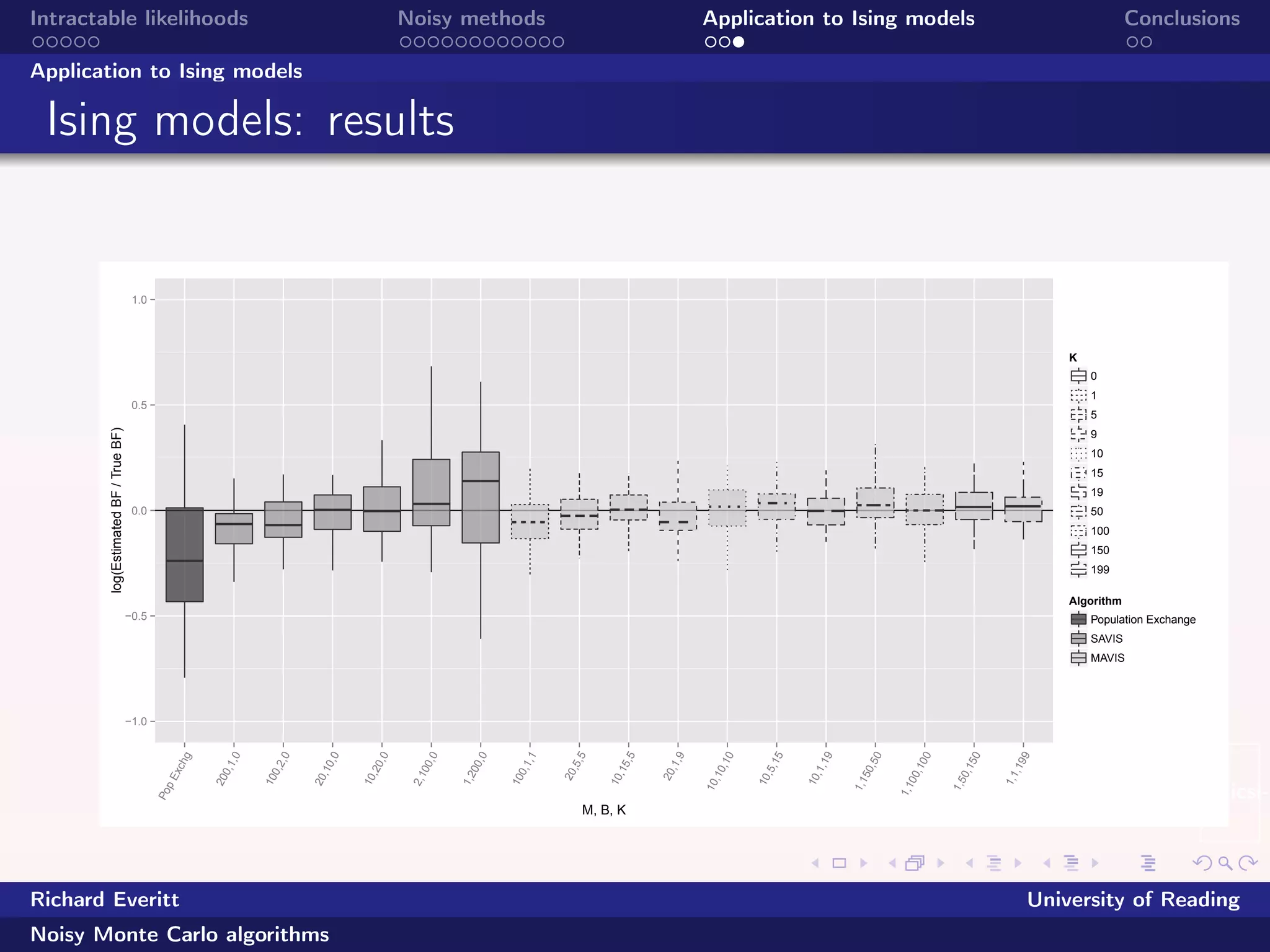
Ising models: results
−1.0
−0.5
0.0
0.5
1.0
PopExchg
200,1,0
100,2,0
20,10,0
10,20,0
2,100,0
1,200,0
100,1,1
20,5,5
10,15,5
20,1,9
10,10,10
10,5,15
10,1,19
1,150,50
1,100,100
1,50,150
1,1,199
M, B, K
log(EstimatedBF/TrueBF)
K
0
1
5
9
10
15
19
50
100
150
199
Algorithm
Population Exchange
SAVIS
MAVIS
Richard Everitt University of Reading
Noisy Monte Carlo algorithms
beamer-icsi-l
Intractable likelihoods Noisy methods Application to Ising models Conclusions
Conclusions
Conclusions
Use exact methods where possible...
... however the bias from a noisy method may be small
compared to errors resulting from commonly accepted
approximate techniques such as ABC (and also the Monte
Carlo variance).
What is the best we can do fo some finite computational
budget?
Promising results, but many open questions:
what one should do in practice is not obvious;
potential accumulation of bias in SMC (mitigated by mixing
well);
in both cases the theory requires very strong assumptions.
Richard Everitt University of Reading
Noisy Monte Carlo algorithms
beamer-icsi-l
Intractable likelihoods Noisy methods Application to Ising models Conclusions
Conclusions
Conclusions
Use exact methods where possible...
... however the bias from a noisy method may be small
compared to errors resulting from commonly accepted
approximate techniques such as ABC (and also the Monte
Carlo variance).
What is the best we can do fo some finite computational
budget?
Promising results, but many open questions:
what one should do in practice is not obvious;
potential accumulation of bias in SMC (mitigated by mixing
well);
in both cases the theory requires very strong assumptions.
Richard Everitt University of Reading
Noisy Monte Carlo algorithms
beamer-icsi-l
Intractable likelihoods Noisy methods Application to Ising models Conclusions
Conclusions
Conclusions
Use exact methods where possible...
... however the bias from a noisy method may be small
compared to errors resulting from commonly accepted
approximate techniques such as ABC (and also the Monte
Carlo variance).
What is the best we can do fo some finite computational
budget?
Promising results, but many open questions:
what one should do in practice is not obvious;
potential accumulation of bias in SMC (mitigated by mixing
well);
in both cases the theory requires very strong assumptions.
Richard Everitt University of Reading
Noisy Monte Carlo algorithms
beamer-icsi-l
Intractable likelihoods Noisy methods Application to Ising models Conclusions
Conclusions
Acknowledgements
Noisy MCMC: Pierre Alquier, Nial Friel and Aiden Boland
(UCD).
Noisy IS and SMC: Adam Johansen (Warwick), Melina
Evdemon-Hogan and Ellen Rowing (Reading).
Richard Everitt University of Reading
Noisy Monte Carlo algorithms

Richard Everitt's slides

  • 1.
    beamer-icsi-l Intractable likelihoods Noisymethods Application to Ising models Conclusions Noisy Monte Carlo algorithms Richard Everitt University of Reading July 8th, 2016 Richard Everitt University of Reading Noisy Monte Carlo algorithms
  • 2.
    beamer-icsi-l Intractable likelihoods Noisymethods Application to Ising models Conclusions Intractable likelihoods Types of intractable likelihood A likelihood is intractable when it is difficult to evaluate pointwise at θ. 1 Big data f (y|θ) = N ∏ i=1 fi (yi |θ). 2 When there are a large number of latent variables x, with f (y|θ) = x f (y,x|θ)dx. 3 When, for an intractable Z(θ) (e.g for a Markov random field), f (y|θ) = 1 Z(θ) γ(y|θ). 4 Where f (·|θ) can be sampled, but not evaluated. Richard Everitt University of Reading Noisy Monte Carlo algorithms
  • 3.
    beamer-icsi-l Intractable likelihoods Noisymethods Application to Ising models Conclusions Intractable likelihoods Exact-approximate methods Suppose that, for any θ, it is possible to compute an unbiased estimate f (y|θ) of f (y|θ). Then... 1 Using the acceptance probability α θ(p) ,θ∗ = min 1, f (y|θ∗)p(θ∗)q(θ(p)|θ∗) f (y|θ(p))p(θ(p))q(θ∗|θ(p)) yields an MCMC algorithm with target distibution π (θ|y). 2 Using the weight w(p) = f (y|θ(p))p(θ(p)) q(θ(p)) yields an importance sampling algorithm with target distribution π (θ|y). Beaumont (2003), Andrieu and Roberts (2009), Fearnhead et al. (2010). Richard Everitt University of Reading Noisy Monte Carlo algorithms
  • 4.
    beamer-icsi-l Intractable likelihoods Noisymethods Application to Ising models Conclusions Intractable likelihoods Type 3: “doubly intractable” distributions Coined by Murray et al. (2006). Intractable in that we need to resort to simulation. Doubly intractable since the acceptance probability in MH min 1, γ(y|θ∗) γ(y|θ(p)) p(θ∗) p(θ(p)) q(θ(p)|θ∗) q(θ∗|θ(p)) 1 Z(θ∗) Z(θ(p)) 1 requires evaluating the intractable term Z. Richard Everitt University of Reading Noisy Monte Carlo algorithms
  • 5.
    beamer-icsi-l Intractable likelihoods Noisymethods Application to Ising models Conclusions Intractable likelihoods The single auxiliary variable (SAV) method Møller et al. (2006) use qu(u∗|θ∗,y) γ(u∗|θ∗) with some distribution qu and u∗ ∼ f (.|θ∗), as an unbiased importance sampling estimator of 1 Z(θ∗) . This gives an acceptance probability of min 1, γ(y|θ∗) γ(y|θ(p)) p(θ∗) p(θ(p)) q(θ(p)|θ∗) q(θ∗|θ(p)) qu(u∗|θ∗,y) γ(u∗|θ∗) γ(u|θ(p)) qu(u|θ(p),y) . Richard Everitt University of Reading Noisy Monte Carlo algorithms
  • 6.
    beamer-icsi-l Intractable likelihoods Noisymethods Application to Ising models Conclusions Intractable likelihoods SAV importance sampling Everitt et al. (2016) use qu(u∗|θ∗,y) γ(u∗|θ∗) with some distribution qu and u∗ ∼ f (.|θ∗), as an unbiased importance sampling estimator of 1 Z(θ∗) . Using qu(u|θ∗,y) γ(u|θ∗) as an IS estimator of 1 Z(θ∗) we obtain w(p) = γ(y|θ(p))p(θ(p)) q(θ(p)) qu(u|θ(p),y) γ(u|θ(p)) . Note: we may use multiple importance points, i.e. use 1 M M ∑ m=1 qu(u(m)|θ∗,y) γ(u(m)|θ∗) . Richard Everitt University of Reading Noisy Monte Carlo algorithms
  • 7.
    beamer-icsi-l Intractable likelihoods Noisymethods Application to Ising models Conclusions Noisy methods Noisy methods The use of “inexact approximate” or “noisy” methods in which an exact method is approximated without resulting in an exact target distribution. Focus on doubly intractable problems strong link to work on other types of intractable likelihood. In particular, that an exact sampler does not exist for u∗ ∼ f (.|θ∗). Alternatives: Russian roulette (Lyne et al., 2015); use a long run of an MCMC in place of an exact sampler (Caimo and Friel, 2011; Everitt, 2012). Richard Everitt University of Reading Noisy Monte Carlo algorithms
  • 8.
    beamer-icsi-l Intractable likelihoods Noisymethods Application to Ising models Conclusions Noisy methods Justification? 1 Is the distribution targeted by the noisy algorithm close to the exact target? 2 What is the error in estimates produced by the noisy algorithm? given a fixed computational budget, how should it be allocated to minimise the error of estimates? Everitt R. G. (2012). Bayesian Parameter Estimation for Latent Markov Random Fields and Social Networks, Journal of Computational and Graphical Statistics, 21(4), 940-960, or arXiv(1203.3725) Alquier, P., Friel, N., Everitt, R. G., Boland, A. (2015). Noisy Monte Carlo: Convergence of Markov chains with approximate transition kernels, Statistics and Computing, or arXiv(1403.5496). Everitt, R. G., Johansen, A. M., Rowing, E., Evdemon-Hogan, M. (2016). Bayesian model comparison with un-normalised likelihoods, arXiv(1504.00298). Richard Everitt University of Reading Noisy Monte Carlo algorithms
  • 9.
    beamer-icsi-l Intractable likelihoods Noisymethods Application to Ising models Conclusions Noisy methods Noisy MCMC MCMC involves simulating a Markov chain (θn)n∈N with transition kernel P such that π is invariant under P. In some situations there is a natural kernel P with this property, but which we cannot draw θn+1 ∼ P(θn,·) for a fixed θn. A natural idea is to replace P by an approximation ˆP. This leads to the obvious question: Can we say something on how close the resultant Markov chain with transition kernel ˆP is that resulting from P? Eg, is it possible to upper bound? δθ0 ˆPn −π . It turns out that a useful answer is given by the study of the stability of Markov chains. Richard Everitt University of Reading Noisy Monte Carlo algorithms
  • 10.
    beamer-icsi-l Intractable likelihoods Noisymethods Application to Ising models Conclusions Noisy methods Noisy MCMC MCMC involves simulating a Markov chain (θn)n∈N with transition kernel P such that π is invariant under P. In some situations there is a natural kernel P with this property, but which we cannot draw θn+1 ∼ P(θn,·) for a fixed θn. A natural idea is to replace P by an approximation ˆP. This leads to the obvious question: Can we say something on how close the resultant Markov chain with transition kernel ˆP is that resulting from P? Eg, is it possible to upper bound? δθ0 ˆPn −π . It turns out that a useful answer is given by the study of the stability of Markov chains. Richard Everitt University of Reading Noisy Monte Carlo algorithms
  • 11.
    beamer-icsi-l Intractable likelihoods Noisymethods Application to Ising models Conclusions Noisy methods Stability result Theorem (Mitrophanov (2005), Corollary 3.1) If (H1) the MC with transition kernel P is uniformly ergodic: sup θ0 δθ0 Pn −π ≤ Cρn for some C < ∞ and ρ < 1. Then we have, for any n ∈ N, for any starting point θ0, δθ0 Pn −δθ0 ˆPn ≤ λ + Cρλ 1−ρ P − ˆP where λ = log(1/C) log(ρ) . Richard Everitt University of Reading Noisy Monte Carlo algorithms
  • 12.
    beamer-icsi-l Intractable likelihoods Noisymethods Application to Ising models Conclusions Noisy methods Noisy MCMC: uniform ergodicity So, if something can be said about P − ˆP we know something about: the distance between the iterated noisy and exact kernels when the invariant distribution of ˆP exists, the distance between the noisy and exact targets. In particular: Everitt (2012) shows that when the burn in increases, the distance goes to zero; same argument is used in Andrieu and Roberts (2009) for Monte Carlo within Metropolis; Alquier et al. (2015) give cases where the bound on P − ˆP can be given in terms of M (where the quality of the approximation goes to zero as M → ∞). Richard Everitt University of Reading Noisy Monte Carlo algorithms
  • 13.
    beamer-icsi-l Intractable likelihoods Noisymethods Application to Ising models Conclusions Noisy methods Noisy MCMC: geometric ergodicity Alquier et al. (2015) also note that similar results can hold in the geometrically ergodic case from result in Ferré, Hervé and Ledoux (2013) taken much further by Medina-Aguayo et al. (2015). Further developments in the geometrically ergodic case, and using Wasserstein distance rather than total variation Pillai and Smith (2014); Rudolf and Schweizer (2015). Richard Everitt University of Reading Noisy Monte Carlo algorithms
  • 14.
    beamer-icsi-l Intractable likelihoods Noisymethods Application to Ising models Conclusions Noisy methods Sequential Monte Carlo Richard Everitt University of Reading Noisy Monte Carlo algorithms
  • 15.
    beamer-icsi-l Intractable likelihoods Noisymethods Application to Ising models Conclusions Noisy methods SMC samplers An iteration of an SMC algorithm at target t +1. For p = 1 : P Update θ (p) t to θ (p) t+1 using some kernel K. For p = 1 : P Reweight: find w (p) t+1, so that the θ (p) t+1,w (p) t+1 are (unnormalised) weighted points from pt+1(.|y). Normalise w (p) t+1 P p=1 to give w (p) t+1 P p=1 . Resample the weighted points if some threshold is met. An estimate of the marginal likelihood is given by ∏T t=1 ∑P p=1 w (p) t . Richard Everitt University of Reading Noisy Monte Carlo algorithms
  • 16.
    beamer-icsi-l Intractable likelihoods Noisymethods Application to Ising models Conclusions Noisy methods Noisy SMC: strong mixing assumptions In Everitt et al (2016), we use biased weights at every step of the SMC; are interested in how the error accumulates as the SMC algorithm iterates. Under strong mixing assumptions (stronger than a global Doeblin condition) we obtain a uniform bound on total-variation discrepancy between the iterated target distributions of the exact and noisy methods strong mixing can prevent the accumulation of error even in systems with biased weights. Richard Everitt University of Reading Noisy Monte Carlo algorithms
  • 17.
    beamer-icsi-l Intractable likelihoods Noisymethods Application to Ising models Conclusions Noisy methods Noisy SMC: empirical study Richard Everitt University of Reading Noisy Monte Carlo algorithms
  • 18.
    beamer-icsi-l Intractable likelihoods Noisymethods Application to Ising models Conclusions Noisy methods Error of estimates: noisy MCMC The noisy method is more efficient (in terms of mean squared error) if 3 sεP 1+ 1 sεP + 3 4 ε2 < 1 P 1+ 1 P . Johndrow, J. E., Mattingly, J. C. Mukherjee, S. Dunson, D. (2015) Approximations of Markov Chains and High-Dimensional Bayesian Inference, arXiv. Richard Everitt University of Reading Noisy Monte Carlo algorithms
  • 19.
    beamer-icsi-l Intractable likelihoods Noisymethods Application to Ising models Conclusions Noisy methods Error of estimates: noisy IS Noisy importance sampling and sequential Monte Carlo: Everitt et al (2016). Under some simplifying assumptions, noisy importance sampling is more efficient (in terms of mean squared error) compared to an exact-approximate algorithm if 1 P Varq [w(θ)+b(θ)]+Eq[`σ2 θ ] +Eq[b(θ)]2 < 1 P Varq [w(θ)]+Eq[´σ2 θ ] , where b(θ) > 0 is the bias of the noisy weights, `σ2 θ is the variance of the noisy weights, ´σ2 θ is the variance of the exact-approximate weights and w(θ) := p(θ)γ(y|θ) Z(θ)q(θ) . Richard Everitt University of Reading Noisy Monte Carlo algorithms
  • 20.
    beamer-icsi-l Intractable likelihoods Noisymethods Application to Ising models Conclusions Application to Ising models SAV importance sampling Recall SAVIS. Use it to estimate the marginal likelihood p(y). We obtain p(y) = 1 P P ∑ p=1 γ(y|θ(p))p(θ(p)) q(θ(p)) M ∑ m=1 qu(u(m,p)|θ(p),y) γ(u(m,p)|θ(p)) , where the u(m,p) are generated by taking the final point of a long MCMC run (length B) targeting f (·|θ(p)). Richard Everitt University of Reading Noisy Monte Carlo algorithms
  • 21.
    beamer-icsi-l Intractable likelihoods Noisymethods Application to Ising models Conclusions Application to Ising models SAV importance sampling Recall SAVIS. Use it to estimate the marginal likelihood p(y). We obtain p(y) = 1 P P ∑ p=1 γ(y|θ(p))p(θ(p)) q(θ(p)) M ∑ m=1 qu(u(m,p)|θ(p),y) γ(u(m,p)|θ(p)) , where the u(m,p) are generated by taking the final point of a long MCMC run (length B) targeting f (·|θ(p)). Richard Everitt University of Reading Noisy Monte Carlo algorithms
  • 22.
    beamer-icsi-l Intractable likelihoods Noisymethods Application to Ising models Conclusions Application to Ising models Application to Ising models An Ising model is a pairwise Markov random field with binary variables. Reanalyse the data from Friel (2013), which consists of 20 realisations from a first-order 10×10 Ising model and 20 realisations from a second-order 10×10 Ising model. Compare population exchange; SAVIS and variations on this idea. Richard Everitt University of Reading Noisy Monte Carlo algorithms
  • 23.
    beamer-icsi-l Intractable likelihoods Noisymethods Application to Ising models Conclusions Application to Ising models Ising models: results −1.0 −0.5 0.0 0.5 1.0 PopExchg 200,1,0 100,2,0 20,10,0 10,20,0 2,100,0 1,200,0 100,1,1 20,5,5 10,15,5 20,1,9 10,10,10 10,5,15 10,1,19 1,150,50 1,100,100 1,50,150 1,1,199 M, B, K log(EstimatedBF/TrueBF) K 0 1 5 9 10 15 19 50 100 150 199 Algorithm Population Exchange SAVIS MAVIS Richard Everitt University of Reading Noisy Monte Carlo algorithms
  • 24.
    beamer-icsi-l Intractable likelihoods Noisymethods Application to Ising models Conclusions Conclusions Conclusions Use exact methods where possible... ... however the bias from a noisy method may be small compared to errors resulting from commonly accepted approximate techniques such as ABC (and also the Monte Carlo variance). What is the best we can do fo some finite computational budget? Promising results, but many open questions: what one should do in practice is not obvious; potential accumulation of bias in SMC (mitigated by mixing well); in both cases the theory requires very strong assumptions. Richard Everitt University of Reading Noisy Monte Carlo algorithms
  • 25.
    beamer-icsi-l Intractable likelihoods Noisymethods Application to Ising models Conclusions Conclusions Conclusions Use exact methods where possible... ... however the bias from a noisy method may be small compared to errors resulting from commonly accepted approximate techniques such as ABC (and also the Monte Carlo variance). What is the best we can do fo some finite computational budget? Promising results, but many open questions: what one should do in practice is not obvious; potential accumulation of bias in SMC (mitigated by mixing well); in both cases the theory requires very strong assumptions. Richard Everitt University of Reading Noisy Monte Carlo algorithms
  • 26.
    beamer-icsi-l Intractable likelihoods Noisymethods Application to Ising models Conclusions Conclusions Conclusions Use exact methods where possible... ... however the bias from a noisy method may be small compared to errors resulting from commonly accepted approximate techniques such as ABC (and also the Monte Carlo variance). What is the best we can do fo some finite computational budget? Promising results, but many open questions: what one should do in practice is not obvious; potential accumulation of bias in SMC (mitigated by mixing well); in both cases the theory requires very strong assumptions. Richard Everitt University of Reading Noisy Monte Carlo algorithms
  • 27.
    beamer-icsi-l Intractable likelihoods Noisymethods Application to Ising models Conclusions Conclusions Acknowledgements Noisy MCMC: Pierre Alquier, Nial Friel and Aiden Boland (UCD). Noisy IS and SMC: Adam Johansen (Warwick), Melina Evdemon-Hogan and Ellen Rowing (Reading). Richard Everitt University of Reading Noisy Monte Carlo algorithms