Shifting our views on Monte Carlo
Christian P. Robert
Universit´e Paris-Dauphine, Paris & University of Warwick, Coventry
June 6, 2016
adapted from NIPS 2015 slides
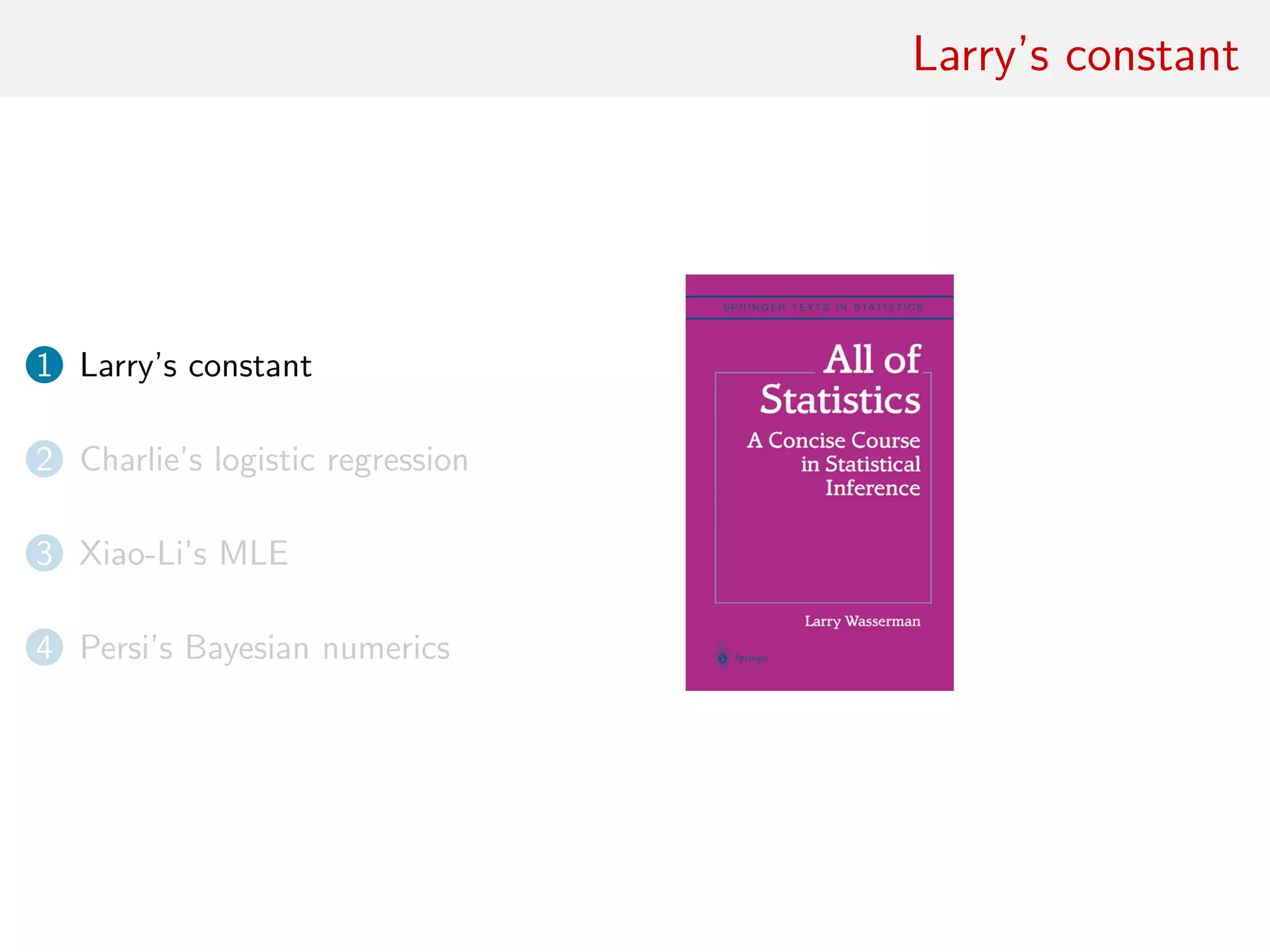
Larry’s constant
1 Larry’s constant
2 Charlie’s logistic regression
3 Xiao-Li’s MLE
4 Persi’s Bayesian numerics
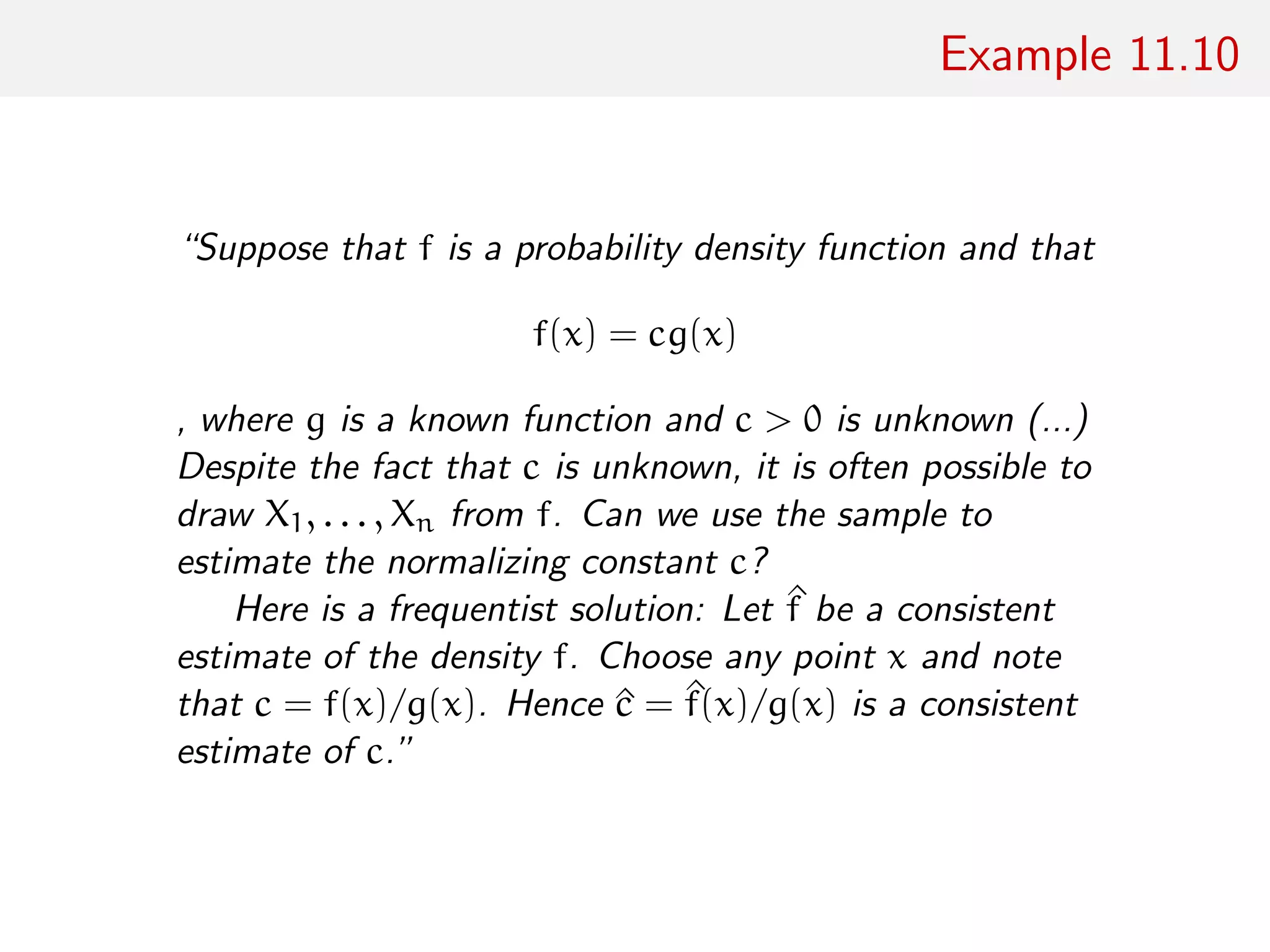
Example 11.10
“Suppose that f is a probability density function and that
f(x) = cg(x)
, where g is a known function and c > 0 is unknown (...)
Despite the fact that c is unknown, it is often possible to
draw X1, . . . , Xn from f. Can we use the sample to
estimate the normalizing constant c?
Here is a frequentist solution: Let ^f be a consistent
estimate of the density f. Choose any point x and note
that c = f(x)/g(x). Hence ^c = ^f(x)/g(x) is a consistent
estimate of c.”
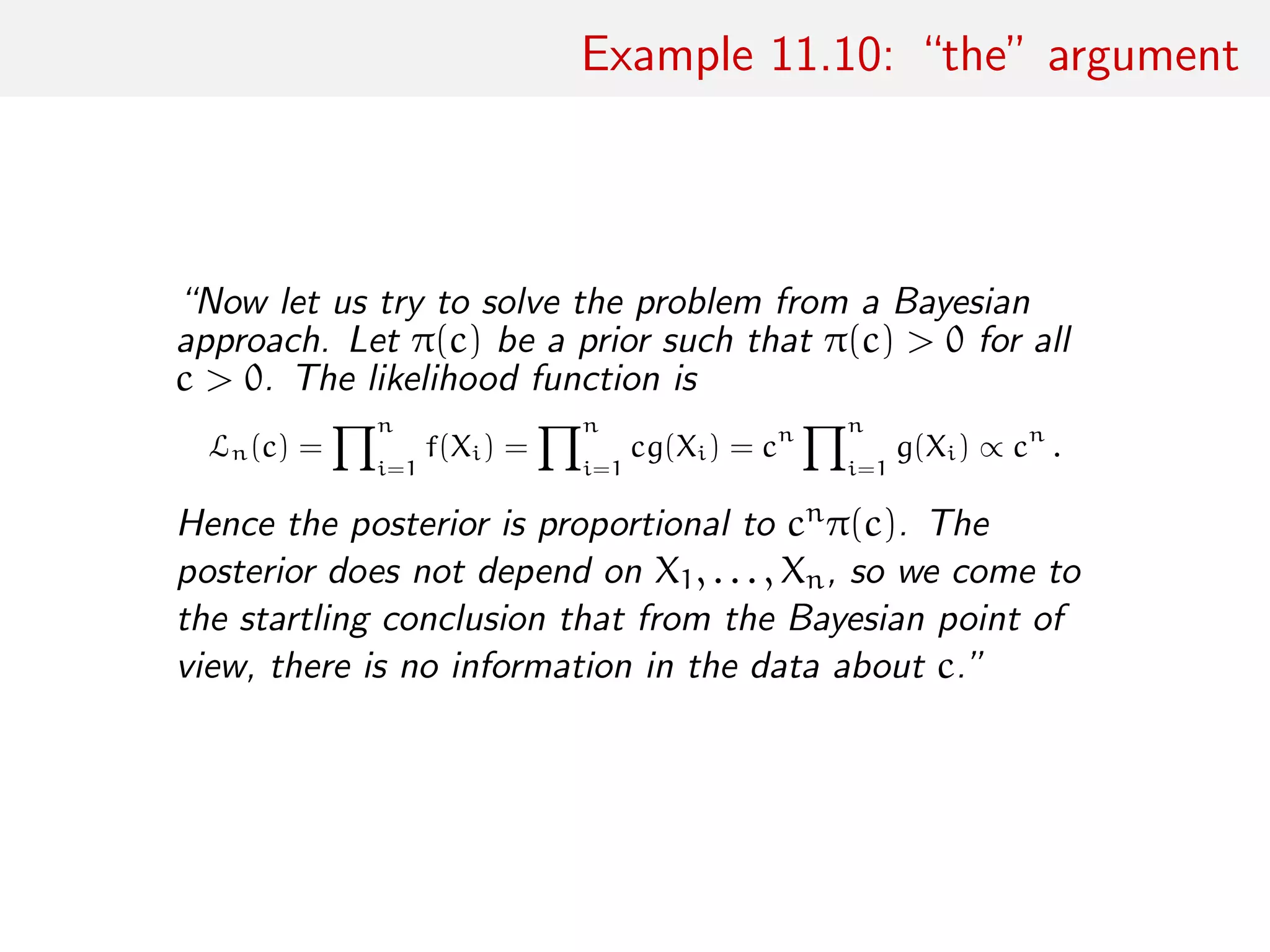
Example 11.10: “the” argument
“Now let us try to solve the problem from a Bayesian
approach. Let π(c) be a prior such that π(c) > 0 for all
c > 0. The likelihood function is
Ln(c) =
n
i=1
f(Xi) =
n
i=1
cg(Xi) = cn n
i=1
g(Xi) ∝ cn
.
Hence the posterior is proportional to cnπ(c). The
posterior does not depend on X1, . . . , Xn, so we come to
the startling conclusion that from the Bayesian point of
view, there is no information in the data about c.”
c “Bayesians are slaves to the likelihood function”
• there is no likelihood function such as Ln(c) [since moving c
does not modify the sample]
• “there is no information in the data about c” but there is
about f
• not a statistical problem [at face value], rather a numerical
problem with many Monte Carlo solutions
• Monte Carlo methods are frequentist (LLN) and asymptotical
(as in large numbers)
• but use of probabilistic numerics brings uncertainty evaluation
a broader picture
• Larry’s problem somehow relates to the infamous harmonic
mean estimator issue
• highlight paradoxical differences between statistics and Monte
Carlo methods:
• statistics constrained by sample and its distribution
• Monte Carlo free to generate samples
• no best unbiased estimator or optimal solution in Monte Carlo
integration
• paradox of the fascinating “Bernoulli factory” problem, which
requires infinite sequence of Bernoullis
[Flegal & Herbei, 2012; Jacob & Thiery, 2015]
• highly limited range of parameters allowing for unbiased
estimation versus universal debiasing of converging sequences
[McLeish, 2011; Rhee & Glynn, 2012, 2013]
reverse logistic regression
1 Larry’s constant
2 Charlie’s logistic regression
3 Xiao-Li’s MLE
4 Persi’s Bayesian numerics
regression estimator
Given
Xij ∼ fi(x) = cihi(x)
with hi known and ci unknown (i = 1, . . . , k, j = 1, . . . , ni),
constants ci estimated by a “reverse logistic regression” based on
the quasi-likelihood
L(η) =
k
i=1
ni
j=1
log pi(xij, η)
with
pi(x, η) = exp{ηi}hi(x)
k
i=1
exp{ηi}hi(x)
[Anderson, 1972; Geyer, 1992]
Approximation
log ^ci = log ni/n − ^ηi
regression estimator
Given
Xij ∼ fi(x) = cihi(x)
with hi known and ci unknown (i = 1, . . . , k, j = 1, . . . , ni),
constants ci estimated by a “reverse logistic regression” based on
the quasi-likelihood
L(η) =
k
i=1
ni
j=1
log pi(xij, η)
with
pi(x, η) = exp{ηi}hi(x)
k
i=1
exp{ηi}hi(x)
[Anderson, 1972; Geyer, 1992]
Approximation
log ^ci = log ni/n − ^ηi
statistical framework?
Existence of a central limit theorem:
√
n (^ηn − η)
L
−→ Nk(0, B+
AB)
[Geyer, 1992; Doss & Tan, 2015]
• strong convergence properties
• asymptotic approximation of the precision
• connection with bridge sampling and auxiliary model [mixture]
• ...but nothing statistical there [no estimation]
• which optimality? [weights unidentifiable]
[Kong et al., 2003; Chopin & Robert, 2011]
statistical framework?
Existence of a central limit theorem:
√
n (^ηn − η)
L
−→ Nk(0, B+
AB)
[Geyer, 1992; Doss & Tan, 2015]
• strong convergence properties
• asymptotic approximation of the precision
• connection with bridge sampling and auxiliary model [mixture]
• ...but nothing statistical there [no estimation]
• which optimality? [weights unidentifiable]
[Kong et al., 2003; Chopin & Robert, 2011]
partition function and maximum likelihood
For parametric family
f(x; θ) = p(x; θ)/Z(θ)
• normalising constant Z(θ) also called partition function
• ...if normalisation possible
• essential part of inference
• estimation by score matching [matching scores of model and
data]
• ...and by noise-contrastive estimation [generalised Charlie’s
regression]
[Gutmann & Hyv¨arinen, 2012, 2015]
partition function and maximum likelihood
For parametric family
f(x; θ) = p(x; θ)/Z(θ)
Generic representation with auxiliary data y from known
distribution fy and regression function
h(u; θ) = 1 +
nx
ny
exp(−G(u; θ))
−1
Objective function
J(θ) =
nx
i=1
log h(xi; θ) +
ny
i=1
log{1 − h(yi; θ)}
that can be maximised with no normalising constant
[Gutmann & Hyv¨arinen, 2012, 2015]
Xiao-Li’s MLE
1 Larry’s constant
2 Charlie’s logistic regression
3 Xiao-Li’s MLE
4 Persi’s Bayesian numerics
[Meng, 2011, IRCEM]
Xiao-Li’s MLE
“The task of estimating an integral by Monte Carlo
methods is formulated as a statistical model using
simulated observations as data.
The difficulty in this exercise is that we ordinarily have
at our disposal all of the information required (..) but
we choose to ignore some (...) for simplicity or
computational feasibility.”
[Kong, McCullagh, Meng, Nicolae & Tan, 2003]
Xiao-Li’s MLE
“Our proposal is to use a semiparametric statistical
model that makes explicit what information is ignored
(...) The parameter space in this model is a set of
measures on the sample space (...) None-the-less,
from simulated data the base-line measure can be
estimated by maximum likelihood, and the required
integrals computed by a simple formula previously
derived by Geyer.”
[Kong, McCullagh, Meng, Nicolae & Tan, 2003]
Xiao-Li’s MLE
“By contrast with Geyer’s retrospective likelihood, a
correct estimate of simulation error is available
directly from the Fisher information. The principal
advantage of the semiparametric model is that
variance reduction techniques are associated with
submodels in which the maximum likelihood estimator
in the submodel may have substantially smaller
variance.”
[Kong, McCullagh, Meng, Nicolae & Tan, 2003]
(c.) Rachel2002
Xiao-Li’s MLE
“At first glance, the problem appears to be an exercise in calculus
or numerical analysis, and not amenable to statistical formulation”
• use of Fisher information
• non-parametric MLE based on
simulations
• comparison of sampling
schemes through variances
• Rao–Blackwellised
improvements by invariance
constraints [Meng, 2011, IRCEM]
reverse logistic regression
1 Larry’s constant
2 Charlie’s logistic regression
3 Xiao-Li’s MLE
4 Persi’s Bayesian numerics [P. Diaconis, 1988]
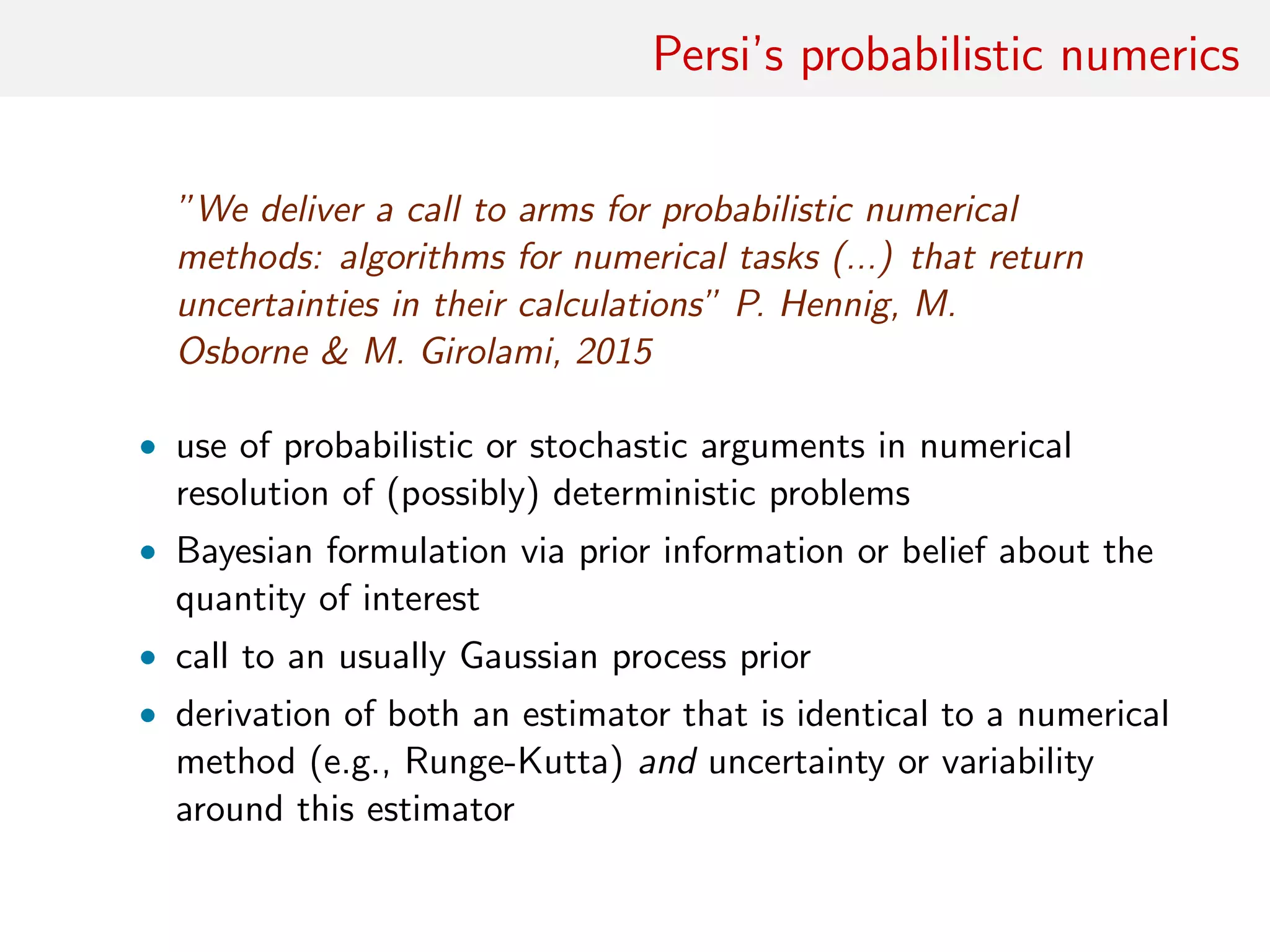
Persi’s probabilistic numerics
”We deliver a call to arms for probabilistic numerical
methods: algorithms for numerical tasks (...) that return
uncertainties in their calculations” P. Hennig, M.
Osborne & M. Girolami, 2015
• use of probabilistic or stochastic arguments in numerical
resolution of (possibly) deterministic problems
• Bayesian formulation via prior information or belief about the
quantity of interest
• call to an usually Gaussian process prior
• derivation of both an estimator that is identical to a numerical
method (e.g., Runge-Kutta) and uncertainty or variability
around this estimator
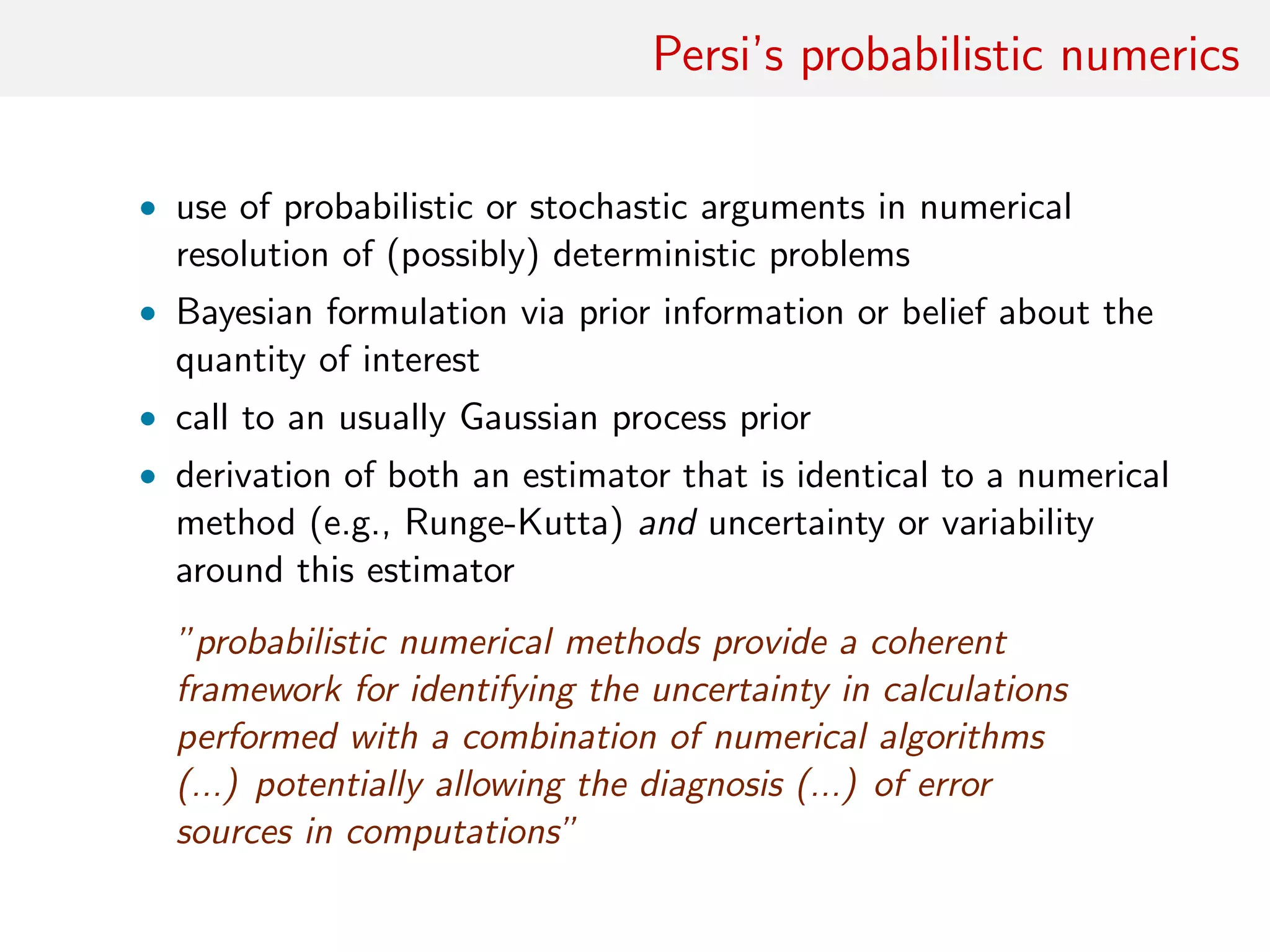
Persi’s probabilistic numerics
• use of probabilistic or stochastic arguments in numerical
resolution of (possibly) deterministic problems
• Bayesian formulation via prior information or belief about the
quantity of interest
• call to an usually Gaussian process prior
• derivation of both an estimator that is identical to a numerical
method (e.g., Runge-Kutta) and uncertainty or variability
around this estimator
”probabilistic numerical methods provide a coherent
framework for identifying the uncertainty in calculations
performed with a combination of numerical algorithms
(...) potentially allowing the diagnosis (...) of error
sources in computations”
My uncertainties
• answer to the zero variance estimator
• significance of a probability statement about a mathematical
constant [other than epistemic]
• posterior in functional spaces mostly reflect choice of prior
rather than information
• big world versus small worlds debate
[Robbins & Wasserman, 2000]
• possible incoherence of Bayesian inference in functional spaces
• unavoidable recourse to (and impact of) Bayesian prior
modelling
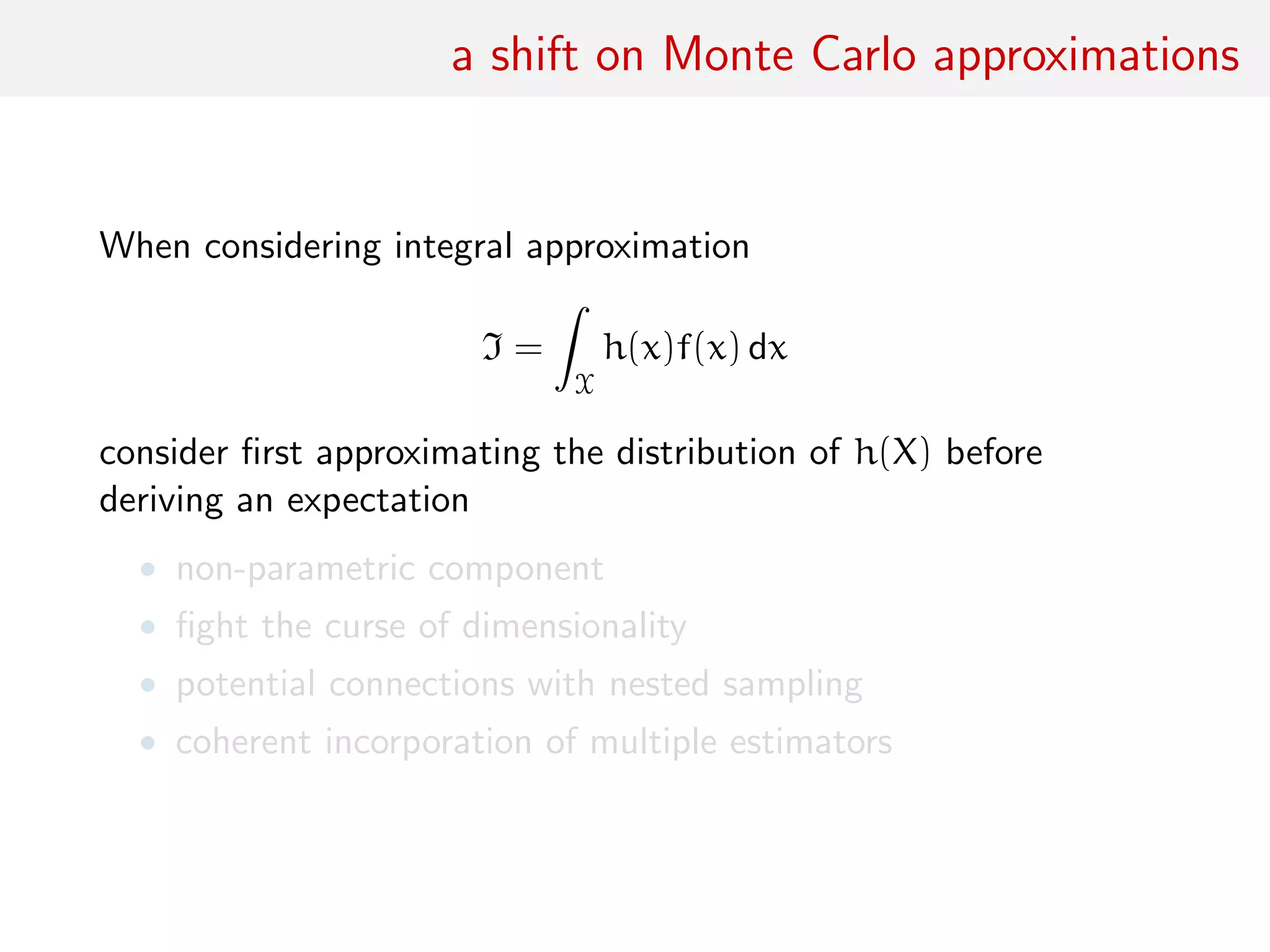
a shift on Monte Carlo approximations
When considering integral approximation
I =
ˆ
X
h(x)f(x) dx
consider first approximating the distribution of h(X) before
deriving an expectation
• non-parametric component
• fight the curse of dimensionality
• potential connections with nested sampling
• coherent incorporation of multiple estimators
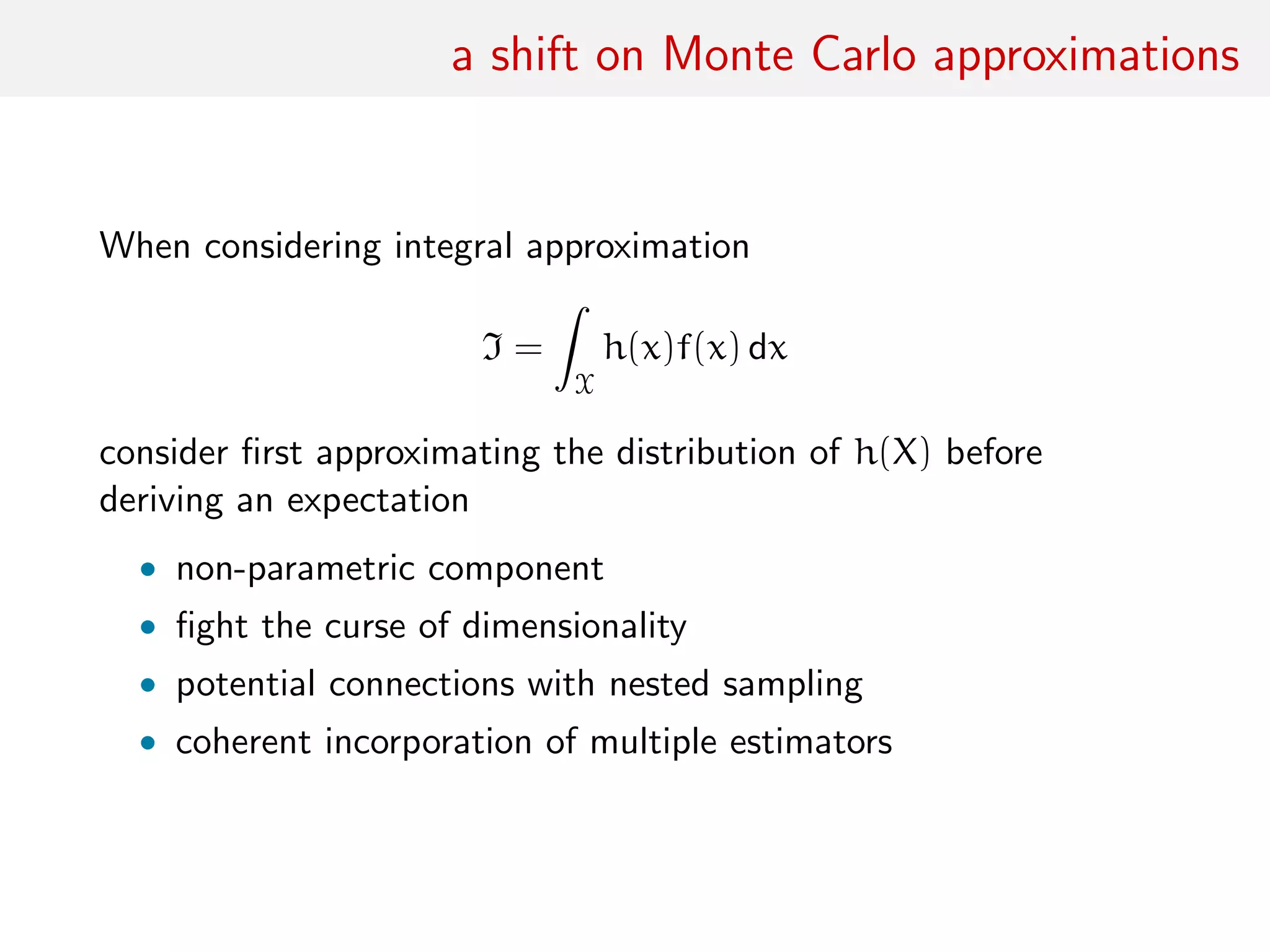
a shift on Monte Carlo approximations
When considering integral approximation
I =
ˆ
X
h(x)f(x) dx
consider first approximating the distribution of h(X) before
deriving an expectation
• non-parametric component
• fight the curse of dimensionality
• potential connections with nested sampling
• coherent incorporation of multiple estimators

Discussion of Persi Diaconis' lecture at ISBA 2016

  • 1.
    Shifting our viewson Monte Carlo Christian P. Robert Universit´e Paris-Dauphine, Paris & University of Warwick, Coventry June 6, 2016 adapted from NIPS 2015 slides
  • 2.
    Larry’s constant 1 Larry’sconstant 2 Charlie’s logistic regression 3 Xiao-Li’s MLE 4 Persi’s Bayesian numerics
  • 3.
    Example 11.10 “Suppose thatf is a probability density function and that f(x) = cg(x) , where g is a known function and c > 0 is unknown (...) Despite the fact that c is unknown, it is often possible to draw X1, . . . , Xn from f. Can we use the sample to estimate the normalizing constant c? Here is a frequentist solution: Let ^f be a consistent estimate of the density f. Choose any point x and note that c = f(x)/g(x). Hence ^c = ^f(x)/g(x) is a consistent estimate of c.”
  • 4.
    Example 11.10: “the”argument “Now let us try to solve the problem from a Bayesian approach. Let π(c) be a prior such that π(c) > 0 for all c > 0. The likelihood function is Ln(c) = n i=1 f(Xi) = n i=1 cg(Xi) = cn n i=1 g(Xi) ∝ cn . Hence the posterior is proportional to cnπ(c). The posterior does not depend on X1, . . . , Xn, so we come to the startling conclusion that from the Bayesian point of view, there is no information in the data about c.”
  • 5.
    c “Bayesians areslaves to the likelihood function” • there is no likelihood function such as Ln(c) [since moving c does not modify the sample] • “there is no information in the data about c” but there is about f • not a statistical problem [at face value], rather a numerical problem with many Monte Carlo solutions • Monte Carlo methods are frequentist (LLN) and asymptotical (as in large numbers) • but use of probabilistic numerics brings uncertainty evaluation
  • 6.
    a broader picture •Larry’s problem somehow relates to the infamous harmonic mean estimator issue • highlight paradoxical differences between statistics and Monte Carlo methods: • statistics constrained by sample and its distribution • Monte Carlo free to generate samples • no best unbiased estimator or optimal solution in Monte Carlo integration • paradox of the fascinating “Bernoulli factory” problem, which requires infinite sequence of Bernoullis [Flegal & Herbei, 2012; Jacob & Thiery, 2015] • highly limited range of parameters allowing for unbiased estimation versus universal debiasing of converging sequences [McLeish, 2011; Rhee & Glynn, 2012, 2013]
  • 7.
    reverse logistic regression 1Larry’s constant 2 Charlie’s logistic regression 3 Xiao-Li’s MLE 4 Persi’s Bayesian numerics
  • 8.
    regression estimator Given Xij ∼fi(x) = cihi(x) with hi known and ci unknown (i = 1, . . . , k, j = 1, . . . , ni), constants ci estimated by a “reverse logistic regression” based on the quasi-likelihood L(η) = k i=1 ni j=1 log pi(xij, η) with pi(x, η) = exp{ηi}hi(x) k i=1 exp{ηi}hi(x) [Anderson, 1972; Geyer, 1992] Approximation log ^ci = log ni/n − ^ηi
  • 9.
    regression estimator Given Xij ∼fi(x) = cihi(x) with hi known and ci unknown (i = 1, . . . , k, j = 1, . . . , ni), constants ci estimated by a “reverse logistic regression” based on the quasi-likelihood L(η) = k i=1 ni j=1 log pi(xij, η) with pi(x, η) = exp{ηi}hi(x) k i=1 exp{ηi}hi(x) [Anderson, 1972; Geyer, 1992] Approximation log ^ci = log ni/n − ^ηi
  • 10.
    statistical framework? Existence ofa central limit theorem: √ n (^ηn − η) L −→ Nk(0, B+ AB) [Geyer, 1992; Doss & Tan, 2015] • strong convergence properties • asymptotic approximation of the precision • connection with bridge sampling and auxiliary model [mixture] • ...but nothing statistical there [no estimation] • which optimality? [weights unidentifiable] [Kong et al., 2003; Chopin & Robert, 2011]
  • 11.
    statistical framework? Existence ofa central limit theorem: √ n (^ηn − η) L −→ Nk(0, B+ AB) [Geyer, 1992; Doss & Tan, 2015] • strong convergence properties • asymptotic approximation of the precision • connection with bridge sampling and auxiliary model [mixture] • ...but nothing statistical there [no estimation] • which optimality? [weights unidentifiable] [Kong et al., 2003; Chopin & Robert, 2011]
  • 12.
    partition function andmaximum likelihood For parametric family f(x; θ) = p(x; θ)/Z(θ) • normalising constant Z(θ) also called partition function • ...if normalisation possible • essential part of inference • estimation by score matching [matching scores of model and data] • ...and by noise-contrastive estimation [generalised Charlie’s regression] [Gutmann & Hyv¨arinen, 2012, 2015]
  • 13.
    partition function andmaximum likelihood For parametric family f(x; θ) = p(x; θ)/Z(θ) Generic representation with auxiliary data y from known distribution fy and regression function h(u; θ) = 1 + nx ny exp(−G(u; θ)) −1 Objective function J(θ) = nx i=1 log h(xi; θ) + ny i=1 log{1 − h(yi; θ)} that can be maximised with no normalising constant [Gutmann & Hyv¨arinen, 2012, 2015]
  • 14.
    Xiao-Li’s MLE 1 Larry’sconstant 2 Charlie’s logistic regression 3 Xiao-Li’s MLE 4 Persi’s Bayesian numerics [Meng, 2011, IRCEM]
  • 15.
    Xiao-Li’s MLE “The taskof estimating an integral by Monte Carlo methods is formulated as a statistical model using simulated observations as data. The difficulty in this exercise is that we ordinarily have at our disposal all of the information required (..) but we choose to ignore some (...) for simplicity or computational feasibility.” [Kong, McCullagh, Meng, Nicolae & Tan, 2003]
  • 16.
    Xiao-Li’s MLE “Our proposalis to use a semiparametric statistical model that makes explicit what information is ignored (...) The parameter space in this model is a set of measures on the sample space (...) None-the-less, from simulated data the base-line measure can be estimated by maximum likelihood, and the required integrals computed by a simple formula previously derived by Geyer.” [Kong, McCullagh, Meng, Nicolae & Tan, 2003]
  • 17.
    Xiao-Li’s MLE “By contrastwith Geyer’s retrospective likelihood, a correct estimate of simulation error is available directly from the Fisher information. The principal advantage of the semiparametric model is that variance reduction techniques are associated with submodels in which the maximum likelihood estimator in the submodel may have substantially smaller variance.” [Kong, McCullagh, Meng, Nicolae & Tan, 2003] (c.) Rachel2002
  • 18.
    Xiao-Li’s MLE “At firstglance, the problem appears to be an exercise in calculus or numerical analysis, and not amenable to statistical formulation” • use of Fisher information • non-parametric MLE based on simulations • comparison of sampling schemes through variances • Rao–Blackwellised improvements by invariance constraints [Meng, 2011, IRCEM]
  • 19.
    reverse logistic regression 1Larry’s constant 2 Charlie’s logistic regression 3 Xiao-Li’s MLE 4 Persi’s Bayesian numerics [P. Diaconis, 1988]
  • 20.
    Persi’s probabilistic numerics ”Wedeliver a call to arms for probabilistic numerical methods: algorithms for numerical tasks (...) that return uncertainties in their calculations” P. Hennig, M. Osborne & M. Girolami, 2015 • use of probabilistic or stochastic arguments in numerical resolution of (possibly) deterministic problems • Bayesian formulation via prior information or belief about the quantity of interest • call to an usually Gaussian process prior • derivation of both an estimator that is identical to a numerical method (e.g., Runge-Kutta) and uncertainty or variability around this estimator
  • 21.
    Persi’s probabilistic numerics •use of probabilistic or stochastic arguments in numerical resolution of (possibly) deterministic problems • Bayesian formulation via prior information or belief about the quantity of interest • call to an usually Gaussian process prior • derivation of both an estimator that is identical to a numerical method (e.g., Runge-Kutta) and uncertainty or variability around this estimator ”probabilistic numerical methods provide a coherent framework for identifying the uncertainty in calculations performed with a combination of numerical algorithms (...) potentially allowing the diagnosis (...) of error sources in computations”
  • 22.
    My uncertainties • answerto the zero variance estimator • significance of a probability statement about a mathematical constant [other than epistemic] • posterior in functional spaces mostly reflect choice of prior rather than information • big world versus small worlds debate [Robbins & Wasserman, 2000] • possible incoherence of Bayesian inference in functional spaces • unavoidable recourse to (and impact of) Bayesian prior modelling
  • 23.
    a shift onMonte Carlo approximations When considering integral approximation I = ˆ X h(x)f(x) dx consider first approximating the distribution of h(X) before deriving an expectation • non-parametric component • fight the curse of dimensionality • potential connections with nested sampling • coherent incorporation of multiple estimators
  • 24.
    a shift onMonte Carlo approximations When considering integral approximation I = ˆ X h(x)f(x) dx consider first approximating the distribution of h(X) before deriving an expectation • non-parametric component • fight the curse of dimensionality • potential connections with nested sampling • coherent incorporation of multiple estimators