Markov Chain Monte Carlo Methods
Christian P. Robert
Universit´e Paris-Dauphine, University of Warwick, & CRESt
CIRM Master Class in Bayesian Statistics
October 22, 2018
Markov Chain Monte Carlo Methods
Outline
The Metropolis-Hastings
Algorithm
Gibbs Sampling
Hamiltonian Monte Carlo
Piecewise Deterministic Versions
Markov Chain Monte Carlo Methods
The Metropolis-Hastings Algorithm
The Metropolis-Hastings
Algorithm
Monte Carlo Methods based
on Markov Chains
The Metropolis–Hastings
algorithm
Some Metropolis-Hastings
algorithms
Extensions
Vanilla Rao–Blackwellisation
Delayed acceptance
Adaptive MCMC
Gibbs Sampling
Markov Chain Monte Carlo Methods
The Metropolis-Hastings Algorithm
Monte Carlo Methods based on Markov Chains
Running Monte Carlo via Markov Chains
Far from necessary to use a sample from the distribution f to
approximate the integral
I = h(x)f(x)dx ,
as sample from different target(s) g can be exploited in
importance sampling version:
ˆI = 1/n
n
i=1
h(xi)f(xi)/g(xi)
Markov Chain Monte Carlo Methods
The Metropolis-Hastings Algorithm
Monte Carlo Methods based on Markov Chains
Running Monte Carlo via Markov Chains
Far from necessary to use a sample from the distribution f to
approximate the integral
I = h(x)f(x)dx ,
as non-i.i.d. sample X1, . . . , Xn ∼ f produced by using an
ergodic Markov chain with stationary distribution f
Markov Chain Monte Carlo Methods
The Metropolis-Hastings Algorithm
Monte Carlo Methods based on Markov Chains
Running Monte Carlo via Markov Chains (2)
Idea
For an arbitrary starting value x(0), an ergodic chain (X(t)) is
generated using a transition kernel with stationary distribution f
Markov Chain Monte Carlo Methods
The Metropolis-Hastings Algorithm
Monte Carlo Methods based on Markov Chains
Running Monte Carlo via Markov Chains (2)
Idea
For an arbitrary starting value x(0), an ergodic chain (X(t)) is
generated using a transition kernel with stationary distribution f
Insures the convergence in distribution of (X(t)) to a random
variable from f.
For a “large enough” T0, X(T0) can be considered as
distributed from limiting distribution f
Produce a dependent sample X(T0), X(T0+1), . . ., which is
generated from f, sufficient for most approximation purposes
Markov Chain Monte Carlo Methods
The Metropolis-Hastings Algorithm
Monte Carlo Methods based on Markov Chains
Running Monte Carlo via Markov Chains (2)
Insures the convergence in distribution of (X(t)) to a random
variable from f.
For a “large enough” T0, X(T0) can be considered as
distributed from limiting distribution f
Produce a dependent sample X(T0), X(T0+1), . . ., which is
generated from f, sufficient for most approximation purposes
Problem:
How can one build a Markov chain with a given stationary
distribution?
Markov Chain Monte Carlo Methods
The Metropolis-Hastings Algorithm
The Metropolis–Hastings algorithm
Basics
The algorithm uses the objective
(target) density
f
and a conditional density
q(y|x)
called the instrumental (or proposal)
distribution
[Metropolis & al., 1953]
Markov Chain Monte Carlo Methods
The Metropolis-Hastings Algorithm
The Metropolis–Hastings algorithm
The MH algorithm
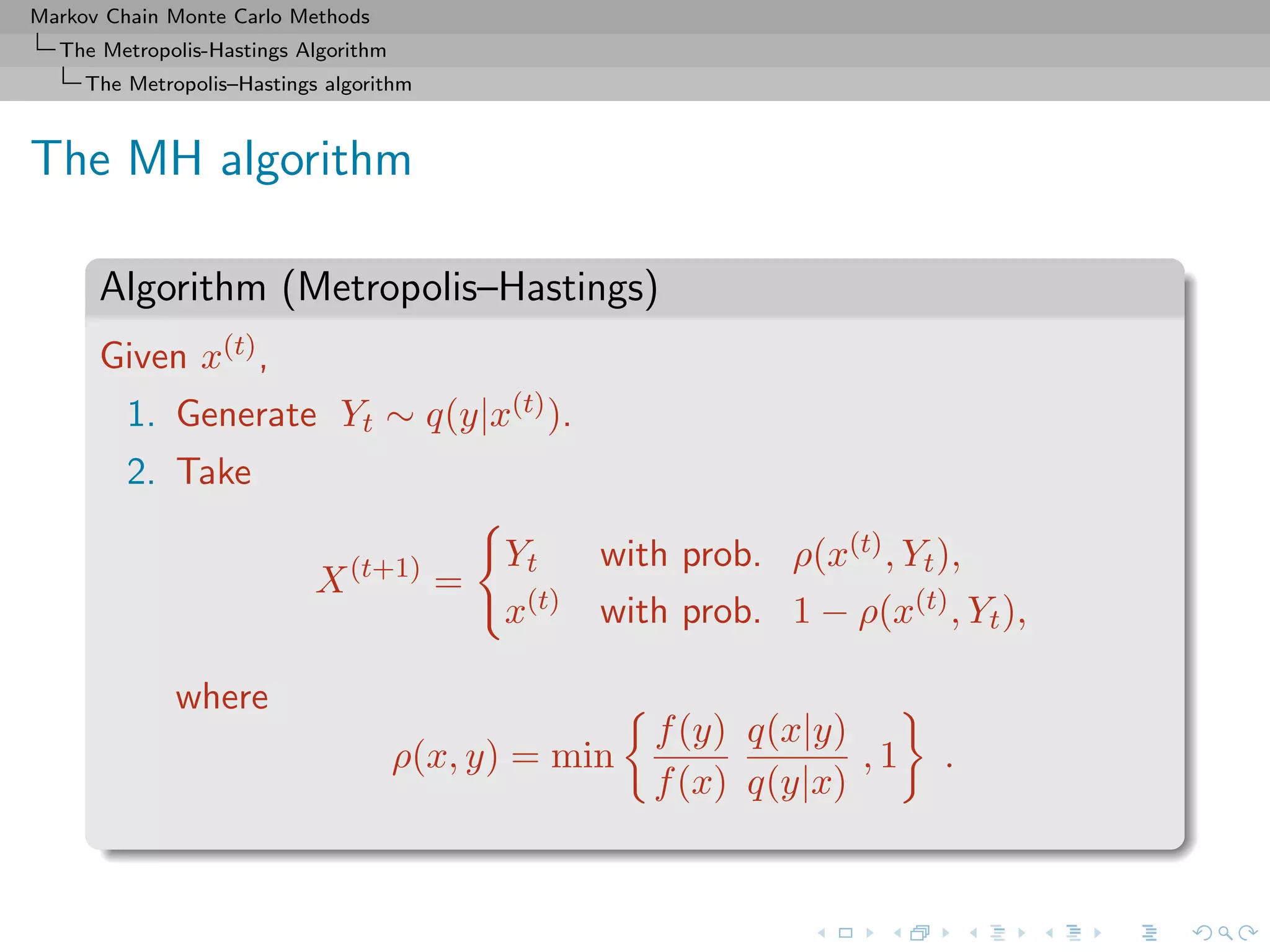
Algorithm (Metropolis–Hastings)
Given x(t),
1. Generate Yt ∼ q(y|x(t)).
2. Take
X(t+1)
=
Yt with prob. ρ(x(t), Yt),
x(t) with prob. 1 − ρ(x(t), Yt),
where
ρ(x, y) = min
f(y)
f(x)
q(x|y)
q(y|x)
, 1 .
Markov Chain Monte Carlo Methods
The Metropolis-Hastings Algorithm
The Metropolis–Hastings algorithm
Features
Independent of normalizing constants for both f and q(·|x)
(ie, those constants independent of x)
Never move to values with f(y) = 0
The chain (x(t))t may take the same value several times in a
row, even though f is a density wrt Lebesgue measure
The sequence (yt)t is usually not a Markov chain
Markov Chain Monte Carlo Methods
The Metropolis-Hastings Algorithm
The Metropolis–Hastings algorithm
Convergence properties
1. The M-H Markov chain is reversible, with
invariant/stationary density f since it satisfies the detailed
balance condition
f(y) K(y, x) = f(x) K(x, y)
Markov Chain Monte Carlo Methods
The Metropolis-Hastings Algorithm
The Metropolis–Hastings algorithm
Convergence properties
1. The M-H Markov chain is reversible, with
invariant/stationary density f since it satisfies the detailed
balance condition
f(y) K(y, x) = f(x) K(x, y)
2. As f is a probability measure, the chain is positive recurrent
Markov Chain Monte Carlo Methods
The Metropolis-Hastings Algorithm
The Metropolis–Hastings algorithm
Convergence properties
1. The M-H Markov chain is reversible, with
invariant/stationary density f since it satisfies the detailed
balance condition
f(y) K(y, x) = f(x) K(x, y)
2. As f is a probability measure, the chain is positive recurrent
3. If
Pr
f(Yt) q(X(t)|Yt)
f(X(t)) q(Yt|X(t))
≥ 1 < 1. (1)
that is, the event {X(t+1) = X(t)} is possible, then the chain
is aperiodic
Markov Chain Monte Carlo Methods
The Metropolis-Hastings Algorithm
The Metropolis–Hastings algorithm
Convergence properties (2)
4. If
q(y|x) > 0 for every (x, y), (2)
the chain is irreducible
Markov Chain Monte Carlo Methods
The Metropolis-Hastings Algorithm
The Metropolis–Hastings algorithm
Convergence properties (2)
4. If
q(y|x) > 0 for every (x, y), (2)
the chain is irreducible
5. For M-H, f-irreducibility implies Harris recurrence
Markov Chain Monte Carlo Methods
The Metropolis-Hastings Algorithm
The Metropolis–Hastings algorithm
Convergence properties (2)
4. If
q(y|x) > 0 for every (x, y), (2)
the chain is irreducible
5. For M-H, f-irreducibility implies Harris recurrence
6. Thus, for M-H satisfying (1) and (2)
(i) For h, with If |h(X)| < ∞,
lim
T →∞
1
T
T
t=1
h(X(t)
) = h(x)df(x) a.e. f.
(ii) and
lim
n→∞
Kn
(x, ·)µ(dx) − f
T V
= 0
for every initial distribution µ, where Kn
(x, ·) denotes the
kernel for n transitions.
Markov Chain Monte Carlo Methods
The Metropolis-Hastings Algorithm
Some Metropolis-Hastings algorithms
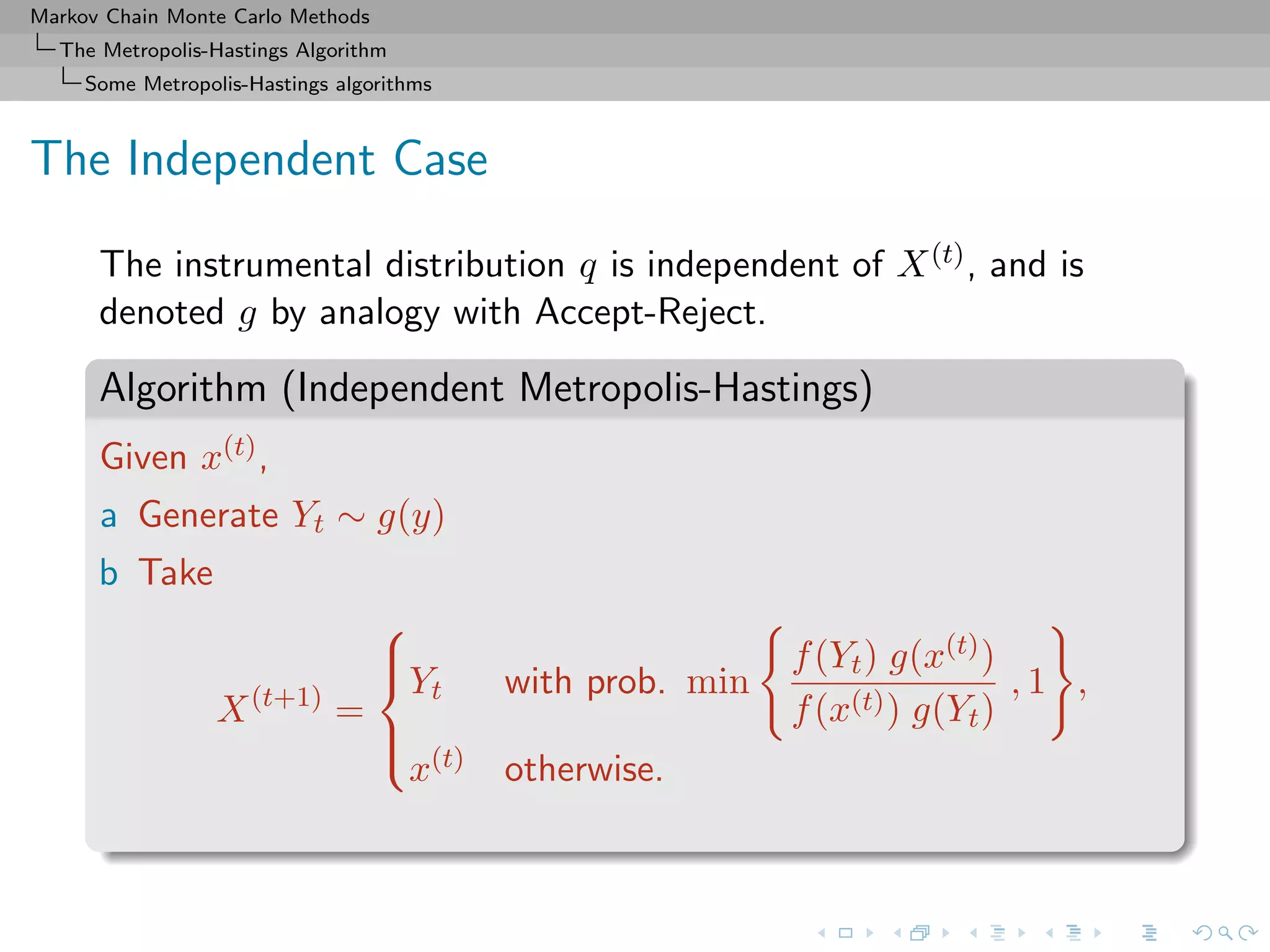
The Independent Case
The instrumental distribution q is independent of X(t), and is
denoted g by analogy with Accept-Reject.
Markov Chain Monte Carlo Methods
The Metropolis-Hastings Algorithm
Some Metropolis-Hastings algorithms
The Independent Case
The instrumental distribution q is independent of X(t), and is
denoted g by analogy with Accept-Reject.
Algorithm (Independent Metropolis-Hastings)
Given x(t),
a Generate Yt ∼ g(y)
b Take
X(t+1)
=



Yt with prob. min
f(Yt) g(x(t))
f(x(t)) g(Yt)
, 1 ,
x(t) otherwise.
Markov Chain Monte Carlo Methods
The Metropolis-Hastings Algorithm
Some Metropolis-Hastings algorithms
Properties
The resulting sample is not iid
Markov Chain Monte Carlo Methods
The Metropolis-Hastings Algorithm
Some Metropolis-Hastings algorithms
Properties
The resulting sample is not iid but there exist strong convergence
properties:
Theorem (Ergodicity)
The algorithm produces a uniformly ergodic chain if there exists a
constant M such that
f(x) ≤ Mg(x) , x ∈ supp f.
In this case,
Kn
(x, ·) − f TV ≤ 1 −
1
M
n
.
[Mengersen & Tweedie, 1996]
Markov Chain Monte Carlo Methods
The Metropolis-Hastings Algorithm
Some Metropolis-Hastings algorithms
Illustration
Example (Noisy AR(1))
Hidden Markov chain from a regular AR(1) model,
xt+1 = ϕxt + t+1 t ∼ N (0, τ2
)
and observables
yt|xt ∼ N (x2
t , σ2
)
Markov Chain Monte Carlo Methods
The Metropolis-Hastings Algorithm
Some Metropolis-Hastings algorithms
Illustration
Example (Noisy AR(1))
Hidden Markov chain from a regular AR(1) model,
xt+1 = ϕxt + t+1 t ∼ N (0, τ2
)
and observables
yt|xt ∼ N (x2
t , σ2
)
The distribution of xt given xt−1, xt+1 and yt is
exp
−1
2τ2
(xt − ϕxt−1)2
+ (xt+1 − ϕxt)2
+
τ2
σ2
(yt − x2
t )2
.
Markov Chain Monte Carlo Methods
The Metropolis-Hastings Algorithm
Some Metropolis-Hastings algorithms
Illustration
Example (Noisy AR(1))
Use for proposal the N (µt, ω2
t ) distribution, with
µt = ϕ
xt−1 + xt+1
1 + ϕ2
and ω2
t =
τ2
1 + ϕ2
.
Markov Chain Monte Carlo Methods
The Metropolis-Hastings Algorithm
Some Metropolis-Hastings algorithms
Illustration
Example (Noisy AR(1))
Use for proposal the N (µt, ω2
t ) distribution, with
µt = ϕ
xt−1 + xt+1
1 + ϕ2
and ω2
t =
τ2
1 + ϕ2
.
Ratio
π(x)/qind(x) = exp −(yt − x2
t )2
/2σ2
is bounded
Markov Chain Monte Carlo Methods
The Metropolis-Hastings Algorithm
Some Metropolis-Hastings algorithms
Illustration
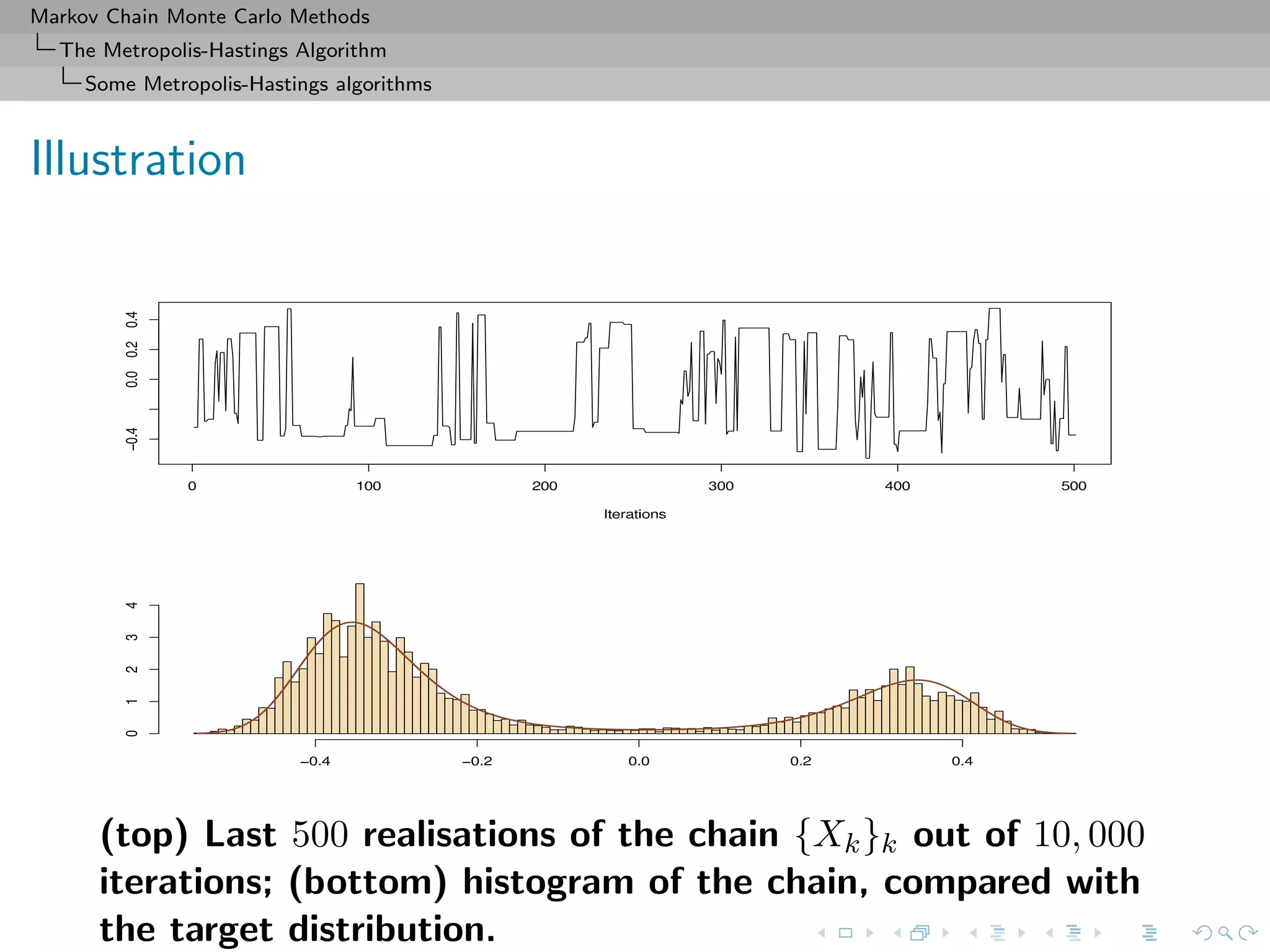
(top) Last 500 realisations of the chain {Xk}k out of 10, 000
iterations; (bottom) histogram of the chain, compared with
the target distribution.
Markov Chain Monte Carlo Methods
The Metropolis-Hastings Algorithm
Some Metropolis-Hastings algorithms
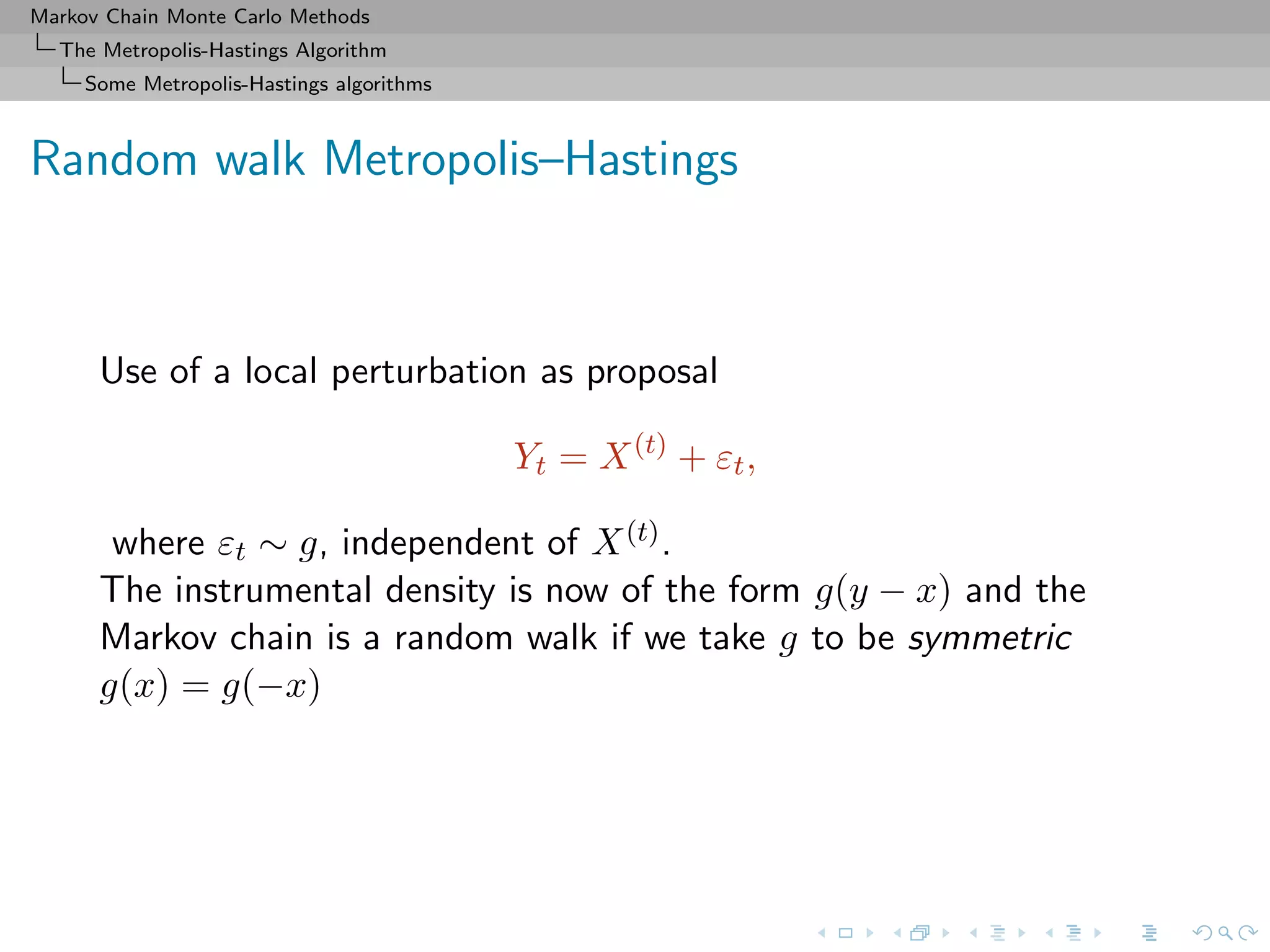
Random walk Metropolis–Hastings
Use of a local perturbation as proposal
Yt = X(t)
+ εt,
where εt ∼ g, independent of X(t).
The instrumental density is now of the form g(y − x) and the
Markov chain is a random walk if we take g to be symmetric
g(x) = g(−x)
Markov Chain Monte Carlo Methods
The Metropolis-Hastings Algorithm
Some Metropolis-Hastings algorithms
Random walk Metropolis–Hastings
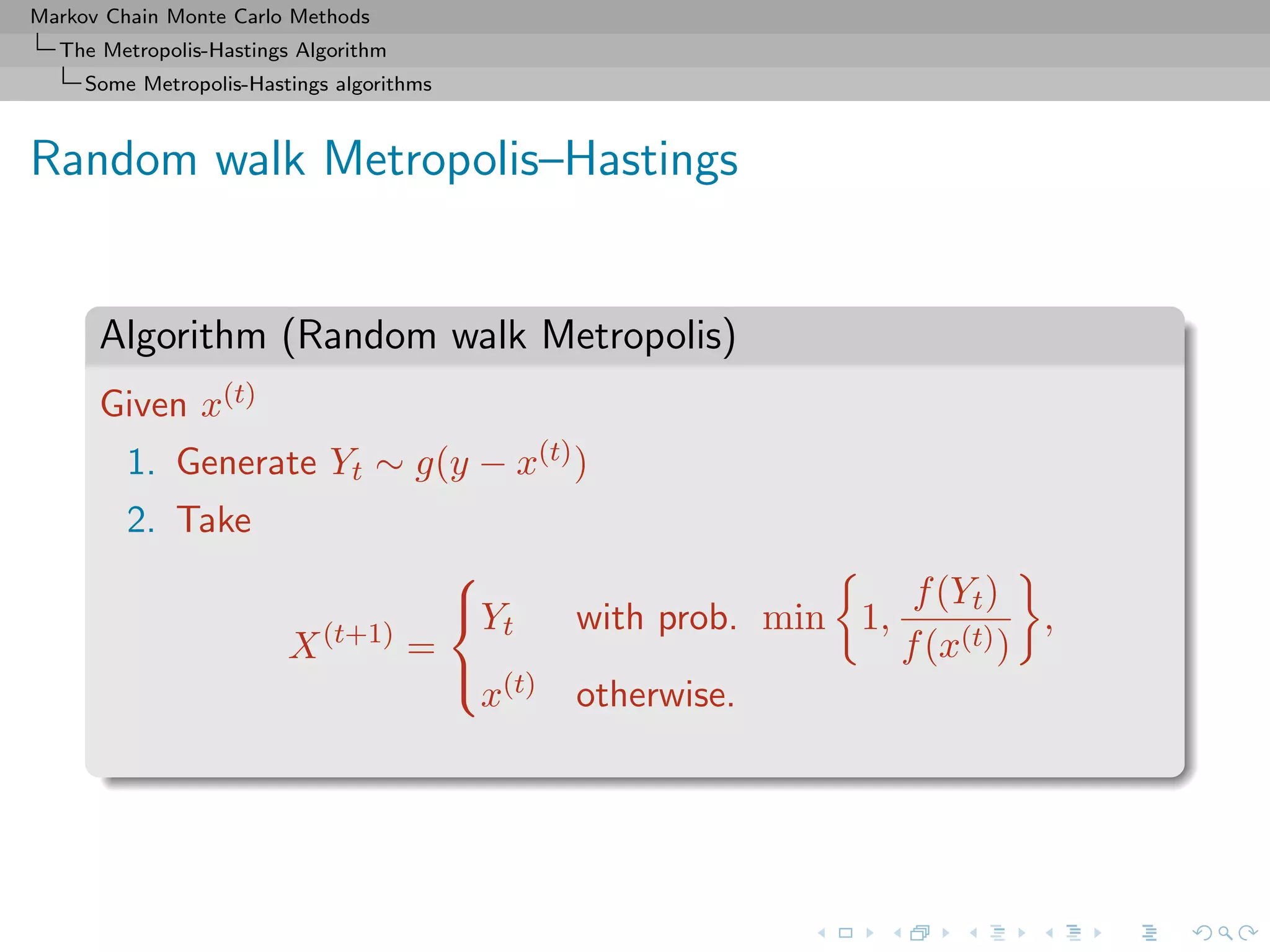
Algorithm (Random walk Metropolis)
Given x(t)
1. Generate Yt ∼ g(y − x(t))
2. Take
X(t+1)
=



Yt with prob. min 1,
f(Yt)
f(x(t))
,
x(t) otherwise.
Markov Chain Monte Carlo Methods
The Metropolis-Hastings Algorithm
Some Metropolis-Hastings algorithms
Random walk Metropolis–Hastings
Example (Random walk and normal target)
Generate N(0, 1) based on the uniform proposal [−δ, δ]
[Hastings (1970)]
The probability of acceptance is then
ρ(x(t)
, yt) = exp{(x(t)2
− y2
t )/2} ∧ 1.
Markov Chain Monte Carlo Methods
The Metropolis-Hastings Algorithm
Some Metropolis-Hastings algorithms
Random walk Metropolis–Hastings
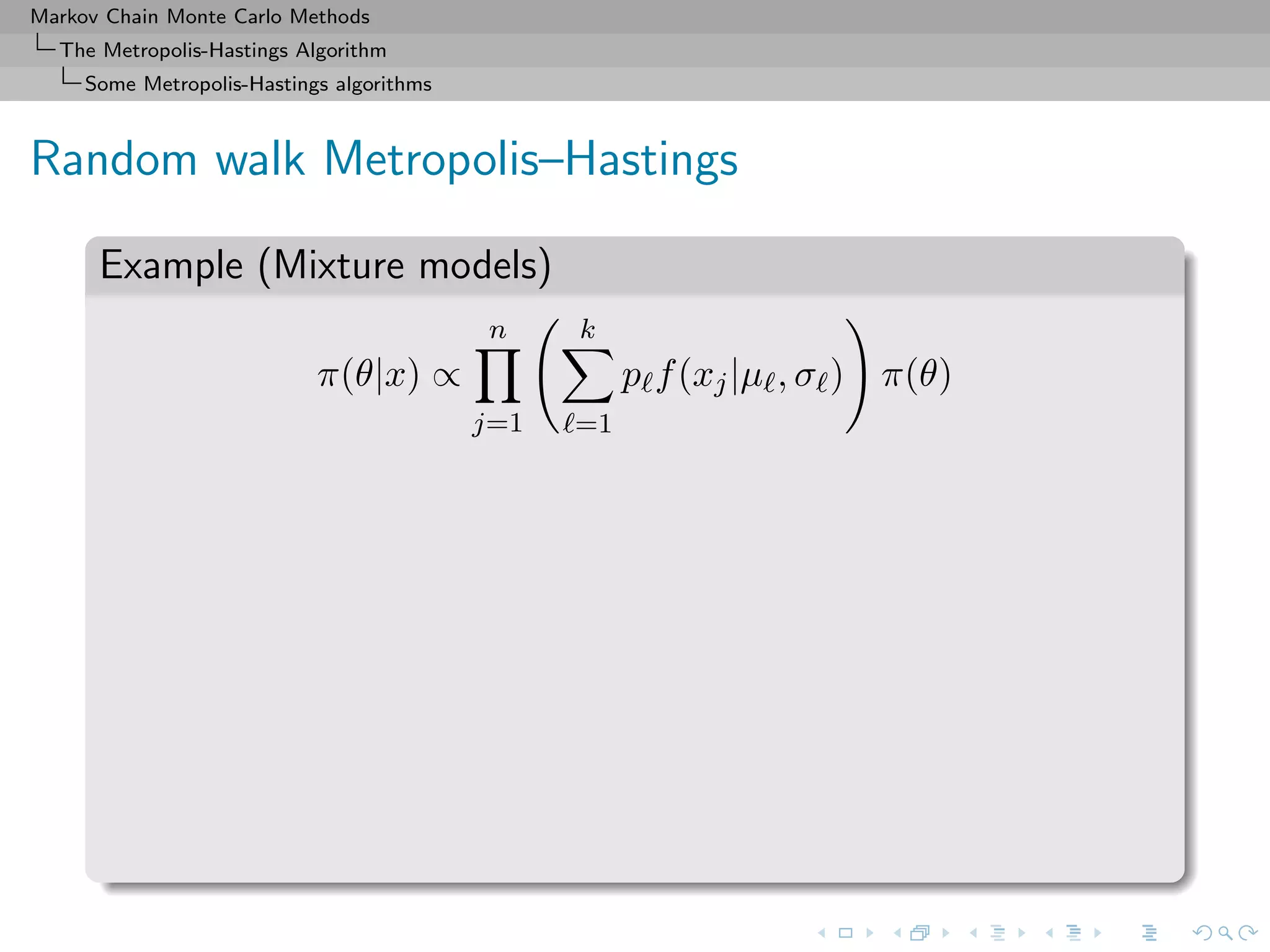
Example (Mixture models)
π(θ|x) ∝
n
j=1
k
=1
p f(xj|µ , σ ) π(θ)
Markov Chain Monte Carlo Methods
The Metropolis-Hastings Algorithm
Some Metropolis-Hastings algorithms
Random walk Metropolis–Hastings
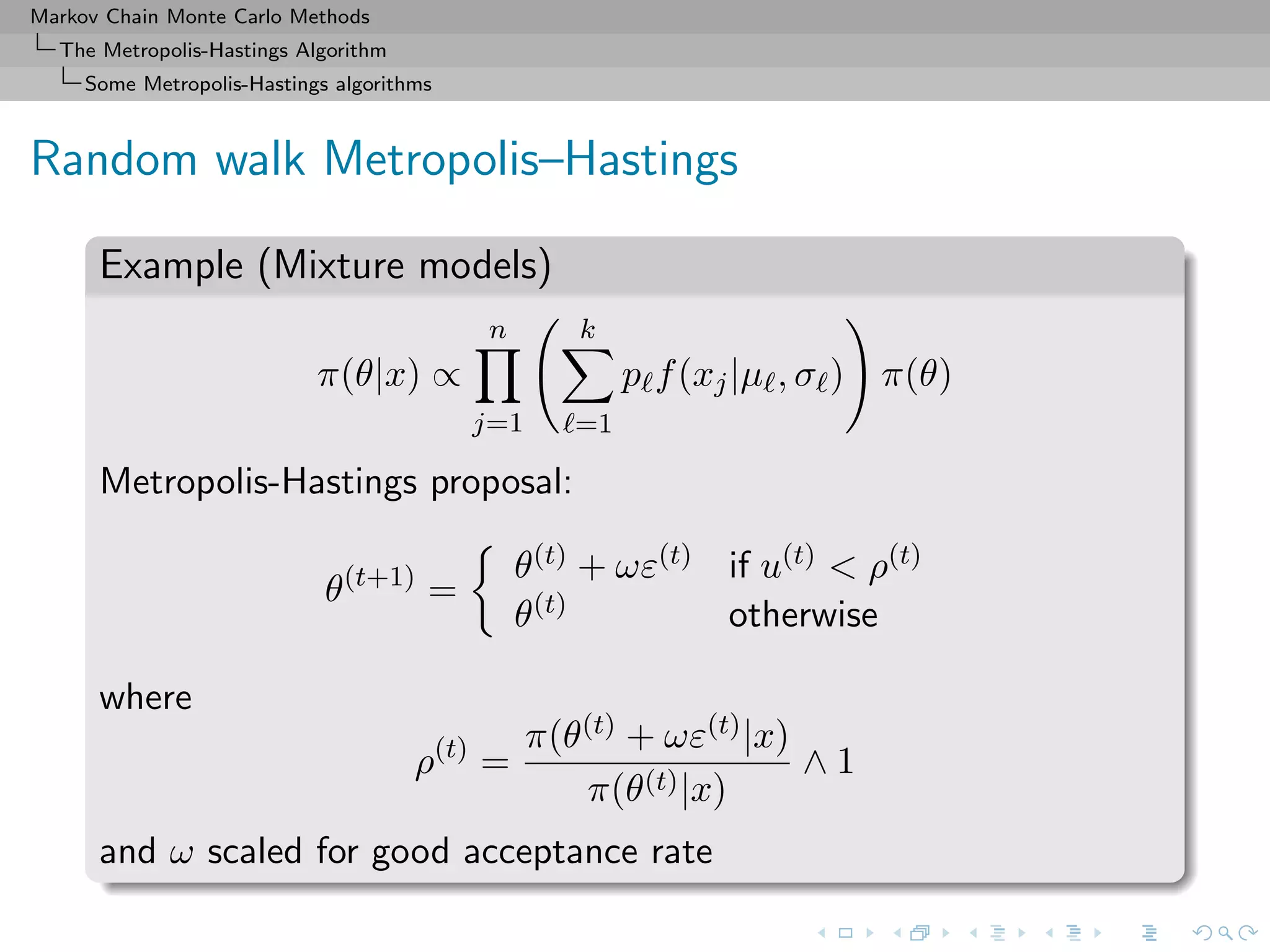
Example (Mixture models)
π(θ|x) ∝
n
j=1
k
=1
p f(xj|µ , σ ) π(θ)
Metropolis-Hastings proposal:
θ(t+1)
=
θ(t) + ωε(t) if u(t) < ρ(t)
θ(t) otherwise
where
ρ(t)
=
π(θ(t) + ωε(t)|x)
π(θ(t)|x)
∧ 1
and ω scaled for good acceptance rate
Markov Chain Monte Carlo Methods
The Metropolis-Hastings Algorithm
Some Metropolis-Hastings algorithms
Random walk Metropolis–Hastings
p
theta
0.0 0.2 0.4 0.6 0.8 1.0
-1012
tau
theta
0.2 0.4 0.6 0.8 1.0 1.2
-1012
p
tau
0.0 0.2 0.4 0.6 0.8 1.0
0.20.40.60.81.01.2
-1 0 1 20.01.02.0
theta
0.2 0.4 0.6 0.8
024
tau
0.0 0.2 0.4 0.6 0.8 1.0
0123456
p
Random walk sampling (50000 iterations)
General case of a 3 component normal mixture
[Celeux & al., 2000]
Markov Chain Monte Carlo Methods
The Metropolis-Hastings Algorithm
Some Metropolis-Hastings algorithms
Random walk Metropolis–Hastings
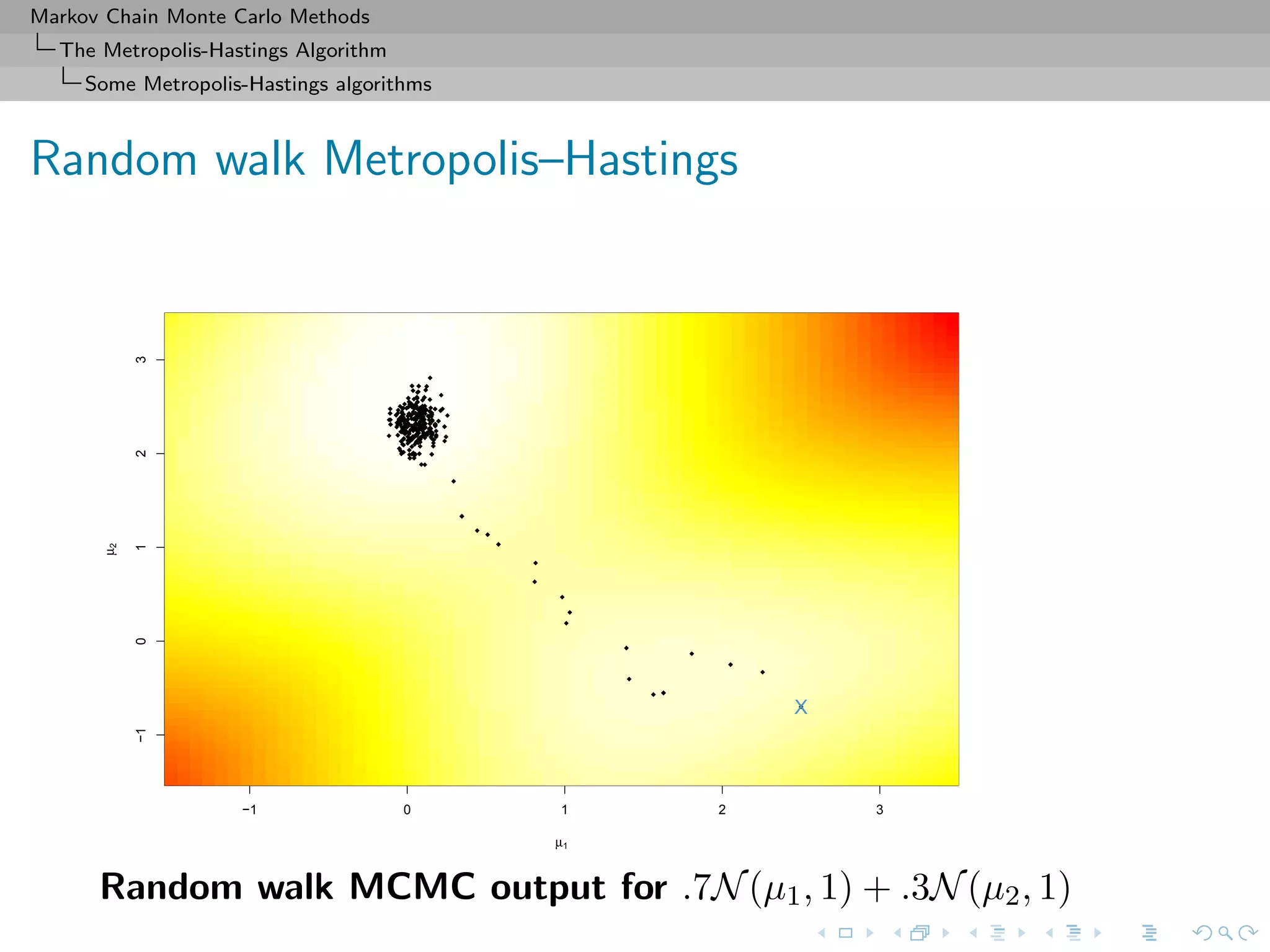
−1 0 1 2 3
−10123
µ1
µ2
X
Random walk MCMC output for .7N(µ1, 1) + .3N(µ2, 1)
Markov Chain Monte Carlo Methods
The Metropolis-Hastings Algorithm
Some Metropolis-Hastings algorithms
Random walk Metropolis–Hastings
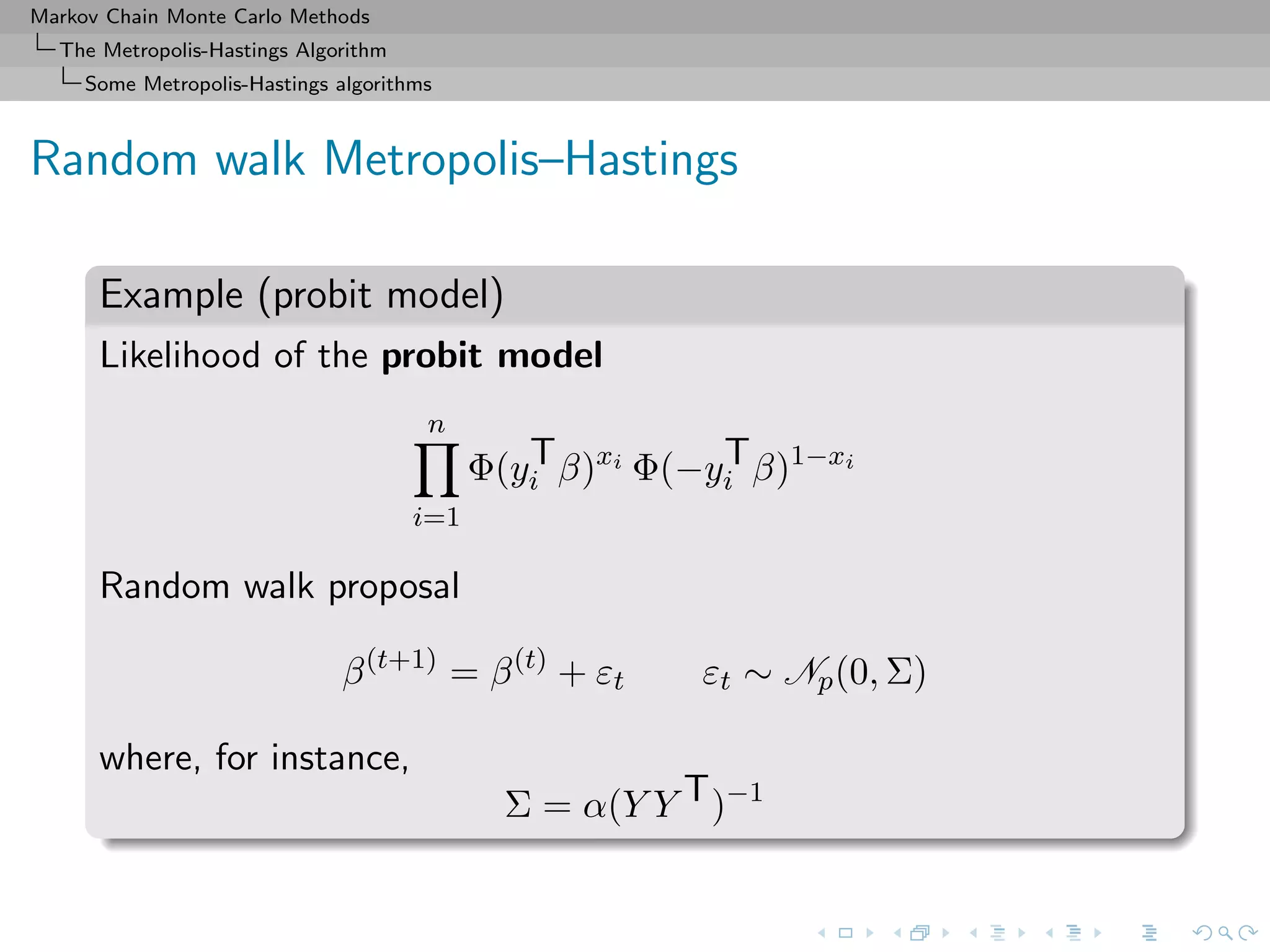
Example (probit model)
Likelihood of the probit model
n
i=1
Φ(yT
i β)xi
Φ(−yT
i β)1−xi
Markov Chain Monte Carlo Methods
The Metropolis-Hastings Algorithm
Some Metropolis-Hastings algorithms
Random walk Metropolis–Hastings
Example (probit model)
Likelihood of the probit model
n
i=1
Φ(yT
i β)xi
Φ(−yT
i β)1−xi
Random walk proposal
β(t+1)
= β(t)
+ εt εt ∼ Np(0, Σ)
where, for instance,
Σ = α(Y Y T)−1
Markov Chain Monte Carlo Methods
The Metropolis-Hastings Algorithm
Some Metropolis-Hastings algorithms
Random walk Metropolis–Hastings
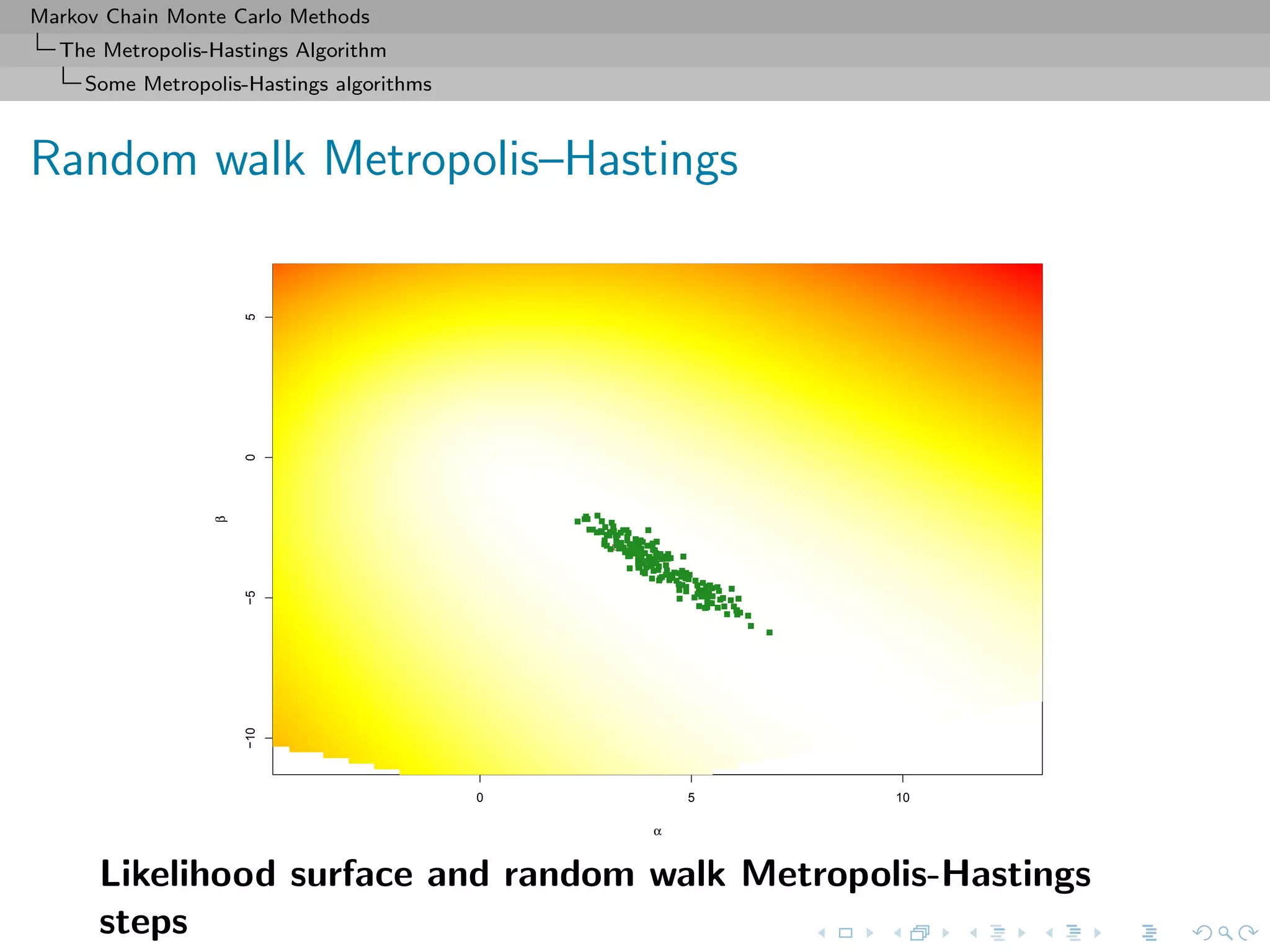
0 5 10
−10−505
α
β
Likelihood surface and random walk Metropolis-Hastings
steps
Markov Chain Monte Carlo Methods
The Metropolis-Hastings Algorithm
Some Metropolis-Hastings algorithms
Convergence properties
Uniform ergodicity prohibited by random walk structure
Markov Chain Monte Carlo Methods
The Metropolis-Hastings Algorithm
Some Metropolis-Hastings algorithms
Convergence properties
Uniform ergodicity prohibited by random walk structure
At best, geometric ergodicity:
Theorem (Sufficient ergodicity)
For a symmetric density f, log-concave in the tails, and a positive
and symmetric density g, the chain (X(t)) is geometrically ergodic.
[Mengersen & Tweedie, 1996]
no tail effect
Markov Chain Monte Carlo Methods
The Metropolis-Hastings Algorithm
Some Metropolis-Hastings algorithms
Convergence properties
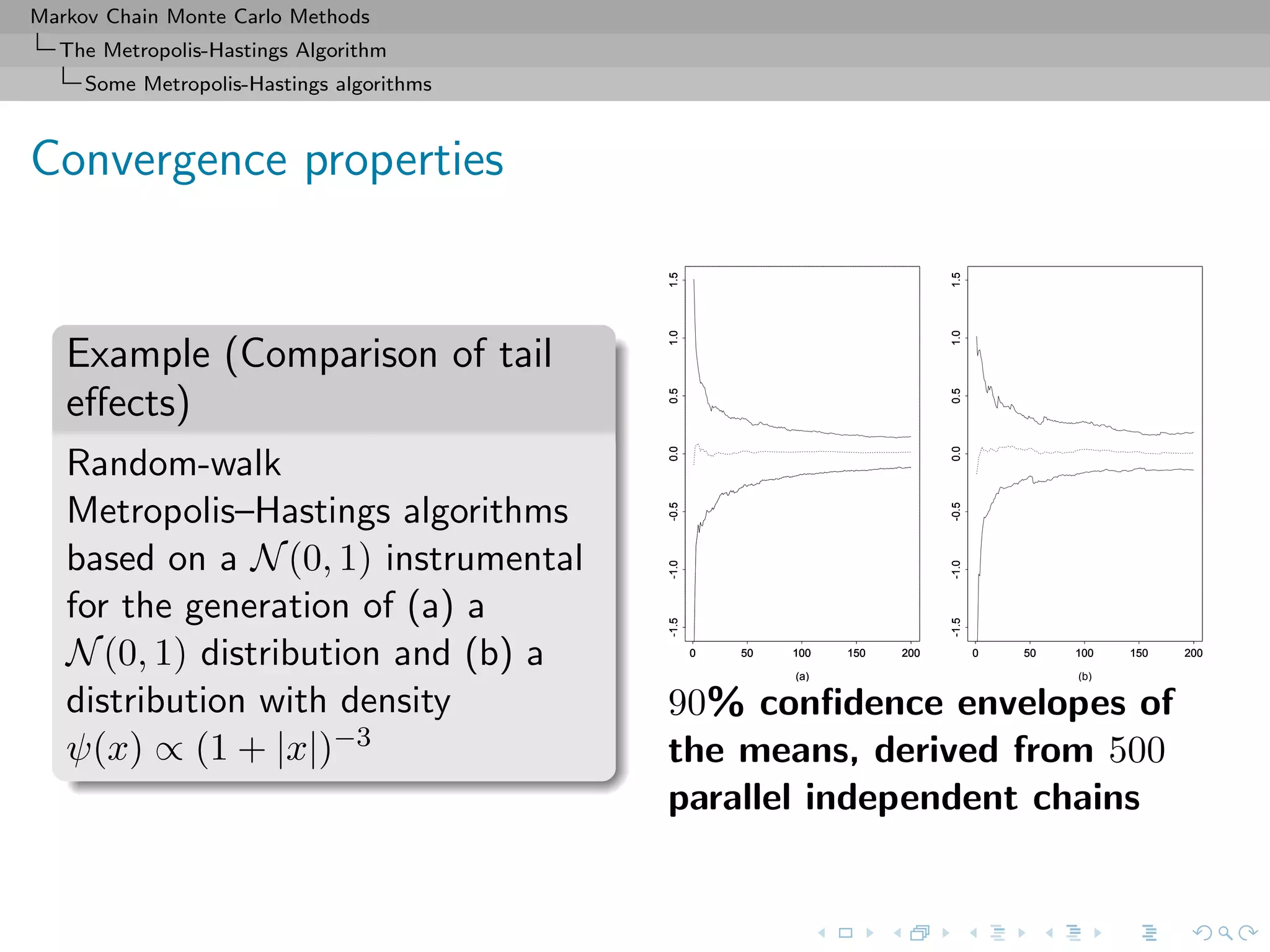
Example (Comparison of tail
effects)
Random-walk
Metropolis–Hastings algorithms
based on a N(0, 1) instrumental
for the generation of (a) a
N(0, 1) distribution and (b) a
distribution with density
ψ(x) ∝ (1 + |x|)−3
(a)
0 50 100 150 200
-1.5-1.0-0.50.00.51.01.5 (a)
0 50 100 150 200
-1.5-1.0-0.50.00.51.01.5
0 50 100 150 200
-1.5-1.0-0.50.00.51.01.5
0 50 100 150 200
-1.5-1.0-0.50.00.51.01.5 (b)
0 50 100 150 200
-1.5-1.0-0.50.00.51.01.5
0 50 100 150 200
-1.5-1.0-0.50.00.51.01.5
0 50 100 150 200
-1.5-1.0-0.50.00.51.01.5
90% confidence envelopes of
the means, derived from 500
parallel independent chains
Markov Chain Monte Carlo Methods
The Metropolis-Hastings Algorithm
Some Metropolis-Hastings algorithms
Convergence properties
Example (Cauchy by normal)
Cauchy C (0, 1) target and Gaussian random walk proposal,
ξ ∼ N (ξ, σ2), with acceptance probability
1 + ξ2
1 + (ξ )2
∧ 1 ,
Overall fit of the Cauchy density by the histogram satisfactory, but
poor exploration of the tails: 99% quantile of C (0, 1) equal to 3,
but no simulation exceeds 14 out of 10, 000!
[Roberts & Tweedie, 2004]
Markov Chain Monte Carlo Methods
The Metropolis-Hastings Algorithm
Some Metropolis-Hastings algorithms
Convergence properties
Again, lack of geometric ergodicity!
[Mengersen & Tweedie, 1996]
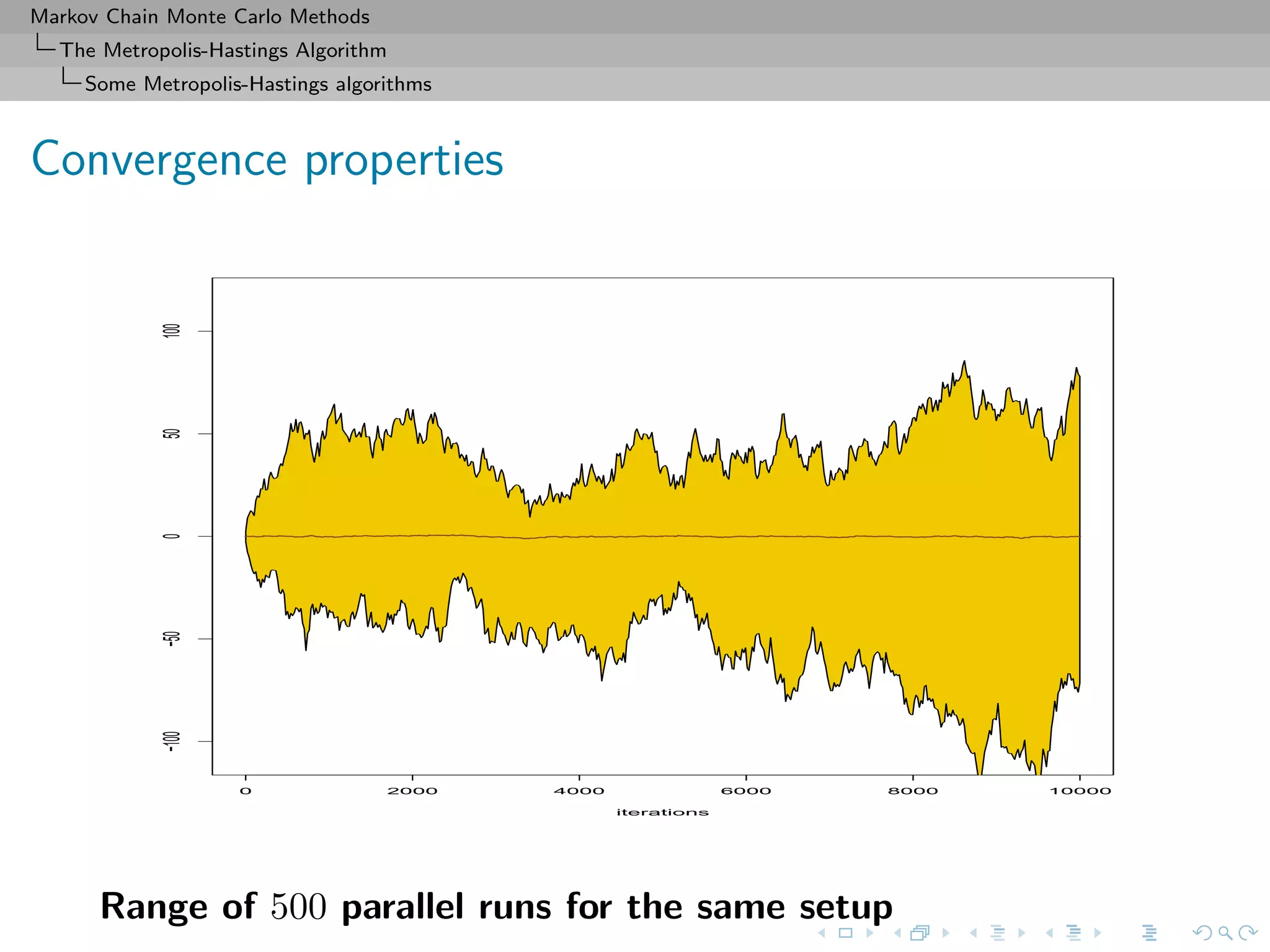
Slow convergence shown by the non-stable range after 10, 000
iterations.
Density
−5 0 5
0.000.050.100.150.200.250.300.35
Markov Chain Monte Carlo Methods
The Metropolis-Hastings Algorithm
Some Metropolis-Hastings algorithms
Convergence properties
0 2000 4000 6000 8000 10000
−100−50050100
iterations
Range of 500 parallel runs for the same setup
Markov Chain Monte Carlo Methods
The Metropolis-Hastings Algorithm
Some Metropolis-Hastings algorithms
Comments
[CLT, Rosenthal’s inequality...] h-ergodicity implies CLT
for additive (possibly unbounded) functionals of the chain,
Rosenthal’s inequality and so on...
[Control of the moments of the return-time] The
condition implies (because h ≥ 1) that
sup
x∈C
Ex[r0(τC)] ≤ sup
x∈C
Ex
τC −1
k=0
r(k)h(Xk) < ∞,
where r0(n) = n
l=0 r(l) Can be used to derive bounds for
the coupling time, an essential step to determine computable
bounds, using coupling inequalities
[Roberts & Tweedie, 1998; Fort & Moulines, 2000]
Markov Chain Monte Carlo Methods
The Metropolis-Hastings Algorithm
Extensions
Extensions
There are many other families of HM algorithms
◦ Adaptive Rejection Metropolis Sampling
◦ Reversible Jump (later!)
◦ Langevin algorithms
◦ not HMC
to name just a few...
Markov Chain Monte Carlo Methods
The Metropolis-Hastings Algorithm
Extensions
Langevin Algorithms
Proposal based on the Langevin diffusion Lt is defined by the
stochastic differential equation
dLt = dBt +
1
2
log f(Lt)dt,
where Bt is the standard Brownian motion
Theorem
The Langevin diffusion is the only non-explosive diffusion which is
reversible with respect to f.
Markov Chain Monte Carlo Methods
The Metropolis-Hastings Algorithm
Extensions
Discretization
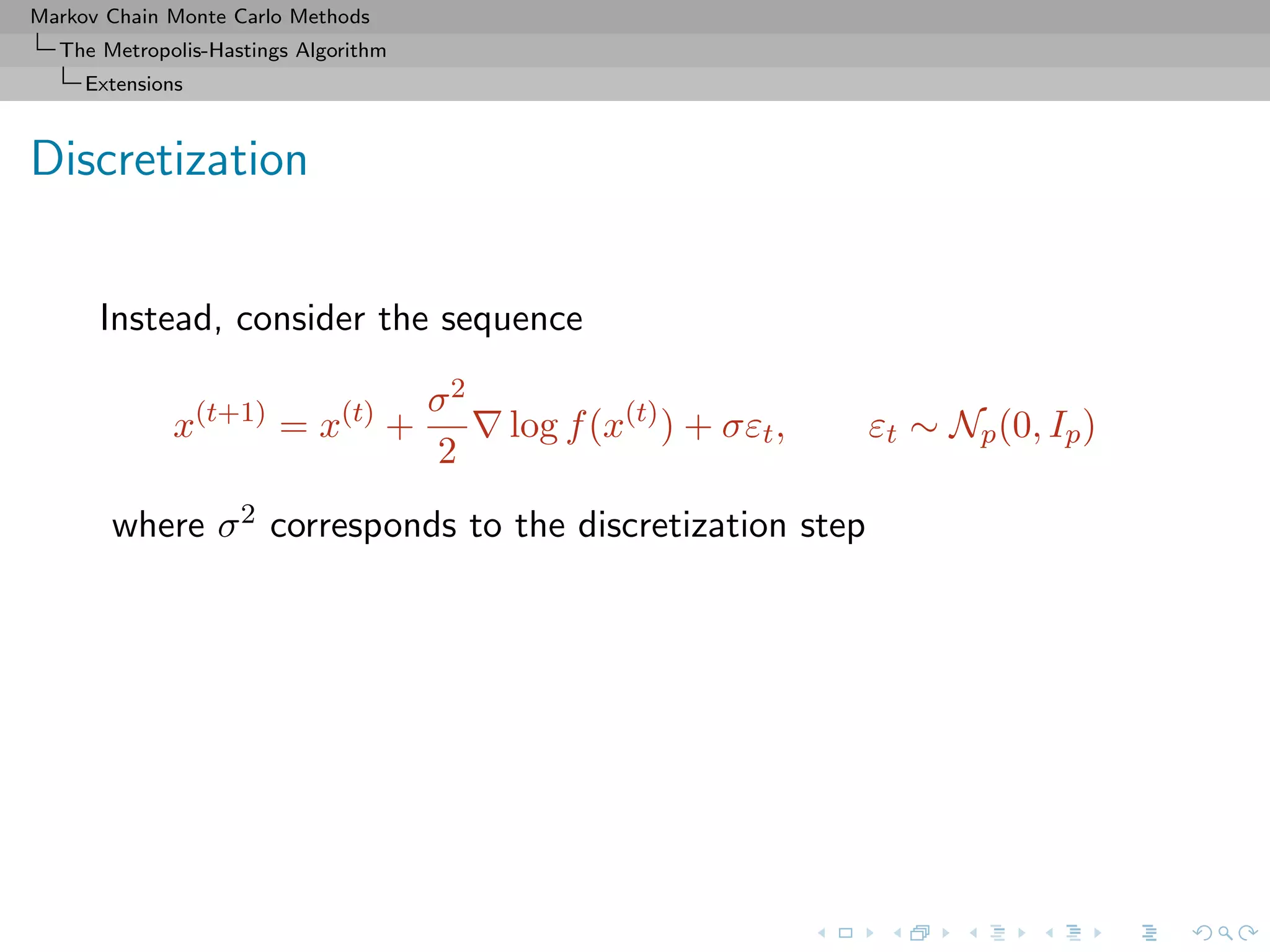
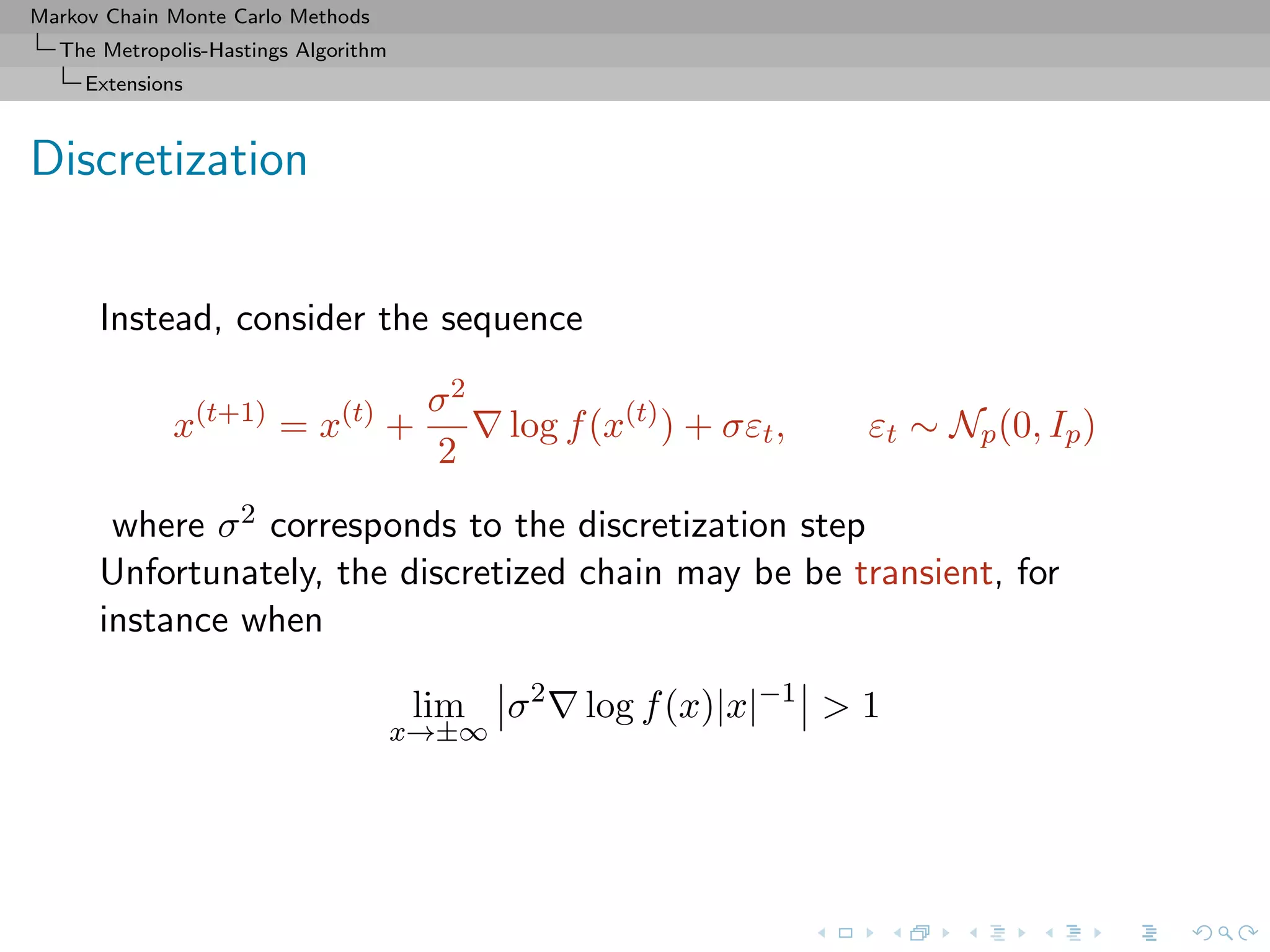
Instead, consider the sequence
x(t+1)
= x(t)
+
σ2
2
log f(x(t)
) + σεt, εt ∼ Np(0, Ip)
where σ2 corresponds to the discretization step
Markov Chain Monte Carlo Methods
The Metropolis-Hastings Algorithm
Extensions
Discretization
Instead, consider the sequence
x(t+1)
= x(t)
+
σ2
2
log f(x(t)
) + σεt, εt ∼ Np(0, Ip)
where σ2 corresponds to the discretization step
Unfortunately, the discretized chain may be be transient, for
instance when
lim
x→±∞
σ2
log f(x)|x|−1
> 1
Markov Chain Monte Carlo Methods
The Metropolis-Hastings Algorithm
Extensions
MH correction (MALA)
Accept the new value Yt with probability
f(Yt)
f(x(t))
·
exp − Yt − x(t) − σ2
2 log f(x(t))
2
2σ2
exp − x(t) − Yt − σ2
2 log f(Yt)
2
2σ2
∧ 1 .
Choice of the scaling factor σ
Should lead to an acceptance rate of 0.574 to achieve optimal
convergence rates (when the components of x are uncorrelated)
[Roberts & Rosenthal, 1998]
Markov Chain Monte Carlo Methods
The Metropolis-Hastings Algorithm
Extensions
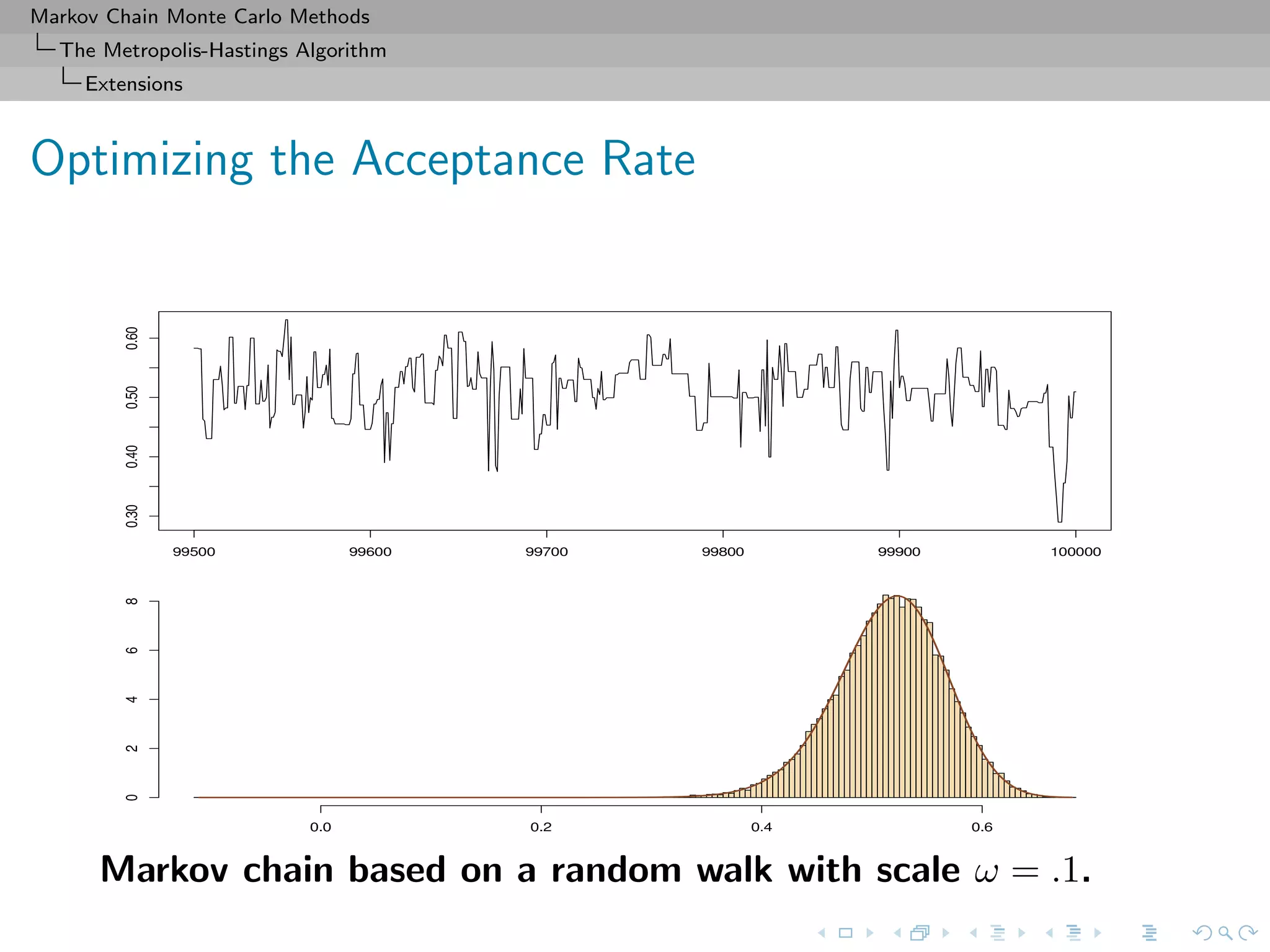
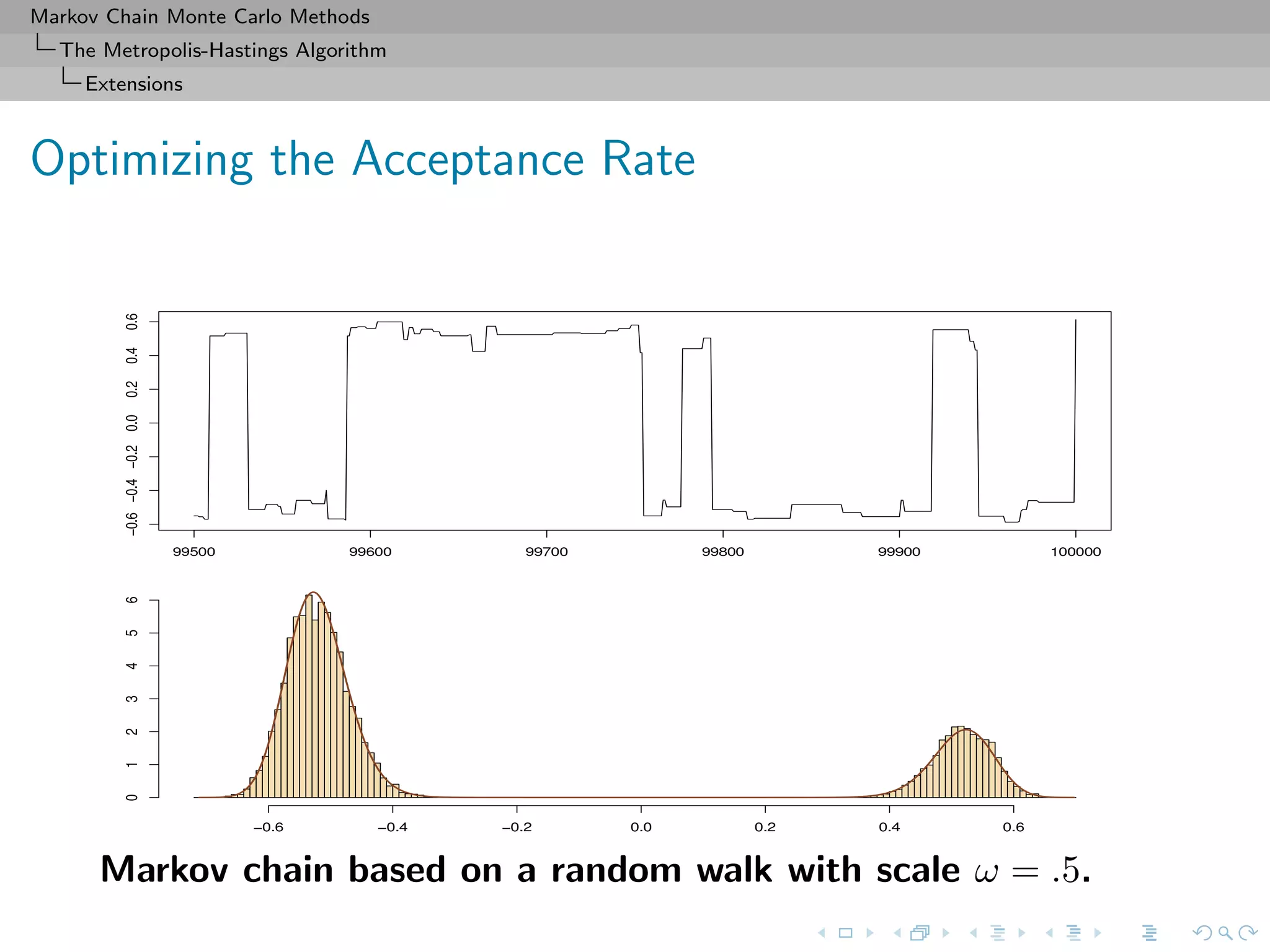
Optimizing the Acceptance Rate
Problem of choice of the transition kernel from a practical point of
view
Most common alternatives:
(a) a fully automated algorithm like ARMS;
(b) an instrumental density g which approximates f, such that
f/g is bounded for uniform ergodicity to apply;
(c) a random walk
In both cases (b) and (c), the choice of g is critical,
Markov Chain Monte Carlo Methods
The Metropolis-Hastings Algorithm
Extensions
Optimizing the Acceptance Rate
Example (Noisy AR(1))
For a Gaussian random walk with scale ω small enough, the
random walk never jumps to the other mode. But if the scale ω is
sufficiently large, the Markov chain explores both modes and give a
satisfactory approximation of the target distribution.
Markov Chain Monte Carlo Methods
The Metropolis-Hastings Algorithm
Extensions
Optimizing the Acceptance Rate
Markov chain based on a random walk with scale ω = .1.
Markov Chain Monte Carlo Methods
The Metropolis-Hastings Algorithm
Extensions
Optimizing the Acceptance Rate
Markov chain based on a random walk with scale ω = .5.
Markov Chain Monte Carlo Methods
The Metropolis-Hastings Algorithm
Vanilla Rao–Blackwellisation
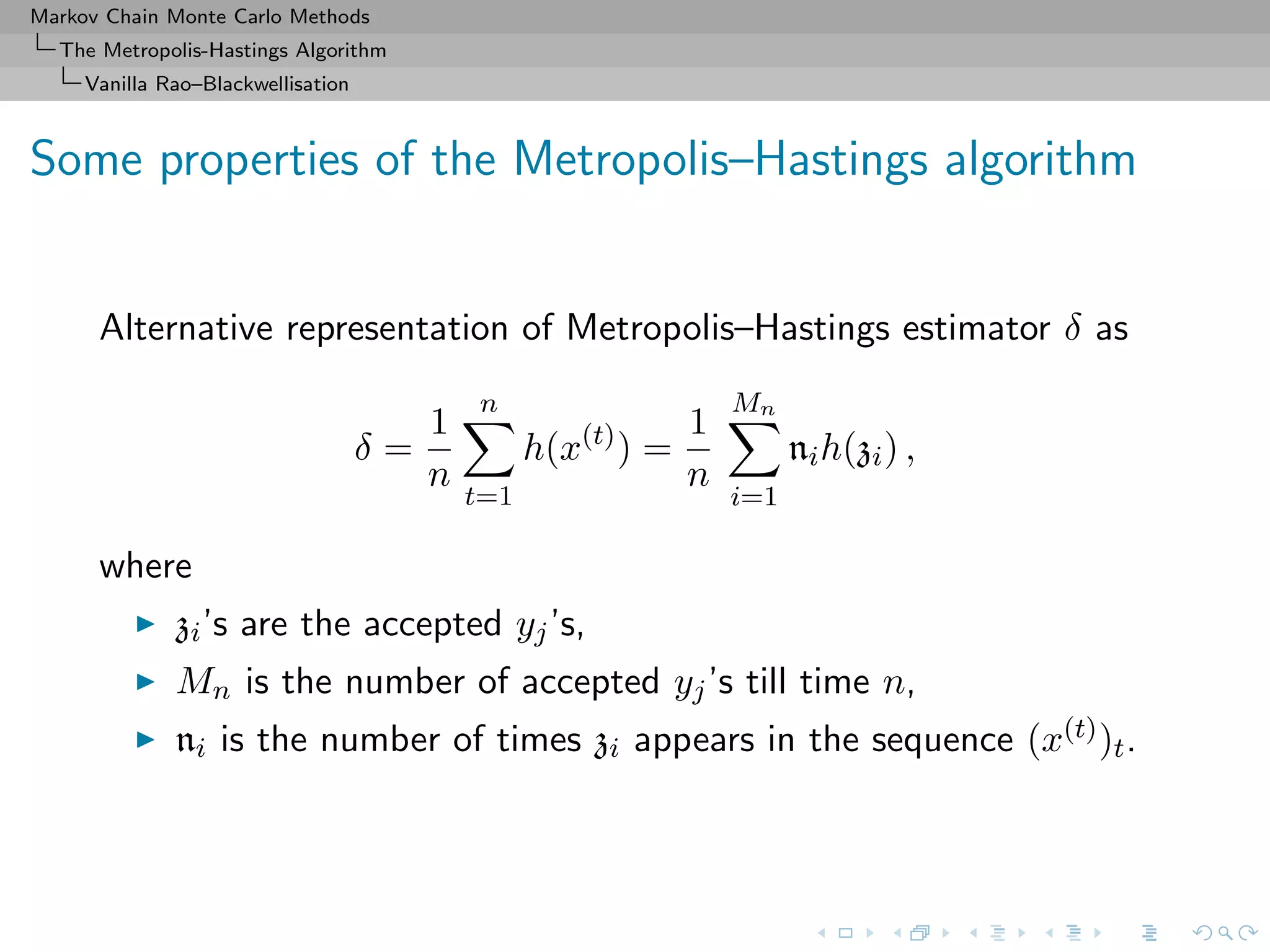
Some properties of the Metropolis–Hastings algorithm
Alternative representation of Metropolis–Hastings estimator δ as
δ =
1
n
n
t=1
h(x(t)
) =
1
n
Mn
i=1
nih(zi) ,
where
zi’s are the accepted yj’s,
Mn is the number of accepted yj’s till time n,
ni is the number of times zi appears in the sequence (x(t))t.
Markov Chain Monte Carlo Methods
The Metropolis-Hastings Algorithm
Vanilla Rao–Blackwellisation
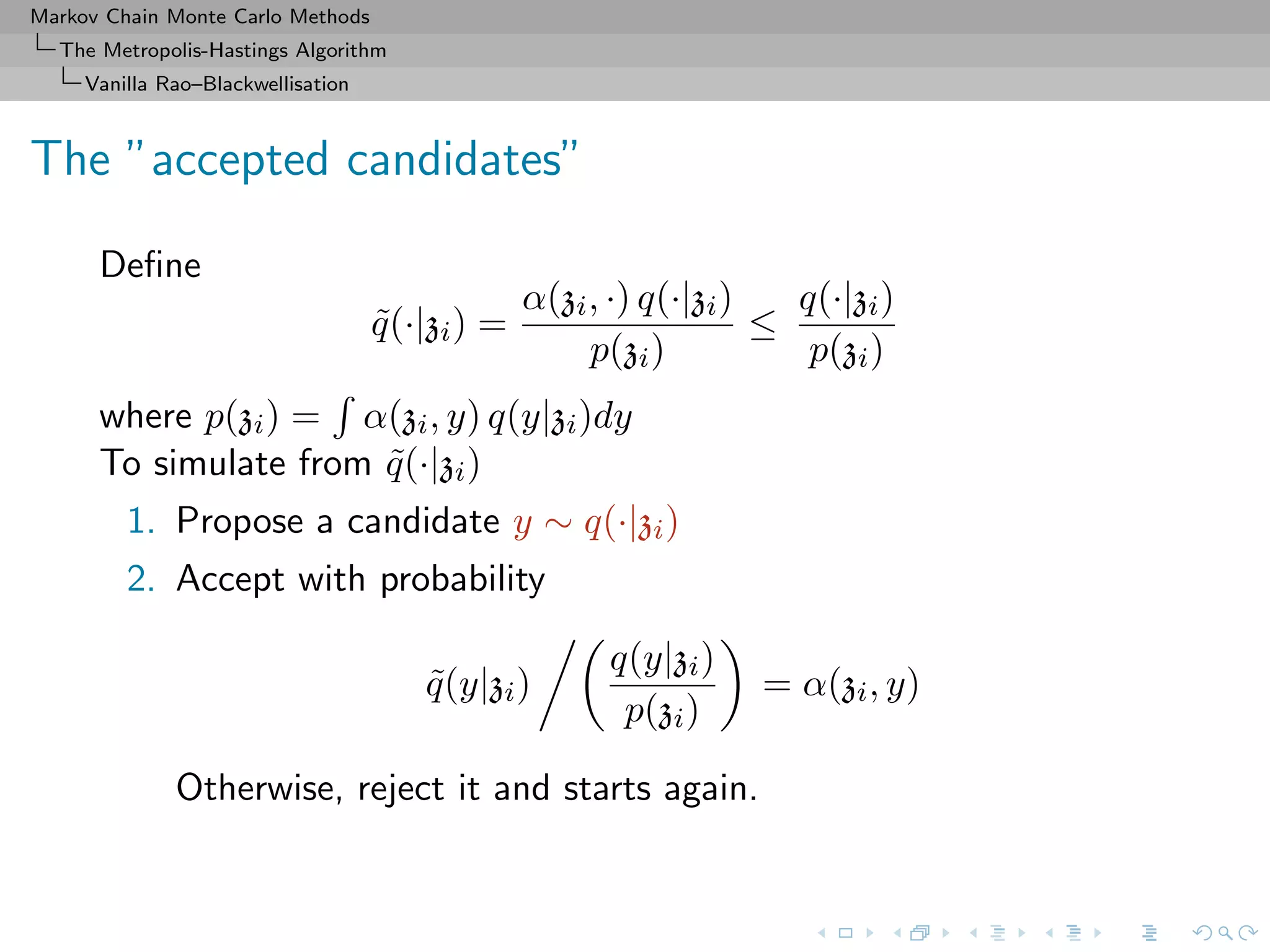
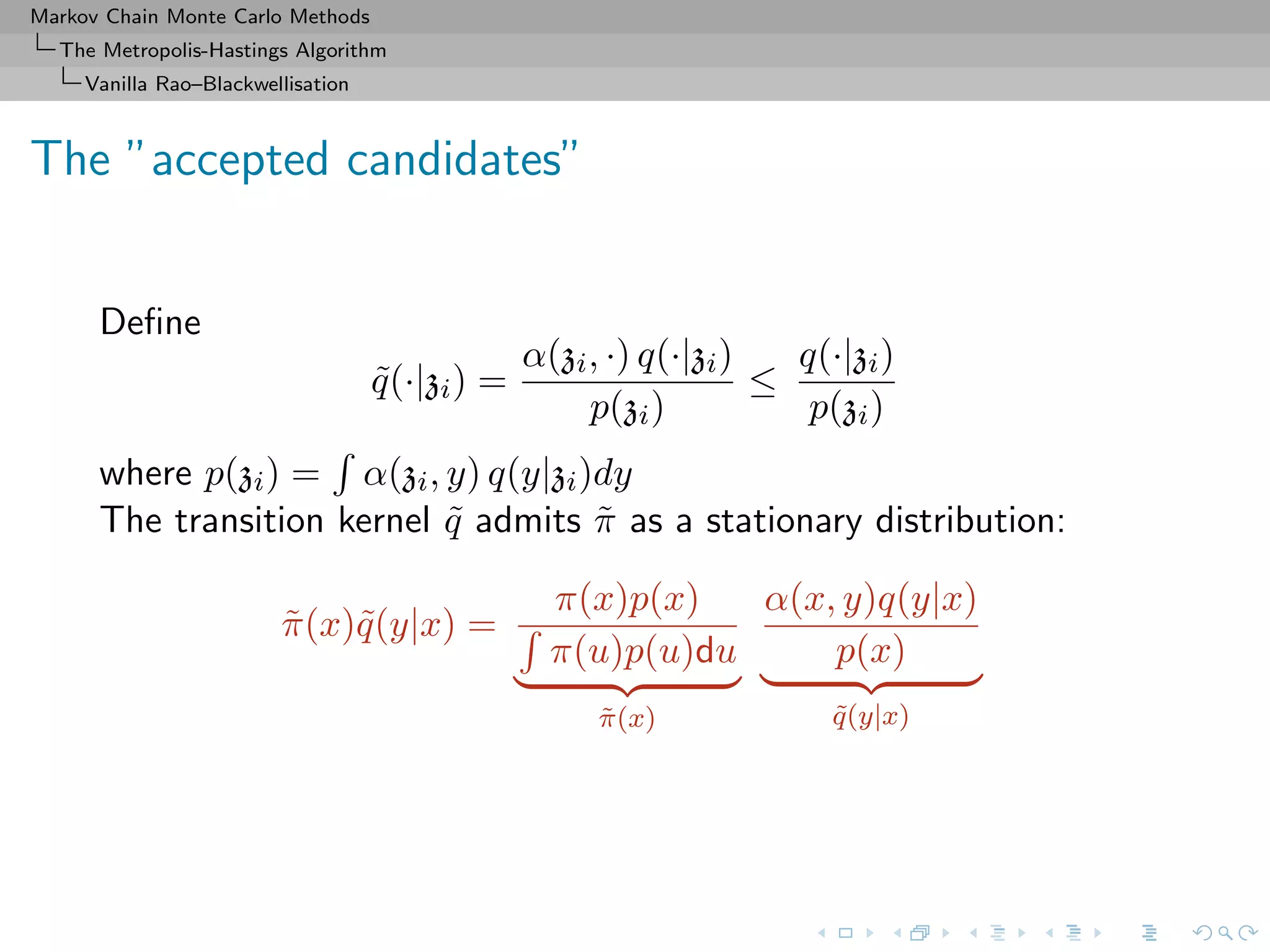
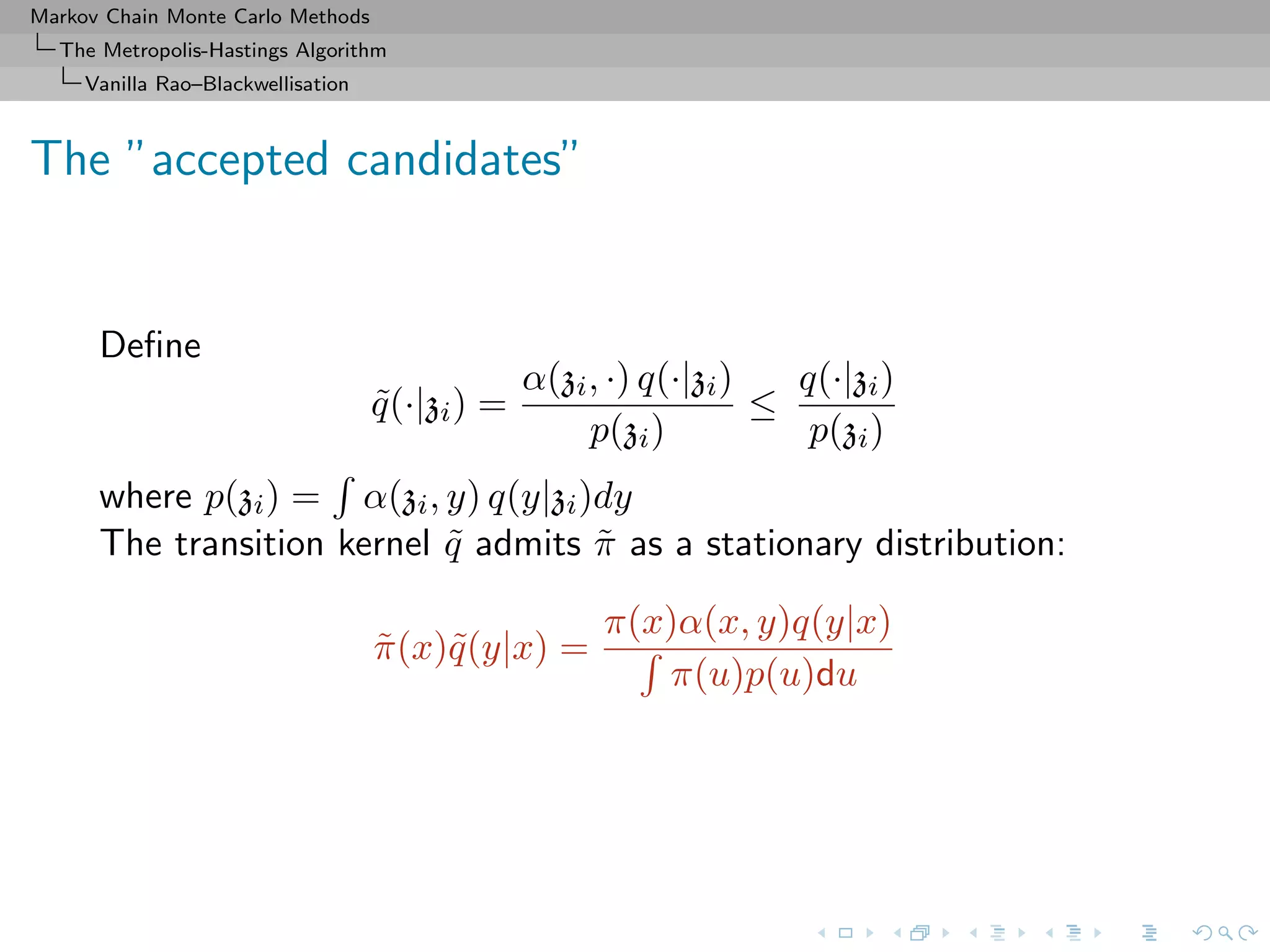
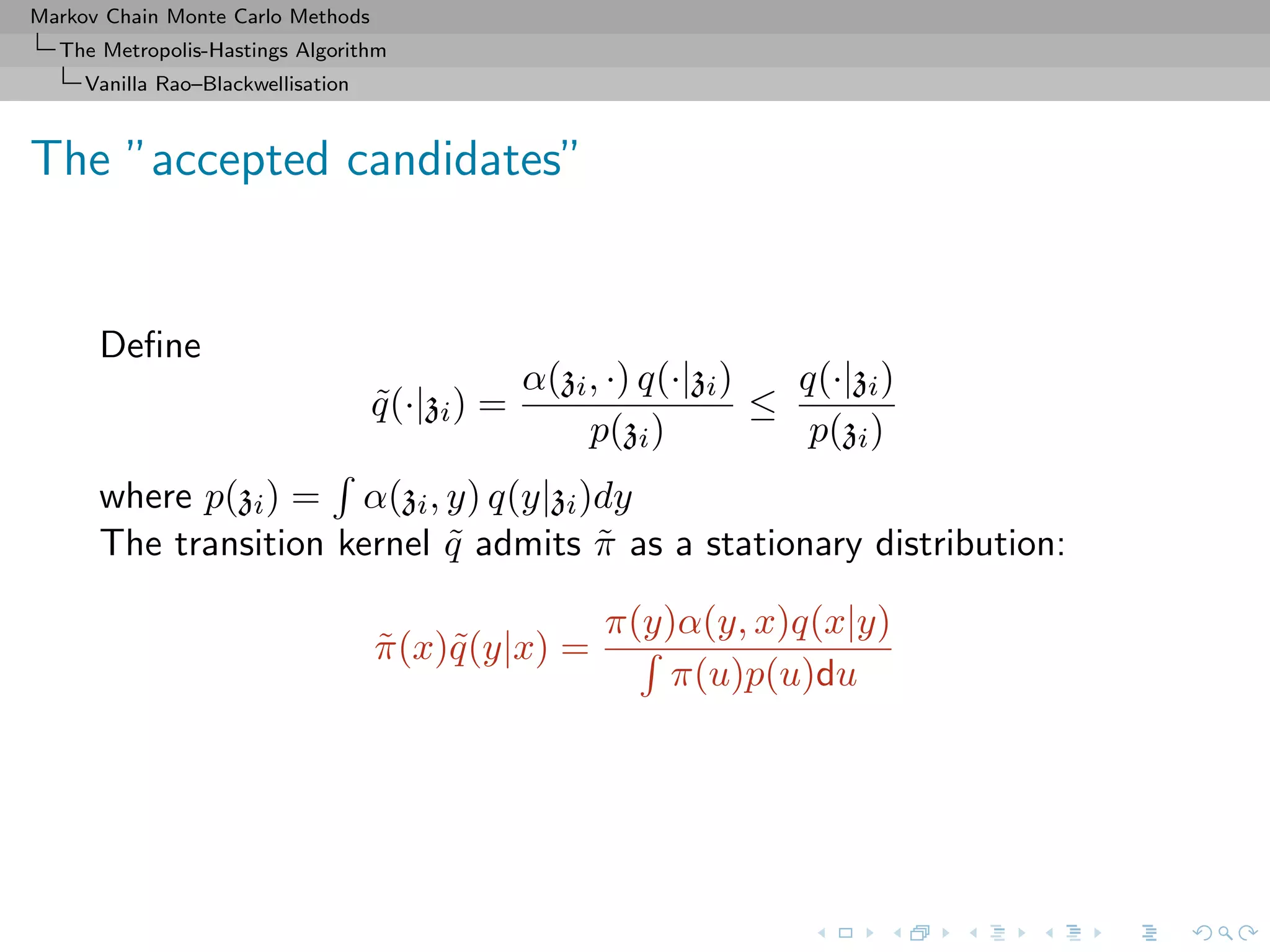
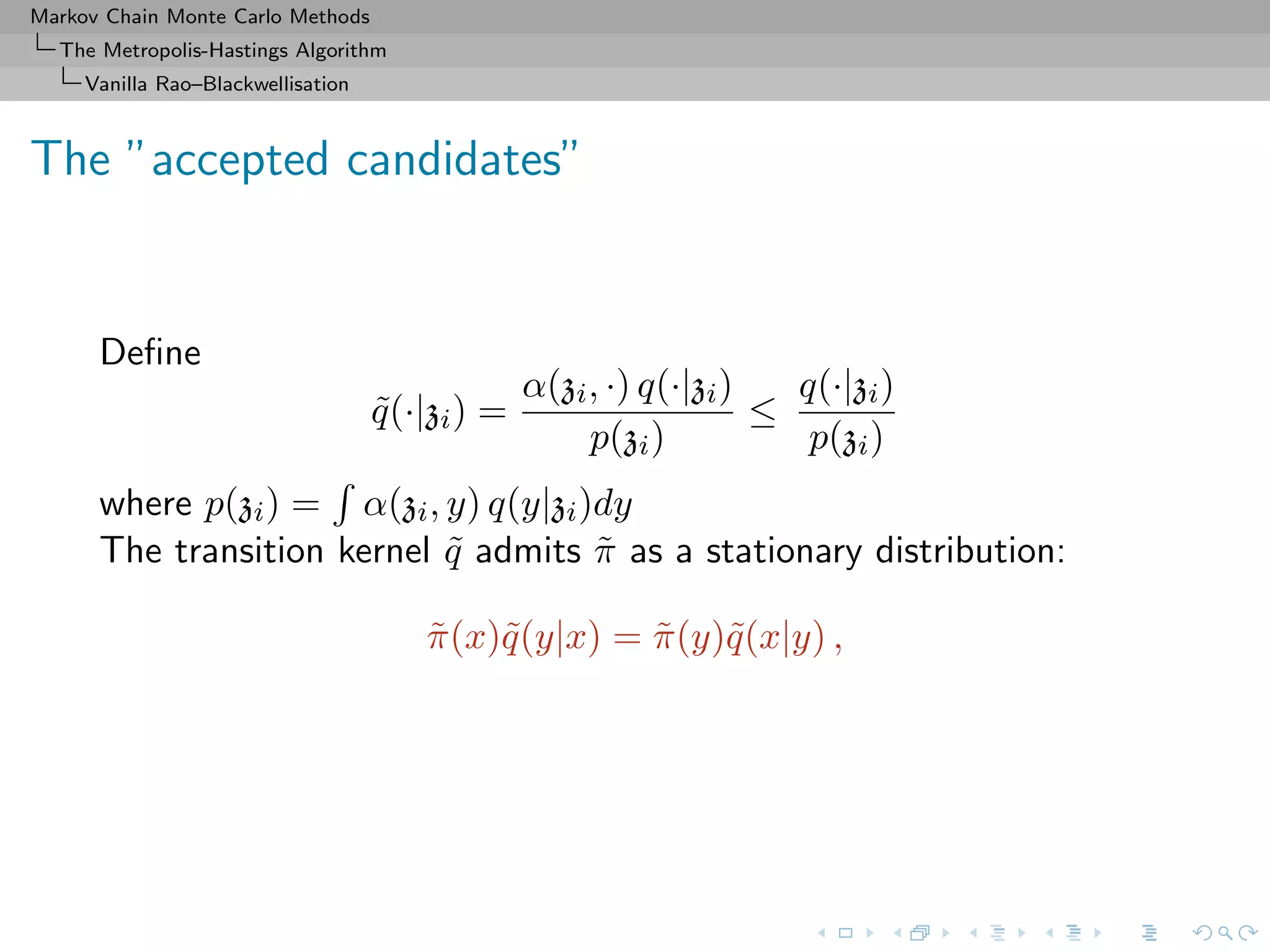
The ”accepted candidates”
Define
˜q(·|zi) =
α(zi, ·) q(·|zi)
p(zi)
≤
q(·|zi)
p(zi)
where p(zi) = α(zi, y) q(y|zi)dy
To simulate from ˜q(·|zi)
1. Propose a candidate y ∼ q(·|zi)
2. Accept with probability
˜q(y|zi)
q(y|zi)
p(zi)
= α(zi, y)
Otherwise, reject it and starts again.
Markov Chain Monte Carlo Methods
The Metropolis-Hastings Algorithm
Vanilla Rao–Blackwellisation
The ”accepted candidates”
Define
˜q(·|zi) =
α(zi, ·) q(·|zi)
p(zi)
≤
q(·|zi)
p(zi)
where p(zi) = α(zi, y) q(y|zi)dy
The transition kernel ˜q admits ˜π as a stationary distribution:
˜π(x)˜q(y|x) =
π(x)p(x)
π(u)p(u)du
˜π(x)
α(x, y)q(y|x)
p(x)
˜q(y|x)
Markov Chain Monte Carlo Methods
The Metropolis-Hastings Algorithm
Vanilla Rao–Blackwellisation
The ”accepted candidates”
Define
˜q(·|zi) =
α(zi, ·) q(·|zi)
p(zi)
≤
q(·|zi)
p(zi)
where p(zi) = α(zi, y) q(y|zi)dy
The transition kernel ˜q admits ˜π as a stationary distribution:
˜π(x)˜q(y|x) =
π(x)α(x, y)q(y|x)
π(u)p(u)du
Markov Chain Monte Carlo Methods
The Metropolis-Hastings Algorithm
Vanilla Rao–Blackwellisation
The ”accepted candidates”
Define
˜q(·|zi) =
α(zi, ·) q(·|zi)
p(zi)
≤
q(·|zi)
p(zi)
where p(zi) = α(zi, y) q(y|zi)dy
The transition kernel ˜q admits ˜π as a stationary distribution:
˜π(x)˜q(y|x) =
π(y)α(y, x)q(x|y)
π(u)p(u)du
Markov Chain Monte Carlo Methods
The Metropolis-Hastings Algorithm
Vanilla Rao–Blackwellisation
The ”accepted candidates”
Define
˜q(·|zi) =
α(zi, ·) q(·|zi)
p(zi)
≤
q(·|zi)
p(zi)
where p(zi) = α(zi, y) q(y|zi)dy
The transition kernel ˜q admits ˜π as a stationary distribution:
˜π(x)˜q(y|x) = ˜π(y)˜q(x|y) ,
Markov Chain Monte Carlo Methods
The Metropolis-Hastings Algorithm
Vanilla Rao–Blackwellisation
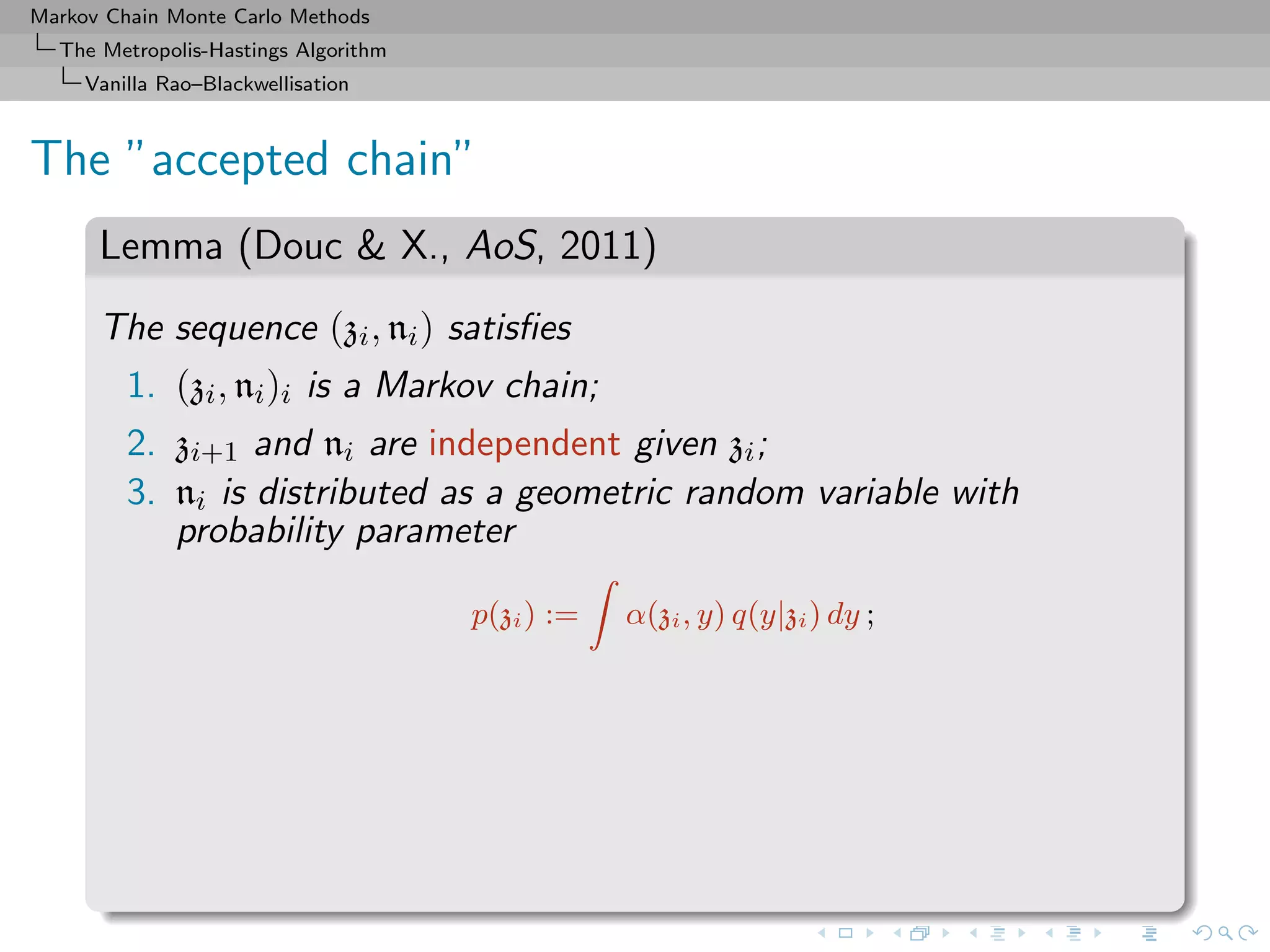
The ”accepted chain”
Lemma (Douc & X., AoS, 2011)
The sequence (zi, ni) satisfies
1. (zi, ni)i is a Markov chain;
Markov Chain Monte Carlo Methods
The Metropolis-Hastings Algorithm
Vanilla Rao–Blackwellisation
The ”accepted chain”
Lemma (Douc & X., AoS, 2011)
The sequence (zi, ni) satisfies
1. (zi, ni)i is a Markov chain;
2. zi+1 and ni are independent given zi;
Markov Chain Monte Carlo Methods
The Metropolis-Hastings Algorithm
Vanilla Rao–Blackwellisation
The ”accepted chain”
Lemma (Douc & X., AoS, 2011)
The sequence (zi, ni) satisfies
1. (zi, ni)i is a Markov chain;
2. zi+1 and ni are independent given zi;
3. ni is distributed as a geometric random variable with
probability parameter
p(zi) := α(zi, y) q(y|zi) dy ;
Markov Chain Monte Carlo Methods
The Metropolis-Hastings Algorithm
Vanilla Rao–Blackwellisation
The ”accepted chain”
Lemma (Douc & X., AoS, 2011)
The sequence (zi, ni) satisfies
1. (zi, ni)i is a Markov chain;
2. zi+1 and ni are independent given zi;
3. ni is distributed as a geometric random variable with
probability parameter
p(zi) := α(zi, y) q(y|zi) dy ;
4. (zi)i is a Markov chain with transition kernel
˜Q(z, dy) = ˜q(y|z)dy and stationary distribution ˜π such that
˜q(·|z) ∝ α(z, ·) q(·|z) and ˜π(·) ∝ π(·)p(·) .
Markov Chain Monte Carlo Methods
The Metropolis-Hastings Algorithm
Vanilla Rao–Blackwellisation
Importance sampling perspective
1. A natural idea:
δ∗
=
1
n
Mn
i=1
h(zi)
p(zi)
,
Markov Chain Monte Carlo Methods
The Metropolis-Hastings Algorithm
Vanilla Rao–Blackwellisation
Importance sampling perspective
1. A natural idea:
δ∗
Mn
i=1
h(zi)
p(zi)
Mn
i=1
1
p(zi)
=
Mn
i=1
π(zi)
˜π(zi)
h(zi)
Mn
i=1
π(zi)
˜π(zi)
.
Markov Chain Monte Carlo Methods
The Metropolis-Hastings Algorithm
Vanilla Rao–Blackwellisation
Importance sampling perspective
1. A natural idea:
δ∗
Mn
i=1
h(zi)
p(zi)
Mn
i=1
1
p(zi)
=
Mn
i=1
π(zi)
˜π(zi)
h(zi)
Mn
i=1
π(zi)
˜π(zi)
.
2. But p not available in closed form.
Markov Chain Monte Carlo Methods
The Metropolis-Hastings Algorithm
Vanilla Rao–Blackwellisation
Importance sampling perspective
1. A natural idea:
δ∗
Mn
i=1
h(zi)
p(zi)
Mn
i=1
1
p(zi)
=
Mn
i=1
π(zi)
˜π(zi)
h(zi)
Mn
i=1
π(zi)
˜π(zi)
.
2. But p not available in closed form.
3. The geometric ni is the replacement, an obvious solution that
is used in the original Metropolis–Hastings estimate since
E[ni] = 1/p(zi).
Markov Chain Monte Carlo Methods
The Metropolis-Hastings Algorithm
Vanilla Rao–Blackwellisation
The Bernoulli factory
The crude estimate of 1/p(zi),
ni = 1 +
∞
j=1 ≤j
I {u ≥ α(zi, y )} ,
can be improved:
Lemma (Douc & X., AoS, 2011)
If (yj)j is an iid sequence with distribution q(y|zi), the quantity
ˆξi = 1 +
∞
j=1 ≤j
{1 − α(zi, y )}
is an unbiased estimator of 1/p(zi) which variance, conditional on
zi, is lower than the conditional variance of ni, {1 − p(zi)}/p2(zi).
Markov Chain Monte Carlo Methods
The Metropolis-Hastings Algorithm
Vanilla Rao–Blackwellisation
Rao-Blackwellised, for sure?
ˆξi = 1 +
∞
j=1 ≤j
{1 − α(zi, y )}
1. Infinite sum but finite with at least positive probability:
α(x(t)
, yt) = min 1,
π(yt)
π(x(t))
q(x(t)|yt)
q(yt|x(t))
For example: take a symmetric random walk as a proposal.
2. What if we wish to be sure that the sum is finite?
Markov Chain Monte Carlo Methods
The Metropolis-Hastings Algorithm
Vanilla Rao–Blackwellisation
Rao-Blackwellised, for sure?
ˆξi = 1 +
∞
j=1 ≤j
{1 − α(zi, y )}
1. Infinite sum but finite with at least positive probability:
α(x(t)
, yt) = min 1,
π(yt)
π(x(t))
q(x(t)|yt)
q(yt|x(t))
For example: take a symmetric random walk as a proposal.
2. What if we wish to be sure that the sum is finite?
Finite horizon k version:
ˆξk
i = 1 +
∞
j=1 1≤ ≤k∧j
{1 − α(zi, yj)}
k+1≤ ≤j
I {u ≥ α(zi, y )}
Markov Chain Monte Carlo Methods
The Metropolis-Hastings Algorithm
Vanilla Rao–Blackwellisation
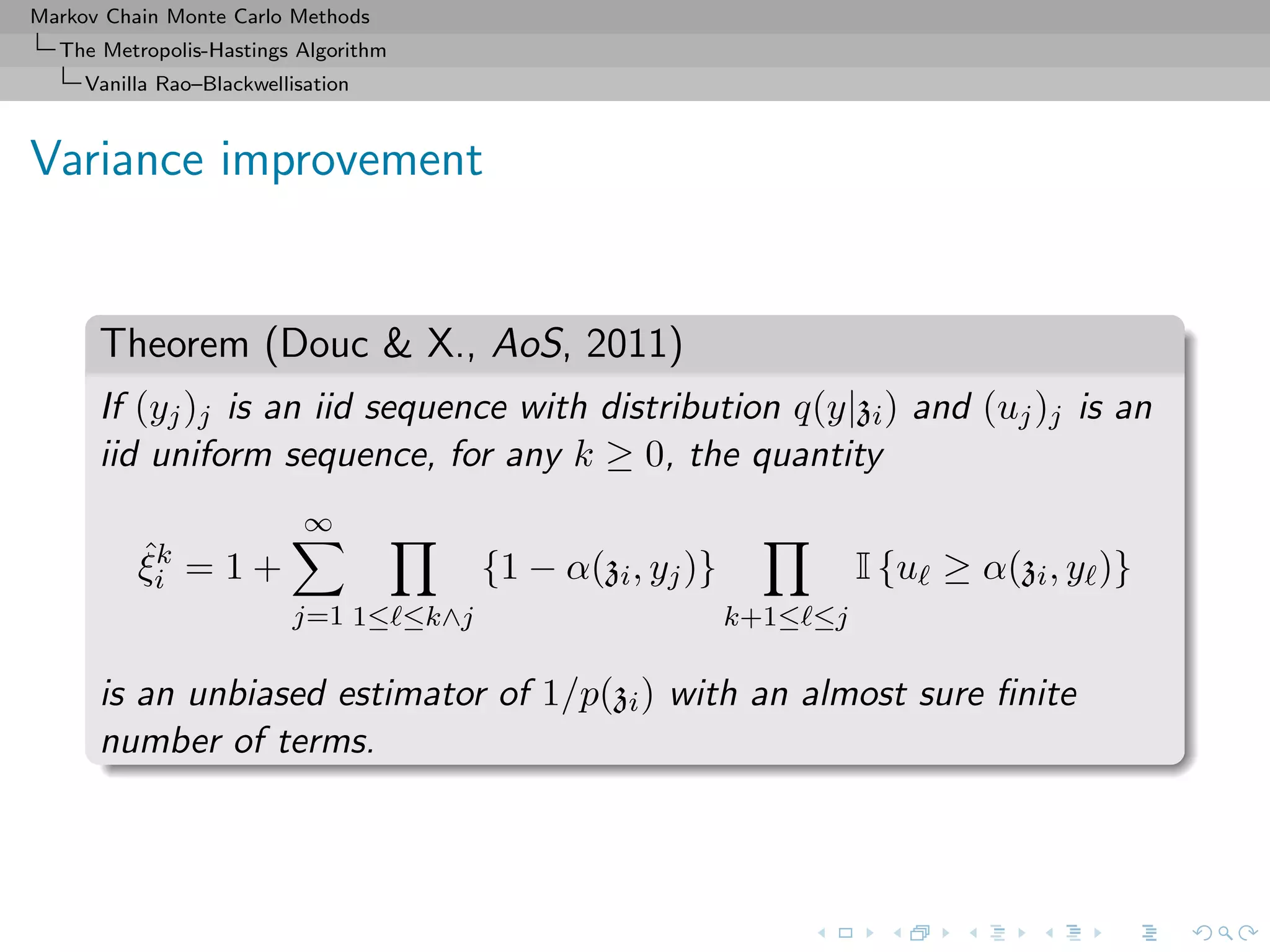
Variance improvement
Theorem (Douc & X., AoS, 2011)
If (yj)j is an iid sequence with distribution q(y|zi) and (uj)j is an
iid uniform sequence, for any k ≥ 0, the quantity
ˆξk
i = 1 +
∞
j=1 1≤ ≤k∧j
{1 − α(zi, yj)}
k+1≤ ≤j
I {u ≥ α(zi, y )}
is an unbiased estimator of 1/p(zi) with an almost sure finite
number of terms.
Markov Chain Monte Carlo Methods
The Metropolis-Hastings Algorithm
Vanilla Rao–Blackwellisation
Variance improvement
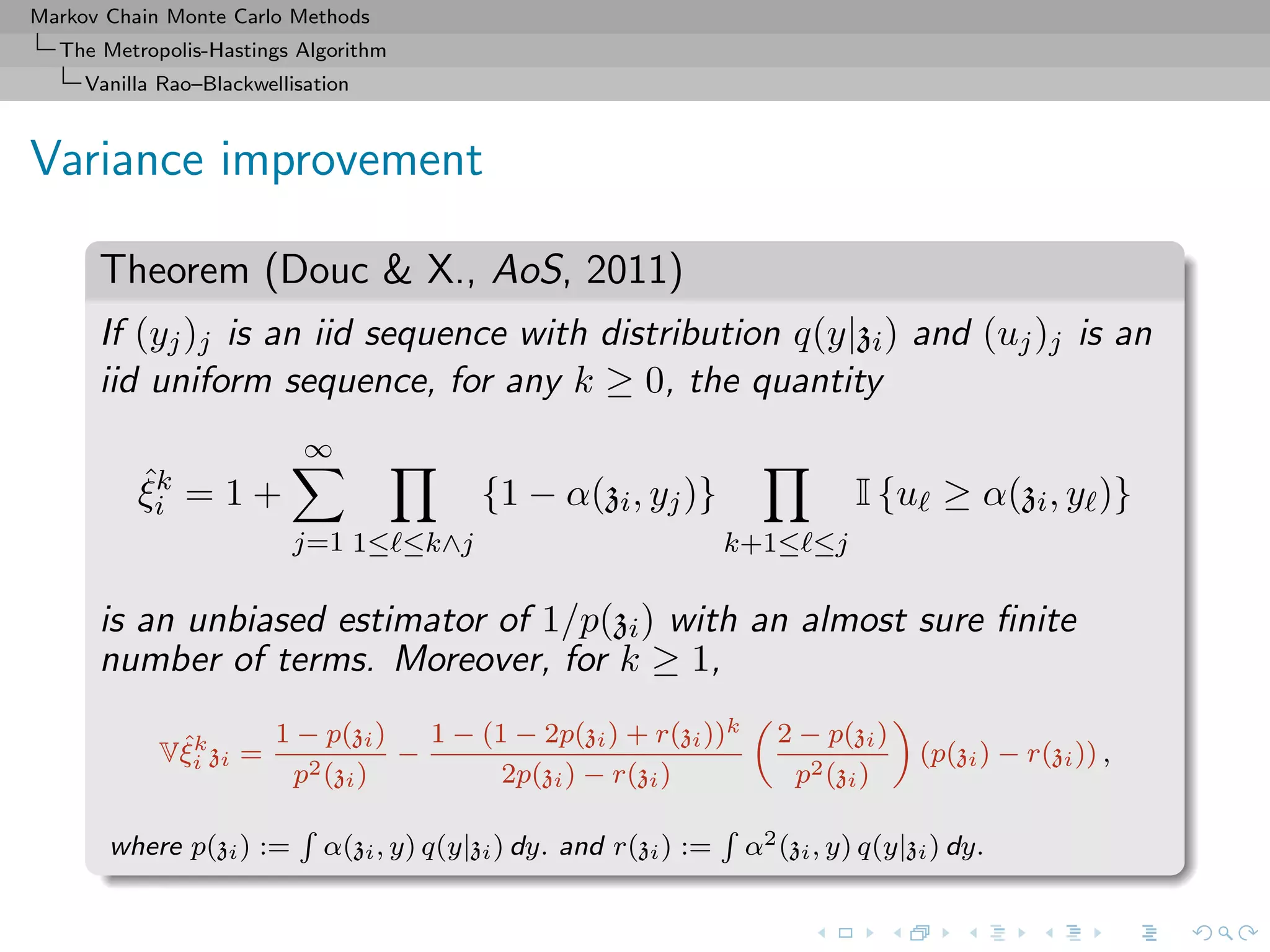
Theorem (Douc & X., AoS, 2011)
If (yj)j is an iid sequence with distribution q(y|zi) and (uj)j is an
iid uniform sequence, for any k ≥ 0, the quantity
ˆξk
i = 1 +
∞
j=1 1≤ ≤k∧j
{1 − α(zi, yj)}
k+1≤ ≤j
I {u ≥ α(zi, y )}
is an unbiased estimator of 1/p(zi) with an almost sure finite
number of terms. Moreover, for k ≥ 1,
Vˆξk
i zi =
1 − p(zi)
p2(zi)
−
1 − (1 − 2p(zi) + r(zi))k
2p(zi) − r(zi)
2 − p(zi)
p2(zi)
(p(zi) − r(zi)) ,
where p(zi) := α(zi, y) q(y|zi) dy. and r(zi) := α2(zi, y) q(y|zi) dy.
Markov Chain Monte Carlo Methods
The Metropolis-Hastings Algorithm
Vanilla Rao–Blackwellisation
Variance improvement
Theorem (Douc & X., AoS, 2011)
If (yj)j is an iid sequence with distribution q(y|zi) and (uj)j is an
iid uniform sequence, for any k ≥ 0, the quantity
ˆξk
i = 1 +
∞
j=1 1≤ ≤k∧j
{1 − α(zi, yj)}
k+1≤ ≤j
I {u ≥ α(zi, y )}
is an unbiased estimator of 1/p(zi) with an almost sure finite
number of terms. Therefore, we have
Vˆξizi ≤ Vˆξk
i zi ≤ Vˆξ0
i zi = Vnizi .
Markov Chain Monte Carlo Methods
The Metropolis-Hastings Algorithm
Delayed acceptance
The “Big Data” plague
Simulation from posterior with largesample size n
Computing time at least of order O(n)
solutions using likelihood decomposition
n
i=1
(θ|xi)
and handling subsets on different processors (CPU), graphical
units (GPU), or computers
[Scott et al., 2013, Korattikara et al., 2013]
no consensus on method of choice, with instabilities from
removing most prior input and uncalibrated approximations
[Neiswanger et al., 2013]
Markov Chain Monte Carlo Methods
The Metropolis-Hastings Algorithm
Delayed acceptance
Proposed solution
“There is no problem an absence of decision cannot solve.”
Anonymous
Given α(x, y) := 1 ∧ r(x, y), factorise
r(x, y) =
d
k=1
ρk(x, y)
under constraint ρk(x, y) = ρk(y, x)−1
Delayed Acceptance Markov kernel given by
˜P(x, A) :=
A
q(x, y)˜α(x, y)dy + 1 −
X
q(x, y)˜α(x, y)dy 1A(x)
where
˜α(x, y) :=
d
k=1
{1 ∧ ρk(x, y)}.
Markov Chain Monte Carlo Methods
The Metropolis-Hastings Algorithm
Delayed acceptance
Proposed solution
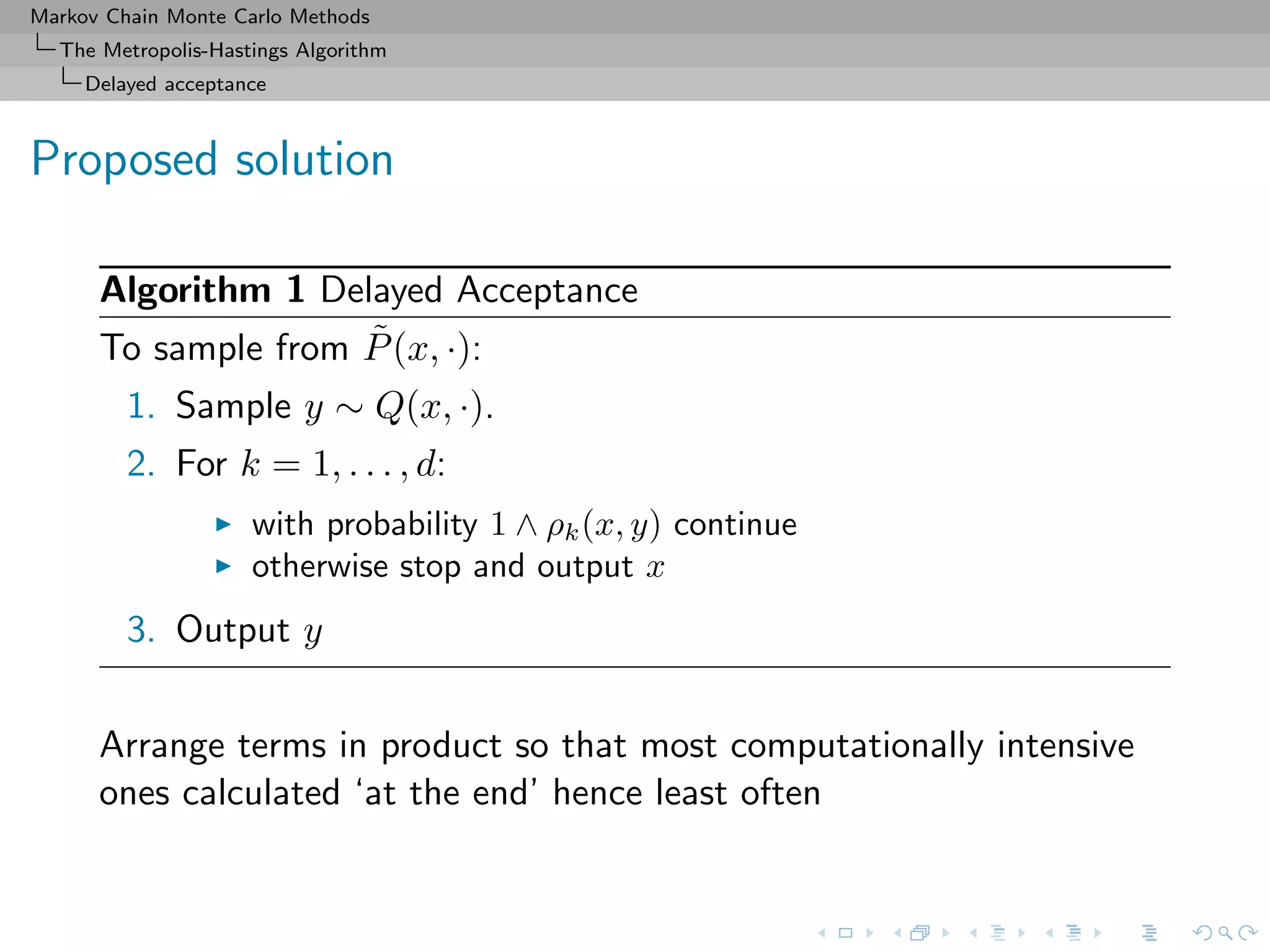
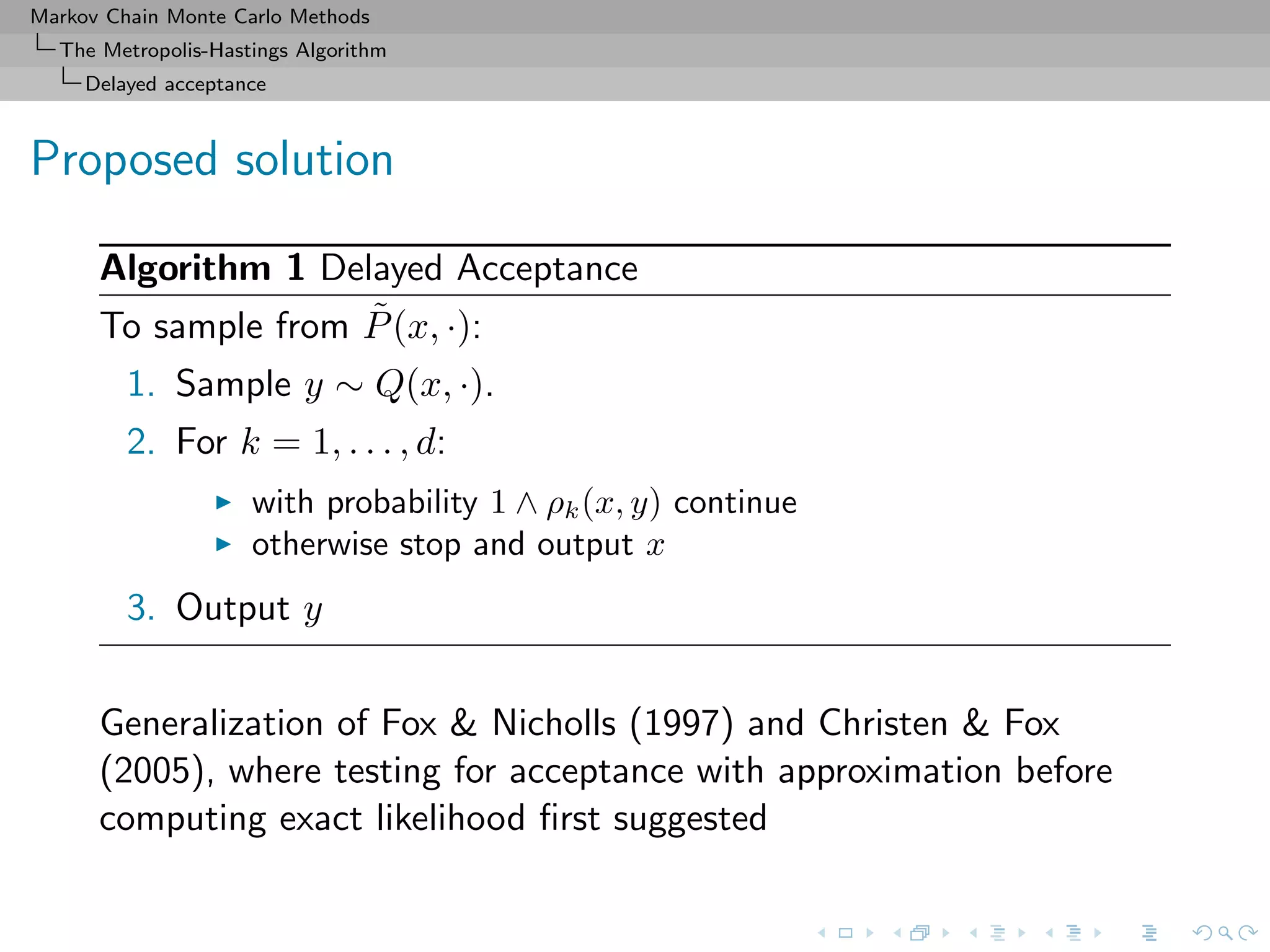
Algorithm 1 Delayed Acceptance
To sample from ˜P(x, ·):
1. Sample y ∼ Q(x, ·).
2. For k = 1, . . . , d:
with probability 1 ∧ ρk(x, y) continue
otherwise stop and output x
3. Output y
Arrange terms in product so that most computationally intensive
ones calculated ‘at the end’ hence least often
Markov Chain Monte Carlo Methods
The Metropolis-Hastings Algorithm
Delayed acceptance
Proposed solution
Algorithm 1 Delayed Acceptance
To sample from ˜P(x, ·):
1. Sample y ∼ Q(x, ·).
2. For k = 1, . . . , d:
with probability 1 ∧ ρk(x, y) continue
otherwise stop and output x
3. Output y
Generalization of Fox & Nicholls (1997) and Christen & Fox
(2005), where testing for acceptance with approximation before
computing exact likelihood first suggested
Markov Chain Monte Carlo Methods
The Metropolis-Hastings Algorithm
Delayed acceptance
The “Big Data” plague
Delayed Acceptance intended for likelihoods or priors, but
not a clear solution for “Big Data” problems
1. all product terms must be computed
2. all terms previously computed either stored for future
comparison or recomputed
3. sequential approach limits parallel gains...
4. ...unless prefetching scheme added to delays
[Strid (2010)]
Markov Chain Monte Carlo Methods
The Metropolis-Hastings Algorithm
Adaptive MCMC
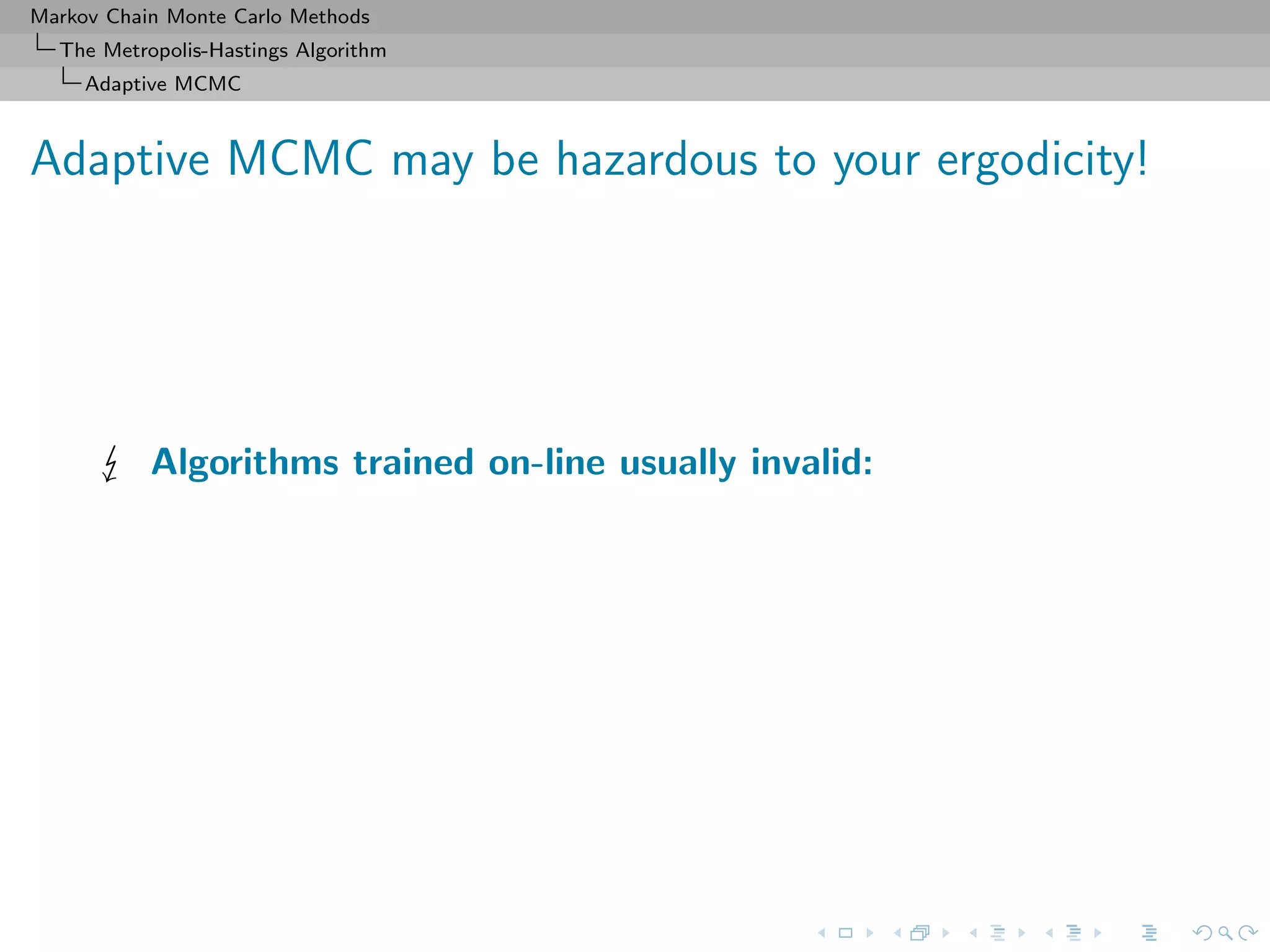
Adaptive MCMC may be hazardous to your ergodicity!
Algorithms trained on-line usually invalid:
Markov Chain Monte Carlo Methods
The Metropolis-Hastings Algorithm
Adaptive MCMC
Adaptive MCMC may be hazardous to your ergodicity!
Algorithms trained on-line usually invalid:
using the whole past of the “chain” implies that this is no longer a
Markov chain! !
Markov Chain Monte Carlo Methods
The Metropolis-Hastings Algorithm
Adaptive MCMC
Illustration
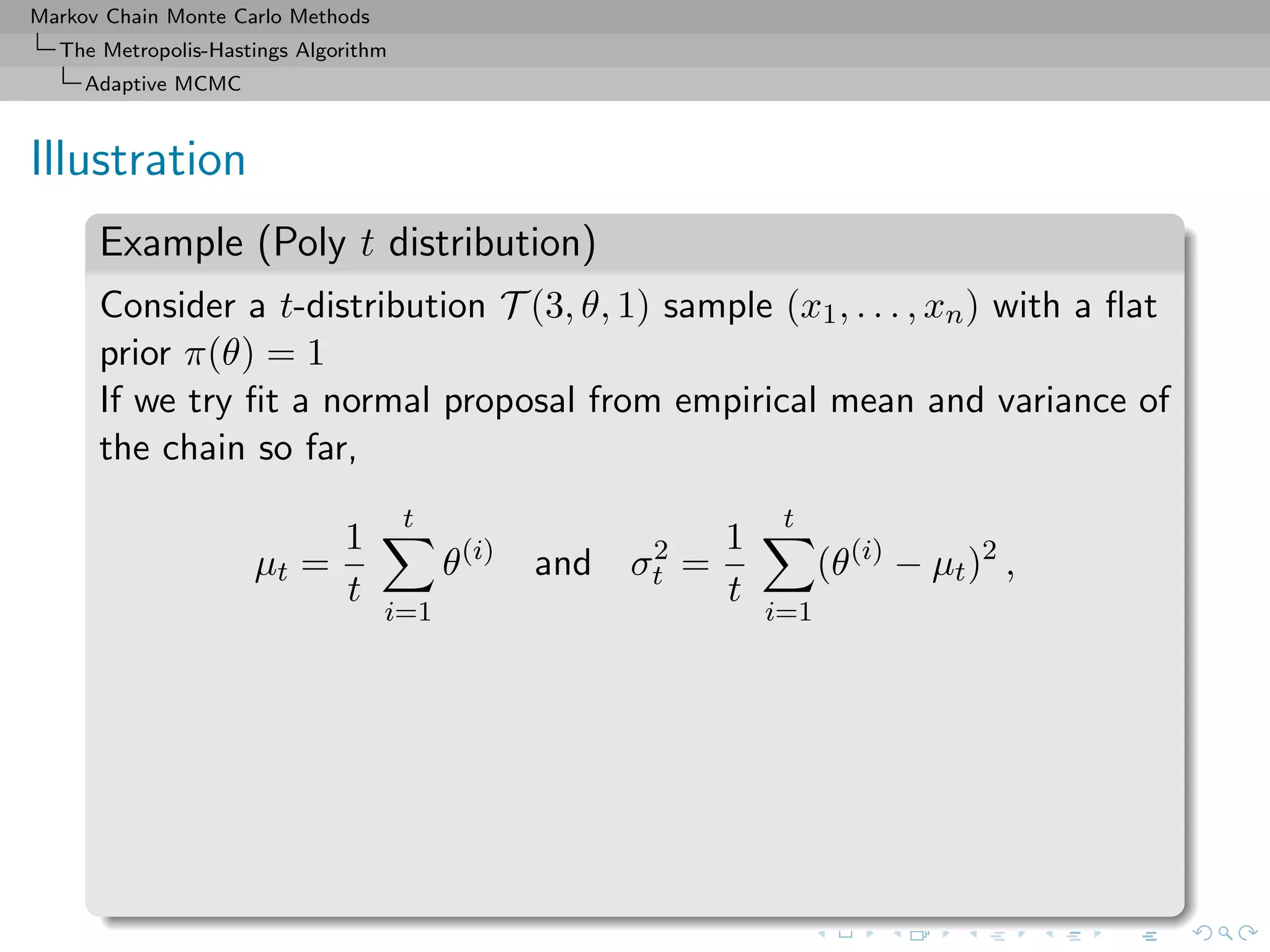
Example (Poly t distribution)
Consider a t-distribution T (3, θ, 1) sample (x1, . . . , xn) with a flat
prior π(θ) = 1
If we try fit a normal proposal from empirical mean and variance of
the chain so far,
µt =
1
t
t
i=1
θ(i)
and σ2
t =
1
t
t
i=1
(θ(i)
− µt)2
,
Markov Chain Monte Carlo Methods
The Metropolis-Hastings Algorithm
Adaptive MCMC
Illustration
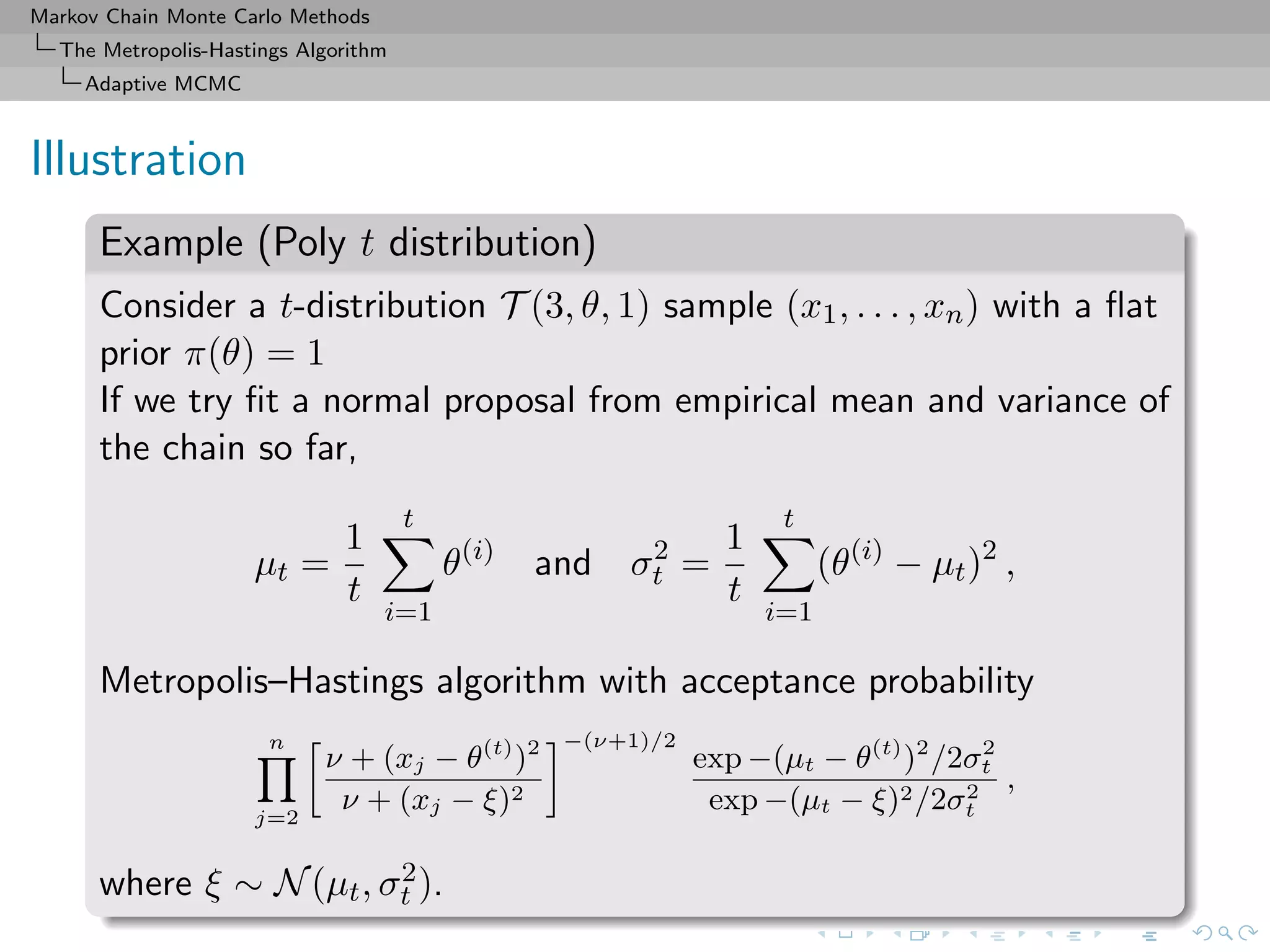
Example (Poly t distribution)
Consider a t-distribution T (3, θ, 1) sample (x1, . . . , xn) with a flat
prior π(θ) = 1
If we try fit a normal proposal from empirical mean and variance of
the chain so far,
µt =
1
t
t
i=1
θ(i)
and σ2
t =
1
t
t
i=1
(θ(i)
− µt)2
,
Metropolis–Hastings algorithm with acceptance probability
n
j=2
ν + (xj − θ(t)
)2
ν + (xj − ξ)2
−(ν+1)/2
exp −(µt − θ(t)
)2
/2σ2
t
exp −(µt − ξ)2/2σ2
t
,
where ξ ∼ N(µt, σ2
t ).
Markov Chain Monte Carlo Methods
The Metropolis-Hastings Algorithm
Adaptive MCMC
Illustration
Example (Poly t distribution (2))
Invalid scheme:
when range of initial values too small, the θ(i)’s cannot
converge to the target distribution and concentrates on too
small a support.
long-range dependence on past values modifies the
distribution of the sequence.
using past simulations to create a non-parametric
approximation to the target distribution does not work either
Markov Chain Monte Carlo Methods
The Metropolis-Hastings Algorithm
Adaptive MCMC
Illustration
0 1000 2000 3000 4000 5000
−0.4−0.20.00.2
Iterations
x
θ
−1.5 −1.0 −0.5 0.0 0.5
0123
0 1000 2000 3000 4000 5000
−1.5−1.0−0.50.00.51.01.5
Iterations
x
θ
−2 −1 0 1 2
0.00.20.40.6
0 1000 2000 3000 4000 5000
−2−1012
Iterations
x
θ
−2 −1 0 1 2 3
0.00.10.20.30.40.50.60.7
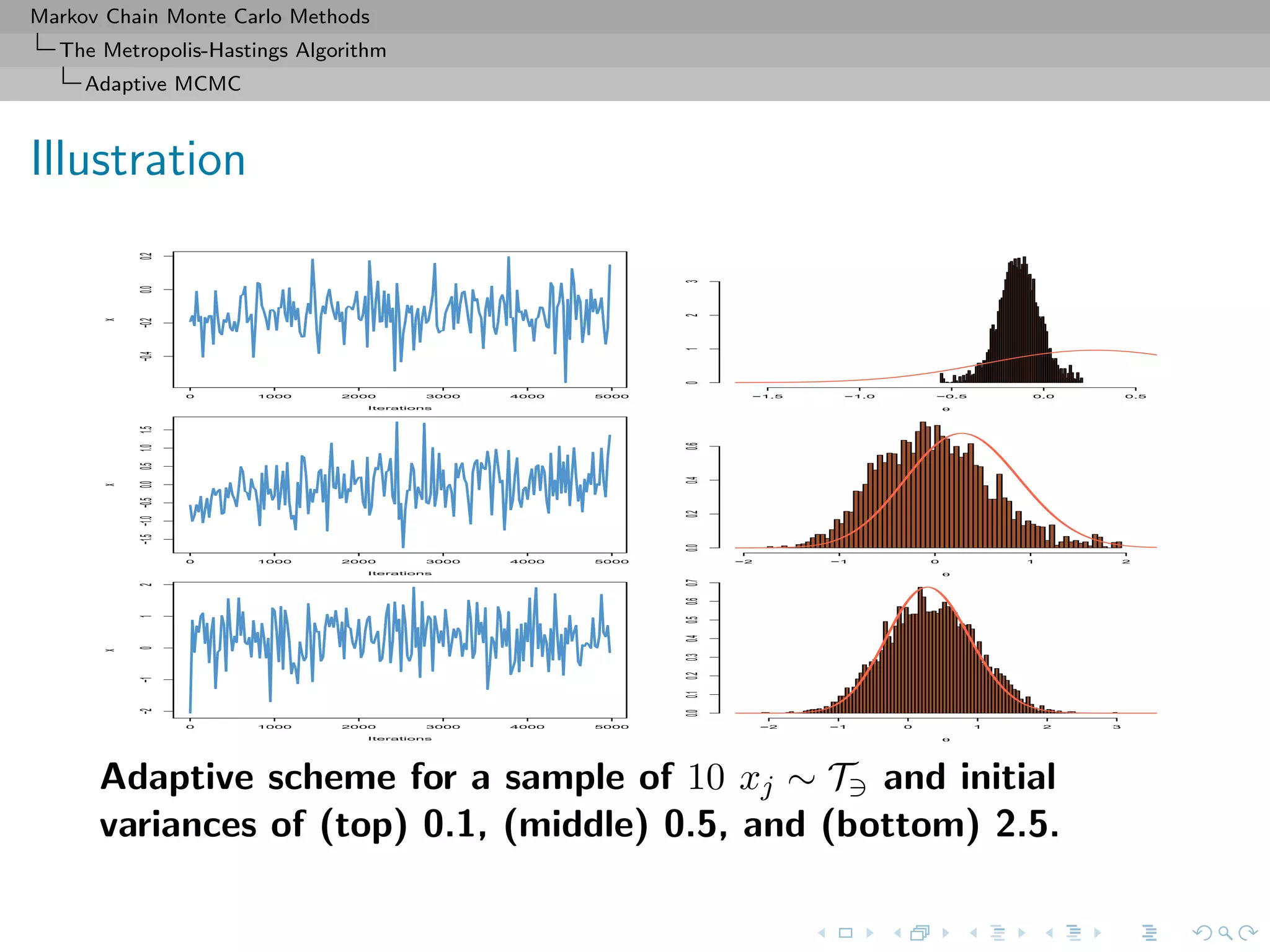
Adaptive scheme for a sample of 10 xj ∼ T and initial
variances of (top) 0.1, (middle) 0.5, and (bottom) 2.5.
Markov Chain Monte Carlo Methods
The Metropolis-Hastings Algorithm
Adaptive MCMC
Illustration
θ
−2 −1 0 1 2
0.00.10.20.30.40.50.6
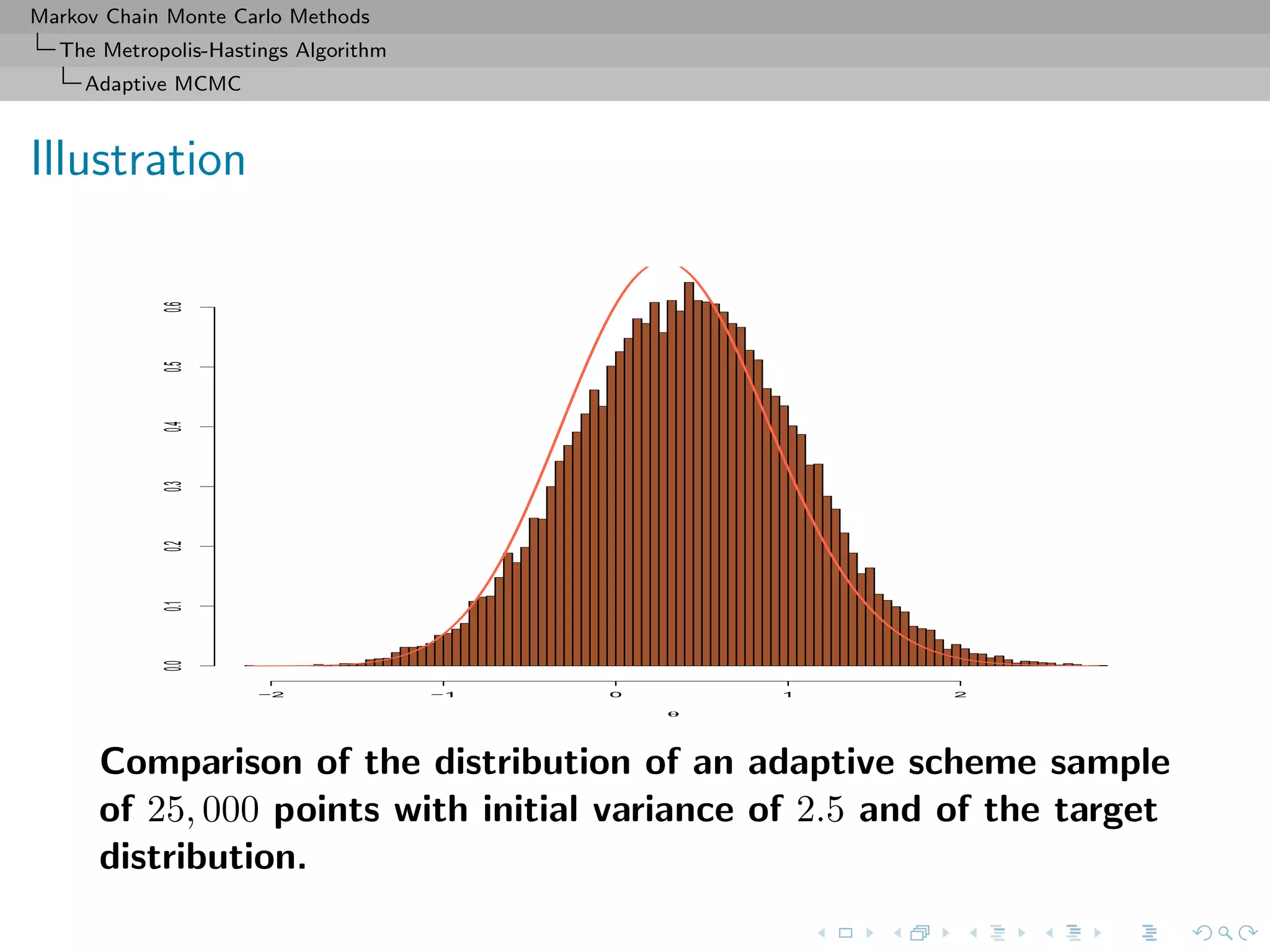
Comparison of the distribution of an adaptive scheme sample
of 25, 000 points with initial variance of 2.5 and of the target
distribution.
Markov Chain Monte Carlo Methods
The Metropolis-Hastings Algorithm
Adaptive MCMC
Illustration
0 10000 30000 50000
−1.0−0.50.00.51.01.5
Iterations
x
θ
−1.5 −0.5 0.5 1.0 1.5
0.00.20.40.60.81.0
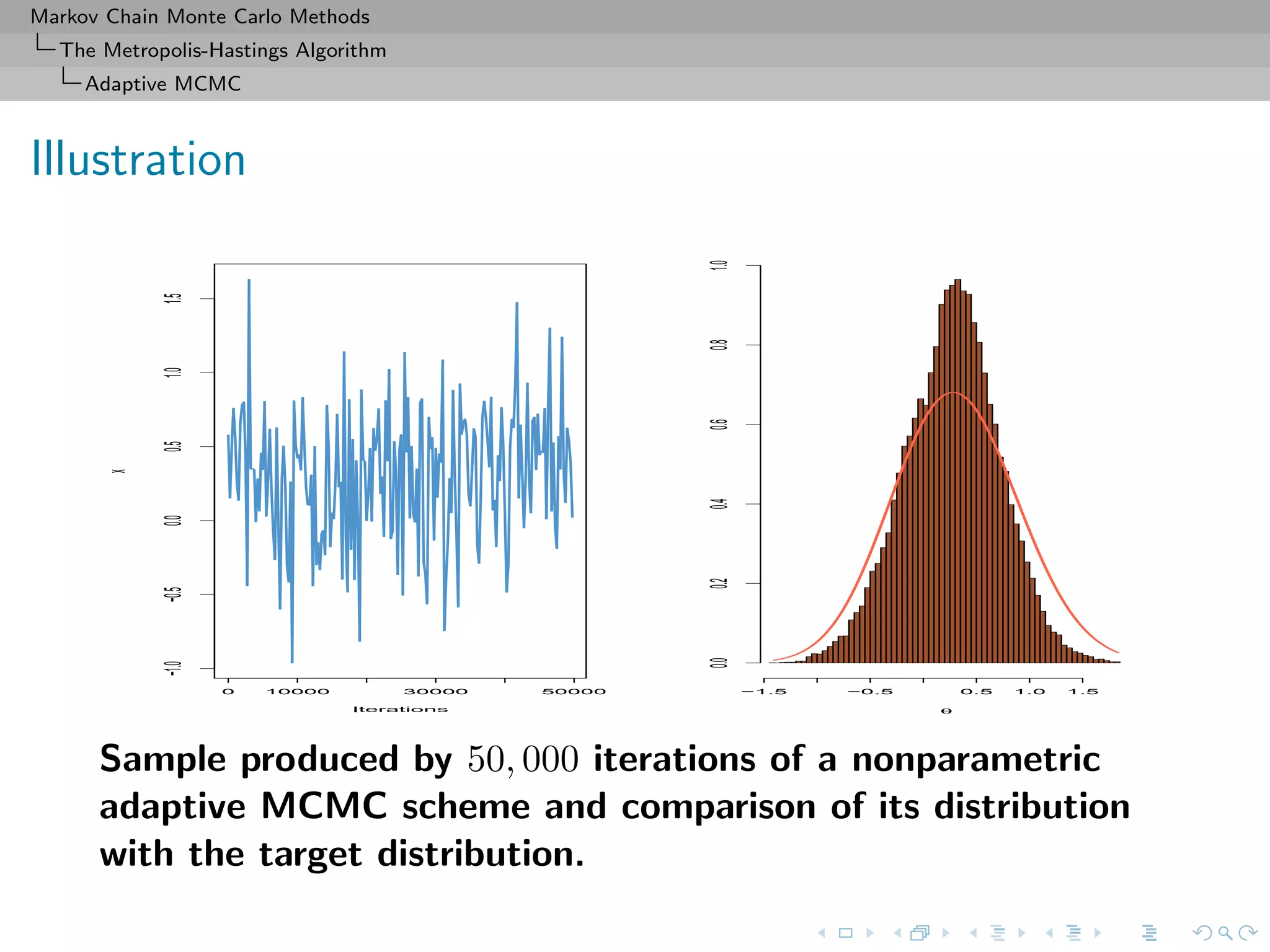
Sample produced by 50, 000 iterations of a nonparametric
adaptive MCMC scheme and comparison of its distribution
with the target distribution.
Markov Chain Monte Carlo Methods
Gibbs Sampling
The Gibbs Sampler
The Metropolis-Hastings
Algorithm
Gibbs Sampling
General Principles
Completion
Convergence
The Hammersley-Clifford
theorem
Improper Priors
Hamiltonian Monte Carlo
Piecewise Deterministic Versions
Markov Chain Monte Carlo Methods
Gibbs Sampling
General Principles
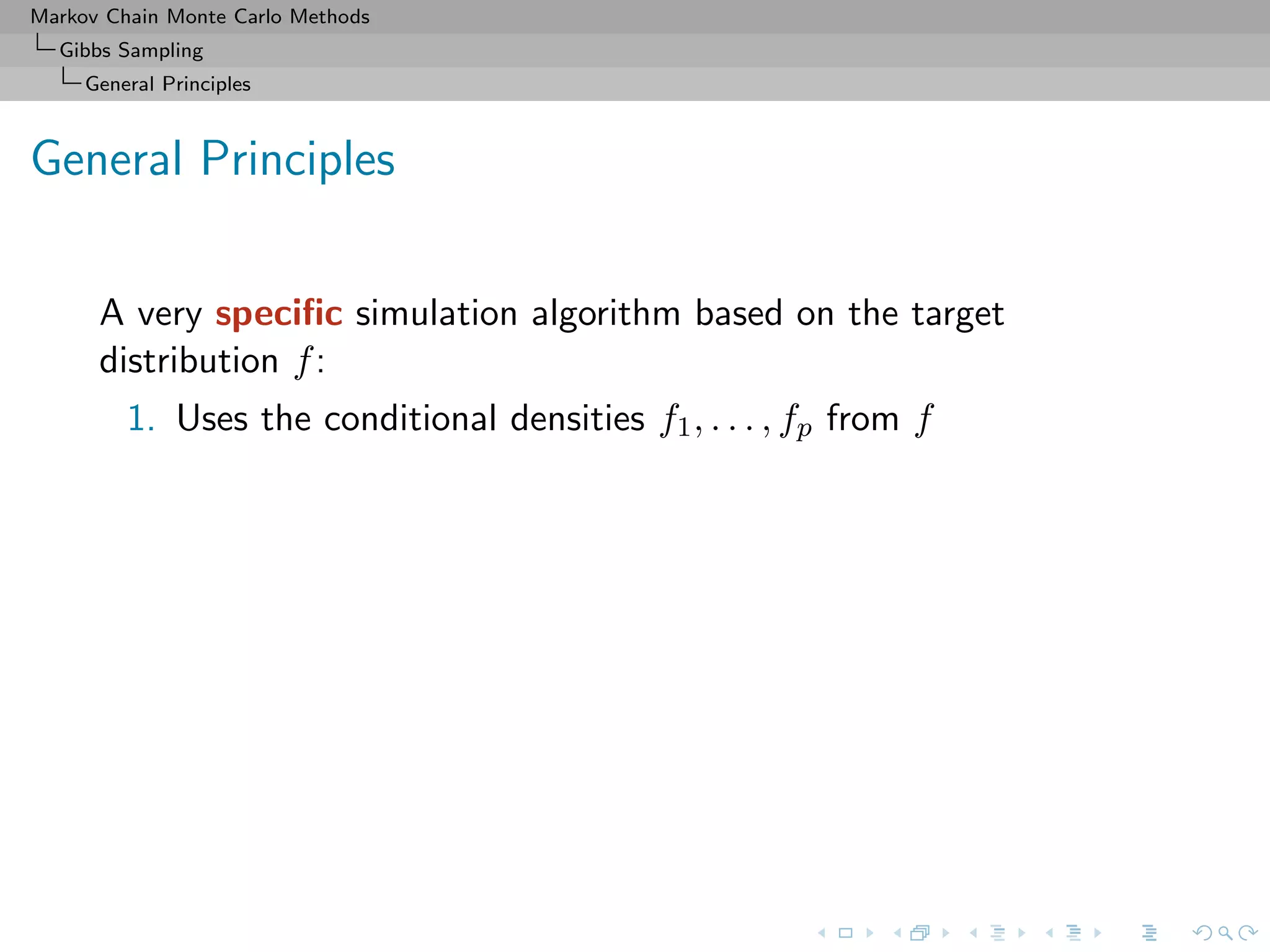
General Principles
A very specific simulation algorithm based on the target
distribution f:
1. Uses the conditional densities f1, . . . , fp from f
Markov Chain Monte Carlo Methods
Gibbs Sampling
General Principles
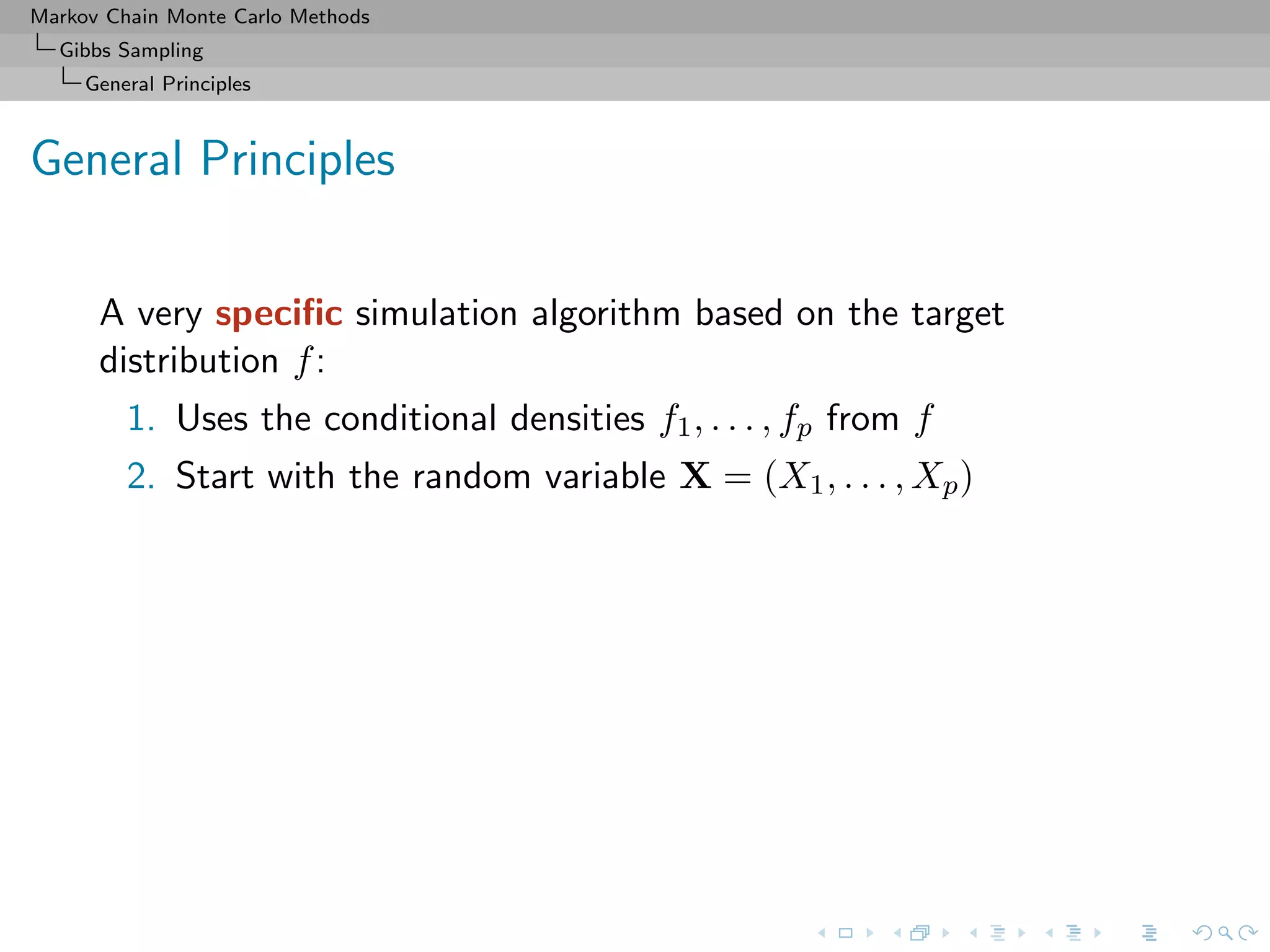
General Principles
A very specific simulation algorithm based on the target
distribution f:
1. Uses the conditional densities f1, . . . , fp from f
2. Start with the random variable X = (X1, . . . , Xp)
Markov Chain Monte Carlo Methods
Gibbs Sampling
General Principles
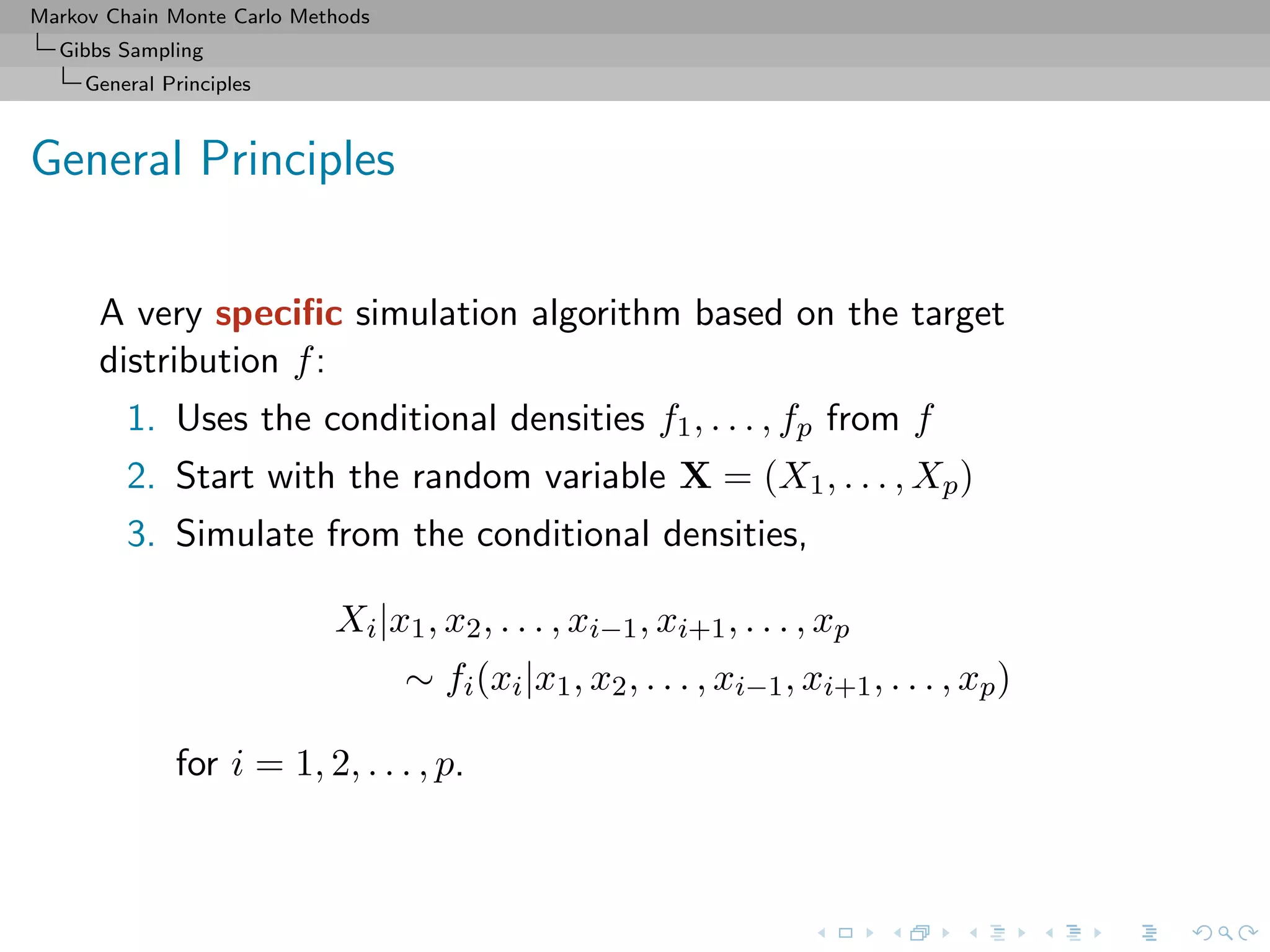
General Principles
A very specific simulation algorithm based on the target
distribution f:
1. Uses the conditional densities f1, . . . , fp from f
2. Start with the random variable X = (X1, . . . , Xp)
3. Simulate from the conditional densities,
Xi|x1, x2, . . . , xi−1, xi+1, . . . , xp
∼ fi(xi|x1, x2, . . . , xi−1, xi+1, . . . , xp)
for i = 1, 2, . . . , p.
Markov Chain Monte Carlo Methods
Gibbs Sampling
General Principles
General Principles
Algorithm (Gibbs sampler)
Given x(t) = (x
(t)
1 , . . . , x
(t)
p ), generate
1. X
(t+1)
1 ∼ f1(x1|x
(t)
2 , . . . , x
(t)
p );
2. X
(t+1)
2 ∼ f2(x2|x
(t+1)
1 , x
(t)
3 , . . . , x
(t)
p ),
. . .
p. X
(t+1)
p ∼ fp(xp|x
(t+1)
1 , . . . , x
(t+1)
p−1 )
X(t+1) → X ∼ f
Markov Chain Monte Carlo Methods
Gibbs Sampling
General Principles
Properties
The full conditionals densities f1, . . . , fp are the only densities used
for simulation. Thus, even in a high dimensional problem, all of
the simulations may be univariate
Markov Chain Monte Carlo Methods
Gibbs Sampling
General Principles
Properties
The full conditionals densities f1, . . . , fp are the only densities used
for simulation. Thus, even in a high dimensional problem, all of
the simulations may be univariate
The Gibbs sampler is not reversible with respect to f. However,
each of its p components is. Besides, it can be turned into a
reversible sampler, either using the Random Scan Gibbs sampler or
running instead the (double) sequence
f1 · · · fp−1fpfp−1 · · · f1
Markov Chain Monte Carlo Methods
Gibbs Sampling
General Principles
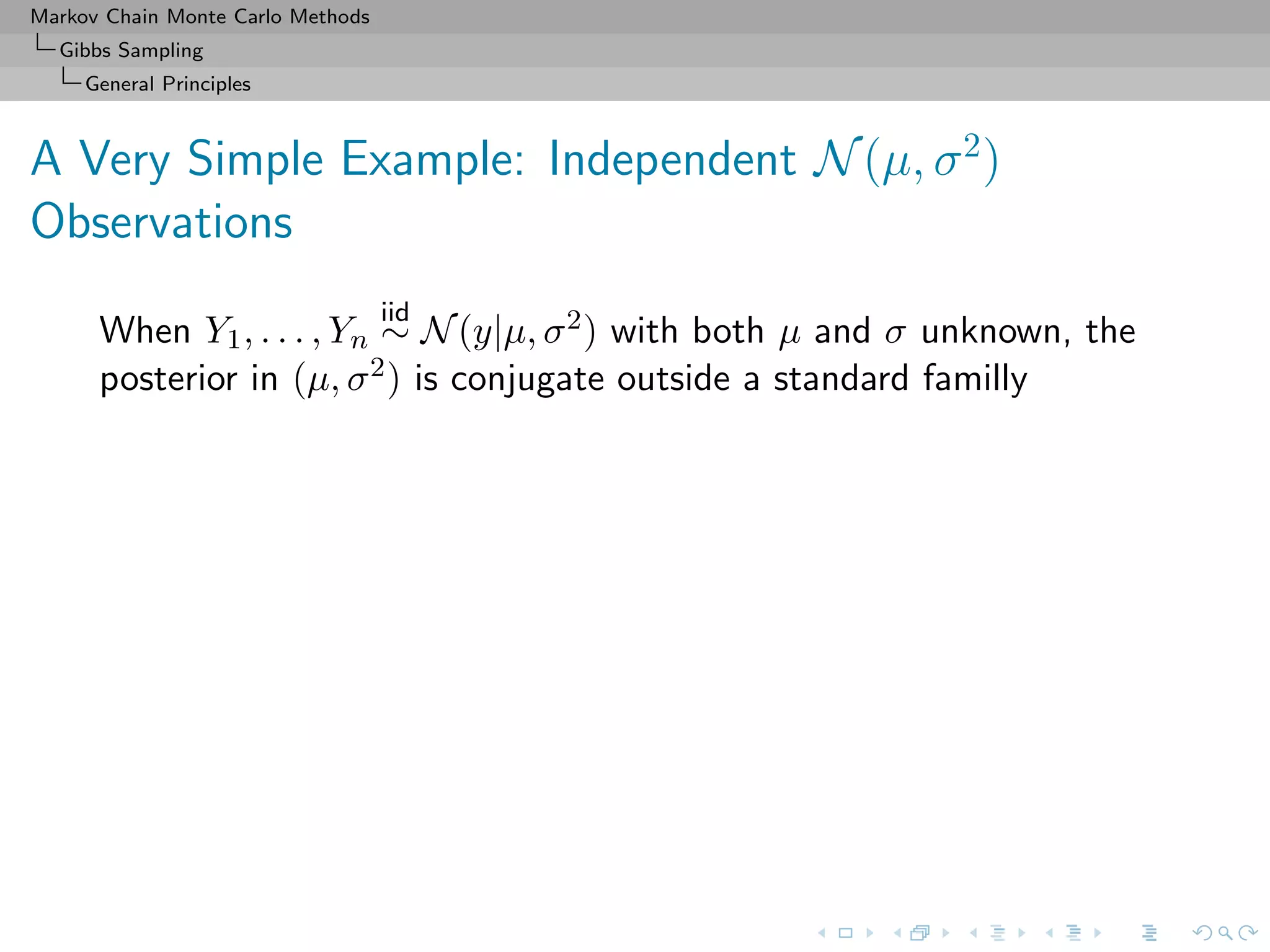
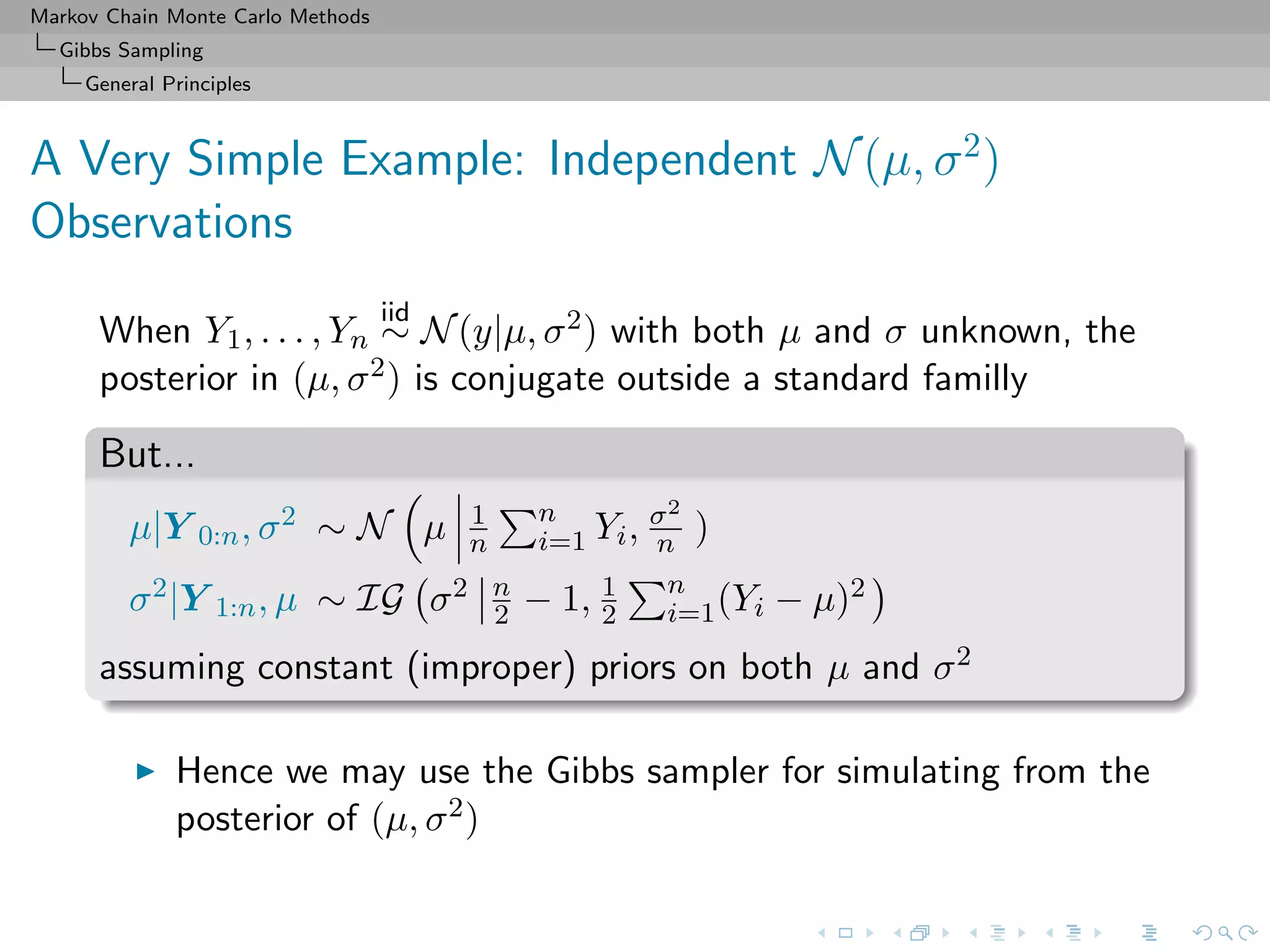
A Very Simple Example: Independent N(µ, σ2
)
Observations
When Y1, . . . , Yn
iid
∼ N(y|µ, σ2) with both µ and σ unknown, the
posterior in (µ, σ2) is conjugate outside a standard familly
Markov Chain Monte Carlo Methods
Gibbs Sampling
General Principles
A Very Simple Example: Independent N(µ, σ2
)
Observations
When Y1, . . . , Yn
iid
∼ N(y|µ, σ2) with both µ and σ unknown, the
posterior in (µ, σ2) is conjugate outside a standard familly
But...
µ|Y 0:n, σ2 ∼ N µ 1
n
n
i=1 Yi, σ2
n )
σ2|Y 1:n, µ ∼ IG σ2 n
2 − 1, 1
2
n
i=1(Yi − µ)2
assuming constant (improper) priors on both µ and σ2
Hence we may use the Gibbs sampler for simulating from the
posterior of (µ, σ2)
Markov Chain Monte Carlo Methods
Gibbs Sampling
General Principles
A Very Simple Example: Independent N(µ, σ2
)
Observations
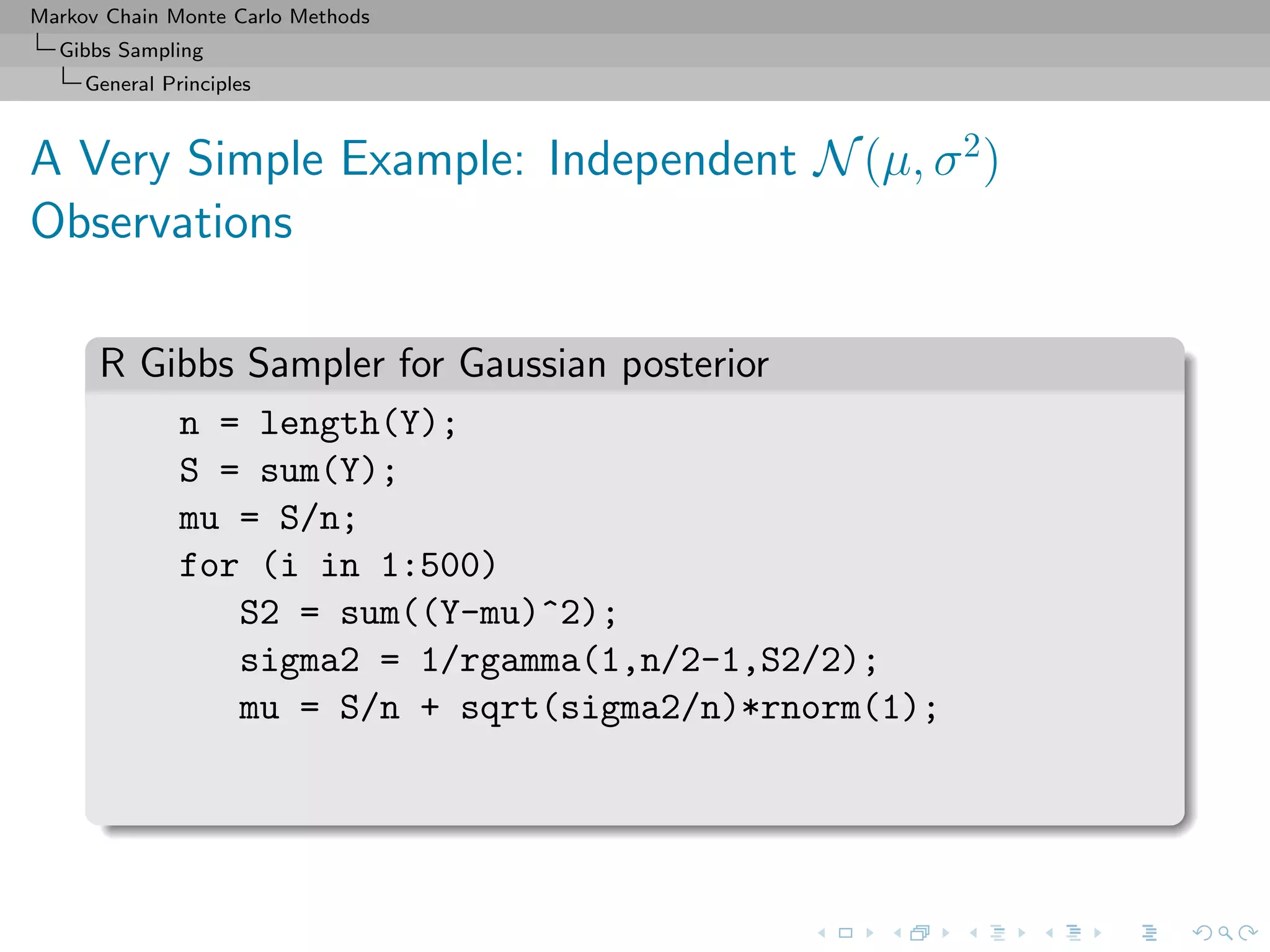
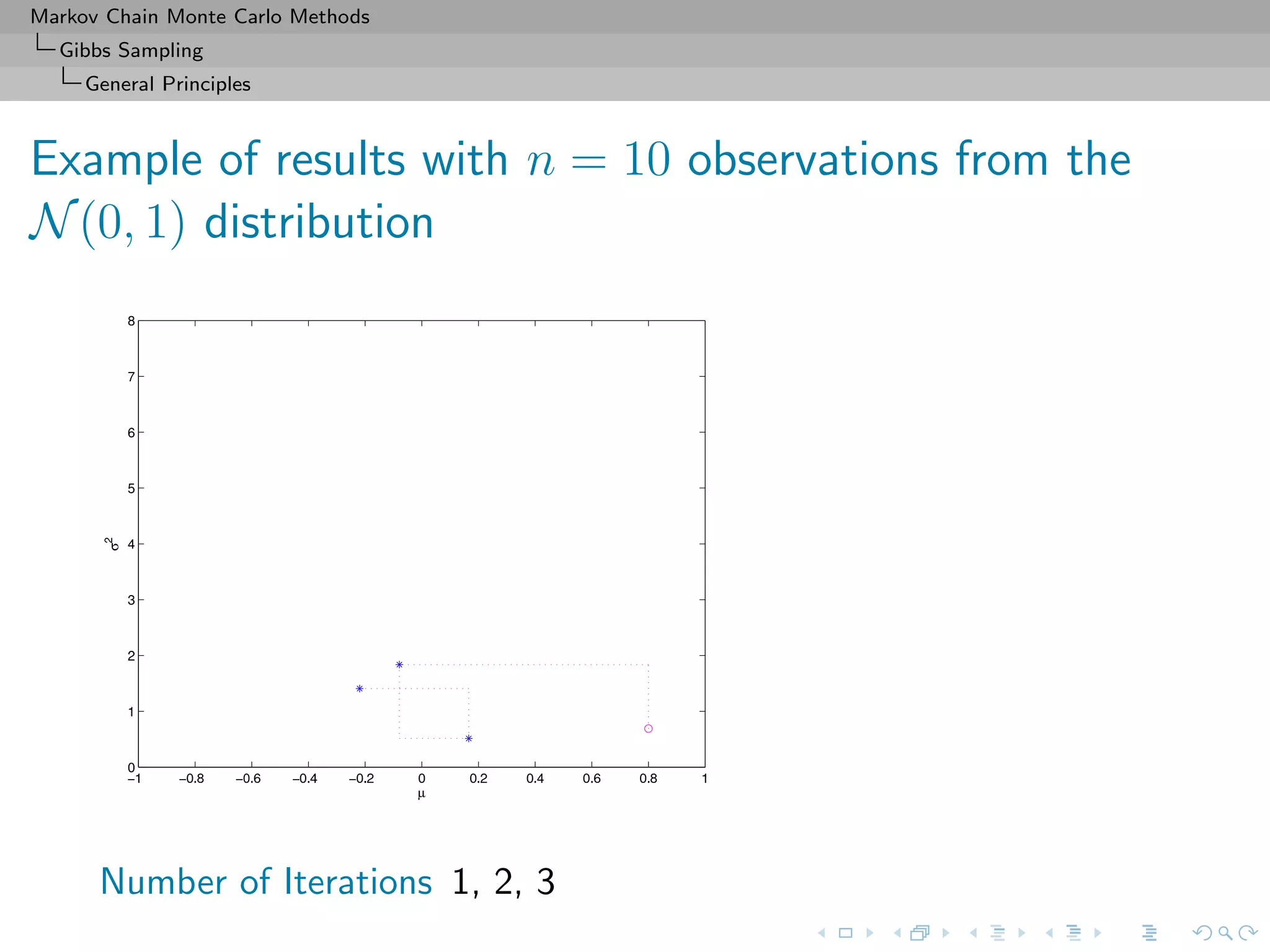
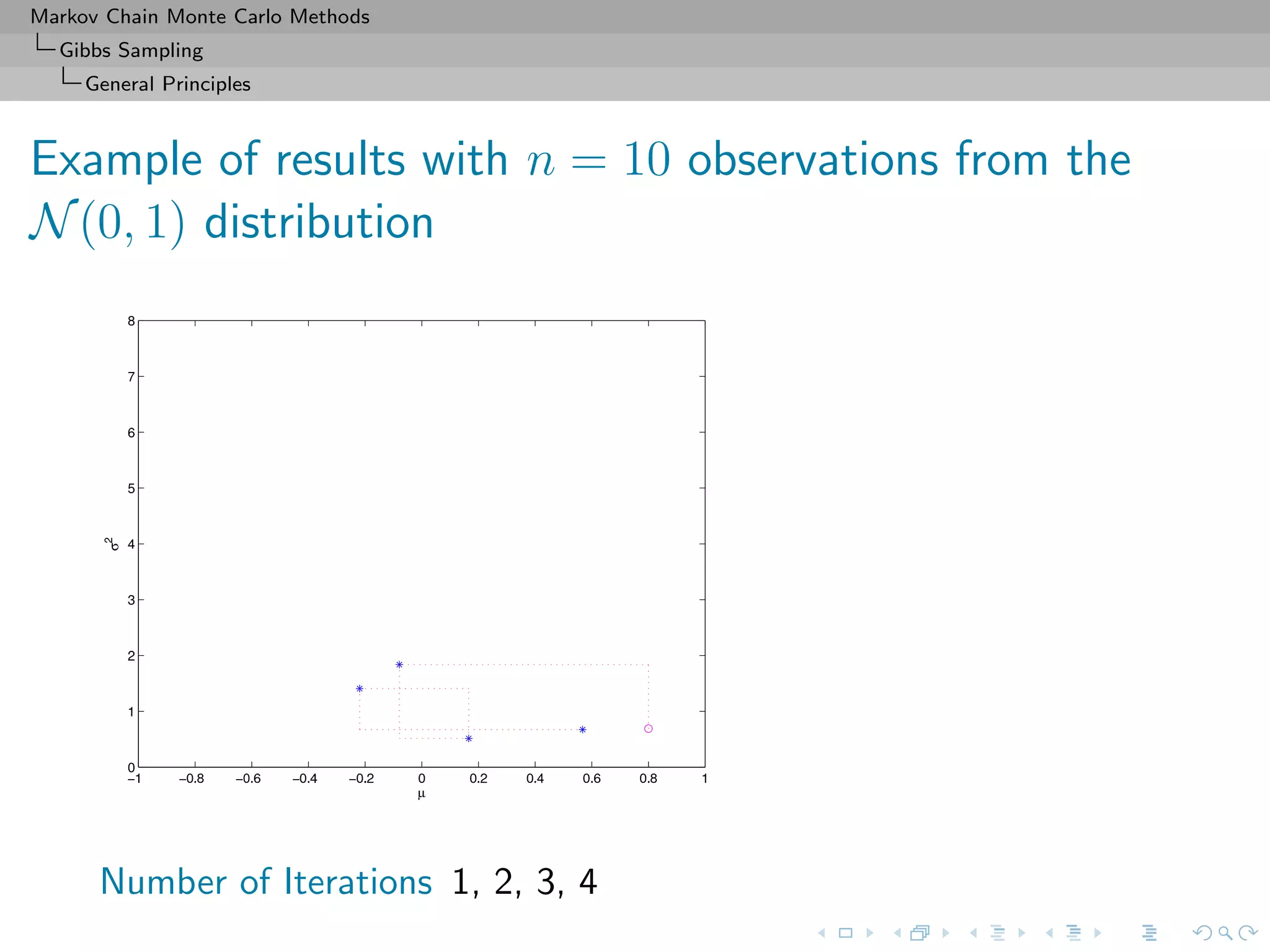
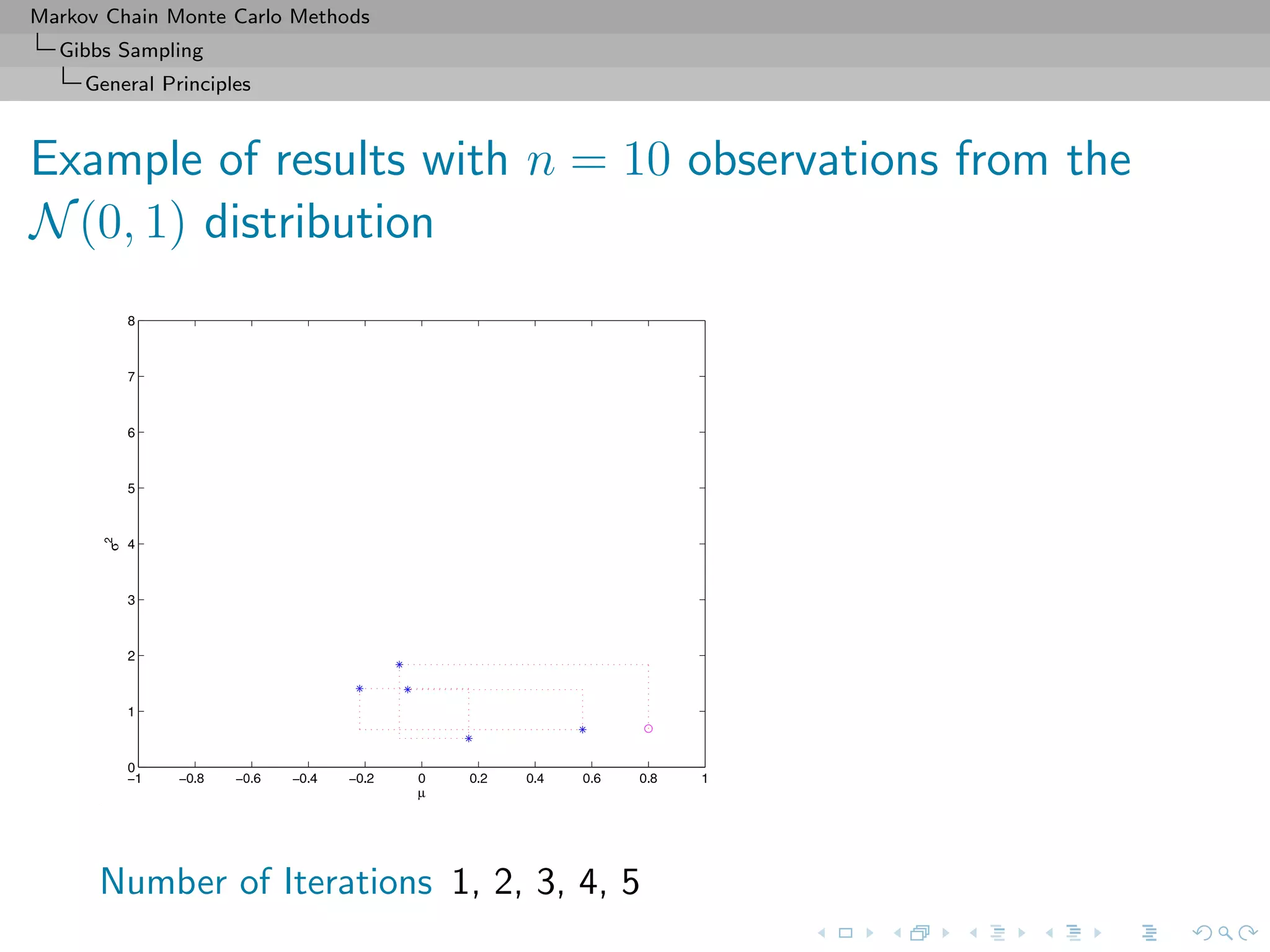
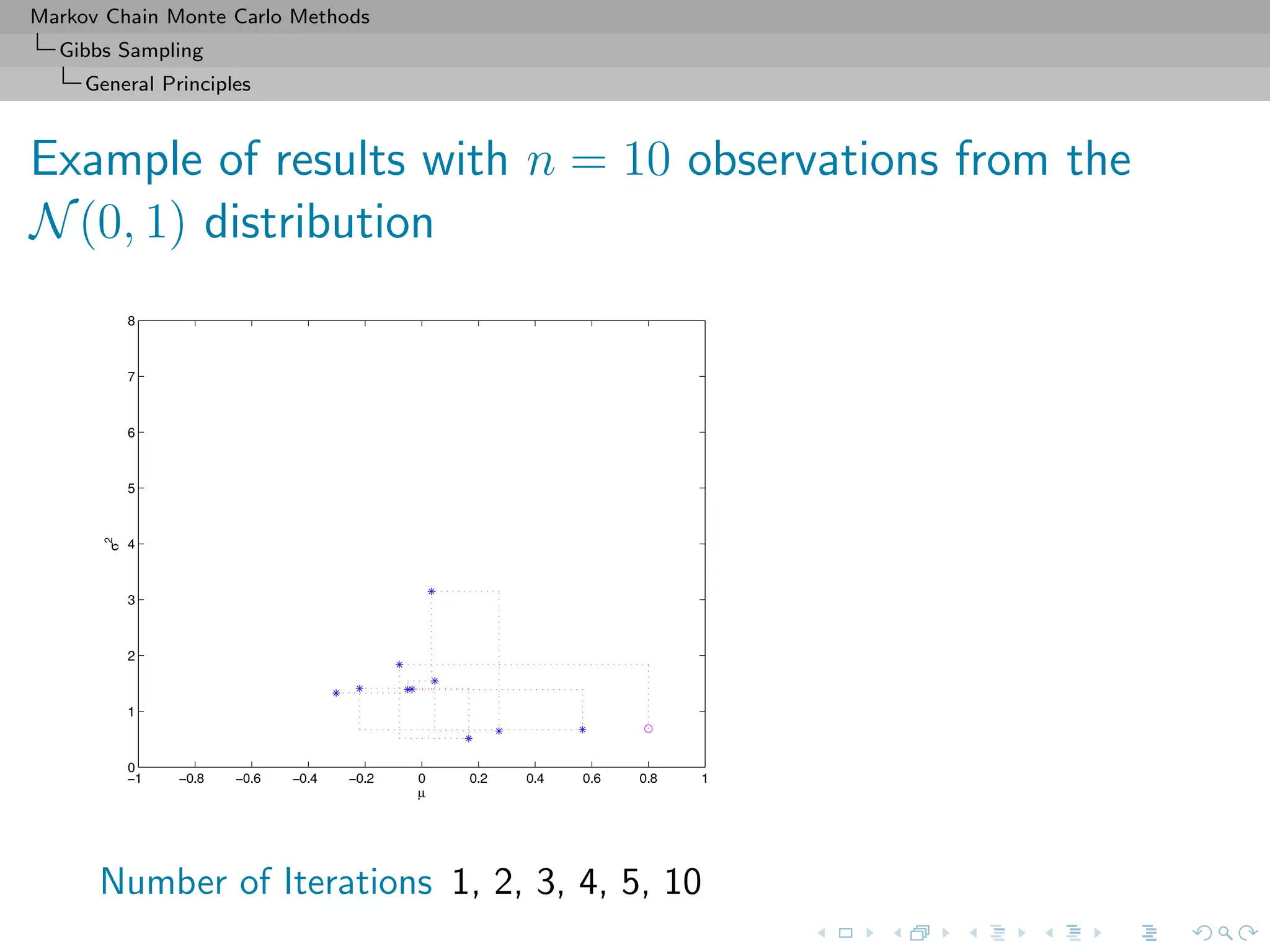
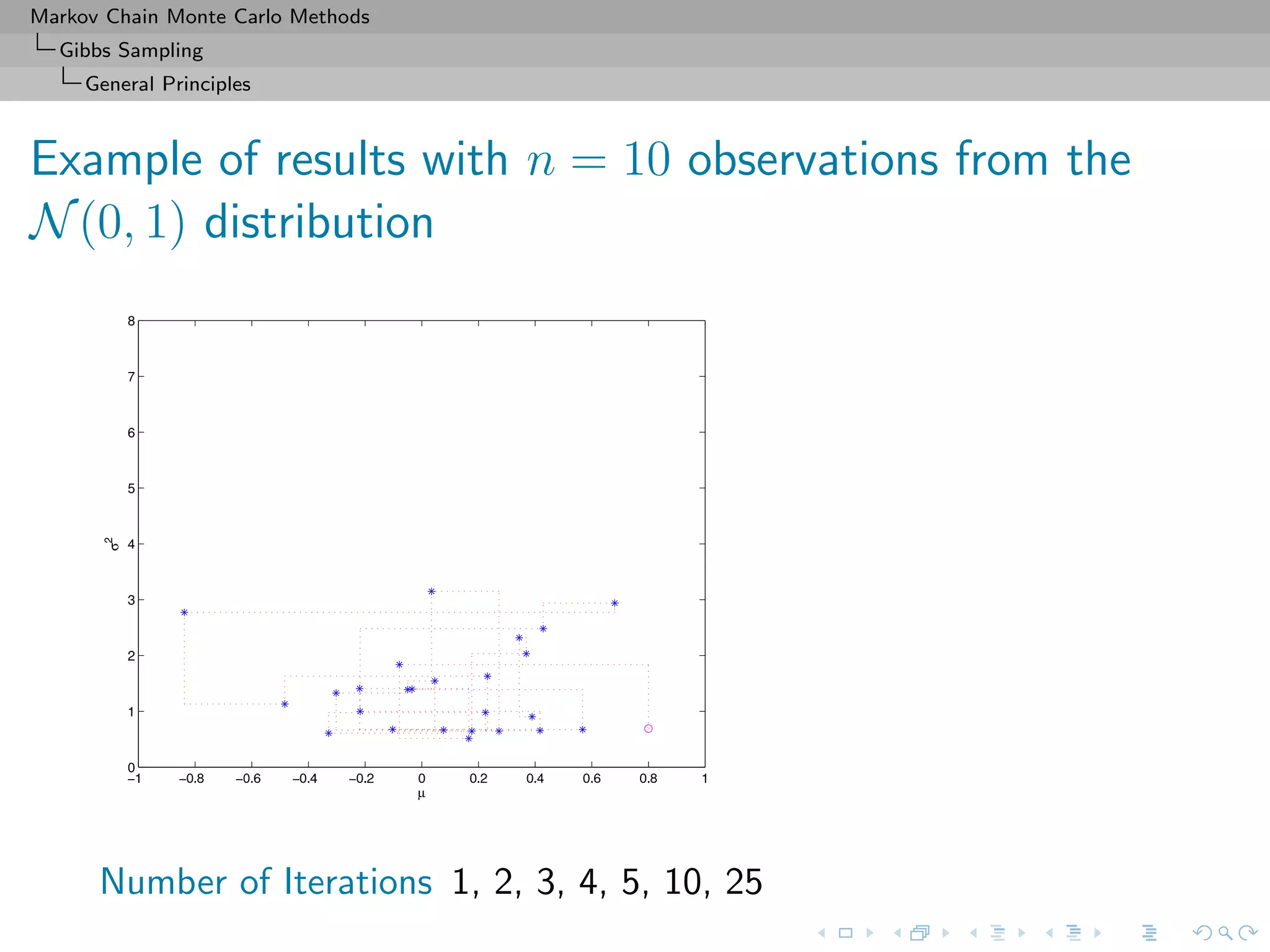
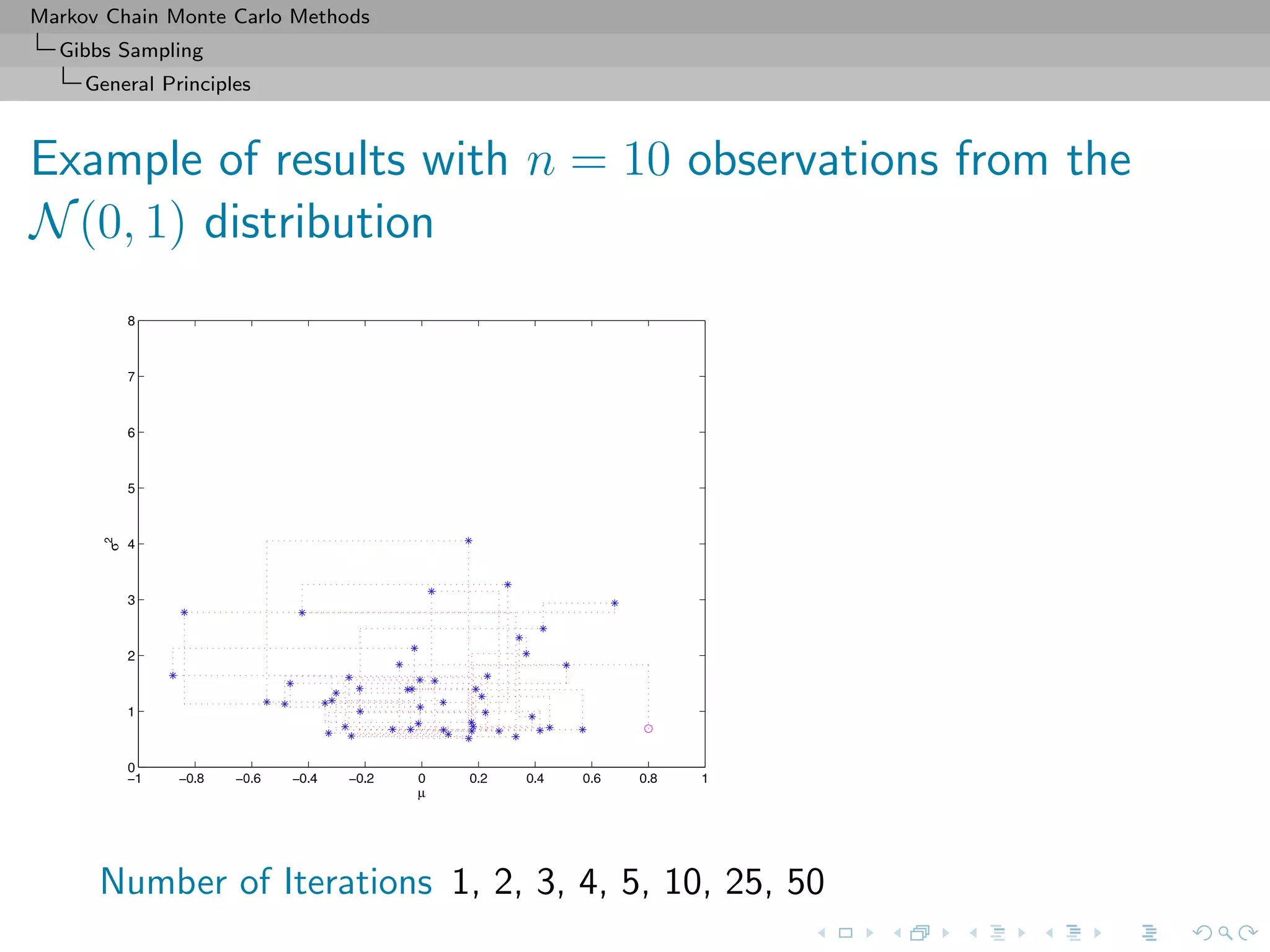
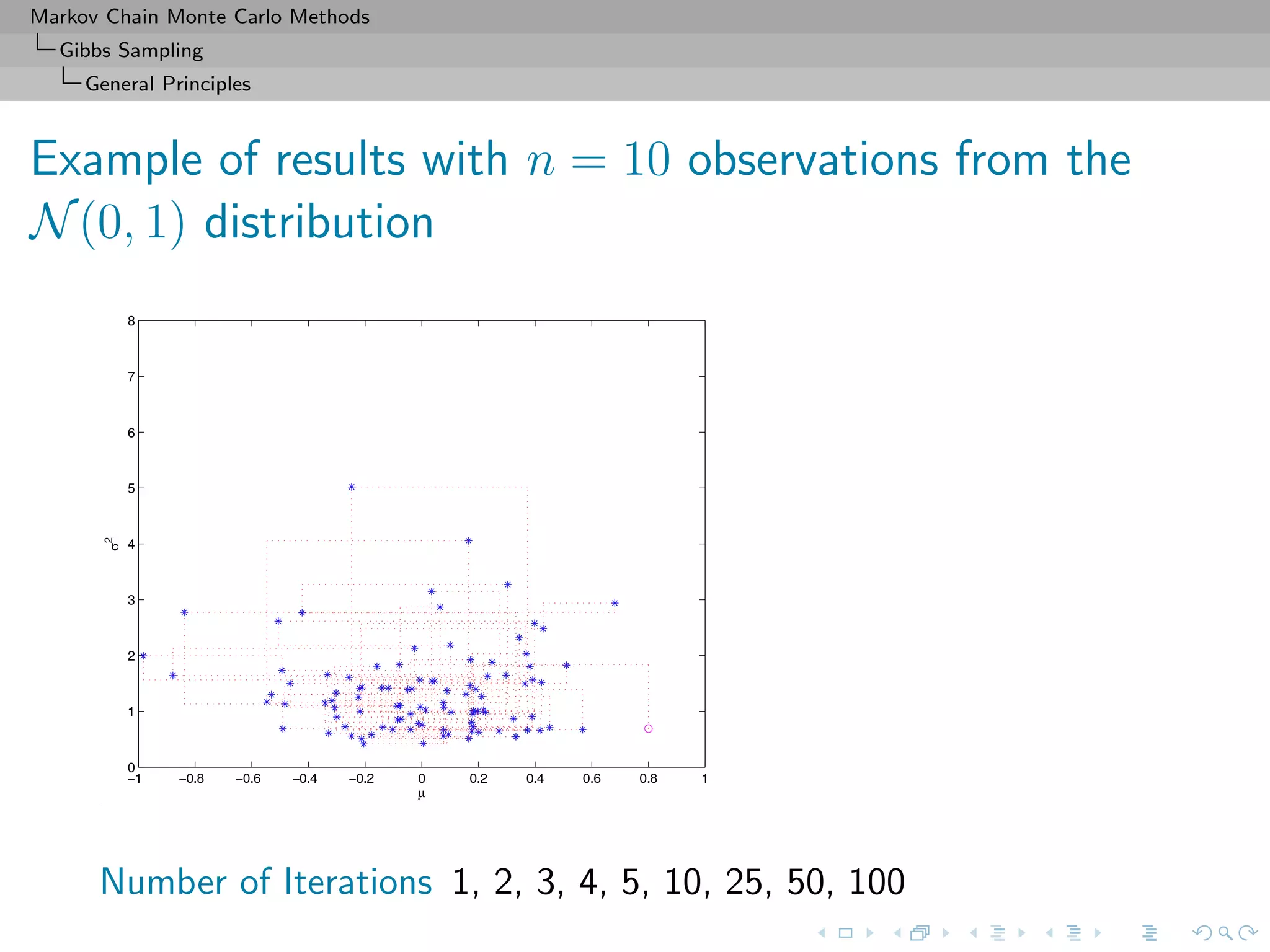
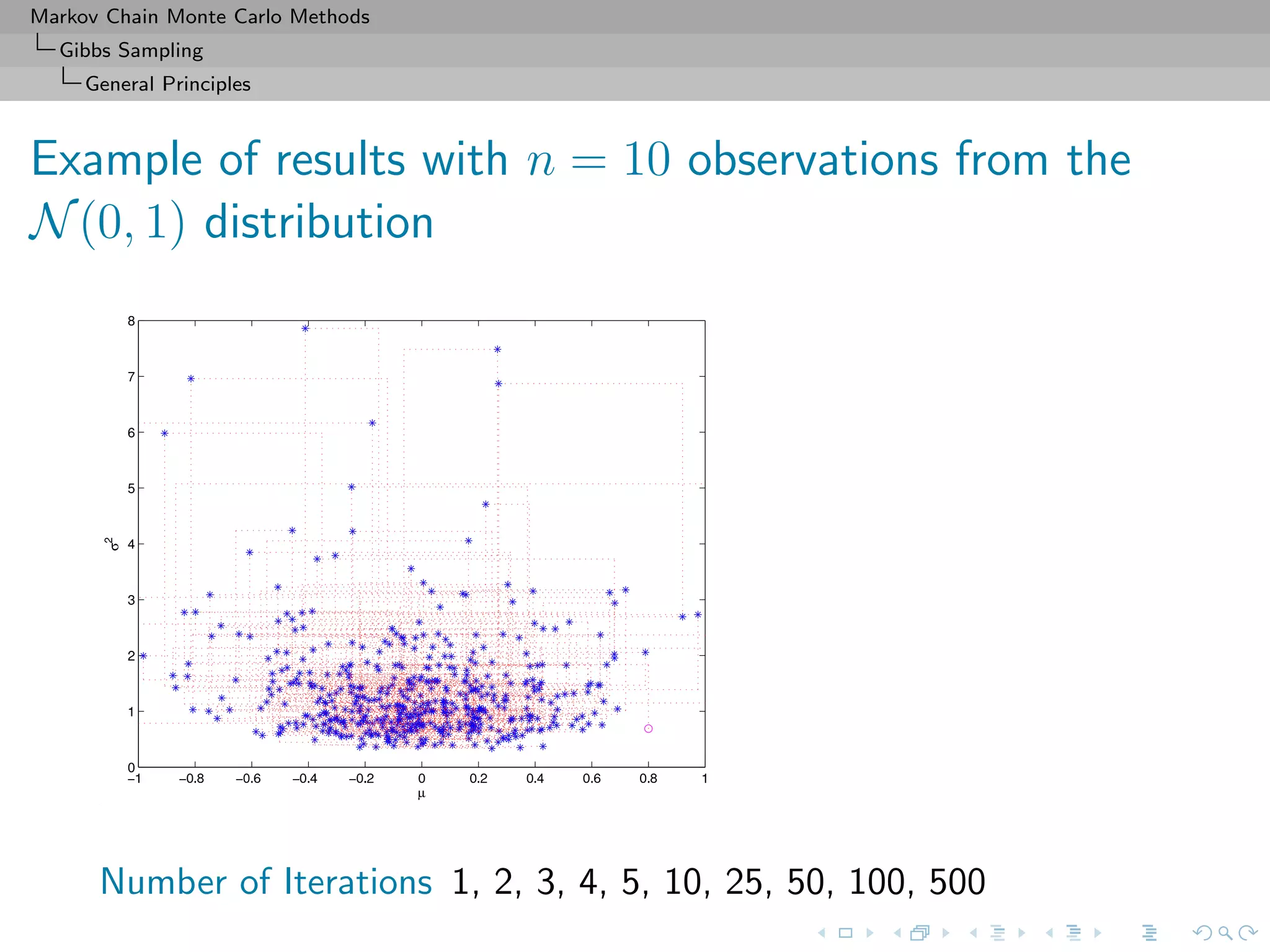
R Gibbs Sampler for Gaussian posterior
n = length(Y);
S = sum(Y);
mu = S/n;
for (i in 1:500)
S2 = sum((Y-mu)^2);
sigma2 = 1/rgamma(1,n/2-1,S2/2);
mu = S/n + sqrt(sigma2/n)*rnorm(1);
Markov Chain Monte Carlo Methods
Gibbs Sampling
General Principles
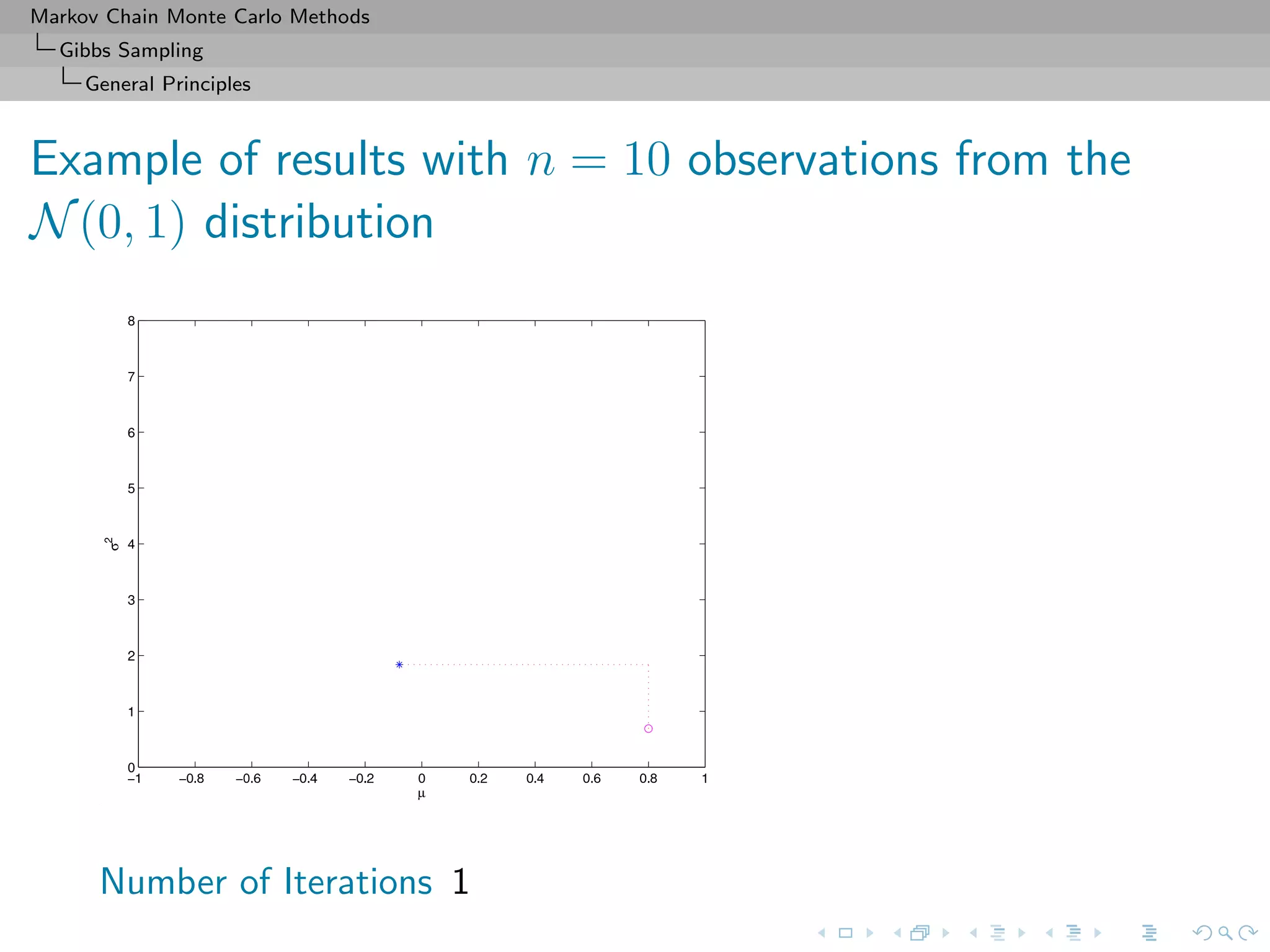
Example of results with n = 10 observations from the
N(0, 1) distribution
Number of Iterations 1
Markov Chain Monte Carlo Methods
Gibbs Sampling
General Principles
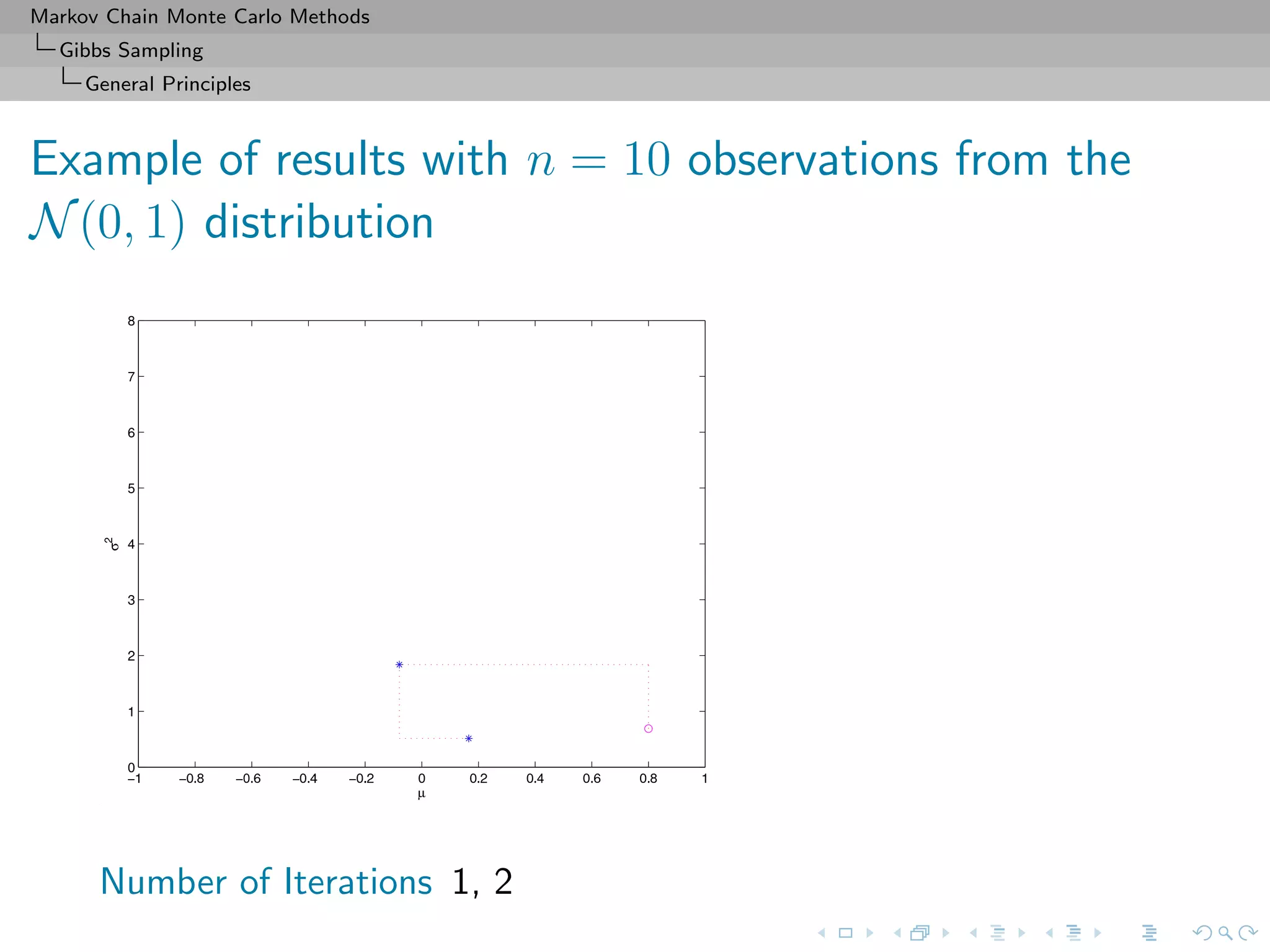
Example of results with n = 10 observations from the
N(0, 1) distribution
Number of Iterations 1, 2
Markov Chain Monte Carlo Methods
Gibbs Sampling
General Principles
Example of results with n = 10 observations from the
N(0, 1) distribution
Number of Iterations 1, 2, 3
Markov Chain Monte Carlo Methods
Gibbs Sampling
General Principles
Example of results with n = 10 observations from the
N(0, 1) distribution
Number of Iterations 1, 2, 3, 4
Markov Chain Monte Carlo Methods
Gibbs Sampling
General Principles
Example of results with n = 10 observations from the
N(0, 1) distribution
Number of Iterations 1, 2, 3, 4, 5
Markov Chain Monte Carlo Methods
Gibbs Sampling
General Principles
Example of results with n = 10 observations from the
N(0, 1) distribution
Number of Iterations 1, 2, 3, 4, 5, 10
Markov Chain Monte Carlo Methods
Gibbs Sampling
General Principles
Example of results with n = 10 observations from the
N(0, 1) distribution
Number of Iterations 1, 2, 3, 4, 5, 10, 25
Markov Chain Monte Carlo Methods
Gibbs Sampling
General Principles
Example of results with n = 10 observations from the
N(0, 1) distribution
Number of Iterations 1, 2, 3, 4, 5, 10, 25, 50
Markov Chain Monte Carlo Methods
Gibbs Sampling
General Principles
Example of results with n = 10 observations from the
N(0, 1) distribution
Number of Iterations 1, 2, 3, 4, 5, 10, 25, 50, 100
Markov Chain Monte Carlo Methods
Gibbs Sampling
General Principles
Example of results with n = 10 observations from the
N(0, 1) distribution
Number of Iterations 1, 2, 3, 4, 5, 10, 25, 50, 100, 500
Markov Chain Monte Carlo Methods
Gibbs Sampling
Completion
Latent variables
The Gibbs sampler can be generalized in much wider generality
A density g is a completion of f if
Z
g(x, z) dz = f(x)
Markov Chain Monte Carlo Methods
Gibbs Sampling
Completion
Latent variables
The Gibbs sampler can be generalized in much wider generality
A density g is a completion of f if
Z
g(x, z) dz = f(x)
Note
The variable z may be meaningless for the problem
Markov Chain Monte Carlo Methods
Gibbs Sampling
Completion
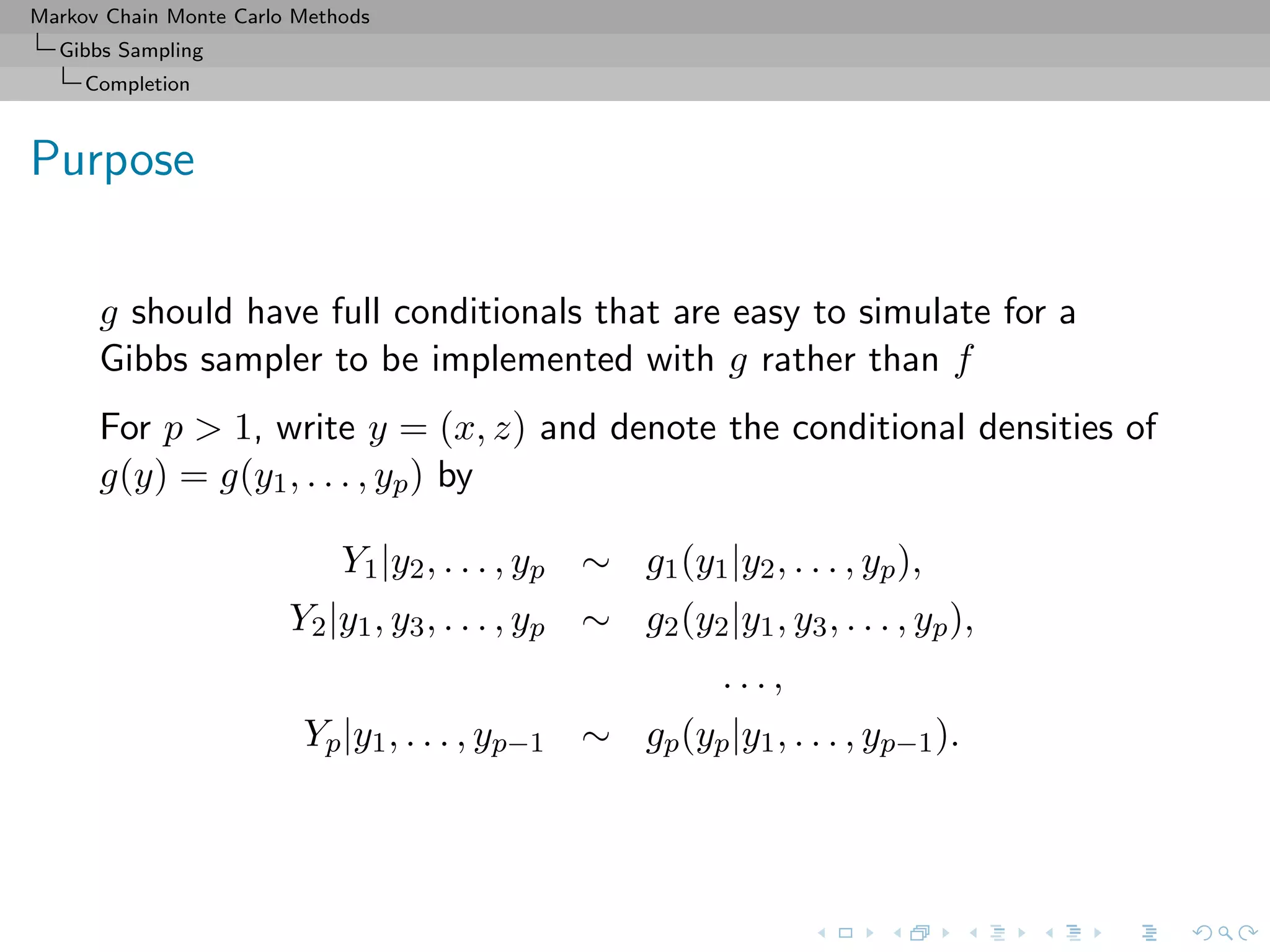
Purpose
g should have full conditionals that are easy to simulate for a
Gibbs sampler to be implemented with g rather than f
For p > 1, write y = (x, z) and denote the conditional densities of
g(y) = g(y1, . . . , yp) by
Y1|y2, . . . , yp ∼ g1(y1|y2, . . . , yp),
Y2|y1, y3, . . . , yp ∼ g2(y2|y1, y3, . . . , yp),
. . . ,
Yp|y1, . . . , yp−1 ∼ gp(yp|y1, . . . , yp−1).
Markov Chain Monte Carlo Methods
Gibbs Sampling
Completion
Purpose
The move from Y (t) to Y (t+1) is defined as follows:
Algorithm (Completion Gibbs sampler)
Given (y
(t)
1 , . . . , y
(t)
p ), simulate
1. Y
(t+1)
1 ∼ g1(y1|y
(t)
2 , . . . , y
(t)
p ),
2. Y
(t+1)
2 ∼ g2(y2|y
(t+1)
1 , y
(t)
3 , . . . , y
(t)
p ),
. . .
p. Y
(t+1)
p ∼ gp(yp|y
(t+1)
1 , . . . , y
(t+1)
p−1 ).
Markov Chain Monte Carlo Methods
Gibbs Sampling
Completion
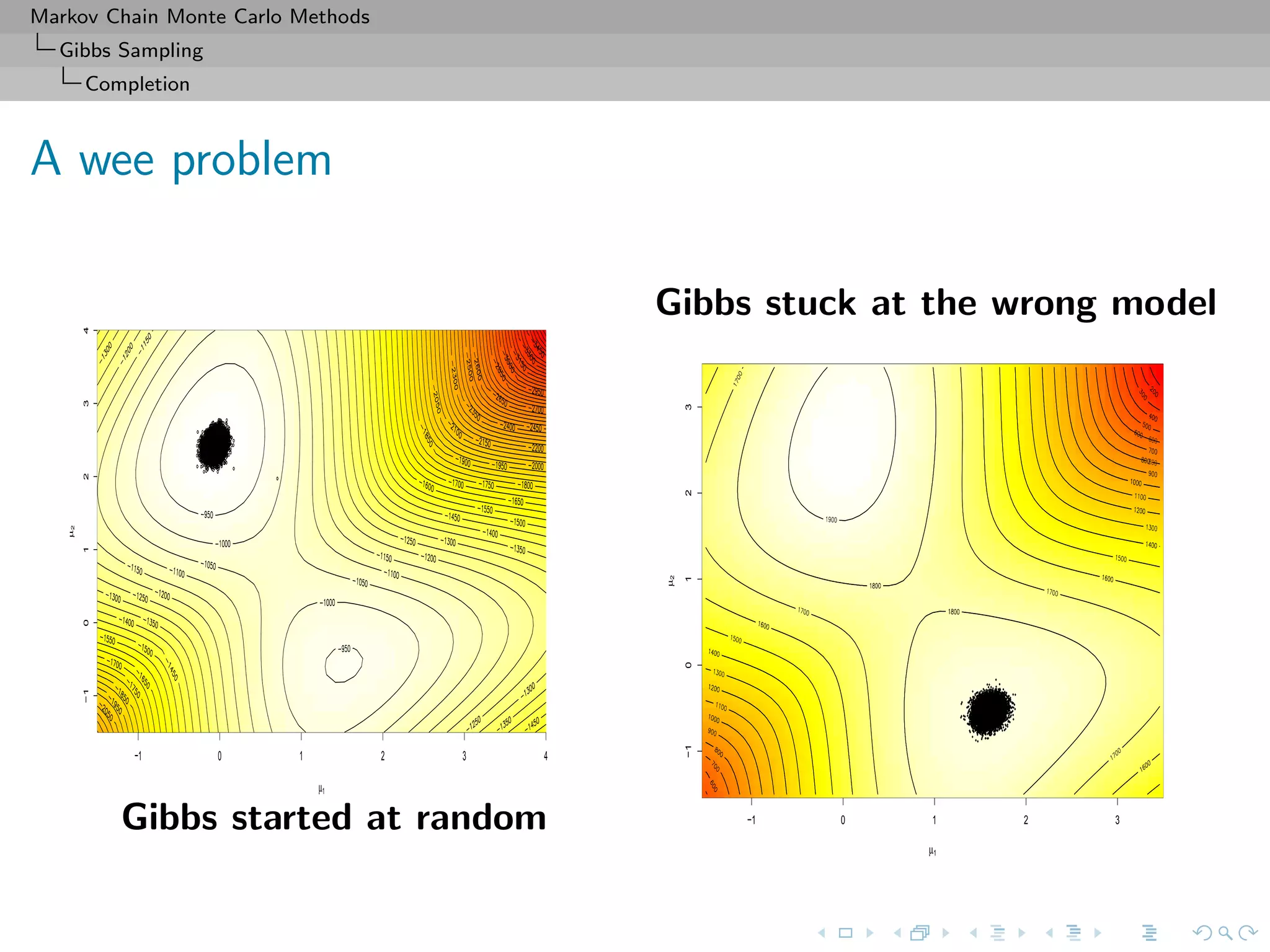
A wee problem
−1 0 1 2 3 4
−101234
µ1
µ2
Gibbs started at random
Gibbs stuck at the wrong model
−1 0 1 2 3
−10123
µ1
µ2
Markov Chain Monte Carlo Methods
Gibbs Sampling
Completion
Slice sampler as generic Gibbs
If f(θ) can be written as a product
k
i=1
fi(θ),
Markov Chain Monte Carlo Methods
Gibbs Sampling
Completion
Slice sampler as generic Gibbs
If f(θ) can be written as a product
k
i=1
fi(θ),
it can be completed as
k
i=1
I0≤ωi≤fi(θ),
leading to the following Gibbs algorithm:
Markov Chain Monte Carlo Methods
Gibbs Sampling
Completion
Slice sampler
Algorithm (Slice sampler)
Simulate
1. ω
(t+1)
1 ∼ U[0,f1(θ(t))];
. . .
k. ω
(t+1)
k ∼ U[0,fk(θ(t))];
k+1. θ(t+1) ∼ UA(t+1) , with
A(t+1)
= {y; fi(y) ≥ ω
(t+1)
i , i = 1, . . . , k}.
Markov Chain Monte Carlo Methods
Gibbs Sampling
Completion
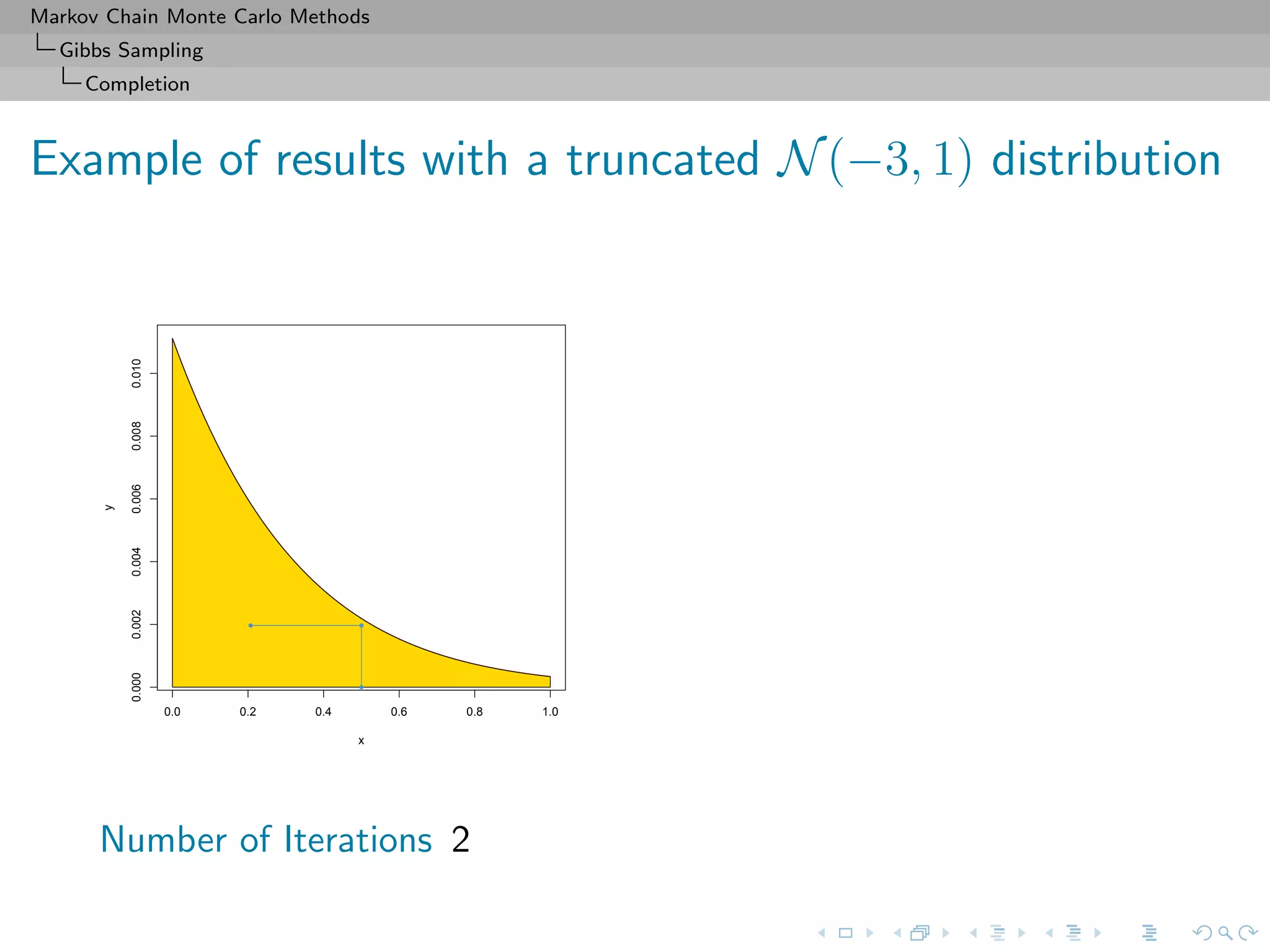
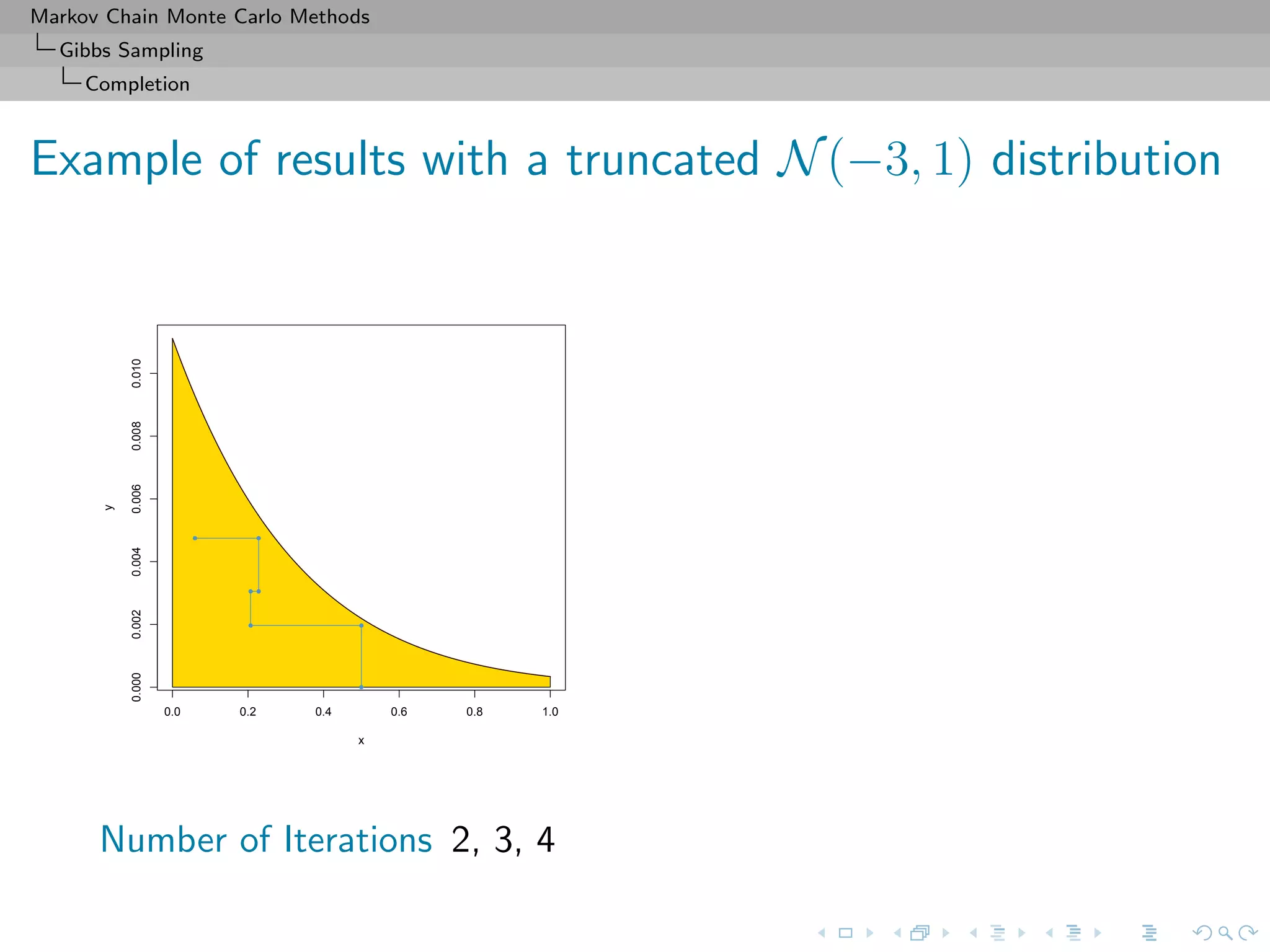
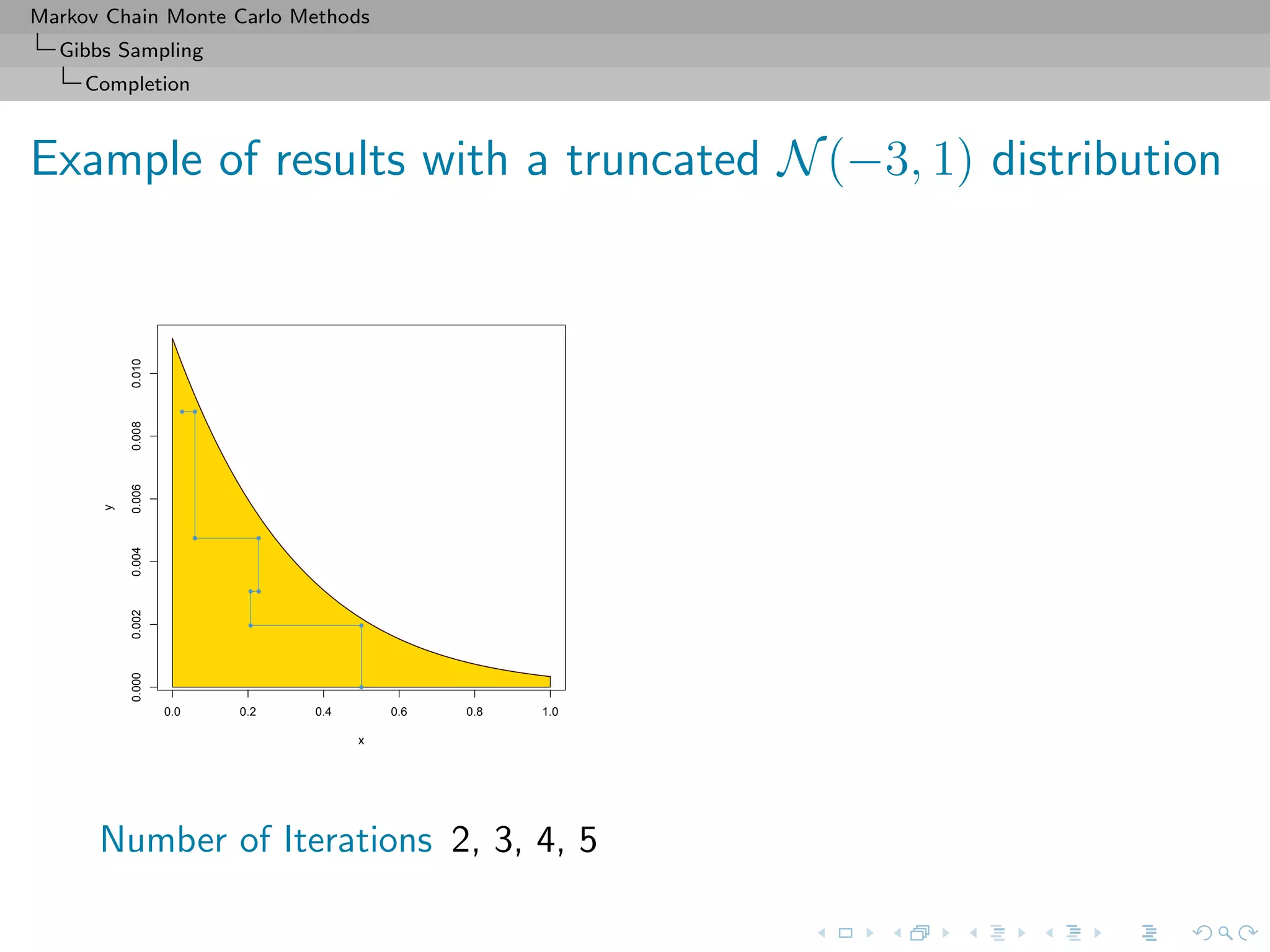
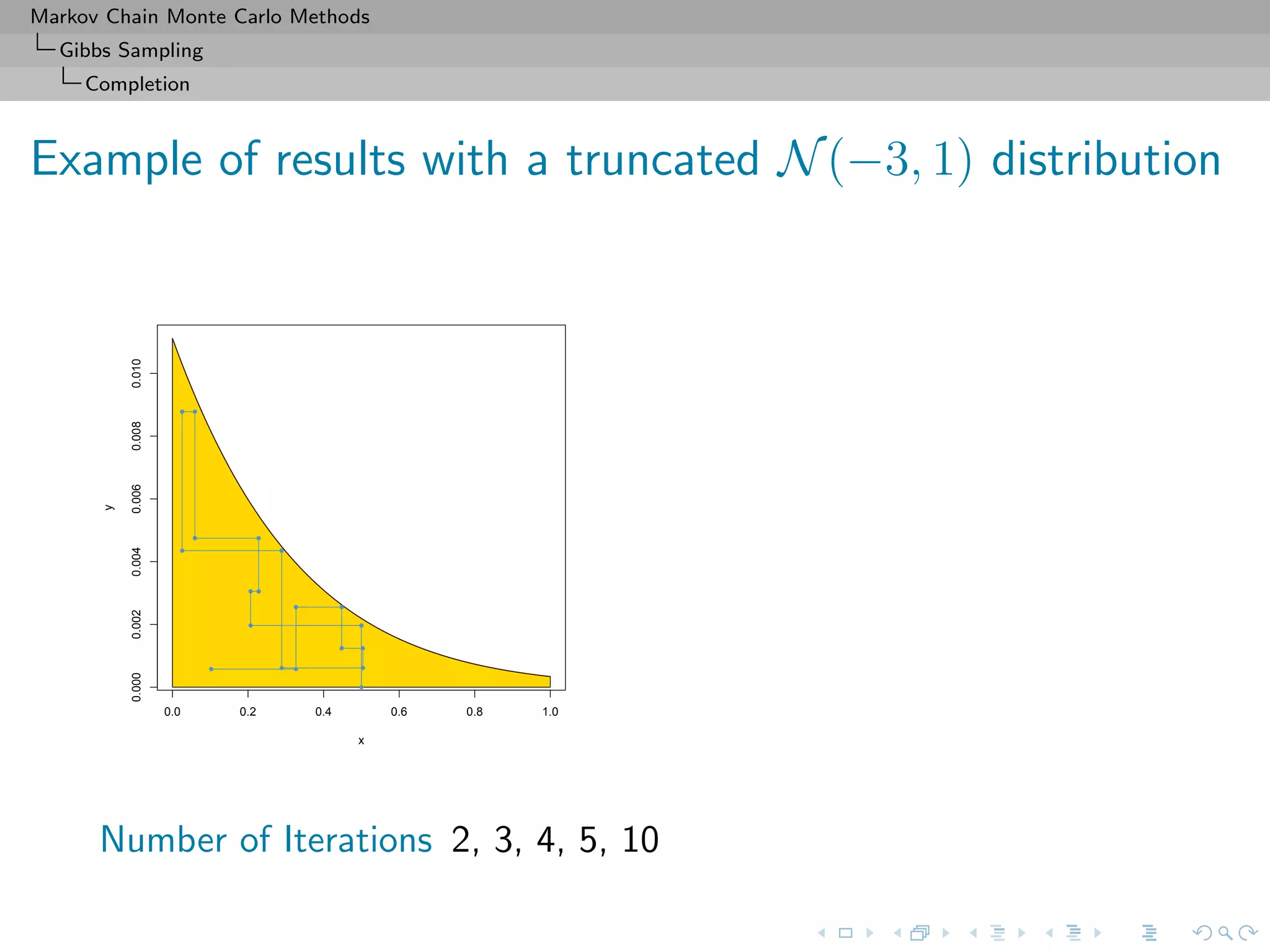
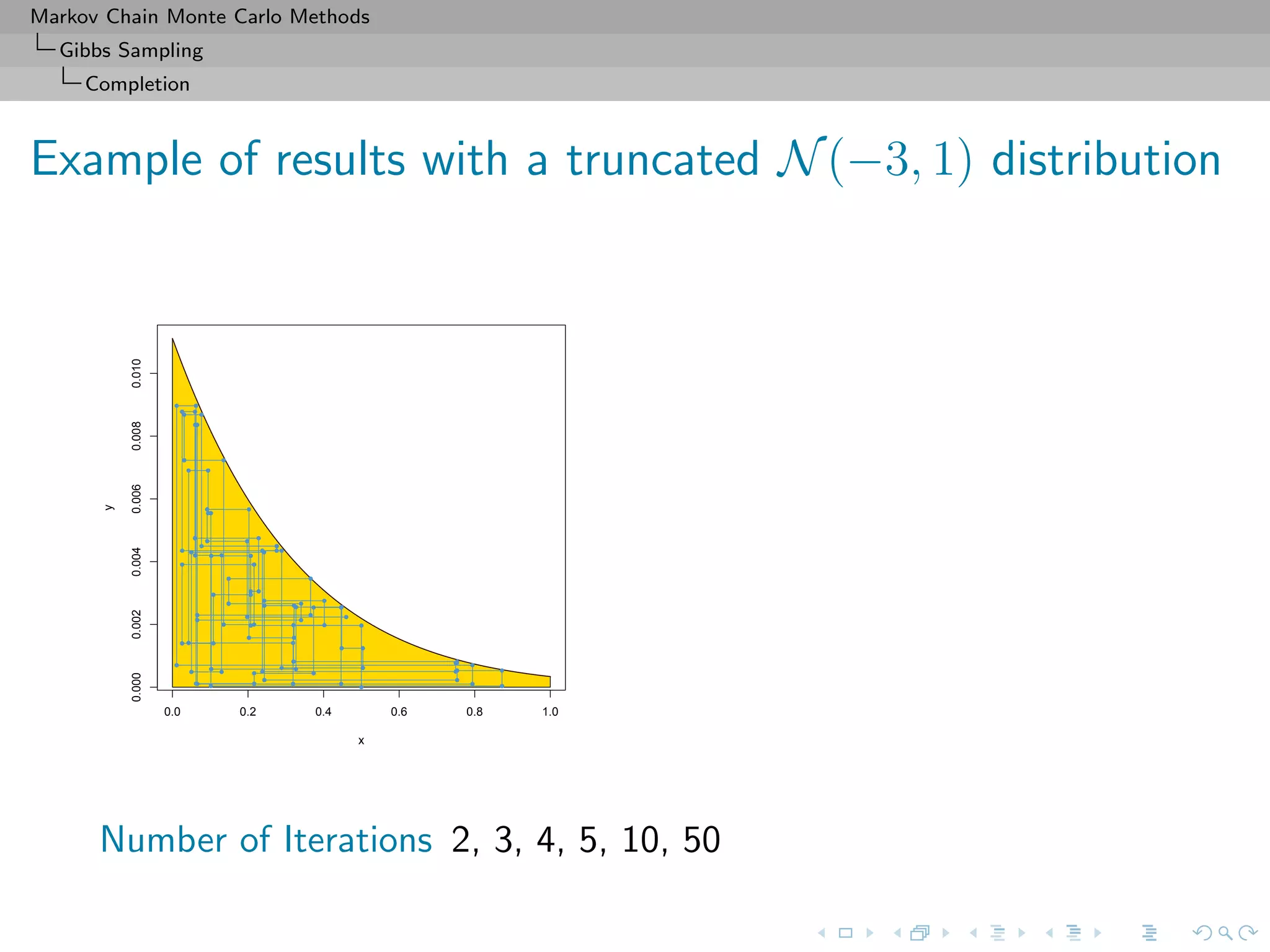
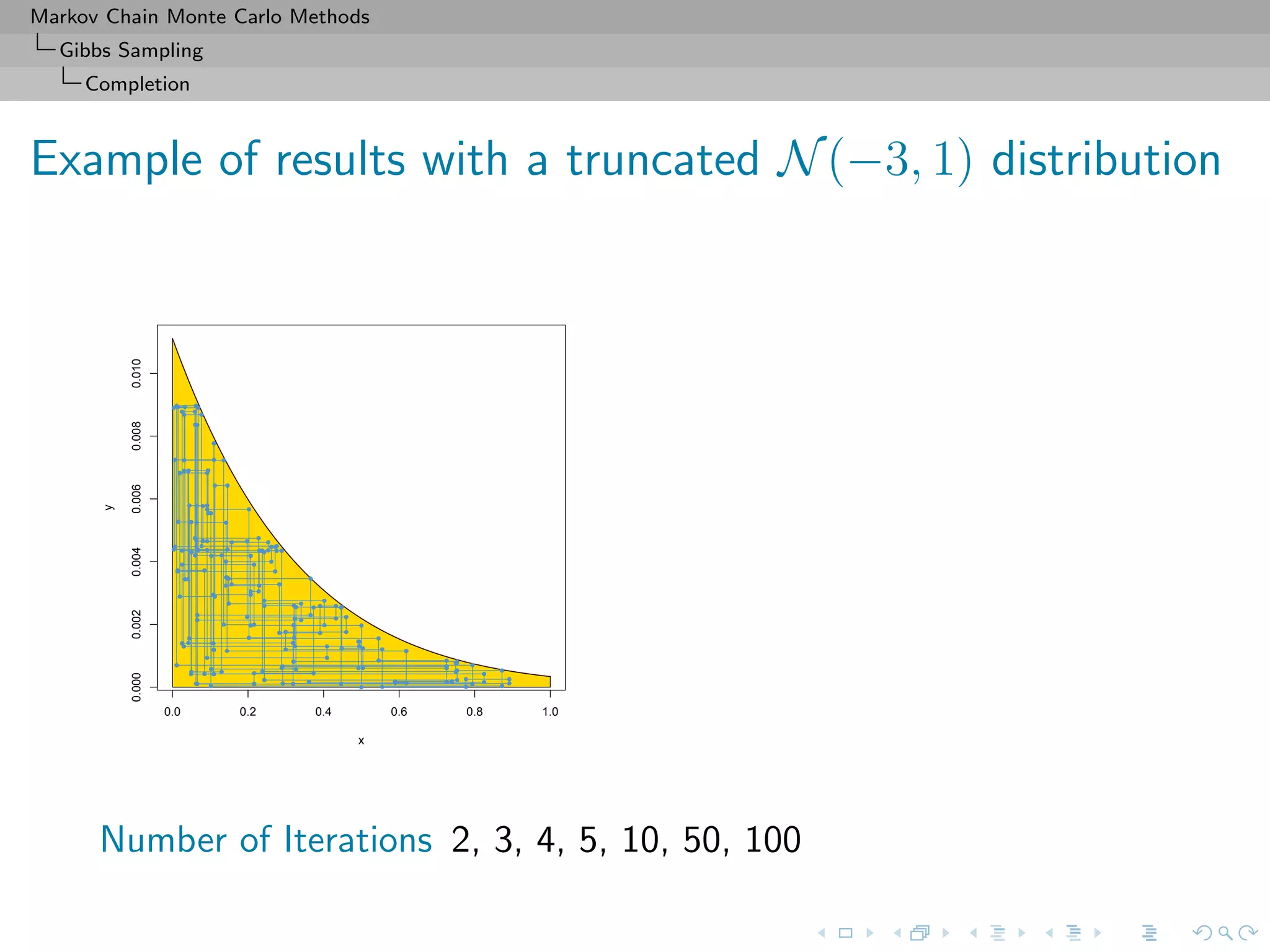
Example of results with a truncated N(−3, 1) distribution
0.0 0.2 0.4 0.6 0.8 1.0
0.0000.0020.0040.0060.0080.010
x
y
Number of Iterations 2
Markov Chain Monte Carlo Methods
Gibbs Sampling
Completion
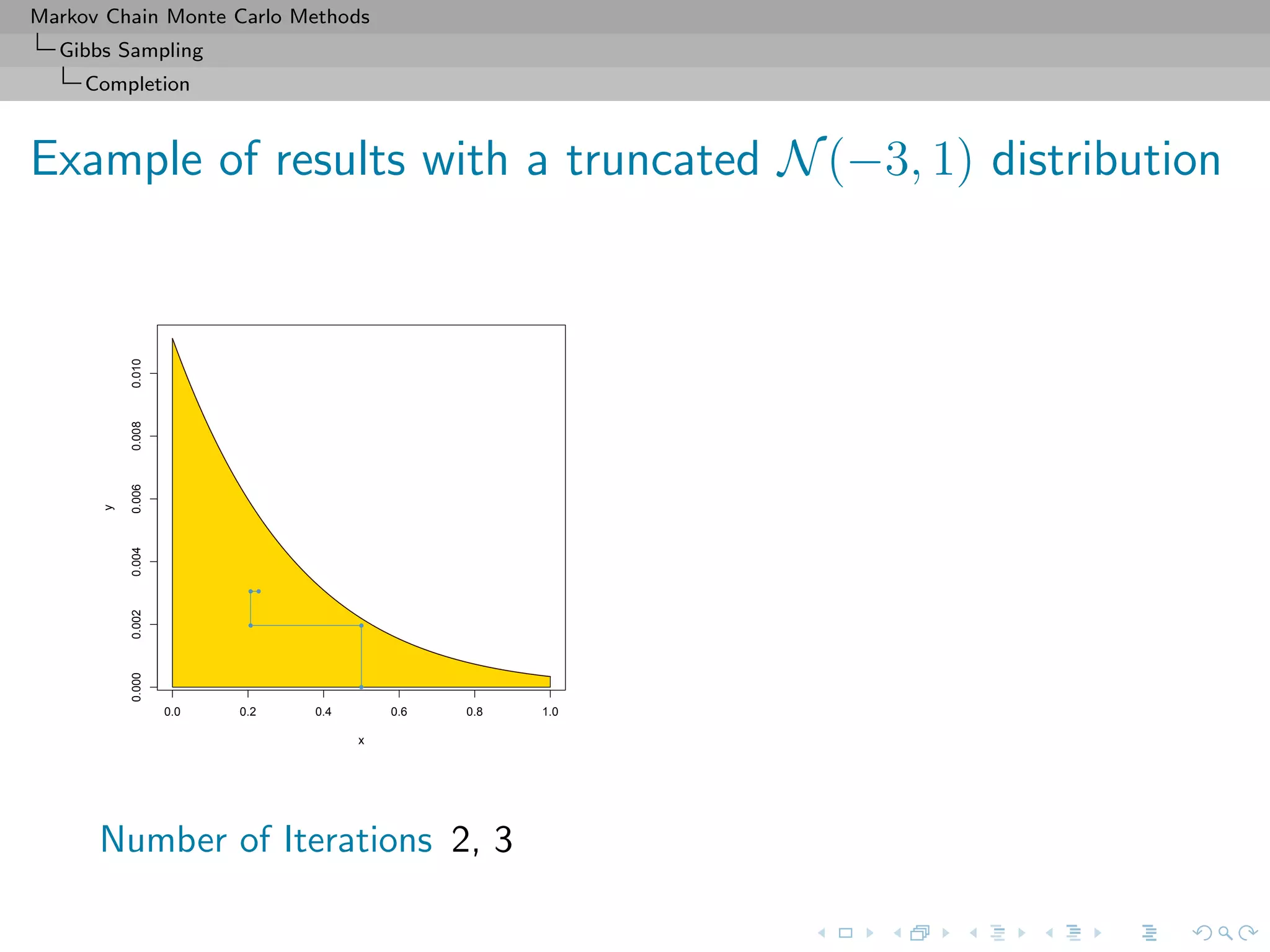
Example of results with a truncated N(−3, 1) distribution
0.0 0.2 0.4 0.6 0.8 1.0
0.0000.0020.0040.0060.0080.010
x
y
Number of Iterations 2, 3
Markov Chain Monte Carlo Methods
Gibbs Sampling
Completion
Example of results with a truncated N(−3, 1) distribution
0.0 0.2 0.4 0.6 0.8 1.0
0.0000.0020.0040.0060.0080.010
x
y
Number of Iterations 2, 3, 4
Markov Chain Monte Carlo Methods
Gibbs Sampling
Completion
Example of results with a truncated N(−3, 1) distribution
0.0 0.2 0.4 0.6 0.8 1.0
0.0000.0020.0040.0060.0080.010
x
y
Number of Iterations 2, 3, 4, 5
Markov Chain Monte Carlo Methods
Gibbs Sampling
Completion
Example of results with a truncated N(−3, 1) distribution
0.0 0.2 0.4 0.6 0.8 1.0
0.0000.0020.0040.0060.0080.010
x
y
Number of Iterations 2, 3, 4, 5, 10
Markov Chain Monte Carlo Methods
Gibbs Sampling
Completion
Example of results with a truncated N(−3, 1) distribution
0.0 0.2 0.4 0.6 0.8 1.0
0.0000.0020.0040.0060.0080.010
x
y
Number of Iterations 2, 3, 4, 5, 10, 50
Markov Chain Monte Carlo Methods
Gibbs Sampling
Completion
Example of results with a truncated N(−3, 1) distribution
0.0 0.2 0.4 0.6 0.8 1.0
0.0000.0020.0040.0060.0080.010
x
y
Number of Iterations 2, 3, 4, 5, 10, 50, 100
Markov Chain Monte Carlo Methods
Gibbs Sampling
Completion
Good slices
The slice sampler usually enjoys good theoretical properties (like
geometric ergodicity and even uniform ergodicity under bounded f
and bounded X ).
As k increases, the determination of the set A(t+1) may get
increasingly complex.
Markov Chain Monte Carlo Methods
Gibbs Sampling
Completion
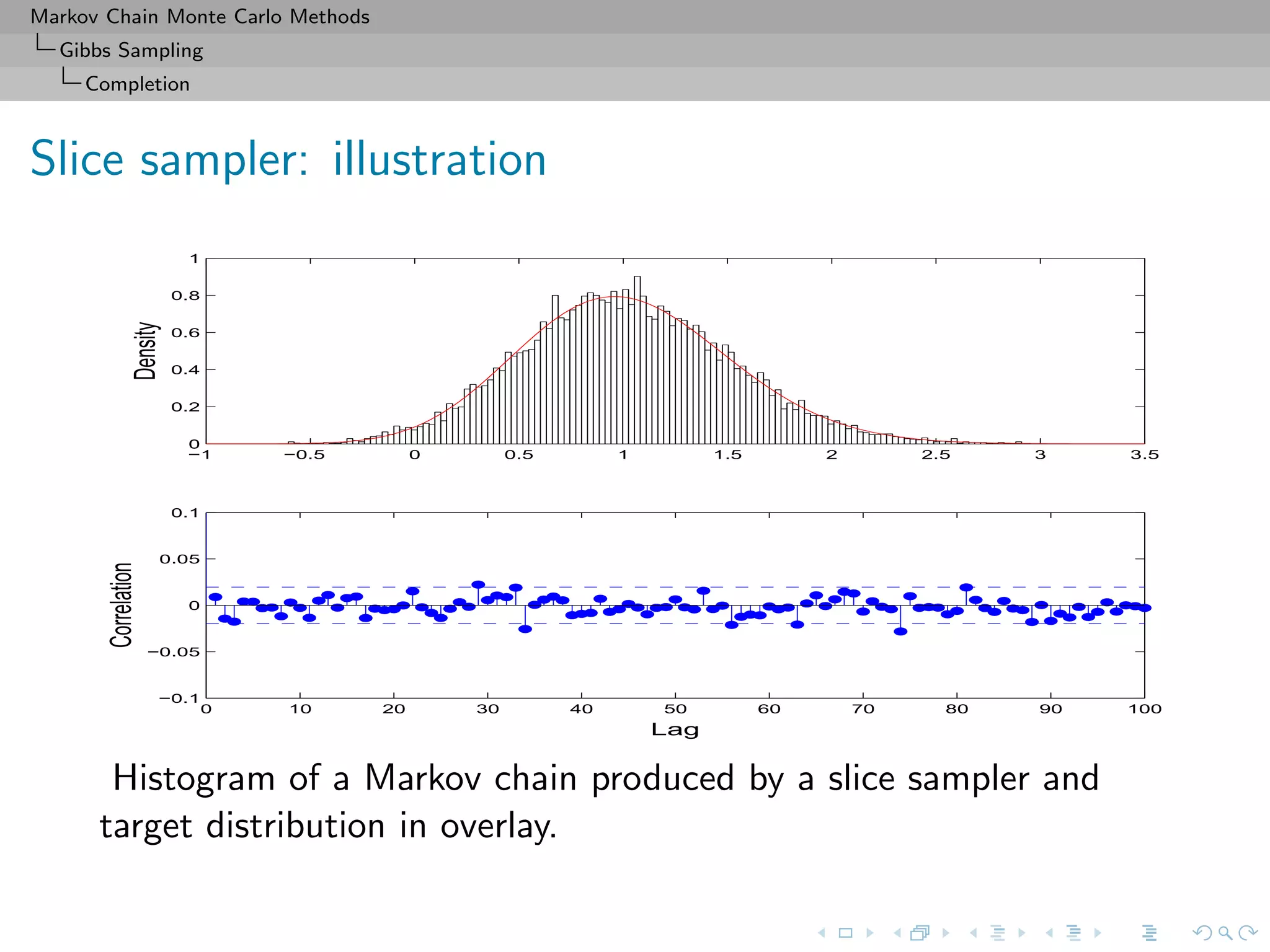
Slice sampler: illustration
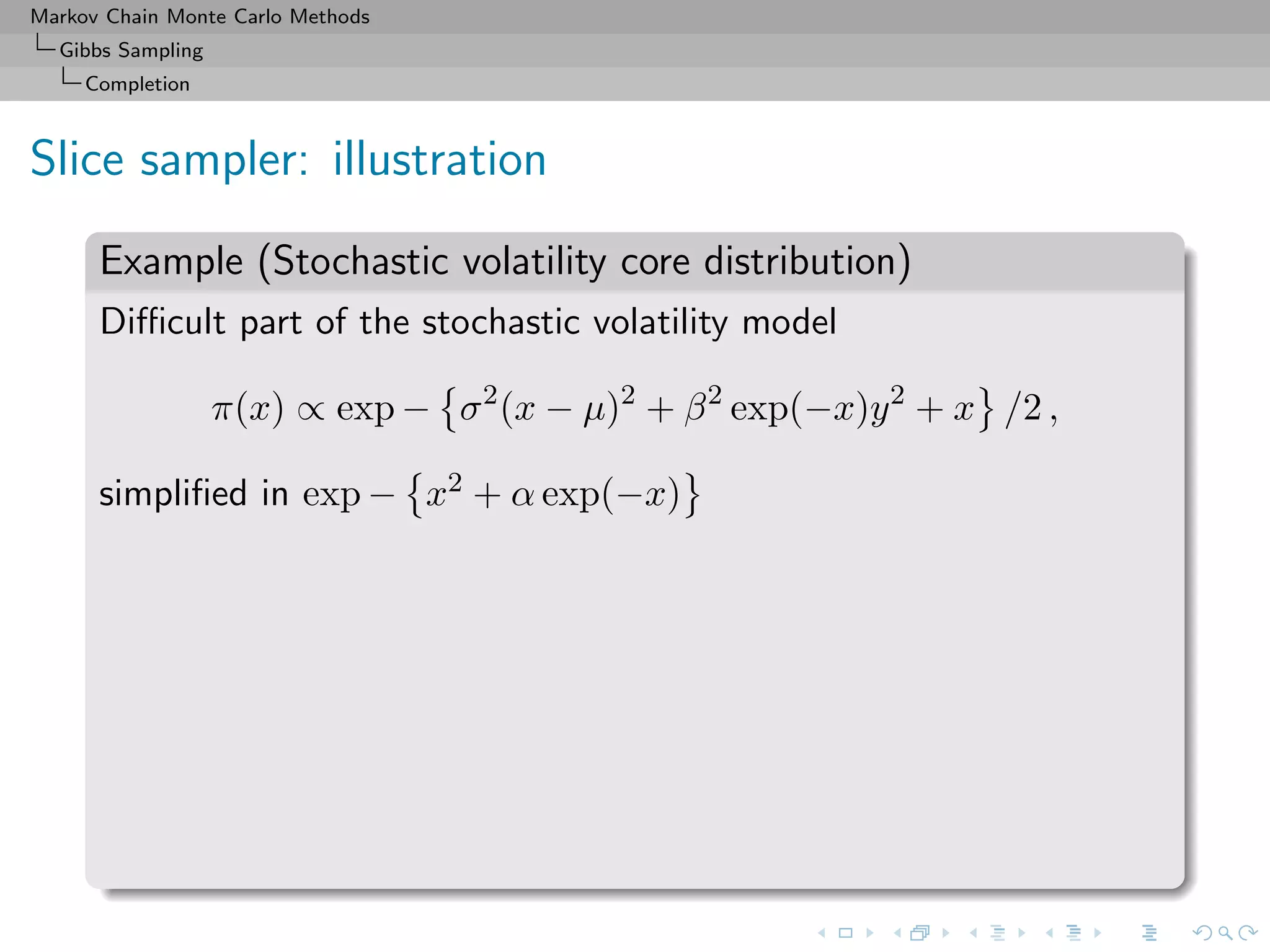
Example (Stochastic volatility core distribution)
Difficult part of the stochastic volatility model
π(x) ∝ exp − σ2
(x − µ)2
+ β2
exp(−x)y2
+ x /2 ,
simplified in exp − x2 + α exp(−x)
Markov Chain Monte Carlo Methods
Gibbs Sampling
Completion
Slice sampler: illustration
Example (Stochastic volatility core distribution)
Difficult part of the stochastic volatility model
π(x) ∝ exp − σ2
(x − µ)2
+ β2
exp(−x)y2
+ x /2 ,
simplified in exp − x2 + α exp(−x)
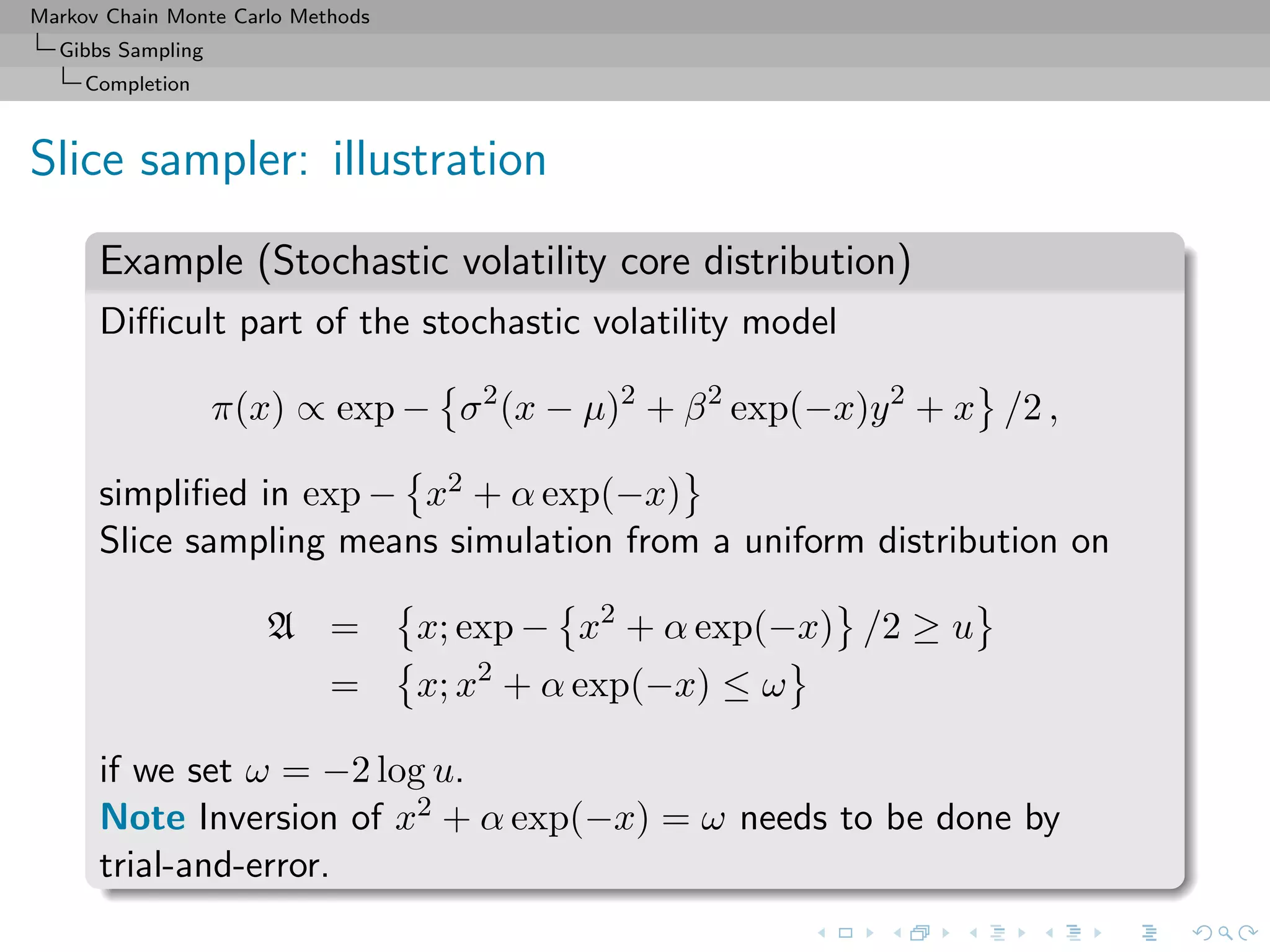
Slice sampling means simulation from a uniform distribution on
A = x; exp − x2
+ α exp(−x) /2 ≥ u
= x; x2
+ α exp(−x) ≤ ω
if we set ω = −2 log u.
Note Inversion of x2 + α exp(−x) = ω needs to be done by
trial-and-error.
Markov Chain Monte Carlo Methods
Gibbs Sampling
Completion
Slice sampler: illustration
0 10 20 30 40 50 60 70 80 90 100
−0.1
−0.05
0
0.05
0.1
Lag
Correlation
−1 −0.5 0 0.5 1 1.5 2 2.5 3 3.5
0
0.2
0.4
0.6
0.8
1
Density
Histogram of a Markov chain produced by a slice sampler and
target distribution in overlay.
Markov Chain Monte Carlo Methods
Gibbs Sampling
Convergence
Properties of the Gibbs sampler
Theorem (Convergence)
For
(Y1, Y2, · · · , Yp) ∼ g(y1, . . . , yp),
if either
[Positivity condition]
(i) g(i)(yi) > 0 for every i = 1, · · · , p, implies that
g(y1, . . . , yp) > 0, where g(i) denotes the marginal distribution
of Yi, or
(ii) the transition kernel is absolutely continuous with respect to g,
then the chain is irreducible and positive Harris recurrent.
Markov Chain Monte Carlo Methods
Gibbs Sampling
Convergence
Properties of the Gibbs sampler (2)
Consequences
(i) If h(y)g(y)dy < ∞, then
lim
nT→∞
1
T
T
t=1
h1(Y (t)
) = h(y)g(y)dy a.e. g.
(ii) If, in addition, (Y (t)) is aperiodic, then
lim
n→∞
Kn
(y, ·)µ(dx) − f
TV
= 0
for every initial distribution µ.
Markov Chain Monte Carlo Methods
Gibbs Sampling
Convergence
Slice sampler
fast on that slice
For convergence, the properties of Xt and of f(Xt) are identical
Theorem (Uniform ergodicity)
If f is bounded and suppf is bounded, the simple slice sampler is
uniformly ergodic.
[Mira & Tierney, 1997]
Markov Chain Monte Carlo Methods
Gibbs Sampling
The Hammersley-Clifford theorem
Hammersley-Clifford theorem
An illustration that conditionals determine the joint distribution
Theorem
If the joint density g(y1, y2) have conditional distributions
g1(y1|y2) and g2(y2|y1), then
g(y1, y2) =
g2(y2|y1)
g2(v|y1)/g1(y1|v) dv
.
[Hammersley & Clifford, circa 1970]
Markov Chain Monte Carlo Methods
Gibbs Sampling
The Hammersley-Clifford theorem
General HC decomposition
Under the positivity condition, the joint distribution g satisfies
g(y1, . . . , yp) ∝
p
j=1
g j
(y j
|y 1 , . . . , y j−1
, y j+1
, . . . , y p
)
g j
(y j
|y 1 , . . . , y j−1
, y j+1
, . . . , y p
)
for every permutation on {1, 2, . . . , p} and every y ∈ Y .
Markov Chain Monte Carlo Methods
Gibbs Sampling
The Hammersley-Clifford theorem
Rao-Blackwellization
If (y1, y2, . . . , yp)(t), t = 1, 2, . . . T is the output from a Gibbs
sampler
δ0 =
1
T
T
t=1
h y
(t)
1 → h(y1)g(y1)dy1
and is unbiased.
Markov Chain Monte Carlo Methods
Gibbs Sampling
The Hammersley-Clifford theorem
Rao-Blackwellization
If (y1, y2, . . . , yp)(t), t = 1, 2, . . . T is the output from a Gibbs
sampler
δ0 =
1
T
T
t=1
h y
(t)
1 → h(y1)g(y1)dy1
and is unbiased.
The Rao-Blackwellization replaces δ0 with its conditional
expectation
δrb =
1
T
T
t=1
I h(Y1)|y
(t)
2 , . . . , y(t)
p .
Markov Chain Monte Carlo Methods
Gibbs Sampling
The Hammersley-Clifford theorem
Rao-Blackwellization (2)
Then
◦ Both estimators converge to I[h(Y1)]
◦ Both are unbiased,
Markov Chain Monte Carlo Methods
Gibbs Sampling
The Hammersley-Clifford theorem
Rao-Blackwellization (2)
Then
◦ Both estimators converge to I[h(Y1)]
◦ Both are unbiased,
◦ and
var I h(Y1)|Y
(t)
2 , . . . , Y (t)
p ≤ var(h(Y1)),
so δrb is uniformly better (for Data Augmentation)
Markov Chain Monte Carlo Methods
Gibbs Sampling
The Hammersley-Clifford theorem
Examples of Rao-Blackwellization
Example
Bivariate normal Gibbs sampler
X | y ∼ N(ρy, 1 − ρ2
)
Y | x ∼ N(ρx, 1 − ρ2
).
Then
δ0 =
1
T
T
i=1
X(i)
and δ1 =
1
T
T
i=1
I[X(i)
|Y (i)
] =
1
T
T
i=1
Y (i)
,
estimate I[X] and σ2
δ0
/σ2
δ1
= 1
ρ2 > 1.
Markov Chain Monte Carlo Methods
Gibbs Sampling
The Hammersley-Clifford theorem
Examples of Rao-Blackwellization (2)
Example (Poisson-Gamma Gibbs cont’d)
Na¨ıve estimate
δ0 =
1
T
T
t=1
λ(t)
and Rao-Blackwellized version
δπ
=
1
T
T
t=1
I[λ(t)
|x1, x2, . . . , x5, y
(i)
1 , y
(i)
2 , . . . , y
(i)
13 ]
=
1
360T
T
t=1
313 +
13
i=1
y
(t)
i ,
back to graph
Markov Chain Monte Carlo Methods
Gibbs Sampling
The Hammersley-Clifford theorem
NP Rao-Blackwellization & Rao-Blackwellized NP
Another substantial benefit of Rao-Blackwellization is in the
approximation of densities of different components of y without
nonparametric density estimation methods.
Markov Chain Monte Carlo Methods
Gibbs Sampling
The Hammersley-Clifford theorem
NP Rao-Blackwellization & Rao-Blackwellized NP
Another substantial benefit of Rao-Blackwellization is in the
approximation of densities of different components of y without
nonparametric density estimation methods.
Lemma
The estimator
1
T
T
t=1
gi(yi|y
(t)
j , j = i) −→ gi(yi),
is unbiased.
Markov Chain Monte Carlo Methods
Gibbs Sampling
Improper Priors
Improper priors
Unsuspected danger resulting from careless use of MCMC
algorithms:
Markov Chain Monte Carlo Methods
Gibbs Sampling
Improper Priors
Improper priors
Unsuspected danger resulting from careless use of MCMC
algorithms:
It may happen that
◦ all conditional distributions are well defined,
◦ all conditional distributions may be simulated from, but...
Markov Chain Monte Carlo Methods
Gibbs Sampling
Improper Priors
Improper priors
Unsuspected danger resulting from careless use of MCMC
algorithms:
It may happen that
◦ all conditional distributions are well defined,
◦ all conditional distributions may be simulated from, but...
◦ the system of conditional distributions may not correspond to
any joint distribution
Markov Chain Monte Carlo Methods
Gibbs Sampling
Improper Priors
Improper priors
Unsuspected danger resulting from careless use of MCMC
algorithms:
It may happen that
◦ all conditional distributions are well defined,
◦ all conditional distributions may be simulated from, but...
◦ the system of conditional distributions may not correspond to
any joint distribution
Warning The problem is due to careless use of the Gibbs sampler
in a situation for which the underlying assumptions are violated
Markov Chain Monte Carlo Methods
Gibbs Sampling
Improper Priors
Improper posteriors
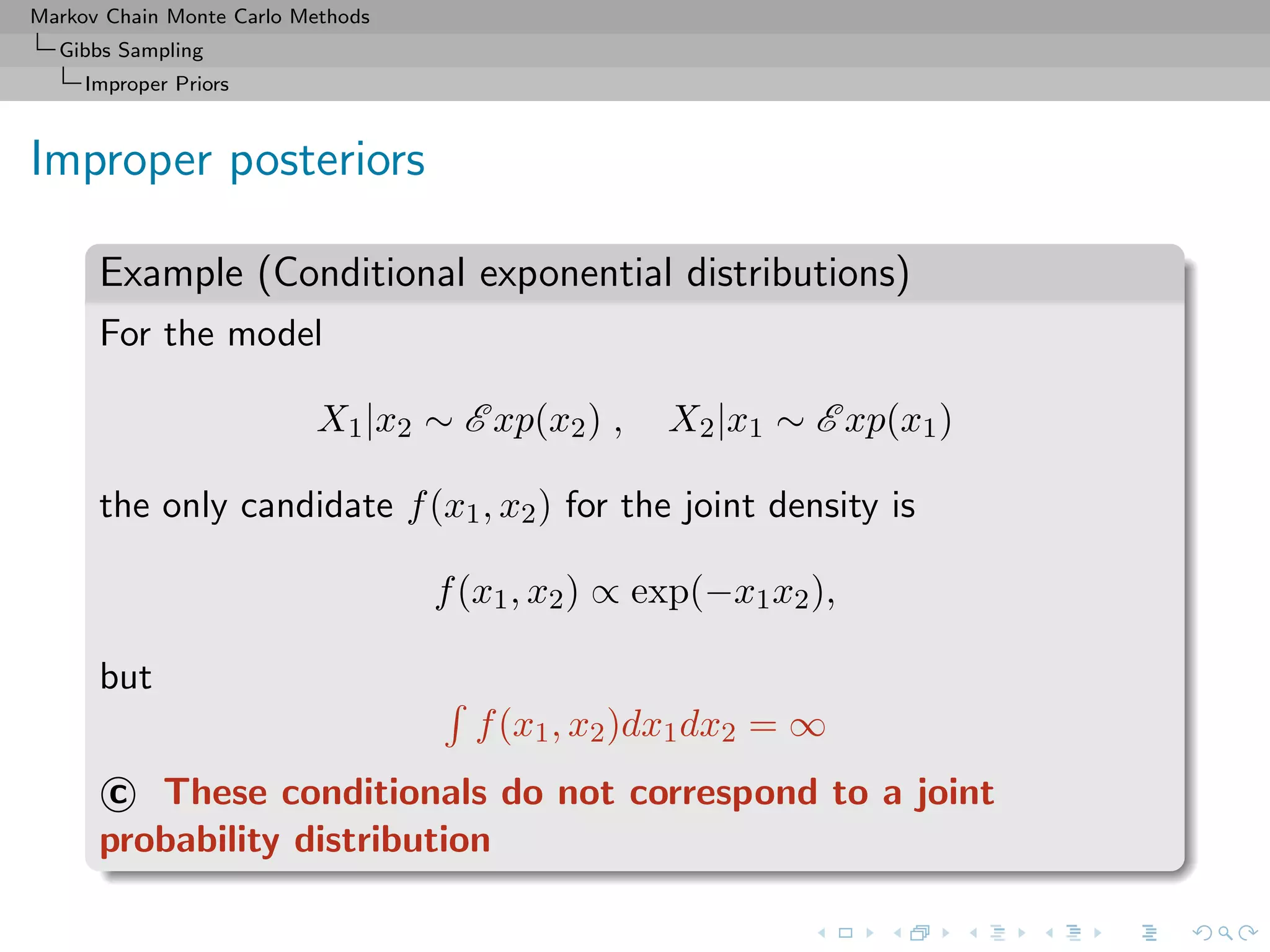
Example (Conditional exponential distributions)
For the model
X1|x2 ∼ E xp(x2) , X2|x1 ∼ E xp(x1)
the only candidate f(x1, x2) for the joint density is
f(x1, x2) ∝ exp(−x1x2),
but
f(x1, x2)dx1dx2 = ∞
c These conditionals do not correspond to a joint
probability distribution
Markov Chain Monte Carlo Methods
Gibbs Sampling
Improper Priors
Improper posteriors
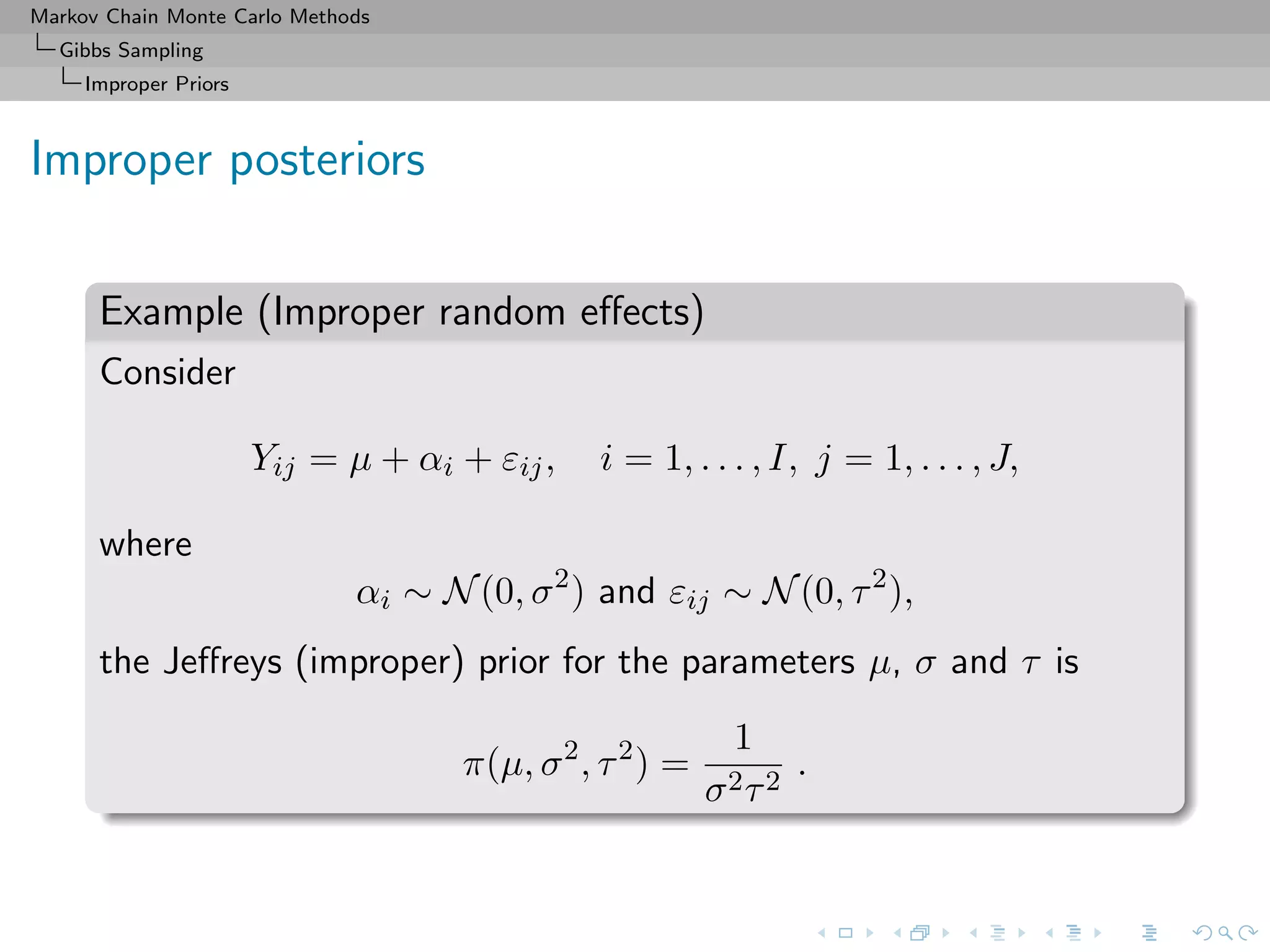
Example (Improper random effects)
Consider
Yij = µ + αi + εij, i = 1, . . . , I, j = 1, . . . , J,
where
αi ∼ N(0, σ2
) and εij ∼ N(0, τ2
),
the Jeffreys (improper) prior for the parameters µ, σ and τ is
π(µ, σ2
, τ2
) =
1
σ2τ2
.
Markov Chain Monte Carlo Methods
Gibbs Sampling
Improper Priors
Improper posteriors
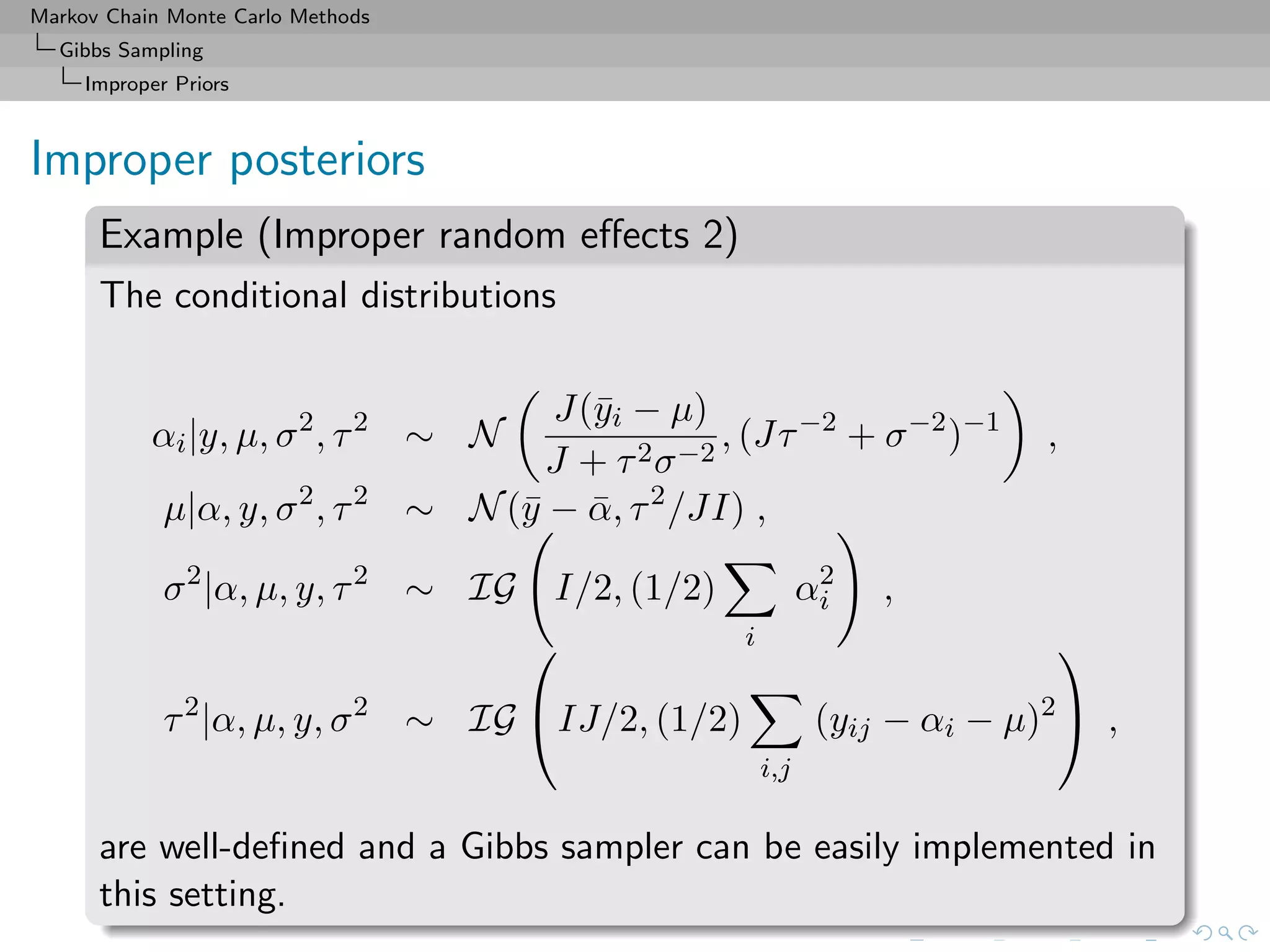
Example (Improper random effects 2)
The conditional distributions
αi|y, µ, σ2
, τ2
∼ N
J(¯yi − µ)
J + τ2σ−2
, (Jτ−2
+ σ−2
)−1
,
µ|α, y, σ2
, τ2
∼ N(¯y − ¯α, τ2
/JI) ,
σ2
|α, µ, y, τ2
∼ IG I/2, (1/2)
i
α2
i ,
τ2
|α, µ, y, σ2
∼ IG

IJ/2, (1/2)
i,j
(yij − αi − µ)2

 ,
are well-defined and a Gibbs sampler can be easily implemented in
this setting.
Markov Chain Monte Carlo Methods
Gibbs Sampling
Improper Priors
Improper posteriors
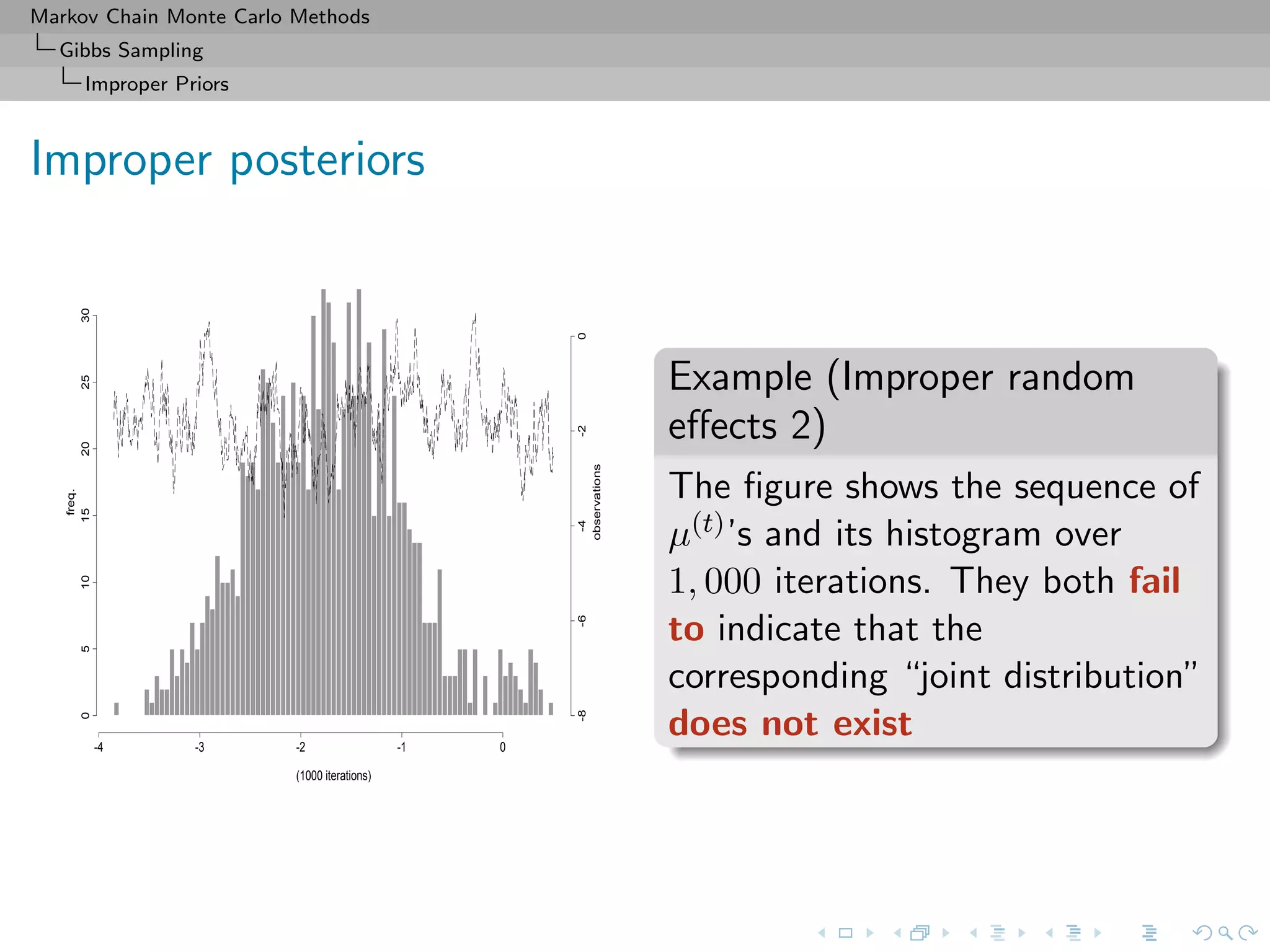
-4 -3 -2 -1 0
051015202530
(1000 iterations)
freq.
-8-6-4-20
observations
Example (Improper random
effects 2)
The figure shows the sequence of
µ(t)’s and its histogram over
1, 000 iterations. They both fail
to indicate that the
corresponding “joint distribution”
does not exist
Markov Chain Monte Carlo Methods
Gibbs Sampling
Improper Priors
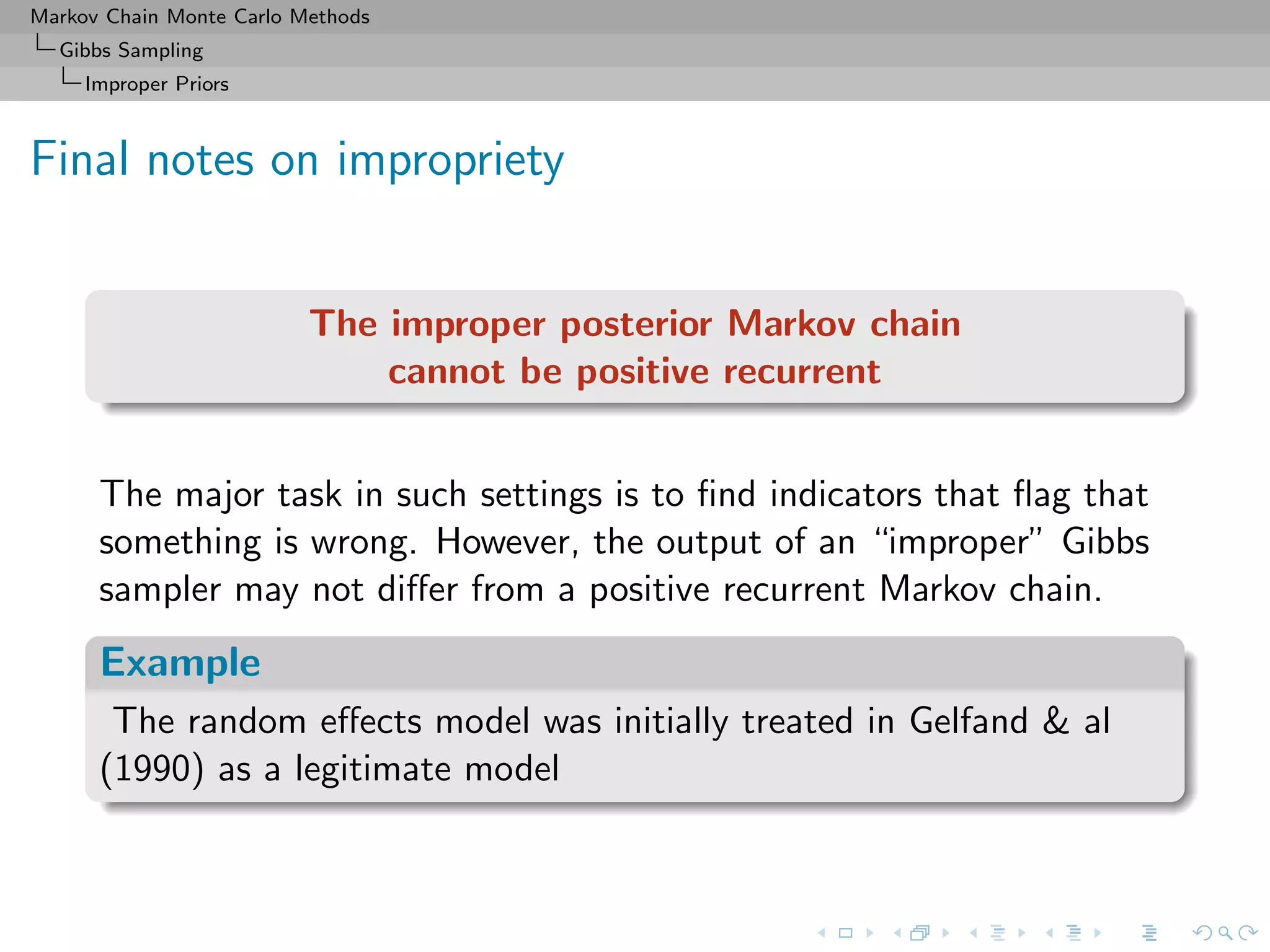
Final notes on impropriety
The improper posterior Markov chain
cannot be positive recurrent
Markov Chain Monte Carlo Methods
Gibbs Sampling
Improper Priors
Final notes on impropriety
The improper posterior Markov chain
cannot be positive recurrent
The major task in such settings is to find indicators that flag that
something is wrong. However, the output of an “improper” Gibbs
sampler may not differ from a positive recurrent Markov chain.
Markov Chain Monte Carlo Methods
Gibbs Sampling
Improper Priors
Final notes on impropriety
The improper posterior Markov chain
cannot be positive recurrent
The major task in such settings is to find indicators that flag that
something is wrong. However, the output of an “improper” Gibbs
sampler may not differ from a positive recurrent Markov chain.
Example
The random effects model was initially treated in Gelfand & al
(1990) as a legitimate model
Markov Chain Monte Carlo Methods
Hamiltonian Monte Carlo
The Metropolis-Hastings
Algorithm
Gibbs Sampling
Hamiltonian Monte Carlo
Piecewise Deterministic Versions
Markov Chain Monte Carlo Methods
Hamiltonian Monte Carlo
Continuous time Markov process
Hamiltonian (or hybrid) Monte Carlo (HMC) auxiliary variable
technique that takes advantage of a continuous time Markov
process to sample from target π(θ)
Auxiliary variable ϑ ∈ Rd introduced along with a density (ϑ|θ)
so that the joint distribution of (θ, ϑ) enjoys π(θ) as its marginal
π(θ) = π(θ) (ϑ|θ)dϑ
Markov Chain Monte Carlo Methods
Hamiltonian Monte Carlo
Continuous time Markov process
Based on representation of joint distribution
ω(θ, ϑ) = π(θ) (ϑ|θ) ∝ exp{−H(θ, ϑ)} ,
where H(·) called Hamiltonian
Markov Chain Monte Carlo Methods
Hamiltonian Monte Carlo
Continuous time Markov process
Based on representation of joint distribution
ω(θ, ϑ) = π(θ) (ϑ|θ) ∝ exp{−H(θ, ϑ)} ,
where H(·) called Hamiltonian
Hamiltonian Monte Carlo (HMC) associated with the continuous
time process (θt, ϑt) generated by the so-called Hamiltonian
equations
dθt
dt
=
∂H
∂ϑ
(θt, ϑt)
dϑt
dt
= −
∂H
∂θ
(θt, ϑt) ,
Markov Chain Monte Carlo Methods
Hamiltonian Monte Carlo
Continuous time Markov process
Based on representation of joint distribution
ω(θ, ϑ) = π(θ) (ϑ|θ) ∝ exp{−H(θ, ϑ)} ,
where H(·) called Hamiltonian
Keep Hamiltonian target stable over time, as
dH(θt, ϑt)
dt
=
∂H
∂ϑ
(θt, ϑt)
dϑt
dt
+
∂H
∂θ
(θt, ϑt)
dθt
dt
= 0 .
Markov Chain Monte Carlo Methods
Hamiltonian Monte Carlo
Background
Approach from physics (Duane et al., 1987) popularised in
statistics by Neal (1996, 2002)
[Lan et al., 2016]
Markov Chain Monte Carlo Methods
Hamiltonian Monte Carlo
Background
Above continuous time Markov process is deterministic
Only explores single given level set
{(θ, ϑ) : H(θ, ϑ) = H(θ0, ϑ0)} ,
instead of the whole augmented state space R2×d
Meaning lack of irreducibility
Solution out is to refresh momentum,
ϑt ∼ (ϑ|θt−)
at random times τn with {τn − τn−1} exponential variates
Specific piecewise deterministic Markov process using
Hamiltonian dynamics
Markov Chain Monte Carlo Methods
Hamiltonian Monte Carlo
Practical implementation
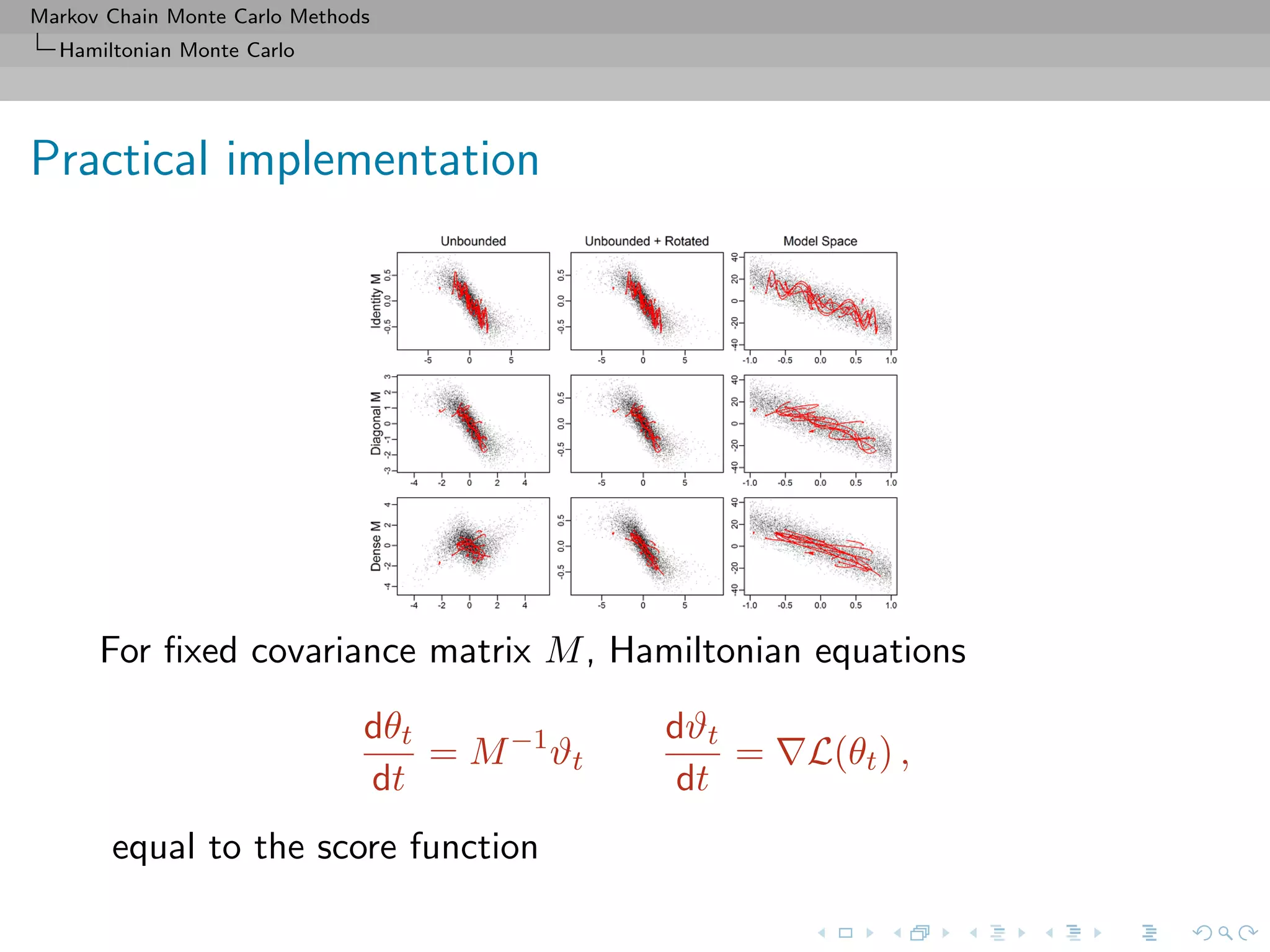
Free conditional density (ϑ|θ), usually chosen as Gaussian with
either a constant covariance matrix M corresponding to target
covariance or as local curvature depending on θ in Riemannian
HMC (Girolami and Calderhead, 2011)
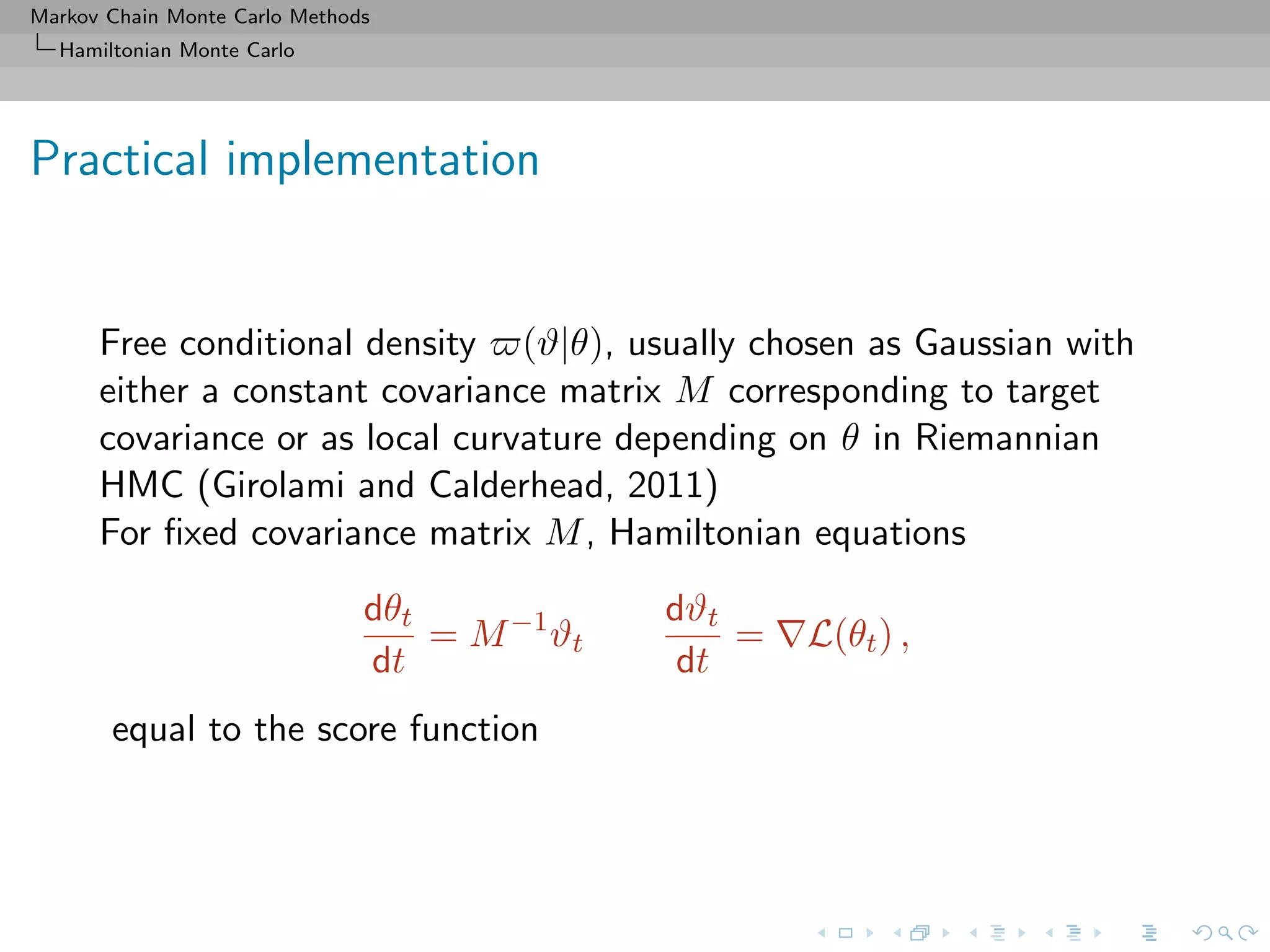
For fixed covariance matrix M, Hamiltonian equations
dθt
dt
= M−1
ϑt
dϑt
dt
= L(θt) ,
equal to the score function
Markov Chain Monte Carlo Methods
Hamiltonian Monte Carlo
Practical implementation
For fixed covariance matrix M, Hamiltonian equations
dθt
dt
= M−1
ϑt
dϑt
dt
= L(θt) ,
equal to the score function
Markov Chain Monte Carlo Methods
Hamiltonian Monte Carlo
Leapfrog integrator
Discretisation simulation technique: symplectic integrator
Markov Chain Monte Carlo Methods
Hamiltonian Monte Carlo
Leapfrog integrator
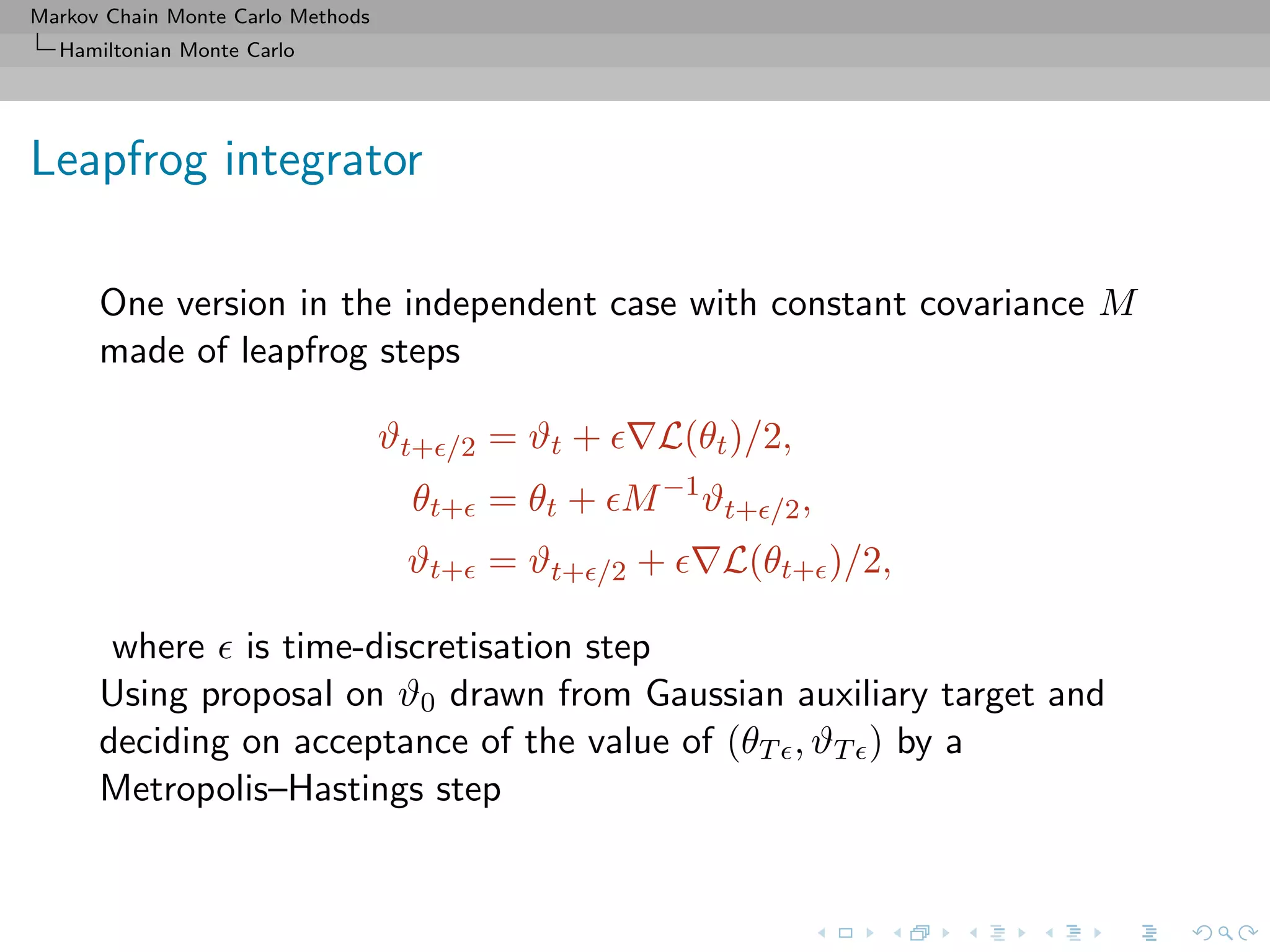
One version in the independent case with constant covariance M
made of leapfrog steps
ϑt+ /2 = ϑt + L(θt)/2,
θt+ = θt + M−1
ϑt+ /2,
ϑt+ = ϑt+ /2 + L(θt+ )/2,
where is time-discretisation step
Using proposal on ϑ0 drawn from Gaussian auxiliary target and
deciding on acceptance of the value of (θT , ϑT ) by a
Metropolis–Hastings step
Markov Chain Monte Carlo Methods
Hamiltonian Monte Carlo
Leapfrog integrator
One version in the independent case with constant covariance M
made of leapfrog steps
ϑt+ /2 = ϑt + L(θt)/2,
θt+ = θt + M−1
ϑt+ /2,
ϑt+ = ϑt+ /2 + L(θt+ )/2,
where is time-discretisation step
Note that first two leapfrog steps induce a Langevin move on θt:
θt+ = θt + 2
M−1
L(θt)/2 + M−1
ϑt ,
Markov Chain Monte Carlo Methods
Hamiltonian Monte Carlo
Leapfrog integrator
One version in the independent case with constant covariance M
made of leapfrog steps
ϑt+ /2 = ϑt + L(θt)/2,
θt+ = θt + M−1
ϑt+ /2,
ϑt+ = ϑt+ /2 + L(θt+ )/2,
where is time-discretisation step
Discretising Hamiltonian dynamics introduces two free parameters,
step size and trajectory length T , both to be calibrated.
Markov Chain Monte Carlo Methods
Hamiltonian Monte Carlo
no U turns
empirically successful and popular version of HMC:
“no-U-turn sampler” (NUTS) adapts value of based on
primal-dual averaging
and eliminates need to choose trajectory length T via a
recursive algorithm that builds a set of candidate proposals for
a number of forward and backward leapfrog steps, stopping
automatically when simulated path traces back
[Hoffman and Gelman, 2014]
Markov Chain Monte Carlo Methods
Piecewise Deterministic Versions
The Metropolis-Hastings
Algorithm
Gibbs Sampling
Hamiltonian Monte Carlo
Piecewise Deterministic Versions
Motivations
Versions of PDMP
Markov Chain Monte Carlo Methods
Piecewise Deterministic Versions
Motivations
Generic issue
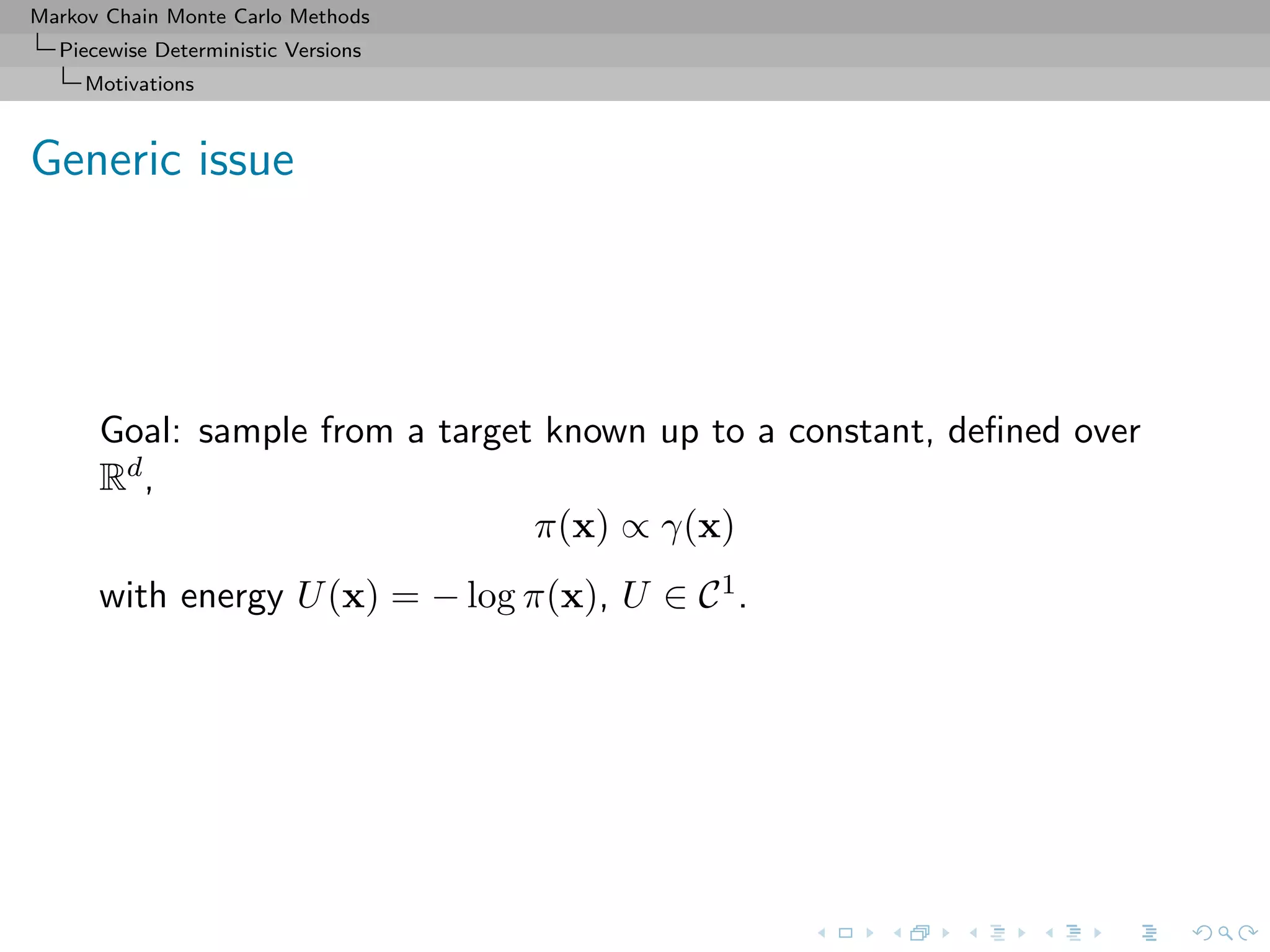
Goal: sample from a target known up to a constant, defined over
Rd,
π(x) ∝ γ(x)
with energy U(x) = − log π(x), U ∈ C1.
Markov Chain Monte Carlo Methods
Piecewise Deterministic Versions
Motivations
Marketing arguments
Current default workhorse: reversible MCMC methods
Non-reversible MCMC algorithms based on piecewise deterministic
Markov processes perform well empirically
Markov Chain Monte Carlo Methods
Piecewise Deterministic Versions
Motivations
Marketing arguments
Non-reversible MCMC algorithms based on piecewise deterministic
Markov processes perform well empirically
Quantitative convergence rates and variance now available
Physics (Peters & De With, 2012; Krauth et al., 2009, 2015,
2016) roots
Mesquita and Hespanha (2010) show geometric ergodicity for
exponentially decaying tail targets
Monmarch (2016) gives sharp results for compact state-spaces
Bierkens et al. (2016a,b) show ergdicity targets on the real
line
Markov Chain Monte Carlo Methods
Piecewise Deterministic Versions
Motivations
Motivation: piecewise deterministic Markov process
PDMP sampler is a (new?) continuous-time, non-reversible
MCMC method based on auxiliary variables
1. particle physics simulation
[Peters et al., 2012]
2. empirically state-of-the-art performances
[Bouchard et al., 2017]
3. exact subsampled in big data
[Bierkens et al., 2017]
4. geometric ergodicity for a large class of distribution
[Deligiannidis et al., 2017, Bierkens et al., 2017]
5. Ability to deal with intractable potential U(x) = Uω(x)µ(dω)
[Pakman et al., 2016]
Markov Chain Monte Carlo Methods
Piecewise Deterministic Versions
Motivations
Older versions
Use of alternative methodology based on Birth–&-Death (point)
process
Markov Chain Monte Carlo Methods
Piecewise Deterministic Versions
Motivations
Older versions
Use of alternative methodology based on Birth–&-Death (point)
process
Idea: Create Markov chain in continuous time, i.e. a Markov jump
process
Time till next modification (jump) exponentially distributed with
intensity q(θ, θ ) depending on current and future states.
[Preston, 1976; Ripley, 1977; Geyer & Møller, 1994; Stevens, 1999]
Markov Chain Monte Carlo Methods
Piecewise Deterministic Versions
Motivations
Older versions
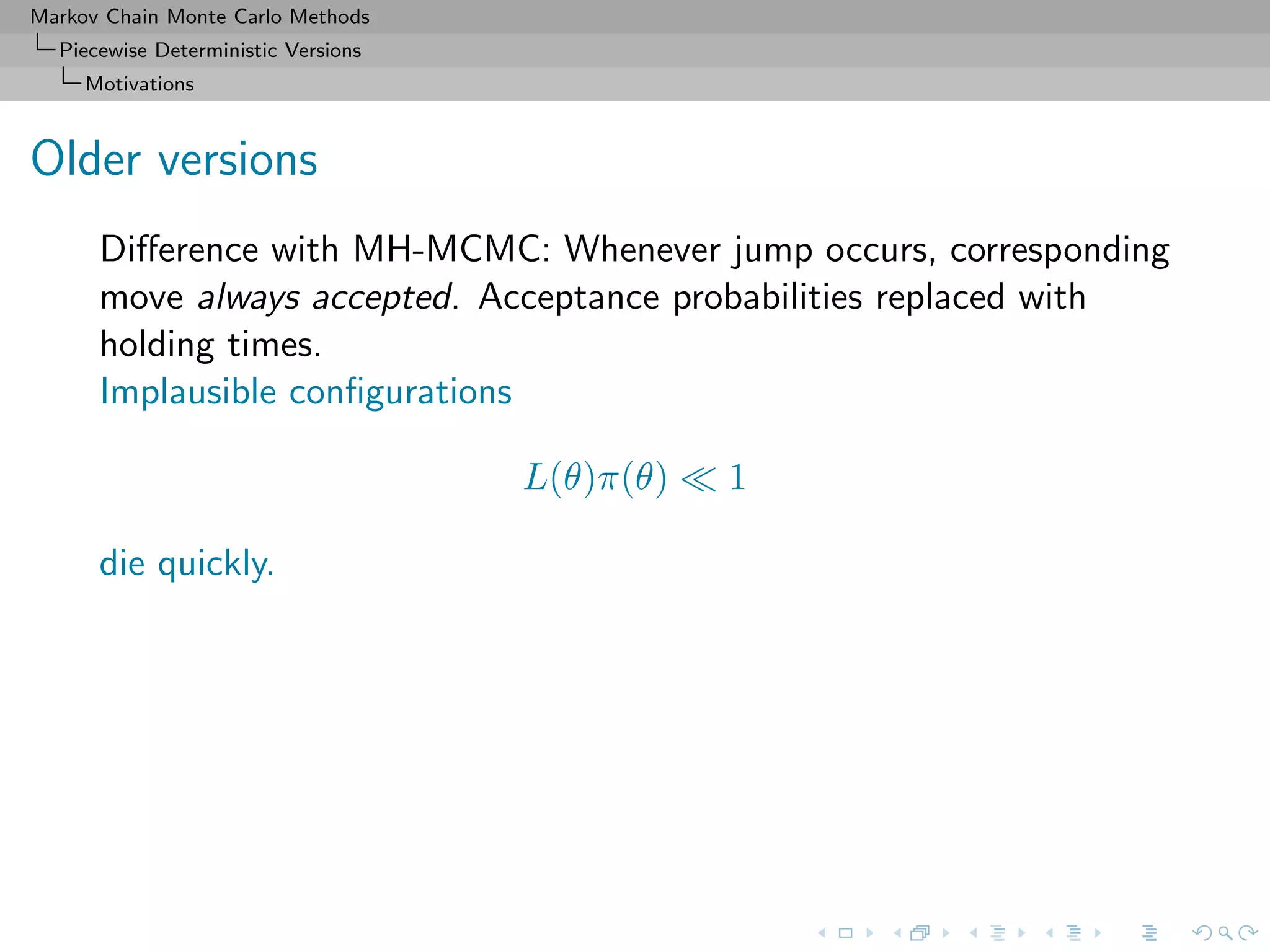
Difference with MH-MCMC: Whenever jump occurs, corresponding
move always accepted. Acceptance probabilities replaced with
holding times.
Implausible configurations
L(θ)π(θ) 1
die quickly.
Markov Chain Monte Carlo Methods
Piecewise Deterministic Versions
Motivations
Older versions
Difference with MH-MCMC: Whenever jump occurs, corresponding
move always accepted. Acceptance probabilities replaced with
holding times.
Implausible configurations
L(θ)π(θ) 1
die quickly.
Sufficient to have detailed balance
L(θ)π(θ)q(θ, θ ) = L(θ )π(θ )q(θ , θ) for all θ, θ
for ˜π(θ) ∝ L(θ)π(θ) to be stationary.
[Capp´e et al., 2000]
Markov Chain Monte Carlo Methods
Piecewise Deterministic Versions
Motivations
Setup
All MCMC schemes presented here target an extended distribution
on Z = Rd × Rd
ρ(z) = π(x) × ψ(v) = exp(−H(z))
where z = (x, v) extended state and Ψ(v) [by default] multivariate
standard Normal
Physics takes v as velocity or momentum variables allowing for a
deterministic dynamics on Rd
Obviously sampling from ρ provides samples from π
Markov Chain Monte Carlo Methods
Piecewise Deterministic Versions
Motivations
Piecewise deterministic Markov process
Piecewise deterministic Markov process {zt ∈ Z}t∈[0,∞), with
three ingredients,
1. Deterministic dynamics: between events, deterministic
evolution based on ODE
dzt/dt = Φ(zt)
2. Event occurrence rate: λ(t) = λ(zt)
3. Transition dynamics: At event time, τ, state prior to τ
denoted by zτ−, and new state generated by zτ ∼ Q(·|zτ−).
[Davis, 1984, 1993]
Markov Chain Monte Carlo Methods
Piecewise Deterministic Versions
Motivations
Implementation
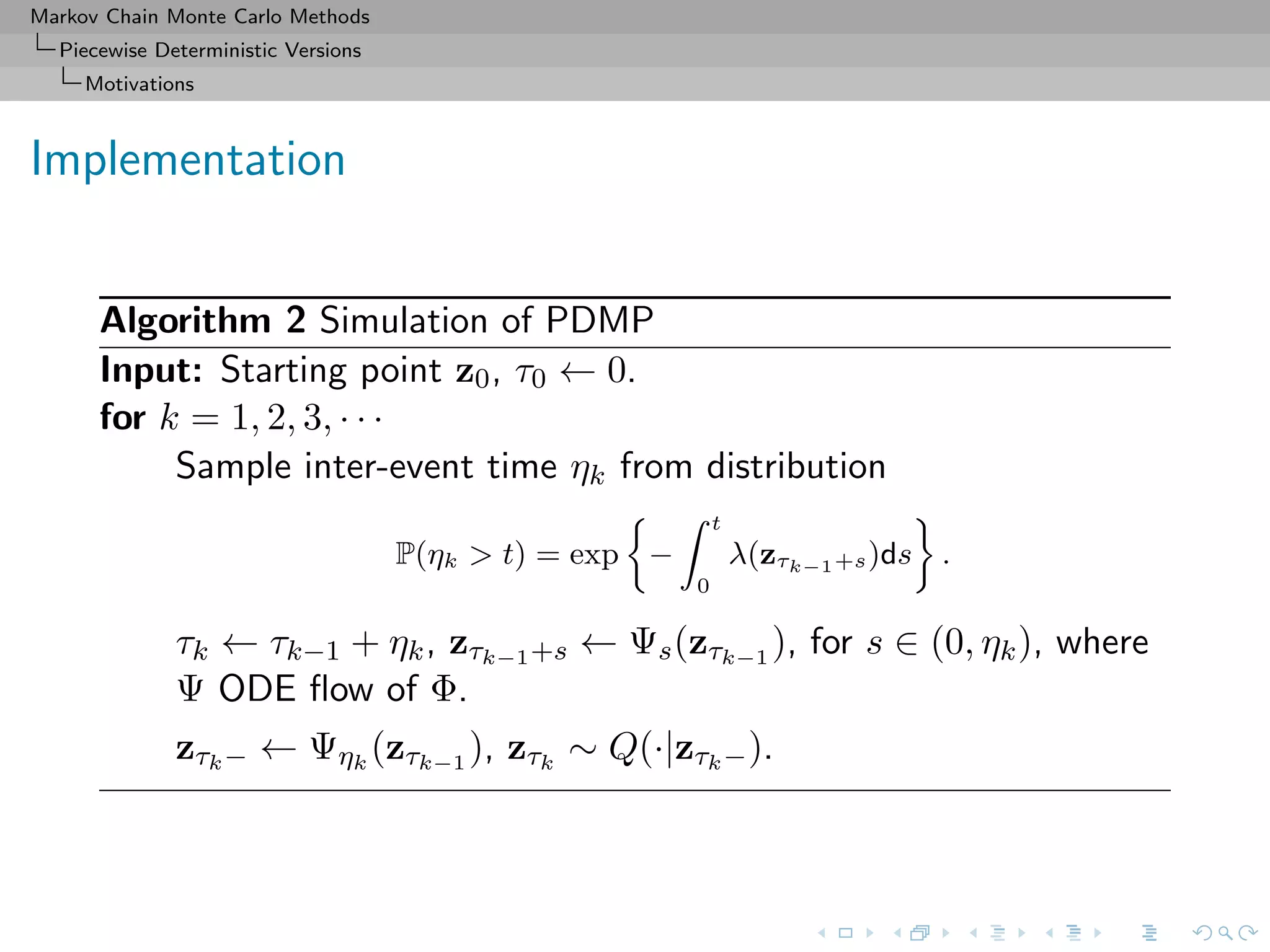
Algorithm 2 Simulation of PDMP
Input: Starting point z0, τ0 ← 0.
for k = 1, 2, 3, · · ·
Sample inter-event time ηk from distribution
P(ηk > t) = exp −
t
0
λ(zτk−1+s)ds .
τk ← τk−1 + ηk, zτk−1+s ← Ψs(zτk−1
), for s ∈ (0, ηk), where
Ψ ODE flow of Φ.
zτk− ← Ψηk
(zτk−1
), zτk
∼ Q(·|zτk−).
Markov Chain Monte Carlo Methods
Piecewise Deterministic Versions
Motivations
Simulation of PDMP: constraints
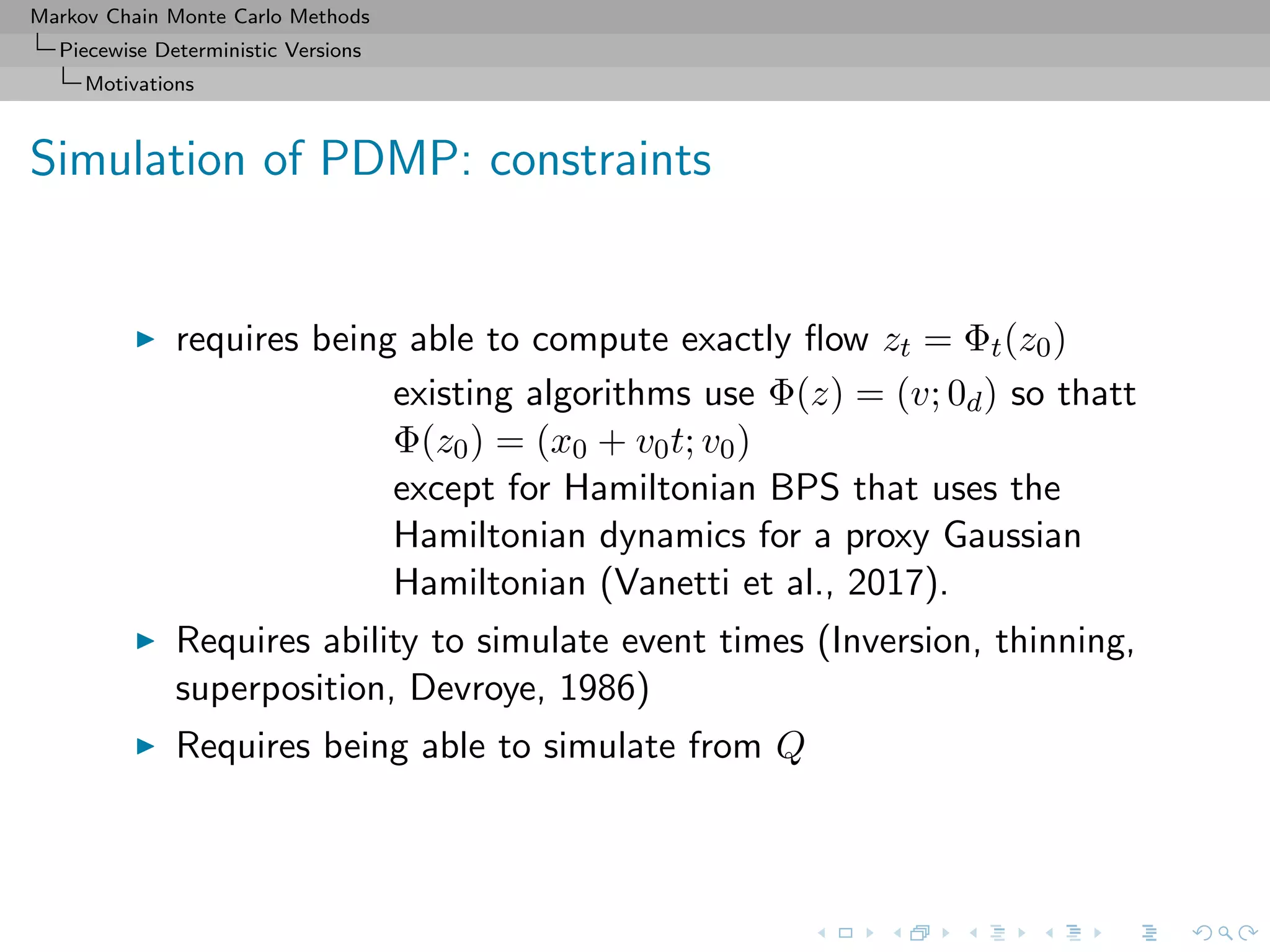
requires being able to compute exactly flow zt = Φt(z0)
existing algorithms use Φ(z) = (v; 0d) so thatt
Φ(z0) = (x0 + v0t; v0)
except for Hamiltonian BPS that uses the
Hamiltonian dynamics for a proxy Gaussian
Hamiltonian (Vanetti et al., 2017).
Requires ability to simulate event times (Inversion, thinning,
superposition, Devroye, 1986)
Requires being able to simulate from Q
Markov Chain Monte Carlo Methods
Piecewise Deterministic Versions
Versions of PDMP
Basic bouncy particle sampler
Simulation of continuous-time piecewise linear trajectory (xt)t with
each segment in trajectory specified by
initial position x
length τ
velocity v
[Bouchard et al., 2017]
Markov Chain Monte Carlo Methods
Piecewise Deterministic Versions
Versions of PDMP
Basic bouncy particle sampler
Simulation of continuous-time piecewise linear trajectory (xt)t with
each segment in trajectory specified by
initial position x
length τ
velocity v
length specified by inhomogeneous Poisson point process with
intensity function
λ(x, v) = max{0, < U(x), v >}
[Bouchard et al., 2017]
Markov Chain Monte Carlo Methods
Piecewise Deterministic Versions
Versions of PDMP
Basic bouncy particle sampler
Simulation of continuous-time piecewise linear trajectory (xt)t with
each segment in trajectory specified by
initial position x
length τ
velocity v
new velocity after bouncing given by Newtonian elastic collision
R(x)v = v − 2
< U(x), v >
|| U(x)||2
U(x)
[Bouchard et al., 2017]
Markov Chain Monte Carlo Methods
Piecewise Deterministic Versions
Versions of PDMP
Basic bouncy particle sampler
[Bouchard et al., 2017]
Markov Chain Monte Carlo Methods
Piecewise Deterministic Versions
Versions of PDMP
Implementation hardships
Generally speaking, the main difficulties of implementing PDMP
come from
1. Computing the ODE flow Ψ: linear dynamic, quadratic
dynamic
2. Simulating the inter-event time ηk: many techniques of
superposition and thinning for Poisson processes
[Devroye, 1986]
Markov Chain Monte Carlo Methods
Piecewise Deterministic Versions
Versions of PDMP
Poisson process on R+
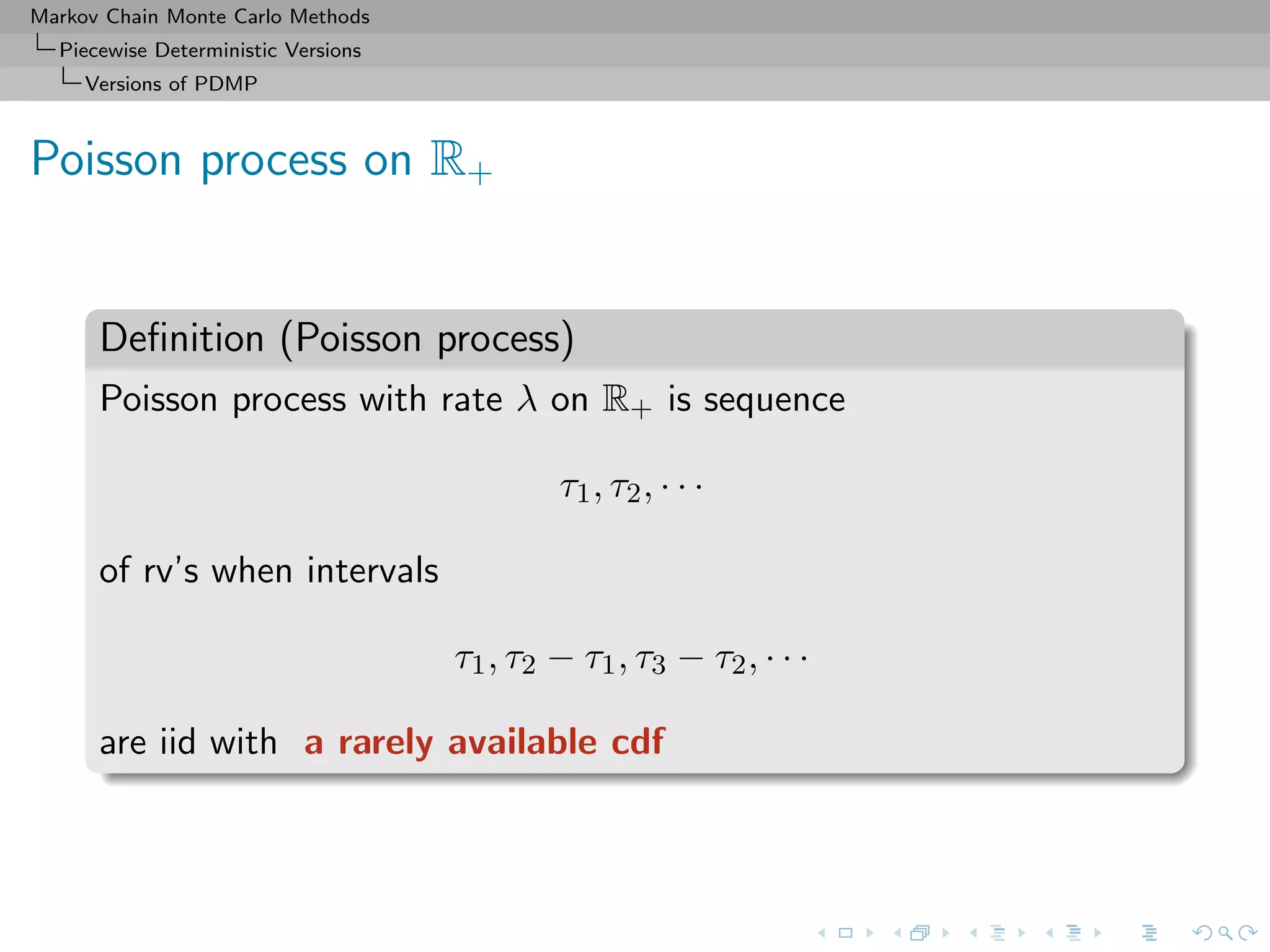
Definition (Poisson process)
Poisson process with rate λ on R+ is sequence
τ1, τ2, · · ·
of rv’s when intervals
τ1, τ2 − τ1, τ3 − τ2, · · ·
are iid with
P(τi − τi−1 > T) = exp −
τi−1+T
τi−1
λ(t)dt , τ0 = 0
Markov Chain Monte Carlo Methods
Piecewise Deterministic Versions
Versions of PDMP
Poisson process on R+
Definition (Poisson process)
Poisson process with rate λ on R+ is sequence
τ1, τ2, · · ·
of rv’s when intervals
τ1, τ2 − τ1, τ3 − τ2, · · ·
are iid with a rarely available cdf
Markov Chain Monte Carlo Methods
Piecewise Deterministic Versions
Versions of PDMP
Simulation by thinning
Theorem (Lewis et al., 1979)
Let
λ, Λ : R+
→ R+
be continuous functions such that λ(·) ≤ Λ(·). Let
τ1, τ2, · · · ,
be the increasing sequence of a Poisson process with rate Λ(·). For
all i, if τi is removed from the sequence with probability
1 − λ(t)/Λ(t)
then the remaining ˜τ1, ˜τ2, · · · form a non-homogeneous Poisson
process with rateλ(·)
Markov Chain Monte Carlo Methods
Piecewise Deterministic Versions
Versions of PDMP
Simulation by thinning
Theorem (Lewis et al., 1979)
Let
λ, Λ : R+
→ R+
be continuous functions such that λ(·) ≤ Λ(·). Let
τ1, τ2, · · · ,
be the increasing sequence of a Poisson process with rate Λ(·).
Simulation from upper bound
Markov Chain Monte Carlo Methods
Piecewise Deterministic Versions
Versions of PDMP
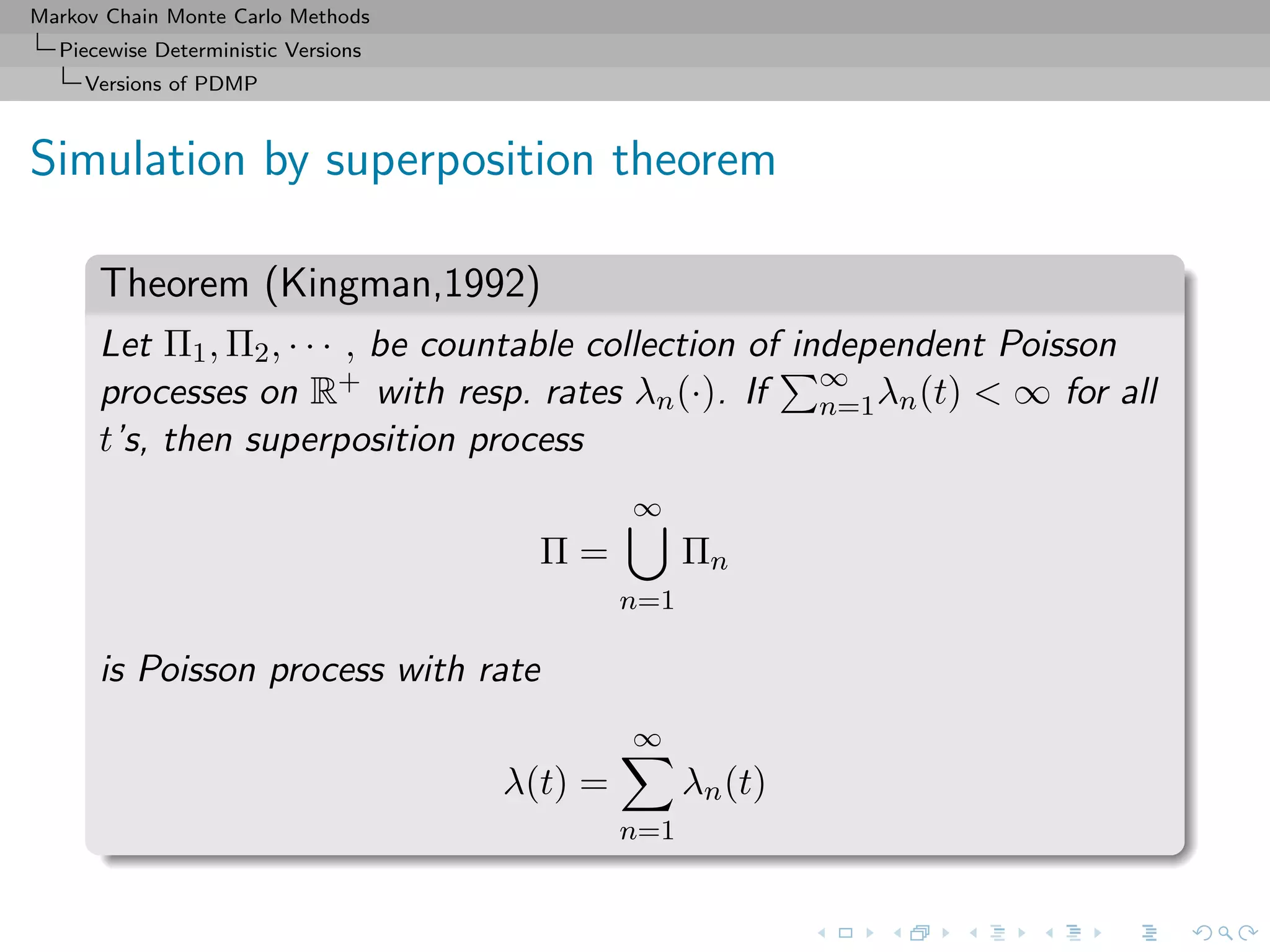
Simulation by superposition theorem
Theorem (Kingman,1992)
Let Π1, Π2, · · · , be countable collection of independent Poisson
processes on R+ with resp. rates λn(·). If ∞
n=1λn(t) < ∞ for all
t’s, then superposition process
Π =
∞
n=1
Πn
is Poisson process with rate
λ(t) =
∞
n=1
λn(t)
Markov Chain Monte Carlo Methods
Piecewise Deterministic Versions
Versions of PDMP
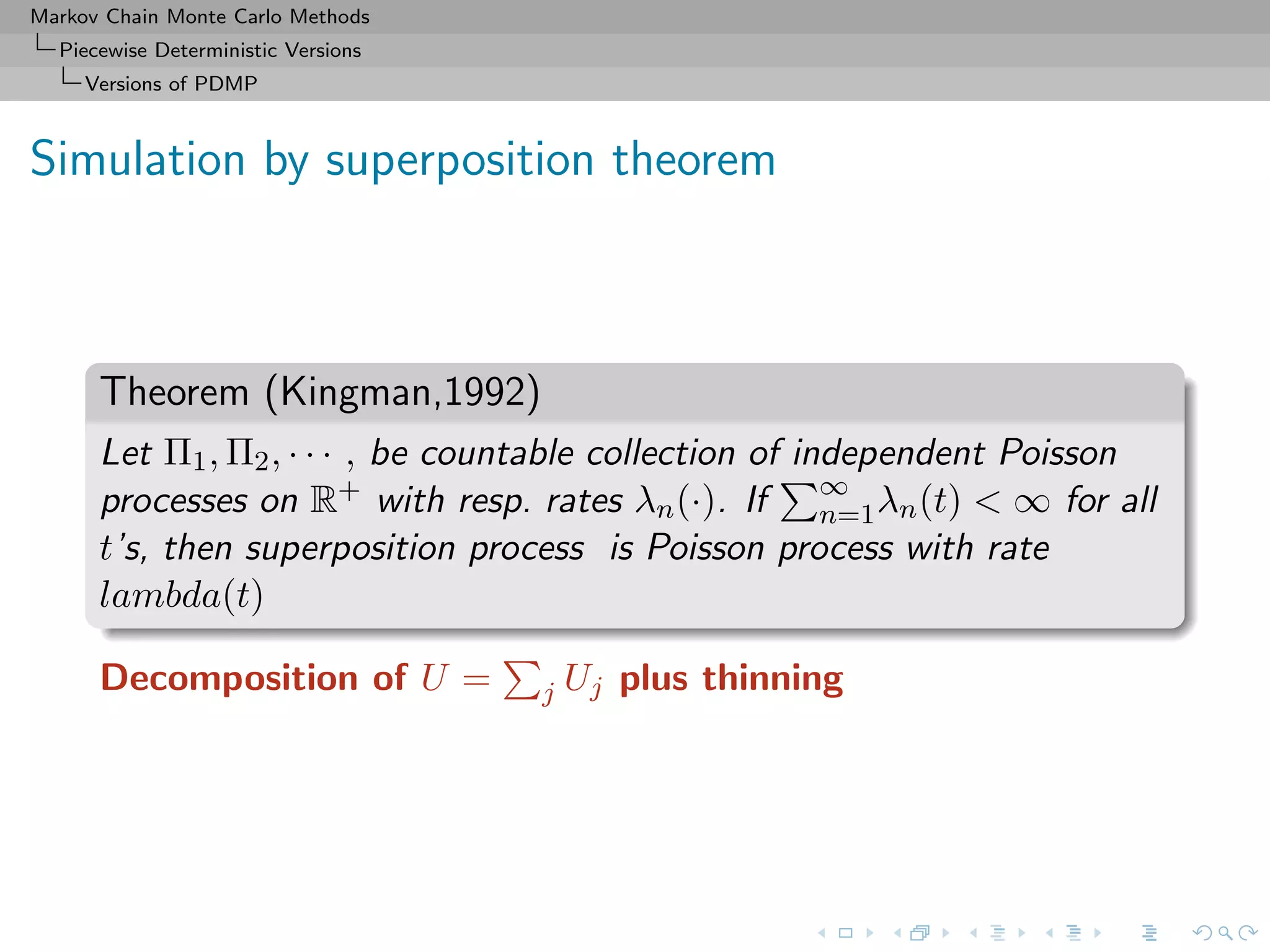
Simulation by superposition theorem
Theorem (Kingman,1992)
Let Π1, Π2, · · · , be countable collection of independent Poisson
processes on R+ with resp. rates λn(·). If ∞
n=1λn(t) < ∞ for all
t’s, then superposition process is Poisson process with rate
lambda(t)
Decomposition of U = j Uj plus thinning
Markov Chain Monte Carlo Methods
Piecewise Deterministic Versions
Versions of PDMP
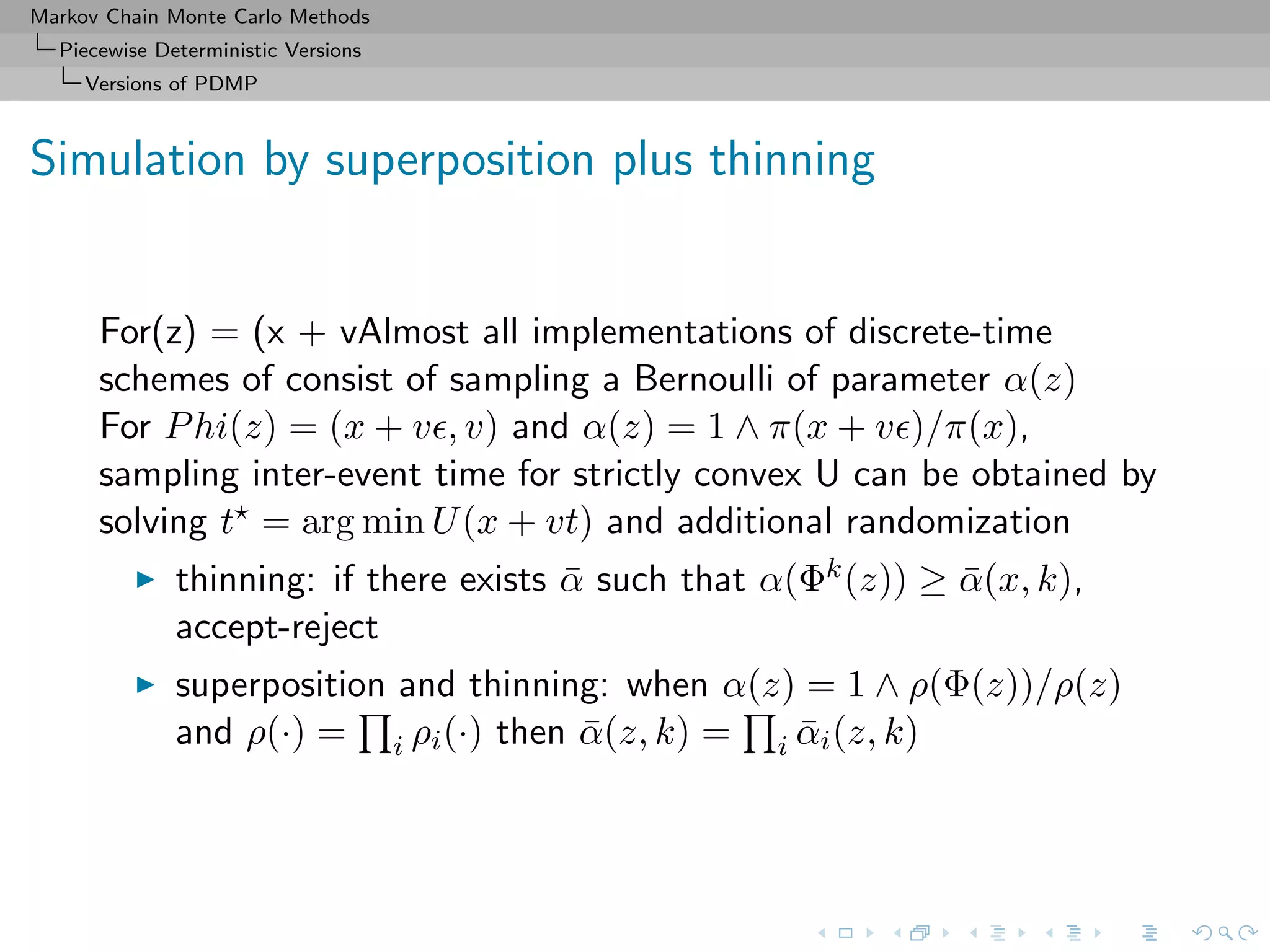
Simulation by superposition plus thinning
For(z) = (x + vAlmost all implementations of discrete-time
schemes of consist of sampling a Bernoulli of parameter α(z)
For Phi(z) = (x + v , v) and α(z) = 1 ∧ π(x + v )/π(x),
sampling inter-event time for strictly convex U can be obtained by
solving t = arg min U(x + vt) and additional randomization
thinning: if there exists ¯α such that α(Φk(z)) ≥ ¯α(x, k),
accept-reject
superposition and thinning: when α(z) = 1 ∧ ρ(Φ(z))/ρ(z)
and ρ(·) = i ρi(·) then ¯α(z, k) = i ¯αi(z, k)
Markov Chain Monte Carlo Methods
Piecewise Deterministic Versions
Versions of PDMP
Extended generator
Definition
For D(L) set of measurable functions f : Z → R such that there
exists a measurable function h : Z → R with t → h(zt) Pz-a.s. for
each z ∈ Z and the process
Cf
t = f(zt) − f(z0) −
t
0
h(zs)ds
a local martingale. Then we write h = Lf and call (L, D(L)) the
extended generator of the process {zt}t≥0.
Markov Chain Monte Carlo Methods
Piecewise Deterministic Versions
Versions of PDMP
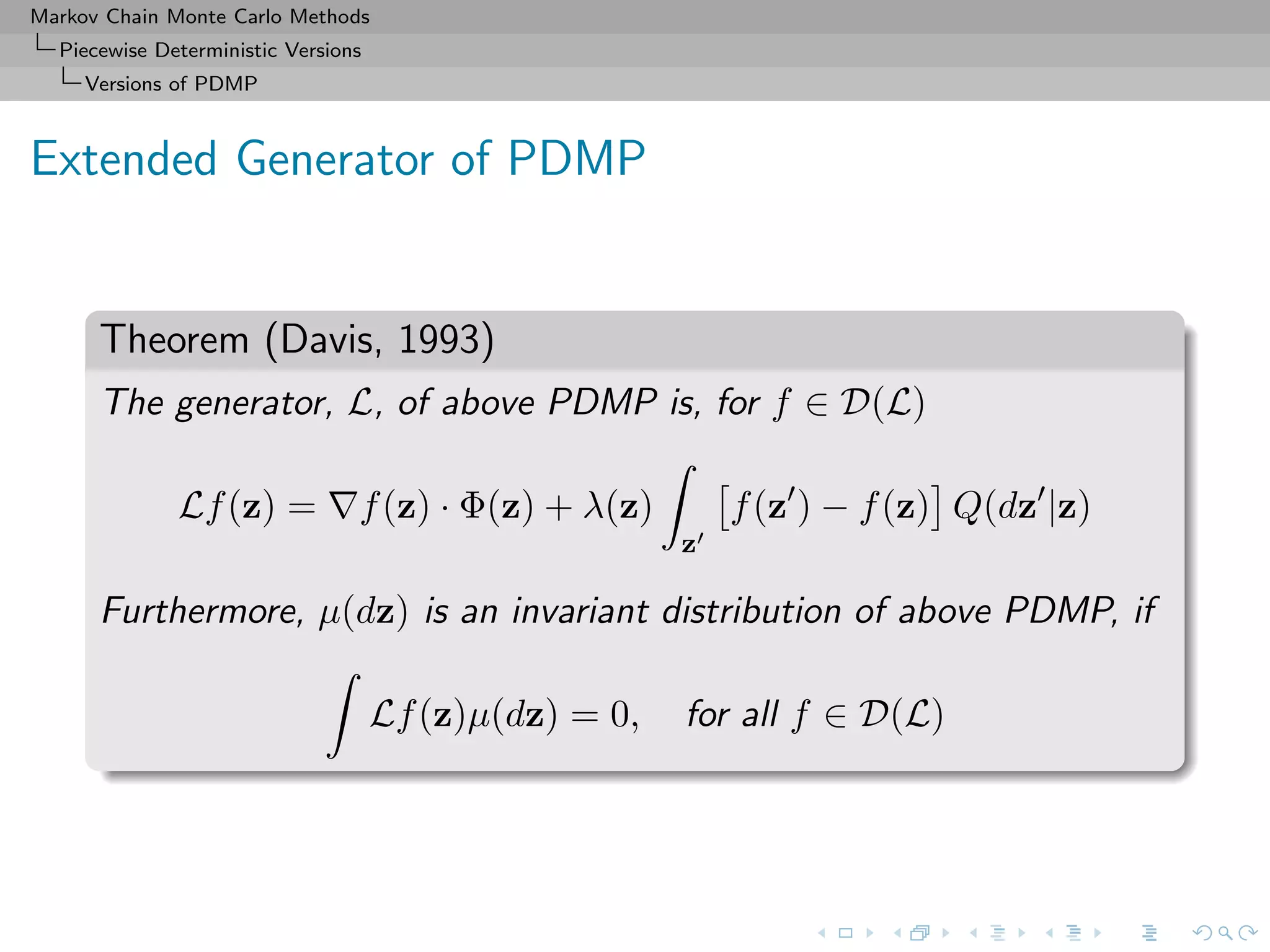
Extended Generator of PDMP
Theorem (Davis, 1993)
The generator, L, of above PDMP is, for f ∈ D(L)
Lf(z) = f(z) · Φ(z) + λ(z)
z
f(z ) − f(z) Q(dz |z)
Furthermore, µ(dz) is an invariant distribution of above PDMP, if
Lf(z)µ(dz) = 0, for all f ∈ D(L)
Markov Chain Monte Carlo Methods
Piecewise Deterministic Versions
Versions of PDMP
PDMP-based sampler
PDMP-based sampler is an auxiliary variable technique
Given target π(x),
1. introduce auxiliary variable V ∈ V along with a density
π(v|x),
2. choose appropriate Φ, λ and Q
for π(x)π(v|x) to be unique invariant distribution of Markov
process
Markov Chain Monte Carlo Methods
Piecewise Deterministic Versions
Versions of PDMP
Bouncy Particle Sampler (Bouchard et al., 2017)
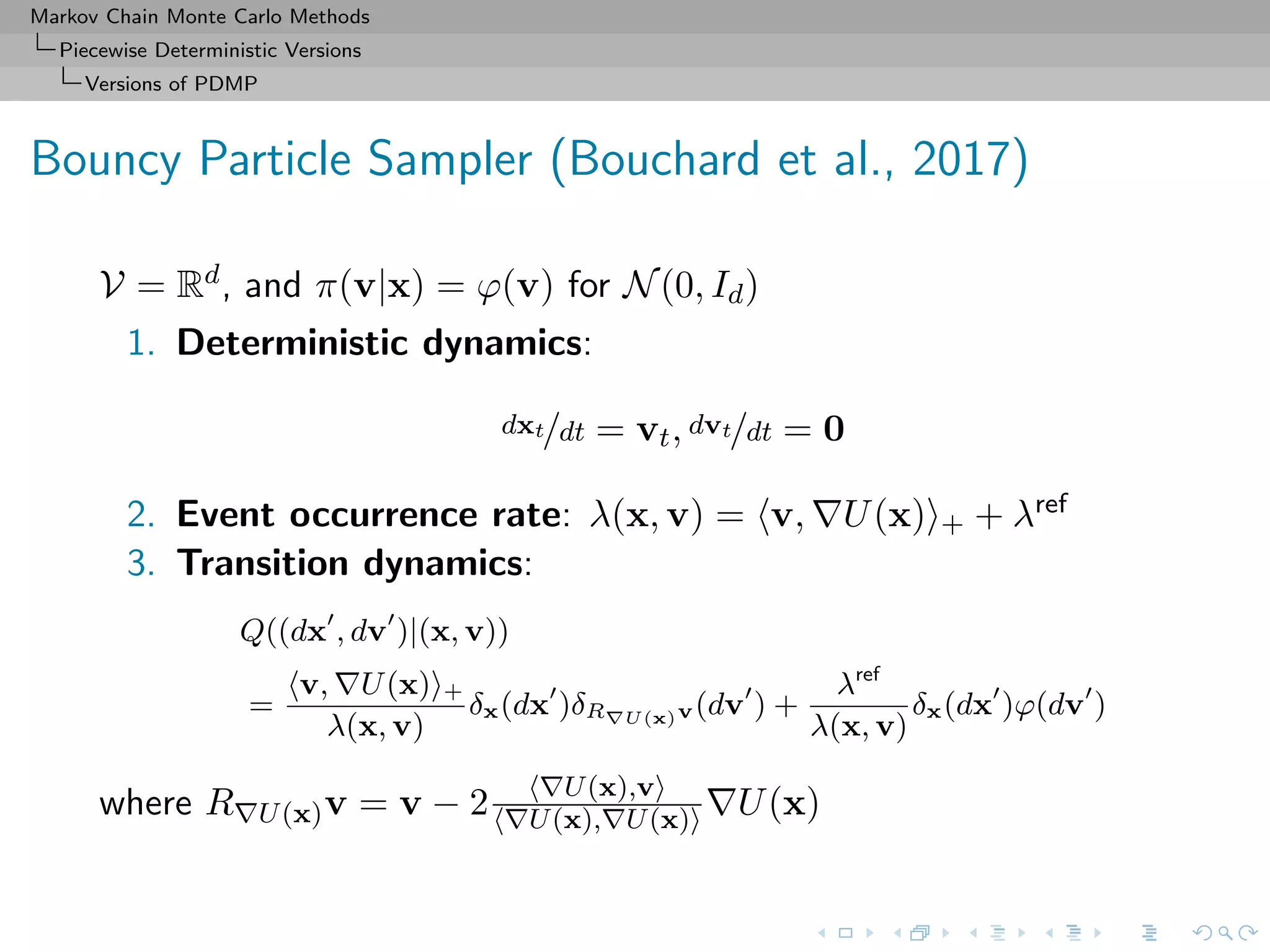
V = Rd, and π(v|x) = ϕ(v) for N(0, Id)
1. Deterministic dynamics:
dxt/dt = vt, dvt/dt = 0
2. Event occurrence rate: λ(x, v) = v, U(x) + + λref
3. Transition dynamics:
Q((dx , dv )|(x, v))
=
v, U(x) +
λ(x, v)
δx(dx )δR U(x)v(dv ) +
λref
λ(x, v)
δx(dx )ϕ(dv )
where R U(x)v = v − 2 U(x),v
U(x), U(x) U(x)
Markov Chain Monte Carlo Methods
Piecewise Deterministic Versions
Versions of PDMP
Zig-Zag Sampler (Bierkens et al., 2016)
Markov Chain Monte Carlo Methods
Piecewise Deterministic Versions
Versions of PDMP
Zig-Zag Sampler (Bierkens et al., 2016)
V = {+1, −1}d, and π(v|x) ∼ Uniform({+1, −1}d)
1. Deterministic dynamics:
dxt/dt = vt, dvt/dt = 0
2. Event occurrence rate:
λ(x, v) = d
i=1 λi(x, v) = d
i=1 {vi iU(x)}+ + λref
i
3. Transition dynamics:
Q((dx , dv )|(x, v)) =
d
i=1
λi(x, v)
λ(x, v)
δx(dx )δFiv(dv )
where Fi operator that flips i-th component of v and keep others
unchanged
Markov Chain Monte Carlo Methods
Piecewise Deterministic Versions
Versions of PDMP
Continuous-time Hamiltonian Monte Carlo (Neal, 1999)
V = Rd, and π(v|x) = ϕ(v) ∼ N(0, Id)
1. Deterministic dynamics:
dxt/dt = vt, dvt/dt = − U(xt)
2. Event occurrence rate: λ(x, v) = λ0(x)
3. Transition dynamics:
Q((dx , dv )|(x, v)) = δx(dx )ϕ(dv )
Markov Chain Monte Carlo Methods
Piecewise Deterministic Versions
Versions of PDMP
Continuous-time Riemannian Manifold HMC (Girolami
& Calderhead, 2011)
V = Rd, and π(v|x) = N(0, G(x)), the Hamiltonian is
H(x, v) = U(x) + 1/2vT
G(x)−1
v + 1/2 log(|G(x)|)
1. Deterministic dynamics:
dxt/dt = ∂H/∂v(xt, vt), dvt/dt = −∂H/∂x(xt, vt)
2. Event occurrence rate: λ(x, v) = λ0(x)
3. Transition dynamics:
Q((dx , dv )|(x, v)) = δx(dx )ϕ(dv |x )
Markov Chain Monte Carlo Methods
Piecewise Deterministic Versions
Versions of PDMP
Randomized BPS
Define
a =
v, U(x)
U(x), U(x)
U(x), b = v − a
Regular BPS, move v = −a + b
Alternatives
1. (Fearnhead et al., 2016):
v ∼ Qx(dv |v) = max {0, −v , U(x) } dv
2. (Wu & X, 2017): v = −a + b , where b Gaussian variate
over the space orthogonal to U(x) in Rd.
Markov Chain Monte Carlo Methods
Piecewise Deterministic Versions
Versions of PDMP
HMC-BPS (Vanetti et al., 2017)
ρ(x) ∝ exp{−V (x)} is a Gaussian approximation of the target
π(x).
ˆH(x, v) = V (x) + 1/2vT
v, ˜U(x) = U(x) − V (x)
1. Deterministic dynamics:
dxt/dt = vt, dvt/dt = − V (xt)
2. Event occurrence rate: λ(x, v) = v, ˜U(x) + + λref
3. Transition dynamics:
Q((dx , dv )|(x, v))
=
v, ˜U(x) +
λ(x, v)
δx(dx )δR ˜U(x)v(dv ) +
λref
λ(x, v)
δx(dx )ϕ(dv )
Markov Chain Monte Carlo Methods
Piecewise Deterministic Versions
Versions of PDMP
Discretisation
1. Sherlock & Thiery (2017) considers delayed rejection
approach with only point-wise evaluations of target, by
making speed flip move once proposal involving flip in speed
and drift in variable of interest rejected. Also add random
perturbation for eergodicity, plus another perturbation based
on a Brownian argument. Requires calibration
2. Vanetti et al. (2017)
Benefit: bypassing the generation of inter-event time of
inhomogeneous Poisson processes.
Markov Chain Monte Carlo Methods
Piecewise Deterministic Versions
Versions of PDMP
Discretisation
1. Sherlock & Thiery (2017)
2. Vanetti et al. (2017) unifies many threads and relates PDMP,
HMC, and discrete versions, with convergence results. Main
idea improves upon existing deterministic methods by
accounting for target. Borrows from earlier slice sampler idea
of Murray et al. (AISTATS, 2010), exploiting exact
Hamiltonian dynamics for approximation to true target.
Except that bouncing avoids the slice step. Eight discrete BPS
both correct against target and do not simulating event times.
Benefit: bypassing the generation of inter-event time of
inhomogeneous Poisson processes.

short course at CIRM, Bayesian Masterclass, October 2018

  • 1.
    Markov Chain MonteCarlo Methods Markov Chain Monte Carlo Methods Christian P. Robert Universit´e Paris-Dauphine, University of Warwick, & CRESt CIRM Master Class in Bayesian Statistics October 22, 2018
  • 2.
    Markov Chain MonteCarlo Methods Outline The Metropolis-Hastings Algorithm Gibbs Sampling Hamiltonian Monte Carlo Piecewise Deterministic Versions
  • 3.
    Markov Chain MonteCarlo Methods The Metropolis-Hastings Algorithm The Metropolis-Hastings Algorithm The Metropolis-Hastings Algorithm Monte Carlo Methods based on Markov Chains The Metropolis–Hastings algorithm Some Metropolis-Hastings algorithms Extensions Vanilla Rao–Blackwellisation Delayed acceptance Adaptive MCMC Gibbs Sampling
  • 4.
    Markov Chain MonteCarlo Methods The Metropolis-Hastings Algorithm Monte Carlo Methods based on Markov Chains Running Monte Carlo via Markov Chains Far from necessary to use a sample from the distribution f to approximate the integral I = h(x)f(x)dx , as sample from different target(s) g can be exploited in importance sampling version: ˆI = 1/n n i=1 h(xi)f(xi)/g(xi)
  • 5.
    Markov Chain MonteCarlo Methods The Metropolis-Hastings Algorithm Monte Carlo Methods based on Markov Chains Running Monte Carlo via Markov Chains Far from necessary to use a sample from the distribution f to approximate the integral I = h(x)f(x)dx , as non-i.i.d. sample X1, . . . , Xn ∼ f produced by using an ergodic Markov chain with stationary distribution f
  • 6.
    Markov Chain MonteCarlo Methods The Metropolis-Hastings Algorithm Monte Carlo Methods based on Markov Chains Running Monte Carlo via Markov Chains (2) Idea For an arbitrary starting value x(0), an ergodic chain (X(t)) is generated using a transition kernel with stationary distribution f
  • 7.
    Markov Chain MonteCarlo Methods The Metropolis-Hastings Algorithm Monte Carlo Methods based on Markov Chains Running Monte Carlo via Markov Chains (2) Idea For an arbitrary starting value x(0), an ergodic chain (X(t)) is generated using a transition kernel with stationary distribution f Insures the convergence in distribution of (X(t)) to a random variable from f. For a “large enough” T0, X(T0) can be considered as distributed from limiting distribution f Produce a dependent sample X(T0), X(T0+1), . . ., which is generated from f, sufficient for most approximation purposes
  • 8.
    Markov Chain MonteCarlo Methods The Metropolis-Hastings Algorithm Monte Carlo Methods based on Markov Chains Running Monte Carlo via Markov Chains (2) Insures the convergence in distribution of (X(t)) to a random variable from f. For a “large enough” T0, X(T0) can be considered as distributed from limiting distribution f Produce a dependent sample X(T0), X(T0+1), . . ., which is generated from f, sufficient for most approximation purposes Problem: How can one build a Markov chain with a given stationary distribution?
  • 9.
    Markov Chain MonteCarlo Methods The Metropolis-Hastings Algorithm The Metropolis–Hastings algorithm The Metropolis–Hastings algorithm Basics The algorithm uses the objective (target) density f and a conditional density q(y|x) called the instrumental (or proposal) distribution [Metropolis & al., 1953]
  • 10.
    Markov Chain MonteCarlo Methods The Metropolis-Hastings Algorithm The Metropolis–Hastings algorithm The MH algorithm Algorithm (Metropolis–Hastings) Given x(t), 1. Generate Yt ∼ q(y|x(t)). 2. Take X(t+1) = Yt with prob. ρ(x(t), Yt), x(t) with prob. 1 − ρ(x(t), Yt), where ρ(x, y) = min f(y) f(x) q(x|y) q(y|x) , 1 .
  • 11.
    Markov Chain MonteCarlo Methods The Metropolis-Hastings Algorithm The Metropolis–Hastings algorithm Features Independent of normalizing constants for both f and q(·|x) (ie, those constants independent of x) Never move to values with f(y) = 0 The chain (x(t))t may take the same value several times in a row, even though f is a density wrt Lebesgue measure The sequence (yt)t is usually not a Markov chain
  • 12.
    Markov Chain MonteCarlo Methods The Metropolis-Hastings Algorithm The Metropolis–Hastings algorithm Convergence properties 1. The M-H Markov chain is reversible, with invariant/stationary density f since it satisfies the detailed balance condition f(y) K(y, x) = f(x) K(x, y)
  • 13.
    Markov Chain MonteCarlo Methods The Metropolis-Hastings Algorithm The Metropolis–Hastings algorithm Convergence properties 1. The M-H Markov chain is reversible, with invariant/stationary density f since it satisfies the detailed balance condition f(y) K(y, x) = f(x) K(x, y) 2. As f is a probability measure, the chain is positive recurrent
  • 14.
    Markov Chain MonteCarlo Methods The Metropolis-Hastings Algorithm The Metropolis–Hastings algorithm Convergence properties 1. The M-H Markov chain is reversible, with invariant/stationary density f since it satisfies the detailed balance condition f(y) K(y, x) = f(x) K(x, y) 2. As f is a probability measure, the chain is positive recurrent 3. If Pr f(Yt) q(X(t)|Yt) f(X(t)) q(Yt|X(t)) ≥ 1 < 1. (1) that is, the event {X(t+1) = X(t)} is possible, then the chain is aperiodic
  • 15.
    Markov Chain MonteCarlo Methods The Metropolis-Hastings Algorithm The Metropolis–Hastings algorithm Convergence properties (2) 4. If q(y|x) > 0 for every (x, y), (2) the chain is irreducible
  • 16.
    Markov Chain MonteCarlo Methods The Metropolis-Hastings Algorithm The Metropolis–Hastings algorithm Convergence properties (2) 4. If q(y|x) > 0 for every (x, y), (2) the chain is irreducible 5. For M-H, f-irreducibility implies Harris recurrence
  • 17.
    Markov Chain MonteCarlo Methods The Metropolis-Hastings Algorithm The Metropolis–Hastings algorithm Convergence properties (2) 4. If q(y|x) > 0 for every (x, y), (2) the chain is irreducible 5. For M-H, f-irreducibility implies Harris recurrence 6. Thus, for M-H satisfying (1) and (2) (i) For h, with If |h(X)| < ∞, lim T →∞ 1 T T t=1 h(X(t) ) = h(x)df(x) a.e. f. (ii) and lim n→∞ Kn (x, ·)µ(dx) − f T V = 0 for every initial distribution µ, where Kn (x, ·) denotes the kernel for n transitions.
  • 18.
    Markov Chain MonteCarlo Methods The Metropolis-Hastings Algorithm Some Metropolis-Hastings algorithms The Independent Case The instrumental distribution q is independent of X(t), and is denoted g by analogy with Accept-Reject.
  • 19.
    Markov Chain MonteCarlo Methods The Metropolis-Hastings Algorithm Some Metropolis-Hastings algorithms The Independent Case The instrumental distribution q is independent of X(t), and is denoted g by analogy with Accept-Reject. Algorithm (Independent Metropolis-Hastings) Given x(t), a Generate Yt ∼ g(y) b Take X(t+1) =    Yt with prob. min f(Yt) g(x(t)) f(x(t)) g(Yt) , 1 , x(t) otherwise.
  • 20.
    Markov Chain MonteCarlo Methods The Metropolis-Hastings Algorithm Some Metropolis-Hastings algorithms Properties The resulting sample is not iid
  • 21.
    Markov Chain MonteCarlo Methods The Metropolis-Hastings Algorithm Some Metropolis-Hastings algorithms Properties The resulting sample is not iid but there exist strong convergence properties: Theorem (Ergodicity) The algorithm produces a uniformly ergodic chain if there exists a constant M such that f(x) ≤ Mg(x) , x ∈ supp f. In this case, Kn (x, ·) − f TV ≤ 1 − 1 M n . [Mengersen & Tweedie, 1996]
  • 22.
    Markov Chain MonteCarlo Methods The Metropolis-Hastings Algorithm Some Metropolis-Hastings algorithms Illustration Example (Noisy AR(1)) Hidden Markov chain from a regular AR(1) model, xt+1 = ϕxt + t+1 t ∼ N (0, τ2 ) and observables yt|xt ∼ N (x2 t , σ2 )
  • 23.
    Markov Chain MonteCarlo Methods The Metropolis-Hastings Algorithm Some Metropolis-Hastings algorithms Illustration Example (Noisy AR(1)) Hidden Markov chain from a regular AR(1) model, xt+1 = ϕxt + t+1 t ∼ N (0, τ2 ) and observables yt|xt ∼ N (x2 t , σ2 ) The distribution of xt given xt−1, xt+1 and yt is exp −1 2τ2 (xt − ϕxt−1)2 + (xt+1 − ϕxt)2 + τ2 σ2 (yt − x2 t )2 .
  • 24.
    Markov Chain MonteCarlo Methods The Metropolis-Hastings Algorithm Some Metropolis-Hastings algorithms Illustration Example (Noisy AR(1)) Use for proposal the N (µt, ω2 t ) distribution, with µt = ϕ xt−1 + xt+1 1 + ϕ2 and ω2 t = τ2 1 + ϕ2 .
  • 25.
    Markov Chain MonteCarlo Methods The Metropolis-Hastings Algorithm Some Metropolis-Hastings algorithms Illustration Example (Noisy AR(1)) Use for proposal the N (µt, ω2 t ) distribution, with µt = ϕ xt−1 + xt+1 1 + ϕ2 and ω2 t = τ2 1 + ϕ2 . Ratio π(x)/qind(x) = exp −(yt − x2 t )2 /2σ2 is bounded
  • 26.
    Markov Chain MonteCarlo Methods The Metropolis-Hastings Algorithm Some Metropolis-Hastings algorithms Illustration (top) Last 500 realisations of the chain {Xk}k out of 10, 000 iterations; (bottom) histogram of the chain, compared with the target distribution.
  • 27.
    Markov Chain MonteCarlo Methods The Metropolis-Hastings Algorithm Some Metropolis-Hastings algorithms Random walk Metropolis–Hastings Use of a local perturbation as proposal Yt = X(t) + εt, where εt ∼ g, independent of X(t). The instrumental density is now of the form g(y − x) and the Markov chain is a random walk if we take g to be symmetric g(x) = g(−x)
  • 28.
    Markov Chain MonteCarlo Methods The Metropolis-Hastings Algorithm Some Metropolis-Hastings algorithms Random walk Metropolis–Hastings Algorithm (Random walk Metropolis) Given x(t) 1. Generate Yt ∼ g(y − x(t)) 2. Take X(t+1) =    Yt with prob. min 1, f(Yt) f(x(t)) , x(t) otherwise.
  • 29.
    Markov Chain MonteCarlo Methods The Metropolis-Hastings Algorithm Some Metropolis-Hastings algorithms Random walk Metropolis–Hastings Example (Random walk and normal target) Generate N(0, 1) based on the uniform proposal [−δ, δ] [Hastings (1970)] The probability of acceptance is then ρ(x(t) , yt) = exp{(x(t)2 − y2 t )/2} ∧ 1.
  • 30.
    Markov Chain MonteCarlo Methods The Metropolis-Hastings Algorithm Some Metropolis-Hastings algorithms Random walk Metropolis–Hastings Example (Mixture models) π(θ|x) ∝ n j=1 k =1 p f(xj|µ , σ ) π(θ)
  • 31.
    Markov Chain MonteCarlo Methods The Metropolis-Hastings Algorithm Some Metropolis-Hastings algorithms Random walk Metropolis–Hastings Example (Mixture models) π(θ|x) ∝ n j=1 k =1 p f(xj|µ , σ ) π(θ) Metropolis-Hastings proposal: θ(t+1) = θ(t) + ωε(t) if u(t) < ρ(t) θ(t) otherwise where ρ(t) = π(θ(t) + ωε(t)|x) π(θ(t)|x) ∧ 1 and ω scaled for good acceptance rate
  • 32.
    Markov Chain MonteCarlo Methods The Metropolis-Hastings Algorithm Some Metropolis-Hastings algorithms Random walk Metropolis–Hastings p theta 0.0 0.2 0.4 0.6 0.8 1.0 -1012 tau theta 0.2 0.4 0.6 0.8 1.0 1.2 -1012 p tau 0.0 0.2 0.4 0.6 0.8 1.0 0.20.40.60.81.01.2 -1 0 1 20.01.02.0 theta 0.2 0.4 0.6 0.8 024 tau 0.0 0.2 0.4 0.6 0.8 1.0 0123456 p Random walk sampling (50000 iterations) General case of a 3 component normal mixture [Celeux & al., 2000]
  • 33.
    Markov Chain MonteCarlo Methods The Metropolis-Hastings Algorithm Some Metropolis-Hastings algorithms Random walk Metropolis–Hastings −1 0 1 2 3 −10123 µ1 µ2 X Random walk MCMC output for .7N(µ1, 1) + .3N(µ2, 1)
  • 34.
    Markov Chain MonteCarlo Methods The Metropolis-Hastings Algorithm Some Metropolis-Hastings algorithms Random walk Metropolis–Hastings Example (probit model) Likelihood of the probit model n i=1 Φ(yT i β)xi Φ(−yT i β)1−xi
  • 35.
    Markov Chain MonteCarlo Methods The Metropolis-Hastings Algorithm Some Metropolis-Hastings algorithms Random walk Metropolis–Hastings Example (probit model) Likelihood of the probit model n i=1 Φ(yT i β)xi Φ(−yT i β)1−xi Random walk proposal β(t+1) = β(t) + εt εt ∼ Np(0, Σ) where, for instance, Σ = α(Y Y T)−1
  • 36.
    Markov Chain MonteCarlo Methods The Metropolis-Hastings Algorithm Some Metropolis-Hastings algorithms Random walk Metropolis–Hastings 0 5 10 −10−505 α β Likelihood surface and random walk Metropolis-Hastings steps
  • 37.
    Markov Chain MonteCarlo Methods The Metropolis-Hastings Algorithm Some Metropolis-Hastings algorithms Convergence properties Uniform ergodicity prohibited by random walk structure
  • 38.
    Markov Chain MonteCarlo Methods The Metropolis-Hastings Algorithm Some Metropolis-Hastings algorithms Convergence properties Uniform ergodicity prohibited by random walk structure At best, geometric ergodicity: Theorem (Sufficient ergodicity) For a symmetric density f, log-concave in the tails, and a positive and symmetric density g, the chain (X(t)) is geometrically ergodic. [Mengersen & Tweedie, 1996] no tail effect
  • 39.
    Markov Chain MonteCarlo Methods The Metropolis-Hastings Algorithm Some Metropolis-Hastings algorithms Convergence properties Example (Comparison of tail effects) Random-walk Metropolis–Hastings algorithms based on a N(0, 1) instrumental for the generation of (a) a N(0, 1) distribution and (b) a distribution with density ψ(x) ∝ (1 + |x|)−3 (a) 0 50 100 150 200 -1.5-1.0-0.50.00.51.01.5 (a) 0 50 100 150 200 -1.5-1.0-0.50.00.51.01.5 0 50 100 150 200 -1.5-1.0-0.50.00.51.01.5 0 50 100 150 200 -1.5-1.0-0.50.00.51.01.5 (b) 0 50 100 150 200 -1.5-1.0-0.50.00.51.01.5 0 50 100 150 200 -1.5-1.0-0.50.00.51.01.5 0 50 100 150 200 -1.5-1.0-0.50.00.51.01.5 90% confidence envelopes of the means, derived from 500 parallel independent chains
  • 40.
    Markov Chain MonteCarlo Methods The Metropolis-Hastings Algorithm Some Metropolis-Hastings algorithms Convergence properties Example (Cauchy by normal) Cauchy C (0, 1) target and Gaussian random walk proposal, ξ ∼ N (ξ, σ2), with acceptance probability 1 + ξ2 1 + (ξ )2 ∧ 1 , Overall fit of the Cauchy density by the histogram satisfactory, but poor exploration of the tails: 99% quantile of C (0, 1) equal to 3, but no simulation exceeds 14 out of 10, 000! [Roberts & Tweedie, 2004]
  • 41.
    Markov Chain MonteCarlo Methods The Metropolis-Hastings Algorithm Some Metropolis-Hastings algorithms Convergence properties Again, lack of geometric ergodicity! [Mengersen & Tweedie, 1996] Slow convergence shown by the non-stable range after 10, 000 iterations. Density −5 0 5 0.000.050.100.150.200.250.300.35
  • 42.
    Markov Chain MonteCarlo Methods The Metropolis-Hastings Algorithm Some Metropolis-Hastings algorithms Convergence properties 0 2000 4000 6000 8000 10000 −100−50050100 iterations Range of 500 parallel runs for the same setup
  • 43.
    Markov Chain MonteCarlo Methods The Metropolis-Hastings Algorithm Some Metropolis-Hastings algorithms Comments [CLT, Rosenthal’s inequality...] h-ergodicity implies CLT for additive (possibly unbounded) functionals of the chain, Rosenthal’s inequality and so on... [Control of the moments of the return-time] The condition implies (because h ≥ 1) that sup x∈C Ex[r0(τC)] ≤ sup x∈C Ex τC −1 k=0 r(k)h(Xk) < ∞, where r0(n) = n l=0 r(l) Can be used to derive bounds for the coupling time, an essential step to determine computable bounds, using coupling inequalities [Roberts & Tweedie, 1998; Fort & Moulines, 2000]
  • 44.
    Markov Chain MonteCarlo Methods The Metropolis-Hastings Algorithm Extensions Extensions There are many other families of HM algorithms ◦ Adaptive Rejection Metropolis Sampling ◦ Reversible Jump (later!) ◦ Langevin algorithms ◦ not HMC to name just a few...
  • 45.
    Markov Chain MonteCarlo Methods The Metropolis-Hastings Algorithm Extensions Langevin Algorithms Proposal based on the Langevin diffusion Lt is defined by the stochastic differential equation dLt = dBt + 1 2 log f(Lt)dt, where Bt is the standard Brownian motion Theorem The Langevin diffusion is the only non-explosive diffusion which is reversible with respect to f.
  • 46.
    Markov Chain MonteCarlo Methods The Metropolis-Hastings Algorithm Extensions Discretization Instead, consider the sequence x(t+1) = x(t) + σ2 2 log f(x(t) ) + σεt, εt ∼ Np(0, Ip) where σ2 corresponds to the discretization step
  • 47.
    Markov Chain MonteCarlo Methods The Metropolis-Hastings Algorithm Extensions Discretization Instead, consider the sequence x(t+1) = x(t) + σ2 2 log f(x(t) ) + σεt, εt ∼ Np(0, Ip) where σ2 corresponds to the discretization step Unfortunately, the discretized chain may be be transient, for instance when lim x→±∞ σ2 log f(x)|x|−1 > 1
  • 48.
    Markov Chain MonteCarlo Methods The Metropolis-Hastings Algorithm Extensions MH correction (MALA) Accept the new value Yt with probability f(Yt) f(x(t)) · exp − Yt − x(t) − σ2 2 log f(x(t)) 2 2σ2 exp − x(t) − Yt − σ2 2 log f(Yt) 2 2σ2 ∧ 1 . Choice of the scaling factor σ Should lead to an acceptance rate of 0.574 to achieve optimal convergence rates (when the components of x are uncorrelated) [Roberts & Rosenthal, 1998]
  • 49.
    Markov Chain MonteCarlo Methods The Metropolis-Hastings Algorithm Extensions Optimizing the Acceptance Rate Problem of choice of the transition kernel from a practical point of view Most common alternatives: (a) a fully automated algorithm like ARMS; (b) an instrumental density g which approximates f, such that f/g is bounded for uniform ergodicity to apply; (c) a random walk In both cases (b) and (c), the choice of g is critical,
  • 50.
    Markov Chain MonteCarlo Methods The Metropolis-Hastings Algorithm Extensions Optimizing the Acceptance Rate Example (Noisy AR(1)) For a Gaussian random walk with scale ω small enough, the random walk never jumps to the other mode. But if the scale ω is sufficiently large, the Markov chain explores both modes and give a satisfactory approximation of the target distribution.
  • 51.
    Markov Chain MonteCarlo Methods The Metropolis-Hastings Algorithm Extensions Optimizing the Acceptance Rate Markov chain based on a random walk with scale ω = .1.
  • 52.
    Markov Chain MonteCarlo Methods The Metropolis-Hastings Algorithm Extensions Optimizing the Acceptance Rate Markov chain based on a random walk with scale ω = .5.
  • 53.
    Markov Chain MonteCarlo Methods The Metropolis-Hastings Algorithm Vanilla Rao–Blackwellisation Some properties of the Metropolis–Hastings algorithm Alternative representation of Metropolis–Hastings estimator δ as δ = 1 n n t=1 h(x(t) ) = 1 n Mn i=1 nih(zi) , where zi’s are the accepted yj’s, Mn is the number of accepted yj’s till time n, ni is the number of times zi appears in the sequence (x(t))t.
  • 54.
    Markov Chain MonteCarlo Methods The Metropolis-Hastings Algorithm Vanilla Rao–Blackwellisation The ”accepted candidates” Define ˜q(·|zi) = α(zi, ·) q(·|zi) p(zi) ≤ q(·|zi) p(zi) where p(zi) = α(zi, y) q(y|zi)dy To simulate from ˜q(·|zi) 1. Propose a candidate y ∼ q(·|zi) 2. Accept with probability ˜q(y|zi) q(y|zi) p(zi) = α(zi, y) Otherwise, reject it and starts again.
  • 55.
    Markov Chain MonteCarlo Methods The Metropolis-Hastings Algorithm Vanilla Rao–Blackwellisation The ”accepted candidates” Define ˜q(·|zi) = α(zi, ·) q(·|zi) p(zi) ≤ q(·|zi) p(zi) where p(zi) = α(zi, y) q(y|zi)dy The transition kernel ˜q admits ˜π as a stationary distribution: ˜π(x)˜q(y|x) = π(x)p(x) π(u)p(u)du ˜π(x) α(x, y)q(y|x) p(x) ˜q(y|x)
  • 56.
    Markov Chain MonteCarlo Methods The Metropolis-Hastings Algorithm Vanilla Rao–Blackwellisation The ”accepted candidates” Define ˜q(·|zi) = α(zi, ·) q(·|zi) p(zi) ≤ q(·|zi) p(zi) where p(zi) = α(zi, y) q(y|zi)dy The transition kernel ˜q admits ˜π as a stationary distribution: ˜π(x)˜q(y|x) = π(x)α(x, y)q(y|x) π(u)p(u)du
  • 57.
    Markov Chain MonteCarlo Methods The Metropolis-Hastings Algorithm Vanilla Rao–Blackwellisation The ”accepted candidates” Define ˜q(·|zi) = α(zi, ·) q(·|zi) p(zi) ≤ q(·|zi) p(zi) where p(zi) = α(zi, y) q(y|zi)dy The transition kernel ˜q admits ˜π as a stationary distribution: ˜π(x)˜q(y|x) = π(y)α(y, x)q(x|y) π(u)p(u)du
  • 58.
    Markov Chain MonteCarlo Methods The Metropolis-Hastings Algorithm Vanilla Rao–Blackwellisation The ”accepted candidates” Define ˜q(·|zi) = α(zi, ·) q(·|zi) p(zi) ≤ q(·|zi) p(zi) where p(zi) = α(zi, y) q(y|zi)dy The transition kernel ˜q admits ˜π as a stationary distribution: ˜π(x)˜q(y|x) = ˜π(y)˜q(x|y) ,
  • 59.
    Markov Chain MonteCarlo Methods The Metropolis-Hastings Algorithm Vanilla Rao–Blackwellisation The ”accepted chain” Lemma (Douc & X., AoS, 2011) The sequence (zi, ni) satisfies 1. (zi, ni)i is a Markov chain;
  • 60.
    Markov Chain MonteCarlo Methods The Metropolis-Hastings Algorithm Vanilla Rao–Blackwellisation The ”accepted chain” Lemma (Douc & X., AoS, 2011) The sequence (zi, ni) satisfies 1. (zi, ni)i is a Markov chain; 2. zi+1 and ni are independent given zi;
  • 61.
    Markov Chain MonteCarlo Methods The Metropolis-Hastings Algorithm Vanilla Rao–Blackwellisation The ”accepted chain” Lemma (Douc & X., AoS, 2011) The sequence (zi, ni) satisfies 1. (zi, ni)i is a Markov chain; 2. zi+1 and ni are independent given zi; 3. ni is distributed as a geometric random variable with probability parameter p(zi) := α(zi, y) q(y|zi) dy ;
  • 62.
    Markov Chain MonteCarlo Methods The Metropolis-Hastings Algorithm Vanilla Rao–Blackwellisation The ”accepted chain” Lemma (Douc & X., AoS, 2011) The sequence (zi, ni) satisfies 1. (zi, ni)i is a Markov chain; 2. zi+1 and ni are independent given zi; 3. ni is distributed as a geometric random variable with probability parameter p(zi) := α(zi, y) q(y|zi) dy ; 4. (zi)i is a Markov chain with transition kernel ˜Q(z, dy) = ˜q(y|z)dy and stationary distribution ˜π such that ˜q(·|z) ∝ α(z, ·) q(·|z) and ˜π(·) ∝ π(·)p(·) .
  • 63.
    Markov Chain MonteCarlo Methods The Metropolis-Hastings Algorithm Vanilla Rao–Blackwellisation Importance sampling perspective 1. A natural idea: δ∗ = 1 n Mn i=1 h(zi) p(zi) ,
  • 64.
    Markov Chain MonteCarlo Methods The Metropolis-Hastings Algorithm Vanilla Rao–Blackwellisation Importance sampling perspective 1. A natural idea: δ∗ Mn i=1 h(zi) p(zi) Mn i=1 1 p(zi) = Mn i=1 π(zi) ˜π(zi) h(zi) Mn i=1 π(zi) ˜π(zi) .
  • 65.
    Markov Chain MonteCarlo Methods The Metropolis-Hastings Algorithm Vanilla Rao–Blackwellisation Importance sampling perspective 1. A natural idea: δ∗ Mn i=1 h(zi) p(zi) Mn i=1 1 p(zi) = Mn i=1 π(zi) ˜π(zi) h(zi) Mn i=1 π(zi) ˜π(zi) . 2. But p not available in closed form.
  • 66.
    Markov Chain MonteCarlo Methods The Metropolis-Hastings Algorithm Vanilla Rao–Blackwellisation Importance sampling perspective 1. A natural idea: δ∗ Mn i=1 h(zi) p(zi) Mn i=1 1 p(zi) = Mn i=1 π(zi) ˜π(zi) h(zi) Mn i=1 π(zi) ˜π(zi) . 2. But p not available in closed form. 3. The geometric ni is the replacement, an obvious solution that is used in the original Metropolis–Hastings estimate since E[ni] = 1/p(zi).
  • 67.
    Markov Chain MonteCarlo Methods The Metropolis-Hastings Algorithm Vanilla Rao–Blackwellisation The Bernoulli factory The crude estimate of 1/p(zi), ni = 1 + ∞ j=1 ≤j I {u ≥ α(zi, y )} , can be improved: Lemma (Douc & X., AoS, 2011) If (yj)j is an iid sequence with distribution q(y|zi), the quantity ˆξi = 1 + ∞ j=1 ≤j {1 − α(zi, y )} is an unbiased estimator of 1/p(zi) which variance, conditional on zi, is lower than the conditional variance of ni, {1 − p(zi)}/p2(zi).
  • 68.
    Markov Chain MonteCarlo Methods The Metropolis-Hastings Algorithm Vanilla Rao–Blackwellisation Rao-Blackwellised, for sure? ˆξi = 1 + ∞ j=1 ≤j {1 − α(zi, y )} 1. Infinite sum but finite with at least positive probability: α(x(t) , yt) = min 1, π(yt) π(x(t)) q(x(t)|yt) q(yt|x(t)) For example: take a symmetric random walk as a proposal. 2. What if we wish to be sure that the sum is finite?
  • 69.
    Markov Chain MonteCarlo Methods The Metropolis-Hastings Algorithm Vanilla Rao–Blackwellisation Rao-Blackwellised, for sure? ˆξi = 1 + ∞ j=1 ≤j {1 − α(zi, y )} 1. Infinite sum but finite with at least positive probability: α(x(t) , yt) = min 1, π(yt) π(x(t)) q(x(t)|yt) q(yt|x(t)) For example: take a symmetric random walk as a proposal. 2. What if we wish to be sure that the sum is finite? Finite horizon k version: ˆξk i = 1 + ∞ j=1 1≤ ≤k∧j {1 − α(zi, yj)} k+1≤ ≤j I {u ≥ α(zi, y )}
  • 70.
    Markov Chain MonteCarlo Methods The Metropolis-Hastings Algorithm Vanilla Rao–Blackwellisation Variance improvement Theorem (Douc & X., AoS, 2011) If (yj)j is an iid sequence with distribution q(y|zi) and (uj)j is an iid uniform sequence, for any k ≥ 0, the quantity ˆξk i = 1 + ∞ j=1 1≤ ≤k∧j {1 − α(zi, yj)} k+1≤ ≤j I {u ≥ α(zi, y )} is an unbiased estimator of 1/p(zi) with an almost sure finite number of terms.
  • 71.
    Markov Chain MonteCarlo Methods The Metropolis-Hastings Algorithm Vanilla Rao–Blackwellisation Variance improvement Theorem (Douc & X., AoS, 2011) If (yj)j is an iid sequence with distribution q(y|zi) and (uj)j is an iid uniform sequence, for any k ≥ 0, the quantity ˆξk i = 1 + ∞ j=1 1≤ ≤k∧j {1 − α(zi, yj)} k+1≤ ≤j I {u ≥ α(zi, y )} is an unbiased estimator of 1/p(zi) with an almost sure finite number of terms. Moreover, for k ≥ 1, Vˆξk i zi = 1 − p(zi) p2(zi) − 1 − (1 − 2p(zi) + r(zi))k 2p(zi) − r(zi) 2 − p(zi) p2(zi) (p(zi) − r(zi)) , where p(zi) := α(zi, y) q(y|zi) dy. and r(zi) := α2(zi, y) q(y|zi) dy.
  • 72.
    Markov Chain MonteCarlo Methods The Metropolis-Hastings Algorithm Vanilla Rao–Blackwellisation Variance improvement Theorem (Douc & X., AoS, 2011) If (yj)j is an iid sequence with distribution q(y|zi) and (uj)j is an iid uniform sequence, for any k ≥ 0, the quantity ˆξk i = 1 + ∞ j=1 1≤ ≤k∧j {1 − α(zi, yj)} k+1≤ ≤j I {u ≥ α(zi, y )} is an unbiased estimator of 1/p(zi) with an almost sure finite number of terms. Therefore, we have Vˆξizi ≤ Vˆξk i zi ≤ Vˆξ0 i zi = Vnizi .
  • 73.
    Markov Chain MonteCarlo Methods The Metropolis-Hastings Algorithm Delayed acceptance The “Big Data” plague Simulation from posterior with largesample size n Computing time at least of order O(n) solutions using likelihood decomposition n i=1 (θ|xi) and handling subsets on different processors (CPU), graphical units (GPU), or computers [Scott et al., 2013, Korattikara et al., 2013] no consensus on method of choice, with instabilities from removing most prior input and uncalibrated approximations [Neiswanger et al., 2013]
  • 74.
    Markov Chain MonteCarlo Methods The Metropolis-Hastings Algorithm Delayed acceptance Proposed solution “There is no problem an absence of decision cannot solve.” Anonymous Given α(x, y) := 1 ∧ r(x, y), factorise r(x, y) = d k=1 ρk(x, y) under constraint ρk(x, y) = ρk(y, x)−1 Delayed Acceptance Markov kernel given by ˜P(x, A) := A q(x, y)˜α(x, y)dy + 1 − X q(x, y)˜α(x, y)dy 1A(x) where ˜α(x, y) := d k=1 {1 ∧ ρk(x, y)}.
  • 75.
    Markov Chain MonteCarlo Methods The Metropolis-Hastings Algorithm Delayed acceptance Proposed solution Algorithm 1 Delayed Acceptance To sample from ˜P(x, ·): 1. Sample y ∼ Q(x, ·). 2. For k = 1, . . . , d: with probability 1 ∧ ρk(x, y) continue otherwise stop and output x 3. Output y Arrange terms in product so that most computationally intensive ones calculated ‘at the end’ hence least often
  • 76.
    Markov Chain MonteCarlo Methods The Metropolis-Hastings Algorithm Delayed acceptance Proposed solution Algorithm 1 Delayed Acceptance To sample from ˜P(x, ·): 1. Sample y ∼ Q(x, ·). 2. For k = 1, . . . , d: with probability 1 ∧ ρk(x, y) continue otherwise stop and output x 3. Output y Generalization of Fox & Nicholls (1997) and Christen & Fox (2005), where testing for acceptance with approximation before computing exact likelihood first suggested
  • 77.
    Markov Chain MonteCarlo Methods The Metropolis-Hastings Algorithm Delayed acceptance The “Big Data” plague Delayed Acceptance intended for likelihoods or priors, but not a clear solution for “Big Data” problems 1. all product terms must be computed 2. all terms previously computed either stored for future comparison or recomputed 3. sequential approach limits parallel gains... 4. ...unless prefetching scheme added to delays [Strid (2010)]
  • 78.
    Markov Chain MonteCarlo Methods The Metropolis-Hastings Algorithm Adaptive MCMC Adaptive MCMC may be hazardous to your ergodicity! Algorithms trained on-line usually invalid:
  • 79.
    Markov Chain MonteCarlo Methods The Metropolis-Hastings Algorithm Adaptive MCMC Adaptive MCMC may be hazardous to your ergodicity! Algorithms trained on-line usually invalid: using the whole past of the “chain” implies that this is no longer a Markov chain! !
  • 80.
    Markov Chain MonteCarlo Methods The Metropolis-Hastings Algorithm Adaptive MCMC Illustration Example (Poly t distribution) Consider a t-distribution T (3, θ, 1) sample (x1, . . . , xn) with a flat prior π(θ) = 1 If we try fit a normal proposal from empirical mean and variance of the chain so far, µt = 1 t t i=1 θ(i) and σ2 t = 1 t t i=1 (θ(i) − µt)2 ,
  • 81.
    Markov Chain MonteCarlo Methods The Metropolis-Hastings Algorithm Adaptive MCMC Illustration Example (Poly t distribution) Consider a t-distribution T (3, θ, 1) sample (x1, . . . , xn) with a flat prior π(θ) = 1 If we try fit a normal proposal from empirical mean and variance of the chain so far, µt = 1 t t i=1 θ(i) and σ2 t = 1 t t i=1 (θ(i) − µt)2 , Metropolis–Hastings algorithm with acceptance probability n j=2 ν + (xj − θ(t) )2 ν + (xj − ξ)2 −(ν+1)/2 exp −(µt − θ(t) )2 /2σ2 t exp −(µt − ξ)2/2σ2 t , where ξ ∼ N(µt, σ2 t ).
  • 82.
    Markov Chain MonteCarlo Methods The Metropolis-Hastings Algorithm Adaptive MCMC Illustration Example (Poly t distribution (2)) Invalid scheme: when range of initial values too small, the θ(i)’s cannot converge to the target distribution and concentrates on too small a support. long-range dependence on past values modifies the distribution of the sequence. using past simulations to create a non-parametric approximation to the target distribution does not work either
  • 83.
    Markov Chain MonteCarlo Methods The Metropolis-Hastings Algorithm Adaptive MCMC Illustration 0 1000 2000 3000 4000 5000 −0.4−0.20.00.2 Iterations x θ −1.5 −1.0 −0.5 0.0 0.5 0123 0 1000 2000 3000 4000 5000 −1.5−1.0−0.50.00.51.01.5 Iterations x θ −2 −1 0 1 2 0.00.20.40.6 0 1000 2000 3000 4000 5000 −2−1012 Iterations x θ −2 −1 0 1 2 3 0.00.10.20.30.40.50.60.7 Adaptive scheme for a sample of 10 xj ∼ T and initial variances of (top) 0.1, (middle) 0.5, and (bottom) 2.5.
  • 84.
    Markov Chain MonteCarlo Methods The Metropolis-Hastings Algorithm Adaptive MCMC Illustration θ −2 −1 0 1 2 0.00.10.20.30.40.50.6 Comparison of the distribution of an adaptive scheme sample of 25, 000 points with initial variance of 2.5 and of the target distribution.
  • 85.
    Markov Chain MonteCarlo Methods The Metropolis-Hastings Algorithm Adaptive MCMC Illustration 0 10000 30000 50000 −1.0−0.50.00.51.01.5 Iterations x θ −1.5 −0.5 0.5 1.0 1.5 0.00.20.40.60.81.0 Sample produced by 50, 000 iterations of a nonparametric adaptive MCMC scheme and comparison of its distribution with the target distribution.
  • 86.
    Markov Chain MonteCarlo Methods Gibbs Sampling The Gibbs Sampler The Metropolis-Hastings Algorithm Gibbs Sampling General Principles Completion Convergence The Hammersley-Clifford theorem Improper Priors Hamiltonian Monte Carlo Piecewise Deterministic Versions
  • 87.
    Markov Chain MonteCarlo Methods Gibbs Sampling General Principles General Principles A very specific simulation algorithm based on the target distribution f: 1. Uses the conditional densities f1, . . . , fp from f
  • 88.
    Markov Chain MonteCarlo Methods Gibbs Sampling General Principles General Principles A very specific simulation algorithm based on the target distribution f: 1. Uses the conditional densities f1, . . . , fp from f 2. Start with the random variable X = (X1, . . . , Xp)
  • 89.
    Markov Chain MonteCarlo Methods Gibbs Sampling General Principles General Principles A very specific simulation algorithm based on the target distribution f: 1. Uses the conditional densities f1, . . . , fp from f 2. Start with the random variable X = (X1, . . . , Xp) 3. Simulate from the conditional densities, Xi|x1, x2, . . . , xi−1, xi+1, . . . , xp ∼ fi(xi|x1, x2, . . . , xi−1, xi+1, . . . , xp) for i = 1, 2, . . . , p.
  • 90.
    Markov Chain MonteCarlo Methods Gibbs Sampling General Principles General Principles Algorithm (Gibbs sampler) Given x(t) = (x (t) 1 , . . . , x (t) p ), generate 1. X (t+1) 1 ∼ f1(x1|x (t) 2 , . . . , x (t) p ); 2. X (t+1) 2 ∼ f2(x2|x (t+1) 1 , x (t) 3 , . . . , x (t) p ), . . . p. X (t+1) p ∼ fp(xp|x (t+1) 1 , . . . , x (t+1) p−1 ) X(t+1) → X ∼ f
  • 91.
    Markov Chain MonteCarlo Methods Gibbs Sampling General Principles Properties The full conditionals densities f1, . . . , fp are the only densities used for simulation. Thus, even in a high dimensional problem, all of the simulations may be univariate
  • 92.
    Markov Chain MonteCarlo Methods Gibbs Sampling General Principles Properties The full conditionals densities f1, . . . , fp are the only densities used for simulation. Thus, even in a high dimensional problem, all of the simulations may be univariate The Gibbs sampler is not reversible with respect to f. However, each of its p components is. Besides, it can be turned into a reversible sampler, either using the Random Scan Gibbs sampler or running instead the (double) sequence f1 · · · fp−1fpfp−1 · · · f1
  • 93.
    Markov Chain MonteCarlo Methods Gibbs Sampling General Principles A Very Simple Example: Independent N(µ, σ2 ) Observations When Y1, . . . , Yn iid ∼ N(y|µ, σ2) with both µ and σ unknown, the posterior in (µ, σ2) is conjugate outside a standard familly
  • 94.
    Markov Chain MonteCarlo Methods Gibbs Sampling General Principles A Very Simple Example: Independent N(µ, σ2 ) Observations When Y1, . . . , Yn iid ∼ N(y|µ, σ2) with both µ and σ unknown, the posterior in (µ, σ2) is conjugate outside a standard familly But... µ|Y 0:n, σ2 ∼ N µ 1 n n i=1 Yi, σ2 n ) σ2|Y 1:n, µ ∼ IG σ2 n 2 − 1, 1 2 n i=1(Yi − µ)2 assuming constant (improper) priors on both µ and σ2 Hence we may use the Gibbs sampler for simulating from the posterior of (µ, σ2)
  • 95.
    Markov Chain MonteCarlo Methods Gibbs Sampling General Principles A Very Simple Example: Independent N(µ, σ2 ) Observations R Gibbs Sampler for Gaussian posterior n = length(Y); S = sum(Y); mu = S/n; for (i in 1:500) S2 = sum((Y-mu)^2); sigma2 = 1/rgamma(1,n/2-1,S2/2); mu = S/n + sqrt(sigma2/n)*rnorm(1);
  • 96.
    Markov Chain MonteCarlo Methods Gibbs Sampling General Principles Example of results with n = 10 observations from the N(0, 1) distribution Number of Iterations 1
  • 97.
    Markov Chain MonteCarlo Methods Gibbs Sampling General Principles Example of results with n = 10 observations from the N(0, 1) distribution Number of Iterations 1, 2
  • 98.
    Markov Chain MonteCarlo Methods Gibbs Sampling General Principles Example of results with n = 10 observations from the N(0, 1) distribution Number of Iterations 1, 2, 3
  • 99.
    Markov Chain MonteCarlo Methods Gibbs Sampling General Principles Example of results with n = 10 observations from the N(0, 1) distribution Number of Iterations 1, 2, 3, 4
  • 100.
    Markov Chain MonteCarlo Methods Gibbs Sampling General Principles Example of results with n = 10 observations from the N(0, 1) distribution Number of Iterations 1, 2, 3, 4, 5
  • 101.
    Markov Chain MonteCarlo Methods Gibbs Sampling General Principles Example of results with n = 10 observations from the N(0, 1) distribution Number of Iterations 1, 2, 3, 4, 5, 10
  • 102.
    Markov Chain MonteCarlo Methods Gibbs Sampling General Principles Example of results with n = 10 observations from the N(0, 1) distribution Number of Iterations 1, 2, 3, 4, 5, 10, 25
  • 103.
    Markov Chain MonteCarlo Methods Gibbs Sampling General Principles Example of results with n = 10 observations from the N(0, 1) distribution Number of Iterations 1, 2, 3, 4, 5, 10, 25, 50
  • 104.
    Markov Chain MonteCarlo Methods Gibbs Sampling General Principles Example of results with n = 10 observations from the N(0, 1) distribution Number of Iterations 1, 2, 3, 4, 5, 10, 25, 50, 100
  • 105.
    Markov Chain MonteCarlo Methods Gibbs Sampling General Principles Example of results with n = 10 observations from the N(0, 1) distribution Number of Iterations 1, 2, 3, 4, 5, 10, 25, 50, 100, 500
  • 106.
    Markov Chain MonteCarlo Methods Gibbs Sampling Completion Latent variables The Gibbs sampler can be generalized in much wider generality A density g is a completion of f if Z g(x, z) dz = f(x)
  • 107.
    Markov Chain MonteCarlo Methods Gibbs Sampling Completion Latent variables The Gibbs sampler can be generalized in much wider generality A density g is a completion of f if Z g(x, z) dz = f(x) Note The variable z may be meaningless for the problem
  • 108.
    Markov Chain MonteCarlo Methods Gibbs Sampling Completion Purpose g should have full conditionals that are easy to simulate for a Gibbs sampler to be implemented with g rather than f For p > 1, write y = (x, z) and denote the conditional densities of g(y) = g(y1, . . . , yp) by Y1|y2, . . . , yp ∼ g1(y1|y2, . . . , yp), Y2|y1, y3, . . . , yp ∼ g2(y2|y1, y3, . . . , yp), . . . , Yp|y1, . . . , yp−1 ∼ gp(yp|y1, . . . , yp−1).
  • 109.
    Markov Chain MonteCarlo Methods Gibbs Sampling Completion Purpose The move from Y (t) to Y (t+1) is defined as follows: Algorithm (Completion Gibbs sampler) Given (y (t) 1 , . . . , y (t) p ), simulate 1. Y (t+1) 1 ∼ g1(y1|y (t) 2 , . . . , y (t) p ), 2. Y (t+1) 2 ∼ g2(y2|y (t+1) 1 , y (t) 3 , . . . , y (t) p ), . . . p. Y (t+1) p ∼ gp(yp|y (t+1) 1 , . . . , y (t+1) p−1 ).
  • 110.
    Markov Chain MonteCarlo Methods Gibbs Sampling Completion A wee problem −1 0 1 2 3 4 −101234 µ1 µ2 Gibbs started at random Gibbs stuck at the wrong model −1 0 1 2 3 −10123 µ1 µ2
  • 111.
    Markov Chain MonteCarlo Methods Gibbs Sampling Completion Slice sampler as generic Gibbs If f(θ) can be written as a product k i=1 fi(θ),
  • 112.
    Markov Chain MonteCarlo Methods Gibbs Sampling Completion Slice sampler as generic Gibbs If f(θ) can be written as a product k i=1 fi(θ), it can be completed as k i=1 I0≤ωi≤fi(θ), leading to the following Gibbs algorithm:
  • 113.
    Markov Chain MonteCarlo Methods Gibbs Sampling Completion Slice sampler Algorithm (Slice sampler) Simulate 1. ω (t+1) 1 ∼ U[0,f1(θ(t))]; . . . k. ω (t+1) k ∼ U[0,fk(θ(t))]; k+1. θ(t+1) ∼ UA(t+1) , with A(t+1) = {y; fi(y) ≥ ω (t+1) i , i = 1, . . . , k}.
  • 114.
    Markov Chain MonteCarlo Methods Gibbs Sampling Completion Example of results with a truncated N(−3, 1) distribution 0.0 0.2 0.4 0.6 0.8 1.0 0.0000.0020.0040.0060.0080.010 x y Number of Iterations 2
  • 115.
    Markov Chain MonteCarlo Methods Gibbs Sampling Completion Example of results with a truncated N(−3, 1) distribution 0.0 0.2 0.4 0.6 0.8 1.0 0.0000.0020.0040.0060.0080.010 x y Number of Iterations 2, 3
  • 116.
    Markov Chain MonteCarlo Methods Gibbs Sampling Completion Example of results with a truncated N(−3, 1) distribution 0.0 0.2 0.4 0.6 0.8 1.0 0.0000.0020.0040.0060.0080.010 x y Number of Iterations 2, 3, 4
  • 117.
    Markov Chain MonteCarlo Methods Gibbs Sampling Completion Example of results with a truncated N(−3, 1) distribution 0.0 0.2 0.4 0.6 0.8 1.0 0.0000.0020.0040.0060.0080.010 x y Number of Iterations 2, 3, 4, 5
  • 118.
    Markov Chain MonteCarlo Methods Gibbs Sampling Completion Example of results with a truncated N(−3, 1) distribution 0.0 0.2 0.4 0.6 0.8 1.0 0.0000.0020.0040.0060.0080.010 x y Number of Iterations 2, 3, 4, 5, 10
  • 119.
    Markov Chain MonteCarlo Methods Gibbs Sampling Completion Example of results with a truncated N(−3, 1) distribution 0.0 0.2 0.4 0.6 0.8 1.0 0.0000.0020.0040.0060.0080.010 x y Number of Iterations 2, 3, 4, 5, 10, 50
  • 120.
    Markov Chain MonteCarlo Methods Gibbs Sampling Completion Example of results with a truncated N(−3, 1) distribution 0.0 0.2 0.4 0.6 0.8 1.0 0.0000.0020.0040.0060.0080.010 x y Number of Iterations 2, 3, 4, 5, 10, 50, 100
  • 121.
    Markov Chain MonteCarlo Methods Gibbs Sampling Completion Good slices The slice sampler usually enjoys good theoretical properties (like geometric ergodicity and even uniform ergodicity under bounded f and bounded X ). As k increases, the determination of the set A(t+1) may get increasingly complex.
  • 122.
    Markov Chain MonteCarlo Methods Gibbs Sampling Completion Slice sampler: illustration Example (Stochastic volatility core distribution) Difficult part of the stochastic volatility model π(x) ∝ exp − σ2 (x − µ)2 + β2 exp(−x)y2 + x /2 , simplified in exp − x2 + α exp(−x)
  • 123.
    Markov Chain MonteCarlo Methods Gibbs Sampling Completion Slice sampler: illustration Example (Stochastic volatility core distribution) Difficult part of the stochastic volatility model π(x) ∝ exp − σ2 (x − µ)2 + β2 exp(−x)y2 + x /2 , simplified in exp − x2 + α exp(−x) Slice sampling means simulation from a uniform distribution on A = x; exp − x2 + α exp(−x) /2 ≥ u = x; x2 + α exp(−x) ≤ ω if we set ω = −2 log u. Note Inversion of x2 + α exp(−x) = ω needs to be done by trial-and-error.
  • 124.
    Markov Chain MonteCarlo Methods Gibbs Sampling Completion Slice sampler: illustration 0 10 20 30 40 50 60 70 80 90 100 −0.1 −0.05 0 0.05 0.1 Lag Correlation −1 −0.5 0 0.5 1 1.5 2 2.5 3 3.5 0 0.2 0.4 0.6 0.8 1 Density Histogram of a Markov chain produced by a slice sampler and target distribution in overlay.
  • 125.
    Markov Chain MonteCarlo Methods Gibbs Sampling Convergence Properties of the Gibbs sampler Theorem (Convergence) For (Y1, Y2, · · · , Yp) ∼ g(y1, . . . , yp), if either [Positivity condition] (i) g(i)(yi) > 0 for every i = 1, · · · , p, implies that g(y1, . . . , yp) > 0, where g(i) denotes the marginal distribution of Yi, or (ii) the transition kernel is absolutely continuous with respect to g, then the chain is irreducible and positive Harris recurrent.
  • 126.
    Markov Chain MonteCarlo Methods Gibbs Sampling Convergence Properties of the Gibbs sampler (2) Consequences (i) If h(y)g(y)dy < ∞, then lim nT→∞ 1 T T t=1 h1(Y (t) ) = h(y)g(y)dy a.e. g. (ii) If, in addition, (Y (t)) is aperiodic, then lim n→∞ Kn (y, ·)µ(dx) − f TV = 0 for every initial distribution µ.
  • 127.
    Markov Chain MonteCarlo Methods Gibbs Sampling Convergence Slice sampler fast on that slice For convergence, the properties of Xt and of f(Xt) are identical Theorem (Uniform ergodicity) If f is bounded and suppf is bounded, the simple slice sampler is uniformly ergodic. [Mira & Tierney, 1997]
  • 128.
    Markov Chain MonteCarlo Methods Gibbs Sampling The Hammersley-Clifford theorem Hammersley-Clifford theorem An illustration that conditionals determine the joint distribution Theorem If the joint density g(y1, y2) have conditional distributions g1(y1|y2) and g2(y2|y1), then g(y1, y2) = g2(y2|y1) g2(v|y1)/g1(y1|v) dv . [Hammersley & Clifford, circa 1970]
  • 129.
    Markov Chain MonteCarlo Methods Gibbs Sampling The Hammersley-Clifford theorem General HC decomposition Under the positivity condition, the joint distribution g satisfies g(y1, . . . , yp) ∝ p j=1 g j (y j |y 1 , . . . , y j−1 , y j+1 , . . . , y p ) g j (y j |y 1 , . . . , y j−1 , y j+1 , . . . , y p ) for every permutation on {1, 2, . . . , p} and every y ∈ Y .
  • 130.
    Markov Chain MonteCarlo Methods Gibbs Sampling The Hammersley-Clifford theorem Rao-Blackwellization If (y1, y2, . . . , yp)(t), t = 1, 2, . . . T is the output from a Gibbs sampler δ0 = 1 T T t=1 h y (t) 1 → h(y1)g(y1)dy1 and is unbiased.
  • 131.
    Markov Chain MonteCarlo Methods Gibbs Sampling The Hammersley-Clifford theorem Rao-Blackwellization If (y1, y2, . . . , yp)(t), t = 1, 2, . . . T is the output from a Gibbs sampler δ0 = 1 T T t=1 h y (t) 1 → h(y1)g(y1)dy1 and is unbiased. The Rao-Blackwellization replaces δ0 with its conditional expectation δrb = 1 T T t=1 I h(Y1)|y (t) 2 , . . . , y(t) p .
  • 132.
    Markov Chain MonteCarlo Methods Gibbs Sampling The Hammersley-Clifford theorem Rao-Blackwellization (2) Then ◦ Both estimators converge to I[h(Y1)] ◦ Both are unbiased,
  • 133.
    Markov Chain MonteCarlo Methods Gibbs Sampling The Hammersley-Clifford theorem Rao-Blackwellization (2) Then ◦ Both estimators converge to I[h(Y1)] ◦ Both are unbiased, ◦ and var I h(Y1)|Y (t) 2 , . . . , Y (t) p ≤ var(h(Y1)), so δrb is uniformly better (for Data Augmentation)
  • 134.
    Markov Chain MonteCarlo Methods Gibbs Sampling The Hammersley-Clifford theorem Examples of Rao-Blackwellization Example Bivariate normal Gibbs sampler X | y ∼ N(ρy, 1 − ρ2 ) Y | x ∼ N(ρx, 1 − ρ2 ). Then δ0 = 1 T T i=1 X(i) and δ1 = 1 T T i=1 I[X(i) |Y (i) ] = 1 T T i=1 Y (i) , estimate I[X] and σ2 δ0 /σ2 δ1 = 1 ρ2 > 1.
  • 135.
    Markov Chain MonteCarlo Methods Gibbs Sampling The Hammersley-Clifford theorem Examples of Rao-Blackwellization (2) Example (Poisson-Gamma Gibbs cont’d) Na¨ıve estimate δ0 = 1 T T t=1 λ(t) and Rao-Blackwellized version δπ = 1 T T t=1 I[λ(t) |x1, x2, . . . , x5, y (i) 1 , y (i) 2 , . . . , y (i) 13 ] = 1 360T T t=1 313 + 13 i=1 y (t) i , back to graph
  • 136.
    Markov Chain MonteCarlo Methods Gibbs Sampling The Hammersley-Clifford theorem NP Rao-Blackwellization & Rao-Blackwellized NP Another substantial benefit of Rao-Blackwellization is in the approximation of densities of different components of y without nonparametric density estimation methods.
  • 137.
    Markov Chain MonteCarlo Methods Gibbs Sampling The Hammersley-Clifford theorem NP Rao-Blackwellization & Rao-Blackwellized NP Another substantial benefit of Rao-Blackwellization is in the approximation of densities of different components of y without nonparametric density estimation methods. Lemma The estimator 1 T T t=1 gi(yi|y (t) j , j = i) −→ gi(yi), is unbiased.
  • 138.
    Markov Chain MonteCarlo Methods Gibbs Sampling Improper Priors Improper priors Unsuspected danger resulting from careless use of MCMC algorithms:
  • 139.
    Markov Chain MonteCarlo Methods Gibbs Sampling Improper Priors Improper priors Unsuspected danger resulting from careless use of MCMC algorithms: It may happen that ◦ all conditional distributions are well defined, ◦ all conditional distributions may be simulated from, but...
  • 140.
    Markov Chain MonteCarlo Methods Gibbs Sampling Improper Priors Improper priors Unsuspected danger resulting from careless use of MCMC algorithms: It may happen that ◦ all conditional distributions are well defined, ◦ all conditional distributions may be simulated from, but... ◦ the system of conditional distributions may not correspond to any joint distribution
  • 141.
    Markov Chain MonteCarlo Methods Gibbs Sampling Improper Priors Improper priors Unsuspected danger resulting from careless use of MCMC algorithms: It may happen that ◦ all conditional distributions are well defined, ◦ all conditional distributions may be simulated from, but... ◦ the system of conditional distributions may not correspond to any joint distribution Warning The problem is due to careless use of the Gibbs sampler in a situation for which the underlying assumptions are violated
  • 142.
    Markov Chain MonteCarlo Methods Gibbs Sampling Improper Priors Improper posteriors Example (Conditional exponential distributions) For the model X1|x2 ∼ E xp(x2) , X2|x1 ∼ E xp(x1) the only candidate f(x1, x2) for the joint density is f(x1, x2) ∝ exp(−x1x2), but f(x1, x2)dx1dx2 = ∞ c These conditionals do not correspond to a joint probability distribution
  • 143.
    Markov Chain MonteCarlo Methods Gibbs Sampling Improper Priors Improper posteriors Example (Improper random effects) Consider Yij = µ + αi + εij, i = 1, . . . , I, j = 1, . . . , J, where αi ∼ N(0, σ2 ) and εij ∼ N(0, τ2 ), the Jeffreys (improper) prior for the parameters µ, σ and τ is π(µ, σ2 , τ2 ) = 1 σ2τ2 .
  • 144.
    Markov Chain MonteCarlo Methods Gibbs Sampling Improper Priors Improper posteriors Example (Improper random effects 2) The conditional distributions αi|y, µ, σ2 , τ2 ∼ N J(¯yi − µ) J + τ2σ−2 , (Jτ−2 + σ−2 )−1 , µ|α, y, σ2 , τ2 ∼ N(¯y − ¯α, τ2 /JI) , σ2 |α, µ, y, τ2 ∼ IG I/2, (1/2) i α2 i , τ2 |α, µ, y, σ2 ∼ IG  IJ/2, (1/2) i,j (yij − αi − µ)2   , are well-defined and a Gibbs sampler can be easily implemented in this setting.
  • 145.
    Markov Chain MonteCarlo Methods Gibbs Sampling Improper Priors Improper posteriors -4 -3 -2 -1 0 051015202530 (1000 iterations) freq. -8-6-4-20 observations Example (Improper random effects 2) The figure shows the sequence of µ(t)’s and its histogram over 1, 000 iterations. They both fail to indicate that the corresponding “joint distribution” does not exist
  • 146.
    Markov Chain MonteCarlo Methods Gibbs Sampling Improper Priors Final notes on impropriety The improper posterior Markov chain cannot be positive recurrent
  • 147.
    Markov Chain MonteCarlo Methods Gibbs Sampling Improper Priors Final notes on impropriety The improper posterior Markov chain cannot be positive recurrent The major task in such settings is to find indicators that flag that something is wrong. However, the output of an “improper” Gibbs sampler may not differ from a positive recurrent Markov chain.
  • 148.
    Markov Chain MonteCarlo Methods Gibbs Sampling Improper Priors Final notes on impropriety The improper posterior Markov chain cannot be positive recurrent The major task in such settings is to find indicators that flag that something is wrong. However, the output of an “improper” Gibbs sampler may not differ from a positive recurrent Markov chain. Example The random effects model was initially treated in Gelfand & al (1990) as a legitimate model
  • 149.
    Markov Chain MonteCarlo Methods Hamiltonian Monte Carlo Hamiltonian Monte Carlo The Metropolis-Hastings Algorithm Gibbs Sampling Hamiltonian Monte Carlo Piecewise Deterministic Versions
  • 150.
    Markov Chain MonteCarlo Methods Hamiltonian Monte Carlo Continuous time Markov process Hamiltonian (or hybrid) Monte Carlo (HMC) auxiliary variable technique that takes advantage of a continuous time Markov process to sample from target π(θ) Auxiliary variable ϑ ∈ Rd introduced along with a density (ϑ|θ) so that the joint distribution of (θ, ϑ) enjoys π(θ) as its marginal π(θ) = π(θ) (ϑ|θ)dϑ
  • 151.
    Markov Chain MonteCarlo Methods Hamiltonian Monte Carlo Continuous time Markov process Based on representation of joint distribution ω(θ, ϑ) = π(θ) (ϑ|θ) ∝ exp{−H(θ, ϑ)} , where H(·) called Hamiltonian
  • 152.
    Markov Chain MonteCarlo Methods Hamiltonian Monte Carlo Continuous time Markov process Based on representation of joint distribution ω(θ, ϑ) = π(θ) (ϑ|θ) ∝ exp{−H(θ, ϑ)} , where H(·) called Hamiltonian Hamiltonian Monte Carlo (HMC) associated with the continuous time process (θt, ϑt) generated by the so-called Hamiltonian equations dθt dt = ∂H ∂ϑ (θt, ϑt) dϑt dt = − ∂H ∂θ (θt, ϑt) ,
  • 153.
    Markov Chain MonteCarlo Methods Hamiltonian Monte Carlo Continuous time Markov process Based on representation of joint distribution ω(θ, ϑ) = π(θ) (ϑ|θ) ∝ exp{−H(θ, ϑ)} , where H(·) called Hamiltonian Keep Hamiltonian target stable over time, as dH(θt, ϑt) dt = ∂H ∂ϑ (θt, ϑt) dϑt dt + ∂H ∂θ (θt, ϑt) dθt dt = 0 .
  • 154.
    Markov Chain MonteCarlo Methods Hamiltonian Monte Carlo Background Approach from physics (Duane et al., 1987) popularised in statistics by Neal (1996, 2002) [Lan et al., 2016]
  • 155.
    Markov Chain MonteCarlo Methods Hamiltonian Monte Carlo Background Above continuous time Markov process is deterministic Only explores single given level set {(θ, ϑ) : H(θ, ϑ) = H(θ0, ϑ0)} , instead of the whole augmented state space R2×d Meaning lack of irreducibility Solution out is to refresh momentum, ϑt ∼ (ϑ|θt−) at random times τn with {τn − τn−1} exponential variates Specific piecewise deterministic Markov process using Hamiltonian dynamics
  • 156.
    Markov Chain MonteCarlo Methods Hamiltonian Monte Carlo Practical implementation Free conditional density (ϑ|θ), usually chosen as Gaussian with either a constant covariance matrix M corresponding to target covariance or as local curvature depending on θ in Riemannian HMC (Girolami and Calderhead, 2011) For fixed covariance matrix M, Hamiltonian equations dθt dt = M−1 ϑt dϑt dt = L(θt) , equal to the score function
  • 157.
    Markov Chain MonteCarlo Methods Hamiltonian Monte Carlo Practical implementation For fixed covariance matrix M, Hamiltonian equations dθt dt = M−1 ϑt dϑt dt = L(θt) , equal to the score function
  • 158.
    Markov Chain MonteCarlo Methods Hamiltonian Monte Carlo Leapfrog integrator Discretisation simulation technique: symplectic integrator
  • 159.
    Markov Chain MonteCarlo Methods Hamiltonian Monte Carlo Leapfrog integrator One version in the independent case with constant covariance M made of leapfrog steps ϑt+ /2 = ϑt + L(θt)/2, θt+ = θt + M−1 ϑt+ /2, ϑt+ = ϑt+ /2 + L(θt+ )/2, where is time-discretisation step Using proposal on ϑ0 drawn from Gaussian auxiliary target and deciding on acceptance of the value of (θT , ϑT ) by a Metropolis–Hastings step
  • 160.
    Markov Chain MonteCarlo Methods Hamiltonian Monte Carlo Leapfrog integrator One version in the independent case with constant covariance M made of leapfrog steps ϑt+ /2 = ϑt + L(θt)/2, θt+ = θt + M−1 ϑt+ /2, ϑt+ = ϑt+ /2 + L(θt+ )/2, where is time-discretisation step Note that first two leapfrog steps induce a Langevin move on θt: θt+ = θt + 2 M−1 L(θt)/2 + M−1 ϑt ,
  • 161.
    Markov Chain MonteCarlo Methods Hamiltonian Monte Carlo Leapfrog integrator One version in the independent case with constant covariance M made of leapfrog steps ϑt+ /2 = ϑt + L(θt)/2, θt+ = θt + M−1 ϑt+ /2, ϑt+ = ϑt+ /2 + L(θt+ )/2, where is time-discretisation step Discretising Hamiltonian dynamics introduces two free parameters, step size and trajectory length T , both to be calibrated.
  • 162.
    Markov Chain MonteCarlo Methods Hamiltonian Monte Carlo no U turns empirically successful and popular version of HMC: “no-U-turn sampler” (NUTS) adapts value of based on primal-dual averaging and eliminates need to choose trajectory length T via a recursive algorithm that builds a set of candidate proposals for a number of forward and backward leapfrog steps, stopping automatically when simulated path traces back [Hoffman and Gelman, 2014]
  • 163.
    Markov Chain MonteCarlo Methods Piecewise Deterministic Versions Piecewise Deterministic Versions The Metropolis-Hastings Algorithm Gibbs Sampling Hamiltonian Monte Carlo Piecewise Deterministic Versions Motivations Versions of PDMP
  • 164.
    Markov Chain MonteCarlo Methods Piecewise Deterministic Versions Motivations Generic issue Goal: sample from a target known up to a constant, defined over Rd, π(x) ∝ γ(x) with energy U(x) = − log π(x), U ∈ C1.
  • 165.
    Markov Chain MonteCarlo Methods Piecewise Deterministic Versions Motivations Marketing arguments Current default workhorse: reversible MCMC methods Non-reversible MCMC algorithms based on piecewise deterministic Markov processes perform well empirically
  • 166.
    Markov Chain MonteCarlo Methods Piecewise Deterministic Versions Motivations Marketing arguments Non-reversible MCMC algorithms based on piecewise deterministic Markov processes perform well empirically Quantitative convergence rates and variance now available Physics (Peters & De With, 2012; Krauth et al., 2009, 2015, 2016) roots Mesquita and Hespanha (2010) show geometric ergodicity for exponentially decaying tail targets Monmarch (2016) gives sharp results for compact state-spaces Bierkens et al. (2016a,b) show ergdicity targets on the real line
  • 167.
    Markov Chain MonteCarlo Methods Piecewise Deterministic Versions Motivations Motivation: piecewise deterministic Markov process PDMP sampler is a (new?) continuous-time, non-reversible MCMC method based on auxiliary variables 1. particle physics simulation [Peters et al., 2012] 2. empirically state-of-the-art performances [Bouchard et al., 2017] 3. exact subsampled in big data [Bierkens et al., 2017] 4. geometric ergodicity for a large class of distribution [Deligiannidis et al., 2017, Bierkens et al., 2017] 5. Ability to deal with intractable potential U(x) = Uω(x)µ(dω) [Pakman et al., 2016]
  • 168.
    Markov Chain MonteCarlo Methods Piecewise Deterministic Versions Motivations Older versions Use of alternative methodology based on Birth–&-Death (point) process
  • 169.
    Markov Chain MonteCarlo Methods Piecewise Deterministic Versions Motivations Older versions Use of alternative methodology based on Birth–&-Death (point) process Idea: Create Markov chain in continuous time, i.e. a Markov jump process Time till next modification (jump) exponentially distributed with intensity q(θ, θ ) depending on current and future states. [Preston, 1976; Ripley, 1977; Geyer & Møller, 1994; Stevens, 1999]
  • 170.
    Markov Chain MonteCarlo Methods Piecewise Deterministic Versions Motivations Older versions Difference with MH-MCMC: Whenever jump occurs, corresponding move always accepted. Acceptance probabilities replaced with holding times. Implausible configurations L(θ)π(θ) 1 die quickly.
  • 171.
    Markov Chain MonteCarlo Methods Piecewise Deterministic Versions Motivations Older versions Difference with MH-MCMC: Whenever jump occurs, corresponding move always accepted. Acceptance probabilities replaced with holding times. Implausible configurations L(θ)π(θ) 1 die quickly. Sufficient to have detailed balance L(θ)π(θ)q(θ, θ ) = L(θ )π(θ )q(θ , θ) for all θ, θ for ˜π(θ) ∝ L(θ)π(θ) to be stationary. [Capp´e et al., 2000]
  • 172.
    Markov Chain MonteCarlo Methods Piecewise Deterministic Versions Motivations Setup All MCMC schemes presented here target an extended distribution on Z = Rd × Rd ρ(z) = π(x) × ψ(v) = exp(−H(z)) where z = (x, v) extended state and Ψ(v) [by default] multivariate standard Normal Physics takes v as velocity or momentum variables allowing for a deterministic dynamics on Rd Obviously sampling from ρ provides samples from π
  • 173.
    Markov Chain MonteCarlo Methods Piecewise Deterministic Versions Motivations Piecewise deterministic Markov process Piecewise deterministic Markov process {zt ∈ Z}t∈[0,∞), with three ingredients, 1. Deterministic dynamics: between events, deterministic evolution based on ODE dzt/dt = Φ(zt) 2. Event occurrence rate: λ(t) = λ(zt) 3. Transition dynamics: At event time, τ, state prior to τ denoted by zτ−, and new state generated by zτ ∼ Q(·|zτ−). [Davis, 1984, 1993]
  • 174.
    Markov Chain MonteCarlo Methods Piecewise Deterministic Versions Motivations Implementation Algorithm 2 Simulation of PDMP Input: Starting point z0, τ0 ← 0. for k = 1, 2, 3, · · · Sample inter-event time ηk from distribution P(ηk > t) = exp − t 0 λ(zτk−1+s)ds . τk ← τk−1 + ηk, zτk−1+s ← Ψs(zτk−1 ), for s ∈ (0, ηk), where Ψ ODE flow of Φ. zτk− ← Ψηk (zτk−1 ), zτk ∼ Q(·|zτk−).
  • 175.
    Markov Chain MonteCarlo Methods Piecewise Deterministic Versions Motivations Simulation of PDMP: constraints requires being able to compute exactly flow zt = Φt(z0) existing algorithms use Φ(z) = (v; 0d) so thatt Φ(z0) = (x0 + v0t; v0) except for Hamiltonian BPS that uses the Hamiltonian dynamics for a proxy Gaussian Hamiltonian (Vanetti et al., 2017). Requires ability to simulate event times (Inversion, thinning, superposition, Devroye, 1986) Requires being able to simulate from Q
  • 176.
    Markov Chain MonteCarlo Methods Piecewise Deterministic Versions Versions of PDMP Basic bouncy particle sampler Simulation of continuous-time piecewise linear trajectory (xt)t with each segment in trajectory specified by initial position x length τ velocity v [Bouchard et al., 2017]
  • 177.
    Markov Chain MonteCarlo Methods Piecewise Deterministic Versions Versions of PDMP Basic bouncy particle sampler Simulation of continuous-time piecewise linear trajectory (xt)t with each segment in trajectory specified by initial position x length τ velocity v length specified by inhomogeneous Poisson point process with intensity function λ(x, v) = max{0, < U(x), v >} [Bouchard et al., 2017]
  • 178.
    Markov Chain MonteCarlo Methods Piecewise Deterministic Versions Versions of PDMP Basic bouncy particle sampler Simulation of continuous-time piecewise linear trajectory (xt)t with each segment in trajectory specified by initial position x length τ velocity v new velocity after bouncing given by Newtonian elastic collision R(x)v = v − 2 < U(x), v > || U(x)||2 U(x) [Bouchard et al., 2017]
  • 179.
    Markov Chain MonteCarlo Methods Piecewise Deterministic Versions Versions of PDMP Basic bouncy particle sampler [Bouchard et al., 2017]
  • 180.
    Markov Chain MonteCarlo Methods Piecewise Deterministic Versions Versions of PDMP Implementation hardships Generally speaking, the main difficulties of implementing PDMP come from 1. Computing the ODE flow Ψ: linear dynamic, quadratic dynamic 2. Simulating the inter-event time ηk: many techniques of superposition and thinning for Poisson processes [Devroye, 1986]
  • 181.
    Markov Chain MonteCarlo Methods Piecewise Deterministic Versions Versions of PDMP Poisson process on R+ Definition (Poisson process) Poisson process with rate λ on R+ is sequence τ1, τ2, · · · of rv’s when intervals τ1, τ2 − τ1, τ3 − τ2, · · · are iid with P(τi − τi−1 > T) = exp − τi−1+T τi−1 λ(t)dt , τ0 = 0
  • 182.
    Markov Chain MonteCarlo Methods Piecewise Deterministic Versions Versions of PDMP Poisson process on R+ Definition (Poisson process) Poisson process with rate λ on R+ is sequence τ1, τ2, · · · of rv’s when intervals τ1, τ2 − τ1, τ3 − τ2, · · · are iid with a rarely available cdf
  • 183.
    Markov Chain MonteCarlo Methods Piecewise Deterministic Versions Versions of PDMP Simulation by thinning Theorem (Lewis et al., 1979) Let λ, Λ : R+ → R+ be continuous functions such that λ(·) ≤ Λ(·). Let τ1, τ2, · · · , be the increasing sequence of a Poisson process with rate Λ(·). For all i, if τi is removed from the sequence with probability 1 − λ(t)/Λ(t) then the remaining ˜τ1, ˜τ2, · · · form a non-homogeneous Poisson process with rateλ(·)
  • 184.
    Markov Chain MonteCarlo Methods Piecewise Deterministic Versions Versions of PDMP Simulation by thinning Theorem (Lewis et al., 1979) Let λ, Λ : R+ → R+ be continuous functions such that λ(·) ≤ Λ(·). Let τ1, τ2, · · · , be the increasing sequence of a Poisson process with rate Λ(·). Simulation from upper bound
  • 185.
    Markov Chain MonteCarlo Methods Piecewise Deterministic Versions Versions of PDMP Simulation by superposition theorem Theorem (Kingman,1992) Let Π1, Π2, · · · , be countable collection of independent Poisson processes on R+ with resp. rates λn(·). If ∞ n=1λn(t) < ∞ for all t’s, then superposition process Π = ∞ n=1 Πn is Poisson process with rate λ(t) = ∞ n=1 λn(t)
  • 186.
    Markov Chain MonteCarlo Methods Piecewise Deterministic Versions Versions of PDMP Simulation by superposition theorem Theorem (Kingman,1992) Let Π1, Π2, · · · , be countable collection of independent Poisson processes on R+ with resp. rates λn(·). If ∞ n=1λn(t) < ∞ for all t’s, then superposition process is Poisson process with rate lambda(t) Decomposition of U = j Uj plus thinning
  • 187.
    Markov Chain MonteCarlo Methods Piecewise Deterministic Versions Versions of PDMP Simulation by superposition plus thinning For(z) = (x + vAlmost all implementations of discrete-time schemes of consist of sampling a Bernoulli of parameter α(z) For Phi(z) = (x + v , v) and α(z) = 1 ∧ π(x + v )/π(x), sampling inter-event time for strictly convex U can be obtained by solving t = arg min U(x + vt) and additional randomization thinning: if there exists ¯α such that α(Φk(z)) ≥ ¯α(x, k), accept-reject superposition and thinning: when α(z) = 1 ∧ ρ(Φ(z))/ρ(z) and ρ(·) = i ρi(·) then ¯α(z, k) = i ¯αi(z, k)
  • 188.
    Markov Chain MonteCarlo Methods Piecewise Deterministic Versions Versions of PDMP Extended generator Definition For D(L) set of measurable functions f : Z → R such that there exists a measurable function h : Z → R with t → h(zt) Pz-a.s. for each z ∈ Z and the process Cf t = f(zt) − f(z0) − t 0 h(zs)ds a local martingale. Then we write h = Lf and call (L, D(L)) the extended generator of the process {zt}t≥0.
  • 189.
    Markov Chain MonteCarlo Methods Piecewise Deterministic Versions Versions of PDMP Extended Generator of PDMP Theorem (Davis, 1993) The generator, L, of above PDMP is, for f ∈ D(L) Lf(z) = f(z) · Φ(z) + λ(z) z f(z ) − f(z) Q(dz |z) Furthermore, µ(dz) is an invariant distribution of above PDMP, if Lf(z)µ(dz) = 0, for all f ∈ D(L)
  • 190.
    Markov Chain MonteCarlo Methods Piecewise Deterministic Versions Versions of PDMP PDMP-based sampler PDMP-based sampler is an auxiliary variable technique Given target π(x), 1. introduce auxiliary variable V ∈ V along with a density π(v|x), 2. choose appropriate Φ, λ and Q for π(x)π(v|x) to be unique invariant distribution of Markov process
  • 191.
    Markov Chain MonteCarlo Methods Piecewise Deterministic Versions Versions of PDMP Bouncy Particle Sampler (Bouchard et al., 2017) V = Rd, and π(v|x) = ϕ(v) for N(0, Id) 1. Deterministic dynamics: dxt/dt = vt, dvt/dt = 0 2. Event occurrence rate: λ(x, v) = v, U(x) + + λref 3. Transition dynamics: Q((dx , dv )|(x, v)) = v, U(x) + λ(x, v) δx(dx )δR U(x)v(dv ) + λref λ(x, v) δx(dx )ϕ(dv ) where R U(x)v = v − 2 U(x),v U(x), U(x) U(x)
  • 192.
    Markov Chain MonteCarlo Methods Piecewise Deterministic Versions Versions of PDMP Zig-Zag Sampler (Bierkens et al., 2016)
  • 193.
    Markov Chain MonteCarlo Methods Piecewise Deterministic Versions Versions of PDMP Zig-Zag Sampler (Bierkens et al., 2016) V = {+1, −1}d, and π(v|x) ∼ Uniform({+1, −1}d) 1. Deterministic dynamics: dxt/dt = vt, dvt/dt = 0 2. Event occurrence rate: λ(x, v) = d i=1 λi(x, v) = d i=1 {vi iU(x)}+ + λref i 3. Transition dynamics: Q((dx , dv )|(x, v)) = d i=1 λi(x, v) λ(x, v) δx(dx )δFiv(dv ) where Fi operator that flips i-th component of v and keep others unchanged
  • 194.
    Markov Chain MonteCarlo Methods Piecewise Deterministic Versions Versions of PDMP Continuous-time Hamiltonian Monte Carlo (Neal, 1999) V = Rd, and π(v|x) = ϕ(v) ∼ N(0, Id) 1. Deterministic dynamics: dxt/dt = vt, dvt/dt = − U(xt) 2. Event occurrence rate: λ(x, v) = λ0(x) 3. Transition dynamics: Q((dx , dv )|(x, v)) = δx(dx )ϕ(dv )
  • 195.
    Markov Chain MonteCarlo Methods Piecewise Deterministic Versions Versions of PDMP Continuous-time Riemannian Manifold HMC (Girolami & Calderhead, 2011) V = Rd, and π(v|x) = N(0, G(x)), the Hamiltonian is H(x, v) = U(x) + 1/2vT G(x)−1 v + 1/2 log(|G(x)|) 1. Deterministic dynamics: dxt/dt = ∂H/∂v(xt, vt), dvt/dt = −∂H/∂x(xt, vt) 2. Event occurrence rate: λ(x, v) = λ0(x) 3. Transition dynamics: Q((dx , dv )|(x, v)) = δx(dx )ϕ(dv |x )
  • 196.
    Markov Chain MonteCarlo Methods Piecewise Deterministic Versions Versions of PDMP Randomized BPS Define a = v, U(x) U(x), U(x) U(x), b = v − a Regular BPS, move v = −a + b Alternatives 1. (Fearnhead et al., 2016): v ∼ Qx(dv |v) = max {0, −v , U(x) } dv 2. (Wu & X, 2017): v = −a + b , where b Gaussian variate over the space orthogonal to U(x) in Rd.
  • 197.
    Markov Chain MonteCarlo Methods Piecewise Deterministic Versions Versions of PDMP HMC-BPS (Vanetti et al., 2017) ρ(x) ∝ exp{−V (x)} is a Gaussian approximation of the target π(x). ˆH(x, v) = V (x) + 1/2vT v, ˜U(x) = U(x) − V (x) 1. Deterministic dynamics: dxt/dt = vt, dvt/dt = − V (xt) 2. Event occurrence rate: λ(x, v) = v, ˜U(x) + + λref 3. Transition dynamics: Q((dx , dv )|(x, v)) = v, ˜U(x) + λ(x, v) δx(dx )δR ˜U(x)v(dv ) + λref λ(x, v) δx(dx )ϕ(dv )
  • 198.
    Markov Chain MonteCarlo Methods Piecewise Deterministic Versions Versions of PDMP Discretisation 1. Sherlock & Thiery (2017) considers delayed rejection approach with only point-wise evaluations of target, by making speed flip move once proposal involving flip in speed and drift in variable of interest rejected. Also add random perturbation for eergodicity, plus another perturbation based on a Brownian argument. Requires calibration 2. Vanetti et al. (2017) Benefit: bypassing the generation of inter-event time of inhomogeneous Poisson processes.
  • 199.
    Markov Chain MonteCarlo Methods Piecewise Deterministic Versions Versions of PDMP Discretisation 1. Sherlock & Thiery (2017) 2. Vanetti et al. (2017) unifies many threads and relates PDMP, HMC, and discrete versions, with convergence results. Main idea improves upon existing deterministic methods by accounting for target. Borrows from earlier slice sampler idea of Murray et al. (AISTATS, 2010), exploiting exact Hamiltonian dynamics for approximation to true target. Except that bouncing avoids the slice step. Eight discrete BPS both correct against target and do not simulating event times. Benefit: bypassing the generation of inter-event time of inhomogeneous Poisson processes.