Markov Chain Monte-Carlo
(MCMC)
What for is it and what does it look like?
A. Favorov, 2003-2014 favorov@sensi.org
favorov@gmail.com
Monte Carlo method: a figure square
The value  is unknown.
Let’s sample a random value (r.v.)  :
   
 
 
, : i.i.d. as flat 0,1
1 ,
0 ,
 
 
  

  
x y
x y
x y
Clever notation:  ,  I x y
i.i.d. is “Identically Independently Distributed”
Expectation of  :        E S S
1
μ
1
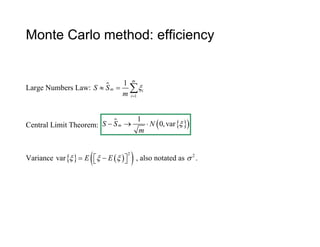
Monte Carlo method: efficiency
Large Numbers Law: 
1
1


  
m
m i
i
S S
m
Central Limit Theorem:    
1
0,var   mS S N
m
Variance     2
var      E E , also notated as 2
 .
Monte Carlo Integration
We are evaluating   D
I f x dx. D is domain of  f x or its subset.
We can sample r.v. ix D: ix are i.i.d. uniformly in D:    
1
    i
D
E f x f x dx I
D
.
The Monte Carlo estimation:   
1
 
m
m i
i
D
I f x
m
,
    0,var  m D
D
I I N f x
m
Advantage:
o The multiplier
1
2

 m does not depend on the space dimension.
Disadvantage:
o a lot of samples are spent in the area where  f x is small;
o the variation value   varD f x that determine convergence time can be large.
D
 f x
Monte Carlo importance integration
We are evaluating   D
I f x dx
Let’s sample ix D from a “trial” distribution  g x that “looks like”  f x and
   0 0  f x g x . ix i.i.d. in D as  g x that “resembles”  f x
Thus
 
 
 
 
   
 
  
 
 
i
g
i D D
f x f x
E g x dx f x dx
g x g x
.
MC evaluation:   
 1
1

 
m
i
m
i i
f x
I
m g x
;   
 
1
0,varm D
f x
I I N
g xm
  
      
  
“More uniform” means “better”.
Another example of importance integration
We are evaluating       
   E h x h x x dx, where   x is a distribution,
e.g.   1x dx 
sample ix from a distribution  .g so that    0 0   x g x
Importance weight    i i iw x g x ;   
 
 
  1g
x
E w x g x dx
g x

 
   
 
           
1 1 1 1
1 1m m m m
i
m i i i i i i
i i i ii
x
h x w x h x w x h x w x
m g x m


   
     
           
1 1 1
1 m m m
m i i i i i
i i i
w x h x w x h x w x
m

  
   
Sampling from   x :   
1
1 m
m i
i
h x
m


 
Rejection sampling (Von Neumann, 1951)
We have a distribution   x and
we want to sample from it.
We are able to calculate   ( ) f x c x for x. Any c.
We are able to sample      , : g x M Mg x f x .
Thus, we can sample   x :
Draw a value x from  g x .
Accept the value x with the probability    f x Mg x .
     
 
 
 |

      
c x c
P accept P accept x P x dx g x dx
Mg x M
 
   
 
 
 
   
|
|


 
    
P accept x P x c x M
P x accept g x x
P accept Mg x c
 g x
  x
 f x
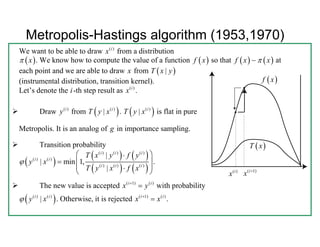
Metropolis-Hastings algorithm (1953,1970)
We want to be able to draw ( )i
x from a distribution
 x . We know how to compute the value of a function  f x so that    f x x at
each point and we are able to draw x from  |T x y
(instrumental distribution, transition kernel).
Let’s denote the i-th step result as ( )i
x .
 Draw ( )i
y from  ( )
| i
T y x .  ( )
| i
T y x is flat in pure
Metropolis. It is an analog of g in importance sampling.
 Transition probability
 
   
   
( ) ( ) ( )
( ) ( )
( ) ( ) ( )
|
| min 1,
|

 
  
  
i i i
i i
i i i
T x y f y
y x
T y x f x
.
 The new value is accepted ( 1) ( )
i i
x y with probability
 ( ) ( )
| i i
y x . Otherwise, it is rejected ( 1) ( )
i i
x x .
( 1)i
x ( )i
x
 f x
 T x
Why does it work: the local balance
Let’s show that if x is already distributed as     x f x , then the MH algorithm
keeps the distribution.
Local balance condition for two points x and y :
           | | | |     f x T y x y x f y T x y x y . Let’s check it:
         
   
   
              
|
| | | min 1,
|
min | , | | |
T x y f y
f x T y x y x f x T y x
T y x f x
T y x f x T x y f y f y T x y x y


 
      
 
     
The balance is stable:
     | | f x T y x y x is the flow from x to y and
     | | f y T x y x y is the flow from y to x.
The stable local balance is enough (BTW, it is not a necessary condition).
Markov chains, Maximization, Simulated
Annealing
ix created as described above is a Markov chain (MC) with transition kernel
   ( 1) ( ) ( 1) ( )
| |  
i i i i
x x T x x . The fact that the chain has a stationary distribution and the
convergence of the chain to the distribution can be proved by the MC theory methods.
Minimization.  C x is a cost (a fine).  
  min
exp
 
  
 
C x C
f x
t
.
We can characterize the transition kernel with a temperature. Then we can decrease the
temperature step-by-step (simulated annealing). MCMC and SA are very effective for
optimization since gradient methods use to be locked is a local maximum while pure
MC is extremely ineffective.
MCMC prior and Bayesian paradigm
( | ) ( )
( | ) ( | ) ( )
( )
posterior likelihood prior
P D M P M
P M D P D M P M
P D

  
 
here, evidence
MCMC and its variations are often used for the best model search .
Let’s can formulate some requirements for the algorithm and thus for the transition
kernel:
o We want it not to depend on the current data.
o We want to minimize the rejection rate.
So, an effective transition kernel is so that the prior ( )P M is its stationary distribution.
Terminology: names of relative algorithms
o MCMC, Metropolis, Metropolis-Hastings, hybrid Metropolis, configurational bias
Monte-Carlo, exchange Monte-Carlo, multigrid Monte-Carlo (MGMC), slice
sampling, RJMCMC (samples the dimensionality of the space), Multiple-Try
Metropolis, Hybrid Monte-Carlo…..
o Simulated annealing, Monte-Carlo annealing, statistical cooling, umbrella
sampling, probabilistic hill climbing, probabilistic exchange algorithm, parallel
tempering, stochastic relaxation….
o Gibbs algorithm, successive over-relaxation…
Gibbs Sampler (Geman and Geman, 1984)
Now, x is a k -dimensional variable  1 2, .... kx x x .
Let’s denote  1 2 1 1, .., , ,.. ,1    m m m kx x x x x x m k
On each step of the Markov Chain we choose the “current coordinate” im .
Then, we calculate the distribution  ( )
| i i
i
m mf x x and draw the next value ( )
i
i
my from the
distribution.
All other coords are the same as on the previous step, ( ) ( )
 i i
i i
m my x .
For such a transition kernel,
 
   
   
( ) ( ) ( )
( ) ( )
( ) ( ) ( )
|
| min 1, 1
|

 
  
  
i i i
i i
i i i
T x y f y
y x
T y x f x
.
o We have no rejects, so the procedure is very effective.
o The “temperature” decreases rather fast .
Inverse transform sampling (well-known)
We want to sample from the density  x . We know how to calculate the inverse
function for the cumulative distribution.
Generate a random number from the  0,1 uniform distribution; call this iu .
Compute the value ix such that  
ix
ix dx u


 ix is the random number that is drawn from the distribution described by   x .
 x dx
u
1
0
ix x
   
   
   
, ,x x x u u u
p x x uniform u u
u
p x uniform x
x

    
  

  

Slice sampling (Neal, 2003)
Sampling of x from  f x is equivalent to sampling of  ,x y pairs from they area.
So, we introduce an auxiliary variable y and iterate as follows:
for a sample tx we choose ty uniformly from the interval  0, tf x  
given ty we choose 1ix uniformly at random from   : tx f x y
the sample of x distributed as  f x is obtained by ignoring the y values.
Literature
Liu, J.S. (2002) Monte Carlo Strategies in Scientific Computing. Springer-Verlag, NY, Berlin, Heidelberg.
Robert, C.P. (1998) Discretization and MCMC Convergence Assessment, Springer-Verlag.
Laarhoven, van, P.M.J. and Aarts, E.H.L (1988) Simulated Annealing: Theory and Applications. Kluwer Academic
Publishers.
Geman, S and Geman, D (1984). Stochastic relaxation, Gibbs distribution and the Bayesian restoration of images. IEEE
Transactions on Pattern Analysis and Machine Intelligence. 6, 621-641.
Besag, J., Green, P., Higdon, D., and Mengersen, K. (1996) Bayesian computation and Stochastic Sytems. Statistical Science,
10, 1, 3-66.
Lawrence, C.E., Altschul, S.F., Boguski, M.S., Liu, J.S., Neuwald, A.F., and Wootton, J.C. (1993). Detecting subtle sequence
signals: a Gibbs sampling strategy for multiple alignment. Science 262, 208-214.
Sivia, D.S. (1996) Data Analysis. A Bayesian tutorial. Clarendon Press, Oxford.
Neal, Radford M. (2003) Slice Sampling. The Annals of Statistics 31(3):705-767.
http://civs.ucla.edu/MCMC/MCMC_tutorial.htm
Sheldon Ross. A First Course in Probability
Соболь И.М. Метод Монте-Карло
Sometimes, it works 
Favorov, A.V., Andreewski, T.V., Sudomoina, M.A., Favorova O.O., Parmigiani, G. Ochs, M.F. (2005). A Markov chain
Monte Carlo technique for identification of combinations of allelic variants underlying complex diseases in humans. Genetics
171(4): 2113-21.
Favorov, A.V., Gelfand, M.S., Gerasimova, A.V. Ravcheev, D.A., Mironov, A.A., Makeev, V. J. (2005). A Gibbs sampler
for identification of symmetrically structured, spaced DNA motifs with improved estimation of the signal length.
Bioinformatics 21(10): 2240-2245.

A bit about мcmc

  • 1.
    Markov Chain Monte-Carlo (MCMC) Whatfor is it and what does it look like? A. Favorov, 2003-2014 favorov@sensi.org favorov@gmail.com
  • 2.
    Monte Carlo method:a figure square The value  is unknown. Let’s sample a random value (r.v.)  :         , : i.i.d. as flat 0,1 1 , 0 ,            x y x y x y Clever notation:  ,  I x y i.i.d. is “Identically Independently Distributed” Expectation of  :        E S S 1 μ 1
  • 3.
    Monte Carlo method:efficiency Large Numbers Law:  1 1      m m i i S S m Central Limit Theorem:     1 0,var   mS S N m Variance     2 var      E E , also notated as 2  .
  • 4.
    Monte Carlo Integration Weare evaluating   D I f x dx. D is domain of  f x or its subset. We can sample r.v. ix D: ix are i.i.d. uniformly in D:     1     i D E f x f x dx I D . The Monte Carlo estimation:    1   m m i i D I f x m ,     0,var  m D D I I N f x m Advantage: o The multiplier 1 2   m does not depend on the space dimension. Disadvantage: o a lot of samples are spent in the area where  f x is small; o the variation value   varD f x that determine convergence time can be large. D  f x
  • 5.
    Monte Carlo importanceintegration We are evaluating   D I f x dx Let’s sample ix D from a “trial” distribution  g x that “looks like”  f x and    0 0  f x g x . ix i.i.d. in D as  g x that “resembles”  f x Thus                      i g i D D f x f x E g x dx f x dx g x g x . MC evaluation:     1 1    m i m i i f x I m g x ;      1 0,varm D f x I I N g xm              “More uniform” means “better”.
  • 6.
    Another example ofimportance integration We are evaluating           E h x h x x dx, where   x is a distribution, e.g.   1x dx  sample ix from a distribution  .g so that    0 0   x g x Importance weight    i i iw x g x ;          1g x E w x g x dx g x                      1 1 1 1 1 1m m m m i m i i i i i i i i i ii x h x w x h x w x h x w x m g x m                         1 1 1 1 m m m m i i i i i i i i w x h x w x h x w x m         Sampling from   x :    1 1 m m i i h x m    
  • 7.
    Rejection sampling (VonNeumann, 1951) We have a distribution   x and we want to sample from it. We are able to calculate   ( ) f x c x for x. Any c. We are able to sample      , : g x M Mg x f x . Thus, we can sample   x : Draw a value x from  g x . Accept the value x with the probability    f x Mg x .            |         c x c P accept P accept x P x dx g x dx Mg x M                 | |          P accept x P x c x M P x accept g x x P accept Mg x c  g x   x  f x
  • 8.
    Metropolis-Hastings algorithm (1953,1970) Wewant to be able to draw ( )i x from a distribution  x . We know how to compute the value of a function  f x so that    f x x at each point and we are able to draw x from  |T x y (instrumental distribution, transition kernel). Let’s denote the i-th step result as ( )i x .  Draw ( )i y from  ( ) | i T y x .  ( ) | i T y x is flat in pure Metropolis. It is an analog of g in importance sampling.  Transition probability           ( ) ( ) ( ) ( ) ( ) ( ) ( ) ( ) | | min 1, |          i i i i i i i i T x y f y y x T y x f x .  The new value is accepted ( 1) ( ) i i x y with probability  ( ) ( ) | i i y x . Otherwise, it is rejected ( 1) ( ) i i x x . ( 1)i x ( )i x  f x  T x
  • 9.
    Why does itwork: the local balance Let’s show that if x is already distributed as     x f x , then the MH algorithm keeps the distribution. Local balance condition for two points x and y :            | | | |     f x T y x y x f y T x y x y . Let’s check it:                                  | | | | min 1, | min | , | | | T x y f y f x T y x y x f x T y x T y x f x T y x f x T x y f y f y T x y x y                    The balance is stable:      | | f x T y x y x is the flow from x to y and      | | f y T x y x y is the flow from y to x. The stable local balance is enough (BTW, it is not a necessary condition).
  • 10.
    Markov chains, Maximization,Simulated Annealing ix created as described above is a Markov chain (MC) with transition kernel    ( 1) ( ) ( 1) ( ) | |   i i i i x x T x x . The fact that the chain has a stationary distribution and the convergence of the chain to the distribution can be proved by the MC theory methods. Minimization.  C x is a cost (a fine).     min exp        C x C f x t . We can characterize the transition kernel with a temperature. Then we can decrease the temperature step-by-step (simulated annealing). MCMC and SA are very effective for optimization since gradient methods use to be locked is a local maximum while pure MC is extremely ineffective.
  • 11.
    MCMC prior andBayesian paradigm ( | ) ( ) ( | ) ( | ) ( ) ( ) posterior likelihood prior P D M P M P M D P D M P M P D       here, evidence MCMC and its variations are often used for the best model search . Let’s can formulate some requirements for the algorithm and thus for the transition kernel: o We want it not to depend on the current data. o We want to minimize the rejection rate. So, an effective transition kernel is so that the prior ( )P M is its stationary distribution.
  • 12.
    Terminology: names ofrelative algorithms o MCMC, Metropolis, Metropolis-Hastings, hybrid Metropolis, configurational bias Monte-Carlo, exchange Monte-Carlo, multigrid Monte-Carlo (MGMC), slice sampling, RJMCMC (samples the dimensionality of the space), Multiple-Try Metropolis, Hybrid Monte-Carlo….. o Simulated annealing, Monte-Carlo annealing, statistical cooling, umbrella sampling, probabilistic hill climbing, probabilistic exchange algorithm, parallel tempering, stochastic relaxation…. o Gibbs algorithm, successive over-relaxation…
  • 13.
    Gibbs Sampler (Gemanand Geman, 1984) Now, x is a k -dimensional variable  1 2, .... kx x x . Let’s denote  1 2 1 1, .., , ,.. ,1    m m m kx x x x x x m k On each step of the Markov Chain we choose the “current coordinate” im . Then, we calculate the distribution  ( ) | i i i m mf x x and draw the next value ( ) i i my from the distribution. All other coords are the same as on the previous step, ( ) ( )  i i i i m my x . For such a transition kernel,           ( ) ( ) ( ) ( ) ( ) ( ) ( ) ( ) | | min 1, 1 |          i i i i i i i i T x y f y y x T y x f x . o We have no rejects, so the procedure is very effective. o The “temperature” decreases rather fast .
  • 14.
    Inverse transform sampling(well-known) We want to sample from the density  x . We know how to calculate the inverse function for the cumulative distribution. Generate a random number from the  0,1 uniform distribution; call this iu . Compute the value ix such that   ix ix dx u    ix is the random number that is drawn from the distribution described by   x .  x dx u 1 0 ix x             , ,x x x u u u p x x uniform u u u p x uniform x x              
  • 15.
    Slice sampling (Neal,2003) Sampling of x from  f x is equivalent to sampling of  ,x y pairs from they area. So, we introduce an auxiliary variable y and iterate as follows: for a sample tx we choose ty uniformly from the interval  0, tf x   given ty we choose 1ix uniformly at random from   : tx f x y the sample of x distributed as  f x is obtained by ignoring the y values.
  • 16.
    Literature Liu, J.S. (2002)Monte Carlo Strategies in Scientific Computing. Springer-Verlag, NY, Berlin, Heidelberg. Robert, C.P. (1998) Discretization and MCMC Convergence Assessment, Springer-Verlag. Laarhoven, van, P.M.J. and Aarts, E.H.L (1988) Simulated Annealing: Theory and Applications. Kluwer Academic Publishers. Geman, S and Geman, D (1984). Stochastic relaxation, Gibbs distribution and the Bayesian restoration of images. IEEE Transactions on Pattern Analysis and Machine Intelligence. 6, 621-641. Besag, J., Green, P., Higdon, D., and Mengersen, K. (1996) Bayesian computation and Stochastic Sytems. Statistical Science, 10, 1, 3-66. Lawrence, C.E., Altschul, S.F., Boguski, M.S., Liu, J.S., Neuwald, A.F., and Wootton, J.C. (1993). Detecting subtle sequence signals: a Gibbs sampling strategy for multiple alignment. Science 262, 208-214. Sivia, D.S. (1996) Data Analysis. A Bayesian tutorial. Clarendon Press, Oxford. Neal, Radford M. (2003) Slice Sampling. The Annals of Statistics 31(3):705-767. http://civs.ucla.edu/MCMC/MCMC_tutorial.htm Sheldon Ross. A First Course in Probability Соболь И.М. Метод Монте-Карло Sometimes, it works  Favorov, A.V., Andreewski, T.V., Sudomoina, M.A., Favorova O.O., Parmigiani, G. Ochs, M.F. (2005). A Markov chain Monte Carlo technique for identification of combinations of allelic variants underlying complex diseases in humans. Genetics 171(4): 2113-21. Favorov, A.V., Gelfand, M.S., Gerasimova, A.V. Ravcheev, D.A., Mironov, A.A., Makeev, V. J. (2005). A Gibbs sampler for identification of symmetrically structured, spaced DNA motifs with improved estimation of the signal length. Bioinformatics 21(10): 2240-2245.