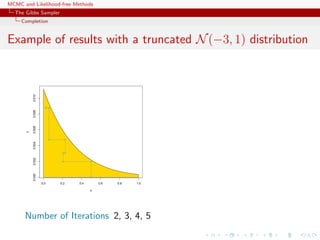
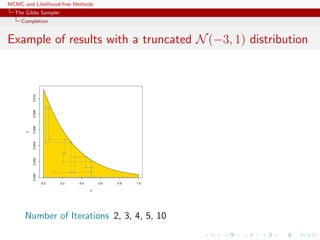
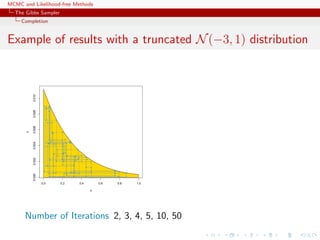
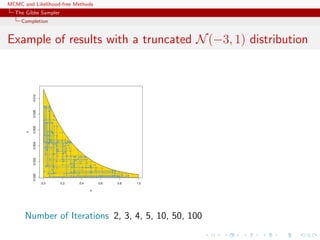
MCMC and Likelihood-free Methods
Christian P. Robert
Universit´e Paris-Dauphine & CREST
http://www.ceremade.dauphine.fr/~xian
November 2, 2010
MCMC and Likelihood-free Methods
Outline
Computational issues in Bayesian statistics
The Metropolis-Hastings Algorithm
The Gibbs Sampler
Population Monte Carlo
Approximate Bayesian computation
ABC for model choice
MCMC and Likelihood-free Methods
Computational issues in Bayesian statistics
Motivation and leading example
Computational issues in Bayesian statistics
The Metropolis-Hastings Algorithm
The Gibbs Sampler
Population Monte Carlo
Approximate Bayesian computation
ABC for model choice
MCMC and Likelihood-free Methods
Computational issues in Bayesian statistics
Latent variables
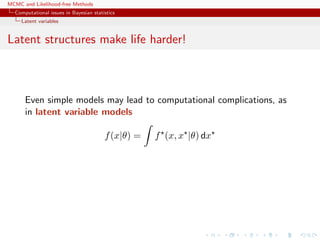
Latent structures make life harder!
Even simple models may lead to computational complications, as
in latent variable models
f(x|θ) = f (x, x |θ) dx
MCMC and Likelihood-free Methods
Computational issues in Bayesian statistics
Latent variables
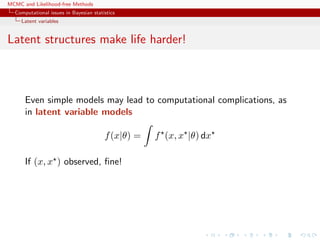
Latent structures make life harder!
Even simple models may lead to computational complications, as
in latent variable models
f(x|θ) = f (x, x |θ) dx
If (x, x ) observed, fine!
MCMC and Likelihood-free Methods
Computational issues in Bayesian statistics
Latent variables
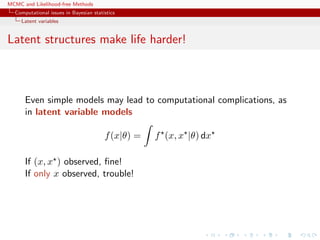
Latent structures make life harder!
Even simple models may lead to computational complications, as
in latent variable models
f(x|θ) = f (x, x |θ) dx
If (x, x ) observed, fine!
If only x observed, trouble!
MCMC and Likelihood-free Methods
Computational issues in Bayesian statistics
Latent variables
Example (Mixture models)
Models of mixtures of distributions:
X ∼ fj with probability pj,
for j = 1, 2, . . . , k, with overall density
X ∼ p1f1(x) + · · · + pkfk(x) .
MCMC and Likelihood-free Methods
Computational issues in Bayesian statistics
Latent variables
Example (Mixture models)
Models of mixtures of distributions:
X ∼ fj with probability pj,
for j = 1, 2, . . . , k, with overall density
X ∼ p1f1(x) + · · · + pkfk(x) .
For a sample of independent random variables (X1, · · · , Xn),
sample density
n
i=1
{p1f1(xi) + · · · + pkfk(xi)} .
MCMC and Likelihood-free Methods
Computational issues in Bayesian statistics
Latent variables
Example (Mixture models)
Models of mixtures of distributions:
X ∼ fj with probability pj,
for j = 1, 2, . . . , k, with overall density
X ∼ p1f1(x) + · · · + pkfk(x) .
For a sample of independent random variables (X1, · · · , Xn),
sample density
n
i=1
{p1f1(xi) + · · · + pkfk(xi)} .
Expanding this product of sums into a sum of products involves kn
elementary terms: too prohibitive to compute in large samples.
MCMC and Likelihood-free Methods
Computational issues in Bayesian statistics
Latent variables
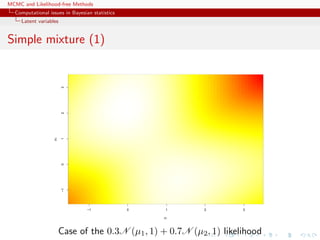
Simple mixture (1)
−1 0 1 2 3
−10123
µ1
µ2
Case of the 0.3N (µ1, 1) + 0.7N (µ2, 1) likelihood
MCMC and Likelihood-free Methods
Computational issues in Bayesian statistics
Latent variables
Simple mixture (2)
For the mixture of two normal distributions,
0.3N(µ1, 1) + 0.7N(µ2, 1) ,
likelihood proportional to
n
i=1
[0.3ϕ (xi − µ1) + 0.7 ϕ (xi − µ2)]
containing 2n terms.
MCMC and Likelihood-free Methods
Computational issues in Bayesian statistics
Latent variables
Complex maximisation
Standard maximization techniques often fail to find the global
maximum because of multimodality or undesirable behavior
(usually at the frontier of the domain) of the likelihood function.
Example
In the special case
f(x|µ, σ) = (1 − ) exp{(−1/2)x2
} +
σ
exp{(−1/2σ2
)(x − µ)2
}
with > 0 known,
MCMC and Likelihood-free Methods
Computational issues in Bayesian statistics
Latent variables
Complex maximisation
Standard maximization techniques often fail to find the global
maximum because of multimodality or undesirable behavior
(usually at the frontier of the domain) of the likelihood function.
Example
In the special case
f(x|µ, σ) = (1 − ) exp{(−1/2)x2
} +
σ
exp{(−1/2σ2
)(x − µ)2
}
with > 0 known, whatever n, the likelihood is unbounded:
lim
σ→0
L(x1, . . . , xn|µ = x1, σ) = ∞
MCMC and Likelihood-free Methods
Computational issues in Bayesian statistics
Latent variables
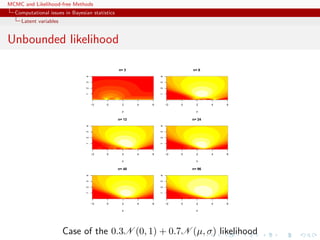
Unbounded likelihood
−2 0 2 4 6
1234
µ
n= 3
−2 0 2 4 6
1234
µ
σ
n= 6
−2 0 2 4 6
1234
µ
n= 12
−2 0 2 4 6
1234 µ
σ
n= 24
−2 0 2 4 6
1234
µ
n= 48
−2 0 2 4 6
1234
µ
σ
n= 96
Case of the 0.3N (0, 1) + 0.7N (µ, σ) likelihood
MCMC and Likelihood-free Methods
Computational issues in Bayesian statistics
Latent variables
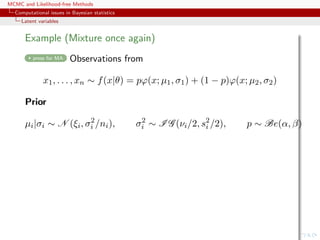
Example (Mixture once again)
press for MA Observations from
x1, . . . , xn ∼ f(x|θ) = pϕ(x; µ1, σ1) + (1 − p)ϕ(x; µ2, σ2)
MCMC and Likelihood-free Methods
Computational issues in Bayesian statistics
Latent variables
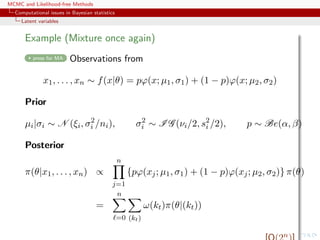
Example (Mixture once again)
press for MA Observations from
x1, . . . , xn ∼ f(x|θ) = pϕ(x; µ1, σ1) + (1 − p)ϕ(x; µ2, σ2)
Prior
µi|σi ∼ N (ξi, σ2
i /ni), σ2
i ∼ I G (νi/2, s2
i /2), p ∼ Be(α, β)
MCMC and Likelihood-free Methods
Computational issues in Bayesian statistics
Latent variables
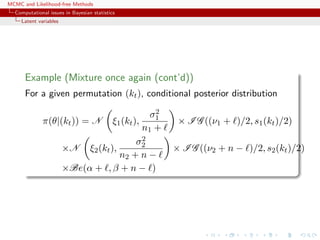
Example (Mixture once again)
press for MA Observations from
x1, . . . , xn ∼ f(x|θ) = pϕ(x; µ1, σ1) + (1 − p)ϕ(x; µ2, σ2)
Prior
µi|σi ∼ N (ξi, σ2
i /ni), σ2
i ∼ I G (νi/2, s2
i /2), p ∼ Be(α, β)
Posterior
π(θ|x1, . . . , xn) ∝
n
j=1
{pϕ(xj; µ1, σ1) + (1 − p)ϕ(xj; µ2, σ2)} π(θ)
=
n
=0 (kt)
ω(kt)π(θ|(kt))
n
MCMC and Likelihood-free Methods
Computational issues in Bayesian statistics
Latent variables
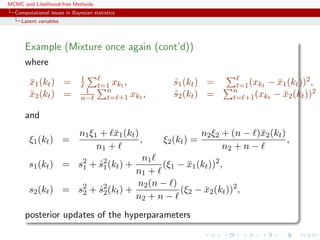
Example (Mixture once again (cont’d))
For a given permutation (kt), conditional posterior distribution
π(θ|(kt)) = N ξ1(kt),
σ2
1
n1 +
× I G ((ν1 + )/2, s1(kt)/2)
×N ξ2(kt),
σ2
2
n2 + n −
× I G ((ν2 + n − )/2, s2(kt)/2)
×Be(α + , β + n − )
MCMC and Likelihood-free Methods
Computational issues in Bayesian statistics
Latent variables
Example (Mixture once again (cont’d))
where
¯x1(kt) = 1
t=1 xkt , ˆs1(kt) = t=1(xkt − ¯x1(kt))2,
¯x2(kt) = 1
n−
n
t= +1 xkt , ˆs2(kt) = n
t= +1(xkt − ¯x2(kt))2
and
ξ1(kt) =
n1ξ1 + ¯x1(kt)
n1 +
, ξ2(kt) =
n2ξ2 + (n − )¯x2(kt)
n2 + n −
,
s1(kt) = s2
1 + ˆs2
1(kt) +
n1
n1 +
(ξ1 − ¯x1(kt))2
,
s2(kt) = s2
2 + ˆs2
2(kt) +
n2(n − )
n2 + n −
(ξ2 − ¯x2(kt))2
,
posterior updates of the hyperparameters
MCMC and Likelihood-free Methods
Computational issues in Bayesian statistics
Latent variables
Example (Mixture once again)
Bayes estimator of θ:
δπ
(x1, . . . , xn) =
n
=0 (kt)
ω(kt)Eπ
[θ|x, (kt)]
Too costly: 2n terms
MCMC and Likelihood-free Methods
Computational issues in Bayesian statistics
The AR(p) model
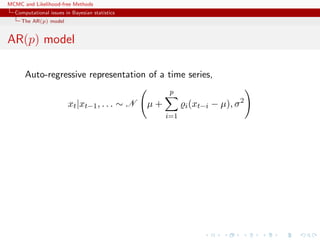
AR(p) model
Auto-regressive representation of a time series,
xt|xt−1, . . . ∼ N µ +
p
i=1
i(xt−i − µ), σ2
MCMC and Likelihood-free Methods
Computational issues in Bayesian statistics
The AR(p) model
AR(p) model
Auto-regressive representation of a time series,
xt|xt−1, . . . ∼ N µ +
p
i=1
i(xt−i − µ), σ2
Generalisation of AR(1)
Among the most commonly used models in dynamic settings
More challenging than the static models (stationarity
constraints)
Different models depending on the processing of the starting
value x0
MCMC and Likelihood-free Methods
Computational issues in Bayesian statistics
The AR(p) model
Unknown stationarity constraints
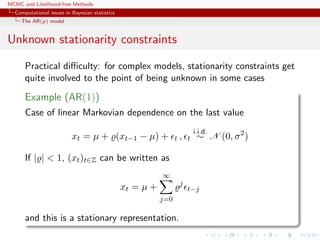
Practical difficulty: for complex models, stationarity constraints get
quite involved to the point of being unknown in some cases
Example (AR(1))
Case of linear Markovian dependence on the last value
xt = µ + (xt−1 − µ) + t , t
i.i.d.
∼ N (0, σ2
)
If | | < 1, (xt)t∈Z can be written as
xt = µ +
∞
j=0
j
t−j
and this is a stationary representation.
MCMC and Likelihood-free Methods
Computational issues in Bayesian statistics
The AR(p) model
Stationary but...
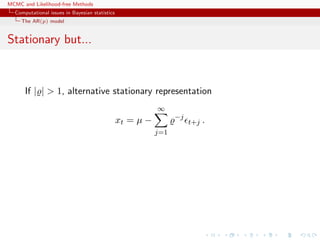
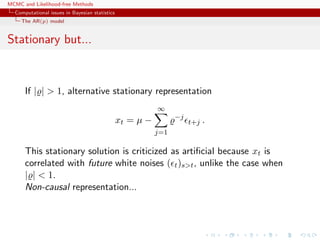
If | | > 1, alternative stationary representation
xt = µ −
∞
j=1
−j
t+j .
MCMC and Likelihood-free Methods
Computational issues in Bayesian statistics
The AR(p) model
Stationary but...
If | | > 1, alternative stationary representation
xt = µ −
∞
j=1
−j
t+j .
This stationary solution is criticized as artificial because xt is
correlated with future white noises ( t)s>t, unlike the case when
| | < 1.
Non-causal representation...
MCMC and Likelihood-free Methods
Computational issues in Bayesian statistics
The AR(p) model
Stationarity+causality
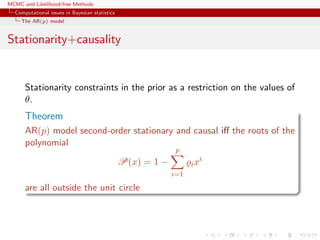
Stationarity constraints in the prior as a restriction on the values of
θ.
Theorem
AR(p) model second-order stationary and causal iff the roots of the
polynomial
P(x) = 1 −
p
i=1
ixi
are all outside the unit circle
MCMC and Likelihood-free Methods
Computational issues in Bayesian statistics
The AR(p) model
Stationarity constraints
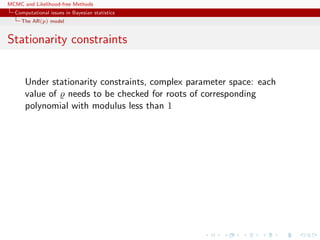
Under stationarity constraints, complex parameter space: each
value of needs to be checked for roots of corresponding
polynomial with modulus less than 1
MCMC and Likelihood-free Methods
Computational issues in Bayesian statistics
The AR(p) model
Stationarity constraints
Under stationarity constraints, complex parameter space: each
value of needs to be checked for roots of corresponding
polynomial with modulus less than 1
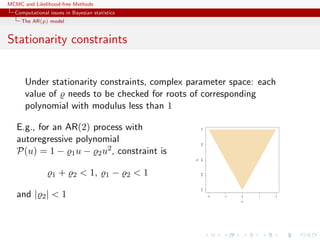
E.g., for an AR(2) process with
autoregressive polynomial
P(u) = 1 − 1u − 2u2, constraint is
1 + 2 < 1, 1 − 2 < 1
and | 2| < 1
q
−2 −1 0 1 2
−1.0−0.50.00.51.0 θ1
θ2
MCMC and Likelihood-free Methods
Computational issues in Bayesian statistics
The MA(q) model
The MA(q) model
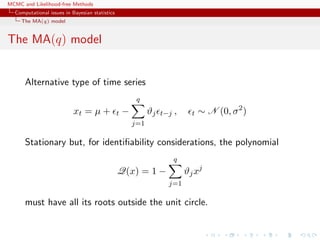
Alternative type of time series
xt = µ + t −
q
j=1
ϑj t−j , t ∼ N (0, σ2
)
Stationary but, for identifiability considerations, the polynomial
Q(x) = 1 −
q
j=1
ϑjxj
must have all its roots outside the unit circle.
MCMC and Likelihood-free Methods
Computational issues in Bayesian statistics
The MA(q) model
Identifiability
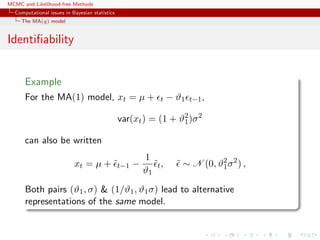
Example
For the MA(1) model, xt = µ + t − ϑ1 t−1,
var(xt) = (1 + ϑ2
1)σ2
can also be written
xt = µ + ˜t−1 −
1
ϑ1
˜t, ˜ ∼ N (0, ϑ2
1σ2
) ,
Both pairs (ϑ1, σ) & (1/ϑ1, ϑ1σ) lead to alternative
representations of the same model.
MCMC and Likelihood-free Methods
Computational issues in Bayesian statistics
The MA(q) model
Properties of MA models
Non-Markovian model (but special case of hidden Markov)
Autocovariance γx(s) is null for |s| > q
MCMC and Likelihood-free Methods
Computational issues in Bayesian statistics
The MA(q) model
Representations
x1:T is a normal random variable with constant mean µ and
covariance matrix
Σ =





σ2
γ1 γ2 . . . γq 0 . . . 0 0
γ1 σ2
γ1 . . . γq−1 γq . . . 0 0
...
0 0 0 . . . 0 0 . . . γ1 σ2





,
with (|s| ≤ q)
γs = σ2
q−|s|
i=0
ϑiϑi+|s|
Not manageable in practice [large T’s]
MCMC and Likelihood-free Methods
Computational issues in Bayesian statistics
The MA(q) model
Representations (contd.)
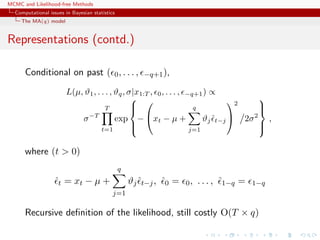
Conditional on past ( 0, . . . , −q+1),
L(µ, ϑ1, . . . , ϑq, σ|x1:T , 0, . . . , −q+1) ∝
σ−T
T
t=1
exp



−

xt − µ +
q
j=1
ϑjˆt−j


2
2σ2



,
where (t > 0)
ˆt = xt − µ +
q
j=1
ϑjˆt−j, ˆ0 = 0, . . . , ˆ1−q = 1−q
Recursive definition of the likelihood, still costly O(T × q)
MCMC and Likelihood-free Methods
Computational issues in Bayesian statistics
The MA(q) model
Representations (contd.)
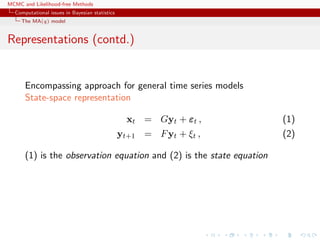
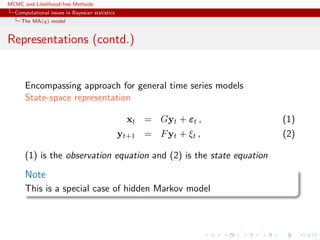
Encompassing approach for general time series models
State-space representation
xt = Gyt + εt , (1)
yt+1 = Fyt + ξt , (2)
(1) is the observation equation and (2) is the state equation
MCMC and Likelihood-free Methods
Computational issues in Bayesian statistics
The MA(q) model
Representations (contd.)
Encompassing approach for general time series models
State-space representation
xt = Gyt + εt , (1)
yt+1 = Fyt + ξt , (2)
(1) is the observation equation and (2) is the state equation
Note
This is a special case of hidden Markov model
MCMC and Likelihood-free Methods
Computational issues in Bayesian statistics
The MA(q) model
MA(q) state-space representation
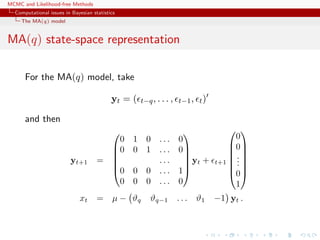
For the MA(q) model, take
yt = ( t−q, . . . , t−1, t)
and then
yt+1 =






0 1 0 . . . 0
0 0 1 . . . 0
. . .
0 0 0 . . . 1
0 0 0 . . . 0






yt + t+1







0
0
...
0
1







xt = µ − ϑq ϑq−1 . . . ϑ1 −1 yt .
MCMC and Likelihood-free Methods
Computational issues in Bayesian statistics
The MA(q) model
MA(q) state-space representation (cont’d)
Example
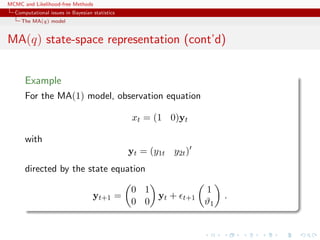
For the MA(1) model, observation equation
xt = (1 0)yt
with
yt = (y1t y2t)
directed by the state equation
yt+1 =
0 1
0 0
yt + t+1
1
ϑ1
.
MCMC and Likelihood-free Methods
Computational issues in Bayesian statistics
The MA(q) model
c A typology of Bayes computational problems
(i). latent variable models in general
MCMC and Likelihood-free Methods
Computational issues in Bayesian statistics
The MA(q) model
c A typology of Bayes computational problems
(i). latent variable models in general
(ii). use of a complex parameter space, as for instance in
constrained parameter sets like those resulting from imposing
stationarity constraints in dynamic models;
MCMC and Likelihood-free Methods
Computational issues in Bayesian statistics
The MA(q) model
c A typology of Bayes computational problems
(i). latent variable models in general
(ii). use of a complex parameter space, as for instance in
constrained parameter sets like those resulting from imposing
stationarity constraints in dynamic models;
(iii). use of a complex sampling model with an intractable
likelihood, as for instance in some graphical models;
MCMC and Likelihood-free Methods
Computational issues in Bayesian statistics
The MA(q) model
c A typology of Bayes computational problems
(i). latent variable models in general
(ii). use of a complex parameter space, as for instance in
constrained parameter sets like those resulting from imposing
stationarity constraints in dynamic models;
(iii). use of a complex sampling model with an intractable
likelihood, as for instance in some graphical models;
(iv). use of a huge dataset;
MCMC and Likelihood-free Methods
Computational issues in Bayesian statistics
The MA(q) model
c A typology of Bayes computational problems
(i). latent variable models in general
(ii). use of a complex parameter space, as for instance in
constrained parameter sets like those resulting from imposing
stationarity constraints in dynamic models;
(iii). use of a complex sampling model with an intractable
likelihood, as for instance in some graphical models;
(iv). use of a huge dataset;
(v). use of a complex prior distribution (which may be the
posterior distribution associated with an earlier sample);
MCMC and Likelihood-free Methods
Computational issues in Bayesian statistics
The MA(q) model
c A typology of Bayes computational problems
(i). latent variable models in general
(ii). use of a complex parameter space, as for instance in
constrained parameter sets like those resulting from imposing
stationarity constraints in dynamic models;
(iii). use of a complex sampling model with an intractable
likelihood, as for instance in some graphical models;
(iv). use of a huge dataset;
(v). use of a complex prior distribution (which may be the
posterior distribution associated with an earlier sample);
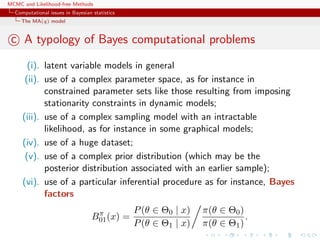
(vi). use of a particular inferential procedure as for instance, Bayes
factors
Bπ
01(x) =
P(θ ∈ Θ0 | x)
P(θ ∈ Θ1 | x)
π(θ ∈ Θ0)
π(θ ∈ Θ1)
.
MCMC and Likelihood-free Methods
The Metropolis-Hastings Algorithm
Computational issues in Bayesian statistics
The Metropolis-Hastings Algorithm
Monte Carlo basics
Importance Sampling
Monte Carlo Methods based on Markov Chains
The Metropolis–Hastings algorithm
Random-walk Metropolis-Hastings algorithms
Extensions
The Gibbs Sampler
Population Monte Carlo
MCMC and Likelihood-free Methods
The Metropolis-Hastings Algorithm
Monte Carlo basics
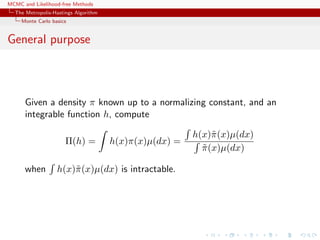
General purpose
Given a density π known up to a normalizing constant, and an
integrable function h, compute
Π(h) = h(x)π(x)µ(dx) =
h(x)˜π(x)µ(dx)
˜π(x)µ(dx)
when h(x)˜π(x)µ(dx) is intractable.
MCMC and Likelihood-free Methods
The Metropolis-Hastings Algorithm
Monte Carlo basics
Monte Carlo 101
Generate an iid sample x1, . . . , xN from π and estimate Π(h) by
ˆΠMC
N (h) = N−1
N
i=1
h(xi).
LLN: ˆΠMC
N (h)
as
−→ Π(h)
If Π(h2) = h2(x)π(x)µ(dx) < ∞,
CLT:
√
N ˆΠMC
N (h) − Π(h)
L
N 0, Π [h − Π(h)]2
.
MCMC and Likelihood-free Methods
The Metropolis-Hastings Algorithm
Monte Carlo basics
Monte Carlo 101
Generate an iid sample x1, . . . , xN from π and estimate Π(h) by
ˆΠMC
N (h) = N−1
N
i=1
h(xi).
LLN: ˆΠMC
N (h)
as
−→ Π(h)
If Π(h2) = h2(x)π(x)µ(dx) < ∞,
CLT:
√
N ˆΠMC
N (h) − Π(h)
L
N 0, Π [h − Π(h)]2
.
Caveat announcing MCMC
Often impossible or inefficient to simulate directly from Π
MCMC and Likelihood-free Methods
The Metropolis-Hastings Algorithm
Importance Sampling
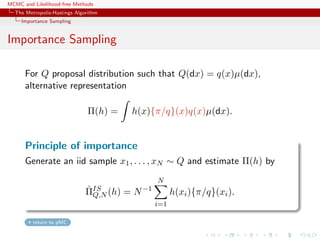
Importance Sampling
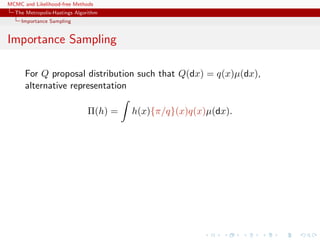
For Q proposal distribution such that Q(dx) = q(x)µ(dx),
alternative representation
Π(h) = h(x){π/q}(x)q(x)µ(dx).
MCMC and Likelihood-free Methods
The Metropolis-Hastings Algorithm
Importance Sampling
Importance Sampling
For Q proposal distribution such that Q(dx) = q(x)µ(dx),
alternative representation
Π(h) = h(x){π/q}(x)q(x)µ(dx).
Principle of importance
Generate an iid sample x1, . . . , xN ∼ Q and estimate Π(h) by
ˆΠIS
Q,N (h) = N−1
N
i=1
h(xi){π/q}(xi).
return to pMC
MCMC and Likelihood-free Methods
The Metropolis-Hastings Algorithm
Importance Sampling
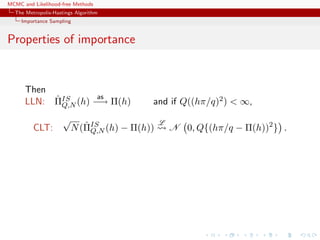
Properties of importance
Then
LLN: ˆΠIS
Q,N (h)
as
−→ Π(h) and if Q((hπ/q)2) < ∞,
CLT:
√
N(ˆΠIS
Q,N (h) − Π(h))
L
N 0, Q{(hπ/q − Π(h))2
} .
MCMC and Likelihood-free Methods
The Metropolis-Hastings Algorithm
Importance Sampling
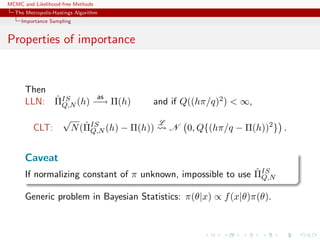
Properties of importance
Then
LLN: ˆΠIS
Q,N (h)
as
−→ Π(h) and if Q((hπ/q)2) < ∞,
CLT:
√
N(ˆΠIS
Q,N (h) − Π(h))
L
N 0, Q{(hπ/q − Π(h))2
} .
Caveat
If normalizing constant of π unknown, impossible to use ˆΠIS
Q,N
Generic problem in Bayesian Statistics: π(θ|x) ∝ f(x|θ)π(θ).
MCMC and Likelihood-free Methods
The Metropolis-Hastings Algorithm
Importance Sampling
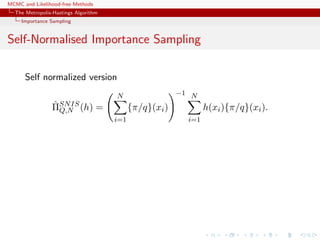
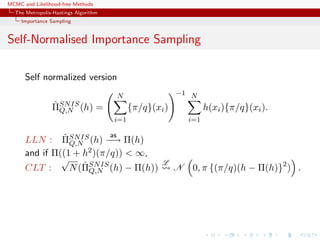
Self-Normalised Importance Sampling
Self normalized version
ˆΠSNIS
Q,N (h) =
N
i=1
{π/q}(xi)
−1 N
i=1
h(xi){π/q}(xi).
MCMC and Likelihood-free Methods
The Metropolis-Hastings Algorithm
Importance Sampling
Self-Normalised Importance Sampling
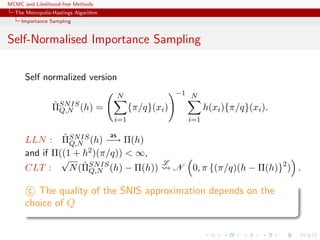
Self normalized version
ˆΠSNIS
Q,N (h) =
N
i=1
{π/q}(xi)
−1 N
i=1
h(xi){π/q}(xi).
LLN : ˆΠSNIS
Q,N (h)
as
−→ Π(h)
and if Π((1 + h2)(π/q)) < ∞,
CLT :
√
N(ˆΠSNIS
Q,N (h) − Π(h))
L
N 0, π {(π/q)(h − Π(h)}2
) .
MCMC and Likelihood-free Methods
The Metropolis-Hastings Algorithm
Importance Sampling
Self-Normalised Importance Sampling
Self normalized version
ˆΠSNIS
Q,N (h) =
N
i=1
{π/q}(xi)
−1 N
i=1
h(xi){π/q}(xi).
LLN : ˆΠSNIS
Q,N (h)
as
−→ Π(h)
and if Π((1 + h2)(π/q)) < ∞,
CLT :
√
N(ˆΠSNIS
Q,N (h) − Π(h))
L
N 0, π {(π/q)(h − Π(h)}2
) .
c The quality of the SNIS approximation depends on the
choice of Q
MCMC and Likelihood-free Methods
The Metropolis-Hastings Algorithm
Monte Carlo Methods based on Markov Chains
Running Monte Carlo via Markov Chains (MCMC)
It is not necessary to use a sample from the distribution f to
approximate the integral
I = h(x)f(x)dx ,
MCMC and Likelihood-free Methods
The Metropolis-Hastings Algorithm
Monte Carlo Methods based on Markov Chains
Running Monte Carlo via Markov Chains (MCMC)
It is not necessary to use a sample from the distribution f to
approximate the integral
I = h(x)f(x)dx ,
We can obtain X1, . . . , Xn ∼ f (approx) without directly
simulating from f, using an ergodic Markov chain with
stationary distribution f
MCMC and Likelihood-free Methods
The Metropolis-Hastings Algorithm
Monte Carlo Methods based on Markov Chains
Running Monte Carlo via Markov Chains (2)
Idea
For an arbitrary starting value x(0), an ergodic chain (X(t)) is
generated using a transition kernel with stationary distribution f
MCMC and Likelihood-free Methods
The Metropolis-Hastings Algorithm
Monte Carlo Methods based on Markov Chains
Running Monte Carlo via Markov Chains (2)
Idea
For an arbitrary starting value x(0), an ergodic chain (X(t)) is
generated using a transition kernel with stationary distribution f
Insures the convergence in distribution of (X(t)) to a random
variable from f.
For a “large enough” T0, X(T0) can be considered as
distributed from f
Produce a dependent sample X(T0), X(T0+1), . . ., which is
generated from f, sufficient for most approximation purposes.
MCMC and Likelihood-free Methods
The Metropolis-Hastings Algorithm
Monte Carlo Methods based on Markov Chains
Running Monte Carlo via Markov Chains (2)
Idea
For an arbitrary starting value x(0), an ergodic chain (X(t)) is
generated using a transition kernel with stationary distribution f
Insures the convergence in distribution of (X(t)) to a random
variable from f.
For a “large enough” T0, X(T0) can be considered as
distributed from f
Produce a dependent sample X(T0), X(T0+1), . . ., which is
generated from f, sufficient for most approximation purposes.
Problem: How can one build a Markov chain with a given
stationary distribution?
MCMC and Likelihood-free Methods
The Metropolis-Hastings Algorithm
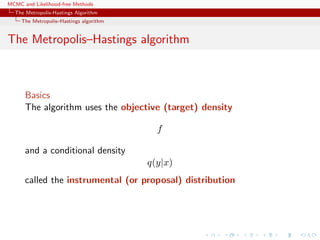
The Metropolis–Hastings algorithm
Basics
The algorithm uses the objective (target) density
f
and a conditional density
q(y|x)
called the instrumental (or proposal) distribution
MCMC and Likelihood-free Methods
The Metropolis-Hastings Algorithm
The Metropolis–Hastings algorithm
The MH algorithm
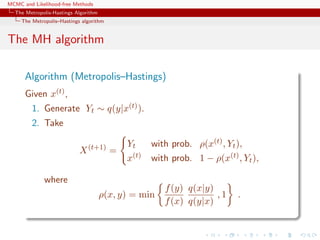
Algorithm (Metropolis–Hastings)
Given x(t),
1. Generate Yt ∼ q(y|x(t)).
2. Take
X(t+1)
=
Yt with prob. ρ(x(t), Yt),
x(t) with prob. 1 − ρ(x(t), Yt),
where
ρ(x, y) = min
f(y)
f(x)
q(x|y)
q(y|x)
, 1 .
MCMC and Likelihood-free Methods
The Metropolis-Hastings Algorithm
The Metropolis–Hastings algorithm
Features
Independent of normalizing constants for both f and q(·|x)
(ie, those constants independent of x)
Never move to values with f(y) = 0
The chain (x(t))t may take the same value several times in a
row, even though f is a density wrt Lebesgue measure
The sequence (yt)t is usually not a Markov chain
MCMC and Likelihood-free Methods
The Metropolis-Hastings Algorithm
The Metropolis–Hastings algorithm
Convergence properties
1. The M-H Markov chain is reversible, with
invariant/stationary density f since it satisfies the detailed
balance condition
f(y) K(y, x) = f(x) K(x, y)
MCMC and Likelihood-free Methods
The Metropolis-Hastings Algorithm
The Metropolis–Hastings algorithm
Convergence properties
1. The M-H Markov chain is reversible, with
invariant/stationary density f since it satisfies the detailed
balance condition
f(y) K(y, x) = f(x) K(x, y)
2. As f is a probability measure, the chain is positive recurrent
MCMC and Likelihood-free Methods
The Metropolis-Hastings Algorithm
The Metropolis–Hastings algorithm
Convergence properties
1. The M-H Markov chain is reversible, with
invariant/stationary density f since it satisfies the detailed
balance condition
f(y) K(y, x) = f(x) K(x, y)
2. As f is a probability measure, the chain is positive recurrent
3. If
Pr
f(Yt) q(X(t)|Yt)
f(X(t)) q(Yt|X(t))
≥ 1 < 1. (1)
that is, the event {X(t+1) = X(t)} is possible, then the chain
is aperiodic
MCMC and Likelihood-free Methods
The Metropolis-Hastings Algorithm
The Metropolis–Hastings algorithm
Convergence properties (2)
4. If
q(y|x) > 0 for every (x, y), (2)
the chain is irreducible
MCMC and Likelihood-free Methods
The Metropolis-Hastings Algorithm
The Metropolis–Hastings algorithm
Convergence properties (2)
4. If
q(y|x) > 0 for every (x, y), (2)
the chain is irreducible
5. For M-H, f-irreducibility implies Harris recurrence
MCMC and Likelihood-free Methods
The Metropolis-Hastings Algorithm
The Metropolis–Hastings algorithm
Convergence properties (2)
4. If
q(y|x) > 0 for every (x, y), (2)
the chain is irreducible
5. For M-H, f-irreducibility implies Harris recurrence
6. Thus, for M-H satisfying (1) and (2)
(i) For h, with Ef |h(X)| < ∞,
lim
T →∞
1
T
T
t=1
h(X(t)
) = h(x)df(x) a.e. f.
(ii) and
lim
n→∞
Kn
(x, ·)µ(dx) − f
T V
= 0
for every initial distribution µ, where Kn
(x, ·) denotes the
kernel for n transitions.
MCMC and Likelihood-free Methods
The Metropolis-Hastings Algorithm
Random-walk Metropolis-Hastings algorithms
Random walk Metropolis–Hastings
Use of a local perturbation as proposal
Yt = X(t)
+ εt,
where εt ∼ g, independent of X(t).
The instrumental density is of the form g(y − x) and the Markov
chain is a random walk if we take g to be symmetric g(x) = g(−x)
MCMC and Likelihood-free Methods
The Metropolis-Hastings Algorithm
Random-walk Metropolis-Hastings algorithms
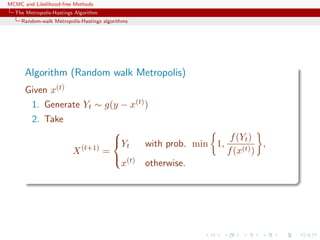
Algorithm (Random walk Metropolis)
Given x(t)
1. Generate Yt ∼ g(y − x(t))
2. Take
X(t+1)
=



Yt with prob. min 1,
f(Yt)
f(x(t))
,
x(t) otherwise.
MCMC and Likelihood-free Methods
The Metropolis-Hastings Algorithm
Random-walk Metropolis-Hastings algorithms
Example (Random walk and normal target)
forget History! Generate N(0, 1) based on the uniform proposal [−δ, δ]
[Hastings (1970)]
The probability of acceptance is then
ρ(x(t)
, yt) = exp{(x(t)2
− y2
t )/2} ∧ 1.
MCMC and Likelihood-free Methods
The Metropolis-Hastings Algorithm
Random-walk Metropolis-Hastings algorithms
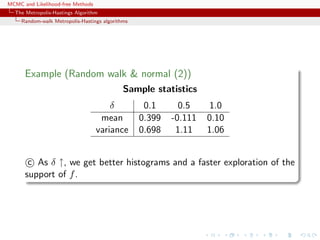
Example (Random walk & normal (2))
Sample statistics
δ 0.1 0.5 1.0
mean 0.399 -0.111 0.10
variance 0.698 1.11 1.06
c As δ ↑, we get better histograms and a faster exploration of the
support of f.
MCMC and Likelihood-free Methods
The Metropolis-Hastings Algorithm
Random-walk Metropolis-Hastings algorithms
-1 0 1 2
050100150200250
(a)
-1.5-1.0-0.50.00.5
-2 0 2
0100200300400
(b) -1.5-1.0-0.50.00.5
-3 -2 -1 0 1 2 3
0100200300400
(c)
-1.5-1.0-0.50.00.5
Three samples based on U[−δ, δ] with (a) δ = 0.1, (b) δ = 0.5
and (c) δ = 1.0, superimposed with the convergence of the
means (15, 000 simulations).
MCMC and Likelihood-free Methods
The Metropolis-Hastings Algorithm
Random-walk Metropolis-Hastings algorithms
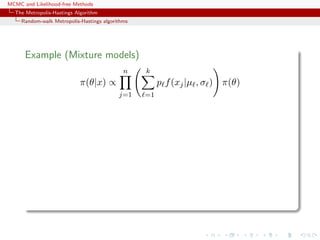
Example (Mixture models)
π(θ|x) ∝
n
j=1
k
=1
p f(xj|µ , σ ) π(θ)
MCMC and Likelihood-free Methods
The Metropolis-Hastings Algorithm
Random-walk Metropolis-Hastings algorithms
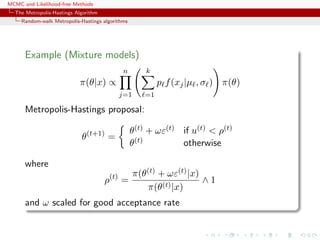
Example (Mixture models)
π(θ|x) ∝
n
j=1
k
=1
p f(xj|µ , σ ) π(θ)
Metropolis-Hastings proposal:
θ(t+1)
=
θ(t) + ωε(t) if u(t) < ρ(t)
θ(t) otherwise
where
ρ(t)
=
π(θ(t) + ωε(t)|x)
π(θ(t)|x)
∧ 1
and ω scaled for good acceptance rate
MCMC and Likelihood-free Methods
The Metropolis-Hastings Algorithm
Random-walk Metropolis-Hastings algorithms
p
theta
0.0 0.2 0.4 0.6 0.8 1.0
-1012
tau
theta
0.2 0.4 0.6 0.8 1.0 1.2
-1012
p
tau
0.0 0.2 0.4 0.6 0.8 1.0
0.20.40.60.81.01.2
-1 0 1 2
0.01.02.0
theta
0.2 0.4 0.6 0.8
024
tau
0.0 0.2 0.4 0.6 0.8 1.0
0123456
p
Random walk sampling (50000 iterations)
General case of a 3 component normal mixture
[Celeux & al., 2000]
MCMC and Likelihood-free Methods
The Metropolis-Hastings Algorithm
Random-walk Metropolis-Hastings algorithms
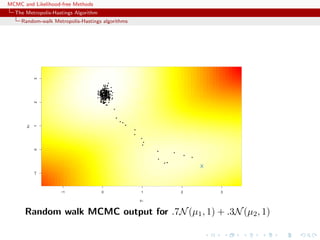
−1 0 1 2 3
−10123
µ1
µ2
X
Random walk MCMC output for .7N(µ1, 1) + .3N(µ2, 1)
MCMC and Likelihood-free Methods
The Metropolis-Hastings Algorithm
Random-walk Metropolis-Hastings algorithms
Convergence properties
Uniform ergodicity prohibited by random walk structure
MCMC and Likelihood-free Methods
The Metropolis-Hastings Algorithm
Random-walk Metropolis-Hastings algorithms
Convergence properties
Uniform ergodicity prohibited by random walk structure
At best, geometric ergodicity:
Theorem (Sufficient ergodicity)
For a symmetric density f, log-concave in the tails, and a positive
and symmetric density g, the chain (X(t)) is geometrically ergodic.
[Mengersen & Tweedie, 1996]
no tail effect
MCMC and Likelihood-free Methods
The Metropolis-Hastings Algorithm
Random-walk Metropolis-Hastings algorithms
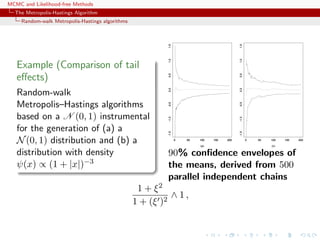
Example (Comparison of tail
effects)
Random-walk
Metropolis–Hastings algorithms
based on a N (0, 1) instrumental
for the generation of (a) a
N(0, 1) distribution and (b) a
distribution with density
ψ(x) ∝ (1 + |x|)−3
(a)
0 50 100 150 200
-1.5-1.0-0.50.00.51.01.5
(a)
0 50 100 150 200
-1.5-1.0-0.50.00.51.01.5
0 50 100 150 200
-1.5-1.0-0.50.00.51.01.5
0 50 100 150 200
-1.5-1.0-0.50.00.51.01.5
(b)
0 50 100 150 200
-1.5-1.0-0.50.00.51.01.5
0 50 100 150 200
-1.5-1.0-0.50.00.51.01.5
0 50 100 150 200
-1.5-1.0-0.50.00.51.01.5
90% confidence envelopes of
the means, derived from 500
parallel independent chains
1 + ξ2
1 + (ξ )2
∧ 1 ,
MCMC and Likelihood-free Methods
The Metropolis-Hastings Algorithm
Random-walk Metropolis-Hastings algorithms
Further convergence properties
Under assumptions skip detailed convergence
(A1) f is super-exponential, i.e. it is positive with positive
continuous first derivative such that
lim|x|→∞ n(x) log f(x) = −∞ where n(x) := x/|x|.
In words : exponential decay of f in every direction with rate
tending to ∞
(A2) lim sup|x|→∞ n(x) m(x) < 0, where
m(x) = f(x)/| f(x)|.
In words: non degeneracy of the countour manifold
Cf(y) = {y : f(y) = f(x)}
Q is geometrically ergodic, and
V (x) ∝ f(x)−1/2 verifies the drift condition
[Jarner & Hansen, 2000]
MCMC and Likelihood-free Methods
The Metropolis-Hastings Algorithm
Random-walk Metropolis-Hastings algorithms
Further [further] convergence properties
skip hyperdetailed convergence
If P ψ-irreducible and aperiodic, for r = (r(n))n∈N real-valued non
decreasing sequence, such that, for all n, m ∈ N,
r(n + m) ≤ r(n)r(m),
and r(0) = 1, for C a small set, τC = inf{n ≥ 1, Xn ∈ C}, and
h ≥ 1, assume
sup
x∈C
Ex
τC −1
k=0
r(k)h(Xk) < ∞,
MCMC and Likelihood-free Methods
The Metropolis-Hastings Algorithm
Random-walk Metropolis-Hastings algorithms
then,
S(f, C, r) := x ∈ X, Ex
τC −1
k=0
r(k)h(Xk) < ∞
is full and absorbing and for x ∈ S(f, C, r),
lim
n→∞
r(n) Pn
(x, .) − f h = 0.
[Tuominen & Tweedie, 1994]
MCMC and Likelihood-free Methods
The Metropolis-Hastings Algorithm
Random-walk Metropolis-Hastings algorithms
Comments
[CLT, Rosenthal’s inequality...] h-ergodicity implies CLT
for additive (possibly unbounded) functionals of the chain,
Rosenthal’s inequality and so on...
[Control of the moments of the return-time] The
condition implies (because h ≥ 1) that
sup
x∈C
Ex[r0(τC)] ≤ sup
x∈C
Ex
τC −1
k=0
r(k)h(Xk) < ∞,
where r0(n) = n
l=0 r(l) Can be used to derive bounds for
the coupling time, an essential step to determine computable
bounds, using coupling inequalities
[Roberts & Tweedie, 1998; Fort & Moulines, 2000]
MCMC and Likelihood-free Methods
The Metropolis-Hastings Algorithm
Random-walk Metropolis-Hastings algorithms
Alternative conditions
The condition is not really easy to work with...
[Possible alternative conditions]
(a) [Tuominen, Tweedie, 1994] There exists a sequence
(Vn)n∈N, Vn ≥ r(n)h, such that
(i) supC V0 < ∞,
(ii) {V0 = ∞} ⊂ {V1 = ∞} and
(iii) PVn+1 ≤ Vn − r(n)h + br(n)IC.
MCMC and Likelihood-free Methods
The Metropolis-Hastings Algorithm
Random-walk Metropolis-Hastings algorithms
(b) [Fort 2000] ∃V ≥ f ≥ 1 and b < ∞, such that supC V < ∞
and
PV (x) + Ex
σC
k=0
∆r(k)f(Xk) ≤ V (x) + bIC(x)
where σC is the hitting time on C and
∆r(k) = r(k) − r(k − 1), k ≥ 1 and ∆r(0) = r(0).
Result (a) ⇔ (b) ⇔ supx∈C Ex
τC −1
k=0 r(k)f(Xk) < ∞.
MCMC and Likelihood-free Methods
The Metropolis-Hastings Algorithm
Extensions
Langevin Algorithms
Proposal based on the Langevin diffusion Lt is defined by the
stochastic differential equation
dLt = dBt +
1
2
log f(Lt)dt,
where Bt is the standard Brownian motion
Theorem
The Langevin diffusion is the only non-explosive diffusion which is
reversible with respect to f.
MCMC and Likelihood-free Methods
The Metropolis-Hastings Algorithm
Extensions
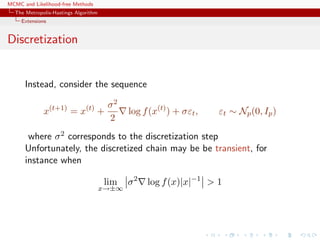
Discretization
Instead, consider the sequence
x(t+1)
= x(t)
+
σ2
2
log f(x(t)
) + σεt, εt ∼ Np(0, Ip)
where σ2 corresponds to the discretization step
MCMC and Likelihood-free Methods
The Metropolis-Hastings Algorithm
Extensions
Discretization
Instead, consider the sequence
x(t+1)
= x(t)
+
σ2
2
log f(x(t)
) + σεt, εt ∼ Np(0, Ip)
where σ2 corresponds to the discretization step
Unfortunately, the discretized chain may be be transient, for
instance when
lim
x→±∞
σ2
log f(x)|x|−1
> 1
MCMC and Likelihood-free Methods
The Metropolis-Hastings Algorithm
Extensions
MH correction
Accept the new value Yt with probability
f(Yt)
f(x(t))
·
exp − Yt − x(t) − σ2
2 log f(x(t))
2
2σ2
exp − x(t) − Yt − σ2
2 log f(Yt)
2
2σ2
∧ 1 .
Choice of the scaling factor σ
Should lead to an acceptance rate of 0.574 to achieve optimal
convergence rates (when the components of x are uncorrelated)
[Roberts & Rosenthal, 1998; Girolami & Calderhead, 2011]
MCMC and Likelihood-free Methods
The Metropolis-Hastings Algorithm
Extensions
Optimizing the Acceptance Rate
Problem of choice of the transition kernel from a practical point of
view
Most common alternatives:
(a) a fully automated algorithm like ARMS;
(b) an instrumental density g which approximates f, such that
f/g is bounded for uniform ergodicity to apply;
(c) a random walk
In both cases (b) and (c), the choice of g is critical,
MCMC and Likelihood-free Methods
The Metropolis-Hastings Algorithm
Extensions
Case of the random walk
Different approach to acceptance rates
A high acceptance rate does not indicate that the algorithm is
moving correctly since it indicates that the random walk is moving
too slowly on the surface of f.
MCMC and Likelihood-free Methods
The Metropolis-Hastings Algorithm
Extensions
Case of the random walk
Different approach to acceptance rates
A high acceptance rate does not indicate that the algorithm is
moving correctly since it indicates that the random walk is moving
too slowly on the surface of f.
If x(t) and yt are close, i.e. f(x(t)) f(yt) y is accepted with
probability
min
f(yt)
f(x(t))
, 1 1 .
For multimodal densities with well separated modes, the negative
effect of limited moves on the surface of f clearly shows.
MCMC and Likelihood-free Methods
The Metropolis-Hastings Algorithm
Extensions
Case of the random walk (2)
If the average acceptance rate is low, the successive values of f(yt)
tend to be small compared with f(x(t)), which means that the
random walk moves quickly on the surface of f since it often
reaches the “borders” of the support of f
MCMC and Likelihood-free Methods
The Metropolis-Hastings Algorithm
Extensions
Rule of thumb
In small dimensions, aim at an average acceptance rate of 50%. In
large dimensions, at an average acceptance rate of 25%.
[Gelman,Gilks and Roberts, 1995]
MCMC and Likelihood-free Methods
The Metropolis-Hastings Algorithm
Extensions
Rule of thumb
In small dimensions, aim at an average acceptance rate of 50%. In
large dimensions, at an average acceptance rate of 25%.
[Gelman,Gilks and Roberts, 1995]
This rule is to be taken with a pinch of salt!
MCMC and Likelihood-free Methods
The Metropolis-Hastings Algorithm
Extensions
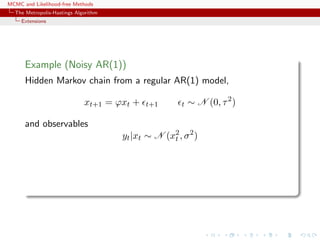
Example (Noisy AR(1))
Hidden Markov chain from a regular AR(1) model,
xt+1 = ϕxt + t+1 t ∼ N (0, τ2
)
and observables
yt|xt ∼ N (x2
t , σ2
)
MCMC and Likelihood-free Methods
The Metropolis-Hastings Algorithm
Extensions
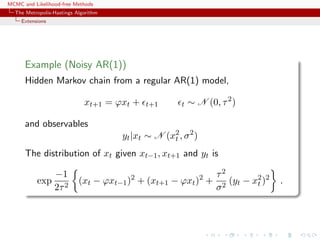
Example (Noisy AR(1))
Hidden Markov chain from a regular AR(1) model,
xt+1 = ϕxt + t+1 t ∼ N (0, τ2
)
and observables
yt|xt ∼ N (x2
t , σ2
)
The distribution of xt given xt−1, xt+1 and yt is
exp
−1
2τ2
(xt − ϕxt−1)2
+ (xt+1 − ϕxt)2
+
τ2
σ2
(yt − x2
t )2
.
MCMC and Likelihood-free Methods
The Metropolis-Hastings Algorithm
Extensions
Example (Noisy AR(1) continued)
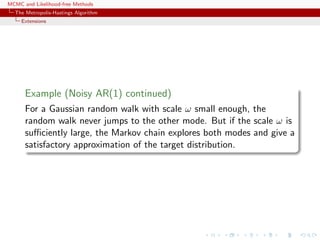
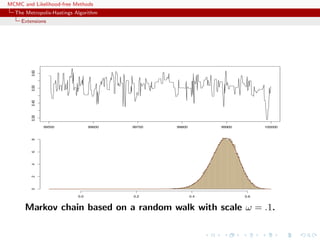
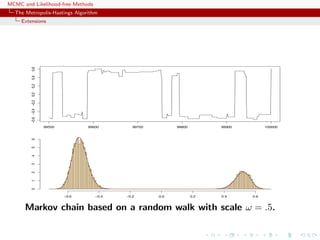
For a Gaussian random walk with scale ω small enough, the
random walk never jumps to the other mode. But if the scale ω is
sufficiently large, the Markov chain explores both modes and give a
satisfactory approximation of the target distribution.
MCMC and Likelihood-free Methods
The Metropolis-Hastings Algorithm
Extensions
Markov chain based on a random walk with scale ω = .1.
MCMC and Likelihood-free Methods
The Metropolis-Hastings Algorithm
Extensions
Markov chain based on a random walk with scale ω = .5.
MCMC and Likelihood-free Methods
The Metropolis-Hastings Algorithm
Extensions
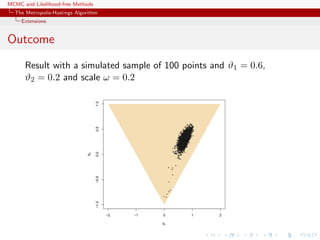
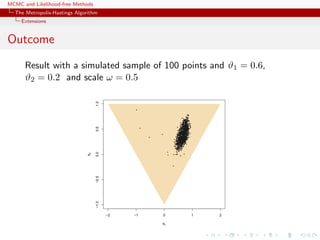
MA(2)
Since the constraints on (ϑ1, ϑ2) are well-defined, use of a flat
prior over the triangle as prior.
Simple representation of the likelihood
library(mnormt)
ma2like=function(theta){
n=length(y)
sigma = toeplitz(c(1 +theta[1]^2+theta[2]^2,
theta[1]+theta[1]*theta[2],theta[2],rep(0,n-3)))
dmnorm(y,rep(0,n),sigma,log=TRUE)
}
MCMC and Likelihood-free Methods
The Metropolis-Hastings Algorithm
Extensions
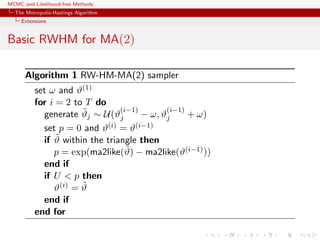
Basic RWHM for MA(2)
Algorithm 1 RW-HM-MA(2) sampler
set ω and ϑ(1)
for i = 2 to T do
generate ˜ϑj ∼ U(ϑ
(i−1)
j − ω, ϑ
(i−1)
j + ω)
set p = 0 and ϑ(i) = ϑ(i−1)
if ˜ϑ within the triangle then
p = exp(ma2like(˜ϑ) − ma2like(ϑ(i−1)))
end if
if U < p then
ϑ(i) = ˜ϑ
end if
end for
MCMC and Likelihood-free Methods
The Metropolis-Hastings Algorithm
Extensions
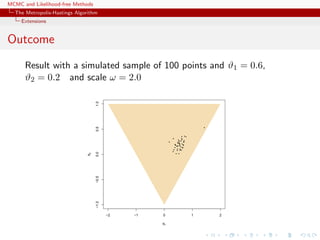
Outcome
Result with a simulated sample of 100 points and ϑ1 = 0.6,
ϑ2 = 0.2 and scale ω = 0.2
q q
−2 −1 0 1 2
−1.0−0.50.00.51.0
θ1
θ2
q
qqq
q
qqq
qqqqq
q
qqq
qq qqqq
qq
qqqqqqqqqq
q qqqqqqqq
qqq
q
qqqqqqqq
q
qq
qqqqq
qq
qqq
qqqqqqqqqqq
q
qqqqq
q
qq
qqqq
qqqqqqq
qqqqq
qqq
qqqqqqqqq
q
q
qqqqqqqqqqqq
qq
qq
q
qqq
qqqqqqqq
qqqqqqq
qqqqq
qqqq
q
qqqqqq
qqqqqqq
qqqqq
qqq
qq
q
qqq
q
q
qq
qqq
qqq
qq
qq
qqqq
qq
q
qqq
qqq
q
q
qq
qqq
qqq
qq
qq
qqqqq
qqq
qqqqq
q
qqq
qqqqq
qq
qqqq
q
qqq
q
q
qq
qqqqqq
qqqqqqqqq
qq
q
qq
q
q
qqqqqqqq
qqqqqqqq
qqq
qqqqqqq
qqqqq
q
qqq
qq
qqqqqqqqqqqqq
qqqq
qqq
q
qq
q
qq
qqqq
q
qq
qq
q
qqqq
q
qq q
q
qqqqq
q
qqq
q
qq
qqqqqqq
q
qq
q
q
q
q
qqq
qqqq
q
qq
q
q
q q
qq
qq
qqqqqqq
qqq
q
qqqq
q
qqqqq
qq
qqq
qqq
q
q
q
qq
qq
qqqqqqqq
qqqqq
qqqqqq
qq
qq
qqqqqqq
q
qqq
q
qqqqqq
qqq
qq
qq
qqq
qqq
qq
qqqqqqq
q
qqq
qqqq
q
qqq
qq
q
qqqqqqqqqqq
q
qq
qq
q
qqqq
q
qqq
qqqqq
q
qqqqqq
qq
qqqq
qq
qqq
qqq
qq
qq
q
qqqq
qq
q
qqq
qq
qq
qqqqqqq
q
qqqq
qqq
q
q
qqqqqqqqqqq
q
q
qqq
qqqq
q
qqqq
qq
qq
qqqqq
q
qqqqq
qqqqqq
qq
q
q
q
q
qqq
q
qqqq
qq
qq
qqqqqqqqqqq
qqqq
q
qq
qqqq
qqqqqqqq
qq
qqq
qqq
q
q
qq
qq
qq
qqq
qqqqqq
q
q
q
q
qqqq
qq
qq
qqqq
qqq
qq
q
qqqqq
qqqqq
qqq
qq
qqq
q
q
qq
qqqq
qqqq
qq
qq
qqqqqqqqqqq
q
qqq
q
q
qqq
q
qq
qq
qq
q
qqq
q
q
qqqqqqqqqqqq
qqq
qqqqq
q
q
qq
q
qqqqq
q
q
qqqqq
q q
q
qqq
qqqqqqqqqqqqqqqqqqq
qq
qq
q
q
q
qq
qq
q
qq
qq
q
q
q
qqqqq
q
q
qqqqq
q
qq
q
qqq
q
qqq
q
q
q
q
q
qq
qqqq
q
qq
q
q
q
qqqqqqqqqq
q
qqqqqqqqq
qqqqqqqqqqqqqq
q
qq
qqqqqqqqqqqqqqqqqqqqqqqqq
qq
q
qq
qqqqqqqqq
qqqqqqqqqqqqqq
qqq
qq q
q
q
q
qqqqqqqqq
q
qq
q
qqqq
q
q
qqq
qqqqq
q
q
q
q
qqqq
qq
qq
qqq
q
qq
qqqq
q
qqqqqqq
qq
q
qq
qqqqqqqqqq
q
qqqqq
qqqqq
qqqq
qqqq
q
qqqqq
qq
qqqqqq
q
q
qq
q
qq
qq
qqq
qq
qqqq
qq
q
qq
qq
q
q
q qq
qq
qqq
q
qq
q
q
qq
q
qqqq
qqqqqqqqqqqqqqqqq
qqq
q
qq
qqq
qqq
qqqq
qqqq
qqq
qqqqqq
qq
qqqq
qqqq
q
qqq
q
qq
qqqqqqq
q
qq
qq
q
qqqq
qq
qq
q
qq
qqqq
qq
qq
qq
qq
qq
qqqqqqq
qqqqqqqqqq
qq
q
qq
qqqqq
qq
qqq
qq
qqq
q
qq
qq
qq
qqq
qq
q
q
q
qqqq
qqqqqqqq
qqq
qq
q
q
qqqqq
qq
qqqq
q
qqqqqqqq
qqq
q
q
qqqq
qq
qq
q
qqqqqqq
qqq
qq
q
q
qq
q
qq
q
qqq
q
q
q
qq
qq
qqqqqq
qqqq
q
qq
qqqq
qqqq
qqqq
q
q
qqq
q
q
qqqqq
q
qqq
qq
q
qq
q q
qqq
q
qqq
qqq
q
qqqqqq
q
q
qq
q
q
qqq
q
qqqq
qq
qqq
q
qq
qq
q
qqqqq
q
q
qqq
qqqq
qqq
qqq
qqqqqqqqqq
qqqqq
q
q
q
qqqq
qqqqqqqqqqqqqqqqqq
qqq
qq
qq
q
qqqqq
qqq
qqq
qqq
qqqqq
q
qqqqqqqqqqqq
q
qq
qqqqqqqqq
qqqqq
qqq
qqqq
qq
qqqq
q
qqqq
q
qq
q
qq
q
q
q
qqq
q
q
qq
q
qqqqq
q
q
q
q
qq
qqqqq
qqq
q
q
qqqqq
qq
qqqqq
q
qq
qqqqqqqqq
qqqqqqqq
qq
qqqqq
qq
qqqqqq
qqqqqqqqqqqqqq
qqq
qqqqqqqq qq
qqq
qqqqqqqqq
q
q
q
q
q
qqq
qq
qq qqq
q
q
qq
q
qq
q
qqqqq
qqqq
qqqq q
q
q
q
qq
q
qqq
q
qqqqqq
q
q q
qqqqqqqqq
qqq q
qqqq
qqqqqqqqqq
q
q
q
q qqqq
q
qqqq
qq
qq
qqqqq
qq
q
q
q
q
q
qqq
qq
qqqq
qq
q q q
qqqq
qqq
q
qqqq
qq
q
qq
qq
qqqqq
q
qq
q
q
q
qqq
qqqqqq
q
q
qqqqqqqqqqqqqq qq
qq
qq
qqqq
qqqqq
qqq
qqq
q
q
qq
qqqqqqq
q
qqq
q qq
q
qq
q
qq
qqqqqqqqqqqqq
qq
q
q
qqqqqqqqqq
qqq
qqq
qqqqqq
qq
qq
qqqqqqq
qqqqqqqqqqqqq
q
qqqq
qq
qq
q
qq
q
q
qqqq
qq
q
q
qqqq
q
qqqq
qq
qqqq
qq
qq
q
q
qqqqq
q
qq
qqqqqqqq
q
qqqqqqqq
q
qq
qqqqqqq
qqqqq
qqqq
qqqqq
qq
q
q
qqqqq
qqqqqqq
qqqqq
q
qq
qq
qq
qqqqqqq
q
qqqqqqq
qqqq
qqq
q
q
qqqq
qq
q
q
qq
qqq
q
qqq
qq
qqqqqqqqqqqqqqqqqq
q
qqq
qqqqqq
qqqq
qqqqqq
qqq
q
q
qqq
q
q
q
qqq
q
q
qqqqqqqqq
qqqq
qq
qqq
qq
qq
qqq
qq
q
qq
qqqqqqqqq
q
qq
q
qqqqqq
q
qqqqqq
qqqqqqqqqqqqqq
qqqq
q
qqqq
qqq
qqqqqq
qqq
q
qq
q
q
qq
q
q
qq
qqqq
q
q
qqq
qqq
q
q
qqqqqqq
q
q
qqqqqqqqq
q
qq
qq
qqqq
qq
qqqq
qqqqq
qq
qqq
q
qqq
q
qq
qqq
q
qqq
q
qq
q
qqq
qqq
qqq
q
qqq
q
qq
qq
qq
q
q
qqq
q
qqqqq
qq
qq
qq q
q
qq
qqq
qqqqqq
qq
qqq
q
qq
q
q
qqqqq
q
qqqqqqqqqqqqqq
qqqqq
qqq
q
qqq
qq
qqqqq
q
qq
q
qq
qqq
qqq
q
q
qq
qq
qq
qq
qq
q
qqqqqqq
qqqq q
qqqq
qq
qqqq
q
q
qq
qqq
qqq
qqq
qqqqq
qq
qq
q
qq
q
qqq
qq
qqq
qqq
qq
q
q
qq
qq
q
q
q
qq
qqqq
q
qq
q
qq
q
qqqqq
q
qqqqqqqqq
qq
q
qqq
qq
qq
qqq
qqqqqq
q
qqq
qqqq
q
qqqq
qqqqqqqqq
q
q
qq
q
q
qqqq
qqqqqq
qq
qq
q
qq
qqqqqqqqqqq
qq
qq
q
q
qqqq
qq
q
qqq
q
q
qq
qq
qq
qqq
qq
qqqq
qq
q
qq
q
qqqqq
qqqqq
q
q
qqq qqq
qqq qq
qqqqqqqqqqqqqqqqqqqq
q
q
q
q
qq
q
qqqqqq
qq
q
q
q
qqq
qq
q
qq
qq
q
qq
qqqq
qq
qq
qqqqqqq
qq
q
q
qqqq
q
qqq qq
q
qqqq
q
qqqqqq
qqqqqq
qqqqq
qqqqqqq q
qqqq
qqqqq
qq
qq
q
q
qqqqqqq
qqqqq
q
qqq
q
q
qqqqqq
qqq
qqq q
qq
qq
qq
qqqq
q
qqqqqqqqqq
qq
q
qqq
qqq
qqq
q
q
qq
qqq
qq
qqqqqqq
q
qq
qqqqqq
q
qqqqq
qq
qq
q
qqqq
qqqq
q
qqqqq
q
q
q
qqqq
q
qq
q
qqqqq
q
qqq
q
qqq
qqqqqqq
qq
qq
q
q
q
qqq
q
q
qq
q
qq
qqq
q
qqqq
qqqqqq
qqq
qqqq
qqqqqqqqq
qqqq
q
qqqq
qqqq
q
qqq
qqqqq
qqqq
q
q
qq
qqqqqqq
q
q
qqq
q q
qqq
qqqqqqqqq
q
qqq
qq
qqqq
qq
qqq
qqq
qqqq
qq
qqqq
q
q
qqq
q
qqqqqq
qqqqqq
qqq
qq
qqqqqqqqqqq
qq q
qq
qqqqqqqqqqqqq
qqqq
q
q
qq
qqqq
qqq
qqqq
qqq
q
qqqq
qq
qq
q
qq
qq
qqq
qqqqq
q
qqqqqqqqqqqqqqq
qq
q
qq
qqq
q
qq
qqqqqqqq
q
qqqqqq
qq
qq
qq
q
qqqqqqqqqqq
q
qqqqqqq
qq
qqqqq
q
qqqq
qq
q
q
qqqqqq
qq
qqqqq
q
qqq
qq
qqqqq
qqqqqqq
qq
qqq
q
q
q
qq
qq
qq
qqqqq
qqqq
q
q
qqqqq
q
qqq
q
q
qqq
qq
qqqq
qqqqqqq
qqq
qqq qq
qq
qq
q
qq
qqq
qqqqqq
qq
q
q
q
qqqqqqqqqq
qqqqqq
q
q
qqq
qqqqqq
qqqqqq
qqqqqqqq
qq
qqq
qq
qqqq
qqq
qqqq
qqqqq
qq
qqqqq
qqq
qqqq
q
qqq
qqqq qq
qqqqqqqqqqqqq
qqqq
qq
qqqqq
qqqqq
qq
q
qqqqqqqq
q
q
qqq
qqqqqq
qq
qq
q
qq
qqqqq
qqqq
qqqq
q
qqqqq
qq
qq
qqq
q
qq
qqqqqq
qqqq
q
qq
qqqqq
qqq
qqq
q
qq
q
q
qq
q
qq
qq
qqqq
q
q
qqqqq
qqq
qqqq
qqqqqq
q
qqqqqq
q
qqq
qqq
qqqqq
qq
qqqq
qqqqq
qq
qq
qq
q
q
qqq
q
qq
qq
qq
q
q
qq
q
qqqqq
q
qq
qq
q
qqqqqqqq
qqq
qq
qqqqq
qqq
qqqqq
qqqqqqqqqqqqqq
qqq
qqq
qqq
qq
q
qq
qqq
q
q
q
qq
q
qqqq
qqq
q
qqqqq
q
qq
qq
qq
q
qqqqq
qq
q
q
q
q
qq
qq
q
q
qq
q
qq
qq
qq
qqqqq
qq
q q
qq
q
qqqqqqqqqqqq
qq
q
qq
qqqqqq
q
q
qq
qq
qqqqqqqqq
qq
q
q
qq
q
qq
qqqqqq
qq
qqqqqqqq
q
qq
q
q
q
qqq
qq
q
q
qqq
qq
qqq
qq
qqq
qqq
q
q
qqq
qqqqq
qqqqqq
qqqqqq
qq
qqqqqqq
q
q
q
qqqq
qqqqqq
qqqqqqq
q
q
q
q
qq
qqq
q
qq
q
qqq
q
qq qq
q
qqqqq
q
qqqqqqqqqqq
q qqqq
qq
q
qqqq
qqq
qq
qqq
q
q
qq
qq
q
qq
qqq
q
qqq
qqq
qqqqqqqqqqqq
qqqqq
qqqq
qqqqqq qqqqqqq
qq
qqq
q
qq
qq
qq
qq
q
q
qqqqqq
q
q
q
qq
qqqq
qqqqq
qqqqqqqqqq
qqqq
qqqqqq
q
qqq
q
qq
qq
q
qq
qq
qq
q
q
qqqqq
qq
qqq
qq
qq
qqq
q
q
qq
qqqqqqqqq
q
qqqq
qqq
q
qqq
qq
qqqqq
q
qqqqqqqqqqqqqq qq qq
qqq
qqqq
q
qq
q
q
q
qqq
q
qq
qqqqq
qq
qqq
qqqqqqqqq
qq
q
q
q
q
qqq
qqqqq
q
q
qq
qqqqq
qqqq
qqqqq
q
qq
q
qqqq
qq
qqq
q
q
qqqqqqqqqqqqqq
qqqq
qqqqq
qq
qqq
qqq
qqqq
qq
qqqqq
q
q
q
qq
qqq
qqqqq
qqqqq
qqqqqqqq
qq
q
qqqqq
q
qqqqqqq
qqqqqqq
qq
qq
q
q
q
qq
q
q
qqqqq
qqqqqqq
q
qq
qq
qqqqqqq
q
qqqqqqqqqq
q
q
qqq
qq
qqq
qqqqqqqqqqqqqqqqqq
q
qqq
q
qqqqq
q
qqq
qq
q
q
qqqq
qq
q
qq
q
q
qqqq
q
qqqqqq
qqqqq
qqq
qqq
qq
q
q
qq
qq
qq
q
qq
q
q
q
qqq
q
q
qq
qqq
qqq
qq
qq
q
q
qq
qqq
qqqqqqqqqqqq
q
q
qqq
qqqqq
qq
q
qq
q
qqq
q
qq
qq
q
q
qqqqq
qqqqq
qqq
qq
q
q
qqq
q
qq
q
q
q
q
qqq
qq
q
qqqq
q
q
qqqq
q
qqqqq
qqq
qq
qqqq
q
qq
q
q
q
q
q
qqqq
q
q
q
qqq
qqqq
qqq
qqqq
q
q
q
qqq
qq
qqqqqq
qqq
qq
qqqqqq
qqqq
q
qqq
q
q
q
q
qqqqqqq
qqqq
qqqqq
q
qqqqq
qqqqqqqqqqqqqq
qqq
q
qq
qqqqqqqqq
qqq
qqq
qq
q
qqqq
qqqqq
qqq
qqqqqqq
qq
qq
qqqq
qq
qqqqqq
qqq
qqq
qqq
qqqqq
q
q
qq
qqq
q
qqqq
qqqq
qqqqqqqqq
qq
q
q
qqqq
qq
q
qqqq
qq
qqq
qq
qqq
q
qqqqq
q
qqqqqq
q
q
q
qqqq
q
q
qqq
qqqqq
q
q
qqqq qq
qqqq
qq
q
qq
qqqq
qq
qqq
qqqqq
q
qq
qq
qqqqq
qq
qqqq
qqqqqq
qqq
q
qqqqq
qq
qq
q
qqq
qqq
qqq
qqqqqq
qqqq
qqq
qqqqq
q
qqq
qqq q
qq
qq
q
qq
qq
q
q
q
qqq
qqqqqqqq
qq
qqqq
qqqqq qq
qq
q
qqq
qq
q
q
qqqq
qqq
qqqqqq
qqqqqq
qq
q
qqq
q
qqqqqqq
qq
q
q
qqqq
qqqq
q
q
qqqqq
q
qqqq
q
q
qqq
q
q
q
qqqqqqqqqq
qqqqq
qqqqqq
qq
qqq
qqqq
qqqq
qqqq
qq
qqqq
q
qqqqqqq
q
qqqqq
qq
q
qqq
q
qqqq
qqq
q
q
q
q
qqq
qq
qqqqqqqqqqqqq
qqq
q qqqqqq
qq
qqq
q
qq
q
qqqq
q
qq
qqqqq
qq
qqqqqqqq
qqq
q
q
qq
q
qqqq
qqq
qqqqq
qq
qqqqqqqqqq
qq
qqqqqqq
q
qq
qqqqqq
q
qqqqq
q
qqq
q
q
qq
q
qqq
qq
qq
q
q
q
qq
q
qq
q
qqq
q
qq
qqqqq
q
qqq
qqq
q
qqqqqqq
q
qqq
q
q
qqqqq
q
qqqqqq
q
qqqq
qqq
qqqqq
qqqqq
q
qqqqqq
qqqqq
qqq
q
qqqqq
qqqqqq
qq
q
qqqqqq
qqqq
qqqqqq
q
q
q
q
qqq
qq
qqq
qqqqqq
qqq
q
qqqqq
q
q
q
q
qqqq
qq
qq
qq
qqqqqq
q
q
q
qq
qq
q
qqq
qq
qqqqq
q
qqqqqqqqqqqqq
qqqqqqqq
q
qq
q
qq
qqq
qqq
q
q
qq
qq
qqqq
q
qqqqqqqq
q
q
q
qq
qqqq
qqq
qqqqqqqq
q
qqq
q
q
qq
qqqq
qqqq
qqqq q
q
qqq
qqqqqqqq
qqqqq
q
qqqqq
q
qqq
q
qqq
q
q
qq
q
qqqq qq
qq
qqqqq
qqq
qqqq
qqqqqqq
qq
qqqq
qqq
q
qq
qq
q
qqqqq
qqqqqqq
qqqqqq
qqqqqq
qq
qqqq
q
q
qqqqqqqqq qqqq
qqqqqq
q
q
qq
qq
q
qqqq
qqq
q
q
q
q
qq
q
qqqqqqq
q
qqqq
qq
q
qqqqqqq
qqq
qqqqqq
q
qqqqqqqqq
qqq
qqq
q
qqqq
qqqqqq
qqqqqq
qq q
qqqqq
qqq
q
qq
qq
qqqq
q
q
qqqqqq
q q
q
q
q
q
qqqq
q
qqqqqqq
qqq
qq
qqqqq
q
qqqq
qqq
qqqqq
q
qq
qq
qqq q
qqqq
qqqqqqqq
qqq
q
qqq
qqqqqqqqqqq
q
qq
qqq
qqqqqq
qqq
qqqq
qqq
qq
qqqqqqqqqq
qq
qq
qqqqqqqq
qqqqq
qq
qqqq qq
q
qq
q
q
q
qq
qqqqq
qqqqqqqqqq
q
qqq
qqq
qqqq qq
qqqq
qqqq
qq
qqqq
qqq
qqq
qq
qqq
qqqqq
qqqqqq
qq
qqqqqqqqqqqqq
qq
qq
qqqq
q
q
qqqqqq
q
q
qq
qqqqqq
qqqqqq
qqqqq
q qqq
qqqqq
q
qqqqq
qq
qqqq
q
qqqq
qqqq
qq
q
qqqqqqq
qq
q
q
qqqq
q
qqqqq
qqqqq
qqq
qqq
q
q
qqq
qq
qqq
qqqqqqq
qqq
q
q
qqqqqqq
q
q
qqqqq
qqq
qq
qqqqqqqqqq
qq
q
qqqq
q
qqqqqqqq
qq
qqqq
qqq
qq
qqq
qqqq
qqqq
qqqqqq
qqq
qqqq
qqqqq
qqq
qqqqq q
q
q
qqqq
q
qqqqqqq
q
q
q
q
q
qqqqq
qqq
qq
qq
qq
q
qqq
qq
q
qqqqqqq
qqqq
qqq
qqq
q
q
qqq
q
q
q
q
qq
qqq
q
qqqqqqq
qqqqqq
qqqqqqq
qqqqqqqq
qq
qqq
qq
q
qqqq
q
qqqq
qq
q
qqq
q
qq
q
q
qqqqqq
q
qq
q
q
q
q
q
qq
q
q
qqqqq
q
q
qq
q qqqq
qq
q
qqq
qqqq
qq
q
qq
qqq
qqqqqqqqqq
q
qqq
qqq
qqqq
q
qqqqqq
q
q
qqqqq
qq
qqq
qqqqqqq
qqqqq
qqq
qq
q
qqqqqqqqqq
qqqqq
q
qq
qqqq
q
q
qqqqq
qq
qq
qq
qqqqqq
qq
qqqq
q
qqqqqqqq
qq
qqq
qq
qq
qq q
q
q
qq
qqqqq
q
q
qqqqqqqqq
qq
q
q
q
qqq
qqqqq
qq
q
qqqq
qqq
qqqqqqqqqqq
q
q
qqqq
q
qqqq
qq
qq
qq
qq
qqqqq
q
qq
q
qqqqq
qqqq
qqqq
q
qqqqqqqqq qq
qqq
qq
q
qq
qqqqqqqqq
q
qqq
qqq
qqqq
qqq
qqqq
qqqqq
qqqq
q
qqqq
q
q
q
qq
qqqqqqq
qq
q
qq
q
q
q
q
qq
qqqqq
q
qqqqq
q
qqq
qqqqq q
q
qq
qq
qq
qq
qqqq
q
q
qq
qqqq
qq
q
qq
q
qqqqqqqqqqq
qqqqqqq
qqqqq
qq
qq
qqq
qqqq
qqqq
q
q
qqq
q
qqq
q
qq
q
qqqqqq
qqq
qq
qqqqqqqqqq
qqq
qq
q
q
qq
qq
qqqq
q
qq
q
qqq
q
qqqq
q
q
qq
qqqqq
qqqqqq
qqqqq
q
qqq q
qqqq
q
qq
qq
q
q
qqq
q
qq
qqqqqq
q
qqq
qqq
q
q
q
qqqqqqq
qq
q
q
qq
qqqqqq
qqqqqqqqqqqq
q
qq
qqq
qq
qqq
qq
qqq
qq
qqqq qqqqq
qqqqqqqq
qqq
qqqqqq
qqq
qqqqq
q
qqqq
q qqqqq
qqq
q
q
q
qqqqqq
qq
q
q
qq
qq
q q
qqqq
q
q
qq
q
qqqqqq
qqqqqq
qqq
qq
qq
qqq
q qqqqqq
q
qqqqqqqqqq
q
qqqqqqqqq
q
qq
qqqqq
qqqqqq
qq
qqq
qqqqqq
qqqq
qq qqqqqq
q
qq
qqqq
qqqqqqq
q
q
q
q
qqqqqqq
qq
q
q
qq
qqqq
qqqqq qqq
qqqqqqq
q
qqqqq
qqqqqqq
qq
q
q
qq
qqq
q
qqq
q
q qqqqq
qq
q
q
q
qqqqq
qqq
qqqq
q
qqq
qq
qq
qq
qqqqq
qq
qq
q
qqqq
qq
qqqqq qqqqqqqq
qq
qq
qqqq
q
q
qq
qqq
qqqq
qqqqq
q
qqqqq
qqq
q
qqqqqqq
q
qqq
q q
q
qqq
q
q
qq
qqqqqqqqqqqqqqqqqq
qqq
q
q
qqqqqq
qqqq
qqqqqqqqqqqqqqqq
qqq
q
q
qqqq
qqqq
qq
q
q
qq
qqqq
q
q
q
qqqqqqq
qqq
qqqqqqqq
q
q
qqqqq
q
qq
q
qqq
qq
qqqqqq
q
qqqqq
q
q
qq
qq
q
qqq
qq
q
qq
q
q
qq
qqqqqqq
q
qqqqqqqq
q
q
q
qqqq
q
q
q
q
qqq
qqqq
qq
q
qqqqqqqq
qqqqqqqq
qq
qqq
qq
q
qqq
qq
qqq
qqq
q
qqqq
qqqq
qqqqqq
qqqqq
qqq
q
q
qqq
qqqqqqq
q
qqq
qqqq
qqq
qq
qqq
qqqq
q
q
qqqqqqqqqq
qq
q
qq
qqqqqqq
qqqq
qq
qq
q
qq
qqqqqqq
qqq
q
qq
qqq
qqqqqqq
qqqqq
qqqqqq
q
qq
qqqqqqq
qq
q
q
qqq
qqqqqqq
qqqqq
qqqq
q
q
q
qq
qqqq
qq
q
q
qq
qqq
qq
qqqqqq
qqq
q
qqq
qqqqq
qq
q
qqqqqqqqq
q
qq
q
qqqq
qqqqqqqqq
q
qq
qqqqq
qq
q
qq
q
qqq
q
qqqqqqqq
qq
qqqqqqqq
qqqqqqqqqqqq
qqqq
q
qqq
qqqqq
q
qqqqqq
q
q
qq
qqqq
qq
q
qqqq
q
qqqq
qqqqq
q
q
q
qqq
qq
q
qqq
qq
q
q
qq
qq
q
qq
qq
qqqq
q
q
qq
qq
qqqq
qqq
q
qqq
qqqqq
q
qq
q
qqqq
q
qq
qqqqq
q
q
qqq
q
q
qqq
qqqqq
qqqqqqqqqqqqq
q
q
qqq
qq
q
qq
qqqqq
qqqq
q
qq
qq
qqq
q
q
q
q
qq
qq
qqqqqqqq
qqq
q
q
qq
qqqqqqq
q q
q
q
qq
q
qq
qqqq
qq
qqqq
q
qqq
qqqqqqqqq
qqqqqqqqqq
q
q
q
qq
qqqqqqq qqqq
qqq
qqqqqq
q
q
qqq
qq
q
qqqqq
qqqqq
q
qq
q
q
q
qqq
qq
q
q q
qqqqqqqqqq
qq
qq
qqqqq
q
qq
q
qqqq
qq
qqqq
qqq
qq
qqq
qqqq
qq
q
q
q
qqqqq
qqq
q
qq
qqqqqqqqqqq
qqqqqq
qqqqqqqq
qq
qq
qq
qqqqqq
qqq
qqq
q
q
q
qqq
qqq
qqqqqqqq
qqqqqqqq
q
qqq
q
q
qqq
qqqqqqqq
qqq
q
qq
qq
qqqqq
qqqq
qqqqq
q
qqqq
qqqqqqqqqqq
qq
qqqq
q
qq
q
qqq
q
q
q
qq
qqqq
qq
qqq
q
q
q
q
q
q
qqqqq
q
qq
qqqqqqqqq
qq
q
q
qq
qqqqq
qqqqqqqqqq
qq
qqq
qq
qqqq
qq
qq
q
qqq
qq
qq
qqqqqq
qqqqq
qqq
qqqqqqq
qqqqqq
qq
q
q
qqqqqqqqq
qqqqq
q
qqqqqq
q
qqqqqqqqqqqq
qqqq
q
q
qq
qq
qqqqqqq
qqqqqqqqq
qq
q
qq
q
qq
q
q
qq
q
q
q
qqqqqqqqq
qq
q
qqqq
qq
qq
q
qqqq
qq
qqqqqqqqqqq
q
qq
qqqqqq
q
q qqqqqqq
qqq
q
q
qqqqq
q
qq
q
qqqq
q
qq
qqqqqqqq
qqq
qqq
q
qq
qq
q
q
q
q
qq
qqq
qqq
q
qqqqqqq
qqqqq
qq
q
q
qqqq
qq
qqq
q
q
qqq
qq
qq
qq
q
qq
qqq
qq
q
qq
q
q
qqq
qqq
qq
qqq
qqqqqqqqq
q
qqqqq
q
qqqqqqqqqqqq
qqq
q
qq
qqqqqqqq
q
qqq
qqq
qqqqq
q
qqq
qq
qqqqqq
qqqqqq
qq
q
qqqq
qq
qq
q
qq
q
qqqqqqqq
qqq
qqqqqqqqq
qq
qqqqq
qqqq
q
q
qqqqq
qqqqqqq
q
qqq
qqqq
q
qq
q
qq
q
qqqqqqqqq
qqq
qqqqq
q
q
q
qqqqqqq
q
qqqq
qqqq
q
q
q
q
qqqq
qqqqqq
q
q
q
qq
qqqq
qq
qq
qqqqq
qq
q
q
q
qq
qq
qqqqqqq
qqqqq
qqqqqqq
q
qqq
qqq
q
qq
qqq
q
qq
qqqqq
q
qqq
q
q
q
q qq
qqqqqqq
qqqqq
q
q
qqqq
qqqq
q
qqq
q
q
qqqq
q
qqq q
qqqqqqq
qqqq
qqqqq
q
qq
qq
qqq
q
q
qqqq
q
qq
qq
q
q
q
qq
qq
qqqqq
qq
q
qq
q
qq
qqq
qqqq
qqq
qqqq
qqqqqqqqq
q
qqqqqqqqqqqqq
q
qqq
qqqqqqqqqqqq
q
q
q
qqq
q
qqqq
qqq
qq
qq
qq
qq
q
q
qqq
q
qqqq
qqqqqq
q
q
qqqqqq
qq
qq
q
q
qqqqq
q
qqqqqqq
q
q
qq
qqq
qqq
qqqqqqqqqqqqqq
qqqqq
qqqqqqqq
qqqq
qq
q
qqqqqqqq
q
qq
qqqqq
q
q
qq
q
qq
q
q
qq
qqqq
q
q
q
qq
qqqq
qqqq
qqqq
q
q
qqq
q
qqqqqqq
qqqq
q
qqqqqqqq qq
q
q
qqq
qq
qqqqq
qqqqqqq
qq
qqqqqq
qqq
qq
q
q
qqqqqq
q
qqqqq
q
qqqqqqq
qq
q
qq
q
qqqqq
q
q
qqqqqqq
qqqqq
q
qq
qqq
qq
q
q
qq
qq
q
q
qqq
qqqq
qqq
qqq
qqq
qqqqq
qq
qq
qq
q
qq
qqq
q
q
q
qqqqqqqq
qqq
q
qqqqqqqqqq
qq
qqqqq
qqqqq
qq
qq
qqq
qqq
q
q
q
q
qq
q
q
qqqqqqq
qq
q
q
qqq
q
qqqqqqqqqqqqq
q
qq
qqqqq
qq
qqqqqqqqqq
qqq
qqqq
qqqqqq
qq
qqqqqqqqq
q
q
qqq
q
qq
qq
qqqqqqq qqqqq
q
qqqq qq
q
qq
q
q
q
q qqqq
qqq
q
q
qqqq
q
q
q
qq
q
qqq
qqq
qqqq
qqqqqqqqqqqqqq
qqq
q
qqq
q
q
qq
qqqqq
qqqqqqqqqq
qqqqqqqqqqq
qq
qqq
qq
qqq
qqq
qqqqqq
qqqq
qq
qq
q qq q
qq
qqqqq
q
qqqqq
qq
qq
qqqqqqq
qqqqqq
qq
q
qq
qqqq
qqq qqq
qqqq
qqq
qqqqq
q
q
qqqqqqqq
q
q
q
q
q
qq
qqq
q
qq
qqqqqq
q
qqqqq
qqq
qqqq
qqqq
q
q
qqqqqq
qqqq
qqqqqq
qqqqqq
qq
q
q
qq
q
q qq
qqqqqqqqqqqqqq
qq
qqq
q
MCMC and Likelihood-free Methods
The Metropolis-Hastings Algorithm
Extensions
Outcome
Result with a simulated sample of 100 points and ϑ1 = 0.6,
ϑ2 = 0.2 and scale ω = 0.5
q q
−2 −1 0 1 2
−1.0−0.50.00.51.0
θ1
θ2
qqqqqqq
qqqq
qqqqq
qq
qqq
q
q
q
qqqqqqqqqqqqqqqqqqq
qq
qq
qqqqqqqqq
qqqqqqqqqqqqq
qq
qqqqqqqqq
q
qq
q
q
qqqqqqqqqqqqqqqqqqqqqqqqqqqqqqqqqqqqqqqqqq
qqqqqqqqqqq
qqqqqqqqqqqqqqq
qqqqqqq
qqqqqqqqq
qqqqqq
qqqq
qqq
qqqqqqqqqqqqqqqqqqqqqqqqqqqqqqqqqqqqqqqqqqqqqqqqqqq
qqqq
qqqqqqqqqq
q
qqqqqqqqqq
qqqqqq
qqqq
q
qqqqqqqq
qqq
qqqqqqqqqq
qqqqqq
qqqqqqqqqqqqqq
qqq
q
qq
qqqqqqqqqqqqqqqq
qqqq
qqqqq
qq
qqq
qqqqqqqq
qqqqqqqqq
qqqqqqqqqqqqqqqqqqqq
qqqqqqqqqq
qqqqq
q
qqqqqqqqqqqqqqqqqqq
qqqqqqqqqqqqqqqqqqqqqqqqqqqqqqqqqqq
qqqqqqqqqqqqqqqqqqqqqq
qqqqqqqqqqqqqqqqq
qqqqqqqqqqqqqqqqqqqqqqqqqqqqqqqqqq
qqqqqqqqqqqqqqqqqqqqqqqqqqqqqq
qqqqqqqqqq
qqqqqqqqqqqqq
qqqqqqqqqq
qqqq
qq
qqqqq
qqqqqq
qqqq
qqqqq
qqqqqqqqqqqqqqqqqqqq
qqqqqqqqqqqqqqqqqqqqqqqqq
qqqqqqqqqqqqqqqqqqqqqqqqqqqqqqqqqqqqqqqqqq
qqqqqqqqqqqqqqqqqqqqqqqqqqqqqqqqqqqqqqqqq
qqq
qqqqqqqqqqqqqqqqqqqqqqqqqqqqqqqqqqqqqqqqqq
qqqqqqqqq
qqqqqqq
qqq
qqqqqqqqqqqqqq
qqqqqq
qqqqqq
qqqqqqqqqqqqqqqqqq
qqqqqqqqqqqqqqqq
q
qqqqqqqqq
qqqqqq
q
qqqqqqqqqqq
qqqqqqqqqq
qqq
qqqqqqqqqqqqqqqq
qqq
qqqq
qqq
qqqqqqqqqqqqqqqqqqqqqqqqqqq
qqqqqqqqqqqqqqqqqqqqqqqqqqqqqq
q
q
qq
qqqqqqqqqqqqqqqqqqqqqqqqqqqqqqqqqqqqqqqq
qqqqqqqqqqq
qqq
qqqqqqqq
qqqqqqqqq
qqqq
qqqqqq
qqq
qqqqq
qqqqqqqqqq
qqqqqqqqqqqqqqqqqqqqqqqqqqqq
qqqq
qqqq
qqqqqq
qqqqq
qqqqq
q
qq
qqqqqqqq
q
qqqqqqq
qq
qqqqqqqqqqqqq
qq
qqq
qqqqqqqqqqqqqqqqqqqq
qqqqqqqqqq
qqq
qqqqqq
qqq
qqqqqqqqqqqqqqqqqqqqqqqqqqqq
qqqqqqqqqqq
qqqqqqqqqqqqqqqqqqqqq
qqqqq
qq
qqq
q
qqqqq
qq
qqqqqqqqqqqq
qqq
qqqq
q
qqqq
q
qqqqq
qqqqqqqqqq
qq
qqqq
q
qqqqqq
qqq
qqq
q
qqqqq
qqq
qqqqqqqqqqqqq
qqqq
qqqqqq
qq
qqqqqqqqq
qqqqqqqqqqqqqqqqqqqqqqqqqq
qqqqq
qq
q
q
qqq
qqqqqqqqqqqqq
qqqqqq
qqqqq
qqqqqq
qqq
qqqqqqq
qqqq
qqqqqqqqqqqqqqqqqqq
qqqq
qqqqqqqqqqqqqqqqqqqqqqqqqqqqqqqqqqqqqqq
qqqqqq
qqqqqqqqq
qqqqqqqqqqqqqqqqqqqqqqqqqqqqqqqqqqqqq
qqqqqq
q
qqqqqqqqqqqqqqqqqq
qqqqq
qqqqqqqqqq
qqqqqqqqqqqqqqqqq
q
qq
qqqq
qqqqqqqq
qqqqqqqqqqqqqqqqqqqqqqqqqqqqqq
qqqqqqqqqqqqqqq
qq
qqqqqqqqqq
qq
qqqqqq
qq
qqqqqqqqqqq
qq
qqqqq
qqqq
q
qqq
qqq
qqqqqqqqqqqqqqqqqqq
qqqqqqqqqqqqqqqqqqqqq
qqqqqqqqqqqqqqqqqqqqqqqqqqqqqqqqqqq
q
qqqq
q
qqqqqqqqqqqqqqq
qqqqqqq
qqqqqqqqq
qqqqqqqqqq
qqqqqqqqqqqqqqqqqqqqqq
qqq
qqqqqqqqqqqqqqqqqqqqqqqqqqqq
qqqqqqqqqqqqq
qqqqq
qqqqqqqqqqqqqq
qqqq
qqqqqqqqqqqqqqqqqqqqqqqq
qq
qqqq
qqq
qqqqq
qqqqqqqqqqqqqq
qq
qqqq
qqq
qqq
qqqqqqqqqqqqqqqqqqqqqqq
qqqqqqqqqqqqqqqqqqqqqqqqqq
qqq
qqqqqqq
qqqqqqqqqqqqqqq
qqq
q
q
q qqqqqqqq
qqqqqqq
qqqqqqqqqqq
qqqqq
qq
qqqqqq
qq
q
qqqqq
qqqqqq
qqqqqqqqqq
qqqqqqqqq
qqqqqqqq
qqqqqqq
qqq
qqqqqqqq
qqqqqqqqqqqqq
qqqqqqqqqqqqqqq
qqq
qqqqqq
qqqqqqqqqqqqqqqqqqqqq
qqq
qqqqqqqq
qqqqqqqqqqqqq
qqqqq
qqqq
qqqqqqqqqqqqqq
qqq
q
qq
qqq
q
qqqqqqqqqqqqqqqqq
qqqqqqqqqqqqqqqq
qqqqqqqqqqqqqqqqqqqqq
qqqqqq
qqqq
qqqqqq
qqq
qqqqqqq
qqqqq
qqqqqqqqqq
qqqqqqqqqqqqqqqqqqqq
q
qqqqqqqqqqqqqqqqq qqqq
qqqqqqqqqq
qqqqqqq
qq
qqqq
qqqqqqqqqqqqqqqqqqqqqqqqqqqqqqqqq
qqqqqqqqqqqqqqqqqqqqqqqqqqqqqqqqqqqqqqqqqqqqqq
qqqqqqqqqqqqqqqqqqqqqqqqqqq
qqqqqqqqqqqqqqqqqqqqqqqqqqqqqqqqqqqq
qqqqqqqq
qqq
qqqqqqqqqqqqqqqqqqqqqqqqqqqqqqqqqqqqqqq
qqq
qqq
qqqqqqqqqqq
qqqqq
qqqqqqqq
qqq
qq
qqqqq
qq
qqqq
qqqqq
qqqqqqq
qqqqqqqqqqqqqqqqqqqqqqqqqqq
qqqqqqqq
qqqqqqqqqqqqqqqqqqqqqqqqqqqqqqqq
qqqqqqqqqq
qqqqqqqqqqqqqqqqqqqqqq
qqqqqqqqqqqqqqqq
qq qqq
qqqqq
qqqqqqqqqqq
q
qqqqqqq
qqqqqqqqqqqqq
qqq
qqq
qqqqqqqq
qq
qqqq
qqqqqqqqqqqqqqqqqqqqqqqqqqq
qqqqqqqqqqqqq
qqqqqqqqq
qq
qq
qqqq
qqqqqqqqqqqqq
qqqqqqqqqqqqqqqqqqqqqqqqqqqqqqqqqqqqqqqqqqqqqqq
qqqqqqqqqqqqqqqqq
qq
qqqqqq
qqqqqqqqqqqqqqqqqq
qqqqq
qqqqqqqqqqqqqqqqqq
qqqq
q
qqqqq
q
qqqqqqqqqqqqqqqqqqqqqqqqqq
qqqqqqqqqqqqqqqqqqqqqqqqqqqqqqqq
q
qq
q
qqqqqq
qqqqq
qq
qq
q
q
qqqqqqq
qqq
qqqqqqqqqqqqqqqqqqqqqqqqqqqqqqqqqqq
qqqqqqqqqqqqqqqqqqq
q
qqq
qqqqqqqqqqqqqq
qqqqqqqqqqqqqqqqqqqq
qqqqqqqqq
q
qqq
qqqqqqq
qqqqqqq
qqqqqqqqqqqqqqq
qqqqqqqqqqqqqqqqq
qqqqqqqqqqqqqqqqqqqqqqqqqqqqqqqqqqqq
qqqqqqqqqqqqqqqq
qq
q
qqqqqqqqqqqqqqqq
qqqqqqqqqqqqqqqqqqqqqqqqq
qqqqqqqqqqqqqqq
qqqqq
qqq
qqqqqqqqqqqqq
qqqqqqqqqqqqqqqqq
qqqq
q
qqqq
q
qqqqqqqqqqqqq
qqqqqqqqqqq
qqqqqqqq
qqqqqqqqq
qqqqqqqqqqq
qqqqqqqqqqqqqqq
q
qqqqqqq
qq
qqqqqqqqqq
qqq
qqqqqqqqqqqq
qqqqqqqqqqqq
qqqqqqqqqqq
qqqqqqqqqqqqqqqqqqqqqqqqqqqqqq
qq
qqqqqqqqqqqqqqqqqqqqq
qqqqq
qqq
qq
q
qqqqq
qqq
qqqqq
qqqqqq
qqqqqqqqqqqqq
qqqqqqq
qq
qqqqqqqqqqq
qqqqq
qqqqqqqq
qqqqq
qqqqqqqqqqqqqq
qqqqqqqqqqqqqqqqqqqqqqqqqqqqqqq
qqqqqqqq
qqqqqqq
qqqqqqqqqqqqqqqqqqqq
q
qqqqqqqqqqqqqqqqqqqqqqqqqqqqqqqqqqqqqqqqqqq
qqqqqq
qqqq
q
qqq
qqqqqqqqqq
q
qq
qqqqqqqqqq
qq
qqqqqqqqqqqqqq
qq
qqqqqqqqqqqqqqqqq
qqq
q
qqqqq
qqqq
qqqq
qq
q
q
q
qqqqqqqq
qqqqqq
qqqqqqqqqqqqqqqqqqqqqqqqqqqqqqqqqqqqqqqqqqqqqqqqqqqqq
qq
q
qqqqqqqqqqqqqqqqqqqqqq
qqqqqqq
qqqqqqq
qqqq
qqqqqqqqq
qq
qq
qqqq
q
qqq
qqqqqqq
qqqqq
qqq
qqq
qqqqqqqqqqq
qqqqqqqqqqqqqqqqqqqqqqqqqqqqq
qqqq
qqqqqqqq
qqqqqqqqqqqqq
qqqq
qq
qqq
qqqq
qqqqqq
qqqqqqqqqqqqqqqqqqqqqq
qqqqqqqqqqqqqqqq
qqqqqqqqqqqqqqqqqqq
qqqqqqqqqqqq
qqqqqqq
qqq
qq
qqqq
qqq
qqqqqqqqqqqqq
qqqqqqq
qq
qqqqqq
qqqqqqq
qqqqqqqqqqqqq q
qqqqqqqq
qqqqqqqqqqqqqqq
qq
qqq
q
qq
qqqqqqqq
qqqqqqq
qqqqqqqqqqqq
qqqqqqqqqqqqqqqqqq
qqqq
q
qqqqqq
qqqqqqqqqqqq
qqq
q
qq
qqqq
qqqqq
qqqqqqqqqqqqqqqqqqqq
qqq
qq
qqqqqq
qqq
q
qq
qqqq
qqqqq
qqq
qqqqqqqqqqq
qq
qqqqqqqqqqqqqq
qqqqqqqqqqqqqqqq
qq
q
qqqqq
qqqq
qq
qqqqq
qqqqqqqqqqqqqqqqqqqqqqqqqqqqqqq
qqqqqqqqqqqqqqqqqqqqqqqqqqqqqqqqqqqqqqqqqqqq
qqq
qq
qqqqqqqqqq q
qqqqqqqqqqqqqqq
qq
qqq
qqqqqqqqqqqqqqqqq
qqqqqqqqqqqqqqqqqqqqqqqqqqqqqqqqqqqq
qq
qqqqqq
qqqqqqqqqqqqqqqqqqq
qqq
qqqqqq
qqqqqqqqqqqqqq
qqqq
qqqqqqq
q
qqqqqqqqqqqqqqqqqqqq
qqqqq
q
qqqqqqqqq
qqq
qqq
qqqqqqqq
qqqqqqqqqqqqqqqqqqq
q
qqqq
qqqqq
qqqq
qqq
qq
qqqqqqqqqqqqqqqqqqqqqqqqqqqqqqqqqqqqqq
qqqqqqqqqqqqqqqqqqqqqqqqqqqqqqqqqqqq
qq
q
qqqqqqqqqqqqqqqqqqqqqq
qqqqqqqqq
qqqqqqq
qqqqqqqqqqqqqqqqqqqq
qqqqqqqqqqq
qq
qqqqqqqqqqqqqqqqqqqqqqqqqqqqqqqqqqqqqqqqqqqqqqqqqqqqq
qqqqqqqq
qqqqqqqqqqqqqqqqqqqqqqqqqqqqqqqqq
q
qq
q
qq
qqq
qqq
qqqqqqqqq
qqqqqqqqq
q
qqqqqqqqqqqqqqqqqqqqqqqqqqqq
qqqqqqq
qqqqq
qqq
qqqqqqqq
qqqqqqqqqqqqqqqqqqq
q
qqq
q
qqqqqqqqqqqqqq
qq
qqqqqqq
qqqqq
qqqqqqqqqq
qq
qqqqqq
qqqqq
qqqqqqqqqqqqq
qqqqqqqqqqqqqqqqqqqqqqqqqqqqqqq
qqqqqq
qqqqqq
qqqqq
qqqqqqqqqq
qqqqqqqqqqqq
qqqq
q
qqqqqqq
q
qq
qqqqqqqqqqqqqqq
qqq
qqqqqqqqqq
qqqq
qq
qq
qqqqqqqqqqqqqqqqqq
qqqqqqq
qqqqqqqqqqqqqqqqqqqqqqqq
qqqq
qqqqqqqqqqq
qq
qqqqqqqqqqqqqqq
qqqqqqqqqq qqqqqqqqqqqqqqqqqqqqqqqqqqqqq
qqqqqqqqqqqqqqqqqq
qqq
qqqqqqq
q
qqqqqqqqqqqqqqqqqqqq
qqqq
qqqqqqqqqqqqqqqqqqqqqqqqqqqqqqqqqqq
qqqqqqqqqqqqqqqqqqqqqqqqq
qqqq
qq
qqqqqq
qqqqqq
qqq
q
qqqqqqq
qqqqqqqqqqqqqqq
qqqq
qqqqqqqqqqqqqqqqqqqqqqqqqqqqqqqqqqqqq
qqqqqqqq
qqqq
qqqqqqqqqq
qqq
qq
qqqq
qqqqqqqqq
qqqqqqq
qqqqqq
qq
q
qqq
qqqqqqq
qqqqqqqqq
qqqq
qqq
qqqqqqqqq
qqqq q
qqqqqqq
qqqqqqqqqqqqqqqq
qqqqqqqqqqqqqqq
qqqqqqqqqqqqqqqqqqq
qqqqqqqqqqqqqqqqq
qq
qqqqqq
qqqqq
q
qqqqq
qqq
qqqqqqqq
qqq qqq
qqqqqqqqqqqqqqqqqqqqqqqqq qqqqqqqqqqqqqqqqqqqqqqqqqqqqqqqqqq
q
qqqqqqqqqqqqqqqq
qqqqqqqqqqqqqqqqqqqqq
qqqqqq
qq
qqqqqqqqqqqqqqqqq
qqqqqqqqqqqqqqqqqqqqqqqqqqqqqqqqqqqqqq
qqqq
qq
qqqqqqqqqqqqqqqqqqqqqqqqqqq
qqqq
qqqqqqqqqqqqqqqqqqqqqqqqqqqqqqqqqqq
qqqqqqqqqqqqqqqqqqqqqqqqqqqqqqqqqqqqqqq
qqqq
q
qqqqqqqqq
qqqqqqqq
qqqqqqqqqqqqqqqqqqqqqqq
qq
qqq
qqqqqqqq
qqqqqqqq
qqqqqqq
qq
qqqqqqqqqqq
qqqqqqqqqqqqqqqq
qqqqqqqqqqq
qqqqqqqqqq
qq
qq
qqqqqqqqqqqqqq
qqqq
qq
q
qqqqq
qq
qqqqqqqqqqqqq
qqqqqqqqqqqqqq
q
q
qqq
qqqqqq
qqqqq
qq
qqqqqqq
qqqqq
qqqqq
qqqqqqqqqqqqqqqqqqqqqqqqq
qqqqqqqqqqqqq
qqqqqqqqqq
qqqqq
q
qqqqqqqqq
qqqqqqqqqqqqqqqqqqqqqqqqqqqqqqqqqqqqqqqqqqqqqqqqqqqqqqqqqqqqqqqqqqqqqqqqq
qqqqqqqqqqqqqqqqqq
qqqqqqq
qqq
q qq
qq
q
qqq
q
q
qqqqqqq
qq
qqqqqqqqq
q
qqq
qqqqq
qqqqq
qqqqqqqqqq
q
qqqq
qqqqqqqqqqqqqqqq
qqqq
qqqqq
qqqqq
qqqqqqqqqqqq
qqqqqq
qqqqqq
qqqqq
qqqqqqqqqqqqqqqqqqqqqqqqqqq
qqqqqqqq
qqqqqqqqqqqqqqqqqqqqqq
qqqqqqqqqqqqqqqqqqqqqqqqqqqqq
qqqqqqqqqqqqqqqqqqqqqq
qqq
qqq
qqqqqqqqqqqqqq
q
qqqq
qqqq
qqqqqq
qqqqqqqqqqqqqqqqq
qqqqqqqqqqqqqqqqqqqq
qqqqqqqq
qqqqqqqqqqqqq
qqqqqqqqqq
qqqqqqqqqqqqqqqqqq
qq
qqqqq
qqqqqq
qqqqqqqqqq
qq
qqqqqqqqqqqqqqqqqqqqqqqqqqqqqqqqqqqqqqqqqqqqqqq
qqqqqqqqqqqqqqqqqqqqq
qqqqqqqqqqq
qqq
qqqqqqqqqqq
qqqqq
qqqqq
qqq
qqqqqqqqqqqq
qqqqqqqqq
qq
qqqqqqqqqq
qqqqqqqqqqqqqqqqqqqqqqq
qqqqqqqqqqqqqq
qqqqq
qq
qqqqq
qqqqqqqqqqqqqqqqqqqqqqqqqqqqq
qqq
qqqqqqqqqqqqqqqqqqqqqqqqqqqqqqqqqqqq
qqqqqqqqqqqqqqqqqqqqqqqqqq
qqqqqq
qqqqqqqqqqqq
q
qqqqq
qqqqqq
qqqqqqq
qqqq
q
q
qqqq
qqqqqqqq
q
qqqqqqq
qqqqqqqq
q
qqqqqqqqq
qqqqqqqqq
qqqqqqq
qqqqqqqqq
qqqqqqqqqqqqqqq
qq
qqqqqqqqqqqqq
qqqqq
qq
qqqqqqqqqqqqqqqqqqqqqqq
qqqqqqqqq
qqqqqq
qqqqq
q
qqqqqqqqqqqqqqqqqqqqqqqqqq
qqqqqq
qqqqqqqqqqqqqqqqqqqqqqqq
qqqqqqqq
qqqq
qqqqqqqqqqqqqq
qqq
qq qqqqqqqqqqqqq
qqqqqqqqqqqqqqqqqqqqqqqqqq
qq
qqqqqqqqqqqqqqqqqqqqqqqqqqqqqqqqqq
qqqqqqqqq
qqqq
qqqqqqqq
qqqqq
qqqqqqq
qqqq
qqqqq
qq
qqqqqqqqqqqqqq
qqqqqqqq
qqqqqqqqqqqqq
qqqqqqqqq
qqq
qqqqqqqqqqqqqqqqqqqqqqqqqqqqqqqqqqqqqqqqqqqqqqqqqqqqqqqqqqqqqqqqqqqqqqqqqqqqqqqqqqqqqqqqqqqqqqqqq
qqqqqq
qqqqqqqqqqqqqqqq
qqqqqq
qqqqqqqqqqqqqqqqqqqqqqq
qqqqqqq
qqqqqqqqqqqqqqqqqqqqqqqqqqq
q
qqqqqqqq
q
qqqqqqqqqqqqqqqqqqqqqqq
qqqqqqqq
qqqqqqq
qqqqqqqqqqqqqqqqqqqqqqqqqqqqqqqqqqqqqqq
qqqqqq
qqqq
qqq
qqqq
qqq
qqqqqqqqq
q
qqqq
qq
qqqqqqqqqqq
qqqq
qqqqqqqqqqqqqqqqqqqqqqqqqqqqq
qqqq
qq
qqqqqqq
qqqqqqqqqq
qqqqqqqqqqqqqqqqqqqqqqqqqqqq
q
q
qq
qqq
qqqq
q
qqqqqqqqqqqqqqqqqqqqqqqqqqqqqqq
qqqq
qqqqqqqqqqqqqqqqqqqq
qqqqqq
qqq
q
qqqqq
qqq
qqq
qqqqq
qqqqqqqqqqq
qqqqqqqqqq
qqqqqqqqqq
qqqqq
qqqqq
q
qq
qqqqqqqqqqqqqqqqqqqqqqqqqqqq
qqqqqqq
qq
qqqqqqqqqqqqqqqqqq
qqqqqqqq
q
q
q
qqqqq
qqqq
q
qqqq
qqqqq qqqqqqqq
qqqq
qqqqqqq
q
q
qqqqqqq
qqqqqqqq
qqqqqq
qq
qqqq
q qqqq
qqqqqqq
qqqqqqq
qq
qqqqqqqqqq
qqqqqqqqqqqqqqqqqqqqqqqqqq
qqqqqq
q
qqqqqqqqqqqqqqqqqqqq
qqqqqqqqqqqqqqqqqqq
q
qqqq
q
qqqqqqqqqq
qqqqqqqqqqqqq
qqq
qq
q
qqqqq
q
qqqqqqqqqqqqqq
qqqq
qqq
qqqqqqq
qqqqqqq
qq
qqqqqqqq qqqqqq
qqqqqqqqqq
q
qqqqq
qqqqqq
qqqqq
qqqqqqqqqqqqqqqqqqqqqqqqqqqqqqqqqqqqqqqqqqqqqqqqqqqqqq
q
qqqqqqqqqqqqqqqqq
q
qq
qqqqqqqqq
qqqqqqqq
qqqqqqq
qq
qqqqqqqq
qqqqqq
q
qqqq
qqqqqq
qqqq
qq
qqq
q
q
qqqqqqq
qqqqqqqq
qqqqq
qqqqq
qqqqqq
qqqqq
qqqq
q
qqqq qqqqq
qqqqqqqqqqqqq
qqqqqqqqqqqqqqq
qqqq
qqqqqqqqqqqqqqqqqq
qqqqqqq
q
qqq
qqqqqqqqqqqqqqqqq
q
q
qqqqqq
qqqqqqqqq
qqqqqqqqqqqqq
qqq
qqqq
qqqqqqqqqqqqqqqq
q
qqqqqqq
qqqqqq
qqqqqqqqqqqqqqqqqqqqqqqqqqqqq
qqqqqqq
qqqqqq
qqqqq
qqqqqqq
qqqqqq
qqqqq
q
qqqqqq
q
qqqqqqqqqqq
q
qqqqqqq
qqqqqqqqqqqqqqqqqqq
qqqqqqqqqqqqqqqqq
qqqqqqqqqqqqqqqqqqqqqqqqqqqqqqqq
qqqqqqqq
qqq
qqqq
qqqqqqqqqqqqqqqqqqq
qqqqqqqqq
qqqq
qqqqqqqq
qqq
qq
qqq
qqqqqqqqqqqqqqqqqqqqqqqqqqqq
qqqqqqqqqqqqqq
qqqqqqqqqqqqqqqqqqqqqqqqqqq
qq
qqqqqqqqqqq
qqq
qqqqqqqqqqqq
qqqqqqqqqqqqqqqqq
qqqqqqqqqqqqqqqqqqq
q
qqq
qqq
qqqq
qqqqqqqqqqqqqqqqqqqqqqqqqqqqqqqq
qqqqqqq
qqq
qqqqqqqqq
qqqqqqq
qqqq
q
q
qqqqqqqqqqqqqqqqq
qqqqqqqqqqqqqqqqqqqq
qqqqqqqqqqqqq
q
q
qq
qqqqqqqqqqqqqqqqqqq
qqqqqqqqqqqqqqqqqqqqqqqqqqqqqq
qq
qq
qqqqqqqqqqqqqqqqqqqqqqqqqqqqq
qqqqq
qqqqqqqqq
qq
qqqqqqqqqqqq
qqqqqqqqqq
q
qq
qqqqqqqqq
q
qqqqqqq
qqqqqqqqqqqqqqq
qqqq
qq
qqq
qqqqqqqq
qq
qqq
qqqqqqqqq
qqqqqqqqqqqqqqqq
qqqqqq
q
q
q
qq
qqqqqq
qq
q
qqqqqqqqqqqqq
qqq
qqqqqqqqqqqqq
qqqqq
qqqqqqq
qqqqqqqqqqqqqqqqqqqqqqqqqqq
qqqqqqqqqq
qqqqqqqqqqq
qqqqqqqqqqqqqqqqqqqqqqqqqqqqqqqqqqqqqqqqqqqqqqqqqqqqqqqqqqqqqqqqqqqqqqqqqqqqqqqqqqqqqqqqqqq
qqqqqq
qq
qqqqqq
qqqqqqqqqqqqqqqqq
q
qqqqq
qqqqqqqqqqqqqqqqqq
qqqqqq
qqqqqqqqqqqqqqqqqqqqq
qqqqqqq
q
qqqqqq
qqqqqq
q
qqqq
qqqqqqqqqqq
qqqqqqqqqq
qqq
qqqqqqqqqq
qqqqq
qq
qqq
qqq
qqqqqqq
q
MCMC and Likelihood-free Methods
The Metropolis-Hastings Algorithm
Extensions
Outcome
Result with a simulated sample of 100 points and ϑ1 = 0.6,
ϑ2 = 0.2 and scale ω = 2.0
q q
−2 −1 0 1 2
−1.0−0.50.00.51.0
θ1
θ2
qqqqqqqqqq
qqqqqqqqqqqqqqqqqqqqq
qqqqqqqqqqqqqqqqqqqqqqqqqqqqqqqqqqqqqqqqqqqqqqqqqqqqqqqqqqqqqqqqqqqqqqqqqqqqqqqqqqqqqqqqqqqqqqqqqqqqqqqqqqqqqqqqqqqqqqqqqqqqqqqqqqqqqqqqqqqqqqqqqq
qqqqqqqqqqqqqqq
qqqqqqqqqqqqqqqqqqqqqqqqqqqqqqqqqqqqqqqqqqqqqqqqqqqqqqqqqqqqqqqqqqqqqqqqqqqqqqqqqqqqqqqqqqqqqqqqqqqqqqqqqqqqqqqqqqqqqqqqqqqqqqqqqqqqqqqqqqqqqqqqqqqqqqqqqqqqqqqqqqqqqqqqqqqqqqqqqqqqqqqqqqqqqqqqqqqqqqqqqqqqqqqqqqqq
qqqqqqqqqqqqqqqqqqqqqqqqqqqqqqqqqqqqqqqqqqqqqqqqqqqqqqqqqqqqqqqqqqqqqqqqqqqqqqqqqqqqqqqqqqqqqqqqqqqqqqqqqqqqqqqqqqqqqqqqqqqqqqqqqqqqqqqqqqqqqqqqqqqqqqqqqqqqqqqqqqqqqqqqqqqqqqq
qqqqqqqqqqqqqqqqqqq
qqqqqqqqqqqqqqqqqqqqqqqqqqqqqqqqqqqqqqqqqqqqqqqqqqq
qqqqqqqqqqqqqqqqqqqqqqqqqqqqqqqqqqqqqqqqqqqqqqqqqqqqqqqqqqqqqqqqqqqqqqqqqqqqqqqqqqqqqqqqqqqqqqqqqqqqqqqqqqqqqqqqqqqqqqqqqqqqqqqqqqqqqqqqqqqqqqqqqqqqqqqqqqqqqqqqqqqqqqqqqqqqqqqqqqqqqqqqqqqqqqqqqqqqqqqqqqqqqqqqqqqqqqqqqqqqqqqqqqqqqqqqqqqqqqqqqqqqqqqqqqqqqqqqqqqqqqqqqqqqqqqqqqqqqqqqqqqqqqqqqqqqqqqqqqqqqqqqqqqqqqqqqqqqqqqqqqqqqqqqqqqqqqqqqqqqqqqqqqqqqqqqqqqqqqqqqqqqqqqqqqqqqqqqqqqqqqqqqqqqqqqqqqqqqqqqqqqqqqqqqqqqqqqqqqqqqqqqqqqqqqqqqqqqqqqqqqqqqqqqqqqqqqqqqqqqqqqqqqqqqqqqqqqqqqqqqqqqqqqqqqqqqqqqqqqqqqqqqqqqqqqqqqqqqqqqqqqqqqqqqqqqqqqqqqqqqqqqqqqqqqqqqq
qq
qqqqqqqqqqqqqqqqqqqqqqqqqqqqqqqqqqqq
qqqqqqqqqqqqqqqqqqqqqqqqqqqqqqqqqqqqqqqqqqqqqqqqqqqqqqqqqqqqqqqqqqqqqqqqqqqqqqqqqq
qqqqqqqqqqqqqqqqqqqqqqqqqqqqqqqqqqqqqqqqqqqqqqqqqqqqqqqqqqqqqqqqqqqqqqqqqqqqqqqqqqqqqqqqqqqqqqqqqqqqqqqqqqqqqqqqqqqqqqqqqqqqqqqqqqqqqqqqqqqqqqqqqqqqqqqqqqqqqqqqqqqqqqqqqqqqqqqqqqqqqqqqqqqqqqqqqqqqqqqqqqqqqqqqqqqqqqqqqqqqqqqqqqqqqqqqqqqqqqqqqqqqqqqqqqqqqqqqqqqqqqqqqqqqqqqqqqqqqqq
qqqqqqqqqqqqqqqqqqqqqqqqqqqqqqqqqqqqqqqqqqqqqqqqqqqqqqqqqqqqqqqqqqqqqqqqqqqqqqqqqqqqqqqqqqqqqqqqqqqqqqqqqqqqqqqqqqqqqqqqqqqqqqqqqqqqqqqqqqqqqqqqqqqqqqqqqqqqqqqqqqqqqqqqqqqqqqqqqqqqqqqqqqqqqqqqqqqqqqqqqqqqqqqqqqqqqqqqqqqqqqqqqqqqqqqqqqqqqqqqqqqqqqqqqqqqqqqqqqqqqqqqqqqqqqqqqqqqqqqqqqqqqqqqqqqqqqqqqqqqqqqqqqqqqqqqqqqqqqqqqqqqqqqqqqqqqqqqqqqqqqqqqqqqqqqqqqqqqqqqqqqqqqqqqqqqqqqqqqqqqqqqqqqqqqqqqqqqqqqqqqqqqqqqqqqqqqqqqqqqqqqqqqqqqqqqqqqqqqqqqqqqqqqqqqqqqqqqqqqqqqqqqqqqqqqqqqqqqqqqqqqqqqqqqqqqqqqqqqqqqqqqqqqqqqqqqqqqqqqqqqqqqqqqqqqqqqqqqqqqqqqqqqqqqqqqqqqqqqqqqqqqqqqqqqqqqqqqqqqqqqqqqqqqqqqqqqqqq
qqqqqqqqqqqqqqqqqqqqqqqqqqqqqqqqqqqqqqqqqqqqqqqqqqqqqqqqqqqqqqqqqqqqqqqqqqqqqqqqqqqqqqqqqqqqqqqqqqqqqqqqqq
qqqqqqqqqqqqqqqqqqqqqqqqqqqqqqqqqqqqqqqqqqqqqqqqqqqqqqqqqqqqqqqqqqqqqqqqqqqqqqqqqqqqqqqqqqqqqqqqqqqqqqqqqqqqqqqqqqqqqqqqqqqqqqqqqqqqqqqqqqqqqqqqqqqqqqqqqqqqqqqqqqqqqqqqqqqqqqqqqqqqqqqqqqqqqqqqqqqqqqqqqqqqqqqqqqqqqqqqqqqqqqqqqqqqqqqqqqqqqqqqqqqqqqqqqqqqqqqqqqqqqqqqqqqqqqqqqqqqqqqqqqqqqqqqqqqqqqqqqqqqqqqqqqqqqqqqqqqqqqqqqqqqqqqqqqqqqqqqqqqqqqqqqqqqqqqqqqqqqqqqqqqqqqqqqqqqqqqqqqqqqqqqqqqqqqqqqqqqqqqqqqqqqqqqqqqqqqqqqqqqqqqqqqqqqqqqqqqqqqqqqqqqqqqqqqqqqqqqqqqqqqqqqqqqqqqqqqqqqqqqqqqqqqqqqqqqqqqqqqqqqqqqqqqqqqqqqqqqqqqqqqqqqqqqqqqqqqqqqqqqqqqqqqqqqqqqqqqqqqqqqqqqqqqqq
qqqqqqqqqqqqqqqqqqqqqqqqqqqqqqqqqqqqqqqqqqqqqqqqqqqqqqqqqqqqqqqqqqqqqqqqqqqqqqqqqqqqqqqqqqqqqqqqqqqqqqqqqqqqqqqqqqqqqqqqqqqqqqqqqqqqqqqqqqqqqqqqqqqqqqqqqqqqqqqqqqqqqqqqqqqqqqqqqqqqqqqqqqqqqqqqqqqqqqqqqqqqqqqqqqqqqqqqqqqqqqqqqqqqqqqqqqqqqqqqqqqqqqqqqqqqqqqqqqqqqqqqqqqqqqqqqqqqqqqqqqqqqqqqqqqqqqqqqqqqqqqqqqqqqqqqqqqqqqqqqqqqqqqqqqqqqqqqqqqqqqqqqqqqqqqqqqqqqqqqqqqqqqqqqqqqqqqqqqqqqqq
qqqqqqqqqqqqqqqqqqqqqqqqqqqqqqqqqqqqqqqqqqqqqqqqqqqqqqqqqqqqqqqqqqqqqqqqqqqqqqqqqqqqqqqqqqqqqqqqqqqqqqqqqqqqqqqqqqqqqqqqqqqqqqqqqqqqqqqqqqqqqqqqqqqqqqqqqqqqqqqqqqqqqqqqqqqqqqqqqqqqqqqqqqqqqqqqqqqqqqqqqqqqqqqqqqqqqqqqqqqqqqqqqqqqqqqqqqqqqqqqqqqqqqqqqqqqqqqqqqqqqqqqqqqqqqqqqqqqqqqqqqqqqqqqqqqqqqqqqqqqqqqqqqqqqqqqqqqqqqqqqqqqqqqqqqqqqqqqqqqqqq
qqqqqqqqqqqqqqqqqqqqqqqqqqqqqqqqqqqqqqqqqqqqqqqqqqqqqqqqqqqqqqqqqqqqqqqqqqqq
qqqqqqqqqqqqqqqqqqqqqqqqqqqqqqqqqqq
qqqqqqqqqqqqqqqqqqqqqqqqqqqqqqqqqqqqqqqqqqqqqqqqqqqqqqqqqqqqqqqqqqqqqqqqqqqqqqqqqqqqqqqqqqqqqqqqqqqqqqqqqqqqqqqqqqqqqqqqqqqqqqqqqqqqqqqqqqqqqqqqqqqqqqqqqqqqqqqqqqqqqqqqqqqqqqqqqqqqqqqqqqqqqqqqqqqqqqqqqqqqqqqqqqqqqqqqqqqqqqqqqqqqqqqqqqqqqqqqqqqqqqqqqqqqqqqqqqqqqqqqqqqqqqqqqqqqqqqqqqqqqqqqqqqqqqqqqqqqqqqqqqqqqqqqqqqqqqqqqqqqqqqqqqqqqqqqqqqqqqqqqqqqqqqqqqqqqqqqqqqqqqqqqqqqqqqqqqqqqqqqqqqqqqqqqqqqqqqqqqqqqqqqqqqqqqqqqqqqqqqqqqqqqqqqqqqqqqqqqqqqqqqqqqqqq
qqqqqqqqqqqqqqqqqqqqqqqqqqqqqqqqqqqqqqqqqqqqqqqqqqqqqqqqqqqqqqqqqqqqqqqqqqqqqqqqqqqqqqqqqqqqqqqqqqqqqqqqqqqqqqqqqqqqqqqqqqqqqqqqqqqqqqqqqqqqqqqqqqqqqqqqqqqqqqqqqqqqqqqqqqq
q
qqqqqqqqqqqqq
qqqqqqqqqqqqqqqqqqqqqqqqqqqqqqqqqqqqqqqqqqqqqqqqqqqqqqqqqqqqqqqqqqq
qqqqqqqqqqqqqqqqqqqqqqqqqqqqqqqqqqqqqqqqqqqqqqqqqqqqqqqqqqqqqqqqqqqqqqqqqqqqqqqqqqqqqqqqqqqqqqqqqqqqqqqqqqqqqqqqqqqqqqqqqqqqqqqqqqqqqqqqqqqqqqqqqqqqqqqqqqqqqqqqqqqqqqqqqqqqqqqqqqqqqqqqqqqqqqqqqqqqqqqqqqqqqqqqqqqqqqqqqqqqqqqqqqqqqqqqqqqqqqqqqqqqqqqqqqqqqqqqqqqqqqqqqqqqqqqqqqqqqqqqqqqqqqqqqqqqqqqqqqqqqqqqqqqqqqqqqqqqqqqqqqqqqqqqqqqqqqqqqqqqqqqqqqqqqqqqqqqqqqqqqqqqqqqqqqqqqqqqqqqqqqqqqqqqqqqqqqqqqqqqqqqqqqqqqqqqqqqqqqqqqqqqqqqqqqqqqqqqqqqqqqqqqqqqqqqqqqqqqqqqqqqqqqqqqqqqqqqqqqqqqqqqqqqqqqqqqqqqqqqqqqqqqqqqqqqqqqqqqqqqqqqqqqqqqqqqqqqqqqqqqqqqqqqqqqqqqqqqqqqqqqqqqqqqqqqqqqqqqqqqqqqqqqqqqqqqqqqqqqqqqqqqqqqqqqqqqqqqqqqqqq
qqqqqqqqqqqqqqqqqqqqqqqqqqqqqqqqqqqqqqqqqqqqqqqqqqqqqqqqqqqqqqqqqqqqqqqqqqqqqqqqqqqqqqqqqqqqqqqqqqqqqqqqqqqqqqqqqqqqqqqqqqqqqqqqqqqqqqqqqqqqqqqqqqqqqqqqqqqqqqqqqqqqqqqqqqqqqqqqqqqqqqqqqqqqqqqqqqqqqqqqqqqqqqqqqqqqqqqqqqqqqqqqqqqqqqqqqqqq
qqqqqqqqqqqqqqqqqqqqqqqqqqqqqqqqqqqqqqqqqqqqqqqqqqqqqqqqqqqqqqqqqqqqqqqqqqqqqqqqqqqqqqqqqqqqqqqqqqqqqqqqqqqqqqqqqqqqqqqqqqqqqqqqqqqqqqqqqqqqqqqqqqqqqqqqqqqqqqqqqqqqqqqqqqqqqqqqqqqqqqqqqqqqqqqqqqqqqqqqqqqqqqqqqqqqqqqqqqqqqqqqqqqqqqqqqqqqqqqqqqqqqqqqqqqqqqqqqqqqqqqqqqqqqqqqqqqqqqqqqqqqqqqqqqqqqqqqqqqqqqqqqqqqqqqqqqqqqqqqqqqqqqqqqqqqqqqqqqqqqqqqqqqqqqqqqqqqqqqqqqqqqqqqqqqqqqqqqqqqqqqqqqqqqqqqqqqqqqqqqqqqqqqqqqqqqqqqqqqqqqqqqqqqqqqqqqqqqqqqqqqqqqqqqqqqqqqqqqqqq
qqqqqqqqqqqqqqqqqqqqqqqqqqqqqqqq
qqqqqqqqqqqqqqqqqqqqqqqqqqqqqqqqqqqqqqqqqqqqqqqqqqqqqqqqqqqqqqqqqqqqqqqqqqqqqqqqqqqqqqqqqqqqqqqqqqqqqqqqqqqqqqqqqqqqqqqqqqqqqqqqqqqqqqqqqqqqqqqqqqqqqqqqqqqqqqqqqqqqqqqqqqqqqqqqqqqqqqqqqqqqqqqqqqqqqqqqqqqqqqqqqqqqqqqqqqqqqq
qqqqqqqqqqqqqqqqqqqqqqqqqqqqqqqqqqqqqqqqqqqqqqqqqqqq
qqqqqqqqqqqqqqqqqqqqqqqqqqqqqqqqqqqqqqqqqqqqqqqqqqqqqqqqqqqqqqqqqqqqqqqqqqqqqqqqqqqqqqqqqqqqqqqqqqqqqqqqqqqqqqqqqqqqqqqqqqqqqqqqqqqqqqqqqqqqqqqqqqqqqqqqqqqqqq
qqqqqqqqqqqqqqqqqqqqqqqqqqqqqqqqqqqqqqqqqqqqqqqqqqqqqqqqqqqqqqqqqqqqqqqqqqqqqqqqqqqqqqqqqqqqqqqqqqqqqqqqqqqqqqqqqqqqqqqqqqqqqqq
qqqqqqqqqqqqqqqqqqqqqqqqqqqqqqqqqqqqqqqqqqqqqqqqqqqqqqqqqqqqqqqqqqqqqqqqqqqqqqqqqqqqqqqqqqqqqqqqqqqqqqqqqqqqqqqqqqqqqqqqqqqqqqqqqqqqqqqqqqqqqqqqqqqqqqqqqqqqqqqqqqqqqqqqqqqqqqqqqqqqqqqqqqqqqqqqqqqqqqqqqqqqqqqqqqqqqqqqqqqqqqqqqqqqqqqqqqqqqqqqqqqqqqqqqqqqqqqqqqqqqqqqqqqqqqqqqqqqqqqqqqqqqqqqqqqqqqqqqqqqqqqqqqqqqqqqqqqqqqqqqqqqqqqq
qqqqqqqqqqqqqqqqqqqqqqqqqqqqqqqqqqqqqqqqqqqqqqqqqqqqqqqqqqqqqqqqqqqqqqqqqqqqqqqqqqqqqqqqqqqqqqqqqqqqqqqqqqqqqqqqqqqqqqqqqqqqqqqqqqqqqqqqqqqqqqqqqqqqqqqqqqqqqqqqqqqqqqqqqqqqqqqqqqqqqqqqqq
qqqqqqqqqqqqqqqqqqqqqqqqqqqqqqqqqqqqqqqqqqqqqqqqqqqqqqqqqqqqqqqqqqqqqqqqqqqqqqqqqqqqqqqqqqqqqqqqqqqqqqqqqqqqqqqqqqqqqqqqqqqqqqqqqqqqqqqqqqqqqqqqqqqqqqqqqqqqqqqqqqqqqqqqqqqqqqqqqqqqqqqqqqqqqqqqqqqqqqqqqqqqqqqqqqqqqqqqqqqqqqqqqqqqqqqqqqqqqqqqqqqqqqqqqqqqqqqqqqqqqqqqqqqqqqqqqqqqqqqqqqqqqqqqqqqqqqqqqqqqqqqqqqqqqqqqqqqqqqqqqqqqqqqqqqqqqqqqqqqqqqqqqqqqqqqqqqqqqqqqqqqqqqqqqqqqqqqqqqqqqqqqqqqqqqqqqqqqqqqqqqqqqqqqqqqqqqqqqqqqqqqqqqqqqqqqqqqqqqqqqqqqqqqqqqqqqqqqqqqqqqqqqqqqqqqqqqqqqqqqqqqqqqqqqqqqqqqqqqqqqqqqqqqqqqqqqqqqqqqqqqqqqqqqqqqqqqqqqqqqqqqqqqqqqqqqqqqqqqqqqqqqqqqqqqqqqqqqqqqqqqqqqqqqqqqqqqqqqqqqqqqqqqqqqqqqqqqqqqqqqqqqqqqqqqqqqqqqqqqqqqqqqqqqqqqqqqqqqqqqqqqqqqqqqqqqqqqqqqqqqqqqqqqqqqqqqqqqqqqqqqqqqqqqqqqqqqqqqqqqqqqqqqqqqqqqqqqqqqqqqqqqqqqqqqqqqqqqqqqqqqqqqqqqqqqqqqqqqqqqqqqqqqqqqqqqqqqqqqqqqqqqqqqqqqqqqqqqqqqqqqqqqqqqqqqqqqqqqqqqqqqqqqqqqqqqqqqqqqqqqqqqqqqqqqqqqqqqqqqqqqqqqqqqqqqqqqqqqqqqqqqqqqqqqqqqqqqqqqqqqqqqqqqqqqqqqqqqqqqqqqqqqqqqqqqqqqqqqqqqqqqqqqqqqqqqqqqqqqqqqqqqqqqqqqqqqqqqqqqqqqqqqqqqqqqqqqqqqqqqqqqqqqqqqqqqqqqqqqqqqqqqqqqqqqqqqqqqqqqqqqqqqqqqqqqqqqqqqqqqqqqqqqqqqqqqqqqqqqqqqqqqqqqqqqqqqqqqqqqqqqqqqq
qqqqqqqqqqqqqqqqqqqqqqqqqqqqqqqqqqqqqqqqqqqqqqqqqqqqqqqqqqqqqqqqqqqqqqqqqqqqqqqqqqqqqqqqqqqqqqqqqqqqqqqqqqqqqqqqqqqqqqqqqqqqqqqqqqqqqqqqqqqqqqqqqqqqqqqqqqqqqqqqqqqqqqqqqqqqq
qqqqqqqqqqqqqqqqqqqqqqqqqqqqqqqqqqqqqqqqqqqqqqqqqqqqqqqqqqqqqqqqqqqqqqqqqqqqqqqqqqqqqqqqqqqqqqqqqqqqqqqqqqqqqqqqqqqqqqqqqqqqqqqqqqqqqqqqqqqqqqqqqqqqqqqqqqqqqqqqqqqqqqqqqqqqqqqqqqqqqqqqqqqqqqqqqqqqqqqqqqqqqqqqqqqqqqqqqqqqqqqqqqqqqqqqqqqqqqqqqqqqqqqqqqqqqqqqqqqqqqqqqqqqqqqqqqqqqqqqqqqqqqqqqqqqqqqqqqqqqqqqqqqqqqqqqqqqqqqqqqqqqqqqqqqqqqqqqqqqqqqqqqqqqqqqqqqqqqqqqqqqqqqqqqqqqqqqqqqqqqqqqqqqqqqqqqqqqqqqqqqqqqqqqqqqqqqqqqqqqqqqqqqqqqqqqqqqqqqqqqqqqqqqqqqqqqqqqqqqqqqqqqqqqqqqqqqqqqqqqqqqqqqqqqqqqqqqqqqqqqqqqqqqqqqqqqqqqqqqqqqqqqqqqqqqqqqqqqqqqqqqqqqqqqqqqqqqqqqqqqqqqqqqqqqqqqqqqqqqqqqqqqqqqqqqqqqqqqqqqqqqqqqqqqqqqqqqqqqqqqqqqqqqqqqqqqqqqqqqqqqqqqqqqqqqqqqqqqqqqqqqqqqqqqqqqqqqqqqqqqqqqqqqqqqqqqqqqqqqqqqqqqqqqqqqqqqqqqqqqqqqqqqqqqqqqqqqqqqqqqqqqqqqqqqqqqqqqqqqqqqqqqqqqqqqqqqqqqqqqqqqqqqqqqqqqqqqqqqqqqqqqqqqqqqqqqqqqqqqqqqqqqqqqqqqqqqqqqqqqqqqqqqqqqqqqqqqqqqqqqqqqqqqqqqqqqqqqqqqqqqqqqqqqqqqqqqqqqqqqqqqqqqqqqqqqqqqqqqqqqqqqqqqqqqqqqqqqqqqqqqqqqqqqqqqqqqqqqqqqqqqqqqqqqqqqqqqqqqqqqqqqqqqqqqqqqqqqqqqqqqqqqqqqqqqqqqqqqqqqqqqqqqqqqqqqqqqqqqqqqqqqqqqqqqqqqqqqqqqqqqqqqqqqqqqqqqqqqqqqqqqqqqqqqqqqqqqqqqqqqqqqqqqqqqqqqqqqqqqqqqqqqqqqqqqqqqqqqqqqqqqqqqqqqqqqqqqqqqqqqqqqqqqqqqqqqqqqqqqqqqqqqqqqqqqqqqqqqqqqqqqqqqqqqqqqqqqq qqqqqqqqqqqqqqqqqqqqqqqqqqqqqqqqqqqqqqqqqqqqqqqqqqqqqqqqqqqqqqqqqqqqqqqqqqqqqqqqqqqqqqqqqqqqqqqqqqqqqqqqqqqqqqqqqqqqqqqqqqq
qqqqqqqqqqqqqqqqqqqqqqqqqqqq
qqqqqqqqqqqqqqqqqqqqq
qqqqqqqqqqqqqqqqqqqqqqqqqqqqqqqqqqqqqqqqqqqqqqqqqqqqqqqqqqqqqqqqqqqqqqqqqqqqqqqqqqqqqqqqqqqqqqqqqqqqqqqqq
qqqqqqqqqqqqqqqqqqqqqqqqqqqqqqqqqqqqqqqqqqqqqqqqqqqqqqqqqqqqqqqqqqqqqqqqqqqqqqqqqqqqqqqqqqqqqqqqqqqqqqqqqqqqqqqqqqqqqqqqqqqqqqqqqqqqqqqqqqqqqqqqqqqqqqqqqqqqqqqqqqqqqqqqqqqqqqqqqqqqqqqqqqqqqqqqqqqqqqqqqqqqqqqqqqqqqqqqqqqqqqqqqqqqqqqqqqqqqqqqqqqqqqqqqqqqqqqqqqqqqqqqqqqqqqqqqqqqqqqqqqqqqqqqqqqqqqqqqqqqqqqqqqqqqqqqqqqqqqqqqqqqqqqqqqqqqqqqqqqqqqqqqqqqqqqqqqqqqqqqqqqqqqqq
MCMC and Likelihood-free Methods
The Gibbs Sampler
The Gibbs Sampler
skip to population Monte Carlo
The Gibbs Sampler
General Principles
Completion
Convergence
The Hammersley-Clifford theorem
MCMC and Likelihood-free Methods
The Gibbs Sampler
General Principles
General Principles
A very specific simulation algorithm based on the target
distribution f:
1. Uses the conditional densities f1, . . . , fp from f
MCMC and Likelihood-free Methods
The Gibbs Sampler
General Principles
General Principles
A very specific simulation algorithm based on the target
distribution f:
1. Uses the conditional densities f1, . . . , fp from f
2. Start with the random variable X = (X1, . . . , Xp)
MCMC and Likelihood-free Methods
The Gibbs Sampler
General Principles
General Principles
A very specific simulation algorithm based on the target
distribution f:
1. Uses the conditional densities f1, . . . , fp from f
2. Start with the random variable X = (X1, . . . , Xp)
3. Simulate from the conditional densities,
Xi|x1, x2, . . . , xi−1, xi+1, . . . , xp
∼ fi(xi|x1, x2, . . . , xi−1, xi+1, . . . , xp)
for i = 1, 2, . . . , p.
MCMC and Likelihood-free Methods
The Gibbs Sampler
General Principles
Algorithm (Gibbs sampler)
Given x(t) = (x
(t)
1 , . . . , x
(t)
p ), generate
1. X
(t+1)
1 ∼ f1(x1|x
(t)
2 , . . . , x
(t)
p );
2. X
(t+1)
2 ∼ f2(x2|x
(t+1)
1 , x
(t)
3 , . . . , x
(t)
p ),
. . .
p. X
(t+1)
p ∼ fp(xp|x
(t+1)
1 , . . . , x
(t+1)
p−1 )
X(t+1) → X ∼ f
MCMC and Likelihood-free Methods
The Gibbs Sampler
General Principles
Properties
The full conditionals densities f1, . . . , fp are the only densities used
for simulation. Thus, even in a high dimensional problem, all of
the simulations may be univariate
MCMC and Likelihood-free Methods
The Gibbs Sampler
General Principles
Properties
The full conditionals densities f1, . . . , fp are the only densities used
for simulation. Thus, even in a high dimensional problem, all of
the simulations may be univariate
The Gibbs sampler is not reversible with respect to f. However,
each of its p components is. Besides, it can be turned into a
reversible sampler, either using the Random Scan Gibbs sampler
see section or running instead the (double) sequence
f1 · · · fp−1fpfp−1 · · · f1
MCMC and Likelihood-free Methods
The Gibbs Sampler
General Principles
Example (Bivariate Gibbs sampler)
(X, Y ) ∼ f(x, y)
Generate a sequence of observations by
Set X0 = x0
For t = 1, 2, . . . , generate
Yt ∼ fY |X(·|xt−1)
Xt ∼ fX|Y (·|yt)
where fY |X and fX|Y are the conditional distributions
MCMC and Likelihood-free Methods
The Gibbs Sampler
General Principles
A Very Simple Example: Independent N(µ, σ2
)
Observations
When Y1, . . . , Yn
iid
∼ N(y|µ, σ2) with both µ and σ unknown, the
posterior in (µ, σ2) is conjugate outside a standard familly
MCMC and Likelihood-free Methods
The Gibbs Sampler
General Principles
A Very Simple Example: Independent N(µ, σ2
)
Observations
When Y1, . . . , Yn
iid
∼ N(y|µ, σ2) with both µ and σ unknown, the
posterior in (µ, σ2) is conjugate outside a standard familly
But...
µ|Y 0:n, σ2 ∼ N µ 1
n
n
i=1 Yi, σ2
n )
σ2|Y 1:n, µ ∼ IG σ2 n
2 − 1, 1
2
n
i=1(Yi − µ)2
assuming constant (improper) priors on both µ and σ2
Hence we may use the Gibbs sampler for simulating from the
posterior of (µ, σ2)
MCMC and Likelihood-free Methods
The Gibbs Sampler
General Principles
R Gibbs Sampler for Gaussian posterior
n = length(Y);
S = sum(Y);
mu = S/n;
for (i in 1:500)
S2 = sum((Y-mu)^2);
sigma2 = 1/rgamma(1,n/2-1,S2/2);
mu = S/n + sqrt(sigma2/n)*rnorm(1);
MCMC and Likelihood-free Methods
The Gibbs Sampler
General Principles
Example of results with n = 10 observations from the
N(0, 1) distribution
Number of Iterations 1
MCMC and Likelihood-free Methods
The Gibbs Sampler
General Principles
Example of results with n = 10 observations from the
N(0, 1) distribution
Number of Iterations 1, 2
MCMC and Likelihood-free Methods
The Gibbs Sampler
General Principles
Example of results with n = 10 observations from the
N(0, 1) distribution
Number of Iterations 1, 2, 3
MCMC and Likelihood-free Methods
The Gibbs Sampler
General Principles
Example of results with n = 10 observations from the
N(0, 1) distribution
Number of Iterations 1, 2, 3, 4
MCMC and Likelihood-free Methods
The Gibbs Sampler
General Principles
Example of results with n = 10 observations from the
N(0, 1) distribution
Number of Iterations 1, 2, 3, 4, 5
MCMC and Likelihood-free Methods
The Gibbs Sampler
General Principles
Example of results with n = 10 observations from the
N(0, 1) distribution
Number of Iterations 1, 2, 3, 4, 5, 10
MCMC and Likelihood-free Methods
The Gibbs Sampler
General Principles
Example of results with n = 10 observations from the
N(0, 1) distribution
Number of Iterations 1, 2, 3, 4, 5, 10, 25
MCMC and Likelihood-free Methods
The Gibbs Sampler
General Principles
Example of results with n = 10 observations from the
N(0, 1) distribution
Number of Iterations 1, 2, 3, 4, 5, 10, 25, 50
MCMC and Likelihood-free Methods
The Gibbs Sampler
General Principles
Example of results with n = 10 observations from the
N(0, 1) distribution
Number of Iterations 1, 2, 3, 4, 5, 10, 25, 50, 100
MCMC and Likelihood-free Methods
The Gibbs Sampler
General Principles
Example of results with n = 10 observations from the
N(0, 1) distribution
Number of Iterations 1, 2, 3, 4, 5, 10, 25, 50, 100, 500
MCMC and Likelihood-free Methods
The Gibbs Sampler
General Principles
Limitations of the Gibbs sampler
Formally, a special case of a sequence of 1-D M-H kernels, all with
acceptance rate uniformly equal to 1.
The Gibbs sampler
1. limits the choice of instrumental distributions
MCMC and Likelihood-free Methods
The Gibbs Sampler
General Principles
Limitations of the Gibbs sampler
Formally, a special case of a sequence of 1-D M-H kernels, all with
acceptance rate uniformly equal to 1.
The Gibbs sampler
1. limits the choice of instrumental distributions
2. requires some knowledge of f
MCMC and Likelihood-free Methods
The Gibbs Sampler
General Principles
Limitations of the Gibbs sampler
Formally, a special case of a sequence of 1-D M-H kernels, all with
acceptance rate uniformly equal to 1.
The Gibbs sampler
1. limits the choice of instrumental distributions
2. requires some knowledge of f
3. is, by construction, multidimensional
MCMC and Likelihood-free Methods
The Gibbs Sampler
General Principles
Limitations of the Gibbs sampler
Formally, a special case of a sequence of 1-D M-H kernels, all with
acceptance rate uniformly equal to 1.
The Gibbs sampler
1. limits the choice of instrumental distributions
2. requires some knowledge of f
3. is, by construction, multidimensional
4. does not apply to problems where the number of parameters
varies as the resulting chain is not irreducible.
MCMC and Likelihood-free Methods
The Gibbs Sampler
Completion
Latent variables are back
The Gibbs sampler can be generalized in much wider generality
A density g is a completion of f if
Z
g(x, z) dz = f(x)
MCMC and Likelihood-free Methods
The Gibbs Sampler
Completion
Latent variables are back
The Gibbs sampler can be generalized in much wider generality
A density g is a completion of f if
Z
g(x, z) dz = f(x)
Note
The variable z may be meaningless for the problem
MCMC and Likelihood-free Methods
The Gibbs Sampler
Completion
Purpose
g should have full conditionals that are easy to simulate for a
Gibbs sampler to be implemented with g rather than f
For p > 1, write y = (x, z) and denote the conditional densities of
g(y) = g(y1, . . . , yp) by
Y1|y2, . . . , yp ∼ g1(y1|y2, . . . , yp),
Y2|y1, y3, . . . , yp ∼ g2(y2|y1, y3, . . . , yp),
. . . ,
Yp|y1, . . . , yp−1 ∼ gp(yp|y1, . . . , yp−1).
MCMC and Likelihood-free Methods
The Gibbs Sampler
Completion
The move from Y (t) to Y (t+1) is defined as follows:
Algorithm (Completion Gibbs sampler)
Given (y
(t)
1 , . . . , y
(t)
p ), simulate
1. Y
(t+1)
1 ∼ g1(y1|y
(t)
2 , . . . , y
(t)
p ),
2. Y
(t+1)
2 ∼ g2(y2|y
(t+1)
1 , y
(t)
3 , . . . , y
(t)
p ),
. . .
p. Y
(t+1)
p ∼ gp(yp|y
(t+1)
1 , . . . , y
(t+1)
p−1 ).
MCMC and Likelihood-free Methods
The Gibbs Sampler
Completion
Example (Mixtures all over again)
Hierarchical missing data structure:
If
X1, . . . , Xn ∼
k
i=1
pif(x|θi),
then
X|Z ∼ f(x|θZ), Z ∼ p1I(z = 1) + . . . + pkI(z = k),
Z is the component indicator associated with observation x
MCMC and Likelihood-free Methods
The Gibbs Sampler
Completion
Example (Mixtures (2))
Conditionally on (Z1, . . . , Zn) = (z1, . . . , zn) :
π(p1, . . . , pk, θ1, . . . , θk|x1, . . . , xn, z1, . . . , zn)
∝ pα1+n1−1
1 . . . pαk+nk−1
k
×π(θ1|y1 + n1¯x1, λ1 + n1) . . . π(θk|yk + nk ¯xk, λk + nk),
with
ni =
j
I(zj = i) and ¯xi =
j; zj=i
xj/ni.
MCMC and Likelihood-free Methods
The Gibbs Sampler
Completion
Algorithm (Mixture Gibbs sampler)
1. Simulate
θi ∼ π(θi|yi + ni¯xi, λi + ni) (i = 1, . . . , k)
(p1, . . . , pk) ∼ D(α1 + n1, . . . , αk + nk)
2. Simulate (j = 1, . . . , n)
Zj|xj, p1, . . . , pk, θ1, . . . , θk ∼
k
i=1
pijI(zj = i)
with (i = 1, . . . , k)
pij ∝ pif(xj|θi)
and update ni and ¯xi (i = 1, . . . , k).
MCMC and Likelihood-free Methods
The Gibbs Sampler
Completion
A wee problem
−1 0 1 2 3 4
−101234
µ1
µ2
Gibbs started at random
MCMC and Likelihood-free Methods
The Gibbs Sampler
Completion
A wee problem
−1 0 1 2 3 4
−101234
µ1
µ2
Gibbs started at random
Gibbs stuck at the wrong mode
−1 0 1 2 3
−10123
µ1
µ2
MCMC and Likelihood-free Methods
The Gibbs Sampler
Completion
Slice sampler as generic Gibbs
If f(θ) can be written as a product
k
i=1
fi(θ),
MCMC and Likelihood-free Methods
The Gibbs Sampler
Completion
Slice sampler as generic Gibbs
If f(θ) can be written as a product
k
i=1
fi(θ),
it can be completed as
k
i=1
I0≤ωi≤fi(θ),
leading to the following Gibbs algorithm:
MCMC and Likelihood-free Methods
The Gibbs Sampler
Completion
Algorithm (Slice sampler)
Simulate
1. ω
(t+1)
1 ∼ U[0,f1(θ(t))];
. . .
k. ω
(t+1)
k ∼ U[0,fk(θ(t))];
k+1. θ(t+1) ∼ UA(t+1) , with
A(t+1)
= {y; fi(y) ≥ ω
(t+1)
i , i = 1, . . . , k}.
MCMC and Likelihood-free Methods
The Gibbs Sampler
Completion
Example of results with a truncated N(−3, 1) distribution
0.0 0.2 0.4 0.6 0.8 1.0
0.0000.0020.0040.0060.0080.010
x
y
Number of Iterations 2
MCMC and Likelihood-free Methods
The Gibbs Sampler
Completion
Example of results with a truncated N(−3, 1) distribution
0.0 0.2 0.4 0.6 0.8 1.0
0.0000.0020.0040.0060.0080.010
x
y
Number of Iterations 2, 3
MCMC and Likelihood-free Methods
The Gibbs Sampler
Completion
Example of results with a truncated N(−3, 1) distribution
0.0 0.2 0.4 0.6 0.8 1.0
0.0000.0020.0040.0060.0080.010
x
y
Number of Iterations 2, 3, 4
MCMC and Likelihood-free Methods
The Gibbs Sampler
Completion
Example of results with a truncated N(−3, 1) distribution
0.0 0.2 0.4 0.6 0.8 1.0
0.0000.0020.0040.0060.0080.010
x
y
Number of Iterations 2, 3, 4, 5
MCMC and Likelihood-free Methods
The Gibbs Sampler
Completion
Example of results with a truncated N(−3, 1) distribution
0.0 0.2 0.4 0.6 0.8 1.0
0.0000.0020.0040.0060.0080.010
x
y
Number of Iterations 2, 3, 4, 5, 10
MCMC and Likelihood-free Methods
The Gibbs Sampler
Completion
Example of results with a truncated N(−3, 1) distribution
0.0 0.2 0.4 0.6 0.8 1.0
0.0000.0020.0040.0060.0080.010
x
y
Number of Iterations 2, 3, 4, 5, 10, 50
MCMC and Likelihood-free Methods
The Gibbs Sampler
Completion
Example of results with a truncated N(−3, 1) distribution
0.0 0.2 0.4 0.6 0.8 1.0
0.0000.0020.0040.0060.0080.010
x
y
Number of Iterations 2, 3, 4, 5, 10, 50, 100
MCMC and Likelihood-free Methods
The Gibbs Sampler
Completion
Good slices
The slice sampler usually enjoys good theoretical properties (like
geometric ergodicity and even uniform ergodicity under bounded f
and bounded X ).
As k increases, the determination of the set A(t+1) may get
increasingly complex.
MCMC and Likelihood-free Methods
The Gibbs Sampler
Completion
Example (Stochastic volatility core distribution)
Difficult part of the stochastic volatility model
π(x) ∝ exp − σ2
(x − µ)2
+ β2
exp(−x)y2
+ x /2 ,
simplified in exp − x2 + α exp(−x)
MCMC and Likelihood-free Methods
The Gibbs Sampler
Completion
Example (Stochastic volatility core distribution)
Difficult part of the stochastic volatility model
π(x) ∝ exp − σ2
(x − µ)2
+ β2
exp(−x)y2
+ x /2 ,
simplified in exp − x2 + α exp(−x)
Slice sampling means simulation from a uniform distribution on
A = x; exp − x2
+ α exp(−x) /2 ≥ u
= x; x2
+ α exp(−x) ≤ ω
if we set ω = −2 log u.
Note Inversion of x2 + α exp(−x) = ω needs to be done by
trial-and-error.
MCMC and Likelihood-free Methods
The Gibbs Sampler
Completion
0 10 20 30 40 50 60 70 80 90 100
−0.1
−0.05
0
0.05
0.1
Lag
Correlation
−1 −0.5 0 0.5 1 1.5 2 2.5 3 3.5
0
0.2
0.4
0.6
0.8
1
Density
Histogram of a Markov chain produced by a slice sampler
and target distribution in overlay.
MCMC and Likelihood-free Methods
The Gibbs Sampler
Convergence
Properties of the Gibbs sampler
Theorem (Convergence)
For
(Y1, Y2, · · · , Yp) ∼ g(y1, . . . , yp),
if either
[Positivity condition]
(i) g(i)(yi) > 0 for every i = 1, · · · , p, implies that
g(y1, . . . , yp) > 0, where g(i) denotes the marginal distribution
of Yi, or
(ii) the transition kernel is absolutely continuous with respect to g,
then the chain is irreducible and positive Harris recurrent.
MCMC and Likelihood-free Methods
The Gibbs Sampler
Convergence
Properties of the Gibbs sampler (2)
Consequences
(i) If h(y)g(y)dy < ∞, then
lim
nT→∞
1
T
T
t=1
h1(Y (t)
) = h(y)g(y)dy a.e. g.
(ii) If, in addition, (Y (t)) is aperiodic, then
lim
n→∞
Kn
(y, ·)µ(dx) − f
TV
= 0
for every initial distribution µ.
MCMC and Likelihood-free Methods
The Gibbs Sampler
Convergence
Slice sampler
fast on that slice
For convergence, the properties of Xt and of f(Xt) are identical
Theorem (Uniform ergodicity)
If f is bounded and suppf is bounded, the simple slice sampler is
uniformly ergodic.
[Mira & Tierney, 1997]
MCMC and Likelihood-free Methods
The Gibbs Sampler
Convergence
A small set for a slice sampler
no slice detail
For > ,
C = {x ∈ X; < f(x) < }
is a small set:
Pr(x, ·) ≥ µ(·)
where
µ(A) =
1
0
λ(A ∩ L( ))
λ(L( ))
d
if L( ) = {x ∈ X; f(x) > }‘
[Roberts & Rosenthal, 1998]
MCMC and Likelihood-free Methods
The Gibbs Sampler
Convergence
Slice sampler: drift
Under differentiability and monotonicity conditions, the slice
sampler also verifies a drift condition with V (x) = f(x)−β, is
geometrically ergodic, and there even exist explicit bounds on the
total variation distance
[Roberts & Rosenthal, 1998]
MCMC and Likelihood-free Methods
The Gibbs Sampler
Convergence
Slice sampler: drift
Under differentiability and monotonicity conditions, the slice
sampler also verifies a drift condition with V (x) = f(x)−β, is
geometrically ergodic, and there even exist explicit bounds on the
total variation distance
[Roberts & Rosenthal, 1998]
Example (Exponential Exp(1))
For n > 23,
||Kn
(x, ·) − f(·)||TV ≤ .054865 (0.985015)n
(n − 15.7043)
MCMC and Likelihood-free Methods
The Gibbs Sampler
Convergence
Slice sampler: convergence
no more slice detail
Theorem
For any density such that
∂
∂
λ ({x ∈ X; f(x) > }) is non-increasing
then
||K523
(x, ·) − f(·)||TV ≤ .0095
[Roberts & Rosenthal, 1998]
MCMC and Likelihood-free Methods
The Gibbs Sampler
Convergence
A poor slice sampler
Example
Consider
f(x) = exp {−||x||} x ∈ Rd
Slice sampler equivalent to
one-dimensional slice sampler on
π(z) = zd−1
e−z
z > 0
or on
π(u) = e−u1/d
u > 0
Poor performances when d large
(heavy tails)
0 200 400 600 800 1000
-2-101
1 dimensional run
correlation
0 10 20 30 40
0.00.20.40.60.81.0
1 dimensional acf
0 200 400 600 800 1000
1015202530
10 dimensional run
correlation
0 10 20 30 40
0.00.20.40.60.81.0
10 dimensional acf
0 200 400 600 800 1000
0204060
20 dimensional run
correlation
0 10 20 30 40
0.00.20.40.60.81.0
20 dimensional acf
0 200 400 600 800 1000
0100200300400
100 dimensional run
correlation
0 10 20 30 40
0.00.20.40.60.81.0
100 dimensional acf
Sample runs of log(u) and
ACFs for log(u) (Roberts
MCMC and Likelihood-free Methods
The Gibbs Sampler
The Hammersley-Clifford theorem
Hammersley-Clifford theorem
An illustration that conditionals determine the joint distribution
Theorem
If the joint density g(y1, y2) have conditional distributions
g1(y1|y2) and g2(y2|y1), then
g(y1, y2) =
g2(y2|y1)
g2(v|y1)/g1(y1|v) dv
.
[Hammersley & Clifford, circa 1970]
MCMC and Likelihood-free Methods
The Gibbs Sampler
The Hammersley-Clifford theorem
General HC decomposition
Under the positivity condition, the joint distribution g satisfies
g(y1, . . . , yp) ∝
p
j=1
g j
(y j
|y 1 , . . . , y j−1
, y j+1
, . . . , y p
)
g j
(y j
|y 1 , . . . , y j−1
, y j+1
, . . . , y p
)
for every permutation on {1, 2, . . . , p} and every y ∈ Y .
MCMC and Likelihood-free Methods
Population Monte Carlo
Sequential importance sampling
Computational issues in Bayesian statistics
The Metropolis-Hastings Algorithm
The Gibbs Sampler
Population Monte Carlo
Approximate Bayesian computation
ABC for model choice
MCMC and Likelihood-free Methods
Population Monte Carlo
Importance sampling (revisited)
basic importance
Approximation of integrals
I = h(x)π(x)dx
by unbiased estimators
ˆI =
1
n
n
i=1
ih(xi)
when
x1, . . . , xn
iid
∼ q(x) and i
def
=
π(xi)
q(xi)
MCMC and Likelihood-free Methods
Population Monte Carlo
Iterated importance sampling
As in Markov Chain Monte Carlo (MCMC) algorithms,
introduction of a temporal dimension :
x
(t)
i ∼ qt(x|x
(t−1)
i ) i = 1, . . . , n, t = 1, . . .
and
ˆIt =
1
n
n
i=1
(t)
i h(x
(t)
i )
is still unbiased for
(t)
i =
πt(x
(t)
i )
qt(x
(t)
i |x
(t−1)
i )
, i = 1, . . . , n
MCMC and Likelihood-free Methods
Population Monte Carlo
Fundamental importance equality
Preservation of unbiasedness
E h(X(t)
)
π(X(t))
qt(X(t)|X(t−1))
= h(x)
π(x)
qt(x|y)
qt(x|y) g(y) dx dy
= h(x) π(x) dx
for any distribution g on X(t−1)
MCMC and Likelihood-free Methods
Population Monte Carlo
Sequential variance decomposition
Furthermore,
var ˆIt =
1
n2
n
i=1
var
(t)
i h(x
(t)
i ) ,
if var
(t)
i exists, because the x
(t)
i ’s are conditionally uncorrelated
Note
This decomposition is still valid for correlated [in i] x
(t)
i ’s when
incorporating weights
(t)
i
MCMC and Likelihood-free Methods
Population Monte Carlo
Simulation of a population
The importance distribution of the sample (a.k.a. particles) x(t)
qt(x(t)
|x(t−1)
)
can depend on the previous sample x(t−1) in any possible way as
long as marginal distributions
qit(x) = qt(x(t)
) dx
(t)
−i
can be expressed to build importance weights
it =
π(x
(t)
i )
qit(x
(t)
i )
MCMC and Likelihood-free Methods
Population Monte Carlo
Special case of the product proposal
If
qt(x(t)
|x(t−1)
) =
n
i=1
qit(x
(t)
i |x(t−1)
)
[Independent proposals]
then
var ˆIt =
1
n2
n
i=1
var
(t)
i h(x
(t)
i ) ,
MCMC and Likelihood-free Methods
Population Monte Carlo
Validation
skip validation
E
(t)
i h(X
(t)
i )
(t)
j h(X
(t)
j )
= h(xi)
π(xi)
qit(xi|x(t−1))
π(xj)
qjt(xj|x(t−1))
h(xj)
qit(xi|x(t−1)
) qjt(xj|x(t−1)
) dxi dxj g(x(t−1)
)dx(t−1)
= Eπ [h(X)]2
whatever the distribution g on x(t−1)
MCMC and Likelihood-free Methods
Population Monte Carlo
Self-normalised version
In general, π is unscaled and the weight
(t)
i ∝
π(x
(t)
i )
qit(x
(t)
i )
, i = 1, . . . , n ,
is scaled so that
i
(t)
i = 1
MCMC and Likelihood-free Methods
Population Monte Carlo
Self-normalised version properties
Loss of the unbiasedness property and the variance
decomposition
Normalising constant can be estimated by
t =
1
tn
t
τ=1
n
i=1
π(x
(τ)
i )
qiτ (x
(τ)
i )
Variance decomposition (approximately) recovered if t−1 is
used instead
MCMC and Likelihood-free Methods
Population Monte Carlo
Sampling importance resampling
Importance sampling from g can also produce samples from the
target π
[Rubin, 1987]
MCMC and Likelihood-free Methods
Population Monte Carlo
Sampling importance resampling
Importance sampling from g can also produce samples from the
target π
[Rubin, 1987]
Theorem (Bootstraped importance sampling)
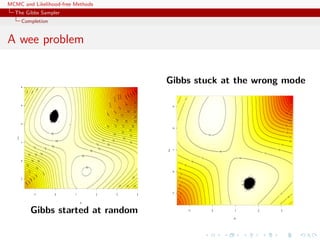
If a sample (xi )1≤i≤m is derived from the weighted sample
(xi, i)1≤i≤n by multinomial sampling with weights i, then
xi ∼ π(x)

MCMC and Likelihood-free Methods
Population Monte Carlo
Sampling importance resampling
Importance sampling from g can also produce samples from the
target π
[Rubin, 1987]
Theorem (Bootstraped importance sampling)
If a sample (xi )1≤i≤m is derived from the weighted sample
(xi, i)1≤i≤n by multinomial sampling with weights i, then
xi ∼ π(x)
Note
Obviously, the xi ’s are not iid
MCMC and Likelihood-free Methods
Population Monte Carlo
Iterated sampling importance resampling
This principle can be extended to iterated importance sampling:
After each iteration, resampling produces a sample from π
[Again, not iid!]
MCMC and Likelihood-free Methods
Population Monte Carlo
Iterated sampling importance resampling
This principle can be extended to iterated importance sampling:
After each iteration, resampling produces a sample from π
[Again, not iid!]
Incentive
Use previous sample(s) to learn about π and q
MCMC and Likelihood-free Methods
Population Monte Carlo
Generic Population Monte Carlo
Algorithm (Population Monte Carlo Algorithm)
For t = 1, . . . , T
For i = 1, . . . , n,
1. Select the generating distribution qit(·)
2. Generate ˜x
(t)
i ∼ qit(x)
3. Compute
(t)
i = π(˜x
(t)
i )/qit(˜x
(t)
i )
Normalise the
(t)
i ’s into ¯
(t)
i ’s
Generate Ji,t ∼ M((¯
(t)
i )1≤i≤N ) and set xi,t = ˜x
(t)
Ji,t
MCMC and Likelihood-free Methods
Population Monte Carlo
D-kernels in competition
A general adaptive construction:
Construct qi,t as a mixture of D different transition kernels
depending on x
(t−1)
i
qi,t =
D
=1
pt, K (x
(t−1)
i , x),
D
=1
pt, = 1 ,
and adapt the weights pt, .
MCMC and Likelihood-free Methods
Population Monte Carlo
D-kernels in competition
A general adaptive construction:
Construct qi,t as a mixture of D different transition kernels
depending on x
(t−1)
i
qi,t =
D
=1
pt, K (x
(t−1)
i , x),
D
=1
pt, = 1 ,
and adapt the weights pt, .
Darwinian example
Take pt, proportional to the survival rate of the points
(a.k.a. particles) x
(t)
i generated from K
MCMC and Likelihood-free Methods
Population Monte Carlo
Implementation
Algorithm (D-kernel PMC)
For t = 1, . . . , T
generate (Ki,t)1≤i≤N ∼ M ((pt,k)1≤k≤D)
for 1 ≤ i ≤ N, generate
˜xi,t ∼ KKi,t (x)
compute and renormalize the importance weights ωi,t
generate (Ji,t)1≤i≤N ∼ M ((ωi,t)1≤i≤N )
take xi,t = ˜xJi,t,t and pt+1,d = N
i=1 ¯ωi,tId(Ki,t)
MCMC and Likelihood-free Methods
Population Monte Carlo
Links with particle filters
Sequential setting where π = πt changes with t: Population
Monte Carlo also adapts to this case
Can be traced back all the way to Hammersley and Morton
(1954) and the self-avoiding random walk problem
Gilks and Berzuini (2001) produce iterated samples with (SIR)
resampling steps, and add an MCMC step: this step must use
a πt invariant kernel
Chopin (2001) uses iterated importance sampling to handle
large datasets: this is a special case of PMC where the qit’s
are the posterior distributions associated with a portion kt of
the observed dataset
MCMC and Likelihood-free Methods
Population Monte Carlo
Links with particle filters (2)
Rubinstein and Kroese’s (2004) cross-entropy method is
parameterised importance sampling targeted at rare events
Stavropoulos and Titterington’s (1999) smooth bootstrap and
Warnes’ (2001) kernel coupler use nonparametric kernels on
the previous importance sample to build an improved
proposal: this is a special case of PMC
West (1992) mixture approximation is a precursor of smooth
bootstrap
Mengersen and Robert (2002) “pinball sampler” is an MCMC
attempt at population sampling
Del Moral, Doucet and Jasra (2006, JRSS B) sequential
Monte Carlo samplers also relates to PMC, with a Markovian
dependence on the past sample x(t) but (limited) stationarity
constraints
MCMC and Likelihood-free Methods
Population Monte Carlo
Things can go wrong
Unexpected behaviour of the mixture weights when the number of
particles increases
N
i=1
¯ωi,tIKi,t=d−→P
1
D
MCMC and Likelihood-free Methods
Population Monte Carlo
Things can go wrong
Unexpected behaviour of the mixture weights when the number of
particles increases
N
i=1
¯ωi,tIKi,t=d−→P
1
D
Conclusion
At each iteration, every weight converges to 1/D:
the algorithm fails to learn from experience!!
MCMC and Likelihood-free Methods
Population Monte Carlo
Saved by Rao-Blackwell!!
Modification: Rao-Blackwellisation (=conditioning)
MCMC and Likelihood-free Methods
Population Monte Carlo
Saved by Rao-Blackwell!!
Modification: Rao-Blackwellisation (=conditioning)
Use the whole mixture in the importance weight:
ωi,t = π(˜xi,t)
D
d=1
pt,dKd(xi,t−1, ˜xi,t)
instead of
ωi,t =
π(˜xi,t)
KKi,t (xi,t−1, ˜xi,t)
MCMC and Likelihood-free Methods
Population Monte Carlo
Adapted algorithm
Algorithm (Rao-Blackwellised D-kernel PMC)
At time t (t = 1, . . . , T),
Generate
(Ki,t)1≤i≤N
iid
∼ M((pt,d)1≤d≤D);
Generate
(˜xi,t)1≤i≤N
ind
∼ KKi,t (xi,t−1, x)
and set ωi,t = π(˜xi,t) D
d=1 pt,dKd(xi,t−1, ˜xi,t);
Generate
(Ji,t)1≤i≤N
iid
∼ M((¯ωi,t)1≤i≤N )
and set xi,t = ˜xJi,t,t and pt+1,d = N
i=1 ¯ωi,tpt,d.
MCMC and Likelihood-free Methods
Population Monte Carlo
Convergence properties
Theorem (LLN)
Under regularity assumptions, for h ∈ L1
Π and for every t ≥ 1,
1
N
N
k=1
¯ωi,th(xi,t)
N→∞
−→P Π(h)
and
pt,d
N→∞
−→P αt
d
The limiting coefficients (αt
d)1≤d≤D are defined recursively as
αt
d = αt−1
d
Kd(x, x )
D
j=1 αt−1
j Kj(x, x )
Π ⊗ Π(dx, dx ).
MCMC and Likelihood-free Methods
Population Monte Carlo
Recursion on the weights
Set F as
F(α) = αd
Kd(x, x )
D
j=1 αjKj(x, x )
Π ⊗ Π(dx, dx )
1≤d≤D
on the simplex
S = α = (α1, . . . , αD); ∀d ∈ {1, . . . , D}, αd ≥ 0 and
D
d=1
αd = 1 .
and define the sequence
αt+1
= F(αt
)
MCMC and Likelihood-free Methods
Population Monte Carlo
Kullback divergence
Definition (Kullback divergence)
For α ∈ S,
KL(α) = log
π(x)π(x )
π(x) D
d=1 αdKd(x, x )
Π ⊗ Π(dx, dx ).
Kullback divergence between Π and the mixture.
Goal: Obtain the mixture closest to Π, i.e., that minimises KL(α)
MCMC and Likelihood-free Methods
Population Monte Carlo
Connection with RBDPMCA ??
Theorem
Under the assumption
∀d ∈ {1, . . . , D}, −∞ < log(Kd(x, x ))Π ⊗ Π(dx, dx ) < ∞
for every α ∈ SD,
KL(F(α)) ≤ KL(α).
MCMC and Likelihood-free Methods
Population Monte Carlo
Connection with RBDPMCA ??
Theorem
Under the assumption
∀d ∈ {1, . . . , D}, −∞ < log(Kd(x, x ))Π ⊗ Π(dx, dx ) < ∞
for every α ∈ SD,
KL(F(α)) ≤ KL(α).
Conclusion
The Kullback divergence decreases at every iteration of RBDPMCA
MCMC and Likelihood-free Methods
Population Monte Carlo
An integrated EM interpretation
skip interpretation
We have
αmin
= arg min
α∈S
KL(α) = arg max
α∈S
log pα(¯x)Π ⊗ Π(d¯x)
= arg max
α∈S
log pα(¯x, K)dK Π ⊗ Π(d¯x)
for ¯x = (x, x ) and K ∼ M((αd)1≤d≤D). Then αt+1 = F(αt)
means
αt+1
= arg max
α
Eαt (log pα( ¯X, K)| ¯X = ¯x)Π ⊗ Π(d¯x)
and
lim
t→∞
αt
= αmin
MCMC and Likelihood-free Methods
Population Monte Carlo
Illustration
Example (A toy example)
Take the target
1/4N (−1, 0.3)(x) + 1/4N (0, 1)(x) + 1/2N (3, 2)(x)
and use 3 proposals: N (−1, 0.3), N (0, 1) and N (3, 2)
[Surprise!!!]
MCMC and Likelihood-free Methods
Population Monte Carlo
Illustration
Example (A toy example)
Take the target
1/4N (−1, 0.3)(x) + 1/4N (0, 1)(x) + 1/2N (3, 2)(x)
and use 3 proposals: N (−1, 0.3), N (0, 1) and N (3, 2)
[Surprise!!!]
Then
1 0.0500000 0.05000000 0.9000000
2 0.2605712 0.09970292 0.6397259
6 0.2740816 0.19160178 0.5343166
10 0.2989651 0.19200904 0.5090259
16 0.2651511 0.24129039 0.4935585
Weight evolution
MCMC and Likelihood-free Methods
Population Monte Carlo
Target and mixture evolution
MCMC and Likelihood-free Methods
Population Monte Carlo
c Learning scheme
The efficiency of the SNIS approximation depends on the choice of
Q, ranging from optimal
q(x) ∝ |h(x) − Π(h)|π(x)
to useless
var ˆΠSNIS
Q,N (h) = +∞
MCMC and Likelihood-free Methods
Population Monte Carlo
c Learning scheme
The efficiency of the SNIS approximation depends on the choice of
Q, ranging from optimal
q(x) ∝ |h(x) − Π(h)|π(x)
to useless
var ˆΠSNIS
Q,N (h) = +∞
Example (PMC=adaptive importance sampling)
Population Monte Carlo is producing a sequence of proposals Qt
aiming at improving efficiency
Kull(π, qt) ≤ Kull(π, qt−1) or var ˆΠSNIS
Qt,∞ (h) ≤ var ˆΠSNIS
Qt−1,∞(h)
[Capp´e, Douc, Guillin, Marin, Robert, 04, 07a, 07b, 08]
MCMC and Likelihood-free Methods
Approximate Bayesian computation
Computational issues in Bayesian statistics
The Metropolis-Hastings Algorithm
The Gibbs Sampler
Population Monte Carlo
Approximate Bayesian computation
ABC basics
Alphabet soup
Calibration of ABC
MCMC and Likelihood-free Methods
Approximate Bayesian computation
ABC basics
Untractable likelihoods
Cases when the likelihood function f(y|θ) is unavailable and when
the completion step
f(y|θ) =
Z
f(y, z|θ) dz
is impossible or too costly because of the dimension of z
c MCMC cannot be implemented!
MCMC and Likelihood-free Methods
Approximate Bayesian computation
ABC basics
Illustrations
Example
Stochastic volatility model: for
t = 1, . . . , T,
yt = exp(zt) t , zt = a+bzt−1+σηt ,
T very large makes it difficult to
include z within the simulated
parameters
0 200 400 600 800 1000
−0.4−0.20.00.20.4 t
Highest weight trajectories
MCMC and Likelihood-free Methods
Approximate Bayesian computation
ABC basics
Illustrations
Example
Potts model: if y takes values on a grid Y of size kn and
f(y|θ) ∝ exp θ
l∼i
Iyl=yi
where l∼i denotes a neighbourhood relation, n moderately large
prohibits the computation of the normalising constant
MCMC and Likelihood-free Methods
Approximate Bayesian computation
ABC basics
Illustrations
Example
Inference on CMB: in cosmology, study of the Cosmic Microwave
Background via likelihoods immensely slow to computate (e.g
WMAP, Plank), because of numerically costly spectral transforms
[Data is a Fortran program]
[Kilbinger et al., 2010, MNRAS]
MCMC and Likelihood-free Methods
Approximate Bayesian computation
ABC basics
Illustrations
Example
Phylogenetic tree: in population
genetics, reconstitution of a common
ancestor from a sample of genes via
a phylogenetic tree that is close to
impossible to integrate out
[100 processor days with 4
parameters]
[Cornuet et al., 2009, Bioinformatics]
MCMC and Likelihood-free Methods
Approximate Bayesian computation
ABC basics
The ABC method
Bayesian setting: target is π(θ)f(x|θ)
MCMC and Likelihood-free Methods
Approximate Bayesian computation
ABC basics
The ABC method
Bayesian setting: target is π(θ)f(x|θ)
When likelihood f(x|θ) not in closed form, likelihood-free rejection
technique:
MCMC and Likelihood-free Methods
Approximate Bayesian computation
ABC basics
The ABC method
Bayesian setting: target is π(θ)f(x|θ)
When likelihood f(x|θ) not in closed form, likelihood-free rejection
technique:
ABC algorithm
For an observation y ∼ f(y|θ), under the prior π(θ), keep jointly
simulating
θ ∼ π(θ) , z ∼ f(z|θ ) ,
until the auxiliary variable z is equal to the observed value, z = y.
[Tavar´e et al., 1997]
MCMC and Likelihood-free Methods
Approximate Bayesian computation
ABC basics
Why does it work?!
The proof is trivial:
f(θi) ∝
z∈D
π(θi)f(z|θi)Iy(z)
∝ π(θi)f(y|θi)
= π(θi|y) .
[Accept–Reject 101]
MCMC and Likelihood-free Methods
Approximate Bayesian computation
ABC basics
Earlier occurrence
‘Bayesian statistics and Monte Carlo methods are ideally
suited to the task of passing many models over one
dataset’
[Don Rubin, Annals of Statistics, 1984]
Note Rubin (1984) does not promote this algorithm for
likelihood-free simulation but frequentist intuition on posterior
distributions: parameters from posteriors are more likely to be
those that could have generated the data.
MCMC and Likelihood-free Methods
Approximate Bayesian computation
ABC basics
A as approximative
When y is a continuous random variable, equality z = y is replaced
with a tolerance condition,
(y, z) ≤
where is a distance
MCMC and Likelihood-free Methods
Approximate Bayesian computation
ABC basics
A as approximative
When y is a continuous random variable, equality z = y is replaced
with a tolerance condition,
(y, z) ≤
where is a distance
Output distributed from
π(θ) Pθ{ (y, z) < } ∝ π(θ| (y, z) < )
MCMC and Likelihood-free Methods
Approximate Bayesian computation
ABC basics
ABC algorithm
Algorithm 2 Likelihood-free rejection sampler 2
for i = 1 to N do
repeat
generate θ from the prior distribution π(·)
generate z from the likelihood f(·|θ )
until ρ{η(z), η(y)} ≤
set θi = θ
end for
where η(y) defines a (not necessarily sufficient) statistic
MCMC and Likelihood-free Methods
Approximate Bayesian computation
ABC basics
Output
The likelihood-free algorithm samples from the marginal in z of:
π (θ, z|y) =
π(θ)f(z|θ)IA ,y (z)
A ,y×Θ π(θ)f(z|θ)dzdθ
,
wheere A ,y = {z ∈ D|ρ(η(z), η(y)) < }.
MCMC and Likelihood-free Methods
Approximate Bayesian computation
ABC basics
Output
The likelihood-free algorithm samples from the marginal in z of:
π (θ, z|y) =
π(θ)f(z|θ)IA ,y (z)
A ,y×Θ π(θ)f(z|θ)dzdθ
,
wheere A ,y = {z ∈ D|ρ(η(z), η(y)) < }.
The idea behind ABC is that the summary statistics coupled with a
small tolerance should provide a good approximation of the
posterior distribution:
π (θ|y) = π (θ, z|y)dz ≈ π(θ|y) .
MCMC and Likelihood-free Methods
Approximate Bayesian computation
ABC basics
MA example
Back to the MA(q) model
xt = t +
q
i=1
ϑi t−i
Simple prior: uniform over the inverse [real and complex] roots in
Q(u) = 1 −
q
i=1
ϑiui
under the identifiability conditions
MCMC and Likelihood-free Methods
Approximate Bayesian computation
ABC basics
MA example
Back to the MA(q) model
xt = t +
q
i=1
ϑi t−i
Simple prior: uniform prior over the identifiability zone, e.g.
triangle for MA(2)
MCMC and Likelihood-free Methods
Approximate Bayesian computation
ABC basics
MA example (2)
ABC algorithm thus made of
1. picking a new value (ϑ1, ϑ2) in the triangle
2. generating an iid sequence ( t)−q<t≤T
3. producing a simulated series (xt)1≤t≤T
MCMC and Likelihood-free Methods
Approximate Bayesian computation
ABC basics
MA example (2)
ABC algorithm thus made of
1. picking a new value (ϑ1, ϑ2) in the triangle
2. generating an iid sequence ( t)−q<t≤T
3. producing a simulated series (xt)1≤t≤T
Distance: basic distance between the series
ρ((xt)1≤t≤T , (xt)1≤t≤T ) =
T
t=1
(xt − xt)2
or distance between summary statistics like the q autocorrelations
τj =
T
t=j+1
xtxt−j
MCMC and Likelihood-free Methods
Approximate Bayesian computation
ABC basics
Comparison of distance impact
Evaluation of the tolerance on the ABC sample against both
distances ( = 100%, 10%, 1%, 0.1%) for an MA(2) model
MCMC and Likelihood-free Methods
Approximate Bayesian computation
ABC basics
Comparison of distance impact
0.0 0.2 0.4 0.6 0.8
01234
θ1
−2.0 −1.0 0.0 0.5 1.0 1.5
0.00.51.01.5
θ2
Evaluation of the tolerance on the ABC sample against both
distances ( = 100%, 10%, 1%, 0.1%) for an MA(2) model
MCMC and Likelihood-free Methods
Approximate Bayesian computation
ABC basics
Comparison of distance impact
0.0 0.2 0.4 0.6 0.8
01234
θ1
−2.0 −1.0 0.0 0.5 1.0 1.5
0.00.51.01.5
θ2
Evaluation of the tolerance on the ABC sample against both
distances ( = 100%, 10%, 1%, 0.1%) for an MA(2) model
MCMC and Likelihood-free Methods
Approximate Bayesian computation
ABC basics
Homonomy
The ABC algorithm is not to be confused with the ABC algorithm
The Artificial Bee Colony algorithm is a swarm based meta-heuristic
algorithm that was introduced by Karaboga in 2005 for optimizing
numerical problems. It was inspired by the intelligent foraging
behavior of honey bees. The algorithm is specifically based on the
model proposed by Tereshko and Loengarov (2005) for the foraging
behaviour of honey bee colonies. The model consists of three
essential components: employed and unemployed foraging bees, and
food sources. The first two components, employed and unemployed
foraging bees, search for rich food sources (...) close to their hive.
The model also defines two leading modes of behaviour (...):
recruitment of foragers to rich food sources resulting in positive
feedback and abandonment of poor sources by foragers causing
negative feedback.
[Karaboga, Scholarpedia]
MCMC and Likelihood-free Methods
Approximate Bayesian computation
ABC basics
ABC advances
Simulating from the prior is often poor in efficiency
MCMC and Likelihood-free Methods
Approximate Bayesian computation
ABC basics
ABC advances
Simulating from the prior is often poor in efficiency
Either modify the proposal distribution on θ to increase the density
of x’s within the vicinity of y...
[Marjoram et al, 2003; Bortot et al., 2007, Sisson et al., 2007]
MCMC and Likelihood-free Methods
Approximate Bayesian computation
ABC basics
ABC advances
Simulating from the prior is often poor in efficiency
Either modify the proposal distribution on θ to increase the density
of x’s within the vicinity of y...
[Marjoram et al, 2003; Bortot et al., 2007, Sisson et al., 2007]
...or by viewing the problem as a conditional density estimation
and by developing techniques to allow for larger
[Beaumont et al., 2002]
MCMC and Likelihood-free Methods
Approximate Bayesian computation
ABC basics
ABC advances
Simulating from the prior is often poor in efficiency
Either modify the proposal distribution on θ to increase the density
of x’s within the vicinity of y...
[Marjoram et al, 2003; Bortot et al., 2007, Sisson et al., 2007]
...or by viewing the problem as a conditional density estimation
and by developing techniques to allow for larger
[Beaumont et al., 2002]
.....or even by including in the inferential framework [ABCµ]
[Ratmann et al., 2009]
MCMC and Likelihood-free Methods
Approximate Bayesian computation
Alphabet soup
ABC-NP
Better usage of [prior] simulations by
adjustement: instead of throwing away
θ such that ρ(η(z), η(y)) > , replace
θs with locally regressed
θ∗
= θ − {η(z) − η(y)}T ˆβ
[Csill´ery et al., TEE, 2010]
where ˆβ is obtained by [NP] weighted least square regression on
(η(z) − η(y)) with weights
Kδ {ρ(η(z), η(y))}
[Beaumont et al., 2002, Genetics]
MCMC and Likelihood-free Methods
Approximate Bayesian computation
Alphabet soup
ABC-MCMC
Markov chain (θ(t)) created via the transition function
θ(t+1)
=



θ ∼ Kω(θ |θ(t)) if x ∼ f(x|θ ) is such that x = y
and u ∼ U(0, 1) ≤ π(θ )Kω(θ(t)|θ )
π(θ(t))Kω(θ |θ(t))
,
θ(t) otherwise,
MCMC and Likelihood-free Methods
Approximate Bayesian computation
Alphabet soup
ABC-MCMC
Markov chain (θ(t)) created via the transition function
θ(t+1)
=



θ ∼ Kω(θ |θ(t)) if x ∼ f(x|θ ) is such that x = y
and u ∼ U(0, 1) ≤ π(θ )Kω(θ(t)|θ )
π(θ(t))Kω(θ |θ(t))
,
θ(t) otherwise,
has the posterior π(θ|y) as stationary distribution
[Marjoram et al, 2003]
MCMC and Likelihood-free Methods
Approximate Bayesian computation
Alphabet soup
ABC-MCMC (2)
Algorithm 3 Likelihood-free MCMC sampler
Use Algorithm 2 to get (θ(0), z(0))
for t = 1 to N do
Generate θ from Kω ·|θ(t−1) ,
Generate z from the likelihood f(·|θ ),
Generate u from U[0,1],
if u ≤ π(θ )Kω(θ(t−1)|θ )
π(θ(t−1)Kω(θ |θ(t−1))
IA ,y (z ) then
set (θ(t), z(t)) = (θ , z )
else
(θ(t), z(t))) = (θ(t−1), z(t−1)),
end if
end for
MCMC and Likelihood-free Methods
Approximate Bayesian computation
Alphabet soup
Why does it work?
Acceptance probability that does not involve the calculation of the
likelihood and
π (θ , z |y)
π (θ(t−1), z(t−1)|y)
×
Kω(θ(t−1)|θ )f(z(t−1)|θ(t−1))
Kω(θ |θ(t−1))f(z |θ )
=
π(θ ) f(z |θ ) IA ,y (z )
π(θ(t−1)) f(z(t−1)|θ(t−1))IA ,y (z(t−1))
×
Kω(θ(t−1)|θ ) f(z(t−1)|θ(t−1))
Kω(θ |θ(t−1)) f(z |θ )
=
π(θ )Kω(θ(t−1)|θ )
π(θ(t−1)Kω(θ |θ(t−1))
IA ,y (z ) .
MCMC and Likelihood-free Methods
Approximate Bayesian computation
Alphabet soup
ABCµ
[Ratmann, Andrieu, Wiuf and Richardson, 2009, PNAS]
Use of a joint density
f(θ, |y) ∝ ξ( |y, θ) × πθ(θ) × π ( )
where y is the data, and ξ( |y, θ) is the prior predictive density of
ρ(η(z), η(y)) given θ and x when z ∼ f(z|θ)
MCMC and Likelihood-free Methods
Approximate Bayesian computation
Alphabet soup
ABCµ
[Ratmann, Andrieu, Wiuf and Richardson, 2009, PNAS]
Use of a joint density
f(θ, |y) ∝ ξ( |y, θ) × πθ(θ) × π ( )
where y is the data, and ξ( |y, θ) is the prior predictive density of
ρ(η(z), η(y)) given θ and x when z ∼ f(z|θ)
Warning! Replacement of ξ( |y, θ) with a non-parametric kernel
approximation.
MCMC and Likelihood-free Methods
Approximate Bayesian computation
Alphabet soup
ABCµ details
Multidimensional distances ρk (k = 1, . . . , K) and errors
k = ρk(ηk(z), ηk(y)), with
k ∼ ξk( |y, θ) ≈ ˆξk( |y, θ) =
1
Bhk
b
K[{ k−ρk(ηk(zb), ηk(y))}/hk]
then used in replacing ξ( |y, θ) with mink
ˆξk( |y, θ)
MCMC and Likelihood-free Methods
Approximate Bayesian computation
Alphabet soup
ABCµ details
Multidimensional distances ρk (k = 1, . . . , K) and errors
k = ρk(ηk(z), ηk(y)), with
k ∼ ξk( |y, θ) ≈ ˆξk( |y, θ) =
1
Bhk
b
K[{ k−ρk(ηk(zb), ηk(y))}/hk]
then used in replacing ξ( |y, θ) with mink
ˆξk( |y, θ)
ABCµ involves acceptance probability
π(θ , )
π(θ, )
q(θ , θ)q( , )
q(θ, θ )q( , )
mink
ˆξk( |y, θ )
mink
ˆξk( |y, θ)
MCMC and Likelihood-free Methods
Approximate Bayesian computation
Alphabet soup
ABCµ multiple errors
[ c Ratmann et al., PNAS, 2009]
MCMC and Likelihood-free Methods
Approximate Bayesian computation
Alphabet soup
ABCµ for model choice
[ c Ratmann et al., PNAS, 2009]
MCMC and Likelihood-free Methods
Approximate Bayesian computation
Alphabet soup
Questions about ABCµ
For each model under comparison, marginal posterior on used to
assess the fit of the model (HPD includes 0 or not).
MCMC and Likelihood-free Methods
Approximate Bayesian computation
Alphabet soup
Questions about ABCµ
For each model under comparison, marginal posterior on used to
assess the fit of the model (HPD includes 0 or not).
Is the data informative about ? [Identifiability]
How is the prior π( ) impacting the comparison?
How is using both ξ( |x0, θ) and π ( ) compatible with a
standard probability model? [remindful of Wilkinson]
Where is the penalisation for complexity in the model
comparison?
[X, Mengersen & Chen, 2010, PNAS]
MCMC and Likelihood-free Methods
Approximate Bayesian computation
Alphabet soup
ABC-PRC
Another sequential version producing a sequence of Markov
transition kernels Kt and of samples (θ
(t)
1 , . . . , θ
(t)
N ) (1 ≤ t ≤ T)
MCMC and Likelihood-free Methods
Approximate Bayesian computation
Alphabet soup
ABC-PRC
Another sequential version producing a sequence of Markov
transition kernels Kt and of samples (θ
(t)
1 , . . . , θ
(t)
N ) (1 ≤ t ≤ T)
ABC-PRC Algorithm
1. Pick a θ is selected at random among the previous θ
(t−1)
i ’s
with probabilities ω
(t−1)
i (1 ≤ i ≤ N).
2. Generate
θ
(t)
i ∼ Kt(θ|θ ) , x ∼ f(x|θ
(t)
i ) ,
3. Check that (x, y) < , otherwise start again.
[Sisson et al., 2007]
MCMC and Likelihood-free Methods
Approximate Bayesian computation
Alphabet soup
Why PRC?
Partial rejection control: Resample from a population of weighted
particles by pruning away particles with weights below threshold C,
replacing them by new particles obtained by propagating an
existing particle by an SMC step and modifying the weights
accordinly.
[Liu, 2001]
MCMC and Likelihood-free Methods
Approximate Bayesian computation
Alphabet soup
Why PRC?
Partial rejection control: Resample from a population of weighted
particles by pruning away particles with weights below threshold C,
replacing them by new particles obtained by propagating an
existing particle by an SMC step and modifying the weights
accordinly.
[Liu, 2001]
PRC justification in ABC-PRC:
Suppose we then implement the PRC algorithm for some
c > 0 such that only identically zero weights are smaller
than c
Trouble is, there is no such c...
MCMC and Likelihood-free Methods
Approximate Bayesian computation
Alphabet soup
ABC-PRC weight
Probability ω
(t)
i computed as
ω
(t)
i ∝ π(θ
(t)
i )Lt−1(θ |θ
(t)
i ){π(θ )Kt(θ
(t)
i |θ )}−1
,
where Lt−1 is an arbitrary transition kernel.
MCMC and Likelihood-free Methods
Approximate Bayesian computation
Alphabet soup
ABC-PRC weight
Probability ω
(t)
i computed as
ω
(t)
i ∝ π(θ
(t)
i )Lt−1(θ |θ
(t)
i ){π(θ )Kt(θ
(t)
i |θ )}−1
,
where Lt−1 is an arbitrary transition kernel.
In case
Lt−1(θ |θ) = Kt(θ|θ ) ,
all weights are equal under a uniform prior.
MCMC and Likelihood-free Methods
Approximate Bayesian computation
Alphabet soup
ABC-PRC weight
Probability ω
(t)
i computed as
ω
(t)
i ∝ π(θ
(t)
i )Lt−1(θ |θ
(t)
i ){π(θ )Kt(θ
(t)
i |θ )}−1
,
where Lt−1 is an arbitrary transition kernel.
In case
Lt−1(θ |θ) = Kt(θ|θ ) ,
all weights are equal under a uniform prior.
Inspired from Del Moral et al. (2006), who use backward kernels
Lt−1 in SMC to achieve unbiasedness
MCMC and Likelihood-free Methods
Approximate Bayesian computation
Alphabet soup
ABC-PRC bias
Lack of unbiasedness of the method
MCMC and Likelihood-free Methods
Approximate Bayesian computation
Alphabet soup
ABC-PRC bias
Lack of unbiasedness of the method
Joint density of the accepted pair (θ(t−1), θ(t)) proportional to
π(θ
(t−1)
|y)Kt(θ
(t)
|θ
(t−1)
)f(y|θ
(t)
) ,
For an arbitrary function h(θ), E[ωth(θ(t))] proportional to
ZZ
h(θ
(t)
)
π(θ(t)
)Lt−1(θ(t−1)
|θ(t)
)
π(θ(t−1))Kt(θ(t)|θ(t−1))
π(θ
(t−1)
|y)Kt(θ
(t)
|θ
(t−1)
)f(y|θ
(t)
)dθ
(t−1)
dθ
(t)
∝
ZZ
h(θ
(t)
)
π(θ(t)
)Lt−1(θ(t−1)
|θ(t)
)
π(θ(t−1))Kt(θ(t)|θ(t−1))
π(θ
(t−1)
)f(y|θ
(t−1)
)
× Kt(θ
(t)
|θ
(t−1)
)f(y|θ
(t)
)dθ
(t−1)
dθ
(t)
∝
Z
h(θ
(t)
)π(θ
(t)
|y)
Z
Lt−1(θ
(t−1)
|θ
(t)
)f(y|θ
(t−1)
)dθ
(t−1)
ff
dθ
(t)
.
MCMC and Likelihood-free Methods
Approximate Bayesian computation
Alphabet soup
A mixture example (1)
Toy model of Sisson et al. (2007): if
θ ∼ U(−10, 10) , x|θ ∼ 0.5 N(θ, 1) + 0.5 N(θ, 1/100) ,
then the posterior distribution associated with y = 0 is the normal
mixture
θ|y = 0 ∼ 0.5 N(0, 1) + 0.5 N(0, 1/100)
restricted to [−10, 10].
Furthermore, true target available as
π(θ||x| < ) ∝ Φ( −θ)−Φ(− −θ)+Φ(10( −θ))−Φ(−10( +θ)) .
MCMC and Likelihood-free Methods
Approximate Bayesian computation
Alphabet soup
“Ugly, squalid graph...”
θθ
−3 −1 1 3
0.00.20.40.60.81.0
θθ
−3 −1 1 3
0.00.20.40.60.81.0
θθ
−3 −1 1 3
0.00.20.40.60.81.0
θθ
−3 −1 1 3
0.00.20.40.60.81.0
θθ
−3 −1 1 3
0.00.20.40.60.81.0
θθ
−3 −1 1 3
0.00.20.40.60.81.0
θθ
−3 −1 1 3
0.00.20.40.60.81.0
θθ
−3 −1 1 3
0.00.20.40.60.81.0
θθ
−3 −1 1 3
0.00.20.40.60.81.0
θθ
−3 −1 1 3
0.00.20.40.60.81.0
Comparison of τ = 0.15 and τ = 1/0.15 in Kt
MCMC and Likelihood-free Methods
Approximate Bayesian computation
Alphabet soup
A PMC version
Use of the same kernel idea as ABC-PRC but with IS correction
Generate a sample at iteration t by
ˆπt(θ(t)
) ∝
N
j=1
ω
(t−1)
j Kt(θ(t)
|θ
(t−1)
j )
modulo acceptance of the associated xt, and use an importance
weight associated with an accepted simulation θ
(t)
i
ω
(t)
i ∝ π(θ
(t)
i ) ˆπt(θ
(t)
i ) .
c Still likelihood free
[Beaumont et al., 2008, arXiv:0805.2256]
MCMC and Likelihood-free Methods
Approximate Bayesian computation
Alphabet soup
The ABC-PMC algorithm
Given a decreasing sequence of approximation levels 1 ≥ . . . ≥ T ,
1. At iteration t = 1,
For i = 1, ..., N
Simulate θ
(1)
i ∼ π(θ) and x ∼ f(x|θ
(1)
i ) until (x, y) < 1
Set ω
(1)
i = 1/N
Take τ2
as twice the empirical variance of the θ
(1)
i ’s
2. At iteration 2 ≤ t ≤ T,
For i = 1, ..., N, repeat
Pick θi from the θ
(t−1)
j ’s with probabilities ω
(t−1)
j
generate θ
(t)
i |θi ∼ N(θi , σ2
t ) and x ∼ f(x|θ
(t)
i )
until (x, y) < t
Set ω
(t)
i ∝ π(θ
(t)
i )/
N
j=1 ω
(t−1)
j ϕ σ−1
t θ
(t)
i − θ
(t−1)
j )
Take τ2
t+1 as twice the weighted empirical variance of the θ
(t)
i ’s
MCMC and Likelihood-free Methods
Approximate Bayesian computation
Alphabet soup
Sequential Monte Carlo
SMC is a simulation technique to approximate a sequence of
related probability distributions πn with π0 “easy” and πT as
target.
Iterated IS as PMC : particles moved from time n to time n via
kernel Kn and use of a sequence of extended targets ˜πn
˜πn(z0:n) = πn(zn)
n
j=0
Lj(zj+1, zj)
where the Lj’s are backward Markov kernels [check that πn(zn) is
a marginal]
[Del Moral, Doucet & Jasra, Series B, 2006]
MCMC and Likelihood-free Methods
Approximate Bayesian computation
Alphabet soup
Sequential Monte Carlo (2)
Algorithm 4 SMC sampler
sample z
(0)
i ∼ γ0(x) (i = 1, . . . , N)
compute weights w
(0)
i = π0(z
(0)
i ))/γ0(z
(0)
i )
for t = 1 to N do
if ESS(w(t−1)) < NT then
resample N particles z(t−1) and set weights to 1
end if
generate z
(t−1)
i ∼ Kt(z
(t−1)
i , ·) and set weights to
w
(t)
i = W
(t−1)
i−1
πt(z
(t)
i ))Lt−1(z
(t)
i ), z
(t−1)
i ))
πt−1(z
(t−1)
i ))Kt(z
(t−1)
i ), z
(t)
i ))
end for
MCMC and Likelihood-free Methods
Approximate Bayesian computation
Alphabet soup
ABC-SMC
[Del Moral, Doucet & Jasra, 2009]
True derivation of an SMC-ABC algorithm
Use of a kernel Kn associated with target π n and derivation of the
backward kernel
Ln−1(z, z ) =
π n (z )Kn(z , z)
πn(z)
Update of the weights
win ∝ wi(n−1)
M
m=1 IA n
(xm
in)
M
m=1 IA n−1
(xm
i(n−1))
when xm
in ∼ K(xi(n−1), ·)
MCMC and Likelihood-free Methods
Approximate Bayesian computation
Alphabet soup
ABC-SMCM
Modification: Makes M repeated simulations of the pseudo-data z
given the parameter, rather than using a single [M = 1]
simulation, leading to weight that is proportional to the number of
accepted zis
ω(θ) =
1
M
M
i=1
Iρ(η(y),η(zi))<
[limit in M means exact simulation from (tempered) target]
MCMC and Likelihood-free Methods
Approximate Bayesian computation
Alphabet soup
Properties of ABC-SMC
The ABC-SMC method properly uses a backward kernel L(z, z ) to
simplify the importance weight and to remove the dependence on
the unknown likelihood from this weight. Update of importance
weights is reduced to the ratio of the proportions of surviving
particles
Major assumption: the forward kernel K is supposed to be
invariant against the true target [tempered version of the true
posterior]
MCMC and Likelihood-free Methods
Approximate Bayesian computation
Alphabet soup
Properties of ABC-SMC
The ABC-SMC method properly uses a backward kernel L(z, z ) to
simplify the importance weight and to remove the dependence on
the unknown likelihood from this weight. Update of importance
weights is reduced to the ratio of the proportions of surviving
particles
Major assumption: the forward kernel K is supposed to be
invariant against the true target [tempered version of the true
posterior]
Adaptivity in ABC-SMC algorithm only found in on-line
construction of the thresholds t, slowly enough to keep a large
number of accepted transitions
MCMC and Likelihood-free Methods
Approximate Bayesian computation
Alphabet soup
A mixture example (2)
Recovery of the target, whether using a fixed standard deviation of
τ = 0.15 or τ = 1/0.15, or a sequence of adaptive τt’s.
θθ
−3 −2 −1 0 1 2 3
0.00.20.40.60.81.0
θθ
−3 −2 −1 0 1 2 3
0.00.20.40.60.81.0
θθ
−3 −2 −1 0 1 2 3
0.00.20.40.60.81.0
θθ
−3 −2 −1 0 1 2 3
0.00.20.40.60.81.0
θθ
−3 −2 −1 0 1 2 3
0.00.20.40.60.81.0
MCMC and Likelihood-free Methods
Approximate Bayesian computation
Alphabet soup
Wilkinson’s exact BC
Wilkinson (2008) replaces the ABC approximation error
(i.e. non-zero tolerance) in with an exact simulation from a
controlled approximation to the target, a convolution of the true
posterior with an arbitrary kernel function
π (θ, z|y) =
π(θ)f(z|θ)K (y − z)
π(θ)f(z|θ)K (y − z)dzdθ
,
where K is a kernel parameterised by a bandwidth .
MCMC and Likelihood-free Methods
Approximate Bayesian computation
Alphabet soup
Wilkinson’s exact BC
Wilkinson (2008) replaces the ABC approximation error
(i.e. non-zero tolerance) in with an exact simulation from a
controlled approximation to the target, a convolution of the true
posterior with an arbitrary kernel function
π (θ, z|y) =
π(θ)f(z|θ)K (y − z)
π(θ)f(z|θ)K (y − z)dzdθ
,
where K is a kernel parameterised by a bandwidth .
Requires K to be bounded
True approximation error never assessed
Requires a modification of the standard ABC algorithms
MCMC and Likelihood-free Methods
Approximate Bayesian computation
Alphabet soup
Semi-automatic ABC
Fearnhead and Prangle (2010) study ABC and the selection of the
summary statistic in close proximity to Wilkinson’s proposal
ABC then considered from a purely inferential viewpoint and
calibrated for estimation purposes.
Use of a randomised (or ‘noisy’) version of the summary statistics
˜η(y) = η(y) + τ
Derivation of a well-calibrated version of ABC, i.e. an algorithm
that gives proper predictions for the distribution associated with
this randomised summary statistic.
MCMC and Likelihood-free Methods
Approximate Bayesian computation
Alphabet soup
Semi-automatic ABC
Fearnhead and Prangle (2010) study ABC and the selection of the
summary statistic in close proximity to Wilkinson’s proposal
ABC then considered from a purely inferential viewpoint and
calibrated for estimation purposes.
Use of a randomised (or ‘noisy’) version of the summary statistics
˜η(y) = η(y) + τ
Derivation of a well-calibrated version of ABC, i.e. an algorithm
that gives proper predictions for the distribution associated with
this randomised summary statistic. [calibration constraint: ABC
approximation with same posterior mean as the true randomised
posterior.]
MCMC and Likelihood-free Methods
Approximate Bayesian computation
Alphabet soup
Summary statistics
Optimality of the posterior expectations of the parameters of
interest as summary statistics!
MCMC and Likelihood-free Methods
Approximate Bayesian computation
Alphabet soup
Summary statistics
Optimality of the posterior expectations of the parameters of
interest as summary statistics!
Use of the standard quadratic loss function
(θ − θ0)T
A(θ − θ0) .
MCMC and Likelihood-free Methods
Approximate Bayesian computation
Calibration of ABC
Which summary?
Fundamental difficulty of the choice of the summary statistic when
there is no non-trivial sufficient statistics [except when done by the
experimenters in the field]
MCMC and Likelihood-free Methods
Approximate Bayesian computation
Calibration of ABC
Which summary?
Fundamental difficulty of the choice of the summary statistic when
there is no non-trivial sufficient statistics [except when done by the
experimenters in the field]
Starting from a large collection of summary statistics is available,
Joyce and Marjoram (2008) consider the sequential inclusion into
the ABC target, with a stopping rule based on a likelihood ratio
test.
MCMC and Likelihood-free Methods
Approximate Bayesian computation
Calibration of ABC
Which summary?
Fundamental difficulty of the choice of the summary statistic when
there is no non-trivial sufficient statistics [except when done by the
experimenters in the field]
Starting from a large collection of summary statistics is available,
Joyce and Marjoram (2008) consider the sequential inclusion into
the ABC target, with a stopping rule based on a likelihood ratio
test.
Does not taking into account the sequential nature of the tests
Depends on parameterisation
Order of inclusion matters.
MCMC and Likelihood-free Methods
Approximate Bayesian computation
Calibration of ABC
A connected Monte Carlo study
Repeating simulations of the pseudo-data per simulated parameter
does not improve approximation
Tolerance level does not seem to be highly influential
Choice of distance / summary statistics / calibration factors
are paramount to successful approximation
ABC-SMC outperforms ABC-MCMC
[Mckinley, Cook, Deardon, 2009]
MCMC and Likelihood-free Methods
Approximate Bayesian computation
Calibration of ABC
A Brave New World?!
MCMC and Likelihood-free Methods
ABC for model choice
Computational issues in Bayesian statistics
The Metropolis-Hastings Algorithm
The Gibbs Sampler
Population Monte Carlo
Approximate Bayesian computation
ABC for model choice
Model choice
Gibbs random fields
MCMC and Likelihood-free Methods
ABC for model choice
Model choice
Bayesian model choice
Several models M1, M2, . . . are considered simultaneously for a
dataset y and the model index M is part of the inference.
Use of a prior distribution. π(M = m), plus a prior distribution on
the parameter conditional on the value m of the model index,
πm(θm)
Goal is to derive the posterior distribution of M, challenging
computational target when models are complex.
MCMC and Likelihood-free Methods
ABC for model choice
Model choice
Generic ABC for model choice
Algorithm 5 Likelihood-free model choice sampler (ABC-MC)
for t = 1 to T do
repeat
Generate m from the prior π(M = m)
Generate θm from the prior πm(θm)
Generate z from the model fm(z|θm)
until ρ{η(z), η(y)} <
Set m(t) = m and θ(t)
= θm
end for
MCMC and Likelihood-free Methods
ABC for model choice
Model choice
ABC estimates
Posterior probability π(M = m|y) approximated by the frequency
of acceptances from model m
1
T
T
t=1
Im(t)=m .
Issues with implementation:
should tolerances be the same for all models?
should summary statistics vary across models (incl. their
dimension)?
should the distance measure ρ vary as well?
MCMC and Likelihood-free Methods
ABC for model choice
Model choice
ABC estimates
Posterior probability π(M = m|y) approximated by the frequency
of acceptances from model m
1
T
T
t=1
Im(t)=m .
Issues with implementation:
should tolerances be the same for all models?
should summary statistics vary across models (incl. their
dimension)?
should the distance measure ρ vary as well?
Extension to a weighted polychotomous logistic regression estimate
of π(M = m|y), with non-parametric kernel weights
[Cornuet et al., DIYABC, 2009]
MCMC and Likelihood-free Methods
ABC for model choice
Model choice
The Great ABC controversy
On-going controvery in phylogeographic genetics about the validity
of using ABC for testing
Against: Templeton, 2008,
2009, 2010a, 2010b, 2010c
argues that nested hypotheses
cannot have higher probabilities
than nesting hypotheses (!)
MCMC and Likelihood-free Methods
ABC for model choice
Model choice
The Great ABC controversy
On-going controvery in phylogeographic genetics about the validity
of using ABC for testing
Against: Templeton, 2008,
2009, 2010a, 2010b, 2010c
argues that nested hypotheses
cannot have higher probabilities
than nesting hypotheses (!)
Replies: Fagundes et al., 2008,
Beaumont et al., 2010, Berger et
al., 2010, Csill`ery et al., 2010
point out that the criticisms are
addressed at [Bayesian]
model-based inference and have
nothing to do with ABC...
MCMC and Likelihood-free Methods
ABC for model choice
Gibbs random fields
Gibbs random fields
Gibbs distribution
The rv y = (y1, . . . , yn) is a Gibbs random field associated with
the graph G if
f(y) =
1
Z
exp −
c∈C
Vc(yc) ,
where Z is the normalising constant, C is the set of cliques of G
and Vc is any function also called potential
U(y) = c∈C Vc(yc) is the energy function
MCMC and Likelihood-free Methods
ABC for model choice
Gibbs random fields
Gibbs random fields
Gibbs distribution
The rv y = (y1, . . . , yn) is a Gibbs random field associated with
the graph G if
f(y) =
1
Z
exp −
c∈C
Vc(yc) ,
where Z is the normalising constant, C is the set of cliques of G
and Vc is any function also called potential
U(y) = c∈C Vc(yc) is the energy function
c Z is usually unavailable in closed form
MCMC and Likelihood-free Methods
ABC for model choice
Gibbs random fields
Potts model
Potts model
Vc(y) is of the form
Vc(y) = θS(y) = θ
l∼i
δyl=yi
where l∼i denotes a neighbourhood structure
MCMC and Likelihood-free Methods
ABC for model choice
Gibbs random fields
Potts model
Potts model
Vc(y) is of the form
Vc(y) = θS(y) = θ
l∼i
δyl=yi
where l∼i denotes a neighbourhood structure
In most realistic settings, summation
Zθ =
x∈X
exp{θT
S(x)}
involves too many terms to be manageable and numerical
approximations cannot always be trusted
[Cucala, Marin, CPR & Titterington, 2009]
MCMC and Likelihood-free Methods
ABC for model choice
Model choice via ABC
Bayesian Model Choice
Comparing a model with potential S0 taking values in Rp0 versus a
model with potential S1 taking values in Rp1 can be done through
the Bayes factor corresponding to the priors π0 and π1 on each
parameter space
Bm0/m1
(x) =
exp{θT
0 S0(x)}/Zθ0,0π0(dθ0)
exp{θT
1 S1(x)}/Zθ1,1π1(dθ1)
MCMC and Likelihood-free Methods
ABC for model choice
Model choice via ABC
Bayesian Model Choice
Comparing a model with potential S0 taking values in Rp0 versus a
model with potential S1 taking values in Rp1 can be done through
the Bayes factor corresponding to the priors π0 and π1 on each
parameter space
Bm0/m1
(x) =
exp{θT
0 S0(x)}/Zθ0,0π0(dθ0)
exp{θT
1 S1(x)}/Zθ1,1π1(dθ1)
Use of Jeffreys’ scale to select most appropriate model
MCMC and Likelihood-free Methods
ABC for model choice
Model choice via ABC
Neighbourhood relations
Choice to be made between M neighbourhood relations
i
m
∼ i (0 ≤ m ≤ M − 1)
with
Sm(x) =
i
m
∼i
I{xi=xi }
driven by the posterior probabilities of the models.
MCMC and Likelihood-free Methods
ABC for model choice
Model choice via ABC
Model index
Formalisation via a model index M that appears as a new
parameter with prior distribution π(M = m) and
π(θ|M = m) = πm(θm)
MCMC and Likelihood-free Methods
ABC for model choice
Model choice via ABC
Model index
Formalisation via a model index M that appears as a new
parameter with prior distribution π(M = m) and
π(θ|M = m) = πm(θm)
Computational target:
P(M = m|x) ∝
Θm
fm(x|θm)πm(θm) dθm π(M = m) ,
MCMC and Likelihood-free Methods
ABC for model choice
Model choice via ABC
Sufficient statistics
By definition, if S(x) sufficient statistic for the joint parameters
(M, θ0, . . . , θM−1),
P(M = m|x) = P(M = m|S(x)) .
MCMC and Likelihood-free Methods
ABC for model choice
Model choice via ABC
Sufficient statistics
By definition, if S(x) sufficient statistic for the joint parameters
(M, θ0, . . . , θM−1),
P(M = m|x) = P(M = m|S(x)) .
For each model m, own sufficient statistic Sm(·) and
S(·) = (S0(·), . . . , SM−1(·)) also sufficient.
MCMC and Likelihood-free Methods
ABC for model choice
Model choice via ABC
Sufficient statistics
By definition, if S(x) sufficient statistic for the joint parameters
(M, θ0, . . . , θM−1),
P(M = m|x) = P(M = m|S(x)) .
For each model m, own sufficient statistic Sm(·) and
S(·) = (S0(·), . . . , SM−1(·)) also sufficient.
For Gibbs random fields,
x|M = m ∼ fm(x|θm) = f1
m(x|S(x))f2
m(S(x)|θm)
=
1
n(S(x))
f2
m(S(x)|θm)
where
n(S(x)) = {˜x ∈ X : S(˜x) = S(x)}
c S(x) is therefore also sufficient for the joint parameters
[Specific to Gibbs random fields!]
MCMC and Likelihood-free Methods
ABC for model choice
Model choice via ABC
ABC model choice Algorithm
ABC-MC
Generate m∗ from the prior π(M = m).
Generate θ∗
m∗ from the prior πm∗ (·).
Generate x∗ from the model fm∗ (·|θ∗
m∗ ).
Compute the distance ρ(S(x0), S(x∗)).
Accept (θ∗
m∗ , m∗) if ρ(S(x0), S(x∗)) < .
Note When = 0 the algorithm is exact
MCMC and Likelihood-free Methods
ABC for model choice
Model choice via ABC
ABC approximation to the Bayes factor
Frequency ratio:
BFm0/m1
(x0
) =
ˆP(M = m0|x0)
ˆP(M = m1|x0)
×
π(M = m1)
π(M = m0)
=
{mi∗ = m0}
{mi∗ = m1}
×
π(M = m1)
π(M = m0)
,
MCMC and Likelihood-free Methods
ABC for model choice
Model choice via ABC
ABC approximation to the Bayes factor
Frequency ratio:
BFm0/m1
(x0
) =
ˆP(M = m0|x0)
ˆP(M = m1|x0)
×
π(M = m1)
π(M = m0)
=
{mi∗ = m0}
{mi∗ = m1}
×
π(M = m1)
π(M = m0)
,
replaced with
BFm0/m1
(x0
) =
1 + {mi∗ = m0}
1 + {mi∗ = m1}
×
π(M = m1)
π(M = m0)
to avoid indeterminacy (also Bayes estimate).
MCMC and Likelihood-free Methods
ABC for model choice
Illustrations
Toy example
iid Bernoulli model versus two-state first-order Markov chain, i.e.
f0(x|θ0) = exp θ0
n
i=1
I{xi=1} {1 + exp(θ0)}n
,
versus
f1(x|θ1) =
1
2
exp θ1
n
i=2
I{xi=xi−1} {1 + exp(θ1)}n−1
,
with priors θ0 ∼ U(−5, 5) and θ1 ∼ U(0, 6) (inspired by “phase
transition” boundaries).
MCMC and Likelihood-free Methods
ABC for model choice
Illustrations
Toy example (2)
−40 −20 0 10
−505
BF01
BF
^
01
−40 −20 0 10−10−50510
BF01
BF
^
01
(left) Comparison of the true BFm0/m1
(x0) with BFm0/m1
(x0)
(in logs) over 2, 000 simulations and 4.106 proposals from the
prior. (right) Same when using tolerance corresponding to the
1% quantile on the distances.
MCMC and Likelihood-free Methods
ABC for model choice
Illustrations
Protein folding
Superposition of the native structure (grey) with the ST1
structure (red.), the ST2 structure (orange), the ST3 structure
(green), and the DT structure (blue).
MCMC and Likelihood-free Methods
ABC for model choice
Illustrations
Protein folding (2)
% seq . Id. TM-score FROST score
1i5nA (ST1) 32 0.86 75.3
1ls1A1 (ST2) 5 0.42 8.9
1jr8A (ST3) 4 0.24 8.9
1s7oA (DT) 10 0.08 7.8
Characteristics of dataset. % seq. Id.: percentage of identity with
the query sequence. TM-score: similarity between predicted and
native structure (uncertainty between 0.17 and 0.4) FROST score:
quality of alignment of the query onto the candidate structure
(uncertainty between 7 and 9).
MCMC and Likelihood-free Methods
ABC for model choice
Illustrations
Protein folding (3)
NS/ST1 NS/ST2 NS/ST3 NS/DT
BF 1.34 1.22 2.42 2.76
P(M = NS|x0) 0.573 0.551 0.708 0.734
Estimates of the Bayes factors between model NS and models
ST1, ST2, ST3, and DT, and corresponding posterior
probabilities of model NS based on an ABC-MC algorithm using
1.2 106 simulations and a tolerance equal to the 1% quantile of
the distances.

MCMC and likelihood-free methods

  • 1.
    MCMC and Likelihood-freeMethods MCMC and Likelihood-free Methods Christian P. Robert Universit´e Paris-Dauphine & CREST http://www.ceremade.dauphine.fr/~xian November 2, 2010
  • 2.
    MCMC and Likelihood-freeMethods Outline Computational issues in Bayesian statistics The Metropolis-Hastings Algorithm The Gibbs Sampler Population Monte Carlo Approximate Bayesian computation ABC for model choice
  • 3.
    MCMC and Likelihood-freeMethods Computational issues in Bayesian statistics Motivation and leading example Computational issues in Bayesian statistics The Metropolis-Hastings Algorithm The Gibbs Sampler Population Monte Carlo Approximate Bayesian computation ABC for model choice
  • 4.
    MCMC and Likelihood-freeMethods Computational issues in Bayesian statistics Latent variables Latent structures make life harder! Even simple models may lead to computational complications, as in latent variable models f(x|θ) = f (x, x |θ) dx
  • 5.
    MCMC and Likelihood-freeMethods Computational issues in Bayesian statistics Latent variables Latent structures make life harder! Even simple models may lead to computational complications, as in latent variable models f(x|θ) = f (x, x |θ) dx If (x, x ) observed, fine!
  • 6.
    MCMC and Likelihood-freeMethods Computational issues in Bayesian statistics Latent variables Latent structures make life harder! Even simple models may lead to computational complications, as in latent variable models f(x|θ) = f (x, x |θ) dx If (x, x ) observed, fine! If only x observed, trouble!
  • 7.
    MCMC and Likelihood-freeMethods Computational issues in Bayesian statistics Latent variables Example (Mixture models) Models of mixtures of distributions: X ∼ fj with probability pj, for j = 1, 2, . . . , k, with overall density X ∼ p1f1(x) + · · · + pkfk(x) .
  • 8.
    MCMC and Likelihood-freeMethods Computational issues in Bayesian statistics Latent variables Example (Mixture models) Models of mixtures of distributions: X ∼ fj with probability pj, for j = 1, 2, . . . , k, with overall density X ∼ p1f1(x) + · · · + pkfk(x) . For a sample of independent random variables (X1, · · · , Xn), sample density n i=1 {p1f1(xi) + · · · + pkfk(xi)} .
  • 9.
    MCMC and Likelihood-freeMethods Computational issues in Bayesian statistics Latent variables Example (Mixture models) Models of mixtures of distributions: X ∼ fj with probability pj, for j = 1, 2, . . . , k, with overall density X ∼ p1f1(x) + · · · + pkfk(x) . For a sample of independent random variables (X1, · · · , Xn), sample density n i=1 {p1f1(xi) + · · · + pkfk(xi)} . Expanding this product of sums into a sum of products involves kn elementary terms: too prohibitive to compute in large samples.
  • 10.
    MCMC and Likelihood-freeMethods Computational issues in Bayesian statistics Latent variables Simple mixture (1) −1 0 1 2 3 −10123 µ1 µ2 Case of the 0.3N (µ1, 1) + 0.7N (µ2, 1) likelihood
  • 11.
    MCMC and Likelihood-freeMethods Computational issues in Bayesian statistics Latent variables Simple mixture (2) For the mixture of two normal distributions, 0.3N(µ1, 1) + 0.7N(µ2, 1) , likelihood proportional to n i=1 [0.3ϕ (xi − µ1) + 0.7 ϕ (xi − µ2)] containing 2n terms.
  • 12.
    MCMC and Likelihood-freeMethods Computational issues in Bayesian statistics Latent variables Complex maximisation Standard maximization techniques often fail to find the global maximum because of multimodality or undesirable behavior (usually at the frontier of the domain) of the likelihood function. Example In the special case f(x|µ, σ) = (1 − ) exp{(−1/2)x2 } + σ exp{(−1/2σ2 )(x − µ)2 } with > 0 known,
  • 13.
    MCMC and Likelihood-freeMethods Computational issues in Bayesian statistics Latent variables Complex maximisation Standard maximization techniques often fail to find the global maximum because of multimodality or undesirable behavior (usually at the frontier of the domain) of the likelihood function. Example In the special case f(x|µ, σ) = (1 − ) exp{(−1/2)x2 } + σ exp{(−1/2σ2 )(x − µ)2 } with > 0 known, whatever n, the likelihood is unbounded: lim σ→0 L(x1, . . . , xn|µ = x1, σ) = ∞
  • 14.
    MCMC and Likelihood-freeMethods Computational issues in Bayesian statistics Latent variables Unbounded likelihood −2 0 2 4 6 1234 µ n= 3 −2 0 2 4 6 1234 µ σ n= 6 −2 0 2 4 6 1234 µ n= 12 −2 0 2 4 6 1234 µ σ n= 24 −2 0 2 4 6 1234 µ n= 48 −2 0 2 4 6 1234 µ σ n= 96 Case of the 0.3N (0, 1) + 0.7N (µ, σ) likelihood
  • 15.
    MCMC and Likelihood-freeMethods Computational issues in Bayesian statistics Latent variables Example (Mixture once again) press for MA Observations from x1, . . . , xn ∼ f(x|θ) = pϕ(x; µ1, σ1) + (1 − p)ϕ(x; µ2, σ2)
  • 16.
    MCMC and Likelihood-freeMethods Computational issues in Bayesian statistics Latent variables Example (Mixture once again) press for MA Observations from x1, . . . , xn ∼ f(x|θ) = pϕ(x; µ1, σ1) + (1 − p)ϕ(x; µ2, σ2) Prior µi|σi ∼ N (ξi, σ2 i /ni), σ2 i ∼ I G (νi/2, s2 i /2), p ∼ Be(α, β)
  • 17.
    MCMC and Likelihood-freeMethods Computational issues in Bayesian statistics Latent variables Example (Mixture once again) press for MA Observations from x1, . . . , xn ∼ f(x|θ) = pϕ(x; µ1, σ1) + (1 − p)ϕ(x; µ2, σ2) Prior µi|σi ∼ N (ξi, σ2 i /ni), σ2 i ∼ I G (νi/2, s2 i /2), p ∼ Be(α, β) Posterior π(θ|x1, . . . , xn) ∝ n j=1 {pϕ(xj; µ1, σ1) + (1 − p)ϕ(xj; µ2, σ2)} π(θ) = n =0 (kt) ω(kt)π(θ|(kt)) n
  • 18.
    MCMC and Likelihood-freeMethods Computational issues in Bayesian statistics Latent variables Example (Mixture once again (cont’d)) For a given permutation (kt), conditional posterior distribution π(θ|(kt)) = N ξ1(kt), σ2 1 n1 + × I G ((ν1 + )/2, s1(kt)/2) ×N ξ2(kt), σ2 2 n2 + n − × I G ((ν2 + n − )/2, s2(kt)/2) ×Be(α + , β + n − )
  • 19.
    MCMC and Likelihood-freeMethods Computational issues in Bayesian statistics Latent variables Example (Mixture once again (cont’d)) where ¯x1(kt) = 1 t=1 xkt , ˆs1(kt) = t=1(xkt − ¯x1(kt))2, ¯x2(kt) = 1 n− n t= +1 xkt , ˆs2(kt) = n t= +1(xkt − ¯x2(kt))2 and ξ1(kt) = n1ξ1 + ¯x1(kt) n1 + , ξ2(kt) = n2ξ2 + (n − )¯x2(kt) n2 + n − , s1(kt) = s2 1 + ˆs2 1(kt) + n1 n1 + (ξ1 − ¯x1(kt))2 , s2(kt) = s2 2 + ˆs2 2(kt) + n2(n − ) n2 + n − (ξ2 − ¯x2(kt))2 , posterior updates of the hyperparameters
  • 20.
    MCMC and Likelihood-freeMethods Computational issues in Bayesian statistics Latent variables Example (Mixture once again) Bayes estimator of θ: δπ (x1, . . . , xn) = n =0 (kt) ω(kt)Eπ [θ|x, (kt)] Too costly: 2n terms
  • 21.
    MCMC and Likelihood-freeMethods Computational issues in Bayesian statistics The AR(p) model AR(p) model Auto-regressive representation of a time series, xt|xt−1, . . . ∼ N µ + p i=1 i(xt−i − µ), σ2
  • 22.
    MCMC and Likelihood-freeMethods Computational issues in Bayesian statistics The AR(p) model AR(p) model Auto-regressive representation of a time series, xt|xt−1, . . . ∼ N µ + p i=1 i(xt−i − µ), σ2 Generalisation of AR(1) Among the most commonly used models in dynamic settings More challenging than the static models (stationarity constraints) Different models depending on the processing of the starting value x0
  • 23.
    MCMC and Likelihood-freeMethods Computational issues in Bayesian statistics The AR(p) model Unknown stationarity constraints Practical difficulty: for complex models, stationarity constraints get quite involved to the point of being unknown in some cases Example (AR(1)) Case of linear Markovian dependence on the last value xt = µ + (xt−1 − µ) + t , t i.i.d. ∼ N (0, σ2 ) If | | < 1, (xt)t∈Z can be written as xt = µ + ∞ j=0 j t−j and this is a stationary representation.
  • 24.
    MCMC and Likelihood-freeMethods Computational issues in Bayesian statistics The AR(p) model Stationary but... If | | > 1, alternative stationary representation xt = µ − ∞ j=1 −j t+j .
  • 25.
    MCMC and Likelihood-freeMethods Computational issues in Bayesian statistics The AR(p) model Stationary but... If | | > 1, alternative stationary representation xt = µ − ∞ j=1 −j t+j . This stationary solution is criticized as artificial because xt is correlated with future white noises ( t)s>t, unlike the case when | | < 1. Non-causal representation...
  • 26.
    MCMC and Likelihood-freeMethods Computational issues in Bayesian statistics The AR(p) model Stationarity+causality Stationarity constraints in the prior as a restriction on the values of θ. Theorem AR(p) model second-order stationary and causal iff the roots of the polynomial P(x) = 1 − p i=1 ixi are all outside the unit circle
  • 27.
    MCMC and Likelihood-freeMethods Computational issues in Bayesian statistics The AR(p) model Stationarity constraints Under stationarity constraints, complex parameter space: each value of needs to be checked for roots of corresponding polynomial with modulus less than 1
  • 28.
    MCMC and Likelihood-freeMethods Computational issues in Bayesian statistics The AR(p) model Stationarity constraints Under stationarity constraints, complex parameter space: each value of needs to be checked for roots of corresponding polynomial with modulus less than 1 E.g., for an AR(2) process with autoregressive polynomial P(u) = 1 − 1u − 2u2, constraint is 1 + 2 < 1, 1 − 2 < 1 and | 2| < 1 q −2 −1 0 1 2 −1.0−0.50.00.51.0 θ1 θ2
  • 29.
    MCMC and Likelihood-freeMethods Computational issues in Bayesian statistics The MA(q) model The MA(q) model Alternative type of time series xt = µ + t − q j=1 ϑj t−j , t ∼ N (0, σ2 ) Stationary but, for identifiability considerations, the polynomial Q(x) = 1 − q j=1 ϑjxj must have all its roots outside the unit circle.
  • 30.
    MCMC and Likelihood-freeMethods Computational issues in Bayesian statistics The MA(q) model Identifiability Example For the MA(1) model, xt = µ + t − ϑ1 t−1, var(xt) = (1 + ϑ2 1)σ2 can also be written xt = µ + ˜t−1 − 1 ϑ1 ˜t, ˜ ∼ N (0, ϑ2 1σ2 ) , Both pairs (ϑ1, σ) & (1/ϑ1, ϑ1σ) lead to alternative representations of the same model.
  • 31.
    MCMC and Likelihood-freeMethods Computational issues in Bayesian statistics The MA(q) model Properties of MA models Non-Markovian model (but special case of hidden Markov) Autocovariance γx(s) is null for |s| > q
  • 32.
    MCMC and Likelihood-freeMethods Computational issues in Bayesian statistics The MA(q) model Representations x1:T is a normal random variable with constant mean µ and covariance matrix Σ =      σ2 γ1 γ2 . . . γq 0 . . . 0 0 γ1 σ2 γ1 . . . γq−1 γq . . . 0 0 ... 0 0 0 . . . 0 0 . . . γ1 σ2      , with (|s| ≤ q) γs = σ2 q−|s| i=0 ϑiϑi+|s| Not manageable in practice [large T’s]
  • 33.
    MCMC and Likelihood-freeMethods Computational issues in Bayesian statistics The MA(q) model Representations (contd.) Conditional on past ( 0, . . . , −q+1), L(µ, ϑ1, . . . , ϑq, σ|x1:T , 0, . . . , −q+1) ∝ σ−T T t=1 exp    −  xt − µ + q j=1 ϑjˆt−j   2 2σ2    , where (t > 0) ˆt = xt − µ + q j=1 ϑjˆt−j, ˆ0 = 0, . . . , ˆ1−q = 1−q Recursive definition of the likelihood, still costly O(T × q)
  • 34.
    MCMC and Likelihood-freeMethods Computational issues in Bayesian statistics The MA(q) model Representations (contd.) Encompassing approach for general time series models State-space representation xt = Gyt + εt , (1) yt+1 = Fyt + ξt , (2) (1) is the observation equation and (2) is the state equation
  • 35.
    MCMC and Likelihood-freeMethods Computational issues in Bayesian statistics The MA(q) model Representations (contd.) Encompassing approach for general time series models State-space representation xt = Gyt + εt , (1) yt+1 = Fyt + ξt , (2) (1) is the observation equation and (2) is the state equation Note This is a special case of hidden Markov model
  • 36.
    MCMC and Likelihood-freeMethods Computational issues in Bayesian statistics The MA(q) model MA(q) state-space representation For the MA(q) model, take yt = ( t−q, . . . , t−1, t) and then yt+1 =       0 1 0 . . . 0 0 0 1 . . . 0 . . . 0 0 0 . . . 1 0 0 0 . . . 0       yt + t+1        0 0 ... 0 1        xt = µ − ϑq ϑq−1 . . . ϑ1 −1 yt .
  • 37.
    MCMC and Likelihood-freeMethods Computational issues in Bayesian statistics The MA(q) model MA(q) state-space representation (cont’d) Example For the MA(1) model, observation equation xt = (1 0)yt with yt = (y1t y2t) directed by the state equation yt+1 = 0 1 0 0 yt + t+1 1 ϑ1 .
  • 38.
    MCMC and Likelihood-freeMethods Computational issues in Bayesian statistics The MA(q) model c A typology of Bayes computational problems (i). latent variable models in general
  • 39.
    MCMC and Likelihood-freeMethods Computational issues in Bayesian statistics The MA(q) model c A typology of Bayes computational problems (i). latent variable models in general (ii). use of a complex parameter space, as for instance in constrained parameter sets like those resulting from imposing stationarity constraints in dynamic models;
  • 40.
    MCMC and Likelihood-freeMethods Computational issues in Bayesian statistics The MA(q) model c A typology of Bayes computational problems (i). latent variable models in general (ii). use of a complex parameter space, as for instance in constrained parameter sets like those resulting from imposing stationarity constraints in dynamic models; (iii). use of a complex sampling model with an intractable likelihood, as for instance in some graphical models;
  • 41.
    MCMC and Likelihood-freeMethods Computational issues in Bayesian statistics The MA(q) model c A typology of Bayes computational problems (i). latent variable models in general (ii). use of a complex parameter space, as for instance in constrained parameter sets like those resulting from imposing stationarity constraints in dynamic models; (iii). use of a complex sampling model with an intractable likelihood, as for instance in some graphical models; (iv). use of a huge dataset;
  • 42.
    MCMC and Likelihood-freeMethods Computational issues in Bayesian statistics The MA(q) model c A typology of Bayes computational problems (i). latent variable models in general (ii). use of a complex parameter space, as for instance in constrained parameter sets like those resulting from imposing stationarity constraints in dynamic models; (iii). use of a complex sampling model with an intractable likelihood, as for instance in some graphical models; (iv). use of a huge dataset; (v). use of a complex prior distribution (which may be the posterior distribution associated with an earlier sample);
  • 43.
    MCMC and Likelihood-freeMethods Computational issues in Bayesian statistics The MA(q) model c A typology of Bayes computational problems (i). latent variable models in general (ii). use of a complex parameter space, as for instance in constrained parameter sets like those resulting from imposing stationarity constraints in dynamic models; (iii). use of a complex sampling model with an intractable likelihood, as for instance in some graphical models; (iv). use of a huge dataset; (v). use of a complex prior distribution (which may be the posterior distribution associated with an earlier sample); (vi). use of a particular inferential procedure as for instance, Bayes factors Bπ 01(x) = P(θ ∈ Θ0 | x) P(θ ∈ Θ1 | x) π(θ ∈ Θ0) π(θ ∈ Θ1) .
  • 44.
    MCMC and Likelihood-freeMethods The Metropolis-Hastings Algorithm The Metropolis-Hastings Algorithm Computational issues in Bayesian statistics The Metropolis-Hastings Algorithm Monte Carlo basics Importance Sampling Monte Carlo Methods based on Markov Chains The Metropolis–Hastings algorithm Random-walk Metropolis-Hastings algorithms Extensions The Gibbs Sampler Population Monte Carlo
  • 45.
    MCMC and Likelihood-freeMethods The Metropolis-Hastings Algorithm Monte Carlo basics General purpose Given a density π known up to a normalizing constant, and an integrable function h, compute Π(h) = h(x)π(x)µ(dx) = h(x)˜π(x)µ(dx) ˜π(x)µ(dx) when h(x)˜π(x)µ(dx) is intractable.
  • 46.
    MCMC and Likelihood-freeMethods The Metropolis-Hastings Algorithm Monte Carlo basics Monte Carlo 101 Generate an iid sample x1, . . . , xN from π and estimate Π(h) by ˆΠMC N (h) = N−1 N i=1 h(xi). LLN: ˆΠMC N (h) as −→ Π(h) If Π(h2) = h2(x)π(x)µ(dx) < ∞, CLT: √ N ˆΠMC N (h) − Π(h) L N 0, Π [h − Π(h)]2 .
  • 47.
    MCMC and Likelihood-freeMethods The Metropolis-Hastings Algorithm Monte Carlo basics Monte Carlo 101 Generate an iid sample x1, . . . , xN from π and estimate Π(h) by ˆΠMC N (h) = N−1 N i=1 h(xi). LLN: ˆΠMC N (h) as −→ Π(h) If Π(h2) = h2(x)π(x)µ(dx) < ∞, CLT: √ N ˆΠMC N (h) − Π(h) L N 0, Π [h − Π(h)]2 . Caveat announcing MCMC Often impossible or inefficient to simulate directly from Π
  • 48.
    MCMC and Likelihood-freeMethods The Metropolis-Hastings Algorithm Importance Sampling Importance Sampling For Q proposal distribution such that Q(dx) = q(x)µ(dx), alternative representation Π(h) = h(x){π/q}(x)q(x)µ(dx).
  • 49.
    MCMC and Likelihood-freeMethods The Metropolis-Hastings Algorithm Importance Sampling Importance Sampling For Q proposal distribution such that Q(dx) = q(x)µ(dx), alternative representation Π(h) = h(x){π/q}(x)q(x)µ(dx). Principle of importance Generate an iid sample x1, . . . , xN ∼ Q and estimate Π(h) by ˆΠIS Q,N (h) = N−1 N i=1 h(xi){π/q}(xi). return to pMC
  • 50.
    MCMC and Likelihood-freeMethods The Metropolis-Hastings Algorithm Importance Sampling Properties of importance Then LLN: ˆΠIS Q,N (h) as −→ Π(h) and if Q((hπ/q)2) < ∞, CLT: √ N(ˆΠIS Q,N (h) − Π(h)) L N 0, Q{(hπ/q − Π(h))2 } .
  • 51.
    MCMC and Likelihood-freeMethods The Metropolis-Hastings Algorithm Importance Sampling Properties of importance Then LLN: ˆΠIS Q,N (h) as −→ Π(h) and if Q((hπ/q)2) < ∞, CLT: √ N(ˆΠIS Q,N (h) − Π(h)) L N 0, Q{(hπ/q − Π(h))2 } . Caveat If normalizing constant of π unknown, impossible to use ˆΠIS Q,N Generic problem in Bayesian Statistics: π(θ|x) ∝ f(x|θ)π(θ).
  • 52.
    MCMC and Likelihood-freeMethods The Metropolis-Hastings Algorithm Importance Sampling Self-Normalised Importance Sampling Self normalized version ˆΠSNIS Q,N (h) = N i=1 {π/q}(xi) −1 N i=1 h(xi){π/q}(xi).
  • 53.
    MCMC and Likelihood-freeMethods The Metropolis-Hastings Algorithm Importance Sampling Self-Normalised Importance Sampling Self normalized version ˆΠSNIS Q,N (h) = N i=1 {π/q}(xi) −1 N i=1 h(xi){π/q}(xi). LLN : ˆΠSNIS Q,N (h) as −→ Π(h) and if Π((1 + h2)(π/q)) < ∞, CLT : √ N(ˆΠSNIS Q,N (h) − Π(h)) L N 0, π {(π/q)(h − Π(h)}2 ) .
  • 54.
    MCMC and Likelihood-freeMethods The Metropolis-Hastings Algorithm Importance Sampling Self-Normalised Importance Sampling Self normalized version ˆΠSNIS Q,N (h) = N i=1 {π/q}(xi) −1 N i=1 h(xi){π/q}(xi). LLN : ˆΠSNIS Q,N (h) as −→ Π(h) and if Π((1 + h2)(π/q)) < ∞, CLT : √ N(ˆΠSNIS Q,N (h) − Π(h)) L N 0, π {(π/q)(h − Π(h)}2 ) . c The quality of the SNIS approximation depends on the choice of Q
  • 55.
    MCMC and Likelihood-freeMethods The Metropolis-Hastings Algorithm Monte Carlo Methods based on Markov Chains Running Monte Carlo via Markov Chains (MCMC) It is not necessary to use a sample from the distribution f to approximate the integral I = h(x)f(x)dx ,
  • 56.
    MCMC and Likelihood-freeMethods The Metropolis-Hastings Algorithm Monte Carlo Methods based on Markov Chains Running Monte Carlo via Markov Chains (MCMC) It is not necessary to use a sample from the distribution f to approximate the integral I = h(x)f(x)dx , We can obtain X1, . . . , Xn ∼ f (approx) without directly simulating from f, using an ergodic Markov chain with stationary distribution f
  • 57.
    MCMC and Likelihood-freeMethods The Metropolis-Hastings Algorithm Monte Carlo Methods based on Markov Chains Running Monte Carlo via Markov Chains (2) Idea For an arbitrary starting value x(0), an ergodic chain (X(t)) is generated using a transition kernel with stationary distribution f
  • 58.
    MCMC and Likelihood-freeMethods The Metropolis-Hastings Algorithm Monte Carlo Methods based on Markov Chains Running Monte Carlo via Markov Chains (2) Idea For an arbitrary starting value x(0), an ergodic chain (X(t)) is generated using a transition kernel with stationary distribution f Insures the convergence in distribution of (X(t)) to a random variable from f. For a “large enough” T0, X(T0) can be considered as distributed from f Produce a dependent sample X(T0), X(T0+1), . . ., which is generated from f, sufficient for most approximation purposes.
  • 59.
    MCMC and Likelihood-freeMethods The Metropolis-Hastings Algorithm Monte Carlo Methods based on Markov Chains Running Monte Carlo via Markov Chains (2) Idea For an arbitrary starting value x(0), an ergodic chain (X(t)) is generated using a transition kernel with stationary distribution f Insures the convergence in distribution of (X(t)) to a random variable from f. For a “large enough” T0, X(T0) can be considered as distributed from f Produce a dependent sample X(T0), X(T0+1), . . ., which is generated from f, sufficient for most approximation purposes. Problem: How can one build a Markov chain with a given stationary distribution?
  • 60.
    MCMC and Likelihood-freeMethods The Metropolis-Hastings Algorithm The Metropolis–Hastings algorithm The Metropolis–Hastings algorithm Basics The algorithm uses the objective (target) density f and a conditional density q(y|x) called the instrumental (or proposal) distribution
  • 61.
    MCMC and Likelihood-freeMethods The Metropolis-Hastings Algorithm The Metropolis–Hastings algorithm The MH algorithm Algorithm (Metropolis–Hastings) Given x(t), 1. Generate Yt ∼ q(y|x(t)). 2. Take X(t+1) = Yt with prob. ρ(x(t), Yt), x(t) with prob. 1 − ρ(x(t), Yt), where ρ(x, y) = min f(y) f(x) q(x|y) q(y|x) , 1 .
  • 62.
    MCMC and Likelihood-freeMethods The Metropolis-Hastings Algorithm The Metropolis–Hastings algorithm Features Independent of normalizing constants for both f and q(·|x) (ie, those constants independent of x) Never move to values with f(y) = 0 The chain (x(t))t may take the same value several times in a row, even though f is a density wrt Lebesgue measure The sequence (yt)t is usually not a Markov chain
  • 63.
    MCMC and Likelihood-freeMethods The Metropolis-Hastings Algorithm The Metropolis–Hastings algorithm Convergence properties 1. The M-H Markov chain is reversible, with invariant/stationary density f since it satisfies the detailed balance condition f(y) K(y, x) = f(x) K(x, y)
  • 64.
    MCMC and Likelihood-freeMethods The Metropolis-Hastings Algorithm The Metropolis–Hastings algorithm Convergence properties 1. The M-H Markov chain is reversible, with invariant/stationary density f since it satisfies the detailed balance condition f(y) K(y, x) = f(x) K(x, y) 2. As f is a probability measure, the chain is positive recurrent
  • 65.
    MCMC and Likelihood-freeMethods The Metropolis-Hastings Algorithm The Metropolis–Hastings algorithm Convergence properties 1. The M-H Markov chain is reversible, with invariant/stationary density f since it satisfies the detailed balance condition f(y) K(y, x) = f(x) K(x, y) 2. As f is a probability measure, the chain is positive recurrent 3. If Pr f(Yt) q(X(t)|Yt) f(X(t)) q(Yt|X(t)) ≥ 1 < 1. (1) that is, the event {X(t+1) = X(t)} is possible, then the chain is aperiodic
  • 66.
    MCMC and Likelihood-freeMethods The Metropolis-Hastings Algorithm The Metropolis–Hastings algorithm Convergence properties (2) 4. If q(y|x) > 0 for every (x, y), (2) the chain is irreducible
  • 67.
    MCMC and Likelihood-freeMethods The Metropolis-Hastings Algorithm The Metropolis–Hastings algorithm Convergence properties (2) 4. If q(y|x) > 0 for every (x, y), (2) the chain is irreducible 5. For M-H, f-irreducibility implies Harris recurrence
  • 68.
    MCMC and Likelihood-freeMethods The Metropolis-Hastings Algorithm The Metropolis–Hastings algorithm Convergence properties (2) 4. If q(y|x) > 0 for every (x, y), (2) the chain is irreducible 5. For M-H, f-irreducibility implies Harris recurrence 6. Thus, for M-H satisfying (1) and (2) (i) For h, with Ef |h(X)| < ∞, lim T →∞ 1 T T t=1 h(X(t) ) = h(x)df(x) a.e. f. (ii) and lim n→∞ Kn (x, ·)µ(dx) − f T V = 0 for every initial distribution µ, where Kn (x, ·) denotes the kernel for n transitions.
  • 69.
    MCMC and Likelihood-freeMethods The Metropolis-Hastings Algorithm Random-walk Metropolis-Hastings algorithms Random walk Metropolis–Hastings Use of a local perturbation as proposal Yt = X(t) + εt, where εt ∼ g, independent of X(t). The instrumental density is of the form g(y − x) and the Markov chain is a random walk if we take g to be symmetric g(x) = g(−x)
  • 70.
    MCMC and Likelihood-freeMethods The Metropolis-Hastings Algorithm Random-walk Metropolis-Hastings algorithms Algorithm (Random walk Metropolis) Given x(t) 1. Generate Yt ∼ g(y − x(t)) 2. Take X(t+1) =    Yt with prob. min 1, f(Yt) f(x(t)) , x(t) otherwise.
  • 71.
    MCMC and Likelihood-freeMethods The Metropolis-Hastings Algorithm Random-walk Metropolis-Hastings algorithms Example (Random walk and normal target) forget History! Generate N(0, 1) based on the uniform proposal [−δ, δ] [Hastings (1970)] The probability of acceptance is then ρ(x(t) , yt) = exp{(x(t)2 − y2 t )/2} ∧ 1.
  • 72.
    MCMC and Likelihood-freeMethods The Metropolis-Hastings Algorithm Random-walk Metropolis-Hastings algorithms Example (Random walk & normal (2)) Sample statistics δ 0.1 0.5 1.0 mean 0.399 -0.111 0.10 variance 0.698 1.11 1.06 c As δ ↑, we get better histograms and a faster exploration of the support of f.
  • 73.
    MCMC and Likelihood-freeMethods The Metropolis-Hastings Algorithm Random-walk Metropolis-Hastings algorithms -1 0 1 2 050100150200250 (a) -1.5-1.0-0.50.00.5 -2 0 2 0100200300400 (b) -1.5-1.0-0.50.00.5 -3 -2 -1 0 1 2 3 0100200300400 (c) -1.5-1.0-0.50.00.5 Three samples based on U[−δ, δ] with (a) δ = 0.1, (b) δ = 0.5 and (c) δ = 1.0, superimposed with the convergence of the means (15, 000 simulations).
  • 74.
    MCMC and Likelihood-freeMethods The Metropolis-Hastings Algorithm Random-walk Metropolis-Hastings algorithms Example (Mixture models) π(θ|x) ∝ n j=1 k =1 p f(xj|µ , σ ) π(θ)
  • 75.
    MCMC and Likelihood-freeMethods The Metropolis-Hastings Algorithm Random-walk Metropolis-Hastings algorithms Example (Mixture models) π(θ|x) ∝ n j=1 k =1 p f(xj|µ , σ ) π(θ) Metropolis-Hastings proposal: θ(t+1) = θ(t) + ωε(t) if u(t) < ρ(t) θ(t) otherwise where ρ(t) = π(θ(t) + ωε(t)|x) π(θ(t)|x) ∧ 1 and ω scaled for good acceptance rate
  • 76.
    MCMC and Likelihood-freeMethods The Metropolis-Hastings Algorithm Random-walk Metropolis-Hastings algorithms p theta 0.0 0.2 0.4 0.6 0.8 1.0 -1012 tau theta 0.2 0.4 0.6 0.8 1.0 1.2 -1012 p tau 0.0 0.2 0.4 0.6 0.8 1.0 0.20.40.60.81.01.2 -1 0 1 2 0.01.02.0 theta 0.2 0.4 0.6 0.8 024 tau 0.0 0.2 0.4 0.6 0.8 1.0 0123456 p Random walk sampling (50000 iterations) General case of a 3 component normal mixture [Celeux & al., 2000]
  • 77.
    MCMC and Likelihood-freeMethods The Metropolis-Hastings Algorithm Random-walk Metropolis-Hastings algorithms −1 0 1 2 3 −10123 µ1 µ2 X Random walk MCMC output for .7N(µ1, 1) + .3N(µ2, 1)
  • 78.
    MCMC and Likelihood-freeMethods The Metropolis-Hastings Algorithm Random-walk Metropolis-Hastings algorithms Convergence properties Uniform ergodicity prohibited by random walk structure
  • 79.
    MCMC and Likelihood-freeMethods The Metropolis-Hastings Algorithm Random-walk Metropolis-Hastings algorithms Convergence properties Uniform ergodicity prohibited by random walk structure At best, geometric ergodicity: Theorem (Sufficient ergodicity) For a symmetric density f, log-concave in the tails, and a positive and symmetric density g, the chain (X(t)) is geometrically ergodic. [Mengersen & Tweedie, 1996] no tail effect
  • 80.
    MCMC and Likelihood-freeMethods The Metropolis-Hastings Algorithm Random-walk Metropolis-Hastings algorithms Example (Comparison of tail effects) Random-walk Metropolis–Hastings algorithms based on a N (0, 1) instrumental for the generation of (a) a N(0, 1) distribution and (b) a distribution with density ψ(x) ∝ (1 + |x|)−3 (a) 0 50 100 150 200 -1.5-1.0-0.50.00.51.01.5 (a) 0 50 100 150 200 -1.5-1.0-0.50.00.51.01.5 0 50 100 150 200 -1.5-1.0-0.50.00.51.01.5 0 50 100 150 200 -1.5-1.0-0.50.00.51.01.5 (b) 0 50 100 150 200 -1.5-1.0-0.50.00.51.01.5 0 50 100 150 200 -1.5-1.0-0.50.00.51.01.5 0 50 100 150 200 -1.5-1.0-0.50.00.51.01.5 90% confidence envelopes of the means, derived from 500 parallel independent chains 1 + ξ2 1 + (ξ )2 ∧ 1 ,
  • 81.
    MCMC and Likelihood-freeMethods The Metropolis-Hastings Algorithm Random-walk Metropolis-Hastings algorithms Further convergence properties Under assumptions skip detailed convergence (A1) f is super-exponential, i.e. it is positive with positive continuous first derivative such that lim|x|→∞ n(x) log f(x) = −∞ where n(x) := x/|x|. In words : exponential decay of f in every direction with rate tending to ∞ (A2) lim sup|x|→∞ n(x) m(x) < 0, where m(x) = f(x)/| f(x)|. In words: non degeneracy of the countour manifold Cf(y) = {y : f(y) = f(x)} Q is geometrically ergodic, and V (x) ∝ f(x)−1/2 verifies the drift condition [Jarner & Hansen, 2000]
  • 82.
    MCMC and Likelihood-freeMethods The Metropolis-Hastings Algorithm Random-walk Metropolis-Hastings algorithms Further [further] convergence properties skip hyperdetailed convergence If P ψ-irreducible and aperiodic, for r = (r(n))n∈N real-valued non decreasing sequence, such that, for all n, m ∈ N, r(n + m) ≤ r(n)r(m), and r(0) = 1, for C a small set, τC = inf{n ≥ 1, Xn ∈ C}, and h ≥ 1, assume sup x∈C Ex τC −1 k=0 r(k)h(Xk) < ∞,
  • 83.
    MCMC and Likelihood-freeMethods The Metropolis-Hastings Algorithm Random-walk Metropolis-Hastings algorithms then, S(f, C, r) := x ∈ X, Ex τC −1 k=0 r(k)h(Xk) < ∞ is full and absorbing and for x ∈ S(f, C, r), lim n→∞ r(n) Pn (x, .) − f h = 0. [Tuominen & Tweedie, 1994]
  • 84.
    MCMC and Likelihood-freeMethods The Metropolis-Hastings Algorithm Random-walk Metropolis-Hastings algorithms Comments [CLT, Rosenthal’s inequality...] h-ergodicity implies CLT for additive (possibly unbounded) functionals of the chain, Rosenthal’s inequality and so on... [Control of the moments of the return-time] The condition implies (because h ≥ 1) that sup x∈C Ex[r0(τC)] ≤ sup x∈C Ex τC −1 k=0 r(k)h(Xk) < ∞, where r0(n) = n l=0 r(l) Can be used to derive bounds for the coupling time, an essential step to determine computable bounds, using coupling inequalities [Roberts & Tweedie, 1998; Fort & Moulines, 2000]
  • 85.
    MCMC and Likelihood-freeMethods The Metropolis-Hastings Algorithm Random-walk Metropolis-Hastings algorithms Alternative conditions The condition is not really easy to work with... [Possible alternative conditions] (a) [Tuominen, Tweedie, 1994] There exists a sequence (Vn)n∈N, Vn ≥ r(n)h, such that (i) supC V0 < ∞, (ii) {V0 = ∞} ⊂ {V1 = ∞} and (iii) PVn+1 ≤ Vn − r(n)h + br(n)IC.
  • 86.
    MCMC and Likelihood-freeMethods The Metropolis-Hastings Algorithm Random-walk Metropolis-Hastings algorithms (b) [Fort 2000] ∃V ≥ f ≥ 1 and b < ∞, such that supC V < ∞ and PV (x) + Ex σC k=0 ∆r(k)f(Xk) ≤ V (x) + bIC(x) where σC is the hitting time on C and ∆r(k) = r(k) − r(k − 1), k ≥ 1 and ∆r(0) = r(0). Result (a) ⇔ (b) ⇔ supx∈C Ex τC −1 k=0 r(k)f(Xk) < ∞.
  • 87.
    MCMC and Likelihood-freeMethods The Metropolis-Hastings Algorithm Extensions Langevin Algorithms Proposal based on the Langevin diffusion Lt is defined by the stochastic differential equation dLt = dBt + 1 2 log f(Lt)dt, where Bt is the standard Brownian motion Theorem The Langevin diffusion is the only non-explosive diffusion which is reversible with respect to f.
  • 88.
    MCMC and Likelihood-freeMethods The Metropolis-Hastings Algorithm Extensions Discretization Instead, consider the sequence x(t+1) = x(t) + σ2 2 log f(x(t) ) + σεt, εt ∼ Np(0, Ip) where σ2 corresponds to the discretization step
  • 89.
    MCMC and Likelihood-freeMethods The Metropolis-Hastings Algorithm Extensions Discretization Instead, consider the sequence x(t+1) = x(t) + σ2 2 log f(x(t) ) + σεt, εt ∼ Np(0, Ip) where σ2 corresponds to the discretization step Unfortunately, the discretized chain may be be transient, for instance when lim x→±∞ σ2 log f(x)|x|−1 > 1
  • 90.
    MCMC and Likelihood-freeMethods The Metropolis-Hastings Algorithm Extensions MH correction Accept the new value Yt with probability f(Yt) f(x(t)) · exp − Yt − x(t) − σ2 2 log f(x(t)) 2 2σ2 exp − x(t) − Yt − σ2 2 log f(Yt) 2 2σ2 ∧ 1 . Choice of the scaling factor σ Should lead to an acceptance rate of 0.574 to achieve optimal convergence rates (when the components of x are uncorrelated) [Roberts & Rosenthal, 1998; Girolami & Calderhead, 2011]
  • 91.
    MCMC and Likelihood-freeMethods The Metropolis-Hastings Algorithm Extensions Optimizing the Acceptance Rate Problem of choice of the transition kernel from a practical point of view Most common alternatives: (a) a fully automated algorithm like ARMS; (b) an instrumental density g which approximates f, such that f/g is bounded for uniform ergodicity to apply; (c) a random walk In both cases (b) and (c), the choice of g is critical,
  • 92.
    MCMC and Likelihood-freeMethods The Metropolis-Hastings Algorithm Extensions Case of the random walk Different approach to acceptance rates A high acceptance rate does not indicate that the algorithm is moving correctly since it indicates that the random walk is moving too slowly on the surface of f.
  • 93.
    MCMC and Likelihood-freeMethods The Metropolis-Hastings Algorithm Extensions Case of the random walk Different approach to acceptance rates A high acceptance rate does not indicate that the algorithm is moving correctly since it indicates that the random walk is moving too slowly on the surface of f. If x(t) and yt are close, i.e. f(x(t)) f(yt) y is accepted with probability min f(yt) f(x(t)) , 1 1 . For multimodal densities with well separated modes, the negative effect of limited moves on the surface of f clearly shows.
  • 94.
    MCMC and Likelihood-freeMethods The Metropolis-Hastings Algorithm Extensions Case of the random walk (2) If the average acceptance rate is low, the successive values of f(yt) tend to be small compared with f(x(t)), which means that the random walk moves quickly on the surface of f since it often reaches the “borders” of the support of f
  • 95.
    MCMC and Likelihood-freeMethods The Metropolis-Hastings Algorithm Extensions Rule of thumb In small dimensions, aim at an average acceptance rate of 50%. In large dimensions, at an average acceptance rate of 25%. [Gelman,Gilks and Roberts, 1995]
  • 96.
    MCMC and Likelihood-freeMethods The Metropolis-Hastings Algorithm Extensions Rule of thumb In small dimensions, aim at an average acceptance rate of 50%. In large dimensions, at an average acceptance rate of 25%. [Gelman,Gilks and Roberts, 1995] This rule is to be taken with a pinch of salt!
  • 97.
    MCMC and Likelihood-freeMethods The Metropolis-Hastings Algorithm Extensions Example (Noisy AR(1)) Hidden Markov chain from a regular AR(1) model, xt+1 = ϕxt + t+1 t ∼ N (0, τ2 ) and observables yt|xt ∼ N (x2 t , σ2 )
  • 98.
    MCMC and Likelihood-freeMethods The Metropolis-Hastings Algorithm Extensions Example (Noisy AR(1)) Hidden Markov chain from a regular AR(1) model, xt+1 = ϕxt + t+1 t ∼ N (0, τ2 ) and observables yt|xt ∼ N (x2 t , σ2 ) The distribution of xt given xt−1, xt+1 and yt is exp −1 2τ2 (xt − ϕxt−1)2 + (xt+1 − ϕxt)2 + τ2 σ2 (yt − x2 t )2 .
  • 99.
    MCMC and Likelihood-freeMethods The Metropolis-Hastings Algorithm Extensions Example (Noisy AR(1) continued) For a Gaussian random walk with scale ω small enough, the random walk never jumps to the other mode. But if the scale ω is sufficiently large, the Markov chain explores both modes and give a satisfactory approximation of the target distribution.
  • 100.
    MCMC and Likelihood-freeMethods The Metropolis-Hastings Algorithm Extensions Markov chain based on a random walk with scale ω = .1.
  • 101.
    MCMC and Likelihood-freeMethods The Metropolis-Hastings Algorithm Extensions Markov chain based on a random walk with scale ω = .5.
  • 102.
    MCMC and Likelihood-freeMethods The Metropolis-Hastings Algorithm Extensions MA(2) Since the constraints on (ϑ1, ϑ2) are well-defined, use of a flat prior over the triangle as prior. Simple representation of the likelihood library(mnormt) ma2like=function(theta){ n=length(y) sigma = toeplitz(c(1 +theta[1]^2+theta[2]^2, theta[1]+theta[1]*theta[2],theta[2],rep(0,n-3))) dmnorm(y,rep(0,n),sigma,log=TRUE) }
  • 103.
    MCMC and Likelihood-freeMethods The Metropolis-Hastings Algorithm Extensions Basic RWHM for MA(2) Algorithm 1 RW-HM-MA(2) sampler set ω and ϑ(1) for i = 2 to T do generate ˜ϑj ∼ U(ϑ (i−1) j − ω, ϑ (i−1) j + ω) set p = 0 and ϑ(i) = ϑ(i−1) if ˜ϑ within the triangle then p = exp(ma2like(˜ϑ) − ma2like(ϑ(i−1))) end if if U < p then ϑ(i) = ˜ϑ end if end for
  • 104.
    MCMC and Likelihood-freeMethods The Metropolis-Hastings Algorithm Extensions Outcome Result with a simulated sample of 100 points and ϑ1 = 0.6, ϑ2 = 0.2 and scale ω = 0.2 q q −2 −1 0 1 2 −1.0−0.50.00.51.0 θ1 θ2 q qqq q qqq qqqqq q qqq qq qqqq qq qqqqqqqqqq q qqqqqqqq qqq q qqqqqqqq q qq qqqqq qq qqq qqqqqqqqqqq q qqqqq q qq qqqq qqqqqqq qqqqq qqq qqqqqqqqq q q qqqqqqqqqqqq qq qq q qqq qqqqqqqq qqqqqqq qqqqq qqqq q qqqqqq qqqqqqq qqqqq qqq qq q qqq q q qq qqq qqq qq qq qqqq qq q qqq qqq q q qq qqq qqq qq qq qqqqq qqq qqqqq q qqq qqqqq qq qqqq q qqq q q qq qqqqqq qqqqqqqqq qq q qq q q qqqqqqqq qqqqqqqq qqq qqqqqqq qqqqq q qqq qq qqqqqqqqqqqqq qqqq qqq q qq q qq qqqq q qq qq q qqqq q qq q q qqqqq q qqq q qq qqqqqqq q qq q q q q qqq qqqq q qq q q q q qq qq qqqqqqq qqq q qqqq q qqqqq qq qqq qqq q q q qq qq qqqqqqqq qqqqq qqqqqq qq qq qqqqqqq q qqq q qqqqqq qqq qq qq qqq qqq qq qqqqqqq q qqq qqqq q qqq qq q qqqqqqqqqqq q qq qq q qqqq q qqq qqqqq q qqqqqq qq qqqq qq qqq qqq qq qq q qqqq qq q qqq qq qq qqqqqqq q qqqq qqq q q qqqqqqqqqqq q q qqq qqqq q qqqq qq qq qqqqq q qqqqq qqqqqq qq q q q q qqq q qqqq qq qq qqqqqqqqqqq qqqq q qq qqqq qqqqqqqq qq qqq qqq q q qq qq qq qqq qqqqqq q q q q qqqq qq qq qqqq qqq qq q qqqqq qqqqq qqq qq qqq q q qq qqqq qqqq qq qq qqqqqqqqqqq q qqq q q qqq q qq qq qq q qqq q q qqqqqqqqqqqq qqq qqqqq q q qq q qqqqq q q qqqqq q q q qqq qqqqqqqqqqqqqqqqqqq qq qq q q q qq qq q qq qq q q q qqqqq q q qqqqq q qq q qqq q qqq q q q q q qq qqqq q qq q q q qqqqqqqqqq q qqqqqqqqq qqqqqqqqqqqqqq q qq qqqqqqqqqqqqqqqqqqqqqqqqq qq q qq qqqqqqqqq qqqqqqqqqqqqqq qqq qq q q q q qqqqqqqqq q qq q qqqq q q qqq qqqqq q q q q qqqq qq qq qqq q qq qqqq q qqqqqqq qq q qq qqqqqqqqqq q qqqqq qqqqq qqqq qqqq q qqqqq qq qqqqqq q q qq q qq qq qqq qq qqqq qq q qq qq q q q qq qq qqq q qq q q qq q qqqq qqqqqqqqqqqqqqqqq qqq q qq qqq qqq qqqq qqqq qqq qqqqqq qq qqqq qqqq q qqq q qq qqqqqqq q qq qq q qqqq qq qq q qq qqqq qq qq qq qq qq qqqqqqq qqqqqqqqqq qq q qq qqqqq qq qqq qq qqq q qq qq qq qqq qq q q q qqqq qqqqqqqq qqq qq q q qqqqq qq qqqq q qqqqqqqq qqq q q qqqq qq qq q qqqqqqq qqq qq q q qq q qq q qqq q q q qq qq qqqqqq qqqq q qq qqqq qqqq qqqq q q qqq q q qqqqq q qqq qq q qq q q qqq q qqq qqq q qqqqqq q q qq q q qqq q qqqq qq qqq q qq qq q qqqqq q q qqq qqqq qqq qqq qqqqqqqqqq qqqqq q q q qqqq qqqqqqqqqqqqqqqqqq qqq qq qq q qqqqq qqq qqq qqq qqqqq q qqqqqqqqqqqq q qq qqqqqqqqq qqqqq qqq qqqq qq qqqq q qqqq q qq q qq q q q qqq q q qq q qqqqq q q q q qq qqqqq qqq q q qqqqq qq qqqqq q qq qqqqqqqqq qqqqqqqq qq qqqqq qq qqqqqq qqqqqqqqqqqqqq qqq qqqqqqqq qq qqq qqqqqqqqq q q q q q qqq qq qq qqq q q qq q qq q qqqqq qqqq qqqq q q q q qq q qqq q qqqqqq q q q qqqqqqqqq qqq q qqqq qqqqqqqqqq q q q q qqqq q qqqq qq qq qqqqq qq q q q q q qqq qq qqqq qq q q q qqqq qqq q qqqq qq q qq qq qqqqq q qq q q q qqq qqqqqq q q qqqqqqqqqqqqqq qq qq qq qqqq qqqqq qqq qqq q q qq qqqqqqq q qqq q qq q qq q qq qqqqqqqqqqqqq qq q q qqqqqqqqqq qqq qqq qqqqqq qq qq qqqqqqq qqqqqqqqqqqqq q qqqq qq qq q qq q q qqqq qq q q qqqq q qqqq qq qqqq qq qq q q qqqqq q qq qqqqqqqq q qqqqqqqq q qq qqqqqqq qqqqq qqqq qqqqq qq q q qqqqq qqqqqqq qqqqq q qq qq qq qqqqqqq q qqqqqqq qqqq qqq q q qqqq qq q q qq qqq q qqq qq qqqqqqqqqqqqqqqqqq q qqq qqqqqq qqqq qqqqqq qqq q q qqq q q q qqq q q qqqqqqqqq qqqq qq qqq qq qq qqq qq q qq qqqqqqqqq q qq q qqqqqq q qqqqqq qqqqqqqqqqqqqq qqqq q qqqq qqq qqqqqq qqq q qq q q qq q q qq qqqq q q qqq qqq q q qqqqqqq q q qqqqqqqqq q qq qq qqqq qq qqqq qqqqq qq qqq q qqq q qq qqq q qqq q qq q qqq qqq qqq q qqq q qq qq qq q q qqq q qqqqq qq qq qq q q qq qqq qqqqqq qq qqq q qq q q qqqqq q qqqqqqqqqqqqqq qqqqq qqq q qqq qq qqqqq q qq q qq qqq qqq q q qq qq qq qq qq q qqqqqqq qqqq q qqqq qq qqqq q q qq qqq qqq qqq qqqqq qq qq q qq q qqq qq qqq qqq qq q q qq qq q q q qq qqqq q qq q qq q qqqqq q qqqqqqqqq qq q qqq qq qq qqq qqqqqq q qqq qqqq q qqqq qqqqqqqqq q q qq q q qqqq qqqqqq qq qq q qq qqqqqqqqqqq qq qq q q qqqq qq q qqq q q qq qq qq qqq qq qqqq qq q qq q qqqqq qqqqq q q qqq qqq qqq qq qqqqqqqqqqqqqqqqqqqq q q q q qq q qqqqqq qq q q q qqq qq q qq qq q qq qqqq qq qq qqqqqqq qq q q qqqq q qqq qq q qqqq q qqqqqq qqqqqq qqqqq qqqqqqq q qqqq qqqqq qq qq q q qqqqqqq qqqqq q qqq q q qqqqqq qqq qqq q qq qq qq qqqq q qqqqqqqqqq qq q qqq qqq qqq q q qq qqq qq qqqqqqq q qq qqqqqq q qqqqq qq qq q qqqq qqqq q qqqqq q q q qqqq q qq q qqqqq q qqq q qqq qqqqqqq qq qq q q q qqq q q qq q qq qqq q qqqq qqqqqq qqq qqqq qqqqqqqqq qqqq q qqqq qqqq q qqq qqqqq qqqq q q qq qqqqqqq q q qqq q q qqq qqqqqqqqq q qqq qq qqqq qq qqq qqq qqqq qq qqqq q q qqq q qqqqqq qqqqqq qqq qq qqqqqqqqqqq qq q qq qqqqqqqqqqqqq qqqq q q qq qqqq qqq qqqq qqq q qqqq qq qq q qq qq qqq qqqqq q qqqqqqqqqqqqqqq qq q qq qqq q qq qqqqqqqq q qqqqqq qq qq qq q qqqqqqqqqqq q qqqqqqq qq qqqqq q qqqq qq q q qqqqqq qq qqqqq q qqq qq qqqqq qqqqqqq qq qqq q q q qq qq qq qqqqq qqqq q q qqqqq q qqq q q qqq qq qqqq qqqqqqq qqq qqq qq qq qq q qq qqq qqqqqq qq q q q qqqqqqqqqq qqqqqq q q qqq qqqqqq qqqqqq qqqqqqqq qq qqq qq qqqq qqq qqqq qqqqq qq qqqqq qqq qqqq q qqq qqqq qq qqqqqqqqqqqqq qqqq qq qqqqq qqqqq qq q qqqqqqqq q q qqq qqqqqq qq qq q qq qqqqq qqqq qqqq q qqqqq qq qq qqq q qq qqqqqq qqqq q qq qqqqq qqq qqq q qq q q qq q qq qq qqqq q q qqqqq qqq qqqq qqqqqq q qqqqqq q qqq qqq qqqqq qq qqqq qqqqq qq qq qq q q qqq q qq qq qq q q qq q qqqqq q qq qq q qqqqqqqq qqq qq qqqqq qqq qqqqq qqqqqqqqqqqqqq qqq qqq qqq qq q qq qqq q q q qq q qqqq qqq q qqqqq q qq qq qq q qqqqq qq q q q q qq qq q q qq q qq qq qq qqqqq qq q q qq q qqqqqqqqqqqq qq q qq qqqqqq q q qq qq qqqqqqqqq qq q q qq q qq qqqqqq qq qqqqqqqq q qq q q q qqq qq q q qqq qq qqq qq qqq qqq q q qqq qqqqq qqqqqq qqqqqq qq qqqqqqq q q q qqqq qqqqqq qqqqqqq q q q q qq qqq q qq q qqq q qq qq q qqqqq q qqqqqqqqqqq q qqqq qq q qqqq qqq qq qqq q q qq qq q qq qqq q qqq qqq qqqqqqqqqqqq qqqqq qqqq qqqqqq qqqqqqq qq qqq q qq qq qq qq q q qqqqqq q q q qq qqqq qqqqq qqqqqqqqqq qqqq qqqqqq q qqq q qq qq q qq qq qq q q qqqqq qq qqq qq qq qqq q q qq qqqqqqqqq q qqqq qqq q qqq qq qqqqq q qqqqqqqqqqqqqq qq qq qqq qqqq q qq q q q qqq q qq qqqqq qq qqq qqqqqqqqq qq q q q q qqq qqqqq q q qq qqqqq qqqq qqqqq q qq q qqqq qq qqq q q qqqqqqqqqqqqqq qqqq qqqqq qq qqq qqq qqqq qq qqqqq q q q qq qqq qqqqq qqqqq qqqqqqqq qq q qqqqq q qqqqqqq qqqqqqq qq qq q q q qq q q qqqqq qqqqqqq q qq qq qqqqqqq q qqqqqqqqqq q q qqq qq qqq qqqqqqqqqqqqqqqqqq q qqq q qqqqq q qqq qq q q qqqq qq q qq q q qqqq q qqqqqq qqqqq qqq qqq qq q q qq qq qq q qq q q q qqq q q qq qqq qqq qq qq q q qq qqq qqqqqqqqqqqq q q qqq qqqqq qq q qq q qqq q qq qq q q qqqqq qqqqq qqq qq q q qqq q qq q q q q qqq qq q qqqq q q qqqq q qqqqq qqq qq qqqq q qq q q q q q qqqq q q q qqq qqqq qqq qqqq q q q qqq qq qqqqqq qqq qq qqqqqq qqqq q qqq q q q q qqqqqqq qqqq qqqqq q qqqqq qqqqqqqqqqqqqq qqq q qq qqqqqqqqq qqq qqq qq q qqqq qqqqq qqq qqqqqqq qq qq qqqq qq qqqqqq qqq qqq qqq qqqqq q q qq qqq q qqqq qqqq qqqqqqqqq qq q q qqqq qq q qqqq qq qqq qq qqq q qqqqq q qqqqqq q q q qqqq q q qqq qqqqq q q qqqq qq qqqq qq q qq qqqq qq qqq qqqqq q qq qq qqqqq qq qqqq qqqqqq qqq q qqqqq qq qq q qqq qqq qqq qqqqqq qqqq qqq qqqqq q qqq qqq q qq qq q qq qq q q q qqq qqqqqqqq qq qqqq qqqqq qq qq q qqq qq q q qqqq qqq qqqqqq qqqqqq qq q qqq q qqqqqqq qq q q qqqq qqqq q q qqqqq q qqqq q q qqq q q q qqqqqqqqqq qqqqq qqqqqq qq qqq qqqq qqqq qqqq qq qqqq q qqqqqqq q qqqqq qq q qqq q qqqq qqq q q q q qqq qq qqqqqqqqqqqqq qqq q qqqqqq qq qqq q qq q qqqq q qq qqqqq qq qqqqqqqq qqq q q qq q qqqq qqq qqqqq qq qqqqqqqqqq qq qqqqqqq q qq qqqqqq q qqqqq q qqq q q qq q qqq qq qq q q q qq q qq q qqq q qq qqqqq q qqq qqq q qqqqqqq q qqq q q qqqqq q qqqqqq q qqqq qqq qqqqq qqqqq q qqqqqq qqqqq qqq q qqqqq qqqqqq qq q qqqqqq qqqq qqqqqq q q q q qqq qq qqq qqqqqq qqq q qqqqq q q q q qqqq qq qq qq qqqqqq q q q qq qq q qqq qq qqqqq q qqqqqqqqqqqqq qqqqqqqq q qq q qq qqq qqq q q qq qq qqqq q qqqqqqqq q q q qq qqqq qqq qqqqqqqq q qqq q q qq qqqq qqqq qqqq q q qqq qqqqqqqq qqqqq q qqqqq q qqq q qqq q q qq q qqqq qq qq qqqqq qqq qqqq qqqqqqq qq qqqq qqq q qq qq q qqqqq qqqqqqq qqqqqq qqqqqq qq qqqq q q qqqqqqqqq qqqq qqqqqq q q qq qq q qqqq qqq q q q q qq q qqqqqqq q qqqq qq q qqqqqqq qqq qqqqqq q qqqqqqqqq qqq qqq q qqqq qqqqqq qqqqqq qq q qqqqq qqq q qq qq qqqq q q qqqqqq q q q q q q qqqq q qqqqqqq qqq qq qqqqq q qqqq qqq qqqqq q qq qq qqq q qqqq qqqqqqqq qqq q qqq qqqqqqqqqqq q qq qqq qqqqqq qqq qqqq qqq qq qqqqqqqqqq qq qq qqqqqqqq qqqqq qq qqqq qq q qq q q q qq qqqqq qqqqqqqqqq q qqq qqq qqqq qq qqqq qqqq qq qqqq qqq qqq qq qqq qqqqq qqqqqq qq qqqqqqqqqqqqq qq qq qqqq q q qqqqqq q q qq qqqqqq qqqqqq qqqqq q qqq qqqqq q qqqqq qq qqqq q qqqq qqqq qq q qqqqqqq qq q q qqqq q qqqqq qqqqq qqq qqq q q qqq qq qqq qqqqqqq qqq q q qqqqqqq q q qqqqq qqq qq qqqqqqqqqq qq q qqqq q qqqqqqqq qq qqqq qqq qq qqq qqqq qqqq qqqqqq qqq qqqq qqqqq qqq qqqqq q q q qqqq q qqqqqqq q q q q q qqqqq qqq qq qq qq q qqq qq q qqqqqqq qqqq qqq qqq q q qqq q q q q qq qqq q qqqqqqq qqqqqq qqqqqqq qqqqqqqq qq qqq qq q qqqq q qqqq qq q qqq q qq q q qqqqqq q qq q q q q q qq q q qqqqq q q qq q qqqq qq q qqq qqqq qq q qq qqq qqqqqqqqqq q qqq qqq qqqq q qqqqqq q q qqqqq qq qqq qqqqqqq qqqqq qqq qq q qqqqqqqqqq qqqqq q qq qqqq q q qqqqq qq qq qq qqqqqq qq qqqq q qqqqqqqq qq qqq qq qq qq q q q qq qqqqq q q qqqqqqqqq qq q q q qqq qqqqq qq q qqqq qqq qqqqqqqqqqq q q qqqq q qqqq qq qq qq qq qqqqq q qq q qqqqq qqqq qqqq q qqqqqqqqq qq qqq qq q qq qqqqqqqqq q qqq qqq qqqq qqq qqqq qqqqq qqqq q qqqq q q q qq qqqqqqq qq q qq q q q q qq qqqqq q qqqqq q qqq qqqqq q q qq qq qq qq qqqq q q qq qqqq qq q qq q qqqqqqqqqqq qqqqqqq qqqqq qq qq qqq qqqq qqqq q q qqq q qqq q qq q qqqqqq qqq qq qqqqqqqqqq qqq qq q q qq qq qqqq q qq q qqq q qqqq q q qq qqqqq qqqqqq qqqqq q qqq q qqqq q qq qq q q qqq q qq qqqqqq q qqq qqq q q q qqqqqqq qq q q qq qqqqqq qqqqqqqqqqqq q qq qqq qq qqq qq qqq qq qqqq qqqqq qqqqqqqq qqq qqqqqq qqq qqqqq q qqqq q qqqqq qqq q q q qqqqqq qq q q qq qq q q qqqq q q qq q qqqqqq qqqqqq qqq qq qq qqq q qqqqqq q qqqqqqqqqq q qqqqqqqqq q qq qqqqq qqqqqq qq qqq qqqqqq qqqq qq qqqqqq q qq qqqq qqqqqqq q q q q qqqqqqq qq q q qq qqqq qqqqq qqq qqqqqqq q qqqqq qqqqqqq qq q q qq qqq q qqq q q qqqqq qq q q q qqqqq qqq qqqq q qqq qq qq qq qqqqq qq qq q qqqq qq qqqqq qqqqqqqq qq qq qqqq q q qq qqq qqqq qqqqq q qqqqq qqq q qqqqqqq q qqq q q q qqq q q qq qqqqqqqqqqqqqqqqqq qqq q q qqqqqq qqqq qqqqqqqqqqqqqqqq qqq q q qqqq qqqq qq q q qq qqqq q q q qqqqqqq qqq qqqqqqqq q q qqqqq q qq q qqq qq qqqqqq q qqqqq q q qq qq q qqq qq q qq q q qq qqqqqqq q qqqqqqqq q q q qqqq q q q q qqq qqqq qq q qqqqqqqq qqqqqqqq qq qqq qq q qqq qq qqq qqq q qqqq qqqq qqqqqq qqqqq qqq q q qqq qqqqqqq q qqq qqqq qqq qq qqq qqqq q q qqqqqqqqqq qq q qq qqqqqqq qqqq qq qq q qq qqqqqqq qqq q qq qqq qqqqqqq qqqqq qqqqqq q qq qqqqqqq qq q q qqq qqqqqqq qqqqq qqqq q q q qq qqqq qq q q qq qqq qq qqqqqq qqq q qqq qqqqq qq q qqqqqqqqq q qq q qqqq qqqqqqqqq q qq qqqqq qq q qq q qqq q qqqqqqqq qq qqqqqqqq qqqqqqqqqqqq qqqq q qqq qqqqq q qqqqqq q q qq qqqq qq q qqqq q qqqq qqqqq q q q qqq qq q qqq qq q q qq qq q qq qq qqqq q q qq qq qqqq qqq q qqq qqqqq q qq q qqqq q qq qqqqq q q qqq q q qqq qqqqq qqqqqqqqqqqqq q q qqq qq q qq qqqqq qqqq q qq qq qqq q q q q qq qq qqqqqqqq qqq q q qq qqqqqqq q q q q qq q qq qqqq qq qqqq q qqq qqqqqqqqq qqqqqqqqqq q q q qq qqqqqqq qqqq qqq qqqqqq q q qqq qq q qqqqq qqqqq q qq q q q qqq qq q q q qqqqqqqqqq qq qq qqqqq q qq q qqqq qq qqqq qqq qq qqq qqqq qq q q q qqqqq qqq q qq qqqqqqqqqqq qqqqqq qqqqqqqq qq qq qq qqqqqq qqq qqq q q q qqq qqq qqqqqqqq qqqqqqqq q qqq q q qqq qqqqqqqq qqq q qq qq qqqqq qqqq qqqqq q qqqq qqqqqqqqqqq qq qqqq q qq q qqq q q q qq qqqq qq qqq q q q q q q qqqqq q qq qqqqqqqqq qq q q qq qqqqq qqqqqqqqqq qq qqq qq qqqq qq qq q qqq qq qq qqqqqq qqqqq qqq qqqqqqq qqqqqq qq q q qqqqqqqqq qqqqq q qqqqqq q qqqqqqqqqqqq qqqq q q qq qq qqqqqqq qqqqqqqqq qq q qq q qq q q qq q q q qqqqqqqqq qq q qqqq qq qq q qqqq qq qqqqqqqqqqq q qq qqqqqq q q qqqqqqq qqq q q qqqqq q qq q qqqq q qq qqqqqqqq qqq qqq q qq qq q q q q qq qqq qqq q qqqqqqq qqqqq qq q q qqqq qq qqq q q qqq qq qq qq q qq qqq qq q qq q q qqq qqq qq qqq qqqqqqqqq q qqqqq q qqqqqqqqqqqq qqq q qq qqqqqqqq q qqq qqq qqqqq q qqq qq qqqqqq qqqqqq qq q qqqq qq qq q qq q qqqqqqqq qqq qqqqqqqqq qq qqqqq qqqq q q qqqqq qqqqqqq q qqq qqqq q qq q qq q qqqqqqqqq qqq qqqqq q q q qqqqqqq q qqqq qqqq q q q q qqqq qqqqqq q q q qq qqqq qq qq qqqqq qq q q q qq qq qqqqqqq qqqqq qqqqqqq q qqq qqq q qq qqq q qq qqqqq q qqq q q q q qq qqqqqqq qqqqq q q qqqq qqqq q qqq q q qqqq q qqq q qqqqqqq qqqq qqqqq q qq qq qqq q q qqqq q qq qq q q q qq qq qqqqq qq q qq q qq qqq qqqq qqq qqqq qqqqqqqqq q qqqqqqqqqqqqq q qqq qqqqqqqqqqqq q q q qqq q qqqq qqq qq qq qq qq q q qqq q qqqq qqqqqq q q qqqqqq qq qq q q qqqqq q qqqqqqq q q qq qqq qqq qqqqqqqqqqqqqq qqqqq qqqqqqqq qqqq qq q qqqqqqqq q qq qqqqq q q qq q qq q q qq qqqq q q q qq qqqq qqqq qqqq q q qqq q qqqqqqq qqqq q qqqqqqqq qq q q qqq qq qqqqq qqqqqqq qq qqqqqq qqq qq q q qqqqqq q qqqqq q qqqqqqq qq q qq q qqqqq q q qqqqqqq qqqqq q qq qqq qq q q qq qq q q qqq qqqq qqq qqq qqq qqqqq qq qq qq q qq qqq q q q qqqqqqqq qqq q qqqqqqqqqq qq qqqqq qqqqq qq qq qqq qqq q q q q qq q q qqqqqqq qq q q qqq q qqqqqqqqqqqqq q qq qqqqq qq qqqqqqqqqq qqq qqqq qqqqqq qq qqqqqqqqq q q qqq q qq qq qqqqqqq qqqqq q qqqq qq q qq q q q q qqqq qqq q q qqqq q q q qq q qqq qqq qqqq qqqqqqqqqqqqqq qqq q qqq q q qq qqqqq qqqqqqqqqq qqqqqqqqqqq qq qqq qq qqq qqq qqqqqq qqqq qq qq q qq q qq qqqqq q qqqqq qq qq qqqqqqq qqqqqq qq q qq qqqq qqq qqq qqqq qqq qqqqq q q qqqqqqqq q q q q q qq qqq q qq qqqqqq q qqqqq qqq qqqq qqqq q q qqqqqq qqqq qqqqqq qqqqqq qq q q qq q q qq qqqqqqqqqqqqqq qq qqq q
  • 105.
    MCMC and Likelihood-freeMethods The Metropolis-Hastings Algorithm Extensions Outcome Result with a simulated sample of 100 points and ϑ1 = 0.6, ϑ2 = 0.2 and scale ω = 0.5 q q −2 −1 0 1 2 −1.0−0.50.00.51.0 θ1 θ2 qqqqqqq qqqq qqqqq qq qqq q q q qqqqqqqqqqqqqqqqqqq qq qq qqqqqqqqq qqqqqqqqqqqqq qq qqqqqqqqq q qq q q qqqqqqqqqqqqqqqqqqqqqqqqqqqqqqqqqqqqqqqqqq qqqqqqqqqqq qqqqqqqqqqqqqqq qqqqqqq qqqqqqqqq qqqqqq qqqq qqq qqqqqqqqqqqqqqqqqqqqqqqqqqqqqqqqqqqqqqqqqqqqqqqqqqq qqqq qqqqqqqqqq q qqqqqqqqqq qqqqqq qqqq q qqqqqqqq qqq qqqqqqqqqq qqqqqq qqqqqqqqqqqqqq qqq q qq qqqqqqqqqqqqqqqq qqqq qqqqq qq qqq qqqqqqqq qqqqqqqqq qqqqqqqqqqqqqqqqqqqq qqqqqqqqqq qqqqq q qqqqqqqqqqqqqqqqqqq qqqqqqqqqqqqqqqqqqqqqqqqqqqqqqqqqqq qqqqqqqqqqqqqqqqqqqqqq qqqqqqqqqqqqqqqqq qqqqqqqqqqqqqqqqqqqqqqqqqqqqqqqqqq qqqqqqqqqqqqqqqqqqqqqqqqqqqqqq qqqqqqqqqq qqqqqqqqqqqqq qqqqqqqqqq qqqq qq qqqqq qqqqqq qqqq qqqqq qqqqqqqqqqqqqqqqqqqq qqqqqqqqqqqqqqqqqqqqqqqqq qqqqqqqqqqqqqqqqqqqqqqqqqqqqqqqqqqqqqqqqqq qqqqqqqqqqqqqqqqqqqqqqqqqqqqqqqqqqqqqqqqq qqq qqqqqqqqqqqqqqqqqqqqqqqqqqqqqqqqqqqqqqqqqq qqqqqqqqq qqqqqqq qqq qqqqqqqqqqqqqq qqqqqq qqqqqq qqqqqqqqqqqqqqqqqq qqqqqqqqqqqqqqqq q qqqqqqqqq qqqqqq q qqqqqqqqqqq qqqqqqqqqq qqq qqqqqqqqqqqqqqqq qqq qqqq qqq qqqqqqqqqqqqqqqqqqqqqqqqqqq qqqqqqqqqqqqqqqqqqqqqqqqqqqqqq q q qq qqqqqqqqqqqqqqqqqqqqqqqqqqqqqqqqqqqqqqqq qqqqqqqqqqq qqq qqqqqqqq qqqqqqqqq qqqq qqqqqq qqq qqqqq qqqqqqqqqq qqqqqqqqqqqqqqqqqqqqqqqqqqqq qqqq qqqq qqqqqq qqqqq qqqqq q qq qqqqqqqq q qqqqqqq qq qqqqqqqqqqqqq qq qqq qqqqqqqqqqqqqqqqqqqq qqqqqqqqqq qqq qqqqqq qqq qqqqqqqqqqqqqqqqqqqqqqqqqqqq qqqqqqqqqqq qqqqqqqqqqqqqqqqqqqqq qqqqq qq qqq q qqqqq qq qqqqqqqqqqqq qqq qqqq q qqqq q qqqqq qqqqqqqqqq qq qqqq q qqqqqq qqq qqq q qqqqq qqq qqqqqqqqqqqqq qqqq qqqqqq qq qqqqqqqqq qqqqqqqqqqqqqqqqqqqqqqqqqq qqqqq qq q q qqq qqqqqqqqqqqqq qqqqqq qqqqq qqqqqq qqq qqqqqqq qqqq qqqqqqqqqqqqqqqqqqq qqqq qqqqqqqqqqqqqqqqqqqqqqqqqqqqqqqqqqqqqqq qqqqqq qqqqqqqqq qqqqqqqqqqqqqqqqqqqqqqqqqqqqqqqqqqqqq qqqqqq q qqqqqqqqqqqqqqqqqq qqqqq qqqqqqqqqq qqqqqqqqqqqqqqqqq q qq qqqq qqqqqqqq qqqqqqqqqqqqqqqqqqqqqqqqqqqqqq qqqqqqqqqqqqqqq qq qqqqqqqqqq qq qqqqqq qq qqqqqqqqqqq qq qqqqq qqqq q qqq qqq qqqqqqqqqqqqqqqqqqq qqqqqqqqqqqqqqqqqqqqq qqqqqqqqqqqqqqqqqqqqqqqqqqqqqqqqqqq q qqqq q qqqqqqqqqqqqqqq qqqqqqq qqqqqqqqq qqqqqqqqqq qqqqqqqqqqqqqqqqqqqqqq qqq qqqqqqqqqqqqqqqqqqqqqqqqqqqq qqqqqqqqqqqqq qqqqq qqqqqqqqqqqqqq qqqq qqqqqqqqqqqqqqqqqqqqqqqq qq qqqq qqq qqqqq qqqqqqqqqqqqqq qq qqqq qqq qqq qqqqqqqqqqqqqqqqqqqqqqq qqqqqqqqqqqqqqqqqqqqqqqqqq qqq qqqqqqq qqqqqqqqqqqqqqq qqq q q q qqqqqqqq qqqqqqq qqqqqqqqqqq qqqqq qq qqqqqq qq q qqqqq qqqqqq qqqqqqqqqq qqqqqqqqq qqqqqqqq qqqqqqq qqq qqqqqqqq qqqqqqqqqqqqq qqqqqqqqqqqqqqq qqq qqqqqq qqqqqqqqqqqqqqqqqqqqq qqq qqqqqqqq qqqqqqqqqqqqq qqqqq qqqq qqqqqqqqqqqqqq qqq q qq qqq q qqqqqqqqqqqqqqqqq qqqqqqqqqqqqqqqq qqqqqqqqqqqqqqqqqqqqq qqqqqq qqqq qqqqqq qqq qqqqqqq qqqqq qqqqqqqqqq qqqqqqqqqqqqqqqqqqqq q qqqqqqqqqqqqqqqqq qqqq qqqqqqqqqq qqqqqqq qq qqqq qqqqqqqqqqqqqqqqqqqqqqqqqqqqqqqqq qqqqqqqqqqqqqqqqqqqqqqqqqqqqqqqqqqqqqqqqqqqqqq qqqqqqqqqqqqqqqqqqqqqqqqqqq qqqqqqqqqqqqqqqqqqqqqqqqqqqqqqqqqqqq qqqqqqqq qqq qqqqqqqqqqqqqqqqqqqqqqqqqqqqqqqqqqqqqqq qqq qqq qqqqqqqqqqq qqqqq qqqqqqqq qqq qq qqqqq qq qqqq qqqqq qqqqqqq qqqqqqqqqqqqqqqqqqqqqqqqqqq qqqqqqqq qqqqqqqqqqqqqqqqqqqqqqqqqqqqqqqq qqqqqqqqqq qqqqqqqqqqqqqqqqqqqqqq qqqqqqqqqqqqqqqq qq qqq qqqqq qqqqqqqqqqq q qqqqqqq qqqqqqqqqqqqq qqq qqq qqqqqqqq qq qqqq qqqqqqqqqqqqqqqqqqqqqqqqqqq qqqqqqqqqqqqq qqqqqqqqq qq qq qqqq qqqqqqqqqqqqq qqqqqqqqqqqqqqqqqqqqqqqqqqqqqqqqqqqqqqqqqqqqqqq qqqqqqqqqqqqqqqqq qq qqqqqq qqqqqqqqqqqqqqqqqq qqqqq qqqqqqqqqqqqqqqqqq qqqq q qqqqq q qqqqqqqqqqqqqqqqqqqqqqqqqq qqqqqqqqqqqqqqqqqqqqqqqqqqqqqqqq q qq q qqqqqq qqqqq qq qq q q qqqqqqq qqq qqqqqqqqqqqqqqqqqqqqqqqqqqqqqqqqqqq qqqqqqqqqqqqqqqqqqq q qqq qqqqqqqqqqqqqq qqqqqqqqqqqqqqqqqqqq qqqqqqqqq q qqq qqqqqqq qqqqqqq qqqqqqqqqqqqqqq qqqqqqqqqqqqqqqqq qqqqqqqqqqqqqqqqqqqqqqqqqqqqqqqqqqqq qqqqqqqqqqqqqqqq qq q qqqqqqqqqqqqqqqq qqqqqqqqqqqqqqqqqqqqqqqqq qqqqqqqqqqqqqqq qqqqq qqq qqqqqqqqqqqqq qqqqqqqqqqqqqqqqq qqqq q qqqq q qqqqqqqqqqqqq qqqqqqqqqqq qqqqqqqq qqqqqqqqq qqqqqqqqqqq qqqqqqqqqqqqqqq q qqqqqqq qq qqqqqqqqqq qqq qqqqqqqqqqqq qqqqqqqqqqqq qqqqqqqqqqq qqqqqqqqqqqqqqqqqqqqqqqqqqqqqq qq qqqqqqqqqqqqqqqqqqqqq qqqqqqqqqqqqqqqqqqqqq qqqqq qqq qq q qqqqq qqq qqqqq qqqqqq qqqqqqqqqqqqq qqqqqqq qq qqqqqqqqqqq qqqqq qqqqqqqq qqqqq qqqqqqqqqqqqqq qqqqqqqqqqqqqqqqqqqqqqqqqqqqqqq qqqqqqqq qqqqqqq qqqqqqqqqqqqqqqqqqqq q qqqqqqqqqqqqqqqqqqqqqqqqqqqqqqqqqqqqqqqqqqq qqqqqq qqqq q qqq qqqqqqqqqq q qq qqqqqqqqqq qq qqqqqqqqqqqqqq qq qqqqqqqqqqqqqqqqq qqq q qqqqq qqqq qqqq qq q q q qqqqqqqq qqqqqq qqqqqqqqqqqqqqqqqqqqqqqqqqqqqqqqqqqqqqqqqqqqqqqqqqqqq qq q qqqqqqqqqqqqqqqqqqqqqq qqqqqqq qqqqqqq qqqq qqqqqqqqq qq qq qqqq q qqq qqqqqqq qqqqq qqq qqq qqqqqqqqqqq qqqqqqqqqqqqqqqqqqqqqqqqqqqqq qqqq qqqqqqqq qqqqqqqqqqqqq qqqq qq qqq qqqq qqqqqq qqqqqqqqqqqqqqqqqqqqqq qqqqqqqqqqqqqqqq qqqqqqqqqqqqqqqqqqq qqqqqqqqqqqq qqqqqqq qqq qq qqqq qqq qqqqqqqqqqqqq qqqqqqq qq qqqqqq qqqqqqq qqqqqqqqqqqqq q qqqqqqqq qqqqqqqqqqqqqqq qq qqq q qq qqqqqqqq qqqqqqq qqqqqqqqqqqq qqqqqqqqqqqqqqqqqq qqqq q qqqqqq qqqqqqqqqqqq qqq q qq qqqq qqqqq qqqqqqqqqqqqqqqqqqqq qqq qq qqqqqq qqq q qq qqqq qqqqq qqq qqqqqqqqqqq qq qqqqqqqqqqqqqq qqqqqqqqqqqqqqqq qq q qqqqq qqqq qq qqqqq qqqqqqqqqqqqqqqqqqqqqqqqqqqqqqq qqqqqqqqqqqqqqqqqqqqqqqqqqqqqqqqqqqqqqqqqqqq qqq qq qqqqqqqqqq q qqqqqqqqqqqqqqq qq qqq qqqqqqqqqqqqqqqqq qqqqqqqqqqqqqqqqqqqqqqqqqqqqqqqqqqqq qq qqqqqq qqqqqqqqqqqqqqqqqqq qqq qqqqqq qqqqqqqqqqqqqq qqqq qqqqqqq q qqqqqqqqqqqqqqqqqqqq qqqqq q qqqqqqqqq qqq qqq qqqqqqqq qqqqqqqqqqqqqqqqqqq q qqqq qqqqq qqqq qqq qq qqqqqqqqqqqqqqqqqqqqqqqqqqqqqqqqqqqqqq qqqqqqqqqqqqqqqqqqqqqqqqqqqqqqqqqqqq qq q qqqqqqqqqqqqqqqqqqqqqq qqqqqqqqq qqqqqqq qqqqqqqqqqqqqqqqqqqq qqqqqqqqqqq qq qqqqqqqqqqqqqqqqqqqqqqqqqqqqqqqqqqqqqqqqqqqqqqqqqqqqq qqqqqqqq qqqqqqqqqqqqqqqqqqqqqqqqqqqqqqqqq q qq q qq qqq qqq qqqqqqqqq qqqqqqqqq q qqqqqqqqqqqqqqqqqqqqqqqqqqqq qqqqqqq qqqqq qqq qqqqqqqq qqqqqqqqqqqqqqqqqqq q qqq q qqqqqqqqqqqqqq qq qqqqqqq qqqqq qqqqqqqqqq qq qqqqqq qqqqq qqqqqqqqqqqqq qqqqqqqqqqqqqqqqqqqqqqqqqqqqqqq qqqqqq qqqqqq qqqqq qqqqqqqqqq qqqqqqqqqqqq qqqq q qqqqqqq q qq qqqqqqqqqqqqqqq qqq qqqqqqqqqq qqqq qq qq qqqqqqqqqqqqqqqqqq qqqqqqq qqqqqqqqqqqqqqqqqqqqqqqq qqqq qqqqqqqqqqq qq qqqqqqqqqqqqqqq qqqqqqqqqq qqqqqqqqqqqqqqqqqqqqqqqqqqqqq qqqqqqqqqqqqqqqqqq qqq qqqqqqq q qqqqqqqqqqqqqqqqqqqq qqqq qqqqqqqqqqqqqqqqqqqqqqqqqqqqqqqqqqq qqqqqqqqqqqqqqqqqqqqqqqqq qqqq qq qqqqqq qqqqqq qqq q qqqqqqq qqqqqqqqqqqqqqq qqqq qqqqqqqqqqqqqqqqqqqqqqqqqqqqqqqqqqqqq qqqqqqqq qqqq qqqqqqqqqq qqq qq qqqq qqqqqqqqq qqqqqqq qqqqqq qq q qqq qqqqqqq qqqqqqqqq qqqq qqq qqqqqqqqq qqqq q qqqqqqq qqqqqqqqqqqqqqqq qqqqqqqqqqqqqqq qqqqqqqqqqqqqqqqqqq qqqqqqqqqqqqqqqqq qq qqqqqq qqqqq q qqqqq qqq qqqqqqqq qqq qqq qqqqqqqqqqqqqqqqqqqqqqqqq qqqqqqqqqqqqqqqqqqqqqqqqqqqqqqqqqq q qqqqqqqqqqqqqqqq qqqqqqqqqqqqqqqqqqqqq qqqqqq qq qqqqqqqqqqqqqqqqq qqqqqqqqqqqqqqqqqqqqqqqqqqqqqqqqqqqqqq qqqq qq qqqqqqqqqqqqqqqqqqqqqqqqqqq qqqq qqqqqqqqqqqqqqqqqqqqqqqqqqqqqqqqqqq qqqqqqqqqqqqqqqqqqqqqqqqqqqqqqqqqqqqqqq qqqq q qqqqqqqqq qqqqqqqq qqqqqqqqqqqqqqqqqqqqqqq qq qqq qqqqqqqq qqqqqqqq qqqqqqq qq qqqqqqqqqqq qqqqqqqqqqqqqqqq qqqqqqqqqqq qqqqqqqqqq qq qq qqqqqqqqqqqqqq qqqq qq q qqqqq qq qqqqqqqqqqqqq qqqqqqqqqqqqqq q q qqq qqqqqq qqqqq qq qqqqqqq qqqqq qqqqq qqqqqqqqqqqqqqqqqqqqqqqqq qqqqqqqqqqqqq qqqqqqqqqq qqqqq q qqqqqqqqq qqqqqqqqqqqqqqqqqqqqqqqqqqqqqqqqqqqqqqqqqqqqqqqqqqqqqqqqqqqqqqqqqqqqqqqqq qqqqqqqqqqqqqqqqqq qqqqqqq qqq q qq qq q qqq q q qqqqqqq qq qqqqqqqqq q qqq qqqqq qqqqq qqqqqqqqqq q qqqq qqqqqqqqqqqqqqqq qqqq qqqqq qqqqq qqqqqqqqqqqq qqqqqq qqqqqq qqqqq qqqqqqqqqqqqqqqqqqqqqqqqqqq qqqqqqqq qqqqqqqqqqqqqqqqqqqqqq qqqqqqqqqqqqqqqqqqqqqqqqqqqqq qqqqqqqqqqqqqqqqqqqqqq qqq qqq qqqqqqqqqqqqqq q qqqq qqqq qqqqqq qqqqqqqqqqqqqqqqq qqqqqqqqqqqqqqqqqqqq qqqqqqqq qqqqqqqqqqqqq qqqqqqqqqq qqqqqqqqqqqqqqqqqq qq qqqqq qqqqqq qqqqqqqqqq qq qqqqqqqqqqqqqqqqqqqqqqqqqqqqqqqqqqqqqqqqqqqqqqq qqqqqqqqqqqqqqqqqqqqq qqqqqqqqqqq qqq qqqqqqqqqqq qqqqq qqqqq qqq qqqqqqqqqqqq qqqqqqqqq qq qqqqqqqqqq qqqqqqqqqqqqqqqqqqqqqqq qqqqqqqqqqqqqq qqqqq qq qqqqq qqqqqqqqqqqqqqqqqqqqqqqqqqqqq qqq qqqqqqqqqqqqqqqqqqqqqqqqqqqqqqqqqqqq qqqqqqqqqqqqqqqqqqqqqqqqqq qqqqqq qqqqqqqqqqqq q qqqqq qqqqqq qqqqqqq qqqq q q qqqq qqqqqqqq q qqqqqqq qqqqqqqq q qqqqqqqqq qqqqqqqqq qqqqqqq qqqqqqqqq qqqqqqqqqqqqqqq qq qqqqqqqqqqqqq qqqqq qq qqqqqqqqqqqqqqqqqqqqqqq qqqqqqqqq qqqqqq qqqqq q qqqqqqqqqqqqqqqqqqqqqqqqqq qqqqqq qqqqqqqqqqqqqqqqqqqqqqqq qqqqqqqq qqqq qqqqqqqqqqqqqq qqq qq qqqqqqqqqqqqq qqqqqqqqqqqqqqqqqqqqqqqqqq qq qqqqqqqqqqqqqqqqqqqqqqqqqqqqqqqqqq qqqqqqqqq qqqq qqqqqqqq qqqqq qqqqqqq qqqq qqqqq qq qqqqqqqqqqqqqq qqqqqqqq qqqqqqqqqqqqq qqqqqqqqq qqq qqqqqqqqqqqqqqqqqqqqqqqqqqqqqqqqqqqqqqqqqqqqqqqqqqqqqqqqqqqqqqqqqqqqqqqqqqqqqqqqqqqqqqqqqqqqqqqqq qqqqqq qqqqqqqqqqqqqqqq qqqqqq qqqqqqqqqqqqqqqqqqqqqqq qqqqqqq qqqqqqqqqqqqqqqqqqqqqqqqqqq q qqqqqqqq q qqqqqqqqqqqqqqqqqqqqqqq qqqqqqqq qqqqqqq qqqqqqqqqqqqqqqqqqqqqqqqqqqqqqqqqqqqqqq qqqqqq qqqq qqq qqqq qqq qqqqqqqqq q qqqq qq qqqqqqqqqqq qqqq qqqqqqqqqqqqqqqqqqqqqqqqqqqqq qqqq qq qqqqqqq qqqqqqqqqq qqqqqqqqqqqqqqqqqqqqqqqqqqqq q q qq qqq qqqq q qqqqqqqqqqqqqqqqqqqqqqqqqqqqqqq qqqq qqqqqqqqqqqqqqqqqqqq qqqqqq qqq q qqqqq qqq qqq qqqqq qqqqqqqqqqq qqqqqqqqqq qqqqqqqqqq qqqqq qqqqq q qq qqqqqqqqqqqqqqqqqqqqqqqqqqqq qqqqqqq qq qqqqqqqqqqqqqqqqqq qqqqqqqq q q q qqqqq qqqq q qqqq qqqqq qqqqqqqq qqqq qqqqqqq q q qqqqqqq qqqqqqqq qqqqqq qq qqqq q qqqq qqqqqqq qqqqqqq qq qqqqqqqqqq qqqqqqqqqqqqqqqqqqqqqqqqqq qqqqqq q qqqqqqqqqqqqqqqqqqqq qqqqqqqqqqqqqqqqqqq q qqqq q qqqqqqqqqq qqqqqqqqqqqqq qqq qq q qqqqq q qqqqqqqqqqqqqq qqqq qqq qqqqqqq qqqqqqq qq qqqqqqqq qqqqqq qqqqqqqqqq q qqqqq qqqqqq qqqqq qqqqqqqqqqqqqqqqqqqqqqqqqqqqqqqqqqqqqqqqqqqqqqqqqqqqqq q qqqqqqqqqqqqqqqqq q qq qqqqqqqqq qqqqqqqq qqqqqqq qq qqqqqqqq qqqqqq q qqqq qqqqqq qqqq qq qqq q q qqqqqqq qqqqqqqq qqqqq qqqqq qqqqqq qqqqq qqqq q qqqq qqqqq qqqqqqqqqqqqq qqqqqqqqqqqqqqq qqqq qqqqqqqqqqqqqqqqqq qqqqqqq q qqq qqqqqqqqqqqqqqqqq q q qqqqqq qqqqqqqqq qqqqqqqqqqqqq qqq qqqq qqqqqqqqqqqqqqqq q qqqqqqq qqqqqq qqqqqqqqqqqqqqqqqqqqqqqqqqqqq qqqqqqq qqqqqq qqqqq qqqqqqq qqqqqq qqqqq q qqqqqq q qqqqqqqqqqq q qqqqqqq qqqqqqqqqqqqqqqqqqq qqqqqqqqqqqqqqqqq qqqqqqqqqqqqqqqqqqqqqqqqqqqqqqqq qqqqqqqq qqq qqqq qqqqqqqqqqqqqqqqqqq qqqqqqqqq qqqq qqqqqqqq qqq qq qqq qqqqqqqqqqqqqqqqqqqqqqqqqqqq qqqqqqqqqqqqqq qqqqqqqqqqqqqqqqqqqqqqqqqqq qq qqqqqqqqqqq qqq qqqqqqqqqqqq qqqqqqqqqqqqqqqqq qqqqqqqqqqqqqqqqqqq q qqq qqq qqqq qqqqqqqqqqqqqqqqqqqqqqqqqqqqqqqq qqqqqqq qqq qqqqqqqqq qqqqqqq qqqq q q qqqqqqqqqqqqqqqqq qqqqqqqqqqqqqqqqqqqq qqqqqqqqqqqqq q q qq qqqqqqqqqqqqqqqqqqq qqqqqqqqqqqqqqqqqqqqqqqqqqqqqq qq qq qqqqqqqqqqqqqqqqqqqqqqqqqqqqq qqqqq qqqqqqqqq qq qqqqqqqqqqqq qqqqqqqqqq q qq qqqqqqqqq q qqqqqqq qqqqqqqqqqqqqqq qqqq qq qqq qqqqqqqq qq qqq qqqqqqqqq qqqqqqqqqqqqqqqq qqqqqq q q q qq qqqqqq qq q qqqqqqqqqqqqq qqq qqqqqqqqqqqqq qqqqq qqqqqqq qqqqqqqqqqqqqqqqqqqqqqqqqqq qqqqqqqqqq qqqqqqqqqqq qqqqqqqqqqqqqqqqqqqqqqqqqqqqqqqqqqqqqqqqqqqqqqqqqqqqqqqqqqqqqqqqqqqqqqqqqqqqqqqqqqqqqqqqqqq qqqqqq qq qqqqqq qqqqqqqqqqqqqqqqq q qqqqq qqqqqqqqqqqqqqqqqq qqqqqq qqqqqqqqqqqqqqqqqqqqq qqqqqqq q qqqqqq qqqqqq q qqqq qqqqqqqqqqq qqqqqqqqqq qqq qqqqqqqqqq qqqqq qq qqq qqq qqqqqqq q
  • 106.
    MCMC and Likelihood-freeMethods The Metropolis-Hastings Algorithm Extensions Outcome Result with a simulated sample of 100 points and ϑ1 = 0.6, ϑ2 = 0.2 and scale ω = 2.0 q q −2 −1 0 1 2 −1.0−0.50.00.51.0 θ1 θ2 qqqqqqqqqq qqqqqqqqqqqqqqqqqqqqq qqqqqqqqqqqqqqqqqqqqqqqqqqqqqqqqqqqqqqqqqqqqqqqqqqqqqqqqqqqqqqqqqqqqqqqqqqqqqqqqqqqqqqqqqqqqqqqqqqqqqqqqqqqqqqqqqqqqqqqqqqqqqqqqqqqqqqqqqqqqqqqqqq qqqqqqqqqqqqqqq qqqqqqqqqqqqqqqqqqqqqqqqqqqqqqqqqqqqqqqqqqqqqqqqqqqqqqqqqqqqqqqqqqqqqqqqqqqqqqqqqqqqqqqqqqqqqqqqqqqqqqqqqqqqqqqqqqqqqqqqqqqqqqqqqqqqqqqqqqqqqqqqqqqqqqqqqqqqqqqqqqqqqqqqqqqqqqqqqqqqqqqqqqqqqqqqqqqqqqqqqqqqqqqqqqqq qqqqqqqqqqqqqqqqqqqqqqqqqqqqqqqqqqqqqqqqqqqqqqqqqqqqqqqqqqqqqqqqqqqqqqqqqqqqqqqqqqqqqqqqqqqqqqqqqqqqqqqqqqqqqqqqqqqqqqqqqqqqqqqqqqqqqqqqqqqqqqqqqqqqqqqqqqqqqqqqqqqqqqqqqqqqqqq qqqqqqqqqqqqqqqqqqq qqqqqqqqqqqqqqqqqqqqqqqqqqqqqqqqqqqqqqqqqqqqqqqqqqq qqqqqqqqqqqqqqqqqqqqqqqqqqqqqqqqqqqqqqqqqqqqqqqqqqqqqqqqqqqqqqqqqqqqqqqqqqqqqqqqqqqqqqqqqqqqqqqqqqqqqqqqqqqqqqqqqqqqqqqqqqqqqqqqqqqqqqqqqqqqqqqqqqqqqqqqqqqqqqqqqqqqqqqqqqqqqqqqqqqqqqqqqqqqqqqqqqqqqqqqqqqqqqqqqqqqqqqqqqqqqqqqqqqqqqqqqqqqqqqqqqqqqqqqqqqqqqqqqqqqqqqqqqqqqqqqqqqqqqqqqqqqqqqqqqqqqqqqqqqqqqqqqqqqqqqqqqqqqqqqqqqqqqqqqqqqqqqqqqqqqqqqqqqqqqqqqqqqqqqqqqqqqqqqqqqqqqqqqqqqqqqqqqqqqqqqqqqqqqqqqqqqqqqqqqqqqqqqqqqqqqqqqqqqqqqqqqqqqqqqqqqqqqqqqqqqqqqqqqqqqqqqqqqqqqqqqqqqqqqqqqqqqqqqqqqqqqqqqqqqqqqqqqqqqqqqqqqqqqqqqqqqqqqqqqqqqqqqqqqqqqqqqqqqqqqqqq qq qqqqqqqqqqqqqqqqqqqqqqqqqqqqqqqqqqqq qqqqqqqqqqqqqqqqqqqqqqqqqqqqqqqqqqqqqqqqqqqqqqqqqqqqqqqqqqqqqqqqqqqqqqqqqqqqqqqqqq qqqqqqqqqqqqqqqqqqqqqqqqqqqqqqqqqqqqqqqqqqqqqqqqqqqqqqqqqqqqqqqqqqqqqqqqqqqqqqqqqqqqqqqqqqqqqqqqqqqqqqqqqqqqqqqqqqqqqqqqqqqqqqqqqqqqqqqqqqqqqqqqqqqqqqqqqqqqqqqqqqqqqqqqqqqqqqqqqqqqqqqqqqqqqqqqqqqqqqqqqqqqqqqqqqqqqqqqqqqqqqqqqqqqqqqqqqqqqqqqqqqqqqqqqqqqqqqqqqqqqqqqqqqqqqqqqqqqqqq qqqqqqqqqqqqqqqqqqqqqqqqqqqqqqqqqqqqqqqqqqqqqqqqqqqqqqqqqqqqqqqqqqqqqqqqqqqqqqqqqqqqqqqqqqqqqqqqqqqqqqqqqqqqqqqqqqqqqqqqqqqqqqqqqqqqqqqqqqqqqqqqqqqqqqqqqqqqqqqqqqqqqqqqqqqqqqqqqqqqqqqqqqqqqqqqqqqqqqqqqqqqqqqqqqqqqqqqqqqqqqqqqqqqqqqqqqqqqqqqqqqqqqqqqqqqqqqqqqqqqqqqqqqqqqqqqqqqqqqqqqqqqqqqqqqqqqqqqqqqqqqqqqqqqqqqqqqqqqqqqqqqqqqqqqqqqqqqqqqqqqqqqqqqqqqqqqqqqqqqqqqqqqqqqqqqqqqqqqqqqqqqqqqqqqqqqqqqqqqqqqqqqqqqqqqqqqqqqqqqqqqqqqqqqqqqqqqqqqqqqqqqqqqqqqqqqqqqqqqqqqqqqqqqqqqqqqqqqqqqqqqqqqqqqqqqqqqqqqqqqqqqqqqqqqqqqqqqqqqqqqqqqqqqqqqqqqqqqqqqqqqqqqqqqqqqqqqqqqqqqqqqqqqqqqqqqqqqqqqqqqqqqqqqqqqqqqqqq qqqqqqqqqqqqqqqqqqqqqqqqqqqqqqqqqqqqqqqqqqqqqqqqqqqqqqqqqqqqqqqqqqqqqqqqqqqqqqqqqqqqqqqqqqqqqqqqqqqqqqqqqq qqqqqqqqqqqqqqqqqqqqqqqqqqqqqqqqqqqqqqqqqqqqqqqqqqqqqqqqqqqqqqqqqqqqqqqqqqqqqqqqqqqqqqqqqqqqqqqqqqqqqqqqqqqqqqqqqqqqqqqqqqqqqqqqqqqqqqqqqqqqqqqqqqqqqqqqqqqqqqqqqqqqqqqqqqqqqqqqqqqqqqqqqqqqqqqqqqqqqqqqqqqqqqqqqqqqqqqqqqqqqqqqqqqqqqqqqqqqqqqqqqqqqqqqqqqqqqqqqqqqqqqqqqqqqqqqqqqqqqqqqqqqqqqqqqqqqqqqqqqqqqqqqqqqqqqqqqqqqqqqqqqqqqqqqqqqqqqqqqqqqqqqqqqqqqqqqqqqqqqqqqqqqqqqqqqqqqqqqqqqqqqqqqqqqqqqqqqqqqqqqqqqqqqqqqqqqqqqqqqqqqqqqqqqqqqqqqqqqqqqqqqqqqqqqqqqqqqqqqqqqqqqqqqqqqqqqqqqqqqqqqqqqqqqqqqqqqqqqqqqqqqqqqqqqqqqqqqqqqqqqqqqqqqqqqqqqqqqqqqqqqqqqqqqqqqqqqqqqqqqqqqqqqqqq qqqqqqqqqqqqqqqqqqqqqqqqqqqqqqqqqqqqqqqqqqqqqqqqqqqqqqqqqqqqqqqqqqqqqqqqqqqqqqqqqqqqqqqqqqqqqqqqqqqqqqqqqqqqqqqqqqqqqqqqqqqqqqqqqqqqqqqqqqqqqqqqqqqqqqqqqqqqqqqqqqqqqqqqqqqqqqqqqqqqqqqqqqqqqqqqqqqqqqqqqqqqqqqqqqqqqqqqqqqqqqqqqqqqqqqqqqqqqqqqqqqqqqqqqqqqqqqqqqqqqqqqqqqqqqqqqqqqqqqqqqqqqqqqqqqqqqqqqqqqqqqqqqqqqqqqqqqqqqqqqqqqqqqqqqqqqqqqqqqqqqqqqqqqqqqqqqqqqqqqqqqqqqqqqqqqqqqqqqqqqqq qqqqqqqqqqqqqqqqqqqqqqqqqqqqqqqqqqqqqqqqqqqqqqqqqqqqqqqqqqqqqqqqqqqqqqqqqqqqqqqqqqqqqqqqqqqqqqqqqqqqqqqqqqqqqqqqqqqqqqqqqqqqqqqqqqqqqqqqqqqqqqqqqqqqqqqqqqqqqqqqqqqqqqqqqqqqqqqqqqqqqqqqqqqqqqqqqqqqqqqqqqqqqqqqqqqqqqqqqqqqqqqqqqqqqqqqqqqqqqqqqqqqqqqqqqqqqqqqqqqqqqqqqqqqqqqqqqqqqqqqqqqqqqqqqqqqqqqqqqqqqqqqqqqqqqqqqqqqqqqqqqqqqqqqqqqqqqqqqqqqqq qqqqqqqqqqqqqqqqqqqqqqqqqqqqqqqqqqqqqqqqqqqqqqqqqqqqqqqqqqqqqqqqqqqqqqqqqqqq qqqqqqqqqqqqqqqqqqqqqqqqqqqqqqqqqqq qqqqqqqqqqqqqqqqqqqqqqqqqqqqqqqqqqqqqqqqqqqqqqqqqqqqqqqqqqqqqqqqqqqqqqqqqqqqqqqqqqqqqqqqqqqqqqqqqqqqqqqqqqqqqqqqqqqqqqqqqqqqqqqqqqqqqqqqqqqqqqqqqqqqqqqqqqqqqqqqqqqqqqqqqqqqqqqqqqqqqqqqqqqqqqqqqqqqqqqqqqqqqqqqqqqqqqqqqqqqqqqqqqqqqqqqqqqqqqqqqqqqqqqqqqqqqqqqqqqqqqqqqqqqqqqqqqqqqqqqqqqqqqqqqqqqqqqqqqqqqqqqqqqqqqqqqqqqqqqqqqqqqqqqqqqqqqqqqqqqqqqqqqqqqqqqqqqqqqqqqqqqqqqqqqqqqqqqqqqqqqqqqqqqqqqqqqqqqqqqqqqqqqqqqqqqqqqqqqqqqqqqqqqqqqqqqqqqqqqqqqqqqqqqqqqqq qqqqqqqqqqqqqqqqqqqqqqqqqqqqqqqqqqqqqqqqqqqqqqqqqqqqqqqqqqqqqqqqqqqqqqqqqqqqqqqqqqqqqqqqqqqqqqqqqqqqqqqqqqqqqqqqqqqqqqqqqqqqqqqqqqqqqqqqqqqqqqqqqqqqqqqqqqqqqqqqqqqqqqqqqqq q qqqqqqqqqqqqq qqqqqqqqqqqqqqqqqqqqqqqqqqqqqqqqqqqqqqqqqqqqqqqqqqqqqqqqqqqqqqqqqqq qqqqqqqqqqqqqqqqqqqqqqqqqqqqqqqqqqqqqqqqqqqqqqqqqqqqqqqqqqqqqqqqqqqqqqqqqqqqqqqqqqqqqqqqqqqqqqqqqqqqqqqqqqqqqqqqqqqqqqqqqqqqqqqqqqqqqqqqqqqqqqqqqqqqqqqqqqqqqqqqqqqqqqqqqqqqqqqqqqqqqqqqqqqqqqqqqqqqqqqqqqqqqqqqqqqqqqqqqqqqqqqqqqqqqqqqqqqqqqqqqqqqqqqqqqqqqqqqqqqqqqqqqqqqqqqqqqqqqqqqqqqqqqqqqqqqqqqqqqqqqqqqqqqqqqqqqqqqqqqqqqqqqqqqqqqqqqqqqqqqqqqqqqqqqqqqqqqqqqqqqqqqqqqqqqqqqqqqqqqqqqqqqqqqqqqqqqqqqqqqqqqqqqqqqqqqqqqqqqqqqqqqqqqqqqqqqqqqqqqqqqqqqqqqqqqqqqqqqqqqqqqqqqqqqqqqqqqqqqqqqqqqqqqqqqqqqqqqqqqqqqqqqqqqqqqqqqqqqqqqqqqqqqqqqqqqqqqqqqqqqqqqqqqqqqqqqqqqqqqqqqqqqqqqqqqqqqqqqqqqqqqqqqqqqqqqqqqqqqqqqqqqqqqqqqqqqqqqqqqqqq qqqqqqqqqqqqqqqqqqqqqqqqqqqqqqqqqqqqqqqqqqqqqqqqqqqqqqqqqqqqqqqqqqqqqqqqqqqqqqqqqqqqqqqqqqqqqqqqqqqqqqqqqqqqqqqqqqqqqqqqqqqqqqqqqqqqqqqqqqqqqqqqqqqqqqqqqqqqqqqqqqqqqqqqqqqqqqqqqqqqqqqqqqqqqqqqqqqqqqqqqqqqqqqqqqqqqqqqqqqqqqqqqqqqqqqqqqqq qqqqqqqqqqqqqqqqqqqqqqqqqqqqqqqqqqqqqqqqqqqqqqqqqqqqqqqqqqqqqqqqqqqqqqqqqqqqqqqqqqqqqqqqqqqqqqqqqqqqqqqqqqqqqqqqqqqqqqqqqqqqqqqqqqqqqqqqqqqqqqqqqqqqqqqqqqqqqqqqqqqqqqqqqqqqqqqqqqqqqqqqqqqqqqqqqqqqqqqqqqqqqqqqqqqqqqqqqqqqqqqqqqqqqqqqqqqqqqqqqqqqqqqqqqqqqqqqqqqqqqqqqqqqqqqqqqqqqqqqqqqqqqqqqqqqqqqqqqqqqqqqqqqqqqqqqqqqqqqqqqqqqqqqqqqqqqqqqqqqqqqqqqqqqqqqqqqqqqqqqqqqqqqqqqqqqqqqqqqqqqqqqqqqqqqqqqqqqqqqqqqqqqqqqqqqqqqqqqqqqqqqqqqqqqqqqqqqqqqqqqqqqqqqqqqqqqqqqqqqq qqqqqqqqqqqqqqqqqqqqqqqqqqqqqqqq qqqqqqqqqqqqqqqqqqqqqqqqqqqqqqqqqqqqqqqqqqqqqqqqqqqqqqqqqqqqqqqqqqqqqqqqqqqqqqqqqqqqqqqqqqqqqqqqqqqqqqqqqqqqqqqqqqqqqqqqqqqqqqqqqqqqqqqqqqqqqqqqqqqqqqqqqqqqqqqqqqqqqqqqqqqqqqqqqqqqqqqqqqqqqqqqqqqqqqqqqqqqqqqqqqqqqqqqqqqqqq qqqqqqqqqqqqqqqqqqqqqqqqqqqqqqqqqqqqqqqqqqqqqqqqqqqq qqqqqqqqqqqqqqqqqqqqqqqqqqqqqqqqqqqqqqqqqqqqqqqqqqqqqqqqqqqqqqqqqqqqqqqqqqqqqqqqqqqqqqqqqqqqqqqqqqqqqqqqqqqqqqqqqqqqqqqqqqqqqqqqqqqqqqqqqqqqqqqqqqqqqqqqqqqqqq qqqqqqqqqqqqqqqqqqqqqqqqqqqqqqqqqqqqqqqqqqqqqqqqqqqqqqqqqqqqqqqqqqqqqqqqqqqqqqqqqqqqqqqqqqqqqqqqqqqqqqqqqqqqqqqqqqqqqqqqqqqqqqq qqqqqqqqqqqqqqqqqqqqqqqqqqqqqqqqqqqqqqqqqqqqqqqqqqqqqqqqqqqqqqqqqqqqqqqqqqqqqqqqqqqqqqqqqqqqqqqqqqqqqqqqqqqqqqqqqqqqqqqqqqqqqqqqqqqqqqqqqqqqqqqqqqqqqqqqqqqqqqqqqqqqqqqqqqqqqqqqqqqqqqqqqqqqqqqqqqqqqqqqqqqqqqqqqqqqqqqqqqqqqqqqqqqqqqqqqqqqqqqqqqqqqqqqqqqqqqqqqqqqqqqqqqqqqqqqqqqqqqqqqqqqqqqqqqqqqqqqqqqqqqqqqqqqqqqqqqqqqqqqqqqqqqqq qqqqqqqqqqqqqqqqqqqqqqqqqqqqqqqqqqqqqqqqqqqqqqqqqqqqqqqqqqqqqqqqqqqqqqqqqqqqqqqqqqqqqqqqqqqqqqqqqqqqqqqqqqqqqqqqqqqqqqqqqqqqqqqqqqqqqqqqqqqqqqqqqqqqqqqqqqqqqqqqqqqqqqqqqqqqqqqqqqqqqqqqqq qqqqqqqqqqqqqqqqqqqqqqqqqqqqqqqqqqqqqqqqqqqqqqqqqqqqqqqqqqqqqqqqqqqqqqqqqqqqqqqqqqqqqqqqqqqqqqqqqqqqqqqqqqqqqqqqqqqqqqqqqqqqqqqqqqqqqqqqqqqqqqqqqqqqqqqqqqqqqqqqqqqqqqqqqqqqqqqqqqqqqqqqqqqqqqqqqqqqqqqqqqqqqqqqqqqqqqqqqqqqqqqqqqqqqqqqqqqqqqqqqqqqqqqqqqqqqqqqqqqqqqqqqqqqqqqqqqqqqqqqqqqqqqqqqqqqqqqqqqqqqqqqqqqqqqqqqqqqqqqqqqqqqqqqqqqqqqqqqqqqqqqqqqqqqqqqqqqqqqqqqqqqqqqqqqqqqqqqqqqqqqqqqqqqqqqqqqqqqqqqqqqqqqqqqqqqqqqqqqqqqqqqqqqqqqqqqqqqqqqqqqqqqqqqqqqqqqqqqqqqqqqqqqqqqqqqqqqqqqqqqqqqqqqqqqqqqqqqqqqqqqqqqqqqqqqqqqqqqqqqqqqqqqqqqqqqqqqqqqqqqqqqqqqqqqqqqqqqqqqqqqqqqqqqqqqqqqqqqqqqqqqqqqqqqqqqqqqqqqqqqqqqqqqqqqqqqqqqqqqqqqqqqqqqqqqqqqqqqqqqqqqqqqqqqqqqqqqqqqqqqqqqqqqqqqqqqqqqqqqqqqqqqqqqqqqqqqqqqqqqqqqqqqqqqqqqqqqqqqqqqqqqqqqqqqqqqqqqqqqqqqqqqqqqqqqqqqqqqqqqqqqqqqqqqqqqqqqqqqqqqqqqqqqqqqqqqqqqqqqqqqqqqqqqqqqqqqqqqqqqqqqqqqqqqqqqqqqqqqqqqqqqqqqqqqqqqqqqqqqqqqqqqqqqqqqqqqqqqqqqqqqqqqqqqqqqqqqqqqqqqqqqqqqqqqqqqqqqqqqqqqqqqqqqqqqqqqqqqqqqqqqqqqqqqqqqqqqqqqqqqqqqqqqqqqqqqqqqqqqqqqqqqqqqqqqqqqqqqqqqqqqqqqqqqqqqqqqqqqqqqqqqqqqqqqqqqqqqqqqqqqqqqqqqqqqqqqqqqqqqqqqqqqqqqqqqqqqqqqqqqqqqqqqqqqqqqqqqqqqqqqqqqqqqqqqqqqqqqqqqqqqqqq qqqqqqqqqqqqqqqqqqqqqqqqqqqqqqqqqqqqqqqqqqqqqqqqqqqqqqqqqqqqqqqqqqqqqqqqqqqqqqqqqqqqqqqqqqqqqqqqqqqqqqqqqqqqqqqqqqqqqqqqqqqqqqqqqqqqqqqqqqqqqqqqqqqqqqqqqqqqqqqqqqqqqqqqqqqqq qqqqqqqqqqqqqqqqqqqqqqqqqqqqqqqqqqqqqqqqqqqqqqqqqqqqqqqqqqqqqqqqqqqqqqqqqqqqqqqqqqqqqqqqqqqqqqqqqqqqqqqqqqqqqqqqqqqqqqqqqqqqqqqqqqqqqqqqqqqqqqqqqqqqqqqqqqqqqqqqqqqqqqqqqqqqqqqqqqqqqqqqqqqqqqqqqqqqqqqqqqqqqqqqqqqqqqqqqqqqqqqqqqqqqqqqqqqqqqqqqqqqqqqqqqqqqqqqqqqqqqqqqqqqqqqqqqqqqqqqqqqqqqqqqqqqqqqqqqqqqqqqqqqqqqqqqqqqqqqqqqqqqqqqqqqqqqqqqqqqqqqqqqqqqqqqqqqqqqqqqqqqqqqqqqqqqqqqqqqqqqqqqqqqqqqqqqqqqqqqqqqqqqqqqqqqqqqqqqqqqqqqqqqqqqqqqqqqqqqqqqqqqqqqqqqqqqqqqqqqqqqqqqqqqqqqqqqqqqqqqqqqqqqqqqqqqqqqqqqqqqqqqqqqqqqqqqqqqqqqqqqqqqqqqqqqqqqqqqqqqqqqqqqqqqqqqqqqqqqqqqqqqqqqqqqqqqqqqqqqqqqqqqqqqqqqqqqqqqqqqqqqqqqqqqqqqqqqqqqqqqqqqqqqqqqqqqqqqqqqqqqqqqqqqqqqqqqqqqqqqqqqqqqqqqqqqqqqqqqqqqqqqqqqqqqqqqqqqqqqqqqqqqqqqqqqqqqqqqqqqqqqqqqqqqqqqqqqqqqqqqqqqqqqqqqqqqqqqqqqqqqqqqqqqqqqqqqqqqqqqqqqqqqqqqqqqqqqqqqqqqqqqqqqqqqqqqqqqqqqqqqqqqqqqqqqqqqqqqqqqqqqqqqqqqqqqqqqqqqqqqqqqqqqqqqqqqqqqqqqqqqqqqqqqqqqqqqqqqqqqqqqqqqqqqqqqqqqqqqqqqqqqqqqqqqqqqqqqqqqqqqqqqqqqqqqqqqqqqqqqqqqqqqqqqqqqqqqqqqqqqqqqqqqqqqqqqqqqqqqqqqqqqqqqqqqqqqqqqqqqqqqqqqqqqqqqqqqqqqqqqqqqqqqqqqqqqqqqqqqqqqqqqqqqqqqqqqqqqqqqqqqqqqqqqqqqqqqqqqqqqqqqqqqqqqqqqqqqqqqqqqqqqqqqqqqqqqqqqqqqqqqqqqqqqqqqqqqqqqqqqqqqqqqqqqqqqqqqqqqqqqqqqqqqqqqqqqqqqqqqqqqqqqqqqqqqqqqq qqqqqqqqqqqqqqqqqqqqqqqqqqqqqqqqqqqqqqqqqqqqqqqqqqqqqqqqqqqqqqqqqqqqqqqqqqqqqqqqqqqqqqqqqqqqqqqqqqqqqqqqqqqqqqqqqqqqqqqqqqq qqqqqqqqqqqqqqqqqqqqqqqqqqqq qqqqqqqqqqqqqqqqqqqqq qqqqqqqqqqqqqqqqqqqqqqqqqqqqqqqqqqqqqqqqqqqqqqqqqqqqqqqqqqqqqqqqqqqqqqqqqqqqqqqqqqqqqqqqqqqqqqqqqqqqqqqqq qqqqqqqqqqqqqqqqqqqqqqqqqqqqqqqqqqqqqqqqqqqqqqqqqqqqqqqqqqqqqqqqqqqqqqqqqqqqqqqqqqqqqqqqqqqqqqqqqqqqqqqqqqqqqqqqqqqqqqqqqqqqqqqqqqqqqqqqqqqqqqqqqqqqqqqqqqqqqqqqqqqqqqqqqqqqqqqqqqqqqqqqqqqqqqqqqqqqqqqqqqqqqqqqqqqqqqqqqqqqqqqqqqqqqqqqqqqqqqqqqqqqqqqqqqqqqqqqqqqqqqqqqqqqqqqqqqqqqqqqqqqqqqqqqqqqqqqqqqqqqqqqqqqqqqqqqqqqqqqqqqqqqqqqqqqqqqqqqqqqqqqqqqqqqqqqqqqqqqqqqqqqqqqq
  • 107.
    MCMC and Likelihood-freeMethods The Gibbs Sampler The Gibbs Sampler skip to population Monte Carlo The Gibbs Sampler General Principles Completion Convergence The Hammersley-Clifford theorem
  • 108.
    MCMC and Likelihood-freeMethods The Gibbs Sampler General Principles General Principles A very specific simulation algorithm based on the target distribution f: 1. Uses the conditional densities f1, . . . , fp from f
  • 109.
    MCMC and Likelihood-freeMethods The Gibbs Sampler General Principles General Principles A very specific simulation algorithm based on the target distribution f: 1. Uses the conditional densities f1, . . . , fp from f 2. Start with the random variable X = (X1, . . . , Xp)
  • 110.
    MCMC and Likelihood-freeMethods The Gibbs Sampler General Principles General Principles A very specific simulation algorithm based on the target distribution f: 1. Uses the conditional densities f1, . . . , fp from f 2. Start with the random variable X = (X1, . . . , Xp) 3. Simulate from the conditional densities, Xi|x1, x2, . . . , xi−1, xi+1, . . . , xp ∼ fi(xi|x1, x2, . . . , xi−1, xi+1, . . . , xp) for i = 1, 2, . . . , p.
  • 111.
    MCMC and Likelihood-freeMethods The Gibbs Sampler General Principles Algorithm (Gibbs sampler) Given x(t) = (x (t) 1 , . . . , x (t) p ), generate 1. X (t+1) 1 ∼ f1(x1|x (t) 2 , . . . , x (t) p ); 2. X (t+1) 2 ∼ f2(x2|x (t+1) 1 , x (t) 3 , . . . , x (t) p ), . . . p. X (t+1) p ∼ fp(xp|x (t+1) 1 , . . . , x (t+1) p−1 ) X(t+1) → X ∼ f
  • 112.
    MCMC and Likelihood-freeMethods The Gibbs Sampler General Principles Properties The full conditionals densities f1, . . . , fp are the only densities used for simulation. Thus, even in a high dimensional problem, all of the simulations may be univariate
  • 113.
    MCMC and Likelihood-freeMethods The Gibbs Sampler General Principles Properties The full conditionals densities f1, . . . , fp are the only densities used for simulation. Thus, even in a high dimensional problem, all of the simulations may be univariate The Gibbs sampler is not reversible with respect to f. However, each of its p components is. Besides, it can be turned into a reversible sampler, either using the Random Scan Gibbs sampler see section or running instead the (double) sequence f1 · · · fp−1fpfp−1 · · · f1
  • 114.
    MCMC and Likelihood-freeMethods The Gibbs Sampler General Principles Example (Bivariate Gibbs sampler) (X, Y ) ∼ f(x, y) Generate a sequence of observations by Set X0 = x0 For t = 1, 2, . . . , generate Yt ∼ fY |X(·|xt−1) Xt ∼ fX|Y (·|yt) where fY |X and fX|Y are the conditional distributions
  • 115.
    MCMC and Likelihood-freeMethods The Gibbs Sampler General Principles A Very Simple Example: Independent N(µ, σ2 ) Observations When Y1, . . . , Yn iid ∼ N(y|µ, σ2) with both µ and σ unknown, the posterior in (µ, σ2) is conjugate outside a standard familly
  • 116.
    MCMC and Likelihood-freeMethods The Gibbs Sampler General Principles A Very Simple Example: Independent N(µ, σ2 ) Observations When Y1, . . . , Yn iid ∼ N(y|µ, σ2) with both µ and σ unknown, the posterior in (µ, σ2) is conjugate outside a standard familly But... µ|Y 0:n, σ2 ∼ N µ 1 n n i=1 Yi, σ2 n ) σ2|Y 1:n, µ ∼ IG σ2 n 2 − 1, 1 2 n i=1(Yi − µ)2 assuming constant (improper) priors on both µ and σ2 Hence we may use the Gibbs sampler for simulating from the posterior of (µ, σ2)
  • 117.
    MCMC and Likelihood-freeMethods The Gibbs Sampler General Principles R Gibbs Sampler for Gaussian posterior n = length(Y); S = sum(Y); mu = S/n; for (i in 1:500) S2 = sum((Y-mu)^2); sigma2 = 1/rgamma(1,n/2-1,S2/2); mu = S/n + sqrt(sigma2/n)*rnorm(1);
  • 118.
    MCMC and Likelihood-freeMethods The Gibbs Sampler General Principles Example of results with n = 10 observations from the N(0, 1) distribution Number of Iterations 1
  • 119.
    MCMC and Likelihood-freeMethods The Gibbs Sampler General Principles Example of results with n = 10 observations from the N(0, 1) distribution Number of Iterations 1, 2
  • 120.
    MCMC and Likelihood-freeMethods The Gibbs Sampler General Principles Example of results with n = 10 observations from the N(0, 1) distribution Number of Iterations 1, 2, 3
  • 121.
    MCMC and Likelihood-freeMethods The Gibbs Sampler General Principles Example of results with n = 10 observations from the N(0, 1) distribution Number of Iterations 1, 2, 3, 4
  • 122.
    MCMC and Likelihood-freeMethods The Gibbs Sampler General Principles Example of results with n = 10 observations from the N(0, 1) distribution Number of Iterations 1, 2, 3, 4, 5
  • 123.
    MCMC and Likelihood-freeMethods The Gibbs Sampler General Principles Example of results with n = 10 observations from the N(0, 1) distribution Number of Iterations 1, 2, 3, 4, 5, 10
  • 124.
    MCMC and Likelihood-freeMethods The Gibbs Sampler General Principles Example of results with n = 10 observations from the N(0, 1) distribution Number of Iterations 1, 2, 3, 4, 5, 10, 25
  • 125.
    MCMC and Likelihood-freeMethods The Gibbs Sampler General Principles Example of results with n = 10 observations from the N(0, 1) distribution Number of Iterations 1, 2, 3, 4, 5, 10, 25, 50
  • 126.
    MCMC and Likelihood-freeMethods The Gibbs Sampler General Principles Example of results with n = 10 observations from the N(0, 1) distribution Number of Iterations 1, 2, 3, 4, 5, 10, 25, 50, 100
  • 127.
    MCMC and Likelihood-freeMethods The Gibbs Sampler General Principles Example of results with n = 10 observations from the N(0, 1) distribution Number of Iterations 1, 2, 3, 4, 5, 10, 25, 50, 100, 500
  • 128.
    MCMC and Likelihood-freeMethods The Gibbs Sampler General Principles Limitations of the Gibbs sampler Formally, a special case of a sequence of 1-D M-H kernels, all with acceptance rate uniformly equal to 1. The Gibbs sampler 1. limits the choice of instrumental distributions
  • 129.
    MCMC and Likelihood-freeMethods The Gibbs Sampler General Principles Limitations of the Gibbs sampler Formally, a special case of a sequence of 1-D M-H kernels, all with acceptance rate uniformly equal to 1. The Gibbs sampler 1. limits the choice of instrumental distributions 2. requires some knowledge of f
  • 130.
    MCMC and Likelihood-freeMethods The Gibbs Sampler General Principles Limitations of the Gibbs sampler Formally, a special case of a sequence of 1-D M-H kernels, all with acceptance rate uniformly equal to 1. The Gibbs sampler 1. limits the choice of instrumental distributions 2. requires some knowledge of f 3. is, by construction, multidimensional
  • 131.
    MCMC and Likelihood-freeMethods The Gibbs Sampler General Principles Limitations of the Gibbs sampler Formally, a special case of a sequence of 1-D M-H kernels, all with acceptance rate uniformly equal to 1. The Gibbs sampler 1. limits the choice of instrumental distributions 2. requires some knowledge of f 3. is, by construction, multidimensional 4. does not apply to problems where the number of parameters varies as the resulting chain is not irreducible.
  • 132.
    MCMC and Likelihood-freeMethods The Gibbs Sampler Completion Latent variables are back The Gibbs sampler can be generalized in much wider generality A density g is a completion of f if Z g(x, z) dz = f(x)
  • 133.
    MCMC and Likelihood-freeMethods The Gibbs Sampler Completion Latent variables are back The Gibbs sampler can be generalized in much wider generality A density g is a completion of f if Z g(x, z) dz = f(x) Note The variable z may be meaningless for the problem
  • 134.
    MCMC and Likelihood-freeMethods The Gibbs Sampler Completion Purpose g should have full conditionals that are easy to simulate for a Gibbs sampler to be implemented with g rather than f For p > 1, write y = (x, z) and denote the conditional densities of g(y) = g(y1, . . . , yp) by Y1|y2, . . . , yp ∼ g1(y1|y2, . . . , yp), Y2|y1, y3, . . . , yp ∼ g2(y2|y1, y3, . . . , yp), . . . , Yp|y1, . . . , yp−1 ∼ gp(yp|y1, . . . , yp−1).
  • 135.
    MCMC and Likelihood-freeMethods The Gibbs Sampler Completion The move from Y (t) to Y (t+1) is defined as follows: Algorithm (Completion Gibbs sampler) Given (y (t) 1 , . . . , y (t) p ), simulate 1. Y (t+1) 1 ∼ g1(y1|y (t) 2 , . . . , y (t) p ), 2. Y (t+1) 2 ∼ g2(y2|y (t+1) 1 , y (t) 3 , . . . , y (t) p ), . . . p. Y (t+1) p ∼ gp(yp|y (t+1) 1 , . . . , y (t+1) p−1 ).
  • 136.
    MCMC and Likelihood-freeMethods The Gibbs Sampler Completion Example (Mixtures all over again) Hierarchical missing data structure: If X1, . . . , Xn ∼ k i=1 pif(x|θi), then X|Z ∼ f(x|θZ), Z ∼ p1I(z = 1) + . . . + pkI(z = k), Z is the component indicator associated with observation x
  • 137.
    MCMC and Likelihood-freeMethods The Gibbs Sampler Completion Example (Mixtures (2)) Conditionally on (Z1, . . . , Zn) = (z1, . . . , zn) : π(p1, . . . , pk, θ1, . . . , θk|x1, . . . , xn, z1, . . . , zn) ∝ pα1+n1−1 1 . . . pαk+nk−1 k ×π(θ1|y1 + n1¯x1, λ1 + n1) . . . π(θk|yk + nk ¯xk, λk + nk), with ni = j I(zj = i) and ¯xi = j; zj=i xj/ni.
  • 138.
    MCMC and Likelihood-freeMethods The Gibbs Sampler Completion Algorithm (Mixture Gibbs sampler) 1. Simulate θi ∼ π(θi|yi + ni¯xi, λi + ni) (i = 1, . . . , k) (p1, . . . , pk) ∼ D(α1 + n1, . . . , αk + nk) 2. Simulate (j = 1, . . . , n) Zj|xj, p1, . . . , pk, θ1, . . . , θk ∼ k i=1 pijI(zj = i) with (i = 1, . . . , k) pij ∝ pif(xj|θi) and update ni and ¯xi (i = 1, . . . , k).
  • 139.
    MCMC and Likelihood-freeMethods The Gibbs Sampler Completion A wee problem −1 0 1 2 3 4 −101234 µ1 µ2 Gibbs started at random
  • 140.
    MCMC and Likelihood-freeMethods The Gibbs Sampler Completion A wee problem −1 0 1 2 3 4 −101234 µ1 µ2 Gibbs started at random Gibbs stuck at the wrong mode −1 0 1 2 3 −10123 µ1 µ2
  • 141.
    MCMC and Likelihood-freeMethods The Gibbs Sampler Completion Slice sampler as generic Gibbs If f(θ) can be written as a product k i=1 fi(θ),
  • 142.
    MCMC and Likelihood-freeMethods The Gibbs Sampler Completion Slice sampler as generic Gibbs If f(θ) can be written as a product k i=1 fi(θ), it can be completed as k i=1 I0≤ωi≤fi(θ), leading to the following Gibbs algorithm:
  • 143.
    MCMC and Likelihood-freeMethods The Gibbs Sampler Completion Algorithm (Slice sampler) Simulate 1. ω (t+1) 1 ∼ U[0,f1(θ(t))]; . . . k. ω (t+1) k ∼ U[0,fk(θ(t))]; k+1. θ(t+1) ∼ UA(t+1) , with A(t+1) = {y; fi(y) ≥ ω (t+1) i , i = 1, . . . , k}.
  • 144.
    MCMC and Likelihood-freeMethods The Gibbs Sampler Completion Example of results with a truncated N(−3, 1) distribution 0.0 0.2 0.4 0.6 0.8 1.0 0.0000.0020.0040.0060.0080.010 x y Number of Iterations 2
  • 145.
    MCMC and Likelihood-freeMethods The Gibbs Sampler Completion Example of results with a truncated N(−3, 1) distribution 0.0 0.2 0.4 0.6 0.8 1.0 0.0000.0020.0040.0060.0080.010 x y Number of Iterations 2, 3
  • 146.
    MCMC and Likelihood-freeMethods The Gibbs Sampler Completion Example of results with a truncated N(−3, 1) distribution 0.0 0.2 0.4 0.6 0.8 1.0 0.0000.0020.0040.0060.0080.010 x y Number of Iterations 2, 3, 4
  • 147.
    MCMC and Likelihood-freeMethods The Gibbs Sampler Completion Example of results with a truncated N(−3, 1) distribution 0.0 0.2 0.4 0.6 0.8 1.0 0.0000.0020.0040.0060.0080.010 x y Number of Iterations 2, 3, 4, 5
  • 148.
    MCMC and Likelihood-freeMethods The Gibbs Sampler Completion Example of results with a truncated N(−3, 1) distribution 0.0 0.2 0.4 0.6 0.8 1.0 0.0000.0020.0040.0060.0080.010 x y Number of Iterations 2, 3, 4, 5, 10
  • 149.
    MCMC and Likelihood-freeMethods The Gibbs Sampler Completion Example of results with a truncated N(−3, 1) distribution 0.0 0.2 0.4 0.6 0.8 1.0 0.0000.0020.0040.0060.0080.010 x y Number of Iterations 2, 3, 4, 5, 10, 50
  • 150.
    MCMC and Likelihood-freeMethods The Gibbs Sampler Completion Example of results with a truncated N(−3, 1) distribution 0.0 0.2 0.4 0.6 0.8 1.0 0.0000.0020.0040.0060.0080.010 x y Number of Iterations 2, 3, 4, 5, 10, 50, 100
  • 151.
    MCMC and Likelihood-freeMethods The Gibbs Sampler Completion Good slices The slice sampler usually enjoys good theoretical properties (like geometric ergodicity and even uniform ergodicity under bounded f and bounded X ). As k increases, the determination of the set A(t+1) may get increasingly complex.
  • 152.
    MCMC and Likelihood-freeMethods The Gibbs Sampler Completion Example (Stochastic volatility core distribution) Difficult part of the stochastic volatility model π(x) ∝ exp − σ2 (x − µ)2 + β2 exp(−x)y2 + x /2 , simplified in exp − x2 + α exp(−x)
  • 153.
    MCMC and Likelihood-freeMethods The Gibbs Sampler Completion Example (Stochastic volatility core distribution) Difficult part of the stochastic volatility model π(x) ∝ exp − σ2 (x − µ)2 + β2 exp(−x)y2 + x /2 , simplified in exp − x2 + α exp(−x) Slice sampling means simulation from a uniform distribution on A = x; exp − x2 + α exp(−x) /2 ≥ u = x; x2 + α exp(−x) ≤ ω if we set ω = −2 log u. Note Inversion of x2 + α exp(−x) = ω needs to be done by trial-and-error.
  • 154.
    MCMC and Likelihood-freeMethods The Gibbs Sampler Completion 0 10 20 30 40 50 60 70 80 90 100 −0.1 −0.05 0 0.05 0.1 Lag Correlation −1 −0.5 0 0.5 1 1.5 2 2.5 3 3.5 0 0.2 0.4 0.6 0.8 1 Density Histogram of a Markov chain produced by a slice sampler and target distribution in overlay.
  • 155.
    MCMC and Likelihood-freeMethods The Gibbs Sampler Convergence Properties of the Gibbs sampler Theorem (Convergence) For (Y1, Y2, · · · , Yp) ∼ g(y1, . . . , yp), if either [Positivity condition] (i) g(i)(yi) > 0 for every i = 1, · · · , p, implies that g(y1, . . . , yp) > 0, where g(i) denotes the marginal distribution of Yi, or (ii) the transition kernel is absolutely continuous with respect to g, then the chain is irreducible and positive Harris recurrent.
  • 156.
    MCMC and Likelihood-freeMethods The Gibbs Sampler Convergence Properties of the Gibbs sampler (2) Consequences (i) If h(y)g(y)dy < ∞, then lim nT→∞ 1 T T t=1 h1(Y (t) ) = h(y)g(y)dy a.e. g. (ii) If, in addition, (Y (t)) is aperiodic, then lim n→∞ Kn (y, ·)µ(dx) − f TV = 0 for every initial distribution µ.
  • 157.
    MCMC and Likelihood-freeMethods The Gibbs Sampler Convergence Slice sampler fast on that slice For convergence, the properties of Xt and of f(Xt) are identical Theorem (Uniform ergodicity) If f is bounded and suppf is bounded, the simple slice sampler is uniformly ergodic. [Mira & Tierney, 1997]
  • 158.
    MCMC and Likelihood-freeMethods The Gibbs Sampler Convergence A small set for a slice sampler no slice detail For > , C = {x ∈ X; < f(x) < } is a small set: Pr(x, ·) ≥ µ(·) where µ(A) = 1 0 λ(A ∩ L( )) λ(L( )) d if L( ) = {x ∈ X; f(x) > }‘ [Roberts & Rosenthal, 1998]
  • 159.
    MCMC and Likelihood-freeMethods The Gibbs Sampler Convergence Slice sampler: drift Under differentiability and monotonicity conditions, the slice sampler also verifies a drift condition with V (x) = f(x)−β, is geometrically ergodic, and there even exist explicit bounds on the total variation distance [Roberts & Rosenthal, 1998]
  • 160.
    MCMC and Likelihood-freeMethods The Gibbs Sampler Convergence Slice sampler: drift Under differentiability and monotonicity conditions, the slice sampler also verifies a drift condition with V (x) = f(x)−β, is geometrically ergodic, and there even exist explicit bounds on the total variation distance [Roberts & Rosenthal, 1998] Example (Exponential Exp(1)) For n > 23, ||Kn (x, ·) − f(·)||TV ≤ .054865 (0.985015)n (n − 15.7043)
  • 161.
    MCMC and Likelihood-freeMethods The Gibbs Sampler Convergence Slice sampler: convergence no more slice detail Theorem For any density such that ∂ ∂ λ ({x ∈ X; f(x) > }) is non-increasing then ||K523 (x, ·) − f(·)||TV ≤ .0095 [Roberts & Rosenthal, 1998]
  • 162.
    MCMC and Likelihood-freeMethods The Gibbs Sampler Convergence A poor slice sampler Example Consider f(x) = exp {−||x||} x ∈ Rd Slice sampler equivalent to one-dimensional slice sampler on π(z) = zd−1 e−z z > 0 or on π(u) = e−u1/d u > 0 Poor performances when d large (heavy tails) 0 200 400 600 800 1000 -2-101 1 dimensional run correlation 0 10 20 30 40 0.00.20.40.60.81.0 1 dimensional acf 0 200 400 600 800 1000 1015202530 10 dimensional run correlation 0 10 20 30 40 0.00.20.40.60.81.0 10 dimensional acf 0 200 400 600 800 1000 0204060 20 dimensional run correlation 0 10 20 30 40 0.00.20.40.60.81.0 20 dimensional acf 0 200 400 600 800 1000 0100200300400 100 dimensional run correlation 0 10 20 30 40 0.00.20.40.60.81.0 100 dimensional acf Sample runs of log(u) and ACFs for log(u) (Roberts
  • 163.
    MCMC and Likelihood-freeMethods The Gibbs Sampler The Hammersley-Clifford theorem Hammersley-Clifford theorem An illustration that conditionals determine the joint distribution Theorem If the joint density g(y1, y2) have conditional distributions g1(y1|y2) and g2(y2|y1), then g(y1, y2) = g2(y2|y1) g2(v|y1)/g1(y1|v) dv . [Hammersley & Clifford, circa 1970]
  • 164.
    MCMC and Likelihood-freeMethods The Gibbs Sampler The Hammersley-Clifford theorem General HC decomposition Under the positivity condition, the joint distribution g satisfies g(y1, . . . , yp) ∝ p j=1 g j (y j |y 1 , . . . , y j−1 , y j+1 , . . . , y p ) g j (y j |y 1 , . . . , y j−1 , y j+1 , . . . , y p ) for every permutation on {1, 2, . . . , p} and every y ∈ Y .
  • 165.
    MCMC and Likelihood-freeMethods Population Monte Carlo Sequential importance sampling Computational issues in Bayesian statistics The Metropolis-Hastings Algorithm The Gibbs Sampler Population Monte Carlo Approximate Bayesian computation ABC for model choice
  • 166.
    MCMC and Likelihood-freeMethods Population Monte Carlo Importance sampling (revisited) basic importance Approximation of integrals I = h(x)π(x)dx by unbiased estimators ˆI = 1 n n i=1 ih(xi) when x1, . . . , xn iid ∼ q(x) and i def = π(xi) q(xi)
  • 167.
    MCMC and Likelihood-freeMethods Population Monte Carlo Iterated importance sampling As in Markov Chain Monte Carlo (MCMC) algorithms, introduction of a temporal dimension : x (t) i ∼ qt(x|x (t−1) i ) i = 1, . . . , n, t = 1, . . . and ˆIt = 1 n n i=1 (t) i h(x (t) i ) is still unbiased for (t) i = πt(x (t) i ) qt(x (t) i |x (t−1) i ) , i = 1, . . . , n
  • 168.
    MCMC and Likelihood-freeMethods Population Monte Carlo Fundamental importance equality Preservation of unbiasedness E h(X(t) ) π(X(t)) qt(X(t)|X(t−1)) = h(x) π(x) qt(x|y) qt(x|y) g(y) dx dy = h(x) π(x) dx for any distribution g on X(t−1)
  • 169.
    MCMC and Likelihood-freeMethods Population Monte Carlo Sequential variance decomposition Furthermore, var ˆIt = 1 n2 n i=1 var (t) i h(x (t) i ) , if var (t) i exists, because the x (t) i ’s are conditionally uncorrelated Note This decomposition is still valid for correlated [in i] x (t) i ’s when incorporating weights (t) i
  • 170.
    MCMC and Likelihood-freeMethods Population Monte Carlo Simulation of a population The importance distribution of the sample (a.k.a. particles) x(t) qt(x(t) |x(t−1) ) can depend on the previous sample x(t−1) in any possible way as long as marginal distributions qit(x) = qt(x(t) ) dx (t) −i can be expressed to build importance weights it = π(x (t) i ) qit(x (t) i )
  • 171.
    MCMC and Likelihood-freeMethods Population Monte Carlo Special case of the product proposal If qt(x(t) |x(t−1) ) = n i=1 qit(x (t) i |x(t−1) ) [Independent proposals] then var ˆIt = 1 n2 n i=1 var (t) i h(x (t) i ) ,
  • 172.
    MCMC and Likelihood-freeMethods Population Monte Carlo Validation skip validation E (t) i h(X (t) i ) (t) j h(X (t) j ) = h(xi) π(xi) qit(xi|x(t−1)) π(xj) qjt(xj|x(t−1)) h(xj) qit(xi|x(t−1) ) qjt(xj|x(t−1) ) dxi dxj g(x(t−1) )dx(t−1) = Eπ [h(X)]2 whatever the distribution g on x(t−1)
  • 173.
    MCMC and Likelihood-freeMethods Population Monte Carlo Self-normalised version In general, π is unscaled and the weight (t) i ∝ π(x (t) i ) qit(x (t) i ) , i = 1, . . . , n , is scaled so that i (t) i = 1
  • 174.
    MCMC and Likelihood-freeMethods Population Monte Carlo Self-normalised version properties Loss of the unbiasedness property and the variance decomposition Normalising constant can be estimated by t = 1 tn t τ=1 n i=1 π(x (τ) i ) qiτ (x (τ) i ) Variance decomposition (approximately) recovered if t−1 is used instead
  • 175.
    MCMC and Likelihood-freeMethods Population Monte Carlo Sampling importance resampling Importance sampling from g can also produce samples from the target π [Rubin, 1987]
  • 176.
    MCMC and Likelihood-freeMethods Population Monte Carlo Sampling importance resampling Importance sampling from g can also produce samples from the target π [Rubin, 1987] Theorem (Bootstraped importance sampling) If a sample (xi )1≤i≤m is derived from the weighted sample (xi, i)1≤i≤n by multinomial sampling with weights i, then xi ∼ π(x)
  • 177.
    MCMC and Likelihood-freeMethods Population Monte Carlo Sampling importance resampling Importance sampling from g can also produce samples from the target π [Rubin, 1987] Theorem (Bootstraped importance sampling) If a sample (xi )1≤i≤m is derived from the weighted sample (xi, i)1≤i≤n by multinomial sampling with weights i, then xi ∼ π(x) Note Obviously, the xi ’s are not iid
  • 178.
    MCMC and Likelihood-freeMethods Population Monte Carlo Iterated sampling importance resampling This principle can be extended to iterated importance sampling: After each iteration, resampling produces a sample from π [Again, not iid!]
  • 179.
    MCMC and Likelihood-freeMethods Population Monte Carlo Iterated sampling importance resampling This principle can be extended to iterated importance sampling: After each iteration, resampling produces a sample from π [Again, not iid!] Incentive Use previous sample(s) to learn about π and q
  • 180.
    MCMC and Likelihood-freeMethods Population Monte Carlo Generic Population Monte Carlo Algorithm (Population Monte Carlo Algorithm) For t = 1, . . . , T For i = 1, . . . , n, 1. Select the generating distribution qit(·) 2. Generate ˜x (t) i ∼ qit(x) 3. Compute (t) i = π(˜x (t) i )/qit(˜x (t) i ) Normalise the (t) i ’s into ¯ (t) i ’s Generate Ji,t ∼ M((¯ (t) i )1≤i≤N ) and set xi,t = ˜x (t) Ji,t
  • 181.
    MCMC and Likelihood-freeMethods Population Monte Carlo D-kernels in competition A general adaptive construction: Construct qi,t as a mixture of D different transition kernels depending on x (t−1) i qi,t = D =1 pt, K (x (t−1) i , x), D =1 pt, = 1 , and adapt the weights pt, .
  • 182.
    MCMC and Likelihood-freeMethods Population Monte Carlo D-kernels in competition A general adaptive construction: Construct qi,t as a mixture of D different transition kernels depending on x (t−1) i qi,t = D =1 pt, K (x (t−1) i , x), D =1 pt, = 1 , and adapt the weights pt, . Darwinian example Take pt, proportional to the survival rate of the points (a.k.a. particles) x (t) i generated from K
  • 183.
    MCMC and Likelihood-freeMethods Population Monte Carlo Implementation Algorithm (D-kernel PMC) For t = 1, . . . , T generate (Ki,t)1≤i≤N ∼ M ((pt,k)1≤k≤D) for 1 ≤ i ≤ N, generate ˜xi,t ∼ KKi,t (x) compute and renormalize the importance weights ωi,t generate (Ji,t)1≤i≤N ∼ M ((ωi,t)1≤i≤N ) take xi,t = ˜xJi,t,t and pt+1,d = N i=1 ¯ωi,tId(Ki,t)
  • 184.
    MCMC and Likelihood-freeMethods Population Monte Carlo Links with particle filters Sequential setting where π = πt changes with t: Population Monte Carlo also adapts to this case Can be traced back all the way to Hammersley and Morton (1954) and the self-avoiding random walk problem Gilks and Berzuini (2001) produce iterated samples with (SIR) resampling steps, and add an MCMC step: this step must use a πt invariant kernel Chopin (2001) uses iterated importance sampling to handle large datasets: this is a special case of PMC where the qit’s are the posterior distributions associated with a portion kt of the observed dataset
  • 185.
    MCMC and Likelihood-freeMethods Population Monte Carlo Links with particle filters (2) Rubinstein and Kroese’s (2004) cross-entropy method is parameterised importance sampling targeted at rare events Stavropoulos and Titterington’s (1999) smooth bootstrap and Warnes’ (2001) kernel coupler use nonparametric kernels on the previous importance sample to build an improved proposal: this is a special case of PMC West (1992) mixture approximation is a precursor of smooth bootstrap Mengersen and Robert (2002) “pinball sampler” is an MCMC attempt at population sampling Del Moral, Doucet and Jasra (2006, JRSS B) sequential Monte Carlo samplers also relates to PMC, with a Markovian dependence on the past sample x(t) but (limited) stationarity constraints
  • 186.
    MCMC and Likelihood-freeMethods Population Monte Carlo Things can go wrong Unexpected behaviour of the mixture weights when the number of particles increases N i=1 ¯ωi,tIKi,t=d−→P 1 D
  • 187.
    MCMC and Likelihood-freeMethods Population Monte Carlo Things can go wrong Unexpected behaviour of the mixture weights when the number of particles increases N i=1 ¯ωi,tIKi,t=d−→P 1 D Conclusion At each iteration, every weight converges to 1/D: the algorithm fails to learn from experience!!
  • 188.
    MCMC and Likelihood-freeMethods Population Monte Carlo Saved by Rao-Blackwell!! Modification: Rao-Blackwellisation (=conditioning)
  • 189.
    MCMC and Likelihood-freeMethods Population Monte Carlo Saved by Rao-Blackwell!! Modification: Rao-Blackwellisation (=conditioning) Use the whole mixture in the importance weight: ωi,t = π(˜xi,t) D d=1 pt,dKd(xi,t−1, ˜xi,t) instead of ωi,t = π(˜xi,t) KKi,t (xi,t−1, ˜xi,t)
  • 190.
    MCMC and Likelihood-freeMethods Population Monte Carlo Adapted algorithm Algorithm (Rao-Blackwellised D-kernel PMC) At time t (t = 1, . . . , T), Generate (Ki,t)1≤i≤N iid ∼ M((pt,d)1≤d≤D); Generate (˜xi,t)1≤i≤N ind ∼ KKi,t (xi,t−1, x) and set ωi,t = π(˜xi,t) D d=1 pt,dKd(xi,t−1, ˜xi,t); Generate (Ji,t)1≤i≤N iid ∼ M((¯ωi,t)1≤i≤N ) and set xi,t = ˜xJi,t,t and pt+1,d = N i=1 ¯ωi,tpt,d.
  • 191.
    MCMC and Likelihood-freeMethods Population Monte Carlo Convergence properties Theorem (LLN) Under regularity assumptions, for h ∈ L1 Π and for every t ≥ 1, 1 N N k=1 ¯ωi,th(xi,t) N→∞ −→P Π(h) and pt,d N→∞ −→P αt d The limiting coefficients (αt d)1≤d≤D are defined recursively as αt d = αt−1 d Kd(x, x ) D j=1 αt−1 j Kj(x, x ) Π ⊗ Π(dx, dx ).
  • 192.
    MCMC and Likelihood-freeMethods Population Monte Carlo Recursion on the weights Set F as F(α) = αd Kd(x, x ) D j=1 αjKj(x, x ) Π ⊗ Π(dx, dx ) 1≤d≤D on the simplex S = α = (α1, . . . , αD); ∀d ∈ {1, . . . , D}, αd ≥ 0 and D d=1 αd = 1 . and define the sequence αt+1 = F(αt )
  • 193.
    MCMC and Likelihood-freeMethods Population Monte Carlo Kullback divergence Definition (Kullback divergence) For α ∈ S, KL(α) = log π(x)π(x ) π(x) D d=1 αdKd(x, x ) Π ⊗ Π(dx, dx ). Kullback divergence between Π and the mixture. Goal: Obtain the mixture closest to Π, i.e., that minimises KL(α)
  • 194.
    MCMC and Likelihood-freeMethods Population Monte Carlo Connection with RBDPMCA ?? Theorem Under the assumption ∀d ∈ {1, . . . , D}, −∞ < log(Kd(x, x ))Π ⊗ Π(dx, dx ) < ∞ for every α ∈ SD, KL(F(α)) ≤ KL(α).
  • 195.
    MCMC and Likelihood-freeMethods Population Monte Carlo Connection with RBDPMCA ?? Theorem Under the assumption ∀d ∈ {1, . . . , D}, −∞ < log(Kd(x, x ))Π ⊗ Π(dx, dx ) < ∞ for every α ∈ SD, KL(F(α)) ≤ KL(α). Conclusion The Kullback divergence decreases at every iteration of RBDPMCA
  • 196.
    MCMC and Likelihood-freeMethods Population Monte Carlo An integrated EM interpretation skip interpretation We have αmin = arg min α∈S KL(α) = arg max α∈S log pα(¯x)Π ⊗ Π(d¯x) = arg max α∈S log pα(¯x, K)dK Π ⊗ Π(d¯x) for ¯x = (x, x ) and K ∼ M((αd)1≤d≤D). Then αt+1 = F(αt) means αt+1 = arg max α Eαt (log pα( ¯X, K)| ¯X = ¯x)Π ⊗ Π(d¯x) and lim t→∞ αt = αmin
  • 197.
    MCMC and Likelihood-freeMethods Population Monte Carlo Illustration Example (A toy example) Take the target 1/4N (−1, 0.3)(x) + 1/4N (0, 1)(x) + 1/2N (3, 2)(x) and use 3 proposals: N (−1, 0.3), N (0, 1) and N (3, 2) [Surprise!!!]
  • 198.
    MCMC and Likelihood-freeMethods Population Monte Carlo Illustration Example (A toy example) Take the target 1/4N (−1, 0.3)(x) + 1/4N (0, 1)(x) + 1/2N (3, 2)(x) and use 3 proposals: N (−1, 0.3), N (0, 1) and N (3, 2) [Surprise!!!] Then 1 0.0500000 0.05000000 0.9000000 2 0.2605712 0.09970292 0.6397259 6 0.2740816 0.19160178 0.5343166 10 0.2989651 0.19200904 0.5090259 16 0.2651511 0.24129039 0.4935585 Weight evolution
  • 199.
    MCMC and Likelihood-freeMethods Population Monte Carlo Target and mixture evolution
  • 200.
    MCMC and Likelihood-freeMethods Population Monte Carlo c Learning scheme The efficiency of the SNIS approximation depends on the choice of Q, ranging from optimal q(x) ∝ |h(x) − Π(h)|π(x) to useless var ˆΠSNIS Q,N (h) = +∞
  • 201.
    MCMC and Likelihood-freeMethods Population Monte Carlo c Learning scheme The efficiency of the SNIS approximation depends on the choice of Q, ranging from optimal q(x) ∝ |h(x) − Π(h)|π(x) to useless var ˆΠSNIS Q,N (h) = +∞ Example (PMC=adaptive importance sampling) Population Monte Carlo is producing a sequence of proposals Qt aiming at improving efficiency Kull(π, qt) ≤ Kull(π, qt−1) or var ˆΠSNIS Qt,∞ (h) ≤ var ˆΠSNIS Qt−1,∞(h) [Capp´e, Douc, Guillin, Marin, Robert, 04, 07a, 07b, 08]
  • 202.
    MCMC and Likelihood-freeMethods Approximate Bayesian computation Approximate Bayesian computation Computational issues in Bayesian statistics The Metropolis-Hastings Algorithm The Gibbs Sampler Population Monte Carlo Approximate Bayesian computation ABC basics Alphabet soup Calibration of ABC
  • 203.
    MCMC and Likelihood-freeMethods Approximate Bayesian computation ABC basics Untractable likelihoods Cases when the likelihood function f(y|θ) is unavailable and when the completion step f(y|θ) = Z f(y, z|θ) dz is impossible or too costly because of the dimension of z c MCMC cannot be implemented!
  • 204.
    MCMC and Likelihood-freeMethods Approximate Bayesian computation ABC basics Illustrations Example Stochastic volatility model: for t = 1, . . . , T, yt = exp(zt) t , zt = a+bzt−1+σηt , T very large makes it difficult to include z within the simulated parameters 0 200 400 600 800 1000 −0.4−0.20.00.20.4 t Highest weight trajectories
  • 205.
    MCMC and Likelihood-freeMethods Approximate Bayesian computation ABC basics Illustrations Example Potts model: if y takes values on a grid Y of size kn and f(y|θ) ∝ exp θ l∼i Iyl=yi where l∼i denotes a neighbourhood relation, n moderately large prohibits the computation of the normalising constant
  • 206.
    MCMC and Likelihood-freeMethods Approximate Bayesian computation ABC basics Illustrations Example Inference on CMB: in cosmology, study of the Cosmic Microwave Background via likelihoods immensely slow to computate (e.g WMAP, Plank), because of numerically costly spectral transforms [Data is a Fortran program] [Kilbinger et al., 2010, MNRAS]
  • 207.
    MCMC and Likelihood-freeMethods Approximate Bayesian computation ABC basics Illustrations Example Phylogenetic tree: in population genetics, reconstitution of a common ancestor from a sample of genes via a phylogenetic tree that is close to impossible to integrate out [100 processor days with 4 parameters] [Cornuet et al., 2009, Bioinformatics]
  • 208.
    MCMC and Likelihood-freeMethods Approximate Bayesian computation ABC basics The ABC method Bayesian setting: target is π(θ)f(x|θ)
  • 209.
    MCMC and Likelihood-freeMethods Approximate Bayesian computation ABC basics The ABC method Bayesian setting: target is π(θ)f(x|θ) When likelihood f(x|θ) not in closed form, likelihood-free rejection technique:
  • 210.
    MCMC and Likelihood-freeMethods Approximate Bayesian computation ABC basics The ABC method Bayesian setting: target is π(θ)f(x|θ) When likelihood f(x|θ) not in closed form, likelihood-free rejection technique: ABC algorithm For an observation y ∼ f(y|θ), under the prior π(θ), keep jointly simulating θ ∼ π(θ) , z ∼ f(z|θ ) , until the auxiliary variable z is equal to the observed value, z = y. [Tavar´e et al., 1997]
  • 211.
    MCMC and Likelihood-freeMethods Approximate Bayesian computation ABC basics Why does it work?! The proof is trivial: f(θi) ∝ z∈D π(θi)f(z|θi)Iy(z) ∝ π(θi)f(y|θi) = π(θi|y) . [Accept–Reject 101]
  • 212.
    MCMC and Likelihood-freeMethods Approximate Bayesian computation ABC basics Earlier occurrence ‘Bayesian statistics and Monte Carlo methods are ideally suited to the task of passing many models over one dataset’ [Don Rubin, Annals of Statistics, 1984] Note Rubin (1984) does not promote this algorithm for likelihood-free simulation but frequentist intuition on posterior distributions: parameters from posteriors are more likely to be those that could have generated the data.
  • 213.
    MCMC and Likelihood-freeMethods Approximate Bayesian computation ABC basics A as approximative When y is a continuous random variable, equality z = y is replaced with a tolerance condition, (y, z) ≤ where is a distance
  • 214.
    MCMC and Likelihood-freeMethods Approximate Bayesian computation ABC basics A as approximative When y is a continuous random variable, equality z = y is replaced with a tolerance condition, (y, z) ≤ where is a distance Output distributed from π(θ) Pθ{ (y, z) < } ∝ π(θ| (y, z) < )
  • 215.
    MCMC and Likelihood-freeMethods Approximate Bayesian computation ABC basics ABC algorithm Algorithm 2 Likelihood-free rejection sampler 2 for i = 1 to N do repeat generate θ from the prior distribution π(·) generate z from the likelihood f(·|θ ) until ρ{η(z), η(y)} ≤ set θi = θ end for where η(y) defines a (not necessarily sufficient) statistic
  • 216.
    MCMC and Likelihood-freeMethods Approximate Bayesian computation ABC basics Output The likelihood-free algorithm samples from the marginal in z of: π (θ, z|y) = π(θ)f(z|θ)IA ,y (z) A ,y×Θ π(θ)f(z|θ)dzdθ , wheere A ,y = {z ∈ D|ρ(η(z), η(y)) < }.
  • 217.
    MCMC and Likelihood-freeMethods Approximate Bayesian computation ABC basics Output The likelihood-free algorithm samples from the marginal in z of: π (θ, z|y) = π(θ)f(z|θ)IA ,y (z) A ,y×Θ π(θ)f(z|θ)dzdθ , wheere A ,y = {z ∈ D|ρ(η(z), η(y)) < }. The idea behind ABC is that the summary statistics coupled with a small tolerance should provide a good approximation of the posterior distribution: π (θ|y) = π (θ, z|y)dz ≈ π(θ|y) .
  • 218.
    MCMC and Likelihood-freeMethods Approximate Bayesian computation ABC basics MA example Back to the MA(q) model xt = t + q i=1 ϑi t−i Simple prior: uniform over the inverse [real and complex] roots in Q(u) = 1 − q i=1 ϑiui under the identifiability conditions
  • 219.
    MCMC and Likelihood-freeMethods Approximate Bayesian computation ABC basics MA example Back to the MA(q) model xt = t + q i=1 ϑi t−i Simple prior: uniform prior over the identifiability zone, e.g. triangle for MA(2)
  • 220.
    MCMC and Likelihood-freeMethods Approximate Bayesian computation ABC basics MA example (2) ABC algorithm thus made of 1. picking a new value (ϑ1, ϑ2) in the triangle 2. generating an iid sequence ( t)−q<t≤T 3. producing a simulated series (xt)1≤t≤T
  • 221.
    MCMC and Likelihood-freeMethods Approximate Bayesian computation ABC basics MA example (2) ABC algorithm thus made of 1. picking a new value (ϑ1, ϑ2) in the triangle 2. generating an iid sequence ( t)−q<t≤T 3. producing a simulated series (xt)1≤t≤T Distance: basic distance between the series ρ((xt)1≤t≤T , (xt)1≤t≤T ) = T t=1 (xt − xt)2 or distance between summary statistics like the q autocorrelations τj = T t=j+1 xtxt−j
  • 222.
    MCMC and Likelihood-freeMethods Approximate Bayesian computation ABC basics Comparison of distance impact Evaluation of the tolerance on the ABC sample against both distances ( = 100%, 10%, 1%, 0.1%) for an MA(2) model
  • 223.
    MCMC and Likelihood-freeMethods Approximate Bayesian computation ABC basics Comparison of distance impact 0.0 0.2 0.4 0.6 0.8 01234 θ1 −2.0 −1.0 0.0 0.5 1.0 1.5 0.00.51.01.5 θ2 Evaluation of the tolerance on the ABC sample against both distances ( = 100%, 10%, 1%, 0.1%) for an MA(2) model
  • 224.
    MCMC and Likelihood-freeMethods Approximate Bayesian computation ABC basics Comparison of distance impact 0.0 0.2 0.4 0.6 0.8 01234 θ1 −2.0 −1.0 0.0 0.5 1.0 1.5 0.00.51.01.5 θ2 Evaluation of the tolerance on the ABC sample against both distances ( = 100%, 10%, 1%, 0.1%) for an MA(2) model
  • 225.
    MCMC and Likelihood-freeMethods Approximate Bayesian computation ABC basics Homonomy The ABC algorithm is not to be confused with the ABC algorithm The Artificial Bee Colony algorithm is a swarm based meta-heuristic algorithm that was introduced by Karaboga in 2005 for optimizing numerical problems. It was inspired by the intelligent foraging behavior of honey bees. The algorithm is specifically based on the model proposed by Tereshko and Loengarov (2005) for the foraging behaviour of honey bee colonies. The model consists of three essential components: employed and unemployed foraging bees, and food sources. The first two components, employed and unemployed foraging bees, search for rich food sources (...) close to their hive. The model also defines two leading modes of behaviour (...): recruitment of foragers to rich food sources resulting in positive feedback and abandonment of poor sources by foragers causing negative feedback. [Karaboga, Scholarpedia]
  • 226.
    MCMC and Likelihood-freeMethods Approximate Bayesian computation ABC basics ABC advances Simulating from the prior is often poor in efficiency
  • 227.
    MCMC and Likelihood-freeMethods Approximate Bayesian computation ABC basics ABC advances Simulating from the prior is often poor in efficiency Either modify the proposal distribution on θ to increase the density of x’s within the vicinity of y... [Marjoram et al, 2003; Bortot et al., 2007, Sisson et al., 2007]
  • 228.
    MCMC and Likelihood-freeMethods Approximate Bayesian computation ABC basics ABC advances Simulating from the prior is often poor in efficiency Either modify the proposal distribution on θ to increase the density of x’s within the vicinity of y... [Marjoram et al, 2003; Bortot et al., 2007, Sisson et al., 2007] ...or by viewing the problem as a conditional density estimation and by developing techniques to allow for larger [Beaumont et al., 2002]
  • 229.
    MCMC and Likelihood-freeMethods Approximate Bayesian computation ABC basics ABC advances Simulating from the prior is often poor in efficiency Either modify the proposal distribution on θ to increase the density of x’s within the vicinity of y... [Marjoram et al, 2003; Bortot et al., 2007, Sisson et al., 2007] ...or by viewing the problem as a conditional density estimation and by developing techniques to allow for larger [Beaumont et al., 2002] .....or even by including in the inferential framework [ABCµ] [Ratmann et al., 2009]
  • 230.
    MCMC and Likelihood-freeMethods Approximate Bayesian computation Alphabet soup ABC-NP Better usage of [prior] simulations by adjustement: instead of throwing away θ such that ρ(η(z), η(y)) > , replace θs with locally regressed θ∗ = θ − {η(z) − η(y)}T ˆβ [Csill´ery et al., TEE, 2010] where ˆβ is obtained by [NP] weighted least square regression on (η(z) − η(y)) with weights Kδ {ρ(η(z), η(y))} [Beaumont et al., 2002, Genetics]
  • 231.
    MCMC and Likelihood-freeMethods Approximate Bayesian computation Alphabet soup ABC-MCMC Markov chain (θ(t)) created via the transition function θ(t+1) =    θ ∼ Kω(θ |θ(t)) if x ∼ f(x|θ ) is such that x = y and u ∼ U(0, 1) ≤ π(θ )Kω(θ(t)|θ ) π(θ(t))Kω(θ |θ(t)) , θ(t) otherwise,
  • 232.
    MCMC and Likelihood-freeMethods Approximate Bayesian computation Alphabet soup ABC-MCMC Markov chain (θ(t)) created via the transition function θ(t+1) =    θ ∼ Kω(θ |θ(t)) if x ∼ f(x|θ ) is such that x = y and u ∼ U(0, 1) ≤ π(θ )Kω(θ(t)|θ ) π(θ(t))Kω(θ |θ(t)) , θ(t) otherwise, has the posterior π(θ|y) as stationary distribution [Marjoram et al, 2003]
  • 233.
    MCMC and Likelihood-freeMethods Approximate Bayesian computation Alphabet soup ABC-MCMC (2) Algorithm 3 Likelihood-free MCMC sampler Use Algorithm 2 to get (θ(0), z(0)) for t = 1 to N do Generate θ from Kω ·|θ(t−1) , Generate z from the likelihood f(·|θ ), Generate u from U[0,1], if u ≤ π(θ )Kω(θ(t−1)|θ ) π(θ(t−1)Kω(θ |θ(t−1)) IA ,y (z ) then set (θ(t), z(t)) = (θ , z ) else (θ(t), z(t))) = (θ(t−1), z(t−1)), end if end for
  • 234.
    MCMC and Likelihood-freeMethods Approximate Bayesian computation Alphabet soup Why does it work? Acceptance probability that does not involve the calculation of the likelihood and π (θ , z |y) π (θ(t−1), z(t−1)|y) × Kω(θ(t−1)|θ )f(z(t−1)|θ(t−1)) Kω(θ |θ(t−1))f(z |θ ) = π(θ ) f(z |θ ) IA ,y (z ) π(θ(t−1)) f(z(t−1)|θ(t−1))IA ,y (z(t−1)) × Kω(θ(t−1)|θ ) f(z(t−1)|θ(t−1)) Kω(θ |θ(t−1)) f(z |θ ) = π(θ )Kω(θ(t−1)|θ ) π(θ(t−1)Kω(θ |θ(t−1)) IA ,y (z ) .
  • 235.
    MCMC and Likelihood-freeMethods Approximate Bayesian computation Alphabet soup ABCµ [Ratmann, Andrieu, Wiuf and Richardson, 2009, PNAS] Use of a joint density f(θ, |y) ∝ ξ( |y, θ) × πθ(θ) × π ( ) where y is the data, and ξ( |y, θ) is the prior predictive density of ρ(η(z), η(y)) given θ and x when z ∼ f(z|θ)
  • 236.
    MCMC and Likelihood-freeMethods Approximate Bayesian computation Alphabet soup ABCµ [Ratmann, Andrieu, Wiuf and Richardson, 2009, PNAS] Use of a joint density f(θ, |y) ∝ ξ( |y, θ) × πθ(θ) × π ( ) where y is the data, and ξ( |y, θ) is the prior predictive density of ρ(η(z), η(y)) given θ and x when z ∼ f(z|θ) Warning! Replacement of ξ( |y, θ) with a non-parametric kernel approximation.
  • 237.
    MCMC and Likelihood-freeMethods Approximate Bayesian computation Alphabet soup ABCµ details Multidimensional distances ρk (k = 1, . . . , K) and errors k = ρk(ηk(z), ηk(y)), with k ∼ ξk( |y, θ) ≈ ˆξk( |y, θ) = 1 Bhk b K[{ k−ρk(ηk(zb), ηk(y))}/hk] then used in replacing ξ( |y, θ) with mink ˆξk( |y, θ)
  • 238.
    MCMC and Likelihood-freeMethods Approximate Bayesian computation Alphabet soup ABCµ details Multidimensional distances ρk (k = 1, . . . , K) and errors k = ρk(ηk(z), ηk(y)), with k ∼ ξk( |y, θ) ≈ ˆξk( |y, θ) = 1 Bhk b K[{ k−ρk(ηk(zb), ηk(y))}/hk] then used in replacing ξ( |y, θ) with mink ˆξk( |y, θ) ABCµ involves acceptance probability π(θ , ) π(θ, ) q(θ , θ)q( , ) q(θ, θ )q( , ) mink ˆξk( |y, θ ) mink ˆξk( |y, θ)
  • 239.
    MCMC and Likelihood-freeMethods Approximate Bayesian computation Alphabet soup ABCµ multiple errors [ c Ratmann et al., PNAS, 2009]
  • 240.
    MCMC and Likelihood-freeMethods Approximate Bayesian computation Alphabet soup ABCµ for model choice [ c Ratmann et al., PNAS, 2009]
  • 241.
    MCMC and Likelihood-freeMethods Approximate Bayesian computation Alphabet soup Questions about ABCµ For each model under comparison, marginal posterior on used to assess the fit of the model (HPD includes 0 or not).
  • 242.
    MCMC and Likelihood-freeMethods Approximate Bayesian computation Alphabet soup Questions about ABCµ For each model under comparison, marginal posterior on used to assess the fit of the model (HPD includes 0 or not). Is the data informative about ? [Identifiability] How is the prior π( ) impacting the comparison? How is using both ξ( |x0, θ) and π ( ) compatible with a standard probability model? [remindful of Wilkinson] Where is the penalisation for complexity in the model comparison? [X, Mengersen & Chen, 2010, PNAS]
  • 243.
    MCMC and Likelihood-freeMethods Approximate Bayesian computation Alphabet soup ABC-PRC Another sequential version producing a sequence of Markov transition kernels Kt and of samples (θ (t) 1 , . . . , θ (t) N ) (1 ≤ t ≤ T)
  • 244.
    MCMC and Likelihood-freeMethods Approximate Bayesian computation Alphabet soup ABC-PRC Another sequential version producing a sequence of Markov transition kernels Kt and of samples (θ (t) 1 , . . . , θ (t) N ) (1 ≤ t ≤ T) ABC-PRC Algorithm 1. Pick a θ is selected at random among the previous θ (t−1) i ’s with probabilities ω (t−1) i (1 ≤ i ≤ N). 2. Generate θ (t) i ∼ Kt(θ|θ ) , x ∼ f(x|θ (t) i ) , 3. Check that (x, y) < , otherwise start again. [Sisson et al., 2007]
  • 245.
    MCMC and Likelihood-freeMethods Approximate Bayesian computation Alphabet soup Why PRC? Partial rejection control: Resample from a population of weighted particles by pruning away particles with weights below threshold C, replacing them by new particles obtained by propagating an existing particle by an SMC step and modifying the weights accordinly. [Liu, 2001]
  • 246.
    MCMC and Likelihood-freeMethods Approximate Bayesian computation Alphabet soup Why PRC? Partial rejection control: Resample from a population of weighted particles by pruning away particles with weights below threshold C, replacing them by new particles obtained by propagating an existing particle by an SMC step and modifying the weights accordinly. [Liu, 2001] PRC justification in ABC-PRC: Suppose we then implement the PRC algorithm for some c > 0 such that only identically zero weights are smaller than c Trouble is, there is no such c...
  • 247.
    MCMC and Likelihood-freeMethods Approximate Bayesian computation Alphabet soup ABC-PRC weight Probability ω (t) i computed as ω (t) i ∝ π(θ (t) i )Lt−1(θ |θ (t) i ){π(θ )Kt(θ (t) i |θ )}−1 , where Lt−1 is an arbitrary transition kernel.
  • 248.
    MCMC and Likelihood-freeMethods Approximate Bayesian computation Alphabet soup ABC-PRC weight Probability ω (t) i computed as ω (t) i ∝ π(θ (t) i )Lt−1(θ |θ (t) i ){π(θ )Kt(θ (t) i |θ )}−1 , where Lt−1 is an arbitrary transition kernel. In case Lt−1(θ |θ) = Kt(θ|θ ) , all weights are equal under a uniform prior.
  • 249.
    MCMC and Likelihood-freeMethods Approximate Bayesian computation Alphabet soup ABC-PRC weight Probability ω (t) i computed as ω (t) i ∝ π(θ (t) i )Lt−1(θ |θ (t) i ){π(θ )Kt(θ (t) i |θ )}−1 , where Lt−1 is an arbitrary transition kernel. In case Lt−1(θ |θ) = Kt(θ|θ ) , all weights are equal under a uniform prior. Inspired from Del Moral et al. (2006), who use backward kernels Lt−1 in SMC to achieve unbiasedness
  • 250.
    MCMC and Likelihood-freeMethods Approximate Bayesian computation Alphabet soup ABC-PRC bias Lack of unbiasedness of the method
  • 251.
    MCMC and Likelihood-freeMethods Approximate Bayesian computation Alphabet soup ABC-PRC bias Lack of unbiasedness of the method Joint density of the accepted pair (θ(t−1), θ(t)) proportional to π(θ (t−1) |y)Kt(θ (t) |θ (t−1) )f(y|θ (t) ) , For an arbitrary function h(θ), E[ωth(θ(t))] proportional to ZZ h(θ (t) ) π(θ(t) )Lt−1(θ(t−1) |θ(t) ) π(θ(t−1))Kt(θ(t)|θ(t−1)) π(θ (t−1) |y)Kt(θ (t) |θ (t−1) )f(y|θ (t) )dθ (t−1) dθ (t) ∝ ZZ h(θ (t) ) π(θ(t) )Lt−1(θ(t−1) |θ(t) ) π(θ(t−1))Kt(θ(t)|θ(t−1)) π(θ (t−1) )f(y|θ (t−1) ) × Kt(θ (t) |θ (t−1) )f(y|θ (t) )dθ (t−1) dθ (t) ∝ Z h(θ (t) )π(θ (t) |y) Z Lt−1(θ (t−1) |θ (t) )f(y|θ (t−1) )dθ (t−1) ff dθ (t) .
  • 252.
    MCMC and Likelihood-freeMethods Approximate Bayesian computation Alphabet soup A mixture example (1) Toy model of Sisson et al. (2007): if θ ∼ U(−10, 10) , x|θ ∼ 0.5 N(θ, 1) + 0.5 N(θ, 1/100) , then the posterior distribution associated with y = 0 is the normal mixture θ|y = 0 ∼ 0.5 N(0, 1) + 0.5 N(0, 1/100) restricted to [−10, 10]. Furthermore, true target available as π(θ||x| < ) ∝ Φ( −θ)−Φ(− −θ)+Φ(10( −θ))−Φ(−10( +θ)) .
  • 253.
    MCMC and Likelihood-freeMethods Approximate Bayesian computation Alphabet soup “Ugly, squalid graph...” θθ −3 −1 1 3 0.00.20.40.60.81.0 θθ −3 −1 1 3 0.00.20.40.60.81.0 θθ −3 −1 1 3 0.00.20.40.60.81.0 θθ −3 −1 1 3 0.00.20.40.60.81.0 θθ −3 −1 1 3 0.00.20.40.60.81.0 θθ −3 −1 1 3 0.00.20.40.60.81.0 θθ −3 −1 1 3 0.00.20.40.60.81.0 θθ −3 −1 1 3 0.00.20.40.60.81.0 θθ −3 −1 1 3 0.00.20.40.60.81.0 θθ −3 −1 1 3 0.00.20.40.60.81.0 Comparison of τ = 0.15 and τ = 1/0.15 in Kt
  • 254.
    MCMC and Likelihood-freeMethods Approximate Bayesian computation Alphabet soup A PMC version Use of the same kernel idea as ABC-PRC but with IS correction Generate a sample at iteration t by ˆπt(θ(t) ) ∝ N j=1 ω (t−1) j Kt(θ(t) |θ (t−1) j ) modulo acceptance of the associated xt, and use an importance weight associated with an accepted simulation θ (t) i ω (t) i ∝ π(θ (t) i ) ˆπt(θ (t) i ) . c Still likelihood free [Beaumont et al., 2008, arXiv:0805.2256]
  • 255.
    MCMC and Likelihood-freeMethods Approximate Bayesian computation Alphabet soup The ABC-PMC algorithm Given a decreasing sequence of approximation levels 1 ≥ . . . ≥ T , 1. At iteration t = 1, For i = 1, ..., N Simulate θ (1) i ∼ π(θ) and x ∼ f(x|θ (1) i ) until (x, y) < 1 Set ω (1) i = 1/N Take τ2 as twice the empirical variance of the θ (1) i ’s 2. At iteration 2 ≤ t ≤ T, For i = 1, ..., N, repeat Pick θi from the θ (t−1) j ’s with probabilities ω (t−1) j generate θ (t) i |θi ∼ N(θi , σ2 t ) and x ∼ f(x|θ (t) i ) until (x, y) < t Set ω (t) i ∝ π(θ (t) i )/ N j=1 ω (t−1) j ϕ σ−1 t θ (t) i − θ (t−1) j ) Take τ2 t+1 as twice the weighted empirical variance of the θ (t) i ’s
  • 256.
    MCMC and Likelihood-freeMethods Approximate Bayesian computation Alphabet soup Sequential Monte Carlo SMC is a simulation technique to approximate a sequence of related probability distributions πn with π0 “easy” and πT as target. Iterated IS as PMC : particles moved from time n to time n via kernel Kn and use of a sequence of extended targets ˜πn ˜πn(z0:n) = πn(zn) n j=0 Lj(zj+1, zj) where the Lj’s are backward Markov kernels [check that πn(zn) is a marginal] [Del Moral, Doucet & Jasra, Series B, 2006]
  • 257.
    MCMC and Likelihood-freeMethods Approximate Bayesian computation Alphabet soup Sequential Monte Carlo (2) Algorithm 4 SMC sampler sample z (0) i ∼ γ0(x) (i = 1, . . . , N) compute weights w (0) i = π0(z (0) i ))/γ0(z (0) i ) for t = 1 to N do if ESS(w(t−1)) < NT then resample N particles z(t−1) and set weights to 1 end if generate z (t−1) i ∼ Kt(z (t−1) i , ·) and set weights to w (t) i = W (t−1) i−1 πt(z (t) i ))Lt−1(z (t) i ), z (t−1) i )) πt−1(z (t−1) i ))Kt(z (t−1) i ), z (t) i )) end for
  • 258.
    MCMC and Likelihood-freeMethods Approximate Bayesian computation Alphabet soup ABC-SMC [Del Moral, Doucet & Jasra, 2009] True derivation of an SMC-ABC algorithm Use of a kernel Kn associated with target π n and derivation of the backward kernel Ln−1(z, z ) = π n (z )Kn(z , z) πn(z) Update of the weights win ∝ wi(n−1) M m=1 IA n (xm in) M m=1 IA n−1 (xm i(n−1)) when xm in ∼ K(xi(n−1), ·)
  • 259.
    MCMC and Likelihood-freeMethods Approximate Bayesian computation Alphabet soup ABC-SMCM Modification: Makes M repeated simulations of the pseudo-data z given the parameter, rather than using a single [M = 1] simulation, leading to weight that is proportional to the number of accepted zis ω(θ) = 1 M M i=1 Iρ(η(y),η(zi))< [limit in M means exact simulation from (tempered) target]
  • 260.
    MCMC and Likelihood-freeMethods Approximate Bayesian computation Alphabet soup Properties of ABC-SMC The ABC-SMC method properly uses a backward kernel L(z, z ) to simplify the importance weight and to remove the dependence on the unknown likelihood from this weight. Update of importance weights is reduced to the ratio of the proportions of surviving particles Major assumption: the forward kernel K is supposed to be invariant against the true target [tempered version of the true posterior]
  • 261.
    MCMC and Likelihood-freeMethods Approximate Bayesian computation Alphabet soup Properties of ABC-SMC The ABC-SMC method properly uses a backward kernel L(z, z ) to simplify the importance weight and to remove the dependence on the unknown likelihood from this weight. Update of importance weights is reduced to the ratio of the proportions of surviving particles Major assumption: the forward kernel K is supposed to be invariant against the true target [tempered version of the true posterior] Adaptivity in ABC-SMC algorithm only found in on-line construction of the thresholds t, slowly enough to keep a large number of accepted transitions
  • 262.
    MCMC and Likelihood-freeMethods Approximate Bayesian computation Alphabet soup A mixture example (2) Recovery of the target, whether using a fixed standard deviation of τ = 0.15 or τ = 1/0.15, or a sequence of adaptive τt’s. θθ −3 −2 −1 0 1 2 3 0.00.20.40.60.81.0 θθ −3 −2 −1 0 1 2 3 0.00.20.40.60.81.0 θθ −3 −2 −1 0 1 2 3 0.00.20.40.60.81.0 θθ −3 −2 −1 0 1 2 3 0.00.20.40.60.81.0 θθ −3 −2 −1 0 1 2 3 0.00.20.40.60.81.0
  • 263.
    MCMC and Likelihood-freeMethods Approximate Bayesian computation Alphabet soup Wilkinson’s exact BC Wilkinson (2008) replaces the ABC approximation error (i.e. non-zero tolerance) in with an exact simulation from a controlled approximation to the target, a convolution of the true posterior with an arbitrary kernel function π (θ, z|y) = π(θ)f(z|θ)K (y − z) π(θ)f(z|θ)K (y − z)dzdθ , where K is a kernel parameterised by a bandwidth .
  • 264.
    MCMC and Likelihood-freeMethods Approximate Bayesian computation Alphabet soup Wilkinson’s exact BC Wilkinson (2008) replaces the ABC approximation error (i.e. non-zero tolerance) in with an exact simulation from a controlled approximation to the target, a convolution of the true posterior with an arbitrary kernel function π (θ, z|y) = π(θ)f(z|θ)K (y − z) π(θ)f(z|θ)K (y − z)dzdθ , where K is a kernel parameterised by a bandwidth . Requires K to be bounded True approximation error never assessed Requires a modification of the standard ABC algorithms
  • 265.
    MCMC and Likelihood-freeMethods Approximate Bayesian computation Alphabet soup Semi-automatic ABC Fearnhead and Prangle (2010) study ABC and the selection of the summary statistic in close proximity to Wilkinson’s proposal ABC then considered from a purely inferential viewpoint and calibrated for estimation purposes. Use of a randomised (or ‘noisy’) version of the summary statistics ˜η(y) = η(y) + τ Derivation of a well-calibrated version of ABC, i.e. an algorithm that gives proper predictions for the distribution associated with this randomised summary statistic.
  • 266.
    MCMC and Likelihood-freeMethods Approximate Bayesian computation Alphabet soup Semi-automatic ABC Fearnhead and Prangle (2010) study ABC and the selection of the summary statistic in close proximity to Wilkinson’s proposal ABC then considered from a purely inferential viewpoint and calibrated for estimation purposes. Use of a randomised (or ‘noisy’) version of the summary statistics ˜η(y) = η(y) + τ Derivation of a well-calibrated version of ABC, i.e. an algorithm that gives proper predictions for the distribution associated with this randomised summary statistic. [calibration constraint: ABC approximation with same posterior mean as the true randomised posterior.]
  • 267.
    MCMC and Likelihood-freeMethods Approximate Bayesian computation Alphabet soup Summary statistics Optimality of the posterior expectations of the parameters of interest as summary statistics!
  • 268.
    MCMC and Likelihood-freeMethods Approximate Bayesian computation Alphabet soup Summary statistics Optimality of the posterior expectations of the parameters of interest as summary statistics! Use of the standard quadratic loss function (θ − θ0)T A(θ − θ0) .
  • 269.
    MCMC and Likelihood-freeMethods Approximate Bayesian computation Calibration of ABC Which summary? Fundamental difficulty of the choice of the summary statistic when there is no non-trivial sufficient statistics [except when done by the experimenters in the field]
  • 270.
    MCMC and Likelihood-freeMethods Approximate Bayesian computation Calibration of ABC Which summary? Fundamental difficulty of the choice of the summary statistic when there is no non-trivial sufficient statistics [except when done by the experimenters in the field] Starting from a large collection of summary statistics is available, Joyce and Marjoram (2008) consider the sequential inclusion into the ABC target, with a stopping rule based on a likelihood ratio test.
  • 271.
    MCMC and Likelihood-freeMethods Approximate Bayesian computation Calibration of ABC Which summary? Fundamental difficulty of the choice of the summary statistic when there is no non-trivial sufficient statistics [except when done by the experimenters in the field] Starting from a large collection of summary statistics is available, Joyce and Marjoram (2008) consider the sequential inclusion into the ABC target, with a stopping rule based on a likelihood ratio test. Does not taking into account the sequential nature of the tests Depends on parameterisation Order of inclusion matters.
  • 272.
    MCMC and Likelihood-freeMethods Approximate Bayesian computation Calibration of ABC A connected Monte Carlo study Repeating simulations of the pseudo-data per simulated parameter does not improve approximation Tolerance level does not seem to be highly influential Choice of distance / summary statistics / calibration factors are paramount to successful approximation ABC-SMC outperforms ABC-MCMC [Mckinley, Cook, Deardon, 2009]
  • 273.
    MCMC and Likelihood-freeMethods Approximate Bayesian computation Calibration of ABC A Brave New World?!
  • 274.
    MCMC and Likelihood-freeMethods ABC for model choice ABC for model choice Computational issues in Bayesian statistics The Metropolis-Hastings Algorithm The Gibbs Sampler Population Monte Carlo Approximate Bayesian computation ABC for model choice Model choice Gibbs random fields
  • 275.
    MCMC and Likelihood-freeMethods ABC for model choice Model choice Bayesian model choice Several models M1, M2, . . . are considered simultaneously for a dataset y and the model index M is part of the inference. Use of a prior distribution. π(M = m), plus a prior distribution on the parameter conditional on the value m of the model index, πm(θm) Goal is to derive the posterior distribution of M, challenging computational target when models are complex.
  • 276.
    MCMC and Likelihood-freeMethods ABC for model choice Model choice Generic ABC for model choice Algorithm 5 Likelihood-free model choice sampler (ABC-MC) for t = 1 to T do repeat Generate m from the prior π(M = m) Generate θm from the prior πm(θm) Generate z from the model fm(z|θm) until ρ{η(z), η(y)} < Set m(t) = m and θ(t) = θm end for
  • 277.
    MCMC and Likelihood-freeMethods ABC for model choice Model choice ABC estimates Posterior probability π(M = m|y) approximated by the frequency of acceptances from model m 1 T T t=1 Im(t)=m . Issues with implementation: should tolerances be the same for all models? should summary statistics vary across models (incl. their dimension)? should the distance measure ρ vary as well?
  • 278.
    MCMC and Likelihood-freeMethods ABC for model choice Model choice ABC estimates Posterior probability π(M = m|y) approximated by the frequency of acceptances from model m 1 T T t=1 Im(t)=m . Issues with implementation: should tolerances be the same for all models? should summary statistics vary across models (incl. their dimension)? should the distance measure ρ vary as well? Extension to a weighted polychotomous logistic regression estimate of π(M = m|y), with non-parametric kernel weights [Cornuet et al., DIYABC, 2009]
  • 279.
    MCMC and Likelihood-freeMethods ABC for model choice Model choice The Great ABC controversy On-going controvery in phylogeographic genetics about the validity of using ABC for testing Against: Templeton, 2008, 2009, 2010a, 2010b, 2010c argues that nested hypotheses cannot have higher probabilities than nesting hypotheses (!)
  • 280.
    MCMC and Likelihood-freeMethods ABC for model choice Model choice The Great ABC controversy On-going controvery in phylogeographic genetics about the validity of using ABC for testing Against: Templeton, 2008, 2009, 2010a, 2010b, 2010c argues that nested hypotheses cannot have higher probabilities than nesting hypotheses (!) Replies: Fagundes et al., 2008, Beaumont et al., 2010, Berger et al., 2010, Csill`ery et al., 2010 point out that the criticisms are addressed at [Bayesian] model-based inference and have nothing to do with ABC...
  • 281.
    MCMC and Likelihood-freeMethods ABC for model choice Gibbs random fields Gibbs random fields Gibbs distribution The rv y = (y1, . . . , yn) is a Gibbs random field associated with the graph G if f(y) = 1 Z exp − c∈C Vc(yc) , where Z is the normalising constant, C is the set of cliques of G and Vc is any function also called potential U(y) = c∈C Vc(yc) is the energy function
  • 282.
    MCMC and Likelihood-freeMethods ABC for model choice Gibbs random fields Gibbs random fields Gibbs distribution The rv y = (y1, . . . , yn) is a Gibbs random field associated with the graph G if f(y) = 1 Z exp − c∈C Vc(yc) , where Z is the normalising constant, C is the set of cliques of G and Vc is any function also called potential U(y) = c∈C Vc(yc) is the energy function c Z is usually unavailable in closed form
  • 283.
    MCMC and Likelihood-freeMethods ABC for model choice Gibbs random fields Potts model Potts model Vc(y) is of the form Vc(y) = θS(y) = θ l∼i δyl=yi where l∼i denotes a neighbourhood structure
  • 284.
    MCMC and Likelihood-freeMethods ABC for model choice Gibbs random fields Potts model Potts model Vc(y) is of the form Vc(y) = θS(y) = θ l∼i δyl=yi where l∼i denotes a neighbourhood structure In most realistic settings, summation Zθ = x∈X exp{θT S(x)} involves too many terms to be manageable and numerical approximations cannot always be trusted [Cucala, Marin, CPR & Titterington, 2009]
  • 285.
    MCMC and Likelihood-freeMethods ABC for model choice Model choice via ABC Bayesian Model Choice Comparing a model with potential S0 taking values in Rp0 versus a model with potential S1 taking values in Rp1 can be done through the Bayes factor corresponding to the priors π0 and π1 on each parameter space Bm0/m1 (x) = exp{θT 0 S0(x)}/Zθ0,0π0(dθ0) exp{θT 1 S1(x)}/Zθ1,1π1(dθ1)
  • 286.
    MCMC and Likelihood-freeMethods ABC for model choice Model choice via ABC Bayesian Model Choice Comparing a model with potential S0 taking values in Rp0 versus a model with potential S1 taking values in Rp1 can be done through the Bayes factor corresponding to the priors π0 and π1 on each parameter space Bm0/m1 (x) = exp{θT 0 S0(x)}/Zθ0,0π0(dθ0) exp{θT 1 S1(x)}/Zθ1,1π1(dθ1) Use of Jeffreys’ scale to select most appropriate model
  • 287.
    MCMC and Likelihood-freeMethods ABC for model choice Model choice via ABC Neighbourhood relations Choice to be made between M neighbourhood relations i m ∼ i (0 ≤ m ≤ M − 1) with Sm(x) = i m ∼i I{xi=xi } driven by the posterior probabilities of the models.
  • 288.
    MCMC and Likelihood-freeMethods ABC for model choice Model choice via ABC Model index Formalisation via a model index M that appears as a new parameter with prior distribution π(M = m) and π(θ|M = m) = πm(θm)
  • 289.
    MCMC and Likelihood-freeMethods ABC for model choice Model choice via ABC Model index Formalisation via a model index M that appears as a new parameter with prior distribution π(M = m) and π(θ|M = m) = πm(θm) Computational target: P(M = m|x) ∝ Θm fm(x|θm)πm(θm) dθm π(M = m) ,
  • 290.
    MCMC and Likelihood-freeMethods ABC for model choice Model choice via ABC Sufficient statistics By definition, if S(x) sufficient statistic for the joint parameters (M, θ0, . . . , θM−1), P(M = m|x) = P(M = m|S(x)) .
  • 291.
    MCMC and Likelihood-freeMethods ABC for model choice Model choice via ABC Sufficient statistics By definition, if S(x) sufficient statistic for the joint parameters (M, θ0, . . . , θM−1), P(M = m|x) = P(M = m|S(x)) . For each model m, own sufficient statistic Sm(·) and S(·) = (S0(·), . . . , SM−1(·)) also sufficient.
  • 292.
    MCMC and Likelihood-freeMethods ABC for model choice Model choice via ABC Sufficient statistics By definition, if S(x) sufficient statistic for the joint parameters (M, θ0, . . . , θM−1), P(M = m|x) = P(M = m|S(x)) . For each model m, own sufficient statistic Sm(·) and S(·) = (S0(·), . . . , SM−1(·)) also sufficient. For Gibbs random fields, x|M = m ∼ fm(x|θm) = f1 m(x|S(x))f2 m(S(x)|θm) = 1 n(S(x)) f2 m(S(x)|θm) where n(S(x)) = {˜x ∈ X : S(˜x) = S(x)} c S(x) is therefore also sufficient for the joint parameters [Specific to Gibbs random fields!]
  • 293.
    MCMC and Likelihood-freeMethods ABC for model choice Model choice via ABC ABC model choice Algorithm ABC-MC Generate m∗ from the prior π(M = m). Generate θ∗ m∗ from the prior πm∗ (·). Generate x∗ from the model fm∗ (·|θ∗ m∗ ). Compute the distance ρ(S(x0), S(x∗)). Accept (θ∗ m∗ , m∗) if ρ(S(x0), S(x∗)) < . Note When = 0 the algorithm is exact
  • 294.
    MCMC and Likelihood-freeMethods ABC for model choice Model choice via ABC ABC approximation to the Bayes factor Frequency ratio: BFm0/m1 (x0 ) = ˆP(M = m0|x0) ˆP(M = m1|x0) × π(M = m1) π(M = m0) = {mi∗ = m0} {mi∗ = m1} × π(M = m1) π(M = m0) ,
  • 295.
    MCMC and Likelihood-freeMethods ABC for model choice Model choice via ABC ABC approximation to the Bayes factor Frequency ratio: BFm0/m1 (x0 ) = ˆP(M = m0|x0) ˆP(M = m1|x0) × π(M = m1) π(M = m0) = {mi∗ = m0} {mi∗ = m1} × π(M = m1) π(M = m0) , replaced with BFm0/m1 (x0 ) = 1 + {mi∗ = m0} 1 + {mi∗ = m1} × π(M = m1) π(M = m0) to avoid indeterminacy (also Bayes estimate).
  • 296.
    MCMC and Likelihood-freeMethods ABC for model choice Illustrations Toy example iid Bernoulli model versus two-state first-order Markov chain, i.e. f0(x|θ0) = exp θ0 n i=1 I{xi=1} {1 + exp(θ0)}n , versus f1(x|θ1) = 1 2 exp θ1 n i=2 I{xi=xi−1} {1 + exp(θ1)}n−1 , with priors θ0 ∼ U(−5, 5) and θ1 ∼ U(0, 6) (inspired by “phase transition” boundaries).
  • 297.
    MCMC and Likelihood-freeMethods ABC for model choice Illustrations Toy example (2) −40 −20 0 10 −505 BF01 BF ^ 01 −40 −20 0 10−10−50510 BF01 BF ^ 01 (left) Comparison of the true BFm0/m1 (x0) with BFm0/m1 (x0) (in logs) over 2, 000 simulations and 4.106 proposals from the prior. (right) Same when using tolerance corresponding to the 1% quantile on the distances.
  • 298.
    MCMC and Likelihood-freeMethods ABC for model choice Illustrations Protein folding Superposition of the native structure (grey) with the ST1 structure (red.), the ST2 structure (orange), the ST3 structure (green), and the DT structure (blue).
  • 299.
    MCMC and Likelihood-freeMethods ABC for model choice Illustrations Protein folding (2) % seq . Id. TM-score FROST score 1i5nA (ST1) 32 0.86 75.3 1ls1A1 (ST2) 5 0.42 8.9 1jr8A (ST3) 4 0.24 8.9 1s7oA (DT) 10 0.08 7.8 Characteristics of dataset. % seq. Id.: percentage of identity with the query sequence. TM-score: similarity between predicted and native structure (uncertainty between 0.17 and 0.4) FROST score: quality of alignment of the query onto the candidate structure (uncertainty between 7 and 9).
  • 300.
    MCMC and Likelihood-freeMethods ABC for model choice Illustrations Protein folding (3) NS/ST1 NS/ST2 NS/ST3 NS/DT BF 1.34 1.22 2.42 2.76 P(M = NS|x0) 0.573 0.551 0.708 0.734 Estimates of the Bayes factors between model NS and models ST1, ST2, ST3, and DT, and corresponding posterior probabilities of model NS based on an ABC-MC algorithm using 1.2 106 simulations and a tolerance equal to the 1% quantile of the distances.