Inference in generative models using the
Wasserstein distance
Christian P. Robert
(Paris Dauphine PSL & Warwick U.)
joint work with E. Bernton (Harvard), P.E. Jacob
(Harvard), and M. Gerber (Bristol)
NUS, Aug 2018
Outline
1 ABC and distance between samples
2 Wasserstein distance
3 Computational aspects
4 Asymptotics
5 Handling time series
Outline
1 ABC and distance between
samples
2 Wasserstein distance
3 Computational aspects
4 Asymptotics
5 Handling time series
Generative model
Assumption of a data-generating distribution µ
(n)
for data
y1:n = y1, . . . , yn ∈ Yn
Parametric generative model
M = {µ
(n)
θ : θ ∈ H}
such that sampling (generating) z1:n from µ
(n)
θ is feasible
Prior distribution π(θ) available as density and generative model
Goal: inference on parameters θ given observations y1:n
Generic ABC
Basic (summary-less) ABC posterior with density
(θ, z1:n) ∼ π(θ)
µ
(n)
θ 1 ( y1:n − z1:n < ε)
Yn 1 ( y1:n − z1:n < ε) dz1:n
.
and ABC marginal
qε
(θ) = Yn
n
i=1 µ(dzi|θ)1 ( y1:n − z1:n < ε)
Yn 1 ( y1:n − z1:n < ε) dz1:n
unbiasedly estimated by π(θ)1 ( y1:n − z1:n < ε) where
z1:n ∼ µ
(n)
θ
Reminder: ABC-posterior goes to posterior as ε → 0
Summary statistics
Since random variable y1:n − z1:n may have large variance,
{ y1:n − z1:n < ε}
gets rare as ε → 0 and rarer when d ↑
When using
|η(y1:n) − η(z1:n) < ε
based on (insufficient) summary statistic η, variance and
dimension decrease but q-likelihood differs from likelihood
Arbitrariness and impact of summaries, incl. curse of
dimensionality
[X et al., 2011; Fearnhead & Prangle, 2012; Li & Fearnhead, 2016]
Distances between samples
Aim: Ressort to alternate distances D between samples y1:n
and z1:n such that
D(y1:n, z1:n)
has smaller variance than
y1:n − z1:n
while induced ABC-posterior still converges to posterior when
ε → 0
ABC with order statistics
Recall that, for univariate i.i.d. data, order statistics are
sufficient
1. sort observed and generated samples y1:n and z1:n
2. compute
yσy(1:n) − zσz(1:n) p =
n
i=1
|y(i) − z(i)|p
1/p
for order p (e.g. 1 or 2) instead of
y1:n − z1:n =
n
i=1
|yi − zi|p
1/p
Toy example
Data-generating process given by
Y1:1000 ∼ Gamma(10, 5)
Hypothesised model:
M = {N(µ, σ2
) : (µ, σ) ∈ R × R+
}
Prior µ ∼ N(0, 1) and σ ∼ Gamma(2, 1)
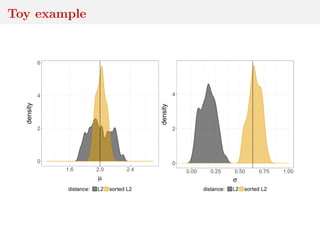
ABC-Rejection sampling: 105 draws, using Euclidean
distance, on sorted vs. unsorted samples and keeping 102
draws with smallest distances
Toy example
0
2
4
6
1.6 2.0 2.4
µ
density
distance: L2 sorted L2
0
2
4
0.00 0.25 0.50 0.75 1.00
σ
density
distance: L2 sorted L2
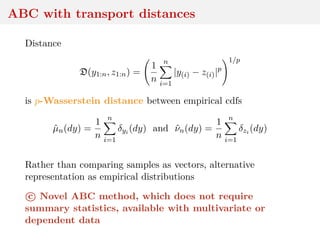
ABC with transport distances
Distance
D(y1:n, z1:n) =
1
n
n
i=1
|y(i) − z(i)|p
1/p
is p-Wasserstein distance between empirical cdfs
ˆµn(dy) =
1
n
n
i=1
δyi (dy) and ˆνn(dy) =
1
n
n
i=1
δzi (dy)
Rather than comparing samples as vectors, alternative
representation as empirical distributions
c Novel ABC method, which does not require
summary statistics, available with multivariate or
dependent data
Outline
1 ABC and distance between
samples
2 Wasserstein distance
3 Computational aspects
4 Asymptotics
5 Handling time series
Wasserstein distance
Ground distance ρ (x, y) → ρ(x, y) on Y along with order p ≥ 1
leads to Wasserstein distance between µ, ν ∈ Pp(Y), p ≥ 1:
Wp(µ, ν) = inf
γ∈Γ(µ,ν) Y×Y
ρ(x, y)p
dγ(x, y)
1/p
where Γ(µ, ν) set of joints with marginals µ, ν and Pp(Y) set of
distributions µ for which Eµ[ρ(Y, y0)p] < ∞ for one y0
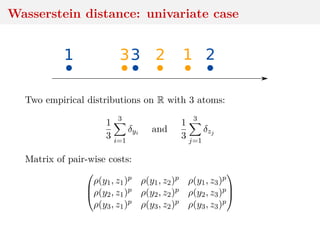
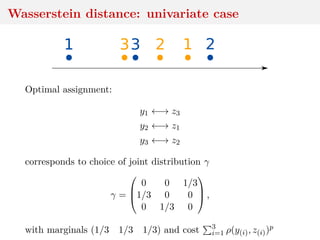
Wasserstein distance: univariate case
1 23 123
Two empirical distributions on R with 3 atoms:
1
3
3
i=1
δyi and
1
3
3
j=1
δzj
Matrix of pair-wise costs:



ρ(y1, z1)p ρ(y1, z2)p ρ(y1, z3)p
ρ(y2, z1)p ρ(y2, z2)p ρ(y2, z3)p
ρ(y3, z1)p ρ(y3, z2)p ρ(y3, z3)p



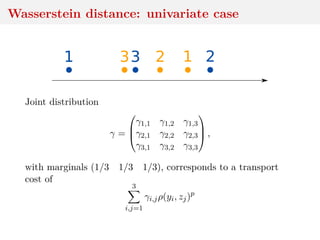
Wasserstein distance: univariate case
1 23 123
Joint distribution
γ =



γ1,1 γ1,2 γ1,3
γ2,1 γ2,2 γ2,3
γ3,1 γ3,2 γ3,3


 ,
with marginals (1/3 1/3 1/3), corresponds to a transport
cost of
3
i,j=1
γi,jρ(yi, zj)p
Wasserstein distance: univariate case
1 23 123
Optimal assignment:
y1 ←→ z3
y2 ←→ z1
y3 ←→ z2
corresponds to choice of joint distribution γ
γ =



0 0 1/3
1/3 0 0
0 1/3 0


 ,
with marginals (1/3 1/3 1/3) and cost 3
i=1 ρ(y(i), z(i))p
Wasserstein distance
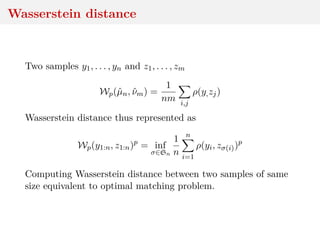
Two samples y1, . . . , yn and z1, . . . , zm
Wp(ˆµn, ˆνm) =
1
nm i,j
ρ(y,zj)
Important special case when n = m, for which solution to the
optimization problem γ corresponds to an assignment matrix,
with only one non-zero entry per row and column, equal to n−1.
[Villani, 2003]
Wasserstein distance
Two samples y1, . . . , yn and z1, . . . , zm
Wp(ˆµn, ˆνm) =
1
nm i,j
ρ(y,zj)
Wasserstein distance thus represented as
Wp(y1:n, z1:n)p
= inf
σ∈Sn
1
n
n
i=1
ρ(yi, zσ(i))p
Computing Wasserstein distance between two samples of same
size equivalent to optimal matching problem.
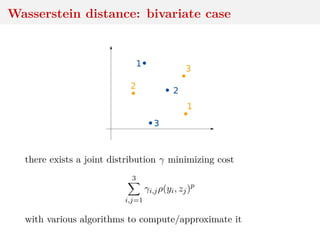
Wasserstein distance: bivariate case
1
2
3
1
2
3
there exists a joint distribution γ minimizing cost
3
i,j=1
γi,jρ(yi, zj)p
with various algorithms to compute/approximate it
Wasserstein distance
also called Earth Mover, Gini, Mallows, Kantorovich, &tc.
can be defined between arbitrary distributions
actual distance
statistically sound:
ˆθn = arginf
θ∈H
Wp(
1
n
n
i=1
δyi , µθ) → θ = arginf
θ∈H
Wp(µ , µθ),
at rate
√
n, plus asymptotic distribution
[Bassetti & al., 2006]
Optimal transport to Parliement
Outline
1 ABC and distance between
samples
2 Wasserstein distance
3 Computational aspects
4 Asymptotics
5 Handling time series
Computing Wasserstein distances
when Y = R, computing Wp(µn, νn) costs O(n log n)
when Y = Rd, exact calculation is O(n3) [Hungarian]or
O(n2.5 log n) [short-list]
For entropic regularization, with δ > 0
Wp,δ(ˆµn, ˆνn)p
= inf
γ∈Γ(ˆµn,ˆνn) Y×Y
ρ(x, y)p
dγ(x, y) − δH(γ) ,
where H(γ) = − ij γij log γij entropy of γ, existence of
Sinkhorn’s algorithm that yields cost O(n2)
[Genevay et al., 2016]
Computing Wasserstein distances
other approximations, like Ye et al. (2016) using Simulated
Annealing
regularized Wasserstein not a distance, but as δ goes to
zero,
Wp,δ(ˆµn, ˆνn) → Wp(ˆµn, ˆνn)
for δ small enough, Wp,δ(ˆµn, ˆνn) = Wp(ˆµn, ˆνn) (exact)
in practice, δ 5% of median(ρ(yi, zj)p)i,j
[Cuturi, 2013]
Computing Wasserstein distances
cost linear in the dimension of
observations
distance calculations
model-independent
other transport distances
calculated in O(n log n), based
on different generalizations of
“sorting” (swapping, Hilbert)
[Gerber & Chopin, 2015]
acceleration by combination of
distances and subsampling
[source: Wikipedia]
Computing Wasserstein distances
cost linear in the dimension of
observations
distance calculations
model-independent
other transport distances
calculated in O(n log n), based
on different generalizations of
“sorting” (swapping, Hilbert)
[Gerber & Chopin, 2015]
acceleration by combination of
distances and subsampling
[source: Wikipedia]
Transport distance via Hilbert curve
Sort multivariate data via space-filling curves, like Hilbert
space-filling curve
H : [0, 1] → [0, 1]d
continuous mapping, with pseudo-inverse
h : [0, 1]d
→ [0, 1]
Compute order σ ∈ S of projected points, and compute
hp(y1:n, z1:n) =
1
n
n
i=1
ρ(yσy(i), zσz(i))p
1/p
,
called Hilbert ordering transport distance
[Gerber & Chopin, 2015]
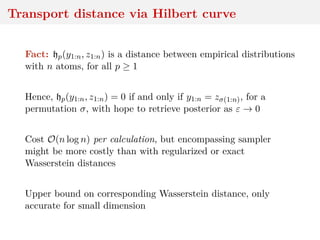
Transport distance via Hilbert curve
Fact: hp(y1:n, z1:n) is a distance between empirical distributions
with n atoms, for all p ≥ 1
Hence, hp(y1:n, z1:n) = 0 if and only if y1:n = zσ(1:n), for a
permutation σ, with hope to retrieve posterior as ε → 0
Cost O(n log n) per calculation, but encompassing sampler
might be more costly than with regularized or exact
Wasserstein distances
Upper bound on corresponding Wasserstein distance, only
accurate for small dimension
Adaptive SMC with r-hit moves
Start with ε0 = ∞
1. ∀k ∈ 1 : N, sample θk
0 ∼ π(θ) (prior)
2. ∀k ∈ 1 : N, sample zk
1:n from µ
(n)
θk
3. ∀k ∈ 1 : N, compute the distance dk
0 = D(y1:n, zk
1:n)
4. based on (θk
0)N
k=1 and (dk
0)N
k=1, compute ε1, s.t.
resampled particles have at least 50% unique values
At step t ≥ 1, weight wk
t ∝ 1(dk
t−1 ≤ εt), resample, and perform
r-hit MCMC with adaptive independent proposals
[Lee, 2012; Lee and Latuszy´nski, 2014]
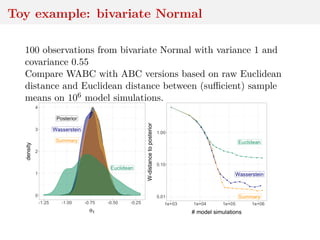
Toy example: bivariate Normal
100 observations from bivariate Normal with variance 1 and
covariance 0.55
Compare WABC with ABC versions based on raw Euclidean
distance and Euclidean distance between (sufficient) sample
means on 106 model simulations.
Quantile “g-and-k” distribution
bivariate extension of the g-and-k distribution with quantile
functions
ai + bi 1 + 0.8
1 − exp(−gizi(r)
1 + exp(−giz(r)
1 + zi(r)2
k
zi(r) (1)
and correlation ρ
Intractable density that can be numerically approximated
[Rayner and MacGillivray, 2002; Prangle, 2017]
Simulation by MCMC and W-ABC (sequential tolerance
exploration)
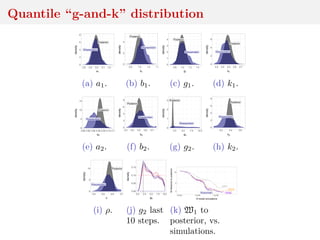
Quantile “g-and-k” distribution
(a) a1. (b) b1. (c) g1. (d) k1.
(e) a2. (f) b2. (g) g2. (h) k2.
(i) ρ. (j) g2 last
10 steps.
(k) W1 to
posterior, vs.
simulations.
Outline
1 ABC and distance between
samples
2 Wasserstein distance
3 Computational aspects
4 Asymptotics
5 Handling time series
Minimum Wasserstein estimator
Under some assumptions, ˆθn exists and
lim sup
n→∞
argmin
θ∈H
Wp(ˆµn, µθ) ⊂ argmin
θ∈H
Wp(µ , µθ),
almost surely
In particular, if θ = argminθ∈H Wp(µ , µθ) is unique, then
ˆθn
a.s.
−→ θ
Minimum Wasserstein estimator
Under stronger assumptions, incl. well-specification,
dim(Y) = 1, and p = 1
√
n(ˆθn − θ )
w
−→ argmin
u∈H R
|G (t) − u, D (t) |dt,
where G is a µ -Brownian bridge, and D ∈ (L1(R))dθ satisfies
R
|Fθ(t) − F (t) − θ − θ , D (t) |dt = o( θ − θ H)
[Pollard, 1980; del Barrio et al., 1999, 2005]
Hard to use for confidence intervals, but the bootstrap is an
intersting alternative.
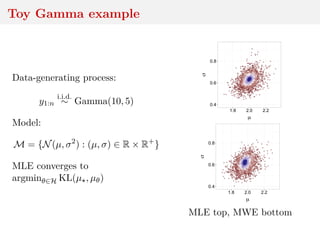
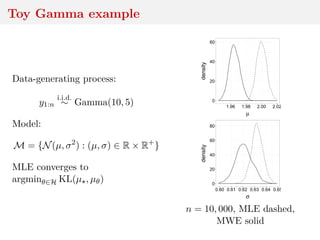
Toy Gamma example
Data-generating process:
y1:n
i.i.d.
∼ Gamma(10, 5)
Model:
M = {N(µ, σ2
) : (µ, σ) ∈ R × R+
}
MLE converges to
argminθ∈H KL(µ , µθ)
MLE top, MWE bottom
Toy Gamma example
Data-generating process:
y1:n
i.i.d.
∼ Gamma(10, 5)
Model:
M = {N(µ, σ2
) : (µ, σ) ∈ R × R+
}
MLE converges to
argminθ∈H KL(µ , µθ)
0
20
40
60
1.96 1.98 2.00 2.02
µ
density
0
20
40
60
80
0.60 0.61 0.62 0.63 0.64 0.65
σ
density
n = 10, 000, MLE dashed,
MWE solid
Minimum expected Wasserstein estimator
ˆθn,m = argmin
θ∈H
E[D(ˆµn, ˆµθ,m)]
with expectation under distribution of sample z1:m ∼ µ
(m)
θ
giving rise to ˆµθ,m = m−1 m
i=1 δzi .
Minimum expected Wasserstein estimator
ˆθn,m = argmin
θ∈H
E[D(ˆµn, ˆµθ,m)]
with expectation under distribution of sample z1:m ∼ µ
(m)
θ
giving rise to ˆµθ,m = m−1 m
i=1 δzi .
Under further assumptions, incl. m(n) → ∞ with n,
inf
θ∈H
EWp(ˆµn(ω), ˆµθ,m(n)) → inf
θ∈H
Wp(µ , µθ)
and
lim sup
n→∞
argmin
θ∈H
EWp(ˆµn(ω), ˆµθ,m(n)) ⊂ argmin
θ∈H
Wp(µ , µθ).
Minimum expected Wasserstein estimator
ˆθn,m = argmin
θ∈H
E[D(ˆµn, ˆµθ,m)]
with expectation under distribution of sample z1:m ∼ µ
(m)
θ
giving rise to ˆµθ,m = m−1 m
i=1 δzi .
Further, for n fixed,
inf
θ∈H
EWp(ˆµn, ˆµθ,m) → inf
θ∈H
Wp(ˆµn, µθ)
as m → ∞ and
lim sup
m→∞
argmin
θ∈H
EWp(ˆµn, ˆµθ,m) ⊂ argmin
θ∈H
Wp(ˆµn, µθ).
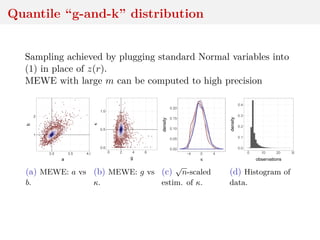
Quantile “g-and-k” distribution
Sampling achieved by plugging standard Normal variables into
(1) in place of z(r).
MEWE with large m can be computed to high precision
(a) MEWE: a vs
b.
(b) MEWE: g vs
κ.
0.00
0.05
0.10
0.15
0.20
−4 0 4
κ
density
(c)
√
n-scaled
estim. of κ.
0.0
0.1
0.2
0.3
0.4
0 10 20 30
observations
density
(d) Histogram of
data.
Asymptotics of WABC-posterior
convergence to true posterior as → 0
convergence to non-Dirac as n → ∞ for fixed
Bayesian consistency if n ↓ at proper speed
[Frazier, X & Rousseau, 2017]
Asymptotics of WABC-posterior
convergence to true posterior as → 0
convergence to non-Dirac as n → ∞ for fixed
Bayesian consistency if n ↓ at proper speed
[Frazier, X & Rousseau, 2017]
WARNING: Theoretical conditions extremely rarely open
checks in practice
Asymptotics of WABC-posterior
For fixed n and ε → 0, for i.i.d. data, assuming
sup
y,θ
µθ(y) < ∞
y → µθ(y) continuous, the Wasserstein ABC-posterior converges
to the posterior irrespective of the choice of ρ and p
Concentration as both n → ∞ and ε → ε = inf Wp(µ , µθ)
[Frazier et al., 2018]
Concentration on neighborhoods of θ = arginf Wp(µ , µθ),
whereas posterior concentrates on arginf KL(µ , µθ)
Asymptotics of WABC-posterior
Rate of posterior concentration (and choice of εn) relates to
rate of convergence of the distance, e.g.
µ
(n)
θ Wp µθ,
1
n
n
i=1
δzi > u ≤ c(θ)fn(u),
[Fournier & Guillin, 2015]
Rate of convergence decays with the dimension of Y,
Asymptotics of WABC-posterior
Rate of posterior concentration (and choice of εn) relates to
rate of convergence of the distance, e.g.
µ
(n)
θ Wp µθ,
1
n
n
i=1
δzi > u ≤ c(θ)fn(u),
[Fournier & Guillin, 2015]
Rate of convergence decays with the dimension of Y, fast or
slow, depending on moments of µθ and choice of p
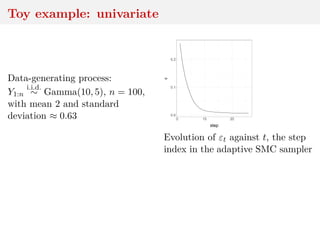
Toy example: univariate
Data-generating process:
Y1:n
i.i.d.
∼ Gamma(10, 5), n = 100,
with mean 2 and standard
deviation ≈ 0.63 0.0
0.1
0.2
0 10 20
step
ε
Evolution of εt against t, the step
index in the adaptive SMC sampler
Toy example: univariate
Data-generating process:
Y1:n
i.i.d.
∼ Gamma(10, 5), n = 100,
with mean 2 and standard
deviation ≈ 0.63 0.0
0.1
0.2
0 10 20
step
ε
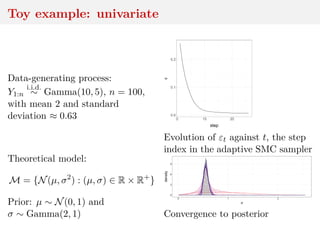
Evolution of εt against t, the step
index in the adaptive SMC sampler
Theoretical model:
M = {N(µ, σ2
) : (µ, σ) ∈ R × R+
}
Prior: µ ∼ N(0, 1) and
σ ∼ Gamma(2, 1)
0
3
6
9
0 1 2
σ
density
Convergence to posterior
Toy example: multivariate
Observation space: Y = R10
Model: Yi ∼ N10(θ, S), for
i ∈ 1 : 100, where Skj = 0.5|k−j| for
k, j ∈ 1 : 10
Data generated with θ defined as
a 10-vector, chosen by drawing
standard Normal variables
Prior: θi ∼ N(0, 1) for all i ∈ 1 : 10
Toy example: multivariate
Observation space: Y = R10
Model: Yi ∼ N10(θ, S), for
i ∈ 1 : 100, where Skj = 0.5|k−j| for
k, j ∈ 1 : 10
Data generated with θ defined as
a 10-vector, chosen by drawing
standard Normal variables
Prior: θi ∼ N(0, 1) for all i ∈ 1 : 10
1e+04
1e+06
0 10 20 30
step
#distancescalculated
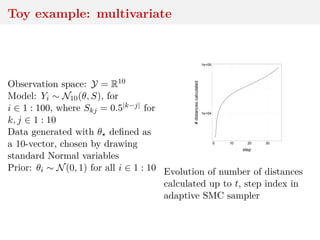
Evolution of number of distances
calculated up to t, step index in
adaptive SMC sampler
Toy example: multivariate
Observation space: Y = R10
Model: Yi ∼ N10(θ, S), for
i ∈ 1 : 100, where Skj = 0.5|k−j| for
k, j ∈ 1 : 10
Data generated with θ defined as
a 10-vector, chosen by drawing
standard Normal variables
Prior: θi ∼ N(0, 1) for all i ∈ 1 : 10
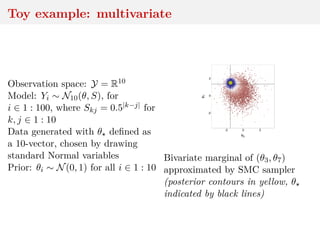
Bivariate marginal of (θ3, θ7)
approximated by SMC sampler
(posterior contours in yellow, θ
indicated by black lines)
sum of log-Normals
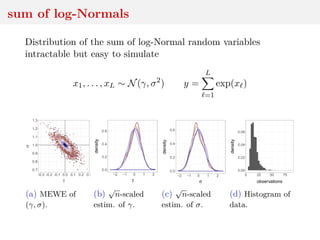
Distribution of the sum of log-Normal random variables
intractable but easy to simulate
x1, . . . , xL ∼ N(γ, σ2
) y =
L
=1
exp(x )
(a) MEWE of
(γ, σ).
0.0
0.2
0.4
0.6
−2 −1 0 1 2
γ
density
(b)
√
n-scaled
estim. of γ.
0.0
0.2
0.4
0.6
−2 −1 0 1 2
σ
density
(c)
√
n-scaled
estim. of σ.
0.00
0.02
0.04
0.06
0 25 50 75
observations
density
(d) Histogram of
data.
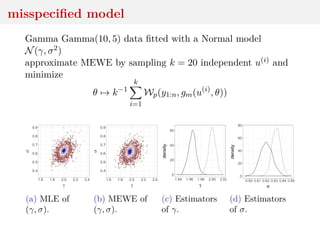
misspecified model
Gamma Gamma(10, 5) data fitted with a Normal model
N(γ, σ2)
approximate MEWE by sampling k = 20 independent u(i) and
minimize
θ → k−1
k
i=1
Wp(y1:n, gm(u(i)
, θ))
(a) MLE of
(γ, σ).
(b) MEWE of
(γ, σ).
0
20
40
60
1.94 1.96 1.98 2.00 2.02
γ
density
(c) Estimators
of γ.
0
20
40
60
80
0.60 0.61 0.62 0.63 0.64 0.65
σ
density
(d) Estimators
of σ.
Outline
1 ABC and distance between
samples
2 Wasserstein distance
3 Computational aspects
4 Asymptotics
5 Handling time series
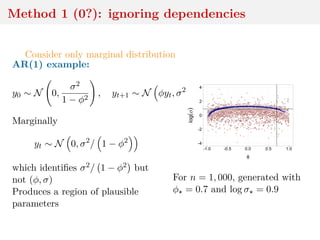
Method 1 (0?): ignoring dependencies
Consider only marginal distribution
AR(1) example:
y0 ∼ N 0,
σ2
1 − φ2
, yt+1 ∼ N φyt, σ2
.
Marginally
yt ∼ N 0, σ2
/ 1 − φ2
which identifies σ2/ 1 − φ2 but
not (φ, σ)
Produces a region of plausible
parameters
For n = 1, 000, generated with
φ = 0.7 and log σ = 0.9
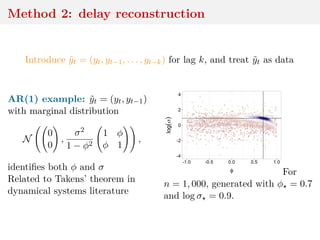
Method 2: delay reconstruction
Introduce ˜yt = (yt, yt−1, . . . , yt−k) for lag k, and treat ˜yt as data
AR(1) example: ˜yt = (yt, yt−1)
with marginal distribution
N
0
0
,
σ2
1 − φ2
1 φ
φ 1
,
identifies both φ and σ
Related to Takens’ theorem in
dynamical systems literature
For
n = 1, 000, generated with φ = 0.7
and log σ = 0.9.
Method 3: residual reconstruction
Time series y1:n deterministic transform of θ and w1:n
Given y1:n and θ, reconstruct w1:n
Cosine example:
yt = A cos(2πωt + φ) + σwt
wt ∼ N(0, 1)
wt = (yt − A cos(2πωt + φ))/σ
and calculate distance between
reconstructed w1:n and Normal
sample
[Mengersen et al., 2013]
Method 3: residual reconstruction
Time series y1:n deterministic transform of θ and w1:n
Given y1:n and θ, reconstruct w1:n
Cosine example:
yt = A cos(2πωt + φ) + σwt
n = 500 observations with
ω = 1/80, φ = π/4,
σ = 1, A = 2, under prior
U[0, 0.1] and U[0, 2π] for ω and φ,
and N(0, 1) for log σ, log A
−2.5
0.0
2.5
0 100 200 300 400 500
time
y
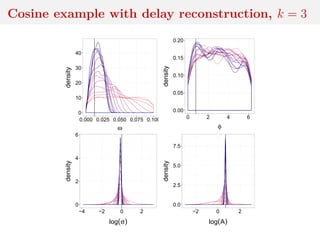
Cosine example with delay reconstruction, k = 3
0
10
20
30
40
0.000 0.025 0.050 0.075 0.100
ω
density
0.00
0.05
0.10
0.15
0.20
0 2 4 6
φ
density
0
2
4
6
−4 −2 0 2
log(σ)
density
0.0
2.5
5.0
7.5
−2 0 2
log(A)
density
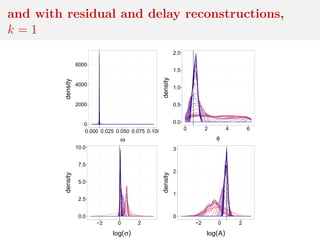
and with residual and delay reconstructions,
k = 1
0
2000
4000
6000
0.000 0.025 0.050 0.075 0.100
ω
density
0.0
0.5
1.0
1.5
2.0
0 2 4 6
φ
density
0.0
2.5
5.0
7.5
10.0
−2 0 2
log(σ)
density
0
1
2
3
−2 0 2
log(A)
density
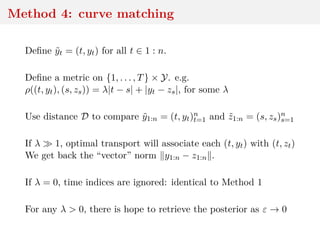
Method 4: curve matching
Define ˜yt = (t, yt) for all t ∈ 1 : n.
Define a metric on {1, . . . , T} × Y. e.g.
ρ((t, yt), (s, zs)) = λ|t − s| + |yt − zs|, for some λ
Use distance D to compare ˜y1:n = (t, yt)n
t=1 and ˜z1:n = (s, zs)n
s=1
If λ 1, optimal transport will associate each (t, yt) with (t, zt)
We get back the “vector” norm y1:n − z1:n .
If λ = 0, time indices are ignored: identical to Method 1
For any λ > 0, there is hope to retrieve the posterior as ε → 0
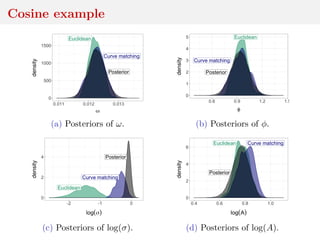
Cosine example
(a) Posteriors of ω. (b) Posteriors of φ.
(c) Posteriors of log(σ). (d) Posteriors of log(A).
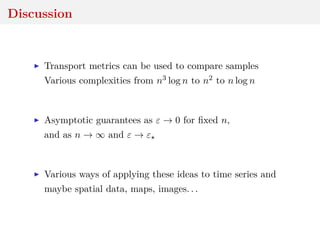
Discussion
Transport metrics can be used to compare samples
Various complexities from n3 log n to n2 to n log n
Asymptotic guarantees as ε → 0 for fixed n,
and as n → ∞ and ε → ε
Various ways of applying these ideas to time series and
maybe spatial data, maps, images. . .

ABC with Wasserstein distances

  • 1.
    Inference in generativemodels using the Wasserstein distance Christian P. Robert (Paris Dauphine PSL & Warwick U.) joint work with E. Bernton (Harvard), P.E. Jacob (Harvard), and M. Gerber (Bristol) NUS, Aug 2018
  • 2.
    Outline 1 ABC anddistance between samples 2 Wasserstein distance 3 Computational aspects 4 Asymptotics 5 Handling time series
  • 3.
    Outline 1 ABC anddistance between samples 2 Wasserstein distance 3 Computational aspects 4 Asymptotics 5 Handling time series
  • 4.
    Generative model Assumption ofa data-generating distribution µ (n) for data y1:n = y1, . . . , yn ∈ Yn Parametric generative model M = {µ (n) θ : θ ∈ H} such that sampling (generating) z1:n from µ (n) θ is feasible Prior distribution π(θ) available as density and generative model Goal: inference on parameters θ given observations y1:n
  • 5.
    Generic ABC Basic (summary-less)ABC posterior with density (θ, z1:n) ∼ π(θ) µ (n) θ 1 ( y1:n − z1:n < ε) Yn 1 ( y1:n − z1:n < ε) dz1:n . and ABC marginal qε (θ) = Yn n i=1 µ(dzi|θ)1 ( y1:n − z1:n < ε) Yn 1 ( y1:n − z1:n < ε) dz1:n unbiasedly estimated by π(θ)1 ( y1:n − z1:n < ε) where z1:n ∼ µ (n) θ Reminder: ABC-posterior goes to posterior as ε → 0
  • 6.
    Summary statistics Since randomvariable y1:n − z1:n may have large variance, { y1:n − z1:n < ε} gets rare as ε → 0 and rarer when d ↑ When using |η(y1:n) − η(z1:n) < ε based on (insufficient) summary statistic η, variance and dimension decrease but q-likelihood differs from likelihood Arbitrariness and impact of summaries, incl. curse of dimensionality [X et al., 2011; Fearnhead & Prangle, 2012; Li & Fearnhead, 2016]
  • 7.
    Distances between samples Aim:Ressort to alternate distances D between samples y1:n and z1:n such that D(y1:n, z1:n) has smaller variance than y1:n − z1:n while induced ABC-posterior still converges to posterior when ε → 0
  • 8.
    ABC with orderstatistics Recall that, for univariate i.i.d. data, order statistics are sufficient 1. sort observed and generated samples y1:n and z1:n 2. compute yσy(1:n) − zσz(1:n) p = n i=1 |y(i) − z(i)|p 1/p for order p (e.g. 1 or 2) instead of y1:n − z1:n = n i=1 |yi − zi|p 1/p
  • 9.
    Toy example Data-generating processgiven by Y1:1000 ∼ Gamma(10, 5) Hypothesised model: M = {N(µ, σ2 ) : (µ, σ) ∈ R × R+ } Prior µ ∼ N(0, 1) and σ ∼ Gamma(2, 1) ABC-Rejection sampling: 105 draws, using Euclidean distance, on sorted vs. unsorted samples and keeping 102 draws with smallest distances
  • 10.
    Toy example 0 2 4 6 1.6 2.02.4 µ density distance: L2 sorted L2 0 2 4 0.00 0.25 0.50 0.75 1.00 σ density distance: L2 sorted L2
  • 11.
    ABC with transportdistances Distance D(y1:n, z1:n) = 1 n n i=1 |y(i) − z(i)|p 1/p is p-Wasserstein distance between empirical cdfs ˆµn(dy) = 1 n n i=1 δyi (dy) and ˆνn(dy) = 1 n n i=1 δzi (dy) Rather than comparing samples as vectors, alternative representation as empirical distributions c Novel ABC method, which does not require summary statistics, available with multivariate or dependent data
  • 12.
    Outline 1 ABC anddistance between samples 2 Wasserstein distance 3 Computational aspects 4 Asymptotics 5 Handling time series
  • 13.
    Wasserstein distance Ground distanceρ (x, y) → ρ(x, y) on Y along with order p ≥ 1 leads to Wasserstein distance between µ, ν ∈ Pp(Y), p ≥ 1: Wp(µ, ν) = inf γ∈Γ(µ,ν) Y×Y ρ(x, y)p dγ(x, y) 1/p where Γ(µ, ν) set of joints with marginals µ, ν and Pp(Y) set of distributions µ for which Eµ[ρ(Y, y0)p] < ∞ for one y0
  • 14.
    Wasserstein distance: univariatecase 1 23 123 Two empirical distributions on R with 3 atoms: 1 3 3 i=1 δyi and 1 3 3 j=1 δzj Matrix of pair-wise costs:    ρ(y1, z1)p ρ(y1, z2)p ρ(y1, z3)p ρ(y2, z1)p ρ(y2, z2)p ρ(y2, z3)p ρ(y3, z1)p ρ(y3, z2)p ρ(y3, z3)p   
  • 15.
    Wasserstein distance: univariatecase 1 23 123 Joint distribution γ =    γ1,1 γ1,2 γ1,3 γ2,1 γ2,2 γ2,3 γ3,1 γ3,2 γ3,3    , with marginals (1/3 1/3 1/3), corresponds to a transport cost of 3 i,j=1 γi,jρ(yi, zj)p
  • 16.
    Wasserstein distance: univariatecase 1 23 123 Optimal assignment: y1 ←→ z3 y2 ←→ z1 y3 ←→ z2 corresponds to choice of joint distribution γ γ =    0 0 1/3 1/3 0 0 0 1/3 0    , with marginals (1/3 1/3 1/3) and cost 3 i=1 ρ(y(i), z(i))p
  • 17.
    Wasserstein distance Two samplesy1, . . . , yn and z1, . . . , zm Wp(ˆµn, ˆνm) = 1 nm i,j ρ(y,zj) Important special case when n = m, for which solution to the optimization problem γ corresponds to an assignment matrix, with only one non-zero entry per row and column, equal to n−1. [Villani, 2003]
  • 18.
    Wasserstein distance Two samplesy1, . . . , yn and z1, . . . , zm Wp(ˆµn, ˆνm) = 1 nm i,j ρ(y,zj) Wasserstein distance thus represented as Wp(y1:n, z1:n)p = inf σ∈Sn 1 n n i=1 ρ(yi, zσ(i))p Computing Wasserstein distance between two samples of same size equivalent to optimal matching problem.
  • 19.
    Wasserstein distance: bivariatecase 1 2 3 1 2 3 there exists a joint distribution γ minimizing cost 3 i,j=1 γi,jρ(yi, zj)p with various algorithms to compute/approximate it
  • 20.
    Wasserstein distance also calledEarth Mover, Gini, Mallows, Kantorovich, &tc. can be defined between arbitrary distributions actual distance statistically sound: ˆθn = arginf θ∈H Wp( 1 n n i=1 δyi , µθ) → θ = arginf θ∈H Wp(µ , µθ), at rate √ n, plus asymptotic distribution [Bassetti & al., 2006]
  • 21.
  • 22.
    Outline 1 ABC anddistance between samples 2 Wasserstein distance 3 Computational aspects 4 Asymptotics 5 Handling time series
  • 23.
    Computing Wasserstein distances whenY = R, computing Wp(µn, νn) costs O(n log n) when Y = Rd, exact calculation is O(n3) [Hungarian]or O(n2.5 log n) [short-list] For entropic regularization, with δ > 0 Wp,δ(ˆµn, ˆνn)p = inf γ∈Γ(ˆµn,ˆνn) Y×Y ρ(x, y)p dγ(x, y) − δH(γ) , where H(γ) = − ij γij log γij entropy of γ, existence of Sinkhorn’s algorithm that yields cost O(n2) [Genevay et al., 2016]
  • 24.
    Computing Wasserstein distances otherapproximations, like Ye et al. (2016) using Simulated Annealing regularized Wasserstein not a distance, but as δ goes to zero, Wp,δ(ˆµn, ˆνn) → Wp(ˆµn, ˆνn) for δ small enough, Wp,δ(ˆµn, ˆνn) = Wp(ˆµn, ˆνn) (exact) in practice, δ 5% of median(ρ(yi, zj)p)i,j [Cuturi, 2013]
  • 25.
    Computing Wasserstein distances costlinear in the dimension of observations distance calculations model-independent other transport distances calculated in O(n log n), based on different generalizations of “sorting” (swapping, Hilbert) [Gerber & Chopin, 2015] acceleration by combination of distances and subsampling [source: Wikipedia]
  • 26.
    Computing Wasserstein distances costlinear in the dimension of observations distance calculations model-independent other transport distances calculated in O(n log n), based on different generalizations of “sorting” (swapping, Hilbert) [Gerber & Chopin, 2015] acceleration by combination of distances and subsampling [source: Wikipedia]
  • 27.
    Transport distance viaHilbert curve Sort multivariate data via space-filling curves, like Hilbert space-filling curve H : [0, 1] → [0, 1]d continuous mapping, with pseudo-inverse h : [0, 1]d → [0, 1] Compute order σ ∈ S of projected points, and compute hp(y1:n, z1:n) = 1 n n i=1 ρ(yσy(i), zσz(i))p 1/p , called Hilbert ordering transport distance [Gerber & Chopin, 2015]
  • 28.
    Transport distance viaHilbert curve Fact: hp(y1:n, z1:n) is a distance between empirical distributions with n atoms, for all p ≥ 1 Hence, hp(y1:n, z1:n) = 0 if and only if y1:n = zσ(1:n), for a permutation σ, with hope to retrieve posterior as ε → 0 Cost O(n log n) per calculation, but encompassing sampler might be more costly than with regularized or exact Wasserstein distances Upper bound on corresponding Wasserstein distance, only accurate for small dimension
  • 29.
    Adaptive SMC withr-hit moves Start with ε0 = ∞ 1. ∀k ∈ 1 : N, sample θk 0 ∼ π(θ) (prior) 2. ∀k ∈ 1 : N, sample zk 1:n from µ (n) θk 3. ∀k ∈ 1 : N, compute the distance dk 0 = D(y1:n, zk 1:n) 4. based on (θk 0)N k=1 and (dk 0)N k=1, compute ε1, s.t. resampled particles have at least 50% unique values At step t ≥ 1, weight wk t ∝ 1(dk t−1 ≤ εt), resample, and perform r-hit MCMC with adaptive independent proposals [Lee, 2012; Lee and Latuszy´nski, 2014]
  • 30.
    Toy example: bivariateNormal 100 observations from bivariate Normal with variance 1 and covariance 0.55 Compare WABC with ABC versions based on raw Euclidean distance and Euclidean distance between (sufficient) sample means on 106 model simulations.
  • 31.
    Quantile “g-and-k” distribution bivariateextension of the g-and-k distribution with quantile functions ai + bi 1 + 0.8 1 − exp(−gizi(r) 1 + exp(−giz(r) 1 + zi(r)2 k zi(r) (1) and correlation ρ Intractable density that can be numerically approximated [Rayner and MacGillivray, 2002; Prangle, 2017] Simulation by MCMC and W-ABC (sequential tolerance exploration)
  • 32.
    Quantile “g-and-k” distribution (a)a1. (b) b1. (c) g1. (d) k1. (e) a2. (f) b2. (g) g2. (h) k2. (i) ρ. (j) g2 last 10 steps. (k) W1 to posterior, vs. simulations.
  • 33.
    Outline 1 ABC anddistance between samples 2 Wasserstein distance 3 Computational aspects 4 Asymptotics 5 Handling time series
  • 34.
    Minimum Wasserstein estimator Undersome assumptions, ˆθn exists and lim sup n→∞ argmin θ∈H Wp(ˆµn, µθ) ⊂ argmin θ∈H Wp(µ , µθ), almost surely In particular, if θ = argminθ∈H Wp(µ , µθ) is unique, then ˆθn a.s. −→ θ
  • 35.
    Minimum Wasserstein estimator Understronger assumptions, incl. well-specification, dim(Y) = 1, and p = 1 √ n(ˆθn − θ ) w −→ argmin u∈H R |G (t) − u, D (t) |dt, where G is a µ -Brownian bridge, and D ∈ (L1(R))dθ satisfies R |Fθ(t) − F (t) − θ − θ , D (t) |dt = o( θ − θ H) [Pollard, 1980; del Barrio et al., 1999, 2005] Hard to use for confidence intervals, but the bootstrap is an intersting alternative.
  • 36.
    Toy Gamma example Data-generatingprocess: y1:n i.i.d. ∼ Gamma(10, 5) Model: M = {N(µ, σ2 ) : (µ, σ) ∈ R × R+ } MLE converges to argminθ∈H KL(µ , µθ) MLE top, MWE bottom
  • 37.
    Toy Gamma example Data-generatingprocess: y1:n i.i.d. ∼ Gamma(10, 5) Model: M = {N(µ, σ2 ) : (µ, σ) ∈ R × R+ } MLE converges to argminθ∈H KL(µ , µθ) 0 20 40 60 1.96 1.98 2.00 2.02 µ density 0 20 40 60 80 0.60 0.61 0.62 0.63 0.64 0.65 σ density n = 10, 000, MLE dashed, MWE solid
  • 38.
    Minimum expected Wassersteinestimator ˆθn,m = argmin θ∈H E[D(ˆµn, ˆµθ,m)] with expectation under distribution of sample z1:m ∼ µ (m) θ giving rise to ˆµθ,m = m−1 m i=1 δzi .
  • 39.
    Minimum expected Wassersteinestimator ˆθn,m = argmin θ∈H E[D(ˆµn, ˆµθ,m)] with expectation under distribution of sample z1:m ∼ µ (m) θ giving rise to ˆµθ,m = m−1 m i=1 δzi . Under further assumptions, incl. m(n) → ∞ with n, inf θ∈H EWp(ˆµn(ω), ˆµθ,m(n)) → inf θ∈H Wp(µ , µθ) and lim sup n→∞ argmin θ∈H EWp(ˆµn(ω), ˆµθ,m(n)) ⊂ argmin θ∈H Wp(µ , µθ).
  • 40.
    Minimum expected Wassersteinestimator ˆθn,m = argmin θ∈H E[D(ˆµn, ˆµθ,m)] with expectation under distribution of sample z1:m ∼ µ (m) θ giving rise to ˆµθ,m = m−1 m i=1 δzi . Further, for n fixed, inf θ∈H EWp(ˆµn, ˆµθ,m) → inf θ∈H Wp(ˆµn, µθ) as m → ∞ and lim sup m→∞ argmin θ∈H EWp(ˆµn, ˆµθ,m) ⊂ argmin θ∈H Wp(ˆµn, µθ).
  • 41.
    Quantile “g-and-k” distribution Samplingachieved by plugging standard Normal variables into (1) in place of z(r). MEWE with large m can be computed to high precision (a) MEWE: a vs b. (b) MEWE: g vs κ. 0.00 0.05 0.10 0.15 0.20 −4 0 4 κ density (c) √ n-scaled estim. of κ. 0.0 0.1 0.2 0.3 0.4 0 10 20 30 observations density (d) Histogram of data.
  • 42.
    Asymptotics of WABC-posterior convergenceto true posterior as → 0 convergence to non-Dirac as n → ∞ for fixed Bayesian consistency if n ↓ at proper speed [Frazier, X & Rousseau, 2017]
  • 43.
    Asymptotics of WABC-posterior convergenceto true posterior as → 0 convergence to non-Dirac as n → ∞ for fixed Bayesian consistency if n ↓ at proper speed [Frazier, X & Rousseau, 2017] WARNING: Theoretical conditions extremely rarely open checks in practice
  • 44.
    Asymptotics of WABC-posterior Forfixed n and ε → 0, for i.i.d. data, assuming sup y,θ µθ(y) < ∞ y → µθ(y) continuous, the Wasserstein ABC-posterior converges to the posterior irrespective of the choice of ρ and p Concentration as both n → ∞ and ε → ε = inf Wp(µ , µθ) [Frazier et al., 2018] Concentration on neighborhoods of θ = arginf Wp(µ , µθ), whereas posterior concentrates on arginf KL(µ , µθ)
  • 45.
    Asymptotics of WABC-posterior Rateof posterior concentration (and choice of εn) relates to rate of convergence of the distance, e.g. µ (n) θ Wp µθ, 1 n n i=1 δzi > u ≤ c(θ)fn(u), [Fournier & Guillin, 2015] Rate of convergence decays with the dimension of Y,
  • 46.
    Asymptotics of WABC-posterior Rateof posterior concentration (and choice of εn) relates to rate of convergence of the distance, e.g. µ (n) θ Wp µθ, 1 n n i=1 δzi > u ≤ c(θ)fn(u), [Fournier & Guillin, 2015] Rate of convergence decays with the dimension of Y, fast or slow, depending on moments of µθ and choice of p
  • 47.
    Toy example: univariate Data-generatingprocess: Y1:n i.i.d. ∼ Gamma(10, 5), n = 100, with mean 2 and standard deviation ≈ 0.63 0.0 0.1 0.2 0 10 20 step ε Evolution of εt against t, the step index in the adaptive SMC sampler
  • 48.
    Toy example: univariate Data-generatingprocess: Y1:n i.i.d. ∼ Gamma(10, 5), n = 100, with mean 2 and standard deviation ≈ 0.63 0.0 0.1 0.2 0 10 20 step ε Evolution of εt against t, the step index in the adaptive SMC sampler Theoretical model: M = {N(µ, σ2 ) : (µ, σ) ∈ R × R+ } Prior: µ ∼ N(0, 1) and σ ∼ Gamma(2, 1) 0 3 6 9 0 1 2 σ density Convergence to posterior
  • 49.
    Toy example: multivariate Observationspace: Y = R10 Model: Yi ∼ N10(θ, S), for i ∈ 1 : 100, where Skj = 0.5|k−j| for k, j ∈ 1 : 10 Data generated with θ defined as a 10-vector, chosen by drawing standard Normal variables Prior: θi ∼ N(0, 1) for all i ∈ 1 : 10
  • 50.
    Toy example: multivariate Observationspace: Y = R10 Model: Yi ∼ N10(θ, S), for i ∈ 1 : 100, where Skj = 0.5|k−j| for k, j ∈ 1 : 10 Data generated with θ defined as a 10-vector, chosen by drawing standard Normal variables Prior: θi ∼ N(0, 1) for all i ∈ 1 : 10 1e+04 1e+06 0 10 20 30 step #distancescalculated Evolution of number of distances calculated up to t, step index in adaptive SMC sampler
  • 51.
    Toy example: multivariate Observationspace: Y = R10 Model: Yi ∼ N10(θ, S), for i ∈ 1 : 100, where Skj = 0.5|k−j| for k, j ∈ 1 : 10 Data generated with θ defined as a 10-vector, chosen by drawing standard Normal variables Prior: θi ∼ N(0, 1) for all i ∈ 1 : 10 Bivariate marginal of (θ3, θ7) approximated by SMC sampler (posterior contours in yellow, θ indicated by black lines)
  • 52.
    sum of log-Normals Distributionof the sum of log-Normal random variables intractable but easy to simulate x1, . . . , xL ∼ N(γ, σ2 ) y = L =1 exp(x ) (a) MEWE of (γ, σ). 0.0 0.2 0.4 0.6 −2 −1 0 1 2 γ density (b) √ n-scaled estim. of γ. 0.0 0.2 0.4 0.6 −2 −1 0 1 2 σ density (c) √ n-scaled estim. of σ. 0.00 0.02 0.04 0.06 0 25 50 75 observations density (d) Histogram of data.
  • 53.
    misspecified model Gamma Gamma(10,5) data fitted with a Normal model N(γ, σ2) approximate MEWE by sampling k = 20 independent u(i) and minimize θ → k−1 k i=1 Wp(y1:n, gm(u(i) , θ)) (a) MLE of (γ, σ). (b) MEWE of (γ, σ). 0 20 40 60 1.94 1.96 1.98 2.00 2.02 γ density (c) Estimators of γ. 0 20 40 60 80 0.60 0.61 0.62 0.63 0.64 0.65 σ density (d) Estimators of σ.
  • 54.
    Outline 1 ABC anddistance between samples 2 Wasserstein distance 3 Computational aspects 4 Asymptotics 5 Handling time series
  • 55.
    Method 1 (0?):ignoring dependencies Consider only marginal distribution AR(1) example: y0 ∼ N 0, σ2 1 − φ2 , yt+1 ∼ N φyt, σ2 . Marginally yt ∼ N 0, σ2 / 1 − φ2 which identifies σ2/ 1 − φ2 but not (φ, σ) Produces a region of plausible parameters For n = 1, 000, generated with φ = 0.7 and log σ = 0.9
  • 56.
    Method 2: delayreconstruction Introduce ˜yt = (yt, yt−1, . . . , yt−k) for lag k, and treat ˜yt as data AR(1) example: ˜yt = (yt, yt−1) with marginal distribution N 0 0 , σ2 1 − φ2 1 φ φ 1 , identifies both φ and σ Related to Takens’ theorem in dynamical systems literature For n = 1, 000, generated with φ = 0.7 and log σ = 0.9.
  • 57.
    Method 3: residualreconstruction Time series y1:n deterministic transform of θ and w1:n Given y1:n and θ, reconstruct w1:n Cosine example: yt = A cos(2πωt + φ) + σwt wt ∼ N(0, 1) wt = (yt − A cos(2πωt + φ))/σ and calculate distance between reconstructed w1:n and Normal sample [Mengersen et al., 2013]
  • 58.
    Method 3: residualreconstruction Time series y1:n deterministic transform of θ and w1:n Given y1:n and θ, reconstruct w1:n Cosine example: yt = A cos(2πωt + φ) + σwt n = 500 observations with ω = 1/80, φ = π/4, σ = 1, A = 2, under prior U[0, 0.1] and U[0, 2π] for ω and φ, and N(0, 1) for log σ, log A −2.5 0.0 2.5 0 100 200 300 400 500 time y
  • 59.
    Cosine example withdelay reconstruction, k = 3 0 10 20 30 40 0.000 0.025 0.050 0.075 0.100 ω density 0.00 0.05 0.10 0.15 0.20 0 2 4 6 φ density 0 2 4 6 −4 −2 0 2 log(σ) density 0.0 2.5 5.0 7.5 −2 0 2 log(A) density
  • 60.
    and with residualand delay reconstructions, k = 1 0 2000 4000 6000 0.000 0.025 0.050 0.075 0.100 ω density 0.0 0.5 1.0 1.5 2.0 0 2 4 6 φ density 0.0 2.5 5.0 7.5 10.0 −2 0 2 log(σ) density 0 1 2 3 −2 0 2 log(A) density
  • 61.
    Method 4: curvematching Define ˜yt = (t, yt) for all t ∈ 1 : n. Define a metric on {1, . . . , T} × Y. e.g. ρ((t, yt), (s, zs)) = λ|t − s| + |yt − zs|, for some λ Use distance D to compare ˜y1:n = (t, yt)n t=1 and ˜z1:n = (s, zs)n s=1 If λ 1, optimal transport will associate each (t, yt) with (t, zt) We get back the “vector” norm y1:n − z1:n . If λ = 0, time indices are ignored: identical to Method 1 For any λ > 0, there is hope to retrieve the posterior as ε → 0
  • 62.
    Cosine example (a) Posteriorsof ω. (b) Posteriors of φ. (c) Posteriors of log(σ). (d) Posteriors of log(A).
  • 63.
    Discussion Transport metrics canbe used to compare samples Various complexities from n3 log n to n2 to n log n Asymptotic guarantees as ε → 0 for fixed n, and as n → ∞ and ε → ε Various ways of applying these ideas to time series and maybe spatial data, maps, images. . .