Model Based Imaging
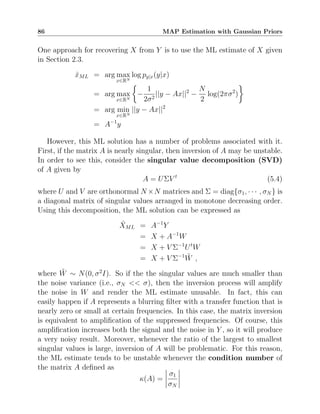
Charles A. Bouman
ii
Model Based Imaging
Charles A. Bouman
Purdue University
Copyright c 2013 by Charles A. Bouman
All rights reserved.
Coverart through the gracious courtesy of
Prof. Andrew Davidhazy (.ret)
School of Photo Arts and Sciences
Rochester Institute of Technology
web: www.andpph.com
To my family for their patient support
iv
Contents
1 Introduction 1
1.1 What is Model-Based Image Processing? . . . . . . . . . . . . 2
1.2 How can I learn Model-Based Image Processing? . . . . . . . . 8
2 Probability, Estimation, and Random Processes 13
2.1 Random Variables and Expectation . . . . . . . . . . . . . . . 13
2.2 Some Commonly Used Distributions . . . . . . . . . . . . . . 18
2.3 Frequentist and Bayesian Estimators . . . . . . . . . . . . . . 23
2.3.1 Frequentist Estimation and the ML Estimator . . . . . 23
2.3.2 Bayesian Estimation and the MAP Estimator . . . . . 27
2.3.3 Comparison of the ML and MMSE Estimators . . . . . 34
2.4 Discrete-Time Random Processes . . . . . . . . . . . . . . . . 35
2.5 Chapter Problems . . . . . . . . . . . . . . . . . . . . . . . . . 41
3 Causal Gaussian Models 45
3.1 Causal Prediction in Gaussian Models . . . . . . . . . . . . . 45
3.2 Density Functions Based on Causal Prediction . . . . . . . . . 48
3.3 1-D Gaussian Autoregressive (AR) Models . . . . . . . . . . . 49
3.4 2-D Gaussian AR Models . . . . . . . . . . . . . . . . . . . . . 54
3.5 Chapter Problems . . . . . . . . . . . . . . . . . . . . . . . . . 59
4 Non-Causal Gaussian Models 65
4.1 Non-Causal Prediction in Gaussian Models . . . . . . . . . . . 66
4.2 Density Functions Based on Non-Causal Prediction . . . . . . 67
vi CONTENTS
4.3 1-D Gaussian Markov Random Fields (GMRF) . . . . . . . . 69
4.4 2-D Gaussian Markov Random Fields (GMRF) . . . . . . . . 72
4.5 Relation Between GMRF and Gaussian AR Models . . . . . . 73
4.6 GMRF Models on General Lattices . . . . . . . . . . . . . . . 77
4.7 Chapter Problems . . . . . . . . . . . . . . . . . . . . . . . . . 80
5 MAP Estimation with Gaussian Priors 83
5.1 MAP Image Restoration . . . . . . . . . . . . . . . . . . . . . 84
5.2 Computing the MAP Estimate . . . . . . . . . . . . . . . . . . 88
5.3 Gradient Descent Optimization . . . . . . . . . . . . . . . . . 89
5.3.1 Convergence Analysis of Gradient Descent . . . . . . . 90
5.3.2 Frequency Analysis of Gradient Descent . . . . . . . . 93
5.3.3 Gradient Descent with Line Search . . . . . . . . . . . 96
5.4 Iterative Coordinate Descent Optimization . . . . . . . . . . . 97
5.4.1 Convergence Analysis of Iterative Coordinate Descent . 100
5.5 Conjugate Gradient Optimization . . . . . . . . . . . . . . . . 103
5.6 Chapter Problems . . . . . . . . . . . . . . . . . . . . . . . . . 105
6 Non-Gaussian MRF Models 109
6.1 Continuous MRFs Based on Pair-Wise Cliques . . . . . . . . . 109
6.2 Selection of Potential and Influence Functions . . . . . . . . . 114
6.3 Convex Potential Functions . . . . . . . . . . . . . . . . . . . 117
6.4 Scaling Parameters for Non-Gaussian MRFs . . . . . . . . . . 123
6.5 Chapter Problems . . . . . . . . . . . . . . . . . . . . . . . . . 127
7 MAP Estimation with Non-Gaussian Priors 129
7.1 The MAP Cost Function and Its Properties . . . . . . . . . . 129
7.2 General Approaches to Optimization . . . . . . . . . . . . . . 133
7.3 Optimization of the MAP Cost Function . . . . . . . . . . . . 138
7.4 Chapter Problems . . . . . . . . . . . . . . . . . . . . . . . . . 143
CONTENTS vii
8 Surrogate Functions and Majorization 147
8.1 Motivation and Intuition . . . . . . . . . . . . . . . . . . . . . 148
8.2 Formal Definition and Properties . . . . . . . . . . . . . . . . 149
8.3 Minimizing the MAP Cost Function . . . . . . . . . . . . . . . 152
8.4 Application to Line Search . . . . . . . . . . . . . . . . . . . . 159
8.5 Chapter Problems . . . . . . . . . . . . . . . . . . . . . . . . . 163
9 Constrained Optimization and Proximal Methods 165
9.1 Motivation and Intuition . . . . . . . . . . . . . . . . . . . . . 166
9.2 The Lagrangian and Dual Function . . . . . . . . . . . . . . . 170
9.2.1 Strong Duality . . . . . . . . . . . . . . . . . . . . . . 173
9.2.2 Technical Conditions for Strong Duality . . . . . . . . 174
9.3 The Augmented Lagrangian . . . . . . . . . . . . . . . . . . . 177
9.4 Proximal Maps and Shrinkage . . . . . . . . . . . . . . . . . . 183
9.5 Variable Splitting and the ADMM Algorithm . . . . . . . . . 188
9.5.1 Total Variation Regularization using ADMM . . . . . . 191
9.5.2 Enforcing Convex Constraints using ADMM . . . . . . 193
9.5.3 Convergence of ADMM Algorithm . . . . . . . . . . . 194
9.6 Chapter Problems . . . . . . . . . . . . . . . . . . . . . . . . . 198
10 Plug-and-Play and Advanced Priors 203
10.1 Motivation and Intuition . . . . . . . . . . . . . . . . . . . . . 204
10.1.1 The Plug-and-Play Algorithm and Agents . . . . . . . 206
10.1.2 The Design of Plug-In Denoisers . . . . . . . . . . . . . 209
10.2 Are Plug-In Denoisers Proxmal Maps? . . . . . . . . . . . . . 211
10.3 Consensus Equilibrium for Two Models . . . . . . . . . . . . . 213
10.3.1 When F and H are Proximal Maps . . . . . . . . . . . 214
10.3.2 When F and H are General Agents . . . . . . . . . . . 216
10.3.3 Solving the CE Equations with Serial Agents . . . . . . 216
10.3.4 Solving the CE Equations with Parallel Agents . . . . 219
10.4 Multi-Agent Consensus Equilibrium . . . . . . . . . . . . . . . 222
viii CONTENTS
10.5 Chapter Problems . . . . . . . . . . . . . . . . . . . . . . . . . 226
11 Model Parameter Estimation 229
11.1 Parameter Estimation Framework . . . . . . . . . . . . . . . . 229
11.2 Noise Variance Estimation . . . . . . . . . . . . . . . . . . . . 231
11.3 Scale Parameter Selection and Estimation . . . . . . . . . . . 234
11.4 Chapter Problems . . . . . . . . . . . . . . . . . . . . . . . . . 238
12 The Expectation-Maximization (EM) Algorithm 239
12.1 Motivation and Intuition . . . . . . . . . . . . . . . . . . . . . 240
12.2 Gaussian Mixture Distributions . . . . . . . . . . . . . . . . . 243
12.3 Theoretical Foundation of the EM Algorithm . . . . . . . . . . 246
12.4 EM for Gaussian Mixtures . . . . . . . . . . . . . . . . . . . . 248
12.5 Algorithmic Implementation of EM Clustering . . . . . . . . . 250
12.6 EM Convergence and Majorization . . . . . . . . . . . . . . . 252
12.7 Simplified Methods for Deriving EM Updates . . . . . . . . . 254
12.7.1 Exponential Distributions and Sufficient Statistics . . . 255
12.7.2 EM for Exponential Distributions . . . . . . . . . . . . 260
12.7.3 EM for Multivariate Gaussian Mixtures . . . . . . . . . 261
12.8 ***Cluster Order Selection . . . . . . . . . . . . . . . . . . . . 263
12.9 Chapter Problems . . . . . . . . . . . . . . . . . . . . . . . . . 264
13 Markov Chains and Hidden Markov Models 269
13.1 Markov Chains . . . . . . . . . . . . . . . . . . . . . . . . . . 269
13.2 Parameter Estimation for Markov Chains . . . . . . . . . . . . 272
13.3 Hidden Markov Models . . . . . . . . . . . . . . . . . . . . . . 274
13.3.1 State Sequence Estimation and Dynamic Programming 275
13.3.2 State Probability and the Forward-Backward Algorithm 277
13.3.3 Training HMMs with the EM Algorithm . . . . . . . . 279
13.4 Stationary Distributions of Markov Chains . . . . . . . . . . . 282
13.5 Properties of Markov Chains . . . . . . . . . . . . . . . . . . . 287
CONTENTS ix
13.6 Chapter Problems . . . . . . . . . . . . . . . . . . . . . . . . . 293
14 General MRF Models 297
14.1 MRFs and Gibbs Distributions . . . . . . . . . . . . . . . . . 298
14.2 1-D MRFs and Markov Chains . . . . . . . . . . . . . . . . . 303
14.3 Discrete MRFs and the Ising Model . . . . . . . . . . . . . . . 308
14.4 2-D Markov Chains and MRFs . . . . . . . . . . . . . . . . . 318
14.5 MRF Parameter Estimation . . . . . . . . . . . . . . . . . . . 323
14.6 Chapter Problems . . . . . . . . . . . . . . . . . . . . . . . . . 327
15 Stochastic Simulation 329
15.1 Motivation for Simulation Methods . . . . . . . . . . . . . . . 329
15.2 The Metropolis Sampler . . . . . . . . . . . . . . . . . . . . . 331
15.3 The Hastings-Metropolis Sampler . . . . . . . . . . . . . . . . 336
15.4 Stochastic Sampling of MRFs . . . . . . . . . . . . . . . . . . 341
15.5 The Gibbs Sampler . . . . . . . . . . . . . . . . . . . . . . . . 345
15.6 Chapter Problems . . . . . . . . . . . . . . . . . . . . . . . . . 349
16 Bayesian Segmentation 353
16.1 Framework for Bayesian Segmentation . . . . . . . . . . . . . 353
16.1.1 Discrete Optimization for MAP Segmentation . . . . . 357
16.1.2 Stochastic Integration for MPM Segmentation . . . . . 364
16.1.3 Multiscale Approaches to MAP Segmentation . . . . . 366
16.2 Joint Segmentation and Reconstruction . . . . . . . . . . . . . 370
16.3 ML Parameter Estimation with Stochastic EM . . . . . . . . . 375
16.4 Chapter Problems . . . . . . . . . . . . . . . . . . . . . . . . . 383
17 Poisson Data Models 385
17.1 The Poisson Forward Model . . . . . . . . . . . . . . . . . . . 386
17.1.1 Poisson Noise Approximations . . . . . . . . . . . . . . 388
17.1.2 Poisson Models for Emission Tomography . . . . . . . 390
x CONTENTS
17.2 Poisson Surrogate Functions for MAP Estimation . . . . . . . 392
17.3 ICD Optimization with Surrogate Functions . . . . . . . . . . 393
17.4 Poisson Surrogate Based on EM Algorithm . . . . . . . . . . . 401
17.5 Chapter Problems . . . . . . . . . . . . . . . . . . . . . . . . . 408
A A Review of Convexity in Optimization 409
A.1 Appendix Problems . . . . . . . . . . . . . . . . . . . . . . . . 419
B Proximal Operator Theory 421
B.1 Appendix Problems . . . . . . . . . . . . . . . . . . . . . . . . 426
C The Boltzmann and Gibbs Distributions 427
C.1 Derivation of Thermodynamic Relations . . . . . . . . . . . . 430
D Proofs of Poisson Surrogates 431
E Book Notation 435
Chapter 1
Introduction
With a quick glance of the front cover, anyone with normal vision can tell
you what has happened. Something has fallen into a liquid, perhaps water,
and caused a very symmetric and beautiful splash.
What seems like such a simple and natural response hides an enormously
sophisticated process that is able to infer from a 2-D light field a very complex
series of embedded phenomena. From the 2-D light field, we infer the 3-D
scene structure; from the scene structure, we infer the context of a fluid
flowing through space and propagating as a wave; and from the dynamic
motion, we infer a cause, presumably a falling object of some kind that created
a splash.
In fact, no one fully understands how humans solve such complex prob-
lems, and we are unlikely to have complete answers in our lifetime, but the
example makes some things clear. First, such inverse problems represent a
fundamentally unsolved class of problems that are of enormous importance.
Second, humans can only solve these problems by using strong embedded
knowledge of the physical world and the constraints it imposes on physical
observations.
The following chapter lays out the philosophy that motivates the creation
of model-based image processing as a discipline, and it explains how the
structure and content of this book can help to teach the basic tools needed
to practically solve this important class of problems.
2 Introduction
1.1 What is Model-Based Image Processing?
The goal of this book is to introduce the basic analytical tools for solving a
broad range of inverse problems using the methods of model-based image
processing. Model-based image processing is a collection of techniques that
have emerged over the past few decades that provide a systematic framework
for the solution of inverse problems that arise in imaging applications.
Figure 1.1: Many imaging problems require the solution of an inverse problem in
which the objective is to recover an unknown image X from measurements Y . Often
there are additional unknown “nuisance” parameters denoted by φ and θ that deter-
mine characteristics of the physical system and the regularity conditions, respectively.
Figure 1.1 illustrates the general form of most inverse problems.1
A phys-
ical system of some type provides measurements, Y , that depend on an un-
known signal or image, X. The objective is then to determine the unknown
signal or image, X, from these measurements. Since X is not directly ob-
served, this problem of determining X from Y is known as an inverse problem
because it requires that the physical process that generated the measurements
be inverted or reversed to create X from Y .
Inverse problems occur often in real imaging systems. So for example,
Y might represent the measurements of a volume X taken by an optical
or electron microscope, or it might represent the voltages read-outs in the
CMOS sensor of a cell-phone camera. Alternatively, Y might represent the
measurements from a radio telescope of unknown astronomical structures, or
the photon counts in a medical PET scanner. All these imaging systems, and
many more, share this same unifying structure.
Any algorithm used for computing the solution to an inverse problem will
1
A second kind of inverse problem often occurs in which it is necessary to determine the input to a system
that produces a desired output.
1.1 What is Model-Based Image Processing? 3
typically share certain common structures or components. So for example,
the purpose of any inversion algorithm is to produce an estimate, X̂, of the
unknown image, X, from the observations, Y . Often, there are also unknown
nuisance parameters of the system that we denote by φ. These parameters
can represent unknown calibration parameters, such as focus or noise gain,
that are typically not of direct interest, but must be determined to solve the
inversion problem. Other parameters, θ, are needed to determine the amount
of regularization or smoothing required in the inversion process.
The model-based approach is built on a foundation of probability, so both
the physical system and image to be discovered, X, are modeled as random
quantities. The so-called forward model of the system is embodied by
p(y|x), the conditional distribution of the data, Y , given the unknown image,
X. The prior model of the unknown image is embodied by the assumed
prior distribution, p(x). Intuitively, p(y|x) tells us everything about how the
observations are related to the unknown. This includes both the deterministic
properties of the imaging system, such as its geometry and sensitivity, as well
as probabilistic properties such as the noise amplitude.
Figure 1.2 illustrates the typical approach to model-based inversion. The
key idea is to first create a forward model of the physical imaging system,
and then search for an input, X̂, to the forward model that best matches
the actual measurements. This is often a counter-intuitive approach since we
start the process of computing an inverse by computing the forward model,
rather than directly looking for an inverse to the measurements. However,
an advantage of this approach is that we can in principle invert any system
that we can model. So the same approach is applicable to nonlinear systems
or other systems for which there is no obvious analytical inverse.
Another critically important ingredient to model-based inversion is the
use of a prior model to characterize the likely behavior of real images. Our
goal will be to compute a final estimate, X̂, that represents a balance be-
tween fitting the system model, p(y|x), and remaining consistent with the
expectations of the prior model, p(x). In this text, we will primarily use the
tools of Bayesian inference as a general framework for balancing these two
objectives. While other approaches can be used and may have advantages
in particular situations, the Bayesian approach is an intuitive and practical
approach that naturally blends both prior and measured information.
4 Introduction
Figure 1.2: Graphical illustration of how model-based methods are typically used to
solve inverse problems in imaging applications. The measurements Y of a physical
system depend on an unknown image X. In addition, there are often unknown system-
model parameters, φ, and prior-model parameters, θ. Model-based inversion works
by searching for an input x̂ that matches the measured output y, but also balances
the need for the solution to be consistent with a prior model of the data.
Often the concept of a prior model is discomforting to people, particularly
those who are in the habit of using formal physical models of sensing systems.
A typical request is to “make no assumptions” about the result. However, in
practice, it is never possible to make “no assumptions”. All inverse algorithms
have built-in assumptions about the smoothness or resolution of the result.
Usually, these assumptions are implicitly enforced through the choice of a
maximum image resolution or the selection of a reconstruction filter. So
the uncomfortable truth is that since it is always necessary to enforce some
assumptions about the image being recovered, X, then it is best to select the
most accurate model, p(x), so as to introduce the least onerous distortions
in the recovered image, X̂.
Figure 1.3 graphically illustrates an intuitive argument for why model-
based methods can dramatically improve the estimation of images from data.
Obviously, an image formed by independent white noise has no chance of
looking like a real natural image. But from a probabilistic perspective, there
is a very, very small probability that a white noise image could appear to be
the Mona Lisa, the famous painting of Leonardo da Vinci. Perhaps this is the
1.1 What is Model-Based Image Processing? 5
Figure 1.3: Graphical illustration of how forward and prior models can interact syn-
ergistically to dramatically improve results. The green curve represents the thin
manifold in which real images lie, and the gray line represents the thin manifold
defined by noisy linear measurements. If the number of measurements, M, is less
than the number of unknowns, N, then classical methods admit no unique solution.
However, in this case model-based approaches can still provide a useful and unique
solution at the intersection of the measurement and prior manifolds.
visual parallel to the argument that a monkey randomly hitting the keys of a
typewriter would eventually (almost surely in fact) produce Hamlet. While
this may be true, we know that from a practical perspective any given white-
noise image (or random sequence typed by a monkey) is much more likely
to appear to be incoherent noise than a great work of art. This argument
motivates the belief that real natural images have a great deal of structure
that can be usefully exploited when solving inverse problems.
In fact, it can be argued that real natural images fall on thin manifolds in
their embedded space. Such a thin image manifold is illustrated graphically
in Figure 1.3 as a blurry green curve. So if X ∈ [0, 1]N
is an image with
N pixels each of which fall in the interval Xs ∈ [0, 1], then with very high
probability, X will fall within a very small fraction of the space in [0, 1]N
.
Alternatively, a random sample from [0, 1]N
will with virtual certainty never
look like a natural image. It will simply look like noise.
In order to see that a natural images lives on a thin manifold, consider an
6 Introduction
image with one missing pixel, Xs. Then the conditional distribution of that
pixel given the rest of the image is p(xs|xr r 6= s). In practice, a single missing
pixel from a natural image can almost always be predicted with very high
certainty. Say for example, that µs = E[xs|xr r 6= s] is the conditional mean
of Xs and σs = Std[xs|xr r 6= s] is the conditional standard deviation. Then
the “thickness” the manifold at the location Xr r 6= s is approximately σs.
Since Xs can be predicted with high certainty, we know that σs << 1, and the
manifold is thin at that point. This in turn proves that a manifold containing
real images, as illustrated in green, is thin in most places. However, while
it is thin, it does in fact have some small thickness because we can almost
never predict the missing pixel with absolute certainty. The situation is
illustrated in Figure 1.3 for the case of a 2-D “image” formed by only two
pixels X = [X1, X2].
Measurements typically constrain the solutions of an inverse problem to lie
on a manifold that is, of course, data dependent. If the measurement is linear,
then this thin measurement manifold is approximately a linear manifold (i.e.,
an affine subspace) except it retains some thickness due to the uncertainty
introduced by measurement noise. So let Y = AX + W, where Y is an M
dimensional column vector of measurements, W is the measurement noise,
and A is an M×N matrix. Then each row of A represents a vector, illustrated
by the red vectors of Figure 1.3, that projects X onto a measurement space.
The resulting thin measurement manifold shown in gray is orthogonal to this
projection, and its thickness is determined by the uncertainty due to noise in
the measurement.
If the number of measurements, M, is less than the dimension of the image,
N, then it would seem that the inverse problem can not be meaningfully
solved because the solution can lie anywhere on the thin manifold defined
by the measurement. In this situation, the prior information is absolutely
essential because it effectively reduces the dimensionality of the unknown, X.
Figure 1.3 shows that even when the number of measurements is less than
the number of unknowns, a good solution can be found at the intersection of
the measurement and prior manifolds. This is why model-based methods can
be so powerful in real problems. They allow one to solve inverse problems
that otherwise would have no solution.2
2
Of course, other methods, most notably regularized inversion, have existed for a long time that allow for
the solution of so-called ill-posed inverse problems. In fact, we include these approaches under the umbrella
1.1 What is Model-Based Image Processing? 7
Figure 1.4: The tradeoff between bias and variance is at the core of model-based image
processing. Variance typically represents noise in the an image, and bias typically
represents excessive smoothing or blur. In many problems, the variance can become
large or even infinite if the bias is driven to zero. In practice, this means it is not
possible to estimate a solution with infinite resolution using a finite amount of data.
Nonetheless, there is a price to be paid for using model-based methods.
First, model-based methods require the creation of accurate models of both
the measurement system and the images, X, being recovered. This is often a
difficult and time consuming task. Second, the incorporation of a prior model
necessarily introduces bias into the recovery of X. Figure 1.4 conceptually
represents the key tradeoff of variance versus bias that is at the heart of
model-based approaches. When a researcher asks for a solution that makes
no assumptions, they are implicitly asking for a solution with no bias in
the estimate of X̂. However, estimators that achieve this goal often do it
at the price of very large, or perhaps even infinite, variance in the final
estimate. Roughly speaking, variance in the estimate can be viewed as noise,
and bias can be viewed as systematic changes that would occur over many
estimates whose noise was averaged away. So typical examples of bias are
of model-based methods, but note that model-based methods typically emphasize the use of probabilistic
models that are designed to accurately characterize the system and unknown image.
8 Introduction
reconstruction error due to blur and other forms of excessive smoothing, or
systematic artifacts such as streaks or offsets.
Figure 1.4 graphically illustrates the tradeoff between variance and bias as
a convex curve.3
As the bias is reduced, the variance must increase. The best
solution depends on the specific application, but, for example, the minimum
mean squared error solution occurs at the interaction of the red curve with
a line of slope -1.
The example of Figure 1.4 illustrates a case where the variance can go
to infinity as the bias goes to zero. In this case, a prior model is essential
to achieving any useful solution. However, the prior model also introduces
some systematic bias in the result; so the crucial idea is to use a prior model
that minimizes any bias that is introduced. Traditional models that assume,
for example, that images are band limited, are not the best models of real
images in most applications, so they result in suboptimal results, such as the
one illustrated with a star. These solutions are suboptimal because at a fixed
bias, there exists a solution with less variance, and at a fixed variance, there
exists a solution with lower bias.
Figure 1.5 shows the practical value of model-based methods [74]. This
result compares state-of-the-art direct reconstruction results and model-based
iterative reconstruction (MBIR) applied to data obtained from a General
Electric 64 slice Volumetric Computed Tomography (VCT) scanner. The
dramatic reduction in noise could not simply be obtained by post-processing
of the image. The increased resolution and reduced noise is the result of the
synergistic interaction between the measured data and the prior model.
1.2 How can I learn Model-Based Image Processing?
The remainder of this book presents the key mathematical and probabilistic
techniques and theories that comprise model-based image processing. Per-
haps the two most critical components are models of both systems and im-
ages, and estimators of X based on those models. In particular, accurate
image models are an essential component of model-based image processing
due to the need to accurately model the thin manifold on which real images
3
It can be proved that the optimal curve must be convex by randomizing the choice of any two algorithms
along the curve.
1.2 How can I learn Model-Based Image Processing? 9
Figure 1.5: Comparison of state-of-the-art direct methods on the left to model-based
iterative reconstruction (MBIR) on the right for the 3-D reconstruction of a medical
image from data collected from a General Electric 64 slice Volumetric Computed
Tomography (VCT) scanner. Notice that by using a accurate model of both the
scanner and the image being reconstructed, it is possible to recover fine detail of the
anatomy while simultaneously reducing noise.
live.
Importantly, real images are not accurately modeled by Gaussian distri-
butions. In fact, a histogram of the difference between adjacent pixel pairs in
just about any natural image will clearly show a Laplacian distribution. Intu-
itively, the sharp edges in natural images caused by occlusion create statistics
that are very non-Gaussian. Referring back to Figure 1.3, notice that the thin
image manifold is represented as being curved. This nonlinear manifold is a
direct result of the non-Gaussian nature of real images.
Another crucial requirement for image models is that they capture the
non-causal nature of image structure. Most 1-D signals, such as audio or
radio signals, can be modeled using causal structure. However, causal models
break down in 2-D because they can no longer capture the naturally occurring
characteristics of images. Unfortunately, we will see that in two or more
dimensions non-casual models introduce very profound technical problems.
This is because non-causal graphs in more than one dimension typically have
10 Introduction
loops, and these loops fundamentally break many of the algorithms and tools
of 1-D signal processing. Consequently, a major theme of this book will be
to explain and understand the methods of Markov random fields, the central
tool for the non-causal modeling of images and signals that live on 2-D lattices
and loopy graphs.
1-D Models 2-D Models
Gaussian
Causal AR (Sec. 3.3) 2-D AR (Sec. 3.4)
Non-Causal 1-D GMRF (Sec. 4.3) 2-D GMRF (Sec. 4.4)
non-Gaussian
Causal Markov Process 2-D Markov Process
Non-Causal 1-D MRF (Chap. 6) 2-D MRF (Chap. 6)
Discrete
Causal Markov Chain (Sec. 13.1) 2-D Markov Chain
Non-Causal 1-D MRF (Chap. 14) 2-D MRF (Chap. 14)
Table 1.1: A table of typical properties or characteristics that are often assumed in
data models. The first, and perhaps simplest model we discuss is the 1-D Gaussian
causal AR model of Section 3.3. From this first case, we generalize to include non-
causal models in 2-D that take on both non-Gaussian and discrete values. The table
lists out a total of 12 possible cases, of which we will cover 9 of these cases in some
detail.
Table 1.1 lists out the various possible models, and shows the appropriate
sections of the book where they are discussed. In fact, each topic represents
a choice between three discrete categories: {1-D, 2-D}, {causal, non-causal},
and {Gaussian, non-Gaussian, Discrete}. Of course, real images are best mod-
eled as 2-D, non-causal, and non-Gaussian; but we start with the simplest
case of 1-D, causal, and Gaussian, and then work towards more complex mod-
els through the book. Towards the end of the book, we delve into discrete
state models that are particularly useful for inverse problems involving the
segmentation or classification of images.
Along the way, we introduce related theoretical and algorithmic techniques
that are useful or even essential for solving model-based imaging applications.
In particular, Chapters 5 and 7 present some of the basic methods of opti-
mization in the context of model-based image processing. So the focus of
this section is on understanding the advantages and disadvantages of differ-
ent approaches, particularly when solving large problems.
Chapter 12 introduces the theory and practice of the EM algorithm, an
essential tool in model-based image processing. The EM algorithm provides
a general framework for estimating unknown model parameters when X is
unknown. So for example, in Figures 1.1 and 1.2 the variables φ and θ denote
1.2 How can I learn Model-Based Image Processing? 11
unknown parameters of the system and image, respectively. In some cases,
these parameters can be determined in advanced, but in many cases they
must be estimated from the data Y as part of the inversion process. This is
when the EM algorithm plays a critical role.
The final Chapters of 13 through 16 cover the basics of ergodic Markov
chains and stochastic simulations. The techniques of stochastic simulation
are particularly useful in applications such as image segmentation when X
is modeled as a discrete Markov random field. Stochastic simulation is also
essential in the application of the EM algorithm when the so-called E-step
can not be computed in closed form. This topic is covered in the section on
stochastic EM.
Of course, all of this material depends on a solid understanding of the
basic techniques of probability and estimation, so Chapter 2 presents a quick
but comprehensive and hopefully truthful account of the essential concepts
along with homework problems that reinforce the key ideas.
12 Introduction
Chapter 2
Probability, Estimation, and Random
Processes
This chapter provides a quick review of probability, estimation, and random
processes. It also introduces many of the basic tools that will be needed for
modeling physical data.
Two important themes throughout this book will be the use of both fre-
quentist and Bayesian methods for the estimation of unknown quantities. In
Section 2.3.1, the ubiquitous maximum likelihood (ML) estimator will
be presented as an important example of the frequentist approach; and in
Section 2.3.2, the minimum mean squared error (MMSE) estimator
will be used to illustrate the Bayesian approach. Our goal is to show that
each approach, frequentist or Bayesian, has its potential advantages, and the
best choice tends to depend on the particular situation. Generally, we will
see that the ML estimator tends to be a good choice when the ratio of the
amount of data to the number of unknowns is much greater than 1, whereas
the MMSE estimator tends to be a good choice when this ratio approaches
or is less than 1.
2.1 Random Variables and Expectation
Let X be a real valued random variable with cumulative distribution
function (CDF) given by
F(t) , P{X ≤ t}
14 Probability, Estimation, and Random Processes
where P{X ≤ t} is the probability of the event that X is less than or equal
to t. In fact, F(t) is a valid CDF if and only if it has three properties:
First, it must be a monotone increasing function of t; second, it must be
right hand continuous; and third, must have limits of limt→∞ F(t) = 1 and
limt→−∞ F(t) = 0.
If F(t) is an absolutely continuous function, then it will have an associated
probability density function (PDF), p(t), such that
F(t) =
Z t
−∞
p(τ)dτ .
For most physical problems, it is reasonable to assume that such a density
function exists, and when it does then it is given by
p(t) =
dF(t)
dt
.
Any function1
of a random variable is itself a random variable. So for
example, if we define the new random variable Y = g(X) where g : R → R,
then Y will also be a random variable.
Armed with the random variable X and its distribution, we may define
the expectation as
E[X] ,
Z ∞
−∞
τdF(τ) =
Z ∞
−∞
τp(τ)dτ .
The first integral form is known as a Lebesgue-Stieltjes integral and is
defined even when the probability density does not exist. However, the second
integral containing the density is perhaps more commonly used.
The expectation is a very basic and powerful tool which exists under very
general conditions.2
An important property of expectation, which directly
results from its definition as an integral, is linearity.
Property 2.1. Linearity of expectation - For all random variables X and Y ,
E[X + Y ] = E[X] + E[Y ] .
1
Technically, this can only be a Lebesgue-measurable function; but in practice, measurability is a reason-
able assumption in any physically meaningful situation.
2
In fact, for any positive random variable, X, the E[X] takes on a well-defined value on the extended
real line of (−∞, ∞]. In addition, whenever E[|X|] < ∞, then E[X] is real valued and well-defined. So we
will generally assume that E[|X|] < ∞ for all random variables we consider.
2.1 Random Variables and Expectation 15
Of course, it is also possible to specify the distribution of groups of random
variables. So let X1, · · · , Xn be n random variables. Then we may specify
the joint distribution of these n random variables via the n-dimensional CDF
given by
F(t1, · · · , tn) = P{X1 ≤ t1, · · · , Xn ≤ tn} .
In this case, there is typically an associated n-dimensional PDF, p(t1, · · · , tn),
so that
F(t1, · · · , tn) =
Z t1
−∞
· · ·
Z tn
−∞
p(τ1, · · · , τn)dτ1 · · · dτn .
Again, any function of the vector X = (X1, · · · , Xn) is then a new random
variable. So for example, if Y = g(X) where g : Rn
→ R, then Y is a random
variable, and we may compute its expectation as
E[Y ] =
Z
Rn
g(τ1, · · · , τn)p(τ1, · · · , τn)dτ1 · · · dτn .
If we have a finite set of random variables, X1, · · · , Xn, then we say the
random variables are jointly independent if we can factor the CDF (or
equivalently the PDF if it exists) into a product with the form,
F(t1, · · · , tn) = Fx1
(t1) · · · Fxn
(tn) ,
where Fxk
(tk) denotes the CDF for the random variable Xk. This leads to
another important property of expectation.
Property 2.2. Expectation of independent random variables - If X1, · · · , Xn
are a set of jointly independent random variables, then we have that
E
" n
Y
k=1
Xk
#
=
n
Y
k=1
E[Xk] .
So when random variables are jointly independent, then expectation and
multiplication can be interchanged. Perhaps surprisingly, pair-wise indepen-
dence of random variables does not imply joint independence. (See problem 3)
One of the most subtle and important concepts in probability is condi-
tional probability and conditional expectation. Let X and Y be two random
variables with a joint CDF given by F(x, y) and marginal CDF given by
16 Probability, Estimation, and Random Processes
Fy(y) = limx→∞ F(x, y) . The conditional CDF of X given Y = y is then
any function, F(x|y), which solves the equation
F(x, y) =
Z y
−∞
F(x|t)dFy(t) .
At least one solution to this equation is guaranteed to exist by an application
of the famous Radon-Nikodym theorem.3
So the conditional CDF, F(x|y),
is guaranteed to exist. However, this definition of the conditional CDF is
somewhat unsatisfying because it does not specify how to construct F(x|y).
Fortunately, the conditional CDF can be calculated in most practical sit-
uations as
F(x|y) =
dF(x, y)
dy

dF(∞, y)
dy
−1
.
More typically, we will just work with probability density functions so that
p(x, y) =
d2
F(x, y)
dxdy
py(y) =
dF(∞, y)
dy
.
Then the PDF of X given Y = y is given by
p(x|y) =
p(x, y)
py(y)
.
We may now ask what is the conditional expectation of X given Y ? It
will turn out that the answer to this question has a subtle twist because Y
is itself a random variable. Formally, the conditional expectation of X given
Y is given by4
E[X|Y ] =
Z ∞
−∞
xdF(x|Y ) ,
or alternatively using the conditional PDF, it is given by
E[X|Y ] =
Z ∞
−∞
xp(x|Y )dx .
3
Interestingly, the solution is generally not unique, so there can be many such functions F(x|y). However,
it can be shown that if F(x|y) and F′
(x|y) are two distinct solution, then the functions F(x|Y ) and F′
(x|Y )
are almost surely equal.
4
In truth, this is an equality between two random variables that are almost surely equal.
2.1 Random Variables and Expectation 17
Notice that in both cases, the integral expression for E[X|Y ] is a function of
the random variable Y . This means that the conditional expectation is itself
a random variable!
The fact that the conditional expectation is a random variable is very
useful. For example, consider the so-called indicator function denoted by
IA(X) ,

1 if X ∈ A
0 otherwise
.
Using the indicator function, we may express the conditional probability of
an event, {X ∈ A}, given Y as
P{X ∈ A|Y } = E[IA(X)|Y ] . (2.1)
Conditional expectation also has many useful properties. We list some
below.
Property 2.3. Filtration property of conditional expectation - For all random
variables X, Y , and Z
E[ E[X|Y, Z] |Y ] = E[X|Y ] .
A special case of the filtration property is that E[X] = E[ E[X|Y ]]. This
can be a useful relationship because sometimes it is much easier to evaluate
an expectation in two steps, by first computing E[X|Z] and then taking
the expectation over Z. Another special case of filtration occurs when we
use the relationship of equation (2.1) to express conditional expectations as
conditional probabilities. In this case, we have that
E[ P {X ∈ A|Y, Z} |Y ] = P {X ∈ A|Y } .
Again, this relationship can be very useful when trying to compute condi-
tional expectations.
Property 2.4. Conditional expectation of known quantities - For all random
variables X, Y , and Z, and for all functions f(·)
E[f(X)Z|X, Y ] = f(X)E[Z|X, Y ] ,
which implies that E[X|X, Y ] = X.
18 Probability, Estimation, and Random Processes
This property states the obvious fact that if we are given knowledge of
X, then the value of f(X) is known. For example, if we are told that the
temperature outside is exactly 100 degrees Fahrenheit, then we know that
the expectation of the outside temperature is 100 degrees Fahrenheit. Notice
that since E[X|Y ] = f(Y ) for some function f(·), Property 2.4 may be used
to show that
E[E[X|Y ] |Y, Z] = E[f(Y )|Y, Z]
= f(Y )
= E[X|Y ] .
Therefore, we know that for all random variables, X, Y , and Z
E[ E[X|Y, Z] |Y ] = E[X|Y ] = E[ E[X|Y ] |Y, Z] . (2.2)
2.2 Some Commonly Used Distributions
Finally, we should introduce some common distributions and their associ-
ated notation. A widely used distribution for a random variable, X, is the
Gaussian distribution denoted by
p(x) =
1
√
2πσ2
exp

−
1
2σ2
(x − µ)2

where µ ∈ R and σ2
 0 are known as the mean and variance parameters
of the Gaussian distribution, and it can be easily shown that
E[X] = µ
E

(X − µ)2

= σ2
.
We use the notation X ∼ N(µ, σ2
) to indicate that X is a Gaussian random
variable with mean µ and variance σ2
.
A generalization of the Gaussian distribution is the multivariate Gaus-
sian distribution. We can use vector-matrix notation to compactly repre-
sent the distributions of multivariate Gaussian random vectors. Let X ∈ Rp
denote a p-dimensional random column vector, and Xt
denote its transpose.
Then the PDF of X is given by
p(x) =
1
(2π)p/2
|R|−1/2
exp

−
1
2
(x − µ)t
R−1
(x − µ)

, (2.3)
2.2 Some Commonly Used Distributions 19
where µ ∈ Rp
is the mean vector and R ∈ Rp×p
is the covariance matrix
of the multivariate Gaussian distribution. Without loss of generality, the
covariance matrix can be assumed to be symmetric (i.e., R = Rt
); however,
in order to be a well defined distribution the covariance must also be positive
definite, otherwise p(x) can not integrate to 1. More precisely, let 0 denote
a column vector of 0’s. We say that a symmetric matrix is positive semi-
definite if for all y ∈ Rp
such that y 6= 0, then ||y||2
R , yt
Ry ≥ 0. If the
inequality is strict, then the matrix is said to be positive definite.
We will use the notation X ∼ N(µ, R) to indicate that X is a multivariate
Gaussian random vector with mean µ and positive-definite covariance R, and
in this case it can be shown that
E[X] = µ
E

(X − µ)(X − µ)t

= R .
A random vector with the distribution of equation (2.3) is also known as a
jointly Gaussian random vector.5
It is important to note that a vector of
Gaussian random variables is not always jointly Gaussian. So for example, it
is possible for each individual random variable to have a marginal distribution
that is Gaussian, but for the overall density not to have the form of (2.3).
Furthermore, it can be shown that a random vector is jointly Gaussian, if and
only if any linear transformation of the vector produces Gaussian random
variables. For example, it is possible to construct two Gaussian random
variables, X1 and X2, such that each individual random variable is Gaussian,
but the sum, Y = X1 + X2, is not. In this case, X1 and X2 are not jointly
Gaussian.
An important property of symmetric matrices is that they can be diagonal-
ized using an orthonormal transformation. So for example, if R is symmetric
and positive definite, then
R = EΛEt
where E is an orthonomal matrix whose columns are the eigenvectors of R
and Λ is a diagonal matrix of strictly positive eigenvalues. Importantly, if
X is a zero-mean Gaussian random vector with covariance R, then we can
5
Furthermore, we say that a finite set of random vectors is jointly Gaussian if the concatenation of these
vectors forms a single vector that is jointly Gaussian.
20 Probability, Estimation, and Random Processes
decorrelate the entries of the vector X with the transformation
X̃ = Et
X .
In this case, E
h
X̃X̃t
i
= Λ, so the components of the vector X̃ are said to be
uncorrelated since then E
h
X̃iX̃j
i
= 0 for i 6= j. Moreover, it can be easily
proved that since X̃ is jointly Gaussian with uncorrelated components, then
its components must be jointly independent.
Jointly Gaussian random variables have many useful properties, one of
which is listed below.
Property 2.5. Linearity of conditional expectation for Gaussian random vari-
ables - If X ∈ Rn
and Y ∈ Rp
are jointly Gaussian random vectors, then
E[X|Y ] = AY + b
E

(X − E[X|Y ])(X − E[X|Y ])t
|Y

= C ,
where A ∈ Rn×p
is a matrix, b ∈ Rn
is a vector, and C ∈ Rn×n
is a positive-
definite matrix. Furthermore, if X and Y are zero mean, then b = 0 and the
conditional expectation is a linear function of Y .
The Bernoulli distribution is an example of a discrete distribution
which we will find very useful in image and signal modeling applications.
If X has a Bernoulli distribution, then
P{X = 1} = θ
P{X = 0} = 1 − θ ,
where θ ∈ [0, 1] parameterizes the distribution. Since X takes on discrete
values, its CDF has discontinuous jumps. The easiest solution to this problem
is to represent the distribution with a probability mass function (PMF)
rather than a probability density function. The PMF of a random variable or
random vector specifies the actual probability of the random quantity taking
on a specific value. If X has a Bernoulli distribution, then it is easy to show
that its PMF may be expressed in the more compact form
p(x) = (1 − θ)1−x
θx
,
where x ∈ {0, 1}. Another equivalent and sometimes useful expression for
the PMF of a Bernoulli random variable is given by
p(x) = (1 − θ)δ(x − 0) + θδ(x − 1) ,
2.2 Some Commonly Used Distributions 21
where the function δ(x) is 1 when its argument is 0, and 0 otherwise.
Regardless of the specific choice of distribution, it is often the case that a
series of n experiments are performed with each experiment resulting in an
independent measurement from the same distribution. In this case, we might
have a set of jointly independent random variables, X1, · · · , Xn, which are
independent and identically distributed (i.i.d.). So for example, if the
random variables are i.i.d. Gaussian with distribution N(µ, σ2
), then their
joint distribution is given by
p(x) = p(x1, · · · , xn) =

1
2πσ2
n/2
exp
(
−
1
2σ2
n
X
k=1
(xk − µ)2
)
.
Notice that for notational simplicity, x is used to denote the entire vector of
measurements.
Example 2.1. Let X1, · · · , Xn be n i.i.d. Gaussian random vectors each with
multivariate Gaussian distribution given by N(µ, R), where µ ∈ Rp
and R ∈
Rp
×Rp
. We would like to know the density function for the entire observation.
In order to simplify notation, we will represent the data as a matrix
X = [X1, · · · , Xn] .
Since the n observations, X1, · · · , Xn, are i.i.d., we know we can represent
the density of X as the following product of densities for each vector Xk.
p(x) =
n
Y
k=1
1
(2π)p/2
|R|−1/2
exp

−
1
2
(xk − µ)t
R−1
(xk − µ)

=
1
(2π)np/2
|R|−n/2
exp
(
−
1
2
n
X
k=1
(xk − µ)t
R−1
(xk − µ)
)
This expression may be further simplified by defining the following two new
sample statistics,
b =
n
X
k=1
xk = x1 (2.4)
S =
n
X
k=1
xkxt
k = xxt
, (2.5)
22 Probability, Estimation, and Random Processes
where 1 is an n dimensional column vector of 1′
s, and xxt
is the product of
the matrix x with its transpose. In general, a statistic is any function of
the observed data, but typically, statistics summarize the data in some useful
way. Using these two statistics, the PDF of X may be written as
p(x) =
1
(2π)np/2
|R|−n/2
exp

−
1
2
tr

SR−1
+ bt
R−1
µ −
n
2
µt
R−1
µ

, (2.6)
where tr{A} denotes the trace of the matrix A. In fact, this expression easily
results by applying the very useful property that
tr{AB} = tr{BA} , (2.7)
for any two matrices A ∈ Rm×n
and B ∈ Rn×m
. (See problem 12)
If we define the combined statistic T = (b, S) from equations (2.4) and
(2.5), then T is said to be a sufficient statistic for the family of multi-
variate Gaussian distributions parameterized by θ = (µ, R). More precisely,
a sufficient statistic, T, is a statistic with the property that the associated
distribution can be written in the form
p(x|θ) = h(x)g(T(x), θ) ,
for some functions h(·) and g(·, ·). (See Section 12.7.1 for more details.)
Intuitively, a sufficient statistic for a distribution contains all the information
that is necessary to estimate an unknown parameter θ.
Example 2.2. Let X1, · · · , Xn be n i.i.d. Bernoulli random variables, each
with parameter θ. We would like to know the probability mass function for
the entire observation. Again, since the n observations are i.i.d., we know
that the PMF is given by
p(x) =
n
Y
k=1

(1 − θ)1−xk
θxk
= (1 − θ)n−N1
θN1
where N1 =
Pn
k=1 xk is a sufficient statistic which counts the number of
random variables Xk that are equal to 1.
2.3 Frequentist and Bayesian Estimators 23
2.3 Frequentist and Bayesian Estimators
Once we have decided on a model, our next step is often to estimate some
information from the observed data. There are two general frameworks for
estimating unknown information from data. We will refer to these two general
frameworks as the Frequentist and Bayesian approaches. We will see that
each approach is valuable, and the key is understanding what combination of
approaches is best for a particular application.
The following subsections present each of the two approaches, and then
provide some insight into the strengths and weaknesses of each approach.
2.3.1 Frequentist Estimation and the ML Estimator
In the frequentist approach, one treats the unknown quantity as a determin-
istic, but unknown parameter vector, θ ∈ Ω. So for example, after we observe
the random vector Y ∈ Rp
, then our objective is to use Y to estimate the un-
known scalar or vector θ. In order to formulate this problem, we will assume
that the vector Y has a PDF given by pθ(y) where θ parameterizes a family
of density functions for Y . We may then use this family of distributions to
determine a function, T : Rn
→ Ω, that can be used to compute an estimate
of the unknown parameter as
θ̂ = T(Y ) .
Notice, that since T(Y ) is a function of the random vector Y , the estimate,
θ̂, is a random vector. The mean of the estimator, θ̄, can be computed as
θ̄ = Eθ
h
θ̂
i
= Eθ[T(Y )] =
Z
Rn
T(y)pθ(y)dy .
The difference between the mean of the estimator and the value of the pa-
rameter is known as the bias and is given by
biasθ = θ̄ − θ .
Similarly, the variance of the estimator is given by
varθ = Eθ

θ̂ − θ̄
2

,
24 Probability, Estimation, and Random Processes
and it is easily shown that the mean squared error (MSE) of the estimate
is then given by
MSEθ = Eθ

θ̂ − θ
2

= varθ + (biasθ)2
.
Since the bias, variance, and MSE of the estimator will depend on the
specific value of θ, it is often unclear precisely how to compare the accuracy
of different estimators. Even estimators that seem quite poor may produce
small or zero error for certain values of θ. For example, consider the estimator
which is fixed to the value θ̂ = 1, independent of the data. This would seem
to be a very poor estimator, but it has an MSE of 0 when θ = 1.
Many important properties of a estimator depend on its behavior as the
amount of observed data tends toward infinity. So, imagine that we have a
series of n independent observations denoted by Y = (Y1, · · · , Yn), and let
θ̂n(Y ) be an estimate of the parameter θ that uses all n samples. We say that
the estimate θ̂n is consistent if it converges to the true value in probability
as n goes to infinity.6
If an estimator is not consistent, this means that even
with arbitrarily large quantities of data, the estimate is not guarranteed to
approach the true value of the parameter. Consistency would seem to be the
least we would expect of an estimator, but we will later see that even some
very intuitive estimators are not always consistent.
Ideally, it would be best if one could select an estimator which has uni-
formly low bias and/or variance for all values of θ. This is not always possible,
but when it is we have names for such estimators. For example, θ̂ is said to
be an unbiased estimator if for all values of θ the bias is zero, i.e. θ = θ̄.
If in addition, for all values of θ, the variance of an estimator is less than or
equal to that of all other unbiased estimators, then we say that the estimator
is a uniformly minimum variance unbiased (UMVU) estimator.
There are many excellent estimators that have been proposed through
the years for many different types of problems. However, one very widely
used Frequentist estimator is known as the maximum likelihood (ML)
6
Formally stated, if θ̂n is an estimate of the parameter θ based on n independent samples, Y1, · · · , Yn, then
we say the estimator is consistent if for all θ ∈ Ω and for all ǫ  0, we know that limn→∞ Pθ{|θ −θ̂|  ǫ} = 0.
2.3 Frequentist and Bayesian Estimators 25
estimator given by
θ̂ = arg max
θ∈Ω
pθ(Y )
= arg max
θ∈Ω
log pθ(Y ) .
where the notation “arg max” denotes the value of the argument that achieves
the global maximum of the function. Notice that these formulas for the ML
estimate actually use the random variable Y as an argument to the density
function pθ(y). This implies that θ̂ is a function of Y , which in turn means
that θ̂ is a random variable.
When the density function, pθ(y), is a continuously differentiable function
of θ, then a necessary condition when computing the ML estimate is that the
gradient of the likelihood is zero.
∇θ pθ(Y )|θ=θ̂ = 0 .
While the ML estimate is generally not unbiased, it does have a number
of desirable properties. It can be shown that under relatively mild technical
conditions, the ML estimate is both consistent and asymptotically effi-
cient. This means that the ML estimate attains the Cramér-Rao bound
asymptotically as the number of independent data samples, n, goes to infin-
ity [69]. Since this Cramér-Rao bound is a lower bound on the variance of
an unbiased estimator, this means that the ML estimate is about as good as
any unbiased estimator can be. So if one has no idea what values of θ may
occur, and needs to guarantee good performance for all cases, then the ML
estimator is usually a good choice.
Example 2.3. Let {Yk}n
k=1 be i.i.d. random variables with Gaussian distribu-
tion N(θ, σ2
) and unknown mean parameter θ. For this case, the logarithm
of the density function is given by
log pθ(Y ) = −
1
2σ2
n
X
k=1
(Yk − θ)2
−
n
2
log 2πσ2

.
Differentiating the log likelihood results in the following expression.
d log pθ(Y )
dθ θ=θ̂
=
1
σ2
n
X
k=1
(Yk − θ̂) = 0
26 Probability, Estimation, and Random Processes
From this we obtain the ML estimate for θ.
θ̂ =
1
n
n
X
k=1
Yk
Notice that, by the following argument, this particular ML estimate is unbi-
ased.
Eθ
h
θ̂
i
= Eθ

1
n
n
X
k=1
Yk
#
=
1
n
n
X
k=1
Eθ[Yk] =
1
n
n
X
k=1
θ = θ
Moreover, for this special case, it can be shown that the ML estimator is also
the UMVU estimator [69].
Example 2.4. Again, let X1, · · · , Xn be n i.i.d. Gaussian random vectors each
with multivariate Gaussian distribution given by N(µ, R), where µ ∈ Rp
. We
would like to compute the ML estimate of the parameter vector θ = [µ, R].
Using the statistics b and S from Example 2.1, we can define the sample
mean and covariance given by
µ̂ = b/n (2.8)
R̂ = (S/n) − µ̂µ̂t
, (2.9)
then by manipulation of equation (2.6) the probability distribution of X can
be written in the form
p(x|θ) =
1
(2π)np/2
|R|−n/2
exp
n
−
n
2
tr
n
R̂R−1
o
−
n
2
(µ̂ − µ)t
R−1
(µ̂ − µ)
o
(2.10)
Maximizing this expression with respect to θ then results in the ML estimate
of the mean and covariance given by
arg max
[µ,R]
p(x|µ, R) = [µ̂, R̂] .
So from this we see that the ML estimate of the mean and covariance of a
multivariate Gaussian distribution is simply given by the sample mean and
covariance of the observations.
2.3 Frequentist and Bayesian Estimators 27
Example 2.5. Let X1, · · · , Xn be n i.i.d. Bernoulli random variables each with
parameter θ. From Example 2.2, we know that
log p(x|θ) = (n − N1) log(1 − θ) + N1 log θ ,
where N1 is a sufficient statistic for the parameter θ. We can then compute
the ML estimate by differentiating with respect to θ and setting the expression
to 0.
∂ log p(x|θ)
∂θ
= −
n − N1
1 − θ
+
N1
θ
= 0
This yields the ML estimate for the parameter of the Bernoulli distribution.
θ̂ =
N1
n
This very intuitive results simply says that the ML estimate is given by the
observed fraction of times that Xn is 1.
2.3.2 Bayesian Estimation and the MAP Estimator
Since the ML estimator is asymptotically efficient, it is guaranteed to do
well for all values of the unknown parameter θ, as the amount of data grows
towards infinity. So it might seem that nothing more can be done.
However, Bayesian methods attempt to exceed the accuracy of Frequentist
estimators, such as the ML estimate, by making assumptions about values
of the parameters that are most likely to occur. In practice, we will see that
Bayesian estimation methods are most useful when the amount of data is
relatively small compared to the dimension of the unknown parameter.
In the Bayesian approach, we model the unknown quantity as random,
rather than deterministic. In order to emphasize this distinction, we will
use the random variable X to denote the unknown quantity in Bayesian
estimation, as opposed to the unknown parameter, θ, used in the frequentist
approach. As before, the estimator is then a function of the observations
with the form
X̂ = T(Y ) ,
and once again the estimate, X̂, is a random vector.
28 Probability, Estimation, and Random Processes
The good news with Bayesian estimators is that once we make the as-
sumption that X is random, then the design of estimators is conceptually
straightforward, and the MSE of our estimator can be reduced by estimating
values of X that are more probable to occur. However, the bad news is that
when we assume that X is a random vector, we must select some distribution
for it. In some cases, the distribution for X may be easy to select, but in
many cases, it may be very difficult to select a reasonable distribution or
model for X. And in some cases, a poor choice of this prior distribution can
severely degrade the accuracy of the estimator.
In any case, let us assume that the joint distribution of both Y and X is
known, and let C(x, x̂) ≥ 0 be the cost of choosing x̂ as our estimate if x
is the correct value of the unknown. If our estimate is perfect, then x̂ = x,
which implies that C(x, x̂) = C(x, x) = 0; so the cost is zero. Of course, in
most cases our estimates will not be perfect, so our objective is to select an
estimator that minimizes the expected cost. For a given value of X = x, the
expected cost is given by
C̄(x) = E[C(x, T(Y ))|X = x]
=
Z
Rn
C(x, T(y))py|x(y|x)dy
where py|x(y|x) is the conditional distribution of the data, Y , given the un-
known, X. Here again, the cost is a function of the unknown, X, but we can
remove this dependency by taking the expectation to form what is known as
the Bayes’ risk.
Risk = E[C(X, T(Y ))]
= E[ E[C(X, T(Y ))|X]]
= E

C̄(X)

=
Z
C̄(x)px(x)dx
Notice, that the risk is not a function of X. This stands in contrast to
the Frequentist case, where the MSE of the estimator was a function of θ.
However, the price we pay for removing this dependency is that the risk now
depends critically on the choice of the density function px(x), which specifies
the distribution on the unknown X. The distribution of X is known as the
2.3 Frequentist and Bayesian Estimators 29
prior distribution since it is the distribution that X is assumed to have
prior to the observation of any data.
Of course, the choice of a specific cost function will determine the form
of the resulting best estimator. For example, it can be shown that when the
cost is squared error, so that C(x, x̂) = |x − x̂|2
, then the optimal estimator
is given by the conditional expectation
X̂MMSE = E[X|Y ] ,
and when the cost is absolute error, so that C(x, x̂) = |x − x̂|, then the
optimal estimator is given by the conditional median.
Z X̂median
−∞
px|y(x|Y )dx =
1
2
Another important case, that will be used extensively in this book, is when
the cost is given by
C(x, x̂) = 1 − δ(x − x̂) =

0 if x = x̂
1 if x 6= x̂
.
Here, the cost is only zero when x = x̂, and otherwise the cost is fixed at
1. This is a very pessimistic cost function since it assigns the same value
whether the error is very small or very large. The optimal estimator for
this cost function is given by the so-called maximum a posteriori (MAP)
estimate,
X̂MAP = arg max
x∈Ω
px|y(x|Y ) , (2.11)
where Ω is the set of feasible values for X, and the conditional distribution
px|y(x|y) is known as the posterior distribution because it specifies the
distribution of the unknown X given the observation Y .
Typically, it is most natural to express the posterior probability in terms
of the forward model, py|x(y|x), and the prior model, px(x), using Bayes’
rule.
px|y(x|y) =
py|x(y|x)px(x)
py(y)
, (2.12)
In practice, the forward model can typically be formulated from a physical
model of how the measurements, Y , are obtained given an assumed image, X.
30 Probability, Estimation, and Random Processes
The prior model, px(x), is then selected to accurately capture the variations
that occur in the images being estimated.
With this framework, the expression for the MAP estimate can then be
reformulated as
X̂MAP = arg max
x∈Ω
log px|y(x|Y ) (2.13)
= arg max
x∈Ω

log py|x(y|x) + log px(x) − log py(y) (2.14)
= arg min
x∈Ω

− log py|x(y|x) − log px(x) . (2.15)
In this form, it is clear that the MAP estimate balances the need to fit the
data (i.e., minimize the forward model’s negative log likelihood) with fitting
our prior model of how the reconstruction should appear (i.e., minimize the
negative log prior term). This balance of fitting the observed data while
remaining consistent with our the prior model represents the core of what
the Bayesian framework attempts to achieve.
Example 2.6. Let X and W be Gaussian random variables with distributions
N(0, σ2
x) and N(0, σ2
w), respectively. Furthermore, let Y = X + W. Our task
is then to estimate X from the observations of Y .
Using the definition of conditional probability, we may express the joint
distribution of X and Y as
py,x(y, x) = px|y(x|y)py(y) = py|x(y|x)px(x) .
Reorganizing terms results in Bayes’ rule, which is the source of the termi-
nology Bayesian estimation.
px|y(x|y) =
py|x(y|x)px(x)
py(y)
One approach to computing the posterior distribution is to directly evaluate
Bayes’ rule. However, this is somewhat cumbersome in this case, and for
some problems, it will actually be impossible. An alternative approach is to
consider the posterior as
px|y(x|y) =
1
zy
py,x(y, x) (2.16)
2.3 Frequentist and Bayesian Estimators 31
where zy is a normalizing constant or partition function for our problem.
Since the posterior distribution is a probability density in x, the right side of
equation (2.16) must integrate to 1 as a function of x. This means that zy
is uniquely specified as the normalizing constant of the distribution. Notice,
that the partition function may depend on y, but it may not depend on x.
Using this approach, we first evaluate the conditional data distribution,
py|x(y|x), and prior distribution, px(x), for our problem. The prior is assumed
to be
px(x) =
1
p
2πσ2
x
exp

−
1
2σ2
x
x2

,
and the conditional density of the data is given by
py|x(y|x) =
1
p
2πσ2
w
exp

−
1
2σ2
w
(y − x)2

.
This means the joint distribution of X and Y can be written in the form
px|y(x|y) =
1
zy
py|x(y|x)px(x)
=
1
z′
y
exp

−
1
2σ2
w
(y − x)2
−
1
2σ2
x
x2

=
1
z′′
y
exp

a(x − b)2
, (2.17)
where a and b are two appropriately chosen parameters. As with the partition
function zy, the parameters a and b can be functions of y, but they can not
be functions of x. Also notice that in general zy, z′
y, and z′′
y are not equal,
but in each case, the partition function collects together all the multiplicative
factors in the expression that do not depend on x.
We can solve for the values of the parameters a and b by taking the first
two derivatives of the logarithms of the expressions and setting the derivatives
to be equal. For the first derivative, this results in the following calculation.
d
dx
log

1
z′
y
exp

−
1
2σ2
w
(y − x)2
−
1
2σ2
x
x2

=
d
dx
log

1
z′′
y
exp

a(x − b)2

d
dx

−
1
2σ2
w
(y − x)2
−
1
2σ2
x
x2
− log z′
y

=
d
dx
a(x − b)2
− log z′′
y

−
1
σ2
w
(x − y) −
1
σ2
x
x = 2a(x − b)
32 Probability, Estimation, and Random Processes
Differentiating this expression a second time yields the result that
a = −
1
2

1
σ2
w
+
1
σ2
x

,
and solving for b yields
b =

σ2
x
σ2
x + σ2
w

y .
In fact, looking at the expression of equation (2.17), one can see that the
parameters b and a specify the posterior mean and variance, respectively.
More specifically, if we define µx|y to be the mean of the posterior density
and σ2
x|y to be its variance, then we have the relationships that
−
1
2σ2
x|y
= a = −
1
2

1
σ2
w
+
1
σ2
x

= −
1
2

σ2
w + σ2
x
σ2
wσ2
x

µx|y = b =

σ2
x
σ2
x + σ2
w

y .
Solving for the conditional mean and variance, we can then write an explicit
expression for the conditional distribution of x given y as
px|y(x|y) =
1
q
2πσ2
x|y
exp
(
−
1
2σ2
x|y
(x − µx|y)2
)
, (2.18)
where
µx|y =
σ2
x
σ2
x + σ2
w
y
σ2
x|y =
σ2
xσ2
w
σ2
x + σ2
w
.
While simple, the result of Example 2.6 is extremely valuable in providing
intuition about the behavior of Bayesian estimates. First, from the form of
(2.18), we can easily see that the MMSE estimate of X given Y is given by
X̂MMSE = E[X|Y ] =
σ2
x
σ2
x + σ2
w
Y =
1
1 + σ2
w
σ2
x
Y .
2.3 Frequentist and Bayesian Estimators 33
Notice that the MMSE estimate is given by Y multiplied by a constant,
0 ≤ σ2
x
σ2
x+σ2
w
 1. In other words, the Bayesian estimate is simply an attenuated
version of Y . Moreover, the degree of attenuation is related to the ratio σ2
w/σ2
x,
which is the noise-to-signal ratio. When the noise-to-signal ratio is low,
the attenuation is low because Y is a good estimate of X; but when the
noise-to-signal ratio is high, then the attenuation is great because Y is only
loosely correlated with X. While this attenuation can reduce mean-square
error, it also results in an estimate which is biased because
E
h
X̂MMSE|X
i
=
σ2
x
σ2
x + σ2
w
X  X .
This scalar result can also be generalized to the case of jointly Gaussian
random vectors to produce a result of general practical value as shown in the
following example.
Example 2.7. Let X ∼ N(0, Rx) and W ∼ N(0, Rw) be independent Gaus-
sian random vectors, and let Y = X + W. Then the conditional distribution
of X given Y can be calculated in much the same way as it was done for
Example 2.6. The only difference is that the quadratic expressions are gen-
eralized to matrix vector products and quadratic forms. (See problem 13)
Under these more general conditions, the conditional distribution is given by
px|y(x|y) =
1
(2π)p/2
Rx|y
−1/2
exp

−
1
2
(x − µx|y)t
R−1
x|y(x − µx|y)

, (2.19)
where
µx|y = R−1
x + R−1
w
−1
R−1
w y
= I + RwR−1
x
−1
y
= Rx (Rx + Rw)−1
y
Rx|y = R−1
x + R−1
w
−1
= Rx (Rx + Rw)−1
Rw ,
and the MMSE estimate of X given Y is then given by
X̂MMSE = E[X|Y ] = Rx (Rx + Rw)−1
Y . (2.20)
34 Probability, Estimation, and Random Processes
At this point, there are two interesting observations to make, which are
both particular to the case of jointly Gaussian random variables. First, for
jointly Gaussian random quantities, the posterior mean is a linear function
of the data y, and the posterior variance is not a function of y. These two
properties will not hold for more general distributions. Second, when the
observation, Y , and unknown, X, are jointly Gaussian, then the posterior
distribution is Gaussian, so it is both a symmetric and unimodal function of
x. Therefore, for jointly Gaussian random quantities, the conditional mean,
conditional median, and MAP estimates are all identical.
X̂median = X̂MMSE = X̂MAP
However, for more general distributions, these estimators will differ.
2.3.3 Comparison of the ML and MMSE Estimators
In order to better understand the advantages and disadvantages of Bayesian
estimators, we explore a simple example. Consider the case when X is a
Gaussian random vector with distribution N(0, Rx) and Y is formed by
Y = X + W
where W is a Gaussian random vector with distribution N(0, σ2
wI). So in this
case, Y is formed by adding independent Gaussian noise with variance σ2
w to
the components of the unknown vector X. Furthermore, let us assume that
the covariance of X is formed by
[Rx]i,j =
1
1 + i−j
10
2 , (2.21)
such that σw = 0.75 and the dimension is p = 50. Using this model, we
can generate a pseudo-random vector on a computer from the distribution
of X. (See problem 7) Such a vector is shown in the upper left plot of
Figure 2.1. Notice, that X is a relatively smooth function. This is a result
of our particular choice of the covariance Rx. More specifically, because the
covariance drops off slowly as the |i − j| increases, nearby samples will be
highly correlated, and it is probable (but not certain) that the function will
2.4 Discrete-Time Random Processes 35
be smooth. However, once we add noise to the samples of X, correlation
between nearby samples is largely lost. So the signal, Y , shown in Figure 2.1
is quite noisy compared to X.
For this problem, the ML estimate of X given Y is simply Y itself! To see
this, we simply apply the definition of the ML estimate keeping in mind that,
for this approach, X is considered to be a deterministic parameter rather
than a random vector.
X̂ML = arg max
x

1
(2πσ2
w)p/2
exp

−
1
2σ2
w
(Y − x)t
(Y − x)

= Y
Alternatively, the MMSE estimate discussed in Example 2.7 can be computed
using the expression of equation (2.20).
Figure 2.1 shows the plots of the original signal, noisy signal, and both
the ML and MMSE estimates. For this example, the MMSE estimate is
much better than the ML estimate because we have considerable knowledge
about the behavior of X. While the ML estimate is unbiased, it does not
use this prior knowledge, so it produces an unsatisfying result. Moreover,
as we mentioned in the introduction, the ML estimator tends to be most
suitable when the number of parameters to be estimated is much less than
the number of data points. However, in the this example there is only one
data point for each unknown parameter; so this situation is not favorable to
the ML estimate.
Alternatively, the MMSE estimate is not perfect, but it does seem to
capture the essential trends in the true signal X. However, the price we have
paid for this better estimate is that we are making strong assumptions about
the nature of X, and if those assumptions are not true then the estimate may
be very poor. In addition, the MMSE estimate will be biased. That is to say
that the shape of the signal X̂MMSE will be smoother than the actual signal.
The tradeoff between bias and variance of an estimator is a fundamental one,
which typically can not be avoided.
2.4 Discrete-Time Random Processes
Now that we have introduced a framework for random variables, we can use
sequences of random variables to build discrete-time random processes.
36 Probability, Estimation, and Random Processes
0 20 40
−2
0
2
Original Signal, X
0 20 40
−2
0
2
Signal with Noise, Y
0 20 40
−2
0
2
ML Estimate of X
0 20 40
−2
0
2
MMSE Estimate of X
Figure 2.1: This figure illustrates the potential advantage of a Bayesian estimate
versus the ML estimate when the prior distribution is known. The original signal
is sampled from the covariance of (2.21) and white noise is added to produce the
observed signal. In this case, the MMSE estimate is much better than the ML estimate
because it uses prior knowledge about the original signal.
So for each integer n ∈ Z, let Xn be a random variable. Then we say that
Xn is a discrete-time random process.
In order to fully specify the distribution of a random process, it is necessary
to specify the joint distribution of all finite subsets of the random variables.
To do this, we can define the following finite-dimensional distribution
Fm,k(tm, · · · , tk) = P {Xm ≤ tm, Xm+1 ≤ tm+1, · · · , Xk ≤ tk} ,
where m and k are any integers with m ≤ k. The extension theorem
(see for example [79] page 3) guarantees that if the set of finite-dimensional
distributions is consistent for all m, k ∈ Z, then the distribution of the in-
finite dimensional random process is well defined. So the set of all finite
dimensional distributions specify the complete distribution of the random
process. Furthermore, if for all m ≤ k, the vector [Xm, Xm+1, · · · , Xk]T
is
jointly Gaussian, then we say that the Xm is a Gaussian random process.
2.4 Discrete-Time Random Processes 37
Often it is reasonable to assume that the properties of random processes
do not change over time. Of course, the actual values of the random process
change, but the idea is that the statistical properties of the random process
are invariant. This type of time-invariance of random processes is known as
stationarity. As it turns out, there are different ways to specify stationarity
for a random process. Perhaps the most direct approach is to specify that
the distribution of the random process does not change when it is shifted in
time. This is called strict-sense stationary, and it is defined below.
Definition 1. Strict-Sense Stationary Random Process
A 1-D discrete-time random process Xn is said to be strict-sense sta-
tionary if the finite dimensional distributions of the random process Xn
are equal to the finite dimensional distributions of the random process
Yn = Xn−k for all integers k. This means that
Fm,m+k(t0, t1, · · · , tk) = F0,k(t0, t1, · · · , tk) ,
for all integers m and k ≥ 1 and for all values of t0, t1, · · · , tk ∈ R.
Strict-sense stationarity is quite strong because it depends on verifying
that all finite-dimensional distributions are equal for both the original random
process and its shifted version. In practice, it is much easier to check the
second order properties of a random processes, than it is to check all its
finite-dimensional distributions. To this end, we first define the concept of a
second-order random process.
Definition 2. Second Order Random Process
A 1-D discrete-time random process Xn is said to be a second order
random process if for all n, k ∈ Z, E[|XnXk|]  ∞, i.e. all second
order moments are finite.
If a random process is second order, then it has a well defined mean, µn,
and time autocovariance, R(n, k), given by the following expressions.
µn = E[Xn]
R(n, k) = E[(Xn − µn)(Xk − µk)]
Armed with these concepts, we can now give the commonly used definition
of wide-sense stationarity.
38 Probability, Estimation, and Random Processes
Definition 3. Wide-Sense Stationary Random Process
A 1-D second-order discrete-time random process Xn is said to be
wide-sense stationary if for all n, k ∈ Z, the E[Xn] = µ and
E[(Xn − µ)(Xk − µ)] = R(n−k) where µ is a scalar constant and R(n)
is a scalar function of n.
So a discrete-time random process is wide-sense stationary if its mean is
constant and its time autocovariance is only a function of n−k, the difference
between the two times in question.
Reversibility is another important invariance property which holds when
a strict-sense stationary random process, Xn, and its time-reverse, X−n, have
the same distribution. The formal definition of a reversible random pro-
cess is listed below.
Definition 4. Reversible Random Process
A 1-D discrete-time random process Xn is said to be reversible if its
finite dimensional distributions have the property that
F0,k(t0, t1, · · · , tk) = Fm,m+k(tk, tk−1, · · · , t0) ,
for all integers m and k ≥ 1 and for all values of t0, t1, · · · , tk ∈ R.
Gaussian random processes have some properties which make them easier
to analyze than more general random processes. In particular, the mean and
time autocovariance for a Gaussian random process provides all the informa-
tion required to specify its finite-dimensional distributions. In practice, this
means that the distribution of any Gaussian random process is fully specified
by its mean and autocovariance, as stated in the following property.
Property 2.6. Autocovariance specification of Gaussian random processes -
The distribution of a discrete-time Gaussian random process, Xn, is uniquely
specified by its mean, µn, and time autocovariance, R(n, k).
If a Gaussian random process is also stationary, then we can equivalently
specify the distribution of the random process from its power spectral den-
sity. In fact, it turns out that the power spectral density of a zero-mean
wide-sense stationary Gaussian random process is given by the Discrete-
time Fourier transform (DTFT) of its time autocovariance. More for-
mally, if we define SX(ejω
) to be the expected power spectrum of the signal,
2.4 Discrete-Time Random Processes 39
Xn, then the Wiener-Khinchin theorem states that for a zero-mean wide-
sense stationary random process the power spectrum is given by the following
expression,
SX(ejω
) =
∞
X
n=−∞
R(n)e−jωn
where the right-hand side of the equation is the DTFT of the time autoco-
variance R(n).
Since the DTFT is an invertible transform, knowing SX(ejω
) is equivalent
to knowing the time autocovariance R(n). Therefore the power spectrum also
fully specifies the distribution of a zero-mean wide-sense stationary Gaussian
random process. The next property summarizes this important result.
Property 2.7. Power spectral density specification of a zero-mean wide-sense
stationary Gaussian random process - The distribution of a wide-sense sta-
tionary discrete-time Gaussian random process, Xn, is uniquely specified by
its power spectral density, SX ejω

.
Finally, we consider reversibility of Gaussian random processes. So if Xn
is a wide-sense stationary Gaussian random process, we can define its time-
reversed version as Yn = X−n. Then by the definition of time autocovariance,
we know that
RY (n) = E[(Yk − µ)(Yk+n − µ)]
= E[(X−k − µ)(X−k−n − µ)]
= E[(Xl+n − µ)(Xl − µ)]
= RX(n)
where l = −k − n, and µ is the mean of both Xn and Yn. From this, we
know that Xn and its time reverse, Yn, have the same autocovariance. By
Property 2.6, this means that Xn and Yn have the same distribution. This
leads to the following property.
Property 2.8. Reversibility of stationary Gaussian random processes - Any
wide-sense stationary Gaussian random process is also strict-sense stationary
and reversible.
Finally, we note that all of these properties, strict-sense stationarity, wide-
sense stationarity, autocovariance, power spectral density, and reversibility
40 Probability, Estimation, and Random Processes
have natural generalizations in 2-D and higher dimensions. In particular, let
Xs1,s2
be a 2-D discrete-space random process that is wide-sense stationary.
Then its 2-D autocovariance function is given by
R(s1 − r1, s2 − r2) = E[(Xs1,s2
− µ)(Xr1,r2
− µ)] .
where µ = E[Xs1,s2
]. Furthermore, the 2-D power spectral density of Xs1,s2
is
given by
SX(ejω1
, ejω2
) =
∞
X
s1=−∞
∞
X
s2=−∞
R(s1, s2)e−jω1s1−jω2s2
(2.22)
where the right-hand side of this equation is known as the discrete-space
Fourier transform (DSFT) of the 2-D autocovariance. In addition, the 2-D
random process is said to be stationary if Xs1,s2
and Ys1,s2
= Xs1−k1,s2−k2
have
the same distribution for all integers k1 and k2; and the 2-D random process is
said to be reversible if Xs1,s2
and Ys1,s2
= X−s1,−s2
have the same distribution.
Again, it can be shown that 2-D zero-mean wide-sense stationary Gaussian
random processes are always reversible and strict-sense stationary.
2.5 Chapter Problems 41
2.5 Chapter Problems
1. Let Y be a random variable which is uniformly distributed on the interval
[0, 1]; so that it has a PDF of py(y) = 1 for 0 ≤ y ≤ 1 and 0 otherwise.
Calculate the CDF of Y and use this to calculate both the CDF and
PDF of Z = Y 2
.
2. In this problem, we present a method for generating a random vari-
able, Y , with any valid CDF specified by Fy(t). To do this, let X be
a uniformly distributed random variable on the interval [0, 1], and let
Y = f(X) where we define the function
f(u) = inf{t ∈ R|Fy(t) ≥ u} .
Prove that in the general case, Y has the desired CDF. (Hint: First show
that the following two sets are equal, (−∞, Fy(t)] = {u ∈ R : f(u) ≤ t}.)
3. Give an example of three random variables, X1, X2, and X3 such that
for k = 1, 2, 3, P{Xk = 1} = P{Xk = −1} = 1
2, and such Xk and Xj are
independent for all k 6= j, but such that X1, X2, and X3 are not jointly
independent.
4. Let X be a jointly Gaussian random vector, and let A ∈ RM×N
be a
rank M matrix. Then prove that the vector Y = AX is also jointly
Gaussian.
5. Let X ∼ N(0, R) where R is a p × p symmetric positive-definite matrix.
a) Prove that if for all i 6= j, E[XiXj] = 0 (i.e., Xi and Xj are uncorre-
lated), then Xi and Xj are pair-wise independent.
b) Prove that if for all i, j, Xi and Xj are uncorrelated, then the com-
ponents of X are jointly independent.
6. Let X ∼ N(0, R) where R is a p × p symmetric positive-definite matrix.
Further define the precision matrix, B = R−1
, and use the notation
B =

1/σ2
A
At
C

,
where A ∈ R1×(p−1)
and C ∈ R(p−1)×(p−1)
.
42 Probability, Estimation, and Random Processes
a) Calculate the marginal density of X1, the first component of X, given
the components of the matrix R.
b) Calculate the conditional density of X1 given all the remaining com-
ponents, Y = [X2, · · · , Xp]t
.
c) What is the conditional mean and covariance of X1 given Y ?
7. Let X ∼ N(0, R) where R is a p × p symmetric positive-definite matrix
with an eigen decomposition of the form R = EΛEt
.
a) Calculate the covariance of X̃ = Et
X, and show that the components
of X̃ are jointly independent Gaussian random variables. (Hint: Use the
result of problem 5 above.)
b) Show that if Y = EΛ1/2
W where W ∼ N(0, I), then Y ∼ N(0, R).
How can this result be of practical value?
8. For each of the following cost functions, find expressions for the minimum
risk Bayesian estimator, and show that it minimizes the risk over all
estimators.
a) C(x, x̂) = |x − x̂|2
.
b) C(x, x̂) = |x − x̂|
9. Let {Yi}n
i=1 be i.i.d. Bernoulli random variables with distribution
P {Yi = 1} = θ
P {Yi = 0} = 1 − θ
Compute the ML estimate of θ.
10. Let {Xi}n
i=1 be i.i.d. random variables with distribution
P{Xi = k} = πk
where
Pm
k=1 πk = 1. Compute the ML estimate of the parameter vector
θ = [π1, · · · , πm]. (Hint: You may use the method of Lagrange multipli-
ers to calculate the solution to the constrained optimization.)
11. Let X1, · · · , Xn be i.i.d. random variables with distribution N(µ, σ2
).
Calculate the ML estimate of the parameter vector (µ, σ2
).
2.5 Chapter Problems 43
12. Let X1, · · · , Xn be i.i.d. Gaussian random vectors with distribution N(µ, R)
where µ ∈ Rp
and R ∈ Rp×p
is a symmetric positive-definite matrix, and
let X = [X1, · · · , Xn] be the p × n matrix containing all the random
vectors. Let θ = [µ, R] denote the parameter vector for the distribution.
a) Derive the expressions for the probability density of p(x|θ) with the
forms given in equations (2.6) and (2.10). (Hint: Use the trace property
of equation (2.7).)
b) Compute the joint ML estimate of µ and R.
13. Let X and W be independent Gaussian random vectors of dimension p
such that X ∼ N(0, Rx) and W ∼ N(0, Rw), and let θ be a deterministic
vector of dimension p.
a) First assume that Y = θ + W, and calculate the ML estimate of θ
given Y .
b) For the next parts, assume that Y = X + W, and calculate an ex-
pression for px|y(x|y), the conditional density of X given Y .
c) Calculate the MMSE estimate of X when Y = X + W.
d) Calculate an expression for the conditional variance of X given Y .
14. Show that if X and Y are jointly Gaussian random vectors, then the
conditional distribution of X given Y is also Gaussian.
15. Prove that if X ∈ RM
and Y ∈ RN
are zero-mean jointly Gaussian
random vectors, then E[X|Y ] = AY and
E

(X − E[X|Y ])(X − E[X|Y ])t
|Y

= C ,
where A ∈ RM×N
and C ∈ RM×M
, i.e., Property 2.5.
16. Let Y ∈ RM
and X ∈ RN
be zero-mean jointly Gaussian random vectors.
Then define the following notation for this problem. Let p(y, x) and
p(y|x) be the joint and conditional density of Y given X. Let B be the
joint positive-definite precision matrix (i.e., inverse covariance matrix)
given by B−1
= E[ZZt
] where Z =

Y
X

. Furthermore, let C, D, and
E be the matrix blocks that form B, so that
B =

C D
Dt
E

.
44 Probability, Estimation, and Random Processes
where C ∈ RM×M
, D ∈ RM×N
, and E ∈ RN×N
. Finally, define the
matrix A so that AX = E[Y |X], and define the matrix
Λ−1
= E

(Y − E[Y |X])(Y − E[Y |X])t
|X

.
a) Write out an expression for p(y, x) in terms of B.
b) Write out an expression for p(y|x) in terms of A and Λ.
c) Derive an expression for Λ in terms of C, D, and E.
d) Derive an expression for A in terms of C, D, and E.
17. Let Y and X be random variables, and let YMAP and YMMSE be the MAP
and MMSE estimates respectively of Y given X. Pick distributions for
Y and X so that the MAP estimator is very “poor”, but the MMSE
estimator is “good”.
18. Prove that two zero-mean discrete-time Gaussian random processes have
the same distribution, if and only if they have the same time autocovari-
ance function.
19. Prove all Gaussian wide-sense stationary random processes are:
a) strict-sense stationary
b) reversible
20. Construct an example of a strict-sense stationary random process that
is not reversible.
21. Consider two zero-mean Gaussian discrete-time random processes, Xn
and Yn related by
Yn = hn ∗ Xn ,
where ∗ denotes discrete-time convolution and hn is an impulse response
with
P
n |hn|  ∞. Show that
Ry(n) = Rx(n) ∗ hn ∗ h−n .
Chapter 3
Causal Gaussian Models
Perhaps the most basic tool in modeling is prediction. Intuitively, if one can
effectively predict the behavior of something, then one must have an accurate
model of its behavior. Clearly, an accurate model can enable accurate pre-
diction, but we will demonstrate that the converse is also true: an accurate
predictor can be used to create an accurate model.
In order to model data using prediction, we must decide the order in which
prediction will occur. The simplest approach is to predict values in causal
order, starting in the past and proceeding toward the future. In this chapter,
we will show that causal prediction leads to many interesting and powerful
tools; and, perhaps most importantly, it eliminates the possibility of circular
dependencies in the prediction model.
However, the price we pay for causal prediction is that it requires that we
impose a causal ordering on the data. For some types of data, causal ordering
is quite natural. However, for images, which are the primary subject of this
book, this is typically not the case, and imposing a causal order can often
lead to artifacts in the results of processing.
3.1 Causal Prediction in Gaussian Models
Let X1, X2, · · · , XN be a portion of a discrete-time Gaussian random process.
Without loss of generality, we will assume that Xn is zero-mean, since we may
always subtract the mean in a preprocessing step. At any particular time n,
we may partition the random process into three distinct portions.
The Past - Xk for 1 ≤ k  n
46 Causal Gaussian Models
The Present - Xn
The Future - Xk for n  k ≤ N
Our objective is to predict the current value, Xn, from the past. As we saw
in Chapter 2, one reasonable predictor is the MMSE estimate of Xn given by
X̂n
△
= E[Xn|Xi for i  n] .
We will refer to X̂ as a causal predictor since it only uses the past to predict
the present value, and we define the causal prediction error as
En = Xn − X̂n .
In order to simplify notation, let Fn denote the set of past observations given
by Fn = {Xi for i  n}. Then the MMSE causal predictor of Xn can be
succinctly expressed as
X̂n = E[Xn|Fn] .
Causal prediction leads to a number of very interesting and useful prop-
erties, the first of which is listed below.
Property 3.1. Linearity of Gaussian predictor - The MMSE causal predictor
for a zero-mean Gaussian random process is a linear function of the past, i.e.,
X̂n = E[Xn|Fn] =
n−1
X
i=1
hn,iXi (3.1)
where hn,i are scalar coefficients.
This property is a direct result of the linearity of conditional expectation
for zero-mean Gaussian random vectors (Property 2.5). From this, we also
know that the prediction errors must be a linear function of the past and
present values of X.
En = Xn −
n−1
X
i=1
hn,iXi (3.2)
3.1 Causal Prediction in Gaussian Models 47
Another important property of causal prediction is that the prediction
error, En, is uncorrelated from all past values of Xi for i  n.
E[XiEn] = E
h
Xi(Xn − X̂n)
i
= E[XiXn] − E
h
XiX̂n
i
= E[XiXn] − E
h
XiE[Xn|Fn]
i
= E[XiXn] − E
h
E[XiXn|Fn]
i
= E[XiXn] − E[XiXn]
= 0
Notice that the fourth equality is a result of Property 2.4, and the fifth equal-
ity is a result of Property 2.3. Since the combination of En and X0, · · · , Xn−1
are jointly Gaussian, this result implies that the prediction errors are inde-
pendent of past values of X, which is stated in the following property.
Property 3.2. Independence of causal Gaussian prediction errors from past -
The MMSE causal prediction errors for a zero-mean Gaussian random process
are independent of the past of the random process. Formally, we write that
for all n
En ⊥
⊥ (X1, · · · , Xn−1) ,
where the symbol ⊥
⊥ indicates that the two quantities on the left and right
are jointly independent of each other.
A similar approach can be used to compute the autocovariance between
predictions errors themselves. If we assume that i  n, then the covariance
between prediction errors is given by
E[EnEi] = E
h
Xn − X̂n
 
Xi − X̂i
i
= E
h
(Xn − E[Xn|Fn]) (Xi − E[Xi|Fi])
i
= E
h
E
h
(Xn − E[Xn|Fn]) (Xi − E[Xi|Fi]) Fn
ii
= E
h
(Xi − E[Xi|Fi]) E
h
(Xn − E[Xn|Fn]) Fn
ii
= E[(Xi − E[Xi|Fi]) (E[Xn|Fn] − E[Xn|Fn])]
= E[(Xi − E[Xi|Fi]) 0] = 0 .
48 Causal Gaussian Models
By symmetry, this result must also hold for i  n. Also, since we know that
the prediction errors are jointly Gaussian, we can therefore conclude joint
independence from this result.
Property 3.3. Joint independence of causal Gaussian prediction errors - The
MMSE causal prediction errors for a zero-mean Gaussian random process are
jointly independent which implies that for all i 6= j, Ei ⊥
⊥ Ej.
The causal prediction errors are independent, but we do not know their
variance. So we denote the causal prediction variance as
σ2
n
△
= E

E2
n

.
The prediction equations of (3.1) and (3.2) can be compactly expressed us-
ing vector-matrix notation. To do this, we let X, X̂, and E denote column vec-
tors with elements indexed from 1 to N. So for example, X = [X1, · · · , XN ]t
.
Then the causal prediction equation of (3.1) becomes
X̂ = HX (3.3)
where H is an N × N causal prediction matrix containing the prediction
coefficients, hi,j. By relating the entries of H to the coefficients of (3.1), we
can see that H is a lower triangular matrix with zeros on the diagonal and
with the following specific form.
H =







0 0 · · · 0
h2,1 0 0 · · · 0
.
.
.
.
.
. ... ... .
.
.
hN−1,1 hN−1,2 · · · 0 0
hN,1 hN,2 · · · hN,N−1 0







Using this notation, the causal prediction error is then given by
E = (I − H)X = AX , (3.4)
where A = I − H.
3.2 Density Functions Based on Causal Prediction
We can derive compact expressions for the density of both the prediction
error, E, and the data, X, by using the vector-matrix notation of the previous
3.3 1-D Gaussian Autoregressive (AR) Models 49
section. To do this, first define Λ = diag

σ2
1, · · · , σ2
N to be a diagonal matrix
containing the causal prediction variances. Then the covariance of E is given
by
E

EEt

= Λ
due to the independence of the prediction errors. Using the general form of
the density function for a zero-mean multivariate Gaussian random vector,
we then can write the density function for E as
pE(e) =
1
(2π)N/2
|Λ|−1/2
exp

−
1
2
et
Λ−1
e

. (3.5)
Since E and X are related through a bijective transformation, it can be
easily shown that the density of X is proportional to the density of E, with the
absolute value of the Jacobian determinant of the transformation serving
as the constant of proportionality. For this particular linear relationship
between X and E, the probability densities are related by
px(x) = |det(A)| pE(Ax)
where |det(A)| is the absolute value of the determinant of the matrix A.
Fortunately, because A is a causal predictor, it is constrained to be lower tri-
angular with 1’s on its diagonal. Therefore, its determinant is one. Applying
this result, and using the form of the density function for pE(e) of (3.5) yields
px(x) =
1
(2π)N/2
|Λ|−1/2
exp

−
1
2
xt
At
Λ−1
Ax

. (3.6)
From this, we can also see that the covariance of X is given by
RX = (At
Λ−1
A)−1
,
where A is the causal prediction matrix and Λ is the diagonal matrix of causal
prediction variances.
3.3 1-D Gaussian Autoregressive (AR) Models
Time invariance is a very important concept that plays an essential role in
the modeling of data. This is because in many practical cases it is reasonable
to assume that the characteristic behavior of data does not change with time.
50 Causal Gaussian Models
Xn-2 Xn-1 Xn Xn+1 Xn+2
Xn-3 Xn+3
H(ejω)
+
-
en
Figure 3.1: Diagram of a causal predictor for a Pth
order Gaussian AR process.
The linear time-invariant prediction filter, hn, has frequency response, H(ω). The
resulting prediction errors, En, are white when the predictor is optimal.
One method for enforcing time-invariance in a random processes is to specify
that the parameters of the model do not change with time. When this is
the case, we say that the model is homogeneous. So for example, a causal
prediction model is homogeneous if the prediction filter and the prediction
variance do not change with time. In this case, the MMSE causal predictor
must be a linear time-invariant filter, so that the predictions are given by
X̂n =
N
X
i=1
hn−iXi ,
where hn is a causal prediction filter (i.e., hn = 0 for n ≤ 0) and the
causal prediction variances take on a constant value of σ2
C.
When the prediction filter is time invariant, then the prediction matrices,
H and A, of equations (3.3) and (3.4) are said to be Toeplitz. A matrix is
Toeplitz if there is a function, hn, so that Hi,j = hi−j. The structure of a
Toeplitz matrix is illustrated in Figure 3.2. Intuitively, each row of a Toeplitz
matrix is a shifted version of a single 1-D function, and multiplication by a
Toeplitz matrix is essentially time-invariant convolution, but using truncated
boundary conditions. Toeplitz matrices arise in many applications, and their
spatial structure sometimes presents computational advantages.
In the same way that Toeplitz matrices arise from convolution with trun-
cated boundaries, circulant matrices arise when convolution is implemented
with circular boundary conditions. In this case, Hi,j = h(i−j) mod N where
mod N specifies the use of modulo N arithmetic. Multiplication by a circu-
lant matrix, H, is equivalent to circular convolution with the function hn.
Circulant matrices have many useful properties because we know that cir-
cular convolution can be implemented with multiplication after taking the
3.3 1-D Gaussian Autoregressive (AR) Models 51
H =







h0 h−1 · · · h2−N h1−N
h1 h0 · · · h3−N h2−N
.
.
.
.
.
.
...
.
.
.
.
.
.
hN−2 hN−3 · · · h0 h−1
hN−1 hN−2 · · · h1 h0







H =







h0 hN−1 · · · h2 h1
h1 h0 · · · h3 h2
.
.
.
.
.
.
...
.
.
.
.
.
.
hN−2 hN−3 · · · h0 hN−1
hN−1 hN−2 · · · h1 h0







Toeplitz Circulant
Figure 3.2: Diagram illustrating the structure of N ×N Toeplitz and circulant matri-
ces. Toeplitz matrices represent truncated convolution in time, and circulant matrices
represent circular convolution in time.
discrete Fourier transform (DFT) of a signal.
A simple way to get around problems with boundary conditions is to
extend the random process Xn so that n = −∞, · · · , −1, 0, 1, · · · , ∞. When
the signal has infinite extent, then we can use the standard notation of linear
time-invariant systems. In this case,
En = Xn − X̂n
= Xn − Xn ∗ hn
= Xn ∗ (δn − hn) , (3.7)
where ∗ denotes 1-D discrete-time convolution. Turning things around, we
may also write
Xn = En + Xn ∗ hn
= En +
P
X
i=1
Xn−ihi , (3.8)
which is the form of a Pth
order infinite impulse response (IIR) filter.
When P = ∞, then all past values of Xn can be used in the MMSE
prediction. However if P  ∞, then the prediction only depends on the last
P observations, and we call Xn an autoregressive (AR) random process.
Figure 3.3 shows how the predictor in an order P AR model only depends
on the P past neighbors.
Equation (3.8) is also sometimes called a white noise driven model
for the AR process because it has the form of an linear time-invariant
(LTI) system with a white noise input, En. The white noise driven model is
52 Causal Gaussian Models
particularly useful because it provides an easy method for generating an AR
process, Xn. To do this, one simply generates a sequence of i.i.d. Gaussian
random variables with distribution N(0, σ2
C), and filters them with the IIR
filter of equation (3.8). If the IIR filter is stable, then its output, Xn, will be
a stationary random process.
We can calculate the autocovariance of the AR process, Xn, by using the
relationship of equation (3.8). Since the prediction errors, En, are i.i.d., we
know that their time autocovariance is given by
RE(i − j) = E[EiEj] = σ2
Cδi−j .
From the results of Section 2.4 (See problem 21 of Chapter 2), and the rela-
tionship of equation (3.7), we know that the autocovariance of Xn obeys the
following important relationship
RX(n) ∗ (δn − hn) ∗ (δn − h−n) = RE(n) = σ2
Cδn . (3.9)
Taking the DTFT of the time autocovariance, we then get an expression for
the power spectral density of the AR process.
SX(ω) =
σ2
C
|1 − H(ω)|2
. (3.10)
Example 3.1. Consider the Pth
order AR random process X1, · · · , XN with
prediction variance of σ2
C and prediction errors given by
En = Xn −
P
X
i=1
hiXn−i . (3.11)
To simplify notation, we will assume that Xn = 0 when n  0, so that we do
not need to use special indexing at the boundaries of the signal.
Our task in this example is to compute the joint ML estimate of the
prediction filter, hn, and the prediction variance, σ2
C. To do this, we first
must compute the probability density of X. Using the PDF of equation
(3.6), we can write the density for the AR process as
p(x) =
1
(2πσ2
C)N/2
exp



−
1
2σ2
C
N
X
n=1
xn −
P
X
i=1
hixn−i
!2



.
3.3 1-D Gaussian Autoregressive (AR) Models 53
We can further simplify the expression by defining the following parameter
vector and statistic vector.
h = [h1, h2, · · · , hP ]t
Zn = [Xn−1, Xn−2, · · · , Xn−P ]t
Then the log likelihood of the observations, X, can be written as
log p(X) = −
N
2
log 2πσ2
C

−
1
2σ2
C
N
X
n=1
Xn −
P
X
i=1
hiXn−i
!2
= −
N
2
log 2πσ2
C

−
1
2σ2
C
N
X
n=1
Xn − ht
Zn

Xn − ht
Zn
t
= −
N
2
log 2πσ2
C

−
1
2σ2
C
N
X
n=1
X2
n − 2ht
ZnXn + ht
ZnZt
nh

Using this, we can express the log likelihood as
log p(X) = −
N
2
log 2πσ2
C

−
N
2σ2
C

σ̂2
x − 2ht
b̂ + ht
R̂h

where
σ̂2
x =
1
N
N
X
n=1
X2
n
b̂ =
1
N
N
X
n=1
ZnXn
R̂ =
1
N
N
X
n=1
ZnZt
n .
Notice that the three quantities σ̂2
x, b̂, and R̂ are sample statistics computed
from the data, X. Intuitively, they correspond to estimates of the variance
of Xn, the covariance between Zn and Xn, and the autocovariance of Zn.
First, we compute the ML estimate of the prediction filter by taking the
gradient with respect to the filter vector h.
∇h log p(X) = −
N
2σ2
C
∇h

ht
R̂h − 2ht
b̂

= −
N
σ2
C

R̂h − b̂

,
54 Causal Gaussian Models
where we use the convention that the gradient is represented as a column
vector. Setting the gradient of the log likelihood to zero, results in the ML
estimate of the prediction filter, h.
ĥ = R̂−1
b̂
We can next compute the ML estimate of σ2
C by plugging in the expression
for the ML estimate of h, and differentiating with respect to the parameter
σ2
C.
d
dσ2
C
log p(X) =
d
dσ2
C

−
N
2
log 2πσ2
C

−
N
2σ2
C

σ̂2
x − b̂t
R̂−1
b̂

= −
N
2

1
σ2
C
−
1
σ4
C

σ̂2
x − b̂t
R̂−1
b̂

.
Setting the derivative of the log likelihood to zero, results in the expression
1 −
1
σ̂2
C

σ̂2
x − b̂t
R̂−1
b̂

= 0
Which yields the ML estimate of the causal prediction variance given by
σ̂2
C = σ̂2
x − b̂t
R̂−1
b̂ .
Perhaps a more intuitive representation for σ̂2
C is as the average of the squared
prediction errors.
σ̂2
C =
1
N
N
X
n=1

Xn − ĥt
Zn
2
=
1
N
N
X
n=1
E2
n
3.4 2-D Gaussian AR Models
In fact, the analysis of 1-D AR models from the previous sections is easily
generalized to a regular grid in 2 or more dimensions. To do this, each
lattice point is represented by s = (s1, s2), where s is a vector index with
3.4 2-D Gaussian AR Models 55
• • ⊗
• • • • •
• • • • •
• • ⊗
1-D AR order P = 2 2-D AR order P = 2
Figure 3.3: Structure of 1-D and 2-D AR prediction window for order P = 2 models.
The pixel denoted by the symbol ⊗ is predicted using the past values denoted by the
symbol •. For the 1-D case, P = 2 past values are used by the predictor; and for
the 2-D case, 2P(P + 1) = 12 past values are used by the predictor. Notice that the
asymmetric shape of the 2-D prediction window results from raster ordering of the
pixels.
each coordinate taking on values in the range 1 to N. When visualizing 2-D
models, we will generally assume that s1 is the row index of the data array
and s2 is the column index.
The key issue in generalizing the AR model to 2-D is the ordering of the
points in the plane. Of course, there is no truly natural ordering of the
points, but a common choice is raster ordering, going left to right and top
to bottom in much the same way that one reads a page of English text. Using
this ordering, the pixels of the image, Xs, may be arranged into a vector with
the form
X = [X1,1, · · · , X1,N , X2,1, · · · , X2,N , · · · , XN,1, · · · , XN,N ]t
,
and the causal prediction errors, E, may be similarly ordered. If we assume
that X(s1,s2) = 0 outside the range of 1 ≤ s1 ≤ N and 1 ≤ s2 ≤ N, then the
2-D causal prediction error can again be written as
Es = Xs −
X
r∈WP
hrXs−r ,
where WP is a window of past pixels in 2-D. Typically, this set is given by
WP =



r = (r1, r2) :
(r1 = 0 and 1 ≤ r2 ≤ P)
or
(1 ≤ r1 ≤ P and − P ≤ r2 ≤ P)



. (3.12)
Notice that using this definition of W, the prediction sum only contains pre-
vious pixels of Xs in raster order. The resulting asymmetric window shown in
Figure 3.3 contains a total of 2P(P +1) pixels. The window is not symmetric
because it is constrained by the raster ordering.
56 Causal Gaussian Models
H =






B0 B−1 · · · B1−N
B1 B0 · · · B2−N
.
.
.
.
.
.
...
.
.
.
BN−1 BN−2 · · · B0






Bk =





h(k,0) h(k,−1) · · · h(k,1−N)
h(k,1) h(k,0) · · · h(k,2−N)
.
.
.
.
.
.
...
.
.
.
h(k,N−1) h(k,N−2) · · · h(k,0)





Figure 3.4: Diagram illustrating the structure of a Toeplitz block Toeplitz matrix.
The N2
× N2
matrix is made up of blocks which are each of size N × N. Notice
that the blocks are organized in a Toeplitz structure, and each block, Bk , is itself
Toeplitz.
Using this convention, the prediction errors can be expressed in matrix
form as
E = (I − H)X ,
where H is the 2-D prediction matrix.
Since H represents the application of a linear space-invariant 2-D filter,
it has a special structure and is referred to as a Toeplitz block Toeplitz
matrix. Figure 3.4 illustrates the structure graphically. Notice that the
matrix H is formed by a set of blocks, Bk, organized in a Toeplitz structure.
In addition, each individual block is itself a Toeplitz matrix, which explains
the terminology. For our problem each block is of size N ×N; so in this case,
the Toeplitz block Toeplitz structure implies that the matrix, Hi,j, can be
expressed in the form
HmN+k,nN+l = h(m−n,k−l)
where h(i,j) is the 2-D prediction filter’s impulse response. Intuitively, a
Toeplitz block Toeplitz matrix results whenever space-invariant filters are
represented as matrix operators and the pixels in the image are organized in
raster order.
The 2-D AR model also has properties quite similar to the 1-D case. In
fact, the results are formally identical, only with 1-D convolution being re-
placed by 2-D convolution and the 1-D DTFT being replaced by the 2-D
DSFT. More specifically,
RX(s) ∗ (δs − hs) ∗ (δs − h−s) = σ2
Cδs , (3.13)
3.4 2-D Gaussian AR Models 57
where ∗ denotes 2-D convolution of 2-D functions, and
SX(µ, ν) =
σ2
C
|1 − H(µ, ν)|2 . (3.14)
where H(µ, ν) is the DSFT of hs, and SX(µ, ν) is the 2-D power spectral
density of the AR process. (See Section 2.4 for details of the 2-D power
spectrum.)
Example 3.2. Consider the Pth
order 2-D AR random process Xs for s ∈ S =
{(s1, s2) : 1 ≤ s1, s2 ≤ N} with prediction variance of σ2
C and prediction
errors given by
Es = Xs −
X
r∈W
hrXs−r . (3.15)
As before, we will assume that Xs = 0 when s1  0 or s2  0. Following
along the lines of Example 3.1, we can compute the probability density of X
using the PDF of equation (3.6).
p(x) =
1
(2πσ2
C)N2/2
exp



−
1
2σ2
C
X
s∈S
xs −
X
r∈W
hrxs−r
!2



.
In 2-D, we can define the following parameter vector and statistic vector.
h =

h(0,1), · · · , h(0,P), h(1,−P), · · · , h(1,P), · · · , h(P,P)
t
Zs =

Xs−(0,1), · · · , Xs−(0,P), Xs−(1,−P), · · · , Xs−(1,P), · · · , Xs−(P,P)
t
.
Using these definitions, the prediction error can be compactly written as
Es = Xs − ht
Zs ,
and the log likelihood can be written as
log p(X) = −
N2
2
log 2πσ2
C

−
N2
2σ2
C

σ̂2
x − 2ht
b̂ + ht
R̂h
58 Causal Gaussian Models
where
σ̂2
x =
1
N2
X
s∈S
X2
s
b̂ =
1
N2
X
s∈S
ZsXs
R̂ =
1
N2
X
s∈S
ZsZt
s .
A calculation similar to that in Example 3.1 then results in the ML estimates
of the model parameters h and σ2
C.
ĥ = R̂−1
b̂
σ̂2
C = σ̂2
x − b̂t
R̂−1
b̂ ,
or equivalently
σ̂2
C =
1
N2
X
s∈S

Xs − ĥt
Zs
2
.
3.5 Chapter Problems 59
3.5 Chapter Problems
1. Let {Xn}N
n=1 be a 1-D Gaussian random process such that
En = Xn −
n−1
X
i=n−P
hn−iXi
results in En being a sequence of i.i.d. N(0, σ2
) random variables for
n = 1, · · · , N, and assume that Xn = 0 for n ≤ 0. Compute the ML
estimates of the prediction filter hn and the prediction variance σ2
.
2. Let Xn be samples of a Gaussian AR process with order P and param-
eters (σ2
, h). Also make the assumption that Xn = 0 for n ≤ 0.
a) Use Matlab to generate 100 samples of X. Experiment with a variety
of values for P and (σ2
, h). Plot your output for each experiment.
b) Use your sample values of X generated in part a) to compute the ML
estimates of the (σ2
, h), and compare them to the true values.
3. Let X be a Gaussian 1-D AR process with hn = ρδn−1 and prediction
variance σ2
.
a) Analytically calculate SX(ω), the power spectrum of X, and RX(n),
the autocovariance function for X.
b) Plot SX(ω) and RX(n) for ρ = 0.5 and ρ = 0.95.
4. Let Xn be a zero-mean wide-sense stationary random process, and define
Zn =


Xn−1
.
.
.
Xn−P


for some fixed order P, and let
R = E

1
N
N−1
X
n=0
ZnZt
n
#
a) Show that R is a Toeplitz matrix.
b) Show that R is a positive semi-definite matrix.
60 Causal Gaussian Models
5. Consider an LTI system with input xn, output, yn, and impulse response,
hn, so that yn = hn ∗ xn, where ∗ denotes convolution. Also define the
vectors, y = [y0, · · · , yN−1]t
, and x = [x0, · · · , xN−1]t
. Show that if
xn = 0 for n  0 and n ≥ N, then
y = Ax
where A is a Toeplitz matrix.
6. Consider a linear system with input {xn}N−1
n=0 , output, {yn}N−1
n=0 , and
impulse response, {hn}N−1
n=0 , so that yn = hn ⊛ xn, where ⊛ denotes
circular convolution. Also define the vectors, y = [y0, · · · , yN−1]t
, and
x = [x0, · · · , xN−1]t
. Show that if xn = 0 for n ≤ 0 and n  N, then
y = Ax
where A is a circulant matrix.
7. Let A be an N ×N circulant matrix, so that Ai,j = h(i−j) mod N , for some
real-valued function hn. In order to simplify notation, we will assume
all matrices in this problem are indexed from 0 to N − 1, rather than
from 1 to N. Using this convention, define the following matrix for
0 ≤ m, n  N,
Tm,n =
1
√
N
e−j 2πmn
N .
Then T is known as the N dimensional orthonormal discrete Fourier
transform (DFT).1
a) Show that the DFT is an orthonormal transform by showing that
the columns of the matrix are orthogonal and normal. So formally this
means for 0 ≤ m, k  N
N−1
X
n=0
Tm,nT∗
k,n = δm−k .
b) Show that inverse transformation is given by

T−1

m,n
= T∗
n,m
1
The DFT is conventionally defined without the factor of 1
√
N
, but we add this constant to normalize the
transform.
3.5 Chapter Problems 61
where T−1
is the inverse DFT.
c) Show that Λ = TAT−1
is a diagonal matrix with entries given by
the DFT of the function hn. That is Λ = diag {λ0, · · · , λN−1} where
λm =
√
N
PN−1
n=0 Tm,nhn.
d) Show that the eigenvalues of A are the diagonal entries of Λ and that
the eigenvectors are the corresponding columns of T−1
.
e) Show that the logarithm of the absolute value of the determinant of
the matrix A is given by
log |A| =
N−1
X
n=0
log |λn| .
where |A| denotes the absolute value of the determinant of A.
f) Show that in the limit at N → ∞,
lim
N→∞
1
N
log |A| =
1
2π
Z π
−π
log |H(ω)|dω .
where H(ω) =
P∞
n=0 hne−jωn
is the DTFT of hn.
8. Let Xm,n be a zero-mean 2-D AR Gaussian random process with hm,n =
ρδm−1δn + ρδmδn−1 − ρ2
δm−1δn−1 and prediction variance σ2
.
a) Calculate an expression for E

|Xm,n|2

, and determine the value of σ2
so that E

|Xm,n|2

= 1.
b) Analytically calculate SX(µ, ν), the power spectrum of X.
c) Use Matlab to generate a 512 × 512 sample of X. Use the value of σ2
from a) so that E

|Xm,n|2

= 1, and use ρ = 0.9.
d) Use the Matlab command imagesc() to display X as an image.
e) Repeat part c) for ρ = 0.5 and ρ = 0.98.
f) Plot SX(µ, ν) for ρ = 0.9.
9. Consider a 2-D LTI system with input xm,n, output, ym,n, and impulse re-
sponse, hm,n, so that ym,n = hm,n∗xm,n, where ∗ denotes 2-D convolution.
Also define the vectors, y = [y1,1, · · · , y1,N , y2,1, · · · , y2,N , · · · , yN,1, · · · , yN,N ]t
,
62 Causal Gaussian Models
and x = [x1,1, · · · , x1,N , x2,1, · · · , x2,N , · · · , xN,1, · · · , xN,N ]t
. Show that if
xm,n = 0 for m  1 or m  N or n  1 or n  N, then
y = Ax
where A is a Toeplitz block Toeplitz matrix.
10. The following problem builds on the results of Example 3.2. Let Xs
be a zero-mean stationary 2-D Gaussian random process and let S =
{s = (s1, s2) : for 1 ≤ s1, s2, ≤ N}. Define, the augmented vector
Vs =

Xs
Zs

where Zs is as defined in Example 3.2. Then we can defined an aug-
mented covariance matrix as
Ĉ ,
1
N2
X
s∈S
VsV t
s =

σ̂2
x b̂t
b̂ R̂
#
.
where, again, σ̂2
x, b̂, and R̂ are defined as in Example 3.2. Furthermore,
define the expected covariance matrix
C , E
h
Ĉ
i
a) Show that the MMSE causal prediction filter, h, and prediction vari-
ance, σ2
C, can be computed from the entries of the matrix C; and deter-
mine an explicit expressions for h from the entries of C.
b) Show C is a matrix with Toeplitz blocks.
c) Show that the matrix C can be specified by knowing the values of the
space autocovariance function R(k, l) = E

X(m,n)X(m−k,n−l)

.
d) Specify exactly the set of values of (k, l) for which you need to deter-
mine R(k, l) in order to construct the Toeplitz block Toeplitz matrix C
for P = 2.
e) Remembering that R(k, l) = R(−k, −l), determine the number of
distinct autocovariance values that are needed to construct the matrix
C for P = 2.
3.5 Chapter Problems 63
f) Determine the number of parameters in a 2-D AR model of order
P = 2.
g) Is the number of distinct autocovariance values determined in part e)
equal to the number of AR model parameters in part f)?
h) Use the same methodology to determine the number of distinct au-
tocovariance values and the number of AR model parameters for a 1-D
AR process of order P = 2. Are these numbers equal?
i) What are the possible consequences of the mismatch in the number
of model parameters and number of distinct autocovariance values for a
2-D AR model?
64 Causal Gaussian Models
Chapter 4
Non-Causal Gaussian Models
One disadvantage of AR processes is that their construction depends on a
causal ordering of points in time. For many applications, it is completely
reasonable to order points into the future, present, and past. For example, in
real-time processing of audio signals, this is a very natural organization of the
data. But sometimes, measurements have no natural ordering. For example,
the temperatures measured along a road, are a 1-D signal, but the direction
of causality is not well defined. Which end of the road should represent the
past and which the future?
While this example may seem a bit contrived, the problem of ordering
points becomes much more severe for pixels in an image. In practical imaging
applications, such as video communications, it is often necessary to impose a
raster ordering on pixels in an image, but subsequent 1-D processing of the
ordered pixels is likely to produce artifacts aligned with the raster pattern.
The problem becomes even worse when the collected data has no regular
structure. For example, the height of each person in an organization can be
viewed as a random quantity to be modeled, but what 1-D ordering of people
in an organization is appropriate? In this case, the set of data points does
not even naturally lie on a 2-D or higher dimensional grid.
The objective of this section is to introduce the basic tools that we will
need to remove causality from the modeling of images and other data. For
images, these techniques will help us to avoid the creation of artifacts; but
more generally, these techniques can serve as powerful tools for the modeling
of a wide variety of data that can be represented on regular grids or graphs.
66 Non-Causal Gaussian Models
Xn-2 Xn-1 Xn Xn+1 Xn+2
Xn-3 Xn+3
G(ejω)
+
-
en
Figure 4.1: Diagram of a non-causal predictor for a Pth
order 1-D Gaussian Markov
random field. The linear time-invariant prediction filter, gn, is symmetric and has
frequency response, G(ω). In this case, the resulting prediction errors, En, are not
white when the predictor is optimal.
4.1 Non-Causal Prediction in Gaussian Models
In order to introduce the concepts of modeling with non-causal prediction, we
will start with the case of 1-D signals. Let X1, · · · , XN again be a zero-mean
discrete-time Gaussian random process. Rather than use causal prediction,
we will attempt to model Xn using predictions based on a combination of
past and future information. In this case, the MMSE predictor is given by
X̂n = E[Xn|Xi for i 6= n] .
As with the causal predictor, the non-causal predictor is a linear function
of the data when the random process is zero-mean and Gaussian. So the
non-causal prediction error can be written as
En = Xn −
N
X
i=1
gn,iXi
where gn,n = 0 for all 1 ≤ n ≤ N. This condition that gn,n = 0 is very
important. Otherwise, the value Xn would be used to predict Xn perfectly!
In addition, we define σ2
n to be the non-causal prediction variance given by
σ2
n = E

E2
n|Xi for i 6= n

.
Notice that because Xn is jointly Gaussian, we know from Property 2.5 that
the prediction variance is not a function of Xi for i 6= n; however, it may
depend on the time index, n.
As in the case of causal predictors, non-causal predictors have a number of
important properties. First, the non-causal prediction errors are independent
of the values used in prediction.
4.2 Density Functions Based on Non-Causal Prediction 67
Property 4.1. Independence of non-causal Gaussian prediction errors from
past and future - The MMSE non-causal prediction errors for a zero-mean
Gaussian random process are independent of the past and future of the ran-
dom process.
En ⊥
⊥ {Xi}i6=n .
Unfortunately, one very important property is lost when using non-causal
prediction. In general, the non-causal prediction errors are no longer uncor-
related and independent. This is a great loss because the independence of the
causal prediction errors was essential for the computation of the probability
density of the random process in Section 3.2.
4.2 Density Functions Based on Non-Causal Predic-
tion
Although the non-causal prediction errors are not independent, we will still
be able to calculate the probability density for Xn by using vector-matrix
operations, but with a somewhat different strategy. Since X is a zero-mean
Gaussian random vector, it must have a density function with the form
p(x) =
1
(2π)N/2
|B|1/2
exp

−
1
2
xt
Bx

, (4.1)
where B is the inverse of the covariance matrix for X. The matrix B is
often called the precision matrix since as it grows large, the variance of X
tends to become small. Furthermore, we know that since X is a zero-mean
Gaussian vector, we can write the conditional distribution of Xn given all the
remaining Xi for i 6= n as
p(xn|xi for i 6= n) =
1
p
2πσ2
n
exp



−
1
2σ2
n
xn −
N
X
i=1
gn,ixi
!2



(4.2)
where σ2
n is the non-causal prediction variance for Xn, and gn,i are the MMSE
non-causal prediction coefficients.
Our objective is then to determine the matrix B in terms of the non-
causal prediction parameters σ2
n and gn,i. We can derive this relationship by
68 Non-Causal Gaussian Models
differentiating the log likelihood as follows.
d
dxn
log p(x) =
d
dxn
log {p(xn|xi for i 6= n)p(xi for i 6= n)}
=
d
dxn
log p(xn|xi for i 6= n) +
d
dxn
log p(xi for i 6= n)
=
d
dxn
log p(xn|xi for i 6= n)
Next, we can evaluate the left and right hand sides of this equality by dif-
ferientiating the expressions of (4.1) and (4.2) to yield the following new
relationship.
N
X
i=1
Bn,ixi =
1
σ2
n
xn −
N
X
i=1
gn,ixi
!
Since this equality must hold for all x and all n, the inverse covariance matrix,
B, must then be given by
Bi,j =
1
σ2
i
(δi−j − gi,j) .
Alternatively, we can invert this relationship to compute the MMSE non-
causal predictor parameters given a specification of B.
σ2
n = (Bn,n)−1
gn,i = δn−i − σ2
nBn,i .
These two relationships can be more compactly represented using matrix
notation. If we define the matrix Gi,j = gi,j as the non–causal prediction
matrix, Γ = diag

σ2
1, · · · , σ2
N as the diagonal matrix of non-causal pre-
diction variances, and E as the column vector of non-causal prediction errors,
then we have that E = (I − G)X, and
B = Γ−1
(I − G)
or alternatively
Γ = diag(B)−1
G = I − ΓB .
4.3 1-D Gaussian Markov Random Fields (GMRF) 69
4.3 1-D Gaussian Markov Random Fields (GMRF)
An important special case occurs when the number of observations needed to
determine the MMSE non-causal predictor is limited to a window of n ± P
about the point being predicted. In order to simplify the notation, we define
the window
∂n = {i ∈ [1, · · · , N] : i 6= n and |i − n| ≤ P} ,
so that ∂n is a set containing P neighbors on either side of n, except on the
boundary, where it is truncated.
Using this new notation, a 1-D Gaussian Markov random field (GMRF)1
is any Gaussian random process with the property that
E[Xn|Xi for i 6= n] = E[Xn|Xi for i ∈ ∂n] .
In words, the MMSE non-causal predictor for any pixel in an GMRF is only
dependent on the pixel’s neighbors. Figure 4.2 illustrates the structure of the
prediction window for a 1-D GMRF of order P.
The GMRF is a bit like an AR process, but the causal predictor of the AR
process is replaced with a non-causal predictor in the GMRF. For the most
general case of a zero-mean GMRF, the non-causal prediction error then has
the form
En = Xn −
X
i∈∂n
gn,iXi .
In order to reduce the number of model parameters, it is often useful to
assume that the prediction coefficients are not a function of position, n. This
results in the following new definition.
Definition 5. Homogeneous GMRF
A GMRF is said to be homogeneous if both the MMSE non-causal
predictor and MMSE prediction variance are invariant to position.
The MMSE non-causal prediction error for a homogeneous GMRF then
1
We should note that the terminology “1-D random field” is clearly an oxymoron, since the term “random
field” refers to a 2-D object. Later we will see that the concept of a Markov random field (MRF) grew out
of the study of 2 or more dimensional objects, where they are most useful, but the concept applies perfectly
well to 1-D also.
70 Non-Causal Gaussian Models
has the form
En = Xn −
X
i∈∂n
gn−iXi ,
with the non-causal prediction variance, σ2
NC, taking on a constant value. In
this case, we can write the density function for the homogeneous GMRF as
p(x) =
1
(2π)N/2
|B|1/2
exp

−
1
2
xt
Bx

,
where
Bi,j =
1
σ2
NC
(δi−j − gi−j) .
Since we know that B must be a symmetric matrix, this implies that gn = g−n
must be a symmetric filter.
Once again, if we extend Xn so that n = −∞, · · · , −1, 0, 1, · · · , ∞, then
we can express the relation between Xn and the non-causal prediction errors,
En, using convolution.
En = Xn ∗ (δn − gn) (4.3)
and
Xn = En +
X
i∈∂n
gn−iXi .
Using this expression, we can compute the covariance between En and Xn as
E[EnXn] = E

En En +
X
i∈∂n
gn−iXi
!#
= E

E2
n

+
X
i∈∂n
gn−iE[EnXi]
= E

E2
n

+ 0 = σ2
NC .
By combining this result with Property 4.1, we get the following expression
for the covariance between the prediction error and Xn.
E[EnXn+k] = σ2
NCδk .
This result just indicates that the prediction errors are independent of the
4.3 1-D Gaussian Markov Random Fields (GMRF) 71
values used in the prediction. Using this fact, we have that
σ2
NCδk = E[EnXn+k]
= E

En

En+k +
X
i∈∂(n+k)
gn+k−iXi




= E[EnEn+k] +
X
i∈∂(n+k)
gn+k−iE[EnXi]
= RE(k) +
X
i∈∂(n+k)
gn+k−iσ2
NCδi−n
= RE(k) + σ2
NCgk .
Rearranging terms results in
RE(n) = σ2
NC (δn − gn) , (4.4)
where RE(n) is the time autocovariance of the non-causal prediction errors.
So from this we see that, in general, the noncausal prediction errors are not
white. From equation (4.3) and problem 21 of Chapter 2, we know that
autocovariance functions for En and Xn must be related by
RE(n) = RX(n) ∗ (δn − gn) ∗ (δn − g−n) . (4.5)
Equating the expressions of (4.4) and (4.5), we get that
σ2
NC (δn − gn) = RX(n) ∗ (δn − gn) ∗ (δn − g−n) .
Then taking the DTFT of this equation we get that
σ2
NC (1 − G(ω)) = SX(ω) (1 − G(ω))2
, (4.6)
where G(ω) is the DTFT of gn, and SX(ω) is the power spectrum of Xn. From
equations (4.4) and (4.6), we can compute the power spectral density of both
the homogeneous GMRF process and its associated non-causal prediction
errors,
SX(ω) =
σ2
NC
1 − G(ω)
(4.7)
SE(ω) = σ2
NC (1 − G(ω)) , (4.8)
and by taking the inverse DTFT of equations (4.7), we can derive an expres-
sion for the autocorrelation function of the random process Xn.
RX(n) ∗ (δn − gn) = σ2
NCδn . (4.9)
72 Non-Causal Gaussian Models
4.4 2-D Gaussian Markov Random Fields (GMRF)
In fact, all of the derivations of this section are easily generalized to regular
grids in 2 or more dimensions. To do this, each lattice point is represented by
s = (s1, s2), where s is a vector index with each coordinate taking on values in
the range 1 to N. We denote the set of all lattice points as S = {1, · · · , N}2
.
To generalize the vector-matrix relationships, we can order the pixels of
the vector X in raster order so that
X = [X1,1, · · · , X1,N , X2,1, · · · , X2,N , · · · , XN,1, · · · , XN,N ]t
,
and E is ordered similarly. If the GMRF is homogeneous, then the 2-D
noncausal prediction error is again given by
Es = Xs −
X
r∈∂s
gs−rXr ,
where ∂s is a set of neighbors in 2-D. Typically, this set is given by
∂s = {r = (r1, r2) : r 6= s and |r1 − s1| ≤ P and |r2 − s2| ≤ P} ,
where P defines a (2P +1)×(2P +1) window about the point being predicted.
Figure 4.2 illustrates the structure of this 2-D prediction window for an order
P GMRF.
Again, the prediction errors can be expressed in matrix form as
E = (I − G)X ,
where G is the 2-D prediction matrix. As in the case of the 2-D AR model,
the matrix G is Toeplitz block Toeplitz.
The 2-D stationary GMRF also has properties quite similar to the 1-D
case. In fact, the results are formally identical, only with 1-D convolution
being replaced by 2-D convolution and the 1-D DTFT being replaced by the
2-D DSFT. More specifically,
RE(s) = σ2
NC (δs − gs) (4.10)
RX(s) ∗ (δs − gs) = σ2
NCδs , (4.11)
where ∗ denotes 2-D convolution of 2-D functions. From this we can express
the 2-D power spectral density of both the homogeneous GMRF process and
4.5 Relation Between GMRF and Gaussian AR Models 73
• • ⊗ • •
• • • • •
• • • • •
• • ⊗ • •
• • • • •
• • • • •
1-D GMRF order P = 2 2-D GMRF order P = 2
Figure 4.2: Structure of 1-D and 2-D GMRF prediction window for an order P = 2
model. The pixel denoted by the symbol ⊗ is predicted using both the past and
future values denoted by the symbol •. For the 1-D case, 2P = 4 values are used as
input to the predictor, and for the 2-D case, (2P + 1)2
− 1 = 24 values are used by
the predictor.
its associated prediction errors as
SX(µ, ν) =
σ2
NC
1 − G(µ, ν)
(4.12)
SE(µ, ν) = σ2
NC (1 − G(µ, ν)) , (4.13)
where G(µ, ν) is the DSFT of gs.
4.5 Relation Between GMRF and Gaussian AR Mod-
els
An obvious question that arises at this point is which model is more general,
the AR or GMRF? In other words, is an AR model a GMRF, or vice versa? In
order to answer this question, we can relate the autocovariance functions and
power spectra for stationary AR and GMRF models. Table 4.1 summarizes
the important relationships from the previous chapter.
We know that if the autocovariance of the stationary AR and GMRF
processes are the same, then they must have the same distribution. Equa-
tions (3.9) and (4.9) give equations that specify the 1-D autocovariance for
the AR and GMRF cases, respectively. So if we assume that RX(n) is the
same in both expression, then we can combine these two equations to derive
the following relationship.
RX(n) ∗ (δn − gn) σ2
C = RX(n) ∗ (δn − hn) ∗ (δn − h−n)σ2
NC
From this, we see that the equality will be satisfied if the following relationship
74 Non-Causal Gaussian Models
1-D AR Model 1-D GMRF Model
Model
Parameters
σ2
C , hn σ2
NC , gn
Time Auto-
correlation
RX(n) ∗ (δn − hn) ∗ (δn − h−n) = σ2
Cδn RX(n) ∗ (δn − gn) = σ2
NCδn
Power
Spectrum
SX(ω) =
σ2
C
|1 − H(ω)|2
SX(ω) =
σ2
NC
1 − G(ω)
2-D AR Model 2-D GMRF Model
Model
Parameters
σ2
C , hs σ2
NC , gs
Space Auto-
correlation
RX(s) ∗ (δs − hs) ∗ (δs − h−s) = σ2
Cδs RX(s) ∗ (δs − gs) = σ2
NCδs
Power
Spectrum
SX(µ, ν) =
σ2
C
|1 − H(µ, ν)|2
SX(µ, ν) =
σ2
NC
1 − G(µ, ν)
Table 4.1: Autocovariance and power spectrum relationships for 1-D and 2-D Gaus-
sian AR and GMRF models.
holds between the parameters of the AR and GMRF models.
σ2
C(δn − gn) = σ2
NC(δn − hn) ∗ (δn − h−n) (4.14)
So if we are given a specific AR process, then we can compute the pa-
rameters of an equivalent GMRF process using equation (4.14) above. In
particular, if we evaluate the equation for n = 0, we get the following general
relationship between the causal and non-causal prediction error.
σ2
NC =
σ2
C
1 +
PP
n=1 h2
n
(4.15)
Using this relationship, we have that
gn = δn −
(δn − hn) ∗ (δn − h−n)
1 +
PP
n=1 h2
n
. (4.16)
So if we select an order P AR model, then the resulting GMRF prediction
coefficients of equation (4.16) are given by the time autocorrelation of the
function δn − hn.2
This autocorrelation operation is shown graphically in
Figure 4.3. Notice, that in 1-D, an order P AR model results in an order P
2
The autocorrelation of a function fn is defined as fn ∗ f−n, i.e. the convolution with its time reverse.
4.5 Relation Between GMRF and Gaussian AR Models 75
GMRF. You should be able to convince yourself of this by working out the
simple case when P = 2.
In order to find the parameters of an AR model from the parameters of
a GMRF, it is necessary to find a causal predictor, hn, so that (4.14) holds
in either 1-D or 2-D. In the 1-D case, this is a classic problem that has been
solved for the case of Wiener filtering. Because gn is a symmetric function, it
is always possible to factor its rational Z-transform into a product of causal
and anti-causal parts. However, this result can not be generalized to 2-D
because polynomials in more than one dimension can not, in general, be
factored. This leads to the following result.
Property 4.2. Equivalence of AR and GMRF models in 1-D - A stationary
discrete time zero-mean Gaussian random process is a 1-D order P AR model
if and only if it is 1-D order P GMRF.
Surprisingly, this equivalence relationship does not hold in 2-D. First, Fig-
ure 4.3 shows how a 2-D AR model of order P produces a 2-D GMRF of
order 2P. This is because the resulting 2-D convolution of the prediction
filter produces an oblong function which is 4P + 1 wide and 2P + 1 high.
However, the converse relationship simply no longer holds. That is to say
that 2-D GMRFs simply are not (in general) 2-D AR processes.
Property 4.3. In 2-D, an AR model of order P is a GMRF of order 2P - In
2-D, a stationary discrete time zero-mean order P AR model is also an order
2P GMRF.
Figure 4.4 summarizes the situation with a Venn diagram that illustrates
the relationship between AR processes and GMRFs in 1 and 2-D. So from this
we see that GMRFs are more general than AR models in 2-D, but not in 1-D.
This explains why they are called Gaussian Markov random fields! They grew
out of a theory which was motivated by needs in 2 or more dimensions because
GMRFs are more general only in 2 or more dimensions. In practice, this
means that 2-D GMRFs can be used to model a broader class of distributions,
which is a major justification for their use.
Example 4.1. Consider a zero-mean stationary AR process with order P = 1,
and prediction filter
hn = ρδn−1 ,
76 Non-Causal Gaussian Models
• • ⊗ ⇒ 1-D Autocorrelation ⇒ • • ⊗ • •
1-D AR order P = 2 1-D GMRF order P = 2
• • • • •
• • • • •
• • ⊗
⇒ 2-D Autocorrelation ⇒
• • • • • • •
• • • • • • • • •
• • • • ⊗ • • • •
• • • • • • • • •
• • • • • • •
2-D AR order P = 2
Requires 2-D GMRF
of order 2P = 4
Figure 4.3: Relationship between an AR model and the corresponding GMRF in
both 1-D and 2-D. In both 1-D and 2-D, the GMRF prediction window is produced
by the autocorrelation of the AR filter. Notice that in 1-D, an order P AR model
produces an order P GMRF. However, in 2-D an order P AR model produces a
GMRF which requires an order of 2P. In each case, the pixels denoted by the symbol
⊗ are predicted using the values denoted by the symbol •.
where |ρ|  1, and prediction variance σ2
C.
From this AR model, we would like to calculate the parameters of an
equivalent GMRF. The non-causal prediction variance is given by
σ2
NC =
σ2
C
1 + ρ2
.
Notice, that this non-causal prediction variance is always smaller than the
causal prediction variance. The corresponding non-causal prediction filter is
given by
gn = δn −
(δn − hn) ∗ (δn − h−n)
1 + ρ2
=
ρ
1 + ρ2
(δn−1 + δn+1) .
From this we can also calculate the power spectrum for both the AR and
4.6 GMRF Models on General Lattices 77
2−D GMRF: order 2P
1−D AR: order P
1−D GMRF:order P
Random Processes
Gaussian
2−D GMRF: order P
2−D AR: order P
Figure 4.4: Venn diagram illustrating the relationship between AR and GMRF models
in 1 and 2-D among the set of all Gaussian random processes. Notice that in 1-D,
AR and GMRF models are equivalent, but in 2-D they are not.
GMRF processes as
SX(ω) =
σ2
C
|1 − H(ω)|2 =
σ2
C
|1 − ρe−jω|2
=
σ2
C
(1 + ρ2)
1

1 − 2ρ
1+ρ2 cos(ω)
 ,
or equivalently using the GMRF power spectrum
SX(ω) =
σ2
NC
1 − G(ω)
=
σ2
NC
1 − g1e−jω − g1ejω
=
σ2
NC
1 − 2g1 cos(ω)
=
σ2
C
(1 + ρ2)
1

1 − 2ρ
1+ρ2 cos(ω)
 .
This verifies that the two models result in the same power spectral density.
4.6 GMRF Models on General Lattices
Now that we have seen the GMRF in 1 and 2-D, we can take a slightly more
abstract approach and develop a general formulation of the GMRF which is
78 Non-Causal Gaussian Models
applicable to observations indexed on any lattice. To do this, we consider a
random process, Xs, indexed on a finite set of lattice points s ∈ S.
The neighbors of a pixel, s, are again denoted by ∂s, but we have made no
specific assumptions regarding the structure of S, or the neighbors of a pixel,
∂s. In fact, our specification of neighbors must only meet the two constraints
stated in the following definition.
Definition 6. Neighborhood System
For each s ∈ S, let ∂s ⊂ S. Then we say that ∂s is a neighborhood
system if it meets two conditions. First, for all s ∈ S, s 6∈ ∂s. Second,
for all s, r ∈ S, if s ∈ ∂r, then r ∈ ∂s.
So for ∂s to be a legitimate neighborhood system, s can not be a neigh-
bor of itself, and if s is a neighbor of r, then r must be a neighbor of s.
Cliques are another very important concept that are very closely related to
neighborhoods.
Definition 7. Pair-Wise Clique
An unordered pair of pixels {s, r} with s, r ∈ S is said to be a pair-wise
clique if s ∈ ∂r. We denote the set of all pair-wise cliques as
P = { {s, r} : s ∈ ∂r such that s, r ∈ S} .
Notice that by convention, the pixel pair {s, r} is unordered, so each unique
pair only appears once in the set P. Using this concept of neighbors, we may
give a formal definition for a Gaussian Markov random field (GMRF).
Definition 8. Gaussian Markov random field (GMRF)
Let Xs be a jointly Gaussian random process indexed on s ∈ S. Then
we say that X is a Gaussian Markov random field (GMRF) with neigh-
borhood system ∂s, if for all s ∈ S
E[Xs|Xr for r 6= s] = E[Xs|Xr for r ∈ ∂s] .
So a GMRF is a Gaussian random process Xs such that the non-causal
predictor is only dependent on neighboring values, Xr for r ∈ ∂s. Using this
new and somewhat more general formulation, we can restate the results of
Section 4.2 that relate the non-causal prediction parameters of a zero-mean
GMRF to the parameters of its density function. So the equations of non-
4.6 GMRF Models on General Lattices 79
causal prediction become
Es = Xs −
X
r∈∂s
gs,rXr
σ2
s = E

E2
s |Xr for r ∈ ∂s

or in vector-matrix form this is written as
E = (I − G)X
Γ = diag E

EEt

.
With this notation, we can define the following general property of zero-mean
GMRFs.
Property 4.4. Density of a zero-mean GMRF from non-causal prediction pa-
rameters - The density function of a zero-mean Gaussian random process,
Xs for s ∈ S, with non-causal prediction matrix G and positive-definite non-
causal prediction variance matrix, Γ, is given by
p(x) =
1
(2π)N/2
|B|1/2
exp

−
1
2
xt
Bx

,
where the inverse covariance, B, is given by
B = Γ−1
(I − G) ,
or equivalently, the non-causal prediction parameters are given by
Γ = diag(B)−1
G = I − ΓB .
These relationships can also be written more explicitly as
Bs,r =
1
σ2
s
(δs−r − gs,r)
σ2
s =
1
Bs,s
gs,r = δs−r − σ2
sBs,r .
80 Non-Causal Gaussian Models
4.7 Chapter Problems
1. Property 3.3 applies to causal prediction errors for zero-mean Gaussian
random processes. Is the same property true for non-causal prediction
errors in which X̂i = E[Xi|Xk k 6= i]? If not, what step in the proof of
Property 3.3 no longer holds for non-causal prediction?
2. Let Xn be a 1-D zero-mean stationary Gaussian AR process with MMSE
causal prediction filter given by hn = ρδn−1 and causal prediction vari-
ance σ2
c . Calculate (σ2
NC, gn) the noncausal prediction variance and the
noncausal prediction filter for the equivalent GMRF.
3. Let {Xn}5
n=1 be a zero-mean 1-D order 2 GMRF.
a) A friend tells you that the non-causal prediction variance for Xn is
σ2
n = n and non-causal prediction filter is gn = 1
4(δn−1 + δn+1). Is this
possible? If so, why? If not, why not?
b) If you know that
Bn,m =
√
nm

δn−m −
1
4
(δn−m−1 + δn−m+1)

,
then calculate the non-causal prediction variance σ2
n and the non-causal
prediction filter gm,n for X.
4. Let Xn be a zero-mean stationary GMRF with prediction filter gn and
prediction variance σ2
NC. Can gn be any symmetric function? If not,
what properties must gn have?
5. Let Xn be a zero-mean stationary 1-D Gaussian MRF with noncausal
predictor gn. Prove that
P
n gn  1.
6. Let G(ω) be the DTFT of the non-causal prediction filter, gn, for a zero-
mean stationary GMRF. Prove that G(ω) is real valued, with G(ω) ≤ 1.
7. Let Xm,n be a 2-D zero-mean wide-sense stationary random process with
autocovariance function R(k, l) = E[Xm,nXm+k,n+l].
a) Show that ∀k, l, R(k, l) = R(−k, −l)
b) Give an example of a wide sense stationary random process for which
it is false that ∀k, l, R(k, l) = R(−k, l). (Hint: This is equivalent to ∃k, l,
R(k, l) 6= R(−k, l).)
4.7 Chapter Problems 81
8. Let Xs be a zero-mean 2-D Gaussian AR process indexed by s = (s1, s2),
and let the MMSE causal prediction filter be given by
hs = ρδs1−1,s2
+ ρδs1,s2−1
and the causal prediction variance be given by σ2
C. Determine (σ2
NC, gs)
the noncausal prediction variance and the noncausal prediction filter.
9. Let Xs be a zero-mean GMRF on a finite general lattice s ∈ S. Let X
be a vector of dimension N = |S| containing all the elements of Xs in
some fixed order, and denote the inverse covariance of X as
B = E

XXt
−1
.
a) Write an expression for p(x), the PDF of X in terms of B.
b) If ∂s denotes the neighborhood system of the MRF, then show that
if r 6∈ ∂s and r 6= s, then Br,s = Bs,r = 0.
c) Show that we can define a valid (but possibly different) neighborhood
system for this GMRF as
∂s = {r ∈ S : Br,s 6= 0 and r 6= s} .
10. Let Xs be a zero-mean GMRF on a finite general lattice s ∈ S with
neighborhood system ∂s. Let X be a vector of dimension N = |S|
containing all the elements of Xs in some fixed order. Furthermore, let
G be the N × N non-causal prediction matrix and let Γ be the diagonal
matrix of non-causal prediction variances.
a) Determine the inverse covariance matrix, B, in terms of G and Γ.
b) Give conditions on G and Γ that ensure that they correspond to a
valid GMRF with neighborhood system ∂s.
11. Let X
(k)
s be a zero-mean GMRF on a finite general lattice s ∈ S with
neighborhood system ∂s. Assume the X∂s is a vector of fixed dimension
P for all s ∈ S. Furthermore, assume that the GMRF is homogeneous
so that
X̂s , E[Xs|X∂s] = ht
X∂s
σ2
, E
h
(Xs − X̂s)2
|X∂s
i
82 Non-Causal Gaussian Models
where h is a vector of prediction filter coefficients and σ2
is the non-causal
prediction variance.
a) Determine an expression for the ML estimate of the model parameters
(h, σ2
). Is the expression in closed form? If not, what are the differences
between the GMRF and the Gaussian AR model that make this ML
estimate more difficult to calculate in closed form?
b) Is it true that
p(x)
?
=
Y
s∈S
ps(xs|x∂s)
where ps(xs|x∂s) is the conditional distribution of Xs given X∂s? How
does this differ from the case of an AR model?
c) Define the log pseudo-likelihood as
PL(h, σ2
) ,
X
s∈S
log ps(xs|x∂s, h, σ2
) ,
and define the maximum pseudo-likelihood estimate of (h, σ2
) as
(ĥ, σ̂2
) = arg max
(h,σ2)
PL(h, σ2
) .
Derive a closed form expression for the maximum pseudo-likelihood es-
timate in this case.
Chapter 5
MAP Estimation with Gaussian
Priors
Model-based signal processing is not just about accurately modeling data. It
is about using these models to extract desired information from the available
data. In this chapter, we will introduce the MAP estimator as a general
approach to achieving this goal. In order to illustrate the concepts, we will
consider the specific application of the restoration of a blurred and noisy
image. However, the framework we introduce is quite general, and can serve
as the bases for the solution of any linear or non-linear inverse problem.
The MAP estimator depends on the selection of a forward and prior model.
In our example, the forward model characterizes the blurring and noise pro-
cesses that corrupt the measured image. The prior model provides a frame-
work to incorporate available information about the likely behavior of the
image to be restored.
We will use the GMRF of the the previous chapter as a prior model since it
is tractable and provides valuable insight. However, we will also see that the
simple GMRF prior model has a number of practical shortcomings that limit
its value in real applications. Perhaps its most important shortcoming is that
the GMRF does not properly model the discontinuous edges that occur in real
image data, so the associated restorations tend to be overly smooth. Luckily,
this deficiency can be addressed by the non-Gaussian MRFs introduced in
the next chapter.
84 MAP Estimation with Gaussian Priors
5.1 MAP Image Restoration
Image and signal processing problems often have a common structure. Typ-
ically, there is some type of observed data, Y , from which one must try to
determine some unknown image or signal X. Often, Y might be the data
from one or more cameras or other sensors, and X might be the “true” state
of the world that is of interest. For example, in medical applications, X may
represent noiseless and undistorted measurements of 3-D tissue properties,
and Y might be tomographic measurements of X-ray projections or magnetic
resonance signals.
In these problems, Bayes’ rule can be used to reform the expression for
the MAP estimate of equation (2.11).
x̂MAP = arg max
x∈Ω

log px|y(x|y)
= arg max
x∈Ω

log

py|x(y|x)px(x)
py(y)

= arg max
x∈Ω

log py|x(y|x) + log px(x) − log py(y)
Since the term log py(y) does not depend on x, this term can be drop from
the optimization resulting in the canonical expression for the MAP estimate.
x̂MAP = arg min
x∈Ω

− log py|x(y|x) − log px(x) (5.1)
In this expression, we will refer to py|x(y|x) as the forward model since it
quantifies how the observed data Y depends on the unknown X. Importantly,
the forward model describes how changes in X can affect both the mean
and the statistical distribution of observations Y . We refer to px(x) in the
second term as the prior model. The prior model quantifies what we know
about the likely properties of the solution even before we have made any
measurements. So for example, a medical image should not look like random
noise. With very high probability, it should have local smoothness properties
and structure that is consistent with known medical image cross-sections.
From the form of equation (5.1), we can see that the MAP estimate
represents a balance between the minimization of a forward model term,
− log py|x(y|x), and a prior model term, − log px(x). Intuitively, the MAP
5.1 MAP Image Restoration 85
estimate seeks to find the solution that both fits the data accurately, but also
is consistent with our prior knowledge of how the solution should behave.
The MAP estimator is very powerful because it can serve as a framework
for solving any problem that requires the estimation of an unknown quan-
tity X from observations Y . Problems of this form are known as inverse
problems because they require that the effects of distorting transformations
and noise be reversed. An enormous range of applications in physics, biol-
ogy, chemistry, and computer science can be viewed as inverse problems; so a
general theoretical framework for solving inverse problems is of great value.
In order to make the techniques of MAP estimation and inverse problems
more clear, we will start with a relatively simple, but still important, problem
of restoration of an image or signal X from noisy and blurred data Y . To do
this, let X ∈ RN
be an N pixel image that we would like to measure, and let
Y ∈ RN
be the noisy measurements given by
Y = AX + W (5.2)
where A is a nonsingular N × N matrix, and W is a vector of i.i.d. Gaussian
noise with distribution N(0, σ2
I).
This type of inverse problem occurs commonly in imaging applications
where Y consists of noisy and blurred scanner measurements and X is the
restored image that we would like to recover. For example, the matrix A
may represent the blurring operation of a linear space-invariant filter. In this
case, the elements of Y and X are related by
Ys =
X
r∈S
As−rXr + Ws ,
and if the pixels are organized in raster order, then A is a Toeplitz-block-
Toeplitz matrix. In fact, with a little generalization, the model of (5.2)
can be used to represent important problems in image reconstruction that
occur in applications such as tomographic reconstruction or even astronomical
imaging.
Using the model of (5.2), the conditional distribution of Y given X is
py|x(y|x) =
1
(2πσ2)N/2
exp

−
1
2σ2
||y − Ax||2

. (5.3)
86 MAP Estimation with Gaussian Priors
One approach for recovering X from Y is to use the ML estimate of X given
in Section 2.3.
x̂ML = arg max
x∈RN
log py|x(y|x)
= arg max
x∈RN

−
1
2σ2
||y − Ax||2
−
N
2
log(2πσ2
)

= arg min
x∈RN
||y − Ax||2
= A−1
y
However, this ML solution has a number of problems associated with it.
First, if the matrix A is nearly singular, then inversion of A may be unstable.
In order to see this, consider the singular value decomposition (SVD)
of A given by
A = UΣV t
(5.4)
where U and V are orthonormal N ×N matrices and Σ = diag{σ1, · · · , σN } is
a diagonal matrix of singular values arranged in monotone decreasing order.
Using this decomposition, the ML solution can be expressed as
X̂ML = A−1
Y
= X + A−1
W
= X + V Σ−1
Ut
W
= X + V Σ−1
W̃ ,
where W̃ ∼ N(0, σ2
I). So if the the singular values are much smaller than
the noise variance (i.e., σN  σ), then the inversion process will amplify
the noise in W and render the ML estimate unusable. In fact, this can
easily happen if A represents a blurring filter with a transfer function that is
nearly zero or small at certain frequencies. In this case, the matrix inversion
is equivalent to amplification of the suppressed frequencies. Of course, this
amplification increases both the signal and the noise in Y , so it will produce
a very noisy result. Moreover, whenever the ratio of the largest to smallest
singular values is large, inversion of A will be problematic. For this reason,
the ML estimate tends to be unstable whenever the condition number of
the matrix A defined as
κ(A) =
σ1
σN
5.1 MAP Image Restoration 87
is very large. In this case, the dynamic range of the inverse problem can
become large leading to a wide array of numerical instabilities.
However, even if A = I (the identity matrix) with a condition number of 1,
the ML estimate is unsatisfying because it implies that the best restoration
of a noisy image is to simply accept the measured noise with no further
processing. Intuitively, we might expect that some type of processing might
be able to reduce the noise without excessively degrading the image detail.
An alternative approach to the ML estimate is to use the Bayesian es-
timator from Section 2.3.2. This approach has the advantage that one can
incorporate knowledge about the probable behavior of X through the selec-
tion of a prior distribution. For this example we use a zero mean homogeneous
GMRF prior model for X, with non-causal prediction matrix Gi,j = gi−j and
non-causal prediction variance σ2
x. This results in a density function for X of
the form
px(x) =
1
(2π)N/2
|B|1/2
exp

−
1
2
xt
Bx

(5.5)
where Bi,j = 1
σ2
x
(δi−j − gi−j).
Using this assumption, we can compute the posterior distribution px|y(x|y).
From Bayes rule, we know that
log px|y(x|y) = log py|x(y|x) + log px(x) − log py(y) .
However, this expression is difficult to evaluate directly because calculation
of the term py(y) requires the evaluation of a difficult integral. Therefore, we
will take a different tack, and simply evaluate log px|y(x|y) as a function of x,
ignoring any dependence on y. This means that our solution will be correct
within an unknown additive constant, but we can compute that constant
if needed because we know that px|y(x|y) must integrate to 1. So using
expressions (5.3) and (5.5), we have that
log px|y(x|y) = −
1
2σ2
||y − Ax||2
−
1
2
xt
Bx + c(y) (5.6)
where c(y) is some as yet unknown function of y. Since (5.6) is a quadratic
function of x, we can complete-the-square and express this function in the
standard quadratic form
log px|y(x|y) = −
1
2
(x − µ(y))t
R−1
(x − µ(y)) + c′
(y) (5.7)
88 MAP Estimation with Gaussian Priors
where µ(y) and R are given by
µ(y) = At
A + σ2
B
−1
At
y
R =

1
σ2
At
A + B
−1
,
and again c′
(y) is only a function of y. From the form of (5.7), we know that
px|y(x|y) must be conditionally Gaussian, with a conditional mean of µ(y)
and conditional variance of R. Therefore, the conditional density must have
the form
px|y(x|y) =
1
(2π)N/2
|R|−1/2
exp

−
1
2
(x − µ(y))t
R−1
(x − µ(y))

. (5.8)
Using the posterior distribution of (5.8), we can compute some typical
Bayesian estimators. Notice that the MMSE estimator is given by the con-
ditional mean,
x̂MMSE = E [X|Y = y] = µ(y) ,
and the MAP estimate is given by the conditional mode
x̂MAP = arg max
x∈RN
log pX|Y (x|y)
= arg min
x∈RN

1
2
(x − µ(y))t
R−1
(x − µ(y))

= µ(y) .
Notice that for this case, the MMSE and MAP estimates are the same. In
fact, this is always the case when all the random quantities in an estimation
problem are jointly Gaussian. However, we will find that the MMSE and
MAP are generally not the same when the distributions are non-Gaussian.
This will be important later since we will see that non-Gaussian distributions
are better models for image features such as edges.
5.2 Computing the MAP Estimate
So it seems that our problem is solved with the ubiquitous estimate
x̂ = At
A + σ2
B
−1
At
y . (5.9)
5.3 Gradient Descent Optimization 89
However, while the solution of (5.9) is mathematically appealing it is not
very practical for most applications because the dimension of the matrix to
be inverted is enormous. For example, if N equals 1 million pixels, then the
matrix to be inverted has 1012
elements. If the matrix is dense and each
element is stored with a 64 bit float, then it will require approximately 8
terrabytes of storage! So, clearly we will need another approach.
In order to make the computation of the MAP estimate more tractable,
we must go back to the first principles of its derivation. The MAP estimate
of X given Y is given by the optimization of equation (5.1). So substituting
the expressions from (5.3) and (5.5) into (5.1), yields the equation
x̂MAP = arg min
x∈RN

1
2σ2
||y − Ax||2
+
1
2
xt
Bx

. (5.10)
From equation (5.10), we see that, in this case, MAP estimation is equivalent
to minimization of a quadratic function of the form
f(x) =
1
2σ2
||y − Ax||2
+
1
2
xt
Bx . (5.11)
The key insight is that while the direct inversion of (5.9) provides an exact
mathematical solution, it requires an enormous amount of computation to
evaluate. Alternatively, numerical optimization methods can provide an ap-
proximate solution to the minimization of (5.10) that can be computed much
more efficiently.
In the following sections, we present four typical methods for solving this
optimization problem. While many other methods exist, these methods are
selected to provide canonical examples of the strengths and weaknesses of
various optimization approaches.
5.3 Gradient Descent Optimization
A natural approach to optimization of a continuously differentiable function
is to start at an initial value x(0)
, and then incrementally move in the oppo-
site direction of the gradient. Intuitively, the gradient is the direction of the
function’s most rapid increase, so one would expect moving in the opposite di-
rection to be an effective method for minimizing the function. This approach
to optimization is generally referred to as gradient descent optimization.
90 MAP Estimation with Gaussian Priors
The general form of gradient descent iterations is given by
x(k+1)
= x(k)
− β∇f(x(k)
)
where x(k)
is the current image estimate, x(k+1)
is the updated image, and β
is a positive step size that determines how far one moves along the negative
gradiant direction. For the image restoration problem of (5.10), the gradient
of f(x) is given by
∇f(x) = −
1
σ2
At
(y − Ax) + Bx . (5.12)
So for this case, the gradient descent update equation is given by
x(k+1)
= x(k)
+ α[At
(y − Ax(k)
) − σ2
Bx(k)
] (5.13)
where α = β/σ2
is a scaled version of the step size. Rearranging terms, we
have the recursion
x(k+1)
= (I − α[At
A + σ2
B])x(k)
+ αAt
y . (5.14)
An important special case of (5.14) occurs when A represents a linear
space-invariant filter with 2-D impulse response as. When A represents a
space-invariant filter, then it has a Toeplitz-block-Toeplitz structure, and the
operation Ax is equivalent to the truncated 2-D convolution as ∗xs. Similarly,
multiplication by the transpose, At
y, is equivalent to 2-D convolution with the
space-reversed impulse response, a−s ∗ ys. In this case, the gradient descent
update equation of (5.13) has the form
x(k+1)
s = x(k)
s + α[a−s ∗ (ys − as ∗ x(k)
s ) − λ(δs − gs) ∗ x(k)
s ] , (5.15)
where gs is the non-causal predictor for the GMRF and λ = σ2
/σ2
x is a
measure of the noise-to-signal ratio. Here you can see that each iteration
of gradient descent is computed through the application of LSI filters; so as
long as the filter impulse response is spatially limited, the computation is not
excessive.
5.3.1 Convergence Analysis of Gradient Descent
Gradient descent is a simple algorithm, but it has a key disadvantage related
to the difficulty in selection of the step-size parameter. In order to better
5.3 Gradient Descent Optimization 91
−1.5
−1
−0.5
0
0.5
1
1.5
−1.5
−1
−0.5
0
0.5
1
1.5
0
0.2
0.4
0.6
0.8
1
x axis
yaxis
−1.5
−1
−0.5
0
0.5
1
1.5 −1.5
−1
−0.5
0
0.5
1
1.5
0
0.2
0.4
0.6
0.8
1
yaxis
x axis
Figure 5.1: 3-D rendering of the example non-quadratic function from two different
views. The analytical form of the function is 1
(x−y)2+1
exp(−4(x + y)2
).
Gradiant Ascent: N = 100, Step Size = 0.020000
x axis
yaxis
−1.5 −1 −0.5 0 0.5 1 1.5
−1.5
−1
−0.5
0
0.5
1
1.5
Gradiant Ascent: N = 100, Step Size = 0.060000
x axis
yaxis
−1.5 −1 −0.5 0 0.5 1 1.5
−1.5
−1
−0.5
0
0.5
1
1.5
Gradiant Ascent: N = 100, Step Size = 0.180000
x axis
yaxis
−1.5 −1 −0.5 0 0.5 1 1.5
−1.5
−1
−0.5
0
0.5
1
1.5
(a) (b) (c)
Figure 5.2: 2-D contour plots of the trajectory of gradient descent optimization using
a step size of a) α = 0.02; b) α = 0.06; c) α = 0.18. Notice that the convergence with
small α is slow, and the convergence with large α is unstable.
illustrate this issue, consider the minimization of the 2-D function c(x, y) =
− 1
(x−y)2+1 exp(−4(x + y)2
). Some intuition into the structure of this function
can be gleaned from Figure 5.1, which shows a 3-D rendering of the negative
of the function, −c(x, y). First notice that the function has a sharp peak but
becomes relatively flat in regions further from its maximum. Also, it should
be noted that maximization of −c(x, y) (using for example gradient ascent)
is equivalent to minimization of c(x, y) (using for example gradient descent).
Figure 5.2 shows the corresponding convergence behavior of gradient de-
scent for three different step sizes. Too large of a step size results in the
unstable convergence shown in Figure 5.2c, whereas too small of a step size
results in the slow convergence of Figure 5.2a. Unfortunately, for high dimen-
sional optimization problems such as (5.10), we will see that there is often
no good choice of α.
92 MAP Estimation with Gaussian Priors
To better understand why this is true, we can analyze the convergence
behavior of the gradient descent algorithm. Let us assume that the iteration
of (5.14) converges to the limit x(∞)
, then we can define the error in the
calculation of the MAP estimate to be ǫ(k)
= x(k)
− x(∞)
. In this case, we
know that taking the limit of (5.14) results in
x(∞)
= (I − α[At
A + σ2
B])x(∞)
+ αAt
y . (5.16)
Subtracting (5.14) and (5.16) results in
ǫ(k+1)
= I − α[At
A + σ2
B]

ǫ(k)
. (5.17)
We can further simplify the structure of (5.17) by using eigenvector analysis
of the matrix
H
△
= At
A + σ2
B .
Since H is symmetric, we know it can be diagonalized as H = EΛEt
where
columns of E are the orthonormal eigenvectors of H, and Λ = diag{h1, · · · , hN }
is a diagonal matrix containing the corresponding N eigenvalues of H. Notice
that the eigenvalues, hi, are all strictly positive because H is formed by the
sum of two positive-definite matrices. If we define the transformed error as
ǫ̃(k)
= Et
ǫ(k)
, then we may derive the following simple relationship for the
decay of the error in the gradient descent method.
ǫ̃(k)
= (I − αΛ)k
ǫ̃(0)
. (5.18)
Since Λ is diagonal, we can see that the ith
component of the error then
decays as
ǫ̃
(k)
i = (1 − αhi)k
ǫ̃
(0)
i . (5.19)
Equation (5.19) provides great insight into the convergence of gradient
descent to the MAP estimate. First, in order for convergence to be stable,
we must have that |1 − αhi|  1 for all i. Second, in order for convergence to
be rapid, we would like that 1 − αhi ≈ 0 for all i. As we will see, it is easy
to make convergence fast for one i, but it is generally not possible to make it
fast for all i.
A typical approach is to select α so that convergence is fast for the largest
eigenvalue, hmax = maxi{hi}. To do this we select α so that 1 − αhmax = 0,
which implies that
α =
1
hmax
.
5.3 Gradient Descent Optimization 93
−4 −2 0 2 4
0
0.5
1
1.5
2
2.5
3
3.5
4
Spectrum of Operator h(ω )
Frequency in Radians
Gain
−4 −2 0 2 4
0
0.2
0.4
0.6
0.8
1
Spectrum of Operator 1 − h(ω )/h
max
Frequency in Radians
Gain
0
−4 −2 0 2 4
0
20
40
60
80
100
Number of Iterations required for 99% Convergence
Frequency in Radians
Number
of
Iterations
(a) (b) (c)
Figure 5.3: Plots showing (a) the frequency response of h(ω), (b) the resulting func-
tion 1 − h(ω)/hmax which determines the convergence rate of gradient descent for a
step-size with good low frequency convergence, (c) the number of iterations of gradient
descent required for 99% convergence. Notice that gradient descent has slow conver-
gence at high frequencies. In fact, this tends to be a general property of gradient
descent for deblurring problems.
However, when we do this the mode associated with the smallest eigenvalue,
hmin = mini{hi}, has very slow convergence. To see this, let imin be the index
of the smallest eigenvalue, then the convergence of the associated mode is
given by
ǫ̃
(k)
imin
ǫ̃
(0)
imin
= (1 − αhmin)k
=

1 −
hmin
hmax
k
=

1 −
1
κ(H)
k
where κ(H) = hmax
hmin
is the condition number of the matrix H. So if κ is very
large, then 1 − 1
κ(H) is very close to 1, and the convergence for the mode
corresponding to the smallest eigenvalue will be very slow.
In many applications, the condition number of H can be very large. When
this is the case, it is not possible to choose α to achieve fast and stable con-
vergence for both large and small eigenvalues. In general, small eigenvalues
will converge slowly; and if one tries to speed the convergence of small eigen-
values by increasing α, then the modes with large eigenvalues can become
unstable.
5.3.2 Frequency Analysis of Gradient Descent
In many practical situations, the matrix A represents a linear space-invariant
filter applied over a large region. In this case, the convolutions of equa-
94 MAP Estimation with Gaussian Priors
tion (5.15) can be approximated by multiplication in the frequency domain,
and it is possible to gain more insight into the convergence behavior of gra-
dient descent. More specifically, taking the DSFT of (5.15) and rearranging
terms results in the following relationship.
x(k+1)
(ω) = 1 − α

|a(ω)|2
+ λ(1 − g(ω))

x(k)
(ω) + αa∗
(ω)y(ω) (5.20)
If we further define ǫ(k)
(ω) to be the DSFT of ǫ
(k)
s = x
(k)
s − x∞
s , then we can
derive a recursion for the error in the computation of the MAP estimate.
ǫ(k+1)
(ω) = 1 − α

|a(ω)|2
+ λ(1 − g(ω))

ǫ(k)
(ω) (5.21)
Using the definition that
h(ω)
△
= |a(ω)|2
+ λ(1 − g(ω)) , (5.22)
we have that
ǫ(k)
(ω) = (1 − αh(ω))k
ǫ(0)
(ω) .
So here we can see that the values of the frequency transform h(ω) are es-
sentially the eigenvalues of H. Furthermore, we know that h(ω)  0 due to
the fact that 1 − g(ω)  0.
If we again define hmax = maxω h(ω) and hmin = minω h(ω), then we can
select α for fast convergence for the largest eigenvalue which results in
ǫ(k)
(ω) =

1 −
h(ω)
hmax
k
ǫ(0)
(ω) .
Example 5.1. Consider a 1-D signal deconvolution problem of the form
Yn =
1
X
k=−1
akXn−k + Wn ,
where
an = δn +
1
2
(δn−1 + δn+1)
is a smoothing filter, and Wn is additive noise modeled as i.i.d. Gaussian
random variables with N(0, σ2
) distribution. We will use a prior model for
5.3 Gradient Descent Optimization 95
X of a GMRF with a non-causal prediction variance of σ2
x and a non-causal
prediction filter of the form
gn =
1
2
(δn−1 + δn+1) .
Taking the DTFT of an and gn results in the following expressions.
a(ω) = 1 + cos(ω)
1 − g(ω) = 1 − cos(ω)
If we assume that σ2
= 1 and σ2
x = 10, then λ = σ2
/σ2
x = 1/10, and we can
calculate the following explicit expression for h(ω) by using equation (5.22).
h(ω)
△
= |1 + cos(ω)|2
+
1
10
(1 − cos(ω))
Figure 5.3(a) shows a plot of h(ω). Notice that the function has a low pass
nature because it is computed from the blurring kernel an. The maximum
of h(ω) occurs at ω = 0 and the minimum at ω = ±π, and these values
correspond to hmax = 4 and hmin = 1/5. If we set the step size to α =
1/hmax = 1/4, then the convergence at frequency ω is given by
ǫ(k)
(ω) =

1 −
h(ω)
4
k
ǫ(0)
(ω) .
Figure 5.3(b) shows a plot of the function 1 − h(ω)
4 . Notice that it takes
on its largest values at ω = ±π. This means the convergence will be slowest
at the high frequencies. Figure 5.3(c) makes this clearer by plotting the
number of iterations required for 99% convergence of the gradient descent
algorithm as a function of frequency. Notice that at ω = 0, convergence is
in 1 iteration; but at a frequency of ω = π, gradient descent takes over 90
iterations to converge.
This result of Example 5.1 is typical for the application of gradient descent
to deconvolution or deblurring problems. Low spatial frequencies tend to
converge rapidly, but high spatial frequencies tend to converge slowly. When
solving 2-D problems, this means that the low frequency shading tends to
converge quickly, but the high frequency detail, such as edges, converge slowly.
This is a serious problem in imaging problems because typically edge content
is particularly important in the perceived quality of an image.
96 MAP Estimation with Gaussian Priors
Steepest Ascent: N = 10
x axis
yaxis
−1.5 −1 −0.5 0 0.5 1 1.5
−1.5
−1
−0.5
0
0.5
1
1.5
Coordinate Ascent: N = 10
x axis
yaxis
−1.5 −1 −0.5 0 0.5 1 1.5
−1.5
−1
−0.5
0
0.5
1
1.5
(a) (b)
Figure 5.4: 2-D contour plots of the trajectory of a) gradient descent with line search
and b) iterative coordinate descent. Neither of these algorithms require the choice of
a step parameter α.
5.3.3 Gradient Descent with Line Search
One partial solution to the problem of selecting a step size is to choose the
value of α at each iteration that minimizes the cost function. In order to
do this, we will need to introduce a very important concept known as line
search for finding the minimum of any 1-D cost function. The three update
equations for gradient descent with line search are listed below.
d(k)
= −∇f(x(k)
) (5.23)
α(k)
= arg min
α≥0
f(x(k)
+ αd(k)
) (5.24)
x(k+1)
= x(k)
+ α(k)
d(k)
(5.25)
The first step of equation (5.23) determines the update direction, d(k)
. The
second step of equation (5.24) then determines the value of the step size that
minimizes the cost function along the direction of the search. This step is
known as line search since it searches along a line in the direction of d(k)
. It
is often the case that the line search can actually dominate the computation
in an optimization strategy; so the design of effective line search strategies
will be an important theme to come. The third step of equation (5.25) then
updates the state to form x(k+1)
.
One approach to solving the line search problem is to root the derivative
of the 1-D function. This can be done by finding a value of α which solves
the following equation.
0 =
∂f(x(k)
+ αd(k)
)
∂α
=
h
∇f(x(k)
+ αd(k)
)
it
d(k)
(5.26)
5.4 Iterative Coordinate Descent Optimization 97
In some cases, the line search required for steepest descent can be com-
putationally intensive, but for quadratic optimization it can be computed
in closed form with modest computation. Applying the gradient expression
of (5.26) to the cost function of (5.11) results in the following closed form
expression for the step size,
α(k)
=
(y − Ax(k)
)t
Ad(k)
− σ2

x(k)
t
Bd(k)
||d(k)||2
H
, (5.27)
where H = At
A+σ2
B, and we use the notation ||z||2
W = zt
Wz for a positive-
definite matrix W. Notice that the expression of equation (5.27) holds for
any choice of direction d(k)
as long as the cost function of (5.11) is used.
This is important because in later sections we will introduce methods such
as conjugate gradient that introduce modifications to the gradient.
However, for the image restoration problem of (5.10), the gradient direc-
tion is given by
d(k)
=
1
σ2
At
(y − Ax(k)
) − Bx(k)
, (5.28)
and in this case, the step size has an even simpler form given by
α(k)
= σ2 ||d(k)
||2
||d(k)||2
H
. (5.29)
Figure 5.4(a) illustrates the results of gradient descent with line search
for the cost function of Figure 5.1. Notice that the convergence of steepest
descent cost function is guaranteed to be stable because with each iteration
the cost function is monotone decreasing.
f(x(k+1)
) ≤ f(x(k)
)
If the cost function f(x) is bounded below, as is the case for our problem,
then we know that limk→∞ f(x(k)
) converges.
5.4 Iterative Coordinate Descent Optimization
As we saw in Section 5.3.2, gradient descent tends to have slow convergence
at high spatial frequencies. In practice, most gradient based methods tend to
98 MAP Estimation with Gaussian Priors
converge faster at low spatial frequencies for problems that require deblurring
or deconvolution of an image. An alternative optimization approach with
faster convergence at high spatial frequencies is the iterative coordinate
descent (ICD) algorithm.1
ICD works by updating each pixel in sequence
while keeping the remaining pixels fixed. One full iteration of ICD then
consists of a sequence of single updates, were each pixel in x is updated
exactly once.
The ICD algorithm is most easily specified using the assignment notation
of a programming language. Using this notation, the value of the pixel xs is
updated using the rule
xs ← arg min
xs∈R
f(x)
while the remaining pixels xr for r 6= s remain unchanged. The result of an
ICD update of the pixel s can be compactly expressed as x + αεs where εs
is a vector that is 1 for element s, and 0 otherwise. Using this notation, we
have that
xs ← xs + arg min
α∈R
f(x + αεs) .
The ICD update can then be computed by solving the equation
0 =
∂f(x + αεs)
∂α
= [∇f(x + αεs)]t
εs ,
which results in
α =
(y − Ax)t
A∗,s − σ2
xt
B∗,s
||A∗,s||2 + σ2Bs,s
, (5.30)
where A∗,s and B∗,s denote the sth
column of A and B respectively. This then
results in the ICD update equation
xs ← xs +
(y − Ax)t
A∗,s − λ xs −
P
r∈∂s gs−rxr

||A∗,s||2 + λ
, (5.31)
where λ = σ2
σ2
x
is the effective noise-to-signal ratio.
Direct implementation of the ICD algorithm using (5.31) requires the eval-
uation of the term y − Ax with each pixel update. Typically, this requires
1
The Gauss-Seidel algorithm for solving differential equations works by updating each point in sequence
to meet the constraint of the differential equation. The Gauss-Seidel method is in many ways analogous to
ICD, and the techniques for analyzing the two algorithms are closely related.
5.4 Iterative Coordinate Descent Optimization 99
ICD Algorithm:
Initialize e ← y − Ax
For K iterations {
For each pixel s ∈ S {
v ← xs
xs ← xs +
et
A∗,s − λ xs −
P
r∈∂s gs−rxr

||A∗,s||2 + λ
e ← e − A∗,s(xs − v)
}
}
Figure 5.5: Pseudocode for fast implementation of the ICD algorithm. The speedup
depends on the use of a state variable to store the error, e = y − Ax.
too much computation. Fortunately, there is a simple method for speed-
ing the computation by keeping a state variable which stores the error term
e = y − Ax. The pseudocode for this faster version of ICD is shown in
Figure 5.5.
As with gradient descent, an important special case of (5.31) occurs when
A represents a linear space-invariant filter as. In this case, multiplication by
A is equivalent to convolution with as; multiplication by At
is equivalent to
convolution with a−s; and the ICD update has the form
xs ← xs +
a−s ∗ (ys − as ∗ xs) − λ(xs −
P
r∈∂s gs−rxr)
P
s a2
s + λ
. (5.32)
When the point spread function is as = δs, then there is no blurring, and the
update equation has a simpler form which lends insight into the process.
xs ←
ys + λ
P
r∈∂s gs−rxr
1 + λ
Notice that in this case, the ICD update is a weighted average between the
measurement, ys, and the non-causal prediction,
P
r∈∂s gs−rxr. When λ is
large and the signal-to-noise is low, then the update is weighted toward the
neighboring pixel values; however, when λ is small and the signal-to-noise is
high, then the update is weighted toward the measured data.
100 MAP Estimation with Gaussian Priors
−4 −2 0 2 4
0
0.5
1
1.5
2
2.5
3
3.5
4
Spectrum of Operator h(ω )
Frequency in Radians
Gain
−3 −2 −1 0 1 2 3
0
0.2
0.4
0.6
0.8
1
Spectrum of Operator P(ω) = U(ω )/( L(ω ) + h0
)
Frequency in Radians
Gain
−3 −2 −1 0 1 2 3
0
20
40
60
80
100
Number of ICD Iterations required for 99% Convergence
Frequency in Radians
Number
of
Iterations
(a) (b) (c)
Figure 5.6: Plots showing (a) the frequency response of h(ω), (b) the resulting func-
tion P(ω) = −L∗(ω)
L(ω)+h0
which determines the convergence rate of ICD, (c) the number
of iterations of ICD required for 99% convergence. Notice that ICD has more uni-
formly fast convergence across different frequencies as compared to gradient descent.
5.4.1 Convergence Analysis of Iterative Coordinate Descent
It is also possible to analyze the convergence of ICD, but the analysis is a bit
more tricky [67]. We first define the matrix
H
△
= At
A + σ2
B .
Using the gradient expression of (5.12), the scaled gradient of f(x) can then
be expressed as
σ2
∇f(x) = −At
y + Hx .
The objective of coordinate descent is to minimize the cost as a function of
the variable xs. So we enforce this condition by setting the sth
gradient term
to 0.
[∇f(x)]s =

−At
y + Hx

s
= 0
This can be more explicitly written as
−
X
r∈S
ar,syr +
X
r∈S
Hs,rxr = 0 . (5.33)
Now, let us assume that the ICD updates are performed in order. When
we update the pixel xs, the values of the previous pixels xr for r  s will have
already been updated, and the values of xr for r  s have yet to be updated.
This means that at the kth
iteration, the past pixels (i.e., r  s) take on their
new value, xr = x
(k+1)
r , and the future pixels (i.e., r  s) still retain their old
5.4 Iterative Coordinate Descent Optimization 101
value, xr = x
(k)
r . Substituting these values into (5.33) results in the following
ICD update equation,
−
X
r∈S
ar,syr +

X
rs
Hs,rx(k+1)
r
#
+ Hs,sx(k+1)
s +

X
rs
Hs,rx(k)
r
#
= 0 , (5.34)
where notice that xs = x
(k+1)
s because the result of solving this equation will
be to determine the updated value of xs.
Now since equation (5.34) holds for all values of r and s, it can be expressed
more simply in matrix notation. Specifically, we can partition H into its lower
triangular, upper triangular, and diagonal portions. So let Lr,s = 0 for r ≤ s
be the lower triangular portion of H, and let Dr,s = 0 for r 6= s be its diagonal
portion. Since H is symmetric, we know that its upper triangular portion
must be given by Lt
. Then we have that
H = L + D + Lt
.
Using this notation, equation (5.34) becomes
−At
y + (L + D)x(k+1)
+ Lt
x(k)
= 0 .
So the update equation for x(k)
becomes
x(k+1)
= −(L + D)−1
(Lt
x(k)
− At
y) .
If we define ǫ(k)
= x(k)
− x(∞)
, then this equation becomes
ǫ(k+1)
= −(L + D)−1
Lt
ǫ(k)
. (5.35)
The convergence of this equation can be studied in much the same way that
we analyzed the convergence of equation (5.17) for gradient descent.
In order to illustrate this, we will consider the case when A and B are
Toeplitz matrices. In this case, the convergence of ICD can be analyzed in
the frequency domain. Since A is Toeplitz, multiplication by A is equivalent
to convolution with as. We will also assume that B is equivalent to convolu-
tion with 1
σ2
x
(δs − gs). So we have that multiplication by H is equivalent to
convolution by hs where
hs = as ∗ a−s + λ(δs − gs) , (5.36)
102 MAP Estimation with Gaussian Priors
where λ = σ2
/σ2
x. Next we can define the functions corresponding the causal,
and memoryless parts of hs.
ls =

hs if s  0
0 if s ≥ 0
, ds = h0δs
Then hs = ls + l−s + ds. The corresponding DSFTs of these functions then
become L(ω) and D(ω) = h0, respectively. Using these Fourier transforms, we
can then represent the update equation for the error in the ICD convergence
as
ǫ(k+1)
(ω) =

−L∗
(ω)
L(ω) + h0
k
ǫ(0)
(ω) .
So from this, we can see that the rate of convergence of the ICD algorithm
is determined by the magnitude of the term
P(ω) =
L∗
(ω)
L(ω) + h0
. (5.37)
If P(ω) is near zero, then convergence is rapid, but if it is near 1, then
convergence is slow.
Example 5.2. Again consider the problem of 1-D deconvolution where our
objective is to recover a sequence Xn from observations Yn defined by
Yn =
1
X
k=−1
akXn−k + Wn ,
where
an = δn +
1
2
(δn−1 + δn+1) ,
Wn is i.i.d. noise distributed as N(0, σ2
), and X is a GMRF with a non-causal
prediction variance of σ2
x and a non-causal prediction filter of the form
gn =
1
2
(δn−1 + δn+1) .
If we assume that σ2
= 1 and σ2
x = 10, then we can compute the function hs
5.5 Conjugate Gradient Optimization 103
of equation (5.36) as
hn = an ∗ a−n +
σ2
σ2
x
(δn − gn)
=
3
2
δn + (δn−1 + δn+1) +
1
4
(δn−2 + δn+2) +
1
10
δn −
1
20
(δn−1 + δn+1)
=
8
5
δn +
19
20
(δn−1 + δn+1) +
1
4
(δn−2 + δn+2) .
So from this, we have that
ls =
19
20
δn−1 +
1
4
δn−2 , ds =
8
5
δn .
From this, we can calculate the function P(ω) from equation (5.37).
Figure 5.6(b) shows a plot of the function P(ω). Notice that its value
is substantially less than 1 for all ω. This means the convergence will be
relatively fast for a wide range of frequencies. Figure 5.6(c) makes this clearer
by plotting the number of iterations required for 99% convergence of the ICD
algorithm as a function of frequency. Comparing this to Figure 5.3(c), we can
see that ICD’s high frequency convergence is much more rapid than gradient
descent, with gradient descent requiring over 80 iterations and ICD requiring
less than 20.
This result of Example 5.2 is typical of ICD which tends to have relatively
rapid convergence at high spatial frequencies for this type of problem. When
solving 2-D problems, this means that the high frequency detail, such as
edges, converge quickly. However, in some cases this can come at the cost
of slower convergence at low spatial frequencies. This is why it can often be
helpful to use an initialization for ICD that accurately approximates the low
frequency components to the MAP estimate.
5.5 Conjugate Gradient Optimization
One of the most popular and effective methods for doing optimization is
known as conjugate gradient (CG). As we saw in Section 5.3.1, the con-
vergence speed of gradient descent algorithms tends to be limited by the
104 MAP Estimation with Gaussian Priors
condition number of the matrix H. The CG method attempts to mitigate
this problem by enforcing the constraint that each new update is conjugate
to the previous updates.
The theory of CG goes beyond this treatment, but the general form of
the update equations are quite simple. The algorithm is initialized by setting
h(0)
= d(0)
= −∇f(x(0)
) where x(0)
is the initial value of the image x. Then
the following iteration is run until the desired level of convergence is achieved.
d(k)
= −∇f(x(k)
)
γk =
(d(k)
− d(k−1)
)t
d(k)
(d(k−1))td(k−1)
h(k)
= d(k)
+ γkh(k−1)
α(k)
= arg min
α≥0
f(x(k)
+ αh(k)
)
x(k+1)
= x(k)
+ α(k)
h(k)
It can be shown that when f(x) is a quadratic function of x, then the update
directions, h(k)
, are conjugate, which is to say that the following relationship
holds,
(h(i)
)t
Hh(j)
= 0 for i 6= j ,
and the algorithm converges to the global optimum in no more than N steps!
Of course, in many cases, it would not be practical to run N iterations, but
it is both interesting and reassuring to know that convergence is achieved in
a finite number of iterations.
5.6 Chapter Problems 105
5.6 Chapter Problems
1. Derive the expressions for µ(y) and R used in equation (5.7).
2. Consider a MAP estimation problem where the observations are given by
Y = AX + W where A ∈ RM×N
and X and W are independent jointly
Gaussian random vectors with distributions given by X ∼ N(0, B−1
),
W ∼ N(0, Λ−1
), where both B ∈ RN×N
and Λ ∈ RM×M
are symmetric
and positive-definite matrix.
a) Write an expression for the conditional density, py|x(y|x).
b) Write an expression for the prior density, px(x).
c) Write an expression for the MAP cost function, f(x), for this problem.
3. Consider the function
f(x) =
1
2
||y − Ax||2
Λ +
1
2
xt
Bx ,
where y ∈ RM
, x ∈ RN
, and B ∈ RN×N
is a symmetric positive semi-
definite matrix.
a) Calculate ∇f(x), the gradient of the cost function.
b) Calculate H(x), the Hessian matrix of the cost function given by
[H(x)]s,r =
∂2
f(x)
∂xs∂xr
c) Calculate the global minimum of the cost function.
4. Show that the update step for gradient descent with line search is given
by equations (5.27) and (5.29).
5. Show that the ICD update step is given by equation (5.30).
6. Let X ∈ RN
be an N pixel image that we would like to measure, and
let Y ∈ RN
be the noisy measurements given by
Y = AX + W
where A is an N × N nonsingular matrix, W is a vector of i.i.d. Gaus-
sian noise with W ∼ N(0, Λ−1
). Furthermore, in a Bayesian framework,
106 MAP Estimation with Gaussian Priors
assume that X is a GMRF with noncausal prediction filter gs and non-
causal prediction variance σ2
.
a) Derive an expression for the ML estimate of X.
b) Derive an expression for the MAP estimate of X under the assumption
that X is a zero mean GMRF with inverse covariance matrix B.
c) Derive an expression for the MAP cost function f(x).
7. Consider the optimization problem
x̂ = arg min
x∈RN

||y − Ax||2
Λ + xt
Bx
where A is a nonsingular N × N matrix, B is a positive-definite N × N
matrix, and Λ is a diagonal and positive-definite matrix..
a) Derive a closed form expression for the solution.
b) Calculate an expression for the gradient descent update using step
size µ ≥ 0.
c) Calculate an expression for the update of gradient descent with line
search.
d) Calculate an expression for the conjugate gradient update.
e) Calculate an expression for the coordinate descent update.
8. Consider the optimization problem
x̂ = arg min
x∈RN

||y − Ax||2
Λ + xt
Bx
where A is a nonsingular N × N matrix, B is a symmetric positive-
definite N × N matrix, and Λ is a diagonal positive-definite matrix.
Furthermore, let x(k)
denote the approximate solution of the optimiza-
tion after k iterations of an optimization technique, and let ǫ(k)
= x(k)
−x̂
be the convergence error after k iterations.
a) Calculate the update recursion for ǫ(k)
with gradient descent opti-
mization
b) Under what conditions does gradient descent have stable convergence?
c) Calculate the update recursion for ǫ(k)
with ICD optimization. (As-
sume a single iteration consists of a single update of each pixel in raster
order)
5.6 Chapter Problems 107
d) Under what conditions does coordinate descent have stable conver-
gence?
108 MAP Estimation with Gaussian Priors
Chapter 6
Non-Gaussian MRF Models
In Chapters 4 and 5, we introduced the GMRF and showed how it can be used
as an image model in applications such as image restoration or reconstruction.
However, one major limitation of the GMRF is that it does not accurately
model the edges and other discontinuities that often occur in real images.
In order to overcome this limitation, we must extend our approach to non-
Gaussian models.
The purpose of this chapter is to generalize the GMRF of the previous
chapters to non-Gaussian random fields. To do this, we will introduce the
concept of a pair-wise Gibbs distribution, and show that, while it includes the
GMRF, it can be used to naturally generalize the GMRF to non-Gaussian
random fields. We will also present a set of commonly used non-Gaussian
MRF models, and develop some tools for selecting their parameters.
6.1 Continuous MRFs Based on Pair-Wise Cliques
In this section, we develop image models which explicitly represent the prob-
ability distribution for an image in terms of the differences between neighbor-
ing pixels. In order to do this, we must first reformulate the GMRF model
so that it is expressed in terms of pixel differences. Once this is done, we can
then generalize the GMRF model to non-Gaussian distributions.
First, let us review the concept of a neighborhood system, ∂s, and its
associated pair-wise cliques, P, from Section 4.6. Recall that ∂s ⊂ S is the
set of neighboring pixels to s and that r ∈ ∂s if and only if s ∈ ∂r. So if s is a
neighbor of r, then r must be a neighbor of s. Then for a given neighborhood
110 Non-Gaussian MRF Models
system, we defined the set of pair-wise cliques as P = { {s, r} : s ∈ ∂r}. So
P is then the set of all unordered neighboring pixel pairs {s, r} such that
r ∈ ∂s.
Using these conventions, the distribution of a zero-mean GMRF can be
written as
p(x) =
1
z
exp

−
1
2
xt
Bx

, (6.1)
where Br,s = 0 when r 6∈ ∂s ∪ {s}, and z is the normalizing constant for the
distribution known as the partition function. We also note that X is then a
Gaussian random vector with density N(0, B−1
).
We would like to rewrite this expression in a way that makes the depen-
dence on differences between neighboring pixels more explicit. To do this, we
introduce a very useful vector-matrix relationship as the following property.
Property 6.1. Pairwise quadratic form identity - Let B ∈ RN×N
be any sym-
metric matrix and let x ∈ RN
be any vector. Then the following identity
holds
xt
Bx =
X
s∈S
asx2
s +
1
2
X
s∈S
X
r∈S
bs,r|xs − xr|2
, (6.2)
where as =
P
r∈S Bs,r and bs,r = −Bs,r.
Moreover, for the particular case of a GMRF with neighborhood system
∂s, we know that the terms Bs,r = 0 for r 6∈ ∂s∪{s}, so we have the following
general relationship.
xt
Bx =
X
s∈S
asx2
s +
X
{s,r}∈P
bs,r|xs − xr|2
(6.3)
Notice that in the case of (6.3) the factor of 1/2 is removed because the sum
is over all unique unordered pairs of {s, r}.
When used to model images, the coefficients as are most often chosen to
be zero. By choosing as = 0, we ensure that the prior probability of an image
x is invariant to additive constant shifts in the pixel values. To see this,
consider the image x and a shifted image, x̃s = xs +1 for all s ∈ S. If as = 0,
then only terms of the form xs − xr remain in the expression of (6.2). Since
any additive constant cancels in these terms, we know that
x̃t
Bx̃ = xt
Bx ,
6.1 Continuous MRFs Based on Pair-Wise Cliques 111
so the two images are equally probable.1
By dropping these terms, and using the relationship of (6.3), we get the
following pair-wise GMRF distribution.2
p(x) =
1
z
exp



−
X
{s,r}∈P
bs,r
|xs − xr|2
2



(6.4)
Notice that the distribution of (6.4) is explicitly written in terms of the dif-
ferences between neighboring pixels. So if bs,r  0, then as the squared pixel
difference |xs − xr|2
increases, the probability decreases. This is reasonable
since we would expect nearby pixels to have similar values.
However, a limitation of the GMRF model is that it can excessively penal-
ize the differences between neighboring pixels. This is because, in practice,
the value of |xs − xr|2
can become very large when xs and xr fall across a
discontinuous boundary in an image. A simple solution to this problem is
to replace the function |xs−xr|2
2 with a new function ρ(xs − xr), which grows
less rapidly. With this strategy in mind, we define the pair-wise Gibbs
distribution as any distribution with the form
p(x) =
1
z
exp



−
X
{s,r}∈P
bs,rρ(xs − xr)



. (6.5)
Later in Chapter 14, we will give a more general definition for the Gibbs
distributions, but it is interesting to note that the concept is borrowed from
statistical thermodynamics (See Appendix C). In thermodynamics, the Gibbs
distribution is a distribution of the form p(x) = 1
z exp {−u(x)} where u(x) is
the energy of the system.3
So for our problem, the energy function of the
pair-wise Gibbs distribution is given by
u(x) =
X
{s,r}∈P
bs,rρ(xs − xr) , (6.6)
1
However, it should be noted that in this case the determinant of the inverse covariance matrix B becomes
zero, which is technically not allowed. However, this technical problem can always be resolved by computing
the MAP estimate with as  0 and then allowing as to go to zero.
2
Again, we note that the value of the partition function, z, in this expression becomes infinite because of
the singular eigenvalue in B. However, this technical problem can be resolved by taking the limit as as → 0.
3
In thermodynamics, the more general expression for the Gibbs distribution (also known as the Boltzmann
distribution) is p(x) = 1
z exp
n
− 1
kbT u(x)
o
where kb is Boltzmann’s constant, T is the absolute temperature,
and u(x) is the energy of the system in state x. So we will assume that kbT = 1.
112 Non-Gaussian MRF Models
where the function ρ(∆) for ∆ = xs − xr is known as the potential func-
tion, and its derivative, ρ′
(∆) = dρ(∆)
d∆ , is known as the associated influence
function.
The choice of the potential function, ρ(∆), is very important since it de-
termines the accuracy of the MRF model, and ultimately in applications, it
can determine the accuracy of the MAP estimate. While the selection of the
potential function will be a major theme of this section, we can immediately
introduce three properties that we will expect of ρ(∆).
Zero at origin: ρ(0) = 0
Symmetric: ρ(−∆) = ρ(∆)
Monotone increasing: ρ(|∆| + ǫ) ≥ ρ(|∆|) for all ǫ  0
Importantly, the pair-wise Gibbs distribution of equation (6.5) is still the
distribution of an MRF. That is, each pixel, xs, is conditionally independent
of the remaining pixels given its neighbors. To see this, we can factor the pair-
wise Gibbs distribution into two portions: the portion that has a dependency
on xs, and the portion that does not. This results in the relation,
p(x) =
1
z
exp



−
X
{s,r}∈P
bs,rρ(xs − xr)



=
1
z
exp
(
−
X
r∈∂s
bs,rρ(xs − xr)
)
f(xr6=s) ,
where f(xr6=s) is a function of the pixels xr for r 6= s. Using the factored form,
we may calculate the conditional distribution of Xs given the remaining pixels
Xr for r 6= s as
pxs|xr6=s
(xs|xr6=s) =
p(x)
R
R p(xs, xr6=s)dxs
=
p(xs, xr6=s)
R
R p(xs, xr6=s)dxs
=
1
z exp

−
P
r∈∂s bs,rρ(xs − xr) f(xr6=s)
R
R
1
z exp

−
P
r∈∂s bs,rρ(xs − xr) f(xr6=s)dxs
=
exp

−
P
r∈∂s bs,rρ(xs − xr)
R
R exp

−
P
r∈∂s bs,rρ(xs − xr) dxs
.
6.1 Continuous MRFs Based on Pair-Wise Cliques 113
However, since this result is only a function of xs and its neighbors, we have
that
pxs|xr6=s
(xs|xr6=s) = pxs|x∂s
(xs|x∂s) .
This type of local dependency in the pixels of X is very valuable. In fact, it
is valuable enough that it is worth giving it a name.
Definition 9. Markov Random Field (MRF)
A random field, Xs for s ∈ S with neighborhood system ∂s is said to
be a Markov random field (MRF) if for all s ∈ S, the conditional
distribution of Xs is only dependent on its neighbors, i.e.,
pxs|xr6=s
(xs|xr6=s) = pxs|x∂s
(xs|x∂s) ,
where x∂s denotes the set of xr such that r ∈ ∂s.
Using this definition, we may state the following very important property
of pair-wise Gibbs distributions.
Property 6.2. Pair-wise Gibbs distributions are the distributions of an MRF
- Let Xs have a pair-wise Gibbs distribution, p(x), with pair-wise cliques P,
then Xs is an MRF with neighborhood system ∂s = {r ∈ S : {r, s} ∈ P},
and the conditional probability of a pixel given its neighbors is given by
pxs|x∂s
(xs|x∂s) =
1
z
exp
(
−
X
r∈∂s
bs,rρ(xs − xr)
)
, (6.7)
where z =
Z
R
exp
(
−
X
r∈∂s
bs,rρ(xs − xr)
)
dxs.
It is important to note, that while pair-wise Gibbs distributions parame-
terize a family of MRFs, there exist MRFs that do not have pair-wise Gibbs
distributions. So the family of all distributions for MRFs is much larger. In
fact, in Section 14.1, we will discuss this issue in detail, and show that the
family of all MRFs is parameterized by a specific family of Gibbs distributions
constructed from more general groups of pixels known as cliques.
114 Non-Gaussian MRF Models
6.2 Selection of Potential and Influence Functions
The question remains of how to select a potential function that best models
real images? One place to start is to look at the conditional distribution of a
pixel, xs, given its neighbors, x∂s. In particular, the most probable value of
xs given its neighbors is the solution to the optimization problem,
x̂s = arg max
xs∈R
log pxs|x∂s
(xs|x∂s)
= arg min
xs∈R
X
r∈∂s
bs,rρ(xs − xr) , (6.8)
which can be in turn computed as the solution to the equation
X
r∈∂s
bs,rρ′
(x̂s − xr) = 0 . (6.9)
Equation (6.8) has an interpretation of energy minimization where the terms
ρ(xs − xr) represent the potential energy associated with the two pixels xs
and xr. Alternatively, equation (6.9) has the interpretation of a force balance
equation where the terms ρ′
(x̂s − xr) represent the force that the pixel xr
exerts on the estimate x̂s.
This interpretation of ρ(xs − xr) as energy and ρ′
(xs − xr) as force serves
as a useful tool for the design and selection of these potential functions.
The function ρ′
(∆) is usually referred to as the influence function because
it determines how much influence a pixel xr has on the MAP estimate of a
pixel x̂s.
Figure 6.1 shows the potential and influence functions for two possible
choices of the potential function which we will refer to as the Gaussian
potential and Weak-spring potential [12, 11] functions.
Gaussian potential: ρ(∆) = |∆|2
Weak-spring potential: ρ(∆) = min

|∆|2
, T2
Notice that the weak-spring potential requires the choice of an additional
parameter T that we set to 1 for the plots. Along with each potential function,
we also show the associated influence function since this gives an indication of
the “force” resulting from neighboring pixels. Notice that with the Gaussian
prior, the influence of a pixel is linearly proportional to the value of ∆ =
6.2 Selection of Potential and Influence Functions 115
−2 0 2
0
1
2
3
Gaussian (L2
) Potential
Gaussian (L2) potential function
−2 0 2
−3
−2
−1
0
1
2
3
Gaussian (L2
) Influence
Gaussian (L2) influence function
−2 0 2
0
1
2
3
Blake and Zisserman Potential
Weak spring potential function
−2 0 2
−3
−2
−1
0
1
2
3
Blake and Zisserman Influence
Weak spring influence function
Figure 6.1: List of the potential and influence functions for the Gaussian prior and
weak-spring model. With the Gaussian prior, the influence of a pixel is unbounded,
and it increases linearly with the value of ∆. However, with the weak spring model,
the influence drops to zero when the value of |∆| exceeds a threshold T.
xs − xr. Therefore, the influence of xr on the estimate of x̂s is unbounded,
and a neighboring pixel on the other side of an edge can have an unbounded
effect on the final estimate of x̂s.
Alternatively, with the weak spring potential, the influence of a neighbor-
ing pixel is bounded because the potential function is clipped to the value
T2
. This bounded influence of neighboring pixels is clearly shown by the
associated influence function, which goes to zero for |∆|  T. This means
that pixel differences greater than T have no influence on the final estimate
of x̂s. If the pixels lie across a boundary or edge in an image, this lack of
influence can be very desirable, since it minimizes any blurring and therefore
preserves the edge detail.
Figure 6.2 shows some additional potential functions with a similar na-
116 Non-Gaussian MRF Models
ture to the weak-spring potential. Each of these potential functions has the
property that ρ(∆) is a non-convex function of ∆. (Appendix A contains a
review of convexity including precise definitions and important properties.)
In fact, all non-convex potential functions have the property that their influ-
ence functions (i.e., derivatives) must sometimes decrease as ∆ increases.
Non-convex potential functions do a good job of precisely defining edges.
Intuitively, non-convex functions typically have a region |∆|  Tc such that
ρ′
(∆) is strictly increasing (i.e., ρ(∆) is locally convex), and a region |∆|  Tc
such that ρ′
(∆) is decreasing (i.e., ρ(∆) is locally concave). These two regions
clearly delineate between the “edge” and “non-edge” cases. However, in the
next section, we will also see that non-convex cost functions have limitations.
ρ(∆) Reference Potential Function Influence Function
min {|∆|2
, T}
Blake  Zisserman [12,
11]
“Weak spring”
−2 0 2
0
1
2
3
Blake and Zisserman Potential
−2 0 2
−3
−2
−1
0
1
2
3
Blake and Zisserman Influence
∆2
T2+∆2 Geman  McClure [35, 36]
−2 0 2
0
1
2
3
Geman and McClure Potential
−2 0 2
−3
−2
−1
0
1
2
3
Geman and McClure Influence
log (T2
+ ∆2
) Hebert  Leahy [41]
−2 0 2
0
1
2
3
Hebert and Leahy Potential
−2 0 2
−3
−2
−1
0
1
2
3
Hebert and Leahy Influence
|∆|
T+|∆|
Geman  Reynolds [31]
−2 0 2
0
1
2
3
Geman and Reynolds Potential
−2 0 2
−3
−2
−1
0
1
2
3
Geman and Reynolds Influence
Figure 6.2: List of the potential and influence functions for a variety of non-convex
potential functions plotted for T = 1.
While non-convex potential functions can preserve edges better than a
GMRF model, they also tend to generate discontinuous estimates at image
boundaries which are typically perceived as undesirable visual artifacts. For
6.3 Convex Potential Functions 117
some applications, such as edge detection, this type of abrupt change at
edges can be desirable. However, in applications where the output needs to
be viewed as a physical image (i.e., photography, medical imaging, etc.), then
this type of very abrupt change can be undesirable.
Figures 6.3 illustrates how this discontinuous behavior can affect the result
of MAP estimation. Figure 6.3(a) shows two slightly different signals that
are used as input to a MAP cost function which uses the non-convex weak-
spring prior model. (See [15] for details of the experiment and model.) Notice
that only a slight change in the input, y, results in a discontinuous jump in
the MAP estimate shown in Figure 6.3(b). While this type of discontinuous
behavior can be desirable in applications such as edge detection, it is typically
not good when the result, x, is to be viewed as an image, or when it is
important to preserveF subtle details of continuous variation in the original
data.
-2
-1
0
1
2
3
4
5
6
0 5 10 15 20 25 30 35 40 45 50
Noisy Signals
signal #1
signal #2
Unstable Reconstructions
signal #1
signal #2
-2
-1
0
1
2
3
4
5
6
0 5 10 15 20 25 30 35 40 45 50
(a) (b)
Figure 6.3: Illustration of how the MAP estimate can actually be unstable in prac-
tice. Figure a) shows two slightly different signals that are used as input to a MAP
cost function incorporating non-convex potential functions. Notice that only a slight
change in the input, y, results in a discontinuous jump in the MAP estimate shown
in Figure b).
6.3 Convex Potential Functions
In this section, we introduce convex potential functions. Convexity is a very
important property of functions that is discussed in detail in Appendix A. A
potential function is convex if ∀a, b ∈ R and ∀λ ∈ R
ρ (λa + (1 − λ)) ≤ λρ(a) + (1 − λ)ρ(b) .
118 Non-Gaussian MRF Models
Convex potential functions have two major advantages when the data term
is also convex. First, they result in continuous or stable MAP estimates, so
the resulting images tend to have fewer undesirable artifacts. And second,
the resulting optimization problem for MAP estimation is also convex, so it
is typically possible to compute the global maximum of the posterior density
in tractable time.
ρ(∆) Reference Potential Function Influence Function
∆2
2
Gaussian MRF
“Quadratic”
−2 0 2
0
1
2
3
Gaussian (L2
) Potential
−2 0 2
−3
−2
−1
0
1
2
3
Gaussian (L
2
) Influence
|∆| Besag[10]
“Total Variation”
−2 0 2
0
1
2
3
Total Variation (L
1
) Potential
−2 0 2
−3
−2
−1
0
1
2
3
Total Variation (L
1
) Influence
|∆|p
p
Bouman  Sauer[15]
“Generalized Gaussian
MRF”
−2 0 2
0
1
2
3
Generalized Gaussian Potential
−2 0 2
−3
−2
−1
0
1
2
3
Generalized Gaussian Influence
(∆2
2 for |∆|T
T|∆|− T2
2 for |∆|≥T
Stevenson  Delp[73]
“Huber function”
−2 0 2
0
1
2
3
Huber Function Potential
−2 0 2
−3
−2
−1
0
1
2
3
Huber Function Influence
T2
log cosh

|∆|
T

Green [37]
−2 0 2
0
1
2
3
log cosh Potential
−2 0 2
−3
−2
−1
0
1
2
3
log cosh Influence
|∆|p
p

|∆/T|q−p
1 + |∆/T|q−p
 Thibault, Sauer,
Bouman,  Hsieh[74]
“Q-Generalized GMRF”
−2 0 2
0
1
2
3
Q−Generalized Gaussian Potential
−2 0 2
−3
−2
−1
0
1
2
3
Q−Generalized Gaussian Influence
Figure 6.4: List of the potential and influence functions for a variety of convex po-
tential functions for T = 1 and shape parameters p = 1.2 and q = 2.
6.3 Convex Potential Functions 119
Over the years, a wide variety of convex potential functions have been
proposed with a correspondingly wide range of practical and theoretical ad-
vantages and disadvantages to consider. Figure 6.4 shows a representative
subset of these functions, although there are many more.
Of course, the simplest choice of potential function is the quadratic, ρ(∆) =
∆2
, which results in the Gaussian MRF model that was the subject of Chap-
ter 4. While this model has the advantage of being the most analytically
tractable, its primary disadvantage is that it does not accurately characterize
the sharp discontinuities that typically occur in images and other real signals.
One of the earliest and most interesting alternative potential functions is
the absolute value function initially proposed by Besag [10], which is some-
times referred to as a L1 norm regularizer. In this case, the potential function
is given by
ρ(∆) = |∆| , (6.10)
with associated influence function
ρ′
(∆) = sign(∆) . (6.11)
This potential function has the advantages that it is convex; it does not grow
as quickly as a quadratic function, so it is edge preserving; and it does not
require the choice of a specific T parameter that determines the value of ∆
that will likely occur across edges.
The absolute value potential function represents a special case because it
is convex, but not strictly convex; and because it has a discontinuous second
derivative at 0. This results in many very unique properties to the MAP
estimate. For example, because the MAP cost function is not continuously
differentiable, gradient based algorithms such as gradient descent, conjugate
gradient and ICD are generally not convergent when used with the abso-
lute value potential function, and more complex optimization algorithms are
required that often are not guaranteed to achieve the global minimum [66].
We should note that the absolute value potential function is very closely
related to the total variation regularization of [65] in which image esti-
mates are regularized using the integral of the gradient magnitude. The total
variation norm is defined for continuous functions on R2
by
TV (x) =
Z
R2
|∇x(r)|dr .
120 Non-Gaussian MRF Models
But of course in applications, it is necessary to discretely sample the function
x(r). So the TV norm can be discretely approximated, using a rectangular
sampling lattice, by either the isotropic total variation given by
TV (x) =
X
i,j
q
(xi+1,j − xi,j)2
+ (xi,j+1 − xi,j)2
, (6.12)
or the anisotropic total variation given by
TV (x) =
X
i,j
|xi+1,j − xi,j| + |xi,j+1 − xi,j| . (6.13)
Notice that the anisotropic total variation of (6.13) is a special case of the
pair-wise Gibbs distribution with the absolute value potential function. How-
ever, as the name implies, the anisotropic total variation of (6.13) does not
accurately approximate the total variation for all orientations of the gradient.
Nonetheless, its simplified form sometimes has computational advantages.
Figure 6.5 illustrates what typically happens when absolute value poten-
tials are used. Notice that the minimum of the cost function typically falls
along these edges of discontinuity. Since the edges of discontinuity occur with
|xr − xs| = 0 or equivalently, xr = xs, the MAP estimate tends to contain
groups of neighboring pixels that are of equal value. This means that the
absolute value potential tends to produce large flat regions with sharp transi-
tions. In some cases, this may be good, but in other cases, these flat regions
can appear artificial and are often described as “waxy” by naive observers.
In some applications, this tendency of the absolute value potential function
or L1 norm log prior model to drive values to zero can be quite useful. For ex-
ample, the least absolute shrinkage and selection operator (LASSO)
uses this property of the L1 norm to drive model parameter values to 0,
thereby reducing model order [75].
However, in other applications, the L1 norm’s tendency to zero out reg-
ularized quantities can result in image artifacts; so in these applications, a
less severe regularizing potential function is needed. There are two basic ap-
proaches to addressing this limitation of absolute value prior models. One
approach is to generalize the L1 norm to an Lp norm, and a second approach
is to “round out” the bottom of the L1 norm by making it quadratic for
|∆|  1.
6.3 Convex Potential Functions 121
xr
f(xs, xr; y)
xs
xs = xr
x̂MAP = arg min
xs,xr
f(xs, xr; y)
Figure 6.5: Figure showing a typical MAP cost function resulting from the use of a
absolute value potential function (i.e., total variation regularization). Notice that the
cost function is convex, but that it is not continuously differentiable, so that the min-
imum of the cost function typically occurs at a point of discontinuity corresponding
to xs = xr where r ∈ ∂s.
An example of the first approach is the potential function used for the
Generalized Gaussian MRF (GGMRF) [15]. In this case, the potential
function is given by
ρ(∆) =
|∆|p
p
, (6.14)
with associated influence function
ρ′
(∆) = |∆|p−1
sign(∆) . (6.15)
For p  1 this potential function is strictly convex and continuously differ-
entiable; so gradient based algorithms can achieve a global minimum of the
cost function. In addition, these potential functions have the advantage that,
as with the case of the absolute value potential, there is no longer an explicit
value of T to choose, but there is instead a general shape parameter p. In
practice, p is often chosen to be in the range of 1.1 to 1.2.
Another approach to generalizing the absolute value potential is to round
out the point of the function by using a local quadratic near ∆ = 0. Perhaps
the best example of this approach is the Huber function [73]. This potential
function is given by
ρ(∆) =
(
∆2
2 for |∆|  T
T|∆|−T2
2 for |∆| ≥ T ,
(6.16)
122 Non-Gaussian MRF Models
with associated influence function
ρ′
(∆) = clip{∆, [−T, T]} , (6.17)
where the function clip{x, [a, b]} simply clips the value x to the interval [a, b].
The Huber function has the advantage that near ∆ = 0 it maintains many
of the properties of the GMRF. This can be very important because the
images generated with Huber function potentials tend to better maintain
low-contrast details, and they also result in MAP cost functions that are
more amenable to optimization. However, the Huber function does have
some disadvantages. First, it again requires the choice of a threshold T.
Second, for values of |∆|  T, the function is not strictly convex, so the
global minimum of the MAP cost function may not be unique; and finally,
the function does not have a continuous second derivative at |∆| = T. This
last disadvantage is easily addressed by a wide variety of alternative potential
functions which are approximately quadratic at ∆ = 0, and approximately
linear as |∆| → ∞. One such example is the function
ρ(∆) = T2
log cosh

|∆|
T

, (6.18)
with associated influence function
ρ′
(∆) = T tanh

|∆|
T

, (6.19)
where again the constant T is introduced to control the placement of the
transition from quadratic to linear behavior [37].
Finally, the Q-Generalized GMRF (QGGMRF) is a generalization of
the GGMRF potential function that allows for parameters to control both
the low-contrast character of the function when ∆ ≈ 0, and the high-contrast
character as |∆| → ∞ [74]. The QGGMRF potential function is given by
ρ(∆) =
|∆|p
p
∆
T
q−p
1 + ∆
T
q−p
!
(6.20)
and its associated influence function is given by
ρ′
(∆) = |∆|p−1
∆
T
q−p

q
p + ∆
T
q−p


1 + ∆
T
q−p
2 sign(∆) (6.21)
6.4 Scaling Parameters for Non-Gaussian MRFs 123
where p and q are chosen so that 1 ≤ p  q in order to ensure that the
function is convex.4
Along high contrast edges, when |∆|  T, the shape
of the QGGMRF is approximately the same as the GGMRF with ρ(∆) ≈
|∆|p
p . However, in low-contrast regions when |∆|  T, then the potential
function is approximately given by ρ(∆) ≈ |∆|q
pTq−p . In a typical application,
one might choose q = 2 and 1 ≤ p  q. In this case, the potential function
is quadratic near ∆ = 0 and is ensured to have a continuous first and second
derivative. Notice that this is not the case for the function |∆|p
, which has an
unbounded second derivative near ∆ = 0 when 1 ≤ p  2. Later we will see
that a continuous second derivative is a valuable property in optimization,
particularly when using the majorization techniques of Chapter 8.
6.4 Scaling Parameters for Non-Gaussian MRFs
In practical problems, it is almost always necessary to scale the range of values
for a MRF model. So for example, if an MRF, X, represent a conventional
raster image, then the values, Xs, should fall in a range from 0 to 255.
However, if X is being used to represent ocean depth in meters, then a range
of 0 to 11,000 might be more appropriate. So for each physical phenomena,
we must be able to scale the typical range of values in a MRF model, without
necessarily changing the basic characteristics of the model.
To do this, we can introduce a scaling parameter, σx, to the pair-wise Gibbs
distribution of equation (6.5). We do this by directly scaling the values inside
the potential functions of the Gibbs distribution.
p(x|σx) =
1
z
exp



−
X
{s,r}∈P
bs,rρ

xs − xr
σx




Using this convention, notice that if X has distribution p(x|σx), then X̃ =
X/σx must have a distribution given by p(x|σx = 1).
Even though parameter estimation for MRFs is known to be a classically
difficult problem, estimation of the scale parameter, σx, is more tractable
then one might imagine. This is because the partition function, z, turns
4
Our definition of the QGGMRF swaps the roles for the variables q and p relative to the form used in
[74].
124 Non-Gaussian MRF Models
out to be a simple function of σx. In fact, by applying standard results
from multidimensional integration, it can be shown (See problem 5) that the
partition function must have the form
z(σx) = z0 σN
x ,
where z0 is a constant. Using this result, we can express the ML estimate of
σx as
σ̂x = arg min
σx0
{u(x/σx) + N log(σx) + log(z0)} ,
where u(x) is the Gibbs distribution’s energy function given by
u(x) =
X
{s,r}∈P
bs,rρ(xs − xr) .
By setting the derivative to zero, we can express the ML estimate as the
solution to the following equation.
σx
N
d
dσx
u(x/σx)
σx=σ̂x
= −1 (6.22)
In fact, this equation is only a function of a single variable, σx; so it maybe
solved numerically for a particular image x by using any rooting algorithm.
However, in some cases, it is even possible to find a closed form solution
to the ML estimate. Consider the case when u(αx) = αp
u(x), then it can
be shown that for this case (See problem 6) the ML estimate has the closed
form given by
σ̂x =
 p
N
u(x)
(1/p)
.
For the specific case of the GGMRF of equation (6.14), the distribution is
then given by
p(x|σx) =
1
z
exp



−
1
pσp
x
X
{s,r}∈P
bs,r|xs − xr|p



;
so the ML estimate of σx has the closed form given by
σ̂p
x =
1
N
X
{s,r}∈P
bs,r|xs − xr|p
. (6.23)
6.4 Scaling Parameters for Non-Gaussian MRFs 125
Name Potential Function ρ(∆) Influence Function ρ′(∆)
Quadratic
∆2
2σ2
x
∆
σ2
x
Total
Variation
|∆|
σx
sign(∆)
σx
Huber



∆2
2σ2
x
for |∆|Tσx
T ∆
σx
− T2
2 for |∆|≥Tσx
1
σ2
x
clip{∆, [−Tσx, Tσx]}
log cosh T2
log cosh

∆
Tσx

T
σx
tanh

∆
Tσx

GGMRF
|∆|p
pσp
x
|∆|p−1
σp
x
sign(∆)
QGGMRF
|∆|p
pσp
x



∆
Tσx
q−p
1 + ∆
Tσx
q−p



|∆|p−1
σp
x
∆
Tσx
q−p

q
p + ∆
Tσx
q−p


1 + ∆
Tσx
q−p
2 sign(∆)
Table 6.1: Analytical expressions for a number of convex potential functions and
their associated influence function. Each potential function is parameterized by a
scale parameter, σx, and a threshold parameter, T. The scale parameter changes the
range of values in X, and the threshold parameter determines the point of transition
in the potential functions.
Notice, that the very simple form of equation (6.23) is reminiscent of the
expression for the variance of a Gaussian random variable, except that the
sum is over all cliques and the differences are raised to the power p rather
than simply squared.
The setting of the single parameter σx can be a major practical concern
when using p(x) as a prior model in, say, MAP estimation. If σx is too large,
then the image will be “under regularized” or in other words, it will over-fit
the measured data and have too much noisy variation. Alternatively, if σx is
too small, the image will be “over regularized” and important detail may be
removed due to over smoothing.
For notational simplicity, we can just include this parameter, σx, in the
definition of the potential function. So for example, in the quadratic case the
potential function becomes
ρ(∆) =
1
2
∆
σx
2
=
∆2
2σ2
x
126 Non-Gaussian MRF Models
and its associated influence function becomes
ρ′
(∆) =
∆
σ2
x
.
Using this approach, Table 6.1 lists out the potential and influence functions
for a number of the convex potential functions discussed in the previous
section. Notice, that the transition point between the low and high contrast
behaviors now occurs at the value σxT, rather than just T. This is useful
since it means that the units of T are automatically scaled to the physical
range of the data based on the choice of σx.
6.5 Chapter Problems 127
6.5 Chapter Problems
1. Prove Property 6.1 by showing that equation (6.2) holds for any sym-
metric matrix B ∈ RN×N
and any vector x ∈ RN
. (Hint: It is enough
to show that the equality holds for x = 0 and that the gradients of the
two expressions are equal for all x.)
2. Let B be the precision matrix (i.e., the inverse covariance) of a zero-
mean GMRF with pair-wise cliques P. Then prove that equation (6.3)
holds for any vector x ∈ RN
. (Hint: Prove that equations (6.2) and (6.3)
are equal by showing the following three facts:
For all {s, r} 6∈ P, Bs,r = 0.
For s = r, the term bs,r|xs − xr|2
= 0.
For all s 6= r, the term bs,r|xs − xr|2
appears twice in the sum of
(6.2) and only once in the sum of (6.3).
)
3. Show that if X is a zero-mean Gaussian random vector with inverse co-
variance, B, then Bs,r = 0 if and only if Xs is conditionally independent
of Xr given {Xi : for i 6= s, r}.
4. Show that if X is distributed as equation (6.5), then the conditional
distribution of Xs given Xr for r 6= s is given by equation (6.7).
5. Let X ∈ RN
have a Gibbs distribution with the form
p(x|σ) =
1
z
exp



−
X
{s,r}∈P
bs,rρ

xs − xr
σ




.
Then prove that the partition function is given by
z(σ) =
Z
RN
exp



−
X
{s,r}∈P
bs,rρ

xs − xr
σ




dx
= z0 σN
,
where z0 is a constant.
128 Non-Gaussian MRF Models
6. Prove that for a Gibbs distribution with the form
p(x|σ) =
1
z
exp {−u(x/σ)} .
with an energy function u(x) of the form
u(x/σ) =
1
pσp
X
{s,r}∈P
bs,r|xs − xr|p
,
then the ML estimate of the parameter σ is given by
σ̂p
=
1
N
X
{s,r}∈P
bs,r|xs − xr|p
.
Chapter 7
MAP Estimation with Non-Gaussian
Priors
The non-Gaussian prior models introduced in the previous chapter have the
potential to improve image quality in applications such as image restoration
and reconstruction. However, these non-Gaussian priors also require new
methods for non-quadratic optimization so that the MAP estimate can be
computed.
In this chapter, we introduce some of the basic tools that are commonly
used for computing the solution to the non-quadratic optimization problems
resulting from MAP estimation with non-Gaussian models. First, we will see
that convexity is a powerful tool for ensuring that the MAP estimation prob-
lem has a unique and computable solution, and we will begin to understand
the importance of efficient line-search algorithms when solving the large con-
vex optimization problems that often arise in MAP optimization. However,
even with these tools, we will see that computing updates for algorithms
such as gradient descent, ICD, and conjugate gradient can be numerically
demanding, which will lead us to the majorization minimization algorithms
presented in Chapter 8.
7.1 The MAP Cost Function and Its Properties
In a typical inverse application, our objective is to estimate an image, X ∈
RN
, with prior distribution p(x) from a vector of measurements, Y ∈ RM
,
with conditional density py|x(y|x). It is also very common to have physical
130 MAP Estimation with Non-Gaussian Priors
properties that restrict the image to a convex set Ω ⊂ RN
. For example, in
many physical problems we know that the solution must by non-negative, so
we would like to enforce a positivity constraint when solving the problem.
To do this, we first define the set R+
= {x ∈ R : x ≥ 0}, and then the convex
set is given by
Ω = R+N
=

x ∈ RN
: xi ≥ 0 for all i . (7.1)
Using this framework, the MAP estimate of X given Y is given by
x̂ = arg min
x∈Ω
f(x; y) , (7.2)
where we will refer to the function f(x; y) as the MAP cost function given
by
f(x; y) = − log py|x(y|x) − log p(x) . (7.3)
So the three key steps required for MAP estimation are:
1. Select the forward model py|x(y|x);
2. Select the prior model p(x);
3. Minimize the cost function.
In principle, only steps 1 and 2 determine the quality of the MAP estimate,
and the choice of optimization procedure only affects the computation re-
quired to compute the estimate. However, in practice if the optimization
method does not achieve the exact global minimum of the MAP cost func-
tion (which is typically the case), then step 3 will also have some impact on
the quality of the solution.
Convexity of the MAP cost function, f(x; y), as a function of x will be a
very powerful concept in understanding the existence, uniqueness, and stabil-
ity of the MAP estimate.1
Appendix A provides a review of convex functions
and sets, and it also provides some basic results on how convexity can be
used to ensure existence and uniqueness of minima in general, and the MAP
estimate in particular. Loosely speaking, the key results are that, for a con-
vex function, any local minimum must also be a global minimum; and for a
strictly convex function, any global minimum must be unique.
1
Existence, uniqueness, and stability are the three properties of a well-posed inverse as defined by
Tikhonov[76].
7.1 The MAP Cost Function and Its Properties 131
1
x x2
location of
minimum
1 2
x x
location of
minimum
a) b)
Figure 7.1: Illustration of how a non-convex MAP cost function can lead to an un-
stable MAP estimate. Figures a) and b) show very slight perturbations of the MAP
cost function corresponding to slightly different values of y. While the functions only
vary slightly, the MAP estimate varies discontinuously jumping from one side to the
other.
This is very important because most practical optimization techniques,
such as the gradient-based methods of Chapter 5, converge at best to a local
minimum of a cost function. So convexity of the MAP cost function ensures
that practical optimization methods can result in a true (but perhaps non-
unique) MAP estimate. Strict convexity further ensures that the resulting
MAP estimate is unique.
While the MAP estimate may exist, it may not always have desirable prop-
erties. For example, Figure 6.3 of Section 6.3 provides an example where the
MAP estimate behaves discontinuously. In some applications, this discon-
tinuous behavior may be desirable, but in many applications, where X is an
image that must be restored, discontinuous behavior of the MAP estimate
can introduce artifacts into the image.
Figure 7.1 graphically illustrates the problem that can occur with non-
convex potential functions. Figures 7.1 a) and b) illustrate the two MAP
cost functions corresponding to two values of y that are only slightly different.
While the MAP cost functions shift only slightly, the locations of the global
minimum for each function can change discontinuously. This causes the MAP
estimate to discontinuously jump from one side to the other. Intuitively, this
is the reason for the discontinuous change in the MAP estimate as shown in
Figure 6.3.
A strictly convex MAP cost function eliminates this potentially undesir-
able behavior by insuring that the MAP estimate is a continuous function of
132 MAP Estimation with Non-Gaussian Priors
the data y. The following theorem makes this statement more precise [15].
Theorem 7.1.1. Stability/Continuity of MAP Estimates
Let the MAP cost function, f(x; y), be a continuous function of (x, y) ∈
Ω × RM
; and for all y ∈ RM
, let f(·, y) be a strictly convex function of x ∈ Ω
with a local minimum. Then the MAP estimate is a unique and continuous
(i.e., stable) function of the data y.
This raises the question of what conditions will ensure convexity of the
MAP cost function? In order to provide a practical answer to this question,
we will consider a slightly more general example than the one considered in
Chapter 5. Let us assume that Y ∈ RM
has the form
Y = AX + W , (7.4)
where W ∈ RM
is assumed to be independent zero-mean additive Gaussian
noise with distribution N(0, Λ−1
), X ∈ RN
, and A is an M × N matrix.
Typically, the inverse covariance Λ is diagonal because the noise for each
scalar observation is independent; however, this is not absolutely necessary
for the formulation of our problem. In addition, it may happen that M  N,
M  N, or M = N depending on the specific experimental scenario.
Given this framework, the likelihood of the observations, Y , given the
unknown, X, has a form similar to equation (5.3).
py|x(y|x) =
1
(2π)M/2
|Λ|1/2
exp

−
1
2
||y − Ax||2
Λ

(7.5)
In addition, we assume that X is an MRF, so that the prior is given by a
pair-wise Gibbs distribution similar to that of equation (6.5),
p(x) =
1
z
exp



−
X
{s,r}∈P
bs,rρ(xs − xr)



, (7.6)
where in this case the potential function ρ(∆) includes the scaling constant
σx as shown in Table 6.1 of Section 6.4. Putting the forward and prior models
into equation (7.3), we get the MAP cost function of
f(x; y) =
1
2
||y − Ax||2
Λ +
X
{s,r}∈P
bs,rρ(xs − xr) . (7.7)
7.2 General Approaches to Optimization 133
From the properties of convex functions given in Appendix A, it is clear that
if ρ(∆) is a convex function, then f(x; y) is a convex function of x ∈ Ω.
Moreover, if the rank of A is at least N, then the function being minimized
is strictly convex. However, even when A is not rank N, the function will
typically be strictly convex as long as A1 6= 0 where 1 denotes a column
vector of 1’s. The following property makes this statement more precise.
Property 7.1. Conditions for strict convexity of the MAP cost function - Let
f(x; y) be defined as in (7.7) where x ∈ Ω ⊂ RN
, y ∈ RM
, Λ is a positive-
definite matrix, bs,r ≥ 0 for all s, r ∈ S, and Ω is a convex set. Then
f(x; y) is a strictly convex function of x ∈ Ω and a continuous function of
(x, y) ∈ Ω × RM
when either one of the following two conditions hold.
Condition 1: A has rank N; and ρ(∆) is convex on R
Condition 2: A1 6= 0; ∀s ∃r s.t. bs,r  0; and ρ(∆) is strictly convex on
R.
In practice, the second condition of Property 7.1 typically holds in applica-
tions as long as the potential functions are strictly convex.
7.2 General Approaches to Optimization
Once we have selected appropriate forward and prior models, the challenge
becomes to accurately compute the MAP estimate through computationally
efficiently minimization of the MAP cost function.
x̂ = arg min
x∈Ω
f(x) (7.8)
In this chapter, we will be primarily concerned with the problem of convex
optimization in which Ω is a closed convex set and f(x) is a convex function.
Then from Theorem A.0.2 of Appendix A we know that any local minimum
will be a global minimum. Moreover, if the function f(x) is strictly convex,
than any such global minimum will be unique.
Now it may happen that no local or global minimum exists for the problem
of (7.8). For example, Figure A.1 shows a simple function f(x) = e−x
that
has no local minimum on R. We can ensure the existence of a local minimum
by adding the assumption that Ω is a compact set, i.e., that it is closed and
134 MAP Estimation with Non-Gaussian Priors
bounded. However, in many cases the MAP cost function will take values on
RN
or R+N
, which are not bounded and therefore not compact. In order to
handle these cases, we will typically assume that the function has a compact
sublevel set as defined in Appendix A. In this case, there is an α ∈ R such
that the sublevel set given by
Aα =

x ∈ RN
: f(x) ≤ α
is compact and non-empty. Using this definition, it is easily shown that
any strictly convex function with a compact sublevel set has a unique global
minimum. (See Problem 2)
In some cases, the set Ω will enforce constraints that can make optimiza-
tion more difficult. If x̂ lies in the interior of Ω and f(x) is continuously
differentiable, then the familiar condition for a minimum is that
∇f(x)|x=x̂ = 0 .
However, things get more complicated when x̂ lies on the boundary of Ω. In
this case, the Karush-Kuhn-Tucker (KKT) conditions provide a gener-
alization of this familiar condition. Moreover, in Chapter 9 we will introduce
the theory of Lagrange multipliers as a general approach to solving con-
strained optimization problems, and we will see that these techniques can
also be extremely useful in solving MAP optimization problems when f(x) is
not differentiable everywhere.
The constraint that typically arises in real imaging problems is positivity.
Physically, we often know that xs must be non-negative because it represents
a non-negative physical quantity such as light emission, photon absorption,
or density. In practice, the positivity constraint can provide quite a bit of
useful information by effectively reducing the number of unknown variables
in a problem when they hit the constraint of zero. Fortunately, the set of
positive images, x ∈ R+N
, is a convex set; so the problem remains one of
convex optimization.
With this background in mind, let us first consider the problem of uncon-
strained optimization when x ∈ RN
. Most iterative optimization algorithms
start with an initial value x(k)
and then update the value in an attempt to
minimize the function f(x). As we saw in Chapter 5, this update step typ-
ically has the form of a line search in which the function f(x) is searched
7.2 General Approaches to Optimization 135
General Optimization Approach:
Initialize x(0)
∈ RN
For k = 1 to K {
// Calculate direction d ∈ RN
d ← FavoriteOptimizationAlgorithm f(·), x(k−1)

// Perform line search
α∗
← arg min
α∈R
f x(k−1)
+ αd

// Update solution
x(k)
← x(k−1)
+ α∗
d
}
Figure 7.2: This figure provides a pseudocode specification for a general class of
non-quadratic optimization algorithms. The structure is used by many optimization
algorithms including gradient descent with line search, ICD, and conjugate gradient.
along a line in the direction d passing through the initial point x(k)
. The
search line can be represented as x = x(k−1)
+ αd where d ∈ RN
is the chosen
direction and α ∈ R is a scalar that parameterizes the movement along the
line. Algorithmically, the line search update is then given by
α∗
= arg min
α∈R
f(x(k−1)
+ αd) (7.9)
x(k)
= x(k−1)
+ α∗
d
where the first step searches along a line, and the second step updates the
value of x. We can also represent this line search operation as a function
x(k)
= LineSearch(x(k−1)
; d).
Our hope is that after repeated application of line search that we will
converge to a local or global minimum of the function f(x). We can make
this thinking a bit more precise by defining the concept of a fixed point.
We say that x∗
is a fixed point of the function LineSearch(·; d) if x∗
=
LineSearch(x∗
; d), i.e., the line-search operation returns its initial value.
Then x∗
is a global minimum of f(x) if and only if x∗
is a fixed point of
the function LineSearch(·; d) for all directions d ∈ RN
.
Figure 7.2 provides a pseudocode specification of this general optimization
framework. First the direction d is determined. Next, a line search is per-
formed to find the value of α ∈ R that minimizes the function f(x(k)
+ αd).
136 MAP Estimation with Non-Gaussian Priors
General ICD Optimization Approach:
For K iterations {
For each pixel s ∈ S {
α∗
← arg min
α≥−xs
f(x + αεs)
xs ← xs + α∗
}
}
Figure 7.3: This figure provides a pseudocode specification for the general ICD or
equivalently Gauss-Seidel update algorithm. One full iteration requires the sequen-
tial update of each pixel. ICD works well with positivity constraints, and when f(x)
is continuously differentiable and convex then ICD updates converge to a global min-
imum when it exists.
Once the optimum value α∗
is determined, the new value of x(k+1)
is com-
puted, and the entire process is repeated until the desired level of convergence
is achieved. In practice, line search is common to many optimization algo-
rithms; and for non-quadratic optimization problems, it tends to represent a
key computational burden in the overall optimization procedure. So efficient
implementation of line search is very important.
In the case of the steepest descent algorithm of Section 5.3.3, the direction
is chosen to be in the opposite direction of the gradient, d = −∇f(x). In the
conjugate gradient algorithm of Section 5.5, the negative gradient direction
is adjusted to be conjugate to all previous update directions. The ICD opti-
mization algorithm of Section 5.4 is an interesting special case in which each
new update is taken to be in the direction of a single pixel. So in this case,
d = εs, where εs ∈ RN
is a vector whose sth
component is 1, and remaining
components are 0.
The ICD algorithm, which is also known as Gauss-Seidel iterations, will
be of particular value and interest to us. A single full ICD iteration consists
of one update for each pixel in a fixed sequential order. So we may represent
that in the following algorithmic form.
For s ∈ S { (7.10)
α∗
← arg min
α∈R
f(x + αεs) (7.11)
x ← x + α∗
εs
}
7.2 General Approaches to Optimization 137
In fact, the ICD algorithm we have studied is guaranteed to converge to the
global minimum under some fairly general conditions. The following theorem
states this result more precisely.
Theorem 7.2.1. ICD Convergence
Let f : Ω → R be a strictly convex and continuously differentiable function on
the convex set Ω ⊂ RN
. Then the ICD iterations of equation (7.10) converge
to the global minimum of f.
Proof. See for example Proposition 3.9 page 219 of [6].
However, while this result appears to be strong, the limitation to con-
tinuously differentiable functions is a practical restriction. If the function
is convex but not differentiable, then the ICD algorithm can routinely fail
to converge. For example, when using the total variation regularization of
Section 6.3, the MAP cost function is not continuously differentiable, so the
ICD algorithm will typically stall before reaching the global minimum. The
Problems 7 and 5 at the end of this chapter present two examples of the ap-
plication of ICD to functions that are not continuously differentiable. In the
first problem, ICD can be shown to converge to the global minimum, while
in the second problem it stalls.
One important advantage of ICD is that positivity is easily enforced by
simply restricting each update to take on a non-negative value. In this case,
the ICD optimization procedure is given by
xs ← xs + arg min
α≥−xs
f(x + αεs) ,
where εs is a vector which is 1 at its sth
coordinate and zero elsewhere.
Figure 7.3 shows a pseudo-code specification of the general ICD optimization
algorithm with positivity constraints.
If the function f(x) is continuously differentiable and convex, then the
solution to the optimization problem with positivity constraints can be ex-
pressed using the KKT conditions. In this case, the KKT conditions reduce
138 MAP Estimation with Non-Gaussian Priors
to the simple form.
∀s ∈ S such that x∗
s 6= 0
∂f(x∗
)
∂xs
= 0
∀s ∈ S such that x∗
s = 0
∂f(x∗
)
∂xs
≥ 0 .
So in this case, the function takes on its global minimum at x∗
if and
only if the derivative for each coordinate is either zero or positive, and it can
only be positive for coordinates that fall on the boundary of the positivity
constraint.
Using these simplified KKT constraints, it is easily shown that x∗
achieves
a global minimum of a convex function if and only if it is a fixed point of the
ICD algorithm. So once again, the ICD algorithm is globally convergent for
the minimization of continuously differentiable convex functions with positiv-
ity constraints. This is an important property because other methods, such
as gradient decent have difficulty with positivity constraints.
In Chapter 9, we will treat the broader problem of constrained optimiza-
tion in the framework of Lagrange multipliers, and we will introduce some
general methods such as variable splitting and the ADMM algorithm that will
provide convergent methods for solving a wide range of convex optimization
problems.
7.3 Optimization of the MAP Cost Function
Now that we have presented some of the basic strategies behind optimization,
consider how these ideas can be applied to the specific MAP cost function of
equation (7.7). For this problem, the line search function has the form
f(x + αd) =
1
2
||y − Ax − αAd||2
Λ +
X
{s,r}∈P
bs,rρ(xs − xr + α(ds − dr))
=
1
2
||e − αAd||2
Λ +
X
{s,r}∈P
bs,rρ(∆xs,r + α∆ds,r) , (7.12)
where e , y − Ax, ∆xs,r , xs − xr, ∆ds,r , ds − dr, and we suppress the
dependence on the data, y, for notational clarity. Now since, in this case,
7.3 Optimization of the MAP Cost Function 139
the log likelihood term has a quadratic form, equation (7.12) can be more
compactly expressed as a simple quadratic function of the scalar value α.
We can do this by simply computing the first two terms of the Taylor series
expansion, which in this case, will be an exact representation of the true log
likelihood. This results in the following simpler expression for the MAP cost
function
f(x + αd) = c + θ1α +
1
2
θ2α2
+
X
{s,r}∈P
bs,rρ(∆xs,r + α∆ds,r) (7.13)
where
θ1 = −et
ΛAd (7.14)
θ2 = dt
At
ΛAd , (7.15)
where e = y − Ax. So our objective is then to minimize this function over α,
and then to use this minimized value to update x. The optimal value of α is
then given by
α∗
= arg min
α∈[a,b]
f(x + αd) (7.16)
= arg min
α∈[a,b]



θ1α +
1
2
θ2α2
+
X
{s,r}∈P
bs,rρ(∆xs,r + α∆ds,r)



(7.17)
where [a, b] is the interval over which α can vary. For example, in gradient
descent [a, b] = [0, ∞]. However, in practice it is usually possible to find
tighter limits which result in a bounded interval. Once the value of α∗
is
computed, then the value of x is updated,
x ← x + α∗
d ,
and the entire optimization procedure is repeated until sufficient convergence
is achieved.
The following example considers the special case of ICD optimization and
derives an efficient algorithm for computing the required updates.
Example 7.1. In order to illustrate the concept of non-quadratic line search,
consider the example of ICD updates with a non-quadratic log prior model.
140 MAP Estimation with Non-Gaussian Priors
Referring back to Section 5.4, we see that the update direction for ICD is
given by d = εs, where εs is a vector that is 1 for element s, and 0 otherwise.
Using this fact, and the update equations of (7.14) and (7.15), we get the
following values of θ1 and θ2,
θ1 = −et
ΛAεs = −et
ΛA∗,s (7.18)
θ2 = εt
sAt
ΛAεs = At
∗,sΛA∗,s , (7.19)
where A∗,s is the sth
column of the matrix A.
Remember that for ICD, the value of α only changes the value of the one
pixel xs. So the only terms that need to be considered are terms that contain
xs in them. Therefore, we have the following relationship.
X
{s,r}∈P
bs,rρ(∆xs,r + α∆ds,r) =
X
r∈∂s
bs,rρ(∆xs,r + α) + const
So using equation (7.17), we get the following ICD update equation for the
sth
pixel,
α∗
= arg min
α≥−xs
(
θ1α +
1
2
θ2α2
+
X
r∈∂s
bs,rρ(xs − xr + α)
)
, (7.20)
where the constraint that α ≥ −xs enforces that the updated pixel is positive.
Of course, the optimization of equation (7.20) is not straightforward for most
non-quadratic potential functions, ρ(·); but for now, let us assume that this
1-D optimization can be solved. The resulting value of α∗
is then used to
update both the pixel’s value and the error vector e with the following update
equations.
xs ← xs + α∗
e ← e − Aεsα∗
= e − A∗,sα∗
Figure 7.4 provides a pseudocode summary of this procedure for ICD opti-
mization with a non-quadratic prior model.
The question remains of how to efficiently compute the line search of equa-
tions (7.17) or (7.20). Notice that, in this form, the likelihood term is reduced
to a very simple quadratic expression, so this is easily handled; but the prior
7.3 Optimization of the MAP Cost Function 141
ICD Algorithm for Non-Quadratic Prior:
Initialize e ← y − Ax
For K iterations {
For each pixel s ∈ S {
θ1 ← −et
ΛA∗,s
θ2 ← At
∗,sΛA∗,s
α∗
← arg min
α≥−xs
(
θ1α +
1
2
θ2α2
+
X
r∈∂s
bs,rρ (α + xs − xr)
)
xs ← xs + α∗
e ← e − A∗,sα∗
}
}
Figure 7.4: Pseudocode for a fast implementation of the ICD algorithm with a non-
quadratic prior term. The speedup depends on the use of a state variable to store the
error, e = y − Ax. The resulting line search can be solved using a variety of rooting
methods, such as half-interval search, or the surrogate function methods of Chapter 8
term still depends on the non-quadratic potential functions. If the poten-
tial functions are continuously differentiable, then one simple way to find the
minimum is to root the derivative of the function, in other words, to compute
the value of α∗
that makes the following equation true.
g(α) ,
∂
∂α
f(x + αd)
= θ1 + θ2α +
X
{s,r}∈P
bs,rρ′
(∆xs,r + α∆ds,r) ∆ds,r
= 0 ,
where ρ′
(∆) is the influence function formed by differentiating the potential
function. If the potential functions are strictly convex, then g(α) will be a
strictly increasing function of α. So if we can find an interval so that g(a)  0
and g(b)  0, then the root must lie somewhere between these two limits.
There are many well known methods for efficiently rooting an equation of
a scalar variable, but perhaps the most intuitive is the half interval search
method. Figure 7.5 shows a pseudocode specification of half interval search.
The idea is a simple one. With each iteration, g(c) is evaluated where c =
(b + a)/2 is the half way point between a and b. Then if g(c) ≤ 0, the point
c is taken as the new left hand end of the search interval; and if g(c)  0,
142 MAP Estimation with Non-Gaussian Priors
Half Interval Line-Search Algorithm:
Initialize a and b so that g(a)  0 and g(b)  0.
For k = 1 to K {
c ← (a + b)/2
If g(c) ≤ 0, then a ← c
If g(c)  0, then b ← c
}
α∗
= −g(a)
g(b)−g(a)
(b − a) + a
Figure 7.5: This figure provides a pseudocode specification of half-interval line search.
The algorithm requires an initial specification of the search interval, [a, b], and then
it iteratively halves the interval to reduce the uncertainly of the solutions.
then c is taken as the new right hand end of the interval. After K iterations,
the algorithm is guaranteed to have achieved an accuracy of at least b−a
2K .
Notice that the last step performs an interpolation of the function in order
to estimate the location of the root. If the function is smooth, then this step
can greatly improve the rooting accuracy.
However, half interval search has a number of disadvantages. First, it
requires that a finite interval, [a, b], for the solution be known in advance.
There are a number of practical approaches to solving this problem. One
approach is to first check the values of g(a) and g(b). If both g(a)  0 and
g(b)  0, then a ← b can be taken as the new left-hand value, since it is
the better of the two solutions, and the value of b can be increased. This
process can then be repeated until g(b)  0. A similar approach can be taken
if g(a)  0 and g(b)  0. In this case, b ← a and a is decreased.
Perhaps a more serious disadvantage of half-interval search is that it re-
quires repeated evaluation of the function g(α). Typically, evaluation of g(α)
requires significant computation, so this may represent an unacceptable com-
putational overhead. This overhead can be reduced by the judicious design
of a line search algorithm which converges in a small number of iterations.
Furthermore, it is important that with each iteration the value of the cost
function, f(x + αd), is monotonically decreased from its starting value, f(x).
This ensures that, even if the iterations are terminated early, the cost function
will still be reduced. The following chapter presents such an approach.
7.4 Chapter Problems 143
7.4 Chapter Problems
1. Consider the optimization problem
x̂ = arg min
x∈RN

||y − Ax||2
Λ + λxt
Bx
where y ∈ RM
, A ∈ RM×N
, Λ is a positive-definite M × M matrix, and
B is a positive-definite N × N matrix, and λ  0.
a) Show that the cost function is strictly convex.
b) Derive a closed form expression for the solution.
2. Theorem A.0.5 of Appendix A requires that the function being mini-
mized is strictly convex and that the domain of the function is compact.
However, it is often the case that the domain of the function being op-
timized is not compact. The goal of this problem is to show that for
some typical cases considered in this book, the global optimum for these
problems still exists and is unique.
Consider the MAP cost function given by
f(x) =
1
2
||y − Ax||2
Λ +
X
{s,r}∈P
bs,rρ(xs − xr) .
where y ∈ ℜN
, x ∈ ℜN
, A ∈ ℜN×N
has rank N, Λ is positive-definite,
and ρ(∆) is a positive convex function of ∆. Also, define the subevel set
Aα to be
Aα =

x ∈ RN
: f(x) ≤ α ,
and define the inverse image of a set S ⊂ ℜ to be
f−1
(S) = {x ∈ ℜN
: f(x) ∈ S} .
For this problem you can use the following theorems:
T1: A set in ℜN
is compact if and only if it is closed and bounded.
T2: If f is a continuous function and S is closed, then the inverse images
f−1
(S) is closed.
144 MAP Estimation with Non-Gaussian Priors
a) Prove that for all α ∈ R the subevel set Aα is closed.
b) Prove that there exists an α ∈ R such that the subevel set Aα is
non-empty and compact.
c) Prove there exists a MAP estimate, x̂, so that ∀x ∈ ℜN
, f(x̂) ≤ f(x).
d) Prove that the MAP estimate is unique.
3. Show that if f : RN
→ R is a strictly convex function, then x∗
achieves
the global minimum of f(x) if and only if x∗
is a fixed point of the
function LineSearch(·; d) for all directions d ∈ RN
.
4. Consider a cost function of the form
f(x) =
1
2
||y − Ax||2
Λ +
X
{s,r}∈P
bs,r(xs − xr)2
.
Show that f(x + αd) = c + θ1α + 1
2θ2α2
where
θ1 = −(y − Ax)t
ΛAd +
X
{s,r}∈P
2bs,r (xs − xr) (ds − dr)
θ2 = dt
At
ΛAd +
X
{s,r}∈P
2bs,r (ds − dr)2
.
5. Define the function f : R2
→ R as
f(x) = |x1 − x0| +
1
8
|x1 + x0|2
where x = (x0, x1).
a) Prove that this function is convex.
b) Prove that the global minimum of the function is at x∗
= (0, 0).
c) Show that in general the ICD algorithm does not necessarily converge
to the global minimum of f(x).
6. Let the MAP cost function have the form of (7.7) where the rank of
A is equal to N, the potential functions are strictly convex, and the
values bs,r ≥ 0. Show that the costs resulting from ICD updates form a
monotone decreasing and convergent sequence.
7.4 Chapter Problems 145
7. Consider the MAP cost function given by
f(x; y) = ||y − Ax||2
+ ||x||1
where x and y are vectors in RN
, ||x||1 is the L1 norm of x, and A is a
full rank matrix in RN×N
.
a) Prove that f(x; y) is a strictly convex function of x.
b) Calculate a closed form expression for the ICD update.
c) Prove that this function takes on a local minimum which is also its
unique global minimum.
d) We say that, x∗
, is a fixed point of the ICD algorithm if a full ICD
update using an initial value of x∗
produces an updated value of x∗
.
Using this definition, prove that x∗
is a fixed point of the ICD algorithm
if and only if it is a global minimum of f(x; y).
146 MAP Estimation with Non-Gaussian Priors
Chapter 8
Surrogate Functions and Majorization
As non-quadratic optimization has grown in importance, a very powerful set
of methods have emerged known as majorization techniques, which allow
non-quadratic optimization problems to be converted into iterative quadratic
optimization. These methods go by a variety of names, but they all share a
similar framework.1
The idea behind majorization techniques is to approxi-
mate the true function being minimized by a much simpler function known
as a surrogate or substitute function.
In this chapter, we introduce the concepts of surrogate functions and ma-
jorization as powerful tools for efficiently computing the solution to the non-
quadratic optimization problems resulting from MAP estimation with non-
Gaussian models. We will see that surrogate functions can be very effective
in a broad range of optimization problems because they allow for dramatic
simplification of problems without sacrificing accuracy or convergence speed.
Later in Chapter 12, we will also see that surrogate functions play a central
role in understanding the EM algorithm.
1
Over the years, roughly equivalent methods have been “rediscovered” for differing purposes, and many
of these rediscoveries have resulted in new names for the method. One of the earliest references is the
majorant technique of Kantorovich in [45] as a method for insuring the convergence of Newton iterations.
Of course, the EM algorithm first introduced in its general form in [3, 2] implicitly uses this method for
the iterative computation of the ML estimate. Ortega and Rheinboldt later discussed the method in the
context of line search and referred to it as the “majorization principal” [56]. In [43], Huber used the concept
of “global” curvature to minimize 1-D functions resulting from robust estimation procedures. This same
concept was called “half-quadratic optimization” and applied to the problem of regularization or MAP
estimation using non-quadratic priors by Geman in [32]. And, De Pierro introduced the concept to the
image reconstruction community for the purposes of parallel optimization in tomographic reconstruction in
[60]. The terms surrogate function [26] and substitute function [83] were later used to describe a technique
for the parallelization of coordinate descent optimization in tomographic reconstruction.
148 Surrogate Functions and Majorization
surrogate function
x
f(x)
to be minimized
function
x∗ x′
x̃∗
f(x′
)
f(x∗
)
q(x̃∗
; x′
)
q(x; x′
)
Figure 8.1: Plots illustrating the relationship between the true function to be min-
imized in a line search, f(x), and the surrogate function, q(x; x′
). Equation (8.1)
requires that the functions be equal at x = x′
, and equation (8.2) requires that the
surrogate function upper bounds the true function everywhere.
8.1 Motivation and Intuition
The central concept of majorization is to find a computationally efficient
method for the minimization of a complicated scalar function f(x), where
x ∈ RN
. Typically, the nature of the function f makes it difficult to directly
optimize, so our strategy will be to instead minimize a much simpler surrogate
function denoted by q. Our surrogate function, q, will be designed to fit f
about a point of approximation denoted by x′
in much the same way that
a Taylor series approximation is designed to fit a function near a point.
Figure 8.1 illustrates the situation. Both f(x) and q(x; x′
) are plotted as
a function of x, and both functions are equal at the point of approximation,
x = x′
. Moreover, we will insist that q(x; x′
) both equal f(x) at x = x′
and that, in addition, q(x; x′
) be an upper bound to f(x) everywhere else.
These two constraints can be expressed mathematically in the following two
equations.
f(x′
) = q(x′
; x′
) (8.1)
f(x) ≤ q(x; x′
) (8.2)
Importantly, we will see that these two conditions ensure that minimiza-
tion of these surrogate function guarantees minimization of the true function.
Again, Figure 8.1 illustrates the situation. Notice that in the figure x∗
is the
global minimum of f(x), while x̃∗
is the global minimum of the surrogate
function q(x; x′
). However, since the surrogate function must upper bound
the true function, it must also be the case that f(x̃∗
)  f(x′
). So the result of
8.2 Formal Definition and Properties 149
minimizing the surrogate function must also reduce the true function’s value.
Of course, we have not yet said anything about how we might choose such
a surrogate function, q(x; x′
). In fact, the choice of surrogate function will
depend on the specific problem to be solved, but for now we will consider the
general case.
Now in order to make the intuition of this figure a bit more formal, imagine
that we have an algorithm for globally minimizing the function q(x; x′
) as
a function of x from an initial state given by x′
= x(k)
. Then using the
initial state x(k)
, we can compute an updated state, x(k+1)
, using the following
iteration known as the majorization minimization algorithm.
x(k+1)
= arg min
x∈RN
n
q(x; x(k)
)
o
(8.3)
The following sequence of inequalities then guarantees that the value of f(x)
is reduced or at least stays the same with each iteration.
f(x(k+1)
) ≤ q(x(k+1)
; x(k)
) ≤ q(x(k)
; x(k)
) = f(x(k)
) (8.4)
Notice that the first inequality results from condition (8.2); the second in-
equality results from the minimization of equation (8.3); and the third equal-
ity results from condition (8.1). Therefore, this proves that the majorization
minimization procedure is guaranteed to produce a monotone decreasing se-
quence of values of the true cost function. If the cost function is strictly
positive (or just bounded below), then (8.4) also guarantees that the re-
sulting sequence of cost function values, f(x(k)
), must converge.2
Again,
Figure 8.1 illustrates the intuition behind the inequalities of equation (8.4).
Since q(x; x(k)
) upper bounds f(x), reducing the value of q(x; x(k)
) must guar-
antee that f(x) is also reduced.
8.2 Formal Definition and Properties
Now that we understand the intuition behind surrogate functions, we can
make the framework more precise with the introduction of some formal defi-
nitions and properties. Now in practice, we can actually relax the conditions
2
A common misconception is to assume that the sequence of actual values, x(k)
, must also be convergent.
However, while this is typically true for practical implementations of the majorization minimization, it is
not guaranteed by the conditions of equations (8.1), (8.2), and (8.3).
150 Surrogate Functions and Majorization
we gave for the surrogate function and still retain the desired outcome. In
particular, let c(x′
) be any function of the initial state x′
. If we define the
function
Q(x; x′
) = q(x; x′
) + c(x′
) ,
then minimization of the function Q(x; x′
) results in the same update of equa-
tion (8.3); so it can also be used to substitute for f(x) in the optimization.
In particular, if we are given the function Q(x; x′
), we can easily compute the
function q(x; x′
) by appropriately shifting the Q function.
q(x; x′
) = Q(x; x′
) − Q(x′
; x′
) + f(x′
) (8.5)
Notice that with this shift, we ensure the condition of equation (8.1) that
f(x′
) = q(x′
; x′
).
Substituting the expression of equation (8.5) into the condition of equa-
tion (8.2) leads to our definition for a valid surrogate function.
Definition 10. Surrogate Function
Let f(x) be a function on A ⊂ RN
. Then we say that Q(x; x′
) is a
surrogate function for the minimization of f(x) if for all x, x′
∈ A the
following condition holds.
f(x) ≤ Q(x; x′
) − Q(x′
; x′
) + f(x′
) (8.6)
Similarly, we say that Q(x; x′
) is a surrogate function for the maximiza-
tion of f(x) if for all x, x′
∈ A
f(x) ≥ Q(x; x′
) − Q(x′
; x′
) + f(x′
) (8.7)
Here we will treat the problem of minimization, but surrogate functions
are equally applicable to maximization, and all the equivalent results can be
obtained by simply negating the functions being maximized.
Armed with this definition, surrogate function minimization is then per-
formed using the very simple majorization minimization algorithm of Fig-
ure 8.2. Basically, each iteration of the algorithm minimizes the value of the
surrogate function, and each new surrogate function uses the value of x(k−1)
determined from the previous iteration.
The simple assumptions we have made about the surrogate function will
ensure some very powerful properties of the associated minimization algo-
8.2 Formal Definition and Properties 151
rithm. Below we list five such properties. The first property results from a
simple rearrangement of the terms of equation (8.6).
Property 8.1. Monotonicity property of majorization - Let Q(x; x′
) be a sur-
rogate function for minimization of f(x) on A ⊂ RN
. Then for all x, x′
∈ A,
{Q(x; x′
)  Q(x′
; x′
)} ⇒ {f(x)  f(x′
)} , (8.8)
and if Q(x; x′
) = Q(x′
; x′
), then f(x) ≤ f(x′
).
The next property states that the gradients of the Q and f functions must
be equal at x = x′
. This results from the fact that the functions must be
tangent; however, it only holds when x′
∈ int(A).
Property 8.2. Gradient property of surrogate function - Let Q(x; x′
) be a sur-
rogate function for minimization of f(x) on A ⊂ RN
. Further, assume that
both Q and f are continuously differentiable functions of x. Then for all
x′
∈ int(A),
∇f(x)|x=x′ = ∇Q(x; x′
)|x=x′ . (8.9)
The next property states that if x∗
is a fixed point of the majorization
update algorithm, then it must also be a point at which the gradient of the
cost function is zero.
Property 8.3. Fixed point property of majorization - Let Q(x; x′
) be a surro-
gate function for minimization of f(x) on A ⊂ RN
where both Q and f are
continuously differentiable functions of x. Then for all x∗
∈ int(A),

Q(x∗
; x∗
) = inf
x∈A
Q(x; x∗
)

⇒ {∇f(x∗
) = 0} . (8.10)
This means that for convex differentiable functions on RN
, any fixed point
of the majorization minimization algorithm must correspond to a local mini-
mum of the actual function, f. Furthermore, if f is strictly convex, then any
such local minimum must also be a global minimum.
The fourth property ensures finite additivity of surrogate functions.
152 Surrogate Functions and Majorization
Property 8.4. Additivity property of surrogate functions - For k = 1, · · · , K,
let Qk(x; x′
) be a surrogate function of fk(x) on A ⊂ RN
. Furthermore, for
all x, x′
∈ A define
f(x) ,
K
X
k=1
fk(x)
Q(x; x′
) ,
K
X
k=1
Qk(x; x′
) .
Then Q(x; x′
) is a surrogate function for f(x) on A.
This property will be extremely useful because it ensures that we can design
surrogate functions for individual terms of a cost function, and then sum
them all together to form a complete surrogate function for our problem.
Finally, composition of the true and surrogate functions with a third func-
tion still results in a valid surrogate function.
Property 8.5. Composition property of surrogate functions - Let Q(x; x′
) be a
surrogate function for minimization of f(x) on A ⊂ RN
; and let g : A → A.
Then define
˜
f(x) , f(g(x))
Q̃(x; x′
) , Q(g(x); g(x′
)) .
Then Q̃(x; x′
) is a surrogate function for ˜
f(x).
8.3 Minimizing the MAP Cost Function
Let us next see how majorization techniques can be applied to the MAP cost
function of equation (7.7). For this case, the function to be minimized is
given by
f(x) =
1
2
||y − Ax||2
Λ +
X
{s,r}∈P
bs,rρ(xs − xr) . (8.11)
Since the data term is quadratic, it already can be handled with the opti-
mization techniques described in Chapter 5. Therefore, we need to find a
quadratic surrogate function that can be used to replace the prior term of
8.3 Minimizing the MAP Cost Function 153
Majorization Minimization Algorithm:
Initialize x′
For k = 1 to K {
x′
← arg min
x∈A
Q(x; x′
)
}
x∗
= x′
Figure 8.2: This figure provides a pseudocode specification of the majorization min-
imization algorithm. In each iteration, the true function, f(x), is approximated by
a surrogate function, Q(x; x′
), in order to compute the minimum. The properties of
the surrogate function ensure that this produces a monontone decreasing sequence of
values f(x′
).
f(x). We can do this by first finding a surrogate function for the poten-
tial function, ρ(∆), and then applying the results of Properties 8.4 and 8.5.
More specifically, if we can determine a surrogate potential function, ρ(∆; ∆′
),
which is a quadratic function of ∆, then we may use ρ(∆; ∆′
) to construct a
surrogate MAP cost function with the following form
Q(x; x′
) =
1
2
||y − Ax||2
Λ +
X
{s,r}∈P
bs,rρ(xs − xr; x′
s − x′
r) . (8.12)
Once this is done, Q(x; x′
) is then a quadratic function of x, and the opti-
mization problem has the same form as considered in Chapter 5. Repeated
optimization of the Q function, as specified by the majorization minimization
algorithm of Figure 8.2, will then also minimize the true MAP cost function
f(x).
So our objective is to find a surrogate function, ρ(∆; ∆′
), for the potential
function ρ(∆). There are a number of strategies for doing this, and the best
choice tends to depend on the specific structure of the potential function
being minimized.
We will first use the maximum curvature method to construct a surro-
gate function. To do this, assume a surrogate function of the form,
ρ(∆; ∆′
) = a1∆ +
a2
2
(∆ − ∆′
)
2
.
By simply matching the gradients of ρ(∆) and ρ(∆; ∆′
) at ∆ = ∆′
as de-
scribed in Property 8.2, we can find the value of the coefficient a1.
a1 = ρ′
(∆′
)
154 Surrogate Functions and Majorization
Now in order to ensure that the surrogate function is an upper bound to
the true function, we will select the value of a2 to be the maximum of the
potential function’s second derivative.
a2 = cmax , max
∆∈R
ρ′′
(∆) (8.13)
Notice that for a given potential function, cmax does not change; so only a1
must be recomputed each time ∆′
changes. Putting this all together, we get
the following maximum curvature surrogate function for ρ(∆).
ρ(∆; ∆′
) = ρ′
(∆′
) ∆ +
cmax
2
(∆ − ∆′
)
2
(8.14)
Plugging this surrogate function into the expression of equation (8.12) re-
sults in a complete expression for the MAP surrogate cost function using the
maximum curvature method.
Q(x; x′
) =
1
2
||y − Ax||2
Λ +
X
{s,r}∈P
bs,r ρ′
(x′
s − x′
r) (xs − xr) (8.15)
+
X
{s,r}∈P
bs,rcmax
2
(xs − x′
s − (xr − x′
r))
2
A disadvantage of the maximum curvature method is that it tends to be too
conservative in the choice of the curvature a2. This is particularly true if the
second derivative of the potential function is large near zero. In fact, if the
second derivative is infinite, then there is no maximum, and the method can
not be used.
The symmetric bound method can be used in place of the maximum
curvature method. The advantage of this method is that it usually results
in a much less conservative upper bound; so it tends to yield optimization
algorithms that converge much faster than those of the maximum curvature
method. The symmetric bound method works for all the potential functions
in Section 6.3 and is illustrated in Figure 8.3. In this strategy, each potential
function from equation (7.6) is upper bounded by a surrogate function that
is a symmetric and quadratic function of ∆. Using this assumption, the
surrogate function has the form
ρ(∆; ∆′
) =
a2
2
∆2
,
8.3 Minimizing the MAP Cost Function 155
surrogate function
to be minimized
function
∆′
∆
−∆′
ρ(∆)
ρ(∆; ∆′
) + const
Figure 8.3: Figure showing the intuition behind the symmetric bound surrogate func-
tion of equation (8.17). For some convex functions, the value of the second derivative
can be chosen so that the function touches and is tangent to the potential function
at two symmetric points about 0. This tends to produce a much tighter surrogate
function.
where a2 is a function of ∆′
.
In order to determine a2, we again match the gradients of ρ(∆) and
ρ(∆; ∆′
) at ∆ = ∆′
to yield
a2 =
ρ′
(∆′
)
∆′
, (8.16)
which results in the following symmetric bound surrogate function,
ρ(∆; ∆′
) =



ρ′
(∆′
)
2∆′ ∆2
if ∆′
6= 0
ρ′′
(0)
2 ∆2
if ∆′
= 0
, (8.17)
where we use the limiting value of a2 = ρ′′
(0) when ∆′
= 0.
Of course, the question remains as to whether this function of equa-
tion (8.17) will achieve the defining constraint of equation (8.6). It can be
shown that in fact the constraint is met for any potential function with the
property that its second derivative decreases as |∆| increases. This is also
equivalent to the condition that the influence function ρ′
(∆) is concave for
∆  0; or equivalently, that the influence function is convex for ∆  0. In
156 Surrogate Functions and Majorization
Name ρ(∆)
ρ′(∆′)
2∆′
ρ′′(0)
2
Quadratic
∆2
2σ2
x
1
2σ2
x
1
2σ2
x
Total
Variation
|∆|
σx
1
2σx|∆′|
∞
Huber



∆2
2σ2
x
for |∆|Tσx
T ∆
σx
− T2
2 for |∆|≥Tσx
clip{∆′, [−Tσx, Tσx]}
2σ2
x∆′
1
2σ2
x
log cosh T2
log cosh

∆
Tσx
 T tanh

∆′
Tσx

2σx∆′
1
2σ2
x
GGMRF
|∆|p
pσp
x
|∆′|p−2
2σp
x
∞ for 1 ≤ p  2
QGGMRF
(p ≤ q)
|∆|p
pσp
x



∆
Tσx
q−p
1 + ∆
Tσx
q−p



|∆′|p−2
2σp
x
∆′
Tσx
q−p

q
p + ∆′
Tσx
q−p


1 + ∆′
Tσx
q−p
2
1
pσ2
xT2−p
for q = 2
Table 8.1: Analytical expressions for the coefficients used in the symmetric bound of
equation (8.17).
practice, this is a common property for practical potential functions since
it means that the influence of pixels will decrease as the difference between
pixels increases.
Table 8.1 lists out the analytical expressions for the terms of equation (8.17)
for each of the potential functions we have discussed. Notice that some of
the expressions for ρ′′
(0)/2 are unbounded. For example, this is the case for
the total variation potential function because its second derivative becomes
unbounded at zero. This represents a real practical problem when using sur-
rogate functions. In fact, a major advantage of the Huber and QGGMRF
potentials is that they have bounded second derivatives at zero; so both these
potential functions are compatible with surrogate optimization methods. In
Chapter 9 we will address this problem by introducing new algorithms that
can be used when computing the MAP estimate with potential functions such
as the total variation prior.
Substituting the symmetric bound surrogate function of (8.17) into equa-
8.3 Minimizing the MAP Cost Function 157
tion (8.12) results in the following MAP surrogate cost function,
Q(x; x′
) =
1
2
||y − Ax||2
Λ +
X
{s,r}∈P
bs,rρ′
(x′
s − x′
r)
2(x′
s − x′
r)
(xs − xr)2
, (8.18)
where for simplicity we assume that x′
s −x′
r 6= 0. Below is an example of how
this method can be applied for a particular choice of potential function.
Name Surrogate Function Coefficient b̃s,r of Equation (8.19)
General b̃s,r ← bs,r
ρ′(x′
s − x′
r)
2(x′
s − x′
r)
Quadratic b̃s,r ← bs,r
1
2σ2
x
Total
Variation
b̃s,r ← bs,r
1
2σx|x′
s − x′
r|
Huber b̃s,r ← bs,r
clip{x′
s − x′
r, [−Tσx, Tσx]}
2σ2
x(x′
s − x′
r)
log cosh b̃s,r ← bs,r
T tanh

x′
s−x′
r
Tσx

2σx(x′
s − x′
r)
GGMRF b̃s,r ← bs,r
|x′
s − x′
r|p−2
2σp
x
QGGMRF b̃s,r ← bs,r
|x′
s − x′
r|p−2
2σp
x
x′
s−x′
r
Tσx
q−p

q
p + x′
s−x′
r
Tσx
q−p


1 + x′
s−x′
r
Tσx
q−p
2
Table 8.2: Analytical expressions for the coefficient b̃s,r required for computing the
surrogate function using the symmetric bound method. Each expression corresponds
to a potential function given in Table 6.1 of Section 6.4.
An alternative way to think about the surrogate function approach is that
with each iteration, we recompute the local coefficients, bs,r. Using this point
of view, we can express the surrogate MAP cost function as
b̃s,r ← bs,r
ρ′
(x′
s − x′
r)
2(x′
s − x′
r)
(8.19)
Q(x; x′
) =
1
2
||y − Ax||2
Λ +
X
{s,r}∈P
b̃s,r (xs − xr)2
, (8.20)
158 Surrogate Functions and Majorization
where the coefficients, b̃s,r, are the modified coefficients that are updated with
each iteration of an optimization algorithm.
So in practice, in order to implement a particular potential function one
simply computes the values of b̃s,r corresponding to their desired choice of po-
tential function. Table 8.2 lists out the specific formulas for the coefficients,
b̃s,r, for each of the potential functions we have considered in Table 6.1. While
the formulas might seem a bit messy, the approach is straightforward. One
simply calculates the value of b̃s,r corresponding to the desired potential func-
tion, and then minimizes the quadratic cost function of equation (8.20) with
respect to x.
Example 8.1. In this example, we find the symmetric bound surrogate func-
tion for the Huber potential listed in Table 6.1 of Section 6.4. In this case,
the potential function is given by
ρ(∆) =



∆2
2σ2
x
for |∆|  Tσx
T ∆
σx
−T2
2 for |∆| ≥ Tσx
,
and its associated influence function is given by
ρ′
(∆) =
1
σ2
x
clip{∆, [−Tσx, Tσx]} ,
where the function clip{x, [a, b]} clips the value x to the interval [a, b]. For
the symmetric bound, the surrogate function of equation (8.17) is given by
ρ(∆; ∆′
) =
clip{∆′
, [−Tσx, Tσx]}
2σ2
x∆′
∆2
. (8.21)
Notice that the result of equation (8.21) corresponds to the entry labeled
“Huber” in Table 8.2. So in practice, we could have skipped this analysis,
and referred directly to the Table to find the update for the b̃s,r terms given
by
b̃s,r ←







bs,r
clip{x′
s − x′
r, [−Tσx, Tσx]}
2σ2
x(x′
s − x′
r)
for x′
s 6= x′
r
bs,r
2σ2
x
for x′
s = x′
r
,
8.4 Application to Line Search 159
where we explicitly add the case when x′
s = x′
r. From this, the symmetric
bound MAP surrogate cost function is given by
Q(x; x′
) =
1
2
||y − Ax||2
Λ +
X
{s,r}∈P
b̃s,r (xs − xr)2
. (8.22)
The MAP estimate can then be computed though repeated minimization of
(8.22). Since the function is now a quadratic function of x, a wide variety of
optimization algorithms can be used for this purpose.
8.4 Application to Line Search
In order to better understand how surrogate functions can be used, let us
next consider its application to the important problem of line-search opti-
mization discussed in Section 7.2. In this case, our objective is to solve the
1-D minimization problem
α∗
= arg min
α∈[a,b]
f(x + αd) ,
where x ∈ RN
is the current value of the solution, d ∈ RN
is the update
direction, α is the unknown update step size, and [a, b] is a search interval
that includes 0.
Using a surrogate function in place of f(x), we compute the modified line
search
α∗
= arg min
α∈[a,b]
Q(x + αd; x) ,
where we assume that α ∈ [a, b]. Now since the surrogate MAP cost function
of equation (8.22) is a quadratic function of x, we can use the same trick and
express the line search function as a quadratic function of α,
Q(x + αd; x) = c + θ1α +
1
2
θ2α2
,
where it can be shown that (See problem 4)
θ1 = −(y − Ax)t
ΛAd +
X
{s,r}∈P
2b̃s,r (xs − xr) (ds − dr) (8.23)
θ2 = dt
At
ΛAd +
X
{s,r}∈P
2b̃s,r (ds − dr)2
. (8.24)
160 Surrogate Functions and Majorization
General MAP Optimization using Majorization of Prior:
Initialize x
For K iterations {
{d, a, b} ← SelectSearchDirectionAndInterval(x)
b̃s,r ←
bs,rρ′
(xs − xr)
2(xs − xr)
θ1 ← −(y − Ax)t
ΛAd +
X
{s,r}∈P
2b̃s,r (xs − xr) (ds − dr)
θ2 ← dt
At
ΛAd +
X
{s,r}∈P
2b̃s,r (ds − dr)2
α∗
← clip

−θ1
θ2
, [a, b]

x ← x + dα∗
}
Figure 8.4: Pseudocode for the implementation of a general MAP optimization pro-
cedure that uses majorization of the prior term. Each line search is approximately
solved by replacing the true prior term with a surrogate function.
In this case, the line search solution has the very simple form of
α∗
= clip

−θ1
θ2
, [a, b]

.
Figure 8.4 provides a pseudocode specification of a generic optimization
algorithm which uses this majorization approach in the line search step. The
search direction may vary based on the specific choice of optimization al-
gorithm, but the computation of the line search always follows the same
procedure. Notice that the resulting value of α∗
guarantees that
f(x + α∗
d) − f(x) ≤ Q(x + α∗
d; x) − Q(x; x) ≤ 0 ,
so we know that the true cost function decreases with each iteration of this
algorithm. The advantage of this modified line search is that the 1-D opti-
mization can be computed very efficiently in one step. This is in contrast
to the many iterations that may be required of the half-interval search of
Section 7.2.
Example 8.2. In this example, we derive the explicit expressions for ICD
updates using a symmetric surrogate function. For the ICD algorithm, the
8.4 Application to Line Search 161
ICD Algorithm using Majorization of Prior:
Initialize e ← y − Ax
For K iterations {
For each pixel s ∈ S {
b̃s,r ←
bs,rρ′
(xs − xr)
2(xs − xr)
θ1 ← −et
ΛA∗,s +
X
r∈∂s
2b̃s,r (xs − xr)
θ2 ← At
∗,sΛA∗,s +
X
r∈∂s
2b̃s,r
α∗
← clip

−θ1
θ2
, [−xs, ∞)

xs ← xs + α∗
e ← e − A∗,sα∗
}
}
Figure 8.5: Pseudocode for fast implementation of the ICD algorithm with majoriza-
tion of the prior term. The speedup depends on the use of a state variable to store
the error, e = y − Ax. Each line search is approximately solved by replacing the true
prior term with a surrogate function.
update direction is given by d = εs where εs is a vector that is 1 for element
s, and 0 otherwise. So using equations (8.23) and (8.24), we can derive
a simplified expression for the first and second derivatives of the ICD line
search.
θ1 = −et
ΛA∗,s +
X
r∈∂s
2b̃s,r (xs − xr) (8.25)
θ2 = At
∗,sΛA∗,s +
X
r∈∂s
2b̃s,r . (8.26)
where e = y − Ax is the error in the measurement domain. If A is a sparse
matrix, then keeping this state vector, e, can dramatically reduce the com-
putation required for an ICD update.
Again, Figure 8.5 provides a pseudocode specification of this complete
algorithm. Notice that, while the surrogate function approach does not com-
pute the exact local minimum of the line search problem, it does guarantee
monotone convergence, and in practice it results in a fast and computation-
162 Surrogate Functions and Majorization
ally efficient algorithm.
8.5 Chapter Problems 163
8.5 Chapter Problems
1. Let q(x; x′
) be a surrogate function for the minimization of f(x) so that
∀x′
, x ∈ RN
,
f(x′
) = q(x′
; x′
)
f(x) ≤ q(x; x′
) .
Prove that ∀x(k)
∈ RN
, when x(k+1)
= arg minx∈RN

q(x; x(k)
) , then
f(x(k+1)
) ≤ f(x(k)
).
2. Let Q(x; x′
) be a surrogate function for the minimization of f(x) such
that both Q and f are continuously differentiable functions of x.
a) Prove the result of Property 8.2, that ∀x′
∈ RN
,
∇f(x)|x=x′ = ∇Q(x; x′
)|x=x′ .
b) Prove the result of Property 8.3, that ∀x∗
∈ RN
,

Q(x∗
; x∗
) = inf
x∈RN
Q(x; x∗
)

⇒ {∇f(x∗
) = 0} .
3. Prove that if the potential function ρ(∆) has the property that its as-
sociated influence function ρ′
(∆) is concave for ∆  0 (or equivalently,
convex for ∆  0), then the symmetric bound surrogate function of
equation (8.17) produces an upper bound to the true function.
4. Provide a counter example to the proof of problem 3 when the influence
function is not concave for ∆  0. (Hint: Try the function ρ(∆) = |∆|p
for p  2.)
5. Consider the function
f(x) = |x − xr|1.1
,
for x ∈ R.
a) Sketch a plot of f(x) when xr = 1.
b) Sketch a good surrogate function, f(x; x′
), for xr = 1 and x′
= 2.
c) Determine a general expression for the surrogate function f(x; x′
) that
works for any value of xr and x′
.
164 Surrogate Functions and Majorization
d) Assuming the objective is to minimize the expression
f(x) =
X
r∈∂s
|x − xr|1.1
,
for x ∈ R, specify an iterative algorithm in terms of the surrogate func-
tion f(x; x′
) that will converge to the global minimum of the function.
6. Let ρ(x) for x ∈ R be the Huber function for T = 1. The objective of
this problem is to determine surrogate functions, Q(x; x′
), for ρ(x).
a) Use the maximum curvature method to determine Q(x; x′
).
b) From Q(x; x′
), determine the function q(x; x′
), so that q(x; x) = f(x).
c) Plot the functions ρ(x) and q(x; x′
) for x′
= 4 and indicate the location
of the minimum
x′′
= arg min
x∈R
q(x; 4)
d) Use the symmetric bound method to determine Q(x; x′
).
e) From Q(x; x′
), determine the function q(x; x′
), so that q(x; x) = f(x).
f) Plot the functions ρ(x) and q(x; x′
) for x′
= 4 and indicate the location
of the minimum
x′′
= arg min
x∈R
q(x; 4)
g) What are the advantages and disadvantages of maximum curvature
and symmetric methods?
Chapter 9
Constrained Optimization and
Proximal Methods
In recent years, there has been a growing awareness that constrained opti-
mization can be of great importance not only as a way in which to enforce
physical constraints, but also has a clever strategy for making large and dif-
ficult optimization problems numerically more tractable. This is particularly
interesting since it runs against the natural intuition that unconstrained op-
timization is easier than constrained optimization.
The goal of this chapter is to introduce the essential machinery of con-
strained optimization and then illustrate the power of these methods with
some canonical examples. The chapter starts by first motivating the prob-
lem, and then covering the basic theory of constrained optimization including
the theory and methods of the augmented Lagrangian. We show how the aug-
mented Lagrangian provides a practical framework for solving large numerical
optimization problems with constraints. With these tools in hand, we then
introduce variable splitting, the proximal map, and the ADMM algorithm
as methods for decomposing large and difficult MAP optimization problems
into smaller more manageable ones. Finally, we illustrate the power of these
approaches by formulating solutions to some very important optimization
problems including total variation regularization and MAP optimization with
positivity constraints.
166 Constrained Optimization and Proximal Methods
9.1 Motivation and Intuition
The methods of constrained optimization have grown to be very important in
model-based imaging. For example, positivity constraints are very common in
imaging problems since the unknown, X, often represents quantities related
to energy or absorption, which must be positive for physical reasons. In this
case, the need for constrained optimization is obvious since the MAP estimate
must be computed using the convex constraint that X ∈ R+N
.
However, in recent years, it has also become clear that constrained opti-
mization techniques can be extremely useful for solving large unconstrained
MAP optimization problems. In order to illustrate this counter-intuitive fact,
we start with a familiar problem which requires the unconstrained optimiza-
tion of two separate terms.
x̂ = arg min
x∈RN
{f(x) + g(x)} (9.1)
In fact, this problem has the form of a typical MAP optimization problem
where f(x) is the negative log likelihood and g(x) is the negative log prior
probability.
First notice that the unconstrained optimization problem of equation (9.1)
can also be used to enforce positivity constraints by setting g(x) = ∞ for
x 6∈ R+N
. So for example, if we choose
g̃(x) =

0 if x ∈ R+N
∞ if x 6∈ R+N
Then in this case, we have that
arg min
x
{f(x) + g̃(x)} = arg min
x∈R+N
f(x) . (9.2)
Intuitively, adding g̃ enforces the positivity by making the cost function
infinite when x moves outside the constraint. We say that g̃ is an ex-
tended function because it takes values on R ∪ {∞}. Perhaps surprisingly,
g̃ : RN
→ R ∪ {∞} is also a convex function if we apply the standard def-
inition of convexity using the very reasonable convention that ∞ + a = ∞.
Moreover, g̃ is also a proper and closed convex function using the definitions
given in Appendix A.
Now we will do something very counter-intuitive. We will take a perfectly
good unconstrained optimization problem with a single independent variable,
9.1 Motivation and Intuition 167
x, and we will “split” the variable into two variables, x and v, with the
constraint that x = v. So then the new, but fully equivalent, problem is
given by
(x̂, v̂) = arg min
(x,v)
x=v
{f(x) + g(v)} . (9.3)
Well, that certainly seems like a silly thing to do. Of course, given the con-
straint it must be that x̂ = v̂ and therefore that the solution to equations (9.1)
and (9.3) must be the same. But why would anyone want to do such at thing?
Well rather than answering that question now, we will continue to forge
ahead and solve this constrained optimization problem so we can see where
it leads us. In order to enforce the constraint, we will add an additional term
to the cost function that penalizes large differences between x and v. This
then results in the unconstrained optimization problem given by
(x̂, v̂) = arg min
(x,v)
n
f(x) + g(v) +
a
2
||x − v||2
o
, (9.4)
where a is a constant that controls the gain of the penalty term.
Now as the value of a is increased, the constraint of x = v is more aggres-
sively enforce. So by making a very large, we should be able to force x̂ ≈ v̂.
However, no matter how large we make a, it will likely never be the case
that x̂ = v̂; so the solution to equation (9.4) will not be exactly the same as
the original problem of equations (9.1). In order to fix this problem, we will
need to augment the problem with an additional term that can “push” the
solution towards a result that exactly meets the constraint x̂ = v̂. This can
be done by using the following modified unconstrained optimization problem
(x̂, v̂) = arg min
(x,v)
n
f(x) + g(v) +
a
2
||x − v + u||2
o
, (9.5)
where u must be chosen to achieve the desired constraint that x̂ = v̂.
In fact, in Section 9.3, we will see that the expression being minimized in
equation (9.5) is known as the augmented Lagrangian for our constrained
optimization problem and the term u serves a role equivalent to that of a
Lagrange multiplier. The beauty of this approach is that the correct value
of u can be determined using the following simple augmented Lagrangian
algorithm.
168 Constrained Optimization and Proximal Methods
Split-Variable Augmented Lagrangian Algorithm
Initialize u ← 0 and v̂ ← 0
For K iterations {
(x̂, v̂) ← arg min
(x,v)
n
f(x) + g(v) +
a
2
||x − v + u||2
o
u ← u + (x̂ − v̂)
}
So with each iteration, the value of u is increased (or decreased) by the
difference δ = x̂ − v̂. Intuitively, if δ is positive, then u ← u + δ increases
the value of u, which then “pushes” δ down until of x̂ = v̂. Alternatively, if
δ is negative, then u ← u + δ decreases the value of u, which then “pushes”
δ up until of x̂ = v̂. Either way, this iterative process drives u to a value
which causes the constraint of x̂ = v̂ to be met. Later in Section 9.2, we will
introduce the basic machinery of convex optimization including the duality
principle, and in Section 9.3 we will use this machinery to prove that this
augmented Lagrangian algorithm converges to the correct value of u.
With the problem in this form, any engineer worth their salt should have
a strong desire to approximately perform the optimization of (x, v) in two
steps using alternating minimization of x and v. Of course, it won’t produce
the same answer, but it should be close, and it seems like it would be much
easier to do. This alternating optimization approach is shown below and
known as the alternating directions method of multipliers or ADMM
algorithm.
Split-Variable ADMM Algorithm
Initialize u ← 0 and v̂ ← 0
For K iterations {
x̂ ← arg min
x
n
f(x) +
a
2
||x − v̂ + u||2
o
v̂ ← arg min
v
n
g(v) +
a
2
||x̂ − v + u||2
o
u ← u + (x̂ − v̂)
}
As it turns out, the ADMM algorithm is also convergent for convex opti-
9.1 Motivation and Intuition 169
mization problems as we will discuss in Sections 9.5.
Now we return to the original question of, why would we choose to solve
the problem of equation (9.1) using this split-variable augmented Lagrangian
algorithm rather than direct optimization? The reason is that for many
important optimization problems the two functions, f(x) and g(x), are so
different that a single optimization approach is not appropriate for both.
Since the split-variable ADMM algorithm allows the two expressions to be
minimized separately, each term may be minimized with a different algorithm
that is best suited to its structure. Intuitively, the ADMM approach allows
the two variables x and v to move along separate paths and then converge
together to a single coherent solution.
Perhaps this can be best illustrated by again considering the problem of
optimization with a positivity constraint as in equation (9.2). In this case,
the optimization over v can be computed in closed form and is given by
v̂ = arg min
v
n
g̃(v) +
a
2
||x̂ − v + u||2
o
= arg min
v∈R+N
na
2
||x̂ + u − v||2
o
= clip

x̂ + u, R+N
,
where we define the function clip{x, A} that projects or “clips” any vector x
onto the convex set A. (See Appendix A) For the special case of non-negative
vectors, we have that A = R+N
and for each component

clip

x, R+N

i
= clip{xi, [0, ∞)} ,
so each component is clipped to be non-negative.
Applying the split-variable ADMM algorithm to this problem, we then
get the following algorithm for enforcing positivity in the minimization of
any convex function f(x).
170 Constrained Optimization and Proximal Methods
Split-Variable ADMM for Positivity Constraint
Initialize u ← 0 and v̂ ← 0
For K iterations {
x̂ ← arg min
x
n
f(x) +
a
2
||x − (v̂ − u)||2
o
v̂ ← clip

x̂ + u, R+N
u ← u + (x̂ − v̂)
}
So this split-variable ADMM algorithm provides a simple and effective
method for enforcing positivity in any convex optimization problem. As a
practical matter, it can also be used in non-convex optimization problems,
but its theoretical convergence properties to a global minimum are no longer
guaranteed in this case.
9.2 The Lagrangian and Dual Function
While the examples of the previous section provided intuitive motivation, the
discussion was primarily based on “hand waving” arguments. The objective
of this section is to provide a rigorous development of the theoretical ma-
chinery for constrained optimization, so that the discussion can be put on
a much more solid footing. In particular, we will introduce the concept of
constrained optimization with Lagrange multipliers along with the concept
of a dual function. The dual function will serve a crucial role in selecting the
correct value of the Lagrange multiplier that causes the desired constraint to
be met.
We will develop this basic theory of constrained optimization by consider-
ing problems with the general form
x∗
= arg min
x∈Ω
Cx=b
f(x) , (9.6)
where b ∈ RK
, C ∈ RK×N
, Ω ⊂ RN
is assumed to be a closed convex set with
nonempty interior, and f(x) takes values in R. If we would like to enforce
positivity in the result, we can set Ω = R+N
, which is a particular example
of a closed convex set with a non-empty interior.
9.2 The Lagrangian and Dual Function 171
In this case, equation (9.6) represents a convex optimization problem. Of
course, this is not the most general form of the constrained optimization
problem. For example, the constraint could be non-linear with the form
C(x) = b, or the function f(x) might be non-convex. Nonetheless, the prob-
lem of equation (9.6) covers a wide range of important practical problems
including linear programing.
The form of equation (9.6) implicitly assumes that the global minimum
exists and is unique. However, this may not be the case, even when f(x)
is a convex function. In order to handle this more general case, we may
reformulate the constrained optimization problem as
p∗
= inf
x∈Ω
Cx=b
f(x) , (9.7)
where p∗
∈ [−∞, ∞) is the infimum of the function subject to the con-
straints.1
Then if the function takes on its minimum, we have that p∗
= f(x∗
).
The classic approach to constrained optimization is the method of La-
grange multipliers. The Lagrange method converts a constrained problem to
an unconstrained one by adding a linear term that drives the solution to the
constraint. To do this, we first define the Lagrangian for the constrained
optimization problem as
L(x; λ) = f(x) + λt
(Cx − b) , (9.8)
where λ ∈ RK
is the so-called Lagrange multiplier; we then compute the
solution to the unconstrained optimization problem as
x(λ) = arg min
x∈Ω
L(x; λ) , (9.9)
where x(λ) denotes a solution for a specific value of λ. Of course, the difficulty
with this approach is the selection of the correct value for λ. On the simplest
level, the value of λ must be chosen so that the constraint is met.
Cx(λ) = b (9.10)
However, this is typically not a practical approach since it is often difficult
to analytically or numerically solve this equation.
1
The operations a = infx∈Ω f(x) and b = supx∈Ω f(x) refer to the greatest lower bound and least upper
bound, respectively. The infimum and supremum always exist for any real-valued function f(x) and any set
Ω, but the results, a and b, take vales in the extended real line [−∞, ∞].
172 Constrained Optimization and Proximal Methods
An alternative and very powerful view of the Lagrangian problem comes
by considering its dual. We define the dual function as
g(λ) = inf
x∈Ω
L(x; λ) , (9.11)
where g : RK
→ [−∞, ∞). Notice that for some values of λ, it may be that
g(λ) = −∞. However, this won’t cause any problems. In this context, we
refer to the original function, f(x), as the primal function and g(λ) as its
dual.
As it turns out, the dual function has many interesting and useful prop-
erties. First notice, that for each distinct value of x, the function
L(x; λ) = f(x) + λt
(Cx − b) ,
is an affine function of λ, which is of course a concave function of λ. Therefore
by applying Property A.4, we know that g(λ) must be concave because it is
formed from the minimum of a set of concave functions. Notice that this
concavity property always holds even when the primal function, f(x), is not
convex.
Property 9.1. Concavity of the dual function - The dual function g(λ) from
equation (9.11) is concave on λ ∈ RK
.
The dual function is very important because it is a lower bound that can
be maximized to find the best value for the Lagrange multiplier λ. In order
to make this concept more formal, define d∗
to be the supremum of the dual
function,
d∗
, sup
λ∈RK
g(λ) . (9.12)
Furthermore, let λ∗
denote a value of the Lagrange multiplier that achieves
that maximum. So when λ∗
exists, then d∗
= g(λ∗
).
Using these definitions, we next define the duality gap as p∗
− d∗
, i.e.,
the difference between the minimum of the primal cost function and the
maximum of its dual. We first prove that this duality gap must be positive.
Property 9.2. Non-negative duality gap - The duality gap is non-negative so
that
p∗
≥ d∗
.
9.2 The Lagrangian and Dual Function 173
Proof. The duality gap is a direct result of the very general max-min in-
equality. (See problem 3) Applying this inequality to the Lagrangian func-
tion, we get that
inf
x∈Ω
sup
λ∈RK
L(x; λ) ≥ sup
λ∈RK
inf
x∈Ω
L(x; λ) . (9.13)
Now in order to better understand the left-hand side of the equation, first
notice that
sup
λ∈RK
L(x; λ) =

f(x) if Cx = b
∞ if Cx 6= b
.
So therefore, it must be that
inf
x∈Ω
sup
λ∈RK
L(x; λ) = p∗
.
Similarly, on the right-hand side of the equation, we have that
inf
x∈Ω
L(x; λ) = g(λ) .
So substituting these two results into equation (9.13), we have that
p∗
≥ sup
λ∈RK
g(λ) = d∗
,
and the proof is complete.
9.2.1 Strong Duality
In typical cases the dual function is not just a lower bound to the solution of
the primal function. In fact, the solutions to the primal and dual functions
occur at that same place and take on the same value. This makes the two
problems essentially equivalent. We can make this idea more precise by first
defining the idea of strong duality. Strong duality holds when p∗
= d∗
, so
that the minimum of the primal function is equal to the maximum of its dual.
In the remainder of this section we will see that when strong duality holds,
the dual and primal problems can be used together to solve the constrained
optimization. This is good news because we will also see that strong duality
holds for most practical problems.
The next property states the key result that when strong duality holds,
then the unconstrained optimization problem of equation (9.9) can be used
174 Constrained Optimization and Proximal Methods
to solve the constrained optimization of equation (9.6). However, to do this,
we must set the Lagrange multiplier to λ∗
, the solution to the dual problem
of equation (9.12).
Property 9.3. Optimal Lagrange multiplier - Consider a constrained optimiza-
tion problem with the form of equation (9.7) such that:
• Strong duality holds with p∗
= d∗
;
• x∗
∈ Ω achieves the minimum to the constrained optimization problem;
• λ∗
∈ RK
achieves the maximum of the dual function.
Then x∗
is also a solution to the unconstrained optimization problem
L(x∗
; λ∗
) = inf
x∈Ω
L(x; λ∗
) .
Furthermore, if f(x) is strictly convex, then x∗
is unique.
Proof. Now if x∗
is the solution to the constrained optimization problem of
equation (9.6), then we know that Cx∗
− b = 0. Therefore, when strong
duality holds, we must have that
L(x∗
; λ∗
) = f(x∗
) + λ∗
(Cx∗
− b)
= f(x∗
)
= p∗
= d∗
= g(λ∗
)
= inf
x∈Ω
L(x; λ∗
) .
So therefore we know that, when strong duality holds, then a solution to the
constrained minimization problem, x∗
, must also be a solution to the uncon-
strained optimization problem when λ∗
is used as the Lagrange multiplier.
Moreover, if f(x) is strictly convex, then this solution to the unconstrained
optimization problem must be unique.
9.2.2 Technical Conditions for Strong Duality
Property 9.3 tells us that if strong duality holds, then we can solve the con-
strained optimization problem of equation (9.6) by first computing λ∗
, as
9.2 The Lagrangian and Dual Function 175
the solution to the dual problem, and then using λ∗
as the correct Lagrange
multiplier in unconstrained optimization of equation (9.9).
As it turns out, strong duality holds in most practical situations. However,
finding conditions that ensure this can be a challenge. We can develop more
intuition for this problem by first considering the simplified case when both
the primal function and its dual are continuously differentiable. In this highly
regular case, the gradient of the dual function is given by [49]
∇g(λ∗
) = Cx(λ∗
) − b ,
where the function x(λ) is defined in equation (9.9). (See problem 4) Using
this result and the fact that g(λ) is concave, we know that λ∗
is the global
maximum of g(λ) if and only if ∇g(λ∗
) = Cx(λ∗
) − b = 0. From this we can
then show that d∗
≥ p∗
through the following set of inequalities.
d∗
= g(λ∗
)
= min
x∈Ω

f(x) + [λ∗
]t
(Cx − b)
= f(x(λ∗
)) + [λ∗
]t
(Cx(λ∗
) − b)
= f(x(λ∗
))
≥ f(x∗
) = p∗
Putting this together with Property 9.2, we must have that d∗
= p∗
and
strong duality holds. So we see that strong duality holds when the function
f(x) is sufficiently regular on RN
.
Fortunately, there exists a relatively general set of technical conditions
known as Slater’s conditions that can be used to ensure strong duality
for just about any reasonable convex optimization problem [70, 17]. The
following definition states a simplified form of Slater’s conditions for our
particular problem.
Definition 11. Slater’s Conditions
The optimization problem with the form of equation (9.7) is said to
meet Slater’s conditions if there exists an x′
in the interior of Ω such
that Cx′
= b.
Stated differently, Slater’s conditions require that there is at least one
strictly feasible solution to the optimization problem. We say that the
solution is strictly feasible because it falls in the interior of Ω and it meets
176 Constrained Optimization and Proximal Methods
the constraint of Cx′
= b. For most practical problems, it is easy to find
a feasible solution that falls within the interior of the domain. So typically,
this is a technical constraint that can be easily verified.
The following theorem proved by Slater provides a powerful tool for en-
suring that strong duality holds in practical situations.
Property 9.4. Slater’s Theorem - Consider a constrained optimization problem
with the form of equation (9.7) such that Slater’s conditions hold and f(x)
is a convex function on a closed convex set Ω. Then
• Strong duality holds with p∗
= d∗
;
• There exists λ∗
∈ RK
such that d∗
= g(λ∗
).
Proof. See for example [17] page 234.
Intuitively, Slater’s Theorem states that if a convex optimization problem
meets Slater’s conditions, then it has strong duality, and by Property 9.3 this
ensures that λ∗
is the correct Lagrange multiplier to enforce the constraint.
From a theoretical perspective, Property 9.4 tells us how to solve any con-
vex optimization problems when Slater’s conditions hold. First, we determine
λ∗
by solving the dual problem,
λ∗
= arg max
λ∈RK
g(λ) . (9.14)
Then we use the resulting value of λ∗
to solve the unconstrained optimization
problem
x∗
= arg min
x∈Ω

f(x) + [λ∗
]t
(Cx − b) , (9.15)
where x∗
is then the solution to the constrained optimization problem of
equation (9.6). However, the difficulty with this approach is that the dual
function, g(λ), typically does not have closed form. So it is still not clear
how to determine λ∗
. The following section provides a practical solution to
this problem.
9.3 The Augmented Lagrangian 177
9.3 The Augmented Lagrangian
Lagrange multipliers provide a beautiful theory for solving constrained opti-
mization problems. However, at this point, it is unclear how to practically
compute the value of λ∗
that will properly enforce the constraint. In some
analytical problems, it is possible to explicitly solve the constraint of equa-
tion (9.10) for the desired value of λ∗
. However, for large numerical problems,
this is not possible. Another approach is to determine λ∗
by maximizing the
dual function of g(λ). However, the function g(λ) usually does not have an
explicit form that can be easily maximized. So at this point, the framework of
Lagrange multipliers and primal-dual functions seems beautiful but perhaps
somewhat useless.
Fortunately, the augmented Lagrangian method [42, 61] solves this
problem by providing a numerically stable approach for computing λ∗
by
simultaneously solving both the primal and dual problems. More specifically,
we will see that the augmented Lagrangian approach results in an explicated
algorithm that is easily implemented and that is theoretically guaranteed to
converge to the optimal Lagrange multiplier λ∗
.
The augmented Lagrangian approach works by augmenting the basic op-
timization problem with an additional quadratic term that helps drive the
solution towards the constraint. However, an unexpected result of adding this
additional term is that we can then derive a recursion for λ that converges
to the desired value of λ∗
.
Now, in order to derive the methods and theory of augmented Lagrangian
optimization, we will first define the following canonical convex optimization
problem as the basis for our results,
p∗
= inf
x∈Ω
Cx=b
f(x) , (9.16)
with the following properties:
• f : Ω → R is a convex function on a closed convex set Ω ⊂ RN
;
• Slater’s conditions hold;
• there exists a solution x∗
∈ Ω such that p∗
= f(x∗
) and Cx∗
= b.
178 Constrained Optimization and Proximal Methods
The associated dual function for this problem is then given by
g(λ) = inf
x∈Ω

f(x) + λt
(Cx − b) . (9.17)
By Property 9.4, we know that the dual function takes on its maximum.
λ∗
= arg max
λ∈RK
g(λ) . (9.18)
Using this framework, we first define a cost function for the augmented
Lagrangian as
L(x; a, λ) = f(x) + λt
(Cx − b) +
a
2
||Cx − b||2
, (9.19)
where the additional term a
2||Cx − b||2
is added in order to drive the solu-
tion towards the constraint of Cx = b. Notice that as a becomes larger,
optimization will naturally tend to reduce the value of ||Cx − b||2
, and there-
fore enforce the constraint of Cx = b. This would appear to be an effective
practical technique to enforce the desired constraint. However, if a is chosen
to be too large, then the optimization problem can become very stiff and
convergence will be very slow.
So our goal will be to find a tractable recursion for λ that will produce the
correct value of the Lagrange multiplier. To achieve this goal, we will first
prove the following very valuable lemma.
Lemma 1. Consider the convex optimization problem of (9.16) with dual
function of (9.17) and augmented Lagrangian of (9.19). Then for all λ ∈ RK
inf
x∈Ω
L(x; a, λ) = sup
λ′∈RK

g(λ′
) −
1
2a
||λ′
− λ||2

, (9.20)
where the infimum and supremum are achieved. Furthermore, the values
x∗∗
∈ Ω and λ∗∗
∈ RK
that achieve the infimum and supremum satisfy the
recursion
λ∗∗
= λ + a(Cx∗∗
− b) . (9.21)
Proof. The proof we present is adapted from [6] page 244.
We start by proving that x∗∗
and λ∗∗
must exist. First, notice that g(λ) is
concave and due to Slater’s conditions, it achieves its maximum. Therefore,
9.3 The Augmented Lagrangian 179
g(λ′
) − 1
2a||λ′
− λ||2
must be strictly concave and must also uniquely achieve
its maximum. Next, since f(x) is convex and x∗
achieves the constrained
minimum, the set {x ∈ Ω : L(x; a, λ) ≤ T} must be compact for some T.
Therefore, L(x; a, λ) must take on a global minimum.
Next we present a sequence of equalities that prove the equality of equa-
tion (9.20).
inf
x∈Ω
L(x; a, λ)
= inf
x∈Ω
n
f(x) + λt
(Cx − b) +
a
2
||Cx − b||2
o
= inf
x∈Ω,z∈RK
z=Cx−b
n
f(x) + λt
z +
a
2
||z||2
o
= sup
λ′
inf
z∈RK,x∈Ω
n
f(x) + [λ′
]t
(Cx − b − z) + λt
z +
a
2
||z||2
o
= sup
λ′

inf
x∈Ω

f(x) + [λ′
]t
(Cx − b) + inf
z∈RK
n
(λ − λ′
)t
z +
a
2
||z||2
o
= sup
λ′

g(λ′
) + inf
z∈RK
n
(λ − λ′
)t
z +
a
2
||z||2
o
The first equality follows from the definition of the function L(x; a, λ). The
second equality holds by substituting z for the expression Cx−b and applying
the constraint that z = Cx − b. The third equality holds by introducing a
new Lagrange multiplier, λ′
, to enforce the constraint z = Cx − b and then
applying the strong duality property. The fourth equality holds by collecting
terms in x and z. The fifth equality holds by the definition of g(λ).
Next, we can simplify the expression in the last term by calculating the
explicit minimum. This yields the result that
g(λ′
) + inf
z∈RK
n
(λ − λ′
)t
z +
a
2
||z||2
o
= g(λ′
) −
1
2a
||λ − λ′
||2
where it is easily shown that the minimization over z results when
z =
λ′
− λ
a
. (9.22)
180 Constrained Optimization and Proximal Methods
Using this result, we have that
inf
x∈Ω
L(x; a, λ) = sup
λ′

g(λ′
) + inf
z∈RK
n
(λ − λ′
)t
z +
a
2
||z||2
o
= sup
λ′

g(λ′
) −
1
2a
||λ − λ′
||2

= g(λ∗∗
) −
1
2a
||λ − λ∗∗
||2
where λ∗∗
is defined as the value that achieves the maximum. So this proves
the first result of the lemma.
Notice that when λ′
= λ∗∗
, then equation (9.22) becomes
z∗∗
=
λ∗∗
− λ
a
, (9.23)
where z∗∗
is the associated value of z when λ′
= λ∗∗
. Now, equation (9.23)
is the result of solving the constrained optimization with z = Cx − b. So in
particular, it must be that z∗∗
= Cx∗∗
− b where x∗∗
is the value of x that
achieved the minimum of L(x; a, λ). Substituting this result into (9.22) then
yields that
Cx∗∗
− b =
λ∗∗
− λ
a
,
and rearranging terms, then yields the final result that
λ∗∗
= λ + a(Cx∗∗
− b) ,
which completes the proof.
With this lemma in hand, we may now introduce the augmented La-
grangian algorithm as the following conceptually simple recursion in k.
x(k+1)
= arg min
x∈Ω
L(x; a, λ(k)
) (9.24)
λ(k+1)
= λ(k)
+ a(Cx(k+1)
− b) (9.25)
The optimization step of (9.24) computes the unconstrained minimum of the
augmented Lagrangian cost function with respect to x, and the update step
of (9.25) computes a very simple update of the Lagrange multiplier based on
the error in the constraint.
9.3 The Augmented Lagrangian 181
We can now show that these iterations converge by using Lemma 1. From
the lemma, we know that each update of this recursion is equivalent to the
following recursion in λ(k)
.
λ(k+1)
= arg max
λ∈RK

g(λ) −
1
2a
||λ − λ(k)
||2

(9.26)
In fact, it is easily shown that this iteration must converge to
lim
k→∞
λ(k)
= λ∗
= arg max
λ∈RK
g(λ) .
Intuitively, each iteration attempts to maximize g(λ), but is restricted by
the term 1
2a||λ − λ(k)
||2
which “pulls” the solution towards the previous value
of λ(k)
. However, after each new iteration, this restriction becomes weaker,
and the solution asymptotically converges to the global maximum of g(λ).
Homework problem 7 presents a proof of convergence.
The following property states this convergence result formally.
Property 9.5. Convergence of Augmented Lagrangian - Consider the convex
optimization problem of (9.16). Then the augmented Lagrangian algorithm
of equations (9.24) and (9.25) converge in the sense that
lim
k→∞
λ(k)
= λ∗
, (9.27)
where λ∗
= arg maxλ∈RK g(λ), and
x∗
= arg min
x∈Ω
L(x; a, λ∗
) , (9.28)
where x∗
is a solution to the constrained optimization of (9.16).
Proof. We have already proved the convergence of equation (9.27) to the
maximum of the dual function g(λ). By a combination of Properties 9.4
and 9.3, we know that strong duality must hold and that any solution to the
constrained optimization problem must be a solution to
x∗
= arg min
x∈Ω
L(x; 0, λ∗
) ,
where a = 0. Since x∗
is assumed to meet the constraint, we know that
Cx∗
− b = 0, and therefore that
x∗
= arg min
x∈Ω
L(x; a, λ∗
) ,
182 Constrained Optimization and Proximal Methods
Augmented Lagrangian Algorithm:
Initialize u ← 0
For K iterations {
x̂ ← arg min
x∈Ω
n
f(x) +
a
2
||Cx − b + u||2
o
u ← u + Cx̂ − b .
}
Figure 9.1: Pseudocode for the implementation of the augmented Lagrangian algo-
rithm for the minimization of f(x) subject to the constraint Cx = b. This iteration
can be shown to converge to the optimal value of the Lagrange multiplier u∗
that
achieves the desired constraint.
which completes the proof.
Finally, we can reorganize the terms of the augmented Lagrangian to put
it in an equivalent but slightly more compact form.
x(k+1)
= arg min
x∈Ω
n
f(x) +
a
2
||Cx − b + u(k)
||2
o
(9.29)
u(k+1)
= u(k)
+ Cx(k+1)
− b . (9.30)
It is easy to show that this new form is equivalent to the from of equa-
tion (9.19) by expanding out the expression for a
2||Cx − b + u(k)
||2
. (See
problem 5) In the new form, the vector u serves the role of the Lagrange
multiplier but it is scaled so that u = λ/a. Figure 9.1 shows the resulting
algorithm in psuedocode form.
It is interesting to note that the convergence of the augmented Lagrangian
algorithm does not depend on the choice of a. In fact, a very large value of a
will result in much faster convergence in terms of number of iterations. This
can be seen in two ways. First, if a is large, then the term a
2||Cx−b||2
will drive
the solution towards the constraint more rapidly. Alternatively, when 1
2a is
small, then the dual-space iteration of equation (9.26) will be less restricted by
the term 1
2a||λ− λ(k)
||2
. However, the price one pays for this fast convergence
is that each iteration can be more difficult. This is because when a is very
large, then the optimization of equation (9.29) becomes more ill-conditioned
and therefore, more difficult. So the trick then becomes to balance these two
objectives of fast convergence and well-conditioned minimization.
9.4 Proximal Maps and Shrinkage 183
9.4 Proximal Maps and Shrinkage
At this point, we take a minor detour to introduce the concept of a proximal
map, a rather simple but powerful operation that reappears in a number
of different contexts. Let u(x) be a convex function on the closed convex
nonempty set Ω ⊂ RN
.2
Then we define the proximal map, H(y) of u(x) as
H(y) = arg min
x∈Ω

1
2
||y − x||2
+ u(x)

. (9.31)
Figure 9.2: The graphic illustration of a proximal map. The input to the proximal
map is a position, y, illustrated by a stake in the ground. The cart is then attached
to the stake via a spring with a unit spring constant, so that the cart is restricted
from moving to the bottom of the function, u(x).
Figure 9.2 graphically illustrates the concept of a proximal map. The
input, y, can be thought of as a stake in the ground holding one end of
a spring. The other end of the spring with unit spring constant holds a
cart on wheels that would otherwise roll down the hill of the function being
minimized. The cart moves toward the bottom of the function f(x), but it
is restricted by the spring, so instead it reaches an equilibrium point where
the force of the hill balances the force of the spring.3
Moreover, we note that the proximal mapping of equation (9.31) has an-
other simple interpretation. Consider the problem in which Y = X + W
2
More generally, u may be an extended convex function in which case u(x) may be any proper closed
convex function f : RN
→ R ∪ {∞}.
3
This physical analogy is not exact because in this case the spring extends diagonally rather than hor-
izontally as the proximal map definition requires. But the emotional intuition you get by looking at the
figure is correct.
184 Constrained Optimization and Proximal Methods
where W is white Gaussian noise with unit variance and our objective is to
recover X from Y . This simplest of inverse problems, known as denoising,
has been the focus of enormous attention over the years. Perhaps this is due
to the fact that denoising is not only of practical importance but also that
it presents a pure theoretical problem in image modeling. Expanding on this
idea, the MAP cost function for this denoising problem is given by
f(x; y) =
1
2
||y − x||2
+ u(x)
where u(x) = − log p(x) is the convex negative log prior distribution. From
this, we see that the MAP estimate, x̂ = H(y), is given by the proximal
mapping of (9.31). It is also interesting to note that by substituting in u(x) =
−g(x), then the proximal mapping has the same structure as the update
equation for the augmented Lagrangian in equation (9.26).
Next, we make some useful observations about the proximal mapping.
First, notice that f(x; y) is a strictly convex function on Ω. Therefore, the
global minimum must be unique, and H(y) must always be well defined for
y ∈ RN
. Also, in homework problem 7, we show that iterative application of
a proximal mapping converges to the global minimum of the function u(x).
So the recursion
y(k+1)
= arg min
x∈Ω

1
2
||y(k)
− x||2
+ u(x)

, (9.32)
converges to the minimum of u(x), or more formally
lim
k→∞
y(k)
= arg min
x
u(x) .
In retrospect, this is the same reason that the augmented Lagrangian itera-
tion of equation (9.26) is guaranteed to converge to the solution of the dual
optimization problem.
We can gain insight into the value of the proximal mapping by considering
some illustrative special cases. One very interesting case occurs when we use
the L1 prior first discussed in Section 6.3 as the regularizing prior. In this
case, u(x) = λ||x||1 where λ ≥ 0 is a scalar parameter, and the proximal
mapping is given by
H(y) = arg min
x∈RN

1
2
||y − x||2
+ λ||x||1

. (9.33)
9.4 Proximal Maps and Shrinkage 185
Once again, since ||x||1 is a convex function, we know that the function being
minimized is a strictly convex function of x and therefore has a unique global
minimum. We can calculate the exact minimum by first noticing that the
function being minimized is separable, so that it can be written as the sum
of independent terms.
f(x; y) =
N
X
i=1

1
2
(yi − xi)2
+ λ|xi|

For each component, yi, the solution can therefore be computed by inde-
pendently minimizing with respect to each component, xi. Minimizing with
respect to xi results in the following solution.
arg min
xi∈R

1
2
(yi − xi)2
+ λ|xi|

=



yi − λ for yi  λ
0 for |yi| ≤ λ
yi + λ for yi  −λ
(9.34)
This result can be easily verified by considering the three cases. (See prob-
lem 8)
The expression of equation (9.34) occurs so commonly that it has been
named the shrinkage function. With a little bit of manipulation, we may
express the shrinkage function in a more compact form given by
Sλ(yi) , sign(yi) max {|yi| − λ, 0} , (9.35)
where Sλ(yi) is defined as the shrinkage function applied to the scaler yi.
Using this more compact notation, we can also express the solution to the
proximal mapping of equation (9.33) as
arg min
x∈RN

1
2
||y − x||2
+ λ||x||1

= Sλ(y) , (9.36)
where Sλ(y) is now interpreted as applying the shrinkage function to each
component of the vector y.
Figure 9.3 graphically illustrates the form of the shrinkage function. Notice
that it is a continuous function, and that values of yi with magnitude ≤ λ
are set to zero. Other values of yi are “shrunk” towards zero, with positive
values being moved down, and negative values being moved up. Intuitively
for the denoising case, if the value of |yi| is below λ, then it seems likely that
186 Constrained Optimization and Proximal Methods
−4 −2 0 2 4
−4
−2
0
2
4
Shrinkage Function
Figure 9.3: Illustration of the shrinkage function for λ = 1. The function acts like a
soft threshold that sets all values of x to zero for |x| ≤ λ, but remains continuous.
the component contains mostly noise; so the value is set to zero. However, if
the value of |yi| is above λ, then it seems likely that the component contains
mostly signal and it is retained, but with attenuation.
In fact, this framework extends to the more general case when our inverse
problem is based on the model Y = AX + W where A is an M × N matrix
and W ∼ N(0, Λ−1
). If we assume that the components of X are i.i.d. with
a Laplacian distribution, then the prior density is given by
pλ(x) = (λ/2)N
exp {−λ||x||1} ,
and the corresponding MAP optimization problem is then given by
x̂ = arg min
x∈RN

1
2
||y − Ax||2
Λ + λ||x||1

. (9.37)
Notice that this MAP estimate has a very similar form to the proximal map of
equation (9.36). So perhaps it is not surprising that the ICD update equation
for solving this problem will incorporate the shrinkage function. In order to
see this, we may use equation (7.13), to rewrite the MAP cost function as a
function of the single pixel in the form
fs(xs) = θ1(xs − xold) +
1
2
θ2(xs − xold)2
+ λ|xs| + const
9.4 Proximal Maps and Shrinkage 187
where xold is the previous value of xs, and θ1 and θ2 are given in equa-
tions (7.14) and (7.15) as
θ1 = −(y − Ax)t
ΛA∗,s
θ2 = At
∗,sΛA∗,s .
Using this simplified expression, it is possible to write the ICD update as
xs ← arg min
xs
(
1
2

xs −

xold −
θ1
θ2
2
+
λ
θ2
|xs|
)
.
Notice that this update now has the form of the shrinkage operator given in
equation (9.34); so the ICD update can be written as
xs ← Sλ/θ2

xold −
θ1
θ2

.
Figure 9.4 shows the pseudocode algorithm for computing the ICD updates
of this L1 regularized optimization problem of equation (9.37). Interestingly,
in this case the ICD algorithm is provably convergent to the global minimum
[1] even though the MAP cost function is not continuously differentiable and
therefore does not meet the conditions of Theorem 7.2.1. Intuitively, the ICD
algorithm converges in this case because the updated directions of the ICD
algorithm are perpendicular to the discontinuous manifolds of the L1 norm
that occur when xi = 0 for any i.
However, in the more general problem with the form
x̂ = arg min
x∈RN

1
2
||y − Ax||2
Λ + ||Bx||1

, (9.38)
where B is an N × N matrix, then the ICD updates are not in general
convergent to the global minimum. This means that the ICD updates can
not be used to guarantee a solution to important problems such as the total-
variation regularization problem of Section 6.3.
Fortunately, in the Section 9.5.1, we will introduce a very clever method
for constrained optimization that can be used to solve problems with the
form of equation (9.38).
188 Constrained Optimization and Proximal Methods
ICD Algorithm using L1 Prior:
Initialize e ← y − Ax
For K iterations {
For each pixel s ∈ S {
xold ← xs
θ1 ← −et
ΛA∗,s
θ2 ← At
∗,sΛA∗,s
xs ← Sλ/θ2

xold −
θ1
θ2

e ← e − A∗,s(xs − xold) .
}
}
Figure 9.4: Pseudocode for fast implementation of the ICD algorithm with an L1
prior as shown in equation (9.37). The algorithm in guaranteed to converge to the
global minimum of the convex cost function.
9.5 Variable Splitting and the ADMM Algorithm
In this section, we will show how constrained optimization can be used to
solve a number of practical problems in MAP optimization through the use
of two synergistic methods: Variable splitting and the ADMM algorithm
[28, 30]. In fact, the two methods were informally introduced in Section 9.1
in the context of enforcing positivity constraints. However, in this section,
we will reexamine these two methods in a bit more general context.
So for example, consider any optimization problem with the general form
x̂ = arg min
x∈Ω
{f(x) + g(Bx)} , (9.39)
where B is a K × N matrix, and f(x) and g(v) are convex functions.
Now to solve this problem, we will split the variable x into two variables,
x and v, with the constraint that Bx = v. So then the new problem is given
by
(x̂, v̂) = arg min
(x,v)
Bx=v
{f(x) + g(v)} . (9.40)
Given the constraint it must be that v̂ = Bx̂, so therefore that the solution
to equations (9.39) and (9.40) must be the same.
9.5 Variable Splitting and the ADMM Algorithm 189
Using the augmented Lagrangian methods of Section 9.3, we can convert
this constrained optimization problem to be an unconstrained optimization
problem with the form
(x̂, v̂) = arg min
(x,v)
n
f(x) + g(v) +
a
2
||Bx − v + u||2
o
, (9.41)
where u must be chosen to achieve the desired constraint that Bx̂ = v̂. Now
in order to determine the correct value of the Lagrange multiplier u, we will
use the augmented Lagrangian algorithm of Figure 9.1. This results in the
following iteration.
Repeat{
(x̂, v̂) ← arg min
(x,v)
n
f(x) + g(v) +
a
2
||Bx − v + u||2
o
(9.42)
u ← u + Bx̂ − v̂ (9.43)
}
Now let us focus on solving the optimization of equation (9.42). In order to
solve this optimization, we can use the method of alternating minimization
specified by the following iteration.
Repeat{
x̂ ← arg min
x
n
f(x) +
a
2
||Bx − v̂ + u||2
o
(9.44)
v̂ ← arg min
v
n
g(v) +
a
2
||Bx̂ − v + u||2
o
(9.45)
}
Notice that we drop the term g(v) in equation (9.44) since it is not a function
of x, and we drop the term f(x) in equation (9.45) since it is not a function
of v. Since this alternating iteration can be a form of coordinate descent from
Theorem 7.2.1, we know that this iteration should converge to the desired
solution of equation (9.5).
Going back to the problem of the augmented Lagrangian, we must em-
bed this alternating minimization within each iteration of the augmented
Lagrangian algorithm. This would result in a nested iteration, which while
possible, can be computationally expensive. Instead, we trust our instincts
190 Constrained Optimization and Proximal Methods
ADMM algorithm for minimizing f(x) + g(Bx):
Initialize a  0, u ← 0, and v̂ ← 0
For K iterations {
x̂ ← arg min
x∈Ω
n
f(x) +
a
2
||Bx − (v̂ − u)||2
o
(9.46)
v̂ ← arg min
v∈RK
n
g(v) +
a
2
||v − (Bx̂ + u)||2
o
(9.47)
u ← u + Bx̂ − v̂ (9.48)
}
Figure 9.5: Pseudocode for ADMM optimization of equation (9.39). The first two
equations provide alternating optimization of the variables x and v, while the last
equation updates u according to the augmented Lagrangian method to enforce the
constraint that Bx = v.
as good irreverent engineers, and we assume that one iteration of the alter-
nating minimization should be “enough”. Perhaps surprisingly, our unsavory
engineering instincts are quite correct in this case. In fact, the algorithm
that results from a single iteration of alternating minimization is the ADMM
algorithm, and it can be proved that ADMM still has guaranteed convergence
[16, 23].
Figure 9.5 shows the general form of the ADMM algorithm for the prob-
lem of equation (9.39). The algorithm consists of three updates performed
repeatedly until convergence. The first update of equation (9.46) minimizes
the augmented Lagrangian cost function with respect to the variable x. The
second update of equation (9.47) does the same for v, and the third of equa-
tion (9.48) updates the variable u of the augmented Lagrangian in order to
enforce the required constraint that v = Bx. One subtle but important point
is that the optimization with respect to v no longer requires the enforcement
of the constraint x ∈ Ω. As we will soon see, this can provide an important
simplification in some circumstances.
So we see that the ADMM algorithm results from a series of three tricks:
• Split a single variable into two variables in order to separate the two
terms in the optimization
• Apply the augmented Lagrangian method to enforce consistency of the
9.5 Variable Splitting and the ADMM Algorithm 191
ADMM algorithm for Total-Variation Regularization:
Initialize a  0, u ← 0, and v̂ ← 0
For K iterations {
x̂ ← arg min
x∈RN

1
2
||y − Ax||2
Λ +
a
2
||Bx − v̂ + u||2

(9.49)
v̂ ← S1/a(Bx̂ + u) (9.50)
u ← u + Bx̂ − v̂ (9.51)
}
Figure 9.6: Pseudocode for ADMM optimization of the total-variation regularization
problem from equation (9.52). The first two equations provide alternating optimiza-
tion of the variables x and v, while the last equation updates u according to the
augmented Lagrangian method to enforce the constraint that Bx = v.
split variables
• Use a single iteration of alternating minimization to minimize with re-
spect to each of the split variables
Based on this view, it is clear that ADMM can be used for wide range of
applications.
Intuitively, the ADMM algorithm has many practical advantages. First,
it allows different optimization methods to be used with different parts of
the cost function. Second, the augmented Lagrangian method allows the
constraint to be relaxed during the optimization process, but ultimately en-
forces it at convergence. Intuitively, this flexibility to relax the constraint
during optimization can allow the optimization algorithm to converge more
efficiently to its solution.
9.5.1 Total Variation Regularization using ADMM
In this section, we will show how variable splitting with ADMM can be ap-
plied to efficiently solve the problem of total-variation regularized inversion
of equation (9.38).
For this problem, the MAP cost function is given by
f(x; y) =
1
2
||y − Ax||2
Λ + ||Bx||1 , (9.52)
192 Constrained Optimization and Proximal Methods
where A is a M × N forward matrix, B is a general K × N matrix, and
||z||1 =
P
i |zi| is the L1 norm of z. As we learned in Theorem 7.2.1, the con-
vergence of ICD optimization depends critically on the MAP cost function
being continuously differentiable. In fact, most gradient based optimization
techniques depend on continuity of the derivative in order to achieve conver-
gence. So the computation of the MAP estimate in this case seems to be
problematic.
To do this, we convert the unconstrained optimization over the single
vector x into an optimization over two vectors x ∈ RN
and v ∈ RK
with the
constraint that v = Bx. So the problem becomes
(x̂, v̂) = arg min
(x,v)
Bx=v

1
2
||y − Ax||2
Λ + ||v||1

. (9.53)
From this, we can formulate the associated augmented Lagrangian to yield
the following iteration.
Repeat{
(x̂, v̂) ← arg min
(x,v)

1
2
||y − Ax||2
Λ + ||v||1 +
a
2
||Bx − v + u||2

(9.54)
u ← u + Bx̂ − v̂
}
Now in order to implement the ADMM algorithm, we must be able to
solve the optimization of equation (9.54) using alternating minimization of
x and v. The function is quadratic in x; so minimization with respect to
this variable is straightforward. Minimization with respect to v yields the
following update formula.
v ← arg min
v∈RK

1
2
||v − (Bx + u)||2
+
1
a
||v||1

So here we see that optimization with respect to v is exactly a proximal
mapping with precisely the same form as given in equation (9.36). Therefore,
we can express the solution in terms of the shrinkage function.
v ← S1/a(Bx + u) (9.55)
9.5 Variable Splitting and the ADMM Algorithm 193
ADMM algorithm for Minimization with Convex Constraint:
Initialize a  0, u ← 0, and v̂ ← 0
For K iterations {
x̂ ← arg min
x∈RN
n
f(x) +
a
2
||x − v̂ + u||2
o
(9.58)
v̂ ← clip{x̂ + u, A} (9.59)
u ← u + x̂ − v̂ (9.60)
}
Figure 9.7: Pseudocode for ADMM minimization of a convex function f(x) with a
positivity constraint on x. The first two equations provide alternating optimization of
the variables x and v, while the last equation updates u according to the augmented
Lagrangian method to enforce the constraint that v = x. Importantly, equation (9.58)
only requires unconstrained optimization of x.
Putting this together with the quadratic update of x, we know that the fol-
lowing repetition of alternating minimizations should converge to the global
minimum of equation (9.54).
Repeat{
x̂ ← arg min
x∈RN

1
2
||y − Ax||2
Λ +
a
2
||Bx − v̂ + u||2

(9.56)
v̂ ← S1/a(Bx̂ + u) (9.57)
}
Figure 9.6 shows the ADMM algorithm for total-variation regularization
that results from a single iteration of the alternating minimization. Again,
this algorithm is guaranteed to converge based on theory discussed in Sec-
tion 9.5.3.
9.5.2 Enforcing Convex Constraints using ADMM
The ADMM algorithm is particularly useful for enforcing convex constraints
such as positivity. In order to illustrate this, consider the general problem of
x̂ = arg min
x∈A
f(x) , (9.61)
194 Constrained Optimization and Proximal Methods
where A ⊂ RN
is a non-empty convex set and f is a convex function. Then
following the logic of Section 9.1, we can express this problem in the form
x̂ = arg min
x
{f(x) + g̃(x)} , (9.62)
where
g̃(x) =

0 if x ∈ A
∞ if x 6∈ A
is a proper, closed, convex function on RN
.
In order to enforce the constraint, we will first split the variable x into
two variables, x and v, such that x = v. Formally, we then represent the
optimization problem as
(x̂, v̂) = arg min
(x,v)∈RN ×A
x=v
{f(x) + g̃(v)} .
From this, we can derive the associated augmented Lagrangian optimization
algorithm.
Repeat{
(x̂, v̂) ← arg min
(x,v)∈RN ×A
n
f(x) + g̃(v) +
a
2
||x − v + u||2
o
(9.63)
u ← u + x̂ − v̂ (9.64)
}
If we replace the optimization of equation (9.63) with the alternating mini-
mization of x and v, we get the resulting ADMM algorithm minimization of
f with a convex constraint.
9.5.3 Convergence of ADMM Algorithm
We finish this chapter by presenting some formal results for guaranteeing
convergence of the ADMM algorithm. Our results are based on [16], but
with some additional context that adapts them for imaging applications.
In order to do this, we first define the following canonical constrained
optimization,
p∗
= inf
x∈Ω,z∈Φ
Ax+Bz=b
{f(x) + h(z)} , (9.65)
where A ∈ RK×N
; B ∈ RK×L
; b ∈ RK
with the following three properties,
9.5 Variable Splitting and the ADMM Algorithm 195
ADMM algorithm for canonical constrained optimization:
Initialize a  0, u ← 0, and ẑ ← 0
For K iterations {
x̂ ← arg min
x∈Ω
n
f(x) +
a
2
||Ax + Bẑ − b − u||2
o
(9.66)
ẑ ← arg min
z∈Φ
n
h(z) +
a
2
||Ax̂ + Bz − b − u||2
o
(9.67)
u ← u + (Ax̂ − Bẑ − b) (9.68)
}
Figure 9.8: Pseudocode for ADMM minimization of the canonical constrained opti-
mization problem of equation (9.65).
• f : Ω → R and h : Φ → R are convex functions on the closed convex
sets Ω ⊂ RN
and Φ ⊂ RL
;
• Slater’s conditions hold;
• there exist a solution x∗
∈ Ω and z∗
∈ Φ such that p∗
= f(x∗
) + h(z∗
)
and Ax∗
+ Bz∗
= b.
Again, we define the augmented Lagrangian as
L(x, z; a, λ) = f(x) + h(z) + λt
(Ax + Bz − b) +
a
2
||Ax + Bz − b||2
,
the unaugmented Lagrangian as L(x, z; λ) = L(x, z; 0, λ), and the associated
dual function as
g(λ) = inf
x∈Ω,z∈Φ
L(x, z; λ) .
Furthermore, the supremum of the dual function is denoted by
d∗
= sup
λ∈RK
g(λ) .
The ADMM optimization algorithm for this canonical problem is given in
Figure 9.8. Our goal for this section is then to find conditions that guar-
antee convergence of the ADMM algorithm to the global minimum of the
constrained optimization problem. To do this, we first define the concept of
a saddle point solution.
196 Constrained Optimization and Proximal Methods
Definition 12. Saddle Point Solution
The triple (x∗
, z∗
, λ∗
) are said to be a saddle point solution if for all
x ∈ Ω, z ∈ Φ, and for all λ ∈ RK
, we have that
L(x, z; λ∗
) ≥ L(x∗
, z∗
; λ∗
) ≥ L(x∗
, z∗
; λ) .
The following property states that any solution to our canonical optimiza-
tion problem must be a saddle point solution.
Property 9.6. Saddle Point Property - Consider the canonical constrained
optimization problem of equation (9.65). Then
• There exists λ∗
∈ RK
such that d∗
= g(λ∗
);
• The triple (x∗
, z∗
, λ∗
) is a saddle point solution.
Proof. The canonical problem of equation (9.65) makes the assumption that
the problem is convex in both f(x) and h(y) and that Slater’s conditions
hold. Therefore, by Property 9.4 we know that strong duality holds and
there exists a λ∗
∈ RK
such that d∗
= g(λ∗
).
Since strong duality holds, then by Property 9.3, we know that for all
x ∈ Ω and z ∈ Φ, L(x, z; λ∗
) ≥ L(x∗
, z∗
; λ∗
) where x∗
and z∗
are the assumed
solutions to the constrained optimization problem.
Furthermore, since x∗
and z∗
are the assumed solution, we know that
Ax∗
+ Bz∗
= b. So therefore, we know that for all λ ∈ RK
that
L(x∗
, z∗
; λ∗
) = L(x∗
, z∗
; λ) .
With these two results, we have that
L(x, z; λ∗
) ≥ L(x∗
, z∗
; λ∗
) ≥ L(x∗
, z∗
; λ) ,
and the property is proved.
The following property then states that the ADMM algorithm converges
for any convex optimization problem with the form of equation (9.65).
9.5 Variable Splitting and the ADMM Algorithm 197
Property 9.7. Convergence of ADMM Algorithm - Consider a constrained con-
vex optimization problem with the canonical form of equation (9.65). Then
the ADMM iterations specified in Figure 9.8 converge for this problem in the
following precise sense,
lim
k→∞
n
Ax̂(k)
+ Bẑ(k)
− b
o
= 0
lim
k→∞
n
f(x̂(k)
) + h(ẑ(k)
)
o
= p∗
lim
k→∞
u(k)
=
λ∗
a
,
where x̂(k)
, ẑ(k)
, and u(k)
denote the result of the kth
ADMM update.
Proof. The canonical problem of equation (9.65) makes the assumption that
x∗
and z∗
exist that are solutions to the constrained optimization prob-
lem. Therefore, by Property 9.6 there must also exists a λ∗
∈ RK
such
that (x∗
, z∗
, λ∗
) is a saddle point to the constrained optimization problem of
equation (9.65). In [16], it is shown that the stated convergence properties
hold when f(x) and h(x) are closed proper convex functions, and (x∗
, z∗
, λ∗
)
is a saddle point solution. So the proof is complete.
198 Constrained Optimization and Proximal Methods
9.6 Chapter Problems
1. Let f :A → R is a convex function on the non-empty convex set A ⊂ RN
,
and furthermore define the extended function
g(x) =

f(x) if x ∈ A
∞ otherwise
.
Then prove that g:RN
→ R is a proper, closed, and convex function.
2. Consider the optimization problem
x̂ = arg min
x∈R+N
Cx−b∈R+N
f(x) ,
where x ∈ RN
, b ∈ RK
, and C ∈ RK×N
. Then define the new vector
z =

x
y

where y ∈ RK
and y = Cx − b. Then show that there is an equivalent
constrained optimization problem with the form
x̂ = arg min
z∈R+N
Bz=c
f(z) ,
for some appropriately chosen matrix B and vector c. The variable y is
sometimes referred to as a slack variable.
3. Show that for any function f : A×B → R the following inequality holds.
inf
y∈B
sup
x∈A
f(x, y) ≥ sup
x∈A
inf
y∈B
f(x, y)
4. Let f(x) be continuously differentiable on Ω = RN
and let x(λ), the
solution to equation (9.9), also be continuously differentiable on λ ∈ D.
Then show that the gradient of the dual function is given by
∇g(λ) = Cx(λ) − b .
5. Let
L(x; a, λ) = f(x) + λt
(Cx − b) +
a
2
||Cx − b||2
L̃(x; a, u) = f(x) +
a
2
||Cx − b + u||2
,
9.6 Chapter Problems 199
where f : RN
→ R and λ = au. Then show that x∗
achieves a local
minimum of L if and only if it achieves a local minimum of L̃.
6. Consider the constrained optimization problem of equation (9.6). Show
that when the primal function f(x) is continuously differentiable on RN
,
then λ∗
achieves a maximum of the dual function g(λ) if and only if the
constraint Cx(λ∗
) − b = 0 is met and in this case p∗
= d∗
.
7. In this problem, we prove that repeated application of a proximal map-
ping of a convex function u(x) converges to its global minimum.4
Let
u(x) be a continuously differentiable convex function on Ω ⊂ RN
, and
define the proximal mapping function as
H(y) = arg min
x∈Ω

||y − x||2
+ u(x) . (9.69)
Furthermore, define the function f(x, y) = ||y − x||2
+ u(x).
a) Show that the following equality holds
min
y∈RN ,x∈Ω
f(x, y) = min
x∈Ω
u(x) ,
and that the minimum is achieved by the same value of x on both the
left and right sides.
b) Use Theorem 7.2.1 to show that the following recursion must converge
to the minimum of f(x, y).
x(k+1)
= arg min
x∈Ω
f(x, y(k)
)
y(k+1)
= arg min
y∈RN
f(x(k+1)
, y) ,
c) Show that the recursion of part b) above has the form
y(k+1)
= H(y(k)
) ,
and that limk→∞ y(k)
= x∗
where x∗
achieves the minimum u(x).
8. Show that the shrinkage operator of equation (9.35) is the solution to
the following minimization operation.
arg min
xi

1
2σ
(yi − xi)2
+ |xi|

= Sσ(yi)
4
For simplicity, we will assume that u(x) is continuously differentiable, but the same result holds without
this assumption.
200 Constrained Optimization and Proximal Methods
9. Define the proximal map of u(x) as
H(y) = arg min
x∈RN

1
2σ2
ky − xk2
+ u(x)

a) Show that when u(x) = 1
2xt
Bx, then
H(y) = I + σ2
B
−1
v .
b) Show that H(Y ) has an interpretation as the MAP estimate of X
given Y under the assumption that
Y = X + W ,
where X and W are independent Gaussian random vectors with X ∼
N(0, B−1
) and W ∼ N(0, σ2
I).
10. Define the proximal map of u(x) as
F(v) = arg min
x∈RN

u(x) +
1
2σ2
kx − vk

a) Show that when u(x; y) = 1
2ky − Axk2
Λ, then
F(v; y) = v + I + At
ΛA
−1
At
Λ (y − Av) .
where the function F(v; y) shows the explicit dependence on y.
b) Show that F(v; Y ) has an interpretation as the MAP estimate of X
given Y under the assumption that
Y = AX + W ,
where X and W are independent Gaussian random vectors with X ∼
N(v, B−1
) and W ∼ N(0, σ2
I).
11. In this problem, we derive useful closed form expressions for proximal
maps in the special case when operators are linear, space/time-invariant
and circulant. In order to simplify notation, we will assume all matrices
are indexed from 0 to N − 1. In this case, y = Bx represents circular
convolution with a impulse response of bn so that
yn = bn ⊛ xn ,
9.6 Chapter Problems 201
where ⊛ denotes 1D circular convolution. Furthermore, define the 1D
discrete Fourier transform (DFT) given by Fm,n = e−j 2πmn
N , and its inverse
F−1
m,n = 1
N ej 2πmn
N , and let H(y) denote the proximal map of Problem 9
given by
H(y) = arg min
x∈RN

1
2σ2
ky − xk2
+
1
2
xt
Bx

a) Show that the proximal map can be expressed in the form
H(y) = F−1
I + σ2
Λ
−1
Fv ,
where Λ is a diagonal matrix with positive elements.
b) What is the advantage of using the expression from part a) to evaluate
the proximal map?
c) Show that the diagonal elements of Λ must have the form
Λn,n = b̃n ,
where b̃ = Fb, that is b̃n is the DFT of bn.
d) Show that when
bn = δn mod N −
1
2
δ(n+1) mod N + δ(n−1) mod N

then
b̃n = 1 − cos

2πn
N

,
and sketch the frequency response associated with b̃n, and
e) Give an interpretation of part d) above in which B is the precision
matrix associated with a non-causal GMRF.
12. Consider the problem
x̂ = arg min
x∈R+N
f(x) ,
where f :RN
→ R is a convex function. In order to remove the constraint,
we may define the proper, closed, convex function
g(x) =

0 if x ∈ R+N
∞ if x 6∈ R+N .
202 Constrained Optimization and Proximal Methods
Then the minimum is given by the solution to the unconstrained opti-
mization problem
x̂ = arg min
x∈RN
{f(x) + g(x)} . (9.70)
Using this formulation, do the following.
a) Use variable splitting to derive a constrained optimization problem
that is equivalent to equation (9.70).
b) Formulate the augmented Lagrangian for this constrained optimiza-
tion problem and give the iterative algorithm for solving the augmented
Lagrangian problem.
c) Use the ADMM approach to formulate an iterative algorithm for
solving the augmented Lagrangian.
d) Simplify the expressions for the ADMM updates and give the general
simplified ADMM algorithm for implementing positivity constraints in
convex optimization problems.
Chapter 10
Plug-and-Play and Advanced Priors
Recent progress in machine learning and deep neural networks (DNN) has
made it clear that these emerging methods have the capacity to represent
very complex phenomena. This raises the question of how to best use them
in computational imaging applications. One obvious approach (which we will
not treat here) is to simply learn the relationship between the data, y, and
the unknown, x, using training data. However, in real applications this direct
approach is often not desirable because one would like to incorporate detailed
physical models, particularly for sensor models that we would rather not
replace with machine learning algorithms. Also, direct learning methods tend
to be one-size-fits all, without the modular structure that makes engineering
designs flexible and maintainable.
In this chapter, we introduce the concepts of Plug-and-Play (PnP),
a framework for the incorporation of advance prior models. The funda-
mental goal of PnP is to allow the cost minimization models used up to this
point in the text to be fused with action based models, such as DNNs, that
are designed to generate outputs from inputs. The most direct example of
this is the PnP prior in which the prior model is replaced by a general class
of denoising operators. In order to put this new class of methods on a firm
theoretical framework, we also introduce equilibrium methods to character-
ize their solution, and finish with the introduction of multi-agent consensus
equilibrium methods (MACE).
204 Plug-and-Play and Advanced Priors
10.1 Motivation and Intuition
As we have seen, inverse problems represent a very broad class of important
problems in which the goal is to recover some unknown or latent quantity, x,
from a set of measurements, y. The MAP estimate and regularized ML esti-
mate are general methods for solving inverse problems that can be expressed
in the form
x∗
= arg min
x
{f(x) + h(x)} , (10.1)
where we use the notation x∗
to emphasize its role as the solution to an
optimization problem. For the case of the MAP estimate, we have that
f(x) = − log p(y|x) + const and h(x) = − log p(x) + const. More generally
for regularized inversion, f(x) can be any data fitting expression such as
total squared error, and h(x) can be any stabilizing function that penalizes
irregular behavior in the solution.
Sensor model
!  #
Prior model
! #
unknown
# 
measurements
Figure 10.1: Inverse problems represent a broad class of important problems in which
the goal is to estimate an unknown or latent quantity x from available measurements
y.
This optimization framework for regularized inversion has served us well,
but it has some severe limitations. First, it is not modular. So the optimiza-
tion of both terms must be done together. This can be challenging in real
applications for which the forward and prior model might represent tens of
thousands of lines of code! The splitting methods introduced in Chapter 9
provide some useful methods for breaking down large optimization problems
into smaller manageable pieces, and we will build on these in this chapter.
Second, the solution of equation (10.1) is purely based on the objective of
minimizing the cost functions f(x) and h(x), but many powerful techniques
are based on actions in the form of machine learning functions, F(x), that
take an input and transform it to some desired output.
10.1 Motivation and Intuition 205
Figure 10.2: The MAP estimate or more generally the regularized inverse represents a
balance between two goals of fitting the sensor data and being a plausible solution to
the problem. For an image reconstruction problem using a linear sensor with AWGN,
this can be viewed as finding a point in a high dimensional space that is close to both
the sensor and image manifold.
Figure 10.2 illustrates graphically why there is a critical need for machine
learning methods in the MAP inversion problems. The figure illustrates the
problem of reconstructing a MAP estimate that is as close as possible to both
the thin sensor and prior manifolds. In this example, the sensor is assumed to
be linear with additive white Gaussian noise (AWGN), so that the function
f(x) has the simple form
f(x) =
1
2
ky − Axk2
.
However, the prior manifold is almost always very complex and nonlinear
in structure. Intuitively, the prior manifold is always nonlinear because real
images have enormously intricate structure. Consequently, machine learning
methods such as DNNs are serving an increasingly important role in accu-
rately capturing the complex structure in the prior model’s thin manifold.
In the following section, we present the Plug-and-Play (PnP) algorithm for
integrating an action-based prior model with the optimization of an objective-
based forward model. In later sections, we will show how the PnP method
can be viewed as a special case of a larger class of equilibrium-based solutions
to regularize inverse problems. The equilibrium-based problem formulation
206 Plug-and-Play and Advanced Priors
we will describe includes traditional regularization approaches as a special
case, but dramatically broadens the inverse problem formulation to include
action-based operators that would otherwise not be possible in a traditional
MAP framework.
10.1.1 The Plug-and-Play Algorithm and Agents
In Chapter 9 and Section 9.1, we introduced the concepts of the ADMM
algorithm and variable splitting based on constrained optimization. In order
to apply these techniques to the optimization of equation (10.1), we first need
to introduce the proximal maps associated with the functions f(x) and h(x)
defined in Section 9.4. These proximal maps are given by
F(x) = arg min
v

f(v) +
1
2σ2
kv − xk2

(10.2)
H(x) = arg min
v

h(v) +
1
2σ2
kv − xk2

, (10.3)
where σ2
is a selectable parameter.
The proximal map is a very subtle but powerful idea because it provides a
mathematical machine for converting objectives to actions. For example, the
function f(x) represents an objective function that we attempt to balance
with other objective functions when computing the MAP estimate. However,
the proximal map, F(x), represents an action we take that moves us closer
to the minimum of f(x).
In applications, the functions f(v) and h(v) used in the proximal maps
are often just well-behaved continuous functions. However, in order to prove
theorems about convergence of algorithms to unique global minimum, we
usually need to make stronger technical assumptions about f(v) and h(v).
Consequently, it is common to assume that f(v) and h(v) are both proper
closed convex functions taking values on the extended real line, where
the extended real line denoted by R ∪ {∞} adds the value ∞ to the reals.
When a convex function takes values on the extended real line, we will some-
times refer to it as an extended convex function. This is often useful since
the value ∞ provides a simple mechanism to impose constraints in optimiza-
tion problems. The details of these definitions are given in Appendix A in
Definitions 35, 36, and 37.
10.1 Motivation and Intuition 207
! 
(a) Model of an Objective
! 
 #
(b) Model of an Action
(c) Interpretation of Proximal Map
Figure 10.3: (a) Illustrates an “objective” in the form of a function f(x) such as a
sensor forward model to be minimized, and (b) illustrates an “action” in terms of an
operator F(x) such as a DNN to be applied to an image. (c) Illustrates the operation
of a proximal map which takes the objective function, f(x), and converts it to the
action operator, F(x). A central question of this chapter is how to fuse models that
are represented as a heterogeneous combination of objectives and actions.
Figure 10.3 graphically illustrates the difference between objectives and
actions. The function f(x) in Fig. 10.3a represents an objective because
the goal is to change x in a way that reduces the value of the function.
Alternatively, the operator F(x) in Fig. 10.3b represents an action because
when the function is applied to x it creates the new value F(x). In this
context, the proximal map shown in Fig. 10.3c can be thought of as a method
for converting an objective into an action. Intuitively, the proximal map is
the resting position of a cart that is attached to a spring that is anchored
at a point x.1
Gravity causes the cart to move down the function, but the
spring restrains the cart and keeps it from moving to the bottom. So in this
example, the objective function, f(x), creates an action operator, F(x), that
1
This physical analogy is not exact because in this case the spring extends diagonally rather than hor-
izontally as the proximal map definition requires. But the emotional intuition you get by looking at the
figure is correct.
208 Plug-and-Play and Advanced Priors
PnP-ADMM Algorithm
Initialize u ← 0 and v ← 0
Until Converged {
x ← F(v − u)
v ← H(x + u)
u ← u + (x − v)
}
Return(x)
Figure 10.4: Pseudo-code for the PnP-ADMM algorithm: When F(x) and H(x) are
proximal maps for f(x) and h(x), then this results in the conventional MAP estimate.
However, the PnP prior replaces H(x) with an action designed or trained to remove
AWGN with variance σ2
. The optimized denoiser then serves as a much better prior
model, resulting in a much more effective reconstruction algorithm. The power of
PnP is that it can use advanced machine learning methods, such as DNNs, that much
more accurately model real images.
results in the movement of the cart.
As discussed in Section 9.1, we can use the proximal maps to split the
optimization problem into two parts and iteratively solve the part separately
using the ADMM algorithm. Figure 10.4 shows the PnP-ADMM algorithm
that results from applying ADMM to our problem [77, 72]. When F(x)
and H(x) are the proximal maps from equation (10.3), then this is exactly
the ADMM algorithm of the previous chapter. However, the power of PnP
comes when we replace these functions F(x) and H(x) with more general
actions. This is a huge conceptual step because when F(x) and H(x) are no
longer proximal maps, then this algorithm is no longer solving an optimization
problem. This is why we refer to this algorithm as “Plug-and-Play” ADMM,
because we have simply plugged-in a different action where the proximal map
should have been.
Figure 10.5 provides some intuition as to what the PnP algorithm is actu-
ally doing. Each iteration applies an action F that moves the solution closer
to the sensor manifold and an action H that moves the solution closer to the
data manifold. The hope is that these iterations will eventually converge to
a solution that balances these two actions.
10.1 Motivation and Intuition 209
Figure 10.5: A graphical illustration of how PnP converges by iteratively searching
for a solution that balances the two goals of being close to the sensor manifold and
being close to the data manifold.
10.1.2 The Design of Plug-In Denoisers
OK, so this is all fine and well, but if we are not going to plug in the proximal
map, then what new operator should we plug in instead? This is a very
important question which will lead us down some very interesting roads. Our
goal will be to replace the proximal maps in the ADMM algorithm with
more general operations that represent more useful actions. From now on,
we will refer to these operations as agents since we will see they have the
anthropomorphic interpretation of imposing their will on the solution.
Let us start by taking a closer look at the proximal map H(x), which we
have rewritten below for convenience.
H(x) = arg min
v

1
2σ2
kx − vk2
+ h(v)

(10.4)
From this, we can see that H(x) has the form of the MAP estimate of an
image corrupted by AWGN with variance σ2
.
In order to make this observation more clear, consider a virtual model
with the form
X = V + W ,
where V is an image that is typical of what we expect in our reconstruction
problem, and W is synthetically generated AWGN with variance σ2
. If we
assume a prior model for the image of the form Vn ∼ 1
z exp{−h((v)}, then
210 Plug-and-Play and Advanced Priors
the log likelihood of the observations is given by
log p(x|v) = −
1
2σ2
kx − vk2
− log z ,
and the MAP estimate of V given X is exactly the proximal map H(X) of
equation (10.4).
typical
image, !

synthetic
AWGN, #
+
Training
parameters, $
%
MSE Loss
!

' % -
(a) Training of PnP Prior
(b) Training of PnP Prior
Figure 10.6: (a) A flow diagram of the process for supervised training of the denoising
algorithm used as a PnP prior model. Notice that the agent, Hθ(Xn), is trained to
remove additive white Gaussian noise from typical images. (b) A graphic interpre-
tation of what the PnP prior model is trained to do. It maps any input image to a
point closer to the prior manifold.
Remember, X and V are not actually images in our original reconstruction
problem. Instead, they are virtual images that we can imagine exist. How-
ever, just because they were born as virtual images, doesn’t mean we can’t
generate them synthetically. To do this, we simply take examples of real im-
ages from our application, Vn, for n = 1, · · · N, and we add Gaussian white
noise with variance σ2
to generate Xn. The resulting image pairs, (Vn, Xn),
10.2 Are Plug-In Denoisers Proxmal Maps? 211
can then be used for supervised training of the function H. From a machine
learning perspective, the inference algorithm can be trained using the MSE
loss function L(θ) =
P
n kVn − Hθ(Xn)k2
.2
Figure 10.6a graphically illustrates this self-training approach used to
learn the agent H(x). Notice that the agent, Hθ(x), is trained to denoise Xn in
a manner that minimizes MSE loss relative to Vn. The resulting agent, Hθ(x),
can then be thought of as an image denoiser since its output is a MMSE
estimate of the noiseless image, Vn. Figure 10.6b graphically illustrates the
intuition behind this training procedure. The agent behaves similarly to a
proximal map. Given an input image, Xn, the agent maps the image to a
new point that is closer to the prior manifold.
10.2 Are Plug-In Denoisers Proxmal Maps?
The PnP-ADMM algorithm results from simply replacing the proximal map,
H(x), with a denoiser designed to effectively remove additive white Gaussian
noise. This turns out to work amazingly well, but what does it mean?
In fact, what we have done raises all kinds of questions. Does the PnP-
ADMM algorithm converge?3
And if it does converge, what might it converge
to?
This convergence question also has two variations. When the agents F
and H are proximal maps, then the converged answer represents the solution
to the optimization problem of (10.1). In this case, proving convergence of
PnP is equivalent to proving convergence of ADMM from Chapter 9. In fact,
we never provided that proof, but we will provide it in this chapter.
The following section introduces the mathematical machinery that will
be required to answer the many questions that that PnP raises. However,
in order to simplify the presentation, we refer the reader to more details in
Appendix B.
The entire concept of PnP is to replace the proximal denoising operator
H with a more general denoising algorithm that has been designed with non-
parametric machine learning methods. So if we drop in this new H, will it
2
Technically, this loss function results in the conditional mean rather than the MAP estimate, but in
practice, this loss function is very effective for training the PnP denoiser.
3
An anonymous reviewer aptly renamed this algorithm “plug-and-pray”.
212 Plug-and-Play and Advanced Priors
still be a proximal map? In most cases, the answer will turn out to be a
definitive “no”. But in order to answer this question, we first present some
pioneering work first done by Moreau in the 1960’s [54, 72].
Theorem 10.2.1. Moreau’s Theorem
Let H : RN
→ RN
be a function. Then H is a proximal map of a proper
closed convex function if and only if
• H is non-expansive;
• H is conservative.
The precise definitions of non-expansive and conservative are given in
Definitions 40 and 42 of Appendix B. However, the essential idea is that if H
is non-expansive, then ∀x ∈ RN
,
kH(x) − H(y)k ≤ kx − yk ,
and it is conservative if there exists an φ : RN
→ R such that ∀x ∈ RN
H(x) = ∇φ(x) .
The theorem also depends on the assumption that H is the proximal map of
a proper closed convex function, where these terms are given in Definitions 36
and 37.
So when is a particular H a proximal map? Well from Theorem 10.2.1,
we see that it must be conservative. In addition, from Theorem B.0.1, we
see that H must also have a self-adjoint gradient. More specifically, we must
have that
∇H(x) = [∇H(x)]t
.
For example, consider the special choice of a linear function H(x) = Ax for
some square matrix A. In this case, ∇H(x) = A, so the self-adjoint condition
is that the matrix is symmetric, i.e., At
= A. Generally speaking, this is
a strong constraint that you would not necessarily expect to hold for many
functions. In fact, this is analogous to the classic problem in electromagnetics
of determining when a particular vector field can possibly be a valid electric
field. Students of electro magnetics know that the answer is that such a
potential field only exists when the electric field has “zero curl”, which is
exactly a statement that the gradient of the field is self-adjoint.
10.3 Consensus Equilibrium for Two Models 213
The important point here is that many interesting actions, H(x), may not
have self-adjoint gradients, so they may not be proximal maps. Consequently,
the much richer class of agents that are not limited to proximal maps offer
the potential for much better reconstruction results. In other words, a DNN
trained for optimal image denoising is not likely to be a proximal map, but
it could serve as an excellent prior model in a PnP framework.
10.3 Consensus Equilibrium for Two Models
In Section 10.1, we introduced the PnP-ADMM algorithm and argued that it
would work best if we replaced the proximal map, H(x), with a more general
denoising agent. In practice, this works quite well, but in Section 10.2, we
showed that a typical denoiser would not be a proximal map.
So if H(x) is not a proximal map, than what exactly is the PnP algorithm
doing? In fact, under what conditions does it even converge? And if it does
converge, what does it converge to? In some sense the core issue is that we
started this discussion by trying to minimize the MAP cost function, but if
H(x) is not a proximal map, then are we still even solving an optimization
problem?
The goal in this section is to introduce a theoretical framework, which we
call consensus equilibrium, that provides an answer to these questions. We
will see that, in general, PnP is no longer solving an optimization problem.
Instead, it is an algorithm for finding a solution to a more general formulation
that has the form of an equilibrium equation.
As a practical matter, consensus equilibrium will allow us to fuse sets
of heterogeneous models represented by both actions and objectives using a
consistent theoretical framework. This is important because it can serve as a
basis for integrating machine learning and physics-based models when solving
inverse problems.
Looking more closely at the PnP-ADMM algorithm of Fig. 10.4, we can
see that when the algorithm converges, it must be that x = v. Therefore, we
know that the following two equations must hold at convergence.
x∗
= F(x∗
− u∗
) (10.5)
x∗
= H(x∗
+ u∗
) (10.6)
214 Plug-and-Play and Advanced Priors
We refer to equations (10.5) and (10.6) as the consensus equilibrium (CE)
equations for our inverse problem [19]. The CE equations are the defining
criteria or formulation for the solution, x∗
, of our inverse problem. Intuitively,
this set of equations replaces the optimization of equation (10.1) as our goal
in solving the inverse problem.
10.3.1 When F and H are Proximal Maps
In the special case when F(x) and H(x) are proximal maps corresponding to
the convex functions f(x) and h(x), then the solution to the CE equations,
x∗
, is exactly the solution to the MAP optimization problem. This is true
because we know that the ADMM algorithm converges to the global minimum
of a convex problem. So in this case, we know that the equilibrium between
the action operations of the CE equations is equivalent to the minimization
of the objective functions of the MAP estimate.
We can also make a more direct connection between the solution to the CE
equations and the MAP estimate by taking the gradient of the CE equations
with respect to x∗
. In this case, we can easily show that
∇x [f(x) + h(x)]|x=x∗ = 0 ,
where x∗
denotes the solution to the CE equations. So from this we can see
that if the functions f(x) and h(x) are convex, then x∗
must also be the MAP
estimate. (See Problem 1)
In some important cases such as when using a TV prior, the functions f
and h may not be convex, but not continuously differentiable. In this case,
we can still relate the CE equations to the MAP estimate, however, we must
use the concept of subgradients as defined in Definition 38.
Theorem 10.3.1. Equivalence of CE and MAP Estimates
Let F and H be proximal maps of proper closed convex functions f and h.
Then x∗
is a solution to the CE equations of (10.5) and (10.6) if and only if
x∗
is a global minimum to the optimization problem of (10.1).
Proof. We first prove the forward direction. It is easily shown that if (x∗
, u∗
)
is a solution to the CE equations, then we have that
0 ∈ ∇x [f(x) + h(x)]|x=x∗ .
10.3 Consensus Equilibrium for Two Models 215
This then implies that x∗
must be a global minimum to the proper closed
convex function f(x) + h(x). We next prove the reverse direction. If x∗
is a
global minimum of f(x) + h(x) and and we choose u∗
∈ σ2
∇f(x∗
), then it
can be shown that 0 ∈ ∇ [f(x∗
) + h(x∗
)] and therefore x∗
must be a global
minimum of f(x) + h(x).
(a) CE solution when F(x) and H(x) are proximal maps
Force Balance
!
!  #
! $ #
%! $ #' !!  #'
(b) General CE solution
Figure 10.7: (a) A graphical interpretation of the solution to the CE equations when
the agents are proximal maps. The minimum of the sum of the two functions occurs
when the two carts fall to the same location, and their respective stakes are located at
x∗
−u and x∗
+u for some u. In this case, it is easy to show that ∇x [f(x) + h(x)] = 0;
so for strictly convex optimization problems, the CE solution is the unique solution to
the MAP estimate. (b) A graphical interpretation of the solution to the CE equations
when the agents are not proximal maps. In this case, the CE solution represents an
equilibrium between opposing and equal actions.
Figure 10.7a graphically illustrates why the solution to the MAP opti-
mization problem of equation (10.1) is equivalent to the solution to the CE
equations of (10.5) and (10.6) when the two agents are proximal maps. The
figure shows the two functions f(x) and h(x) separately, each with their own
proximal map solution represented by the position of a cart, with each spring
216 Plug-and-Play and Advanced Priors
stretched by the same amount but in the opposite directions of ±u. In this
case, the minimum of the sum of the two functions occurs when the two carts
fall to the same location.
10.3.2 When F and H are General Agents
More generally, Fig. 10.7b illustrates the solution to the CE equations when
the agents F and H are not proximal maps. In this case, the CE equations
represent a force balance equilibrium in which agents are acting in opposing
directions with equal action. However, this equilibrium does not result from
the minimization of any underlying cost function because the agents are not
proximal maps.
Again, we note that the action operations used in the CE equations are
much more general than the objective functions of the MAP estimate be-
cause, for example, we may choose an operation H(x) that is not a proximal
map. This mixing of actions and objectives is the essence of the PnP method,
and it allows us to, for example, fuse prior models represented by the actions
of DNNs with the objectives of traditional sensor models. Whereas the con-
vergence of the PnP algorithm was up to question, the CE equations give us
a firm criteria for stating the solution to our problem.
10.3.3 Solving the CE Equations with Serial Agents
At this point, we have expressed the solution of our problem as the solution
to the CE equations of (10.5) and (10.6). However, this raises a number of
important questions. Do the CE equations have a solution? And if they do,
then how can we compute it?’
In order to answer these questions, we will need to reorganize the CE
equations into a more elegant form. To this end, we start by introducing a
change of variables of w1 = x − u and w2 = x + u, so then the CE equations
become
F(w∗
1) =
w∗
1 + w∗
2
2
(10.7)
H(w∗
2) =
w∗
1 + w∗
2
2
. (10.8)
10.3 Consensus Equilibrium for Two Models 217
Of course, we can always convert back to the original variables x and u using
the transformation
x∗
=
w∗
1 + w∗
2
2
(10.9)
u∗
=
w∗
2 − w∗
1
2
. (10.10)
Next, we can rewrite these equations using simple algebra in the following
new form.
(2F − I) w∗
1 = w∗
2 (10.11)
(2H − I) w∗
2 = w∗
1 , (10.12)
where for simplicity we use the notation Fw = F(w) to denote the application
of the function F. Substituting in for w2 in equation (10.12) then results in
(2H − I) (2F − I) w∗
1 = w∗
1 (10.13)
So in other words, w∗
1 is the CE solution if and only if it is a fixed point of
the operator T = (2H − I) (2F − I), where a fixed point of T is any solution
to the equation
Tw∗
1 = w∗
1 . (10.14)
This is important because there are many robust algorithms for computing
the fixed points of operators; so this will be an effective method for computing
the CE solution to a problem.
In particular, we will use the Douglas-Rachford (DR) algorithm [22, 24]
with Mann iterations [13, 63] to solve the fixed point problem. The Mann
iterations have the form
w1 ← (1 − ρ)w1 + ρTw1 , (10.15)
where ρ ∈ (0, 1) is a user selectable parameter. When the operator T is non-
expansive, then the Mann iterations are guaranteed to converge to a fixed
point of T if one exists.4
Once the value of w∗
1 is computed, the value of
w∗
2 can be obtained from (10.11), and then the solution to the CE equations
can be computed using equations (10.9) and 10.10. The formal statement for
convergence of the Mann iterations is given in Theorem B.0.2 of Appendix B.
4
If T is contractive, then a fixed point is also guaranteed to exist and ρ ∈ (0, 1].
218 Plug-and-Play and Advanced Priors
PnP-DR-Serial Algorithm
Initialize Reconstruction: w1 ∈ RN
Until Converged {
w′
1 ← (2H − I)(2F − I)w1
w1 ← (1 − ρ)w1 + ρw′
1 ,
}
w∗
2 ← (2F − I)w∗
1
x∗
←
w∗
1+w∗
2
2
Return(x∗
)
Figure 10.8: Pseudo-Code for the PnP-DR-Serial Algorithm: This algorithm com-
putes the solution to the CE equations for plug-in forward or prior agents F(x) and
H(x) using the Douglas-Rachford Algorithm with Mann iterations. The algorithm is
provably convergent when T = (2H − I)(2F − I) is non-expansive. When ρ = 0.5 it
can be shown that this algorithm is exactly equivalent to the PnP-ADMM Algorithm
of Figure 10.4.
Algorithm 10.8 shows the pseudo-code implementation of the PnP-DR-
Serial algorithm with the user-selectable parameter ρ ∈ (0, 1). So when does
this converge, and what does it converge to? For the case of PnP, the following
theorem provides a very useful result.
Theorem 10.3.2. Serial PnP Convergence
If the operator T = (2H−I)(2F −I) is non-expansive and T has a fixed point,
then the PnP-DR-Serial Algorithm of Figure 10.8 converges to a solution of
the CE equations given by (10.5) and (10.6).
Proof. This is a direct result of Theorem B.0.2.
So when we plug-in a desnoising agent for H, a sufficient condition for
convergence of the PnP Algorithm is that T is non-expansive. In practice,
the PnP algorithm will typically numerically converge even when T is not
non-expansive, but in this case it is more difficult to guarantee theoretical
convergence.
In the special case when F and H are both proximal maps, then it can
be shown that T = (2H − I)(2F − I) is non-expansive and the PnP-DR-
Serial Algorithm of Figure 10.8 is convergent to both the CE solution and
the MAP estimate. This statement is made more precise in Theorem B.0.3
10.3 Consensus Equilibrium for Two Models 219
of Appendix B. Also, when ρ = 0.5, it can be shown that the PnP-DR-
Serial Algorithm of Figure 10.8 is exactly equivalent to ADMM algorithm
of Figure 10.4. So therefore, this is really a proof of the convergence of the
ADMM algorithm, which we never really gave in Chapter 9.
Importantly, the PnP algorithm has a clear interpretation even when F or
H are general agents, rather than proximal maps. In this case, PnP can no
longer be viewed as solving the MAP optimization problem; however, it can
still be viewed as a method for solving the CE equations. So we can see that
the solution to the CE equations is a generalization of the MAP estimate, and
that the PnP algorithm is a way to solve this more general problem. A second
advantage of the PnP-DR-Serial Algorithm is that, unlike with ADMM, it
is not restricted to the case of ρ = 0.5. In practice, it is often possible to
get much more rapid convergence by using larger values of ρ, thereby saving
computation.
10.3.4 Solving the CE Equations with Parallel Agents
In the previous section, we presented a serial algorithm for solving the CE
equations, but in this section, we will derive a parallel algorithm for the same
purpose. In order to derive this new algorithm, we will need to first define a
new variable, w, by stacking the two states w1 and w2.
w =

w1
w2

And we also define a corresponding stacked operator, F(w), by stacking the
two operators of F and H.
F(w) =

F(w1)
H(w2)

(10.16)
Our next step introduces a subtly important new operator that will play
a central role in the new algorithm. The new operator, G(w), computes the
average of the two states in w and is given by
G(w) =

w̄
w̄

(10.17)
where w̄ = w1+w2
2 .
220 Plug-and-Play and Advanced Priors
With this notation in hand, we can now express the CE equations of (10.7)
and (10.8) in a much more compact and elegant form.
F(w∗
) = G(w∗
) (10.18)
The averaging function, G, is deceptively simple, but powerful. A key
property of G is that if you apply it twice, you get the same result because
the average of the average is the average. Symbolically, this means that
GG = G. This also means that (2G − I)2
= 4GG − 4G + I = I, which in
turn implies that (2G−I)−1
= (2G−I). Using this fact, we get the following
important result.
Fw∗
= Gw∗
(10.19)
(2F − I)w∗
= (2G − I)w∗
(10.20)
(2G − I)(2F − I)w∗
= w∗
(10.21)
So in other words, w∗
is the CE solution if and only if it is a fixed point of
the operator T = (2G − I)(2F − I), where a fixed point of T is any solution
to the equation
Tw∗
= w∗
.
Again, we use the following Mann iterations to solve for this fixed point
w ← ρTw + (1 − ρ)w , (10.22)
where ρ ∈ (0, 1). When the operator T is non-expansive, then the Mann
iterations are guaranteed to converge to a fixed point of T if one exists.5
And once the algorithm converges to a fixed point, w∗
, then the solution can
be evaluated by averaging its two components given by x∗
= w∗
1+w∗
2
2 .
This again raises the question of when the operator T = (2G−I)(2F−I)
is non-expansive. If F and H are both firmly non-expansive, as is the case
when they are proximal maps, then T is non-expansive. (See problem ??)
Algorithm 10.9 shows the pseudo-code implementation of the PnP-DR-
Parallel algorithm with the user-selectable parameter ρ ∈ (0, 1). Importantly,
when ρ = 0.5 and F and H are proximal maps, then T is non-expansive, and
this PnP-DR algorithm must converge to a fixed point. The resulting fixed
point is then the solution to the underlying MAP optimization problem of
5
If T is contractive, then a fixed point is also guaranteed to exist.
10.3 Consensus Equilibrium for Two Models 221
PnP-DR-Parallel Algorithm
Initialize Reconstruction: x(0)
∈ RN
w ←

x(0)
x(0)

Until Converged {
w′
← (2G − I)(2F − I)w
w ← ρw′
+ (1 − ρ)w ,
}
x∗
← w1+w2
2
Return(x∗
)
Figure 10.9: Pseudo-Code for the PnP-DR-Parallel Algorithm: This algorithm com-
putes the solution to the CE equations for plug-in forward or prior agents F(x) and
H(x) using the Douglas-Rachford Algorithm with Mann iterations. The algorithm is
provably convergent when T = (2G − I)(2F − I) is non-expansive.
(10.1) using variable splitting along with the consensus ADMM algorithm
[72].
However, the PnP-DR algorithm as two important advantages as com-
pared to consensus ADMM. The first and perhaps most important advantage
is that PnP-DR has a well defined solution even when the operators F and
H are not proximal maps. Remember, the ADMM algorithm is designed to
minimize a cost function, but if the operators F and H are not proximal
maps, then there is no underlying cost function to minimize! Nonetheless,
even when F and H are not proximal maps, the PnP-DR algorithm is still
designed to solve the CE equations.
The second advantage of PnP-DR-Parallel is that by using larger values of
ρ it is typically possible to get much more rapid convergence, thereby saving
computation. Moreover, we can borrow a wide array of known properties of
the DR algorithm in order to understand both the convergence of the PnP-
DR algorithm and the existence of a CE solution. The most basic result is
that the PnP-DR-Parallel algorithm converges when T = (2G − I)(2F − I)
is non-expansive. This is a far weaker condition than being a proximal map,
which is assumed by ADMM.
222 Plug-and-Play and Advanced Priors
10.4 Multi-Agent Consensus Equilibrium
We next consider the more general case in which we will solve for the con-
sensus equilibrium solution when there are multiple heterogeneous agents.
Some of these agents will have the form of proximal maps corresponding
to underlying objective functions; and some of these agents will be directly
implemented as operations performing actions. We refer to this problem as
multi-agent consensus equilibrium (MACE) [19, 50].
In order to best understand MACE, we start by assuming the special case
that there are K agents, each with a corresponding cost function, fk(x). In
this special case, the complete cost function has the form
f(x) =
K
X
k=1
µk fk(x) (10.23)
where µk are weights such that 1 =
PK
k=1 µk. Intuitively, the functions fk(x)
may represent different soft or even hard constraints that one would like to
incorporate into the solution of the inverse problem. The desired solution to
the problem is then given by
x∗
= arg min
x
( K
X
k=1
µk fk(x)
)
. (10.24)
When each agent has a cost function, then each of the K agents must also
have an associated proximal map given by
F1(v) = arg min
x

f1(x) +
1
2σ2
kx − vk2

.
.
.
FK(v) = arg min
x

fK(x) +
1
2σ2
kx − vk2

,
where σ2
is a user selectable parameter that does not effect the final solution.
Using the notation from the previous section, the stacked state is given by
w =


w1
.
.
.
wK

 ,
10.4 Multi-Agent Consensus Equilibrium 223
Figure 10.10: A graphical interpretation of the consensus equilibrium solution for
the multi-agent case. The solution falls at the point in which the agents’ forces are
in balance, but this does not necessarily correspond to the minimization of a cost
function.
and the stacked operator is given by
F(w) =


F1(w1)
.
.
.
FK(wK)

 .
Finally, we define a stacked weighted averaging operator as
Gµ(w) =


w̄
.
.
.
w̄

 ,
where w̄ =
PK
k=1 µk wk. Using this notation, the MACE equations can now
be written in the compact form
F(w∗
) = Gµ(w∗
) , (10.25)
where the solution is now given by x∗
=
PK
k=1 µk w∗
k.
In the particular case when the agents are proximal maps, then by differ-
entiating the MACE equations we can show that
0 ∈ ∇xf(x)|x=x∗ , (10.26)
where x∗
denotes the solution to the MACE equations. So if all the functions
fk(x) are proper closed convex functions, then x∗
is a MACE solution if and
only if it is the minimum of f(x).
224 Plug-and-Play and Advanced Priors
However, the power of the MACE equations is when we use them with
plug-in agents Fk that are not proximal maps. In this case, the solution
to the MACE equations does not correspond to the minimization of any
underlying cost function, but it does represent an equilibrium that balances
the agent’s actions.
Figure 10.10 provides a graphical interpretation of the MACE solution.
Each agent is depicted as a action that moves the state from a starting point
of wk to the common central point of x∗
that constitutes the MACE solution.
We also have the additional constraint that x∗
=
PK
k=1 µk Fk(wk).
The weights µk represent an important and very useful generalization of
the CE method. By using these weights, it is very easy to adjust the relative
strength of the different agents by simply adjusting the weighted average used
in computing Gµ. For example, this can be used to adjust the regularization
by adjusting the relative weighting of the forward and prior agents. Notice
that adjusting these weights does not require that one change the agents,
Fk. This is important since if the agents are designed using machine learning
methods, they may require computationally expensive retraining every time
they are adjusted.
Regardless of the particular choice of weights, the averaging operator, Gµ,
still has the critical property that GµGµ = Gµ. Therefore, we once again
know that the solution to the CE equations is given by
Tw∗
= w∗
,
where T = (2G − I)(2F − I). Again, we can solve for the fixed point of T
using the DR algorithm with Mann iterations, and we know this algorithm
will converge when T is non-expansive.
However, there is one wrinkle in the story. When µk = 1/k, then Gµ
is a projection, and (2G − I) is firmly non-expansive. However, when this
is not the case, then Gµ may be expansive. (See Problem 3) In this case,
(2G − I)(2F − I) may not be non-expansive, and the MACE-DR Algorithm
of Figure 10.11 may, theoretically speaking, not converge. In practice, this
never seems to happen, but it is an interesting point to keep in mind.
Intuitively, you can imagine these functions as anthropomorphic agents,
each of which as the assignment to move the solution in a way that solves
“their” problem. Much like the endless number of vice presidents in an overly
10.4 Multi-Agent Consensus Equilibrium 225
MACE-DR Algorithm
Initialize Reconstruction: x(0)
∈ RN
w ←



x(0)
.
.
.
x(0)



Until Converged {
x ← F(w)
z ← Gµ(2x − w)
w ← w + 2ρ(z − x) ,
}
x∗
← z1
Return(x∗
)
Figure 10.11: Pseudo-Code for the MACE-DR: This algorithm computes the solution
to the CE equations for multiple plug-in agents Fk(x) using the Douglas-Rachford
algorithm with Mann iterations. The algorithm is provably convergent when T =
(2G − I)(2F − I) is non-expansive.
bureaucratic university6
each MACE agent may attempt to enforce its prefer-
ence, which might be in conflict with the objectives or actions of other agents.
The CE solution is the solution that achieves an equilibrium in the actions
of all these agents.
Figure 10.11 shows the algorithm for MACE reconstruction that imple-
ments the DR algorithm with Mann iterations. In the special case that the
agents Fk are proximal maps, then the algorithm converges to x∗
, the solution
of equation (10.24). However, the real power of this method is that it works
with any combination of agents that are proximal maps (i.e., objective mod-
els) or not proximal maps (i.e., action models); and it convergences, when T
is non-expansive, to a solution that balances all these agent’s forces.
6
At one point Purdue had as many as 16 vice presidents, each with an enormous and very expensive
staff. However, the analogy is not perfect because, unlike MACE, Purdue vice presidents did not appear to
achieve any useful results.
226 Plug-and-Play and Advanced Priors
10.5 Chapter Problems
1. Let f : RN
→ R and f : RN
→ R be continuously differentiable convex
functions such that
x̂ = arg min
x
{f(x) + h(x)} .
Further let
x∗
= F(x∗
− u∗
)
x∗
= H(x∗
+ u∗
) , (10.27)
where F(x) and H(x) are the proximal maps for f(x) and h(x) respec-
tively, using the same parameter σ2
.
a) Prove that if x∗
exists, then x̂ = x∗
.
b) Prove that if x̂ exists, then x∗
= x̂. (Hint: Choose u∗
= σ2
∇f(x̂).
c) Prove the result of a) and b) above for the more general case when
f(x) and h(x) are proper closed convex functions.
2. Prove that the function G is firmly non-expansive where
G(w) =


w̄
.
.
.
w̄


for w̄ = 1
K
PK
k=1 wk.
3. Let Gµ be defined as
Gµ(w) =


w̄
.
.
.
w̄


for w̄ =
PK
k=1 µk wk and 1 =
PK
k=1 µk. Then construct an example that
shows for general µk, Gµ may be expansive.
4. Show that the algorithms of Figure 10.4 and 10.8 are algebraically equiv-
alent when ρ = 0.5.
10.5 Chapter Problems 227
5. Assume that H and F are proximal maps corresponding to proper closed
convex functions h and f.
a) Show that H and F are firmly non-expansive using Property B.5.
b) Use the fact that G is firmly non-expansive from Problem 2 together
with Property B.3 to show that T = (2G − I)(2F − I) is non-expansive.
6. For this problem assume that the CE equations F(w∗
) = Gµ(w∗
) hold
for some w∗
where
F(w) =


F1(w1)
.
.
.
FK(wK)


and each agent Fk is a proximal map of the form
Fk(v) = arg min
x

fk(x) +
1
2σ2
kx − vk2

,
for a continuously differentiable function fk, and
Gµ(w) =


w̄
.
.
.
w̄


where w̄ =
PK
k=1 µk wk. Then by differentiating the MACE equations
show that
∇xf(x)|x=x∗ = 0 ,
where
f(x) =
K
X
k=1
µk fk(x) .
228 Plug-and-Play and Advanced Priors
Chapter 11
Model Parameter Estimation
The focus of the previous chapters has been on the estimation of an unknown
image X from measurements Y . However, in real applications there are often
a variety of model parameters that must also be estimated. So for example,
in an imaging system there are typically calibration parameters that control
focus or data fidelity that must be accurately estimated in order to achieve
high quality results. While in principle it might seem that these parameters
can be determined in advance through a calibration or training procedure, in
practice this is often impractical, particular when these parameters tend to
drift with time.
A huge practical advantage of model-based methods is that they provide
a principled framework to estimate model parameters as part of the recon-
struction process. This avoids the need to do difficult or sometimes impos-
sible calibration measurements, and it makes the reconstruction algorithms
adaptive to variations in both image statistics and system calibration. The
following chapter introduces a variety of methods for estimation of system and
prior parameters, and also introduces the challenging problem of estimating
discrete model order.
11.1 Parameter Estimation Framework
In practical problems, there are often unknown parameters for both the for-
ward and prior models. So for example, the amplitude of measurement noise
or the point-spread function of a sensor are quantities that can be mod-
eled as unknown parameters. In addition, parameters such as the scaling
230 Model Parameter Estimation
X
Random Field
Model
θ
Physical System
Y
Data Collection
φ
Figure 11.1: A very powerful aspect of model-based methods is that they provide a
framework for the estimation of unknown hyper-parameters as part of the inversion
process. These hyper-parameters can represent either unknown parameters of the
system model, φ, or unknown parameters of the prior model, θ.
parameter in an MRF prior model, as discussed in Section 6.4, is a classic
example of an unknown parameter that is essential to know in order to ob-
tain an accurate MAP estimate. These extra parameters, collectively known
as hyper-parameters or perhaps more classically as nuisance parame-
ters, are often not of direct interest, but are required in order to make good
estimates of X.
Figure 11.1 illustrates our basic approach. The variable φ will be used
to represent unknown parameters of the imaging system. So for example,
parameters dealing with the system PSF, noise calibration, or data offsets
might be parameterized by φ. The variable θ will be used to represent un-
known parameters of the prior model. This will include the all important
regularization parameters that must typically be estimated in order to get a
estimate of X that is neither over nor under smoothed.
One relatively simple and intuitive approach to estimating φ and θ is to
jointly minimize the MAP cost function with respect to all the unknown
quantities [53]. This results in
(x̂, θ̂, φ̂) = arg min
x,θ,φ
{− log p(y|x, φ) − log p(x|θ)} . (11.1)
We will refer to this as the joint-MAP estimate of (x, θ, φ) because it can
be viewed as a MAP estimate using uniform priors on the parameters1
. This
joint estimate has the intuitive appeal of seeming to be a joint MAP estimate
of X and a ML estimate of (θ, φ); however, in fact it is neither, and therefore
it inherits the properties of neither. In fact, we will see that in many typical
cases, this estimator is not even consistent. This is perhaps surprising since
1
Such a prior is, of course, improper, but nonetheless can be convenient to assume in practice.
11.2 Noise Variance Estimation 231
the ML estimator is generally consistent, but in fact, the ML estimate of
(θ, φ) requires that the variable x be integrated out of the distributions, since
it is not directly observed. More specifically, the ML estimate is given by
(θ̂, φ̂) = arg min
θ,φ

−
Z
p(y|x, φ)p(x|θ)dx

. (11.2)
This estimator is generally consistent, but is usually much more computa-
tionally expensive to compute since it requires high dimensional integration
over x. In fact, the entire development of the expectation-maximization al-
gorithm presented in Chapter 12 is designed to address this very issue. But
in many cases, even the EM algorithm requires the numerical computation
of a high dimensional integral. Addressing this case will require the use of
the stochastic sampling techniques introduced in Chapter 15.
Nonetheless, we will find that for many important applications, the joint-
MAP estimate works great. The key is to understand the estimator’s strengths
and weaknesses, so that it can be used in applications that are appropriate.
Its advantage is that it is often easy to implement, and requires little addi-
tional computation, and when it works, it typically can give very accurate
estimates of parameters since the dimension of θ and φ are typically quite
low.
11.2 Noise Variance Estimation
Typically, the joint-MAP estimation of system parameters, φ, works well, and
is easy to implement. In practice, φ can represent a wide variety of unknown
physical parameters in sensing systems, so the ability to automatically esti-
mate these parameters as part of the MAP estimation procedure is a huge
advantage.
In order to illustrate how this is done, let’s consider a simple and useful
case of estimating the unknown noise gain in a measurement system. So
consider the case where
Y = AX + W
where W is distributed as N(0, σ2
Λ−1
), so the inverse covariance of the ad-
ditive noise is given by 1
σ2 Λ where σ2
is an unknown scaling constant. This
situation occurs commonly when the relative noise of measurements is known,
232 Model Parameter Estimation
but the overall gain of the noise is unknown. For example, it is common in
imaging systems for the conditional distribution of Y given X to have a Pois-
son distribution with mean AX. The Poisson noise model often results from
the “shot” or photon counting noise when quanta of energy are detected in
physical sensors. In this case, the noise can be approximated by indepen-
dent additive Gaussian noise with mean zero and variance proportional to
the amplitude of the signal Y [67].
So consider a system where each measurement Yi is formed by amplifying
a Poisson random variable λi by an unknown gain constant α. In practice,
this happens in an “integrating detector” system in which the underlying
signal, λi, is the Poisson random variable generated by some kind of photon
counting process. An analog amplifier with a gain of α then produces the
signal Yi = αλi that is converted to digital form and processed on a computer.
Using this model, it can be easily shown that
Var[Yi|X] = αE[Yi|X]
where α is an unknown gain constant that affects the overall level of noise
variance.
A common assumption in this case is to assume that Yi are indepen-
dent Gaussian random variables. So then the vector is distributed as Y ∼
N(AX, αΛ−1
) where Λ is a diagonal matrix with diagonal entries of
αΛ−1
i,i ∝ E[Yi|X] .
However, even though Λ is known, it is often the case that the gain, α
must still be estimated. In order to do this, we first write out the MAP cost
function.
f(x, α; y) = − log p(y|x, α) − log p(x)
=
1
2α
||y − Ax||2
Λ +
M
2
log (α) −
1
2
log (|Λ|) − log p(x)(11.3)
Interestingly, this function can be minimized with respect to α in closed form
to yield
α̂ = arg min
σ2
f(x, α; y)
=
1
M
||y − Ax||2
Λ .
11.2 Noise Variance Estimation 233
Noise Variance Estimation using Alternating Minimization:
Initialize x̂ and α̂
For K iterations {
//Compute the MAP estimate using α = α̂.
x̂ ← arg min
x∈Ω

1
2α̂
||y − Ax||2
Λ − log p(x)

//Compute ML estimate of σ2
using x = x̂.
α̂ ←
1
M
||y − Ax̂||2
Λ .
}
Figure 11.2: Pseudocode for alternating minimization of the MAP cost function with
respect to both x and α. Each step monotonically reduces the cost of equation (11.4).
Then substituting this estimate of the noise variance into the MAP cost
function, results in the following expression.
f(x, α̂; y) =
M
2
(1 − log M) +
M
2
log ||y − Ax||2
Λ

−
1
2
log (|Λ|) − log p(x)
So from this, we can see that joint-MAP estimation will result in an estimate
of x̂ that minimizes a modified cost function given by
˜
f(x; y) =
M
2
log ||y − Ax||2
Λ

− log p(x) . (11.4)
Notice that in this form, we have removed any dependency on the unknown
noise gain, α, by replacing the norm squared term with its log. Minimization
of this modified cost function results in the joint-MAP estimate of X given
by
x̂ = arg min
x∈Ω

M
2
log ||y − Ax||2
Λ

− log p(x)

.
This modified cost function, ˜
f(x; y), is useful for tracking convergence of
optimization algorithms, but in practice, direct minimization of this cost
function is usually not the best approach. Usually, the best approach to
minimizing equation (11.4) is to alternately minimize the joint MAP cost
function of equation (11.3) with respect to x and α.
Figure 11.2 provides a pseudocode example of how this alternating mini-
mization approach is performed. First the MAP estimate of x is computed
234 Model Parameter Estimation
under the assumption that α = α̂, and then the ML estimate of α is com-
puted using the estimate of x = x̂. Each step of this procedure monotonically
decreases the value of the modified MAP cost function in equation (11.4). So
the process can be repeated until convergence is achieved.
11.3 Scale Parameter Selection and Estimation
Perhaps the most important parameter to be selected in MAP estimation is
the scale parameter of the prior distribution, σx. Section 6.4 presented very
tractable methods for computing the ML estimate of σx given observations of
the MRF, X. However, in the problem of MAP estimation, X, is unknown;
so it is not observed directly. We will see that one solution to this dilemma
of incomplete data is to employ the techniques of the EM algorithm and
stochastic sampling, to be discussed in Chapters 12 and 15. However, even in
the best of situations, these approaches can be very computational expensive,
so alternative methods are usually needed in practice.
In fact, scale parameter estimation has been studied for many years and
is still a problem of great interest to the research community; so a consen-
sus on the best approach has yet to emerge. Moreover, while very effective
techniques do exist, they tend to be tuned to a specific class of applications
and/or be very computational expensive. One issue that makes the selection
of σx so difficult is that its actual value can vary dramatically based on the
units and scale of the quantity X. So if individual pixels in X represent
interplanetary distances, and the units are meters, then we might expect an
appropriate value for σx to be quite large. However, if the quantities being
measured are molecular distances, but with the same units of meters, then
σx will be many orders of magnitude smaller. Another challenge is that the
“best” value of σx typically depends on the specific use of the image X being
estimated. In some applications, it maybe more important to reduce noise
in X at the cost of additional smoothing, but in other applications, it might
be more important to retain detail. In practice, what is typically needed is a
unitless quantity to adjust in a limited range that allows resolution and noise
to be controlled about a reasonable nominal value.
One approach to the selection of σx is to use the joint-MAP estimator of
equation (11.1). Assuming a Gibbs distribution with energy function u(x/σx),
11.3 Scale Parameter Selection and Estimation 235
then the prior distribution is given by
p(x) =
1
z0σN
x
exp {−u(x/σx)} , (11.5)
where N is the dimension of x. So in this case, the MAP cost function is
given by
f(x, σx; y) = − log p(y|x) + u(x/σx) + N log(σx) . (11.6)
This function can be minimized by alternately minimizing with respect to x
and σx. Minimization with respect to x is performed using the MAP estima-
tion techniques we have discuss throughout this chapter, and the minimiza-
tion of with respect to σx can be done by numerically rooting equation (6.22)
of Section 6.4.
However, in practice, there is a serious problem with estimaton of σx
through the joint minimization of (11.6). The problem is that algorithms for
minimization of (11.6) typically converge to the global minimum at σx = 0! In
fact, after a bit of thought, it is clear that when x = 0, then limσx→0 f(0, σx; y) =
−∞, so that σx = 0 is always a global minimum.2
A somewhat ad-hoc but useful approach to fixing this problem is to intro-
duce a unitless adjustable sharpening factor, γ  1, which a user can tune to
achieve the desired level of regularization. This sharpening parameter can be
adjusted without knowing the scale of X, so as to achieve the desired level
of sharpness in the reconstruction. Using this procedure, the modified cost
function is given by
f(x, σx; y, γ) = − log p(y|x) + u(x/σx) +
N
γ
log(σx) , (11.7)
where γ is inserted as a way of attenuating the attraction of σx towards 0. So
using the methodology described in Section 6.4, the update of σ̂x is computed
by minimizing the cost function of equation (11.7), and this is done by rooting
the following equation.
γσx
N
d
dσx
u(x/σx)
σx=σ̂x
= −1 (11.8)
2
The existence of a minimum at σx = 0 is not necessarily so bad since for many problems, such as for
example the estimation of the parameters of a Gaussian mixture model (as described in Section 12.2), there
is an undesirable global minimum when the variance parameter is zero and a cluster contains only a single
sample. However, the estimation of σx in MAP estimation is of greater concern because, in practice, there
is often not even a local minimum to the cost function for which σx is bounded away from zero.
236 Model Parameter Estimation
We can get more intuition into this procedure by considering the special
case when the prior is a MRF using a GGMRF potential function so that
u(x) =
1
pσp
x
X
{s,r}∈P
bs,r|xs − xr|p
. (11.9)
In this case, the cost function of (11.7) can be minimized by alternating min-
imization with respect to the quantities x and σx. This is done by repeating
the following two update procedures.
x̂ ← arg min
x∈Ω



− log p(y|x) +
1
pσ̂p
x
X
{s,r}∈P
bs,r|xs − xr|p



(11.10)
σ̂p
x ←
γ
N
X
{s,r}∈P
bs,r|x̂s − x̂r|p
. (11.11)
So notice that in this procedure the estimated value of σx is increase by
a factor of γ with each iteration. This gain factor reduces the amount of
regularization and helps to compensate for the systematic underestimation
of σx that tends to occur in a joint-MAP estimation procedure of this kind.
The sharpening factor, γ  1, can also be used to adjust the amount of
regularization to suit the application. So a large value of γ will result in a
sharper image with less regularization.
Another problem that commonly arises is the need to adjust the scale
parameter, σx, as the sampling resolution of an image is changed. So for
example, consider the case when Xs is an image on a discrete rectangular
lattice with sample spacing h in each dimension. This occurs when Xs is
a discretely sampled representation of an underlying continuous space func-
tion. More specifically, the discrete function Xs is often a representation of
a continuous function f : Rd
→ R, where f(hs) = Xs. In other words, f(u)
is then a continuous function of u ∈ Rd
, and Xs is a sampled version of f(u)
for u = hs.
So in this type of application, our underlying objective is to recover the
continuous function, f(u), and we may want or need to change the choice of
h used in the MAP reconstruction problem. For example, sometimes multi-
resolution methods are used to solve the MAP reconstruction problems at
different resolutions. For each of these resolutions, the value of h will change,
11.3 Scale Parameter Selection and Estimation 237
but we would like the underlying estimation problem for f(u) to remain the
same. In order to do this, we need to scale the prior term of the MAP cost
function so that it remains approximately constant as h changes.
We can make the MAP estimate approximately invariant to the sample
spacing, h, by scaling the energy function of the prior so that it has the
following normalized form,
u(x) = hd
X
{s,r}∈P
bs−rρ

xs − xr
h

. (11.12)
where we assume that s takes values on a d-dimensional rectangular lattice
and bs−r is only a function of the vector difference between the indices s and
r. Then the following series of approximate equalities illustrate how as h
becomes small, this energy function converges toward the Riemann sum of a
continuous integral.
u(x) = hd
X
{s,r}∈P
bs−rρ

xs − xr
h

=
hd
2
X
s∈S
X
r∈W
brρ

xs+r − xs
h

≈
1
2
X
r∈W
br
X
s∈S
hd
ρ rt
∇f(hs)

≈
1
2
X
r∈W
br
Z
Rd
ρ rt
∇f(u)

du ,
where the fourth line uses the Riemann sum approximation of an integral,
and the third line uses the fact that
xs+r − xs
h
=
f(hs + hr) − f(hs)
h
≈
hrt
∇f(hs)
h
= rt
∇f(hs) .
From this result, we can see that the normalized energy function of equa-
tion (11.12) is approximately invariant to the choice of h.
238 Model Parameter Estimation
11.4 Chapter Problems
1. The following problems deal with joint estimation of x and σ2
x.
(a) Derive an expression, analogous to (11.2) for the joint estimation of
x and σ2
x.
(b) Would this be a good estimator? Why or why not?
Chapter 12
The Expectation-Maximization (EM)
Algorithm
Hopefully, the previous chapters have convinced you that the methods of
model-based image processing are quite promising. However, one crucial
question that arises is how should the model be chosen? Clearly, a poor
choice of models will produce bad results, so this is a critical question.
One solution to this problem is to select a broad family of models that are
controlled by a scalar or vector parameter. So for example, the prior model
for an image may be controlled by a parameter which determines properties
such as variation or edginess. These model parameters can then be estimated
along with the unknown image. If the family of models is sufficiently broad,
and the parameter estimation is sufficiently robust, then it should be possible
to select a model from the family that accurately describes the data.
However, there is still a catch with this approach: The undistorted image
is typically not available. In fact, if it were available, then we would not
need to solve the image restoration or reconstruction problem in the first
place. This means that the parameters that specify a particular prior model
must be estimated from indirect measurements of the corrupted, distorted,
or transformed image.
In fact, the problem of estimating parameters from indirect or incomplete
observations is a recurring theme in model-based image processing. Fortu-
nately, there are some powerful tools that can be used to address this prob-
lem. Among these tools, the expectation-maximization (EM) algorithm
is perhaps the most widely used. At its core, the EM algorithm provides a
two-step process for parameter estimation. In the first step, one conjectures
240 The Expectation-Maximization (EM) Algorithm
values for the missing data and uses them to calculate an ML estimate of the
unknown parameters (M-step); and in the second step, the conjectured val-
ues are updated using the estimated parameter values (E-step). The two-step
process is then repeated, with the hope of convergence.
This cyclic process is quite intuitive, but will it work? In fact, naive
implementation of this approach leads to very bad estimates. However, the
EM algorithm provides a formal framework for this iterative heuristic, which
ensures well defined properties of convergence and good behavior.
The following Sections 12.1 and 12.2 first provide some informal motivation
for the EM algorithm and its primary application in data clustering with
Gaussian mixtures. Section 12.3 next builds the theoretic foundation and
general form of the EM algorithm as it applies to many applications. Later
sections develop the tools and motivate its use in an array of signal processing
and imaging applications.
12.1 Motivation and Intuition
Imagine the following problem. You have measured the height of each plant
in a garden. There are N plants, and you know that some have been regularly
fertilized, and the remainder have not been fertilized at all. Unfortunately,
the fertilizing records were lost. Your measurements, Yn, of the plant height
for the nth
plant could have been modeled as Gaussian with mean µ and
variance σ2
, if they had all been treated equally; but since they have not, the
fertilized plants will, on average, be taller.
We can model this unknown treatment of the plants by a random variable
Xn =

1 if plant has been fertilized
0 if plant has not been fertilized
.
Now if Xn were known, then the distribution of plant heights for each category
could be assumed to be Gaussian, but with different means, and perhaps the
same variance σ2
. This implies that the conditional distribution of Yn given
12.1 Motivation and Intuition 241
true mean
mean
estimated
mean
fertilized plants
unfertilized plants
Histogram of Labeled Plant Heights
all plants
Histogram of Unlabeled Plant Height
decision boundary
assumed to be unfertilized assumed to be fertilized
true mean
estimated
Figure 12.1: Example of the distribution we might expect in plant height for the
two populations. Notice that the distributions for fertilized and unfertilized plants
are different, with the fertilized plants having a larger mean height. However, if the
labels of the plants are unknown, then the distribution appears to have two modes, as
shown in the second plot. Notice that naive estimates of the mean, are systematically
offset from the true values.
Xn will be Gaussian,
p(yn|xn) =









1
√
2πσ2
exp

−
1
2σ2
(yn − µ1)2

for xn = 1
1
√
2πσ2
exp

−
1
2σ2
(yn − µ0)2

for xn = 0 ,
with µ0 and µ1 denoting the means of the two different classes.
It might also be reasonable to assume the class labels of the plants, Xn,
are i.i.d. Bernoulli random variables with
p(xn) =

π1 for xn = 1
π0 = 1 − π1 for xn = 0 ,
where πi parameterizes the Bernoulli distribution.
This type of stochastic process is sometimes referred to as a doubly
stochastic process due to its hierarchical structure, with the distribu-
tion of Yn being dependent on the value of the random variable Xn. The
parameters of this doubly stochastic process, (Xn, Yn), are then given by
θ = [π0, µ0, π1, µ1] where π0 + π1 = 1.
242 The Expectation-Maximization (EM) Algorithm
The question arises of how to estimate the parameter θ of this distribution?
This is an important practical problem because we may want to measure the
effect of fertilization on plant growth, so we would like to know how much
µ0 and µ1 differ. Figure 12.1 illustrates the situation. Notice that the two
populations create two modes in the distribution of plant height. In order
to estimate the mean of each mode, it seems that we would need to know
Xn, the label of each plant. However, casual inspection of the distribution of
Figure 12.1 suggests that one might be able to estimate the unknown means,
µ0 and µ1, by looking at the combined distribution of the two populations.
One possibility for estimating µ0 and µ1 is to first estimate the labels
Xn. This can be done by applying a threshold at the valley between the
two modes, and assigning a class of “fertilized” (Xn = 1) or “unfertilized”
(Xn = 0) to each plant.
X̂n =

1 Yn ≥ threshold
0 Yn  threshold
(12.1)
The result of this classification can be compactly represented by the two sets
S0 = {n : X̂n = 0} and S1 = {n : X̂n = 1}. Using this notation, we can
estimate the two unknown means as
µ̂0 =
1
|S0|
X
n∈S0
Yn
µ̂1 =
1
|S1|
X
n∈S1
Yn ,
where |S0| and |S1| denote the number of plants that have been classified as
unfertilized and fertilized respectively.
While this is an intuitively appealing approach, it has a very serious flaw.
Since we have separated the two groups by their height, it is inevitable that
we will measure a larger value for µ̂1 than we should (and also a smaller value
of µ̂0 than we should). In fact, even when the two means are quite different
the resulting estimates of µ̂0 and µ̂1 will be systematically shifted no matter
how many plants, N, are measured. This is much worse than simply being
biased. These estimates are inconsistent because the estimated values do not
converge to the true parameters as N → ∞.
Another approach to solving this estimation problem is to attempt to
directly estimate the value of the parameter vector θ = [π0, µ0, π1, µ1] from
12.2 Gaussian Mixture Distributions 243
the data Y using the ML estimate. Formally, this can be stated as
θ̂ = arg max
θ∈Ω
log p(y|θ) .
This seems to be a much more promising approach since it is known that the
ML estimate is not only consistent, but it is asymptotically efficient. (See
Section 2.3.) However, there is still a problem. The distribution p(y|θ) is not
explicitly available for this problem. In fact, it requires the evaluation of a
sum that makes direct ML estimation difficult.
p(y|θ) =
X
x
p(y|x, θ)p(x|θ)
So we will see that it is no longer possible to calculate simple closed form
expressions for the ML estimate of θ.
The purpose of the expectation-maximization (EM) algorithm is to provide
a systematic methodology for estimating parameters, such as µk, when there
is missing data. For this problem, we refer to the unknown labels, X, as
the missing data; the combination of (X, Y ) as the complete data; and
Y alone as the incomplete data. The EM algorithm provides a method to
compute an ML estimate of the parameter vector, θ, from the incomplete data
Y . We will see that the derivation of the EM algorithm is quite ingenious;
but in the end, the resulting algorithms are very intuitive. In fact, the EM
algorithm is more than a simple algorithm. It is a way of thinking about
incomplete observations of data, and the associated optimization algorithms
required for ML parameter estimation.
12.2 Gaussian Mixture Distributions
Imagine a generalization of our example of the previous section in which
the random variables {Yn}N
n=1 are assumed to be conditionally Gaussian and
independent given the class labels {Xn}N
n=1. In order to be a bit more general,
we will also assume that each label takes on M possible values. So that
Xn ∈ {0, · · · , M − 1}.
Figure 12.2 graphically illustrates the behavior of the model. Each ob-
servation can come from one of M possible Gaussian distributions, and the
selection of the specific Gaussian distribution is made using a switch con-
trolled by the class label Xn. So for the mth
Gaussian distribution, the mean
244 The Expectation-Maximization (EM) Algorithm
Yn
Gaussian N(µ0, σ2
0) Random Variable
Gaussian N(µM−1, σ2
M−1) Random Variable
Xn control selection
Gaussian N(µ1, σ2
1) Random Variable
Figure 12.2: This figure graphically illustrates the creation of a random variable Yn
with a Gaussian mixture distribution. The output is selected among M possible
Gaussian distributions using a switch. The switch is controlled using an independent
random variable, Xn, that represents the class label.
and variance are denoted by µm and σ2
m and the distribution is denoted by
N(µm, σ2
m). Using this notation, if the control variable takes on the value
m = xn, then Yn is conditionally Gaussian with mean µxn
and variance σ2
xn
.
With this model and notation, the conditional distribution of Yn given Xn
can be explicitly written as
p(yn|xn) =
1
p
2πσ2
xn
exp

−
1
2σ2
xn
(yn − µxn
)2

,
where µxn
and σ2
xn
are the mean and variance of the sample when xn is the
label. From this, we can calculate the marginal distribution of yn given by
p(yn) =
M−1
X
m=0
p(yn|m)πm
=
M−1
X
m=0
πm
p
2πσ2
m
exp

−
1
2σ2
m
(yn − µm)2

, (12.2)
where πm = P{Xn = m}. If we further assume that the samples, Yn, are
i.i.d., then the distribution of the entire sequence, {Yn}N
n=1, can be written as
p(y) =
N
Y
n=1
M−1
X
m=0
πm
p
2πσ2
m
exp

−
1
2σ2
m
(yn − µm)2

. (12.3)
A distribution with this form of (12.2) is known as a Gaussian mixture
distribution with parameter vector θ = [π0, µ0, σ2
0, · · · , πM−1, µM−1, σ2
M−1].
12.2 Gaussian Mixture Distributions 245
Gaussian mixtures are very useful because, for sufficiently large M, they
can approximate almost any distribution. This is because, intuitively, any
density function can be approximated by a weighted sum of Gaussian density
functions.
So the next question is, how can we estimate the parameter θ from the
observations of Yn? For now, we will make the simplifying assumption that we
know both the values Yn and their associated labels Xn. In order to calculate
the ML estimate, we first compute Nm, the number of labels taking on class
m given by
Nm =
N
X
n=1
δ(Xn − m) ,
where δ(k) is 1 when k = 0 and zero otherwise. From this, we can compute
the ML estimate of πm as the fraction of labels taking on the class m.
π̂m =
Nm
N
The ML estimate of the mean for each class is then computed by only aver-
aging the values of Yn with the class label Xn = m.
µ̂m =
1
Nm
N
X
n=1
Ynδ(Xn − m)
Finally, the ML estimate of the variance for each class is computed by only
summing over terms with the class label Xn = m.
σ̂2
m =
1
Nm
N
X
n=1
(Yn − µ̂m)2
δ(Xn − m)
Of course, for our problem the class labels, Xn, are not known; so the
problem remains of how we are going to calculate the ML estimate of θ from
only the incomplete data Y . The EM algorithm provides a solution in the
form of an algorithm for computing the ML parameter estimate that does not
require the missing data. In essence, this is done by replacing the unknown
labels, Xn, with their expected values. However, in order to fully understand
this, we must first introduce the underlying theory of the method.
246 The Expectation-Maximization (EM) Algorithm
12.3 Theoretical Foundation of the EM Algorithm
In this section, we derive the mathematical relationships that serve as a foun-
dation for the EM algorithm. While these relationships may seem abstract,
they are relatively simple to derive, and are very powerful, so the reader is
strongly encouraged to take the time to understand them. An early, succinct,
general, and clear presentation of these results can be found in [3, 2].
The EM algorithm is based on two non-obvious mathematical insights.
The first insight is that one can separate the log likelihood into the sum of
two functions. In particular, the log likelihood can be expressed as
log p(y|θ) = Q(θ; θ′
) + H(θ; θ′
) (12.4)
where θ′
is any value of the parameter, and the functions Q and H are defined
as
Q(θ; θ′
) , E[log p(y, X|θ)|Y = y, θ′
] (12.5)
H(θ; θ′
) , −E[log p(X|y, θ)|Y = y, θ′
] . (12.6)
where p(y, x|θ) is assumed to be strictly positive density function. In order
to prove that the result of (12.4) holds, we first observe the following two
equalities.
p(y|θ) =
p(y, x|θ)
p(x|y, θ)
=
p(y, X|θ)
p(X|y, θ)
The first equality is simply a result of conditional probability that must hold
for all values of x. Since this equality holds for all x, it must in particular
hold if we substitute in the random variable X. Using these identities, the
following sequence of equalities then proves the desired result.
log p(y|θ) = E[log p(y|θ)| Y = y, θ′
]
= E

log

p(y, X|θ)
p(X|y, θ)

Y = y, θ′

= E[log p(y, X|θ)|Y = y, θ′
] − E[log p(X|y, θ)|Y = y, θ′
]
= Q(θ; θ′
) + H(θ; θ′
)
The second insight is that the function H(θ; θ′
) takes on its minimum value
when θ = θ′
. More precisely, for all θ, θ′
∈ Ω, we have that
H(θ; θ′
) ≥ H(θ′
; θ′
) . (12.7)
12.3 Theoretical Foundation of the EM Algorithm 247
To see that this is true, we have the following set of inequalities
0 = log
Z
p(x|y, θ)dx

= log
Z
p(x|y, θ)
p(x|y, θ′)
p(x|y, θ′
)dx

≥
Z
log

p(x|y, θ)
p(x|y, θ′)

p(x|y, θ′
)dx
=
Z
log p(x|y, θ)p(x|y, θ′
)dx −
Z
log p(x|y, θ′
)p(x|y, θ′
)dx
= −H(θ; θ′
) + H(θ′
; θ′
) ,
where the third line depends on the famous Jensen’s inequality which
states that a concave function of the expectation is greater than or equal to
the expectation of the concave function.
The two results of equations (12.4) and (12.7) now admit the foundation
of the EM algorithm. If we adjust the parameter from an initial value of θ′
to a new value of θ, then the change in the log likelihood is lower bounded
by the change in the Q function. This is formally stated as
log p(y|θ) − log p(y|θ′
) ≥ Q(θ; θ′
) − Q(θ′
; θ′
) . (12.8)
The proof of this key result is then quite simple.
log p(y|θ) − log p(y|θ′
) = Q(θ; θ′
) + H(θ; θ′
) − [Q(θ′
; θ′
) + H(θ′
; θ′
)]
= Q(θ; θ′
) − Q(θ′
; θ′
) + H(θ; θ′
) − H(θ′
; θ′
)
≥ Q(θ; θ′
) − Q(θ′
; θ′
)
In fact, by rearranging the terms of equation (12.8), we obtain the defining
property of a surrogate function, as defined in equation (8.7) of Chapter 8.
log p(y|θ) ≥ Q(θ; θ′
) − Q(θ′
; θ′
) + log p(y|θ′
) . (12.9)
So we see that the function Q(θ; θ′
) is a surrogate function for the maximiza-
tion of log p(y|θ). As with any surrogate function, optimization of Q ensures
optimization of the likelihood; so we have the following.
Q(θ; θ′
)  Q(θ′
; θ′
) ⇒ p(y|θ)  p(y|θ′
) (12.10)
248 The Expectation-Maximization (EM) Algorithm
From this result, the central concept of the EM algorithm becomes clear.
Each iteration starts with an initial parameter θ′
. Our objective is then to
find a new parameter θ so that Q(θ; θ′
)  Q(θ′
; θ′
). From equation (12.10),
we then know that this new parameter is guaranteed to produce a larger value
of the likelihood.
With this understanding in mind, we can now state the two-step recursion
that defines the EM algorithm.
E-step: Q(θ; θ(k)
) = E
h
log p(y, X|θ)|Y = y, θ(k)
i
(12.11)
M-step: θ(k+1)
= arg max
θ∈Ω
Q(θ; θ(k)
) (12.12)
Since each new value of the parameter θ(k)
is selected to maximize the Q
function, we know that this iteration will produce a monotone increasing
sequence of log likelihood values, log p(y|θ(k+1)
) ≥ log p(y|θ(k)
).
To summarize the results of this section, we list out the major properties
associated with the EM algorithm below.
Property 12.1. Decomposition of likelihood - Let X and Y be random vectors
with joint density function p(x, y|θ) for θ ∈ Ω. Then we have that
log p(y|θ) = Q(θ; θ′
) + H(θ; θ′
)
where Q(θ; θ′
) and H(θ; θ′
) are given by equations (12.5) and (12.6).
The Q and H functions then have the following properties.
Property 12.2. Properties of Q and H functions - Let X and Y be random
vectors with joint density function p(x, y|θ) for θ ∈ Ω, and let the functions
Q and H be given by equations (12.5) and (12.6). Then
• Q(θ; θ′
) is a surrogate function for the maximization of log p(y|θ).
• H(θ′
; θ′
) = minθ∈Ω H(θ; θ′
)
12.4 EM for Gaussian Mixtures
Now that we have the basic tools of the EM algorithm, we can use them
to estimate the parameters of the Gaussian mixture distribution introduced
12.4 EM for Gaussian Mixtures 249
in Section 12.2. In order to calculate the Q function for this problem, we
will need a more suitable expression for the joint distribution of Yn and Xn.
Recalling that the Gaussian mixture is parameterized by
θ = [π0, µ0, σ2
0, · · · , πM−1, µM−1, σ2
M−1] ,
then it is easily verified that the following equalities holds
log p(yn, xn|θ) = log {p(yn|µxn
, σxn
)πxn
}
=
M−1
X
m=0
δ(xn − m) {log p(yn|µm, σm) + log πm} ,
where p(yn|µm, σm) denotes a Gaussian density with mean µm and standard
deviation σm. Notice, that the delta function in the sum is only 1 when
xn = m, otherwise it is zero. Since the values of Yn and Xn are assumed
independent for different n, we know that
log p(y, x|θ) =
N
X
n=1
log p(yn, xn|θ)
=
N
X
n=1
M−1
X
m=0
δ(xn − m) {log p(yn|µm, σm) + log πm} .
Using this expression, we can now calculate the Q function.
Q(θ; θ′
) = E[log p(y, X|θ)|Y = y, θ′
]
= E
 N
X
n=1
M−1
X
m=0
δ(Xn − m) {log p(yn|µm, σm) + log πm} Y = y, θ′
#
=
N
X
n=1
M−1
X
m=0
E[δ(Xn − m)|Y = y, θ′
] {log p(yn|µm, σm) + log πm}
=
N
X
n=1
M−1
X
m=0
P{Xn =m|Y =y, θ′
} {log p(yn|µm, σm) + log πm}
Now plugging in the explicit expression for the Gaussian distribution, we get
the final expression for the Q function.
Q(θ; θ′
) =
N
X
n=1
M−1
X
m=0

−1
2σ2
m
(yn−µm)2
−
1
2
log 2πσ2
m

+ log πm

P{Xn =m|Y =y, θ′
}
250 The Expectation-Maximization (EM) Algorithm
The posterior conditional probability, P{Xn =m|Y =y, θ′
}, can be easily
computed using Bayes rule. If we define the new notation that
f(m|yn, θ′
) , P{Xn =m|Y =y, θ′
} ,
then this function is given by
f(m|yn, θ′
) =
1
p
2πσ′2
m
exp

−
1
2σ′2
m
(yn − µ′
m)2

π′
m
M−1
X
j=0
1
q
2πσ′2
j
exp
(
−
1
2σ′2
j
(yn − µ′
j)2
)
π′
j
.
While this expression for f(m|yn, θ′
) may appear complex, it is quite simple
to compute numerically.
In order to calculate the associated M-step, we must maximize Q(θ; θ′
)
with respect to the parameter θ. This maximization procedure is much the
same as is required for ML estimation of parameters. So for example, µk and
σk are calculated the same way as is used for the ML estimate of mean and
variance of a Gaussian random variable. This approach results in the final
EM update equations for this clustering problem.
N̂(k+1)
m =
N
X
n=1
f(m|yn, θ(k)
) (12.13)
π̂(k+1)
m =
N̂
(k+1)
m
N
(12.14)
µ̂(k+1)
m =
1
N̂
(k+1)
m
N
X
n=1
ynf(m|yn, θ(k)
) (12.15)

σ̂2
m
(k+1)
=
1
N̂
(k+1)
m
N
X
n=1

yn − µ̂(k+1)
m
2
f(m|yn, θ(k)
) (12.16)
12.5 Algorithmic Implementation of EM Clustering
In order to better understand the EM algorithm, it is useful to take a closer
look at its algorithmic implementation. To do this, we will use the algorithmic
notation of pseudo code programming where θ is the variable that contains the
12.5 Algorithmic Implementation of EM Clustering 251
current value of the parameter. Also, let Pn,m be the program variable that
contains the current value of the posterior probability P{Xn =m|Y =y, θ}.
Using these variables, the E-step is computed by evaluating the following
expression for all values of n and m.
E-step: Pn,m ←
1
p
2πσ2
m
exp

−
1
2σ2
m
(yn − µm)2

πm
M−1
X
j=0
1
q
2πσ2
j
exp
(
−
1
2σ2
j
(yn − µj)2
)
πj
Notice that ← indicates that the value is assigned to the program variable
Pn,m. Once this is computed, we can update the model parameters by eval-
uating the following expressions for all values of m.
M-step: Nm ←
N
X
n=1
Pn,m (12.17)
πm ←
Nm
N
(12.18)
µm ←
1
Nm
N
X
n=1
ynPn,m (12.19)
σ2
m ←
1
Nm
N
X
n=1
(yn − µm)2
Pn,m (12.20)
In this form, the meaning of the EM algorithm starts to become more clear
as shown in Figure 12.3. With each update, we use the current estimate of the
parameter, θ, to compute the matrix Pn,m, the probability that Xn has label
m. These posterior probabilities are then used to assign each data point, Yn,
to the associated M clusters. Since the assignment is soft, each data point
has partial membership in each cluster.
Once the data points are assigned to the clusters, then the parameters
of each cluster, [πm, µm, σ2
m], can be updated based on the weighted contri-
butions of each sample. This results in an updated value for the parameter
θ. However, with this new parameter, we must compute new entries for the
matrix Pn,m, and the iterative process repeats.
In fact, this is a generalization of the heuristic method described in the
beginning of the chapter, except the hard classification heuristic of (12.1) is
252 The Expectation-Maximization (EM) Algorithm
yN
y1
y2
P1,0
P1,1
P2,1
P2,0
P
1
,
M
−
1
P2,M
−1
P
N
,
0
P
N
,
1
PN,M−1
Cluster M −1
[πM−1, µM−1, σM−1]
[π1, µ1, σ1]
Cluster 1
Cluster 0
[π0, µ0, σ0]
Figure 12.3: This figure illustrates the structure of the EM algorithm updates. In the
E-step, the matrix Pn,m is computed which contains the posterior probability that
Xn = m. The entries Pn,m represent the soft assignment of each sample, Yn, to a
cluster m. Armed with this inform, the parameters of each cluster, (πm, µm, σm),
may be updated in the M-step.
replaced with the soft classification of the posterior probability. So the E-
step can be viewed as a form of soft classification of the data to the available
categories, while the M-step can be viewed as ML parameter estimation given
those soft classifications.
12.6 EM Convergence and Majorization
In this section, we provide some insight into the convergence properties of
the EM algorithm. From Property 12.2, we know that Q(θ; θ′
) is a surro-
gate function for the maximization of the log likelihood. So we know that
the iterations of the EM algorithm will produce a monotone non-decreasing
sequence of log likelihoods.
However, this raises the question, does the EM algorithm actually converge
to the ML estimate of θ? It is difficult to give a simple and clear answer to
this question because in optimization (as in life) many things can go wrong.
For example, the iterations can become trapped in a local maximum of the
likelihood that is not a global maximum. Even if the likelihood has no local
maximum, there are strange technical problems that can occur, so it is diffi-
cult to make a simple statement about the convergence to the ML estimate
12.6 EM Convergence and Majorization 253
that is absolutely true under all conditions.
But with that said, as a practical matter, the EM algorithm generally
does converge to a local maximum of the log likelihood in typical estima-
tion problems. For interested readers, the two references [81, 62] provide a
more detailed introduction to the theory of convergence for the EM algo-
rithm. However, in order to give some intuition regarding the convergence,
we present some simplified results to illustrate the methods of proof.
Define the function L(θ) = log p(y|θ), then we know that for each iteration
of the EM algorithm
L(θ(k+1)
) ≥ L(θ(k)
) .
If the ML estimate exists, then for all k, we also know that L(θ(k)
) ≤
L(θML)  ∞. Therefore, the sequence L(θ(k)
) must be a monotone increas-
ing sequence that is bounded above, so it must therefore reach a limit which
we denote by L∗
= limk→∞ L(θ(k)
). However, even though the limit exists,
proving that the value L∗
is the maximum of the likelihood estimate, or that
the limk→∞ θ(k)
exists is a much more difficult matter.
The following simplified theorem gives some insight into the convergence
of the EM algorithm. The basic result is that under normal conditions, the
EM algorithm converges to a parameter value for which the gradient of the
likelihood is zero. Typically, this means that the EM algorithm converges to
a local or global maximum of the likelihood function.
Theorem 12.6.1. Let θ(k)
∈ Ω be a sequence of parameter values generated
by the EM updates. Assume that a) Ω is a open set, b) the functions Q and H
are continuously differentiable on Ω2
, c) limk→∞ θ(k)
= θ∗
exists for θ∗
∈ Ω.
Then
∇ log p(y|θ∗
) = 0 .
Proof. First, we know that by the nature of the M-step, the updated parame-
ter value, θ(k+1)
, is a global, and therefore, local maximum of the Q function.
254 The Expectation-Maximization (EM) Algorithm
This implies that
0 = ∇Q(θ; θ(k)
)
θ=θ(k+1)
= lim
k→∞
∇Q(θ(k+1)
; θ(k)
)
= ∇Q

lim
k→∞
θ(k+1)
, lim
k→∞
θ(k)

= ∇Q(θ∗
; θ∗
)
= ∇ log p(y|θ∗
) ,
where for the last equality is the result of Property 8.9.
The assumptions of this proof are a bit artificial, but the result serves to
illustrate the basic concepts of convergence. In particular, assumption a) is
used to ensure that the solution does not fall on the boundary of a closed set
because, if this happened, the gradient would no longer need to be zero at a
global maximum.
12.7 Simplified Methods for Deriving EM Updates
While the direct calculation of the Q function can be complicated, it is clear
that there is a general pattern to the result. For example, in the clustering
example of Sections 12.4 and 12.5 the final EM update equations appear much
like the conventional ML estimates, except that the means are weighted by the
probability that a sample is from the particular class. This pattern turns out
to have an underlying explanation which can be used to make the derivation
of the EM updates much simpler. In fact, it turns out that for all exponential
distributions, the form of the EM update is quite simple.
In the following two sections, we derive and explain an easy method for de-
termining the EM update equations for any exponential distribution. Armed
with this technique, you will be able to write down the EM algorithm for
most common distributions, without any need to calculate the dreaded Q
function.
12.7 Simplified Methods for Deriving EM Updates 255
12.7.1 Exponential Distributions and Sufficient Statistics
In order to make the EM algorithm more intuitive and simpler to derive, we
first must take a bit of a detour to understand two very fundamental tools
of statistical estimation: sufficient statistics and exponential families.
With these two very powerful tools in hand, we will be able to dramatically
simplify the derivations for the EM algorithm updates; so let’s take the time
to understand these important concepts.
First, we say that T(Y ) ∈ Rk
is a sufficient statistic for the family of
distributions, p(y|θ) for θ ∈ Ω, if the density functions can be written in
the form
p(y|θ) = h(y) g(T(y), θ) , (12.21)
where g(·, ·) and h(·) are any two functions.
Intuitively, the sufficient statistic, T(Y ), distills into a k-dimensional vec-
tor all the information required to estimate the parameter θ from the data
Y . In particular, the ML estimator of θ must be a function of the sufficient
statistic T(Y ). To see this, notice that
θ̂ML = arg max
θ∈Ω
log p(y|θ)
= arg max
θ∈Ω
{log h(y) + log g(T(y), θ)}
= arg max
θ∈Ω
log g(T(y), θ)
= f(T(y)) ,
for some function f(·).
Example 12.1. To illustrate the concept of a sufficient statistic, let us consider
the simple example of a set of i.i.d. Gaussian random variables, {Yi}N
i=1,
with distribution N(µ, σ2
). For this family of distributions parameterized
by θ =

µ, σ2
t
, we know that the joint density can be written as
p(y|θ)
=
1
(2πσ2)N/2
exp
(
−
1
2σ2
N
X
i=1
(yi − µ)2
)
(12.22)
=
1
(2πσ2)N/2
exp

−S
1
2σ2
+ b
µ
σ2
−
Nµ2
2σ2

, (12.23)
256 The Expectation-Maximization (EM) Algorithm
where S and b are defined by
b =
N
X
i=1
yi (12.24)
S =
N
X
i=1
y2
i . (12.25)
In order to see that T(Y ) = [b, S]t
is a sufficient statistic, we select the two
functions g(·, ·) and h(·) from equation (12.21) to be
h(y) = 1
g

b
S

,

µ
σ2

=
1
(2πσ2)N/2
exp

−S
1
2σ2
+ b
µ
σ2
−
Nµ2
2σ2

.
In practice, we know that we do not need all the data in Y to estimate µ and
σ. For example, we can compute the ML estimator of these parameters from
the sufficient statistics b and S as follows.
µ̂ =
b
N
σ̂2
=
S
N
−

b
N
2
,
Many commonly used distributions, such as Gaussian, exponential, Pois-
son, Bernoulli, and binomial, have a structure which makes them particularly
useful. These distributions are known as exponential families because their
density can be written in a particularly useful exponential form. Below we
give the formal definition of an exponential family of distributions.
Definition 13. Exponential Family
A family of density functions p(y|θ) for y ∈ RN
and θ ∈ Ω is said to be a
k-parameter exponential family if there exist functions η(θ) ∈ Rk
,
s(y), d(θ) and statistic T(y) ∈ Rk
such that
p(y|θ) = exp {hη(θ), T(y)i + d(θ) + s(y)} (12.26)
for all y ∈ RN
and θ ∈ Ω where  ·, ·  denotes an inner product.
We refer to T(y) as the natural sufficient statistic or natural
statistic for the exponential distribution.
12.7 Simplified Methods for Deriving EM Updates 257
Exponential families are extremely valuable because the log of their as-
sociated density functions form an inner product that is easily manipulated
when computing ML parameter estimates. In general, ML estimates for ex-
ponential families have the form
θ̂ML = arg max
θ∈Ω
log p(y|θ)
= arg max
θ∈Ω
{hη(θ), T(y)i + d(θ)}
= f(T(y)) ,
for some function f(·).
Referring back to the Example 12.1, we can see that the i.i.d. Gaussian
distribution of equation (12.22) is an example of an exponential family with
natural sufficient statistic T(y) = [b, S]t
where b and S are defined in equa-
tions (12.24) and (12.25). More specifically, if we define
η(θ) =
 µ
σ2
− 1
2σ2

d(θ) = −
N
2

µ2
σ2
+ log(2πσ2
)

,
then the probability density of equation (12.22) has the form
p(y|θ) = exp

ηt
(θ)T(Y ) + d(θ) ,
which means that it is an exponential family of densities parameterized by
θ =

µ, σ2
t
with natural sufficient statistic T(Y ) = [b, S]t
.
Below we present some examples of other important exponential families,
and for each family we derive the natural sufficient statistic, T(Y ).
Example 12.2. Let {Yn}N
n=1 be i.i.d. random vectors of dimension p with multi-
variate Gaussian distribution N(µ, R) and parameter θ = [µ, R]. Then p(y|θ)
is an exponential distribution with natural sufficient statistics
b =
N
X
n=1
yn
S =
N
X
n=1
ynyt
n .
258 The Expectation-Maximization (EM) Algorithm
To see why this is true, we can use the result of equation (2.6) to write the
density function for Y as
p(y|θ) =
1
(2π)Np/2
|R|−N/2
exp

−
1
2
tr

SR−1
− 2bt
R−1
µ + Nµt
R−1
µ


.
which has the form of (12.26) required by a natural sufficient statistic of the
distribution. From these sufficient statistics, we can also compute the ML
estimate, θ̂ = [µ̂, R̂], as
µ̂ = b/N
R̂ = (S/N) − µ̂µ̂t
.
Of course, i.i.d. Gaussian random variables are just a special case of this
example when the vector dimension is p = 1.
Example 12.3. Let {Xn}N−1
n=0 be i.i.d. random variables which take on the
discrete values in the set {0, · · · , M − 1}. The distribution of Xn is param-
eterized by θ = [π0, · · · , πM−1] where P{Xn = i} = πi. Then p(x|θ) is an
exponential distribution with natural sufficient statistics
Nm =
N
X
n=1
δ(Xn − m) .
To see why this is true, we can write the density function as
p(x|θ) =
M−1
Y
m=0
πNm
m
because Nm counts the number of times Xn takes on the value m. This can
then be rewritten as
p(x|θ) = exp
(M−1
X
m=0
Nm log πm
)
,
which has the form of (12.26) required by a natural sufficient statistic of the
distribution. Again, from these sufficient statistics we can compute the ML
estimate, θ̂ = [π̂0, · · · , π̂M−1], as
π̂m =
Nm
N
.
12.7 Simplified Methods for Deriving EM Updates 259
Example 12.4. Here we consider two random processes, Yn and Xn, with a
structure similar to those used in the clustering problem of Sections 12.4 and
12.5, except we generalize the problem slightly by assuming that each Yn is
a p-dimensional multivariate Gaussian random vector when conditioned on
each Xn. Furthermore, assume the conditional distribution of each Yn given
each Xn is Gaussian with conditional mean µm and conditional covariance
Rm where m = Xn.
More specifically, we have that
p(y|x) =
N
Y
n=1
1
(2π)p/2
|Rxn
|−1
2 exp

−
1
2
(yn − µxn
)t
R−1
xn
(yn − µxn
)

were y and x represent the entire sequence of N random vectors and N
random variables.
Then in this case, p(y, x|θ) is an exponential distribution with natural
sufficient statistics given by
Nm =
N
X
n=1
δ(xn − m) (12.27)
bm =
N
X
n=1
ynδ(xn − m) (12.28)
Sm =
N
X
n=1
ynyt
nδ(xn − m) . (12.29)
The ML parameter estimate, θ̂, can then be computed from these sufficient
statistics as
π̂m =
Nm
N
(12.30)
µ̂m =
bm
Nm
(12.31)
R̂m =
Sm
Nm
−
bmbt
m
N2
m
. (12.32)
The proof of these facts is left as an exercise. (See problem 4)
260 The Expectation-Maximization (EM) Algorithm
Of course the problem with the ML estimates of (12.30), (12.31), and
(12.32) is that we may not know the labels Xn. This is the incomplete data
problem that the EM algorithm addresses. In the next section, we will see how
the EM algorithm can be easily applied for any such exponential distribution.
12.7.2 EM for Exponential Distributions
Now that we have the tools of exponential families firmly in hand, we can
use them to simplify the derivation of the EM update equations. To do
this, we will make the assumption that the joint distribution of (X, Y ) comes
from an exponential family, where Y is the observed or incomplete data, X
is the unobserved data, and θ is the parameter to be estimated by the EM
algorithm.
More specifically, let the distribution of (X, Y ) be from an exponential
family parameterized by θ, then we know that
p(y, x|θ) = exp{hg(θ), T(y, x)i + d(θ) + s(y, x)}
for some natural sufficient statistic T(y, x). Assuming the ML estimate of θ
exists, then it is given by
θML = arg max
θ∈Ω
{hg(θ), T(y, x)i + d(θ)}
= f(T(y, x)) (12.33)
where f(·) is some function of T(y, x).
Recalling the form of the Q function, we have
Q(θ; θ′
) = E[log p(y, X|θ)|Y = y, θ′
] ,
where Y is the observed data and X is the unknown data. Using the assumed
structure of the exponential distribution, we have that
Q(θ; θ′
) = E[log p(y, X|θ)|Y = y, θ′
]
= E[hg(θ), T(y, X)i + d(θ) + s(y, X)|Y = y, θ′
]
= g(θ), T̄(y) + d(θ) + const ,
12.7 Simplified Methods for Deriving EM Updates 261
where
T̄(y) = E[T(y, X)|Y = y, θ′
] ,
is the conditional expectation of the sufficient statistic T(y, X), and “const”
is a constant which does not depend on θ. Since our objective is to maximize
Q with respect to θ, this constant can be dropped. A single update of the
EM algorithm is then given by the recursion
θ′′
= arg max
θ∈Ω
Q(θ; θ′
)
= arg max
θ∈Ω

g(θ), T̄(y) + d(θ)
= f(T̄(y)) . (12.34)
Intuitively, we see that the EM update of (12.34) has the same form as the
computation of the ML estimate in equation (12.33), but with the expected
value of the statistic, T̄, replacing the actual statistic, T.
12.7.3 EM for Multivariate Gaussian Mixtures
To see how useful the result of the previous Section 12.7.2 can be, we apply
it to extend the clustering example of Sections 12.4 and 12.5 to the problem
of EM estimation for multivariate Gaussian mixture distributions. So in this
case, each observation Yn ∈ Rp
is a p-dimensional vector that is conditionally
Gaussian given the unknown class, Xn ∈ {0, · · · , M − 1}.
Example 12.5. Let Yn and Xn be as in the previous Example 12.4 in this
chapter. So {Yn}N
n=1 are p-dimensional conditionally independent Gaussian
random vectors given the class labels {Xn}N
n=1 with conditional mean and
covariance given by µm and Rm when Xn = m; and Xn are assumed i.i.d.
with P{Xn = m} = πm for 0 ≤ m  M − 1.
Then we know from Example 12.4 that p(y, x|θ) is an exponential distri-
bution with parameter
θ = (π0, µ0, R0, · · · , πM−1, µM−1, RM−1)
and natural sufficient statistics given by equations (12.27), (12.28), and (12.29).
In order to derive the EM update, we only need to replace the sufficient
statistics in the ML estimate by their expected values. So to compute the EM
262 The Expectation-Maximization (EM) Algorithm
update of the parameter θ, we first must compute the conditional expectation
of the sufficient statistics. We can do this for the statistic Nm as follows.
N̄m = E
h
Nm|Y = y, θ(k)
i
= E
 N
X
n=1
δ(xn − m) Y = y, θ(k)
#
=
N
X
n=1
E
h
δ(xn − m)| Y = y, θ(k)
i
=
N
X
n=1
P{Xn = m|Y = y, θ(k)
}
Using a similar approach for all three sufficient statistics yields the E-step of
N̄m =
N
X
n=1
P{Xn = m|Y = y, θ(k)
}
b̄m =
N
X
n=1
ynP{Xn = m|Y = y, θ(k)
}
S̄m =
N
X
n=1
ynyt
nP{Xn = m|Y = y, θ(k)
} .
Then in order to calculate the M-step, we simply use these expected statistics
in place of the conventional statistics in the equations for the ML estimator.
π(k+1)
m =
N̄m
N
µ(k+1)
m =
b̄m
N̄m
R(k+1)
m =
S̄m
N̄m
−
b̄mb̄t
m
N̄2
m
.
With each repetition of this process, we increase the likelihood of the obser-
vations. Assuming that the likelihood has a maximum1
and that one is not
1
For the case of a Gaussian mixture with no lower bound on the eigenvalues of R
(k)
m , the likelihood is
not bounded. However, in practice a local maximum of the likelihood usually provides a good estimate of
the parameters.
12.8 ***Cluster Order Selection 263
trapped in a local maximum, then repeated application of the EM iterations
will converge to the ML estimate of θ.
12.8 ***Cluster Order Selection
Need to add a section on this. Use some of the writeup from the Cluster
software manual.
264 The Expectation-Maximization (EM) Algorithm
12.9 Chapter Problems
1. Let Y and X be random objects with non-negative density function2
p(y|θ) for θ ∈ Ω. Then derive the following relationships that form the
basis of the EM algorithm.
a) Show that for all parameter values θ, θ′
∈ Ω,
log p(y|θ) = Q(θ; θ′
) + H(θ; θ′
)
where the functions Q and H are defined as
Q(θ; θ′
) = E[log p(y, X|θ)|Y = y, θ′
] (12.35)
H(θ; θ′
) = −E[log p(X|y, θ)|Y = y, θ′
] . (12.36)
b) Show that for all parameter values θ, θ′
∈ Ω
H(θ; θ′
) ≥ H(θ′
; θ′
)
c) Show that for all parameter values θ, θ′
∈ Ω
log p(y|θ) − log p(y|θ′
) ≥ Q(θ; θ′
) − Q(θ′
; θ′
) .
2. Use the Q function in Section 12.4 to calculate the solutions to the M-
step shown in equations (12.14), (12.15), and (12.16).
3. Derive the expression for the multivariate Gaussian density of p(y|θ)
given in Example 12.2 with the following form.
p(y|θ) =
1
(2π)Np/2
|R|−N/2
exp

−1
2
tr

SR−1
− 2bt
R−1
µ + Nµt
R−1
µ


.
4. Show that the result stated in Example 12.4 is correct.
5. Let X and Y be two random vectors of dimensions N and p respectively
that are jointly distributed with a Gaussian mixture. More specifically,
the column vector Z =

X
Y

has mixture density given by
p(z) =
M−1
X
i=0
πif(z|µi, B−1
i )
2
More generally, this can also be a probability mass function or a mixed probability density/mass
function.
12.9 Chapter Problems 265
where f(z|µ, B−1
) is general notation for an N dimensional multivariate
Gaussian density with mean µ ∈ RN
and inverse covariance B ∈ RN×N
given by
f(z|µ, B−1
) =
1
(2π)N/2
|B|1/2
exp

−
1
2
(z − µ)t
B(z − µ)

.
Furthermore, assume that
µi =

µx,i
µy,i

where µx,i has dimension N and µy,i has dimension p, and that Bi has a
block structure with the form
Bi =

Bxx,i Bxy,i
Bt
xy,i Byy,i

,
Ri = B−1
i =

Rxx,i Cxy,i
Ct
xy,i Ryy,i

,
where Bxx,i and Rxx,i are N × N, Bxy,i and Cxy,i are N × p, and Byy,i
and Ryy,i are p × p.
a) Show that the distribution of X is a Gaussian mixture.
b) Show that the conditional distribution of X given Y is a Gaussian
mixture with the form
p(x|y) =
M−1
X
i=0
πi(y)f(x|µi(y), B−1
xx,i) ,
and find expressions for its parameters µi(y) and πi(y).
c) Use the result of b) above to find an expression for the function g(y)
so that
E[X|Y ] = g(Y ) .
d) Is g(Y ) a linear function of Y ? Why or why not?
6. Let {Xn}N
n=1 be i.i.d. random variables with P{Xn = i} = πi for i =
0, · · · , M − 1. Also, assume that Yn ∈ Rp
are conditionally independent
Gaussian random vectors given Xn and that the conditional distribution
of Yn given Xn is distributed as N(µxn
, γxn
).
266 The Expectation-Maximization (EM) Algorithm
a) Derive an expression for the maximum likelihood estimates of the
parameters {πi, µi, γi}M−1
i=0 given the complete data {Xn, Yn}N
n=1.
b) Derive an expression for the posterior distribution of Xn given {Yn}N
n=1.
c) Derive an expression for the expectation and maximization steps of
the EM algorithm for estimating the parameters {πi, µi, γi}M−1
i=0 from the
observations {Yn}N
n=1.
7. Let Xn, Wn, and Yn each be i.i.d. discrete time random processes with
Yn = Xn + Wn
where Xn ∼ N(µ, R) and Wn ∼ N(0, I).
a) Show that given N realizations, X1, X2, · · · , XN , the ML estimates of
R and µ are
µ̂ =
1
N
N
X
n=1
Xn
and
R̂ =
1
N
N
X
n=1
(Xn − µ̂)(Xn − µ̂)t
.
b) Derive the EM algorithm for computing the ML estimates of R and
µ from {Yn}N
n=1.
8. Let Xn be a sequence of i.i.d. random variables for n = 1, · · · , N, and let
Yn be a sequence of random variables that are conditionally independent
and exponentially distributed with mean µi for i = 0, · · · , M − 1 given
the corresponding values of Xn. More specifically, the distributions of
X and Y are given by
P{Xn = i} = πi
p(yn|xn) =
1
µxn
e−yn/µxn u(yn)
where i ∈ {0, · · · , M − 1} and u(·) is the unit step function. Further-
more, let θ = [π0, µ0, · · · , πM−1, µM−1] be the parameter vector of the
distribution.
12.9 Chapter Problems 267
a) Derive a closed form expression for the ML estimate of θ given both
X and Y (i.e., the complete data).
b) Find the natural sufficient statistics for the exponential distribution
of (X, Y ).
c) Use the results of this chapter to derive the EM algorithm for com-
puting the ML estimate of θ from Y .
9. Let {Xn}N
n=1 be i.i.d. random variables with distribution
P{Xn = m} = πm ,
where
PM−1
m=0 πm = 1. Also, let Yn be conditionally independent random
variables given Xn, with Poisson conditional distribution
p(yn|xn = m) =
λyn
m e−λm
yn!
.
a) Write out the density function for the vector Y .
b) What are the natural sufficient statistics for the complete data (X, Y )?
c) Give an expression for the ML estimate of the parameter
θ = (π0, λ0, · · · , πM−1, λM−1) ,
given the complete data (X, Y ).
d) Give the EM update equations for computing the ML estimate of the
parameter θ = (π0, λ0, · · · , πM−1, λM−1) given the incomplete data Y .
268 The Expectation-Maximization (EM) Algorithm
Chapter 13
Markov Chains and Hidden Markov
Models
In this chapter, we will introduce the concept of Markov chains and show
how Markov chains can be used to model signals using structures such as
hidden Markov models (HMM). Markov chains represent data as a sequence
of states in time, and they are based on the simple idea that each new state
is only dependent on the previous state. This simple assumption makes them
easy to analyze, but still allows them to be very powerful tools for modeling
a wide variety of physical processes.
We finish the chapter by discussing what happens to the states of a ho-
mogeneous Markov chain as time tends towards infinity. Once the transient
behavior decays, one would expect that a homogeneous Markov chain should
reach steady state. When this does happen, we call the Markov chain ergodic,
and we will present some simple technical conditions that ensure ergodicity.
In fact, we will see that ergodic Markov chains are very useful in a wide
range of applications and are particularly important in applications such as
Monte Carlo simulation, generating a stochastic sample of a Markov ran-
dom field, and stochastic optimization. This issue of stochastic sampling and
optimization will be considered in more detail in Chapter 15.
13.1 Markov Chains
It is often useful to model the discrete state of a real-world system as it evolves
in time. So for example, the discrete-time random process, {Xn}N
n=0, which
270 Markov Chains and Hidden Markov Models
takes values on a countable set, Ω, might be used to represent many things.
For a speech signal, each state could represent the particular phoneme being
voice; for music, it could represent the specific note of a discrete musical scale;
and for a digitally modulated signal, it could represent the discrete binary
values 0 or 1.
While the behavior of physical systems can never be fully characterized by
a stochastic model, it is often useful to approximate the distribution of each
new state, Xn, as only dependent on the previous state, Xn−1. In this case,
we call the random process a Markov chain. The following definition makes
this more precise.
Definition 14. Markov Chain
Let {Xn}∞
n=0 be a discrete-time random process taking values in the
countable set, Ω. Then we say that Xn is a Markov chain if for all
j ∈ Ω and for all n  0
P{Xn = j|Xk for all k  n} = P{Xn = j|Xn−1} ,
where Ω is the state space of the Markov chain.
Since the state space is discrete and countable, we can assume, without
loss of generality, that Ω = {0, · · · , M −1}, where M = ∞ is allowed. We
also allow for the possibility that the Markov chain is of finite length, so that
the Markov chain consists of the sequence X0, · · · , XN . In the case where
Ω is continuously valued, then we refer to Xn as a discrete-time Markov
process. However, we will primarily focus on Markov chains because they
are easy to analyze and of great practical value. Nonetheless, most of the
results we derive are also true for discrete-time Markov processes.
In order to analyze a Markov chain, we need to first define some basic
notation. The marginal distribution, π
(n)
j , and transition probabilities,
P
(n)
i,j , of the Markov chain are defined as
π
(n)
j
△
= P{Xn = j}
P
(n)
i,j
△
= P{Xn = j|Xn−1 = i}
for i, j ∈ Ω. If the transition probabilities, P
(n)
i,j , do not depend on time, n,
then we say that Xn is a homogeneous Markov chain. For the remainder
13.1 Markov Chains 271
of this chapter, we will assume that Markov chains are homogeneous unless
otherwise stated.
One might initially guess that a homogeneous Markov chain will have a
stationary distribution; so that for example, its marginal distribution will
not vary with time. However, this is not true, since the Markov chain can
have transient behavior depending on the initial distribution of states at
n = 0. Nonetheless, it is reasonable to expect that after a sufficient time, any
transient behavior would die out, and the Markov chain might reach some
type of steady-state behavior. In fact, Section 13.4 will treat this issue in
detail.
From the parameters of the Markov process, we can derive an expression
for the probability of the sequence {Xn}N
n=0. In order to simplify notation,
denote the distribution of the initial state as
τj = π
(0)
j = P{X0 = j} .
Then the probability of a particular state sequence for the Markov chain
is given by the product of the probability of the initial state, τx0
, with the
probabilities for each of the N transitions from state xn−1 to state xn. This
product is given by
p(x) = τx0
N
Y
n=1
Pxn−1,xn
. (13.1)
From this expression, it is clear that the Markov chain is parameterized by
its initial distribution, τj, and its transition probabilities, Pi,j.
Example 13.1. Let {Xn}N
n=0 be a Markov chain with state-space Ω = {0, 1}
and parameters given by
τj = 1/2
Pi,j =

1 − ρ if j = i
ρ if j 6= i
.
This Markov chain starts with an equal chance of being 0 or 1. Then with
each new state, it has probability ρ of changing states, and probability 1 − ρ
of remaining in the same state. If ρ is small, then the probability of changing
state is small, and the Markov chain is likely to stay in the same state for
272 Markov Chains and Hidden Markov Models
10 20 30 40 50
−0.5
0
0.5
1
1.5
Discrete Time, n
State
Value
10 20 30 40 50
−0.5
0
0.5
1
1.5
Discrete Time, n
State
Value
10 20 30 40 50
−0.5
0
0.5
1
1.5
Discrete Time, n
State
Value
ρ = 0.01 ρ = 0.5 ρ = 0.9
Figure 13.1: Three figures illustrating three distinct behaviors of the Markov chain
example with ρ = 0.1, 0.5, and 0.9. In the case of ρ = 0.1, the Markov chain remains
in its current state 90% of the time. When ρ = 0.5, the state is independent of the
past with each new value; and when ρ = 0.9, the state changes value 90% of the time.
an extended period of time. When ρ = 1/2 each new state is independent
of the previous state; and when ρ is approximately 1, then the state is likely
to change with each new value of n. These three cases are illustrated in
Figure 13.1.
If we define the statistic
K = N −
N
X
n=1
δ(Xn − Xn−1) ,
then K is the number of times that the Markov chain changes state. Using
this definition, we can express the probability of the sequence as
p(x) = (1/2)(1 − ρ)N−K
ρK
.
13.2 Parameter Estimation for Markov Chains
Markov chains are very useful for modeling physical phenomena because,
as with AR models, we simply predict the distribution of the next sample
from the previous one. However, the challenge with Markov chains is often
to accurately estimate the parameters of the model from real data. If the
Markov chain is nonhomogeneous, then the number of parameters will grow
with the length of the sequence. So it is often practically necessary to assume
13.2 Parameter Estimation for Markov Chains 273
Markov chains are homogeneous. However, even when the Markov chain is
homogeneous, there are M2
parameters to choose, where M = |Ω| is the
number of states.1
Therefore, it is important to have effective methods to
estimate these parameters.
Fortunately, we will see that Markov chains are exponential distributions,
so parameters are easily estimated from natural sufficient statistics (See Sec-
tion 12.7.1 for details). Let {Xn}N
n=0 be a Markov chain parameterized by
θ = [τj, Pi,j :for i, j ∈ Ω], and define the statistics
Nj = δ(X0 − j)
Ki,j =
N
X
n=1
δ(Xn − j)δ(Xn−1 − i) .
The statistic Ki,j essentially counts the number of times that the Markov
chain transitions from state i to j, and the statistic Nj counts the number of
times the initial state has value j. Using these statistics, we can express the
probability of the Markov chain sequence as
p(x) =


Y
j∈Ω
τ
Nj
j




Y
i∈Ω
Y
j∈Ω
P
Ki,j
i,j

 ,
which means that the log likelihood has the form2
log p(x) =
X
j∈Ω
(
Nj log(τj) +
X
i∈Ω
Ki,j log(Pi,j)
)
. (13.2)
Based on this, it is easy to see that the distribution of the Markov chain
Xn with parameter θ is from an exponential family, and that Ni and Ki,j
are its natural sufficient statistics. From (13.2), we can derive the maximum
likelihood estimates of the parameter θ in much the same manner as is done
for the ML estimates of the parameters of a Bernoulli sequence. This results
1
The quantity M2
results from the sum of M parameters for the initial state plus M(M − 1) parameters
for the transition probabilities. The value M(M − 1) results form the fact that there are M rows to the
transition matrix and each row has M − 1 degrees of freedom since it must sum to 1.
2
This expression assumes that the parameters are non-zero, but the results for the ML parameter estimates
still hold in the general case.
274 Markov Chains and Hidden Markov Models
XN−1
X0 X1 X2 XN
Y1 Y2 YN−1 YN
Figure 13.2: This diagram illustrates the dependency of quantities in a hidden Markov
model. Notice that the values Xn form a Markov chain in time, while the observed
values, Yn, are dependent on the corresponding labels Xn.
in the ML estimates
τ̂j = Nj (13.3)
P̂i,j =
Ki,j
P
j∈Ω Ki,j
. (13.4)
So the ML estimate of transition parameters is quite reasonable. It simply
counts the rate at which a particular transition occurs from state i to state j,
and then normalizes this quantity so it sums to 1 for each initial state i.
13.3 Hidden Markov Models
One important use of Markov chains is in hidden Markov models (HMM).
Figure 13.2 shows the structure of an HMM. The discrete values {Xn}N
n=0
form a Markov chain in time, and their values determine the distribution of
the corresponding observations {Yn}N
n=1. Much like in the case of the Gaus-
sian mixture distribution, the labels Xn are typically not observed in the real
application, but we can imagine that their existence explains the changes
in behavior of Yn over long time scales. As with the example of the mix-
ture distribution from Section 12.2, the HMM model is a doubly-stochastic
model because the unobserved stochastic process Xn controls the observed
stochastic process Yn.
HMMs are very useful in applications such as audio or speech processing.
For these applications, the observations Yn are typically continuously valued
feature vectors describing the local sound properties, and the discrete random
variables, Xn, represent the underlying state of the audio signal. So for
example in speech applications, Xn might be a label that represents the
13.3 Hidden Markov Models 275
specific phoneme or sound that is being voiced in the pronunciation of a
word.
In order to analyze the HMM, we start by defining some notation. Let the
density function for Yn given Xn be given by
f(y|k) = P{Yn ∈ dy|Xn = k} ,
and let the Markov chain Xn be parameterized by θ = [τj, Pi,j : for i, j ∈ Ω],
then the joint density function for the sequences Y and X is given by 3
p(y, x|θ) = τx0
N
Y
n=1

f(yn|xn)Pxn−1,xn
.
and assuming that no quantities are zero, the log likelihood is given by
log p(y, x|θ) = log τx0
+
N
X
n=1

log f(yn|xn) + log Pxn−1,xn
.
There are two basic tasks which one typically needs to perform using
HMMs. The first task is to estimate the unknown states, Xn, from the
observed data, Yn, and the second task is to estimate the parameters, θ,
from the observations, Yn. The following two sections explain how these
problems can be solved using dynamic programing and the EM algorithm of
Chapter 12.
13.3.1 State Sequence Estimation and Dynamic Programming
When using HMMs, it is often important to be able to estimate the unob-
served discrete state sequence, X, from the full set of observations, Y . This
problem is known as state sequence estimation. While different estima-
tors present different strengths and weaknesses, one commonly used estimate
for the state sequence is the MAP estimate given by
x̂ = arg max
x∈ΩN
p(x|y, θ)
= arg max
x∈ΩN
log p(y, x|θ) .
3
This is actually a mixed probability density and probability mass function. This is fine as long as one
remembers to integrate over y and sum over x.
276 Markov Chains and Hidden Markov Models
Present
Past Future
Yn+1
X0 X1
Y1
Xn−1
Yn−1
Xn
Yn
XN
YN
Xn+1
Past Present Future
Observation yn = {y1, · · · , yn−1} yn yn = {yn+1, · · · , yN }
State xn = {x0, · · · , xn−1} xn xn = {xn+1, · · · , xN }
Figure 13.3: The figure and associated table illustrates the notation we will use to de-
note the past, present, and future information in a HMM’s state, x, and observations,
y. The boxes represent aggregated quantities corresponding to the past, present,
or future, while the circles represent individual states or observations. The arrows
indicate conditional dependence in our assumed model.
When we expand out the MAP optimization problem using the log likelihood
of the HMM, it is not obvious that it can be tractably solved.
x̂ = arg max
x∈ΩN
(
log τx0
+
N
X
n=1

log f(yn|xn) + log Pxn−1,xn
)
(13.5)
On its face, the optimization of (13.5) is an extraordinarily difficult problem,
requiring a search over a state space of the size MN+1
. However, the prob-
lem’s complexity can be dramatically reduced by decomposing it into compo-
nents corresponding to the past, present, and future values of the states and
observations. Figure 13.3 provides a visual representation of how these obser-
vations and states are related along with a table defining some new notation
for the problem. This notation will allow us to more compactly express the
probabilities of past, present, and future events.
Using this new notation and the assumed dependencies of the HMM, we
can write the joint distribution of the observations and states as the following
product, (See problem 2)
p(y, x) = p(yn, xn|xn)f(yn|xn)p(yn, xn, xn) , (13.6)
where the conditional distributions have the following intuitive interpreta-
13.3 Hidden Markov Models 277
tions.
p(yn, xn|xn) = P(Future|present state)
f(yn|xn) = P(Present observation|present state)
p(yn, xn, xn) = P(Past along with present state)
Using this formulation of the problem, we may define a solution to the future
portion of the problem given an assumed value for xn = j as the function
L(j, n) = max
xn
{log p(yn, xn|xn = j)} .
So the function L(xn, n) specifies the maximum log probability of the
future states and observations given that the present state at time n is known
to be xn. From this definition, we can work out the following recursive
relationship for L(i, n − 1) in terms of a maximization involving L(j, n).
L(i, n − 1) = max
j∈Ω
{log f(yn|j) + log Pi,j + L(j, n)} (13.7)
The application of this recursion, along with the additional boundary con-
straint that L(j, N) = 0, is a special case of a more general optimization
strategy known as dynamic programming. Using this approach, the val-
ues of L(i, n) can be computed for 0 ≤ n ≤ N and i ∈ Ω with order NM2
computational complexity. The complexity result is due to the fact that for
each value of n and for each value of i, we must maximize over M possible
values of j.
Of course, the values of L(i, n) are not actually what we are needed. What
we need to know are the values of the states, xn, that maximize the likelihood.
However, with the stored values of L(i, n) from the dynamic programing
recursion, we can easily compute the states using the following relationships.
x̂0 = arg max
j∈Ω
{log τj + L(j, 0)} (13.8)
x̂n = arg max
j∈Ω

log Px̂n−1,j + log f(yn|j) + L(j, n) (13.9)
Figure 13.4 shows the complete algorithm for MAP sequence estimation.
13.3.2 State Probability and the Forward-Backward Algorithm
While the MAP estimate of the state sequence, xn, is useful, in some cases we
may need to know the actual distribution of individual states. In particular,
278 Markov Chains and Hidden Markov Models
MAP Sequence Estimation:
For i ∈ Ω, L(i, N) = 0
For n = N to 1 {
For i ∈ Ω,
L(i, n − 1) = maxj∈Ω {log f(yn|j) + log Pi,j + L(j, n)}
}
For i ∈ Ω, x̂0 = arg maxj∈Ω {log τk + L(j, 0)}
For n = 1 to N {
For i ∈ Ω,
x̂n = arg maxj∈Ω

log Px̂n−1,j + log f(yn|j) + L(j, n)
}
Figure 13.4: A pseudocode specification of the dynamic programing algorithm used
for MAP state sequence estimation of HMMs.
we will need to know the joint distribution of pairs of states, (xn−1, xn), in
order to train HMM models later is Section 13.3.3.
In fact, we can use techniques very similar to those of Section 13.3.1 in
order to compute the marginal and joint distributions of states. Again, the
trick is to break up the observation and state variables into their past, present,
and future components. To do this, we define the following two functions.
αn(j) = p(xn = j, yn, yn)
βn(j) = p(yn|xn = j)
If we can compute these two functions, then the joint probability of the
observations and xn can be expressed simply as
p(xn = j, y) = αn(j)βn(j) , (13.10)
and from this it is easy to compute the conditional density of xn as,
p(xn = j|y) =
αn(j)βn(j)
p(y)
, (13.11)
where p(y) is just a normalizing constant given by
p(y) =
X
j∈Ω
αn(j)βn(j) =
X
j∈Ω
α0(j)β0(j) . (13.12)
13.3 Hidden Markov Models 279
We can also compute the joint conditional density of (xn−1, xn) similarly as
p(xn−1 = i, xn = j|y) =
αn−1(i)Pi,jf(yn|j)βn(j)
p(y)
, (13.13)
where again p(y) can be computed using equation (13.12).
The efficient algorithm for computing the functions αn(j) and βn(j) is
known as the forward-backward algorithm. It takes its name from the
fact that αn(j) is computed using a forward recursion, and βn(j) is computed
using a backward recursion. The overall flow of the forward-backward algo-
rithm is very similar to that of the dynamic programing technique used in
Section 13.3.1. The forward recursion is given by
αn(j) =
X
i∈Ω
αn−1(i)Pi,j f(yn|j) , (13.14)
with a boundary condition of α0(j) = τj, and the backward recursion is given
by
βn(i) =
X
j∈Ω
Pi,jf(yn+1|j)βn+1(j) (13.15)
with a boundary condition of βN (i) = 1. Figure 13.5 gives a pseudocode
summary of the forward backward algorithm. Again, the total computation
required for this algorithm is order NM2
due to the requirement of computing
the functions for all n and i, and the sum of the index j.
13.3.3 Training HMMs with the EM Algorithm
Of course, HMMs are only useful if they accurately model the behavior of
real physical processes. Since the HMM represents a generic model structure,
it is necessary to fit the properties of a specific HMM model to some spe-
cific physical process of interest. In practice, this fitting process is typically
accomplished by estimating the parameters of the HMM from some typical
examples. Often, these examples sequences, known as training data, are
collected for the specific purpose of training the HMM model.
Ideally, the training data should consist of sequences of observations, Yn,
along with the hidden states, Xn. This might be possible in cases where the
exact states, Xn, can be measured at additional cost. However in many cases,
280 Markov Chains and Hidden Markov Models
Forward-Backward Algorithm:
/* forward step */
For j ∈ Ω, α0(j) = τj
For n = 1 to N {
For j ∈ Ω,
αn(j) =
P
i∈Ω αn−1(i)Pi,j f(yn|j)
}
/* backwards step */
For i ∈ Ω, βN (i) = 1
For n = N to 1{
For i ∈ Ω,
βn(i) =
P
j∈Ω Pi,jf(yn+1|j)βn+1(j)
}
/* calculate probabilities */
For n = 1 to N and i, j ∈ Ω, {
p(y) =
X
i∈Ω
α0(i)β0(i)
P{Xn = i|Y = y, θ} =
αn(i)βn(i)
p(y)
P{Xn = j, Xn−1 = i|Y = y, θ} =
αn−1(i)Pi,j f(yn|j)βn(i)
p(y)
}
Figure 13.5: A pseudocode specification of the forward-backward algorithm required
for computing the marginal and conditional distributions of states in an HMM.
the unknown states, Xn, may not be available at any cost. For example, in
speech modeling, Xn could represent the phoneme being voiced and Yn the
spectral features of the auditory signal. In this example, there is no way to
directly measure the phoneme being voiced, so any training must estimate the
parameters of the HMM model while simultaneously estimating the unknown
states, Xn. This problem of parameter estimation from incomplete data is
a classic example for which EM the algorithm, as described Chapter 12, is
perfectly suited.
In a typical application, the observed quantity Yn is an p dimensional mul-
tivariate Gaussian random vector with conditional distribution N(µxn
, Rxn
).
So the complete set of parameters for the HMM will be θ = [µj, Rj, τj, Pi,j :
for i, j ∈ Ω]. In this case it can be shown that the joint distribution, p(x, y|θ),
13.3 Hidden Markov Models 281
is an exponential distribution with natural sufficient statistics given by
bj =
N
X
n=1
ynδ(xn − j) (13.16)
Sj =
N
X
n=1
ynyt
nδ(xn − j) (13.17)
Nj = δ(x0 − j) (13.18)
Ki,j =
N
X
n=1
δ(xn − j)δ(xn−1 − i) , (13.19)
and another useful statistic, Kj, can be computed from these as
Kj =
X
i∈Ω
Ki,j =
N
X
n=1
δ(xn − j) .
Referring back to the ML estimates for multivariate Gaussian distributions
given in equations (2.8) and (2.9), and the ML estimate derived for Markov
chains in equations (13.3) and (13.4), we can write down the ML estimate of
the entire parameter vector, θ, given both X and Y . These are given by
µ̂j =
bj
Kj
R̂j =
Sj
Kj
−
bj bt
j
K2
j
τ̂j = Nj
P̂i,j =
Ki,j
P
j∈Ω Ki,j
.
Remember, these are the closed form ML estimates that we compute when
we can observe the states Xn directly. So in this case, the problem is not
incomplete.
Now the results from Section 12.7 dramatically simplify our computation
because they state that the EM update equations directly result from replac-
ing the natural sufficient statistics of the complete data problem with their
expected values. So to compute the EM update of the parameter θ, we first
compute the conditional expectation of the sufficient statistics in the E-step
282 Markov Chains and Hidden Markov Models
as
b̄j ←
N
X
n=1
ynP{Xn = j|Y = y, θ}
S̄j ←
N
X
n=1
ynyt
nP{Xn = j|Y = y, θ}
N̄j ← P{X0 = j|Y = y, θ}
K̄i,j ←
N
X
n=1
P{Xn = j, Xn−1 = i|Y = y, θ}
K̄j ←
N
X
n=1
P{Xn = j|Y = y, θ} .
Then the HMM model parameters, θ = [µj, Rj, τj, Pi,j : for i, j ∈ Ω], are
updated using the M-step
µ̂j ←
b̄j
K̄j
R̂j ←
S̄j
K̄j
−
b̄j b̄t
j
K̄2
j
τ̂j ← N̄j
P̂i,j ←
K̄i,j
P
j∈Ω K̄i,j
.
Notice that the E-step requires the computation of the posterior probability
of Xn given Y . Fortunately, this may be easily computed using the forward-
backward algorithm shown in Figure 13.5 of the previous section.
13.4 Stationary Distributions of Markov Chains
In addition to using Markov chains as models of data, they can also serve as
a very powerful computational tool. For example, in Chapter 14 we will use
Monte Carlo Markov chains techniques to generate samples from very general
posterior distributions. Similar methods can also be used to numerically
compute expectations/integrals or to solve optimization problems.
13.4 Stationary Distributions of Markov Chains 283
In order to provide a framework for these methods, we will first need to
introduce a theory of ergodic Markov chains [64]. The key concept in this
theory is that a well behaved Markov chain should eventually reach a stable
stationary distribution after the transient behavior dies away. So we will need
tools for both guaranteeing that such a steady state distribution is reached,
and determining precisely what that steady state distribution is.
Again, let {Xn}∞
n=0 be a homogeneous Markov chain with marginal density
given by π
(n)
j = P{Xn = j} and transitions probabilities given by Pi,j =
P{Xn = j|Xn−1 = i}. Then a fundamental property of Markov chains is that
the marginal probability density for time n + 1 can be expressed as
π
(n+1)
j =
X
i∈Ω
π
(n)
i Pi,j . (13.20)
When the number of states is finite, then we can more compactly express
these ideas using vector/matrix notation. To do this, let π(n)
be a 1 × M
row vector containing the marginal densities, and let P be an M ×M matrix
containing the transition probabilities. Then in matrix notation, we have
that
π(n+1)
= π(n)
P . (13.21)
Repeated application of (13.21) results in the equation
π(n+m)
= π(n)
Pm
, (13.22)
where Pm
denotes the matrix raised to the mth
power. So we can compute the
marginal distribution at any time in the future by repeated multiplication by
the transition matrix P. In particular, we can compute the marginal density
at any time n as
π(n)
= π(0)
Pn
.
Intuitively, we might expect that as n grows large, the Markov chain should
reach some type of steady state. If that were to hold, then we must have that
limn→∞ Pn
exists and that
π∞
= lim
n→∞
π(0)
Pn
= π(0)
P∞
.
Moreover, we might expect that the steady state behavior should not depend
on the initial distribution, π(0)
. So if this holds, then we know two important
284 Markov Chains and Hidden Markov Models
things. First, each row of P∞
must equal π∞
, so we have that
P∞
= 1π∞
,
where 1 is an M × 1 vector of 1’s, and that π∞
must solve the equation
π∞
= π∞
P . (13.23)
In fact, equation (13.23) also indicates that the matrix P has an eigenvalue
of 1, with an associated eigenvector of π∞
.
Unfortunately, it is not guaranteed that a homogeneous Markov chain will
reach a steady state distribution that is invariant to the initial distribution.
As a matter of fact, it is relatively easy to produce counterexamples, which
we will do momentarily. Fortunately, the things that can go wrong can be
grouped into three basic categories, and we can provide technical conditions
to guard against these cases.
The three basic counter examples to steady state behavior are:
• The density can become trapped in disconnected states;
• The density can become periodic;
• The density can disperse.
Below we present three corresponding counter examples illustrating each of
these behaviors.
Example 13.2. In this example, we illustrate how a homogeneous Markov
chain can fail to achieve a steady state distribution.
For the first case, let the Markov chain take values in the set {−1, 1}. Let
Xn+1 = Xn and let the initial distribution be given by π(0)
. In this case, it is
obvious that the steady state distribution will always be given by
π∞
i = lim
n→∞
P{Xn = i} = π
(0)
i .
Therefore, the steady state distribution is not independent of the initial dis-
tribution.
13.4 Stationary Distributions of Markov Chains 285
For the second case, let the Markov chain take values in the set {−1, 1}.
Let X0 = 1, and let Xn+1 = −Xn. In this case, it can be easily shown that
P{Xn = 1} =

1 if n is even
0 if n is odd
.
Therefore, the limn→∞ P{Xn = 1} does not exist.
For the third case, let the Markov chain take on integer values. Let X0 = 0,
and let Xn+1 = Xn + Bn where Bn is an i.i.d. sequence of random variables
with P{Bn = 1} = P{Bn = −1} = 1/2. In this case, it can be shown that
for all integers i,
π∞
i = lim
n→∞
P{Xn = i} = 0 .
Therefore, the density function disperses to zero.
So if such simple examples of homogeneous Markov chains can result in
counter examples, how can we ensure convergence to a steady state? Of
course, this is a huge field of research and many results exist, but we will
provide some simple conditions, that when satisfied, ensure ergodic behavior
of the Markov chain. We start with two definitions, which we will use to
guard against disconnected states.
Definition 15. Communicating states
The states i, j ∈ Ω of a discrete time discrete state homogeneous Markov
chain are said to communicate if there exist integers n  0 and m  0 such
that Pn
i,j  0 and Pm
j,i  0.
Intuitively, two states communicate if it is possible to transition between
the two states. It is easily shown that communication is an equivalence
property, so it partitions the set of states into disjoint subsets, and only
states within a subset communicate with each other. This leads to a natural
definition for irreducible Markov chains.
Definition 16. Irreducible Markov Chain
A discrete time discrete state homogeneous Markov chain is said to be irre-
ducible if for all i, j ∈ Ω, i and j communicate.
So a Markov chain is irreducible if it is possible to change from any initial
state to any other state in finite time.
286 Markov Chains and Hidden Markov Models
The next condition is used to guard against periodic repetition of states
that can last indefinitely and will not allow convergence to steady state.
Definition 17. Periodic state
We denote the period of a state i ∈ Ω by the value d(i) where d(i) is the largest
integer so that [Pn
]i,i = 0 whenever n is not divisible by d(i). If d(i)  1,
then we say that the state i is periodic.
It can be shown that states of a Markov chain that communicate must
have the same period. Therefore, all the states of an irreducible Markov
chain must have the same period. We say that an irreducible Markov chain
is aperiodic if all the states have period 1.
Using these definitions, we may now state a theorem which gives basic
conditions for convergence of the distribution of the Markov chain.
Theorem 13.4.1. Limit Theorem for Markov Chains
Let Xn ∈ Ω be a discrete-state discrete-time homogeneous Markov chain with
transition probabilities Pi,j and the following additional properties
• Ω is a finite set
• The Markov chain is irreducible
• The Markov chain is aperiodic
Then there exists a unique stationary distribution π, which for all states i is
given by
πj = lim
n→∞
[Pn
]i,j  0 , (13.24)
and which is the unique solution to the following set of equations.
1 =
X
i∈Ω
πi (13.25)
πj =
X
i∈Ω
πiPi,j (13.26)
The relations of (13.26) are called the full-balance equations. Any
probability density which solves the full-balance equations is guaranteed to
be the stationary distribution of the Markov chain. Furthermore, in the limit
as n → ∞, the Markov chain is guaranteed to converge to this stationary
13.5 Properties of Markov Chains 287
distribution independently of the initial state. Markov chains that have this
property of (13.24) are said to be ergodic. It can be shown that for er-
godic Markov chains, expectations of state variables can be replaced by time
averages, which will be very useful in later sections.
13.5 Properties of Markov Chains
Theorem 13.4.1 provides relatively simple conditions to establish that a Markov
chain has a stationary distribution. However, while it may be known that a
stationary distribution exists, it may be very difficult to compute the solution
of the full-balance equations in order to determine the precise form of that
distribution. Fortunately, Markov chains have a variety of properties that
can be extremely useful in both quantifying and understanding their conver-
gence. The following section presents a sampling of some of the most useful
properties.
First we derive some basic properties of Markov chains. Our first property
is that the conditional distribution of Xn given some past set of samples, Xr
for r  k, is only dependent on the most recent sample, Xk. Stated formally,
we have the following.
Property 13.1. Conditioning on past of a Markov Chain - Let {Xn}∞
n=0 be a
Markov chain taking values on Ω, and let k  n be two integers. Then
P{Xn = xn|Xr r ≤ k} = P{Xn = xn|Xk} .
Intuitively, the present sample is only dependent on the most recent sample
that is available in the Markov chain.
This property can be used recursively to show that any subsampling of
a Markov chain must also be a Markov chain. So for example, if Yn = Xdn
where d is a positive integer, then we have that
P{Yn = yn|Yr r  n} = P{Xdn = xdn|Xdr r  n}
= E[P{Xdn = xdn|Xr r ≤ d(n − 1)}|Xdr r  n]
= E

P{Xdn = xdn|Xd(n−1)}|Xdr r  n

= P{Xdn = xdn|Xd(n−1)}
= P{Yn = yn|Yn−1} ,
288 Markov Chains and Hidden Markov Models
where the second equality uses the filtration property listed in Property 2.3,
the third equality uses Property 13.1 above, and the forth equality uses the
result of equation (2.2).
This leads to our next property of Markov chains.
Property 13.2. Subsampling of a Markov chain - Let {Xn}∞
n=0 be a Markov
chain taking values on Ω, and let Yn = Xdn where d is a positive integer.
Then Yn is a Markov chain. Furthermore, if Xn is a homogeneous Markov
chain, then Yn is also a homogeneous Markov chain.
Perhaps surprisingly, it turns out that the concepts of reversibility are
often extremely useful in determining the stationary distributions of ergodic
Markov chains. So we will need to derive some important conditions related
to reversible Markov chains.
Our first observation is that the time-reverse of any Markov chain results
in another process with the Markov property.
Property 13.3. Time reverse of a Markov chain - Let {Xn}N
n=0 be a Markov
chain taking values on Ω, and let Yn = XN−n for n = 0, · · · , N. Then Yn is a
Markov chain.
Perhaps the result of Property 13.3 is surprising given the causal definition of
a Markov chain. But in fact, there is hidden symmetry in the definition that
arrises through the ability to reverse conditional dependence using Bayes’
rule.
It turns out that Property 13.3 provides a powerful tool for us to analyze
the convergence of a class of Markov chains. In order to see this, consider the
case when Xn is a homogeneous Markov chain which is in steady state with
the stationary distribution π. In general, we can write the joint distribution
of (Xn, Xn−1) as
P{Xn = j, Xn−1 = i} = P{Xn = j|Xn−1 = i}P{Xn−1 = i}
= P{Xn−1 = i|Xn = j}P{Xn = j} .
So using this equality, and the definitions of πi and Pi,j, we have that
πiPi,j = P{Xn−1 = i|Xn = j}πj . (13.27)
Now we know that the time-reversed process is also a Markov chain, so let
13.5 Properties of Markov Chains 289
its transition probabilities be denoted by
Qj,i , P{Xn−1 = i|Xn = j} .
Also notice that from the form of equation (13.27), Qj,i is not a function of
n, so the time-reversed Markov chain must also be homogeneous. Plugging
back into equation (13.27), we get an expression which must hold for any
homogeneous Markov chain in steady state.
πiPi,j = πjQj,i . (13.28)
Now, if in addition, the Markov chain is reversible, then we know that the
transitions probabilities of the process running forward in time must be the
same as the transition probabilities running backwards in time. Formally,
this means that Pi,j = Qi,j. Substituting this equality into equation (13.28)
yields the so-called detailed-balance equations.
πiPi,j = πjPj,i (13.29)
The detailed-balance equations specify that the rate of transitions from state
i to state j equals the rate of transitions from state j to i. This is always the
case when a Markov chain is reversible and in steady state. This result leads
to the following very important definition that extends to both homogeneous
and nonhomogeneous Markov chains.
Definition 18. Reversible Markov Chain
A Markov chain with transition probabilities P{Xn = j|Xn−1 = i} is said
to be reversible under the stationary distribution πi if the following detailed-
balance equations hold.
P{Xn = j|Xn−1 = i}πi = P{Xn = i|Xn−1 = j}πj (13.30)
It is not always possible to find a probability density πi which is a so-
lution to the detailed-balance equations because not all Markov chains are
reversible. But when you can find a solution, then that solution must also
be a solution to the full-balance equations, which means that this is the
stationary distribution of an ergodic Markov chain!
To see why this is true, we simply sum the detailed-balance equations over
290 Markov Chains and Hidden Markov Models
the index i.
X
i∈Ω
P{Xn = j|Xn−1 = i}πi =
X
i∈Ω
P{Xn = i|Xn−1 = j}πj
= πj
X
i∈Ω
P{Xn = i|Xn−1 = j}
= πj
Example 13.3. A birth-death process is a classic example of a reversible
Markov chain. In a birth-death process the state of the Markov chain, Xn,
takes on values in the set {0, 1, 2, · · · }. With each new time increment, the
value of Xn is either incremented (i.e., birth occurs), decremented (i.e., death
occurs), or the state remains unchanged. Mathematically, this can be ex-
pressed with the following transition probabilities.
Pi,j =











λ if j = i + 1
µ if j = i − 1 and i  0
1 − λ − µ if j = i and i  0
1 − λ if j = i and i = 0
0 otherwise
Here 0  λ  1 is the probability of a birth and 0  µ  1 is the probability
of a death, where we also assume that λ + µ  1.
In this case, the detailed balance equations have a simple solution. Let πi
be the steady-state probability that the Markov chain is in state i. Then the
detailed balance equations require that
πiλ = πi+1µ ,
for all i ≥ 0. This relations implies the recursion that πi+1 = λ
µπi must hold;
so we know that the solution must have the form
πi =
1
z

λ
µ
i
,
where z is a normalizing constant. When λ
µ  1, then the value of z may
then be calculated as
z =
∞
X
i=0

λ
µ
i
=
1
1 − λ
µ
.
13.5 Properties of Markov Chains 291
So the stationary distribution is given by
πi =

λ
µ
i 
1 −
λ
µ

. (13.31)
Since the distribution of equation (13.31) solves the detailed balance equa-
tions, it must also solve the full balance equations. This implies that it is
a stationary distribution of the Markov chain, and that the Markov chain is
ergodic and reversible. However, when λ
µ ≥ 1, then the only solution to the
detailed balance equations has the form πi = 0. In this case, the Markov
chain is not ergodic, which is to say that it does not reach a steady state.
Intuitively, when λ ≥ µ, then the rate of births is greater than the rate of
deaths, and the state grows toward infinity, so it can not reach a steady state.
Finally, it is useful to study the convergence behavior of Markov chains
with a finite number of states. In this case, the transition probabilities, Pi,j,
can be represented by an M × M matrix, P. In order to further simplify the
analysis, let us also assume that the eigenvalues of P are all distinct.4
In this
case, P may be diagonalized using eigen decomposition and expressed in the
form
P = E−1
ΛE
where the rows of E are the left hand eigenvectors of P, and Λ is a diagonal
matrix of eigenvalues. Using this decomposition, we can see that
Pn
= Pn−2
E−1
ΛE E−1
ΛE
= Pn−2
E−1
Λ2
E
= E−1
Λn
E .
So the distribution at time n is given by
π(n)
= π(0)
E−1
Λn
E .
Then we can write this in terms of its modal components as
π(n)
=
M−1
X
m=0
cmΛn
m,mEm,∗ ,
4
The more general case is also tractable but it requires the use of the Jordan canonical form to handle
multiplicity in eigenvalues and their associated generalized eigenvectors.
292 Markov Chains and Hidden Markov Models
where Em,∗ is the mth
row of E, and cm is the mth
component of a constant
vector given by c = π(0)
E−1
. When P corresponds to an irreducible and
aperiodic Markov chain, then it must have a stationary distribution. In this
case, exactly one of the eigenvalues is 1, and the remaining eigenvalues have
magnitude strictly less then 1. In this form, we can see that all the other
modes with eigenvalues |Λm,m|  1 must decay away at a geometric rate. So,
in principle, convergence of the Markov chain to its stationary distribution
should be rapid.
13.6 Chapter Problems 293
13.6 Chapter Problems
1. Let {Xi}N
i=0 be a Markov Chain with Xi ∈ {0, · · · , M −1} and transition
probabilities given by P{Xn = j|Xn−1 = i} = Pi,j where 0 ≤ i, j  M,
and initial probability P{X0 = j} = τj and parameters θ = (τ, P). Also
define the statistics
Nj = δ(X0 − j)
Ki,j =
N
X
n=1
δ(Xn − j)δ(Xn−1 − i) .
a) Use these statistics to derive an expression for the probability p(x).
b) Show that the Markov chain has an exponential distribution, and that
Nj and Ki,j are the natural sufficient statistics of the distribution.
c) Derive the ML estimate of the parameters τj and Pi,j in terms of the
natural sufficient statistics.
2. Use the assumed properties of the HMM to prove the equality of equa-
tion (13.6).
3. Show that the recursions of equations (13.7), (13.8), and (13.9) are cor-
rect.
4. Use the definitions of αn(i) and βn(i) to derive the relationships of equa-
tions (13.10), (13.11), (13.12), and (13.13).
5. Derive the recursions of the forward-backward algorithm given in equa-
tions (13.14) and (13.15).
6. Consider the HMM, (X, Y ), with the structure described in Section 13.3,
but with the observed quantity Yn being an p dimensional multivari-
ate Gaussian random vector with conditional distribution N(µxn
, Rxn
).
Show that the the following are natural sufficient statistics for the joint
294 Markov Chains and Hidden Markov Models
distribution, p(x, y|θ), with parameters θ = [µj, Rj, τj, Pi,j : for i, j ∈ Ω].
bj =
N
X
n=1
ynδ(xn − j)
Sj =
N
X
n=1
ynyt
nδ(xn − j)
Nj = δ(x0 − j)
Ki,j =
N
X
n=1
δ(xn − j)δ(xn−1 − i) .
7. Prove Property 13.1.
8. Prove Property 13.2.
9. Property 13.3.
10. Let Xn be a Markov chain (not necessarily homogeneous) that takes
values on the discrete set Ω. And let Yn = XDn be a subsampled version
of Xn where D is a positive integer.
a) Show that Yn is also a Markov chain.
b) Show that if Xn is a homogeneous Markov chain, then Yn is a homo-
geneous Markov chain.
c) Show that if Xn is a reversible Markov chain, then Yn is a reversible
Markov chain.
11. Consider the homogeneous Markov chain {Xn}∞
n=0 with parameters
τj = P{X0 = j}
Pi,j = P{Xn = j|Xn−1 = i}
where i, j ∈ {0, · · · , M − 1}. Furthermore, assume that the transition
parameters are given by
Pi,j =



1/2 if j = (i + 1)modM
1/2 if j = i
0 otherwise
13.6 Chapter Problems 295
a) Write out the transition matrix P for the special case of M = 4. (But
solve the remaining problems for any M.)
b) Is the Markov chain irreducible? Prove or give a counter example.
c) Is the Markov chain periodic? Prove or give a counter example.
d) Is the Markov chain ergodic? Prove or give a counter example.
e) Determine the value of the following matrix
lim
n→∞
Pn
f) Is the Markov chain reversible? Prove or give a counter example.
12. Consider a Markov chain, Xn, as in Example 13.3, but with the states
limited to the set {0, · · · , M−1}. So for i = 0, · · · , M−2, then Pi,i+1 = λ
is the birth rate; and for i = 1, · · · , M − 1, then Pi,i−1 = µ is the death
rate. Calculate all the values of Pi,j and the density πi that is the
stationary distribution of the Markov chain.
296 Markov Chains and Hidden Markov Models
Chapter 14
General MRF Models
In the previous Chapter, we showed how state sequence estimation of HMMs
can be used to label samples in a 1-D signal. In 2-D, this same approach
corresponds to image segmentation, i.e. the labeling of pixels into discrete
classes. However, in order to formalize this approach to image segmenta-
tion, we will first need to generalize the concept of a Markov Chain to two
or more dimensions. As with the case of AR models, this generalization is
not so straightforward because it implies the need for non-causal prediction,
which results in loopy dependencies in the model. Generally, these loopy
dependencies make closed form calculation of the probability mass function
impossible due to intractable form of the so-called partition function, or nor-
malizing constant of the distribution.
A common partial solution to this dilemma is to use discrete Markov
random field (MRF) models. As with the non-Gaussian MRFs of Chapter 6,
the discrete MRFs do not require imposing a 1-D causal ordering of the pixels
in the plane, and therefore they can produce more natural and isotropic image
models. However, as we will see, a disadvantage of MRF models is that
parameter estimation can become much more difficult due to the intractable
nature of the partition function. The key theorem required to work around
this limitation is the Hammersley-Clifford Theorem which will be presented
in detail.
298 General MRF Models
X(1,4)
X(1,3)
X(1,2)
X(1,1)
X(1,0)
X(2,4)
X(2,3)
X(2,2)
X(2,1)
X(2,0)
X(3,4)
X(3,3)
X(3,2)
X(3,1)
X(3,0)
X(0,4)
X(0,3)
X(0,2)
X(0,1)
X(0,0)
X(4,4)
X(4,3)
X(4,2)
X(4,1)
X(4,0)
Neighbors of X(2,2)
1-point clique
2-point cliques
3-point cliques
4-point cliques
Not a clique
a) b)
Figure 14.1: Illustration of a neighborhood system and its associated cliques. a) The
eight point neighborhoods of the point X(2,2) shown in gray. b) The associated cliques
for an eight point neighborhood system.
14.1 MRFs and Gibbs Distributions
Before we can define an MRF, we must first define the concept of a neigh-
borhood system. Let S be a set of lattice points with elements s ∈ S. Then
we use the notation ∂s to denote the neighbors of s. Notice that ∂s is a
subset of S, so the function ∂ is a mapping from S to the power set of S, or
equivalently the set of all subsets of S denoted by 2S
.
However, not any mapping ∂s qualifies as a neighborhood system. In order
for ∂s to be a neighborhood system, it must meet the following symmetry
constraint.
Definition 19. Neighborhood system
Let S be a set of lattice of points, then any mapping ∂ : S → 2S
is a neigh-
borhood system if for all s, r ∈ S
r ∈ ∂s ⇒ s ∈ ∂r and s 6∈ ∂s
In other words, if r is a neighbor of s, then s must be a neighbor of r;
and in addition, s may not be a neighbor of itself. Notice that this definition
is not restricted to a regular lattice. However, if the lattice S is a regular
lattice, and the neighborhood is spatially invariant, then symmetry constraint
necessitates that the neighbors of a point must be symmetrically distributed
about each pixel. Figure 14.1a shows such a symmetric 8-point neighborhood.
14.1 MRFs and Gibbs Distributions 299
We may now give the general definition of an MRF.
Definition 20. Markov Random Field
Let Xs ∈ Ω be a discrete (continuous) valued random field defined on the
lattice S with neighborhood system ∂s. Further assume that the X has proba-
bility mass (density) function p(x). Then we say that X is a Markov random
field (MRF) if it has the property that for all x ∈ Ω
P{Xs = xs|Xr for r 6= s} = P{Xs = xs|X∂r} ,
for all xs ∈ Ω.1
So each pixel of the MRF is only dependent on its neighbors.
A limitation of MRFs is that their definition does not yield a natural
method for writing down an MRFs distribution. At times, people have been
tempted to write the joint distribution of the MRF as the product of the
associated conditional distributions; however, this is generally not true. More
formally, it is typically the case that
p(x) 6=
Y
s∈S
p(xs|x∂r)
because the loopy dependencies of a MRFs non-causal structure render the
result of (13.1) invalid.
Alas, this limitation of MRFs is quite fundamental, but the good news is
that many researchers have been provided gainful employment in an attempt
to solve it. Perhaps the most widely used work-around to this dilemma has
been the Gibbs distribution. However, in order to define the Gibbs distribu-
tion, we must first introduce the concept of cliques defined below.
Definition 21. Clique
Given a lattice S and neighborhood system ∂s, a clique is any set of lattice
points c ⊂ S such that for every distinct pair of points, s, r ∈ c, it is the case
that r ∈ ∂s.
Cliques are sets of point which are all neighbors of one another. Examples
of cliques for an eight point neighborhood system on a rectangular lattice are
1
In the continuous case, this equality becomes P{Xs ∈ A|Xr for r 6= s} = P{Xs ∈ A|X∂r} , for all
measurable sets A ⊂ Ω, and in both cases the equality is with probability 1.
300 General MRF Models
illustrated in Figure 14.1b. Notice, that any individual point, s ∈ S, forms a
clique with the single member, c = {s}.
In fact, cliques and neighborhood systems are alternative specifications
of the same information because for each neighborhood system, there is a
unique corresponding maximal set of cliques, and for each set of cliques there
is a unique corresponding minimal neighborhood system. (See problem 1)
With this definition of cliques, we may now define the concept of a Gibbs
distribution.
Definition 22. Gibbs Distribution
Let p(x) be the probability mass (density) function of a discrete (continuous)
valued random field Xs ∈ Ω defined on the lattice S with neighborhood system
∂s. Then we say that p(x) is a Gibbs distribution if it can be written in the
form
p(x) =
1
z
exp
(
−
X
c∈C
Vc(xc)
)
(14.1)
where z is a normalizing constant known as the partition function, C is
the set of all cliques, xc is the vector containing values of x on the set c, and
Vc(xc) is any functions of xc.
We sometimes refer to the function Vc(xc) as a potential function and
the function
u(x) =
X
c∈C
Vc(xc)
as the associated energy function.
The important result that relates MRFs and Gibbs distributions is the
Hammersley-Clifford Theorem[7] stated below.
Theorem 14.1.1. Hammersley-Clifford Theorem
Let S be an N point lattice with neighborhood system ∂s, and X be a dis-
crete (continuously) valued random process on S with strictly positive prob-
ability mass (density) function p(x)  0. Then X is an MRF if and only if
p(x) is a Gibbs distribution.
So the Hammersley-Clifford Theorem states that X is an MRF if and only
if its density function, p(x), is a Gibbs distribution. Since, Gibbs distributions
are restricted to be strictly positive, this result comes along with the technical
14.1 MRFs and Gibbs Distributions 301
constraint that X has a strictly positive density, but in practice this is a
minor limitation since the density can become exceedingly small even if it is
non-zero.
Interestingly, the proof that a Gibbs distribution corresponds to an MRF
is simple and constructive, while the converse proof that an MRF must have
a Gibbs distribution, is not.2
(See problem 2) In practice, this means that
one typically starts with a Gibbs distribution, and from this computes the
conditional dependencies of an MRF, and not the other way around.
So to prove that a Gibbs distribution corresponds to an MRF, we first
define Cs to be the set of all cliques that contain the pixel xs. More precisely,
let Cs be a subset of all cliques, C, defined by
Cs = {c ∈ C : s ∈ c} , (14.2)
and let ¯
Cs = C − Cs be the set of all cliques that do not include xs. The
we can explicitly compute the conditional distribution of xs given all other
pixels as
P{Xs = xs|Xr r 6= s} =
1
z exp

−
P
c∈C Vc(xc)
P
xs∈Ω
1
z exp

−
P
c∈C Vc(xc)
=
exp

−
P
c∈Cs
Vc(xc) exp

−
P
c∈ ¯
Cs
Vc(xc)
P
xs∈Ω exp

−
P
c∈Cs
Vc(xc) exp

−
P
c∈ ¯
Cs
Vc(xc)
=
exp

−
P
c∈Cs
Vc(xc)
P
xs∈Ω exp

−
P
c∈Cs
Vc(xc)
=
exp {−us(xs|x∂s)}
P
xs∈Ω exp {−us(xs|x∂s)}
(14.3)
where
us(xs|x∂s) =
X
c∈Cs
Vc(xc)
is only a function of xs and its neighbors. So from this, we see that
P{Xs = xs|Xr r 6= s} = P{Xs = xs|Xr r ∈ ∂s} ,
2
The proof that every MRF has a Gibbs distribution depends on eliminating the possibility that the
log p(x) depends on functions of non-cliques.
302 General MRF Models


X is a Markov random field

∀x, P{X = x}  0


Constructive
⇐=
Exists
=⇒

P{X = x} has the form
of a Gibbs distribution

Figure 14.2: Graphical illustration of the celebrated Hammersley-Clifford Theorem.
and Xs must be an MRF.
The Hammersley-Clifford Theorem also justifies the pair-wise Gibbs dis-
tribution approach taken in Chapter 6 since neighboring pixel pairs represent
cliques in any neighborhood system. However, referring to Figure 14.1, it’s
interesting to note that even for an 8-point neighborhood system other cliques
exist; so pair-wise Gibbs distributions are certainly not the most general class
of MRFs possible for a given neighborhood system. Nonetheless, the pair-
wise Gibbs distributions admit a rich and useful sub-class of MRFs.
Now since most approaches start with a Gibbs distribution and then derive
the associated MRF, it is important to understand how a set of cliques can
induce a neighborhood system. So let’s say that Xs has a Gibbs distribution
on the lattice S with cliques C. Then it must be an MRF, but what is the
smallest neighborhood system, ∂s, that is guaranteed to fully describe that
MRF? Formally, the answer to this question is given by the following minimal
neighborhood system.
∂s = {r ∈ S : ∃c ∈ C s.t. r 6= s and r, s ∈ c} (14.4)
So in words, the minimal neighborhood, ∂s, must contain any pixel, r, that
shares a clique with s; and it may not contain any more pixels. Perhaps
this will become clearer when we need to use this fact in a number of later
examples.
An important limitation of the Gibbs distribution is that typically, it is
impossible to compute or even express in simple closed form the partition
function z. Theoretically, z can be written as the sum over all possible states
of the random field X,
z =
X
x∈Ω|S|
exp {−u(x)} ,
where each point in the lattice, xs, takes on values in the discrete set Ω.
14.2 1-D MRFs and Markov Chains 303
However, in practice, this expression can not be evaluated since it requires
the summation over an exponentially large set of states. This becomes a
serious limitation in problems such as parameter estimation in which it is
often necessary to maximize or at least compute the likelihood as a function
of a parameter. So for example, in order to compute the ML estimate of a
parameter θ, it is necessary to minimize the expression,
θ̂ = arg min
θ
{u(x) + log z(θ)} ;
however, this is generally not possible to compute in closed form when the
evaluation of the partition function is intractable.
Nonetheless, the Gibbs distribution is still extremely valuable when the
problem is one of estimating or maximizing over x. Since the partition func-
tion is not a function of x, optimization with respect to x can be performed
using only the energy function, without regard to the potentially intractable
partition function.
x̂ = arg max
x
{log p(x)} = arg min
x
{u(x)} .
Another case of great importance occurs when we would like to sample from
the distribution of a Gibbs distribution. This problem, which is considered in
detail in Chapter 15, generally only requires the computation of the likelihood
ratio between alternative states, say x and x′
. In this case, the likelihood ratio
can be exactly computed from the Gibbs distribution
p(x′
)
p(x)
= exp {u(x) − u(x′
)} .
14.2 1-D MRFs and Markov Chains
In order to better understand the value of MRFs, it is useful to start with the
1-D case. So consider a 1-D random process, {Xn}N
n=0, which takes values on
the discrete set {0, · · · , M − 1}.
First, it is easily shown that if Xn is a Markov chain, then it must also
have a Gibbs distribution, which further implies that it must be an MRF. To
304 General MRF Models
see this, we may write the PMF of the Markov chain as,
p(x) = p0(x0)
N
Y
n=1
pn(xn|xn−1)
= exp
( N
X
n=1
log pn(xn|xn−1) + log p0(x0)
)
,
where pn(xn|xn−1) is the transition distribution for the Markov chain, and
p0(x0) is the PMF of the initial state.3
If we take the potential functions to
be
Vn(xn, xn−1) = − log pn(xn|xn−1) ,
for 2 ≤ n ≤ N, and
V1(xn, xn−1) = − log p1(x1|x0) − log p0(x0) .
Then with this definition, we see that the distribution of a Markov chain is
a Gibbs distribution with the form
p(x) =
1
z
exp
(
−
N
X
n=1
Vn(xn, xn−1)
)
,
where the cliques are formed by cn = {n, n − 1}, and the full set of cliques is
given by C = {cn : for n = 1, · · · N}.
Since Xn has a Gibbs distribution, then by the Hammersley-Clifford The-
orem, Xn must be an MRF. Furthermore, its neighborhood system must be
specified by the result of equation (14.4). This means that ∂n must include
any pixel that shares a clique with n. For this simple case, the neighbors are
formally specified to be
∂n = {n − 1, n + 1} ∩ {0, · · · , N} .
So the neighbors of n will be the pixels on either side of n, except when n
falls on a boundary, in which case it will only have a single neighbor.
In fact, we can generalize these ideas to a Pth
order Markov chain. In this
case, each sample is only dependent on the Pth
previous samples as defined
below.
3
Here we again assume that the probabilities are non-zero, so as to meet the technical constraint of the
Hammersley-Clifford Theorem, but this is not a strong restriction since these probabilities can be allowed
to be very close to zero.
14.2 1-D MRFs and Markov Chains 305
Definition 23. Pth
Order Markov Chain
{Xn}N
n=0 is said to be a Pth
order Markov chain if for all n, the
following holds.
P{Xn = xn|Xr = xr for r  n} = P{Xn = xn|Xn−1, · · · , Xmax{n−P,0}}
Since a Pth
order Markov chain is only conditionally dependent on the last
P values of the sequence, we can write the joint distribution of the sequence
as the product of the transition probabilities.
p(x) = p0(x0, · · · , xP−1)
N
Y
n=P
pn(xn|xn−1, · · · xn−P )
Again, by taking the log, we can write this in the form
p(x) =
1
z
exp
(
−
N
X
n=P
Vn(xn, · · · , xn−P )
)
. (14.5)
So the cliques become cn = {n, · · · , n−P}, and the full set of cliques is given
by C = {cn : for n = 1, · · · N}.
Once again we see that the expression of equation (14.5) is a Gibbs dis-
tribution, so Xn must be an MRF; and the neighborhood system of Xn must
be given by ∂n = {n − P, · · · , n − 1, n + 1, · · · , n + P} ∩ {0, · · · , N}. (See
problem 4) Therefore, in 1-D, we can see that a Pth
order Markov chain is
always a Pth
order MRF, as defined below.
Definition 24. Pth
Order 1-D Markov Random Field
{Xn}N
n=0 is said to be a Pth
order 1-D Markov random field if for
all n, the following holds.
P{Xn = xn|Xr = xr for r 6= n}
= P{Xn = xn|Xmax{n−P,0}, · · · , Xn−1, Xn+1, · · · , Xmin{n+P,N}}
So if a 1-D Markov chain is an MRF, is the converse always true? In
order to answer this question, consider when {Xn}N
n=0 is an order P = 1
MRF in 1-D. In this case, the MRF must have a Gibbs distribution with
a neighborhood system given by ∂n = {n − 1, n + 1} ∩ {0, · · · , N}. With
this neighborhood system, the most general set of cliques is given by C =
306 General MRF Models
{{n, n − 1} : n = 1, · · · , N}.4
So therefore, we know that it must be possible
to write the Gibbs distribution with the form
p(x) =
1
z
exp
(
−
N
X
n=1
Vn(xn, xn−1)
)
.
From this, it is easy to show that the truncated random process, from time
n = 0 to N − 1 is also an MRF. We can do this by showing it also has a
Gibbs distribution given by
p(x0, · · · , xN−1) =
M−1
X
xN =0
p(x0, · · · , xN )
=
M−1
X
xN =0
1
z
exp
(
−
N
X
n=1
Vn(xn, xn−1)
)
=
1
z
exp
(
−
N−1
X
n=1
Vn(xn, xn−1)
) M−1
X
xN =0
exp {−VN (xN , xN−1)}
=
1
z
exp
(
−
N−1
X
n=1
Vn(xn, xn−1)
)
exp {−V ′
N−1(xN−1)}
=
1
z
exp
(
−
N−1
X
n=1
Vn(xn, xn−1) − V ′
N−1(xN−1)
)
,
where all but the last of the potential functions are the same.
Using this result, we can also compute the conditional PMF of Xn given
4
Of course, any individual sample, xn, is also a clique, but, this clique’s potential function, V ′
n(xn), can
always be subsumed as part of the potential function, Vn(xn, xn−1).
14.2 1-D MRFs and Markov Chains 307
Xr for r  n as,
p(xN |xr for r  N) =
p(x0, · · · , xN )
p(x0, · · · , xN−1)
=
1
z exp
n
−
PN
n=1 Vn(xn, xn−1)
o
1
z exp
n
−
PN−1
n=1 Vn(xn, xn−1) − V ′
N−1(xN−1)
o
= exp {−VN (xN , xN−1) + V ′
N−1(xN−1)}
=
1
z′
exp {−VN (xN , xN−1)}
= p(xN |xN−1) ,
where z′
=
PM−1
xN =0 exp {−VN (xN , xN−1)}.
So applying this result, along with mathematical induction, we see that
every 1-D MRF of order 1 is also a 1-D Markov chain of order 1. In fact,
the generalization of this proof to Pth
order 1-D MRFs and Markov chains
is direct (but with nasty notional issues). This results in the following very
important property for 1-D random processes.
Property 14.1. Equivalence of 1-D MRFs and Markov chains - Let {Xn}N
n=0
be discrete time random process with strictly positive PMF taking values on
a finite discrete set. Then X is a Pth
order MRF if and only if it is a Pth
order Markov chain.
Of course, the sums in the proof can easily be replaced with integrals, so a
similar result holds for discrete-time processes with strictly positive densities.
That is, Xn is a Pth
order 1-D discrete-time Markov process with a strictly
positive PDF, if and only if it is Pth
order 1-D MRF with a strictly positive
PDF.
In some sense, this would seem to be a major disappointment. If MRFs
and Markov chains are equivalent, why bother with MRFs at all? Well the
answer is that MRFs are rarely used in 1-D for this exact reason. However,
in the following sections, we will see that in two a more dimensions, MRFs
are quite different than 2-D Markov processes, and can exhibit interesting
and useful characteristics.
308 General MRF Models
14.3 Discrete MRFs and the Ising Model
Perhaps the first serious attempts to generalize Markov chains to multiple di-
mensions came from the physics community in an effort to model the behavior
and properties of magnetic dipoles in real materials. Amazingly enough, some
of this early research resulted in closed form expressions for the behavior of
these highly non-linear systems, but they achieved this goal by restricting
their analysis to simple 2-D models with 4-point neighborhoods.
In the 1920’s, it was well known that magnetic materials exhibit a phase
transition when the temperature falls below the Curie temperature. Below
this critical temperature, the magnetic material will spontaneously mag-
netize itself, but above the critical temperature it will not. Wilhelm Lenz
[48] and his student, Ernst Ising [44], proposed what is now known as the
Ising model in an attempt to mathematically model this unique physical
behavior.
The Ising model is formed by a lattice of binary random variables that are
used to model the states of magnetic dipoles. Each binary variable, Xs, can
take on the value +1 or −1, indicating either a North or South orientation
of the corresponding dipole. The potential energy associated with a pair of
neighboring dipoles is then approximated as −Jxsxr where s ∈ ∂r and J
is a positive constant. So if the neighboring dipoles are misaligned, (i.e.,
xs = −xr), then the potential energy is J; and if they are aligned, (i.e.,
xs = xr), then the potential energy falls to −J. Using this model, the total
energy of the lattice is given by
u(x) = −
X
{s,r}∈C
Jxsxr ,
where C is the set of all neighboring pixel pairs (i.e., cliques).
The question that next arrises is, what is the distribution of the dipole
states in the Ising model? For a physical system, the question is answered
by the Boltzmann distribution (also known as the Gibbs distribution) of
thermodynamics. The Boltzmann distribution has the form
p(x) =
1
z
exp

−
1
kbT
u(x)

,
where u(x) is the energy associated with the state x. The Boltzmann distri-
bution is derived for a system in thermodynamic equilibrium by finding the
14.3 Discrete MRFs and the Ising Model 309
distribution of states that maximizes the entropy of the system subject to a
constraint that the expected energy be constant. (See Appendix C and prob-
lem 6 for a derivation of this result.) So for the Ising model, the Boltzmann
distribution of states has the form
p(x) =
1
z
exp



1
kbT
X
{s,r}∈C
Jxsxr



. (14.6)
Since this is a Gibbs distribution, then we know that p(x) must be the dis-
tribution of an MRF with cliques given by C.
In order to be able to analyze the properties of this model, Ising first
assumed the lattice to be only one dimensional. Now we know from Sec-
tion 14.2 that any 1-D MRF of order P is a 1-D Markov chain of order P.
So this 1-D approximation allowed Ising to exactly analyze the behavior of
the lattice. However, in 1-D, the Ising model no longer exhibits the critical
temperature behavior! So let Xn be the 1-D random process resulting from
the Ising model, and assume that we know that X0 = 1. Then as n → ∞, we
know that the Markov chain will converge to a stationary distribution and
Xn will be independent of the initial value, X0. This means that in 1-D the
initial state has no lasting effect.
However, in 2-D, Gibbs distributions no longer can be represented as sim-
ple Markov chains. So the analysis is much more difficult, but also turns
out to yield much richer behavior. In fact in 1936, Peierls first provided a
precise argument that in 2-D the Ising model exhibits the expected critical
temperature behavior [58]. So below a specific critical temperature, dipoles
in the random field remain correlated regardless of how far apart they are.
Later this analysis was made more precise when in 1944 Onsager was able to
obtain a closed form expression for the infinite lattice case [55].
In order to better understand the Ising model, we first make the standard
modeling assumption of a 2-D rectangular lattice with a 4-point neighborhood
system, and cliques formed by neighboring horizontal or vertical pixel pairs.
If we use the notation, δ(xr 6= xs), as an indicator function for the event
310 General MRF Models
xr 6= xs, then we can rewrite the Ising distribution in the form
p(x) =
1
z
exp



J
kbT
X
{r,s}∈C
xrxs



=
1
z
exp



J
kbT
X
{r,s}∈C
(1 − 2δ(xr 6= xs))



.
This results in a new expression for the distribution of an Ising model
p(x) =
1
z(β)
exp



−β
X
{r,s}∈C
δ(xr 6= xs)



, (14.7)
where
β ,
2J
kbT
(14.8)
is a standard parameter of the Ising model that is inversely proportional to
the temperature. Notice that we write z(β) to emphasize the dependence of
the partition function on β. Generally, it is more convenient and intuitive to
work with the unitless parameter of β than to work with the temperature T
directly.
From the form of (14.7), we know that p(x) is a Gibbs distribution with
pair-wise cliques. In 2-D, the Ising model uses horizontal and vertical cliques,
so by the Hammersly-Clifford Theorem, we also know that X must be a MRF
with a 4-point neighborhood. More directly, we can compute the conditional
distribution of a pixel xs given its neighbors xr for r ∈ ∂s to yield
p(xs|xi6=s) =
exp

−β
P
r∈∂s δ(xs 6= xr)
exp

−β
P
r∈∂s δ(1 6= xr) + exp

−β
P
r∈∂s δ(−1 6= xr)
.
(14.9)
In order to further simplify this expression, we can define v(xs, ∂xs) to be the
number of horizontal/vertical neighbors that differ from xs.
v(xs, x∂s) ,
X
r∈∂s
δ(xs 6= xr) (14.10)
From this we can compute the conditional probability that xs = 1 as
p(1|xi6=s) =
1
1 + e2β[v(1,x∂s)−2]
. (14.11)
14.3 Discrete MRFs and the Ising Model 311
0 1 2 3 4
0
0.2
0.4
0.6
0.8
1
Probability that X
s
= 1
Number of neighbors not equal to 1
Probability
β = 0.00
β = 0.25
β = 0.50
β = 0.75
β = 1.00
β = 1.25
Figure 14.3: Conditional density of a pixel given its neighbors for a 2-D Ising model.
Notice that the probably that Xs = 1 increases as the number of neighbors equal to
one increase. This tendency also becomes stronger as β increases.
Figure 14.3 shows a plot of the function in equation (14.11). First, notice that
the conditional probability is only a function of v(1, ∂xs), that is the number
of neighbors not equal to 1. When β  0, then as v(1, ∂xs) increases, the
probability that Xs = 1 decreases. A special case occurs when v(1, ∂xs) = 2.
In this case, half of the neighbors are 1, and half are −1, so p(xs|x∂s) = 1/2.
Generally speaking, when β is very large and positive, a pixel is highly
likely to be the same polarity as the majority of its neighbors. However, if
β  0, then the opposite occurs, and pixels are likely to be the opposite
polarity of their neighbor. In the transitional case, when β = 0, the pixels in
the Ising model are all independent. Intuitively, β = 0 corresponds to T = ∞,
so at infinite temperature, the dipoles of the lattice are highly disordered with
no correlation between them.
Figure 14.4 provides additional intuition into the behavior of the Ising
model. Notice that with its 4-point neighborhood, the energy function of the
Ising model is equal to the total boundary length scaled by the constant β.
β
X
{r,s}∈C
δ(Xr 6= Xs) = β(Boundary length)
So with this interpretation, we might expect that longer boundaries should
become less probable as the value of β increases. However, this is not neces-
312 General MRF Models
- - - -
- - - -
- - - +
- - - +
- - - -
- + + -
+ + + -
+ - -
- - - -
- - - -
- - - -
- - - -
- + - -
+ + - -
- + - -
- - - -
+
Cliques: Xr Xs Xr
Xs
Boundary:
Figure 14.4: Example of a 2-D Ising models structure using a 4-point neighborhood.
In this case, the energy is proportional to the boundary length traced between pixels
of opposite sign.
sarily the case because as the length of a boundary increases the total number
of possible boundaries of a given length can increase quite rapidly.
The complex nature of the 2-D Ising model is perhaps best illustrated by
the existence of a critical temperature below which the correlations in the
lattice extend to infinite distances. Figure 14.5a illustrates an Ising model
of size N × N with a boundary specified by the set of lattice points B. So
one might expect that as the size the the lattice, N, tends to infinity, then
the choice of the boundary as either XB = 1 or XB = −1 would not affect
the pixels in the center of the lattice. However, this is not true. In 1936,
Peierls first showed this surprising result using a clever proof based on argu-
ments about the probability of a boundary surrounding the center pixel [58].
Kinderman and Snell provide a simplified example of this proof technique
on page 13 of [47] to show that for β sufficiently large the probability of the
center pixel, X0, can be made arbitrarily small. For β  βc, it can be shown
that
lim
N→∞
P{X0 = −1|XB = 1}  1/2 .
In fact, by choosing β sufficiently large, it can be shown that limN→∞ P{X0 =
−1|XB = 1}  ǫ for any ǫ  0. This means that the choice of a boundary
effects the behavior of the Ising model even as the boundary goes to infinity.
This is a behavior which is distinctly different than the behavior of a ergodic
1-D Markov chain, in which the effect of the initial value decays with time.
Example 14.1. In this example, we provide a simple geometric proof originally
14.3 Discrete MRFs and the Ising Model 313
from Kinderman and Snell (See [47] page 13) that there exists a critical value,
βc, above which correlations in the lattice extend to infinite distances. The
proof works by first bounding the correlation for the case of an N ×N lattice,
and then taking the limit as N → ∞.
Figure 14.5a illustrates the situation in which an N × N Ising MRF has a
center pixel X0 which is surrounded by a outer boundary of values B. Our ob-
jective will be to show that for β sufficiently large, PN {X0 =−1|B =1}  1/3.
Once we have proven this, we than know that
lim
N→∞
PN {X0 =B} ≥ 2/3 ,
which means that the value of X0 and the boundary B are correlated re-
gardless of how large the lattice becomes. So intuitively, this center pixel of
the random field is affected by the boundary regardless of how far away the
boundary moves.
In order to formulate the proof, we will first need to define some notation.
Consider a particular configuration x for which x0 = −1 and B = 1. Then
we know there must be a closed boundary that surrounds the lattice point at
0 and that contains all the pixels with label −1 that are connected through
4-point neighbor relation to the pixel X0 = −1. This boundary and the
associated set of pixels inside the boundary are illustrated in Figure 14.5a.
Now let Ω = {+1, −1}N2
denote the set of all binary images, and let L(x)
be the total boundary length associated with neighboring pixels of opposite
polarity. Then the probability distribution of X given B = 1 has the form
P{X = x|XB = 1} =
1
z
exp {−βL(x)} .
Now let c(x) denote the closed boundary around the pixel X0 that includes
all pixels of value −1. Notice that all pixels inside the curve, c(x), must have
value −1, and all values immediately outside the curve must be +1.5
In
addition, since the outer boundary is assumed to be all 1′
s (i.e., B = 1) and
X0 = −1, then c(x) must exist as a separation between the change in these
two states. We will denote the length of this separating curve by L(c(x)).
Figure 14.5a) illustrates the situation with X0 = −1 and c(x) denoted by a
bold line of length L(c(x)) = 24 enclosing 15 pixels each with the value −1.
5
Of course, diagonal neighbors to the curve can be −1, and so can pixels that do not neighbor the curve.
314 General MRF Models
Center Pixel X0:
B B B B
B + + +
B + + -
B + + -
B B B B
+ - - B
- - - B
- + B
B + + +
B + + +
B + + +
B B B B
+ - + B
- - + B
+ - + B
B B B B
-
B + + + + - - B
B
+
+
+
+
+
+
B
+
N
N
0 1 2 3 4 5
−0.5
0
0.5
1
1.5
Inverse Temperature
Mean
Field
Value
a) b)
Figure 14.5: In 2-D, the Ising model exhibits a unique critical temperature behavior
in which the correlations between pixels in the model can extend to infinite distances.
a) This figure illustrates the approach first used by Peierls and latter adapted by
Kinderman and Snell to prove the existence of the critical temperature. b) This plot
shows the exact value of the mean field strength of an infinite lattice with a boundary
condition of XB = 1. The analytic result comes from Onsager’s closed-form analysis
of the Ising model as N → ∞.
Next, consider the set of all fields, x, such that x0 = −1, and c(x) = co.
Ωco
, {x ∈ Ω : c(x) = co and x0 = −1} .
So then for any x ∈ Ωco
, we know that all the pixels inside the boundary co
will have value −1 including x0, and all the neighboring pixels on the outside
boundary of co will be +1.
Now for each x ∈ Ωco
, we can define a “flipped” version of x by reversing
the polarity of the pixels inside the boundary co, but leaving the pixels outside
the boundary unchanged. So if x′
= fco
(x) is the flipped version of x, then
x′
s = fco
(x) =

1 s lies inside the boundary co
xs s lies outside the boundary co
.
Notice that the flipped version, x′
s, no longer has a boundary along co. Fur-
thermore, we can define the set of all flipped configurations as
Ω′
co
, {x′
∈ Ω : x′
= fco
(x) for some x ∈ Ωco
} .
So the elements of Ω′
co
are just the flipped versions of the elements of Ωco
.
Now, notice that with this definition, each element of Ω′
co
corresponds to a
unique element of Ωco
; so the elements in the two sets are in a one-to-one
14.3 Discrete MRFs and the Ising Model 315
correspondence, and the sets are assured to have the same size, i.e. |Ωco
| =
|Ω′
co
|.
Finally, we observe that for each element x ∈ Ω, the total boundary length
in the flipped version is shortened by L(c(x)). So the total boundary length
in x and f(x) must be related as
L(f(x)) = L(x) − L(co) , (14.12)
where L(co) denotes the length of the curve co.
With these facts in mind, we can now upper bound the probability of the
event that a particular boundary co occurs along with X0 = −1,
PN {c(X) = co, X0 = −1|B = 1} =
1
z
X
x∈Ωco
exp {−βL(x)}
=
X
x∈Ωco
exp {−βL(x)}
X
x∈Ω
exp {−βL(x)}
≤
X
x∈Ωco
exp {−βL(x)}
X
x∈Ω′
co
exp {−βL(x)}
=
X
x∈Ωco
exp {−βL(x)}
X
x∈Ωco
exp {−βL(f(x))}
=
X
x∈Ωco
exp {−βL(x)}
exp{βL(co)}
X
x∈Ωco
exp {−βL(x)}
= e−βL(co)
,
where line three uses the fact that Ω′
co
⊂ Ω, line four uses the fact that
elements of Ωco
and Ω′
co
are in one-to-one correspondence, and line five uses
316 General MRF Models
equation (14.12). So this results in the bound that
PN {c(X) = co, X0 = −1|B = 1} ≤ e−βL(co)
, (14.13)
Now to bound PN {X0 = −1|B = 1}, we must sum the upper bound of
equation (14.13) over all possible boundaries co. To do this, we define the
set CL to contain all boundaries, co, of length L, such that the interior of c
includes the center pixel X0. Then using this definition, we have that
PN {X0 = −1|B = 1} =
∞
X
L=4
X
co∈CL
P{c(x) = co, X0 = −1|B = 1}
≤
∞
X
L=4
X
co∈CL
e−βL
=
∞
X
L=4
|CL| e−βL
.
So then the question becomes, how many such boundaries of length L are
there? Well, the boundaries must have even length, so |CL| = 0 for L odd.
The boundary must also be within L/2 of the point X0; so there can only
be L2
ways to select the starting point of the boundary, and once chosen,
only 4 possibilities for the initial direction. For each subsequent step, there
are only 3 possible choices of direction. Putting this together, we have that
|CL| ≤ 4L2
3L
for L even. Setting L = 2n, this leads to
PN {X0 = −1|B = 1} ≤
∞
X
n=2
4(2n)2
32n
e−β2n
=
∞
X
n=2
16n2
9e−2β
n
.
It is clear that for β sufficiently large, we can ensure that
PN {X0 = −1|B = 1} ≤
∞
X
n=2
16n2
9e−2β
n
 1/3 ;
so we have proved the desired result.
14.3 Discrete MRFs and the Ising Model 317
Amazingly, in 1944, Onsager was able to obtain closed form expressions
for properties of the Ising model as N → ∞ [55]. One representative result
from this analysis is the following expression for the conditional expectation
of a pixel in the lattice given that the boundary at infinity is XB = 1.
lim
N→∞
EN [X0|B = 1] =
( 
1 − 1
(sinh(β))4
1/8
if β  βc
0 if β  βc
(14.14)
This expression, plotted in Figure 14.5b, clearly illustrates the critical tem-
perature behavior of the Ising model. For values of β below a critical value
of βc ≈ 0.88, the expected value of a pixel in the field is zero. This is what
you would expect if the effect of the boundary were to become negligible as
it tends towards infinity. However, for β  βc (i.e., T  Tc) where βc ≈ 0.88,
this symmetry is broken, and the expectation moves towards 1. In fact, for
large values of β, the expectation approaches 1, which means that X0 = 1
with high probability.
Intuitively, this happens because when β is above the critical value, the
random field’s distribution becomes bi-modal, tending to be either nearly
all values of 1 or nearly all values of −1. Clearly, without the boundary
condition, the probability of X and −X (i.e., the random field with the sign
of each pixel reversed) must be the same due to the symmetry in the density
of equation 14.6. However, the assumption of a boundary of B = 1 breaks
this symmetry in the model, and favors the mode associated with a majority
of 1’s in the lattice. In this case, values of −1 only occur in primarily isolated
locations.
The Ising model can be generalized to a wider range of similar models,
but typically in these more general cases, it is no longer possible to compute
closed form solutions to properties of the model. A simple and very useful
generalization of the Ising model is to an M-level discrete MRF with
typically an 8-point neighborhood. So for a 2-D lattice, let C1 denote the set
of horizontal and vertical cliques and let C2 denote the set of diagonal cliques.
Then we may define the following two statistics
t1(x) ,
X
{s,r}∈C1
δ(xr 6= xs) (14.15)
t2(x) ,
X
{s,r}∈C2
δ(xr 6= xs) , (14.16)
318 General MRF Models
where t1(x) counts the number of vertically and horizontally adjacent pixels
with different values, t2(x) counts the number of diagonally adjacent pixels
with different values, and the pixels xs are assumed to take values in the set
{0, · · · , M − 1}. From this, we can express the distribution of an M-level
MRF as
p(x) =
1
z
exp {−(β1t1(x) + β2t2(x))} . (14.17)
We can also compute the conditional distribution of a pixel, Xs, given
its neighbors, X∂s. In order to compactly express this, we can first define
the functions v1 and v2 which count the number of horizontal/vertical and
diagonal neighbors with a different value from Xs. These functions are given
by
v1(xs, x∂s) ,
X
r∈[∂s]1
δ(xs 6= xr)
v2(xs, x∂s) ,
X
r∈[∂s]2
δ(xs 6= xr) ,
where [∂s]1 is the set of horizontally and vertically adjacent neighbors to s,
and [∂s]2 is the set of diagonally adjacent neighbors to s. Using this notation,
we can then express the conditional distribution of Xs given its neighbors as
p(xs|xr6=s) =
exp {−β1v1(xs, x∂s) − β2v2(xs, x∂s)}
PM−1
m=0 exp {−β1v1(m, x∂s) − β2v2(m, x∂s)}
.
In this form, it is clear that when β1, β2  0, the pixel Xs is more likely to
take on a value that is shared by a number of its neighbors.
14.4 2-D Markov Chains and MRFs
In Section 14.2, we showed that the 1-D Markov chain and 1-D MRF represent
equivalent models. Therefore, as a practical matter, a Markov chain model
is almost always preferred in 1-D since, in many ways, it is more tractable.
So this raises the question, are 2-D Markov chains and 2-D MRFs equiva-
lent? The answer to this is “no”. We will show that MRFs are more general
in two or more dimensions, or when the lattice forms a general graph rather
than a 1-D sequence or tree. In fact the relationship of Markov chains to
14.4 2-D Markov Chains and MRFs 319
• • • • •
• • • • •
• • ⊗
• • • • • • •
• • • • • • • • •
• • • • ⊗ • • • •
• • • • • • • • •
• • • • • • •
(a)
Causal neighborhood and clique
structure for 2-D Markov chain of
order P = 2
(b)
MRF neighborhood resulting from
a 2-D Markov chain of order P = 2
Figure 14.6: Figure illustrating how a 2-D Markov chain of order P is still an MRF,
but with an order of 2P. (a) Illustration of the lattice points that form cliques in the
Gibbs distribution of a 2-D Markov chain. (b) The associated MRF neighborhood is
formed by the autocorrelation of the clique structure and results in an asymmetric
neighborhood system.
MRFs in 1 and 2 dimensions, is largely analogous the relationship between
AR models and Gaussian MRFs as described in Chapter 3.
We will start by first defining Pth
order Markov chains and Markov random
fields in 2-D. To do this, we will need to re-introduce the 2-D causal ordering
of points in a plane, as first described in Section 3.4. Figure 3.3b illustrates
the 2-D window of causal neighbors of a point using raster ordering. More
formally, the the causal neighbors of the point s are the points s − r, where
r ∈ WP , and WP is a Pth
order window as defined in equation (3.12).
Using the same approach as in Section 14.2, we first define a 2-D Markov
chain of order P.
Definition 25. Pth
order 2-D Markov Chain
Let S be a 2-D rectangular lattice. Then {Xs}s∈S is said to be a Pth
order 2-D Markov chain if for all s, the following holds,
P{Xs = xs|Xr = xr for r  s} = P{Xs = xs|Xs−r r ∈ WP } ,
where WP is defined as in equation (3.12) of Section 3.4.
In order to simplify notation, let {s−WP } denote the set of previous pixel
locations in the Markov chain. Figure 14.6a illustrates that the set {s−WP }
is an asymmetric causal window which only includes pixels that occurred
before s in raster order. Now if Xs is a 2-D Markov chain of order P, we can
320 General MRF Models
write the joint distribution of X as6
p(x) =
Y
s∈S
P{Xs = xs|Xs−WP
= xs−WP
} .
If we also assume the technical condition that p(x) is strictly positive, then
we know we can write this as a Gibbs distribution with the form
p(x) =
1
z
exp
(
−
X
s∈S
Vs(xs, xs−WP
)
)
, (14.18)
where the potential functions are defined by
Vs(xs, xs−WP
) = − log P{Xs = xs|Xs−r = xs−WP
} .
From the form of equation (14.18), we can see that the 2-D Markov chain
has a Gibbs distribution.
By the Hammersley-Clifford Theorem, we know that since Xs has a Gibbs
distribution, it must be an MRF with associated cliques of cs = {s, s −
WP }, and a complete set of cliques given by C = {cs : s ∈ S}. From this
we may determine the neighborhood system of the MRF. In particular, we
know from equation (14.4) that ∂s must contain any pixel, r, that shares a
clique with s. With a little thought, it becomes clear that the associated
neighborhood system for this set of cliques can be determined by performing
the 2-D autocorrelation of the cliques, cs, with themselves. The result is
shown in Figure 14.6b. In fact, the relationship between these cliques and
the neighborhood of the MRF is precisely the same relationship as discussed
in Section 4.5 for the Gaussian MRF with pairwise cliques.
From this, we can define a 2-D Markov random field of order P. The
natural definition is that each pixel is dependent on a (2P + 1) × (2P + 1)
non-causal neighborhood of surrounding pixels. So with this definition, and
our previous results, we can see that a 2-D Markov chain of order P must be
a 2-D MRF of order 2P.
6
For notational simplicity, we ignore the initialization terms of the Markov chain that occur along the
boundaries of a finite MRF. In fact, the expression still holds as long as the conditional probability is
interpreted to be simply the probability when the conditioning variables are unavailable.
14.4 2-D Markov Chains and MRFs 321
Definition 26. Pth
order 2-D Markov Random Field
Let S be a 2-D rectangular lattice with neighborhood system
∂(s1, s2) = {(r1, r2) ∈ S : 0  max{|r1 − s1|, |r2 − s2|} ≤ P} .
Then {Xs}s∈S is said to be a Pth
order 2-D Markov random field if for
all s, the following holds,
P{Xs = xs|Xr = xr for r 6= s} = P{Xs = xs|X∂s} .
Since in 2-D a Markov chain is an MRF, one might again wonder if an
MRF can be represented as a Markov chain? In fact, this is generally not the
case. So as an example, consider the Ising model of equation (14.7). In this
case, the conditional distribution of a pixel, Xs, given the past pixels, Xr for
r  s, and be computed as
P {Xs = xs|Xr = xr r  s} =
P {Xs = xs, Xr = xr r  s}
PM−1
m=0 P {Xs = m, Xr = xr r  s}
.
However, in order to compute the joint density of the numerator, we need to
perform a sum over all pixels xk for k  s,
P {Xs = xs, Xr = xr r  s} =
X
xk for k  s
1
z(β)
exp



−β
X
{i,j}∈C
δ(xi 6= xj)



,
where again k = (k1, k2) denotes a vector index. Some manipulation of these
terms then results in a conditional distribution with the form
P {Xs = xs|Xr = xr r  s} = P {Xs = xs|Xr = xr r ∈ Bs} ,
where Bs is a set of boundary pixels that precede the pixel s and lie along
two rows of the image.
Figure 14.7 illustrates the structure of this set, Bs, relative to the pixel s.
Importantly, the set Bs extends indefinitely to the left and right. This means
the the random field Xs is not a 2-D Markov chain for any fixed finite value
of P. Consequently, even with this simple example of the Ising model, we
can see that MRFs are not generally 2-D Markov chains. In fact, this makes
sense because if all MRFs were Markov chains, then we would expect that
two pixels, Xs and Xr, would become decorrelated when the lattice points s
322 General MRF Models
.
.
.
.
.
.
.
.
.
.
.
.
.
.
.
.
.
.
.
.
.
.
.
.
.
.
.
.
.
.
.
.
.
.
.
.
.
.
.
.
.
.
.
.
.
· · · • • • • • • • • • • • • • • • · · ·
· · · • • • • • • • • • • • • • • • · · ·
· · · • • • • • • • • • • • • • • • · · ·
· · · • • • • • • • • • • • • • • • · · ·
· · · • • • • • • • Bs Bs Bs Bs Bs Bs Bs Bs · · ·
· · · Bs Bs Bs Bs Bs Bs Bs ⊗
Figure 14.7: This figure illustrates the causal neighborhood of a pixel s which makes
Xs conditionally independent of the past for an Ising model with a 4-point neighbor-
hood. The symbol ⊗ denotes the location of the pixel s, and the set of points labeled
Bs indicate the positions necessary to make Xs conditionally independent of the past.
2−D MRF: order 2P
Discrete Random Processes
1−D MRF:order P
1−D MC: order P
2−D MRF: order P
2−D MC: order P
with Positive Distribution
Figure 14.8: Venn diagram illustrating the relationship between Markov chains (MC)
and Markov Random Fields (MRF) in 1 and 2-D among the set of all discrete-state
random processes with strictly positive distribution. Notice that in 1-D, Markov chain
and MRF models are equivalent, but in 2-D they are not.
and r become sufficiently far apart. However, we know from the discussion
of critical temperature in Section 14.3 that this does not happen when β is
greater than the critical value.
Figure 14.8 illustrates the relationships between Markov chains and MRFs
graphically with a Venn diagram. The Venn diagram only treats discrete ran-
dom processes with PMFs that are strictly positive, but the results typically
apply to a boarder class of continuous random processes with well defined
densities. Notice that in 1-D, Markov chains and MRFs parameterize the
same family of models, so they are equally expressive. However, in 2-D,
MRFs are more general than Markov chains. More specifically, 2-D Markov
chains of order P are always 2-D MRFs, but of order 2P.
14.5 MRF Parameter Estimation 323
14.5 MRF Parameter Estimation
Perhaps the greatest practical deficiency of MRFs is the general difficulty of
estimating parameters of MRF models. In fact, typical MRF models have
a relatively small number of parameters in order to minimize the difficulties
associated with parameter estimation.
The difficulty in MRF parameter estimation results from the fact that the
partition function is typically not a tractable function of the parameters. So
for example, in the general case, the MRFs distribution can be written as a
Gibbs distribution with the form
pθ(x) =
1
z(θ)
exp {−uθ(x)} ,
where uθ(x) is the energy function parameterized by θ, and z(θ) is the parti-
tion function. In this form, the ML estimate is given by
θ̂ = arg max
θ
log pθ(x)
= arg min
θ
{uθ(x) + log z(θ)} .
Typically, the ML estimate is difficult to compute because the term z(θ)
does not have a tractable form. However, it is still possible to make a bit
more progress in analyzing this expression. Assuming the the quantities
are all differentiable and that the ML estimate does not lie on a constraint
boundary, then a necessary condition is that the ML estimate, θ̂, solve the
following equation,
∇uθ̂(x) = −
∇z(θ̂)
z(θ̂)
,
where the gradient is with respect to θ. Now by using the definition of the
partition function, and applying some simple calculus, it is easily shown that
−
∇z(θ̂)
z(θ̂)
=
X
x∈ΩN
∇uθ̂(x)
1
z(θ̂)
exp

−uθ̂(x)
= Eθ̂

∇uθ̂(X)

.
So the ML estimate of the parameter, θ̂, is given by the solution to the
equation
∇uθ̂(x) = Eθ̂

∇uθ̂(X)

. (14.19)
324 General MRF Models
It is often the case that the Gibbs distribution is parameterized as an expo-
nential family so that it can be written as
uθ(x) = T(x)θ
where T(x) is a 1×k row vector and θ is a k ×1 column vector. For instance,
this is the case in the example of equation (14.17) where T(x) = [t1(x), t2(x)]
and θ = [β1, β2]t
. In this case, ∇uθ(x) = T(x), and the relationship of
equation (14.19) becomes
T(x) = Eθ̂ [T(X)] . (14.20)
Equation (14.20) has the intuitively appealing interpretation that, to compute
the ML estimate, one must adjust the components of the parameter θ until
the expected values of the statistics, (i.e., Eθ [T(X)]) match the observed
values of the statistics, (i.e., T(x)).
Of course, the difficulty in solving equation (14.20) is computing the re-
quired expectation. One approach to solving this problem numerically is
to approximately compute the expectation using the simulation techniques
of that will be introduced in Chapter 15. Methods such as the Metropo-
lis, Hastings-Metropolis, and Gibbs sampler provide techniques to generate
sequences of samples from the distribution of X using parameter θ. So for
example, simulation methods can be used to generate M samples from the
Gibbs distribution with the parameter θ. Then the following error can be
computed as
∆T ← T(x) −
1
M
M
X
m=1
T(X
(m)
θ ) ,
where {X
(m)
θ }M
m=1 are the M samples of X generated from the distribution
with parameter θ. Using this error, the parameters of θ can be adjusted by
decreasing its components in proportion to the error
θ ← θ − α∆T ,
where α is a user selected step size. In any case, this approach to ML es-
timation can be very computationally expensive since it requires the use of
stochastic sampling techniques, and its convergence can be fragile.
A much more commonly used approach to ML estimation for MRF pa-
rameters is the so called maximum pseudo-likelihood (MPL) estimator
14.5 MRF Parameter Estimation 325
[8, 9]. The MPL estimator works by replacing the true likelihood with the so-
called pseudo likelihood that does not include the dreaded partition function.
Since X is a assumed to be an MRF, we know that it is possible to write the
conditional distributions of pixels given all other pixels as pθ(xs|x∂s), where
∂s is the set of neighbors to the pixel s. So the pseudo-likelihood function is
defined as
PL(θ) =
Y
s∈S
pθ(xs|x∂s) .
Of course, the pseudo-likelihood is not the actual likelihood because the
dependencies in the MRF are loopy. Nonetheless, we can use the pseudo-
likelihood as a criteria for optimization in parameter estimation. More specif-
ically, the maximum pseudo-likelihood estimate of the parameter θ is then
given by
θ̂ = arg max
θ
(
X
s∈S
log pθ(xs|x∂s)
)
So the maximum pseudo-likelihood estimate is based on the strategy of sim-
ply ignoring the loopy nature of the MRF dependencies and computing the
likelihood as if the probabilities formed a Markov chain.
However, one glitch in the approach is that in applications the parameter
θ typically is used to parameterize the Gibbs distribution rather than the
conditional probabilities themselves.7
So therefore, using the MPL approach
requires that the conditional distributions must be expressed in terms of the
associated Gibbs distribution using Bayes’ rule. This results in a complex and
typically nonlinear relationship between the parameters, θ, and the psuedo-
likelihood expression to be optimized. So consider a Gibbs distribution with
the form
pθ(x) =
1
z
exp
(
−
X
c∈C
Vc(xc|θ)
)
.
Once again, we can define Cs to be the set of all cliques that contain the pixel
xs. With this notation, it is easily shown that
pθ(xs|x∂s) =
exp

−
P
c∈Cs
Vc(xc|θ)
P
xs∈Ω exp

−
P
c∈Cs
Vc(xc|θ)
.
7
It is generally necessary to parameterize the Gibbs distribution rather than the conditional probabilities
because the Hammersley-Clifford Theorem does not say how to construct the full distribution from the con-
ditional distributions. Also, a given set of conditional distributions are not likely to consistently correspond
to any overall joint distribution.
326 General MRF Models
So using this expression, the functional form of the maximum pseudo-likelihood
estimate is given by
θ̂ = arg max
θ
(
X
s∈S
log
exp −
P
c∈Cs
Vc(xc|θ)
P
xs∈Ω exp

−
P
c∈Cs
Vc(xc|θ)
!)
. (14.21)
While this expression is not very pretty, it can be numerically optimized. In
particular, it is tractable because the sum in the denominator of each term is
only over individual pixels, xs, rather than the entire MRF. However in prac-
tice, this expression tends to be a highly nonlinear function of the parameter
θ, so numerical optimization can be tricky. Nonetheless, an important advan-
tage of the maximum pseudo-likelihood estimate is that it has been shown to
be consistent [34], so it is typically better than completely ad-hoc parameter
estimates, which often are not.
14.6 Chapter Problems 327
14.6 Chapter Problems
1. In the following problem, we show that for every neighborhood system,
there is a unique set of cliques, and for every set of cliques there is a
unique neighborhood system.
a) Show that for any neighborhood system, ∂s, there is a unique largest
set of cliques, C. We say that the set of cliques C is larger than the set
of cliques C′
if C′
⊂ C.
b) Show that for any set of cliques, C, there is a unique smallest neighbor-
hood system. Here we say that the neighborhood system ∂s is smaller
than the neighborhood system ∂′
s, if for all s ∈ S, ∂s ⊂ ∂′
s.
2. Let X be a discrete valued random field on a lattice, and assume that its
PMF has the form of a Gibbs distribution with neighborhood system ∂s
and associated cliques C. Then show that X is a MRF with neighborhood
system ∂s.
3. Let {Xn}N
n=0 be a Pth
order Markov chain. Furthermore, define the new
random process, {Yn}N
n=0, given by Yn = (Xn, · · · , Xmax{n−P,0}). Then
show that Yn is a Markov chain of order P = 1.
4. Prove that in 1-D a Pth
order Markov chain is also a Pth
order MRF.
5. Prove that in 1-D a Pth
order MRF is also a Pth
order Markov chain.
6. In this problem, we will derive the general form of the discrete distribu-
tion known as the Boltzmann or Gibbs distribution of Appendix C.
a) Derive the result of equation (C.2).
b) Derive the result of equation (C.3).
c) Derive the results of equations (C.5), (C.6), and (C.7).
d) For a system in thermodynamic equilibrium, is it possible for the
temperature, T , to be negative? Use the Ising model to propose an
example of a physical system with negative temperature.
7. Using the Ising distribution specified by equation (14.7), do the follow-
ing:
328 General MRF Models
a) Show that in 2-D the conditional distribution of a pixel given its
neighbors has the form of equation 14.11;
b) Plot the conditional probability p(xs = 1|xi6=s) as a function of
v(1, x∂s) with β = −1, 0, 0.5, and 1.
c) What would a “typical” sample of the X look like when β = −2?
8. Answer the following questions using results from Example 14.1 and
equation (14.14).
a) From the example, calculate a value of β which guarantees that
PN {X0 =−1|XB =1}  1/3 for all N  3.
b) Find a value of β which ensures that the limN→∞ EN [Xs|XB = 1] ≥
0.9 for all lattice points s.
c) Does the proof of Example 14.1 hold for a 1-D Ising model? If so,
prove the result. If not, explain why?
9. Let X be a binary valued 2-D random field with N × N points. Assume
that for 0  i, j ≤ N − 1
P{X(0,j) = 0} = P{X(i,0) = 0} =
1
2
and for
P{X(i,j) = x(i,j)|Xr = xr r  (i, j)}
= g(x(i,j)|x(i−1,j), x(i,j−1))
=
1
3
δ(x(i,j), x(i−1,j)) +
1
3
δ(x(i,j), x(i,j−1)) +
1
6
a) Compute the complete density function for X.
b) Show that X is an MRF. Give the cliques and the neighborhood for
X.
Chapter 15
Stochastic Simulation
So far, we have reviewed many non-causal image and signal models, and we
have shown how they can be of great value as prior distributions in inverse
problems such as image restoration and deconvolution. However, we have not
yet given any approach for generating samples from these distributions.
The objective of this chapter is to present a general class of techniques for
stochastic sampling from complex and high-dimensional distributions. These
techniques, which we broadly refer to as stochastic simulation, are based on
the use of Monte Carlo methods for pseudo-random sampling of distributions.
While we present stochastic simulation as a method for generating samples
of random objects, the methods can be used to simulate a broad range of
practical stochastic systems in applications ranging from signal processing,
to communications, to chemistry and material science. In addition, these
methods also serve as a basic tool used in a wide range of techniques including
stochastic optimization, stochastic integration, and stochastic EM parameter
estimation.
15.1 Motivation for Simulation Methods
In order to understand the motivation for stochastic simulation methods,
consider a situation in which one would like to use a computer to generate
a sample of a random variable X with a CDF of F(x) = P{X ≤ x}. The
classic approach to this problem is to first generate a pseudo-random number
which is uniformly distributed on the interval [0, 1],
U ← Rand([0, 1])
330 Stochastic Simulation
where Rand([0, 1]) denotes a process for generating such a random variable.
Next, one calculates the inverse CDF defined by
F−1
(u) , inf{x|F(x) ≥ u} .
Then it can be shown that the desired random variable can be generated by
applying the inverse CDF to the uniform random variable.
X ← F−1
(U) (15.1)
In fact, it can be proven that this inverse transform sampling method
works for any random variable. (See problem 2 of Chapter 2)
With this result, one might think it would be easy enough to generate a
random variable with any desired distribution. However, this is not always
the case. For some distributions, like for example exponential or Gaussian
random variables,1
it is possible to calculate the inverse CDF in closed form,
so that the inverse transform method of equation (15.1) can be directly imple-
mented. However, for a general random variable, the inverse CDF typically
does not have any simple form; so that direct implementation is not tractable.
For example, consider the random variable, X, with a density function
given by
p(x) =
1
z
exp
n
−

4(x − 1)2
(x + 1)2
+
x
2
o
. (15.2)
where z is a normalizing constant for the density. In fact, this density has
the form of a Gibbs distribution, p(x) = 1
z e−u(x)
, where
u(x) = 4(x − 1)2
(x + 1)2
+
x
2
.
From Figure 15.1, we can see that both the energy function and its asso-
ciated density are bimodal for this distribution, with modes peaking at ap-
proximately x = ±1. Not surprisingly, the CDF of this density does not
have closed analytical form, so neither does its inverse. So how might one
efficiently generate samples of this random variable on a computer?
In the following sections, we present a set of tools broadly termed as
stochastic simulation methods, that can be used to generate samples from
1
It is interesting to note that the inverse CDF does not have closed form for the Gaussian distribution, but
this problem can be circumvented by generating the distribution of pairs of independent Gaussian random
variables since their vector norm is exponentially distributed.
15.2 The Metropolis Sampler 331
−2 −1 0 1 2
0
1
2
Probability Density Function
−2 −1 0 1 2
0
10
20
30
Energy Function u(x)
Figure 15.1: Example of the energy function and density for a random variable with
the distribution specified in equation (15.2).
general distributions such as the one in equation (15.2). While we motivate
the method with this problem of generating a single random variable, the
technique has its greatest application in the generation of samples from very
complex high-dimensional distributions. As a matter of fact, the methods
were first introduced to generate samples from chemical systems in thermo-
dynamic equilibrium; so the approaches are quite generally useful.
The first subsection will introduce the Metropolis sampler, perhaps the
original example of a stochastic sampling method. Then we will extend this
approach to the more general Hastings-Metropolis sampler, and finally show
that the very useful Gibbs sampler is in fact a special case.
15.2 The Metropolis Sampler
The Metropolis sampler is a very clever method that allows samples to be
generated from any Boltzmann or equivalently Gibbs distribution [52]. Con-
332 Stochastic Simulation
sider the discrete distribution on the set Ω with a PMF of the form2
p(x) =
1
z
exp {−u(x)} , (15.3)
where u(x) is an energy function and z is the associated partition function.
So any strictly positive PMF can be put in this form since it is always possible
to take the energy function as
u(x) = − log p(x) + const .
In fact, the random quantity X may be a random variable, or it may be a
higher dimensional random object such as a vector or random field.
The objective of a simulation algorithm is to generate a sequence of random
objects, denoted by X(k)
, whose distribution converges to the desired Gibbs
distribution, p(x). The strategy of the Metropolis algorithm is to use the
current sample, X(k)
, to generate a “proposal” for a new sample denoted by,
W. The proposal, W, is generated randomly, but its distribution is dependent
on the current sample, X(k)
. More specifically, the proposed sample W is
chosen from some conditional distribution q(w|X(k)
). However, this proposal
density, q(w|x(k)
), must obey the symmetry property that for all w, x ∈ Ω,
q(w|x) = q(x|w) . (15.4)
While the condition of (15.4) is quite restrictive, there are reasonable methods
for generating proposals that fulfill the condition. For example, we can set
the proposal to be W ← X(k)
+ Z, where Z is a random variable with a
symmetric PDF that is independently generated at each new time k. In this
case, it is easy to show that the condition applies.
In practice, the proposal W can be generated with the inverse transform
sampling method of equation (15.1). In pseudocode, this can be expressed as
U ← Rand([0, 1])
W ← Q−1
(U|X(k)
) ,
where Q−1
(·|x(k)
) is the inverse CDF corresponding to the density q(w|x(k)
).
The proposal density is typically chosen to be relatively simple, so that gen-
erating samples from this distribution is easy.
2
The theory we develop here assumes discrete random variables, but the methods equally apply to the
sampling of continuously valued random variables. In fact, the extension to continuous random variable is
largely intuitive since the continuous random variables can be quantized to form discrete ones.
15.2 The Metropolis Sampler 333
The clever trick of the Metropolis algorithm is then to accept or reject
these proposals in a very particular way. To do this, we first compute the
change in the energy given by ∆E ← u(W)−u(X(k)
). If the change in energy
is negative, ∆E  0, then we immediately accept the proposal, so that
X(k+1)
← W if ∆E  0 .
However, if the change in energy is positive, ∆E ≥ 0, then we accept the
proposal with a probability of e−∆E
and reject it with probability 1 − e−∆E
.
In practice, this is done with the following two steps.
U ← Rand([0, 1])
X(k+1)
← W if ∆E ≥ 0 and U  e−∆E
X(k+1)
← X(k)
if ∆E ≥ 0 and U ≥ e−∆E
.
We can simplify this acceptance decision by introducing a function that
expresses the acceptance probability for each proposal.
α(w|x(k)
) = min
n
1, e−[u(w)−u(x(k)
)]
o
(15.5)
Using this function, the Metropolis sampling is performed in the following
steps. First, the proposal, W, is generated according to the sampling distri-
bution.
U ← Rand([0, 1])
W ← Q−1
(U|X(k)
)
Then the sample is either accepted or rejected according to the acceptance
probability α(W|X(k)
).
U ← Rand([0, 1])
X(k+1)
← W if U  α(W|X(k)
)
X(k+1)
← X(k)
if U ≥ α(W|X(k)
) .
Figure 15.2 lays out the Metropolis algorithm in pseudocode format. The
intuition behind the algorithm is that decreases in energy are always ac-
cepted but the probability of accepting a proposal with an increasing energy
decreases exponentially as the energy increases.
334 Stochastic Simulation
Metropolis Algorithm:
Initialize X(0)
For k = 0 to K − 1 {
/*Generate proposal*/
W ∼ q(w|X(k)
) /*Use proposal distribution to generate W*/
/*Accept or reject proposal*/
α ← min
n
1, e−[u(W)−u(X(k))]
o
/*Compute acceptance probability*/
X(k+1)
←

W with probability α
X(k)
with probability 1 − α
}
Figure 15.2: A pseudocode specification of the Metropolis algorithm for stochastic
simulation from Gibbs distributions.
While this may all seem reasonable, how do we know that the Metropolis
algorithm converges to the desired distribution of equation (15.3)? The proof
of convergence depends on a clever use of ergodic theory for Markov chains.
First notice that the sequence {X(k)
}N
k=1 is a Markov chain. This is because
each new sample, X(k+1)
, is only dependent on the previous sample, X(k)
,
and other independently generated random variables.
Next, we can show (perhaps surprisingly) that this Markov chain is re-
versible as defined in Section 13.4. To see why this is true, consider the
transition probabilities for the Markov chain denoted by p(x(k+1)
|x(k)
). With
a little thought it is clear that the transition probability is given by
p(x(k+1)
|x(k)
) =
(
q(x(k+1)
|x(k)
)α(x(k+1)
|x(k)
) if x(k+1)
6= x(k)
1 −
P
w6=x(k) q(w|x(k)
) α(w|x(k)
) if x(k+1)
= x(k)
. (15.6)
The justification for this expression is that when x(k+1)
6= x(k)
, then the
probability of the transition is the product of the probabilities that you will
generate the proposal multiplied by the probability that you will accept the
proposal. Of course, since the transition probabilities must sum to one, the
probability that x(k+1)
= x(k)
is just one minus the sum of the alternative
cases.
In order to show that these transition probabilities are reversible, we must
show that for all state combinations, (x, x′
), the detailed balance equations
15.2 The Metropolis Sampler 335
of (13.29) hold. For our problem, these are given by
p(x′
|x)
1
z
e−u(x)
= p(x|x′
)
1
z
e−u(x′
)
,
where p(x) = 1
z e−u(x)
is the stationary distribution of the ergodic Markov
chain.
To show this, we will consider three cases: case 1 in which u(x′
) ≤ u(x)
and x′
6= x; case 2 in which u(x′
)  u(x) and x′
6= x; and case 3 in which
x′
= x. For case 1, we have have that
p(x′
|x) = q(x′
|x) α(x′
|x)
= q(x′
|x)
= q(x|x′
)
= q(x|x′
) e−[u(x)−u(x′
)]
e[u(x)−u(x′
)]
= q(x|x′
) α(x|x′
) e[u(x)−u(x′
)]
= p(x|x′
) e[u(x)−u(x′
)]
. (15.7)
Rearranging terms and normalizing by the partition function z then provides
the desired result.
p(x′
|x)
1
z
e−u(x)
= p(x|x′
)
1
z
e−u(x′
)
(15.8)
Now there are two additional cases to consider. Case 2 results from swap-
ping the roles of x and x′
. However, the symmetry of equation (15.8) then
immediately yields the desired result. For case 3, substituting in x = x′
results in the two sides of equation (15.8) being identical; so the required
equality holds trivially.
The detailed balance equations of (15.8), then imply the full balance equa-
tions hold by simply summing over the variable x.
X
x∈Ω
p(x′
|x)
1
z
e−u(x)
=
1
z
e−u(x′
)
(15.9)
So we can see that the Gibbs distribution p(x) = 1
z e−u(x)
is in fact the station-
ary distribution of the Markov chain generated by the Metropolis algorithm.
By Theorem 13.4.1 of Section 13.4, we now know that if the proposal
distribution q(x(k+1)
|x(k)
) is chosen so that all states can be accessed (i.e.,
336 Stochastic Simulation
Hastings-Metropolis Algorithm:
Initialize X(0)
For k = 0 to K − 1 {
/*Generate proposal*/
W ∼ q(w|X(k)
) /*Use proposal distribution to generate W*/
/*Accept or reject proposal*/
α ← min

1,
q(X(k)
|W)
q(W|X(k))
exp

−[u(W) − u(X(k)
)]

/*Acceptance prob.*/
X(k+1)
←

W with probability α
X(k)
with probability 1 − α
}
Figure 15.3: A pseudocode specification of the Hastings-Metropolis algorithm for
stochastic simulation from Gibbs distributions. The Hastings-Metropolis algorithm
improves on the more basic Metropolis algorithm by allowing for an asymmetric
proposal distribution.
the Markov chain is irreducible), the probability of remaining in the same
state is greater than zero (i.e., the Markov chain is aperiodic), and if the
number of states are finite, then the Metropolis algorithm must generate an
ergodic Markov chain that converges to the desired Gibbs distribution.
In this case, we have that
lim
k→∞
P{X(k)
= x} =
1
z
exp{−u(x)} .
In fact, the Metropolis algorithm is commonly used even when these tech-
nical conditions do not hold. For example, it is commonly used to generate
samples from high-dimensional continuous distributions with densities, such
as non-Gaussian MRF models like those discussed in Chapter 6. In fact,
much stronger convergence results exist for stochastic simulation methods
and ergodic Markov chains, so our convergence result is simply provided to
illustrate the basic concept.
15.3 The Hastings-Metropolis Sampler
While the Metropolis algorithm is a very powerful method, it can be slow
to converge to the desired distribution. This is a problem for two important
15.3 The Hastings-Metropolis Sampler 337
reasons. First, it means that one might need to generate many samples be-
fore the ergodic distribution is reached. This time need to run the Markov
chain until it approximately converges to its ergodic distribution is some-
times referred to as the burn-in time. But a second equally important
consequence of slow convergence is that it requires more samples to be gen-
erated before the random variables Xk
become approximately independent.
Naive users sometime assume that subsequent samples of the Markov chain
are independent, but this is not true. So if the object is to produce inde-
pendent stochastic samples from the Markov chain, as is often the case, then
a slowly converging Markov chain will require more samples between each
approximately independent sample.
A crucial limitation in the Metropolis algorithm is the requirement that
the proposal distribution be symmetric. That is
q(x(k+1)
|x(k)
) = q(x(k)
|x(k+1)
) .
Intuitively, it is best if the proposal distribution closely approximates the
desired ergodic distribution. However, this restriction to a symmetric distri-
bution is severe because it is often the case that we might want to “bias”
the proposals towards ones that more closely match the desired distribution
and are therefore more likely to be accepted.3
Intuitively, proposals that are
rejected do not lead to any change in the state, so they are substantially
wasted, and one would expect the associated Markov chain’s convergence to
be slowed [38].
Fortunately, Hastings and Peskun discovered a generalization of the Metropo-
lis sampler, generally referred to as the Hastings-Metropolis sampler,
that allows for the use of proposal distributions that are not symmetric
[40, 59]. So in this case, any valid distribution, q(xk
|xk−1
), can be chosen,
but in order to correct for the bias due to this asymmetric proposal density,
the probability of acceptance and rejection must be appropriately adjusted.
The acceptance probability for the Hastings-Metropolis sampler is given
3
This strategy is also highly recommended when pursuing funding.
338 Stochastic Simulation
by
α(w|x(k)
) = min

1,
q(x(k)
|w)
q(w|x(k))
exp
n
−[u(w) − u(x(k)
)]
o
= min

1,
q(x(k)
|w)
q(w|x(k))
p(w)
p(x(k))

.
So the resulting transition probability is then given by
p(x(k+1)
|x(k)
) =
(
q(x(k+1)
|x(k)
)α(x(k+1)
|x(k)
) if x(k+1)
6= x(k)
1 −
P
w6=x(k) q(w|x(k)
) α(w|x(k)
) if x(k+1)
= x(k)
.
(15.10)
As with the basic Metropolis algorithm, our approach is to prove that the
Markov chain resulting from the Hastings-Metropolis algorithm is reversible.
To prove this, we must again show that the Gibbs distribution solves the
detailed balance equation. Our proof is broken into three cases:
Case 1: x′
6= x and q(x|x′
)
q(x′|x) exp {−[u(x′
) − u(x)]} ≥ 1;
Case 2: x′
6= x and q(x|x′
)
q(x′|x) exp {−[u(x′
) − u(x)]} ≤ 1;
Case 3: x′
= x.
We again start with case 1 for which we have that
p(x′
|x) = q(x′
|x) α(x′
|x)
= q(x′
|x)
= q(x|x′
)
q(x′
|x)
q(x|x′)
= q(x|x′
)
q(x′
|x)
q(x|x′)
exp{−[u(x) − u(x′
)]} exp{−[u(x′
) − u(x)]}
= q(x|x′
) α(x|x′
) exp{−[u(x′
) − u(x)]}
= p(x|x′
) exp{−[u(x′
) − u(x)]} , (15.11)
15.3 The Hastings-Metropolis Sampler 339
From this we again get the detailed balance equation.
p(x′
|x)
1
z
e−u(x)
= p(x|x′
)
1
z
e−u(x′
)
(15.12)
Once again, case 2 results directly from the symmetry of the of equation (15.12),
and case 3 is immediate by substituting x′
= x into equation (15.12).
Figure 15.3 presents a pseudocode version of the Hasting-Metropolis al-
gorithm. The method is basically the same as for the Metropolis algorithm,
except that the acceptance probability incorporates the ratio q(X(k)
|W)
q(W|X(k))
.
Another special case arrises when the proposal distribution is exactly the
true Gibbs distribution. In this case, we have that q(w|x) = p(x), where p(x)
is the desired distribution, and then
α(w|x) = min

1,
q(x|w)
q(w|x)
p(w)
p(x)

= min

1,
p(x)
p(w)
p(w)
p(x)

= 1 .
So in this case, the acceptance probability is always 1, and the algorithm
converges to the Gibbs distribution in one step! (See problem 4)
Example 15.1. In this example, we use both the Metropolis and Hastings-
Metropolis algorithms to generate samples from the distribution
p(x) =
1
z
exp {−u(x)} , (15.13)
where
u(x) = 4(x − 1)2
(x + 1)2
+
x
2
.
The upper left hand plot of Figure 15.4 shows a plot of this density function.
We will generate proposals, W, for the Metropolis algorithm as
W = X(k)
+ Z ,
where Z is additive Gaussian noise with Z ∼ N(0, (1/2)2
). From this we
know that the proposal distribution has the form
q(w|x(k)
) =
1
√
2πσ2
exp

−
1
2σ2

w − x(k)
2

,
340 Stochastic Simulation
−2 −1 0 1 2
0
1
2
Probability Density Function
−2 −1 0 1 2
0
1
2
Proposal Density Function
0 10 20 30 40 50
−2
0
2
Metropolis Sample Values
0 10 20 30 40 50
−2
0
2
Hastings−Metropolis Sample Values
Figure 15.4: Example illustrating the use of the Metropolis and Hastings-Metropolis
algorithms for stochastic sampling of a random variable. (upper left) Plot of the
desired density function of equation (15.13); (upper right) Time sequence of sample
values generated by the Metropolis algorithm. (lower left) Plot of the proposal density
function formed by a mixture of two Gaussians. (lower right) Time sequence of
sample values generated by the Hastings-Metropolis algorithm. Notice that adjacent
samples generated by the Metropolis algorithm are often the same because the updates
are rejected. Alternatively, the proposals of the Hastings-Metropolis are more often
accepted, leading to faster convergence of the Markov chain.
where σ = 1/2. So therefore, we see that the proposal density has the
symmetry property required for the Metropolis algorithm.
q(w|x(k)
) = q(x(k)
|w)
The acceptance probability is then given by
α = min
n
1, exp{−[u(w) − u(x(k)
)]}
o
= min

1,
p(w)
p(x(k))

.
The time sequence of values generated by the Metropolis algorithm is
shown in the upper right hand plot of Figure 15.4. Notice that sequential
values are often exactly the same. This is because many of the samples are
rejected. Intuitively, this high rejection rate slows down convergence of the
Markov chain.
Next, we use the Hasting-Metropolis algorithm to generate samples. For
this algorithm, we are not limited to symmetric proposal densities, so we may
very roughly approximate the desired distribution of equation (15.13). We
do this rough approximation with a mixture of two Gaussian distributions,
15.4 Stochastic Sampling of MRFs 341
one distributed as N(1, (1/4)2
) and a second distributed as N(−1, (1/4)2
).
This results in a proposal distribution with the form
q(w) =
π1
p
2πσ2
w
exp

−
1
2σ2
w
(w − 1)2

+
π2
p
2πσ2
w
exp

−
1
2σ2
w
(w + 1)2

where σw = 1/4, π1 = exp(−1)
1+exp(−1), and π2 = 1
1+exp(−1). Notice that this density,
shown in the lower left corner of Figure 15.4, reasonably approximates the
true density. So we would expect that fewer rejections will be needed. For
the Hastings-Metropolis algorithm, the acceptance probability is then
α = min

1,
q(x(k)
)
q(w)
p(w)
p(x(k))

.
So if q(x) ≈ p(x), then the acceptance probability should be ≈ 1.
The plotted time sequence of the Hastings-Metropolis samples shown in
Figure 15.4 supports our intuition. Notice that samples are much less corre-
lated in time than is the case for the Metropolis algorithm; and in particular,
there are many fewer examples of repeated samples (i.e., rejected proposals).
This means that the Markov chain converges more quickly to its desired dis-
tribution, and that samples become approximately independent with fewer
time steps of the Markov chain. In practice, this means that fewer samples
need to be generated by the Markov chain in order to compute accurate
estimates of time averages.
15.4 Stochastic Sampling of MRFs
In the previous sections, we have been a bit vague about exactly what X
represents. In fact, our theory does not assume a specific form for X, but
our examples emphasize the case when X is a random variable. While this
scalar case is useful, stochastic simulation is more widely used in applications
where X is a high dimensional object, such as an MRF. So in this case, the
stimulation method produces samples, X
(k)
s , which vary in both 1-D time, k,
and space, s.
While the methods of Sections 15.2 and 15.3 fully apply when X is an
MRF, the particulars of the implementation bear some additional scrutiny.
342 Stochastic Simulation
More specifically, one needs to consider what practical choices exist for the
proposal distribution, q(w|x).
When X is high dimensional, it is common to restrict the proposals to
changes in only one coordinate of the high dimensional vector. So for example,
the proposal distribution is restricted to have the form
qs(w|x) = gs(ws|x) δ(wr − xr; r 6= s) , (15.14)
where gs(ws|x) is the conditional proposal distribution of a single pixel, Ws,
given the random field X. The term δ(wr − xr; r 6= s) in the conditional
probability indicates that all other pixels remain the same. So Wr = Xr for
r 6= s. We refer to this strategy of only replacing a single pixel at a time as
a coordinate-wise sampler.
Pseudocode for the corresponding coordinate-wise Hastings-Metropolis al-
gorithm is listed in Figure 15.5. Notice that the pixels in the MRF are first
ordered from 0 to N − 1, and this ordering is denoted by {si}N−1
i=0 . Then in
a single full iteration through the image, the pixels are visited and updated
in this repeating sequence. For this case, the acceptance probability is then
given by
α = min

1,
qsi
(X(k)
|W)
qsi
(W|X(k))
exp
n
−[u(W) − u(X(k)
)]
o
(15.15)
= min
(
1,
gsi
(X
(k)
si |W)
gsi
(Wsi
|X(k))
exp
n
−[u(W) − u(X(k)
)]
o
)
. (15.16)
Now if the 1-D density function gs(ws|x)  0 for all ws and x, then on each
update it is possible (but perhaps not very likely) to produce any pixel update.
And since in one pass through the pixels of X, every pixel is updated, then
in a single update any new image is possible. This means that the resulting
Markov chain is both irreducible and aperiodic Moreover, assuming that the
Hastings-Metropolis method is used to accept or reject proposals, then the
Markov chain will also be reversible. So we know that with the update of
any pixel, s, the detailed-balance equations must be satisfied; and therefore,
the full-balance equations must also be satisfied by the Gibbs distribution.
1
z
e−u(x(k+1)
)
=
X
x(k)∈ΩN
ps(x(k+1)
|x(k)
)
1
z
e−u(x(k)
)
15.4 Stochastic Sampling of MRFs 343
Coordinate-Wise Hastings-Metropolis Algorithm:
Initialize X(0)
Select ordering of pixels, {si}N−1
i=0
Initialize k ← 0
For l = 0 to L − 1 { /* Repeat for L full iterations through the MRF */
For i = 0 to N − 1 {
/*Generate proposal*/
W ← X(k)
/*Initialize proposal*/
Wsi
∼ gsi
(w|X(k)
) /*Proposal for sth
i pixel*/
/*Accept or reject proposal*/
α ← min
(
1,
gsi
(X
(k)
si |W)
gsi
(Wsi
|X(k))
exp

−[u(W) − u(X(k)
)]
)
X(k+1)
←

W with probability α
X(k)
with probability 1 − α
k ← k + 1
}}
Figure 15.5: A pseudocode for a Hastings-Metropolis sampler using coordinate-wise
updates. The pseudocode performs L complete iterations through the full MRF, and
each full iteration performs a single update of each pixel. The resulting Markov chain
is nonhomogeneous, but it still convergences to the desired Gibbs distribution.
However, the analysis of the previous section assumed that the proposal
distribution, q(x(k+1)
|x(k)
), is fixed. But in this case, the proposal distribution
of equation (15.14) is dependent on s, the pixel being updated. Therefore,
the resulting Markov chain is not homogeneous. Since it is not homogeneous,
it is also unclear as to whether it converges to the desired Gibbs distribution.
Nonetheless, it seems intuitively clear that if the pixels are updated in a
fixed and repeated order, then the Markov chain should converge. The fol-
lowing argument confirms this intuition. From Property 13.2 of Chapter 13,
we know that the subsampling of any Markov chain produces another Markov
chain. So let X(k)
be the state after k updates. The subsampled version is
then Y (k)
= X(Nk)
where N is the number of pixels in the image. Then
Y (0)
= X(0)
is the initial state, Y (1)
= X(N)
is the state after a single update
of each pixel, and Y (k)
= X(Nk)
is the result after k full updates of the state.
Now Y (k)
is a Markov chain because it is formed by a subsampling of X(k)
.
344 Stochastic Simulation
In addition, we know that Y k
forms a homogeneous Markov chain because
each full update of the pixels follows the same sequence of transition rules.
More formally, we can compute the transition probability for Y k
as
p̃(x(N)
|x(0)
) =
X
x1∈ΩN
X
x2∈ΩN
· · ·
X
xN−1∈ΩN
N−1
Y
i=0
psi
(x(i+1)
|x(i)
) ,
where p̃(x(N)
|x(0)
) no longer depends on an index of time. Moreover, since the
Gibbs distribution is the stationary distribution of the transitions ps(x(k+1)
|x(k)
),
it must also be the stationary distribution (i.e., solve the full-balance equa-
tions) for the transition probabilities p̃(x(N)
|x(0)
). So we have that
1
z
e−u(y(k+1)
)
=
X
yk∈ΩN
p̃(y(k+1)
|y(k)
)
1
z
e−u(y(k)
)
.
Finally, if gs(ws|x)  0 then in one full iteration of the algorithm we can get
from any state Y (k)
to any other state Y (k+1)
. So therefore, the Markov chain
Y (k)
must be irreducible and aperiodic.
So now we have all the ingredients required for convergence of the ergodic
Markov chain Y (k)
to the Gibbs distribution: 1) The Markov chain is sta-
tionary; 2) it has a finite state; 3) it is homogeneous; 4) it is irreducible; 5) it
is aperiodic; and 6) the Gibbs distribution solves the full-balance equations
of the Markov chain.
With this, we can now state a theorem about the convergence of the
coordinate-wise Hastings-Metropolis sampler.
Theorem 15.4.1. Convergence of Coordinate-Wise Hastings-Metropolis Al-
gorithm
Let X(k)
∈ ΩN
be the kth
update of a coordinate-wise Hastings-Metropolis
algorithm sampling from the Gibbs distribution p(x) = 1
z e−u(x)
with Ω a finite
discrete set. (See Figure 15.5) Furthermore, assume that the coordinate-wise
proposal distribution is strictly positive, i.e., for all ws ∈ Ω, gs(ws|x)  0.
Then X(k)
is a Markov chain, which reaches the stationary distribution
lim
k→∞
P{X(k)
= x} =
1
z
e−u(x)
.
This theorem, which is based on the convergence Theorem 13.4.1 of Sec-
tion 13.4, ensures that the coordinate-wise Hastings-Metropolis algorithm
15.5 The Gibbs Sampler 345
always converges to the desired result. However, in some cases, this conver-
gence can be very slow.
Moreover, this theorem also guarantees convergence of the basic-Metropolis
algorithm, since that is a special case. Another special case, that is widely
used in practice, is the so-called Gibbs sampler presented in the following
section.
15.5 The Gibbs Sampler
Gibbs Sampler Algorithm:
Initialize X(0)
Select ordering of pixels, {si}N−1
i=0 /* Can use raster order */
Initialize k ← 0
For l = 0 to L − 1 {
For i = 0 to N − 1 {
/*Generate update for sth
i pixel*/
X(k+1)
← X(k)
/*Initialize update*/
Wsi
∼ gsi
(wsi
|X
(k)
∂si
) /* Generate sample from conditional distrib.*/
X
(k+1)
si ← Wsi
/* Replace pixel with generated sample */
k ← k + 1
}}
Figure 15.6: The Gibbs sampler algorithm is a special case of the coordinate-wise
Hastings-Metropolis algorithm when the proposal distribution for each pixel is just
its conditional distribution given its neighbors, i.e., X
(k+1)
s ∼ ps(xs|X
(k)
∂s ). In this
case, the acceptance probability is always α = 1; so all proposals are accepted.
The Gibbs sampler is an important special case of the coordinate-wise
Hastings-Metropolis sampler that was first proposed by Geman and Geman
[33] and has since become widely used due to its ease of implementation and
relatively fast convergence for simple distributions. With the Gibbs sampler,
the proposal distribution is taken to be the conditional distribution of the
pixel Xs given its neighbors under the Gibbs distribution.
346 Stochastic Simulation
Assume that X is an MRF4
with a Gibbs distribution of the form
p(x) =
1
z
exp {−u(x)}
=
1
z
exp
(
−
X
c∈C
Vc(xc)
)
,
where u(x) is the energy function and Vc(xc) are the potential functions for
clique c. If we again define Cs from equation (14.2) to be the subset of all
cliques containing xs, then we know from equation (14.3) that the conditional
distribution of a pixel, xs, given all other pixels has the form
P{Xs = xs|Xr r 6= s} =
exp {−us(xs|x∂s)}
P
xs∈Ω exp {−us(xs|x∂s)}
where
us(xs|x∂s) =
X
c∈Cs
Vc(xc) .
So then for a Gibbs sampler, the key idea is to use the conditional distri-
bution of a pixel as the proposal distribution. More specifically, the proposal
distribution is given by
gs(xs|x∂s) = P{Xs = xs|Xi = xi i 6= s}
=
exp{−us(xs|x∂s)}
X
x′
s∈Ω
exp{−us(x′
s|x∂s)}
.
In this case, the acceptance probability can be computed in closed form to
be
α = min
(
1,
gs(X
(k)
s |W∂s)
gs(Ws|X
(k)
∂s )
exp
n
−[u(W) − u(X(k)
)]
o
)
= min



1,
gs(X
(k)
s |W∂s)
gs(Ws|X
(k)
∂s )
exp
n
−u(Ws|X
(k)
∂s )
o
exp
n
−u(X
(k)
s |X
(k)
∂s )
o



= min {1, 1} = 1 . (15.17)
4
Without loss of generality, X can be assumed to be an MRF because we can always take ∂s = {r : r 6= s}.
15.5 The Gibbs Sampler 347
So the acceptance probability for the Gibbs sampler is always 1. Without
rejections, the algorithm becomes the simple sequential replacement of pixels
from their assumed conditional distribution.
For example, with the Ising model of Section 14.3, the conditional distri-
bution of a pixel given its neighbors becomes
gs(xs|x∂s) =
exp

−β
P
r∈∂s δ(xs 6= xr)
PM−1
xs=0 exp

−β
P
r∈∂s δ(xs 6= xr)
. (15.18)
So for this case, the Gibbs sampler would simply replace each pixel in se-
quence with a new pixel drawn from this conditional distribution. An impor-
tant advantage of the Gibbs sampler is that, since all proposals are accepted,
it tends to achieve faster convergence. Intuitively, each pixel is replaced with
a sample having the desired distribution. So it is quite reasonable that re-
peated updating of pixels with this “correct” distribution should converge to
the entire random field having the correct distribution.
Figure 15.7 shows the results of an example in which a Gibbs sampler is
used to generate pseudo-random samples from the distribution of a 16 × 16
Ising model with circular boundary conditions and an inverse temperature
parameter of β = 1.0. So this example corresponds to the conditional distri-
bution of equation (15.18), but with a 4-point neighborhood and M = 2. The
figure shows 4 independent runs of the simulation, each with an independent
initial condition of i.i.d. binary random variables with equal probability of
1 (white) and −1 (black). The columns are the results after 0, 10, 50, and
100 full iterations through the image. Notice that after a large number of
iterations, the result becomes either mostly all 1’s or mostly all −1′
s. This
happens because β is above the critical value; so we know that the distribu-
tion of the Ising model is bi-modally disturbed, with one mode consisting of
mostly all 1’s, and the other mode consisting of mostly all −1’s.
For this example, the Gibbs sampler does a good job of generating rep-
resentative samples from the distribution of the Ising model, but as the size
of the image grows larger, or as the value of β grows larger, one can eas-
ily imagine that the Gibbs sampler can become “trapped” in a deep local
maximum of the distribution. In fact, while the Gibbs sampler is guaranteed
to converge, in many practical cases its convergence can be extremely slow.
In some cases, the convergence is so slow that no practical computer could
generate the desired result. We will look at this issue in more depth in the
348 Stochastic Simulation
Test 1
2 4 6 8 10 12 14 16
2
4
6
8
10
12
14
16
Ising model: Beta = 1.000000, Iteration = 10
2 4 6 8 10 12 14 16
2
4
6
8
10
12
14
16
Ising model: Beta = 1.000000, Iteration = 50
2 4 6 8 10 12 14 16
2
4
6
8
10
12
14
16
Ising model: Beta = 1.000000, Iteration = 100
2 4 6 8 10 12 14 16
2
4
6
8
10
12
14
16
Test 2
2 4 6 8 10 12 14 16
2
4
6
8
10
12
14
16
Ising model: Beta = 1.000000, Iteration = 10
2 4 6 8 10 12 14 16
2
4
6
8
10
12
14
16
Ising model: Beta = 1.000000, Iteration = 50
2 4 6 8 10 12 14 16
2
4
6
8
10
12
14
16
Ising model: Beta = 1.000000, Iteration = 100
2 4 6 8 10 12 14 16
2
4
6
8
10
12
14
16
Test 3
2 4 6 8 10 12 14 16
2
4
6
8
10
12
14
16
Ising model: Beta = 1.000000, Iteration = 10
2 4 6 8 10 12 14 16
2
4
6
8
10
12
14
16
Ising model: Beta = 1.000000, Iteration = 50
2 4 6 8 10 12 14 16
2
4
6
8
10
12
14
16
Ising model: Beta = 1.000000, Iteration = 100
2 4 6 8 10 12 14 16
2
4
6
8
10
12
14
16
Test 4
2 4 6 8 10 12 14 16
2
4
6
8
10
12
14
16
Ising model: Beta = 1.000000, Iteration = 10
2 4 6 8 10 12 14 16
2
4
6
8
10
12
14
16
Ising model: Beta = 1.000000, Iteration = 50
2 4 6 8 10 12 14 16
2
4
6
8
10
12
14
16
Ising model: Beta = 1.000000, Iteration = 100
2 4 6 8 10 12 14 16
2
4
6
8
10
12
14
16
Uniform Random 10 Iterations 50 Iterations 100 Iterations
Figure 15.7: A Gibbs sampler simulation of a Ising model with inverse temperature
parameter of β = 1.0 for a 16 × 16 binary array using circular boundary conditions.
Each row represents an independently run experiment using a different seed for the
pseudo-random number generator, and the columns are the results after 0, 10, 50, and
100 full iterations through the image. Notice that after a large number of iterations,
the result becomes either mostly all 1’s or mostly all −1’s because β is above the
critical value.
following chapter.
15.6 Chapter Problems 349
15.6 Chapter Problems
1. Let W = Xk
+ Z where Z is independent of Xk
with symmetric den-
sity pz(z) = pz(−z). Show that the proposal density q(w|x) obeys the
symmetry condition of equation (15.4).
2. The following problem verifies some properties of the Metropolis simu-
lation algorithm.
a) Show that the transition probabilities for the Metropolis algorithm
given by equation (15.6) are correct.
b) Justify each line in the proof of equation (15.7).
c) Use the symmetry of equation (15.8) to show that it also holds in
case 2 when u(x′
)  u(x) and x′
6= x.
d) Show that equation (15.8) also holds in case 3 when x′
= x.
3. Justify each line in the proof of equation (15.11). Then prove the result
of equation (15.12) using the three cases given in the text.
4. Show that when the proposal distribution is taken to be
q(w|xk
) =
1
z
exp{−u(w)} ,
then the acceptance probability is 1, and the algorithm converges to the
Gibbs distribution in one step.
5. Consider the random variable X with density
p(x) =
1
σz(p)
exp

−
1
pσp
|x|p

,
with p = 1.2 and σ = 1. Consider the case of a Metropolis simulation
algorithm for sampling from the distribution of p(x) with the proposals
generated as W ← Xk
+ Z where Z ∼ N(0, 1).
a) Plot the density function for p(x).
b) Derive an expression for the proposal distribution q(w|x), and show
that the proposal distribution obeys the symmetry condition given by
q(w|x) = q(x|w).
c) Derive an expression for the acceptance probability α.
350 Stochastic Simulation
d) Write a Matlab program to generate 100 Metropolis samples from an
initial condition of X0
= 0, and plot your output.
6. Consider the positive random variable X with density
p(x) =
1
σz(p)
exp

−
1
pσp
|x|p

,
with p = 1.2 and σ = 1. Consider the case of a Hastings-Metropolis
simulation algorithm for sampling from the distribution of p(x) with the
proposals generated as W ∼ q(w) where
q(w) =
1
2γ
exp

−
1
γ
|w|

,
where γ = 1.
a) Plot the density function for p(x) and the proposal density q(w). How
do they compare?
b) Derive an expression for the acceptance probability α.
c) Write a Matlab program to generate 100 Hastings-Metropolis samples
from an initial condition of X0
= 0, and plot your results.
d) Compare your results to the results of Problem 5 above.
7. Let Xn be a sequence of multivariate random vectors that form a ho-
mogeneous Markov Chain. More specifically, for each n, let Xn =
(Xn,0, Xn,1, · · · , Xn,M−1) where Xn,m ∈ {0, · · · , K − 1}.
Furthermore, let p(x)  0 be any probability density function defined
over the set x ∈ {0, · · · , K − 1}M
, and let pm(xm|xi for i 6= m)  0 be
its associated conditional density functions.
Then each new state is generated using the following three step proce-
dure:
Step 1: Generate a uniformly distributed random variable J on the
set {0, · · · , M − 1}.
Step 2: Generate an independent random variable W, distributed
according to W ∼ pJ(xJ|Xi for i 6= J).
15.6 Chapter Problems 351
Step 3: For i 6= J, set Xn,i ← Xn−1,i; and for i = J, set Xn,i ← W.
a) Show that the Markov chain has a finite number of states.
b) Show that the Markov chain is irreducible.
c) Show that the Markov chain is aperiodic.
d) Prove that Markov chain is ergodic with asymptotic distribution p(x).
e) Intuitively, why does this make sense?
352 Stochastic Simulation
Chapter 16
Bayesian Segmentation
Up until this point, our primary focus has been on the use of MRF priors in
applications where the unknown image, X, is continuously valued. A partial
exception in Chapter 13 was the estimation of discrete Markov chain states
using a doubly-stochastic hidden Markov model.
In this chapter, we study the application of model-based methods to the
estimation of discrete random-fields, X, from observation data. In many
applications, this is essentially equivalent to segmentation of an image, with
the discrete state of each pixel in X representing a class of the segmentation.
To do this, we will use the tools introduced in Chapter 14 to model general
discrete MRFs along with the computational techniques of Chapter 15 to
compute estimates of the discrete image X.
An important point to remember is that the methods of this chapter not
only apply to the traditional segmentation of images. They also can be
applied to the reconstruction of images when the images have discrete prop-
erties. This is extremely important when imaging 3-D objects composed of a
small number of discrete materials since the segmentation into these discrete
regions can be a powerful constraint.
16.1 Framework for Bayesian Segmentation
Figure 16.1 graphically illustrates the basic framework for MAP segmentation
of an image. The unknown segmentation is represented by X, a random field
taking on discrete values Xs ∈ Ω = {0, · · · , M − 1} for s ∈ S. Each class
is denoted by a discrete value 0 through M − 1, and each pixel is assumed
354 Bayesian Segmentation
1
2
3
0
Y - Texture feature vectors
observed from image.
X - Unobserved field containing
the class of each pixel
Figure 16.1: Diagram illustrating the forward model used for segmentation of an
image. Each class corresponds to a different local statistical behavior in the im-
age. Segmentation can then be perform through MAP estimation of the unobserved
random field X.
to take on one of these M discrete classes. Typically, the random field of
classes, X, is assumed to be a discrete MRF with a Gibbs distribution of
form in equation (14.1). Then by estimating X, we then recover the unknown
segmentation of the observed image Y .
Our estimate of X is based on the observed data Y , through a forward
model, p(y|x) = P{Y ∈ dy|X = x}, and a prior model, p(x) = P{X = x}.
In a typical case, p(x) is a Gibbs distribution for a discrete MRF, and p(y|x)
is formed by a local dependency of each observed pixel Ys on its unknown
class, Xs. So for example, if each observed pixel, Ys, is only dependent on its
associated class label, Xs, then we have
py|x(y|x) =
Y
s∈S
pys|xs
(ys|xs) (16.1)
where pys|xs
(ys|xs) is the conditional distribution of Ys given Xs. In this case,
we say that the likelihood has product form, and the negative log likelihood
used in MAP estimation can be written as a sum of independent terms,
− log py|x(y|x) =
X
s∈S
l(ys|xs) , (16.2)
where l(ys|xs) = − log pys|xs
(ys|xs).
While assuming this type of product from can be extremely useful, it is
also a strong assumption because it presumes that neighboring pixels are
16.1 Framework for Bayesian Segmentation 355
conditionally independent given the class labels X. In natural images, there
are usually spatial correlations between nearby pixels of the same class; so
this type of model does not account for such spatial dependencies. A partial
solution to this problem is to let each observed pixel, Ys, be an local feature
vector extracted from the image. Of course, this is also approximate since
neighboring feature vectors will likely share information and be conditionally
dependent, but nonetheless, the approach can be effective.
The form of equation (16.1) allows for a wide range of choices in the
distribution of pys|xs
(ys|xs). Just about any distribution parameterized by φ
can be used. In this case, each of the M classes can be specified by a different
choice of the parameter {φm}M−1
m=0 , and the negative log likelihood is given by
l(ys|xs) = − log pys|xs
(ys|φxs
) .
For example, if each class is assumed to be conditionally Gaussian, then
l(ys|xs) =
1
2σ2
xs
(ys − µxs
)2
+
1
2
log 2πσ2
xs

,
and each pixel Ys is a conditionally independent Gaussian random variable
with mean µxs
and variance σ2
xs
.
Another common choice is to assume that each pixel Ys is conditionally
distributed with a Gaussian mixture from Section 12.2. This has the advan-
tage that each of the M Gaussian mixture distributions can be fitted to the
empirical distribution of each class. Of course, the parameters of a Gaussian
mixture can be fitted using ML estimation with the EM algorithm of Sec-
tion 12.4. In this case, each parameter vector φm parameterizes the Gaussian
mixture distribution of the Mth
class.
More specifically, we can model Ys as a p-dimensional Gaussian mixture
given the class label Xs. The parameters of this model can be estimated
using the EM algorithm as described in Section 12.7.3. So we have that for
a J component Gaussian mixture, the parameter to be estimated is
φm = {πm,j, µm,j, Bm,j}J−1
j=0 ,
where {πm,j}J−1
j=0 are the J component weightings that sum to 1, {µm,j}J−1
j=0
are the component means, and {Bm,j}J−1
j=0 are the component precision (i.e.,
inverse covariance) matrices. Then the conditional distribution of Ys given
356 Bayesian Segmentation
Xs is
pys|xs
(ys|m, φ) =
J−1
X
j=0
πm,j|Bm,j|1/2
(2π)p/2
exp

−
1
2
(ys − µm,j)t
Bm,j(ys − µm,j)

,
(16.3)
and the negative log likelihood is given by
l(ys|m, φ) = (16.4)
− log
J−1
X
j=0
πm,j|Bm,j|1/2
(2π)p/2
exp

−
1
2
(ys − µm,j)t
Bm,j(ys − µm,j)
!
.
Once forward and prior models have been chosen, we can apply some
type of Bayesian estimator to determine X from Y . The general approach,
described in Section (2.3.2), is to select a cost function, C(x, x̂), and then
choose the estimator X̂ = T(Y ) that minimizes the expected cost.
T∗
= arg min
T
E[C(X, T(Y )]
If the cost is chosen to be C(x, x̂) = 1 − δ(x − x̂), then the optimal estimator
is the MAP estimate given by
X̂ = T∗
(Y )
= arg max
x∈ΩN

px|y(x|Y )
= arg min
x∈ΩN

− log py|x(Y |x) − log p(x) . (16.5)
However, the cost function of the MAP estimate is difficult to justify since
it is only 0 when there is an exact match between the true segmentation
X and the estimate X̂. This is a very conservative criteria since it means
that having one erroneous pixel classification is no worse then having every
pixel wrong. Nonetheless, the MAP estimate is widely used because it can be
implemented with numerical optimization, and it often yields good results.
A more compelling cost criteria actually counts the number of classification
errors in the image, rather than simply checking to see if the classification is
perfect. This cost function is given by
C(x, X) =
X
s∈S
δ(xs 6= Xs) ,
16.1 Framework for Bayesian Segmentation 357
and minimization of this cost function results in the so-called maximizer of
the posterior marginals (MPM) estimator [51] given by
X̂s = arg max
xs
pxs|Y (xs|Y ) . (16.6)
This MPM estimator has the property that it minimizes the number of mis-
classified pixels in the image, which is quite reasonable in most applications,
but it has the disadvantage that it requires the computation of an (N − 1)-
dimensional integral or expectation.
X̂s = arg max
xs
E

py|x(Y |xs, Xr r 6= s)p(xs, Xr r 6= s)|Y

(16.7)
While computing this high-dimensional integral for each pixel might seem
impossible, it can be done using the stochastic sampling techniques of Chap-
ter 15 as we will describe in Section 16.1.2.
In the following sections, we will introduce some of the methodologies for
computing Bayesian estimates of discrete random fields, X, with a structure
as shown in Figure 16.1. In particular, we will present basic methods for
computing both the MAP and MPM estimates of equations (16.5) and (16.7).
16.1.1 Discrete Optimization for MAP Segmentation
In order to illustrate basic methods for optimization of the MAP cost func-
tion, we start by assuming that the image has a log likelihood with a product-
form as in equation (16.1) and a prior model based on an M-level discrete
MRF. Then the negative log likelihood is given by
− log py|x(y|x) = −
X
s∈S
log pys|xs
(ys|xs)
=
X
s∈S
l(ys|xs) ,
where l(ys|xs) = − log pys|xs
(ys|xs) is the negative log likelihood for each pixel,
and the negative log prior term is given by
− log p(x) = β
X
{s,r}∈C
δ(xr 6= xs) + const ,
358 Bayesian Segmentation
where C contains all pairwise cliques in an 8-point neighborhood. Using these
two models, the MAP estimate is given by
x̂ = arg min
x∈ΩN

− log py|x(y|x) − log p(x)
= arg min
x∈ΩN



X
s∈S
l(ys|xs) + β
X
{s,r}∈C
δ(xr 6= xs)



. (16.8)
In general, optimization problems with the form of equation (16.8) are very
difficult to solve. Since they are discrete, they certainly can not be convex.
In fact, even the definition of convexity no longer applies since it requires
the function to be defined along any line connecting two inputs values to the
function, and a linear combination of two discrete variables is not necessarily
discrete.
In general this optimization problem will have exponential complexity.
However, in the special case when M = 2, this type of optimization can be
solved exactly in polynomial time by using graph cut algorithms based on
the max-flow min-cut theorem [39]. This class of graph cut algorithms can
be solved in polynomial time by the Ford-Fulkerson algorithm [27]. In
fact, this approach works for any problem with the form of equation (16.8)
when M = 2. Moreover, it even holds when the neighborhoods have arbitrary
structure and the weights of the potential function are space varying. So for
example, it works for binary segmentation using the M-level discrete MRF
of equation (14.17) with M = 2.
However, the exact graph-cut solution does not work when M  2, and it
generally only works when the log likelihood of the data has a simple product
form of equation (16.1). In particular, the product form is often not a realistic
assumption when pixels are conditionally dependent or depend on the class
label of nearby pixels. Nonetheless, graph-cut algorithms have become very
popular in image segmentation, so these can be a very useful technique [18].
So absent an exact algorithm for minimization of equation (16.8), we must
resort to some approximate method of minimization. Early on, there were
many attempts to use dynamic programming to solve this MAP segmentation
problem in much the same way that dynamic programming can be used to
solve the MAP estimation problem for HMMs. However, dynamic program-
ming does not work in 2-D because the state variable must have the dimension
16.1 Framework for Bayesian Segmentation 359
of an entire row or column of the image, which makes the complexity expo-
nential. Nonetheless, various approximation methods have been proposed for
doing approximate MAP segmentation by, for example, processing a small
number of image rows at a time [21, 80].
Perhaps the most common approach to minimization of this cost function
is coordinate-wise optimization similar to ICD. For discrete random fields, X,
this approach is often called iterated conditional modes (ICM) [9]. ICM
works by iteratively replacing each pixel’s class with the class that maximizes
the mode of the conditional distribution p(xs|y, xr r 6= x). This can be
computed as
x̂s ← arg max
xs
p(xs|y, xr r 6= s)
= arg min
xs

− log py|x(y|xs, xr r 6= s) − log p(xs, xr r 6= s)
= arg min
xs
{l(ys|xs) − log p(xs, xr r 6= s)}
= arg min
xs



l(ys|xs) + β
X
{i,j}∈C
δ(xi 6= xj)



= arg min
xs
(
l(ys|xs) + β
X
r∈∂s
δ(xs 6= xr)
)
.
So with this, we see that replacing each pixel with its conditional mode is
exactly equivalent to performing an ICD update, i.e., sequentially replacing
each pixel with the value that maximizes the MAP cost function. So ICD
and ICM are equivalent for discrete random fields, X.
Figure 16.2 provides a pseudocode specification of the ICM algorithm. The
segmentation is initialized with the ML estimate of the class of each pixel.
This is simply the class that maximizes the likelihood for each observation Ys.
Then for each iteration of the algorithm, every pixel is visited and replaced
with the class that maximizes the MAP cost function. This can be done with
little computation since each pixel is only dependent on the local negative
log likelihood, l(ys|xs), and the class of its neighbors. Each pixel replacement
monotonically decreases the MAP cost function, and the MAP cost function is
bounded below, so this sequence is guaranteed to converge to a local minimum
of the cost function in a finite number of steps. When this happens, each
360 Bayesian Segmentation
new pixel replacement remains the same,1
and the iterations stop. However,
while ICM can be a simple and effective algorithm for MAP segmentation,
it does have the problem that it is easily trapped in local minimum of the
MAP cost function, particularly when the signal-to-noise ratio is low.
ICM Algorithm:
Initialize with ML estimate xs ← arg min0≤mM l(ys|m)
Repeat until no changes occur {
For each pixel s ∈ S
xs ← arg min
0≤mM
(
l(yr|m) + β
X
r∈∂s
δ(m 6= xr)
)
}
Figure 16.2: A pseudocode specification of the ICD algorithm for computing an
approximate MAP estimate of a discrete random field X. This algorithm is typically
used to segment images from observed data Y .
One approach to avoiding local minima in optimization is simulated an-
nealing (SA). The concept of SA is to use the stochastic sampling methods
of Chapter 15 to generate samples from a distribution whose maximum also
minimizes the MAP cost function. So for our problem, the MAP cost function
is given by
u(x) =



X
s∈S
l(ys|xs) + β
X
{s,r}∈C
δ(xr 6= xs)



, (16.9)
where we use the notation u(x) in order to draw an analogy with the energy of
a Gibbs distribution. In fact, it is easily shown that the posterior distribution
of the segmentation, px|y(x|y), is given by the following Gibbs distribution
pT (x|y) =
1
z
exp

−
1
T
u(x)

,
when the temperature T = 1. However, as the temperature is reduce so that
1
An interesting dilemma occurs when the M possible values of the cost functions are equal for a pixel
replacement. If the tie-breaking algorithm is deterministic, then convergence of ICM is guaranteed. However,
if the tie-breaking algorithm is, for example, stochastic, then it is possible to have limit-cycles that do not
allow convergence of the state, x. In this case, the pixel choices can cycle between states that have equal
values of the MAP cost function. One such tie-breaking procedure that guarantees convergence is to only
change the current pixel value when the new class strictly decreases the MAP cost function.
16.1 Framework for Bayesian Segmentation 361
T ≤ 1, samples from this distribution become more concentrated about the
MAP estimate of X.
To better illustrate this point, consider the MAP estimate
x̂ = arg min
x∈ΩN
u(x) ,
and let x 6= x̂ be any other value of x.2
Then we can see that as the temper-
ature goes to zero, the likelihood ratio between the probability of the MAP
estimate and any other state goes to infinitely.
lim
T ↓0
pT (x̂)
pT (x)
= lim
T ↓0
exp

1
T
(u(x) − u(x̂))

= lim
T ↓0
exp

1
T

u(x) − min
x∈Ω
u(x)

= ∞
Moreover, since pT (x̂MAP ) ≤ 1, we then know that for x 6= x̂ then
lim
T ↓0
pT (x) = 0 .
So if the MAP estimate, x̂, is unique, then
lim
T ↓0
pT (x̂) = 1 .
In other words, as the temperature goes to zero, any stochastic sample from
the distribution pT (x) will be the MAP estimate with probability one.
So the solution might seem simple. Just set the temperature, T , to some
very small value, and use the stochastic sampling methods of Chapter 15
to generate a sample from the distribution pT (x) using, say, the Metropolis-
Hastings sampler or perhaps the Gibbs sampler. However, the problem with
this approach is that as the temperature becomes small, the convergence of
the Metropolis-Hastings algorithm becomes very, very slow. This is because
the probably of transitioning between some states in the MC becomes very
small, effectively violating the assumption of irreducibility for the reversible
MC. That is to say, that when T is very small, then it become very improbable
to transition between some states, so the MC is, for all practical purposes,
no longer irreducible; and therefore, it is no longer ergodic.
2
Here we are assuming that x̂ represents an equivalence class of states that all minimize the MAP cost
function.
362 Bayesian Segmentation
The partial solution to this problem is to start the temperature, T , at a
large value, and then allow its value to decrease slowly as samples from the
Metropolis-Hastings algorithm are generated. This means that the resulting
MC is no longer homogeneous. Nonetheless, it is still possible to show con-
vergence of this nonhomogeneous MC to the MAP estimate, x̂, under the
proper conditions.
In practice, the Gibbs sampler is typically used in this application since
then there is no need to do rejections. Now in order to implement the Gibbs
sampler, we must compute the conditional distribution of each pixel given all
the other pixels in the image. For the distribution, pT (x), it is easily shown
that this conditional distribution is given by
pT (xs|y, xr r 6= s) =
1
z
exp

1
T
u(xs|xr r 6= s)

=
exp
 1
T u(xs|xr r 6= s)
PM−1
m=0 exp
 1
T u(m|xr r 6= s)
, (16.10)
where
u(xs|xr r 6= s) = l(ys|xs) + β
X
r∈∂s
δ(xr 6= xs) .
The SA algorithm is then shown in Figure 16.3. First a annealing sched-
ule denoted by Tk is chosen to be a decreasing sequence of temperatures. In
each iteration of the algorithm, each pixel is replaced by a new independent
random variable with a distribution take from equation (16.10). As the tem-
perature decreases, samples from the distribution should become clustered
more closely to the MAP estimate, x̂. However, if the temperature decreases
too quickly, then one might expect that the MC will not achieve its desired
stationary distribution at each temperature and convergence will not occur.
Figure 16.4 illustrates the value of SA for a simple example. The top
row shows the result of different numbers of full iterations of ICD, and the
bottom row shows the same thing for the SA algorithm. Notice that the SA
result is better because it does not become trapped in a local minimum of the
cost function. This can often happen when the two classes have very similar
distributions, as is the case in this example.
So the question remains, what annealing schedule, if any, ensures conver-
gence of the SA algorithm to the MAP estimate? In fact, this question was
16.1 Framework for Bayesian Segmentation 363
SA Algorithm:
Initialize with ML estimate xs ← arg min0≤mM l(ys|m)
Select an annealing schedule: Decreasing sequence Tk
For k = 1 to ∞ {
For each pixel s ∈ S {
Compute the conditional energy
u(xs|xr r 6= s) = l(ys|xs) + β
X
r∈∂s
δ(xr 6= xs)
Generate a new pixel
xs ∼
exp
n
1
Tk
u(xs|xr r 6= s)
o
PM−1
m=0 exp
n
1
Tk
u(m|xr r 6= s)
o
}
}
Figure 16.3: A pseudocode specification of the SA algorithm for computing an ap-
proximate MAP estimate of a discrete random field X. The SA algorithm has the
advantage that it can avoid local minima in the MAP cost function, but at the cost
of often substantial additional computation.
answered by Geman and Geman in their classic paper [33]; however, the an-
swer is perhaps still unsatisfying. Let N be the number of pixels in X, and
define ∆ = maxx u(x)−minx u(x). Then an annealing schedule with the form
Tk =
N∆
log(k + 1)
,
produces an sequence of Gibbs samples X(k)
that converge to the MAP es-
timate x̂ almost surely [33]. However, the problem is that this annealing
schedule is absurdly slow. In fact, for this reason has been said that “SA
minimization is only slightly worse than exhaustive search.”3
For example,
if N = 10,000 and ∆ = 1, then in order to achieve a temperature of Tk = 1
corresponding to simply sampling form the posterior distribution requires a
number of simulation steps of k ≥ e10,000
− 1. This is completely impractical!
So in practice, people use SA but with much faster annealing schedules
that allow for some type of reasonable tradeoff between speed and accuracy.
For example, a more typical annealing schedule that achieves a reasonable
3
This insightful statement was reported to have been made by Allan Willsky.
364 Bayesian Segmentation
5 10 15 20 25 30
5
10
15
20
25
30
5 10 15 20 25 30
5
10
15
20
25
30
5 10 15 20 25 30
5
10
15
20
25
30
5 10 15 20 25 30
5
10
15
20
25
30
5 10 15 20 25 30
5
10
15
20
25
30
Iterated Conditional Modes (ICM): Original; ML ; ICM 1; ICM 5; ICM 10
5 10 15 20 25 30
5
10
15
20
25
30
5 10 15 20 25 30
5
10
15
20
25
30
5 10 15 20 25 30
5
10
15
20
25
30
5 10 15 20 25 30
5
10
15
20
25
30
5 10 15 20 25 30
5
10
15
20
25
30
Simulated Annealing (SA): Original; ML ; SA 1; SA 5; SA 10
Figure 16.4: Figure comparing the results of MAP segmentation using ICD and
simulated annealing. In this example, the two classes are composed white Gaussian
noise with slightly different means. Notice that the ICM algorithm becomes trapped
in a local minimum of the cost function, whereas the simulated annealing algorithm
does not. In this case, the background and foreground classes are generated with
Gaussian distributions N(117, 322
) and N(137, 322
) respectively.
approximate solution is given by
Tk = T0

TK
T0
k/K
,
where TK is the selected temperature after K iterations and T0 is the initial
temperature.
16.1.2 Stochastic Integration for MPM Segmentation
As we discussed in Section 16.1.1, the MPM estimate of a discrete random
field can be superior to the MAP estimate because it actually minimizes the
probability of error in the estimated segmentation. However, the drawback
of the MPM estimate is the potentially high cost of computation. More
specifically, the MPM estimate requires that we compute the conditional
distribution of a pixel, Xs, given all the data Y ; and this, in turn, requires
integration over the N−1 variables, Xr for r 6= s. Of course, exact integration
is not possible for any practical value of N; but in the following section, we
16.1 Framework for Bayesian Segmentation 365
will see that it is often possible to get a sufficiently accurate approximation
to this integral by using the simulated annealing approach of the previous
section.
To do this, we first generate a set of L discrete images, each generated
from the conditional posterior distribution, px|y(x|Y ). So more specifically,
let X(l)
∼ px|y(x|Y ) for l = 0, · · · L−1 be a set of L images each sampled from
the posterior distribution px|y(x|Y ). Then define the normalized histogram
for the pixel Xs as
hs(xs) =
1
L
L−1
X
l=0
δ

X(l)
s − xs

.
Then hs(xs) is essentially an empirical estimate of the conditional distribution
of Xs given Y . In particular, we also know that the conditional mean of each
entry in the sum is given by
E
h
δ

X(l)
s − xs

|Y
i
= pxs|y(xs|Y ) .
Then using the law of large numbers, we know that the following sequence
of equalities hold,
lim
L→∞
hs(xs) = lim
L→∞
1
L
L−1
X
l=0
δ

X(l)
s − xs

a.s.
= E
h
δ

X(l)
s − xs

|Y
i
= pxs|y(xs|Y ) ,
where the second equality results from the strong law of large numbers and
the fact that the sample images, X(l)
, are assumed to be independent samples
from the posterior distribution.
So with this, we can use this empirical estimate of the posterior to compute
an approximate MPM estimate of X as
x̂s = arg max
xs
pxs|y(xs|Y )
≈ arg max
xs
hs(xs) .
In practice, to do this one need only generate L samples of the posterior
image, and then for each pixel, create a histogram, and select the class that
maximizes the histogram.
366 Bayesian Segmentation
So in order to generate the samples from the posterior, we can again use
the stochastic sampling algorithms of Chapter 15 to generate the images
X(l)
. To do this, we adopt the energy function corresponding to the MAP
cost function of equation (16.9).
u(x) = − log p(y|x) − log p(x) + const
=
X
s∈S
l(ys|xs) + β
X
{s,r}∈C
δ(xr 6= xs)
Then we sample from the Gibbs distribution
pT (x|y) =
1
z
exp

−
1
T
u(x)

,
with a temperature of T = 1. In fact, when T = 1, the Gibbs distribution is
exactly equal to the posterior distribution px|y(x|y), and samples generated
using the Hastings-Metropolis algorithm will be approximately independent
samples from the posterior distribution. Of course, this assumption of in-
dependent samples from the posterior distribution in turn depends on the
assumption that the MC is run long enough to achieve its steady-state er-
godic distribution. So in practice, there is a tradeoff between speed and
accuracy in the MPM algorithm.
Figure 16.5 provides a pseudocode specification of the MPM algorithm. As
the number of samples, L, is increased, the accuracy of the method improves,
but at the cost of additional computation. Also, each sample, X(l)
, is assumed
to be an independent sample from the posterior distribution. In order to
ensure this, the number of stochastic samples used in the Hastings-Metropolis
algorithm must be increased. So, generally speaking, the MPM algorithm
can be computationally expensive to implement, but it can also achieve high
quality segmentations.
16.1.3 Multiscale Approaches to MAP Segmentation
The SA method is useful for experimentation, but in practice, it is usually
necessary to have a faster algorithm in real applications. One approach that
is often useful for speeding optimization are multiscale methods and multigrid
methods.
16.1 Framework for Bayesian Segmentation 367
Stochastic MPM Algorithm:
/* Generate L samples from the posterior distribution */
For l = 1 to L − 1 {
Generate a stochastic sample from the distribution
X(l)
∼
1
z
exp {−u(x)}
where u(x) =
X
s∈S
l(ys|xs) + β
X
{s,r}∈C
δ(xr 6= xs)
}
/* Compute MPM estimate for each pixel */
For each pixel s ∈ S {
Compute the conditional histogram
hs(xs) =
1
L
L−1
X
l=0
δ X(l)
s − xs

.
Compute approximate MPM estimate
x̂s ← arg max
xs
hs(xs)
}
Figure 16.5: A pseudocode specification of the stochastic MPM algorithm. The
stochastic sampling methods of Chapter 15 are used to generate samples from the
posterior distribution. Then these samples are used to estimate the posterior distri-
bution of each pixel, and the maximum of the histogram is selected.
Below we illustrate a simple but effective multiscale method for solving the
MAP segmentation problem [14]. Other more sophisticated approach can be
formulated by extending the MRF model to a third dimension [46].
t =2
t =1
(0)
1
(0)
x x(1)
2
1
1 1
0
1
(1)
(1)
1
1
1 1
1 1 1 1
1 1 1 1
0 0
0
0
2
t =5
(0)
t =4
Image Image
(a) (b)
Figure 16.6: Figure (a) depicts a quad tree structure for an image, and (b) shows the
the relationship between fine and course scale pixel pairs of different class.
368 Bayesian Segmentation
Consider the somewhat more general MAP cost function with the form
u(x) =
X
s∈S
l(ys|xs) + β1t1(x) + β2t2(x) ,
where t1(x) and t2(x) count the number of horizontal-vertical and diagonal
pixel pairs, respectively. This just the same as using the M-level discrete
MRF of equation (14.17) as a prior model. So our strategy is to first compute
the MAP estimate under the assumption that the segmentation is constant
on blocks of size 2l
× 2l
. Then we repeat with smaller blocks until we reach
a block size of 20
= 1 at the finest resolution. At each level, we initialize
the MAP segmentation process with an interpolated version of the previous
lower resolution MAP estimate. Since each MAP optimization is initialized
with a good first guess, the convergence is rapid and tends to avoid local
minimum. So the entire coarse-to-fine process is typically fast and results in
a good quality segmentation.
More specifically, we can adopt a quad-tree structure as shown in Fig-
ure 16.6(a). So the finest resolution is denoted by l = 0 and the coarsest by
l = L − 1. At each resolution, a single pixel represents a block of size 2l
× 2l
at the finest scale. If we assume that each entire block has a single class, then
the associated negative log likelihood function at scale l and pixel s is given
by
l(k)
s (m) =
X
r∈d(s)
l(k−1)
r (m) ,
where d(s) denotes the four children of s, and this fine-to-coarse recursion is
initialized with l
(0)
s (m) = l(ys|m) at the finest scale. In fact, implementing
this recursion at all scales is quite efficient requiring only O(N) operations.
We can also define corresponding course scale statistics, t
(l)
1 and t
(l)
2 , that
count the number of fine scale pixel pairs of differing type that result from this
course scale segmentation. If we assume that the segmentation is constant
on blocks, as is the case if the segmentation is performance at scale l, then
the values of t
(l)
1 and t
(l)
2 at each scale are related by the following recursion.
t
(l−1)
1 = 2t
(l)
1 (16.11)
t
(l−1)
2 = 2t
(l)
1 + t
(l)
2 (16.12)
To see why this is true, consider Figure 16.6(b). Notice that for each adjacent
block of different class at scale l, there are 2 adjacent blocks at scale l − 1 of
16.1 Framework for Bayesian Segmentation 369
MRS Algorithm:
Select coarsest scale L and parameters β
(l)
1 and β
(l)
2
Set l
(0)
s (m) ← l(ys|m).
For l = 1 to L, compute: l
(l)
s (m) =
P
r∈d(s) l
(l−1)
r (m)
Compute ML estimate at scale L: x̂
(L)
s ← arg min0≤mM l
(L)
s (m)
For l = L to 0 {
Perform ICM optimization using inital condition x̂
(L)
s until
converged
x̂(l)
← arg min
x
(l)
s
(
X
s
l(l)
s (x(l)
s ) + β
(l)
2 t
(l)
1 + β
(l)
2 t
(l)
2
)
if l  0 compute initial condition using block replication
x̂(l−1)
← Block Replication(x̂(l)
)
}
Output x̂(0)
Figure 16.7: A pseudocode specification of the multiresolution segmentation (MRS)
algorithm for computing an approximate MAP estimate of a discrete random field X.
Multiresolution algorithms can often avoid local minima in the MAP cost function
and are computationally efficient.
different class, and 2 diagonal blocks at scale l −1 of different class. Also, for
each diagonal block of different class at scale l, there is only 1 diagonal block
at scale l − 1 of different class. Summing terms results in equations (16.11)
and (16.12). In matrix form, this can be expressed as

t
(l−1)
1
t
(l−1)
2
#
=

2 0
2 1
 
t
(l)
1
t
(l)
2
#
. (16.13)
In order for the optimization problem to be consistent at different scales, the
values of the energy functions at scales l and l −1 should be equal. Formally,
this means that the following equality must hold.
h
β
(l−1)
1 β
(l−1)
1
i

t
(l−1)
1
t
(l−1)
2
#
=
h
β
(l)
1 β
(l)
1
i

t
(l)
1
t
(l)
2
#
(16.14)
370 Bayesian Segmentation
Then substituting in equation 16.13 into equation 16.14, results a recursion
between the parameters, β, at scale l − 1 and l.

β
(l)
1
β
(l)
2
#
=

2 2
0 1
 
β
(l−1)
1
β
(l−1)
2
#
. (16.15)
So the parameters β(0)
can be chosen at the finest scale, and then the recur-
sion of equation (16.15) can be used to generate parameters β(l)
at all desired
coarser scales. Using these coarser scale parameters, the MAP segmentation
problem at scale l then becomes
x̂(l)
= arg min
x
(l)
s
(
X
s
l(l)
s (x(l)
s ) + β
(l)
2 t
(l)
1 + β
(l)
2 t
(l)
2
)
.
Interestingly, this is the same basic problem as we had at the finest scale,
but only with different values of the MRF parameters β
(l)
1 and β
(l)
2 and new
negative log likelihood functions, l
(l)
s (x
(l)
s ).
The pseudocode for this multiresolution segmentation algorithm is given
in Figure 16.7. In practice, the values of β
(l)
1 and β
(l)
2 at different scales can be
adjusted empirically. One simple choice is to just leave them constant, which
is roughly equivalent to starting with less regularization at course scales and
then increasing the regularization with each successive finer scale.
16.2 Joint Segmentation and Reconstruction
Reconstruction and segmentation are typically viewed as distinct operations,
with reconstruction focused on forming an image with continuously valued
pixels, and segmentation focused on assigning each pixel to a specific discrete
class. However, model-based imaging provides a powerful framework for the
integration of these two seemingly distinct operations [29, 25].4
Consider a problem in which the observed data, Y , is formed from a linear
transformation of some underlying image, X; but in addition, we know that
each pixel in X takes on one value from a discrete set of M unknown gray
levels. We will denote these M unknown gray levels of the image by the
4
The approach in this section follows the method described in [29].
16.2 Joint Segmentation and Reconstruction 371
parameter vector φ = [φ0, · · · , φM−1]t
. Then each individual pixel in X must
have the form
Xs = φZs
,
where Zs ∈ {0, · · · , M − 1} is the discrete class of the sth
pixel.
So for example, this is a reasonable model to assume in many real-world
tomographic reconstruction problems. In X-ray transmission tomog-
raphy, the measurements, Ys, are formed from 2 or 3-D integral projections
of the image, X, along lines. Typically, these measurements are noisy and
sometimes incomplete due to physical limitations or opaque obstructions in
the object. Since these projections are linear integrals, the model for this
problem is exactly of the form of equation (7.4) from Chapter 6. So, we have
that
Y = AX + W ,
where A is a sparse matrix with entries Ai,j that are proportional the inter-
section of the ith
projection ray with the jth
pixel.
In many tomographic imaging applications, it is reasonable to assume the
object being imaged comprises a set of discrete materials. So for example,
the object might be made of air, plastic, aluminum, etc. In this case, we
know that each pixel, Xs, takes on only one of M distinct values depending
in which material the pixels s lies. So if φ = [φ0, · · · , φM−1]t
represents the
M possible X-ray densities corresponding to M materials, then each pixel
can be represented as Xs = φZs
, where Zs is the class of the sth
pixel. Taking
some notational liberties, we may write that X = φZ, and the forward model
of the data given the unknowns, X and φ, may be written as
Y = AφZ + W . (16.16)
This new system model of equation (16.16) creates a powerful synergy
between both a continuous and discrete representations of the problem. In-
tuitively, it can dramatically reduce the amount of data required to solve the
associated inverse problem by putting a strong constraint on the solution.
Rather than requiring a general solution X ∈ RN
, we need only estimate the
M continuously valued densities together with the discrete classifications of
each pixel.
So our objective will be to simultaneously estimate Z and φ. This can be
done in many ways, but here we choose to use the joint-MAP estimator of
372 Bayesian Segmentation
Section 11. To do this, we first define the MAP cost function given by
f(z, φ) = − log p(y|z, φ) − log p(z) + const
=
1
2
||Y − Aφz||2
Λ +
X
{s,r}∈C
βr−sδ(zr 6= zs) ,
and then the joint-MAP estimate of equation (11.1) is given by
(ẑ, φ̂) = arg min
z∈ΩN, φ∈RM
f(z, φ) ,
where Ω = {0, · · · , M − 1}. In many cases, it is reasonable to enforce the
additional constraint of positivity, so that φ ∈ R+M
. It is relatively straight-
forward to do this, but to keep things simple, we will not include a positivity
constraint here.
Now in order to make the problem easier to solve, we will introduce some
new notation. Let Jz be an N × M matrix with binary entries given by
[Jz]i,j = δ(j − 1 − zi) ,
where the pixels are assumed to be indexed in raster order so that i =
1, 2, · · · , N. So for example, if M = 3 and z = [0, 2, 1, 1]t
, then
Jz =




1 0 0
0 0 1
0 1 0
0 1 0



 ,
so that every row of Jz has a single entry of 1 in the location corresponding
to class zs. With this structure, we can then specify the gray level image X
as
X = Jzφ ,
where the sth
row of the matrix Jz selects the entry of the vector φ corre-
sponding the the class zs. Using this new notation, we can now express the
MAP cost function as
f(z, φ) =
1
2
||Y − AJzφ||2
Λ +
X
{s,r}∈C
βr−sδ(zr 6= zs) . (16.17)
16.2 Joint Segmentation and Reconstruction 373
Now to minimize this MAP cost function, we will use alternating minimiza-
tion. More specifically, we need to iteratively solve the following two opti-
mization problems.
z ← arg min
z
f(z, φ) (16.18)
φ ← arg min
φ
f(z, φ) (16.19)
In practice, each alternating update need not exactly minimize the cost func-
tion with respect to its variable. Even an update of the variable that only
reduces the cost is still very useful and can lead to a local minimum of the
cost function.5
Equation (16.18) is simply the MAP estimate for the reconstruction of a
discrete valued image. So our objective will be to perform an update on the
discrete image, z, that reduces the MAP cost function. Since z is discretely
valued, methods such as gradient descent and conjugate gradient can not be
applied because the gradient of f(z, φ) with respect to z does not exist. So
instead we will use the method of ICM introduced in Section 16.1.1. However,
since ICM is equivalent to ICD, we can also use the methods of Section 5.4
to accelerate the computation of the ICM updates.
In order to derive a simple expression for the update of a pixel, first con-
sider the pixel at location s with gray level given by X′
s = φzs
. If this pixels is
changed to be class k, then its updated gray level will be given by Xs = φk.
Recalling that X = Jzφ, then the log likelihood term of the cost function can
be written as a quadratic function of the individual pixel’s gray value,
1
2
||Y − AJzφ||2
Λ =
1
2
||Y − A (X + (Xs − X′
s)εs) ||2
Λ
= θ1(Xs − X′
s) +
1
2
θ2(Xs − X′
s)2
+ const
= θ1(φk − φzs
) +
1
2
θ2(φk − φzs
)2
+ const
where εs is a vector that is 1 for the element s and 0 otherwise, and the
coefficients θ1 and θ2 are computed in much the same way as they were for
5
The cost function should be reduced by some percentage of the possible maximum reduction, and this
percentage should be bounded above zero. Otherwise, it is possible to have an asymptotically decreasing
reduction that will converge to a value that is bounded away from even a local minimum.
374 Bayesian Segmentation
Discrete-Continuous ICD Algorithm:
Initialize z and φ
Initialize e = y − Aφz
For K iterations {
For each pixel s ∈ S {
θ1 ← −et
ΛA∗,s
θ2 ← A∗,s
t
ΛA∗,s
zold ← zs
zs ← arg min
k∈{0,M−1}
(
θ1(φk − φzs ) +
1
2
θ2(φk − φzs )2
+
X
r∈∂s
βr−s δ(xr 6= k)
)
e ← e + A∗,s(zs − zold)
}
R ← Jt
zAt
ΛAJz
b ← Jt
zAt
Y
φ ← R−1
b
e ← y − Aφz
}
Figure 16.8: A pseudocode specification of the mixed discrete-continuous version of
the ICD optimization algorithm for computing an approximate joint-MAP estimate
of (z, φ). The actual reconstruction is then given by xs = φzs where the values φm
represent the gray levels associated with each of the M classes, and zs represents the
discrete segmentation of the image.
the ICD update parameters of equations (7.18) and (7.19).
θ1 = −et
ΛA∗,s
θ2 = A∗,s
t
ΛA∗,s .
Using this expression, the ICD update corresponding to equation (7.17) is
given by
xs ← arg min
k∈{0,M−1}
(
θ1(φk − φzs
) +
1
2
θ2(φk − φzs
)2
+
X
r∈∂s
βr−s δ(zr 6= k)
)
.
Equation (16.19) updates the parameter vector φ to maximize the MAP
16.3 ML Parameter Estimation with Stochastic EM 375
cost function. With the quadratic form of equation (16.17), the update of φ
is simply the solution to a linear set of equations. More specifically,
φ ← arg min
φ
1
2
φt
Rφ − bt
φ = R−1
b
where
R = Jt
zAt
ΛAJz
b = Jt
zAt
Y .
16.3 ML Parameter Estimation with Stochastic EM
One huge advantage of model-based methods is that model parameters can
be estimated during the inversion process. So for example, in Section 11 we
saw that the model for the observations, Y , and unknown, X, often includes
unknown parameters sometimes called hyper-parameters.
More specifically, the joint distribution of (Y, X) can often be written in
the form
log p(y, X|φ, θ) = log p(y|X, φ) + log p(X|θ) , (16.20)
where φ parameterizes the system model, and θ parameterizes the prior dis-
tribution. So for example, φ might represent unknown parameters of the
noise amplitude or perhaps the point-spread function of an imaging system;
and θ can represent the unknown scale parameter of an MRF that controls
the level of regularization.
Now, if both Y and X are known, than these parameters can be estimated
using standard estimators such as the ML estimate. However, this is usually
not the case. In fact, it is almost always the case that X is not known since
the objective of Bayesian estimation is to determine X!
The EM algorithm introduced in Chapter 12 is precisely designed to han-
dle this missing data problem, so an obvious solution is to simply use it to
estimate (φ, θ) from Y . However, there is a catch. In Section 13.3.3, the EM
algorithm was used to estimate the parameters of an HMM; but in this case,
we could also use the forward-backward algorithm of Section 13.3.2 to exactly
compute the posterior probabilities of X given Y . However, when X is a 2-D
376 Bayesian Segmentation
MRF, then generally it is not possible to compute the posterior distribution
in closed from; so it is therefore, not possible to compute the E-step of the
EM algorithm in closed from either. As a partial solution to this dilemma, in
Section 11 we introduce the joint-MAP estimate of equations (11.10) and the
adjustment factor approach of equation (11.11) as heuristic techniques that
do not employ the true ML estimator.
However, if one desires to compute the true ML estimate of parameters
(φ, θ) it is possible to do this numerically in a tractable way by using the
Monte Carlo sampling techniques of Chapter 15 and Section 16.1.2. In or-
der to do this, we generate samples from the posterior distribution using the
Hastings-Metropolis algorithm, and then we use those samples to approx-
imate the expectation required for the E-step in the EM algorithm. This
approach to the EM algorithm using Monte Carlo sampling is known as
stochastic EM. In order to implement it, we must first generate samples
from a Gibbs distribution using an energy function with the form of equa-
tion (16.11), so that
u(x) = − log p(y|x) − log p(x) + const .
Then, L samples are generated from the posterior distribution by sampling
from the Gibbs distribution
X(l)
∼
1
z
exp {−u(x)} .
In general, the EM update equations for the estimation of φ and θ are
given by
E-step: q(φ, θ; φ(k)
, θ(k)
) = E[log p(y, X|φ, θ)|Y = y, φ(k)
, θ(k)
]
M-step: (φ̂(k+1)
, θ̂k+1
) = arg max
φ,θ
q(φ, θ; φ(k)
, θ(k)
)
However, using the structure of equation (16.20), we can decompose the q
function into its two components resulting in the decoupled EM updates given
16.3 ML Parameter Estimation with Stochastic EM 377
below.
E-step: q1(φ; φ(k)
, θ(k)
) = E[log p(y|X, φ)|Y = y, φ(k)
, θ(k)
]
q2(θ; φ(k)
, θ(k)
) = E[log p(X|θ)|Y = y, φ(k)
, θ(k)
]
M-step: φ̂(k+1)
= arg max
φ
q1(φ; φ(k)
, θ(k)
)
θ̂k+1
= arg max
θ
q2(θ; φ(k)
, θ(k)
)
Next we can use the methods introduced in Section 12.7 to simplify the EM
expressions when the distributions are exponential, which is almost always
the case. More specifically, if we assume that T1(y, x) is a natural sufficient
statistic for φ, and T2(x) is a natural sufficient statistic for θ, then the ML
estimate of φ and θ from the complete data, (Y, X), can be written as
φ̂ = f1(T1(Y, X))
θ̂ = f2(T2(X)) ,
for some function f1(·) and f2(·). Then using the methods of Section 12.7.2,
we can derive simplified updates for the EM algorithms based on the expec-
tation of the natural sufficient statistics.
E-step: T̄1 = E
h
T1(y, X)|Y = y, φ(k)
, θ(k)
i
T̄2 = E
h
T2(X)|Y = y, φ(k)
, θ(k)
i
M-step: φ̂(k+1)
= f1(T̄1)
θ̂k+1
= f2(T̄2)
Now we simply replace the expectations of the E-step with a average over
378 Bayesian Segmentation
the Monte Carlo samples from the posterior distribution.
E-step: T̄1 =
1
L
L−1
X
l=0
T1(y, X(l)
) (16.21)
T̄2 =
1
L
L−1
X
l=0
T2(X(l)
)
M-step: φ̂(k+1)
= f1(T̄1) (16.22)
θ̂k+1
= f2(T̄2)
The following examples shows how this approach can be applied to the
specific example of estimating the parameters of both an MRF, X, and the
system model, Y given X.
In the first example, we illustrate how the stochastic EM algorithm can be
used to estimate the parameters, θ, of an unobserved MRF, X. However, to
do this, we must be able to compute the ML estimate of θ when X is directly
observed. From Section 14.5, we know from that the ML estimates of MRF
parameters are, in general, difficult to compute due to the often intractable
nature of the partition function.
So in order to simplify the example, we will consider a case for which the
ML estimate of the parameter, θ, has closed form. We note that for a discrete
valued MRF, the ML parameter estimate, θ, typically never has closed form.
However, approaches do exist for numerically approximating the ML estimate
for discrete MRFs, so these methods can also be used.
Example 16.1. Here we provide an example of using stochastic EM to estimate
the scale parameter of a continuous MRF prior model from noisy observations
of a linear transformation of the image. More specifically, we will assume
that that X has the form of a pair-wise Gibbs distribution using a GGMRF
potential function with an unknown scale parameter, σs.
From Section 6.4, we know that the prior distribution has the form
p(x|σx) =
1
z
exp



−
1
pσp
x
X
{s,r}∈P
bs,r|xs − xr|p



, (16.23)
16.3 ML Parameter Estimation with Stochastic EM 379
and the ML estimate of σx is given by equation (6.23) as
σ̂p
x =
1
N
X
{s,r}∈P
bs,r|xs − xr|p
. (16.24)
So if we assume a model with the form of equation (7.4), then the associated
energy function for the Gibbs distribution is exactly the MAP cost function
from equation (7.7) and is given by
u(x; σx) =
1
2
||y − Ax||2
Λ +
1
pσp
x
X
{s,r}∈P
bs,r|xs − xr|p
. (16.25)
In fact, it can be shown that the statistic
T(x) =
X
{s,r}∈P
bs,r|xs − xr|p
(16.26)
is the natural sufficient statistic for the parameter σx of the exponential dis-
tribution of (16.23), and that the ML estimate of σx given in equation (16.24)
has the form
σ̂x = (T(x))1/p
.
So putting this all together with the updates of equations (16.21) and (16.22)
results in the stochastic EM update steps,
E-step: X(l)
∼
1
z
exp
n
−u(x; σ(k)
x )
o
for l = 1 to L − 1
M-step: σ̂(k+1)
x =



1
LN
L−1
X
l=0
X
{s,r}∈P
bs,r|X(l)
s − X(l)
r |p



1/p
,
where again θ(k)
= σ
(k)
x is the unknown scale parameter for the MRF. In
practice, this stochastic EM update can often be performed with only L = 1
samples from the posterior. This is because even just a single image will
typically have enough pixels to get an accurate estimate of σx.
Our next example is for the estimation of the parameter vector φ when
X is an M-level discrete MRF, and the observations, Y , are conditionally
380 Bayesian Segmentation
Gaussian with unknown means and variances. In this case, the samples
from the posterior distribution can serve double duty by both being used
to perform the E-step of stochastic EM algorithm, while also being used to
compute the MPM estimate of X as described in Section 16.1.2. The resulting
algorithm is known as the EM/MPM algorithm of [20].
EM/MPM Algorithm:
/* Compute EM updates */
Repeat until converged {
E-step: For l = 1 to L − 1
X(l)
∼
1
z
exp

−u(x; φ(k)
)
M-step:
N̂(k+1)
m =
1
L
X
s∈S
L−1
X
l=0
δ(X(l)
− m)
µ̂(k+1)
m =
1
N̂m
X
s∈S
L−1
X
l=0
Ys δ(X(l)
− m)
σ̂2(k+1)
m =
1
N̂m
X
s∈S
(Ys − µ̂m)2
δ(X(l)
− m)
}
/* Compute MPM estimate */
For each pixel {
Compute the conditional histogram
hs(xs) =
1
L
L−1
X
l=0
δ X(l)
s − xs

.
Compute approximate MPM estimate
x̂s ← arg max
xs
hs(xs)
}
Figure 16.9: A pseudocode specification of the EM/MPM algorithm. The stochastic
sampling methods of Chapter 15 are used to generate samples from the posterior
distribution. Then these samples are used both to perform the E-step of the EM
algorithm, and also to compute the MPM estimate of the segmentation X.
Example 16.2. In this example, we consider the case when our objective is
to segment an image by estimating the discrete 2-D MRF, X, from obser-
16.3 ML Parameter Estimation with Stochastic EM 381
vations, Y , and we must simultaneously estimate the mean and variance for
the observations of each class.
Assume that each pixel, Ys, is conditionally Gaussian with distribution
N(µxs
, σ2
xs
), but the particular values of the parameters µm and σ2
m are un-
known for the M classes, m ∈ {0, · · · , M − 1}. So then the negative log
likelihood is given by
l(ys|xs, φ) =
1
2σ2
xs
(ys − µxs
)2
+
1
2
log 2πσ2
xs

,
and the MAP cost function is given by
u(x; φ) =
X
s∈S
l(ys|xs, φ) + β
X
{s,r}∈C
δ(xr 6= xs) ,
where φ = {µ0, σ2
0, · · · , µM−1, σ2
M−1} is the unknown parameter that we would
like to estimate.
Now if both Y and X were available, then the ML estimates of µm and
σ2
m can be easily estimated as
Nm =
X
s∈S
δ(Xs − m)
µ̂m =
1
Nm
X
s∈S
Ysδ(Xs − m)
σ̂2
m =
1
Nm
X
s∈S
(Ys − µ̂s)2
δ(Xs − m) .
However, if the X is not known, then we can use the EM algorithm to
estimate the parameters µm and σ2
m. To do this, we simply take the posterior
expectation of the natural sufficient statistics as described in more detail in
Section 12.7.2. This results in the following EM-update.
N̂(k+1)
m =
X
s∈S
P{Xs = m|Y = y, φ(k)
}
µ̂(k+1)
m =
1
N̂m
X
s∈S
YsP{Xs = m|Y = y, φ(k)
}
σ̂2(k+1)
m =
1
N̂m
X
s∈S
(Ys − µ̂s)2
P{Xs = m|Y = y, φ(k)
}
382 Bayesian Segmentation
Of course, the problem with this approach is that there is no closed form
expression for the probability P{Xs = m|Y = y, φ(k)
} when X has a discrete
multi-level MRF distribution. So instead we generate L samples from the
posterior distribution X(l)
∼ 1
z exp {−u(x; φ)}, and then we use these samples
to compute the approximate posterior probabilities.
This results in the following stochastic EM update steps,
E-step: X(l)
∼
1
z
exp
n
−u(x; φ(k)
)
o
M-step: N̂(k+1)
m =
1
L
X
s∈S
L−1
X
l=0
δ(X(l)
s − m)
µ̂(k+1)
m =
1
LN̂m
X
s∈S
L−1
X
l=0
Ys δ(X(l)
s − m)
σ̂2(k+1)
m =
1
LN̂m
X
s∈S
L−1
X
l=0
(Ys − µ̂m)2
δ(X(l)
s − m) ,
where again φ(k)
= {µ
(k)
0 , σ
2(k)
0 , · · · , µ
(k)
M−1, σ
2(k)
M−1} are the mean and variance
for each classes conditional distribution.
16.4 Chapter Problems 383
16.4 Chapter Problems
1. Let f : I
RN
→ I
R be a continuous convex function which is differentiable
every where and has a unique global minima. Let x ∈ {0, 1}N
be a
binary valued vector with N components. We would like to compute
x̂ = arg min
x∈{0,1}N
f(x) .
a) Is the minimum unique? Prove your answer or give a counter example.
b) Does the Gauss-Seidel/Coordinate search method converge to a global
minimum? Prove your answer or give a counter example.
2. Show that T(x) of equation (16.26) is the natural sufficient statistic for
the parameter σx of the exponential distribution of (16.23).
384 Bayesian Segmentation
Chapter 17
Poisson Data Models
In the previous chapters, we have modeled the signal as a continuously valued
random quantity. However, physics tells us that ultimately physical phenom-
ena come in discrete quanta. In electromagnetic imaging systems, such as
optical cameras or X-ray scanners, these discrete quanta correspond to in-
dividual photons of light. In other imaging systems, these discrete events
may correspond to the count of detected electrons in an electron microscope,
or the count of neutrons in a neutron imaging system. In all these cases,
the most sensitive imaging systems measure discrete counts of events rather
than continuous signals. In order to optimally process these discrete mea-
surements, we will need to accurately model them; and typically the model
of choice is the Poisson distribution.
In this chapter, we will delve into the details of model-based imaging with
Poisson data. The detailed mechanics of modeling Poisson data are quite dif-
ferent than in the additive Gaussian noise case. First, the variance of Poisson
measurements increases with the mean. This means that the noise actually
increases with the signal strength, leading to some counter-intuitive results.
Also, Poisson measurements have a uniquely distinct interpretation when the
event counts are zero. The observation of “nothing” provides important in-
formation in an event counting system, which is both subtly and accurately
quantified by the Poisson distribution. However, working with Poisson distri-
butions can be challenging because the associated log likelihood terms, while
convex, do not have a quadratic form. In order to address this challenge, we
will introduce quadratic surrogate functions that can be used to successively
approximate the true Poisson expressions; thus leading to computationally
tractable algorithms with guaranteed convergence.
386 Poisson Data Models
17.1 The Poisson Forward Model
In order to build a foundation for the modeling of event-counting systems,
we start by considering the attributes of Poisson random variables. Let
Y ∈ Z+
denote a Poisson random variable. Then its probability mass function
(PMF) is given by
pλ(y) , Pλ{Y = y} =
λy
e−λ
y!
, (17.1)
where λ ≥ 0 parameterizes the distribution. For notational simplicity, we
write that Y ∼ Pois(λ). From this form, it is easily shown that the PMF
sums to 1 and that Y has a mean and variance of λ,
∞
X
y=0
pλ(y) =
∞
X
k=0
λk
e−λ
k!
= 1 (17.2)
E[Y ] =
∞
X
k=0
k
λk
e−λ
k!
= λ (17.3)
E
h
(Y − λ)2
i
=
∞
X
k=0
(k − λ)2 λk
e−λ
k!
= λ . (17.4)
Intuitively, λ represents the average number of detected events that occur
in a measurement period; so in many applications, we can also think of it as
an event rate when it is normalized by the detection time. Two important
special cases occur when y = 0 and when λ = 0. When λ = 0, the rate is zero,
and p0(0) = P0{Y = 0} = 1. So in this case, the only possible observation is
that Y = 0, and the probability of any other count is 0.1
When y = 0 then
zero events have been counted. Of course, this can occur whenever λ ≥ 0.
In this case, pλ(0) = Pλ{Y = 0} = e−λ
results in an exponentially decaying
likelihood with increasing λ.
For a Poisson model, the negative log likelihood can be written as
l(λ) = − log p(y|λ)
= λ − y log λ + log (y!) , (17.5)
1
The form of the PMF in equation (17.1) works in this case, but requires the interpretations that 00
= 1
and 0! = 1.
17.1 The Poisson Forward Model 387
where we suppress the dependence on the data, y, for notational clarity. From
this, we can also derive the ML estimate of the parameter λ to be
λ̂ = arg min
λ≥0
l(λ) = arg min
λ≥0
{λ − y log λ + log (y!)} = y . (17.6)
So the ML estimate of the rate is simply the observed number of events, Y .
In the Bayesian framework, we will often assume that the rate of the
Poisson random variable is itself random. So in this case, the conditional
distribution of Y ∈ Z+
given X ∈ R+
has the form
p(y|x) =
xy
e−x
y!
,
and for notational convenience we write that Y |X ∼ Pois(X) to indicate
that the conditional distribution of Y given X is Poisson with rate X. When
computing Bayesian estimates, we will often want to use the associated log
likelihood of equation (17.5) as our forward model for a photon-counting
system. In this case, the negative log likelihood and its derivative are given
by the following equations.
l(x) = x − y log x + log (y!) (17.7)
l′
(x) = 1 − y/x (17.8)
Both these functions are plotted in Figure 17.1 for the case of y = 1. Notice,
that both functions are unbounded at x = 0, which is very important and
will cause many headaches later. In addition, when y 6= 0 the negative log
likelihood function is strictly convex while its derivative is strictly concave.2
The convexity of the negative log likelihood will be of critical importance
in computing MAP estimators. This is because we know from Chapter 7 the
strict convexity of the MAP cost function can be used to ensure that the
global minimum exists, is unique, and can be efficiently computed. Perhaps
surprisingly, concavity of the negative log likelihood’s derivative will also
serve a crucial role in the design of convergent optimization algorithms for
MAP reconstruction. In this case, the concavity can be used to construct
surrogate functions to the log likelihood in a manner similar to that used for
the potential functions in Section 8.3 on page 155.
2
When y = 0, the functions are linear, so they are both convex and concave.
388 Poisson Data Models
0 1 2 3 4 5
0
1
2
3
4
l(x) for Y=1
0 1 2 3 4 5
−1
−0.5
0
0.5
l′(x) for Y=1
(a) (b)
Figure 17.1: Plots of (a) the negative log likelihood, l(x), of the Poisson distribution
with an observation of Y = 1 and (b) its derivative. Notice that both functions are
unbounded at x = 0, and that the negative log likelihood function is convex and its
derivative is concave.
17.1.1 Poisson Noise Approximations
While the negative log likelihood function is convex, its form can be more
difficult to deal with than the quadratic functions of previous chapters. One
simplification is to approximate l(x) using a Taylor series about some point
of approximation x′
.
l(x) = x − y log x + log (y!) (17.9)
≈ a + b(x − x′
) +
c
2
(x − x′
)2
(17.10)
where the Taylor series coefficients are given by
a = x′
− y log(x′
) + log(y!)
b = 1 − y/x′
c = y/(x′
)2
.
One particular case of importance is when the point of approximation, x′
, is
taken to be the ML estimate x′
= y. In this case, b = 0 and c = 1/y, so the
Taylor series approximation to the negative log likelihood has the form
l(x) ≈
1
2y
(x − y)2
+ const , (17.11)
17.1 The Poisson Forward Model 389
where the constant term can usually be dropped since it is not a function
of x. The approximation of equation (17.11) is sometimes referred to as
the “Gaussian approximation” to the Poisson distribution. Intuitively, this
comes from the fact that for large counts the random variable Y can be
approximated as Gaussian with mean µ = x and variance σ2
= x ≈ y.
However, this is really a misnomer since it is not the probability density that
is being approximated as Gaussian. Instead, it is the log likelihood function
that is being approximated as being quadratic.
The approximation of equation (17.11) is very useful at high count rates
since it converts the problem of MAP estimation with Poisson noise to the
simpler problem of MAP estimation with Gaussian noise. So for example,
if a vector of measurements, Y , are independent Poisson random variables,
then following the approach of [67] the negative log likelihood function used
in the MAP estimate can be approximated as
l(x) =
1
2
||y − x||2
Λ + const (17.12)
where
Λ = diag{1/y1, · · · , 1/yN } . (17.13)
So this results in what appears to be a Gaussian approximation for the data,
Y , except that the data is used to also compute the precision matrix Λ. In
fact, Section 11.2 discusses the problem of parameter estimation for a similar
model that arises out of photon counting data, and presents a method for
adaptively estimating an unknown noise gain factor.
However, the approximation of equation (17.12) has two disadvantages.
First, it runs into problems when the photon counts are zero because of
the need to compute the terms 1/yi as the elements of Λ. Second, this
quadratic approximation is only accurate when the event count is large, i.e.,
Yi  1. In many applications, this is an excellent approximation; but in
some applications, when the photon counts are very low, it may happen
that Yi ≈ 0, and the “Gaussian approximation”, or equivalently the quadratic
likelihood approximation, may be very poor.
An alternative approach to simplification of the Poisson log likelihood is
to use a surrogate function as described in Chapter 8. In Section 17.3 we will
discuss the issue of constructing surrogate functions for Poisson distributions
390 Poisson Data Models
Xj - Emision Rate
ith
Photon Counting Detector
Ai,jXj
Detection rate from jth
voxel
Columnator
Figure 17.2: This diagram illustrates a typical scenario for an X-ray or gamma ray
imaging system with a photon counting detector. X-ray photons are emitted from
some material. A particular voxel may emit photons at a rate Xj. However, only a
fraction of these photons, Ai,jXj, are detected by the ith
photon counting detector
because a pin-hole collimator blocks all photons that do not fall along the line of
interest.
in detail. Quadratic surrogates simplify the update computations while still
guaranteeing convergence to the true MAP estimate.
17.1.2 Poisson Models for Emission Tomography
In real applications, it is often the case that each observed Poisson random
variable is the sum of photons emitted from more than one underlying source
location. Figure 17.2 illustrates a typical scenario in which the jth
photon
counting detector of an array measures the gamma ray emissions along a line
through the object.3
In concept, this model applies to a wide range of imag-
ing applications such as single photon emission tomography (SPECT)
and positron emission tomography (PET). In SPECT imaging, a lead
collimator is used to form a pin-hole camera by blocking all the photons
except those that are emitted along a line.
PET scanners achieve a similar result using a very different principal.
The subject in a PET scanner is first injected with a radio-pharmaceutical
such as fluorodeoxyglucose (FDG) containing a radioactive isotope, in this
3
High energy X-ray photons that are emitted from nuclear decay are often referred to as gamma rays.
17.1 The Poisson Forward Model 391
case F18
, that emits positrons. When the positron collides with an nearby
electron, they annihilate and emit a pair of photons in approximately opposite
directions. The PET scanner then detects these coincident pairs of photons
in opposing pairs of detectors. Each such coincident event is assumed to
have happened along the line connecting the detector pair. So in this way,
the events are grouped into virtual line integrals between detectors.
With this setup in mind, let Zi,j denote the number of photons detected by
the ith
detector that were emitted by the jth
voxel. The term voxel refers to a
volume element in 3-D and is analogous to a pixel (i.e., picture element) of an
image. In this case, Zi,j|Xj ∼ Pois(Ai,jXj) where Ai,j ≥ 0 is the probability
that a photon emitted from voxel j will be detected by detector i, and Xj
is the expected number of emissions from voxel j. Since the photon counts
are all conditionally independent given X, we can then write down both the
PMF and log likelihood for the entire array of photon counts, Z.
pz|x(z|x) =
M
Y
i=1
N
Y
j=1
(Ai,jxj)zi,j
e−Ai,jxj
zi,j!
(17.14)
log pz|x(z|x) =
M
X
i=1
N
X
j=1
{−Ai,jxj + zi,j log (Ai,jxj) − log(zi,j!)} (17.15)
From this it is also clear that the conditional expectation of Zi,j is given by
E[Zi,j| X] = Ai,jXj . (17.16)
However, typically the detector will not be able to distinguish between dif-
ferent photons; so in this case, the measured photon count will correspond
to the sum of all photons detected along the line.
Yi =
N
X
j=1
Zi,j
It is easily shown that the sum of independent Poisson random variables is
also a Poisson random variable; so therefore we know that
Yi|X ∼ Pois (Ai,∗X) ,
where Ai,∗ denotes the ith
row of the matrix A. Furthermore, since each Yi
is formed by the sum of distinct and independent counts, Zi,j, the individual
392 Poisson Data Models
measurements Yi must all be independent. Therefore, we may compactly
express the distribution of the measured vector as Y |X ∼ Pois(AX). From
this, we can write the log likelihood of the measured count vector, Y , given
X as
log p(y|x) =
M
X
i=1
{−Ai,∗x + yi log (Ai,∗x) − log(yi!)} , (17.17)
and the associated negative log likelihood function.
l(x) =
M
X
i=1
{Ai,∗x − yi log (Ai,∗x) + log(yi!)} (17.18)
In practice, one might want to use this forward model to compute the MAP
estimate of X. In this case, the MAP estimate would then have the form
x̂ = arg min
x∈R+N
{l(x) + u(x)} , (17.19)
where u(x) = − log p(x) is the stabilizing function associated with the prior
model and x ∈ R+N
enforces the positivity constraint. Notice that the posi-
tivity constraint along with the fact that the elements of A are non-negative
ensure that the Poisson rates, Ax, are also non-negative.
Moreover, if u(x) is a convex function, then the optimization problem of
equation (17.19) requires the minimization of a strictly convex function on a
convex set; so the results of Appendix A apply and it is generally possible to
compute a unique global minimum to the MAP optimization problem.
17.2 Poisson Surrogate Functions for MAP Estimation
While the Poisson negative log likelihood is convex, it doesn’t have a simple
quadratic form that is easy to minimize in MAP estimation. One approach to
simplification of the Poisson log likelihood is to use a surrogate function as de-
scribed in Chapter 8. Surrogate functions work by approximating a function
with an upper bound that is typically (but not always) quadratic. Surrogates
allow one to have one’s cake and eat it too by making computations simple
and still guaranteeing convergence to the true minimum.
The following two sections describe methods for efficiently computing Pois-
son surrogate functions. Section 17.3 treats the case of quadratic surrogate
17.3 ICD Optimization with Surrogate Functions 393
functions used for ICD optimization; and Section 17.4 explains out the EM
algorithm can be used to generate surrogate Poisson functions.
17.3 ICD Optimization with Surrogate Functions
Constructing surrogate functions for Poisson data is tricky because the nega-
tive log likelihood function plotted in Figure 17.1(a) is unbounded on the in-
terval x ∈ [0, ∞). Therefore, no quadratic function can bound l(x) for x ≥ 0.
Our solution to this problem will be to allow estimates to get arbitrarily close
to zero, but not actually ever reach zero. In particular, Theorem 17.3.1 be-
low provides a key piece of machinery for constructing surrogate functions to
Poisson log likelihoods using the methods similar to those in [82, 83].
Theorem 17.3.1. Optimal Surrogates for convex functions with concave
derivatives
Let f : [xmin, ∞) → R be a convex function with derivative f′
: [xmin, ∞) →
R that is concave. Then for all x ∈ [xmin, ∞) and x′
∈ (xmin, ∞) define
Q(x; x′
) = b(x − x′
) +
c
2
(x − x′
)2
where b and c are given by
b = f′
(x′
) (17.20)
c = 2
f(xmin) − f(x′
) + f′
(x′
)(x′
− xmin)
(x′ − xmin)2
(17.21)
is a surrogate function for minimization of f(x) on x ∈ [xmin, ∞). Fur-
thermore, Q provides the tightest upper bound among all quadratic surrogate
functions on [xmin, ∞).
Proof. See Appendix D.
In order to better understand the intuition behind Theorem 17.3.1 consider
the surrogate function
q(x; x′
) = Q(x; x′
) + f(x′
) .
Then q(x; x′
) possesses the two essential properties of an upper bounding
394 Poisson Data Models
surrogate function.
f(x′
) = q(x′
; x′
)
f(x) ≤ q(x; x′
)
In Theorem 17.3.1, the selection of b ensures that ∂q(x;x′
)
∂x x=x′
= f′
(x′
), so
that the derivative of the surrogate matches the derivative of the function
at the point of approximation. In addition, it can be easily shown that the
selection of the coefficient c as specified in equation (17.21) ensures that
f(xmin) = q(xmin; x′
), so that the surrogate exactly matches the function at
the lower bound of the interval.
In order to get more intuition as to how this works, we can apply this
property to the Poisson log likelihood given in equation (17.7). So if we
choose x′
as our point of approximation, then our search interval will be
x ∈ [xmin, ∞) where 0  xmin  x′
. In this case the surrogate function is
given by
l(x; x′
) = b(x − x′
) +
c
2
(x − x′
)2
(17.22)
where
b = 1 − y/x′
(17.23)
c = 2
(b − 1)(x′
− xmin) + y log (x′
/xmin)
(x′ − xmin)2
. (17.24)
Figure 17.3(a) and (b) illustrates the result for x′
= 2 and two values of xmin.
Both sub-figures show a negative log likelihood function, l(x), for y = 1; so
in both cases, the function takes on its minimum at x = y = 1. However,
in Figure 17.3(a) the minimum allowed value is taken to be xmin = 0.2 and
in Figure 17.3(b) it is taken to be xmin = 0.5. Notice that the larger value
of xmin = 0.5 results in a tighter bound; however, this is at the expense
of a smaller interval of [0.5, ∞). So in this case, the surrogate function is
only valid for x ≥ 0.5. When the interval is enlarged to [0.2, ∞), then the
surrogate function bound becomes looser. Generally speaking, a tighter sur-
rogate provides a better approximation, so each update is more aggressive,
and convergence is likely to be faster.
So while the surrogate function provides an upper bound, one problem is
that it requires the selection of a value xmin. One solution to this problem
17.3 ICD Optimization with Surrogate Functions 395
0 1 2 3 4 5
0
1
2
3
4
Surrogate of l(x) for Xmin
= 0.2
0 1 2 3 4 5
0
1
2
3
4
Surrogate of l(x) for Xmin
= 0.5
(a) (b)
Figure 17.3: Plots showing the negative log likelihood, l(x), (blue) and the optimal
quadratic surrogate function, l(x; x′
), (green) for two different values of xmin. In both
cases, y = 1 and x′
= 2, but in (a) xmin = 0.2 and in (b) xmin = 0.5. Notice that
the surrogate function upper bounds l(x) for x ∈ [xmin, ∞). When xmin = 0.2, the
interval [xmin, ∞) is larger, but the bound is looser. Alternatively, when xmin = 0.5,
the interval [xmin, ∞) is smaller, but the bound is tighter.
is to make the choice of this minimum value adaptive. To do this, we will
define a user selectable parameter, 0  γ  1 and then bound the solution
adaptively by setting xmin = γ x′
. So for example if γ = 1/10, then with each
iteration of the surrogate function we can reduce the error by 90%.
The following example below illustrates how this technique for construct-
ing surrogate functions to the Poisson log likelihood can be used to perform
ICD optimization for the computation of the MAP estimate.
Example 17.1. Consider the problem when our objective is to compute the
MAP estimate of equation (17.19) when Y |X ∼ Pois(X). In this case, the
negative log likelihood is given by
l(x) =
M
X
i=1
{xi − yi log (xi) + log(yi!)} . (17.25)
In order to keep the approach general, we will assume that the prior term,
u(x), can be efficiently minimized with respect to individual pixels. More
specifically, we will assume that there is a set of functions ui(xi, x∂i) that
396 Poisson Data Models
ICD for Poisson Measurements Y |X ∼ Pois(X):
Initialize 0  γ  1
Initialize x  0
For K iterations {
For each pixel j ∈ 1, · · · , N {
xmin ← γxj
b ← 1 − yj/xj
c ← 2
(b − 1)xj(1 − γ) − yj log (γ)
x2
j (1 − γ)2
xj ← arg min
α≥xmin
n
b(α − xj) +
c
2
(α − xj)2
+ uj(α, x∂j)
o
}
}
Figure 17.4: Pseudocode for ICD computation of the MAP estimate with a Poisson
forward model of the form Y |X ∼ Pois(X) and a general prior model. Each ICD up-
date assumes the use of a quadratic surrogate function for the Poisson log likelihood.
The parameter 0  γ  1 determines the minimum allowed value of the pixel update.
only depend on neighboring pixels so that
arg min
xi
u(x) = arg min
xi
ui(xi, x∂i) .
So for example if
u(x) =
X
{s,r}∈P
ρ(xs − xr)
from equation (6.6), then
ui(xi, x∂i) =
X
r∈∂i
ρ(xi − xr) .
From this, we can write the ICD update for the ith
pixel as
xi ← arg min
α≥0
{li(α) + ui(α, x∂i)} .
where we define the function
li(α) = α − yi log (α) + log(yi!) .
From this, we can then define a quadratic surrogate function with the form
li(α; x′
) = b(α − x′
) +
c
2
(α − x′
)2
(17.26)
17.3 ICD Optimization with Surrogate Functions 397
where x′
is the initial value of the pixel. So the ICD update then becomes
xi ← arg min
α≥0
{li(α; x′
) + ui(α, x∂i)} .
Now since the function li(α) is unbounded as α → 0, we must restrict the
search interval to α ≥ xmin  0. In fact, we can make this minimum adaptive
by selecting xmin = γ x′
for some fixed value of 0  γ  1. Typically, one
might select 1/10 ≥ γ ≤ 1/4. Substituting this value of xmin = γ x′
into
equation (17.23) and (17.24) then results in the coefficients b and c given by
b = 1 − y/x′
(17.27)
c = 2
(b − 1)x′
(1 − γ) − y log (γ)
(x′)2(1 − γ)2
. (17.28)
Putting this all together results in the ICD update algorithm given in Fig-
ure 17.4.
The surrogate function of Theorem 17.3.1 provides the tightest possible
quadratic surrogate function on the interval [xmin, ∞]. However, computation
of the coefficient c in equation (17.21) can sometimes be difficult because it
requires the evaluation of both f(x) and its derivative f′
(x). The following
property often provides a simpler surrogate function that is not quite so tight,
but only requires two evaluations of the derivative, f′
(x). In practice, this is
often simpler.
Theorem 17.3.2. Simplified surrogates for convex functions with concave
derivatives
Let f(x) be a convex function defined on the interval x ∈ [xmin, ∞) with a
concave derivative f′
(x). Then the function
Q(x; x′
) = b(x − x′
) +
c
2
(x − x′
)2
where b and c are given by
b = f′
(x′
) (17.29)
c =
f′
(x′
) − f′
(xmin)
x′ − xmin
(17.30)
is a surrogate function for minimization of f(x) on x ∈ [xmin, ∞).
398 Poisson Data Models
0 1 2 3 4 5
0
1
2
3
4
Simplified Surrogate of l(x) for X
min
= 0.2
0 1 2 3 4 5
0
1
2
3
4
Simplified Surrogate of l(x) for X
min
= 0.5
(a) (b)
Figure 17.5: Plots showing the negative log likelihood, l(x), (blue) and the simplified
quadratic surrogate function, l(x; x′
), (green) for two different values of xmin. In both
cases, y = 1 and x′
= 2, but in (a) xmin = 0.2 and in (b) xmin = 0.5. Notice that the
surrogate function upper bounds l(x) for x ∈ [xmin, ∞). However, these surrogate
functions are not as tight as the optimal quadratic surrogate functions of Figure 17.3.
Proof. See Appendix D.
The following example shows how the simplified surrogate function can be
used for computing the MAP estimate with Poisson observations.
Example 17.2. In this example, we will again consider the problem of Ex-
ample 17.2, but we will use the simplified quadratic surrogate function of
Theorem 17.3.2.
As in the previous example, each ICD pixel update is given by
xi ← arg min
α≥0
{li(α; x′
) + ui(α, x∂i)} .
where new li(α; x′
) is the simplified quadratic surrogate again with the form
li(α; x′
) = b(α − x′
) +
c
2
(α − x′
)2
.
Once again, we will adaptively choose the minimum value so that xmin = γ x′
.
We next compute the constants b and c using equations (17.29) and (17.30).
This results in
b = 1 − y/x′
(17.31)
c =
y
γ(x′)2
. (17.32)
17.3 ICD Optimization with Surrogate Functions 399
Simplified ICD for Poisson Measurements Y |X ∼ Pois(X):
Initialize 0  γ  1
Initialize x  0
For K iterations {
For each pixel j ∈ 1, · · · , N {
xmin ← γxj
b ← 1 − yj/xj
c ←
yj
γx2
j
xi ← arg min
α≥xmin
n
b(α − xj) +
c
2
(α − xj)2
+ uj(α, x∂j)
o
}
}
Figure 17.6: Pseudocode for Simplfied ICD computation of the MAP estimate with a
Poisson forward model of the form Y |X ∼ Pois(X) and a general prior model. This
algorithm differs from the one in Figure 17.4 because it uses a simplified surrogate
function that results in a simpler calculation for the coefficient c.
Putting this all together results in the ICD update algorithm given in Fig-
ure 17.6.
This same surrogate function approach can also be applied for the direct
minimization of the MAP cost function when Y |X ∼ Pois(AX). In this case,
Y is formed from conditionally independent Poisson random variables with a
conditional mean of AX. In this case, the negative log likelihood is given by
l(x) =
M
X
i=1
{Ai,∗x − yi log (Ai,∗x) + log(yi!)} . (17.33)
Since our objective will be to use ICD optimization, we must consider how
the likelihood changes when we update the jth
pixel, xj. Referring back to
Section 5.4, we can express the update of a single pixel as
x ← x′
+ αεj , (17.34)
where εj is a vector that is 1 for element j and 0 otherwise, x′
is the initial
image before the pixel is updated, and x is the resulting image after updating
400 Poisson Data Models
the jth
pixel to take on the value α. Substituting equation (17.34) into (17.33)
then results in
l(x′
+ αεj) =
M
X
i=1
{ȳi + Ai,jα − yi log (ȳi + Ai,jα) + log(yi!)} .
where ȳ = Ax′
. Intuitively, ȳ represents the expected photon count for each
measurement assuming the initial value of the image. Now dropping any
constants, we obtain lj(α; ȳ), the negative log likelihood function for the jth
pixel, and its derivative l′
j(α; ȳ).
lj(α; ȳ) =
M
X
i=1
{Ai,jα − yi log (ȳi + Ai,jα)} (17.35)
l′
j(α; ȳ) =
M
X
i=1

1 −
yi
ȳi + Ai,jα

Ai,j (17.36)
From this, we can once again define a quadratic surrogate function with the
form
Qj(α; ȳ) = bα +
c
2
α2
. (17.37)
Now at this point, we can calculate the constants b and c based on either
the optimal surrogate function of Theorem 17.1 or the simplified surrogate
function of Theorem 17.3.2. Both surrogate functions will use the same ex-
pression for b, but they will result in different expressions for c. In each case,
Qj(α; ȳ) will be a surrogate for the minimization of lj(α; ȳ) on an interval
α ∈ [αmin, ∞). Notice that since α represents the change in a pixel value, it
can be negative. However, the sum of α and the original pixel value x′
j must
be bounded above zero; so we have that xj + α ≥ xmin = γx′
j . This results
in the relationship that
αmin = −(1 − γ)x′
j .
We can calculate an expression for the coefficient b from equation (17.20) by
simply evaluating equation (17.36) at α = 0 to yield
b = l′
j(0; ȳ) (17.38)
=
M
X
i=1

1 −
yi
ȳi

Ai,j , (17.39)
17.4 Poisson Surrogate Based on EM Algorithm 401
where again ȳ = Ax′
. The expression for c is calculated using equation (17.21)
using the likelihood function li(α; ȳ) in place of f(x). This results in
c = 2
∆l + b x′
j(1 − γ)
(x′
j)2(1 − γ)2
, (17.40)
where
∆l , lj(αmin; ȳ) − lj(0; ȳ) ,
where lj(α; ȳ) is computed from equation (17.35)). Notice the expression for
lj(α; ȳ) contains logarithms so its evaluation can be more computationally
expensive.
An alternative approach is to use the simplified surrogate function of The-
orem 17.3.2 based on the expression for c in equation (17.30). In this case, c
is given by
c =
l′
j(0; ȳ) − l′
j(αmin; ȳ)
x′
j(1 − γ)
,
where l′
j(α; ȳ) is computed from equation (17.36)). Again, putting this all
together results in the general ICD update algorithm given in Figure 17.7.
17.4 Poisson Surrogate Based on EM Algorithm
While the Poisson negative log likelihood function is convex, minimization
can still be quite tricky since this is not a quadratic function of x. The
previous section presented some techniques for directly constructing surrogate
functions to the Poisson log likelihood.
However, another approach to forming a surrogate function is to use a
method based on the EM algorithm that was first pioneered by Shepp and
Verdi [68]. Shepp and Verdi’s method works by using the full set of un-
known counts, Zi,j, as the complete information, and then using the subset
of information, Yi, as the incomplete information.
Referring back to Section 17.1, we can think of each Zi,j as being photons
independently generated at a conditional rate of Ai,jXj. Then the actual
402 Poisson Data Models
ICD for Poisson Measurements Y |X ∼ Pois(AX):
Initialize 0  γ  1
Initialize x  0
ȳ ← Ax
For K iterations {
For each pixel j ∈ 1, · · · , N {
xmin ← −(1 − γ)xj
b ← l′
j(0; ȳ) using equation (17.36)
c ←
l′
j(0; ȳ) − l′
j(xmin; ȳ)
xj(1 − γ)
using equation (17.36)
α̂ ← arg min
α≥αmin
n
bα +
c
2
α2
+ uj(α + xj, x∂j)
o
ȳ ← ȳ + A∗,jα̂
xj ← xj + α̂
}
}
Figure 17.7: Pseudocode for ICD computation of the MAP estimate with a Poisson
forward model of the form Y |X ∼ Pois(AX) and a general prior model. Each ICD
update assumes the use of a quadratic surrogate function for the Poisson log likeli-
hood. The parameter 0  γ  1 determines the minimum allowed value of the pixel
update.
observations, Yi, are formed by
Yi =
N
X
j=1
Zi,j ;
so that it then has a conditional distribution given by Yi|X ∼
PN
i=1 Ai,jXj.
This also implies that the complete set of photon counts has conditional
distribution Zi,j|X ∼ Pois(Ai,jXj).
Given this framework, our objective is to derive a surrogate function for
the negative log likelihood function l(x) = − log p(y|x). To do this, we will
adapt the Q function of the EM algorithm from Chapter 12 equation (12.11).
Recall that the function Q(x; x′
) of the EM algorithm is a surrogate function
for the maximization of the log likelihood log p(y|x). So given this fact, our
17.4 Poisson Surrogate Based on EM Algorithm 403
approach will be to calculate an expression for the Q function, and then define
a general surrogate function for the negative log likelihood as
l(x; x′
) = −Q(x; x′
) + const , (17.41)
where const is anything that is not a function of x. We can do this by
using the following formula for the Q function adapted from Chapter 12
equation (12.11).
Q(x; x′
) = E[log p(Z|x)|Y = y, x′
] (17.42)
Using the log likelihood expression of equation (17.15), we can substitute into
the expression of equation (17.42).
Q(x; x′
) = E[log p(Z|x)|Y = y, x′
]
= E
 M
X
i=1
N
X
j=1
{−Ai,jxj + Zi,j log(Ai,jxj) − log(zi,j!)} Y = y, x′
#
=
M
X
i=1
N
X
j=1

−Ai,jxj + Z̄i,j log(Ai,jxj) + const
where
Z̄i,j = E[Zi,j|Y = y, x′
]
Now in order to simplify the expression for Z̄i,j, we will first need to define
some additional terms. Define
Z
(c)
i,j =
X
k6=j
Zi,k = Yi − Zi,j , (17.43)
so that Yi = Zi,j + Z
(c)
i,j where Zi,j and Z
(c)
i,j are independent with conditional
means given by
λ1 , E[Zi,j| X] = Ai,jXj (17.44)
λ2 , E
h
Z
(c)
i,j X
i
=
X
k6=j
Ai,kXk . (17.45)
404 Poisson Data Models
So using the facts that Yi = Zi,j + Z
(c)
i,j and that Zi,j is independent of Yk for
k 6= i, then we have that
Z̄i,j = E[Zi,j|Y = y, x′
]
= E[Zi,j|Yi = yi, x′
]
= E
h
Zi,j Zi,j + Z
(c)
i,j = yi, x′
i
.
Now in order to evaluate this last expression for Z̄i,j, we first derive an explicit
expression for the joint conditional PMF of Z̄i,j and Z
(c)
i,j given X.
pz,z(c)|x(k, l|x′
) , P{ Zi,j = k, Z
(c)
i,j = l |X = x′
}
=
λk
1e−λ1
k!
λl
2e−λ2
l!
From this we know that
pz,z(c)|y,x(k, l|yi, x′
) , P
n
Zi,j = k, Z
(c)
i,j = l Zi,j + Z
(c)
i,j = yi, X = x′
o
=
1
z
pz,z(c)|x(k, l|x′
) δ(k + l = yi) ,
where z is the normalizing constant required so that pz,z(c)|y(k, l|yi) sums to
1. So from this we can see that
pz|y,x(k|yi, x′
) , P
n
Zi,j = k| Zi,j + Z
(c)
i,j = yi, X = x′
o
= P
n
Zi,j = k, Z
(c)
i,j = yi − k Zi,j + Z
(c)
i,j = yi, X = x′
o
=
1
z
pz,z(c)|x(k, yi − k|x′
) .
From this point, it is simply a matter of algebra to show the result that
pz|y,x(k|yi, x′
) =
1
z
pz,z(c)(k, yi − k|x′
)
=

yi
k
 
λ1
λ1 + λ2
k 
λ2
λ1 + λ2
yi−k
. (17.46)
The form of equation (17.46) is the binomial distribution with parameters yi
and
p =
λ1
λ1 + λ2
.
17.4 Poisson Surrogate Based on EM Algorithm 405
So we denote this by Zi,j|(Y, X) ∼ B(yi, p). From this we can calculate the
conditional expectation required for Z̄i,j as
Z̄i,j = yi
λ1
λ1 + λ2
= yi
Ai,jx′
j
PN
j=1 Ai,jx′
j
.
Now going back to equation (17.41), we have that
l(x; x′
) = −Q(x; x′
) + const
=
M
X
i=1
N
X
j=1

Ai,jxj − Z̄i,j log(Ai,jxj) + const
=
N
X
j=1
M
X
i=1

Ai,jxj − Z̄i,j log(xj) + const
=
N
X
j=1
( M
X
i=1
Ai,j
!
xj −
M
X
i=1
Z̄i,j
!
log(xj)
)
+ const
=
N
X
j=1
{αjxj − βj log(xj)}
where
αj =
M
X
i=1
Ai,j
βj = x′
j
M
X
i=1
yiAi,j
PN
k=1 Ai,kx′
k
So in summary, a surrogate function for the negative log likelihood of the
Poisson distribution given by
l(x) =
M
X
i=1
{Ai,∗x − yi log (Ai,∗x) + log(yi!)} , (17.47)
is given by
l(x; x′
) =
N
X
j=1
{αjxj − βj log(xj)}
406 Poisson Data Models
EM Optimization for Poisson Measurements Y |X ∼ Pois(AX):
Initialize 0  γ  1
Initialize x  0
For K iterations {
For each pixel j ∈ 1, · · · , N {
αj ←
M
X
i=1
Ai,j
βj ← xj
M
X
i=1
yiAi,j
PN
k=1 Ai,kxk
}
For each pixel j ∈ 1, · · · , N {
xmin ← γxj
b ← αj − βj/xj
c ←
βj
γx2
j
xi ← arg min
α≥xmin
n
b(α − xj) +
c
2
(α − xj)2
+ uj(α, x∂j)
o
}
}
Figure 17.8: Pseudocode for EM computation of the MAP estimate with a Poisson
forward model of the form Y |X ∼ Pois(AX) and a general prior model. This algo-
rithm uses the EM surrogate function together with the ICD optimization algorithm
of Figure 17.6.
where
αj =
M
X
i=1
Ai,j
βj = x′
j
M
X
i=1
yiAi,j
PN
k=1 Ai,kx′
k
.
The crucial value of this result is that the surrogate function, l(x; x′
) is a
sum of decoupled terms index by j the pixel index. This means that the
EM surrogate function appears as if the Poisson measurements are made
independently at each pixel!
Putting this all together, Figure 17.8 shows the final algorithm result-
17.4 Poisson Surrogate Based on EM Algorithm 407
ing from the integration of the EM algorithm surrogate function with ICD
optimization for the M-step using the algoirthm of Figure 17.6.
408 Poisson Data Models
17.5 Chapter Problems
1. Calculate the sum, mean, and variance of the PMF for the Poisson
distribution given in equations (17.2), (17.3), and (17.4).
2. Calculate the ML estimate of X given Y of equation (17.6).
3. Let Y =
PN
i=1 Zj be the sum of N independent Poisson random variables
each with Zj ∼ Pois(λj). Show that Y is then Poisson with mean
λ =
PN
i=1 λj.
4. Derive the ML estimate of λ given Y of equation (17.6).
5. Show that the negative log likelihood function of equation (17.17) is
convex.
6. Let Y |X ∼ Pois(X) where X and Y are both scalars, so that
l(y|x) = − log p(y|x) = x − y log x + log(y!) .
a) Show that for all y ∈ Z+
that l(y|x) is a convex function of x.
b) Show that for all y ∈ Z+
that l′
(y|x) is a concave function of x where
l′
(y|x) , ∂l(y|x)
∂x .
7. Consider the surrogate function Q(x; x′
) defined in Theorem 17.3.1. Fur-
thermore, define
q(x; x′
) = Q(x; x′
) + f(x′
) .
Show that the following are true.
a) Show that q(x′
; x′
) = f(x′
).
b) Show that ∂q(x;x′
)
∂x x=x′
= b = f′
(x′
).
c) Show that q(xmin; x′
) = f(xmin).
8. Prove that Zi,j and Z
(c)
i,j defined in equation (17.43) are independent with
conditional means given by equations (17.44) and (17.45).
Appendix A
A Review of Convexity in
Optimization
In order to better understand the use of convex potential functions in prior
modeling, we first need to review some basic definitions and properties of
convex functions and sets. We start with the definition of a convex set in
RN
.
Definition 27. Convex Set
A set A ⊂ RN
is said to be a convex set if for all x, y ∈ A and for
all 0  λ  1,
λx + (1 − λ)y ∈ A .
A convex set has the property that any line connecting two points in A
is contained within the set A. Convex sets occur commonly, and include
sets such as RN
and R+N
= {x ∈ RN
: ∀i xi ≥ 0}. This latter set is
very important because it is often used as a constraint on the solution of
MAP estimates when x is an image. Below are some important and useful
properties of convex sets.
Property A.1. Basic properties of convex sets - Let A and B be convex subsets
of RN
; let C be a convex subset of RM
; and let A be a M × N matrix. Then
the following properties hold.
a) The set A ∩ B is a convex set.
b) The set {x ∈ RN
: Ax ∈ C} is convex.
c) The set RN
is a convex set.
410 A Review of Convexity in Optimization
−2 −1 0 1 2
0
1
2
3
4
5
y = (x−1)
2
*(x+1)
2
+ x+1.1
−2 −1 0 1 2
0
1
2
3
4
5
y = exp( − x )
−2 −1 0 1 2
0
1
2
3
4
5
y = x
2
(a) (b) (c)
Figure A.1: Figure a) illustrates an example of a non-convex function, f(x) = (x −
1)2
(x+1)2
+x+1.1, which contains a local minimum that is not global. Alternatively,
Figure b) shows an example of a convex function, f(x) = e−x
, which has no minima,
either local or global. Finally, Figure c) shows the function f(x) = x2
, which is
strictly convex with a local minimum, which must also be the global minimum.
d) The set R+N
is a convex set.
One very important property of convex sets is stated in the following
theorem.
Theorem A.0.1. Hilbert Projection Theorem
Let A ⊂ RN
be a convex set. Then for all x ∈ RN
there exists a unique point
y ∈ A for which ||x − y|| is minimized over all points in A.
Using this result, we define the following notation for the projection of a
vector x onto a non-empty convex set A
x̂ = clip{x, A} = arg min
y∈A
||x − y|| .
By Theorem A.0.1, we then know that this projection both exists and is
unique. This notation will be useful when dealing with convex constraints
such as positivity. For example, we can enforce positivity using the following
notation
x̂ = clip

x, R+N
where x̂ is then constrained to be in the non-negative quadrant of RN
.
Now that we have defined convex sets, we can use this definition to define
convex functions.
411
Definition 28. (Strictly) Convex Functions
Let A be a convex subset of RN
. Then we say that a function f :A → R
is convex if for all x, y ∈ A such that x 6= y, and for all 0  λ  1,
f(λx + (1 − λ)y) ≤ λf(x) + (1 − λ)f(y) .
Furthermore, we say that f is strictly convex if the inequality is strict.
Concave functions have a closely related definition.
Definition 29. (Strictly) Concave Functions
Let A be a convex subset of RN
. Then we say that a function f :A → R
is (strictly) concave on A if the function −f is (strictly) convex on
A.
Convexity is a very valuable property for two reasons. First, it is often
easy to show that functions are convex. This is primarily because the sum of
convex functions is convex. Second, convex functions have important advan-
tages in optimization problems. In particular, it is much easier to guarantee
both existence of global minimum and convergence of iterative optimization
algorithms when the function being minimized is convex. The following lists
out some basic properties of convex functions that will be very useful. The
corresponding results are, of course, also true for concave functions by apply-
ing these results to the function −f.
Property A.2. Basic properties of convex functions - Let A be a convex subset
of RN
; let f :A → R and g:A → R be convex functions; let A be an N × M
matrix; and let B be an N × N symmetric and positive semi-definite matrix.
Then the following are true.
a) f(x) is a continuous function on int(A).
b) h(x) = f(Ax) for x ∈ {x ∈ RM
: Ax ∈ A} is a convex function.
c) h(x) = f(x) + g(x) for x ∈ A is a convex function.
d) h(x) = ||x||2
B = xt
Bx for x ∈ A is a convex function.
Property a) above deserves some additional explanation in order to fully
understand its implications. First, we know that if f is a convex function on
A = RN
, then f must be continuous since int(RN
) = RN
.
412 A Review of Convexity in Optimization
However, it is important to remember that convex functions need not
always be continuous. To see this, consider the counter example given by the
function f :[0, 1] → R defined below.
f(x) =

1 if x = 0
x2
if x ∈ (0, 1]
Notice that f is a convex function defined on the convex set [0, 1] ⊂ R; how-
ever, f is not continuous at x = 0 since limx→0 f(x) = 0 6= 1. Furthermore, f
does not take on a local or global minimum because it never actually achieves
its infimum.
Of course, strict convexity is stronger than convexity, and in some cases,
it is very useful. However, the conditions required for strict convexity are a
bit different and are given below.
Property A.3. Basic properties of strictly convex functions - Let A be a convex
subset of RN
; let f : A → R be a strictly convex function; let g : A → R be
a convex function; let A be an N × M matrix of rank M; and let B be an
N × N symmetric and positive-definite matrix. Then the following are true.
a) h(x) = f(Ax) for x ∈ {x ∈ RM
: Ax ∈ A} is a strictly convex function.
b) h(x) = f(x) + g(x) for x ∈ A is a strictly convex function.
c) h(x) = ||x||2
B = xt
Bx for x ∈ A is a strictly convex function.
In some cases, it is useful to show that a function is convex by showing it
is the point-wise maximum of a set of functions.
Property A.4. Point-wise maximum over sets of convex functions - Let f1(x)
and f2(x) be two convex functions, and let g(x, y) be a convex function of x
for each value of y ∈ B where B is not necessarily a convex set. Then the
following are true.
a) h(x) = max{f1(x), f2(x)} is a convex function.
b) h(x) = supy∈B{g(x, y)} is a convex function.
When optimizing functions in high dimensional spaces, it is easy to be-
come trapped in local minima. For example, Figure A.1a illustrates a case in
413
which a function has a local minimum that is not the global minimum. Lo-
cal minimum can make optimization very difficult by trapping optimization
algorithms in poor solutions.
Convex functions and sets are extremely useful concepts in optimization
because they can be used to ensure that any local minimum must be global,
thereby eliminating this potentially problematic case. To see this, consider
the strictly-convex function shown in Figure A.1b.
In order to make this more precise, we first must give precise definitions
to the concept of global and local minimum of a function. We can do this by
using the concept of an “epsilon ball” about a point x∗
.
B(x∗
, ǫ) ,

x ∈ RN
: ||x − x∗
||  ǫ
So, x∗
is a local minimum of a function f(x) if there exists a sufficiently small
value of ǫ so that f(x) ≥ f(x∗
) for all the points in the set x ∈ B(x∗
, ǫ) ∩ A.
Definition 30. Local Minimum
Consider a function f : A → R where A ⊂ R. Then we say that the
function f has a local minimum at x∗
∈ A if ∃ǫ  0, such that ∀x ∈
B(x∗
, ǫ) ∩ A it is the case that f(x) ≥ f(x∗
).
Alternatively, x∗
is a global minimum if it achieves the minimum value of
the function over the entire domain. So we have the following definition.
Definition 31. Global Minimum
Consider a function f :A → R where A ⊂ RN
. Then we say that the
function f has a global minimum at x∗
∈ A if ∀x ∈ A it is the case
that f(x) ≥ f(x∗
).
Using these definitions, we can now state some very powerful theorems
about the nature of local and global minimum for convex functions.
Theorem A.0.2. Equivalence of Local and Global Minimum for Convex
Function
Let f :A → R be a convex function on a convex set A ⊂ RN
. Then f has a
local minimum at x∗
∈ A if and only if f has a global minimum at x∗
∈ A.
This is a powerful theorem because it states that for convex functions, we
need only find local minimum of the function in order to be assured that
the minima are actually global. In fact, many of the iterative optimization
414 A Review of Convexity in Optimization
algorithms that we have seen operate locally on the function being minimized,
so without this theorem, these methods have little chance of obtaining a
global minimum for very complex functions.
However, while Theorem A.0.2 states that local and global minimum are
equivalent, it does not assure that they exist or that they are unique if they
do exist. The following theorem handles the issue of uniqueness when the
function being minimized is strictly convex.
Theorem A.0.3. Uniqueness of Global Minimum for a Strictly Convex Func-
tion
Let f :A → R be a strictly convex function on a convex set A ⊂ RN
. Then if
f has a global minimum at x∗
∈ A, then that global minimum must be unique
so that for all x ∈ A such that x 6= x∗
, we have that f(x)  f(x∗
).
Existence of a global minimum is a more difficult matter. In fact, it is easy
to come up with examples of strictly convex functions which have no global
minimum. For example, the function f(x) = e−x
shown in Figure A.1(b) is
such an example. In this case, there is no global minimum because the func-
tion decreases monotonically toward infinity, never achieving its minimum
value.
In order to assure the existence of a global minimum, we will need some
additional concepts defined below.
Definition 32. Closed, Bounded, and Compact Sets
Let A ⊂ RN
, then we say that A is:
• Closed if every convergent sequence in A has its limit in A.
• Bounded if ∃M such that ∀x ∈ A , ||x||  M.
• Compact if A is both closed and bounded.
With these definitions, we can invoke a powerful theorem from analysis
which assures us that any continuous function takes on its minimum and
maximum on a compact set [71].
Theorem A.0.4. Weierstrass Extreme Value Theorem
Let f : A → R be a continuous function on a compact set A ⊂ RN
. Then
f takes on its global minimum in A, i.e., there exists an x∗
∈ A such that
∀x ∈ A , f(x∗
) ≤ f(x).
Putting together the Extreme Value Theorem with the results of Theo-
415
rems A.0.2 and A.0.3 yields the following important result.
Theorem A.0.5. Global Minimum of Convex Functions
Let f : A → R be a strictly convex continuous function on a compact and
convex set A ⊂ RN
. Then f takes on a unique global minimum at some point
x∗
∈ A.
Notice that we must explicitly assume continuity of f in Theorem A.0.5
because convex functions need not be continuous on the boundary of A.
In many cases, we will be faced with the case where A is closed but not
bounded, and therefore not compact. For example, if A = RN
then A is both
open and closed, but it is neither bounded nor compact. Nonetheless, even
in this case, it can often be shown from the structure of the problem that a
global minimum exists.
In order to better handle these cases, we define two properties of functions
that will serve as handy tools. First, we define the sublevel set of a function.
Definition 33. Sublevel Set
The α-sublevel set of a function is the set defined by
Aα =

x ∈ RN
: f(x) ≤ α .
Next we define the concept of a compact sublevel set.
Definition 34. Compact Sublevel Set
We say that a function f(x) has a compact sublevel set if there
exists an α ∈ R such that the sublevel set Aα is compact and non-
empty.
Using this definition, it is easily shown that any strictly convex function
with a compact sublevel set has a unique global minimum. Armed with these
new definitions, we may state the following two corollaries of Theorems A.0.4
and A.0.5.
Corollary 1. Minimum of Functions with Compact Sublevel Sets
Let f : A → R be a continuous function on A ⊂ RN
with a compact sublevel
set. Then f takes on a global minimum for some x∗
∈ A, so that ∀x ∈
A , f(x∗
) ≤ f(x).
416 A Review of Convexity in Optimization
Corollary 2. Global Minimum of Functions with Compact Sublevel Sets
Let f :A → R be a strictly convex continuous function on a convex set A ⊂
RN
with a compact sublevel set. Then f takes on a unique global minimum
for some x∗
∈ A, so that ∀x ∈ A , f(x∗
)  f(x).
These two corollaries remove the need for the domain of a convex function
to be compact in order to ensure that the global minimum exists and is
unique. So for example, functions such as f(x) = 1
2xt
Hx + bt
x where H
is a positive definite matrix are strictly convex but do not have a compact
domain. Yet, this function is has a compact sublevel set, so it does take on
a unique global minimum. (See Problem 2 of Chapter 7)
Finally, we introduce two standard definitions that are commonly used in
conjunction with convex functions that take values on the extended real line
that includes ∞. We will mostly restrict ourselves to functions that only take
values in R; so we will mostly avoid using these definitions, but we present
them here both for completeness and for the special situations when they are
useful.
First we give the definition for an extended convex function which
takes values on R ∪ {∞}.
Definition 35. Extended Convex Function
We say that the extended function f :RN
→ R ∪ {∞} is convex if for
all x, y ∈ A and for all 0  λ  1,
f(λx + (1 − λ)y) ≤ λf(x) + (1 − λ)f(y) ,
where for any a ∈ R∪{∞}, we define that ∞+a = ∞ and that ∞ ≤ ∞.
Now it is interesting to note that if f : A → R is a convex function on
the convex set A, then we always have the option of defining a new extended
convex function given by
˜
f(x) =

f(x) if x ∈ A
∞ otherwise
, (A.1)
where it is easily verified that ˜
f is convex. (See problem 1) The point here is
that using extended convex functions can sometimes simplify our lives since
the domain of the function can always be RN
.
However, the downside of extended convex functions is that they can lead
417
to some unintended technical difficulties. So in order to guard against these
problems, mathematicians typically also assume that functions are proper,
closed, convex functions as a condition of theorems. The following two
definitions give meaning to these two terms.
Definition 36. Proper Functions
We say the function f : RN
→ R ∪ {∞} is proper if there exists an
x ∈ RN
so that f(x)  ∞.
Definition 37. Closed Functions
We say the function f :RN
→ R ∪ {∞} is closed if for all α ∈ R, the
sublevel set Aα = {x ∈ RN
: f(x) ≤ α} is a closed set.
If a function is proper, then we know that it can be not infinite every-
where, which is typically a very reasonable assumption. Closure eliminates
the possibility that very strange things can happen when minimizing a convex
function. In particular, while it does not guarantee that a minimum exists,
it does removed certain pathological cases.
For example, consider the function
f(x) =

1t
x if ||x||  1
∞ if ||x|| ≥ 1
,
where 1 is a column vector of 1′
s. Then in this case f is not closed since
{x ∈ RN
: f(x)  ∞} is an open set. However, even though the function
is convex and tends to infinity as ||x|| → ∞, it does not take on a global or
local minimum. This is because the minimum “should” occur at x = −1,
but it doesn’t because f(−1) = ∞. Intuitively, the problem is that f is not
continuous at x = −1.
We conclude with a result that provides some additional intuition about
the nature of proper closed convex functions [5]. It states that, for a proper
convex function, closure is equivalent to lower semi-continuity, which is very
valuable when minimizing functions.
Theorem A.0.6. Continuity of Proper, Closed, Convex Functions
Let f :RN
→ R ∪ {∞} be a proper convex function. Then f is closed if and
only if it is lower semi-continuous.
Next we introduce the concept of a subgradient, which is very useful
when minimizing functions that are not continuously differentiable.
418 A Review of Convexity in Optimization
Definition 38. Subgradient of a Function
Let f : RN
→ R be a continuous function. The subgradient of f at
xo ∈ RN
denoted by
G = ∇f(x)|x=xo
,
is a set G ⊂ RN
so that ∀c ∈ G and for x in a open ball about xo, the
following inequality holds.
f(x) − f(xo) ≥ ct
(x − xo)
Intuitively, when the gradient of f exists, then G = {∇f(xo)}. However,
when the gradient of f does not exist at a point, then the linear function
with gradient c lower bounds f. This concept is very useful when minimizing
convex functions since commonly used convex functions such as TV can have
discontinuous derivatives.
The subgradient then plays a crucial role in the following theorem.
Theorem A.0.7. Minimum of a Convex Function
Let f : RN
→ R ∪ {∞} be a convex function. Then xo ∈ RN
is a global
minimum of f if and only if
0 ∈ ∇f(x)|x=xo
,
where 0 ∈ RN
denotes null vector or vector of 0’s.
So from this we see that the subgradient must contain zero at the minimum
of a convex function.
A.1 Appendix Problems 419
A.1 Appendix Problems
1. Prove statements of Property A.1.
2. Give a counter-example to the following statement. “If A and B are
convex sets, then A ∪ B is a convex set.”
3. Prove the statements a), b), and c) of Property A.3.
4. Prove the statements d) of Property A.3; that is, prove if f : A → R is
a convex function on the convex set A ⊂ RN
, then it is a continuous
function for all x ∈ A.
5. Prove the statements of Property A.3.
6. Prove the Property A.4a.
7. Prove Theorem A.0.2.
8. Prove Theorem A.0.3.
9. Prove Theorem A.0.5.
420 A Review of Convexity in Optimization
Appendix B
Proximal Operator Theory
In this appendix, we introduce some of the basic concepts of proximal oper-
ator theory that we will need in order to prove convergence of the ADMM
and PnP algorithms when the agents are proximal maps. We start with
the concepts of contractive, non-expansive and firmly non-expansive
functions.
Definition 39. Contraction Mapping
We say that H : RN
→ RN
is a contraction mapping if ∃λ ∈ [0, 1) so
that ∀x, y ∈ RN
,
kH(x) − H(y)k ≤ λkx − yk .
Definition 40. Non-Expansive Function
We say that H : RN
→ RN
is a non-expansive function if ∀x, y ∈ RN
,
kH(x) − H(y)k ≤ kx − yk .
Definition 41. Firmly Non-Expansive Function
We say that H : RN
→ RN
is a firmly non-expansive function if
∀x, y ∈ RN
,
kH(x) − H(y)k ≤ (x − y)t
(H(x) − H(y)) .
Intuitively, if H(x) is non-expansive, a pair of outputs are no further apart
than their corresponding pair of inputs. Also notice that a contractive func-
tion must be non-expansive. It is easily shown that the composition of non-
422 Proximal Operator Theory
expansive functions is then non-expansive. (See problem 2).
Property B.1. Composition of Non-Expansive Functions - Let H : RN
→ RN
and Let F : RN
→ RN
be non-expansive functions. Then the composition of
the two functions, FH, is also non-expansive.
Moreover, as the name implies, the following property states that firmly
non-expansive mappings must always be non-expansive. (See problem 1)
Property B.2. Firmly Non-Expansive Implies Non-Expansive - Let H : RN
→
RN
be a firmly non-expansive function, then it is non-expansive.
Firmly non-expansive functions will be important to us for the following
reason. When H is firmly non-expansive, then the function, (2H − I), which
we will call the reflective resolvent1
is non-expansive. This is stated in the
following property proved in [4]. While this property may seem unmotivated
now, later we will see that it plays a central role in our analysis.
Property B.3. Firmly Non-Expansive Implies Non-Expansive Reflective Re-
solvent - Let H : RN
→ RN
be a firmly non-expansive function. Then the
reflective resolvent, R : RN
→ RN
where R = (2H − I), is non-expansive.
Next we introduce some important properties of proximal maps. To do
this, we will need to invoke the concepts of proper closed convex functions
explained in Appendix A and Definitions 36 and 37. The proper closed
conditions are typically assumed for convex functions taking values on the
extended real line, R ∪ {∞}, which we will sometimes refer to as extended
convex functions of Definition 35. The proper condition ensures that the
function can not be everywhere infinite, and Theorem A.0.6 ensures that
that a proper closed function is lower semi-continuous.
The following property, shown in [57], states that the proximal map of a
proper closed convex function is uniquely valued. This is important because
we know that for each input x ∈ RN
, there is a unique output, H(x) ∈ RN
.
1
This is not the true technical definition of the reflective resolvent used in monotone operator theory, but
we will adapt the definition for our somewhat simplified framework
423
Property B.4. Proximal Maps of Proper Closed Convex Functions - Let h :
RN
→ R ∪ {∞} be a proper closed convex function, then its associated
proximal map given by
H(x) = arg min
v

h(v) +
1
2σ2
kx − vk2

,
for σ2
 0 is a function H : RN
→ RN
.
In addition, the following property, shown in [57, p. 131], states that a the
proximal map of a proper closed convex function is firmly non-expansive.
Property B.5. Proximal Maps are Firmly Nonexpansive - Let H : RN
→ RN
be the proximal map of a proper closed convex function h : RN
→ R ∪ {∞}.
Then H is firmly non-expansive.
Putting together the results of Properties B.5 and B.3 yields a very im-
portant property of proximal maps for proper closed convex functions that
we will use throughout the chapter.
Property B.6. Reflective Resolvents of Proximal Maps
Let H : RN
→ RN
be the proximal map of a proper closed convex function
h : RN
→ R ∪ {∞}. Then its reflective resolvent, R = (2H − I) is non-
expansive.
In order to present Moreau’s Theorem [54, 72], we first introduce the
concept of a conservative function.
Definition 42. Conservative Functions
Let H : RN
→ RN
be a function. Then we say that H is a conservative
if their exists a function φ : RN
→ R such that ∀x ∈ RN
H(x) = ∇φ(x) .
Intuitively, a function is conservative if it is the gradient of some scalar
field. The classic example of a conservative vector field is from electromag-
netics in which the electric field is the gradient of the potential field. While
not all functions have this property, it turns out that there is a simple way
to determine if a function is conservative by using the following well known
theorem.
424 Proximal Operator Theory
Theorem B.0.1. Conservation Theorem for Vector Fields
Let H : RN
→ RN
be a continuously differentiable function. Then H is
conservative if and only if for all x ∈ RN
,
∇H(x) = [∇H(x)]t
.
See for example [78, Theorem 2.6, p. 527] for proof.
Using these definitions, Moreau’s theorem can be stated in Chapter 10
as Theorem 10.2.1 [72, 54].
We conclude with some foundational material in the solution of fixed point
problems. Typically, when using proximal maps, we often need to compute
the fixed point of an operator T. A common way to do this is by using
the Mann iterations [13, 63] of equation (10.15). Below, we state the basic
theorem that we will use for this purpose.
Theorem B.0.2. Mann Iteration
Consider the iteration
w(k−1)
← (1 − ρ)w(k−1)
+ ρTw(k−1)
,
where ρ ∈ (0, 1), and T : RN
→ RN
.
• If T is non-expansive with a fixed point and ρ ∈ (0, 1) , then
limk→∞ w(k−1)
= w∗
where Tw∗
= w∗.
• If T is contractive and ρ ∈ (0, 1] , then limk→∞ w(k−1)
= w∗
where Tw∗
=
w∗.
We can use the results above to prove the convergence of the PnP-DR-
Serial Algorithm of Figure 10.8 when F and H are proximal maps. The
following theorem makes this precise.
425
Theorem B.0.3. Serial ADMM Convergence
Let F and H be proximal maps of proper closed convex functions f and h
such that there is a global minimum to the optimization problem of (10.1).
Then the PnP-DR-Serial Algorithm of Figure 10.8:
• Is equivalent to the ADMM algorithm for the minimization of (10.1)
when ρ = 0.5;
• Converges to a solution of the CE equations given by (10.5) and (10.6);
• Converges to the solution of the MAP optimization of (10.1).
Proof. The first item results from algebraic manipulations of the update
terms. Next we consider the second item. By Properties B.5 and B.6, we
know that both (2H − I) and (2F − I) are non-expansive, so then we know
that by Property B.1 that T = (2H − I)(2F − I) is non-expansive. Also, by
Theorem 10.3.1 and the fact that a global minimum of exists, we know that
a solution to the fixed point problem Tw∗
1 = w∗
1 must exist. Consequently,
by Theorem B.0.2, the Mann iterations must converge to the fixed point,
Tw∗
1 = w∗
1. Finally we consider the third item. We know that the algorithm
must converge to a fixed point Tw∗
1 = w∗
1. Any fixed point of T must also be
a solution to the CE equations. And by Theorem 10.3.1 any solution to the
CE equations must be minimum of the MAP cost function.
426 Proximal Operator Theory
B.1 Appendix Problems
1. Prove that any firmly non-expansive function H : RN
→ RN
is also
non-expansive. (Hint: Use the CauchySchwarz inequality.)
2. Let F : RN
→ RN
and H : RN
→ RN
both be non-expansive functions.
Then prove that FH, the composition of F and H, must also be non-
expansive functions.
3. Let F : RN
→ RN
. Then prove that if F is firmly non-expansive, then
(2F − I) is non-expansive.
4. Let F : RN
→ RN
and H : RN
→ RN
be proximal maps of proper
closed convex functions. Then prove that T = (2H − I)(2F − I) is
non-expansive functions.
Appendix C
The Boltzmann and Gibbs
Distributions
In this appendix, we derive the general form of the discrete distribution known
as the Boltzmann or Gibbs distribution, and also derive some of its important
properties.
Let X be a discrete valued random variable with PMF given by px =
P{X = x}. In practice, X can be an array of discrete random variables, but
the key issue is that X takes on values in a discrete set. With each value or
state, x, we will associate an energy denoted by u(x). So then the expected
energy is given by
E = E[u(X)] =
X
x
u(x) px ,
and the entropy of the random variable X is then defined as
H = E[− log pX] =
X
x
−px log px .
The first law of thermodynamics states that energy is conserved for a
closed system. So the expected energy, E, must be constant. In addition,
the second law of thermodynamics states that the entropy of a closed system
can only increase with time. Therefore, a closed system in thermodynamic
equilibrium is one that has achieved its maximum entropy; so that no further
increases in entropy can occur and the system is in a stable equilibrium.
Therefore, the Boltzmann distribution can be derived by maximizing the
entropy, H, subject to the constraint that the energy is constant, i.e., E = Eo.
Based on this logic, we can derive the Boltzmann distribution by computing
428 The Boltzmann and Gibbs Distributions
the values of the discrete probabilities, px, that maximize H subject to the
two constraints that E is constant and
P
x px = 1.
Using the method of Lagrange multipliers, we can change the constrained
optimization problem into an unconstrained optimization problem. Then the
solution to the optimization problem can be found by solving the equation
∂
∂px

H − β (E − Eo) + λ
X
x
px − 1
!#
= 0 (C.1)
where −β and λ are the Lagrange multiplier constants for the two constraints.
In order to evaluation this expression, we first compute derivatives of the
energy and entropy expressions.
∂
∂px
E =
∂
∂px
X
k
pk u(k) = u(x)
∂
∂px
H =
∂
∂px
X
k
−pk log pk = −1 − log px
Notice that the derivative is only non-zero for the term in which k = x. Using
these expressions, then equation (C.1) is given by
−1 − log px − βu(x) + λ = 0 . (C.2)
Then solving for the value px and applying the constraint that
P
x px = 1
results in an explicit form for the density given by
px =
1
zβ
exp {−βu(x)} , (C.3)
where zβ is the partition function for the distribution given by
zβ =
X
x
exp {−βu(x)} .
In statistical thermodynamics, the Lagrange multiplier is defined as β = 1
kbT ,
where kb is Boltzmann’s constant and T is the temperature in degrees Kelvin.
Using this convention, we may rewrite the expression of (C.3) in the standard
form
px =
1
zβ
exp {−βu(x)} , (C.4)
429
where β = 1
kbT .
With this expression, we can now view the probability density as a function
of β, a parameter inversely proportional to temperature. So notationally, we
may express this as
pβ(x) , px ,
where the notation pβ(x) emphasizes the dependence on the inverse temper-
ature β.
Consequently, the energy and entropy of the system can also be viewed as
functions of β, resulting in the notation Eβ and Hβ. With this in mind, we can
derive the following three important properties of systems in thermodynamic
equilibrium derived below in Section C.1.
Hβ = βEβ + log zβ (C.5)
d log zβ
dβ
= −Eβ (C.6)
dHβ
dβ
= β
dEβ
dβ
. (C.7)
So using these results, we can see that the physical temperature is propor-
tional to the ratio of the change in energy per unit change in entropy.
T =
1
kb
dE
dH
Generally, the entropy of a system tends to increase as the energy increases,
so generally the physical temperature tends to be positive. But that said, it
is physically possible to have negative temperatures when the number of high
energy states in a system is limited. In this case, increasing the energy in a
system can actually reduce the number of possible available states, and there-
fore reduce the entropy of the system. When this happens, the temperature
can become negative.
430 The Boltzmann and Gibbs Distributions
C.1 Derivation of Thermodynamic Relations
The following derives the relationship of equation (C.5).
Hβ =
X
x
−px log px
=
X
x
px {βu(x) + log zβ}
= βEβ + log zβ .
The following derives the relationship of equation (C.6).
d log zβ
dβ
=
1
zβ
dzβ
dβ
=
1
zβ
d
dβ
X
x
exp {−βu(x)}
= −
X
x
u(x)
1
zβ
exp {−βu(x)}
= −E
The differentiating equation (C.5) results in the relationship of equa-
tion (C.7).
dHβ
dβ
= Eβ + β
dEβ
dβ
+
d log zβ
dβ
= Eβ + β
dEβ
dβ
− Eβ
= β
dEβ
dβ
Appendix D
Proofs of Poisson Surrogates
The following is a proof of Theorem 17.3.1 from Chapter 17.
Proof. In order to simplify the notation of the proof, we may with out loss
of generality assume that x′
= 0 and f(x′
) = 0. In this case, it must then
be that xmin  0 and b = 0. Also, since f(x) is convex and f′
(x) is concave
both must also be continuous functions of [xmin, ∞).
Now in this case, Q(0; 0) = f(0) = 0, so in order to show that Q is
a surrogate for the minimization of f(x), we need only show that for all
x ∈ [xmin, ∞) that Q(x; 0) ≥ f(x). To do this, we start by defining the
convex function g(t) = ct − f′
(t). Then we can show that
Q(x; x′
) − f(x) =
c
2
x2
−
Z x
0
f′
(t)dt
=
Z x
0
(ct − f′
(t)) dt
=
Z x
0
g(t)dt .
By the specific choice of c from equation (17.21), it is easily shown that
f(xmin) = Q(xmin, x′
) ;
so we know that
Z xmin
0
g(t)dt = Q(xmin, x′
) − f(xmin) = 0 .
432 Proofs of Poisson Surrogates
Furthermore define the two functions
G1(x) =
Z x
0
g(t)dt
G2(x) =
Z xmin
x
g(t)dt .
Then we know that for x ∈ [xmin, 0]
G1(x) + G2(x) =
Z 0
xmin
g(t)dt = 0 .
Now if we can show that G1(x) ≥ 0 for all x ∈ [xmin, ∞), then we know
that
Q(x; x′
) − f(x) = G1(x) ≥ 0 , (D.1)
and we will have proved the result that Q is a surrogate for the minimization
of f(x). Furthermore, since Q(xmin; x′
)−f(xmin) = 0, then any smaller value
of the coefficient c′
 c will violate the surrogate function relationship. So
therefore, if Q is a surrogate function for the minimization of f(x) then it
must be the tightest quadratic surrogate.
Next, we will show that g0 , g(xmin) ≥ 0. Since g(x) is a convex function
with g(xmin) = g0 and g(0) = 0, we know that g(t) ≤ g0
t
xmin
for all t ∈
[xmin, 0]. Therefore we have that
0 =
Z xmin
0
g(t)dt =
Z 0
xmin
g(t)dt ≤
Z 0
xmin
g0
t
xmin
dt =
g0
2
.
So therefore, we know that g0 ≥ 0. Now in order to prove the theorem, we
will consider two cases. Case 1 when g0 = 0 and case 2 when g0  0.
In case 1 when g0 = 0, then since g(t) is convex with g(0) = 0, then it
must be that g(t) ≤ 0 for t ∈ [xmin, 0). But since g(t) is continuous with
R 0
xmin
g(t)dt = 0, this implies that g(t) = 0 for t ∈ [xmin, 0), which implies
that for all x ∈ [xmin, 0]
G1(x) =
Z x
0
g(t)dt =
Z x
0
0 dt = 0 .
Also, since g(t) is convex and g(xmin) = g(0) = 0, it must be that g(x) ≥ 0
for all x ∈ [0, ∞), which implies that for all x ∈ [0, ∞]
G1(x) =
Z x
0
g(t)dt ≥ 0 .
433
So for case 1 we have the result that G1(x) ≥ 0 for all x ∈ [xmin, ∞).
In case 2, we assume g0  0. Since the function g(t) is continuous with
R 0
xmin
g(t)dt = 0, there must exist a point x1 ∈ (xmin, 0) such that g(x1)  0.
Therefore, by the intermediate value theorem, there must exist a point x0 ∈
(xmin, x1) such that g(x0) = 0.
Since g(t) is convex, then the following results must hold.
R1 g(x) ≥ 0 for all x ∈ [xmin, x0]
R2 g(x) ≤ 0 for all x ∈ [x0, 0]
R3 g(x) ≥ 0 for all x ∈ [0, ∞)
Now result R3 implies that for all x ∈ [0, ∞]
G1(x) =
Z x
0
g(t)dt ≥ 0 .
Result R2 implies that for all x ∈ [x0, 0]
G1(x) =
Z x
0
g(t)dt = −
Z 0
x
g(t)dt ≥ 0 .
Result R1 implies that for all x ∈ [xmin, x0]
G1(x) = −G2(x) = −
Z xmin
x
g(t)dt =
Z x
xmin
g(t)dt ≥ 0 .
So for case 2 we have again shown the result that G1(x) ≥ 0 for all x ∈
[xmin, ∞).
The following is a proof of Theorem 17.3.2 from Chapter 17.
Proof. In order to simplify the notation of the proof, we may with out loss
of generality assume that x′
= 0 and f(x′
) = 0. In this case, it must then
be that xmin  0 and b = 0. Also, since f(x) is convex and f′
(x) is concave
both must also be continuous functions of [xmin, ∞).
Now in this case, Q(0; 0) = f(0) = 0, so in order to show that Q is
a surrogate for the minimization of f(x), we need only show that for all
434 Proofs of Poisson Surrogates
x ∈ [xmin, ∞) that Q(x; 0) ≥ f(x). To do this, we start by defining the
convex function g(t) = ct − f′
(t). Then we can show that
Q(x; x′
) − f(x) =
c
2
x2
−
Z x
0
f′
(t)dt
=
Z x
0
(ct − f′
(t)) dt
=
Z x
0
g(t)dt .
Furthermore if we define the function
G1(x) =
Z x
0
g(t)dt ,
then if we can show that G1(x) ≥ 0 for all x ∈ [xmin, ∞), then we know that
Q(x; x′
) − f(x) = G1(x) ≥ 0 , (D.2)
and we have proved the result that Q is a surrogate for the minimization of
f(x).
By the specific choice of c from equation (17.21), it is easily show that
g(xmin) = 0. Therefore, since g(t) is convex and g(0) = 0, we know that the
following results must hold.
R1 g(x) ≤ 0 for all x ∈ [xmin, 0]
R2 g(x) ≥ 0 for all x ∈ [0, ∞)
Now result R2 implies that for all x ∈ [0, ∞]
G1(x) =
Z x
0
g(t)dt ≥ 0 .
Result R1 implies that for all x ∈ [xmin, 0]
G1(x) =
Z x
0
g(t)dt = −
Z 0
x
g(t)dt ≥ 0 .
So we have shown the result that G1(x) ≥ 0 for all x ∈ [xmin, ∞).
Appendix E
Book Notation
General Notation:
1. Reals - R
2. Integers - Z
3. Non-negative Reals - R+
4. N dimensional Non-negative Reals - R+N
5. Non-negative Integers - Z+
6. Gradient is a column vector!
7. Vector norm ||x||
8. Definition ,
9. Expectation E[X]
10. Expectation Eθ[X]
11. Variance Var[X]
12. Circular convolution xn ⊛ hn
13. Column vector of 1’s, 1.
14. Column vector of 0’s, 0.
15. Approximately equal x ≈ y
436 Book Notation
16. Interior of set int(S)
17. clip{x, [a, b]} - clips the value x to the interval [a, b]
18. clip{x, Ω} - projects the vector x onto the convex set Ω.
19. clip

x, R+N
- enforce positivity constraint on x.
20. const - additive constant
21. 0 - null vector
Probability (Chapter 2):
• Y or X ∈ Rp
- multivariate Gaussian observations
• X1, · · · , Xn - i.i.d. samples from a distribution
• P(A) - Probability of an event A ⊂ Ω
• P{X ≤ t} - Probability of the event A = {ω ∈ Ω : X(ω) ≤ t}
• P
 X
1+Y ≤ t - Probability of the event A =
n
ω ∈ Ω : X(ω)
1+Y (ω) ≤ t
o
Gaussian prior models (Chapters 3 and 4):
• n ∈ [1, · · · , N] - 1-D index set
• s = (s1, s2) ∈ [1, · · · , N]2
- 2-D index set with s1 being the row and s2
being the column.
• s ∈ S - arbitrary index set
• N = |S| - number of elements in lattice
• Xn - random process in 1 or more dimensions
• Es - causal or non-causal prediction error
• Causal notation
– H - causal predictor matrix
– A = I − H - causal predictor matrix
– E = AX = (I − H)X - causal prediction error
437
– Λ - diagonal matrix of causal prediction variances
– hi,j or hi−j - causal prediction filter
– Fn = {Xi : i  n} - past observations
– H(ω) - DTFT of causal prediction filter
• Non-causal notation
– G - non-causal predictor matrix
– B = I − G - non-causal predictor matrix
– E = BX = (I − G)X - non-causal prediction error
– Γ - diagonal matrix of non-causal prediction variances
– gi,j or gi−j - non-causal prediction filter
– G(ω) - DTFT of causal prediction filter
MAP Estimation with Gaussian priors (Chapters 5):
• Y ∈ RN
- Measured data
• X ∈ RN
- Unknown Image
• A ∈ RN×N
- System matrix
• W ∼ N(0, σ2
I) - Additive noise vector
• εs - unit vector in direction of sth
coordinate.
• f(x) - MAP cost function
• ∇f(x) - gradient of MAP cost function
Non-Gaussian prior models (Chapters 6) Notation:
• ρ(∆) - potential function
• ρ′
(∆) - influence function
• ρ′′
(∆) - derivative of influence function
MAP Estimation with non-Gaussian priors (Chapters 7):
• Y ∈ RM
- Measured data
438 Book Notation
• X ∈ RN
- Unknown Image
• X ∈ R+N
- positivity constraint on unknown Image
• X ∈ Ω - general convex constraint on unknown image
• A ∈ RM×N
- System matrix
• W ∼ N(0, σ2
I) - Additive noise vector
• Q(x; x′
) - surrogate function for f(x)
• ρ(∆; ∆′
) - surrogate function for potential function ρ(∆)
Constrained Optimization and Proximal Methods (Chapters 9):
• x ∈ Ω ⊂ RN
- Unknown Image were Ω is closed with non-empty interior
• λ ∈ D ⊂ RK
- Lagrange parameter where D is convex
Plug-and-Play and Advanced Priors (Chapter 10) Notation:
• f(x) - Forward model negative log likelihood.
• h(x) - Prior model negative log probability.
• F(x) - Proximal map associated with f(x).
• H(x) - Proximal map associated with h(x).
• w - Stacked state


w1
.
.
.
wK

.
• F(w) - Stacked functions


F1(w1)
.
.
.
FK(w2)

.
EM Algorithm (Chapter 12):
• 1 ≤ n ≤ N - time index and range
• 0 ≤ m  M - state index and range
439
• Rp
- observation space
• Yn ∈ Rp
for n = 1, · · · , N - observed data and associated space
• Xn ∈ Ω with |Ω| = M - unobserved data and associated space
• θ(k)
- result of kth
EM iteration
• Nm, bm, Rm - sufficient statistics for each class
• N̄m, b̄m, R̄m - expected sufficient statistics for each class
• p - dimension of observation vector
• θ, θ̃ - new and old parameters respectively
• πm, µm, σ2
m - parameters for mth
mixture component
• θ = [π0, µ0, σ2
0, · · · , πM−1, µM−1, σ2
M−1] - full parameter vector
Markov Chain and HMM (Chapter 13):
• Xn - discrete time Markov chain
• 0 ≤ n ≤ N with X0 being the initial state
• π
(n)
j = P{Xn = j} - state distribution at time n
• P
(n)
i,j - nonhomogeneous state transition probability
• τj = π
(0)
j - initial state distribution
• Nj = δ(X0 − j) - initial state statistics
• Kj =
PN
n=1 δ(Xn − j) =
PM−1
i=0 Ki,j - state membership statistics
• Ki,j =
PN
n=1 δ(Xn − j)δ(Xn−1 − i) - state transition statistics
• bj =
PN−1
n=0 ynδ(xn − j) - first order class statistics
• Sj =
PN−1
n=0 ynyt
nδ(xn − j) - second order class statistics
• Ω = [0, · · · , M − 1] - set of discrete states
• θ = [τj, Pi,j : for i, j ∈ Ω] - parameter vector
440 Book Notation
• πj - ergodic distribution of Markov chain
General MRF Models (Chapter 14):
• T - temperature in Gibbs distribution
• C - set of cliques in MRF
• Cs - set of cliques which contain the pixel xs
• z - partition function in Gibbs distribution
• u(x) - energy function
• Vc(xc) for c ∈ C - potential function for clique c
• Xs ∈ Ω for s ∈ S - discrete random field
• Xs ∈ {0, · · · , M − 1} for s ∈ S - discrete random field
• Xn ∈ {0, · · · , M − 1} for n ∈ {0, · · · , N − 1} - discrete random field
MAP Segmentation (Chapter 16):
• Ys ∈ Rp
for n = 1, · · · , N - observed data
• Xs ∈ Ω with |Ω| = {0, · · · , M − 1} - unobserved class label
• s ∈ S - pixel index space
• l(ys|xs) = − log pys|xs
(ys|xs) - negative log likelihood ratio for each pixel
• θm = {πm,j, µm,j, Bm,j}J−1
j=0 - parameters of Gaussian mixture
• T - temperature in Gibbs distribution
Modeling Poisson Data (Chapter 17):
• Yi ∼ Pois(Ai,∗x) for i = 1, · · · , N - observed data
• Xj for j = 1, · · · , N - unobserved rates
• l(x) = − log py|x(y|x) - negative log likelihood ratio
Index
L1 norm, 119
M-level discrete MRF, 317
Pth order 1-D Markov random field, 305
Pth order Markov chain, 305
(strictly) concave, 411
1-D Gaussian Markov random field (GMRF), 69
2-D Markov chain of order P, 319
2-D Markov random field of order P, 320
actions, 204
advance prior models, 203
agents, 209
alternating directions method of multipliers or
ADMM, 168
annealing schedule, 362
asymptotically efficient, 25
augmented Lagrangian, 167, 177
augmented Lagrangian algorithm, 167, 180
autoregressive (AR) random process., 51
Bayes’ risk, 28
Bayes’ rule, 29
Bayesian estimation, 30
Bayesian inference, 3
Bernoulli distribution, 20
bias, 7, 23
birth-death process, 290
Boltzmann distribution, 308
Bounded, 414
burn-in time, 337
causal prediction error, 46
causal prediction filter, 50
causal prediction matrix, 48
causal prediction variance, 48
causal predictor, 46
circulant matrices, 50
Closed, 414
closed, 417
collimator, 390
Compact, 414
compact sublevel set, 134, 415
complete data, 243
condition number, 86
conditional CDF, 16
conjugate gradient (CG), 103
consensus equilibrium, 213
consensus equilibrium (CE) equations, 214
conservative, 212, 423
consistent , 24
contractive, 421
convex, 117, 411, 416
convex optimization, 133
convex set, 409
coordinate-wise sampler, 342
cost, 28
covariance matrix, 19
Cramér-Rao bound, 25
critical temperature, 308
cumulative distribution function (CDF), 13
Curie temperature, 308
denoising, 184
detailed-balance equations, 289
discrete Fourier transform (DFT), 51, 60
discrete-space Fourier transform (DSFT), 40
Discrete-time Fourier transform (DTFT), 38
discrete-time random processes, 35
doubly stochastic process, 241
Douglas-Rachford, 217
dual function, 172
duality gap, 172
dynamic range, 87
energy function, 111
ergodic, 287
expectation-maximization (EM), 239
exponential families, 255
extended convex function, 206, 416
extended function, 166
extended real line, 206
442 INDEX
extension theorem, 36
family of distributions, 255
finite-dimensional distribution, 36
firmly non-expansive, 421
fixed point, 135
Ford-Fulkerson algorithm, 358
forward model, 3, 84
forward-backward algorithm, 279
full-balance equations, 286
Gaussian Markov random field (GMRF), 78
Gaussian mixture distribution, 244
Gaussian potential, 114
Gaussian random process, 36
Generalized Gaussian MRF (GGMRF), 121
Gibbs sampler, 345
global minimum, 413
graph cut algorithms, 358
Hastings-Metropolis sampler, 337
homogeneous, 50, 69
Huber function, 121
hyper-parameters, 230
incomplete data, 243
independent and identically distributed (i.i.d.),
21
indicator function, 17
infinite impulse response (IIR), 51
influence function, 112
inverse problems, 1, 85
inverse transform sampling, 330
Ising model, 308
iterated conditional modes (ICM), 359
Jacobian determinant, 49
Jensen’s inequality, 247
joint distribution, 36
joint-MAP estimate, 230
jointly Gaussian random vector, 19
jointly independent, 15
k-parameter exponential family , 256
Karush-Kuhn-Tucker (KKT) conditions, 134
Lagrange multiplier, 171
Lagrangian, 171
least absolute shrinkage and selection operator
(LASSO), 120
Lebesgue-Stieltjes, 14
line search, 96
linear programing, 171
linear time-invariant (LTI) system, 51
local minimum, 413
loopy dependencies, 297
majorization minimization algorithm, 149
majorization techniques, 147
Mann iterations, 217
MAP cost function, 130
marginal CDF, 15
Markov chain, 270
Markov random field (MRF), 113
max-min inequality, 173
maximizer of the posterior marginals (MPM),
357
maximum a posteriori (MAP), 29
maximum curvature, 153
maximum likelihood (ML), 13, 24
maximum pseudo-likelihood, 82
maximum pseudo-likelihood (MPL) estimator, 324
mean, 18
mean squared error (MSE), 24
mean vector, 19
minimum mean squared error (MMSE), 13
missing data, 243
model-based image processing, 2
multi-agent consensus equilibrium (MACE), 222
multivariate Gaussian distribution, 18
natural statistic, 256
natural sufficient statistic, 256
neighborhood system, 78
noise-to-signal ratio, 33
non–causal prediction matrix,, 68
non-convex, 116
non-expansive, 212, 421
nuisance parameters, 3, 230
objective, 204
pair-wise clique, 78
pair-wise Gibbs distribution, 111
pair-wise GMRF, 111
partition function, 31
Plug-and-Play (PnP), 203
point of approximation, 148
Poisson random variables, 386
INDEX 443
positive definite, 19
positive semi-definite, 19
positivity constraint, 130
positron emission tomography (PET), 390
posterior distribution, 29
potential function, 112
power spectral density, 38
precision matrix, 67
primal function, 172
prior distribution, 29
prior model, 3, 84
probability density function (PDF), 14
probability mass function (PMF), 20
product form, 354
projection, 410
proper, 417
proper closed convex, 206
proper, closed, convex functions, 417
proposal density, 332
proximal map, 183
pseudo-random, 34
Q-Generalized GMRF (QGGMRF), 122
raster ordering, 55
reflective resolvent, 422
regularization, 3
reversible random process, 38
saddle point solution, 195
second-order random process, 37
self-training, 211
shrinkage function, 185
simulated annealing (SA)., 360
single photon emission tomography (SPECT),
390
singular value decomposition (SVD), 86
slack variable, 198
Slater’s conditions, 175
state sequence estimation, 275
stationarity, 37
statistic, 22
stochastic EM, 376
stochastic simulation, 329, 330
strict-sense stationary, 37
strictly convex, 411
strictly feasible, 175
strong duality, 173
subgradient, 417
subgradients, 214
sublevel set, 415
sufficient statistic, 22, 255
sufficient statistics, 255
surrogate or substitute function, 147
symmetric bound, 154
The Future, 46
The Past, 45
The Present, 46
time autocorrelation, 74
time autocovariance, 37
Toeplitz, 50
Toeplitz block Toeplitz, 56
tomographic reconstruction, 371
total variation, 119
training data, 279
transition probabilities, 270
unbiased estimator, 24
uncorrelated, 20
uniformly minimum variance unbiased (UMVU),
24
Variable splitting, 188
variance, 18
virtual model, 209
voxel, 391
Weak-spring potential, 114
white noise driven model, 51
wide-sense stationarity, 37
Wiener-Khinchin theorem, 39
X-ray transmission tomography, 371
444 INDEX
Bibliography
[1] S. Alliney and S. A. Ruzinsky. An algorithm for the minimization of mixed l1 and l2 norms
with application to Bayesian estimation. IEEE Trans. on Signal Processing, 42(3):618–627,
March 1994.
[2] L. Baum, T. Petrie, G. Soules, and N. Weiss. A maximization technique occurring in the statis-
tical analysis of probabilistic functions of Markov chains. Ann. Math. Statistics, 41(1):164–171,
1970.
[3] L. E. Baum and T. Petrie. Statistical inference for probabilistic functions of finite state Markov
chains. Ann. Math. Statistics, 37:1554–1563, 1966.
[4] H. H. Bauschke, S. M. Moffat, and X. Wang. Firmly nonexpansive mappings and maxi-
mally monotone operators: Correspondence and duality. Set-Valued and Variational Analysis,
20:131153, 2012.
[5] D. P. Bertsekas. Convex Analysis and Optimization. Athena Scientific, 2003.
[6] D. P. Bertsekas and J. N. Tsitsiklis. Parallel and Distributed Computation: Numerical Methods.
Prentice-Hall, 1989.
[7] J. Besag. Spatial interaction and the statistical analysis of lattice systems. Journal of the
Royal Statistical Society B, 36(2):192–236, 1974.
[8] J. Besag. Efficiency of pseudolikelihood estimation for simple Gaussian fields. Biometrica,
64(3):616–618, 1977.
[9] J. Besag. On the statistical analysis of dirty pictures. Journal of the Royal Statistical Society
B, 48(3):259–302, 1986.
[10] J. Besag. Towards Bayesian image analysis. Journal of Applied Statistics, 16(3):395–407, 1989.
[11] A. Blake. Comparison of the efficiency of deterministic and stochastic algorithms for visual re-
construction. IEEE Trans. on Pattern Analysis and Machine Intelligence, 11(1):2–30, January
1989.
[12] A. Blake and A. Zisserman. Visual Reconstruction. MIT Press, Cambridge, Massachusetts,
1987.
[13] J. Borwein, S. Reich, and I. Shafrir. Krasnoselski-mann iterations in normed spaces. Canad.
Math. Bull., 35(1):21–28, 1992.
446 BIBLIOGRAPHY
[14] C. A. Bouman and B. Liu. Multiple resolution segmentation of textured images. IEEE Trans.
on Pattern Analysis and Machine Intelligence, 13(2):99–113, February 1991.
[15] C. A. Bouman and K. Sauer. A generalized Gaussian image model for edge-preserving MAP
estimation. IEEE Trans. on Image Processing, 2(3):296–310, July 1993.
[16] S. Boyd, N. Parikh, E. Chu, B. Peleato, and J. Eckstein. Distributed optimization and statisti-
cal learning via the alternating direction method of multipliers. Found. Trends Mach. Learn.,
3(1):1–122, Jan. 2011.
[17] S. Boyd and L. Vandenberghe. Convex Optimization. Cambridge University Press, Cambridge
UK, 2009.
[18] Y. Boykov and V. Kolmogorov. An experimental comparison of min-cut/max-flow algorithms
for energy minimization in vision. IEEE Trans. on Pattern Analysis and Machine Intelligence,
26(9):1124–1137, 2004.
[19] G. T. Buzzard, S. H. Chan, S. Sreehari, and C. A. Bouman. Plug-and-play unplugged:
Optimization-free reconstruction using consensus equilibrium. SIAM J. Imaging Sciences,
11(3):2001–2020, Dec. 2018.
[20] M. L. Comer and E. J. Delp. The em/mpm algorithm for segmentation of textured images:
Analysis and further experimental results. IEEE Trans. on Image Processing, 9(10):1731–1744,
October 2000.
[21] H. Derin, H. Elliott, R. Cristi, and D. Geman. Bayes smoothing algorithms for segmentation
of binary images modeled by Markov random fields. IEEE Trans. on Pattern Analysis and
Machine Intelligence, PAMI-6(6):707–719, November 1984.
[22] J. Douglas and H. H. R. Jr. On the numerical solution of heat conduction problems in two
and three space variables. Trans. of the American Mathematical Society, 82(2):421439, 1956.
[23] J. Eckstein. Augmented lagrangian and alternating directions methods for convex optimiza-
tion: A tutorial and some illustrative computational results. Technical Report RRR 32-2012,
RUTCOR Rutgers Center for Operations Research, Rutger University, Rutger University, De-
cember 2012.
[24] J. Eckstein and D. P. Bertsekas. On the Douglas-Rachford splitting method and the proximal
point algorithm for maximal monotone operators. Mathematical Programming, 55(1-3):293–
318, 1992.
[25] H. Feng, W. C. Karl, and D. A. Castanon. A curve evolution approach to object-based
tomographic reconstruction. IEEE Trans. on Image Processing, 12(1):44–57, March 2003.
[26] J. Fessler, E. Ficaro, N. Clinthorne, and K. Lange. Grouped-coordinate ascent algorithms for
penalized-likelihood transmi ssion image reconstruction. IEEE Trans. on Medical Imaging,
16(2):166–175, April 1997.
[27] L. R. Ford and D. R. Fulkerson. Flows in Networks. Princeton University Press, Princeton,
NJ, 1962.
[28] M. Fortin and R. Glowinski. On Decomposition-coordination methods using an augmented
Lagrangian. North-Holland: Amsterdam, 1983.
BIBLIOGRAPHY 447
[29] T. Frese, C. A. Bouman, and K. Sauer. Multiscale Bayesian methods for discrete tomography.
In G. T. Herman and A. Kuba, editors, Discrete Tomography: Foundations, Algorithms and
Applications, pages 237–261. Birkhauser Boston, Cambridge, MA, 1999.
[30] D. Gabay. Applications of the Method of Multipliers to Variational Inequalities. North-Holland:
Amsterdam, 1983.
[31] D. Geman and G. Reynolds. Constrained restoration and the recovery of discontinuities. IEEE
Trans. on Pattern Analysis and Machine Intelligence, 14(3):367–383, March 1992.
[32] D. Geman and C. Yang. Nonlinear image recovery with half-quadratic regularization. IEEE
Trans. Image Processing, 4(7):932–946, 1975.
[33] S. Geman and D. Geman. Stochastic relaxation, Gibbs distributions and the Bayesian restora-
tion of images. IEEE Trans. on Pattern Analysis and Machine Intelligence, PAMI-6:721–741,
November 1984.
[34] S. Geman and C. Graffigne. Markov random field image models and their applications to
computer vision. In Proc. of the Intl Congress of Mathematicians, pages 1496–1517, Berkeley,
CA, 1986.
[35] S. Geman and D. McClure. Bayesian images analysis: An application to single photon emission
tomography. In Proc. Statist. Comput. sect. Amer. Stat. Assoc., pages 12–18, Washington,
DC, 1985.
[36] S. Geman and D. McClure. Statistical methods for tomographic image reconstruction. Bull.
Int. Stat. Inst., LII-4:5–21, 1987.
[37] P. J. Green. Bayesian reconstruction from emission tomography data using a modified EM
algorithm. IEEE Trans. on Medical Imaging, 9(1):84–93, March 1990.
[38] P. J. Green and X. liang Han. Metropolis methods, Gaussian proposals and antithetic variables.
In P. Barone, A. Frigessi, and M. Piccioni, editors, Stochastic Models, Statistical methods, and
Algorithms in Image Analysis, pages 142–164. Springer-Verlag, Berlin, 1992.
[39] D. Greig, B. Porteous, and A. Seheult. Exact maximum a posteriori estimation for binary
images. J. R. Statist. Soc. B, 51(2):271–278, 1989.
[40] W. K. Hastings. Monte Carlo sampling methods using Markov chains and their applications.
Biometrika, 57(1):97–109, 1970.
[41] T. Hebert and R. Leahy. A generalized EM algorithm for 3-D Bayesian reconstruction from
Poisson data using Gibbs priors. IEEE Trans. on Medical Imaging, 8(2):194–202, June 1989.
[42] M. R. Hestenes. Multiplier and gradient methods. Journal of Optimization Theory and Ap-
plications, 4(5):303–320, 1969.
[43] P. J. Huber. Robust Statistics. Wiley, New York, 1981.
[44] E. Ising. Beitrag zur theorie des ferromagnetismus. Z. Phys., 31:253258, 1925.
[45] L. Kantorovich and G. Akilov. Functional Analysis in Normed Spaces. Fitzmatgiz, Moscow,
1959.
448 BIBLIOGRAPHY
[46] Z. Kato, M. Berthod, and J. Zerubia. Parallel image classification using multiscale Markov
random fields. In Proc. of IEEE Int’l Conf. on Acoust., Speech and Sig. Proc., volume 5, pages
137–140, Minneapolis, MN, April 27-30 1993.
[47] R. Kindermann and J. Snell. Markov Random Fields and their Applications. American Math-
ematical Society, Providence, 1980.
[48] W. Lenz. Beitrage zum verstandnis der magnetischen eigenschaften in festen korpern.
Physikalische Zeitschrift, page 613615, 1921.
[49] D. G. Luenberger. Linear and Nonlinear Programming. Addison-Wesley Publishing Company,
Reading Massachusetts, 1989.
[50] S. Majee, T. Balke, C. A. J. Kemp, G. T. Buzzard, and C. A. Bouman. 4d x-ray ct reconstruc-
tion using multi-slice fusion. In 2019 IEEE Int. Conference on Computational Photography
(ICCP), pages 1–8, Tokyo, Japan, May 2019.
[51] J. Marroquin, S. Mitter, and T. Poggio. Probabilistic solution of ill-posed problems in com-
putational vision. Journal of the American Statistical Association, 82:76–89, March 1987.
[52] N. Metropolis, A. Rosenbluth, M. Rosenbluth, A. Teller, and E. Teller. Equations of state
calculations by fast computing machines. J. Chem. Phys., 21:1087–1091, 1953.
[53] A. Mohammad-Djafari. Joint estimation of parameters and hyperparameters in a Bayesian
approach of solving inverse problems. In Proc. of IEEE Int’l Conf. on Image Proc., volume II,
pages 473–476, Lausanne, Switzerland, September 16-19 1996.
[54] J.-J. Moreau. Proximité et dualité dans un espace hilbertien. Bulletin de la Société
mathématique de France, 93:273–299, 1965.
[55] L. Onsager. Crystal statistics i. a two-dimensional model. Physical Review Letters, 65:117–149,
1944.
[56] J. M. Ortega and W. C. Rheinoboldt. Iterative Solutions of Nonlinear Equations in Several
Variables, pages 253–255. Academic, New York, 1970.
[57] N. Parikh and S. Boyd. Proximal algorithms. Found. Trends Optim., 1(3):127239, Jan 2014.
[58] R. E. Peierls. Statistical theory of adsorption with interaction between the adsorbed atoms.
Proc. Camb. Phil. Soc., 32:471–476, 1936.
[59] P. H. Peskun. Optimum Monte-Carlo sampling using Markov chains. Biometrika, 60(3):607–
612, 1973.
[60] A. R. D. Pierro. A modified expectation maximization algorithm for penalized likelihood
estimation in emission tomography. IEEE Trans. Med. Imaging, 14(1):132–137, 1995.
[61] M. J. D. Powell. A Method for Nonlinear Constraints in Minimization Problems, pages 283–
298. Academic Press, New York, 1969.
[62] E. Redner and H. Walker. Mixture densities, maximum likelihood and the EM algorithm.
SIAM Review, 26(2), April 1984.
BIBLIOGRAPHY 449
[63] S. Reich and A. J. Zaslavski. Convergence of krasnoselskii-mann iterations of nonexpansive
operators. Mathematical and Computer Modelling., 32:1423–1431, 2000.
[64] S. M. Ross. Stochastic Processes. John Wiley  Sons, New York, 1983.
[65] L. Rudin, S. Oscher, and E. Fatemi. Nonlinear total variation based noise removal algorithms.
Phys. D, 60:259–268, November 1992.
[66] K. Sauer and C. Bouman. Bayesian estimation of transmission tomograms using segmentation
based optimization. IEEE Trans. on Nuclear Science, 39:1144–1152, 1992.
[67] K. Sauer and C. A. Bouman. A local update strategy for iterative reconstruction from pro-
jections. IEEE Trans. on Signal Processing, 41(2):534–548, February 1993.
[68] L. Shepp and Y. Vardi. Maximum likelihood reconstruction for emission tomography. IEEE
Trans. on Medical Imaging, MI-1(2):113–122, October 1982.
[69] S. Silvey. Statistical Inference. Chapman and Hall, London, 1975.
[70] M. Slater. Lagrange multipliers revisisted. Technical Report 80, Cowles Foundation for Re-
search in Economics, Yale University, November 1950.
[71] H. Sohrab. Basic Real Analysis. Springer New York, 2014.
[72] S. Sreehari, B. W. S. V. Venkatakrishnan, L. F. D. Gregery T. Buzzard, J. P. Simmons,
and C. A. Bouman. Plug-and-play priors for bright field electron tomography and sparse
interpolation. 2(4):408–423, Sept. 2016.
[73] R. Stevenson and E. Delp. Fitting curves with discontinuities. Proc. of the first international
workshop on robust computer vision, pages 127–136, October 1-3 1990.
[74] J.-B. Thibault, K. Sauer, C. Bouman, and J. Hsieh. A three-dimensional statistical approach to
improved image quality for multi-slice helical ct. Medical Physics, 34(11):4526–4544, November
2007.
[75] R. Tibshirani. Regression shrinkage and selection via the lasso. Journal of the Royal Statistical
Society. Series B, 58(1):267288, 1996.
[76] A. Tikhonov and V. Arsenin. Solutions of Ill-Posed Problems. Winston and Sons, New York,
1977.
[77] S. V. Venkatakrishanan, C. A. Bouman, and B. Wohlberg. Plug-and-play priors for model
based reconstruction. In IEEE 2013 IEEE Global Conference on Signal and Information
Processing (GlobalSIP), pages 945–948, Austin, TX, December 3-5 2013.
[78] R. E. Williamson, R. H. Crowell, and H. F. Trotter. Calculus of vector functions. Prentice-Hall,
1972.
[79] E. Wong and B. Hajek. Stochastic Processes in Engineering Systems. Springer Texts in
Electrical Engineering. Springer New York Inc., 1985.
[80] J. Woods, S. Dravida, and R. Mediavilla. Image estimation using double stochastic Gaussian
random field models. IEEE Trans. on Pattern Analysis and Machine Intelligence, PAMI-
9(2):245–253, March 1987.
450 BIBLIOGRAPHY
[81] C. Wu. On the convergence properties of the EM algorithm. Annals of Statistics, 11(1):95–103,
1983.
[82] Z. Yu, J.-B. Thibault, C. A. Bouman, K. D. Sauer, and J. Hsieh. Fast model-based x-ray
ct reconstruction using spatially nonhomogeneous icd optimization. IEEE Trans. on Image
Processing, 20(1):161–175, 2011.
[83] J. Zheng, S. S. Saquib, K. Sauer, and C. A. Bouman. Parallelizable Bayesian tomography
algorithms with rapid, guaranteed convergence. IEEE Trans. on Image Processing, 9(10):1745–
1759, Oct. 2000.

MBIP-book.pdf

  • 1.
  • 2.
    ii Model Based Imaging CharlesA. Bouman Purdue University Copyright c 2013 by Charles A. Bouman All rights reserved. Coverart through the gracious courtesy of Prof. Andrew Davidhazy (.ret) School of Photo Arts and Sciences Rochester Institute of Technology web: www.andpph.com
  • 3.
    To my familyfor their patient support
  • 4.
  • 5.
    Contents 1 Introduction 1 1.1What is Model-Based Image Processing? . . . . . . . . . . . . 2 1.2 How can I learn Model-Based Image Processing? . . . . . . . . 8 2 Probability, Estimation, and Random Processes 13 2.1 Random Variables and Expectation . . . . . . . . . . . . . . . 13 2.2 Some Commonly Used Distributions . . . . . . . . . . . . . . 18 2.3 Frequentist and Bayesian Estimators . . . . . . . . . . . . . . 23 2.3.1 Frequentist Estimation and the ML Estimator . . . . . 23 2.3.2 Bayesian Estimation and the MAP Estimator . . . . . 27 2.3.3 Comparison of the ML and MMSE Estimators . . . . . 34 2.4 Discrete-Time Random Processes . . . . . . . . . . . . . . . . 35 2.5 Chapter Problems . . . . . . . . . . . . . . . . . . . . . . . . . 41 3 Causal Gaussian Models 45 3.1 Causal Prediction in Gaussian Models . . . . . . . . . . . . . 45 3.2 Density Functions Based on Causal Prediction . . . . . . . . . 48 3.3 1-D Gaussian Autoregressive (AR) Models . . . . . . . . . . . 49 3.4 2-D Gaussian AR Models . . . . . . . . . . . . . . . . . . . . . 54 3.5 Chapter Problems . . . . . . . . . . . . . . . . . . . . . . . . . 59 4 Non-Causal Gaussian Models 65 4.1 Non-Causal Prediction in Gaussian Models . . . . . . . . . . . 66 4.2 Density Functions Based on Non-Causal Prediction . . . . . . 67
  • 6.
    vi CONTENTS 4.3 1-DGaussian Markov Random Fields (GMRF) . . . . . . . . 69 4.4 2-D Gaussian Markov Random Fields (GMRF) . . . . . . . . 72 4.5 Relation Between GMRF and Gaussian AR Models . . . . . . 73 4.6 GMRF Models on General Lattices . . . . . . . . . . . . . . . 77 4.7 Chapter Problems . . . . . . . . . . . . . . . . . . . . . . . . . 80 5 MAP Estimation with Gaussian Priors 83 5.1 MAP Image Restoration . . . . . . . . . . . . . . . . . . . . . 84 5.2 Computing the MAP Estimate . . . . . . . . . . . . . . . . . . 88 5.3 Gradient Descent Optimization . . . . . . . . . . . . . . . . . 89 5.3.1 Convergence Analysis of Gradient Descent . . . . . . . 90 5.3.2 Frequency Analysis of Gradient Descent . . . . . . . . 93 5.3.3 Gradient Descent with Line Search . . . . . . . . . . . 96 5.4 Iterative Coordinate Descent Optimization . . . . . . . . . . . 97 5.4.1 Convergence Analysis of Iterative Coordinate Descent . 100 5.5 Conjugate Gradient Optimization . . . . . . . . . . . . . . . . 103 5.6 Chapter Problems . . . . . . . . . . . . . . . . . . . . . . . . . 105 6 Non-Gaussian MRF Models 109 6.1 Continuous MRFs Based on Pair-Wise Cliques . . . . . . . . . 109 6.2 Selection of Potential and Influence Functions . . . . . . . . . 114 6.3 Convex Potential Functions . . . . . . . . . . . . . . . . . . . 117 6.4 Scaling Parameters for Non-Gaussian MRFs . . . . . . . . . . 123 6.5 Chapter Problems . . . . . . . . . . . . . . . . . . . . . . . . . 127 7 MAP Estimation with Non-Gaussian Priors 129 7.1 The MAP Cost Function and Its Properties . . . . . . . . . . 129 7.2 General Approaches to Optimization . . . . . . . . . . . . . . 133 7.3 Optimization of the MAP Cost Function . . . . . . . . . . . . 138 7.4 Chapter Problems . . . . . . . . . . . . . . . . . . . . . . . . . 143
  • 7.
    CONTENTS vii 8 SurrogateFunctions and Majorization 147 8.1 Motivation and Intuition . . . . . . . . . . . . . . . . . . . . . 148 8.2 Formal Definition and Properties . . . . . . . . . . . . . . . . 149 8.3 Minimizing the MAP Cost Function . . . . . . . . . . . . . . . 152 8.4 Application to Line Search . . . . . . . . . . . . . . . . . . . . 159 8.5 Chapter Problems . . . . . . . . . . . . . . . . . . . . . . . . . 163 9 Constrained Optimization and Proximal Methods 165 9.1 Motivation and Intuition . . . . . . . . . . . . . . . . . . . . . 166 9.2 The Lagrangian and Dual Function . . . . . . . . . . . . . . . 170 9.2.1 Strong Duality . . . . . . . . . . . . . . . . . . . . . . 173 9.2.2 Technical Conditions for Strong Duality . . . . . . . . 174 9.3 The Augmented Lagrangian . . . . . . . . . . . . . . . . . . . 177 9.4 Proximal Maps and Shrinkage . . . . . . . . . . . . . . . . . . 183 9.5 Variable Splitting and the ADMM Algorithm . . . . . . . . . 188 9.5.1 Total Variation Regularization using ADMM . . . . . . 191 9.5.2 Enforcing Convex Constraints using ADMM . . . . . . 193 9.5.3 Convergence of ADMM Algorithm . . . . . . . . . . . 194 9.6 Chapter Problems . . . . . . . . . . . . . . . . . . . . . . . . . 198 10 Plug-and-Play and Advanced Priors 203 10.1 Motivation and Intuition . . . . . . . . . . . . . . . . . . . . . 204 10.1.1 The Plug-and-Play Algorithm and Agents . . . . . . . 206 10.1.2 The Design of Plug-In Denoisers . . . . . . . . . . . . . 209 10.2 Are Plug-In Denoisers Proxmal Maps? . . . . . . . . . . . . . 211 10.3 Consensus Equilibrium for Two Models . . . . . . . . . . . . . 213 10.3.1 When F and H are Proximal Maps . . . . . . . . . . . 214 10.3.2 When F and H are General Agents . . . . . . . . . . . 216 10.3.3 Solving the CE Equations with Serial Agents . . . . . . 216 10.3.4 Solving the CE Equations with Parallel Agents . . . . 219 10.4 Multi-Agent Consensus Equilibrium . . . . . . . . . . . . . . . 222
  • 8.
    viii CONTENTS 10.5 ChapterProblems . . . . . . . . . . . . . . . . . . . . . . . . . 226 11 Model Parameter Estimation 229 11.1 Parameter Estimation Framework . . . . . . . . . . . . . . . . 229 11.2 Noise Variance Estimation . . . . . . . . . . . . . . . . . . . . 231 11.3 Scale Parameter Selection and Estimation . . . . . . . . . . . 234 11.4 Chapter Problems . . . . . . . . . . . . . . . . . . . . . . . . . 238 12 The Expectation-Maximization (EM) Algorithm 239 12.1 Motivation and Intuition . . . . . . . . . . . . . . . . . . . . . 240 12.2 Gaussian Mixture Distributions . . . . . . . . . . . . . . . . . 243 12.3 Theoretical Foundation of the EM Algorithm . . . . . . . . . . 246 12.4 EM for Gaussian Mixtures . . . . . . . . . . . . . . . . . . . . 248 12.5 Algorithmic Implementation of EM Clustering . . . . . . . . . 250 12.6 EM Convergence and Majorization . . . . . . . . . . . . . . . 252 12.7 Simplified Methods for Deriving EM Updates . . . . . . . . . 254 12.7.1 Exponential Distributions and Sufficient Statistics . . . 255 12.7.2 EM for Exponential Distributions . . . . . . . . . . . . 260 12.7.3 EM for Multivariate Gaussian Mixtures . . . . . . . . . 261 12.8 ***Cluster Order Selection . . . . . . . . . . . . . . . . . . . . 263 12.9 Chapter Problems . . . . . . . . . . . . . . . . . . . . . . . . . 264 13 Markov Chains and Hidden Markov Models 269 13.1 Markov Chains . . . . . . . . . . . . . . . . . . . . . . . . . . 269 13.2 Parameter Estimation for Markov Chains . . . . . . . . . . . . 272 13.3 Hidden Markov Models . . . . . . . . . . . . . . . . . . . . . . 274 13.3.1 State Sequence Estimation and Dynamic Programming 275 13.3.2 State Probability and the Forward-Backward Algorithm 277 13.3.3 Training HMMs with the EM Algorithm . . . . . . . . 279 13.4 Stationary Distributions of Markov Chains . . . . . . . . . . . 282 13.5 Properties of Markov Chains . . . . . . . . . . . . . . . . . . . 287
  • 9.
    CONTENTS ix 13.6 ChapterProblems . . . . . . . . . . . . . . . . . . . . . . . . . 293 14 General MRF Models 297 14.1 MRFs and Gibbs Distributions . . . . . . . . . . . . . . . . . 298 14.2 1-D MRFs and Markov Chains . . . . . . . . . . . . . . . . . 303 14.3 Discrete MRFs and the Ising Model . . . . . . . . . . . . . . . 308 14.4 2-D Markov Chains and MRFs . . . . . . . . . . . . . . . . . 318 14.5 MRF Parameter Estimation . . . . . . . . . . . . . . . . . . . 323 14.6 Chapter Problems . . . . . . . . . . . . . . . . . . . . . . . . . 327 15 Stochastic Simulation 329 15.1 Motivation for Simulation Methods . . . . . . . . . . . . . . . 329 15.2 The Metropolis Sampler . . . . . . . . . . . . . . . . . . . . . 331 15.3 The Hastings-Metropolis Sampler . . . . . . . . . . . . . . . . 336 15.4 Stochastic Sampling of MRFs . . . . . . . . . . . . . . . . . . 341 15.5 The Gibbs Sampler . . . . . . . . . . . . . . . . . . . . . . . . 345 15.6 Chapter Problems . . . . . . . . . . . . . . . . . . . . . . . . . 349 16 Bayesian Segmentation 353 16.1 Framework for Bayesian Segmentation . . . . . . . . . . . . . 353 16.1.1 Discrete Optimization for MAP Segmentation . . . . . 357 16.1.2 Stochastic Integration for MPM Segmentation . . . . . 364 16.1.3 Multiscale Approaches to MAP Segmentation . . . . . 366 16.2 Joint Segmentation and Reconstruction . . . . . . . . . . . . . 370 16.3 ML Parameter Estimation with Stochastic EM . . . . . . . . . 375 16.4 Chapter Problems . . . . . . . . . . . . . . . . . . . . . . . . . 383 17 Poisson Data Models 385 17.1 The Poisson Forward Model . . . . . . . . . . . . . . . . . . . 386 17.1.1 Poisson Noise Approximations . . . . . . . . . . . . . . 388 17.1.2 Poisson Models for Emission Tomography . . . . . . . 390
  • 10.
    x CONTENTS 17.2 PoissonSurrogate Functions for MAP Estimation . . . . . . . 392 17.3 ICD Optimization with Surrogate Functions . . . . . . . . . . 393 17.4 Poisson Surrogate Based on EM Algorithm . . . . . . . . . . . 401 17.5 Chapter Problems . . . . . . . . . . . . . . . . . . . . . . . . . 408 A A Review of Convexity in Optimization 409 A.1 Appendix Problems . . . . . . . . . . . . . . . . . . . . . . . . 419 B Proximal Operator Theory 421 B.1 Appendix Problems . . . . . . . . . . . . . . . . . . . . . . . . 426 C The Boltzmann and Gibbs Distributions 427 C.1 Derivation of Thermodynamic Relations . . . . . . . . . . . . 430 D Proofs of Poisson Surrogates 431 E Book Notation 435
  • 11.
    Chapter 1 Introduction With aquick glance of the front cover, anyone with normal vision can tell you what has happened. Something has fallen into a liquid, perhaps water, and caused a very symmetric and beautiful splash. What seems like such a simple and natural response hides an enormously sophisticated process that is able to infer from a 2-D light field a very complex series of embedded phenomena. From the 2-D light field, we infer the 3-D scene structure; from the scene structure, we infer the context of a fluid flowing through space and propagating as a wave; and from the dynamic motion, we infer a cause, presumably a falling object of some kind that created a splash. In fact, no one fully understands how humans solve such complex prob- lems, and we are unlikely to have complete answers in our lifetime, but the example makes some things clear. First, such inverse problems represent a fundamentally unsolved class of problems that are of enormous importance. Second, humans can only solve these problems by using strong embedded knowledge of the physical world and the constraints it imposes on physical observations. The following chapter lays out the philosophy that motivates the creation of model-based image processing as a discipline, and it explains how the structure and content of this book can help to teach the basic tools needed to practically solve this important class of problems.
  • 12.
    2 Introduction 1.1 Whatis Model-Based Image Processing? The goal of this book is to introduce the basic analytical tools for solving a broad range of inverse problems using the methods of model-based image processing. Model-based image processing is a collection of techniques that have emerged over the past few decades that provide a systematic framework for the solution of inverse problems that arise in imaging applications. Figure 1.1: Many imaging problems require the solution of an inverse problem in which the objective is to recover an unknown image X from measurements Y . Often there are additional unknown “nuisance” parameters denoted by φ and θ that deter- mine characteristics of the physical system and the regularity conditions, respectively. Figure 1.1 illustrates the general form of most inverse problems.1 A phys- ical system of some type provides measurements, Y , that depend on an un- known signal or image, X. The objective is then to determine the unknown signal or image, X, from these measurements. Since X is not directly ob- served, this problem of determining X from Y is known as an inverse problem because it requires that the physical process that generated the measurements be inverted or reversed to create X from Y . Inverse problems occur often in real imaging systems. So for example, Y might represent the measurements of a volume X taken by an optical or electron microscope, or it might represent the voltages read-outs in the CMOS sensor of a cell-phone camera. Alternatively, Y might represent the measurements from a radio telescope of unknown astronomical structures, or the photon counts in a medical PET scanner. All these imaging systems, and many more, share this same unifying structure. Any algorithm used for computing the solution to an inverse problem will 1 A second kind of inverse problem often occurs in which it is necessary to determine the input to a system that produces a desired output.
  • 13.
    1.1 What isModel-Based Image Processing? 3 typically share certain common structures or components. So for example, the purpose of any inversion algorithm is to produce an estimate, X̂, of the unknown image, X, from the observations, Y . Often, there are also unknown nuisance parameters of the system that we denote by φ. These parameters can represent unknown calibration parameters, such as focus or noise gain, that are typically not of direct interest, but must be determined to solve the inversion problem. Other parameters, θ, are needed to determine the amount of regularization or smoothing required in the inversion process. The model-based approach is built on a foundation of probability, so both the physical system and image to be discovered, X, are modeled as random quantities. The so-called forward model of the system is embodied by p(y|x), the conditional distribution of the data, Y , given the unknown image, X. The prior model of the unknown image is embodied by the assumed prior distribution, p(x). Intuitively, p(y|x) tells us everything about how the observations are related to the unknown. This includes both the deterministic properties of the imaging system, such as its geometry and sensitivity, as well as probabilistic properties such as the noise amplitude. Figure 1.2 illustrates the typical approach to model-based inversion. The key idea is to first create a forward model of the physical imaging system, and then search for an input, X̂, to the forward model that best matches the actual measurements. This is often a counter-intuitive approach since we start the process of computing an inverse by computing the forward model, rather than directly looking for an inverse to the measurements. However, an advantage of this approach is that we can in principle invert any system that we can model. So the same approach is applicable to nonlinear systems or other systems for which there is no obvious analytical inverse. Another critically important ingredient to model-based inversion is the use of a prior model to characterize the likely behavior of real images. Our goal will be to compute a final estimate, X̂, that represents a balance be- tween fitting the system model, p(y|x), and remaining consistent with the expectations of the prior model, p(x). In this text, we will primarily use the tools of Bayesian inference as a general framework for balancing these two objectives. While other approaches can be used and may have advantages in particular situations, the Bayesian approach is an intuitive and practical approach that naturally blends both prior and measured information.
  • 14.
    4 Introduction Figure 1.2:Graphical illustration of how model-based methods are typically used to solve inverse problems in imaging applications. The measurements Y of a physical system depend on an unknown image X. In addition, there are often unknown system- model parameters, φ, and prior-model parameters, θ. Model-based inversion works by searching for an input x̂ that matches the measured output y, but also balances the need for the solution to be consistent with a prior model of the data. Often the concept of a prior model is discomforting to people, particularly those who are in the habit of using formal physical models of sensing systems. A typical request is to “make no assumptions” about the result. However, in practice, it is never possible to make “no assumptions”. All inverse algorithms have built-in assumptions about the smoothness or resolution of the result. Usually, these assumptions are implicitly enforced through the choice of a maximum image resolution or the selection of a reconstruction filter. So the uncomfortable truth is that since it is always necessary to enforce some assumptions about the image being recovered, X, then it is best to select the most accurate model, p(x), so as to introduce the least onerous distortions in the recovered image, X̂. Figure 1.3 graphically illustrates an intuitive argument for why model- based methods can dramatically improve the estimation of images from data. Obviously, an image formed by independent white noise has no chance of looking like a real natural image. But from a probabilistic perspective, there is a very, very small probability that a white noise image could appear to be the Mona Lisa, the famous painting of Leonardo da Vinci. Perhaps this is the
  • 15.
    1.1 What isModel-Based Image Processing? 5 Figure 1.3: Graphical illustration of how forward and prior models can interact syn- ergistically to dramatically improve results. The green curve represents the thin manifold in which real images lie, and the gray line represents the thin manifold defined by noisy linear measurements. If the number of measurements, M, is less than the number of unknowns, N, then classical methods admit no unique solution. However, in this case model-based approaches can still provide a useful and unique solution at the intersection of the measurement and prior manifolds. visual parallel to the argument that a monkey randomly hitting the keys of a typewriter would eventually (almost surely in fact) produce Hamlet. While this may be true, we know that from a practical perspective any given white- noise image (or random sequence typed by a monkey) is much more likely to appear to be incoherent noise than a great work of art. This argument motivates the belief that real natural images have a great deal of structure that can be usefully exploited when solving inverse problems. In fact, it can be argued that real natural images fall on thin manifolds in their embedded space. Such a thin image manifold is illustrated graphically in Figure 1.3 as a blurry green curve. So if X ∈ [0, 1]N is an image with N pixels each of which fall in the interval Xs ∈ [0, 1], then with very high probability, X will fall within a very small fraction of the space in [0, 1]N . Alternatively, a random sample from [0, 1]N will with virtual certainty never look like a natural image. It will simply look like noise. In order to see that a natural images lives on a thin manifold, consider an
  • 16.
    6 Introduction image withone missing pixel, Xs. Then the conditional distribution of that pixel given the rest of the image is p(xs|xr r 6= s). In practice, a single missing pixel from a natural image can almost always be predicted with very high certainty. Say for example, that µs = E[xs|xr r 6= s] is the conditional mean of Xs and σs = Std[xs|xr r 6= s] is the conditional standard deviation. Then the “thickness” the manifold at the location Xr r 6= s is approximately σs. Since Xs can be predicted with high certainty, we know that σs << 1, and the manifold is thin at that point. This in turn proves that a manifold containing real images, as illustrated in green, is thin in most places. However, while it is thin, it does in fact have some small thickness because we can almost never predict the missing pixel with absolute certainty. The situation is illustrated in Figure 1.3 for the case of a 2-D “image” formed by only two pixels X = [X1, X2]. Measurements typically constrain the solutions of an inverse problem to lie on a manifold that is, of course, data dependent. If the measurement is linear, then this thin measurement manifold is approximately a linear manifold (i.e., an affine subspace) except it retains some thickness due to the uncertainty introduced by measurement noise. So let Y = AX + W, where Y is an M dimensional column vector of measurements, W is the measurement noise, and A is an M×N matrix. Then each row of A represents a vector, illustrated by the red vectors of Figure 1.3, that projects X onto a measurement space. The resulting thin measurement manifold shown in gray is orthogonal to this projection, and its thickness is determined by the uncertainty due to noise in the measurement. If the number of measurements, M, is less than the dimension of the image, N, then it would seem that the inverse problem can not be meaningfully solved because the solution can lie anywhere on the thin manifold defined by the measurement. In this situation, the prior information is absolutely essential because it effectively reduces the dimensionality of the unknown, X. Figure 1.3 shows that even when the number of measurements is less than the number of unknowns, a good solution can be found at the intersection of the measurement and prior manifolds. This is why model-based methods can be so powerful in real problems. They allow one to solve inverse problems that otherwise would have no solution.2 2 Of course, other methods, most notably regularized inversion, have existed for a long time that allow for the solution of so-called ill-posed inverse problems. In fact, we include these approaches under the umbrella
  • 17.
    1.1 What isModel-Based Image Processing? 7 Figure 1.4: The tradeoff between bias and variance is at the core of model-based image processing. Variance typically represents noise in the an image, and bias typically represents excessive smoothing or blur. In many problems, the variance can become large or even infinite if the bias is driven to zero. In practice, this means it is not possible to estimate a solution with infinite resolution using a finite amount of data. Nonetheless, there is a price to be paid for using model-based methods. First, model-based methods require the creation of accurate models of both the measurement system and the images, X, being recovered. This is often a difficult and time consuming task. Second, the incorporation of a prior model necessarily introduces bias into the recovery of X. Figure 1.4 conceptually represents the key tradeoff of variance versus bias that is at the heart of model-based approaches. When a researcher asks for a solution that makes no assumptions, they are implicitly asking for a solution with no bias in the estimate of X̂. However, estimators that achieve this goal often do it at the price of very large, or perhaps even infinite, variance in the final estimate. Roughly speaking, variance in the estimate can be viewed as noise, and bias can be viewed as systematic changes that would occur over many estimates whose noise was averaged away. So typical examples of bias are of model-based methods, but note that model-based methods typically emphasize the use of probabilistic models that are designed to accurately characterize the system and unknown image.
  • 18.
    8 Introduction reconstruction errordue to blur and other forms of excessive smoothing, or systematic artifacts such as streaks or offsets. Figure 1.4 graphically illustrates the tradeoff between variance and bias as a convex curve.3 As the bias is reduced, the variance must increase. The best solution depends on the specific application, but, for example, the minimum mean squared error solution occurs at the interaction of the red curve with a line of slope -1. The example of Figure 1.4 illustrates a case where the variance can go to infinity as the bias goes to zero. In this case, a prior model is essential to achieving any useful solution. However, the prior model also introduces some systematic bias in the result; so the crucial idea is to use a prior model that minimizes any bias that is introduced. Traditional models that assume, for example, that images are band limited, are not the best models of real images in most applications, so they result in suboptimal results, such as the one illustrated with a star. These solutions are suboptimal because at a fixed bias, there exists a solution with less variance, and at a fixed variance, there exists a solution with lower bias. Figure 1.5 shows the practical value of model-based methods [74]. This result compares state-of-the-art direct reconstruction results and model-based iterative reconstruction (MBIR) applied to data obtained from a General Electric 64 slice Volumetric Computed Tomography (VCT) scanner. The dramatic reduction in noise could not simply be obtained by post-processing of the image. The increased resolution and reduced noise is the result of the synergistic interaction between the measured data and the prior model. 1.2 How can I learn Model-Based Image Processing? The remainder of this book presents the key mathematical and probabilistic techniques and theories that comprise model-based image processing. Per- haps the two most critical components are models of both systems and im- ages, and estimators of X based on those models. In particular, accurate image models are an essential component of model-based image processing due to the need to accurately model the thin manifold on which real images 3 It can be proved that the optimal curve must be convex by randomizing the choice of any two algorithms along the curve.
  • 19.
    1.2 How canI learn Model-Based Image Processing? 9 Figure 1.5: Comparison of state-of-the-art direct methods on the left to model-based iterative reconstruction (MBIR) on the right for the 3-D reconstruction of a medical image from data collected from a General Electric 64 slice Volumetric Computed Tomography (VCT) scanner. Notice that by using a accurate model of both the scanner and the image being reconstructed, it is possible to recover fine detail of the anatomy while simultaneously reducing noise. live. Importantly, real images are not accurately modeled by Gaussian distri- butions. In fact, a histogram of the difference between adjacent pixel pairs in just about any natural image will clearly show a Laplacian distribution. Intu- itively, the sharp edges in natural images caused by occlusion create statistics that are very non-Gaussian. Referring back to Figure 1.3, notice that the thin image manifold is represented as being curved. This nonlinear manifold is a direct result of the non-Gaussian nature of real images. Another crucial requirement for image models is that they capture the non-causal nature of image structure. Most 1-D signals, such as audio or radio signals, can be modeled using causal structure. However, causal models break down in 2-D because they can no longer capture the naturally occurring characteristics of images. Unfortunately, we will see that in two or more dimensions non-casual models introduce very profound technical problems. This is because non-causal graphs in more than one dimension typically have
  • 20.
    10 Introduction loops, andthese loops fundamentally break many of the algorithms and tools of 1-D signal processing. Consequently, a major theme of this book will be to explain and understand the methods of Markov random fields, the central tool for the non-causal modeling of images and signals that live on 2-D lattices and loopy graphs. 1-D Models 2-D Models Gaussian Causal AR (Sec. 3.3) 2-D AR (Sec. 3.4) Non-Causal 1-D GMRF (Sec. 4.3) 2-D GMRF (Sec. 4.4) non-Gaussian Causal Markov Process 2-D Markov Process Non-Causal 1-D MRF (Chap. 6) 2-D MRF (Chap. 6) Discrete Causal Markov Chain (Sec. 13.1) 2-D Markov Chain Non-Causal 1-D MRF (Chap. 14) 2-D MRF (Chap. 14) Table 1.1: A table of typical properties or characteristics that are often assumed in data models. The first, and perhaps simplest model we discuss is the 1-D Gaussian causal AR model of Section 3.3. From this first case, we generalize to include non- causal models in 2-D that take on both non-Gaussian and discrete values. The table lists out a total of 12 possible cases, of which we will cover 9 of these cases in some detail. Table 1.1 lists out the various possible models, and shows the appropriate sections of the book where they are discussed. In fact, each topic represents a choice between three discrete categories: {1-D, 2-D}, {causal, non-causal}, and {Gaussian, non-Gaussian, Discrete}. Of course, real images are best mod- eled as 2-D, non-causal, and non-Gaussian; but we start with the simplest case of 1-D, causal, and Gaussian, and then work towards more complex mod- els through the book. Towards the end of the book, we delve into discrete state models that are particularly useful for inverse problems involving the segmentation or classification of images. Along the way, we introduce related theoretical and algorithmic techniques that are useful or even essential for solving model-based imaging applications. In particular, Chapters 5 and 7 present some of the basic methods of opti- mization in the context of model-based image processing. So the focus of this section is on understanding the advantages and disadvantages of differ- ent approaches, particularly when solving large problems. Chapter 12 introduces the theory and practice of the EM algorithm, an essential tool in model-based image processing. The EM algorithm provides a general framework for estimating unknown model parameters when X is unknown. So for example, in Figures 1.1 and 1.2 the variables φ and θ denote
  • 21.
    1.2 How canI learn Model-Based Image Processing? 11 unknown parameters of the system and image, respectively. In some cases, these parameters can be determined in advanced, but in many cases they must be estimated from the data Y as part of the inversion process. This is when the EM algorithm plays a critical role. The final Chapters of 13 through 16 cover the basics of ergodic Markov chains and stochastic simulations. The techniques of stochastic simulation are particularly useful in applications such as image segmentation when X is modeled as a discrete Markov random field. Stochastic simulation is also essential in the application of the EM algorithm when the so-called E-step can not be computed in closed form. This topic is covered in the section on stochastic EM. Of course, all of this material depends on a solid understanding of the basic techniques of probability and estimation, so Chapter 2 presents a quick but comprehensive and hopefully truthful account of the essential concepts along with homework problems that reinforce the key ideas.
  • 22.
  • 23.
    Chapter 2 Probability, Estimation,and Random Processes This chapter provides a quick review of probability, estimation, and random processes. It also introduces many of the basic tools that will be needed for modeling physical data. Two important themes throughout this book will be the use of both fre- quentist and Bayesian methods for the estimation of unknown quantities. In Section 2.3.1, the ubiquitous maximum likelihood (ML) estimator will be presented as an important example of the frequentist approach; and in Section 2.3.2, the minimum mean squared error (MMSE) estimator will be used to illustrate the Bayesian approach. Our goal is to show that each approach, frequentist or Bayesian, has its potential advantages, and the best choice tends to depend on the particular situation. Generally, we will see that the ML estimator tends to be a good choice when the ratio of the amount of data to the number of unknowns is much greater than 1, whereas the MMSE estimator tends to be a good choice when this ratio approaches or is less than 1. 2.1 Random Variables and Expectation Let X be a real valued random variable with cumulative distribution function (CDF) given by F(t) , P{X ≤ t}
  • 24.
    14 Probability, Estimation,and Random Processes where P{X ≤ t} is the probability of the event that X is less than or equal to t. In fact, F(t) is a valid CDF if and only if it has three properties: First, it must be a monotone increasing function of t; second, it must be right hand continuous; and third, must have limits of limt→∞ F(t) = 1 and limt→−∞ F(t) = 0. If F(t) is an absolutely continuous function, then it will have an associated probability density function (PDF), p(t), such that F(t) = Z t −∞ p(τ)dτ . For most physical problems, it is reasonable to assume that such a density function exists, and when it does then it is given by p(t) = dF(t) dt . Any function1 of a random variable is itself a random variable. So for example, if we define the new random variable Y = g(X) where g : R → R, then Y will also be a random variable. Armed with the random variable X and its distribution, we may define the expectation as E[X] , Z ∞ −∞ τdF(τ) = Z ∞ −∞ τp(τ)dτ . The first integral form is known as a Lebesgue-Stieltjes integral and is defined even when the probability density does not exist. However, the second integral containing the density is perhaps more commonly used. The expectation is a very basic and powerful tool which exists under very general conditions.2 An important property of expectation, which directly results from its definition as an integral, is linearity. Property 2.1. Linearity of expectation - For all random variables X and Y , E[X + Y ] = E[X] + E[Y ] . 1 Technically, this can only be a Lebesgue-measurable function; but in practice, measurability is a reason- able assumption in any physically meaningful situation. 2 In fact, for any positive random variable, X, the E[X] takes on a well-defined value on the extended real line of (−∞, ∞]. In addition, whenever E[|X|] < ∞, then E[X] is real valued and well-defined. So we will generally assume that E[|X|] < ∞ for all random variables we consider.
  • 25.
    2.1 Random Variablesand Expectation 15 Of course, it is also possible to specify the distribution of groups of random variables. So let X1, · · · , Xn be n random variables. Then we may specify the joint distribution of these n random variables via the n-dimensional CDF given by F(t1, · · · , tn) = P{X1 ≤ t1, · · · , Xn ≤ tn} . In this case, there is typically an associated n-dimensional PDF, p(t1, · · · , tn), so that F(t1, · · · , tn) = Z t1 −∞ · · · Z tn −∞ p(τ1, · · · , τn)dτ1 · · · dτn . Again, any function of the vector X = (X1, · · · , Xn) is then a new random variable. So for example, if Y = g(X) where g : Rn → R, then Y is a random variable, and we may compute its expectation as E[Y ] = Z Rn g(τ1, · · · , τn)p(τ1, · · · , τn)dτ1 · · · dτn . If we have a finite set of random variables, X1, · · · , Xn, then we say the random variables are jointly independent if we can factor the CDF (or equivalently the PDF if it exists) into a product with the form, F(t1, · · · , tn) = Fx1 (t1) · · · Fxn (tn) , where Fxk (tk) denotes the CDF for the random variable Xk. This leads to another important property of expectation. Property 2.2. Expectation of independent random variables - If X1, · · · , Xn are a set of jointly independent random variables, then we have that E " n Y k=1 Xk # = n Y k=1 E[Xk] . So when random variables are jointly independent, then expectation and multiplication can be interchanged. Perhaps surprisingly, pair-wise indepen- dence of random variables does not imply joint independence. (See problem 3) One of the most subtle and important concepts in probability is condi- tional probability and conditional expectation. Let X and Y be two random variables with a joint CDF given by F(x, y) and marginal CDF given by
  • 26.
    16 Probability, Estimation,and Random Processes Fy(y) = limx→∞ F(x, y) . The conditional CDF of X given Y = y is then any function, F(x|y), which solves the equation F(x, y) = Z y −∞ F(x|t)dFy(t) . At least one solution to this equation is guaranteed to exist by an application of the famous Radon-Nikodym theorem.3 So the conditional CDF, F(x|y), is guaranteed to exist. However, this definition of the conditional CDF is somewhat unsatisfying because it does not specify how to construct F(x|y). Fortunately, the conditional CDF can be calculated in most practical sit- uations as F(x|y) = dF(x, y) dy dF(∞, y) dy −1 . More typically, we will just work with probability density functions so that p(x, y) = d2 F(x, y) dxdy py(y) = dF(∞, y) dy . Then the PDF of X given Y = y is given by p(x|y) = p(x, y) py(y) . We may now ask what is the conditional expectation of X given Y ? It will turn out that the answer to this question has a subtle twist because Y is itself a random variable. Formally, the conditional expectation of X given Y is given by4 E[X|Y ] = Z ∞ −∞ xdF(x|Y ) , or alternatively using the conditional PDF, it is given by E[X|Y ] = Z ∞ −∞ xp(x|Y )dx . 3 Interestingly, the solution is generally not unique, so there can be many such functions F(x|y). However, it can be shown that if F(x|y) and F′ (x|y) are two distinct solution, then the functions F(x|Y ) and F′ (x|Y ) are almost surely equal. 4 In truth, this is an equality between two random variables that are almost surely equal.
  • 27.
    2.1 Random Variablesand Expectation 17 Notice that in both cases, the integral expression for E[X|Y ] is a function of the random variable Y . This means that the conditional expectation is itself a random variable! The fact that the conditional expectation is a random variable is very useful. For example, consider the so-called indicator function denoted by IA(X) , 1 if X ∈ A 0 otherwise . Using the indicator function, we may express the conditional probability of an event, {X ∈ A}, given Y as P{X ∈ A|Y } = E[IA(X)|Y ] . (2.1) Conditional expectation also has many useful properties. We list some below. Property 2.3. Filtration property of conditional expectation - For all random variables X, Y , and Z E[ E[X|Y, Z] |Y ] = E[X|Y ] . A special case of the filtration property is that E[X] = E[ E[X|Y ]]. This can be a useful relationship because sometimes it is much easier to evaluate an expectation in two steps, by first computing E[X|Z] and then taking the expectation over Z. Another special case of filtration occurs when we use the relationship of equation (2.1) to express conditional expectations as conditional probabilities. In this case, we have that E[ P {X ∈ A|Y, Z} |Y ] = P {X ∈ A|Y } . Again, this relationship can be very useful when trying to compute condi- tional expectations. Property 2.4. Conditional expectation of known quantities - For all random variables X, Y , and Z, and for all functions f(·) E[f(X)Z|X, Y ] = f(X)E[Z|X, Y ] , which implies that E[X|X, Y ] = X.
  • 28.
    18 Probability, Estimation,and Random Processes This property states the obvious fact that if we are given knowledge of X, then the value of f(X) is known. For example, if we are told that the temperature outside is exactly 100 degrees Fahrenheit, then we know that the expectation of the outside temperature is 100 degrees Fahrenheit. Notice that since E[X|Y ] = f(Y ) for some function f(·), Property 2.4 may be used to show that E[E[X|Y ] |Y, Z] = E[f(Y )|Y, Z] = f(Y ) = E[X|Y ] . Therefore, we know that for all random variables, X, Y , and Z E[ E[X|Y, Z] |Y ] = E[X|Y ] = E[ E[X|Y ] |Y, Z] . (2.2) 2.2 Some Commonly Used Distributions Finally, we should introduce some common distributions and their associ- ated notation. A widely used distribution for a random variable, X, is the Gaussian distribution denoted by p(x) = 1 √ 2πσ2 exp − 1 2σ2 (x − µ)2 where µ ∈ R and σ2 0 are known as the mean and variance parameters of the Gaussian distribution, and it can be easily shown that E[X] = µ E (X − µ)2 = σ2 . We use the notation X ∼ N(µ, σ2 ) to indicate that X is a Gaussian random variable with mean µ and variance σ2 . A generalization of the Gaussian distribution is the multivariate Gaus- sian distribution. We can use vector-matrix notation to compactly repre- sent the distributions of multivariate Gaussian random vectors. Let X ∈ Rp denote a p-dimensional random column vector, and Xt denote its transpose. Then the PDF of X is given by p(x) = 1 (2π)p/2 |R|−1/2 exp − 1 2 (x − µ)t R−1 (x − µ) , (2.3)
  • 29.
    2.2 Some CommonlyUsed Distributions 19 where µ ∈ Rp is the mean vector and R ∈ Rp×p is the covariance matrix of the multivariate Gaussian distribution. Without loss of generality, the covariance matrix can be assumed to be symmetric (i.e., R = Rt ); however, in order to be a well defined distribution the covariance must also be positive definite, otherwise p(x) can not integrate to 1. More precisely, let 0 denote a column vector of 0’s. We say that a symmetric matrix is positive semi- definite if for all y ∈ Rp such that y 6= 0, then ||y||2 R , yt Ry ≥ 0. If the inequality is strict, then the matrix is said to be positive definite. We will use the notation X ∼ N(µ, R) to indicate that X is a multivariate Gaussian random vector with mean µ and positive-definite covariance R, and in this case it can be shown that E[X] = µ E (X − µ)(X − µ)t = R . A random vector with the distribution of equation (2.3) is also known as a jointly Gaussian random vector.5 It is important to note that a vector of Gaussian random variables is not always jointly Gaussian. So for example, it is possible for each individual random variable to have a marginal distribution that is Gaussian, but for the overall density not to have the form of (2.3). Furthermore, it can be shown that a random vector is jointly Gaussian, if and only if any linear transformation of the vector produces Gaussian random variables. For example, it is possible to construct two Gaussian random variables, X1 and X2, such that each individual random variable is Gaussian, but the sum, Y = X1 + X2, is not. In this case, X1 and X2 are not jointly Gaussian. An important property of symmetric matrices is that they can be diagonal- ized using an orthonormal transformation. So for example, if R is symmetric and positive definite, then R = EΛEt where E is an orthonomal matrix whose columns are the eigenvectors of R and Λ is a diagonal matrix of strictly positive eigenvalues. Importantly, if X is a zero-mean Gaussian random vector with covariance R, then we can 5 Furthermore, we say that a finite set of random vectors is jointly Gaussian if the concatenation of these vectors forms a single vector that is jointly Gaussian.
  • 30.
    20 Probability, Estimation,and Random Processes decorrelate the entries of the vector X with the transformation X̃ = Et X . In this case, E h X̃X̃t i = Λ, so the components of the vector X̃ are said to be uncorrelated since then E h X̃iX̃j i = 0 for i 6= j. Moreover, it can be easily proved that since X̃ is jointly Gaussian with uncorrelated components, then its components must be jointly independent. Jointly Gaussian random variables have many useful properties, one of which is listed below. Property 2.5. Linearity of conditional expectation for Gaussian random vari- ables - If X ∈ Rn and Y ∈ Rp are jointly Gaussian random vectors, then E[X|Y ] = AY + b E (X − E[X|Y ])(X − E[X|Y ])t |Y = C , where A ∈ Rn×p is a matrix, b ∈ Rn is a vector, and C ∈ Rn×n is a positive- definite matrix. Furthermore, if X and Y are zero mean, then b = 0 and the conditional expectation is a linear function of Y . The Bernoulli distribution is an example of a discrete distribution which we will find very useful in image and signal modeling applications. If X has a Bernoulli distribution, then P{X = 1} = θ P{X = 0} = 1 − θ , where θ ∈ [0, 1] parameterizes the distribution. Since X takes on discrete values, its CDF has discontinuous jumps. The easiest solution to this problem is to represent the distribution with a probability mass function (PMF) rather than a probability density function. The PMF of a random variable or random vector specifies the actual probability of the random quantity taking on a specific value. If X has a Bernoulli distribution, then it is easy to show that its PMF may be expressed in the more compact form p(x) = (1 − θ)1−x θx , where x ∈ {0, 1}. Another equivalent and sometimes useful expression for the PMF of a Bernoulli random variable is given by p(x) = (1 − θ)δ(x − 0) + θδ(x − 1) ,
  • 31.
    2.2 Some CommonlyUsed Distributions 21 where the function δ(x) is 1 when its argument is 0, and 0 otherwise. Regardless of the specific choice of distribution, it is often the case that a series of n experiments are performed with each experiment resulting in an independent measurement from the same distribution. In this case, we might have a set of jointly independent random variables, X1, · · · , Xn, which are independent and identically distributed (i.i.d.). So for example, if the random variables are i.i.d. Gaussian with distribution N(µ, σ2 ), then their joint distribution is given by p(x) = p(x1, · · · , xn) = 1 2πσ2 n/2 exp ( − 1 2σ2 n X k=1 (xk − µ)2 ) . Notice that for notational simplicity, x is used to denote the entire vector of measurements. Example 2.1. Let X1, · · · , Xn be n i.i.d. Gaussian random vectors each with multivariate Gaussian distribution given by N(µ, R), where µ ∈ Rp and R ∈ Rp ×Rp . We would like to know the density function for the entire observation. In order to simplify notation, we will represent the data as a matrix X = [X1, · · · , Xn] . Since the n observations, X1, · · · , Xn, are i.i.d., we know we can represent the density of X as the following product of densities for each vector Xk. p(x) = n Y k=1 1 (2π)p/2 |R|−1/2 exp − 1 2 (xk − µ)t R−1 (xk − µ) = 1 (2π)np/2 |R|−n/2 exp ( − 1 2 n X k=1 (xk − µ)t R−1 (xk − µ) ) This expression may be further simplified by defining the following two new sample statistics, b = n X k=1 xk = x1 (2.4) S = n X k=1 xkxt k = xxt , (2.5)
  • 32.
    22 Probability, Estimation,and Random Processes where 1 is an n dimensional column vector of 1′ s, and xxt is the product of the matrix x with its transpose. In general, a statistic is any function of the observed data, but typically, statistics summarize the data in some useful way. Using these two statistics, the PDF of X may be written as p(x) = 1 (2π)np/2 |R|−n/2 exp − 1 2 tr SR−1 + bt R−1 µ − n 2 µt R−1 µ , (2.6) where tr{A} denotes the trace of the matrix A. In fact, this expression easily results by applying the very useful property that tr{AB} = tr{BA} , (2.7) for any two matrices A ∈ Rm×n and B ∈ Rn×m . (See problem 12) If we define the combined statistic T = (b, S) from equations (2.4) and (2.5), then T is said to be a sufficient statistic for the family of multi- variate Gaussian distributions parameterized by θ = (µ, R). More precisely, a sufficient statistic, T, is a statistic with the property that the associated distribution can be written in the form p(x|θ) = h(x)g(T(x), θ) , for some functions h(·) and g(·, ·). (See Section 12.7.1 for more details.) Intuitively, a sufficient statistic for a distribution contains all the information that is necessary to estimate an unknown parameter θ. Example 2.2. Let X1, · · · , Xn be n i.i.d. Bernoulli random variables, each with parameter θ. We would like to know the probability mass function for the entire observation. Again, since the n observations are i.i.d., we know that the PMF is given by p(x) = n Y k=1 (1 − θ)1−xk θxk = (1 − θ)n−N1 θN1 where N1 = Pn k=1 xk is a sufficient statistic which counts the number of random variables Xk that are equal to 1.
  • 33.
    2.3 Frequentist andBayesian Estimators 23 2.3 Frequentist and Bayesian Estimators Once we have decided on a model, our next step is often to estimate some information from the observed data. There are two general frameworks for estimating unknown information from data. We will refer to these two general frameworks as the Frequentist and Bayesian approaches. We will see that each approach is valuable, and the key is understanding what combination of approaches is best for a particular application. The following subsections present each of the two approaches, and then provide some insight into the strengths and weaknesses of each approach. 2.3.1 Frequentist Estimation and the ML Estimator In the frequentist approach, one treats the unknown quantity as a determin- istic, but unknown parameter vector, θ ∈ Ω. So for example, after we observe the random vector Y ∈ Rp , then our objective is to use Y to estimate the un- known scalar or vector θ. In order to formulate this problem, we will assume that the vector Y has a PDF given by pθ(y) where θ parameterizes a family of density functions for Y . We may then use this family of distributions to determine a function, T : Rn → Ω, that can be used to compute an estimate of the unknown parameter as θ̂ = T(Y ) . Notice, that since T(Y ) is a function of the random vector Y , the estimate, θ̂, is a random vector. The mean of the estimator, θ̄, can be computed as θ̄ = Eθ h θ̂ i = Eθ[T(Y )] = Z Rn T(y)pθ(y)dy . The difference between the mean of the estimator and the value of the pa- rameter is known as the bias and is given by biasθ = θ̄ − θ . Similarly, the variance of the estimator is given by varθ = Eθ θ̂ − θ̄ 2 ,
  • 34.
    24 Probability, Estimation,and Random Processes and it is easily shown that the mean squared error (MSE) of the estimate is then given by MSEθ = Eθ θ̂ − θ 2 = varθ + (biasθ)2 . Since the bias, variance, and MSE of the estimator will depend on the specific value of θ, it is often unclear precisely how to compare the accuracy of different estimators. Even estimators that seem quite poor may produce small or zero error for certain values of θ. For example, consider the estimator which is fixed to the value θ̂ = 1, independent of the data. This would seem to be a very poor estimator, but it has an MSE of 0 when θ = 1. Many important properties of a estimator depend on its behavior as the amount of observed data tends toward infinity. So, imagine that we have a series of n independent observations denoted by Y = (Y1, · · · , Yn), and let θ̂n(Y ) be an estimate of the parameter θ that uses all n samples. We say that the estimate θ̂n is consistent if it converges to the true value in probability as n goes to infinity.6 If an estimator is not consistent, this means that even with arbitrarily large quantities of data, the estimate is not guarranteed to approach the true value of the parameter. Consistency would seem to be the least we would expect of an estimator, but we will later see that even some very intuitive estimators are not always consistent. Ideally, it would be best if one could select an estimator which has uni- formly low bias and/or variance for all values of θ. This is not always possible, but when it is we have names for such estimators. For example, θ̂ is said to be an unbiased estimator if for all values of θ the bias is zero, i.e. θ = θ̄. If in addition, for all values of θ, the variance of an estimator is less than or equal to that of all other unbiased estimators, then we say that the estimator is a uniformly minimum variance unbiased (UMVU) estimator. There are many excellent estimators that have been proposed through the years for many different types of problems. However, one very widely used Frequentist estimator is known as the maximum likelihood (ML) 6 Formally stated, if θ̂n is an estimate of the parameter θ based on n independent samples, Y1, · · · , Yn, then we say the estimator is consistent if for all θ ∈ Ω and for all ǫ 0, we know that limn→∞ Pθ{|θ −θ̂| ǫ} = 0.
  • 35.
    2.3 Frequentist andBayesian Estimators 25 estimator given by θ̂ = arg max θ∈Ω pθ(Y ) = arg max θ∈Ω log pθ(Y ) . where the notation “arg max” denotes the value of the argument that achieves the global maximum of the function. Notice that these formulas for the ML estimate actually use the random variable Y as an argument to the density function pθ(y). This implies that θ̂ is a function of Y , which in turn means that θ̂ is a random variable. When the density function, pθ(y), is a continuously differentiable function of θ, then a necessary condition when computing the ML estimate is that the gradient of the likelihood is zero. ∇θ pθ(Y )|θ=θ̂ = 0 . While the ML estimate is generally not unbiased, it does have a number of desirable properties. It can be shown that under relatively mild technical conditions, the ML estimate is both consistent and asymptotically effi- cient. This means that the ML estimate attains the Cramér-Rao bound asymptotically as the number of independent data samples, n, goes to infin- ity [69]. Since this Cramér-Rao bound is a lower bound on the variance of an unbiased estimator, this means that the ML estimate is about as good as any unbiased estimator can be. So if one has no idea what values of θ may occur, and needs to guarantee good performance for all cases, then the ML estimator is usually a good choice. Example 2.3. Let {Yk}n k=1 be i.i.d. random variables with Gaussian distribu- tion N(θ, σ2 ) and unknown mean parameter θ. For this case, the logarithm of the density function is given by log pθ(Y ) = − 1 2σ2 n X k=1 (Yk − θ)2 − n 2 log 2πσ2 . Differentiating the log likelihood results in the following expression. d log pθ(Y ) dθ θ=θ̂ = 1 σ2 n X k=1 (Yk − θ̂) = 0
  • 36.
    26 Probability, Estimation,and Random Processes From this we obtain the ML estimate for θ. θ̂ = 1 n n X k=1 Yk Notice that, by the following argument, this particular ML estimate is unbi- ased. Eθ h θ̂ i = Eθ 1 n n X k=1 Yk # = 1 n n X k=1 Eθ[Yk] = 1 n n X k=1 θ = θ Moreover, for this special case, it can be shown that the ML estimator is also the UMVU estimator [69]. Example 2.4. Again, let X1, · · · , Xn be n i.i.d. Gaussian random vectors each with multivariate Gaussian distribution given by N(µ, R), where µ ∈ Rp . We would like to compute the ML estimate of the parameter vector θ = [µ, R]. Using the statistics b and S from Example 2.1, we can define the sample mean and covariance given by µ̂ = b/n (2.8) R̂ = (S/n) − µ̂µ̂t , (2.9) then by manipulation of equation (2.6) the probability distribution of X can be written in the form p(x|θ) = 1 (2π)np/2 |R|−n/2 exp n − n 2 tr n R̂R−1 o − n 2 (µ̂ − µ)t R−1 (µ̂ − µ) o (2.10) Maximizing this expression with respect to θ then results in the ML estimate of the mean and covariance given by arg max [µ,R] p(x|µ, R) = [µ̂, R̂] . So from this we see that the ML estimate of the mean and covariance of a multivariate Gaussian distribution is simply given by the sample mean and covariance of the observations.
  • 37.
    2.3 Frequentist andBayesian Estimators 27 Example 2.5. Let X1, · · · , Xn be n i.i.d. Bernoulli random variables each with parameter θ. From Example 2.2, we know that log p(x|θ) = (n − N1) log(1 − θ) + N1 log θ , where N1 is a sufficient statistic for the parameter θ. We can then compute the ML estimate by differentiating with respect to θ and setting the expression to 0. ∂ log p(x|θ) ∂θ = − n − N1 1 − θ + N1 θ = 0 This yields the ML estimate for the parameter of the Bernoulli distribution. θ̂ = N1 n This very intuitive results simply says that the ML estimate is given by the observed fraction of times that Xn is 1. 2.3.2 Bayesian Estimation and the MAP Estimator Since the ML estimator is asymptotically efficient, it is guaranteed to do well for all values of the unknown parameter θ, as the amount of data grows towards infinity. So it might seem that nothing more can be done. However, Bayesian methods attempt to exceed the accuracy of Frequentist estimators, such as the ML estimate, by making assumptions about values of the parameters that are most likely to occur. In practice, we will see that Bayesian estimation methods are most useful when the amount of data is relatively small compared to the dimension of the unknown parameter. In the Bayesian approach, we model the unknown quantity as random, rather than deterministic. In order to emphasize this distinction, we will use the random variable X to denote the unknown quantity in Bayesian estimation, as opposed to the unknown parameter, θ, used in the frequentist approach. As before, the estimator is then a function of the observations with the form X̂ = T(Y ) , and once again the estimate, X̂, is a random vector.
  • 38.
    28 Probability, Estimation,and Random Processes The good news with Bayesian estimators is that once we make the as- sumption that X is random, then the design of estimators is conceptually straightforward, and the MSE of our estimator can be reduced by estimating values of X that are more probable to occur. However, the bad news is that when we assume that X is a random vector, we must select some distribution for it. In some cases, the distribution for X may be easy to select, but in many cases, it may be very difficult to select a reasonable distribution or model for X. And in some cases, a poor choice of this prior distribution can severely degrade the accuracy of the estimator. In any case, let us assume that the joint distribution of both Y and X is known, and let C(x, x̂) ≥ 0 be the cost of choosing x̂ as our estimate if x is the correct value of the unknown. If our estimate is perfect, then x̂ = x, which implies that C(x, x̂) = C(x, x) = 0; so the cost is zero. Of course, in most cases our estimates will not be perfect, so our objective is to select an estimator that minimizes the expected cost. For a given value of X = x, the expected cost is given by C̄(x) = E[C(x, T(Y ))|X = x] = Z Rn C(x, T(y))py|x(y|x)dy where py|x(y|x) is the conditional distribution of the data, Y , given the un- known, X. Here again, the cost is a function of the unknown, X, but we can remove this dependency by taking the expectation to form what is known as the Bayes’ risk. Risk = E[C(X, T(Y ))] = E[ E[C(X, T(Y ))|X]] = E C̄(X) = Z C̄(x)px(x)dx Notice, that the risk is not a function of X. This stands in contrast to the Frequentist case, where the MSE of the estimator was a function of θ. However, the price we pay for removing this dependency is that the risk now depends critically on the choice of the density function px(x), which specifies the distribution on the unknown X. The distribution of X is known as the
  • 39.
    2.3 Frequentist andBayesian Estimators 29 prior distribution since it is the distribution that X is assumed to have prior to the observation of any data. Of course, the choice of a specific cost function will determine the form of the resulting best estimator. For example, it can be shown that when the cost is squared error, so that C(x, x̂) = |x − x̂|2 , then the optimal estimator is given by the conditional expectation X̂MMSE = E[X|Y ] , and when the cost is absolute error, so that C(x, x̂) = |x − x̂|, then the optimal estimator is given by the conditional median. Z X̂median −∞ px|y(x|Y )dx = 1 2 Another important case, that will be used extensively in this book, is when the cost is given by C(x, x̂) = 1 − δ(x − x̂) = 0 if x = x̂ 1 if x 6= x̂ . Here, the cost is only zero when x = x̂, and otherwise the cost is fixed at 1. This is a very pessimistic cost function since it assigns the same value whether the error is very small or very large. The optimal estimator for this cost function is given by the so-called maximum a posteriori (MAP) estimate, X̂MAP = arg max x∈Ω px|y(x|Y ) , (2.11) where Ω is the set of feasible values for X, and the conditional distribution px|y(x|y) is known as the posterior distribution because it specifies the distribution of the unknown X given the observation Y . Typically, it is most natural to express the posterior probability in terms of the forward model, py|x(y|x), and the prior model, px(x), using Bayes’ rule. px|y(x|y) = py|x(y|x)px(x) py(y) , (2.12) In practice, the forward model can typically be formulated from a physical model of how the measurements, Y , are obtained given an assumed image, X.
  • 40.
    30 Probability, Estimation,and Random Processes The prior model, px(x), is then selected to accurately capture the variations that occur in the images being estimated. With this framework, the expression for the MAP estimate can then be reformulated as X̂MAP = arg max x∈Ω log px|y(x|Y ) (2.13) = arg max x∈Ω log py|x(y|x) + log px(x) − log py(y) (2.14) = arg min x∈Ω − log py|x(y|x) − log px(x) . (2.15) In this form, it is clear that the MAP estimate balances the need to fit the data (i.e., minimize the forward model’s negative log likelihood) with fitting our prior model of how the reconstruction should appear (i.e., minimize the negative log prior term). This balance of fitting the observed data while remaining consistent with our the prior model represents the core of what the Bayesian framework attempts to achieve. Example 2.6. Let X and W be Gaussian random variables with distributions N(0, σ2 x) and N(0, σ2 w), respectively. Furthermore, let Y = X + W. Our task is then to estimate X from the observations of Y . Using the definition of conditional probability, we may express the joint distribution of X and Y as py,x(y, x) = px|y(x|y)py(y) = py|x(y|x)px(x) . Reorganizing terms results in Bayes’ rule, which is the source of the termi- nology Bayesian estimation. px|y(x|y) = py|x(y|x)px(x) py(y) One approach to computing the posterior distribution is to directly evaluate Bayes’ rule. However, this is somewhat cumbersome in this case, and for some problems, it will actually be impossible. An alternative approach is to consider the posterior as px|y(x|y) = 1 zy py,x(y, x) (2.16)
  • 41.
    2.3 Frequentist andBayesian Estimators 31 where zy is a normalizing constant or partition function for our problem. Since the posterior distribution is a probability density in x, the right side of equation (2.16) must integrate to 1 as a function of x. This means that zy is uniquely specified as the normalizing constant of the distribution. Notice, that the partition function may depend on y, but it may not depend on x. Using this approach, we first evaluate the conditional data distribution, py|x(y|x), and prior distribution, px(x), for our problem. The prior is assumed to be px(x) = 1 p 2πσ2 x exp − 1 2σ2 x x2 , and the conditional density of the data is given by py|x(y|x) = 1 p 2πσ2 w exp − 1 2σ2 w (y − x)2 . This means the joint distribution of X and Y can be written in the form px|y(x|y) = 1 zy py|x(y|x)px(x) = 1 z′ y exp − 1 2σ2 w (y − x)2 − 1 2σ2 x x2 = 1 z′′ y exp a(x − b)2 , (2.17) where a and b are two appropriately chosen parameters. As with the partition function zy, the parameters a and b can be functions of y, but they can not be functions of x. Also notice that in general zy, z′ y, and z′′ y are not equal, but in each case, the partition function collects together all the multiplicative factors in the expression that do not depend on x. We can solve for the values of the parameters a and b by taking the first two derivatives of the logarithms of the expressions and setting the derivatives to be equal. For the first derivative, this results in the following calculation. d dx log 1 z′ y exp − 1 2σ2 w (y − x)2 − 1 2σ2 x x2 = d dx log 1 z′′ y exp a(x − b)2 d dx − 1 2σ2 w (y − x)2 − 1 2σ2 x x2 − log z′ y = d dx a(x − b)2 − log z′′ y − 1 σ2 w (x − y) − 1 σ2 x x = 2a(x − b)
  • 42.
    32 Probability, Estimation,and Random Processes Differentiating this expression a second time yields the result that a = − 1 2 1 σ2 w + 1 σ2 x , and solving for b yields b = σ2 x σ2 x + σ2 w y . In fact, looking at the expression of equation (2.17), one can see that the parameters b and a specify the posterior mean and variance, respectively. More specifically, if we define µx|y to be the mean of the posterior density and σ2 x|y to be its variance, then we have the relationships that − 1 2σ2 x|y = a = − 1 2 1 σ2 w + 1 σ2 x = − 1 2 σ2 w + σ2 x σ2 wσ2 x µx|y = b = σ2 x σ2 x + σ2 w y . Solving for the conditional mean and variance, we can then write an explicit expression for the conditional distribution of x given y as px|y(x|y) = 1 q 2πσ2 x|y exp ( − 1 2σ2 x|y (x − µx|y)2 ) , (2.18) where µx|y = σ2 x σ2 x + σ2 w y σ2 x|y = σ2 xσ2 w σ2 x + σ2 w . While simple, the result of Example 2.6 is extremely valuable in providing intuition about the behavior of Bayesian estimates. First, from the form of (2.18), we can easily see that the MMSE estimate of X given Y is given by X̂MMSE = E[X|Y ] = σ2 x σ2 x + σ2 w Y = 1 1 + σ2 w σ2 x Y .
  • 43.
    2.3 Frequentist andBayesian Estimators 33 Notice that the MMSE estimate is given by Y multiplied by a constant, 0 ≤ σ2 x σ2 x+σ2 w 1. In other words, the Bayesian estimate is simply an attenuated version of Y . Moreover, the degree of attenuation is related to the ratio σ2 w/σ2 x, which is the noise-to-signal ratio. When the noise-to-signal ratio is low, the attenuation is low because Y is a good estimate of X; but when the noise-to-signal ratio is high, then the attenuation is great because Y is only loosely correlated with X. While this attenuation can reduce mean-square error, it also results in an estimate which is biased because E h X̂MMSE|X i = σ2 x σ2 x + σ2 w X X . This scalar result can also be generalized to the case of jointly Gaussian random vectors to produce a result of general practical value as shown in the following example. Example 2.7. Let X ∼ N(0, Rx) and W ∼ N(0, Rw) be independent Gaus- sian random vectors, and let Y = X + W. Then the conditional distribution of X given Y can be calculated in much the same way as it was done for Example 2.6. The only difference is that the quadratic expressions are gen- eralized to matrix vector products and quadratic forms. (See problem 13) Under these more general conditions, the conditional distribution is given by px|y(x|y) = 1 (2π)p/2 Rx|y −1/2 exp − 1 2 (x − µx|y)t R−1 x|y(x − µx|y) , (2.19) where µx|y = R−1 x + R−1 w −1 R−1 w y = I + RwR−1 x −1 y = Rx (Rx + Rw)−1 y Rx|y = R−1 x + R−1 w −1 = Rx (Rx + Rw)−1 Rw , and the MMSE estimate of X given Y is then given by X̂MMSE = E[X|Y ] = Rx (Rx + Rw)−1 Y . (2.20)
  • 44.
    34 Probability, Estimation,and Random Processes At this point, there are two interesting observations to make, which are both particular to the case of jointly Gaussian random variables. First, for jointly Gaussian random quantities, the posterior mean is a linear function of the data y, and the posterior variance is not a function of y. These two properties will not hold for more general distributions. Second, when the observation, Y , and unknown, X, are jointly Gaussian, then the posterior distribution is Gaussian, so it is both a symmetric and unimodal function of x. Therefore, for jointly Gaussian random quantities, the conditional mean, conditional median, and MAP estimates are all identical. X̂median = X̂MMSE = X̂MAP However, for more general distributions, these estimators will differ. 2.3.3 Comparison of the ML and MMSE Estimators In order to better understand the advantages and disadvantages of Bayesian estimators, we explore a simple example. Consider the case when X is a Gaussian random vector with distribution N(0, Rx) and Y is formed by Y = X + W where W is a Gaussian random vector with distribution N(0, σ2 wI). So in this case, Y is formed by adding independent Gaussian noise with variance σ2 w to the components of the unknown vector X. Furthermore, let us assume that the covariance of X is formed by [Rx]i,j = 1 1 + i−j 10 2 , (2.21) such that σw = 0.75 and the dimension is p = 50. Using this model, we can generate a pseudo-random vector on a computer from the distribution of X. (See problem 7) Such a vector is shown in the upper left plot of Figure 2.1. Notice, that X is a relatively smooth function. This is a result of our particular choice of the covariance Rx. More specifically, because the covariance drops off slowly as the |i − j| increases, nearby samples will be highly correlated, and it is probable (but not certain) that the function will
  • 45.
    2.4 Discrete-Time RandomProcesses 35 be smooth. However, once we add noise to the samples of X, correlation between nearby samples is largely lost. So the signal, Y , shown in Figure 2.1 is quite noisy compared to X. For this problem, the ML estimate of X given Y is simply Y itself! To see this, we simply apply the definition of the ML estimate keeping in mind that, for this approach, X is considered to be a deterministic parameter rather than a random vector. X̂ML = arg max x 1 (2πσ2 w)p/2 exp − 1 2σ2 w (Y − x)t (Y − x) = Y Alternatively, the MMSE estimate discussed in Example 2.7 can be computed using the expression of equation (2.20). Figure 2.1 shows the plots of the original signal, noisy signal, and both the ML and MMSE estimates. For this example, the MMSE estimate is much better than the ML estimate because we have considerable knowledge about the behavior of X. While the ML estimate is unbiased, it does not use this prior knowledge, so it produces an unsatisfying result. Moreover, as we mentioned in the introduction, the ML estimator tends to be most suitable when the number of parameters to be estimated is much less than the number of data points. However, in the this example there is only one data point for each unknown parameter; so this situation is not favorable to the ML estimate. Alternatively, the MMSE estimate is not perfect, but it does seem to capture the essential trends in the true signal X. However, the price we have paid for this better estimate is that we are making strong assumptions about the nature of X, and if those assumptions are not true then the estimate may be very poor. In addition, the MMSE estimate will be biased. That is to say that the shape of the signal X̂MMSE will be smoother than the actual signal. The tradeoff between bias and variance of an estimator is a fundamental one, which typically can not be avoided. 2.4 Discrete-Time Random Processes Now that we have introduced a framework for random variables, we can use sequences of random variables to build discrete-time random processes.
  • 46.
    36 Probability, Estimation,and Random Processes 0 20 40 −2 0 2 Original Signal, X 0 20 40 −2 0 2 Signal with Noise, Y 0 20 40 −2 0 2 ML Estimate of X 0 20 40 −2 0 2 MMSE Estimate of X Figure 2.1: This figure illustrates the potential advantage of a Bayesian estimate versus the ML estimate when the prior distribution is known. The original signal is sampled from the covariance of (2.21) and white noise is added to produce the observed signal. In this case, the MMSE estimate is much better than the ML estimate because it uses prior knowledge about the original signal. So for each integer n ∈ Z, let Xn be a random variable. Then we say that Xn is a discrete-time random process. In order to fully specify the distribution of a random process, it is necessary to specify the joint distribution of all finite subsets of the random variables. To do this, we can define the following finite-dimensional distribution Fm,k(tm, · · · , tk) = P {Xm ≤ tm, Xm+1 ≤ tm+1, · · · , Xk ≤ tk} , where m and k are any integers with m ≤ k. The extension theorem (see for example [79] page 3) guarantees that if the set of finite-dimensional distributions is consistent for all m, k ∈ Z, then the distribution of the in- finite dimensional random process is well defined. So the set of all finite dimensional distributions specify the complete distribution of the random process. Furthermore, if for all m ≤ k, the vector [Xm, Xm+1, · · · , Xk]T is jointly Gaussian, then we say that the Xm is a Gaussian random process.
  • 47.
    2.4 Discrete-Time RandomProcesses 37 Often it is reasonable to assume that the properties of random processes do not change over time. Of course, the actual values of the random process change, but the idea is that the statistical properties of the random process are invariant. This type of time-invariance of random processes is known as stationarity. As it turns out, there are different ways to specify stationarity for a random process. Perhaps the most direct approach is to specify that the distribution of the random process does not change when it is shifted in time. This is called strict-sense stationary, and it is defined below. Definition 1. Strict-Sense Stationary Random Process A 1-D discrete-time random process Xn is said to be strict-sense sta- tionary if the finite dimensional distributions of the random process Xn are equal to the finite dimensional distributions of the random process Yn = Xn−k for all integers k. This means that Fm,m+k(t0, t1, · · · , tk) = F0,k(t0, t1, · · · , tk) , for all integers m and k ≥ 1 and for all values of t0, t1, · · · , tk ∈ R. Strict-sense stationarity is quite strong because it depends on verifying that all finite-dimensional distributions are equal for both the original random process and its shifted version. In practice, it is much easier to check the second order properties of a random processes, than it is to check all its finite-dimensional distributions. To this end, we first define the concept of a second-order random process. Definition 2. Second Order Random Process A 1-D discrete-time random process Xn is said to be a second order random process if for all n, k ∈ Z, E[|XnXk|] ∞, i.e. all second order moments are finite. If a random process is second order, then it has a well defined mean, µn, and time autocovariance, R(n, k), given by the following expressions. µn = E[Xn] R(n, k) = E[(Xn − µn)(Xk − µk)] Armed with these concepts, we can now give the commonly used definition of wide-sense stationarity.
  • 48.
    38 Probability, Estimation,and Random Processes Definition 3. Wide-Sense Stationary Random Process A 1-D second-order discrete-time random process Xn is said to be wide-sense stationary if for all n, k ∈ Z, the E[Xn] = µ and E[(Xn − µ)(Xk − µ)] = R(n−k) where µ is a scalar constant and R(n) is a scalar function of n. So a discrete-time random process is wide-sense stationary if its mean is constant and its time autocovariance is only a function of n−k, the difference between the two times in question. Reversibility is another important invariance property which holds when a strict-sense stationary random process, Xn, and its time-reverse, X−n, have the same distribution. The formal definition of a reversible random pro- cess is listed below. Definition 4. Reversible Random Process A 1-D discrete-time random process Xn is said to be reversible if its finite dimensional distributions have the property that F0,k(t0, t1, · · · , tk) = Fm,m+k(tk, tk−1, · · · , t0) , for all integers m and k ≥ 1 and for all values of t0, t1, · · · , tk ∈ R. Gaussian random processes have some properties which make them easier to analyze than more general random processes. In particular, the mean and time autocovariance for a Gaussian random process provides all the informa- tion required to specify its finite-dimensional distributions. In practice, this means that the distribution of any Gaussian random process is fully specified by its mean and autocovariance, as stated in the following property. Property 2.6. Autocovariance specification of Gaussian random processes - The distribution of a discrete-time Gaussian random process, Xn, is uniquely specified by its mean, µn, and time autocovariance, R(n, k). If a Gaussian random process is also stationary, then we can equivalently specify the distribution of the random process from its power spectral den- sity. In fact, it turns out that the power spectral density of a zero-mean wide-sense stationary Gaussian random process is given by the Discrete- time Fourier transform (DTFT) of its time autocovariance. More for- mally, if we define SX(ejω ) to be the expected power spectrum of the signal,
  • 49.
    2.4 Discrete-Time RandomProcesses 39 Xn, then the Wiener-Khinchin theorem states that for a zero-mean wide- sense stationary random process the power spectrum is given by the following expression, SX(ejω ) = ∞ X n=−∞ R(n)e−jωn where the right-hand side of the equation is the DTFT of the time autoco- variance R(n). Since the DTFT is an invertible transform, knowing SX(ejω ) is equivalent to knowing the time autocovariance R(n). Therefore the power spectrum also fully specifies the distribution of a zero-mean wide-sense stationary Gaussian random process. The next property summarizes this important result. Property 2.7. Power spectral density specification of a zero-mean wide-sense stationary Gaussian random process - The distribution of a wide-sense sta- tionary discrete-time Gaussian random process, Xn, is uniquely specified by its power spectral density, SX ejω . Finally, we consider reversibility of Gaussian random processes. So if Xn is a wide-sense stationary Gaussian random process, we can define its time- reversed version as Yn = X−n. Then by the definition of time autocovariance, we know that RY (n) = E[(Yk − µ)(Yk+n − µ)] = E[(X−k − µ)(X−k−n − µ)] = E[(Xl+n − µ)(Xl − µ)] = RX(n) where l = −k − n, and µ is the mean of both Xn and Yn. From this, we know that Xn and its time reverse, Yn, have the same autocovariance. By Property 2.6, this means that Xn and Yn have the same distribution. This leads to the following property. Property 2.8. Reversibility of stationary Gaussian random processes - Any wide-sense stationary Gaussian random process is also strict-sense stationary and reversible. Finally, we note that all of these properties, strict-sense stationarity, wide- sense stationarity, autocovariance, power spectral density, and reversibility
  • 50.
    40 Probability, Estimation,and Random Processes have natural generalizations in 2-D and higher dimensions. In particular, let Xs1,s2 be a 2-D discrete-space random process that is wide-sense stationary. Then its 2-D autocovariance function is given by R(s1 − r1, s2 − r2) = E[(Xs1,s2 − µ)(Xr1,r2 − µ)] . where µ = E[Xs1,s2 ]. Furthermore, the 2-D power spectral density of Xs1,s2 is given by SX(ejω1 , ejω2 ) = ∞ X s1=−∞ ∞ X s2=−∞ R(s1, s2)e−jω1s1−jω2s2 (2.22) where the right-hand side of this equation is known as the discrete-space Fourier transform (DSFT) of the 2-D autocovariance. In addition, the 2-D random process is said to be stationary if Xs1,s2 and Ys1,s2 = Xs1−k1,s2−k2 have the same distribution for all integers k1 and k2; and the 2-D random process is said to be reversible if Xs1,s2 and Ys1,s2 = X−s1,−s2 have the same distribution. Again, it can be shown that 2-D zero-mean wide-sense stationary Gaussian random processes are always reversible and strict-sense stationary.
  • 51.
    2.5 Chapter Problems41 2.5 Chapter Problems 1. Let Y be a random variable which is uniformly distributed on the interval [0, 1]; so that it has a PDF of py(y) = 1 for 0 ≤ y ≤ 1 and 0 otherwise. Calculate the CDF of Y and use this to calculate both the CDF and PDF of Z = Y 2 . 2. In this problem, we present a method for generating a random vari- able, Y , with any valid CDF specified by Fy(t). To do this, let X be a uniformly distributed random variable on the interval [0, 1], and let Y = f(X) where we define the function f(u) = inf{t ∈ R|Fy(t) ≥ u} . Prove that in the general case, Y has the desired CDF. (Hint: First show that the following two sets are equal, (−∞, Fy(t)] = {u ∈ R : f(u) ≤ t}.) 3. Give an example of three random variables, X1, X2, and X3 such that for k = 1, 2, 3, P{Xk = 1} = P{Xk = −1} = 1 2, and such Xk and Xj are independent for all k 6= j, but such that X1, X2, and X3 are not jointly independent. 4. Let X be a jointly Gaussian random vector, and let A ∈ RM×N be a rank M matrix. Then prove that the vector Y = AX is also jointly Gaussian. 5. Let X ∼ N(0, R) where R is a p × p symmetric positive-definite matrix. a) Prove that if for all i 6= j, E[XiXj] = 0 (i.e., Xi and Xj are uncorre- lated), then Xi and Xj are pair-wise independent. b) Prove that if for all i, j, Xi and Xj are uncorrelated, then the com- ponents of X are jointly independent. 6. Let X ∼ N(0, R) where R is a p × p symmetric positive-definite matrix. Further define the precision matrix, B = R−1 , and use the notation B = 1/σ2 A At C , where A ∈ R1×(p−1) and C ∈ R(p−1)×(p−1) .
  • 52.
    42 Probability, Estimation,and Random Processes a) Calculate the marginal density of X1, the first component of X, given the components of the matrix R. b) Calculate the conditional density of X1 given all the remaining com- ponents, Y = [X2, · · · , Xp]t . c) What is the conditional mean and covariance of X1 given Y ? 7. Let X ∼ N(0, R) where R is a p × p symmetric positive-definite matrix with an eigen decomposition of the form R = EΛEt . a) Calculate the covariance of X̃ = Et X, and show that the components of X̃ are jointly independent Gaussian random variables. (Hint: Use the result of problem 5 above.) b) Show that if Y = EΛ1/2 W where W ∼ N(0, I), then Y ∼ N(0, R). How can this result be of practical value? 8. For each of the following cost functions, find expressions for the minimum risk Bayesian estimator, and show that it minimizes the risk over all estimators. a) C(x, x̂) = |x − x̂|2 . b) C(x, x̂) = |x − x̂| 9. Let {Yi}n i=1 be i.i.d. Bernoulli random variables with distribution P {Yi = 1} = θ P {Yi = 0} = 1 − θ Compute the ML estimate of θ. 10. Let {Xi}n i=1 be i.i.d. random variables with distribution P{Xi = k} = πk where Pm k=1 πk = 1. Compute the ML estimate of the parameter vector θ = [π1, · · · , πm]. (Hint: You may use the method of Lagrange multipli- ers to calculate the solution to the constrained optimization.) 11. Let X1, · · · , Xn be i.i.d. random variables with distribution N(µ, σ2 ). Calculate the ML estimate of the parameter vector (µ, σ2 ).
  • 53.
    2.5 Chapter Problems43 12. Let X1, · · · , Xn be i.i.d. Gaussian random vectors with distribution N(µ, R) where µ ∈ Rp and R ∈ Rp×p is a symmetric positive-definite matrix, and let X = [X1, · · · , Xn] be the p × n matrix containing all the random vectors. Let θ = [µ, R] denote the parameter vector for the distribution. a) Derive the expressions for the probability density of p(x|θ) with the forms given in equations (2.6) and (2.10). (Hint: Use the trace property of equation (2.7).) b) Compute the joint ML estimate of µ and R. 13. Let X and W be independent Gaussian random vectors of dimension p such that X ∼ N(0, Rx) and W ∼ N(0, Rw), and let θ be a deterministic vector of dimension p. a) First assume that Y = θ + W, and calculate the ML estimate of θ given Y . b) For the next parts, assume that Y = X + W, and calculate an ex- pression for px|y(x|y), the conditional density of X given Y . c) Calculate the MMSE estimate of X when Y = X + W. d) Calculate an expression for the conditional variance of X given Y . 14. Show that if X and Y are jointly Gaussian random vectors, then the conditional distribution of X given Y is also Gaussian. 15. Prove that if X ∈ RM and Y ∈ RN are zero-mean jointly Gaussian random vectors, then E[X|Y ] = AY and E (X − E[X|Y ])(X − E[X|Y ])t |Y = C , where A ∈ RM×N and C ∈ RM×M , i.e., Property 2.5. 16. Let Y ∈ RM and X ∈ RN be zero-mean jointly Gaussian random vectors. Then define the following notation for this problem. Let p(y, x) and p(y|x) be the joint and conditional density of Y given X. Let B be the joint positive-definite precision matrix (i.e., inverse covariance matrix) given by B−1 = E[ZZt ] where Z = Y X . Furthermore, let C, D, and E be the matrix blocks that form B, so that B = C D Dt E .
  • 54.
    44 Probability, Estimation,and Random Processes where C ∈ RM×M , D ∈ RM×N , and E ∈ RN×N . Finally, define the matrix A so that AX = E[Y |X], and define the matrix Λ−1 = E (Y − E[Y |X])(Y − E[Y |X])t |X . a) Write out an expression for p(y, x) in terms of B. b) Write out an expression for p(y|x) in terms of A and Λ. c) Derive an expression for Λ in terms of C, D, and E. d) Derive an expression for A in terms of C, D, and E. 17. Let Y and X be random variables, and let YMAP and YMMSE be the MAP and MMSE estimates respectively of Y given X. Pick distributions for Y and X so that the MAP estimator is very “poor”, but the MMSE estimator is “good”. 18. Prove that two zero-mean discrete-time Gaussian random processes have the same distribution, if and only if they have the same time autocovari- ance function. 19. Prove all Gaussian wide-sense stationary random processes are: a) strict-sense stationary b) reversible 20. Construct an example of a strict-sense stationary random process that is not reversible. 21. Consider two zero-mean Gaussian discrete-time random processes, Xn and Yn related by Yn = hn ∗ Xn , where ∗ denotes discrete-time convolution and hn is an impulse response with P n |hn| ∞. Show that Ry(n) = Rx(n) ∗ hn ∗ h−n .
  • 55.
    Chapter 3 Causal GaussianModels Perhaps the most basic tool in modeling is prediction. Intuitively, if one can effectively predict the behavior of something, then one must have an accurate model of its behavior. Clearly, an accurate model can enable accurate pre- diction, but we will demonstrate that the converse is also true: an accurate predictor can be used to create an accurate model. In order to model data using prediction, we must decide the order in which prediction will occur. The simplest approach is to predict values in causal order, starting in the past and proceeding toward the future. In this chapter, we will show that causal prediction leads to many interesting and powerful tools; and, perhaps most importantly, it eliminates the possibility of circular dependencies in the prediction model. However, the price we pay for causal prediction is that it requires that we impose a causal ordering on the data. For some types of data, causal ordering is quite natural. However, for images, which are the primary subject of this book, this is typically not the case, and imposing a causal order can often lead to artifacts in the results of processing. 3.1 Causal Prediction in Gaussian Models Let X1, X2, · · · , XN be a portion of a discrete-time Gaussian random process. Without loss of generality, we will assume that Xn is zero-mean, since we may always subtract the mean in a preprocessing step. At any particular time n, we may partition the random process into three distinct portions. The Past - Xk for 1 ≤ k n
  • 56.
    46 Causal GaussianModels The Present - Xn The Future - Xk for n k ≤ N Our objective is to predict the current value, Xn, from the past. As we saw in Chapter 2, one reasonable predictor is the MMSE estimate of Xn given by X̂n △ = E[Xn|Xi for i n] . We will refer to X̂ as a causal predictor since it only uses the past to predict the present value, and we define the causal prediction error as En = Xn − X̂n . In order to simplify notation, let Fn denote the set of past observations given by Fn = {Xi for i n}. Then the MMSE causal predictor of Xn can be succinctly expressed as X̂n = E[Xn|Fn] . Causal prediction leads to a number of very interesting and useful prop- erties, the first of which is listed below. Property 3.1. Linearity of Gaussian predictor - The MMSE causal predictor for a zero-mean Gaussian random process is a linear function of the past, i.e., X̂n = E[Xn|Fn] = n−1 X i=1 hn,iXi (3.1) where hn,i are scalar coefficients. This property is a direct result of the linearity of conditional expectation for zero-mean Gaussian random vectors (Property 2.5). From this, we also know that the prediction errors must be a linear function of the past and present values of X. En = Xn − n−1 X i=1 hn,iXi (3.2)
  • 57.
    3.1 Causal Predictionin Gaussian Models 47 Another important property of causal prediction is that the prediction error, En, is uncorrelated from all past values of Xi for i n. E[XiEn] = E h Xi(Xn − X̂n) i = E[XiXn] − E h XiX̂n i = E[XiXn] − E h XiE[Xn|Fn] i = E[XiXn] − E h E[XiXn|Fn] i = E[XiXn] − E[XiXn] = 0 Notice that the fourth equality is a result of Property 2.4, and the fifth equal- ity is a result of Property 2.3. Since the combination of En and X0, · · · , Xn−1 are jointly Gaussian, this result implies that the prediction errors are inde- pendent of past values of X, which is stated in the following property. Property 3.2. Independence of causal Gaussian prediction errors from past - The MMSE causal prediction errors for a zero-mean Gaussian random process are independent of the past of the random process. Formally, we write that for all n En ⊥ ⊥ (X1, · · · , Xn−1) , where the symbol ⊥ ⊥ indicates that the two quantities on the left and right are jointly independent of each other. A similar approach can be used to compute the autocovariance between predictions errors themselves. If we assume that i n, then the covariance between prediction errors is given by E[EnEi] = E h Xn − X̂n Xi − X̂i i = E h (Xn − E[Xn|Fn]) (Xi − E[Xi|Fi]) i = E h E h (Xn − E[Xn|Fn]) (Xi − E[Xi|Fi]) Fn ii = E h (Xi − E[Xi|Fi]) E h (Xn − E[Xn|Fn]) Fn ii = E[(Xi − E[Xi|Fi]) (E[Xn|Fn] − E[Xn|Fn])] = E[(Xi − E[Xi|Fi]) 0] = 0 .
  • 58.
    48 Causal GaussianModels By symmetry, this result must also hold for i n. Also, since we know that the prediction errors are jointly Gaussian, we can therefore conclude joint independence from this result. Property 3.3. Joint independence of causal Gaussian prediction errors - The MMSE causal prediction errors for a zero-mean Gaussian random process are jointly independent which implies that for all i 6= j, Ei ⊥ ⊥ Ej. The causal prediction errors are independent, but we do not know their variance. So we denote the causal prediction variance as σ2 n △ = E E2 n . The prediction equations of (3.1) and (3.2) can be compactly expressed us- ing vector-matrix notation. To do this, we let X, X̂, and E denote column vec- tors with elements indexed from 1 to N. So for example, X = [X1, · · · , XN ]t . Then the causal prediction equation of (3.1) becomes X̂ = HX (3.3) where H is an N × N causal prediction matrix containing the prediction coefficients, hi,j. By relating the entries of H to the coefficients of (3.1), we can see that H is a lower triangular matrix with zeros on the diagonal and with the following specific form. H =        0 0 · · · 0 h2,1 0 0 · · · 0 . . . . . . ... ... . . . hN−1,1 hN−1,2 · · · 0 0 hN,1 hN,2 · · · hN,N−1 0        Using this notation, the causal prediction error is then given by E = (I − H)X = AX , (3.4) where A = I − H. 3.2 Density Functions Based on Causal Prediction We can derive compact expressions for the density of both the prediction error, E, and the data, X, by using the vector-matrix notation of the previous
  • 59.
    3.3 1-D GaussianAutoregressive (AR) Models 49 section. To do this, first define Λ = diag σ2 1, · · · , σ2 N to be a diagonal matrix containing the causal prediction variances. Then the covariance of E is given by E EEt = Λ due to the independence of the prediction errors. Using the general form of the density function for a zero-mean multivariate Gaussian random vector, we then can write the density function for E as pE(e) = 1 (2π)N/2 |Λ|−1/2 exp − 1 2 et Λ−1 e . (3.5) Since E and X are related through a bijective transformation, it can be easily shown that the density of X is proportional to the density of E, with the absolute value of the Jacobian determinant of the transformation serving as the constant of proportionality. For this particular linear relationship between X and E, the probability densities are related by px(x) = |det(A)| pE(Ax) where |det(A)| is the absolute value of the determinant of the matrix A. Fortunately, because A is a causal predictor, it is constrained to be lower tri- angular with 1’s on its diagonal. Therefore, its determinant is one. Applying this result, and using the form of the density function for pE(e) of (3.5) yields px(x) = 1 (2π)N/2 |Λ|−1/2 exp − 1 2 xt At Λ−1 Ax . (3.6) From this, we can also see that the covariance of X is given by RX = (At Λ−1 A)−1 , where A is the causal prediction matrix and Λ is the diagonal matrix of causal prediction variances. 3.3 1-D Gaussian Autoregressive (AR) Models Time invariance is a very important concept that plays an essential role in the modeling of data. This is because in many practical cases it is reasonable to assume that the characteristic behavior of data does not change with time.
  • 60.
    50 Causal GaussianModels Xn-2 Xn-1 Xn Xn+1 Xn+2 Xn-3 Xn+3 H(ejω) + - en Figure 3.1: Diagram of a causal predictor for a Pth order Gaussian AR process. The linear time-invariant prediction filter, hn, has frequency response, H(ω). The resulting prediction errors, En, are white when the predictor is optimal. One method for enforcing time-invariance in a random processes is to specify that the parameters of the model do not change with time. When this is the case, we say that the model is homogeneous. So for example, a causal prediction model is homogeneous if the prediction filter and the prediction variance do not change with time. In this case, the MMSE causal predictor must be a linear time-invariant filter, so that the predictions are given by X̂n = N X i=1 hn−iXi , where hn is a causal prediction filter (i.e., hn = 0 for n ≤ 0) and the causal prediction variances take on a constant value of σ2 C. When the prediction filter is time invariant, then the prediction matrices, H and A, of equations (3.3) and (3.4) are said to be Toeplitz. A matrix is Toeplitz if there is a function, hn, so that Hi,j = hi−j. The structure of a Toeplitz matrix is illustrated in Figure 3.2. Intuitively, each row of a Toeplitz matrix is a shifted version of a single 1-D function, and multiplication by a Toeplitz matrix is essentially time-invariant convolution, but using truncated boundary conditions. Toeplitz matrices arise in many applications, and their spatial structure sometimes presents computational advantages. In the same way that Toeplitz matrices arise from convolution with trun- cated boundaries, circulant matrices arise when convolution is implemented with circular boundary conditions. In this case, Hi,j = h(i−j) mod N where mod N specifies the use of modulo N arithmetic. Multiplication by a circu- lant matrix, H, is equivalent to circular convolution with the function hn. Circulant matrices have many useful properties because we know that cir- cular convolution can be implemented with multiplication after taking the
  • 61.
    3.3 1-D GaussianAutoregressive (AR) Models 51 H =        h0 h−1 · · · h2−N h1−N h1 h0 · · · h3−N h2−N . . . . . . ... . . . . . . hN−2 hN−3 · · · h0 h−1 hN−1 hN−2 · · · h1 h0        H =        h0 hN−1 · · · h2 h1 h1 h0 · · · h3 h2 . . . . . . ... . . . . . . hN−2 hN−3 · · · h0 hN−1 hN−1 hN−2 · · · h1 h0        Toeplitz Circulant Figure 3.2: Diagram illustrating the structure of N ×N Toeplitz and circulant matri- ces. Toeplitz matrices represent truncated convolution in time, and circulant matrices represent circular convolution in time. discrete Fourier transform (DFT) of a signal. A simple way to get around problems with boundary conditions is to extend the random process Xn so that n = −∞, · · · , −1, 0, 1, · · · , ∞. When the signal has infinite extent, then we can use the standard notation of linear time-invariant systems. In this case, En = Xn − X̂n = Xn − Xn ∗ hn = Xn ∗ (δn − hn) , (3.7) where ∗ denotes 1-D discrete-time convolution. Turning things around, we may also write Xn = En + Xn ∗ hn = En + P X i=1 Xn−ihi , (3.8) which is the form of a Pth order infinite impulse response (IIR) filter. When P = ∞, then all past values of Xn can be used in the MMSE prediction. However if P ∞, then the prediction only depends on the last P observations, and we call Xn an autoregressive (AR) random process. Figure 3.3 shows how the predictor in an order P AR model only depends on the P past neighbors. Equation (3.8) is also sometimes called a white noise driven model for the AR process because it has the form of an linear time-invariant (LTI) system with a white noise input, En. The white noise driven model is
  • 62.
    52 Causal GaussianModels particularly useful because it provides an easy method for generating an AR process, Xn. To do this, one simply generates a sequence of i.i.d. Gaussian random variables with distribution N(0, σ2 C), and filters them with the IIR filter of equation (3.8). If the IIR filter is stable, then its output, Xn, will be a stationary random process. We can calculate the autocovariance of the AR process, Xn, by using the relationship of equation (3.8). Since the prediction errors, En, are i.i.d., we know that their time autocovariance is given by RE(i − j) = E[EiEj] = σ2 Cδi−j . From the results of Section 2.4 (See problem 21 of Chapter 2), and the rela- tionship of equation (3.7), we know that the autocovariance of Xn obeys the following important relationship RX(n) ∗ (δn − hn) ∗ (δn − h−n) = RE(n) = σ2 Cδn . (3.9) Taking the DTFT of the time autocovariance, we then get an expression for the power spectral density of the AR process. SX(ω) = σ2 C |1 − H(ω)|2 . (3.10) Example 3.1. Consider the Pth order AR random process X1, · · · , XN with prediction variance of σ2 C and prediction errors given by En = Xn − P X i=1 hiXn−i . (3.11) To simplify notation, we will assume that Xn = 0 when n 0, so that we do not need to use special indexing at the boundaries of the signal. Our task in this example is to compute the joint ML estimate of the prediction filter, hn, and the prediction variance, σ2 C. To do this, we first must compute the probability density of X. Using the PDF of equation (3.6), we can write the density for the AR process as p(x) = 1 (2πσ2 C)N/2 exp    − 1 2σ2 C N X n=1 xn − P X i=1 hixn−i !2    .
  • 63.
    3.3 1-D GaussianAutoregressive (AR) Models 53 We can further simplify the expression by defining the following parameter vector and statistic vector. h = [h1, h2, · · · , hP ]t Zn = [Xn−1, Xn−2, · · · , Xn−P ]t Then the log likelihood of the observations, X, can be written as log p(X) = − N 2 log 2πσ2 C − 1 2σ2 C N X n=1 Xn − P X i=1 hiXn−i !2 = − N 2 log 2πσ2 C − 1 2σ2 C N X n=1 Xn − ht Zn Xn − ht Zn t = − N 2 log 2πσ2 C − 1 2σ2 C N X n=1 X2 n − 2ht ZnXn + ht ZnZt nh Using this, we can express the log likelihood as log p(X) = − N 2 log 2πσ2 C − N 2σ2 C σ̂2 x − 2ht b̂ + ht R̂h where σ̂2 x = 1 N N X n=1 X2 n b̂ = 1 N N X n=1 ZnXn R̂ = 1 N N X n=1 ZnZt n . Notice that the three quantities σ̂2 x, b̂, and R̂ are sample statistics computed from the data, X. Intuitively, they correspond to estimates of the variance of Xn, the covariance between Zn and Xn, and the autocovariance of Zn. First, we compute the ML estimate of the prediction filter by taking the gradient with respect to the filter vector h. ∇h log p(X) = − N 2σ2 C ∇h ht R̂h − 2ht b̂ = − N σ2 C R̂h − b̂ ,
  • 64.
    54 Causal GaussianModels where we use the convention that the gradient is represented as a column vector. Setting the gradient of the log likelihood to zero, results in the ML estimate of the prediction filter, h. ĥ = R̂−1 b̂ We can next compute the ML estimate of σ2 C by plugging in the expression for the ML estimate of h, and differentiating with respect to the parameter σ2 C. d dσ2 C log p(X) = d dσ2 C − N 2 log 2πσ2 C − N 2σ2 C σ̂2 x − b̂t R̂−1 b̂ = − N 2 1 σ2 C − 1 σ4 C σ̂2 x − b̂t R̂−1 b̂ . Setting the derivative of the log likelihood to zero, results in the expression 1 − 1 σ̂2 C σ̂2 x − b̂t R̂−1 b̂ = 0 Which yields the ML estimate of the causal prediction variance given by σ̂2 C = σ̂2 x − b̂t R̂−1 b̂ . Perhaps a more intuitive representation for σ̂2 C is as the average of the squared prediction errors. σ̂2 C = 1 N N X n=1 Xn − ĥt Zn 2 = 1 N N X n=1 E2 n 3.4 2-D Gaussian AR Models In fact, the analysis of 1-D AR models from the previous sections is easily generalized to a regular grid in 2 or more dimensions. To do this, each lattice point is represented by s = (s1, s2), where s is a vector index with
  • 65.
    3.4 2-D GaussianAR Models 55 • • ⊗ • • • • • • • • • • • • ⊗ 1-D AR order P = 2 2-D AR order P = 2 Figure 3.3: Structure of 1-D and 2-D AR prediction window for order P = 2 models. The pixel denoted by the symbol ⊗ is predicted using the past values denoted by the symbol •. For the 1-D case, P = 2 past values are used by the predictor; and for the 2-D case, 2P(P + 1) = 12 past values are used by the predictor. Notice that the asymmetric shape of the 2-D prediction window results from raster ordering of the pixels. each coordinate taking on values in the range 1 to N. When visualizing 2-D models, we will generally assume that s1 is the row index of the data array and s2 is the column index. The key issue in generalizing the AR model to 2-D is the ordering of the points in the plane. Of course, there is no truly natural ordering of the points, but a common choice is raster ordering, going left to right and top to bottom in much the same way that one reads a page of English text. Using this ordering, the pixels of the image, Xs, may be arranged into a vector with the form X = [X1,1, · · · , X1,N , X2,1, · · · , X2,N , · · · , XN,1, · · · , XN,N ]t , and the causal prediction errors, E, may be similarly ordered. If we assume that X(s1,s2) = 0 outside the range of 1 ≤ s1 ≤ N and 1 ≤ s2 ≤ N, then the 2-D causal prediction error can again be written as Es = Xs − X r∈WP hrXs−r , where WP is a window of past pixels in 2-D. Typically, this set is given by WP =    r = (r1, r2) : (r1 = 0 and 1 ≤ r2 ≤ P) or (1 ≤ r1 ≤ P and − P ≤ r2 ≤ P)    . (3.12) Notice that using this definition of W, the prediction sum only contains pre- vious pixels of Xs in raster order. The resulting asymmetric window shown in Figure 3.3 contains a total of 2P(P +1) pixels. The window is not symmetric because it is constrained by the raster ordering.
  • 66.
    56 Causal GaussianModels H =       B0 B−1 · · · B1−N B1 B0 · · · B2−N . . . . . . ... . . . BN−1 BN−2 · · · B0       Bk =      h(k,0) h(k,−1) · · · h(k,1−N) h(k,1) h(k,0) · · · h(k,2−N) . . . . . . ... . . . h(k,N−1) h(k,N−2) · · · h(k,0)      Figure 3.4: Diagram illustrating the structure of a Toeplitz block Toeplitz matrix. The N2 × N2 matrix is made up of blocks which are each of size N × N. Notice that the blocks are organized in a Toeplitz structure, and each block, Bk , is itself Toeplitz. Using this convention, the prediction errors can be expressed in matrix form as E = (I − H)X , where H is the 2-D prediction matrix. Since H represents the application of a linear space-invariant 2-D filter, it has a special structure and is referred to as a Toeplitz block Toeplitz matrix. Figure 3.4 illustrates the structure graphically. Notice that the matrix H is formed by a set of blocks, Bk, organized in a Toeplitz structure. In addition, each individual block is itself a Toeplitz matrix, which explains the terminology. For our problem each block is of size N ×N; so in this case, the Toeplitz block Toeplitz structure implies that the matrix, Hi,j, can be expressed in the form HmN+k,nN+l = h(m−n,k−l) where h(i,j) is the 2-D prediction filter’s impulse response. Intuitively, a Toeplitz block Toeplitz matrix results whenever space-invariant filters are represented as matrix operators and the pixels in the image are organized in raster order. The 2-D AR model also has properties quite similar to the 1-D case. In fact, the results are formally identical, only with 1-D convolution being re- placed by 2-D convolution and the 1-D DTFT being replaced by the 2-D DSFT. More specifically, RX(s) ∗ (δs − hs) ∗ (δs − h−s) = σ2 Cδs , (3.13)
  • 67.
    3.4 2-D GaussianAR Models 57 where ∗ denotes 2-D convolution of 2-D functions, and SX(µ, ν) = σ2 C |1 − H(µ, ν)|2 . (3.14) where H(µ, ν) is the DSFT of hs, and SX(µ, ν) is the 2-D power spectral density of the AR process. (See Section 2.4 for details of the 2-D power spectrum.) Example 3.2. Consider the Pth order 2-D AR random process Xs for s ∈ S = {(s1, s2) : 1 ≤ s1, s2 ≤ N} with prediction variance of σ2 C and prediction errors given by Es = Xs − X r∈W hrXs−r . (3.15) As before, we will assume that Xs = 0 when s1 0 or s2 0. Following along the lines of Example 3.1, we can compute the probability density of X using the PDF of equation (3.6). p(x) = 1 (2πσ2 C)N2/2 exp    − 1 2σ2 C X s∈S xs − X r∈W hrxs−r !2    . In 2-D, we can define the following parameter vector and statistic vector. h = h(0,1), · · · , h(0,P), h(1,−P), · · · , h(1,P), · · · , h(P,P) t Zs = Xs−(0,1), · · · , Xs−(0,P), Xs−(1,−P), · · · , Xs−(1,P), · · · , Xs−(P,P) t . Using these definitions, the prediction error can be compactly written as Es = Xs − ht Zs , and the log likelihood can be written as log p(X) = − N2 2 log 2πσ2 C − N2 2σ2 C σ̂2 x − 2ht b̂ + ht R̂h
  • 68.
    58 Causal GaussianModels where σ̂2 x = 1 N2 X s∈S X2 s b̂ = 1 N2 X s∈S ZsXs R̂ = 1 N2 X s∈S ZsZt s . A calculation similar to that in Example 3.1 then results in the ML estimates of the model parameters h and σ2 C. ĥ = R̂−1 b̂ σ̂2 C = σ̂2 x − b̂t R̂−1 b̂ , or equivalently σ̂2 C = 1 N2 X s∈S Xs − ĥt Zs 2 .
  • 69.
    3.5 Chapter Problems59 3.5 Chapter Problems 1. Let {Xn}N n=1 be a 1-D Gaussian random process such that En = Xn − n−1 X i=n−P hn−iXi results in En being a sequence of i.i.d. N(0, σ2 ) random variables for n = 1, · · · , N, and assume that Xn = 0 for n ≤ 0. Compute the ML estimates of the prediction filter hn and the prediction variance σ2 . 2. Let Xn be samples of a Gaussian AR process with order P and param- eters (σ2 , h). Also make the assumption that Xn = 0 for n ≤ 0. a) Use Matlab to generate 100 samples of X. Experiment with a variety of values for P and (σ2 , h). Plot your output for each experiment. b) Use your sample values of X generated in part a) to compute the ML estimates of the (σ2 , h), and compare them to the true values. 3. Let X be a Gaussian 1-D AR process with hn = ρδn−1 and prediction variance σ2 . a) Analytically calculate SX(ω), the power spectrum of X, and RX(n), the autocovariance function for X. b) Plot SX(ω) and RX(n) for ρ = 0.5 and ρ = 0.95. 4. Let Xn be a zero-mean wide-sense stationary random process, and define Zn =   Xn−1 . . . Xn−P   for some fixed order P, and let R = E 1 N N−1 X n=0 ZnZt n # a) Show that R is a Toeplitz matrix. b) Show that R is a positive semi-definite matrix.
  • 70.
    60 Causal GaussianModels 5. Consider an LTI system with input xn, output, yn, and impulse response, hn, so that yn = hn ∗ xn, where ∗ denotes convolution. Also define the vectors, y = [y0, · · · , yN−1]t , and x = [x0, · · · , xN−1]t . Show that if xn = 0 for n 0 and n ≥ N, then y = Ax where A is a Toeplitz matrix. 6. Consider a linear system with input {xn}N−1 n=0 , output, {yn}N−1 n=0 , and impulse response, {hn}N−1 n=0 , so that yn = hn ⊛ xn, where ⊛ denotes circular convolution. Also define the vectors, y = [y0, · · · , yN−1]t , and x = [x0, · · · , xN−1]t . Show that if xn = 0 for n ≤ 0 and n N, then y = Ax where A is a circulant matrix. 7. Let A be an N ×N circulant matrix, so that Ai,j = h(i−j) mod N , for some real-valued function hn. In order to simplify notation, we will assume all matrices in this problem are indexed from 0 to N − 1, rather than from 1 to N. Using this convention, define the following matrix for 0 ≤ m, n N, Tm,n = 1 √ N e−j 2πmn N . Then T is known as the N dimensional orthonormal discrete Fourier transform (DFT).1 a) Show that the DFT is an orthonormal transform by showing that the columns of the matrix are orthogonal and normal. So formally this means for 0 ≤ m, k N N−1 X n=0 Tm,nT∗ k,n = δm−k . b) Show that inverse transformation is given by T−1 m,n = T∗ n,m 1 The DFT is conventionally defined without the factor of 1 √ N , but we add this constant to normalize the transform.
  • 71.
    3.5 Chapter Problems61 where T−1 is the inverse DFT. c) Show that Λ = TAT−1 is a diagonal matrix with entries given by the DFT of the function hn. That is Λ = diag {λ0, · · · , λN−1} where λm = √ N PN−1 n=0 Tm,nhn. d) Show that the eigenvalues of A are the diagonal entries of Λ and that the eigenvectors are the corresponding columns of T−1 . e) Show that the logarithm of the absolute value of the determinant of the matrix A is given by log |A| = N−1 X n=0 log |λn| . where |A| denotes the absolute value of the determinant of A. f) Show that in the limit at N → ∞, lim N→∞ 1 N log |A| = 1 2π Z π −π log |H(ω)|dω . where H(ω) = P∞ n=0 hne−jωn is the DTFT of hn. 8. Let Xm,n be a zero-mean 2-D AR Gaussian random process with hm,n = ρδm−1δn + ρδmδn−1 − ρ2 δm−1δn−1 and prediction variance σ2 . a) Calculate an expression for E |Xm,n|2 , and determine the value of σ2 so that E |Xm,n|2 = 1. b) Analytically calculate SX(µ, ν), the power spectrum of X. c) Use Matlab to generate a 512 × 512 sample of X. Use the value of σ2 from a) so that E |Xm,n|2 = 1, and use ρ = 0.9. d) Use the Matlab command imagesc() to display X as an image. e) Repeat part c) for ρ = 0.5 and ρ = 0.98. f) Plot SX(µ, ν) for ρ = 0.9. 9. Consider a 2-D LTI system with input xm,n, output, ym,n, and impulse re- sponse, hm,n, so that ym,n = hm,n∗xm,n, where ∗ denotes 2-D convolution. Also define the vectors, y = [y1,1, · · · , y1,N , y2,1, · · · , y2,N , · · · , yN,1, · · · , yN,N ]t ,
  • 72.
    62 Causal GaussianModels and x = [x1,1, · · · , x1,N , x2,1, · · · , x2,N , · · · , xN,1, · · · , xN,N ]t . Show that if xm,n = 0 for m 1 or m N or n 1 or n N, then y = Ax where A is a Toeplitz block Toeplitz matrix. 10. The following problem builds on the results of Example 3.2. Let Xs be a zero-mean stationary 2-D Gaussian random process and let S = {s = (s1, s2) : for 1 ≤ s1, s2, ≤ N}. Define, the augmented vector Vs = Xs Zs where Zs is as defined in Example 3.2. Then we can defined an aug- mented covariance matrix as Ĉ , 1 N2 X s∈S VsV t s = σ̂2 x b̂t b̂ R̂ # . where, again, σ̂2 x, b̂, and R̂ are defined as in Example 3.2. Furthermore, define the expected covariance matrix C , E h Ĉ i a) Show that the MMSE causal prediction filter, h, and prediction vari- ance, σ2 C, can be computed from the entries of the matrix C; and deter- mine an explicit expressions for h from the entries of C. b) Show C is a matrix with Toeplitz blocks. c) Show that the matrix C can be specified by knowing the values of the space autocovariance function R(k, l) = E X(m,n)X(m−k,n−l) . d) Specify exactly the set of values of (k, l) for which you need to deter- mine R(k, l) in order to construct the Toeplitz block Toeplitz matrix C for P = 2. e) Remembering that R(k, l) = R(−k, −l), determine the number of distinct autocovariance values that are needed to construct the matrix C for P = 2.
  • 73.
    3.5 Chapter Problems63 f) Determine the number of parameters in a 2-D AR model of order P = 2. g) Is the number of distinct autocovariance values determined in part e) equal to the number of AR model parameters in part f)? h) Use the same methodology to determine the number of distinct au- tocovariance values and the number of AR model parameters for a 1-D AR process of order P = 2. Are these numbers equal? i) What are the possible consequences of the mismatch in the number of model parameters and number of distinct autocovariance values for a 2-D AR model?
  • 74.
  • 75.
    Chapter 4 Non-Causal GaussianModels One disadvantage of AR processes is that their construction depends on a causal ordering of points in time. For many applications, it is completely reasonable to order points into the future, present, and past. For example, in real-time processing of audio signals, this is a very natural organization of the data. But sometimes, measurements have no natural ordering. For example, the temperatures measured along a road, are a 1-D signal, but the direction of causality is not well defined. Which end of the road should represent the past and which the future? While this example may seem a bit contrived, the problem of ordering points becomes much more severe for pixels in an image. In practical imaging applications, such as video communications, it is often necessary to impose a raster ordering on pixels in an image, but subsequent 1-D processing of the ordered pixels is likely to produce artifacts aligned with the raster pattern. The problem becomes even worse when the collected data has no regular structure. For example, the height of each person in an organization can be viewed as a random quantity to be modeled, but what 1-D ordering of people in an organization is appropriate? In this case, the set of data points does not even naturally lie on a 2-D or higher dimensional grid. The objective of this section is to introduce the basic tools that we will need to remove causality from the modeling of images and other data. For images, these techniques will help us to avoid the creation of artifacts; but more generally, these techniques can serve as powerful tools for the modeling of a wide variety of data that can be represented on regular grids or graphs.
  • 76.
    66 Non-Causal GaussianModels Xn-2 Xn-1 Xn Xn+1 Xn+2 Xn-3 Xn+3 G(ejω) + - en Figure 4.1: Diagram of a non-causal predictor for a Pth order 1-D Gaussian Markov random field. The linear time-invariant prediction filter, gn, is symmetric and has frequency response, G(ω). In this case, the resulting prediction errors, En, are not white when the predictor is optimal. 4.1 Non-Causal Prediction in Gaussian Models In order to introduce the concepts of modeling with non-causal prediction, we will start with the case of 1-D signals. Let X1, · · · , XN again be a zero-mean discrete-time Gaussian random process. Rather than use causal prediction, we will attempt to model Xn using predictions based on a combination of past and future information. In this case, the MMSE predictor is given by X̂n = E[Xn|Xi for i 6= n] . As with the causal predictor, the non-causal predictor is a linear function of the data when the random process is zero-mean and Gaussian. So the non-causal prediction error can be written as En = Xn − N X i=1 gn,iXi where gn,n = 0 for all 1 ≤ n ≤ N. This condition that gn,n = 0 is very important. Otherwise, the value Xn would be used to predict Xn perfectly! In addition, we define σ2 n to be the non-causal prediction variance given by σ2 n = E E2 n|Xi for i 6= n . Notice that because Xn is jointly Gaussian, we know from Property 2.5 that the prediction variance is not a function of Xi for i 6= n; however, it may depend on the time index, n. As in the case of causal predictors, non-causal predictors have a number of important properties. First, the non-causal prediction errors are independent of the values used in prediction.
  • 77.
    4.2 Density FunctionsBased on Non-Causal Prediction 67 Property 4.1. Independence of non-causal Gaussian prediction errors from past and future - The MMSE non-causal prediction errors for a zero-mean Gaussian random process are independent of the past and future of the ran- dom process. En ⊥ ⊥ {Xi}i6=n . Unfortunately, one very important property is lost when using non-causal prediction. In general, the non-causal prediction errors are no longer uncor- related and independent. This is a great loss because the independence of the causal prediction errors was essential for the computation of the probability density of the random process in Section 3.2. 4.2 Density Functions Based on Non-Causal Predic- tion Although the non-causal prediction errors are not independent, we will still be able to calculate the probability density for Xn by using vector-matrix operations, but with a somewhat different strategy. Since X is a zero-mean Gaussian random vector, it must have a density function with the form p(x) = 1 (2π)N/2 |B|1/2 exp − 1 2 xt Bx , (4.1) where B is the inverse of the covariance matrix for X. The matrix B is often called the precision matrix since as it grows large, the variance of X tends to become small. Furthermore, we know that since X is a zero-mean Gaussian vector, we can write the conditional distribution of Xn given all the remaining Xi for i 6= n as p(xn|xi for i 6= n) = 1 p 2πσ2 n exp    − 1 2σ2 n xn − N X i=1 gn,ixi !2    (4.2) where σ2 n is the non-causal prediction variance for Xn, and gn,i are the MMSE non-causal prediction coefficients. Our objective is then to determine the matrix B in terms of the non- causal prediction parameters σ2 n and gn,i. We can derive this relationship by
  • 78.
    68 Non-Causal GaussianModels differentiating the log likelihood as follows. d dxn log p(x) = d dxn log {p(xn|xi for i 6= n)p(xi for i 6= n)} = d dxn log p(xn|xi for i 6= n) + d dxn log p(xi for i 6= n) = d dxn log p(xn|xi for i 6= n) Next, we can evaluate the left and right hand sides of this equality by dif- ferientiating the expressions of (4.1) and (4.2) to yield the following new relationship. N X i=1 Bn,ixi = 1 σ2 n xn − N X i=1 gn,ixi ! Since this equality must hold for all x and all n, the inverse covariance matrix, B, must then be given by Bi,j = 1 σ2 i (δi−j − gi,j) . Alternatively, we can invert this relationship to compute the MMSE non- causal predictor parameters given a specification of B. σ2 n = (Bn,n)−1 gn,i = δn−i − σ2 nBn,i . These two relationships can be more compactly represented using matrix notation. If we define the matrix Gi,j = gi,j as the non–causal prediction matrix, Γ = diag σ2 1, · · · , σ2 N as the diagonal matrix of non-causal pre- diction variances, and E as the column vector of non-causal prediction errors, then we have that E = (I − G)X, and B = Γ−1 (I − G) or alternatively Γ = diag(B)−1 G = I − ΓB .
  • 79.
    4.3 1-D GaussianMarkov Random Fields (GMRF) 69 4.3 1-D Gaussian Markov Random Fields (GMRF) An important special case occurs when the number of observations needed to determine the MMSE non-causal predictor is limited to a window of n ± P about the point being predicted. In order to simplify the notation, we define the window ∂n = {i ∈ [1, · · · , N] : i 6= n and |i − n| ≤ P} , so that ∂n is a set containing P neighbors on either side of n, except on the boundary, where it is truncated. Using this new notation, a 1-D Gaussian Markov random field (GMRF)1 is any Gaussian random process with the property that E[Xn|Xi for i 6= n] = E[Xn|Xi for i ∈ ∂n] . In words, the MMSE non-causal predictor for any pixel in an GMRF is only dependent on the pixel’s neighbors. Figure 4.2 illustrates the structure of the prediction window for a 1-D GMRF of order P. The GMRF is a bit like an AR process, but the causal predictor of the AR process is replaced with a non-causal predictor in the GMRF. For the most general case of a zero-mean GMRF, the non-causal prediction error then has the form En = Xn − X i∈∂n gn,iXi . In order to reduce the number of model parameters, it is often useful to assume that the prediction coefficients are not a function of position, n. This results in the following new definition. Definition 5. Homogeneous GMRF A GMRF is said to be homogeneous if both the MMSE non-causal predictor and MMSE prediction variance are invariant to position. The MMSE non-causal prediction error for a homogeneous GMRF then 1 We should note that the terminology “1-D random field” is clearly an oxymoron, since the term “random field” refers to a 2-D object. Later we will see that the concept of a Markov random field (MRF) grew out of the study of 2 or more dimensional objects, where they are most useful, but the concept applies perfectly well to 1-D also.
  • 80.
    70 Non-Causal GaussianModels has the form En = Xn − X i∈∂n gn−iXi , with the non-causal prediction variance, σ2 NC, taking on a constant value. In this case, we can write the density function for the homogeneous GMRF as p(x) = 1 (2π)N/2 |B|1/2 exp − 1 2 xt Bx , where Bi,j = 1 σ2 NC (δi−j − gi−j) . Since we know that B must be a symmetric matrix, this implies that gn = g−n must be a symmetric filter. Once again, if we extend Xn so that n = −∞, · · · , −1, 0, 1, · · · , ∞, then we can express the relation between Xn and the non-causal prediction errors, En, using convolution. En = Xn ∗ (δn − gn) (4.3) and Xn = En + X i∈∂n gn−iXi . Using this expression, we can compute the covariance between En and Xn as E[EnXn] = E En En + X i∈∂n gn−iXi !# = E E2 n + X i∈∂n gn−iE[EnXi] = E E2 n + 0 = σ2 NC . By combining this result with Property 4.1, we get the following expression for the covariance between the prediction error and Xn. E[EnXn+k] = σ2 NCδk . This result just indicates that the prediction errors are independent of the
  • 81.
    4.3 1-D GaussianMarkov Random Fields (GMRF) 71 values used in the prediction. Using this fact, we have that σ2 NCδk = E[EnXn+k] = E  En  En+k + X i∈∂(n+k) gn+k−iXi     = E[EnEn+k] + X i∈∂(n+k) gn+k−iE[EnXi] = RE(k) + X i∈∂(n+k) gn+k−iσ2 NCδi−n = RE(k) + σ2 NCgk . Rearranging terms results in RE(n) = σ2 NC (δn − gn) , (4.4) where RE(n) is the time autocovariance of the non-causal prediction errors. So from this we see that, in general, the noncausal prediction errors are not white. From equation (4.3) and problem 21 of Chapter 2, we know that autocovariance functions for En and Xn must be related by RE(n) = RX(n) ∗ (δn − gn) ∗ (δn − g−n) . (4.5) Equating the expressions of (4.4) and (4.5), we get that σ2 NC (δn − gn) = RX(n) ∗ (δn − gn) ∗ (δn − g−n) . Then taking the DTFT of this equation we get that σ2 NC (1 − G(ω)) = SX(ω) (1 − G(ω))2 , (4.6) where G(ω) is the DTFT of gn, and SX(ω) is the power spectrum of Xn. From equations (4.4) and (4.6), we can compute the power spectral density of both the homogeneous GMRF process and its associated non-causal prediction errors, SX(ω) = σ2 NC 1 − G(ω) (4.7) SE(ω) = σ2 NC (1 − G(ω)) , (4.8) and by taking the inverse DTFT of equations (4.7), we can derive an expres- sion for the autocorrelation function of the random process Xn. RX(n) ∗ (δn − gn) = σ2 NCδn . (4.9)
  • 82.
    72 Non-Causal GaussianModels 4.4 2-D Gaussian Markov Random Fields (GMRF) In fact, all of the derivations of this section are easily generalized to regular grids in 2 or more dimensions. To do this, each lattice point is represented by s = (s1, s2), where s is a vector index with each coordinate taking on values in the range 1 to N. We denote the set of all lattice points as S = {1, · · · , N}2 . To generalize the vector-matrix relationships, we can order the pixels of the vector X in raster order so that X = [X1,1, · · · , X1,N , X2,1, · · · , X2,N , · · · , XN,1, · · · , XN,N ]t , and E is ordered similarly. If the GMRF is homogeneous, then the 2-D noncausal prediction error is again given by Es = Xs − X r∈∂s gs−rXr , where ∂s is a set of neighbors in 2-D. Typically, this set is given by ∂s = {r = (r1, r2) : r 6= s and |r1 − s1| ≤ P and |r2 − s2| ≤ P} , where P defines a (2P +1)×(2P +1) window about the point being predicted. Figure 4.2 illustrates the structure of this 2-D prediction window for an order P GMRF. Again, the prediction errors can be expressed in matrix form as E = (I − G)X , where G is the 2-D prediction matrix. As in the case of the 2-D AR model, the matrix G is Toeplitz block Toeplitz. The 2-D stationary GMRF also has properties quite similar to the 1-D case. In fact, the results are formally identical, only with 1-D convolution being replaced by 2-D convolution and the 1-D DTFT being replaced by the 2-D DSFT. More specifically, RE(s) = σ2 NC (δs − gs) (4.10) RX(s) ∗ (δs − gs) = σ2 NCδs , (4.11) where ∗ denotes 2-D convolution of 2-D functions. From this we can express the 2-D power spectral density of both the homogeneous GMRF process and
  • 83.
    4.5 Relation BetweenGMRF and Gaussian AR Models 73 • • ⊗ • • • • • • • • • • • • • • ⊗ • • • • • • • • • • • • 1-D GMRF order P = 2 2-D GMRF order P = 2 Figure 4.2: Structure of 1-D and 2-D GMRF prediction window for an order P = 2 model. The pixel denoted by the symbol ⊗ is predicted using both the past and future values denoted by the symbol •. For the 1-D case, 2P = 4 values are used as input to the predictor, and for the 2-D case, (2P + 1)2 − 1 = 24 values are used by the predictor. its associated prediction errors as SX(µ, ν) = σ2 NC 1 − G(µ, ν) (4.12) SE(µ, ν) = σ2 NC (1 − G(µ, ν)) , (4.13) where G(µ, ν) is the DSFT of gs. 4.5 Relation Between GMRF and Gaussian AR Mod- els An obvious question that arises at this point is which model is more general, the AR or GMRF? In other words, is an AR model a GMRF, or vice versa? In order to answer this question, we can relate the autocovariance functions and power spectra for stationary AR and GMRF models. Table 4.1 summarizes the important relationships from the previous chapter. We know that if the autocovariance of the stationary AR and GMRF processes are the same, then they must have the same distribution. Equa- tions (3.9) and (4.9) give equations that specify the 1-D autocovariance for the AR and GMRF cases, respectively. So if we assume that RX(n) is the same in both expression, then we can combine these two equations to derive the following relationship. RX(n) ∗ (δn − gn) σ2 C = RX(n) ∗ (δn − hn) ∗ (δn − h−n)σ2 NC From this, we see that the equality will be satisfied if the following relationship
  • 84.
    74 Non-Causal GaussianModels 1-D AR Model 1-D GMRF Model Model Parameters σ2 C , hn σ2 NC , gn Time Auto- correlation RX(n) ∗ (δn − hn) ∗ (δn − h−n) = σ2 Cδn RX(n) ∗ (δn − gn) = σ2 NCδn Power Spectrum SX(ω) = σ2 C |1 − H(ω)|2 SX(ω) = σ2 NC 1 − G(ω) 2-D AR Model 2-D GMRF Model Model Parameters σ2 C , hs σ2 NC , gs Space Auto- correlation RX(s) ∗ (δs − hs) ∗ (δs − h−s) = σ2 Cδs RX(s) ∗ (δs − gs) = σ2 NCδs Power Spectrum SX(µ, ν) = σ2 C |1 − H(µ, ν)|2 SX(µ, ν) = σ2 NC 1 − G(µ, ν) Table 4.1: Autocovariance and power spectrum relationships for 1-D and 2-D Gaus- sian AR and GMRF models. holds between the parameters of the AR and GMRF models. σ2 C(δn − gn) = σ2 NC(δn − hn) ∗ (δn − h−n) (4.14) So if we are given a specific AR process, then we can compute the pa- rameters of an equivalent GMRF process using equation (4.14) above. In particular, if we evaluate the equation for n = 0, we get the following general relationship between the causal and non-causal prediction error. σ2 NC = σ2 C 1 + PP n=1 h2 n (4.15) Using this relationship, we have that gn = δn − (δn − hn) ∗ (δn − h−n) 1 + PP n=1 h2 n . (4.16) So if we select an order P AR model, then the resulting GMRF prediction coefficients of equation (4.16) are given by the time autocorrelation of the function δn − hn.2 This autocorrelation operation is shown graphically in Figure 4.3. Notice, that in 1-D, an order P AR model results in an order P 2 The autocorrelation of a function fn is defined as fn ∗ f−n, i.e. the convolution with its time reverse.
  • 85.
    4.5 Relation BetweenGMRF and Gaussian AR Models 75 GMRF. You should be able to convince yourself of this by working out the simple case when P = 2. In order to find the parameters of an AR model from the parameters of a GMRF, it is necessary to find a causal predictor, hn, so that (4.14) holds in either 1-D or 2-D. In the 1-D case, this is a classic problem that has been solved for the case of Wiener filtering. Because gn is a symmetric function, it is always possible to factor its rational Z-transform into a product of causal and anti-causal parts. However, this result can not be generalized to 2-D because polynomials in more than one dimension can not, in general, be factored. This leads to the following result. Property 4.2. Equivalence of AR and GMRF models in 1-D - A stationary discrete time zero-mean Gaussian random process is a 1-D order P AR model if and only if it is 1-D order P GMRF. Surprisingly, this equivalence relationship does not hold in 2-D. First, Fig- ure 4.3 shows how a 2-D AR model of order P produces a 2-D GMRF of order 2P. This is because the resulting 2-D convolution of the prediction filter produces an oblong function which is 4P + 1 wide and 2P + 1 high. However, the converse relationship simply no longer holds. That is to say that 2-D GMRFs simply are not (in general) 2-D AR processes. Property 4.3. In 2-D, an AR model of order P is a GMRF of order 2P - In 2-D, a stationary discrete time zero-mean order P AR model is also an order 2P GMRF. Figure 4.4 summarizes the situation with a Venn diagram that illustrates the relationship between AR processes and GMRFs in 1 and 2-D. So from this we see that GMRFs are more general than AR models in 2-D, but not in 1-D. This explains why they are called Gaussian Markov random fields! They grew out of a theory which was motivated by needs in 2 or more dimensions because GMRFs are more general only in 2 or more dimensions. In practice, this means that 2-D GMRFs can be used to model a broader class of distributions, which is a major justification for their use. Example 4.1. Consider a zero-mean stationary AR process with order P = 1, and prediction filter hn = ρδn−1 ,
  • 86.
    76 Non-Causal GaussianModels • • ⊗ ⇒ 1-D Autocorrelation ⇒ • • ⊗ • • 1-D AR order P = 2 1-D GMRF order P = 2 • • • • • • • • • • • • ⊗ ⇒ 2-D Autocorrelation ⇒ • • • • • • • • • • • • • • • • • • • • ⊗ • • • • • • • • • • • • • • • • • • • • 2-D AR order P = 2 Requires 2-D GMRF of order 2P = 4 Figure 4.3: Relationship between an AR model and the corresponding GMRF in both 1-D and 2-D. In both 1-D and 2-D, the GMRF prediction window is produced by the autocorrelation of the AR filter. Notice that in 1-D, an order P AR model produces an order P GMRF. However, in 2-D an order P AR model produces a GMRF which requires an order of 2P. In each case, the pixels denoted by the symbol ⊗ are predicted using the values denoted by the symbol •. where |ρ| 1, and prediction variance σ2 C. From this AR model, we would like to calculate the parameters of an equivalent GMRF. The non-causal prediction variance is given by σ2 NC = σ2 C 1 + ρ2 . Notice, that this non-causal prediction variance is always smaller than the causal prediction variance. The corresponding non-causal prediction filter is given by gn = δn − (δn − hn) ∗ (δn − h−n) 1 + ρ2 = ρ 1 + ρ2 (δn−1 + δn+1) . From this we can also calculate the power spectrum for both the AR and
  • 87.
    4.6 GMRF Modelson General Lattices 77 2−D GMRF: order 2P 1−D AR: order P 1−D GMRF:order P Random Processes Gaussian 2−D GMRF: order P 2−D AR: order P Figure 4.4: Venn diagram illustrating the relationship between AR and GMRF models in 1 and 2-D among the set of all Gaussian random processes. Notice that in 1-D, AR and GMRF models are equivalent, but in 2-D they are not. GMRF processes as SX(ω) = σ2 C |1 − H(ω)|2 = σ2 C |1 − ρe−jω|2 = σ2 C (1 + ρ2) 1 1 − 2ρ 1+ρ2 cos(ω) , or equivalently using the GMRF power spectrum SX(ω) = σ2 NC 1 − G(ω) = σ2 NC 1 − g1e−jω − g1ejω = σ2 NC 1 − 2g1 cos(ω) = σ2 C (1 + ρ2) 1 1 − 2ρ 1+ρ2 cos(ω) . This verifies that the two models result in the same power spectral density. 4.6 GMRF Models on General Lattices Now that we have seen the GMRF in 1 and 2-D, we can take a slightly more abstract approach and develop a general formulation of the GMRF which is
  • 88.
    78 Non-Causal GaussianModels applicable to observations indexed on any lattice. To do this, we consider a random process, Xs, indexed on a finite set of lattice points s ∈ S. The neighbors of a pixel, s, are again denoted by ∂s, but we have made no specific assumptions regarding the structure of S, or the neighbors of a pixel, ∂s. In fact, our specification of neighbors must only meet the two constraints stated in the following definition. Definition 6. Neighborhood System For each s ∈ S, let ∂s ⊂ S. Then we say that ∂s is a neighborhood system if it meets two conditions. First, for all s ∈ S, s 6∈ ∂s. Second, for all s, r ∈ S, if s ∈ ∂r, then r ∈ ∂s. So for ∂s to be a legitimate neighborhood system, s can not be a neigh- bor of itself, and if s is a neighbor of r, then r must be a neighbor of s. Cliques are another very important concept that are very closely related to neighborhoods. Definition 7. Pair-Wise Clique An unordered pair of pixels {s, r} with s, r ∈ S is said to be a pair-wise clique if s ∈ ∂r. We denote the set of all pair-wise cliques as P = { {s, r} : s ∈ ∂r such that s, r ∈ S} . Notice that by convention, the pixel pair {s, r} is unordered, so each unique pair only appears once in the set P. Using this concept of neighbors, we may give a formal definition for a Gaussian Markov random field (GMRF). Definition 8. Gaussian Markov random field (GMRF) Let Xs be a jointly Gaussian random process indexed on s ∈ S. Then we say that X is a Gaussian Markov random field (GMRF) with neigh- borhood system ∂s, if for all s ∈ S E[Xs|Xr for r 6= s] = E[Xs|Xr for r ∈ ∂s] . So a GMRF is a Gaussian random process Xs such that the non-causal predictor is only dependent on neighboring values, Xr for r ∈ ∂s. Using this new and somewhat more general formulation, we can restate the results of Section 4.2 that relate the non-causal prediction parameters of a zero-mean GMRF to the parameters of its density function. So the equations of non-
  • 89.
    4.6 GMRF Modelson General Lattices 79 causal prediction become Es = Xs − X r∈∂s gs,rXr σ2 s = E E2 s |Xr for r ∈ ∂s or in vector-matrix form this is written as E = (I − G)X Γ = diag E EEt . With this notation, we can define the following general property of zero-mean GMRFs. Property 4.4. Density of a zero-mean GMRF from non-causal prediction pa- rameters - The density function of a zero-mean Gaussian random process, Xs for s ∈ S, with non-causal prediction matrix G and positive-definite non- causal prediction variance matrix, Γ, is given by p(x) = 1 (2π)N/2 |B|1/2 exp − 1 2 xt Bx , where the inverse covariance, B, is given by B = Γ−1 (I − G) , or equivalently, the non-causal prediction parameters are given by Γ = diag(B)−1 G = I − ΓB . These relationships can also be written more explicitly as Bs,r = 1 σ2 s (δs−r − gs,r) σ2 s = 1 Bs,s gs,r = δs−r − σ2 sBs,r .
  • 90.
    80 Non-Causal GaussianModels 4.7 Chapter Problems 1. Property 3.3 applies to causal prediction errors for zero-mean Gaussian random processes. Is the same property true for non-causal prediction errors in which X̂i = E[Xi|Xk k 6= i]? If not, what step in the proof of Property 3.3 no longer holds for non-causal prediction? 2. Let Xn be a 1-D zero-mean stationary Gaussian AR process with MMSE causal prediction filter given by hn = ρδn−1 and causal prediction vari- ance σ2 c . Calculate (σ2 NC, gn) the noncausal prediction variance and the noncausal prediction filter for the equivalent GMRF. 3. Let {Xn}5 n=1 be a zero-mean 1-D order 2 GMRF. a) A friend tells you that the non-causal prediction variance for Xn is σ2 n = n and non-causal prediction filter is gn = 1 4(δn−1 + δn+1). Is this possible? If so, why? If not, why not? b) If you know that Bn,m = √ nm δn−m − 1 4 (δn−m−1 + δn−m+1) , then calculate the non-causal prediction variance σ2 n and the non-causal prediction filter gm,n for X. 4. Let Xn be a zero-mean stationary GMRF with prediction filter gn and prediction variance σ2 NC. Can gn be any symmetric function? If not, what properties must gn have? 5. Let Xn be a zero-mean stationary 1-D Gaussian MRF with noncausal predictor gn. Prove that P n gn 1. 6. Let G(ω) be the DTFT of the non-causal prediction filter, gn, for a zero- mean stationary GMRF. Prove that G(ω) is real valued, with G(ω) ≤ 1. 7. Let Xm,n be a 2-D zero-mean wide-sense stationary random process with autocovariance function R(k, l) = E[Xm,nXm+k,n+l]. a) Show that ∀k, l, R(k, l) = R(−k, −l) b) Give an example of a wide sense stationary random process for which it is false that ∀k, l, R(k, l) = R(−k, l). (Hint: This is equivalent to ∃k, l, R(k, l) 6= R(−k, l).)
  • 91.
    4.7 Chapter Problems81 8. Let Xs be a zero-mean 2-D Gaussian AR process indexed by s = (s1, s2), and let the MMSE causal prediction filter be given by hs = ρδs1−1,s2 + ρδs1,s2−1 and the causal prediction variance be given by σ2 C. Determine (σ2 NC, gs) the noncausal prediction variance and the noncausal prediction filter. 9. Let Xs be a zero-mean GMRF on a finite general lattice s ∈ S. Let X be a vector of dimension N = |S| containing all the elements of Xs in some fixed order, and denote the inverse covariance of X as B = E XXt −1 . a) Write an expression for p(x), the PDF of X in terms of B. b) If ∂s denotes the neighborhood system of the MRF, then show that if r 6∈ ∂s and r 6= s, then Br,s = Bs,r = 0. c) Show that we can define a valid (but possibly different) neighborhood system for this GMRF as ∂s = {r ∈ S : Br,s 6= 0 and r 6= s} . 10. Let Xs be a zero-mean GMRF on a finite general lattice s ∈ S with neighborhood system ∂s. Let X be a vector of dimension N = |S| containing all the elements of Xs in some fixed order. Furthermore, let G be the N × N non-causal prediction matrix and let Γ be the diagonal matrix of non-causal prediction variances. a) Determine the inverse covariance matrix, B, in terms of G and Γ. b) Give conditions on G and Γ that ensure that they correspond to a valid GMRF with neighborhood system ∂s. 11. Let X (k) s be a zero-mean GMRF on a finite general lattice s ∈ S with neighborhood system ∂s. Assume the X∂s is a vector of fixed dimension P for all s ∈ S. Furthermore, assume that the GMRF is homogeneous so that X̂s , E[Xs|X∂s] = ht X∂s σ2 , E h (Xs − X̂s)2 |X∂s i
  • 92.
    82 Non-Causal GaussianModels where h is a vector of prediction filter coefficients and σ2 is the non-causal prediction variance. a) Determine an expression for the ML estimate of the model parameters (h, σ2 ). Is the expression in closed form? If not, what are the differences between the GMRF and the Gaussian AR model that make this ML estimate more difficult to calculate in closed form? b) Is it true that p(x) ? = Y s∈S ps(xs|x∂s) where ps(xs|x∂s) is the conditional distribution of Xs given X∂s? How does this differ from the case of an AR model? c) Define the log pseudo-likelihood as PL(h, σ2 ) , X s∈S log ps(xs|x∂s, h, σ2 ) , and define the maximum pseudo-likelihood estimate of (h, σ2 ) as (ĥ, σ̂2 ) = arg max (h,σ2) PL(h, σ2 ) . Derive a closed form expression for the maximum pseudo-likelihood es- timate in this case.
  • 93.
    Chapter 5 MAP Estimationwith Gaussian Priors Model-based signal processing is not just about accurately modeling data. It is about using these models to extract desired information from the available data. In this chapter, we will introduce the MAP estimator as a general approach to achieving this goal. In order to illustrate the concepts, we will consider the specific application of the restoration of a blurred and noisy image. However, the framework we introduce is quite general, and can serve as the bases for the solution of any linear or non-linear inverse problem. The MAP estimator depends on the selection of a forward and prior model. In our example, the forward model characterizes the blurring and noise pro- cesses that corrupt the measured image. The prior model provides a frame- work to incorporate available information about the likely behavior of the image to be restored. We will use the GMRF of the the previous chapter as a prior model since it is tractable and provides valuable insight. However, we will also see that the simple GMRF prior model has a number of practical shortcomings that limit its value in real applications. Perhaps its most important shortcoming is that the GMRF does not properly model the discontinuous edges that occur in real image data, so the associated restorations tend to be overly smooth. Luckily, this deficiency can be addressed by the non-Gaussian MRFs introduced in the next chapter.
  • 94.
    84 MAP Estimationwith Gaussian Priors 5.1 MAP Image Restoration Image and signal processing problems often have a common structure. Typ- ically, there is some type of observed data, Y , from which one must try to determine some unknown image or signal X. Often, Y might be the data from one or more cameras or other sensors, and X might be the “true” state of the world that is of interest. For example, in medical applications, X may represent noiseless and undistorted measurements of 3-D tissue properties, and Y might be tomographic measurements of X-ray projections or magnetic resonance signals. In these problems, Bayes’ rule can be used to reform the expression for the MAP estimate of equation (2.11). x̂MAP = arg max x∈Ω log px|y(x|y) = arg max x∈Ω log py|x(y|x)px(x) py(y) = arg max x∈Ω log py|x(y|x) + log px(x) − log py(y) Since the term log py(y) does not depend on x, this term can be drop from the optimization resulting in the canonical expression for the MAP estimate. x̂MAP = arg min x∈Ω − log py|x(y|x) − log px(x) (5.1) In this expression, we will refer to py|x(y|x) as the forward model since it quantifies how the observed data Y depends on the unknown X. Importantly, the forward model describes how changes in X can affect both the mean and the statistical distribution of observations Y . We refer to px(x) in the second term as the prior model. The prior model quantifies what we know about the likely properties of the solution even before we have made any measurements. So for example, a medical image should not look like random noise. With very high probability, it should have local smoothness properties and structure that is consistent with known medical image cross-sections. From the form of equation (5.1), we can see that the MAP estimate represents a balance between the minimization of a forward model term, − log py|x(y|x), and a prior model term, − log px(x). Intuitively, the MAP
  • 95.
    5.1 MAP ImageRestoration 85 estimate seeks to find the solution that both fits the data accurately, but also is consistent with our prior knowledge of how the solution should behave. The MAP estimator is very powerful because it can serve as a framework for solving any problem that requires the estimation of an unknown quan- tity X from observations Y . Problems of this form are known as inverse problems because they require that the effects of distorting transformations and noise be reversed. An enormous range of applications in physics, biol- ogy, chemistry, and computer science can be viewed as inverse problems; so a general theoretical framework for solving inverse problems is of great value. In order to make the techniques of MAP estimation and inverse problems more clear, we will start with a relatively simple, but still important, problem of restoration of an image or signal X from noisy and blurred data Y . To do this, let X ∈ RN be an N pixel image that we would like to measure, and let Y ∈ RN be the noisy measurements given by Y = AX + W (5.2) where A is a nonsingular N × N matrix, and W is a vector of i.i.d. Gaussian noise with distribution N(0, σ2 I). This type of inverse problem occurs commonly in imaging applications where Y consists of noisy and blurred scanner measurements and X is the restored image that we would like to recover. For example, the matrix A may represent the blurring operation of a linear space-invariant filter. In this case, the elements of Y and X are related by Ys = X r∈S As−rXr + Ws , and if the pixels are organized in raster order, then A is a Toeplitz-block- Toeplitz matrix. In fact, with a little generalization, the model of (5.2) can be used to represent important problems in image reconstruction that occur in applications such as tomographic reconstruction or even astronomical imaging. Using the model of (5.2), the conditional distribution of Y given X is py|x(y|x) = 1 (2πσ2)N/2 exp − 1 2σ2 ||y − Ax||2 . (5.3)
  • 96.
    86 MAP Estimationwith Gaussian Priors One approach for recovering X from Y is to use the ML estimate of X given in Section 2.3. x̂ML = arg max x∈RN log py|x(y|x) = arg max x∈RN − 1 2σ2 ||y − Ax||2 − N 2 log(2πσ2 ) = arg min x∈RN ||y − Ax||2 = A−1 y However, this ML solution has a number of problems associated with it. First, if the matrix A is nearly singular, then inversion of A may be unstable. In order to see this, consider the singular value decomposition (SVD) of A given by A = UΣV t (5.4) where U and V are orthonormal N ×N matrices and Σ = diag{σ1, · · · , σN } is a diagonal matrix of singular values arranged in monotone decreasing order. Using this decomposition, the ML solution can be expressed as X̂ML = A−1 Y = X + A−1 W = X + V Σ−1 Ut W = X + V Σ−1 W̃ , where W̃ ∼ N(0, σ2 I). So if the the singular values are much smaller than the noise variance (i.e., σN σ), then the inversion process will amplify the noise in W and render the ML estimate unusable. In fact, this can easily happen if A represents a blurring filter with a transfer function that is nearly zero or small at certain frequencies. In this case, the matrix inversion is equivalent to amplification of the suppressed frequencies. Of course, this amplification increases both the signal and the noise in Y , so it will produce a very noisy result. Moreover, whenever the ratio of the largest to smallest singular values is large, inversion of A will be problematic. For this reason, the ML estimate tends to be unstable whenever the condition number of the matrix A defined as κ(A) = σ1 σN
  • 97.
    5.1 MAP ImageRestoration 87 is very large. In this case, the dynamic range of the inverse problem can become large leading to a wide array of numerical instabilities. However, even if A = I (the identity matrix) with a condition number of 1, the ML estimate is unsatisfying because it implies that the best restoration of a noisy image is to simply accept the measured noise with no further processing. Intuitively, we might expect that some type of processing might be able to reduce the noise without excessively degrading the image detail. An alternative approach to the ML estimate is to use the Bayesian es- timator from Section 2.3.2. This approach has the advantage that one can incorporate knowledge about the probable behavior of X through the selec- tion of a prior distribution. For this example we use a zero mean homogeneous GMRF prior model for X, with non-causal prediction matrix Gi,j = gi−j and non-causal prediction variance σ2 x. This results in a density function for X of the form px(x) = 1 (2π)N/2 |B|1/2 exp − 1 2 xt Bx (5.5) where Bi,j = 1 σ2 x (δi−j − gi−j). Using this assumption, we can compute the posterior distribution px|y(x|y). From Bayes rule, we know that log px|y(x|y) = log py|x(y|x) + log px(x) − log py(y) . However, this expression is difficult to evaluate directly because calculation of the term py(y) requires the evaluation of a difficult integral. Therefore, we will take a different tack, and simply evaluate log px|y(x|y) as a function of x, ignoring any dependence on y. This means that our solution will be correct within an unknown additive constant, but we can compute that constant if needed because we know that px|y(x|y) must integrate to 1. So using expressions (5.3) and (5.5), we have that log px|y(x|y) = − 1 2σ2 ||y − Ax||2 − 1 2 xt Bx + c(y) (5.6) where c(y) is some as yet unknown function of y. Since (5.6) is a quadratic function of x, we can complete-the-square and express this function in the standard quadratic form log px|y(x|y) = − 1 2 (x − µ(y))t R−1 (x − µ(y)) + c′ (y) (5.7)
  • 98.
    88 MAP Estimationwith Gaussian Priors where µ(y) and R are given by µ(y) = At A + σ2 B −1 At y R = 1 σ2 At A + B −1 , and again c′ (y) is only a function of y. From the form of (5.7), we know that px|y(x|y) must be conditionally Gaussian, with a conditional mean of µ(y) and conditional variance of R. Therefore, the conditional density must have the form px|y(x|y) = 1 (2π)N/2 |R|−1/2 exp − 1 2 (x − µ(y))t R−1 (x − µ(y)) . (5.8) Using the posterior distribution of (5.8), we can compute some typical Bayesian estimators. Notice that the MMSE estimator is given by the con- ditional mean, x̂MMSE = E [X|Y = y] = µ(y) , and the MAP estimate is given by the conditional mode x̂MAP = arg max x∈RN log pX|Y (x|y) = arg min x∈RN 1 2 (x − µ(y))t R−1 (x − µ(y)) = µ(y) . Notice that for this case, the MMSE and MAP estimates are the same. In fact, this is always the case when all the random quantities in an estimation problem are jointly Gaussian. However, we will find that the MMSE and MAP are generally not the same when the distributions are non-Gaussian. This will be important later since we will see that non-Gaussian distributions are better models for image features such as edges. 5.2 Computing the MAP Estimate So it seems that our problem is solved with the ubiquitous estimate x̂ = At A + σ2 B −1 At y . (5.9)
  • 99.
    5.3 Gradient DescentOptimization 89 However, while the solution of (5.9) is mathematically appealing it is not very practical for most applications because the dimension of the matrix to be inverted is enormous. For example, if N equals 1 million pixels, then the matrix to be inverted has 1012 elements. If the matrix is dense and each element is stored with a 64 bit float, then it will require approximately 8 terrabytes of storage! So, clearly we will need another approach. In order to make the computation of the MAP estimate more tractable, we must go back to the first principles of its derivation. The MAP estimate of X given Y is given by the optimization of equation (5.1). So substituting the expressions from (5.3) and (5.5) into (5.1), yields the equation x̂MAP = arg min x∈RN 1 2σ2 ||y − Ax||2 + 1 2 xt Bx . (5.10) From equation (5.10), we see that, in this case, MAP estimation is equivalent to minimization of a quadratic function of the form f(x) = 1 2σ2 ||y − Ax||2 + 1 2 xt Bx . (5.11) The key insight is that while the direct inversion of (5.9) provides an exact mathematical solution, it requires an enormous amount of computation to evaluate. Alternatively, numerical optimization methods can provide an ap- proximate solution to the minimization of (5.10) that can be computed much more efficiently. In the following sections, we present four typical methods for solving this optimization problem. While many other methods exist, these methods are selected to provide canonical examples of the strengths and weaknesses of various optimization approaches. 5.3 Gradient Descent Optimization A natural approach to optimization of a continuously differentiable function is to start at an initial value x(0) , and then incrementally move in the oppo- site direction of the gradient. Intuitively, the gradient is the direction of the function’s most rapid increase, so one would expect moving in the opposite di- rection to be an effective method for minimizing the function. This approach to optimization is generally referred to as gradient descent optimization.
  • 100.
    90 MAP Estimationwith Gaussian Priors The general form of gradient descent iterations is given by x(k+1) = x(k) − β∇f(x(k) ) where x(k) is the current image estimate, x(k+1) is the updated image, and β is a positive step size that determines how far one moves along the negative gradiant direction. For the image restoration problem of (5.10), the gradient of f(x) is given by ∇f(x) = − 1 σ2 At (y − Ax) + Bx . (5.12) So for this case, the gradient descent update equation is given by x(k+1) = x(k) + α[At (y − Ax(k) ) − σ2 Bx(k) ] (5.13) where α = β/σ2 is a scaled version of the step size. Rearranging terms, we have the recursion x(k+1) = (I − α[At A + σ2 B])x(k) + αAt y . (5.14) An important special case of (5.14) occurs when A represents a linear space-invariant filter with 2-D impulse response as. When A represents a space-invariant filter, then it has a Toeplitz-block-Toeplitz structure, and the operation Ax is equivalent to the truncated 2-D convolution as ∗xs. Similarly, multiplication by the transpose, At y, is equivalent to 2-D convolution with the space-reversed impulse response, a−s ∗ ys. In this case, the gradient descent update equation of (5.13) has the form x(k+1) s = x(k) s + α[a−s ∗ (ys − as ∗ x(k) s ) − λ(δs − gs) ∗ x(k) s ] , (5.15) where gs is the non-causal predictor for the GMRF and λ = σ2 /σ2 x is a measure of the noise-to-signal ratio. Here you can see that each iteration of gradient descent is computed through the application of LSI filters; so as long as the filter impulse response is spatially limited, the computation is not excessive. 5.3.1 Convergence Analysis of Gradient Descent Gradient descent is a simple algorithm, but it has a key disadvantage related to the difficulty in selection of the step-size parameter. In order to better
  • 101.
    5.3 Gradient DescentOptimization 91 −1.5 −1 −0.5 0 0.5 1 1.5 −1.5 −1 −0.5 0 0.5 1 1.5 0 0.2 0.4 0.6 0.8 1 x axis yaxis −1.5 −1 −0.5 0 0.5 1 1.5 −1.5 −1 −0.5 0 0.5 1 1.5 0 0.2 0.4 0.6 0.8 1 yaxis x axis Figure 5.1: 3-D rendering of the example non-quadratic function from two different views. The analytical form of the function is 1 (x−y)2+1 exp(−4(x + y)2 ). Gradiant Ascent: N = 100, Step Size = 0.020000 x axis yaxis −1.5 −1 −0.5 0 0.5 1 1.5 −1.5 −1 −0.5 0 0.5 1 1.5 Gradiant Ascent: N = 100, Step Size = 0.060000 x axis yaxis −1.5 −1 −0.5 0 0.5 1 1.5 −1.5 −1 −0.5 0 0.5 1 1.5 Gradiant Ascent: N = 100, Step Size = 0.180000 x axis yaxis −1.5 −1 −0.5 0 0.5 1 1.5 −1.5 −1 −0.5 0 0.5 1 1.5 (a) (b) (c) Figure 5.2: 2-D contour plots of the trajectory of gradient descent optimization using a step size of a) α = 0.02; b) α = 0.06; c) α = 0.18. Notice that the convergence with small α is slow, and the convergence with large α is unstable. illustrate this issue, consider the minimization of the 2-D function c(x, y) = − 1 (x−y)2+1 exp(−4(x + y)2 ). Some intuition into the structure of this function can be gleaned from Figure 5.1, which shows a 3-D rendering of the negative of the function, −c(x, y). First notice that the function has a sharp peak but becomes relatively flat in regions further from its maximum. Also, it should be noted that maximization of −c(x, y) (using for example gradient ascent) is equivalent to minimization of c(x, y) (using for example gradient descent). Figure 5.2 shows the corresponding convergence behavior of gradient de- scent for three different step sizes. Too large of a step size results in the unstable convergence shown in Figure 5.2c, whereas too small of a step size results in the slow convergence of Figure 5.2a. Unfortunately, for high dimen- sional optimization problems such as (5.10), we will see that there is often no good choice of α.
  • 102.
    92 MAP Estimationwith Gaussian Priors To better understand why this is true, we can analyze the convergence behavior of the gradient descent algorithm. Let us assume that the iteration of (5.14) converges to the limit x(∞) , then we can define the error in the calculation of the MAP estimate to be ǫ(k) = x(k) − x(∞) . In this case, we know that taking the limit of (5.14) results in x(∞) = (I − α[At A + σ2 B])x(∞) + αAt y . (5.16) Subtracting (5.14) and (5.16) results in ǫ(k+1) = I − α[At A + σ2 B] ǫ(k) . (5.17) We can further simplify the structure of (5.17) by using eigenvector analysis of the matrix H △ = At A + σ2 B . Since H is symmetric, we know it can be diagonalized as H = EΛEt where columns of E are the orthonormal eigenvectors of H, and Λ = diag{h1, · · · , hN } is a diagonal matrix containing the corresponding N eigenvalues of H. Notice that the eigenvalues, hi, are all strictly positive because H is formed by the sum of two positive-definite matrices. If we define the transformed error as ǫ̃(k) = Et ǫ(k) , then we may derive the following simple relationship for the decay of the error in the gradient descent method. ǫ̃(k) = (I − αΛ)k ǫ̃(0) . (5.18) Since Λ is diagonal, we can see that the ith component of the error then decays as ǫ̃ (k) i = (1 − αhi)k ǫ̃ (0) i . (5.19) Equation (5.19) provides great insight into the convergence of gradient descent to the MAP estimate. First, in order for convergence to be stable, we must have that |1 − αhi| 1 for all i. Second, in order for convergence to be rapid, we would like that 1 − αhi ≈ 0 for all i. As we will see, it is easy to make convergence fast for one i, but it is generally not possible to make it fast for all i. A typical approach is to select α so that convergence is fast for the largest eigenvalue, hmax = maxi{hi}. To do this we select α so that 1 − αhmax = 0, which implies that α = 1 hmax .
  • 103.
    5.3 Gradient DescentOptimization 93 −4 −2 0 2 4 0 0.5 1 1.5 2 2.5 3 3.5 4 Spectrum of Operator h(ω ) Frequency in Radians Gain −4 −2 0 2 4 0 0.2 0.4 0.6 0.8 1 Spectrum of Operator 1 − h(ω )/h max Frequency in Radians Gain 0 −4 −2 0 2 4 0 20 40 60 80 100 Number of Iterations required for 99% Convergence Frequency in Radians Number of Iterations (a) (b) (c) Figure 5.3: Plots showing (a) the frequency response of h(ω), (b) the resulting func- tion 1 − h(ω)/hmax which determines the convergence rate of gradient descent for a step-size with good low frequency convergence, (c) the number of iterations of gradient descent required for 99% convergence. Notice that gradient descent has slow conver- gence at high frequencies. In fact, this tends to be a general property of gradient descent for deblurring problems. However, when we do this the mode associated with the smallest eigenvalue, hmin = mini{hi}, has very slow convergence. To see this, let imin be the index of the smallest eigenvalue, then the convergence of the associated mode is given by ǫ̃ (k) imin ǫ̃ (0) imin = (1 − αhmin)k = 1 − hmin hmax k = 1 − 1 κ(H) k where κ(H) = hmax hmin is the condition number of the matrix H. So if κ is very large, then 1 − 1 κ(H) is very close to 1, and the convergence for the mode corresponding to the smallest eigenvalue will be very slow. In many applications, the condition number of H can be very large. When this is the case, it is not possible to choose α to achieve fast and stable con- vergence for both large and small eigenvalues. In general, small eigenvalues will converge slowly; and if one tries to speed the convergence of small eigen- values by increasing α, then the modes with large eigenvalues can become unstable. 5.3.2 Frequency Analysis of Gradient Descent In many practical situations, the matrix A represents a linear space-invariant filter applied over a large region. In this case, the convolutions of equa-
  • 104.
    94 MAP Estimationwith Gaussian Priors tion (5.15) can be approximated by multiplication in the frequency domain, and it is possible to gain more insight into the convergence behavior of gra- dient descent. More specifically, taking the DSFT of (5.15) and rearranging terms results in the following relationship. x(k+1) (ω) = 1 − α |a(ω)|2 + λ(1 − g(ω)) x(k) (ω) + αa∗ (ω)y(ω) (5.20) If we further define ǫ(k) (ω) to be the DSFT of ǫ (k) s = x (k) s − x∞ s , then we can derive a recursion for the error in the computation of the MAP estimate. ǫ(k+1) (ω) = 1 − α |a(ω)|2 + λ(1 − g(ω)) ǫ(k) (ω) (5.21) Using the definition that h(ω) △ = |a(ω)|2 + λ(1 − g(ω)) , (5.22) we have that ǫ(k) (ω) = (1 − αh(ω))k ǫ(0) (ω) . So here we can see that the values of the frequency transform h(ω) are es- sentially the eigenvalues of H. Furthermore, we know that h(ω) 0 due to the fact that 1 − g(ω) 0. If we again define hmax = maxω h(ω) and hmin = minω h(ω), then we can select α for fast convergence for the largest eigenvalue which results in ǫ(k) (ω) = 1 − h(ω) hmax k ǫ(0) (ω) . Example 5.1. Consider a 1-D signal deconvolution problem of the form Yn = 1 X k=−1 akXn−k + Wn , where an = δn + 1 2 (δn−1 + δn+1) is a smoothing filter, and Wn is additive noise modeled as i.i.d. Gaussian random variables with N(0, σ2 ) distribution. We will use a prior model for
  • 105.
    5.3 Gradient DescentOptimization 95 X of a GMRF with a non-causal prediction variance of σ2 x and a non-causal prediction filter of the form gn = 1 2 (δn−1 + δn+1) . Taking the DTFT of an and gn results in the following expressions. a(ω) = 1 + cos(ω) 1 − g(ω) = 1 − cos(ω) If we assume that σ2 = 1 and σ2 x = 10, then λ = σ2 /σ2 x = 1/10, and we can calculate the following explicit expression for h(ω) by using equation (5.22). h(ω) △ = |1 + cos(ω)|2 + 1 10 (1 − cos(ω)) Figure 5.3(a) shows a plot of h(ω). Notice that the function has a low pass nature because it is computed from the blurring kernel an. The maximum of h(ω) occurs at ω = 0 and the minimum at ω = ±π, and these values correspond to hmax = 4 and hmin = 1/5. If we set the step size to α = 1/hmax = 1/4, then the convergence at frequency ω is given by ǫ(k) (ω) = 1 − h(ω) 4 k ǫ(0) (ω) . Figure 5.3(b) shows a plot of the function 1 − h(ω) 4 . Notice that it takes on its largest values at ω = ±π. This means the convergence will be slowest at the high frequencies. Figure 5.3(c) makes this clearer by plotting the number of iterations required for 99% convergence of the gradient descent algorithm as a function of frequency. Notice that at ω = 0, convergence is in 1 iteration; but at a frequency of ω = π, gradient descent takes over 90 iterations to converge. This result of Example 5.1 is typical for the application of gradient descent to deconvolution or deblurring problems. Low spatial frequencies tend to converge rapidly, but high spatial frequencies tend to converge slowly. When solving 2-D problems, this means that the low frequency shading tends to converge quickly, but the high frequency detail, such as edges, converge slowly. This is a serious problem in imaging problems because typically edge content is particularly important in the perceived quality of an image.
  • 106.
    96 MAP Estimationwith Gaussian Priors Steepest Ascent: N = 10 x axis yaxis −1.5 −1 −0.5 0 0.5 1 1.5 −1.5 −1 −0.5 0 0.5 1 1.5 Coordinate Ascent: N = 10 x axis yaxis −1.5 −1 −0.5 0 0.5 1 1.5 −1.5 −1 −0.5 0 0.5 1 1.5 (a) (b) Figure 5.4: 2-D contour plots of the trajectory of a) gradient descent with line search and b) iterative coordinate descent. Neither of these algorithms require the choice of a step parameter α. 5.3.3 Gradient Descent with Line Search One partial solution to the problem of selecting a step size is to choose the value of α at each iteration that minimizes the cost function. In order to do this, we will need to introduce a very important concept known as line search for finding the minimum of any 1-D cost function. The three update equations for gradient descent with line search are listed below. d(k) = −∇f(x(k) ) (5.23) α(k) = arg min α≥0 f(x(k) + αd(k) ) (5.24) x(k+1) = x(k) + α(k) d(k) (5.25) The first step of equation (5.23) determines the update direction, d(k) . The second step of equation (5.24) then determines the value of the step size that minimizes the cost function along the direction of the search. This step is known as line search since it searches along a line in the direction of d(k) . It is often the case that the line search can actually dominate the computation in an optimization strategy; so the design of effective line search strategies will be an important theme to come. The third step of equation (5.25) then updates the state to form x(k+1) . One approach to solving the line search problem is to root the derivative of the 1-D function. This can be done by finding a value of α which solves the following equation. 0 = ∂f(x(k) + αd(k) ) ∂α = h ∇f(x(k) + αd(k) ) it d(k) (5.26)
  • 107.
    5.4 Iterative CoordinateDescent Optimization 97 In some cases, the line search required for steepest descent can be com- putationally intensive, but for quadratic optimization it can be computed in closed form with modest computation. Applying the gradient expression of (5.26) to the cost function of (5.11) results in the following closed form expression for the step size, α(k) = (y − Ax(k) )t Ad(k) − σ2 x(k) t Bd(k) ||d(k)||2 H , (5.27) where H = At A+σ2 B, and we use the notation ||z||2 W = zt Wz for a positive- definite matrix W. Notice that the expression of equation (5.27) holds for any choice of direction d(k) as long as the cost function of (5.11) is used. This is important because in later sections we will introduce methods such as conjugate gradient that introduce modifications to the gradient. However, for the image restoration problem of (5.10), the gradient direc- tion is given by d(k) = 1 σ2 At (y − Ax(k) ) − Bx(k) , (5.28) and in this case, the step size has an even simpler form given by α(k) = σ2 ||d(k) ||2 ||d(k)||2 H . (5.29) Figure 5.4(a) illustrates the results of gradient descent with line search for the cost function of Figure 5.1. Notice that the convergence of steepest descent cost function is guaranteed to be stable because with each iteration the cost function is monotone decreasing. f(x(k+1) ) ≤ f(x(k) ) If the cost function f(x) is bounded below, as is the case for our problem, then we know that limk→∞ f(x(k) ) converges. 5.4 Iterative Coordinate Descent Optimization As we saw in Section 5.3.2, gradient descent tends to have slow convergence at high spatial frequencies. In practice, most gradient based methods tend to
  • 108.
    98 MAP Estimationwith Gaussian Priors converge faster at low spatial frequencies for problems that require deblurring or deconvolution of an image. An alternative optimization approach with faster convergence at high spatial frequencies is the iterative coordinate descent (ICD) algorithm.1 ICD works by updating each pixel in sequence while keeping the remaining pixels fixed. One full iteration of ICD then consists of a sequence of single updates, were each pixel in x is updated exactly once. The ICD algorithm is most easily specified using the assignment notation of a programming language. Using this notation, the value of the pixel xs is updated using the rule xs ← arg min xs∈R f(x) while the remaining pixels xr for r 6= s remain unchanged. The result of an ICD update of the pixel s can be compactly expressed as x + αεs where εs is a vector that is 1 for element s, and 0 otherwise. Using this notation, we have that xs ← xs + arg min α∈R f(x + αεs) . The ICD update can then be computed by solving the equation 0 = ∂f(x + αεs) ∂α = [∇f(x + αεs)]t εs , which results in α = (y − Ax)t A∗,s − σ2 xt B∗,s ||A∗,s||2 + σ2Bs,s , (5.30) where A∗,s and B∗,s denote the sth column of A and B respectively. This then results in the ICD update equation xs ← xs + (y − Ax)t A∗,s − λ xs − P r∈∂s gs−rxr ||A∗,s||2 + λ , (5.31) where λ = σ2 σ2 x is the effective noise-to-signal ratio. Direct implementation of the ICD algorithm using (5.31) requires the eval- uation of the term y − Ax with each pixel update. Typically, this requires 1 The Gauss-Seidel algorithm for solving differential equations works by updating each point in sequence to meet the constraint of the differential equation. The Gauss-Seidel method is in many ways analogous to ICD, and the techniques for analyzing the two algorithms are closely related.
  • 109.
    5.4 Iterative CoordinateDescent Optimization 99 ICD Algorithm: Initialize e ← y − Ax For K iterations { For each pixel s ∈ S { v ← xs xs ← xs + et A∗,s − λ xs − P r∈∂s gs−rxr ||A∗,s||2 + λ e ← e − A∗,s(xs − v) } } Figure 5.5: Pseudocode for fast implementation of the ICD algorithm. The speedup depends on the use of a state variable to store the error, e = y − Ax. too much computation. Fortunately, there is a simple method for speed- ing the computation by keeping a state variable which stores the error term e = y − Ax. The pseudocode for this faster version of ICD is shown in Figure 5.5. As with gradient descent, an important special case of (5.31) occurs when A represents a linear space-invariant filter as. In this case, multiplication by A is equivalent to convolution with as; multiplication by At is equivalent to convolution with a−s; and the ICD update has the form xs ← xs + a−s ∗ (ys − as ∗ xs) − λ(xs − P r∈∂s gs−rxr) P s a2 s + λ . (5.32) When the point spread function is as = δs, then there is no blurring, and the update equation has a simpler form which lends insight into the process. xs ← ys + λ P r∈∂s gs−rxr 1 + λ Notice that in this case, the ICD update is a weighted average between the measurement, ys, and the non-causal prediction, P r∈∂s gs−rxr. When λ is large and the signal-to-noise is low, then the update is weighted toward the neighboring pixel values; however, when λ is small and the signal-to-noise is high, then the update is weighted toward the measured data.
  • 110.
    100 MAP Estimationwith Gaussian Priors −4 −2 0 2 4 0 0.5 1 1.5 2 2.5 3 3.5 4 Spectrum of Operator h(ω ) Frequency in Radians Gain −3 −2 −1 0 1 2 3 0 0.2 0.4 0.6 0.8 1 Spectrum of Operator P(ω) = U(ω )/( L(ω ) + h0 ) Frequency in Radians Gain −3 −2 −1 0 1 2 3 0 20 40 60 80 100 Number of ICD Iterations required for 99% Convergence Frequency in Radians Number of Iterations (a) (b) (c) Figure 5.6: Plots showing (a) the frequency response of h(ω), (b) the resulting func- tion P(ω) = −L∗(ω) L(ω)+h0 which determines the convergence rate of ICD, (c) the number of iterations of ICD required for 99% convergence. Notice that ICD has more uni- formly fast convergence across different frequencies as compared to gradient descent. 5.4.1 Convergence Analysis of Iterative Coordinate Descent It is also possible to analyze the convergence of ICD, but the analysis is a bit more tricky [67]. We first define the matrix H △ = At A + σ2 B . Using the gradient expression of (5.12), the scaled gradient of f(x) can then be expressed as σ2 ∇f(x) = −At y + Hx . The objective of coordinate descent is to minimize the cost as a function of the variable xs. So we enforce this condition by setting the sth gradient term to 0. [∇f(x)]s = −At y + Hx s = 0 This can be more explicitly written as − X r∈S ar,syr + X r∈S Hs,rxr = 0 . (5.33) Now, let us assume that the ICD updates are performed in order. When we update the pixel xs, the values of the previous pixels xr for r s will have already been updated, and the values of xr for r s have yet to be updated. This means that at the kth iteration, the past pixels (i.e., r s) take on their new value, xr = x (k+1) r , and the future pixels (i.e., r s) still retain their old
  • 111.
    5.4 Iterative CoordinateDescent Optimization 101 value, xr = x (k) r . Substituting these values into (5.33) results in the following ICD update equation, − X r∈S ar,syr + X rs Hs,rx(k+1) r # + Hs,sx(k+1) s + X rs Hs,rx(k) r # = 0 , (5.34) where notice that xs = x (k+1) s because the result of solving this equation will be to determine the updated value of xs. Now since equation (5.34) holds for all values of r and s, it can be expressed more simply in matrix notation. Specifically, we can partition H into its lower triangular, upper triangular, and diagonal portions. So let Lr,s = 0 for r ≤ s be the lower triangular portion of H, and let Dr,s = 0 for r 6= s be its diagonal portion. Since H is symmetric, we know that its upper triangular portion must be given by Lt . Then we have that H = L + D + Lt . Using this notation, equation (5.34) becomes −At y + (L + D)x(k+1) + Lt x(k) = 0 . So the update equation for x(k) becomes x(k+1) = −(L + D)−1 (Lt x(k) − At y) . If we define ǫ(k) = x(k) − x(∞) , then this equation becomes ǫ(k+1) = −(L + D)−1 Lt ǫ(k) . (5.35) The convergence of this equation can be studied in much the same way that we analyzed the convergence of equation (5.17) for gradient descent. In order to illustrate this, we will consider the case when A and B are Toeplitz matrices. In this case, the convergence of ICD can be analyzed in the frequency domain. Since A is Toeplitz, multiplication by A is equivalent to convolution with as. We will also assume that B is equivalent to convolu- tion with 1 σ2 x (δs − gs). So we have that multiplication by H is equivalent to convolution by hs where hs = as ∗ a−s + λ(δs − gs) , (5.36)
  • 112.
    102 MAP Estimationwith Gaussian Priors where λ = σ2 /σ2 x. Next we can define the functions corresponding the causal, and memoryless parts of hs. ls = hs if s 0 0 if s ≥ 0 , ds = h0δs Then hs = ls + l−s + ds. The corresponding DSFTs of these functions then become L(ω) and D(ω) = h0, respectively. Using these Fourier transforms, we can then represent the update equation for the error in the ICD convergence as ǫ(k+1) (ω) = −L∗ (ω) L(ω) + h0 k ǫ(0) (ω) . So from this, we can see that the rate of convergence of the ICD algorithm is determined by the magnitude of the term P(ω) = L∗ (ω) L(ω) + h0 . (5.37) If P(ω) is near zero, then convergence is rapid, but if it is near 1, then convergence is slow. Example 5.2. Again consider the problem of 1-D deconvolution where our objective is to recover a sequence Xn from observations Yn defined by Yn = 1 X k=−1 akXn−k + Wn , where an = δn + 1 2 (δn−1 + δn+1) , Wn is i.i.d. noise distributed as N(0, σ2 ), and X is a GMRF with a non-causal prediction variance of σ2 x and a non-causal prediction filter of the form gn = 1 2 (δn−1 + δn+1) . If we assume that σ2 = 1 and σ2 x = 10, then we can compute the function hs
  • 113.
    5.5 Conjugate GradientOptimization 103 of equation (5.36) as hn = an ∗ a−n + σ2 σ2 x (δn − gn) = 3 2 δn + (δn−1 + δn+1) + 1 4 (δn−2 + δn+2) + 1 10 δn − 1 20 (δn−1 + δn+1) = 8 5 δn + 19 20 (δn−1 + δn+1) + 1 4 (δn−2 + δn+2) . So from this, we have that ls = 19 20 δn−1 + 1 4 δn−2 , ds = 8 5 δn . From this, we can calculate the function P(ω) from equation (5.37). Figure 5.6(b) shows a plot of the function P(ω). Notice that its value is substantially less than 1 for all ω. This means the convergence will be relatively fast for a wide range of frequencies. Figure 5.6(c) makes this clearer by plotting the number of iterations required for 99% convergence of the ICD algorithm as a function of frequency. Comparing this to Figure 5.3(c), we can see that ICD’s high frequency convergence is much more rapid than gradient descent, with gradient descent requiring over 80 iterations and ICD requiring less than 20. This result of Example 5.2 is typical of ICD which tends to have relatively rapid convergence at high spatial frequencies for this type of problem. When solving 2-D problems, this means that the high frequency detail, such as edges, converge quickly. However, in some cases this can come at the cost of slower convergence at low spatial frequencies. This is why it can often be helpful to use an initialization for ICD that accurately approximates the low frequency components to the MAP estimate. 5.5 Conjugate Gradient Optimization One of the most popular and effective methods for doing optimization is known as conjugate gradient (CG). As we saw in Section 5.3.1, the con- vergence speed of gradient descent algorithms tends to be limited by the
  • 114.
    104 MAP Estimationwith Gaussian Priors condition number of the matrix H. The CG method attempts to mitigate this problem by enforcing the constraint that each new update is conjugate to the previous updates. The theory of CG goes beyond this treatment, but the general form of the update equations are quite simple. The algorithm is initialized by setting h(0) = d(0) = −∇f(x(0) ) where x(0) is the initial value of the image x. Then the following iteration is run until the desired level of convergence is achieved. d(k) = −∇f(x(k) ) γk = (d(k) − d(k−1) )t d(k) (d(k−1))td(k−1) h(k) = d(k) + γkh(k−1) α(k) = arg min α≥0 f(x(k) + αh(k) ) x(k+1) = x(k) + α(k) h(k) It can be shown that when f(x) is a quadratic function of x, then the update directions, h(k) , are conjugate, which is to say that the following relationship holds, (h(i) )t Hh(j) = 0 for i 6= j , and the algorithm converges to the global optimum in no more than N steps! Of course, in many cases, it would not be practical to run N iterations, but it is both interesting and reassuring to know that convergence is achieved in a finite number of iterations.
  • 115.
    5.6 Chapter Problems105 5.6 Chapter Problems 1. Derive the expressions for µ(y) and R used in equation (5.7). 2. Consider a MAP estimation problem where the observations are given by Y = AX + W where A ∈ RM×N and X and W are independent jointly Gaussian random vectors with distributions given by X ∼ N(0, B−1 ), W ∼ N(0, Λ−1 ), where both B ∈ RN×N and Λ ∈ RM×M are symmetric and positive-definite matrix. a) Write an expression for the conditional density, py|x(y|x). b) Write an expression for the prior density, px(x). c) Write an expression for the MAP cost function, f(x), for this problem. 3. Consider the function f(x) = 1 2 ||y − Ax||2 Λ + 1 2 xt Bx , where y ∈ RM , x ∈ RN , and B ∈ RN×N is a symmetric positive semi- definite matrix. a) Calculate ∇f(x), the gradient of the cost function. b) Calculate H(x), the Hessian matrix of the cost function given by [H(x)]s,r = ∂2 f(x) ∂xs∂xr c) Calculate the global minimum of the cost function. 4. Show that the update step for gradient descent with line search is given by equations (5.27) and (5.29). 5. Show that the ICD update step is given by equation (5.30). 6. Let X ∈ RN be an N pixel image that we would like to measure, and let Y ∈ RN be the noisy measurements given by Y = AX + W where A is an N × N nonsingular matrix, W is a vector of i.i.d. Gaus- sian noise with W ∼ N(0, Λ−1 ). Furthermore, in a Bayesian framework,
  • 116.
    106 MAP Estimationwith Gaussian Priors assume that X is a GMRF with noncausal prediction filter gs and non- causal prediction variance σ2 . a) Derive an expression for the ML estimate of X. b) Derive an expression for the MAP estimate of X under the assumption that X is a zero mean GMRF with inverse covariance matrix B. c) Derive an expression for the MAP cost function f(x). 7. Consider the optimization problem x̂ = arg min x∈RN ||y − Ax||2 Λ + xt Bx where A is a nonsingular N × N matrix, B is a positive-definite N × N matrix, and Λ is a diagonal and positive-definite matrix.. a) Derive a closed form expression for the solution. b) Calculate an expression for the gradient descent update using step size µ ≥ 0. c) Calculate an expression for the update of gradient descent with line search. d) Calculate an expression for the conjugate gradient update. e) Calculate an expression for the coordinate descent update. 8. Consider the optimization problem x̂ = arg min x∈RN ||y − Ax||2 Λ + xt Bx where A is a nonsingular N × N matrix, B is a symmetric positive- definite N × N matrix, and Λ is a diagonal positive-definite matrix. Furthermore, let x(k) denote the approximate solution of the optimiza- tion after k iterations of an optimization technique, and let ǫ(k) = x(k) −x̂ be the convergence error after k iterations. a) Calculate the update recursion for ǫ(k) with gradient descent opti- mization b) Under what conditions does gradient descent have stable convergence? c) Calculate the update recursion for ǫ(k) with ICD optimization. (As- sume a single iteration consists of a single update of each pixel in raster order)
  • 117.
    5.6 Chapter Problems107 d) Under what conditions does coordinate descent have stable conver- gence?
  • 118.
    108 MAP Estimationwith Gaussian Priors
  • 119.
    Chapter 6 Non-Gaussian MRFModels In Chapters 4 and 5, we introduced the GMRF and showed how it can be used as an image model in applications such as image restoration or reconstruction. However, one major limitation of the GMRF is that it does not accurately model the edges and other discontinuities that often occur in real images. In order to overcome this limitation, we must extend our approach to non- Gaussian models. The purpose of this chapter is to generalize the GMRF of the previous chapters to non-Gaussian random fields. To do this, we will introduce the concept of a pair-wise Gibbs distribution, and show that, while it includes the GMRF, it can be used to naturally generalize the GMRF to non-Gaussian random fields. We will also present a set of commonly used non-Gaussian MRF models, and develop some tools for selecting their parameters. 6.1 Continuous MRFs Based on Pair-Wise Cliques In this section, we develop image models which explicitly represent the prob- ability distribution for an image in terms of the differences between neighbor- ing pixels. In order to do this, we must first reformulate the GMRF model so that it is expressed in terms of pixel differences. Once this is done, we can then generalize the GMRF model to non-Gaussian distributions. First, let us review the concept of a neighborhood system, ∂s, and its associated pair-wise cliques, P, from Section 4.6. Recall that ∂s ⊂ S is the set of neighboring pixels to s and that r ∈ ∂s if and only if s ∈ ∂r. So if s is a neighbor of r, then r must be a neighbor of s. Then for a given neighborhood
  • 120.
    110 Non-Gaussian MRFModels system, we defined the set of pair-wise cliques as P = { {s, r} : s ∈ ∂r}. So P is then the set of all unordered neighboring pixel pairs {s, r} such that r ∈ ∂s. Using these conventions, the distribution of a zero-mean GMRF can be written as p(x) = 1 z exp − 1 2 xt Bx , (6.1) where Br,s = 0 when r 6∈ ∂s ∪ {s}, and z is the normalizing constant for the distribution known as the partition function. We also note that X is then a Gaussian random vector with density N(0, B−1 ). We would like to rewrite this expression in a way that makes the depen- dence on differences between neighboring pixels more explicit. To do this, we introduce a very useful vector-matrix relationship as the following property. Property 6.1. Pairwise quadratic form identity - Let B ∈ RN×N be any sym- metric matrix and let x ∈ RN be any vector. Then the following identity holds xt Bx = X s∈S asx2 s + 1 2 X s∈S X r∈S bs,r|xs − xr|2 , (6.2) where as = P r∈S Bs,r and bs,r = −Bs,r. Moreover, for the particular case of a GMRF with neighborhood system ∂s, we know that the terms Bs,r = 0 for r 6∈ ∂s∪{s}, so we have the following general relationship. xt Bx = X s∈S asx2 s + X {s,r}∈P bs,r|xs − xr|2 (6.3) Notice that in the case of (6.3) the factor of 1/2 is removed because the sum is over all unique unordered pairs of {s, r}. When used to model images, the coefficients as are most often chosen to be zero. By choosing as = 0, we ensure that the prior probability of an image x is invariant to additive constant shifts in the pixel values. To see this, consider the image x and a shifted image, x̃s = xs +1 for all s ∈ S. If as = 0, then only terms of the form xs − xr remain in the expression of (6.2). Since any additive constant cancels in these terms, we know that x̃t Bx̃ = xt Bx ,
  • 121.
    6.1 Continuous MRFsBased on Pair-Wise Cliques 111 so the two images are equally probable.1 By dropping these terms, and using the relationship of (6.3), we get the following pair-wise GMRF distribution.2 p(x) = 1 z exp    − X {s,r}∈P bs,r |xs − xr|2 2    (6.4) Notice that the distribution of (6.4) is explicitly written in terms of the dif- ferences between neighboring pixels. So if bs,r 0, then as the squared pixel difference |xs − xr|2 increases, the probability decreases. This is reasonable since we would expect nearby pixels to have similar values. However, a limitation of the GMRF model is that it can excessively penal- ize the differences between neighboring pixels. This is because, in practice, the value of |xs − xr|2 can become very large when xs and xr fall across a discontinuous boundary in an image. A simple solution to this problem is to replace the function |xs−xr|2 2 with a new function ρ(xs − xr), which grows less rapidly. With this strategy in mind, we define the pair-wise Gibbs distribution as any distribution with the form p(x) = 1 z exp    − X {s,r}∈P bs,rρ(xs − xr)    . (6.5) Later in Chapter 14, we will give a more general definition for the Gibbs distributions, but it is interesting to note that the concept is borrowed from statistical thermodynamics (See Appendix C). In thermodynamics, the Gibbs distribution is a distribution of the form p(x) = 1 z exp {−u(x)} where u(x) is the energy of the system.3 So for our problem, the energy function of the pair-wise Gibbs distribution is given by u(x) = X {s,r}∈P bs,rρ(xs − xr) , (6.6) 1 However, it should be noted that in this case the determinant of the inverse covariance matrix B becomes zero, which is technically not allowed. However, this technical problem can always be resolved by computing the MAP estimate with as 0 and then allowing as to go to zero. 2 Again, we note that the value of the partition function, z, in this expression becomes infinite because of the singular eigenvalue in B. However, this technical problem can be resolved by taking the limit as as → 0. 3 In thermodynamics, the more general expression for the Gibbs distribution (also known as the Boltzmann distribution) is p(x) = 1 z exp n − 1 kbT u(x) o where kb is Boltzmann’s constant, T is the absolute temperature, and u(x) is the energy of the system in state x. So we will assume that kbT = 1.
  • 122.
    112 Non-Gaussian MRFModels where the function ρ(∆) for ∆ = xs − xr is known as the potential func- tion, and its derivative, ρ′ (∆) = dρ(∆) d∆ , is known as the associated influence function. The choice of the potential function, ρ(∆), is very important since it de- termines the accuracy of the MRF model, and ultimately in applications, it can determine the accuracy of the MAP estimate. While the selection of the potential function will be a major theme of this section, we can immediately introduce three properties that we will expect of ρ(∆). Zero at origin: ρ(0) = 0 Symmetric: ρ(−∆) = ρ(∆) Monotone increasing: ρ(|∆| + ǫ) ≥ ρ(|∆|) for all ǫ 0 Importantly, the pair-wise Gibbs distribution of equation (6.5) is still the distribution of an MRF. That is, each pixel, xs, is conditionally independent of the remaining pixels given its neighbors. To see this, we can factor the pair- wise Gibbs distribution into two portions: the portion that has a dependency on xs, and the portion that does not. This results in the relation, p(x) = 1 z exp    − X {s,r}∈P bs,rρ(xs − xr)    = 1 z exp ( − X r∈∂s bs,rρ(xs − xr) ) f(xr6=s) , where f(xr6=s) is a function of the pixels xr for r 6= s. Using the factored form, we may calculate the conditional distribution of Xs given the remaining pixels Xr for r 6= s as pxs|xr6=s (xs|xr6=s) = p(x) R R p(xs, xr6=s)dxs = p(xs, xr6=s) R R p(xs, xr6=s)dxs = 1 z exp − P r∈∂s bs,rρ(xs − xr) f(xr6=s) R R 1 z exp − P r∈∂s bs,rρ(xs − xr) f(xr6=s)dxs = exp − P r∈∂s bs,rρ(xs − xr) R R exp − P r∈∂s bs,rρ(xs − xr) dxs .
  • 123.
    6.1 Continuous MRFsBased on Pair-Wise Cliques 113 However, since this result is only a function of xs and its neighbors, we have that pxs|xr6=s (xs|xr6=s) = pxs|x∂s (xs|x∂s) . This type of local dependency in the pixels of X is very valuable. In fact, it is valuable enough that it is worth giving it a name. Definition 9. Markov Random Field (MRF) A random field, Xs for s ∈ S with neighborhood system ∂s is said to be a Markov random field (MRF) if for all s ∈ S, the conditional distribution of Xs is only dependent on its neighbors, i.e., pxs|xr6=s (xs|xr6=s) = pxs|x∂s (xs|x∂s) , where x∂s denotes the set of xr such that r ∈ ∂s. Using this definition, we may state the following very important property of pair-wise Gibbs distributions. Property 6.2. Pair-wise Gibbs distributions are the distributions of an MRF - Let Xs have a pair-wise Gibbs distribution, p(x), with pair-wise cliques P, then Xs is an MRF with neighborhood system ∂s = {r ∈ S : {r, s} ∈ P}, and the conditional probability of a pixel given its neighbors is given by pxs|x∂s (xs|x∂s) = 1 z exp ( − X r∈∂s bs,rρ(xs − xr) ) , (6.7) where z = Z R exp ( − X r∈∂s bs,rρ(xs − xr) ) dxs. It is important to note, that while pair-wise Gibbs distributions parame- terize a family of MRFs, there exist MRFs that do not have pair-wise Gibbs distributions. So the family of all distributions for MRFs is much larger. In fact, in Section 14.1, we will discuss this issue in detail, and show that the family of all MRFs is parameterized by a specific family of Gibbs distributions constructed from more general groups of pixels known as cliques.
  • 124.
    114 Non-Gaussian MRFModels 6.2 Selection of Potential and Influence Functions The question remains of how to select a potential function that best models real images? One place to start is to look at the conditional distribution of a pixel, xs, given its neighbors, x∂s. In particular, the most probable value of xs given its neighbors is the solution to the optimization problem, x̂s = arg max xs∈R log pxs|x∂s (xs|x∂s) = arg min xs∈R X r∈∂s bs,rρ(xs − xr) , (6.8) which can be in turn computed as the solution to the equation X r∈∂s bs,rρ′ (x̂s − xr) = 0 . (6.9) Equation (6.8) has an interpretation of energy minimization where the terms ρ(xs − xr) represent the potential energy associated with the two pixels xs and xr. Alternatively, equation (6.9) has the interpretation of a force balance equation where the terms ρ′ (x̂s − xr) represent the force that the pixel xr exerts on the estimate x̂s. This interpretation of ρ(xs − xr) as energy and ρ′ (xs − xr) as force serves as a useful tool for the design and selection of these potential functions. The function ρ′ (∆) is usually referred to as the influence function because it determines how much influence a pixel xr has on the MAP estimate of a pixel x̂s. Figure 6.1 shows the potential and influence functions for two possible choices of the potential function which we will refer to as the Gaussian potential and Weak-spring potential [12, 11] functions. Gaussian potential: ρ(∆) = |∆|2 Weak-spring potential: ρ(∆) = min |∆|2 , T2 Notice that the weak-spring potential requires the choice of an additional parameter T that we set to 1 for the plots. Along with each potential function, we also show the associated influence function since this gives an indication of the “force” resulting from neighboring pixels. Notice that with the Gaussian prior, the influence of a pixel is linearly proportional to the value of ∆ =
  • 125.
    6.2 Selection ofPotential and Influence Functions 115 −2 0 2 0 1 2 3 Gaussian (L2 ) Potential Gaussian (L2) potential function −2 0 2 −3 −2 −1 0 1 2 3 Gaussian (L2 ) Influence Gaussian (L2) influence function −2 0 2 0 1 2 3 Blake and Zisserman Potential Weak spring potential function −2 0 2 −3 −2 −1 0 1 2 3 Blake and Zisserman Influence Weak spring influence function Figure 6.1: List of the potential and influence functions for the Gaussian prior and weak-spring model. With the Gaussian prior, the influence of a pixel is unbounded, and it increases linearly with the value of ∆. However, with the weak spring model, the influence drops to zero when the value of |∆| exceeds a threshold T. xs − xr. Therefore, the influence of xr on the estimate of x̂s is unbounded, and a neighboring pixel on the other side of an edge can have an unbounded effect on the final estimate of x̂s. Alternatively, with the weak spring potential, the influence of a neighbor- ing pixel is bounded because the potential function is clipped to the value T2 . This bounded influence of neighboring pixels is clearly shown by the associated influence function, which goes to zero for |∆| T. This means that pixel differences greater than T have no influence on the final estimate of x̂s. If the pixels lie across a boundary or edge in an image, this lack of influence can be very desirable, since it minimizes any blurring and therefore preserves the edge detail. Figure 6.2 shows some additional potential functions with a similar na-
  • 126.
    116 Non-Gaussian MRFModels ture to the weak-spring potential. Each of these potential functions has the property that ρ(∆) is a non-convex function of ∆. (Appendix A contains a review of convexity including precise definitions and important properties.) In fact, all non-convex potential functions have the property that their influ- ence functions (i.e., derivatives) must sometimes decrease as ∆ increases. Non-convex potential functions do a good job of precisely defining edges. Intuitively, non-convex functions typically have a region |∆| Tc such that ρ′ (∆) is strictly increasing (i.e., ρ(∆) is locally convex), and a region |∆| Tc such that ρ′ (∆) is decreasing (i.e., ρ(∆) is locally concave). These two regions clearly delineate between the “edge” and “non-edge” cases. However, in the next section, we will also see that non-convex cost functions have limitations. ρ(∆) Reference Potential Function Influence Function min {|∆|2 , T} Blake Zisserman [12, 11] “Weak spring” −2 0 2 0 1 2 3 Blake and Zisserman Potential −2 0 2 −3 −2 −1 0 1 2 3 Blake and Zisserman Influence ∆2 T2+∆2 Geman McClure [35, 36] −2 0 2 0 1 2 3 Geman and McClure Potential −2 0 2 −3 −2 −1 0 1 2 3 Geman and McClure Influence log (T2 + ∆2 ) Hebert Leahy [41] −2 0 2 0 1 2 3 Hebert and Leahy Potential −2 0 2 −3 −2 −1 0 1 2 3 Hebert and Leahy Influence |∆| T+|∆| Geman Reynolds [31] −2 0 2 0 1 2 3 Geman and Reynolds Potential −2 0 2 −3 −2 −1 0 1 2 3 Geman and Reynolds Influence Figure 6.2: List of the potential and influence functions for a variety of non-convex potential functions plotted for T = 1. While non-convex potential functions can preserve edges better than a GMRF model, they also tend to generate discontinuous estimates at image boundaries which are typically perceived as undesirable visual artifacts. For
  • 127.
    6.3 Convex PotentialFunctions 117 some applications, such as edge detection, this type of abrupt change at edges can be desirable. However, in applications where the output needs to be viewed as a physical image (i.e., photography, medical imaging, etc.), then this type of very abrupt change can be undesirable. Figures 6.3 illustrates how this discontinuous behavior can affect the result of MAP estimation. Figure 6.3(a) shows two slightly different signals that are used as input to a MAP cost function which uses the non-convex weak- spring prior model. (See [15] for details of the experiment and model.) Notice that only a slight change in the input, y, results in a discontinuous jump in the MAP estimate shown in Figure 6.3(b). While this type of discontinuous behavior can be desirable in applications such as edge detection, it is typically not good when the result, x, is to be viewed as an image, or when it is important to preserveF subtle details of continuous variation in the original data. -2 -1 0 1 2 3 4 5 6 0 5 10 15 20 25 30 35 40 45 50 Noisy Signals signal #1 signal #2 Unstable Reconstructions signal #1 signal #2 -2 -1 0 1 2 3 4 5 6 0 5 10 15 20 25 30 35 40 45 50 (a) (b) Figure 6.3: Illustration of how the MAP estimate can actually be unstable in prac- tice. Figure a) shows two slightly different signals that are used as input to a MAP cost function incorporating non-convex potential functions. Notice that only a slight change in the input, y, results in a discontinuous jump in the MAP estimate shown in Figure b). 6.3 Convex Potential Functions In this section, we introduce convex potential functions. Convexity is a very important property of functions that is discussed in detail in Appendix A. A potential function is convex if ∀a, b ∈ R and ∀λ ∈ R ρ (λa + (1 − λ)) ≤ λρ(a) + (1 − λ)ρ(b) .
  • 128.
    118 Non-Gaussian MRFModels Convex potential functions have two major advantages when the data term is also convex. First, they result in continuous or stable MAP estimates, so the resulting images tend to have fewer undesirable artifacts. And second, the resulting optimization problem for MAP estimation is also convex, so it is typically possible to compute the global maximum of the posterior density in tractable time. ρ(∆) Reference Potential Function Influence Function ∆2 2 Gaussian MRF “Quadratic” −2 0 2 0 1 2 3 Gaussian (L2 ) Potential −2 0 2 −3 −2 −1 0 1 2 3 Gaussian (L 2 ) Influence |∆| Besag[10] “Total Variation” −2 0 2 0 1 2 3 Total Variation (L 1 ) Potential −2 0 2 −3 −2 −1 0 1 2 3 Total Variation (L 1 ) Influence |∆|p p Bouman Sauer[15] “Generalized Gaussian MRF” −2 0 2 0 1 2 3 Generalized Gaussian Potential −2 0 2 −3 −2 −1 0 1 2 3 Generalized Gaussian Influence (∆2 2 for |∆|T T|∆|− T2 2 for |∆|≥T Stevenson Delp[73] “Huber function” −2 0 2 0 1 2 3 Huber Function Potential −2 0 2 −3 −2 −1 0 1 2 3 Huber Function Influence T2 log cosh |∆| T Green [37] −2 0 2 0 1 2 3 log cosh Potential −2 0 2 −3 −2 −1 0 1 2 3 log cosh Influence |∆|p p |∆/T|q−p 1 + |∆/T|q−p Thibault, Sauer, Bouman, Hsieh[74] “Q-Generalized GMRF” −2 0 2 0 1 2 3 Q−Generalized Gaussian Potential −2 0 2 −3 −2 −1 0 1 2 3 Q−Generalized Gaussian Influence Figure 6.4: List of the potential and influence functions for a variety of convex po- tential functions for T = 1 and shape parameters p = 1.2 and q = 2.
  • 129.
    6.3 Convex PotentialFunctions 119 Over the years, a wide variety of convex potential functions have been proposed with a correspondingly wide range of practical and theoretical ad- vantages and disadvantages to consider. Figure 6.4 shows a representative subset of these functions, although there are many more. Of course, the simplest choice of potential function is the quadratic, ρ(∆) = ∆2 , which results in the Gaussian MRF model that was the subject of Chap- ter 4. While this model has the advantage of being the most analytically tractable, its primary disadvantage is that it does not accurately characterize the sharp discontinuities that typically occur in images and other real signals. One of the earliest and most interesting alternative potential functions is the absolute value function initially proposed by Besag [10], which is some- times referred to as a L1 norm regularizer. In this case, the potential function is given by ρ(∆) = |∆| , (6.10) with associated influence function ρ′ (∆) = sign(∆) . (6.11) This potential function has the advantages that it is convex; it does not grow as quickly as a quadratic function, so it is edge preserving; and it does not require the choice of a specific T parameter that determines the value of ∆ that will likely occur across edges. The absolute value potential function represents a special case because it is convex, but not strictly convex; and because it has a discontinuous second derivative at 0. This results in many very unique properties to the MAP estimate. For example, because the MAP cost function is not continuously differentiable, gradient based algorithms such as gradient descent, conjugate gradient and ICD are generally not convergent when used with the abso- lute value potential function, and more complex optimization algorithms are required that often are not guaranteed to achieve the global minimum [66]. We should note that the absolute value potential function is very closely related to the total variation regularization of [65] in which image esti- mates are regularized using the integral of the gradient magnitude. The total variation norm is defined for continuous functions on R2 by TV (x) = Z R2 |∇x(r)|dr .
  • 130.
    120 Non-Gaussian MRFModels But of course in applications, it is necessary to discretely sample the function x(r). So the TV norm can be discretely approximated, using a rectangular sampling lattice, by either the isotropic total variation given by TV (x) = X i,j q (xi+1,j − xi,j)2 + (xi,j+1 − xi,j)2 , (6.12) or the anisotropic total variation given by TV (x) = X i,j |xi+1,j − xi,j| + |xi,j+1 − xi,j| . (6.13) Notice that the anisotropic total variation of (6.13) is a special case of the pair-wise Gibbs distribution with the absolute value potential function. How- ever, as the name implies, the anisotropic total variation of (6.13) does not accurately approximate the total variation for all orientations of the gradient. Nonetheless, its simplified form sometimes has computational advantages. Figure 6.5 illustrates what typically happens when absolute value poten- tials are used. Notice that the minimum of the cost function typically falls along these edges of discontinuity. Since the edges of discontinuity occur with |xr − xs| = 0 or equivalently, xr = xs, the MAP estimate tends to contain groups of neighboring pixels that are of equal value. This means that the absolute value potential tends to produce large flat regions with sharp transi- tions. In some cases, this may be good, but in other cases, these flat regions can appear artificial and are often described as “waxy” by naive observers. In some applications, this tendency of the absolute value potential function or L1 norm log prior model to drive values to zero can be quite useful. For ex- ample, the least absolute shrinkage and selection operator (LASSO) uses this property of the L1 norm to drive model parameter values to 0, thereby reducing model order [75]. However, in other applications, the L1 norm’s tendency to zero out reg- ularized quantities can result in image artifacts; so in these applications, a less severe regularizing potential function is needed. There are two basic ap- proaches to addressing this limitation of absolute value prior models. One approach is to generalize the L1 norm to an Lp norm, and a second approach is to “round out” the bottom of the L1 norm by making it quadratic for |∆| 1.
  • 131.
    6.3 Convex PotentialFunctions 121 xr f(xs, xr; y) xs xs = xr x̂MAP = arg min xs,xr f(xs, xr; y) Figure 6.5: Figure showing a typical MAP cost function resulting from the use of a absolute value potential function (i.e., total variation regularization). Notice that the cost function is convex, but that it is not continuously differentiable, so that the min- imum of the cost function typically occurs at a point of discontinuity corresponding to xs = xr where r ∈ ∂s. An example of the first approach is the potential function used for the Generalized Gaussian MRF (GGMRF) [15]. In this case, the potential function is given by ρ(∆) = |∆|p p , (6.14) with associated influence function ρ′ (∆) = |∆|p−1 sign(∆) . (6.15) For p 1 this potential function is strictly convex and continuously differ- entiable; so gradient based algorithms can achieve a global minimum of the cost function. In addition, these potential functions have the advantage that, as with the case of the absolute value potential, there is no longer an explicit value of T to choose, but there is instead a general shape parameter p. In practice, p is often chosen to be in the range of 1.1 to 1.2. Another approach to generalizing the absolute value potential is to round out the point of the function by using a local quadratic near ∆ = 0. Perhaps the best example of this approach is the Huber function [73]. This potential function is given by ρ(∆) = ( ∆2 2 for |∆| T T|∆|−T2 2 for |∆| ≥ T , (6.16)
  • 132.
    122 Non-Gaussian MRFModels with associated influence function ρ′ (∆) = clip{∆, [−T, T]} , (6.17) where the function clip{x, [a, b]} simply clips the value x to the interval [a, b]. The Huber function has the advantage that near ∆ = 0 it maintains many of the properties of the GMRF. This can be very important because the images generated with Huber function potentials tend to better maintain low-contrast details, and they also result in MAP cost functions that are more amenable to optimization. However, the Huber function does have some disadvantages. First, it again requires the choice of a threshold T. Second, for values of |∆| T, the function is not strictly convex, so the global minimum of the MAP cost function may not be unique; and finally, the function does not have a continuous second derivative at |∆| = T. This last disadvantage is easily addressed by a wide variety of alternative potential functions which are approximately quadratic at ∆ = 0, and approximately linear as |∆| → ∞. One such example is the function ρ(∆) = T2 log cosh |∆| T , (6.18) with associated influence function ρ′ (∆) = T tanh |∆| T , (6.19) where again the constant T is introduced to control the placement of the transition from quadratic to linear behavior [37]. Finally, the Q-Generalized GMRF (QGGMRF) is a generalization of the GGMRF potential function that allows for parameters to control both the low-contrast character of the function when ∆ ≈ 0, and the high-contrast character as |∆| → ∞ [74]. The QGGMRF potential function is given by ρ(∆) = |∆|p p ∆ T q−p 1 + ∆ T q−p ! (6.20) and its associated influence function is given by ρ′ (∆) = |∆|p−1 ∆ T q−p q p + ∆ T q−p 1 + ∆ T q−p 2 sign(∆) (6.21)
  • 133.
    6.4 Scaling Parametersfor Non-Gaussian MRFs 123 where p and q are chosen so that 1 ≤ p q in order to ensure that the function is convex.4 Along high contrast edges, when |∆| T, the shape of the QGGMRF is approximately the same as the GGMRF with ρ(∆) ≈ |∆|p p . However, in low-contrast regions when |∆| T, then the potential function is approximately given by ρ(∆) ≈ |∆|q pTq−p . In a typical application, one might choose q = 2 and 1 ≤ p q. In this case, the potential function is quadratic near ∆ = 0 and is ensured to have a continuous first and second derivative. Notice that this is not the case for the function |∆|p , which has an unbounded second derivative near ∆ = 0 when 1 ≤ p 2. Later we will see that a continuous second derivative is a valuable property in optimization, particularly when using the majorization techniques of Chapter 8. 6.4 Scaling Parameters for Non-Gaussian MRFs In practical problems, it is almost always necessary to scale the range of values for a MRF model. So for example, if an MRF, X, represent a conventional raster image, then the values, Xs, should fall in a range from 0 to 255. However, if X is being used to represent ocean depth in meters, then a range of 0 to 11,000 might be more appropriate. So for each physical phenomena, we must be able to scale the typical range of values in a MRF model, without necessarily changing the basic characteristics of the model. To do this, we can introduce a scaling parameter, σx, to the pair-wise Gibbs distribution of equation (6.5). We do this by directly scaling the values inside the potential functions of the Gibbs distribution. p(x|σx) = 1 z exp    − X {s,r}∈P bs,rρ xs − xr σx    Using this convention, notice that if X has distribution p(x|σx), then X̃ = X/σx must have a distribution given by p(x|σx = 1). Even though parameter estimation for MRFs is known to be a classically difficult problem, estimation of the scale parameter, σx, is more tractable then one might imagine. This is because the partition function, z, turns 4 Our definition of the QGGMRF swaps the roles for the variables q and p relative to the form used in [74].
  • 134.
    124 Non-Gaussian MRFModels out to be a simple function of σx. In fact, by applying standard results from multidimensional integration, it can be shown (See problem 5) that the partition function must have the form z(σx) = z0 σN x , where z0 is a constant. Using this result, we can express the ML estimate of σx as σ̂x = arg min σx0 {u(x/σx) + N log(σx) + log(z0)} , where u(x) is the Gibbs distribution’s energy function given by u(x) = X {s,r}∈P bs,rρ(xs − xr) . By setting the derivative to zero, we can express the ML estimate as the solution to the following equation. σx N d dσx u(x/σx) σx=σ̂x = −1 (6.22) In fact, this equation is only a function of a single variable, σx; so it maybe solved numerically for a particular image x by using any rooting algorithm. However, in some cases, it is even possible to find a closed form solution to the ML estimate. Consider the case when u(αx) = αp u(x), then it can be shown that for this case (See problem 6) the ML estimate has the closed form given by σ̂x = p N u(x) (1/p) . For the specific case of the GGMRF of equation (6.14), the distribution is then given by p(x|σx) = 1 z exp    − 1 pσp x X {s,r}∈P bs,r|xs − xr|p    ; so the ML estimate of σx has the closed form given by σ̂p x = 1 N X {s,r}∈P bs,r|xs − xr|p . (6.23)
  • 135.
    6.4 Scaling Parametersfor Non-Gaussian MRFs 125 Name Potential Function ρ(∆) Influence Function ρ′(∆) Quadratic ∆2 2σ2 x ∆ σ2 x Total Variation |∆| σx sign(∆) σx Huber    ∆2 2σ2 x for |∆|Tσx T ∆ σx − T2 2 for |∆|≥Tσx 1 σ2 x clip{∆, [−Tσx, Tσx]} log cosh T2 log cosh ∆ Tσx T σx tanh ∆ Tσx GGMRF |∆|p pσp x |∆|p−1 σp x sign(∆) QGGMRF |∆|p pσp x    ∆ Tσx q−p 1 + ∆ Tσx q−p    |∆|p−1 σp x ∆ Tσx q−p q p + ∆ Tσx q−p 1 + ∆ Tσx q−p 2 sign(∆) Table 6.1: Analytical expressions for a number of convex potential functions and their associated influence function. Each potential function is parameterized by a scale parameter, σx, and a threshold parameter, T. The scale parameter changes the range of values in X, and the threshold parameter determines the point of transition in the potential functions. Notice, that the very simple form of equation (6.23) is reminiscent of the expression for the variance of a Gaussian random variable, except that the sum is over all cliques and the differences are raised to the power p rather than simply squared. The setting of the single parameter σx can be a major practical concern when using p(x) as a prior model in, say, MAP estimation. If σx is too large, then the image will be “under regularized” or in other words, it will over-fit the measured data and have too much noisy variation. Alternatively, if σx is too small, the image will be “over regularized” and important detail may be removed due to over smoothing. For notational simplicity, we can just include this parameter, σx, in the definition of the potential function. So for example, in the quadratic case the potential function becomes ρ(∆) = 1 2 ∆ σx 2 = ∆2 2σ2 x
  • 136.
    126 Non-Gaussian MRFModels and its associated influence function becomes ρ′ (∆) = ∆ σ2 x . Using this approach, Table 6.1 lists out the potential and influence functions for a number of the convex potential functions discussed in the previous section. Notice, that the transition point between the low and high contrast behaviors now occurs at the value σxT, rather than just T. This is useful since it means that the units of T are automatically scaled to the physical range of the data based on the choice of σx.
  • 137.
    6.5 Chapter Problems127 6.5 Chapter Problems 1. Prove Property 6.1 by showing that equation (6.2) holds for any sym- metric matrix B ∈ RN×N and any vector x ∈ RN . (Hint: It is enough to show that the equality holds for x = 0 and that the gradients of the two expressions are equal for all x.) 2. Let B be the precision matrix (i.e., the inverse covariance) of a zero- mean GMRF with pair-wise cliques P. Then prove that equation (6.3) holds for any vector x ∈ RN . (Hint: Prove that equations (6.2) and (6.3) are equal by showing the following three facts: For all {s, r} 6∈ P, Bs,r = 0. For s = r, the term bs,r|xs − xr|2 = 0. For all s 6= r, the term bs,r|xs − xr|2 appears twice in the sum of (6.2) and only once in the sum of (6.3). ) 3. Show that if X is a zero-mean Gaussian random vector with inverse co- variance, B, then Bs,r = 0 if and only if Xs is conditionally independent of Xr given {Xi : for i 6= s, r}. 4. Show that if X is distributed as equation (6.5), then the conditional distribution of Xs given Xr for r 6= s is given by equation (6.7). 5. Let X ∈ RN have a Gibbs distribution with the form p(x|σ) = 1 z exp    − X {s,r}∈P bs,rρ xs − xr σ    . Then prove that the partition function is given by z(σ) = Z RN exp    − X {s,r}∈P bs,rρ xs − xr σ    dx = z0 σN , where z0 is a constant.
  • 138.
    128 Non-Gaussian MRFModels 6. Prove that for a Gibbs distribution with the form p(x|σ) = 1 z exp {−u(x/σ)} . with an energy function u(x) of the form u(x/σ) = 1 pσp X {s,r}∈P bs,r|xs − xr|p , then the ML estimate of the parameter σ is given by σ̂p = 1 N X {s,r}∈P bs,r|xs − xr|p .
  • 139.
    Chapter 7 MAP Estimationwith Non-Gaussian Priors The non-Gaussian prior models introduced in the previous chapter have the potential to improve image quality in applications such as image restoration and reconstruction. However, these non-Gaussian priors also require new methods for non-quadratic optimization so that the MAP estimate can be computed. In this chapter, we introduce some of the basic tools that are commonly used for computing the solution to the non-quadratic optimization problems resulting from MAP estimation with non-Gaussian models. First, we will see that convexity is a powerful tool for ensuring that the MAP estimation prob- lem has a unique and computable solution, and we will begin to understand the importance of efficient line-search algorithms when solving the large con- vex optimization problems that often arise in MAP optimization. However, even with these tools, we will see that computing updates for algorithms such as gradient descent, ICD, and conjugate gradient can be numerically demanding, which will lead us to the majorization minimization algorithms presented in Chapter 8. 7.1 The MAP Cost Function and Its Properties In a typical inverse application, our objective is to estimate an image, X ∈ RN , with prior distribution p(x) from a vector of measurements, Y ∈ RM , with conditional density py|x(y|x). It is also very common to have physical
  • 140.
    130 MAP Estimationwith Non-Gaussian Priors properties that restrict the image to a convex set Ω ⊂ RN . For example, in many physical problems we know that the solution must by non-negative, so we would like to enforce a positivity constraint when solving the problem. To do this, we first define the set R+ = {x ∈ R : x ≥ 0}, and then the convex set is given by Ω = R+N = x ∈ RN : xi ≥ 0 for all i . (7.1) Using this framework, the MAP estimate of X given Y is given by x̂ = arg min x∈Ω f(x; y) , (7.2) where we will refer to the function f(x; y) as the MAP cost function given by f(x; y) = − log py|x(y|x) − log p(x) . (7.3) So the three key steps required for MAP estimation are: 1. Select the forward model py|x(y|x); 2. Select the prior model p(x); 3. Minimize the cost function. In principle, only steps 1 and 2 determine the quality of the MAP estimate, and the choice of optimization procedure only affects the computation re- quired to compute the estimate. However, in practice if the optimization method does not achieve the exact global minimum of the MAP cost func- tion (which is typically the case), then step 3 will also have some impact on the quality of the solution. Convexity of the MAP cost function, f(x; y), as a function of x will be a very powerful concept in understanding the existence, uniqueness, and stabil- ity of the MAP estimate.1 Appendix A provides a review of convex functions and sets, and it also provides some basic results on how convexity can be used to ensure existence and uniqueness of minima in general, and the MAP estimate in particular. Loosely speaking, the key results are that, for a con- vex function, any local minimum must also be a global minimum; and for a strictly convex function, any global minimum must be unique. 1 Existence, uniqueness, and stability are the three properties of a well-posed inverse as defined by Tikhonov[76].
  • 141.
    7.1 The MAPCost Function and Its Properties 131 1 x x2 location of minimum 1 2 x x location of minimum a) b) Figure 7.1: Illustration of how a non-convex MAP cost function can lead to an un- stable MAP estimate. Figures a) and b) show very slight perturbations of the MAP cost function corresponding to slightly different values of y. While the functions only vary slightly, the MAP estimate varies discontinuously jumping from one side to the other. This is very important because most practical optimization techniques, such as the gradient-based methods of Chapter 5, converge at best to a local minimum of a cost function. So convexity of the MAP cost function ensures that practical optimization methods can result in a true (but perhaps non- unique) MAP estimate. Strict convexity further ensures that the resulting MAP estimate is unique. While the MAP estimate may exist, it may not always have desirable prop- erties. For example, Figure 6.3 of Section 6.3 provides an example where the MAP estimate behaves discontinuously. In some applications, this discon- tinuous behavior may be desirable, but in many applications, where X is an image that must be restored, discontinuous behavior of the MAP estimate can introduce artifacts into the image. Figure 7.1 graphically illustrates the problem that can occur with non- convex potential functions. Figures 7.1 a) and b) illustrate the two MAP cost functions corresponding to two values of y that are only slightly different. While the MAP cost functions shift only slightly, the locations of the global minimum for each function can change discontinuously. This causes the MAP estimate to discontinuously jump from one side to the other. Intuitively, this is the reason for the discontinuous change in the MAP estimate as shown in Figure 6.3. A strictly convex MAP cost function eliminates this potentially undesir- able behavior by insuring that the MAP estimate is a continuous function of
  • 142.
    132 MAP Estimationwith Non-Gaussian Priors the data y. The following theorem makes this statement more precise [15]. Theorem 7.1.1. Stability/Continuity of MAP Estimates Let the MAP cost function, f(x; y), be a continuous function of (x, y) ∈ Ω × RM ; and for all y ∈ RM , let f(·, y) be a strictly convex function of x ∈ Ω with a local minimum. Then the MAP estimate is a unique and continuous (i.e., stable) function of the data y. This raises the question of what conditions will ensure convexity of the MAP cost function? In order to provide a practical answer to this question, we will consider a slightly more general example than the one considered in Chapter 5. Let us assume that Y ∈ RM has the form Y = AX + W , (7.4) where W ∈ RM is assumed to be independent zero-mean additive Gaussian noise with distribution N(0, Λ−1 ), X ∈ RN , and A is an M × N matrix. Typically, the inverse covariance Λ is diagonal because the noise for each scalar observation is independent; however, this is not absolutely necessary for the formulation of our problem. In addition, it may happen that M N, M N, or M = N depending on the specific experimental scenario. Given this framework, the likelihood of the observations, Y , given the unknown, X, has a form similar to equation (5.3). py|x(y|x) = 1 (2π)M/2 |Λ|1/2 exp − 1 2 ||y − Ax||2 Λ (7.5) In addition, we assume that X is an MRF, so that the prior is given by a pair-wise Gibbs distribution similar to that of equation (6.5), p(x) = 1 z exp    − X {s,r}∈P bs,rρ(xs − xr)    , (7.6) where in this case the potential function ρ(∆) includes the scaling constant σx as shown in Table 6.1 of Section 6.4. Putting the forward and prior models into equation (7.3), we get the MAP cost function of f(x; y) = 1 2 ||y − Ax||2 Λ + X {s,r}∈P bs,rρ(xs − xr) . (7.7)
  • 143.
    7.2 General Approachesto Optimization 133 From the properties of convex functions given in Appendix A, it is clear that if ρ(∆) is a convex function, then f(x; y) is a convex function of x ∈ Ω. Moreover, if the rank of A is at least N, then the function being minimized is strictly convex. However, even when A is not rank N, the function will typically be strictly convex as long as A1 6= 0 where 1 denotes a column vector of 1’s. The following property makes this statement more precise. Property 7.1. Conditions for strict convexity of the MAP cost function - Let f(x; y) be defined as in (7.7) where x ∈ Ω ⊂ RN , y ∈ RM , Λ is a positive- definite matrix, bs,r ≥ 0 for all s, r ∈ S, and Ω is a convex set. Then f(x; y) is a strictly convex function of x ∈ Ω and a continuous function of (x, y) ∈ Ω × RM when either one of the following two conditions hold. Condition 1: A has rank N; and ρ(∆) is convex on R Condition 2: A1 6= 0; ∀s ∃r s.t. bs,r 0; and ρ(∆) is strictly convex on R. In practice, the second condition of Property 7.1 typically holds in applica- tions as long as the potential functions are strictly convex. 7.2 General Approaches to Optimization Once we have selected appropriate forward and prior models, the challenge becomes to accurately compute the MAP estimate through computationally efficiently minimization of the MAP cost function. x̂ = arg min x∈Ω f(x) (7.8) In this chapter, we will be primarily concerned with the problem of convex optimization in which Ω is a closed convex set and f(x) is a convex function. Then from Theorem A.0.2 of Appendix A we know that any local minimum will be a global minimum. Moreover, if the function f(x) is strictly convex, than any such global minimum will be unique. Now it may happen that no local or global minimum exists for the problem of (7.8). For example, Figure A.1 shows a simple function f(x) = e−x that has no local minimum on R. We can ensure the existence of a local minimum by adding the assumption that Ω is a compact set, i.e., that it is closed and
  • 144.
    134 MAP Estimationwith Non-Gaussian Priors bounded. However, in many cases the MAP cost function will take values on RN or R+N , which are not bounded and therefore not compact. In order to handle these cases, we will typically assume that the function has a compact sublevel set as defined in Appendix A. In this case, there is an α ∈ R such that the sublevel set given by Aα = x ∈ RN : f(x) ≤ α is compact and non-empty. Using this definition, it is easily shown that any strictly convex function with a compact sublevel set has a unique global minimum. (See Problem 2) In some cases, the set Ω will enforce constraints that can make optimiza- tion more difficult. If x̂ lies in the interior of Ω and f(x) is continuously differentiable, then the familiar condition for a minimum is that ∇f(x)|x=x̂ = 0 . However, things get more complicated when x̂ lies on the boundary of Ω. In this case, the Karush-Kuhn-Tucker (KKT) conditions provide a gener- alization of this familiar condition. Moreover, in Chapter 9 we will introduce the theory of Lagrange multipliers as a general approach to solving con- strained optimization problems, and we will see that these techniques can also be extremely useful in solving MAP optimization problems when f(x) is not differentiable everywhere. The constraint that typically arises in real imaging problems is positivity. Physically, we often know that xs must be non-negative because it represents a non-negative physical quantity such as light emission, photon absorption, or density. In practice, the positivity constraint can provide quite a bit of useful information by effectively reducing the number of unknown variables in a problem when they hit the constraint of zero. Fortunately, the set of positive images, x ∈ R+N , is a convex set; so the problem remains one of convex optimization. With this background in mind, let us first consider the problem of uncon- strained optimization when x ∈ RN . Most iterative optimization algorithms start with an initial value x(k) and then update the value in an attempt to minimize the function f(x). As we saw in Chapter 5, this update step typ- ically has the form of a line search in which the function f(x) is searched
  • 145.
    7.2 General Approachesto Optimization 135 General Optimization Approach: Initialize x(0) ∈ RN For k = 1 to K { // Calculate direction d ∈ RN d ← FavoriteOptimizationAlgorithm f(·), x(k−1) // Perform line search α∗ ← arg min α∈R f x(k−1) + αd // Update solution x(k) ← x(k−1) + α∗ d } Figure 7.2: This figure provides a pseudocode specification for a general class of non-quadratic optimization algorithms. The structure is used by many optimization algorithms including gradient descent with line search, ICD, and conjugate gradient. along a line in the direction d passing through the initial point x(k) . The search line can be represented as x = x(k−1) + αd where d ∈ RN is the chosen direction and α ∈ R is a scalar that parameterizes the movement along the line. Algorithmically, the line search update is then given by α∗ = arg min α∈R f(x(k−1) + αd) (7.9) x(k) = x(k−1) + α∗ d where the first step searches along a line, and the second step updates the value of x. We can also represent this line search operation as a function x(k) = LineSearch(x(k−1) ; d). Our hope is that after repeated application of line search that we will converge to a local or global minimum of the function f(x). We can make this thinking a bit more precise by defining the concept of a fixed point. We say that x∗ is a fixed point of the function LineSearch(·; d) if x∗ = LineSearch(x∗ ; d), i.e., the line-search operation returns its initial value. Then x∗ is a global minimum of f(x) if and only if x∗ is a fixed point of the function LineSearch(·; d) for all directions d ∈ RN . Figure 7.2 provides a pseudocode specification of this general optimization framework. First the direction d is determined. Next, a line search is per- formed to find the value of α ∈ R that minimizes the function f(x(k) + αd).
  • 146.
    136 MAP Estimationwith Non-Gaussian Priors General ICD Optimization Approach: For K iterations { For each pixel s ∈ S { α∗ ← arg min α≥−xs f(x + αεs) xs ← xs + α∗ } } Figure 7.3: This figure provides a pseudocode specification for the general ICD or equivalently Gauss-Seidel update algorithm. One full iteration requires the sequen- tial update of each pixel. ICD works well with positivity constraints, and when f(x) is continuously differentiable and convex then ICD updates converge to a global min- imum when it exists. Once the optimum value α∗ is determined, the new value of x(k+1) is com- puted, and the entire process is repeated until the desired level of convergence is achieved. In practice, line search is common to many optimization algo- rithms; and for non-quadratic optimization problems, it tends to represent a key computational burden in the overall optimization procedure. So efficient implementation of line search is very important. In the case of the steepest descent algorithm of Section 5.3.3, the direction is chosen to be in the opposite direction of the gradient, d = −∇f(x). In the conjugate gradient algorithm of Section 5.5, the negative gradient direction is adjusted to be conjugate to all previous update directions. The ICD opti- mization algorithm of Section 5.4 is an interesting special case in which each new update is taken to be in the direction of a single pixel. So in this case, d = εs, where εs ∈ RN is a vector whose sth component is 1, and remaining components are 0. The ICD algorithm, which is also known as Gauss-Seidel iterations, will be of particular value and interest to us. A single full ICD iteration consists of one update for each pixel in a fixed sequential order. So we may represent that in the following algorithmic form. For s ∈ S { (7.10) α∗ ← arg min α∈R f(x + αεs) (7.11) x ← x + α∗ εs }
  • 147.
    7.2 General Approachesto Optimization 137 In fact, the ICD algorithm we have studied is guaranteed to converge to the global minimum under some fairly general conditions. The following theorem states this result more precisely. Theorem 7.2.1. ICD Convergence Let f : Ω → R be a strictly convex and continuously differentiable function on the convex set Ω ⊂ RN . Then the ICD iterations of equation (7.10) converge to the global minimum of f. Proof. See for example Proposition 3.9 page 219 of [6]. However, while this result appears to be strong, the limitation to con- tinuously differentiable functions is a practical restriction. If the function is convex but not differentiable, then the ICD algorithm can routinely fail to converge. For example, when using the total variation regularization of Section 6.3, the MAP cost function is not continuously differentiable, so the ICD algorithm will typically stall before reaching the global minimum. The Problems 7 and 5 at the end of this chapter present two examples of the ap- plication of ICD to functions that are not continuously differentiable. In the first problem, ICD can be shown to converge to the global minimum, while in the second problem it stalls. One important advantage of ICD is that positivity is easily enforced by simply restricting each update to take on a non-negative value. In this case, the ICD optimization procedure is given by xs ← xs + arg min α≥−xs f(x + αεs) , where εs is a vector which is 1 at its sth coordinate and zero elsewhere. Figure 7.3 shows a pseudo-code specification of the general ICD optimization algorithm with positivity constraints. If the function f(x) is continuously differentiable and convex, then the solution to the optimization problem with positivity constraints can be ex- pressed using the KKT conditions. In this case, the KKT conditions reduce
  • 148.
    138 MAP Estimationwith Non-Gaussian Priors to the simple form. ∀s ∈ S such that x∗ s 6= 0 ∂f(x∗ ) ∂xs = 0 ∀s ∈ S such that x∗ s = 0 ∂f(x∗ ) ∂xs ≥ 0 . So in this case, the function takes on its global minimum at x∗ if and only if the derivative for each coordinate is either zero or positive, and it can only be positive for coordinates that fall on the boundary of the positivity constraint. Using these simplified KKT constraints, it is easily shown that x∗ achieves a global minimum of a convex function if and only if it is a fixed point of the ICD algorithm. So once again, the ICD algorithm is globally convergent for the minimization of continuously differentiable convex functions with positiv- ity constraints. This is an important property because other methods, such as gradient decent have difficulty with positivity constraints. In Chapter 9, we will treat the broader problem of constrained optimiza- tion in the framework of Lagrange multipliers, and we will introduce some general methods such as variable splitting and the ADMM algorithm that will provide convergent methods for solving a wide range of convex optimization problems. 7.3 Optimization of the MAP Cost Function Now that we have presented some of the basic strategies behind optimization, consider how these ideas can be applied to the specific MAP cost function of equation (7.7). For this problem, the line search function has the form f(x + αd) = 1 2 ||y − Ax − αAd||2 Λ + X {s,r}∈P bs,rρ(xs − xr + α(ds − dr)) = 1 2 ||e − αAd||2 Λ + X {s,r}∈P bs,rρ(∆xs,r + α∆ds,r) , (7.12) where e , y − Ax, ∆xs,r , xs − xr, ∆ds,r , ds − dr, and we suppress the dependence on the data, y, for notational clarity. Now since, in this case,
  • 149.
    7.3 Optimization ofthe MAP Cost Function 139 the log likelihood term has a quadratic form, equation (7.12) can be more compactly expressed as a simple quadratic function of the scalar value α. We can do this by simply computing the first two terms of the Taylor series expansion, which in this case, will be an exact representation of the true log likelihood. This results in the following simpler expression for the MAP cost function f(x + αd) = c + θ1α + 1 2 θ2α2 + X {s,r}∈P bs,rρ(∆xs,r + α∆ds,r) (7.13) where θ1 = −et ΛAd (7.14) θ2 = dt At ΛAd , (7.15) where e = y − Ax. So our objective is then to minimize this function over α, and then to use this minimized value to update x. The optimal value of α is then given by α∗ = arg min α∈[a,b] f(x + αd) (7.16) = arg min α∈[a,b]    θ1α + 1 2 θ2α2 + X {s,r}∈P bs,rρ(∆xs,r + α∆ds,r)    (7.17) where [a, b] is the interval over which α can vary. For example, in gradient descent [a, b] = [0, ∞]. However, in practice it is usually possible to find tighter limits which result in a bounded interval. Once the value of α∗ is computed, then the value of x is updated, x ← x + α∗ d , and the entire optimization procedure is repeated until sufficient convergence is achieved. The following example considers the special case of ICD optimization and derives an efficient algorithm for computing the required updates. Example 7.1. In order to illustrate the concept of non-quadratic line search, consider the example of ICD updates with a non-quadratic log prior model.
  • 150.
    140 MAP Estimationwith Non-Gaussian Priors Referring back to Section 5.4, we see that the update direction for ICD is given by d = εs, where εs is a vector that is 1 for element s, and 0 otherwise. Using this fact, and the update equations of (7.14) and (7.15), we get the following values of θ1 and θ2, θ1 = −et ΛAεs = −et ΛA∗,s (7.18) θ2 = εt sAt ΛAεs = At ∗,sΛA∗,s , (7.19) where A∗,s is the sth column of the matrix A. Remember that for ICD, the value of α only changes the value of the one pixel xs. So the only terms that need to be considered are terms that contain xs in them. Therefore, we have the following relationship. X {s,r}∈P bs,rρ(∆xs,r + α∆ds,r) = X r∈∂s bs,rρ(∆xs,r + α) + const So using equation (7.17), we get the following ICD update equation for the sth pixel, α∗ = arg min α≥−xs ( θ1α + 1 2 θ2α2 + X r∈∂s bs,rρ(xs − xr + α) ) , (7.20) where the constraint that α ≥ −xs enforces that the updated pixel is positive. Of course, the optimization of equation (7.20) is not straightforward for most non-quadratic potential functions, ρ(·); but for now, let us assume that this 1-D optimization can be solved. The resulting value of α∗ is then used to update both the pixel’s value and the error vector e with the following update equations. xs ← xs + α∗ e ← e − Aεsα∗ = e − A∗,sα∗ Figure 7.4 provides a pseudocode summary of this procedure for ICD opti- mization with a non-quadratic prior model. The question remains of how to efficiently compute the line search of equa- tions (7.17) or (7.20). Notice that, in this form, the likelihood term is reduced to a very simple quadratic expression, so this is easily handled; but the prior
  • 151.
    7.3 Optimization ofthe MAP Cost Function 141 ICD Algorithm for Non-Quadratic Prior: Initialize e ← y − Ax For K iterations { For each pixel s ∈ S { θ1 ← −et ΛA∗,s θ2 ← At ∗,sΛA∗,s α∗ ← arg min α≥−xs ( θ1α + 1 2 θ2α2 + X r∈∂s bs,rρ (α + xs − xr) ) xs ← xs + α∗ e ← e − A∗,sα∗ } } Figure 7.4: Pseudocode for a fast implementation of the ICD algorithm with a non- quadratic prior term. The speedup depends on the use of a state variable to store the error, e = y − Ax. The resulting line search can be solved using a variety of rooting methods, such as half-interval search, or the surrogate function methods of Chapter 8 term still depends on the non-quadratic potential functions. If the poten- tial functions are continuously differentiable, then one simple way to find the minimum is to root the derivative of the function, in other words, to compute the value of α∗ that makes the following equation true. g(α) , ∂ ∂α f(x + αd) = θ1 + θ2α + X {s,r}∈P bs,rρ′ (∆xs,r + α∆ds,r) ∆ds,r = 0 , where ρ′ (∆) is the influence function formed by differentiating the potential function. If the potential functions are strictly convex, then g(α) will be a strictly increasing function of α. So if we can find an interval so that g(a) 0 and g(b) 0, then the root must lie somewhere between these two limits. There are many well known methods for efficiently rooting an equation of a scalar variable, but perhaps the most intuitive is the half interval search method. Figure 7.5 shows a pseudocode specification of half interval search. The idea is a simple one. With each iteration, g(c) is evaluated where c = (b + a)/2 is the half way point between a and b. Then if g(c) ≤ 0, the point c is taken as the new left hand end of the search interval; and if g(c) 0,
  • 152.
    142 MAP Estimationwith Non-Gaussian Priors Half Interval Line-Search Algorithm: Initialize a and b so that g(a) 0 and g(b) 0. For k = 1 to K { c ← (a + b)/2 If g(c) ≤ 0, then a ← c If g(c) 0, then b ← c } α∗ = −g(a) g(b)−g(a) (b − a) + a Figure 7.5: This figure provides a pseudocode specification of half-interval line search. The algorithm requires an initial specification of the search interval, [a, b], and then it iteratively halves the interval to reduce the uncertainly of the solutions. then c is taken as the new right hand end of the interval. After K iterations, the algorithm is guaranteed to have achieved an accuracy of at least b−a 2K . Notice that the last step performs an interpolation of the function in order to estimate the location of the root. If the function is smooth, then this step can greatly improve the rooting accuracy. However, half interval search has a number of disadvantages. First, it requires that a finite interval, [a, b], for the solution be known in advance. There are a number of practical approaches to solving this problem. One approach is to first check the values of g(a) and g(b). If both g(a) 0 and g(b) 0, then a ← b can be taken as the new left-hand value, since it is the better of the two solutions, and the value of b can be increased. This process can then be repeated until g(b) 0. A similar approach can be taken if g(a) 0 and g(b) 0. In this case, b ← a and a is decreased. Perhaps a more serious disadvantage of half-interval search is that it re- quires repeated evaluation of the function g(α). Typically, evaluation of g(α) requires significant computation, so this may represent an unacceptable com- putational overhead. This overhead can be reduced by the judicious design of a line search algorithm which converges in a small number of iterations. Furthermore, it is important that with each iteration the value of the cost function, f(x + αd), is monotonically decreased from its starting value, f(x). This ensures that, even if the iterations are terminated early, the cost function will still be reduced. The following chapter presents such an approach.
  • 153.
    7.4 Chapter Problems143 7.4 Chapter Problems 1. Consider the optimization problem x̂ = arg min x∈RN ||y − Ax||2 Λ + λxt Bx where y ∈ RM , A ∈ RM×N , Λ is a positive-definite M × M matrix, and B is a positive-definite N × N matrix, and λ 0. a) Show that the cost function is strictly convex. b) Derive a closed form expression for the solution. 2. Theorem A.0.5 of Appendix A requires that the function being mini- mized is strictly convex and that the domain of the function is compact. However, it is often the case that the domain of the function being op- timized is not compact. The goal of this problem is to show that for some typical cases considered in this book, the global optimum for these problems still exists and is unique. Consider the MAP cost function given by f(x) = 1 2 ||y − Ax||2 Λ + X {s,r}∈P bs,rρ(xs − xr) . where y ∈ ℜN , x ∈ ℜN , A ∈ ℜN×N has rank N, Λ is positive-definite, and ρ(∆) is a positive convex function of ∆. Also, define the subevel set Aα to be Aα = x ∈ RN : f(x) ≤ α , and define the inverse image of a set S ⊂ ℜ to be f−1 (S) = {x ∈ ℜN : f(x) ∈ S} . For this problem you can use the following theorems: T1: A set in ℜN is compact if and only if it is closed and bounded. T2: If f is a continuous function and S is closed, then the inverse images f−1 (S) is closed.
  • 154.
    144 MAP Estimationwith Non-Gaussian Priors a) Prove that for all α ∈ R the subevel set Aα is closed. b) Prove that there exists an α ∈ R such that the subevel set Aα is non-empty and compact. c) Prove there exists a MAP estimate, x̂, so that ∀x ∈ ℜN , f(x̂) ≤ f(x). d) Prove that the MAP estimate is unique. 3. Show that if f : RN → R is a strictly convex function, then x∗ achieves the global minimum of f(x) if and only if x∗ is a fixed point of the function LineSearch(·; d) for all directions d ∈ RN . 4. Consider a cost function of the form f(x) = 1 2 ||y − Ax||2 Λ + X {s,r}∈P bs,r(xs − xr)2 . Show that f(x + αd) = c + θ1α + 1 2θ2α2 where θ1 = −(y − Ax)t ΛAd + X {s,r}∈P 2bs,r (xs − xr) (ds − dr) θ2 = dt At ΛAd + X {s,r}∈P 2bs,r (ds − dr)2 . 5. Define the function f : R2 → R as f(x) = |x1 − x0| + 1 8 |x1 + x0|2 where x = (x0, x1). a) Prove that this function is convex. b) Prove that the global minimum of the function is at x∗ = (0, 0). c) Show that in general the ICD algorithm does not necessarily converge to the global minimum of f(x). 6. Let the MAP cost function have the form of (7.7) where the rank of A is equal to N, the potential functions are strictly convex, and the values bs,r ≥ 0. Show that the costs resulting from ICD updates form a monotone decreasing and convergent sequence.
  • 155.
    7.4 Chapter Problems145 7. Consider the MAP cost function given by f(x; y) = ||y − Ax||2 + ||x||1 where x and y are vectors in RN , ||x||1 is the L1 norm of x, and A is a full rank matrix in RN×N . a) Prove that f(x; y) is a strictly convex function of x. b) Calculate a closed form expression for the ICD update. c) Prove that this function takes on a local minimum which is also its unique global minimum. d) We say that, x∗ , is a fixed point of the ICD algorithm if a full ICD update using an initial value of x∗ produces an updated value of x∗ . Using this definition, prove that x∗ is a fixed point of the ICD algorithm if and only if it is a global minimum of f(x; y).
  • 156.
    146 MAP Estimationwith Non-Gaussian Priors
  • 157.
    Chapter 8 Surrogate Functionsand Majorization As non-quadratic optimization has grown in importance, a very powerful set of methods have emerged known as majorization techniques, which allow non-quadratic optimization problems to be converted into iterative quadratic optimization. These methods go by a variety of names, but they all share a similar framework.1 The idea behind majorization techniques is to approxi- mate the true function being minimized by a much simpler function known as a surrogate or substitute function. In this chapter, we introduce the concepts of surrogate functions and ma- jorization as powerful tools for efficiently computing the solution to the non- quadratic optimization problems resulting from MAP estimation with non- Gaussian models. We will see that surrogate functions can be very effective in a broad range of optimization problems because they allow for dramatic simplification of problems without sacrificing accuracy or convergence speed. Later in Chapter 12, we will also see that surrogate functions play a central role in understanding the EM algorithm. 1 Over the years, roughly equivalent methods have been “rediscovered” for differing purposes, and many of these rediscoveries have resulted in new names for the method. One of the earliest references is the majorant technique of Kantorovich in [45] as a method for insuring the convergence of Newton iterations. Of course, the EM algorithm first introduced in its general form in [3, 2] implicitly uses this method for the iterative computation of the ML estimate. Ortega and Rheinboldt later discussed the method in the context of line search and referred to it as the “majorization principal” [56]. In [43], Huber used the concept of “global” curvature to minimize 1-D functions resulting from robust estimation procedures. This same concept was called “half-quadratic optimization” and applied to the problem of regularization or MAP estimation using non-quadratic priors by Geman in [32]. And, De Pierro introduced the concept to the image reconstruction community for the purposes of parallel optimization in tomographic reconstruction in [60]. The terms surrogate function [26] and substitute function [83] were later used to describe a technique for the parallelization of coordinate descent optimization in tomographic reconstruction.
  • 158.
    148 Surrogate Functionsand Majorization surrogate function x f(x) to be minimized function x∗ x′ x̃∗ f(x′ ) f(x∗ ) q(x̃∗ ; x′ ) q(x; x′ ) Figure 8.1: Plots illustrating the relationship between the true function to be min- imized in a line search, f(x), and the surrogate function, q(x; x′ ). Equation (8.1) requires that the functions be equal at x = x′ , and equation (8.2) requires that the surrogate function upper bounds the true function everywhere. 8.1 Motivation and Intuition The central concept of majorization is to find a computationally efficient method for the minimization of a complicated scalar function f(x), where x ∈ RN . Typically, the nature of the function f makes it difficult to directly optimize, so our strategy will be to instead minimize a much simpler surrogate function denoted by q. Our surrogate function, q, will be designed to fit f about a point of approximation denoted by x′ in much the same way that a Taylor series approximation is designed to fit a function near a point. Figure 8.1 illustrates the situation. Both f(x) and q(x; x′ ) are plotted as a function of x, and both functions are equal at the point of approximation, x = x′ . Moreover, we will insist that q(x; x′ ) both equal f(x) at x = x′ and that, in addition, q(x; x′ ) be an upper bound to f(x) everywhere else. These two constraints can be expressed mathematically in the following two equations. f(x′ ) = q(x′ ; x′ ) (8.1) f(x) ≤ q(x; x′ ) (8.2) Importantly, we will see that these two conditions ensure that minimiza- tion of these surrogate function guarantees minimization of the true function. Again, Figure 8.1 illustrates the situation. Notice that in the figure x∗ is the global minimum of f(x), while x̃∗ is the global minimum of the surrogate function q(x; x′ ). However, since the surrogate function must upper bound the true function, it must also be the case that f(x̃∗ ) f(x′ ). So the result of
  • 159.
    8.2 Formal Definitionand Properties 149 minimizing the surrogate function must also reduce the true function’s value. Of course, we have not yet said anything about how we might choose such a surrogate function, q(x; x′ ). In fact, the choice of surrogate function will depend on the specific problem to be solved, but for now we will consider the general case. Now in order to make the intuition of this figure a bit more formal, imagine that we have an algorithm for globally minimizing the function q(x; x′ ) as a function of x from an initial state given by x′ = x(k) . Then using the initial state x(k) , we can compute an updated state, x(k+1) , using the following iteration known as the majorization minimization algorithm. x(k+1) = arg min x∈RN n q(x; x(k) ) o (8.3) The following sequence of inequalities then guarantees that the value of f(x) is reduced or at least stays the same with each iteration. f(x(k+1) ) ≤ q(x(k+1) ; x(k) ) ≤ q(x(k) ; x(k) ) = f(x(k) ) (8.4) Notice that the first inequality results from condition (8.2); the second in- equality results from the minimization of equation (8.3); and the third equal- ity results from condition (8.1). Therefore, this proves that the majorization minimization procedure is guaranteed to produce a monotone decreasing se- quence of values of the true cost function. If the cost function is strictly positive (or just bounded below), then (8.4) also guarantees that the re- sulting sequence of cost function values, f(x(k) ), must converge.2 Again, Figure 8.1 illustrates the intuition behind the inequalities of equation (8.4). Since q(x; x(k) ) upper bounds f(x), reducing the value of q(x; x(k) ) must guar- antee that f(x) is also reduced. 8.2 Formal Definition and Properties Now that we understand the intuition behind surrogate functions, we can make the framework more precise with the introduction of some formal defi- nitions and properties. Now in practice, we can actually relax the conditions 2 A common misconception is to assume that the sequence of actual values, x(k) , must also be convergent. However, while this is typically true for practical implementations of the majorization minimization, it is not guaranteed by the conditions of equations (8.1), (8.2), and (8.3).
  • 160.
    150 Surrogate Functionsand Majorization we gave for the surrogate function and still retain the desired outcome. In particular, let c(x′ ) be any function of the initial state x′ . If we define the function Q(x; x′ ) = q(x; x′ ) + c(x′ ) , then minimization of the function Q(x; x′ ) results in the same update of equa- tion (8.3); so it can also be used to substitute for f(x) in the optimization. In particular, if we are given the function Q(x; x′ ), we can easily compute the function q(x; x′ ) by appropriately shifting the Q function. q(x; x′ ) = Q(x; x′ ) − Q(x′ ; x′ ) + f(x′ ) (8.5) Notice that with this shift, we ensure the condition of equation (8.1) that f(x′ ) = q(x′ ; x′ ). Substituting the expression of equation (8.5) into the condition of equa- tion (8.2) leads to our definition for a valid surrogate function. Definition 10. Surrogate Function Let f(x) be a function on A ⊂ RN . Then we say that Q(x; x′ ) is a surrogate function for the minimization of f(x) if for all x, x′ ∈ A the following condition holds. f(x) ≤ Q(x; x′ ) − Q(x′ ; x′ ) + f(x′ ) (8.6) Similarly, we say that Q(x; x′ ) is a surrogate function for the maximiza- tion of f(x) if for all x, x′ ∈ A f(x) ≥ Q(x; x′ ) − Q(x′ ; x′ ) + f(x′ ) (8.7) Here we will treat the problem of minimization, but surrogate functions are equally applicable to maximization, and all the equivalent results can be obtained by simply negating the functions being maximized. Armed with this definition, surrogate function minimization is then per- formed using the very simple majorization minimization algorithm of Fig- ure 8.2. Basically, each iteration of the algorithm minimizes the value of the surrogate function, and each new surrogate function uses the value of x(k−1) determined from the previous iteration. The simple assumptions we have made about the surrogate function will ensure some very powerful properties of the associated minimization algo-
  • 161.
    8.2 Formal Definitionand Properties 151 rithm. Below we list five such properties. The first property results from a simple rearrangement of the terms of equation (8.6). Property 8.1. Monotonicity property of majorization - Let Q(x; x′ ) be a sur- rogate function for minimization of f(x) on A ⊂ RN . Then for all x, x′ ∈ A, {Q(x; x′ ) Q(x′ ; x′ )} ⇒ {f(x) f(x′ )} , (8.8) and if Q(x; x′ ) = Q(x′ ; x′ ), then f(x) ≤ f(x′ ). The next property states that the gradients of the Q and f functions must be equal at x = x′ . This results from the fact that the functions must be tangent; however, it only holds when x′ ∈ int(A). Property 8.2. Gradient property of surrogate function - Let Q(x; x′ ) be a sur- rogate function for minimization of f(x) on A ⊂ RN . Further, assume that both Q and f are continuously differentiable functions of x. Then for all x′ ∈ int(A), ∇f(x)|x=x′ = ∇Q(x; x′ )|x=x′ . (8.9) The next property states that if x∗ is a fixed point of the majorization update algorithm, then it must also be a point at which the gradient of the cost function is zero. Property 8.3. Fixed point property of majorization - Let Q(x; x′ ) be a surro- gate function for minimization of f(x) on A ⊂ RN where both Q and f are continuously differentiable functions of x. Then for all x∗ ∈ int(A), Q(x∗ ; x∗ ) = inf x∈A Q(x; x∗ ) ⇒ {∇f(x∗ ) = 0} . (8.10) This means that for convex differentiable functions on RN , any fixed point of the majorization minimization algorithm must correspond to a local mini- mum of the actual function, f. Furthermore, if f is strictly convex, then any such local minimum must also be a global minimum. The fourth property ensures finite additivity of surrogate functions.
  • 162.
    152 Surrogate Functionsand Majorization Property 8.4. Additivity property of surrogate functions - For k = 1, · · · , K, let Qk(x; x′ ) be a surrogate function of fk(x) on A ⊂ RN . Furthermore, for all x, x′ ∈ A define f(x) , K X k=1 fk(x) Q(x; x′ ) , K X k=1 Qk(x; x′ ) . Then Q(x; x′ ) is a surrogate function for f(x) on A. This property will be extremely useful because it ensures that we can design surrogate functions for individual terms of a cost function, and then sum them all together to form a complete surrogate function for our problem. Finally, composition of the true and surrogate functions with a third func- tion still results in a valid surrogate function. Property 8.5. Composition property of surrogate functions - Let Q(x; x′ ) be a surrogate function for minimization of f(x) on A ⊂ RN ; and let g : A → A. Then define ˜ f(x) , f(g(x)) Q̃(x; x′ ) , Q(g(x); g(x′ )) . Then Q̃(x; x′ ) is a surrogate function for ˜ f(x). 8.3 Minimizing the MAP Cost Function Let us next see how majorization techniques can be applied to the MAP cost function of equation (7.7). For this case, the function to be minimized is given by f(x) = 1 2 ||y − Ax||2 Λ + X {s,r}∈P bs,rρ(xs − xr) . (8.11) Since the data term is quadratic, it already can be handled with the opti- mization techniques described in Chapter 5. Therefore, we need to find a quadratic surrogate function that can be used to replace the prior term of
  • 163.
    8.3 Minimizing theMAP Cost Function 153 Majorization Minimization Algorithm: Initialize x′ For k = 1 to K { x′ ← arg min x∈A Q(x; x′ ) } x∗ = x′ Figure 8.2: This figure provides a pseudocode specification of the majorization min- imization algorithm. In each iteration, the true function, f(x), is approximated by a surrogate function, Q(x; x′ ), in order to compute the minimum. The properties of the surrogate function ensure that this produces a monontone decreasing sequence of values f(x′ ). f(x). We can do this by first finding a surrogate function for the poten- tial function, ρ(∆), and then applying the results of Properties 8.4 and 8.5. More specifically, if we can determine a surrogate potential function, ρ(∆; ∆′ ), which is a quadratic function of ∆, then we may use ρ(∆; ∆′ ) to construct a surrogate MAP cost function with the following form Q(x; x′ ) = 1 2 ||y − Ax||2 Λ + X {s,r}∈P bs,rρ(xs − xr; x′ s − x′ r) . (8.12) Once this is done, Q(x; x′ ) is then a quadratic function of x, and the opti- mization problem has the same form as considered in Chapter 5. Repeated optimization of the Q function, as specified by the majorization minimization algorithm of Figure 8.2, will then also minimize the true MAP cost function f(x). So our objective is to find a surrogate function, ρ(∆; ∆′ ), for the potential function ρ(∆). There are a number of strategies for doing this, and the best choice tends to depend on the specific structure of the potential function being minimized. We will first use the maximum curvature method to construct a surro- gate function. To do this, assume a surrogate function of the form, ρ(∆; ∆′ ) = a1∆ + a2 2 (∆ − ∆′ ) 2 . By simply matching the gradients of ρ(∆) and ρ(∆; ∆′ ) at ∆ = ∆′ as de- scribed in Property 8.2, we can find the value of the coefficient a1. a1 = ρ′ (∆′ )
  • 164.
    154 Surrogate Functionsand Majorization Now in order to ensure that the surrogate function is an upper bound to the true function, we will select the value of a2 to be the maximum of the potential function’s second derivative. a2 = cmax , max ∆∈R ρ′′ (∆) (8.13) Notice that for a given potential function, cmax does not change; so only a1 must be recomputed each time ∆′ changes. Putting this all together, we get the following maximum curvature surrogate function for ρ(∆). ρ(∆; ∆′ ) = ρ′ (∆′ ) ∆ + cmax 2 (∆ − ∆′ ) 2 (8.14) Plugging this surrogate function into the expression of equation (8.12) re- sults in a complete expression for the MAP surrogate cost function using the maximum curvature method. Q(x; x′ ) = 1 2 ||y − Ax||2 Λ + X {s,r}∈P bs,r ρ′ (x′ s − x′ r) (xs − xr) (8.15) + X {s,r}∈P bs,rcmax 2 (xs − x′ s − (xr − x′ r)) 2 A disadvantage of the maximum curvature method is that it tends to be too conservative in the choice of the curvature a2. This is particularly true if the second derivative of the potential function is large near zero. In fact, if the second derivative is infinite, then there is no maximum, and the method can not be used. The symmetric bound method can be used in place of the maximum curvature method. The advantage of this method is that it usually results in a much less conservative upper bound; so it tends to yield optimization algorithms that converge much faster than those of the maximum curvature method. The symmetric bound method works for all the potential functions in Section 6.3 and is illustrated in Figure 8.3. In this strategy, each potential function from equation (7.6) is upper bounded by a surrogate function that is a symmetric and quadratic function of ∆. Using this assumption, the surrogate function has the form ρ(∆; ∆′ ) = a2 2 ∆2 ,
  • 165.
    8.3 Minimizing theMAP Cost Function 155 surrogate function to be minimized function ∆′ ∆ −∆′ ρ(∆) ρ(∆; ∆′ ) + const Figure 8.3: Figure showing the intuition behind the symmetric bound surrogate func- tion of equation (8.17). For some convex functions, the value of the second derivative can be chosen so that the function touches and is tangent to the potential function at two symmetric points about 0. This tends to produce a much tighter surrogate function. where a2 is a function of ∆′ . In order to determine a2, we again match the gradients of ρ(∆) and ρ(∆; ∆′ ) at ∆ = ∆′ to yield a2 = ρ′ (∆′ ) ∆′ , (8.16) which results in the following symmetric bound surrogate function, ρ(∆; ∆′ ) =    ρ′ (∆′ ) 2∆′ ∆2 if ∆′ 6= 0 ρ′′ (0) 2 ∆2 if ∆′ = 0 , (8.17) where we use the limiting value of a2 = ρ′′ (0) when ∆′ = 0. Of course, the question remains as to whether this function of equa- tion (8.17) will achieve the defining constraint of equation (8.6). It can be shown that in fact the constraint is met for any potential function with the property that its second derivative decreases as |∆| increases. This is also equivalent to the condition that the influence function ρ′ (∆) is concave for ∆ 0; or equivalently, that the influence function is convex for ∆ 0. In
  • 166.
    156 Surrogate Functionsand Majorization Name ρ(∆) ρ′(∆′) 2∆′ ρ′′(0) 2 Quadratic ∆2 2σ2 x 1 2σ2 x 1 2σ2 x Total Variation |∆| σx 1 2σx|∆′| ∞ Huber    ∆2 2σ2 x for |∆|Tσx T ∆ σx − T2 2 for |∆|≥Tσx clip{∆′, [−Tσx, Tσx]} 2σ2 x∆′ 1 2σ2 x log cosh T2 log cosh ∆ Tσx T tanh ∆′ Tσx 2σx∆′ 1 2σ2 x GGMRF |∆|p pσp x |∆′|p−2 2σp x ∞ for 1 ≤ p 2 QGGMRF (p ≤ q) |∆|p pσp x    ∆ Tσx q−p 1 + ∆ Tσx q−p    |∆′|p−2 2σp x ∆′ Tσx q−p q p + ∆′ Tσx q−p 1 + ∆′ Tσx q−p 2 1 pσ2 xT2−p for q = 2 Table 8.1: Analytical expressions for the coefficients used in the symmetric bound of equation (8.17). practice, this is a common property for practical potential functions since it means that the influence of pixels will decrease as the difference between pixels increases. Table 8.1 lists out the analytical expressions for the terms of equation (8.17) for each of the potential functions we have discussed. Notice that some of the expressions for ρ′′ (0)/2 are unbounded. For example, this is the case for the total variation potential function because its second derivative becomes unbounded at zero. This represents a real practical problem when using sur- rogate functions. In fact, a major advantage of the Huber and QGGMRF potentials is that they have bounded second derivatives at zero; so both these potential functions are compatible with surrogate optimization methods. In Chapter 9 we will address this problem by introducing new algorithms that can be used when computing the MAP estimate with potential functions such as the total variation prior. Substituting the symmetric bound surrogate function of (8.17) into equa-
  • 167.
    8.3 Minimizing theMAP Cost Function 157 tion (8.12) results in the following MAP surrogate cost function, Q(x; x′ ) = 1 2 ||y − Ax||2 Λ + X {s,r}∈P bs,rρ′ (x′ s − x′ r) 2(x′ s − x′ r) (xs − xr)2 , (8.18) where for simplicity we assume that x′ s −x′ r 6= 0. Below is an example of how this method can be applied for a particular choice of potential function. Name Surrogate Function Coefficient b̃s,r of Equation (8.19) General b̃s,r ← bs,r ρ′(x′ s − x′ r) 2(x′ s − x′ r) Quadratic b̃s,r ← bs,r 1 2σ2 x Total Variation b̃s,r ← bs,r 1 2σx|x′ s − x′ r| Huber b̃s,r ← bs,r clip{x′ s − x′ r, [−Tσx, Tσx]} 2σ2 x(x′ s − x′ r) log cosh b̃s,r ← bs,r T tanh x′ s−x′ r Tσx 2σx(x′ s − x′ r) GGMRF b̃s,r ← bs,r |x′ s − x′ r|p−2 2σp x QGGMRF b̃s,r ← bs,r |x′ s − x′ r|p−2 2σp x x′ s−x′ r Tσx q−p q p + x′ s−x′ r Tσx q−p 1 + x′ s−x′ r Tσx q−p 2 Table 8.2: Analytical expressions for the coefficient b̃s,r required for computing the surrogate function using the symmetric bound method. Each expression corresponds to a potential function given in Table 6.1 of Section 6.4. An alternative way to think about the surrogate function approach is that with each iteration, we recompute the local coefficients, bs,r. Using this point of view, we can express the surrogate MAP cost function as b̃s,r ← bs,r ρ′ (x′ s − x′ r) 2(x′ s − x′ r) (8.19) Q(x; x′ ) = 1 2 ||y − Ax||2 Λ + X {s,r}∈P b̃s,r (xs − xr)2 , (8.20)
  • 168.
    158 Surrogate Functionsand Majorization where the coefficients, b̃s,r, are the modified coefficients that are updated with each iteration of an optimization algorithm. So in practice, in order to implement a particular potential function one simply computes the values of b̃s,r corresponding to their desired choice of po- tential function. Table 8.2 lists out the specific formulas for the coefficients, b̃s,r, for each of the potential functions we have considered in Table 6.1. While the formulas might seem a bit messy, the approach is straightforward. One simply calculates the value of b̃s,r corresponding to the desired potential func- tion, and then minimizes the quadratic cost function of equation (8.20) with respect to x. Example 8.1. In this example, we find the symmetric bound surrogate func- tion for the Huber potential listed in Table 6.1 of Section 6.4. In this case, the potential function is given by ρ(∆) =    ∆2 2σ2 x for |∆| Tσx T ∆ σx −T2 2 for |∆| ≥ Tσx , and its associated influence function is given by ρ′ (∆) = 1 σ2 x clip{∆, [−Tσx, Tσx]} , where the function clip{x, [a, b]} clips the value x to the interval [a, b]. For the symmetric bound, the surrogate function of equation (8.17) is given by ρ(∆; ∆′ ) = clip{∆′ , [−Tσx, Tσx]} 2σ2 x∆′ ∆2 . (8.21) Notice that the result of equation (8.21) corresponds to the entry labeled “Huber” in Table 8.2. So in practice, we could have skipped this analysis, and referred directly to the Table to find the update for the b̃s,r terms given by b̃s,r ←        bs,r clip{x′ s − x′ r, [−Tσx, Tσx]} 2σ2 x(x′ s − x′ r) for x′ s 6= x′ r bs,r 2σ2 x for x′ s = x′ r ,
  • 169.
    8.4 Application toLine Search 159 where we explicitly add the case when x′ s = x′ r. From this, the symmetric bound MAP surrogate cost function is given by Q(x; x′ ) = 1 2 ||y − Ax||2 Λ + X {s,r}∈P b̃s,r (xs − xr)2 . (8.22) The MAP estimate can then be computed though repeated minimization of (8.22). Since the function is now a quadratic function of x, a wide variety of optimization algorithms can be used for this purpose. 8.4 Application to Line Search In order to better understand how surrogate functions can be used, let us next consider its application to the important problem of line-search opti- mization discussed in Section 7.2. In this case, our objective is to solve the 1-D minimization problem α∗ = arg min α∈[a,b] f(x + αd) , where x ∈ RN is the current value of the solution, d ∈ RN is the update direction, α is the unknown update step size, and [a, b] is a search interval that includes 0. Using a surrogate function in place of f(x), we compute the modified line search α∗ = arg min α∈[a,b] Q(x + αd; x) , where we assume that α ∈ [a, b]. Now since the surrogate MAP cost function of equation (8.22) is a quadratic function of x, we can use the same trick and express the line search function as a quadratic function of α, Q(x + αd; x) = c + θ1α + 1 2 θ2α2 , where it can be shown that (See problem 4) θ1 = −(y − Ax)t ΛAd + X {s,r}∈P 2b̃s,r (xs − xr) (ds − dr) (8.23) θ2 = dt At ΛAd + X {s,r}∈P 2b̃s,r (ds − dr)2 . (8.24)
  • 170.
    160 Surrogate Functionsand Majorization General MAP Optimization using Majorization of Prior: Initialize x For K iterations { {d, a, b} ← SelectSearchDirectionAndInterval(x) b̃s,r ← bs,rρ′ (xs − xr) 2(xs − xr) θ1 ← −(y − Ax)t ΛAd + X {s,r}∈P 2b̃s,r (xs − xr) (ds − dr) θ2 ← dt At ΛAd + X {s,r}∈P 2b̃s,r (ds − dr)2 α∗ ← clip −θ1 θ2 , [a, b] x ← x + dα∗ } Figure 8.4: Pseudocode for the implementation of a general MAP optimization pro- cedure that uses majorization of the prior term. Each line search is approximately solved by replacing the true prior term with a surrogate function. In this case, the line search solution has the very simple form of α∗ = clip −θ1 θ2 , [a, b] . Figure 8.4 provides a pseudocode specification of a generic optimization algorithm which uses this majorization approach in the line search step. The search direction may vary based on the specific choice of optimization al- gorithm, but the computation of the line search always follows the same procedure. Notice that the resulting value of α∗ guarantees that f(x + α∗ d) − f(x) ≤ Q(x + α∗ d; x) − Q(x; x) ≤ 0 , so we know that the true cost function decreases with each iteration of this algorithm. The advantage of this modified line search is that the 1-D opti- mization can be computed very efficiently in one step. This is in contrast to the many iterations that may be required of the half-interval search of Section 7.2. Example 8.2. In this example, we derive the explicit expressions for ICD updates using a symmetric surrogate function. For the ICD algorithm, the
  • 171.
    8.4 Application toLine Search 161 ICD Algorithm using Majorization of Prior: Initialize e ← y − Ax For K iterations { For each pixel s ∈ S { b̃s,r ← bs,rρ′ (xs − xr) 2(xs − xr) θ1 ← −et ΛA∗,s + X r∈∂s 2b̃s,r (xs − xr) θ2 ← At ∗,sΛA∗,s + X r∈∂s 2b̃s,r α∗ ← clip −θ1 θ2 , [−xs, ∞) xs ← xs + α∗ e ← e − A∗,sα∗ } } Figure 8.5: Pseudocode for fast implementation of the ICD algorithm with majoriza- tion of the prior term. The speedup depends on the use of a state variable to store the error, e = y − Ax. Each line search is approximately solved by replacing the true prior term with a surrogate function. update direction is given by d = εs where εs is a vector that is 1 for element s, and 0 otherwise. So using equations (8.23) and (8.24), we can derive a simplified expression for the first and second derivatives of the ICD line search. θ1 = −et ΛA∗,s + X r∈∂s 2b̃s,r (xs − xr) (8.25) θ2 = At ∗,sΛA∗,s + X r∈∂s 2b̃s,r . (8.26) where e = y − Ax is the error in the measurement domain. If A is a sparse matrix, then keeping this state vector, e, can dramatically reduce the com- putation required for an ICD update. Again, Figure 8.5 provides a pseudocode specification of this complete algorithm. Notice that, while the surrogate function approach does not com- pute the exact local minimum of the line search problem, it does guarantee monotone convergence, and in practice it results in a fast and computation-
  • 172.
    162 Surrogate Functionsand Majorization ally efficient algorithm.
  • 173.
    8.5 Chapter Problems163 8.5 Chapter Problems 1. Let q(x; x′ ) be a surrogate function for the minimization of f(x) so that ∀x′ , x ∈ RN , f(x′ ) = q(x′ ; x′ ) f(x) ≤ q(x; x′ ) . Prove that ∀x(k) ∈ RN , when x(k+1) = arg minx∈RN q(x; x(k) ) , then f(x(k+1) ) ≤ f(x(k) ). 2. Let Q(x; x′ ) be a surrogate function for the minimization of f(x) such that both Q and f are continuously differentiable functions of x. a) Prove the result of Property 8.2, that ∀x′ ∈ RN , ∇f(x)|x=x′ = ∇Q(x; x′ )|x=x′ . b) Prove the result of Property 8.3, that ∀x∗ ∈ RN , Q(x∗ ; x∗ ) = inf x∈RN Q(x; x∗ ) ⇒ {∇f(x∗ ) = 0} . 3. Prove that if the potential function ρ(∆) has the property that its as- sociated influence function ρ′ (∆) is concave for ∆ 0 (or equivalently, convex for ∆ 0), then the symmetric bound surrogate function of equation (8.17) produces an upper bound to the true function. 4. Provide a counter example to the proof of problem 3 when the influence function is not concave for ∆ 0. (Hint: Try the function ρ(∆) = |∆|p for p 2.) 5. Consider the function f(x) = |x − xr|1.1 , for x ∈ R. a) Sketch a plot of f(x) when xr = 1. b) Sketch a good surrogate function, f(x; x′ ), for xr = 1 and x′ = 2. c) Determine a general expression for the surrogate function f(x; x′ ) that works for any value of xr and x′ .
  • 174.
    164 Surrogate Functionsand Majorization d) Assuming the objective is to minimize the expression f(x) = X r∈∂s |x − xr|1.1 , for x ∈ R, specify an iterative algorithm in terms of the surrogate func- tion f(x; x′ ) that will converge to the global minimum of the function. 6. Let ρ(x) for x ∈ R be the Huber function for T = 1. The objective of this problem is to determine surrogate functions, Q(x; x′ ), for ρ(x). a) Use the maximum curvature method to determine Q(x; x′ ). b) From Q(x; x′ ), determine the function q(x; x′ ), so that q(x; x) = f(x). c) Plot the functions ρ(x) and q(x; x′ ) for x′ = 4 and indicate the location of the minimum x′′ = arg min x∈R q(x; 4) d) Use the symmetric bound method to determine Q(x; x′ ). e) From Q(x; x′ ), determine the function q(x; x′ ), so that q(x; x) = f(x). f) Plot the functions ρ(x) and q(x; x′ ) for x′ = 4 and indicate the location of the minimum x′′ = arg min x∈R q(x; 4) g) What are the advantages and disadvantages of maximum curvature and symmetric methods?
  • 175.
    Chapter 9 Constrained Optimizationand Proximal Methods In recent years, there has been a growing awareness that constrained opti- mization can be of great importance not only as a way in which to enforce physical constraints, but also has a clever strategy for making large and dif- ficult optimization problems numerically more tractable. This is particularly interesting since it runs against the natural intuition that unconstrained op- timization is easier than constrained optimization. The goal of this chapter is to introduce the essential machinery of con- strained optimization and then illustrate the power of these methods with some canonical examples. The chapter starts by first motivating the prob- lem, and then covering the basic theory of constrained optimization including the theory and methods of the augmented Lagrangian. We show how the aug- mented Lagrangian provides a practical framework for solving large numerical optimization problems with constraints. With these tools in hand, we then introduce variable splitting, the proximal map, and the ADMM algorithm as methods for decomposing large and difficult MAP optimization problems into smaller more manageable ones. Finally, we illustrate the power of these approaches by formulating solutions to some very important optimization problems including total variation regularization and MAP optimization with positivity constraints.
  • 176.
    166 Constrained Optimizationand Proximal Methods 9.1 Motivation and Intuition The methods of constrained optimization have grown to be very important in model-based imaging. For example, positivity constraints are very common in imaging problems since the unknown, X, often represents quantities related to energy or absorption, which must be positive for physical reasons. In this case, the need for constrained optimization is obvious since the MAP estimate must be computed using the convex constraint that X ∈ R+N . However, in recent years, it has also become clear that constrained opti- mization techniques can be extremely useful for solving large unconstrained MAP optimization problems. In order to illustrate this counter-intuitive fact, we start with a familiar problem which requires the unconstrained optimiza- tion of two separate terms. x̂ = arg min x∈RN {f(x) + g(x)} (9.1) In fact, this problem has the form of a typical MAP optimization problem where f(x) is the negative log likelihood and g(x) is the negative log prior probability. First notice that the unconstrained optimization problem of equation (9.1) can also be used to enforce positivity constraints by setting g(x) = ∞ for x 6∈ R+N . So for example, if we choose g̃(x) = 0 if x ∈ R+N ∞ if x 6∈ R+N Then in this case, we have that arg min x {f(x) + g̃(x)} = arg min x∈R+N f(x) . (9.2) Intuitively, adding g̃ enforces the positivity by making the cost function infinite when x moves outside the constraint. We say that g̃ is an ex- tended function because it takes values on R ∪ {∞}. Perhaps surprisingly, g̃ : RN → R ∪ {∞} is also a convex function if we apply the standard def- inition of convexity using the very reasonable convention that ∞ + a = ∞. Moreover, g̃ is also a proper and closed convex function using the definitions given in Appendix A. Now we will do something very counter-intuitive. We will take a perfectly good unconstrained optimization problem with a single independent variable,
  • 177.
    9.1 Motivation andIntuition 167 x, and we will “split” the variable into two variables, x and v, with the constraint that x = v. So then the new, but fully equivalent, problem is given by (x̂, v̂) = arg min (x,v) x=v {f(x) + g(v)} . (9.3) Well, that certainly seems like a silly thing to do. Of course, given the con- straint it must be that x̂ = v̂ and therefore that the solution to equations (9.1) and (9.3) must be the same. But why would anyone want to do such at thing? Well rather than answering that question now, we will continue to forge ahead and solve this constrained optimization problem so we can see where it leads us. In order to enforce the constraint, we will add an additional term to the cost function that penalizes large differences between x and v. This then results in the unconstrained optimization problem given by (x̂, v̂) = arg min (x,v) n f(x) + g(v) + a 2 ||x − v||2 o , (9.4) where a is a constant that controls the gain of the penalty term. Now as the value of a is increased, the constraint of x = v is more aggres- sively enforce. So by making a very large, we should be able to force x̂ ≈ v̂. However, no matter how large we make a, it will likely never be the case that x̂ = v̂; so the solution to equation (9.4) will not be exactly the same as the original problem of equations (9.1). In order to fix this problem, we will need to augment the problem with an additional term that can “push” the solution towards a result that exactly meets the constraint x̂ = v̂. This can be done by using the following modified unconstrained optimization problem (x̂, v̂) = arg min (x,v) n f(x) + g(v) + a 2 ||x − v + u||2 o , (9.5) where u must be chosen to achieve the desired constraint that x̂ = v̂. In fact, in Section 9.3, we will see that the expression being minimized in equation (9.5) is known as the augmented Lagrangian for our constrained optimization problem and the term u serves a role equivalent to that of a Lagrange multiplier. The beauty of this approach is that the correct value of u can be determined using the following simple augmented Lagrangian algorithm.
  • 178.
    168 Constrained Optimizationand Proximal Methods Split-Variable Augmented Lagrangian Algorithm Initialize u ← 0 and v̂ ← 0 For K iterations { (x̂, v̂) ← arg min (x,v) n f(x) + g(v) + a 2 ||x − v + u||2 o u ← u + (x̂ − v̂) } So with each iteration, the value of u is increased (or decreased) by the difference δ = x̂ − v̂. Intuitively, if δ is positive, then u ← u + δ increases the value of u, which then “pushes” δ down until of x̂ = v̂. Alternatively, if δ is negative, then u ← u + δ decreases the value of u, which then “pushes” δ up until of x̂ = v̂. Either way, this iterative process drives u to a value which causes the constraint of x̂ = v̂ to be met. Later in Section 9.2, we will introduce the basic machinery of convex optimization including the duality principle, and in Section 9.3 we will use this machinery to prove that this augmented Lagrangian algorithm converges to the correct value of u. With the problem in this form, any engineer worth their salt should have a strong desire to approximately perform the optimization of (x, v) in two steps using alternating minimization of x and v. Of course, it won’t produce the same answer, but it should be close, and it seems like it would be much easier to do. This alternating optimization approach is shown below and known as the alternating directions method of multipliers or ADMM algorithm. Split-Variable ADMM Algorithm Initialize u ← 0 and v̂ ← 0 For K iterations { x̂ ← arg min x n f(x) + a 2 ||x − v̂ + u||2 o v̂ ← arg min v n g(v) + a 2 ||x̂ − v + u||2 o u ← u + (x̂ − v̂) } As it turns out, the ADMM algorithm is also convergent for convex opti-
  • 179.
    9.1 Motivation andIntuition 169 mization problems as we will discuss in Sections 9.5. Now we return to the original question of, why would we choose to solve the problem of equation (9.1) using this split-variable augmented Lagrangian algorithm rather than direct optimization? The reason is that for many important optimization problems the two functions, f(x) and g(x), are so different that a single optimization approach is not appropriate for both. Since the split-variable ADMM algorithm allows the two expressions to be minimized separately, each term may be minimized with a different algorithm that is best suited to its structure. Intuitively, the ADMM approach allows the two variables x and v to move along separate paths and then converge together to a single coherent solution. Perhaps this can be best illustrated by again considering the problem of optimization with a positivity constraint as in equation (9.2). In this case, the optimization over v can be computed in closed form and is given by v̂ = arg min v n g̃(v) + a 2 ||x̂ − v + u||2 o = arg min v∈R+N na 2 ||x̂ + u − v||2 o = clip x̂ + u, R+N , where we define the function clip{x, A} that projects or “clips” any vector x onto the convex set A. (See Appendix A) For the special case of non-negative vectors, we have that A = R+N and for each component clip x, R+N i = clip{xi, [0, ∞)} , so each component is clipped to be non-negative. Applying the split-variable ADMM algorithm to this problem, we then get the following algorithm for enforcing positivity in the minimization of any convex function f(x).
  • 180.
    170 Constrained Optimizationand Proximal Methods Split-Variable ADMM for Positivity Constraint Initialize u ← 0 and v̂ ← 0 For K iterations { x̂ ← arg min x n f(x) + a 2 ||x − (v̂ − u)||2 o v̂ ← clip x̂ + u, R+N u ← u + (x̂ − v̂) } So this split-variable ADMM algorithm provides a simple and effective method for enforcing positivity in any convex optimization problem. As a practical matter, it can also be used in non-convex optimization problems, but its theoretical convergence properties to a global minimum are no longer guaranteed in this case. 9.2 The Lagrangian and Dual Function While the examples of the previous section provided intuitive motivation, the discussion was primarily based on “hand waving” arguments. The objective of this section is to provide a rigorous development of the theoretical ma- chinery for constrained optimization, so that the discussion can be put on a much more solid footing. In particular, we will introduce the concept of constrained optimization with Lagrange multipliers along with the concept of a dual function. The dual function will serve a crucial role in selecting the correct value of the Lagrange multiplier that causes the desired constraint to be met. We will develop this basic theory of constrained optimization by consider- ing problems with the general form x∗ = arg min x∈Ω Cx=b f(x) , (9.6) where b ∈ RK , C ∈ RK×N , Ω ⊂ RN is assumed to be a closed convex set with nonempty interior, and f(x) takes values in R. If we would like to enforce positivity in the result, we can set Ω = R+N , which is a particular example of a closed convex set with a non-empty interior.
  • 181.
    9.2 The Lagrangianand Dual Function 171 In this case, equation (9.6) represents a convex optimization problem. Of course, this is not the most general form of the constrained optimization problem. For example, the constraint could be non-linear with the form C(x) = b, or the function f(x) might be non-convex. Nonetheless, the prob- lem of equation (9.6) covers a wide range of important practical problems including linear programing. The form of equation (9.6) implicitly assumes that the global minimum exists and is unique. However, this may not be the case, even when f(x) is a convex function. In order to handle this more general case, we may reformulate the constrained optimization problem as p∗ = inf x∈Ω Cx=b f(x) , (9.7) where p∗ ∈ [−∞, ∞) is the infimum of the function subject to the con- straints.1 Then if the function takes on its minimum, we have that p∗ = f(x∗ ). The classic approach to constrained optimization is the method of La- grange multipliers. The Lagrange method converts a constrained problem to an unconstrained one by adding a linear term that drives the solution to the constraint. To do this, we first define the Lagrangian for the constrained optimization problem as L(x; λ) = f(x) + λt (Cx − b) , (9.8) where λ ∈ RK is the so-called Lagrange multiplier; we then compute the solution to the unconstrained optimization problem as x(λ) = arg min x∈Ω L(x; λ) , (9.9) where x(λ) denotes a solution for a specific value of λ. Of course, the difficulty with this approach is the selection of the correct value for λ. On the simplest level, the value of λ must be chosen so that the constraint is met. Cx(λ) = b (9.10) However, this is typically not a practical approach since it is often difficult to analytically or numerically solve this equation. 1 The operations a = infx∈Ω f(x) and b = supx∈Ω f(x) refer to the greatest lower bound and least upper bound, respectively. The infimum and supremum always exist for any real-valued function f(x) and any set Ω, but the results, a and b, take vales in the extended real line [−∞, ∞].
  • 182.
    172 Constrained Optimizationand Proximal Methods An alternative and very powerful view of the Lagrangian problem comes by considering its dual. We define the dual function as g(λ) = inf x∈Ω L(x; λ) , (9.11) where g : RK → [−∞, ∞). Notice that for some values of λ, it may be that g(λ) = −∞. However, this won’t cause any problems. In this context, we refer to the original function, f(x), as the primal function and g(λ) as its dual. As it turns out, the dual function has many interesting and useful prop- erties. First notice, that for each distinct value of x, the function L(x; λ) = f(x) + λt (Cx − b) , is an affine function of λ, which is of course a concave function of λ. Therefore by applying Property A.4, we know that g(λ) must be concave because it is formed from the minimum of a set of concave functions. Notice that this concavity property always holds even when the primal function, f(x), is not convex. Property 9.1. Concavity of the dual function - The dual function g(λ) from equation (9.11) is concave on λ ∈ RK . The dual function is very important because it is a lower bound that can be maximized to find the best value for the Lagrange multiplier λ. In order to make this concept more formal, define d∗ to be the supremum of the dual function, d∗ , sup λ∈RK g(λ) . (9.12) Furthermore, let λ∗ denote a value of the Lagrange multiplier that achieves that maximum. So when λ∗ exists, then d∗ = g(λ∗ ). Using these definitions, we next define the duality gap as p∗ − d∗ , i.e., the difference between the minimum of the primal cost function and the maximum of its dual. We first prove that this duality gap must be positive. Property 9.2. Non-negative duality gap - The duality gap is non-negative so that p∗ ≥ d∗ .
  • 183.
    9.2 The Lagrangianand Dual Function 173 Proof. The duality gap is a direct result of the very general max-min in- equality. (See problem 3) Applying this inequality to the Lagrangian func- tion, we get that inf x∈Ω sup λ∈RK L(x; λ) ≥ sup λ∈RK inf x∈Ω L(x; λ) . (9.13) Now in order to better understand the left-hand side of the equation, first notice that sup λ∈RK L(x; λ) = f(x) if Cx = b ∞ if Cx 6= b . So therefore, it must be that inf x∈Ω sup λ∈RK L(x; λ) = p∗ . Similarly, on the right-hand side of the equation, we have that inf x∈Ω L(x; λ) = g(λ) . So substituting these two results into equation (9.13), we have that p∗ ≥ sup λ∈RK g(λ) = d∗ , and the proof is complete. 9.2.1 Strong Duality In typical cases the dual function is not just a lower bound to the solution of the primal function. In fact, the solutions to the primal and dual functions occur at that same place and take on the same value. This makes the two problems essentially equivalent. We can make this idea more precise by first defining the idea of strong duality. Strong duality holds when p∗ = d∗ , so that the minimum of the primal function is equal to the maximum of its dual. In the remainder of this section we will see that when strong duality holds, the dual and primal problems can be used together to solve the constrained optimization. This is good news because we will also see that strong duality holds for most practical problems. The next property states the key result that when strong duality holds, then the unconstrained optimization problem of equation (9.9) can be used
  • 184.
    174 Constrained Optimizationand Proximal Methods to solve the constrained optimization of equation (9.6). However, to do this, we must set the Lagrange multiplier to λ∗ , the solution to the dual problem of equation (9.12). Property 9.3. Optimal Lagrange multiplier - Consider a constrained optimiza- tion problem with the form of equation (9.7) such that: • Strong duality holds with p∗ = d∗ ; • x∗ ∈ Ω achieves the minimum to the constrained optimization problem; • λ∗ ∈ RK achieves the maximum of the dual function. Then x∗ is also a solution to the unconstrained optimization problem L(x∗ ; λ∗ ) = inf x∈Ω L(x; λ∗ ) . Furthermore, if f(x) is strictly convex, then x∗ is unique. Proof. Now if x∗ is the solution to the constrained optimization problem of equation (9.6), then we know that Cx∗ − b = 0. Therefore, when strong duality holds, we must have that L(x∗ ; λ∗ ) = f(x∗ ) + λ∗ (Cx∗ − b) = f(x∗ ) = p∗ = d∗ = g(λ∗ ) = inf x∈Ω L(x; λ∗ ) . So therefore we know that, when strong duality holds, then a solution to the constrained minimization problem, x∗ , must also be a solution to the uncon- strained optimization problem when λ∗ is used as the Lagrange multiplier. Moreover, if f(x) is strictly convex, then this solution to the unconstrained optimization problem must be unique. 9.2.2 Technical Conditions for Strong Duality Property 9.3 tells us that if strong duality holds, then we can solve the con- strained optimization problem of equation (9.6) by first computing λ∗ , as
  • 185.
    9.2 The Lagrangianand Dual Function 175 the solution to the dual problem, and then using λ∗ as the correct Lagrange multiplier in unconstrained optimization of equation (9.9). As it turns out, strong duality holds in most practical situations. However, finding conditions that ensure this can be a challenge. We can develop more intuition for this problem by first considering the simplified case when both the primal function and its dual are continuously differentiable. In this highly regular case, the gradient of the dual function is given by [49] ∇g(λ∗ ) = Cx(λ∗ ) − b , where the function x(λ) is defined in equation (9.9). (See problem 4) Using this result and the fact that g(λ) is concave, we know that λ∗ is the global maximum of g(λ) if and only if ∇g(λ∗ ) = Cx(λ∗ ) − b = 0. From this we can then show that d∗ ≥ p∗ through the following set of inequalities. d∗ = g(λ∗ ) = min x∈Ω f(x) + [λ∗ ]t (Cx − b) = f(x(λ∗ )) + [λ∗ ]t (Cx(λ∗ ) − b) = f(x(λ∗ )) ≥ f(x∗ ) = p∗ Putting this together with Property 9.2, we must have that d∗ = p∗ and strong duality holds. So we see that strong duality holds when the function f(x) is sufficiently regular on RN . Fortunately, there exists a relatively general set of technical conditions known as Slater’s conditions that can be used to ensure strong duality for just about any reasonable convex optimization problem [70, 17]. The following definition states a simplified form of Slater’s conditions for our particular problem. Definition 11. Slater’s Conditions The optimization problem with the form of equation (9.7) is said to meet Slater’s conditions if there exists an x′ in the interior of Ω such that Cx′ = b. Stated differently, Slater’s conditions require that there is at least one strictly feasible solution to the optimization problem. We say that the solution is strictly feasible because it falls in the interior of Ω and it meets
  • 186.
    176 Constrained Optimizationand Proximal Methods the constraint of Cx′ = b. For most practical problems, it is easy to find a feasible solution that falls within the interior of the domain. So typically, this is a technical constraint that can be easily verified. The following theorem proved by Slater provides a powerful tool for en- suring that strong duality holds in practical situations. Property 9.4. Slater’s Theorem - Consider a constrained optimization problem with the form of equation (9.7) such that Slater’s conditions hold and f(x) is a convex function on a closed convex set Ω. Then • Strong duality holds with p∗ = d∗ ; • There exists λ∗ ∈ RK such that d∗ = g(λ∗ ). Proof. See for example [17] page 234. Intuitively, Slater’s Theorem states that if a convex optimization problem meets Slater’s conditions, then it has strong duality, and by Property 9.3 this ensures that λ∗ is the correct Lagrange multiplier to enforce the constraint. From a theoretical perspective, Property 9.4 tells us how to solve any con- vex optimization problems when Slater’s conditions hold. First, we determine λ∗ by solving the dual problem, λ∗ = arg max λ∈RK g(λ) . (9.14) Then we use the resulting value of λ∗ to solve the unconstrained optimization problem x∗ = arg min x∈Ω f(x) + [λ∗ ]t (Cx − b) , (9.15) where x∗ is then the solution to the constrained optimization problem of equation (9.6). However, the difficulty with this approach is that the dual function, g(λ), typically does not have closed form. So it is still not clear how to determine λ∗ . The following section provides a practical solution to this problem.
  • 187.
    9.3 The AugmentedLagrangian 177 9.3 The Augmented Lagrangian Lagrange multipliers provide a beautiful theory for solving constrained opti- mization problems. However, at this point, it is unclear how to practically compute the value of λ∗ that will properly enforce the constraint. In some analytical problems, it is possible to explicitly solve the constraint of equa- tion (9.10) for the desired value of λ∗ . However, for large numerical problems, this is not possible. Another approach is to determine λ∗ by maximizing the dual function of g(λ). However, the function g(λ) usually does not have an explicit form that can be easily maximized. So at this point, the framework of Lagrange multipliers and primal-dual functions seems beautiful but perhaps somewhat useless. Fortunately, the augmented Lagrangian method [42, 61] solves this problem by providing a numerically stable approach for computing λ∗ by simultaneously solving both the primal and dual problems. More specifically, we will see that the augmented Lagrangian approach results in an explicated algorithm that is easily implemented and that is theoretically guaranteed to converge to the optimal Lagrange multiplier λ∗ . The augmented Lagrangian approach works by augmenting the basic op- timization problem with an additional quadratic term that helps drive the solution towards the constraint. However, an unexpected result of adding this additional term is that we can then derive a recursion for λ that converges to the desired value of λ∗ . Now, in order to derive the methods and theory of augmented Lagrangian optimization, we will first define the following canonical convex optimization problem as the basis for our results, p∗ = inf x∈Ω Cx=b f(x) , (9.16) with the following properties: • f : Ω → R is a convex function on a closed convex set Ω ⊂ RN ; • Slater’s conditions hold; • there exists a solution x∗ ∈ Ω such that p∗ = f(x∗ ) and Cx∗ = b.
  • 188.
    178 Constrained Optimizationand Proximal Methods The associated dual function for this problem is then given by g(λ) = inf x∈Ω f(x) + λt (Cx − b) . (9.17) By Property 9.4, we know that the dual function takes on its maximum. λ∗ = arg max λ∈RK g(λ) . (9.18) Using this framework, we first define a cost function for the augmented Lagrangian as L(x; a, λ) = f(x) + λt (Cx − b) + a 2 ||Cx − b||2 , (9.19) where the additional term a 2||Cx − b||2 is added in order to drive the solu- tion towards the constraint of Cx = b. Notice that as a becomes larger, optimization will naturally tend to reduce the value of ||Cx − b||2 , and there- fore enforce the constraint of Cx = b. This would appear to be an effective practical technique to enforce the desired constraint. However, if a is chosen to be too large, then the optimization problem can become very stiff and convergence will be very slow. So our goal will be to find a tractable recursion for λ that will produce the correct value of the Lagrange multiplier. To achieve this goal, we will first prove the following very valuable lemma. Lemma 1. Consider the convex optimization problem of (9.16) with dual function of (9.17) and augmented Lagrangian of (9.19). Then for all λ ∈ RK inf x∈Ω L(x; a, λ) = sup λ′∈RK g(λ′ ) − 1 2a ||λ′ − λ||2 , (9.20) where the infimum and supremum are achieved. Furthermore, the values x∗∗ ∈ Ω and λ∗∗ ∈ RK that achieve the infimum and supremum satisfy the recursion λ∗∗ = λ + a(Cx∗∗ − b) . (9.21) Proof. The proof we present is adapted from [6] page 244. We start by proving that x∗∗ and λ∗∗ must exist. First, notice that g(λ) is concave and due to Slater’s conditions, it achieves its maximum. Therefore,
  • 189.
    9.3 The AugmentedLagrangian 179 g(λ′ ) − 1 2a||λ′ − λ||2 must be strictly concave and must also uniquely achieve its maximum. Next, since f(x) is convex and x∗ achieves the constrained minimum, the set {x ∈ Ω : L(x; a, λ) ≤ T} must be compact for some T. Therefore, L(x; a, λ) must take on a global minimum. Next we present a sequence of equalities that prove the equality of equa- tion (9.20). inf x∈Ω L(x; a, λ) = inf x∈Ω n f(x) + λt (Cx − b) + a 2 ||Cx − b||2 o = inf x∈Ω,z∈RK z=Cx−b n f(x) + λt z + a 2 ||z||2 o = sup λ′ inf z∈RK,x∈Ω n f(x) + [λ′ ]t (Cx − b − z) + λt z + a 2 ||z||2 o = sup λ′ inf x∈Ω f(x) + [λ′ ]t (Cx − b) + inf z∈RK n (λ − λ′ )t z + a 2 ||z||2 o = sup λ′ g(λ′ ) + inf z∈RK n (λ − λ′ )t z + a 2 ||z||2 o The first equality follows from the definition of the function L(x; a, λ). The second equality holds by substituting z for the expression Cx−b and applying the constraint that z = Cx − b. The third equality holds by introducing a new Lagrange multiplier, λ′ , to enforce the constraint z = Cx − b and then applying the strong duality property. The fourth equality holds by collecting terms in x and z. The fifth equality holds by the definition of g(λ). Next, we can simplify the expression in the last term by calculating the explicit minimum. This yields the result that g(λ′ ) + inf z∈RK n (λ − λ′ )t z + a 2 ||z||2 o = g(λ′ ) − 1 2a ||λ − λ′ ||2 where it is easily shown that the minimization over z results when z = λ′ − λ a . (9.22)
  • 190.
    180 Constrained Optimizationand Proximal Methods Using this result, we have that inf x∈Ω L(x; a, λ) = sup λ′ g(λ′ ) + inf z∈RK n (λ − λ′ )t z + a 2 ||z||2 o = sup λ′ g(λ′ ) − 1 2a ||λ − λ′ ||2 = g(λ∗∗ ) − 1 2a ||λ − λ∗∗ ||2 where λ∗∗ is defined as the value that achieves the maximum. So this proves the first result of the lemma. Notice that when λ′ = λ∗∗ , then equation (9.22) becomes z∗∗ = λ∗∗ − λ a , (9.23) where z∗∗ is the associated value of z when λ′ = λ∗∗ . Now, equation (9.23) is the result of solving the constrained optimization with z = Cx − b. So in particular, it must be that z∗∗ = Cx∗∗ − b where x∗∗ is the value of x that achieved the minimum of L(x; a, λ). Substituting this result into (9.22) then yields that Cx∗∗ − b = λ∗∗ − λ a , and rearranging terms, then yields the final result that λ∗∗ = λ + a(Cx∗∗ − b) , which completes the proof. With this lemma in hand, we may now introduce the augmented La- grangian algorithm as the following conceptually simple recursion in k. x(k+1) = arg min x∈Ω L(x; a, λ(k) ) (9.24) λ(k+1) = λ(k) + a(Cx(k+1) − b) (9.25) The optimization step of (9.24) computes the unconstrained minimum of the augmented Lagrangian cost function with respect to x, and the update step of (9.25) computes a very simple update of the Lagrange multiplier based on the error in the constraint.
  • 191.
    9.3 The AugmentedLagrangian 181 We can now show that these iterations converge by using Lemma 1. From the lemma, we know that each update of this recursion is equivalent to the following recursion in λ(k) . λ(k+1) = arg max λ∈RK g(λ) − 1 2a ||λ − λ(k) ||2 (9.26) In fact, it is easily shown that this iteration must converge to lim k→∞ λ(k) = λ∗ = arg max λ∈RK g(λ) . Intuitively, each iteration attempts to maximize g(λ), but is restricted by the term 1 2a||λ − λ(k) ||2 which “pulls” the solution towards the previous value of λ(k) . However, after each new iteration, this restriction becomes weaker, and the solution asymptotically converges to the global maximum of g(λ). Homework problem 7 presents a proof of convergence. The following property states this convergence result formally. Property 9.5. Convergence of Augmented Lagrangian - Consider the convex optimization problem of (9.16). Then the augmented Lagrangian algorithm of equations (9.24) and (9.25) converge in the sense that lim k→∞ λ(k) = λ∗ , (9.27) where λ∗ = arg maxλ∈RK g(λ), and x∗ = arg min x∈Ω L(x; a, λ∗ ) , (9.28) where x∗ is a solution to the constrained optimization of (9.16). Proof. We have already proved the convergence of equation (9.27) to the maximum of the dual function g(λ). By a combination of Properties 9.4 and 9.3, we know that strong duality must hold and that any solution to the constrained optimization problem must be a solution to x∗ = arg min x∈Ω L(x; 0, λ∗ ) , where a = 0. Since x∗ is assumed to meet the constraint, we know that Cx∗ − b = 0, and therefore that x∗ = arg min x∈Ω L(x; a, λ∗ ) ,
  • 192.
    182 Constrained Optimizationand Proximal Methods Augmented Lagrangian Algorithm: Initialize u ← 0 For K iterations { x̂ ← arg min x∈Ω n f(x) + a 2 ||Cx − b + u||2 o u ← u + Cx̂ − b . } Figure 9.1: Pseudocode for the implementation of the augmented Lagrangian algo- rithm for the minimization of f(x) subject to the constraint Cx = b. This iteration can be shown to converge to the optimal value of the Lagrange multiplier u∗ that achieves the desired constraint. which completes the proof. Finally, we can reorganize the terms of the augmented Lagrangian to put it in an equivalent but slightly more compact form. x(k+1) = arg min x∈Ω n f(x) + a 2 ||Cx − b + u(k) ||2 o (9.29) u(k+1) = u(k) + Cx(k+1) − b . (9.30) It is easy to show that this new form is equivalent to the from of equa- tion (9.19) by expanding out the expression for a 2||Cx − b + u(k) ||2 . (See problem 5) In the new form, the vector u serves the role of the Lagrange multiplier but it is scaled so that u = λ/a. Figure 9.1 shows the resulting algorithm in psuedocode form. It is interesting to note that the convergence of the augmented Lagrangian algorithm does not depend on the choice of a. In fact, a very large value of a will result in much faster convergence in terms of number of iterations. This can be seen in two ways. First, if a is large, then the term a 2||Cx−b||2 will drive the solution towards the constraint more rapidly. Alternatively, when 1 2a is small, then the dual-space iteration of equation (9.26) will be less restricted by the term 1 2a||λ− λ(k) ||2 . However, the price one pays for this fast convergence is that each iteration can be more difficult. This is because when a is very large, then the optimization of equation (9.29) becomes more ill-conditioned and therefore, more difficult. So the trick then becomes to balance these two objectives of fast convergence and well-conditioned minimization.
  • 193.
    9.4 Proximal Mapsand Shrinkage 183 9.4 Proximal Maps and Shrinkage At this point, we take a minor detour to introduce the concept of a proximal map, a rather simple but powerful operation that reappears in a number of different contexts. Let u(x) be a convex function on the closed convex nonempty set Ω ⊂ RN .2 Then we define the proximal map, H(y) of u(x) as H(y) = arg min x∈Ω 1 2 ||y − x||2 + u(x) . (9.31) Figure 9.2: The graphic illustration of a proximal map. The input to the proximal map is a position, y, illustrated by a stake in the ground. The cart is then attached to the stake via a spring with a unit spring constant, so that the cart is restricted from moving to the bottom of the function, u(x). Figure 9.2 graphically illustrates the concept of a proximal map. The input, y, can be thought of as a stake in the ground holding one end of a spring. The other end of the spring with unit spring constant holds a cart on wheels that would otherwise roll down the hill of the function being minimized. The cart moves toward the bottom of the function f(x), but it is restricted by the spring, so instead it reaches an equilibrium point where the force of the hill balances the force of the spring.3 Moreover, we note that the proximal mapping of equation (9.31) has an- other simple interpretation. Consider the problem in which Y = X + W 2 More generally, u may be an extended convex function in which case u(x) may be any proper closed convex function f : RN → R ∪ {∞}. 3 This physical analogy is not exact because in this case the spring extends diagonally rather than hor- izontally as the proximal map definition requires. But the emotional intuition you get by looking at the figure is correct.
  • 194.
    184 Constrained Optimizationand Proximal Methods where W is white Gaussian noise with unit variance and our objective is to recover X from Y . This simplest of inverse problems, known as denoising, has been the focus of enormous attention over the years. Perhaps this is due to the fact that denoising is not only of practical importance but also that it presents a pure theoretical problem in image modeling. Expanding on this idea, the MAP cost function for this denoising problem is given by f(x; y) = 1 2 ||y − x||2 + u(x) where u(x) = − log p(x) is the convex negative log prior distribution. From this, we see that the MAP estimate, x̂ = H(y), is given by the proximal mapping of (9.31). It is also interesting to note that by substituting in u(x) = −g(x), then the proximal mapping has the same structure as the update equation for the augmented Lagrangian in equation (9.26). Next, we make some useful observations about the proximal mapping. First, notice that f(x; y) is a strictly convex function on Ω. Therefore, the global minimum must be unique, and H(y) must always be well defined for y ∈ RN . Also, in homework problem 7, we show that iterative application of a proximal mapping converges to the global minimum of the function u(x). So the recursion y(k+1) = arg min x∈Ω 1 2 ||y(k) − x||2 + u(x) , (9.32) converges to the minimum of u(x), or more formally lim k→∞ y(k) = arg min x u(x) . In retrospect, this is the same reason that the augmented Lagrangian itera- tion of equation (9.26) is guaranteed to converge to the solution of the dual optimization problem. We can gain insight into the value of the proximal mapping by considering some illustrative special cases. One very interesting case occurs when we use the L1 prior first discussed in Section 6.3 as the regularizing prior. In this case, u(x) = λ||x||1 where λ ≥ 0 is a scalar parameter, and the proximal mapping is given by H(y) = arg min x∈RN 1 2 ||y − x||2 + λ||x||1 . (9.33)
  • 195.
    9.4 Proximal Mapsand Shrinkage 185 Once again, since ||x||1 is a convex function, we know that the function being minimized is a strictly convex function of x and therefore has a unique global minimum. We can calculate the exact minimum by first noticing that the function being minimized is separable, so that it can be written as the sum of independent terms. f(x; y) = N X i=1 1 2 (yi − xi)2 + λ|xi| For each component, yi, the solution can therefore be computed by inde- pendently minimizing with respect to each component, xi. Minimizing with respect to xi results in the following solution. arg min xi∈R 1 2 (yi − xi)2 + λ|xi| =    yi − λ for yi λ 0 for |yi| ≤ λ yi + λ for yi −λ (9.34) This result can be easily verified by considering the three cases. (See prob- lem 8) The expression of equation (9.34) occurs so commonly that it has been named the shrinkage function. With a little bit of manipulation, we may express the shrinkage function in a more compact form given by Sλ(yi) , sign(yi) max {|yi| − λ, 0} , (9.35) where Sλ(yi) is defined as the shrinkage function applied to the scaler yi. Using this more compact notation, we can also express the solution to the proximal mapping of equation (9.33) as arg min x∈RN 1 2 ||y − x||2 + λ||x||1 = Sλ(y) , (9.36) where Sλ(y) is now interpreted as applying the shrinkage function to each component of the vector y. Figure 9.3 graphically illustrates the form of the shrinkage function. Notice that it is a continuous function, and that values of yi with magnitude ≤ λ are set to zero. Other values of yi are “shrunk” towards zero, with positive values being moved down, and negative values being moved up. Intuitively for the denoising case, if the value of |yi| is below λ, then it seems likely that
  • 196.
    186 Constrained Optimizationand Proximal Methods −4 −2 0 2 4 −4 −2 0 2 4 Shrinkage Function Figure 9.3: Illustration of the shrinkage function for λ = 1. The function acts like a soft threshold that sets all values of x to zero for |x| ≤ λ, but remains continuous. the component contains mostly noise; so the value is set to zero. However, if the value of |yi| is above λ, then it seems likely that the component contains mostly signal and it is retained, but with attenuation. In fact, this framework extends to the more general case when our inverse problem is based on the model Y = AX + W where A is an M × N matrix and W ∼ N(0, Λ−1 ). If we assume that the components of X are i.i.d. with a Laplacian distribution, then the prior density is given by pλ(x) = (λ/2)N exp {−λ||x||1} , and the corresponding MAP optimization problem is then given by x̂ = arg min x∈RN 1 2 ||y − Ax||2 Λ + λ||x||1 . (9.37) Notice that this MAP estimate has a very similar form to the proximal map of equation (9.36). So perhaps it is not surprising that the ICD update equation for solving this problem will incorporate the shrinkage function. In order to see this, we may use equation (7.13), to rewrite the MAP cost function as a function of the single pixel in the form fs(xs) = θ1(xs − xold) + 1 2 θ2(xs − xold)2 + λ|xs| + const
  • 197.
    9.4 Proximal Mapsand Shrinkage 187 where xold is the previous value of xs, and θ1 and θ2 are given in equa- tions (7.14) and (7.15) as θ1 = −(y − Ax)t ΛA∗,s θ2 = At ∗,sΛA∗,s . Using this simplified expression, it is possible to write the ICD update as xs ← arg min xs ( 1 2 xs − xold − θ1 θ2 2 + λ θ2 |xs| ) . Notice that this update now has the form of the shrinkage operator given in equation (9.34); so the ICD update can be written as xs ← Sλ/θ2 xold − θ1 θ2 . Figure 9.4 shows the pseudocode algorithm for computing the ICD updates of this L1 regularized optimization problem of equation (9.37). Interestingly, in this case the ICD algorithm is provably convergent to the global minimum [1] even though the MAP cost function is not continuously differentiable and therefore does not meet the conditions of Theorem 7.2.1. Intuitively, the ICD algorithm converges in this case because the updated directions of the ICD algorithm are perpendicular to the discontinuous manifolds of the L1 norm that occur when xi = 0 for any i. However, in the more general problem with the form x̂ = arg min x∈RN 1 2 ||y − Ax||2 Λ + ||Bx||1 , (9.38) where B is an N × N matrix, then the ICD updates are not in general convergent to the global minimum. This means that the ICD updates can not be used to guarantee a solution to important problems such as the total- variation regularization problem of Section 6.3. Fortunately, in the Section 9.5.1, we will introduce a very clever method for constrained optimization that can be used to solve problems with the form of equation (9.38).
  • 198.
    188 Constrained Optimizationand Proximal Methods ICD Algorithm using L1 Prior: Initialize e ← y − Ax For K iterations { For each pixel s ∈ S { xold ← xs θ1 ← −et ΛA∗,s θ2 ← At ∗,sΛA∗,s xs ← Sλ/θ2 xold − θ1 θ2 e ← e − A∗,s(xs − xold) . } } Figure 9.4: Pseudocode for fast implementation of the ICD algorithm with an L1 prior as shown in equation (9.37). The algorithm in guaranteed to converge to the global minimum of the convex cost function. 9.5 Variable Splitting and the ADMM Algorithm In this section, we will show how constrained optimization can be used to solve a number of practical problems in MAP optimization through the use of two synergistic methods: Variable splitting and the ADMM algorithm [28, 30]. In fact, the two methods were informally introduced in Section 9.1 in the context of enforcing positivity constraints. However, in this section, we will reexamine these two methods in a bit more general context. So for example, consider any optimization problem with the general form x̂ = arg min x∈Ω {f(x) + g(Bx)} , (9.39) where B is a K × N matrix, and f(x) and g(v) are convex functions. Now to solve this problem, we will split the variable x into two variables, x and v, with the constraint that Bx = v. So then the new problem is given by (x̂, v̂) = arg min (x,v) Bx=v {f(x) + g(v)} . (9.40) Given the constraint it must be that v̂ = Bx̂, so therefore that the solution to equations (9.39) and (9.40) must be the same.
  • 199.
    9.5 Variable Splittingand the ADMM Algorithm 189 Using the augmented Lagrangian methods of Section 9.3, we can convert this constrained optimization problem to be an unconstrained optimization problem with the form (x̂, v̂) = arg min (x,v) n f(x) + g(v) + a 2 ||Bx − v + u||2 o , (9.41) where u must be chosen to achieve the desired constraint that Bx̂ = v̂. Now in order to determine the correct value of the Lagrange multiplier u, we will use the augmented Lagrangian algorithm of Figure 9.1. This results in the following iteration. Repeat{ (x̂, v̂) ← arg min (x,v) n f(x) + g(v) + a 2 ||Bx − v + u||2 o (9.42) u ← u + Bx̂ − v̂ (9.43) } Now let us focus on solving the optimization of equation (9.42). In order to solve this optimization, we can use the method of alternating minimization specified by the following iteration. Repeat{ x̂ ← arg min x n f(x) + a 2 ||Bx − v̂ + u||2 o (9.44) v̂ ← arg min v n g(v) + a 2 ||Bx̂ − v + u||2 o (9.45) } Notice that we drop the term g(v) in equation (9.44) since it is not a function of x, and we drop the term f(x) in equation (9.45) since it is not a function of v. Since this alternating iteration can be a form of coordinate descent from Theorem 7.2.1, we know that this iteration should converge to the desired solution of equation (9.5). Going back to the problem of the augmented Lagrangian, we must em- bed this alternating minimization within each iteration of the augmented Lagrangian algorithm. This would result in a nested iteration, which while possible, can be computationally expensive. Instead, we trust our instincts
  • 200.
    190 Constrained Optimizationand Proximal Methods ADMM algorithm for minimizing f(x) + g(Bx): Initialize a 0, u ← 0, and v̂ ← 0 For K iterations { x̂ ← arg min x∈Ω n f(x) + a 2 ||Bx − (v̂ − u)||2 o (9.46) v̂ ← arg min v∈RK n g(v) + a 2 ||v − (Bx̂ + u)||2 o (9.47) u ← u + Bx̂ − v̂ (9.48) } Figure 9.5: Pseudocode for ADMM optimization of equation (9.39). The first two equations provide alternating optimization of the variables x and v, while the last equation updates u according to the augmented Lagrangian method to enforce the constraint that Bx = v. as good irreverent engineers, and we assume that one iteration of the alter- nating minimization should be “enough”. Perhaps surprisingly, our unsavory engineering instincts are quite correct in this case. In fact, the algorithm that results from a single iteration of alternating minimization is the ADMM algorithm, and it can be proved that ADMM still has guaranteed convergence [16, 23]. Figure 9.5 shows the general form of the ADMM algorithm for the prob- lem of equation (9.39). The algorithm consists of three updates performed repeatedly until convergence. The first update of equation (9.46) minimizes the augmented Lagrangian cost function with respect to the variable x. The second update of equation (9.47) does the same for v, and the third of equa- tion (9.48) updates the variable u of the augmented Lagrangian in order to enforce the required constraint that v = Bx. One subtle but important point is that the optimization with respect to v no longer requires the enforcement of the constraint x ∈ Ω. As we will soon see, this can provide an important simplification in some circumstances. So we see that the ADMM algorithm results from a series of three tricks: • Split a single variable into two variables in order to separate the two terms in the optimization • Apply the augmented Lagrangian method to enforce consistency of the
  • 201.
    9.5 Variable Splittingand the ADMM Algorithm 191 ADMM algorithm for Total-Variation Regularization: Initialize a 0, u ← 0, and v̂ ← 0 For K iterations { x̂ ← arg min x∈RN 1 2 ||y − Ax||2 Λ + a 2 ||Bx − v̂ + u||2 (9.49) v̂ ← S1/a(Bx̂ + u) (9.50) u ← u + Bx̂ − v̂ (9.51) } Figure 9.6: Pseudocode for ADMM optimization of the total-variation regularization problem from equation (9.52). The first two equations provide alternating optimiza- tion of the variables x and v, while the last equation updates u according to the augmented Lagrangian method to enforce the constraint that Bx = v. split variables • Use a single iteration of alternating minimization to minimize with re- spect to each of the split variables Based on this view, it is clear that ADMM can be used for wide range of applications. Intuitively, the ADMM algorithm has many practical advantages. First, it allows different optimization methods to be used with different parts of the cost function. Second, the augmented Lagrangian method allows the constraint to be relaxed during the optimization process, but ultimately en- forces it at convergence. Intuitively, this flexibility to relax the constraint during optimization can allow the optimization algorithm to converge more efficiently to its solution. 9.5.1 Total Variation Regularization using ADMM In this section, we will show how variable splitting with ADMM can be ap- plied to efficiently solve the problem of total-variation regularized inversion of equation (9.38). For this problem, the MAP cost function is given by f(x; y) = 1 2 ||y − Ax||2 Λ + ||Bx||1 , (9.52)
  • 202.
    192 Constrained Optimizationand Proximal Methods where A is a M × N forward matrix, B is a general K × N matrix, and ||z||1 = P i |zi| is the L1 norm of z. As we learned in Theorem 7.2.1, the con- vergence of ICD optimization depends critically on the MAP cost function being continuously differentiable. In fact, most gradient based optimization techniques depend on continuity of the derivative in order to achieve conver- gence. So the computation of the MAP estimate in this case seems to be problematic. To do this, we convert the unconstrained optimization over the single vector x into an optimization over two vectors x ∈ RN and v ∈ RK with the constraint that v = Bx. So the problem becomes (x̂, v̂) = arg min (x,v) Bx=v 1 2 ||y − Ax||2 Λ + ||v||1 . (9.53) From this, we can formulate the associated augmented Lagrangian to yield the following iteration. Repeat{ (x̂, v̂) ← arg min (x,v) 1 2 ||y − Ax||2 Λ + ||v||1 + a 2 ||Bx − v + u||2 (9.54) u ← u + Bx̂ − v̂ } Now in order to implement the ADMM algorithm, we must be able to solve the optimization of equation (9.54) using alternating minimization of x and v. The function is quadratic in x; so minimization with respect to this variable is straightforward. Minimization with respect to v yields the following update formula. v ← arg min v∈RK 1 2 ||v − (Bx + u)||2 + 1 a ||v||1 So here we see that optimization with respect to v is exactly a proximal mapping with precisely the same form as given in equation (9.36). Therefore, we can express the solution in terms of the shrinkage function. v ← S1/a(Bx + u) (9.55)
  • 203.
    9.5 Variable Splittingand the ADMM Algorithm 193 ADMM algorithm for Minimization with Convex Constraint: Initialize a 0, u ← 0, and v̂ ← 0 For K iterations { x̂ ← arg min x∈RN n f(x) + a 2 ||x − v̂ + u||2 o (9.58) v̂ ← clip{x̂ + u, A} (9.59) u ← u + x̂ − v̂ (9.60) } Figure 9.7: Pseudocode for ADMM minimization of a convex function f(x) with a positivity constraint on x. The first two equations provide alternating optimization of the variables x and v, while the last equation updates u according to the augmented Lagrangian method to enforce the constraint that v = x. Importantly, equation (9.58) only requires unconstrained optimization of x. Putting this together with the quadratic update of x, we know that the fol- lowing repetition of alternating minimizations should converge to the global minimum of equation (9.54). Repeat{ x̂ ← arg min x∈RN 1 2 ||y − Ax||2 Λ + a 2 ||Bx − v̂ + u||2 (9.56) v̂ ← S1/a(Bx̂ + u) (9.57) } Figure 9.6 shows the ADMM algorithm for total-variation regularization that results from a single iteration of the alternating minimization. Again, this algorithm is guaranteed to converge based on theory discussed in Sec- tion 9.5.3. 9.5.2 Enforcing Convex Constraints using ADMM The ADMM algorithm is particularly useful for enforcing convex constraints such as positivity. In order to illustrate this, consider the general problem of x̂ = arg min x∈A f(x) , (9.61)
  • 204.
    194 Constrained Optimizationand Proximal Methods where A ⊂ RN is a non-empty convex set and f is a convex function. Then following the logic of Section 9.1, we can express this problem in the form x̂ = arg min x {f(x) + g̃(x)} , (9.62) where g̃(x) = 0 if x ∈ A ∞ if x 6∈ A is a proper, closed, convex function on RN . In order to enforce the constraint, we will first split the variable x into two variables, x and v, such that x = v. Formally, we then represent the optimization problem as (x̂, v̂) = arg min (x,v)∈RN ×A x=v {f(x) + g̃(v)} . From this, we can derive the associated augmented Lagrangian optimization algorithm. Repeat{ (x̂, v̂) ← arg min (x,v)∈RN ×A n f(x) + g̃(v) + a 2 ||x − v + u||2 o (9.63) u ← u + x̂ − v̂ (9.64) } If we replace the optimization of equation (9.63) with the alternating mini- mization of x and v, we get the resulting ADMM algorithm minimization of f with a convex constraint. 9.5.3 Convergence of ADMM Algorithm We finish this chapter by presenting some formal results for guaranteeing convergence of the ADMM algorithm. Our results are based on [16], but with some additional context that adapts them for imaging applications. In order to do this, we first define the following canonical constrained optimization, p∗ = inf x∈Ω,z∈Φ Ax+Bz=b {f(x) + h(z)} , (9.65) where A ∈ RK×N ; B ∈ RK×L ; b ∈ RK with the following three properties,
  • 205.
    9.5 Variable Splittingand the ADMM Algorithm 195 ADMM algorithm for canonical constrained optimization: Initialize a 0, u ← 0, and ẑ ← 0 For K iterations { x̂ ← arg min x∈Ω n f(x) + a 2 ||Ax + Bẑ − b − u||2 o (9.66) ẑ ← arg min z∈Φ n h(z) + a 2 ||Ax̂ + Bz − b − u||2 o (9.67) u ← u + (Ax̂ − Bẑ − b) (9.68) } Figure 9.8: Pseudocode for ADMM minimization of the canonical constrained opti- mization problem of equation (9.65). • f : Ω → R and h : Φ → R are convex functions on the closed convex sets Ω ⊂ RN and Φ ⊂ RL ; • Slater’s conditions hold; • there exist a solution x∗ ∈ Ω and z∗ ∈ Φ such that p∗ = f(x∗ ) + h(z∗ ) and Ax∗ + Bz∗ = b. Again, we define the augmented Lagrangian as L(x, z; a, λ) = f(x) + h(z) + λt (Ax + Bz − b) + a 2 ||Ax + Bz − b||2 , the unaugmented Lagrangian as L(x, z; λ) = L(x, z; 0, λ), and the associated dual function as g(λ) = inf x∈Ω,z∈Φ L(x, z; λ) . Furthermore, the supremum of the dual function is denoted by d∗ = sup λ∈RK g(λ) . The ADMM optimization algorithm for this canonical problem is given in Figure 9.8. Our goal for this section is then to find conditions that guar- antee convergence of the ADMM algorithm to the global minimum of the constrained optimization problem. To do this, we first define the concept of a saddle point solution.
  • 206.
    196 Constrained Optimizationand Proximal Methods Definition 12. Saddle Point Solution The triple (x∗ , z∗ , λ∗ ) are said to be a saddle point solution if for all x ∈ Ω, z ∈ Φ, and for all λ ∈ RK , we have that L(x, z; λ∗ ) ≥ L(x∗ , z∗ ; λ∗ ) ≥ L(x∗ , z∗ ; λ) . The following property states that any solution to our canonical optimiza- tion problem must be a saddle point solution. Property 9.6. Saddle Point Property - Consider the canonical constrained optimization problem of equation (9.65). Then • There exists λ∗ ∈ RK such that d∗ = g(λ∗ ); • The triple (x∗ , z∗ , λ∗ ) is a saddle point solution. Proof. The canonical problem of equation (9.65) makes the assumption that the problem is convex in both f(x) and h(y) and that Slater’s conditions hold. Therefore, by Property 9.4 we know that strong duality holds and there exists a λ∗ ∈ RK such that d∗ = g(λ∗ ). Since strong duality holds, then by Property 9.3, we know that for all x ∈ Ω and z ∈ Φ, L(x, z; λ∗ ) ≥ L(x∗ , z∗ ; λ∗ ) where x∗ and z∗ are the assumed solutions to the constrained optimization problem. Furthermore, since x∗ and z∗ are the assumed solution, we know that Ax∗ + Bz∗ = b. So therefore, we know that for all λ ∈ RK that L(x∗ , z∗ ; λ∗ ) = L(x∗ , z∗ ; λ) . With these two results, we have that L(x, z; λ∗ ) ≥ L(x∗ , z∗ ; λ∗ ) ≥ L(x∗ , z∗ ; λ) , and the property is proved. The following property then states that the ADMM algorithm converges for any convex optimization problem with the form of equation (9.65).
  • 207.
    9.5 Variable Splittingand the ADMM Algorithm 197 Property 9.7. Convergence of ADMM Algorithm - Consider a constrained con- vex optimization problem with the canonical form of equation (9.65). Then the ADMM iterations specified in Figure 9.8 converge for this problem in the following precise sense, lim k→∞ n Ax̂(k) + Bẑ(k) − b o = 0 lim k→∞ n f(x̂(k) ) + h(ẑ(k) ) o = p∗ lim k→∞ u(k) = λ∗ a , where x̂(k) , ẑ(k) , and u(k) denote the result of the kth ADMM update. Proof. The canonical problem of equation (9.65) makes the assumption that x∗ and z∗ exist that are solutions to the constrained optimization prob- lem. Therefore, by Property 9.6 there must also exists a λ∗ ∈ RK such that (x∗ , z∗ , λ∗ ) is a saddle point to the constrained optimization problem of equation (9.65). In [16], it is shown that the stated convergence properties hold when f(x) and h(x) are closed proper convex functions, and (x∗ , z∗ , λ∗ ) is a saddle point solution. So the proof is complete.
  • 208.
    198 Constrained Optimizationand Proximal Methods 9.6 Chapter Problems 1. Let f :A → R is a convex function on the non-empty convex set A ⊂ RN , and furthermore define the extended function g(x) = f(x) if x ∈ A ∞ otherwise . Then prove that g:RN → R is a proper, closed, and convex function. 2. Consider the optimization problem x̂ = arg min x∈R+N Cx−b∈R+N f(x) , where x ∈ RN , b ∈ RK , and C ∈ RK×N . Then define the new vector z = x y where y ∈ RK and y = Cx − b. Then show that there is an equivalent constrained optimization problem with the form x̂ = arg min z∈R+N Bz=c f(z) , for some appropriately chosen matrix B and vector c. The variable y is sometimes referred to as a slack variable. 3. Show that for any function f : A×B → R the following inequality holds. inf y∈B sup x∈A f(x, y) ≥ sup x∈A inf y∈B f(x, y) 4. Let f(x) be continuously differentiable on Ω = RN and let x(λ), the solution to equation (9.9), also be continuously differentiable on λ ∈ D. Then show that the gradient of the dual function is given by ∇g(λ) = Cx(λ) − b . 5. Let L(x; a, λ) = f(x) + λt (Cx − b) + a 2 ||Cx − b||2 L̃(x; a, u) = f(x) + a 2 ||Cx − b + u||2 ,
  • 209.
    9.6 Chapter Problems199 where f : RN → R and λ = au. Then show that x∗ achieves a local minimum of L if and only if it achieves a local minimum of L̃. 6. Consider the constrained optimization problem of equation (9.6). Show that when the primal function f(x) is continuously differentiable on RN , then λ∗ achieves a maximum of the dual function g(λ) if and only if the constraint Cx(λ∗ ) − b = 0 is met and in this case p∗ = d∗ . 7. In this problem, we prove that repeated application of a proximal map- ping of a convex function u(x) converges to its global minimum.4 Let u(x) be a continuously differentiable convex function on Ω ⊂ RN , and define the proximal mapping function as H(y) = arg min x∈Ω ||y − x||2 + u(x) . (9.69) Furthermore, define the function f(x, y) = ||y − x||2 + u(x). a) Show that the following equality holds min y∈RN ,x∈Ω f(x, y) = min x∈Ω u(x) , and that the minimum is achieved by the same value of x on both the left and right sides. b) Use Theorem 7.2.1 to show that the following recursion must converge to the minimum of f(x, y). x(k+1) = arg min x∈Ω f(x, y(k) ) y(k+1) = arg min y∈RN f(x(k+1) , y) , c) Show that the recursion of part b) above has the form y(k+1) = H(y(k) ) , and that limk→∞ y(k) = x∗ where x∗ achieves the minimum u(x). 8. Show that the shrinkage operator of equation (9.35) is the solution to the following minimization operation. arg min xi 1 2σ (yi − xi)2 + |xi| = Sσ(yi) 4 For simplicity, we will assume that u(x) is continuously differentiable, but the same result holds without this assumption.
  • 210.
    200 Constrained Optimizationand Proximal Methods 9. Define the proximal map of u(x) as H(y) = arg min x∈RN 1 2σ2 ky − xk2 + u(x) a) Show that when u(x) = 1 2xt Bx, then H(y) = I + σ2 B −1 v . b) Show that H(Y ) has an interpretation as the MAP estimate of X given Y under the assumption that Y = X + W , where X and W are independent Gaussian random vectors with X ∼ N(0, B−1 ) and W ∼ N(0, σ2 I). 10. Define the proximal map of u(x) as F(v) = arg min x∈RN u(x) + 1 2σ2 kx − vk a) Show that when u(x; y) = 1 2ky − Axk2 Λ, then F(v; y) = v + I + At ΛA −1 At Λ (y − Av) . where the function F(v; y) shows the explicit dependence on y. b) Show that F(v; Y ) has an interpretation as the MAP estimate of X given Y under the assumption that Y = AX + W , where X and W are independent Gaussian random vectors with X ∼ N(v, B−1 ) and W ∼ N(0, σ2 I). 11. In this problem, we derive useful closed form expressions for proximal maps in the special case when operators are linear, space/time-invariant and circulant. In order to simplify notation, we will assume all matrices are indexed from 0 to N − 1. In this case, y = Bx represents circular convolution with a impulse response of bn so that yn = bn ⊛ xn ,
  • 211.
    9.6 Chapter Problems201 where ⊛ denotes 1D circular convolution. Furthermore, define the 1D discrete Fourier transform (DFT) given by Fm,n = e−j 2πmn N , and its inverse F−1 m,n = 1 N ej 2πmn N , and let H(y) denote the proximal map of Problem 9 given by H(y) = arg min x∈RN 1 2σ2 ky − xk2 + 1 2 xt Bx a) Show that the proximal map can be expressed in the form H(y) = F−1 I + σ2 Λ −1 Fv , where Λ is a diagonal matrix with positive elements. b) What is the advantage of using the expression from part a) to evaluate the proximal map? c) Show that the diagonal elements of Λ must have the form Λn,n = b̃n , where b̃ = Fb, that is b̃n is the DFT of bn. d) Show that when bn = δn mod N − 1 2 δ(n+1) mod N + δ(n−1) mod N then b̃n = 1 − cos 2πn N , and sketch the frequency response associated with b̃n, and e) Give an interpretation of part d) above in which B is the precision matrix associated with a non-causal GMRF. 12. Consider the problem x̂ = arg min x∈R+N f(x) , where f :RN → R is a convex function. In order to remove the constraint, we may define the proper, closed, convex function g(x) = 0 if x ∈ R+N ∞ if x 6∈ R+N .
  • 212.
    202 Constrained Optimizationand Proximal Methods Then the minimum is given by the solution to the unconstrained opti- mization problem x̂ = arg min x∈RN {f(x) + g(x)} . (9.70) Using this formulation, do the following. a) Use variable splitting to derive a constrained optimization problem that is equivalent to equation (9.70). b) Formulate the augmented Lagrangian for this constrained optimiza- tion problem and give the iterative algorithm for solving the augmented Lagrangian problem. c) Use the ADMM approach to formulate an iterative algorithm for solving the augmented Lagrangian. d) Simplify the expressions for the ADMM updates and give the general simplified ADMM algorithm for implementing positivity constraints in convex optimization problems.
  • 213.
    Chapter 10 Plug-and-Play andAdvanced Priors Recent progress in machine learning and deep neural networks (DNN) has made it clear that these emerging methods have the capacity to represent very complex phenomena. This raises the question of how to best use them in computational imaging applications. One obvious approach (which we will not treat here) is to simply learn the relationship between the data, y, and the unknown, x, using training data. However, in real applications this direct approach is often not desirable because one would like to incorporate detailed physical models, particularly for sensor models that we would rather not replace with machine learning algorithms. Also, direct learning methods tend to be one-size-fits all, without the modular structure that makes engineering designs flexible and maintainable. In this chapter, we introduce the concepts of Plug-and-Play (PnP), a framework for the incorporation of advance prior models. The funda- mental goal of PnP is to allow the cost minimization models used up to this point in the text to be fused with action based models, such as DNNs, that are designed to generate outputs from inputs. The most direct example of this is the PnP prior in which the prior model is replaced by a general class of denoising operators. In order to put this new class of methods on a firm theoretical framework, we also introduce equilibrium methods to character- ize their solution, and finish with the introduction of multi-agent consensus equilibrium methods (MACE).
  • 214.
    204 Plug-and-Play andAdvanced Priors 10.1 Motivation and Intuition As we have seen, inverse problems represent a very broad class of important problems in which the goal is to recover some unknown or latent quantity, x, from a set of measurements, y. The MAP estimate and regularized ML esti- mate are general methods for solving inverse problems that can be expressed in the form x∗ = arg min x {f(x) + h(x)} , (10.1) where we use the notation x∗ to emphasize its role as the solution to an optimization problem. For the case of the MAP estimate, we have that f(x) = − log p(y|x) + const and h(x) = − log p(x) + const. More generally for regularized inversion, f(x) can be any data fitting expression such as total squared error, and h(x) can be any stabilizing function that penalizes irregular behavior in the solution. Sensor model ! # Prior model ! # unknown # measurements Figure 10.1: Inverse problems represent a broad class of important problems in which the goal is to estimate an unknown or latent quantity x from available measurements y. This optimization framework for regularized inversion has served us well, but it has some severe limitations. First, it is not modular. So the optimiza- tion of both terms must be done together. This can be challenging in real applications for which the forward and prior model might represent tens of thousands of lines of code! The splitting methods introduced in Chapter 9 provide some useful methods for breaking down large optimization problems into smaller manageable pieces, and we will build on these in this chapter. Second, the solution of equation (10.1) is purely based on the objective of minimizing the cost functions f(x) and h(x), but many powerful techniques are based on actions in the form of machine learning functions, F(x), that take an input and transform it to some desired output.
  • 215.
    10.1 Motivation andIntuition 205 Figure 10.2: The MAP estimate or more generally the regularized inverse represents a balance between two goals of fitting the sensor data and being a plausible solution to the problem. For an image reconstruction problem using a linear sensor with AWGN, this can be viewed as finding a point in a high dimensional space that is close to both the sensor and image manifold. Figure 10.2 illustrates graphically why there is a critical need for machine learning methods in the MAP inversion problems. The figure illustrates the problem of reconstructing a MAP estimate that is as close as possible to both the thin sensor and prior manifolds. In this example, the sensor is assumed to be linear with additive white Gaussian noise (AWGN), so that the function f(x) has the simple form f(x) = 1 2 ky − Axk2 . However, the prior manifold is almost always very complex and nonlinear in structure. Intuitively, the prior manifold is always nonlinear because real images have enormously intricate structure. Consequently, machine learning methods such as DNNs are serving an increasingly important role in accu- rately capturing the complex structure in the prior model’s thin manifold. In the following section, we present the Plug-and-Play (PnP) algorithm for integrating an action-based prior model with the optimization of an objective- based forward model. In later sections, we will show how the PnP method can be viewed as a special case of a larger class of equilibrium-based solutions to regularize inverse problems. The equilibrium-based problem formulation
  • 216.
    206 Plug-and-Play andAdvanced Priors we will describe includes traditional regularization approaches as a special case, but dramatically broadens the inverse problem formulation to include action-based operators that would otherwise not be possible in a traditional MAP framework. 10.1.1 The Plug-and-Play Algorithm and Agents In Chapter 9 and Section 9.1, we introduced the concepts of the ADMM algorithm and variable splitting based on constrained optimization. In order to apply these techniques to the optimization of equation (10.1), we first need to introduce the proximal maps associated with the functions f(x) and h(x) defined in Section 9.4. These proximal maps are given by F(x) = arg min v f(v) + 1 2σ2 kv − xk2 (10.2) H(x) = arg min v h(v) + 1 2σ2 kv − xk2 , (10.3) where σ2 is a selectable parameter. The proximal map is a very subtle but powerful idea because it provides a mathematical machine for converting objectives to actions. For example, the function f(x) represents an objective function that we attempt to balance with other objective functions when computing the MAP estimate. However, the proximal map, F(x), represents an action we take that moves us closer to the minimum of f(x). In applications, the functions f(v) and h(v) used in the proximal maps are often just well-behaved continuous functions. However, in order to prove theorems about convergence of algorithms to unique global minimum, we usually need to make stronger technical assumptions about f(v) and h(v). Consequently, it is common to assume that f(v) and h(v) are both proper closed convex functions taking values on the extended real line, where the extended real line denoted by R ∪ {∞} adds the value ∞ to the reals. When a convex function takes values on the extended real line, we will some- times refer to it as an extended convex function. This is often useful since the value ∞ provides a simple mechanism to impose constraints in optimiza- tion problems. The details of these definitions are given in Appendix A in Definitions 35, 36, and 37.
  • 217.
    10.1 Motivation andIntuition 207 ! (a) Model of an Objective ! # (b) Model of an Action (c) Interpretation of Proximal Map Figure 10.3: (a) Illustrates an “objective” in the form of a function f(x) such as a sensor forward model to be minimized, and (b) illustrates an “action” in terms of an operator F(x) such as a DNN to be applied to an image. (c) Illustrates the operation of a proximal map which takes the objective function, f(x), and converts it to the action operator, F(x). A central question of this chapter is how to fuse models that are represented as a heterogeneous combination of objectives and actions. Figure 10.3 graphically illustrates the difference between objectives and actions. The function f(x) in Fig. 10.3a represents an objective because the goal is to change x in a way that reduces the value of the function. Alternatively, the operator F(x) in Fig. 10.3b represents an action because when the function is applied to x it creates the new value F(x). In this context, the proximal map shown in Fig. 10.3c can be thought of as a method for converting an objective into an action. Intuitively, the proximal map is the resting position of a cart that is attached to a spring that is anchored at a point x.1 Gravity causes the cart to move down the function, but the spring restrains the cart and keeps it from moving to the bottom. So in this example, the objective function, f(x), creates an action operator, F(x), that 1 This physical analogy is not exact because in this case the spring extends diagonally rather than hor- izontally as the proximal map definition requires. But the emotional intuition you get by looking at the figure is correct.
  • 218.
    208 Plug-and-Play andAdvanced Priors PnP-ADMM Algorithm Initialize u ← 0 and v ← 0 Until Converged { x ← F(v − u) v ← H(x + u) u ← u + (x − v) } Return(x) Figure 10.4: Pseudo-code for the PnP-ADMM algorithm: When F(x) and H(x) are proximal maps for f(x) and h(x), then this results in the conventional MAP estimate. However, the PnP prior replaces H(x) with an action designed or trained to remove AWGN with variance σ2 . The optimized denoiser then serves as a much better prior model, resulting in a much more effective reconstruction algorithm. The power of PnP is that it can use advanced machine learning methods, such as DNNs, that much more accurately model real images. results in the movement of the cart. As discussed in Section 9.1, we can use the proximal maps to split the optimization problem into two parts and iteratively solve the part separately using the ADMM algorithm. Figure 10.4 shows the PnP-ADMM algorithm that results from applying ADMM to our problem [77, 72]. When F(x) and H(x) are the proximal maps from equation (10.3), then this is exactly the ADMM algorithm of the previous chapter. However, the power of PnP comes when we replace these functions F(x) and H(x) with more general actions. This is a huge conceptual step because when F(x) and H(x) are no longer proximal maps, then this algorithm is no longer solving an optimization problem. This is why we refer to this algorithm as “Plug-and-Play” ADMM, because we have simply plugged-in a different action where the proximal map should have been. Figure 10.5 provides some intuition as to what the PnP algorithm is actu- ally doing. Each iteration applies an action F that moves the solution closer to the sensor manifold and an action H that moves the solution closer to the data manifold. The hope is that these iterations will eventually converge to a solution that balances these two actions.
  • 219.
    10.1 Motivation andIntuition 209 Figure 10.5: A graphical illustration of how PnP converges by iteratively searching for a solution that balances the two goals of being close to the sensor manifold and being close to the data manifold. 10.1.2 The Design of Plug-In Denoisers OK, so this is all fine and well, but if we are not going to plug in the proximal map, then what new operator should we plug in instead? This is a very important question which will lead us down some very interesting roads. Our goal will be to replace the proximal maps in the ADMM algorithm with more general operations that represent more useful actions. From now on, we will refer to these operations as agents since we will see they have the anthropomorphic interpretation of imposing their will on the solution. Let us start by taking a closer look at the proximal map H(x), which we have rewritten below for convenience. H(x) = arg min v 1 2σ2 kx − vk2 + h(v) (10.4) From this, we can see that H(x) has the form of the MAP estimate of an image corrupted by AWGN with variance σ2 . In order to make this observation more clear, consider a virtual model with the form X = V + W , where V is an image that is typical of what we expect in our reconstruction problem, and W is synthetically generated AWGN with variance σ2 . If we assume a prior model for the image of the form Vn ∼ 1 z exp{−h((v)}, then
  • 220.
    210 Plug-and-Play andAdvanced Priors the log likelihood of the observations is given by log p(x|v) = − 1 2σ2 kx − vk2 − log z , and the MAP estimate of V given X is exactly the proximal map H(X) of equation (10.4). typical image, ! synthetic AWGN, # + Training parameters, $ % MSE Loss ! ' % - (a) Training of PnP Prior (b) Training of PnP Prior Figure 10.6: (a) A flow diagram of the process for supervised training of the denoising algorithm used as a PnP prior model. Notice that the agent, Hθ(Xn), is trained to remove additive white Gaussian noise from typical images. (b) A graphic interpre- tation of what the PnP prior model is trained to do. It maps any input image to a point closer to the prior manifold. Remember, X and V are not actually images in our original reconstruction problem. Instead, they are virtual images that we can imagine exist. How- ever, just because they were born as virtual images, doesn’t mean we can’t generate them synthetically. To do this, we simply take examples of real im- ages from our application, Vn, for n = 1, · · · N, and we add Gaussian white noise with variance σ2 to generate Xn. The resulting image pairs, (Vn, Xn),
  • 221.
    10.2 Are Plug-InDenoisers Proxmal Maps? 211 can then be used for supervised training of the function H. From a machine learning perspective, the inference algorithm can be trained using the MSE loss function L(θ) = P n kVn − Hθ(Xn)k2 .2 Figure 10.6a graphically illustrates this self-training approach used to learn the agent H(x). Notice that the agent, Hθ(x), is trained to denoise Xn in a manner that minimizes MSE loss relative to Vn. The resulting agent, Hθ(x), can then be thought of as an image denoiser since its output is a MMSE estimate of the noiseless image, Vn. Figure 10.6b graphically illustrates the intuition behind this training procedure. The agent behaves similarly to a proximal map. Given an input image, Xn, the agent maps the image to a new point that is closer to the prior manifold. 10.2 Are Plug-In Denoisers Proxmal Maps? The PnP-ADMM algorithm results from simply replacing the proximal map, H(x), with a denoiser designed to effectively remove additive white Gaussian noise. This turns out to work amazingly well, but what does it mean? In fact, what we have done raises all kinds of questions. Does the PnP- ADMM algorithm converge?3 And if it does converge, what might it converge to? This convergence question also has two variations. When the agents F and H are proximal maps, then the converged answer represents the solution to the optimization problem of (10.1). In this case, proving convergence of PnP is equivalent to proving convergence of ADMM from Chapter 9. In fact, we never provided that proof, but we will provide it in this chapter. The following section introduces the mathematical machinery that will be required to answer the many questions that that PnP raises. However, in order to simplify the presentation, we refer the reader to more details in Appendix B. The entire concept of PnP is to replace the proximal denoising operator H with a more general denoising algorithm that has been designed with non- parametric machine learning methods. So if we drop in this new H, will it 2 Technically, this loss function results in the conditional mean rather than the MAP estimate, but in practice, this loss function is very effective for training the PnP denoiser. 3 An anonymous reviewer aptly renamed this algorithm “plug-and-pray”.
  • 222.
    212 Plug-and-Play andAdvanced Priors still be a proximal map? In most cases, the answer will turn out to be a definitive “no”. But in order to answer this question, we first present some pioneering work first done by Moreau in the 1960’s [54, 72]. Theorem 10.2.1. Moreau’s Theorem Let H : RN → RN be a function. Then H is a proximal map of a proper closed convex function if and only if • H is non-expansive; • H is conservative. The precise definitions of non-expansive and conservative are given in Definitions 40 and 42 of Appendix B. However, the essential idea is that if H is non-expansive, then ∀x ∈ RN , kH(x) − H(y)k ≤ kx − yk , and it is conservative if there exists an φ : RN → R such that ∀x ∈ RN H(x) = ∇φ(x) . The theorem also depends on the assumption that H is the proximal map of a proper closed convex function, where these terms are given in Definitions 36 and 37. So when is a particular H a proximal map? Well from Theorem 10.2.1, we see that it must be conservative. In addition, from Theorem B.0.1, we see that H must also have a self-adjoint gradient. More specifically, we must have that ∇H(x) = [∇H(x)]t . For example, consider the special choice of a linear function H(x) = Ax for some square matrix A. In this case, ∇H(x) = A, so the self-adjoint condition is that the matrix is symmetric, i.e., At = A. Generally speaking, this is a strong constraint that you would not necessarily expect to hold for many functions. In fact, this is analogous to the classic problem in electromagnetics of determining when a particular vector field can possibly be a valid electric field. Students of electro magnetics know that the answer is that such a potential field only exists when the electric field has “zero curl”, which is exactly a statement that the gradient of the field is self-adjoint.
  • 223.
    10.3 Consensus Equilibriumfor Two Models 213 The important point here is that many interesting actions, H(x), may not have self-adjoint gradients, so they may not be proximal maps. Consequently, the much richer class of agents that are not limited to proximal maps offer the potential for much better reconstruction results. In other words, a DNN trained for optimal image denoising is not likely to be a proximal map, but it could serve as an excellent prior model in a PnP framework. 10.3 Consensus Equilibrium for Two Models In Section 10.1, we introduced the PnP-ADMM algorithm and argued that it would work best if we replaced the proximal map, H(x), with a more general denoising agent. In practice, this works quite well, but in Section 10.2, we showed that a typical denoiser would not be a proximal map. So if H(x) is not a proximal map, than what exactly is the PnP algorithm doing? In fact, under what conditions does it even converge? And if it does converge, what does it converge to? In some sense the core issue is that we started this discussion by trying to minimize the MAP cost function, but if H(x) is not a proximal map, then are we still even solving an optimization problem? The goal in this section is to introduce a theoretical framework, which we call consensus equilibrium, that provides an answer to these questions. We will see that, in general, PnP is no longer solving an optimization problem. Instead, it is an algorithm for finding a solution to a more general formulation that has the form of an equilibrium equation. As a practical matter, consensus equilibrium will allow us to fuse sets of heterogeneous models represented by both actions and objectives using a consistent theoretical framework. This is important because it can serve as a basis for integrating machine learning and physics-based models when solving inverse problems. Looking more closely at the PnP-ADMM algorithm of Fig. 10.4, we can see that when the algorithm converges, it must be that x = v. Therefore, we know that the following two equations must hold at convergence. x∗ = F(x∗ − u∗ ) (10.5) x∗ = H(x∗ + u∗ ) (10.6)
  • 224.
    214 Plug-and-Play andAdvanced Priors We refer to equations (10.5) and (10.6) as the consensus equilibrium (CE) equations for our inverse problem [19]. The CE equations are the defining criteria or formulation for the solution, x∗ , of our inverse problem. Intuitively, this set of equations replaces the optimization of equation (10.1) as our goal in solving the inverse problem. 10.3.1 When F and H are Proximal Maps In the special case when F(x) and H(x) are proximal maps corresponding to the convex functions f(x) and h(x), then the solution to the CE equations, x∗ , is exactly the solution to the MAP optimization problem. This is true because we know that the ADMM algorithm converges to the global minimum of a convex problem. So in this case, we know that the equilibrium between the action operations of the CE equations is equivalent to the minimization of the objective functions of the MAP estimate. We can also make a more direct connection between the solution to the CE equations and the MAP estimate by taking the gradient of the CE equations with respect to x∗ . In this case, we can easily show that ∇x [f(x) + h(x)]|x=x∗ = 0 , where x∗ denotes the solution to the CE equations. So from this we can see that if the functions f(x) and h(x) are convex, then x∗ must also be the MAP estimate. (See Problem 1) In some important cases such as when using a TV prior, the functions f and h may not be convex, but not continuously differentiable. In this case, we can still relate the CE equations to the MAP estimate, however, we must use the concept of subgradients as defined in Definition 38. Theorem 10.3.1. Equivalence of CE and MAP Estimates Let F and H be proximal maps of proper closed convex functions f and h. Then x∗ is a solution to the CE equations of (10.5) and (10.6) if and only if x∗ is a global minimum to the optimization problem of (10.1). Proof. We first prove the forward direction. It is easily shown that if (x∗ , u∗ ) is a solution to the CE equations, then we have that 0 ∈ ∇x [f(x) + h(x)]|x=x∗ .
  • 225.
    10.3 Consensus Equilibriumfor Two Models 215 This then implies that x∗ must be a global minimum to the proper closed convex function f(x) + h(x). We next prove the reverse direction. If x∗ is a global minimum of f(x) + h(x) and and we choose u∗ ∈ σ2 ∇f(x∗ ), then it can be shown that 0 ∈ ∇ [f(x∗ ) + h(x∗ )] and therefore x∗ must be a global minimum of f(x) + h(x). (a) CE solution when F(x) and H(x) are proximal maps Force Balance ! ! # ! $ # %! $ #' !! #' (b) General CE solution Figure 10.7: (a) A graphical interpretation of the solution to the CE equations when the agents are proximal maps. The minimum of the sum of the two functions occurs when the two carts fall to the same location, and their respective stakes are located at x∗ −u and x∗ +u for some u. In this case, it is easy to show that ∇x [f(x) + h(x)] = 0; so for strictly convex optimization problems, the CE solution is the unique solution to the MAP estimate. (b) A graphical interpretation of the solution to the CE equations when the agents are not proximal maps. In this case, the CE solution represents an equilibrium between opposing and equal actions. Figure 10.7a graphically illustrates why the solution to the MAP opti- mization problem of equation (10.1) is equivalent to the solution to the CE equations of (10.5) and (10.6) when the two agents are proximal maps. The figure shows the two functions f(x) and h(x) separately, each with their own proximal map solution represented by the position of a cart, with each spring
  • 226.
    216 Plug-and-Play andAdvanced Priors stretched by the same amount but in the opposite directions of ±u. In this case, the minimum of the sum of the two functions occurs when the two carts fall to the same location. 10.3.2 When F and H are General Agents More generally, Fig. 10.7b illustrates the solution to the CE equations when the agents F and H are not proximal maps. In this case, the CE equations represent a force balance equilibrium in which agents are acting in opposing directions with equal action. However, this equilibrium does not result from the minimization of any underlying cost function because the agents are not proximal maps. Again, we note that the action operations used in the CE equations are much more general than the objective functions of the MAP estimate be- cause, for example, we may choose an operation H(x) that is not a proximal map. This mixing of actions and objectives is the essence of the PnP method, and it allows us to, for example, fuse prior models represented by the actions of DNNs with the objectives of traditional sensor models. Whereas the con- vergence of the PnP algorithm was up to question, the CE equations give us a firm criteria for stating the solution to our problem. 10.3.3 Solving the CE Equations with Serial Agents At this point, we have expressed the solution of our problem as the solution to the CE equations of (10.5) and (10.6). However, this raises a number of important questions. Do the CE equations have a solution? And if they do, then how can we compute it?’ In order to answer these questions, we will need to reorganize the CE equations into a more elegant form. To this end, we start by introducing a change of variables of w1 = x − u and w2 = x + u, so then the CE equations become F(w∗ 1) = w∗ 1 + w∗ 2 2 (10.7) H(w∗ 2) = w∗ 1 + w∗ 2 2 . (10.8)
  • 227.
    10.3 Consensus Equilibriumfor Two Models 217 Of course, we can always convert back to the original variables x and u using the transformation x∗ = w∗ 1 + w∗ 2 2 (10.9) u∗ = w∗ 2 − w∗ 1 2 . (10.10) Next, we can rewrite these equations using simple algebra in the following new form. (2F − I) w∗ 1 = w∗ 2 (10.11) (2H − I) w∗ 2 = w∗ 1 , (10.12) where for simplicity we use the notation Fw = F(w) to denote the application of the function F. Substituting in for w2 in equation (10.12) then results in (2H − I) (2F − I) w∗ 1 = w∗ 1 (10.13) So in other words, w∗ 1 is the CE solution if and only if it is a fixed point of the operator T = (2H − I) (2F − I), where a fixed point of T is any solution to the equation Tw∗ 1 = w∗ 1 . (10.14) This is important because there are many robust algorithms for computing the fixed points of operators; so this will be an effective method for computing the CE solution to a problem. In particular, we will use the Douglas-Rachford (DR) algorithm [22, 24] with Mann iterations [13, 63] to solve the fixed point problem. The Mann iterations have the form w1 ← (1 − ρ)w1 + ρTw1 , (10.15) where ρ ∈ (0, 1) is a user selectable parameter. When the operator T is non- expansive, then the Mann iterations are guaranteed to converge to a fixed point of T if one exists.4 Once the value of w∗ 1 is computed, the value of w∗ 2 can be obtained from (10.11), and then the solution to the CE equations can be computed using equations (10.9) and 10.10. The formal statement for convergence of the Mann iterations is given in Theorem B.0.2 of Appendix B. 4 If T is contractive, then a fixed point is also guaranteed to exist and ρ ∈ (0, 1].
  • 228.
    218 Plug-and-Play andAdvanced Priors PnP-DR-Serial Algorithm Initialize Reconstruction: w1 ∈ RN Until Converged { w′ 1 ← (2H − I)(2F − I)w1 w1 ← (1 − ρ)w1 + ρw′ 1 , } w∗ 2 ← (2F − I)w∗ 1 x∗ ← w∗ 1+w∗ 2 2 Return(x∗ ) Figure 10.8: Pseudo-Code for the PnP-DR-Serial Algorithm: This algorithm com- putes the solution to the CE equations for plug-in forward or prior agents F(x) and H(x) using the Douglas-Rachford Algorithm with Mann iterations. The algorithm is provably convergent when T = (2H − I)(2F − I) is non-expansive. When ρ = 0.5 it can be shown that this algorithm is exactly equivalent to the PnP-ADMM Algorithm of Figure 10.4. Algorithm 10.8 shows the pseudo-code implementation of the PnP-DR- Serial algorithm with the user-selectable parameter ρ ∈ (0, 1). So when does this converge, and what does it converge to? For the case of PnP, the following theorem provides a very useful result. Theorem 10.3.2. Serial PnP Convergence If the operator T = (2H−I)(2F −I) is non-expansive and T has a fixed point, then the PnP-DR-Serial Algorithm of Figure 10.8 converges to a solution of the CE equations given by (10.5) and (10.6). Proof. This is a direct result of Theorem B.0.2. So when we plug-in a desnoising agent for H, a sufficient condition for convergence of the PnP Algorithm is that T is non-expansive. In practice, the PnP algorithm will typically numerically converge even when T is not non-expansive, but in this case it is more difficult to guarantee theoretical convergence. In the special case when F and H are both proximal maps, then it can be shown that T = (2H − I)(2F − I) is non-expansive and the PnP-DR- Serial Algorithm of Figure 10.8 is convergent to both the CE solution and the MAP estimate. This statement is made more precise in Theorem B.0.3
  • 229.
    10.3 Consensus Equilibriumfor Two Models 219 of Appendix B. Also, when ρ = 0.5, it can be shown that the PnP-DR- Serial Algorithm of Figure 10.8 is exactly equivalent to ADMM algorithm of Figure 10.4. So therefore, this is really a proof of the convergence of the ADMM algorithm, which we never really gave in Chapter 9. Importantly, the PnP algorithm has a clear interpretation even when F or H are general agents, rather than proximal maps. In this case, PnP can no longer be viewed as solving the MAP optimization problem; however, it can still be viewed as a method for solving the CE equations. So we can see that the solution to the CE equations is a generalization of the MAP estimate, and that the PnP algorithm is a way to solve this more general problem. A second advantage of the PnP-DR-Serial Algorithm is that, unlike with ADMM, it is not restricted to the case of ρ = 0.5. In practice, it is often possible to get much more rapid convergence by using larger values of ρ, thereby saving computation. 10.3.4 Solving the CE Equations with Parallel Agents In the previous section, we presented a serial algorithm for solving the CE equations, but in this section, we will derive a parallel algorithm for the same purpose. In order to derive this new algorithm, we will need to first define a new variable, w, by stacking the two states w1 and w2. w = w1 w2 And we also define a corresponding stacked operator, F(w), by stacking the two operators of F and H. F(w) = F(w1) H(w2) (10.16) Our next step introduces a subtly important new operator that will play a central role in the new algorithm. The new operator, G(w), computes the average of the two states in w and is given by G(w) = w̄ w̄ (10.17) where w̄ = w1+w2 2 .
  • 230.
    220 Plug-and-Play andAdvanced Priors With this notation in hand, we can now express the CE equations of (10.7) and (10.8) in a much more compact and elegant form. F(w∗ ) = G(w∗ ) (10.18) The averaging function, G, is deceptively simple, but powerful. A key property of G is that if you apply it twice, you get the same result because the average of the average is the average. Symbolically, this means that GG = G. This also means that (2G − I)2 = 4GG − 4G + I = I, which in turn implies that (2G−I)−1 = (2G−I). Using this fact, we get the following important result. Fw∗ = Gw∗ (10.19) (2F − I)w∗ = (2G − I)w∗ (10.20) (2G − I)(2F − I)w∗ = w∗ (10.21) So in other words, w∗ is the CE solution if and only if it is a fixed point of the operator T = (2G − I)(2F − I), where a fixed point of T is any solution to the equation Tw∗ = w∗ . Again, we use the following Mann iterations to solve for this fixed point w ← ρTw + (1 − ρ)w , (10.22) where ρ ∈ (0, 1). When the operator T is non-expansive, then the Mann iterations are guaranteed to converge to a fixed point of T if one exists.5 And once the algorithm converges to a fixed point, w∗ , then the solution can be evaluated by averaging its two components given by x∗ = w∗ 1+w∗ 2 2 . This again raises the question of when the operator T = (2G−I)(2F−I) is non-expansive. If F and H are both firmly non-expansive, as is the case when they are proximal maps, then T is non-expansive. (See problem ??) Algorithm 10.9 shows the pseudo-code implementation of the PnP-DR- Parallel algorithm with the user-selectable parameter ρ ∈ (0, 1). Importantly, when ρ = 0.5 and F and H are proximal maps, then T is non-expansive, and this PnP-DR algorithm must converge to a fixed point. The resulting fixed point is then the solution to the underlying MAP optimization problem of 5 If T is contractive, then a fixed point is also guaranteed to exist.
  • 231.
    10.3 Consensus Equilibriumfor Two Models 221 PnP-DR-Parallel Algorithm Initialize Reconstruction: x(0) ∈ RN w ← x(0) x(0) Until Converged { w′ ← (2G − I)(2F − I)w w ← ρw′ + (1 − ρ)w , } x∗ ← w1+w2 2 Return(x∗ ) Figure 10.9: Pseudo-Code for the PnP-DR-Parallel Algorithm: This algorithm com- putes the solution to the CE equations for plug-in forward or prior agents F(x) and H(x) using the Douglas-Rachford Algorithm with Mann iterations. The algorithm is provably convergent when T = (2G − I)(2F − I) is non-expansive. (10.1) using variable splitting along with the consensus ADMM algorithm [72]. However, the PnP-DR algorithm as two important advantages as com- pared to consensus ADMM. The first and perhaps most important advantage is that PnP-DR has a well defined solution even when the operators F and H are not proximal maps. Remember, the ADMM algorithm is designed to minimize a cost function, but if the operators F and H are not proximal maps, then there is no underlying cost function to minimize! Nonetheless, even when F and H are not proximal maps, the PnP-DR algorithm is still designed to solve the CE equations. The second advantage of PnP-DR-Parallel is that by using larger values of ρ it is typically possible to get much more rapid convergence, thereby saving computation. Moreover, we can borrow a wide array of known properties of the DR algorithm in order to understand both the convergence of the PnP- DR algorithm and the existence of a CE solution. The most basic result is that the PnP-DR-Parallel algorithm converges when T = (2G − I)(2F − I) is non-expansive. This is a far weaker condition than being a proximal map, which is assumed by ADMM.
  • 232.
    222 Plug-and-Play andAdvanced Priors 10.4 Multi-Agent Consensus Equilibrium We next consider the more general case in which we will solve for the con- sensus equilibrium solution when there are multiple heterogeneous agents. Some of these agents will have the form of proximal maps corresponding to underlying objective functions; and some of these agents will be directly implemented as operations performing actions. We refer to this problem as multi-agent consensus equilibrium (MACE) [19, 50]. In order to best understand MACE, we start by assuming the special case that there are K agents, each with a corresponding cost function, fk(x). In this special case, the complete cost function has the form f(x) = K X k=1 µk fk(x) (10.23) where µk are weights such that 1 = PK k=1 µk. Intuitively, the functions fk(x) may represent different soft or even hard constraints that one would like to incorporate into the solution of the inverse problem. The desired solution to the problem is then given by x∗ = arg min x ( K X k=1 µk fk(x) ) . (10.24) When each agent has a cost function, then each of the K agents must also have an associated proximal map given by F1(v) = arg min x f1(x) + 1 2σ2 kx − vk2 . . . FK(v) = arg min x fK(x) + 1 2σ2 kx − vk2 , where σ2 is a user selectable parameter that does not effect the final solution. Using the notation from the previous section, the stacked state is given by w =   w1 . . . wK   ,
  • 233.
    10.4 Multi-Agent ConsensusEquilibrium 223 Figure 10.10: A graphical interpretation of the consensus equilibrium solution for the multi-agent case. The solution falls at the point in which the agents’ forces are in balance, but this does not necessarily correspond to the minimization of a cost function. and the stacked operator is given by F(w) =   F1(w1) . . . FK(wK)   . Finally, we define a stacked weighted averaging operator as Gµ(w) =   w̄ . . . w̄   , where w̄ = PK k=1 µk wk. Using this notation, the MACE equations can now be written in the compact form F(w∗ ) = Gµ(w∗ ) , (10.25) where the solution is now given by x∗ = PK k=1 µk w∗ k. In the particular case when the agents are proximal maps, then by differ- entiating the MACE equations we can show that 0 ∈ ∇xf(x)|x=x∗ , (10.26) where x∗ denotes the solution to the MACE equations. So if all the functions fk(x) are proper closed convex functions, then x∗ is a MACE solution if and only if it is the minimum of f(x).
  • 234.
    224 Plug-and-Play andAdvanced Priors However, the power of the MACE equations is when we use them with plug-in agents Fk that are not proximal maps. In this case, the solution to the MACE equations does not correspond to the minimization of any underlying cost function, but it does represent an equilibrium that balances the agent’s actions. Figure 10.10 provides a graphical interpretation of the MACE solution. Each agent is depicted as a action that moves the state from a starting point of wk to the common central point of x∗ that constitutes the MACE solution. We also have the additional constraint that x∗ = PK k=1 µk Fk(wk). The weights µk represent an important and very useful generalization of the CE method. By using these weights, it is very easy to adjust the relative strength of the different agents by simply adjusting the weighted average used in computing Gµ. For example, this can be used to adjust the regularization by adjusting the relative weighting of the forward and prior agents. Notice that adjusting these weights does not require that one change the agents, Fk. This is important since if the agents are designed using machine learning methods, they may require computationally expensive retraining every time they are adjusted. Regardless of the particular choice of weights, the averaging operator, Gµ, still has the critical property that GµGµ = Gµ. Therefore, we once again know that the solution to the CE equations is given by Tw∗ = w∗ , where T = (2G − I)(2F − I). Again, we can solve for the fixed point of T using the DR algorithm with Mann iterations, and we know this algorithm will converge when T is non-expansive. However, there is one wrinkle in the story. When µk = 1/k, then Gµ is a projection, and (2G − I) is firmly non-expansive. However, when this is not the case, then Gµ may be expansive. (See Problem 3) In this case, (2G − I)(2F − I) may not be non-expansive, and the MACE-DR Algorithm of Figure 10.11 may, theoretically speaking, not converge. In practice, this never seems to happen, but it is an interesting point to keep in mind. Intuitively, you can imagine these functions as anthropomorphic agents, each of which as the assignment to move the solution in a way that solves “their” problem. Much like the endless number of vice presidents in an overly
  • 235.
    10.4 Multi-Agent ConsensusEquilibrium 225 MACE-DR Algorithm Initialize Reconstruction: x(0) ∈ RN w ←    x(0) . . . x(0)    Until Converged { x ← F(w) z ← Gµ(2x − w) w ← w + 2ρ(z − x) , } x∗ ← z1 Return(x∗ ) Figure 10.11: Pseudo-Code for the MACE-DR: This algorithm computes the solution to the CE equations for multiple plug-in agents Fk(x) using the Douglas-Rachford algorithm with Mann iterations. The algorithm is provably convergent when T = (2G − I)(2F − I) is non-expansive. bureaucratic university6 each MACE agent may attempt to enforce its prefer- ence, which might be in conflict with the objectives or actions of other agents. The CE solution is the solution that achieves an equilibrium in the actions of all these agents. Figure 10.11 shows the algorithm for MACE reconstruction that imple- ments the DR algorithm with Mann iterations. In the special case that the agents Fk are proximal maps, then the algorithm converges to x∗ , the solution of equation (10.24). However, the real power of this method is that it works with any combination of agents that are proximal maps (i.e., objective mod- els) or not proximal maps (i.e., action models); and it convergences, when T is non-expansive, to a solution that balances all these agent’s forces. 6 At one point Purdue had as many as 16 vice presidents, each with an enormous and very expensive staff. However, the analogy is not perfect because, unlike MACE, Purdue vice presidents did not appear to achieve any useful results.
  • 236.
    226 Plug-and-Play andAdvanced Priors 10.5 Chapter Problems 1. Let f : RN → R and f : RN → R be continuously differentiable convex functions such that x̂ = arg min x {f(x) + h(x)} . Further let x∗ = F(x∗ − u∗ ) x∗ = H(x∗ + u∗ ) , (10.27) where F(x) and H(x) are the proximal maps for f(x) and h(x) respec- tively, using the same parameter σ2 . a) Prove that if x∗ exists, then x̂ = x∗ . b) Prove that if x̂ exists, then x∗ = x̂. (Hint: Choose u∗ = σ2 ∇f(x̂). c) Prove the result of a) and b) above for the more general case when f(x) and h(x) are proper closed convex functions. 2. Prove that the function G is firmly non-expansive where G(w) =   w̄ . . . w̄   for w̄ = 1 K PK k=1 wk. 3. Let Gµ be defined as Gµ(w) =   w̄ . . . w̄   for w̄ = PK k=1 µk wk and 1 = PK k=1 µk. Then construct an example that shows for general µk, Gµ may be expansive. 4. Show that the algorithms of Figure 10.4 and 10.8 are algebraically equiv- alent when ρ = 0.5.
  • 237.
    10.5 Chapter Problems227 5. Assume that H and F are proximal maps corresponding to proper closed convex functions h and f. a) Show that H and F are firmly non-expansive using Property B.5. b) Use the fact that G is firmly non-expansive from Problem 2 together with Property B.3 to show that T = (2G − I)(2F − I) is non-expansive. 6. For this problem assume that the CE equations F(w∗ ) = Gµ(w∗ ) hold for some w∗ where F(w) =   F1(w1) . . . FK(wK)   and each agent Fk is a proximal map of the form Fk(v) = arg min x fk(x) + 1 2σ2 kx − vk2 , for a continuously differentiable function fk, and Gµ(w) =   w̄ . . . w̄   where w̄ = PK k=1 µk wk. Then by differentiating the MACE equations show that ∇xf(x)|x=x∗ = 0 , where f(x) = K X k=1 µk fk(x) .
  • 238.
    228 Plug-and-Play andAdvanced Priors
  • 239.
    Chapter 11 Model ParameterEstimation The focus of the previous chapters has been on the estimation of an unknown image X from measurements Y . However, in real applications there are often a variety of model parameters that must also be estimated. So for example, in an imaging system there are typically calibration parameters that control focus or data fidelity that must be accurately estimated in order to achieve high quality results. While in principle it might seem that these parameters can be determined in advance through a calibration or training procedure, in practice this is often impractical, particular when these parameters tend to drift with time. A huge practical advantage of model-based methods is that they provide a principled framework to estimate model parameters as part of the recon- struction process. This avoids the need to do difficult or sometimes impos- sible calibration measurements, and it makes the reconstruction algorithms adaptive to variations in both image statistics and system calibration. The following chapter introduces a variety of methods for estimation of system and prior parameters, and also introduces the challenging problem of estimating discrete model order. 11.1 Parameter Estimation Framework In practical problems, there are often unknown parameters for both the for- ward and prior models. So for example, the amplitude of measurement noise or the point-spread function of a sensor are quantities that can be mod- eled as unknown parameters. In addition, parameters such as the scaling
  • 240.
    230 Model ParameterEstimation X Random Field Model θ Physical System Y Data Collection φ Figure 11.1: A very powerful aspect of model-based methods is that they provide a framework for the estimation of unknown hyper-parameters as part of the inversion process. These hyper-parameters can represent either unknown parameters of the system model, φ, or unknown parameters of the prior model, θ. parameter in an MRF prior model, as discussed in Section 6.4, is a classic example of an unknown parameter that is essential to know in order to ob- tain an accurate MAP estimate. These extra parameters, collectively known as hyper-parameters or perhaps more classically as nuisance parame- ters, are often not of direct interest, but are required in order to make good estimates of X. Figure 11.1 illustrates our basic approach. The variable φ will be used to represent unknown parameters of the imaging system. So for example, parameters dealing with the system PSF, noise calibration, or data offsets might be parameterized by φ. The variable θ will be used to represent un- known parameters of the prior model. This will include the all important regularization parameters that must typically be estimated in order to get a estimate of X that is neither over nor under smoothed. One relatively simple and intuitive approach to estimating φ and θ is to jointly minimize the MAP cost function with respect to all the unknown quantities [53]. This results in (x̂, θ̂, φ̂) = arg min x,θ,φ {− log p(y|x, φ) − log p(x|θ)} . (11.1) We will refer to this as the joint-MAP estimate of (x, θ, φ) because it can be viewed as a MAP estimate using uniform priors on the parameters1 . This joint estimate has the intuitive appeal of seeming to be a joint MAP estimate of X and a ML estimate of (θ, φ); however, in fact it is neither, and therefore it inherits the properties of neither. In fact, we will see that in many typical cases, this estimator is not even consistent. This is perhaps surprising since 1 Such a prior is, of course, improper, but nonetheless can be convenient to assume in practice.
  • 241.
    11.2 Noise VarianceEstimation 231 the ML estimator is generally consistent, but in fact, the ML estimate of (θ, φ) requires that the variable x be integrated out of the distributions, since it is not directly observed. More specifically, the ML estimate is given by (θ̂, φ̂) = arg min θ,φ − Z p(y|x, φ)p(x|θ)dx . (11.2) This estimator is generally consistent, but is usually much more computa- tionally expensive to compute since it requires high dimensional integration over x. In fact, the entire development of the expectation-maximization al- gorithm presented in Chapter 12 is designed to address this very issue. But in many cases, even the EM algorithm requires the numerical computation of a high dimensional integral. Addressing this case will require the use of the stochastic sampling techniques introduced in Chapter 15. Nonetheless, we will find that for many important applications, the joint- MAP estimate works great. The key is to understand the estimator’s strengths and weaknesses, so that it can be used in applications that are appropriate. Its advantage is that it is often easy to implement, and requires little addi- tional computation, and when it works, it typically can give very accurate estimates of parameters since the dimension of θ and φ are typically quite low. 11.2 Noise Variance Estimation Typically, the joint-MAP estimation of system parameters, φ, works well, and is easy to implement. In practice, φ can represent a wide variety of unknown physical parameters in sensing systems, so the ability to automatically esti- mate these parameters as part of the MAP estimation procedure is a huge advantage. In order to illustrate how this is done, let’s consider a simple and useful case of estimating the unknown noise gain in a measurement system. So consider the case where Y = AX + W where W is distributed as N(0, σ2 Λ−1 ), so the inverse covariance of the ad- ditive noise is given by 1 σ2 Λ where σ2 is an unknown scaling constant. This situation occurs commonly when the relative noise of measurements is known,
  • 242.
    232 Model ParameterEstimation but the overall gain of the noise is unknown. For example, it is common in imaging systems for the conditional distribution of Y given X to have a Pois- son distribution with mean AX. The Poisson noise model often results from the “shot” or photon counting noise when quanta of energy are detected in physical sensors. In this case, the noise can be approximated by indepen- dent additive Gaussian noise with mean zero and variance proportional to the amplitude of the signal Y [67]. So consider a system where each measurement Yi is formed by amplifying a Poisson random variable λi by an unknown gain constant α. In practice, this happens in an “integrating detector” system in which the underlying signal, λi, is the Poisson random variable generated by some kind of photon counting process. An analog amplifier with a gain of α then produces the signal Yi = αλi that is converted to digital form and processed on a computer. Using this model, it can be easily shown that Var[Yi|X] = αE[Yi|X] where α is an unknown gain constant that affects the overall level of noise variance. A common assumption in this case is to assume that Yi are indepen- dent Gaussian random variables. So then the vector is distributed as Y ∼ N(AX, αΛ−1 ) where Λ is a diagonal matrix with diagonal entries of αΛ−1 i,i ∝ E[Yi|X] . However, even though Λ is known, it is often the case that the gain, α must still be estimated. In order to do this, we first write out the MAP cost function. f(x, α; y) = − log p(y|x, α) − log p(x) = 1 2α ||y − Ax||2 Λ + M 2 log (α) − 1 2 log (|Λ|) − log p(x)(11.3) Interestingly, this function can be minimized with respect to α in closed form to yield α̂ = arg min σ2 f(x, α; y) = 1 M ||y − Ax||2 Λ .
  • 243.
    11.2 Noise VarianceEstimation 233 Noise Variance Estimation using Alternating Minimization: Initialize x̂ and α̂ For K iterations { //Compute the MAP estimate using α = α̂. x̂ ← arg min x∈Ω 1 2α̂ ||y − Ax||2 Λ − log p(x) //Compute ML estimate of σ2 using x = x̂. α̂ ← 1 M ||y − Ax̂||2 Λ . } Figure 11.2: Pseudocode for alternating minimization of the MAP cost function with respect to both x and α. Each step monotonically reduces the cost of equation (11.4). Then substituting this estimate of the noise variance into the MAP cost function, results in the following expression. f(x, α̂; y) = M 2 (1 − log M) + M 2 log ||y − Ax||2 Λ − 1 2 log (|Λ|) − log p(x) So from this, we can see that joint-MAP estimation will result in an estimate of x̂ that minimizes a modified cost function given by ˜ f(x; y) = M 2 log ||y − Ax||2 Λ − log p(x) . (11.4) Notice that in this form, we have removed any dependency on the unknown noise gain, α, by replacing the norm squared term with its log. Minimization of this modified cost function results in the joint-MAP estimate of X given by x̂ = arg min x∈Ω M 2 log ||y − Ax||2 Λ − log p(x) . This modified cost function, ˜ f(x; y), is useful for tracking convergence of optimization algorithms, but in practice, direct minimization of this cost function is usually not the best approach. Usually, the best approach to minimizing equation (11.4) is to alternately minimize the joint MAP cost function of equation (11.3) with respect to x and α. Figure 11.2 provides a pseudocode example of how this alternating mini- mization approach is performed. First the MAP estimate of x is computed
  • 244.
    234 Model ParameterEstimation under the assumption that α = α̂, and then the ML estimate of α is com- puted using the estimate of x = x̂. Each step of this procedure monotonically decreases the value of the modified MAP cost function in equation (11.4). So the process can be repeated until convergence is achieved. 11.3 Scale Parameter Selection and Estimation Perhaps the most important parameter to be selected in MAP estimation is the scale parameter of the prior distribution, σx. Section 6.4 presented very tractable methods for computing the ML estimate of σx given observations of the MRF, X. However, in the problem of MAP estimation, X, is unknown; so it is not observed directly. We will see that one solution to this dilemma of incomplete data is to employ the techniques of the EM algorithm and stochastic sampling, to be discussed in Chapters 12 and 15. However, even in the best of situations, these approaches can be very computational expensive, so alternative methods are usually needed in practice. In fact, scale parameter estimation has been studied for many years and is still a problem of great interest to the research community; so a consen- sus on the best approach has yet to emerge. Moreover, while very effective techniques do exist, they tend to be tuned to a specific class of applications and/or be very computational expensive. One issue that makes the selection of σx so difficult is that its actual value can vary dramatically based on the units and scale of the quantity X. So if individual pixels in X represent interplanetary distances, and the units are meters, then we might expect an appropriate value for σx to be quite large. However, if the quantities being measured are molecular distances, but with the same units of meters, then σx will be many orders of magnitude smaller. Another challenge is that the “best” value of σx typically depends on the specific use of the image X being estimated. In some applications, it maybe more important to reduce noise in X at the cost of additional smoothing, but in other applications, it might be more important to retain detail. In practice, what is typically needed is a unitless quantity to adjust in a limited range that allows resolution and noise to be controlled about a reasonable nominal value. One approach to the selection of σx is to use the joint-MAP estimator of equation (11.1). Assuming a Gibbs distribution with energy function u(x/σx),
  • 245.
    11.3 Scale ParameterSelection and Estimation 235 then the prior distribution is given by p(x) = 1 z0σN x exp {−u(x/σx)} , (11.5) where N is the dimension of x. So in this case, the MAP cost function is given by f(x, σx; y) = − log p(y|x) + u(x/σx) + N log(σx) . (11.6) This function can be minimized by alternately minimizing with respect to x and σx. Minimization with respect to x is performed using the MAP estima- tion techniques we have discuss throughout this chapter, and the minimiza- tion of with respect to σx can be done by numerically rooting equation (6.22) of Section 6.4. However, in practice, there is a serious problem with estimaton of σx through the joint minimization of (11.6). The problem is that algorithms for minimization of (11.6) typically converge to the global minimum at σx = 0! In fact, after a bit of thought, it is clear that when x = 0, then limσx→0 f(0, σx; y) = −∞, so that σx = 0 is always a global minimum.2 A somewhat ad-hoc but useful approach to fixing this problem is to intro- duce a unitless adjustable sharpening factor, γ 1, which a user can tune to achieve the desired level of regularization. This sharpening parameter can be adjusted without knowing the scale of X, so as to achieve the desired level of sharpness in the reconstruction. Using this procedure, the modified cost function is given by f(x, σx; y, γ) = − log p(y|x) + u(x/σx) + N γ log(σx) , (11.7) where γ is inserted as a way of attenuating the attraction of σx towards 0. So using the methodology described in Section 6.4, the update of σ̂x is computed by minimizing the cost function of equation (11.7), and this is done by rooting the following equation. γσx N d dσx u(x/σx) σx=σ̂x = −1 (11.8) 2 The existence of a minimum at σx = 0 is not necessarily so bad since for many problems, such as for example the estimation of the parameters of a Gaussian mixture model (as described in Section 12.2), there is an undesirable global minimum when the variance parameter is zero and a cluster contains only a single sample. However, the estimation of σx in MAP estimation is of greater concern because, in practice, there is often not even a local minimum to the cost function for which σx is bounded away from zero.
  • 246.
    236 Model ParameterEstimation We can get more intuition into this procedure by considering the special case when the prior is a MRF using a GGMRF potential function so that u(x) = 1 pσp x X {s,r}∈P bs,r|xs − xr|p . (11.9) In this case, the cost function of (11.7) can be minimized by alternating min- imization with respect to the quantities x and σx. This is done by repeating the following two update procedures. x̂ ← arg min x∈Ω    − log p(y|x) + 1 pσ̂p x X {s,r}∈P bs,r|xs − xr|p    (11.10) σ̂p x ← γ N X {s,r}∈P bs,r|x̂s − x̂r|p . (11.11) So notice that in this procedure the estimated value of σx is increase by a factor of γ with each iteration. This gain factor reduces the amount of regularization and helps to compensate for the systematic underestimation of σx that tends to occur in a joint-MAP estimation procedure of this kind. The sharpening factor, γ 1, can also be used to adjust the amount of regularization to suit the application. So a large value of γ will result in a sharper image with less regularization. Another problem that commonly arises is the need to adjust the scale parameter, σx, as the sampling resolution of an image is changed. So for example, consider the case when Xs is an image on a discrete rectangular lattice with sample spacing h in each dimension. This occurs when Xs is a discretely sampled representation of an underlying continuous space func- tion. More specifically, the discrete function Xs is often a representation of a continuous function f : Rd → R, where f(hs) = Xs. In other words, f(u) is then a continuous function of u ∈ Rd , and Xs is a sampled version of f(u) for u = hs. So in this type of application, our underlying objective is to recover the continuous function, f(u), and we may want or need to change the choice of h used in the MAP reconstruction problem. For example, sometimes multi- resolution methods are used to solve the MAP reconstruction problems at different resolutions. For each of these resolutions, the value of h will change,
  • 247.
    11.3 Scale ParameterSelection and Estimation 237 but we would like the underlying estimation problem for f(u) to remain the same. In order to do this, we need to scale the prior term of the MAP cost function so that it remains approximately constant as h changes. We can make the MAP estimate approximately invariant to the sample spacing, h, by scaling the energy function of the prior so that it has the following normalized form, u(x) = hd X {s,r}∈P bs−rρ xs − xr h . (11.12) where we assume that s takes values on a d-dimensional rectangular lattice and bs−r is only a function of the vector difference between the indices s and r. Then the following series of approximate equalities illustrate how as h becomes small, this energy function converges toward the Riemann sum of a continuous integral. u(x) = hd X {s,r}∈P bs−rρ xs − xr h = hd 2 X s∈S X r∈W brρ xs+r − xs h ≈ 1 2 X r∈W br X s∈S hd ρ rt ∇f(hs) ≈ 1 2 X r∈W br Z Rd ρ rt ∇f(u) du , where the fourth line uses the Riemann sum approximation of an integral, and the third line uses the fact that xs+r − xs h = f(hs + hr) − f(hs) h ≈ hrt ∇f(hs) h = rt ∇f(hs) . From this result, we can see that the normalized energy function of equa- tion (11.12) is approximately invariant to the choice of h.
  • 248.
    238 Model ParameterEstimation 11.4 Chapter Problems 1. The following problems deal with joint estimation of x and σ2 x. (a) Derive an expression, analogous to (11.2) for the joint estimation of x and σ2 x. (b) Would this be a good estimator? Why or why not?
  • 249.
    Chapter 12 The Expectation-Maximization(EM) Algorithm Hopefully, the previous chapters have convinced you that the methods of model-based image processing are quite promising. However, one crucial question that arises is how should the model be chosen? Clearly, a poor choice of models will produce bad results, so this is a critical question. One solution to this problem is to select a broad family of models that are controlled by a scalar or vector parameter. So for example, the prior model for an image may be controlled by a parameter which determines properties such as variation or edginess. These model parameters can then be estimated along with the unknown image. If the family of models is sufficiently broad, and the parameter estimation is sufficiently robust, then it should be possible to select a model from the family that accurately describes the data. However, there is still a catch with this approach: The undistorted image is typically not available. In fact, if it were available, then we would not need to solve the image restoration or reconstruction problem in the first place. This means that the parameters that specify a particular prior model must be estimated from indirect measurements of the corrupted, distorted, or transformed image. In fact, the problem of estimating parameters from indirect or incomplete observations is a recurring theme in model-based image processing. Fortu- nately, there are some powerful tools that can be used to address this prob- lem. Among these tools, the expectation-maximization (EM) algorithm is perhaps the most widely used. At its core, the EM algorithm provides a two-step process for parameter estimation. In the first step, one conjectures
  • 250.
    240 The Expectation-Maximization(EM) Algorithm values for the missing data and uses them to calculate an ML estimate of the unknown parameters (M-step); and in the second step, the conjectured val- ues are updated using the estimated parameter values (E-step). The two-step process is then repeated, with the hope of convergence. This cyclic process is quite intuitive, but will it work? In fact, naive implementation of this approach leads to very bad estimates. However, the EM algorithm provides a formal framework for this iterative heuristic, which ensures well defined properties of convergence and good behavior. The following Sections 12.1 and 12.2 first provide some informal motivation for the EM algorithm and its primary application in data clustering with Gaussian mixtures. Section 12.3 next builds the theoretic foundation and general form of the EM algorithm as it applies to many applications. Later sections develop the tools and motivate its use in an array of signal processing and imaging applications. 12.1 Motivation and Intuition Imagine the following problem. You have measured the height of each plant in a garden. There are N plants, and you know that some have been regularly fertilized, and the remainder have not been fertilized at all. Unfortunately, the fertilizing records were lost. Your measurements, Yn, of the plant height for the nth plant could have been modeled as Gaussian with mean µ and variance σ2 , if they had all been treated equally; but since they have not, the fertilized plants will, on average, be taller. We can model this unknown treatment of the plants by a random variable Xn = 1 if plant has been fertilized 0 if plant has not been fertilized . Now if Xn were known, then the distribution of plant heights for each category could be assumed to be Gaussian, but with different means, and perhaps the same variance σ2 . This implies that the conditional distribution of Yn given
  • 251.
    12.1 Motivation andIntuition 241 true mean mean estimated mean fertilized plants unfertilized plants Histogram of Labeled Plant Heights all plants Histogram of Unlabeled Plant Height decision boundary assumed to be unfertilized assumed to be fertilized true mean estimated Figure 12.1: Example of the distribution we might expect in plant height for the two populations. Notice that the distributions for fertilized and unfertilized plants are different, with the fertilized plants having a larger mean height. However, if the labels of the plants are unknown, then the distribution appears to have two modes, as shown in the second plot. Notice that naive estimates of the mean, are systematically offset from the true values. Xn will be Gaussian, p(yn|xn) =          1 √ 2πσ2 exp − 1 2σ2 (yn − µ1)2 for xn = 1 1 √ 2πσ2 exp − 1 2σ2 (yn − µ0)2 for xn = 0 , with µ0 and µ1 denoting the means of the two different classes. It might also be reasonable to assume the class labels of the plants, Xn, are i.i.d. Bernoulli random variables with p(xn) = π1 for xn = 1 π0 = 1 − π1 for xn = 0 , where πi parameterizes the Bernoulli distribution. This type of stochastic process is sometimes referred to as a doubly stochastic process due to its hierarchical structure, with the distribu- tion of Yn being dependent on the value of the random variable Xn. The parameters of this doubly stochastic process, (Xn, Yn), are then given by θ = [π0, µ0, π1, µ1] where π0 + π1 = 1.
  • 252.
    242 The Expectation-Maximization(EM) Algorithm The question arises of how to estimate the parameter θ of this distribution? This is an important practical problem because we may want to measure the effect of fertilization on plant growth, so we would like to know how much µ0 and µ1 differ. Figure 12.1 illustrates the situation. Notice that the two populations create two modes in the distribution of plant height. In order to estimate the mean of each mode, it seems that we would need to know Xn, the label of each plant. However, casual inspection of the distribution of Figure 12.1 suggests that one might be able to estimate the unknown means, µ0 and µ1, by looking at the combined distribution of the two populations. One possibility for estimating µ0 and µ1 is to first estimate the labels Xn. This can be done by applying a threshold at the valley between the two modes, and assigning a class of “fertilized” (Xn = 1) or “unfertilized” (Xn = 0) to each plant. X̂n = 1 Yn ≥ threshold 0 Yn threshold (12.1) The result of this classification can be compactly represented by the two sets S0 = {n : X̂n = 0} and S1 = {n : X̂n = 1}. Using this notation, we can estimate the two unknown means as µ̂0 = 1 |S0| X n∈S0 Yn µ̂1 = 1 |S1| X n∈S1 Yn , where |S0| and |S1| denote the number of plants that have been classified as unfertilized and fertilized respectively. While this is an intuitively appealing approach, it has a very serious flaw. Since we have separated the two groups by their height, it is inevitable that we will measure a larger value for µ̂1 than we should (and also a smaller value of µ̂0 than we should). In fact, even when the two means are quite different the resulting estimates of µ̂0 and µ̂1 will be systematically shifted no matter how many plants, N, are measured. This is much worse than simply being biased. These estimates are inconsistent because the estimated values do not converge to the true parameters as N → ∞. Another approach to solving this estimation problem is to attempt to directly estimate the value of the parameter vector θ = [π0, µ0, π1, µ1] from
  • 253.
    12.2 Gaussian MixtureDistributions 243 the data Y using the ML estimate. Formally, this can be stated as θ̂ = arg max θ∈Ω log p(y|θ) . This seems to be a much more promising approach since it is known that the ML estimate is not only consistent, but it is asymptotically efficient. (See Section 2.3.) However, there is still a problem. The distribution p(y|θ) is not explicitly available for this problem. In fact, it requires the evaluation of a sum that makes direct ML estimation difficult. p(y|θ) = X x p(y|x, θ)p(x|θ) So we will see that it is no longer possible to calculate simple closed form expressions for the ML estimate of θ. The purpose of the expectation-maximization (EM) algorithm is to provide a systematic methodology for estimating parameters, such as µk, when there is missing data. For this problem, we refer to the unknown labels, X, as the missing data; the combination of (X, Y ) as the complete data; and Y alone as the incomplete data. The EM algorithm provides a method to compute an ML estimate of the parameter vector, θ, from the incomplete data Y . We will see that the derivation of the EM algorithm is quite ingenious; but in the end, the resulting algorithms are very intuitive. In fact, the EM algorithm is more than a simple algorithm. It is a way of thinking about incomplete observations of data, and the associated optimization algorithms required for ML parameter estimation. 12.2 Gaussian Mixture Distributions Imagine a generalization of our example of the previous section in which the random variables {Yn}N n=1 are assumed to be conditionally Gaussian and independent given the class labels {Xn}N n=1. In order to be a bit more general, we will also assume that each label takes on M possible values. So that Xn ∈ {0, · · · , M − 1}. Figure 12.2 graphically illustrates the behavior of the model. Each ob- servation can come from one of M possible Gaussian distributions, and the selection of the specific Gaussian distribution is made using a switch con- trolled by the class label Xn. So for the mth Gaussian distribution, the mean
  • 254.
    244 The Expectation-Maximization(EM) Algorithm Yn Gaussian N(µ0, σ2 0) Random Variable Gaussian N(µM−1, σ2 M−1) Random Variable Xn control selection Gaussian N(µ1, σ2 1) Random Variable Figure 12.2: This figure graphically illustrates the creation of a random variable Yn with a Gaussian mixture distribution. The output is selected among M possible Gaussian distributions using a switch. The switch is controlled using an independent random variable, Xn, that represents the class label. and variance are denoted by µm and σ2 m and the distribution is denoted by N(µm, σ2 m). Using this notation, if the control variable takes on the value m = xn, then Yn is conditionally Gaussian with mean µxn and variance σ2 xn . With this model and notation, the conditional distribution of Yn given Xn can be explicitly written as p(yn|xn) = 1 p 2πσ2 xn exp − 1 2σ2 xn (yn − µxn )2 , where µxn and σ2 xn are the mean and variance of the sample when xn is the label. From this, we can calculate the marginal distribution of yn given by p(yn) = M−1 X m=0 p(yn|m)πm = M−1 X m=0 πm p 2πσ2 m exp − 1 2σ2 m (yn − µm)2 , (12.2) where πm = P{Xn = m}. If we further assume that the samples, Yn, are i.i.d., then the distribution of the entire sequence, {Yn}N n=1, can be written as p(y) = N Y n=1 M−1 X m=0 πm p 2πσ2 m exp − 1 2σ2 m (yn − µm)2 . (12.3) A distribution with this form of (12.2) is known as a Gaussian mixture distribution with parameter vector θ = [π0, µ0, σ2 0, · · · , πM−1, µM−1, σ2 M−1].
  • 255.
    12.2 Gaussian MixtureDistributions 245 Gaussian mixtures are very useful because, for sufficiently large M, they can approximate almost any distribution. This is because, intuitively, any density function can be approximated by a weighted sum of Gaussian density functions. So the next question is, how can we estimate the parameter θ from the observations of Yn? For now, we will make the simplifying assumption that we know both the values Yn and their associated labels Xn. In order to calculate the ML estimate, we first compute Nm, the number of labels taking on class m given by Nm = N X n=1 δ(Xn − m) , where δ(k) is 1 when k = 0 and zero otherwise. From this, we can compute the ML estimate of πm as the fraction of labels taking on the class m. π̂m = Nm N The ML estimate of the mean for each class is then computed by only aver- aging the values of Yn with the class label Xn = m. µ̂m = 1 Nm N X n=1 Ynδ(Xn − m) Finally, the ML estimate of the variance for each class is computed by only summing over terms with the class label Xn = m. σ̂2 m = 1 Nm N X n=1 (Yn − µ̂m)2 δ(Xn − m) Of course, for our problem the class labels, Xn, are not known; so the problem remains of how we are going to calculate the ML estimate of θ from only the incomplete data Y . The EM algorithm provides a solution in the form of an algorithm for computing the ML parameter estimate that does not require the missing data. In essence, this is done by replacing the unknown labels, Xn, with their expected values. However, in order to fully understand this, we must first introduce the underlying theory of the method.
  • 256.
    246 The Expectation-Maximization(EM) Algorithm 12.3 Theoretical Foundation of the EM Algorithm In this section, we derive the mathematical relationships that serve as a foun- dation for the EM algorithm. While these relationships may seem abstract, they are relatively simple to derive, and are very powerful, so the reader is strongly encouraged to take the time to understand them. An early, succinct, general, and clear presentation of these results can be found in [3, 2]. The EM algorithm is based on two non-obvious mathematical insights. The first insight is that one can separate the log likelihood into the sum of two functions. In particular, the log likelihood can be expressed as log p(y|θ) = Q(θ; θ′ ) + H(θ; θ′ ) (12.4) where θ′ is any value of the parameter, and the functions Q and H are defined as Q(θ; θ′ ) , E[log p(y, X|θ)|Y = y, θ′ ] (12.5) H(θ; θ′ ) , −E[log p(X|y, θ)|Y = y, θ′ ] . (12.6) where p(y, x|θ) is assumed to be strictly positive density function. In order to prove that the result of (12.4) holds, we first observe the following two equalities. p(y|θ) = p(y, x|θ) p(x|y, θ) = p(y, X|θ) p(X|y, θ) The first equality is simply a result of conditional probability that must hold for all values of x. Since this equality holds for all x, it must in particular hold if we substitute in the random variable X. Using these identities, the following sequence of equalities then proves the desired result. log p(y|θ) = E[log p(y|θ)| Y = y, θ′ ] = E log p(y, X|θ) p(X|y, θ) Y = y, θ′ = E[log p(y, X|θ)|Y = y, θ′ ] − E[log p(X|y, θ)|Y = y, θ′ ] = Q(θ; θ′ ) + H(θ; θ′ ) The second insight is that the function H(θ; θ′ ) takes on its minimum value when θ = θ′ . More precisely, for all θ, θ′ ∈ Ω, we have that H(θ; θ′ ) ≥ H(θ′ ; θ′ ) . (12.7)
  • 257.
    12.3 Theoretical Foundationof the EM Algorithm 247 To see that this is true, we have the following set of inequalities 0 = log Z p(x|y, θ)dx = log Z p(x|y, θ) p(x|y, θ′) p(x|y, θ′ )dx ≥ Z log p(x|y, θ) p(x|y, θ′) p(x|y, θ′ )dx = Z log p(x|y, θ)p(x|y, θ′ )dx − Z log p(x|y, θ′ )p(x|y, θ′ )dx = −H(θ; θ′ ) + H(θ′ ; θ′ ) , where the third line depends on the famous Jensen’s inequality which states that a concave function of the expectation is greater than or equal to the expectation of the concave function. The two results of equations (12.4) and (12.7) now admit the foundation of the EM algorithm. If we adjust the parameter from an initial value of θ′ to a new value of θ, then the change in the log likelihood is lower bounded by the change in the Q function. This is formally stated as log p(y|θ) − log p(y|θ′ ) ≥ Q(θ; θ′ ) − Q(θ′ ; θ′ ) . (12.8) The proof of this key result is then quite simple. log p(y|θ) − log p(y|θ′ ) = Q(θ; θ′ ) + H(θ; θ′ ) − [Q(θ′ ; θ′ ) + H(θ′ ; θ′ )] = Q(θ; θ′ ) − Q(θ′ ; θ′ ) + H(θ; θ′ ) − H(θ′ ; θ′ ) ≥ Q(θ; θ′ ) − Q(θ′ ; θ′ ) In fact, by rearranging the terms of equation (12.8), we obtain the defining property of a surrogate function, as defined in equation (8.7) of Chapter 8. log p(y|θ) ≥ Q(θ; θ′ ) − Q(θ′ ; θ′ ) + log p(y|θ′ ) . (12.9) So we see that the function Q(θ; θ′ ) is a surrogate function for the maximiza- tion of log p(y|θ). As with any surrogate function, optimization of Q ensures optimization of the likelihood; so we have the following. Q(θ; θ′ ) Q(θ′ ; θ′ ) ⇒ p(y|θ) p(y|θ′ ) (12.10)
  • 258.
    248 The Expectation-Maximization(EM) Algorithm From this result, the central concept of the EM algorithm becomes clear. Each iteration starts with an initial parameter θ′ . Our objective is then to find a new parameter θ so that Q(θ; θ′ ) Q(θ′ ; θ′ ). From equation (12.10), we then know that this new parameter is guaranteed to produce a larger value of the likelihood. With this understanding in mind, we can now state the two-step recursion that defines the EM algorithm. E-step: Q(θ; θ(k) ) = E h log p(y, X|θ)|Y = y, θ(k) i (12.11) M-step: θ(k+1) = arg max θ∈Ω Q(θ; θ(k) ) (12.12) Since each new value of the parameter θ(k) is selected to maximize the Q function, we know that this iteration will produce a monotone increasing sequence of log likelihood values, log p(y|θ(k+1) ) ≥ log p(y|θ(k) ). To summarize the results of this section, we list out the major properties associated with the EM algorithm below. Property 12.1. Decomposition of likelihood - Let X and Y be random vectors with joint density function p(x, y|θ) for θ ∈ Ω. Then we have that log p(y|θ) = Q(θ; θ′ ) + H(θ; θ′ ) where Q(θ; θ′ ) and H(θ; θ′ ) are given by equations (12.5) and (12.6). The Q and H functions then have the following properties. Property 12.2. Properties of Q and H functions - Let X and Y be random vectors with joint density function p(x, y|θ) for θ ∈ Ω, and let the functions Q and H be given by equations (12.5) and (12.6). Then • Q(θ; θ′ ) is a surrogate function for the maximization of log p(y|θ). • H(θ′ ; θ′ ) = minθ∈Ω H(θ; θ′ ) 12.4 EM for Gaussian Mixtures Now that we have the basic tools of the EM algorithm, we can use them to estimate the parameters of the Gaussian mixture distribution introduced
  • 259.
    12.4 EM forGaussian Mixtures 249 in Section 12.2. In order to calculate the Q function for this problem, we will need a more suitable expression for the joint distribution of Yn and Xn. Recalling that the Gaussian mixture is parameterized by θ = [π0, µ0, σ2 0, · · · , πM−1, µM−1, σ2 M−1] , then it is easily verified that the following equalities holds log p(yn, xn|θ) = log {p(yn|µxn , σxn )πxn } = M−1 X m=0 δ(xn − m) {log p(yn|µm, σm) + log πm} , where p(yn|µm, σm) denotes a Gaussian density with mean µm and standard deviation σm. Notice, that the delta function in the sum is only 1 when xn = m, otherwise it is zero. Since the values of Yn and Xn are assumed independent for different n, we know that log p(y, x|θ) = N X n=1 log p(yn, xn|θ) = N X n=1 M−1 X m=0 δ(xn − m) {log p(yn|µm, σm) + log πm} . Using this expression, we can now calculate the Q function. Q(θ; θ′ ) = E[log p(y, X|θ)|Y = y, θ′ ] = E N X n=1 M−1 X m=0 δ(Xn − m) {log p(yn|µm, σm) + log πm} Y = y, θ′ # = N X n=1 M−1 X m=0 E[δ(Xn − m)|Y = y, θ′ ] {log p(yn|µm, σm) + log πm} = N X n=1 M−1 X m=0 P{Xn =m|Y =y, θ′ } {log p(yn|µm, σm) + log πm} Now plugging in the explicit expression for the Gaussian distribution, we get the final expression for the Q function. Q(θ; θ′ ) = N X n=1 M−1 X m=0 −1 2σ2 m (yn−µm)2 − 1 2 log 2πσ2 m + log πm P{Xn =m|Y =y, θ′ }
  • 260.
    250 The Expectation-Maximization(EM) Algorithm The posterior conditional probability, P{Xn =m|Y =y, θ′ }, can be easily computed using Bayes rule. If we define the new notation that f(m|yn, θ′ ) , P{Xn =m|Y =y, θ′ } , then this function is given by f(m|yn, θ′ ) = 1 p 2πσ′2 m exp − 1 2σ′2 m (yn − µ′ m)2 π′ m M−1 X j=0 1 q 2πσ′2 j exp ( − 1 2σ′2 j (yn − µ′ j)2 ) π′ j . While this expression for f(m|yn, θ′ ) may appear complex, it is quite simple to compute numerically. In order to calculate the associated M-step, we must maximize Q(θ; θ′ ) with respect to the parameter θ. This maximization procedure is much the same as is required for ML estimation of parameters. So for example, µk and σk are calculated the same way as is used for the ML estimate of mean and variance of a Gaussian random variable. This approach results in the final EM update equations for this clustering problem. N̂(k+1) m = N X n=1 f(m|yn, θ(k) ) (12.13) π̂(k+1) m = N̂ (k+1) m N (12.14) µ̂(k+1) m = 1 N̂ (k+1) m N X n=1 ynf(m|yn, θ(k) ) (12.15) σ̂2 m (k+1) = 1 N̂ (k+1) m N X n=1 yn − µ̂(k+1) m 2 f(m|yn, θ(k) ) (12.16) 12.5 Algorithmic Implementation of EM Clustering In order to better understand the EM algorithm, it is useful to take a closer look at its algorithmic implementation. To do this, we will use the algorithmic notation of pseudo code programming where θ is the variable that contains the
  • 261.
    12.5 Algorithmic Implementationof EM Clustering 251 current value of the parameter. Also, let Pn,m be the program variable that contains the current value of the posterior probability P{Xn =m|Y =y, θ}. Using these variables, the E-step is computed by evaluating the following expression for all values of n and m. E-step: Pn,m ← 1 p 2πσ2 m exp − 1 2σ2 m (yn − µm)2 πm M−1 X j=0 1 q 2πσ2 j exp ( − 1 2σ2 j (yn − µj)2 ) πj Notice that ← indicates that the value is assigned to the program variable Pn,m. Once this is computed, we can update the model parameters by eval- uating the following expressions for all values of m. M-step: Nm ← N X n=1 Pn,m (12.17) πm ← Nm N (12.18) µm ← 1 Nm N X n=1 ynPn,m (12.19) σ2 m ← 1 Nm N X n=1 (yn − µm)2 Pn,m (12.20) In this form, the meaning of the EM algorithm starts to become more clear as shown in Figure 12.3. With each update, we use the current estimate of the parameter, θ, to compute the matrix Pn,m, the probability that Xn has label m. These posterior probabilities are then used to assign each data point, Yn, to the associated M clusters. Since the assignment is soft, each data point has partial membership in each cluster. Once the data points are assigned to the clusters, then the parameters of each cluster, [πm, µm, σ2 m], can be updated based on the weighted contri- butions of each sample. This results in an updated value for the parameter θ. However, with this new parameter, we must compute new entries for the matrix Pn,m, and the iterative process repeats. In fact, this is a generalization of the heuristic method described in the beginning of the chapter, except the hard classification heuristic of (12.1) is
  • 262.
    252 The Expectation-Maximization(EM) Algorithm yN y1 y2 P1,0 P1,1 P2,1 P2,0 P 1 , M − 1 P2,M −1 P N , 0 P N , 1 PN,M−1 Cluster M −1 [πM−1, µM−1, σM−1] [π1, µ1, σ1] Cluster 1 Cluster 0 [π0, µ0, σ0] Figure 12.3: This figure illustrates the structure of the EM algorithm updates. In the E-step, the matrix Pn,m is computed which contains the posterior probability that Xn = m. The entries Pn,m represent the soft assignment of each sample, Yn, to a cluster m. Armed with this inform, the parameters of each cluster, (πm, µm, σm), may be updated in the M-step. replaced with the soft classification of the posterior probability. So the E- step can be viewed as a form of soft classification of the data to the available categories, while the M-step can be viewed as ML parameter estimation given those soft classifications. 12.6 EM Convergence and Majorization In this section, we provide some insight into the convergence properties of the EM algorithm. From Property 12.2, we know that Q(θ; θ′ ) is a surro- gate function for the maximization of the log likelihood. So we know that the iterations of the EM algorithm will produce a monotone non-decreasing sequence of log likelihoods. However, this raises the question, does the EM algorithm actually converge to the ML estimate of θ? It is difficult to give a simple and clear answer to this question because in optimization (as in life) many things can go wrong. For example, the iterations can become trapped in a local maximum of the likelihood that is not a global maximum. Even if the likelihood has no local maximum, there are strange technical problems that can occur, so it is diffi- cult to make a simple statement about the convergence to the ML estimate
  • 263.
    12.6 EM Convergenceand Majorization 253 that is absolutely true under all conditions. But with that said, as a practical matter, the EM algorithm generally does converge to a local maximum of the log likelihood in typical estima- tion problems. For interested readers, the two references [81, 62] provide a more detailed introduction to the theory of convergence for the EM algo- rithm. However, in order to give some intuition regarding the convergence, we present some simplified results to illustrate the methods of proof. Define the function L(θ) = log p(y|θ), then we know that for each iteration of the EM algorithm L(θ(k+1) ) ≥ L(θ(k) ) . If the ML estimate exists, then for all k, we also know that L(θ(k) ) ≤ L(θML) ∞. Therefore, the sequence L(θ(k) ) must be a monotone increas- ing sequence that is bounded above, so it must therefore reach a limit which we denote by L∗ = limk→∞ L(θ(k) ). However, even though the limit exists, proving that the value L∗ is the maximum of the likelihood estimate, or that the limk→∞ θ(k) exists is a much more difficult matter. The following simplified theorem gives some insight into the convergence of the EM algorithm. The basic result is that under normal conditions, the EM algorithm converges to a parameter value for which the gradient of the likelihood is zero. Typically, this means that the EM algorithm converges to a local or global maximum of the likelihood function. Theorem 12.6.1. Let θ(k) ∈ Ω be a sequence of parameter values generated by the EM updates. Assume that a) Ω is a open set, b) the functions Q and H are continuously differentiable on Ω2 , c) limk→∞ θ(k) = θ∗ exists for θ∗ ∈ Ω. Then ∇ log p(y|θ∗ ) = 0 . Proof. First, we know that by the nature of the M-step, the updated parame- ter value, θ(k+1) , is a global, and therefore, local maximum of the Q function.
  • 264.
    254 The Expectation-Maximization(EM) Algorithm This implies that 0 = ∇Q(θ; θ(k) ) θ=θ(k+1) = lim k→∞ ∇Q(θ(k+1) ; θ(k) ) = ∇Q lim k→∞ θ(k+1) , lim k→∞ θ(k) = ∇Q(θ∗ ; θ∗ ) = ∇ log p(y|θ∗ ) , where for the last equality is the result of Property 8.9. The assumptions of this proof are a bit artificial, but the result serves to illustrate the basic concepts of convergence. In particular, assumption a) is used to ensure that the solution does not fall on the boundary of a closed set because, if this happened, the gradient would no longer need to be zero at a global maximum. 12.7 Simplified Methods for Deriving EM Updates While the direct calculation of the Q function can be complicated, it is clear that there is a general pattern to the result. For example, in the clustering example of Sections 12.4 and 12.5 the final EM update equations appear much like the conventional ML estimates, except that the means are weighted by the probability that a sample is from the particular class. This pattern turns out to have an underlying explanation which can be used to make the derivation of the EM updates much simpler. In fact, it turns out that for all exponential distributions, the form of the EM update is quite simple. In the following two sections, we derive and explain an easy method for de- termining the EM update equations for any exponential distribution. Armed with this technique, you will be able to write down the EM algorithm for most common distributions, without any need to calculate the dreaded Q function.
  • 265.
    12.7 Simplified Methodsfor Deriving EM Updates 255 12.7.1 Exponential Distributions and Sufficient Statistics In order to make the EM algorithm more intuitive and simpler to derive, we first must take a bit of a detour to understand two very fundamental tools of statistical estimation: sufficient statistics and exponential families. With these two very powerful tools in hand, we will be able to dramatically simplify the derivations for the EM algorithm updates; so let’s take the time to understand these important concepts. First, we say that T(Y ) ∈ Rk is a sufficient statistic for the family of distributions, p(y|θ) for θ ∈ Ω, if the density functions can be written in the form p(y|θ) = h(y) g(T(y), θ) , (12.21) where g(·, ·) and h(·) are any two functions. Intuitively, the sufficient statistic, T(Y ), distills into a k-dimensional vec- tor all the information required to estimate the parameter θ from the data Y . In particular, the ML estimator of θ must be a function of the sufficient statistic T(Y ). To see this, notice that θ̂ML = arg max θ∈Ω log p(y|θ) = arg max θ∈Ω {log h(y) + log g(T(y), θ)} = arg max θ∈Ω log g(T(y), θ) = f(T(y)) , for some function f(·). Example 12.1. To illustrate the concept of a sufficient statistic, let us consider the simple example of a set of i.i.d. Gaussian random variables, {Yi}N i=1, with distribution N(µ, σ2 ). For this family of distributions parameterized by θ = µ, σ2 t , we know that the joint density can be written as p(y|θ) = 1 (2πσ2)N/2 exp ( − 1 2σ2 N X i=1 (yi − µ)2 ) (12.22) = 1 (2πσ2)N/2 exp −S 1 2σ2 + b µ σ2 − Nµ2 2σ2 , (12.23)
  • 266.
    256 The Expectation-Maximization(EM) Algorithm where S and b are defined by b = N X i=1 yi (12.24) S = N X i=1 y2 i . (12.25) In order to see that T(Y ) = [b, S]t is a sufficient statistic, we select the two functions g(·, ·) and h(·) from equation (12.21) to be h(y) = 1 g b S , µ σ2 = 1 (2πσ2)N/2 exp −S 1 2σ2 + b µ σ2 − Nµ2 2σ2 . In practice, we know that we do not need all the data in Y to estimate µ and σ. For example, we can compute the ML estimator of these parameters from the sufficient statistics b and S as follows. µ̂ = b N σ̂2 = S N − b N 2 , Many commonly used distributions, such as Gaussian, exponential, Pois- son, Bernoulli, and binomial, have a structure which makes them particularly useful. These distributions are known as exponential families because their density can be written in a particularly useful exponential form. Below we give the formal definition of an exponential family of distributions. Definition 13. Exponential Family A family of density functions p(y|θ) for y ∈ RN and θ ∈ Ω is said to be a k-parameter exponential family if there exist functions η(θ) ∈ Rk , s(y), d(θ) and statistic T(y) ∈ Rk such that p(y|θ) = exp {hη(θ), T(y)i + d(θ) + s(y)} (12.26) for all y ∈ RN and θ ∈ Ω where ·, · denotes an inner product. We refer to T(y) as the natural sufficient statistic or natural statistic for the exponential distribution.
  • 267.
    12.7 Simplified Methodsfor Deriving EM Updates 257 Exponential families are extremely valuable because the log of their as- sociated density functions form an inner product that is easily manipulated when computing ML parameter estimates. In general, ML estimates for ex- ponential families have the form θ̂ML = arg max θ∈Ω log p(y|θ) = arg max θ∈Ω {hη(θ), T(y)i + d(θ)} = f(T(y)) , for some function f(·). Referring back to the Example 12.1, we can see that the i.i.d. Gaussian distribution of equation (12.22) is an example of an exponential family with natural sufficient statistic T(y) = [b, S]t where b and S are defined in equa- tions (12.24) and (12.25). More specifically, if we define η(θ) = µ σ2 − 1 2σ2 d(θ) = − N 2 µ2 σ2 + log(2πσ2 ) , then the probability density of equation (12.22) has the form p(y|θ) = exp ηt (θ)T(Y ) + d(θ) , which means that it is an exponential family of densities parameterized by θ = µ, σ2 t with natural sufficient statistic T(Y ) = [b, S]t . Below we present some examples of other important exponential families, and for each family we derive the natural sufficient statistic, T(Y ). Example 12.2. Let {Yn}N n=1 be i.i.d. random vectors of dimension p with multi- variate Gaussian distribution N(µ, R) and parameter θ = [µ, R]. Then p(y|θ) is an exponential distribution with natural sufficient statistics b = N X n=1 yn S = N X n=1 ynyt n .
  • 268.
    258 The Expectation-Maximization(EM) Algorithm To see why this is true, we can use the result of equation (2.6) to write the density function for Y as p(y|θ) = 1 (2π)Np/2 |R|−N/2 exp − 1 2 tr SR−1 − 2bt R−1 µ + Nµt R−1 µ . which has the form of (12.26) required by a natural sufficient statistic of the distribution. From these sufficient statistics, we can also compute the ML estimate, θ̂ = [µ̂, R̂], as µ̂ = b/N R̂ = (S/N) − µ̂µ̂t . Of course, i.i.d. Gaussian random variables are just a special case of this example when the vector dimension is p = 1. Example 12.3. Let {Xn}N−1 n=0 be i.i.d. random variables which take on the discrete values in the set {0, · · · , M − 1}. The distribution of Xn is param- eterized by θ = [π0, · · · , πM−1] where P{Xn = i} = πi. Then p(x|θ) is an exponential distribution with natural sufficient statistics Nm = N X n=1 δ(Xn − m) . To see why this is true, we can write the density function as p(x|θ) = M−1 Y m=0 πNm m because Nm counts the number of times Xn takes on the value m. This can then be rewritten as p(x|θ) = exp (M−1 X m=0 Nm log πm ) , which has the form of (12.26) required by a natural sufficient statistic of the distribution. Again, from these sufficient statistics we can compute the ML estimate, θ̂ = [π̂0, · · · , π̂M−1], as π̂m = Nm N .
  • 269.
    12.7 Simplified Methodsfor Deriving EM Updates 259 Example 12.4. Here we consider two random processes, Yn and Xn, with a structure similar to those used in the clustering problem of Sections 12.4 and 12.5, except we generalize the problem slightly by assuming that each Yn is a p-dimensional multivariate Gaussian random vector when conditioned on each Xn. Furthermore, assume the conditional distribution of each Yn given each Xn is Gaussian with conditional mean µm and conditional covariance Rm where m = Xn. More specifically, we have that p(y|x) = N Y n=1 1 (2π)p/2 |Rxn |−1 2 exp − 1 2 (yn − µxn )t R−1 xn (yn − µxn ) were y and x represent the entire sequence of N random vectors and N random variables. Then in this case, p(y, x|θ) is an exponential distribution with natural sufficient statistics given by Nm = N X n=1 δ(xn − m) (12.27) bm = N X n=1 ynδ(xn − m) (12.28) Sm = N X n=1 ynyt nδ(xn − m) . (12.29) The ML parameter estimate, θ̂, can then be computed from these sufficient statistics as π̂m = Nm N (12.30) µ̂m = bm Nm (12.31) R̂m = Sm Nm − bmbt m N2 m . (12.32) The proof of these facts is left as an exercise. (See problem 4)
  • 270.
    260 The Expectation-Maximization(EM) Algorithm Of course the problem with the ML estimates of (12.30), (12.31), and (12.32) is that we may not know the labels Xn. This is the incomplete data problem that the EM algorithm addresses. In the next section, we will see how the EM algorithm can be easily applied for any such exponential distribution. 12.7.2 EM for Exponential Distributions Now that we have the tools of exponential families firmly in hand, we can use them to simplify the derivation of the EM update equations. To do this, we will make the assumption that the joint distribution of (X, Y ) comes from an exponential family, where Y is the observed or incomplete data, X is the unobserved data, and θ is the parameter to be estimated by the EM algorithm. More specifically, let the distribution of (X, Y ) be from an exponential family parameterized by θ, then we know that p(y, x|θ) = exp{hg(θ), T(y, x)i + d(θ) + s(y, x)} for some natural sufficient statistic T(y, x). Assuming the ML estimate of θ exists, then it is given by θML = arg max θ∈Ω {hg(θ), T(y, x)i + d(θ)} = f(T(y, x)) (12.33) where f(·) is some function of T(y, x). Recalling the form of the Q function, we have Q(θ; θ′ ) = E[log p(y, X|θ)|Y = y, θ′ ] , where Y is the observed data and X is the unknown data. Using the assumed structure of the exponential distribution, we have that Q(θ; θ′ ) = E[log p(y, X|θ)|Y = y, θ′ ] = E[hg(θ), T(y, X)i + d(θ) + s(y, X)|Y = y, θ′ ] = g(θ), T̄(y) + d(θ) + const ,
  • 271.
    12.7 Simplified Methodsfor Deriving EM Updates 261 where T̄(y) = E[T(y, X)|Y = y, θ′ ] , is the conditional expectation of the sufficient statistic T(y, X), and “const” is a constant which does not depend on θ. Since our objective is to maximize Q with respect to θ, this constant can be dropped. A single update of the EM algorithm is then given by the recursion θ′′ = arg max θ∈Ω Q(θ; θ′ ) = arg max θ∈Ω g(θ), T̄(y) + d(θ) = f(T̄(y)) . (12.34) Intuitively, we see that the EM update of (12.34) has the same form as the computation of the ML estimate in equation (12.33), but with the expected value of the statistic, T̄, replacing the actual statistic, T. 12.7.3 EM for Multivariate Gaussian Mixtures To see how useful the result of the previous Section 12.7.2 can be, we apply it to extend the clustering example of Sections 12.4 and 12.5 to the problem of EM estimation for multivariate Gaussian mixture distributions. So in this case, each observation Yn ∈ Rp is a p-dimensional vector that is conditionally Gaussian given the unknown class, Xn ∈ {0, · · · , M − 1}. Example 12.5. Let Yn and Xn be as in the previous Example 12.4 in this chapter. So {Yn}N n=1 are p-dimensional conditionally independent Gaussian random vectors given the class labels {Xn}N n=1 with conditional mean and covariance given by µm and Rm when Xn = m; and Xn are assumed i.i.d. with P{Xn = m} = πm for 0 ≤ m M − 1. Then we know from Example 12.4 that p(y, x|θ) is an exponential distri- bution with parameter θ = (π0, µ0, R0, · · · , πM−1, µM−1, RM−1) and natural sufficient statistics given by equations (12.27), (12.28), and (12.29). In order to derive the EM update, we only need to replace the sufficient statistics in the ML estimate by their expected values. So to compute the EM
  • 272.
    262 The Expectation-Maximization(EM) Algorithm update of the parameter θ, we first must compute the conditional expectation of the sufficient statistics. We can do this for the statistic Nm as follows. N̄m = E h Nm|Y = y, θ(k) i = E N X n=1 δ(xn − m) Y = y, θ(k) # = N X n=1 E h δ(xn − m)| Y = y, θ(k) i = N X n=1 P{Xn = m|Y = y, θ(k) } Using a similar approach for all three sufficient statistics yields the E-step of N̄m = N X n=1 P{Xn = m|Y = y, θ(k) } b̄m = N X n=1 ynP{Xn = m|Y = y, θ(k) } S̄m = N X n=1 ynyt nP{Xn = m|Y = y, θ(k) } . Then in order to calculate the M-step, we simply use these expected statistics in place of the conventional statistics in the equations for the ML estimator. π(k+1) m = N̄m N µ(k+1) m = b̄m N̄m R(k+1) m = S̄m N̄m − b̄mb̄t m N̄2 m . With each repetition of this process, we increase the likelihood of the obser- vations. Assuming that the likelihood has a maximum1 and that one is not 1 For the case of a Gaussian mixture with no lower bound on the eigenvalues of R (k) m , the likelihood is not bounded. However, in practice a local maximum of the likelihood usually provides a good estimate of the parameters.
  • 273.
    12.8 ***Cluster OrderSelection 263 trapped in a local maximum, then repeated application of the EM iterations will converge to the ML estimate of θ. 12.8 ***Cluster Order Selection Need to add a section on this. Use some of the writeup from the Cluster software manual.
  • 274.
    264 The Expectation-Maximization(EM) Algorithm 12.9 Chapter Problems 1. Let Y and X be random objects with non-negative density function2 p(y|θ) for θ ∈ Ω. Then derive the following relationships that form the basis of the EM algorithm. a) Show that for all parameter values θ, θ′ ∈ Ω, log p(y|θ) = Q(θ; θ′ ) + H(θ; θ′ ) where the functions Q and H are defined as Q(θ; θ′ ) = E[log p(y, X|θ)|Y = y, θ′ ] (12.35) H(θ; θ′ ) = −E[log p(X|y, θ)|Y = y, θ′ ] . (12.36) b) Show that for all parameter values θ, θ′ ∈ Ω H(θ; θ′ ) ≥ H(θ′ ; θ′ ) c) Show that for all parameter values θ, θ′ ∈ Ω log p(y|θ) − log p(y|θ′ ) ≥ Q(θ; θ′ ) − Q(θ′ ; θ′ ) . 2. Use the Q function in Section 12.4 to calculate the solutions to the M- step shown in equations (12.14), (12.15), and (12.16). 3. Derive the expression for the multivariate Gaussian density of p(y|θ) given in Example 12.2 with the following form. p(y|θ) = 1 (2π)Np/2 |R|−N/2 exp −1 2 tr SR−1 − 2bt R−1 µ + Nµt R−1 µ . 4. Show that the result stated in Example 12.4 is correct. 5. Let X and Y be two random vectors of dimensions N and p respectively that are jointly distributed with a Gaussian mixture. More specifically, the column vector Z = X Y has mixture density given by p(z) = M−1 X i=0 πif(z|µi, B−1 i ) 2 More generally, this can also be a probability mass function or a mixed probability density/mass function.
  • 275.
    12.9 Chapter Problems265 where f(z|µ, B−1 ) is general notation for an N dimensional multivariate Gaussian density with mean µ ∈ RN and inverse covariance B ∈ RN×N given by f(z|µ, B−1 ) = 1 (2π)N/2 |B|1/2 exp − 1 2 (z − µ)t B(z − µ) . Furthermore, assume that µi = µx,i µy,i where µx,i has dimension N and µy,i has dimension p, and that Bi has a block structure with the form Bi = Bxx,i Bxy,i Bt xy,i Byy,i , Ri = B−1 i = Rxx,i Cxy,i Ct xy,i Ryy,i , where Bxx,i and Rxx,i are N × N, Bxy,i and Cxy,i are N × p, and Byy,i and Ryy,i are p × p. a) Show that the distribution of X is a Gaussian mixture. b) Show that the conditional distribution of X given Y is a Gaussian mixture with the form p(x|y) = M−1 X i=0 πi(y)f(x|µi(y), B−1 xx,i) , and find expressions for its parameters µi(y) and πi(y). c) Use the result of b) above to find an expression for the function g(y) so that E[X|Y ] = g(Y ) . d) Is g(Y ) a linear function of Y ? Why or why not? 6. Let {Xn}N n=1 be i.i.d. random variables with P{Xn = i} = πi for i = 0, · · · , M − 1. Also, assume that Yn ∈ Rp are conditionally independent Gaussian random vectors given Xn and that the conditional distribution of Yn given Xn is distributed as N(µxn , γxn ).
  • 276.
    266 The Expectation-Maximization(EM) Algorithm a) Derive an expression for the maximum likelihood estimates of the parameters {πi, µi, γi}M−1 i=0 given the complete data {Xn, Yn}N n=1. b) Derive an expression for the posterior distribution of Xn given {Yn}N n=1. c) Derive an expression for the expectation and maximization steps of the EM algorithm for estimating the parameters {πi, µi, γi}M−1 i=0 from the observations {Yn}N n=1. 7. Let Xn, Wn, and Yn each be i.i.d. discrete time random processes with Yn = Xn + Wn where Xn ∼ N(µ, R) and Wn ∼ N(0, I). a) Show that given N realizations, X1, X2, · · · , XN , the ML estimates of R and µ are µ̂ = 1 N N X n=1 Xn and R̂ = 1 N N X n=1 (Xn − µ̂)(Xn − µ̂)t . b) Derive the EM algorithm for computing the ML estimates of R and µ from {Yn}N n=1. 8. Let Xn be a sequence of i.i.d. random variables for n = 1, · · · , N, and let Yn be a sequence of random variables that are conditionally independent and exponentially distributed with mean µi for i = 0, · · · , M − 1 given the corresponding values of Xn. More specifically, the distributions of X and Y are given by P{Xn = i} = πi p(yn|xn) = 1 µxn e−yn/µxn u(yn) where i ∈ {0, · · · , M − 1} and u(·) is the unit step function. Further- more, let θ = [π0, µ0, · · · , πM−1, µM−1] be the parameter vector of the distribution.
  • 277.
    12.9 Chapter Problems267 a) Derive a closed form expression for the ML estimate of θ given both X and Y (i.e., the complete data). b) Find the natural sufficient statistics for the exponential distribution of (X, Y ). c) Use the results of this chapter to derive the EM algorithm for com- puting the ML estimate of θ from Y . 9. Let {Xn}N n=1 be i.i.d. random variables with distribution P{Xn = m} = πm , where PM−1 m=0 πm = 1. Also, let Yn be conditionally independent random variables given Xn, with Poisson conditional distribution p(yn|xn = m) = λyn m e−λm yn! . a) Write out the density function for the vector Y . b) What are the natural sufficient statistics for the complete data (X, Y )? c) Give an expression for the ML estimate of the parameter θ = (π0, λ0, · · · , πM−1, λM−1) , given the complete data (X, Y ). d) Give the EM update equations for computing the ML estimate of the parameter θ = (π0, λ0, · · · , πM−1, λM−1) given the incomplete data Y .
  • 278.
  • 279.
    Chapter 13 Markov Chainsand Hidden Markov Models In this chapter, we will introduce the concept of Markov chains and show how Markov chains can be used to model signals using structures such as hidden Markov models (HMM). Markov chains represent data as a sequence of states in time, and they are based on the simple idea that each new state is only dependent on the previous state. This simple assumption makes them easy to analyze, but still allows them to be very powerful tools for modeling a wide variety of physical processes. We finish the chapter by discussing what happens to the states of a ho- mogeneous Markov chain as time tends towards infinity. Once the transient behavior decays, one would expect that a homogeneous Markov chain should reach steady state. When this does happen, we call the Markov chain ergodic, and we will present some simple technical conditions that ensure ergodicity. In fact, we will see that ergodic Markov chains are very useful in a wide range of applications and are particularly important in applications such as Monte Carlo simulation, generating a stochastic sample of a Markov ran- dom field, and stochastic optimization. This issue of stochastic sampling and optimization will be considered in more detail in Chapter 15. 13.1 Markov Chains It is often useful to model the discrete state of a real-world system as it evolves in time. So for example, the discrete-time random process, {Xn}N n=0, which
  • 280.
    270 Markov Chainsand Hidden Markov Models takes values on a countable set, Ω, might be used to represent many things. For a speech signal, each state could represent the particular phoneme being voice; for music, it could represent the specific note of a discrete musical scale; and for a digitally modulated signal, it could represent the discrete binary values 0 or 1. While the behavior of physical systems can never be fully characterized by a stochastic model, it is often useful to approximate the distribution of each new state, Xn, as only dependent on the previous state, Xn−1. In this case, we call the random process a Markov chain. The following definition makes this more precise. Definition 14. Markov Chain Let {Xn}∞ n=0 be a discrete-time random process taking values in the countable set, Ω. Then we say that Xn is a Markov chain if for all j ∈ Ω and for all n 0 P{Xn = j|Xk for all k n} = P{Xn = j|Xn−1} , where Ω is the state space of the Markov chain. Since the state space is discrete and countable, we can assume, without loss of generality, that Ω = {0, · · · , M −1}, where M = ∞ is allowed. We also allow for the possibility that the Markov chain is of finite length, so that the Markov chain consists of the sequence X0, · · · , XN . In the case where Ω is continuously valued, then we refer to Xn as a discrete-time Markov process. However, we will primarily focus on Markov chains because they are easy to analyze and of great practical value. Nonetheless, most of the results we derive are also true for discrete-time Markov processes. In order to analyze a Markov chain, we need to first define some basic notation. The marginal distribution, π (n) j , and transition probabilities, P (n) i,j , of the Markov chain are defined as π (n) j △ = P{Xn = j} P (n) i,j △ = P{Xn = j|Xn−1 = i} for i, j ∈ Ω. If the transition probabilities, P (n) i,j , do not depend on time, n, then we say that Xn is a homogeneous Markov chain. For the remainder
  • 281.
    13.1 Markov Chains271 of this chapter, we will assume that Markov chains are homogeneous unless otherwise stated. One might initially guess that a homogeneous Markov chain will have a stationary distribution; so that for example, its marginal distribution will not vary with time. However, this is not true, since the Markov chain can have transient behavior depending on the initial distribution of states at n = 0. Nonetheless, it is reasonable to expect that after a sufficient time, any transient behavior would die out, and the Markov chain might reach some type of steady-state behavior. In fact, Section 13.4 will treat this issue in detail. From the parameters of the Markov process, we can derive an expression for the probability of the sequence {Xn}N n=0. In order to simplify notation, denote the distribution of the initial state as τj = π (0) j = P{X0 = j} . Then the probability of a particular state sequence for the Markov chain is given by the product of the probability of the initial state, τx0 , with the probabilities for each of the N transitions from state xn−1 to state xn. This product is given by p(x) = τx0 N Y n=1 Pxn−1,xn . (13.1) From this expression, it is clear that the Markov chain is parameterized by its initial distribution, τj, and its transition probabilities, Pi,j. Example 13.1. Let {Xn}N n=0 be a Markov chain with state-space Ω = {0, 1} and parameters given by τj = 1/2 Pi,j = 1 − ρ if j = i ρ if j 6= i . This Markov chain starts with an equal chance of being 0 or 1. Then with each new state, it has probability ρ of changing states, and probability 1 − ρ of remaining in the same state. If ρ is small, then the probability of changing state is small, and the Markov chain is likely to stay in the same state for
  • 282.
    272 Markov Chainsand Hidden Markov Models 10 20 30 40 50 −0.5 0 0.5 1 1.5 Discrete Time, n State Value 10 20 30 40 50 −0.5 0 0.5 1 1.5 Discrete Time, n State Value 10 20 30 40 50 −0.5 0 0.5 1 1.5 Discrete Time, n State Value ρ = 0.01 ρ = 0.5 ρ = 0.9 Figure 13.1: Three figures illustrating three distinct behaviors of the Markov chain example with ρ = 0.1, 0.5, and 0.9. In the case of ρ = 0.1, the Markov chain remains in its current state 90% of the time. When ρ = 0.5, the state is independent of the past with each new value; and when ρ = 0.9, the state changes value 90% of the time. an extended period of time. When ρ = 1/2 each new state is independent of the previous state; and when ρ is approximately 1, then the state is likely to change with each new value of n. These three cases are illustrated in Figure 13.1. If we define the statistic K = N − N X n=1 δ(Xn − Xn−1) , then K is the number of times that the Markov chain changes state. Using this definition, we can express the probability of the sequence as p(x) = (1/2)(1 − ρ)N−K ρK . 13.2 Parameter Estimation for Markov Chains Markov chains are very useful for modeling physical phenomena because, as with AR models, we simply predict the distribution of the next sample from the previous one. However, the challenge with Markov chains is often to accurately estimate the parameters of the model from real data. If the Markov chain is nonhomogeneous, then the number of parameters will grow with the length of the sequence. So it is often practically necessary to assume
  • 283.
    13.2 Parameter Estimationfor Markov Chains 273 Markov chains are homogeneous. However, even when the Markov chain is homogeneous, there are M2 parameters to choose, where M = |Ω| is the number of states.1 Therefore, it is important to have effective methods to estimate these parameters. Fortunately, we will see that Markov chains are exponential distributions, so parameters are easily estimated from natural sufficient statistics (See Sec- tion 12.7.1 for details). Let {Xn}N n=0 be a Markov chain parameterized by θ = [τj, Pi,j :for i, j ∈ Ω], and define the statistics Nj = δ(X0 − j) Ki,j = N X n=1 δ(Xn − j)δ(Xn−1 − i) . The statistic Ki,j essentially counts the number of times that the Markov chain transitions from state i to j, and the statistic Nj counts the number of times the initial state has value j. Using these statistics, we can express the probability of the Markov chain sequence as p(x) =   Y j∈Ω τ Nj j     Y i∈Ω Y j∈Ω P Ki,j i,j   , which means that the log likelihood has the form2 log p(x) = X j∈Ω ( Nj log(τj) + X i∈Ω Ki,j log(Pi,j) ) . (13.2) Based on this, it is easy to see that the distribution of the Markov chain Xn with parameter θ is from an exponential family, and that Ni and Ki,j are its natural sufficient statistics. From (13.2), we can derive the maximum likelihood estimates of the parameter θ in much the same manner as is done for the ML estimates of the parameters of a Bernoulli sequence. This results 1 The quantity M2 results from the sum of M parameters for the initial state plus M(M − 1) parameters for the transition probabilities. The value M(M − 1) results form the fact that there are M rows to the transition matrix and each row has M − 1 degrees of freedom since it must sum to 1. 2 This expression assumes that the parameters are non-zero, but the results for the ML parameter estimates still hold in the general case.
  • 284.
    274 Markov Chainsand Hidden Markov Models XN−1 X0 X1 X2 XN Y1 Y2 YN−1 YN Figure 13.2: This diagram illustrates the dependency of quantities in a hidden Markov model. Notice that the values Xn form a Markov chain in time, while the observed values, Yn, are dependent on the corresponding labels Xn. in the ML estimates τ̂j = Nj (13.3) P̂i,j = Ki,j P j∈Ω Ki,j . (13.4) So the ML estimate of transition parameters is quite reasonable. It simply counts the rate at which a particular transition occurs from state i to state j, and then normalizes this quantity so it sums to 1 for each initial state i. 13.3 Hidden Markov Models One important use of Markov chains is in hidden Markov models (HMM). Figure 13.2 shows the structure of an HMM. The discrete values {Xn}N n=0 form a Markov chain in time, and their values determine the distribution of the corresponding observations {Yn}N n=1. Much like in the case of the Gaus- sian mixture distribution, the labels Xn are typically not observed in the real application, but we can imagine that their existence explains the changes in behavior of Yn over long time scales. As with the example of the mix- ture distribution from Section 12.2, the HMM model is a doubly-stochastic model because the unobserved stochastic process Xn controls the observed stochastic process Yn. HMMs are very useful in applications such as audio or speech processing. For these applications, the observations Yn are typically continuously valued feature vectors describing the local sound properties, and the discrete random variables, Xn, represent the underlying state of the audio signal. So for example in speech applications, Xn might be a label that represents the
  • 285.
    13.3 Hidden MarkovModels 275 specific phoneme or sound that is being voiced in the pronunciation of a word. In order to analyze the HMM, we start by defining some notation. Let the density function for Yn given Xn be given by f(y|k) = P{Yn ∈ dy|Xn = k} , and let the Markov chain Xn be parameterized by θ = [τj, Pi,j : for i, j ∈ Ω], then the joint density function for the sequences Y and X is given by 3 p(y, x|θ) = τx0 N Y n=1 f(yn|xn)Pxn−1,xn . and assuming that no quantities are zero, the log likelihood is given by log p(y, x|θ) = log τx0 + N X n=1 log f(yn|xn) + log Pxn−1,xn . There are two basic tasks which one typically needs to perform using HMMs. The first task is to estimate the unknown states, Xn, from the observed data, Yn, and the second task is to estimate the parameters, θ, from the observations, Yn. The following two sections explain how these problems can be solved using dynamic programing and the EM algorithm of Chapter 12. 13.3.1 State Sequence Estimation and Dynamic Programming When using HMMs, it is often important to be able to estimate the unob- served discrete state sequence, X, from the full set of observations, Y . This problem is known as state sequence estimation. While different estima- tors present different strengths and weaknesses, one commonly used estimate for the state sequence is the MAP estimate given by x̂ = arg max x∈ΩN p(x|y, θ) = arg max x∈ΩN log p(y, x|θ) . 3 This is actually a mixed probability density and probability mass function. This is fine as long as one remembers to integrate over y and sum over x.
  • 286.
    276 Markov Chainsand Hidden Markov Models Present Past Future Yn+1 X0 X1 Y1 Xn−1 Yn−1 Xn Yn XN YN Xn+1 Past Present Future Observation yn = {y1, · · · , yn−1} yn yn = {yn+1, · · · , yN } State xn = {x0, · · · , xn−1} xn xn = {xn+1, · · · , xN } Figure 13.3: The figure and associated table illustrates the notation we will use to de- note the past, present, and future information in a HMM’s state, x, and observations, y. The boxes represent aggregated quantities corresponding to the past, present, or future, while the circles represent individual states or observations. The arrows indicate conditional dependence in our assumed model. When we expand out the MAP optimization problem using the log likelihood of the HMM, it is not obvious that it can be tractably solved. x̂ = arg max x∈ΩN ( log τx0 + N X n=1 log f(yn|xn) + log Pxn−1,xn ) (13.5) On its face, the optimization of (13.5) is an extraordinarily difficult problem, requiring a search over a state space of the size MN+1 . However, the prob- lem’s complexity can be dramatically reduced by decomposing it into compo- nents corresponding to the past, present, and future values of the states and observations. Figure 13.3 provides a visual representation of how these obser- vations and states are related along with a table defining some new notation for the problem. This notation will allow us to more compactly express the probabilities of past, present, and future events. Using this new notation and the assumed dependencies of the HMM, we can write the joint distribution of the observations and states as the following product, (See problem 2) p(y, x) = p(yn, xn|xn)f(yn|xn)p(yn, xn, xn) , (13.6) where the conditional distributions have the following intuitive interpreta-
  • 287.
    13.3 Hidden MarkovModels 277 tions. p(yn, xn|xn) = P(Future|present state) f(yn|xn) = P(Present observation|present state) p(yn, xn, xn) = P(Past along with present state) Using this formulation of the problem, we may define a solution to the future portion of the problem given an assumed value for xn = j as the function L(j, n) = max xn {log p(yn, xn|xn = j)} . So the function L(xn, n) specifies the maximum log probability of the future states and observations given that the present state at time n is known to be xn. From this definition, we can work out the following recursive relationship for L(i, n − 1) in terms of a maximization involving L(j, n). L(i, n − 1) = max j∈Ω {log f(yn|j) + log Pi,j + L(j, n)} (13.7) The application of this recursion, along with the additional boundary con- straint that L(j, N) = 0, is a special case of a more general optimization strategy known as dynamic programming. Using this approach, the val- ues of L(i, n) can be computed for 0 ≤ n ≤ N and i ∈ Ω with order NM2 computational complexity. The complexity result is due to the fact that for each value of n and for each value of i, we must maximize over M possible values of j. Of course, the values of L(i, n) are not actually what we are needed. What we need to know are the values of the states, xn, that maximize the likelihood. However, with the stored values of L(i, n) from the dynamic programing recursion, we can easily compute the states using the following relationships. x̂0 = arg max j∈Ω {log τj + L(j, 0)} (13.8) x̂n = arg max j∈Ω log Px̂n−1,j + log f(yn|j) + L(j, n) (13.9) Figure 13.4 shows the complete algorithm for MAP sequence estimation. 13.3.2 State Probability and the Forward-Backward Algorithm While the MAP estimate of the state sequence, xn, is useful, in some cases we may need to know the actual distribution of individual states. In particular,
  • 288.
    278 Markov Chainsand Hidden Markov Models MAP Sequence Estimation: For i ∈ Ω, L(i, N) = 0 For n = N to 1 { For i ∈ Ω, L(i, n − 1) = maxj∈Ω {log f(yn|j) + log Pi,j + L(j, n)} } For i ∈ Ω, x̂0 = arg maxj∈Ω {log τk + L(j, 0)} For n = 1 to N { For i ∈ Ω, x̂n = arg maxj∈Ω log Px̂n−1,j + log f(yn|j) + L(j, n) } Figure 13.4: A pseudocode specification of the dynamic programing algorithm used for MAP state sequence estimation of HMMs. we will need to know the joint distribution of pairs of states, (xn−1, xn), in order to train HMM models later is Section 13.3.3. In fact, we can use techniques very similar to those of Section 13.3.1 in order to compute the marginal and joint distributions of states. Again, the trick is to break up the observation and state variables into their past, present, and future components. To do this, we define the following two functions. αn(j) = p(xn = j, yn, yn) βn(j) = p(yn|xn = j) If we can compute these two functions, then the joint probability of the observations and xn can be expressed simply as p(xn = j, y) = αn(j)βn(j) , (13.10) and from this it is easy to compute the conditional density of xn as, p(xn = j|y) = αn(j)βn(j) p(y) , (13.11) where p(y) is just a normalizing constant given by p(y) = X j∈Ω αn(j)βn(j) = X j∈Ω α0(j)β0(j) . (13.12)
  • 289.
    13.3 Hidden MarkovModels 279 We can also compute the joint conditional density of (xn−1, xn) similarly as p(xn−1 = i, xn = j|y) = αn−1(i)Pi,jf(yn|j)βn(j) p(y) , (13.13) where again p(y) can be computed using equation (13.12). The efficient algorithm for computing the functions αn(j) and βn(j) is known as the forward-backward algorithm. It takes its name from the fact that αn(j) is computed using a forward recursion, and βn(j) is computed using a backward recursion. The overall flow of the forward-backward algo- rithm is very similar to that of the dynamic programing technique used in Section 13.3.1. The forward recursion is given by αn(j) = X i∈Ω αn−1(i)Pi,j f(yn|j) , (13.14) with a boundary condition of α0(j) = τj, and the backward recursion is given by βn(i) = X j∈Ω Pi,jf(yn+1|j)βn+1(j) (13.15) with a boundary condition of βN (i) = 1. Figure 13.5 gives a pseudocode summary of the forward backward algorithm. Again, the total computation required for this algorithm is order NM2 due to the requirement of computing the functions for all n and i, and the sum of the index j. 13.3.3 Training HMMs with the EM Algorithm Of course, HMMs are only useful if they accurately model the behavior of real physical processes. Since the HMM represents a generic model structure, it is necessary to fit the properties of a specific HMM model to some spe- cific physical process of interest. In practice, this fitting process is typically accomplished by estimating the parameters of the HMM from some typical examples. Often, these examples sequences, known as training data, are collected for the specific purpose of training the HMM model. Ideally, the training data should consist of sequences of observations, Yn, along with the hidden states, Xn. This might be possible in cases where the exact states, Xn, can be measured at additional cost. However in many cases,
  • 290.
    280 Markov Chainsand Hidden Markov Models Forward-Backward Algorithm: /* forward step */ For j ∈ Ω, α0(j) = τj For n = 1 to N { For j ∈ Ω, αn(j) = P i∈Ω αn−1(i)Pi,j f(yn|j) } /* backwards step */ For i ∈ Ω, βN (i) = 1 For n = N to 1{ For i ∈ Ω, βn(i) = P j∈Ω Pi,jf(yn+1|j)βn+1(j) } /* calculate probabilities */ For n = 1 to N and i, j ∈ Ω, { p(y) = X i∈Ω α0(i)β0(i) P{Xn = i|Y = y, θ} = αn(i)βn(i) p(y) P{Xn = j, Xn−1 = i|Y = y, θ} = αn−1(i)Pi,j f(yn|j)βn(i) p(y) } Figure 13.5: A pseudocode specification of the forward-backward algorithm required for computing the marginal and conditional distributions of states in an HMM. the unknown states, Xn, may not be available at any cost. For example, in speech modeling, Xn could represent the phoneme being voiced and Yn the spectral features of the auditory signal. In this example, there is no way to directly measure the phoneme being voiced, so any training must estimate the parameters of the HMM model while simultaneously estimating the unknown states, Xn. This problem of parameter estimation from incomplete data is a classic example for which EM the algorithm, as described Chapter 12, is perfectly suited. In a typical application, the observed quantity Yn is an p dimensional mul- tivariate Gaussian random vector with conditional distribution N(µxn , Rxn ). So the complete set of parameters for the HMM will be θ = [µj, Rj, τj, Pi,j : for i, j ∈ Ω]. In this case it can be shown that the joint distribution, p(x, y|θ),
  • 291.
    13.3 Hidden MarkovModels 281 is an exponential distribution with natural sufficient statistics given by bj = N X n=1 ynδ(xn − j) (13.16) Sj = N X n=1 ynyt nδ(xn − j) (13.17) Nj = δ(x0 − j) (13.18) Ki,j = N X n=1 δ(xn − j)δ(xn−1 − i) , (13.19) and another useful statistic, Kj, can be computed from these as Kj = X i∈Ω Ki,j = N X n=1 δ(xn − j) . Referring back to the ML estimates for multivariate Gaussian distributions given in equations (2.8) and (2.9), and the ML estimate derived for Markov chains in equations (13.3) and (13.4), we can write down the ML estimate of the entire parameter vector, θ, given both X and Y . These are given by µ̂j = bj Kj R̂j = Sj Kj − bj bt j K2 j τ̂j = Nj P̂i,j = Ki,j P j∈Ω Ki,j . Remember, these are the closed form ML estimates that we compute when we can observe the states Xn directly. So in this case, the problem is not incomplete. Now the results from Section 12.7 dramatically simplify our computation because they state that the EM update equations directly result from replac- ing the natural sufficient statistics of the complete data problem with their expected values. So to compute the EM update of the parameter θ, we first compute the conditional expectation of the sufficient statistics in the E-step
  • 292.
    282 Markov Chainsand Hidden Markov Models as b̄j ← N X n=1 ynP{Xn = j|Y = y, θ} S̄j ← N X n=1 ynyt nP{Xn = j|Y = y, θ} N̄j ← P{X0 = j|Y = y, θ} K̄i,j ← N X n=1 P{Xn = j, Xn−1 = i|Y = y, θ} K̄j ← N X n=1 P{Xn = j|Y = y, θ} . Then the HMM model parameters, θ = [µj, Rj, τj, Pi,j : for i, j ∈ Ω], are updated using the M-step µ̂j ← b̄j K̄j R̂j ← S̄j K̄j − b̄j b̄t j K̄2 j τ̂j ← N̄j P̂i,j ← K̄i,j P j∈Ω K̄i,j . Notice that the E-step requires the computation of the posterior probability of Xn given Y . Fortunately, this may be easily computed using the forward- backward algorithm shown in Figure 13.5 of the previous section. 13.4 Stationary Distributions of Markov Chains In addition to using Markov chains as models of data, they can also serve as a very powerful computational tool. For example, in Chapter 14 we will use Monte Carlo Markov chains techniques to generate samples from very general posterior distributions. Similar methods can also be used to numerically compute expectations/integrals or to solve optimization problems.
  • 293.
    13.4 Stationary Distributionsof Markov Chains 283 In order to provide a framework for these methods, we will first need to introduce a theory of ergodic Markov chains [64]. The key concept in this theory is that a well behaved Markov chain should eventually reach a stable stationary distribution after the transient behavior dies away. So we will need tools for both guaranteeing that such a steady state distribution is reached, and determining precisely what that steady state distribution is. Again, let {Xn}∞ n=0 be a homogeneous Markov chain with marginal density given by π (n) j = P{Xn = j} and transitions probabilities given by Pi,j = P{Xn = j|Xn−1 = i}. Then a fundamental property of Markov chains is that the marginal probability density for time n + 1 can be expressed as π (n+1) j = X i∈Ω π (n) i Pi,j . (13.20) When the number of states is finite, then we can more compactly express these ideas using vector/matrix notation. To do this, let π(n) be a 1 × M row vector containing the marginal densities, and let P be an M ×M matrix containing the transition probabilities. Then in matrix notation, we have that π(n+1) = π(n) P . (13.21) Repeated application of (13.21) results in the equation π(n+m) = π(n) Pm , (13.22) where Pm denotes the matrix raised to the mth power. So we can compute the marginal distribution at any time in the future by repeated multiplication by the transition matrix P. In particular, we can compute the marginal density at any time n as π(n) = π(0) Pn . Intuitively, we might expect that as n grows large, the Markov chain should reach some type of steady state. If that were to hold, then we must have that limn→∞ Pn exists and that π∞ = lim n→∞ π(0) Pn = π(0) P∞ . Moreover, we might expect that the steady state behavior should not depend on the initial distribution, π(0) . So if this holds, then we know two important
  • 294.
    284 Markov Chainsand Hidden Markov Models things. First, each row of P∞ must equal π∞ , so we have that P∞ = 1π∞ , where 1 is an M × 1 vector of 1’s, and that π∞ must solve the equation π∞ = π∞ P . (13.23) In fact, equation (13.23) also indicates that the matrix P has an eigenvalue of 1, with an associated eigenvector of π∞ . Unfortunately, it is not guaranteed that a homogeneous Markov chain will reach a steady state distribution that is invariant to the initial distribution. As a matter of fact, it is relatively easy to produce counterexamples, which we will do momentarily. Fortunately, the things that can go wrong can be grouped into three basic categories, and we can provide technical conditions to guard against these cases. The three basic counter examples to steady state behavior are: • The density can become trapped in disconnected states; • The density can become periodic; • The density can disperse. Below we present three corresponding counter examples illustrating each of these behaviors. Example 13.2. In this example, we illustrate how a homogeneous Markov chain can fail to achieve a steady state distribution. For the first case, let the Markov chain take values in the set {−1, 1}. Let Xn+1 = Xn and let the initial distribution be given by π(0) . In this case, it is obvious that the steady state distribution will always be given by π∞ i = lim n→∞ P{Xn = i} = π (0) i . Therefore, the steady state distribution is not independent of the initial dis- tribution.
  • 295.
    13.4 Stationary Distributionsof Markov Chains 285 For the second case, let the Markov chain take values in the set {−1, 1}. Let X0 = 1, and let Xn+1 = −Xn. In this case, it can be easily shown that P{Xn = 1} = 1 if n is even 0 if n is odd . Therefore, the limn→∞ P{Xn = 1} does not exist. For the third case, let the Markov chain take on integer values. Let X0 = 0, and let Xn+1 = Xn + Bn where Bn is an i.i.d. sequence of random variables with P{Bn = 1} = P{Bn = −1} = 1/2. In this case, it can be shown that for all integers i, π∞ i = lim n→∞ P{Xn = i} = 0 . Therefore, the density function disperses to zero. So if such simple examples of homogeneous Markov chains can result in counter examples, how can we ensure convergence to a steady state? Of course, this is a huge field of research and many results exist, but we will provide some simple conditions, that when satisfied, ensure ergodic behavior of the Markov chain. We start with two definitions, which we will use to guard against disconnected states. Definition 15. Communicating states The states i, j ∈ Ω of a discrete time discrete state homogeneous Markov chain are said to communicate if there exist integers n 0 and m 0 such that Pn i,j 0 and Pm j,i 0. Intuitively, two states communicate if it is possible to transition between the two states. It is easily shown that communication is an equivalence property, so it partitions the set of states into disjoint subsets, and only states within a subset communicate with each other. This leads to a natural definition for irreducible Markov chains. Definition 16. Irreducible Markov Chain A discrete time discrete state homogeneous Markov chain is said to be irre- ducible if for all i, j ∈ Ω, i and j communicate. So a Markov chain is irreducible if it is possible to change from any initial state to any other state in finite time.
  • 296.
    286 Markov Chainsand Hidden Markov Models The next condition is used to guard against periodic repetition of states that can last indefinitely and will not allow convergence to steady state. Definition 17. Periodic state We denote the period of a state i ∈ Ω by the value d(i) where d(i) is the largest integer so that [Pn ]i,i = 0 whenever n is not divisible by d(i). If d(i) 1, then we say that the state i is periodic. It can be shown that states of a Markov chain that communicate must have the same period. Therefore, all the states of an irreducible Markov chain must have the same period. We say that an irreducible Markov chain is aperiodic if all the states have period 1. Using these definitions, we may now state a theorem which gives basic conditions for convergence of the distribution of the Markov chain. Theorem 13.4.1. Limit Theorem for Markov Chains Let Xn ∈ Ω be a discrete-state discrete-time homogeneous Markov chain with transition probabilities Pi,j and the following additional properties • Ω is a finite set • The Markov chain is irreducible • The Markov chain is aperiodic Then there exists a unique stationary distribution π, which for all states i is given by πj = lim n→∞ [Pn ]i,j 0 , (13.24) and which is the unique solution to the following set of equations. 1 = X i∈Ω πi (13.25) πj = X i∈Ω πiPi,j (13.26) The relations of (13.26) are called the full-balance equations. Any probability density which solves the full-balance equations is guaranteed to be the stationary distribution of the Markov chain. Furthermore, in the limit as n → ∞, the Markov chain is guaranteed to converge to this stationary
  • 297.
    13.5 Properties ofMarkov Chains 287 distribution independently of the initial state. Markov chains that have this property of (13.24) are said to be ergodic. It can be shown that for er- godic Markov chains, expectations of state variables can be replaced by time averages, which will be very useful in later sections. 13.5 Properties of Markov Chains Theorem 13.4.1 provides relatively simple conditions to establish that a Markov chain has a stationary distribution. However, while it may be known that a stationary distribution exists, it may be very difficult to compute the solution of the full-balance equations in order to determine the precise form of that distribution. Fortunately, Markov chains have a variety of properties that can be extremely useful in both quantifying and understanding their conver- gence. The following section presents a sampling of some of the most useful properties. First we derive some basic properties of Markov chains. Our first property is that the conditional distribution of Xn given some past set of samples, Xr for r k, is only dependent on the most recent sample, Xk. Stated formally, we have the following. Property 13.1. Conditioning on past of a Markov Chain - Let {Xn}∞ n=0 be a Markov chain taking values on Ω, and let k n be two integers. Then P{Xn = xn|Xr r ≤ k} = P{Xn = xn|Xk} . Intuitively, the present sample is only dependent on the most recent sample that is available in the Markov chain. This property can be used recursively to show that any subsampling of a Markov chain must also be a Markov chain. So for example, if Yn = Xdn where d is a positive integer, then we have that P{Yn = yn|Yr r n} = P{Xdn = xdn|Xdr r n} = E[P{Xdn = xdn|Xr r ≤ d(n − 1)}|Xdr r n] = E P{Xdn = xdn|Xd(n−1)}|Xdr r n = P{Xdn = xdn|Xd(n−1)} = P{Yn = yn|Yn−1} ,
  • 298.
    288 Markov Chainsand Hidden Markov Models where the second equality uses the filtration property listed in Property 2.3, the third equality uses Property 13.1 above, and the forth equality uses the result of equation (2.2). This leads to our next property of Markov chains. Property 13.2. Subsampling of a Markov chain - Let {Xn}∞ n=0 be a Markov chain taking values on Ω, and let Yn = Xdn where d is a positive integer. Then Yn is a Markov chain. Furthermore, if Xn is a homogeneous Markov chain, then Yn is also a homogeneous Markov chain. Perhaps surprisingly, it turns out that the concepts of reversibility are often extremely useful in determining the stationary distributions of ergodic Markov chains. So we will need to derive some important conditions related to reversible Markov chains. Our first observation is that the time-reverse of any Markov chain results in another process with the Markov property. Property 13.3. Time reverse of a Markov chain - Let {Xn}N n=0 be a Markov chain taking values on Ω, and let Yn = XN−n for n = 0, · · · , N. Then Yn is a Markov chain. Perhaps the result of Property 13.3 is surprising given the causal definition of a Markov chain. But in fact, there is hidden symmetry in the definition that arrises through the ability to reverse conditional dependence using Bayes’ rule. It turns out that Property 13.3 provides a powerful tool for us to analyze the convergence of a class of Markov chains. In order to see this, consider the case when Xn is a homogeneous Markov chain which is in steady state with the stationary distribution π. In general, we can write the joint distribution of (Xn, Xn−1) as P{Xn = j, Xn−1 = i} = P{Xn = j|Xn−1 = i}P{Xn−1 = i} = P{Xn−1 = i|Xn = j}P{Xn = j} . So using this equality, and the definitions of πi and Pi,j, we have that πiPi,j = P{Xn−1 = i|Xn = j}πj . (13.27) Now we know that the time-reversed process is also a Markov chain, so let
  • 299.
    13.5 Properties ofMarkov Chains 289 its transition probabilities be denoted by Qj,i , P{Xn−1 = i|Xn = j} . Also notice that from the form of equation (13.27), Qj,i is not a function of n, so the time-reversed Markov chain must also be homogeneous. Plugging back into equation (13.27), we get an expression which must hold for any homogeneous Markov chain in steady state. πiPi,j = πjQj,i . (13.28) Now, if in addition, the Markov chain is reversible, then we know that the transitions probabilities of the process running forward in time must be the same as the transition probabilities running backwards in time. Formally, this means that Pi,j = Qi,j. Substituting this equality into equation (13.28) yields the so-called detailed-balance equations. πiPi,j = πjPj,i (13.29) The detailed-balance equations specify that the rate of transitions from state i to state j equals the rate of transitions from state j to i. This is always the case when a Markov chain is reversible and in steady state. This result leads to the following very important definition that extends to both homogeneous and nonhomogeneous Markov chains. Definition 18. Reversible Markov Chain A Markov chain with transition probabilities P{Xn = j|Xn−1 = i} is said to be reversible under the stationary distribution πi if the following detailed- balance equations hold. P{Xn = j|Xn−1 = i}πi = P{Xn = i|Xn−1 = j}πj (13.30) It is not always possible to find a probability density πi which is a so- lution to the detailed-balance equations because not all Markov chains are reversible. But when you can find a solution, then that solution must also be a solution to the full-balance equations, which means that this is the stationary distribution of an ergodic Markov chain! To see why this is true, we simply sum the detailed-balance equations over
  • 300.
    290 Markov Chainsand Hidden Markov Models the index i. X i∈Ω P{Xn = j|Xn−1 = i}πi = X i∈Ω P{Xn = i|Xn−1 = j}πj = πj X i∈Ω P{Xn = i|Xn−1 = j} = πj Example 13.3. A birth-death process is a classic example of a reversible Markov chain. In a birth-death process the state of the Markov chain, Xn, takes on values in the set {0, 1, 2, · · · }. With each new time increment, the value of Xn is either incremented (i.e., birth occurs), decremented (i.e., death occurs), or the state remains unchanged. Mathematically, this can be ex- pressed with the following transition probabilities. Pi,j =            λ if j = i + 1 µ if j = i − 1 and i 0 1 − λ − µ if j = i and i 0 1 − λ if j = i and i = 0 0 otherwise Here 0 λ 1 is the probability of a birth and 0 µ 1 is the probability of a death, where we also assume that λ + µ 1. In this case, the detailed balance equations have a simple solution. Let πi be the steady-state probability that the Markov chain is in state i. Then the detailed balance equations require that πiλ = πi+1µ , for all i ≥ 0. This relations implies the recursion that πi+1 = λ µπi must hold; so we know that the solution must have the form πi = 1 z λ µ i , where z is a normalizing constant. When λ µ 1, then the value of z may then be calculated as z = ∞ X i=0 λ µ i = 1 1 − λ µ .
  • 301.
    13.5 Properties ofMarkov Chains 291 So the stationary distribution is given by πi = λ µ i 1 − λ µ . (13.31) Since the distribution of equation (13.31) solves the detailed balance equa- tions, it must also solve the full balance equations. This implies that it is a stationary distribution of the Markov chain, and that the Markov chain is ergodic and reversible. However, when λ µ ≥ 1, then the only solution to the detailed balance equations has the form πi = 0. In this case, the Markov chain is not ergodic, which is to say that it does not reach a steady state. Intuitively, when λ ≥ µ, then the rate of births is greater than the rate of deaths, and the state grows toward infinity, so it can not reach a steady state. Finally, it is useful to study the convergence behavior of Markov chains with a finite number of states. In this case, the transition probabilities, Pi,j, can be represented by an M × M matrix, P. In order to further simplify the analysis, let us also assume that the eigenvalues of P are all distinct.4 In this case, P may be diagonalized using eigen decomposition and expressed in the form P = E−1 ΛE where the rows of E are the left hand eigenvectors of P, and Λ is a diagonal matrix of eigenvalues. Using this decomposition, we can see that Pn = Pn−2 E−1 ΛE E−1 ΛE = Pn−2 E−1 Λ2 E = E−1 Λn E . So the distribution at time n is given by π(n) = π(0) E−1 Λn E . Then we can write this in terms of its modal components as π(n) = M−1 X m=0 cmΛn m,mEm,∗ , 4 The more general case is also tractable but it requires the use of the Jordan canonical form to handle multiplicity in eigenvalues and their associated generalized eigenvectors.
  • 302.
    292 Markov Chainsand Hidden Markov Models where Em,∗ is the mth row of E, and cm is the mth component of a constant vector given by c = π(0) E−1 . When P corresponds to an irreducible and aperiodic Markov chain, then it must have a stationary distribution. In this case, exactly one of the eigenvalues is 1, and the remaining eigenvalues have magnitude strictly less then 1. In this form, we can see that all the other modes with eigenvalues |Λm,m| 1 must decay away at a geometric rate. So, in principle, convergence of the Markov chain to its stationary distribution should be rapid.
  • 303.
    13.6 Chapter Problems293 13.6 Chapter Problems 1. Let {Xi}N i=0 be a Markov Chain with Xi ∈ {0, · · · , M −1} and transition probabilities given by P{Xn = j|Xn−1 = i} = Pi,j where 0 ≤ i, j M, and initial probability P{X0 = j} = τj and parameters θ = (τ, P). Also define the statistics Nj = δ(X0 − j) Ki,j = N X n=1 δ(Xn − j)δ(Xn−1 − i) . a) Use these statistics to derive an expression for the probability p(x). b) Show that the Markov chain has an exponential distribution, and that Nj and Ki,j are the natural sufficient statistics of the distribution. c) Derive the ML estimate of the parameters τj and Pi,j in terms of the natural sufficient statistics. 2. Use the assumed properties of the HMM to prove the equality of equa- tion (13.6). 3. Show that the recursions of equations (13.7), (13.8), and (13.9) are cor- rect. 4. Use the definitions of αn(i) and βn(i) to derive the relationships of equa- tions (13.10), (13.11), (13.12), and (13.13). 5. Derive the recursions of the forward-backward algorithm given in equa- tions (13.14) and (13.15). 6. Consider the HMM, (X, Y ), with the structure described in Section 13.3, but with the observed quantity Yn being an p dimensional multivari- ate Gaussian random vector with conditional distribution N(µxn , Rxn ). Show that the the following are natural sufficient statistics for the joint
  • 304.
    294 Markov Chainsand Hidden Markov Models distribution, p(x, y|θ), with parameters θ = [µj, Rj, τj, Pi,j : for i, j ∈ Ω]. bj = N X n=1 ynδ(xn − j) Sj = N X n=1 ynyt nδ(xn − j) Nj = δ(x0 − j) Ki,j = N X n=1 δ(xn − j)δ(xn−1 − i) . 7. Prove Property 13.1. 8. Prove Property 13.2. 9. Property 13.3. 10. Let Xn be a Markov chain (not necessarily homogeneous) that takes values on the discrete set Ω. And let Yn = XDn be a subsampled version of Xn where D is a positive integer. a) Show that Yn is also a Markov chain. b) Show that if Xn is a homogeneous Markov chain, then Yn is a homo- geneous Markov chain. c) Show that if Xn is a reversible Markov chain, then Yn is a reversible Markov chain. 11. Consider the homogeneous Markov chain {Xn}∞ n=0 with parameters τj = P{X0 = j} Pi,j = P{Xn = j|Xn−1 = i} where i, j ∈ {0, · · · , M − 1}. Furthermore, assume that the transition parameters are given by Pi,j =    1/2 if j = (i + 1)modM 1/2 if j = i 0 otherwise
  • 305.
    13.6 Chapter Problems295 a) Write out the transition matrix P for the special case of M = 4. (But solve the remaining problems for any M.) b) Is the Markov chain irreducible? Prove or give a counter example. c) Is the Markov chain periodic? Prove or give a counter example. d) Is the Markov chain ergodic? Prove or give a counter example. e) Determine the value of the following matrix lim n→∞ Pn f) Is the Markov chain reversible? Prove or give a counter example. 12. Consider a Markov chain, Xn, as in Example 13.3, but with the states limited to the set {0, · · · , M−1}. So for i = 0, · · · , M−2, then Pi,i+1 = λ is the birth rate; and for i = 1, · · · , M − 1, then Pi,i−1 = µ is the death rate. Calculate all the values of Pi,j and the density πi that is the stationary distribution of the Markov chain.
  • 306.
    296 Markov Chainsand Hidden Markov Models
  • 307.
    Chapter 14 General MRFModels In the previous Chapter, we showed how state sequence estimation of HMMs can be used to label samples in a 1-D signal. In 2-D, this same approach corresponds to image segmentation, i.e. the labeling of pixels into discrete classes. However, in order to formalize this approach to image segmenta- tion, we will first need to generalize the concept of a Markov Chain to two or more dimensions. As with the case of AR models, this generalization is not so straightforward because it implies the need for non-causal prediction, which results in loopy dependencies in the model. Generally, these loopy dependencies make closed form calculation of the probability mass function impossible due to intractable form of the so-called partition function, or nor- malizing constant of the distribution. A common partial solution to this dilemma is to use discrete Markov random field (MRF) models. As with the non-Gaussian MRFs of Chapter 6, the discrete MRFs do not require imposing a 1-D causal ordering of the pixels in the plane, and therefore they can produce more natural and isotropic image models. However, as we will see, a disadvantage of MRF models is that parameter estimation can become much more difficult due to the intractable nature of the partition function. The key theorem required to work around this limitation is the Hammersley-Clifford Theorem which will be presented in detail.
  • 308.
    298 General MRFModels X(1,4) X(1,3) X(1,2) X(1,1) X(1,0) X(2,4) X(2,3) X(2,2) X(2,1) X(2,0) X(3,4) X(3,3) X(3,2) X(3,1) X(3,0) X(0,4) X(0,3) X(0,2) X(0,1) X(0,0) X(4,4) X(4,3) X(4,2) X(4,1) X(4,0) Neighbors of X(2,2) 1-point clique 2-point cliques 3-point cliques 4-point cliques Not a clique a) b) Figure 14.1: Illustration of a neighborhood system and its associated cliques. a) The eight point neighborhoods of the point X(2,2) shown in gray. b) The associated cliques for an eight point neighborhood system. 14.1 MRFs and Gibbs Distributions Before we can define an MRF, we must first define the concept of a neigh- borhood system. Let S be a set of lattice points with elements s ∈ S. Then we use the notation ∂s to denote the neighbors of s. Notice that ∂s is a subset of S, so the function ∂ is a mapping from S to the power set of S, or equivalently the set of all subsets of S denoted by 2S . However, not any mapping ∂s qualifies as a neighborhood system. In order for ∂s to be a neighborhood system, it must meet the following symmetry constraint. Definition 19. Neighborhood system Let S be a set of lattice of points, then any mapping ∂ : S → 2S is a neigh- borhood system if for all s, r ∈ S r ∈ ∂s ⇒ s ∈ ∂r and s 6∈ ∂s In other words, if r is a neighbor of s, then s must be a neighbor of r; and in addition, s may not be a neighbor of itself. Notice that this definition is not restricted to a regular lattice. However, if the lattice S is a regular lattice, and the neighborhood is spatially invariant, then symmetry constraint necessitates that the neighbors of a point must be symmetrically distributed about each pixel. Figure 14.1a shows such a symmetric 8-point neighborhood.
  • 309.
    14.1 MRFs andGibbs Distributions 299 We may now give the general definition of an MRF. Definition 20. Markov Random Field Let Xs ∈ Ω be a discrete (continuous) valued random field defined on the lattice S with neighborhood system ∂s. Further assume that the X has proba- bility mass (density) function p(x). Then we say that X is a Markov random field (MRF) if it has the property that for all x ∈ Ω P{Xs = xs|Xr for r 6= s} = P{Xs = xs|X∂r} , for all xs ∈ Ω.1 So each pixel of the MRF is only dependent on its neighbors. A limitation of MRFs is that their definition does not yield a natural method for writing down an MRFs distribution. At times, people have been tempted to write the joint distribution of the MRF as the product of the associated conditional distributions; however, this is generally not true. More formally, it is typically the case that p(x) 6= Y s∈S p(xs|x∂r) because the loopy dependencies of a MRFs non-causal structure render the result of (13.1) invalid. Alas, this limitation of MRFs is quite fundamental, but the good news is that many researchers have been provided gainful employment in an attempt to solve it. Perhaps the most widely used work-around to this dilemma has been the Gibbs distribution. However, in order to define the Gibbs distribu- tion, we must first introduce the concept of cliques defined below. Definition 21. Clique Given a lattice S and neighborhood system ∂s, a clique is any set of lattice points c ⊂ S such that for every distinct pair of points, s, r ∈ c, it is the case that r ∈ ∂s. Cliques are sets of point which are all neighbors of one another. Examples of cliques for an eight point neighborhood system on a rectangular lattice are 1 In the continuous case, this equality becomes P{Xs ∈ A|Xr for r 6= s} = P{Xs ∈ A|X∂r} , for all measurable sets A ⊂ Ω, and in both cases the equality is with probability 1.
  • 310.
    300 General MRFModels illustrated in Figure 14.1b. Notice, that any individual point, s ∈ S, forms a clique with the single member, c = {s}. In fact, cliques and neighborhood systems are alternative specifications of the same information because for each neighborhood system, there is a unique corresponding maximal set of cliques, and for each set of cliques there is a unique corresponding minimal neighborhood system. (See problem 1) With this definition of cliques, we may now define the concept of a Gibbs distribution. Definition 22. Gibbs Distribution Let p(x) be the probability mass (density) function of a discrete (continuous) valued random field Xs ∈ Ω defined on the lattice S with neighborhood system ∂s. Then we say that p(x) is a Gibbs distribution if it can be written in the form p(x) = 1 z exp ( − X c∈C Vc(xc) ) (14.1) where z is a normalizing constant known as the partition function, C is the set of all cliques, xc is the vector containing values of x on the set c, and Vc(xc) is any functions of xc. We sometimes refer to the function Vc(xc) as a potential function and the function u(x) = X c∈C Vc(xc) as the associated energy function. The important result that relates MRFs and Gibbs distributions is the Hammersley-Clifford Theorem[7] stated below. Theorem 14.1.1. Hammersley-Clifford Theorem Let S be an N point lattice with neighborhood system ∂s, and X be a dis- crete (continuously) valued random process on S with strictly positive prob- ability mass (density) function p(x) 0. Then X is an MRF if and only if p(x) is a Gibbs distribution. So the Hammersley-Clifford Theorem states that X is an MRF if and only if its density function, p(x), is a Gibbs distribution. Since, Gibbs distributions are restricted to be strictly positive, this result comes along with the technical
  • 311.
    14.1 MRFs andGibbs Distributions 301 constraint that X has a strictly positive density, but in practice this is a minor limitation since the density can become exceedingly small even if it is non-zero. Interestingly, the proof that a Gibbs distribution corresponds to an MRF is simple and constructive, while the converse proof that an MRF must have a Gibbs distribution, is not.2 (See problem 2) In practice, this means that one typically starts with a Gibbs distribution, and from this computes the conditional dependencies of an MRF, and not the other way around. So to prove that a Gibbs distribution corresponds to an MRF, we first define Cs to be the set of all cliques that contain the pixel xs. More precisely, let Cs be a subset of all cliques, C, defined by Cs = {c ∈ C : s ∈ c} , (14.2) and let ¯ Cs = C − Cs be the set of all cliques that do not include xs. The we can explicitly compute the conditional distribution of xs given all other pixels as P{Xs = xs|Xr r 6= s} = 1 z exp − P c∈C Vc(xc) P xs∈Ω 1 z exp − P c∈C Vc(xc) = exp − P c∈Cs Vc(xc) exp − P c∈ ¯ Cs Vc(xc) P xs∈Ω exp − P c∈Cs Vc(xc) exp − P c∈ ¯ Cs Vc(xc) = exp − P c∈Cs Vc(xc) P xs∈Ω exp − P c∈Cs Vc(xc) = exp {−us(xs|x∂s)} P xs∈Ω exp {−us(xs|x∂s)} (14.3) where us(xs|x∂s) = X c∈Cs Vc(xc) is only a function of xs and its neighbors. So from this, we see that P{Xs = xs|Xr r 6= s} = P{Xs = xs|Xr r ∈ ∂s} , 2 The proof that every MRF has a Gibbs distribution depends on eliminating the possibility that the log p(x) depends on functions of non-cliques.
  • 312.
    302 General MRFModels   X is a Markov random field ∀x, P{X = x} 0   Constructive ⇐= Exists =⇒ P{X = x} has the form of a Gibbs distribution Figure 14.2: Graphical illustration of the celebrated Hammersley-Clifford Theorem. and Xs must be an MRF. The Hammersley-Clifford Theorem also justifies the pair-wise Gibbs dis- tribution approach taken in Chapter 6 since neighboring pixel pairs represent cliques in any neighborhood system. However, referring to Figure 14.1, it’s interesting to note that even for an 8-point neighborhood system other cliques exist; so pair-wise Gibbs distributions are certainly not the most general class of MRFs possible for a given neighborhood system. Nonetheless, the pair- wise Gibbs distributions admit a rich and useful sub-class of MRFs. Now since most approaches start with a Gibbs distribution and then derive the associated MRF, it is important to understand how a set of cliques can induce a neighborhood system. So let’s say that Xs has a Gibbs distribution on the lattice S with cliques C. Then it must be an MRF, but what is the smallest neighborhood system, ∂s, that is guaranteed to fully describe that MRF? Formally, the answer to this question is given by the following minimal neighborhood system. ∂s = {r ∈ S : ∃c ∈ C s.t. r 6= s and r, s ∈ c} (14.4) So in words, the minimal neighborhood, ∂s, must contain any pixel, r, that shares a clique with s; and it may not contain any more pixels. Perhaps this will become clearer when we need to use this fact in a number of later examples. An important limitation of the Gibbs distribution is that typically, it is impossible to compute or even express in simple closed form the partition function z. Theoretically, z can be written as the sum over all possible states of the random field X, z = X x∈Ω|S| exp {−u(x)} , where each point in the lattice, xs, takes on values in the discrete set Ω.
  • 313.
    14.2 1-D MRFsand Markov Chains 303 However, in practice, this expression can not be evaluated since it requires the summation over an exponentially large set of states. This becomes a serious limitation in problems such as parameter estimation in which it is often necessary to maximize or at least compute the likelihood as a function of a parameter. So for example, in order to compute the ML estimate of a parameter θ, it is necessary to minimize the expression, θ̂ = arg min θ {u(x) + log z(θ)} ; however, this is generally not possible to compute in closed form when the evaluation of the partition function is intractable. Nonetheless, the Gibbs distribution is still extremely valuable when the problem is one of estimating or maximizing over x. Since the partition func- tion is not a function of x, optimization with respect to x can be performed using only the energy function, without regard to the potentially intractable partition function. x̂ = arg max x {log p(x)} = arg min x {u(x)} . Another case of great importance occurs when we would like to sample from the distribution of a Gibbs distribution. This problem, which is considered in detail in Chapter 15, generally only requires the computation of the likelihood ratio between alternative states, say x and x′ . In this case, the likelihood ratio can be exactly computed from the Gibbs distribution p(x′ ) p(x) = exp {u(x) − u(x′ )} . 14.2 1-D MRFs and Markov Chains In order to better understand the value of MRFs, it is useful to start with the 1-D case. So consider a 1-D random process, {Xn}N n=0, which takes values on the discrete set {0, · · · , M − 1}. First, it is easily shown that if Xn is a Markov chain, then it must also have a Gibbs distribution, which further implies that it must be an MRF. To
  • 314.
    304 General MRFModels see this, we may write the PMF of the Markov chain as, p(x) = p0(x0) N Y n=1 pn(xn|xn−1) = exp ( N X n=1 log pn(xn|xn−1) + log p0(x0) ) , where pn(xn|xn−1) is the transition distribution for the Markov chain, and p0(x0) is the PMF of the initial state.3 If we take the potential functions to be Vn(xn, xn−1) = − log pn(xn|xn−1) , for 2 ≤ n ≤ N, and V1(xn, xn−1) = − log p1(x1|x0) − log p0(x0) . Then with this definition, we see that the distribution of a Markov chain is a Gibbs distribution with the form p(x) = 1 z exp ( − N X n=1 Vn(xn, xn−1) ) , where the cliques are formed by cn = {n, n − 1}, and the full set of cliques is given by C = {cn : for n = 1, · · · N}. Since Xn has a Gibbs distribution, then by the Hammersley-Clifford The- orem, Xn must be an MRF. Furthermore, its neighborhood system must be specified by the result of equation (14.4). This means that ∂n must include any pixel that shares a clique with n. For this simple case, the neighbors are formally specified to be ∂n = {n − 1, n + 1} ∩ {0, · · · , N} . So the neighbors of n will be the pixels on either side of n, except when n falls on a boundary, in which case it will only have a single neighbor. In fact, we can generalize these ideas to a Pth order Markov chain. In this case, each sample is only dependent on the Pth previous samples as defined below. 3 Here we again assume that the probabilities are non-zero, so as to meet the technical constraint of the Hammersley-Clifford Theorem, but this is not a strong restriction since these probabilities can be allowed to be very close to zero.
  • 315.
    14.2 1-D MRFsand Markov Chains 305 Definition 23. Pth Order Markov Chain {Xn}N n=0 is said to be a Pth order Markov chain if for all n, the following holds. P{Xn = xn|Xr = xr for r n} = P{Xn = xn|Xn−1, · · · , Xmax{n−P,0}} Since a Pth order Markov chain is only conditionally dependent on the last P values of the sequence, we can write the joint distribution of the sequence as the product of the transition probabilities. p(x) = p0(x0, · · · , xP−1) N Y n=P pn(xn|xn−1, · · · xn−P ) Again, by taking the log, we can write this in the form p(x) = 1 z exp ( − N X n=P Vn(xn, · · · , xn−P ) ) . (14.5) So the cliques become cn = {n, · · · , n−P}, and the full set of cliques is given by C = {cn : for n = 1, · · · N}. Once again we see that the expression of equation (14.5) is a Gibbs dis- tribution, so Xn must be an MRF; and the neighborhood system of Xn must be given by ∂n = {n − P, · · · , n − 1, n + 1, · · · , n + P} ∩ {0, · · · , N}. (See problem 4) Therefore, in 1-D, we can see that a Pth order Markov chain is always a Pth order MRF, as defined below. Definition 24. Pth Order 1-D Markov Random Field {Xn}N n=0 is said to be a Pth order 1-D Markov random field if for all n, the following holds. P{Xn = xn|Xr = xr for r 6= n} = P{Xn = xn|Xmax{n−P,0}, · · · , Xn−1, Xn+1, · · · , Xmin{n+P,N}} So if a 1-D Markov chain is an MRF, is the converse always true? In order to answer this question, consider when {Xn}N n=0 is an order P = 1 MRF in 1-D. In this case, the MRF must have a Gibbs distribution with a neighborhood system given by ∂n = {n − 1, n + 1} ∩ {0, · · · , N}. With this neighborhood system, the most general set of cliques is given by C =
  • 316.
    306 General MRFModels {{n, n − 1} : n = 1, · · · , N}.4 So therefore, we know that it must be possible to write the Gibbs distribution with the form p(x) = 1 z exp ( − N X n=1 Vn(xn, xn−1) ) . From this, it is easy to show that the truncated random process, from time n = 0 to N − 1 is also an MRF. We can do this by showing it also has a Gibbs distribution given by p(x0, · · · , xN−1) = M−1 X xN =0 p(x0, · · · , xN ) = M−1 X xN =0 1 z exp ( − N X n=1 Vn(xn, xn−1) ) = 1 z exp ( − N−1 X n=1 Vn(xn, xn−1) ) M−1 X xN =0 exp {−VN (xN , xN−1)} = 1 z exp ( − N−1 X n=1 Vn(xn, xn−1) ) exp {−V ′ N−1(xN−1)} = 1 z exp ( − N−1 X n=1 Vn(xn, xn−1) − V ′ N−1(xN−1) ) , where all but the last of the potential functions are the same. Using this result, we can also compute the conditional PMF of Xn given 4 Of course, any individual sample, xn, is also a clique, but, this clique’s potential function, V ′ n(xn), can always be subsumed as part of the potential function, Vn(xn, xn−1).
  • 317.
    14.2 1-D MRFsand Markov Chains 307 Xr for r n as, p(xN |xr for r N) = p(x0, · · · , xN ) p(x0, · · · , xN−1) = 1 z exp n − PN n=1 Vn(xn, xn−1) o 1 z exp n − PN−1 n=1 Vn(xn, xn−1) − V ′ N−1(xN−1) o = exp {−VN (xN , xN−1) + V ′ N−1(xN−1)} = 1 z′ exp {−VN (xN , xN−1)} = p(xN |xN−1) , where z′ = PM−1 xN =0 exp {−VN (xN , xN−1)}. So applying this result, along with mathematical induction, we see that every 1-D MRF of order 1 is also a 1-D Markov chain of order 1. In fact, the generalization of this proof to Pth order 1-D MRFs and Markov chains is direct (but with nasty notional issues). This results in the following very important property for 1-D random processes. Property 14.1. Equivalence of 1-D MRFs and Markov chains - Let {Xn}N n=0 be discrete time random process with strictly positive PMF taking values on a finite discrete set. Then X is a Pth order MRF if and only if it is a Pth order Markov chain. Of course, the sums in the proof can easily be replaced with integrals, so a similar result holds for discrete-time processes with strictly positive densities. That is, Xn is a Pth order 1-D discrete-time Markov process with a strictly positive PDF, if and only if it is Pth order 1-D MRF with a strictly positive PDF. In some sense, this would seem to be a major disappointment. If MRFs and Markov chains are equivalent, why bother with MRFs at all? Well the answer is that MRFs are rarely used in 1-D for this exact reason. However, in the following sections, we will see that in two a more dimensions, MRFs are quite different than 2-D Markov processes, and can exhibit interesting and useful characteristics.
  • 318.
    308 General MRFModels 14.3 Discrete MRFs and the Ising Model Perhaps the first serious attempts to generalize Markov chains to multiple di- mensions came from the physics community in an effort to model the behavior and properties of magnetic dipoles in real materials. Amazingly enough, some of this early research resulted in closed form expressions for the behavior of these highly non-linear systems, but they achieved this goal by restricting their analysis to simple 2-D models with 4-point neighborhoods. In the 1920’s, it was well known that magnetic materials exhibit a phase transition when the temperature falls below the Curie temperature. Below this critical temperature, the magnetic material will spontaneously mag- netize itself, but above the critical temperature it will not. Wilhelm Lenz [48] and his student, Ernst Ising [44], proposed what is now known as the Ising model in an attempt to mathematically model this unique physical behavior. The Ising model is formed by a lattice of binary random variables that are used to model the states of magnetic dipoles. Each binary variable, Xs, can take on the value +1 or −1, indicating either a North or South orientation of the corresponding dipole. The potential energy associated with a pair of neighboring dipoles is then approximated as −Jxsxr where s ∈ ∂r and J is a positive constant. So if the neighboring dipoles are misaligned, (i.e., xs = −xr), then the potential energy is J; and if they are aligned, (i.e., xs = xr), then the potential energy falls to −J. Using this model, the total energy of the lattice is given by u(x) = − X {s,r}∈C Jxsxr , where C is the set of all neighboring pixel pairs (i.e., cliques). The question that next arrises is, what is the distribution of the dipole states in the Ising model? For a physical system, the question is answered by the Boltzmann distribution (also known as the Gibbs distribution) of thermodynamics. The Boltzmann distribution has the form p(x) = 1 z exp − 1 kbT u(x) , where u(x) is the energy associated with the state x. The Boltzmann distri- bution is derived for a system in thermodynamic equilibrium by finding the
  • 319.
    14.3 Discrete MRFsand the Ising Model 309 distribution of states that maximizes the entropy of the system subject to a constraint that the expected energy be constant. (See Appendix C and prob- lem 6 for a derivation of this result.) So for the Ising model, the Boltzmann distribution of states has the form p(x) = 1 z exp    1 kbT X {s,r}∈C Jxsxr    . (14.6) Since this is a Gibbs distribution, then we know that p(x) must be the dis- tribution of an MRF with cliques given by C. In order to be able to analyze the properties of this model, Ising first assumed the lattice to be only one dimensional. Now we know from Sec- tion 14.2 that any 1-D MRF of order P is a 1-D Markov chain of order P. So this 1-D approximation allowed Ising to exactly analyze the behavior of the lattice. However, in 1-D, the Ising model no longer exhibits the critical temperature behavior! So let Xn be the 1-D random process resulting from the Ising model, and assume that we know that X0 = 1. Then as n → ∞, we know that the Markov chain will converge to a stationary distribution and Xn will be independent of the initial value, X0. This means that in 1-D the initial state has no lasting effect. However, in 2-D, Gibbs distributions no longer can be represented as sim- ple Markov chains. So the analysis is much more difficult, but also turns out to yield much richer behavior. In fact in 1936, Peierls first provided a precise argument that in 2-D the Ising model exhibits the expected critical temperature behavior [58]. So below a specific critical temperature, dipoles in the random field remain correlated regardless of how far apart they are. Later this analysis was made more precise when in 1944 Onsager was able to obtain a closed form expression for the infinite lattice case [55]. In order to better understand the Ising model, we first make the standard modeling assumption of a 2-D rectangular lattice with a 4-point neighborhood system, and cliques formed by neighboring horizontal or vertical pixel pairs. If we use the notation, δ(xr 6= xs), as an indicator function for the event
  • 320.
    310 General MRFModels xr 6= xs, then we can rewrite the Ising distribution in the form p(x) = 1 z exp    J kbT X {r,s}∈C xrxs    = 1 z exp    J kbT X {r,s}∈C (1 − 2δ(xr 6= xs))    . This results in a new expression for the distribution of an Ising model p(x) = 1 z(β) exp    −β X {r,s}∈C δ(xr 6= xs)    , (14.7) where β , 2J kbT (14.8) is a standard parameter of the Ising model that is inversely proportional to the temperature. Notice that we write z(β) to emphasize the dependence of the partition function on β. Generally, it is more convenient and intuitive to work with the unitless parameter of β than to work with the temperature T directly. From the form of (14.7), we know that p(x) is a Gibbs distribution with pair-wise cliques. In 2-D, the Ising model uses horizontal and vertical cliques, so by the Hammersly-Clifford Theorem, we also know that X must be a MRF with a 4-point neighborhood. More directly, we can compute the conditional distribution of a pixel xs given its neighbors xr for r ∈ ∂s to yield p(xs|xi6=s) = exp −β P r∈∂s δ(xs 6= xr) exp −β P r∈∂s δ(1 6= xr) + exp −β P r∈∂s δ(−1 6= xr) . (14.9) In order to further simplify this expression, we can define v(xs, ∂xs) to be the number of horizontal/vertical neighbors that differ from xs. v(xs, x∂s) , X r∈∂s δ(xs 6= xr) (14.10) From this we can compute the conditional probability that xs = 1 as p(1|xi6=s) = 1 1 + e2β[v(1,x∂s)−2] . (14.11)
  • 321.
    14.3 Discrete MRFsand the Ising Model 311 0 1 2 3 4 0 0.2 0.4 0.6 0.8 1 Probability that X s = 1 Number of neighbors not equal to 1 Probability β = 0.00 β = 0.25 β = 0.50 β = 0.75 β = 1.00 β = 1.25 Figure 14.3: Conditional density of a pixel given its neighbors for a 2-D Ising model. Notice that the probably that Xs = 1 increases as the number of neighbors equal to one increase. This tendency also becomes stronger as β increases. Figure 14.3 shows a plot of the function in equation (14.11). First, notice that the conditional probability is only a function of v(1, ∂xs), that is the number of neighbors not equal to 1. When β 0, then as v(1, ∂xs) increases, the probability that Xs = 1 decreases. A special case occurs when v(1, ∂xs) = 2. In this case, half of the neighbors are 1, and half are −1, so p(xs|x∂s) = 1/2. Generally speaking, when β is very large and positive, a pixel is highly likely to be the same polarity as the majority of its neighbors. However, if β 0, then the opposite occurs, and pixels are likely to be the opposite polarity of their neighbor. In the transitional case, when β = 0, the pixels in the Ising model are all independent. Intuitively, β = 0 corresponds to T = ∞, so at infinite temperature, the dipoles of the lattice are highly disordered with no correlation between them. Figure 14.4 provides additional intuition into the behavior of the Ising model. Notice that with its 4-point neighborhood, the energy function of the Ising model is equal to the total boundary length scaled by the constant β. β X {r,s}∈C δ(Xr 6= Xs) = β(Boundary length) So with this interpretation, we might expect that longer boundaries should become less probable as the value of β increases. However, this is not neces-
  • 322.
    312 General MRFModels - - - - - - - - - - - + - - - + - - - - - + + - + + + - + - - - - - - - - - - - - - - - - - - - + - - + + - - - + - - - - - - + Cliques: Xr Xs Xr Xs Boundary: Figure 14.4: Example of a 2-D Ising models structure using a 4-point neighborhood. In this case, the energy is proportional to the boundary length traced between pixels of opposite sign. sarily the case because as the length of a boundary increases the total number of possible boundaries of a given length can increase quite rapidly. The complex nature of the 2-D Ising model is perhaps best illustrated by the existence of a critical temperature below which the correlations in the lattice extend to infinite distances. Figure 14.5a illustrates an Ising model of size N × N with a boundary specified by the set of lattice points B. So one might expect that as the size the the lattice, N, tends to infinity, then the choice of the boundary as either XB = 1 or XB = −1 would not affect the pixels in the center of the lattice. However, this is not true. In 1936, Peierls first showed this surprising result using a clever proof based on argu- ments about the probability of a boundary surrounding the center pixel [58]. Kinderman and Snell provide a simplified example of this proof technique on page 13 of [47] to show that for β sufficiently large the probability of the center pixel, X0, can be made arbitrarily small. For β βc, it can be shown that lim N→∞ P{X0 = −1|XB = 1} 1/2 . In fact, by choosing β sufficiently large, it can be shown that limN→∞ P{X0 = −1|XB = 1} ǫ for any ǫ 0. This means that the choice of a boundary effects the behavior of the Ising model even as the boundary goes to infinity. This is a behavior which is distinctly different than the behavior of a ergodic 1-D Markov chain, in which the effect of the initial value decays with time. Example 14.1. In this example, we provide a simple geometric proof originally
  • 323.
    14.3 Discrete MRFsand the Ising Model 313 from Kinderman and Snell (See [47] page 13) that there exists a critical value, βc, above which correlations in the lattice extend to infinite distances. The proof works by first bounding the correlation for the case of an N ×N lattice, and then taking the limit as N → ∞. Figure 14.5a illustrates the situation in which an N × N Ising MRF has a center pixel X0 which is surrounded by a outer boundary of values B. Our ob- jective will be to show that for β sufficiently large, PN {X0 =−1|B =1} 1/3. Once we have proven this, we than know that lim N→∞ PN {X0 =B} ≥ 2/3 , which means that the value of X0 and the boundary B are correlated re- gardless of how large the lattice becomes. So intuitively, this center pixel of the random field is affected by the boundary regardless of how far away the boundary moves. In order to formulate the proof, we will first need to define some notation. Consider a particular configuration x for which x0 = −1 and B = 1. Then we know there must be a closed boundary that surrounds the lattice point at 0 and that contains all the pixels with label −1 that are connected through 4-point neighbor relation to the pixel X0 = −1. This boundary and the associated set of pixels inside the boundary are illustrated in Figure 14.5a. Now let Ω = {+1, −1}N2 denote the set of all binary images, and let L(x) be the total boundary length associated with neighboring pixels of opposite polarity. Then the probability distribution of X given B = 1 has the form P{X = x|XB = 1} = 1 z exp {−βL(x)} . Now let c(x) denote the closed boundary around the pixel X0 that includes all pixels of value −1. Notice that all pixels inside the curve, c(x), must have value −1, and all values immediately outside the curve must be +1.5 In addition, since the outer boundary is assumed to be all 1′ s (i.e., B = 1) and X0 = −1, then c(x) must exist as a separation between the change in these two states. We will denote the length of this separating curve by L(c(x)). Figure 14.5a) illustrates the situation with X0 = −1 and c(x) denoted by a bold line of length L(c(x)) = 24 enclosing 15 pixels each with the value −1. 5 Of course, diagonal neighbors to the curve can be −1, and so can pixels that do not neighbor the curve.
  • 324.
    314 General MRFModels Center Pixel X0: B B B B B + + + B + + - B + + - B B B B + - - B - - - B - + B B + + + B + + + B + + + B B B B + - + B - - + B + - + B B B B B - B + + + + - - B B + + + + + + B + N N 0 1 2 3 4 5 −0.5 0 0.5 1 1.5 Inverse Temperature Mean Field Value a) b) Figure 14.5: In 2-D, the Ising model exhibits a unique critical temperature behavior in which the correlations between pixels in the model can extend to infinite distances. a) This figure illustrates the approach first used by Peierls and latter adapted by Kinderman and Snell to prove the existence of the critical temperature. b) This plot shows the exact value of the mean field strength of an infinite lattice with a boundary condition of XB = 1. The analytic result comes from Onsager’s closed-form analysis of the Ising model as N → ∞. Next, consider the set of all fields, x, such that x0 = −1, and c(x) = co. Ωco , {x ∈ Ω : c(x) = co and x0 = −1} . So then for any x ∈ Ωco , we know that all the pixels inside the boundary co will have value −1 including x0, and all the neighboring pixels on the outside boundary of co will be +1. Now for each x ∈ Ωco , we can define a “flipped” version of x by reversing the polarity of the pixels inside the boundary co, but leaving the pixels outside the boundary unchanged. So if x′ = fco (x) is the flipped version of x, then x′ s = fco (x) = 1 s lies inside the boundary co xs s lies outside the boundary co . Notice that the flipped version, x′ s, no longer has a boundary along co. Fur- thermore, we can define the set of all flipped configurations as Ω′ co , {x′ ∈ Ω : x′ = fco (x) for some x ∈ Ωco } . So the elements of Ω′ co are just the flipped versions of the elements of Ωco . Now, notice that with this definition, each element of Ω′ co corresponds to a unique element of Ωco ; so the elements in the two sets are in a one-to-one
  • 325.
    14.3 Discrete MRFsand the Ising Model 315 correspondence, and the sets are assured to have the same size, i.e. |Ωco | = |Ω′ co |. Finally, we observe that for each element x ∈ Ω, the total boundary length in the flipped version is shortened by L(c(x)). So the total boundary length in x and f(x) must be related as L(f(x)) = L(x) − L(co) , (14.12) where L(co) denotes the length of the curve co. With these facts in mind, we can now upper bound the probability of the event that a particular boundary co occurs along with X0 = −1, PN {c(X) = co, X0 = −1|B = 1} = 1 z X x∈Ωco exp {−βL(x)} = X x∈Ωco exp {−βL(x)} X x∈Ω exp {−βL(x)} ≤ X x∈Ωco exp {−βL(x)} X x∈Ω′ co exp {−βL(x)} = X x∈Ωco exp {−βL(x)} X x∈Ωco exp {−βL(f(x))} = X x∈Ωco exp {−βL(x)} exp{βL(co)} X x∈Ωco exp {−βL(x)} = e−βL(co) , where line three uses the fact that Ω′ co ⊂ Ω, line four uses the fact that elements of Ωco and Ω′ co are in one-to-one correspondence, and line five uses
  • 326.
    316 General MRFModels equation (14.12). So this results in the bound that PN {c(X) = co, X0 = −1|B = 1} ≤ e−βL(co) , (14.13) Now to bound PN {X0 = −1|B = 1}, we must sum the upper bound of equation (14.13) over all possible boundaries co. To do this, we define the set CL to contain all boundaries, co, of length L, such that the interior of c includes the center pixel X0. Then using this definition, we have that PN {X0 = −1|B = 1} = ∞ X L=4 X co∈CL P{c(x) = co, X0 = −1|B = 1} ≤ ∞ X L=4 X co∈CL e−βL = ∞ X L=4 |CL| e−βL . So then the question becomes, how many such boundaries of length L are there? Well, the boundaries must have even length, so |CL| = 0 for L odd. The boundary must also be within L/2 of the point X0; so there can only be L2 ways to select the starting point of the boundary, and once chosen, only 4 possibilities for the initial direction. For each subsequent step, there are only 3 possible choices of direction. Putting this together, we have that |CL| ≤ 4L2 3L for L even. Setting L = 2n, this leads to PN {X0 = −1|B = 1} ≤ ∞ X n=2 4(2n)2 32n e−β2n = ∞ X n=2 16n2 9e−2β n . It is clear that for β sufficiently large, we can ensure that PN {X0 = −1|B = 1} ≤ ∞ X n=2 16n2 9e−2β n 1/3 ; so we have proved the desired result.
  • 327.
    14.3 Discrete MRFsand the Ising Model 317 Amazingly, in 1944, Onsager was able to obtain closed form expressions for properties of the Ising model as N → ∞ [55]. One representative result from this analysis is the following expression for the conditional expectation of a pixel in the lattice given that the boundary at infinity is XB = 1. lim N→∞ EN [X0|B = 1] = ( 1 − 1 (sinh(β))4 1/8 if β βc 0 if β βc (14.14) This expression, plotted in Figure 14.5b, clearly illustrates the critical tem- perature behavior of the Ising model. For values of β below a critical value of βc ≈ 0.88, the expected value of a pixel in the field is zero. This is what you would expect if the effect of the boundary were to become negligible as it tends towards infinity. However, for β βc (i.e., T Tc) where βc ≈ 0.88, this symmetry is broken, and the expectation moves towards 1. In fact, for large values of β, the expectation approaches 1, which means that X0 = 1 with high probability. Intuitively, this happens because when β is above the critical value, the random field’s distribution becomes bi-modal, tending to be either nearly all values of 1 or nearly all values of −1. Clearly, without the boundary condition, the probability of X and −X (i.e., the random field with the sign of each pixel reversed) must be the same due to the symmetry in the density of equation 14.6. However, the assumption of a boundary of B = 1 breaks this symmetry in the model, and favors the mode associated with a majority of 1’s in the lattice. In this case, values of −1 only occur in primarily isolated locations. The Ising model can be generalized to a wider range of similar models, but typically in these more general cases, it is no longer possible to compute closed form solutions to properties of the model. A simple and very useful generalization of the Ising model is to an M-level discrete MRF with typically an 8-point neighborhood. So for a 2-D lattice, let C1 denote the set of horizontal and vertical cliques and let C2 denote the set of diagonal cliques. Then we may define the following two statistics t1(x) , X {s,r}∈C1 δ(xr 6= xs) (14.15) t2(x) , X {s,r}∈C2 δ(xr 6= xs) , (14.16)
  • 328.
    318 General MRFModels where t1(x) counts the number of vertically and horizontally adjacent pixels with different values, t2(x) counts the number of diagonally adjacent pixels with different values, and the pixels xs are assumed to take values in the set {0, · · · , M − 1}. From this, we can express the distribution of an M-level MRF as p(x) = 1 z exp {−(β1t1(x) + β2t2(x))} . (14.17) We can also compute the conditional distribution of a pixel, Xs, given its neighbors, X∂s. In order to compactly express this, we can first define the functions v1 and v2 which count the number of horizontal/vertical and diagonal neighbors with a different value from Xs. These functions are given by v1(xs, x∂s) , X r∈[∂s]1 δ(xs 6= xr) v2(xs, x∂s) , X r∈[∂s]2 δ(xs 6= xr) , where [∂s]1 is the set of horizontally and vertically adjacent neighbors to s, and [∂s]2 is the set of diagonally adjacent neighbors to s. Using this notation, we can then express the conditional distribution of Xs given its neighbors as p(xs|xr6=s) = exp {−β1v1(xs, x∂s) − β2v2(xs, x∂s)} PM−1 m=0 exp {−β1v1(m, x∂s) − β2v2(m, x∂s)} . In this form, it is clear that when β1, β2 0, the pixel Xs is more likely to take on a value that is shared by a number of its neighbors. 14.4 2-D Markov Chains and MRFs In Section 14.2, we showed that the 1-D Markov chain and 1-D MRF represent equivalent models. Therefore, as a practical matter, a Markov chain model is almost always preferred in 1-D since, in many ways, it is more tractable. So this raises the question, are 2-D Markov chains and 2-D MRFs equiva- lent? The answer to this is “no”. We will show that MRFs are more general in two or more dimensions, or when the lattice forms a general graph rather than a 1-D sequence or tree. In fact the relationship of Markov chains to
  • 329.
    14.4 2-D MarkovChains and MRFs 319 • • • • • • • • • • • • ⊗ • • • • • • • • • • • • • • • • • • • • ⊗ • • • • • • • • • • • • • • • • • • • • (a) Causal neighborhood and clique structure for 2-D Markov chain of order P = 2 (b) MRF neighborhood resulting from a 2-D Markov chain of order P = 2 Figure 14.6: Figure illustrating how a 2-D Markov chain of order P is still an MRF, but with an order of 2P. (a) Illustration of the lattice points that form cliques in the Gibbs distribution of a 2-D Markov chain. (b) The associated MRF neighborhood is formed by the autocorrelation of the clique structure and results in an asymmetric neighborhood system. MRFs in 1 and 2 dimensions, is largely analogous the relationship between AR models and Gaussian MRFs as described in Chapter 3. We will start by first defining Pth order Markov chains and Markov random fields in 2-D. To do this, we will need to re-introduce the 2-D causal ordering of points in a plane, as first described in Section 3.4. Figure 3.3b illustrates the 2-D window of causal neighbors of a point using raster ordering. More formally, the the causal neighbors of the point s are the points s − r, where r ∈ WP , and WP is a Pth order window as defined in equation (3.12). Using the same approach as in Section 14.2, we first define a 2-D Markov chain of order P. Definition 25. Pth order 2-D Markov Chain Let S be a 2-D rectangular lattice. Then {Xs}s∈S is said to be a Pth order 2-D Markov chain if for all s, the following holds, P{Xs = xs|Xr = xr for r s} = P{Xs = xs|Xs−r r ∈ WP } , where WP is defined as in equation (3.12) of Section 3.4. In order to simplify notation, let {s−WP } denote the set of previous pixel locations in the Markov chain. Figure 14.6a illustrates that the set {s−WP } is an asymmetric causal window which only includes pixels that occurred before s in raster order. Now if Xs is a 2-D Markov chain of order P, we can
  • 330.
    320 General MRFModels write the joint distribution of X as6 p(x) = Y s∈S P{Xs = xs|Xs−WP = xs−WP } . If we also assume the technical condition that p(x) is strictly positive, then we know we can write this as a Gibbs distribution with the form p(x) = 1 z exp ( − X s∈S Vs(xs, xs−WP ) ) , (14.18) where the potential functions are defined by Vs(xs, xs−WP ) = − log P{Xs = xs|Xs−r = xs−WP } . From the form of equation (14.18), we can see that the 2-D Markov chain has a Gibbs distribution. By the Hammersley-Clifford Theorem, we know that since Xs has a Gibbs distribution, it must be an MRF with associated cliques of cs = {s, s − WP }, and a complete set of cliques given by C = {cs : s ∈ S}. From this we may determine the neighborhood system of the MRF. In particular, we know from equation (14.4) that ∂s must contain any pixel, r, that shares a clique with s. With a little thought, it becomes clear that the associated neighborhood system for this set of cliques can be determined by performing the 2-D autocorrelation of the cliques, cs, with themselves. The result is shown in Figure 14.6b. In fact, the relationship between these cliques and the neighborhood of the MRF is precisely the same relationship as discussed in Section 4.5 for the Gaussian MRF with pairwise cliques. From this, we can define a 2-D Markov random field of order P. The natural definition is that each pixel is dependent on a (2P + 1) × (2P + 1) non-causal neighborhood of surrounding pixels. So with this definition, and our previous results, we can see that a 2-D Markov chain of order P must be a 2-D MRF of order 2P. 6 For notational simplicity, we ignore the initialization terms of the Markov chain that occur along the boundaries of a finite MRF. In fact, the expression still holds as long as the conditional probability is interpreted to be simply the probability when the conditioning variables are unavailable.
  • 331.
    14.4 2-D MarkovChains and MRFs 321 Definition 26. Pth order 2-D Markov Random Field Let S be a 2-D rectangular lattice with neighborhood system ∂(s1, s2) = {(r1, r2) ∈ S : 0 max{|r1 − s1|, |r2 − s2|} ≤ P} . Then {Xs}s∈S is said to be a Pth order 2-D Markov random field if for all s, the following holds, P{Xs = xs|Xr = xr for r 6= s} = P{Xs = xs|X∂s} . Since in 2-D a Markov chain is an MRF, one might again wonder if an MRF can be represented as a Markov chain? In fact, this is generally not the case. So as an example, consider the Ising model of equation (14.7). In this case, the conditional distribution of a pixel, Xs, given the past pixels, Xr for r s, and be computed as P {Xs = xs|Xr = xr r s} = P {Xs = xs, Xr = xr r s} PM−1 m=0 P {Xs = m, Xr = xr r s} . However, in order to compute the joint density of the numerator, we need to perform a sum over all pixels xk for k s, P {Xs = xs, Xr = xr r s} = X xk for k s 1 z(β) exp    −β X {i,j}∈C δ(xi 6= xj)    , where again k = (k1, k2) denotes a vector index. Some manipulation of these terms then results in a conditional distribution with the form P {Xs = xs|Xr = xr r s} = P {Xs = xs|Xr = xr r ∈ Bs} , where Bs is a set of boundary pixels that precede the pixel s and lie along two rows of the image. Figure 14.7 illustrates the structure of this set, Bs, relative to the pixel s. Importantly, the set Bs extends indefinitely to the left and right. This means the the random field Xs is not a 2-D Markov chain for any fixed finite value of P. Consequently, even with this simple example of the Ising model, we can see that MRFs are not generally 2-D Markov chains. In fact, this makes sense because if all MRFs were Markov chains, then we would expect that two pixels, Xs and Xr, would become decorrelated when the lattice points s
  • 332.
    322 General MRFModels . . . . . . . . . . . . . . . . . . . . . . . . . . . . . . . . . . . . . . . . . . . . . · · · • • • • • • • • • • • • • • • · · · · · · • • • • • • • • • • • • • • • · · · · · · • • • • • • • • • • • • • • • · · · · · · • • • • • • • • • • • • • • • · · · · · · • • • • • • • Bs Bs Bs Bs Bs Bs Bs Bs · · · · · · Bs Bs Bs Bs Bs Bs Bs ⊗ Figure 14.7: This figure illustrates the causal neighborhood of a pixel s which makes Xs conditionally independent of the past for an Ising model with a 4-point neighbor- hood. The symbol ⊗ denotes the location of the pixel s, and the set of points labeled Bs indicate the positions necessary to make Xs conditionally independent of the past. 2−D MRF: order 2P Discrete Random Processes 1−D MRF:order P 1−D MC: order P 2−D MRF: order P 2−D MC: order P with Positive Distribution Figure 14.8: Venn diagram illustrating the relationship between Markov chains (MC) and Markov Random Fields (MRF) in 1 and 2-D among the set of all discrete-state random processes with strictly positive distribution. Notice that in 1-D, Markov chain and MRF models are equivalent, but in 2-D they are not. and r become sufficiently far apart. However, we know from the discussion of critical temperature in Section 14.3 that this does not happen when β is greater than the critical value. Figure 14.8 illustrates the relationships between Markov chains and MRFs graphically with a Venn diagram. The Venn diagram only treats discrete ran- dom processes with PMFs that are strictly positive, but the results typically apply to a boarder class of continuous random processes with well defined densities. Notice that in 1-D, Markov chains and MRFs parameterize the same family of models, so they are equally expressive. However, in 2-D, MRFs are more general than Markov chains. More specifically, 2-D Markov chains of order P are always 2-D MRFs, but of order 2P.
  • 333.
    14.5 MRF ParameterEstimation 323 14.5 MRF Parameter Estimation Perhaps the greatest practical deficiency of MRFs is the general difficulty of estimating parameters of MRF models. In fact, typical MRF models have a relatively small number of parameters in order to minimize the difficulties associated with parameter estimation. The difficulty in MRF parameter estimation results from the fact that the partition function is typically not a tractable function of the parameters. So for example, in the general case, the MRFs distribution can be written as a Gibbs distribution with the form pθ(x) = 1 z(θ) exp {−uθ(x)} , where uθ(x) is the energy function parameterized by θ, and z(θ) is the parti- tion function. In this form, the ML estimate is given by θ̂ = arg max θ log pθ(x) = arg min θ {uθ(x) + log z(θ)} . Typically, the ML estimate is difficult to compute because the term z(θ) does not have a tractable form. However, it is still possible to make a bit more progress in analyzing this expression. Assuming the the quantities are all differentiable and that the ML estimate does not lie on a constraint boundary, then a necessary condition is that the ML estimate, θ̂, solve the following equation, ∇uθ̂(x) = − ∇z(θ̂) z(θ̂) , where the gradient is with respect to θ. Now by using the definition of the partition function, and applying some simple calculus, it is easily shown that − ∇z(θ̂) z(θ̂) = X x∈ΩN ∇uθ̂(x) 1 z(θ̂) exp −uθ̂(x) = Eθ̂ ∇uθ̂(X) . So the ML estimate of the parameter, θ̂, is given by the solution to the equation ∇uθ̂(x) = Eθ̂ ∇uθ̂(X) . (14.19)
  • 334.
    324 General MRFModels It is often the case that the Gibbs distribution is parameterized as an expo- nential family so that it can be written as uθ(x) = T(x)θ where T(x) is a 1×k row vector and θ is a k ×1 column vector. For instance, this is the case in the example of equation (14.17) where T(x) = [t1(x), t2(x)] and θ = [β1, β2]t . In this case, ∇uθ(x) = T(x), and the relationship of equation (14.19) becomes T(x) = Eθ̂ [T(X)] . (14.20) Equation (14.20) has the intuitively appealing interpretation that, to compute the ML estimate, one must adjust the components of the parameter θ until the expected values of the statistics, (i.e., Eθ [T(X)]) match the observed values of the statistics, (i.e., T(x)). Of course, the difficulty in solving equation (14.20) is computing the re- quired expectation. One approach to solving this problem numerically is to approximately compute the expectation using the simulation techniques of that will be introduced in Chapter 15. Methods such as the Metropo- lis, Hastings-Metropolis, and Gibbs sampler provide techniques to generate sequences of samples from the distribution of X using parameter θ. So for example, simulation methods can be used to generate M samples from the Gibbs distribution with the parameter θ. Then the following error can be computed as ∆T ← T(x) − 1 M M X m=1 T(X (m) θ ) , where {X (m) θ }M m=1 are the M samples of X generated from the distribution with parameter θ. Using this error, the parameters of θ can be adjusted by decreasing its components in proportion to the error θ ← θ − α∆T , where α is a user selected step size. In any case, this approach to ML es- timation can be very computationally expensive since it requires the use of stochastic sampling techniques, and its convergence can be fragile. A much more commonly used approach to ML estimation for MRF pa- rameters is the so called maximum pseudo-likelihood (MPL) estimator
  • 335.
    14.5 MRF ParameterEstimation 325 [8, 9]. The MPL estimator works by replacing the true likelihood with the so- called pseudo likelihood that does not include the dreaded partition function. Since X is a assumed to be an MRF, we know that it is possible to write the conditional distributions of pixels given all other pixels as pθ(xs|x∂s), where ∂s is the set of neighbors to the pixel s. So the pseudo-likelihood function is defined as PL(θ) = Y s∈S pθ(xs|x∂s) . Of course, the pseudo-likelihood is not the actual likelihood because the dependencies in the MRF are loopy. Nonetheless, we can use the pseudo- likelihood as a criteria for optimization in parameter estimation. More specif- ically, the maximum pseudo-likelihood estimate of the parameter θ is then given by θ̂ = arg max θ ( X s∈S log pθ(xs|x∂s) ) So the maximum pseudo-likelihood estimate is based on the strategy of sim- ply ignoring the loopy nature of the MRF dependencies and computing the likelihood as if the probabilities formed a Markov chain. However, one glitch in the approach is that in applications the parameter θ typically is used to parameterize the Gibbs distribution rather than the conditional probabilities themselves.7 So therefore, using the MPL approach requires that the conditional distributions must be expressed in terms of the associated Gibbs distribution using Bayes’ rule. This results in a complex and typically nonlinear relationship between the parameters, θ, and the psuedo- likelihood expression to be optimized. So consider a Gibbs distribution with the form pθ(x) = 1 z exp ( − X c∈C Vc(xc|θ) ) . Once again, we can define Cs to be the set of all cliques that contain the pixel xs. With this notation, it is easily shown that pθ(xs|x∂s) = exp − P c∈Cs Vc(xc|θ) P xs∈Ω exp − P c∈Cs Vc(xc|θ) . 7 It is generally necessary to parameterize the Gibbs distribution rather than the conditional probabilities because the Hammersley-Clifford Theorem does not say how to construct the full distribution from the con- ditional distributions. Also, a given set of conditional distributions are not likely to consistently correspond to any overall joint distribution.
  • 336.
    326 General MRFModels So using this expression, the functional form of the maximum pseudo-likelihood estimate is given by θ̂ = arg max θ ( X s∈S log exp − P c∈Cs Vc(xc|θ) P xs∈Ω exp − P c∈Cs Vc(xc|θ) !) . (14.21) While this expression is not very pretty, it can be numerically optimized. In particular, it is tractable because the sum in the denominator of each term is only over individual pixels, xs, rather than the entire MRF. However in prac- tice, this expression tends to be a highly nonlinear function of the parameter θ, so numerical optimization can be tricky. Nonetheless, an important advan- tage of the maximum pseudo-likelihood estimate is that it has been shown to be consistent [34], so it is typically better than completely ad-hoc parameter estimates, which often are not.
  • 337.
    14.6 Chapter Problems327 14.6 Chapter Problems 1. In the following problem, we show that for every neighborhood system, there is a unique set of cliques, and for every set of cliques there is a unique neighborhood system. a) Show that for any neighborhood system, ∂s, there is a unique largest set of cliques, C. We say that the set of cliques C is larger than the set of cliques C′ if C′ ⊂ C. b) Show that for any set of cliques, C, there is a unique smallest neighbor- hood system. Here we say that the neighborhood system ∂s is smaller than the neighborhood system ∂′ s, if for all s ∈ S, ∂s ⊂ ∂′ s. 2. Let X be a discrete valued random field on a lattice, and assume that its PMF has the form of a Gibbs distribution with neighborhood system ∂s and associated cliques C. Then show that X is a MRF with neighborhood system ∂s. 3. Let {Xn}N n=0 be a Pth order Markov chain. Furthermore, define the new random process, {Yn}N n=0, given by Yn = (Xn, · · · , Xmax{n−P,0}). Then show that Yn is a Markov chain of order P = 1. 4. Prove that in 1-D a Pth order Markov chain is also a Pth order MRF. 5. Prove that in 1-D a Pth order MRF is also a Pth order Markov chain. 6. In this problem, we will derive the general form of the discrete distribu- tion known as the Boltzmann or Gibbs distribution of Appendix C. a) Derive the result of equation (C.2). b) Derive the result of equation (C.3). c) Derive the results of equations (C.5), (C.6), and (C.7). d) For a system in thermodynamic equilibrium, is it possible for the temperature, T , to be negative? Use the Ising model to propose an example of a physical system with negative temperature. 7. Using the Ising distribution specified by equation (14.7), do the follow- ing:
  • 338.
    328 General MRFModels a) Show that in 2-D the conditional distribution of a pixel given its neighbors has the form of equation 14.11; b) Plot the conditional probability p(xs = 1|xi6=s) as a function of v(1, x∂s) with β = −1, 0, 0.5, and 1. c) What would a “typical” sample of the X look like when β = −2? 8. Answer the following questions using results from Example 14.1 and equation (14.14). a) From the example, calculate a value of β which guarantees that PN {X0 =−1|XB =1} 1/3 for all N 3. b) Find a value of β which ensures that the limN→∞ EN [Xs|XB = 1] ≥ 0.9 for all lattice points s. c) Does the proof of Example 14.1 hold for a 1-D Ising model? If so, prove the result. If not, explain why? 9. Let X be a binary valued 2-D random field with N × N points. Assume that for 0 i, j ≤ N − 1 P{X(0,j) = 0} = P{X(i,0) = 0} = 1 2 and for P{X(i,j) = x(i,j)|Xr = xr r (i, j)} = g(x(i,j)|x(i−1,j), x(i,j−1)) = 1 3 δ(x(i,j), x(i−1,j)) + 1 3 δ(x(i,j), x(i,j−1)) + 1 6 a) Compute the complete density function for X. b) Show that X is an MRF. Give the cliques and the neighborhood for X.
  • 339.
    Chapter 15 Stochastic Simulation Sofar, we have reviewed many non-causal image and signal models, and we have shown how they can be of great value as prior distributions in inverse problems such as image restoration and deconvolution. However, we have not yet given any approach for generating samples from these distributions. The objective of this chapter is to present a general class of techniques for stochastic sampling from complex and high-dimensional distributions. These techniques, which we broadly refer to as stochastic simulation, are based on the use of Monte Carlo methods for pseudo-random sampling of distributions. While we present stochastic simulation as a method for generating samples of random objects, the methods can be used to simulate a broad range of practical stochastic systems in applications ranging from signal processing, to communications, to chemistry and material science. In addition, these methods also serve as a basic tool used in a wide range of techniques including stochastic optimization, stochastic integration, and stochastic EM parameter estimation. 15.1 Motivation for Simulation Methods In order to understand the motivation for stochastic simulation methods, consider a situation in which one would like to use a computer to generate a sample of a random variable X with a CDF of F(x) = P{X ≤ x}. The classic approach to this problem is to first generate a pseudo-random number which is uniformly distributed on the interval [0, 1], U ← Rand([0, 1])
  • 340.
    330 Stochastic Simulation whereRand([0, 1]) denotes a process for generating such a random variable. Next, one calculates the inverse CDF defined by F−1 (u) , inf{x|F(x) ≥ u} . Then it can be shown that the desired random variable can be generated by applying the inverse CDF to the uniform random variable. X ← F−1 (U) (15.1) In fact, it can be proven that this inverse transform sampling method works for any random variable. (See problem 2 of Chapter 2) With this result, one might think it would be easy enough to generate a random variable with any desired distribution. However, this is not always the case. For some distributions, like for example exponential or Gaussian random variables,1 it is possible to calculate the inverse CDF in closed form, so that the inverse transform method of equation (15.1) can be directly imple- mented. However, for a general random variable, the inverse CDF typically does not have any simple form; so that direct implementation is not tractable. For example, consider the random variable, X, with a density function given by p(x) = 1 z exp n − 4(x − 1)2 (x + 1)2 + x 2 o . (15.2) where z is a normalizing constant for the density. In fact, this density has the form of a Gibbs distribution, p(x) = 1 z e−u(x) , where u(x) = 4(x − 1)2 (x + 1)2 + x 2 . From Figure 15.1, we can see that both the energy function and its asso- ciated density are bimodal for this distribution, with modes peaking at ap- proximately x = ±1. Not surprisingly, the CDF of this density does not have closed analytical form, so neither does its inverse. So how might one efficiently generate samples of this random variable on a computer? In the following sections, we present a set of tools broadly termed as stochastic simulation methods, that can be used to generate samples from 1 It is interesting to note that the inverse CDF does not have closed form for the Gaussian distribution, but this problem can be circumvented by generating the distribution of pairs of independent Gaussian random variables since their vector norm is exponentially distributed.
  • 341.
    15.2 The MetropolisSampler 331 −2 −1 0 1 2 0 1 2 Probability Density Function −2 −1 0 1 2 0 10 20 30 Energy Function u(x) Figure 15.1: Example of the energy function and density for a random variable with the distribution specified in equation (15.2). general distributions such as the one in equation (15.2). While we motivate the method with this problem of generating a single random variable, the technique has its greatest application in the generation of samples from very complex high-dimensional distributions. As a matter of fact, the methods were first introduced to generate samples from chemical systems in thermo- dynamic equilibrium; so the approaches are quite generally useful. The first subsection will introduce the Metropolis sampler, perhaps the original example of a stochastic sampling method. Then we will extend this approach to the more general Hastings-Metropolis sampler, and finally show that the very useful Gibbs sampler is in fact a special case. 15.2 The Metropolis Sampler The Metropolis sampler is a very clever method that allows samples to be generated from any Boltzmann or equivalently Gibbs distribution [52]. Con-
  • 342.
    332 Stochastic Simulation siderthe discrete distribution on the set Ω with a PMF of the form2 p(x) = 1 z exp {−u(x)} , (15.3) where u(x) is an energy function and z is the associated partition function. So any strictly positive PMF can be put in this form since it is always possible to take the energy function as u(x) = − log p(x) + const . In fact, the random quantity X may be a random variable, or it may be a higher dimensional random object such as a vector or random field. The objective of a simulation algorithm is to generate a sequence of random objects, denoted by X(k) , whose distribution converges to the desired Gibbs distribution, p(x). The strategy of the Metropolis algorithm is to use the current sample, X(k) , to generate a “proposal” for a new sample denoted by, W. The proposal, W, is generated randomly, but its distribution is dependent on the current sample, X(k) . More specifically, the proposed sample W is chosen from some conditional distribution q(w|X(k) ). However, this proposal density, q(w|x(k) ), must obey the symmetry property that for all w, x ∈ Ω, q(w|x) = q(x|w) . (15.4) While the condition of (15.4) is quite restrictive, there are reasonable methods for generating proposals that fulfill the condition. For example, we can set the proposal to be W ← X(k) + Z, where Z is a random variable with a symmetric PDF that is independently generated at each new time k. In this case, it is easy to show that the condition applies. In practice, the proposal W can be generated with the inverse transform sampling method of equation (15.1). In pseudocode, this can be expressed as U ← Rand([0, 1]) W ← Q−1 (U|X(k) ) , where Q−1 (·|x(k) ) is the inverse CDF corresponding to the density q(w|x(k) ). The proposal density is typically chosen to be relatively simple, so that gen- erating samples from this distribution is easy. 2 The theory we develop here assumes discrete random variables, but the methods equally apply to the sampling of continuously valued random variables. In fact, the extension to continuous random variable is largely intuitive since the continuous random variables can be quantized to form discrete ones.
  • 343.
    15.2 The MetropolisSampler 333 The clever trick of the Metropolis algorithm is then to accept or reject these proposals in a very particular way. To do this, we first compute the change in the energy given by ∆E ← u(W)−u(X(k) ). If the change in energy is negative, ∆E 0, then we immediately accept the proposal, so that X(k+1) ← W if ∆E 0 . However, if the change in energy is positive, ∆E ≥ 0, then we accept the proposal with a probability of e−∆E and reject it with probability 1 − e−∆E . In practice, this is done with the following two steps. U ← Rand([0, 1]) X(k+1) ← W if ∆E ≥ 0 and U e−∆E X(k+1) ← X(k) if ∆E ≥ 0 and U ≥ e−∆E . We can simplify this acceptance decision by introducing a function that expresses the acceptance probability for each proposal. α(w|x(k) ) = min n 1, e−[u(w)−u(x(k) )] o (15.5) Using this function, the Metropolis sampling is performed in the following steps. First, the proposal, W, is generated according to the sampling distri- bution. U ← Rand([0, 1]) W ← Q−1 (U|X(k) ) Then the sample is either accepted or rejected according to the acceptance probability α(W|X(k) ). U ← Rand([0, 1]) X(k+1) ← W if U α(W|X(k) ) X(k+1) ← X(k) if U ≥ α(W|X(k) ) . Figure 15.2 lays out the Metropolis algorithm in pseudocode format. The intuition behind the algorithm is that decreases in energy are always ac- cepted but the probability of accepting a proposal with an increasing energy decreases exponentially as the energy increases.
  • 344.
    334 Stochastic Simulation MetropolisAlgorithm: Initialize X(0) For k = 0 to K − 1 { /*Generate proposal*/ W ∼ q(w|X(k) ) /*Use proposal distribution to generate W*/ /*Accept or reject proposal*/ α ← min n 1, e−[u(W)−u(X(k))] o /*Compute acceptance probability*/ X(k+1) ← W with probability α X(k) with probability 1 − α } Figure 15.2: A pseudocode specification of the Metropolis algorithm for stochastic simulation from Gibbs distributions. While this may all seem reasonable, how do we know that the Metropolis algorithm converges to the desired distribution of equation (15.3)? The proof of convergence depends on a clever use of ergodic theory for Markov chains. First notice that the sequence {X(k) }N k=1 is a Markov chain. This is because each new sample, X(k+1) , is only dependent on the previous sample, X(k) , and other independently generated random variables. Next, we can show (perhaps surprisingly) that this Markov chain is re- versible as defined in Section 13.4. To see why this is true, consider the transition probabilities for the Markov chain denoted by p(x(k+1) |x(k) ). With a little thought it is clear that the transition probability is given by p(x(k+1) |x(k) ) = ( q(x(k+1) |x(k) )α(x(k+1) |x(k) ) if x(k+1) 6= x(k) 1 − P w6=x(k) q(w|x(k) ) α(w|x(k) ) if x(k+1) = x(k) . (15.6) The justification for this expression is that when x(k+1) 6= x(k) , then the probability of the transition is the product of the probabilities that you will generate the proposal multiplied by the probability that you will accept the proposal. Of course, since the transition probabilities must sum to one, the probability that x(k+1) = x(k) is just one minus the sum of the alternative cases. In order to show that these transition probabilities are reversible, we must show that for all state combinations, (x, x′ ), the detailed balance equations
  • 345.
    15.2 The MetropolisSampler 335 of (13.29) hold. For our problem, these are given by p(x′ |x) 1 z e−u(x) = p(x|x′ ) 1 z e−u(x′ ) , where p(x) = 1 z e−u(x) is the stationary distribution of the ergodic Markov chain. To show this, we will consider three cases: case 1 in which u(x′ ) ≤ u(x) and x′ 6= x; case 2 in which u(x′ ) u(x) and x′ 6= x; and case 3 in which x′ = x. For case 1, we have have that p(x′ |x) = q(x′ |x) α(x′ |x) = q(x′ |x) = q(x|x′ ) = q(x|x′ ) e−[u(x)−u(x′ )] e[u(x)−u(x′ )] = q(x|x′ ) α(x|x′ ) e[u(x)−u(x′ )] = p(x|x′ ) e[u(x)−u(x′ )] . (15.7) Rearranging terms and normalizing by the partition function z then provides the desired result. p(x′ |x) 1 z e−u(x) = p(x|x′ ) 1 z e−u(x′ ) (15.8) Now there are two additional cases to consider. Case 2 results from swap- ping the roles of x and x′ . However, the symmetry of equation (15.8) then immediately yields the desired result. For case 3, substituting in x = x′ results in the two sides of equation (15.8) being identical; so the required equality holds trivially. The detailed balance equations of (15.8), then imply the full balance equa- tions hold by simply summing over the variable x. X x∈Ω p(x′ |x) 1 z e−u(x) = 1 z e−u(x′ ) (15.9) So we can see that the Gibbs distribution p(x) = 1 z e−u(x) is in fact the station- ary distribution of the Markov chain generated by the Metropolis algorithm. By Theorem 13.4.1 of Section 13.4, we now know that if the proposal distribution q(x(k+1) |x(k) ) is chosen so that all states can be accessed (i.e.,
  • 346.
    336 Stochastic Simulation Hastings-MetropolisAlgorithm: Initialize X(0) For k = 0 to K − 1 { /*Generate proposal*/ W ∼ q(w|X(k) ) /*Use proposal distribution to generate W*/ /*Accept or reject proposal*/ α ← min 1, q(X(k) |W) q(W|X(k)) exp −[u(W) − u(X(k) )] /*Acceptance prob.*/ X(k+1) ← W with probability α X(k) with probability 1 − α } Figure 15.3: A pseudocode specification of the Hastings-Metropolis algorithm for stochastic simulation from Gibbs distributions. The Hastings-Metropolis algorithm improves on the more basic Metropolis algorithm by allowing for an asymmetric proposal distribution. the Markov chain is irreducible), the probability of remaining in the same state is greater than zero (i.e., the Markov chain is aperiodic), and if the number of states are finite, then the Metropolis algorithm must generate an ergodic Markov chain that converges to the desired Gibbs distribution. In this case, we have that lim k→∞ P{X(k) = x} = 1 z exp{−u(x)} . In fact, the Metropolis algorithm is commonly used even when these tech- nical conditions do not hold. For example, it is commonly used to generate samples from high-dimensional continuous distributions with densities, such as non-Gaussian MRF models like those discussed in Chapter 6. In fact, much stronger convergence results exist for stochastic simulation methods and ergodic Markov chains, so our convergence result is simply provided to illustrate the basic concept. 15.3 The Hastings-Metropolis Sampler While the Metropolis algorithm is a very powerful method, it can be slow to converge to the desired distribution. This is a problem for two important
  • 347.
    15.3 The Hastings-MetropolisSampler 337 reasons. First, it means that one might need to generate many samples be- fore the ergodic distribution is reached. This time need to run the Markov chain until it approximately converges to its ergodic distribution is some- times referred to as the burn-in time. But a second equally important consequence of slow convergence is that it requires more samples to be gen- erated before the random variables Xk become approximately independent. Naive users sometime assume that subsequent samples of the Markov chain are independent, but this is not true. So if the object is to produce inde- pendent stochastic samples from the Markov chain, as is often the case, then a slowly converging Markov chain will require more samples between each approximately independent sample. A crucial limitation in the Metropolis algorithm is the requirement that the proposal distribution be symmetric. That is q(x(k+1) |x(k) ) = q(x(k) |x(k+1) ) . Intuitively, it is best if the proposal distribution closely approximates the desired ergodic distribution. However, this restriction to a symmetric distri- bution is severe because it is often the case that we might want to “bias” the proposals towards ones that more closely match the desired distribution and are therefore more likely to be accepted.3 Intuitively, proposals that are rejected do not lead to any change in the state, so they are substantially wasted, and one would expect the associated Markov chain’s convergence to be slowed [38]. Fortunately, Hastings and Peskun discovered a generalization of the Metropo- lis sampler, generally referred to as the Hastings-Metropolis sampler, that allows for the use of proposal distributions that are not symmetric [40, 59]. So in this case, any valid distribution, q(xk |xk−1 ), can be chosen, but in order to correct for the bias due to this asymmetric proposal density, the probability of acceptance and rejection must be appropriately adjusted. The acceptance probability for the Hastings-Metropolis sampler is given 3 This strategy is also highly recommended when pursuing funding.
  • 348.
    338 Stochastic Simulation by α(w|x(k) )= min 1, q(x(k) |w) q(w|x(k)) exp n −[u(w) − u(x(k) )] o = min 1, q(x(k) |w) q(w|x(k)) p(w) p(x(k)) . So the resulting transition probability is then given by p(x(k+1) |x(k) ) = ( q(x(k+1) |x(k) )α(x(k+1) |x(k) ) if x(k+1) 6= x(k) 1 − P w6=x(k) q(w|x(k) ) α(w|x(k) ) if x(k+1) = x(k) . (15.10) As with the basic Metropolis algorithm, our approach is to prove that the Markov chain resulting from the Hastings-Metropolis algorithm is reversible. To prove this, we must again show that the Gibbs distribution solves the detailed balance equation. Our proof is broken into three cases: Case 1: x′ 6= x and q(x|x′ ) q(x′|x) exp {−[u(x′ ) − u(x)]} ≥ 1; Case 2: x′ 6= x and q(x|x′ ) q(x′|x) exp {−[u(x′ ) − u(x)]} ≤ 1; Case 3: x′ = x. We again start with case 1 for which we have that p(x′ |x) = q(x′ |x) α(x′ |x) = q(x′ |x) = q(x|x′ ) q(x′ |x) q(x|x′) = q(x|x′ ) q(x′ |x) q(x|x′) exp{−[u(x) − u(x′ )]} exp{−[u(x′ ) − u(x)]} = q(x|x′ ) α(x|x′ ) exp{−[u(x′ ) − u(x)]} = p(x|x′ ) exp{−[u(x′ ) − u(x)]} , (15.11)
  • 349.
    15.3 The Hastings-MetropolisSampler 339 From this we again get the detailed balance equation. p(x′ |x) 1 z e−u(x) = p(x|x′ ) 1 z e−u(x′ ) (15.12) Once again, case 2 results directly from the symmetry of the of equation (15.12), and case 3 is immediate by substituting x′ = x into equation (15.12). Figure 15.3 presents a pseudocode version of the Hasting-Metropolis al- gorithm. The method is basically the same as for the Metropolis algorithm, except that the acceptance probability incorporates the ratio q(X(k) |W) q(W|X(k)) . Another special case arrises when the proposal distribution is exactly the true Gibbs distribution. In this case, we have that q(w|x) = p(x), where p(x) is the desired distribution, and then α(w|x) = min 1, q(x|w) q(w|x) p(w) p(x) = min 1, p(x) p(w) p(w) p(x) = 1 . So in this case, the acceptance probability is always 1, and the algorithm converges to the Gibbs distribution in one step! (See problem 4) Example 15.1. In this example, we use both the Metropolis and Hastings- Metropolis algorithms to generate samples from the distribution p(x) = 1 z exp {−u(x)} , (15.13) where u(x) = 4(x − 1)2 (x + 1)2 + x 2 . The upper left hand plot of Figure 15.4 shows a plot of this density function. We will generate proposals, W, for the Metropolis algorithm as W = X(k) + Z , where Z is additive Gaussian noise with Z ∼ N(0, (1/2)2 ). From this we know that the proposal distribution has the form q(w|x(k) ) = 1 √ 2πσ2 exp − 1 2σ2 w − x(k) 2 ,
  • 350.
    340 Stochastic Simulation −2−1 0 1 2 0 1 2 Probability Density Function −2 −1 0 1 2 0 1 2 Proposal Density Function 0 10 20 30 40 50 −2 0 2 Metropolis Sample Values 0 10 20 30 40 50 −2 0 2 Hastings−Metropolis Sample Values Figure 15.4: Example illustrating the use of the Metropolis and Hastings-Metropolis algorithms for stochastic sampling of a random variable. (upper left) Plot of the desired density function of equation (15.13); (upper right) Time sequence of sample values generated by the Metropolis algorithm. (lower left) Plot of the proposal density function formed by a mixture of two Gaussians. (lower right) Time sequence of sample values generated by the Hastings-Metropolis algorithm. Notice that adjacent samples generated by the Metropolis algorithm are often the same because the updates are rejected. Alternatively, the proposals of the Hastings-Metropolis are more often accepted, leading to faster convergence of the Markov chain. where σ = 1/2. So therefore, we see that the proposal density has the symmetry property required for the Metropolis algorithm. q(w|x(k) ) = q(x(k) |w) The acceptance probability is then given by α = min n 1, exp{−[u(w) − u(x(k) )]} o = min 1, p(w) p(x(k)) . The time sequence of values generated by the Metropolis algorithm is shown in the upper right hand plot of Figure 15.4. Notice that sequential values are often exactly the same. This is because many of the samples are rejected. Intuitively, this high rejection rate slows down convergence of the Markov chain. Next, we use the Hasting-Metropolis algorithm to generate samples. For this algorithm, we are not limited to symmetric proposal densities, so we may very roughly approximate the desired distribution of equation (15.13). We do this rough approximation with a mixture of two Gaussian distributions,
  • 351.
    15.4 Stochastic Samplingof MRFs 341 one distributed as N(1, (1/4)2 ) and a second distributed as N(−1, (1/4)2 ). This results in a proposal distribution with the form q(w) = π1 p 2πσ2 w exp − 1 2σ2 w (w − 1)2 + π2 p 2πσ2 w exp − 1 2σ2 w (w + 1)2 where σw = 1/4, π1 = exp(−1) 1+exp(−1), and π2 = 1 1+exp(−1). Notice that this density, shown in the lower left corner of Figure 15.4, reasonably approximates the true density. So we would expect that fewer rejections will be needed. For the Hastings-Metropolis algorithm, the acceptance probability is then α = min 1, q(x(k) ) q(w) p(w) p(x(k)) . So if q(x) ≈ p(x), then the acceptance probability should be ≈ 1. The plotted time sequence of the Hastings-Metropolis samples shown in Figure 15.4 supports our intuition. Notice that samples are much less corre- lated in time than is the case for the Metropolis algorithm; and in particular, there are many fewer examples of repeated samples (i.e., rejected proposals). This means that the Markov chain converges more quickly to its desired dis- tribution, and that samples become approximately independent with fewer time steps of the Markov chain. In practice, this means that fewer samples need to be generated by the Markov chain in order to compute accurate estimates of time averages. 15.4 Stochastic Sampling of MRFs In the previous sections, we have been a bit vague about exactly what X represents. In fact, our theory does not assume a specific form for X, but our examples emphasize the case when X is a random variable. While this scalar case is useful, stochastic simulation is more widely used in applications where X is a high dimensional object, such as an MRF. So in this case, the stimulation method produces samples, X (k) s , which vary in both 1-D time, k, and space, s. While the methods of Sections 15.2 and 15.3 fully apply when X is an MRF, the particulars of the implementation bear some additional scrutiny.
  • 352.
    342 Stochastic Simulation Morespecifically, one needs to consider what practical choices exist for the proposal distribution, q(w|x). When X is high dimensional, it is common to restrict the proposals to changes in only one coordinate of the high dimensional vector. So for example, the proposal distribution is restricted to have the form qs(w|x) = gs(ws|x) δ(wr − xr; r 6= s) , (15.14) where gs(ws|x) is the conditional proposal distribution of a single pixel, Ws, given the random field X. The term δ(wr − xr; r 6= s) in the conditional probability indicates that all other pixels remain the same. So Wr = Xr for r 6= s. We refer to this strategy of only replacing a single pixel at a time as a coordinate-wise sampler. Pseudocode for the corresponding coordinate-wise Hastings-Metropolis al- gorithm is listed in Figure 15.5. Notice that the pixels in the MRF are first ordered from 0 to N − 1, and this ordering is denoted by {si}N−1 i=0 . Then in a single full iteration through the image, the pixels are visited and updated in this repeating sequence. For this case, the acceptance probability is then given by α = min 1, qsi (X(k) |W) qsi (W|X(k)) exp n −[u(W) − u(X(k) )] o (15.15) = min ( 1, gsi (X (k) si |W) gsi (Wsi |X(k)) exp n −[u(W) − u(X(k) )] o ) . (15.16) Now if the 1-D density function gs(ws|x) 0 for all ws and x, then on each update it is possible (but perhaps not very likely) to produce any pixel update. And since in one pass through the pixels of X, every pixel is updated, then in a single update any new image is possible. This means that the resulting Markov chain is both irreducible and aperiodic Moreover, assuming that the Hastings-Metropolis method is used to accept or reject proposals, then the Markov chain will also be reversible. So we know that with the update of any pixel, s, the detailed-balance equations must be satisfied; and therefore, the full-balance equations must also be satisfied by the Gibbs distribution. 1 z e−u(x(k+1) ) = X x(k)∈ΩN ps(x(k+1) |x(k) ) 1 z e−u(x(k) )
  • 353.
    15.4 Stochastic Samplingof MRFs 343 Coordinate-Wise Hastings-Metropolis Algorithm: Initialize X(0) Select ordering of pixels, {si}N−1 i=0 Initialize k ← 0 For l = 0 to L − 1 { /* Repeat for L full iterations through the MRF */ For i = 0 to N − 1 { /*Generate proposal*/ W ← X(k) /*Initialize proposal*/ Wsi ∼ gsi (w|X(k) ) /*Proposal for sth i pixel*/ /*Accept or reject proposal*/ α ← min ( 1, gsi (X (k) si |W) gsi (Wsi |X(k)) exp −[u(W) − u(X(k) )] ) X(k+1) ← W with probability α X(k) with probability 1 − α k ← k + 1 }} Figure 15.5: A pseudocode for a Hastings-Metropolis sampler using coordinate-wise updates. The pseudocode performs L complete iterations through the full MRF, and each full iteration performs a single update of each pixel. The resulting Markov chain is nonhomogeneous, but it still convergences to the desired Gibbs distribution. However, the analysis of the previous section assumed that the proposal distribution, q(x(k+1) |x(k) ), is fixed. But in this case, the proposal distribution of equation (15.14) is dependent on s, the pixel being updated. Therefore, the resulting Markov chain is not homogeneous. Since it is not homogeneous, it is also unclear as to whether it converges to the desired Gibbs distribution. Nonetheless, it seems intuitively clear that if the pixels are updated in a fixed and repeated order, then the Markov chain should converge. The fol- lowing argument confirms this intuition. From Property 13.2 of Chapter 13, we know that the subsampling of any Markov chain produces another Markov chain. So let X(k) be the state after k updates. The subsampled version is then Y (k) = X(Nk) where N is the number of pixels in the image. Then Y (0) = X(0) is the initial state, Y (1) = X(N) is the state after a single update of each pixel, and Y (k) = X(Nk) is the result after k full updates of the state. Now Y (k) is a Markov chain because it is formed by a subsampling of X(k) .
  • 354.
    344 Stochastic Simulation Inaddition, we know that Y k forms a homogeneous Markov chain because each full update of the pixels follows the same sequence of transition rules. More formally, we can compute the transition probability for Y k as p̃(x(N) |x(0) ) = X x1∈ΩN X x2∈ΩN · · · X xN−1∈ΩN N−1 Y i=0 psi (x(i+1) |x(i) ) , where p̃(x(N) |x(0) ) no longer depends on an index of time. Moreover, since the Gibbs distribution is the stationary distribution of the transitions ps(x(k+1) |x(k) ), it must also be the stationary distribution (i.e., solve the full-balance equa- tions) for the transition probabilities p̃(x(N) |x(0) ). So we have that 1 z e−u(y(k+1) ) = X yk∈ΩN p̃(y(k+1) |y(k) ) 1 z e−u(y(k) ) . Finally, if gs(ws|x) 0 then in one full iteration of the algorithm we can get from any state Y (k) to any other state Y (k+1) . So therefore, the Markov chain Y (k) must be irreducible and aperiodic. So now we have all the ingredients required for convergence of the ergodic Markov chain Y (k) to the Gibbs distribution: 1) The Markov chain is sta- tionary; 2) it has a finite state; 3) it is homogeneous; 4) it is irreducible; 5) it is aperiodic; and 6) the Gibbs distribution solves the full-balance equations of the Markov chain. With this, we can now state a theorem about the convergence of the coordinate-wise Hastings-Metropolis sampler. Theorem 15.4.1. Convergence of Coordinate-Wise Hastings-Metropolis Al- gorithm Let X(k) ∈ ΩN be the kth update of a coordinate-wise Hastings-Metropolis algorithm sampling from the Gibbs distribution p(x) = 1 z e−u(x) with Ω a finite discrete set. (See Figure 15.5) Furthermore, assume that the coordinate-wise proposal distribution is strictly positive, i.e., for all ws ∈ Ω, gs(ws|x) 0. Then X(k) is a Markov chain, which reaches the stationary distribution lim k→∞ P{X(k) = x} = 1 z e−u(x) . This theorem, which is based on the convergence Theorem 13.4.1 of Sec- tion 13.4, ensures that the coordinate-wise Hastings-Metropolis algorithm
  • 355.
    15.5 The GibbsSampler 345 always converges to the desired result. However, in some cases, this conver- gence can be very slow. Moreover, this theorem also guarantees convergence of the basic-Metropolis algorithm, since that is a special case. Another special case, that is widely used in practice, is the so-called Gibbs sampler presented in the following section. 15.5 The Gibbs Sampler Gibbs Sampler Algorithm: Initialize X(0) Select ordering of pixels, {si}N−1 i=0 /* Can use raster order */ Initialize k ← 0 For l = 0 to L − 1 { For i = 0 to N − 1 { /*Generate update for sth i pixel*/ X(k+1) ← X(k) /*Initialize update*/ Wsi ∼ gsi (wsi |X (k) ∂si ) /* Generate sample from conditional distrib.*/ X (k+1) si ← Wsi /* Replace pixel with generated sample */ k ← k + 1 }} Figure 15.6: The Gibbs sampler algorithm is a special case of the coordinate-wise Hastings-Metropolis algorithm when the proposal distribution for each pixel is just its conditional distribution given its neighbors, i.e., X (k+1) s ∼ ps(xs|X (k) ∂s ). In this case, the acceptance probability is always α = 1; so all proposals are accepted. The Gibbs sampler is an important special case of the coordinate-wise Hastings-Metropolis sampler that was first proposed by Geman and Geman [33] and has since become widely used due to its ease of implementation and relatively fast convergence for simple distributions. With the Gibbs sampler, the proposal distribution is taken to be the conditional distribution of the pixel Xs given its neighbors under the Gibbs distribution.
  • 356.
    346 Stochastic Simulation Assumethat X is an MRF4 with a Gibbs distribution of the form p(x) = 1 z exp {−u(x)} = 1 z exp ( − X c∈C Vc(xc) ) , where u(x) is the energy function and Vc(xc) are the potential functions for clique c. If we again define Cs from equation (14.2) to be the subset of all cliques containing xs, then we know from equation (14.3) that the conditional distribution of a pixel, xs, given all other pixels has the form P{Xs = xs|Xr r 6= s} = exp {−us(xs|x∂s)} P xs∈Ω exp {−us(xs|x∂s)} where us(xs|x∂s) = X c∈Cs Vc(xc) . So then for a Gibbs sampler, the key idea is to use the conditional distri- bution of a pixel as the proposal distribution. More specifically, the proposal distribution is given by gs(xs|x∂s) = P{Xs = xs|Xi = xi i 6= s} = exp{−us(xs|x∂s)} X x′ s∈Ω exp{−us(x′ s|x∂s)} . In this case, the acceptance probability can be computed in closed form to be α = min ( 1, gs(X (k) s |W∂s) gs(Ws|X (k) ∂s ) exp n −[u(W) − u(X(k) )] o ) = min    1, gs(X (k) s |W∂s) gs(Ws|X (k) ∂s ) exp n −u(Ws|X (k) ∂s ) o exp n −u(X (k) s |X (k) ∂s ) o    = min {1, 1} = 1 . (15.17) 4 Without loss of generality, X can be assumed to be an MRF because we can always take ∂s = {r : r 6= s}.
  • 357.
    15.5 The GibbsSampler 347 So the acceptance probability for the Gibbs sampler is always 1. Without rejections, the algorithm becomes the simple sequential replacement of pixels from their assumed conditional distribution. For example, with the Ising model of Section 14.3, the conditional distri- bution of a pixel given its neighbors becomes gs(xs|x∂s) = exp −β P r∈∂s δ(xs 6= xr) PM−1 xs=0 exp −β P r∈∂s δ(xs 6= xr) . (15.18) So for this case, the Gibbs sampler would simply replace each pixel in se- quence with a new pixel drawn from this conditional distribution. An impor- tant advantage of the Gibbs sampler is that, since all proposals are accepted, it tends to achieve faster convergence. Intuitively, each pixel is replaced with a sample having the desired distribution. So it is quite reasonable that re- peated updating of pixels with this “correct” distribution should converge to the entire random field having the correct distribution. Figure 15.7 shows the results of an example in which a Gibbs sampler is used to generate pseudo-random samples from the distribution of a 16 × 16 Ising model with circular boundary conditions and an inverse temperature parameter of β = 1.0. So this example corresponds to the conditional distri- bution of equation (15.18), but with a 4-point neighborhood and M = 2. The figure shows 4 independent runs of the simulation, each with an independent initial condition of i.i.d. binary random variables with equal probability of 1 (white) and −1 (black). The columns are the results after 0, 10, 50, and 100 full iterations through the image. Notice that after a large number of iterations, the result becomes either mostly all 1’s or mostly all −1′ s. This happens because β is above the critical value; so we know that the distribu- tion of the Ising model is bi-modally disturbed, with one mode consisting of mostly all 1’s, and the other mode consisting of mostly all −1’s. For this example, the Gibbs sampler does a good job of generating rep- resentative samples from the distribution of the Ising model, but as the size of the image grows larger, or as the value of β grows larger, one can eas- ily imagine that the Gibbs sampler can become “trapped” in a deep local maximum of the distribution. In fact, while the Gibbs sampler is guaranteed to converge, in many practical cases its convergence can be extremely slow. In some cases, the convergence is so slow that no practical computer could generate the desired result. We will look at this issue in more depth in the
  • 358.
    348 Stochastic Simulation Test1 2 4 6 8 10 12 14 16 2 4 6 8 10 12 14 16 Ising model: Beta = 1.000000, Iteration = 10 2 4 6 8 10 12 14 16 2 4 6 8 10 12 14 16 Ising model: Beta = 1.000000, Iteration = 50 2 4 6 8 10 12 14 16 2 4 6 8 10 12 14 16 Ising model: Beta = 1.000000, Iteration = 100 2 4 6 8 10 12 14 16 2 4 6 8 10 12 14 16 Test 2 2 4 6 8 10 12 14 16 2 4 6 8 10 12 14 16 Ising model: Beta = 1.000000, Iteration = 10 2 4 6 8 10 12 14 16 2 4 6 8 10 12 14 16 Ising model: Beta = 1.000000, Iteration = 50 2 4 6 8 10 12 14 16 2 4 6 8 10 12 14 16 Ising model: Beta = 1.000000, Iteration = 100 2 4 6 8 10 12 14 16 2 4 6 8 10 12 14 16 Test 3 2 4 6 8 10 12 14 16 2 4 6 8 10 12 14 16 Ising model: Beta = 1.000000, Iteration = 10 2 4 6 8 10 12 14 16 2 4 6 8 10 12 14 16 Ising model: Beta = 1.000000, Iteration = 50 2 4 6 8 10 12 14 16 2 4 6 8 10 12 14 16 Ising model: Beta = 1.000000, Iteration = 100 2 4 6 8 10 12 14 16 2 4 6 8 10 12 14 16 Test 4 2 4 6 8 10 12 14 16 2 4 6 8 10 12 14 16 Ising model: Beta = 1.000000, Iteration = 10 2 4 6 8 10 12 14 16 2 4 6 8 10 12 14 16 Ising model: Beta = 1.000000, Iteration = 50 2 4 6 8 10 12 14 16 2 4 6 8 10 12 14 16 Ising model: Beta = 1.000000, Iteration = 100 2 4 6 8 10 12 14 16 2 4 6 8 10 12 14 16 Uniform Random 10 Iterations 50 Iterations 100 Iterations Figure 15.7: A Gibbs sampler simulation of a Ising model with inverse temperature parameter of β = 1.0 for a 16 × 16 binary array using circular boundary conditions. Each row represents an independently run experiment using a different seed for the pseudo-random number generator, and the columns are the results after 0, 10, 50, and 100 full iterations through the image. Notice that after a large number of iterations, the result becomes either mostly all 1’s or mostly all −1’s because β is above the critical value. following chapter.
  • 359.
    15.6 Chapter Problems349 15.6 Chapter Problems 1. Let W = Xk + Z where Z is independent of Xk with symmetric den- sity pz(z) = pz(−z). Show that the proposal density q(w|x) obeys the symmetry condition of equation (15.4). 2. The following problem verifies some properties of the Metropolis simu- lation algorithm. a) Show that the transition probabilities for the Metropolis algorithm given by equation (15.6) are correct. b) Justify each line in the proof of equation (15.7). c) Use the symmetry of equation (15.8) to show that it also holds in case 2 when u(x′ ) u(x) and x′ 6= x. d) Show that equation (15.8) also holds in case 3 when x′ = x. 3. Justify each line in the proof of equation (15.11). Then prove the result of equation (15.12) using the three cases given in the text. 4. Show that when the proposal distribution is taken to be q(w|xk ) = 1 z exp{−u(w)} , then the acceptance probability is 1, and the algorithm converges to the Gibbs distribution in one step. 5. Consider the random variable X with density p(x) = 1 σz(p) exp − 1 pσp |x|p , with p = 1.2 and σ = 1. Consider the case of a Metropolis simulation algorithm for sampling from the distribution of p(x) with the proposals generated as W ← Xk + Z where Z ∼ N(0, 1). a) Plot the density function for p(x). b) Derive an expression for the proposal distribution q(w|x), and show that the proposal distribution obeys the symmetry condition given by q(w|x) = q(x|w). c) Derive an expression for the acceptance probability α.
  • 360.
    350 Stochastic Simulation d)Write a Matlab program to generate 100 Metropolis samples from an initial condition of X0 = 0, and plot your output. 6. Consider the positive random variable X with density p(x) = 1 σz(p) exp − 1 pσp |x|p , with p = 1.2 and σ = 1. Consider the case of a Hastings-Metropolis simulation algorithm for sampling from the distribution of p(x) with the proposals generated as W ∼ q(w) where q(w) = 1 2γ exp − 1 γ |w| , where γ = 1. a) Plot the density function for p(x) and the proposal density q(w). How do they compare? b) Derive an expression for the acceptance probability α. c) Write a Matlab program to generate 100 Hastings-Metropolis samples from an initial condition of X0 = 0, and plot your results. d) Compare your results to the results of Problem 5 above. 7. Let Xn be a sequence of multivariate random vectors that form a ho- mogeneous Markov Chain. More specifically, for each n, let Xn = (Xn,0, Xn,1, · · · , Xn,M−1) where Xn,m ∈ {0, · · · , K − 1}. Furthermore, let p(x) 0 be any probability density function defined over the set x ∈ {0, · · · , K − 1}M , and let pm(xm|xi for i 6= m) 0 be its associated conditional density functions. Then each new state is generated using the following three step proce- dure: Step 1: Generate a uniformly distributed random variable J on the set {0, · · · , M − 1}. Step 2: Generate an independent random variable W, distributed according to W ∼ pJ(xJ|Xi for i 6= J).
  • 361.
    15.6 Chapter Problems351 Step 3: For i 6= J, set Xn,i ← Xn−1,i; and for i = J, set Xn,i ← W. a) Show that the Markov chain has a finite number of states. b) Show that the Markov chain is irreducible. c) Show that the Markov chain is aperiodic. d) Prove that Markov chain is ergodic with asymptotic distribution p(x). e) Intuitively, why does this make sense?
  • 362.
  • 363.
    Chapter 16 Bayesian Segmentation Upuntil this point, our primary focus has been on the use of MRF priors in applications where the unknown image, X, is continuously valued. A partial exception in Chapter 13 was the estimation of discrete Markov chain states using a doubly-stochastic hidden Markov model. In this chapter, we study the application of model-based methods to the estimation of discrete random-fields, X, from observation data. In many applications, this is essentially equivalent to segmentation of an image, with the discrete state of each pixel in X representing a class of the segmentation. To do this, we will use the tools introduced in Chapter 14 to model general discrete MRFs along with the computational techniques of Chapter 15 to compute estimates of the discrete image X. An important point to remember is that the methods of this chapter not only apply to the traditional segmentation of images. They also can be applied to the reconstruction of images when the images have discrete prop- erties. This is extremely important when imaging 3-D objects composed of a small number of discrete materials since the segmentation into these discrete regions can be a powerful constraint. 16.1 Framework for Bayesian Segmentation Figure 16.1 graphically illustrates the basic framework for MAP segmentation of an image. The unknown segmentation is represented by X, a random field taking on discrete values Xs ∈ Ω = {0, · · · , M − 1} for s ∈ S. Each class is denoted by a discrete value 0 through M − 1, and each pixel is assumed
  • 364.
    354 Bayesian Segmentation 1 2 3 0 Y- Texture feature vectors observed from image. X - Unobserved field containing the class of each pixel Figure 16.1: Diagram illustrating the forward model used for segmentation of an image. Each class corresponds to a different local statistical behavior in the im- age. Segmentation can then be perform through MAP estimation of the unobserved random field X. to take on one of these M discrete classes. Typically, the random field of classes, X, is assumed to be a discrete MRF with a Gibbs distribution of form in equation (14.1). Then by estimating X, we then recover the unknown segmentation of the observed image Y . Our estimate of X is based on the observed data Y , through a forward model, p(y|x) = P{Y ∈ dy|X = x}, and a prior model, p(x) = P{X = x}. In a typical case, p(x) is a Gibbs distribution for a discrete MRF, and p(y|x) is formed by a local dependency of each observed pixel Ys on its unknown class, Xs. So for example, if each observed pixel, Ys, is only dependent on its associated class label, Xs, then we have py|x(y|x) = Y s∈S pys|xs (ys|xs) (16.1) where pys|xs (ys|xs) is the conditional distribution of Ys given Xs. In this case, we say that the likelihood has product form, and the negative log likelihood used in MAP estimation can be written as a sum of independent terms, − log py|x(y|x) = X s∈S l(ys|xs) , (16.2) where l(ys|xs) = − log pys|xs (ys|xs). While assuming this type of product from can be extremely useful, it is also a strong assumption because it presumes that neighboring pixels are
  • 365.
    16.1 Framework forBayesian Segmentation 355 conditionally independent given the class labels X. In natural images, there are usually spatial correlations between nearby pixels of the same class; so this type of model does not account for such spatial dependencies. A partial solution to this problem is to let each observed pixel, Ys, be an local feature vector extracted from the image. Of course, this is also approximate since neighboring feature vectors will likely share information and be conditionally dependent, but nonetheless, the approach can be effective. The form of equation (16.1) allows for a wide range of choices in the distribution of pys|xs (ys|xs). Just about any distribution parameterized by φ can be used. In this case, each of the M classes can be specified by a different choice of the parameter {φm}M−1 m=0 , and the negative log likelihood is given by l(ys|xs) = − log pys|xs (ys|φxs ) . For example, if each class is assumed to be conditionally Gaussian, then l(ys|xs) = 1 2σ2 xs (ys − µxs )2 + 1 2 log 2πσ2 xs , and each pixel Ys is a conditionally independent Gaussian random variable with mean µxs and variance σ2 xs . Another common choice is to assume that each pixel Ys is conditionally distributed with a Gaussian mixture from Section 12.2. This has the advan- tage that each of the M Gaussian mixture distributions can be fitted to the empirical distribution of each class. Of course, the parameters of a Gaussian mixture can be fitted using ML estimation with the EM algorithm of Sec- tion 12.4. In this case, each parameter vector φm parameterizes the Gaussian mixture distribution of the Mth class. More specifically, we can model Ys as a p-dimensional Gaussian mixture given the class label Xs. The parameters of this model can be estimated using the EM algorithm as described in Section 12.7.3. So we have that for a J component Gaussian mixture, the parameter to be estimated is φm = {πm,j, µm,j, Bm,j}J−1 j=0 , where {πm,j}J−1 j=0 are the J component weightings that sum to 1, {µm,j}J−1 j=0 are the component means, and {Bm,j}J−1 j=0 are the component precision (i.e., inverse covariance) matrices. Then the conditional distribution of Ys given
  • 366.
    356 Bayesian Segmentation Xsis pys|xs (ys|m, φ) = J−1 X j=0 πm,j|Bm,j|1/2 (2π)p/2 exp − 1 2 (ys − µm,j)t Bm,j(ys − µm,j) , (16.3) and the negative log likelihood is given by l(ys|m, φ) = (16.4) − log J−1 X j=0 πm,j|Bm,j|1/2 (2π)p/2 exp − 1 2 (ys − µm,j)t Bm,j(ys − µm,j) ! . Once forward and prior models have been chosen, we can apply some type of Bayesian estimator to determine X from Y . The general approach, described in Section (2.3.2), is to select a cost function, C(x, x̂), and then choose the estimator X̂ = T(Y ) that minimizes the expected cost. T∗ = arg min T E[C(X, T(Y )] If the cost is chosen to be C(x, x̂) = 1 − δ(x − x̂), then the optimal estimator is the MAP estimate given by X̂ = T∗ (Y ) = arg max x∈ΩN px|y(x|Y ) = arg min x∈ΩN − log py|x(Y |x) − log p(x) . (16.5) However, the cost function of the MAP estimate is difficult to justify since it is only 0 when there is an exact match between the true segmentation X and the estimate X̂. This is a very conservative criteria since it means that having one erroneous pixel classification is no worse then having every pixel wrong. Nonetheless, the MAP estimate is widely used because it can be implemented with numerical optimization, and it often yields good results. A more compelling cost criteria actually counts the number of classification errors in the image, rather than simply checking to see if the classification is perfect. This cost function is given by C(x, X) = X s∈S δ(xs 6= Xs) ,
  • 367.
    16.1 Framework forBayesian Segmentation 357 and minimization of this cost function results in the so-called maximizer of the posterior marginals (MPM) estimator [51] given by X̂s = arg max xs pxs|Y (xs|Y ) . (16.6) This MPM estimator has the property that it minimizes the number of mis- classified pixels in the image, which is quite reasonable in most applications, but it has the disadvantage that it requires the computation of an (N − 1)- dimensional integral or expectation. X̂s = arg max xs E py|x(Y |xs, Xr r 6= s)p(xs, Xr r 6= s)|Y (16.7) While computing this high-dimensional integral for each pixel might seem impossible, it can be done using the stochastic sampling techniques of Chap- ter 15 as we will describe in Section 16.1.2. In the following sections, we will introduce some of the methodologies for computing Bayesian estimates of discrete random fields, X, with a structure as shown in Figure 16.1. In particular, we will present basic methods for computing both the MAP and MPM estimates of equations (16.5) and (16.7). 16.1.1 Discrete Optimization for MAP Segmentation In order to illustrate basic methods for optimization of the MAP cost func- tion, we start by assuming that the image has a log likelihood with a product- form as in equation (16.1) and a prior model based on an M-level discrete MRF. Then the negative log likelihood is given by − log py|x(y|x) = − X s∈S log pys|xs (ys|xs) = X s∈S l(ys|xs) , where l(ys|xs) = − log pys|xs (ys|xs) is the negative log likelihood for each pixel, and the negative log prior term is given by − log p(x) = β X {s,r}∈C δ(xr 6= xs) + const ,
  • 368.
    358 Bayesian Segmentation whereC contains all pairwise cliques in an 8-point neighborhood. Using these two models, the MAP estimate is given by x̂ = arg min x∈ΩN − log py|x(y|x) − log p(x) = arg min x∈ΩN    X s∈S l(ys|xs) + β X {s,r}∈C δ(xr 6= xs)    . (16.8) In general, optimization problems with the form of equation (16.8) are very difficult to solve. Since they are discrete, they certainly can not be convex. In fact, even the definition of convexity no longer applies since it requires the function to be defined along any line connecting two inputs values to the function, and a linear combination of two discrete variables is not necessarily discrete. In general this optimization problem will have exponential complexity. However, in the special case when M = 2, this type of optimization can be solved exactly in polynomial time by using graph cut algorithms based on the max-flow min-cut theorem [39]. This class of graph cut algorithms can be solved in polynomial time by the Ford-Fulkerson algorithm [27]. In fact, this approach works for any problem with the form of equation (16.8) when M = 2. Moreover, it even holds when the neighborhoods have arbitrary structure and the weights of the potential function are space varying. So for example, it works for binary segmentation using the M-level discrete MRF of equation (14.17) with M = 2. However, the exact graph-cut solution does not work when M 2, and it generally only works when the log likelihood of the data has a simple product form of equation (16.1). In particular, the product form is often not a realistic assumption when pixels are conditionally dependent or depend on the class label of nearby pixels. Nonetheless, graph-cut algorithms have become very popular in image segmentation, so these can be a very useful technique [18]. So absent an exact algorithm for minimization of equation (16.8), we must resort to some approximate method of minimization. Early on, there were many attempts to use dynamic programming to solve this MAP segmentation problem in much the same way that dynamic programming can be used to solve the MAP estimation problem for HMMs. However, dynamic program- ming does not work in 2-D because the state variable must have the dimension
  • 369.
    16.1 Framework forBayesian Segmentation 359 of an entire row or column of the image, which makes the complexity expo- nential. Nonetheless, various approximation methods have been proposed for doing approximate MAP segmentation by, for example, processing a small number of image rows at a time [21, 80]. Perhaps the most common approach to minimization of this cost function is coordinate-wise optimization similar to ICD. For discrete random fields, X, this approach is often called iterated conditional modes (ICM) [9]. ICM works by iteratively replacing each pixel’s class with the class that maximizes the mode of the conditional distribution p(xs|y, xr r 6= x). This can be computed as x̂s ← arg max xs p(xs|y, xr r 6= s) = arg min xs − log py|x(y|xs, xr r 6= s) − log p(xs, xr r 6= s) = arg min xs {l(ys|xs) − log p(xs, xr r 6= s)} = arg min xs    l(ys|xs) + β X {i,j}∈C δ(xi 6= xj)    = arg min xs ( l(ys|xs) + β X r∈∂s δ(xs 6= xr) ) . So with this, we see that replacing each pixel with its conditional mode is exactly equivalent to performing an ICD update, i.e., sequentially replacing each pixel with the value that maximizes the MAP cost function. So ICD and ICM are equivalent for discrete random fields, X. Figure 16.2 provides a pseudocode specification of the ICM algorithm. The segmentation is initialized with the ML estimate of the class of each pixel. This is simply the class that maximizes the likelihood for each observation Ys. Then for each iteration of the algorithm, every pixel is visited and replaced with the class that maximizes the MAP cost function. This can be done with little computation since each pixel is only dependent on the local negative log likelihood, l(ys|xs), and the class of its neighbors. Each pixel replacement monotonically decreases the MAP cost function, and the MAP cost function is bounded below, so this sequence is guaranteed to converge to a local minimum of the cost function in a finite number of steps. When this happens, each
  • 370.
    360 Bayesian Segmentation newpixel replacement remains the same,1 and the iterations stop. However, while ICM can be a simple and effective algorithm for MAP segmentation, it does have the problem that it is easily trapped in local minimum of the MAP cost function, particularly when the signal-to-noise ratio is low. ICM Algorithm: Initialize with ML estimate xs ← arg min0≤mM l(ys|m) Repeat until no changes occur { For each pixel s ∈ S xs ← arg min 0≤mM ( l(yr|m) + β X r∈∂s δ(m 6= xr) ) } Figure 16.2: A pseudocode specification of the ICD algorithm for computing an approximate MAP estimate of a discrete random field X. This algorithm is typically used to segment images from observed data Y . One approach to avoiding local minima in optimization is simulated an- nealing (SA). The concept of SA is to use the stochastic sampling methods of Chapter 15 to generate samples from a distribution whose maximum also minimizes the MAP cost function. So for our problem, the MAP cost function is given by u(x) =    X s∈S l(ys|xs) + β X {s,r}∈C δ(xr 6= xs)    , (16.9) where we use the notation u(x) in order to draw an analogy with the energy of a Gibbs distribution. In fact, it is easily shown that the posterior distribution of the segmentation, px|y(x|y), is given by the following Gibbs distribution pT (x|y) = 1 z exp − 1 T u(x) , when the temperature T = 1. However, as the temperature is reduce so that 1 An interesting dilemma occurs when the M possible values of the cost functions are equal for a pixel replacement. If the tie-breaking algorithm is deterministic, then convergence of ICM is guaranteed. However, if the tie-breaking algorithm is, for example, stochastic, then it is possible to have limit-cycles that do not allow convergence of the state, x. In this case, the pixel choices can cycle between states that have equal values of the MAP cost function. One such tie-breaking procedure that guarantees convergence is to only change the current pixel value when the new class strictly decreases the MAP cost function.
  • 371.
    16.1 Framework forBayesian Segmentation 361 T ≤ 1, samples from this distribution become more concentrated about the MAP estimate of X. To better illustrate this point, consider the MAP estimate x̂ = arg min x∈ΩN u(x) , and let x 6= x̂ be any other value of x.2 Then we can see that as the temper- ature goes to zero, the likelihood ratio between the probability of the MAP estimate and any other state goes to infinitely. lim T ↓0 pT (x̂) pT (x) = lim T ↓0 exp 1 T (u(x) − u(x̂)) = lim T ↓0 exp 1 T u(x) − min x∈Ω u(x) = ∞ Moreover, since pT (x̂MAP ) ≤ 1, we then know that for x 6= x̂ then lim T ↓0 pT (x) = 0 . So if the MAP estimate, x̂, is unique, then lim T ↓0 pT (x̂) = 1 . In other words, as the temperature goes to zero, any stochastic sample from the distribution pT (x) will be the MAP estimate with probability one. So the solution might seem simple. Just set the temperature, T , to some very small value, and use the stochastic sampling methods of Chapter 15 to generate a sample from the distribution pT (x) using, say, the Metropolis- Hastings sampler or perhaps the Gibbs sampler. However, the problem with this approach is that as the temperature becomes small, the convergence of the Metropolis-Hastings algorithm becomes very, very slow. This is because the probably of transitioning between some states in the MC becomes very small, effectively violating the assumption of irreducibility for the reversible MC. That is to say, that when T is very small, then it become very improbable to transition between some states, so the MC is, for all practical purposes, no longer irreducible; and therefore, it is no longer ergodic. 2 Here we are assuming that x̂ represents an equivalence class of states that all minimize the MAP cost function.
  • 372.
    362 Bayesian Segmentation Thepartial solution to this problem is to start the temperature, T , at a large value, and then allow its value to decrease slowly as samples from the Metropolis-Hastings algorithm are generated. This means that the resulting MC is no longer homogeneous. Nonetheless, it is still possible to show con- vergence of this nonhomogeneous MC to the MAP estimate, x̂, under the proper conditions. In practice, the Gibbs sampler is typically used in this application since then there is no need to do rejections. Now in order to implement the Gibbs sampler, we must compute the conditional distribution of each pixel given all the other pixels in the image. For the distribution, pT (x), it is easily shown that this conditional distribution is given by pT (xs|y, xr r 6= s) = 1 z exp 1 T u(xs|xr r 6= s) = exp 1 T u(xs|xr r 6= s) PM−1 m=0 exp 1 T u(m|xr r 6= s) , (16.10) where u(xs|xr r 6= s) = l(ys|xs) + β X r∈∂s δ(xr 6= xs) . The SA algorithm is then shown in Figure 16.3. First a annealing sched- ule denoted by Tk is chosen to be a decreasing sequence of temperatures. In each iteration of the algorithm, each pixel is replaced by a new independent random variable with a distribution take from equation (16.10). As the tem- perature decreases, samples from the distribution should become clustered more closely to the MAP estimate, x̂. However, if the temperature decreases too quickly, then one might expect that the MC will not achieve its desired stationary distribution at each temperature and convergence will not occur. Figure 16.4 illustrates the value of SA for a simple example. The top row shows the result of different numbers of full iterations of ICD, and the bottom row shows the same thing for the SA algorithm. Notice that the SA result is better because it does not become trapped in a local minimum of the cost function. This can often happen when the two classes have very similar distributions, as is the case in this example. So the question remains, what annealing schedule, if any, ensures conver- gence of the SA algorithm to the MAP estimate? In fact, this question was
  • 373.
    16.1 Framework forBayesian Segmentation 363 SA Algorithm: Initialize with ML estimate xs ← arg min0≤mM l(ys|m) Select an annealing schedule: Decreasing sequence Tk For k = 1 to ∞ { For each pixel s ∈ S { Compute the conditional energy u(xs|xr r 6= s) = l(ys|xs) + β X r∈∂s δ(xr 6= xs) Generate a new pixel xs ∼ exp n 1 Tk u(xs|xr r 6= s) o PM−1 m=0 exp n 1 Tk u(m|xr r 6= s) o } } Figure 16.3: A pseudocode specification of the SA algorithm for computing an ap- proximate MAP estimate of a discrete random field X. The SA algorithm has the advantage that it can avoid local minima in the MAP cost function, but at the cost of often substantial additional computation. answered by Geman and Geman in their classic paper [33]; however, the an- swer is perhaps still unsatisfying. Let N be the number of pixels in X, and define ∆ = maxx u(x)−minx u(x). Then an annealing schedule with the form Tk = N∆ log(k + 1) , produces an sequence of Gibbs samples X(k) that converge to the MAP es- timate x̂ almost surely [33]. However, the problem is that this annealing schedule is absurdly slow. In fact, for this reason has been said that “SA minimization is only slightly worse than exhaustive search.”3 For example, if N = 10,000 and ∆ = 1, then in order to achieve a temperature of Tk = 1 corresponding to simply sampling form the posterior distribution requires a number of simulation steps of k ≥ e10,000 − 1. This is completely impractical! So in practice, people use SA but with much faster annealing schedules that allow for some type of reasonable tradeoff between speed and accuracy. For example, a more typical annealing schedule that achieves a reasonable 3 This insightful statement was reported to have been made by Allan Willsky.
  • 374.
    364 Bayesian Segmentation 510 15 20 25 30 5 10 15 20 25 30 5 10 15 20 25 30 5 10 15 20 25 30 5 10 15 20 25 30 5 10 15 20 25 30 5 10 15 20 25 30 5 10 15 20 25 30 5 10 15 20 25 30 5 10 15 20 25 30 Iterated Conditional Modes (ICM): Original; ML ; ICM 1; ICM 5; ICM 10 5 10 15 20 25 30 5 10 15 20 25 30 5 10 15 20 25 30 5 10 15 20 25 30 5 10 15 20 25 30 5 10 15 20 25 30 5 10 15 20 25 30 5 10 15 20 25 30 5 10 15 20 25 30 5 10 15 20 25 30 Simulated Annealing (SA): Original; ML ; SA 1; SA 5; SA 10 Figure 16.4: Figure comparing the results of MAP segmentation using ICD and simulated annealing. In this example, the two classes are composed white Gaussian noise with slightly different means. Notice that the ICM algorithm becomes trapped in a local minimum of the cost function, whereas the simulated annealing algorithm does not. In this case, the background and foreground classes are generated with Gaussian distributions N(117, 322 ) and N(137, 322 ) respectively. approximate solution is given by Tk = T0 TK T0 k/K , where TK is the selected temperature after K iterations and T0 is the initial temperature. 16.1.2 Stochastic Integration for MPM Segmentation As we discussed in Section 16.1.1, the MPM estimate of a discrete random field can be superior to the MAP estimate because it actually minimizes the probability of error in the estimated segmentation. However, the drawback of the MPM estimate is the potentially high cost of computation. More specifically, the MPM estimate requires that we compute the conditional distribution of a pixel, Xs, given all the data Y ; and this, in turn, requires integration over the N−1 variables, Xr for r 6= s. Of course, exact integration is not possible for any practical value of N; but in the following section, we
  • 375.
    16.1 Framework forBayesian Segmentation 365 will see that it is often possible to get a sufficiently accurate approximation to this integral by using the simulated annealing approach of the previous section. To do this, we first generate a set of L discrete images, each generated from the conditional posterior distribution, px|y(x|Y ). So more specifically, let X(l) ∼ px|y(x|Y ) for l = 0, · · · L−1 be a set of L images each sampled from the posterior distribution px|y(x|Y ). Then define the normalized histogram for the pixel Xs as hs(xs) = 1 L L−1 X l=0 δ X(l) s − xs . Then hs(xs) is essentially an empirical estimate of the conditional distribution of Xs given Y . In particular, we also know that the conditional mean of each entry in the sum is given by E h δ X(l) s − xs |Y i = pxs|y(xs|Y ) . Then using the law of large numbers, we know that the following sequence of equalities hold, lim L→∞ hs(xs) = lim L→∞ 1 L L−1 X l=0 δ X(l) s − xs a.s. = E h δ X(l) s − xs |Y i = pxs|y(xs|Y ) , where the second equality results from the strong law of large numbers and the fact that the sample images, X(l) , are assumed to be independent samples from the posterior distribution. So with this, we can use this empirical estimate of the posterior to compute an approximate MPM estimate of X as x̂s = arg max xs pxs|y(xs|Y ) ≈ arg max xs hs(xs) . In practice, to do this one need only generate L samples of the posterior image, and then for each pixel, create a histogram, and select the class that maximizes the histogram.
  • 376.
    366 Bayesian Segmentation Soin order to generate the samples from the posterior, we can again use the stochastic sampling algorithms of Chapter 15 to generate the images X(l) . To do this, we adopt the energy function corresponding to the MAP cost function of equation (16.9). u(x) = − log p(y|x) − log p(x) + const = X s∈S l(ys|xs) + β X {s,r}∈C δ(xr 6= xs) Then we sample from the Gibbs distribution pT (x|y) = 1 z exp − 1 T u(x) , with a temperature of T = 1. In fact, when T = 1, the Gibbs distribution is exactly equal to the posterior distribution px|y(x|y), and samples generated using the Hastings-Metropolis algorithm will be approximately independent samples from the posterior distribution. Of course, this assumption of in- dependent samples from the posterior distribution in turn depends on the assumption that the MC is run long enough to achieve its steady-state er- godic distribution. So in practice, there is a tradeoff between speed and accuracy in the MPM algorithm. Figure 16.5 provides a pseudocode specification of the MPM algorithm. As the number of samples, L, is increased, the accuracy of the method improves, but at the cost of additional computation. Also, each sample, X(l) , is assumed to be an independent sample from the posterior distribution. In order to ensure this, the number of stochastic samples used in the Hastings-Metropolis algorithm must be increased. So, generally speaking, the MPM algorithm can be computationally expensive to implement, but it can also achieve high quality segmentations. 16.1.3 Multiscale Approaches to MAP Segmentation The SA method is useful for experimentation, but in practice, it is usually necessary to have a faster algorithm in real applications. One approach that is often useful for speeding optimization are multiscale methods and multigrid methods.
  • 377.
    16.1 Framework forBayesian Segmentation 367 Stochastic MPM Algorithm: /* Generate L samples from the posterior distribution */ For l = 1 to L − 1 { Generate a stochastic sample from the distribution X(l) ∼ 1 z exp {−u(x)} where u(x) = X s∈S l(ys|xs) + β X {s,r}∈C δ(xr 6= xs) } /* Compute MPM estimate for each pixel */ For each pixel s ∈ S { Compute the conditional histogram hs(xs) = 1 L L−1 X l=0 δ X(l) s − xs . Compute approximate MPM estimate x̂s ← arg max xs hs(xs) } Figure 16.5: A pseudocode specification of the stochastic MPM algorithm. The stochastic sampling methods of Chapter 15 are used to generate samples from the posterior distribution. Then these samples are used to estimate the posterior distri- bution of each pixel, and the maximum of the histogram is selected. Below we illustrate a simple but effective multiscale method for solving the MAP segmentation problem [14]. Other more sophisticated approach can be formulated by extending the MRF model to a third dimension [46]. t =2 t =1 (0) 1 (0) x x(1) 2 1 1 1 0 1 (1) (1) 1 1 1 1 1 1 1 1 1 1 1 1 0 0 0 0 2 t =5 (0) t =4 Image Image (a) (b) Figure 16.6: Figure (a) depicts a quad tree structure for an image, and (b) shows the the relationship between fine and course scale pixel pairs of different class.
  • 378.
    368 Bayesian Segmentation Considerthe somewhat more general MAP cost function with the form u(x) = X s∈S l(ys|xs) + β1t1(x) + β2t2(x) , where t1(x) and t2(x) count the number of horizontal-vertical and diagonal pixel pairs, respectively. This just the same as using the M-level discrete MRF of equation (14.17) as a prior model. So our strategy is to first compute the MAP estimate under the assumption that the segmentation is constant on blocks of size 2l × 2l . Then we repeat with smaller blocks until we reach a block size of 20 = 1 at the finest resolution. At each level, we initialize the MAP segmentation process with an interpolated version of the previous lower resolution MAP estimate. Since each MAP optimization is initialized with a good first guess, the convergence is rapid and tends to avoid local minimum. So the entire coarse-to-fine process is typically fast and results in a good quality segmentation. More specifically, we can adopt a quad-tree structure as shown in Fig- ure 16.6(a). So the finest resolution is denoted by l = 0 and the coarsest by l = L − 1. At each resolution, a single pixel represents a block of size 2l × 2l at the finest scale. If we assume that each entire block has a single class, then the associated negative log likelihood function at scale l and pixel s is given by l(k) s (m) = X r∈d(s) l(k−1) r (m) , where d(s) denotes the four children of s, and this fine-to-coarse recursion is initialized with l (0) s (m) = l(ys|m) at the finest scale. In fact, implementing this recursion at all scales is quite efficient requiring only O(N) operations. We can also define corresponding course scale statistics, t (l) 1 and t (l) 2 , that count the number of fine scale pixel pairs of differing type that result from this course scale segmentation. If we assume that the segmentation is constant on blocks, as is the case if the segmentation is performance at scale l, then the values of t (l) 1 and t (l) 2 at each scale are related by the following recursion. t (l−1) 1 = 2t (l) 1 (16.11) t (l−1) 2 = 2t (l) 1 + t (l) 2 (16.12) To see why this is true, consider Figure 16.6(b). Notice that for each adjacent block of different class at scale l, there are 2 adjacent blocks at scale l − 1 of
  • 379.
    16.1 Framework forBayesian Segmentation 369 MRS Algorithm: Select coarsest scale L and parameters β (l) 1 and β (l) 2 Set l (0) s (m) ← l(ys|m). For l = 1 to L, compute: l (l) s (m) = P r∈d(s) l (l−1) r (m) Compute ML estimate at scale L: x̂ (L) s ← arg min0≤mM l (L) s (m) For l = L to 0 { Perform ICM optimization using inital condition x̂ (L) s until converged x̂(l) ← arg min x (l) s ( X s l(l) s (x(l) s ) + β (l) 2 t (l) 1 + β (l) 2 t (l) 2 ) if l 0 compute initial condition using block replication x̂(l−1) ← Block Replication(x̂(l) ) } Output x̂(0) Figure 16.7: A pseudocode specification of the multiresolution segmentation (MRS) algorithm for computing an approximate MAP estimate of a discrete random field X. Multiresolution algorithms can often avoid local minima in the MAP cost function and are computationally efficient. different class, and 2 diagonal blocks at scale l −1 of different class. Also, for each diagonal block of different class at scale l, there is only 1 diagonal block at scale l − 1 of different class. Summing terms results in equations (16.11) and (16.12). In matrix form, this can be expressed as t (l−1) 1 t (l−1) 2 # = 2 0 2 1 t (l) 1 t (l) 2 # . (16.13) In order for the optimization problem to be consistent at different scales, the values of the energy functions at scales l and l −1 should be equal. Formally, this means that the following equality must hold. h β (l−1) 1 β (l−1) 1 i t (l−1) 1 t (l−1) 2 # = h β (l) 1 β (l) 1 i t (l) 1 t (l) 2 # (16.14)
  • 380.
    370 Bayesian Segmentation Thensubstituting in equation 16.13 into equation 16.14, results a recursion between the parameters, β, at scale l − 1 and l. β (l) 1 β (l) 2 # = 2 2 0 1 β (l−1) 1 β (l−1) 2 # . (16.15) So the parameters β(0) can be chosen at the finest scale, and then the recur- sion of equation (16.15) can be used to generate parameters β(l) at all desired coarser scales. Using these coarser scale parameters, the MAP segmentation problem at scale l then becomes x̂(l) = arg min x (l) s ( X s l(l) s (x(l) s ) + β (l) 2 t (l) 1 + β (l) 2 t (l) 2 ) . Interestingly, this is the same basic problem as we had at the finest scale, but only with different values of the MRF parameters β (l) 1 and β (l) 2 and new negative log likelihood functions, l (l) s (x (l) s ). The pseudocode for this multiresolution segmentation algorithm is given in Figure 16.7. In practice, the values of β (l) 1 and β (l) 2 at different scales can be adjusted empirically. One simple choice is to just leave them constant, which is roughly equivalent to starting with less regularization at course scales and then increasing the regularization with each successive finer scale. 16.2 Joint Segmentation and Reconstruction Reconstruction and segmentation are typically viewed as distinct operations, with reconstruction focused on forming an image with continuously valued pixels, and segmentation focused on assigning each pixel to a specific discrete class. However, model-based imaging provides a powerful framework for the integration of these two seemingly distinct operations [29, 25].4 Consider a problem in which the observed data, Y , is formed from a linear transformation of some underlying image, X; but in addition, we know that each pixel in X takes on one value from a discrete set of M unknown gray levels. We will denote these M unknown gray levels of the image by the 4 The approach in this section follows the method described in [29].
  • 381.
    16.2 Joint Segmentationand Reconstruction 371 parameter vector φ = [φ0, · · · , φM−1]t . Then each individual pixel in X must have the form Xs = φZs , where Zs ∈ {0, · · · , M − 1} is the discrete class of the sth pixel. So for example, this is a reasonable model to assume in many real-world tomographic reconstruction problems. In X-ray transmission tomog- raphy, the measurements, Ys, are formed from 2 or 3-D integral projections of the image, X, along lines. Typically, these measurements are noisy and sometimes incomplete due to physical limitations or opaque obstructions in the object. Since these projections are linear integrals, the model for this problem is exactly of the form of equation (7.4) from Chapter 6. So, we have that Y = AX + W , where A is a sparse matrix with entries Ai,j that are proportional the inter- section of the ith projection ray with the jth pixel. In many tomographic imaging applications, it is reasonable to assume the object being imaged comprises a set of discrete materials. So for example, the object might be made of air, plastic, aluminum, etc. In this case, we know that each pixel, Xs, takes on only one of M distinct values depending in which material the pixels s lies. So if φ = [φ0, · · · , φM−1]t represents the M possible X-ray densities corresponding to M materials, then each pixel can be represented as Xs = φZs , where Zs is the class of the sth pixel. Taking some notational liberties, we may write that X = φZ, and the forward model of the data given the unknowns, X and φ, may be written as Y = AφZ + W . (16.16) This new system model of equation (16.16) creates a powerful synergy between both a continuous and discrete representations of the problem. In- tuitively, it can dramatically reduce the amount of data required to solve the associated inverse problem by putting a strong constraint on the solution. Rather than requiring a general solution X ∈ RN , we need only estimate the M continuously valued densities together with the discrete classifications of each pixel. So our objective will be to simultaneously estimate Z and φ. This can be done in many ways, but here we choose to use the joint-MAP estimator of
  • 382.
    372 Bayesian Segmentation Section11. To do this, we first define the MAP cost function given by f(z, φ) = − log p(y|z, φ) − log p(z) + const = 1 2 ||Y − Aφz||2 Λ + X {s,r}∈C βr−sδ(zr 6= zs) , and then the joint-MAP estimate of equation (11.1) is given by (ẑ, φ̂) = arg min z∈ΩN, φ∈RM f(z, φ) , where Ω = {0, · · · , M − 1}. In many cases, it is reasonable to enforce the additional constraint of positivity, so that φ ∈ R+M . It is relatively straight- forward to do this, but to keep things simple, we will not include a positivity constraint here. Now in order to make the problem easier to solve, we will introduce some new notation. Let Jz be an N × M matrix with binary entries given by [Jz]i,j = δ(j − 1 − zi) , where the pixels are assumed to be indexed in raster order so that i = 1, 2, · · · , N. So for example, if M = 3 and z = [0, 2, 1, 1]t , then Jz =     1 0 0 0 0 1 0 1 0 0 1 0     , so that every row of Jz has a single entry of 1 in the location corresponding to class zs. With this structure, we can then specify the gray level image X as X = Jzφ , where the sth row of the matrix Jz selects the entry of the vector φ corre- sponding the the class zs. Using this new notation, we can now express the MAP cost function as f(z, φ) = 1 2 ||Y − AJzφ||2 Λ + X {s,r}∈C βr−sδ(zr 6= zs) . (16.17)
  • 383.
    16.2 Joint Segmentationand Reconstruction 373 Now to minimize this MAP cost function, we will use alternating minimiza- tion. More specifically, we need to iteratively solve the following two opti- mization problems. z ← arg min z f(z, φ) (16.18) φ ← arg min φ f(z, φ) (16.19) In practice, each alternating update need not exactly minimize the cost func- tion with respect to its variable. Even an update of the variable that only reduces the cost is still very useful and can lead to a local minimum of the cost function.5 Equation (16.18) is simply the MAP estimate for the reconstruction of a discrete valued image. So our objective will be to perform an update on the discrete image, z, that reduces the MAP cost function. Since z is discretely valued, methods such as gradient descent and conjugate gradient can not be applied because the gradient of f(z, φ) with respect to z does not exist. So instead we will use the method of ICM introduced in Section 16.1.1. However, since ICM is equivalent to ICD, we can also use the methods of Section 5.4 to accelerate the computation of the ICM updates. In order to derive a simple expression for the update of a pixel, first con- sider the pixel at location s with gray level given by X′ s = φzs . If this pixels is changed to be class k, then its updated gray level will be given by Xs = φk. Recalling that X = Jzφ, then the log likelihood term of the cost function can be written as a quadratic function of the individual pixel’s gray value, 1 2 ||Y − AJzφ||2 Λ = 1 2 ||Y − A (X + (Xs − X′ s)εs) ||2 Λ = θ1(Xs − X′ s) + 1 2 θ2(Xs − X′ s)2 + const = θ1(φk − φzs ) + 1 2 θ2(φk − φzs )2 + const where εs is a vector that is 1 for the element s and 0 otherwise, and the coefficients θ1 and θ2 are computed in much the same way as they were for 5 The cost function should be reduced by some percentage of the possible maximum reduction, and this percentage should be bounded above zero. Otherwise, it is possible to have an asymptotically decreasing reduction that will converge to a value that is bounded away from even a local minimum.
  • 384.
    374 Bayesian Segmentation Discrete-ContinuousICD Algorithm: Initialize z and φ Initialize e = y − Aφz For K iterations { For each pixel s ∈ S { θ1 ← −et ΛA∗,s θ2 ← A∗,s t ΛA∗,s zold ← zs zs ← arg min k∈{0,M−1} ( θ1(φk − φzs ) + 1 2 θ2(φk − φzs )2 + X r∈∂s βr−s δ(xr 6= k) ) e ← e + A∗,s(zs − zold) } R ← Jt zAt ΛAJz b ← Jt zAt Y φ ← R−1 b e ← y − Aφz } Figure 16.8: A pseudocode specification of the mixed discrete-continuous version of the ICD optimization algorithm for computing an approximate joint-MAP estimate of (z, φ). The actual reconstruction is then given by xs = φzs where the values φm represent the gray levels associated with each of the M classes, and zs represents the discrete segmentation of the image. the ICD update parameters of equations (7.18) and (7.19). θ1 = −et ΛA∗,s θ2 = A∗,s t ΛA∗,s . Using this expression, the ICD update corresponding to equation (7.17) is given by xs ← arg min k∈{0,M−1} ( θ1(φk − φzs ) + 1 2 θ2(φk − φzs )2 + X r∈∂s βr−s δ(zr 6= k) ) . Equation (16.19) updates the parameter vector φ to maximize the MAP
  • 385.
    16.3 ML ParameterEstimation with Stochastic EM 375 cost function. With the quadratic form of equation (16.17), the update of φ is simply the solution to a linear set of equations. More specifically, φ ← arg min φ 1 2 φt Rφ − bt φ = R−1 b where R = Jt zAt ΛAJz b = Jt zAt Y . 16.3 ML Parameter Estimation with Stochastic EM One huge advantage of model-based methods is that model parameters can be estimated during the inversion process. So for example, in Section 11 we saw that the model for the observations, Y , and unknown, X, often includes unknown parameters sometimes called hyper-parameters. More specifically, the joint distribution of (Y, X) can often be written in the form log p(y, X|φ, θ) = log p(y|X, φ) + log p(X|θ) , (16.20) where φ parameterizes the system model, and θ parameterizes the prior dis- tribution. So for example, φ might represent unknown parameters of the noise amplitude or perhaps the point-spread function of an imaging system; and θ can represent the unknown scale parameter of an MRF that controls the level of regularization. Now, if both Y and X are known, than these parameters can be estimated using standard estimators such as the ML estimate. However, this is usually not the case. In fact, it is almost always the case that X is not known since the objective of Bayesian estimation is to determine X! The EM algorithm introduced in Chapter 12 is precisely designed to han- dle this missing data problem, so an obvious solution is to simply use it to estimate (φ, θ) from Y . However, there is a catch. In Section 13.3.3, the EM algorithm was used to estimate the parameters of an HMM; but in this case, we could also use the forward-backward algorithm of Section 13.3.2 to exactly compute the posterior probabilities of X given Y . However, when X is a 2-D
  • 386.
    376 Bayesian Segmentation MRF,then generally it is not possible to compute the posterior distribution in closed from; so it is therefore, not possible to compute the E-step of the EM algorithm in closed from either. As a partial solution to this dilemma, in Section 11 we introduce the joint-MAP estimate of equations (11.10) and the adjustment factor approach of equation (11.11) as heuristic techniques that do not employ the true ML estimator. However, if one desires to compute the true ML estimate of parameters (φ, θ) it is possible to do this numerically in a tractable way by using the Monte Carlo sampling techniques of Chapter 15 and Section 16.1.2. In or- der to do this, we generate samples from the posterior distribution using the Hastings-Metropolis algorithm, and then we use those samples to approx- imate the expectation required for the E-step in the EM algorithm. This approach to the EM algorithm using Monte Carlo sampling is known as stochastic EM. In order to implement it, we must first generate samples from a Gibbs distribution using an energy function with the form of equa- tion (16.11), so that u(x) = − log p(y|x) − log p(x) + const . Then, L samples are generated from the posterior distribution by sampling from the Gibbs distribution X(l) ∼ 1 z exp {−u(x)} . In general, the EM update equations for the estimation of φ and θ are given by E-step: q(φ, θ; φ(k) , θ(k) ) = E[log p(y, X|φ, θ)|Y = y, φ(k) , θ(k) ] M-step: (φ̂(k+1) , θ̂k+1 ) = arg max φ,θ q(φ, θ; φ(k) , θ(k) ) However, using the structure of equation (16.20), we can decompose the q function into its two components resulting in the decoupled EM updates given
  • 387.
    16.3 ML ParameterEstimation with Stochastic EM 377 below. E-step: q1(φ; φ(k) , θ(k) ) = E[log p(y|X, φ)|Y = y, φ(k) , θ(k) ] q2(θ; φ(k) , θ(k) ) = E[log p(X|θ)|Y = y, φ(k) , θ(k) ] M-step: φ̂(k+1) = arg max φ q1(φ; φ(k) , θ(k) ) θ̂k+1 = arg max θ q2(θ; φ(k) , θ(k) ) Next we can use the methods introduced in Section 12.7 to simplify the EM expressions when the distributions are exponential, which is almost always the case. More specifically, if we assume that T1(y, x) is a natural sufficient statistic for φ, and T2(x) is a natural sufficient statistic for θ, then the ML estimate of φ and θ from the complete data, (Y, X), can be written as φ̂ = f1(T1(Y, X)) θ̂ = f2(T2(X)) , for some function f1(·) and f2(·). Then using the methods of Section 12.7.2, we can derive simplified updates for the EM algorithms based on the expec- tation of the natural sufficient statistics. E-step: T̄1 = E h T1(y, X)|Y = y, φ(k) , θ(k) i T̄2 = E h T2(X)|Y = y, φ(k) , θ(k) i M-step: φ̂(k+1) = f1(T̄1) θ̂k+1 = f2(T̄2) Now we simply replace the expectations of the E-step with a average over
  • 388.
    378 Bayesian Segmentation theMonte Carlo samples from the posterior distribution. E-step: T̄1 = 1 L L−1 X l=0 T1(y, X(l) ) (16.21) T̄2 = 1 L L−1 X l=0 T2(X(l) ) M-step: φ̂(k+1) = f1(T̄1) (16.22) θ̂k+1 = f2(T̄2) The following examples shows how this approach can be applied to the specific example of estimating the parameters of both an MRF, X, and the system model, Y given X. In the first example, we illustrate how the stochastic EM algorithm can be used to estimate the parameters, θ, of an unobserved MRF, X. However, to do this, we must be able to compute the ML estimate of θ when X is directly observed. From Section 14.5, we know from that the ML estimates of MRF parameters are, in general, difficult to compute due to the often intractable nature of the partition function. So in order to simplify the example, we will consider a case for which the ML estimate of the parameter, θ, has closed form. We note that for a discrete valued MRF, the ML parameter estimate, θ, typically never has closed form. However, approaches do exist for numerically approximating the ML estimate for discrete MRFs, so these methods can also be used. Example 16.1. Here we provide an example of using stochastic EM to estimate the scale parameter of a continuous MRF prior model from noisy observations of a linear transformation of the image. More specifically, we will assume that that X has the form of a pair-wise Gibbs distribution using a GGMRF potential function with an unknown scale parameter, σs. From Section 6.4, we know that the prior distribution has the form p(x|σx) = 1 z exp    − 1 pσp x X {s,r}∈P bs,r|xs − xr|p    , (16.23)
  • 389.
    16.3 ML ParameterEstimation with Stochastic EM 379 and the ML estimate of σx is given by equation (6.23) as σ̂p x = 1 N X {s,r}∈P bs,r|xs − xr|p . (16.24) So if we assume a model with the form of equation (7.4), then the associated energy function for the Gibbs distribution is exactly the MAP cost function from equation (7.7) and is given by u(x; σx) = 1 2 ||y − Ax||2 Λ + 1 pσp x X {s,r}∈P bs,r|xs − xr|p . (16.25) In fact, it can be shown that the statistic T(x) = X {s,r}∈P bs,r|xs − xr|p (16.26) is the natural sufficient statistic for the parameter σx of the exponential dis- tribution of (16.23), and that the ML estimate of σx given in equation (16.24) has the form σ̂x = (T(x))1/p . So putting this all together with the updates of equations (16.21) and (16.22) results in the stochastic EM update steps, E-step: X(l) ∼ 1 z exp n −u(x; σ(k) x ) o for l = 1 to L − 1 M-step: σ̂(k+1) x =    1 LN L−1 X l=0 X {s,r}∈P bs,r|X(l) s − X(l) r |p    1/p , where again θ(k) = σ (k) x is the unknown scale parameter for the MRF. In practice, this stochastic EM update can often be performed with only L = 1 samples from the posterior. This is because even just a single image will typically have enough pixels to get an accurate estimate of σx. Our next example is for the estimation of the parameter vector φ when X is an M-level discrete MRF, and the observations, Y , are conditionally
  • 390.
    380 Bayesian Segmentation Gaussianwith unknown means and variances. In this case, the samples from the posterior distribution can serve double duty by both being used to perform the E-step of stochastic EM algorithm, while also being used to compute the MPM estimate of X as described in Section 16.1.2. The resulting algorithm is known as the EM/MPM algorithm of [20]. EM/MPM Algorithm: /* Compute EM updates */ Repeat until converged { E-step: For l = 1 to L − 1 X(l) ∼ 1 z exp −u(x; φ(k) ) M-step: N̂(k+1) m = 1 L X s∈S L−1 X l=0 δ(X(l) − m) µ̂(k+1) m = 1 N̂m X s∈S L−1 X l=0 Ys δ(X(l) − m) σ̂2(k+1) m = 1 N̂m X s∈S (Ys − µ̂m)2 δ(X(l) − m) } /* Compute MPM estimate */ For each pixel { Compute the conditional histogram hs(xs) = 1 L L−1 X l=0 δ X(l) s − xs . Compute approximate MPM estimate x̂s ← arg max xs hs(xs) } Figure 16.9: A pseudocode specification of the EM/MPM algorithm. The stochastic sampling methods of Chapter 15 are used to generate samples from the posterior distribution. Then these samples are used both to perform the E-step of the EM algorithm, and also to compute the MPM estimate of the segmentation X. Example 16.2. In this example, we consider the case when our objective is to segment an image by estimating the discrete 2-D MRF, X, from obser-
  • 391.
    16.3 ML ParameterEstimation with Stochastic EM 381 vations, Y , and we must simultaneously estimate the mean and variance for the observations of each class. Assume that each pixel, Ys, is conditionally Gaussian with distribution N(µxs , σ2 xs ), but the particular values of the parameters µm and σ2 m are un- known for the M classes, m ∈ {0, · · · , M − 1}. So then the negative log likelihood is given by l(ys|xs, φ) = 1 2σ2 xs (ys − µxs )2 + 1 2 log 2πσ2 xs , and the MAP cost function is given by u(x; φ) = X s∈S l(ys|xs, φ) + β X {s,r}∈C δ(xr 6= xs) , where φ = {µ0, σ2 0, · · · , µM−1, σ2 M−1} is the unknown parameter that we would like to estimate. Now if both Y and X were available, then the ML estimates of µm and σ2 m can be easily estimated as Nm = X s∈S δ(Xs − m) µ̂m = 1 Nm X s∈S Ysδ(Xs − m) σ̂2 m = 1 Nm X s∈S (Ys − µ̂s)2 δ(Xs − m) . However, if the X is not known, then we can use the EM algorithm to estimate the parameters µm and σ2 m. To do this, we simply take the posterior expectation of the natural sufficient statistics as described in more detail in Section 12.7.2. This results in the following EM-update. N̂(k+1) m = X s∈S P{Xs = m|Y = y, φ(k) } µ̂(k+1) m = 1 N̂m X s∈S YsP{Xs = m|Y = y, φ(k) } σ̂2(k+1) m = 1 N̂m X s∈S (Ys − µ̂s)2 P{Xs = m|Y = y, φ(k) }
  • 392.
    382 Bayesian Segmentation Ofcourse, the problem with this approach is that there is no closed form expression for the probability P{Xs = m|Y = y, φ(k) } when X has a discrete multi-level MRF distribution. So instead we generate L samples from the posterior distribution X(l) ∼ 1 z exp {−u(x; φ)}, and then we use these samples to compute the approximate posterior probabilities. This results in the following stochastic EM update steps, E-step: X(l) ∼ 1 z exp n −u(x; φ(k) ) o M-step: N̂(k+1) m = 1 L X s∈S L−1 X l=0 δ(X(l) s − m) µ̂(k+1) m = 1 LN̂m X s∈S L−1 X l=0 Ys δ(X(l) s − m) σ̂2(k+1) m = 1 LN̂m X s∈S L−1 X l=0 (Ys − µ̂m)2 δ(X(l) s − m) , where again φ(k) = {µ (k) 0 , σ 2(k) 0 , · · · , µ (k) M−1, σ 2(k) M−1} are the mean and variance for each classes conditional distribution.
  • 393.
    16.4 Chapter Problems383 16.4 Chapter Problems 1. Let f : I RN → I R be a continuous convex function which is differentiable every where and has a unique global minima. Let x ∈ {0, 1}N be a binary valued vector with N components. We would like to compute x̂ = arg min x∈{0,1}N f(x) . a) Is the minimum unique? Prove your answer or give a counter example. b) Does the Gauss-Seidel/Coordinate search method converge to a global minimum? Prove your answer or give a counter example. 2. Show that T(x) of equation (16.26) is the natural sufficient statistic for the parameter σx of the exponential distribution of (16.23).
  • 394.
  • 395.
    Chapter 17 Poisson DataModels In the previous chapters, we have modeled the signal as a continuously valued random quantity. However, physics tells us that ultimately physical phenom- ena come in discrete quanta. In electromagnetic imaging systems, such as optical cameras or X-ray scanners, these discrete quanta correspond to in- dividual photons of light. In other imaging systems, these discrete events may correspond to the count of detected electrons in an electron microscope, or the count of neutrons in a neutron imaging system. In all these cases, the most sensitive imaging systems measure discrete counts of events rather than continuous signals. In order to optimally process these discrete mea- surements, we will need to accurately model them; and typically the model of choice is the Poisson distribution. In this chapter, we will delve into the details of model-based imaging with Poisson data. The detailed mechanics of modeling Poisson data are quite dif- ferent than in the additive Gaussian noise case. First, the variance of Poisson measurements increases with the mean. This means that the noise actually increases with the signal strength, leading to some counter-intuitive results. Also, Poisson measurements have a uniquely distinct interpretation when the event counts are zero. The observation of “nothing” provides important in- formation in an event counting system, which is both subtly and accurately quantified by the Poisson distribution. However, working with Poisson distri- butions can be challenging because the associated log likelihood terms, while convex, do not have a quadratic form. In order to address this challenge, we will introduce quadratic surrogate functions that can be used to successively approximate the true Poisson expressions; thus leading to computationally tractable algorithms with guaranteed convergence.
  • 396.
    386 Poisson DataModels 17.1 The Poisson Forward Model In order to build a foundation for the modeling of event-counting systems, we start by considering the attributes of Poisson random variables. Let Y ∈ Z+ denote a Poisson random variable. Then its probability mass function (PMF) is given by pλ(y) , Pλ{Y = y} = λy e−λ y! , (17.1) where λ ≥ 0 parameterizes the distribution. For notational simplicity, we write that Y ∼ Pois(λ). From this form, it is easily shown that the PMF sums to 1 and that Y has a mean and variance of λ, ∞ X y=0 pλ(y) = ∞ X k=0 λk e−λ k! = 1 (17.2) E[Y ] = ∞ X k=0 k λk e−λ k! = λ (17.3) E h (Y − λ)2 i = ∞ X k=0 (k − λ)2 λk e−λ k! = λ . (17.4) Intuitively, λ represents the average number of detected events that occur in a measurement period; so in many applications, we can also think of it as an event rate when it is normalized by the detection time. Two important special cases occur when y = 0 and when λ = 0. When λ = 0, the rate is zero, and p0(0) = P0{Y = 0} = 1. So in this case, the only possible observation is that Y = 0, and the probability of any other count is 0.1 When y = 0 then zero events have been counted. Of course, this can occur whenever λ ≥ 0. In this case, pλ(0) = Pλ{Y = 0} = e−λ results in an exponentially decaying likelihood with increasing λ. For a Poisson model, the negative log likelihood can be written as l(λ) = − log p(y|λ) = λ − y log λ + log (y!) , (17.5) 1 The form of the PMF in equation (17.1) works in this case, but requires the interpretations that 00 = 1 and 0! = 1.
  • 397.
    17.1 The PoissonForward Model 387 where we suppress the dependence on the data, y, for notational clarity. From this, we can also derive the ML estimate of the parameter λ to be λ̂ = arg min λ≥0 l(λ) = arg min λ≥0 {λ − y log λ + log (y!)} = y . (17.6) So the ML estimate of the rate is simply the observed number of events, Y . In the Bayesian framework, we will often assume that the rate of the Poisson random variable is itself random. So in this case, the conditional distribution of Y ∈ Z+ given X ∈ R+ has the form p(y|x) = xy e−x y! , and for notational convenience we write that Y |X ∼ Pois(X) to indicate that the conditional distribution of Y given X is Poisson with rate X. When computing Bayesian estimates, we will often want to use the associated log likelihood of equation (17.5) as our forward model for a photon-counting system. In this case, the negative log likelihood and its derivative are given by the following equations. l(x) = x − y log x + log (y!) (17.7) l′ (x) = 1 − y/x (17.8) Both these functions are plotted in Figure 17.1 for the case of y = 1. Notice, that both functions are unbounded at x = 0, which is very important and will cause many headaches later. In addition, when y 6= 0 the negative log likelihood function is strictly convex while its derivative is strictly concave.2 The convexity of the negative log likelihood will be of critical importance in computing MAP estimators. This is because we know from Chapter 7 the strict convexity of the MAP cost function can be used to ensure that the global minimum exists, is unique, and can be efficiently computed. Perhaps surprisingly, concavity of the negative log likelihood’s derivative will also serve a crucial role in the design of convergent optimization algorithms for MAP reconstruction. In this case, the concavity can be used to construct surrogate functions to the log likelihood in a manner similar to that used for the potential functions in Section 8.3 on page 155. 2 When y = 0, the functions are linear, so they are both convex and concave.
  • 398.
    388 Poisson DataModels 0 1 2 3 4 5 0 1 2 3 4 l(x) for Y=1 0 1 2 3 4 5 −1 −0.5 0 0.5 l′(x) for Y=1 (a) (b) Figure 17.1: Plots of (a) the negative log likelihood, l(x), of the Poisson distribution with an observation of Y = 1 and (b) its derivative. Notice that both functions are unbounded at x = 0, and that the negative log likelihood function is convex and its derivative is concave. 17.1.1 Poisson Noise Approximations While the negative log likelihood function is convex, its form can be more difficult to deal with than the quadratic functions of previous chapters. One simplification is to approximate l(x) using a Taylor series about some point of approximation x′ . l(x) = x − y log x + log (y!) (17.9) ≈ a + b(x − x′ ) + c 2 (x − x′ )2 (17.10) where the Taylor series coefficients are given by a = x′ − y log(x′ ) + log(y!) b = 1 − y/x′ c = y/(x′ )2 . One particular case of importance is when the point of approximation, x′ , is taken to be the ML estimate x′ = y. In this case, b = 0 and c = 1/y, so the Taylor series approximation to the negative log likelihood has the form l(x) ≈ 1 2y (x − y)2 + const , (17.11)
  • 399.
    17.1 The PoissonForward Model 389 where the constant term can usually be dropped since it is not a function of x. The approximation of equation (17.11) is sometimes referred to as the “Gaussian approximation” to the Poisson distribution. Intuitively, this comes from the fact that for large counts the random variable Y can be approximated as Gaussian with mean µ = x and variance σ2 = x ≈ y. However, this is really a misnomer since it is not the probability density that is being approximated as Gaussian. Instead, it is the log likelihood function that is being approximated as being quadratic. The approximation of equation (17.11) is very useful at high count rates since it converts the problem of MAP estimation with Poisson noise to the simpler problem of MAP estimation with Gaussian noise. So for example, if a vector of measurements, Y , are independent Poisson random variables, then following the approach of [67] the negative log likelihood function used in the MAP estimate can be approximated as l(x) = 1 2 ||y − x||2 Λ + const (17.12) where Λ = diag{1/y1, · · · , 1/yN } . (17.13) So this results in what appears to be a Gaussian approximation for the data, Y , except that the data is used to also compute the precision matrix Λ. In fact, Section 11.2 discusses the problem of parameter estimation for a similar model that arises out of photon counting data, and presents a method for adaptively estimating an unknown noise gain factor. However, the approximation of equation (17.12) has two disadvantages. First, it runs into problems when the photon counts are zero because of the need to compute the terms 1/yi as the elements of Λ. Second, this quadratic approximation is only accurate when the event count is large, i.e., Yi 1. In many applications, this is an excellent approximation; but in some applications, when the photon counts are very low, it may happen that Yi ≈ 0, and the “Gaussian approximation”, or equivalently the quadratic likelihood approximation, may be very poor. An alternative approach to simplification of the Poisson log likelihood is to use a surrogate function as described in Chapter 8. In Section 17.3 we will discuss the issue of constructing surrogate functions for Poisson distributions
  • 400.
    390 Poisson DataModels Xj - Emision Rate ith Photon Counting Detector Ai,jXj Detection rate from jth voxel Columnator Figure 17.2: This diagram illustrates a typical scenario for an X-ray or gamma ray imaging system with a photon counting detector. X-ray photons are emitted from some material. A particular voxel may emit photons at a rate Xj. However, only a fraction of these photons, Ai,jXj, are detected by the ith photon counting detector because a pin-hole collimator blocks all photons that do not fall along the line of interest. in detail. Quadratic surrogates simplify the update computations while still guaranteeing convergence to the true MAP estimate. 17.1.2 Poisson Models for Emission Tomography In real applications, it is often the case that each observed Poisson random variable is the sum of photons emitted from more than one underlying source location. Figure 17.2 illustrates a typical scenario in which the jth photon counting detector of an array measures the gamma ray emissions along a line through the object.3 In concept, this model applies to a wide range of imag- ing applications such as single photon emission tomography (SPECT) and positron emission tomography (PET). In SPECT imaging, a lead collimator is used to form a pin-hole camera by blocking all the photons except those that are emitted along a line. PET scanners achieve a similar result using a very different principal. The subject in a PET scanner is first injected with a radio-pharmaceutical such as fluorodeoxyglucose (FDG) containing a radioactive isotope, in this 3 High energy X-ray photons that are emitted from nuclear decay are often referred to as gamma rays.
  • 401.
    17.1 The PoissonForward Model 391 case F18 , that emits positrons. When the positron collides with an nearby electron, they annihilate and emit a pair of photons in approximately opposite directions. The PET scanner then detects these coincident pairs of photons in opposing pairs of detectors. Each such coincident event is assumed to have happened along the line connecting the detector pair. So in this way, the events are grouped into virtual line integrals between detectors. With this setup in mind, let Zi,j denote the number of photons detected by the ith detector that were emitted by the jth voxel. The term voxel refers to a volume element in 3-D and is analogous to a pixel (i.e., picture element) of an image. In this case, Zi,j|Xj ∼ Pois(Ai,jXj) where Ai,j ≥ 0 is the probability that a photon emitted from voxel j will be detected by detector i, and Xj is the expected number of emissions from voxel j. Since the photon counts are all conditionally independent given X, we can then write down both the PMF and log likelihood for the entire array of photon counts, Z. pz|x(z|x) = M Y i=1 N Y j=1 (Ai,jxj)zi,j e−Ai,jxj zi,j! (17.14) log pz|x(z|x) = M X i=1 N X j=1 {−Ai,jxj + zi,j log (Ai,jxj) − log(zi,j!)} (17.15) From this it is also clear that the conditional expectation of Zi,j is given by E[Zi,j| X] = Ai,jXj . (17.16) However, typically the detector will not be able to distinguish between dif- ferent photons; so in this case, the measured photon count will correspond to the sum of all photons detected along the line. Yi = N X j=1 Zi,j It is easily shown that the sum of independent Poisson random variables is also a Poisson random variable; so therefore we know that Yi|X ∼ Pois (Ai,∗X) , where Ai,∗ denotes the ith row of the matrix A. Furthermore, since each Yi is formed by the sum of distinct and independent counts, Zi,j, the individual
  • 402.
    392 Poisson DataModels measurements Yi must all be independent. Therefore, we may compactly express the distribution of the measured vector as Y |X ∼ Pois(AX). From this, we can write the log likelihood of the measured count vector, Y , given X as log p(y|x) = M X i=1 {−Ai,∗x + yi log (Ai,∗x) − log(yi!)} , (17.17) and the associated negative log likelihood function. l(x) = M X i=1 {Ai,∗x − yi log (Ai,∗x) + log(yi!)} (17.18) In practice, one might want to use this forward model to compute the MAP estimate of X. In this case, the MAP estimate would then have the form x̂ = arg min x∈R+N {l(x) + u(x)} , (17.19) where u(x) = − log p(x) is the stabilizing function associated with the prior model and x ∈ R+N enforces the positivity constraint. Notice that the posi- tivity constraint along with the fact that the elements of A are non-negative ensure that the Poisson rates, Ax, are also non-negative. Moreover, if u(x) is a convex function, then the optimization problem of equation (17.19) requires the minimization of a strictly convex function on a convex set; so the results of Appendix A apply and it is generally possible to compute a unique global minimum to the MAP optimization problem. 17.2 Poisson Surrogate Functions for MAP Estimation While the Poisson negative log likelihood is convex, it doesn’t have a simple quadratic form that is easy to minimize in MAP estimation. One approach to simplification of the Poisson log likelihood is to use a surrogate function as de- scribed in Chapter 8. Surrogate functions work by approximating a function with an upper bound that is typically (but not always) quadratic. Surrogates allow one to have one’s cake and eat it too by making computations simple and still guaranteeing convergence to the true minimum. The following two sections describe methods for efficiently computing Pois- son surrogate functions. Section 17.3 treats the case of quadratic surrogate
  • 403.
    17.3 ICD Optimizationwith Surrogate Functions 393 functions used for ICD optimization; and Section 17.4 explains out the EM algorithm can be used to generate surrogate Poisson functions. 17.3 ICD Optimization with Surrogate Functions Constructing surrogate functions for Poisson data is tricky because the nega- tive log likelihood function plotted in Figure 17.1(a) is unbounded on the in- terval x ∈ [0, ∞). Therefore, no quadratic function can bound l(x) for x ≥ 0. Our solution to this problem will be to allow estimates to get arbitrarily close to zero, but not actually ever reach zero. In particular, Theorem 17.3.1 be- low provides a key piece of machinery for constructing surrogate functions to Poisson log likelihoods using the methods similar to those in [82, 83]. Theorem 17.3.1. Optimal Surrogates for convex functions with concave derivatives Let f : [xmin, ∞) → R be a convex function with derivative f′ : [xmin, ∞) → R that is concave. Then for all x ∈ [xmin, ∞) and x′ ∈ (xmin, ∞) define Q(x; x′ ) = b(x − x′ ) + c 2 (x − x′ )2 where b and c are given by b = f′ (x′ ) (17.20) c = 2 f(xmin) − f(x′ ) + f′ (x′ )(x′ − xmin) (x′ − xmin)2 (17.21) is a surrogate function for minimization of f(x) on x ∈ [xmin, ∞). Fur- thermore, Q provides the tightest upper bound among all quadratic surrogate functions on [xmin, ∞). Proof. See Appendix D. In order to better understand the intuition behind Theorem 17.3.1 consider the surrogate function q(x; x′ ) = Q(x; x′ ) + f(x′ ) . Then q(x; x′ ) possesses the two essential properties of an upper bounding
  • 404.
    394 Poisson DataModels surrogate function. f(x′ ) = q(x′ ; x′ ) f(x) ≤ q(x; x′ ) In Theorem 17.3.1, the selection of b ensures that ∂q(x;x′ ) ∂x x=x′ = f′ (x′ ), so that the derivative of the surrogate matches the derivative of the function at the point of approximation. In addition, it can be easily shown that the selection of the coefficient c as specified in equation (17.21) ensures that f(xmin) = q(xmin; x′ ), so that the surrogate exactly matches the function at the lower bound of the interval. In order to get more intuition as to how this works, we can apply this property to the Poisson log likelihood given in equation (17.7). So if we choose x′ as our point of approximation, then our search interval will be x ∈ [xmin, ∞) where 0 xmin x′ . In this case the surrogate function is given by l(x; x′ ) = b(x − x′ ) + c 2 (x − x′ )2 (17.22) where b = 1 − y/x′ (17.23) c = 2 (b − 1)(x′ − xmin) + y log (x′ /xmin) (x′ − xmin)2 . (17.24) Figure 17.3(a) and (b) illustrates the result for x′ = 2 and two values of xmin. Both sub-figures show a negative log likelihood function, l(x), for y = 1; so in both cases, the function takes on its minimum at x = y = 1. However, in Figure 17.3(a) the minimum allowed value is taken to be xmin = 0.2 and in Figure 17.3(b) it is taken to be xmin = 0.5. Notice that the larger value of xmin = 0.5 results in a tighter bound; however, this is at the expense of a smaller interval of [0.5, ∞). So in this case, the surrogate function is only valid for x ≥ 0.5. When the interval is enlarged to [0.2, ∞), then the surrogate function bound becomes looser. Generally speaking, a tighter sur- rogate provides a better approximation, so each update is more aggressive, and convergence is likely to be faster. So while the surrogate function provides an upper bound, one problem is that it requires the selection of a value xmin. One solution to this problem
  • 405.
    17.3 ICD Optimizationwith Surrogate Functions 395 0 1 2 3 4 5 0 1 2 3 4 Surrogate of l(x) for Xmin = 0.2 0 1 2 3 4 5 0 1 2 3 4 Surrogate of l(x) for Xmin = 0.5 (a) (b) Figure 17.3: Plots showing the negative log likelihood, l(x), (blue) and the optimal quadratic surrogate function, l(x; x′ ), (green) for two different values of xmin. In both cases, y = 1 and x′ = 2, but in (a) xmin = 0.2 and in (b) xmin = 0.5. Notice that the surrogate function upper bounds l(x) for x ∈ [xmin, ∞). When xmin = 0.2, the interval [xmin, ∞) is larger, but the bound is looser. Alternatively, when xmin = 0.5, the interval [xmin, ∞) is smaller, but the bound is tighter. is to make the choice of this minimum value adaptive. To do this, we will define a user selectable parameter, 0 γ 1 and then bound the solution adaptively by setting xmin = γ x′ . So for example if γ = 1/10, then with each iteration of the surrogate function we can reduce the error by 90%. The following example below illustrates how this technique for construct- ing surrogate functions to the Poisson log likelihood can be used to perform ICD optimization for the computation of the MAP estimate. Example 17.1. Consider the problem when our objective is to compute the MAP estimate of equation (17.19) when Y |X ∼ Pois(X). In this case, the negative log likelihood is given by l(x) = M X i=1 {xi − yi log (xi) + log(yi!)} . (17.25) In order to keep the approach general, we will assume that the prior term, u(x), can be efficiently minimized with respect to individual pixels. More specifically, we will assume that there is a set of functions ui(xi, x∂i) that
  • 406.
    396 Poisson DataModels ICD for Poisson Measurements Y |X ∼ Pois(X): Initialize 0 γ 1 Initialize x 0 For K iterations { For each pixel j ∈ 1, · · · , N { xmin ← γxj b ← 1 − yj/xj c ← 2 (b − 1)xj(1 − γ) − yj log (γ) x2 j (1 − γ)2 xj ← arg min α≥xmin n b(α − xj) + c 2 (α − xj)2 + uj(α, x∂j) o } } Figure 17.4: Pseudocode for ICD computation of the MAP estimate with a Poisson forward model of the form Y |X ∼ Pois(X) and a general prior model. Each ICD up- date assumes the use of a quadratic surrogate function for the Poisson log likelihood. The parameter 0 γ 1 determines the minimum allowed value of the pixel update. only depend on neighboring pixels so that arg min xi u(x) = arg min xi ui(xi, x∂i) . So for example if u(x) = X {s,r}∈P ρ(xs − xr) from equation (6.6), then ui(xi, x∂i) = X r∈∂i ρ(xi − xr) . From this, we can write the ICD update for the ith pixel as xi ← arg min α≥0 {li(α) + ui(α, x∂i)} . where we define the function li(α) = α − yi log (α) + log(yi!) . From this, we can then define a quadratic surrogate function with the form li(α; x′ ) = b(α − x′ ) + c 2 (α − x′ )2 (17.26)
  • 407.
    17.3 ICD Optimizationwith Surrogate Functions 397 where x′ is the initial value of the pixel. So the ICD update then becomes xi ← arg min α≥0 {li(α; x′ ) + ui(α, x∂i)} . Now since the function li(α) is unbounded as α → 0, we must restrict the search interval to α ≥ xmin 0. In fact, we can make this minimum adaptive by selecting xmin = γ x′ for some fixed value of 0 γ 1. Typically, one might select 1/10 ≥ γ ≤ 1/4. Substituting this value of xmin = γ x′ into equation (17.23) and (17.24) then results in the coefficients b and c given by b = 1 − y/x′ (17.27) c = 2 (b − 1)x′ (1 − γ) − y log (γ) (x′)2(1 − γ)2 . (17.28) Putting this all together results in the ICD update algorithm given in Fig- ure 17.4. The surrogate function of Theorem 17.3.1 provides the tightest possible quadratic surrogate function on the interval [xmin, ∞]. However, computation of the coefficient c in equation (17.21) can sometimes be difficult because it requires the evaluation of both f(x) and its derivative f′ (x). The following property often provides a simpler surrogate function that is not quite so tight, but only requires two evaluations of the derivative, f′ (x). In practice, this is often simpler. Theorem 17.3.2. Simplified surrogates for convex functions with concave derivatives Let f(x) be a convex function defined on the interval x ∈ [xmin, ∞) with a concave derivative f′ (x). Then the function Q(x; x′ ) = b(x − x′ ) + c 2 (x − x′ )2 where b and c are given by b = f′ (x′ ) (17.29) c = f′ (x′ ) − f′ (xmin) x′ − xmin (17.30) is a surrogate function for minimization of f(x) on x ∈ [xmin, ∞).
  • 408.
    398 Poisson DataModels 0 1 2 3 4 5 0 1 2 3 4 Simplified Surrogate of l(x) for X min = 0.2 0 1 2 3 4 5 0 1 2 3 4 Simplified Surrogate of l(x) for X min = 0.5 (a) (b) Figure 17.5: Plots showing the negative log likelihood, l(x), (blue) and the simplified quadratic surrogate function, l(x; x′ ), (green) for two different values of xmin. In both cases, y = 1 and x′ = 2, but in (a) xmin = 0.2 and in (b) xmin = 0.5. Notice that the surrogate function upper bounds l(x) for x ∈ [xmin, ∞). However, these surrogate functions are not as tight as the optimal quadratic surrogate functions of Figure 17.3. Proof. See Appendix D. The following example shows how the simplified surrogate function can be used for computing the MAP estimate with Poisson observations. Example 17.2. In this example, we will again consider the problem of Ex- ample 17.2, but we will use the simplified quadratic surrogate function of Theorem 17.3.2. As in the previous example, each ICD pixel update is given by xi ← arg min α≥0 {li(α; x′ ) + ui(α, x∂i)} . where new li(α; x′ ) is the simplified quadratic surrogate again with the form li(α; x′ ) = b(α − x′ ) + c 2 (α − x′ )2 . Once again, we will adaptively choose the minimum value so that xmin = γ x′ . We next compute the constants b and c using equations (17.29) and (17.30). This results in b = 1 − y/x′ (17.31) c = y γ(x′)2 . (17.32)
  • 409.
    17.3 ICD Optimizationwith Surrogate Functions 399 Simplified ICD for Poisson Measurements Y |X ∼ Pois(X): Initialize 0 γ 1 Initialize x 0 For K iterations { For each pixel j ∈ 1, · · · , N { xmin ← γxj b ← 1 − yj/xj c ← yj γx2 j xi ← arg min α≥xmin n b(α − xj) + c 2 (α − xj)2 + uj(α, x∂j) o } } Figure 17.6: Pseudocode for Simplfied ICD computation of the MAP estimate with a Poisson forward model of the form Y |X ∼ Pois(X) and a general prior model. This algorithm differs from the one in Figure 17.4 because it uses a simplified surrogate function that results in a simpler calculation for the coefficient c. Putting this all together results in the ICD update algorithm given in Fig- ure 17.6. This same surrogate function approach can also be applied for the direct minimization of the MAP cost function when Y |X ∼ Pois(AX). In this case, Y is formed from conditionally independent Poisson random variables with a conditional mean of AX. In this case, the negative log likelihood is given by l(x) = M X i=1 {Ai,∗x − yi log (Ai,∗x) + log(yi!)} . (17.33) Since our objective will be to use ICD optimization, we must consider how the likelihood changes when we update the jth pixel, xj. Referring back to Section 5.4, we can express the update of a single pixel as x ← x′ + αεj , (17.34) where εj is a vector that is 1 for element j and 0 otherwise, x′ is the initial image before the pixel is updated, and x is the resulting image after updating
  • 410.
    400 Poisson DataModels the jth pixel to take on the value α. Substituting equation (17.34) into (17.33) then results in l(x′ + αεj) = M X i=1 {ȳi + Ai,jα − yi log (ȳi + Ai,jα) + log(yi!)} . where ȳ = Ax′ . Intuitively, ȳ represents the expected photon count for each measurement assuming the initial value of the image. Now dropping any constants, we obtain lj(α; ȳ), the negative log likelihood function for the jth pixel, and its derivative l′ j(α; ȳ). lj(α; ȳ) = M X i=1 {Ai,jα − yi log (ȳi + Ai,jα)} (17.35) l′ j(α; ȳ) = M X i=1 1 − yi ȳi + Ai,jα Ai,j (17.36) From this, we can once again define a quadratic surrogate function with the form Qj(α; ȳ) = bα + c 2 α2 . (17.37) Now at this point, we can calculate the constants b and c based on either the optimal surrogate function of Theorem 17.1 or the simplified surrogate function of Theorem 17.3.2. Both surrogate functions will use the same ex- pression for b, but they will result in different expressions for c. In each case, Qj(α; ȳ) will be a surrogate for the minimization of lj(α; ȳ) on an interval α ∈ [αmin, ∞). Notice that since α represents the change in a pixel value, it can be negative. However, the sum of α and the original pixel value x′ j must be bounded above zero; so we have that xj + α ≥ xmin = γx′ j . This results in the relationship that αmin = −(1 − γ)x′ j . We can calculate an expression for the coefficient b from equation (17.20) by simply evaluating equation (17.36) at α = 0 to yield b = l′ j(0; ȳ) (17.38) = M X i=1 1 − yi ȳi Ai,j , (17.39)
  • 411.
    17.4 Poisson SurrogateBased on EM Algorithm 401 where again ȳ = Ax′ . The expression for c is calculated using equation (17.21) using the likelihood function li(α; ȳ) in place of f(x). This results in c = 2 ∆l + b x′ j(1 − γ) (x′ j)2(1 − γ)2 , (17.40) where ∆l , lj(αmin; ȳ) − lj(0; ȳ) , where lj(α; ȳ) is computed from equation (17.35)). Notice the expression for lj(α; ȳ) contains logarithms so its evaluation can be more computationally expensive. An alternative approach is to use the simplified surrogate function of The- orem 17.3.2 based on the expression for c in equation (17.30). In this case, c is given by c = l′ j(0; ȳ) − l′ j(αmin; ȳ) x′ j(1 − γ) , where l′ j(α; ȳ) is computed from equation (17.36)). Again, putting this all together results in the general ICD update algorithm given in Figure 17.7. 17.4 Poisson Surrogate Based on EM Algorithm While the Poisson negative log likelihood function is convex, minimization can still be quite tricky since this is not a quadratic function of x. The previous section presented some techniques for directly constructing surrogate functions to the Poisson log likelihood. However, another approach to forming a surrogate function is to use a method based on the EM algorithm that was first pioneered by Shepp and Verdi [68]. Shepp and Verdi’s method works by using the full set of un- known counts, Zi,j, as the complete information, and then using the subset of information, Yi, as the incomplete information. Referring back to Section 17.1, we can think of each Zi,j as being photons independently generated at a conditional rate of Ai,jXj. Then the actual
  • 412.
    402 Poisson DataModels ICD for Poisson Measurements Y |X ∼ Pois(AX): Initialize 0 γ 1 Initialize x 0 ȳ ← Ax For K iterations { For each pixel j ∈ 1, · · · , N { xmin ← −(1 − γ)xj b ← l′ j(0; ȳ) using equation (17.36) c ← l′ j(0; ȳ) − l′ j(xmin; ȳ) xj(1 − γ) using equation (17.36) α̂ ← arg min α≥αmin n bα + c 2 α2 + uj(α + xj, x∂j) o ȳ ← ȳ + A∗,jα̂ xj ← xj + α̂ } } Figure 17.7: Pseudocode for ICD computation of the MAP estimate with a Poisson forward model of the form Y |X ∼ Pois(AX) and a general prior model. Each ICD update assumes the use of a quadratic surrogate function for the Poisson log likeli- hood. The parameter 0 γ 1 determines the minimum allowed value of the pixel update. observations, Yi, are formed by Yi = N X j=1 Zi,j ; so that it then has a conditional distribution given by Yi|X ∼ PN i=1 Ai,jXj. This also implies that the complete set of photon counts has conditional distribution Zi,j|X ∼ Pois(Ai,jXj). Given this framework, our objective is to derive a surrogate function for the negative log likelihood function l(x) = − log p(y|x). To do this, we will adapt the Q function of the EM algorithm from Chapter 12 equation (12.11). Recall that the function Q(x; x′ ) of the EM algorithm is a surrogate function for the maximization of the log likelihood log p(y|x). So given this fact, our
  • 413.
    17.4 Poisson SurrogateBased on EM Algorithm 403 approach will be to calculate an expression for the Q function, and then define a general surrogate function for the negative log likelihood as l(x; x′ ) = −Q(x; x′ ) + const , (17.41) where const is anything that is not a function of x. We can do this by using the following formula for the Q function adapted from Chapter 12 equation (12.11). Q(x; x′ ) = E[log p(Z|x)|Y = y, x′ ] (17.42) Using the log likelihood expression of equation (17.15), we can substitute into the expression of equation (17.42). Q(x; x′ ) = E[log p(Z|x)|Y = y, x′ ] = E M X i=1 N X j=1 {−Ai,jxj + Zi,j log(Ai,jxj) − log(zi,j!)} Y = y, x′ # = M X i=1 N X j=1 −Ai,jxj + Z̄i,j log(Ai,jxj) + const where Z̄i,j = E[Zi,j|Y = y, x′ ] Now in order to simplify the expression for Z̄i,j, we will first need to define some additional terms. Define Z (c) i,j = X k6=j Zi,k = Yi − Zi,j , (17.43) so that Yi = Zi,j + Z (c) i,j where Zi,j and Z (c) i,j are independent with conditional means given by λ1 , E[Zi,j| X] = Ai,jXj (17.44) λ2 , E h Z (c) i,j X i = X k6=j Ai,kXk . (17.45)
  • 414.
    404 Poisson DataModels So using the facts that Yi = Zi,j + Z (c) i,j and that Zi,j is independent of Yk for k 6= i, then we have that Z̄i,j = E[Zi,j|Y = y, x′ ] = E[Zi,j|Yi = yi, x′ ] = E h Zi,j Zi,j + Z (c) i,j = yi, x′ i . Now in order to evaluate this last expression for Z̄i,j, we first derive an explicit expression for the joint conditional PMF of Z̄i,j and Z (c) i,j given X. pz,z(c)|x(k, l|x′ ) , P{ Zi,j = k, Z (c) i,j = l |X = x′ } = λk 1e−λ1 k! λl 2e−λ2 l! From this we know that pz,z(c)|y,x(k, l|yi, x′ ) , P n Zi,j = k, Z (c) i,j = l Zi,j + Z (c) i,j = yi, X = x′ o = 1 z pz,z(c)|x(k, l|x′ ) δ(k + l = yi) , where z is the normalizing constant required so that pz,z(c)|y(k, l|yi) sums to 1. So from this we can see that pz|y,x(k|yi, x′ ) , P n Zi,j = k| Zi,j + Z (c) i,j = yi, X = x′ o = P n Zi,j = k, Z (c) i,j = yi − k Zi,j + Z (c) i,j = yi, X = x′ o = 1 z pz,z(c)|x(k, yi − k|x′ ) . From this point, it is simply a matter of algebra to show the result that pz|y,x(k|yi, x′ ) = 1 z pz,z(c)(k, yi − k|x′ ) = yi k λ1 λ1 + λ2 k λ2 λ1 + λ2 yi−k . (17.46) The form of equation (17.46) is the binomial distribution with parameters yi and p = λ1 λ1 + λ2 .
  • 415.
    17.4 Poisson SurrogateBased on EM Algorithm 405 So we denote this by Zi,j|(Y, X) ∼ B(yi, p). From this we can calculate the conditional expectation required for Z̄i,j as Z̄i,j = yi λ1 λ1 + λ2 = yi Ai,jx′ j PN j=1 Ai,jx′ j . Now going back to equation (17.41), we have that l(x; x′ ) = −Q(x; x′ ) + const = M X i=1 N X j=1 Ai,jxj − Z̄i,j log(Ai,jxj) + const = N X j=1 M X i=1 Ai,jxj − Z̄i,j log(xj) + const = N X j=1 ( M X i=1 Ai,j ! xj − M X i=1 Z̄i,j ! log(xj) ) + const = N X j=1 {αjxj − βj log(xj)} where αj = M X i=1 Ai,j βj = x′ j M X i=1 yiAi,j PN k=1 Ai,kx′ k So in summary, a surrogate function for the negative log likelihood of the Poisson distribution given by l(x) = M X i=1 {Ai,∗x − yi log (Ai,∗x) + log(yi!)} , (17.47) is given by l(x; x′ ) = N X j=1 {αjxj − βj log(xj)}
  • 416.
    406 Poisson DataModels EM Optimization for Poisson Measurements Y |X ∼ Pois(AX): Initialize 0 γ 1 Initialize x 0 For K iterations { For each pixel j ∈ 1, · · · , N { αj ← M X i=1 Ai,j βj ← xj M X i=1 yiAi,j PN k=1 Ai,kxk } For each pixel j ∈ 1, · · · , N { xmin ← γxj b ← αj − βj/xj c ← βj γx2 j xi ← arg min α≥xmin n b(α − xj) + c 2 (α − xj)2 + uj(α, x∂j) o } } Figure 17.8: Pseudocode for EM computation of the MAP estimate with a Poisson forward model of the form Y |X ∼ Pois(AX) and a general prior model. This algo- rithm uses the EM surrogate function together with the ICD optimization algorithm of Figure 17.6. where αj = M X i=1 Ai,j βj = x′ j M X i=1 yiAi,j PN k=1 Ai,kx′ k . The crucial value of this result is that the surrogate function, l(x; x′ ) is a sum of decoupled terms index by j the pixel index. This means that the EM surrogate function appears as if the Poisson measurements are made independently at each pixel! Putting this all together, Figure 17.8 shows the final algorithm result-
  • 417.
    17.4 Poisson SurrogateBased on EM Algorithm 407 ing from the integration of the EM algorithm surrogate function with ICD optimization for the M-step using the algoirthm of Figure 17.6.
  • 418.
    408 Poisson DataModels 17.5 Chapter Problems 1. Calculate the sum, mean, and variance of the PMF for the Poisson distribution given in equations (17.2), (17.3), and (17.4). 2. Calculate the ML estimate of X given Y of equation (17.6). 3. Let Y = PN i=1 Zj be the sum of N independent Poisson random variables each with Zj ∼ Pois(λj). Show that Y is then Poisson with mean λ = PN i=1 λj. 4. Derive the ML estimate of λ given Y of equation (17.6). 5. Show that the negative log likelihood function of equation (17.17) is convex. 6. Let Y |X ∼ Pois(X) where X and Y are both scalars, so that l(y|x) = − log p(y|x) = x − y log x + log(y!) . a) Show that for all y ∈ Z+ that l(y|x) is a convex function of x. b) Show that for all y ∈ Z+ that l′ (y|x) is a concave function of x where l′ (y|x) , ∂l(y|x) ∂x . 7. Consider the surrogate function Q(x; x′ ) defined in Theorem 17.3.1. Fur- thermore, define q(x; x′ ) = Q(x; x′ ) + f(x′ ) . Show that the following are true. a) Show that q(x′ ; x′ ) = f(x′ ). b) Show that ∂q(x;x′ ) ∂x x=x′ = b = f′ (x′ ). c) Show that q(xmin; x′ ) = f(xmin). 8. Prove that Zi,j and Z (c) i,j defined in equation (17.43) are independent with conditional means given by equations (17.44) and (17.45).
  • 419.
    Appendix A A Reviewof Convexity in Optimization In order to better understand the use of convex potential functions in prior modeling, we first need to review some basic definitions and properties of convex functions and sets. We start with the definition of a convex set in RN . Definition 27. Convex Set A set A ⊂ RN is said to be a convex set if for all x, y ∈ A and for all 0 λ 1, λx + (1 − λ)y ∈ A . A convex set has the property that any line connecting two points in A is contained within the set A. Convex sets occur commonly, and include sets such as RN and R+N = {x ∈ RN : ∀i xi ≥ 0}. This latter set is very important because it is often used as a constraint on the solution of MAP estimates when x is an image. Below are some important and useful properties of convex sets. Property A.1. Basic properties of convex sets - Let A and B be convex subsets of RN ; let C be a convex subset of RM ; and let A be a M × N matrix. Then the following properties hold. a) The set A ∩ B is a convex set. b) The set {x ∈ RN : Ax ∈ C} is convex. c) The set RN is a convex set.
  • 420.
    410 A Reviewof Convexity in Optimization −2 −1 0 1 2 0 1 2 3 4 5 y = (x−1) 2 *(x+1) 2 + x+1.1 −2 −1 0 1 2 0 1 2 3 4 5 y = exp( − x ) −2 −1 0 1 2 0 1 2 3 4 5 y = x 2 (a) (b) (c) Figure A.1: Figure a) illustrates an example of a non-convex function, f(x) = (x − 1)2 (x+1)2 +x+1.1, which contains a local minimum that is not global. Alternatively, Figure b) shows an example of a convex function, f(x) = e−x , which has no minima, either local or global. Finally, Figure c) shows the function f(x) = x2 , which is strictly convex with a local minimum, which must also be the global minimum. d) The set R+N is a convex set. One very important property of convex sets is stated in the following theorem. Theorem A.0.1. Hilbert Projection Theorem Let A ⊂ RN be a convex set. Then for all x ∈ RN there exists a unique point y ∈ A for which ||x − y|| is minimized over all points in A. Using this result, we define the following notation for the projection of a vector x onto a non-empty convex set A x̂ = clip{x, A} = arg min y∈A ||x − y|| . By Theorem A.0.1, we then know that this projection both exists and is unique. This notation will be useful when dealing with convex constraints such as positivity. For example, we can enforce positivity using the following notation x̂ = clip x, R+N where x̂ is then constrained to be in the non-negative quadrant of RN . Now that we have defined convex sets, we can use this definition to define convex functions.
  • 421.
    411 Definition 28. (Strictly)Convex Functions Let A be a convex subset of RN . Then we say that a function f :A → R is convex if for all x, y ∈ A such that x 6= y, and for all 0 λ 1, f(λx + (1 − λ)y) ≤ λf(x) + (1 − λ)f(y) . Furthermore, we say that f is strictly convex if the inequality is strict. Concave functions have a closely related definition. Definition 29. (Strictly) Concave Functions Let A be a convex subset of RN . Then we say that a function f :A → R is (strictly) concave on A if the function −f is (strictly) convex on A. Convexity is a very valuable property for two reasons. First, it is often easy to show that functions are convex. This is primarily because the sum of convex functions is convex. Second, convex functions have important advan- tages in optimization problems. In particular, it is much easier to guarantee both existence of global minimum and convergence of iterative optimization algorithms when the function being minimized is convex. The following lists out some basic properties of convex functions that will be very useful. The corresponding results are, of course, also true for concave functions by apply- ing these results to the function −f. Property A.2. Basic properties of convex functions - Let A be a convex subset of RN ; let f :A → R and g:A → R be convex functions; let A be an N × M matrix; and let B be an N × N symmetric and positive semi-definite matrix. Then the following are true. a) f(x) is a continuous function on int(A). b) h(x) = f(Ax) for x ∈ {x ∈ RM : Ax ∈ A} is a convex function. c) h(x) = f(x) + g(x) for x ∈ A is a convex function. d) h(x) = ||x||2 B = xt Bx for x ∈ A is a convex function. Property a) above deserves some additional explanation in order to fully understand its implications. First, we know that if f is a convex function on A = RN , then f must be continuous since int(RN ) = RN .
  • 422.
    412 A Reviewof Convexity in Optimization However, it is important to remember that convex functions need not always be continuous. To see this, consider the counter example given by the function f :[0, 1] → R defined below. f(x) = 1 if x = 0 x2 if x ∈ (0, 1] Notice that f is a convex function defined on the convex set [0, 1] ⊂ R; how- ever, f is not continuous at x = 0 since limx→0 f(x) = 0 6= 1. Furthermore, f does not take on a local or global minimum because it never actually achieves its infimum. Of course, strict convexity is stronger than convexity, and in some cases, it is very useful. However, the conditions required for strict convexity are a bit different and are given below. Property A.3. Basic properties of strictly convex functions - Let A be a convex subset of RN ; let f : A → R be a strictly convex function; let g : A → R be a convex function; let A be an N × M matrix of rank M; and let B be an N × N symmetric and positive-definite matrix. Then the following are true. a) h(x) = f(Ax) for x ∈ {x ∈ RM : Ax ∈ A} is a strictly convex function. b) h(x) = f(x) + g(x) for x ∈ A is a strictly convex function. c) h(x) = ||x||2 B = xt Bx for x ∈ A is a strictly convex function. In some cases, it is useful to show that a function is convex by showing it is the point-wise maximum of a set of functions. Property A.4. Point-wise maximum over sets of convex functions - Let f1(x) and f2(x) be two convex functions, and let g(x, y) be a convex function of x for each value of y ∈ B where B is not necessarily a convex set. Then the following are true. a) h(x) = max{f1(x), f2(x)} is a convex function. b) h(x) = supy∈B{g(x, y)} is a convex function. When optimizing functions in high dimensional spaces, it is easy to be- come trapped in local minima. For example, Figure A.1a illustrates a case in
  • 423.
    413 which a functionhas a local minimum that is not the global minimum. Lo- cal minimum can make optimization very difficult by trapping optimization algorithms in poor solutions. Convex functions and sets are extremely useful concepts in optimization because they can be used to ensure that any local minimum must be global, thereby eliminating this potentially problematic case. To see this, consider the strictly-convex function shown in Figure A.1b. In order to make this more precise, we first must give precise definitions to the concept of global and local minimum of a function. We can do this by using the concept of an “epsilon ball” about a point x∗ . B(x∗ , ǫ) , x ∈ RN : ||x − x∗ || ǫ So, x∗ is a local minimum of a function f(x) if there exists a sufficiently small value of ǫ so that f(x) ≥ f(x∗ ) for all the points in the set x ∈ B(x∗ , ǫ) ∩ A. Definition 30. Local Minimum Consider a function f : A → R where A ⊂ R. Then we say that the function f has a local minimum at x∗ ∈ A if ∃ǫ 0, such that ∀x ∈ B(x∗ , ǫ) ∩ A it is the case that f(x) ≥ f(x∗ ). Alternatively, x∗ is a global minimum if it achieves the minimum value of the function over the entire domain. So we have the following definition. Definition 31. Global Minimum Consider a function f :A → R where A ⊂ RN . Then we say that the function f has a global minimum at x∗ ∈ A if ∀x ∈ A it is the case that f(x) ≥ f(x∗ ). Using these definitions, we can now state some very powerful theorems about the nature of local and global minimum for convex functions. Theorem A.0.2. Equivalence of Local and Global Minimum for Convex Function Let f :A → R be a convex function on a convex set A ⊂ RN . Then f has a local minimum at x∗ ∈ A if and only if f has a global minimum at x∗ ∈ A. This is a powerful theorem because it states that for convex functions, we need only find local minimum of the function in order to be assured that the minima are actually global. In fact, many of the iterative optimization
  • 424.
    414 A Reviewof Convexity in Optimization algorithms that we have seen operate locally on the function being minimized, so without this theorem, these methods have little chance of obtaining a global minimum for very complex functions. However, while Theorem A.0.2 states that local and global minimum are equivalent, it does not assure that they exist or that they are unique if they do exist. The following theorem handles the issue of uniqueness when the function being minimized is strictly convex. Theorem A.0.3. Uniqueness of Global Minimum for a Strictly Convex Func- tion Let f :A → R be a strictly convex function on a convex set A ⊂ RN . Then if f has a global minimum at x∗ ∈ A, then that global minimum must be unique so that for all x ∈ A such that x 6= x∗ , we have that f(x) f(x∗ ). Existence of a global minimum is a more difficult matter. In fact, it is easy to come up with examples of strictly convex functions which have no global minimum. For example, the function f(x) = e−x shown in Figure A.1(b) is such an example. In this case, there is no global minimum because the func- tion decreases monotonically toward infinity, never achieving its minimum value. In order to assure the existence of a global minimum, we will need some additional concepts defined below. Definition 32. Closed, Bounded, and Compact Sets Let A ⊂ RN , then we say that A is: • Closed if every convergent sequence in A has its limit in A. • Bounded if ∃M such that ∀x ∈ A , ||x|| M. • Compact if A is both closed and bounded. With these definitions, we can invoke a powerful theorem from analysis which assures us that any continuous function takes on its minimum and maximum on a compact set [71]. Theorem A.0.4. Weierstrass Extreme Value Theorem Let f : A → R be a continuous function on a compact set A ⊂ RN . Then f takes on its global minimum in A, i.e., there exists an x∗ ∈ A such that ∀x ∈ A , f(x∗ ) ≤ f(x). Putting together the Extreme Value Theorem with the results of Theo-
  • 425.
    415 rems A.0.2 andA.0.3 yields the following important result. Theorem A.0.5. Global Minimum of Convex Functions Let f : A → R be a strictly convex continuous function on a compact and convex set A ⊂ RN . Then f takes on a unique global minimum at some point x∗ ∈ A. Notice that we must explicitly assume continuity of f in Theorem A.0.5 because convex functions need not be continuous on the boundary of A. In many cases, we will be faced with the case where A is closed but not bounded, and therefore not compact. For example, if A = RN then A is both open and closed, but it is neither bounded nor compact. Nonetheless, even in this case, it can often be shown from the structure of the problem that a global minimum exists. In order to better handle these cases, we define two properties of functions that will serve as handy tools. First, we define the sublevel set of a function. Definition 33. Sublevel Set The α-sublevel set of a function is the set defined by Aα = x ∈ RN : f(x) ≤ α . Next we define the concept of a compact sublevel set. Definition 34. Compact Sublevel Set We say that a function f(x) has a compact sublevel set if there exists an α ∈ R such that the sublevel set Aα is compact and non- empty. Using this definition, it is easily shown that any strictly convex function with a compact sublevel set has a unique global minimum. Armed with these new definitions, we may state the following two corollaries of Theorems A.0.4 and A.0.5. Corollary 1. Minimum of Functions with Compact Sublevel Sets Let f : A → R be a continuous function on A ⊂ RN with a compact sublevel set. Then f takes on a global minimum for some x∗ ∈ A, so that ∀x ∈ A , f(x∗ ) ≤ f(x).
  • 426.
    416 A Reviewof Convexity in Optimization Corollary 2. Global Minimum of Functions with Compact Sublevel Sets Let f :A → R be a strictly convex continuous function on a convex set A ⊂ RN with a compact sublevel set. Then f takes on a unique global minimum for some x∗ ∈ A, so that ∀x ∈ A , f(x∗ ) f(x). These two corollaries remove the need for the domain of a convex function to be compact in order to ensure that the global minimum exists and is unique. So for example, functions such as f(x) = 1 2xt Hx + bt x where H is a positive definite matrix are strictly convex but do not have a compact domain. Yet, this function is has a compact sublevel set, so it does take on a unique global minimum. (See Problem 2 of Chapter 7) Finally, we introduce two standard definitions that are commonly used in conjunction with convex functions that take values on the extended real line that includes ∞. We will mostly restrict ourselves to functions that only take values in R; so we will mostly avoid using these definitions, but we present them here both for completeness and for the special situations when they are useful. First we give the definition for an extended convex function which takes values on R ∪ {∞}. Definition 35. Extended Convex Function We say that the extended function f :RN → R ∪ {∞} is convex if for all x, y ∈ A and for all 0 λ 1, f(λx + (1 − λ)y) ≤ λf(x) + (1 − λ)f(y) , where for any a ∈ R∪{∞}, we define that ∞+a = ∞ and that ∞ ≤ ∞. Now it is interesting to note that if f : A → R is a convex function on the convex set A, then we always have the option of defining a new extended convex function given by ˜ f(x) = f(x) if x ∈ A ∞ otherwise , (A.1) where it is easily verified that ˜ f is convex. (See problem 1) The point here is that using extended convex functions can sometimes simplify our lives since the domain of the function can always be RN . However, the downside of extended convex functions is that they can lead
  • 427.
    417 to some unintendedtechnical difficulties. So in order to guard against these problems, mathematicians typically also assume that functions are proper, closed, convex functions as a condition of theorems. The following two definitions give meaning to these two terms. Definition 36. Proper Functions We say the function f : RN → R ∪ {∞} is proper if there exists an x ∈ RN so that f(x) ∞. Definition 37. Closed Functions We say the function f :RN → R ∪ {∞} is closed if for all α ∈ R, the sublevel set Aα = {x ∈ RN : f(x) ≤ α} is a closed set. If a function is proper, then we know that it can be not infinite every- where, which is typically a very reasonable assumption. Closure eliminates the possibility that very strange things can happen when minimizing a convex function. In particular, while it does not guarantee that a minimum exists, it does removed certain pathological cases. For example, consider the function f(x) = 1t x if ||x|| 1 ∞ if ||x|| ≥ 1 , where 1 is a column vector of 1′ s. Then in this case f is not closed since {x ∈ RN : f(x) ∞} is an open set. However, even though the function is convex and tends to infinity as ||x|| → ∞, it does not take on a global or local minimum. This is because the minimum “should” occur at x = −1, but it doesn’t because f(−1) = ∞. Intuitively, the problem is that f is not continuous at x = −1. We conclude with a result that provides some additional intuition about the nature of proper closed convex functions [5]. It states that, for a proper convex function, closure is equivalent to lower semi-continuity, which is very valuable when minimizing functions. Theorem A.0.6. Continuity of Proper, Closed, Convex Functions Let f :RN → R ∪ {∞} be a proper convex function. Then f is closed if and only if it is lower semi-continuous. Next we introduce the concept of a subgradient, which is very useful when minimizing functions that are not continuously differentiable.
  • 428.
    418 A Reviewof Convexity in Optimization Definition 38. Subgradient of a Function Let f : RN → R be a continuous function. The subgradient of f at xo ∈ RN denoted by G = ∇f(x)|x=xo , is a set G ⊂ RN so that ∀c ∈ G and for x in a open ball about xo, the following inequality holds. f(x) − f(xo) ≥ ct (x − xo) Intuitively, when the gradient of f exists, then G = {∇f(xo)}. However, when the gradient of f does not exist at a point, then the linear function with gradient c lower bounds f. This concept is very useful when minimizing convex functions since commonly used convex functions such as TV can have discontinuous derivatives. The subgradient then plays a crucial role in the following theorem. Theorem A.0.7. Minimum of a Convex Function Let f : RN → R ∪ {∞} be a convex function. Then xo ∈ RN is a global minimum of f if and only if 0 ∈ ∇f(x)|x=xo , where 0 ∈ RN denotes null vector or vector of 0’s. So from this we see that the subgradient must contain zero at the minimum of a convex function.
  • 429.
    A.1 Appendix Problems419 A.1 Appendix Problems 1. Prove statements of Property A.1. 2. Give a counter-example to the following statement. “If A and B are convex sets, then A ∪ B is a convex set.” 3. Prove the statements a), b), and c) of Property A.3. 4. Prove the statements d) of Property A.3; that is, prove if f : A → R is a convex function on the convex set A ⊂ RN , then it is a continuous function for all x ∈ A. 5. Prove the statements of Property A.3. 6. Prove the Property A.4a. 7. Prove Theorem A.0.2. 8. Prove Theorem A.0.3. 9. Prove Theorem A.0.5.
  • 430.
    420 A Reviewof Convexity in Optimization
  • 431.
    Appendix B Proximal OperatorTheory In this appendix, we introduce some of the basic concepts of proximal oper- ator theory that we will need in order to prove convergence of the ADMM and PnP algorithms when the agents are proximal maps. We start with the concepts of contractive, non-expansive and firmly non-expansive functions. Definition 39. Contraction Mapping We say that H : RN → RN is a contraction mapping if ∃λ ∈ [0, 1) so that ∀x, y ∈ RN , kH(x) − H(y)k ≤ λkx − yk . Definition 40. Non-Expansive Function We say that H : RN → RN is a non-expansive function if ∀x, y ∈ RN , kH(x) − H(y)k ≤ kx − yk . Definition 41. Firmly Non-Expansive Function We say that H : RN → RN is a firmly non-expansive function if ∀x, y ∈ RN , kH(x) − H(y)k ≤ (x − y)t (H(x) − H(y)) . Intuitively, if H(x) is non-expansive, a pair of outputs are no further apart than their corresponding pair of inputs. Also notice that a contractive func- tion must be non-expansive. It is easily shown that the composition of non-
  • 432.
    422 Proximal OperatorTheory expansive functions is then non-expansive. (See problem 2). Property B.1. Composition of Non-Expansive Functions - Let H : RN → RN and Let F : RN → RN be non-expansive functions. Then the composition of the two functions, FH, is also non-expansive. Moreover, as the name implies, the following property states that firmly non-expansive mappings must always be non-expansive. (See problem 1) Property B.2. Firmly Non-Expansive Implies Non-Expansive - Let H : RN → RN be a firmly non-expansive function, then it is non-expansive. Firmly non-expansive functions will be important to us for the following reason. When H is firmly non-expansive, then the function, (2H − I), which we will call the reflective resolvent1 is non-expansive. This is stated in the following property proved in [4]. While this property may seem unmotivated now, later we will see that it plays a central role in our analysis. Property B.3. Firmly Non-Expansive Implies Non-Expansive Reflective Re- solvent - Let H : RN → RN be a firmly non-expansive function. Then the reflective resolvent, R : RN → RN where R = (2H − I), is non-expansive. Next we introduce some important properties of proximal maps. To do this, we will need to invoke the concepts of proper closed convex functions explained in Appendix A and Definitions 36 and 37. The proper closed conditions are typically assumed for convex functions taking values on the extended real line, R ∪ {∞}, which we will sometimes refer to as extended convex functions of Definition 35. The proper condition ensures that the function can not be everywhere infinite, and Theorem A.0.6 ensures that that a proper closed function is lower semi-continuous. The following property, shown in [57], states that the proximal map of a proper closed convex function is uniquely valued. This is important because we know that for each input x ∈ RN , there is a unique output, H(x) ∈ RN . 1 This is not the true technical definition of the reflective resolvent used in monotone operator theory, but we will adapt the definition for our somewhat simplified framework
  • 433.
    423 Property B.4. ProximalMaps of Proper Closed Convex Functions - Let h : RN → R ∪ {∞} be a proper closed convex function, then its associated proximal map given by H(x) = arg min v h(v) + 1 2σ2 kx − vk2 , for σ2 0 is a function H : RN → RN . In addition, the following property, shown in [57, p. 131], states that a the proximal map of a proper closed convex function is firmly non-expansive. Property B.5. Proximal Maps are Firmly Nonexpansive - Let H : RN → RN be the proximal map of a proper closed convex function h : RN → R ∪ {∞}. Then H is firmly non-expansive. Putting together the results of Properties B.5 and B.3 yields a very im- portant property of proximal maps for proper closed convex functions that we will use throughout the chapter. Property B.6. Reflective Resolvents of Proximal Maps Let H : RN → RN be the proximal map of a proper closed convex function h : RN → R ∪ {∞}. Then its reflective resolvent, R = (2H − I) is non- expansive. In order to present Moreau’s Theorem [54, 72], we first introduce the concept of a conservative function. Definition 42. Conservative Functions Let H : RN → RN be a function. Then we say that H is a conservative if their exists a function φ : RN → R such that ∀x ∈ RN H(x) = ∇φ(x) . Intuitively, a function is conservative if it is the gradient of some scalar field. The classic example of a conservative vector field is from electromag- netics in which the electric field is the gradient of the potential field. While not all functions have this property, it turns out that there is a simple way to determine if a function is conservative by using the following well known theorem.
  • 434.
    424 Proximal OperatorTheory Theorem B.0.1. Conservation Theorem for Vector Fields Let H : RN → RN be a continuously differentiable function. Then H is conservative if and only if for all x ∈ RN , ∇H(x) = [∇H(x)]t . See for example [78, Theorem 2.6, p. 527] for proof. Using these definitions, Moreau’s theorem can be stated in Chapter 10 as Theorem 10.2.1 [72, 54]. We conclude with some foundational material in the solution of fixed point problems. Typically, when using proximal maps, we often need to compute the fixed point of an operator T. A common way to do this is by using the Mann iterations [13, 63] of equation (10.15). Below, we state the basic theorem that we will use for this purpose. Theorem B.0.2. Mann Iteration Consider the iteration w(k−1) ← (1 − ρ)w(k−1) + ρTw(k−1) , where ρ ∈ (0, 1), and T : RN → RN . • If T is non-expansive with a fixed point and ρ ∈ (0, 1) , then limk→∞ w(k−1) = w∗ where Tw∗ = w∗. • If T is contractive and ρ ∈ (0, 1] , then limk→∞ w(k−1) = w∗ where Tw∗ = w∗. We can use the results above to prove the convergence of the PnP-DR- Serial Algorithm of Figure 10.8 when F and H are proximal maps. The following theorem makes this precise.
  • 435.
    425 Theorem B.0.3. SerialADMM Convergence Let F and H be proximal maps of proper closed convex functions f and h such that there is a global minimum to the optimization problem of (10.1). Then the PnP-DR-Serial Algorithm of Figure 10.8: • Is equivalent to the ADMM algorithm for the minimization of (10.1) when ρ = 0.5; • Converges to a solution of the CE equations given by (10.5) and (10.6); • Converges to the solution of the MAP optimization of (10.1). Proof. The first item results from algebraic manipulations of the update terms. Next we consider the second item. By Properties B.5 and B.6, we know that both (2H − I) and (2F − I) are non-expansive, so then we know that by Property B.1 that T = (2H − I)(2F − I) is non-expansive. Also, by Theorem 10.3.1 and the fact that a global minimum of exists, we know that a solution to the fixed point problem Tw∗ 1 = w∗ 1 must exist. Consequently, by Theorem B.0.2, the Mann iterations must converge to the fixed point, Tw∗ 1 = w∗ 1. Finally we consider the third item. We know that the algorithm must converge to a fixed point Tw∗ 1 = w∗ 1. Any fixed point of T must also be a solution to the CE equations. And by Theorem 10.3.1 any solution to the CE equations must be minimum of the MAP cost function.
  • 436.
    426 Proximal OperatorTheory B.1 Appendix Problems 1. Prove that any firmly non-expansive function H : RN → RN is also non-expansive. (Hint: Use the CauchySchwarz inequality.) 2. Let F : RN → RN and H : RN → RN both be non-expansive functions. Then prove that FH, the composition of F and H, must also be non- expansive functions. 3. Let F : RN → RN . Then prove that if F is firmly non-expansive, then (2F − I) is non-expansive. 4. Let F : RN → RN and H : RN → RN be proximal maps of proper closed convex functions. Then prove that T = (2H − I)(2F − I) is non-expansive functions.
  • 437.
    Appendix C The Boltzmannand Gibbs Distributions In this appendix, we derive the general form of the discrete distribution known as the Boltzmann or Gibbs distribution, and also derive some of its important properties. Let X be a discrete valued random variable with PMF given by px = P{X = x}. In practice, X can be an array of discrete random variables, but the key issue is that X takes on values in a discrete set. With each value or state, x, we will associate an energy denoted by u(x). So then the expected energy is given by E = E[u(X)] = X x u(x) px , and the entropy of the random variable X is then defined as H = E[− log pX] = X x −px log px . The first law of thermodynamics states that energy is conserved for a closed system. So the expected energy, E, must be constant. In addition, the second law of thermodynamics states that the entropy of a closed system can only increase with time. Therefore, a closed system in thermodynamic equilibrium is one that has achieved its maximum entropy; so that no further increases in entropy can occur and the system is in a stable equilibrium. Therefore, the Boltzmann distribution can be derived by maximizing the entropy, H, subject to the constraint that the energy is constant, i.e., E = Eo. Based on this logic, we can derive the Boltzmann distribution by computing
  • 438.
    428 The Boltzmannand Gibbs Distributions the values of the discrete probabilities, px, that maximize H subject to the two constraints that E is constant and P x px = 1. Using the method of Lagrange multipliers, we can change the constrained optimization problem into an unconstrained optimization problem. Then the solution to the optimization problem can be found by solving the equation ∂ ∂px H − β (E − Eo) + λ X x px − 1 !# = 0 (C.1) where −β and λ are the Lagrange multiplier constants for the two constraints. In order to evaluation this expression, we first compute derivatives of the energy and entropy expressions. ∂ ∂px E = ∂ ∂px X k pk u(k) = u(x) ∂ ∂px H = ∂ ∂px X k −pk log pk = −1 − log px Notice that the derivative is only non-zero for the term in which k = x. Using these expressions, then equation (C.1) is given by −1 − log px − βu(x) + λ = 0 . (C.2) Then solving for the value px and applying the constraint that P x px = 1 results in an explicit form for the density given by px = 1 zβ exp {−βu(x)} , (C.3) where zβ is the partition function for the distribution given by zβ = X x exp {−βu(x)} . In statistical thermodynamics, the Lagrange multiplier is defined as β = 1 kbT , where kb is Boltzmann’s constant and T is the temperature in degrees Kelvin. Using this convention, we may rewrite the expression of (C.3) in the standard form px = 1 zβ exp {−βu(x)} , (C.4)
  • 439.
    429 where β =1 kbT . With this expression, we can now view the probability density as a function of β, a parameter inversely proportional to temperature. So notationally, we may express this as pβ(x) , px , where the notation pβ(x) emphasizes the dependence on the inverse temper- ature β. Consequently, the energy and entropy of the system can also be viewed as functions of β, resulting in the notation Eβ and Hβ. With this in mind, we can derive the following three important properties of systems in thermodynamic equilibrium derived below in Section C.1. Hβ = βEβ + log zβ (C.5) d log zβ dβ = −Eβ (C.6) dHβ dβ = β dEβ dβ . (C.7) So using these results, we can see that the physical temperature is propor- tional to the ratio of the change in energy per unit change in entropy. T = 1 kb dE dH Generally, the entropy of a system tends to increase as the energy increases, so generally the physical temperature tends to be positive. But that said, it is physically possible to have negative temperatures when the number of high energy states in a system is limited. In this case, increasing the energy in a system can actually reduce the number of possible available states, and there- fore reduce the entropy of the system. When this happens, the temperature can become negative.
  • 440.
    430 The Boltzmannand Gibbs Distributions C.1 Derivation of Thermodynamic Relations The following derives the relationship of equation (C.5). Hβ = X x −px log px = X x px {βu(x) + log zβ} = βEβ + log zβ . The following derives the relationship of equation (C.6). d log zβ dβ = 1 zβ dzβ dβ = 1 zβ d dβ X x exp {−βu(x)} = − X x u(x) 1 zβ exp {−βu(x)} = −E The differentiating equation (C.5) results in the relationship of equa- tion (C.7). dHβ dβ = Eβ + β dEβ dβ + d log zβ dβ = Eβ + β dEβ dβ − Eβ = β dEβ dβ
  • 441.
    Appendix D Proofs ofPoisson Surrogates The following is a proof of Theorem 17.3.1 from Chapter 17. Proof. In order to simplify the notation of the proof, we may with out loss of generality assume that x′ = 0 and f(x′ ) = 0. In this case, it must then be that xmin 0 and b = 0. Also, since f(x) is convex and f′ (x) is concave both must also be continuous functions of [xmin, ∞). Now in this case, Q(0; 0) = f(0) = 0, so in order to show that Q is a surrogate for the minimization of f(x), we need only show that for all x ∈ [xmin, ∞) that Q(x; 0) ≥ f(x). To do this, we start by defining the convex function g(t) = ct − f′ (t). Then we can show that Q(x; x′ ) − f(x) = c 2 x2 − Z x 0 f′ (t)dt = Z x 0 (ct − f′ (t)) dt = Z x 0 g(t)dt . By the specific choice of c from equation (17.21), it is easily shown that f(xmin) = Q(xmin, x′ ) ; so we know that Z xmin 0 g(t)dt = Q(xmin, x′ ) − f(xmin) = 0 .
  • 442.
    432 Proofs ofPoisson Surrogates Furthermore define the two functions G1(x) = Z x 0 g(t)dt G2(x) = Z xmin x g(t)dt . Then we know that for x ∈ [xmin, 0] G1(x) + G2(x) = Z 0 xmin g(t)dt = 0 . Now if we can show that G1(x) ≥ 0 for all x ∈ [xmin, ∞), then we know that Q(x; x′ ) − f(x) = G1(x) ≥ 0 , (D.1) and we will have proved the result that Q is a surrogate for the minimization of f(x). Furthermore, since Q(xmin; x′ )−f(xmin) = 0, then any smaller value of the coefficient c′ c will violate the surrogate function relationship. So therefore, if Q is a surrogate function for the minimization of f(x) then it must be the tightest quadratic surrogate. Next, we will show that g0 , g(xmin) ≥ 0. Since g(x) is a convex function with g(xmin) = g0 and g(0) = 0, we know that g(t) ≤ g0 t xmin for all t ∈ [xmin, 0]. Therefore we have that 0 = Z xmin 0 g(t)dt = Z 0 xmin g(t)dt ≤ Z 0 xmin g0 t xmin dt = g0 2 . So therefore, we know that g0 ≥ 0. Now in order to prove the theorem, we will consider two cases. Case 1 when g0 = 0 and case 2 when g0 0. In case 1 when g0 = 0, then since g(t) is convex with g(0) = 0, then it must be that g(t) ≤ 0 for t ∈ [xmin, 0). But since g(t) is continuous with R 0 xmin g(t)dt = 0, this implies that g(t) = 0 for t ∈ [xmin, 0), which implies that for all x ∈ [xmin, 0] G1(x) = Z x 0 g(t)dt = Z x 0 0 dt = 0 . Also, since g(t) is convex and g(xmin) = g(0) = 0, it must be that g(x) ≥ 0 for all x ∈ [0, ∞), which implies that for all x ∈ [0, ∞] G1(x) = Z x 0 g(t)dt ≥ 0 .
  • 443.
    433 So for case1 we have the result that G1(x) ≥ 0 for all x ∈ [xmin, ∞). In case 2, we assume g0 0. Since the function g(t) is continuous with R 0 xmin g(t)dt = 0, there must exist a point x1 ∈ (xmin, 0) such that g(x1) 0. Therefore, by the intermediate value theorem, there must exist a point x0 ∈ (xmin, x1) such that g(x0) = 0. Since g(t) is convex, then the following results must hold. R1 g(x) ≥ 0 for all x ∈ [xmin, x0] R2 g(x) ≤ 0 for all x ∈ [x0, 0] R3 g(x) ≥ 0 for all x ∈ [0, ∞) Now result R3 implies that for all x ∈ [0, ∞] G1(x) = Z x 0 g(t)dt ≥ 0 . Result R2 implies that for all x ∈ [x0, 0] G1(x) = Z x 0 g(t)dt = − Z 0 x g(t)dt ≥ 0 . Result R1 implies that for all x ∈ [xmin, x0] G1(x) = −G2(x) = − Z xmin x g(t)dt = Z x xmin g(t)dt ≥ 0 . So for case 2 we have again shown the result that G1(x) ≥ 0 for all x ∈ [xmin, ∞). The following is a proof of Theorem 17.3.2 from Chapter 17. Proof. In order to simplify the notation of the proof, we may with out loss of generality assume that x′ = 0 and f(x′ ) = 0. In this case, it must then be that xmin 0 and b = 0. Also, since f(x) is convex and f′ (x) is concave both must also be continuous functions of [xmin, ∞). Now in this case, Q(0; 0) = f(0) = 0, so in order to show that Q is a surrogate for the minimization of f(x), we need only show that for all
  • 444.
    434 Proofs ofPoisson Surrogates x ∈ [xmin, ∞) that Q(x; 0) ≥ f(x). To do this, we start by defining the convex function g(t) = ct − f′ (t). Then we can show that Q(x; x′ ) − f(x) = c 2 x2 − Z x 0 f′ (t)dt = Z x 0 (ct − f′ (t)) dt = Z x 0 g(t)dt . Furthermore if we define the function G1(x) = Z x 0 g(t)dt , then if we can show that G1(x) ≥ 0 for all x ∈ [xmin, ∞), then we know that Q(x; x′ ) − f(x) = G1(x) ≥ 0 , (D.2) and we have proved the result that Q is a surrogate for the minimization of f(x). By the specific choice of c from equation (17.21), it is easily show that g(xmin) = 0. Therefore, since g(t) is convex and g(0) = 0, we know that the following results must hold. R1 g(x) ≤ 0 for all x ∈ [xmin, 0] R2 g(x) ≥ 0 for all x ∈ [0, ∞) Now result R2 implies that for all x ∈ [0, ∞] G1(x) = Z x 0 g(t)dt ≥ 0 . Result R1 implies that for all x ∈ [xmin, 0] G1(x) = Z x 0 g(t)dt = − Z 0 x g(t)dt ≥ 0 . So we have shown the result that G1(x) ≥ 0 for all x ∈ [xmin, ∞).
  • 445.
    Appendix E Book Notation GeneralNotation: 1. Reals - R 2. Integers - Z 3. Non-negative Reals - R+ 4. N dimensional Non-negative Reals - R+N 5. Non-negative Integers - Z+ 6. Gradient is a column vector! 7. Vector norm ||x|| 8. Definition , 9. Expectation E[X] 10. Expectation Eθ[X] 11. Variance Var[X] 12. Circular convolution xn ⊛ hn 13. Column vector of 1’s, 1. 14. Column vector of 0’s, 0. 15. Approximately equal x ≈ y
  • 446.
    436 Book Notation 16.Interior of set int(S) 17. clip{x, [a, b]} - clips the value x to the interval [a, b] 18. clip{x, Ω} - projects the vector x onto the convex set Ω. 19. clip x, R+N - enforce positivity constraint on x. 20. const - additive constant 21. 0 - null vector Probability (Chapter 2): • Y or X ∈ Rp - multivariate Gaussian observations • X1, · · · , Xn - i.i.d. samples from a distribution • P(A) - Probability of an event A ⊂ Ω • P{X ≤ t} - Probability of the event A = {ω ∈ Ω : X(ω) ≤ t} • P X 1+Y ≤ t - Probability of the event A = n ω ∈ Ω : X(ω) 1+Y (ω) ≤ t o Gaussian prior models (Chapters 3 and 4): • n ∈ [1, · · · , N] - 1-D index set • s = (s1, s2) ∈ [1, · · · , N]2 - 2-D index set with s1 being the row and s2 being the column. • s ∈ S - arbitrary index set • N = |S| - number of elements in lattice • Xn - random process in 1 or more dimensions • Es - causal or non-causal prediction error • Causal notation – H - causal predictor matrix – A = I − H - causal predictor matrix – E = AX = (I − H)X - causal prediction error
  • 447.
    437 – Λ -diagonal matrix of causal prediction variances – hi,j or hi−j - causal prediction filter – Fn = {Xi : i n} - past observations – H(ω) - DTFT of causal prediction filter • Non-causal notation – G - non-causal predictor matrix – B = I − G - non-causal predictor matrix – E = BX = (I − G)X - non-causal prediction error – Γ - diagonal matrix of non-causal prediction variances – gi,j or gi−j - non-causal prediction filter – G(ω) - DTFT of causal prediction filter MAP Estimation with Gaussian priors (Chapters 5): • Y ∈ RN - Measured data • X ∈ RN - Unknown Image • A ∈ RN×N - System matrix • W ∼ N(0, σ2 I) - Additive noise vector • εs - unit vector in direction of sth coordinate. • f(x) - MAP cost function • ∇f(x) - gradient of MAP cost function Non-Gaussian prior models (Chapters 6) Notation: • ρ(∆) - potential function • ρ′ (∆) - influence function • ρ′′ (∆) - derivative of influence function MAP Estimation with non-Gaussian priors (Chapters 7): • Y ∈ RM - Measured data
  • 448.
    438 Book Notation •X ∈ RN - Unknown Image • X ∈ R+N - positivity constraint on unknown Image • X ∈ Ω - general convex constraint on unknown image • A ∈ RM×N - System matrix • W ∼ N(0, σ2 I) - Additive noise vector • Q(x; x′ ) - surrogate function for f(x) • ρ(∆; ∆′ ) - surrogate function for potential function ρ(∆) Constrained Optimization and Proximal Methods (Chapters 9): • x ∈ Ω ⊂ RN - Unknown Image were Ω is closed with non-empty interior • λ ∈ D ⊂ RK - Lagrange parameter where D is convex Plug-and-Play and Advanced Priors (Chapter 10) Notation: • f(x) - Forward model negative log likelihood. • h(x) - Prior model negative log probability. • F(x) - Proximal map associated with f(x). • H(x) - Proximal map associated with h(x). • w - Stacked state   w1 . . . wK  . • F(w) - Stacked functions   F1(w1) . . . FK(w2)  . EM Algorithm (Chapter 12): • 1 ≤ n ≤ N - time index and range • 0 ≤ m M - state index and range
  • 449.
    439 • Rp - observationspace • Yn ∈ Rp for n = 1, · · · , N - observed data and associated space • Xn ∈ Ω with |Ω| = M - unobserved data and associated space • θ(k) - result of kth EM iteration • Nm, bm, Rm - sufficient statistics for each class • N̄m, b̄m, R̄m - expected sufficient statistics for each class • p - dimension of observation vector • θ, θ̃ - new and old parameters respectively • πm, µm, σ2 m - parameters for mth mixture component • θ = [π0, µ0, σ2 0, · · · , πM−1, µM−1, σ2 M−1] - full parameter vector Markov Chain and HMM (Chapter 13): • Xn - discrete time Markov chain • 0 ≤ n ≤ N with X0 being the initial state • π (n) j = P{Xn = j} - state distribution at time n • P (n) i,j - nonhomogeneous state transition probability • τj = π (0) j - initial state distribution • Nj = δ(X0 − j) - initial state statistics • Kj = PN n=1 δ(Xn − j) = PM−1 i=0 Ki,j - state membership statistics • Ki,j = PN n=1 δ(Xn − j)δ(Xn−1 − i) - state transition statistics • bj = PN−1 n=0 ynδ(xn − j) - first order class statistics • Sj = PN−1 n=0 ynyt nδ(xn − j) - second order class statistics • Ω = [0, · · · , M − 1] - set of discrete states • θ = [τj, Pi,j : for i, j ∈ Ω] - parameter vector
  • 450.
    440 Book Notation •πj - ergodic distribution of Markov chain General MRF Models (Chapter 14): • T - temperature in Gibbs distribution • C - set of cliques in MRF • Cs - set of cliques which contain the pixel xs • z - partition function in Gibbs distribution • u(x) - energy function • Vc(xc) for c ∈ C - potential function for clique c • Xs ∈ Ω for s ∈ S - discrete random field • Xs ∈ {0, · · · , M − 1} for s ∈ S - discrete random field • Xn ∈ {0, · · · , M − 1} for n ∈ {0, · · · , N − 1} - discrete random field MAP Segmentation (Chapter 16): • Ys ∈ Rp for n = 1, · · · , N - observed data • Xs ∈ Ω with |Ω| = {0, · · · , M − 1} - unobserved class label • s ∈ S - pixel index space • l(ys|xs) = − log pys|xs (ys|xs) - negative log likelihood ratio for each pixel • θm = {πm,j, µm,j, Bm,j}J−1 j=0 - parameters of Gaussian mixture • T - temperature in Gibbs distribution Modeling Poisson Data (Chapter 17): • Yi ∼ Pois(Ai,∗x) for i = 1, · · · , N - observed data • Xj for j = 1, · · · , N - unobserved rates • l(x) = − log py|x(y|x) - negative log likelihood ratio
  • 451.
    Index L1 norm, 119 M-leveldiscrete MRF, 317 Pth order 1-D Markov random field, 305 Pth order Markov chain, 305 (strictly) concave, 411 1-D Gaussian Markov random field (GMRF), 69 2-D Markov chain of order P, 319 2-D Markov random field of order P, 320 actions, 204 advance prior models, 203 agents, 209 alternating directions method of multipliers or ADMM, 168 annealing schedule, 362 asymptotically efficient, 25 augmented Lagrangian, 167, 177 augmented Lagrangian algorithm, 167, 180 autoregressive (AR) random process., 51 Bayes’ risk, 28 Bayes’ rule, 29 Bayesian estimation, 30 Bayesian inference, 3 Bernoulli distribution, 20 bias, 7, 23 birth-death process, 290 Boltzmann distribution, 308 Bounded, 414 burn-in time, 337 causal prediction error, 46 causal prediction filter, 50 causal prediction matrix, 48 causal prediction variance, 48 causal predictor, 46 circulant matrices, 50 Closed, 414 closed, 417 collimator, 390 Compact, 414 compact sublevel set, 134, 415 complete data, 243 condition number, 86 conditional CDF, 16 conjugate gradient (CG), 103 consensus equilibrium, 213 consensus equilibrium (CE) equations, 214 conservative, 212, 423 consistent , 24 contractive, 421 convex, 117, 411, 416 convex optimization, 133 convex set, 409 coordinate-wise sampler, 342 cost, 28 covariance matrix, 19 Cramér-Rao bound, 25 critical temperature, 308 cumulative distribution function (CDF), 13 Curie temperature, 308 denoising, 184 detailed-balance equations, 289 discrete Fourier transform (DFT), 51, 60 discrete-space Fourier transform (DSFT), 40 Discrete-time Fourier transform (DTFT), 38 discrete-time random processes, 35 doubly stochastic process, 241 Douglas-Rachford, 217 dual function, 172 duality gap, 172 dynamic range, 87 energy function, 111 ergodic, 287 expectation-maximization (EM), 239 exponential families, 255 extended convex function, 206, 416 extended function, 166 extended real line, 206
  • 452.
    442 INDEX extension theorem,36 family of distributions, 255 finite-dimensional distribution, 36 firmly non-expansive, 421 fixed point, 135 Ford-Fulkerson algorithm, 358 forward model, 3, 84 forward-backward algorithm, 279 full-balance equations, 286 Gaussian Markov random field (GMRF), 78 Gaussian mixture distribution, 244 Gaussian potential, 114 Gaussian random process, 36 Generalized Gaussian MRF (GGMRF), 121 Gibbs sampler, 345 global minimum, 413 graph cut algorithms, 358 Hastings-Metropolis sampler, 337 homogeneous, 50, 69 Huber function, 121 hyper-parameters, 230 incomplete data, 243 independent and identically distributed (i.i.d.), 21 indicator function, 17 infinite impulse response (IIR), 51 influence function, 112 inverse problems, 1, 85 inverse transform sampling, 330 Ising model, 308 iterated conditional modes (ICM), 359 Jacobian determinant, 49 Jensen’s inequality, 247 joint distribution, 36 joint-MAP estimate, 230 jointly Gaussian random vector, 19 jointly independent, 15 k-parameter exponential family , 256 Karush-Kuhn-Tucker (KKT) conditions, 134 Lagrange multiplier, 171 Lagrangian, 171 least absolute shrinkage and selection operator (LASSO), 120 Lebesgue-Stieltjes, 14 line search, 96 linear programing, 171 linear time-invariant (LTI) system, 51 local minimum, 413 loopy dependencies, 297 majorization minimization algorithm, 149 majorization techniques, 147 Mann iterations, 217 MAP cost function, 130 marginal CDF, 15 Markov chain, 270 Markov random field (MRF), 113 max-min inequality, 173 maximizer of the posterior marginals (MPM), 357 maximum a posteriori (MAP), 29 maximum curvature, 153 maximum likelihood (ML), 13, 24 maximum pseudo-likelihood, 82 maximum pseudo-likelihood (MPL) estimator, 324 mean, 18 mean squared error (MSE), 24 mean vector, 19 minimum mean squared error (MMSE), 13 missing data, 243 model-based image processing, 2 multi-agent consensus equilibrium (MACE), 222 multivariate Gaussian distribution, 18 natural statistic, 256 natural sufficient statistic, 256 neighborhood system, 78 noise-to-signal ratio, 33 non–causal prediction matrix,, 68 non-convex, 116 non-expansive, 212, 421 nuisance parameters, 3, 230 objective, 204 pair-wise clique, 78 pair-wise Gibbs distribution, 111 pair-wise GMRF, 111 partition function, 31 Plug-and-Play (PnP), 203 point of approximation, 148 Poisson random variables, 386
  • 453.
    INDEX 443 positive definite,19 positive semi-definite, 19 positivity constraint, 130 positron emission tomography (PET), 390 posterior distribution, 29 potential function, 112 power spectral density, 38 precision matrix, 67 primal function, 172 prior distribution, 29 prior model, 3, 84 probability density function (PDF), 14 probability mass function (PMF), 20 product form, 354 projection, 410 proper, 417 proper closed convex, 206 proper, closed, convex functions, 417 proposal density, 332 proximal map, 183 pseudo-random, 34 Q-Generalized GMRF (QGGMRF), 122 raster ordering, 55 reflective resolvent, 422 regularization, 3 reversible random process, 38 saddle point solution, 195 second-order random process, 37 self-training, 211 shrinkage function, 185 simulated annealing (SA)., 360 single photon emission tomography (SPECT), 390 singular value decomposition (SVD), 86 slack variable, 198 Slater’s conditions, 175 state sequence estimation, 275 stationarity, 37 statistic, 22 stochastic EM, 376 stochastic simulation, 329, 330 strict-sense stationary, 37 strictly convex, 411 strictly feasible, 175 strong duality, 173 subgradient, 417 subgradients, 214 sublevel set, 415 sufficient statistic, 22, 255 sufficient statistics, 255 surrogate or substitute function, 147 symmetric bound, 154 The Future, 46 The Past, 45 The Present, 46 time autocorrelation, 74 time autocovariance, 37 Toeplitz, 50 Toeplitz block Toeplitz, 56 tomographic reconstruction, 371 total variation, 119 training data, 279 transition probabilities, 270 unbiased estimator, 24 uncorrelated, 20 uniformly minimum variance unbiased (UMVU), 24 Variable splitting, 188 variance, 18 virtual model, 209 voxel, 391 Weak-spring potential, 114 white noise driven model, 51 wide-sense stationarity, 37 Wiener-Khinchin theorem, 39 X-ray transmission tomography, 371
  • 454.
  • 455.
    Bibliography [1] S. Allineyand S. A. Ruzinsky. An algorithm for the minimization of mixed l1 and l2 norms with application to Bayesian estimation. IEEE Trans. on Signal Processing, 42(3):618–627, March 1994. [2] L. Baum, T. Petrie, G. Soules, and N. Weiss. A maximization technique occurring in the statis- tical analysis of probabilistic functions of Markov chains. Ann. Math. Statistics, 41(1):164–171, 1970. [3] L. E. Baum and T. Petrie. Statistical inference for probabilistic functions of finite state Markov chains. Ann. Math. Statistics, 37:1554–1563, 1966. [4] H. H. Bauschke, S. M. Moffat, and X. Wang. Firmly nonexpansive mappings and maxi- mally monotone operators: Correspondence and duality. Set-Valued and Variational Analysis, 20:131153, 2012. [5] D. P. Bertsekas. Convex Analysis and Optimization. Athena Scientific, 2003. [6] D. P. Bertsekas and J. N. Tsitsiklis. Parallel and Distributed Computation: Numerical Methods. Prentice-Hall, 1989. [7] J. Besag. Spatial interaction and the statistical analysis of lattice systems. Journal of the Royal Statistical Society B, 36(2):192–236, 1974. [8] J. Besag. Efficiency of pseudolikelihood estimation for simple Gaussian fields. Biometrica, 64(3):616–618, 1977. [9] J. Besag. On the statistical analysis of dirty pictures. Journal of the Royal Statistical Society B, 48(3):259–302, 1986. [10] J. Besag. Towards Bayesian image analysis. Journal of Applied Statistics, 16(3):395–407, 1989. [11] A. Blake. Comparison of the efficiency of deterministic and stochastic algorithms for visual re- construction. IEEE Trans. on Pattern Analysis and Machine Intelligence, 11(1):2–30, January 1989. [12] A. Blake and A. Zisserman. Visual Reconstruction. MIT Press, Cambridge, Massachusetts, 1987. [13] J. Borwein, S. Reich, and I. Shafrir. Krasnoselski-mann iterations in normed spaces. Canad. Math. Bull., 35(1):21–28, 1992.
  • 456.
    446 BIBLIOGRAPHY [14] C.A. Bouman and B. Liu. Multiple resolution segmentation of textured images. IEEE Trans. on Pattern Analysis and Machine Intelligence, 13(2):99–113, February 1991. [15] C. A. Bouman and K. Sauer. A generalized Gaussian image model for edge-preserving MAP estimation. IEEE Trans. on Image Processing, 2(3):296–310, July 1993. [16] S. Boyd, N. Parikh, E. Chu, B. Peleato, and J. Eckstein. Distributed optimization and statisti- cal learning via the alternating direction method of multipliers. Found. Trends Mach. Learn., 3(1):1–122, Jan. 2011. [17] S. Boyd and L. Vandenberghe. Convex Optimization. Cambridge University Press, Cambridge UK, 2009. [18] Y. Boykov and V. Kolmogorov. An experimental comparison of min-cut/max-flow algorithms for energy minimization in vision. IEEE Trans. on Pattern Analysis and Machine Intelligence, 26(9):1124–1137, 2004. [19] G. T. Buzzard, S. H. Chan, S. Sreehari, and C. A. Bouman. Plug-and-play unplugged: Optimization-free reconstruction using consensus equilibrium. SIAM J. Imaging Sciences, 11(3):2001–2020, Dec. 2018. [20] M. L. Comer and E. J. Delp. The em/mpm algorithm for segmentation of textured images: Analysis and further experimental results. IEEE Trans. on Image Processing, 9(10):1731–1744, October 2000. [21] H. Derin, H. Elliott, R. Cristi, and D. Geman. Bayes smoothing algorithms for segmentation of binary images modeled by Markov random fields. IEEE Trans. on Pattern Analysis and Machine Intelligence, PAMI-6(6):707–719, November 1984. [22] J. Douglas and H. H. R. Jr. On the numerical solution of heat conduction problems in two and three space variables. Trans. of the American Mathematical Society, 82(2):421439, 1956. [23] J. Eckstein. Augmented lagrangian and alternating directions methods for convex optimiza- tion: A tutorial and some illustrative computational results. Technical Report RRR 32-2012, RUTCOR Rutgers Center for Operations Research, Rutger University, Rutger University, De- cember 2012. [24] J. Eckstein and D. P. Bertsekas. On the Douglas-Rachford splitting method and the proximal point algorithm for maximal monotone operators. Mathematical Programming, 55(1-3):293– 318, 1992. [25] H. Feng, W. C. Karl, and D. A. Castanon. A curve evolution approach to object-based tomographic reconstruction. IEEE Trans. on Image Processing, 12(1):44–57, March 2003. [26] J. Fessler, E. Ficaro, N. Clinthorne, and K. Lange. Grouped-coordinate ascent algorithms for penalized-likelihood transmi ssion image reconstruction. IEEE Trans. on Medical Imaging, 16(2):166–175, April 1997. [27] L. R. Ford and D. R. Fulkerson. Flows in Networks. Princeton University Press, Princeton, NJ, 1962. [28] M. Fortin and R. Glowinski. On Decomposition-coordination methods using an augmented Lagrangian. North-Holland: Amsterdam, 1983.
  • 457.
    BIBLIOGRAPHY 447 [29] T.Frese, C. A. Bouman, and K. Sauer. Multiscale Bayesian methods for discrete tomography. In G. T. Herman and A. Kuba, editors, Discrete Tomography: Foundations, Algorithms and Applications, pages 237–261. Birkhauser Boston, Cambridge, MA, 1999. [30] D. Gabay. Applications of the Method of Multipliers to Variational Inequalities. North-Holland: Amsterdam, 1983. [31] D. Geman and G. Reynolds. Constrained restoration and the recovery of discontinuities. IEEE Trans. on Pattern Analysis and Machine Intelligence, 14(3):367–383, March 1992. [32] D. Geman and C. Yang. Nonlinear image recovery with half-quadratic regularization. IEEE Trans. Image Processing, 4(7):932–946, 1975. [33] S. Geman and D. Geman. Stochastic relaxation, Gibbs distributions and the Bayesian restora- tion of images. IEEE Trans. on Pattern Analysis and Machine Intelligence, PAMI-6:721–741, November 1984. [34] S. Geman and C. Graffigne. Markov random field image models and their applications to computer vision. In Proc. of the Intl Congress of Mathematicians, pages 1496–1517, Berkeley, CA, 1986. [35] S. Geman and D. McClure. Bayesian images analysis: An application to single photon emission tomography. In Proc. Statist. Comput. sect. Amer. Stat. Assoc., pages 12–18, Washington, DC, 1985. [36] S. Geman and D. McClure. Statistical methods for tomographic image reconstruction. Bull. Int. Stat. Inst., LII-4:5–21, 1987. [37] P. J. Green. Bayesian reconstruction from emission tomography data using a modified EM algorithm. IEEE Trans. on Medical Imaging, 9(1):84–93, March 1990. [38] P. J. Green and X. liang Han. Metropolis methods, Gaussian proposals and antithetic variables. In P. Barone, A. Frigessi, and M. Piccioni, editors, Stochastic Models, Statistical methods, and Algorithms in Image Analysis, pages 142–164. Springer-Verlag, Berlin, 1992. [39] D. Greig, B. Porteous, and A. Seheult. Exact maximum a posteriori estimation for binary images. J. R. Statist. Soc. B, 51(2):271–278, 1989. [40] W. K. Hastings. Monte Carlo sampling methods using Markov chains and their applications. Biometrika, 57(1):97–109, 1970. [41] T. Hebert and R. Leahy. A generalized EM algorithm for 3-D Bayesian reconstruction from Poisson data using Gibbs priors. IEEE Trans. on Medical Imaging, 8(2):194–202, June 1989. [42] M. R. Hestenes. Multiplier and gradient methods. Journal of Optimization Theory and Ap- plications, 4(5):303–320, 1969. [43] P. J. Huber. Robust Statistics. Wiley, New York, 1981. [44] E. Ising. Beitrag zur theorie des ferromagnetismus. Z. Phys., 31:253258, 1925. [45] L. Kantorovich and G. Akilov. Functional Analysis in Normed Spaces. Fitzmatgiz, Moscow, 1959.
  • 458.
    448 BIBLIOGRAPHY [46] Z.Kato, M. Berthod, and J. Zerubia. Parallel image classification using multiscale Markov random fields. In Proc. of IEEE Int’l Conf. on Acoust., Speech and Sig. Proc., volume 5, pages 137–140, Minneapolis, MN, April 27-30 1993. [47] R. Kindermann and J. Snell. Markov Random Fields and their Applications. American Math- ematical Society, Providence, 1980. [48] W. Lenz. Beitrage zum verstandnis der magnetischen eigenschaften in festen korpern. Physikalische Zeitschrift, page 613615, 1921. [49] D. G. Luenberger. Linear and Nonlinear Programming. Addison-Wesley Publishing Company, Reading Massachusetts, 1989. [50] S. Majee, T. Balke, C. A. J. Kemp, G. T. Buzzard, and C. A. Bouman. 4d x-ray ct reconstruc- tion using multi-slice fusion. In 2019 IEEE Int. Conference on Computational Photography (ICCP), pages 1–8, Tokyo, Japan, May 2019. [51] J. Marroquin, S. Mitter, and T. Poggio. Probabilistic solution of ill-posed problems in com- putational vision. Journal of the American Statistical Association, 82:76–89, March 1987. [52] N. Metropolis, A. Rosenbluth, M. Rosenbluth, A. Teller, and E. Teller. Equations of state calculations by fast computing machines. J. Chem. Phys., 21:1087–1091, 1953. [53] A. Mohammad-Djafari. Joint estimation of parameters and hyperparameters in a Bayesian approach of solving inverse problems. In Proc. of IEEE Int’l Conf. on Image Proc., volume II, pages 473–476, Lausanne, Switzerland, September 16-19 1996. [54] J.-J. Moreau. Proximité et dualité dans un espace hilbertien. Bulletin de la Société mathématique de France, 93:273–299, 1965. [55] L. Onsager. Crystal statistics i. a two-dimensional model. Physical Review Letters, 65:117–149, 1944. [56] J. M. Ortega and W. C. Rheinoboldt. Iterative Solutions of Nonlinear Equations in Several Variables, pages 253–255. Academic, New York, 1970. [57] N. Parikh and S. Boyd. Proximal algorithms. Found. Trends Optim., 1(3):127239, Jan 2014. [58] R. E. Peierls. Statistical theory of adsorption with interaction between the adsorbed atoms. Proc. Camb. Phil. Soc., 32:471–476, 1936. [59] P. H. Peskun. Optimum Monte-Carlo sampling using Markov chains. Biometrika, 60(3):607– 612, 1973. [60] A. R. D. Pierro. A modified expectation maximization algorithm for penalized likelihood estimation in emission tomography. IEEE Trans. Med. Imaging, 14(1):132–137, 1995. [61] M. J. D. Powell. A Method for Nonlinear Constraints in Minimization Problems, pages 283– 298. Academic Press, New York, 1969. [62] E. Redner and H. Walker. Mixture densities, maximum likelihood and the EM algorithm. SIAM Review, 26(2), April 1984.
  • 459.
    BIBLIOGRAPHY 449 [63] S.Reich and A. J. Zaslavski. Convergence of krasnoselskii-mann iterations of nonexpansive operators. Mathematical and Computer Modelling., 32:1423–1431, 2000. [64] S. M. Ross. Stochastic Processes. John Wiley Sons, New York, 1983. [65] L. Rudin, S. Oscher, and E. Fatemi. Nonlinear total variation based noise removal algorithms. Phys. D, 60:259–268, November 1992. [66] K. Sauer and C. Bouman. Bayesian estimation of transmission tomograms using segmentation based optimization. IEEE Trans. on Nuclear Science, 39:1144–1152, 1992. [67] K. Sauer and C. A. Bouman. A local update strategy for iterative reconstruction from pro- jections. IEEE Trans. on Signal Processing, 41(2):534–548, February 1993. [68] L. Shepp and Y. Vardi. Maximum likelihood reconstruction for emission tomography. IEEE Trans. on Medical Imaging, MI-1(2):113–122, October 1982. [69] S. Silvey. Statistical Inference. Chapman and Hall, London, 1975. [70] M. Slater. Lagrange multipliers revisisted. Technical Report 80, Cowles Foundation for Re- search in Economics, Yale University, November 1950. [71] H. Sohrab. Basic Real Analysis. Springer New York, 2014. [72] S. Sreehari, B. W. S. V. Venkatakrishnan, L. F. D. Gregery T. Buzzard, J. P. Simmons, and C. A. Bouman. Plug-and-play priors for bright field electron tomography and sparse interpolation. 2(4):408–423, Sept. 2016. [73] R. Stevenson and E. Delp. Fitting curves with discontinuities. Proc. of the first international workshop on robust computer vision, pages 127–136, October 1-3 1990. [74] J.-B. Thibault, K. Sauer, C. Bouman, and J. Hsieh. A three-dimensional statistical approach to improved image quality for multi-slice helical ct. Medical Physics, 34(11):4526–4544, November 2007. [75] R. Tibshirani. Regression shrinkage and selection via the lasso. Journal of the Royal Statistical Society. Series B, 58(1):267288, 1996. [76] A. Tikhonov and V. Arsenin. Solutions of Ill-Posed Problems. Winston and Sons, New York, 1977. [77] S. V. Venkatakrishanan, C. A. Bouman, and B. Wohlberg. Plug-and-play priors for model based reconstruction. In IEEE 2013 IEEE Global Conference on Signal and Information Processing (GlobalSIP), pages 945–948, Austin, TX, December 3-5 2013. [78] R. E. Williamson, R. H. Crowell, and H. F. Trotter. Calculus of vector functions. Prentice-Hall, 1972. [79] E. Wong and B. Hajek. Stochastic Processes in Engineering Systems. Springer Texts in Electrical Engineering. Springer New York Inc., 1985. [80] J. Woods, S. Dravida, and R. Mediavilla. Image estimation using double stochastic Gaussian random field models. IEEE Trans. on Pattern Analysis and Machine Intelligence, PAMI- 9(2):245–253, March 1987.
  • 460.
    450 BIBLIOGRAPHY [81] C.Wu. On the convergence properties of the EM algorithm. Annals of Statistics, 11(1):95–103, 1983. [82] Z. Yu, J.-B. Thibault, C. A. Bouman, K. D. Sauer, and J. Hsieh. Fast model-based x-ray ct reconstruction using spatially nonhomogeneous icd optimization. IEEE Trans. on Image Processing, 20(1):161–175, 2011. [83] J. Zheng, S. S. Saquib, K. Sauer, and C. A. Bouman. Parallelizable Bayesian tomography algorithms with rapid, guaranteed convergence. IEEE Trans. on Image Processing, 9(10):1745– 1759, Oct. 2000.