By – Dr.D.W.Deshkar
Department of Microbiology
VIRUS – HOST INTERACTIONS
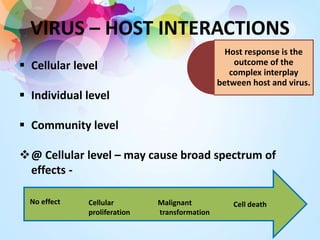
 Cellular level
 Individual level
 Community level
@ Cellular level – may cause broad spectrum of
effects -
No effect Cellular
proliferation
Malignant
transformation
Cell death
Host response is the
outcome of the
complex interplay
between host and virus.
VIRUS – HOST INTERACTIONS
Some viruses, like Poliovirus – cause cell death
( ) or even lysis ( ).
Other viruses may cause cellular proliferation
( molluscum contagiosum ) or malignant transformation
( ).
CELLULAR INJURY MAY BE DUE TO
A NUMBER OF CAUSES
1.Early or nonstructural viral proteins often cause a shut-down
of host protein and DNA synthesis.
2.Large amounts of viral macromolecules that accumulate in
the infected cell may distort the cellular architecture and exert
a toxic effect.
3.The permeability of plasma membranes may be altered
CELLULAR INJURY MAY BE DUE TO
A NUMBER OF CAUSES
4.Many viruses produce alterations in the cytoplasmic membrane
of infected cells.
5.Certain viruses cause damage to the chromosomes of host cells
(eg: measles, mumps, adenovirus, Varicella, cytomegaloviruses).
6. Some ( such as respiratory syncytial virus) cause fusion of adjacent
cell membrane leading to polykaryocytosis or Syncytium
formation.
CELLULAR INJURY MAY BE DUE TO
A NUMBER OF CAUSES
7. Virus coded antigens may appear on the surface of infected cells.
These antigens may confer new properties on the cells.
• E.g. – viral haemagglutinin appears on the surface of cells
infected with the influenza virus and causes adsorption of
erythrocytes to the cell surface ( haemadsorption).
• Virus coded antigens also appear on the surface of cells
transformed by oncogenic viruses.
8. Inclusion bodies.
INCLUSION BODIES
 Most characteristic histological feature in virus infected cells is
the appearance of inclusion bodies.
 Structures with distinct size, shape , location and staining
properties
 Can be seen under light microscope after staining
 May be seen in cytoplasm or nucleus
 Generally acidophilic in nature –Pink in colour on staining with
Giemsa or Eosin methylene blue stains
 Some may be basophilic as well
INCLUSION BODIES
 Help in diagnosis
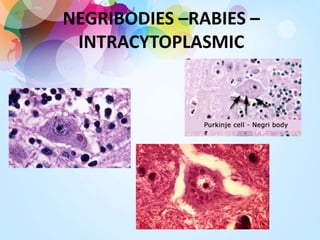
–Negribodies –intra cytoplasmic inclusion –Rabies
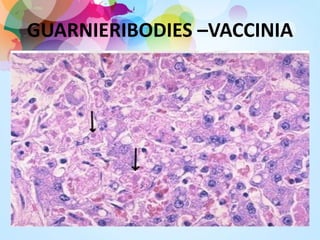
–Guarnieribodies –Vaccinia
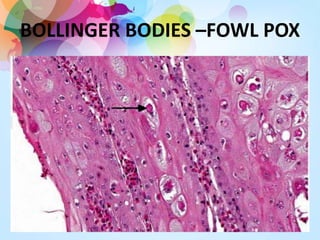
–Bollinger bodies –fowl pox
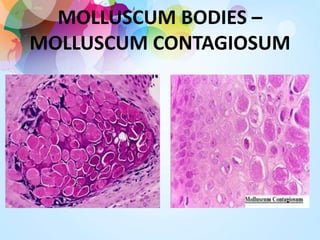
–Molluscum bodies –molluscum contagiosum
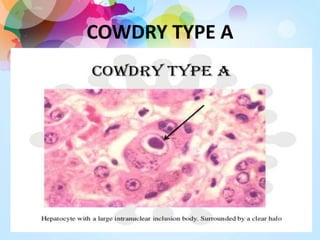
–Cowdry type A –Herpes virus , Yellow fever virus
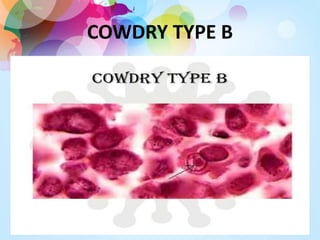
–Cowdry type B –Adenovirus, Polio virus
 Inclusion bodies my be an aggregate of virions or collection of
viral antigens or the degenerative changes produced by viral
infection.
NEGRIBODIES –RABIES –
INTRACYTOPLASMIC
GUARNIERIBODIES –VACCINIA
BOLLINGER BODIES –FOWL POX
MOLLUSCUM BODIES –
MOLLUSCUM CONTAGIOSUM
COWDRY TYPE A
COWDRY TYPE B
PATHOGENESIS OF VIRAL
INFECTIONS
• Depending on the clinical outcome, viral infections can be
classified as
1. Inapparent (subclinical)
2. Apparent (clinical or overt)
a) acute b) subacute c) chronic
• Latent infections
 Herpes simplex and Varicella-zoster viruses remain latent in
nerve root ganglia, to be reactivated periodically
 HBV and HIV infections
 Slow viral diseases
VIRUSES ENTER THE BODY THROUGH
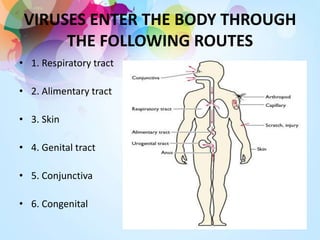
THE FOLLOWING ROUTES
• 1. Respiratory tract
• 2. Alimentary tract
• 3. Skin
• 4. Genital tract
• 5. Conjunctiva
• 6. Congenital
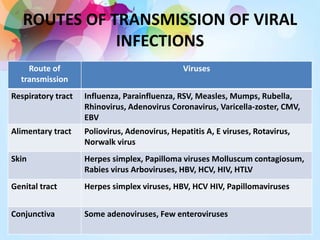
ROUTES OF TRANSMISSION OF VIRAL
INFECTIONS
Route of
transmission
Viruses
Respiratory tract Influenza, Parainfluenza, RSV, Measles, Mumps, Rubella,
Rhinovirus, Adenovirus Coronavirus, Varicella-zoster, CMV,
EBV
Alimentary tract Poliovirus, Adenovirus, Hepatitis A, E viruses, Rotavirus,
Norwalk virus
Skin Herpes simplex, Papilloma viruses Molluscum contagiosum,
Rabies virus Arboviruses, HBV, HCV, HIV, HTLV
Genital tract Herpes simplex viruses, HBV, HCV HIV, Papillomaviruses
Conjunctiva Some adenoviruses, Few enteroviruses
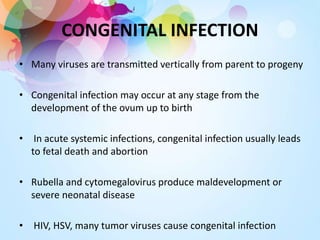
CONGENITAL INFECTION
• Many viruses are transmitted vertically from parent to progeny
• Congenital infection may occur at any stage from the
development of the ovum up to birth
• In acute systemic infections, congenital infection usually leads
to fetal death and abortion
• Rubella and cytomegalovirus produce maldevelopment or
severe neonatal disease
• HIV, HSV, many tumor viruses cause congenital infection
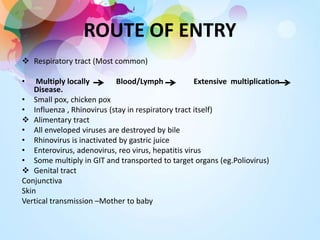
ROUTE OF ENTRY
 Respiratory tract (Most common)
• Multiply locally Blood/Lymph Extensive multiplication
Disease.
• Small pox, chicken pox
• Influenza , Rhinovirus (stay in respiratory tract itself)
 Alimentary tract
• All enveloped viruses are destroyed by bile
• Rhinovirus is inactivated by gastric juice
• Enterovirus, adenovirus, reo virus, hepatitis virus
• Some multiply in GIT and transported to target organs (eg.Poliovirus)
 Genital tract
Conjunctiva
Skin
Vertical transmission –Mother to baby
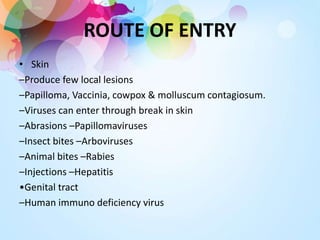
• Skin
–Produce few local lesions
–Papilloma, Vaccinia, cowpox & molluscum contagiosum.
–Viruses can enter through break in skin
–Abrasions –Papillomaviruses
–Insect bites –Arboviruses
–Animal bites –Rabies
–Injections –Hepatitis
•Genital tract
–Human immuno deficiency virus
ROUTE OF ENTRY
ROUTE OF ENTRY
• Conjunctiva
–Local disease –Adenovirus
–Systemic disease –Measles
•Vertical transmission –Mother to baby
–May occur at any stage till birth
–Usually leads to fetal death and abortion
–Maldevelopment–Rubella and Cytomegalovirus
–Many tumor virus spread via this route
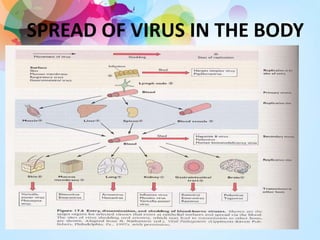
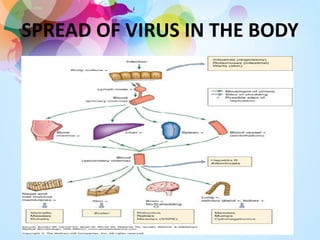
SPREAD OF VIRUS IN THE BODY
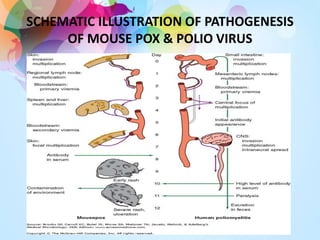
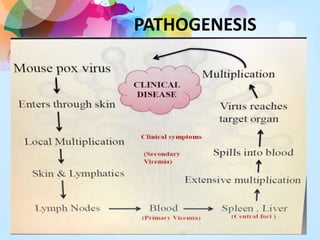
SCHEMATIC ILLUSTRATION OF PATHOGENESIS
OF MOUSE POX & POLIO VIRUS
PATHOGENESIS
INCUBATION period
• It is the time taken for the virus to spread from the site of
entry to the target organs for the production of lesions.
• Its duration is therefore influenced by the relation between
the site of entry, multiplication and lesion.
• The incubation period in HBV may be 2-6 months and in slow
viral infections, many years.
• Papilloma and molluscum contagiosum have long incubation
periods, probably because the viruses multiply slowly
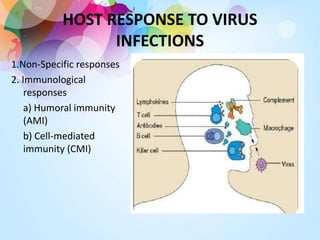
HOST RESPONSE TO VIRUS
INFECTIONS
1.Non-Specific responses
2. Immunological
responses
a) Humoral immunity
(AMI)
b) Cell-mediated
immunity (CMI)
NON-SPECIFIC RESPONSES
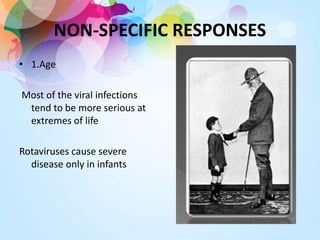
• 1.Age
Most of the viral infections
tend to be more serious at
extremes of life
Rotaviruses cause severe
disease only in infants
2. Hormones
Corticosteroids administration enhances most viral infections
• The particularly severe course of many viral infections in pregnancy
may be related to the hormonal changes
3. Malnutrition
• Malnutrition interferes with the humoral and cell-mediated immune
responses, therefore it can exacerbate viral infections (eg: measles –
higher incidence of complications and a higher case fatality rate in
malnourished children)
4. Body temperature
• Fever may act as a natural defense mechanism against viral infections
as most viruses are inhibited by temperatures above 390C
NON-SPECIFIC RESPONSES
5. Phagocytosis
 Macrophages phagocytose viruses and are important in clearing
viruses from blood stream
 Polymorphonuclear leucocytes do not play any significant role
6. Interferons
 Interferons are a family of glycoproteins produced by cells on
induction by viral or nonviral inducers
 Interferon by itself has no direct action on viruses but acts on other
cells of the same species, rendering them refractory to viral
infection
 On exposure to interferon, cells produce a protein (translation
inhibiting protein, TIP) which selectively inhibits translation of
viral mRNA
TYPES OF INTERFERONS
 They are classified into three types
1. IFN-α
 It is induced by virus infection and produced by leucocytes
 It has antiviral activity
2. IFN-β
 It is also induced by virus infection but produced by
fibroblasts and epithelial cells
 It also has antiviral activity
TYPES OF INTERFERONS
3. IFN-γ
 Produced by T-lymphocytes and NK cells, on stimulation by antigens
or mitogens
 It is a lymphokine with Immunoregulatory functions
 It enhances MHC antigens and activates cytotoxic T-lymphocytes,
macrophages and NK cells
 Modulates antibody formation and suppresses DTH
Mechanism of action
 IFN-α and IFN-β induce the production of three enzymes namely
protein kinase, an Oligonucleotide synthetase and an Rnase. This
leads to inhibition of viral protein synthesis but does not affect host
protein synthesis
BIOLOGICAL EFFECTS OF INTERFERON
• Anti-Viral : resistance to infection
• Anti –Microbial: Resistance to intracellular infections (Toxoplasma,
Chlamydia, Malaria)
• Cellular effects : Inhibition of cell growth and proliferation,
Increased expression of MHC antigens on cell surface
• Immunoregulatory:
–Increases activity of Natural killer (NK) calls and T cells.
–Activates cell destruction activity of macrophage
–Moderates antibody formation
–Activates suppressor T cells
–Suppresses DTH
IMMUNOLOGICAL RESPONSES
1. Antibody-mediated immunity
 IgG, IgM, IgA antibodies are produced in response to virus
infection
 IgG and IgM play a major role in blood and tissue spaces
while IgA is more important in mucosal surfaces
 IgA is important in resistance to infection of the respiratory,
intestinal and urogenital tracts
ANTIBODIES MAY ACT IN THE
FOLLOWING WAYS
• Neutralization of virus which prevents attachment, penetration
or subsequent events
• Antibody may attach to viral antigens on the surface of infected
cells, rendering these cells prone to lysis by complement or
destruction by phagocytes or killer lymphocytes
• Immune opsonisation of virus for phagocytosis and destruction
of virus by macrophages
CELL-MEDIATED IMMUNITY (CMI)
• CMI prevents infection of target organs and promotes
recovery from disease by destroying virus and virus-infected
cells. The different mechanisms involved for virus destruction
are as follows
• 1. Cytolysis by cytotoxic T-cells and Natural-killer (NK) cells
• 2. Antibody-dependent cell-mediated cytotoxicity (ADCC)
• 3. Antibody-complement-mediated cytotoxicity
IMMUNOPROPHYLAXIS
1. Active immunization
2. Passive immunization
• Active immunization
• Viral vaccines
• a) Live viral vaccines
• b) Killed viral vaccines
LIVE VIRAL VACCINES
 They are prepared from
• Attenuated strain (eg: yellow fever vaccines)
• Temperature sensitive (ts) mutants (eg: influenza)
• Live recombinant viruses (eg: influenza)
Advantages -
1. A single dose of live vaccine is usually sufficient
2. They may be administered by the route of natural infection so
that local immunity is induced
LIVE VIRAL VACCINES
Advantages –
3. They induce a wide spectrum of immunoglobulins against the
whole range of viral antigens
4. They also induce cell mediated immunity
5. They can in general be prepared more economically, and
administered more conveniently for mass immunization
LIVE VIRAL VACCINES
Disadvantages –
1. There is a risk, however remote, of reversion of virulence
2. The vaccine may be contaminated with potentially dangerous
viruses (eg: oncogenic viruses)
3. Live viral vaccines are heat-labile and they have to be kept
under strict refrigeration
LIVE VIRAL VACCINES
Disadvantages –
1. There is a risk, however remote, of reversion of virulence
2. The vaccine may be contaminated with potentially dangerous
viruses (eg: oncogenic viruses)
3. Live viral vaccines are heat-labile and they have to be kept
under strict refrigeration
4. Interference by preexisting viruses
5. The virus may spread from the vaccines to contact
6. Some live viral vaccines may cause local but remote
complications
KILLED VIRAL VACCINES
• Killed vaccines are prepared by inactivating viruses with heat,
phenol, beta- propiolactone and formaldehyde
• Advantages
• 1. Safety and stability
• 2. They can be given in combination as polyvalent vaccines
• 3. There is no danger of spread of virus from the vaccinee
• Disadvantages
1. Multiple injections are needed
2. These vaccines have to be given by injection, therefore,
local immunity (IgA immunoglobulins) immunity fails to develop
3. Cell mediated immunity is not induced
PASSIVE IMMUNISATION
• Passive immunization with human gamma globulin,
convalescent serum or specific immune globulin gives
temporary protection against many viral diseases (eg:
measles, mumps and infectious hepatitis)
• Indicated only when non immune individuals who are at
special risk are exposed to infection
• Combined active and passive immunization is an established
method for the prevention of rabies
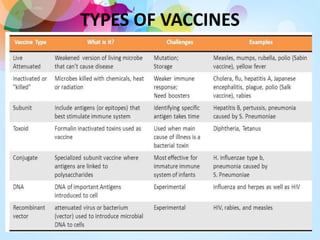
TYPES OF VACCINES
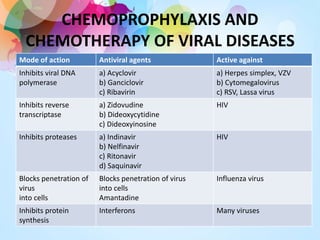
CHEMOPROPHYLAXIS AND
CHEMOTHERAPY OF VIRAL DISEASES
Mode of action Antiviral agents Active against
Inhibits viral DNA
polymerase
a) Acyclovir
b) Ganciclovir
c) Ribavirin
a) Herpes simplex, VZV
b) Cytomegalovirus
c) RSV, Lassa virus
Inhibits reverse
transcriptase
a) Zidovudine
b) Dideoxycytidine
c) Dideoxyinosine
HIV
Inhibits proteases a) Indinavir
b) Nelfinavir
c) Ritonavir
d) Saquinavir
HIV
Blocks penetration of
virus
into cells
Blocks penetration of virus
into cells
Amantadine
Influenza virus
Inhibits protein
synthesis
Interferons Many viruses

Virus host interactions lect dwd

  • 1.
  • 2.
    VIRUS – HOSTINTERACTIONS  Cellular level  Individual level  Community level @ Cellular level – may cause broad spectrum of effects - No effect Cellular proliferation Malignant transformation Cell death Host response is the outcome of the complex interplay between host and virus.
  • 3.
    VIRUS – HOSTINTERACTIONS Some viruses, like Poliovirus – cause cell death ( ) or even lysis ( ). Other viruses may cause cellular proliferation ( molluscum contagiosum ) or malignant transformation ( ).
  • 4.
    CELLULAR INJURY MAYBE DUE TO A NUMBER OF CAUSES 1.Early or nonstructural viral proteins often cause a shut-down of host protein and DNA synthesis. 2.Large amounts of viral macromolecules that accumulate in the infected cell may distort the cellular architecture and exert a toxic effect. 3.The permeability of plasma membranes may be altered
  • 5.
    CELLULAR INJURY MAYBE DUE TO A NUMBER OF CAUSES 4.Many viruses produce alterations in the cytoplasmic membrane of infected cells. 5.Certain viruses cause damage to the chromosomes of host cells (eg: measles, mumps, adenovirus, Varicella, cytomegaloviruses). 6. Some ( such as respiratory syncytial virus) cause fusion of adjacent cell membrane leading to polykaryocytosis or Syncytium formation.
  • 6.
    CELLULAR INJURY MAYBE DUE TO A NUMBER OF CAUSES 7. Virus coded antigens may appear on the surface of infected cells. These antigens may confer new properties on the cells. • E.g. – viral haemagglutinin appears on the surface of cells infected with the influenza virus and causes adsorption of erythrocytes to the cell surface ( haemadsorption). • Virus coded antigens also appear on the surface of cells transformed by oncogenic viruses. 8. Inclusion bodies.
  • 7.
    INCLUSION BODIES  Mostcharacteristic histological feature in virus infected cells is the appearance of inclusion bodies.  Structures with distinct size, shape , location and staining properties  Can be seen under light microscope after staining  May be seen in cytoplasm or nucleus  Generally acidophilic in nature –Pink in colour on staining with Giemsa or Eosin methylene blue stains  Some may be basophilic as well
  • 8.
    INCLUSION BODIES  Helpin diagnosis –Negribodies –intra cytoplasmic inclusion –Rabies –Guarnieribodies –Vaccinia –Bollinger bodies –fowl pox –Molluscum bodies –molluscum contagiosum –Cowdry type A –Herpes virus , Yellow fever virus –Cowdry type B –Adenovirus, Polio virus  Inclusion bodies my be an aggregate of virions or collection of viral antigens or the degenerative changes produced by viral infection.
  • 9.
  • 10.
  • 11.
  • 12.
  • 13.
  • 14.
  • 15.
    PATHOGENESIS OF VIRAL INFECTIONS •Depending on the clinical outcome, viral infections can be classified as 1. Inapparent (subclinical) 2. Apparent (clinical or overt) a) acute b) subacute c) chronic • Latent infections  Herpes simplex and Varicella-zoster viruses remain latent in nerve root ganglia, to be reactivated periodically  HBV and HIV infections  Slow viral diseases
  • 16.
    VIRUSES ENTER THEBODY THROUGH THE FOLLOWING ROUTES • 1. Respiratory tract • 2. Alimentary tract • 3. Skin • 4. Genital tract • 5. Conjunctiva • 6. Congenital
  • 17.
    ROUTES OF TRANSMISSIONOF VIRAL INFECTIONS Route of transmission Viruses Respiratory tract Influenza, Parainfluenza, RSV, Measles, Mumps, Rubella, Rhinovirus, Adenovirus Coronavirus, Varicella-zoster, CMV, EBV Alimentary tract Poliovirus, Adenovirus, Hepatitis A, E viruses, Rotavirus, Norwalk virus Skin Herpes simplex, Papilloma viruses Molluscum contagiosum, Rabies virus Arboviruses, HBV, HCV, HIV, HTLV Genital tract Herpes simplex viruses, HBV, HCV HIV, Papillomaviruses Conjunctiva Some adenoviruses, Few enteroviruses
  • 18.
    CONGENITAL INFECTION • Manyviruses are transmitted vertically from parent to progeny • Congenital infection may occur at any stage from the development of the ovum up to birth • In acute systemic infections, congenital infection usually leads to fetal death and abortion • Rubella and cytomegalovirus produce maldevelopment or severe neonatal disease • HIV, HSV, many tumor viruses cause congenital infection
  • 19.
    ROUTE OF ENTRY Respiratory tract (Most common) • Multiply locally Blood/Lymph Extensive multiplication Disease. • Small pox, chicken pox • Influenza , Rhinovirus (stay in respiratory tract itself)  Alimentary tract • All enveloped viruses are destroyed by bile • Rhinovirus is inactivated by gastric juice • Enterovirus, adenovirus, reo virus, hepatitis virus • Some multiply in GIT and transported to target organs (eg.Poliovirus)  Genital tract Conjunctiva Skin Vertical transmission –Mother to baby
  • 20.
    • Skin –Produce fewlocal lesions –Papilloma, Vaccinia, cowpox & molluscum contagiosum. –Viruses can enter through break in skin –Abrasions –Papillomaviruses –Insect bites –Arboviruses –Animal bites –Rabies –Injections –Hepatitis •Genital tract –Human immuno deficiency virus ROUTE OF ENTRY
  • 21.
    ROUTE OF ENTRY •Conjunctiva –Local disease –Adenovirus –Systemic disease –Measles •Vertical transmission –Mother to baby –May occur at any stage till birth –Usually leads to fetal death and abortion –Maldevelopment–Rubella and Cytomegalovirus –Many tumor virus spread via this route
  • 22.
    SPREAD OF VIRUSIN THE BODY
  • 23.
    SPREAD OF VIRUSIN THE BODY
  • 24.
    SCHEMATIC ILLUSTRATION OFPATHOGENESIS OF MOUSE POX & POLIO VIRUS
  • 25.
  • 26.
    INCUBATION period • Itis the time taken for the virus to spread from the site of entry to the target organs for the production of lesions. • Its duration is therefore influenced by the relation between the site of entry, multiplication and lesion. • The incubation period in HBV may be 2-6 months and in slow viral infections, many years. • Papilloma and molluscum contagiosum have long incubation periods, probably because the viruses multiply slowly
  • 27.
    HOST RESPONSE TOVIRUS INFECTIONS 1.Non-Specific responses 2. Immunological responses a) Humoral immunity (AMI) b) Cell-mediated immunity (CMI)
  • 28.
    NON-SPECIFIC RESPONSES • 1.Age Mostof the viral infections tend to be more serious at extremes of life Rotaviruses cause severe disease only in infants
  • 29.
    2. Hormones Corticosteroids administrationenhances most viral infections • The particularly severe course of many viral infections in pregnancy may be related to the hormonal changes 3. Malnutrition • Malnutrition interferes with the humoral and cell-mediated immune responses, therefore it can exacerbate viral infections (eg: measles – higher incidence of complications and a higher case fatality rate in malnourished children) 4. Body temperature • Fever may act as a natural defense mechanism against viral infections as most viruses are inhibited by temperatures above 390C NON-SPECIFIC RESPONSES
  • 30.
    NON-SPECIFIC RESPONSES 5. Phagocytosis Macrophages phagocytose viruses and are important in clearing viruses from blood stream  Polymorphonuclear leucocytes do not play any significant role 6. Interferons  Interferons are a family of glycoproteins produced by cells on induction by viral or nonviral inducers  Interferon by itself has no direct action on viruses but acts on other cells of the same species, rendering them refractory to viral infection  On exposure to interferon, cells produce a protein (translation inhibiting protein, TIP) which selectively inhibits translation of viral mRNA
  • 31.
    TYPES OF INTERFERONS They are classified into three types 1. IFN-α  It is induced by virus infection and produced by leucocytes  It has antiviral activity 2. IFN-β  It is also induced by virus infection but produced by fibroblasts and epithelial cells  It also has antiviral activity
  • 32.
    TYPES OF INTERFERONS 3.IFN-γ  Produced by T-lymphocytes and NK cells, on stimulation by antigens or mitogens  It is a lymphokine with Immunoregulatory functions  It enhances MHC antigens and activates cytotoxic T-lymphocytes, macrophages and NK cells  Modulates antibody formation and suppresses DTH Mechanism of action  IFN-α and IFN-β induce the production of three enzymes namely protein kinase, an Oligonucleotide synthetase and an Rnase. This leads to inhibition of viral protein synthesis but does not affect host protein synthesis
  • 33.
    BIOLOGICAL EFFECTS OFINTERFERON • Anti-Viral : resistance to infection • Anti –Microbial: Resistance to intracellular infections (Toxoplasma, Chlamydia, Malaria) • Cellular effects : Inhibition of cell growth and proliferation, Increased expression of MHC antigens on cell surface • Immunoregulatory: –Increases activity of Natural killer (NK) calls and T cells. –Activates cell destruction activity of macrophage –Moderates antibody formation –Activates suppressor T cells –Suppresses DTH
  • 34.
    IMMUNOLOGICAL RESPONSES 1. Antibody-mediatedimmunity  IgG, IgM, IgA antibodies are produced in response to virus infection  IgG and IgM play a major role in blood and tissue spaces while IgA is more important in mucosal surfaces  IgA is important in resistance to infection of the respiratory, intestinal and urogenital tracts
  • 35.
    ANTIBODIES MAY ACTIN THE FOLLOWING WAYS • Neutralization of virus which prevents attachment, penetration or subsequent events • Antibody may attach to viral antigens on the surface of infected cells, rendering these cells prone to lysis by complement or destruction by phagocytes or killer lymphocytes • Immune opsonisation of virus for phagocytosis and destruction of virus by macrophages
  • 36.
    CELL-MEDIATED IMMUNITY (CMI) •CMI prevents infection of target organs and promotes recovery from disease by destroying virus and virus-infected cells. The different mechanisms involved for virus destruction are as follows • 1. Cytolysis by cytotoxic T-cells and Natural-killer (NK) cells • 2. Antibody-dependent cell-mediated cytotoxicity (ADCC) • 3. Antibody-complement-mediated cytotoxicity
  • 37.
    IMMUNOPROPHYLAXIS 1. Active immunization 2.Passive immunization • Active immunization • Viral vaccines • a) Live viral vaccines • b) Killed viral vaccines
  • 38.
    LIVE VIRAL VACCINES They are prepared from • Attenuated strain (eg: yellow fever vaccines) • Temperature sensitive (ts) mutants (eg: influenza) • Live recombinant viruses (eg: influenza) Advantages - 1. A single dose of live vaccine is usually sufficient 2. They may be administered by the route of natural infection so that local immunity is induced
  • 39.
    LIVE VIRAL VACCINES Advantages– 3. They induce a wide spectrum of immunoglobulins against the whole range of viral antigens 4. They also induce cell mediated immunity 5. They can in general be prepared more economically, and administered more conveniently for mass immunization
  • 40.
    LIVE VIRAL VACCINES Disadvantages– 1. There is a risk, however remote, of reversion of virulence 2. The vaccine may be contaminated with potentially dangerous viruses (eg: oncogenic viruses) 3. Live viral vaccines are heat-labile and they have to be kept under strict refrigeration
  • 41.
    LIVE VIRAL VACCINES Disadvantages– 1. There is a risk, however remote, of reversion of virulence 2. The vaccine may be contaminated with potentially dangerous viruses (eg: oncogenic viruses) 3. Live viral vaccines are heat-labile and they have to be kept under strict refrigeration 4. Interference by preexisting viruses 5. The virus may spread from the vaccines to contact 6. Some live viral vaccines may cause local but remote complications
  • 42.
    KILLED VIRAL VACCINES •Killed vaccines are prepared by inactivating viruses with heat, phenol, beta- propiolactone and formaldehyde • Advantages • 1. Safety and stability • 2. They can be given in combination as polyvalent vaccines • 3. There is no danger of spread of virus from the vaccinee • Disadvantages 1. Multiple injections are needed 2. These vaccines have to be given by injection, therefore, local immunity (IgA immunoglobulins) immunity fails to develop 3. Cell mediated immunity is not induced
  • 43.
    PASSIVE IMMUNISATION • Passiveimmunization with human gamma globulin, convalescent serum or specific immune globulin gives temporary protection against many viral diseases (eg: measles, mumps and infectious hepatitis) • Indicated only when non immune individuals who are at special risk are exposed to infection • Combined active and passive immunization is an established method for the prevention of rabies
  • 44.
  • 45.
    CHEMOPROPHYLAXIS AND CHEMOTHERAPY OFVIRAL DISEASES Mode of action Antiviral agents Active against Inhibits viral DNA polymerase a) Acyclovir b) Ganciclovir c) Ribavirin a) Herpes simplex, VZV b) Cytomegalovirus c) RSV, Lassa virus Inhibits reverse transcriptase a) Zidovudine b) Dideoxycytidine c) Dideoxyinosine HIV Inhibits proteases a) Indinavir b) Nelfinavir c) Ritonavir d) Saquinavir HIV Blocks penetration of virus into cells Blocks penetration of virus into cells Amantadine Influenza virus Inhibits protein synthesis Interferons Many viruses