Rheumatic fever and
heart disease
Rheumatic Fever and heart
disease
• Acute rheumatic fever (ARF) is a inflammatory disease
of the heart potentially involving all layers (
endocardium, myocardium, and pericardium) of heart
resulting from an autoimmune reaction to infection
with group A streptococci
• Rheumatic heart disease is a chronic condition
resulting from rheumatic fever that is characterized by
scarring and deformity of the heart valves
Incidence
• ARF is mainly a disease of children aged 5–14 years.
• Initial episodes become less common in older
adolescents and young adults and are rare in persons
aged >30 years.
• There is no clear gender association for ARF, but RHD
more commonly affects females, sometimes up to
twice as frequently as males.
Etiology
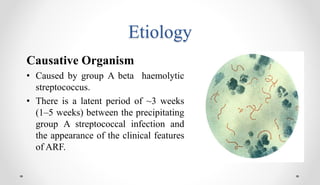
Causative Organism
• Caused by group A beta haemolytic
streptococcus.
• There is a latent period of ~3 weeks
(1–5 weeks) between the precipitating
group A streptococcal infection and
the appearance of the clinical features
of ARF.
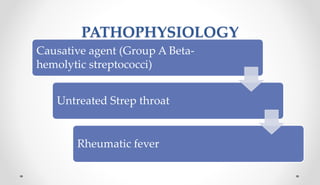
PATHOPHYSIOLOGY
Causative agent (Group A Beta-
hemolytic streptococci)
Untreated Strep throat
Rheumatic fever
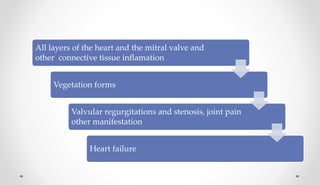
All layers of the heart and the mitral valve and
other connective tissue inflamation
Vegetation forms
Valvular regurgitations and stenosis, joint pain
other manifestation
Heart failure
PATHOPHYSIOLOGY
• Group A strep pharyngeal infection precedes clinical
manifestations of ARF by 2 - 6 weeks.
• Body produce antibodies against streptococci
PATHOPHYSIOLOGY
• These antibodies cross react with human tissues
because of the antigenic similarity between
streptococcal components and human connective
tissues (molecular mimicry)
• Immunologically mediated inflammation & damage
(autoimmune) to human tissues which have antigenic
similarity with streptococcal components- like heart, joint,
brain and connective tissues
Clinical manifestations
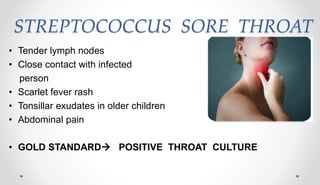
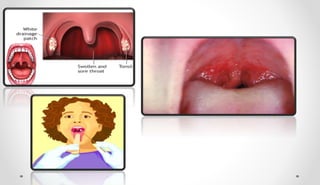
STREPTOCOCCUS SORE THROAT
• Tender lymph nodes
• Close contact with infected
person
• Scarlet fever rash
• Tonsillar exudates in older children
• Abdominal pain
• GOLD STANDARD POSITIVE THROAT CULTURE
CLINICAL FEATURES
• Cluster of signs and symptoms
• A group of criteria developed by T.D jones
Following upper airway infection with GAS
Silent period of 2 - 6 weeks
Sudden onset of fever, pallor, malaise, fatigue.
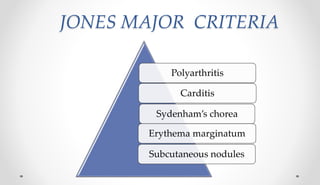
JONES MAJOR CRITERIA
Polyarthritis
Carditis
Sydenham’s chorea
Erythema marginatum
Subcutaneous nodules
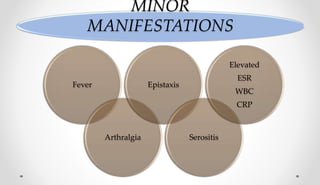
Fever
Arthralgia
Epistaxis
Serositis
Elevated
ESR
WBC
CRP
MINOR
MANIFESTATIONS
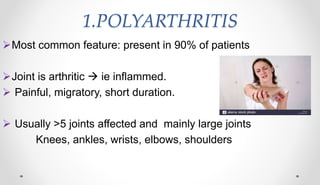
1.POLYARTHRITIS
Most common feature: present in 90% of patients
Joint is arthritic  ie inflammed.
 Painful, migratory, short duration.
 Usually >5 joints affected and mainly large joints
Knees, ankles, wrists, elbows, shoulders
2.CARDITIS
• Early and most serious manifestation
• Manifest as pancarditis
• Occur in 60-70% of cases
• Heart murmer
• Cardiac enlargement
• Pericarditis
Chorea (sydenham’s chorea)
• Major CNS manifestation
• Characterized by involunatary movements, especially of
the face and limbs which cause disturbances of speech
and gait
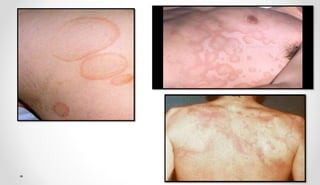
Erythema marginatum
• Bright pink, nonpruriric,maplike macular lesions
occur mainly on the trunk and proximal extrimities
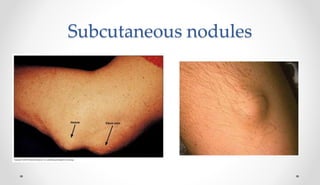
Subcutaneous nodules
• Associated with severe carditis
• Characterized by firm, small,hard ,painless swelling
located over extenser surfaces of the joints,knee,wrist
and elbow
Subcutaneous nodules
JONES CRITERIA
 2 major or
1 major and 2 minor
• plus evidence of streptococcal infection indicates ARF
Evidence of Group A streptococcal infection
• Positive throat culture for strep A
• Elevated or rising anti-streptococcal antibody titer
• Recent scarlet fever
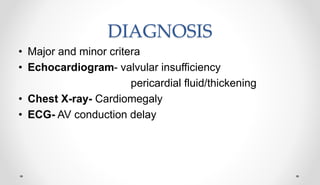
DIAGNOSIS
• Major and minor critera
• Echocardiogram- valvular insufficiency
pericardial fluid/thickening
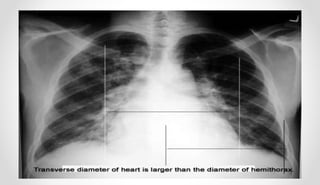
• Chest X-ray- Cardiomegaly
• ECG- AV conduction delay
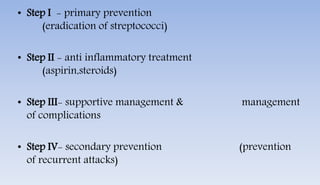
• Step I - primary prevention
(eradication of streptococci)
• Step II - anti inflammatory treatment
(aspirin,steroids)
• Step III- supportive management & management
of complications
• Step IV- secondary prevention (prevention
of recurrent attacks)
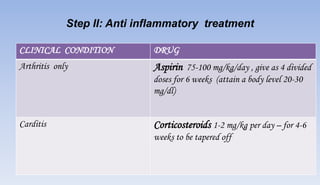
CLINICAL CONDITION DRUG
Arthritis only Aspirin 75-100 mg/kg/day , give as 4 divided
doses for 6 weeks (attain a body level 20-30
mg/dl)
Carditis Corticosteroids 1-2 mg/kg per day – for 4-6
weeks to be tapered off
Step II: Anti inflammatory treatment
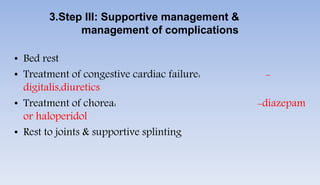
3.Step III: Supportive management &
management of complications
• Bed rest
• Treatment of congestive cardiac failure: -
digitalis,diuretics
• Treatment of chorea: -diazepam
or haloperidol
• Rest to joints & supportive splinting
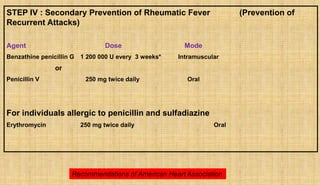
STEP IV : Secondary Prevention of Rheumatic Fever (Prevention of
Recurrent Attacks)
Agent Dose Mode
Benzathine penicillin G 1 200 000 U every 3 weeks* Intramuscular
or
Penicillin V 250 mg twice daily Oral
For individuals allergic to penicillin and sulfadiazine
Erythromycin 250 mg twice daily Oral
Recommendations of American Heart Association
SURGICAL MANAGEMENT
• In patients with critical stenosis, mitral valvulotomy,
percutaneous balloon valvuloplasty, or mitral valve
replacement may be indicated.
• Due to high rates of recurrent symptoms after annuloplasty
or other repair procedures, valve replacement appears to be
the preferred surgical option
NURSING MANAGEMENT
• ASSESSMENT
• Nursing diagnosis
Acute Pain related to inflammatory response in the
joints.
Interventions
• Assess the level of pain, duration, intensity and frequency of
pain.
• Complete bed rest and provide comfortable position.
• Provide diversional therapy and psychological support.
• Administer analgesics as needed.
• Nursing diagnosis
Decreased cardiac output related to valve
dysfunction or HF.
Interventions
• Assess the symptoms of heart failure and decreased cardiac
output including diminished quality of peripheral pulses, cool
skin and extremities, increased respiration, increased heart rate,
neck vein distention and presence of edema.
• Assess for heart sounds.
• Monitor intake and output.
• Provide bed rest.
• Administration of cardiac glycosides as prescribed.
• Administration of antibiotics to reduce infection.
• Nursing diagnosis
Knowledge deficit related to disease condition and long term
treatment.
Intervention
• Assess the clients level of knowledge.
• Assess the client’s ability to learn.
• Explain about disease condition and about prophylactic
treatment of antibiotics.
• Clarify the clients doubt clearly.

Rheumatic heart disease

  • 1.
  • 2.
    Rheumatic Fever andheart disease • Acute rheumatic fever (ARF) is a inflammatory disease of the heart potentially involving all layers ( endocardium, myocardium, and pericardium) of heart resulting from an autoimmune reaction to infection with group A streptococci • Rheumatic heart disease is a chronic condition resulting from rheumatic fever that is characterized by scarring and deformity of the heart valves
  • 3.
    Incidence • ARF ismainly a disease of children aged 5–14 years. • Initial episodes become less common in older adolescents and young adults and are rare in persons aged >30 years. • There is no clear gender association for ARF, but RHD more commonly affects females, sometimes up to twice as frequently as males.
  • 4.
    Etiology Causative Organism • Causedby group A beta haemolytic streptococcus. • There is a latent period of ~3 weeks (1–5 weeks) between the precipitating group A streptococcal infection and the appearance of the clinical features of ARF.
  • 5.
    PATHOPHYSIOLOGY Causative agent (GroupA Beta- hemolytic streptococci) Untreated Strep throat Rheumatic fever
  • 6.
    All layers ofthe heart and the mitral valve and other connective tissue inflamation Vegetation forms Valvular regurgitations and stenosis, joint pain other manifestation Heart failure
  • 7.
    PATHOPHYSIOLOGY • Group Astrep pharyngeal infection precedes clinical manifestations of ARF by 2 - 6 weeks. • Body produce antibodies against streptococci
  • 8.
    PATHOPHYSIOLOGY • These antibodiescross react with human tissues because of the antigenic similarity between streptococcal components and human connective tissues (molecular mimicry) • Immunologically mediated inflammation & damage (autoimmune) to human tissues which have antigenic similarity with streptococcal components- like heart, joint, brain and connective tissues
  • 9.
  • 10.
    STREPTOCOCCUS SORE THROAT •Tender lymph nodes • Close contact with infected person • Scarlet fever rash • Tonsillar exudates in older children • Abdominal pain • GOLD STANDARD POSITIVE THROAT CULTURE
  • 12.
    CLINICAL FEATURES • Clusterof signs and symptoms • A group of criteria developed by T.D jones Following upper airway infection with GAS Silent period of 2 - 6 weeks Sudden onset of fever, pallor, malaise, fatigue.
  • 13.
    JONES MAJOR CRITERIA Polyarthritis Carditis Sydenham’schorea Erythema marginatum Subcutaneous nodules
  • 14.
  • 15.
    1.POLYARTHRITIS Most common feature:present in 90% of patients Joint is arthritic  ie inflammed.  Painful, migratory, short duration.  Usually >5 joints affected and mainly large joints Knees, ankles, wrists, elbows, shoulders
  • 16.
    2.CARDITIS • Early andmost serious manifestation • Manifest as pancarditis • Occur in 60-70% of cases • Heart murmer • Cardiac enlargement • Pericarditis
  • 17.
    Chorea (sydenham’s chorea) •Major CNS manifestation • Characterized by involunatary movements, especially of the face and limbs which cause disturbances of speech and gait
  • 18.
    Erythema marginatum • Brightpink, nonpruriric,maplike macular lesions occur mainly on the trunk and proximal extrimities
  • 20.
    Subcutaneous nodules • Associatedwith severe carditis • Characterized by firm, small,hard ,painless swelling located over extenser surfaces of the joints,knee,wrist and elbow
  • 21.
  • 22.
    JONES CRITERIA  2major or 1 major and 2 minor • plus evidence of streptococcal infection indicates ARF
  • 23.
    Evidence of GroupA streptococcal infection • Positive throat culture for strep A • Elevated or rising anti-streptococcal antibody titer • Recent scarlet fever
  • 24.
    DIAGNOSIS • Major andminor critera • Echocardiogram- valvular insufficiency pericardial fluid/thickening • Chest X-ray- Cardiomegaly • ECG- AV conduction delay
  • 27.
    • Step I- primary prevention (eradication of streptococci) • Step II - anti inflammatory treatment (aspirin,steroids) • Step III- supportive management & management of complications • Step IV- secondary prevention (prevention of recurrent attacks)
  • 28.
    CLINICAL CONDITION DRUG Arthritisonly Aspirin 75-100 mg/kg/day , give as 4 divided doses for 6 weeks (attain a body level 20-30 mg/dl) Carditis Corticosteroids 1-2 mg/kg per day – for 4-6 weeks to be tapered off Step II: Anti inflammatory treatment
  • 29.
    3.Step III: Supportivemanagement & management of complications • Bed rest • Treatment of congestive cardiac failure: - digitalis,diuretics • Treatment of chorea: -diazepam or haloperidol • Rest to joints & supportive splinting
  • 30.
    STEP IV :Secondary Prevention of Rheumatic Fever (Prevention of Recurrent Attacks) Agent Dose Mode Benzathine penicillin G 1 200 000 U every 3 weeks* Intramuscular or Penicillin V 250 mg twice daily Oral For individuals allergic to penicillin and sulfadiazine Erythromycin 250 mg twice daily Oral Recommendations of American Heart Association
  • 31.
  • 32.
    • In patientswith critical stenosis, mitral valvulotomy, percutaneous balloon valvuloplasty, or mitral valve replacement may be indicated. • Due to high rates of recurrent symptoms after annuloplasty or other repair procedures, valve replacement appears to be the preferred surgical option
  • 33.
  • 34.
    • Nursing diagnosis AcutePain related to inflammatory response in the joints. Interventions • Assess the level of pain, duration, intensity and frequency of pain. • Complete bed rest and provide comfortable position. • Provide diversional therapy and psychological support. • Administer analgesics as needed.
  • 35.
    • Nursing diagnosis Decreasedcardiac output related to valve dysfunction or HF.
  • 36.
    Interventions • Assess thesymptoms of heart failure and decreased cardiac output including diminished quality of peripheral pulses, cool skin and extremities, increased respiration, increased heart rate, neck vein distention and presence of edema. • Assess for heart sounds. • Monitor intake and output. • Provide bed rest. • Administration of cardiac glycosides as prescribed. • Administration of antibiotics to reduce infection.
  • 37.
    • Nursing diagnosis Knowledgedeficit related to disease condition and long term treatment. Intervention • Assess the clients level of knowledge. • Assess the client’s ability to learn. • Explain about disease condition and about prophylactic treatment of antibiotics. • Clarify the clients doubt clearly.