Rheumatic Fever
By-
1. Nameera Shaikh
Case Presentation
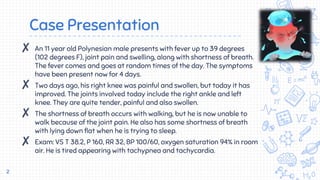
✘ An 11 year old Polynesian male presents with fever up to 39 degrees
(102 degrees F), joint pain and swelling, along with shortness of breath.
The fever comes and goes at random times of the day. The symptoms
have been present now for 4 days.
✘ Two days ago, his right knee was painful and swollen, but today it has
improved. The joints involved today include the right ankle and left
knee. They are quite tender, painful and also swollen.
✘ The shortness of breath occurs with walking, but he is now unable to
walk because of the joint pain. He also has some shortness of breath
with lying down flat when he is trying to sleep.
✘ Exam: VS T 38.2, P 160, RR 32, BP 100/60, oxygen saturation 94% in room
air. He is tired appearing with tachypnea and tachycardia.
2
What did the examination revealed?
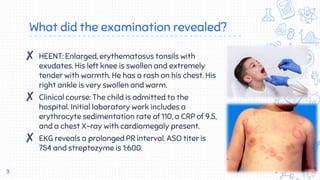
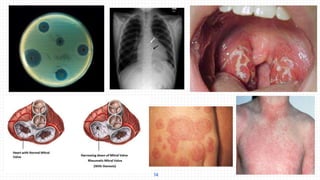
✘ HEENT: Enlarged, erythematosus tonsils with
exudates. His left knee is swollen and extremely
tender with warmth. He has a rash on his chest. His
right ankle is very swollen and warm.
✘ Clinical course: The child is admitted to the
hospital. Initial laboratory work includes a
erythrocyte sedimentation rate of 110, a CRP of 9.5,
and a chest X-ray with cardiomegaly present.
✘ EKG reveals a prolonged PR interval. ASO titer is
754 and streptozyme is 1:600.
3
What is Rheumatic Fever?
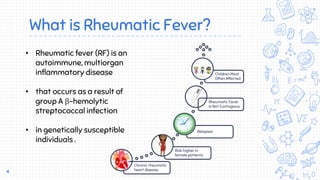
Chronic rheumatic
heart disease.
Risk higher in
female patients .
Relapses
Rheumatic Fever
Is Not Contagious
Children Most
Often Affected
4
• Rheumatic fever (RF) is an
autoimmune, multiorgan
inflammatory disease
• that occurs as a result of
group A β-hemolytic
streptococcal infection
• in genetically susceptible
individuals .
5
Epidemiology
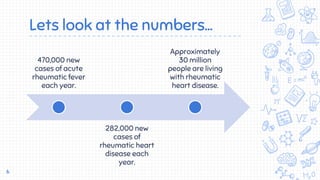
Lets look at the numbers…
470,000 new
cases of acute
rheumatic fever
each year.
282,000 new
cases of
rheumatic heart
disease each
year.
Approximately
30 million
people are living
with rheumatic
heart disease.
6
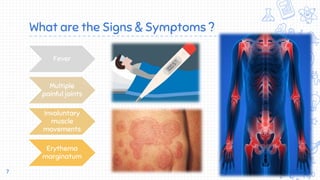
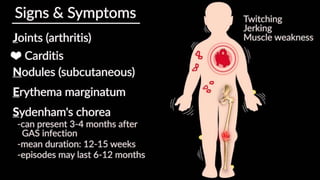
What are the Signs & Symptoms ?
Fever
Multiple
painful joints
Involuntary
muscle
movements
Erythema
marginatum
7
8
What are the causes of ARF?
It usually takes
about 1 to 5 weeks
after strep throat
or scarlet fever.
Environmental
factors
Genetic gene
through the family
Repeated infection
Group A
streptococcus
9
Risk Factors
Genetics Malnutrition Poverty
10
11
P a t h o p h y s i o l o g y
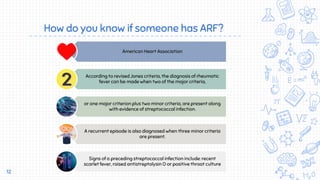
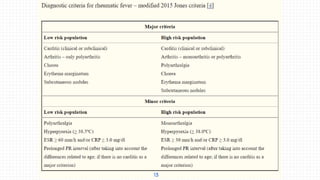
How do you know if someone has ARF?
American Heart Association
According to revised Jones criteria, the diagnosis of rheumatic
fever can be made when two of the major criteria,
or one major criterion plus two minor criteria, are present along
with evidence of streptococcal infection.
A recurrent episode is also diagnosed when three minor criteria
are present.
Signs of a preceding streptococcal infection include: recent
scarlet fever, raised antistreptolysin O or positive throat culture
12
13
14
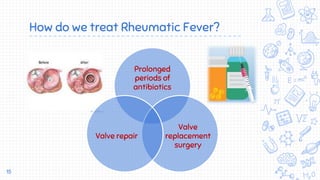
How do we treat Rheumatic Fever?
Prolonged
periods of
antibiotics
Valve
replacement
surgery
Valve repair
15
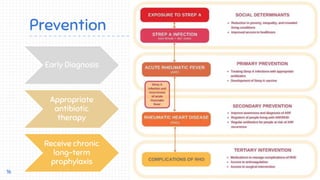
Prevention
Early Diagnosis
Appropriate
antibiotic
therapy
Receive chronic
long-term
prophylaxis
16
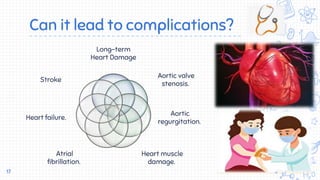
Can it lead to complications?
Long-term
Heart Damage
Aortic valve
stenosis.
Aortic
regurgitation.
Heart muscle
damage.
Atrial
fibrillation.
Heart failure.
Stroke
17
Prognosis
18
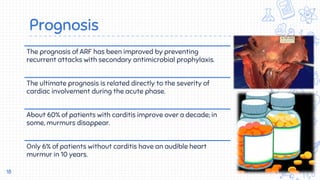
The prognosis of ARF has been improved by preventing
recurrent attacks with secondary antimicrobial prophylaxis.
The ultimate prognosis is related directly to the severity of
cardiac involvement during the acute phase.
About 60% of patients with carditis improve over a decade; in
some, murmurs disappear.
Only 6% of patients without carditis have an audible heart
murmur in 10 years.
How do we tackle this problem globally?
Antibiotics for
strep throat
Improved
sanitation
19
20
Recent Advances in Medicine
Vaccine- Wide variety of
strains of S. pyogenes
present in the
environment
Single treatment
regime
Auscultation,
Phonocardiography,
Electromyogram
21
THANKS!
Any questions?
22

Rheumatic fever ppt

  • 1.
  • 2.
    Case Presentation ✘ An11 year old Polynesian male presents with fever up to 39 degrees (102 degrees F), joint pain and swelling, along with shortness of breath. The fever comes and goes at random times of the day. The symptoms have been present now for 4 days. ✘ Two days ago, his right knee was painful and swollen, but today it has improved. The joints involved today include the right ankle and left knee. They are quite tender, painful and also swollen. ✘ The shortness of breath occurs with walking, but he is now unable to walk because of the joint pain. He also has some shortness of breath with lying down flat when he is trying to sleep. ✘ Exam: VS T 38.2, P 160, RR 32, BP 100/60, oxygen saturation 94% in room air. He is tired appearing with tachypnea and tachycardia. 2
  • 3.
    What did theexamination revealed? ✘ HEENT: Enlarged, erythematosus tonsils with exudates. His left knee is swollen and extremely tender with warmth. He has a rash on his chest. His right ankle is very swollen and warm. ✘ Clinical course: The child is admitted to the hospital. Initial laboratory work includes a erythrocyte sedimentation rate of 110, a CRP of 9.5, and a chest X-ray with cardiomegaly present. ✘ EKG reveals a prolonged PR interval. ASO titer is 754 and streptozyme is 1:600. 3
  • 4.
    What is RheumaticFever? Chronic rheumatic heart disease. Risk higher in female patients . Relapses Rheumatic Fever Is Not Contagious Children Most Often Affected 4 • Rheumatic fever (RF) is an autoimmune, multiorgan inflammatory disease • that occurs as a result of group A β-hemolytic streptococcal infection • in genetically susceptible individuals .
  • 5.
  • 6.
    Lets look atthe numbers… 470,000 new cases of acute rheumatic fever each year. 282,000 new cases of rheumatic heart disease each year. Approximately 30 million people are living with rheumatic heart disease. 6
  • 7.
    What are theSigns & Symptoms ? Fever Multiple painful joints Involuntary muscle movements Erythema marginatum 7
  • 8.
  • 9.
    What are thecauses of ARF? It usually takes about 1 to 5 weeks after strep throat or scarlet fever. Environmental factors Genetic gene through the family Repeated infection Group A streptococcus 9
  • 10.
  • 11.
    11 P a th o p h y s i o l o g y
  • 12.
    How do youknow if someone has ARF? American Heart Association According to revised Jones criteria, the diagnosis of rheumatic fever can be made when two of the major criteria, or one major criterion plus two minor criteria, are present along with evidence of streptococcal infection. A recurrent episode is also diagnosed when three minor criteria are present. Signs of a preceding streptococcal infection include: recent scarlet fever, raised antistreptolysin O or positive throat culture 12
  • 13.
  • 14.
  • 15.
    How do wetreat Rheumatic Fever? Prolonged periods of antibiotics Valve replacement surgery Valve repair 15
  • 16.
  • 17.
    Can it leadto complications? Long-term Heart Damage Aortic valve stenosis. Aortic regurgitation. Heart muscle damage. Atrial fibrillation. Heart failure. Stroke 17
  • 18.
    Prognosis 18 The prognosis ofARF has been improved by preventing recurrent attacks with secondary antimicrobial prophylaxis. The ultimate prognosis is related directly to the severity of cardiac involvement during the acute phase. About 60% of patients with carditis improve over a decade; in some, murmurs disappear. Only 6% of patients without carditis have an audible heart murmur in 10 years.
  • 19.
    How do wetackle this problem globally? Antibiotics for strep throat Improved sanitation 19
  • 20.
  • 21.
    Recent Advances inMedicine Vaccine- Wide variety of strains of S. pyogenes present in the environment Single treatment regime Auscultation, Phonocardiography, Electromyogram 21
  • 22.