Infective Endocarditis
Major (Dr) Jahangir Alam
DCH, FCPS
Classified Child Specialist
Bangladesh Army
Definition
Infective endocarditis is a form of
endocarditis, or inflammation, of the inner
tissue of the heart (such as its valves)
caused by infectious agents. The agents
are usually bacterial, but other organisms
can also be responsible.
Epidemiology
• Infective endocarditis is often a complication of
congenital or rheumatic heart disease.
• It is rare in infancy.
• Prevalence of Infective endocarditis (IE) accounts
for 0.5 to 1 of every 1000 hospital admissions,
excluding postoperative endocarditis
• The frequency of IE among children seems to
have increased in recent years due to
– Survivors of surgical repair of complex congenital
heart disease
– Survivors of neonatal intensive care units, who are at
an increased risk for IE.
Etiology
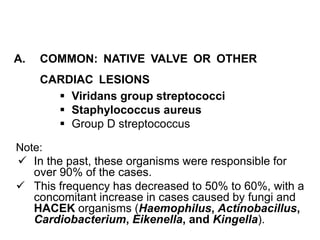
A. COMMON: NATIVE VALVE OR OTHER
CARDIAC LESIONS
 Viridans group streptococci
 Staphylococcus aureus
 Group D streptococcus
Note:
 In the past, these organisms were responsible for
over 90% of the cases.
 This frequency has decreased to 50% to 60%, with a
concomitant increase in cases caused by fungi and
HACEK organisms (Haemophilus, Actinobacillus,
Cardiobacterium, Eikenella, and Kingella).
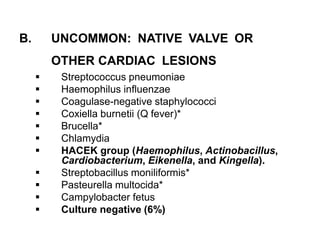
B. UNCOMMON: NATIVE VALVE OR
OTHER CARDIAC LESIONS
 Streptococcus pneumoniae
 Haemophilus influenzae
 Coagulase-negative staphylococci
 Coxiella burnetii (Q fever)*
 Brucella*
 Chlamydia
 HACEK group (Haemophilus, Actinobacillus,
Cardiobacterium, Eikenella, and Kingella).
 Streptobacillus moniliformis*
 Pasteurella multocida*
 Campylobacter fetus
 Culture negative (6%)
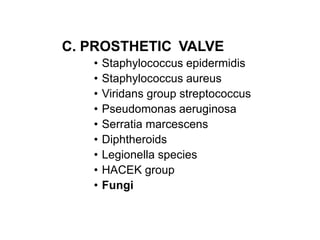
C. PROSTHETIC VALVE
• Staphylococcus epidermidis
• Staphylococcus aureus
• Viridans group streptococcus
• Pseudomonas aeruginosa
• Serratia marcescens
• Diphtheroids
• Legionella species
• HACEK group
• Fungi
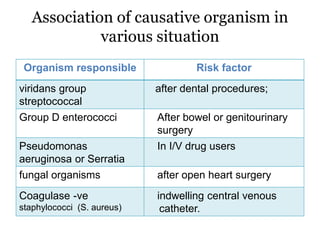
Association of causative organism in
various situation
Organism responsible Risk factor
viridans group
streptococcal
after dental procedures;
Group D enterococci After bowel or genitourinary
surgery
Pseudomonas
aeruginosa or Serratia
In I/V drug users
fungal organisms after open heart surgery
Coagulase -ve
staphylococci (S. aureus)
indwelling central venous
catheter.
Pathogenesis
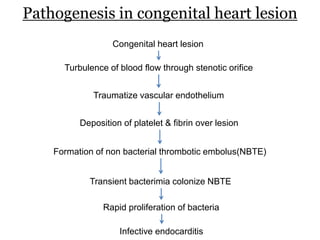
Pathogenesis in congenital heart lesion
Congenital heart lesion
Turbulence of blood flow through stenotic orifice
Traumatize vascular endothelium
Deposition of platelet & fibrin over lesion
Formation of non bacterial thrombotic embolus(NBTE)
Transient bacterimia colonize NBTE
Rapid proliferation of bacteria
Infective endocarditis
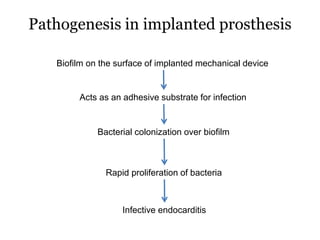
Pathogenesis in implanted prosthesis
Biofilm on the surface of implanted mechanical device
Acts as an adhesive substrate for infection
Bacterial colonization over biofilm
Rapid proliferation of bacteria
Infective endocarditis
Manifestation of Infective
Endocarditis
History
• Prior congenital or rheumatic heart disease
• Preceding dental, urinary tract, or intestinal
procedure
• Intravenous drug use
• Central venous catheter
• Prosthetic heart valve
Symptoms
• Fever : prolong fever without other manifestation may
be the early symptoms of IE
• Chills
• Night sweat
• Weight loss
• Chest and abdominal pain
• fatigue
• Arthralgia, myalgia
• Dyspnea
• Malaise, weakness
• CNS manifestations (stroke, seizures, headache)
Sign
• Elevated temperature
• Tachycardia
• Clubbing
• Skin menifestation
– Petechiae
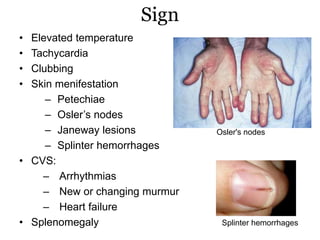
– Osler’s nodes
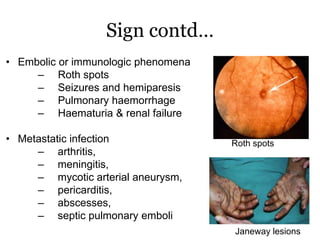
– Janeway lesions
– Splinter hemorrhages
• CVS:
– Arrhythmias
– New or changing murmur
– Heart failure
• Splenomegaly
Osler's nodes
Splinter hemorrhages
Sign contd…
• Embolic or immunologic phenomena
– Roth spots
– Seizures and hemiparesis
– Pulmonary haemorrhage
– Haematuria & renal failure
• Metastatic infection
– arthritis,
– meningitis,
– mycotic arterial aneurysm,
– pericarditis,
– abscesses,
– septic pulmonary emboli
Roth spots
Janeway lesions
Investigation
Laboratory studies
• Blood cultures:
– positive in > 90% of patients in the absence of
previous antimicrobial therapy
– 50% to 60% positive in pretreatment with antibiotics
• Complete blood count:
– Anemia present in 80% of patient
– leukocytosis
– Raised ESR
– Raised CRP
• Urine
– Microscopic haematuria is found in 30% of patients
• Other specimens that may be cultured:
– scrapings from cutaneous lesions,
– urine,
– synovial fluid,
– Abscesses
– cerebrospinal fluid
• CXR : Evidence of heart failure
• ECG: Evidence of underlying heart disease
or conduction defect due to abscess.
Echocardiography
Certain echo findings are included as major
criteria in the modified Duke criteria
a) Oscillating intracardiac mass on valve or
supporting structures, in the path of
regurgitation jets, or on implanted material
b) Abscesses
c) New partial dehiscence of prosthetic valve
d) New valvular regurgitation
Diagnosis
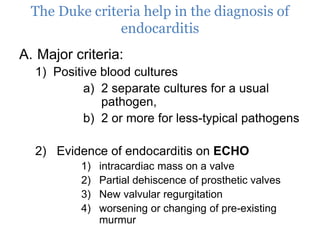
The Duke criteria help in the diagnosis of
endocarditis
A. Major criteria:
1) Positive blood cultures
a) 2 separate cultures for a usual
pathogen,
b) 2 or more for less-typical pathogens
2) Evidence of endocarditis on ECHO
1) intracardiac mass on a valve
2) Partial dehiscence of prosthetic valves
3) New valvular regurgitation
4) worsening or changing of pre-existing
murmur
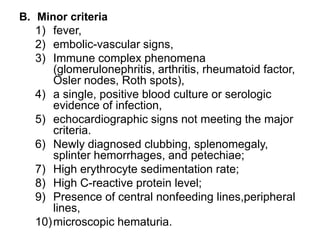
B. Minor criteria
1) fever,
2) embolic-vascular signs,
3) Immune complex phenomena
(glomerulonephritis, arthritis, rheumatoid factor,
Osler nodes, Roth spots),
4) a single, positive blood culture or serologic
evidence of infection,
5) echocardiographic signs not meeting the major
criteria.
6) Newly diagnosed clubbing, splenomegaly,
splinter hemorrhages, and petechiae;
7) High erythrocyte sedimentation rate;
8) High C-reactive protein level;
9) Presence of central nonfeeding lines,peripheral
lines,
10)microscopic hematuria.
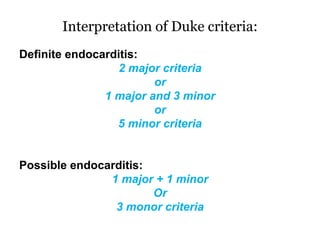
Interpretation of Duke criteria:
Definite endocarditis:
2 major criteria
or
1 major and 3 minor
or
5 minor criteria
Possible endocarditis:
1 major + 1 minor
Or
3 monor criteria
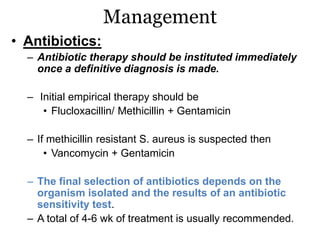
Management
• Antibiotics:
– Antibiotic therapy should be instituted immediately
once a definitive diagnosis is made.
– Initial empirical therapy should be
• Flucloxacillin/ Methicillin + Gentamicin
– If methicillin resistant S. aureus is suspected then
• Vancomycin + Gentamicin
– The final selection of antibiotics depends on the
organism isolated and the results of an antibiotic
sensitivity test.
– A total of 4-6 wk of treatment is usually recommended.
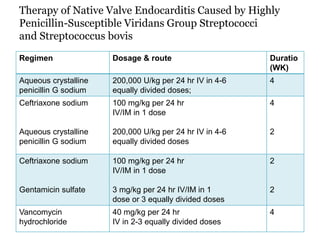
Therapy of Native Valve Endocarditis Caused by Highly
Penicillin-Susceptible Viridans Group Streptococci
and Streptococcus bovis
Regimen Dosage & route Duratio
(WK)
Aqueous crystalline
penicillin G sodium
200,000 U/kg per 24 hr IV in 4-6
equally divided doses;
4
Ceftriaxone sodium
Aqueous crystalline
penicillin G sodium
100 mg/kg per 24 hr
IV/IM in 1 dose
200,000 U/kg per 24 hr IV in 4-6
equally divided doses
4
2
Ceftriaxone sodium
Gentamicin sulfate
100 mg/kg per 24 hr
IV/IM in 1 dose
3 mg/kg per 24 hr IV/IM in 1
dose or 3 equally divided doses
2
2
Vancomycin
hydrochloride
40 mg/kg per 24 hr
IV in 2-3 equally divided doses
4
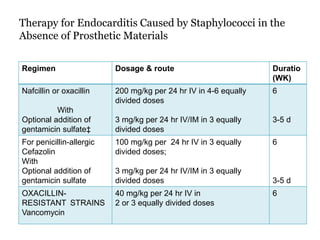
Therapy for Endocarditis Caused by Staphylococci in the
Absence of Prosthetic Materials
Regimen Dosage & route Duratio
(WK)
Nafcillin or oxacillin
With
Optional addition of
gentamicin sulfate‡
200 mg/kg per 24 hr IV in 4-6 equally
divided doses
3 mg/kg per 24 hr IV/IM in 3 equally
divided doses
6
3-5 d
For penicillin-allergic
Cefazolin
With
Optional addition of
gentamicin sulfate
100 mg/kg per 24 hr IV in 3 equally
divided doses;
3 mg/kg per 24 hr IV/IM in 3 equally
divided doses
6
3-5 d
OXACILLIN-
RESISTANT STRAINS
Vancomycin
40 mg/kg per 24 hr IV in
2 or 3 equally divided doses
6
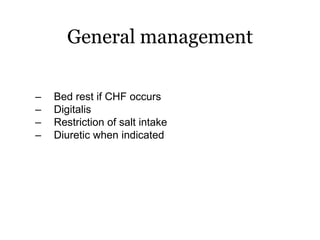
General management
– Bed rest if CHF occurs
– Digitalis
– Restriction of salt intake
– Diuretic when indicated
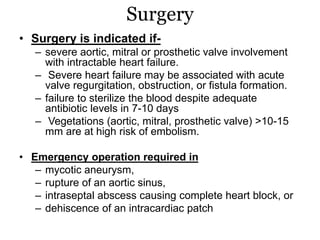
Surgery
• Surgery is indicated if-
– severe aortic, mitral or prosthetic valve involvement
with intractable heart failure.
– Severe heart failure may be associated with acute
valve regurgitation, obstruction, or fistula formation.
– failure to sterilize the blood despite adequate
antibiotic levels in 7-10 days
– Vegetations (aortic, mitral, prosthetic valve) >10-15
mm are at high risk of embolism.
• Emergency operation required in
– mycotic aneurysm,
– rupture of an aortic sinus,
– intraseptal abscess causing complete heart block, or
– dehiscence of an intracardiac patch
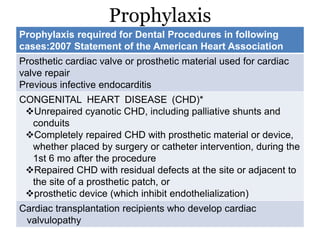
Prophylaxis
Prophylaxis required for Dental Procedures in following
cases:2007 Statement of the American Heart Association
Prosthetic cardiac valve or prosthetic material used for cardiac
valve repair
Previous infective endocarditis
CONGENITAL HEART DISEASE (CHD)*
Unrepaired cyanotic CHD, including palliative shunts and
conduits
Completely repaired CHD with prosthetic material or device,
whether placed by surgery or catheter intervention, during the
1st 6 mo after the procedure
Repaired CHD with residual defects at the site or adjacent to
the site of a prosthetic patch, or
prosthetic device (which inhibit endothelialization)
Cardiac transplantation recipients who develop cardiac
valvulopathy
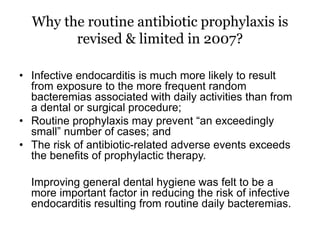
Why the routine antibiotic prophylaxis is
revised & limited in 2007?
• Infective endocarditis is much more likely to result
from exposure to the more frequent random
bacteremias associated with daily activities than from
a dental or surgical procedure;
• Routine prophylaxis may prevent “an exceedingly
small” number of cases; and
• The risk of antibiotic-related adverse events exceeds
the benefits of prophylactic therapy.
Improving general dental hygiene was felt to be a
more important factor in reducing the risk of infective
endocarditis resulting from routine daily bacteremias.
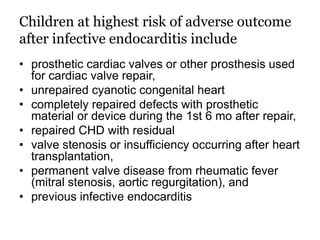
Children at highest risk of adverse outcome
after infective endocarditis include
• prosthetic cardiac valves or other prosthesis used
for cardiac valve repair,
• unrepaired cyanotic congenital heart
• completely repaired defects with prosthetic
material or device during the 1st 6 mo after repair,
• repaired CHD with residual
• valve stenosis or insufficiency occurring after heart
transplantation,
• permanent valve disease from rheumatic fever
(mitral stenosis, aortic regurgitation), and
• previous infective endocarditis
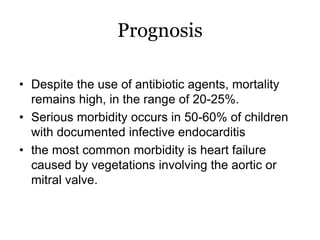
Prognosis
• Despite the use of antibiotic agents, mortality
remains high, in the range of 20-25%.
• Serious morbidity occurs in 50-60% of children
with documented infective endocarditis
• the most common morbidity is heart failure
caused by vegetations involving the aortic or
mitral valve.
Thank you

Infective Endocarditis in Children

  • 1.
    Infective Endocarditis Major (Dr)Jahangir Alam DCH, FCPS Classified Child Specialist Bangladesh Army
  • 2.
    Definition Infective endocarditis isa form of endocarditis, or inflammation, of the inner tissue of the heart (such as its valves) caused by infectious agents. The agents are usually bacterial, but other organisms can also be responsible.
  • 3.
    Epidemiology • Infective endocarditisis often a complication of congenital or rheumatic heart disease. • It is rare in infancy. • Prevalence of Infective endocarditis (IE) accounts for 0.5 to 1 of every 1000 hospital admissions, excluding postoperative endocarditis • The frequency of IE among children seems to have increased in recent years due to – Survivors of surgical repair of complex congenital heart disease – Survivors of neonatal intensive care units, who are at an increased risk for IE.
  • 4.
  • 5.
    A. COMMON: NATIVEVALVE OR OTHER CARDIAC LESIONS  Viridans group streptococci  Staphylococcus aureus  Group D streptococcus Note:  In the past, these organisms were responsible for over 90% of the cases.  This frequency has decreased to 50% to 60%, with a concomitant increase in cases caused by fungi and HACEK organisms (Haemophilus, Actinobacillus, Cardiobacterium, Eikenella, and Kingella).
  • 6.
    B. UNCOMMON: NATIVEVALVE OR OTHER CARDIAC LESIONS  Streptococcus pneumoniae  Haemophilus influenzae  Coagulase-negative staphylococci  Coxiella burnetii (Q fever)*  Brucella*  Chlamydia  HACEK group (Haemophilus, Actinobacillus, Cardiobacterium, Eikenella, and Kingella).  Streptobacillus moniliformis*  Pasteurella multocida*  Campylobacter fetus  Culture negative (6%)
  • 7.
    C. PROSTHETIC VALVE •Staphylococcus epidermidis • Staphylococcus aureus • Viridans group streptococcus • Pseudomonas aeruginosa • Serratia marcescens • Diphtheroids • Legionella species • HACEK group • Fungi
  • 8.
    Association of causativeorganism in various situation Organism responsible Risk factor viridans group streptococcal after dental procedures; Group D enterococci After bowel or genitourinary surgery Pseudomonas aeruginosa or Serratia In I/V drug users fungal organisms after open heart surgery Coagulase -ve staphylococci (S. aureus) indwelling central venous catheter.
  • 9.
  • 10.
    Pathogenesis in congenitalheart lesion Congenital heart lesion Turbulence of blood flow through stenotic orifice Traumatize vascular endothelium Deposition of platelet & fibrin over lesion Formation of non bacterial thrombotic embolus(NBTE) Transient bacterimia colonize NBTE Rapid proliferation of bacteria Infective endocarditis
  • 11.
    Pathogenesis in implantedprosthesis Biofilm on the surface of implanted mechanical device Acts as an adhesive substrate for infection Bacterial colonization over biofilm Rapid proliferation of bacteria Infective endocarditis
  • 12.
  • 13.
    History • Prior congenitalor rheumatic heart disease • Preceding dental, urinary tract, or intestinal procedure • Intravenous drug use • Central venous catheter • Prosthetic heart valve
  • 14.
    Symptoms • Fever :prolong fever without other manifestation may be the early symptoms of IE • Chills • Night sweat • Weight loss • Chest and abdominal pain • fatigue • Arthralgia, myalgia • Dyspnea • Malaise, weakness • CNS manifestations (stroke, seizures, headache)
  • 15.
    Sign • Elevated temperature •Tachycardia • Clubbing • Skin menifestation – Petechiae – Osler’s nodes – Janeway lesions – Splinter hemorrhages • CVS: – Arrhythmias – New or changing murmur – Heart failure • Splenomegaly Osler's nodes Splinter hemorrhages
  • 16.
    Sign contd… • Embolicor immunologic phenomena – Roth spots – Seizures and hemiparesis – Pulmonary haemorrhage – Haematuria & renal failure • Metastatic infection – arthritis, – meningitis, – mycotic arterial aneurysm, – pericarditis, – abscesses, – septic pulmonary emboli Roth spots Janeway lesions
  • 17.
  • 18.
    Laboratory studies • Bloodcultures: – positive in > 90% of patients in the absence of previous antimicrobial therapy – 50% to 60% positive in pretreatment with antibiotics • Complete blood count: – Anemia present in 80% of patient – leukocytosis – Raised ESR – Raised CRP • Urine – Microscopic haematuria is found in 30% of patients
  • 19.
    • Other specimensthat may be cultured: – scrapings from cutaneous lesions, – urine, – synovial fluid, – Abscesses – cerebrospinal fluid • CXR : Evidence of heart failure • ECG: Evidence of underlying heart disease or conduction defect due to abscess.
  • 20.
    Echocardiography Certain echo findingsare included as major criteria in the modified Duke criteria a) Oscillating intracardiac mass on valve or supporting structures, in the path of regurgitation jets, or on implanted material b) Abscesses c) New partial dehiscence of prosthetic valve d) New valvular regurgitation
  • 21.
  • 22.
    The Duke criteriahelp in the diagnosis of endocarditis A. Major criteria: 1) Positive blood cultures a) 2 separate cultures for a usual pathogen, b) 2 or more for less-typical pathogens 2) Evidence of endocarditis on ECHO 1) intracardiac mass on a valve 2) Partial dehiscence of prosthetic valves 3) New valvular regurgitation 4) worsening or changing of pre-existing murmur
  • 23.
    B. Minor criteria 1)fever, 2) embolic-vascular signs, 3) Immune complex phenomena (glomerulonephritis, arthritis, rheumatoid factor, Osler nodes, Roth spots), 4) a single, positive blood culture or serologic evidence of infection, 5) echocardiographic signs not meeting the major criteria. 6) Newly diagnosed clubbing, splenomegaly, splinter hemorrhages, and petechiae; 7) High erythrocyte sedimentation rate; 8) High C-reactive protein level; 9) Presence of central nonfeeding lines,peripheral lines, 10)microscopic hematuria.
  • 24.
    Interpretation of Dukecriteria: Definite endocarditis: 2 major criteria or 1 major and 3 minor or 5 minor criteria Possible endocarditis: 1 major + 1 minor Or 3 monor criteria
  • 25.
    Management • Antibiotics: – Antibiotictherapy should be instituted immediately once a definitive diagnosis is made. – Initial empirical therapy should be • Flucloxacillin/ Methicillin + Gentamicin – If methicillin resistant S. aureus is suspected then • Vancomycin + Gentamicin – The final selection of antibiotics depends on the organism isolated and the results of an antibiotic sensitivity test. – A total of 4-6 wk of treatment is usually recommended.
  • 26.
    Therapy of NativeValve Endocarditis Caused by Highly Penicillin-Susceptible Viridans Group Streptococci and Streptococcus bovis Regimen Dosage & route Duratio (WK) Aqueous crystalline penicillin G sodium 200,000 U/kg per 24 hr IV in 4-6 equally divided doses; 4 Ceftriaxone sodium Aqueous crystalline penicillin G sodium 100 mg/kg per 24 hr IV/IM in 1 dose 200,000 U/kg per 24 hr IV in 4-6 equally divided doses 4 2 Ceftriaxone sodium Gentamicin sulfate 100 mg/kg per 24 hr IV/IM in 1 dose 3 mg/kg per 24 hr IV/IM in 1 dose or 3 equally divided doses 2 2 Vancomycin hydrochloride 40 mg/kg per 24 hr IV in 2-3 equally divided doses 4
  • 27.
    Therapy for EndocarditisCaused by Staphylococci in the Absence of Prosthetic Materials Regimen Dosage & route Duratio (WK) Nafcillin or oxacillin With Optional addition of gentamicin sulfate‡ 200 mg/kg per 24 hr IV in 4-6 equally divided doses 3 mg/kg per 24 hr IV/IM in 3 equally divided doses 6 3-5 d For penicillin-allergic Cefazolin With Optional addition of gentamicin sulfate 100 mg/kg per 24 hr IV in 3 equally divided doses; 3 mg/kg per 24 hr IV/IM in 3 equally divided doses 6 3-5 d OXACILLIN- RESISTANT STRAINS Vancomycin 40 mg/kg per 24 hr IV in 2 or 3 equally divided doses 6
  • 28.
    General management – Bedrest if CHF occurs – Digitalis – Restriction of salt intake – Diuretic when indicated
  • 29.
    Surgery • Surgery isindicated if- – severe aortic, mitral or prosthetic valve involvement with intractable heart failure. – Severe heart failure may be associated with acute valve regurgitation, obstruction, or fistula formation. – failure to sterilize the blood despite adequate antibiotic levels in 7-10 days – Vegetations (aortic, mitral, prosthetic valve) >10-15 mm are at high risk of embolism. • Emergency operation required in – mycotic aneurysm, – rupture of an aortic sinus, – intraseptal abscess causing complete heart block, or – dehiscence of an intracardiac patch
  • 30.
    Prophylaxis Prophylaxis required forDental Procedures in following cases:2007 Statement of the American Heart Association Prosthetic cardiac valve or prosthetic material used for cardiac valve repair Previous infective endocarditis CONGENITAL HEART DISEASE (CHD)* Unrepaired cyanotic CHD, including palliative shunts and conduits Completely repaired CHD with prosthetic material or device, whether placed by surgery or catheter intervention, during the 1st 6 mo after the procedure Repaired CHD with residual defects at the site or adjacent to the site of a prosthetic patch, or prosthetic device (which inhibit endothelialization) Cardiac transplantation recipients who develop cardiac valvulopathy
  • 31.
    Why the routineantibiotic prophylaxis is revised & limited in 2007? • Infective endocarditis is much more likely to result from exposure to the more frequent random bacteremias associated with daily activities than from a dental or surgical procedure; • Routine prophylaxis may prevent “an exceedingly small” number of cases; and • The risk of antibiotic-related adverse events exceeds the benefits of prophylactic therapy. Improving general dental hygiene was felt to be a more important factor in reducing the risk of infective endocarditis resulting from routine daily bacteremias.
  • 32.
    Children at highestrisk of adverse outcome after infective endocarditis include • prosthetic cardiac valves or other prosthesis used for cardiac valve repair, • unrepaired cyanotic congenital heart • completely repaired defects with prosthetic material or device during the 1st 6 mo after repair, • repaired CHD with residual • valve stenosis or insufficiency occurring after heart transplantation, • permanent valve disease from rheumatic fever (mitral stenosis, aortic regurgitation), and • previous infective endocarditis
  • 33.
    Prognosis • Despite theuse of antibiotic agents, mortality remains high, in the range of 20-25%. • Serious morbidity occurs in 50-60% of children with documented infective endocarditis • the most common morbidity is heart failure caused by vegetations involving the aortic or mitral valve.
  • 34.