Congenital Heart Disease
Classification, Epidemiology, Etiology
Clinical Features
Prof. Imran Iqbal
Fellowship in Pediatric Neurology (Australia)
Prof of Paediatrics (2003-2018)
Prof of Pediatrics Emeritus, CHICH
Prof of Pediatrics, CIMS
Multan, Pakistan
Al Quran surah Qaf 50:37
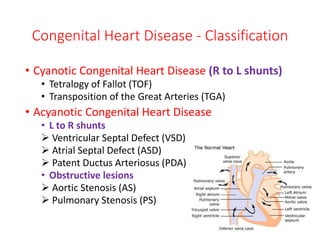
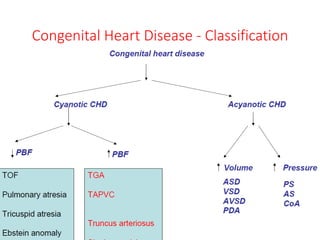
Congenital Heart Disease - Classification
• Cyanotic Congenital Heart Disease (R to L shunts)
• Tetralogy of Fallot (TOF)
• Transposition of the Great Arteries (TGA)
• Acyanotic Congenital Heart Disease
• L to R shunts
 Ventricular Septal Defect (VSD)
 Atrial Septal Defect (ASD)
 Patent Ductus Arteriosus (PDA)
• Obstructive lesions
 Aortic Stenosis (AS)
 Pulmonary Stenosis (PS)
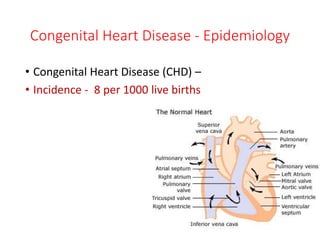
Congenital Heart Disease - Epidemiology
• Congenital Heart Disease (CHD) –
• Incidence - 8 per 1000 live births
Acyanotic Congenital Heart Defects
(Relative Frequency)
• Ventricular Septal Defect (25% of total Congenital
Heart Defects)
• Atrial Septal Defect (7%)
• Patent Ductus Arteriosus (12%)
• Co-arctation of Aorta (5%)
• Aortic Stenosis (5%)
• Pulmonary Stenosis (5%)
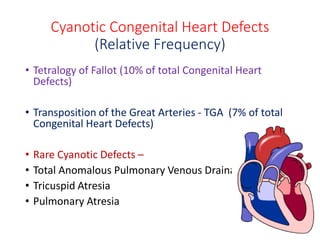
Cyanotic Congenital Heart Defects
(Relative Frequency)
• Tetralogy of Fallot (10% of total Congenital Heart
Defects)
• Transposition of the Great Arteries - TGA (7% of total
Congenital Heart Defects)
• Rare Cyanotic Defects –
• Total Anomalous Pulmonary Venous Drainage
• Tricuspid Atresia
• Pulmonary Atresia
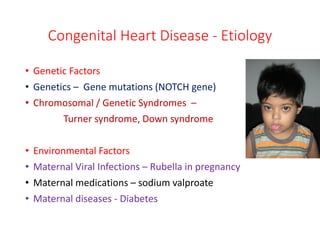
Congenital Heart Disease - Etiology
• Genetic Factors
• Genetics – Gene mutations (NOTCH gene)
• Chromosomal / Genetic Syndromes –
Turner syndrome, Down syndrome
• Environmental Factors
• Maternal Viral Infections – Rubella in pregnancy
• Maternal medications – sodium valproate
• Maternal diseases - Diabetes
Congenital Heart Disease
Clinical Features
Examination of Cardiovascular System
• Dysmorphic features (GPE)
• Color (Cyanosis – on lips, tongue, hands, nails)
• Respiratory rate and effort
• Heart rate and rhythm
• Heart sounds and murmurs
• Pulse (rate, rhythm, volume, peripheral pulses)
• Inspection of precordium
• Palpation of apex beat
• Palpation for thrills and heave
CVS - Abnormal Symptoms
• Bluish discoloration
• Poor feeding
• Sweating on feeding
• Respiratory distress on feeding
• Swelling of face
• Palpitation
CVS – Abnormal Signs
• Cyanosis
• Tachypnoea
• Poorly palpable or absent peripheral pulses
• Hyper-dynamic precordium
• Displaced apex beat
• Thrill or heave present
• Abnormal cardiac rate or rhythm
• Added heart sounds or murmurs
• Hepatomegaly
Clinical features of
Congenital Heart Disease
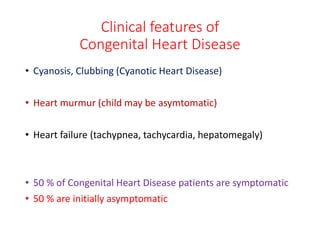
• Cyanosis, Clubbing (Cyanotic Heart Disease)
• Heart murmur (child may be asymtomatic)
• Heart failure (tachypnea, tachycardia, hepatomegaly)
• 50 % of Congenital Heart Disease patients are symptomatic
• 50 % are initially asymptomatic
Differentiate between
Valvular lesions and Flow Murmurs
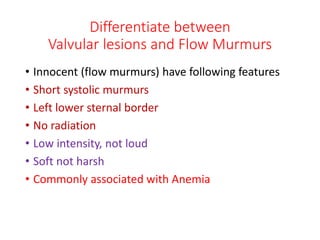
• Innocent (flow murmurs) have following features
• Short systolic murmurs
• Left lower sternal border
• No radiation
• Low intensity, not loud
• Soft not harsh
• Commonly associated with Anemia
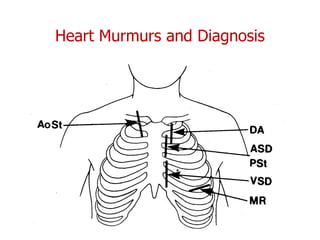
Heart Murmurs and Diagnosis
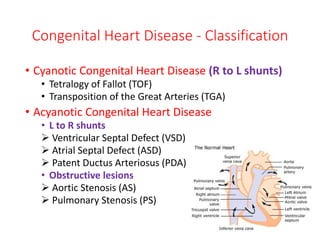
Congenital Heart Disease - Classification
• Cyanotic Congenital Heart Disease (R to L shunts)
• Tetralogy of Fallot (TOF)
• Transposition of the Great Arteries (TGA)
• Acyanotic Congenital Heart Disease
• L to R shunts
 Ventricular Septal Defect (VSD)
 Atrial Septal Defect (ASD)
 Patent Ductus Arteriosus (PDA)
• Obstructive lesions
 Aortic Stenosis (AS)
 Pulmonary Stenosis (PS)
Congenital Heart Disease - Classification

Congenital heart disease 2021

  • 1.
    Congenital Heart Disease Classification,Epidemiology, Etiology Clinical Features Prof. Imran Iqbal Fellowship in Pediatric Neurology (Australia) Prof of Paediatrics (2003-2018) Prof of Pediatrics Emeritus, CHICH Prof of Pediatrics, CIMS Multan, Pakistan
  • 2.
    Al Quran surahQaf 50:37
  • 3.
    Congenital Heart Disease- Classification • Cyanotic Congenital Heart Disease (R to L shunts) • Tetralogy of Fallot (TOF) • Transposition of the Great Arteries (TGA) • Acyanotic Congenital Heart Disease • L to R shunts  Ventricular Septal Defect (VSD)  Atrial Septal Defect (ASD)  Patent Ductus Arteriosus (PDA) • Obstructive lesions  Aortic Stenosis (AS)  Pulmonary Stenosis (PS)
  • 4.
    Congenital Heart Disease- Epidemiology • Congenital Heart Disease (CHD) – • Incidence - 8 per 1000 live births
  • 5.
    Acyanotic Congenital HeartDefects (Relative Frequency) • Ventricular Septal Defect (25% of total Congenital Heart Defects) • Atrial Septal Defect (7%) • Patent Ductus Arteriosus (12%) • Co-arctation of Aorta (5%) • Aortic Stenosis (5%) • Pulmonary Stenosis (5%)
  • 6.
    Cyanotic Congenital HeartDefects (Relative Frequency) • Tetralogy of Fallot (10% of total Congenital Heart Defects) • Transposition of the Great Arteries - TGA (7% of total Congenital Heart Defects) • Rare Cyanotic Defects – • Total Anomalous Pulmonary Venous Drainage • Tricuspid Atresia • Pulmonary Atresia
  • 7.
    Congenital Heart Disease- Etiology • Genetic Factors • Genetics – Gene mutations (NOTCH gene) • Chromosomal / Genetic Syndromes – Turner syndrome, Down syndrome • Environmental Factors • Maternal Viral Infections – Rubella in pregnancy • Maternal medications – sodium valproate • Maternal diseases - Diabetes
  • 8.
  • 9.
    Examination of CardiovascularSystem • Dysmorphic features (GPE) • Color (Cyanosis – on lips, tongue, hands, nails) • Respiratory rate and effort • Heart rate and rhythm • Heart sounds and murmurs • Pulse (rate, rhythm, volume, peripheral pulses) • Inspection of precordium • Palpation of apex beat • Palpation for thrills and heave
  • 10.
    CVS - AbnormalSymptoms • Bluish discoloration • Poor feeding • Sweating on feeding • Respiratory distress on feeding • Swelling of face • Palpitation
  • 11.
    CVS – AbnormalSigns • Cyanosis • Tachypnoea • Poorly palpable or absent peripheral pulses • Hyper-dynamic precordium • Displaced apex beat • Thrill or heave present • Abnormal cardiac rate or rhythm • Added heart sounds or murmurs • Hepatomegaly
  • 12.
    Clinical features of CongenitalHeart Disease • Cyanosis, Clubbing (Cyanotic Heart Disease) • Heart murmur (child may be asymtomatic) • Heart failure (tachypnea, tachycardia, hepatomegaly) • 50 % of Congenital Heart Disease patients are symptomatic • 50 % are initially asymptomatic
  • 13.
    Differentiate between Valvular lesionsand Flow Murmurs • Innocent (flow murmurs) have following features • Short systolic murmurs • Left lower sternal border • No radiation • Low intensity, not loud • Soft not harsh • Commonly associated with Anemia
  • 14.
  • 15.
    Congenital Heart Disease- Classification • Cyanotic Congenital Heart Disease (R to L shunts) • Tetralogy of Fallot (TOF) • Transposition of the Great Arteries (TGA) • Acyanotic Congenital Heart Disease • L to R shunts  Ventricular Septal Defect (VSD)  Atrial Septal Defect (ASD)  Patent Ductus Arteriosus (PDA) • Obstructive lesions  Aortic Stenosis (AS)  Pulmonary Stenosis (PS)
  • 16.
    Congenital Heart Disease- Classification