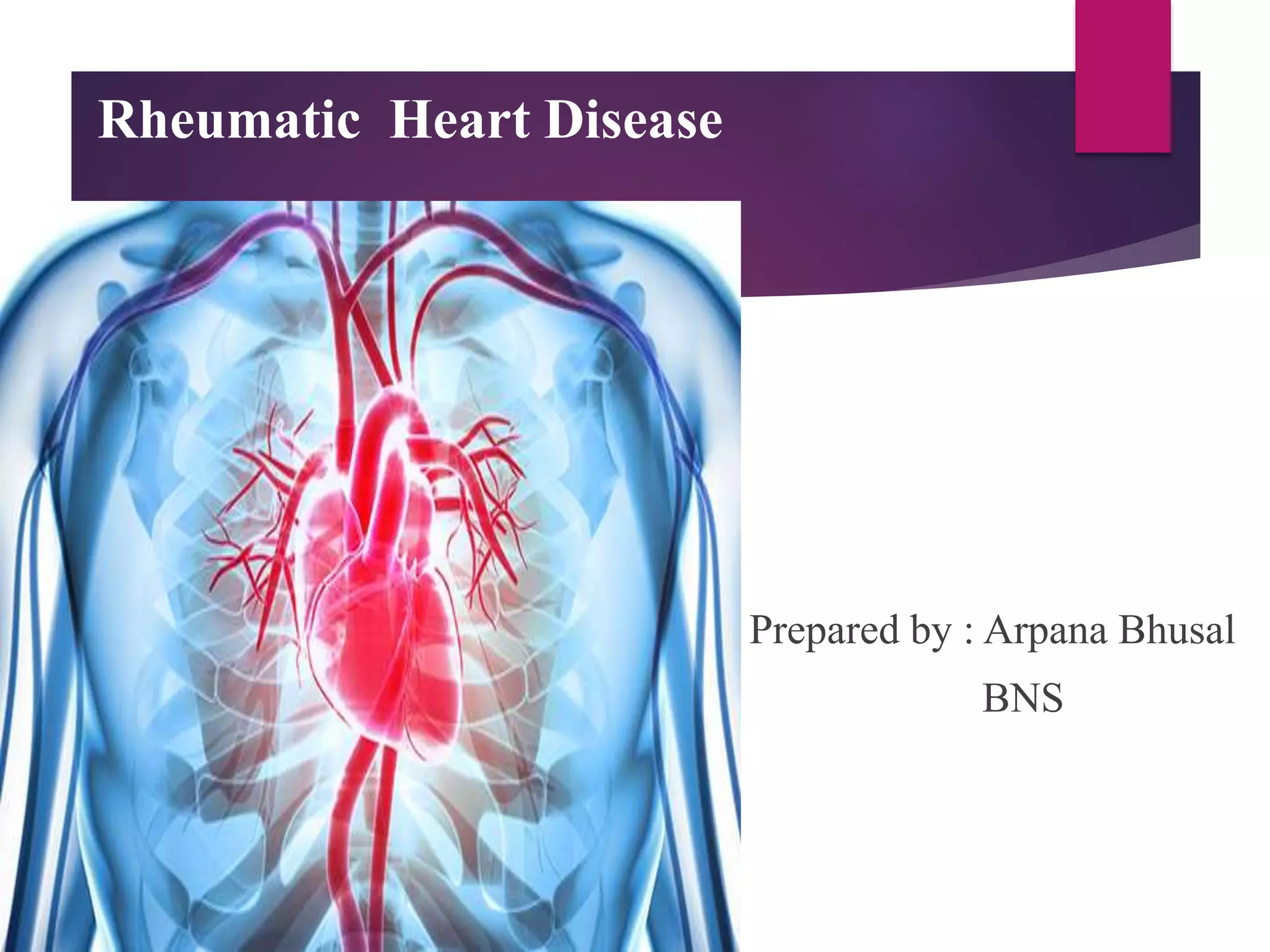
Rheumatic Heart Disease
Prepared by : Arpana Bhusal
BNS
CONTENT
 Introduction
 Definition
 Incidence
 Type
 Risk factors
 Causes
 Pathophysiology
 Sign and symptoms
 Diagnosis
Cont
 Treatment
 Medical management
 Nursing management
 Complication
 Reference
Introduction
 Rheumatic fever is an inflammatory disease that can
develop when strep throat or scarlet fever isn't properly
treated , it can caused rheumatic heart disease . Strep throat
and scarlet fever are caused by an infection with group A
beta hemolytic streptococcus bacteria.
Definition
 Rheumatic heart disease (RHD) is a life-threatening heart
condition which results from damage to heart valves caused
by one or several episodes of rheumatic fever, an
autoimmune inflammatory reaction to infection with
streptococcal bacteria (streptococcal pharyngitis or strep
throat).
 Rheumatic heart disease is caused by damage to the heart
valves and heart muscle from the inflammation and scarring
caused by rheumatic fever.
 Rheumatic heart disease involve permanent damage to the
heart, including damaged heart valves and heart failure.
Types Of Rheumatic Heart
Disease
1. Acute Rheumatic Heart Disease:
Acute rheumatic disease usually occur after the course of
acute rheumatic fever, any condition in with unspecified
type of heart involvement ,rheumatic carditis
2. Chronic rheumatic heart disease :
In chronic rheumatic heart disease, valve are particularly
damage due to chronic inflammation, most commonly
mitral and aortic valve .
Incidence
Worldwide 33.4 million people have rheumatic heart disease
and that 300,000-500,000 new cases of rheumatic fever
(approximately 60% of whom will develop rheumatic heart
disease) occur annually, with 230,000 deaths resulting from its
complications.
Risk factors
Factors that can increase the risk of rheumatic fever
include:
 Poor socio economic status ; people who are poor and
belong to low socio economic condition are prone to get
RHD.
 Over crowding ; people who are living in a slum areas
are more prone to get RHD
 Age ; It appears most commonly in children between the
age of 5-15 years .
Cont.
 Climate and season; It occurs more in the
rainy season and in the cold climate.
 Upper Respiratory tract infection ;
Rheumatic fever is an outcome of upper
respiratory tract infection with group A beta
hemolytic streptococcus .
 Previous history of rheumatic fever
 Genetic predisposition
Causes
 Group A beta hemolytic streptococcus which causes
rheumatic fever
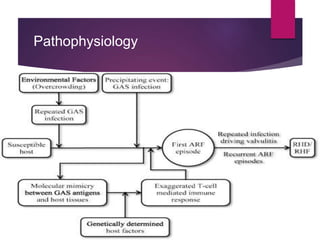
Pathophysiology
Sign And Symptoms
Major manifestation include;
 Carditis
 Polyarthritis
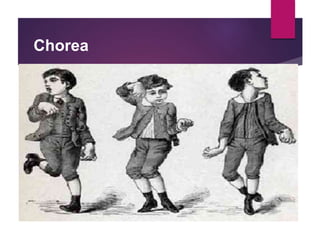
 Chorea
 Erythema marginatum
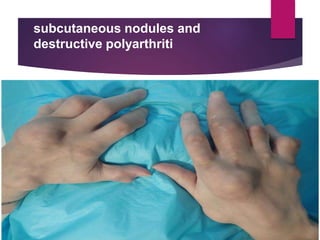
 Subcutaneous nodules
Chorea
Erythema marginatum
subcutaneous nodules and
destructive polyarthriti
 Minor manifestation are as follows:
• Polyarthralgia
• Fever exceeding 38.5°C
• Elevated ESR (>60 mm/hr.) or CRP level (>3 mg/L)
• Prolonged PR interval
Cont.
Symptoms of heart valve damage that is
associated with rheumatic heart disease may
include:
 chest pain or discomfort
 shortness of breath
 swelling of the stomach, hands or feet
 fatigue
 Rapid or irregular heart beat
cont ..
 jerky uncontrollable body movements called
‘chorea’
 painless nodules under the skin near joints
and/or a rash consisting of pink rings
 heart murmur
Diagnostic Evaluation
 Blood cultures
 Antibody titer tests used include ASO test, antistreptococcal
DNase B (ADB) test, and the antistreptococcal hyaluronidase
(AH) test
 erythrocyte sedimentation rate (ESR), and C-reactive protein
levels (CRP)
Radiological examination:
 Chest X-ray; cardiomegaly pulmonary congestion
 Electrocardiogram; prolong P-R interval
 Cardiac MRI, Echocardiogram (echo)
Primary Prophylaxis
 Amoxicillin
• 50 mg per kg (maximum, 1 g) orally once daily for 10
days
 Penicillin G benzathine-
• Patients weighing 27 kg (60 lb.) or less: 600,000 units
IM once
• Patients weighing more than 27 kg: 1,200,000 units IM
once
cont. ..
 Penicillin V potassium
• Patients weighing 27 kg or less: 250 mg orally 2 or 3 times
daily for 10 days
• Patients weighing more than 27 kg: 500 mg orally 2 or 3
times daily for 10 days
cont. ..
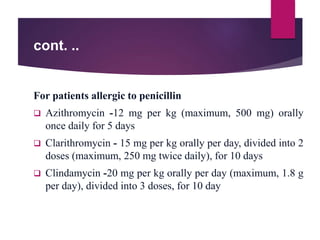
For patients allergic to penicillin
 Azithromycin -12 mg per kg (maximum, 500 mg) orally
once daily for 5 days
 Clarithromycin - 15 mg per kg orally per day, divided into 2
doses (maximum, 250 mg twice daily), for 10 days
 Clindamycin -20 mg per kg orally per day (maximum, 1.8 g
per day), divided into 3 doses, for 10 day
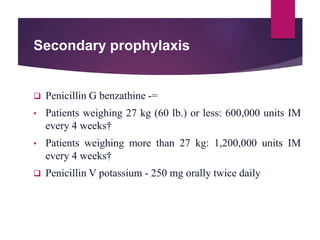
Secondary prophylaxis
 Penicillin G benzathine -=
• Patients weighing 27 kg (60 lb.) or less: 600,000 units IM
every 4 weeks†
• Patients weighing more than 27 kg: 1,200,000 units IM
every 4 weeks†
 Penicillin V potassium - 250 mg orally twice daily
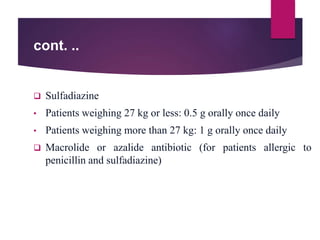
cont. ..
 Sulfadiazine
• Patients weighing 27 kg or less: 0.5 g orally once daily
• Patients weighing more than 27 kg: 1 g orally once daily
 Macrolide or azalide antibiotic (for patients allergic to
penicillin and sulfadiazine)
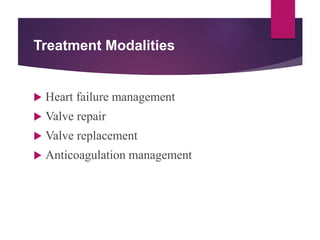
Treatment Modalities
 Heart failure management
 Valve repair
 Valve replacement
 Anticoagulation management
cont. ..
Promote comfort
 Client with arthritic manifestation obtain relief with
salicylates .
 Bed rest usually prescribed to reduce cardiac effort until
evidence of inflammation has subsided
cont. ..
Maximize cardiac output
 Corticosteroids are used to treat carditis , especially if heart
failure is evident .
 If heart failure develops , treatment including ACE
inhibitors , beta blockers and diuretics is effective .
Nursing management
Assessment
 History of family and medical history i.e. present and past
illness
 Assessment of cardiac function, nutritional status,
discomfort level, sleep disturbance,
 Monitor vital sign .
 Assessment of presence of pain, presence of skin lesion.
Nursing diagnosis
 Acute Pain related to inflammation evidenced by verbal
description of pain, edema , redness .
 Hyperthermia related to Illness or inflammatory disease
evidenced by increase body temperature above normal
range, hot, flushed skin.
 Activity intolerance related to decrease cardiac output as
evidence by prolong bed rest.
 Reduce cardiac output related to valve stenosis .
 Risk for infection related to recurrence chronic disease.
Nursing intervention
1. Pain and comfort management
 Administer analgesic to relief pain
 Provide cold / hot compress to relief pain
 Provide quite and calm environment.
 Maintain bed rest during the acute stage of disease.
 Elevate involved extremities above heart level
 Encourage the use of nonpharmacologic interventions such
as relaxation, distraction
 Offering support to reduce anxiety.
Cont..
2. Management of hyperthermia
 Assess temperature, heart rate, and blood pressure
frequently.
 Remove excess cloths and cover
 Provide sponge bath
 Administer antipyretic drugs
 Encourage fluid intake , keep in cool environment.
Cont..
3. Patient will participate in physical activity as
tolerated.
 Monitor vital signs before and during activities.
 Encourage self-care and gradually increasing activities
as allowed and tolerated
Cont.….
 Provide for rest periods, uninterrupted sleep, and
adequate nutritional intake.
 Provide assistance as needed. Suggest use of a shower
chair, sitting while brushing hair or teeth, and other
energy-saving measures.
Cont..
4. Prevent infection:
 Apply infection prevention measures such as hand
washing, linen changes and sterility during
procedures.
 Encourage short stay to prevent nosocomial infections
 Maintain skin and mucosal integrity:
Cont..
5. Prevent complication
 Check vital sign and record it carefully.
 Carefully monitor intake output.
 Closely monitor sign for cardiac tamponade.
6. Nutrition
 Ensure high protein, high carbohydrate,
 low sodium diet to meet adequate nutrition.
 serve attractive meals that stimulate appetite
Complication
 Valve stenosis
 Valve regurgitation
 Damage to the heart muscle
 Heart failure
 Arrhythmia
 Endocarditis
Reference
 MandalG.N.,“Text book of adult nursing” Makalu
publication house (P) Ltd, Dili bazar, Kathmandu
 R.N. Wilma J. phipps “Shafer’s Medical Surgical
Nursing”B.I. Publications PVT LTD, New Delhi
 Datta BN, (1992). “Text book of Pathology” 2nd edition,
Jaypee brothers (p). Ltd, New Delhi
 Mosby,( 2009 ),Medical surgical Nursing (5th edition)
 https://www.mayoclinic.org/diseases-conditions/heart-
attack/diagnosis-treatment/drc-20373112. aug. 2021
Rheumatic heart Disease

Rheumatic heart Disease

  • 1.
    Rheumatic Heart Disease Preparedby : Arpana Bhusal BNS
  • 2.
    CONTENT  Introduction  Definition Incidence  Type  Risk factors  Causes  Pathophysiology  Sign and symptoms  Diagnosis
  • 3.
    Cont  Treatment  Medicalmanagement  Nursing management  Complication  Reference
  • 4.
    Introduction  Rheumatic feveris an inflammatory disease that can develop when strep throat or scarlet fever isn't properly treated , it can caused rheumatic heart disease . Strep throat and scarlet fever are caused by an infection with group A beta hemolytic streptococcus bacteria.
  • 5.
    Definition  Rheumatic heartdisease (RHD) is a life-threatening heart condition which results from damage to heart valves caused by one or several episodes of rheumatic fever, an autoimmune inflammatory reaction to infection with streptococcal bacteria (streptococcal pharyngitis or strep throat).
  • 6.
     Rheumatic heartdisease is caused by damage to the heart valves and heart muscle from the inflammation and scarring caused by rheumatic fever.  Rheumatic heart disease involve permanent damage to the heart, including damaged heart valves and heart failure.
  • 7.
    Types Of RheumaticHeart Disease 1. Acute Rheumatic Heart Disease: Acute rheumatic disease usually occur after the course of acute rheumatic fever, any condition in with unspecified type of heart involvement ,rheumatic carditis 2. Chronic rheumatic heart disease : In chronic rheumatic heart disease, valve are particularly damage due to chronic inflammation, most commonly mitral and aortic valve .
  • 8.
    Incidence Worldwide 33.4 millionpeople have rheumatic heart disease and that 300,000-500,000 new cases of rheumatic fever (approximately 60% of whom will develop rheumatic heart disease) occur annually, with 230,000 deaths resulting from its complications.
  • 9.
    Risk factors Factors thatcan increase the risk of rheumatic fever include:  Poor socio economic status ; people who are poor and belong to low socio economic condition are prone to get RHD.  Over crowding ; people who are living in a slum areas are more prone to get RHD  Age ; It appears most commonly in children between the age of 5-15 years .
  • 10.
    Cont.  Climate andseason; It occurs more in the rainy season and in the cold climate.  Upper Respiratory tract infection ; Rheumatic fever is an outcome of upper respiratory tract infection with group A beta hemolytic streptococcus .  Previous history of rheumatic fever  Genetic predisposition
  • 11.
    Causes  Group Abeta hemolytic streptococcus which causes rheumatic fever
  • 12.
  • 13.
    Sign And Symptoms Majormanifestation include;  Carditis  Polyarthritis  Chorea  Erythema marginatum  Subcutaneous nodules
  • 14.
  • 15.
  • 16.
  • 17.
     Minor manifestationare as follows: • Polyarthralgia • Fever exceeding 38.5°C • Elevated ESR (>60 mm/hr.) or CRP level (>3 mg/L) • Prolonged PR interval
  • 18.
    Cont. Symptoms of heartvalve damage that is associated with rheumatic heart disease may include:  chest pain or discomfort  shortness of breath  swelling of the stomach, hands or feet  fatigue  Rapid or irregular heart beat
  • 19.
    cont ..  jerkyuncontrollable body movements called ‘chorea’  painless nodules under the skin near joints and/or a rash consisting of pink rings  heart murmur
  • 20.
    Diagnostic Evaluation  Bloodcultures  Antibody titer tests used include ASO test, antistreptococcal DNase B (ADB) test, and the antistreptococcal hyaluronidase (AH) test  erythrocyte sedimentation rate (ESR), and C-reactive protein levels (CRP)
  • 21.
    Radiological examination:  ChestX-ray; cardiomegaly pulmonary congestion  Electrocardiogram; prolong P-R interval  Cardiac MRI, Echocardiogram (echo)
  • 22.
    Primary Prophylaxis  Amoxicillin •50 mg per kg (maximum, 1 g) orally once daily for 10 days  Penicillin G benzathine- • Patients weighing 27 kg (60 lb.) or less: 600,000 units IM once • Patients weighing more than 27 kg: 1,200,000 units IM once
  • 23.
    cont. ..  PenicillinV potassium • Patients weighing 27 kg or less: 250 mg orally 2 or 3 times daily for 10 days • Patients weighing more than 27 kg: 500 mg orally 2 or 3 times daily for 10 days
  • 24.
    cont. .. For patientsallergic to penicillin  Azithromycin -12 mg per kg (maximum, 500 mg) orally once daily for 5 days  Clarithromycin - 15 mg per kg orally per day, divided into 2 doses (maximum, 250 mg twice daily), for 10 days  Clindamycin -20 mg per kg orally per day (maximum, 1.8 g per day), divided into 3 doses, for 10 day
  • 25.
    Secondary prophylaxis  PenicillinG benzathine -= • Patients weighing 27 kg (60 lb.) or less: 600,000 units IM every 4 weeks† • Patients weighing more than 27 kg: 1,200,000 units IM every 4 weeks†  Penicillin V potassium - 250 mg orally twice daily
  • 26.
    cont. ..  Sulfadiazine •Patients weighing 27 kg or less: 0.5 g orally once daily • Patients weighing more than 27 kg: 1 g orally once daily  Macrolide or azalide antibiotic (for patients allergic to penicillin and sulfadiazine)
  • 27.
    Treatment Modalities  Heartfailure management  Valve repair  Valve replacement  Anticoagulation management
  • 28.
    cont. .. Promote comfort Client with arthritic manifestation obtain relief with salicylates .  Bed rest usually prescribed to reduce cardiac effort until evidence of inflammation has subsided
  • 29.
    cont. .. Maximize cardiacoutput  Corticosteroids are used to treat carditis , especially if heart failure is evident .  If heart failure develops , treatment including ACE inhibitors , beta blockers and diuretics is effective .
  • 30.
    Nursing management Assessment  Historyof family and medical history i.e. present and past illness  Assessment of cardiac function, nutritional status, discomfort level, sleep disturbance,  Monitor vital sign .  Assessment of presence of pain, presence of skin lesion.
  • 31.
    Nursing diagnosis  AcutePain related to inflammation evidenced by verbal description of pain, edema , redness .  Hyperthermia related to Illness or inflammatory disease evidenced by increase body temperature above normal range, hot, flushed skin.  Activity intolerance related to decrease cardiac output as evidence by prolong bed rest.  Reduce cardiac output related to valve stenosis .  Risk for infection related to recurrence chronic disease.
  • 32.
    Nursing intervention 1. Painand comfort management  Administer analgesic to relief pain  Provide cold / hot compress to relief pain  Provide quite and calm environment.  Maintain bed rest during the acute stage of disease.  Elevate involved extremities above heart level  Encourage the use of nonpharmacologic interventions such as relaxation, distraction  Offering support to reduce anxiety.
  • 33.
    Cont.. 2. Management ofhyperthermia  Assess temperature, heart rate, and blood pressure frequently.  Remove excess cloths and cover  Provide sponge bath  Administer antipyretic drugs  Encourage fluid intake , keep in cool environment.
  • 34.
    Cont.. 3. Patient willparticipate in physical activity as tolerated.  Monitor vital signs before and during activities.  Encourage self-care and gradually increasing activities as allowed and tolerated
  • 35.
    Cont.….  Provide forrest periods, uninterrupted sleep, and adequate nutritional intake.  Provide assistance as needed. Suggest use of a shower chair, sitting while brushing hair or teeth, and other energy-saving measures.
  • 36.
    Cont.. 4. Prevent infection: Apply infection prevention measures such as hand washing, linen changes and sterility during procedures.  Encourage short stay to prevent nosocomial infections  Maintain skin and mucosal integrity:
  • 37.
    Cont.. 5. Prevent complication Check vital sign and record it carefully.  Carefully monitor intake output.  Closely monitor sign for cardiac tamponade.
  • 38.
    6. Nutrition  Ensurehigh protein, high carbohydrate,  low sodium diet to meet adequate nutrition.  serve attractive meals that stimulate appetite
  • 39.
    Complication  Valve stenosis Valve regurgitation  Damage to the heart muscle  Heart failure  Arrhythmia  Endocarditis
  • 41.
    Reference  MandalG.N.,“Text bookof adult nursing” Makalu publication house (P) Ltd, Dili bazar, Kathmandu  R.N. Wilma J. phipps “Shafer’s Medical Surgical Nursing”B.I. Publications PVT LTD, New Delhi  Datta BN, (1992). “Text book of Pathology” 2nd edition, Jaypee brothers (p). Ltd, New Delhi  Mosby,( 2009 ),Medical surgical Nursing (5th edition)  https://www.mayoclinic.org/diseases-conditions/heart- attack/diagnosis-treatment/drc-20373112. aug. 2021

Editor's Notes