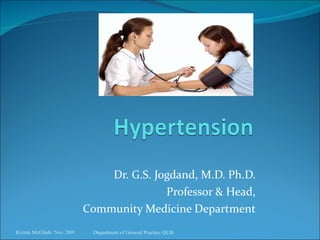
Dr. G.S. Jogdand, M.D. Ph.D. Professor & Head, Community Medicine Department Kieran McGlade  Nov 2001 Department of General Practice QUB
Definition Sir George peckering has made an observation that hypertension is distributed in the population as a continuous variable showing normal distribution. Therefore clear cut definition cannot be given, however for operational feasibility cut off points are taken. Normotension:  systolic B.P. <130 mm. of Hg. Diastolic B.P. < 85 mm. of Hg.  Kieran McGlade  Nov 2001 Department of General Practice QUB
In 2000 global prevalence of HTN was 26.4% and is expected to be >30% by 2025. It is highest in Poland (70%) and lowest in rural India (3.4%). Only few populations living at high altitude are belonging to primitive cultures have exceptionally low B.P. Global Magnitude of the Problem Kieran McGlade  Nov 2001 Department of General Practice QUB
Indian Scenario In India prevalence ranging from 3 to 40% Chennai-21% of adult population Jaipur-30% of adult population Mumbai-34% of adult population Thiruvananthapuram-41% of adult population Kieran McGlade  Nov 2001 Department of General Practice QUB
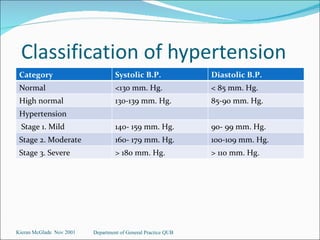
Classification of hypertension Kieran McGlade  Nov 2001 Department of General Practice QUB Category Systolic B.P. Diastolic B.P. Normal <130 mm. Hg. < 85 mm. Hg. High normal 130-139 mm. Hg. 85-90 mm. Hg. Hypertension Stage 1. Mild 140- 159 mm. Hg. 90- 99 mm. Hg. Stage 2. Moderate 160- 179 mm. Hg. 100-109 mm. Hg. Stage 3. Severe > 180 mm. Hg. > 110 mm. Hg.
Rule of halves in Hypertension Kieran McGlade  Nov 2001 Department of General Practice QUB
Aetiology of Hypertension Primary – 90-95% of cases – also termed “essential” or “idiopathic ” Secondary – about 5% of cases Renal or reno-vascular disease Endocrine disease Phaeochromocytoma Cushing’s syndrome Conn’s syndrome Acromegaly and hypothyroidism Coarctation of the aorta Iatrogenic Hormonal / oral contraceptive NSAIDs Kieran McGlade  Nov 2001 Department of General Practice QUB
Patho-physiology of hypertension Atherosclerotic changes in the body: Thickening of blood vessels » increase in peripheral resistance » leads to hypertension.  Hormonal changes in the body. Some secondary infections. No obvious cause. Kieran McGlade  Nov 2001 Department of General Practice QUB
Risk factors for Hypertension Non modifiable: Age. Sex. Ethnicity. Genetic factors. Kieran McGlade  Nov 2001 Department of General Practice QUB
Risk factors continued…. Modifiable: Obesity. Intake of table salt. Intake of saturated fats. Consumption of alcohol. Smoking. Sedentary life style. Environmental stress. S.E. status. Kieran McGlade  Nov 2001 Department of General Practice QUB
Complications of Hypertension Cardiomegaly:  Uncontrolled hypertension leads to thickening of heart musculature. Damage to the target organs: Hypertensive occulopathy. Hypertensive nephropathy. Hypertensive encephalopathy. Myocardial infarction. Stroke. Kieran McGlade  Nov 2001 Department of General Practice QUB
Kieran McGlade  Nov 2001 Department of General Practice QUB This left ventricle is very thickened (slightly over 2 cm in thickness), but the rest of the heart is not greatly enlarged. This is typical for hypertensive heart disease. The hypertension creates a greater pressure load on the heart to induce the hypertrophy.
Kieran McGlade  Nov 2001 Department of General Practice QUB The left ventricle is markedly thickened in this patient with severe hypertension that was untreated for many years. The myocardial fibres have undergone hypertrophy.
Treatment (H O T) Hypertension Optimal Treatment Largest intervention trial in hypertension. Published in 1998 Conducted in General Practice. 18,790 patients in 26 countries Followed up for an average of 3.8 years Kieran McGlade  Nov 2001 Department of General Practice QUB
H O T  Findings Lowest incidence  of major CV events occurred at a mean achieved DBP of 83 mm of hg.  This target (compared to mean achieved of 105 mmHg was associated with a 30% reduction in main CV events). In diabetes – Diastolic B.P. ≤ 80 mm. Hg.  51 % lower risk compared to 90 mm. Hg. Kieran McGlade  Nov 2001 Department of General Practice QUB
Kieran McGlade  Nov 2001 Department of General Practice QUB Global heart threat from diabetes: A global explosion in the number of cases of diabetes is threatening to reverse the reduction in deaths from heart disease in many western countries, including the United Kingdom. To coincide with World Diabetes Day on 14 November, Diabetes UK is calling for action to be taken to reduce the 20,000 deaths per year from coronary heart disease (CHD) among people with diabetes in the UK.
Hypertension and Diabetes Hypertension co-exists with type II in about 40% at age 45 rising to 60% at age 75. 70% of type II patients die from cardio-vascular disease. At least 60% of patients will require 2 or 3 antihypertensive agents to achieve tight control. Kieran McGlade  Nov 2001 Department of General Practice QUB
Stages Identification of hypertensive patients Baseline investigations Initiating therapy Reviewing patients Stepping up therapy Motivation and compliance Kieran McGlade  Nov 2001 Department of General Practice QUB
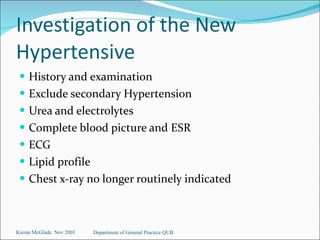
Investigation of the New Hypertensive History and examination Exclude secondary Hypertension Urea and electrolytes Complete blood picture and ESR ECG Lipid profile Chest x-ray no longer routinely indicated Kieran McGlade  Nov 2001 Department of General Practice QUB
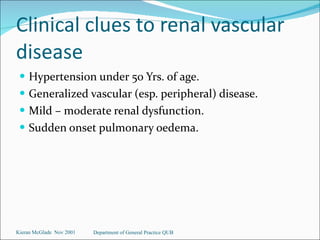
Clinical clues to renal vascular disease Hypertension under 50 Yrs. of age. Generalized vascular (esp. peripheral) disease. Mild – moderate renal dysfunction. Sudden onset pulmonary oedema. Kieran McGlade  Nov 2001 Department of General Practice QUB
Ladder Approach Bendrofluazide Bendrofluazide + Atenolol or ACE Calcium Channel blocker Alpha blocker Kieran McGlade  Nov 2001 Department of General Practice QUB
Tailored Approach Assessment of overall cardiovascular risk Recognition of co-morbidities Lipid profile Renal function Existing contra- indications Kieran McGlade  Nov 2001 Department of General Practice QUB
Kieran McGlade  Nov 2001 Department of General Practice QUB
Kieran McGlade  Nov 2001 Department of General Practice QUB Compelling and possible indications and contraindications for the major classes of antihypertensive drugs                                    INDICATIONS                   CONTRAINDICATIONS *  ACE inhibitors may be beneficial in chronic renal failure but should be used with caution. Close supervision and specialist  advice are needed when there is established and significant renal impairment   †   Caution with ACE inhibitors and angiotensin II receptor antagonists in peripheral vascular disease because of association         with renovascular disease.   ‡   If ACE inhibitor indicated    -blockers may worsen heart failure, but in specialist hands may be used to treat heart failure     British Hypertension Society Guidelines 2000  CLASSS OF DRUG COMPELLING POSSIBLE POSSIBLE COMPELLING  -blockers Prostatism Dyslipidaemia Postural Hypotension Unrinary incontinence Angiotensin converting enzyme (ACE) inhibitors Heart failure   Left ventricular dysfunction Chronic renal disease *   Type II diabetic nephropathy Renal impairment *   Peripheral vascular disease † Pregnancy   Renovascular disease Angiotensin II receptor antagonists Cough induced by ACE inhibitor ‡  Heart failure   Intolerance of other antihypertensive drugs Peripheral vascular disease Pregnancy   Renovascular disease  blockers     Myocardial infarction   Angina     Heart failure        Heart failure   Dyslipidaemia   Peripheral vascular disease Asthma or COPD   Heart block Calcium antagonists (dihydropyridine) Isolated systolic hypertension (ISH) in elderly patients Angina   Elderly patients    _     _ Calcium antagonists (rate limiting) Angina Myocardial infarction Combination with   blockade Heart block   Heart failure Thiazides Elderly patients including ISH    _ Dyslipidaemia Gout
Kieran McGlade  Nov 2001 Department of General Practice QUB Therapeutic targets *                              Measured in clinic                Mean daytime ABPM                                                                        or home measurement   Blood Pressure            No diabetes      Diabetes                No diabetes        Diabetes   Optimal                          <140/85             <140/80                   <130/80              <130/75   Audit Standard             <150/90             <140/85                  <140/85              <140/80         The audit standard reflects the minimum recommended levels of BP control.  Despite best practice, it may not be achievable in some treated hypertensive patients.   NB: Both systolic  and  diastolic targets should be reached British Hypertension Society Guidelines
Kieran McGlade  Nov 2001 Department of General Practice QUB *  Verapramil + beta-blocker = absolute contra-indication         Diuretic  - blocker CCB ACE inhibitor  - blocker Diuretic           -            -    - blocker            -  *           -  CCB           -  *           -   ACE inhibitor            -            -   - blocker               -
ACE Inhibitor Side Effects Cough (15% of patients. Is reversible) Taste disturbance  (reversible) Angiodema First-dose hypotension Hyperkalaemia ( esp. in patients with type II diabetes and renal dysfunction) Kieran McGlade  Nov 2001 Department of General Practice QUB
Follow-up For patients with BP stabilised by management, follow up should normally be three monthly (interval should not exceed 6 months), at which the following should be assessed by a trained nurse:   *   Measurement of BP and weight    *   Reinforcement of non-pharmacological advice   *   General health and drug side-effects    *   Test urine for proteinuria (annually) Kieran McGlade  Nov 2001 Department of General Practice QUB
Drug Treatment of Essential Hypertension in Older People Hypertension is very common, occuring in over 50% of older people, and is a major risk factor for stroke and ischaemic heart disease.  Drug treatment of hypertension in older people saves lives and prevents unnecessary morbidity.  Treating isolated systolic hypertension also saves lives.  Kieran McGlade  Nov 2001 Department of General Practice QUB
Drug Treatment of Essential Hypertension in Older People There is strong evidence to support the use of diuretics as first-line agents.  Antihypertensive treatments are most cost-effective when targeted at older patients.  There is evidence of under detection and under treatment of hypertension.  Factors influencing patient adherence with treatment are not well understood and require further research.  Kieran McGlade  Nov 2001 Department of General Practice QUB
Kieran McGlade  Nov 2001 Department of General Practice QUB RECOMMENDATIONS   (for the treatment of the elderly) Through the wider use of antihypertensive therapies more older people would be able to maintain a healthy and active lifestyle.  For first-line agents there is strong evidence to support the use of diuretics and some evidence for the use of beta-blockers.  Systems to ensure that older people with hypertension are diagnosed, treated and followed up need to be developed.  A system of audit should be cultivated to assure adequate treatment.  High quality research on patient adherence with antihypertensive medications is needed.  NHS Centre for reviews and dissemination 1999
Practical Points 15 – 20% of adult western population. Isolated systolic hypertension just as dangerous. Primary cause identified in only 5%. Investigate – Urine, FBP, ESR, ECG, U&E, Lipids. Target < 140/85. Bendrofluazide 2.5 mg a good starting point. Refer patients needing more than 3 drugs to control their hypertension. Kieran McGlade  Nov 2001 Department of General Practice QUB
Prevention & Control Primordial prevention. Primary prevention. Secondary prevention. Primordial prevention strategy: Targeted at controlling the emergence and spread of risk factors in the community. Primary prevention strategies: 1. Population strategy involves multi-dimensional  approach Nutrition education: reduction of salt intake, not more than 5gms./day Kieran McGlade  Nov 2001 Department of General Practice QUB
Continued…. Weight reduction: Life style modification. Cessation of smoking and alcohol intake. Non phamacotheraputic intervention: Practicing yoga and meditation regularly. Health education. Self care.  High risk strategy:  Appropriate if the prevalence of risk factors in the community is low. Kieran McGlade  Nov 2001 Department of General Practice QUB
Early detection of cases. Early initiation of  treatment. Follow up of cases. Secondary prevention Kieran McGlade  Nov 2001 Department of General Practice QUB
Web based references British Hypertension Society:  http://www.hyp.ac.uk/bhs/ Summary Guidelines 2000: http://www.hyp.ac.uk/bhs/gl2000.htm Hypertension audit protocol from Leicester http://www.le.ac.uk/genpractice/gpaudit/htnprot.html Kieran McGlade  Nov 2001 Department of General Practice QUB
Thank You Kieran McGlade  Nov 2001 Department of General Practice QUB

Hypertension

  • 1.
    Dr. G.S. Jogdand,M.D. Ph.D. Professor & Head, Community Medicine Department Kieran McGlade Nov 2001 Department of General Practice QUB
  • 2.
    Definition Sir Georgepeckering has made an observation that hypertension is distributed in the population as a continuous variable showing normal distribution. Therefore clear cut definition cannot be given, however for operational feasibility cut off points are taken. Normotension: systolic B.P. <130 mm. of Hg. Diastolic B.P. < 85 mm. of Hg. Kieran McGlade Nov 2001 Department of General Practice QUB
  • 3.
    In 2000 globalprevalence of HTN was 26.4% and is expected to be >30% by 2025. It is highest in Poland (70%) and lowest in rural India (3.4%). Only few populations living at high altitude are belonging to primitive cultures have exceptionally low B.P. Global Magnitude of the Problem Kieran McGlade Nov 2001 Department of General Practice QUB
  • 4.
    Indian Scenario InIndia prevalence ranging from 3 to 40% Chennai-21% of adult population Jaipur-30% of adult population Mumbai-34% of adult population Thiruvananthapuram-41% of adult population Kieran McGlade Nov 2001 Department of General Practice QUB
  • 5.
    Classification of hypertensionKieran McGlade Nov 2001 Department of General Practice QUB Category Systolic B.P. Diastolic B.P. Normal <130 mm. Hg. < 85 mm. Hg. High normal 130-139 mm. Hg. 85-90 mm. Hg. Hypertension Stage 1. Mild 140- 159 mm. Hg. 90- 99 mm. Hg. Stage 2. Moderate 160- 179 mm. Hg. 100-109 mm. Hg. Stage 3. Severe > 180 mm. Hg. > 110 mm. Hg.
  • 6.
    Rule of halvesin Hypertension Kieran McGlade Nov 2001 Department of General Practice QUB
  • 7.
    Aetiology of HypertensionPrimary – 90-95% of cases – also termed “essential” or “idiopathic ” Secondary – about 5% of cases Renal or reno-vascular disease Endocrine disease Phaeochromocytoma Cushing’s syndrome Conn’s syndrome Acromegaly and hypothyroidism Coarctation of the aorta Iatrogenic Hormonal / oral contraceptive NSAIDs Kieran McGlade Nov 2001 Department of General Practice QUB
  • 8.
    Patho-physiology of hypertensionAtherosclerotic changes in the body: Thickening of blood vessels » increase in peripheral resistance » leads to hypertension. Hormonal changes in the body. Some secondary infections. No obvious cause. Kieran McGlade Nov 2001 Department of General Practice QUB
  • 9.
    Risk factors forHypertension Non modifiable: Age. Sex. Ethnicity. Genetic factors. Kieran McGlade Nov 2001 Department of General Practice QUB
  • 10.
    Risk factors continued….Modifiable: Obesity. Intake of table salt. Intake of saturated fats. Consumption of alcohol. Smoking. Sedentary life style. Environmental stress. S.E. status. Kieran McGlade Nov 2001 Department of General Practice QUB
  • 11.
    Complications of HypertensionCardiomegaly: Uncontrolled hypertension leads to thickening of heart musculature. Damage to the target organs: Hypertensive occulopathy. Hypertensive nephropathy. Hypertensive encephalopathy. Myocardial infarction. Stroke. Kieran McGlade Nov 2001 Department of General Practice QUB
  • 12.
    Kieran McGlade Nov 2001 Department of General Practice QUB This left ventricle is very thickened (slightly over 2 cm in thickness), but the rest of the heart is not greatly enlarged. This is typical for hypertensive heart disease. The hypertension creates a greater pressure load on the heart to induce the hypertrophy.
  • 13.
    Kieran McGlade Nov 2001 Department of General Practice QUB The left ventricle is markedly thickened in this patient with severe hypertension that was untreated for many years. The myocardial fibres have undergone hypertrophy.
  • 14.
    Treatment (H OT) Hypertension Optimal Treatment Largest intervention trial in hypertension. Published in 1998 Conducted in General Practice. 18,790 patients in 26 countries Followed up for an average of 3.8 years Kieran McGlade Nov 2001 Department of General Practice QUB
  • 15.
    H O T Findings Lowest incidence of major CV events occurred at a mean achieved DBP of 83 mm of hg. This target (compared to mean achieved of 105 mmHg was associated with a 30% reduction in main CV events). In diabetes – Diastolic B.P. ≤ 80 mm. Hg. 51 % lower risk compared to 90 mm. Hg. Kieran McGlade Nov 2001 Department of General Practice QUB
  • 16.
    Kieran McGlade Nov 2001 Department of General Practice QUB Global heart threat from diabetes: A global explosion in the number of cases of diabetes is threatening to reverse the reduction in deaths from heart disease in many western countries, including the United Kingdom. To coincide with World Diabetes Day on 14 November, Diabetes UK is calling for action to be taken to reduce the 20,000 deaths per year from coronary heart disease (CHD) among people with diabetes in the UK.
  • 17.
    Hypertension and DiabetesHypertension co-exists with type II in about 40% at age 45 rising to 60% at age 75. 70% of type II patients die from cardio-vascular disease. At least 60% of patients will require 2 or 3 antihypertensive agents to achieve tight control. Kieran McGlade Nov 2001 Department of General Practice QUB
  • 18.
    Stages Identification ofhypertensive patients Baseline investigations Initiating therapy Reviewing patients Stepping up therapy Motivation and compliance Kieran McGlade Nov 2001 Department of General Practice QUB
  • 19.
    Investigation of theNew Hypertensive History and examination Exclude secondary Hypertension Urea and electrolytes Complete blood picture and ESR ECG Lipid profile Chest x-ray no longer routinely indicated Kieran McGlade Nov 2001 Department of General Practice QUB
  • 20.
    Clinical clues torenal vascular disease Hypertension under 50 Yrs. of age. Generalized vascular (esp. peripheral) disease. Mild – moderate renal dysfunction. Sudden onset pulmonary oedema. Kieran McGlade Nov 2001 Department of General Practice QUB
  • 21.
    Ladder Approach BendrofluazideBendrofluazide + Atenolol or ACE Calcium Channel blocker Alpha blocker Kieran McGlade Nov 2001 Department of General Practice QUB
  • 22.
    Tailored Approach Assessmentof overall cardiovascular risk Recognition of co-morbidities Lipid profile Renal function Existing contra- indications Kieran McGlade Nov 2001 Department of General Practice QUB
  • 23.
    Kieran McGlade Nov 2001 Department of General Practice QUB
  • 24.
    Kieran McGlade Nov 2001 Department of General Practice QUB Compelling and possible indications and contraindications for the major classes of antihypertensive drugs                                 INDICATIONS                 CONTRAINDICATIONS *  ACE inhibitors may be beneficial in chronic renal failure but should be used with caution. Close supervision and specialist  advice are needed when there is established and significant renal impairment †   Caution with ACE inhibitors and angiotensin II receptor antagonists in peripheral vascular disease because of association         with renovascular disease. ‡   If ACE inhibitor indicated  -blockers may worsen heart failure, but in specialist hands may be used to treat heart failure   British Hypertension Society Guidelines 2000 CLASSS OF DRUG COMPELLING POSSIBLE POSSIBLE COMPELLING  -blockers Prostatism Dyslipidaemia Postural Hypotension Unrinary incontinence Angiotensin converting enzyme (ACE) inhibitors Heart failure Left ventricular dysfunction Chronic renal disease * Type II diabetic nephropathy Renal impairment * Peripheral vascular disease † Pregnancy Renovascular disease Angiotensin II receptor antagonists Cough induced by ACE inhibitor ‡  Heart failure Intolerance of other antihypertensive drugs Peripheral vascular disease Pregnancy Renovascular disease  blockers   Myocardial infarction Angina   Heart failure     Heart failure Dyslipidaemia Peripheral vascular disease Asthma or COPD Heart block Calcium antagonists (dihydropyridine) Isolated systolic hypertension (ISH) in elderly patients Angina Elderly patients   _    _ Calcium antagonists (rate limiting) Angina Myocardial infarction Combination with  blockade Heart block Heart failure Thiazides Elderly patients including ISH   _ Dyslipidaemia Gout
  • 25.
    Kieran McGlade Nov 2001 Department of General Practice QUB Therapeutic targets *                            Measured in clinic               Mean daytime ABPM                                                                     or home measurement Blood Pressure            No diabetes      Diabetes                No diabetes        Diabetes Optimal                         <140/85            <140/80                   <130/80              <130/75 Audit Standard             <150/90             <140/85                  <140/85              <140/80     The audit standard reflects the minimum recommended levels of BP control.  Despite best practice, it may not be achievable in some treated hypertensive patients. NB: Both systolic and diastolic targets should be reached British Hypertension Society Guidelines
  • 26.
    Kieran McGlade Nov 2001 Department of General Practice QUB * Verapramil + beta-blocker = absolute contra-indication     Diuretic  - blocker CCB ACE inhibitor  - blocker Diuretic          -           -    - blocker           -  *          -  CCB          -  *          -   ACE inhibitor           -           -   - blocker              -
  • 27.
    ACE Inhibitor SideEffects Cough (15% of patients. Is reversible) Taste disturbance (reversible) Angiodema First-dose hypotension Hyperkalaemia ( esp. in patients with type II diabetes and renal dysfunction) Kieran McGlade Nov 2001 Department of General Practice QUB
  • 28.
    Follow-up For patientswith BP stabilised by management, follow up should normally be three monthly (interval should not exceed 6 months), at which the following should be assessed by a trained nurse: *   Measurement of BP and weight  *   Reinforcement of non-pharmacological advice *   General health and drug side-effects  *   Test urine for proteinuria (annually) Kieran McGlade Nov 2001 Department of General Practice QUB
  • 29.
    Drug Treatment ofEssential Hypertension in Older People Hypertension is very common, occuring in over 50% of older people, and is a major risk factor for stroke and ischaemic heart disease. Drug treatment of hypertension in older people saves lives and prevents unnecessary morbidity. Treating isolated systolic hypertension also saves lives. Kieran McGlade Nov 2001 Department of General Practice QUB
  • 30.
    Drug Treatment ofEssential Hypertension in Older People There is strong evidence to support the use of diuretics as first-line agents. Antihypertensive treatments are most cost-effective when targeted at older patients. There is evidence of under detection and under treatment of hypertension. Factors influencing patient adherence with treatment are not well understood and require further research. Kieran McGlade Nov 2001 Department of General Practice QUB
  • 31.
    Kieran McGlade Nov 2001 Department of General Practice QUB RECOMMENDATIONS (for the treatment of the elderly) Through the wider use of antihypertensive therapies more older people would be able to maintain a healthy and active lifestyle. For first-line agents there is strong evidence to support the use of diuretics and some evidence for the use of beta-blockers. Systems to ensure that older people with hypertension are diagnosed, treated and followed up need to be developed. A system of audit should be cultivated to assure adequate treatment. High quality research on patient adherence with antihypertensive medications is needed. NHS Centre for reviews and dissemination 1999
  • 32.
    Practical Points 15– 20% of adult western population. Isolated systolic hypertension just as dangerous. Primary cause identified in only 5%. Investigate – Urine, FBP, ESR, ECG, U&E, Lipids. Target < 140/85. Bendrofluazide 2.5 mg a good starting point. Refer patients needing more than 3 drugs to control their hypertension. Kieran McGlade Nov 2001 Department of General Practice QUB
  • 33.
    Prevention & ControlPrimordial prevention. Primary prevention. Secondary prevention. Primordial prevention strategy: Targeted at controlling the emergence and spread of risk factors in the community. Primary prevention strategies: 1. Population strategy involves multi-dimensional approach Nutrition education: reduction of salt intake, not more than 5gms./day Kieran McGlade Nov 2001 Department of General Practice QUB
  • 34.
    Continued…. Weight reduction:Life style modification. Cessation of smoking and alcohol intake. Non phamacotheraputic intervention: Practicing yoga and meditation regularly. Health education. Self care. High risk strategy: Appropriate if the prevalence of risk factors in the community is low. Kieran McGlade Nov 2001 Department of General Practice QUB
  • 35.
    Early detection ofcases. Early initiation of treatment. Follow up of cases. Secondary prevention Kieran McGlade Nov 2001 Department of General Practice QUB
  • 36.
    Web based referencesBritish Hypertension Society: http://www.hyp.ac.uk/bhs/ Summary Guidelines 2000: http://www.hyp.ac.uk/bhs/gl2000.htm Hypertension audit protocol from Leicester http://www.le.ac.uk/genpractice/gpaudit/htnprot.html Kieran McGlade Nov 2001 Department of General Practice QUB
  • 37.
    Thank You KieranMcGlade Nov 2001 Department of General Practice QUB