Name :Obieda Mansour
Title : Rheumatic Heart
Disease
Outline:
Definition
Prevalence
etiology
Predisposing factors
Pathophysiology
Clinical manifestation
Laboratory +diagnostic tests
Complications
Nursing management
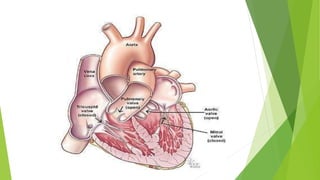
What is Rheumatic fever
Rheumatic fever is an inflammatory disease of the
heart potentially involving all the layers of the
heart ( endocardium ,myocardium and
pericardium, particularly the valves), resulting
heart damage in valve leakage
(insufficiency) and/or obstruction (narrowing or
stenosis)the resulting damage from rheumatic
fever is called Rheumatic Heart Disease (RHD)
Prevalence
 Acute rheumatic fever is complication of respiratory infection caused by
group A B-hemolytic streptococci
 ARF are most common from age 6 to 15 years .
 ARF may attack again up to age 22
etiology
 ARF occur 3 weeks after group A β-streptococcal infection of the upper
respiratory system
 The Streptococcus is spread by direct contact with oral or respiratory
secretions
Predisposing factors
 Immune system (immune system may be genetically weak )( risk for infection
and development )
 Socioeconomic factors (overcrowding)(lower socioeconomic status)
 Family factors ( genetics )
 Nutrition (poor nutrition-bad health )(malnutrition)
 poor hygiene
Pathophysiology
 Rheumatic fever is a sequela to group A streptococcal infection that occurs in
about 3% of untreated infections.
 It is a preventable disease through the detection and adequate treatment of
streptococcal pharyngitis.
 Connective tissue of the heart, blood vessels, joints, and subcutaneous tissues
are affected.
 Lesions in connective tissue are known as Aschoff bodies, which are localized
areas of tissue necrosis surrounded by immune cells.
Patho cont.
 Heart valves are affected, resulting in valve leakage and
narrowing.
 Compensatory changes in the chamber sizes and thickness
of chamber walls occur.
 Heart involvement (carditis) also includes pericarditis,
myocarditis, and endocarditis
Clinical manifestation
 Symptoms of streptococcal pharyngitis may precede rheumatic
symptoms :
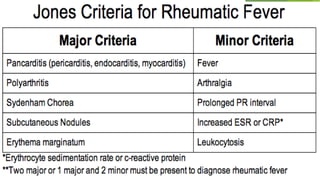
1. fever (38.9 to 40 C)
2. chills
3. Sore throat (sudden )
4. Abdominal pain (children)
5. Enlarged and tender lymph nodes
 polyarthritis
 Chorea
 Erythema marginatum
 Subcutaneous nodules
 Carditis
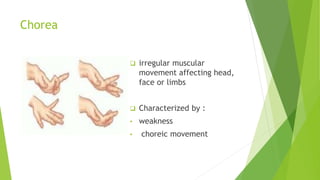
Chorea
 irregular muscular
movement affecting head,
face or limbs
 Characterized by :
• weakness
• choreic movement
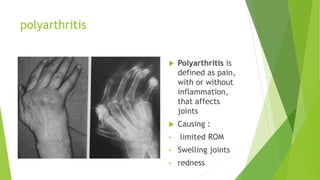
polyarthritis
 Polyarthritis is
defined as pain,
with or without
inflammation,
that affects
joints
 Causing :
• limited ROM
• Swelling joints
• redness
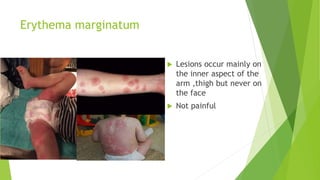
Erythema marginatum
 Lesions occur mainly on
the inner aspect of the
arm ,thigh but never on
the face
 Not painful
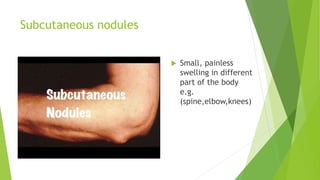
Subcutaneous nodules
 Small, painless
swelling in different
part of the body
e.g.
(spine,elbow,knees)
Carditis
 It is important manifestation
 It include :
Myocarditis, Pericarditis and Endocarditis
Heart murmur
Aortic regurigation
Cardiac enlargement
Chest pain
Laboratory and Diagnostic Tests
 •WBC count and ESR is elevated
 • C- reactive protein is positive.
 • Cardiac enzymes levels may increase in severe carditis.
 • Throat cultures continue to presence of GABS; however they usually occur
in small numbers. Isolating them is difficult.
 • ECG reveals no diagnostic changes, but 20% of patient show a prolonged PR
interval. Echocardiography helps evaluate valvular damage, chamber size,
ventricular function and the presence of a pericardial effusion.
 • Cardiac catheter evaluates valvular damage and left ventricular function in
severe cardiac dysfunction.
Complication
 Heart failure
 Atrial fibrillation
 Infective endocarditis
 Atrial and ventricular arrhythmias
 cerebral vascular complications
 valve stenosis or regurgitation
 myocardial damage
Treatment
 Antibiotics
 Anti-inflammatory treatment.
 Anticonvulsant medications. For severe involuntary
movements caused by Sydenham chorea,
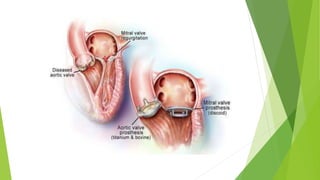
 Valve replacement
Nursing management
 Teaching patients about the disease ,its treatment and the
prevention steps needed to avoid potential complication
 Monitor patient’s temperature; a fever may be present for
weeks
 Assess heart sounds for new or worsening murmur
 Instruct patient and family about activity restrictions,
medications, and signs and symptoms of infection.
 Assess for signs and symptoms of organ damage such as
stroke , meningitis, heart failure, myocardial infarction
Medical Management
 Isolating causative organism through serial blood
cultures. Blood cultures are taken to monitor the course
of therapy.
 Monitoring patient’s temperature for effectiveness of the
treatment.
 After recovery from the infectious process, seriously
damaged valves may require debridement or
replacement.
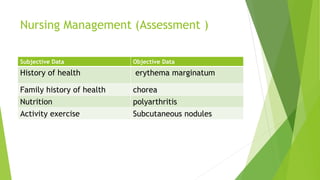
Nursing Management (Assessment )
Subjective Data Objective Data
History of health erythema marginatum
Family history of health chorea
Nutrition polyarthritis
Activity exercise Subcutaneous nodules
Collaborative Care
 Penicillin (elimination of group A B-Hemolytic
streptococci )
 Corticosteroids (anti-inflammatory to control fever and
joint manifestations)
Nursing diagnosis
 Acute Pain related to migratory inflammation of
the joints.
 Activity Intolerance related to joint pain.
 Altered thermoregulation (Hyperthermia) related to
microorganisms invasion
 Decreased cardiac output related to valve dysfunction of
heart failure
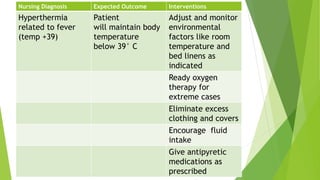
Nursing Diagnosis Expected Outcome Interventions
Hyperthermia
related to fever
(temp +39)
Patient
will maintain body
temperature
below 39° C
Adjust and monitor
environmental
factors like room
temperature and
bed linens as
indicated
Ready oxygen
therapy for
extreme cases
Eliminate excess
clothing and covers
Encourage fluid
intake
Give antipyretic
medications as
prescribed
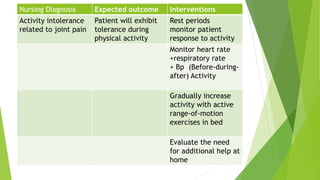
Nursing Diagnosis Expected outcome Interventions
Activity intolerance
related to joint pain
Patient will exhibit
tolerance during
physical activity
Rest periods
monitor patient
response to activity
Monitor heart rate
+respiratory rate
+ Bp (Before-during-
after) Activity
Gradually increase
activity with active
range-of-motion
exercises in bed
Evaluate the need
for additional help at
home
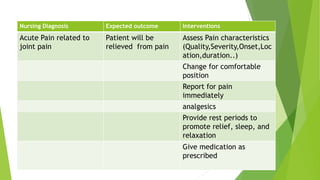
Nursing Diagnosis Expected outcome Interventions
Acute Pain related to
joint pain
Patient will be
relieved from pain
Assess Pain characteristics
(Quality,Severity,Onset,Loc
ation,duration..)
Change for comfortable
position
Report for pain
immediately
analgesics
Provide rest periods to
promote relief, sleep, and
relaxation
Give medication as
prescribed
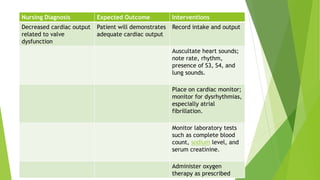
Nursing Diagnosis Expected Outcome Interventions
Decreased cardiac output
related to valve
dysfunction
Patient will demonstrates
adequate cardiac output
Record intake and output
Auscultate heart sounds;
note rate, rhythm,
presence of S3, S4, and
lung sounds.
Place on cardiac monitor;
monitor for dysrhythmias,
especially atrial
fibrillation.
Monitor laboratory tests
such as complete blood
count, sodium level, and
serum creatinine.
Administer oxygen
therapy as prescribed
Reference
 Dermatology Book By Jean L. Bolognia, Joseph L. Jorizzo, Ronald P.(
2008)(224)
 Brunner book (780)(cardiovascular unit)
 Suddarth’s textbook of medical-surgical nursing (12th ed.). Philadelphia:
Lippincott Williams & Wilkins.

Rheumatic heart disease (nursing ppt )

  • 1.
    Name :Obieda Mansour Title: Rheumatic Heart Disease Outline: Definition Prevalence etiology Predisposing factors Pathophysiology Clinical manifestation Laboratory +diagnostic tests Complications Nursing management
  • 3.
    What is Rheumaticfever Rheumatic fever is an inflammatory disease of the heart potentially involving all the layers of the heart ( endocardium ,myocardium and pericardium, particularly the valves), resulting heart damage in valve leakage (insufficiency) and/or obstruction (narrowing or stenosis)the resulting damage from rheumatic fever is called Rheumatic Heart Disease (RHD)
  • 4.
    Prevalence  Acute rheumaticfever is complication of respiratory infection caused by group A B-hemolytic streptococci  ARF are most common from age 6 to 15 years .  ARF may attack again up to age 22
  • 5.
    etiology  ARF occur3 weeks after group A β-streptococcal infection of the upper respiratory system  The Streptococcus is spread by direct contact with oral or respiratory secretions
  • 6.
    Predisposing factors  Immunesystem (immune system may be genetically weak )( risk for infection and development )  Socioeconomic factors (overcrowding)(lower socioeconomic status)  Family factors ( genetics )  Nutrition (poor nutrition-bad health )(malnutrition)  poor hygiene
  • 7.
    Pathophysiology  Rheumatic feveris a sequela to group A streptococcal infection that occurs in about 3% of untreated infections.  It is a preventable disease through the detection and adequate treatment of streptococcal pharyngitis.  Connective tissue of the heart, blood vessels, joints, and subcutaneous tissues are affected.  Lesions in connective tissue are known as Aschoff bodies, which are localized areas of tissue necrosis surrounded by immune cells.
  • 8.
    Patho cont.  Heartvalves are affected, resulting in valve leakage and narrowing.  Compensatory changes in the chamber sizes and thickness of chamber walls occur.  Heart involvement (carditis) also includes pericarditis, myocarditis, and endocarditis
  • 9.
    Clinical manifestation  Symptomsof streptococcal pharyngitis may precede rheumatic symptoms : 1. fever (38.9 to 40 C) 2. chills 3. Sore throat (sudden ) 4. Abdominal pain (children) 5. Enlarged and tender lymph nodes  polyarthritis  Chorea  Erythema marginatum  Subcutaneous nodules  Carditis
  • 11.
    Chorea  irregular muscular movementaffecting head, face or limbs  Characterized by : • weakness • choreic movement
  • 12.
    polyarthritis  Polyarthritis is definedas pain, with or without inflammation, that affects joints  Causing : • limited ROM • Swelling joints • redness
  • 13.
    Erythema marginatum  Lesionsoccur mainly on the inner aspect of the arm ,thigh but never on the face  Not painful
  • 14.
    Subcutaneous nodules  Small,painless swelling in different part of the body e.g. (spine,elbow,knees)
  • 15.
    Carditis  It isimportant manifestation  It include : Myocarditis, Pericarditis and Endocarditis Heart murmur Aortic regurigation Cardiac enlargement Chest pain
  • 16.
    Laboratory and DiagnosticTests  •WBC count and ESR is elevated  • C- reactive protein is positive.  • Cardiac enzymes levels may increase in severe carditis.  • Throat cultures continue to presence of GABS; however they usually occur in small numbers. Isolating them is difficult.  • ECG reveals no diagnostic changes, but 20% of patient show a prolonged PR interval. Echocardiography helps evaluate valvular damage, chamber size, ventricular function and the presence of a pericardial effusion.  • Cardiac catheter evaluates valvular damage and left ventricular function in severe cardiac dysfunction.
  • 17.
    Complication  Heart failure Atrial fibrillation  Infective endocarditis  Atrial and ventricular arrhythmias  cerebral vascular complications  valve stenosis or regurgitation  myocardial damage
  • 18.
    Treatment  Antibiotics  Anti-inflammatorytreatment.  Anticonvulsant medications. For severe involuntary movements caused by Sydenham chorea,  Valve replacement
  • 20.
    Nursing management  Teachingpatients about the disease ,its treatment and the prevention steps needed to avoid potential complication  Monitor patient’s temperature; a fever may be present for weeks  Assess heart sounds for new or worsening murmur  Instruct patient and family about activity restrictions, medications, and signs and symptoms of infection.  Assess for signs and symptoms of organ damage such as stroke , meningitis, heart failure, myocardial infarction
  • 21.
    Medical Management  Isolatingcausative organism through serial blood cultures. Blood cultures are taken to monitor the course of therapy.  Monitoring patient’s temperature for effectiveness of the treatment.  After recovery from the infectious process, seriously damaged valves may require debridement or replacement.
  • 22.
    Nursing Management (Assessment) Subjective Data Objective Data History of health erythema marginatum Family history of health chorea Nutrition polyarthritis Activity exercise Subcutaneous nodules
  • 23.
    Collaborative Care  Penicillin(elimination of group A B-Hemolytic streptococci )  Corticosteroids (anti-inflammatory to control fever and joint manifestations)
  • 24.
    Nursing diagnosis  AcutePain related to migratory inflammation of the joints.  Activity Intolerance related to joint pain.  Altered thermoregulation (Hyperthermia) related to microorganisms invasion  Decreased cardiac output related to valve dysfunction of heart failure
  • 25.
    Nursing Diagnosis ExpectedOutcome Interventions Hyperthermia related to fever (temp +39) Patient will maintain body temperature below 39° C Adjust and monitor environmental factors like room temperature and bed linens as indicated Ready oxygen therapy for extreme cases Eliminate excess clothing and covers Encourage fluid intake Give antipyretic medications as prescribed
  • 26.
    Nursing Diagnosis Expectedoutcome Interventions Activity intolerance related to joint pain Patient will exhibit tolerance during physical activity Rest periods monitor patient response to activity Monitor heart rate +respiratory rate + Bp (Before-during- after) Activity Gradually increase activity with active range-of-motion exercises in bed Evaluate the need for additional help at home
  • 27.
    Nursing Diagnosis Expectedoutcome Interventions Acute Pain related to joint pain Patient will be relieved from pain Assess Pain characteristics (Quality,Severity,Onset,Loc ation,duration..) Change for comfortable position Report for pain immediately analgesics Provide rest periods to promote relief, sleep, and relaxation Give medication as prescribed
  • 28.
    Nursing Diagnosis ExpectedOutcome Interventions Decreased cardiac output related to valve dysfunction Patient will demonstrates adequate cardiac output Record intake and output Auscultate heart sounds; note rate, rhythm, presence of S3, S4, and lung sounds. Place on cardiac monitor; monitor for dysrhythmias, especially atrial fibrillation. Monitor laboratory tests such as complete blood count, sodium level, and serum creatinine. Administer oxygen therapy as prescribed
  • 29.
    Reference  Dermatology BookBy Jean L. Bolognia, Joseph L. Jorizzo, Ronald P.( 2008)(224)  Brunner book (780)(cardiovascular unit)  Suddarth’s textbook of medical-surgical nursing (12th ed.). Philadelphia: Lippincott Williams & Wilkins.