MALDI-TOF MASS
SPECTROMETRY
Presented By:
Ghulam Fareed 08
Zohair Mehdi 11
Hafiz Hassan Ahmad 13
Introduction
• The mass spectrometer is an instrument that can ionize a sample and measure
the mass-to-charge ratio of the resulting ions.
• The versatility of it’s function has allowed it to become a vital tool in a wide
range of fields, including biological research.
• This versatility arises from the fact that mass spectrometers can give qualitative
and quantitative information on the elemental, isotopic, and molecular
composition of organic and inorganic samples.
• J. J. Thompson constructed the first mass spectrometer in 1912.
Brief History
• The application of mass spectrometry (MS) to biology began in the 1940s.
• In 1959, MS was first used to sequence peptides and oligonucleotides, and in
1962 it was used to study the structure of nucleotides.
• 2002 Nobel Prize in Chemistry, which was awarded to John Fenn and Koichi
Tanaka “for their development of soft desorption ionization methods for mass
spectrometric analysis of biological macromolecules”
Schematic Setting
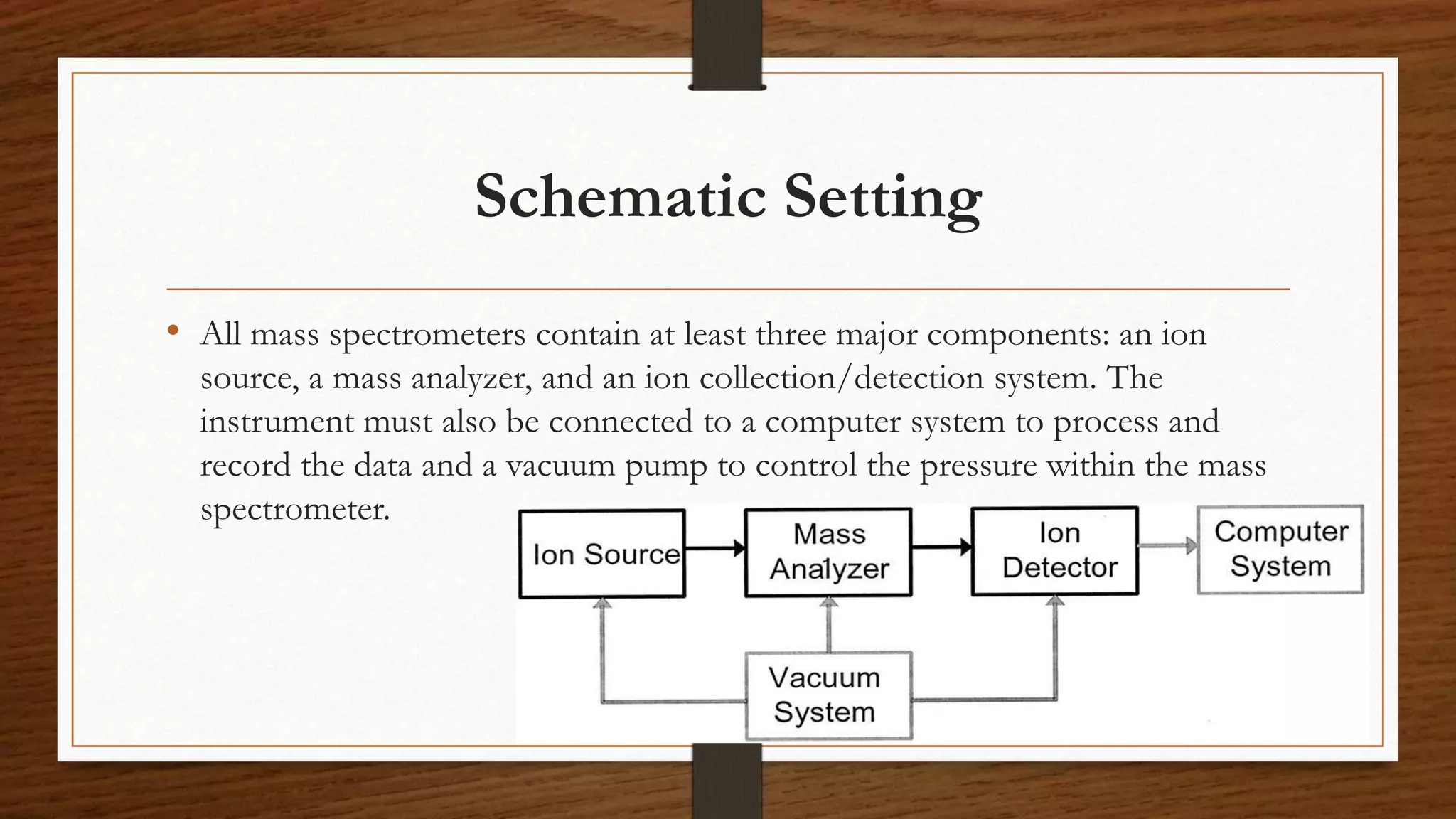
• All mass spectrometers contain at least three major components: an ion
source, a mass analyzer, and an ion collection/detection system. The
instrument must also be connected to a computer system to process and
record the data and a vacuum pump to control the pressure within the mass
spectrometer.
In order to measure the characteristics of individual molecules, a mass spectrometer
converts them to ions so that they can be moved about and manipulated by external
electric and magnetic fields . The three essential functions of a mass spectrometer, and
the associated components, are:
1. The Ion Source. A small sample is ionized, usually to cations by loss of an
electron.
2. The Mass Analyzer. The ions are sorted and separated according to their mass and
charge.
3. The Detector. The separated ions are then measured, and the results displayed on a
chart.
MALDI
Matrix Assisted Laser Desorption
Ionization
• MALDI is the most recently developed technique of Mass spectrometry.
• Maldi is a soft ionization technique used in mass spectrometry, allowing the analysis
of biomolecules such as DNA, proteins, peptides & sugar or polymers such as
dendrimers and macromolecules.
• It is three steps method.
i. The sample is mixed with a suitable matrix & applied to a metal plate.
ii. A pulsed laser irradiates a sample triggering desorption of the sample and matrix
material.
iii. Ionization of analyte molecules.
Ionization Mechanism
• In MALDI, the sample is co-crystallized within an organic matrix such as sinapinic
acid or α-cyano-4-hydroxycinnamic acid
• Co-crystallization is achieved by mixing a solution of the sample analyte with a
solution of the matrix. The mixture is then applied to a metal target plate and
allowed to dry. The resulting crystals are irradiated with laser pulses at a wavelength
at which the matrix has high spectral absorption. This process desorbs the mixture
and photo excites the matrix.
• The excited matrix then ionizes the analyte via proton transfer. The result to change
analyte ions in the gas phase, the majority of which are singly charged.
Matrix
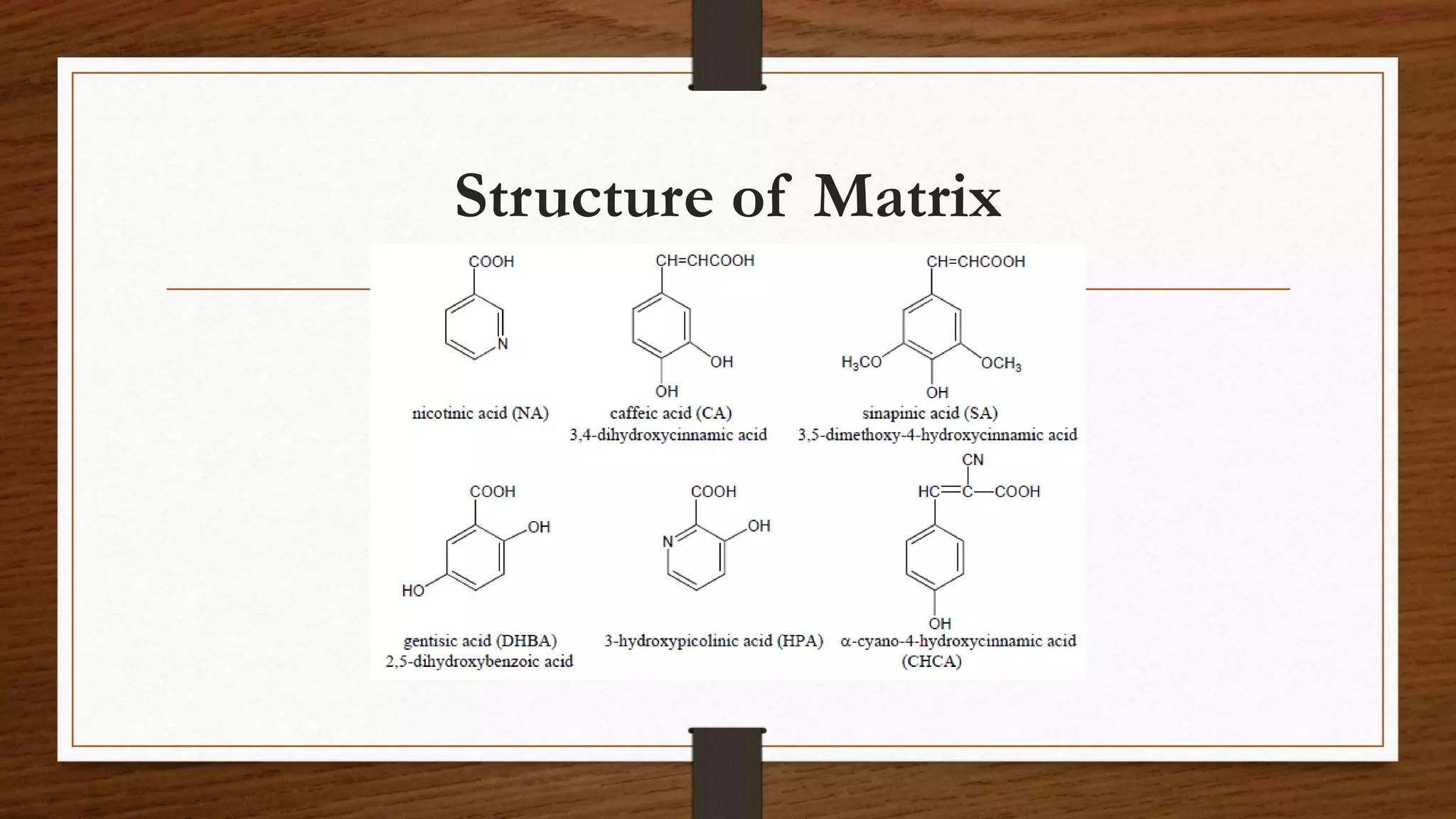
• Matrix consists of crystallized molecule of which the most 3 commonly used
are 3,5 dimthoxy-4-hydroxy cinnamic acid (sinapinic acid), alpha-cyano-4
hydroxycinnamic acid (CHCA/alpha-cyano/alpha-matrix), 2,5-dihydroxybenzoic
acid (DHB).
• A solution of one of these molecules is made, often in a mixture of highly
purified water & an organic solvent ACN i. e. acetonitril.
• Trifluoroacetic acid may also be added .
• A good example of matrix solution would be 20ug/ml sinapinic acid in
ACN: water : TFA (50:50:0.1).
Structure of Matrix
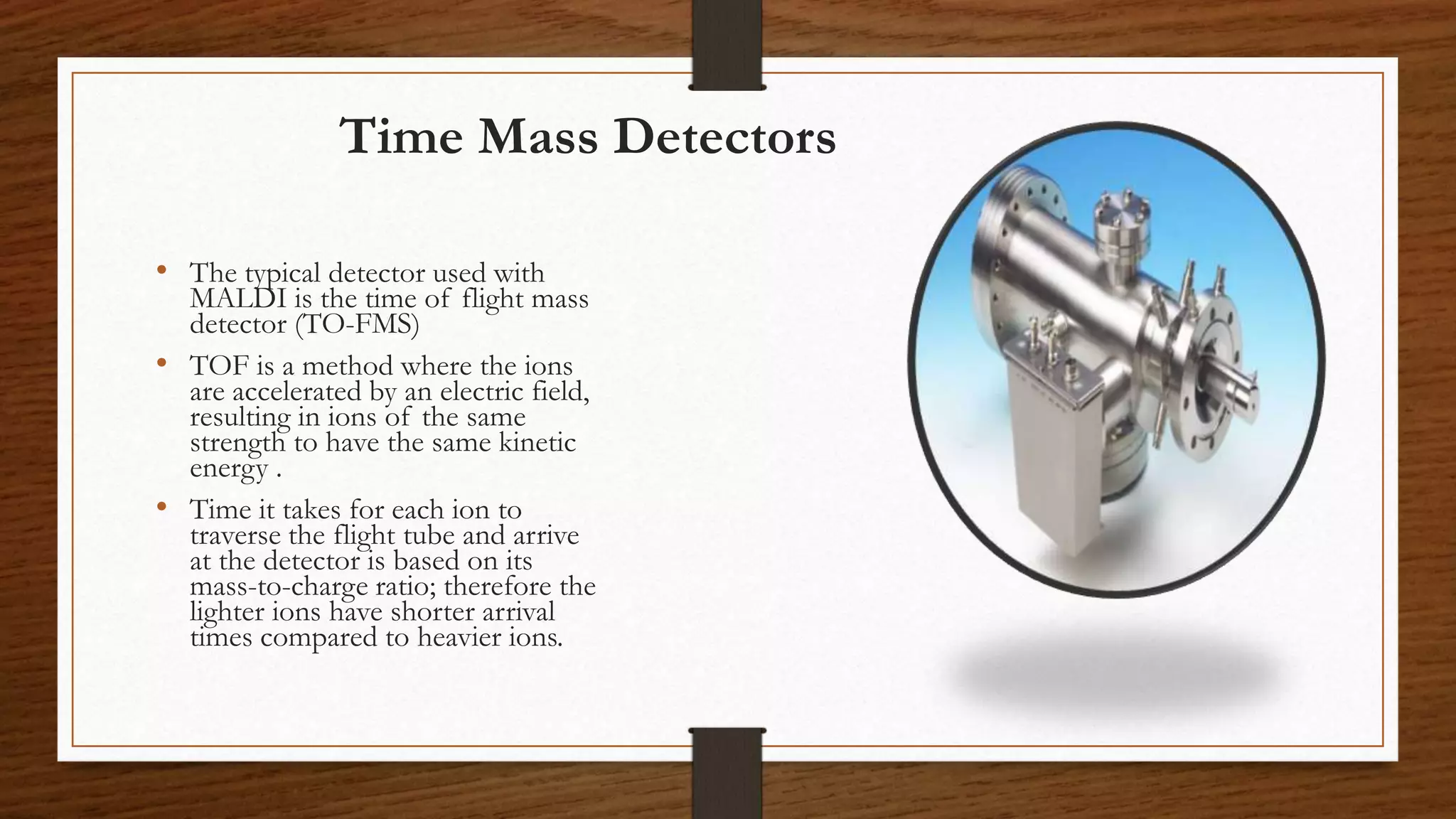
Time Mass Detectors
• The typical detector used with
MALDI is the time of flight mass
detector (TO-FMS)
• TOF is a method where the ions
are accelerated by an electric field,
resulting in ions of the same
strength to have the same kinetic
energy .
• Time it takes for each ion to
traverse the flight tube and arrive
at the detector is based on its
mass-to-charge ratio; therefore the
lighter ions have shorter arrival
times compared to heavier ions.
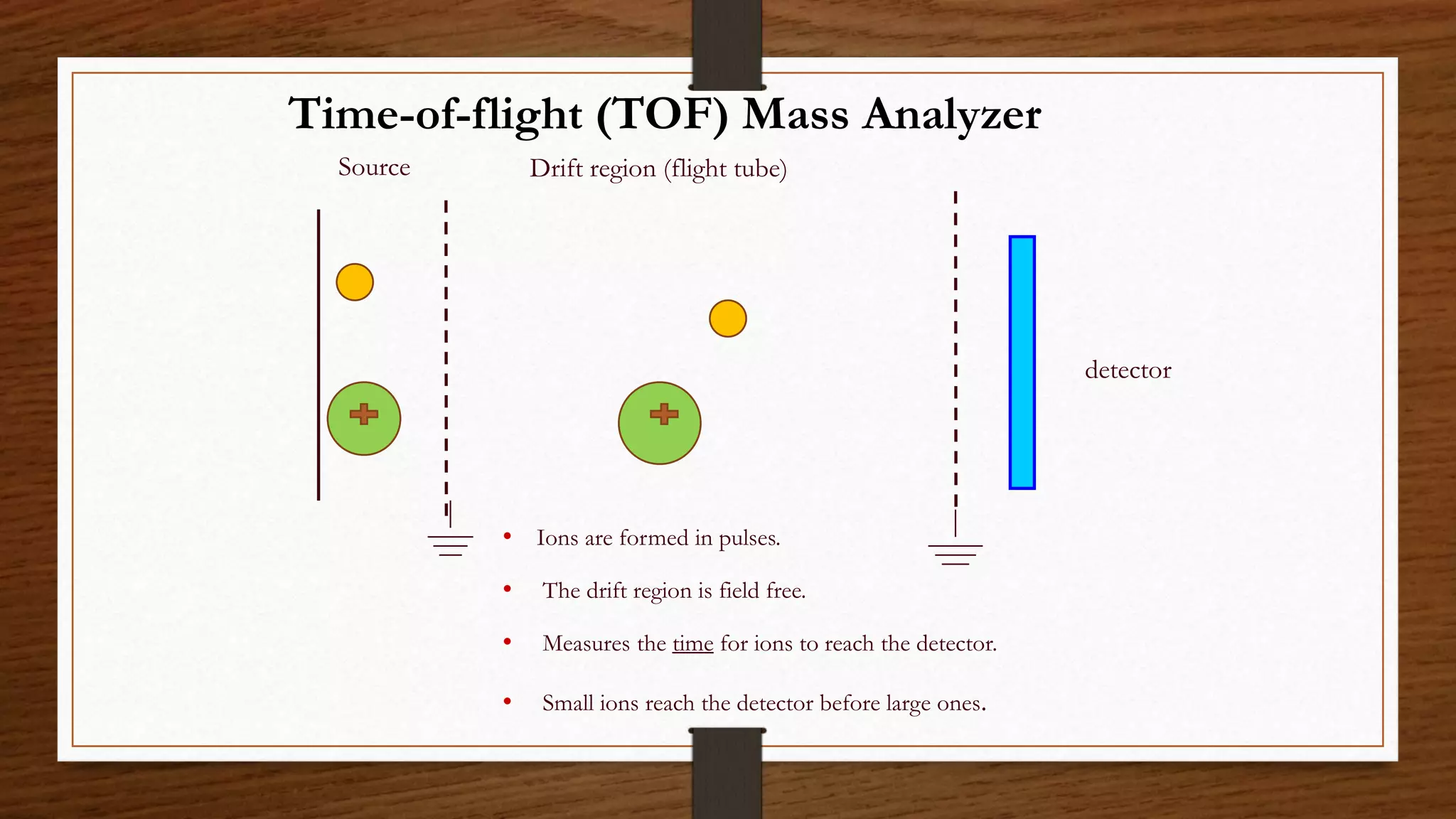
• Ions are formed in pulses.
• The drift region is field free.
• Measures the time for ions to reach the detector.
• Small ions reach the detector before large ones.
detector
Drift region (flight tube)
Source
Time-of-flight (TOF) Mass Analyzer
MALDI Advantages
• Gentle Ionization technique
• High molecular weight analyte can be ionized
• Molecule need not be volatile
• Sub-picomole sensitivity easy to obtain
• Wide array of matrices
see reference 8
TOF Advantages
• All ions detected at once
• High mass accuracy and resolving power possible
• Reasonable performance for cost
• <5 ppm mass accuracy and >20,000 resolving power commercially available
• High mass, low charge ions not a problem
• Theoretically unlimited mass range
APPLICATIONS Chemistry
Pharmaceutical
analysis
Clinical
analysis
Taxonomy
MICROBIOLOGY
APPLICATIONS
Proteomics
To identify, verify, and quantitate:
• Metabolites,
• recombinant proteins,
• proteins isolated from natural source
• peptides & their amino acid sequences
Pharmaceutical Analysis
• Bioavailability studies
• Drug metabolism studies,
pharmacokinetics
• Characterization of potential drugs
• Drug degradation product analysis
• Screening of drug candidates
• Identifying drug targets
APPLICATIONS
Microbiology
• It is used for the identification of
microorganisms.
• Species diagnosis by this procedure
is much faster, more accurate &
cheaper than other procedures
based on biochemical tests.
Forensic analysis
• Environmental analysis
• Pesticides on foods
• Soil and groundwater
contamination
Questions?
..
References
• Bakhtiar, R., & Tse, F. (2000). Biological mass spectrometry: a primer. Mutagenesis, 15(5), 415-
430.
• De Hoffmann, E., & Stroobant, V. (2007). Mass spectrometry: principles and applications: John
Wiley & Sons.
• De Laeter, J. R. (2001). Applications of inorganic mass spectrometry (Vol. 3): John Wiley & Sons.
• Fenn, J. B., Mann, M., Meng, C. K., Wong, S. F., & Whitehouse, C. M. (1989). Electrospray
ionization for mass spectrometry of large biomolecules. Science, 246(4926), 64-71.
• James, P. (2000). Proteome research: mass spectrometry: Springer Science & Business Media.
• Willard, H. H., Merritt Jr, L. L., Dean, J. A., & Settle Jr, F. A. (1988). Instrumental methods
of analysis.

Maldi tof spectrometry

  • 1.
    MALDI-TOF MASS SPECTROMETRY Presented By: GhulamFareed 08 Zohair Mehdi 11 Hafiz Hassan Ahmad 13
  • 2.
    Introduction • The massspectrometer is an instrument that can ionize a sample and measure the mass-to-charge ratio of the resulting ions. • The versatility of it’s function has allowed it to become a vital tool in a wide range of fields, including biological research. • This versatility arises from the fact that mass spectrometers can give qualitative and quantitative information on the elemental, isotopic, and molecular composition of organic and inorganic samples. • J. J. Thompson constructed the first mass spectrometer in 1912.
  • 3.
    Brief History • Theapplication of mass spectrometry (MS) to biology began in the 1940s. • In 1959, MS was first used to sequence peptides and oligonucleotides, and in 1962 it was used to study the structure of nucleotides. • 2002 Nobel Prize in Chemistry, which was awarded to John Fenn and Koichi Tanaka “for their development of soft desorption ionization methods for mass spectrometric analysis of biological macromolecules”
  • 4.
    Schematic Setting • Allmass spectrometers contain at least three major components: an ion source, a mass analyzer, and an ion collection/detection system. The instrument must also be connected to a computer system to process and record the data and a vacuum pump to control the pressure within the mass spectrometer.
  • 6.
    In order tomeasure the characteristics of individual molecules, a mass spectrometer converts them to ions so that they can be moved about and manipulated by external electric and magnetic fields . The three essential functions of a mass spectrometer, and the associated components, are: 1. The Ion Source. A small sample is ionized, usually to cations by loss of an electron. 2. The Mass Analyzer. The ions are sorted and separated according to their mass and charge. 3. The Detector. The separated ions are then measured, and the results displayed on a chart.
  • 7.
    MALDI Matrix Assisted LaserDesorption Ionization • MALDI is the most recently developed technique of Mass spectrometry. • Maldi is a soft ionization technique used in mass spectrometry, allowing the analysis of biomolecules such as DNA, proteins, peptides & sugar or polymers such as dendrimers and macromolecules. • It is three steps method. i. The sample is mixed with a suitable matrix & applied to a metal plate. ii. A pulsed laser irradiates a sample triggering desorption of the sample and matrix material. iii. Ionization of analyte molecules.
  • 8.
    Ionization Mechanism • InMALDI, the sample is co-crystallized within an organic matrix such as sinapinic acid or α-cyano-4-hydroxycinnamic acid • Co-crystallization is achieved by mixing a solution of the sample analyte with a solution of the matrix. The mixture is then applied to a metal target plate and allowed to dry. The resulting crystals are irradiated with laser pulses at a wavelength at which the matrix has high spectral absorption. This process desorbs the mixture and photo excites the matrix. • The excited matrix then ionizes the analyte via proton transfer. The result to change analyte ions in the gas phase, the majority of which are singly charged.
  • 10.
    Matrix • Matrix consistsof crystallized molecule of which the most 3 commonly used are 3,5 dimthoxy-4-hydroxy cinnamic acid (sinapinic acid), alpha-cyano-4 hydroxycinnamic acid (CHCA/alpha-cyano/alpha-matrix), 2,5-dihydroxybenzoic acid (DHB). • A solution of one of these molecules is made, often in a mixture of highly purified water & an organic solvent ACN i. e. acetonitril. • Trifluoroacetic acid may also be added . • A good example of matrix solution would be 20ug/ml sinapinic acid in ACN: water : TFA (50:50:0.1).
  • 11.
  • 12.
    Time Mass Detectors •The typical detector used with MALDI is the time of flight mass detector (TO-FMS) • TOF is a method where the ions are accelerated by an electric field, resulting in ions of the same strength to have the same kinetic energy . • Time it takes for each ion to traverse the flight tube and arrive at the detector is based on its mass-to-charge ratio; therefore the lighter ions have shorter arrival times compared to heavier ions.
  • 13.
    • Ions areformed in pulses. • The drift region is field free. • Measures the time for ions to reach the detector. • Small ions reach the detector before large ones. detector Drift region (flight tube) Source Time-of-flight (TOF) Mass Analyzer
  • 14.
    MALDI Advantages • GentleIonization technique • High molecular weight analyte can be ionized • Molecule need not be volatile • Sub-picomole sensitivity easy to obtain • Wide array of matrices see reference 8
  • 15.
    TOF Advantages • Allions detected at once • High mass accuracy and resolving power possible • Reasonable performance for cost • <5 ppm mass accuracy and >20,000 resolving power commercially available • High mass, low charge ions not a problem • Theoretically unlimited mass range
  • 16.
  • 17.
    APPLICATIONS Proteomics To identify, verify,and quantitate: • Metabolites, • recombinant proteins, • proteins isolated from natural source • peptides & their amino acid sequences Pharmaceutical Analysis • Bioavailability studies • Drug metabolism studies, pharmacokinetics • Characterization of potential drugs • Drug degradation product analysis • Screening of drug candidates • Identifying drug targets
  • 18.
    APPLICATIONS Microbiology • It isused for the identification of microorganisms. • Species diagnosis by this procedure is much faster, more accurate & cheaper than other procedures based on biochemical tests. Forensic analysis • Environmental analysis • Pesticides on foods • Soil and groundwater contamination
  • 20.
  • 21.
    References • Bakhtiar, R.,& Tse, F. (2000). Biological mass spectrometry: a primer. Mutagenesis, 15(5), 415- 430. • De Hoffmann, E., & Stroobant, V. (2007). Mass spectrometry: principles and applications: John Wiley & Sons. • De Laeter, J. R. (2001). Applications of inorganic mass spectrometry (Vol. 3): John Wiley & Sons. • Fenn, J. B., Mann, M., Meng, C. K., Wong, S. F., & Whitehouse, C. M. (1989). Electrospray ionization for mass spectrometry of large biomolecules. Science, 246(4926), 64-71. • James, P. (2000). Proteome research: mass spectrometry: Springer Science & Business Media. • Willard, H. H., Merritt Jr, L. L., Dean, J. A., & Settle Jr, F. A. (1988). Instrumental methods of analysis.