COMMON OCULAR
EMERGENCIES
Mahmoud Tawfik ,MD
AFHSR
WHAT IS MOST IMPORTANT ORGAN IN BODY?
So ocular emergencies for all medical
staff is very important that if u safe ptn
eye as u safe his life
So all of us must know 1st Aid
in ophtha cases as we know
CPR
My lecture looks like BLS
You will be never blamed
if you cann’t treat cardiac
arrest case but will be
very impressed if you fail
to maintain life tell code
blue team arrive
OBJECTIVES
How non ophthalmologist
triaging and give 1st aid of
ocular emergencies
IOP
INTRODUCTION
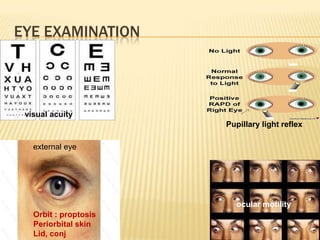
EYE EXAMINATION
visual acuity
Pupillary light reflex
ocular motility
external eye
Orbit : proptosis
Periorbital skin
Lid, conj
indirect ophthalmoscop
Direct ophthalmoscopy
Slit lamp
Ant segment examination Fundus examination
USEFUL TOOLS
Near vision card
Penlight with blue
filter
Topical anesthetic
Fluorescein strips
Topical mydriatic
ESTIMATING ANTERIOR CHAMBER DEPTH
ALGORITHM FOR DIAGNOSING
Key worrisome clinical findings (ophtho
referral needed):
Pain: Pain in eye often indicates more
serious intraocular pathology (iritis,
glaucoma).
Visual acuity: if decreased, usually more
serious cause.
Pupil: if sluggish
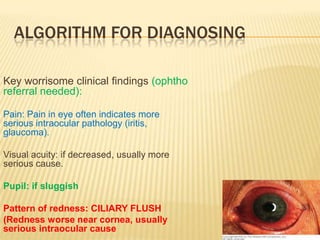
Pattern of redness: CILIARY FLUSH
(Redness worse near cornea, usually
serious intraocular cause
RED EYE: KEY HISTORICAL QUESTIONS
DO YOU HAVE PAIN?
Biggest distinguishing factor
between emergent and
non-emergent
Do you wear contacts?
(increased risk of
keratitis-corneal infection)
Do you have any associated
symptoms?
Decreased vision
photophobia/diplopia
flashes/floaters
Halos/N/V/Abd pain
Any above require referral
Main differential of red eye:
Conjunctivitis
(infectious/noninfectious)
Trauma, Foreign body
Subconjunctival hemorrhage
Angle closure glaucoma
Iritis/uveitis
Kerititis
Scleritis, episcleritis
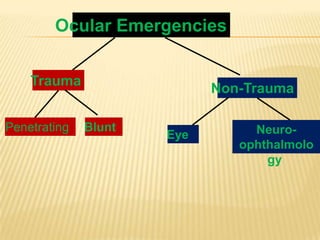
Ocular Emergencies
Trauma
Non-Trauma
BluntPenetrating
Eye Neuro-
ophthalmolo
gy
Chemical burns
CRAO
Orbital Hemorrhage
IMMEDIATE
Within minutes
Endophthalmitis
Orbital Cellulitis
Rupture Globe
IOFB
Macula-on RDAcute Glaucoma
Microbial
Keratitis
Very URGENT
Within hours
cavernous sinus thrombosis
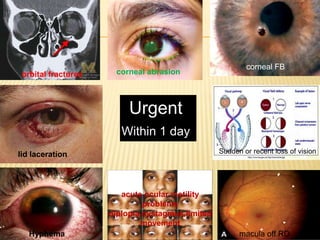
Urgent
Within 1 day
orbital fractures
lid laceration
Hyphema
corneal abrasion
corneal FB
Sudden or recent loss of vision
acute ocular motility
problems
diplopia,nystagmus,limited
movement
macula off RD
SUDDEN OR RECENT LOSS OF VISION
Painless
Hydrops
Abnormal cornea
viterous hge
RD
Abnormal fundus
CRAO
CRVO
AION
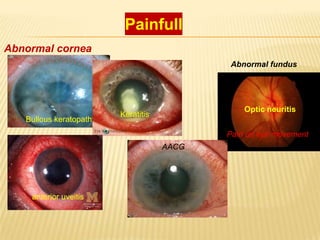
Painfull
Abnormal cornea
Bullous keratopathy
Keratitis
Abnormal fundus
Optic neuritis
anterior uveitis
AACG
Pain on eye movement
MOST COMMON EMERGENCIES
CASES DIAGNOSIS,MANGEMENT
CHEMICAL BURN
Tap water
Emergency Treatment:
Saline Copious irrigation (until
neutral pH):, may range from a few
liters to many liters (more than 8 to
10 L
Treatment should be instituted
IMMEDIATELY, even before
talking history
Lids should be retracted and
fornices swabbed for
particulate matter
Once pH is stabilized
Cycloplegic agent
Broad-spectrum
antibiotic
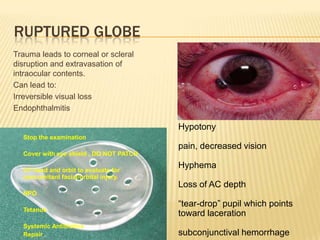
RUPTURED GLOBE
Trauma leads to corneal or scleral
disruption and extravasation of
intraocular contents.
Can lead to:
Irreversible visual loss
Endophthalmitis
Hypotony
pain, decreased vision
Hyphema
Loss of AC depth
“tear-drop” pupil which points
toward laceration
subconjunctival hemorrhage
Stop the examination
Cover with eye shield , DO NOT PATCH.
CT head and orbit to evaluate for
concomitant facial/orbital injury.
NPO
Tetanus
Systemic Antibiotics
Repair .
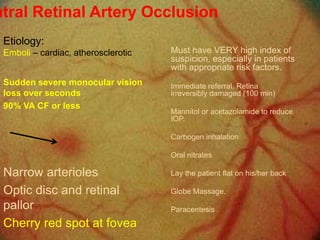
ntral Retinal Artery Occlusion
Sudden severe monocular vision
loss over seconds
90% VA CF or less
Etiology:
Emboli – cardiac, atherosclerotic
Narrow arterioles
Optic disc and retinal
pallor
Cherry red spot at fovea
Must have VERY high index of
suspicion, especially in patients
with appropriate risk factors.
Immediate referral. Retina
irreversibly damaged (100 min)
Mannitol or acetazolamide to reduce
IOP.
Carbogen inhalation
Oral nitrates
Lay the patient flat on his/her back
Globe Massage.
Paracentesis .
Signs and symptoms
“black coming down over visual
field”
Bright flashes of light (photopsia)
Increasing floaters
Decreased visual acuity (macula
off)
Retinal detachment
separation of neurosensory layer of
retina from underlying choroid and
retinal pigment epithelium
KEY MANAGEMENT POINT- know
“classic” presentation so you can refer to
an ophthalmologist quickly.
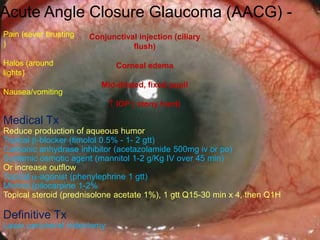
Acute Angle Closure Glaucoma (AACG) -
Pain (sever brusting
)
Halos (around
lights)
Nausea/vomiting
Conjunctival injection (ciliary
flush)
Corneal edema
Mid-dilated, fixed pupil
 IOP ( stony hard)
Medical Tx
Reduce production of aqueous humor
Topical -blocker (timolol 0.5% - 1- 2 gtt)
Carbonic anhydrase inhibitor (acetazolamide 500mg iv or po)
Systemic osmotic agent (mannitol 1-2 g/Kg IV over 45 min)
Or increase outflow
Topical -agonist (phenylephrine 1 gtt)
Miotics (pilocarpine 1-2%)
Topical steroid (prednisolone acetate 1%), 1 gtt Q15-30 min x 4, then Q1H
Definitive Tx
Laser peripheral iridectomy
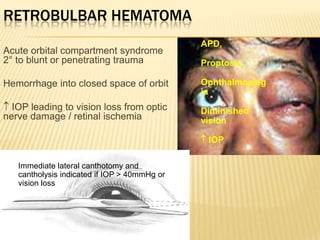
RETROBULBAR HEMATOMA
Acute orbital compartment syndrome
2° to blunt or penetrating trauma
Hemorrhage into closed space of orbit
 IOP leading to vision loss from optic
nerve damage / retinal ischemia
Immediate lateral canthotomy and
cantholysis indicated if IOP > 40mmHg or
vision loss
APD,
Proptosis
Ophthalmopleg
ia
Diminished
vision
 IOP
ORBITAL BLOWOUT FRACTURE
Enophthalmos
Diplopia
Impairment of eye
movement
Orbital emphysema
CT should include axial
and coronal cuts
Periorbital Cellulitis (Preseptal
Cellulitis)
Warm, indurated, erythematous eyelids
only
Orbital Cellulitis (Postseptal
Cellulitis)
Warm, indurated, erythematous
eyelids only
Treatment:
Hospital
admission for IV
Cefuroxime
Fever, toxicity, proptosis, p
ainful ocular
motility, limited ocular
excursion
emergent orbital and sinus CT
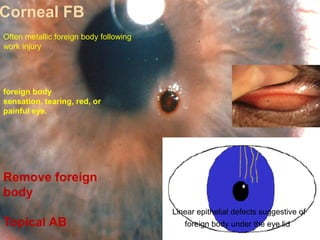
foreign body
sensation, tearing, red, or
painful eye.
Linear epithelial defects suggestive of
foreign body under the eye lid
Often metallic foreign body following
work injury
Remove foreign
body
Topical AB
Corneal FB
5. CORNEAL INJURIES(ABRASIONS, LACERATIONS, ULCERS)
Symptoms:
extreme eye pain, relieved with
lidocaine drops.
Visual acuity usually
decreased, depending on
location of injury in relation to
visual axis.
Diagnosis:
fluorescein staining to see epithelial
defect.
Seidel’s test
Topical antibiotics and follow up with
ophthalmologist
Avoid contact lenses
Avoid patching.
CORNEAL INJURIES
Seidel’s test:
Concentrated
fluorescein is dark
orange but turns bright
green under blue light
after dilution.
This indicates aqueous
leakage which is
diluting the green dye.
+ve >>>> laceration
HYPOPON (AC PUS )
Endoopthalmitis Microbial keratitis
Iritis
Very urgent refferal
LID LACERATION
Eyelids don’t have fat
Orbital fat usually protrudes through
septal lacerations
Fat in the lid laceration confirms the
diagnosis
High incidence of globe penetration
and intraocular foreign bodies
High risk for orbital cellulitis
Take care check lid margin
Medial injuries may affect lacrimal
passages
Hopefully I convey my
message to my
colleges today
together we will safe
ptns eyes
Common ocular emergencies

Common ocular emergencies

  • 1.
  • 2.
    WHAT IS MOSTIMPORTANT ORGAN IN BODY?
  • 3.
    So ocular emergenciesfor all medical staff is very important that if u safe ptn eye as u safe his life So all of us must know 1st Aid in ophtha cases as we know CPR My lecture looks like BLS You will be never blamed if you cann’t treat cardiac arrest case but will be very impressed if you fail to maintain life tell code blue team arrive
  • 4.
    OBJECTIVES How non ophthalmologist triagingand give 1st aid of ocular emergencies
  • 5.
  • 6.
    EYE EXAMINATION visual acuity Pupillarylight reflex ocular motility external eye Orbit : proptosis Periorbital skin Lid, conj
  • 7.
    indirect ophthalmoscop Direct ophthalmoscopy Slitlamp Ant segment examination Fundus examination
  • 8.
    USEFUL TOOLS Near visioncard Penlight with blue filter Topical anesthetic Fluorescein strips Topical mydriatic
  • 9.
  • 10.
    ALGORITHM FOR DIAGNOSING Keyworrisome clinical findings (ophtho referral needed): Pain: Pain in eye often indicates more serious intraocular pathology (iritis, glaucoma). Visual acuity: if decreased, usually more serious cause. Pupil: if sluggish Pattern of redness: CILIARY FLUSH (Redness worse near cornea, usually serious intraocular cause
  • 11.
    RED EYE: KEYHISTORICAL QUESTIONS DO YOU HAVE PAIN? Biggest distinguishing factor between emergent and non-emergent Do you wear contacts? (increased risk of keratitis-corneal infection) Do you have any associated symptoms? Decreased vision photophobia/diplopia flashes/floaters Halos/N/V/Abd pain Any above require referral Main differential of red eye: Conjunctivitis (infectious/noninfectious) Trauma, Foreign body Subconjunctival hemorrhage Angle closure glaucoma Iritis/uveitis Kerititis Scleritis, episcleritis
  • 12.
  • 13.
  • 14.
    Endophthalmitis Orbital Cellulitis Rupture Globe IOFB Macula-onRDAcute Glaucoma Microbial Keratitis Very URGENT Within hours cavernous sinus thrombosis
  • 15.
    Urgent Within 1 day orbitalfractures lid laceration Hyphema corneal abrasion corneal FB Sudden or recent loss of vision acute ocular motility problems diplopia,nystagmus,limited movement macula off RD
  • 16.
    SUDDEN OR RECENTLOSS OF VISION Painless Hydrops Abnormal cornea viterous hge RD Abnormal fundus CRAO CRVO AION
  • 17.
    Painfull Abnormal cornea Bullous keratopathy Keratitis Abnormalfundus Optic neuritis anterior uveitis AACG Pain on eye movement
  • 18.
    MOST COMMON EMERGENCIES CASESDIAGNOSIS,MANGEMENT
  • 19.
    CHEMICAL BURN Tap water EmergencyTreatment: Saline Copious irrigation (until neutral pH):, may range from a few liters to many liters (more than 8 to 10 L Treatment should be instituted IMMEDIATELY, even before talking history Lids should be retracted and fornices swabbed for particulate matter Once pH is stabilized Cycloplegic agent Broad-spectrum antibiotic
  • 20.
    RUPTURED GLOBE Trauma leadsto corneal or scleral disruption and extravasation of intraocular contents. Can lead to: Irreversible visual loss Endophthalmitis Hypotony pain, decreased vision Hyphema Loss of AC depth “tear-drop” pupil which points toward laceration subconjunctival hemorrhage Stop the examination Cover with eye shield , DO NOT PATCH. CT head and orbit to evaluate for concomitant facial/orbital injury. NPO Tetanus Systemic Antibiotics Repair .
  • 21.
    ntral Retinal ArteryOcclusion Sudden severe monocular vision loss over seconds 90% VA CF or less Etiology: Emboli – cardiac, atherosclerotic Narrow arterioles Optic disc and retinal pallor Cherry red spot at fovea Must have VERY high index of suspicion, especially in patients with appropriate risk factors. Immediate referral. Retina irreversibly damaged (100 min) Mannitol or acetazolamide to reduce IOP. Carbogen inhalation Oral nitrates Lay the patient flat on his/her back Globe Massage. Paracentesis .
  • 22.
    Signs and symptoms “blackcoming down over visual field” Bright flashes of light (photopsia) Increasing floaters Decreased visual acuity (macula off) Retinal detachment separation of neurosensory layer of retina from underlying choroid and retinal pigment epithelium KEY MANAGEMENT POINT- know “classic” presentation so you can refer to an ophthalmologist quickly.
  • 23.
    Acute Angle ClosureGlaucoma (AACG) - Pain (sever brusting ) Halos (around lights) Nausea/vomiting Conjunctival injection (ciliary flush) Corneal edema Mid-dilated, fixed pupil  IOP ( stony hard) Medical Tx Reduce production of aqueous humor Topical -blocker (timolol 0.5% - 1- 2 gtt) Carbonic anhydrase inhibitor (acetazolamide 500mg iv or po) Systemic osmotic agent (mannitol 1-2 g/Kg IV over 45 min) Or increase outflow Topical -agonist (phenylephrine 1 gtt) Miotics (pilocarpine 1-2%) Topical steroid (prednisolone acetate 1%), 1 gtt Q15-30 min x 4, then Q1H Definitive Tx Laser peripheral iridectomy
  • 24.
    RETROBULBAR HEMATOMA Acute orbitalcompartment syndrome 2° to blunt or penetrating trauma Hemorrhage into closed space of orbit  IOP leading to vision loss from optic nerve damage / retinal ischemia Immediate lateral canthotomy and cantholysis indicated if IOP > 40mmHg or vision loss APD, Proptosis Ophthalmopleg ia Diminished vision  IOP
  • 25.
    ORBITAL BLOWOUT FRACTURE Enophthalmos Diplopia Impairmentof eye movement Orbital emphysema CT should include axial and coronal cuts
  • 26.
    Periorbital Cellulitis (Preseptal Cellulitis) Warm,indurated, erythematous eyelids only Orbital Cellulitis (Postseptal Cellulitis) Warm, indurated, erythematous eyelids only Treatment: Hospital admission for IV Cefuroxime Fever, toxicity, proptosis, p ainful ocular motility, limited ocular excursion emergent orbital and sinus CT
  • 27.
    foreign body sensation, tearing,red, or painful eye. Linear epithelial defects suggestive of foreign body under the eye lid Often metallic foreign body following work injury Remove foreign body Topical AB Corneal FB
  • 28.
    5. CORNEAL INJURIES(ABRASIONS,LACERATIONS, ULCERS) Symptoms: extreme eye pain, relieved with lidocaine drops. Visual acuity usually decreased, depending on location of injury in relation to visual axis. Diagnosis: fluorescein staining to see epithelial defect. Seidel’s test Topical antibiotics and follow up with ophthalmologist Avoid contact lenses Avoid patching.
  • 29.
    CORNEAL INJURIES Seidel’s test: Concentrated fluoresceinis dark orange but turns bright green under blue light after dilution. This indicates aqueous leakage which is diluting the green dye. +ve >>>> laceration
  • 30.
    HYPOPON (AC PUS) Endoopthalmitis Microbial keratitis Iritis Very urgent refferal
  • 31.
    LID LACERATION Eyelids don’thave fat Orbital fat usually protrudes through septal lacerations Fat in the lid laceration confirms the diagnosis High incidence of globe penetration and intraocular foreign bodies High risk for orbital cellulitis Take care check lid margin Medial injuries may affect lacrimal passages
  • 32.
    Hopefully I conveymy message to my colleges today together we will safe ptns eyes