HUDSON DE CARVALHO NAKAMURA,
MD, CBO
FUNDAÇÃO BANCO DE OLHOS DE GOIÁS
GOIÂNIA, BRAZIL
www.fubog.org
4 HELPING
DIAGNOSIS
4 MONEY
4 TRAINING
4 CATCHING UP
PATIENTS
 4 HELPING
DIAGNOSIS, BUT NOT
ALWAYS
BAD
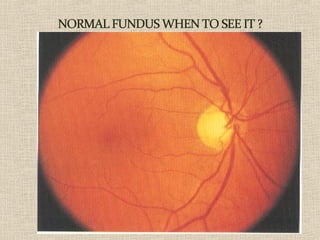
APPERANCE : Uniform red
Punctate stippling-periphery
Varies-color of individual
Normal choroidal vessels,invisible
PARTS : DISC
VESSELS
MACULA
PERIPHERY
RED EYE
LOW VISION
OCULAR PAIN
FLOATERS & FLASHES
METAMORPHOPSIAS
SCOTOMAS
MICROPSIAS
IMAGE DISTORTION
DIPLOPIA – MONOCULAR AND BINOCULAR
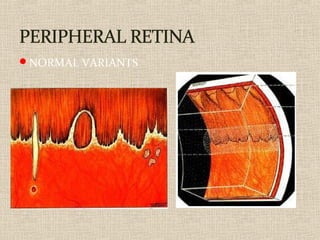
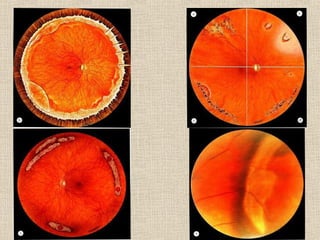
NORMAL VARIANTS
Why it is performed:
It can detect some signs & physiological effects of
various circulatory, metabolic and neurological
disorders.
Routinely used to assess and diagnose vitro-retinal
diseases (such as Diabetic retinopathy, retinal tear
and detachment, macular hole, retinal haemorrhage,
retinal artery and vein occlusion, choroidal tumor, or
macular edema), optic nerve defects, and hereditary
diseases.
Fundus examination is used to:
Identify and locate vitro-retinal and optical
nerve defects caused by eye diseases or
trauma.
Examine the extent of the defects or
abnormalities to plan a proper treatment.
Evaluate the success of treatment.
DIRECT OPHTHALMOSCOPY
RED REFLEX
INDIRECT OPHTHALMOSCOPY
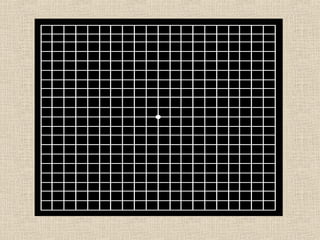
AMSLER GRID TESTING
WATZKE ALLEN TEST
EYE TEST FOR ROP SCREENING
METHODS OF EXAMINATION
DIRECT OPHTHALMOSCOPY
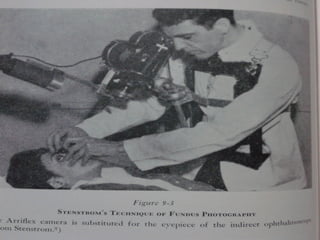
INDIRECT OPHTHALMOSCOPY
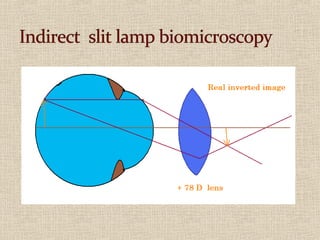
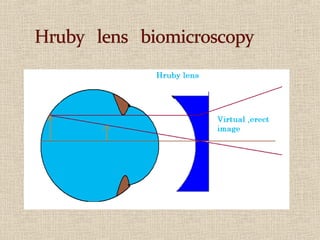
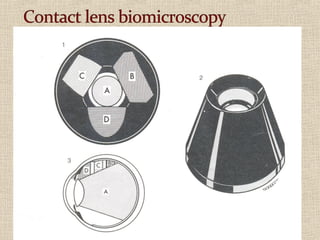
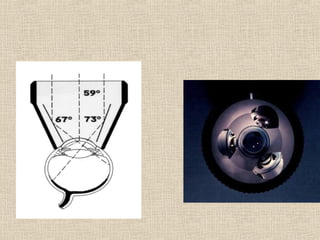
INDIRECT SLIT LAMP BIOMICROSCOPY
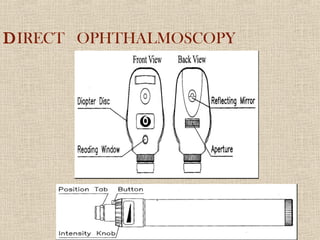
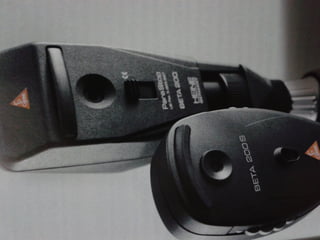
DIRECT OPHTHALMOSCOPY
DIRECT OPTHALMOSCOPE
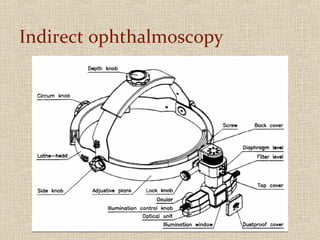
INDIRECT OPHTHALMOSCOPE
Indirect ophthalmoscopy
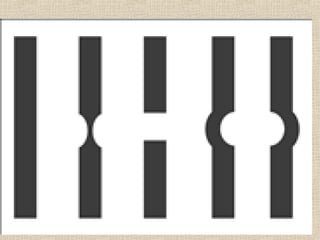
LOOK FOR DISTORTIONS, CROOKED LINES, SCOTOMAS,
OTHER IRREGULARITIES
SPECIALLY 4 MAC HOLES
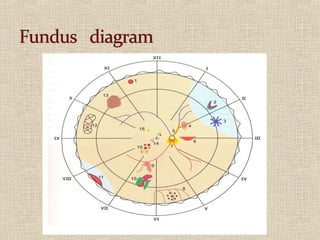
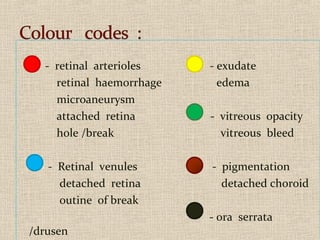
- retinal arterioles - exudate
retinal haemorrhage edema
microaneurysm
attached retina - vitreous opacity
hole /break vitreous bleed
- Retinal venules - pigmentation
detached retina detached choroid
outine of break
- ora serrata
/drusen
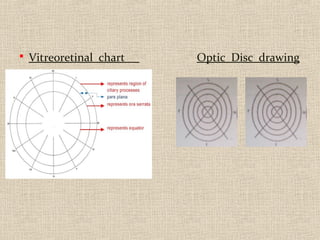
 Vitreoretinal chart Optic Disc drawing
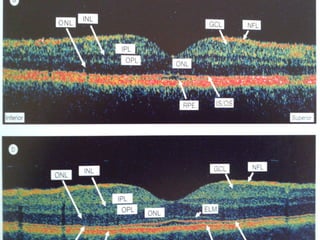
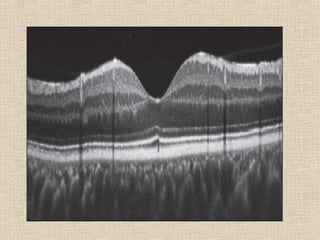
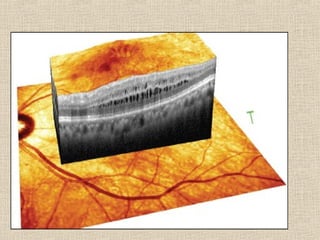
ERM – CME – CNM – ME – CSME – POST-UVEITIS – POST
INJECTIONS – MAC HOLES – PSEUDO MAC HOLES
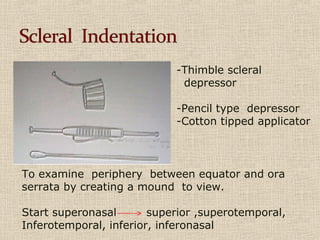
-Thimble scleral
depressor
-Pencil type depressor
-Cotton tipped applicator
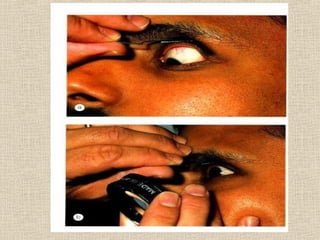
To examine periphery between equator and ora
serrata by creating a mound to view.
Start superonasal superior ,superotemporal,
Inferotemporal, inferior, inferonasal
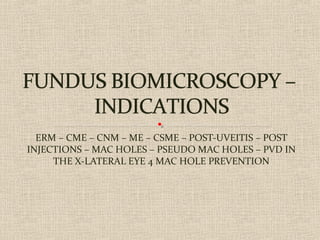
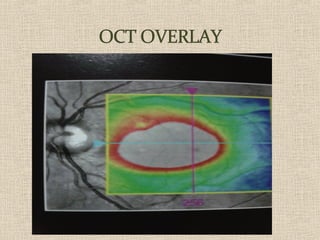
ERM – CME – CNM – ME – CSME – POST-UVEITIS – POST
INJECTIONS – MAC HOLES – PSEUDO MAC HOLES – PVD IN
THE X-LATERAL EYE 4 MAC HOLE PREVENTION
ERM – CME – CNM – ME – CSME – POST-UVEITIS – POST
INJECTIONS – MAC HOLES – PSEUDO MAC HOLES
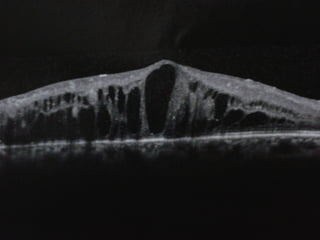
CME
NON CME, DIABETIC
OTHERS
MEDIA OPACITY - PVD – UVEITIS – HYALOID ASTERITIS –
IOFB – LENS & IOL DISLOCATIONS
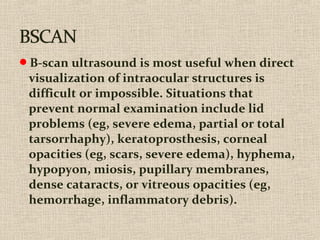
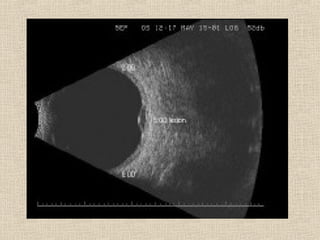
B-scan ultrasound is most useful when direct
visualization of intraocular structures is
difficult or impossible. Situations that
prevent normal examination include lid
problems (eg, severe edema, partial or total
tarsorrhaphy), keratoprosthesis, corneal
opacities (eg, scars, severe edema), hyphema,
hypopyon, miosis, pupillary membranes,
dense cataracts, or vitreous opacities (eg,
hemorrhage, inflammatory debris).
NO MEDIA OPACITY – WHAT FOR?
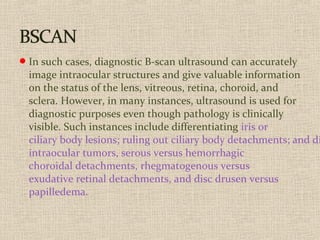
In such cases, diagnostic B-scan ultrasound can accurately
image intraocular structures and give valuable information
on the status of the lens, vitreous, retina, choroid, and
sclera. However, in many instances, ultrasound is used for
diagnostic purposes even though pathology is clinically
visible. Such instances include differentiating iris or
ciliary body lesions; ruling out ciliary body detachments; and di
intraocular tumors, serous versus hemorrhagic
choroidal detachments, rhegmatogenous versus
exudative retinal detachments, and disc drusen versus
papilledema.
VISUAL EVOKED
POTENTIAL - VEP
 The visually evoked potential (VEP)
measures the electrical response of
the brain's primary visual cortex to
a visual stimulus.
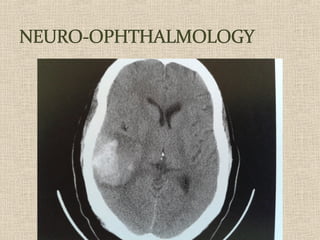
NEURO-OPHTH DISORDERS
OPTIC PATHWAY DISORDERS
EXCLUDING CRITERIA
MEDICAL LEGAL
OTHERS
Preemie Eye test (ROP)...
how bad is it?
I made the mistake of
reading up about the
ROP eye test that they
are giving my baby early
next week. It sounds
absolutely terrible. How
did your babies do
afterwards? The nurses
have warned that he may
not eat well that day.
Your Baby’s Eye Test
Why your baby needs an eye test
All babies on the neonatal unit are screened for an
eye condition called retinopathy of prematurity
(ROP) if they are born before 32 weeks of
pregnancy or if they weighed 1500 grams or less
at birth.
ERM – CME – CNM – ME – CSME – POST-UVEITIS – POST
INJECTIONS – MAC HOLES – PSEUDO MAC HOLES
NO DIABETIC RETINOPATHY WHAT FOR ???
NO POSTERIOR POLE CHANGES WHAT FOR ???
NO KNOWN ALLERGIES AND THE TWO ABOVE
WHAT FOR ???
NO CHANGES SO MEDICAL LEGAL ASPECT WHAT
FOR ???
THINK ABOUT
CONCENTRATION AND QUANTITY
WAIT ENOUGH TIME OTHERWISE WAIST ALL THE TIME
EXAMPLE : MAC EDEMA DUE TO DIABETIC RETINOPATHY
THANK YOU

Retina examination when to order

  • 1.
    HUDSON DE CARVALHONAKAMURA, MD, CBO FUNDAÇÃO BANCO DE OLHOS DE GOIÁS GOIÂNIA, BRAZIL www.fubog.org
  • 3.
    4 HELPING DIAGNOSIS 4 MONEY 4TRAINING 4 CATCHING UP PATIENTS  4 HELPING DIAGNOSIS, BUT NOT ALWAYS BAD
  • 4.
    APPERANCE : Uniformred Punctate stippling-periphery Varies-color of individual Normal choroidal vessels,invisible PARTS : DISC VESSELS MACULA PERIPHERY
  • 7.
    RED EYE LOW VISION OCULARPAIN FLOATERS & FLASHES METAMORPHOPSIAS SCOTOMAS MICROPSIAS IMAGE DISTORTION DIPLOPIA – MONOCULAR AND BINOCULAR
  • 8.
  • 10.
    Why it isperformed: It can detect some signs & physiological effects of various circulatory, metabolic and neurological disorders. Routinely used to assess and diagnose vitro-retinal diseases (such as Diabetic retinopathy, retinal tear and detachment, macular hole, retinal haemorrhage, retinal artery and vein occlusion, choroidal tumor, or macular edema), optic nerve defects, and hereditary diseases.
  • 13.
    Fundus examination isused to: Identify and locate vitro-retinal and optical nerve defects caused by eye diseases or trauma. Examine the extent of the defects or abnormalities to plan a proper treatment. Evaluate the success of treatment.
  • 14.
    DIRECT OPHTHALMOSCOPY RED REFLEX INDIRECTOPHTHALMOSCOPY AMSLER GRID TESTING WATZKE ALLEN TEST EYE TEST FOR ROP SCREENING
  • 15.
    METHODS OF EXAMINATION DIRECTOPHTHALMOSCOPY INDIRECT OPHTHALMOSCOPY INDIRECT SLIT LAMP BIOMICROSCOPY
  • 16.
  • 17.
  • 20.
  • 21.
  • 22.
    LOOK FOR DISTORTIONS,CROOKED LINES, SCOTOMAS, OTHER IRREGULARITIES
  • 24.
  • 26.
    - retinal arterioles- exudate retinal haemorrhage edema microaneurysm attached retina - vitreous opacity hole /break vitreous bleed - Retinal venules - pigmentation detached retina detached choroid outine of break - ora serrata /drusen
  • 27.
     Vitreoretinal chartOptic Disc drawing
  • 28.
    ERM – CME– CNM – ME – CSME – POST-UVEITIS – POST INJECTIONS – MAC HOLES – PSEUDO MAC HOLES
  • 29.
    -Thimble scleral depressor -Pencil typedepressor -Cotton tipped applicator To examine periphery between equator and ora serrata by creating a mound to view. Start superonasal superior ,superotemporal, Inferotemporal, inferior, inferonasal
  • 35.
    ERM – CME– CNM – ME – CSME – POST-UVEITIS – POST INJECTIONS – MAC HOLES – PSEUDO MAC HOLES – PVD IN THE X-LATERAL EYE 4 MAC HOLE PREVENTION
  • 36.
    ERM – CME– CNM – ME – CSME – POST-UVEITIS – POST INJECTIONS – MAC HOLES – PSEUDO MAC HOLES
  • 42.
  • 44.
    MEDIA OPACITY -PVD – UVEITIS – HYALOID ASTERITIS – IOFB – LENS & IOL DISLOCATIONS
  • 45.
    B-scan ultrasound ismost useful when direct visualization of intraocular structures is difficult or impossible. Situations that prevent normal examination include lid problems (eg, severe edema, partial or total tarsorrhaphy), keratoprosthesis, corneal opacities (eg, scars, severe edema), hyphema, hypopyon, miosis, pupillary membranes, dense cataracts, or vitreous opacities (eg, hemorrhage, inflammatory debris).
  • 46.
    NO MEDIA OPACITY– WHAT FOR?
  • 47.
    In such cases,diagnostic B-scan ultrasound can accurately image intraocular structures and give valuable information on the status of the lens, vitreous, retina, choroid, and sclera. However, in many instances, ultrasound is used for diagnostic purposes even though pathology is clinically visible. Such instances include differentiating iris or ciliary body lesions; ruling out ciliary body detachments; and di intraocular tumors, serous versus hemorrhagic choroidal detachments, rhegmatogenous versus exudative retinal detachments, and disc drusen versus papilledema.
  • 49.
    VISUAL EVOKED POTENTIAL -VEP  The visually evoked potential (VEP) measures the electrical response of the brain's primary visual cortex to a visual stimulus. NEURO-OPHTH DISORDERS OPTIC PATHWAY DISORDERS EXCLUDING CRITERIA MEDICAL LEGAL OTHERS
  • 56.
    Preemie Eye test(ROP)... how bad is it? I made the mistake of reading up about the ROP eye test that they are giving my baby early next week. It sounds absolutely terrible. How did your babies do afterwards? The nurses have warned that he may not eat well that day.
  • 58.
    Your Baby’s EyeTest Why your baby needs an eye test All babies on the neonatal unit are screened for an eye condition called retinopathy of prematurity (ROP) if they are born before 32 weeks of pregnancy or if they weighed 1500 grams or less at birth.
  • 60.
    ERM – CME– CNM – ME – CSME – POST-UVEITIS – POST INJECTIONS – MAC HOLES – PSEUDO MAC HOLES
  • 62.
    NO DIABETIC RETINOPATHYWHAT FOR ??? NO POSTERIOR POLE CHANGES WHAT FOR ??? NO KNOWN ALLERGIES AND THE TWO ABOVE WHAT FOR ??? NO CHANGES SO MEDICAL LEGAL ASPECT WHAT FOR ??? THINK ABOUT
  • 64.
  • 65.
    WAIT ENOUGH TIMEOTHERWISE WAIST ALL THE TIME EXAMPLE : MAC EDEMA DUE TO DIABETIC RETINOPATHY
  • 68.