Choosing the right
  pricing strategy
          Peter Ramsden
   Paramount Learning Ltd
Outline
 Importance  of Price
 Factors affecting Price

 Pricing Strategies

 Price demand curves
What must I consider before
setting price?
1.   Know how much it costs to
     make and deliver product or
     service. Direct and Indirect
     costs. Fixed and Variable costs.
2.   Know your breakeven point
3.   Research current prices in the
     market.
4.   Consider your market
     positioning and competitive
     advantage as this is likely to
     impact directly on your choice of
     pricing strategy.
Importance of Price
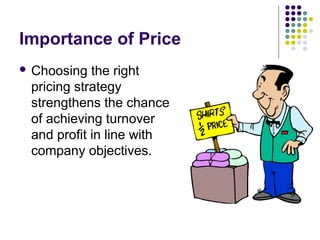
 Choosing  the right
 pricing strategy
 strengthens the chance
 of achieving turnover
 and profit in line with
 company objectives.
Importance of Price
 Getting   it wrong can be
 painful!
Importance of Price
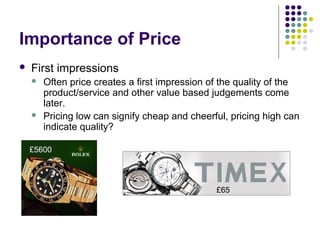
   First impressions
       Often price creates a first impression of the quality of the
        product/service and other value based judgements come
        later.
       Pricing low can signify cheap and cheerful, pricing high can
        indicate quality?

    £5600


                                                £65
Price Elasticity of Demand
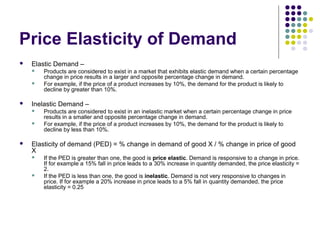
   Elastic Demand –
       Products are considered to exist in a market that exhibits elastic demand when a certain percentage
        change in price results in a larger and opposite percentage change in demand.
       For example, if the price of a product increases by 10%, the demand for the product is likely to
        decline by greater than 10%.

   Inelastic Demand –
       Products are considered to exist in an inelastic market when a certain percentage change in price
        results in a smaller and opposite percentage change in demand.
       For example, if the price of a product increases by 10%, the demand for the product is likely to
        decline by less than 10%.

   Elasticity of demand (PED) = % change in demand of good X / % change in price of good
    X
       If the PED is greater than one, the good is price elastic. Demand is responsive to a change in price.
        If for example a 15% fall in price leads to a 30% increase in quantity demanded, the price elasticity =
        2.
       If the PED is less than one, the good is inelastic. Demand is not very responsive to changes in
        price. If for example a 20% increase in price leads to a 5% fall in quantity demanded, the price
        elasticity = 0.25
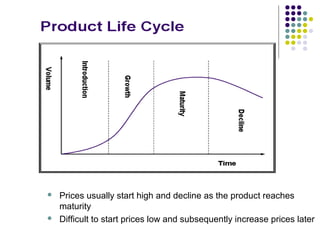
   Prices usually start high and decline as the product reaches
    maturity
   Difficult to start prices low and subsequently increase prices later
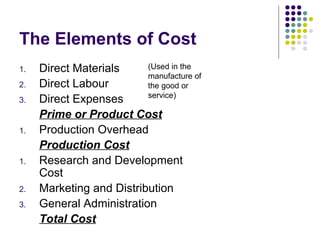
The Elements of Cost
1.   Direct Materials     (Used in the
                          manufacture of
2.   Direct Labour        the good or
                          service)
3.   Direct Expenses
     Prime or Product Cost
1.   Production Overhead
     Production Cost
1.   Research and Development
     Cost
2.   Marketing and Distribution
3.   General Administration
     Total Cost
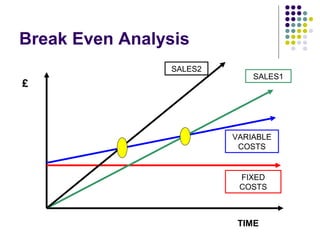
Break Even Analysis
                SALES2
                             SALES1
£


                         VARIABLE
                          COSTS


                          FIXED
                          COSTS


                          TIME
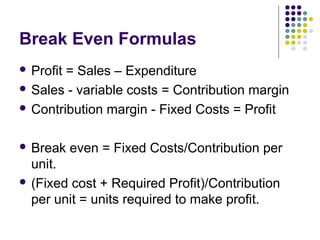
Break Even Formulas
 Profit= Sales – Expenditure
 Sales - variable costs = Contribution margin

 Contribution margin - Fixed Costs = Profit


 Break    even = Fixed Costs/Contribution per
  unit.
 (Fixed cost + Required Profit)/Contribution
  per unit = units required to make profit.
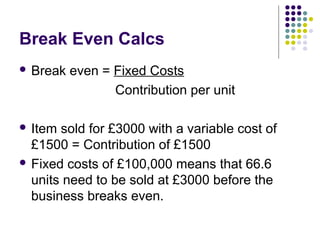
Break Even Calcs
 Break   even = Fixed Costs
                 Contribution per unit

 Item sold for £3000 with a variable cost of
  £1500 = Contribution of £1500
 Fixed costs of £100,000 means that 66.6
  units need to be sold at £3000 before the
  business breaks even.
Pricing Strategies
   Market pricing             Competitive Pricing
   Cost pricing                   Below market
       Mark up                    Parity or Price Matching
       Margin generation      Bundle
       Breakeven              Skimming
   Loss leader                Markdowns
   Psychological pricing          Temporary
       Prestige                   Permanent
       Odd even pricing       Payment and delivery
   Demand                      terms
Market Pricing

 Set prices at or around
  the middle of the
  market
 Fight on other added
  value areas such as
  delivery, customer
  service etc
Cost Plus Pricing
   Cost Plus Pricing
       Cost of materials
       Cost of labour

       Add an amount for profit

       Does not take into account
        general overhead costs
       Beware of making loss due
        to hidden overhead
Loss Leader
 Pricing
        a product below cost to attract
  customers to higher margin products
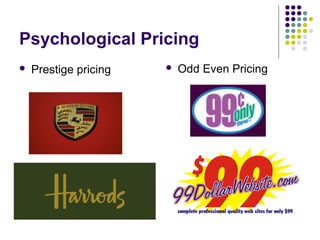
Psychological Pricing
   Prestige pricing      Odd Even Pricing
Demand Pricing
 Price   varies based on some demand criteria


 As  your output increases/decreases your
  prices change.
 Can confuse customers
Competitive Pricing
 Matching or beating the
 market price
Bundle Pricing
 Discounts offered to entice client to accept a
  bundle rather than one part only.
 Example
     Product X             £3,500
     Product Y             £4,500
     Product Z             £7,500
     Total                 £15,500
     Bundle Price          £14,500
         Discount of       £1,000 or 6.5%
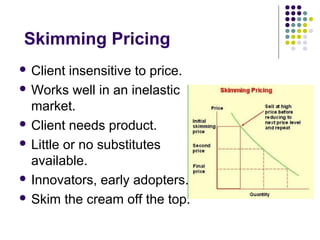
Skimming Pricing
 Client  insensitive to price.
 Works well in an inelastic
  market.
 Client needs product.

 Little or no substitutes
  available.
 Innovators, early adopters.

 Skim the cream off the top.
Markdowns
 Temporary
    Finite life- Offer closes 31/10/08
    Can be used to test the market
 Permanent
    Often used to get rid of old stock or perishables
     approaching end of shelf life
    Fire sale and soiled goods
 Seasonal
    Fashions, clothing gardening etc
Payment and Delivery Terms
 Considered  part of the pricing mix.
 Cost for payment terms borne by supplier of
  purchaser depending on terms agreed.
 Do not forget to take into account credit terms
  and risk when pricing.
Pricing Decisions
   Understand how much it costs to produce or procure
    a product/service.
   Ensure that general overhead has been taken into
    account when setting pricing.
   Research the typical market price for your product
    and service and pitch accordingly.
   Understand your position in the market.
       High end value, cheap and cheerful or somewhere in
        between.
       Set your price level, and review on going.

Pricing strategies

  • 1.
    Choosing the right pricing strategy Peter Ramsden Paramount Learning Ltd
  • 2.
    Outline  Importance of Price  Factors affecting Price  Pricing Strategies  Price demand curves
  • 3.
    What must Iconsider before setting price? 1. Know how much it costs to make and deliver product or service. Direct and Indirect costs. Fixed and Variable costs. 2. Know your breakeven point 3. Research current prices in the market. 4. Consider your market positioning and competitive advantage as this is likely to impact directly on your choice of pricing strategy.
  • 4.
    Importance of Price Choosing the right pricing strategy strengthens the chance of achieving turnover and profit in line with company objectives.
  • 5.
    Importance of Price Getting it wrong can be painful!
  • 6.
    Importance of Price  First impressions  Often price creates a first impression of the quality of the product/service and other value based judgements come later.  Pricing low can signify cheap and cheerful, pricing high can indicate quality? £5600 £65
  • 8.
    Price Elasticity ofDemand  Elastic Demand –  Products are considered to exist in a market that exhibits elastic demand when a certain percentage change in price results in a larger and opposite percentage change in demand.  For example, if the price of a product increases by 10%, the demand for the product is likely to decline by greater than 10%.  Inelastic Demand –  Products are considered to exist in an inelastic market when a certain percentage change in price results in a smaller and opposite percentage change in demand.  For example, if the price of a product increases by 10%, the demand for the product is likely to decline by less than 10%.  Elasticity of demand (PED) = % change in demand of good X / % change in price of good X  If the PED is greater than one, the good is price elastic. Demand is responsive to a change in price. If for example a 15% fall in price leads to a 30% increase in quantity demanded, the price elasticity = 2.  If the PED is less than one, the good is inelastic. Demand is not very responsive to changes in price. If for example a 20% increase in price leads to a 5% fall in quantity demanded, the price elasticity = 0.25
  • 10.
    Prices usually start high and decline as the product reaches maturity  Difficult to start prices low and subsequently increase prices later
  • 11.
    The Elements ofCost 1. Direct Materials (Used in the manufacture of 2. Direct Labour the good or service) 3. Direct Expenses Prime or Product Cost 1. Production Overhead Production Cost 1. Research and Development Cost 2. Marketing and Distribution 3. General Administration Total Cost
  • 12.
    Break Even Analysis SALES2 SALES1 £ VARIABLE COSTS FIXED COSTS TIME
  • 13.
    Break Even Formulas Profit= Sales – Expenditure  Sales - variable costs = Contribution margin  Contribution margin - Fixed Costs = Profit  Break even = Fixed Costs/Contribution per unit.  (Fixed cost + Required Profit)/Contribution per unit = units required to make profit.
  • 14.
    Break Even Calcs Break even = Fixed Costs Contribution per unit  Item sold for £3000 with a variable cost of £1500 = Contribution of £1500  Fixed costs of £100,000 means that 66.6 units need to be sold at £3000 before the business breaks even.
  • 15.
    Pricing Strategies  Market pricing  Competitive Pricing  Cost pricing  Below market  Mark up  Parity or Price Matching  Margin generation  Bundle  Breakeven  Skimming  Loss leader  Markdowns  Psychological pricing  Temporary  Prestige  Permanent  Odd even pricing  Payment and delivery  Demand terms
  • 16.
    Market Pricing  Setprices at or around the middle of the market  Fight on other added value areas such as delivery, customer service etc
  • 17.
    Cost Plus Pricing  Cost Plus Pricing  Cost of materials  Cost of labour  Add an amount for profit  Does not take into account general overhead costs  Beware of making loss due to hidden overhead
  • 18.
    Loss Leader  Pricing a product below cost to attract customers to higher margin products
  • 19.
    Psychological Pricing  Prestige pricing  Odd Even Pricing
  • 20.
    Demand Pricing  Price varies based on some demand criteria  As your output increases/decreases your prices change.  Can confuse customers
  • 21.
    Competitive Pricing  Matchingor beating the market price
  • 22.
    Bundle Pricing  Discountsoffered to entice client to accept a bundle rather than one part only.  Example  Product X £3,500  Product Y £4,500  Product Z £7,500  Total £15,500  Bundle Price £14,500  Discount of £1,000 or 6.5%
  • 23.
    Skimming Pricing  Client insensitive to price.  Works well in an inelastic market.  Client needs product.  Little or no substitutes available.  Innovators, early adopters.  Skim the cream off the top.
  • 24.
    Markdowns  Temporary  Finite life- Offer closes 31/10/08  Can be used to test the market  Permanent  Often used to get rid of old stock or perishables approaching end of shelf life  Fire sale and soiled goods  Seasonal  Fashions, clothing gardening etc
  • 25.
    Payment and DeliveryTerms  Considered part of the pricing mix.  Cost for payment terms borne by supplier of purchaser depending on terms agreed.  Do not forget to take into account credit terms and risk when pricing.
  • 26.
    Pricing Decisions  Understand how much it costs to produce or procure a product/service.  Ensure that general overhead has been taken into account when setting pricing.  Research the typical market price for your product and service and pitch accordingly.  Understand your position in the market.  High end value, cheap and cheerful or somewhere in between.  Set your price level, and review on going.